

Submitted:
05 October 2024
Posted:
07 October 2024
You are already at the latest version
Abstract
This article takes the representative uncultivated riverfront internet-famous sites (the uncultivated RIFSs) in Changsha city, China as an example, to explore the internal mechanism of its formation, and finds out that they are closely related to "urban subculture" and "informality of urban public space". In terms of methodology, through questionnaire surveys and in-depth interviews, this study investigates the behavioral characteristics of on-site visitors, overall perceptions and satisfaction of public spaces, and perceptions of spatial and humanistic elements of visitors. It also compares the online-offline differences of the spatial perceptions on the uncultivated RIFSs between this study and previous research, that is, instead of focus on the urban physical spaces, the online social media users pay more attention to their self-presentation. Meanwhile, the visitors place greater emphasis on the functionality, practicality, and experiential activities of the urban physical spaces. Finally, this article proposes the optimization strategies for the uncultivated RIFSs from two aspects: planning and governance, and public space design. Firstly, it is necessary to protect this special type of spaces, avoiding the binary opposition between "formal spaces" and "informal spaces”, achieving a gradual integration of "subculture spaces" and "mainstream culture spaces", and highlighting the city's inclusiveness. Secondly, human-centric space design should be demonstrated, that is, paying practical attention to people's diverse lifestyles and value needs, strengthening the composite utilization of riverside spaces to enhance diverse vitality.
Keywords:
the uncultivated riverfront internet-famous sites (the uncultivated RIFSs)
; riverfront public spaces
; informal public spaces
; sub-cultural spaces
; on-site visitors’ behaviors
; spatial factors
; humanistic factors
; perception of public spaces
; Changsha
; China
1. Introduction
Urban public spaces have been increasingly popular because of the widespread use of social media platforms [1]. In recent years, annual "Internet-celebrity city" rankings [2]and internal "Internet-famous Sites" selection activities [3] have frequently appeared on major social media platforms and even government websites in China. For example, Beijing government website initiated the establishment of the Beijing Internet-famous Sites Alliance including 18 Beijing internet-famous sites. What’s more, the relevant person in charge of the Beijing Municipal Bureau of Culture and Tourism held the "2020 Beijing Internet-famous Sites Selection" [4]. Another example was the selection of "2023 Top 100 Internet-famous Sites in Sichuan Province" organized by Tiktok, Kwai and other folk social platforms [5]. The Internet-famous Sites in various cities in China have been showing a diversified trend, covering multiple aspects such as urban cultures, scenic spot tourism and restaurant explorations. And social media platforms have widely showcased the lifestyles of netizens and their insights into the urban spatial environments, leading to the improvement of urban physical spaces [6]. Specifically, people took visits to internet-famous sites according to the recommendations in social media data, and uploaded their feedback according to their own personal feelings, expressing their likes and praises of urban physical spaces online, which could promote urban innovation continuously, as well as network popularity of urban spaces.
In this situation, the concept of human-centric space design is increasingly valued in the promotion of quality of the urban life and urban vitality. In China, scholar Long Ying has defined “human scale urban form” as the urban form that people can see, touch, and feel [7]. The urban riverfront public space is a representative public space of the city and also a gathering area for urban internet-famous sites. The perspective of social media users in promoting and evaluating urban riverfront spaces is highly beneficial for urban managers to conduct humanistic urban design and decision-making. Based on the visual focus and emotional preferences of online social media users, Huang et al. conducted a preliminary classification study on riverfront internet-famous sites (RIFS) in the internet-celebrity city Changsha. Moreover, riverfront internet-famous sites were divided into five categories: commercial RIFS, art exhibitional RIFS, historical and cultural RIFS, ecological recreational RIFS, and the uncultivated RIFS. Among them, the uncultivated RIFSs are different from the other four categories, that is, other four categories have specialized investments and operations from commercial capital or government, which have certain standardization and safety guarantee in daily operations. Differently, there is no standardized development and operation of the uncultivated RIFSs, and most of them remain in a weakly managed state. They often locate in remote or isolated geographical locations [8]. Notably, this type of RIFS can easily reflect the inner perception of the people towards urban public spaces, and is a representative space for humanistic urban "spatial reproduction".
The research aim is to continue the research based on the above study of Huang et al, especially focusing on the uncultivated RIFSs. From the perspective of on-site visitors, this study explores human behaviors and perceptions of this type of space, comparing it with the perceptions of social media users online, in order to provide the optimization and improvement strategies for riverside public space in the future.
2. Literature Review
2.1. Human-Centric Riverfront Public Space
This type of riverfront public space research often focuses on human activities. From the perspective of built environment, the environmental quality of riverfront public spaces often determines the types of human activities. Yang et al. have elaborated on the connotation of waterfront lingering activities, that is, lingering activities are behaviors such as slowing down, staying, and socializing based on visitors' preferences on the waterfront environment. Moreover, Yang et al. took Shanghai Xuhui riverfront and Pudong riverfront as examples, using behavioral mapping methods to explore the impact of four representative spatial elements, including base, shoreline, facilities, and functions, on waterfront resident activities [9]. Liao et al. used the analytic hierarchy process to construct an evaluation framework, evaluating the comprehensive quality of public green space recreational facilities in the central section of the Huangpu riverfront from three levels: the coordination between facilities and spatial environment, artistic and cultural aspects, and functionality of facilities, in order to propose optimization strategies [10].
From the perspective of people's perception of the built environment, Liu et al. analyzed the correlation between age diversity and riverfront environmental elements using the core section of Huangpu riverside public space in Shanghai as a case study. They believed that shoreline exposure, walking experience, surrounding environmental facilities, residential population density and traffic accessibility were the main factors affecting user diversity. What’s more, users in different age groups had different concerns [11]. Wang et al. studied the preferences and attitudes of citizens towards urban waterfront space based on built environment factors such as landscape, public services, main facilities, supporting facilities, and road functions, using the development of Qiantang Riverside as an example [12]. Based on the Scenic Beauty Estimation Method and Semantic Differential Method, Sun et al. conducted a visual quality evaluation of the waterfront and green belt trails, using 22 built environment landscape factors as representatives to study the relationship between visual quality and the landscape characteristics of Shenyang waterfront linear park [13]. Liang et al. conducted research on the satisfaction of pedestrian environment in urban waterfront spaces based on the Kano IPA method. Using the Kano model analysis, they identified the demand of various functional elements that affect the satisfaction of pedestrian environment in riverfront spaces, and used the IPA method to analyze people's psychological expectations (importance) and current perception (satisfaction) of various functional elements of waterfront pedestrian environment [14].
However, with the popularization of social media platforms, people's perception and evaluation methods of waterfront space is more diversified. What’s more, the evaluation subjects have also expanded from scholars, urban planning managers to the audiences. Therefore, previous studies have established relatively traditional elements and systems for evaluating waterfront environments, without taking into account new trends such as internet-famous phenomena. Based on this, this study adds elements with internet-famous characteristics to the traditional riverfront environment elements for research.
2.2. Urban Internet-Famous Sites Based on Users’ Perspective
Some research on urban internet-famous sites were partly based on the images and text data of social media, that is, the research on the perception of online users. For example, Lv conducted a study on the landscape visual elements, social behaviors, and emotional preferences of netizens in different types of "internet famous streets" in Shanghai based on online user data from the Xiaohongshu platform [15]. Chen studied the types, spatial elements, human activities and cultural characteristics of internet-famous sites in Chengdu based on the Tiktok platform [16]. Other research was based on field surveys of existing internet-famous sites, using questionnaire interviews to explore the spatial perceptions of on-site visitors. For instance, Wang have conducted on-site check-in experiences at the Hangzhou internet-famous sites and interviewed other on-site visitors to observe the interrelationships between internet social media, human, and physical spaces [17]. Wen conducted a survey on the spatial experience and cultural perception of Yongqing Fang, a popular internet-famous site in Guangzhou. The survey questionnaires were conducted from four aspects: the basic information of visitors, basic understanding of the site, human behaviors, and environmental atmosphere [18]. Based on the questionnaire survey, Wei made a systematically understanding from visitors' views on internet-famous sites from the perspectives of social characteristics, understanding of geographic media, behavioral characteristics of visitors, overall environment and satisfaction of public spaces [19].
Theoretically, in Manuel Castells' book "The Rise of the Internet Society”: cyberspace was interpreted as "space of flows", while urban physical space was interpreted as "space of places". The relationship between cities and networks was inseparable, and it completely changed the spatio-temporal concept of human life [20]. However, the above research on internet-famous sites were only based on online or offline methods, lacking comparative studies on the online "flow space" and offline "place space" on the same internet-famous site. Besides, online social media users cannot all be equated with on-site visitors: firstly, some online social media users only learn about the internet-famous site through graphic and textual information, rather than visiting onsite. Secondly, some onsite visitors are not users of social media platforms, and their actual onsite experience are not known to online platforms. Based on this, this article selects the same site as Huang's previous research [8], the uncultivated riverfront internet-famous sites in Changsha city, to study the actual human behaviors and spatial perceptions of onsite visitors.
In the related studies, few research was found on the uncultivated internet-famous sites. The concept of the uncultivated internet-famous site was firstly proposed in Wang's research. The study only gave a fuzzy description of the uncultivated internet-famous sites: in the context of the COVID-19, domestic tourism and cross-border tourism have suffered negative impacts. In this situation, the travel group, mainly young people, begun to explore the niche and informal tourist attractions. With the support of internet-celebrity bloggers, the uncultivated internet-famous sites have emerged under the characteristics of "suitable for taking photos, easy to become famous attractions..."[17]. Afterwards, scholars such as Huang conducted pilot research on the uncultivated riverfront Internet-famous sites (the uncultivated RIFSs) in Changsha, using images and text data from the social media platform Xiaohongshu, they identified seven representative uncultivated RIFSs [8]. However, the above studies did not conduct in-depth research on the mechanism of uncultivated internet-famous sites, which need to be intensively studied further.
2.3. Urban Subculture and Informal Urban Public Spaces
From the spatial perspective, the uncultivated RIFSs have some characteristics of “informal public spaces”. Meanwhile, from the culture perspective, the uncultivated RIFSs also include various sub-cultural attributes of cities.
From the perspective of urban space, Professor Long Yuan firstly proposed the concept of “informal public spaces” in his book "Informal Cities". He believed that “informal public spaces” are compared to the top-down formally constructed public spaces, referring to the spontaneous and bottom-up urban renovation by the audience, which based on the audiences’ internal needs. What’s more, such kinds of public spaces usually lacks of formal guidance or regulations by city governors [21]. Such public spaces are often vacant, surplus, marginal, abandoned, or underutilized urban infrastructure spaces. And the occupation, alteration, and utilization of such spaces by residents often make them become diverse and meaningful public spaces [22]. This type of spaces also belongs to urban environments that grow spontaneously and accidentally [23], having some unique lifestyles and urban morphology [24]. Informal public spaces have provided a means of livelihood for the lower classes of society. At the same time, informal public spaces also have a negative impact on urban spatial order, which may result in policy controversies and may receive attentions from academia circles. At present, research on urban informal public spaces mainly focuses on the "informal economy" and "informal settlements", such as slums, shantytowns, urban villages, open-air markets, street vendors, etc [25].
From the perspective of urban culture, the study of subcultures began with the Chicago School. In 1947, Milton Gordon firstly proposed the concept of "sub-culture" in his book “The Concept of the Subculture and its Application”. He believed that subcultures were seen as subdivisions of national cultures, which were cultural differences based on different social factors such as race, economy, religion, and region [26]. Urban subcultures are opposed to urban mainstream cultures, which are alternative niche cultures that often have unique values and concepts [27]. The focus of urban sub-culture is to pursue a certain degree of "freedom" and reflect certain “humanistic values” [28]. It is a supplement to the mainstream culture of the city, which can highlight the different individuals in the city. Meanwhile, in the continuous collision between subcultures and mainstream urban culture, subcultures are gradually merging with mainstream culture. At present, research on urban subcultures in China mainly focus on youth subcultures [29], subcultural consumption spaces [30], online subcultures [31], new immigrants' children’s subcultures [32], street performer subcultures [33], etc. This study will focus on analyzing the perceptions of on-site visitors on the uncultivated RIFSs, in order to propose optimization strategies for the planning and management strategies, public space design of the riverfront in Changsha city.
3. Methodology
3.1. Study Area
Changsha is the capital city of Hunan Province China, also a commercial center, a tourism destination, and a historical and cultural city. Changsha has also been famous for China's first "world-class media art capital" by UNESCO [34]. Starting from 2020, Changsha has consistently ranked among the top ten internet famous cities in China for several consecutive years [35] [36] [37]. Xiangjiang riverfront spaces in Changsha have highly concentrated areas of internet-famous sites. Within the scope of this study, the north-south direction takes Changsha belt expressway as the boundary. And the east-west direction takes a 500m buffer zone or adjacent main roads as the boundary with best visual and perceptual distance to the river. This study focuses on the uncultivated RIFSs identified by Huang et al. [8] in Changsha. The locations are shown in the following Figure 1:
The above uncultivated RIFSs are closely related to the promotion of ecologicalism in the new era, the diversification of social classes under the influence of urbanization, and the diversification of cultural and environmental aesthetics. The characteristics of the above uncultivated RIFSs are detailed in the Table 1 below.
3.2. Research Framework
The research framework is shown in the following Figure 2:
3.3. Questionnaire Design
Questionnaire surveys were down to collect the on-site visitors’ perception and evaluation of the uncultivated RIFSs along the Xiangjiang River. Referring to the questionnaire design of other types of internet-famous sites, methods for evaluating the publicness of public spaces, and the survey of online users' visual and emotional preferences of the uncultivated RIFSs, the framework of questionnaire interview of this study was developed (Table 2). And the complete questionnaire can be found on the Appendix A.
- Personal Characteristics:this is mainly from four aspects (age, gender, occupation and identity). The purpose of setting these questions is to understand the main social characteristics of the on-site visitors of the uncultivated RIFSs.
- Overall Perception of Space: this is mainly measured from three aspects: visitors’ familiarity of “Internet-famous Sites”, the overall cognition of the uncultivated RIFSs, and emotional preference of each uncultivated RIFS. Among them: visitors’ familiarity of “Internet-famous Sites” refers to know whether the field visitors have heard about the concept of "Internet-famous Sites" before, and whether they can identify "Internet-famous Sites"? The overall cognition of public space mainly refers to the five-dimensional model of public space index summarized by American scholar Vikas Mehta, namely meaningful activities, inclusiveness, pleasurability, safety and comfort [38], to analyze each uncultivated RIFS. Emotional preference of each uncultivated RIFS is measured by a 5-point Likert scale to measure the satisfaction of onsite visitors.
- Human Behaviors: this is the analysis of general behavior characteristics (purpose, frequency, and time period of the visit) and four main types of lingering activities (viewing stay, sports stay, leisure stay, social stay). As for the specific activities of the four types of lingerings, we mainly refer to Huang's research results [8] as multiple choice option settings, such as viewing stay (viewing, watching others, personal posing, taking photos, etc.), sports stay (walking, biking, paddle boarding, swimming, running, skateboarding, square dance, etc.), leisure stay (fishing, camping, walking dogs, treading on water, barbecue, listening to songs, walking babies, picnics, flying kites, reading, playing, singing, lying down, etc.), social stay (drinking tea, chatting, dating, stamping and punching cards, eating melon seeds, rolling strings, playing chess, etc.). In addition to the above options, open-answer options are also set for visitors to freely put forward other opinions.
- Perception of Spacial Elements: this is mainly measured from four aspects: the overall atmosphere, the physical space elements mostly concerned, the humanistic elements mostly concerned, and the dissatisfaction factors mostly concerned. The multiple-choice questions are set in this part. And the options mainly refer to the visual elements and emotional preferences of online users which were previously studied [8]. Besides, open-answer options are also set for visitors to freely put forward other opinions. This part is mainly to understand the overall impression, concerns and factors that need to be improved in the uncultivated RIFSs.
3.4. Data Collection
Data collection mainly included three categories: personal characteristics, human behaviors and riverfront spatial perception. Three days were selected for site investigations, with the time period from 9:00 to 21:00, including a working day (June 11, 2024)), a weekend (June 9, 2024) and a traditional holiday (Dragon Boat Festival on June 10). Notably, the numbers of visitors of uncultivated RIFSs were generally far lower than those in downtown areas. Therefore, the number of questionnaire interviews was less and 30 valid questionnaires were collected at each site. In the end, 210 valid questionnaires are collected totally. The data were collected and analyzed by SPSS software.
4. Results
4.1. Personal Characteristics of Onsite Visitors
In terms of gender, the number of male visitors is twice that of female, which is different from the official statistics of Xiaohongshu platform that 80% of online users are females [39]. In terms of age group, the proportion of young and middle-aged people aged 26-35 is more than one quarter, followed by the three age groups of 36-45, 18-25 and 46-60, with the proportion floating around 20%. Minors under the age of 18 and retirees over the age of 60 account for less than 10%. In terms of occupation, the highest proportion of office workers is more than 40%, followed by self-employed people (27.6%) and students (21%). Retirees account for the least (less than 10%). In terms of identity, the proportion of local tourists (41.4%) and nearby residents (45.7%) is near, while the proportion of foreign tourists is relatively low (12.9%). Detail Data are listed on Table 3 below:
4.2. Onsite Visitors' Understanding of the RIFSs
In terms of the onsite visitors’ overall understanding of RIFSs, the proportion of "not very familiar" is much higher than other options, accounting for 41.9%. Next are "relatively familiar" (21.9%), "not heard of" (16.2%), "fairly familiar" (13.8%), with only 6.2% of onsite visitors saying they are "very familiar" with RIFSs.
Regarding the ability to identify the site as a typical uncultivated RIFS, 59.53% of visiting tourists said they "didn't know" that the site is a typical uncultivated RIFS, which may be related to the characteristics of such type of RIFS. The uncultivated RIFSs usually have not been developed, operated, or officially promoted in a standardized manner, so that most people have not heard of it. Notably, the number of visitors who clearly "know" that the venue is a typical uncultivated RIFS is twice that of visitors who "vaguely know, but are not very clear". This may be due to the influence of social media platforms, where tourist’s “check-in” at these niche venues because of curiosity. In terms of seven uncultivated RIFS respectively, six uncultivated RIFS, where more than half of the visiting tourists stated that they were completely not know. Among them, more than 80% visitors at Bridge Cave (east of Jvzizhou bridge) and the Xiaoxiang Scenic Belt (west of Fuyuanlu Bridge) cannot recognize the site. Only Bridge Pier (East of Houzishi Bridge), over half of the respondents indicated that this place was very popular on the internet.
Overall, visitors are optimistic about whether online check-in can bring offline vitality: 44.29% of visitors stated that it can bring sustained vitality offline, while only 15.23% of the surveyed tourists showed a clear negative attitude. 39.04% of visitors expressed confusion, which is consistent with the previous results regarding the concept of internet-famous sites and the vague understanding of the uncultivated RIFSs. In terms of seven uncultivated RIFS respectively, more than 70% of the surveyed tourists stated that the waterfront platform (Fangyuanhui area) can have sustained offline vitality, which may be related to the location of the venue. This waterfront platform is backed by Fangyuanhui Shopping Center and is in the neighborhoods of the large-scale residential area of Xiangjiang Century City, with a high population density. Meanwhile, the site faces the office building complex of Hunan Financial Center across the river to the west, and the Hunan Binjiang Cultural Park across the Liuyang River to the south, providing excellent landscape views. Among the interviewed tourists at the Bridge Cave (East of Jvzizhou Bridge) and Bridge Pier (East of Houzishi Bridge, the numbers of “not sure” were the highest, exceeding half. These may be due to their uncertainty about whether the planning managers may remove these “internet-famous elements” on the site. What’s more, Xiaoxiang Scenic Belt (west of Fuyuanlu Bridge) has the highest proportion of negative views, with nearly one-third of the surveyed tourists stating that online popularity cannot bring vitality to offline visits. Interestingly, there is one interviewee who chose the option of "others" at each of the three locations: Bridge Pier (West of Houzishi Bridge), Hydrophilic trail (Zhuohua Semior High School Area), and Xiaoxiang Riverside Scenic Belt (West of Fuyuanlu Bridge), but they did not provide a clear reason.
Detailed data are listed on Table 4 below:
4.3. Time Distributions of On-Site Visitors’ Lingering Activities
In the overall frequency of visits (Figure 3a), the option "a few times" has the highest proportion (42.4%), followed by the option "often"(34.4%). The proportion of visitors who came for the first time and only came once is the lowest (23.3%). Specially, in terms of the relationship between visit frequency and human behaviors (Table C1): visitors who went for “leisure stay” chose the option of "often" the most frequently, reaching 26 person times. This may be related to the visitors, who have formed a habit of fishing activities at a fixed time and place. Therefore, they visit more frequently. What’s more, visitors who went for “sports stay” chose the option of "often" the most frequently as well, accounting for 57.14%. Most of these visitors are residents of the surrounding areas. And they have also regarded the site as a regular place for daily exercise. The visitors who said that "they came for the first time, but also only once" were mainly on viewing stay, reaching 24 person times. It may be related to the novelty of visitors' one-time visiting experience. Notably, the highest frequency (36) and the highest proportion of "have been here several times" are both in leisure stays, which may be due to the amount of visitors doing leisure stays is the largest, and the types of leisure stay are most diverse.
From the selection of visit dates (Figure 3b) and the relationship between personal characteristics and visit dates (Table C2): the proportion distribution of the three options is relatively close. The proportion of visitors who visit "at ordinary times" is the highest (38.6%), and the proportion of visitors who visit "at weekends" is relatively close (35.2%), which may be related to the fact that most visitors are composed of nearby residents and local tourists. The proportion of visitors who choose "holidays" is the lowest (26.2%), which is mainly because foreign tourists tend to visit on holidays. Specifically, visitors who "happen to pass by with no purpose" are mainly on the site of the bridge cave (Juzizhou bridge). These passengers commute frequently for work. Notably, some visitors who choose to visit "at ordinary times" are small vendors and sanitation personnel. Based on the fixed working place, they usually appear around the site. For visitors who stay in sports and leisure, the proportion of choosing "weekend" is the highest. Most of these people are nearby residents and local tourists, and they regard the site as an outdoor venue for weekend leisure, relaxation and exercise. For visitors who chose” social stay”, the proportion of visiting "at ordinary times" is also the highest. Most of these visitors are self-employed, so that the disposable time of these groups is relatively flexible and is not affected by fixed working commuting time like enterprise employees.
According to the time period of visits (Figure 3c), the proportion of visitors who choose "afternoon" or "evening" is relatively high, with 34.3% and 31.9% respectively. 22.9% of the visitors chose to visit in the “morning”, and the lowest proportion of visitors chose to visit at “night” (11%).
In the time length of stay (Figure 3d), the proportion of staying "1-2 hours" is much higher than that of other options, accounting for 31.9%. The percentage of other options are all between 10% and 20%, with little difference.
4.4. Overall Spatial Perception and Satisfaction of Onsite Visitors
According to overall spatial perception of onsite visitors based on five-dimensional model of public space index (Figure 4a),68 surveyed tourists expressed that they are most concerned about being able to engage in “meaningful activities” (32.4%), followed by the demand for “comfort” with 52 votes (24.8%), “safety” with 44 votes (21%), and “pleasurability” with 40 votes (19%). The minimum number of people selected for the option of "inclusiveness" is only 6, accounting for 2.9%.
Meanwhile, the overall satisfaction results of onsite visitors showed a positive attitude (Figure 4b): more than half of the interviewees chose to be relatively satisfied (38.00%) or very satisfied (17.33%), 30.95% of the respondents were neutral, and less than 10% of the visitors had a negative attitude (the proportion of relatively satisfied and very dissatisfied were 9.33% and 4.38%, respectively).
From the perspective of sub indicators (Figure 5), inclusiveness and pleasurability are the two most satisfactory factors for visitors, while safety is the most worrying factor for visitors. (1) In terms of "being able to carry out meaningful activities", the proportions of "relatively satisfied" and "so so" are very close, both of which are about 35%. Notably, this is the public space feature that visitors are most concerned about, which indicates that it still needs to be improved in the future. (2)"Inclusiveness" is the one with the highest satisfaction degree and the lowest dissatisfaction degree among the five spatial characteristics, with more than three quarters of positive comments and less than 4% of negative comments. (3) The result of "pleasurability" is similar to that of "inclusiveness", with the highest proportion of "relatively satisfied" and similar to "very satisfied" and "so so" options. (4) In terms of "safety", the answers of "very satisfied" and "relatively satisfied" accounted for the lowest proportion among the five dimensions, while the answers of "less satisfied" and "very dissatisfied" accounted for the highest, which proved that this option is surely an urgent factor to be improved. (5) In "comfort", the proportions of "relatively satisfied" and "so so" evaluation are more than 30%, and the proportions of "very satisfied" and "less satisfied" are close, both about 10%.
4.5. Correlation Analysis Between the Lingerings Activities and Satisfaction with Public Space Characteristics
In terms of the different types of lingering activities (Figure 6): the highest proportion is leisure stay (35.7%), mainly including fishing (32 person times), trampling water (11 person times), camping (6 person times), baby walking (6 person times) and lying down for rest (10 person times). Viewing stops accounted for 21.9%, mainly including personal posing (19 person times), viewing scenery (10 person times), watching others (19 person times) and taking photos (6 person times). Sports stay accounted for 16.7%, mainly walking (13 person times), swimming (11 person times) and cycling (7 person times). Social stay accounted for 11%, mainly chatting (8 person times), drinking tea (6 person times) and playing chess (4 person times). In addition, 9.5% (20 people) happened to pass by without purpose, and other situations accounted for 5.2%, mainly due to the business behavior of vendors, and sanitation workers here.
This article uses SPSS software to study the correlation between different forms of lingering activities and satisfaction of the five dimensions of public space perception through correlation analysis. The scoring rules are as follows: set 1 for a certain stay activity and 0 for a certain activity not performed. Satisfaction with meaningful activities, inclusiveness, pleasurability, safety and comfort (“very satisfied” set as 1, “relatively satisfied” set as 2, “so so” set as 3, “less satisfied” set as 4, “very dissatisfied” set as 5).
The results of correlation analysis are as follows:(1) In sports stay, walking (-0.178**) and cycling (-0.202**) have a significant positive correlation with the satisfaction of the "safety". Swimming has a weak correlation with the satisfaction of "being able to carry out meaningful activities" (-.141*), and a strong positive correlation with the satisfaction of "comfort"(-.182**). (2) In leisure stay, fishing in leisure stay is weakly and positively correlated with the satisfaction of "being able to carry out meaningful activities"(-.190**). Visitors of "walking babies" are weakly and positively correlated with the "inclusiveness"(-.173*). And visitors of "lying down and rest" are weakly and positively correlated with the satisfaction of the "comfort"(-.156*). (3) In social stay, "chatting" is weakly negatively correlated with satisfaction with "being able to carry out meaningful activities"(.151*) and "pleasurability"(.159*). Visitors who play chess have a weak negative correlation with the “inclusiveness” (-.136*), "pleasurability"(-.173*) and “safety” (-.152*).
Overall, "being able to carry out meaningful activities", "safety" and "comfort" have a great relationship with the choice of visitors' staying activities, which is consistent with the previous analysis results. Detailed data are listed on Table 5 below:
4.6. Perceptions of the Different Types of the Uncultivated RIFS
According to the statistics of questionnaire results and key interview records (Appendix B), detailed perceptions of different types of the Uncultivated RIFS can be found in the following paragraphs.
4.6.1. Informal Consumption Space Related to Nighttime Cultural Tourism
The waterfront platform in Fangyuanhui area, is an informal consumption space related to nighttime cultural tourism. According to questionnaire statistics and key interview results: 66.7% of tourists choose to visit the site in the evening or at night. This may be related to the lighting and beautification effect of the neon lights on the surface of the buildings (the urban commercial landmark Hunan Financial Center office building groups) on the opposite bank. The main form of activity for visitors is leisure stay (43.33%), followed by viewing stay (23.33%) and social stay (20%), with sports stay accounting for the least proportion (13.33%). Visitors are most concerned about the "pleasurability" and "comfort" of the site, and their evaluations of both are relatively positive. In the overall atmosphere, the “coastline (including the island and the opposite bank)”, “other tourists” and “time & season” are the top three concerned factors by onsite visitors. The “wide vision of riverside”, the “natural environment of the shoreline” and the “hydrophilicity of the space” are the most concerned spatial factors for visitors. Meanwhile, the “experiential activities and personal posing”, “watching others”, “food and camping” are the most concerned humanistic factors for visitors. The vendors spontaneously arranged tea seats and reclining chairs inside the venue to form a simple and cheap informal consumption space for tourists to enjoy the scenery. Notably, visitors' dissatisfaction with the venue is mainly reflected in the lack of actual function of the space, which only focuses on visual effects; And the public facilities of the site are inadequate.
4.6.2. Informal Photography Space Related to Microclimate Comfort
Riverfront sidewalk near the west of Yinpenling bridge is an informal photography space related to microclimate comfort. The site became internet-famous because of some famous wedding photos taken here. According to questionnaire statistics and key interview results: More than half of the visitors stayed at leisure (56.67%), mainly fishermen and citizens resting on the stone steps. The proportion of social stay (13.33%), viewing stay (13.33%), happen to pass by (10.00%) and sports stay (6.67%) is far lower than that of leisure stay. What visitors most care about is that the venue "can carry out meaningful activities" and "comfort". This is consistent with the description of "the site has good microclimate comfort in summer, belonging to the wind corridor space near the river, which has good shading effect under the bridge". In the overall atmosphere, “waterfront topography”, “time and season”, and “plants”are the top three concerned elements. What’s more, “shoreline”, “spatial hydrophilicity” and “spatial accessibility” are the spatial factors most concerned by visitors. “Experiential activities and personal posing”, “watching others”, “food and camping” are the most concerned humanistic factors for visitors. Visitors' dissatisfaction with the site mainly focused on the poor safety and sanitation conditions of the site and the inadequate facilities.
4.6.3. Irregular Water Playing Space with Potential Safety Hazards
The hydrophilic trail in Zhuohua semior high school area is an irregular water playing space with potential safety hazards.The original function of the hydrophilic trail was to provide visitors with walking, viewing etc. Because the trail was not installed with protective railings, it has become a "platform" for many visitors to dive and swim, and has also become an informal water playing space with potential safety hazards. According to questionnaire statistics and key interview results: leisure stays (43.33%) and viewing stay (36.67%) were the main forms of stay, while sports stay accounted for only (10%), and social stay and other forms accounted for less. Among them, leisure and viewing stay is mainly walking on the trail or taking pictures. Although the proportion of sports stay is relatively small, but the tourists who dive and swim are repeatedly forbidden. Visitors are most concerned about the "ability to carry out meaningful activities" and "safety" of the venue. They are more positive about the "ability to carry out meaningful activities" meanwhile more worried about the "safety". Relevant administrative departments of the government issued announcements to solicit public opinions on whether it is necessary to remove the whole trail to eliminate potential safety hazards such as drowning. Notably, in the overall atmosphere, waterfront topography, coastline (including island and the opposite bank) and waterfront structures and facilities are the top three concerned elements. Among the spatial elements, more attention has been paid to the wide vision of riverside, the skyline of the opposite city and the hydrophilicity of space. The space atmosphere of dreamy feeling & film feeling, experiential activities & personal posing are the most concerned humanistic factors of visitors. Visitors' dissatisfaction with the site is mainly reflected in the following aspects: inadequate facilities, poor site safety and sanitation conditions, lack of actual connotation and function of the space, which is consistent with the "security" concerns derived from the above analysis.
4.6.4. New Immigrants' Subculture Related Urban Pastoral Spaces
Xiaoxiang riverside scenic belt in the west of Fuyuanlu bridge is a new immigrants' subculture related urban pastoral spaces. According to questionnaire statistics and key interview results: Sports stay (40%) and leisure stay (36.67%) were the main forms of activities, while viewing stay accounted for only (10%). Visitors here have paid almost the same attention to the site's ability to carry out meaningful activities, pleasure, safety and comfort. Contrary to the negative evaluation of "comfort", the evaluation of other dimensions of public space is relatively positive. In the overall atmosphere, the top three concerned elements are waterfront topography, coastline (including island and the opposite bank), meteorology and climate characteristics. Among the spatial elements, more attention has been paid to the natural environment of the shoreline, the hydrophilicity of the space and the wide vision of the riverside. Experiential activities and personal posing, watching others, and dreamy atmosphere are the humanistic factors that visitors pay most attention to. Visitors' dissatisfaction with the site is mainly reflected in inadequate facilities, weak space accessibility, and poor site safety and sanitation conditions, which is consistent with the poor "comfort" comments above. Notably, this may be due to the fact that as the "second generation of immigrants" from the countryside to the city, social media users have witnessed the scene of cattle and sheep eating grass by the water in the city area, which recalled the precious memories of their childhood rural life. As a result, they fully immersed themselves into the "urban pastoral “atmosphere, neglecting the sanitation problems of the site. However, some of the onsite visitors are urban residents, who are familiar with the clean, orderly and hygienic space environment of the city. They queried about the "mosquito bites, cattle and sheep feces" and other environmental conditions, which to some extent reflects the differences in people's tolerance for environmental quality, sanitary conditions and cultural aesthetics caused by the diversity of social classes.
4.6.5. Informal Residential and Commercial Space Under the Bridge
The bridge cave in the east of Jvzizhou bridge, is an informal residential and commercial space under the bridge. The site is near the CBD of the city center, with high pedestrian density. According to questionnaire statistics and key interview results: more than half of the people are passengers (53.33%). And the proportion of viewing stay and leisure stay is relatively low, both of which are 6.67%. The leisure stay mainly refers to migrant workers who settled in the bridge cave without another place to live. What’s more, social stay accounts for 16.67%, and they are mainly some cheap haircuts, vendors, small businesses and other low-income people who stayed here for consumption. Other forms of activities accounted for 16.67%, mainly sanitation workers working in this area. Visitors are most concerned about the "safety", "comfort" and "being able to carry out meaningful activities" of the site. It is worth noting that although "inclusiveness" is not the most important factor for visitors with the highest satisfaction. While the satisfaction with the "safety" and "pleasure" of the site is low, which is mainly related to traffic safety and social instability factors caused by homeless people. In the overall atmosphere, other tourists, time and season, and waterfront structures and facilities are the top three elements.Among the spatial elements, spatial accessibility and weather conditions have received more attention. What’s more, many visitors added that the traffic conditions of the site and the location of vendors are also the important factors they are more concerned about. Among the humanistic elements, "shelter for vulnerable groups" and "watching others" have attracted much attention. In addition to the existing options, some visitors also questioned "whether there are urban management people who may disperse homeless people and street vendors? “Visitors' dissatisfaction with the site is mainly reflected in the poor safety and sanitation conditions of the site, inadequate facilities and poor surrounding environment, which is consistent with the fact that the site has an obvious phenomenon of diversity and hybridity of social strata, making the bridge space messy and dirty.
4.6.6. Youth Subculture Space (Graffiti) Under the Bridge
The bridge pier in the east of Houzishi bridge is a youth subculture space. Street artists and other creative talents created graffiti on the piers. And then, some netizens came here to take photos and uploaded on the social media platforms, which became popular online. According to questionnaire statistics and key interview results: viewing stay (36.67%), leisure stay (33.33%) and sports stay (20.00%) accounted for a relatively high proportion, mainly graffiti, fishing, swimming and other activities. Except that "inclusiveness" is rarely mentioned, visitors are more concerned about the "ability to carry out meaningful activities", "comfort", "safety" and "pleasure" of the venue. Among them, visitors are most satisfied with the "pleasure" of the site but less satisfied with the "safety", which may be related to the potential safety hazards of illegal swimming near the bridge piers. In the overall atmosphere, the coastline (including the island and the opposite bank), waterfront structures and facilities and waterfront topography are the top three concerned elements. Among the spatial elements, more attention has been paid to the landscape across the river, the hydrophilicity of the space, the wide vision of the riverside, and the natural environment along the coastline. Among the concerns of humanistic elements, graffiti, watching others, experiential activities and personal posing have attracted much attention.
Visitors' dissatisfaction with the site is mainly reflected in the poor safety and sanitation conditions of the site, inadequate facilities, weak space accessibility, and inconvenient transportation. This may be related to the fact that the site is adjacent to the riverside expressway,and the entrance is blocked by railings. As a result, people have to climb over the railings and go down the stairs to enter the site. At the same time, some visitors said that relevant government departments believed that graffiti was an act that harmful to the appearance of the city, so that they began to remove some graffiti. Therefore, some visitors have expressed regret for the damage of graffiti.
4.6.7. Youth Subculture Space (Film Imitations) Under the Bridge
The imitations and replications of scenes in some famous films have become a typical form of expression for youth subcultures. Due to the shape of the rows of piers which are similar to the mega structure in the surrealistic urban scene in the film “inception”, the site which locates in the west of Houzishi bridge has become famous. According to questionnaire statistics and key interview results:viewing stay (26.67%), sports stay (26.67%) and social stay (23.33%) accounted for the similar proportion. Leisure stay accounted for 16.67%, mainly including activities such as personal posing, swimming, fishing and chatting. Specially, some visitors are fortune tellers, who say that geomantic omen here is good and suitable for fortune telling and divination. In the perception of public spaces, visitors are most concerned about the ability to engage in meaningful activities, comfort, and pleasure. Among them, visitors have a relatively positive overall evaluation of the venue, with the highest satisfaction towards "inclusiveness" and "comfort", and hardly any negative evaluations.
In the overall atmosphere, waterfront structures and facilities, other tourists, time and season are the top three concerned factors. Among them, the waterfront structures and facilities are the river crossing bridge piers that give the "film sense" mentioned by the visitors. Among the concerns of humanistic elements, "experiential activities and personal posing", "watching others", "the space atmosphere of film, fantasy and mystery" has attracted much attention. Visitors' dissatisfaction with the site is mainly reflected in the poor safety and sanitation conditions of the site and inadequate facilities.
5. Discussion
5.1. Comparison of Onsite Visitors and Social Media Users’ Perception on the Uncultivated RIFSs
Comparing the results of this study with Huang's previous study [8], this study has summarized the differences between onsite visitors and social media users’ perception on the Uncultivated RIFSs. Detailed information can be found on the Table C3.
- Human Behaviors: according to the social media data, the proportion of people who stay for viewing is the highest. In terms of field survey, the proportion of leisure stay is the highest in the onsite visitors. Specifically,online users' viewing stay is mainly for the "personal posing". They pay more attention to showcase themselves and highlight the "self-awareness", rather than the physical spaces. Meanwhile, the leisure stay of onsite visitors is mainly fishing, treading on water, camping and lying down for rest. Such leisure activities emphasize the functionality, practicability and experiential activities of the physical spaces. Besides, onsite visitors are more likely to engage in activities that can interact directly with water, such as swimming, treading on water, fishing, etc.
- Emotional Preference: according to the social media data, netizens' positive evaluation of the site is much higher than the neutral evaluation, and there is no negative evaluation. In terms of field survey, although the proportion of positive evaluation (very satisfied & relatively satisfied) is still the highest, the proportion of negative evaluation (less satisfied & very dissatisfied) is also more than 10%. From the perceptions of the five dimensions of public space, online netizens mainly value "being able to carry out meaningful activities", "pleasure" and "inclusiveness". While onsite visitors mainly focus on "being able to carry out meaningful activities", "safety" and "comfort". That is to say, onsite visitors are more concerned about the safety (Whether there are any safety facilities? Whether the social security of the site is good?) and comfort (Whether the public service facilities are adequate? Whether the sanitary conditions of the site are good? Whether the microclimate of the site is comfortable?) than online netizens. What’s more, online netizens care more about the pleasure (mainly based on the visual beauty) of the site than onsite visitors. These negative evaluations are also the directions for future improvements of the uncultivated RIFSs.
- Perceptions of Spatial Elements: in terms of the overall atmosphere shaping, online netizens and onsite visitors share similar attitudes. They all think that tourists, shoreline (including islands and the opposite bank), waterfront topography, waterfront facilities, time and seasonal characteristics are very important elements. In terms of spatial elements, online netizens pay more attention to long-distance landscapes such as river-crossing bridges, weather landscapes and city skyline on the opposite bank, while onsite visitors pay more attention to short-distance spatial factors such as spatial accessibility, natural environment and hydrophilicity of shorelines. In terms of humanistic elements, onsite visitors have more diverse focus. In addition to the protection of vulnerable groups, experiential activities and personal posing, they also pay more attention to diversified site experience activities.
It can be seen that, to have a more comprehensive and in-depth understanding of the Uncultivated RIFSs, field survey is essential and irresponsible, which can reflect the site problems more intuitively.
5.2. “. Life and Death” of the Uncultivated RIFSs
Traditional planning managers tend to interpret and manage urban space in a panoramic and group way, which pay little attention to individual emotions and experiences. The informal public space and subculture phenomena represented by the Uncultivated RIFSs can be seen as a mirror of urban cultural renewal. In other words, it is the subculture or informal space that people can reflect the deficiencies and criticize the problems in urban renewal.
- The graffiti on the bridge piers, and the film scene imitation behaviour near the bridge piers are typical youth subculture phenomena that are not limited to the mode of traditional elite culture, but to reconstruct popular culture from bottom to top in a grassroots manner [40]. As for graffiti, which is not a culture phenomenon widely recognized by public in China, only scattered in the corners of the city. The ambiguity of the graffiti writers' appeal also weakens its "legitimacy”, therefore losing the effective expression of the subculture [41]. On the one hand, urban managers should effectively select and reasonably guide graffiti subculture space, and strengthen the active integration between subculture and mainstream culture, rather than completely removed it. On the other hand, through social media’s propagation and urban space design, subculture spaces can be an effective way to display humanistic social value.
- As an informal consumption space, the waterfront platform near Fangyuanhui area is a typical space for the consumption degradation. The vendors set up and rented sling chairs at a low price here, attracting a large number of tourists for leisure and sightseeing. The cheap price here is in sharp contrast to the high-end commercial and financial space in the surroundings. This phenomenon reflects that, under the current prevalence of consumerism, there is still a subculture of anti-consumption. They reject irrational consumption and try to achieve self-satisfaction by limited costs [42]. Meanwhile, they pursue a kind of consumption mode which pay equal attention to individuality and practicality, quality and simplicity. Due to subculture landscape in the bustling city, visitors can get a feeling of relaxation and complacency [43].
- Urban rights are the collective rights and interests of urban residents, especially the vulnerable and marginalized groups [44]. Public space is the place where urban rights can be embodied and where "space justice" can be highlighted [45]. One example, the bridge cave on the east side of Juzizhou bridge is designed to be a transit traffic site for vehicles. Surprisingly, there exists some "informal" spaces, such as micro hairdressing space, homeless people's living space, small vendors' space at the edge of the site. Another example, the piers on the west side of Houzishi bridge were originally the tidal ebb zone of the Xiangjiang River. However, there exists some "informal" activities such as fortune telling, fishing, playing chess and cards. Notably, these informal residential and informal commercial spaces have provided shelters for urban low-income groups and cheap labor or services for urban development. They are diversified survival channels for urban low-income groups. They are real, disordered but full of vitality [29]. In short, a large number of urban informality phenomena grow spontaneously outside the formal system and planning management. Therefore, the governance of urban informality has become an extremely complex socio-economic and cultural issue nowadays
- Urban safety and urban vitality are crucial to improve the quality of Chinese cities. The Uncultivated RIFS has also provided a new thinking direction for the creation of urban vitality. The hydrophilic trail in Zhuohua senior high school area has become a venue for surrounding residents to play with water. The government and relevant administrative departments tried to remove the whole trail because of safety problems, while the surrounding residents protested against it. How to give full play to public participation and social responsibility in urban planning and achieve a win-win situation between the government and citizens? How to create an interesting urban space form under the premise of ensuring urban safety by introducing capital investment and standardized operation and management? How to enhance residents' local identity and create urban cultural space? These above are worthy of attention in the follow-up planning, management and design of the site.
5. Conclusions
This paper focuses on visitors’ behaviors and perceptions of spatial factors of the uncultivated internet-famous sites in urban riverfront public spaces, and makes comparisons with the spatial perception of online social media users in previous study. The main conclusions are as follows:
- There are more men than women in the field visitors, which is contrary to the gender difference of social media users in xiaohongshu platform. Most of the visitors cannot be able to identify a typical internet-famous site. Meanwhile, only a few visitors who can identify it may be affected by the social media platform. Nearly half of the visitors believed that online popularity could bring sustained vitality to the site, while nearly 40% of visitors said they were not clear about it, which is consistent with the above results that lots of people only have the vague cognition to the uncultivated internet-famous sites.
- People's overall attitude towards the uncultivated internet-famous sites are positive. The ability to carry out meaningful activities, comfort, and safety are of the greatest concern to onsite tourists. Among the human activities, leisure stay accounted for the highest proportion, followed by viewing stay, sports stay and social stay. In addition, there are a certain number of people and other situations who happen to pass by without purpose. In the overall frequency of visiting, "a few times" accounts for the highest proportion, and the proportion of visitors who choose "afternoon" and "evening" within a day is relatively high, which is related to the fact that onsite visitors are mainly from nearby tourists and local residents, and there are a certain proportion of freelancers. In the correlation analysis of visitors' perception of public space based on different resident activities, "being able to carry out meaningful activities", "safety" and "comfort" have a great relationship with the choice of visitor resident activities.
- In the perception of site elements by onsite visitors, the main focus of spatial elements and humanistic elements are different according to the different sites. However, visitors' dissatisfaction is mainly reflected in the poor site safety and sanitation conditions, inadequate facilities and poor surrounding environment. These negative evaluations are also the directions for future improvements of the uncultivated RIFSs.
- Social media users emphasize self-display rather than the venue itself. While the onsite visitors put more emphasis on the functional, practical and experiential activities of the venue. Netizens' positive evaluation of the venue is much higher than the neutral evaluation, with no negative evaluation. And although the proportion of positive evaluations of onsite visitors is still the highest, there are still a certain proportion of negative evaluations. In terms of spatial perceptions, online netizens pay more attention to long-distance river crossing landscapes such as the weather landscape and the city skyline on the opposite bank, while offline visitors place the primary position on short-range spatial elements such as spatial accessibility, natural environment and hydrophilicity of the shoreline.
The author believes that in addition to the perception of spatial elements, the uncultivated RIFSs have some characteristics of “informal public spaces”. Meanwhile, from the culture perspective, the uncultivated RIFSs also include various sub-cultural attributes of cities. Therefore, the paper puts forward the following optimization strategies for the uncultivated RIFSs, from the perspective of planning and governance as well as public space design.
- The planning and management of the uncultivated RIFSs should go beyond the binary opposition between "formal" and "informal”, and should achieve the gradual integration of "subculture" and "mainstream culture", as well as highlighting the diverse vitality of the city. What’s more, the existing uncultivated RIFS with some problems but also has improvement potential, should not simply be demolished and eliminated. Urban managers should have a more inclusive attitude to accept the diversified and differentiated urban subjects. Specifically, the government and its planning management departments should pay attention to the flexible management, as well as providing financial and technical support for this kind of spaces. By creating a relatively dynamic and loose environment, minimizing and limiting the negative impact and conflict caused by this kind of space, the rights and interests of vulnerable groups can be better protected. Moreover, more equal rights can be given to the vulnerable groups living and developing in such spaces, and social security levels can be improved as well.
- As a kind of potential spaces in the city, the uncultivated RIFSs should always be implemented the concept of "human-centric space design", and people's real lifestyle and diverse value needs should be focused on. What’s more, urban designers can integrate the space design of the uncultivated RIFSs into the whole urban planning system. Through the comprehensive understanding of the users’ perception of social media users and field visitors, we should firstly pay attention to the improvement of urban infrastructure and public service facilities, especially the safety facilities, therefore ensuring the comfort and sanitary conditions of the site. The second is to give full play to the advantages and characteristics of the riverside space, improving the accessibility and interaction of the waterfront, strengthening the boundaries between the shoreline and the water body, adding civilian and flexible functional facilities, as well as effectively bringing into play the multiple functional potential of the site. In addition, compound utilization of the uncultivated RIFSs can be down to enhance the vitality of diversity.
To sum up, based on the perspective of onsite visitors, this paper innovatively studies the emerging phenomenon of the uncultivated RIFSs, therefore expanding the observation perspective and connotation of the vitality of riverside public space. Moreover, it can also provide more specific and operable directions and suggestions for the improvement of different types of riverside environment in the future. However, this paper also has some limitations, one is the small sample size of the data, the other is the lack of corresponding measurement for the spatial scale. These problems can provide direction or ideas for future researchers.
Author Contributions
Conceptualization, Y.H. and B.Z.; methodology, Y.H.; software, Y.H.; validation, Y.H., B.Z. and R.G.; formal analysis, Y.H.; investigation, Y.H.; resources, B.Z.; data curation, B.Z.; writing—original draft preparation, Y.H.; writing—review and editing, B.Z.; visualization, Y.H.; supervision, B.Z.; project administration, R.G.; All authors have read and agreed to the published version of the manuscript.
Funding
This research received no external funding.
Data Availability Statement
Not applicable.
Acknowledgments
We thank Liu Junyou and Fan jia for kindly providing us some valuable suggestions for this article. And we also thank Ling (Net name), Zhexi (Net name), Zhangzhang (Net name), Lin Tongxue (Net name), Xiong Shi (Net name), Yue Jinzhao (Net name) for kindly providing and authorizing their pictures to our research team.
Conflicts of Interest
The authors declare no conflicts of interest.
Appendix A. The Questionnaire Survey on the Uncultivated RIFSs in Changsha
Hello! We are urban designers. And we are conducting a field survey on the urban design of the riverside public space in Changsha. We hope you can give us your opinions. Thank you very much!
-
Location:☐Waterfront Platform (Fangyuanhui Area) ☐Bridge Cave (East of Jvzizhou Bridge)☐Bridge Pier (East of Houzishi Bridge) ☐Bridge Pier (West of Houzishi Bridge)☐Hydrophilic Trail (Zhuohua Semior High School Area) ☐Xiaoxiang Riverside Scenic Belt (West of Fuyuanlu Bridge) ☐Riverfront Sidewalk (West of Yinpenling Bridge)
- Spatial Type:
☐Waterfront Platform ☐Hydrophilic trail ☐Space under Bridge
☐Hydrophilic Trail ☐Shoal
- Personal Characteristics:
①Gender? ☐Male ☐Female
②Age? ☐under 18 ☐18-25 ☐26-35 ☐35-45 ☐45-60 ☐over 60
③Occupation? ☐Student ☐Office Worker ☐Retiree ☐Self-employed
④Residence? ☐Nearby residents ☐Local tourists ☐Foreign tourists
- Overall Perception of Space:
①Have you heard of Changsha riverfront Internet-famous sites (RIFS)?
☐Very familiar ☐Fairly familiar ☐Relatively know ☐Not very familiar ☐Never heard of
②Do you know that this place is one of the riverfront Internet-famous sites (RIFS)?
☐Know ☐Not sure ☐Don’t know
③Does online popularity can bring about sustained offline visits?
☐Can ☐Cannot ☐Not sure ☐Others (indicate reasons) ____
④Are you satisfied with the feature that this site has "meaningful activities"?
☐Very satisfied ☐Relatively satisfied, ☐So so ☐Relatively dissatisfied,
☐Very unsatisfied (please add reasons) ____
⑤Are you satisfied with the "inclusiveness" of the site? (The site can accommodate various groups)
☐Very satisfied ☐Relatively satisfied, ☐So so ☐Relatively dissatisfied,
☐Very unsatisfied (please add reasons) ____
⑥Are you satisfied with the "pleasurability" of the site? (I feel happy when I come here)
☐Very satisfied ☐Relatively satisfied, ☐So so ☐Relatively dissatisfied,
☐Very unsatisfied (please add reasons) ____
⑦Are you satisfied with the " safety" of the site?
☐Very satisfied ☐Relatively satisfied, ☐So so ☐Relatively dissatisfied,
☐Very unsatisfied (please add reasons) ____
⑧Are you satisfied with the "comfort" of the site?
☐Very satisfied ☐Relatively satisfied, ☐So so ☐Relatively dissatisfied,
☐Very unsatisfied (please add reasons) ____
⑨What’s your most concerned factor of the site?
☐Meaningful activities ☐Inclusiveness ☐Pleasurability ☐Safety ☐Comfort
⑩Do you think online propagation can bring about offline vitality?
☐Can ☐Cannot ☐Not sure ☐Others (indicate reasons)____
- Human Behaviors:
①How often do you come here?
☐Once ☐A few times ☐Often
②When do you usually come here?
☐Holidays ☐Weekends ☐At ordinary times
③When do you usually come here within a day?
☐Morning ☐Afternoon ☐Evening ☐Night
④How long do you stay here?
☐0-0.5 hour ☐0.5-1.0 hour ☐1.0-2.0 hours ☐2.0-3.0 hours ☐more than 3 hours
⑤Why are you here?
☐No purpose, I happened to pass by.
☐Viewing stay (viewing, watching others, personal posing, taking photos, etc)
☐Sports stay (walking, cycling, paddle boarding, swimming, running, skateboarding, square dancing, etc)
☐Leisure stay (fishing, camping, walking dogs, treading water, barbecue, listening to songs, walking babies, having a picnic, flying kites, reading, playing, singing, lying down, etc)
☐Social stay (drinking tea, chatting, dating, stamping and punching cards, eating melon seeds, rolling strings, playing chess, doing business, etc)
☐Others (please add reasons) ____
- Perception of Spacial Elements (mainly visual elements):
①Which elements in this site are most important for shaping overall atmosphere? (Select 3 items)
☐Waterfront topography ☐Coastline (including island and the opposite bank) ☐Waterfront buildings ☐Waterfront structures & facilities ☐Time & season ☐Meteorological and climatic characteristics ☐Animals ☐Plants ☐Other visitors
②What are the spatial elements that you are most concerned about for this site? (Select 3 items)
☐Wide vision of the river (river scenery, waves) ☐Landscape across the river (cross-river bridge) ☐City skyline on the opposite bank (buildings and mountains on) ☐Shoreline natural environment (water features, flowers, flora and fauna) ☐Spatial hydrophilicity (hydrophilic platforms, shoals, hydrophilic paths) ☐Spatial accessibility (sidewalks, bike lanes, primary and secondary roads, squares) ☐Weather landscape (sunrise, sunset, dusk, clouds, breeze, etc.)) ☐Others____
③What are the humanistic elements that you are most concerned about for this site? (Select 3 items)
☐Shelters for vulnerable groups ☐Graffiti ☐Dreamy atmosphere ☐Cinematic atmosphere ☐Mysterious atmosphere ☐Experiential activities and personal posing ☐Viewing others (art performances, cultural activities, filming, etc) ☐ Food and camping ☐Others____
④What are the factors that make you dissatisfied with this site? (Select 3 items)
☐Space lacks practical function, only focusing on visual effect ☐The symbolization and homogenization of landscapes lack regional cultural characteristics ☐Poor safety and hygiene conditions ☐ The surrounding environment is not good ☐Inadequate supporting facilities (safety, public sanitation, retail, parking, etc.) ☐Weak spatial accessibility ☐Inconvenient transportation ☐Lack of public activity space ☐Inconsistent with the surrounding environment ☐Others_____
Appendix B. Key Interview Records
In order to gain a more comprehensive and in-depth understanding of the uncultivated RIFSs, this study has not only conducted data analysis on the questionnaire, but also conducted in-depth interviews with onsite visitors.
- Location 1: Bridge Cave (East of Jvzizhou Bridge)
Interviewee: barber auntie
Time: June 11, 2024 (weekday) 3:30 pm
"I'm a farmer in the suburb of Changsha. The bridge cave here can shelter from the wind and rain. And this place is near the city center with a large flow of people. So, I choose here to do haircuts every day. The homeless settle here to save money. Some are casual workers in the construction site, while others are melon farmers who come to the city to sell fruits and vegetables. They are all migrant workers which temporarily unable to find work or have no income...”
- Location 2: Bridge Pier (East of Houzishi Bridge)
Interviewee: swimmer
Time: June 9, 2024 (weekend) 10:00 am
"The entrance to the site is sealed by railings, because the government intended to prevent visitors from drowning. We are residents living nearby, so that we often climb over the railing to visit the site. Other tourists generally cannot find the entrance here. For security reasons, our neighbors take care of each other every time they come to swim together. In fact, it was a very popular site, and there were many well-painted graffiti on piers and dams. Young people often came to take photos and do personal posing. Two or three months ago, due to some unknown reasons, the government staff came and cleared some graffiti. It was a pity...”
- Location 3: Hydrophilic trail (Zhuohua Semior High School Area)
Interviewee: camping family
Time: June 10, 2024 (dragon boat festival) 13:30 pm
"We are the residents nearby. The children’s father works in other city, so we only have reunions on holidays here. There are no safety barriers on the hydrophilic trail, so it is dangerous for children to play alone on the shore. In the daytime of hot summer,there will not be many people here in the daytime. But at summer night, you can see many people on the hydrophilic trail jumping down to the river and swimming in the water. Because of the safety matters, the government is soliciting public opinions, and has not yet determined whether to remove the whole hydrophilic trail...”
- Location 4: Waterfront Platform (Fangyuanhui Area)
Interviewee: tourists from other provinces
Time: June 10, 2024 (dragon boat festival) 20:30 pm
"We are tourists from other provinces. We come to Changsha to see the Xiangjiang River. Sitting here at this small tea stand, we can only spend 15 yuan to get a seat, a cup of tea, a bowl of melon seeds, and to enjoy the invincible river view for one night. The riverfront scenery is all very beautiful. This is absolutely the best scenic spot here...”
- Location 5: Riverfront Sidewalk (West of Yinpenling Bridge)
Interviewee: fisherman
Time: June 11, 2024 (weekday) 11:00 am
"I didn't feel that this is a typical uncultivated RIFS. But it is especially comfortable for fishing in hot summer. For the shade under the bridge is very cool, and the river is windward. There are many fishermen here. There are also steps and seats under the bridge, which is very comfortable to take a nap when you are tired. But it's troublesome not to have a public toilet here..."
- Location 6: Xiaoxiang Riverside Scenic Belt (West of Fuyuanlu Bridge)
Interviewee: wedding photographer
Time: June 9, 2024 (weekend) 16:00 pm
"We are a local high-end wedding photography team. We accidentally found this site on Xiaohongshu platform. The big lawn and trees here are the perfect background, which is very suitable for our wedding photography. The site is lack of shadings and the sanitary environment is not good. There are many mosquitoes in the grass, with no garbage cans and toilets in the surroundings. What’s more, there are cattle and sheep feces in the grass, smelling awful..."
- Location 7: Bridge Pier (West of Houzishi Bridge)
Interviewee: fortune tellers
Time: June 10, 2024 (dragon boat festival) 14:00 pm
"I don't know what is riverfront Internet-famous Sites. I just think the Fengshui pattern under the bridge is good. Now the economic environment is getting worse. Therefore, more and more people come to me for fortune telling. I've received a lot of repeat customers. It's not convenient to set up a stall in other places now, or I'll be chased away by the urban management personnel. Although there are few people under the bridge, I feel relatively comfortable..."
Appendix C

Table C1.
Relationship Between Visit Frequency and Human Behaviors.
| No purpose | Viewing Stay | Sports Stay | Leisure Stay | Social Stay | Others | Total | |
|---|---|---|---|---|---|---|---|
| Once | 4 | 24 | 5 | 13 | 3 | 0 | 49 |
| A few times | 11 | 19 | 10 | 36 | 10 | 3 | 89 |
| Often | 5 | 3 | 20 | 26 | 10 | 8 | 72 |
| Total | 20 | 46 | 35 | 75 | 23 | 11 | 210 |
Table C2.
Relationship Between Personal Characteristics and Visit Dates.
| Nearby Residents | Local Tourists | Foreign Tourists | Total | |
|---|---|---|---|---|
| Holidays | 13 | 22 | 20 | 55 |
| Weekends | 20 | 50 | 4 | 74 |
| At ordinary times | 54 | 24 | 3 | 81 |
| Total | 87 | 96 | 27 | 210 |
Table C3.
Comparison of research results between onsite visitors and social media users’ on the uncultivated RIFSs in Changsha.
Table C3.
Comparison of research results between onsite visitors and social media users’ on the uncultivated RIFSs in Changsha.
| Comparing Factors | Data Sources (Frequency) | Basic Types(Frequency) |
|---|---|---|
| Human Behaviors | Social Media Platform (Total:142) |
Viewing Stay (total:63): personal posing (45), viewing others (9), taking wedding photos (9) |
| Sports Stay (total:29):walking (19), cycling (7), running (2), swimming (1) | ||
| Leisure Stay (total:36): fishing (17), baby walking (7), walking the dog (5), barbecue (2), performance (2), picnic (1), treading on the waves (1), resting (1) | ||
| Social Stay (total:14): drinking tea (7), eating melon seeds (4), chatting (3) | ||
| Field Survey (Total:210) |
Viewing Stay (total:46): personal posing(19), viewing others (11), viewing scenery(10), taking photos (6) | |
| Sports Stay (total:35): walking(13), swimming(11), cycling(7), skateboarding(3), running(1) | ||
| Leisure Stay (total:75): fishing (32), treading on the waves (11), lying down and rest(10), camping(6), baby walking(6), picnic(3), listening to music(2), picnic(2), reading(2), walking the dog (1) | ||
| Social Stay (total:23): chatting(8), drinking tea (6), playing chess (4), dating (2), eating melon seeds (1), eating kebabs (1), doing business (1) | ||
| Happen to pass by or other behaviors (total:31) | ||
| Emotional Preference |
Social Media Platform (Total:443) |
Positive(total:396): pleasurability(206), meaningful activities(139), inclusiveness(51) |
| Neutral or query(total:47): safety(3), comfort(29), convenience15 | ||
| Negative (total:0) | ||
| Field Survey (Total:1050) |
Positive(total:581): inclusiveness(159), pleasurability (129), comfort(108), meaningful activities(108), safety(77) | |
| Neutral(total:325): meaningful activities(74), comfort(69), safety(81), pleasurability (58), inclusiveness(43) | ||
| Negative(total:144): meaningful activities(28), comfort(33), safety(52), pleasurability (23), inclusiveness(8) | ||
| Spatial Perception |
Social Media Platform | Overall atmosphere shaping: other tourists (301), riverfront structures & facilities (152), meteorology and weather (134), coastline (including islands and the opposite bank) (127), buildings on the opposite bank (73), riverfront topography (59), time & season (44), animals (16), plants (13) |
| Spatial elements: meteorological landscape (134), urban skyline (78), cross-river bridge(71), wide vision of the river (45), natural environment along the coastline(59) | ||
| Humanistic elements: provide shelters for vulnerable groups (51), experiential activities and personal posing (45), cinematic atmosphere(20) | ||
| Field Survey | Overall atmosphere shaping: other tourists(91), coastline (including islands and the opposite bank) (87), riverfront topography (85), time & season (83), riverfront structures & facilities (81), meteorology and weather (70), plants (54), riverfront buildings(43), animals (36) | |
| Spatial elements: spatial accessibility (107), shoreline natural environment (101), spatial hydrophilicity (99), wide vision of riverside (83), meteorological landscape (77), river crossing landscape (64), urban skyline (61), others (37) | ||
| Humanistic elements: viewing others (135), experiential activities and personal posing(126), provide shelters for vulnerable groups(73), food and camping(68), dreamy atmosphere (55), cinematic atmosphere(49), mysterious atmosphere (49), graffiti (43), others(32) | ||
| Ps.Online social media data comes from literature[错误!未定义书签。] | ||
References
- Lv, F.; Wang, S. Research on the Measurement and Influencing Factors of Internet Celebrity Phenomenon in Urban Space. Urban Probl. 2023, 12, 50–59. [Google Scholar]
- The Beijing News “Internet Celebrity City” Potential Report (2024) Was Released. Available online: https://baijiahao.baidu.com/s?id=1796185349858989339&wfr=spider&for=pc (accessed on 13 April 2024).
- Beijing Internet-Famous Sites in 2022: Cultural Landscape. Available online: https://english.beijing.gov.cn/consuminginbeijing/onlyinbeijing/mustsee/updatesofmustsee/202304/t20230418_3058599.html (accessed on 18 April 2023).
- The Establishment of Beijing Internet-famous Sites Alliance. Available online: https://www.beijing.gov.cn/renwen/sy/whkb/202012/t20201231_2191071.html (accessed on 20 April 2024).
- Top 100 Internet-famous Sites in Sichuan Province. Available online: https://sc.cri.cn/2023-09-27/bc158732-a285-b17c-7cc0-a3ea77649592.html (accessed on 20 April 2024).
- He, L. Restructuring and Design of Urban Public Space Under Internet Environment. City. Plann. Rev. 2016, 9, 97–104. [Google Scholar] [CrossRef]
- Long, Y.; Ye, Y. Human-Scale Urban Form:Measurements,Performances,and Urban Planning & Design Interventions. South. Archit 2016, 05, 41–47. [Google Scholar]
- Huang, Y.; Zheng, B. Social Media Users’ Visual and Emotional Preferences of Internet-Famous Sites in Urban Riverfront Public Spaces: A Case Study in Changsha, China. Land 2024, 13, 930. [Google Scholar] [CrossRef]
- Yang, C.; Shao, B. Influence of Waterfront Public Space Elements on Lingering Vitality and Strategies: Taking Two Typical Waterfronts along Huangpu River, Shanghai as Examples. Urbanism.Archit. 2018, 5, 40–47. [Google Scholar]
- Liao, J.; Tang, M. Research on the Evaluation and Optimization Strategy on the Recreational Facilities in Public Green Space along the Central Section of Huangpu River in Shanghai. Chin. Landscape Archit. 2018, 9, 84–88. [Google Scholar]
- Liu, S.; Lai, S. Factors Influencing Users Diversity of Urban Waterfront Public Spaces Based on Multi-source Data. Landscape Archit. 2021, 9, 75–81. [Google Scholar]
- Wang, Y.; Dewancker, B.; Qi, Q. Citizens' Preferences and Attitudes towards Urban Waterfront Spaces: a Case Study of Qiantang Riverside Development. Environ. Sci. Pollut. Res. 2020, 27, 45787–45801. [Google Scholar] [CrossRef]
- Sun, D.; Li, Q.; Gao, W.; Huang, G.; Tang, N.; Lyu, M. On the relation between visual quality and landscape characteristics: a case study application to the waterfront linear parks in Shenyang, China. Environ. Res. Commun. 2021, 3, 115013. [Google Scholar] [CrossRef]
- Liang, L.; Yan, J.; Wen, B. Strategies for Improving Pedestrian Environment Satisfaction of Urban Waterfront Space based on Kano-IPA Method. Chin. Overseas Archit. 2021, 11, 2–7. [Google Scholar]
- Lv, J. The Characteristics of Urban Street Media Spectacle from the Perspective of Communication: A Case Study of “Internet Celebrity Street” in Shanghai. Master’s Thesis, School of Southeast University, Nanjing, China, 2022. [Google Scholar]
- Chen, R. Exploration of Chengdu Scene Image Features Based on Tik Tok. Master’s Thesis, South China University of Technology, Guangzhou, China, 2021. [Google Scholar]
- Wang, T. The Production of Internet Famous Places from a Perspective of Media Geography: An Example of Hangzhou from Xiao Hong Shu. Master’s Thesis, Jilin University, Jilin, China, 2023. [Google Scholar]
- Wen, L. Research on the Symbolization of Yongqing District, Enning Road, Guangzhou. Master’s Thesis, South China University of Technology, Guangzhou, China, 2020. [Google Scholar]
- Wei, S. A Study on the Design Strategy of Urban Public Space under the Influence of Geo-media. Master’s Thesis, South China University of Technology, Guangzhou, China, 2021. [Google Scholar]
- Castells, M. The Rise of the Network Society: The Information Age: Economy, Society and Culture, 1st ed.; Blackwell Publishers: Oxford, UK, 1996. [Google Scholar]
- Long, Y.; Wang, H. Informal Cities,Southeast University Press: Nanjing, China, 2010.
- Gan, X. Tracing and Analyzing Urban Informal Settlements and Employment from the Lens of Informality. Mod. Urban. Res. 2023, 38, 96–102. [Google Scholar]
- Wang, H.; Long, Y. A Brief Review on the Urban Informality Studies and Housing Practices in the Third World. Urban Plann. Int. 2008, 6, 65–69. [Google Scholar]
- Pang, J. Research on Inclusive Governance of Urban Informal Spaces from a Fusion Perspective. Probe 2017, 6, 146–152. [Google Scholar] [CrossRef]
- Pang, J. Reflections on Urban Informality Governance,Spatial Turn and Strategic Choice. Academics 2019, 3, 115–122. [Google Scholar] [CrossRef]
- Milton M.The Concept of the Subculture and its Application, Routledge. London,UK, 1997.
- Tang, Y. Exploration and Planning of Urban Sub-cultural Spaces. Master’s Thesis, Central South University, Changsha, China, 2011. [Google Scholar] [CrossRef]
- You, Z.; Zhao, Y. Person I or Person e? Analysis and Reflection on the Phenomenon of Youth MBTI Enthusiasm. China Youth Study 2024, 07, 83–92. [Google Scholar] [CrossRef]
- Liu, Y. Visual image of youth subculture in urban spatial field. China Youth Study 2019, 02, 34–39,33. [Google Scholar]
- Wang, H.; Dong, H.; Wang, Q. An Exploratory Study Of The Dimensions Of Place Attachment To Subcultural Consumption Space:A Case Study Of Pop Mart Store In Dalian. Hum. Geogr. 2022, 37, 88–97. [Google Scholar]
- Sun, W.; Fu, Z. Cyber Youth Subculture and Its Governance. Jianghai Acad. J. 2024, 4, 157–163. [Google Scholar]
- Qiu, X. On Etiquette Education and the Sub-Cultural Transition of the New Immigrants' Children in City. J. Educ. Stud. 2007, 3, 92–96. [Google Scholar]
- Xi, Z.; Wang, J. Preliminary Exploration of Cultural Renewal and Development Strategies from the Perspective of Subcultures: Contents and Inspirations of Street Performers. China Urban Planning Annual Conference, Qingdao, Shandong, China (2019).
- Beautiful City Index: White Paper on the Relationship between Short Videos and Urban Prosperity. Available online: https://trendinsight.oceanengine.com/arithmetic-report/detail/173 (accessed on 16 September 2023).
- The 2020 Top 100 Internet Celebrity Cities List Has Arrived! Available online:. Available online: https://baijiahao.baidu.com/s?id=1671455758384443528&wfr=spider&for=pc (accessed on 20 September 2024).
- Internet Celebrity Cities! Changsha has once again entered the top 10 on this national ranking list. Available online: https://baijiahao.baidu.com/s?id=1714881630431701892&wfr=spider&for=pc (accessed on 20 September 2024).
- Changsha is listed as one of the top ten cities in China for a better life and a desirable destination for tourism. Available online: https://baijiahao.baidu.com/s?id=1765099433742767660&wfr=spider&for=pc (accessed on 20 September 2024).
- Mehta, V. Evaluating Public Space. J.Urban. Des. 2014, 19, 53–88. [Google Scholar] [CrossRef]
- 2024 Active User Research Report (Xiaohongshu Platform). Available online: https://www.sohu.com/a/775080601_121094725 (accessed on 20 September 2024).
- Li, H. From Kuaishou to Douyin: Urban Evolution in the Internet World. Beijing Plann. Rev. 2018, 5, 160–162. [Google Scholar]
- Wang, S. Transformation and Reconstruction: Public Space Under the Intervention of Art. Soc. Sci. Yunnan. 2020, 5, 181–186. [Google Scholar]
- Iyer, R .; Muncy, J. Purpose and Object of Anti-Consumption. J. Bus. Res. 2009, 62, 160–168. [Google Scholar] [CrossRef]
- Zhang, A.; Wu, Y. The Practical Logic of"City Walk"Among Contemporary Youths in the Context of Subculture. Contemp. Youth. Res. 2024, 3, 64–73. [Google Scholar]
- Shi, N. Introductions To Habitat Iii And New Urban Agenda,and Their Enlightenment On China. City Plann. Rev. 2017, 1, 9–21. [Google Scholar]
- Liu, R.; Chen, S.; Wang, D. Measurement and Optimization of Spatial Justice in Public Space Perceived by Urban Residents. J. Stat. Inf. 2022, 37, 89–102. [Google Scholar]
Figure 1.
Uncultivated riverfront internet famous sites in Changsha, China.
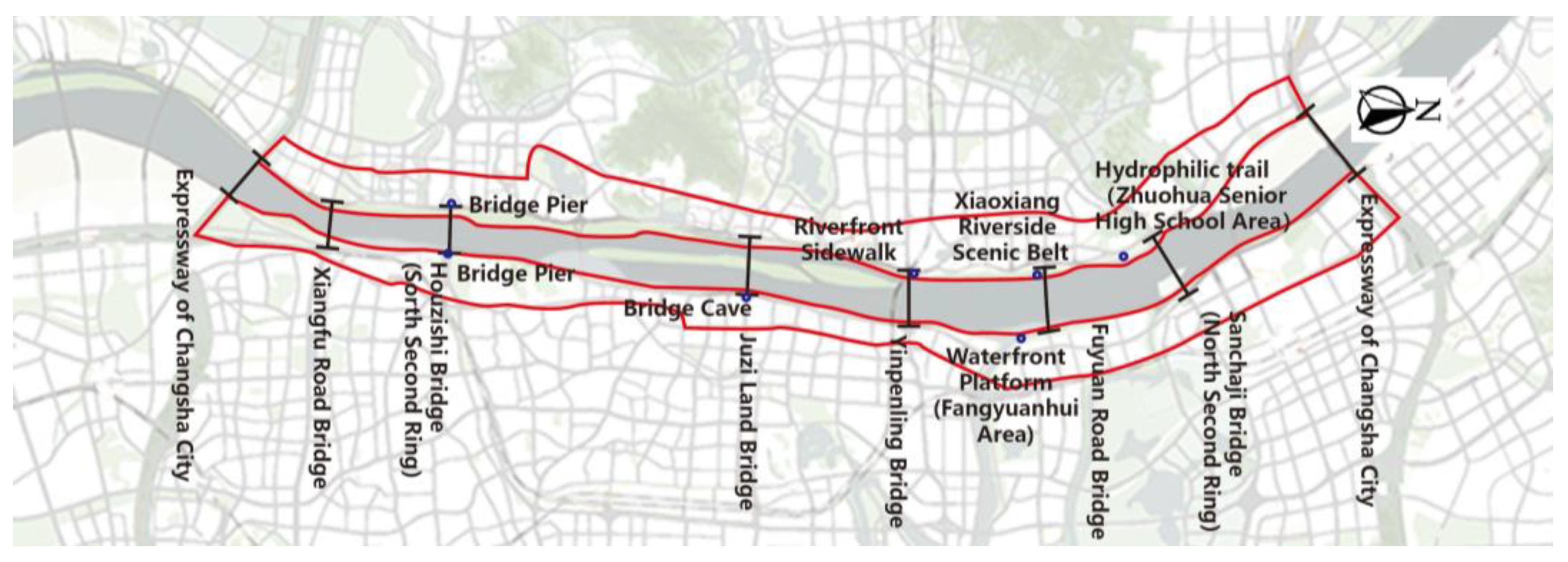
Figure 2.
Research Framework of This Study.
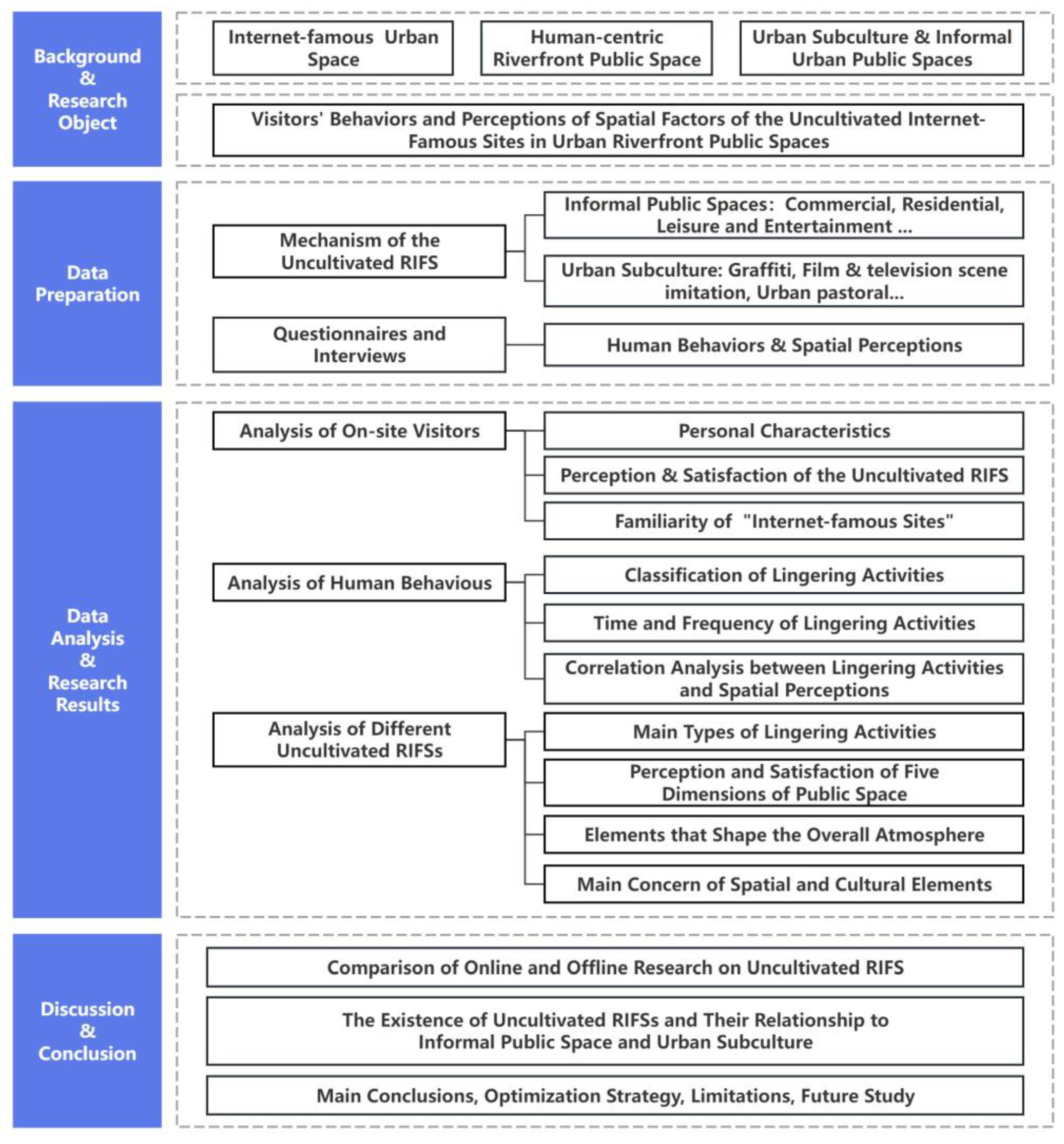
Figure 3.
Time Distributions of Onsite Visitors’ Lingering Activities: (a)Frequency of Visits. (b)Selection of Visit Dates. (c)Time Period of Visits. (d)Time Length of Stay.
Figure 3.
Time Distributions of Onsite Visitors’ Lingering Activities: (a)Frequency of Visits. (b)Selection of Visit Dates. (c)Time Period of Visits. (d)Time Length of Stay.
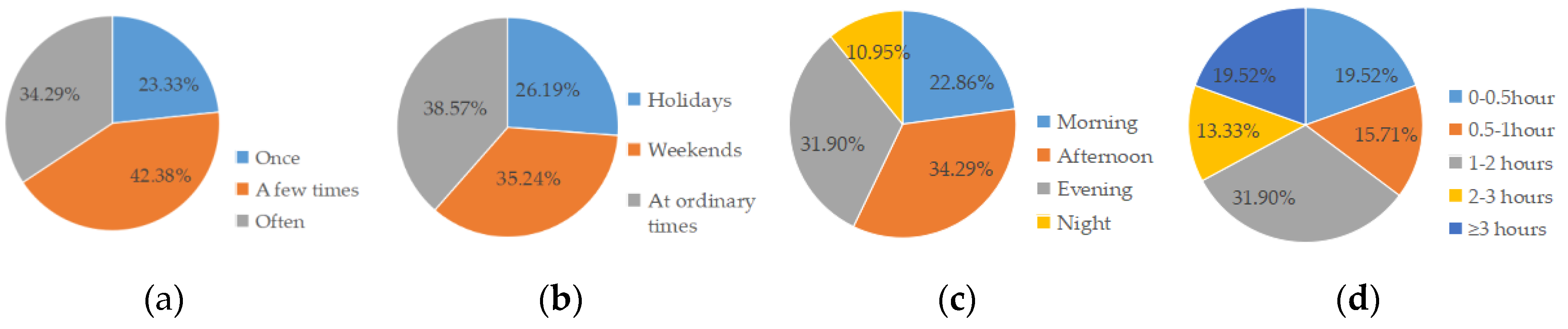
Figure 4.
Overall Spatial Perception and Satisfaction of Onsite Visitors: (a)Spatial Perceptions. (b)Degree of satisfaction.
Figure 4.
Overall Spatial Perception and Satisfaction of Onsite Visitors: (a)Spatial Perceptions. (b)Degree of satisfaction.
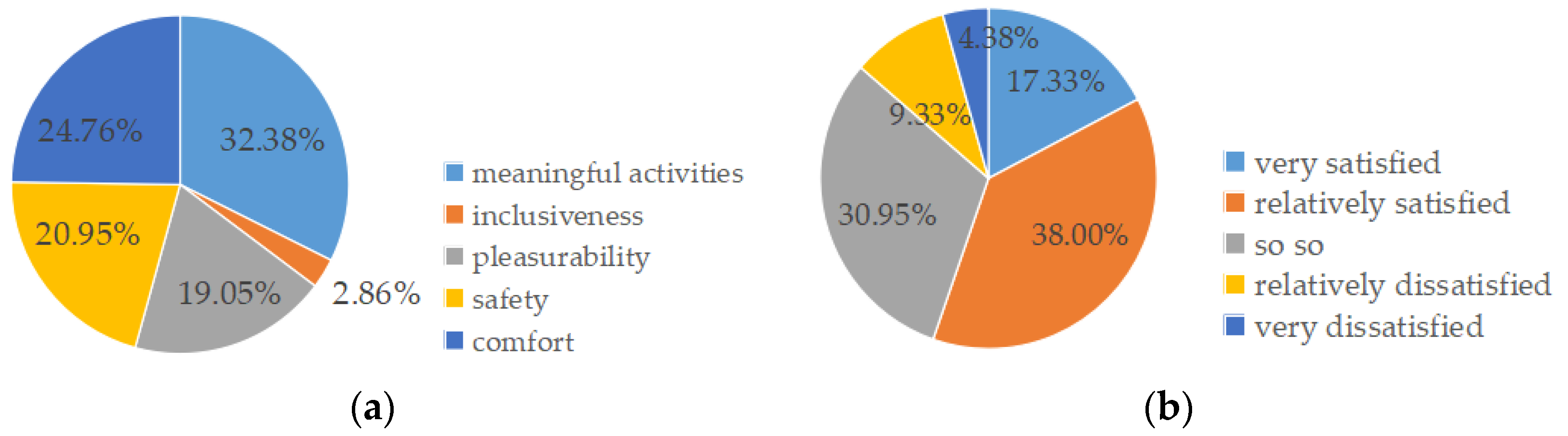
Figure 5.
Satisfaction Degree of Five Dimensions of Public Space.
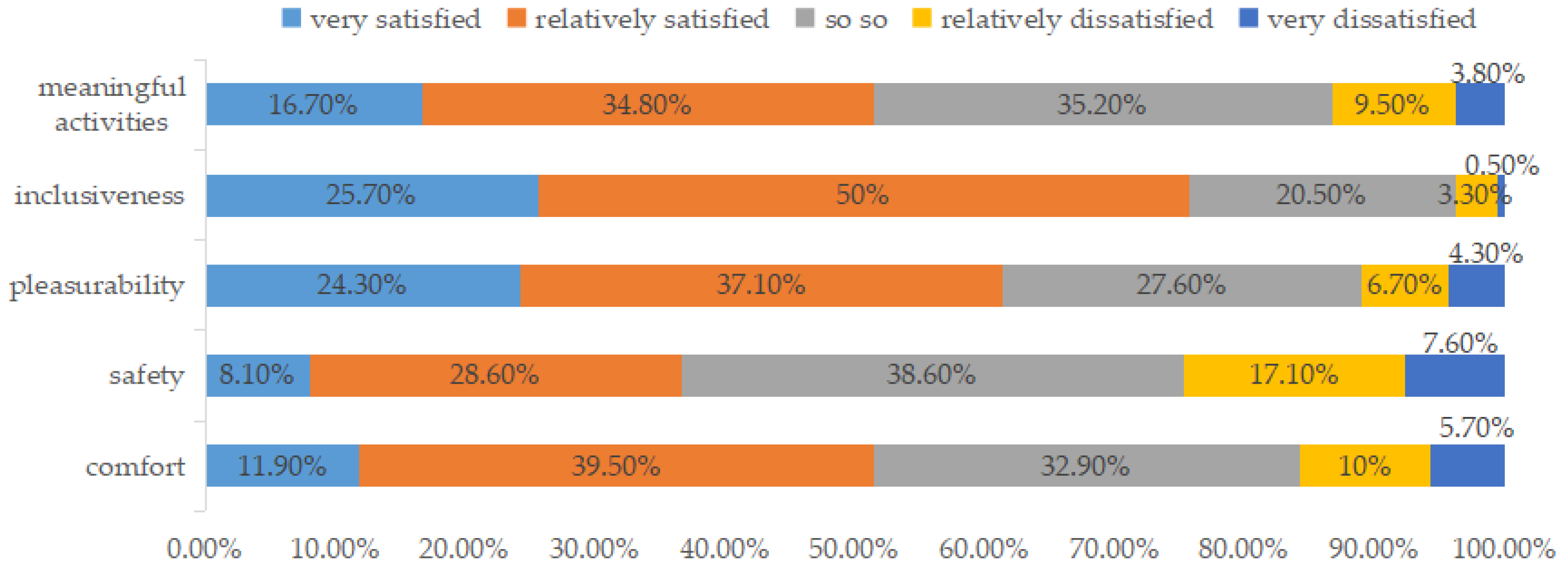
Figure 6.
Proportion of Different Types of Lingering Activities.
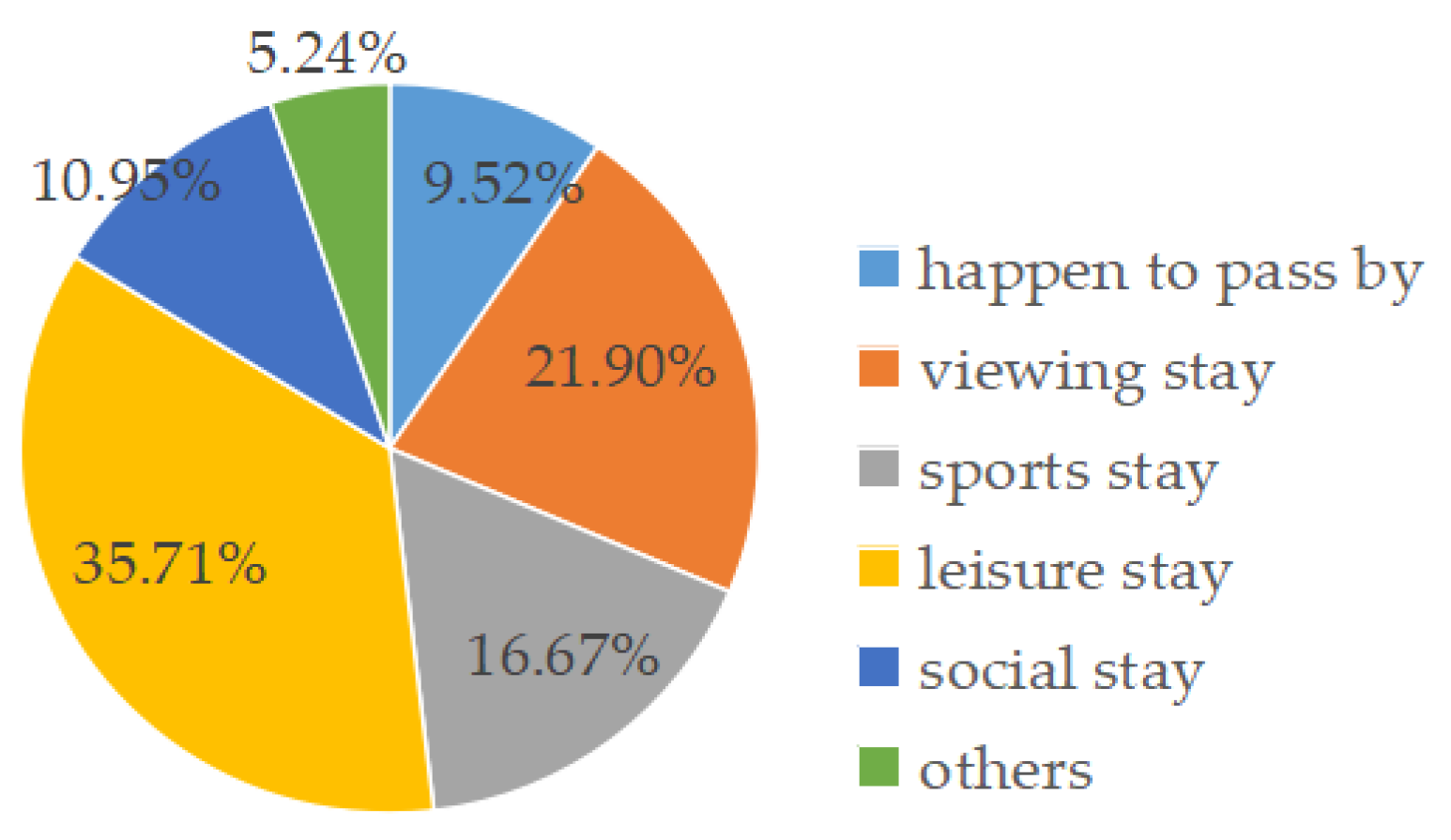
Table 1.
The characteristics of 7 uncultivated RIFSs in Changsha, China.
| Site | Spatial Features | Site Descriptions | Photos (Source:Xiaohongshu) |
|---|---|---|---|
| Waterfront Platform (Fangyuanhui Area) |
Informal consumption space related to nighttime cultural tourism | The site is located at the junction of the Xiangjiang River and the Liuyang River, facing the city commercial landmark Hunan Financial Center office complex across the river to the west, and the city art exhibition landmark Changsha riverside Cultural Park across the river to the south. At night, the neon lights on the building interface on the opposite bank are on. The site has an excellent view, attracting vendors to decorate and rent low-cost reclining chairs, and to sell snacks such as milk tea. It has attracted a large number of tourists for leisure viewing. The consumer space with cheap price close is in contrast to the high-end commercial and financial space around. |
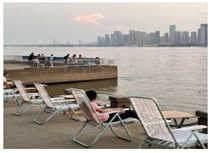 The image has been authorized by the author @棱 |
| Riverfront Sidewalk(West of Yinpenling Bridge) |
Informal photography space related to microclimate comfort |
The site is the waterfront sidewalk with hard revetment under the approach bridge of Yinpenling bridge. The site has good microclimate comfort in summer which is on the riverside wind-corridor and also have good shading effects. Meanwhile, the across-river bridge and the urban skyline on opposite side of the river formed an excellent photographic background. |
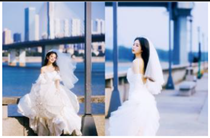 The image has been authorized by the author @哲希 |
| Hydrophilic trail (Zhuohua Semior High School Area) |
Irregular water playing space with potential safety hazards | The site is located in the urban-rural fringe of the northern suburbs of the city, with most of the surrounding areas being undeveloped land. There are relatively few waterfront recreational facilities in the area, making this site the main gathering place for nearby residents and tourists. However, due to the lack of protective railings on the boardwalk, the government have proposed an agenda to remove the whole hydrophilic trail to prevent drowning problems. This decision has attracted widespread attention from audience due to government intervention to the site. |
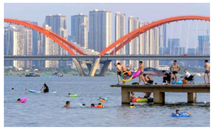 The image has been authorized by the author @章章干嘛呢 |
| Xiaoxiang Riverside Scenic Belt (West of Fuyuanlu Bridge ) | New immigrants' subculture related urban pastoral spaces | Due to the urban-rural dual structure, children born in rural areas came to the city with their parents. They saw cattle and sheep eating grass by the water in the city, which recalled the memories of rural life in childhood. The site is located in the shoal of the waterfront scenic belt on the west of Fuyuanlu Bridge. Because the surrounding villagers are herding cattle and sheep here, the "Urban Pastoral" scene here has become popular on the internet. |
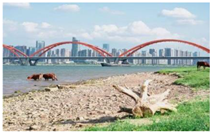 The image has been authorized by the author @我是林同学 |
| Bridge Cave (East of Jvzizhou Bridge) | Informal residential and commercial space under the bridge | Under the influence of urban-rural dual structure, migrant workers are seeking job opportunities in the city. The site is near the CBD of the city center, with high pedestrian density. Meanwhile, the bridge cave is inhabited by homeless people who have not yet found any jobs and accommodations, as well as some cheap haircuts, street vendors, small businesses. Due to the diversity of social strata, the dirty and messy environment of the site is in sharp contrast to the high-end CBD outside the bridge. |
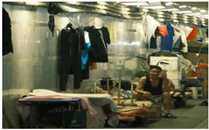 The image has been authorized by the author @xiong柿 |
| Bridge Pier(East of Houzishi Bridge) | Youth subculture space (graffiti) under the bridge | The site became popular on the Internet because of the graffiti made by creative talents to express their demands or even criticism on urban and social issues. However, government managers believe that graffiti may have a negative impact on the city appearance. They attempt to remove graffiti, which shows a negative attitude on this kind of subculture. |
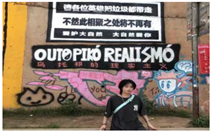 The image has been authorized by the author @越今朝 |
| Bridge Pier(West of Houzishi Bridge) | Youth subculture space (film imitation) under the bridge | The shape of the bridge piers and the spatial depth formed by rows of piers are similar to the Mega structure in the surrealist urban scene of the movie “Inception”. Netizens took photos on the site and uploaded on social media platforms. And these photos have become popular online. |
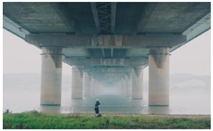 The image has been authorized by the author @我是林同学 |
Table 2.
The Framework of Questionnaire and Interview Design.
| Major Category |
Sub Category |
Relevant Questions |
Purposes |
|---|---|---|---|
| Personal Characteristics | social characteristics | age, gender, occupation, identity |
to understand the impact of visitors’ social characteristics on the evaluations |
| Overall Perception of Space |
visitors’ familiarity of “Internet-famous Sites” | concept familiarity, identify “internet-famous sites”, whether online propagation can bring about offline vitality |
to understand visitors’ familiarity of the concept and the ability to identify it |
| cognition of the publicness | five-dimensional model: meaningful activities, inclusiveness, pleasurability, safety, comfort |
to understand visitors’ overall cognition of the publicness and the most concerned factors | |
| emotional preference | a 5-point Likert scale (from most satisfied to most unsatisfied) | to understand visitors’ emotional preference of the publicness of the site | |
| Human Behaviors | general behavior characteristics | purpose, frequency, and time period of the visit | to understand the impact of human behaviors to the evaluation of RIFS |
| type of lingering activities | viewing stay,sports stay, leisure stay,social stay |
to understand the specific activities of lingerings | |
| Perception of Spacial Elements |
spacial elements (mainly visual elements) | the overall atmosphere, the physical space elements, the humanistic elements, the dissatisfaction factors | to understand visitors’ overall impressions, mostly concerned factors and directions for improvement |
Table 3.
Personal Characteristics of Survey (N=210).
| Individual Characteristics | Percent (%) | Frequency | |
|---|---|---|---|
| Gender | Male | 67.6 | 142 |
| Female | 32.4 | 68 | |
| Age Group | 18 below | 9.5 | 20 |
| 18—25 | 19.5 | 41 | |
| 26—35 | 25.7 | 54 | |
| 36—45 | 20.5 | 43 | |
| 46—60 | 17.1 | 36 | |
| 60 above | 7.6 | 16 | |
| Occupation | Student | 21.0 | 44 |
| Office worker | 42.4 | 89 | |
| Retiree | 9.0 | 19 | |
| Self-employed | 27.6 | 58 | |
| Residence | Nearby residents | 41.4 | 87 |
| Local tourists | 45.7 | 96 | |
| Foreign tourists | 12.9 | 27 | |
Table 4.
Onsite Visitors' Understanding of the RIFSs(N=210).
| Questions Sites |
Waterfront Platform (Fangyuanhui Area) | Bridge Cave (East of Jvzizhou Bridge) | Bridge Pier (East of Houzishi Bridge) | Bridge Pier (West of Houzishi Bridge) | Hydrophilic trail (Zhuohua Semior High School Area) | Xiaoxiang Riverside Scenic Belt (West of Fuyuanlu Bridge) | Riverfront Sidewalk (West of Yinpenling Bridge) |
Total | Percentage (%) | |
| Have you heard of RIFS in Changsha City? | Very familiar | 2 | 2 | 1 | 4 | 2 | 1 | 1 | 13 | 6.2% |
| Fairly familiar | 9 | 1 | 7 | 4 | 5 | 1 | 2 | 29 | 13.8% | |
| Relatively know | 10 | 6 | 5 | 4 | 9 | 3 | 9 | 46 | 21.9% | |
| Not very familiar | 7 | 13 | 13 | 14 | 12 | 17 | 12 | 88 | 41.9% | |
| Not heard of | 2 | 8 | 4 | 4 | 2 | 8 | 6 | 34 | 16.2% | |
| Do you know that this place is a typical RIFS? | Know | 12 | 2 | 17 | 11 | 10 | 2 | 3 | 57 | 27.14% |
| vaguely know | 3 | 4 | 2 | 3 | 4 | 2 | 10 | 28 | 13.33% | |
| Don’t know | 15 | 24 | 11 | 16 | 16 | 26 | 17 | 125 | 59.53% | |
| Does online popularity can bring about sustained offline visits? | Can | 22 | 9 | 10 | 14 | 13 | 13 | 12 | 93 | 44.29% |
| Can not | 1 | 5 | 4 | 3 | 4 | 9 | 6 | 32 | 15.23% | |
| Not sure | 7 | 16 | 16 | 12 | 12 | 7 | 12 | 82 | 39.04% | |
| Others | 0 | 0 | 0 | 1 | 1 | 1 | 0 | 3 | 1.44% | |
Table 5.
Correlation Analysis Between the Lingerings Activities and Satisfaction with Public Space Characteristics.
Table 5.
Correlation Analysis Between the Lingerings Activities and Satisfaction with Public Space Characteristics.
| Meaningful Activities (ordinal) |
Inclusiveness (ordinal) |
Pleasurability (ordinal) |
Safety (ordinal) |
Comfort (ordinal) |
||
|---|---|---|---|---|---|---|
|
Viewing Stay (Nominal) |
Viewing scenery | 0.069 | 0.02 | -0.063 | 0.027 | -0.04 |
| Viewing others | 0.013 | -0.008 | 0.015 | 0.09 | 0.055 | |
| Personal posing | 0.064 | 0.055 | 0 | -0.032 | 0.054 | |
| Taking photos | -0.064 | -0.04 | -0.002 | 0.022 | 0.077 | |
|
Sports Stay (Nominal) |
Walking | -0.051 | -0.035 | -0.108 | -.178** | -0.135 |
| Cycling | 0.061 | 0.081 | -0.015 | -.202** | -0.052 | |
| Swimming | -.141* | -0.112 | -0.109 | -0.03 | -.182** | |
|
Leisure Stay (Nominal) |
Fishing | -.190** | 0.046 | -0.024 | -0.044 | 0.123 |
| Camping | -0.055 | -0.114 | -0.104 | -0.007 | -0.07 | |
| Treading water | -0.104 | 0.022 | -0.128 | 0.003 | 0.041 | |
| Walking baby | -0.091 | -.173* | -0.053 | 0.074 | -0.054 | |
| Lying down | 0.034 | 0.045 | -0.067 | -0.013 | -.156* | |
|
Social Stay (Nominal) |
Drinking tea | 0.079 | 0.073 | 0.076 | 0.049 | -0.028 |
| Chatting | .151* | 0.118 | .159* | 0.12 | 0.033 | |
| Playing Chess | -0.103 | -.136* | -.173* | -.152* | -0.114 | |
| ** Significant at the 0.01 level (two-tailed) for correlation. * Significant at the 0.05 level (two-tailed) for correlation. | ||||||
Disclaimer/Publisher’s Note: The statements, opinions and data contained in all publications are solely those of the individual author(s) and contributor(s) and not of MDPI and/or the editor(s). MDPI and/or the editor(s) disclaim responsibility for any injury to people or property resulting from any ideas, methods, instructions or products referred to in the content. |
© 2024 by the authors. Licensee MDPI, Basel, Switzerland. This article is an open access article distributed under the terms and conditions of the Creative Commons Attribution (CC BY) license (http://creativecommons.org/licenses/by/4.0/).
Copyright: This open access article is published under a Creative Commons CC BY 4.0 license, which permit the free download, distribution, and reuse, provided that the author and preprint are cited in any reuse.


