

Submitted:
05 October 2024
Posted:
07 October 2024
You are already at the latest version
Abstract
(1) Background: Food and Feed Safety Legislation does not concern all the mycotoxins generated by Penicillium and Aspergillus spp. Certain mycotoxins, including cyclopiazonic acid (CPA), penicillic acid (PA), roquefortine C (ROQ C), mycophenolic acid (MPA), and gliotoxin regarded as having lower toxicity levels, hence not included in food and feed legislation; (2) Methods: Presence of these substances in maize and wheat grown in Albania across two consecutive harvesting seasons was investigated by liquid chromatography and mass spectrometry (LC-MS/MS); (3) Results: The findings indicated the presence of these mycotoxins in maize grain but not in wheat grain. In the 2014 season, they exhibited a higher contamination incidence than the 2015 season. The most commonly detected Mycotoxin was MPA, followed by CPA and ROC toxin, while Penicillium acid and gliotoxin were detected. The MPA revealed a concentration range of 72.92–3447.25 μg/kg, with a mean value of 1063.89 μg/kg. Mycophenolic acid was detected in the maize samples collected during the 2015 season. (4) Conclusions: These findings suggest that focusing the investigation only on 'controlled' mycotoxins will not produce a proper risk assessment and may not adequately address the possible harmful impacts of mycotoxins on human and animal health due to mycotoxins co-occurrence.
Keywords:
Mycophenolic acid
; Cyclopiazonic acid
; Roquefortine C
; Penicillic acid
; gliotoxin
; maize
; wheat
; LC-MS/MS
; Albania
1. Introduction
Cereals are susceptible to contamination by harmful and decay-causing microbes at various phases, including growth, harvest, and storage [1]. Molds, a distinct category, can create a wide range of secondary metabolites called mycotoxins. Food can get contaminated by direct means, such as mold on the item, or indirectly, when processed foods are manufactured using materials that are already infected [2,3]. Out of the many mycotoxins, only around twelve are naturally present in significant amounts and have the potential to be toxic enough to raise concerns over the safety of food and feed. The molds that produce mycotoxins of the most worrisome belong to five taxonomic genera - Aspergillus, Fusarium, Penicillium, and Claviceps [4,5]. This emphasizes the vital importance of food safety and regulation in preventing mycotoxin contamination and guaranteeing the health and welfare of the general population.
Penicillium mycotoxins, notorious for their quick development throughout the transit and storage, present a significant contamination issue in inadequately kept food and animal feed. The Penicillium genus comprises around 350 species of fungus, which are widely distributed and can produce various mycotoxins or other secondary metabolites that are advantageous for human health. In addition to the distinguished mycotoxins, ochratoxin A, and patulin, the presence of cyclopiazonic acid is worth mentioning, albeit to a lower degree. They have a crucial function in cases of simultaneous exposure to other mycotoxins [2,4,6].
Cyclopiazonic acid (CPA), an indole tetramic acid, was initially identified and described in 1968 [7]. It is synthesized by several species of the Penicillium and Aspergillus genera [8]. The principal producers within the genus Penicillium are P. commune, P. camemberti, P. palitans, P. dipodomyicola, and P. griseofulvum. From the genus Aspergillus, notable species include Aspergillus flavus, A. oryzae, and A. tamarii [4,9]. In addition to colonizing a variety of grains and seeds, these molds can grow on a wide range of foods, including cheese and meat products [10,11]. This growth is attributed to the intake of contaminated feed [7]. While this Mycotoxin alone did not receive much attention for its hazardous deleterious effects, its presence with aflatoxins in contaminated foods often leads to cumulative impacts [9]. At high levels, it is a strong mycotoxin that may cause localized tissue death in the internal organs of most vertebrates, as well as severe gastrointestinal and neurological diseases [12]. It also acts as a neurotoxic vasodilator, disrupting the muscular contraction-relaxation cycle. This substance is poisonous to many animal species, including rats, pigs, guinea pigs, poultry, and dogs [9].
Penicillic Acid (PA) is a mycotoxin derived from polyketides synthesized by many species of the Penicillium and Aspergillus genera [13]. The chief producers of Penicillium spp. are P. aurantiogriseum, P. cyclopium, P. melanoconidium, and P. polonicum, whereas A. ochraceus is the primary producer of Aspergillus spp. It is abundantly present with ochratoxin A in high-moisture maize at low temperatures [1,4]. Although its carcinogenic potential is far lower than that of aflatoxins, the concern about its presence in foods stems from its structural resemblance to patulin, a well-known carcinogen. PA’s primary contribution to mycotoxicology is its potential for synergistic toxicity with ochratoxin A [14,15] and its potentially additive or synergistic action with the naphthoquinone hepatotoxins [12]. Penicillic acid contains pharmacological properties that cause vasodilation and have antidiuretic effects. It has a comparable behavior to patulin by quickly reacting with dietary molecules that contain sulfhydryl groups, resulting in the formation of harmless substances [1].
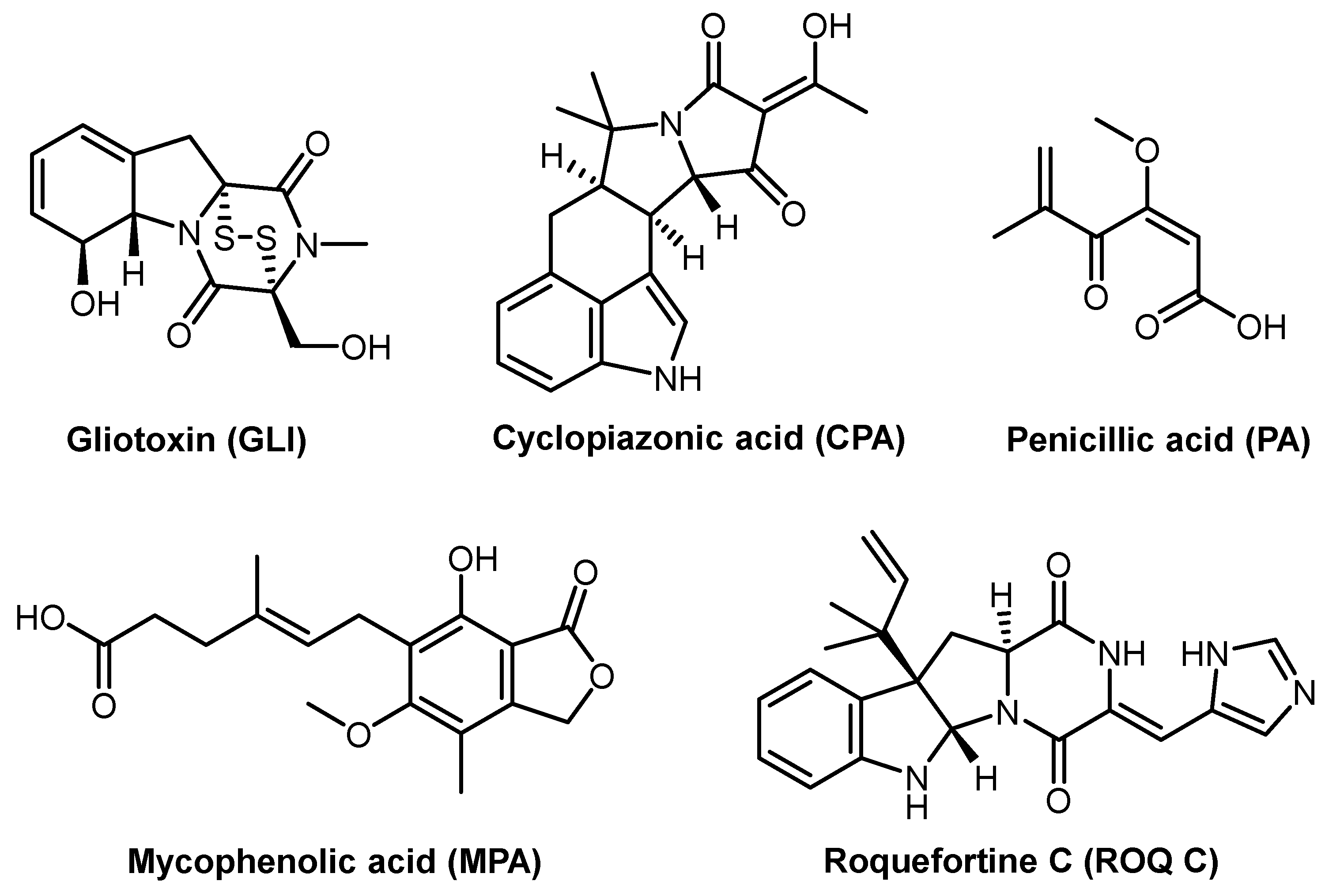
Figure 1.
Chemical structures of studied mycotoxins.
Roquefortine C (ROQ C) is a naturally occurring compound that belongs to a family of substances called 2,5-diketopiperazines. Its IUPAC designation is 10b-(1,1-dimethyl-2-propenyl)-3-imidazol-4-methylene-5a,10b,11,11a-tetrahydro-2H-pyrazino-[19,29:1,5]pyrrol [2,3,b]indole-1,4-(3H,6H)-dione [16]. It is synthesized by many types of Penicillium fungi, particularly P. roqueforti, and other species such as: P. chrysogenum, P. crustosum, P. expansum, P. hordei, and P. griseofulvum [17]. P. roqueforti is a common saprophytic fungus in soil and decaying organic matter. It has the ability to create many mycotoxins, such as patulin, penicillic acid, and mycophenolic acid [18]. Roquefortine C is a significant fungal contaminant commonly found in carbonated drinks, beer, wine, meats, and cheese. At low amounts, the presence of this substance in domestic cheeses is deemed “safe for the consumer.” However, at large dosages, it is regarded as a powerful neurotoxin [19].
Mycophenolic acid (MPA) is a compound synthesized by some species of the Penicillium genus, namely P. brevicompactum, P. roqueforti, and P. caneum [2,4]. Mycophenolic acid, also known as 6-(4-hydroxy-6-methoxy-7-methyl-3-oxo-5-phthalanyl)-4-methyl-4-hexenoic acid, is a low-strength organic acid that has immunosuppressive, antiviral, antifungal, antibacterial, and antitumoral properties. Although MPA has modest toxicity to animals, it can nevertheless have a significant impact as an indirect mycotoxin due to its immunosuppressive solid properties, potentially affecting bacterial and fungal diseases. The genesis of corn tainted with harmful fungus metabolites is considered the epidemic of pellagra disease in the Tyrol region, Italy/Austria, during the beginning of the 20th century [20].
Gliotoxin (GLI) is a mycotoxin containing sulfur that belongs to the family of 2,5-diketopiperazines. It is naturally found in the air, soil, and water and is generated by A. fumigatus and other species of the Penicillium genus [21]. The toxicity processes entail the participation of a disulfide bridge, which seems to generate reactive oxygen species by oxidizing the reduced dithiol to its disulfide form [22]. Other authors have found that gliotoxin possesses many immunosuppressive effects [23].

Table 1.
Some minor Penicillium spp. mycotoxins, plant product occurrence, and associated producing species.
Table 1.
Some minor Penicillium spp. mycotoxins, plant product occurrence, and associated producing species.
| Mycotoxins | Agricultural products | Species |
|---|---|---|
| Cyclopiazonic acid | Long-stored cereals, pasta, meat, and cheese | P. commune, P. camamberti, P. palitans, P. dipodomyicola, P. griseofulvum |
| Penicillic acid | Cereals, hay, onions, carrots, potatoes | P. aurantiogriseum, P. cyclopium, P. melaconidium, P. viridicatum, P. polonicum, P. radicicola |
| Roquefortine C | Farm silage, cheese, meat products, sugar beet pulp | P. roqueforti, P. carneum, P. chrysogenum, P. crustosum, P. expansum, P. paneum, P. albocoremium, P. allii, P. griseofulvum, P. hordei, P. melanoconidium, P. radicicola, P. sclerotigenum, plus other 13 Penicillium species |
| Mycophenolic acid | Cheese, sugar beet pulp | P. brevicompactum, P. roqueforti and P. carneum |
| Gliotoxin | Sugar beet pulp | A. fumigatus, Gliocladium fimbriatum |
Source: [2].
Studying mycotoxins, which can induce many detrimental toxicological consequences in animals and humans, is an essential field that requires more investigation. Animals exposed to this substance over a long period, whether by eating, breathing it in, or absorbing it through their skin, might experience genetic changes, problems with the development of their offspring, miscarriages, and the production of congenital disabilities. Subchronic exposure to some substances in food-producing animals can lead to decreased production, weight loss, slower development rate, and impaired reproductive function. This emphasizes the importance of conducting further scientific research and gaining better knowledge [1].
Categorize the observed adverse effects into major and minor mycotoxins. Although small mycotoxins are not considered dangerous or controlled by regulation, they can have cumulative effects when exposed together with other critical mycotoxins. One example is the simultaneous exposure to CPA and ochratoxin A, penicillic acid and patulin, roquefortine C and patulin, or roquefortine C and penicillic acid [24]. CPA is a powerful mycotoxin that induces weight loss, diarrhea, convulsions, and mortality in rodents, birds, dogs, and pigs [25]. There have been few recorded cases of animal mycotoxicosis due to the harmless characteristics of CPA [7].
This study examined the simultaneous presence of five mycotoxins (cyclopiazonic acid, penicillic acid, mycophenolic acid, roquefortine C, and gliotoxin) in maize and wheat across two harvest seasons, 2014 and 2015. Evidence of mycotoxins’ persistence in Albanian cereals has demonstrated the existence of fusarium mycotoxins, aflatoxin, and ochratoxin contamination [26,27,28].
2. Results
2.1. Co-Occurrence of five Mycotoxins in Maize and Wheat
None of the five mycotoxins were found in the wheat grain. However, the maize grain was infected in the samples from 2014 but not in the following year, 2015. The maize samples from the 2014 season had the most significant incidence rate, with MPA being the most prevalent at 32.3%, followed by CPA at 12.9% and ROC at 6.5%. Penicillic acid and gliotoxin were not found in maize grain throughout both harvesting seasons. An analysis of five mycotoxins reveals distinct contamination patterns in two separate years of harvest. In 2014, CPA, MPA, and ROC were found, but in the 2015 harvest season, only MPA was discovered in maize samples. Mycophenolic acid exhibited the most significant concentration levels among the other mycotoxins investigated in our study, with a mean value of 1063.89 μg/kg and a range of 72.92-3447.25 μg/kg. Among the 31 maize samples from 2014, CPA was shown to have the second-highest occurrence rate at 12.9%. The average concentration of CPA in these samples was 590.21 μg/kg, with a range of 189.21-868.89 μg/kg. Roquefortine C was identified as the third Mycotoxin detected in maize, occurring with a relatively low frequency of 6.5%. The average concentration of Roquefortine C was 277.89 μg/kg, with a range of 124.62-431.16 μg/kg. The median results for positive samples were as follows: MPA had a concentration of 374.65 μg/kg, CPA had a concentration of 651.41 μg/kg, and ROC had a concentration of 277.89 μg/kg. The prevalence and frequency of MPA during the 2015 season exhibited a significantly high prevalence rate of 90% but a reduced frequency compared to the 2014 data, with an average value of 46.6 μg/kg and a range of 25.46-134.43 μg/kg—a co-occurrence of the mycotoxins mycophenolic acid and roquefortine C detected in a single sample. The spread of pollution varies according to area, primarily due to variances in climate and the amount of precipitation. The maize samples from Elbasan (12) were found to be free of contamination. However, the maize grain from Fieri (18) had a contamination incidence of seven out of 18 samples, with MPA being detected in these samples, and four samples were contaminated with CPA.
Similarly, the maize commodity from Korça had 8 out of 11 samples contaminated with MPA, and two samples were found to be contaminated with Roquerfortine C. The Kruja region showed a similar pattern, with 8 out of eleven samples contaminated with MPA. Fusarium toxins were also observed in conjunction with the subject mentioned [26].
Table 2.
Maize contamination during the harvesting seasons of 2014 and 2015 (μg/kg).
| 2014 | |||||
| Parameter | Cyclopiazonic acid | Penicillium acid | Mycophenolic acid | Roquefortine C | Gliotoxin |
| Analyzed samples | 31 | 31 | 31 | 31 | 31 |
| Positive samples | 4 | 0 | 10 | 2 | 0 |
| Incidence (%) | 12.9 | 0.0 | 32.3 | 6.5 | 0.0 |
| Min | 189.12 | 0.00 | 72.92 | 124.62 | 0.00 |
| Max | 868.89 | 0.00 | 3447.25 | 431.16 | 0.00 |
| Meana | 590.21 | 0.00 | 1063.89 | 277.89 | 0.00 |
| Mediana | 651.41 | 0.00 | 374.65 | 277.89 | 0.00 |
| Meanb | 76.16 | 0 | 343.19 | 17.93 | 0 |
| 2015 | |||||
| Analyzed samples | 20 | 20 | 20 | 20 | 21 |
| Positive samples | 0 | 0 | 18.0 | 0 | 0 |
| Incidence (%) | 0.0 | 0.0 | 90.0 | 0.0 | 0.0 |
| Min | 0.00 | 0.00 | 25.46 | 0.00 | 0.00 |
| Max | 0.00 | 0.00 | 134.43 | 0.00 | 0.00 |
| Meana | 0.00 | 0.00 | 46.60 | 0.00 | 0.00 |
| Mediana | 0.00 | 0.00 | 37.30 | 0.00 | 0.00 |
| Meanb | 0.00 | 0.00 | 31.89 | 0.00 | 0 |
a-calculated by including only positive samples, b-calculated by considering negative samples with 0.0 μg/kg.
The presence of CPA has been documented in corn [29], cheese [30], and several types of animal feeds and feed ingredients [3,31]. While CPA is generally considered a non-significant mycotoxin, its exposure can be extensive [6]. Toxicological tests conducted on several species have shown that the primary organs affected are the liver, kidney, and digestive systems. The presence of CPA in broiler chickens has been found to affect their growth rate and feed intake [8]. The global presence of CPA is evidenced in various regions of the world. In Asia, for instance, maize samples from Indonesia had CPA levels of LOD-9000 μg/kg [32], while poultry feed in the same region had levels ranging from 20-9220 μg/kg [33]. In India, feed contamination levels ranged from 400-12000 μg/kg [31], and in Japan, maize samples showed relatively low contamination levels of 76 μg/kg [25]. The contamination levels of maize from the United States are reported to vary from 120 to 1820 μg/kg [34], with a limit of detection (LOD) of 2,771 μg/kg [29]. There is a lack of available data on the occurrence of CPA in Africa. However, it has been mentioned that in Mozambique, one out of every thirteen samples had a measured level of 606 μg/kg [35]. The contamination of maize indicates the presence of both CPA and aflatoxins [27]. This discovery pertains to corn samples originating from the Korça area. CPA is recognized as a contributing factor in several chronic illnesses affecting both humans and animals. Significant findings will emerge from the link between CPA and Afs co-occurrence and the prevalence of chronic diseases in the human population of this region.
3. Discussion
Fungal pathogens in cereal crops can significantly reduce output, with estimated losses ranging from 15% to 20%. In severe instances, these losses can escalate to as much as 50% [36]. Of the numerous mycotoxins, only around 20 are naturally occurring pollutants that pose a significant risk to food and feed safety. These mycotoxins, including aflatoxins, ochratoxin A, zearalenone, deoxynivalenol, and fumonisins, are of particular concern due to their frequent occurrence and possible toxicity [1]. Mycotoxins are classified into three main risk management categories based on their toxicity and occurrence. The first category includes major mycotoxins that can potentially cause illness in humans or domestic animals and economic losses. The second category consists of minor mycotoxins shown to have toxicity or economic impact on a smaller scale. The third category includes mycotoxins of lesser importance, which have demonstrated toxicity but are not known to be associated with specific diseases. This is typically due to the uncommon occurrence of these foods [6]. Multiple species of Penicillium fungi, together with other mycotoxins such as cyclopiazonic acid, penicillic acid, mycophenolic acid, and roquefortine C, have been found in maize-based diets, including silage [11,37,38].
3.1. Co-Occurrence with Fusarium, AFs, OTA, and Alternaria Toxins
The co-occurrence of cyclopiazonic acid, penicillium acid, mycophenolic acid, roquefortine C, and gliotoxin with fusarium toxins, aflatoxins, ochratoxin A, and the Alternaria mycotoxins was analyzed using previously published data from the same study period [26,27,39]. The highest co-occurrence rate was revealed between CPA and fusarium toxins, especially Fumonisin B1 and Fumonisin B2 [26]. Another close correlation was identified with AFs in contaminated maize samples [27]. Meanwhile, the co-occurrence between MPA and alternaria toxins was to be less present [39].
3.2. Climate Conditions in Agricultural Districts of Albania
The country’s climate is characterized by average summer temperatures exceeding 20°C, while winter temperatures range from -3 to 18°C. According to the Köppen-Geiger climate classification, the western plain along the Mediterranean Sea has a hot-summer Mediterranean climate (Csa Köppen-Geiger climate classification) [40]. The mean annual temperature is 16.7°C, with July having the highest temperature at 25.6°C and January being the coldest month with a temperature of 7.6°C. The average annual precipitation is 803.1 mm. The Fieri district encompasses the primary agricultural area within this specific climate zone.
On the other hand, the Elbasani area has a transitional microclimate that shifts towards a continental climate. It receives an average annual rainfall of 1007.0 mm, an unusual climatic event in 2014 when it received high rainfall of 1282.0 mm throughout the summer. The Kruja region in Eastern Albania has a humid subtropical climate (Cfa) with an average annual temperature of 15°C and annual precipitation of 1260.0 mm. On the other hand, the Korça Plain, situated at an altitude of 800 m a.s.l, experiences a Continental Mediterranean climate (Csb) with a yearly average temperature of 10.3°C and precipitation of 695.5 mm, making it the driest region in the country [41].
Table 3.
Worldwide incidence of studied mycotoxins in corn, feed, and maize silage.
| Country | Commodity | Incidence of Positive Samples | Mean (μg/kg) |
Range (μg/kg) |
Reference | |
|---|---|---|---|---|---|---|
| Cyclopiazonic acid (CPA) | Indonesia | Feed | 1/1 | 6000 | 6000 | [32] |
| Feed | 21/26 | - | LOD-9000 | |||
| Indonesia/Australia | Poultry Feed | 19/26 | 2117 | 30-9220 | [33] | |
| USA | Feed | 33/38 | 390 | 120-1820 | [34] | |
| India | Feed | 10/26 | - | 400-12000 | [31] | |
| USA | Maize | 23/45 | - | LOD-2,771 | [29] | |
| Japan | Maize | 1/6 | 76 | 76 | [25] | |
| Mozambique | Feed | 1/13 | 606 | [35] | ||
| Penicillic acid (PA) | Bulgaria/South Africa | Feed | 23/25 | 904.9 | 30-9220 | [42] |
| USA | Maize | 7/20 | 59 | 5-231 | [43] | |
| Roquefortine C (ROQ C) | Czech Republic, Denmark, Hungary | Feed | 4/82 | 4.6 | 1.3-14 | [44] |
| USA | Maize silage | 30/60 | - | 20-1100 | [45] | |
| Germany | Maize silage | 12/12 | 17,000 | 700-36,000 | [46] | |
| Italy | Maize silage | 10/196 | 740 | Lod-32,000 | [47] | |
| Netherland | Maize silage | 778 | LOD-3160 | [48] | ||
| Mycophenolic acid (MPA) | USA | Maize silage | 16/60 | - | 80-600 | [45] |
| Germany | Maize silage | 38/135 | 690 | 20-23,000 | [49] | |
| Italy | Maize silage | 16/196 | 1760 | LOD-48,000 | [47] | |
| Netherland | Maize silage | 524 | LOD-2630 | [50] |
LOD-Limit of Detection.
Maize with high moisture content that has seen mold development has been discovered to have Penicillic acid in very high quantities [51]. Information on maize harvested in Albania indicates a lack of application of quality standards, an indicator for penicillic acid occurrence in the analyzed maize samples [52]. The occurrence of penicillic acid in feed has been reported in pig and chick farms from Bulgaria and South Africa, with an average concentration of 904.9 μg/kg and a contamination range of 30-9220 μg/kg [42]. In a study conducted on maize from the United States, the average concentration of penicillic acid was 59 μg/kg, with a range of occurrence between 5-231 μg/kg [43].
ROQ C was detected in maize samples from the 2014 season, with a frequency of 6.5% in two out of thirteen samples. The concentration of Roquefortine C in these samples ranged from 124.6-431.1 μg/kg. However, no contamination was observed in the samples evaluated from the 2015 season. The presence of ROC is also documented in the feeds of many European Union nations, including the Czech Republic, Denmark, Hungary, and Germany. The contamination levels ranged from 1.3 to 14 μg/kg, [44,46]. In Italy, the average contamination level in maize silage was 740 μg/kg with a range of LOD-32,000 μg/kg [47]. In the Netherlands, the contamination level in maize silage ranged from LOD-3160 μg/kg [48]. In the United States, the contamination level in maize silage ranged from 20-1100 μg/kg [37]. Tangni and colleagues [18] discovered the existence of both mycotoxins in maize and grass silages given to dairy calves in Belgium. The levels of ROC contamination ranged from 459 to 1,848 μg/kg, while MPA levels ranged from 4,448 to 21,387 μg/kg for non-moldy or moldy silages, respectively [51]. The presence of roquefortine C has been observed alongside mycophenolic acid, cyclopiazonic acid, and patulin in maize samples from Indonesia. The most significant occurrence was attributed to ROC toxin at a rate of 60%, followed by MPA at 42%, CPA at 37%, and PAT at 23% [33]. The occurrence of ROC in newly harvested maize for silage in the USA was detected in 30 out of 60 samples, with concentrations ranging from 20 to 1,100 μg/kg [37].
MPA is synthesized by several strains of P. roqueforti and certain other Penicillium strains, notably P. brevicompactum and P. paneum. Mammals have a limited susceptibility to MPA toxicity. Administering a daily dosage of 30 μg/kg orally to rats leads to toxicity, causing anemia and death. MPA is commonly used to treat psoriasis; both MPA and its derivatives have demonstrated anticancer and immunosuppressive properties [20]. Out of the 31 samples, ten were found to have MPA contamination. The concentration of MPA ranged from 72.92 to 3447.25 µg/kg, with an average value of 1063.89 μg/kg. Europe and the United States have comprehensive global statistics on the incidence of mycophenolic acid. Mycophenolic acid and roquefortines are the most extensively researched chemicals generated from Penicillium in preserved goods. According to Gallo et al. [47], MPA is the most common fungal toxin found in silages after harvest, with concentrations exceeding 20,000 μg/kg. The mean levels of roquefortine C contamination in silage were 778 μg/kg, while the mean levels of mycophenolic acid contamination were 524 μg/kg. However, the highest levels of roquefortine C and mycophenolic acid contamination were 3160 μg/kg and 2630 μg/kg, respectively [50]. The presence of air leads to significantly elevated levels of MPA (9,300 µg/kg) and ROC (26,000 µg/kg) in the surface layers of corn silages, as observed in a study publishing data from 2013 [18]. Studies have demonstrated that the tillage, cultivation, fertilization rate, and cultivar selection impact the occurrence of fungal infections in cereals. Nevertheless, the presence of these diseases is primarily influenced by the meteorological conditions that occur throughout the growth and development of plants [36].
4. Materials and Methods
4.1. Sample Collection
Plant material, including 51 maize and 70 wheat samples, were collected from different agricultural regions of Albania in two consecutive years, 2014 and 2015. Five mycotoxins (CPA, PA, MA, Roquefortine C, and Gliotoxin) were analyzed for their presence. The wheat and maize seed material was collected from small farms and warehouses during the respective harvesting seasons. The sampling procedure followed Commission Regulation [EC] No 401/2006 to ensure representative samples.
4.2. Standards and Chemicals
Individual standard solutions (2 µg/mL) for each Mycotoxin were purchased from Romer Labs (Tulln, Austria). The AcCN stock and mixed working standard were stored at -20°C in amber glass vials. Chemical reagents of pure analytical grade: Acetonitrile, methanol, acetic acid (Sigma-Aldrich, Steinheim, Germany), and ammonium acetate (Merck, Darmstadt, Germany) were purchased, while a Milli-Q system for preparing deionized water was used (Millipore, Bedford, MA, USA).
4.3. Sample Preparation
The simultaneous determination of mycotoxins consisted of extraction from the ground cereal samples and LC-MS/MS analysis [53]. The grains were ground to a particle size of 1 mm using a Retsch ZM 100 laboratory mill (Haan, Germany). A sample size of 10 g was extracted in a volume of 100 mL AcCN-deionized water mixture (84:16 v/v) and shaken for one hour using an IKA HS 501 digital linear shaker (IKA Labortechnik, Staufen, Germany). A 4 ml filtered extract was evaporated to dryness using a Syncore Polyvap system (Büchi, Flawil, Switzerland). The dry residue was reconstituted in a 0.5 ml MeOH/H2O deionized (80:20 v/v). Finally, a ten μl solution volume was injected into the UPLC-MS/MS system (Acquity UPLC H Class system) coupled to a quadrupole mass spectrometer (Xevo TQ and MS), and detection system equipped with electrospray ionization (ESI) interface and MassLynx software for data collection and processing (Waters, Milford, MA, USA). The vials were stored in the autosampler at 10°C. For matrix-based calibration, appropriate amounts of standard solutions were added to 4 ml aliquots of filtered extracts and prepared beside the samples.
4.4. LC-MS/MS Operation
Zorbax Eclipse Plus C18 Rapid Resolution HD column, 2.1 x 100 mm, 1.8 μm from Agilent, was used for chromatographic separation. Mycotoxin separation was performed using the mixture of solvent A (deionized water) and B (MeOH) in a 60:40 ratio and isocratic condition—the mobile phase at a fixed flow rate of 0.3 ml min-1 and the temperature column of 40°C. Multiple reaction monitoring (MRM) mode was employed for MS/MS analysis. Specific MS/MS parameters related to determined mycotoxins (retention times, ionization mode, and monitored transitions) are given in Table 4. LOD and LOQ for analyzed mycotoxins were 25 µg kg-1 and 75 µg kg-1.
Table 4.
Mass spectrometric detection parameters in ESI+ Ionization mode: retention time, precursor, quantifier, and qualifier ion for ROQ C, GLI, MPA, PA, and CPA.
Table 4.
Mass spectrometric detection parameters in ESI+ Ionization mode: retention time, precursor, quantifier, and qualifier ion for ROQ C, GLI, MPA, PA, and CPA.
| Mycotoxin | Abbrev. | Retention time (min) | Precursor ion (m/z) | Quantifier ion (m/z) | Qualifier ion (m/z) |
|---|---|---|---|---|---|
| Roquefortine C | ROQ C | 2.92 | 390 | 215 | 200 |
| Gliotoxin | GLI | 3.61 | 325 | 261 | 243 |
| Penicillic acid | PA | 4.75 | 170 | 109.8 | 259 |
| Mycophenolic acid | MPA | 5.25 | 321 | 207 | 241 |
| Cyclopiazonic acid | CPA | 5.33 | 337 | 196 | 182 |
4.5. Statistical Analysis
Mycotoxin concentrations were calculated using two replicates. Data was processed in SPSS 27. The proportion of the sample with mycotoxin occurrence was compared using different sample characteristics, where frequency and percentage were reported. Pearson’s chi-square was used to generate the p-value. All analyses were done at the 5% significance level.
5. Conclusions
This study presents findings on five unregulated mycotoxins in maize and wheat grain collected over two harvesting seasons, 2014-2015. Our research shows that the level of contamination and the presence of mycotoxins in maize grown in countries of high concern is greater compared to wheat and other winter crops. The presence of cyclopiazonic acid, mycophenolic acid, and roquefortine C in maize from the 2014 season was not detected during the 2015 harvest, suggesting the existence of mycophenolic acid. This Mycotoxin was the most prevalent in both harvesting seasons and had the maximum occurrence in this particular season. While exposure evaluations for people and animals do not currently consider these mycotoxins, it is crucial to investigate their presence in grains due to the potential for combined harmful effects when co-exposed with other controlled mycotoxins. The contamination patterns in maize samples from the Kruja and Korça regions showed a significant occurrence rate, which was associated with the climatic features of these locations.
Supplementary Materials
No supplementary materials.
Author Contributions
Conceptualization, B.J-S., G.T-K. and D.T.; methodology, G.T-K., D.T. and J.B.; software, J.B. and D.T.; validation, J.B., D.T. and G.T-K.; formal analysis, D.T. and G.T-K.; investigation, B.J-S., G.T-K. and DT; resources, DT and ZD; data curation, DT ZD. JB B.J-S. G.T-K.; writing—original draft preparation, D.T., Z.D. and G.T-K; writing—review and editing, B.J-S., G.T-K. and D.T.; visualization, G.T-K. and D.T.; supervision, B.J-S. and G.T-K.; project administration, B.J-S. and G.T-K.; funding acquisition, DT All authors have read and agreed to the published version of the manuscript.
Funding
The study was supported by the Slovenian Research Agency grant P4-0092 and the Erasmus Mundus program of the European Union.
Data Availability Statement
The data presented in this study are available on request from the corresponding author.
Acknowledgments
The authors thank Karin Šrimpf, Irena Ardalič, and Katarina Pavšič-Vrtač for performing chemical analyses.
Conflicts of Interest
“The authors declare no conflict of interest. The funders had no role in the study’s design; in the collection, analyses, or interpretation of data; in the writing of the manuscript; or in the decision to publish the results”.
Sample Availability
Samples of the compounds ... are available from the authors.
References
- Bianchini, A.; Bullerman, L.B. Mycotoxins, Classification. In Encyclopedia of Food Microbiology, Vol. 2. 2nd Ed, Batt, C. A.; Tortorello. M-L, Eds; Academic Press, Amsterdam, Netherland, 2014; pp. 854–861. [CrossRef]
- Perrone, G.; Susca, A. Penicillium Species and Their Associated Mycotoxins. In Mycotoxigenic Fungi. Methods in Molecular Biology, vol 1542; Moretti, A.; Susca, A. (eds) Humana Press, New York, USA. 2017. [CrossRef]
- Lopes, P.; Sobral, MM; Lopes, G. R.; Martins, Z.E.; Passos, C.P.; Petronilho, S.; Ferreira, I.M. Mycotoxins’ Prevalence in Food Industry By-Products: A Systematic Review. Toxins, 2023, 15, 249. [Google Scholar] [CrossRef] [PubMed]
- Frisvad, J.; Samson, R.A. Polyphasic taxonomy of Penicillium subgenus Penicillium. A guide to the identification of food and air-borne terverticillate Penicillia and their mycotoxins. Stud. Mycol., 2004, 49, 1–174. [Google Scholar]
- Mostrom, M. Mycotoxins: Toxicology. In Encyclopedia of Food and Health, Caballero, B.; Finglas, P. M.; Toldrá, F. Eds.; Academic Press, Massachusetts, USA, 2016; pp. 29–34.
- Pitt, J.I. Penicillium toxins: Hazards and Diseases, In Encyclopedia of Food Safety, 2nd Ed.; Motarjemi, Y.; Moy, G.G.; Todd, E.C. Eds.; Elsevier Ltd., Academic Press, Netherland, 2014, pp. 283–288.
- Chang, P-K. ; Ehrlich, K.C.; Fujii, I. Cyclopiazonic Acid Biosynthesis of Aspergillus flavus and Aspergillus oryzae. Toxins, 2009, 1, 74–99. [Google Scholar] [CrossRef]
- Bryden, W.L.; Suksupath, S.; Taylor, D.J.; Prasongsidh, B.C. Cyclopiazonic Acid: Food Chain Contaminant? Poisonous Plants and Related Toxins. Acamovic, T.; Stewart, C.S.; & Pennycott, T.W. Eds. CABI Publishing, Wallingford, U.K., 2004; pp. 134–139.
- Ostry, V.; Toman, J.; Grosse, Y.; Malir, F. Cyclopiazonic acid: 50th anniversary of its discovery. World Mycotoxin J. 2018, 11, 135–148. [Google Scholar] [CrossRef]
- Oliveira, C.A.; Sebastio, L.S.; Fagundes, H.; Rosim, R.E.; Fernandes, A.M. Aflatoxins and cyclopiazonic acid in feed and milk from dairy farms in Sao Paulo, Brazil. Food Addit. Contam. 2008, 1, 147–152. [Google Scholar] [CrossRef] [PubMed]
- Weidenbörner, M. Mycotoxins in Feedstuffs, 2nd Edition. Springer Science+Business Media, New York, USA. 2012; pp. 295.
- Frisvad, J.C.; Thrane, U.; Samson, R.A.; Pitt, J.I. Important mycotoxins and the fungi that produce them. Adv. Exp. Med. Biol., 2006, 571, 3–31. [Google Scholar] [CrossRef]
- Frisvad, J.C. A critical review of producers of small lactone mycotoxins: patulin, penicillic acid, and moniliformin. World Mycotoxin J. 2018, 11, 73–100. [Google Scholar] [CrossRef]
- Ciegler, A.; Kurtzman, C. P. Penicillic Acid Production by Blue-Eye Fungi on Various Agricultural Commodities. Appl. Microbiol.; 1970, 20, 761–764. [Google Scholar] [CrossRef] [PubMed]
- Stoev, S.D.; Vitanov, S.; Anguelov, G.; Petkova-Bocharova, T.; Creppy, E.E. Experimental mycotoxic nephropathy in pigs provoked by a diet containing ochratoxin A and penicillic acid, Vet. Res. Commun. 2001, 25, 205–223. [Google Scholar]
- Abbas, A.; Dobson, A.D. Yeasts and Molds, Penicillium roqueforti. In Encyclopedia of Dairy Sciences (2nd Ed), Fuquay, J.W. Ed.; Academic Press: Massachusetts, USA, 2011; pp. 772–775. [Google Scholar]
- Abramson, D. Mycotoxins, Toxicology. In Encyclopedia of Food Microbiology, Robinson, R.K. Eds. Elsevier, Amsterdam, Netherlands, 1999; pp. 1539–1547. [CrossRef]
- Tangni, E.K.; Pussemier, L.; Bastiaanse, H.; Haesaert, G.; Foucart, G. Van Hove F. Presence of Mycophenolic Acid, Roquefortine C, Citrinin, and Ochratoxin A in Maize and Grass Silages Supplied to Dairy Cattle in Belgium. J. Anim. Sci. Adv. 2013, 3, 598–612. [Google Scholar]
- Borthwick, A.D. 2,5-Diketopiperazines: Synthesis, Reactions, Medicinal Chemistry, and Bioactive Natural Products. Chemical Reviews, 2012, 112, 3641–3716. [Google Scholar] [CrossRef] [PubMed]
- Bentley, R. Mycophenolic acid: a one-hundred-year odyssey from antibiotic to immunosuppressant. Chemical Review. 2000; 100, 3801–3825. [Google Scholar]
- Mitchell, N. J.; Marroquín-Cardona, A. G.; Romoser, A.; Phillips, T. D.; Hayes, A.W. Mycotoxins. Reference Module in Biomedical Sciences. Elsevier, Netherlands, 2014; [CrossRef]
- Gardiner, D.M.; Waring, P.; Howlett, B.J. The epipolythiodioxopiperazine (ETP) class of fungal toxins, distribution, mode of action, functions, and biosynthesis. Microbiology, 2005, 151, 1021. [Google Scholar] [CrossRef] [PubMed]
- Smith, M.; McGinnis, M.R. Mycotoxins and their effects on humans. Clinical Mycology, 2009; 649–656. [Google Scholar] [CrossRef]
- Bernhoft, A.; Keblys, M.; Morrison, E.; Jørgen, H.; Larsen, S.; Flaøyen, A. Combined effects of selected Penicillium mycotoxins on in vitro proliferation of porcine lymphocytes. Mycopathologia, 2004, 158, 441–450. [Google Scholar] [CrossRef]
- Hayashi, Y.; Yoshizawa, T. Analysis of cyclopiazonic acid in corn and rice by a newly developed method. Food Chem. 2005, 93, 215–221. [Google Scholar] [CrossRef]
- Topi, D.; Babič, J.; Pavšič-Vrtač, K.; Tavčar-Kalcher, G.; Jakovac-Strajn, B. Incidence of Fusarium Mycotoxins in Wheat and Maize from Albania. Molecules, 2021; 26. [Google Scholar] [CrossRef]
- Topi, D.; Babic, J.; Jakovac-Strajn, B.; Tavcar-Kalcher, G. Incidence of Aflatoxins and Ochratoxin A in Wheat and Corn from Albania. Toxins, 2023; 15. [Google Scholar] [CrossRef]
- Mato, L.; Damani, Z.; Spahiu, J.; Halimi, E.; Seiti, B.; Topi, D. High Prevalence of Mycotoxigenic Fungi and Aflatoxin B1 Contamination in Corn and Wheat Grains Grown to Albania: Implications for Food Safety. Journal of Food Quality and Hazards Control, 2024, 11, 59–68. [Google Scholar] [CrossRef]
- Urano, T.; Trucksess, M.W.; Beaver, R.W.; Wilson, DM; Doenew, J. W.; Dowel, F.E. Co-occurrence of cyclopiazonic acid and aflatoxins in corn and peanut. Journal of AOAC International, 1992, 75, 838–841. [Google Scholar] [CrossRef]
- Finoli, C.; Vecchio, A.; Galli, A.; Franzetti, L. Production of cyclopiazonic acid by moulds isolated from taleggio cheese. J. Food Protection, 1999, 62, 1198–1202. [Google Scholar] [CrossRef]
- Balachandran, C.; Parthasarathy, K.R. Occurrence of cyclopiazonic acid in feeds and feedstuffs in Tamil Nadu, India. Mycopathologia, 1996, 133, 159–192. [Google Scholar] [CrossRef] [PubMed]
- Stoltz, D.R.; Widiastuti, R.; Maryam, R.; Akoso, B.T.; Amang, U.D. Suspected cyclopiazonic acid mycotoxicosis of quail in Indonesia. Toxicon, 1988, 26, 39–40. [Google Scholar]
- Widiastuti, R.; Maryam, R.; Blaney, B.J.; Salfina; Stoltz, D. R. Cyclopiazonic acid in combination with aflatoxins, zearalenone, and ochratoxin A in Indonesian corn. Mycopathologia, 1988, 104, 153–156. [Google Scholar] [CrossRef]
- Yu, W. ; Yu, F-Y. ; Undersander, D.J.; Chu, F.S. Immunoassays of Selected Mycotoxins in Hay, Silage and Mixed Feed, Food and Agr. Immunol. 1999, 11, 307–319. [Google Scholar]
- Warth, B.; Parich, A.; Atehnkeng, J.; Bandyopadhayay, R.; Schumacher, R.; Sulyok, M.; et al. Quantitation of mycotoxins in food and feed from Burkina Faso and Mozambique using a modern LC-MS/MS multitoxin method. Journal of Agricultural and Food Chemistry, 2012, 60, 9352–9363. [Google Scholar] [CrossRef]
- Różewicz, M.; Wyzińska, M.; Grabiński, J. The Most Important Fungal Diseases of Cereals—Problems and Possible Solutions. Agronomy, 2021, 11, 714. [Google Scholar] [CrossRef]
- Mansfield, M.A.; Jones, A.D.; Kuldau, G.A. Contamination of fresh and ensiled maize by multiple Penicillium mycotoxins. Phytopathology, 2008, 98, 330–336. [Google Scholar] [CrossRef] [PubMed]
- Weidenborner, M. Mycotoxins in Foodstuffs, 2nd Edition. Springer, New York, USA, 2013; pp. 433; pp. 498-499.
- Topi, D. , Tavčar-Kalcher G., Pavšič-Vrtač K., Babič J., Jakovac-Strajn B. (2019). Alternaria mycotoxins in grains from Albania: alternariol, alternariol monomethyl ether, tenuazonic acid, and tentoxin. World Mycotoxin Journal. 12: 89-99. [CrossRef]
- Kottek, M.; Grieser, J.; Beck, Ch.; Rudolf, B.; Rube, F. World Map of the Köppen-Geiger climate classification updated. Meteorologische Zeitschrift, 2006, 15, 259–263. [Google Scholar] [CrossRef]
- Institute of Geosciences, (2020). Monthly climate bulletin. https://www.geo.edu.al/newweb/. ISSN 2521-831X. (Accessed on September 15, 2024).
- Stoev, S.D.; Dutton, M.F.; Njobeh, P.B.; Mosonik, J.S.; Steenkamp, P.A. Mycotoxic nephropathy in Bulgarian pigs and chickens: complex etiology and similarity to Balkan endemic nephropathy. Food Addit. Contam. Part A, Chem. Anal. Control Expo. Risk Assess. 2010, 27, 72–88. [Google Scholar] [CrossRef]
- Thorpe, C.W.; & Johnson, R.L.; & Johnson, R. L. Analysis of penicillic acid by gas-liquid chromatography. Journal of the Association of Official Analytical Chemists, 1974, 57, 861–865. [Google Scholar] [CrossRef]
- Monbaliu, S.; Van Poucke, C.; Detavernier, C.; Dumoulin, F.; Van De Velde, M.; Schoeters, E.; et al. . Occurrence of mycotoxins in feed as analyzed by a multi-mycotoxin LC-MS/MS method. J. Agric. Food Chem. 2010, 58, 66–71. [Google Scholar] [CrossRef]
- Mansfield, M.A.; Archibald, D.D.; Jones, A.D.; Kuldau, G.A. Relationship of sphinganine analogue mycotoxin contamination in maize silage to seasonal weather conditions and agronomic and ensiling practices. Phytopathology, 2007, 97, 504–511. [Google Scholar] [CrossRef]
- Auerbach, H.; Oldenburg, E.; Weissbach, F. Incidence of Penicillium roqueforti and roquefortine C in silages. J. Sci. Food Agric. 1998, 76, 565–572. [Google Scholar] [CrossRef]
- Gallo, A.; Giuberti, G.; Frisvad, J.C.; Bertuzzi, T.; Nielsen, K.F. Review on Mycotoxin Issues in Ruminants: Occurrence in Forages, Effects of Mycotoxin Ingestion on Health Status and Animal Performance and Practical Strategies to Counteract Their Negative Effects. Toxins, 2015, 7, 3057–3111. [Google Scholar] [CrossRef] [PubMed]
- Driehuis, F.; Spanjer, M.C.; Scholten, J.M.; Te Giffel, M.C. Occurrence of mycotoxins in maize, grass, and wheat silage for dairy cattle in the Netherlands. Food Addit. Contam. Part B., 2008, 1, 41–50. [Google Scholar] [CrossRef] [PubMed]
- Schneweis, I.; Meyer, K.; Hörmansdorfer, S.; Bauer, J. ; Mycophenolic acid in silage. Appl. Environ. Microbiol, 2000, 66, 3639–3641. [Google Scholar] [CrossRef] [PubMed]
- Driehuis, F.; Spanjer, M.C.; Scholten, J.M.; Te Giffel, M.C. Occurrence of mycotoxins in feedstuffs of dairy cows and estimation of total dietary intakes. J. Dairy Science, 2008, 91, 4261–4271. [Google Scholar] [CrossRef]
- Vandicke, J.; De Visschere, K.; Ameye, M.; Croubels, S.; De Saeger, S.; Audenaert, K.; Haesaert, G. Multi-Mycotoxin Contamination of Maize Silages in Flanders, Belgium: Monitoring Mycotoxin Levels from Seed to Feed. Toxins, 2021, 13, 202. [Google Scholar] [CrossRef]
- Mato, L.; Damani, Z.; Osmanaj, A.; & Topi, D.; & Topi, D. Nutritional value and quality aspects of wheat produced and consumed in Albania. 3rd International Conference on Research of Agricultural and Food Technologies (I-CRAFT-2023). BIO Web of Conferences 2024, 85, 01059. [Google Scholar] [CrossRef]
- Rasmussen, R.R.; Storm, I.M.; Rasmussen, P.H.; Smedsgaard, J.; Nielsen, K.F. Multi-mycotoxin analysis of maize silage by LC-MS/MS. Anal. Bioanal. Chem. 2010, 397, 765–776. [Google Scholar] [CrossRef]
Disclaimer/Publisher’s Note: The statements, opinions and data contained in all publications are solely those of the individual author(s) and contributor(s) and not of MDPI and/or the editor(s). MDPI and/or the editor(s) disclaim responsibility for any injury to people or property resulting from any ideas, methods, instructions or products referred to in the content. |
© 2024 by the authors. Licensee MDPI, Basel, Switzerland. This article is an open access article distributed under the terms and conditions of the Creative Commons Attribution (CC BY) license (http://creativecommons.org/licenses/by/4.0/).
Copyright: This open access article is published under a Creative Commons CC BY 4.0 license, which permit the free download, distribution, and reuse, provided that the author and preprint are cited in any reuse.


