

Submitted:
04 October 2024
Posted:
07 October 2024
You are already at the latest version
Abstract
Here I examine the overexploitation of Artemisia granatensis, a narrow endemic medicinal plant species from Sierra Nevada, Spain, and the consequences for its conservation. With over 50,000 flowering plant species used for medicinal purposes worldwide, many species face sustainability issues due to overharvesting and habitat loss. Historical documentation of A. granatensis use dates back to the 13th century, highlighting its significance in traditional medicine. However, this species has suffered extensive overexploitation, particularly in the 19th and 20th centuries, leading to a significant decline in populations. Conservation concerns were first raised in 1909, and despite the species being legally protected since 1982, illegal collection and environmental pressures persist. Today, A. granatensis is critically endangered, with fewer than 2,000 individuals remaining in fragmented populations. The study synthesizes historical and recent literature to understand the long-standing pressures on this species and the limited conservation efforts made. Cultivation of A. granatensis is proposed as a crucial strategy to reduce pressure on wild populations and ensure the survival of this flagship important plant species.
Keywords:
Medicinal plant species
; Overexploitation
; Threatened and Endemic species
; Conservation
; Sierra Nevada (SE Spain)
1. Introduction
Worldwide, an estimated 50,000 to 80,000 flowering plant species are used for medicinal purposes [1]. In fact, among the many provisioning services provided by plants, the use of medicinal plants stands out, especially in rural areas where access to conventional drugs is limited [2]. However, the use of these plants is in many cases far from sustainable. In fact, some 15,000 species worldwide are threatened from overharvesting and habitat depletion [3]. Important consequences are arising from this fact, with experts estimating that the Earth is losing at least one potential major drug every two years [4]. In many cases, a given species has become rare and even extinct due to the overexploitation, even a formerly common species [5]. The disappearance of “silphium”, an unidentified species considered to belong Ferula genus (Apiaceae family) is considered the first extinction of a plant or animal species recorded. Silphium had a remarkably narrow native range, about 201 by 56 km, in the southern steppe of Cyrenaica (present-day eastern Libya). The cause of silphium’s supposed extinction is not fully known, but numerous factors such as overgrazing combined with overharvesting, are suggested to have led to its extinction [6]. This example is paradigmatic and illustrates us about how rare is to have detailed historical information on plant species overexploitation and its consequences.
Artemisia granatensis, a wormwood narrow endemic species, considered among the most threatened medicinal plant species in Europe [5], could be an outstanding exception as we have references about the use and harvesting dating back to at least the 13th century [7] that can enlighten us about on the effects of overexploitation for endemic plant species.
This article aims to examine a paradigmatic case of overuse of an endemic medicinal plant species to illustrate the consequences of this over-exploitation for the conservation of an endemic and rare species.
2. Material and Methods
2.1. Studied Species
Artemisia granatensis Boiss. belongs to the large family of Asteraceae. Artemisia is the largest genus in the tribe Anthemideae and one of the largest in the family, with over 500 species (Martin & al., 2001). A. granatensis is endemic to Sierra Nevada (SE Spain) and appears in perennial high-mountain pasturelands, screes and rock crevices on mica-schists, from 2500 m to the highest peaks (above 3400 m a.s.l.). Traditionally, the main threat has been the harvest of complete individuals for medicinal purposes; also ungulates (wild and domestic) browse a large percentage of the reproductive stems [8], despite the production of sesquiterpenes that make the foliage bitter [9]. The result of these pressures is a major decrease in seed set of 20-90 % of the total, depending on the population [10].
2.2. Literature Search
I conducted systematic literature searches in Scopus, ISI Web of Science and PubMed databases. In addition, I retrieved non-indexed but relevant citations from grey literature and books using Google Scholar and freeFullpdf (https://www.freefullpdf.com) and Biblioteca Digital del Jardín Botánico de Madrid (https://bibdigital.rjb.csic.es). Also to gather news about the species I search in the Hemeroteca Digital, Biblioteca Nacional de España (https://www.bne.es/es). The search terms were: “Artemisia granatensis” AND/OR “royal chamomille” AND/OR “wormwood” (both in English and Spanish). I specifically aimed to review the papers dealing with the use and conservation (sensu lato) of the species. For this I subjected all the documents (96) to a manual screening to select the relevant documents to answer the aim (including research articles, reviews, commentaries, letters, books, book chapters and reports). After the screening I selected 61 documents (Table S1) that have been used to illustrate the use and conservation issues of the species for the period 1220-2019.
3. Results and Discussion
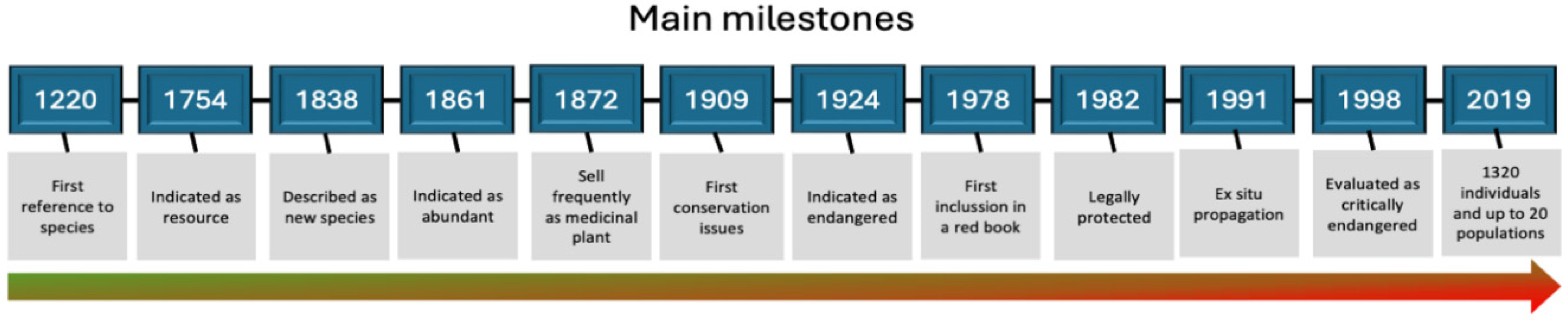
I have included all the documents selected in Table S1. I have added also some relevant information for each of them concerning the use, overexploitation and conservation of the species. Also, I have added a timeline illustrating the main milestones in the literature (Figure 1).
3.1. A Long History of Use and Abuse
First writing references date back from ca. 1220, where Ibn Al-Baytar a Spanish-Arabic physician and botanist indicated that “manzanilla real“ (royal chamomille, Spanish name for A. granatensis) “grows in the colder mountains” [7], which indicates the interest in the species date back even to medieval times.
The following reference to the species appeared in [11] making the inventory for the cadastre of the Marques de la Ensenada, who indicates for the Veleta summit area “…producing nothing but Royal Chamomille, polypodium and some amethyst-like points or crystals strongly attached to the surface of the slabs”. It is reasonable to think that its use must have already been widespread, since it is considered one of the few remarkable resources in the high mountain.
First botanical description of species was made by [12], who assigned the species to the alpine taxon Artemisia rupestris Lamarck, then other botanists cited the species as: A. glacialis L. [13], A. genipi Weber, or A. laxa Fritsch [14]. Afterwards, [15] first described the species as new and named it A. basilicata (Webb ex Willk & Lange) but did not formally published it. Then, [16] finally described the species as A. granatensis, the currently accepted name. This author also commented on its frequency on the summint of the Sierra and the “large quantity of the plant that was observed during the summer in the markets of the city of Granada”.
The rest of the 19th century references indicate the interest of the species, i.e., [17] in his geographic dictionary commented for Trevelez (a village in the southern slope of Sierra Nevada) when mentioning its products that “… thyme and chamomile grow there”. Other authors pointed their abundance [18], or the extensive use as in [19]: “… the royal chamomile Artemisia granatensis Boiss., a tiny, silvery herb, existing in very thick grasslands, of the chamomile family or St. John’s wort which, as a medicinal herb, is well known to the inhabitants of the Sierra….” or [20]: “…In the province of Granada the best known and most appreciated plant variety is undoubtedly the royal chamomile (Artemisia granatensis) a very aromatic plant and very popular as a remedy for any stomach illness. This plant, which grows among the schist of the highest peaks, can be easily bought in the streets of Granada”.
It is noteworthy that shortly after these references to the extensive use, a reference first reported the conservation concerns posed by this overuse of the species [21]: “If I mention this species here, it is to point out the war of extermination being waged by the manzanilleros (Spanish name collectors of royal chamomile). It is condemned to disappear: I do not know of any plant in Spain or in any other region where the monomania or social epidemic is more fiercely embodied in the natives of the country…”
The species rapidly turns very rare and by 1923 it is indicated [22]: “…the manzanilleros, in search of a special chamomille, exclusive, it seems, of Sierra Nevada, already very rarefied, almost exhausted, preserved only in places almost inaccessible to any interest other than the conquest of bread, the prize of all the sweat..”. He also narrated the death of a manzanillero who fell from the Mulhacén peak in the search of the scarce plants growing there. The situation become even worst, as an example Font Quer (1924) wrote: “…it has become so scarce that to collect a few sheets for the herbarium, it is necessary to search a lot”, and “…the main incentive for collectors is not so much the healing virtue of this plant as its price”. He also highlighted the problems that over-harvesting posed for natural regeneration: “Due to the irrational collection that is made of it, it is almost exhausted in Sierra Nevada. As a result of the high price it fetches in the market, it is cut as soon as it is born to prevent other collectors from getting ahead of it, thus not allowing the production of seed and its dissemination to multiply it properly.”
This situation became critical by the 70s of 20th century, when some authors consider the species have disappeared from many places [24] and globally “…in the process of disappearing as a consequence of the incessant search to which it has been subjected…” [25].
3.2. Protection and Conservation Status
Despite some authors early consider the species threatened by abusive collection [21], and that it should be protected and its collection regulated [26], by the end of 70s “the plant is extremely difficult to find, but there is a still a strong desire to collect and it is not legally protected” [27]. Due to this situation the species was included Bern Convention [28], the first attempt to preserve some species at European scale. However, until 1982 the species was not legally protected in the Spanish legislation, under endangered category, being prohibited “the collection, cutting and uprooting of this plant or part of it, including its seeds, as well as its commercialization, except for scientific purposes” [29]. After this, the species has been included in all the national and regional legislation for the protection of endangered species.
Despite the legal protection, illegal collection still continued along the 80s [30] and there was a local black market with a great demand of the species [31,32], also aggravated by the grazing impact by Spanish goat (Capra pyrenaica hispanica) [33] whose populations grew by this time due to game regulation and the absence of predators (e.g., wolf), even along the 90s the situation remained critical [34]. As a result, species was evaluated as critically endangered (CR sensu IUCN 2012) with only 6 populations (scattered in small patches) and less than 3,000 individuals in total [36]. This regressive trend still persisted with less than 2,000 individuals by 2003 [37] and it was maintained along the 2000s [38]. Other threat factors can have a punctual but strong influence in some populations, such as the hybridization with the closely related alpine species Artemisia umbelliformis [39] present in the area, despite rare [38]. Moreover, with the synergistic effect of ski slopes machine grading and the construction and maintenance of auxiliary infrastructure in the ski area [40].
In addition, it has been found that the low number of individuals in most populations caused a generalized failure in seed set, with a 20-90 % decline depending on the populations [10]. Extensive search carried out for the staff of the National Park of Sierra Nevada resulted in the location of more populations (up to 20) but a decreasing in the estimated number of individuals of 1320 by the end of 2020s, this estimate being the last available in the literature, and thus being considered as critically endangered (CR) and as a result becoming included in the top ten most endangered species at regional scale [41].
3.3. Conservation Efforts
Despite the critical situation of the species, conservation efforts remain insufficient.
From the very first indication of the conservation issues, it is also indicated that a possible measure is the cultivation of the species. Pau (1909) states “…I told the guide to cultivate it to meet the demands and thus avoid its extermination”. Despite this, there is no attempt in this sense until 1979 [42], when it is propagated in a nursery and planted in situ for the first time, but on a small scale (only 40 individuals). Afterwards, in vitro propagation was tested as an appropriate method to promote its cultivation [43].
Long after [37] indicate again that among different conservation measures (such as effective control of illegal harvesting, public awareness campaigns, or ex situ seed conservation in germplasm banks), to promote propagation as the only method to reinforcement the populations and at the same time meet the needs of traditional use of the plant through cultivation. However, to date, reinforcements or re-introductions with conservation purpose have been very scarce, being limited to about 300 individuals [44]. Nor a mechanism has been established to cultivate it under controlled conditions, although it is acknowledged that it would be a dissuasive element to prevent illegal harvesting, which still occurs at present (author’s personal observation). Paradoxically, it is well known how to propagate the species from seeds and cuttings, as well as its maintenance under cultivation conditions, from experiences carried out in botanical gardens [44].
4. Conclusions
The case of Artemisia granatensis illustrates very well how overexploitation of a species, especially if it is a narrow endemic and rare species, can led it to the brink of extinction. It is unusual in the available literature for a given species to have so many references illustrating in detail and over such a long period of time this whole process. We tend to think that the use of resources by rural communities is balanced and sustainable, but current conservation problems are often due to the overexploitation of a resource in the past. In this sense, the example of this species is paradigmatic.
The species was relatively common in the past, but becoming heavily used, locally traded, and then overexploited, it is becoming one of the most endangered plant species in Spain.
Moreover, despite the status of the species, there is a lack of effective conservation measures to ensure its survival. For this, it is necessary that the environmental administration takes the initiative in conservation and promotes all the proposed conservation measures. In this sense, cultivation could be an interesting way to reduce the pressure on natural populations, while at the same time providing an interesting resource for local farmers.
Supplementary Materials
The following supporting information can be downloaded at the website of this paper posted on Preprints.org, Table S1. Relevant literature including data about use and conservation of Artemisia granatensis.
Acknowledgments
This work has been partially funded by the project: Characterisation and conservation of the unique, endemic and/or threatened rock flora of National Parks in a context of global change. (PROROCA). Spanish network of National Parks. Organismo Autónomo Parques Nacionales. PN3003/2023.
References
- Roberson, E.; Mccormack, J. Medicinal Plants at Risk Nature’s Pharmacy, Our Treasure Chest: Why We Must Conserve Our Natural Heritage. 2008.
- Millennium Ecosystem Assessment Ecosystems and Human Well-Being: Synthesis; Island Press: Whashington, DC., 2005; ISBN 1-59726-040-1.
- Chen, S.L.; Yu, H.; Luo, H.M.; Wu, Q.; Li, C.F.; Steinmetz, A. Conservation and Sustainable Use of Medicinal Plants: Problems, Progress, and Prospects. Chinese Medicine (United Kingdom) 2016, 11, 1–10. [Google Scholar] [CrossRef] [PubMed]
- Pimm, S.L.; Russell, G.J.; Gittleman, J.L.; Brooks, T.M. The Future of Biodiversity. Science 1995, 269, 347–350. [Google Scholar] [CrossRef] [PubMed]
- Allen, D.; Bilz, M.; Leaman, D.J.; Miller, R.M.; Timoshyna, A.; Window, J. European Red List of Medicinal Plants; Luxembourg, 2014.
- Parejko, K. Pliny the Elder’s Silphium: First Recorded Species Extinction. Biology (Basel) 2003, 17, 925–927. [Google Scholar] [CrossRef]
- Navarro-García, M.A.; Hernández-Bermejo, J.E. Las Manzanillas En Los Autores Andalusíes: Algunos Apuntes Para La Interpretación de Los Textos; 1994; Vol. 3.
- Blanca, G.; López-Onieva, M.; Lorite, J.; Martínez-Lirola, M.; Molero-Mesa, J.; Quintas, S.; Ruiz-Girela, M.; Varo, M.; Vidal, S. Flora Amenazada y Endémica de Sierra Nevada; Universidad de Granada: Granada, 2001; ISBN 8433827138. [Google Scholar]
- Watson, L.E.; Bates, P.L.; Evans, T.M.; Unwin, M.M.; Estes, J.R. Molecular Phylogeny of Subtribe Artemisiinae (Asteraceae), Including Artemisia and Its Allied and Segregate Genera. BMC Evol Biol 2002, 2, 1–12. [Google Scholar] [CrossRef] [PubMed]
- Peñas, J.; Lorite, J.; Alba, F.; Taisma, M.A. Self-Incompatibility, Floral Parameters, and Pollen Characterization in the Narrow Endemic and Threatened Species Artemisia Granatensis (Asteraceae). Anales Jardin Botanico de Madrid 2010, 67, 97–105. [Google Scholar] [CrossRef]
- Ponz, A. Mensajero económico y erudito de Granada. Granada 1754, pp. 25–30.
- Lagasca, M.; Rodríguez, J. Descripción de Algunas Plantas Que Colectó D. Guillermo Thalacker En Sierra Nevada. Anales de Ciencias Naturales 1802, 5, 263–288. [Google Scholar]
- Rojas-Clemente, S. Viaje a Andalucía. Historia Natural Del Reino de Granada (1804-1809). Transcripción de Antonio Gil Albarracín; G.B.G.: Barcelona, 2002. [Google Scholar]
- Bory de Saint-Vincent, J.B.G.M. Florule de La Sierra Nevada Ou Catalogue Des Plantes Observées Dans Une Reconnasance Militaire Faite de Grenade Au Sommet Appelé Veleta. Annales Générales des Sciences Physiques 1820, 3, 3–16. [Google Scholar]
- Webb, P.B. Iter Hispaniense or a Synopsis of Plants Collected in the Southern Provinces of Spain and in Portugal, with Geographical Remarks, and Observations on Rare and Undescribed Species; Henry Coxhead: Paris, Béthune and Plon / London, 1820. [Google Scholar]
- Boissier, E. Notice Sur l’Abies Pinsapo. Tiré de La Bibliothèque Universelle de Genève; Tiré de la Bibliothèque Universelle de Genève: Genéve, 1838. [Google Scholar]
- Madoz, P. Diccionario Geográfico-Estadístico-Histórico de España y Sus Posesiones de Ultramar.; Ámbito de ediciones S.A.: Valladolid, 1845. [Google Scholar]
- Willkomm, M.; Lange, J. Prodromus Florae Hispanicae: Seu Synopsis Methodica Omnium Plantarum in Hispania, Sponte Nascentium Vel Frequentius Cultarum Quae Innotuerunt /Auctoribus Mauritio Willkomm et Joanni Lange.; E. Schweizerbart, Ed.; E. Schweizerbart: Stuttgartiae, 1861. [Google Scholar]
- Willkomm, M. Aus Den Hochgebirgen von Granada: Naturschilderungen, Erlebnisse Und Erinnerungen/ von Moritz Willkomm, Nebst Granadinischen Volkssagen Und Märchen; Wien Druck und Verlag von Carl Gerold’s Sohn: Wien, 1882. [Google Scholar]
- Rein, J. Beitrage Zur Kenntnis Der Spanischen Sierra Nevada; Lechner: Wien, 1899. [Google Scholar]
- Pau, C. Mi Segunda Visita a Sierra Nevada. Boletín de la Sociedad Aragonesa de Ciencias Naturales 1909, 8, 104–124. [Google Scholar]
- Bernaldo de Quirós, C. Sierra Nevada; Publicaciones de la comisaría regia del turismo: Madrid, 1923. [Google Scholar]
- Font Quer, P. Datos Acerca de La Flora Orófila de Sierra Nevada. Boletín de la Sociedad Aragonesa de Ciencias Naturales 1924, 24, 238–244. [Google Scholar]
- Prieto, P. Flora de La Tundra de Sierra Nevada; Col. Monogr. Publ. Univ. Granada: Granada, 1975. [Google Scholar]
- Martínez-Parras, J.M.; Molero, J.; Esteve-Chueca, F. Notas Sobre La Provincia de Granada. Lagascalia 1979, 9, 51–64. [Google Scholar]
- Rivas-Goday, S. Algunas Especies Raras o Relícticas Que Deben Protegerse En La España Mediterránea. Rev Ecol 1959, sup, 95–101. [Google Scholar]
- Synge, H. The IUCN Plant Red Data Book: Comprising Red Data Sheets on 250 Selected Plants Threatened on a World Scale.; Unwin Bros.: London, 1978. [Google Scholar]
- Anonymous Bern Convention on the Conservation of European Wildlife and Natural Habitats. 1979.
- Anonymous Real Decreto 3091/1982, de 15 de Octubre, Sobre Proteccion de Especies Amenazadas de La Flora Silvestre. Spain. 1982.
- López-Guadalupe, M.; Sierra, C.; Marín-Calderón, G. Comunidades, Habitat y Tipos de Suelos Sobre Los Que Se Desarrolla La Manzanilla de Sierra Nevada. Ars Pharmaceutica 1985, 24, 255–263. [Google Scholar]
- Losa, J.M.; Giménez, M.A. Especies Medicinales Endémicas de Sierra Nevada. Ars Pharmaceutica 1986, 27, 381–386. [Google Scholar]
- González-Tejero, M.R. Investigaciones Etnobotánicas En La Provincia de Granada, 1989.
- Gómez-Campo, C. Libro Rojo de Especies Vegetales Amenazadas de España Peninsular e Islas Baleares; Gómez Campo, C., Ed.; Ministerio de Agricultura, Pesca y Alimentación. ICONA. Serie Técnica: Madrid, 1987. [Google Scholar]
- Blanca, G.; Cabezudo, B.; Hernández-Bermejo, E.; Herrera, C.; Muñoz, J.; Valdés, B. Libro Rojo de La Flora Silvestre Amenazada de Andalucía; Consejería de Medio Ambiente, Junta de Andalucía: Sevilla, 1999; ISBN 89650-75-6. [Google Scholar]
- IUCN IUCN Red List Categories and Criteria: Version 3.1. Second, Edition; IUCN (Eds.) IUCN IUCN Red List Categories and Criteria: Version 3.1. Second Edition; IUCN, Ed.; Gland-Cambridge, 2012; ISBN 2831707862.
- Blanca, G.; Cueto, M.; Martínez-Lirola, M.J.; Molero-Mesa, J. Threatened Vascular Flora of Sierra Nevada (Southern Spain). Biol Conserv 1998, 85, 269–285. [Google Scholar] [CrossRef]
- Hernández-Bermejo, E., C.P., C.M.& P.J. Artemisia Granatensis Boiss. In Atlas y libro rojo dela flora vascular amenazada de España.; Ministerio de Medio Ambiente: Madrid, 2003; pp. 124–125.
- Lorite, J.; Navarro, F.B.; Valle, F. Estimation of Threatened Orophytic Flora and Priority of Its Conservation in the Baetic Range (S. Spain). Plant Biosystems - An International Journal Dealing with all Aspects of Plant Biology 2007, 141, 1–14. [Google Scholar] [CrossRef]
- Gómez, J.M.; González-Megías, A.; Lorite, J.; Abdelaziz, M.; Perfectti, F. The Silent Extinction: Climate Change and the Potential Hybridization-Mediated Extinction of Endemic High-Mountain Plants. Biodivers Conserv 2015, 24, 1843–1857. [Google Scholar] [CrossRef]
- Lorite, J.; Molina-Morales, M.; Cañadas, E.M.; Ballesteros, M.; Peñas, J. Evaluating a Vegetation-Recovery Plan in Mediterranean Alpine Ski Slopes: A Chronosequence-Based Study in Sierra Nevada (SE Spain). Landsc Urban Plan 2010, 97, 92–97. [Google Scholar] [CrossRef]
- Gutierrez Carretero, L.; Fuentes Carretero, J.; Cueto Romero, M.; Blanca López, G. Top Ten de Las Plantas Más Amenazadas de Andalucía Oriental: Taxones Endémicos y No Endémicos. Acta Botanica Malacitana 2019, 44, 5–33. [Google Scholar] [CrossRef]
- Sainz-Ollero, H.; Hernández-Bermejo, J.E. Experimental Reintroductions of Endangered Plant Species in Their Natural Habitats in Spain. Biol Conserv 1979, 195–206. [Google Scholar] [CrossRef]
- Clemente, M.; Contreras, P.; Susín, J.; Pliego-Alfaro, F. Micropropagation of Artemisia Granatensis. HortScience 1991, 26, 420. [Google Scholar] [CrossRef]
- Lorite, J.; Ruiz, M.; Plaza, L. Conservación Situ e in Ex Situ. In Biología de la conservación de plantas en Sierra Nevada: Principios y retos para su preservación; Editorial Universidad de Granada: Granada, 2019; pp. 225–265. [Google Scholar]
Figure 1.
Main milestones after the bibliographic review. Color in the arrow indicates the inferred growing conservation issues.
Figure 1.
Main milestones after the bibliographic review. Color in the arrow indicates the inferred growing conservation issues.
Disclaimer/Publisher’s Note: The statements, opinions and data contained in all publications are solely those of the individual author(s) and contributor(s) and not of MDPI and/or the editor(s). MDPI and/or the editor(s) disclaim responsibility for any injury to people or property resulting from any ideas, methods, instructions or products referred to in the content. |
© 2024 by the author. Licensee MDPI, Basel, Switzerland. This article is an open access article distributed under the terms and conditions of the Creative Commons Attribution (CC BY) license (https://creativecommons.org/licenses/by/4.0/).
Copyright: This open access article is published under a Creative Commons CC BY 4.0 license, which permit the free download, distribution, and reuse, provided that the author and preprint are cited in any reuse.


