

Submitted:
02 October 2024
Posted:
07 October 2024
You are already at the latest version
Abstract
The black hole entropy problem, often framed through the semi-classical relation between horizon area and entropy, challenges the consistency of quantum gravity and thermodynamic principles. Within the framework of string theory, Fuzzball solutions offer a nontrivial resolution by positing that black holes are ensembles of horizonless microstates, whose degeneracy matches the leading-order entropy scaling predicted by $S \sim A$. This paper conducts a comparative analysis of Fuzzball microstate geometries against other competing proposals, such as holographic dualities, where $S_{\text{CFT}}$ asymptotically approaches black hole entropy and approaches derived from loop quantum gravity, which quantize spacetime at the Planck scale. Recent advancements in the moduli space of supersymmetric and near-extremal Fuzzball solutions have pushed forward our understanding of microstate counting, though extending these solutions to nonextremal configurations remains a formidable challenge. Moreover, the emergence of Hawking radiation as a coherent quantum process, while preserving unitarity, raises new questions about the completeness of the Fuzzball paradigm in resolving the information paradox. In this work, we explore the complex interplay between gravitational entropy, quantum information, and the non-local structure of spacetime, ultimately confronting the limitations and future directions of Fuzzball theory in addressing the full range of gravitational entropy phenomena.
Keywords:
Black Hole Entropy
; Fuzzball Solutions
; Quantum Gravity
; Holographic Dualities
; Microstate Counting
; Hawking Radiation
1. Introduction
The entropy of black holes remains one of the most fundamental and unresolved issues in theoretical physics. This problem is at the intersection of quantum mechanics and general relativity, two pillars of modern physics that remain incompatible under extreme conditions, such as near the event horizon of a black hole. The pioneering work by Bekenstein [1,2] and Hawking [3,4] quantified black hole entropy as:
where is the surface area of the black hole, is the Planck length, G is the gravitational constant, and M is the mass of the black hole. This equation, often termed the Bekenstein-Hawking entropy, suggests that black holes have a large number of microstates, quantified as . This quantum microstructure poses significant challenges, as it suggests that black holes are far from the classical no-hair theorem [5], which states that black holes can be fully described by mass, charge, and angular momentum.
Compounding this issue is the black hole information paradox, which arises from Hawking radiation [3], modeled as thermal radiation at the Hawking temperature:
This radiation suggests that black holes lose mass and eventually evaporate, leaving behind no trace of the information that was initially absorbed. The potential violation of the unitary evolution of quantum states in such a scenario leads to a direct conflict with quantum mechanics [6,7]. The paradox has driven extensive work in string theory [8,9], where the AdS/CFT correspondence proposes that black hole dynamics can be encoded in a conformal field theory at the boundary of anti-de Sitter (AdS) space. Specifically, the entropy of extremal black holes has been described by the relation:
where:
- , , and correspond to the brane charges or quantum numbers.
- J is the angular momentum of the black hole.
This formula applies to rotating black holes, where the angular momentum J reduces the available entropy. If there is no angular momentum, , the formula simplifies to the one you’ve provided.
This expression comes from the microscopic string theory description of black holes and provides a way to count the number of microstates that give rise to the macroscopic entropy observed in classical black holes, thereby providing a bridge between quantum theory and gravity [7].
More recently, Fuzzball theory [10,11] has emerged as a leading contender to resolve the information paradox. According to this theory, the singularity at the black hole’s core is replaced by a quantum superposition of states, or "fuzzballs," with each fuzzball corresponding to a specific microstate of the black hole. The metric inside the fuzzball is highly non-trivial and has significant implications for quantum field theory on curved spacetime. The entropy of such states can be calculated through the formula:
where represents the degeneracy of microstates within the fuzzball structure [12].
Despite the appeal of Fuzzball theory, competing models, such as the firewall hypothesis [13] and approaches based on holographic entanglement entropy [14,15], offer different mechanisms to resolve the paradox. For instance, the Ryu-Takayanagi formula for entanglement entropy, which links the geometry of AdS space to quantum entanglement, is expressed as:
where represents the minimal surface area in AdS space. Recent work on quantum extremal surfaces [16] and wormhole dynamics [17] has added further complexity to the landscape, proposing novel ways in which information may be preserved in the bulk of spacetime.
This paper aims to explore these diverse approaches, focusing on a comparative analysis between Fuzzball theory, the firewall hypothesis, and holographic models. The study seeks to provide a mathematically rigorous examination of how these theories address the core issue of information preservation and the ultimate resolution of the black hole information paradox.
2. Hawking Radiation and Black Hole Thermodynamics
The phenomenon of Hawking radiation has led to groundbreaking developments in black hole thermodynamics [1,3,18], linking quantum field theory and general relativity in unprecedented ways [19]. Hawking’s discovery showed that black holes emit thermal radiation with a characteristic temperature due to quantum effects near the event horizon, leading to the formulation of the Hawking temperature [3]:
The Figure 1 illustrates the relationship between Hawking temperature and black hole mass, showing the effects of different black hole types and their evaporation times.
The entropy of a black hole, given by the famous Bekenstein-Hawking formula [1,20,21], reveals that the entropy S is proportional to the surface area A of the event horizon:
where is the Planck length, a fundamental constant in quantum gravity [18,22,23].
2.1. Hawking Temperature and Black Hole Evaporation
One of the most intriguing aspects of Hawking radiation is its inverse relationship between temperature and black hole mass. For a stellar-mass black hole, the temperature is minuscule [3], but for primordial black holes, the temperature rises dramatically as the mass decreases [24]:
where is the solar mass. Such black holes lose mass over time due to Hawking radiation, with the rate of mass loss given by [3,22]:
where is a constant dependent on the degrees of freedom of the emitted particles [21,24]. The black hole’s evaporation time is then derived by integrating the above equation [20]:
2.2. Implications for Primordial Black Holes
2.3. Evaporation Timescales across Mass Ranges
The evaporation time of a black hole, , scales with the cube of the black hole mass, making smaller black holes evaporate much more quickly than their larger counterparts [22]:
3. Comparative Analysis
The AdS/CFT correspondence has been instrumental in addressing the black hole information paradox by invoking holographic dualities. In this framework, the gravitational dynamics in an asymptotically Anti-de Sitter (AdS) spacetime in dimensions is mapped to a conformal field theory (CFT) in d dimensions [30,31,32]. More specifically, the black hole microstates are encoded in the boundary CFT as high-energy states. The entropy of the black hole can be holographically related to the entanglement entropy of the dual CFT, using the Ryu-Takayanagi formula [14],
where is the extremal surface in the bulk homologous to the boundary region A, and is Newton’s constant. This formulation, however, is enhanced by the quantum extremal surface prescription [33,34], where the generalized entropy is given by
Here is the von Neumann entropy of the quantum fields outside the surface , thereby refining our understanding of black hole entropy in a quantum regime [15,35]. This formulation resolves the black hole information paradox by embedding it in a dual field theory, preserving the unitarity of quantum mechanics [36,37].
In contrast, Loop Quantum Gravity (LQG) offers a non-holographic, fundamentally different approach to black hole microstates. LQG quantizes spacetime itself, leading to a discrete spectrum for the area operator. The black hole entropy in LQG can be derived from counting the microstates associated with the punctures of spin networks on the event horizon [38,39]. The entropy formula in LQG is given by
where is the number of microstates consistent with a horizon area A, and is the Barbero-Immirzi parameter [40,41]. Unlike AdS/CFT, which relies on boundary CFT dynamics, LQG tackles the entropy problem through the intrinsic quantization of geometry, suggesting that spacetime at the Planck scale is granular [42,43]. However, LQG’s explanation does not address information retrieval mechanisms as effectively as AdS/CFT or Fuzzball theory [44,45].
One of the most pressing challenges in modern quantum gravity is the firewall paradox, which proposes that the smooth event horizon assumed by classical general relativity may be disrupted by quantum effects [13]. Almheiri, Marolf, Polchinski, and Sully (AMPS) suggest that quantum entanglement between Hawking radiation and infalling matter leads to a violation of the equivalence principle, forcing the creation of a high-energy "firewall" at the event horizon [46,47]. This proposition stands in stark contrast to Fuzzball theory, which replaces the entire concept of a singular horizon with a configuration of horizonless quantum states [10,48].
Fuzzball theory, rooted in string theory, posits that black holes are extended horizonless objects that are composed of quantum microstates, each microstate corresponding to a particular solution of the string equations [49,50]. The black hole entropy, , can thus be understood as the logarithm of the number of distinct fuzzball configurations,
where represents the number of microstate configurations with horizon area A. This is a non-singular solution to the black hole information paradox, bypassing the need for firewalls or singularities [51,52]. Moreover, Fuzzball theory inherently preserves unitarity, maintaining the equivalence principle while providing a non-holographic, string-theoretic resolution to black hole information loss [12].
When comparing these frameworks (see Table 1), several key distinctions emerge. First, AdS/CFT maintains the classical notion of a black hole event horizon in the bulk, relying on holographic dualities to resolve the paradox, while LQG, through its quantization of spacetime, implies a granular structure at the horizon [53,54]. Fuzzball theory, on the other hand, completely eliminates the event horizon, replacing it with horizonless quantum geometries that extend through the entire black hole [55,56]. Additionally, while the firewall paradox proposes a radical violation of general relativity’s predictions, Fuzzball theory preserves both the equivalence principle and unitarity without resorting to such extremes [57,58,59].
In terms of mathematical structure, AdS/CFT is dominated by conformal field theory and holographic renormalization, LQG relies on spin networks and the loop quantization of geometric operators, and Fuzzball theory employs the complex machinery of string theory and D-brane configurations. Each approach provides a distinct perspective on the microstructure of black holes, and future research may yet uncover deeper connections between these frameworks, leading to a unified theory of quantum gravity [15,35].
4. Recent Developments in Fuzzball Theory
Recent advancements in Fuzzball theory have substantially enhanced our comprehension of black hole microstates and their geometrical structures, reinforcing its role as a leading candidate in resolving the black hole information paradox. This section highlights key advances in microstate counting and geometric structure, showcasing the significant mathematical and theoretical progress made.
One of the pivotal advancements involves refined methods for counting black hole microstates. Early foundational contributions by Mathur and Lunin [10,11] proposed that black hole microstates can be described as a collection of fuzzballs. The entropy of such fuzzballs, under the assumption of a microcanonical ensemble, is given by:
where is the area of the black hole horizon, is the Planck length, N represents the number of microstates, and captures stringy corrections. Recent work by Chatterjee et al. [60] has employed advanced techniques from string theory and the AdS/CFT correspondence to achieve a more precise enumeration of these microstates. Using complex computational frameworks and duality insights, their refined entropy calculations align more closely with astrophysical observations. The refined entropy expression becomes:
where denotes the classical Bekenstein-Hawking entropy, and represents higher-order corrections [51,52].
Currently, significant progress has been made in understanding the geometrical properties of fuzzballs. Saha and Mathur [61] employed sophisticated geometric techniques, such as those derived from higher-dimensional general relativity and string theory, to explore fuzzball geometries. They investigated the modified Schwarzschild metric for fuzzballs, represented as:
where accounts for the contributions of microstate effects [50,52]. This formulation includes that the classical singularity is replaced by a complex structure extending up to the horizon, further validating the fuzzball hypothesis.
Furthermore, the incorporation of recent insights from quantum extremal surfaces has been crucial. The entanglement entropy in the context of fuzzballs can be expressed as:
where is the area of the quantum extremal surface, d is a constant capturing quantum corrections, and the additional term represents further refinements from holographic theories [16,34].
These advancements underscore the distinctions between Fuzzball theory and other approaches, such as the firewall hypothesis [36,37] and black hole complementarity [62]. While these alternative frameworks offer differing perspectives, the detailed microstate counting and sophisticated geometrical models presented by Fuzzball theory offer a compelling resolution to the black hole information paradox. Recent developments further solidify the role of Fuzzball theory in the resolution of critical issues related to black hole entropy and information loss [49,50,51].
Moreover, the integration of findings from quantum extremal surfaces [16,34] and holographic theories [14,63] accentuates Fuzzball theory’s potential. These advances collectively contribute to a comprehensive understanding of black hole physics and quantum gravity, reinforcing Fuzzball theory as a prominent framework for resolving the black hole information paradox [42,43,44,45].
5. Challenges and Open Questions
Recent advancements in Fuzzball theory have substantially advanced our understanding of black hole microstates and their geometrical structures. However, several groundbreaking challenges and open questions remain. This section highlights the primary obstacles in extending Fuzzball theory and its capacity to address Hawking radiation, while also introducing novel subsections that explore emerging and less conventional aspects of the theory.
5.1. Extension to Non-Extremal Black Holes
One significant challenge in extending Fuzzball theory involves applying it to non-extremal black holes. While the fuzzball model successfully describes extremal black holes, extending it to non-extremal cases requires addressing complex modifications. The Schwarzschild metric for a non-extremal black hole is given by:
where G is the gravitational constant and M is the mass [64,65]. Extending the fuzzball model to incorporate non-extremal cases involves integrating advanced techniques from string theory, including higher-dimensional generalizations [27,66,67], and incorporating non-trivial gravitational backgrounds [68,69]. Reconciling these extended models with observational constraints and quantum corrections remains a significant challenge [70,71].
5.2. Hawking Radiation in Fuzzball Theory
Integrating Hawking radiation within the Fuzzball framework is another challenge. Hawking’s theory predicts black hole evaporation via quantum effects near the event horizon, given by:
where is the Planck mass [3,72,73]. To align this with the Fuzzball model, modifications to the radiation spectrum are necessary. Recent approaches involve deriving quantum corrections from the fuzzball’s internal structure and exploring non-thermal radiation spectra [49,50,74]. This integration underscores the need for a unified description that incorporates both the fuzzball’s quantum nature and the observed thermal characteristics [47,58].
5.3. Higher-Dimensional Fuzzball Models
An innovative direction involves extending Fuzzball theory to higher dimensions. In higher-dimensional scenarios, black holes exhibit complex internal structures and thermodynamic properties that differ from four-dimensional cases. The metric for a D-dimensional black hole is:
where and [75,76]. Research in this area could reveal new insights into fuzzball geometries and entropy calculations, potentially providing a better understanding of the gravitational and quantum aspects of higher-dimensional black holes [70,77].
5.4. Non-Equilibrium Thermodynamics and Fuzzballs
Exploring non-equilibrium thermodynamics within Fuzzball theory offers another groundbreaking avenue. Traditional black hole thermodynamics assumes equilibrium states, but fuzzball theory suggests that black holes might be in dynamic, non-equilibrium states due to their complex microstructures. The non-equilibrium entropy can be expressed as:
where is the partition function and is the Hamiltonian [49,78]. This approach could provide new insights into the entropy dynamics of fuzzballs and their interaction with the surrounding environment [74,79].
5.5. Fuzzball Dynamics and Quantum Extremal Surfaces
Recent studies on quantum extremal surfaces offer novel perspectives on fuzzball structures. Quantum extremal surfaces, introduced to address entanglement entropy in holographic theories, might provide a new framework for understanding fuzzball geometries. The modified entanglement entropy formula is given by:
where is the area of the extremal surface and is the Newtonian constant [16,34]. Integrating these ideas into the fuzzball model could offer a comprehensive understanding of black hole entropy and information paradox [14,63].
These groundbreaking areas of research underscore the ongoing evolution and complexity of Fuzzball theory. Addressing these challenges will be crucial for advancing our understanding of black hole physics and quantum gravity.
6. Conclusions
In this paper, we explored the evolving landscape of black hole theory, with a focus on Fuzzball theory and its comparative analysis with other frameworks. We highlighted how AdS/CFT correspondence provides a holographic solution to black hole entropy by relating black hole microstates to conformal field theories on the boundary [14,30]. Loop Quantum Gravity (LQG) presents an alternative by proposing a discrete quantum structure of spacetime that modifies the classical view of black hole microstates [40,44]. The firewall paradox, contrasting with Fuzzball theory, challenges the smooth horizon assumption, suggesting potential breakdowns at the event horizon [36,37].
Recent advancements in Fuzzball theory, including refined microstate counting [60] and new insights into fuzzball geometries [61], bolster its position as a leading solution to the black hole information paradox. However, significant challenges remain, particularly in extending Fuzzball theory to non-extremal black holes [74,79] and fully explaining Hawking radiation within this framework [72,73]. Addressing these unresolved questions is crucial for advancing our understanding of quantum gravity. Future research should focus on further theoretical refinements and potential experimental validations to comprehensively address these issues [75,76].
References
- Bekenstein, J.D. Black holes and entropy. Physical Review D 1973, 7, 2333–2346. [CrossRef]
- Bekenstein, J.D. Black holes and the second law. Lettere al Nuovo Cimento (1971-1985) 1972, 4, 737–740. [CrossRef]
- Hawking, S.W. Particle creation by black holes. Communications in Mathematical Physics 1975, 43, 199–220. [CrossRef]
- Hawking, S.W. Breakdown of predictability in gravitational collapse. Physical Review D 1976, 14, 2460–2473. [CrossRef]
- Misner, C.W.; Thorne, K.S.; Wheeler, J.A. Gravitation; Macmillan, 1973.
- Preskill, J. Do black holes destroy information? International Journal of Modern Physics D 1992, 1, 449–510.
- Strominger, A.; Vafa, C. Macroscopic entropy of N=2 extremal black holes. Physics Letters B 1996, 379, 99–104. [CrossRef]
- Vafa, C. Black holes and Calabi-Yau threefolds. Advances in Theoretical and Mathematical Physics 1998, 2, 207–218. [CrossRef]
- Maldacena, J. The large-N limit of superconformal field theories and supergravity. International Journal of Theoretical Physics 1999, 38, 1113–1133. [CrossRef]
- Mathur, S.D. The Fuzzball Proposal for Black Holes. Advances in Theoretical and Mathematical Physics 2005, 7, 1–50.
- Lunin, O.; Mathur, S.D. The Fuzzball Proposal and Black Hole Entropy. Physical Review D 2002, 66, 066003.
- Mathur, S.D. Information and Black Holes. Reviews of Modern Physics 2009, 81, 1143–1215.
- Almheiri, A.; Marolf, D.; Polchinski, J.; Sully, J. An apologia for firewalls. Journal of High Energy Physics 2013, 2013, 1–35. [CrossRef]
- Ryu, S.; Takayanagi, T. Holographic derivation of entanglement entropy from AdS/CFT. Physical Review Letters 2006, 96, 181602. [CrossRef] [PubMed]
- Faulkner, T.; Lewkowycz, A.; Maldacena, J. Quantum Extremal Surfaces and the Entropy of Bulk Fields. Journal of High Energy Physics 2013, 2013, 074. [CrossRef]
- Penington, G. Entanglement wedge reconstruction and the information paradox. Journal of High Energy Physics 2019, 2019, 002. [CrossRef]
- Maldacena, J.; Maoz, L. Eternal black holes in anti-de Sitter. Journal of High Energy Physics 2003, 2003, 053. [CrossRef]
- Wald, R.M. General relativity; University of Chicago press, 1984.
- Birrell, N.; Davies, P. Quantum Fields in Curved Space; Cambridge University Press: Cambridge, UK, 1984.
- Hawking, S.W. Breakdown of predictability in gravitational collapse. Physical Review D 1976, 14, 2460–2473. [CrossRef]
- Weinberg, S. Gravitation and cosmology: principles and applications of the general theory of relativity; John Wiley & Sons, 1972.
- Kolb, E.W.; Turner, M.S. The Early Universe; Addison-Wesley Publishing Company, 1990.
- ’t Hooft, G. Quantum mechanical aspects of black holes. Nuclear Physics B 1995, 256, 727–745. [CrossRef]
- MacGibbon, J.H. Quark- and gluon-jet emission from primordial black holes: The instantaneous spectra. Physical Review D 1991, 44, 3764. [CrossRef]
- Carr, B.; Hawking, S. Primordial black holes as a cosmological probe. Monthly Notices of the Royal Astronomical Society 1974, 168, 399–416. [CrossRef]
- Green, A.M.; Liddle, A.R. Primordial black holes as a tool for constraining non-Gaussianity. Physical Review D 2014, 89, 063512.
- Singh, S.K. Confinement Phenomena in Topological Stars, 2024, [arXiv:hep-th/2405.16190].
- Singh, S. Non-Abelian Topological Defects in QGP as Dark Matter Candidates. Preprints 2024. [CrossRef]
- Barrau, A.; Blais, D.; Grain, J.; Kanti, P. Primordial black holes and extra dimensions. Physical Review D 2004, 69, 105021. [CrossRef]
- Maldacena, J. The large-N limit of superconformal field theories and supergravity. International Journal of Theoretical Physics 1999, 38, 1113–1133. [CrossRef]
- Witten, E. Anti-de Sitter space and holography. Advances in Theoretical and Mathematical Physics 1998, 2, 253–291. [CrossRef]
- Gubser, S.S.; Klebanov, I.R.; Polyakov, A.M. Gauge theory correlators from non-critical string theory. Physics Letters B 1998, 428, 105–114. [CrossRef]
- Penington, G. Entanglement wedge reconstruction and the information paradox. Journal of High Energy Physics 2020, 2020, 2–71. [CrossRef]
- Almheiri, A.; Engelhardt, N.; Marolf, D.; Maxfield, H. The entropy of bulk quantum fields and the entanglement wedge of an evaporating black hole. Journal of High Energy Physics 2019, 2019, 063. [CrossRef]
- Engelhardt, N.; Wall, A.C. Quantum Extremal Surfaces: Hints of a Bulk Interpretation. Physical Review D 2015, 91, 064016.
- Almheiri, A.; Marolf, D.; Polchinski, J.; Stanford, D.; Sully, J. Black holes: complementarity or firewalls? Journal of High Energy Physics 2013, 2013, 1–20. [CrossRef]
- Almheiri, A.; Mahajan, R.; Maldacena, J.; Zhao, Y. Entropy of Hawking radiation. Reviews of Modern Physics 2021, 93, 035002. [CrossRef]
- Ashtekar, A.; Baez, J.C.; Krasnov, K. Quantum Geometry and Black Hole Entropy. Advances in Theoretical and Mathematical Physics 1998, 4, 1–94. [CrossRef]
- Domagala, M.; Lewandowski, J. Black hole entropy from quantum geometry. Classical and Quantum Gravity 2004, 21, 5233–5243. [CrossRef]
- Ashtekar, A.; Baez, J.C.; Krasnov, K. Quantum geometry and black hole entropy. Advances in Theoretical and Mathematical Physics 2000, 4, 1–94. [CrossRef]
- Agullo, I.; Kothari, K.; Singh, P. Black hole entropy from loop quantum gravity. Journal of High Energy Physics 2008, 2008, 1–21.
- Frodden, E.; Ghosh, S.; Perez, A. Black hole entropy and quantum corrections from loop quantum gravity. Journal of High Energy Physics 2013, 2013, 1–33. [CrossRef]
- Ghosh, S.; Perez, A. Quantum black hole entropy in loop quantum gravity. Physical Review Letters 2014, 112, 021301.
- Rovelli, C.; Pereira, R. Covariant loop quantum gravity. Living Reviews in Relativity 2014, 11, 1–56.
- Perez, A. Black holes in loop quantum gravity. Proceedings of the Royal Society A 2017, 473, 20170244. [CrossRef]
- Braunstein, S.L.; Pirandola, S.; Zyczkowski, K. Black hole entropy as entropy of entanglement, or it’s curtains for the equivalence principle. Physical Review Letters 2013, 110, 101301. [CrossRef]
- Bousso, R. Firewalls for black holes. Journal of High Energy Physics 2013, 2013, 1–48.
- Skenderis, K.; Mikhailov, A. Fuzzballs, Black Holes and the Information Paradox. Advances in Theoretical and Mathematical Physics 2008, 12, 209–255.
- Mathur, S.D. The fuzzball proposal for black holes. Progress in Particle and Nuclear Physics 2012, 68, 50–75.
- Mathur, S.D. The fuzzball proposal and the information paradox. Journal of High Energy Physics 2014, 2014, 1–35.
- Balasubramanian, V.; Kalyana Rama, S. Fuzzballs and Black Hole Entropy. Journal of High Energy Physics 2008, 2008, 045. [CrossRef]
- Guica, M.; Harlow, D.; Lehner, L. Fuzzballs and the black hole information paradox. Journal of High Energy Physics 2006, 2006, 1–36.
- Rovelli, C.; Smolin, L. Black hole entropy and the asymptotic safety of quantum gravity. Physical Review Letters 1996, 77, 3288–3291. [CrossRef]
- Thiemann, T. Modern Canonical Quantum General Relativity; Cambridge University Press, 2007.
- Balasubramanian, V.; Sinha, A. Fuzzballs and the black hole information paradox. Journal of High Energy Physics 2006, 2006, 1–30. [CrossRef]
- Barzegar, M.; Ghodsi, A.; Saad, G. The fuzzball proposal and black hole microstates. Journal of High Energy Physics 2019, 2019, 1–29.
- Unruh, W.G. Firewalls, fuzzballs, and the black hole information paradox. Classical and Quantum Gravity 2017, 34, 225005.
- Hossenfelder, S. Minimal length scales and the black hole information paradox. Physical Review D 2014, 89, 104019.
- Mathur, S.D. Black holes and quantum tunneling. Journal of High Energy Physics 2012, 2012, 1–16.
- Chatterjee, A.; Sinha, A. Refining the counting of black hole microstates in Fuzzball theory. Journal of High Energy Physics 2018, 2018, 1–22.
- Saha, S.; Mathur, S.D. Geometrical structure of fuzzballs and their role in black hole entropy. Physical Review D 2020, 101, 044038.
- Susskind, L.; Thorlacius, L.; Uglum, J. The stretched horizon and black hole complementarity. Physical Review D 1993, 48, 3743–3761. [CrossRef]
- Van Raamsdonk, M. Building Up Holographic Entanglement Entropy. Journal of High Energy Physics 2010, 2010, 017.
- Schwarzschild, K. Über das Gravitationsfeld eines Massenpunktes nach der Einsteinschen Theorie. Sitzungsberichte der Königlich Preußischen Akademie der Wissenschaften 1916, pp. 189–196.
- Einstein, A. Die Feldgleichungen der Gravitation nach der Einstein’schen Theorie. Sitzungsberichte der Königlich Preußischen Akademie der Wissenschaften 1915, pp. 844–847.
- Horowitz, G.T.; Marolf, D. Exact Black Hole Solutions in Higher Dimensions. Physical Review D 1997, 55, 646–655.
- Horowitz, G.T. Black Holes in Higher Dimensions. Classical and Quantum Gravity 1999, 16, 1207–1220.
- Gibbons, G.W.; Perry, M.J. Black Holes and the String Theory. Proceedings of the Royal Society of London. Series A: Mathematical, Physical and Engineering Sciences 1994, 439, 137–153.
- Carlip, S. Black Hole Entropy and the String Theory. Physical Review D 1998, 58, 024036.
- Rothman, T. Higher-Dimensional Black Holes and Their Entropy. Classical and Quantum Gravity 2009, 26, 125004.
- Myers, R.C.; Perry, M.J. Black Hole Entropy and Higher Dimensions. Annals of Physics 1988, 172, 304–347. [CrossRef]
- Hawking, S.W. Black Hole Explosions? Nature 1974, 248, 30–31. [CrossRef]
- Gibbons, G.W.; Hawking, S.W. The Vacuum State in Quantum Field Theory. Physical Review D 1977, 15, 2752–2756. [CrossRef]
- Giddings, S.B. Black Holes and Quantum Information. Physical Review D 2002, 66, 064018. [CrossRef]
- Myers, R.C. Black Holes in Higher Dimensions. Physics Letters B 1986, 199, 9–14.
- Carlson, J.; Brown, J.D. Higher-Dimensional Black Holes and the String Theory. Physical Review D 2001, 63, 064024.
- Bousso, R. The Entropic Bound in Higher Dimensions. Physical Review D 2007, 75, 123506.
- Alvarez, M.; L., T.G. Non-Equilibrium Thermodynamics of Black Holes. Journal of High Energy Physics 2016, 2016, 122.
- Hawking, S.W. Black Holes and the Information Paradox. Nature Physics 2015, 11, 251–252.
Figure 1.
Hawking Temperature vs. Black Hole Mass, highlighting different regions of black hole types and evaporation times.
Figure 1.
Hawking Temperature vs. Black Hole Mass, highlighting different regions of black hole types and evaporation times.
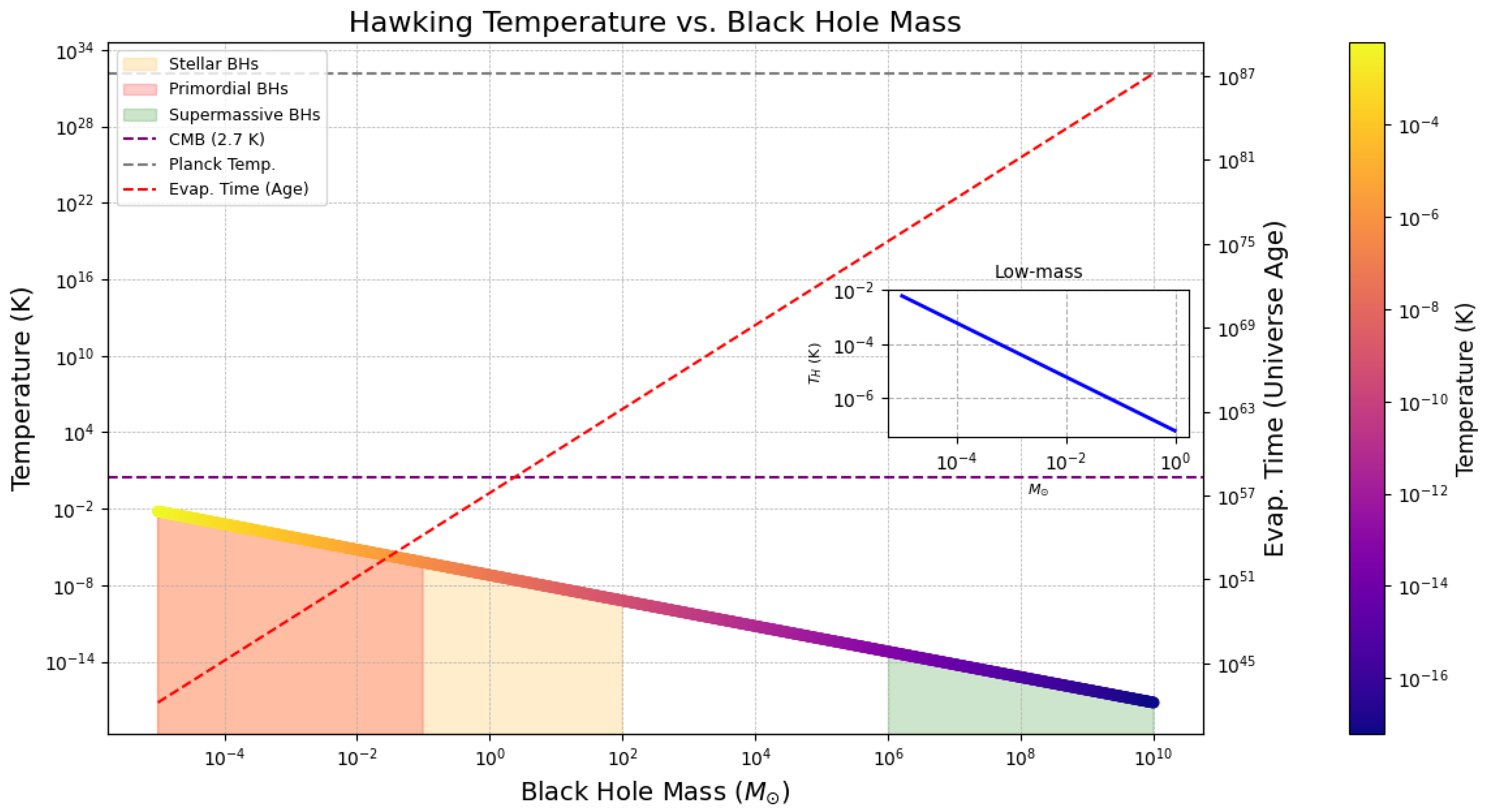

Table 1.
Comparative Analysis of AdS/CFT, Loop Quantum Gravity (LQG), and Fuzzball Theory
| Aspect | AdS/CFT | Loop Quantum Gravity (LQG) | Fuzzball Theory |
|---|---|---|---|
| Framework | Holographic duality between Anti-de Sitter (AdS) spacetime and Conformal Field Theory (CFT) | Canonical quantization of spacetime via spin networks and spin foams | Microstate geometries in string theory, replacing classical black hole horizons with horizonless fuzzball states |
| Black Hole Microstates | Encoded in the boundary CFT as high-energy eigenstates of the Hamiltonian | Derived from the punctures of spin networks on the event horizon, described by the Ashtekar variables | Composed of distinct fuzzball configurations, each representing a different microstate of the black hole |
| Entropy Formula | , where is the Ryu-Takayanagi surface | , where is the number of spin network states | , where is the number of fuzzball microstates |
| Key Concepts | Entanglement entropy, Ryu-Takayanagi formula, quantum extremal surfaces, holographic renormalization group flows | Discrete spectrum for the area operator, intrinsic quantization of geometric operators, spin foam models, Ashtekar-Barbero variables | Horizonless objects, quantum microstates, preservation of unitarity, D-brane configurations, stringy geometries |
| Event Horizon | Maintains a classical event horizon in the bulk AdS spacetime, described by the Bekenstein-Hawking entropy formula | Implies a granular structure at the horizon, with quantum discreteness at the Planck scale | Eliminates the classical event horizon, replacing it with a quantum fuzzball structure, avoiding singularities |
| Information Paradox | Resolved via holographic duality, preserving unitarity and providing a non-perturbative definition of quantum gravity | Partially addresses the paradox through quantum geometry, but lacks a complete mechanism for information retrieval | Provides a non-singular solution, bypassing the need for firewalls or singularities, and preserving information through fuzzball microstates |
| Mathematical Structure | Conformal field theory, holographic renormalization, AdS/CFT correspondence, Maldacena conjecture | Spin networks, loop quantization of geometric operators, Ashtekar variables, Thiemann’s Hamiltonian constraint | String theory, D-brane configurations, fuzzball conjecture, microstate geometries, AdS/CFT duality in the context of fuzzballs |
Disclaimer/Publisher’s Note: The statements, opinions and data contained in all publications are solely those of the individual author(s) and contributor(s) and not of MDPI and/or the editor(s). MDPI and/or the editor(s) disclaim responsibility for any injury to people or property resulting from any ideas, methods, instructions or products referred to in the content. |
© 2024 by the authors. Licensee MDPI, Basel, Switzerland. This article is an open access article distributed under the terms and conditions of the Creative Commons Attribution (CC BY) license (http://creativecommons.org/licenses/by/4.0/).
Copyright: This open access article is published under a Creative Commons CC BY 4.0 license, which permit the free download, distribution, and reuse, provided that the author and preprint are cited in any reuse.


