

Submitted:
23 September 2024
Posted:
24 September 2024
You are already at the latest version
Abstract
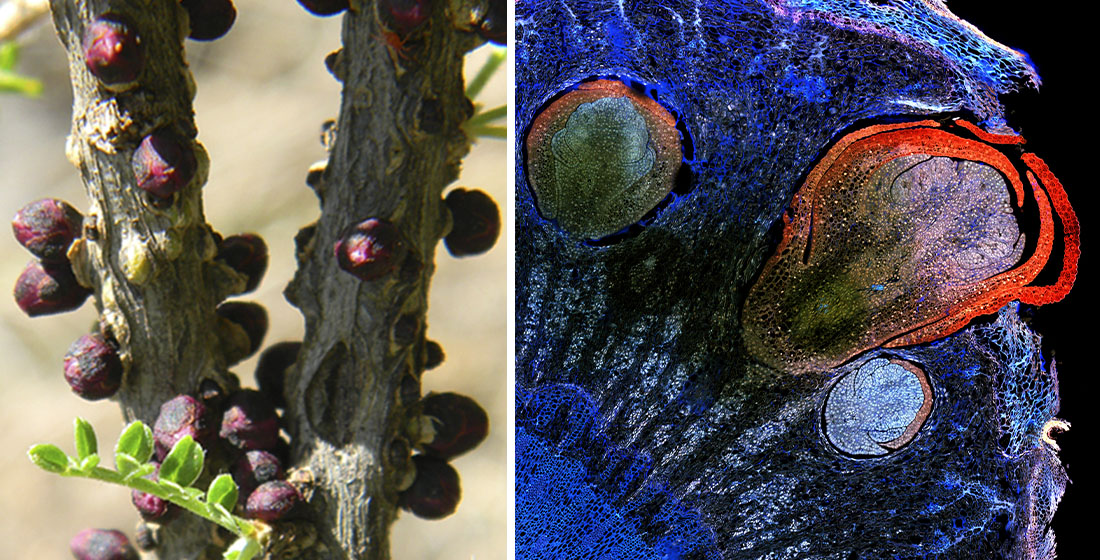
Pilostyles, an endoparasitic genus within the Apodanthaceae family, grows inside host stems, with flowers and fruits being the only external manifestations. Previous studies of P. berteroi growing on Adesmia trijuga provided limited details of the endophyte and omitted the origin of flowers and synker structure. This study, using classical methods of optical microscopy applied to the analysis with scanning electron microscopy and confocal laser scanning microscopy, expands the understanding of the P. berteroi/A. trijuga complex. We find that P. berteroi develops isophasically with its host, forming meristematic patches between secondary phloem cells. The parasitized Adesmia stem’s cambium primarily produces inward parenchyma cells, with limited vessel production and ceased fiber formation. The polarization of meristematic patches led to the formation of floral meristems. Flowers develop endogenously and emerge by the breakthrough of the host stem. Flowers connect to the host cambium via chimeric synkers, combining P. berteroi parenchyma and tracheoids with Adesmia vessels. Unlike previous studies that show uniformity among Pilostyles species, our analysis reveals new insights into the structural interaction between P. berteroi and A. trijuga. Further ultrastructural investigations are needed to explore potential direct or indirect connections between the vascular systems of the two taxa.
Keywords:
CLSM
; chimera
; endoparasites
; holoparasitic
; SEM
; sinkers
; tracheoids
; wood
Copyright: This open access article is published under a Creative Commons CC BY 4.0 license, which permit the free download, distribution, and reuse, provided that the author and preprint are cited in any reuse.


