

Submitted:
23 September 2024
Posted:
24 September 2024
You are already at the latest version
Abstract
In sustainable floriculture, the integration of arbuscular mycorrhizal fungi (AMF) and salicylic acid (SA) in the cultivation of statice flowers presents a promising ecofriendly approach to enhancing crop health and productivity. AMF improve nutrient uptake, particularly phosphorus, in plants, leading to stronger growth and abundant flowering while reducing the reliance on chemical fertilizers. Additionally, AMF enhance soil structure and water retention, fostering robust root systems and increasing the plant's resilience to drought and soil-borne pathogens thus improving soil health and minimizing environmental impact. Complementarily, the application of salicylic acid boosts the plant’s innate defense mechanisms, elevating its resistance to diseases, enhancing stress tolerance, helping statice flowers withstand adverse conditions such as drought and salinity, and promotes vigorous root development for better nutrient absorption. Hence, this study evaluates the effect of mycorrhizal inoculation and salicylic acid treatment on ornamental statice (Limonium sinuatum [L.] Mill.) cv. Qis White. The investigation involves two primary factors: mycorrhizal inoculation and salicylic acid concentration. For mycorrhizal inoculation, the study compares the untreated control with treatments including Glomus mossae, Gigaspora margarita, and a mixture of both fungi (applied as basal during transplanting). For salicylic acid, the study assesses the untreated control alongside treatments with Salicylic Acid at 100 mg L-1, 150 mg L-1, and 200 mg L-1 (applied as foliar spray at 45 and 90 days after transplanting) in a factorial RCBD experiment with three replications. Growth, flowering, yield and biomass parameters were assessed in this study. The results indicated that statice plants benefited from mycorrhizal inoculation, particularly with Glomus mosseae, when paired with salicylic acid @ 200 mg L-1. This was further validated by principal component analysis. AMF inoculated plants showed improved growth, and superior flower qualities compared to non-inoculated plants. Additionally, the application of salicylic acid demonstrated positive effects across various parameters. Notably mycorrhization led to a delay of 4 to 9 days in the flowering time of statice. In conclusion, mycorrhizal inoculation and salicylic acid can enhance the growth and flowering attributes of statice by choosing the appropriate mycorrhizal inoculum and optimal salicylic acid concentrations. In the future they can contribute to more sustainable and productive statice cultivation by reducing the need for chemical inputs and supporting overall plant health.
Keywords:
Statice
; salicylic acid
; arbuscular mycorrhiza
; growth
; flowering
1. Introduction
Statice (Limonium sinuatum [L.] Mill.) belonging to Plumbaginaceae family is widely used in landscapes, as a flowering pot plant and in flower arrangements and decoration in both fresh and dried forms. It is also one of the most popular cut flowers, which is planted worldwide [1,2]. It is native to Mediterranean region and is widely distributed in Northern Africa, western Asia, and Europe [3]. The attractive flower with its diverse colour and long-lasting shelf life can serve multiple functions and therefore its cultivation has gained popularity globally [4].
Different types of Limonium sinuatum are categorized based on their flower colours [5]. The average yield of Limonium sinuatum varies based on cultivation methods and environmental factors. Reports indicate an average yield of approximately 607.9 q/ha under specific farming practices [6]. Additionally, it has been reported that about 50,000 plants can be cultivated per hectare, potentially leading to substantial economic returns, with reports of close to 80,388.92 US dollars per hectare being achieved [7]. On an average 15 to 30 stems of flower stalks are produced annually from one plant of statice [8].
Commercial cultivation of statice is not very popular in India as compared to other traditional cut flower crops. However, its cultivation by small and medium farmers can prove to be a sustainable livelihood option and will definitely contribute to the economy of the country [9,10]. Furthermore, the continual application of chemical fertilizers at excessively high levels in contemporary agriculture can be expensive and may negatively impact the environment and soil health [11]. Therefore, it is essential to adopt a more sustainable and eco-friendly farming approach. Over the decades, various innovations had elevated by scientists to make the agricultural sector more efficient [12].
The use of microbial inoculants, in sustainable production enables plants to effectively absorb mineral elements such as nitrogen and phosphorus [13,14]. Arbuscular mycorrhizal fungi (AMF) are among the most important microbial inoculants, establishing endomycorrhizal relationships with 80% of angiosperms [15], more than 80% of terrestrial plant species [16] and about two-thirds of all plant species [17,18,19]. identified three families of arbuscular mycorrhizal fungi viz; Gigasporacea, Acaulosporaceae and Glomaceae for its potential use in agricultural production.
AMF inoculation is known to have tremendous effects on plant growth by enhancing nutrient and water uptake [20,21], inducing change of root morphology [22], providing protection to colonized roots against pathogens [23,24] and increases the phytochemical content of health-promoting compounds [25,26]. These fungi contribute to reducing fertilizer inputs in crop cultivation without significant yield loss [27]. They also improve soil quality by influencing its structure and texture [28]. Because of these implications on plant health and fitness, AMF inoculants can be considered as an important strategy in sustainable farming [29].
It has been well established that colonizing ability and growth promoting effect of different AMF species or even strains for a given plant are variable [30,31]. And to maximize the growth promoting effect of AMF, more than one species has been inoculated sometimes [15,32]. The positive effect of Glomus mossae on Limonium sinuatum has already been documented where Glomus mossae was found to perform better when compared with Glomus intraradices and their consortia [33]. The interaction of the AMF with plants may vary due to varying degree of compatibility between the AMF strain and plant species [34]. So, in the present investigation the performances of Glomus mossae was compared with Gigaspora margarita and the consortia of Glomus mossae and Gigaspora margarita on statice flower production system.
Salicylic acid on the other hand is a plant growth hormone which plays an important role in regulating normal plant growth and development [35], flower development processes [36,37], photosynthesis [38,39], responses to several abiotic stresses and to pathogen attack [40,41,42], protein synthesis and absorption of nutrients [43,44]. It has also been reported that application of salicylic acid inhibits the formation of ethylene from ACC by inactivating the ACC oxidase enzyme, thereby delaying ageing in plants [45].
In order to formulate an environmentally friendly and sustainable crop production system for statice, exploring the potential of salicylic acid and AMF application for enhancing crop production is important. However, information regarding the response of statice to mycorrhizal colonization and salicylic application and their interaction is very limited. Hence, to address this problem, the investigation was undertaken with the objectives to determine the potential of different genera of mycorrhiza and different concentrations of salicylic acid in enhancing growth and flowering of statice plant and also to study the interaction of salicylic acid and AMF on growth and flower production of statice plant.
2. Results
2.1. Growth and Flowering Traits
The interaction between arbuscular mycorrhizal fungi and salicylic acid significantly affected the growth and flowering indices of statice. Mycorrhizae notably enhanced several parameters, including the plant height, plant spread, number of leaves and leaf area (Table 1). Among the treatments, the highest plants were observed with the application of Gigaspora margarita in combination with salicylic acid @ 200 mg L-1 upto reaching 71.23 cm. The largest leaf area (30.72 cm2) was achieved when a combination of Glomus mossae, Gigaspora margarita, and salicylic acid @ 150 mg L-1was applied. Number of leaves and plant spread were found to maximum with the treatment of Gigaspora margarita + salicylic acid @ 200 mg L-1. The interaction of arbuscular mycorrhizal fungi and salicylic acid application did not show statistically significant effect on the chlorophyll content of the leaves.
Flower emergence was delayed by 4 to 9 days over control with the application of arbuscular mycorrhizal fungi, but neither the interaction of mycorrhizal inoculum and salicylic acid nor the individual effect of salicylic acid had a significant effect on this timing (Table 2). Application of Glomus mossae + Gigaspora margarita resulted into 95.5 days for flower emergence from the date of transplanting while the untreated plants took 86.37 days for emergence of flower. Maximum number of days taken for first flowering (123.73 days) was observed with the treatment involving Glomus mossae + Gigaspora margarita without salicylic acid application. A decreasing trend was observed in the number of days taken for first flowering with the increasing dose of salicylic acid. In contrary, inoculation of arbuscular mycorrhizal fungi was found to delay the time taken for first flowering. Flower longevity was maximum (35.00 days) in Gigaspora margarita inoculated plants and treated with 200 mg L-1 salicylic acid. Mycorrhizal inoculation did not show any significant effect on the vase life of statice flowers. However, the interaction effect of mycorrhiza and salicylic application reveal an extended vase life of 15.67 days with the application of Glomus mossae + Gigaspora margarita in combination with salicylic acid @ 200 mg L-1. Furthermore, longest inflorescence of 5.03 cm was obtained from plants inoculated with Glomus mossae and treated with salicylic acid @ 150 mg L-1.
The flower yield and quality parameters were significantly enhanced with the treatment of Glomus mossae in combination with salicylic acid at 200 mg L-1 (Table 3). The maximum number of flower bunches per stem recorded 82.11 from the same treatment. This treatment also resulted in the highest fresh weight of cut flower stems, which was 50.33 g. Furthermore, the greatest number of cut stems per plant, totaling 14.78, was observed with this same combination. These results highlight the effectiveness of Glomus mossae and salicylic acid at 200 mg L-1in optimizing key flowering metrics.
2.2. Biomass production and Root Colonization
To evaluate the impact of various treatments on plant development, detailed measurements of both root and shoot weights were performed (Table 4). The results demonstrated that the highest shoot fresh weight (636.67 g), was achieved with a treatment combining Glomus mossae and salicylic acid at a concentration of 200 mg L-1. For root growth, the maximum fresh weight of 25.24 g was recorded with the treatment involving Glomus mossae + Gigaspora margarita, and salicylic acid at 200 mg L-1. Additionally, the greatest shoot dry weight of 204.67 g was found with Glomus mossae and salicylic acid combination at the same dosage, while the highest root dry weight of 9.53 g was observed with the combination of Glomus mossae + Gigaspora margarita, and salicylic acid at 200 mg L-1. Moreover, the same treatment also yielded the highest root-to-shoot ratio on a fresh weight basis, measuring 0.049. These findings underscore the effectiveness of these treatments in enhancing both root and shoot growth, demonstrating their potential for optimizing plant development.
Maximum AM fungal spore (162.95 per 20 g of soil) and colonization percentage (54.73 %) was recorded in soil inoculated with Glomus mossae. Inoculated plants showed colonization percentages ranging from 48% to 54% (Table 5). Root colonization increased significantly with higher salicylic acid concentrations, peaking at 200 mg L-1 (48.18 %).
2.3. Correlation and Principal Component Analysis
The correlation analysis provides an in-depth look at how different plant traits interact with each other, revealing both positive and negative relationships. Traits like plant height, number of leaves, vase life, plant spread, fresh weight of cut flowers, cut flower stem length, number of cut stems per plant, and chlorophyll content exhibit strong positive correlations with each other (Figure 1). This means that plants with greater height tend to have more leaves, longer vase life, heavier flowers, longer stems, more flowers per plant, and higher chlorophyll content. For example, as plant height increases, so does the number of leaves and flowers, which are also indicators of overall plant vigor and health.
Cut flower quality parameters like inflorescence length was found to be positively correlated with number of leaves (r=0.61, p=0.05), plant spread (r=0.72, p=0.01), fresh weight of cut stem (r=0.53, p=0.05) and number of flower bunches per stem (r=0.71, p=0.01). Vase life was positively correlated with plant height (r=0.68, p=0.01) leaf area (r=1.0, p=0.01), chlorophyll content (r=1.0, p=0.01) and fresh weight of stem (r=0.7, p=0.01).
Yield attributing parameter i.e., number of cut flower stem per plant exhibit strong significant positive correlation with parameters viz., plant height (r=0.50, p=0.05), plant spread (r=0.65, p=0.01), number of flower bunches per stem (r=0.66, p=0.01), fresh weight of root (r=0.69, p=0.01) and root length (r=0.55, p=0.05). Understanding these relationships allows to make more informed decisions about which traits to prioritize for improving overall plant performance.
The best treatment for enhancing growth, flowering and yield of statice was evaluated using principal component analysis where insignificant relationship between growth and flowering attributes due to different treatments viz., AMF application and salicylic acid foliar spray applications were analyzed (Figure 2).
Growth and flowering parameters from 16 treatment combinations were subjected to PCA for analysis of compositional variations. The correlation coefficients of different variables in PCA were evaluated by the cosine of the angle between their vectors [51].
The Principal Component Analysis (PCA) performed on the vegetative and flowering growth parameters of statice aimed to capture the maximum variability within the data by reducing its dimensionality. According to the criteria set by [52], principal components with eigen values greater than 1 and explaining at least 5% of the total variation should be retained for further analysis. In this study, the PCA results revealed that the first three principal components had eigen values greater than 1, collectively explaining 86.9 % of the total variation in the dataset. Thus, these three components were considered significant for further analysis.
It is evident from Table 6 that Principal Component 1 (PC1) accounts for a significant portion of the total variability, explaining 72.6% with an eigen value of 13.56. This is followed by Principal Component 2 (PC2), which explains an additional 9.1 % of the variability with an eigen value of 3.59 and Principal Component 3 (PC3) showing 5.2 % of total variability with eigen value of 1.77. The remaining components each account for a small fraction of the variability. Data presented in Table 7 shows the factor loadings which depicts the contribution of each original variable to these principal components.
In PCA biplot, X-axis represents PC-1 and Y-axis represents PC-2 (Fig. 2). The association among the different variables in PC-1 and PC-2 with factor loadings is presented in Table 7. PC1 is primarily influenced by traits such leaf area, vase life and days to first flowering, with contributions of 6.4%, 6.36% and 6.34%, respectively. These traits are positively associated and cluster together on the right side of the biplot, indicating their strong contribution to the overall variability. On the other hand, PC2 is mainly driven by the root shoot ratio on dry weight basis, root shoot ratio on fresh weight basis and dry weight of root with contributions of 39.28 %, 10.11 % and 21.5%, respectively. These traits differentiate the treatments along the second axis, capturing the next largest portion of the variation.
The analysis revealed that treatment combinations of Glomus mossae + salicylic acid @ 100 mg L-1, Glomus mossae + Gigaspora margarita + salicylic acid @ 150 ppm and Glomus mossae + Gigaspora margarita + salicylic acid @ 150 mg L-1 were located on the positive side of PC1 in the upper right quadrant resulting in plants with maximum plant height, inflorescence length, number of flower bunches per plant, root shoot ratio on fresh weight basis, root length, fresh and dry weight of root parameters.
3. Discussion
3.1. Growth and Vegetative Traits
Many plant species exhibit enhanced growth and development when associated with mycorrhizal fungi [53,54,55,56,57] compared to non-mycorrhizal plants. The effects of salicylic acid on physiological processes can vary, as it may promote some functions while inhibiting others depending on its concentration, plant species, developmental stages, and environmental conditions [58,59]. When both mycorrhizal fungi and salicylic acid are present, their combined influence on plant growth and development can be particularly complex, potentially enhancing or modifying the overall effects compared to when each factor is present individually. The finding of our investigation shows that mycoorhizal inoculation resulted in increased vegetative growth as compared to the in-inoculated plants irrespective of the genera being used. It is well established that arbuscular mycorrhizal fungi (AMFs) can function as symbionts to enhance the growth and productivity of host plants [60,61,62,63]. The primary advantage of arbuscular mycorrhizal fungi (AMF) comes from their impact on the host plant's root system [64,65]. Additionally, they can impact their growth by increasing leaf area through morphologic compatibilities [33,66,67].
Salicylic acid also plays a crucial role in the production of auxin and cytokinin [68,69]. Salicylic acid has been shown to affect the production and activity of other plant hormones, including abscisic acid and gibberellins [70,71]. A further increased in vegetative growth was also observed with the application of salicylic acid and also due to the interaction of AMF and salicylic acid. [72] found that African violet plants increased their leaf count when exposed to higher levels of salicylic acid. Another study also indicated that treatments involving mycorrhizal symbiosis led to enhanced chlorophyll content, likely due to elevated concentrations of hormones such as cytokinins [73]. Similarly, an increase in vegetative growth with salicylic acid application was reported in African marigold by [74], and in gladiolus by [75,76]. Salicylic acid may improve CO2 assimilation, photosynthetic rates, and mineral uptake in stressed plants, as demonstrated by [77,78,79]. This synergy arises from salicylic acid’s capacity to enhance AMF colonization, which boosts nutrient uptake and mitigates environmental stresses such as salinity and drought [80].
Research by [81,82,83,84] demonstrated that establishing mycorrhizal associations significantly increased the leaf surface area in both Anthurium andraeanum and Glycine max. [85] found that mycorrhizal associations improved the photosynthetic rate due to higher phosphorus levels, which in turn promoted better growth and taller plant stature. [86] observed similar effects in Prunus plants. Additionally, [87] reported that applying arbuscular mycorrhizal fungi (AMF) and elevating carbon dioxide (CO2) levels resulted in more leaves and greater fresh and dry mass of Osteospermum ecklonis shoots. In our study, plants inoculated with Glomus mosseae exhibited better results than those treated with mixed inoculum. Similarly, [88] found that mycorrhizal inoculation of Zinnia elegans increased shoot biomass and flower count, with Glomus mosseae proving more effective than blended inocula. Additionally, salicylic acid at a concentration of 200 mg L-1 significantly improved various vegetative parameters, including shoot and root lengths, number of leaves, and overall biomass [89,90].
3.2. Flowering and Quality Traits
A significant effect was observed by inoculation of AMF on different flowering characters such as inflorescence length, number of flower bunches, fresh weight of cut stem, number of cut stem, flower longevity and vase life which were significantly higher in AMF inoculated plants as compared to non-inoculated plants. [91] also reported that mycorrhizal plants exhibited significantly more flowering stems compared to the non-mycorrhizal plants. Our findings are also in accordance with the reports of [92] who revealed that Callistephus chinensis plants inoculated with arbuscular mycorrhizal fungi (AMF) exhibited elevated phosphorus concentrations in their shoots. Additionally, these AMF-inoculated plants produced 39% more flowers compared to non-inoculated plants. [93] also found that Glomus etunicatum had a beneficial effect on the number of flowers of Tagetes erecta and Zinnia elegans and increased flower size in Campanula [94]. Inoculation of AMF resulted in increased flower size [55,56,82,93]. Application of salicylic acid further enhances the flowering parameters which were in accordance with the findings of [95] who reported that the higher number of floral buds induced by salicylic acid was accompanied by increase in protein synthesis and appearance of new isozyme bands. A decreasing trend in the number of days required for flowering with the increasing dose of salicylic acid may be attributed to the role of salicylic acid is in inducing flowering, prolonging flower life, delaying senescence, and boosting cell metabolic rates. Furthermore, it may be essential for the synthesis of auxins and/or cytokinins [68,69,96,97] reported that salicylic acid dramatically increases the total number of flowers produced per plant in gloxinia by 25% to 37%. [98] reported that applying small amounts of salicylic acid can delay senescence, while larger quantities can lead to rapid changes, resulting in abscission and induced senescence in lupine cut flowers and also it extended the vase life in cut flowers such as Nicotiana plumbaginifolia [99] and Gladiolus [72,100] further reported that salicylic acid increased the length of inflorescences, which may be attributed to changes in hormonal status or enhancements in photosynthesis, transpiration, and stomatal conductance.
3.3. Biomass Production and Root Colonization
Increased root colonization was observed in inoculated soils with high concentrations of salicylic acid. This increase in colonization may be attributed to the enhanced hyphal growth and spore production resulting from elevated salicylic acid levels.
Numerous studies have shown that arbuscular mycorrhizal fungi (AMF) significantly increase crop biomass [101,102]. For instance, [103] found that AMF enhanced shoot biomass by 24.2% and root biomass by 29.6% in rainfed conditions. This can be attributed to several factors. Firstly, AMF promote plant growth by improving water availability and nutrient uptake through the expansion of mycorrhizal hyphae in rainfed environments [104,105]. Secondly, the mycelium of AMF increases the root's ability to absorb nutrients and water [106,107]. Additionally, AMF contribute to higher biomass in host plants [108,109] by facilitating greater water absorption, which keeps the stomata of leaves open longer during rainfed conditions [110]. In our study, plants inoculated with Glomus mosseae exhibited higher plant biomass production among other treatments. [111] revealed the positive effect of SA on improving plant dry mass. [112] also reported an enhancement in dry matter production, plant height, and shoot and root dry weights in black gram plants when treated with SA (10-4M). Furthermore, [113] found an increased aerial biomass and root biomass with the application of SA. The enhanced growth effects of SA may be linked to hormonal changes or improvements in photosynthesis and stomatal conductance, as suggested by previous studies [114,115,116].
In our study it was observed that there is a variation in spore count and colonization percentage of arbuscular myccorhizal fungi among different genera. This may be due to the compatibility of the fungal genera with the host plant and among the genera being used. This finding was in accordance to the findings of [117] who suggested the differential behaviour of VAM fungi due to the variation in colonization of roots and symbiotic response of host preference of the fungi.
4. Materials and Methods
4.1. Experimental Site
The study was conducted at the Experimental Farm of the Division of Floriculture and Landscaping, SKUAST-Jammu, Jammu and Kashmir, India which is situated at an altitude of 296 meters above sea level and has latitude of 33°55′ north and a longitude of 74°58′ east. The overall climate of the region is subtropical with distinct seasons. Summers are hot and dry, while the rainy season is characterized by hot and humid conditions. Winters are cold, with average rainfall ranging from 1000 to 1200 mm annually. During the summer, temperatures reach a maximum of 45-46°C, while winter temperatures drop to a minimum of 4-6°C. The average humidity levels are 92.0% for the maximum and 32.0% for the minimum. A preliminary study of the soil of the experimental field was conducted before starting the experiment. The physio-chemical characteristics of soil taken revealed sandy loam textural class with available N of 240.54 kg ha-1, available P2O5 of 29.81kg ha-1, available K2O of 229.62 kg ha-1, EC of 0.37 dS m-1 and organic carbon content of 0.38 %.
4.2. Plant Material
Limonium sinuatum [L.] Mill. cv. Qis White was used for the experiment. Sowing of seed was done on mid of October, 2023. After 30 days of sowing, healthy seedlings having four fully developed leaves were transplanted into the field at a spacing of 30 cm x 30 cm, allowing for a total of 20 seedlings per bed size measuring 1.50 m × 1.20 m. To ensure a full plant population in each plot until ten days after transplanting, fresh seedlings were used to replace mortality. No fertilization, disease and pest control schedule was included during the cultivation period.
4.3. Experimental Design
A factorial experiment using randomized complete block design with three replications was carried out in open field conditions. Study comprises of two factors viz; four levels different arbuscular mycorrhizal fungi (AMF) inoculation and four levels of salicylic acid. The levels of mycorrhizal inoculation includes untreated control, Glomus mossae, Gigaspora margarita, and Glomus mossae + Gigaspora margarita while the levels of salicylic acid were untreated control, 100 mg L-1, 150 mg L-1, and 200 mg L-1 concentrations of salicylic acid. Application of salicylic acid was done as foliar spray twice during the cropping season, at 30 days and 60 days after transplanting respectively. Control plants were sprayed with distilled water. All the plants were thoroughly sprayed from the top to the ground level till runoff. With regards to the application of arbuscular mycorrhizal fungi, 2 grams of AMF were incorporated into the planting pit of each plant. The inoculums consists of mycorrhizal spores and growth medium with 10 viable fungal spores per gram of the product.
4.4. Evaluations of Growth and Flowering Parameters
Growth, flowering, yield and biomass production of statice in response to different treatments were assessed from five randomly tagged plants from each treatment and each replication. Plant height and plant spread were measured at peak flowering stage. Leaf area was determined by using a Leaf Area Meter 211 (SYSTRONICS® India Ltd.) during peak flowering stage. The chlorophyll content of leaf was recorded at 90 days after transplanting with the help of the SPAD - 502 chlorophyll meter (Minolta Corporation Ltd., Osaka, Japan) on three newly expanded leaves and three fully matured leaves separately, and averaged was worked out for each group.
The duration that the flower remains presentable in the field after it fully bloomed was recorded as flower longevity in field. At full bloom stage, the length of five sets of flower clusters were measured on each tagged plant for observations on inflorescence length. Flower harvesting was done when the inflorescences were fully opened. Immediately after harvesting, the flowers were placed in containers filled with clean water and vase life was determined at room temperature.
At full maturity, the representative plants were uprooted for destructive sampling. Plant parts were separated into roots and shoots. Fresh weight of each part was determined immediately after harvest and the plant parts were dried in a hot air oven at 70oC for 48 hours until a constant weight was obtained. After drying, shoot and root weight was calculated. The root: shoot ratio on fresh and dry weight basis was derived to denote the ratio of water-absorbing area (root) and the transpiration area (shoot) of a plant and was calculated as outlined by [46].
4.5. Determination of Mycorrhizal Spore Count and Mycorrhizal Colonization of Roots
The AM fungal spores present in the rhizosphere soil was determined by spore isolation through ‘Wet Seiving and Decanting’ method [47] and spore counted via most probable number method [48]. Mycorrhizal colonisation of roots was determined by uprooting the roots and thereafter it was rinsed and then roots less than 2 mm in diameter were examined with trypan blue 0.05 in lactoglycerol [49]. Colonization was determined according to gridline intersect method under a stereomicroscope with magnification of 50x [50].
4.6. Statistical Analysis
The data were analyzed using analysis of variance (ANOVA) to test the significance in the data recorded. The means were compared with Tukey’s Test at 1% and 5% probability where ANOVA indicated significant differences. The analysis was conducted using SPSS analytical package (IBM SPSS Statistics 27.0.1). Principal component analysis (PCA) was conducted for growth and flowering parameters using R studio 2022 (Version 4.2.1).
5. Conclusions
The various interaction effects revealed in terms of maximum fresh weight of shoot, dry weight of shoot, number of flower bunches per stem, fresh weight of cut stem and number of cut stem per plant with the treatment combination of Glomus mossae + SA @ 200 mg/L performed better than control. Delayed flowering was observed in mycorrhizal plants, which could be advantageous for market management. Thus, using an appropriate inoculum along with an optimal salicylic acid concentration can enhance the production of statice.
Author Contributions
Conceptualization, N.L.; investigation, N.L., S.G., A.S. and R.M.; formal analysis of data, N.L., S.G. and K.M.G.; original draft preparation, S.G., N.L. and A.S.; writing-review and editing, G. C., N.L. and A.S.; supervision, G. C. and R.K.P.
Funding
This research received no external funding.
Acknowledgments
The authors are highly thankful to SKUAST-J, Chatha-180009, Jammu, Jammu and Kashmir for carrying out the research work and also to all the authors.
Conflicts of Interest
The authors declare no conflict of interest.
References
- Whipker, B.E.; Hammer, P.A. Growth and yield characteristics of field-grown Limonium sinuatum (L.). Hortic Sci. 1994, 29, 638-640.
- Kumar, M.R.; Topno, S.E.; Kerketta, A. Effect of crop geometry and age of seedlings on its growth, flower yield and quality of statice (Limonium sinuatum L.) under Prayagraj agro climatic conditions. Int J Environ Clim Change, 2022,12, 700-708.
- Lledo, M.D.; Karis, P.O.; Crespo, M.B.; Fay, M.F.; Chase, M.W. Endemism and evolution in Macaronesian and Mediterranean Limonium taxa, in: Bramwell, D., Caujape-Castells, J. (Eds.), The Biology of Island Floras. Cambridge University Press, 2011; pp. 325-337.
- Grieve, C.M.; Poss, J.A.; Grattan, S.R.; Shouse, P.J.; Lieth, J.H.; Zeng, L. Productivity and mineral nutrition of Limonium species irrigated with saline waste waters. Hortic Sci. 2005, 40, 40654–40658. [Google Scholar]
- Galage, N.; Topno, S.E.; Parsad, V.M. Studies on the effect of different plant densities and levels of CRF on growth, yield and quality of flowers of statice (Limonium sinuatum L.). Int J Curr Microbiol Appl Sci, 2021, 10, 259-266.
- Mellesse, B.; Kassa, N.; Mohammed, A. Yield and quality of statice [Limonium sinuatum (L.) Mill.] as affected by cultivars and planting densities. Afr J Plant Sci. 2013, 7, 528-537.
- Kottayam, S.; Sartaj, A.; Ansari, H. Yield quality of statice [Limonium sinuatum (L.) Mill.] as affected by cultivars and planting densities. Int J Hortic Floric, 2014, 2, 089-097.
- Jain, R.; Singh, M.K.; Swaroop, K.; Reddy, M.V.; Janakiram, T.; Kumar, P.; Pinder, R. Optimization of spacing and nitrogen dose for growth and flowering of statice (Limonium sinuatum). Indian J Agric Sci. 2018, 88, 1108–1114. [Google Scholar] [CrossRef]
- Burchi, G.; Mercuri, A.; Bianchini, C.; Mercatelli, E.; Maletta, M.; Schiva, T. Results of a Breeding Activity on Limonium spp. Int Eucarpia Symp Orn Breed Beaut. 2006, 714, 43–50. [Google Scholar] [CrossRef]
- Nataraj, S. K.; Gangadharappa, P. M.; Reddy, B. S.; Naik, K. B.; Prashanth, S. J.; Prakash, D. P. Evaluation of annual statice (Limonium sinuatum L.) cultivars. J Hortic Sci. 2009, 4,184-186.
- Wahid, F.; Fahad, S.; Danish, S.; Adnan, M.; Yue, Z.; Saud, S.; Siddiqui, M.H.; Brtnicky, M.; Hammerschmiedt, T.; Datta, R. Sustainable management with mycorrhizae and phosphate solubilizing bacteria for enhanced phosphorus uptake in calcareous soils. Agric. 2020, 10, 334. [Google Scholar] [CrossRef]
- Ajmal, M.; Ali, H.I.; Saeed, R.; Akhtar, A.; Tahir, M.; Mehboob, M.Z.; Ayub, A. Biofertilizer as an alternative for chemical fertilizers. J Agric Allied Sci. 2018, 7, 1–7. [Google Scholar]
- Igiehon, N.O.; Babalola, O.O. Biofertilizers and Sustainable Agriculture: Exploring Arbuscular Mycorrhizal Fungi. Appl Microbiol Biotechnol 2017, 101, 4871–4881. [Google Scholar] [CrossRef]
- Johnson, D.; Martin, F.; Cairney, J.W.; Anderson, I.C. The importance of individuals: intraspecific diversity of mycorrhizal plants and fungi in ecosystems. New Phytol, 2012,194, 614-628.
- Wang, B.; Qiu, Y.L. Phylogenetic distribution and evolution of mycorrhizas in land plants. Mycorrhiza. 2006, 16, 299–363. [Google Scholar] [CrossRef] [PubMed]
- Smith, S.E.; Smith, FA. Roles of arbuscular mycorrhizas in plant nutrition and growth: new paradigms from cellular to ecosystem scales. Annu Rev Plant Biol, 2011, 62, 227–250.
- Patreze, C.M.; Moreira, M.; Tsai, S.M. Advances in molecular diversity of arbuscular mycorrhizal fungi (Phylum Glomeromycota) in forest ecosystems, in: Blanco, A.J., Lo, H.Y. (Eds.), Forest Ecosystems: More than Just Trees. In Tech, Rijeka, 2012, pp.53-80.
- Morton, J.B.; Benny, G.L. Revised Classification of Arbuscular Mycorrhizal Fungi (Zygomycetes): A New Order, Glomales, two new suborders, Glomineae and Gigasporineae and two new families, Acaulosporaceae and Gigasporaceae, with an emendation of Glomaceae. Mycotaxon. 1990, 37, 471–491. [Google Scholar]
- Morton, J.B.; Bentivenga, S.P. Levels of diversity in endomycorrhizal fungi (Glomales, Zygomycetes) and their role in defining taxonomic and non-taxonomic groups. Plant Soil, 1994, 159, 47–59.
- Kim, K.Y.; Jordan, D.; McDonald, G.A. Effect of phosphate-solubilizing bacteria and vesicular-arbuscular mycorrhizae on tomato growth and soil microbial activity. Biol Fertil Soils, 1997, 26: 79-87.
- Davies Jr, F.T.; Potter, J.R.; Linderman, R.G. Drought resistance of mycorrhizal pepper plants independent of leaf P concentration response in gas exchange and water relations. Physiol Plant. 1993, 87, 45–53. [Google Scholar] [CrossRef]
- Azcon-Aguilar, C.; Padilla, I.G.; Encina, C.L.; Azcon, R.; Barea, J.M. Arbuscular mycorrhizal inoculation enhances plant growth and changes root system morphology in micropropagated Annona cherimola Mill. Agronomie J Genet Plant Breed. 1996, 16, 647–652. [Google Scholar] [CrossRef]
- Elsayed Abdalla, M.; Abdel-Fattah, G.M. Influence of the endomycorrhizal fungus Glomus mosseae on the development of peanut pod rot disease in Egypt. Mycorrhiza, 2000,10, 29-35.
- Abdel-Fattah, G.M.; Mankarios, A.T. Functional activity of vesicular-arbuscular fungus Glomus mosseae in the protection of soybean from infection by the pathogenic fungus Chalara elegans. Egypt J Microbiol. 1995, 30, 287–305. [Google Scholar]
- Sbrana, C.; Avio, L.; Giovannetti, M. Beneficial mycorrhizal symbionts affecting the production of health-promoting phytochemicals. Electrophoresis, 2014, 35, 1535–1546.
- Avio, L.; Turrini, A.; Giovannetti, M.; Sbrana, C. Designing the ideotype mycorrhizal symbionts for the production of healthy food. Front Plant Sci, 2018, 9, 1089.
- Sharma, M.; Delta, A.K.; Kaushik, P. Glomus mosseae and Pseudomonas fluorescens application sustains yield and promote tolerance to water stress in Helianthus annuus L. Stresses, 2021, 1, 305-316.
- Bowles, T.M.; Barrios-Masias, F.H.; Carlisle, E.A.; Cavagnaro, T.R.; Jackson, L.E. Effects of arbuscular mycorrhizae on tomato yield, nutrient uptake, water relations, and soil carbon dynamics under deficit irrigation in field conditions. Sci Total Environ. 2016, 566, 1223–1234. [Google Scholar] [CrossRef] [PubMed]
- de Souza, T.A.F.; Rodrigues, A.F.; Marques, L.F. Long-term effects of alternative and conventional fertilization I: Effects on arbuscular mycorrhizal fungi community composition. Russ Agric Sci, 2015, 41; 454-461.
- Linderman, R.G.; Davis, E.A. Evaluation of commercial inorganic and organic fertilizer effects on arbuscular mycorrhizae formed by Glomus intraradices. HortTechnology, 2004, 14, 196-202.
- Sensoy, S.; Demir, S.; Turkmen, O.; Erdinc, C.; Savur, O. B. Responses of some different pepper (Capsicum annuum L.) genotypes to inoculation with two different arbuscular mycorrhizal fungi. Scientia Hort. 2007, 113, 92-95.
- Jansa, J.; Smith, F.A.; Smith, S.E. Are there benefits of simultaneous root colonization by different arbuscular mycorrhizal fungi? New Phytol, 2008, 177, 779-789.
- Sheikh-Assadi, M.; Khandan-Mirkohi, A.; Taheri, M.R.; Babalar, M.; Sheikhi, H.; Nicola, S. Arbuscular Mycorrhizae contribute to growth, nutrient uptake and ornamental characteristics of Statice (Limonium sinuatum [L.] Mill.) subject to appropriate inoculum and optimal phosphorus. Horticulturae. 2023, 9, 564.
- Gao, X.; Liu, Y.; Liu, C.; Guo, C.; Zhang, Y.; Ma, C.; Duan, X. Individual and combined effects of arbuscular mycorrhizal fungi and phytohormones on the growth and physiobiochemical characteristics of tea cutting seedlings. Front. Plant Sci. 2023, 14, 1140267. [Google Scholar] [CrossRef]
- Hayat, Q.; Hayat, S.; Irfan, M.; Ahmad, A. Effect of exogenous salicylic acid under changing environment: a Review. Environ Exp Bot, 2010, 68,14-25.
- Kadam, M.S.; Malshe, K.V.; Salvi, B.R.; Chavan, S.S. Effect of plant growth regulators on flowering and flower yield in gaillardia (Gaiilardia pulchella) cv. Local double. Int J Chem Stud, 2020, 8: 927-930.
- Luo, Y.; Liu, M.; Cao, J.; Cao, F.; Zhang, L. The role of salicylic acid in plant flower development. J For Res, 2022, 2, 14.
- Arfan, M.; Athar, H.R.; Ashraf, M. Does exogenous application of salicylic acid through the rooting medium modulate growth and photosynthetic capacity in two differently adapted spring wheat cultivars under salt stress?. J Plant Physio, 2007, 164, 685-694.
- El-Tayeb, M.A. Response of barley grains to the interactive effect of salinity and salicylic acid. Plant Growth Regul, 2005, 45, 215-224.
- Noreen, S.; Ashraf, M.; Hussain, M.; Jamil, A. Exogenous application of salicylic acid enhances antioxidative capacity in salt stressed sunflower (Helianthus annuus L.) plants. Pak J Bot, 2009, 41, 473-479.
- Abdelaal, K.A. Effect of salicylic acid and abscisic acid on morpho-physiological and anatomical characters of faba bean plants (Vicia faba L.) under drought stress. J Plant Prod, 2015, 6, 1771-1788.
- Vlot, A.C.; Dempsey, D.M.A.; Klessig, D.F. Salicylic acid, a multifaceted hormone to combat disease. Annu Rev Phytopathol, 2009, 47: 177-206.
- Ali, S.; Ganai, B.A.; Kamili, A.N.; Bhat, A.A.; Mir, Z.A.; Bhat, J.A.; Tyagi, A.; Islam, S.T.; Mushtaq, M.; Yadav, P.; Rawat, S.; Grover, A. Pathogenesis-related proteins and peptides as promising tools for engineering plants with multiple stress tolerance. Microbiol Res. 2018, 212, 29–37. [Google Scholar] [CrossRef]
- Davies, P.J. Plant Hormones: Physiology, Biochemistry and Molecular Biology. Kluwer Academic Publishers, Dordrecht, The Netherlands; Norwell, MA, USA. 1995.
- Leslie, C.A.; Romani, R.J. Inhibition of ethylene biosynthesis by salicylic acid. Plant physiol, 1988, 88, 833-837.
- Racey, G.D. A com parison of planting stock characterisation with root area index, volume and dry weight. Forestry Chronicle. 1985, 61, 64–70. [Google Scholar] [CrossRef]
- Gardemann, J.W.; Nicholson, T. H. Spores of mycorrhizal Endogone species extracted from soil by wet sieving and decanting. Transactions of British Mycol Society. 1963, 46, 235–44. [Google Scholar] [CrossRef]
- Porter, W.N. The most probable number method for enumerating infective propagules of VA-mycorrhizal fungi in soil. Austrailian J Soil Res. 1979, 17, 515–9. [Google Scholar] [CrossRef]
- Koske, R.E.; Gemma, J.N. A modified procedure for staining roots to detect VA mycorrhizas. Mycol Res, 1989, 92, 486-488.
- Giovannetti, M.; Mosse, B. An evaluation of techniques for measuring vesicular arbuscular mycorrhizal infection in roots. New Phytol, 1980, 84, 489-500.
- Thakur, M.; Kumar, R. Foliar application of plant growth regulators modulates the productivity and chemical profile of Damask rose (Rosa damascena Mill.) under mid hill conditions of the western Himalaya, Ind Crop Prod. 2020, 158, 113024.
- Brejda, J.J.; Moorman, T.B.; Karlen, D.L.; Dao, T.H. Identification of regional soil quality factors and indicators I. Central and Southern High Plains. SSSAJ, 2000, 64, 2115-2124.
- Smith, S.E.; Read, D.J. Mycorrhizal Symbiosis; Academic Press: Cambridge, MA, USA, 2010; p. 32. ISBN 0080559344. [Google Scholar]
- Nunes, C.E.P.; Stancato, G.C.; Da Silveira, A.P.D. Anthurium growth responses to phosphate fertilisation and inoculation with an arbuscular mycorrhizal fungus. J Hortic Sci Biotechnol, 2014, 89, 261-267.
- Turjaman, M.; Tamai, Y.; Santoso, E.; Osaki, M.; Tawaraya, K. Arbuscular mycorrhizal fungi increased early growth of two non timber forest product species Dyera polyphylla and Aquilaria filaria under greenhouse conditions. Mycorrhiza. 2006, 16, 459–464. [Google Scholar] [CrossRef]
- Liu, J.; Wu, L.; Wei, S.; Xiao, X.; Su, C.; Jiang, P.; Song, Z.; Wang, T.; Yu, Z. Effects of arbuscular mycorrhizal fungi on the growth, nutrient uptake and glycyrrhizin production of licorice (Glycyrrhiza uralensis Fisch). Plant Growth Regul. 2007, 52, 29–39. [Google Scholar] [CrossRef]
- Vosnjak, M.; Likar, M.; Osterc, G. The effect of mycorrhizal inoculum and phosphorus treatment on growth and flowering of Ajania (Ajania pacifica (Nakai) Bremer et Humphries) plant. Horticulturae, 2021, 7, 178.
- El-Mergawi, R.A.; Abdel-Wahed, M.S. Diversity in salicylic acid effects on growth criteria and different indole acetic acid forms among faba bean and maize. Egypt J Agron, 2004, 26, 49-61.
- Grown, B.A. Physiological role of salicylic acid in improving performance, yield and some biochemical aspects of sunflower plant grown under newly reclaimed sandy soil. Aust J Basic Appl Sci, 2012, 6, 82-89.
- Shahabivand, S.; Maivan, H. Z.; Goltapeh, E. M.; Sharifi, M.; Aliloo, A. A. The effects of root endophyte and arbuscular mycorrhizal fungi on growth and cadmium accumulation in wheat under cadmium toxicity. Plant Physiol Biochem. 2012, 60, 53–58. [Google Scholar] [CrossRef]
- Colla, G.; Rouphael, Y.; Di Mattia, E.; El-Nakhel, C.; Cardarelli, M. Co-inoculation of Glomus intraradices and Trichoderma atroviride acts as a biostimulant to promote growth, yield and nutrient uptake of vegetable crops. J Sci Food Agric. 2012, 95, 1706–1715. [Google Scholar] [CrossRef] [PubMed]
- Palencia, P.; Martinez, F.; Pestana, M.; Oliveira, J. A.; Correia, P. J. Effect of Bacillus velezensis and Glomus intraradices on fruit quality and growth parameters in strawberry soilless growing system. Hortic. J. 2015, 84, 122–130. [Google Scholar] [CrossRef]
- Yang, H.; Zhang, Q.; Dai, Y.; Liu, Q.; Tang, J.; Bian, X.; Chen, X. Effects of arbuscular mycorrhizal fungi on plant growth depend on root system: a meta-analysis. Plant Soil. 2015, 389, 361–374. [Google Scholar] [CrossRef]
- Gutjahr, C.; Casieri, L.; Paszkowski, U. Glomus intraradices induces changes in root system architecture of rice independently of common symbiosis signaling. New Phytol, 2009, 182, 829–837.
- Vos, C.; Schouteden, N.; van Tuinen, D.; Chatagnier, O.; Elsen, A.; De Waele, D.; Panis, B.; Gianinazzi-Pearson, V. Mycorrhiza-induced resistance against the root–knot nematode Meloidogyne incognita involves priming of defense gene responses in tomato. Soil Biol Biochem. 2013, 60, 45–54. [Google Scholar] [CrossRef]
- Qi, S.; Wang, J.; Wan, L.; Dai, Z.; da Silva Matos, D.M.; Du, D., Egan, S.; Bonser, S.P.; Thomas, T.; Moles, A.T. Arbuscular Mycorrhizal Fungi contribute to phosphorous uptake and allocation strategies of Solidago canadensis in a phosphorous-deficient environment. Front Plant Sci. 2022, 13, 1-11.
- Grimoldi, A.A.; Kavanova, M.; Lattanzi, F.A.; Schnyder, H. Phosphorus nutrition-mediated effects of arbuscular mycorrhiza on leaf morphology and carbon allocation in perennial ryegrass. New Phytol. 2005, 168, 435–444. [Google Scholar] [CrossRef]
- Metwally, A.; Finkemeier, I.; Georgi, M.; Dietz, K.J. Salicylic acid alleviates the cadmium toxicity in barley seedlings. Plant Physiol, 2003, 132, 272-281.
- Gharib, F.A.; Abed, F. Effect of salicylic acid on the growth, metabolic activities and oil content of basil and marjoram. Int J Agric Biol, 2006, 4, 485-492.
- Senaratna, T.; Touchell, D.; Bunn, E.; Dixon, K. Acetyl salicylic acid (Aspirin) and salicylic acid induce multiple stress tolerance in bean and tomato plants. Plant Growth Regul, 30.
- Traw, M.B.; Kim, J.; Enright, S.; Cipollini, D.F.; Bergelson, J. Negative cross-talk between salicylate-and jasmonate-mediated pathways in the Wassilewskija ecotype of Arabidopsis thaliana. Mol Ecol. 2003, 12, 1125–1135. [Google Scholar] [CrossRef]
- Basit, A.; Shah, K.; Rahman, M. Ur.; Xing, L.; Zuo, X.; Han, M.; Alam, N.; Khan, F. A. Salicylic acid an emerging growth and flower inducing hormone in marigold (Tagetes sp. L). Pure Appl Biol. 2018, 7:1301–1308.
- Goh, D.M.; Cosme, M.; Kisiala, A.B.; Mulholland, S.; Said, Z.M.; Spichal, L.; Emery, R.N.; Declerck, S.; Guinel, F.C. A stimulatory role for cytokinin in the arbuscular mycorrhizal symbiosis of pea. Front Plant Sci. 2019, 10, 262. [Google Scholar] [CrossRef]
- Swaroop, K.; Singh, K.P.; Raju, D.V.S. Vegetative growth, flowering and seed characters of African marigold (Tagetes erectaLinn.) as influenced by different growth substances during mild off seasons. J Ornam Hortic, 2007, 10, 268- 270.
- Sable, P.B.; Ransingh, U.R.; Waskar, D.P. Effect of foliar application of plant growth regulators on growth and flower quality of gladiolus cv.‘HB Pitt’. J Hortic, 2015, 2, 141-143.
- Pawar, A.; Chopde, N.; Nikam, B. Thiourea and salicylic acid influences growth, yield and quality of gladiolus. J Pharmacogn Phytochem, 2018, 7, 970-972.
- Karlidag, H.; Yildirim, E.; Turan, M. Salicylic acid ameliorates the adverse effect of salt stress on strawberry. Sci Agric, 2009, 66, 180-187.
- Khan, W.; Prithiviraj, B.; Smith, D.L. Photosynthetic responses of corn and soybean to foliar application of salicylates. J Plant Physiol, 2003, 160, 485-492.
- Szepesi, A. Role of salicylic acid pre-treatment on the acclimation of tomato plants to salt-and osmotic stress. Acta Biol Szeged, 2005, 49, 123-125.
- Garg, N.; Bharti, A. Salicylic acid improves arbuscular mycorrhizal symbiosis, and chickpea growth and yield by modulating carbohydrate metabolism under salt stress. Mycorrhiza, 2018, 28, 727-746.
- Sohn, B.K.; Kim, K.Y.; Chung, S.J.; Kim, W.S.; Park, S.M.; Kang, J.G.; Rim, Y.S.; Cho, J.S.; Kim, T.H.; Lee, J.H. Effect of the different timing of AMF inoculation on plant growth and flower quality of chrysanthemum. SciHortic. 2003, 98, 173–183. [Google Scholar] [CrossRef]
- Prasad, K.; Aggarwal, A.; Yadav, K.; Tanwar, A. Impact of different levels of superphosphate using arbuscular mycorrhizal fungi and Pseudomonas fluorescens on Chrysanthemum indicum L. J Soil Sci Plant Nutr, 2012, 12, 451–462.
- Liang, J.F.; An, J.; Gao, J.Q.; Zhang, X.Y.; Yu, F.H. Effects of arbuscular mycorrhizal fungi and soil nutrient addition on the growth of Phragmites australis under different drying-rewetting cycles. Public Lib Sci, 2018, 13, 0191999.
- Adeyemi, N.O.; Atayese, M.O.; Olubode, A.A.; Akan, M.E. Effect of commercial arbuscular mycorrhizal fungi inoculant on growth and yield of soybean under controlled and natural field conditions. J Plant Nutr. 2020, 43: 487-499.
- Rousseau, J.V.D.; Reid, C.P.P. Effects of phosphorus and ectomycorrhizas on the carbon balance of loblolly pine seedlings. For Sci, 1990, 36, 101-112.
- Monticelli, S.; Puppi, G.; Damiano, C. Effects of in vivo mycorrhization on micropropagated fruit tree rootstocks. Appl Soil Ecol, 2000, 15, 105-111.
- Nowak, J.; Nowak, J.S. CO2 enrichment and mycorrhizal effects on cutting growth and some physiological traits of cuttings during rooting. Acta Sci Pol Hortorum Cultus, 2013, 12, 67-75.
- Long, L.K.; Yao, Q.; Huang, Y.H.; Yang, R.H.; Guo, J.; Zhu, H.H. Effects of arbuscular mycorrhizal fungi on Zinnia and the different colonization between Gigaspora and Glomus. World J Microbiol Biotechnol. 2010, 26, 1527–1531. [Google Scholar] [CrossRef]
- Hassoon, A.S.; Abduljabbar, I.A. Review on the role of salicylic acid in plants, in: Hasanuzzaman, M., Fujita, M., Filho, T.M.C.M., Nogueira, R.A.T., Galindo, S.F. (Eds.), Sustainable crop production. London, U.K, pp. 2019, 61-64.
- Rawi, A.T.A.; Ghani, E.T.A. The Effect of Salicylic Acid on the Growth Features of Sunflower Crops in Iraqi Middle-area Conditions. In: IOP Conf Ser Earth Environ Sci, 2023, 1755-1307.
- Asrar, A.A.; Abdel-Fattah, G.M.; Elhindi, K.M. Improving growth, flower yield and water relations of snapdragon (Antirhinum majus L.) plants grown under well-watered and water-stress conditions using arbuscular mycorrhizal fungi. Photosynthetica, 2012, 50, 305-316.
- Gaur, A., Adholeya, A. Diverse response of five ornamental plant species to mixed indigenous and single isolate arbuscular-mycorrhizal inocula in marginal soil amended with organic matter. J Plant Nutr, 2005, 28, 707-723.
- Aboul-Nasr, A. Effects of Vesicular-Arbuscular Mycorrhiza on Tagetes erecta and Zinnia elegans. Mycorrhiza, 1995, 6, 61–64.
- Serek, M. Does salicylic acid affect the postharvest characteristics of Campanula carpatica? Gartenbauwissenschaft, 1992, 57, 112- 114.
- Kumar, S.; Nanda, K.K. Gibberellic acid-and salicylic acid-caused formation of new proteins associated with extension growth and flowering of Impatiens balsamina. Biol Plant, 1981, 23, 321-327.
- Dawood, M.G.; Sadak, M.S.; Hozayen, M. Physiological role of salicylic acid in improving performance, yield and some biochemical aspects of sunflower plant grown under newly reclaimed sandy soil. Aust J Basic Appl Sci, 2012, 6: 82-89.
- Martin-Mex, R.; Nexticapan-Garcez, A.; Villanueva-Couoh, E.; Uicab-Quijano, V.; Vergara-Yoisura, S.; Larque-Saavedra, A. Salicylic acid stimulates flowering in micropopagated gloxinia plants. Rev Fitotec Mex. 2015, 38, 115–118. [Google Scholar] [CrossRef]
- Mackay, W.A.; Sankhla, N.; Sankhla, D.; Davis, T.D. Postharvest performance of Lupinus havardii Wats. , a new cut flower crop. Lupin, an ancient crop for the new millennium Proceedings of the 9th International Lupin Conference, Klink/Muritz, Germany, 20-24 June 1999, 2000, 330–332. [Google Scholar]
- Bayat, H.; Aminifard, M.H. Salicylic acid treatment extends the vase life of five commercial cut flowers. Electron J Biol, 2017, 13, 67-72.
- Hatamzadeh, A.; Hatami, M.; Ghasemnezhad, M. Efficiency of salicylic acid delay petal senescence and extended quality of cut spikes of Gladiolus grandiflora cv ‘Wing’s Sensation’. Afr J Agric Res, 2012, 7, 540-545.
- Pellegrino, E.; Opik, M.; Bonari, E.; Ercoli, L. Responses of wheat to arbuscular mycorrhizal fungi: a meta-analysis of field studies from 1975 to 2013. Soil Biol Biochem, 2015, 84, 210-217.
- Shao, Y.D.; Zhang, D.J.; Hu, X.C.; Wu, Q.S.; Jiang, C.J.; Xia, T.J.; Gao, X.B.; Kuca, K. Mycorrhiza-induced changes in root growth and nutrient absorption of tea plants. Plant Soil Environ. 2018, 64: 283-289.
- Wu, S.; Shi, Z.; Chen, X.; Gao, J.; Wang, X. Arbuscular mycorrhizal fungi increase crop yields by improving biomass under rainfed condition: a meta-analysis. J Life Environ Sci, 2022, 10, 2861.
- Hazzoumi, Z.; Moustakime, Y.; Hassan Elharchli, E.; Joutei, K.A. Effect of arbuscular mycorrhizal fungi (AMF) and water stress on growth, phenolic compounds, glandular hairs and yield of essential oil in basil (Ocimum gratissimum L). Chem Biol Technol Agric. 2015, 2, 1–11. [Google Scholar] [CrossRef]
- Puschel, D.; Janouskova, M.; Hujslova, M.; Slavikova, R.; Gryndlerova, H.; Jansa, J. Plant–fungus competition for nitrogen erases mycorrhizal growth benefits of Andropogon gerardii under limited nitrogen supply. Ecol Evol. 2016, 6, 4332–4346. [Google Scholar] [CrossRef] [PubMed]
- Ruiz-Lozano, J.M. Arbuscular mycorrhizal symbiosis and alleviation of osmotic stress. New perspectives for molecular studies. Mycorrhiza, 2003, 13, 309-317.
- Zhang, F.; Wang, P.; Zou, Y.N.; Wu, Q.S.; Kuca, K. Effects of mycorrhizal fungi on root-hair growth and hormone levels of taproot and lateral roots in trifoliate orange under drought stress. Arch Agron Soil Sci, 2019, 65, 1316-1330.
- Gosling, P.; Hodge, A.; Goodlass, G.; Bending, G.D. Arbuscular mycorrhizal fungi and organic farming. Agric Ecosyst Envirot, 2006, 113, 17-35.
- Jia-Dong, H.; Tao, D.; Hui-Hui, W.; Ying-Ning, Z.; Qiang-Sheng, W.; Kamil, K. Mycorrhizas induce diverse responses of root TIP aquaporin gene expression to drought stress in trifoliate orange. Sci Hortic, 2019, 243, 64-69.
- Zhu, X.C.; Song, F.B.; Liu, S.Q.; Liu, T.D.; Zhou, X. Arbuscular mycorrhizae improve Arbuscular mycorrhizae improves photosynthesis and water status of Zea mays L. under drought stress. Plant Soil Environ. 2012, 58(4), 186–191. [Google Scholar] [CrossRef]
- Singh, B.; Usha, K. Salicylic acid induced physiological and biochemical changes in wheat seedlings under water stress. Plant Growth Regul, 2003, 39, 137-141.
- Jeyakumar, P.; Velu, G.; Rajendran, C.; Amutha, R.; Savery, M.A.J.R.; Chidambaram, S. Varied responses of black gram (Vigna mungo) to certain foliar applied chemicals and plant growth regulators. Legum Res An Int J. 2008, 31, 105–109. [Google Scholar]
- Gorni, P.H.; Pacheco, A.C.; Moro, A.L.; Silva, J.F.A.; Moreli, R.R.; de Miranda, G.R.; Pelegrini, J.M.; Spera, K.D.; Junior, J.L.B.; da Silva, R.M.G. Salicylic acid foliar application increases biomass, nutrient assimilation, primary metabolites and essential oil content in Achillea millefolium L. Sci Hortic. 2020, 270: 109436.
- Del Blanco, I.A.; Rajaram, S.; Kronstad, W.E.; Reynolds, M.P. Physiological performance of synthetic hexaploid wheat-derived populations. Crop Sci. 2000, 40, 1257–1263. [Google Scholar] [CrossRef]
- Rivas-San Vicente; M., Plasencia, J. Salicylic acid beyond defence: its role in plant growth and development. J Exp Bot, 2011, 62, 3321-3338.
- Ibrahim, A.M.; Abd El-Mageed, T.A.; Abdou, N.M.; Abohamid, Y.M. Effect of salicylic acid on growth, physiological responses and yield of maize grown under drought stress. J Agric Res Dev. 2019, 33, 18–30. [Google Scholar]
- Ganadevi, G.; Haripriya, K. Studies on screening efficient VAM fungi for chrysanthemum. South Indian Hortic. 1999, 47(1/6), 325–6.
Figure 1.
Correlation coefficient of various parameters of statice plants in response to AMF and salicylic acid applications. PH: Plant Height, PS: Plant Spread, NoL: Number of Leaves, LA: Leaf Area, Chlo: Cholorophyll content, FE: Days to Flower Emergence, FF: Days to First Flowering, HS: Days to Harvesting, FL: Flower Longevity, IL: Inflorescence Length, NCS: Number of Cut Stems, NoF: Number of Flower Bunch, FwtS: Fresh Weight of Cut Stem, VL: Vase Life, FR: Fresh Weight of Root, DR: Dry Weight of Root, FS: Fresh Weight of Shoot, DS: Dry Weight of Shoot, FRS: Root to Shoot Ratio on Fresh Weight Basis, DRS: Root to Shoot Ratio on Dry Weight Basis, *, **, ***, and ns denote statistical significance at 0.05, 0.01 and 0.001 levels and the non-significance, respectively.
Figure 1.
Correlation coefficient of various parameters of statice plants in response to AMF and salicylic acid applications. PH: Plant Height, PS: Plant Spread, NoL: Number of Leaves, LA: Leaf Area, Chlo: Cholorophyll content, FE: Days to Flower Emergence, FF: Days to First Flowering, HS: Days to Harvesting, FL: Flower Longevity, IL: Inflorescence Length, NCS: Number of Cut Stems, NoF: Number of Flower Bunch, FwtS: Fresh Weight of Cut Stem, VL: Vase Life, FR: Fresh Weight of Root, DR: Dry Weight of Root, FS: Fresh Weight of Shoot, DS: Dry Weight of Shoot, FRS: Root to Shoot Ratio on Fresh Weight Basis, DRS: Root to Shoot Ratio on Dry Weight Basis, *, **, ***, and ns denote statistical significance at 0.05, 0.01 and 0.001 levels and the non-significance, respectively.
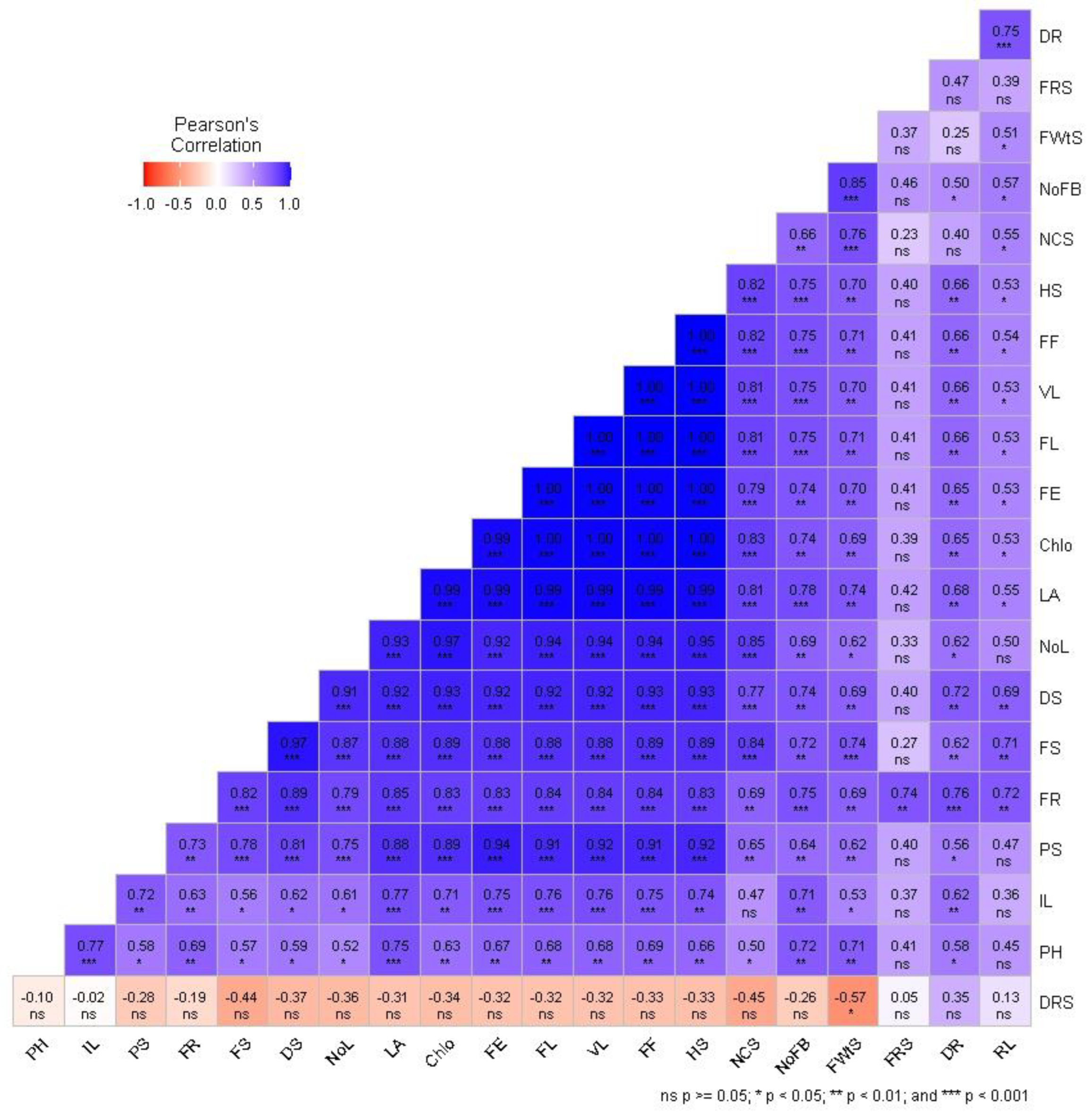
Figure 2.
Principal Component Analysis biplot representing different treatments of AMF and salicylic acid along with various parameters of statice. The length of the arrow indicates how each parameters is loaded onto the PCA axes. PH: Plant Height, PS: Plant Spread, NoL: Number of Leaves, LA: Leaf Area, Chlo: Cholorophyll content, FE: Days to Flower Emergence, FF: Days to First Flowering, HS: Days to Harvesting, FL: Flower Longevity, IL: Inflorescence Length, NCS: Number of Cut Stems, NoF: Number of Flower Bunch, FwtS: Fresh Weight of Cut Stem, VL: Vase Life, FR: Fresh Weight of Root, DR: Dry Weight of Root, FS: Fresh Weight of Shoot, DS: Dry Weight of Shoot, FRS: Root to Shoot Ratio on Fresh Weight Basis, DRS: Root to Shoot Ratio on Dry Weight Basis.
Figure 2.
Principal Component Analysis biplot representing different treatments of AMF and salicylic acid along with various parameters of statice. The length of the arrow indicates how each parameters is loaded onto the PCA axes. PH: Plant Height, PS: Plant Spread, NoL: Number of Leaves, LA: Leaf Area, Chlo: Cholorophyll content, FE: Days to Flower Emergence, FF: Days to First Flowering, HS: Days to Harvesting, FL: Flower Longevity, IL: Inflorescence Length, NCS: Number of Cut Stems, NoF: Number of Flower Bunch, FwtS: Fresh Weight of Cut Stem, VL: Vase Life, FR: Fresh Weight of Root, DR: Dry Weight of Root, FS: Fresh Weight of Shoot, DS: Dry Weight of Shoot, FRS: Root to Shoot Ratio on Fresh Weight Basis, DRS: Root to Shoot Ratio on Dry Weight Basis.
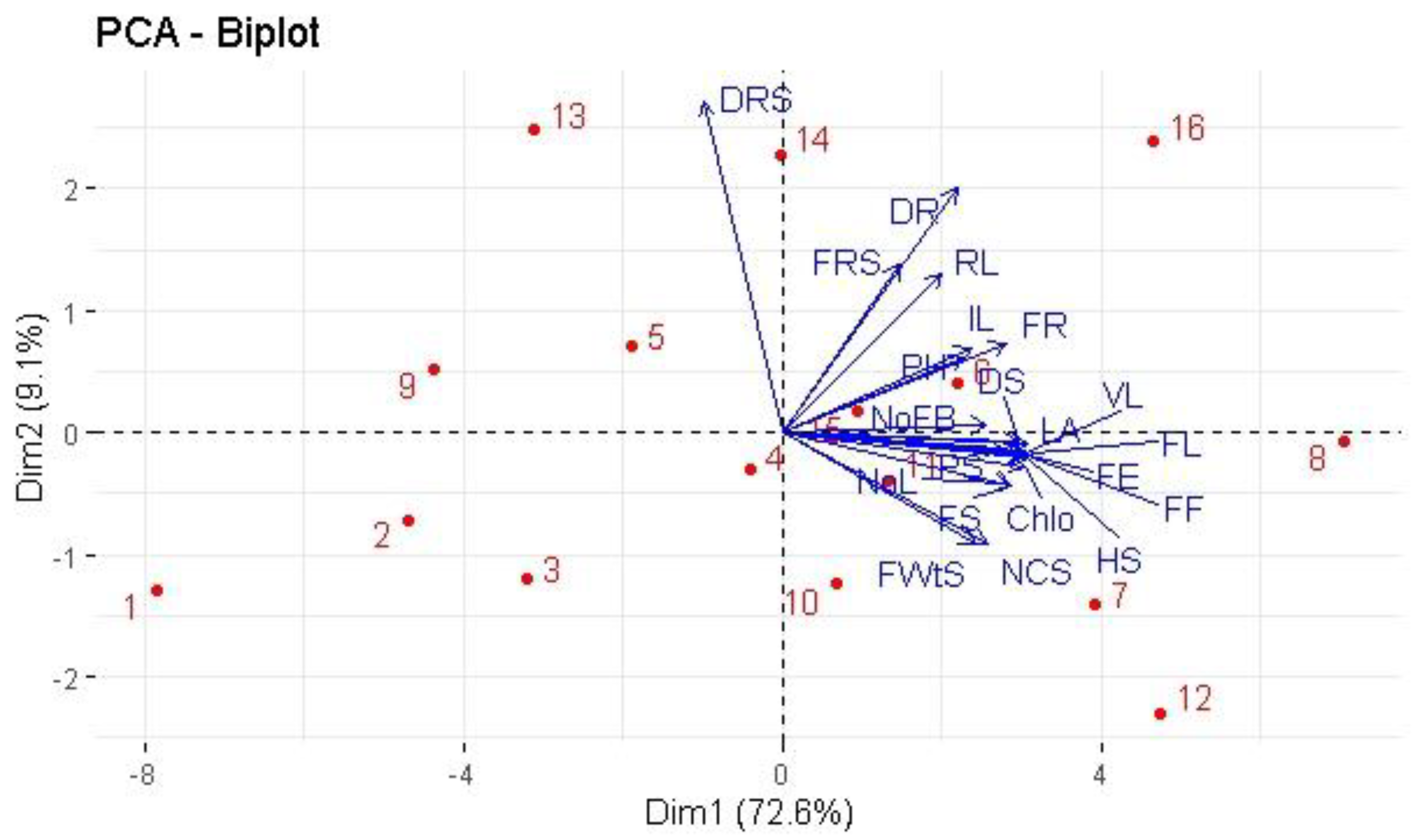

Table 1.
Effect of Arbuscular Mycorrhizal Fungi and salicylic acid on plant height, number of leaves per plant, plant spread, leaf area and chlorophyll content of Limonium sinuatum [L.] Mill. Means with similar letters in each row are not significantly different (P≤0.05) using Tukey’s Test. The results represented the mean and standard deviations (± S.D.) of three replicates.
Table 1.
Effect of Arbuscular Mycorrhizal Fungi and salicylic acid on plant height, number of leaves per plant, plant spread, leaf area and chlorophyll content of Limonium sinuatum [L.] Mill. Means with similar letters in each row are not significantly different (P≤0.05) using Tukey’s Test. The results represented the mean and standard deviations (± S.D.) of three replicates.
| Treatments | Plant height (cm) | Number of leaves per plant | Plant spread (cm) | Leaf area (cm2) |
Chlorophyll content (SPAD value) |
|---|---|---|---|---|---|
| Arbuscular Mycorrhizal Fungi (AMF) | |||||
| Un-inoculated Control (A0) | 59.04 ± 5.91 b | 51.12 ± 8.84 b | 48.03 ± 6.55c | 11.66 ± 2.35 c | 48.59 ± 4.85 b |
| Glomus mossae (A1) | 68.61 ± 4.57 a | 61.47 ± 11.98 a | 56.39 ± 4.55 a | 25.51 ± 3.75 a | 52.90 ± 4.34 a |
| Gigaspora margarita (A2) | 67.69 ± 4.14 a | 61.27 ± 11.84 a | 50.95 ± 5.86 bc | 18.19 ± 4.24 b | 52.48 ± 4.36 ab |
| Glomus mossae + Gigaspora margarita (A3) | 66.66 ± 5.25 a | 58.69 ± 8.51 a | 52.46 ± 3.87 b | 18.86 ± 3.96 b | 51.99 ± 2.69 ab |
| Significance | ** | ** | ** | ** | * |
| Salicylic Acid (SA) | |||||
| Control (S0) | 62.67 ± 7.97 b | 46.82 ± 4.38 c | 46.56 ± 5.99 c | 15.03 ± 5.51 c | 48.46 ± 4.87 b |
| SA @ 100 mg L-1 (S1) | 63.53 ± 4.83 b | 55.72 ± 5.70 b | 51.83 ± 5.52 b | 16.99 ± 5.04 b | 50.58 ± 3.39 ab |
| SA @ 150 mg L-1 (S2) | 67.70 ± 5.91 a | 59.40 ± 8.15 b | 52.42 ± 4.81 b | 20.54 ± 3.72 a | 53.01 ± 4.12 a |
| SA @ 200 mg L-1 (S3) | 68.09 ± 3.99 a | 70.60 ± 8.72 a | 57.01 ± 1.75 a | 21.66 ± 7.58 a | 53.91 ± 3.04 a |
| Significance | ** | ** | ** | ** | ** |
| AMF × SA | |||||
| A0 × S0 | 51.20 ± 2.27 c | 44.27 ± 2.34 f | 42.89 ± 4.95 e | 9.70 ± 0.71 f | 44.77 ± 5.55 a |
| A0 × S1 | 59.93 ± 0.54 bc | 49.20 ± 8.4 def | 44.67 ± 5.37 cde | 10.89 ± 0.91 ef | 48.33 ± 4.22 a |
| A0 × S2 | 61.29 ± 5.04 abc | 52.87 ± 11.32 cdef | 47.56 ± 1.83 bcde | 15.32 ± 0.66 de | 50.35 ± 6.14 a |
| A0 × S3 | 63.72 ± 5.25 ab | 58.13 ± 8.47 bcdef | 57.00 ± 1.32 a | 10.71 ± 0.75 ef | 50.91 ± 2.89 a |
| A1 × S0 | 70.73 ± 1.70 a | 46.07 ± 5.83 ef | 52.50 ± 7.88 abcd | 23.46 ± 2.49 b | 49.83 ± 5.54 a |
| A1 × S1 | 65.78 ± 7.06 ab | 56.93 ± 0.80 bcdef | 57.44 ± 2.00 a | 23.60 ± 1.99 b | 51.23 ± 2.88 a |
| A1 × S2 | 67.20 ± 5.71 ab | 66.80 ± 1.11 abc | 58.55 ± 3.12 a | 24.25 ± 2.80 b | 54.89 ± 5.05 a |
| A1 × S3 | 70.72 ± 1.11a | 76.07 ± 2.24 a | 57.05 ± 2.42 a | 30.72 ± 2.17 a | 55.66 ± 1.84 a |
| A2 × S0 | 67.11 ± 2.52 ab | 45.07 ± 1.00 ef | 43.28 ± 2.85 de | 13.73 ± 1.61 def | 46.65 ± 2.03 a |
| A2 × S1 | 64.89 ± 6.03 ab | 59.67 ± 1.92 bcde | 52.56 ± 2.26 abcd | 15.00 ± 1.54 de | 53.49 ± 2.41 a |
| A2 × S2 | 71.23 ± 3.99 a | 64.00 ± 2.83 abcd | 49.78 ± 1.43 abcde | 22.17 ± 1.30 bc | 53.78 ± 3.39 a |
| A2 × S3 | 67.52 ± 2.17 ab | 76.33 ± 3.20 a | 58.17 ± 1.24 a | 21.87 ± 1.80 bc | 55.99 ± 3.13 a |
| A3 × S0 | 61.66 ± 3.10 abc | 51.87 ± 3.44 cdef | 47.56 ± 3.46 bcde | 13.25 ± 1.29 ef | 52.59 ± 3.38 a |
| A3 × S1 | 63.51 ± 3.48 ab | 57.07 ± 3.44 bcdef | 52.67 ± 1.92 abcd | 18.45 ± 1.52 cd | 49.29 ± 2.83 a |
| A3 × S 2 | 71.08 ± 4.56 a | 53.93 ± 2.27 cdef | 53.78 ± 2.67 abc | 20.40 ± 0.95 bc | 53.01 ± 1.32 a |
| A3 × S3 | 70.40 ± 2.57 ab | 71.87 ± 1.36 ab | 55.83 ± 1.93 ab | 23.35 ± 0.63 bc | 53.06 ± 1.97 a |
| Significance | * | * | * | ** | ns |
*, **, and ns denote statistical significance at 0.05 and 0.01 levels and the non-significance, respectively.
Table 2.
Effect of Arbuscular Mycorrhizal Fungi and salicylic acid on days to flower emergence, first flowering, harvesting of flower stem, inflorescence length and flower longevity of Limonium sinuatum [L.] Mill. Means with similar letters in each row are not significantly different (P≤0.05) using Tukey’s Test. The results represented the mean and standard deviations (± S.D.) of three replicates.
Table 2.
Effect of Arbuscular Mycorrhizal Fungi and salicylic acid on days to flower emergence, first flowering, harvesting of flower stem, inflorescence length and flower longevity of Limonium sinuatum [L.] Mill. Means with similar letters in each row are not significantly different (P≤0.05) using Tukey’s Test. The results represented the mean and standard deviations (± S.D.) of three replicates.
| Treatments | Days to flower emergence | Days to first flowering | Days to harvesting of flower stem | Inflorescence length (cm) | Flower longevity (days) |
|---|---|---|---|---|---|
| Arbuscular Mycorrhizal Fungi (AMF) | |||||
| Un-inoculated Control (A0) | 86.37 ± 5.42 b | 118.18 ± 3.51 b | 129.83 ± 3.59 b | 4.35 ± 0.67 c | 25.83 ± 5.35 b |
| Glomus mossae (A1) | 90.48 ± 4.31 ab | 118.88 ± 2.51 ab | 134.75 ± 2.07 a | 4.92 ± 0.11 a | 30.47 ± 4.51 a |
| Gigaspora margarita (A2) | 90.81 ± 4.00 ab | 119.03 ± 3.13 ab | 132.78 ± 2.96 ab | 4.74 ± 0.35 b | 31.64 ± 2.47 a |
| Glomus mossae + Gigaspora margarita (A3) | 95.50 ± 5.12 a | 120.88 ± 2.32 a | 133.08 ± 2.88 ab | 4.92 ± 0.15 a | 30.61 ± 2.25 a |
| Significance | ** | ** | ** | ** | ** |
| Salicylic Acid (SA) | |||||
| Control (S0) | 94.14 ± 4.82 a | 120.93 ± 2.45 a | 131.45 ± 3.88 a | 4.26 ± 0.66 c | 27.36 ± 4.82 b |
| SA @ 100 mg L-1 (S1) | 90.37 ± 3.97 a | 120.25 ± 2.59 a | 132.17 ± 2.75 a | 4.84 ± 0.15 b | 29.17 ± 4.36 ab |
| SA @ 150 mg L-1 (S2) | 89.52 ± 6.96 a | 118.07 ± 2.60 b | 133.06 ± 3.80 a | 4.85 ± 0.24 b | 30.22 ± 3.72 ab |
| SA @ 200 mg L-1 (S3) | 89.13 ± 5.60 a | 117.73 ± 3.23 b | 133.78 ± 2.74 a | 4.97 ± 0.07 a | 31.80 ± 3.82 a |
| Significance | * | ** | ns | ** | * |
| AMF × SA | |||||
| A0 × S0 | 91.27 ± 3.52 ab | 120.27 ± 1.72 abc | 129.00 ± 2.64 a | 3.29 ± 0.21 f | 21.78 ± 0.99 b |
| A0 × S1 | 88.13 ± 3.90 ab | 120.33 ± 2.41 abc | 129.44 ± 3.40 a | 4.74 ± 0.26 cd | 24.00 ± 4.58 ab |
| A0 × S2 | 81.33 ± 3.36 b | 117.87 ± 3.20 bcd | 130.11 ± 6.30 a | 4.48 ± 0.18 d | 27.00 ± 5.56 ab |
| A0 × S3 | 84.73 ± 6.34 ab | 114.27 ± 3.49 d | 130.78 ± 3.20 a | 4.88 ± 0.02 abc | 30.55 ± 6.31 ab |
| A1 × S0 | 94.07 ± 4.19 ab | 121.67 ± 2.01 abc | 133.45 ± 3.34 a | 4.83 ± 0.14 abc | 26.89 ± 6.45 ab |
| A1 × S1 | 89.93 ± 4.77 ab | 119.20 ± 1.38 abcd | 134.33 ± 0.66 a | 4.87 ± 0.11 abc | 29.67 ± 3.09 ab |
| A1 × S2 | 88.80 ± 3.81 ab | 116.60 ± 2.42 cd | 135.33 ± 0.33 a | 4.93 ± 0.05 abc | 30.33 ± 2.52 ab |
| A1 × S3 | 89.13 ± 4.56 ab | 118.07 ± 1.51 bcd | 135.89 ± 2.54 a | 5.03 ± 0.02 a | 35.00 ± 1.84 a |
| A2 × S0 | 93.09 ± 5.65 ab | 118.07 ± 0.75 bcd | 131.67 ± 4.97 a | 4.17 ± 0.05 e | 30.56 ± 2.09 ab |
| A2 × S1 | 90.93 ± 3.91 ab | 122.60 ± 3.66 ab | 132.00 ± 2.0 a | 4.86 ± 0.12 abc | 32.11 ± 2.96 ab |
| A2 × S2 | 91.33 ± 3.50 ab | 117.13 ± 0.64 bcd | 133.33 ± 3.33 a | 4.99 ± 0.07 abc | 32.89 ± 1.97 a |
| A2 × S3 | 87.87 ± 2.73 ab | 118.33 ± 3.58 abcd | 134.11 ± 1.57 a | 4.93 ± 0.07 abc | 31.00 ± 3.39 ab |
| A3 × S0 | 98.13 ± 5.31 a | 123.73 ± 0.30 a | 131.67 ± 4.97 a | 4.77 ± 0.22 bc | 30.22 ± 2.48 ab |
| A3 × S1 | 92.47 ± 4.31 ab | 118.87 ± 1.72 abcd | 132.89 ± 2.58 a | 4.87 ± 0.07 abc | 30.89 ± 2.79 ab |
| A3 × S 2 | 96.60 ± 6.8 a | 120.67 ± 2.44 abc | 133.45 ± 2.67 a | 5.01 ± 0.08 ab | 30.67 ± 2.93 ab |
| A3 × S3 | 94.80 ± 4.97 ab | 120.27 ± 1.33 abc | 134.33 ± 1.20 a | 5.03 ± 0.02 ab | 30.67 ± 2.23 ab |
| Significance | ns | ** | ns | ** | ns |
*, **, and ns denote statistical significance at 0.05 and 0.01 levels and the non-significance, respectively.
Table 3.
Effect of Arbuscular Mycorrhizal Fungi and salicylic acid on number of flower bunches per stem, weight of cut stem, number of cut stems per plant and vase life of Limonium sinuatum [L.] Mill. Means with similar letters in each row are not significantly different (P≤0.05) using Tukey’s Test. The results represented the mean and standard deviations (± S.D.) of three replicates.
Table 3.
Effect of Arbuscular Mycorrhizal Fungi and salicylic acid on number of flower bunches per stem, weight of cut stem, number of cut stems per plant and vase life of Limonium sinuatum [L.] Mill. Means with similar letters in each row are not significantly different (P≤0.05) using Tukey’s Test. The results represented the mean and standard deviations (± S.D.) of three replicates.
| Treatments | Number of flower bunches per stem | Weight of cut stem (g) | Number of cut stem per plant | Vase life (days) |
|---|---|---|---|---|
| Arbuscular Mycorrhizal Fungi (AMF) | ||||
| Un-inoculated Control (A0) | 50.25 ± 11.90 b | 27.17 ± 3.63 d | 8.98 ± 1.08 c | 9.08 ± 1.70 a |
| Glomus mossae (A1) | 67.42 ± 10.18 a | 43.42 ± 5.80 a | 11.55 ± 2.38 a | 12.33 ± 2.65 a |
| Gigaspora margarita (A2) | 66.67 ± 6.55 a | 40.67 ± 4.71 b | 10.19 ± 1.76 b | 10.92 ± 2.96 ab |
| Glomus mossae + Gigaspora margarita (A3) | 61.75 ± 4.37 a | 32.17 ± 6.05 c | 9.10 ± 0.97 c | 11.92 ± 3.89 a |
| Significance | ** | ** | ** | ** |
| Salicylic Acid (SA) | ||||
| Control (S0) | 52.67 ± 10.37 c | 29.67 ± 6.02 c | 8.39 ± 0.64 c | 9.00 ± 1.07 b |
| SA @ 100 mg L-1 (S1) | 64.61 ± 8.99 ab | 35.92 ± 8.47 b | 9.19 ± 1.08 c | 11.08 ± 3.04 b |
| SA @ 150 mg L-1 (S2) | 61.19 ± 7.45 b | 39.33 ± 4.67 a | 10.60 ± 1.49 b | 9.83 ± 1.32 b |
| SA @ 200 mg L-1 (S3) | 67.61 ± 11.49 a | 38.50 ± 9.90 a | 11.64 ± 2.20 a | 14.33 ± 3.25 a |
| Significance | ** | ** | ** | ** |
| AMF × SA | ||||
| A0 × S0 | 36.78 ± 6.04 e | 23.00 ± 1.0 g | 8.11 ± 0.69 f | 8.00 ± 1.0 d |
| A0 × S1 | 51.89 ± 5.10 de | 26.33 ± 1.15 efg | 8.44 ± 0.83 ef | 8.00 ± 0.83 d |
| A0 × S2 | 57.67 ± 15.60 bcd | 32.33 ± 1.52 de | 9.78 ± 1.01 bcdef | 8.67 ± 0.63 cd |
| A0 × S3 | 54.67 ± 9.20 cd | 27.00 ± 1.0 efg | 9.59 ± 1.07 cdef | 11.67 ± 0.37 abcd |
| A1 × S0 | 58.33 ± 3.84 bcd | 36.33 ± 1.52 cd | 8.67 ± 0.33 ef | 10.00 ± 0.55 abcd |
| A1 × S1 | 69.22 ± 2.79 abcd | 45.67 ± 3.21 ab | 10.67 ± 0.33 bcde | 12.67 ± 0.50 abcd |
| A1 × S2 | 60.00 ± 2.95 bcd | 41.33 ± 3.05 bc | 12.08 ± 0.82 b | 11.00 ± 1.0 abcd |
| A1 × S3 | 82.11 ± 1.95 a | 50.33 ± 1.52 a | 14.78 ± 0.84 a | 15.67 ± 3.09 a |
| A2 × S0 | 59.78 ± 1.67 bcd | 34.00 ± 2.0 d | 8.22 ± 0.50 f | 9.00 ± 1.0 cd |
| A2 × S1 | 73.67 ± 3.18 ab | 41.33 ± 3.21 bc | 9.11 ± 0.69 def | 9.67 ± 0.33 bcd |
| A2 × S2 | 62.44 ± 3.17 bcd | 42.67 ± 2.08 b | 11.44 ± 1.17 bcd | 10.00 ± 2.0 abcd |
| A2 × S3 | 70.78 ± 4.07 abc | 44.67 ± 2.51 ab | 12.00 ± 0.33 bc | 15.00 ± 3.0 ab |
| A3 × S0 | 55.78 ± 4.6 cd | 25.33 ± 1.52 fg | 8.55 ± 1.07 ef | 9.00 ± 1.0 cd |
| A3 × S1 | 63.66 ± 1.52 bcd | 30.33 ± 1.52 def | 8.55 ± 0.69 ef | 14.00 ± 4.0 abc |
| A3 × S 2 | 64.67 ± 1.33 abcd | 41.00 ± 2.0 bc | 9.11 ± 0.69 def | 9.67 ± 0.37 bcd |
| A3 × S3 | 62.89 ± 2.50 bcd | 32.00 ± 1.0 de | 10.20 ± 0.65 bcdef | 15.00 ± 5.0 ab |
| Significance | * | ** | ** | ns |
*, **, and ns denote statistical significance at 0.05 and 0.01 levels and the non-significance, respectively.
Table 4.
Effect of Arbuscular Mycorrhizal Fungi and salicylic acid on plant height, number of leaves per plant, plant spread, leaf area and chlorophyll content of Limonium sinuatum [L.] Mill. Means with similar letters in each row are not significantly different (P≤0.05) using Tukey’s Test. The results represented the mean and standard deviations (± S.D.) of three replicates.
Table 4.
Effect of Arbuscular Mycorrhizal Fungi and salicylic acid on plant height, number of leaves per plant, plant spread, leaf area and chlorophyll content of Limonium sinuatum [L.] Mill. Means with similar letters in each row are not significantly different (P≤0.05) using Tukey’s Test. The results represented the mean and standard deviations (± S.D.) of three replicates.
| Treatments | Fresh weight of shoot (g) | Fresh weight of root (g) | Dry weight of shoot (g) | Dry weight of root (g) | Root: shoot ratio (Dry weight basis) | Root: shoot ratio (Fresh weight basis) |
|---|---|---|---|---|---|---|
| Arbuscular Mycorrhizal Fungi (AMF) | ||||||
| Un-inoculated Control (A0) | 328.42 ± 37.27 c | 9.50 ± 1.44 d | 88.67 ± 16.24 d | 3.81 ± 1.03 d | 0.041 ± 0.0067 b | 0.029 ± 0.0036 c |
| Glomus mossae (A1) | 499.00 ± 141.80 a | 18.73 ± 4.22 a | 155.58 ± 50.28 a | 5.95 ± 1.28 b | 0.042 ± 0.0083 b | 0.039 ± 0.0073 a |
| Gigaspora margarita (A2) | 423.92 ± 69.17 b | 14.85 ± 2.52 c | 136.08 ± 34.46 c | 4.87 ± 0.66 c | 0.038 ± 0.0094 b | 0.035 ± 0.0042 b |
| Glomus mossae + Gigaspora margarita (A3) | 430.25 ± 76.88 b | 16.77 ± 5.67 b | 144.50 ± 37.05 b | 7.64 ± 1.32 a | 0.056 ± 0.01 a | 0.038 ± 0.0076 ab |
| Significance | ** | ** | ** | ** | ** | ** |
| Salicylic Acid (SA) | ||||||
| Control (S0) | 309.83 ± 24.44 d | 10.45 ± 2.30 c | 83.92 ± 9.95 d | 4.55 ± 1.53 c | 0.052 ± 0.014 a | 0.034 ± 0.0075 b |
| SA @ 100 mg L-1 (S1) | 400.83 ± 55.19 c | 15.52 ± 3.74 b | 129.00 ± 27.74 c | 5.23 ± 1.75 b | 0.043 ± 0.0106 b | 0.038 ± 0.0049 a |
| SA @ 150 mg L-1 (S2) | 460.75 ± 102.56 b | 14.68 ± 3.28 b | 139.50 ± 38.74 b | 5.54 ± 1.15 b | 0.042 ± 0.0072 b | 0.032 ± 0.0057 b |
| SA @ 200 mg L-1 (S3) | 510.17 ± 98.98 a | 19.21 ± 6.13 a | 172.42 ± 38.09 a | 6.95 ± 1.88 a | 0.041± 0.0079 b | 0.037 ± 0.0082 a |
| Significance | ** | ** | ** | ** | ** | ** |
| AMF × SA | ||||||
| A0 × S0 | 280.00 ± 11.93 l | 7.33 ± 0.74 g | 70.00 ± 6.82 i | 2.51 ± 0.06 i | 0.033 ± 0.0058 cd | 0.026 ± 0.0035 g |
| A0 × S1 | 313.33 ± 8.76 k | 10.35 ± 0.10 f | 83.33 ± 2.69 gh | 3.58 ± 0.26 hi | 0.043 ± 0.0058 bcd | 0.033 ± 0.0006 defg |
| A0 × S2 | 350.00 ± 13.85 hi | 9.52 ± 0.42 fg | 90.00 ± 3.24 gh | 3.91 ± 0.18 h | 0.043 ± 0.0058 bcd | 0.027 ± 0.0035 fg |
| A0 × S3 | 370.34 ± 6.07 h | 10.80 ± 0.25 ef | 111.33 ± 6.94 f | 5.23 ± 0.44 efg | 0.043 ± 0.0058 bcd | 0.029 ± 0.0012 efg |
| A1 × S0 | 299.33 ± 5.99 kl | 13.25 ± 0.61 de | 82.33 ± 1.77 h | 4.45 ± 0.16 fgh | 0.053 ± 0.0058 ab | 0.044 ± 0.0031 abc |
| A1 × S1 | 450.00 ± 5.71 e | 20.41 ± 0.57 b | 143.33 ± 1.77 d | 5.37 ± 0.33 ef | 0.040 ± 0.0 bcd | 0.045 ± 0.0015 ab |
| A1 × S2 | 610.00 ± 9.99 b | 17.31± 1.63 c | 192.00 ± 3.21 b | 6.25 ± 0.51 de | 0.033 ± 0.0058 cd | 0.028 ± 0.0021 fg |
| A1 × S3 | 636.67 ± 11.01 a | 23.96 ± 1.28 a | 204.67 ± 3.36 a | 7.71 ± 0.24 bc | 0.040 ± 0.0 bcd | 0.038 ± 0.0021 bcde |
| A2 × S0 | 340.00 ±7.91 ij | 11.01 ± 1.13 ef | 89.67 ± 2.21 gh | 4.62 ± 0.54 fgh | 0.050 ± 0.0 bc | 0.032 ± 0.0046 defg |
| A2 × S1 | 430.00 ± 5.71 ef | 15.32 ± 0.63 cd | 147.67 ± 3.44 d | 4.09 ± 0.30 gh | 0.030 ± 0.0 d | 0.036 ± 0.0015 cdef |
| A2 × S2 | 402.33 ± 4.64 g | 16.23 ± 0.89 c | 126.67 ± 3.25 e | 5.42 ± 0.22 def | 0.043 ± 0.0058 bcd | 0.040 ± 0.0021 bcd |
| A2 × S3 | 523.34 ± 7.77 c | 16.86 ± 1.04 c | 180.33 ± 1.66 c | 5.35 ± 0.45 ef | 0.030 ± 0.0 d | 0.032 ± 0.0021 defg |
| A3 × S0 | 320.00 ± 5.06 jk | 10.21 ± 0.28 f | 93.67 ± 6.94 f | 6.60 ± 0.26 cd | 0.070 ± 0.0 a | 0.032 ± 0.001 defg |
| A3 × S1 | 410.00 ± 10.0 fg | 16.00 ± 0.33 c | 141.67 ± 3.34 d | 7.87 ± 0.36 b | 0.057 ± 0.057 ab | 0.039 ± 0.0025 bcd |
| A3 × S 2 | 480.67 ± 4.46 d | 15.65 ± 0.55 cd | 149.33 ± 4.92 d | 6.57 ± 0.80 cd | 0.047 ± 0.0058 bcd | 0.032 ± 0.0012 defg |
| A3 × S3 | 510.34 ± 9.07 c | 25.24 ± 1.20 a | 193.33 ± 3.79 b | 9.53 ± 0.20 a | 0.050 ± 0.0 bc | 0.049 ± 0.0031 a |
| Significance | ** | ** | ** | ** | ** | ** |
*, **, and ns denote statistical significance at 0.05 and 0.01 levels and the non-significance, respectively.
Table 5.
Effect of Arbuscular Mycorrhizal Fungi and salicylic acid on root length, mycorrhizal spore count and root colonization percentage in Limonium sinuatum [L.] Mill. Means with similar letters in each row are not significantly different (P≤0.05) using Tukey’s Test. The results represented the mean and standard deviations (± S.D.) of three replicates.
Table 5.
Effect of Arbuscular Mycorrhizal Fungi and salicylic acid on root length, mycorrhizal spore count and root colonization percentage in Limonium sinuatum [L.] Mill. Means with similar letters in each row are not significantly different (P≤0.05) using Tukey’s Test. The results represented the mean and standard deviations (± S.D.) of three replicates.
| Treatments | Root length (cm) | Spore count per 20 of soil | Root colonization percentage |
|---|---|---|---|
| Arbuscular Mycorrhizal Fungi (AMF) | |||
| Un-inoculated Control (A0) | 11.10 ± 1.59 c | 41.46 ± 3.86 d | 30.23 ± 1.55 d |
| Glomus mossae (A1) | 23.05 ± 6.50 a | 162.95 ± 4.45 a | 54.73 ± 3.34 a |
| Gigaspora margarita (A2) | 16.20 ± 1.72 b | 123.61 ± 8.48 c | 48.21 ± 1.52 c |
| Glomus mossae + Gigaspora margarita (A3) | 22.22 ± 1.94 a | 143.58 ± 8.55 b | 52.21 ± 1.72 b |
| Significance | ** | ** | ** |
| Salicylic Acid (SA) | |||
| Control (S0) | 17.17 ± 4.57 b | 108.84 ± 46.91 d | 44.4 ± 9.33 c |
| SA @ 100 mg L-1 (S1) | 17.18 ± 5.65 b | 117.25 ± 47.96 c | 45.87 ± 9.87 bc |
| SA @ 150 mg L-1 (S2) | 18.00 ± 5.69 b | 120.48 ± 49.30 b | 46.92 ± 10.02 bc |
| SA @ 200 mg L-1 (S3) | 20.22 ± 7.88 a | 125.03 ± 49.38 a | 48.18 ± 11.25 a |
| Significance | ** | ** | ** |
| AMF × SA | |||
| A0 × S0 | 13.20 ± 1.37 fgh | 36.2 ± 1.95 k | 29.33 ± 2.15 f |
| A0 × S1 | 9.70 ± 0.71 h | 41.64 ± 1.12 j | 30.14 ± 1.41 f |
| A0 × S2 | 10.70 ± 0.76 gh | 42.08 ± 1.79 j | 30.45 ± 1.17 f |
| A0 × S3 | 10.80 ± 1.07 gh | 45.91 ± 1.37 j | 31.00 ± 1.76 f |
| A1 × S0 | 13.70 ± 1.21 fgh | 156.58 ± 1.59 c | 50.45 ± 1.92 cde |
| A1 × S1 | 23.60 ± 1.99 b | 162.57 ± 1.42 b | 54.13 ± 1.56 abc |
| A1 × S2 | 24.20 ± 1.78 b | 165.07 ± 1.96 ab | 55.71 ± 1.06 ab |
| A1 × S3 | 30.70 ± 1.68 a | 167.58 ± 0.73 a | 58.65 ± 1.30 a |
| A2 × S0 | 18.40 ± 1.61 cde | 111.33 ± 0.85 i | 46.98 ± 1.21 e |
| A2 × S1 | 15.00 ± 1.54 efg | 122.45 ± 1.69 h | 47.76 ± 1.90 e |
| A2 × S2 | 15.30 ± 0.70 ef | 127.34 ± 1.07 g | 48.45 ± 0.63 de |
| A2 × S3 | 16.10 ± 0.39 def | 133.33 ± 0.67 f | 49.65 ± 1.23 cde |
| A3 × S0 | 23.40 ± 2.58 b | 131.26 ± 1.21 fg | 50.87 ± 1.14 cde |
| A3 × S1 | 20.40 ± 0.95 bcd | 142.35 ± 2.28 e | 51.45 ± 1.64 bcde |
| A3 × S 2 | 21.80 ± 1.91 bc | 147.43 ± 0.70 d | 52.54 ± 0.97 bcd |
| A3 × S3 | 23.30 ± 0.72 b | 153.31 ± 1.13 c | 53.98 ± 1.75 bc |
| Significance | ** | ** | * |
*, **, and ns denote statistical significance at 0.05 and 0.01 levels and the non-significance, respectively.
Table 6.
Eigen values and percentage of variance corresponding to each principal component.
| Principal components | Eigen value | Percentage of variance | Cumulative percentage of variance |
| Comp 1 | 15.24 | 72.58 | 72.58 |
| Comp 2 | 1.91 | 9.12 | 81.69 |
| Comp3 | 1.08 | 5.16 | 86.85 |
| Comp 4 | 0.98 | 4.69 | 91.54 |
| Comp 5 | 0.73 | 3.47 | 95.01 |
| Comp 6 | 0.32 | 1.50 | 96.52 |
| Comp 7 | 0.28 | 1.34 | 97.86 |
| Comp 8 | 0.24 | 1.16 | 99.02 |
| Comp 9 | 0.13 | 0.64 | 99.67 |
| Comp 10 | 0.04 | 0.18 | 99.85 |
| Comp 11 | 0.02 | 0.09 | 99.94 |
| Comp 12 | 0.01 | 0.04 | 99.99 |
| Comp 13 | 0.002 | 0.01 | 100.00 |
| Comp 14 | 0.00 | 0.002 | 100.00 |
| Comp 15 | 0.00 | 0.00 | 100.00 |
Table 7.
Contribution of each parameter towards variance of principal components.
| Parameters | PC1 | PC2 | PC3 | PC4 | PC5 |
|---|---|---|---|---|---|
| PH | 3.53 | 2.01 | 1.06 | 10.93 | 11.93 |
| NoL | 5.56 | 0.98 | 4.54 | 0.66 | 0.95 |
| PS | 5.13 | 0.08 | 2.08 | 3.15 | 1.83 |
| LA | 6.40 | 0.05 | 4.61 | 1.03 | 0.00 |
| Chlo | 6.25 | 0.40 | 2.66 | 0.12 | 0.67 |
| FE | 6.27 | 0.17 | 1.67 | 1.02 | 0.49 |
| FF | 6.36 | 0.19 | 1.50 | 0.60 | 0.25 |
| HS | 6.32 | 0.25 | 1.94 | 0.48 | 0.46 |
| IL | 3.80 | 2.58 | 6.78 | 24.91 | 4.45 |
| FL | 6.35 | 0.16 | 1.61 | 0.79 | 0.26 |
| VL | 6.34 | 0.15 | 1.68 | 0.90 | 0.26 |
| FS | 5.54 | 1.05 | 2.94 | 8.63 | 1.85 |
| FR | 5.32 | 2.88 | 3.73 | 2.63 | 5.78 |
| DS | 5.92 | 0.03 | 6.31 | 4.56 | 0.09 |
| DR | 3.22 | 21.51 | 4.02 | 1.36 | 0.54 |
| FRS | 1.47 | 10.11 | 1.99 | 0.01 | 49.12 |
| DRS | 0.65 | 39.28 | 4.83 | 0.54 | 2.99 |
| NoFB | 4.43 | 0.02 | 1.31 | 0.33 | 5.04 |
| FWtS | 3.94 | 4.45 | 2.36 | 0.20 | 4.12 |
| NCS | 4.51 | 4.47 | 1.37 | 5.74 | 1.24 |
| RL | 2.67 | 9.17 | 1.04 | 31.39 | 7.65 |
PH: Plant Height, PS: Plant Spread, NoL: Number of Leaves, LA: Leaf Area, Chlo: Cholorophyll content, FE: Days to Flower Emergence, FF: Days to First Flowering, HS: Days to Harvesting, FL: Flower Longevity, IL: Inflorescence Length, NCS: Number of Cut Stems, NoF: Number of Flower Bunch, FwtS: Fresh Weight of Cut Stem, VL: Vase Life, FR: Fresh Weight of Root, DR: Dry Weight of Root, FS: Fresh Weight of Shoot, DS: Dry Weight of Shoot, FRS: Root to Shoot Ratio on Fresh Weight Basis, DRS: Root to Shoot Ratio on Dry Weight Basis.
Disclaimer/Publisher’s Note: The statements, opinions and data contained in all publications are solely those of the individual author(s) and contributor(s) and not of MDPI and/or the editor(s). MDPI and/or the editor(s) disclaim responsibility for any injury to people or property resulting from any ideas, methods, instructions or products referred to in the content. |
© 2024 by the authors. Licensee MDPI, Basel, Switzerland. This article is an open access article distributed under the terms and conditions of the Creative Commons Attribution (CC BY) license (http://creativecommons.org/licenses/by/4.0/).
Copyright: This open access article is published under a Creative Commons CC BY 4.0 license, which permit the free download, distribution, and reuse, provided that the author and preprint are cited in any reuse.


