
Submitted:
20 September 2024
Posted:
23 September 2024
You are already at the latest version
Abstract
For almost 75 years, the general solution for the Schrödinger equation was assumed
to be generated by an exponential or a time-ordered exponential known as the Dyson
series. We study the unitarity of this solution in case of singular Hamiltonian and provide a
new methodology that is not based on the assumption that the underlying space is L2(R).
Then, an alternative operator for generating the time evolution is suggested that is manifestly
unitary, regardless of the choice of the Hamiltonian. The new construction involves an additional
positive operator that normalizes the wave-function locally and allows us to preserve
unitary even on indefinite norm spaces. Our considerations show that Schrödinger's and Liouville's
equations are, in fact, two sides of the same coin, and together they become the unified
description of quantum systems.
Keywords:
Quantum mechanics
; Schrodinger equation
; Unitarity
1. Introduction
The Schrödinger equation (named after Erwin Schrödinger, who postulated the equation in 1925) is the fundamental operatorial equation that governs the wave function of a quantum-mechanical system [1]. The discovery of this linear differential equation was a significant landmark in the development of quantum mechanics. In basic terms, if a wave-function of a system is given at some moment (denoted by ) one can determine the wave-function at all the subsequent moments by solving [2,3]
As long as the Hamiltonian of the system is expressible as a bounded1 self-adjoint2 operator with no time dependence, the solution of (1) is given by the unitary evolution,
regardless the choice of space. In various cases, the Hamiltonian of a quantum system includes a time dependent part, and thus equation (1) is replaced by
The widely known general solution for (3) is expressible by using the operator3 [4],
It is well known that solutions (2) and (4) are unitary on Hilbert spaces for any choice of self-adjoint Hamiltonians. However, as we shall discuss, the property of unitarity can no longer be shown everywhere on more general spaces unless the Hamiltonian is strictly bounded self-adjoint. Our claim in this paper is the following: instead of solutions (2) and (4), one can obtain a universal unitary solution4,
with
This solution no longer rely on any assumption with regards to the properties of the space or Hamiltonian. As shall later be explained, the only formulation of the Schrödinger equation that is consistent with the probabilistic interpretation [40] is governed by the bounded self-adjoint component5 of the general Hamiltonian . The resulting equation is solely that of wave mechanics,
The new operator from (6) is known as the "normalization operator" or "jump operator". In its defining relation the operator denotes the inverse of , and is the inverse of its adjoint. The inclusion of the operator is, in fact, a promotion of the familiar normalization procedure of a quantum states to operatoric level, such that it becomes a local procedure rather than a global one6. In other words, instead of having normalization only as an asymptotic procedure, it is now ensured even at the intermediate times. From definition (6) it is already evident that the introduction of is not necessary if from (4) is truly an exact unitary operator. In that case the adjoint operator coincides with the inverse operator, and , which leads to . However, as we shall explicitly show, this simplification is generally not valid in various interesting situations, among them is the case of gauge theories.
This paper is organized as follows: in Section 2 we explain for what reason the standard solution cannot always provide a unitary description for quantum systems. In Section 3, we provide a proof for the validity of the new solution, discuss its properties, and compute the new corresponding perturbative construction. In Section 4, we provide a few practical demonstrations in which the new solution differs from the current mainstream approach. In Section 5, we summarize the implications of our result on various aspects. In Appendix A, we discuss the applicability of the iterative method. In Appendix B, the details of the computation of the differential equation for the dynamics of is provided.
2. Normalization as a Consequence of Unboundedness
In this part we review the standard argument that is considered a proof for the unitarity of in the case of time-dependent Hamiltonian, Equation (4). Our intention is to have a closer look at the necessary mathematical conditions involved there, and then discuss under what circumstances this argument can be invalidated. Afterwards, a new construction is motivated, in which unitarity becomes a robust property and no longer can be broken. And lastly, we characterize from the mathematical perspective the different choices of Hamiltonians for which our considerations become relevant.
2.1. Why Is Not Always Unitary?
Our starting point is a quick reminder for the procedure that has led to the result shown in Equation (4). The central idea is to solve the differential equation (3) by iterations [2]: at first turning the original differential equation to an integral equation, and then substituting the result "inside itself" repeatedly78,
The applicability of the iterative method is discussed in Appendix A, but for now let us assume the validity of this method9. The series that is obtained by this process, known as the Dyson series [4], is given by
At this point the terms of the series above should be interpreted as merely a abstract operatoric symbols. The convergence properties of the terms and of the series as a whole are dictated by the choice of the Hamiltonian as well as the time interval of the evolution. Let us now present the familiar argument that currently exist in the literature [2] and regarded as a proof for the unitarity of . By assuming that one can replace the integrations in the iterative form with the productive form,
And by assuming along with the validity of the operator simplifications10
the expansion conjugate to (10) takes the form
It then follows, by taking the product of (10) and (12), that
The next step, as shown in Figure 1, is to apply an "operatoric version" of the Fubini theorem [9] and exchange of the ordering of the two time integrations in the last term of (13),
Then, after introducing the replacement (14) in the result of (13), the last two terms can be combined together,
what allegedly seems to lead to the inevitable conclusion that .
Now, let us look again on the argument that has been presented above, but this time adopt a more cautious approach, paying attention to the mathematical conditions involved at each step that we perform. Before we proceed, a wise question to ask ourselves is – is this argument applicable for the case of unbounded Hamiltonian? How does the domain of the Hamiltonian, , affect the argument?
A detailed discussion about the differences between these two kinds of mathematical constructions can be found in [10,11]. From there we learn that confidently answering the question above is necessary in order to determine the legitimate set of simplification operations that can be performed. For clarity, let us summarize the underlying requirements which took place while presenting the unitarity argument above11:
◊Additivity of integrands: for operators and , and for any ,
◊Additivity of integration intervals: for an operator , any , ,
Clearly, our argument established unitarity not as a general property that is valid for a general choice of Hamiltonian, but rather only those that are self-adjoint. In fact, our ability to perform operation (16) is mathematically justified only if the domains of the integrated operators on both sides is equivalent throughout the evolution12. More importantly, in order to satisfy the property (17), the operator is required to be a bounded operator13. A sufficient condition that ensures the validity of the unitarity argument is that the involved operators are satisfying an analogous condition to absolute convergence for any choice of ,
However, various interesting problems (such as gauge theories) we often deal with a situations in which the condition above is violated. That happens since either the time interval under consideration is improper, , or due to integrand containing singularities, as discussed in example Section 4.3. In these cases the resulting integrals (potentially obtained after regularization procedure) converge only conditionally and demand additional care.
What about Stone’s Theorem?
In case that the Hamiltonian is time-independent, the theorem that allows us to regard (2) as a unitary operator is given by Stone’s theorem [12]. This theorem provides a one-to-one correspondence between self-adjoint and unitary operators as stated below.
•Stone’s theorem:let be a possibly unbounded self-adjoint operator, the map is a strongly-continuous one-parameter unitary operator.
However, there are three saddle situations in which one cannot any longer rely on this theorem, all connected with the necessity of careful treatment of the element ∞.
◊Infinitely dimensional Hilbert spaces: as discussed in example Section 4.1, a self-adjoint operator satisfy an additional condition on its domain that an Hermitian operator does not. In case that it can be said that the Hamiltonian is Hermitian but not self-adjoint. Note that this type of space is fundamental to QM, since in order satisfy the relation, , either the position or momentum operators must be an unbounded operator14. Since in order to apply Stone’s theorem the property of Hermiticity alone is an insufficient condition, one should not be surprised that establishing unitarity cannot be done.
◊Singular potentials: these type of potentials are defined only on a densly defined domain, but not everywhere. An example for this choice of Hamiltonian is explicitly discussed in example Section 4.2,
which is defined on the domain It is common to consider this problem on an inadequate space, , in which the value of the Hamiltonian on the singular location is replaced by 0. However, this cannot be done for a general choice of space, such as indefinite norm spaces. In that case the Stone theorem cannot imply unitarity in the region outside the domain of the Hamiltonian,
In other words, unitarity with Hamiltonian (19) cannot be shown for the state satisfying when working on indefinite norm space.
◊Asymptotic states: the case in which , as typically involved in the definition of the S-matrix.
2.2. How to Unitarize ?
The main point of the last section was that unitarity is not a manifest property of for a general choice of space, but rather a property that follows only under a certain restrictive assumptions. An advancement toward a manifestly unitary can be done by introducing the replacement
which leads to the proposed solution in (5). This decomposition is analogous to the polar decomposition, which always exists and is always unique [13]. By construction, the solution manifestly preserves the exactness of unitarity at all orders and at all times,
from which it is immediately apparent that . The expression for the inverse of can be uniquely determined by the condition so that15,
By insertion back to (6) along with the Taylor expansion of the square root, the following result is obtained for the case of bounded self-adjoint Hamiltonian:
Then, by using the definition (5), we find the expansion
However, generally the original terms must be kept in their full glory1617,
from which we arrive at the manifestly unitary result,
As expected, expansions (26) and (27) are consistent with expressions (24) and (25) under the assumption of a bounded self-adjoint Hamiltonian.
2.3. Classification of Quantum Evolution
In this part we discuss the circumstances under which the solution can no longer be considered a complete unitary description. This will be done by characterizing two types of Hamiltonians and spaces that typically play a role in problems of quantum physics.
2.3.1. The bounded self-adjoint evolution
In this part we would like to provide specific details under which conditions our new proposal will not matter and the equivalence will be sustained throughout the entire evolution. One of the fundamental postulate in quantum mechanics is that any measurable dynamical quantity is represented by a bounded self-adjoint operator. A crucial property of the Hamiltonians belonging to this category is spectrum that involves eigenvalues that belong to . As a simple example for a practical realization of such an operator it is possible to use a matrix of finite dimensions with entries given by a finite valued and continuous functions18:
with and where . In case that it can be shown that a bounded self-adjoint Hamiltonians implies that
for any and . All that have been discussed in this part can be translated to the main property that characterize these Hamiltonians: the evolution dictated by preserves the norm of the Hilbert space. Thus, for any given and action of generates an isometric transformation,
For time-independent self-adjoint Hamiltonians, the boundness condition ensures the existence of the Taylor series expansion, and it is immediate to show that the construction (2) is indeed unitary:
Moreover, even if the Hamiltonian includes time dependence, as long as it is bounded self-adjoint the argument presented in Section 2 is valid and therefore construction (4) provides us with a unitary description as well. The reason for that is since the boundness requirement ensures the integrability of the expansion, as guaranteed by the Lebesgue’s criterion for integrablility19. An alternative way to establish unitarity in this case relies on a simple well-known argument [21]. By multiplying Equation (3) by on the left side, and multiplying the conjugate equation of motion by on the right side,
Adding the two equations in (32), one can make use of the Leibniz product rule,
Provided that the initial conditions holds, , this is sufficient to ensure that unitarity is also preserved at all later times,
However, it is important to realize that the argument above is crucially based on the operatorical equivalence for any t, which implies the equivalence of domains,
An additional property that can be shown for any intermediate time is that
The property above, known as the Markovian property [22], is a characteristic of various stochastic processes. Its intuitive meaning is that the evolution associated with the operator has ’no memory’, or differently said, that the evolution from time to time depends only on the state of the system at time , and not on the preceding part of the evolution. The generalization of the above is given by the Trotter formula [23],
2.3.2. The Unbounded Evolution
The capacity of the bounded Hamiltonian to describe the quantum phenomena is limited only for systems that evolve in a gradual (functional) way. However, there are plethora of quantum processes for which the condition mentioned in footnote 1 is not satisfied. The mathematical characterization of these type of Hamiltonians can be done in accordance with footnote 1. As demonstrated in example Section 4.3, it can be shown that up to indefinite terms in these cases the transformation generated by changes the norm of the evolved state,
The factor is typically known as the WF normalization, the LSZ factor, or the field strength. The preservation of the norm is obtained after including the compensation via the action of , so that
A simple example is the Dirac comb potential (see example in Section 4.3,) which involves periodic kicks [26],
with . In order to get an impression of the subtleties that arise when handling this case we can simply take . Due to (A12), for such a choice the differentiation and integration are not commutative operations20,
It is also clear that for this choice the validity of the Fubini theorem (14) for evolution intervals which contain the singular times T has no mathematical justification to be used,
In addition, the additivity property (17) holds only as long as , but fails when reaching the singular moment as required by the unitarity argument,
Obviously, without these properties the unitarity argument presented in Section 2.1 cannot be established. At this point one might be tempted to replace the delta function with its corresponding smeared version in order to avoid these problems. However, this means that our approach is fundamentally incapable of handling singular objects as they really are. As long as is outside of the evolution interval, unitarity is trivially preserved,
But for evolution intervals such that this is no longer the case,
which is the reason behind (38). Note that contrary to the bounded case, as in Equation (36), the unbounded Hamiltonians describe non-Markovian process, so there exists at least one values of such that
3. The Properties of the Pitaron
In this part we would like to discuss more about the characteristics of the new solution with regards to the initial conditions and its ability to solve the Schrödinger equation.
3.1. Satisfying the Initial Conditions
An immediate observation is that satisfaction of the initial conditions by implies they are also satisfied by . Generally speaking, bounded Hamiltonians allow to satisfy the initial conditions trivially, as in that case both and by continuity. Tackling the case of unbounded Hamiltonians is slightly less straightforward, and for one has to make a fair necessary assumption that the initial time does not coincide with the places in which the Hamiltonian becomes singular21, so that,
For , the necessary condition for ensuring the initial condition is
which implies,
3.2. Solving the Schrödinger Equation
In this part we provide mathematical proof for our claim that the solution provided in (5) solves the original Schrödinger Equation (3). Let us start first with performing the calculation under the assumption of an Hermitian Hamiltonian. By using the Leibniz’s product rule, the time derivative of can be expressed as22,
By taking the time derivative of Equations (9) and (24), one arrives at the following set of equations (a detailed computation of the time derivative of is provided in Appendix B): The regular Schrödinger-Liouville dynamics: let be a bounded Hermitian Hamiltonian, then
By plugging Equations (50) inside relation (49), we note that indeed the Schrödinger equation is satisfied23,
One recognizes that the resulting equation for is, in fact, the quantum Liouville equation [33], known alternatively as von Neuman equation [34], ensuring the probability conservation in our phase-space, and more commonly written in the equivalent form,
The dynamics of the above Liouville equation can be shown to be trivial: the value of will remain unchanged throughout the entire evolution. However, this will no longer be justified in the case where the Hamiltonian is unbounded, or alternatively – non-Hermitian. The Hamiltonians which are under consideration here can be decomposed as a sum of a self-adjoint and singular component24. This singular component is non-vanishing on a measure-0 set and exists as a generalized object (see example Section 4.2),
The corresponding evolution equations are:
It is straightforward to verify that Equation (54) above indeed solve the time-dependent Schrödinger equation (3) by inserting them to (49),
Not surprisingly, the RHS of the above equation no longer depends on the anti self-adjoint component, . This should have been expected – unlike the case of , the differential equation for does not predict the decay of the probabilistic wave-function with time, even in the presence of a complex Hamiltonian. In case that the component is bounded and evaluated on a proper time interval, the time evolution operator based on (55) can be constructed analogously to (4),
Note that according to the current approach, in situtions in which the Hamiltonian is Hermitian but not self-adjoint, the replacement should not have affected the corresponding differential equation, but in reality we see that it does.
4. Examples
In this part we demonstrate with simple examples how our proposed solution affects the description of quantum systems practically. We start with examples in quantum mechanics, involving a single particle subjected to complex Hamiltonian, unbounded Hamiltonian, then we move to study the case of quantum field theory. However, even without studying any particular case, one can observe that when using the Born approximation25 [40]. Naturally, a necessity of multiplying with an additional operator to maintain unitarity is apparent. In fact, similar consideration will apply whenever truncating the expansion for at any odd power. Our intention here is to demonstrate situations that unitarity is absent when even order of approximation is involved.
4.1. The Free Particle
Generally, a particle subject to a time-independent Hamiltonian is given as a sum of its kinetic and potential energy,
A simple choice is to examine the case of , with a setup such that . The corresponding Hilbert space is spanned via the complete set of momentum eigenstates such that their corresponding eigenvalues belong to the extended real numbers set ,
The resulting differential equation for a particle with mass m is obtained via ,
The kinetic part can be resolved by introducing , from which we infer the time evolution operator
As previously mentioned, an operator on the Hilbert space is called self-adjoint if it is operatorically identical to its adjoint, . The equivalence between two operators implies two conditions:
and additionally the domains are identical, .
The second condition holds automatically when is finite-dimensional operator, since in that case for every non-singular linear operator on a finite-dimensional space. However, in the infinite-dimensional case the domain may be a larger subspace than , so that . In that case the operator is called Hermitian. Thus, any self-adjoint operator is Hermitian, but an Hermitian operator is not necessarily self-adjoint [6]. Noticeably, for a bounded self-adjoint Hamiltonian the spectrum is real and the eigenvectors associated to different eigenvalues are mutually orthogonal. Moreover, all the eigenvectors are having a finite norm and together they form a complete Hilbert space [27]. These properties do not hold for operators which are only Hermitian [28]. As demonstrated in [7] for the momentum operator of a particle living on a compact domain , the equivalence holds for any . This since for all ,
However, since the boundary conditions satisfied by are already sufficient for annihilating the surface term,
Thus, the operator is Hermitian but not self-adjoint [8],
and the same conclusion remains true also at the level of the Hamiltonian. Thus, the corresponding time evolution operator (60), cannot be regarded as unitary, Our approach is also related with the well known problem that the solution in this case is non-normalizable. In the standard approach, the result for the WF is taken as
and one attempts to fix the overall pre-factor N via the normalization condition,
As long as the space is of finite size, based on the transitions
the condition (66) yields
However, if our intention is to use the complete unbounded space , its cover has to be considered separately, as the case does not allow to apply the familiar simplification rules. Therefore, based on our logic the solution is given by
The result above includes an indefinite norm that cannot be further simplified,
Another perspective can be found by working in momentum representation.
4.2. The Coulomb Potential
The inter-atomic and molecular potentials are known empirically to be described by inverse positive powers of the Euclidean norm, and therefore, cannot be defined everywhere [24][25]. Well known examples are the Coulomb, Yukawa, van der Waals, Lennard-Jones, and London potentials [26]. Here our interest is to provide a new perspective for analyzing the Coulomb force. Let us start with an explanation the current approach for dealing with this case, then discuss its drawback, and provide an alternative approach. This potential is expressed via
and full Hamiltonian, including the kinetic term, is given by
For simplicity, in order to focus on the part that matters, let us assume that the kinetic term is sufficiently well behaved and the limit is taken. In the current approach, an additional assumption that is unjustifiably introduced is that the problem can be adequately studied on the space . Under such an assumption contributions of measure-0 has no importance, and the singularity at the origin can be disregarded. Thus, it is sufficient to specify the potential only on a densely defined part of the space,
As expected, the corresponding time evolution operator, Equation (2), based on representation (73) is unitary everywhere. However, expression (73) is an over simplification of the original singular potential and is incompatible with the classically correspondent case in which the source to be represented by a distribution. Suppose now that we no longer assume dealing with , and therefore our previous assumption that measure-0 contributions can be ignored is no longer justified. The first thing we have to do is to provide a meaning to the singularity in terms of familiar objects. This can be done by generalizing the framework, , so that . Eventually, we can get back to the real line by taking vanishing imaginary component, . A valuable relation in our case is the Sokhotski theorem,
Thus, in our approach the consistent representation of the Coulomb force is:
The corresponding expression for the time evolution operator is
Although the last result is unitary for any , our approach regard the case as non-unitary,
despite the fact that a rigorous proof is still not at hand. An important observation is that since the Taylor series expansion does not exist for generalized object, one cannot repeat the considerations of (31). Therefore, without getting into the details of how to define , we can use the following formal structure as a unitary operator
The situation becomes more interesting when passing from potentials with only a single singular point to the case in which a measure-0 set of singularities is involved. An explicit example for such a potential is the Poschl-Teller potential (see Figure 2),
which after extracting the generalized part can be written
Showing us that unitarity is not maintained at the tunneling points. Without solving the singular dynamics, one has to specify itself only for a specific branch of the potential, and cannot realize the entire dynamics that includes the singular locations.
4.3. The Dirac Comb Potential
One of the simplest examples in order to demonstrate the dynamics of a time-dependent unbounded (distributional) Hamiltonian is to use the Dirac comb potential (see Figure 3). The properties of this potential has already been previously briefly mentioned in Section 2.3.2.
For our purpose it will be sufficient to use a truncated version of the series,
where denotes an array of n values. Clearly, the unitarity argument presented in Section 2.1 is inadequate for the above choice of Hamiltonian due to the failure of additivity at the singular times . Let us now examine the resulting expansion from the Dyson series. With the aid of the integration in Equation (A9), one finds the following expressions for Equations (9) and (24):
As expected, based on the discussion in Appendix A, both the results for U and above are ill-defined due to the last term (which cancels when taking their products.) Therefore, one can think of as a regulator which replaces indefinite integrals involved in U by valid integrals describing the singular dynamics. In order to get an impression on how evolves, it is useful to work with a truncated version of which does not involve integration over products of distributions,
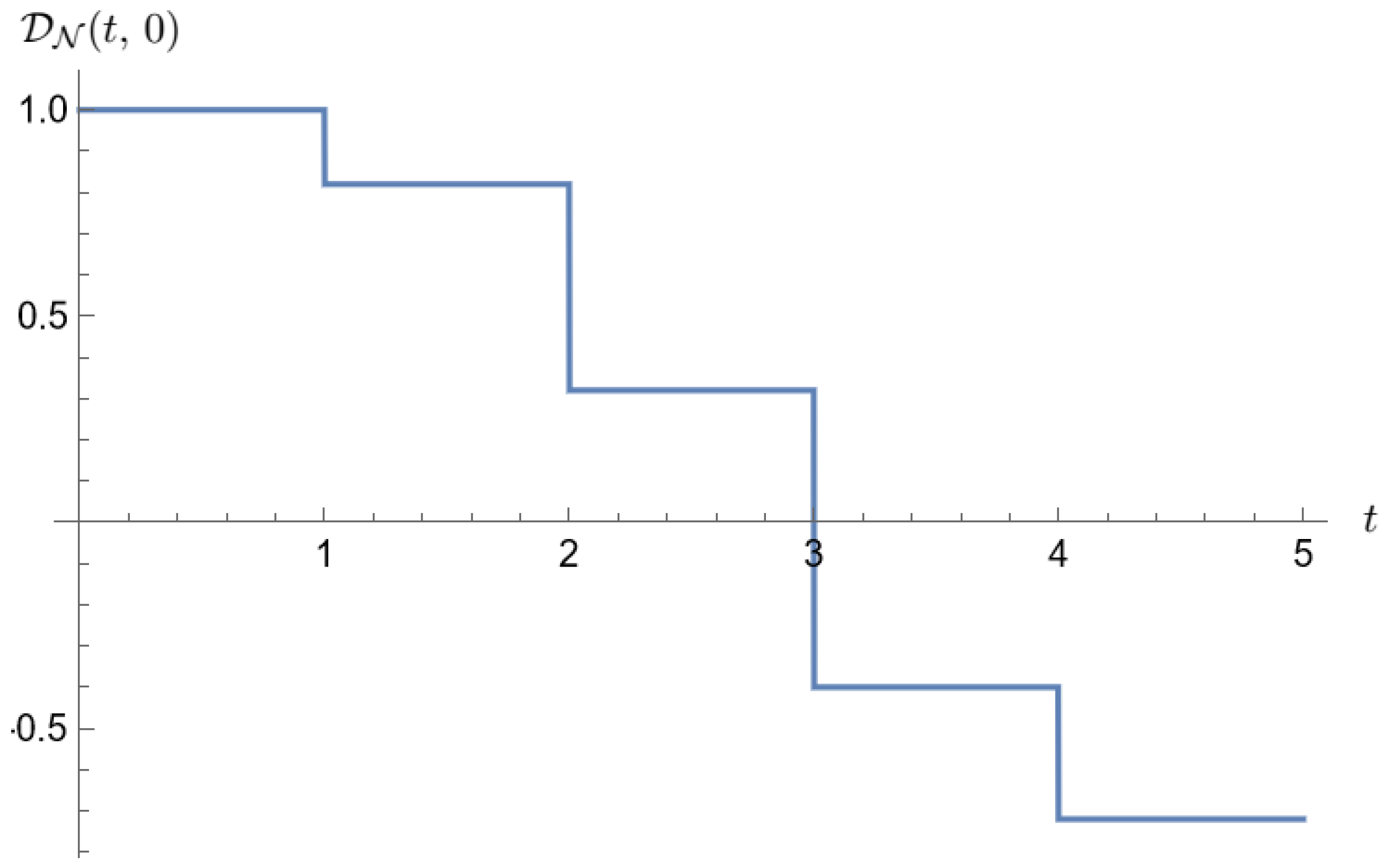
A plot of the last expression is shown in Figure 4. We note that if was differentiable like an ordinary function, then indeed , however, is non-differentiable. However, the construction defined by , as defined by Equation (27), involves the action of on before the evaluation of the integrals. One arrives at a result which does not include ill-defined terms,
Although our formalism does not describe what happens at the isolated transition time , this is not of any concern. Practically, the time that a perturbation is turned on is well separated from the time that a measurement is conducted.
We would like to finish this part with a comment. It is tempting to think that the problem with products of distributions can be solved by replacing the Dirac delta function by a function with a finite width . This can be done by using either the nascent or Gaussian representation,
By applying such a replacement one effectively replace an unbounded Hamiltonian with a bounded version, and the description of the system is given entirely by . However, it is crucial to understand that this demands from us the introduction of an additional dimensionful parameter – the width. Of course, the replaced integrals exist only as long as the width is kept non-vanishing. While the introduction of dimensionful parameter can sometime be justified, a clear advantage is to have an approach that is compatible with the Hamiltonian already in its original form, expressed in terms of generalized objects.
5. Conclusions
In this part a summarized list of the consequences is provided for adopting (5) as the solution for the Schrödinger equation. These implications affect both the perturbative and the non-perturbative aspects.
- ⊛
- The currently widely used solution should be regarded as a unitary everywhere operator only when working with a self-adjoint Hamiltonian on a Hilbert space (each state has a defined norm). On infinitely dimensional Hilbert spaces Hermiticity and self-adjoint are not equivalent properties, and Hermiticity is insufficient condition to guarantee a unitary evolution.
- ⊛
- The Liouville part of the evolution is dormant for bounded Hamiltonians and become activated for unbounded Hamiltonians on a measure-0 set. It acts as a "probability conservation regulator," and produces a correction for the discontinuous evolution that is involved in the dynamics of .
- ⊛
- For the proposed solution unitary is maintained manifestly, at all orders and at any given moment of the evolution, rather than asymptotically. The ordinary probabilistic interpretation is applicable even for unbounded Hamiltonians: the modulus of transitions amplitudes are always given by a defined expressions (up to regularization).
- ⊛
- The dynamics of quantum systems with unbounded Hamiltonian is non-Markovian. The typical approach wrongly assumes that the space is suitable to study these problems. However, a more faithful approach would be to assume no knowledge of space or "indefinite norm spaces" such as Krein space, such that a becomes non-trivial operator.
- ⊛
- The solution provided will hopefully pave the way for a better understanding of various quantum systems in which unitarity is currently assumed to be broken. As such are systems with a non-Hermitian Hamiltonians, field theories on non-commutative spaces [46], field theories on factional dimensions [47], or open quantum systems [48].
- ⊛
- The reason which has initiated this study and was not mentioned is scattering amplitudes for entangled states. In this setup, unlike that where fully on-shell states are involved, strangely the JIMWLK equation [45] is no longer applicable. That happens since the normalization of the WF via simple overall factor breaks down and a convolution is required. The analysis of the time evolution of entangled states is a key for experimental verification of our proposed idea.
Data Availability Statement
Data sharing not applicable to this article as no datasets were generated or analysed during the current study.
Acknowledgments
First and foremost, Y. M. would like to thank his singular mother for which this paper is dedicated. Y.M. would like to greatly thank A. Ramallo for many valuable discussions, guidance, and support. Y.M also like to thank E. Iancu, N. Armesto, A. Dumitru, E. Gandelman, D. Cohen, O. Aharoni, G. Beuf, F. Salazar, Y. Mehtar-Tani, T. Becher, P. Taels, S. Blanes, F. Perez, J. Jalilian-Marian, X. Garcia, M. Escobedo, A. H. Mueller, M. Peskin, Y. Neiman, C. Moulopoulos, A. Papa, M. Berry, E. Buks, O. M. Shalit, J. Lampart, A. Jadczyk and various other people with whom I had the chance to discuss about this project. Y.M. is also grateful for the Mathematics Stack Exchange community for providing me help with regard to the technical aspects involved in this project. A very special thanks goes for T. Lappi from the University of Jyväskylä (where this project was first initiated) for plenty of discussions on this matter in a way that has eventually shaped the structure of this paper. As a matter of fact, this paper has been evolved by the process of striving to get answers for his various interesting questions that arose along the way.
Open Access:
This article is licensed under a Creative Commons Attribution 4.0 International License, which permits use, sharing, adaptation, distribution and reproduction in any medium or format, as long as you give appropriate credit to the original author(s) and the source, provide a link to the Creative Commons licence, and indicate if changes were made. The images or other third party material in this article are included in the article’s Creative Commons licence, unless indicated otherwise in a credit line to the material. If material is not included in the article’s Creative Commons licence and your intended use is not permitted by statutory regulation or exceeds the permitted use, you will need to obtain permission directly from the copyright holder. To view a copy of this licence, visit http://creativecommons.org/licenses/by/4.0/.
Conflicts of Interest
The author have no relevant financial or non-financial interests to disclose. No funding was received for conducting this study.
Appendix A. Why May the Iterative Method Fail?
In this section we would like to discuss the Picard’s method of successive approximations [14,15] in order to analyze the capacity of this approach to yield the solution for a differential evolution equation of first order. Our intention is to consider a differential equation of the type
subject to the initial condition . The key point of Picard’s idea consist in replacing the original differential equation by a system of difference equations that approximate the evolution occurring in a small neighborhood of the domain26 [16]. As demonstrated below, under certain assumptions, the resulting difference equation can reliably approximate the evolution on the whole domain. In that case, the resulting solution uniquely converges to the analytic solution of the original equation. Our intention is to provide an answer for the following fundamental question – what are the necessary conditions for the iterative method to be applicable? is the discretization limit always admissible?
Let us start by applying the method in the non-negative region with the simple choice of with . The analytical solution corresponding to our choice can naturally be found by direct integration, . Now let us reproduce the last solution via the iterative method. Our initial assumption is that the differential equation above allows to start a process of successive approximations by rewriting it in the integral form,
After a few iterations the following results are obtained:
from which we observe the series that is generated after n iterations,
As expected, the sequence converges to the Taylor series for the exponent,
which indeed reproduced the expected result. This last equivalence was, in fact, guaranteed to us by the Picard–Lindelöf theorem [15]. As lengthy discussed in [17], the error at the nth step of the iterative procedure in the interval with , where and , is bounded by the inequality
with the definitions , . Clearly, in order for the solution obtained by iterative method to be considered valid, it must converge asymptotically to the analytic solution,
However, as we are about to see, the above theorem will fail to imply uniqueness when singularities are involved. For example, let us take a closer look on what happens when trying to solve a differential equation with RHS involving Dirac delta function [18],
subject to the initial condition with . The direct solution method leads to , where we have used the defining relation for the Heaveside theta function27,
Now let us try to reproduce the last result by the iterative method. For that purpose we present the solution as
and then by substitution
After performing the integration of the inner brackets by using (A9) it is clear that something goes wrong. One arrives at the badly defined result that involves integration over a product of two distributions [19],
It is, therefore, clear that the iterative series (A11) will not converge to the expected result. We realize that in order for the iterative method to work, the integrand has to be well defined (measurable function) at each part of the domain. A more practical example, which allows to get a deeper understanding what happens when the conditions for Picard theorem fails, is given by the differential equation,
which has an unbounded RHS when brought to the form of (A1). The solution is often taken as , although a more general discontinuous solution can be found,
In terms of distributions that can be expressed as . Note that even thought the constant term changes in the passage between the two disjoint regions, this is still valid a solution. The discontinuous part, or alternatively, the singular dynamics at , is exactly the part in which the iterative procedure fails to provide a definitive answer. Thus, our main conclusion in this part is that singular differential equations28 cannot be solved by a solution method that is based solely on the iterative method.
Appendix B. The Dynamics of N ^
In this part we provide the proof for the second equation of (54). From the defining relation for the normalization operator, . By applying the time derivative on the two side of this equation it follows that
After multiplication by from the right side and from the left side becomes
which is a Sylvester type equation [35] for . In our case, due to positive definite property of , this equation can be solved in a unique manner. In fact, this equation is not just a Sylvester equation, but more precisely the continuous time Lyapunov equation29 [36]. As such, its solution is known to be given explicitly by the integral
By plugging the dynamics of from Equation (54) in the above result we obtain
which after simplifications30 can equivalently written
Finally, an immediate integration31 of the last result establishes the fact that has a non-trivial dynamics that is given by the second equation that is written in (54).
References
- Schrödinger, "An undulatory theory of the mechanics of atoms and molecules," Physical review, 28(6), 1049. [CrossRef]
- Landau, L. D., & Lifshitz, E. M. (2013). Quantum mechanics: non-relativistic theory (Vol. 3). Elsevier.Böhm, A. (2013). Quantum mechanics: foundations and applications. Springer Science & Business Media.
- Peskin, M. E. (2018). An introduction to quantum field theory. CRC press.Kaiser, D. (2018). Lectures of Sidney Coleman on Quantum Field Theory: Foreword by David Kaiser. World Scientific Publishing. [CrossRef]
- Dyson, Freeman J. "The radiation theories of Tomonaga, Schwinger, and Feynman." Physical Review 75.3 (1949): 486.Dyson, Freeman J. "The S matrix in quantum electrodynamics." Physical Review 75.11 (1949): 1736. [CrossRef]
- Robinson, J. C. (2020). An introduction to functional analysis. Cambridge University Press.Yosida, K. (2012). Functional analysis. Springer Science & Business Media.
- Gitman, D. M., Tyutin, I. V., & Voronov, B. L. (2012). Self-adjoint extensions in quantum mechanics: general theory and applications to Schrödinger and Dirac equations with singular potentials (Vol. 62). Springer Science & Business Media.
- Gieres, F. (2000). Mathematical surprises and Dirac’s formalism in quantum mechanics. Reports on Progress in Physics, 63(12), 1893.Bonneau, G., Faraut, J., & Valent, G. (2001). Self-adjoint extensions of operators and the teaching of quantum mechanics. American Journal of physics, 69(3), 322-331. [CrossRef]
- A. Mariani and U. J. Wiese (2023). "Self-adjoint Momentum Operator for a Particle Confined in a Multi Dimensional Cavity".M. H. Al-Hashimi and U.-J. Wiese (2021). "Alternative momentum concept for a quantum mechanical particle in a box," Phys. Rev. Research, vol. 3, p. L042008.
- Apelian, C., & Surace, S. (2009). Real and complex analysis. CRC press.Simon, B. (2015). Real analysis. American Mathematical Soc..
- Teschl, G. Mathematical methods in quantum mechanics. Vol. 157. American Mathematical Soc., 2014.Dimock, J. Quantum mechanics and quantum field theory: a mathematical primer. Cambridge University Press, 2011.
- Schmüdgen, K. Unbounded self-adjoint operators on Hilbert space. Vol. 265. Springer Science Business Media, 2012.Goldberg, S. (2006). Unbounded linear operators: Theory and applications. Courier Corporation.
- Hall, B. C. (2013). Quantum theory for mathematicians. springer publication..Neumann, J. V. (1932). Uber einen satz von herrn mh stone. Annals of Mathematics, 567-573.
- Hall, B. C., & Hall, B. C. (2013). Lie groups, Lie algebras, and representations (pp. 333-366). Springer New York.Lipschutz, S., & Lipson, M. L. (2018). Schaum’s Outline of Linear Algebra. McGraw-Hill Education.
- Lindelöf, E. (1894). "Sur l’application de la méthode des approximations successives aux équations différentielles ordinaires du premier ordre". Comptes rendus hebdomadaires des séances de l’Académie des sciences. 118: 454–7.
- Seifert, C., Trostorff, S., & Waurick, M. (2022). Evolutionary Equations: Picard’s Theorem for Partial Differential Equations, and Applications (p. 317). Springer Nature. [CrossRef]
- Lax, P. D., & Richtmyer, R. D. (1956). Survey of the stability of linear finite difference equations. Communications on pure and applied mathematics, 9(2), 267-293. [CrossRef]
- Byron, Frederick W., and Robert W. Fuller. Mathematics of classical and quantum physics. Courier Corporation, 2012.
- Lighthill, M.J. An Introduction to Fourier Analysis and Generalised FunctionsJ C. Ferreira, R. F. Hoskins, J. Sousa-Pinto, Introduction to the Theory of Distributions.
- Schwartz, L. (1954). Sur l’impossibilité de la multiplication des distributions. CR Acad. Sci. Paris, 239(847-848), 6.
- Kanwal, R. P. (2004). Generalized functions: theory and applications. Springer Science & Business Media.Johnson, S. G. “When functions have no value(s)”.
- Bilenky, S. M. (2013). Introduction to Feynman Diagrams: International Series of Monographs in Natural Philosophy (Vol. 65). Elsevier.
- Stroock, D. W. (2013). An introduction to Markov processes (Vol. 230). Springer Science & Business Media.Dynkin, E. B. (2012). Theory of Markov processes. Courier Corporation.
- Trotter, H. F. (1958). Approximation of semi-groups of operators.
- Moretti, V. (2017). Spectral theory and quantum mechanics. UNITEXT, Italy: Springer International Publishing AG.Prugovecki, E. (1982). Quantum mechanics in Hilbert space. Academic Press.
- S. Albeverio, F. Gesztesy, R. Hoegh-Krohn, H. Holden, Solvable Models in Quantum Mechanics,2012.
- Flugge, S. (1999). Practical quantum mechanics (Vol. 177). Springer Science & Business Media.Galitskii, V. M., Karnakov, B., Galitski, V., & Kogan, V. I. (2013). Exploring quantum mechanics: A collection of 700+ solved problems for students, lecturers, and researchers. Oxford University Press, USA.
- Prugovecki, E. (1982). Quantum mechanics in Hilbert space. Academic Press.Gallone, F. (2014). Hilbert Space and Quantum Mechanics. World Scientific Publishing Company.
- Berezanskiĭ, I. M. (1968). Expansions in eigenfunctions of selfadjoint operators (Vol. 17). American Mathematical Soc..
- Gelfand, I. M., Graev, M. I., & Vilenkin, N. Y. (1962). Generalized Functions, Vol. 1-5, Gos. Izd. Fiz. Mat. Lit., Moscow.De la Madrid, R. (2005). The role of the rigged Hilbert space in quantum mechanics. European journal of physics, 26(2), 287. [CrossRef]
- Bender, C. M. (2007). Making sense of non-Hermitian Hamiltonians. Reports on Progress in Physics, 70(6), 947. [CrossRef]
- Moiseyev, N. (2011). Non-Hermitian quantum mechanics. Cambridge University Press.Bountis, T., & Skokos, H. (2012). Complex hamiltonian dynamics (Vol. 10). Springer Science & Business Media.
- Mostafazadeh, A. (2010). Pseudo-Hermitian representation of quantum mechanics. International Journal of Geometric Methods in Modern Physics, 7(07), 1191-1306.Ashida, Y., Gong, Z., & Ueda, M. (2020). Non-hermitian physics. Advances in Physics, 69(3), 249-435.
- N. N. Bogolubov, and N. N. Bogolubov Jr. "Introduction to quantum statistical mechanics," World Scientific Publishing Company, 2009.
- J. von Neumann, "Wahrscheinlichkeitstheoretischer Aufbau der Quantenmechanik," Nachr. Ges. Wiss. Göttingen, 1, 245-272, 1927.
- Sylvester, J. (1884). "Sur l’equations en matrices px = xq". C. R. Acad. Sci. Paris. 99 (2): 67–71, 115–116.Bartels, R. H.; Stewart, G. W. (1972). "Solution of the matrix equation AX + XB=C". Comm. ACM. 15 (9): 820–826. doi:10.1145/361573.361582. S2CID 12957010.
- Parks, P. C. (1992). AM Lyapunov’s stability theory—100 years on. IMA journal of Mathematical Control and Information, 9(4), 275-303.
- Hannesdottir, H. S., Mizera, S. (2023). What is the iε for the S-matrix?. Springer.Collins, J. C. (1984). Renormalization: an introduction to renormalization, the renormalization group and the operator-product expansion. Cambridge university press.
- Halmos, P. R. (2013). Measure theory (Vol. 18). Springer.Tao, T. (Ed.). (2011). An introduction to measure theory (Vol. 126). American Mathematical Soc..
- Dumitru, Adrian, and Risto Paatelainen. "Sub-femtometer scale color charge fluctuations in a proton made of three quarks and a gluon." Physical Review D 103.3 (2021): 034026.
- M. Born: Zur Quantenmechanik der Stoßvorg¨ange. Z. f. Phys. 37, 863–867 (1926). M. Born: Quantenmechanik der Stoßvorg¨ange. Z. f. Phys. 38, 803–827 (1926).
- Feynman, R. P., Hibbs, A. R., & Styer, D. F. (2010). Quantum mechanics and path integrals. Courier Corporation.Feynman, R. P. (1948). Space-time approach to non-relativistic quantum mechanics. Reviews of modern physics, 20(2), 367. [CrossRef]
- Z. Chen, and A. H. Mueller. "The dipole picture of high energy scattering, the BFKL equation and many gluon compound states," Nuclear Physics B 451.3 (1995): 579-604.C. Marquet, "Forward inclusive dijet production and azimuthal correlations in pA collisions." Nuclear Physics A 796.1-4 (2007): 41-60. [CrossRef]
- Kovner, A., & Wiedemann, U. A. (2001). Eikonal evolution and gluon radiation. Physical Review D, 64(11), 114002. [CrossRef]
- E. Iancu, Y. Mulian. "Forward trijet production in proton–nucleus collisions." Nuclear Physics A 985 (2019): 66-127.E. Iancu, and Y. Mulian. "Forward dijets in proton-nucleus collisions at next-to-leading order: the real corrections." Journal of High Energy Physics 2021.3 (2021): 1-67.
- M. Lublinsky, and Y. Mulian. "High Energy QCD at NLO: from light-cone wave function to JIMWLK evolution." Journal of High Energy Physics 2017.5 (2017): 1-80. [CrossRef]
- Gomis, Jaume, and Thomas Mehen. "Space–time noncommutative field theories and unitarity." Nuclear Physics B 591.1-2 (2000): 265-276. Bahns, D. (2003). Unitary quantum field theory on the noncommutative Minkowski space. Fortschritte der Physik: Progress of Physics, 51(7-8), 658-663. Morita, K., Okumura, Y., & Umezawa, E. (2003). Lorentz invariance and the unitarity problem in non-commutative field theory. Progress of theoretical physics, 110(5), 989-1001. [CrossRef]
- Hogervorst, M., Rychkov, S., & van Rees, B. C. (2016). Unitarity violation at the Wilson-Fisher fixed point in 4-ϵ dimensions. Physical Review D, 93(12), 125025. Jin, Q., Ren, K., Yang, G., & Yu, R. (2023). Is Yang-Mills Theory Unitary in Fractional Spacetime Dimensions?. arXiv preprint arXiv:2301.01786. [CrossRef]
- Rivas, A., & Huelga, S. F. (2012). Open quantum systems (Vol. 10, pp. 978-3). Berlin: Springer.Breuer, H. P., & Petruccione, F. (2002). The theory of open quantum systems. Oxford University Press, USA.
- Higham, N. J. (2008). Functions of matrices: theory and computation. Society for Industrial and Applied Mathematics.Horn, R. A., & Johnson, C. R. (2012). Matrix analysis. Cambridge university press.
- R. Salem, "On some singular monotonic functions which are strictly increasing." Transactions of the American Mathematical Society 53.3 (1943): 427-439.Feder, J., & Feder, J. (1988). Cantor Sets. Fractals, 62-65.
- Hardy, G. H. (1901). The Elementary Theory of Cauchy’s Principal Values. Proceedings of the London Mathematical Society, 1(1), 16-40. [CrossRef]
- Estrada, R., & Kanwal, R. P. (2000). Singular integral equations. Springer Science & Business Media.Mandal, B. N., & Chakrabarti, A. (2016). Applied singular integral equations. CRC press.
- Sebestyén, Zoltán, and Zsigmond Tarcsay. "Adjoint of sums and products of operators in Hilbert spaces." Acta Scientiarum Mathematicarum 82 (2016): 175-191. [CrossRef]
| 1 | A linear operator is called bounded if and only if for any where the notation denotes the norm of on the space [5]. |
| 2 | An operator on the Hilbert space is called self-adjoint if it is operatorically identical to its adjoint, . The equivalence between two operators implies two conditions: for , and additionally the domains are identical,
|
| 3 | The action of this operator, known as the time-ordering operator, is defined by , where is the Heaviside theta function. |
| 4 | We denote the exact solution by from the word pitaron which means solution in Hebrew. |
| 5 | The definition of this component is later provided in Equation (53). |
| 6 | Note that an operator is called a square root of operator if it satisfies . |
| 7 | Therefore, it is clear that the original terms in the perturbative series involving integrations in the iterative form , and not the productive form . |
| 8 | The integration over an operator is defined as where the inner integration includes any . Note that exchanging of the ordering of integrations, , is generally permitted only if is a bounded operator. |
| 9 | At first sight, the solution (9) seems to satisfy the Schrodinger equation. Indeed, by applying the derivative term-by-term based on , it seems that we arrive at
|
| 10 | Essentially, we assume that both and . These non-trivial simplifications can only be guaranteed for bounded self-adjoint Hamiltonians integrted over a proper domain. |
| 11 | An additional operation that is not listed is the Fubini theorem, as mentioned in (14). However, it can be shown that this operation is redundant in terms of the mathematical requirements, as its validity is ensured if (17) is satisfied. In any case, it is clear that applying simplification (14) is not universal, and cannot be guaranteed to yield a correct transition if the integrand is conditionally convergent. |
| 12 | Contrary to the case of bounded operators, unbounded operators on a given space do not form an algebra, nor even a complete linear space [5]. Each unbounded operator is defined on its own domain, so that if and are two unbounded operators defined on the domains and respectively, then the domain of operator is . Note that two operators which act in the same way are to be considered as different if they are not defined on the same subspace of Hilbert space. According to Hellinger-Toeplitz theorem [5], if a self-adjoint operator is well defined on the entire Hilbert space it has to be bounded. |
| 13 | It is worth mentioning that one can ’save additivity’ by replacing the standard Riemann integral with a modified definition of integral, but obviously, this will not cure the fundamental problem, but rather just hide it inside the integrals definitions. |
| 14 | Otherwise, by tracing both sides of the relation, an illogical result is obtained [7]. |
| 15 | Similarly, . |
| 16 | The approximation is used. |
| 17 | The notation is introduced. Notice the difference with the definition of the norm: the outcome of is another operator, while the operation includes an additional tracing operation, and therefore, leaves us with just a number. |
| 18 | More generally, such a choice of Hamiltonian can be expressed by using a complete orthonormal Hilbert space , , where , with for any value of t. |
| 19 | Stating that if , then f is Riemann integrable if and only if f is bounded and the set of discontinuities of f has measure 0. |
| 20 | The notation of a broken arrow ↛ signifies here an invalid transition |
| 21 | For example, the value of is undefined. |
| 22 | Note that differentiation and conjugation are not commutative operations, , with equivalence only when using a self-adjoint Hamiltonian. |
| 23 | The simplification is used. |
| 24 | In order for operators and to represent an eligible decomposition of a diagonalizible Hamiltonian, they need to share a common set of eigenvectors. In that case they are simultaneously diagonalizable, which implies the relations . |
| 25 | In that case only the leading order term dominates the expansion of , . |
| 26 | So that, (A1) is essentially replaced by solving the system , that leads to . |
| 27 | Generally, if the signs of a and x are unknown, . |
| 28 | These are typically of the form with . For example, as discussed in [20], if the obtained result is given by for which approximate expressions cannot be found. |
| 29 | These are equtions of the type where is a self-adjoint operator. |
| 30 | By using the identity along with the observation that since the operator is fully expressible based on the operator they shares a common basis and domain,
|
| 31 | More explicitly, . |
Figure 1.
Changing the order of integration via the Fubini theorem. Left: the original integration. This integration was required to be performed on the triangle defined by first integrating the interval , and only then . Right: the integration after applying the Fubini theorem – the first integration is carried on the interval .
Figure 1.
Changing the order of integration via the Fubini theorem. Left: the original integration. This integration was required to be performed on the triangle defined by first integrating the interval , and only then . Right: the integration after applying the Fubini theorem – the first integration is carried on the interval .
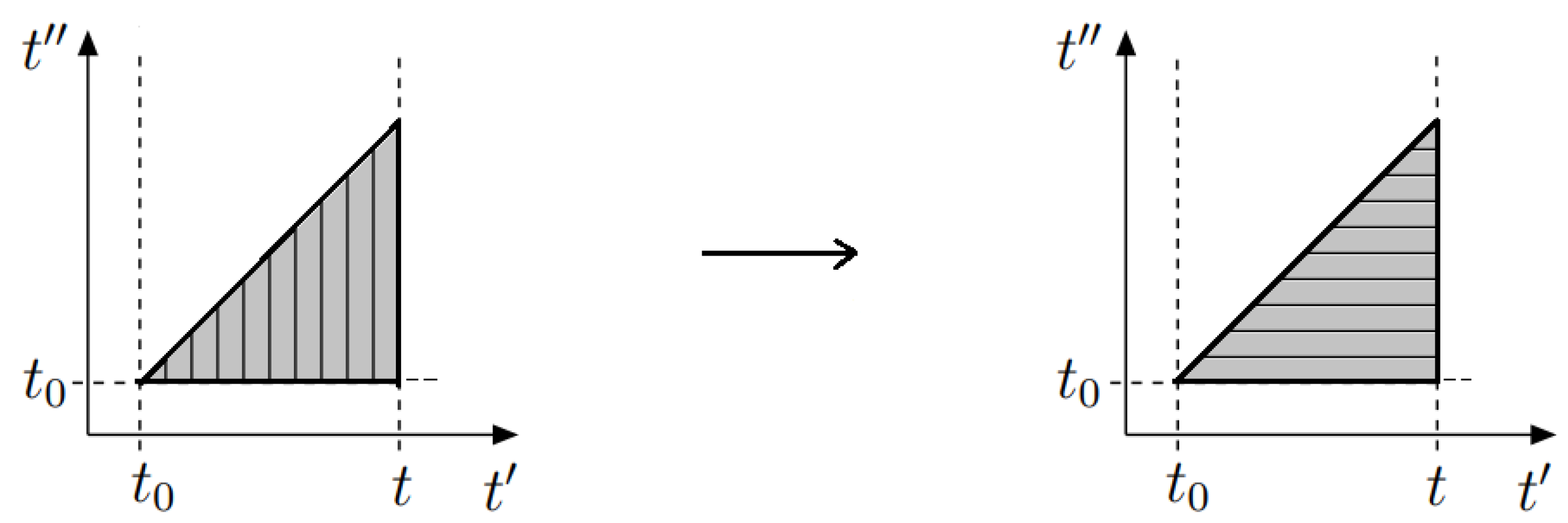
Figure 2.
The Poschl-Teller potential with .
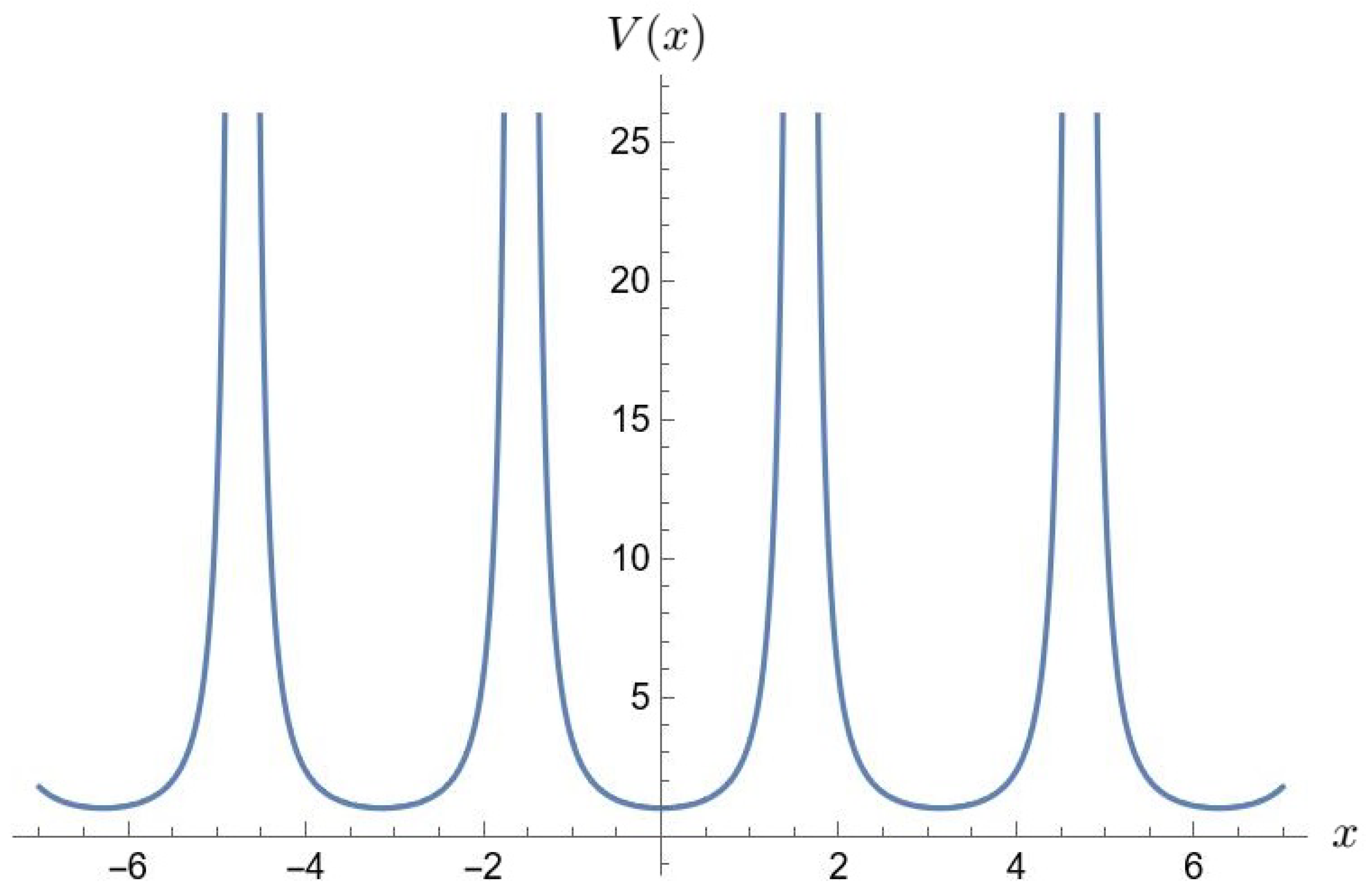
Figure 3.
The Dirac comb.
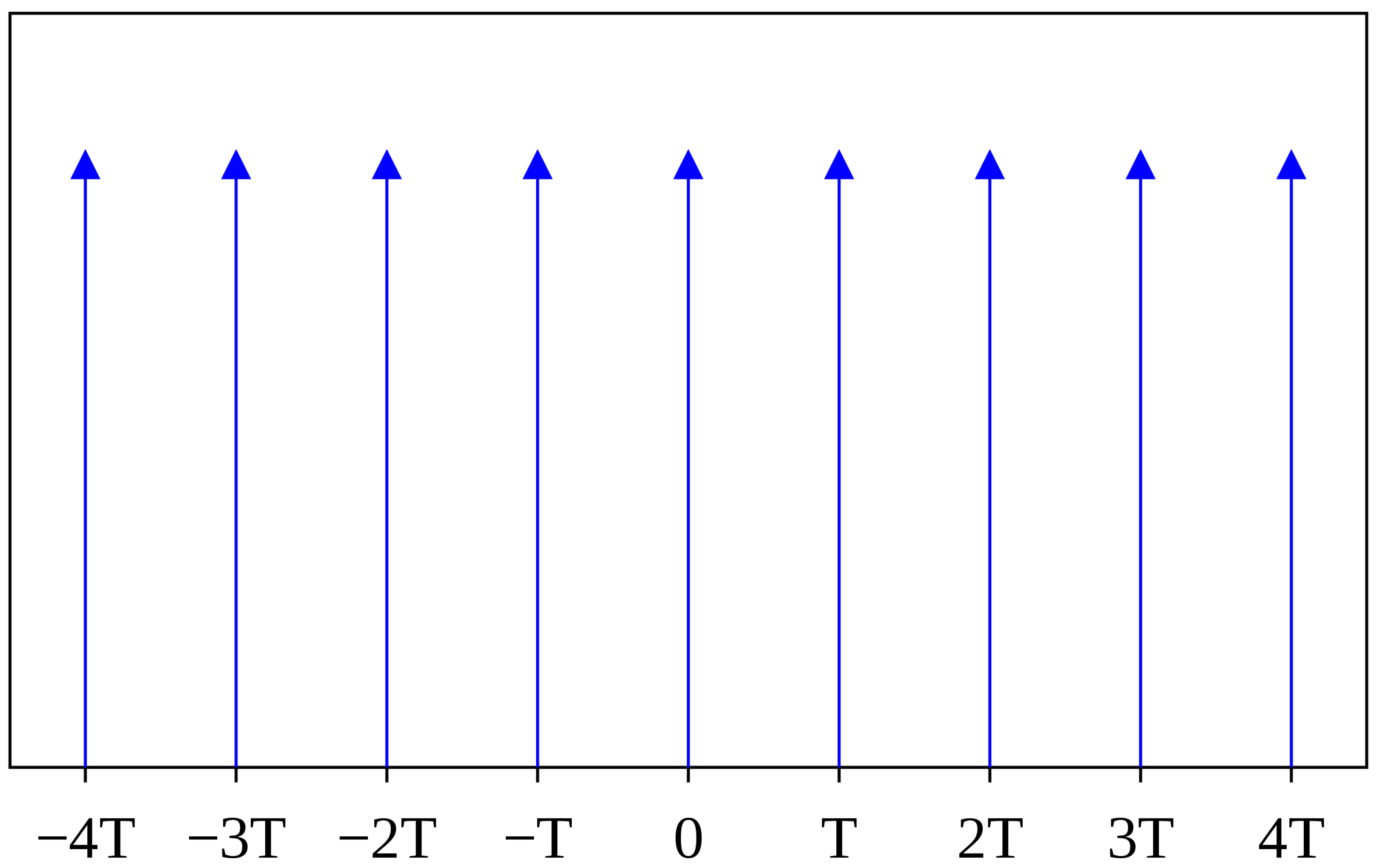
Figure 4.
The value of the defined part of for the Dirac comb Hamiltonian (81) with and .
Figure 4.
The value of the defined part of for the Dirac comb Hamiltonian (81) with and .
Disclaimer/Publisher’s Note: The statements, opinions and data contained in all publications are solely those of the individual author(s) and contributor(s) and not of MDPI and/or the editor(s). MDPI and/or the editor(s) disclaim responsibility for any injury to people or property resulting from any ideas, methods, instructions or products referred to in the content. |
© 2024 by the authors. Licensee MDPI, Basel, Switzerland. This article is an open access article distributed under the terms and conditions of the Creative Commons Attribution (CC BY) license (http://creativecommons.org/licenses/by/4.0/).
Copyright: This open access article is published under a Creative Commons CC BY 4.0 license, which permit the free download, distribution, and reuse, provided that the author and preprint are cited in any reuse.


