

Submitted:
21 September 2024
Posted:
24 September 2024
You are already at the latest version
Abstract
Anthropogenic activities impacting marine environments are internationally recognized as welfare issues for wild cetaceans. This study validates a first evidence-based physical health and welfare assessment protocol for humpback (n=50) and fin whales (n=50) living in a highly anthropized environment. Visual assessments of body condition, skin health, prevalence of injuries and parasite/epibiont loads were performed using a species-specific multi-scale measuring tool. A total of 6403 images were analyzed (fin, n =3152; humpback, n= 3251) and results were validated through reliability and positive discrimination statistical tests. Welfare assessment results showed that 60% of humpback whales were considered in a good physical welfare state compared to only 46% of fin whales. Significant relationships were observed in both species, between environmental parameters, like dissolved oxygen levels, and prevalence of cutaneous lesions like pale skin patch syndrome. Furthermore, animals with injuries due to anthropogenic activities were more likely to be in poorer body condition, suggesting chronic stress affecting health and welfare.
Keywords:
Humpback Whales
; Fin Whales
; Welfare Assessment
; Anthropized environment
; Chronic Stress
; Entanglement
; Physical health
; Body condition
; Cutaneous lesions
1. Introduction
In recent years, anthropogenic disturbance has had an increasing impact on the welfare of wild cetaceans around the world [1,2,3,4,5,6,7]. Marine debris, entanglement in fishing gear, ship collisions, underwater noise, whale-watching activities and degradation of the marine environment are currently the main welfare issues identified by international conservation bodies and marine mammal research groups [6,8,9,10]. The welfare of an animal can be defined as ˝its state as regards its attempt to cope with its environment […] it refers to the extent of biological activity underlying attempts to cope, including the involvement of body repair systems, immunological defences and physiological stress responses as well as a variety of behavioural responses" [11]. Furthermore, the “welfare state” refers to the underlying emotional status of an animal, characterized by positive or negative valence, arousal, duration, and generalization of emotions, where it “constitutes an internal, central (as in central nervous system) state” [12]. This recent interest in the welfare of individual animals underlines new ethical concerns about cetaceans, recognizing them as sentient beings that can experience subjective affective states such as pain and stress due to human activities [13,14,15,16]. Interest in free-ranging cetacean welfare also represents a complementary approach to classical conservation biology [17,18] which together constitute a continuum of ethical concerns that range from the individual’s welfare to the conservation of a healthy population. In this regard, legislators have been urged to include cetacean welfare assessment protocols in regulations and conservation plans, notably by the Committee on Welfare Issues of the International Whaling Commission [8,9,10,19,20,21].
Located in the Atlantic Ocean, the Gulf of St-Lawrence (“St-Lawrence” hereafter), Canada, is a highly anthropized environment and is a well-known feeding ground for rorquals like the humpback (Megaptera novangliae) and fin whales (Balaenoptera physalus) [22,23,24,25]. Each year, in early spring, these two species enter the St-Lawrence to feed on zooplankton and small pelagic fishes [26,27,28] for several months before migrating out of the Gulf, usually before ice cover occurs [29,30]. However, due to extensive human activities, predominantly commercial fishing and maritime traffic, the animals feeding in the St-Lawrence face important welfare challenges which could have dire consequences at the individual and population levels. To truly understand the human impact on these whales, methods to assess welfare are needed. In this regard, scientific welfare assessment protocols have been validated for a wide range of species held in captivity like farm [31,32], companion [33,34] and wildlife animals [35,36]. More recently, validation of welfare protocols for free-ranging species impacted by anthropogenic activities have been conducted, but these protocols are the most challenging ones due to the uncontrolled nature of the environment [37,38]. One of the key aspects of a scientific welfare assessment protocol is the holistic nature of its design which aims to establish relationships between animal-based indicators of welfare (physical health, physiological status and behavioural state) and environmental measures that positively or negatively impact the welfare of the animal [19,39,40,41,42].
The first indicator to be validated in a welfare protocol is usually the physical health status of an animal. Depending on the species and the context, the protocol may include a wide range of measures such as body condition score [43,44,45], lameness score [46,47], number and severity of injuries [48,49] and clinical observation of diseases [50,51]. Once validated, a physical health indicator can be used to infer the underlying affective state of an animal and ultimately assess welfare with a scoring system [41]. On its own, the physical indicator of health can partially inform on the overall welfare of an animal but needs to be integrated into a complete species-specific welfare assessment protocol (see the Five Domains model by Mellor [41]).
In captive cetaceans, one welfare assessment protocol was developed for bottlenose dolphins (Tursiops truncatus) based on four welfare principles, 11 welfare criteria and 36 different measures including nine specifically assessing physical health e.g. body weight, injury, and diseases [52]. A scoring system based on a 0-2 scale (0=good welfare, 1=adequate and 2=poor welfare) was used to assess all measures. In the context of free-ranging cetaceans, the assessment of animal-based measures is particularly challenging due to remoteness and other logistical difficulties of research at sea (e.g., weather and sea state limitations), which result in limited time of direct observation. However, conservation medicine and physiology approaches have recently validated four visual measures of health that could be used in a physical welfare indicator for free-range cetaceans: body condition, prevalence of injuries, cutaneous lesions and parasite and/or epibiont loads [7,53,54,55,56,57,58].
Body condition has been extensively validated as an informative measure of welfare in mammals, since chronic states of energy deficit lead to endocrine metabolic homeostasis dysregulation, clinically observed by weight gain or loss [59,60,61]. For instance, emaciation can reflect poor nutritional status, chronic stress and underlying pathologies [62,63,64,65] which can be emotionally experienced as feelings of hunger, pain and discomfort [39,41,66,67]. However, body weight fluctuations can also reflect reproductive status, age and seasonal migration for some species, which should be considered when developing species-specific scoring systems [68,69,70]. In North Atlantic right whales (Eubalaena glacialis, "NARW"), a three-point scale for body condition was developed in 2004 and remains the reference for baleen whale visual body condition scoring system. This scale has been useful for visually assessing health in NARW for over three decades, ultimately showing a decline in overall physical health over this time period [71,72,73,74]; further, poor scores are known to be predictive of subsequent reproduction and mortality. Similar approaches to assessing body condition as a visual measure of health have since been validated for southern right whales (Eubalaena australis) [75], gray whales (Eschrichtius robustus) [76], blue whales (Balaenoptera musculus) [70], common dolphins (Delphinus delphis) [77], and short-finned pilot whales (Globicephala macrohynchus) [78]. However, body condition evaluation has only been partially examined in humpbacks [7], and has not been applied to fin whales.
Besides body condition, physical injuries of free-ranging cetaceans have also been measured visually by characterizing open wounds, deformities and scars using either unmanned vehicles, boat-based photographs or through post-mortem investigation [7,79,80,81,82,83]. Some scoring systems were developed based on the location of injury on the body, type and cause of injury (e.g., entanglement, boat strike, etc.) and severity of the observed lesions [80,84,85]. For instance, analysis of boat-based photographs collected in the St-Lawrence (2009-2016), showed that 6.5% of fin whales (n=322) and 85% of humpback whales (n=112) had visible scars from previous entanglement [57]. However, fin whales rarely lift their flukes fully out of the water (as humpback whales do), thus limiting the body areas available for assessment and limiting accurate assessment of entanglement rates [57]. From a welfare standpoint, physical injuries, past and present, have a detrimental impact on the animal by inflicting pain and suffering but also, depending on the location and severity, can negatively affect survival and fitness (e.g., half a fluke missing). The level of stress resulting from physical pain and injuries can have prolonged effects on health and welfare [86,87,88].
Cutaneous disease may also provide indications about the health status of cetaceans. For instance, prolonged freshwater exposure in humpback whales and oceanic dolphins may lead to ulcerative dermatitis and, ultimately, death [89,90]. As another example, in bottlenose dolphins (Tursiops spp.), the high prevalence of lobomycosis, a fungal granulomatous skin disease is indicative of environmental degradation [58,91,92], and the epidemiological pattern of tattoo skin lesions caused by poxviruses may be indicative of poor health and stress [92,93]. Although complete diagnosis can only be achieved through histology and immunohistochemistry of skin samples, visual assessments based on previously diagnosed skin pathologies have been validated for multiple types of cutaneous lesions [55,94,95]. Most of the scoring systems used to quantify cutaneous lesions indicate presence or absence, in addition to percentage of the body covered and lesion size [53,71,92,96,97,98].
The presence of ectoparasites and epibionts on the bodies of whales and dolphins can also reflect health status since diseased or injured individuals will often reduce their swimming speed favouring epibiotic settlement [99,100]. The relationship between the epibiotic organisms and their cetacean hosts can be one of parasitism or commensalism and can have different consequences on overall welfare of the whales [99,101,102]. When covering extensive parts of their hosts, diatom algae and barnacles like Coronula diadema are thought to impact swimming drag and hydrodynamics [100,103,104,105], but have a relatively small impact on overall welfare [101]. In comparison, cookiecutter shark bites (Insitus sp.), characterized by considerable epithelial removal, will leave open “cookiecutter shape” wounds that can range between 8 to 18 cm in diameter [106,107,108]. The welfare impact of such open wounds doesn’t only concern physical pain, but also susceptibility to infectious diseases and other sequelae [109,110,111].
Recent studies on the epidermal condition of fin and humpback whales have reported numerous types of lesions originating from infectious diseases and ectoparasites. Fin whales found in Antarctic feeding grounds showed a high prevalence of cookiecutter shark bites compared with fin whales observed in the Strait of Gibraltar, where the highest prevalence of cutaneous lesions was associated with the copepod ectoparasite Pennella balaenopterae [63,112]. In the endangered humpback whale population found in the Arabian Sea, 41% of animals (n=93) exhibited tattoo skin disease-like lesions (TSD-L) possibly caused by cetacean poxvirus [7], compared with humpbacks found in Icelandic waters, where prevalence of TSD-L was only 0,7% (n=728) [113].
When comparing visual health assessment results across species of cetaceans found in different geographical areas, we can begin to evaluate the effects of anthropogenic activities and marine environmental degradation on cetaceans. Therefore, the development of a standardized method to assess the physical health and welfare of more species of free-ranging cetaceans is needed. The aim of the current study was to validate a physical indicator of welfare for humpback and fin whales observed in a seriously anthropized feeding ground. We hypothesized that the four different animal-based measures — body condition, injury condition, skin condition and parasite/epibionts condition — would show convergent validity, supported by these measures loading onto a shared factor in common factor analysis. Additionally, we theorized that these measures would show discriminant validity, supported by only low to moderate positive correlations between them. Furthermore, we assumed that normal environmental indices (lower water temperature, higher salinity levels, higher oxygen and lower nitrate levels) would correlate with good skin health and lower parasite/epibionts loads, and prey availability would correlate positively with body condition scores. The findings of this study could contribute to the development of wild cetacean welfare assessment protocols which could be valuable in informing policymakers and government agencies on conservation priorities for these species.
2. Materials and Methods
The present study is part of a larger ongoing project on the development of an integrated welfare assessment protocol for humpback and fin whales found in the Gulf of St-Lawrence. The project is in compliance with the Canadian Council on Animal Care guidelines [114].
2.1. Fieldwork Methods
Aboard a research platform (19 feet inflatable rigid hull boat with a 90 hp outboard motor), a focal study approach was used to collect photographic data on humpback and fin whales observed in the Sept-Îles area from 2016 to 2021 (Figure 1). Once an animal was observed, we approached to position the boat parallel to the whale’s body and took photographs of the animal (all possible angles) at 50m distance for photo-identification purposes and physical health characterization (Nikon D-800; 500/1000mm and 18/200mm lens). The maximum time spent with an individual was two hours, including diving and breathing sequences. If an animal actively avoided the boat, the focal study was terminated.
2.2. Image Treatment and Analysis
All images were treated with Photoshop (2021) to standardize and maximize quality in accordance with validated photo-identification methods [115,116]. After analysis and categorization (e.g., matching the individual whale with our local catalogue), photographs of the fluke of each humpback whale and the right-side chevron and dorsal fin of fin whales were uploaded into an online database (Happy Whale) to increase photo-identification capture-recapture information and collaborative efforts. [117]. For repeatability and validation purposes [70,71,118], a single observer (the first author, a researcher experienced in field whale research and welfare assessment methodologies for multiple species), analyzed the image dataset of the 50 first individual humpbacks and 50 first individual fin whales encountered between 2016 and 2021 for which at least 10 high-quality photographs (at least one of each side of observable body parts in both species and fluke for humpbacks) were taken during the focal observation. If a whale was resighted on multiple days/years, only the photographs of the first encounter were used for the welfare assessment.
2.3. Environmental Measures
Environmental parameters were retrieved from Fisheries and Oceans Canada’s open database (https://open.canada.ca/data/en/dataset) and included: sea surface temperatures (C˚) and salinity levels (%) [119], bottom temperatures (C˚) and salinity levels (%) [120], bottom dissolved oxygen content (% saturation) [121], mean integrated chlorophyll a (mg/m2) measured at depths between 0-100 m [122], integrated nitrate (mmol/m2), phosphate (mmol/m2), and silicate (mmol/m2), measured between 0 and 50 m and from 50 to 150m [121]. These abiotic measures were collected from different sites throughout the St-Lawrence, notably from the Rimouski station, located upstream and the Shediac Valley area in New Brunswick, downstream just outside the Gulf of St-Lawrence. The data were collected once a month at each site. We averaged the datasets across these sites since whales observed in the Sept-Îles area are mobile throughout the entire St-Lawrence and western parts of the Atlantic Ocean. These environmental parameters can inform the level of eutrophication (impact of urban runoff, agricultural fertilizers, human waste, etc.). We also retrieved annual biotic measures (data were collected in the Rimouski area, Anticosti, located in the Gulf of St-Lawrence, and Gaspé, on the south shore of the Gulf) on total zooplankton wet weight (g/m3) [121] and pelagic fish species abundance for sand lances (Ammodytes s.p), Atlantic herring (Clupea harengus), capelan (Mallotus villosus) and Atlantic mackerel (Scomber scombrus) which are the main dietary items of humpback and fin whales [120,123,124,125].
2.4. Physical Health Measures and Welfare Scoring System
Based on existing validated welfare assessment protocols in other species [7,31,38,52,126], we identified four categories of physical health measures that could be assessed for both humpback and fin whales: body condition, skin condition, injury/scarring condition and parasite/epibiont condition. A scoring system was developed consisting of four different scales, one for each physical health measure (three scales 0-4, and one scale 1-3) (Table 1). We used the Criteria Importance Through Inter-Criteria Correlation method (CRITIC) to determine the weight of each measure [127,128]. This method is used to combine multiple criteria into one overall score by attributing a larger weight to the measures that have a greater standard deviation, and that are negatively correlated to other pairs of criteria. The method comprises five steps: normalization of the criterion matrix, calculation of the standard deviation of each criterion, creation of the correlation matrix using a pairwise comparison between the criteria, calculation of H index and finally, calculation of the weight for each criterion (see Krishnan et al., 2021). We used the CRITIC method separately for fin and humpback whale measurement scales, as the results showed different weights should be used for each criterion in each species (Table 1). The final percentage grading scale was used to infer (arbitrarily based on the worst and best scores) the overall welfare state of each animal, as follows: a score between 1 and 40% was considered to represent poor welfare, a score > 40% up to 75% was considered moderate welfare, and a score > 75% was considered good welfare (see Table 1).
2.4.1. Body Condition Scoring
The body condition scoring scale was subdivided into three categories, used to generate one of five possible scores. First, whales were categorized as either emaciated, thin/moderate or optimal/good condition. These categories were developed based on protocols validated in other species [70,71,76]. The second step was to attribute a score to the animals, which took the date of observation into account. As whales usually arrive in the St-Lawrence to feed in May or June, body fat stores typically increase by mid-July. Emaciated animals were given a score of 0-1 (where 0 is attributed to whales observed after mid-July and 1 before mid-July); thin/moderate, a score of 2 or 3 (again, 2 after mid-July and 3 before mid-July) and a score of 4 was attributed to optimal weight condition independent of the date (Figure 2). Body condition assessment of females accompanied by a calf is always either emaciated or thin due to high energy requirements during lactation, thus an increase of 1 point was attributed; for example, a lactating female with a body score of 0 was increased to 1 to compensate.
2.4.2. Skin Condition Scoring
The skin condition scoring scale was developed during image analysis and characterization based on existing cutaneous lesion categories in multiple cetacean species [7,53,93,96,98,130,131] (See Table 2 and Figure 4). Skin condition was assessed with a scoring scale ranging from 0 to 4: 0 = ≥ 2 skin lesion types covering ≥ 75% of the observable body surface; 1= 1 skin lesion type covering ≥ 75% of the observed body surface; 2 = ≥ 1 skin lesion type covering ≥ 25% and ≤ 74% of observed body surface; 3 = ≥ 1 skin lesion type covering ≤ 24% of the observed body surface and 4 = ≤ 5% of observed body covered in skin lesions (Figure 3).
2.4.3. Injury and Scar Condition Scoring
Based on previous studies, we developed a scoring system for physical injuries and scarring with a 0-4 scale [57,81,133,134,135,136,137,138]. A score of 0 was attributed to whales that had an important physical injury from anthropogenic origin (typical entanglement or boat collision wounds or scars, see Robbins & Mattila 2001 for details) that could alter swimming, diving and/or thermoregulation, like fluke and dorsal fin amputation (Figure 5.A). A score of 1 was attributed to animals that had open vascularized wounds (Figure 5.B) and a score of 2 for deep healed injuries (no vascularization observed but characterized by a visible dent in the epidermis, Figure 5.C, D, E), both with anthropogenic origin characteristics. A score of 3 was given for superficial healed anthropogenic injuries (scars with no dent in the epidermis Figure 5.F, G) or important natural scarring from either killer whale predation attempts (visible tooth rake scars, Figure 5.H) or agonistic interactions with conspecifics (multiple scars from different angles, typical in male humpback whales). Finally, a score of 4 was given to animals that didn't have any visible scars from anthropogenic origins but could have multiple superficial scars from natural origins.
2.4.4. Parasite and Epibiont Condition Scoring
The parasite and epibiont condition scores were included in the same category, although their presence or the lesions they cause might not affect the whales equally. The scoring system was developed using a 1 to 3 scale, where 1 = ≥ 40% of the observable body was covered by parasites/scars and/or epibionts, 2 = between ≥ 5% and ≤ 40%, and a score of 3 = ˂ 5% (Figure 6). Barnacle load, only found on the flukes of humpbacks, was assessed by comparing and adding left and right lobe loads and was included in the overall score.

Table 3.
Description of parasite and epibiont categories used for scoring.
| Parasite and epibiont categories |
Description |
|---|---|
|
Orange film/diatoms (OFD) |
Orange film covering parts of the body to different extent (Figure 7.A) [139,140]. |
|
Lamprey bite and skid marks (LBM) |
Circular marks with a pale centre and darker edges, sometimes raised. Skidding marks are often observed with parallel scratches (Figure 7.B) [130,131]. |
|
Cookiecutter wounds/ scars (CCW) |
Oval-shaped crater-like wounds. Colour will depend on the healing stage, from pink to red in a fresh wound to whitish in a healing phase, to a depressed scar with normal pigmentation once healed (Figure 7.C) [130,141]. |
|
Whale lice (Louse) (WL) |
Small crustaceans of the Cyamid family found on body parts with folds (e.g., the ventral grooves or around blowholes). Infestations can also be observed on open wounds or immune-compromised individuals (Figure 7.D) [99,142]. |
|
Fluke barnacle load (FBL) |
Crustaceans from the family Coronulidae typically attached to appendages like pectoral fins or fluke (Figure 7.E and F) [104,143]. |
2.4.5. Statistical Analysis
Data were analyzed with JMP®, 17 (SAS Institute Inc., Cary, NC, 1989–2024) and R 4.1.0 (R Core Team, 2021) with each whale considered as a statistical unit (n =50 humpbacks and n = 50 fin whales). A total of 6403 images were analyzed (n = 3251 for humpbacks and n = 3152 for fin whales). The scoring systems (the four measurement scales) were each tested with Cronbach’s alpha standardized test for internal consistency, where alpha (α) needs to be greater than 0.7 for reliability of the measurement scales [144]. Discriminant validity between the four measurement scales (body, skin, injury and parasite/epibiont) of our physical welfare assessment protocol was tested with Spearman correlations within each species. Discriminant validity is supported if correlations between two scales are less than 0.75 [145]. We performed a common factor analysis (Q-type) using Maximum-Likelihood and Varimax orthogonal rotation to test convergent validity between the measurement scales of humpbacks and fin whales (standardized loading values greater than 0.4 are considered significant) [146,147]. We also used Spearman correlations to test the relationships between all measurement scales and environmental parameters (temperature, salinity, dissolved oxygen, nitrate, phosphate, silicate, chlorophyll A, and biomass of fishes and zooplankton) and dates (day-month-year). We also used the results to identify predictors and outcome variables within each common factor (Figure 8); injury condition predictor on body condition outcome, and parasite/epibiont condition predictor on skin condition outcomes. These were tested with ordinal logistic regressions. Point-biserial correlations were used to test the relationships between nominal variables (presence or absence of cutaneous lesion types, parasite/epibiont species, and anthropogenic injuries) and environmental parameters (temperature, salinity, dissolved oxygen, nitrate, phosphate, silicate, chlorophyll A, and biomass of fishes and zooplankton). Furthermore, an ordinal logistic regression model was used to test the likelihood of environmental parameters (fixed effects) influencing cutaneous lesion prevalence (skin disease condition, parasite/epibionts condition) and body condition. These fixed environmental effects were previously transformed to obtain the mean values, for the month each animal was observed and the two months prior to observation, to account for long-term environmental effects.
Once the CRITIC method was applied to the different measuring scales (see section 2.4 for the method), a Generalized Linear Mixed Model was used to test the environmental parameters as fixed effects (temperature, salinity, dissolved oxygen, nitrate, phosphate, silicate, chlorophyll A, and biomass of fishes and zooplankton) on overall welfare state (random effect was attributed to date (day-month-year).
3. Results
Cronbach’s alpha standardized test was significant for both fin (α=.76) and humpback whales (α=.82) confirming reliability. The scoring scales developed for assessing body condition, skin condition, injury condition and parasite/epibiont condition measures correlated (positively) with each other at low to moderate levels in humpback whales: r = 0.23-0.54 (average r = 0.38) and fin whales: r = 0.10-0.51 (average r = 0.29) showing discriminant validity between the 4 measures (Figure 9). Common factor analysis showed significant (> 0.40) standardized loading factors for each scale in both fin whales and humpback whales (Figure 8). For both species, body condition and injury condition loaded onto a common factor, suggesting convergent validity between these two scales. Similarly, skin condition and parasite/epibiont condition loaded onto a common factor in both species
3.1. Anthropogenic Injuries and Body Condition
The mean body condition score was found to be moderate for both fin (M = 69.50, SD = 23.50) and humpback whales (M = 72.50, SD = 19.72). A total of 25 individuals (50%) of fin whales and 24 humpback whales (48%) had scars originating from anthropogenic activities, specifically fishing gear (n = 46) and small vessel strikes (n = 3). A moderate, yet significant relationship was observed between body condition and injury condition scores in fins (r = 0.51, p ˂ .001) and humpback whales (r = 0.54, p ˂ .001). Moreover, ordinal regression results showed that injury condition scores, originating from anthropogenic activities, significantly predicted poorer body condition in both fin whales (ß = -2.19, SE = 0.64, Wald x2 (4) = 14.03, p = .0006) and humpback whales (ß = -2.63, SE = 0.72, Wald x2 (3) = 15.24, p = .003) (Figure 10). Physical injuries were more severe in 2017 compared to 2020 for humpbacks (r = 0.86, p ˂ .001) and fin whales (r = 0.32, p = 0.02). Finally, 6% of humpback whales had scars due to orca whale predation (Orcinus orca), and none was observed in fin whales.
3.2. Parasite/Epibiont Loads and Skin Health Condition
A moderate relationship between parasite/epibiont condition and skin health condition was observed in fin whales (r = 0.45, p = .002) and humpback whales (r = 0.53, p ˂ .001), and ordinal regression showed that animals with parasites and epibionts were more likely to have poorer skin health in both species (fin whales ß = -2.22, SE = 0,85, Wald x2 (2), 0.85, p = .009) and humpback whales ß = -4.53, SE = 1.33, Wald x2 (1) = 11,55, p = .007). A moderate, yet statistically significant, relationship was observed between lamprey bite marks and prevalence of pale skin patch syndrome in fin whales (rpb = 0.41, p = .002) and lamprey bite marks and prevalence of dark focal skin diseases in humpback whales (rpb = 0.48, p = .0005). Cutaneous nodules were more prevalent in humpback whales, with 68% of individuals affected compared with only 4% in fin whales. Conversely, the predominant cutaneous lesion in fin whales was lamprey bite marks with 74% of individuals bearing these parasitical lesions, compared to 36% in humpback whales (Table 3). Uniquely observed in humpback whales, barnacle (epibiont) load compared between the right and left side appendages of the fluke showed a strong symmetrical load (r = 0.68, p ˂ .001) and a significant relationship between congener markings and prevalence of light focal skin disease was observed (rpb = 0.44, p = .001).
One cutaneous lesion classified in the miscellaneous category of skin conditions, which we describe as a bulla-like lesion (Figure 11) was present in 16% of humpback whales and 2% of fin whales. This skin anomaly had a small, yet significant impact on the overall skin condition scores of humpbacks (ß = -0.93, SE = 0.38, Wald x2 (1) = 5.99, p = .001) but not in fin whales (ß = -0.17, SE = 0.35, Wald x2 (1) = 0.26, p = 0.56).
3.3. Environmental Parameters
Biotic parameters regarding annual zooplankton biomass and abundance of pelagic fishes did not correlate with body condition scores in humpbacks or fin whales (all P > .07). However, abiotic environmental parameters did have significant relationships with some skin diseases and parasite/epibionts in both fins and humpback whales (Table 4). Low saturated oxygen levels (DO) (M = 17.06, SD =17.93), mostly in the Rimouski area, were correlated with high levels of nitrate (r = -0.49, p ˂ .001), phosphate (r =-0.74, p ˂ .001), chlorophyll A (r = -0.39, p =.006), sea temperatures (r = -0.52, p ˂ .001) and salinity levels (r = -0.56, p ˂ .001) consistent with eutrophication. A total of six cutaneous lesion categories were related to environmental parameters in one of the two species. Light focal skin disease, tortuous cutaneous disease, and cookiecutter wounds were not correlated to any environmental parameters (for both species). Finally, one category (pale skin patch syndrome) was related to higher dissolved oxygen levels in both species (Table 4.)
3.4. Overall Welfare State
Positive welfare was associated with higher salinity levels and lower sea temperatures in both species (all P ≤ .002) and poorer welfare scores were significantly related to scars and injuries originating from human activity in fin (r = -0.49, p ≤ .001) and humpback whales (r = -0.50, p ≤ .001).
4. Discussion
Welfare assessment of wild cetaceans is increasingly gaining scientific attention as a preventive approach to inform international conservation bodies about priority concerns. For instance, in 2014, the International Whaling Commission (IWC) founded a new working group on emerging welfare issues, resulting in the publication of a new theoretical framework for the welfare assessment of wild cetaceans and recommending further development of this framework based on field research [10,19]. Our study presents advances in validating a first physical welfare assessment protocol for humpback and fin whales found in a highly anthropized environment, by analyzing over six thousand images and demonstrating positive correlations among four species-specific physical measures that can be used to partially assess health and welfare. Physical measures of welfare in both species clustered in two categories, one related to physical state (body condition and injuries) and the other to the epidermal state (skin condition and parasites/epibionts).
Based only on the physical measures of welfare, our results suggest that most humpback whales assessed in our study were in a positive welfare state, compared to fin whales, who were in a moderate one. The main welfare issues, in both species, were specifically related to two underlying factors: the cumulative effects of eutrophication on the environment, and direct anthropogenic activities associated with fishing activities and boat collisions. We discuss our results considering these two main welfare issues.
4.1. Effects of Environmental Degradation on Epidermal State
Skin diseases affecting cetaceans can be caused by several pathogens including viruses, bacteria or fungi, and have been correlated with environmental parameters such as low salinity levels and high water temperatures [90,148]. However, these two measures are also intrinsically correlated to other marine environmental parameters, notably: dissolved oxygen levels, integrated nitrate, phosphate and chlorophyll-A levels. Our study showed that, between 2016 and 2021, dissolved oxygen levels in the St-Lawrence estuary reflected hypoxia and were highly correlated with all other environmental parameters suggesting eutrophication [149,150,151]. We found that pale skin patch syndrome prevalence was observed in both species when dissolved oxygen levels were higher, suggesting a non-pathological epidermal condition like desquamation. Epidermal growth and renewal is rapid and continuous in cetaceans and actively maintains a protective barrier from environmental stressors [152]. Furthermore, epidermal homeostasis disruption has been linked to systemic imbalance of nutrient levels, like iron, in aquatic and terrestrial animals, underlying the importance of skin health on overall welfare [153,154]. Conversely, lower dissolved oxygen levels were correlated to the prevalence of tattoo skin disease-like lesions in fin whales, suggesting that this environmental parameter might have greater impact on cetacean skin health than previously thought. This hypothesis should be further explored.
Among cutaneous conditions, light focal skin disease had the highest prevalence in both species and was not correlated to any environmental parameters, suggesting that this cutaneous condition might have an infectious aetiology, as shown in previous studies [131,155]. Parasite and epibiont loads were significantly different between the two species, where lamprey bite marks, cookiecutter wounds and orange film (diatoms) affected more fin whales than humpbacks. Sea lice and barnacles were only observed in humpback whales and the latter was the highest epibiont prevalence in this species.
Recent studies on the degradation of the marine environment due to climate change, have highlighted some relationships between abiotic changes (higher sea temperature, lower salinity levels, etc.) and proliferation of some parasites, like sea lampreys [156,157]. Furthermore, higher sea temperatures seems to increase the survival of some pathogens that could impact negatively cetaceans’ health and welfare but more studies on this potential problematic are needed [158,159].
4.2. Anthropogenic Activities and Stress Response
The strongest finding of our study was the significant relationship between lesions from anthropogenic origins and thinner body conditions, even when animals had clearly healed wounds characterized by superficial scars. This relationship was observed in both species despite different prevalences of anthropogenic injuries among them. Moreover, no significant relationships were seen between body condition and prey availability. This finding highlights the long-term effects of severe anthropogenic injuries and, besides direct physical impairment due to injuries, may suggest a chronic stress response impacting their overall health and welfare.
In free-ranging baleen whales, chronic stress can occur following various natural and anthropogenic impacts, particularly if they are prolonged, severe, unpredictable, and/or occur simultaneously with other stressors. For example, entanglement in fishing gear seems to be the greatest source of chronic stress in North Atlantic right whales [160,161,162]. Faecal glucocorticoid metabolite levels have been found to be much higher in free-ranging chronically entangled whales than in non-entangled ones [160,162]. Moreover, postmortem steroid hormones extracted from the baleen plates of a North Atlantic right whale were positively correlated with the period of entanglement (the dates the animal was visually observed in the field) and showed elevated levels above baseline [161]. Similarly, an 11 year old North-Atlantic humpback whale who suffered chronic entanglements during her lifetime, had deep chronic skeletal lacerations and higher corticosterone levels than three other specimens who died from diseases or ship strike [61]. Long-term studies of rorqual whales observed in the Gulf of St-Lawrence suggest a gradual decline in abundance and survival since early 2000 in fin whales [163], and a decline in reproductive success in humpback whales [164]. Perhaps not coincidently, entanglement rates of Northwest Atlantic baleen whales have been sharply rising since the mid-1990s, due to changes in fishing rope material, comprised now of higher-strength polymer fibres than previously [165]. Consequently, whale entanglements are more severe, entangled whales are less likely to free themselves, and even if whales shed the gear and survive, they may have long-lasting injuries and chronic stress [82,161]. This negatively affects fitness and the immune response through the continued release of glucocorticoids and increases the risk of infectious diseases [166,167]. Our study further confirms that acute and chronic entanglements in fishing gears represent a serious threat to the welfare and health of North Atlantic whales.
4.3. Strengths and Limitations
This study is the first welfare assessment protocol to be validated in free-range cetaceans by correlating four animal-based physical measures. Our scoring system was proven to be reliable and valid, especially by weighting the scores using the CRITIC methodology. Furthermore, we showed convergent validity between body condition and injury scores, and between skin condition and parasite/epibiont scores, in both humpback and fin whales. Finally, this study showed significant statistical relationships between parasitical prevalence and skin diseases, and that whales injured by anthropogenic activities were thinner than the whales who had no evidence of past/present injuries. However, sex, personality and early life experiences can impact the underlying stress response mechanisms and overall welfare of each animal, but these could not be taken into account, highlighting the limitations of our study. Furthermore, the impact of environmental variables on the welfare status of animals is difficult to measure on free-ranging whales navigating in complex marine ecosystems. Finally, our physical indicator protocol can only partially assess welfare since it needs to correlate with behavioural and physiological indicators to validate the overall welfare status of an animal. The inevitable subjective aspect of our measuring scales’ thresholds (negative/moderate/good) can only be objectively validated over time when correlated with other measures.
5. Conclusions
The purpose of this study was to validate a first indicator of welfare for humpback and fin whales living in an anthropized environment. Based on a multi-scale scoring system of body, skin, injury, and parasite/epibiont condition measures, our results showed positive inter-correlation and discrimination between all measures validating our physical indicator. Overall welfare states, for both humpback and fin whales, were mostly impacted by the degradation of the marine environment and previous physical trauma due to anthropogenic activities. Although the majority of humpback whales were found to be in an overall good welfare state whilst fin whales were in a moderate one, the true potential of the current welfare assessment protocol will only be fully measured through long-term studies. Future research should focus on validating the current physical health and welfare assessment protocol in other populations of humpbacks and fin whales, but also in other species like the gray whales, who are showing signs of chronic stress and poor health. Finally, the measures included in our physical indicator of welfare need to be correlated with other measures/indicators like physiological parameters of stress and behavioural responses.
Author Contributions
Conceptualization, A.B. and J.A.D.; methodology, A.B. and J.B.; validation, A.B., J.A.D., KH and M.F.V.B.; formal analysis, A.B.; investigation, A.B.; data curation, A.B.; writing—original draft preparation, A.B.; writing—review and editing, A.B, J.A.D, K.H, M.F.V.B.; visualization, A.B.; supervision, J.A.D and K.H.; funding acquisition, A.B. All authors have read and agreed to the published version of the manuscript.
Funding
This research was funded by the Natural Sciences and Engineering Research Council of Canada, grant number 466474199 and Fisheries and Oceans Canada grant number PGSD-3 568928-2022.
Institutional Review Board Statement
This study received ethical approval from the Animal Protection Committee of the University Laval (2020-433, VRR-20-433) and the Division of Fisheries and Oceans Canada (under research permit QUE-LEP-014B-2016-2024).
Informed Consent Statement
Not applicable.
Data Availability Statement
Data used in this study are available upon reasonable request. Please contact the corresponding author.
Acknowledgments
We would like to thank Whale and Dolphin Conservation (WDC) for sharing photographs of Tulip, the humpback whale which helped in creating our body condition scoring system. Erin Johns Gless (Figure 4.A; Figure 7 B and Figure 8 C and D) and Blanca Ferriz Rosell (Figure 7.A) for sharing humpback whale photographs which were useful for the parasite scoring scales. We also would like to thank all the people in the Sept-Iles area who took the time to let us know when they observed whales: Larry Mercier, Yves Jean, Jacques Gélineau, Caroline and Véronique Demontigny and Julie Nöel. Finally, we would like to thank the Cégep de Sept-Iles for its continual support and the Peruvian Centre for Cetacean Research (CEPEC), which is an all-volunteer study group.
Conflicts of Interest
The authors declare no conflicts of interest.
References
- Abadi, S.H.; Tolstoy, M.; Wilcock, W.S.D. Estimating the Location of Baleen Whale Calls Using Dual Streamers to Support Mitigation Procedures in Seismic Reflection Surveys. PLOS ONE 2017, 12, e0171115. [Google Scholar] [CrossRef] [PubMed]
- Constantine, R.; Johnson, M.; Riekkola, L.; Jervis, S.; Kozmian-Ledward, L.; Dennis, T.; Torres, L.G.; Aguilar de Soto, N. Mitigation of Vessel-Strike Mortality of Endangered Bryde’s Whales in the Hauraki Gulf, New Zealand. Biol. Conserv. 2015, 186, 149–157. [Google Scholar] [CrossRef]
- Panigada, S.; Donovan, G.P.; Druon, J.-N.; Lauriano, G.; Pierantonio, N.; Pirotta, E.; Zanardelli, M.; Zerbini, A.N.; di Sciara, G.N. Satellite Tagging of Mediterranean Fin Whales: Working towards the Identification of Critical Habitats and the Focussing of Mitigation Measures. Sci. Rep. 2017, 7, 3365. [Google Scholar] [CrossRef] [PubMed]
- Johnson, S.R.; Richardson, W.J.; Yazvenko, S.B.; Blokhin, S.A.; Gailey, G.; Jenkerson, M.R.; Meier, S.K.; Melton, H.R.; Newcomer, M.W.; Perlov, A.S.; et al. A Western Gray Whale Mitigation and Monitoring Program for a 3-D Seismic Survey, Sakhalin Island, Russia. Environ. Monit. Assess. 2007, 134, 1–19. [Google Scholar] [CrossRef] [PubMed]
- Chion, C.; Turgeon, S.; Cantin, G.; Michaud, R.; Ménard, N.; Lesage, V.; Parrott, L.; Beaufils, P.; Clermont, Y.; Gravel, C. A Voluntary Conservation Agreement Reduces the Risks of Lethal Collisions between Ships and Whales in the St. Lawrence Estuary (Québec, Canada): From Co-Construction to Monitoring Compliance and Assessing Effectiveness. PLOS ONE 2018, 13, e0202560. [Google Scholar] [CrossRef]
- Waerebeek, K.V.; Baker, A.N.; Félix, F.; Gedamke, J.; Iñiguez, M.; Sanino, G.P.; Secchi, E.; Sutaria, D.; Helden, A. van; Wang, Y. Vessel Collisions with Small Cetaceans Worldwide and with Large Whales in the Southern Hemisphere, an Initial Assessment. Lat. Am. J. Aquat. Mamm. 2007, 43–69. [Google Scholar] [CrossRef]
- Minton, G.; Bressem, M.F.V.; Willson, A.; Collins, T.; Harthi, S.A.; Willson, M.S.; Baldwin, R.; Leslie, M.; Waerebeek, K.V. Visual Health Assessment and Evaluation of Anthropogenic Threats to Arabian Sea Humpback Whales in Oman. J Cetacean Res Manage 2022, 23, 59–79. [Google Scholar] [CrossRef]
- de Vere, A.J.; Lilley, M.K.; Frick, E.E. Anthropogenic Impacts on the Welfare of Wild Marine Mammals. Aquat. Mamm. 2018, 44, 150–180. [Google Scholar] [CrossRef]
- Hampton, J.O.; Hyndman, T.H. Underaddressed Animal-welfare Issues in Conservation. Conserv. Biol. 2018; cobi.13267. [Google Scholar] [CrossRef]
- Nicol, C.; Bejder, L.; Green, L.; Johnson, C.; Keeling, L.; Noren, D.; Van der Hoop, J.; Simmonds, M. Anthropogenic Threats to Wild Cetacean Welfare and a Tool to Inform Policy in This Area. Front. Vet. Sci. 2020, 7, 57. [Google Scholar] [CrossRef]
- Broom, D. A History of Animal Welfare Science. Acta Biotheor. 2011, 59, 121–137. [Google Scholar] [CrossRef]
- Anderson, D.J.; Adolphs, R. A Framework for Studying Emotions across Species. Cell 2014, 157, 187–200. [Google Scholar] [CrossRef] [PubMed]
- Fraser, D. Toward a Synthesis of Conservation and Animal Welfare Science. Anim. Welf. 2010, 19, 121–124. [Google Scholar] [CrossRef]
- Hunt, K.; Fernández Ajó, A.A.; Lowe, C.; Burgess, E.; Buck, C.L. A Tale of Two Whales: Putting Physiological Tools to Work for North Atlantic and Southern Right Whalesputting Physiological Tools to Work for North Atlantic and Southern Right Whales. In; 2020; pp. 205–226 ISBN 978-0-19-884361-0.
- Lennox, R.J.; Chapman, J.M.; Souliere, C.M.; Tudorache, C.; Wikelski, M.; Metcalfe, J.D.; Cooke, S.J. Conservation Physiology of Animal Migration. Conserv. Physiol. 2016, 4, cov072. [Google Scholar] [CrossRef] [PubMed]
- Paquet, P.C. Wildlife Conservation and Animal Welfare: Two Sides of the Same Coin? Marine Ecology View Project Recovery Efforts for Southern Resident Killer Whales View Project. 2010. [Google Scholar]
- Kareiva, P.; Marvier, M. What Is Conservation Science? BioScience 2012, 62, 962–969. [Google Scholar] [CrossRef]
- Skandrani, Z. From “What Is” to “What Should Become” Conservation Biology? Reflections on the Discipline’s Ethical Fundaments. J. Agric. Environ. Ethics 2016, 29, 541–548. [Google Scholar] [CrossRef]
- Butterworth, A. Report of the Workshop to Support the IWC’s Consideration of Non-Hunting Related Aspects of Cetacean Welfare, Kruger, S Africa, 2 to 6 May 2016; Proceedings International Whaling Commission: Cambridge, 2017; Vol. IWC BT-; [Google Scholar]
- Dubois, S.; Fenwick, N.; Ryan, E.A.; Baker, L.; Baker, S.E.; Beausoleil, N.J.; Carter, S.; Cartwright, B.; Costa, F.; Draper, C.; et al. International Consensus Principles for Ethical Wildlife Control. Conserv. Biol. 2017, 31, 753–760. [Google Scholar] [CrossRef]
- Wallach, A.D.; Bekoff, M.; Batavia, C.; Nelson, M.P.; Ramp, D. Summoning Compassion to Address the Challenges of Conservation. Conserv. Biol. 2018, 32, 1255–1265. [Google Scholar] [CrossRef]
- Doniol-Valcroze, T.; Berteaux, D.; Larouche, P.; Sears, R. Influence of Thermal Fronts on Habitat Selection by Four Rorqual Whale Species in the Gulf of St. Lawrence. Mar. Ecol. Prog. Ser. 2007, 335, 207–216. [Google Scholar] [CrossRef]
- Lesage, V.; Gosselin, J.-F.; Hammill, M.; Kingsley, M.C.; Lawson, J. Ecologically and Biologically Significant Areas (EBSAs) in the Estuary and Gulf of St. Lawrence, a Marine Mammal Perspective. Canadian Science Advisory Secretariat, 2007. [Google Scholar]
- Schleimer, A.; Ramp, C.; Plourde, S.; Lehoux, C.; Sears, R.; Hammond, P. Spatio-Temporal Patterns in Fin Whale Balaenoptera Physalus Habitat Use in the Northern Gulf of St. Lawrence. Mar. Ecol. Prog. Ser. 2019, 623, 221–234. [Google Scholar] [CrossRef]
- Stevick, P.T.; Allen, J.; Clapham, P.J.; Katona, S.K.; Larsen, F.; Lien, J.; Mattila, D.K.; Palsbøll, P.J.; Sears, R.; Sigurjónsson, J.; et al. Population Spatial Structuring on the Feeding Grounds in North Atlantic Humpback Whales ( Megaptera Novaeangliae ). J. Zool. 2006, 270, 244–255. [Google Scholar] [CrossRef]
- Gavrilchuk, K.; Lesage, V.; Ramp, C.; Sears, R.; Bérubé, M.; Bearhop, S.; Beauplet, G. Trophic Niche Partitioning among Sympatric Baleen Whale Species Following the Collapse of Groundfish Stocks in the Northwest Atlantic. Mar. Ecol. Prog. Ser. 2014, 497, 285–301. [Google Scholar] [CrossRef]
- Ryan, C.; Berrow, S.D.; McHugh, B.; O’Donnell, C.; Trueman, C.N.; O’Connor, I. Prey Preferences of Sympatric Fin ( Balaenoptera Physalus ) and Humpback ( Megaptera Novaeangliae ) Whales Revealed by Stable Isotope Mixing Models. Mar. Mammal Sci. 2014, 30, 242–258. [Google Scholar] [CrossRef]
- Kawamura, A. A Review of Food of Balaenopterid Whales. Sci. Rep. Whales Res. Inst. 1980, 32, 155–197. [Google Scholar]
- Galbraith, P.; Sévigny, C.; Bourgault, D.; Dumont, D. Sea Ice Interannual Variability and Sensitivity to Fall Oceanic Conditions and Winter Air Temperature in the Gulf of St. Lawrence, Canada. 2023. [Google Scholar]
- Ramp, C.; Delarue, J.; Palsbøll, P.J.; Sears, R.; Hammond, P.S. Adapting to a Warmer Ocean—Seasonal Shift of Baleen Whale Movements over Three Decades. PLOS ONE 2015, 10, e0121374. [Google Scholar] [CrossRef]
- Welfare Quality ® Assessment Protocol for Pigs; 2009;
- De Jong, I.C.; Hindle, V.A.; Butterworth, A.; Engel, B.; Ferrari, P.; Gunnink, H.; Moya, T.P.; Tuyttens, F.A.M.; Van Reenen, C.G. Simplifying the Welfare Quality® Assessment Protocol for Broiler Chicken Welfare. Animal 2016, 10, 117–127. [Google Scholar] [CrossRef]
- Bacon, H.; Walters, H.; Vancia, V.; Connelly, L.; Waran, N. Development of a Robust Canine Welfare Assessment Protocol for Use in Dog (Canis Familiaris) Catch-Neuter-Return (CNR) Programmes. Animals 2019, 9, 564. [Google Scholar] [CrossRef]
- Dalmau, A.; Moles, X.; Pallisera, J. Animal Welfare Assessment Protocol for Does, Bucks, and Kit Rabbits Reared for Production. Front. Vet. Sci. 2020, 7, 445. [Google Scholar] [CrossRef]
- Bansiddhi, P.; Brown, J.L.; Thitaram, C. Welfare Assessment and Activities of Captive Elephants in Thailand. Animals 2020, 10, 919. [Google Scholar] [CrossRef]
- Toni, M.; Manciocco, A.; Angiulli, E.; Alleva, E.; Cioni, C.; Malavasi, S. Assessing Fish Welfare in Research and Aquaculture, with a Focus on European Directives. Animal 2019, 13, 161–170. [Google Scholar] [CrossRef]
- Harvey, A.M.; Beausoleil, N.J.; Ramp, D.; Mellor, D.J. A Ten-Stage Protocol for Assessing the Welfare of Individual Non-Captive Wild Animals: Free- Roaming Horses (Equus Ferus Caballus) as an Example. Animals 2020, 10. [Google Scholar] [CrossRef]
- Harvey, A.M.; Beausoleil, N.J.; Ramp, D.; Mellor, D.J. Mental Experiences in Wild Animals: Scientifically Validating Measurable Welfare Indicators in Free-Roaming Horses. Anim. Open Access J. MDPI 2023, 13, 1507. [Google Scholar] [CrossRef] [PubMed]
- Appleby, M.C.; Olsson, A.S.; Galindo, F. Animal Welfare, 3rd Edition; CABI, 2018; ISBN 978-1-78639-020-2.
- Mellor, D.J.; Patterson-Kane, Emily.; Stafford, K.J. Universities Federation for Animal Welfare. In The Sciences of Animal Welfare; Wiley-Blackwell, 2009; ISBN 978-1-4443-0769-6. [Google Scholar]
- Mellor, D.J.; Beausoleil, N.J.; Littlewood, K.E.; McLean, A.N.; McGreevy, P.D.; Jones, B.; Wilkins, C. The 2020 Five Domains Model: Including Human–Animal Interactions in Assessments of Animal Welfare. Anim. 2020 Vol 10 Page 1870 2020, 10, 1870. [Google Scholar] [CrossRef] [PubMed]
- Viksten, S.M.; Visser, E.K.; Nyman, S.; Blokhuis, H.J. Developing a Horse Welfare Assessment Protocol. Anim. Welf. 2017, 26, 59–65. [Google Scholar] [CrossRef]
- Kenyon, P.R.; Maloney, S.K. ; Blache, & D. Review of Sheep Body Condition Score in Relation to Production Characteristics. 2014. [Google Scholar] [CrossRef]
- Chun, J.L.; Bang, H.T.; Ji, S.Y.; Jeong, J.Y.; Kim, M.; Kim, B.; Lee, S.D.; Lee, Y.K.; Reddy, K.E.; Kim, K.H. A Simple Method to Evaluate Body Condition Score to Maintain theoptimal Body Weight in Dogs. J. Anim. Sci. Technol. 2019, 61, 366. [Google Scholar] [CrossRef]
- Valle, E.; Raspa, F.; Giribaldi, M.; Barbero, R.; Bergagna, S.; Antoniazzi, S.; McLean, A.K.; Minero, M.; Cavallarin, L. A Functional Approach to the Body Condition Assessment of Lactating Donkeys as a Tool for Welfare Evaluation. PeerJ 2017, 2017. [Google Scholar] [CrossRef]
- Contreras-Aguilar, M.D.; Escribano, D.; Martínez-Miró, S.; López-Arjona, M.; Rubio, C.P.; Martínez-Subiela, S.; Cerón, J.J.; Tecles, F. Application of a Score for Evaluation of Pain, Distress and Discomfort in Pigs with Lameness and Prolapses: Correlation with Saliva Biomarkers and Severity of the Disease. Res. Vet. Sci. 2019, 126, 155–163. [Google Scholar] [CrossRef]
- Keegan, K.G.; Dent, E.V.; Wilson, D.A.; Janicek, J.; Kramer, J.; LaCarruba, A.; Walsh, D.M.; Cassels, M.W.; ESTHER, T.M.; SCHILTZ, P.; et al. Repeatability of Subjective Evaluation of Lameness in Horses. Equine Vet. J. 2010, 42, 92–97. [Google Scholar] [CrossRef]
- Camerlink, I.; Peijnenburg, M.; Wemelsfelder, F.; Turner, S.P. Emotions after Victory or Defeat Assessed through Qualitative Behavioural Assessment, Skin Lesions and Blood Parameters in Pigs. Appl. Anim. Behav. Sci. 2016, 183, 28–34. [Google Scholar] [CrossRef]
- Whay, H.R.; Main, D.C.J.; Green, L.E.; Webster, A.J.F. Assessment of the Welfare of Dairy Caftle Using Animal-Based Measurements: Direct Observations and Investigation of Farm Records. Vet. Rec. 2003, 153, 197–202. [Google Scholar] [CrossRef]
- Bonde, M.; Rousing, T.; Badsberg, J.H.; Sørensen, J.T. Associations between Lying-down Behaviour Problems and Body Condition, Limb Disorders and Skin Lesions of Lactating Sows Housed in Farrowing Crates in Commercial Sow Herds. Livest. Prod. Sci. 2004, 87, 179–187. [Google Scholar] [CrossRef]
- Webster, A.J.F.; Main, D.C.J.; Whay, H.R. Welfare Assessment: Indices from Clinical Observation. Anim. Welf. 2004, 13, S93–S98. [Google Scholar] [CrossRef]
- Clegg, I.L.K.; Borger-Turner, J.L.; Eskelinen, H.C. C-Well: The Development of a Welfare Assessment Index for Captive Bottlenose Dolphins (Tursiops Truncatus). Anim. Welf. 2015, 24, 267–282. [Google Scholar] [CrossRef]
- Bressem, M.-F.V.; Bertulli1, C.G.; Cecchetti, A.; Van Bressem, M.-F.; Van Waerebeek, K. Skin Disorders in Common Minke Whales and White-Beaked Dolphins off Iceland, a Photographic Assessment; 2014;
- Hermosilla, C.; Silva, L.M.R.; Prieto, R.; Kleinertz, S.; Taubert, A.; Silva, M.A. Endo- and Ectoparasites of Large Whales (Cetartiodactyla: Balaenopteridae, Physeteridae): Overcoming Difficulties in Obtaining Appropriate Samples by Non- and Minimally-Invasive Methods. Int. J. Parasitol. Parasites Wildl. 2015, 4, 414–420. [Google Scholar] [CrossRef]
- Hunt, K.E.; Moore, M.J.; Rolland, R.M.; Kellar, N.M.; Hall, A.J.; Kershaw, J.; Raverty, S.A.; Davis, C.E.; Yeates, L.C.; Fauquier, D.A.; et al. Overcoming the Challenges of Studying Conservation Physiology in Large Whales: A Review of Available Methods. Conserv. Physiol. 2013, 1, 1–24. [Google Scholar] [CrossRef]
- Hunt, K.E.; Rolland, R.M.; Kraus, S.D. Conservation Physiology of an Uncatchable Animal: The North Atlantic Right Whale (Eubalaena Glacialis). Integr. Comp. Biol. 2015, 55, 577–586. [Google Scholar] [CrossRef]
- Ramp, C.; Gaspard, D.; Gavrilchuk, K.; Unger, M.; Schleimer, A.; Delarue, J.; Landry, S.; Sears, R. Up in the Air: Drone Images Reveal Underestimation of Entanglement Rates in Large Rorqual Whales. Endanger. Species Res. 2021, 44, 33–44. [Google Scholar] [CrossRef]
- Van Bressem, M.-F.E.; Flach, L.; Reyes, J.C.; Echegaray, M.; Santos, M.; Viddi, F.; Félix, F.; Lodi, L.; Van Waerebeek, K. Epidemiological Characteristics of Skin Disorders in Cetaceans from South American Waters. Lat. Am. J. Aquat. Mamm. 2015, 10, 20. [Google Scholar] [CrossRef]
- Harwood, H.J. The Adipocyte as an Endocrine Organ in the Regulation of Metabolic Homeostasis. Neuropharmacology 2012, 63, 57–75. [Google Scholar] [CrossRef]
- Li, Y.; Yun, K.; Mu, R. A Review on the Biology and Properties of Adipose Tissue Macrophages Involved in Adipose Tissue Physiological and Pathophysiological Processes. Lipids Health Dis. 2020, 19, 164. [Google Scholar] [CrossRef]
- Lowe, C.L.; Hunt, K.E.; Robbins, J.; Seton, R.E.; Rogers, M.; Gabriele, C.M.; Neilson, J.L.; Landry, S.; Teerlink, S.S.; Buck, C.L. Patterns of Cortisol and Corticosterone Concentrations in Humpback Whale (Megaptera Novaeangliae) Baleen Are Associated with Different Causes of Death. Conserv. Physiol. 2021, 9, coab096. [Google Scholar] [CrossRef] [PubMed]
- Beer, H.N.; Karr, L.K.; Shrader, T.C.; Yates, D.T. Allostatic Load Index Effectively Measures Chronic Stress Status in Zoo-Housed Giraffes. J. Zool. Bot. Gard. 2023, 4, 623–636. [Google Scholar] [CrossRef]
- Hanninger, E.-M.; Selling, J.; Heyer, K.; Burkhardt-Holm, P. Skin Conditions, Epizoa, Ectoparasites and Emaciation in Cetaceans in the Strait of Gibraltar: An Update for the Period 2016-2020. J. Cetacean Res. Manag. 2023, 24, 121–142. [Google Scholar] [CrossRef]
- Li, Y.; Zeng, Z.; Li, K.; Rehman, M.U.; Nawaz, S.; Kulyar, M.F.-A.; Hu, M.; Zhang, W.; Zhang, Z.; An, M.; et al. Detection of Culex Tritaeniorhynchus Giles and Novel Recombinant Strain of Lumpy Skin Disease Virus Causes High Mortality in Yaks. Viruses 2023, 15, 880. [Google Scholar] [CrossRef]
- Raverty, S.; Leger, J.S.; Noren, D.P.; Huntington, K.B.; Rotstein, D.S.; Gulland, F.M.D.; Ford, J.K.B.; Hanson, M.B.; Lambourn, D.M.; Huggins, J.; et al. Pathology Findings and Correlation with Body Condition Index in Stranded Killer Whales (Orcinus Orca) in the Northeastern Pacific and Hawaii from 2004 to 2013. PLOS ONE 2020, 15, e0242505. [Google Scholar] [CrossRef]
- Fraser, D. (David G.) Understanding Animal Welfare : The Science in Its Cultural Context; Wiley-Blackwell, 2008; ISBN 978-1-4443-0948-5.
- Hemsworth, P.H.; Mellor, D.J.; Cronin, G.M.; Tilbrook, A.J. Scientific Assessment of Animal Welfare. N. Z. Vet. J. 2015, 63, 24–30. [Google Scholar] [CrossRef]
- Castrillon, J.; Bengtson Nash, S. Evaluating Cetacean Body Condition; a Review of Traditional Approaches and New Developments. Ecol. Evol. 2020, 10, 6144–6162. [Google Scholar] [CrossRef]
- Lockyer, C. All Creatures Great and Smaller: A Study in Cetacean Life History Energetics. J. Mar. Biol. Assoc. U. K. 2007, 87, 1035–1045. [Google Scholar] [CrossRef]
- Wachtendonk, R.; Calambokidis, J.; Flynn, K. Blue Whale Body Condition Assessed Over a 14-Year Period in the NE Pacific: Annual Variation and Connection to Measures of Ocean Productivity. Front. Mar. Sci. 2022, 9. [Google Scholar] [CrossRef]
- Pettis, H.M.; Rolland, R.M.; Hamilton, P.K.; Brault, S.; Knowlton, A.R.; Kraus, S.D. Visual Health Assessment of North Atlantic Right Whales (Eubalaena Glacialis) Using Photographs. Can. J. Zool. 2004, 82, 8–19. [Google Scholar] [CrossRef]
- Moore, M.J.; Rowles, T.K.; Fauquier, D.A.; Baker, J.D.; Biedron, I.; Durban, J.W.; Hamilton, P.K.; Henry, A.G.; Knowlton, A.R.; McLellan, W.A.; et al. REVIEW: Assessing North Atlantic Right Whale Health: Threats, and Development of Tools Critical for Conservation of the Species. Dis. Aquat. Organ. 2021, 143, 205–226. [Google Scholar] [CrossRef] [PubMed]
- Pettis, H.; Rolland, R.; Hamilton, P.; Knowlton, A.; Burgess, E.; Kraus, S. Body Condition Changes Arising from Natural Factors and Fishing Gear Entanglements in North Atlantic Right Whales Eubalaena Glacialis. Endanger. Species Res. 2017, 32, 237–249. [Google Scholar] [CrossRef]
- Rolland, R.; Schick, R.; Pettis, H.; Knowlton, A.; Hamilton, P.; Clark, J.; Kraus, S. Health of North Atlantic Right Whales Eubalaena Glacialis over Three Decades: From Individual Health to Demographic and Population Health Trends. Mar. Ecol. Prog. Ser. 2016, 542, 265–282. [Google Scholar] [CrossRef]
- Miller, C.; Best, P.; Perryman, W.; Baumgartner, M.; Moore, M. Body Shape Changes Associated with Reproductive Status, Nutritive Condition and Growth in Right Whales Eubalaena Glacialis and E. Australis. Mar. Ecol. Prog. Ser. 2012, 459, 135–156. [Google Scholar] [CrossRef]
- Bradford, A.L.; Weller, D.W.; Punt, A.E.; Ivashchenko, Y.V.; Burdin, A.M.; VanBlaricom, G.R.; Brownell, R.L. Leaner Leviathans: Body Condition Variation in a Critically Endangered Whale Population. J. Mammal. 2012, 93, 251–266. [Google Scholar] [CrossRef]
- Joblon, M.J.; Pokras, M.A.; Morse, B.; Harry, C.T.; Rose, K.S.; Sharp, S.M.; Niemeyer, M.E.; Patchett, K.M.; Sharp, W.B.; Moore, M.J. Body Condition Scoring System for Delphinids Based on Short-Beaked Common Dolphins (Delphinus Delphis), 2008.
- Noren, S.R.; Schwarz, L.; Chase, K.; Aldrich, K.; Oss, K.M.-V.; Leger, J.S. Validation of the Photogrammetric Method to Assess Body Condition of an Odontocete, the Shortfinned Pilot Whale Globicephala Macrorhynchus. Mar. Ecol. Prog. Ser. 2019, 620, 185–200. [Google Scholar] [CrossRef]
- Basran, C.; Bertulli, C.; Cecchetti, A.; Rasmussen, M.; Whittaker, M.; Robbins, J. First Estimates of Entanglement Rate of Humpback Whales Megaptera Novaeangliae Observed in Coastal Icelandic Waters. Endanger. Species Res. 2019, 38, 67–77. [Google Scholar] [CrossRef]
- Bradford, A.L.; Weller, D.W.; Ivashchenko, Y.V.; Burdin, A.M.; Brownell, Jr, R.L. Anthropogenic Scarring of Western Gray Whales ( Eschrichtius Robustus ). Mar. Mammal Sci. 2009, 25, 161–175. [Google Scholar] [CrossRef]
- Hill, A.N.; Karniski, C.; Robbins, J.; Pitchford, T.; Todd, S.; Asmutis-Silvia, R. Vessel Collision Injuries on Live Humpback Whales, Megaptera Novaeangliae, in the Southern Gulf of Maine. Mar. Mammal Sci. 2017, 33, 558–573. [Google Scholar] [CrossRef]
- Knowlton, A.R.; Hamilton, P.K.; Marx, M.K.; Pettis, H.M.; Kraus, S.D. Monitoring North Atlantic Right Whale Eubalaena Glacialis Entanglement Rates: A 30 Yr Retrospective. Mar. Ecol. Prog. Ser. 2012, 466, 293–302. [Google Scholar] [CrossRef]
- Laist, D.W.; Knowlton, A.R.; Mead, J.G.; Collet, A.S.; Podesta, M. Collisions Between Ships and Whales. Mar. Mammal Sci. 2001, 17, 35–75. [Google Scholar] [CrossRef]
- Knowlton, A.R.; Marx, M.K.; Pettis, H.M.; Hamilton, P.K.; Kraus, S.D. Analysis of Scarring on North Atlantic Right Whales (Eubalaena Glacialis) Monitoring Rates of Entanglement Interaction, 1980-2002. 2005.
- Robbins, J.; Mattila, D. Estimating Humpback Whale (Megaptera Novaeangliae) Entanglement Rates on the Basis of Scar Evidence Report to The; 2004;
- Korte, S.M.; Olivier, B.; Koolhaas, J.M. A New Animal Welfare Concept Based on Allostasis. Physiol. Behav. 2007, 92, 422–428. [Google Scholar] [CrossRef] [PubMed]
- McEwen, B.S.; Seeman, T. Protective and Damaging Effects of Mediators of Stress. In Elaborating and Testing the Concepts of Allostasis and Allostatic Load. In Proceedings of the Annals of the New York Academy of Sciences; New York Academy of Sciences, December 1 1999; Vol. 896; pp. 30–47. [Google Scholar]
- Seeley, K.E.; Proudfoot, K.L.; Edes, A.N. The Application of Allostasis and Allostatic Load in Animal Species: A Scoping Review. PLoS ONE 2022, 17, e0273838. [Google Scholar] [CrossRef] [PubMed]
- Gulland, F.M.; Nutter, F.B.; Dixon, K.; Calambokidis, J.; Schorr, G.; Barlow, J.; Rowles, T.; Wilkin, S.; Spradlin, T.; Gage, L. Health Assessment, Antibiotic Treatment, and Behavioral Responses to Herding Efforts of a Cow-Calf Pair of Humpback Whales (Megaptera Novaeangliae) in the Sacramento River Delta, California. Aquat. Mamm. 2008, 34, 182–192. [Google Scholar] [CrossRef]
- Duignan, P.J.; Stephens, N.S.; Robb, K. Fresh Water Skin Disease in Dolphins: A Case Definition Based on Pathology and Environmental Factors in Australia. Sci. Rep. 2020, 10, 21979. [Google Scholar] [CrossRef] [PubMed]
- Reif, J.S.; Mazzoil, M.S.; McCulloch, S.D.; Varela, R.A.; Goldstein, J.D.; Fair, P.A.; Bossart, G.D. Lobomycosis in Atlantic Bottlenose Dolphins from the Indian River Lagoon, Florida. J. Am. Vet. Med. Assoc. 2006, 228, 104–108. [Google Scholar] [CrossRef]
- Van Bressem, M.F.; Raga, J.A.; Di Guardo, G.; Jepson, P.D.; Duignan, P.J.; Siebert, U.; Barrett, T.; De Oliveira Santos, M.C.; Moreno, I.B.; Siciliano, S.; et al. Emerging Infectious Diseases in Cetaceans Worldwide and the Possible Role of Environmental Stressors. Dis. Aquat. Organ. 2009, 86, 143–157. [Google Scholar] [CrossRef]
- Van Bressem, M.-F.; Burville, B.; Sharpe, M.; Berggren, P.; Van Waerebeek, K. Visual Health Assessment of White-Beaked Dolphins off the Coast of Northumberland, North Sea, Using Underwater Photography. Mar. Mammal Sci. 2018, 34, 1119–1133. [Google Scholar] [CrossRef]
- Kautek, G.; Bressem, F.V.; Ritter, F. External Body Conditions in Cetaceans from La Gomera, Canary Islands, Spain. 2019, 11.
- Toms, C.N.; Stone, T.; Och-Adams, T. Visual-only Assessments of Skin Lesions on Free-ranging Common Bottlenose Dolphins (Tursiops Truncatus): Reliability and Utility of Quantitative Tools. Mar. Mammal Sci. 2020, 36, 744–773. [Google Scholar] [CrossRef]
- Bertulli, C.G.; Rasmussen, M.H.; Rosso, M. An Assessment of the Natural Marking Patterns Used for Photo-Identification of Common Minke Whales and White-Beaked Dolphins in Icelandic Waters. J. Mar. Biol. Assoc. U. K. 2016, 96, 807–819. [Google Scholar] [CrossRef]
- Van Bressem, M.F.; Burville, B.; Sharpe, M.; Berggren, P.; Van Waerebeek, K. Visual Health Assessment of White-Beaked Dolphins off the Coast of Northumberland, North Sea, Using Underwater Photography. Mar. Mammal Sci. 2018, 34, 1119–1133. [Google Scholar] [CrossRef]
- Van Bressem, M.-F.; Minton, G.; Collins, T.; Willson, A.; Baldwin, R.; Van Waerebeek, K. Tattoo-like Skin Disease in the Endangered Subpopulation of the Humpback Whale, Megaptera Novaeangliae, in Oman (Cetacea: Balaenopteridae). Zool. Middle East 2015, 61, 1–8. [Google Scholar] [CrossRef]
- Lehnert, K.; IJsseldijk, L.L.; Uy, M.L.; Boyi, J.O.; van Schalkwijk, L.; Tollenaar, E.A.P.; Gröne, A.; Wohlsein, P.; Siebert, U. Whale Lice (Isocyamus Deltobranchium & Isocyamus Delphinii; Cyamidae) Prevalence in Odontocetes off the German and Dutch Coasts – Morphological and Molecular Characterization and Health Implications. Int. J. Parasitol. Parasites Wildl. 2021, 15, 22–30. [Google Scholar] [CrossRef] [PubMed]
- Ten, S.; Raga, J.A.; Aznar, F.J. Epibiotic Fauna on Cetaceans Worldwide: A Systematic Review of Records and Indicator Potential. Front. Mar. Sci. 2022, 9. [Google Scholar] [CrossRef]
- Geraci, J.R.; Aubin, D.J.S. Effects of Parasites on Marine Mammals. Int. J. Parasitol. 1987, 17, 407–414. [Google Scholar] [CrossRef]
- IJsseldijk, L.L.; van Neer, A.; Deaville, R.; Begeman, L.; van de Bildt, M.; van den Brand, J.M.A.; Brownlow, A.; Czeck, R.; Dabin, W.; Ten Doeschate, M.; et al. Beached Bachelors: An Extensive Study on the Largest Recorded Sperm Whale Physeter Macrocephalus Mortality Event in the North Sea. PloS One 2018, 13, e0201221. [Google Scholar] [CrossRef]
- Bennett, A.G. On the Occurrence of Diatoms on the Skin of Whales. Proc. R. Soc. Lond. Ser. B Contain. Pap. Biol. Character 1920, 91, 352–357. [Google Scholar]
- FERNANDO, F.; Bearson, B.; Falconí, J. Epizoic Barnacles Removed from the Skin of a Humpback Whale after a Period of Intense Surface Activity. Mar. Mammal Sci. 2006, 22, 979–984. [Google Scholar]
- Omura, H. Diatom Infection on Blue and Fin Whales in the Autarctic Whaling Area V-the Ross Sea Area. Sci. Rep. Whales Res. Inst. 1950, 14–26. [Google Scholar]
- Grace, M.A.; Huber, D.; Travis, K.; Doosey, M.H.; Ford, J.; Decker, S.; Mann, J. Simulating Cookiecutter Shark Bites with a 3D-Printed Jaw-Dental Model. Zoomorphology 2023, 142, 253–264. [Google Scholar] [CrossRef]
- Scala, V.A.; Ng, K.; Kaneshige, J.; Furuta, S.; Hayashi, M.S. Cookiecutter Shark-Related Injuries: A New Threat to Swimming Across the Ka’iwi Channel. Hawaii J. Health Soc. Welf. 2021, 80, 31–37. [Google Scholar] [PubMed]
- Stepchew, C.; Yaipen-Llanos, C.F. Marine Mammals in Peru with Cookiecutter Shark Bites (Isistius Brasiliensis): First Record of Interspecific Interactions.
- Brown, E.J.; Vosloo, A. The Involvement of the Hypothalamopituitary-Adrenocortical Axis in Stress Physiology and Its Significance in the Assessment of Animal Welfare in Cattle. Onderstepoort J. Vet. Res. 2017, 84, 1–9. [Google Scholar] [CrossRef] [PubMed]
- Cohen, S.; Williamson, G.M. Stress and Infectious Disease in Humans. Psychol. Bull. 1991, 109, 5–24. [Google Scholar] [CrossRef] [PubMed]
- Godbout, J.P.; Glaser, R. Stress-Induced Immune Dysregulation: Implications for Wound Healing, Infectious Disease and Cancer. J. Neuroimmune Pharmacol. 2006, 1, 421–427. [Google Scholar] [CrossRef] [PubMed]
- Herr, H.; Viquerat, S.; Naujocks, T.; Gregory, B.; Lees, A.; Devas, F. Skin Condition of Fin Whales at Antarctic Feeding Grounds Reveals Little Evidence for Anthropogenic Impacts and High Prevalence of Cookiecutter Shark Bite Lesions. Mar. Mammal Sci. 2022, 39. [Google Scholar] [CrossRef]
- Shears, G.M.; Bertulli, C.B.; Rasmussen, M.H.; Basran, C.; McCormick, K.; Stevick, P.T.; Todd, S.K. Documentation of Scarification Type, Frequency and Persistence in Icelandic Humpback Whales in Skjálfandi Bay. 2017. [Google Scholar]
- Canadian Council on Animal Care CCAC Guidelines: Wildlife; 2023. ISBN 978-0-919087-97-2.
- Agler, B. Testing the Reliability of Photographic Identification of Individual Fin Whales (Balaenoptera Physalus). Ret Int Whal Commn 1992, 42, 731–737. [Google Scholar]
- Katona, S.K.; Whitehead, H.P. Identifying Humpback Whales Using Their Natural Markings. Polar Rec. 1981, 20, 439–444. [Google Scholar] [CrossRef]
- Cheeseman, T.; Southerland, K.; Acebes, J.M.; Audley, K.; Barlow, J.; Bejder, L.; Birdsall, C.; Bradford, A.L.; Byington, J.K.; Calambokidis, J.; et al. A Collaborative and Near-Comprehensive North Pacific Humpback Whale Photo-ID Dataset. Sci. Rep. 2023, 13, 10237. [Google Scholar] [CrossRef]
- Bradford, A.L.; Weller, D.W.; Punt, A.E.; Ivashchenko, Y.V.; Burdin, A.M.; VanBlaricom, G.R.; Brownell, R.L. Leaner Leviathans: Body Condition Variation in a Critically Endangered Whale Population. J. Mammal. 2012, 93, 251–266. [Google Scholar] [CrossRef]
- Galbraith, P.; Chassé, J.; Gilbert, D.; Larouche, P.; Brickman, D.; Pettigrew, B.; Devine, L.; Gosselin, A.; Pettipas, R.; LaFleur, C. Physical Oceanographic Conditions in the Gulf of St Lawrence in 2010; 2011;
- Bourdages, H.; Brassard, C.; Desgagnés, M.; Galbraith, P.; Gauthier, J.; Legaré, B.; Nozères, C.; Parent, E. Preliminary Results from the Groundfish and Shrimp Multidisciplinary Survey in August 2016 in the Estuary and Northern Gulf of St Lawrence; 2017;
- Devine, L.; Scarratt, M.; Plourde, S.; Galbraith, P.; Lehoux, C. Chemical and Biological Oceanographic Conditions in the Estuary and Gulf of St. Lawrence during 2015. 2017, 48 pp.
- Mitchell, M.R.; Harrison, G.; Pauley, K.; Gagné, A.; Maillet, G.; Strain, P. Atlantic 1025 Zonal Monitoring Program Sampling Protocol. Can Tech Rep Hydrogr Ocean Sci 2002, 223, 1–23. [Google Scholar]
- Gong, Z.; Jain, A.D.; Tran, D.; Yi, D.H.; Wu, F.; Zorn, A.; Ratilal, P.; Makris, N.C. Ecosystem Scale Acoustic Sensing Reveals Humpback Whale Behavior Synchronous with Herring Spawning Processes and Re-Evaluation Finds No Effect of Sonar on Humpback Song Occurrence in the Gulf of Maine in Fall 2006. PLoS ONE 2014, 9, e104733. [Google Scholar] [CrossRef] [PubMed]
- Magnúsdóttir, E.E.; Rasmussen, M.H.; Lammers, M.O.; Svavarsson, J. Humpback Whale Songs during Winter in Subarctic Waters. Polar Biol. 2014, 37, 427–433. [Google Scholar] [CrossRef]
- Sourisseau, M.; Simard, Y.; Saucier, F.J. Krill Aggregation in the St. Lawrence System, and Supply of Krill to the Whale Feeding Grounds in the Estuary from the Gulf. Mar. Ecol. Prog. Ser. 2006, 314, 257–270. [Google Scholar] [CrossRef]
- Lemos, L.S.; Olsen, A.; Smith, A.; Burnett, J.D.; Chandler, T.E.; Larson, S.; Hunt, K.E.; Torres, L.G. Stressed and Slim or Relaxed and Chubby? A Simultaneous Assessment of Gray Whale Body Condition and Hormone Variability. Mar. Mammal Sci. 2022, 38, 801–811. [Google Scholar] [CrossRef]
- Diakoulaki, D.; Mavrotas, G.; Papayannakis, L. Determining Objective Weights in Multiple Criteria Problems: The Critic Method. Comput. Oper. Res. 1995, 22, 763–770. [Google Scholar] [CrossRef]
- Lotfi, F.H.; Allahviranloo, T.; Pedrycz, W.; Shahriari, M.; Sharafi, H.; GhalehJough, S.R. Fuzzy Decision Analysis: Multi Attribute Decision Making Approach; Springer Nature, 2023; ISBN 978-3-031-44742-6.
- Krishnan, A.R.; Kasim, M.M.; Hamid, R.; Ghazali, M.F. A Modified CRITIC Method to Estimate the Objective Weights of Decision Criteria. Symmetry 2021, 13, 973. [Google Scholar] [CrossRef]
- Bertulli, C.; Cecchetti, A.; Van Bressem, M.-F.; Van Waerebeek, K. Skin Disorders in Common Minke Whales and White-Beaked Dolphins off Iceland, a Photographic Assessment. J. Mar. Anim. Their Ecol. 2012, 5, 29–40. [Google Scholar]
- Sanino, G.P.; Bressem, M.V.; Waerebeek, K.; Pozo, N. Skin Disorders of Coastal Dolphins at Añihué Reserve, Chilean Patagonia: A Matter of Concern.; 2014.
- Segura-Göthlin, S.; Fernández, A.; Arbelo, M.; Andrada Borzollino, M.A.; Felipe-Jiménez, I.; Colom-Rivero, A.; Fiorito, C.; Sierra, E. Viral Skin Diseases in Odontocete Cetaceans: Gross, Histopathological, and Molecular Characterization of Selected Pathogens. Front. Vet. Sci. 2023, 10, 1188105. [Google Scholar] [CrossRef]
- Baker, C.S.; Herman, L.M. Aggressive Behavior between Humpback Whales (Megaptera Novaeangliae) Wintering in Hawaiian Waters. Can. J. Zool. 1984, 62, 1922–1937. [Google Scholar] [CrossRef]
- Clapham, P.J.; Palsbøll, P.J.; Mattila, D.K.; Vasquez, O. Composition and Dynamics of Humpback Whale Competitive Groups in the West Indies. Behaviour 1992, 182–194. [Google Scholar] [CrossRef]
- Helweg, D.A.; Herman, L.M. Diurnal Patterns of Behaviour and Group Membership of Humpback Whales (Megaptera Novaeangliae) Wintering in Hawaiian Waters. Ethology 1994, 98, 298–311. [Google Scholar] [CrossRef]
- McCordic, J.A.; Todd, S.K.; Stevick, P.T. Differential Rates of Killer Whale Attacks on Humpback Whales in the North Atlantic as Determined by Scarification. J. Mar. Biol. Assoc. U. K. 2014, 94, 1311–1315. [Google Scholar] [CrossRef]
- Naessig, P.J.; Lanyon, J.M. Levels and Probable Origin of Predatory Scarring on Humpback Whales (Megaptera Novaeangliae) in East Australian Waters. Wildl. Res. 2004, 31, 163–170. [Google Scholar] [CrossRef]
- Robbins, J.; Mattila, D. Monitoring Entanglements of Humpback Whales (Megaptera Novaeangliae) in the Gulf of Maine on the Basis of Caudal Peduncle Scarring. 2001.
- Denys, L. Morphology and Taxonomy of Epizoic Diatoms (Epiphalaina and Tursiocola) on a Sperm Whale (Physeter Macrocephalus) Stranded on the Coast of Belgium. Diatom Res. 1997, 12, 1–18. [Google Scholar] [CrossRef]
- Hart, T.J. On the Diatoms of the Skin Film of Whales, and Their Possible Bearing on Problems of Whale Movements; Cambridge University Press. 1935. [Google Scholar]
- Dwyer, S.L.; Visser, I.N. Cookie Cutter Shark (Isistius Sp.) Bites on Cetaceans, with Particular Reference to Killer Whales (Orca)(Orcinus Orca). Aquat. Mamm. 2011, 37, 111. [Google Scholar] [CrossRef]
- Leung, Y.-M. An Illustrated Key to the Species of Whale-Lice (Amphipoda, Cyamidae), Ectoparasites of Cetacea, with a Guide to the Literature. Crustaceana 1967, 12, 279–291. [Google Scholar] [CrossRef]
- Nogata, Y.; Matsumura, K. Larval Development and Settlement of a Whale Barnacle. Biol. Lett. 2006, 2, 92–93. [Google Scholar] [CrossRef]
- Tavakol, M.; Dennick, R. Making Sense of Cronbach’s Alpha. Int. J. Med. Educ. 2011, 2, 53. [Google Scholar] [CrossRef]
- McCoach, D.B.; Newton, S.D. Confirmatory Factor Analysis. BERASAGE Handb. Educ. Res. 2016, 2, 851–872. [Google Scholar]
- Hair, J.F. Multivariate Data Analysis. 2009.
- Cheung, G.W.; Cooper-Thomas, H.D.; Lau, R.S.; Wang, L.C. Reporting Reliability, Convergent and Discriminant Validity with Structural Equation Modeling: A Review and Best-Practice Recommendations. Asia Pac. J. Manag. 2024, 41, 745–783. [Google Scholar] [CrossRef]
- Guinn, M.A.; Toms, C.N.; Sinclair, C.; Orbach, D.N. Seasonal Prevalence of Skin Lesions on Dolphins across a Natural Salinity Gradient. Sustainability 2024, 16, 4260. [Google Scholar] [CrossRef]
- Chabot, D.; Guénette, S. Physiology of Water Breathers: Effects of Temperature, Dissolved Oxygen, Salinity and pH. Clim. Change Impacts Vulnerabilities Oppor. Anal. Mar. Atl. Basin 2013, 16–44. [Google Scholar]
- Thibodeau, B.; de Vernal, A.; Mucci, A. Recent Eutrophication and Consequent Hypoxia in the Bottom Waters of the Lower St. Lawrence Estuary: Micropaleontological and Geochemical Evidence. Mar. Geol. 2006, 231, 37–50. [Google Scholar] [CrossRef]
- Jutras, M.; Mucci, A.; Sundby, B.; Gratton, Y.; Katsev, S. Nutrient Cycling in the Lower St. Lawrence Estuary: Response to Environmental Perturbations. Estuar. Coast. Shelf Sci. 2020, 239, 106715. [Google Scholar] [CrossRef]
- Menon, G.K.; Elias, P.M.; Wakefield, J.S.; Crumrine, D. Cetacean Epidermal Specialization: A Review. Anat. Histol. Embryol. 2022, 51, 563–575. [Google Scholar] [CrossRef] [PubMed]
- Milstone, L.M.; Hu, R.-H.; Dziura, J.D.; Zhou, J. Impact of Epidermal Desquamation on Tissue Stores of Iron. J. Dermatol. Sci. 2012, 67, 9–14. [Google Scholar] [CrossRef]
- Glover, C.N.; Bucking, C.; Wood, C.M. The Skin of Fish as a Transport Epithelium: A Review. J. Comp. Physiol. B 2013, 183, 877–891. [Google Scholar] [CrossRef]
- Bressem, M.-F.V.; Waerebeek, K.V.; Garcia-Godos, A.; Dekegel, D.; Pastoret, P.-P. HERPES-LIKE VIRUS IN DUSKY DOLPHINS, LAGENORHYNCHUS OBSCURUS, FROM COASTAL PERU. Mar. Mammal Sci. 1994, 10, 354–359. [Google Scholar] [CrossRef]
- Cline, T.J.; Kitchell, J.F.; Bennington, V.; McKinley, G.A.; Moody, E.K.; Weidel, B.C. Climate Impacts on Landlocked Sea Lamprey: Implications for Host-Parasite Interactions and Invasive Species Management. Ecosphere 2014, 5, art68. [Google Scholar] [CrossRef]
- Byers, J.E. Marine Parasites and Disease in the Era of Global Climate Change. Annu. Rev. Mar. Sci. 2021, 13, 397–420. [Google Scholar] [CrossRef]
- Gulland, F.M.; Baker, J.D.; Howe, M.; LaBrecque, E.; Leach, L.; Moore, S.E.; Reeves, R.R.; Thomas, P.O. A Review of Climate Change Effects on Marine Mammals in United States Waters: Past Predictions, Observed Impacts, Current Research and Conservation Imperatives. Clim. Change Ecol. 2022, 3, 100054. [Google Scholar] [CrossRef]
- Vandersea, M.W.; Kibler, S.R.; Tester, P.A.; Holderied, K.; Hondolero, D.E.; Powell, K.; Baird, S.; Doroff, A.; Dugan, D.; Litaker, R.W. Environmental Factors Influencing the Distribution and Abundance of Alexandrium Catenella in Kachemak Bay and Lower Cook Inlet, Alaska. Harmful Algae 2018, 77, 81–92. [Google Scholar] [CrossRef] [PubMed]
- Hunt, K.E.; Rolland, R.M.; Kraus, S.D.; Wasser, S.K. Analysis of Fecal Glucocorticoids in the North Atlantic Right Whale (Eubalaena Glacialis). Gen. Comp. Endocrinol. 2006, 148, 260–272. [Google Scholar] [CrossRef] [PubMed]
- Lysiak, N.S.J.; Trumble, S.J.; Knowlton, A.R.; Moore, M.J. Characterizing the Duration and Severity of Fishing Gear Entanglement on a North Atlantic Right Whale (Eubalaena Glacialis) Using Stable Isotopes, Steroid and Thyroid Hormones in Baleen. Front. Mar. Sci. 2018, 5, 168. [Google Scholar] [CrossRef]
- Rolland, R.M.; McLellan, W.A.; Moore, M.J.; Harms, C.A.; Burgess, E.A.; Hunt, K.E. Fecal Glucocorticoids and Anthropogenic Injury and Mortality in North Atlantic Right Whales Eubalaena Glacialis. Endanger. Species Res. 2017, 34, 417–429. [Google Scholar] [CrossRef]
- Schleimer, A.; Ramp, C.; Delarue, J.; Carpentier, A.; Bérubé, M.; Palsbøll, P.J.; Sears, R.; Hammond, P.S. Decline in Abundance and Apparent Survival Rates of Fin Whales ( Balaenoptera Physalus ) in the Northern Gulf of St. Lawrence. Ecol. Evol. 2019, 9, 4231–4244. [Google Scholar] [CrossRef]
- Kershaw, J.L.; Ramp, C.A.; Sears, R.; Plourde, S.; Brosset, P.; Miller, P.J.; Hall, A.J. Declining Reproductive Success in the Gulf of St. Lawrence’s Humpback Whales (Megaptera Novaeangliae) Reflects Ecosystem Shifts on Their Feeding Grounds. Glob. Change Biol. 2021, 27, 1027–1041. [Google Scholar] [CrossRef]
- Knowlton, A.R.; Robbins, J.; Landry, S.; McKenna, H.A.; Kraus, S.D.; Werner, T.B. Effects of Fishing Rope Strength on the Severity of Large Whale Entanglements. Conserv. Biol. 2016, 30, 318–328. [Google Scholar] [CrossRef]
- Marino, L.; Rose, N.A.; Visser, I.N.; Rally, H.; Ferdowsian, H.; Slootsky, V. The Harmful Effects of Captivity and Chronic Stress on the Well-Being of Orcas (Orcinus Orca). J. Vet. Behav. 2020, 35, 69–82. [Google Scholar] [CrossRef]
- Guo, Y.; Gui, D.; Zhang, X.; Liu, W.; Xie, Q.; Yu, X.; Wu, Y. Blubber Cortisol-Based Approach to Explore the Endocrine Responses of Indo-Pacific Humpback Dolphins (Sousa Chinensis) to Diet Shifts and Contaminant Exposure. Environ. Sci. Technol. 2022, 56, 1069–1080. [Google Scholar] [CrossRef]
Figure 1.
Research area in the region of Sept-Îles and Port-Cartier, showing humpbacks (n=50) represented by circles and fin whales (n=50) by triangles, part of the current study and observed between 2016-2021.
Figure 1.
Research area in the region of Sept-Îles and Port-Cartier, showing humpbacks (n=50) represented by circles and fin whales (n=50) by triangles, part of the current study and observed between 2016-2021.
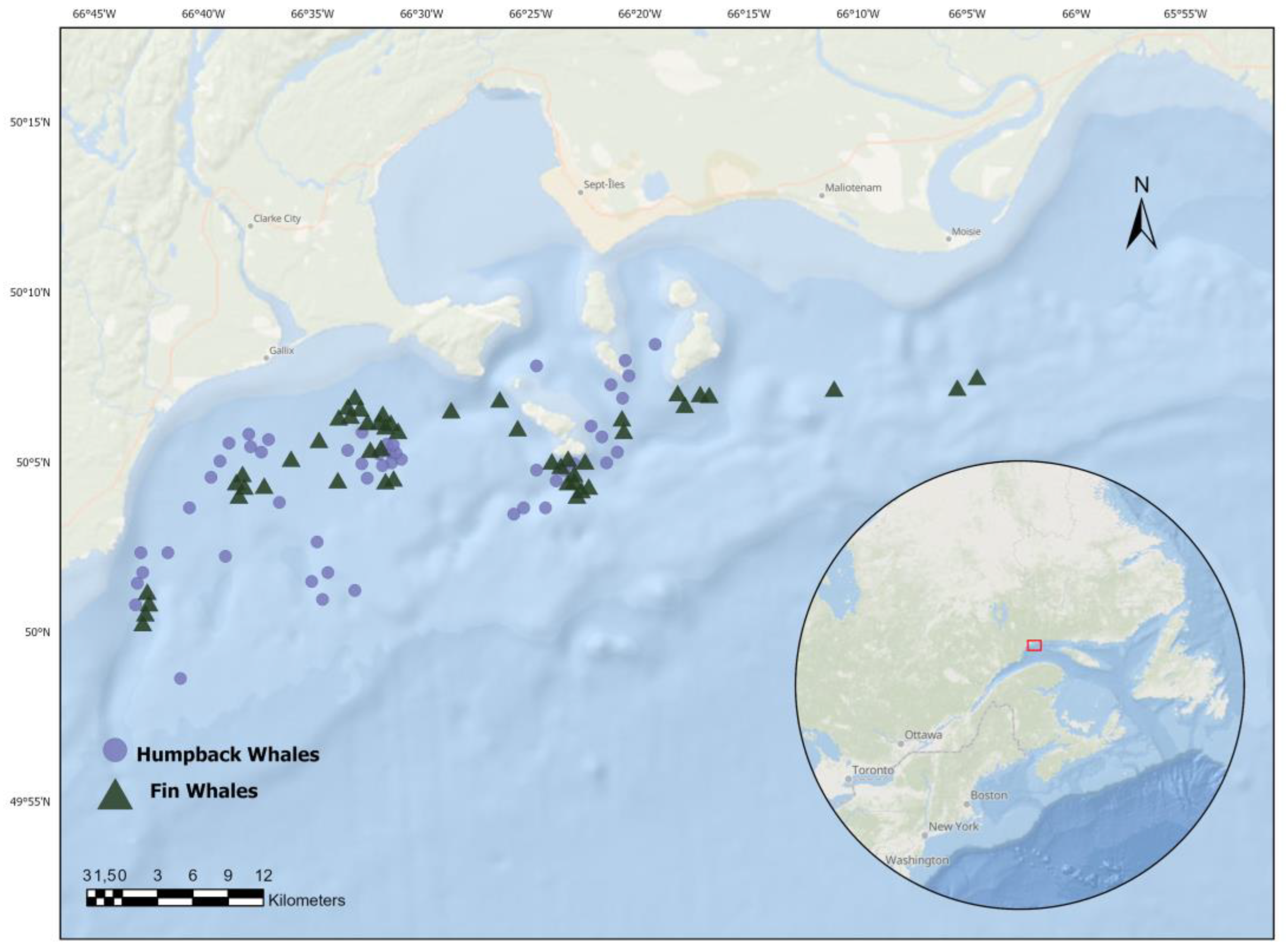
Figure 2.
Body condition scoring system with top horizontal photographs showing a lateral view and bottom square photographs showing a posterior view. Photos A and D represent a score of 0-1, considered emaciated since we can see the dorsal vertebra and ribcage. Photos B and E represent a score of 2-3 considered thin/moderate since we can distinguish a prominent dorsal ridge with sunken flanks. Photos C and F represent an optimal score of 4 where the curved arrows show no ridge and a fully rounded body.
Figure 2.
Body condition scoring system with top horizontal photographs showing a lateral view and bottom square photographs showing a posterior view. Photos A and D represent a score of 0-1, considered emaciated since we can see the dorsal vertebra and ribcage. Photos B and E represent a score of 2-3 considered thin/moderate since we can distinguish a prominent dorsal ridge with sunken flanks. Photos C and F represent an optimal score of 4 where the curved arrows show no ridge and a fully rounded body.
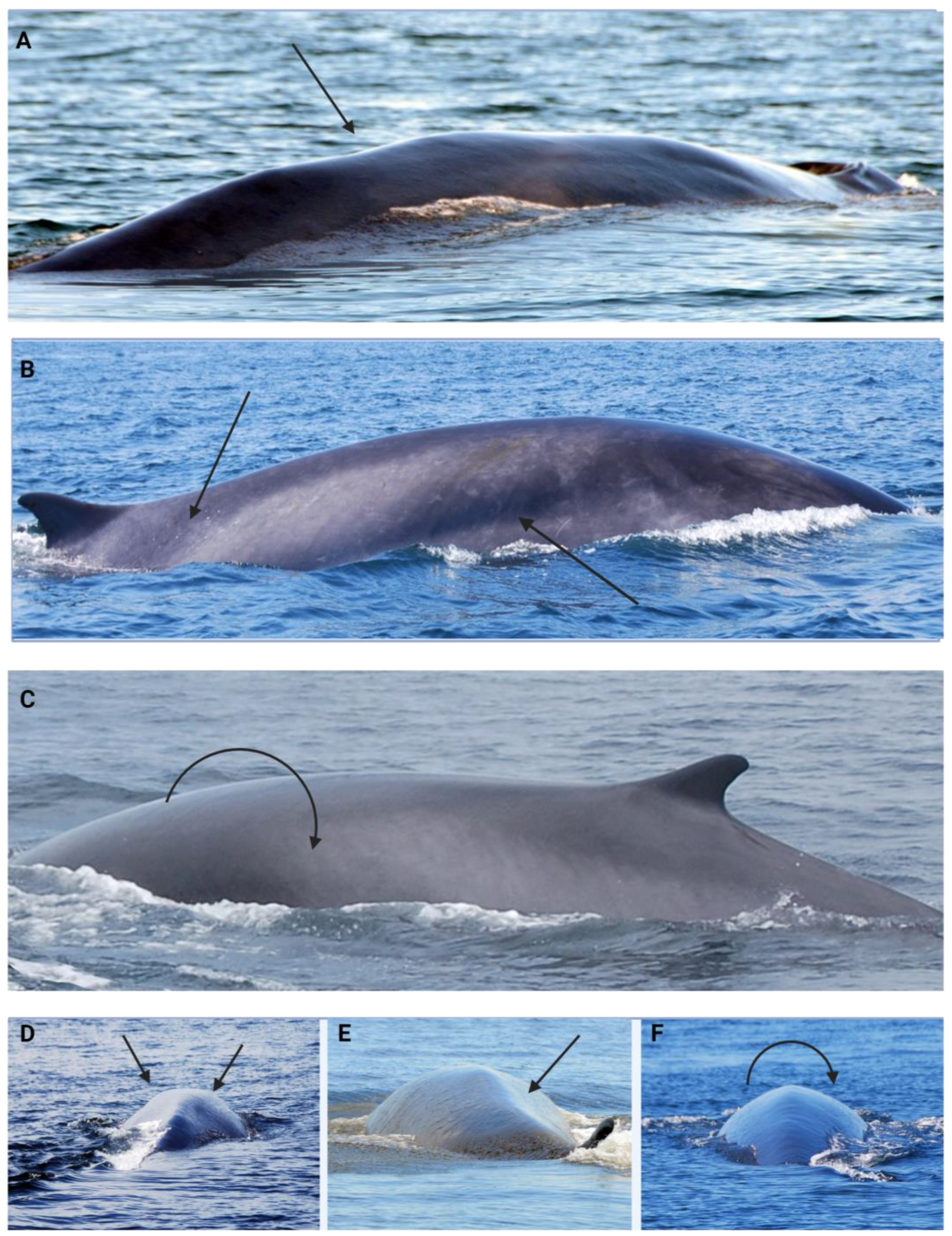
Figure 3.
The skin condition scale used in humpback whales. A) represents a skin condition of 1, where the arrows point to one skin lesion type covering ≥ 75% of the observable body surface. B) represents a score of 2, where the arrow points to one type of skin lesion covering ≥ 25% and ≤ 74% of the observable body surface. C) represents a skin condition score of 4, where the arrow points to ≤ 5% of skin lesions on the observable body surface. .
Figure 3.
The skin condition scale used in humpback whales. A) represents a skin condition of 1, where the arrows point to one skin lesion type covering ≥ 75% of the observable body surface. B) represents a score of 2, where the arrow points to one type of skin lesion covering ≥ 25% and ≤ 74% of the observable body surface. C) represents a skin condition score of 4, where the arrow points to ≤ 5% of skin lesions on the observable body surface. .
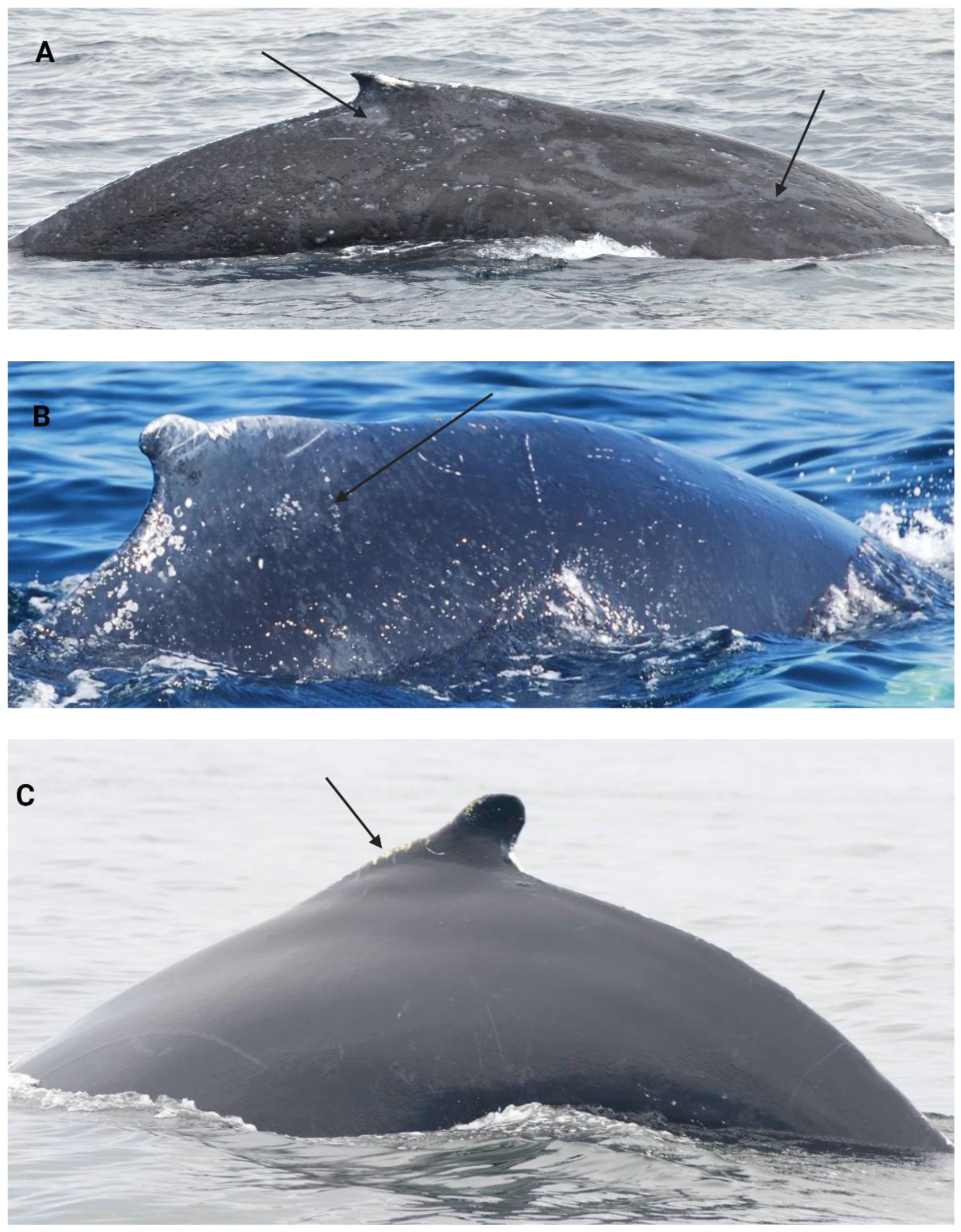
Figure 4.
Cutaneous lesions categories used in the scoring of skin condition in fin whales. A) Pale skin patch syndrome; B) Light focal skin disease; C) Dark focal skin disease; D) Tortuous cutaneous marks; E) Tattoo skin disease-like lesions; F) Cutaneous nodules.
Figure 4.
Cutaneous lesions categories used in the scoring of skin condition in fin whales. A) Pale skin patch syndrome; B) Light focal skin disease; C) Dark focal skin disease; D) Tortuous cutaneous marks; E) Tattoo skin disease-like lesions; F) Cutaneous nodules.
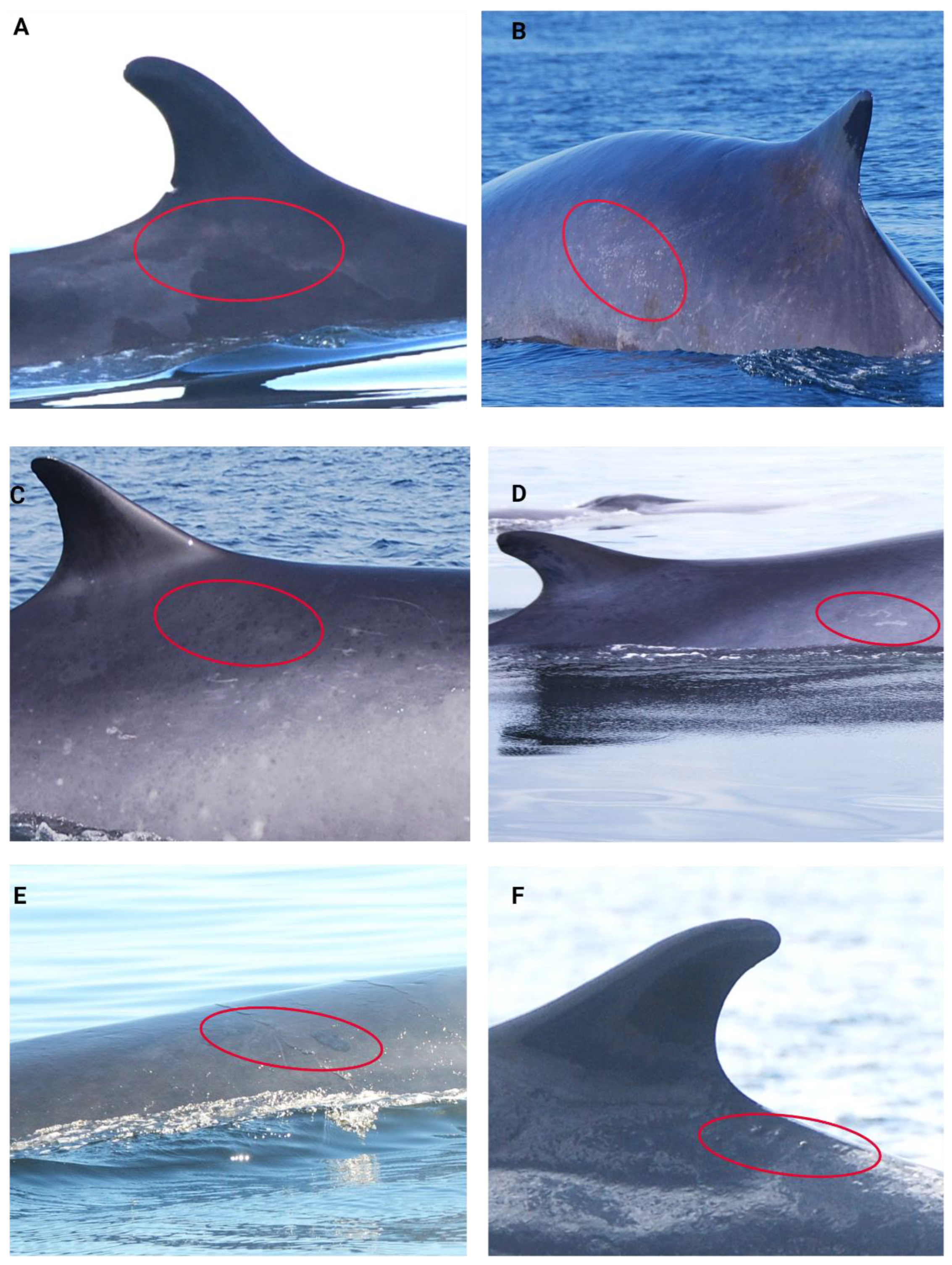
Figure 5.
Injury condition scoring system. A) a score of 0 for a fin whale missing half its fluke. B) a score of 1 for a fin whale with open wounds on the peduncle. C) a score of 2 for a fin whale with deep scars typical of entanglement in fishing gear. D) a score of 2 for a humpback with an important scar from a boat propeller. E) a score of 2 for a deep entanglement scar in a fin whale. F) a score of 3 for superficial entanglement scars in a humpback. G) a score of 3 for superficial entanglement scars in a fin whale. H) a score of 3 for important predation tooth rake on a humpback.
Figure 5.
Injury condition scoring system. A) a score of 0 for a fin whale missing half its fluke. B) a score of 1 for a fin whale with open wounds on the peduncle. C) a score of 2 for a fin whale with deep scars typical of entanglement in fishing gear. D) a score of 2 for a humpback with an important scar from a boat propeller. E) a score of 2 for a deep entanglement scar in a fin whale. F) a score of 3 for superficial entanglement scars in a humpback. G) a score of 3 for superficial entanglement scars in a fin whale. H) a score of 3 for important predation tooth rake on a humpback.
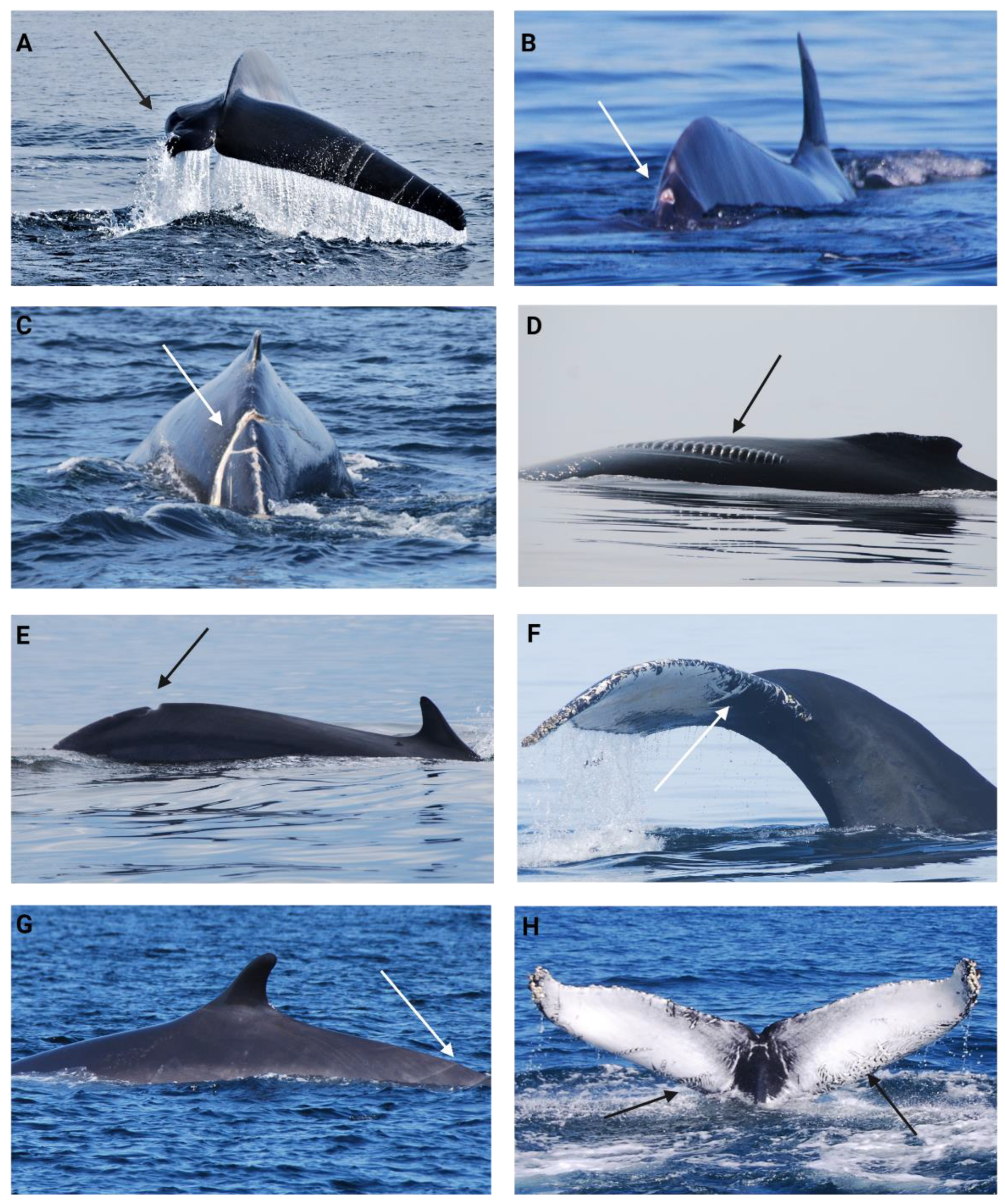
Figure 6.
Parasite and epibiont condition scoring scale where: A) a score of 1 with ectoparasite (sea lice) covering ≥ 40% of observed body; B) a humpback whale with a score of 2 with cookiecutter scars covering ≥ 5% and ≤ 40%, and C) a fin whale scored as 3, with a small patch of diatoms covering ˂ 5% of its body.
Figure 6.
Parasite and epibiont condition scoring scale where: A) a score of 1 with ectoparasite (sea lice) covering ≥ 40% of observed body; B) a humpback whale with a score of 2 with cookiecutter scars covering ≥ 5% and ≤ 40%, and C) a fin whale scored as 3, with a small patch of diatoms covering ˂ 5% of its body.
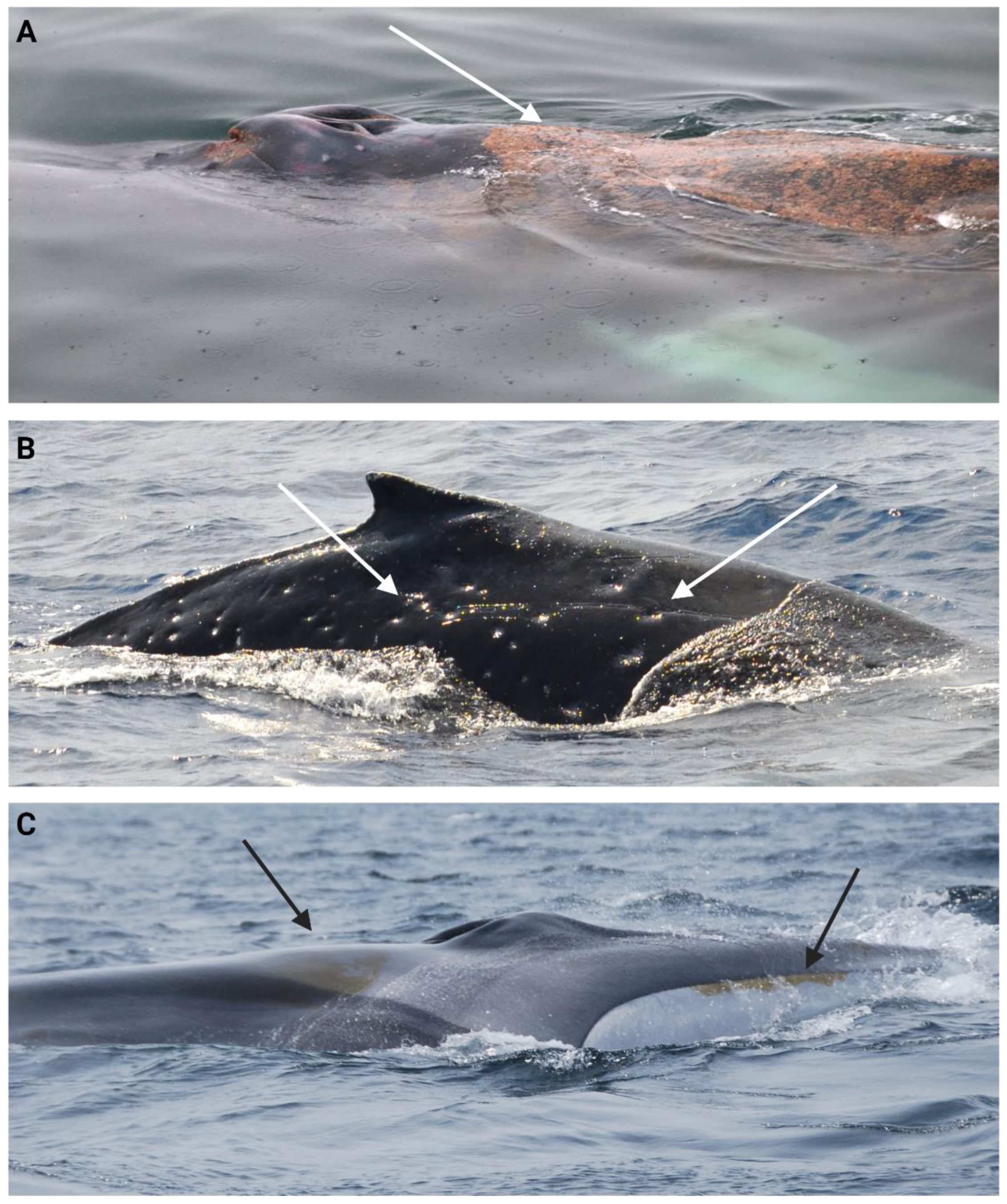
Figure 7.
Parasite and epibiont categories: A) fin whale with an orange film (diatoms). B) fin whale with lamprey bite scars and skid marks. C) humpback whale with multiple cookiecutter scars. D) humpback whale with whale lice infestation on an apparent healing wound. E) humpback whale fluke with barnacles covering the tip of the left and right-side fluke lobes in a symmetrical load. F) humpback whale fluke without barnacles on tips of the left and right-side fluke lobes, also in a symmetrical manner.
Figure 7.
Parasite and epibiont categories: A) fin whale with an orange film (diatoms). B) fin whale with lamprey bite scars and skid marks. C) humpback whale with multiple cookiecutter scars. D) humpback whale with whale lice infestation on an apparent healing wound. E) humpback whale fluke with barnacles covering the tip of the left and right-side fluke lobes in a symmetrical load. F) humpback whale fluke without barnacles on tips of the left and right-side fluke lobes, also in a symmetrical manner.
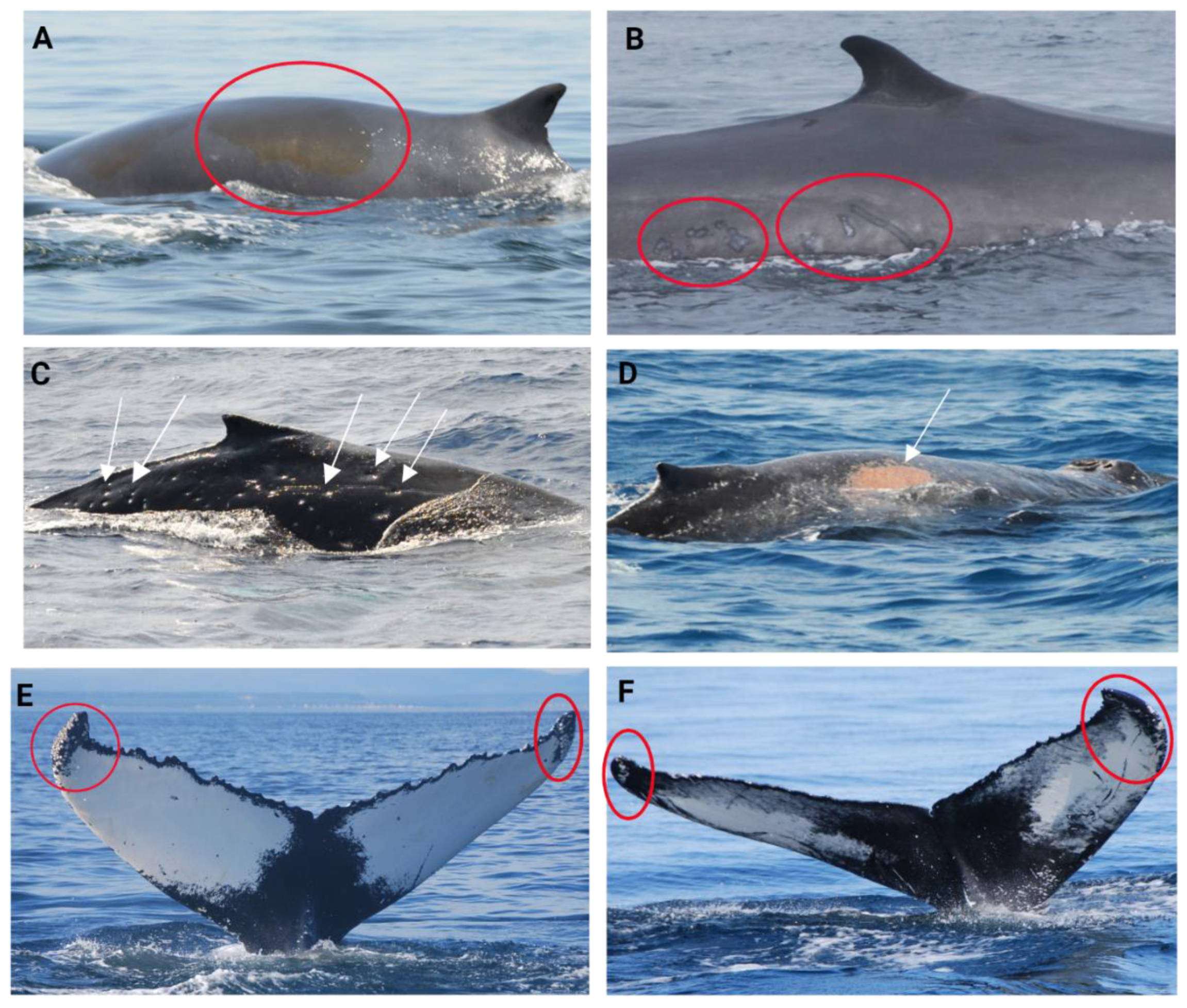
Figure 8.
Underlying factors for physical condition measures: body condition score (BCS), injury condition score (ICS), parasites/epibionts condition score (PCS) and skin condition score (SCS) in fin whales (n=50) and humpback whales (n=50).
Figure 8.
Underlying factors for physical condition measures: body condition score (BCS), injury condition score (ICS), parasites/epibionts condition score (PCS) and skin condition score (SCS) in fin whales (n=50) and humpback whales (n=50).
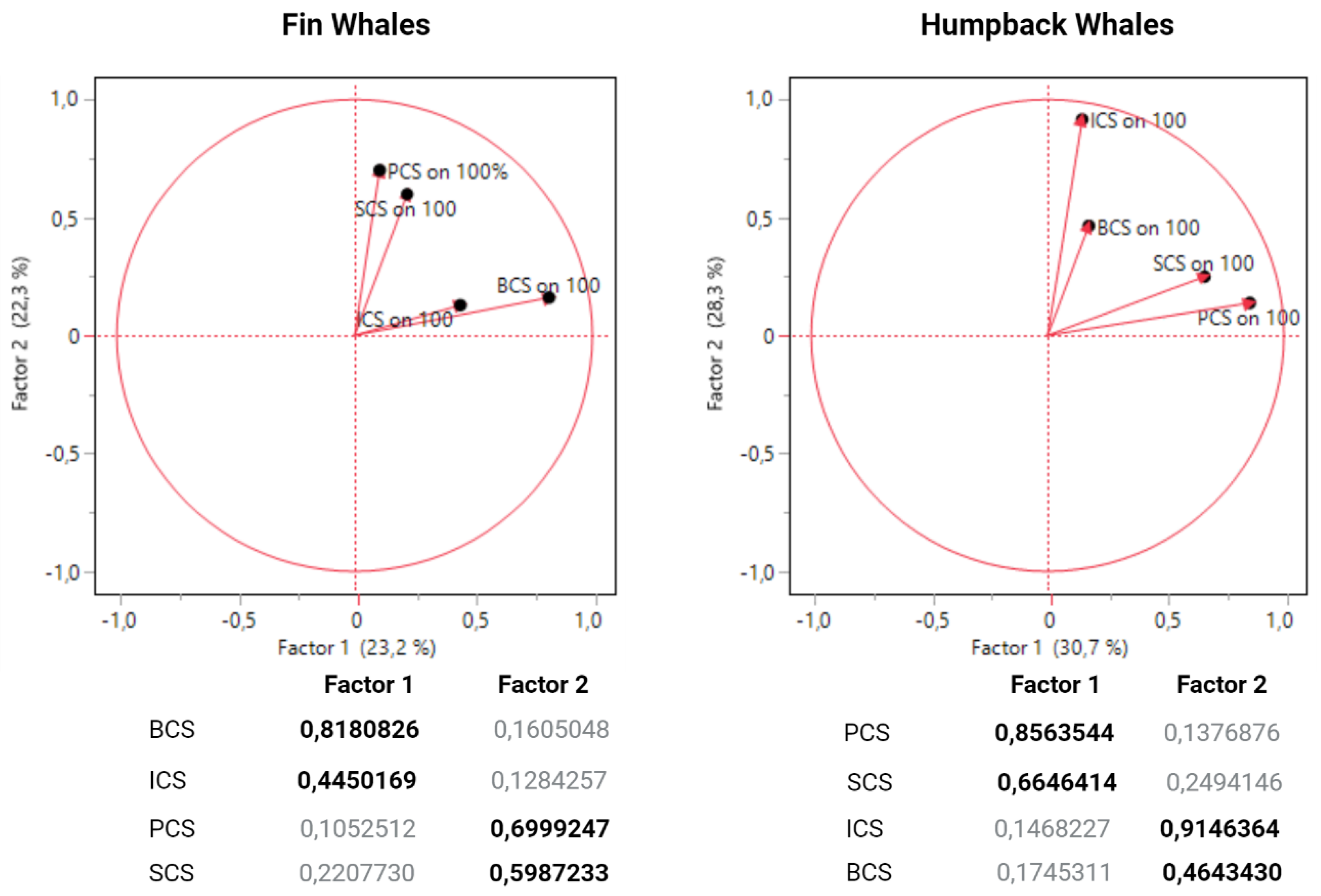
Figure 9.
All four measuring scales positively correlated in both species (n=50 fin whales and n=50 humpback whales), and no correlations were stronger than 0.75, validating the relevance of including each measure in our physical welfare indicator (discriminant validity). M=mean and SD= standard deviation. All values were statistically significant (p ≤ .05). .
Figure 9.
All four measuring scales positively correlated in both species (n=50 fin whales and n=50 humpback whales), and no correlations were stronger than 0.75, validating the relevance of including each measure in our physical welfare indicator (discriminant validity). M=mean and SD= standard deviation. All values were statistically significant (p ≤ .05). .
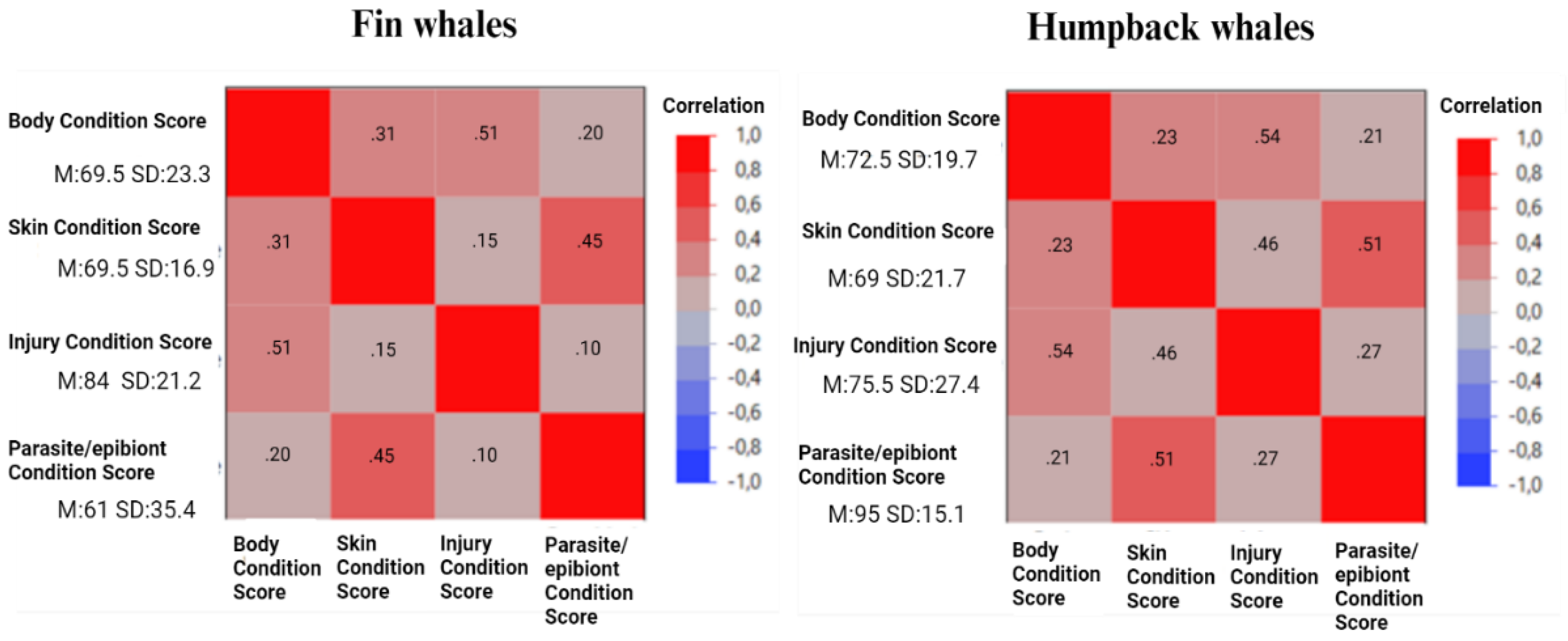
Figure 10.
Ordinal regression showed that injury conditions from anthropogenic origins, related positively to body condition in both fins and humpback whales; linear fit for fin whales (F (1,48) = 8.34; p = .005) and humpback whales (F (1,48) = 12.21; p = .001).
Figure 10.
Ordinal regression showed that injury conditions from anthropogenic origins, related positively to body condition in both fins and humpback whales; linear fit for fin whales (F (1,48) = 8.34; p = .005) and humpback whales (F (1,48) = 12.21; p = .001).
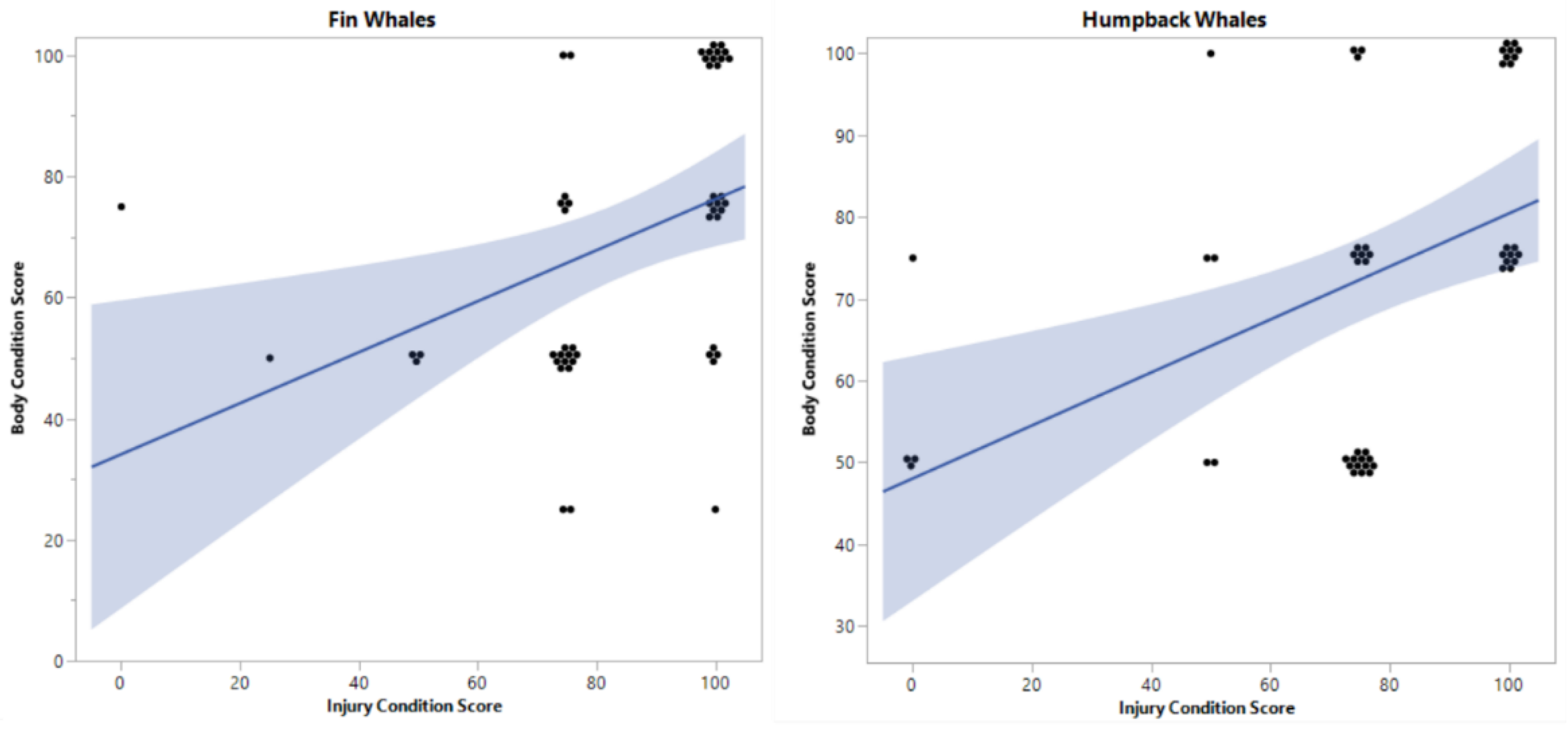
Figure 11.
In the miscellaneous category of cutaneous lesions associated with skin diseases (see Table 2 in section 2.4.2), we included an undocumented condition characterized by a raised fluid- filled epidermis lesion, which we categorized as Bulla-like lesion.
Figure 11.
In the miscellaneous category of cutaneous lesions associated with skin diseases (see Table 2 in section 2.4.2), we included an undocumented condition characterized by a raised fluid- filled epidermis lesion, which we categorized as Bulla-like lesion.
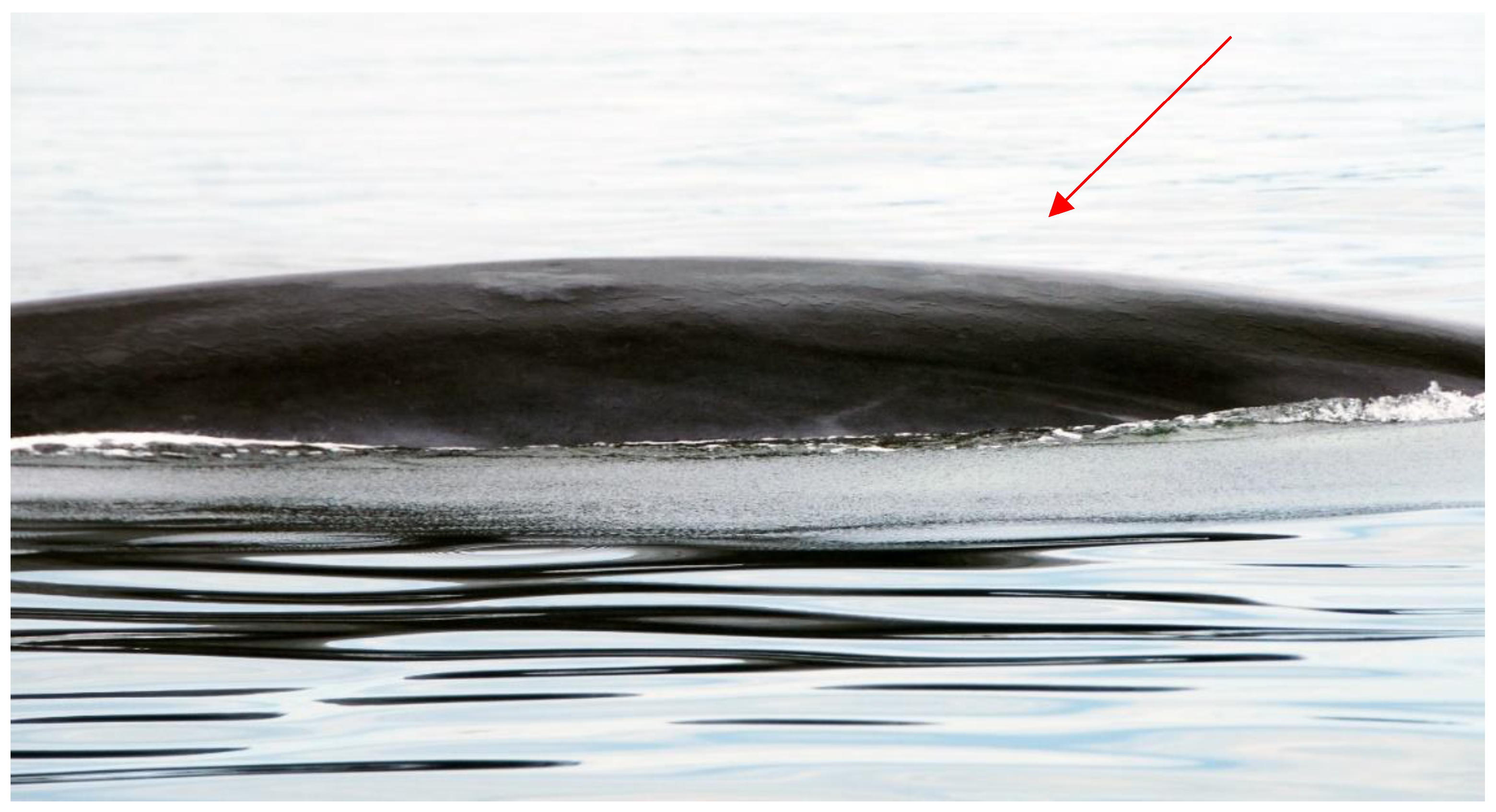
Table 1.
The physical health and welfare scoring system includes a 0-4 scale for body condition, skin condition, injury and scarring condition measures, and a 1-3 scale for parasite and epibiont condition scores. The score of each measure was then transformed to a percentage scale and weighted according to the CRITIC method. The final score for each whale was then associated with the corresponding inferred welfare state.
Table 1.
The physical health and welfare scoring system includes a 0-4 scale for body condition, skin condition, injury and scarring condition measures, and a 1-3 scale for parasite and epibiont condition scores. The score of each measure was then transformed to a percentage scale and weighted according to the CRITIC method. The final score for each whale was then associated with the corresponding inferred welfare state.
| Welfare measures (criteria) | Scoring scale | Inter-Criteria Correlation weight | |
|---|---|---|---|
| Fin whales | Humpbacks | ||
| Body Condition Score | 0-1-2-3-4 | 23.71% | 25.24% |
| Skin Condition Score | 0-1-2-3-4 | 18.26% | 24.08% |
| Injury/Scarring Condition Score | 0-1-2-3-4 | 24.46% | 32.91% |
| Parasite/Epibiont Condition Score | 1-2-3 | 33.57% | 17.76% |
| Total= | Weighted scores | ||
| Physical Indicator Score | Inferred welfare state | ||
 |
Physical condition is optimal, suggesting comfort of good health, high functional capacity and postprandial satiety, inferring positive welfare state. Physical condition is moderate, suggesting feelings of hunger and/or psychophysical exertion, inferring moderate welfare state. Physical condition is poor, suggesting chronic pain due to hunger, psychophysical exertion and underlying pathological states, inferring negative welfare state. |
||
Table 2.
Characteristics of cutaneous lesions categories associated with skin diseases used for the skin condition scoring.
Table 2.
Characteristics of cutaneous lesions categories associated with skin diseases used for the skin condition scoring.
| Skin lesions categories | Description |
|---|---|
| Pale skin patch syndrome (PSP) |
Areas of opaque to translucent skin, light grey or whitish colouration [131]. (Figure 4.A) |
| Light-focal skin disease (LFD) |
Clusters of distinct, smallish round or oval white/light grey lesions [131]. (Figure 4.B) |
| Dark focal skin disease (DFD) |
Clusters of distinct, smallish round or oval black/dark grey lesions [131]. (Figure 4.C) |
| Tortuous cutaneous marks (TCM) | Black or white linear lesions leaving tortuous tracks, with raised or depressed patterns [132]. (Figure 4.D) |
| Tattoo skin disease-like lesions (TSD-L) |
Dark or light grey rounded borders with a characteristic stippled pattern [7,53]. (Figure 4.E) |
| Cutaneous nodules (NOD) |
Circumscribed nodules with grey or normal pigmentation [58]. (Figure 4.F) |
| Miscellaneous | Other cutaneous lesions not associated with current categories. |
Table 4.
Point-biserial correlation coefficients and associated P values between abiotic parameters (sea temperature (TC˚) and salinity levels (S%); dissolved oxygen (DO); integrated mean of nitrate (NO-3); phosphate (PO3-4); silicate (O3SI-2) and cutaneous lesion types in fin and humpback whales (Pale skin patch syndrome (PSP); Light focal skin disease (LFD); Dark focal skin disease; Cutaneous nodules (NOD); Bulla like lesions (BLL); Tortuous cutaneous mark (TCM); Tattoo skin disease- like lesions (TSD-L; only in fin whales); Cookie cutter shark wounds (CCW); Sea lamprey bite and skidding marks (LBM); Orange film diatoms (OFD) and, only found in humpbacks, Sea lice (SL) and Barnacles (BR). The prevalence of cutaneous lesions for each species is presented in %.
Table 4.
Point-biserial correlation coefficients and associated P values between abiotic parameters (sea temperature (TC˚) and salinity levels (S%); dissolved oxygen (DO); integrated mean of nitrate (NO-3); phosphate (PO3-4); silicate (O3SI-2) and cutaneous lesion types in fin and humpback whales (Pale skin patch syndrome (PSP); Light focal skin disease (LFD); Dark focal skin disease; Cutaneous nodules (NOD); Bulla like lesions (BLL); Tortuous cutaneous mark (TCM); Tattoo skin disease- like lesions (TSD-L; only in fin whales); Cookie cutter shark wounds (CCW); Sea lamprey bite and skidding marks (LBM); Orange film diatoms (OFD) and, only found in humpbacks, Sea lice (SL) and Barnacles (BR). The prevalence of cutaneous lesions for each species is presented in %.
| Fin whales | |||||||||||||
|---|---|---|---|---|---|---|---|---|---|---|---|---|---|
| Lesion Correlation Coefficient and P values Prevalence | |||||||||||||
| TC˚ | p | S % | p | DO | p | NO-3 | p | PO3-4 | p | O3SI-2 | p | % | |
| PSP | 0.30 | .030 | -0.31 | .002 | 0.36 | .009 | 0.01 | .944 | -0.27 | .004 | 0.00 | .999 | 0.04 |
| LFD | 0.04 | .789 | 0.08 | .568 | -0.01 | .906 | 0.07 | .602 | 0.23 | .103 | 0.02 | .883 | 0.56 |
| DFD | -0.35 | .014 | -0.35 | .012 | 0.19 | .173 | -0.32 | .025 | -0.37 | .008 | 0.07 | .594 | 0.32 |
| NOD | -0.42 | .002 | -0.50 | .000 | 0.39 | .005 | 0.04 | .757 | -0.40 | .000 | 0.18 | .203 | 0.04 |
| BLL | -0.17 | .229 | -0.20 | .149 | 0.17 | .233 | -0.06 | .652 | -0.19 | .172 | 0.02 | .874 | 0.02 |
| TCM | -0.05 | .730 | 0.02 | .864 | -0.11 | .419 | 0.12 | .372 | 0.18 | .201 | 0.11 | .441 | 0.20 |
| TSD | 0.09 | .501 | 0.10 | .471 | -0.30 | .031 | -0.06 | .666 | -0.02 | .857 | -0.14 | .406 | 0.08 |
| CCW | -0.09 | .509 | -0.06 | .656 | 0.06 | .656 | 0.06 | .632 | 0.08 | .549 | 0.09 | .500 | 0.72 |
| LBM | -0.09 | .514 | -0.11 | .422 | 0.13 | .337 | 0.07 | .601 | 0.03 | .824 | 0.06 | .632 | 0.74 |
| OFD | -0.18 | .188 | -0.20 | .160 | 0.38 | .007 | 0.19 | .164 | -0.01 | .906 | 0.14 | .321 | 0.54 |
| Humpback whales | |||||||||||||
| Lesion Correlation Coefficient and P values Prevalence | |||||||||||||
| TC˚ | p | S % | p | DO | p | NO-3 | p | PO3-4 | p | O3SI-2 | p | % | |
| PSP | -0.14 | .317 | -0.19 | .182 | 0.29 | .041 | 0.17 | .222 | -0.12 | .368 | 0.16 | .263 | 0.56 |
| LFD | 0.08 | .571 | 0.06 | .631 | 0.14 | .321 | 0.32 | .063 | 0.02 | .868 | 0.16 | .241 | 0.48 |
| DFD | 0.08 | .535 | 0.01 | .893 | 0.07 | .621 | 0.05 | .679 | -0.12 | .370 | -0.04 | .739 | 0.16 |
| NOD | -0,19 | .662 | -0.19 | .182 | 0.18 | .193 | -0.06 | .667 | -0.08 | .578 | 0.02 | .858 | 0.68 |
| BLL | -0.09 | .526 | -0.16 | .265 | 0.02 | .852 | -0.37 | .008 | -0.12 | .377 | -0.29 | .044 | 0.16 |
| TCM | 0.01 | .971 | 0.09 | .528 | -0.02 | .889 | 0.22 | .120 | 0.20 | .158 | 0.19 | .180 | 0.02 |
| CCW | 0.24 | .091 | 0.26 | .063 | -0.14 | .317 | 0.27 | .054 | 0.14 | .328 | 0.15 | .284 | 0.24 |
| LBM | 0.33 | .019 | -0.08 | .560 | 0.18 | .203 | -0.38 | .006 | -0.08 | .540 | -0.25 | .075 | 0.36 |
| OFD | -0.22 | .120 | -0.24 | .083 | 0.25 | .075 | -0.02 | .845 | -0.10 | .470 | 0.01 | .972 | 0.24 |
| SL | 0.33 | .018 | -0.32 | .025 | 0.20 | .152 | -0.01 | .968 | -0.32 | .021 | -0.08 | .549 | 0.40 |
| BR | -0.31 | .026 | .038 | .005 | -0.25 | .069 | -0.02 | .873 | 0.34 | .015 | 0.03 | .810 | 0.84 |
Table 5.
Mean welfare scores (weighted scores on a 0- 100 scale): Body condition score (BCS), skin condition score (SCS), injury condition score (ICS), parasite/epibiont score and overall welfare score (OWS).
Table 5.
Mean welfare scores (weighted scores on a 0- 100 scale): Body condition score (BCS), skin condition score (SCS), injury condition score (ICS), parasite/epibiont score and overall welfare score (OWS).
| Species | BCS | SCS | ICS | PCS | OWS |
|---|---|---|---|---|---|
| M (SD) | |||||
| Bp | 69.05 (23.30) | 69.5 (16.97) | 84.0 (21.28) | 61.0 (35.41) | 70.18 (17.93) |
| Mn | 72.5 (19.72) | 69.2 (21.75) | 75.5 (27.42) | 95.2 (15.15) | 76.63 (16.10) |
Disclaimer/Publisher’s Note: The statements, opinions and data contained in all publications are solely those of the individual author(s) and contributor(s) and not of MDPI and/or the editor(s). MDPI and/or the editor(s) disclaim responsibility for any injury to people or property resulting from any ideas, methods, instructions or products referred to in the content. |
© 2024 by the authors. Licensee MDPI, Basel, Switzerland. This article is an open access article distributed under the terms and conditions of the Creative Commons Attribution (CC BY) license (http://creativecommons.org/licenses/by/4.0/).
Copyright: This open access article is published under a Creative Commons CC BY 4.0 license, which permit the free download, distribution, and reuse, provided that the author and preprint are cited in any reuse.


