

Submitted:
22 September 2024
Posted:
23 September 2024
Read the latest preprint version here
Abstract
Haug and Tatum have recently solved the Hubble tension within a type of R_h = ct cosmology using an intuitive, smart trial-and-error search algorithm. The trial-and-error algorithm demonstrates that one can start with the measured CMB temperature and a rough estimate of H0. Based on the algorithm, one ends up matching the entire distance ladder of the observed supernovas by finding a value for H_0. However, this is a numerical search procedure, even though it can be completed in a fraction of a second on a standard computer. Here, we will demonstrate that the trial-and-error numerical method is not needed and that the Hubble tension can be resolved using the same Haug and Tatum model through a closed- form solution. This means one simply solves an equation to find the correct H0 value. This is possible because an exact mathematical relation between H_0 and the CMB temperature has recently been established, in combination with the linearity in an R_h = ct model.
Keywords:
Hubble tension close dorm
; Hubble constant
; Cosmological redshift
; z
; CMB temperature
1. The Haug-Tatum Cosmological Model
The Haug and Tatum [1,2] cosmological model that we will discuss is unique in that it provides an exact mathematical relation between the CMB temperature, the Hubble constant and the cosmological red-shift. The Haug-Tatum cosmological model has developed over time in multiple stages. It is consistent with the principle, which describes a universe expanding at the speed of light without accelerated expansion. There are several -type cosmological models, and these models are still actively discussed in recent literature, see for example [3,4,5,6]. Melia [7] has recently demonstrated that cosmology seems more in line with recent observations from the James Webb Space Telescope than the -CDM model. The question of which cosmological model best fits different observed properties of the universe will undoubtedly be an ongoing discussion in the years to come. This paper offers additional evidence in favor of cosmology, as it seems that even with a closed-form solution, we can resolve the Hubble tension within such a cosmological model.
In 2015, Tatum et al. [8] presented the following formula for the Cosmic Microwave Background (CMB) temperature, which was later formally derived based on the Stefan-Boltzmann law [9,10] by Haug and Wojnow [11,12]:
It has also recently been derived using a geometric mean approach, see [13]. Additionally, Haug and Tatum [1] have demonstrated that to be consistent with the observed relation , the predicted redshift must be given by:
Haug and Tatum has also show that the distance relation must be:
Solving for gives:
Here, represents the distance between us and the object emitting the observed photons. Haug and Tatum then show that the first term of the Taylor expansion yields:
and since , where d is the distance in the -CDM model one get the standard relation for .
Furthermore, Haug and Tatum demonstrate that the predicted redshift must satisfy:
They then use a smart trial-and-error algorithm, such as the Newton-Raphson method or the bisection method, to find the value of that minimizes the sum of the prediction errors . They demonstrate that this approach leads to a single value that perfectly matches the model with the full observed distance ladder, something that seems to solve the Hubble tension.
However, here we simply solve equation (2) for , which yields:
In the case where the predicted redshift is exactly equal to the observed redshift , we must have . Substituting back into equation (7) gives:
The last part, the Greek upsilon: , is a composite constant made up of well-known constants (which we [14,15] have coined ). This is the same formula as given by [14], but here we have just demonstrated that this formula is strictly valid only when the predicted redshift exactly matches the observed redshift, or as we soon will see we can use equation (7) to match the full distance ladder of observed supernova redshifts by simply finding this one value directly from the current measured CMB temperature.
This means that we only need to know and this constant to closely match all observed cosmological redshifts. The reason we say "close to perfect" rather than "perfect" is due to small measurement errors in both the measured CMB temperature and in G, and that is the only uncertainty in this method. The Boltzmann constant, the speed of light, and the reduced Planck constant have no uncertainty, as they have been exactly defined since the 2019 NIST CODATA standard.
2. Predictions Relative to the Observations Using the Full Distance Ladder of the Union 2 Database
Here, we will see if our model can match all the observed cosmological redshifts by simply determining the constant from equation (8). However to demonstrate the superiority of equation (8), we will first instead use the predicted value for by for example Riess et al. [16] of km/s/Mpc. We plot the Riess et al. value, accounting for 2 standard deviations (STD), and from this, we get Figure 1. The blue line represents the predicted redshift from km/s/Mpc, while the green lines represent the 2 STD confidence interval, i.e., km/s/Mpc. We can see that even the 95% confidence interval falls outside the observations, meaning that any value within this interval does not come close to matching the observed redshifts in our cosmological model.
Figure 2 demonstrates the results we get when we instead calculate based on equation (8) when using the Dhal et al [17] measured CMB value of . According to our theory, this should provide a perfect match between the observed and predicted values, and as we can see, the observed and predicted values lie on top of each other. The confidence interval is now so narrow that even if we plotted it, it would appear to overlap with the observed values.
3. Conclusion
Haug and Tatum have outlined a way to solve the Hubble tension inside cosmology based on new exact relations between the CMB temperature the Hubble constant and redshift, they however use a numerical search algorithm to do so. Even if their method is intuitive and powerful we here demonstrate one can simply solve one of their equations and further based on logic get to the one single value that make their model matching all observed SN Ia. In other words this leads to a closed form solution of the Hubble tension in side cosmology. We get a when relying on the very precise Dhal et al measured CMB value matching leading to matching all the observed SN Ia redshifts across the full distance ladder in the Union2 database. This is the same value Haug and Tatum got from their numerical search algorithm solution when solving the Hubble tension. It is basically the same solution, one is using numerical search algorithm while the later used closed form solution. The closed form solution is naturally more elegant as no numerical search rutine with many calculations are needed to find the that matches all the supernovas.
Data Availability Statement
The supernova Union-2 database that we have used can be found here: https://supernova.lbl.gov/Union/figures/SCPUnion2.1_mu_vs_z.txt
Conflicts of Interest
The authors declare no conflict of interest.
References
- E. G. Haug and E. T. Tatum. Solving the Hubble tension using the union2 supernova database. Preprints.org, 2024. URL. [CrossRef]
- E. G. Haug and E. T. Tatum. Planck length from cosmological redshifts solves the Hubble tension. ResearchGate.org, 2024. URL. [CrossRef]
- F. Melia. A comparison of the Rh=ct and λ-cdm cosmologies using the cosmic distance duality relation. Monthly Notices of the Royal Astronomical Society, 143:4855, 2018. URL. [CrossRef]
- M. V. John. Rh=ct and the eternal coasting cosmological model. Monthly Notices of the Royal Astronomical Society, 484, 2019. URL. [CrossRef]
- F. Melia. Thermodynamics of the Rh=ct universe: a simplification of cosmic entropye. European Journal of Physics C, 81:234, 2021. URL. [CrossRef]
- F. Melia. Model selection with baryonic acoustic oscillations in the lyman-α forest. European Physics Letters, 143:59004, 2023. URL. [CrossRef]
- F. Melia. Strong observational support for the rh=ct timeline in the early universe. Physics of the Dark Universe, 46:101587, 2024. URL. [CrossRef]
- E. T. Tatum, U. V. S. Seshavatharam, and S. Lakshminarayana. The basics of flat space cosmology. International Journal of Astronomy and Astrophysics, 5:116, 2015. URL http://dx.doi.org/10.4236/ijaa.2015.52015.
- Stefan J. Über die beziehung zwischen der wärmestrahlung und der temperatur. Sitzungsberichte der Mathematisch-Naturwissenschaftlichen Classe der Kaiserlichen Akademie der Wissenschaften in Wien, 79:391, 1879.
- L. Boltzmann. Ableitung des stefanschen gesetzes, betreffend die abhängigkeit der wärmestrahlung von der temperatur aus der electromagnetischen lichttheori. Annalen der Physik und Chemie, 22:291, 1879.
- E. G. Haug. CMB, Hawking, Planck, and Hubble scale relations consistent with recent quantization of general relativity theory. International Journal of Theoretical Physics, Nature-Springer, 63(57), 2024. URL. [CrossRef]
- E. G. Haug and S. Wojnow. How to predict the temperature of the CMB directly using the Hubble parameter and the Planck scale using the Stefan-Boltzman law. Research Square, Pre-print, under consideration by journal, 2023. URL. [CrossRef]
- E. G. Haug and E. T. Tatum. The hawking Hubble temperature as a minimum temperature, the Planck temperature as a maximum temperature and the CMB temperature as their geometric mean temperature. Journal of Applied Physics and Mathematics (accepted and forthcoming), 2024c.
- E. T. Tatum, E. G. Haug, and S. Wojnow. High precision Hubble constant determinations based upon a new theoretical relationship between CMB temperature and H0. Journal of Modern Physics, Accepted and forthcoming. Pre-print version at Hal-archive, 2024. URL https://hal.science/hal-04268732.
- E. T. Tatum. Upsilon constants and their usefulness in Planck scale quantum cosmology. Journal of Modern Physics, 15:167, 2024. URL. [CrossRef]
- A. G. Riess and et. al. A comprehensive measurement of the local value of the Hubble constant with 1 km s-1 Mpc-1 uncertainty from the Hubble space telescope and the sh0es team. The Astrophysical Journal, 934, 2021. URL. [CrossRef]
- Dhal, S.; Singh, S.; Konar, K.; Paul, R.K. Calculation of Cosmic Microwave Background radiation parameters using COBE/FIRAS dataset. Experimental Astronomy (2023), 2023, 612, 86. URL. [CrossRef]
- Fixsen, D.J. The Temperature of the Cosmic Microwave Background. The Astrophysical Journal, 2009, 707, 916. URL. [CrossRef]
Figure 1.
This figure shows observed redshift values from 580 type Ia supernovae, sorted by redshift (blue line). Based on the measured CMB temperature by Dhal et al. (2023) of , the blue line represents our predictions based on , and the green lines represent the 2 STD confidence interval . We find that the Riess et al. value cannot match the observed redshifts in this model.
Figure 1.
This figure shows observed redshift values from 580 type Ia supernovae, sorted by redshift (blue line). Based on the measured CMB temperature by Dhal et al. (2023) of , the blue line represents our predictions based on , and the green lines represent the 2 STD confidence interval . We find that the Riess et al. value cannot match the observed redshifts in this model.
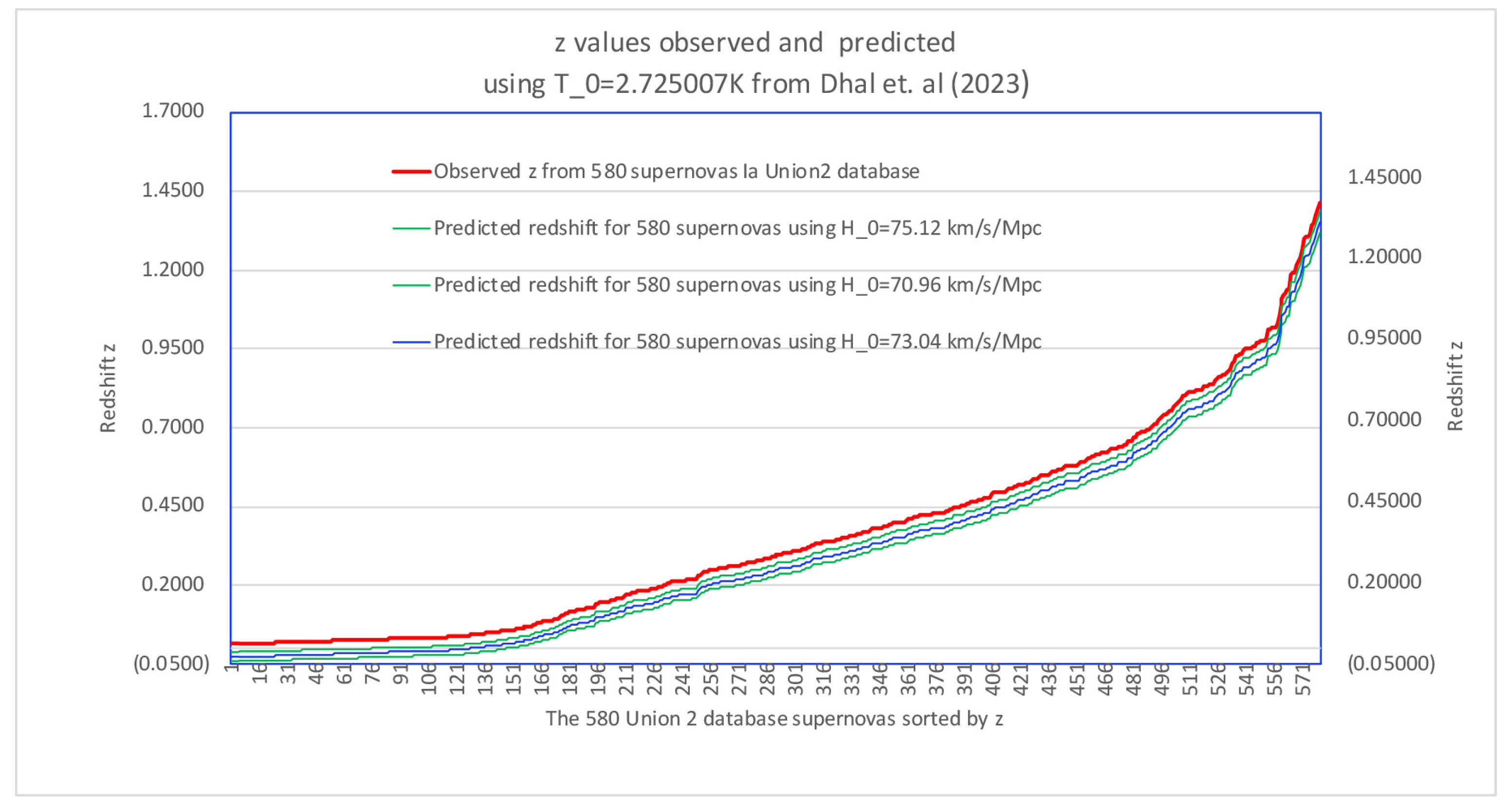
Figure 2.
This figure shows observed redshift values from 580 type Ia supernovae, sorted by redshift (blue line). Based upon the measured CMB temperature by Dhal et al (2023) of , the red line represents our predictions based on , which we extracted from the data using equation (8).
Figure 2.
This figure shows observed redshift values from 580 type Ia supernovae, sorted by redshift (blue line). Based upon the measured CMB temperature by Dhal et al (2023) of , the red line represents our predictions based on , which we extracted from the data using equation (8).
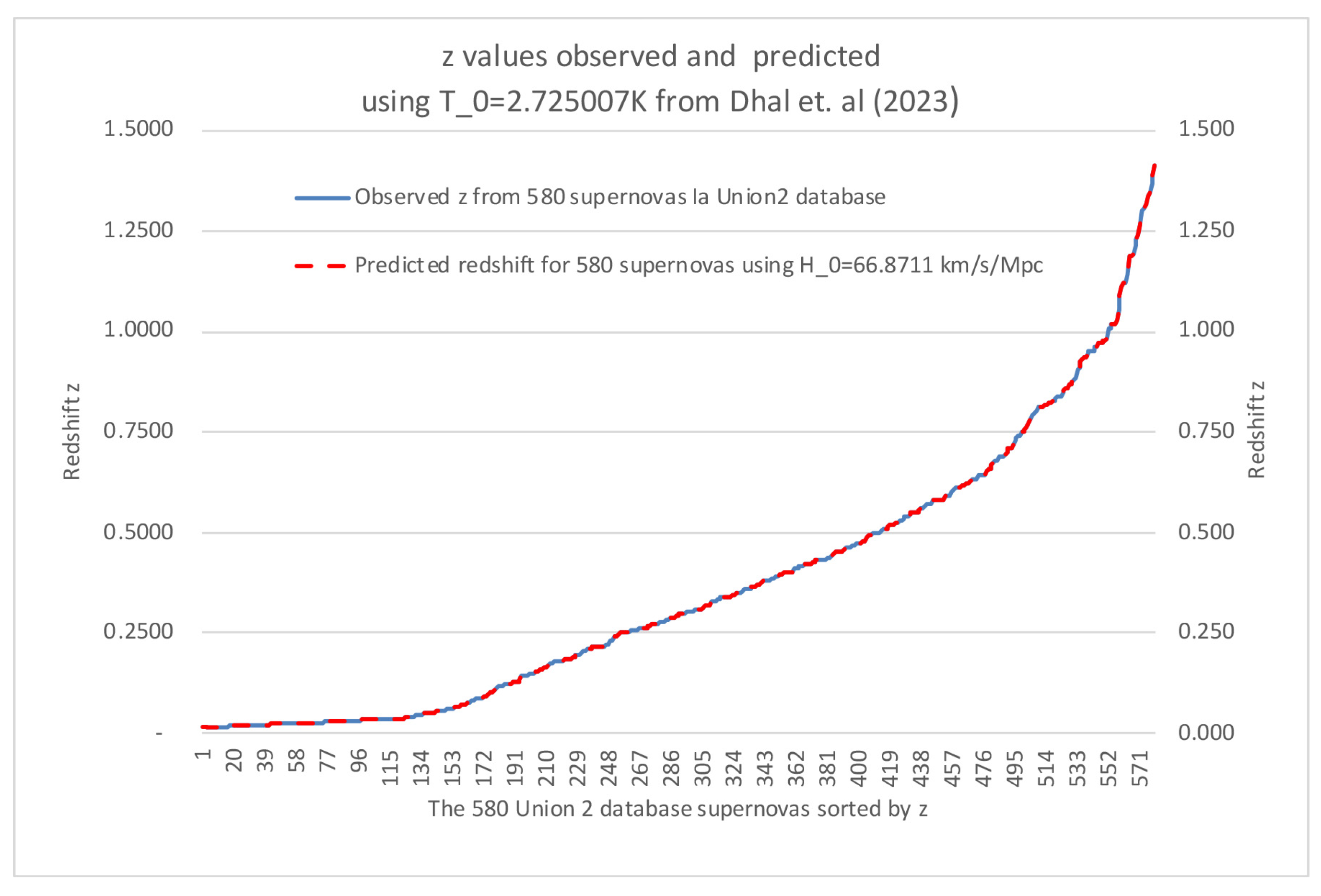
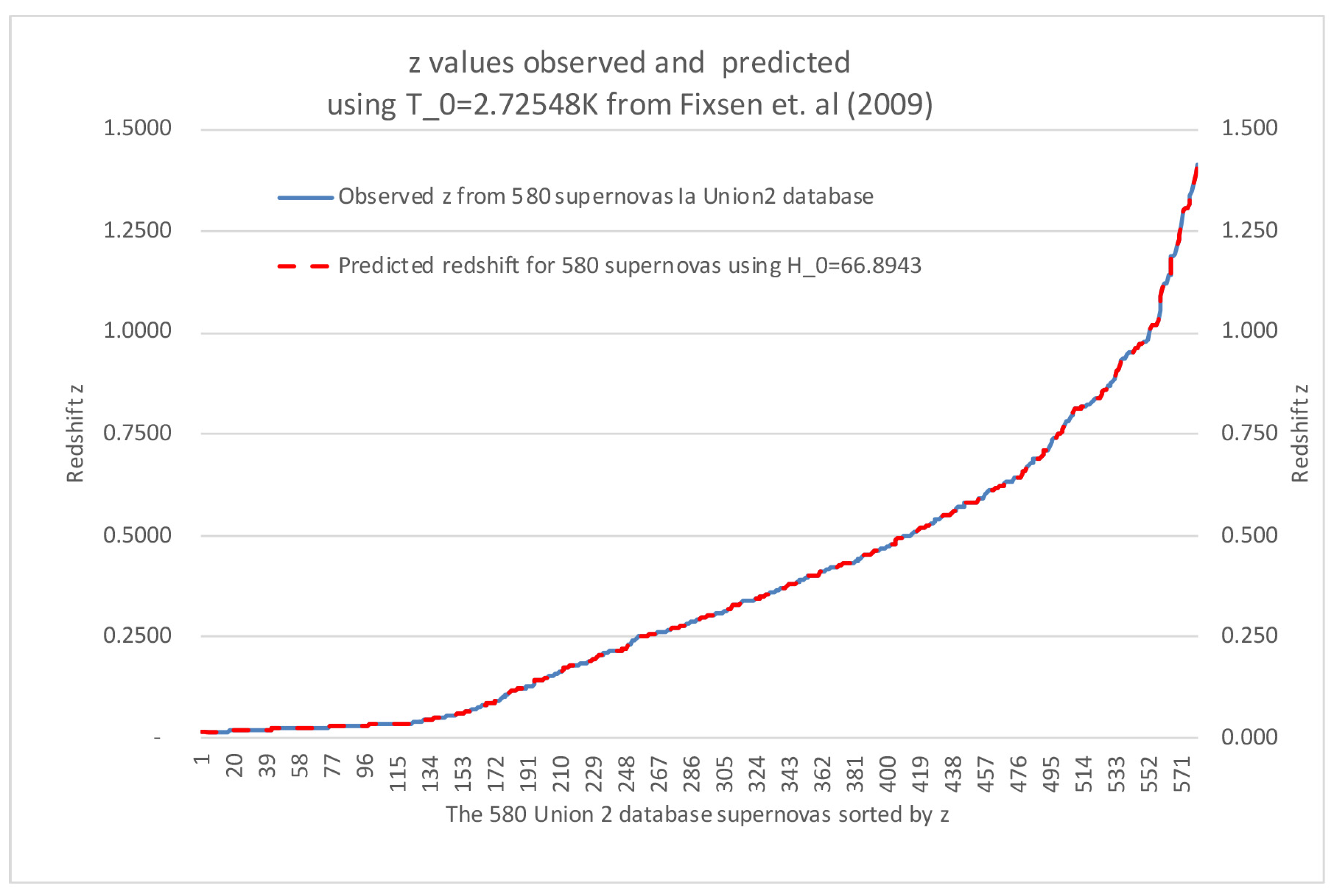
Figure 3.
This figure shows observed redshift values from 580 type Ia supernovae, sorted by redshift (blue line). Based upon the measured CMB temperature by Fixen et al (2009) of , the red line represents our predictions based on calculated from equation (8).
Figure 3.
This figure shows observed redshift values from 580 type Ia supernovae, sorted by redshift (blue line). Based upon the measured CMB temperature by Fixen et al (2009) of , the red line represents our predictions based on calculated from equation (8).
Disclaimer/Publisher’s Note: The statements, opinions and data contained in all publications are solely those of the individual author(s) and contributor(s) and not of MDPI and/or the editor(s). MDPI and/or the editor(s) disclaim responsibility for any injury to people or property resulting from any ideas, methods, instructions or products referred to in the content. |
© 2024 by the authors. Licensee MDPI, Basel, Switzerland. This article is an open access article distributed under the terms and conditions of the Creative Commons Attribution (CC BY) license (http://creativecommons.org/licenses/by/4.0/).
Copyright: This open access article is published under a Creative Commons CC BY 4.0 license, which permit the free download, distribution, and reuse, provided that the author and preprint are cited in any reuse.