

Submitted:
18 September 2024
Posted:
19 September 2024
You are already at the latest version
Abstract
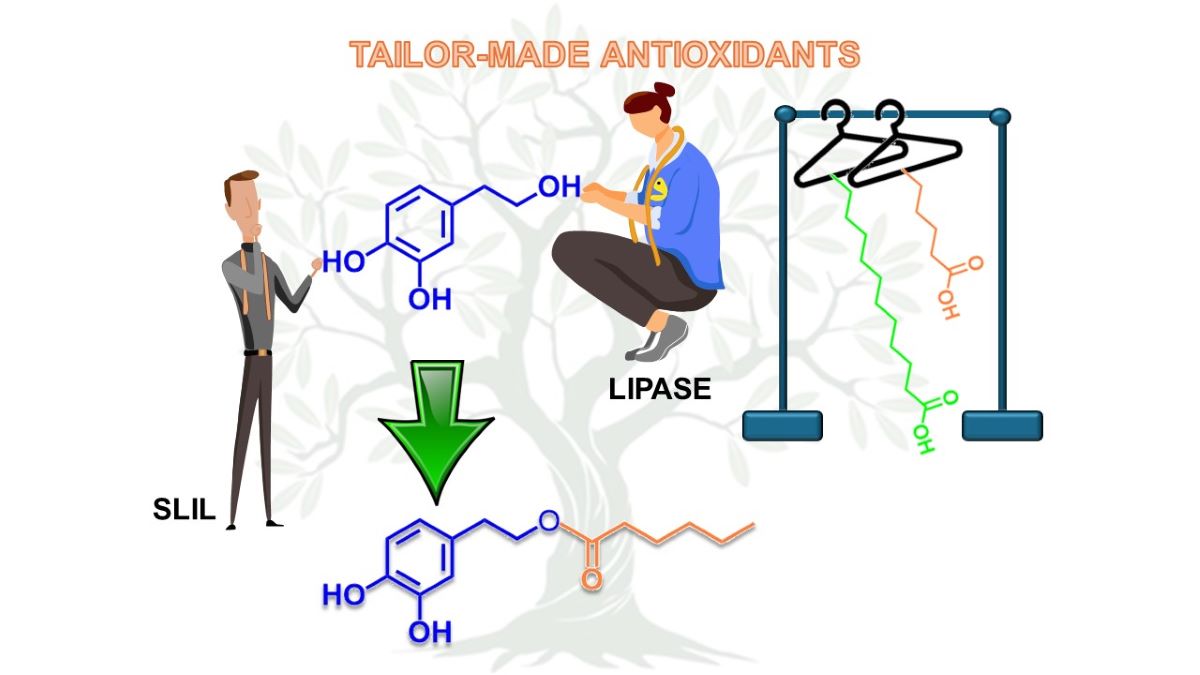
Hydroxytyrosol (HT) is a nutraceutic compound, mainly found in the fruit, leaves and waste from the olive oil industry, that shows one of the highest antioxidant activities among molecules of natural origin. To harness this bioactivity in cosmetics, pharmaceuticals, and the food industry, it is essential to modify the hydrophilicity of HT to enhance its compatibility with lipid-based mixtures. This chemical modification must be done with high selectivity to avoid compromising its radical scavenging activity. This work presents a highly efficient and selective approach to perform the biocatalytic esterification of free fatty acids (FFAs) of different alkyl chain length with HT in a reaction medium based on the SLIL [C12mim][NTf2]. By using a 1:2 (mol/mol) HT:FFA mixture of substrates, the HT monoester derivative was obtained up to 77% yield after 2 h at 80 oC. The adjusted molar ratio of substrates, combined with the ability to recover the SLIL for further reuse, significantly reduces waste accumulation compared to other reported strategies and results in a more sustainable approach as demonstrated by different green metrics. Furthermore, it was demonstrated by a DPPH test how the HT monoester products retain the same antioxidant activity as free HT, being superior to vitamin C.
Keywords:
hydroxytyrosol
; applied biocatalysis
; green processes
; sponge-like ionic liquids
; antioxidants
1. Introduction
Nature is a great supplier of compounds with valuable bioactive properties. Between them, outstand those with aromatic moieties in their structure (i.e. simple phenols, polyphenols, coumarins, flavonoids, etc.) because their ability to filter UV radiations and counteract free radicals if the benzene group has hydroxyl substituents. [1] In particular, hydroxytyrosol (HT) is a simple phenol derived from the secondary metabolism of tyrosol (Tyr), highly abundant in olive plants and derived extracts. The antioxidant power of HT is among the highest contributing to the redox balance in the organism, even surpassing that of coenzyme Q10.[2,3]This is due to the existence of two hydroxyl groups in the aromatic ring with an improved capacity to donate electrons to scavenge free radicals because of their orto- position, that facilitates the stabilization of the HT intermediate by resonance, being able to counteract a total of two free radical species.[4] Thus in the food sector HT has been recognized as a GRAS (Generally Recognized As Safe) additive to prevent lipids rancidity [5,6] and improve the nutritional value and quality of foods because of other interesting therapeutic effects like neuroprotective, cardiovascular, anti-microbial, chemo-preventive or anti-diabetic.[4] Even, HT and related compounds have been successfully reported as suitable reductants to recover precious metals (i.e. Ag, Cu, Cr, and Sn) from waste printed circuit boards, a recycling now known as “urban mining.”[7]
However, as it occurs with the rests of phenols, the use of HT as antioxidant agent, especially in nutraceutical formulations, is limited because its high hydrophilicity that constraints the miscibility with hydrophobic matrices and impedes an acceptable absorption decreasing their bioavailability [8]. In this context, it has been reported that the naturally occurring HT acetate ester has better gut absorption,[9] which may be used as inspiration source for carefully designed chemical modifications on the chemical structure of HT, aiming to reduce hydrophilicity while preserving the hydroxyl groups responsible for its valued scavenging activity. Thus, a common practice to reduce the hydrophilicity of aromatic compounds is to transform them into the so called “phenolipids” [10] through the addition of an acyl chain which has also been shown to improve their stability and provide a mechanism to control their activity through the gradual release by plasma carboxyl esterases.[8,11,12,13] To achieve the lipophilization of Tyr and HT, several chemical and enzymatic strategies have been reported so far. While the chemical strategies involve steps for protection/deprotection due to the poor discrimination of activated acids to react with aromatic or aliphatic hydroxyl groups,[14,15] the high selectivity inherent to the enzymes provides a simple procedure for such controlled modification. In addition, these natural catalysts are biodegradable, highly efficient and their requirements of energy and molar ratio of substrates are much lower than those of chemical catalysts, thus reducing waste and improving the cost-effectiveness and sustainability of processes.[16,17]
Different enzymatic strategies have been reported so far that resolve the immiscibility between HT and the acyl donor by using different organic solvents (dimethyl carbonate, methyl tert-butyl ether, tert-butanol) or fatty acids derivatives (acyl chlorides, methyl/vinyl esters). However, those strategies still carry out additional steps that contribute to increase waste and energy cost,[8,18] and fail in other critical sustainable issues like the best harnessing of raw materials and reduced contamination. At this respect, a biocatalytic direct esterification reaction carried out in green solvents is considered a more suitable strategy compared to the transesterification approach.
Ionic liquids (ILs) have become an interesting sustainable alternative to organic solvents to carry out (bio)catalytic transformations because of their excellent solvent capacities and their physical-chemical properties, like the almost null vapor pressure that prevents any spill and affords the total recovery of these media. Moreover, the sponge-like behavior of certain hydrophobic ILs, so called Sponge-Like Ionic Liquids (SLILs), has become very convenient for the development of efficient and clean methodologies for biocatalytic esterification and separation of pure products.[19] So, these SLILs have been exploited in the syntheses of flavors [20], and bioactive food ingredients like monoacylglycerides of saturated or ω-3 fatty acids,[21,22] panthenol esters,[23] and in the lipophilization of different (hydroxy)cinnamic acids [24] with fatty alcohols of different chain length. However, in the case of Tyr and HT the use of ILs has merely been restricted to the extraction step,[25] and to date there is no data about the use of ILs as solvents for the direct esterification of free fatty acids with these phenol compounds.
By the first time, this work deepens in the exploitation of biocatalysis and ILs as sustainable tools for the design of an efficient protocol for the direct esterification of FFAs having alkyl-chain lengths ranging between C6- C18 with HT (Figure 1). It should be noted that this esterification reaction based on the use of natural substrates, such as FFAs and HT, responds better to the atom economy as regards the low mass of the water by-product released, with respect to the use of fatty acid esters derivatives as acyl donor substrates by a transesterification approach. As counterpart of the enzyme, the SLIL [C12mim][NTf2] has been selected to afford substrates solubilization and provide a sustainable approach for products extraction. The best efficiency and selectivity in the synthesis of HT-esters have been sought through the optimization of the reaction conditions (e.g. HT/FFA molar ratio, temperature, biocatalyst amount, reaction time, etc.) and work up which, in turn, results in significant improvements in green metric parameters compared to previous reported strategies.[10] Equally, the DPPH radical neutralization test on the obtained HT-monoesters will contribute to shed light on the debate whether the antioxidant activity of HT is negatively affected by the lipophilization.
2. Results and Discussion
2.1. Suitability of IL-Lipase Combined Tools for the Esterification of FFAs with HT
The biocatalytic esterification of two substrates mutually immiscible, such as an aromatic alcohol, like HT and a FFA as acyl donor, may be considered the main handicap for a good performance, which is usually overcome by using chemical derivatives of substrates [26], or a great excess of inert solvents [27] to facilitate the reaction. By using ILs, many biocatalytic esterification reactions have been successfully carried out, where the easy recovery for reuse of this solvent was the main flag of greenness. As representative example, the hexanoic acid (Hex) was selected as acyl donor to carry out the biocatalytic esterification with HT by using a 1:4 HT:Hex molar ratio in the SLIL [C12mim][NTf2] green solvent. After the addition of the immobilized C. antarctica lipase B Novozym 435 (N435) (400 mg/mmol HT), the mixture was incubated at 80 oC under magnetic stirring, where the presence of the MS 13X dehydrating agent allowed to shift the reaction equilibrium towards the synthetic side by withdrawing the released water by-product. Under these conditions the hydroxytyrosyl hexanoate (HT-Hex) product was obtained at 87 % yield after 3 h reaction time, as determined by HPLC (see Table 1, entry 4). The synthesis of the product was also confirmed by ATR-FTIR, revealing the formation of an ester bond through the identification of the C=O stretching by the shift of the vibration band of the carboxyl group from 1704 cm−1 to 1735 cm−1, and the detection of a new band at 1238 cm−1 corresponding to the C-O-C stretching (see Figure S1). In the same context, the HT-Hex product was identified and characterized by HPLC-MS and 1H-NMR and 13C-NMR analyses, as detailed in Supplementary Material (Figures S2–S7). The 1H-NMR and 13C-NMR spectra clearly showed that the primary OH group in the alkyl chain is the only one involved in the ester product, confirming the selectivity of the enzymatic esterification.
These results show the convenience of the combination of biocatalysis and SLILs to achieve the efficient esterification of FFAs with HT. While the exquisite selectivity of the enzymes makes this desired transformation simpler and more efficient, the selection of this SLIL as non-aqueous green solvent with an excellent solubilization capacity, permits to significantly reduce its contribution to the mass transfer and improves the reaction rate compared to other organic solvents (see section 2.5, Table 3, entries 2 and 3).[16,20]. Besides, the potential for recovery and reuse of this SLIL is much more interesting from the economic and environmental points of view. Thus, it has been demonstrated that the synergy between the IL and the biocatalysts is fundamental for the efficient modification of natural bioactive compounds following the selectivity and economy criteria. [19,20,21,22] However, the excellence of this combo IL-biocatalysts can be boosted through the optimization of the reaction conditions, attending to the amount of biocatalyst, the reaction temperature and the molar ratio of substrates.
As can be seen in Table 1 (entries 1-4), the increase in the enzyme amount from 50 to 400 mg provides a concomitant increase in product yield up to 87 % (see entry 4). However, it should be noted that the productivity of the reaction systems shows a bell-shape profile by increasing the amount of enzyme, being obtained the best results when using 100 mg N435/mmol HT (see entry 3), a value 4-fold higher than that obtained for the highest enzyme content. Reaction temperature was also shown as an important parameter, being observed a clear improvement in product yield (from 47% to 83 %, see entries 2, 5 and 6) when temperature raised from 60 to 80 ºC. This fact was directly related with the improved suitability of the reaction system for dissolving both HT and Hex substrates into the SLIL system, enhancing their transfer rate to the active site of the enzyme while maintaining the enzyme activity by the protective effect of SLIL media.[20] The ability of hydrophobic SLILs to stabilize enzymes at high temperatures has been widely reported (e.g. up to 1370 days half-life time at 60ºC in the N-octadecyl-N’,N”,N”’-trimethylammonium bis(trifluoromethylsulfonyl)imide IL)[20,28]. This stabilization is attributed to the preservation of the essential water-shell around the enzyme, as well as the native enzyme conformation into the IL net, which acts as a stabilizing confined space for the biocatalysts. It should be noted that by decreasing the HT:Hex substrates molar ratio to 1:2 mol/mol (see entry 7), both, product yield (76 %) and productivity (2.6 mmol HT-Hex/g N435 h) parameters remained practically similar to those obtained for a 1:4 HT:Hex molar ratio (see entry 2). Consequently, the 1:2 HT-Hex molar ratio was selected for further experiments because of the improvement in green metric parameters of the process (e.g. atom economy).[10,29]
2.2. Biocatalytic Synthesis of HT Monoesters with Different Acyl Chain Length
To analyze the suitability of the N435/[C12mim][NTf2] combo system for the lipophilization of HT, the biocatalytic synthesis of HT monoesters of fatty acids of different alkyl chain length was studied under the optimized reaction conditions.
Figure 2 shows the time-course profiles of the N-435-catalyzed direct esterification of hexanoic (C6), octanoic (C8), decanoic (C10), lauric (C12), myristic (C14) or oleic (C18:1) acid with HT using a 1:2 HT: FFA molar ratio at 80 ºC. For all the assayed reaction systems, it should be noted that the immobilized enzyme was able to achieve a product yield higher than 50% within the first 30 minutes, whatever the size of the alkyl chain and being almost completed in 2 h with a slight increase afterwards (i.e. up to 70-83 % HT-monoester yield after 4 h reaction). The suitability of the proposed approach is also demonstrated when compared with other strategies previously described, where similar yields were achieved after 16 h reaction by using a transesterification synthetic approach in acetonitrile as reaction medium.[26] According to the profiles in Figure 2, a reaction time of 2 h was selected as the most appropriate for enzymatically producing HT monoesters attending to the balance between high yield and productivity, as well as to minimize any possible undesired oxidations on HT derivatives induced by heat, that could occur after long reaction times at 80 ºC.
Figure 3 shows the evolution of the HT-monoester product yield and the productivity of the reaction system as a function of the alkyl chain length of the carboxylic acid used for the biocatalytic esterification of HT after 2 h of reaction. Both parameters show a similar behavior being increased with the alkyl chain length from hexanoic (C6) to lauric (C12) acids, then remained practically unchanged (i.e. aprox. 80 % yield and 3.8 mmol HT-monoester/g N435·h) for myristic and oleic acids as the most hydrophobic cases. Once again, these results emphasized the excellent synergies between biocatalysts and SLILs to achieve the efficient and selective lipophilization of aromatic alcohols.[10,19] A similar behavior was reported for the N435-catalyzed esterification of FFAs with different alkyl length with glycerol [21] and panthenol, [23,29], where lauric acid also displayed the best performance for both, either in SLIL or solvent-free reaction media. For these hydrophobic SLIL-based reaction media, these results clearly demonstrated that biocatalysts performance in the reaction system is positively influenced by the increase in the alkyl chain length of the acyl donor. This improvement is driven by the hydrophobic interactions between the alkyl chains of both substrates and SLIL, fully aligning with the “like-dissolves-like” principle, which enhances the suitability of the system for biocatalysis.[19,28] It is important to note that, despite the excess of acyl donor respect HT and the increased hydrophobicity of the reaction media with all tested FFAs, the degree of selectivity towards the synthesis of HT monoesters is not affected, not detecting diester products that could signify a decrease in the antioxidant activity.
2.3. Scaling Up of the Production of HT-Monohexanoate
To demonstrate the robustness of this procedure, a tempting assay to measure the suitability for scaling-up was carried out by increasing 10-folds the reaction mass with respect to the optimized reaction in Table 1. Under these conditions the incubation was performed in a reactor with an anchor mechanical stirring, coupled to a vacuum system to remove the water by-product released from the enzymatic reaction. Figure 4A shows the accumulated productivity (in terms of mmol of HT-monohexanoate per gram of N435) for the N435-catalyzed direct esterification of Hex with 0.5 mmol (low scale) or 5 mmol (high scale) HT by using a 1:2 HT:FFA molar ratio in 70% (w/w) [C12mim][NTf2] at 80 ºC. The comparison of the time-course profiles reveals similar biocatalytic performance in both scales of synthesis and even, a slight improvement when the reaction mass is increased 10-folds, reaching a value close to 8 mmol HT-monohexanoate/g N435 at 3 h reaction time. This result was attributed to the better suitability of the mechanical anchor stirring for mixing the resulting viscous reaction medium, with respect to the magnetic stirring used for low reaction size. By this approach an adequate mass-transfer rate during the biocatalytic process occurred, as well as an efficient removal of the water by-product produced along the reaction by the vacuum system coupled to the reactor. These results highlight the relevance of the setup as an additional element to the N435/SLIL combo to achieve the best performance. This improvement of the biocatalytic efficiency provided by the suitable set-up at high reaction volumes was also observed, although to a greater extent, for the synthesis of panthenyl monolaurate [29], and xylityl monolaurate [30],by direct esterification in solvent free media.
To build green chemical processes, it is necessary to develop integrated approaches for selective (bio)transformation and separation capables of directly providing products, including the recovery for reuse of all the elements of the reaction system (e.g. biocatalysts, solvents, etc.). The SLILs (e.g. [C12mim][NTf2], etc.) are temperature switchable ionic liquid/solid phases that behave as sponge-like systems that permit to develop straightforward and clean approaches for product separation after the biocatalytic step by a simple protocol of cooling and centrifugation. By this approach, the SLIL precipitates as a solid salt at the bottom, while the products remain in the upper liquid phase, as pure products when they are liquids, or dissolved in another green molecular cosolvent (e.g. water, etc.) previously added. [19,20,23,28]
Figure 4B shows the phase behavior of the reaction media resulted from the biocatalytic step for HT-monohexanoate synthesis in [C12mim][NTf2] after the addition of five volumes of a (85:15 v/v) propylene glycol: H2O mixture, then cooling at -10ºC and centrifuged for 10 min, at 0 ºC, 10.000 rpm. As can be seen, this easy protocol permits the full precipitation of the solid SLIL, while the reaction products are extracted in the molecular liquid upper phase, as demonstrated by HPLC analysis that confirmed the recovery of 94 % HT-Hex. Furthermore, the 19F- NMR analysis of the upper liquid phase only detected scarce traces of residual SLIL (up to 1%, see Figure S8), that could be fully eliminated by other classical procedures (i.e. ionic exchange column). Because of the solid character of HT and its derivatives, the separation of the HT-monoester product from the SLIL phase needs the addition of a liquid molecular solvent that favor its extraction. Among other molecular solvents, an 85:15 (v/v) propylene glycol: H2O mixture provides the best precipitation of the solid SLIL after cooling and centrifugation. It should be noted that propylene glycol (PG), meets the specifications of the Food Chemicals Codex (Report Number: 27 NTIS Accession Number: PB265504, 1973) in agreement with the Select Committee on GRAS Substances (SCOGS). [31] Because of the safety of PG, the extracted mixture containing the HT-monoester could be used without additional steps of purification, contrary to other strategies where the use of volatile organic solvents involves tedious work-ups that also contribute to waste, reducing the greenness of the overall process.
2.4. Antioxidant Activity of the HT-Monoesters
The industrial interest for preparing lipophilized HT derivatives to be used as nutraceutics in hydrophobic-based formulations is fully dependent on the maintenance of the antioxidant power with respect to the free HT. The antioxidant activity of HT and its derivatives after the esterification with different alkyl-chain length FFAs was determined by their capacity to reduce the free radical 2,2-diphenyl-1-picrylhydrazyl, which manifests through a color turn from deep purple to pale yellow that can be quantified by Vis-UV spectroscopy at 517 nm. [10,32,33]
Figure 5 shows the time course profiles of the antioxidant activity of the HT-monoesters based on different alkyl chain length. Firstly, SLIL-free samples were obtained from the reaction media by liquid-liquid extraction, and their respective concentrations were determined by HPLC through a calibration pattern. Free HT and vitamin C (ascorbic acid) were used as control references of the antioxidant activity, and the concentration of all samples was adjusted to 80 nmol for a proper comparison (see Materials and Methods section).
As can be seen, HT and HT-monoesters show relative antioxidant activities ranging from 75 to 88 % after 4 h reaction, values practically twice than that showed by vitamin C (41%), being related to two reductive hydroxyl groups on HT structure with respect to the sole reductive group of vitamin C.[34] The excellent suitability showed by free HT as natural antioxidant (88 %) agrees with previously reported studies,[1,2,3] even as reductant for precious metal recovery from electronic wastes.[7]. Furthermore, it should be noted how all the HT-monoesters derivatives maintained the same antioxidant activity regardless the length of the alkyl chain of the FFA. As demonstrated by NMR analysis (see Figure S7), the ester bond between the FFA and the HT was selectively formed between the carboxylic group of the FFA and the primary hydroxyl group of HT present at the lateral chain, which is not involved in the antioxidant properties of HT. Although the biocatalytic lipophilization of HT provides bioactive molecules with the similar antioxidant power to free HT, it should be noted that the presence of the alkyl chain seems to reduce the reaction rate of DPPH reduction. Thus, while free HT, or vitamin C, reacts immediately with DPPH maintaining unchanged its antioxidant activity with time, the HT-monoester derivatives showed a lower reaction rate of DPPH reduction, being necessary up to 4 h until to reach the maximum level of antioxidant activity (see Figure 5). This fact was also reported by for the lipophilization of HT,[27,35] as well as for other aromatic acids (e.g. caffeic acid, coumaric, etc.,[10]), being attributed to a lower ionization of the aromatic hydroxyl groups after the esterification. Other authors report a decay in antioxidant activity after lipophilization, although they recorded the DPPH test only after 10-30 min of incubation reaction, where the steady state has not yet been reached.[34,36] Thus, the esterification of FFAs with HT not only improve the miscibility with lipophilic formulations in cosmetics or foods favoring the skin penetration and intestinal absorption, but also the longer reaction time of HT-monoester derivatives could be considered an enhancement in the half-life time of the antioxidant activity in free radicals scavenging.
2.5. Green Metric Assessment of the Biocatalytic Synthesis of HT-Monoesters
To assess the sustainability of the biocatalytic strategy here presented, the synthesis of HT-monohexanoate was selected as representative example of HT-monoesters, and it has been analyzed by means of different recognized green metric parameters i.e. Atom Economy (AE), Yield (ε), Stoichiometric Factor (SF), Mass Recovery Parameter (MRP), Reaction Mass Efficiency (RME) and E-factor parameters, as well as the EcoScale tool. The AE, 1/SF and ε parameters provide information about the reactivity of substrates and atoms incorporated into the desired products. It should be noted that the MRP concerns the recyclability of the reaction species (or their contribution to waste), whereas RME is considered as a global indicator of sustainability comprising all the above parameter. The values of all these parameters range between 0 to 1, corresponding the highest value to the best sustainability. Alternatively, the E-factor parameter may be used as waste quantification criteria, being expected the lowest value for sustainable processes. Related to waste, the Total Carbon Release (TCR) parameter has been designed to quantify the emissions of CO2 as results from the incineration of waste from organic (waste accumulated in the in the synthesis step) and aqueous (wastewater in the downstream step) residues from the reactions. [37] And finally, the EcoScale tool permits to extend the sustainable analysis to other criteria, such as the energy expense, the process cost and/or toxicity of reagents, running by introducing different penalties to an initial value of 100% corresponding to the maximum sustainability. [10,29] (see Material and Methods and Supplementary Material sections for further details). For an appropriate comparison of these results, the analysis of sustainability has also been extended to other selected strategies of HT esterification for a better understanding of the green metrics dimension. The reaction conditions of all the approaches considered, as well as the results obtained for the E-factor parameter, the TCR and the EcoScale tool, are shown in Table 3.
The strategies selected are representative examples of different approaches for the biocatalytic esterification of fatty acids (free or derivatized) with HT. Among other conditions, the most relevant differences attend to the use of solvents as reaction medium (entries 2-4), or aliphatic esters, as activated acyl donors for a transesterification reaction mechanism (entries 1 and 2), able to provide homogeneous reaction media suitable for the enzymatic catalysis. It should be noted the higher molar ratio for these transesterification strategies (that produces an alcohol as by-product), while the direct esterification ones using free Hex and HT deal with a more fair molar ratio of substrates (1:2 HT:Hex, entries 3 and 4). In all cases the reaction has been catalyzed by N435, providing excellent yields (75-98 %) but different performances. Thus, a high HT-monoester yield (93%, entry 2) was obtained at the shortest reaction time (1.25 h), leading to the highest value of productivity (5.4 mmol ME/g N435 ∙ h). These results are slightly higher than those here reported by a direct esterification approach (see entry 4, 3.1 mmol HT-monoester/g N435∙h). It can be noted that the use of a very low amount of biocatalyst (entry 3, 33 mg/mmol HT) involves a lengthening in the reaction time up to 48 h for achieving a 75 % HT-monoester yield, being the productivity greatly reduced (0.5 mmol ME/g N435 ∙ h). In this regard, it seems more appropriate to increase the amount of enzyme to improve esterification reaction rates and productivity.
However, the productivity parameter only focuses on reaction efficiency, and other critical aspects regarding the reaction conditions and work-up that provide information on resource use (substrates, energy, solvents, etc.) and waste generation, must also be considered.[10,29] Therefore, a complementary sustainability analysis becomes necessary to identify the most efficient approach. In this regard, the ε is complemented with other green parameters like AE, 1/SF, MRP and RME, which are usually represented as the vertices of a pentagon (Figure 6). Thus, the greenness of the process is shown when a balanced pentagon with a maximum radius of 1 is obtained, as indicated by the highest value for each metric. [38] It should be emphasized that the calculations of all parameters have been strictly referred to the biocatalytic step.
The AE parameter provides information about the suitability of the strategy selected, revealing the contribution of byproducts to the overall synthesis. As depicted in Figure 6, the esterification approaches (entries 3 and 4, Table 3) show the best values as only water is released along the reaction, which mass is negligible respect to the HT ester product. The transesterification strategies (see entries 1 and 2, Table 3) also show a high AE value despite releasing ethanol or acetaldehyde, respectively, as their molecular weights also becomes practically insignificant respect to that of HT monoester having long alkyl chain. However, since AE does not consider the stoichiometry of the reaction, it is important to determine the 1/SF parameter that quantifies non-used substrates according to the reaction stoichiometry, as they are an important source of waste. As can be seen in Figure 6, the high excess of acyl donors in entries 1 and 2 results in the lowest 1/SF values (0.1), as opposed to the 1:2 HT: Hex molar ratio used in entries 3 and 4 (0.7 1/SF value). Furthermore, the 1/SF value has a deep impact in the results of the MRP parameter, which accounts for all non-recovered elements after the reaction for further reuse, that directly contribute to waste. This value is even decreased by the used of an organic solvent, as occurs in the strategies using MTBE (entries 2 and 3) which display the lower MRP values. Conversely, the suitability of SLILs to be recovered and reused [19,20,21,28], together with the fair molar ratio of substrates used in the strategy here reported, leads to the best MRP value (0.66, entry 4), being 66 folds higher than the MRP value of entry 3 (0.01) despite using the same approach in MTBE solvent. This evidences that the selection of the solvent is crucial for the sustainability of processes. The results of all the above green metrics are collected in the RME parameter, giving a landscape of the reaction sustainability. Therefore, whilst the entries 1-3 adopt a triangle or a square shape, only the direct esterification of Hex with HT in SLILs fits more properly to a pentagon and shows the higher radius. The RME value can be indirectly considered an indicator of waste generation, as is related to the E-factor (see formula in Table S1). Thus, the E-factor parameter (Table 3) reveals that the best productivity achieved in the entry 2 is at the cost of a large amount of waste, questioning the interest of this approach. This parameter also assigns the lowest value for the entry 4 (2.0) corroborating that the combination of biocatalysis and SLILs provides the best utilization of substrates and reagents with low waste generation. Beyond waste, there is a serious concern about its further contribution to the environmental CO2 emissions. [39] For this reason, the TCR parameter permits to calculate the CO2 emissions after their incineration (considering the worst case scenario) and can be calculated from the E-factor (i.e. TCR = (PMI organic x 2.3) + (PMI water x 0.63), where PMI = E-factor + 1).[40] In this analysis of green metrics, only the synthetic step has been considered and because of this, the E-factor only refers to the organic waste produced in this step. According to the results shown in Table 3, the synthetic approach developed in this work provided the best TCR results, pointing out its lower CO2 footprint with respect to the strategies 1-3.
To extend the analysis to other issues like the reagent’s characteristics, incubation conditions and purification, the EcoScale tool was also used. Herein, penalties are assigned as a function of the toxicity, hazard, energy invested, price, work-up, etc. of the overall process (listed in Table S2). According to the results, this tool has taken into consideration the higher price of the activated acyl donor (i.e. ethyl palmitate and vinyl decanoate) compared to FFAs, and the reagents and steps involved in each approach. All the penalties assigned reduce the score of the EcoScale for entries 1-3 from 100 % (corresponding to an ideal sustainable reaction) to almost 50 %. Meanwhile, the one here reported obtains a value of 77 % because of the reduction in the range of reagents, the improved safety and simplification of the overall process. A punctuation, that according to the authors of this tool, corresponds to excellent operating conditions.[41]
3. Conclussions
The actual framework of sustainability in industrial processes demands a shift towards the use of renewable raw materials and the better use of the resources to decrease the environmental burden. The increased interest of natural antioxidants for the cosmetic and food market opens the necessity to develop highly selective, green and clean synthetic approaches for preparing new products with improved bioactivities. This means a turn of conventional approaches by introducing new tools that afford more sustainable and cost-effective processes. This work demonstrates how the combination of biocatalysis with the [C12mim][NTf2]-SLIL, as a neoteric green solvent, is a highly suitable approach for the selective preparation of lipophilic HT-monoesters, preserving their bioactive properties. The synergy between the excellent solvent capacity of this SLIL and the biocatalytic efficiency permits to achieve a high productivity (up to 3.8 mmol HT-monoester/g N435·h) in the synthesis of HT-monoesters bearing different alkyl chain length, with the lowest waste accumulation compared to other strategies previously reported. Moreover, the interesting properties of SLILs have been key for the development of a clean, innocuous and low energy intensive work-up for the products extraction. Once again, the synergic combination of biocatalysts and SLIL opens an interesting path to upgrade the greenness of chemical transformations for a more sustainable future.
4. Materials and Methods
4.1. Materials
Commercial HT (2,4-dihydroxyphenylethanol, Naturolive HT15SF with 15 % purity was a kind gift from Deretil Nature, S.A (Spain). As a pure standard, a commercial HT (>98 %) from TCI was also used. Sigma provided different free fatty acids: hexanoic acid (C6, 99 %), octanoic acid (C8, > 98%), decanoic acid (C10, ≥ 98 %), lauric acid (C12, 98 %), mirystic acid (C14, 98 %) and oleic acid (C18:1, 90 %), as the dehydrating agent molecular sieves MS13X, acetophenone (99 %), deuterated dimethyl sulfoxide (DMSO-δ6) and the free radical 2,2-DiPhenyl-1-PicrylHydrazyl (DPPH), while ascorbic acid (≥99 %) was supplied by Probus, S. A. (Barcelona, Spain). IoLiTec (Ionic Liquids Technologies, Germany) was the source of the IL 1-dodecyl-3-methylimidazolium bis(trifluoromethyl-sulfonyl)imide ([C12mim][NTf2], 99% purity). The commercial immobilized Candida antarctica lipase B, named Novozym® 435 (N435), was a gift of Novozymes/Novonesis. (Spain).
4.2. Biocatalytic Synthesis of Hydroxytyrosol Esters
The commercial product Naturolive HT15SF is a complex extract from Olea europaea containing 15-17 % HT, 45-65 % fruit extract (fats, sugars, dietary fiber and proteins) and 35-55% starch. Before the use, HT was extracted with methanol (10 g extract/60 mL MeOH) for 12 h and afterwards, methanol was evaporated in a rotary evaporator at 60 ºC and 110 rpm. The concentration of recovered HT was measured by HPLC respect to a calibration pattern of pure HT (0.02-1 mM) from TCI (99 % purity) using acetophenone (1 mM) as internal standard, obtaining a concentration of 2.7 M. The biocatalytic esterification process of HT was carried out by using different FFAs as acyl donor (i.e. hexanoic acid, C6; octanoic acid, C8; decanoic acid, C10; lauric acid, C12; myristic acid, C14; oleic acid, C18:1). To perform the process, 1:4 or 1:2 molar ratios of HT and FFA were dissolved in 0.5 mL of the SLIL-[C12mim][NTf2] containing MS 13X (100 mg/mmol HT). After mixing at 60-80 oC, 250 rpm, N435 (50-400 mg N435/mmol HT) was added, and the reaction was incubated in the same conditions for 8 h. Along the reaction, 10 μL aliquots were withdrawn at different intervals to obtain the time course profiles through HPLC analysis. The higher scale reaction was performed by increasing 10-folds the overall mass in a Carousel Plus 6 Reaction Station system with a TornadoTM Overhead Stirring System (Radleys) coupled to a vacuum system (Vacstar).
At the end of the biocatalytic reaction, the immobilized enzyme derivative was separated from the medium by centrifugation (i.e. 14,000 rpm, 15 min, RT). A liquid-liquid extraction procedure was developed to separate the HT-monoesters and unreacted HT from the SLIL, as follows: 200 µL of reaction medium were suspended in propylene glycol: H2O (85: 15 v/v, 1 mL) and stirred for 5 min at room temperature. The resulting heterogeneous mixture was cooled to -10 oC for 15 min and centrifuged at 0 oC (i.e. 14,000 rpm, 10 min), resulting in two separated phases: an upper liquid phase containing unreacted HT and HT-monoester products, and a solid-white bottom phase corresponding to the SLIL. Residual SLIL on the liquid phase was determined by 19F-NMR, as follows. Sample (40 µL) and trifluoroacetic acid (TFA, 40 µL, internal standard) were dissolved in DMSO-δ6, (420 µL), and then analyzed in a Brucker AC 200E spectrometer 400 MHz quantifying the residual IL with respect to a standard of the [C12mim][NTf2] SLIL prepared in the same conditions.
4.3. HPLC Analysis
The separation and identification of substrates and products was performed by HPLC using an HPLC LC-20 system (Shimadzu) coupled to a photodiode detector (SPD-M20A, Shimadzu), with a RP-18 column (LiChrospher, Merck, 250nm x 5 μm). The solvents acetonitrile (ACN, A) and orthophosphoric acid 0,1 % v/v (B) were used according to the following elution gradient: 0-2min, 25% A; 2-16 min, 25%-90% A; 16-17 min, 90%; 17-18min, 90%-25 % A, 18-25 min, 25% A. For the reaction with octadecenoic acid as acyl donor the gradient varied as follows: 0-2 min, 25% A; 2-16 min, 25%-90% A; 16-25 min 90% A; 25-26 min, 90%-25% A, 26-32 min, 25% A. HT and the ester products were identified at their λmax (280 nm) with the following retention times: HT (3,0 min), HT-C6 (13,6 min), HT-C8 (15,8 min), HT-C10 (17,8 min), HT-C12 (19,7 min), HT-C14/21,4 min) and HT-C18:1 (23,4 min).Yield of the esterification was determined as a function of the peak areas balance of HT and the ester product.
4.4. FTIR Espectra
The vibration bands of the functional groups in HT, FFAs and the ester products were identified by infrared spectroscopy (FT/IR-4700 JASCO Analytical Instruments, Easton, PA, EE.UU.) with a range of measurement from 3,500 to 400 cm−1, at a 0.4 cm-1 resolution.
4.5. HPLC-MS and NMR Analyses
The reaction model of HT esterification with hexanoic acid was selected to identify the ester product by HPLC-MS and NMR spectra. HPLC-MS analyses were performed with a HPLC-DAD Agilent 1200 equipped with a RP-C18 column (250 mm × 5 μm) and an electrospray detector ESI-TOF Agilent 6220 (Agilent, USA) following the same elution gradient as in section 2.3 but replacing orthophosphoric acid by acetic acid. Signals were obtained by scanning in the range 100-1000 m/z operating in negative ion mode. The ion spectra were compared with a NIST library for the identification of the reaction species.
Equally 1H-NMR and 13C-NMR spectra were obtained for HT, Hex, the SLIL-[C12mim][NTf2] and the reaction mixture with a Bruker Avance, 400 MHz spectrometer. For the analyses, 50 μL were diluted with DMSO-δ6 up to 400 μL final volumen. Hydroxytyrosol: 1H-NMR δ(ppm): 3.48 (dt, 2H, Ha); 4.53 (t, 1H, Ha-OH); 2.52 (t, 2H, Hb); 6.42 (dd, 1H, Hd); 6.60 (d, 1H, He); 8.57/8.67 (s, 1H, Hf-OH or Hg-OH, indistinguishable); 6.57 (d, 1H, Hh). 13C-NMR δ(ppm): 62.6 (CA); 38.5 (CB); 130.1 (CC); 119.4 (CD); 116.3 (CE); 143.3 (CF); 144.9 (CG); 115.4 (CH). Hexanoic acid: 1H-NMR δ(ppm): 11.95 (s, 1H, Hi-OH); 2.18 (t, 2H, Hj); 1.48 (q, 2H, Hk); 1.18-1.33 (m, 4H, Hl and Hm, indistinguishable); 0.85 (t, 3H, Hn). 13C-NMR δ(ppm): 174.5 (CI); 33.6 (CJ); 24.2 (CK); 30.8 (CL); 21.9 (CM); 13.8 (CN). Hydroxytyrosyl hexanoate: 1H-NMR δ(ppm):4.11 (t, 2H, Ha); 2.67 (t, 2H, Hb); 6.43 (dd, 1H, Hd); 6.59, (d, 1H, He); 6.56 (d, 1H, Hh); 2.23 (t, 2H, Hj); 1.47 (q, 2H, Hk); 1.18-1.33 (m, 4H, Hl and Hm, indistinguishable); 0.85 (t, 3H, Hn). 13C-NMR δ(ppm): 64.6 (CA); 33.8 (CB); 128.5 (CC); 119.4 (CD); 116.5 (CE); 143.6 (CF); 145.1 (CG); 115.7 (CH); 172.9 (CI); 33.5 (CJ); 24.1 (CK); 30.7 (CL); 21.8 (CM); 13.8 (CN). 1-Dodecyl-3-methylimidazolium bis(trifluoromethylsulfonyl)imide: 1H-NMR δ(ppm): 4.14 (t, 2 H, Ha´); 1.77 (q, 2 H, Hb´); from 1.32 to 1.15 (m, 18 H, from Hc´ to Hk´, indistinguishable); 0.85 (t, 2H, Hl´); 9.09 (dd, 1H, Hm´); 7.75 (dd, 1H, Hn´); 7.76 (dd, 1H, Ho´); 3.84 (s, 3H, Hp´). 13C-NMR δ(ppm): 48.8 (CA´); from 29.3 to 28.4 (from CB´to CI´, indistinguishable); 25.5 (CC´); 31.3 (CJ´); 22.1 (CK´); 13.8 (CL´); 136.5 (CM´); 123.6 and 122.1 (CN´and CO´, indistinguishable).
4.6. Antioxidant Activity of HT-Monoesters by Radical Scavenging Test
The antioxidant activity of HT-monoesters was determined by using the DPPH method. [10,32,33] First, samples of reaction media (200 μL) containing HT-monoesters based on different FFA acyl donors (see Fig. 3) were suspended in ethyl acetate (1 mL), and the mixture was strongly shaken for 10 min at RT to extract all HT compounds. Then, the ethyl acetate phase was collected, and the solvent was removed under reduced pressure. The remaining solid fraction was then dissolved in MeOH (0.5 mL) and the concentration of HT species was determined by HPLC, as described in section 4.2. For all cases, concentrations ranged from 0.3-0.37 M HT species, where HT-monoester derivative accounted for 72-83 %, maintaining the same proportion with free HT as in the reaction media. Finally, all extracted fractions were diluted with methanol to achieve a 0.8 mM HT-monoester final concentration to determine the antioxidant activity. Samples of HT methanolic fraction (100 μL, 80 nmol) were added to 3 mL of 0.15 mM DPPH in MeOH, shaken at RT, and then the absorbance at 517 nm was recorded until reach the steady state. The Relative Antioxidant Activity, in terms of the capacity to neutralize the free DPPH radical, was calculated according to the formula:
 where, AC corresponds to the absorbance of the DPPH control solution (without antioxidant), and AS correspond to the absorbance of DPPH in presence of the antioxidant sample.
4.7. Analysis of Sustainability
To assess the sustainability of the reaction, the efficiency and waste generation was determined by means of six green metric parameters as previously reported [29]: Atom Economy (AE), Yield (ε), Stoichiometric Factor (SF), Material Recovery Parameter (MRP), Reaction Mass Efficiency (RME), E-Factor and TCR (see section 3in Supplementary Material, for more information). The EcoScale tool was also used (http://ecoscale.cheminfo.org/calculator).
Supplementary Materials
The following supporting information can be downloaded at the website of this paper posted on Preprints.org.
Author Contributions
Susana Nieto: Conceptualization, Methodology, Formal Analysis, Investigation, Data Curation, Writing – Original Draft Preparation, Writing - review & editing and Funding Acquisition. Inmaculada Lozano: Data curation; Formal analysis; Investigation; Methodology. Fran J. Ruiz: Data curation; Formal analysis; Investigation; Methodology Jose F. Costa: Data curation; Formal analysis; Investigation; Methodology. Rocio Villa: Formal analysis; Investigation; Writing - review & editing. Pedro Lozano: Conceptualization; Data curation; Formal analysis; Funding acquisition; Investigation; Supervision; Methodology; Writing -original draft; Writing - review & editing.
Funding
This work was partially supported by 21640/PDC/21 (Fundación SENECA-CARM), and the grants PID2021-124695OB-C21/22 and PDC2022-133313-C21/22 funded by MICIN/AEI//10.13039/501100011033 and by the European Union NextGenerationEU/PRTR.
Acknowledgments
We thank Ramino Martinez (Novonesis; S.A.; Spain) for the gith of Novozym 435 ®, and Alicia Navarro (Deretil Nature S.A.; Almería; Spain) for the gift of Naturolive HT15SF
Conflicts of Interest
Authors declare there are no conflicts of interest.
Abbreviations
AE, Atom Economy; E-factor, Environmental factor; FFA, Free Fatty Acid; Hex, hexanoic acid; HT, hydroxytyrosol; MRP, Material Recovery Parameter; PG, propylene glycol; RME, Reaction Mass Efficiency; SLIL, Sponge-Like Ionic Liquid; SF, Stoichiometric Factor; TCR, Total Carbon Release.
References
- . Bernini, R.; Campo, M.; Cassiani, C.; Fochetti, A.; Ieri, F.; Lombardi, A.; Urciuoli, S.; Vignolini, P.; Villanova, N.; Vita, C. Polyphenol-rich extracts from agroindustrial waste and byproducts: Results and perspectives according to the green chemistry and circular economy. J. Agric. Food Chem. 2024, 72, 12871–12895. [Google Scholar] [CrossRef] [PubMed]
- . Wang, E.H.; Jiang, Y.F.; Zhao, C.Y. Hydroxytyrosol isolation, comparison of synthetic routes and potential biological activities. Food Sci. Nutr. 2024, 12. [Google Scholar] [CrossRef]
- Martinez, L.; Ros, G. Hydroxytyrosol: Health benefits and use as functional ingredient in meat. Medicines 2018, 5, 13. [Google Scholar] [CrossRef] [PubMed]
- . Markovic, A.K.; Toric, J.; Barbaric, M.; Brala, C.J. . Hydroxytyrosol, tyrosol and derivatives and their potential effects on human health. Molecules. 2019, 24, 2001. [Google Scholar] [CrossRef]
- EFSA Panel on Food additives and Nutrient Sources added to Food (ANS). Scientific Opinion on the re-evaluation of propyl gallate (E 310) as a food additive. EFSA Journal 2014, 12, Article 3642. [CrossRef]
- . GB 2760-2014. National food safety standard for uses of food additives. Chinese National Standard. 2014. https://www.mpi.govt.nz/dmsdocument/42706-China-GB-Standard-A.
- . Alexandre-Franco, M. F.; Fernandez-Gonzalez, C.; Reguero-Padilla, G.; Cuerda-Correa, E. M. Olive-tree polyphenols and urban mining. A greener alternative for the recovery of valuable metals from scrap printed circuit boards. Environm. Res. 2022, 214, 114112. [Google Scholar] [CrossRef]
- Wang, X.; Wang, Q.; Yu, J.; Guo, X.; Tong, P.; Yin, F.; X. Liua.; D. Zhou. The potential of hydroxytyrosol fatty acid esters to enhance oral bioavailabilities of hydroxytyrosol and fatty acids: Continuous and slow-release ability in small intestine and blood. Food Chem 2023, 422, 136246. [CrossRef]
- . Mateos, R.; Pereira-Caro, G.; Saha, S.; Cert, R.; Redondo-Horcajo, M.; Bravo, L.; Kroon, P.A. Acetylation of hydroxytyrosol enhances its transport across differentiated Caco-2 cell monolayers. Food Chem. 2011, 125, 865–872. [Google Scholar] [CrossRef]
- . Nieto, S.; Martínez-Mora, F.; Lozano, I.; Ruiz, F.; Villa, R.; Lozano, P. "New sustainable biocatalytic approach for producing lipophilic (hydroxy)cinnamic esters based on deep eutectic mixtures”. Catal. Tod. 2024, 114500. [Google Scholar] [CrossRef]
- . Yin, F. W.; Wang, X. M.; Hu, Y. Y.; Xie, H. K.; Liu, X. Y.; Qin, L.; Zhang, J.; Zhou, D.; Shahidi, F. Evaluation of absorption and plasma pharmacokinetics of tyrosol acyl esters in rats. J. Agric. Food Chem. 2020, 65, 1248–1256. [Google Scholar] [CrossRef] [PubMed]
- . Celli, N.; Dragani, L.K.; Murzilli, S.; Pagliani, T.; Poggi, A. In vitro and in vivo stability of caffeic acid phenethyl ester, a bioactive compound of propolis. J. Agric. Food Chem. 2007, 55, 3398–3407. [Google Scholar] [CrossRef]
- . Yin, F-W.; Hu, X-P.; Zhou, D-Y.; Ma, X-C.; Tian, X-G.; Huo, X-K.; Rakariyatham, K.; Shahidid, F.; Zhua, B-W. Evaluation of the stability of tyrosol esters during in vitro gastrointestinal digestion. Food Funct 2018, 9, 3610. [CrossRef]
- . Appendino, G.; Minassi, A.; Daddario, N.; Bianchi, F.; Tron, G.C. Chemoselective esterification of phenolic acids and alcohols. Org. Lett. 2002, 4, 3839–3841. [Google Scholar] [CrossRef]
- . Bernini, R.; Mincione, E.; Barontini, M.; Crisante, F. Convenient synthesis of hydroxytyrosol and its lipophilic derivatives from tyrosol or homovanillyl alcohol. J. Agric. Food Chem. 2008, 56, 8897–8904. [Google Scholar] [CrossRef] [PubMed]
- Nieto, S: Villa, R.; Donaire, A.; Lozano, P. Nonconventional biocatalysis: from organic solvents to green solvents. In Biocatalysis in Green Solvents, 1st Ed.; Lozano, P. Ed.; Elsevier, London, 2022, pp. 23–55. [CrossRef]
- . Alcantara, A.R.; de Maria, P.D.; Littlechild, J.; Schurmann, M.; Sheldon, R.; Wohlgemuth, R. Biocatalysis as key to sustainable industrial chemistry. ChemSusChem. 2022, 15, e202102709. [Google Scholar] [CrossRef] [PubMed]
- . Bernini, R.; Carastro, I.; Santoni, F.; Clemente, M. Synthesis of lipophilic esters of tyrosol, homovanillyl alcohol and hydroxytyrosol. Antioxidants, 2019, 8, 174. [Google Scholar] [CrossRef] [PubMed]
- . Lozano, P.; Bernal, J. M.; Garcia-Verdugo, E.; Sanchez-Gomez, G.; Vaultier, M.; Burguete, M.I.; Luis, S.V. Sponge-like ionic liquids: a new platform for green biocatalytic chemical processes. Green Chem. 2015, 17, 3706–3717. [Google Scholar] [CrossRef]
- . Lozano, P.; Bernal, J.M.; Navarro, A. A clean enzymatic process for producing flavour esters by direct esterification in switchable ionic liquid/solid phases. Green Chem. 2012, 14, 3026–3033. [Google Scholar] [CrossRef]
- . Lozano, P.; Gomez, C.; Nieto, S.; Sanchez-Gomez, G.; Garcia-Verdugo, E.; Luis, S.V. Highly selective biocatalytic synthesis of monoacylglycerides in sponge-like ionic liquids. Green Chem 2017, 19, 390–396. [Google Scholar] [CrossRef]
- . Villa, R.; Alvarez, E.; Nieto, S.; Donaire, A.; Garcia-Verdugo, E.; Luis, S.V.; Lozano, P. Chemo-enzymatic production of omega-3 monoacylglycerides using sponge-like ionic liquids and supercritical carbon dioxide. Green Chem. 2020, 22, 5701–5710. [Google Scholar] [CrossRef]
- . Lozano, P.; Alvarez, E.; Nieto, S.; Villa, R.; Bernal, J.M.; Donaire, A. Biocatalytic synthesis of panthenyl monoacyl esters in ionic liquids and deep eutectic solvents. Green. Chem. 2019, 21, 3353–3361. [Google Scholar] [CrossRef]
- . Katsoura, M.H.; Polydera, A.C.; Tsironis, L.D.; Petraki, M.P.; Rajacic, S.K.; Tselepis, A.D.; Stamatis, H. Efficient enzymatic preparation of hydroxycinnamates in ionic liquids enhances their antioxidant effect on lipoproteins oxidative modification. New Biotechnol. 2009, 26, 83–91. [Google Scholar] [CrossRef]
- Romero, J.; Zambra, C.; Merlet, G.; Cabezas, R.; Correa, G.; Salinas, G; González, J.; Veliz F.; Lemus-Mondaca, R. Liquid-liquid extraction of hydroxytyrosol, tyrosol, and oleuropein using ionic liquids. Sep. Sci. Technol. 2018, 54, 2895–2906. [CrossRef]
- . Torres de Pinedo, A.; Peñalver, P.; Rondón, D.; Morales, J. C. Efficient lipase-catalyzed synthesis of new lipid antioxidants based on a catechol structure. Tetrahedron. 2005, 61, 7654–7660. [Google Scholar] [CrossRef]
- . Grasso, S.; Siracusa, L.; Spatafora, C.; Renis, M.; Tringali, C. Hydroxytyrosol lipophilic analogues: Enzymatic synthesis, radical scavenging activity and DNA oxidative damage protection. Bioorg. Chem. 2007, 35, 137–152. [Google Scholar] [CrossRef]
- . Lozano, P.; Bernal, J.M.; Sanchez-Gomez, G.; Lopez-Lopez, G.; Vaultier, M. How to produce biodiesel easily using a green biocatalytic approach in sponge-like ionic liquids. Energy Envirom. Sci. 2013, 6, 1328–1338. [Google Scholar] [CrossRef]
- . Nieto, S.; Bernal, J.M.; Villa, R.; García-Verdugo, E.; Donaire, A.; Lozano, P. Sustainable setups for the biocatalytic production and scale-up of panthenyl monoacyl esters under solvent-free conditions, ACS Sustain. Chem. Eng. 2023, 11, 5737–5747. [Google Scholar] [CrossRef]
- . Nieto, S.; Villa, R.; Donaire, A.; Lozano, P. Ultrasound-assisted enzymatic synthesis of xylitol fatty acid esters in solvent-free conditions. Ultrason. Sonochem. 2021, 75, 105606. [Google Scholar] [CrossRef]
- U.S. Food & Drug Administration. Available online: https://www.fda.gov/food/food-ingredients-packaging/generally-recognized-safe-gras (accessed on 1 July 2024).
- . Baliyan, S.; Mukherjee, R.; Priyadarshini, A.; Vibhuti, A.; Gupta, A.; Pandey, R. P.; Chang, C. M. Determination of antioxidants by DPPH radical scavenging activity and quantitative phytochemical analysis of Ficus religiosa. Molecules. 2022, 27, 1326. [Google Scholar] [CrossRef] [PubMed]
- . Silva, F. A.; Borges, F.; Guimaraes, C.; Lima, J.L.; Matos, C.; Reis, S. Phenolic acids and derivatives: studies on the relationship among structure, radical scavenging activity, and physicochemical parameters. J. Agric. Food Chem. 2000, 48, 2122–2126. [Google Scholar] [CrossRef]
- . Gulcin, I; Alwasel, S.H. Antioxidants and antioxidant methods: an updated overview. Arch. Toxicol. 2020, 94:651-715. [CrossRef]
- . Foti, M.C.; Daquino, C.; Geraci, C. Electron-transfer reaction of cinnamic acids and their methyl esters with the DPPH· radical in alcoholic solutions. J. Org. Chem. 2004, 69, 2309–2314. [Google Scholar] [CrossRef] [PubMed]
- Zhou, D.Y.; Sun, Y.X.; Shahidi, F. Preparation and antioxidant activity of tyrosol and hydroxytyrosol esters. J. Funct. Foods. 2017, 37, 66–73. [Google Scholar] [CrossRef]
- . Onken, U.; Koettgen, A.; Scheidat, H.; Schueepp, P.; Gallou, F. Environmental metrics to drive a cultural change: our green eco-label. Chimia 2019, 73, 730–736. [Google Scholar] [CrossRef] [PubMed]
- . Andraos, J. The algebra of organic synthesis: green metrics, design strategy. Route, selection and optimization. 9: CRC Press-Taylor & Francis: Boca Raton, 2019, ISBN, 2019. [Google Scholar]
- . de Maria, P.D; Kara, S.; Gallou, F. Biocatalysis in water or in non-conventional media? Adding the CO2 production for the debate. Molecules. 2023, 28, 6452. [Google Scholar] [CrossRef]
- Andraos, J. Relationships between step and cumulative PMI and E-factors: implications on estimating material efficiency with respect to charting synthesis optimization strategies. Green Process Synth. 2019, 8, 324–336. [Google Scholar] [CrossRef]
- . Van Aken, K.; Strekowski, L.; Patiny, L. EcoScale, a semi-quantitative tool to select an organic preparation based on economical and ecological parameters. Beilstein J. Org. Chem. 2006, 2, 3. [Google Scholar] [CrossRef] [PubMed]
Figure 1.
A. Structure of the 1-dodecyl-3-methylimidazolium bistriflimide [C12mim][NTf2] SLIL. B. Biocatalytic synthesis of hydroxytyrosyl monoesters by direct esterification of FFAs with HT in SLIL-based reaction media. .
Figure 1.
A. Structure of the 1-dodecyl-3-methylimidazolium bistriflimide [C12mim][NTf2] SLIL. B. Biocatalytic synthesis of hydroxytyrosyl monoesters by direct esterification of FFAs with HT in SLIL-based reaction media. .
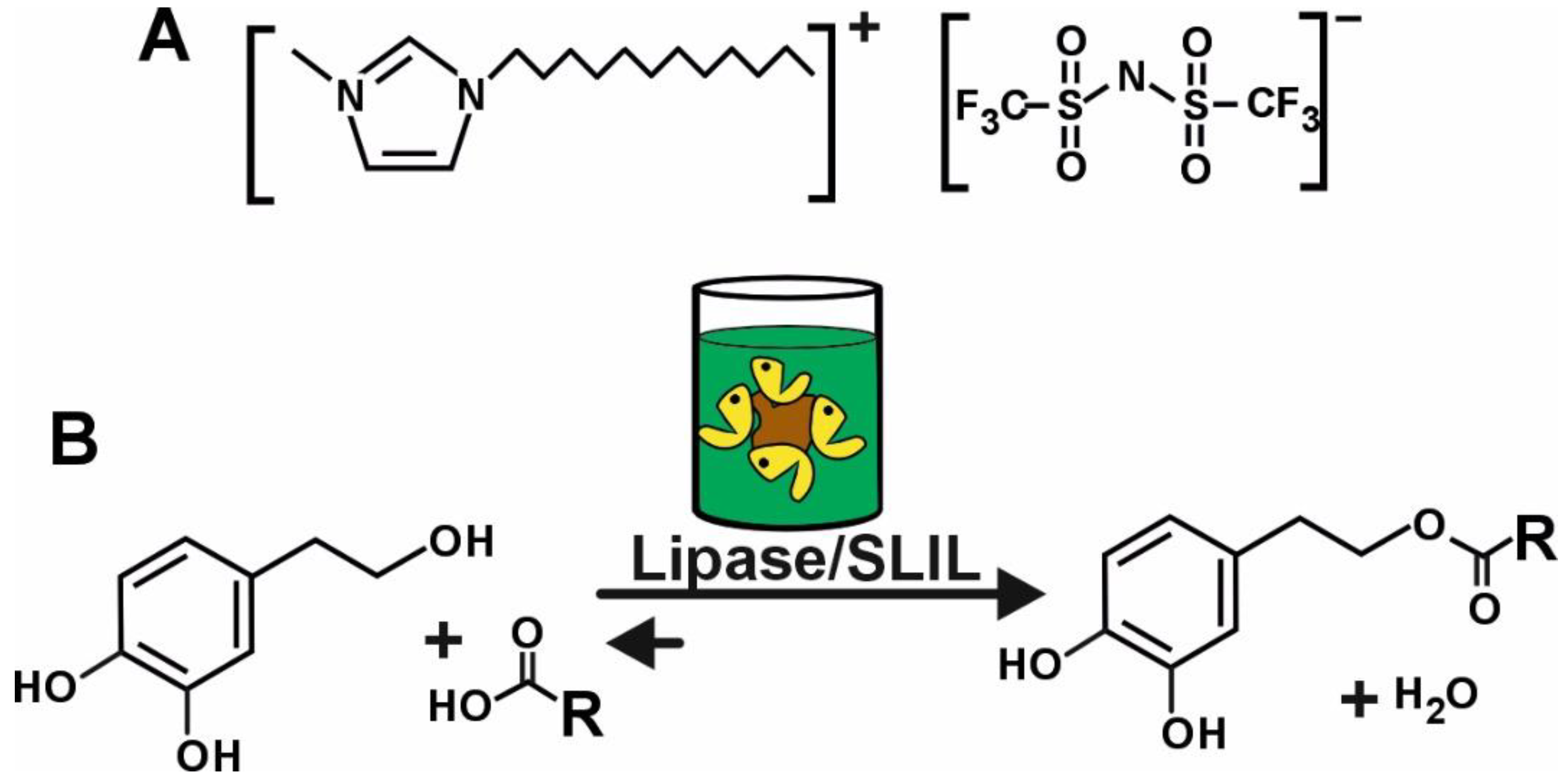
Figure 2.
Time-course profiles of the enzymatic esterification of hexanoic acid, (A); octanoic acid, (B); decanoic acid, (C); lauric acid (D); myristic acid, (E) and oleic acid, (F) with HT in [C12mim][NTf2] reaction medium. Free HT (Ο); HT-monoester product (▼).
Figure 2.
Time-course profiles of the enzymatic esterification of hexanoic acid, (A); octanoic acid, (B); decanoic acid, (C); lauric acid (D); myristic acid, (E) and oleic acid, (F) with HT in [C12mim][NTf2] reaction medium. Free HT (Ο); HT-monoester product (▼).
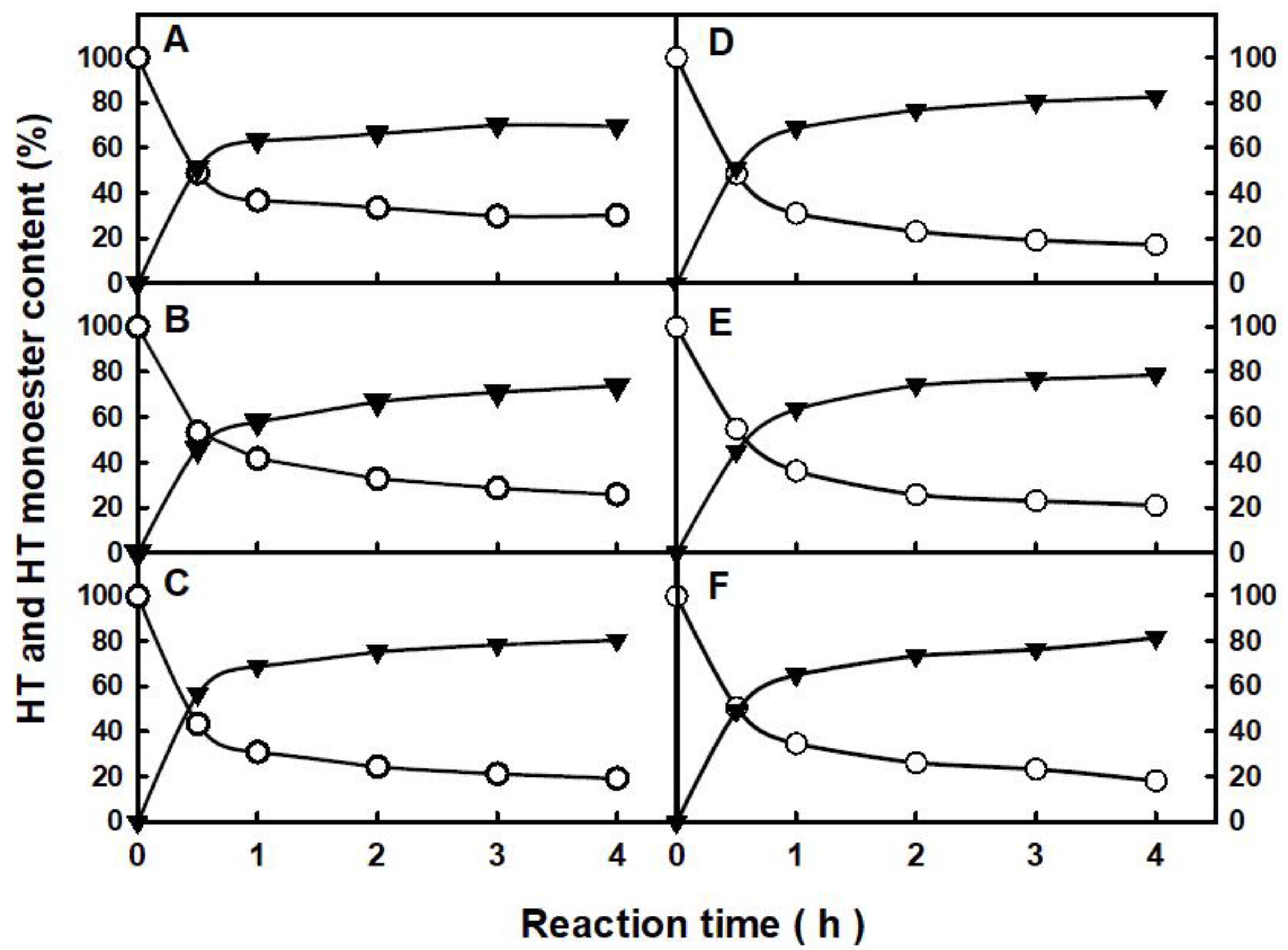
Figure 3.
Yield (bars) and productivity (●) for the synthesis of HT-monoester derivatives by N435-catalyzed direct esterification of different FFAs (i.e. hexanoic acid, C6; octanoic acid, C8; decanoic acid, C10; lauric acid, C12; myristic acid, C14; oleic acid, C18:1) with HT. Reaction conditions: HT: FFA 1:2 (mol:mol), 2 h, 80 ºC.
Figure 3.
Yield (bars) and productivity (●) for the synthesis of HT-monoester derivatives by N435-catalyzed direct esterification of different FFAs (i.e. hexanoic acid, C6; octanoic acid, C8; decanoic acid, C10; lauric acid, C12; myristic acid, C14; oleic acid, C18:1) with HT. Reaction conditions: HT: FFA 1:2 (mol:mol), 2 h, 80 ºC.
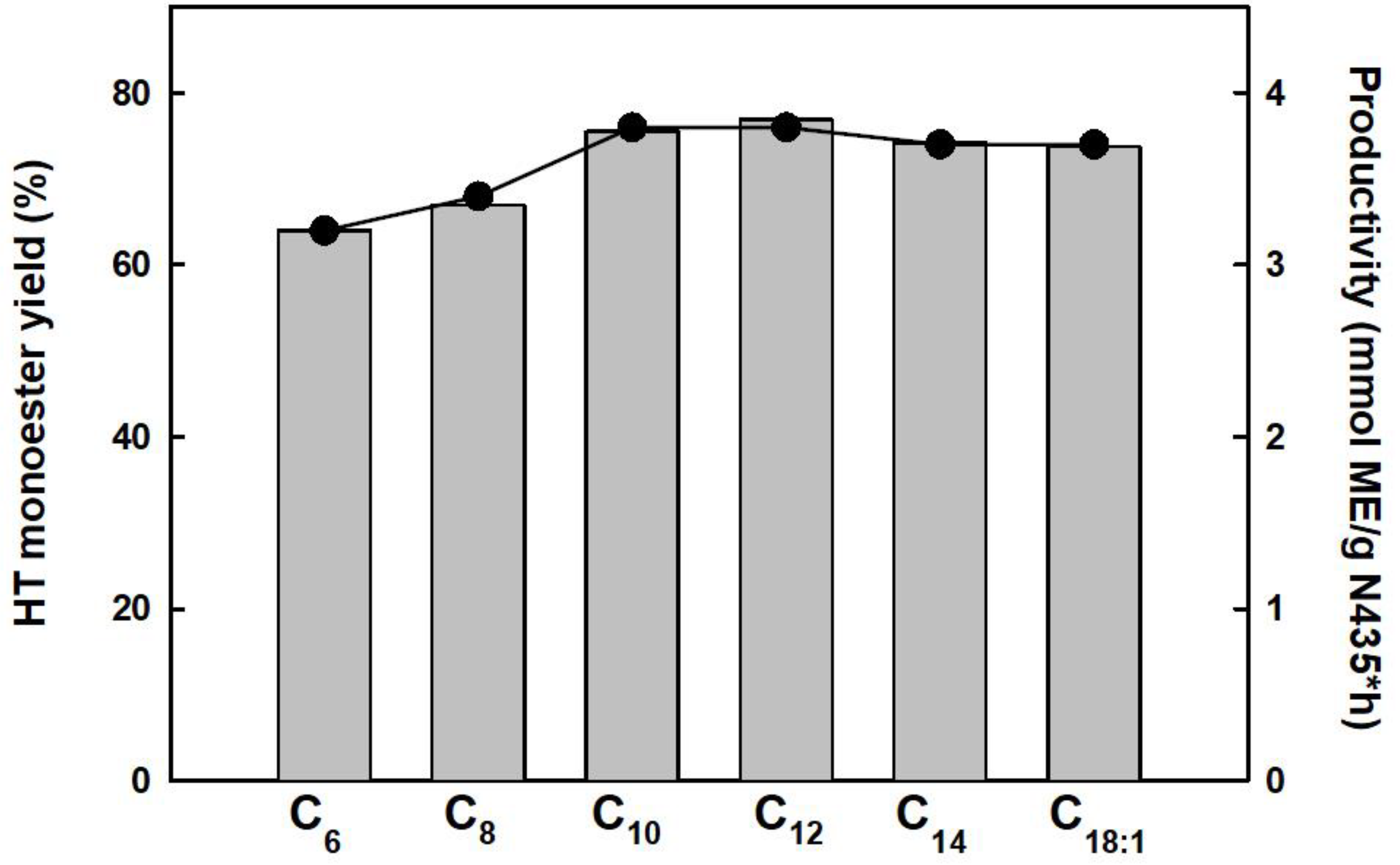
Figure 4.
A. Time-course profiles of the accumulated productivity for the N435-catalyzed esterification of Hex with 0.5 mmol HT (●) or 5 mmol HT (△) (HT:Hex 1:2 mol:mol) using 100 mg N435/mmol HT in 70 % (w/w) [C12mim][NTf2] at 80 ºC. B. Phase behavior of the reaction mixture after adding five volumes of (85:15 v/v) propylene glycol: H2O, then cooling at -10ºC and centrifugation (10 min, 0ºC, 10,000 rpm).
Figure 4.
A. Time-course profiles of the accumulated productivity for the N435-catalyzed esterification of Hex with 0.5 mmol HT (●) or 5 mmol HT (△) (HT:Hex 1:2 mol:mol) using 100 mg N435/mmol HT in 70 % (w/w) [C12mim][NTf2] at 80 ºC. B. Phase behavior of the reaction mixture after adding five volumes of (85:15 v/v) propylene glycol: H2O, then cooling at -10ºC and centrifugation (10 min, 0ºC, 10,000 rpm).
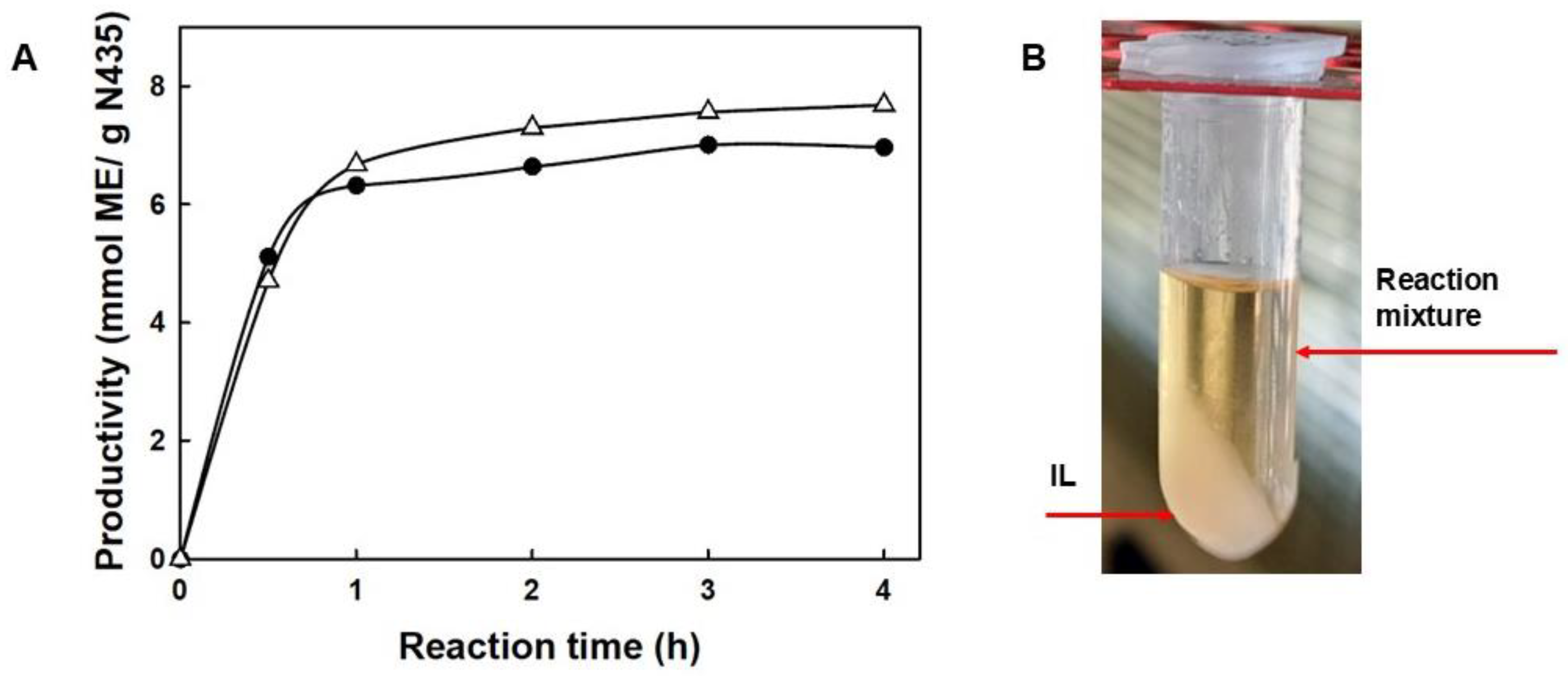
Figure 5.
Time-course profiles of the relative antioxidant activity of free HT (▼) and HT-monoesters based on different alkyl-chain length (C6, △; C8, ■; C10, ☐; C12, ◆; C14, ◊; C18:1, ▲; overall content in HT species: 80 nmol), determined spectrophotometrically at 517 nm during 4 h with DPPH.[33] Vitamin C (80 nmol, ○) was used as an antioxidant standard reference. A sample of DPPH without any antioxidant (●) was used as control to stablish the zero value. Insert picture: final color displayed by each sample after the DPPH test.
Figure 5.
Time-course profiles of the relative antioxidant activity of free HT (▼) and HT-monoesters based on different alkyl-chain length (C6, △; C8, ■; C10, ☐; C12, ◆; C14, ◊; C18:1, ▲; overall content in HT species: 80 nmol), determined spectrophotometrically at 517 nm during 4 h with DPPH.[33] Vitamin C (80 nmol, ○) was used as an antioxidant standard reference. A sample of DPPH without any antioxidant (●) was used as control to stablish the zero value. Insert picture: final color displayed by each sample after the DPPH test.
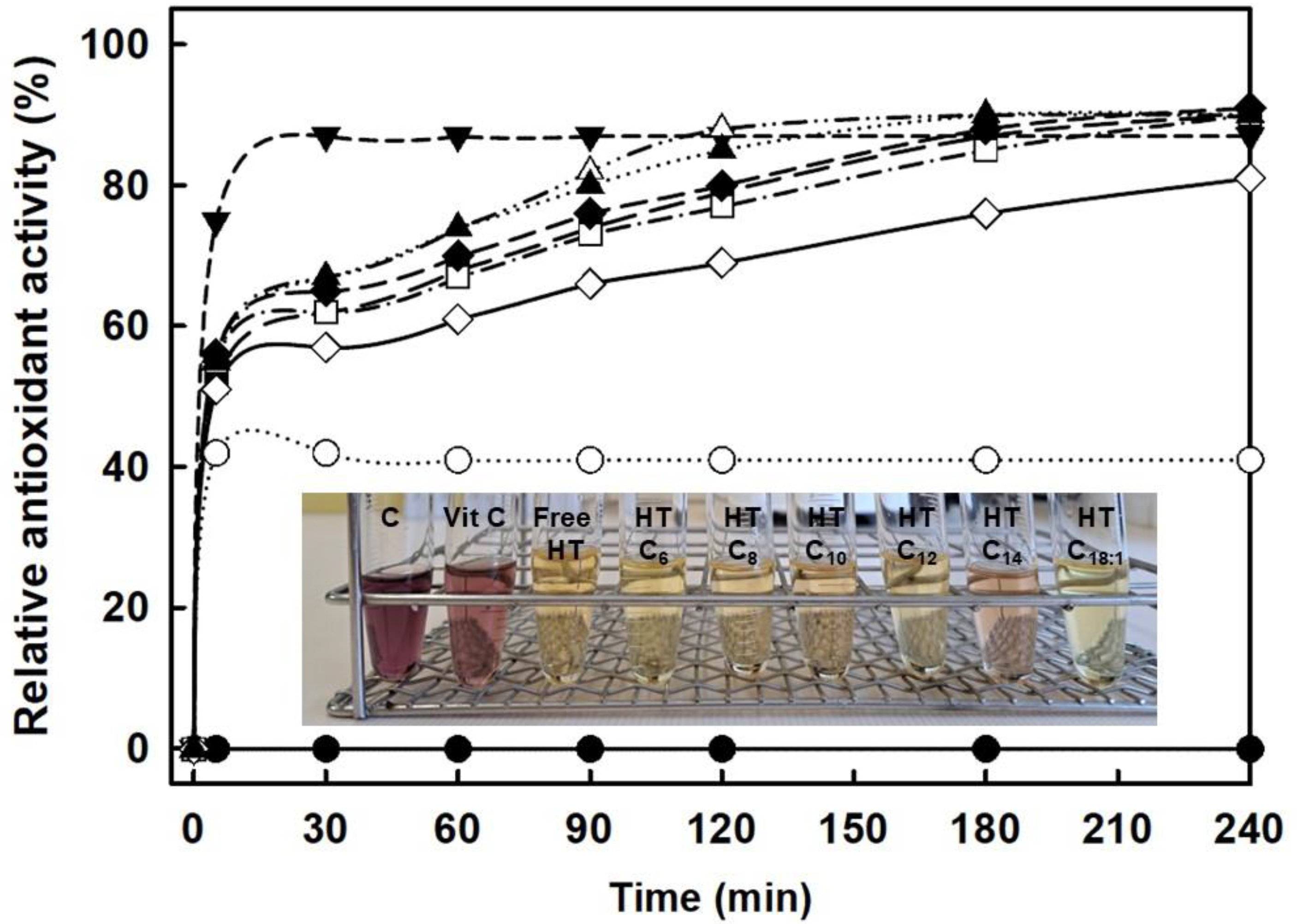
Figure 6.
Radial pentagon of the green metric analyses for approaches included in Table 3 (Orange, [26]; red, [27], blue, [8]; green, [This work].
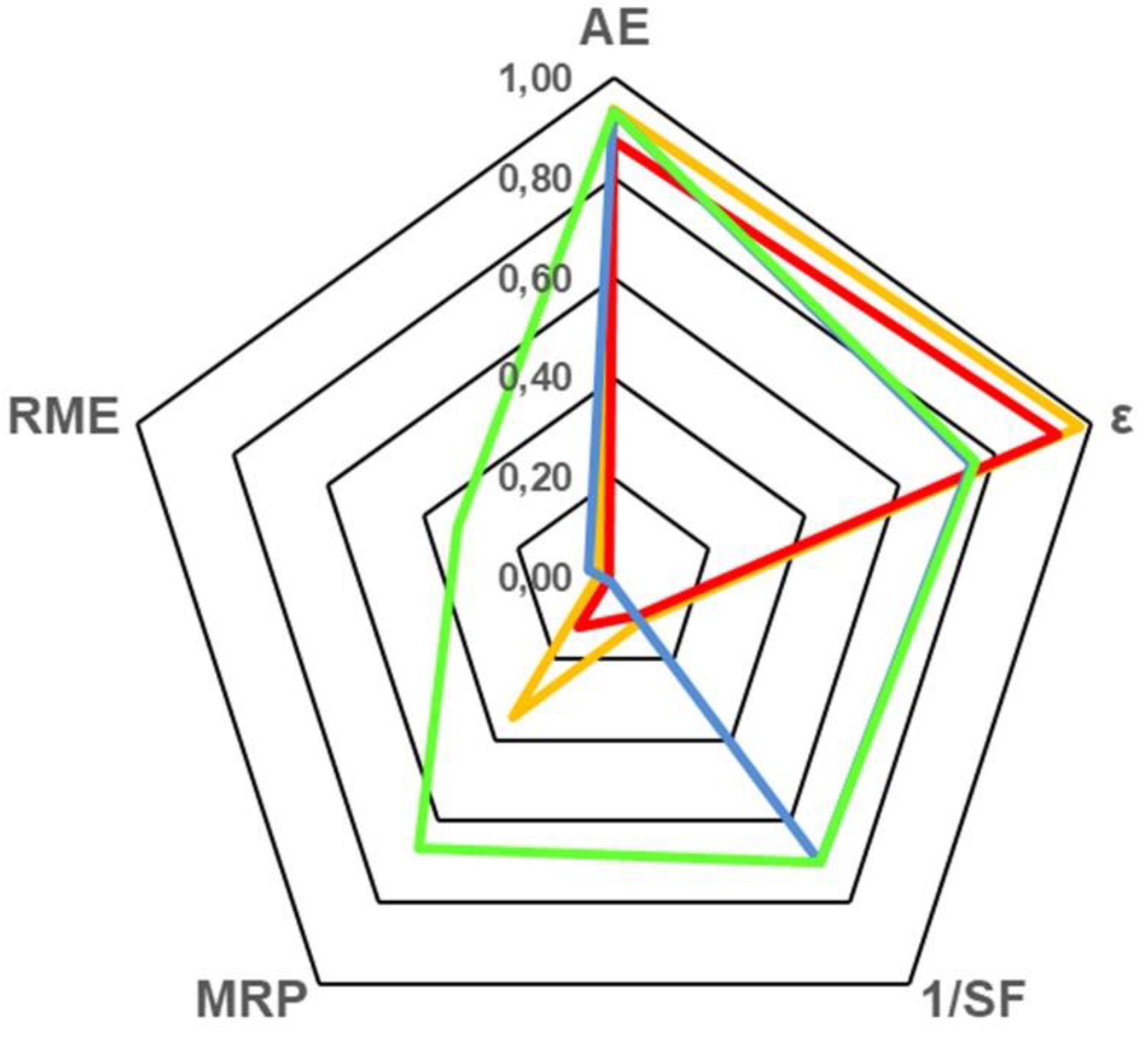

Table 1.
Influence of reaction parameters on the biocatalytic synthesis of hydroxytyrosyl hexanoate by esterification of Hex with HT (0.25 mmol) in 70 % (w/w) [C12mim][NTf2] reaction medium. Yield (ε) and Productivity (mmol HT-Hex/g N435 h) have been calculated at 3 h reaction time.
Table 1.
Influence of reaction parameters on the biocatalytic synthesis of hydroxytyrosyl hexanoate by esterification of Hex with HT (0.25 mmol) in 70 % (w/w) [C12mim][NTf2] reaction medium. Yield (ε) and Productivity (mmol HT-Hex/g N435 h) have been calculated at 3 h reaction time.
| Entry | HT:Hex (mol: mol) |
N435/HT (mg/mmol) |
T (oC) |
(%) |
Productivity (mmol HT-Hex/g N435 ∙ h) |
|---|---|---|---|---|---|
| 1 | 1:4 | 50 | 80 | 33 | 2.2 |
| 2 | 1:4 | 100 | 80 | 83 | 2.8 |
| 3 | 1:4 | 200 | 80 | 81 | 1.4 |
| 4 | 1:4 | 400 | 80 | 87 | 0.7 |
| 5 | 1:4 | 100 | 70 | 71 | 2.4 |
| 6 | 1:4 | 100 | 60 | 47 | 1.6 |
| 7a | 1:2 | 100 | 80 | 78 | 2.6 |
a 0.5 mmol HT.
Table 3.
Reaction conditions and analysis of sustainability of different biocatalytic strategies for hydroxytyrosol lipophilization.
Table 3.
Reaction conditions and analysis of sustainability of different biocatalytic strategies for hydroxytyrosol lipophilization.
| Entry | 1, [26] | 2, [27] | 3, [8] | 4, [This work] a | |
|---|---|---|---|---|---|
| Reaction conditions | Solvent (mL/mmol HT) |
None | MTBEb (35) |
MTBE (33) |
[C12mim][NTf2] (5) |
| Acyl donor | Ethyl palmitate | Vinyl decanoate |
Hexanoic acid |
Hexanoic acid |
|
| HT (mmol) | 0,4 | 0,72 | 6 | 5 | |
| HT:DA (mol:mol) | 1:30 | 1:20 | 1:2 | 1:2 | |
| mg N435/mmol HT | 100 | 139 | 33 | 100 | |
| Temperature (oC) | 37 | 40 | 40 | 80 | |
| Time (h) | 4 | 1,25 | 48 | 3 | |
| Green Metrics | ε (%) | 98 | 93 | 75 | 76 |
| Productivity (mmol HT-ester/g Enz ∙ h) |
2.5 | 5.4 | 0.5 | 3.1 | |
| E factor | 30.4 | 115.2 | 132.4 | 2.0 | |
| TCR | 19.8 | 73.2 | 84.0 | 1.9 | |
| EcoScale | 46 | 50 | 48.5 | 77 |
aFrom this work, the biocatalytic esterification reaction of Hex (10 mmol) with HT (5 mmol) was selected for green metric analysis; bMTBE, methyl tert-butyl ether.
Disclaimer/Publisher’s Note: The statements, opinions and data contained in all publications are solely those of the individual author(s) and contributor(s) and not of MDPI and/or the editor(s). MDPI and/or the editor(s) disclaim responsibility for any injury to people or property resulting from any ideas, methods, instructions or products referred to in the content. |
© 2024 by the authors. Licensee MDPI, Basel, Switzerland. This article is an open access article distributed under the terms and conditions of the Creative Commons Attribution (CC BY) license (http://creativecommons.org/licenses/by/4.0/).
Copyright: This open access article is published under a Creative Commons CC BY 4.0 license, which permit the free download, distribution, and reuse, provided that the author and preprint are cited in any reuse.


