
Submitted:
14 September 2024
Posted:
20 September 2024
You are already at the latest version
Abstract
Catalog and key for identifying common marine invertebrates in the Little Sippewissett Marsh, Woods Hole, MA. Species identifications from August to September 2024 focused on arthropoda phylum and interacting ecosystems.
Keywords:
Arthropoda
; Decapoda
; taxonomy
; morphology
; biodiversity
Preface
We are pleased to present this comprehensive species catalog of the Arthropoda phylum found in Little Sippewissett Marsh, Woods Hole, Massachusetts. This catalog is the result of an intensive field study conducted from August to September, combining traditional taxonomic methods with modern genomic analysis. Our primary goal in creating this catalog is to provide researchers, students, and naturalists with a reliable and accessible method for identifying and characterizing the diverse arthropod species in the Woods Hole area. We believe that understanding the biodiversity of our local ecosystems is crucial for conservation efforts and for gaining insights into the complex ecological relationships that sustain our environment.
The catalog includes detailed morphological descriptions, high-resolution photographs, and genomic data for each species encountered during our study. By incorporating genomic analysis, we have been able to verify species identifications with a high degree of accuracy, detect cryptic species that may be morphologically similar but genetically distinct, and provide a basis for future comparative studies across different regions or time periods. We hope that this catalog will serve as a valuable resource for the scientific community and contribute to our collective understanding of arthropod diversity in coastal marsh ecosystems. Furthermore, we anticipate that this work will facilitate long-term monitoring of species populations, enabling us to track changes in biodiversity over time and in response to environmental factors.
As you explore this catalog, we encourage you to approach it not just as a reference guide, but as an invitation to delve deeper into the fascinating world of arthropods that surrounds us. Whether you are a seasoned entomologist or a curious novice, we hope this catalog will inspire you to observe, question, and appreciate the intricate beauty of these remarkable creatures. We extend our gratitude to the Woods Hole scientific community for their support and to all those who contributed to this project. Your dedication to the advancement of scientific knowledge and ecological preservation has made this work possible.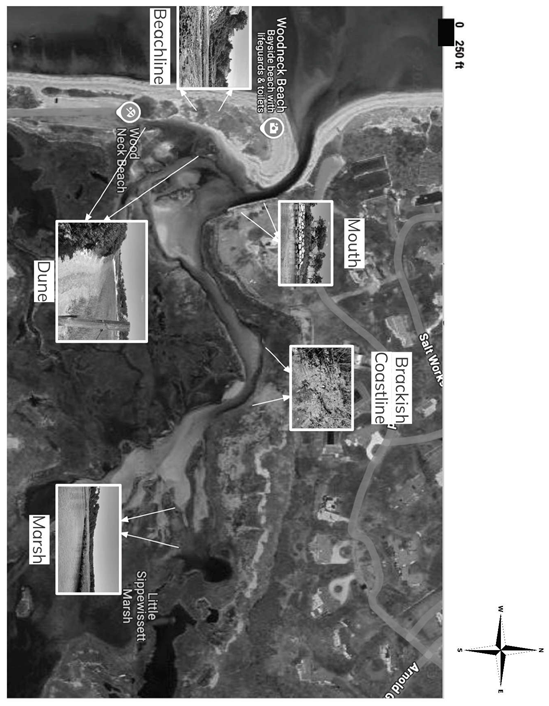
Callinectes sapidus
Collected 28 August 2024, 09:30 ET; Observed on all coastlines.
Genetic identification via barcoding is AVAILABLE (Appendix A).
Callinectes sapidus, commonly known as the “Atlantic Blue Crab,” is a decapod crustacean native to the western Atlantic Ocean and Gulf of Mexico, including the coastal waters of Woods Hole, Massachusetts. Taxonomically, it belongs to the kingdom Animalia, phylum Arthropoda, subphylum Crustacea, class Malacostraca, order Decapoda, infraorder Brachyura, family Portunidae, genus, Callinectes, species Sapidus (Marine Species, 2024). This species is characterized by its bright blue coloration on the legs and claws, contrasting with a dark green to bluish-gray carapace. C. sapidus is a commercially important species in the region, known for its rich taste giving it a significant role in both recreational and commercial fisheries. As a euryhaline species, it can tolerate a wide range of salinities, allowing it to inhabit various coastal and estuarine environments such as the brackish water of Little Sipppewissett Marsh in Woods Hole, MA (Walters et al., 2023).
Identification Key
- 1.
-
Examine the overall body form:
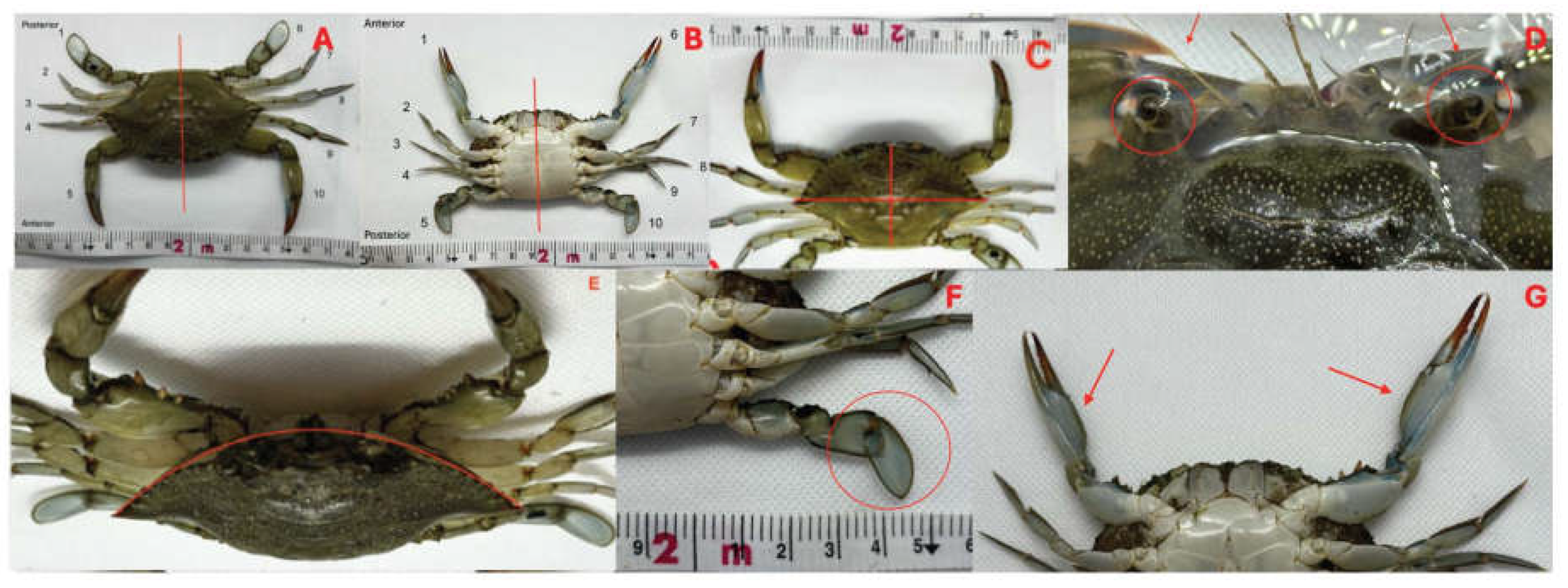
- If the specimen has a crab-like form with the fifth pair of thoracic legs not markedly reduced, a reduced abdomen folded under the body lacking uropods, and short antennae set medial to the eyes, proceed to step 2. (Figure 1A,B)
- If not, the specimen is not a “true crab.”
- 2.
-
Assess the carapace shape:
- If the carapace is broader than long with a small or absent rostrum, proceed to step 3. (Figure 1C)
- If not, the specimen is not Callinectes sapidus.
- 3.
-
Evaluate the crab’s habitat and pigmentation:
- If the specimen is free-living, well-pigmented, and has non-reduced eyes, proceed to step 4. (Figure 1D)
- If not, the specimen is not Callinectes sapidus.
- 4.
-
Observe the carapace outline and size:
- If the front margin is curved and bears a series of teeth between the eye and the anterolateral corner on each side, and the carapace is over 5 cm across, proceed to step 5. (Figure 1E)
- If not, the specimen is not Callinectes sapidus.
- 5.
-
Check the orientation of the first antennae:
- If the first antennae are folded transversely or obliquely, proceed to step 6. (Figure 1D)
- If not, the specimen is not Callinectes sapidus.
- 6.
-
Examine the last pair of legs:
- If the last pair of legs are flattened, paddle-like with rounded tips for swimming, proceed to step 7. (Figure 1F)
- If not, the specimen is no Callinectes sapidus.
- 7.
-
Count the anterolateral teeth and assess carapace characteristics:
- If the specimen has nine anterolateral teeth, and extremely broad carapace, and the outermost lateral tooth is especially long and sharp, proceed to step 8. (Figure 1C)
- If not, the specimen is not Callinectes sapidus.
- 8.
-
Look for distinctive coloration:
- If the specimen shows blue coloration, particularly on the chelipeds, it is likely Callinectes sapidus (Atlantic Blue Crab). (Figure 1G)
Figure 1.
Figure 1 illustrates key identifying features of the Callinectes sapidus. A Illustrates the dorsal view of the size of the callinectes sapidus with indication of bilateral symmetry along the anterior-posterior axis. B Illustrates the ventral view of the size of the Callinectes sapidus with indication of bilateral symmetry along the anterior-posterior axis. C Shows the size comparison between length and width of carapace. D Indicates the presence of non-reduced eyes and first antennae folding obliquely. E Illustrates the characteristic curve of the front margin of the carapace. F Shows the flattened and paddle-like last pair of legs with their distinct blue coloration. G Shows blue coloration on chelipeds signifying the common name “blue crab.”.
Figure 1.
Figure 1 illustrates key identifying features of the Callinectes sapidus. A Illustrates the dorsal view of the size of the callinectes sapidus with indication of bilateral symmetry along the anterior-posterior axis. B Illustrates the ventral view of the size of the Callinectes sapidus with indication of bilateral symmetry along the anterior-posterior axis. C Shows the size comparison between length and width of carapace. D Indicates the presence of non-reduced eyes and first antennae folding obliquely. E Illustrates the characteristic curve of the front margin of the carapace. F Shows the flattened and paddle-like last pair of legs with their distinct blue coloration. G Shows blue coloration on chelipeds signifying the common name “blue crab.”.
Carcinus maenas
Collected 28 August 2024, 10:00 ET; Observed at the neck of Marsh.
Genetic identification via barcoding is AVAILABLE (Appendix A).
Carcinus maenas, commonly known as the European Green Crab or Shore Crab, is an invasive decapod crustacean well-established along the Atlantic coast of North America, including the Woods Hole, Massachusetts region (Marine Species, 2024). Taxonomically, it belongs to the kingdom Animalia, phylum Arthropoda, subphylum Crustacea, class Malacostraca, order Decapoda, infraorder Brachyura, family Portunidae, genus Carcinus, and species Maenas (Giribet & Edgecomb, 2020). This medium-sized crab, typically ranging from 6 to 10 cm in carapace width, is characterized by its fan-shaped carapace with five prominent anterolateral teeth on each side. C. maenas exhibit variable coloration, often appearing mottled green to reddish-brown dorsally, with a yellowing underside, though coloration can vary with molt stage and habitat (Invertebrate Key, 1964). Native to European and North African coasts, it was first reported in Massachusetts in 1817 and has since become a common inhabitant of various coastal habitats, including rocky intertidal zones, saltmarshes, and subtidal seagrass beds. In the Woods Hole area, it has been observed on the rocks at the neck of little Sippewissett Marsh, demonstrating its adaptability to diverse coastal environments.
Identification Key
- 1.
-
Examine the overall body form:
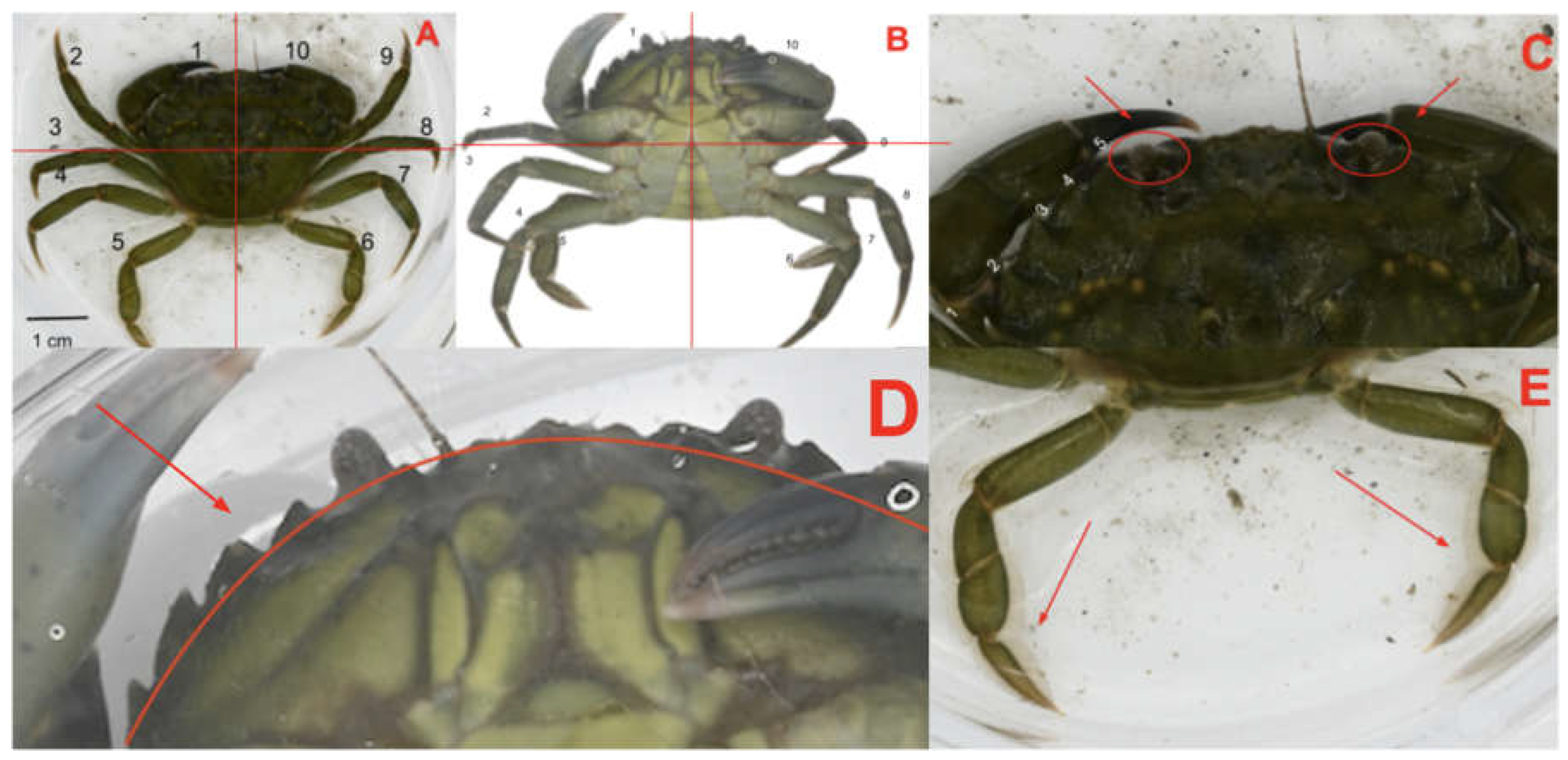
- If the specimen has a crab-like form with the fifth pair of thoracic legs not markedly reduced, a reduced abdomen folded under the body lacking uropods, and short antennae set medial to the eyes, proceed to step 2. (Figure 2A,B)
- If not, the specimen is not a “true crab.”
- 2.
-
Assess the carapace shape:
- If the carapace is broader than long with a small or absent rostrum, proceed to step 3. (Figure 2A)
- If not, the specimen is not Carcinus maenas.
- 3.
-
Evaluate the crab’s habitat and pigmentation:
- If the specimen is free-living, well-pigmented, and has non-reduced eyes, proceed to step 4. (Figure 2C)
- If not, the specimen is not Carcinus maenas.
- 4.
-
Observe the carapace outline and size:
- If the front margin is curved and bears a series of teeth between the eye and the anterolateral corner on each side, and the carapace is over 5 cm across, proceed to step 5. (Figure 2C,D)
- If not, the specimen is not Carcinus maenas.
- 5.
-
Check the orientation of the first antennae:
- If the first antennae are folded transversely or obliquely, proceed to step 6. (Figure 2C)
- If not, the specimen is not Carcinus maenas.
- 6.
-
Examine the last pair of walking legs:
- If the last pair of walking legs are not markedly adapted for swimming, have sharp tips for walking, and are slightly flattened, proceed to step 7. (Figure 2E)
- If not, the specimen is not Carcinus maenas.
- 7.
-
Assess specific carapace features:
- If the front region between the eyes is produced into three low teeth, and there are five very prominent sharp anterolateral teeth, proceed to step 8. (Figure 2C)
- If not, the specimen is not Carcinus maenas.
- 8.
-
Consider overall appearance and size:
- If the specimen is an active, long-legged crab commonly 5 - 7.5 cm across the carapace, with color varying from greenish-black to orange, it is likely Carcinus maenas (European green crab).
Figure 2.
Figure 2 depicts images of defining features used to identify carcinus maenas. A Illustrates the dorsal view illustrating ten legs and bilateral symmetry. B Illustrates a ventral view of carcinus maenas with a bilateral plane of symmetry. C Depicts three key defining features of carcinus maenas: (1) non-reduced eyes, (2) obtuse first antennae, and (3) three rows of teeth between the eyes. D Illustrates a carapace that is broader than long with the characteristic, curved front margin. E Images the last pair of walking legs which contain sharp tips for walking (i.e., not adapted for swimming).
Figure 2.
Figure 2 depicts images of defining features used to identify carcinus maenas. A Illustrates the dorsal view illustrating ten legs and bilateral symmetry. B Illustrates a ventral view of carcinus maenas with a bilateral plane of symmetry. C Depicts three key defining features of carcinus maenas: (1) non-reduced eyes, (2) obtuse first antennae, and (3) three rows of teeth between the eyes. D Illustrates a carapace that is broader than long with the characteristic, curved front margin. E Images the last pair of walking legs which contain sharp tips for walking (i.e., not adapted for swimming).
Hemigrapsus sanguineus
Collected 28 August 2024, 09:13 ET; Observed on Atlantic saltwater coastline.
Genetic identification via barcoding is AVAILABLE (Appendix A).
Hemigrapsus sanguineus, commonly known as the Asian Shore Crab or Japanese Shore Crab, is an invasive decapod crustacean now established along the Atlantic Coast of North America, including Woods Hole, Massachusetts region. Taxonomically, it belongs to the kingdom Animalia, phylum Arthropoda, subphylum Crustacea, class Malacostraca, order Decapoda, infraorder Brachyura, family Varunidae, genus Hemigrapsus, and species Sanguineus (Giribet & Edgecomb, 2020). This small crab, typically not exceeding 4 cm in carapace width, is characterized by its square-shaped carapace and three prominent spines on each anterolateral margin. H. sanguineus displays variable coloration, often appearing mottled with shades of green, purple, and brown, with distinctive light and dark bands on its legs. Native to the western Pacific, it was first reported on the Atlantic coast of the United States in 1988 and has since become a common inhabitant of rocky intertidal and shallow subtidal zones, where it competes with native species for resources.
Identification Key
- 1.
-
Examine the overall body form:
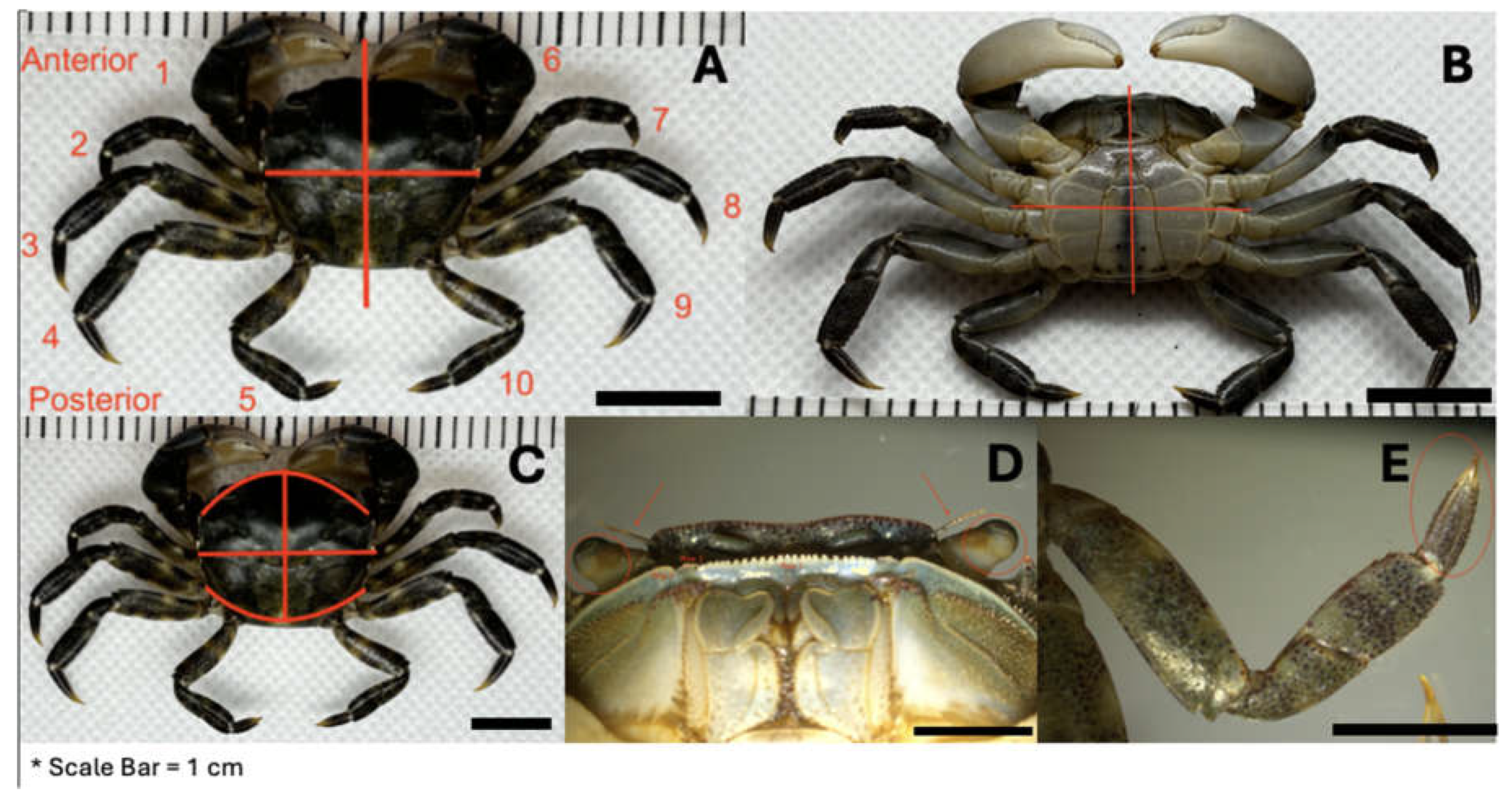
- If the specimen has a crab-like form with the fifth pair of thoracic legs not markedly reduced, a reduced abdomen folded under the body lacking uropods, and short antennae set medial to the eyes, proceed to step 2. (Figure 3A,B)
- If not, the specimen is not a “true crab.”
- 2.
-
Assess the carapace shape:
- If the carapace is broader than long with a small or absent rostrum, proceed to step 3. (Figure 3C)
- If not, the specimen is not Hemigrapsus sanguineus.
- 3.
-
Evaluate the crab’s habitat and pigmentation:
- If the specimen is free-living, well-pigmented, and has non-reduced eyes, proceed to step 4. (Figure 3D)
- If not, the specimen is not Hemigrapsus sanguineus.
- 4.
-
Observe the last pair of walking legs:
- If the last pair of walking legs are not markedly adapted for swimming and have sharp tips for walking, proceed to step 5. (Figure 3E)
- If not, the specimen is not Hemigrapsus sanguineus.
- 5.
-
Count the sharp edges along the carapace:
- If there are three sharp edges along the carapace, proceed to step 6. (Figure 3A)
- If not, the specimen is not Hemigrapsus sanguineus.
- 6.
-
Examine the anterior carapace and antennae:
- If the anterior carapace between the eyes is relatively flat (rather than curved), and the first antennae are obtuse and located between the eyes, proceed to step 7. (Figure 3D)
- If not, the specimen is not Hemigrapsus sanguineus.
- 7.
-
Check for distinctive features:
- If the specimen has three individual sets of teeth on the anterolateral margins, and its overall appearance matches the description (square-shaped carapace, typically not exceeding 4 cm in width, variable coloration often mottled with shades of green, purple, and brown, with distinctive light and dark bands on its legs), it is likely Hemigrapsus sanguineus (Asian Shore Crab).
Figure 3.
A Illustrates a dorsal view of Hemigrapsus sanguineus with ten legs and bilateral symmetry. B Illustrates a ventral view of Hemigrapsus sanguineus along with a scale bar showing width of seven cm from the end of leg three to leg eight. C Illustrates a carapace that is more broad than long with a rounded anterior and posterior front. D Indicates obtuse first antennae between the eyes, non-reduced eyes, and three individual sets of teeth. The anterior carapace between the eyes is relatively flat rather than curved. E Depicts the last leg of Hemigrapsus sanguineus as pointy and used for walking rather than flat for swimming.
Figure 3.
A Illustrates a dorsal view of Hemigrapsus sanguineus with ten legs and bilateral symmetry. B Illustrates a ventral view of Hemigrapsus sanguineus along with a scale bar showing width of seven cm from the end of leg three to leg eight. C Illustrates a carapace that is more broad than long with a rounded anterior and posterior front. D Indicates obtuse first antennae between the eyes, non-reduced eyes, and three individual sets of teeth. The anterior carapace between the eyes is relatively flat rather than curved. E Depicts the last leg of Hemigrapsus sanguineus as pointy and used for walking rather than flat for swimming.
Libinia dubia
Collected 30 August 2024, 11:55 ET; Observed in moss on coastline.
Genetic identification via barcoding is AVAILABLE (Appendix A).
Libinia dubia, commonly known as the Longnose Spider Crab, is a species of marine crab found along the Atlantic coast of North America, including the Woods Hole region of Massachusetts. Taxonomically, it belongs to the kingdom Animalia, phylum Arthropoda, subphylum Crustacea, class Malacostraca, order Decapoda, infraorder Brachyura, family Epialtidae, genus Libinia, and species Dubia (Libinia Dubia, 2024). This crab is characterized by its elongated rostrum, pear-shaped carapace covered with short, stout hairs, and long, slender walking legs. The carapace can reach widths of up to 10 cm (Rjiba-Bahri et al., 2019). L. dubia inhabits a variety of marine environments, from the intertidal zone to depths of about 50 meters, and its range extends from Nova Scotia to the Gulf of Mexico. These crabs are known for their habit of decorating their carapaces with algae and other marine organisms for camouflage.
Identification Key
- 1.
-
Observe the overall body structure:
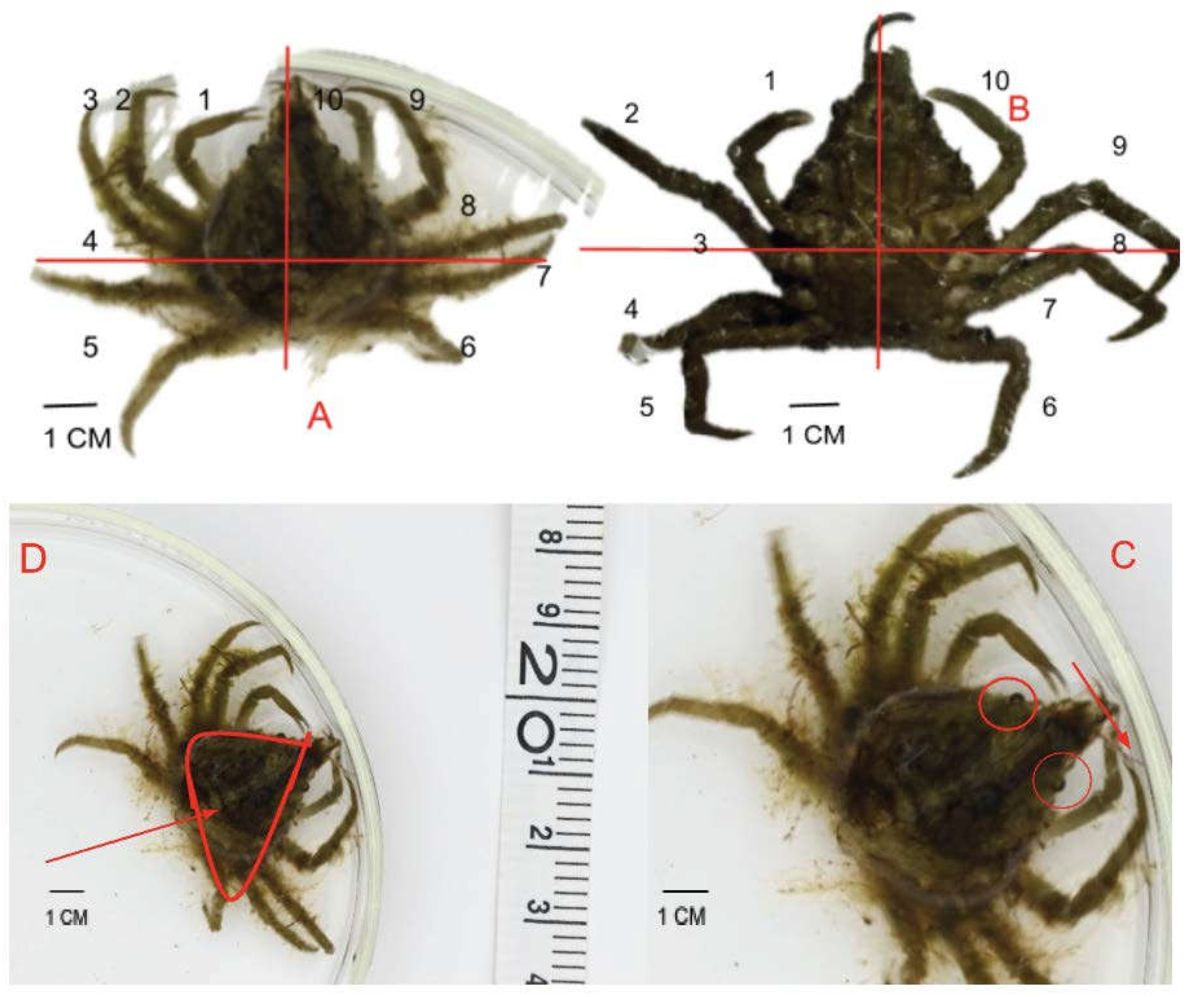
- If the specimen has a typically crablike form with all five pairs of thoracic legs well-developed, a reduced abdomen folded under the body, and short antennae set medial to the eyes, proceed to step 2. (Figure 8A,C)
- If not, the specimen is not Libinia dubia.
- 2.
-
Examine the carapace shape:
- If the carapace is triangular or globose, with the apex projecting forward to form a rostrum, proceed to step 3. (Figure 8D)
- If not, the specimen is not Libinia dubia.
- 3.
-
Check the walking legs:
- If the walking legs are long and conspicuous, proceed to step 4. (Figure 8A,B)
- If not, the specimen is not Libinia dubia.
- 4.
-
Observe the dorsal spines:
- If the carapace has medial dorsal spines, proceed to step 5. (Figure 8D)
- If not, the specimen is not Libinia dubia.
- 5.
-
Count the medial dorsal spines:
- If there are six spines in the median dorsal row with few dorsal tubercles, it is likely Libinia dubia (Longnose Spider Crab). (Figure 8D)
Figure 8.
Figure 8 depicts images of defining features used to identify Libinia dubia. A Illustrates the dorsal view of L. dubia, showing bilateral symmetry and all 10 legs. The long, conspicuous walking legs characteristic of spider crabs are clearly visible. B Shows the ventral view, highlighting the bilateral symmetry of the crab’s underside. C Focuses on the eye characteristics and antennae, depicting the short antennae set medial to the eyes. D Highlights the triangular body shape and elongated rostrum (“nose”) of L. dubia. This panel also shows the six spines in the median dorsal row and the few dorsal tubercles on the carapace, which are key identifying features of this species.
Figure 8.
Figure 8 depicts images of defining features used to identify Libinia dubia. A Illustrates the dorsal view of L. dubia, showing bilateral symmetry and all 10 legs. The long, conspicuous walking legs characteristic of spider crabs are clearly visible. B Shows the ventral view, highlighting the bilateral symmetry of the crab’s underside. C Focuses on the eye characteristics and antennae, depicting the short antennae set medial to the eyes. D Highlights the triangular body shape and elongated rostrum (“nose”) of L. dubia. This panel also shows the six spines in the median dorsal row and the few dorsal tubercles on the carapace, which are key identifying features of this species.
Limulus polyphemus
Collected 30 August 2024, 11:15 ET; Observed on all coastlines.
Genetic identification via barcoding is UNAVAILABLE.
Limulus polyphemus, commonly known as the Atlantic Horseshoe Crab, is a marine chelicerate arthropod found along the Atlantic coast of North America, including the waters around Woods Hole, Massachusetts. Taxonomically, it belongs to the kingdom Animalia, phylum Arthropoda, subphylum Chelicerata, class Merostomata, order Xiphosura, family Limulidae, genus Limulus, and species Polyphemus (FWS, 2024). Despite its common name, L. polyphemus is not a “true crab” but is more closely related to arachnids. This living fossil has existed relatively unchanged for approximately 450 million years. Characterized by its distinctive horseshoe-shaped carapace, L. Polyphemus can grow up to 60 cm in length, with females typically larger than males. The species possesses a long, rigid tail-like telson, used primarily for righting itself if overturned. L. polyphemus plays crucial ecological roles in coastal ecosystems, including as a bioturbator and a food source for migratory birds. Additionally, its unique copper-based blue blood, containing Limulus Amebocyte Lysate (LAL), is invaluable in biomedical applications for detecting bacterial endotoxins.
Identification Key
- 1.
-
Observe the overall body structure:
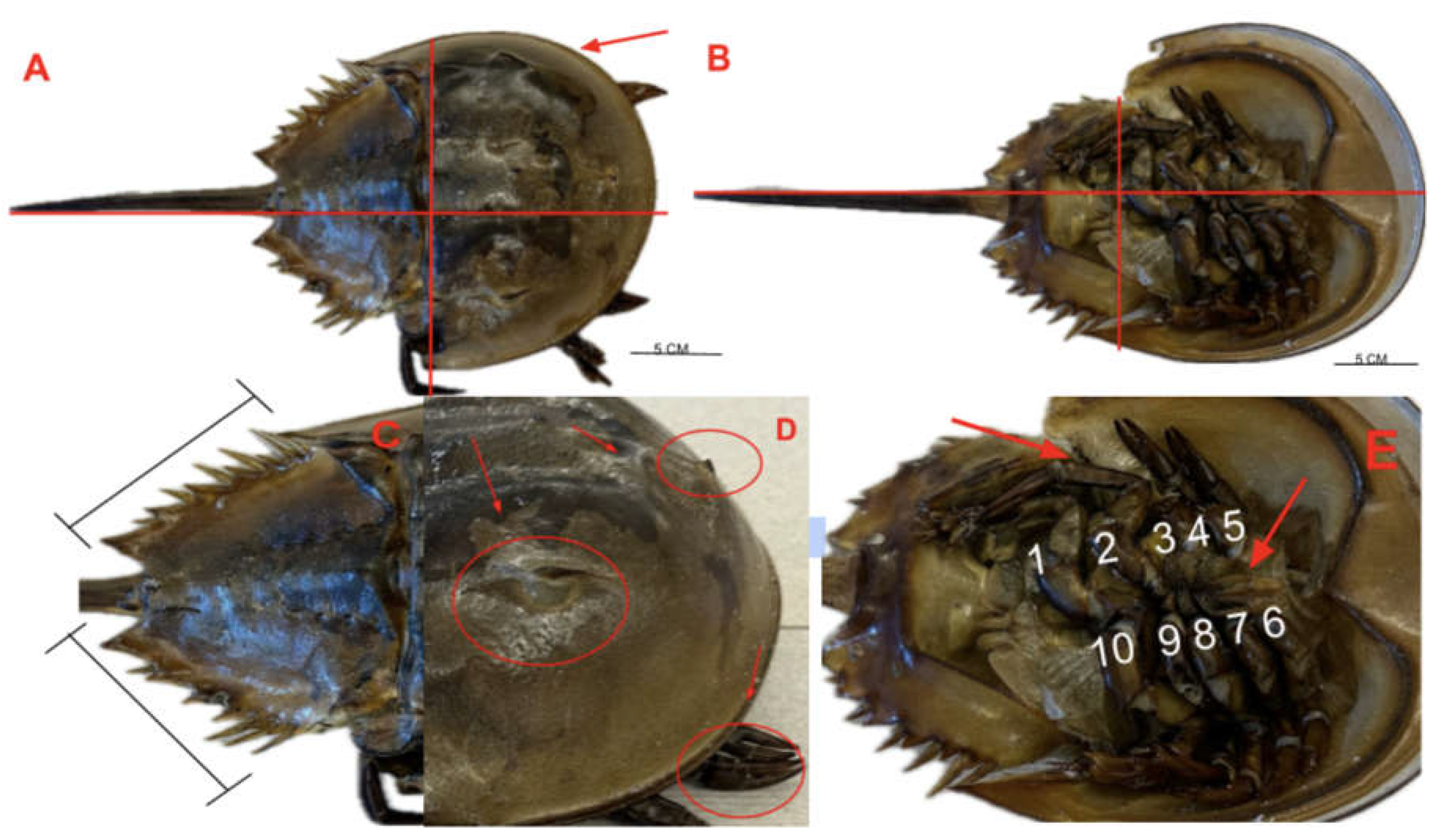
- If the specimen has a large horseshoe-shaped carapace with bilateral symmetry, proceed to step 2. (Figure 5A,B)
- If not, the specimen is not Limulus polyphemus.
- 2.
-
Examine the ventral side:
- If the specimen shows a bilateral plane of symmetry on the ventral side, proceed to step 3. (Figure 5B)
- If not, the specimen is not Limulus polyphemus.
- 3.
-
Check for moveable spines:
- If the specimen has moveable spines on its abdomen, proceed to step 4. (Figure 5C)
- If not, the specimen is not Limulus polyphemus.
- 4.
-
Identify key features on the dorsal side:
- If the specimen has compound eyes and simple eyes visible on the dorsal side, proceed to step 5. (Figure 5D)
- If not, the specimen is not Limulus polyphemus.
- 5.
-
Examine the legs:
- If the specimen has five pairs of walking legs with sharp tips (not adapted for swimming), proceed to step 6. (Figure 5E)
- If not, the specimen is not Limulus polyphemus.
- 6.
-
Check for chelicerae:
- If chelicerae are present and folded between the walking legs, proceed to step 7. (Figure 5E)
- If not, the specimen is not Limulus polyphemus.
- 7.
-
Assess taxonomic grouping:
- If the specimen belongs to the order Xiphosurida (“horseshoe crabs”), which are ancient (450 mya) chelicerates, it is likely Limulus polyphemus (Atlantic Horseshoe Crab). (Figure 5B)
Figure 5.
Figure 5 depicts images of defining features used to identify Limulus polyphemus. A Illustrates the dorsal view illustrating the carapace and bilateral symmetry. B Illustrates a ventral view of Limulus polyphemus with a bilateral plane of symmetry. C Illustrates moveable spines in its abdomen. D Depicts three key defining features of Limulus polyphemus: (1) compound eyes, (2) first legs (female), and (3) simple eyes. E Images the five pairs of walking legs which contain sharp tips for walking (i.e., not adapted for swimming) and the chelicerae folded in between.
Figure 5.
Figure 5 depicts images of defining features used to identify Limulus polyphemus. A Illustrates the dorsal view illustrating the carapace and bilateral symmetry. B Illustrates a ventral view of Limulus polyphemus with a bilateral plane of symmetry. C Illustrates moveable spines in its abdomen. D Depicts three key defining features of Limulus polyphemus: (1) compound eyes, (2) first legs (female), and (3) simple eyes. E Images the five pairs of walking legs which contain sharp tips for walking (i.e., not adapted for swimming) and the chelicerae folded in between.
Ovalipes ocellatus
Collected 30 August 2024, 11:10 ET; Observed in brackish water of marsh.
Genetic identification via barcoding is AVAILABLE (Appendix A).
Ovalipes ocellatus, commonly known as the Lady Crab, is a species of swimming crab found along the eastern coast of North America, including the Woods Hole region of Massachusetts. Taxonomically, it belongs to the kingdom Animalia, phylum Arthropoda, subphylum Crustacea, class Malacostraca, order Decapoda, infraorder Brachyura, family Portunidae, genus Ovalipes, and species Ocellatus (Giribet & Edgecomb, 2020). This crab is characterized by its oval-shaped carapace, which can reach widths of up to 7.6 cm (3 inches), and its distinctive purple-spotted claws. The Lady Crab inhabits sandy and muddy bottoms in coastal waters, ranging from the intertidal zone to depths of about 100 meters. Its distribution extends from Nova Scotia to the Gulf of Mexico, making it a common species in the Woods Hole area. O. ocellatus plays a significant role in benthic ecosystems as both predator and prey, and it is occasionally harvested for human consumption.
Identification Key
- 1.
-
Observe the overall body structure:
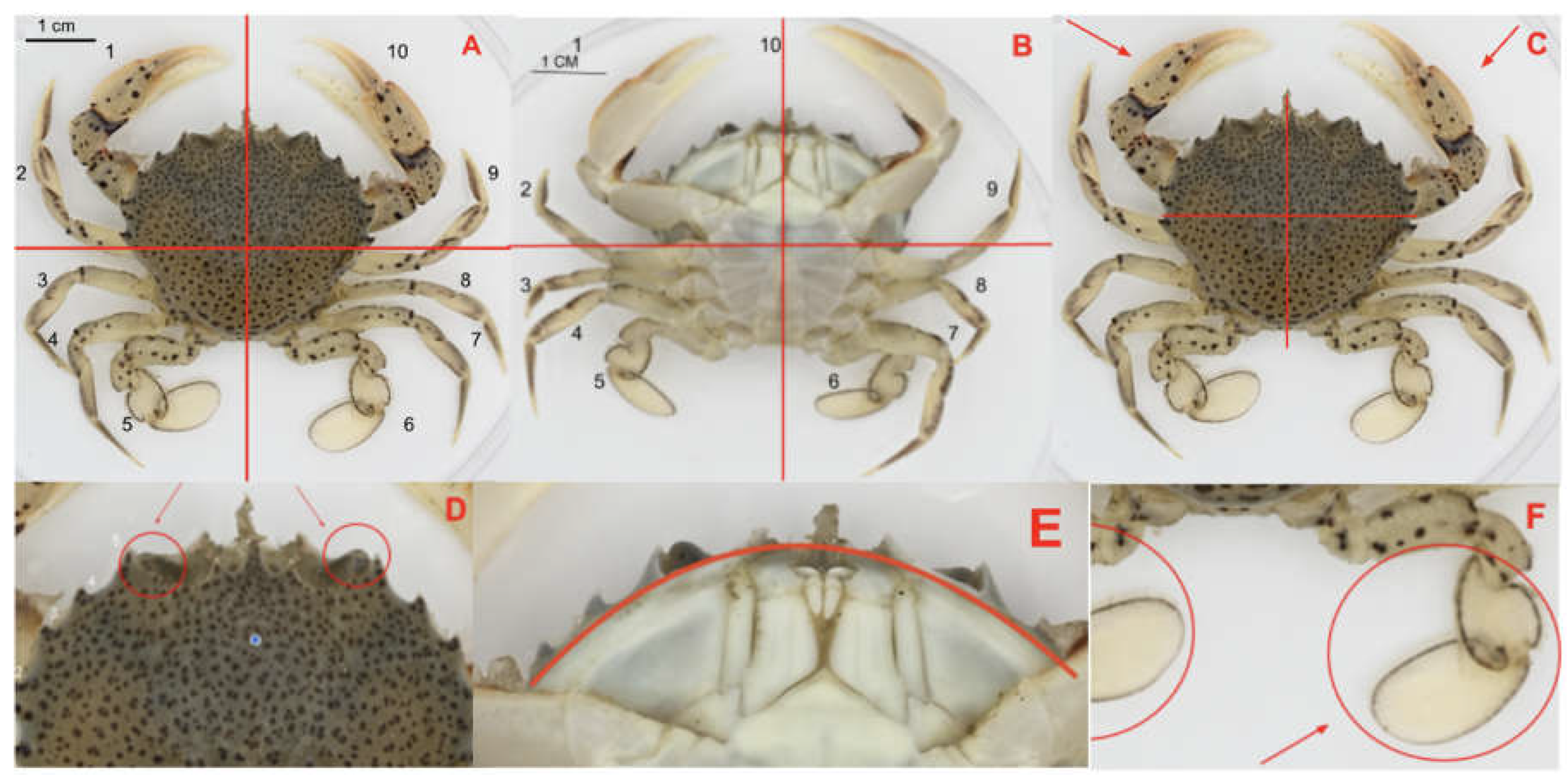
- If the specimen has a typically crablike form with a carapace broader than long, proceed to step 2. (Figure 6A,C)
- If not, the specimen is not Ovalipes ocellatus.
- 2.
-
Examine the abdomen:
- If the abdomen is reduced and folded under the body, proceed to step 3. (Figure 6B)
- If not, the specimen is not Ovalipes ocellatus.
- 3.
-
Check the eyes and pigmentation:
- If the specimen is well-pigmented with fully developed eyes, proceed to step 4. (Figure 6D)
- If not, the specimen is not Ovalipes ocellatus.
- 4.
-
Examine the carapace margin:
- If the front margin of the carapace is curved and bears a series of teeth between the eye and the anterolateral corner, proceed to step 5. (Figure 6D,E)
- If not, the specimen is not Ovalipes ocellatus.
- 5.
-
Check the antennae:
- If the first antennae are folded transversely or obliquely, proceed to step 6. (Figure 6E)
- If not, the specimen is not Ovalipes ocellatus.
- 6.
-
Examine the last pair of legs:
- If the last pair of legs are flattened and paddle-like with rounded tips, adapted for swimming, proceed to step 7. (Figure 6F)
- If not, the specimen is not Ovalipes ocellatus.
- 7.
-
Assess taxonomic grouping:
-
Count the antero-lateral teeth and observe coloration:If the carapace has five antero-lateral teeth and the crab has a cream to tan coloration with distinctive purple spots on the claws, it is likely Ovalipes ocellatus (Lady Crab). (Figure 6A)
-
Figure 6.
Figure 6 depicts images of defining features used to identify Ovalipes ocellatus. A Illustrates the dorsal view of O. ocellatus, showing the typical crablike form with a broad carapace. B Shows the ventral view, highlighting the reduced abdomen folded under the body. C Depicts the carapace, which is broader than long with a small rostrum. D Illustrates the well-pigmented body and developed eyes of the free-living crab. E Shows the curved front margin of the carapace with a series of teeth, characteristic of “cancroid” crabs. The image also depicts the first antennae folded transversely. F Highlights the last pair of legs, which are flattened and paddle-like, adapted for swimming.
Figure 6.
Figure 6 depicts images of defining features used to identify Ovalipes ocellatus. A Illustrates the dorsal view of O. ocellatus, showing the typical crablike form with a broad carapace. B Shows the ventral view, highlighting the reduced abdomen folded under the body. C Depicts the carapace, which is broader than long with a small rostrum. D Illustrates the well-pigmented body and developed eyes of the free-living crab. E Shows the curved front margin of the carapace with a series of teeth, characteristic of “cancroid” crabs. The image also depicts the first antennae folded transversely. F Highlights the last pair of legs, which are flattened and paddle-like, adapted for swimming.
Celuca pugilator
Collected 30 August 2024, 10:40 ET; Observed on dry sand at marsh neck.
Genetic identification via barcoding is AVAILABLE (Appendix A).
Celuca pugilator, commonly known as the Atlantic Sand Fiddler Crab, is a small semi-terrestrial crustacean found along the eastern coast of North America, including the Woods Hole region of Massachusetts. Taxonomically, it belongs to the kingdom Animalia, phylum Arthropoda, subphylum Crustacea, class Malacostraca, order Decapoda, infraorder Brachyura, family Ocypodidae, genus Celuca, and species Pugilator (Giribet & Edgecomb, 2020). This crab is characterized by its sexual dimorphism, most notably the males’ single greatly enlarged claw used for signaling and combat. The carapace is generally square-shaped and can reach widths of up to 15 mm in males and 13 mm in females. C. pugilator inhabits sandy beaches, salt marshes, and mudflats in the intertidal zone, ranging from Massachusetts to the Gulf of Mexico. These crabs play a crucial role in their ecosystem as detritivores and as prey for various birds and fish.
Identification Key
- 1.
-
Observe the overall body structure:
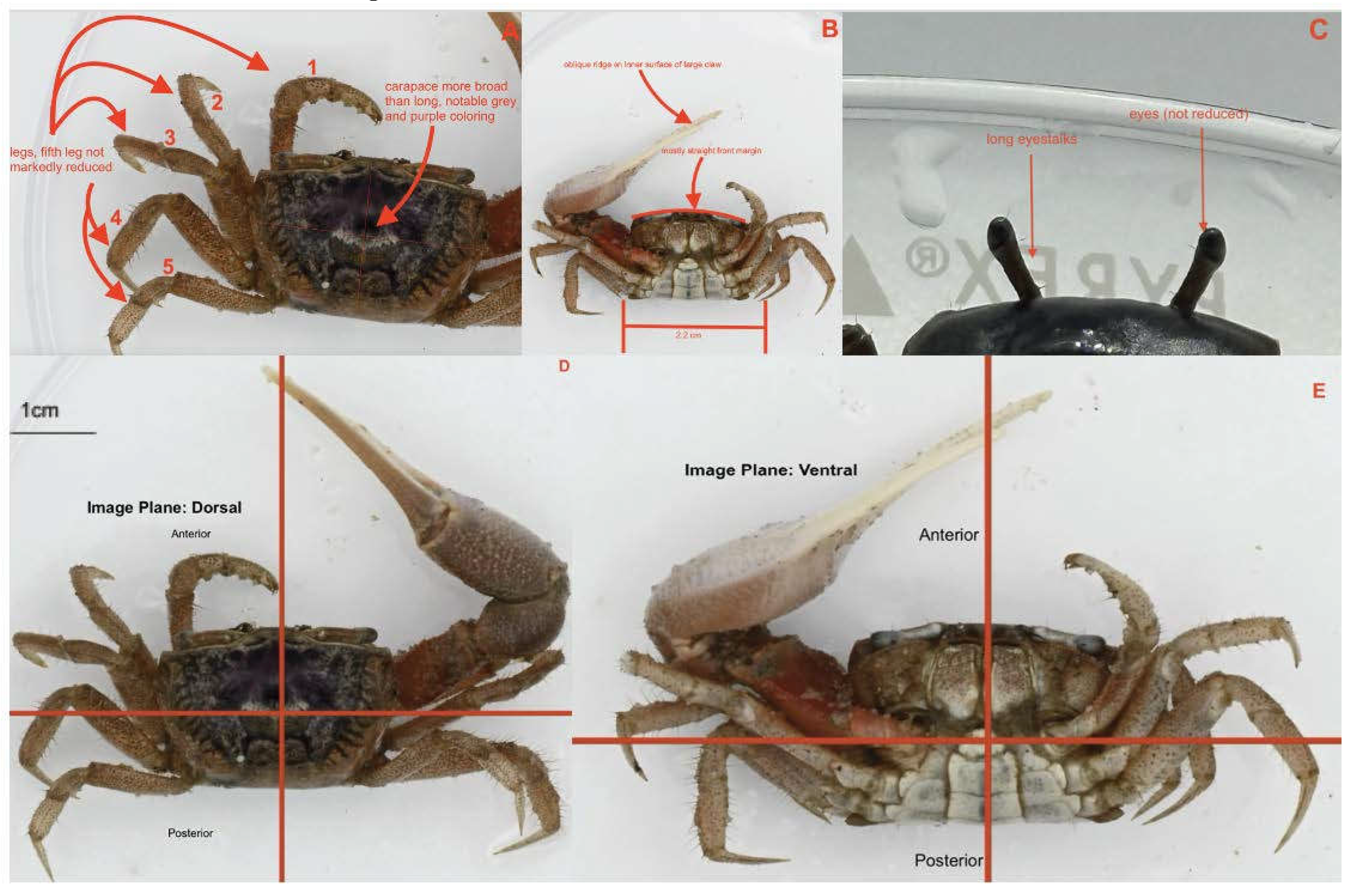
- If the specimen has a typically crablike form with reduced abdomen folded under the body, short antennae set medial to the eyes, and the fifth pair of thoracic legs not markedly reduced, proceed to step 2. (Figure 7A)
- If not, the specimen is not Celuca pugilator.
- 2.
-
Examine the carapace:
- If the carapace is squarish with a more or less straight front margin, proceed to step 3. (Figure 7A,B)
- If not, the specimen is not Celuca pugilator.
- 3.
-
Check the eyes and pigmentation:
- If the specimen is well-pigmented with fully developed eyes on long eyestalks, proceed to step 4. (Figure 7C)
- If not, the specimen is not Celuca pugilator.
- 4.
-
Examine the third maxillipeds:
- If the third maxilliped is almost or quite close over the mouth region when held at rest, proceed to step 5. (Figure 7B)
- If not, the specimen is not Celuca pugilator.
- 5.
-
Check for cheliped dimorphism in males:
- If one cheliped of the male is very large (in females, both chelipeds are small), proceed to step 6. (Figure 7B)
- If not, the specimen is not Celuca pugilator.
- 6.
-
Observe the carapace coloration:
- If the carapace is mottled in grays and purple, it is likely Celuca pugilator (Atlantic Sand Fiddler Crab). (Figure 7A,B)
Figure 7.
Figure 7 depicts images of defining features used to identify Celuca pugilator. A Illustrates the dorsal view of C. pugilator, showing the squarish carapace with a straight front margin and the mottled gray and purple coloration. B Shows a close-up of the male’s large cheliped, highlighting the absence of an oblique ridge on the inner surface of the claw. The image also captures the mottled coloration of the carapace. C Depicts the frontal view of C. pugilator showcasing the long eyestalks. D Displays a plane image of C. pugliator from a dorsal perspective. E Demonstrates the ventral perspective.
Figure 7.
Figure 7 depicts images of defining features used to identify Celuca pugilator. A Illustrates the dorsal view of C. pugilator, showing the squarish carapace with a straight front margin and the mottled gray and purple coloration. B Shows a close-up of the male’s large cheliped, highlighting the absence of an oblique ridge on the inner surface of the claw. The image also captures the mottled coloration of the carapace. C Depicts the frontal view of C. pugilator showcasing the long eyestalks. D Displays a plane image of C. pugliator from a dorsal perspective. E Demonstrates the ventral perspective.
Pagurus longicarpus
Collected 28 August 2024, 09:15 ET; Observed on all coastlines.
Genetic identification via barcoding is UNAVAILABLE.
Pagurus longicarpus, commonly known as the long-clawed hermit crab, is a decapod crustacean native to the northwestern Atlantic Ocean, including the coastal waters of Woods Hole, Massachusetts. Taxonomically, it belongs to the kingdom Animalia, phylum Arthropoda, subphylum Crustacea, class Malacostraca, order Decapoda, infraorder Anomura, family Paguridae, genus Pagurus, and species Longicarpus (Barnegat, 2023). This small hermit crab typically measures 5 - 12 mm in carapace length and is characterized by its asymmetrical body plan, with a soft, curved abdomen adapted for living in abandoned gastropod shells. P. longicarpus is distinguished by its elongated right cheliped, which is significantly larger than the left, and its long antennae. The species exhibits variable coloration, often appearing light brown to olive-green, with the exposed parts sometimes bearing blue or red tints. Found in intertidal and shallow subtidal zones, P. longicarpus plays a crucial role in coastal ecosystems as a scavenger and prey species for various marine organisms.
Identification Key
- 1.
-
Observe the habitat and body structure:
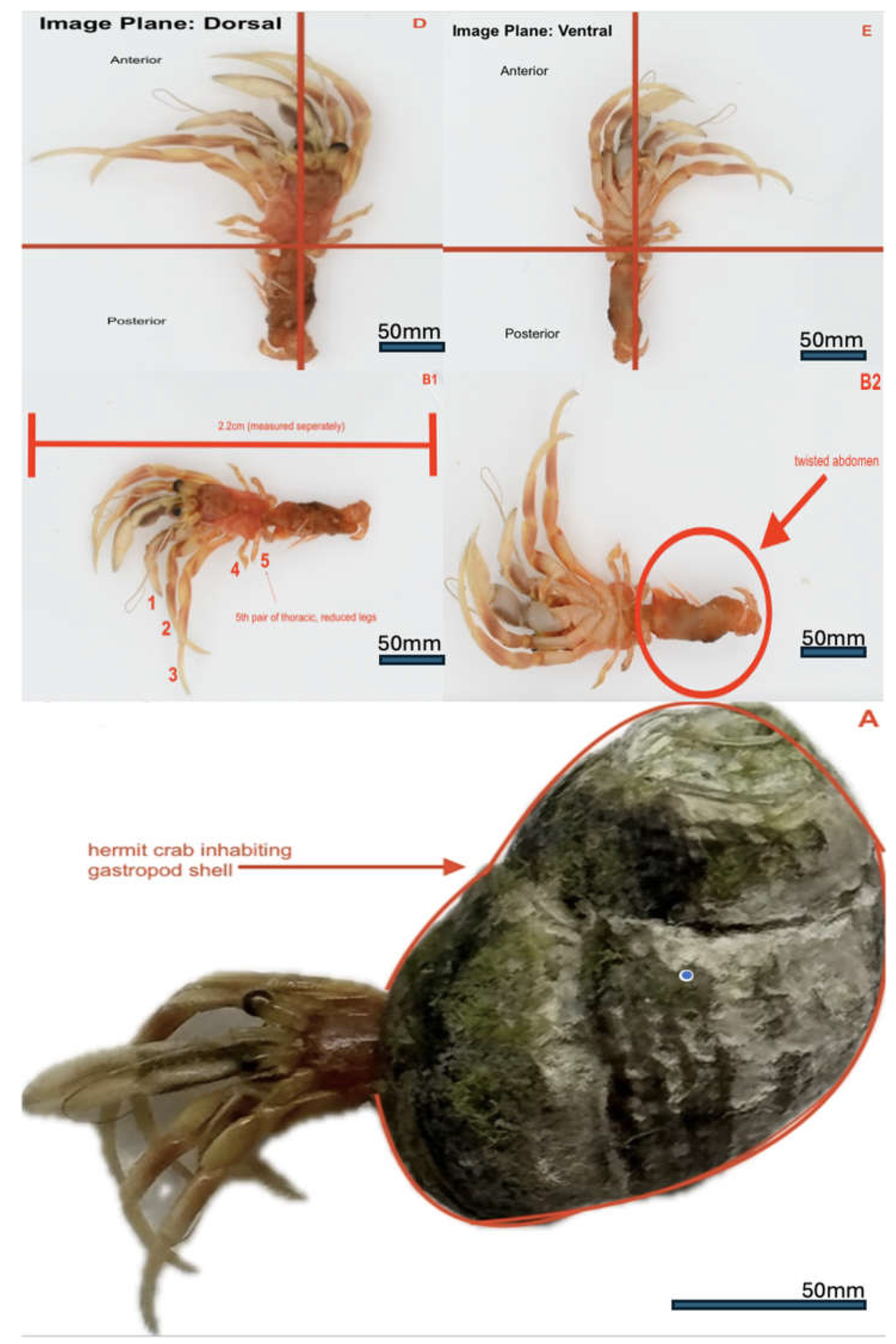
- If the animal inhabits a gastropod shell and has a soft, twisted abdomen, proceed to step 2. (Figure 7A,B2)
- If not, the specimen is not a hermit crab.
- 2.
-
Examine the thoracic legs:
- If the fifth pair of thoracic legs is very reduced and folded up above the bases of the fourth pair, proceed to step 3. (Figure 7B1,B2)
- If not, the specimen is not Pagurus longicarpus.
- 3.
-
Assess the body form and abdomen:
- If the body form varies from quite crab-like to not very crab-like, and the abdomen is asymmetrical, twisted, or reduced but with uropods, proceed to step 4. (Figure 7B1,B2)
- If not, the specimen is not Pagurus longicarpus.
- 4.
-
Examine the chelipeds:
- If the chelipeds are slender with sub-cylindrical hands, proceed to step 5. (Figure 7C)
- If not, the specimen is not Pagurus longicarpus.
- 5.
-
Check for cheliped banding:
- If the chelae do not have distinct banding, it is likely Pagurus longicarpus (Long-clawed Hermit Crab). (Figure 7C)
- If distinct banding is present, the specimen is not Pagurus longicarpus.
Figure 7.
illustrates key identifying features of Pagurus longicarpus. A Shows the hermit crab inhabiting a gastropod shell, demonstrating its characteristic habitat. B1 Provides a dorsal view of P. longicarpus, indicating a carapace length of 10 mm with five visible legs and the fifth pair of thoracic legs reduced. B2 Depicts a ventral view, highlighting the twisted abdomen characteristic of hermit crabs. C Illustrates the slender chelipeds with sub-cylindrical hands and the absence of distinct banding on the chelae. D Shows the image plane from a dorsal view. E Shows a ventral perspective, noting the anterior and posterior of the specimen.
Figure 7.
illustrates key identifying features of Pagurus longicarpus. A Shows the hermit crab inhabiting a gastropod shell, demonstrating its characteristic habitat. B1 Provides a dorsal view of P. longicarpus, indicating a carapace length of 10 mm with five visible legs and the fifth pair of thoracic legs reduced. B2 Depicts a ventral view, highlighting the twisted abdomen characteristic of hermit crabs. C Illustrates the slender chelipeds with sub-cylindrical hands and the absence of distinct banding on the chelae. D Shows the image plane from a dorsal view. E Shows a ventral perspective, noting the anterior and posterior of the specimen.
Pagurus pollicaris
Collected 30 August 2024, 12:10 ET; Observed on rocks of coastline.
Genetic identification via barcoding is AVAILABLE (Appendix A).
Pagurus pollicaris, commonly known as the Flat-Clawed Hermit Crab, is a species of marine hermit crab found along the Atlantic coast of North America, including the Woods Hole region of Massachusetts. Taxonomically, it belongs to the kingdom Animalia, phylum Arthropoda, subphylum Crustacea, class Malacostraca, order Decapoda, superfamily Paguroidea, family Paguridae, genus Pagurus, and species Pollicaris (Giribet & Edgecomb, 2020). This hermit crab is characterized by its distinctive flat, broad right cheliped (claw), which is significantly larger than the left and is used to seal the aperture of its adopted shell when the crab withdraws. P. pollicaris typically inhabits gastropod shells and can reach sizes of up to 8 cm in total length. Its range extends from Massachusetts to the Gulf of Mexico, occupying various marine habitats from the intertidal zone to depths of about 200 meters. These crabs play important roles in marine ecosystems as scavengers and prey items.
Identification Key
- 1.
-
Observe the overall body structure:
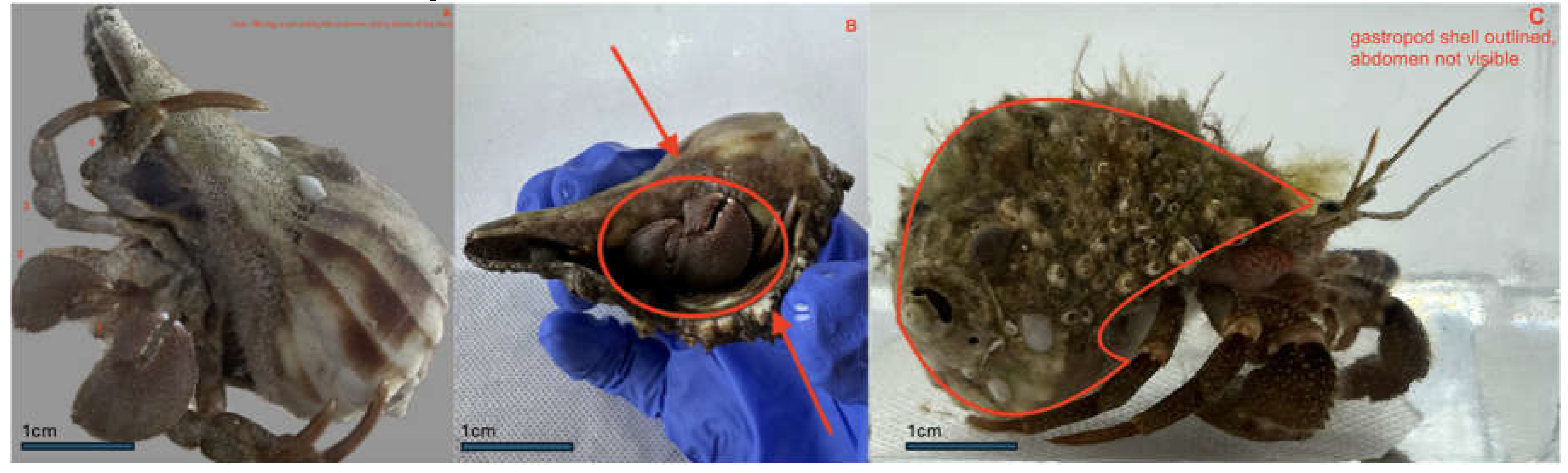
- If the specimen has four visible pairs of legs (the fifth pair is reduced and not visible in this specimen), proceed to step 2. (Figure 8A)
- If not, the specimen is not Pagurus pollicaris.
- 2.
-
Examine the claws:
- If one claw (typically the right) is noticeably larger, broad, flat, and tuberculate, proceed to step 3. (Figure 8B)
- If not, the specimen is not Pagurus pollicaris.
- 3.
-
Check for gastropod shell habitation:
- If the animal is inhabiting a gastropod shell, it is likely Pagurus pollicaris (Flat-Clawed Hermit Crab). (Figure 8C)
Figure 8.
depicts images of defining features used to identify Pagurus pollicaris. A Illustrates the legs of P. pollicaris. Four pairs of legs are visible and numbered in red font. Note that the fifth pair of legs, which would be reduced and folded up above the fourth pair, is not visible in this image as the organism was not euthanized for full examination. B Shows a close-up view of the large, flat claw (cheliped) characteristic of P. pollicaris. C Displays P. pollicaris inhabiting a gastropod shell, which is typical behavior for hermit crabs. The shell provides protection for the crab’s soft, twisted abdomen, which is not visible in this image.
Figure 8.
depicts images of defining features used to identify Pagurus pollicaris. A Illustrates the legs of P. pollicaris. Four pairs of legs are visible and numbered in red font. Note that the fifth pair of legs, which would be reduced and folded up above the fourth pair, is not visible in this image as the organism was not euthanized for full examination. B Shows a close-up view of the large, flat claw (cheliped) characteristic of P. pollicaris. C Displays P. pollicaris inhabiting a gastropod shell, which is typical behavior for hermit crabs. The shell provides protection for the crab’s soft, twisted abdomen, which is not visible in this image.
Munica Pugnax
Collected 30 August 2024, 11:20 ET; Observed in mud of marsh coastline.
Genetic identification via barcoding is AVAILABLE (Appendix A).
Munica pugnax, commonly known as the Atlantic Marsh Fiddler Crab, is a small, semi-terrestrial crustacean belonging to the kingdom Animalia, phylum Arthropoda, subphylum Crustacea, class Malacostraca, order Decapoda, infraorder Brachyura, family Oxypodidae, genus Minuca, and species Pugnax. This species exhibits notable sexual dimorphism, with adults typically measuring 15-25 mm in carapace width. Males are distinguished by one greatly enlarged cheliped, usually on the right side, which can constitute up to 50% of the crab’s total mass, while females have both claws small and of equal size. Both sexes possess a squarish carapace wider than it is long, varying in color from dark olive-green to brown or nearly black, four pairs of walking legs, and eyes set on long stalks. Found along the Atlantic coast of North America from Massachusetts to northern Florida, M. pugnax inhabits salt marshes, tidal mud flats, and tidal creek banks, preferring areas with mixed sand and mud. As a detritivore feeding on algae, bacteria, and sediment detritus, it plays a crucial role in nutrient cycling within salt marsh ecosystems. Males are known for their distinctive waving display using their enlarged claw, a behavior that gives the species its common name. These crabs emerge during low tide to feed, mate, and interact, retreating to burrows up to 30 cm deep during high tide. Their burrowing activities aerate the soil, promoting marsh plant growth and influencing sediment chemistry, while also serving as prey for various birds, fish, and other marsh inhabitants.
Identification Key
- 1.
-
Examine the overall body form:
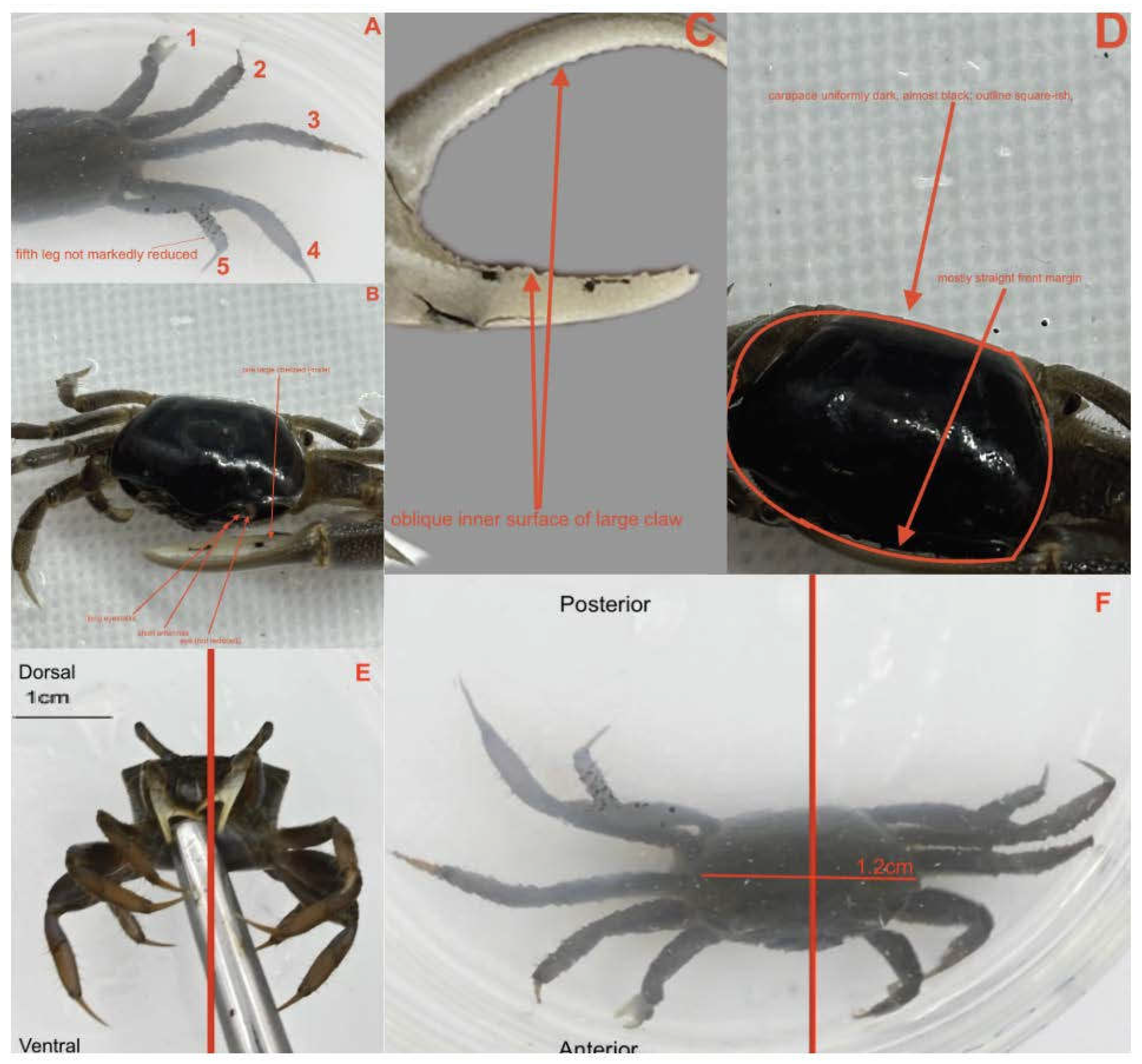
- If the animal has a typically crablike form, with the fifth (last) pair of thoracic legs not markedly reduced, abdomen reduced and folded under body, lacking uropods, and antennae short and set medial to the eyes, proceed to step 2. (Figure 9A)
- If not, the specimen is not a “true crab.”
- 2.
-
Observe the mouth region and front of the carapace:
- If the third maxillipeds almost or quite close over the mouth region when held at rest, the front is moderately or very narrow, eyestalks are long, and one cheliped of male is very large (typical of “fiddler crabs”), proceed to step 3. (Figure 9B)
- If not, the specimen is not Minuca pugnax.
- 3.
-
Check the habitat and pigmentation:
- If the crab is free-living and well pigmented, with eyes not reduced, proceed to step 4. (Figure 9D,E)
- If not, the specimen is not Minuca pugnax.
- 4.
-
Examine the carapace outline:
- If the carapace outline is squarish with a more or less straight front margin, and the crab is active, semi-terrestrial, rarely over 4 cm across carapace, proceed to step 5. (Figure 9D)
- If not, the specimen is not Minuca pugnax.
- 5.
-
Examine the large claw:
- If the inner surface of the large claw has an oblique ridge and all previous features, the species is most likely Minuca pugnax.
Figure 9.
Figure 9 illustrates key identifying features of the Minuca Pugnax. A Illustrates the quantity of legs on one side of the body, with the thoracic legs being not markedly reduced. B Shows the distinct short size of the antennae, long eyestalks, and eyes not reduced. It further displays the existence of one large cheliped in male M. Pugnax. C Indicates the presence of the inner surface of large claw with an oblique ridge. D Shows the carapace as uniformly dark (almost black), carapace outline almost square, mostly straight front maraign. E Illustrates the anterior view of the size of the M. Pugnax with indication of bilateral symmetry along the dorsal-ventral axis. F Illustrates the dorsal view of the size of the M. Pugnax with indication of bilateral symmetry along the anterior-posterior axis. This shows the size of the carapace at 1.2cm, under 4 cm across.
Figure 9.
Figure 9 illustrates key identifying features of the Minuca Pugnax. A Illustrates the quantity of legs on one side of the body, with the thoracic legs being not markedly reduced. B Shows the distinct short size of the antennae, long eyestalks, and eyes not reduced. It further displays the existence of one large cheliped in male M. Pugnax. C Indicates the presence of the inner surface of large claw with an oblique ridge. D Shows the carapace as uniformly dark (almost black), carapace outline almost square, mostly straight front maraign. E Illustrates the anterior view of the size of the M. Pugnax with indication of bilateral symmetry along the dorsal-ventral axis. F Illustrates the dorsal view of the size of the M. Pugnax with indication of bilateral symmetry along the anterior-posterior axis. This shows the size of the carapace at 1.2cm, under 4 cm across.
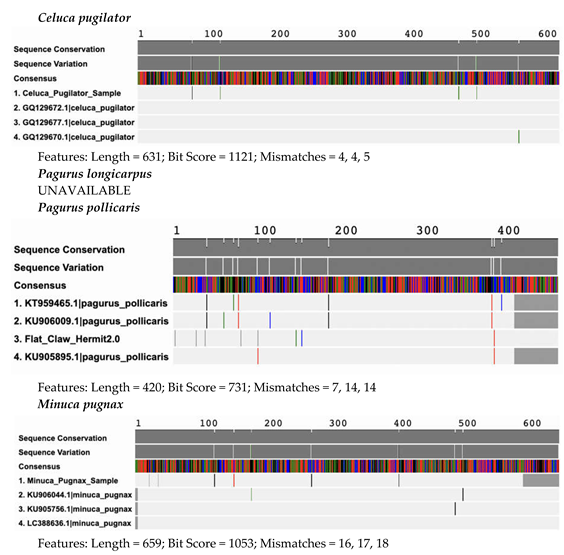
Appendix A
This appendix presents the genetic sequences for arthropod species identified in the Woods Hole, Massachusetts region. The data contained herein is the result of meticulous analysis and comparison between field-caught samples and reference data from the Basic Local Alignment Search Tool (BLAST) database. For each species listed in the main catalog, this appendix provides the aligned barcode region of the cytochrome c oxidase subunit I (COI) gene, which is commonly used for species identification in animals. The sequences are presented in a format that highlights both similarities and differences between the field-caught sample sequence and the BLAST reference sequence.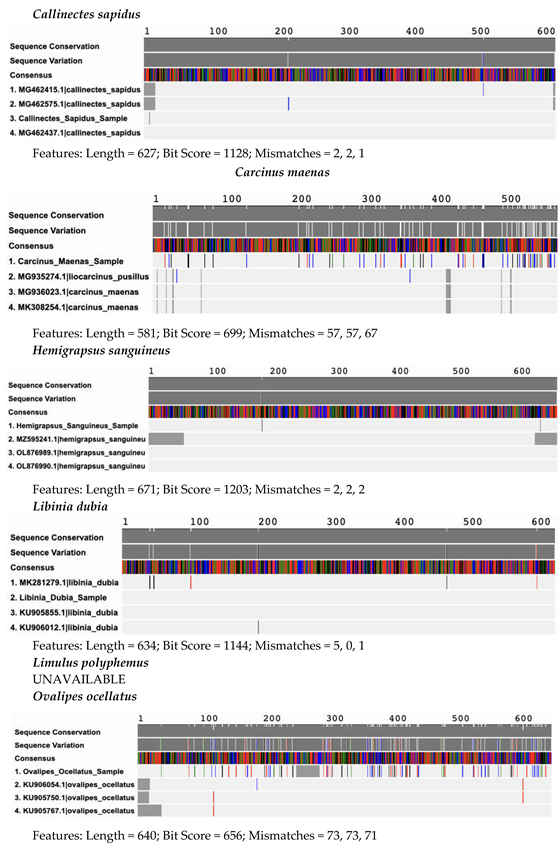
Appendix B
| Scientific Name | Common Name | Taxonomy | Collection Date | Location |
| Callinectes sapidus | Blue Crab | Kingdom Animalia, Phylum Arthropoda, Subphylum Crustacea, Class Malacostraca, Order Decapoda, Infraorder Brachyura, Family Portunidae, Genus, Callinectes, Species Sapidus | 08/28/24 | Submerged in the mouth |
| Carcinus maenas | Green Crab | Kingdom Animalia, Phylum Arthropoda, Subphylum Crustacea, Class Malacostraca, Order Decapoda, Infraorder Brachyura, Family Portunidae, Genus Carcinus, and Species Maenas | 08/28/24 | Submerged in the mouth |
| Hemigrapsus sanguineus | Asian Shore Crab | Kingdom Animalia, Phylum Arthropoda, Subphylum Crustacea, Class Malacostraca, Order Decapoda, Infraorder Brachyura, Family Varunidae, Genus Hemigrapsus, and Species Sanguineus | 08/28/24 | Under rocks in the beachline |
| Libinia dubia | Spider Crab | Kingdom Animalia, Phylum Arthropoda, Subphylum Crustacea, Class Malacostraca, Order Decapoda, Infraorder Brachyura, Family Epialtidae, Genus Libinia, And Species Dubia | 08/30/24 | Submerged in the shallow end of the beachline |
| Ovalipes ocellatus | Lady Crab | Kingdom Animalia, Phylum Arthropoda, Subphylum Crustacea, Class Malacostraca, Order Decapoda, Infraorder Brachyura, Family Portunidae, Genus Ovalipes, and Species Ocellatus | 08/30/24 | Shallow of the brackish coastline |
| Celuca pugilator | Sand Fiddler Crab | Kingdom Animalia, Phylum Arthropoda, Subphylum Crustacea, Class Malacostraca, Order Decapoda, Infraorder Brachyura, Family Ocypodidae, Genus Celuca, and Species Pugilator | 08/30/24 | Dune |
| Pagurus longicarpus | Long Claw Hermit Crab | Kingdom Animalia, Phylum Arthropoda, Subphylum Crustacea, Class Malacostraca, Order Decapoda, Infraorder Anomura, Family Paguridae, Genus Pagurus, and Species Longicarpus | 09/03/24 | Submerged in shoreline |
| Pagurus pollicaris | Flat Claw Hermit Crab | Kingdom Animalia, Phylum Arthropoda, Subphylum Crustacea, Class Malacostraca, Order Decapoda, Superfamily Paguroidea, Family Paguridae, Genus Pagurus, and Species Pollicaris | 08/30/24 | Submerged in the beachline |
| Minuca pugnax | Mud Fiddler | Kingdom Animalia, Phylum Arthropoda, Subphylum Crustacea, Class Malacostraca, Order Decapoda, Infraorder Brachyura, Family Ocypodidae, Genus Minuca, and Species Pugnax | 09/03/24 | Wet mud in marsh |
References
- DecaNet eds. 2024. DecaNet. Callinectes sapidus Rathbun, 1896. Last modified January 12, 2024: https://www.marinespecies.org/aphia.php?p=taxdetails&id=107379.
- DecaNet eds. 2024. DecaNet. Carcinus maenas Linnaeus, 1758. Last modified January 11, 2024: https://www.marinespecies.org/aphia.php?p=taxdetails&id=107381.
- “REVISED KEYS TO MARINE INVERTEBRATES of the WOODS HOLE REGION”, 1964.
- “Atlantic Horseshoe Crab (Limulus Polyphemus): U.S. Fish & Wildlife Service.” FWS.gov. Accessed September 10, 2024. https://www.fws.gov/species/atlantic-horseshoe-crab-limulus-polyphemus.
- Giribet, Gonzalo, and Gregory D. Edgecombe. The Invertebrate Tree of Life. Princeton, NJ: Princeton University Press, 2020.
- “Libinia Dubia.” World Register of Marine Species - Libinia Dubia H. Milne Edwards, 1834. Accessed September 10, 2024. https://www.marinespecies.org/aphia.php?p=taxdetails&id=107335.
- “Long-Clawed Hermit Crab.” Barnegat Bay Partnership, August 30, 2023. https://barnegatbaypartnership.org/species/long-clawed-hermit-crab/.
- Walters, Erin A, Jamie Bojko, Claire E Crowley, Ryan L Gandy, Charles W Martin, e, f, g, Highlights•Twelve symbiont groups identified in Florida C. sapidus include Ciliophorans, and AbstractSubtropical Florida blue crabs.
- “Salinity and Temperature Affect the Symbiont Profile and Host Condition of Florida USA Blue Crabs Callinectes Sapidus.” Journal of Invertebrate Pathology, May 4, 2023. https://www.sciencedirect.com/science/article/pii/S0022201123000472.
- Blue Crab Life Cycle. Accessed September 10, 2024. https://www.bluecrab.info/lifecycle.html.
- Rjiba-Bahri, Wafa, Faten Khamassi, Emna Soufi Kechaou, Amani Chaffai, and Jamila Ben Souissi. “Morphological and Biological Traits, Exoskeleton Biochemistry and Socio-Economic Impacts of the Alien Invasive Crab Libinia Dubia H. Milne Edwards, 1834 from the Tunisian Coast (Central Mediterranean) - Thalassas: An International Journal of Marine Sciences.” SpringerLink, January 30, 2019. https://link.springer.com/article/10.1007/s41208-019-0122-5.
- Lillie, Frank R. “The Woods Hole Marine Biological Laboratory.” The University of Chicago, February 1998.
- Smith, Ralph I. “Keys to Marine Invertebrates of the Woods Hole Region”. Woods Hole, Mass: Systematics-Ecology Program, Marine Biological Laboratory, 1964.
Disclaimer/Publisher’s Note: The statements, opinions and data contained in all publications are solely those of the individual author(s) and contributor(s) and not of MDPI and/or the editor(s). MDPI and/or the editor(s) disclaim responsibility for any injury to people or property resulting from any ideas, methods, instructions or products referred to in the content. |
© 2024 by the authors. Licensee MDPI, Basel, Switzerland. This article is an open access article distributed under the terms and conditions of the Creative Commons Attribution (CC BY) license (http://creativecommons.org/licenses/by/4.0/).
Copyright: This open access article is published under a Creative Commons CC BY 4.0 license, which permit the free download, distribution, and reuse, provided that the author and preprint are cited in any reuse.