1. Introduction
Semiconductor technology serves as the backbone of modern advancements in electronics, telecommunications, and renewable energy, playing an increasingly vital role in global economic and technological progress. Since the invention of transistors, semiconductors have revolutionized electronics due to their unique properties, acting as the fundamental building blocks for various devices. Over the past several decades, these technologies have transformed global communication and data-processing powers, accelerating innovations in sectors such as electric vehicles, renewable energy, healthcare, and advanced computing.
From early transistors to modern integrated circuits, the exponential growth of the semiconductor industry has made electronic chips indispensable in system solutions, driving applications like GPS positioning and autonomous vehicles (robocabs) [
1,
2]. Semiconductors are essential not only in electronics but also in renewable energy systems and other industries, where their efficient power conversion and signal modulation capabilities are crucial [
1]. These solids continue to propel the expansion of fields such as artificial intelligence (AI), nanotechnology, and quantum computing, promising to redefine the speed, efficiency, and potential of electronic devices across multiple sectors.
Diodes and transistors are semiconductor devices that are crucial for contemporary technologies in developing functionalities from smartphones, and computers, to medical equipment. Since they are built on semiconductor materials such as silicon, their nature allows for efficient power conversion and signal modulation. The applications of diodes involve rectification; thus, they convert alternating current (AC) to direct current (DC), which is critical for powering an electronic device [
3]. They are applied to communication systems, where they help in the modulation of signals for transmission [
4]. Transistors act as switches and amplifiers and are building blocks of integrated circuits that are applied to most electronic devices [
5]. The ability to alter semiconductor properties through doping enhances transistor performance, allowing for the creation of various electronic components [
4]. The applications of semiconductors are still growing through developments in artificial intelligence, nanotech, and quantum computing that have spread their use to other fields such as healthcare and energy. The study and development of semiconductors are important as they make up the foundation on which technological enhancements are built in a bid to enhance multiple sectors. It is critical for people inclined to make a difference in contemporary electronics, energy, or communication to know semiconductors.
The surge in global demand for high-performance computing and digital transformation is significantly propelled by innovations in semiconductor technologies, particularly in quantum computing, AI, and nanotechnology. Quantum dots (QDs) in semiconductor devices enhance functionalities, enabling efficient communication and advanced data processing, which are crucial for AI-powered diagnostics in healthcare [
6]. Furthermore, the integration of AI and machine learning into semiconductor design enhances system efficiency and reliability, addressing challenges in testing and dependability [
7]. In energy applications, the development of wide-bandgap semiconductors offers superior efficiency compared to traditional silicon, facilitating the creation of more effective power systems. Additionally, the digital transformation driven by these technologies presents both opportunities and risks, necessitating robust cybersecurity measures to protect sensitive information [
8]. Collectively, these advancements position semiconductors as essential enablers of breakthroughs across various fields, including medical diagnostics and autonomous vehicles [
8,
9].
The semiconductor industry faces significant challenges, particularly highlighted by the recent global chip shortage exacerbated by the COVID-19 pandemic, which has revealed the critical role of semiconductors in global supply chains and the urgent need for resilient production frameworks [
1,
10]. This shortage, alongside geopolitical tensions, especially between the U.S. and China, underscores the fragility of the semiconductor supply chain. Asia, particularly China, has emerged as a crucial hub for semiconductor manufacturing due to lower costs and supportive government policies [
1], yet its reliance on U.S. technology for advanced designs illustrates the sector's global interdependence [
11,
12]. As the U.S.-China technological rivalry escalates, with the U.S. implementing export restrictions to safeguard its dominance [
11,
13,
14], the future of semiconductor geopolitics will hinge on how these nations navigate their intertwined interests and dependencies.
The semiconductor industry is undergoing a transformative evolution, focusing on long-term sustainability and continuous innovation, particularly through the development of advanced technologies such as tunnel gate transistors, graphene, and wide-bandgap and ultrawide-bandgap semiconductors. These innovations are crucial for enhancing functionality while reducing costs, aligning with global sustainability goals, including the United Nations Sustainable Development Goals (SDGs) [
15]. The integration of artificial intelligence (AI) is expected to further propel growth, enabling smarter manufacturing processes and improved device performance [
16]. Additionally, the industry's commitment to sustainable development is evident in its efforts to minimize electronic waste and enhance energy efficiency, which are vital for addressing environmental concerns [
17]. Despite challenges, such as geopolitical tensions and technological barriers, the semiconductor sector remains a pivotal player in driving economic growth and achieving sustainability objectives [
18].
This review delves into the evolving landscape of semiconductor technologies, tracing their foundational properties, historical evolution, and the most recent innovations. It places a special emphasis on sustainability, a key challenge that the semiconductor industry faces in the 21st century as environmental impacts and supply chain disruptions force manufacturers to adopt more resilient and eco-friendly production methods. By highlighting recent developments, including wide-bandgap and ultrawide-bandgap semiconductors, AI integration, and sustainable practices, this review provides a comprehensive and timely overview of semiconductor technologies. In doing so, it offers insights into how these advancements align with sustainability and innovation, while paving the way for future research and industrial progress.
2. Overview of the Historical Development Semiconductor Fundamentals
Semiconductors, characterized by their unique ability to conduct electricity under specific conditions, form the foundation of modern electronic devices. Their intrinsic properties, governed by crystal structure and electronic band gaps, can be significantly enhanced through doping processes, wherein impurities are introduced to modify electrical behavior. Recent advances in defect engineering and impurity control have enabled improvements in conductivity and carrier generation, particularly through the strategic manipulation of point defects in materials like silicon and gallium arsenide [
19,
20].
Emerging materials such as Wide-bandgap semiconductors, particularly silicon carbide (SiC) and gallium nitride (GaN), are revolutionizing high-efficiency, high-power electronic applications due to their exceptional thermal and electrical properties (
Figure 1). These materials exhibit significantly higher breakdown voltages and lower on-resistance compared to traditional silicon, making them ideal for power electronics and high-frequency applications [
21]. GaN, in particular, is noted for its high electron mobility and thermal stability (
Figure 1), which enhance the performance of devices such as high-electron-mobility transistors (HEMTs) and LEDs [
22,
23]. Additionally, 2D materials like graphene are emerging as promising candidates for flexible electronics and quantum computing, thanks to their remarkable conductivity and mechanical properties, which could complement the advancements in wide-bandgap semiconductor technologies [
24]. The evolution of semiconductor technologies from early materials like silicon to these advanced compounds has been pivotal in driving innovations across industries. Together, these materials are paving the way for innovative solutions in various high-performance fields.
2.1. Historical Development in Semiconductors
The history of semiconductors traces from the Pre-Transistor Era. According to G. Busch the term “semiconducting” was used for the first time by Alessandro Volta in 1872. The first documented observation of a semiconductor effect is that of Faraday (1833), who noticed that the resistance of silver sulfide decreased with temperature, which was different from the behavior observed in metals [
26]. Johann Hittorf published an extensive quantitative analysis of the temperature dependence of the electrical conductivity of Ag
2S and Cu
2S in 1851. The history of semiconductors initially focused on two crucial properties; rectification of metal-semiconductor junctions and sensitivity of semiconductors to light [
27,
28].
2.1.1. Rectification
Ferdinand Braun invented the solid-state rectifier in 1874, laying the foundation for solid-state electronics [
29]. He observed the conduction and rectification in metal sulfides probed with a metal point whisker. Although not immediately appreciated, Braun’s discovery later played a significant role in the development of radio and microwave radar systems during World War II. In 1874, Arthur Schuster also observed rectification in a circuit made of copper wires bound by screws. He discovered copper oxide as a new semiconductor when cleaning the ends of the wires, removed the rectification effect. In 1929, Walter Schottky experimentally confirmed the presence of a barrier in a metal-semiconductor junction [
28].
2.1.2. Photoconductivity and Photovoltaic
The photovoltaic effect at a junction between a semiconductor and an electrolyte was discovered by Alexander Edmund Becquerel (the father of a great scientist Henri Becquerel) [
30]. Willoughby Smith discovered photoconductivity in solids in 1873 while working on submarine cable testing [
30]. Adams and Day were the first to discover the photovoltaic effect in a solid material (selenium) in 1876. They noticed that the presence of light could change the direction of the current flowing through the selenium connected to a battery. Charles Fritts constructed the first working solar cell in 1883, consisting of a metal plate and a thin layer of selenium covered with a very thin layer of gold, with an efficiency below 1% [
28,
30].
2.1.3. Theory of Semiconductor
In 1879, Edwin Herbert Hall discovered that charge carriers in solids are deflected in a magnetic field (Hall effect), which was later used to study semiconductor properties [
31]. Several scientists proposed theories of electron-based conduction in metals shortly after the discovery of the electron by J.J. Thomson. Eduard Riecke's theory (1899) assumed the presence of both negative and positive charge carriers with different concentrations and mobilities. Around 1908, Karl Baedeker observed the dependence of the conductivity of copper iodide on stoichiometry (iodine content) and measured the Hall effect in this material, indicating carriers with positive charge. In 1914, Johan Koenigsberger divided solid-state materials into three groups based on their conductivity: metals, insulators, and "variable conductors" [
32]. Ferdinand Bloch developed the theory of electrons in lattices in 1928 [
28].
In 1930, Rudolf Peierls presented the concept of forbidden gaps, which was applied to realistic solids by Brillouin the same year. Kronig and Penney developed a simple, analytical model of periodic potential in 1930. Alan Wilson developed the band theory of solids based on the idea of empty and filled energy bands in 1931. He also confirmed that the conductivity of semiconductors was due to impurities. In the same year, Werner Heisenberg developed the concept of holes. Walter Schottky and Neville F. Mott independently developed models of the potential barrier and current flow through a metal-semiconductor junction in 1938. Schottky improved his model the following year, including the presence of space charge. Boris Davydov presented a theory of a copper-oxide rectifier in 1938, including the presence of a p-n junction in the oxide, excess carriers, recombination, and the importance of surface states. Hans Bethe developed the theory of thermionic emission in 1942 [
33,
34].
2.1.4. Earlier Semiconductor Devices
2.1.4.1. Point-Contact Rectifiers
The point-contact rectifier was one of the earliest semiconductor devices. This device relied on the rectifying behavior of a small metal wire in contact with a semiconductor material, typically germanium or silicon. J.C. Bose obtained a patent for lead sulfide (PbS) point-contact rectifiers in 1904. G. Pickard was the first to show that silicon point-contact rectifiers were useful in detecting radio waves (patent in 1906). Selenium and copper oxide rectifiers were developed by E. Presser in 1925 and L.O. Grondahl in 1926, respectively. Selenium rectifiers were heavily used in military communications and radar equipment during World War II [
28].
These early rectifiers led to the development of the cat’s-whisker detector, a simple semiconductor diode that used a fine metal wire (the "whisker") to make contact with a crystal, typically made of lead sulfide (galena). The device was pivotal in the early 20th century, particularly in radio receivers, as it demonstrated how semiconductor materials could rectify current. Ferdinand Braun, a German physicist, first discovered the rectification effect in 1874 when he observed that current flowed only in one direction at the contact point between a metal wire and a galena crystal [
29]. This discovery, although not immediately applied, became significant with the rise of radio technology, and the term "cat’s-whisker detector" was derived from the delicate wire used to make electrical contact with the crystal surface. While revolutionary at the time, the
cat’s-whisker detector had its limitations due to the inconsistency of the semiconductor material, which affected the quality and performance of the device.
2.1.4.2. The P-N Junction
Building on the early semiconductor developments, Russel Ohl made a breakthrough in addressing the limitations of the cat’s-whisker detectors. He realized that the inconsistent performance of these detectors was caused by the poor quality of the semiconductor material. Ohl improved the process by melting silicon in quartz tubes and allowing it to cool, creating polycrystalline silicon with much more uniform electrical properties. This improved material quality helped stabilize the performance of silicon detectors.
During his experiments, Ohl accidentally discovered the p-n junction, which occurs when two differently doped regions (one p-type, one n-type) form a junction within a semiconductor. This junction created a new level of control over electrical conduction, leading to the development of the p-n junction diode, which could rectify current more reliably and efficiently than the earlier point-contact or cat’s-whisker detectors. Ohl identified the role of impurities in forming this junction and went on to hold four patents related to silicon detectors and the p-n junction, which became foundational in semiconductor technology [
28].
2.1.4.3. Bipolar Transistor
Lilienfeld invented the concept of the field-effect transistor (FET) in 1926 [
35]. Mervin Kelly at Bell Labs initiated a solid-state device group in 1936 foreseeing the limitations of vacuum tubes. Russell Ohl’s work on silicon crystals in the 1940s led to the understanding of n-type and p-type silicon.
The Transistor Invention era occurred in 1947. John Bardeen and Walter Brattain at Bell Laboratories invented the point-contact semiconductor amplifier (transistor action) which exhibited power gain [
36]. They discovered transistor action while investigating surface states in polycrystalline germanium which is also observed in polycrystalline silicon. Shortly after, William Shockley developed the theory of bipolar junction transistor in a creative burst, earning him the title of the father of Silicon Valley. However, Bill Shockley was not a co-patent holder on Bardeen and Brattain’s point-contact semiconductor amplifier patent since Julius Lilienfeld had already received a patent in 1930 for what would have been Shockley’s contribution; namely, the field-effect methodology. Shockley received patents for both his minority-carrier injection concept and junction transistor theory, however, and deservedly shared the Nobel prize with Bardeen and Brattain for his seminal contributions to injection, p-n junction theory, and junction transistor theory [
28].
In February 1948, John Shive demonstrated a correctly operating point-contact transistor with the emitter and collector placed on opposite sides of a very thin slice of germanium, indicating that conduction was taking place in the bulk. Point-contact transistors were unstable and had hard-to-control electrical characteristics. The first grown junction transistors were manufactured in 1952, although the production process was challenging. In the same year, the alloyed junction transistor was introduced with a simpler production process. In 1954, the first diffused germanium transistor with a characteristic "mesa" shape was reported, featuring a base width of 1 μm and a cut-off frequency of 500 MHz. That same year, Gordon Teal manufactured the first commercially available silicon devices (grown junction), marking a significant breakthrough for electronics. These transistors could amplify and switch electronic signals, paving the way for the development of modern electronic devices [
28].
2.1.4.4. Metal-Oxide-Semiconductor Field-Effect Transistor (MOSFET)
Julius Lilienfeld obtained patents for devices resembling today's MESFET (Metal Semiconductor Field-Effect Transistor) and MOSFET (Metal-Oxide-Semiconductor Field-Effect Transistor) in 1930 and 1933, respectively. Oskar Heil applied for a patent for his theoretical work on capacitive control in field-effect transistors in 1934. A group directed by M.M. Atalla worked on the problem of semiconductor surface passivation and found that a layer of silicon dioxide could be the answer. They developed a new concept of a field-effect transistor and manufactured the actual device [
37].
In 1963, Steven Hofstein and Fredric Heiman published a paper on a silicon MOSFET. In the same year, Frank Wanlass proposed the first CMOS circuit. The development of a poly-Si gate led to a self-aligned MOSFET device, where the gate itself constitutes the mask for source and drain diffusion. Reduction of device size led to short-channel effects, which were addressed by reducing the depth of source and drain, using a lightly doped drain, elevated source/drain, or Schottky barrier source/drain [
28].
2.1.4.5. The Integrated Circuit
In 1958, two engineers independently developed the integrated circuit (IC), a revolutionary electronic device that combined multiple transistors and other components on a single semiconductor chip. Jack Kilby at Texas Instruments sketched an oscillator circuit that formed in situ in a semiconductor substrate. He fabricated a working model and several logic circuits in the early fall of 1958 and his invention launched the entire field of modern microelectronics [
38].
Robert Noyce at Fairchild Semiconductor independently showed how to form interconnected transistors, diodes, resistors, capacitors, and other components on a single piece of silicon in 1958-59. Noyce co-invented the integrated circuit, the electronic heart of every modern computer automobile, cellular telephone, advanced weapon, and video games. He co-founded Fairchild Semiconductor and Intel and earned 16 patents in addition to the IC [
28].
The integrated circuit revolutionized electronics, allowing for tremendous advantages in power consumption, speed, reliability, cost, weight, and size compared to circuits made from discrete components. It launched the semiconductor industry, which has grown to over $250 billion in annual sales. The invention of the integrated circuit is considered one of the most important technological breakthroughs of the 20th century.
2.1.4.6. Semiconductor Laser
Semiconductors are crucial for the emission and detection of radiation. The first known phenomenon of light emission in semiconductor material was in 1907 by H. J. Round, with significant contributions from Losev. Semiconductor lasers were, in principle, invented around 1962 by four American research groups. Subsequent research focused on expanding the range of materials and developing new device structures [
28].
Herbert Kroemer and Zhores Alferov independently proposed using heterostructures for semiconductor lasers. Alferov, who contributed to the development of the first soviet p-n junction transistor in the same year 1953, understood the possibility of employing double heterostructures in these devices. He developed the first practical heterostructure laser and, along with Kroemer, was awarded the Nobel Prize in Physics in 2000 for advancements in semiconductor heterostructures. The use of quantum wells and new materials, particularly gallium nitride, has significantly advanced semiconductor laser technology [
28].
2.1.5. Advanced Devices
2.1.5.1. Tunnel Diode
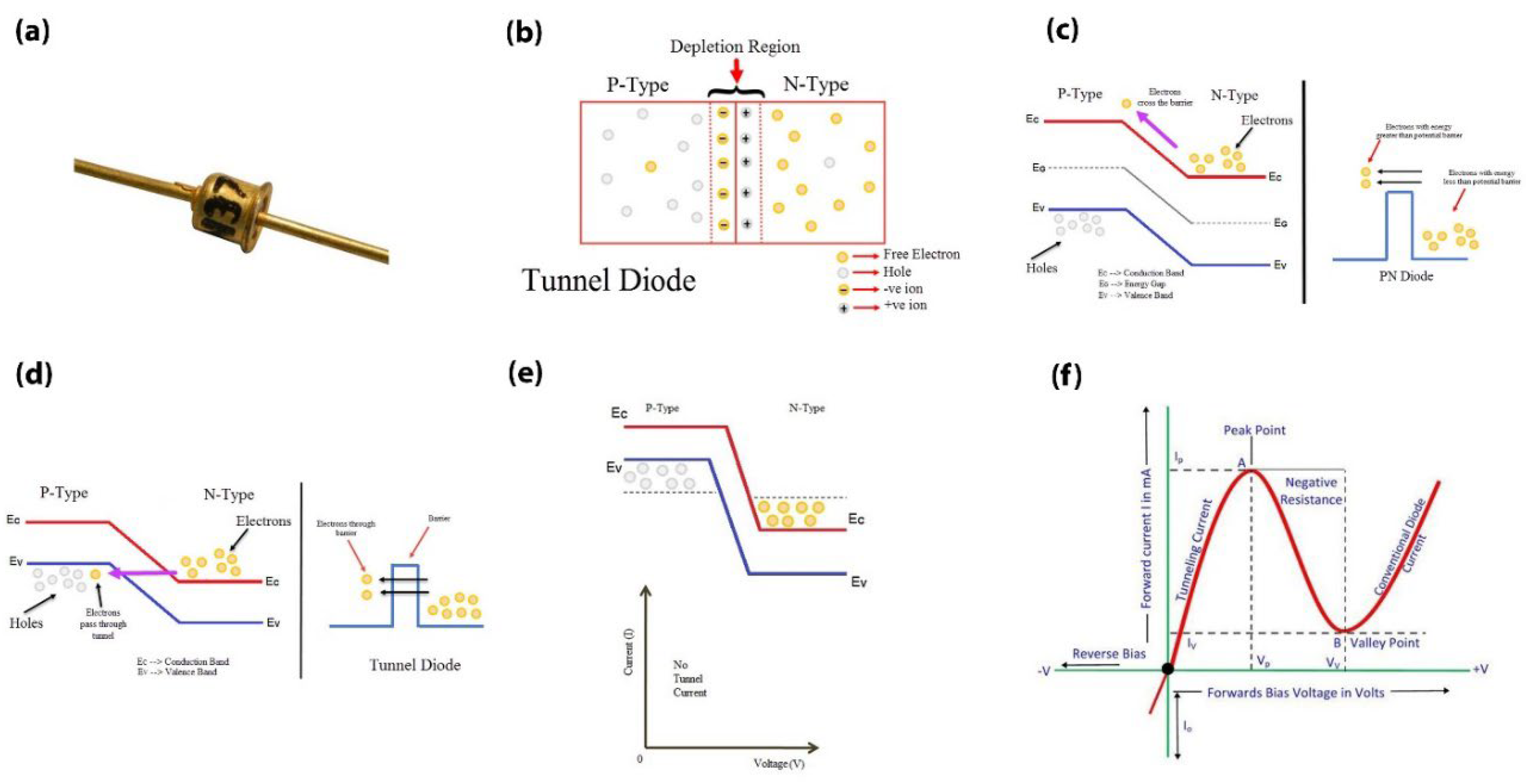
In 1957 Leo Esaki designed the first germanium tunnel diode, then a silicon tunnel diode in 1958 revealing electron tunneling in heavily doped p-n junctions (
Figure 2). Esaki was awarded the Nobel Prize in Physics in 1973 for his work, though Robert Noyce also claimed to have conceived the idea. The materials used for this diode are Germanium, Gallium arsenide, and other silicon materials.
Tunneling behavior stems from the tunneling effect which involves the movement of electrons through a thin depletion layer region (
Figure 2). In an unbiased tunnel diode, the conduction band of the n-region is coaxial with the valence band of the p-region thereby making it possible for electrons to tunnel in the absence of any voltage and thus making the flow of charge carriers balanced (
Figure 2) [
39]. When a small forward voltage is used, electrons in the n-region move in the p-region resulting in a forward current. As the voltage increases, the overlap between the bands grows, peaking at a certain point (Ip). Beyond this voltage, the current decreases, creating a region of negative resistance (See
Figure 2) [
39,
40]. The tunnel diode, known for its negative resistance due to quantum mechanical tunneling, operates at high speeds and is used in oscillators, amplifiers, and radio frequency (RF) applications [
41]. Recent research explores its use in terahertz frequency devices and superconducting spintronic devices, highlighting its versatility and significance in modern electronics [
42,
43,
44,
45].
Figure 2.
Analysis of Tunnel Diode Characteristics and Working Principles. (a) Physical appearance of a tunnel diode. (b) Schematic diagram showing the structure of a tunnel diode, including the depletion region between the P-type and N-type materials. (c) Illustration of the tunneling effect in a PN junction, showing electron movement across the energy bands. (d) Detailed depiction of the tunneling effect in a tunnel diode, highlighting electron and hole movement through the narrow depletion region, enabling quantum tunneling. (e) Energy band diagram of an unbiased tunnel diode, indicating the alignment of the conduction band and valence band in P-type and N-type materials, and the absence of tunneling current. (f) Current-voltage (I-V) characteristics of a tunnel diode, demonstrating the peak current (Ip), valley current (Iv), and the region of negative resistance, highlighting the distinct tunneling current, negative resistance region, and conventional diode behavior. [
41].
Figure 2.
Analysis of Tunnel Diode Characteristics and Working Principles. (a) Physical appearance of a tunnel diode. (b) Schematic diagram showing the structure of a tunnel diode, including the depletion region between the P-type and N-type materials. (c) Illustration of the tunneling effect in a PN junction, showing electron movement across the energy bands. (d) Detailed depiction of the tunneling effect in a tunnel diode, highlighting electron and hole movement through the narrow depletion region, enabling quantum tunneling. (e) Energy band diagram of an unbiased tunnel diode, indicating the alignment of the conduction band and valence band in P-type and N-type materials, and the absence of tunneling current. (f) Current-voltage (I-V) characteristics of a tunnel diode, demonstrating the peak current (Ip), valley current (Iv), and the region of negative resistance, highlighting the distinct tunneling current, negative resistance region, and conventional diode behavior. [
41].
2.1.5.2. Silicon-on-Insulator (SOI) MOSFET
Silicon-on-insulator (SOI) MOSFETs offer advantages such as reduced parasitic capacitances, improved device isolation, and reduced short-channel effects due to their structure of a thin silicon layer atop an insulating silicon dioxide (SiO
2) layer. Some of the issues that were discovered that limit their use include the deterioration of carrier mobility and the floating body effects [
46,
47]. Various extensions and modifications have been proposed to rectify these challenges [
48].
Quasi-SOI MOSFETs are a further improvement of SOI MOSFETs which incorporate the features of both SOI and bulk devices. In this structure, the source/drain regions are partially surrounded by an insulator, and the channel is connected to the bulk substrate. This design minimizes the short-channel effects, parasitic capacitances, and self-heating while maintaining effective heat dissipation. Quasi-SOI MOSFETs can be fabricated using epitaxial technology and thermal oxidation, and simulations show they have good scaling capability and can achieve high cut-off frequencies, up to 220 GHz for NMOS and 130 GHz for PMOS (P-type Metal-Oxide Semiconductor) at a 20 nm effective channel length [
49].
Localized-SOI MOSFETs include two variants: quasi-SOI MOSFETs and source-drain-on-nothing (SDON) / source-drain-on-insulator (SDOI) MOSFETs. The quasi-SOI structure is analogous to previously described designs, and the SDON/SDOI devices have recessed source/drain regions on partially buried layers. These structures maintain the advantages of quasi-SOI MOSFETs, such as reduced short-channel effects and parasitic capacitances, and are more compatible with standard CMOS (Complementary Metal-Oxide Semiconductor) fabrication processes, making them suitable for highly scaled devices [
49].
DSSB, Dopant-segregated Schottky Barrier SOI MOSFETs utilize the properties of both SOI and Schottky barrier devices, which include incorporating a thin layer of heavily doped material in the source-to-channel interface. This decreases the Schottky barrier height and increases on-state improvement. DSSB SOI MOSFETs have features like low short-channel effects (SCE), high scalability, and better analog/RF characteristics. However, optimizing the segregation layer density and length is crucial to balance trade-offs between leakage current, drive current, and variability [
49].
2.1.5.3. Multigate Transistors
Advanced structures of transistors, Multigate transistors, which include double gate, FinFET, and surrounding gate structures, significantly improve the electrostatic control and mitigate short-channel effects in metal-oxide-semiconductor field-effect transistors (MOSFETs). These devices, by employing multiple gates, enhance the control of the electric field within the channel, key for scaling down. FinFETs, with their three-dimensional structure and vertically positioned fins, possess better gate control compared to planar devices. Moreover, the double gate transistors lessen the short channel effects like Drain-Induced Barrier Lowering (DIBL), achieve better ON/OFF current ratios, and reduced subthreshold swings which are effective features in low-power devices (
Table 1) [
50,
51,
52,
53,
54].
Double Gate Transistors; These are the devices that have two gates to control the channel so that the channel can be independently biased, hence better electrostatic control. This configuration may improve the overall performance of both analog and digital applications, as confirmed and shown in various simulations [
55].
Fin Field-Effect Transistor (FinFET); FinFET technology is proven as a promising solution for sub-22 nm technology nodes. The FinFET's three-dimensional structure allows for a significant decrease in short-channel effects while achieving high drive currents (
Table 1). Research highlights that FinFETs are capable of providing superior electrical performance, making them ideal for high-frequency applications [
52,
56].
Gate-All-Around Transistor / Surrounding Gate Structures; These structures, such as Gate-All-Around (GAA) transistors, offer even better control compared to FinFETs by surrounding the channel on all sides. This design minimizes short-channel effects (SCE) and allows for further scaling of device dimensions without significant performance degradation (
Table 1) [
51,
57].
2.1.6. Other Advanced Devices
Heterostructure Field-Effect Transistors (HFETs), particularly those utilizing AlGaN/GaN materials, are recognized for their exceptional performance in high-frequency applications due to their high electron mobility and saturation velocity, which significantly surpass traditional MOSFETs [
58]. The AlGaN/GaN heterostructures are engineered to achieve high power and speed, making them ideal for applications in satellite communication and radar systems [
58]. Furthermore, these devices exhibit high breakdown voltages and low noise levels, which are critical for low-power and high-speed electronic applications. The integration of ferroelectric materials like BaTiO
3 into the gate structure of GaN-based high-electron-mobility transistors (HEMTs) significantly enhances their performance, efficiency, and reliability. The extreme permittivity of BaTiO
3 contributes to excellent electrostatic control, as evidenced by a high peak transconductance of 141 mS/mm and a large ON/OFF current ratio of 4.1 × 10
9, which are crucial for high-performance applications in power electronics [
59]. Additionally, the use of ferroelectric gate stacks, such as Hf
0.5Zr
0.5O
2, has shown improvements in RF switching applications, achieving low insertion loss and high isolation at mm-wave frequencies, which is essential for future wireless communication systems [
60,
61]. The combination of these materials not only optimizes energy efficiency but also addresses the limitations of traditional silicon-based devices, making GaN HEMTs a leading choice for advanced electronic devices in demanding environments [
61,
62].
Heterostructure Bipolar Transistors (HBTs) utilize emitter-base heterojunctions, which significantly enhance their performance compared to conventional bipolar junction transistors (BJTs). The incorporation of advanced materials, such as III-V compounds (e.g., GaAs and AlGaAs) and 2D materials (e.g., MoS
2 and WSe
2), allows HBTs to achieve high current amplification and improved electrical characteristics, making them suitable for high-frequency applications like wireless communication and power electronics [
63,
64]. HBT technology has evolved to address challenges such as lattice mismatch and interface quality, which are critical for maintaining device performance [
64,
65]. Additionally, innovations like strained silicon layers in the emitter region enhance carrier emission efficiency, further boosting current and frequency performance. Overall, HBTs demonstrate remarkable reliability and efficiency, positioning them as a preferred choice for demanding applications in modern electronics [
65].
Wide Bandgap Semiconductors, like Gallium Nitride and Silicon Carbide, have been accelerating an entirely new frontier of electronics wherein devices can be operated at higher power densities, voltages, and frequencies than conventional silicon-based technologies [
66,
67]. These materials have larger power density, high efficiency, and thermal stability, with high-voltage operation, making them very suitable for power electronics, renewable energy systems, and electric vehicles [
68,
69]. GaN, owing to superior electron mobility, offers high-frequency performance in RF amplifiers and power converters; on the other hand, SiC excels only in realms of high-power applications adjudged vital by thermal management, like power supplies and industrial motor drives [
69]. Wide bandgap semiconductors are finding applications in renewable energy, electric vehicles, and telecommunications, significantly impacting these industries by enabling more efficient, powerful, and compact electronic devices [
68,
69].
Resistive RAM (RRAM) is an advanced memory technology that employs semiconductor principles, using metal oxides like Titanium Oxide (TiO
x) as the switching layer. RRAM operates through resistive switching, where conductive filaments form and rupture within the oxide layer, enabling data storage [
70,
71]. Key advantages include non-volatility, high speed, low power consumption, and scalability. Recent advancements integrate RRAM with AI to boost performance and unleash forms of computing paradigms, such as neuromorphic computing [
72,
73]. Not being a conventional semiconductor device itself, RRAM exploits semiconductor materials and principles to achieve better memory performance.
Nanowire transistors are high-performance semiconductor devices that utilize quantum confinement effects to increase carrier mobility and electrostatic control while reducing power consumption and increasing switching speeds. Their vertical surround-gate architecture maximizes gate control while minimizing channel length, essential for maintaining performance as devices shrink. Nanowire transistors can perform multiple functions, such as in neuromorphic computing by controlling charge carriers in different regions. They also address thermal management challenges by optimizing thermal conductivity, crucial for sub-5 nm technology nodes. These innovations make nanowire transistors a significant advancement in semiconductor technology [
74,
75].
Resonant tunneling devices (RTDs) leverage quantum tunneling through a double-barrier quantum well structure, enabling them to achieve resonant peaks in their current-voltage characteristics, which facilitate operation at terahertz frequencies—far exceeding the capabilities of traditional transistors [
76]. This unique property allows RTDs to simplify circuit designs by reducing the number of components needed, thereby enhancing efficiency and lowering power consumption [
76]. Furthermore, RTDs can be integrated with other semiconductor technologies, such as heterostructure field-effect transistors (HFETs), to develop hybrid circuits tailored for ultra-high-speed applications [
77]. The exploration of both electron and magnon resonant tunneling further underscores the versatility of RTDs, opening new avenues for device applications in optoelectronics and logic circuits. Overall, the reliance on quantum mechanics in RTDs represents a significant leap forward in semiconductor technology, promising advancements in high-speed communication systems [
77].
2.2. Significance of Semiconductors (Technological, Economic, and Societal Impact)
Semiconductors are one of the core materials and form the backbone of modern electronic devices, which make a wide range of functionalities possible in contemporary technology. Their unique properties and versatility help to a great extent in different applications, ranging from consumer electronics to industrial systems. Key roles of semiconductors in electronics include:
Transistor Functionality; Semiconductors are the primary material used in making transistors, which act as the simplest and building blocks of every electronic circuit. Transistors can function as switches or amplifiers, controlling the flow of electrical current. Such functionality is so very essential to logic operations in a digital circuit and signal processing for microprocessors and memory devices [
78].
Integrated Circuits (ICs); Semiconductors have facilitated the miniaturization of electronic components by inventing integrated circuits. ICs integrate thousands to millions of transistors onto a single chip, thus allowing compact and efficient designs that power everything from smartphones to computers. It highly improves performance at reduced size and cost [
79].
Energy Efficiency; Modern semiconductors, more specifically wide-bandgap materials such as SiC and GaN, have been designed for high efficiency in power electronics. Such materials have superior voltage, frequency, and thermal tolerance compared to conventional silicon, hence having the potential for reduced energy losses and improved thermal management in applications like electric vehicles and renewable energy systems [
80,
81].
Optoelectronics; Semiconductors have an incredibly large role in optoelectronic devices. They are majorly used for the transformation of electrical signals into optical signals and vice versa. Such devices include light-emitting diodes, laser diodes, and photodetectors. The manipulation of light by semiconductor materials has changed display technology, telecommunications, and lighting solutions completely [
82,
83,
84].
Flexible and Organic Electronics; Advancements in organic semiconductors have led to the development of flexible electronic devices, such as organic light-emitting diodes (OLEDs) and organic photovoltaics. These materials allow for lightweight, bendable, and even wearable electronics, expanding the possibilities for consumer products and applications in health monitoring [
85,
86].
Sensors and IoT Devices; Semiconductors drive the development of sensors that detect physical phenomena, such as temperature, light, and motion. These inherently form a part of the Internet of Things, which enables smart devices to capture data and send them to improve areas like automation and connectivity in healthcare, agriculture, or smart cities [
82,
87,
88].
High-Speed Communication; Semiconductors have found use in different kinds of communication devices, including fiber optics and wireless networks, which have facilitated data transfer at higher speeds. Semiconductor lasers and photonic devices aid high-speed information transfer; this forms part of the internet structure and mobile communication [
82,
89].
The semiconductor industry is vital to the global economy, driving economic growth, job creation, and technological advancement [
90]. It supports various sectors, such as IT, telecommunications, and automotive, and has shown resilience during challenges like the COVID-19 pandemic [
91,
92]. Its role in international trade, particularly between major economies like the US and China, underscores its significance [
93]. The industry's innovation and adaptability are crucial for sustaining economic growth.
2.3. Focus on Semiconductor Sustainability
Many more sustainable materials are being considered for production within the semiconductor industry to decrease environmental impact and dependence on toxic compounds. Major examples of such attempts are the development of Kankyo-Semiconductors based on abundant and less toxic elements, such as silicon, iron, aluminum, calcium, and magnesium, in lieu of the traditional materials in optoelectronics. Additionally, there is a high demand for environmentally friendly solvents and components free from lead during the process of fabrication of perovskite solar cells to achieve devices with better performance while having a minimum detrimental impact on the environment [
94].
Alternative substrate materials for printed circuit boards (PCB), such as polyimide and paper-based substrates, along with lower-temperature solders, are also being explored to reduce the environmental impact of electronic products [
95]. Niobium-based semiconductor materials are being researched for their potential in the utilization of photocatalytic applications, such as solar fuel production, which can contribute to renewable energies and decrease dependency on fossil fuel sources [
96].
2.4. Bridging Historical Development and Emerging Trends
The evolution of semiconductor technology, from early point-contact rectifiers and p-n junctions to the widespread use of integrated circuits and transistors, has set the stage for the groundbreaking innovations we see today. Historical advancements provided the essential understanding of how materials like silicon and gallium arsenide behave under various conditions, leading to the development of modern semiconductor devices that power everything from consumer electronics to advanced computing systems.
The evolution of material doping and defect management has been pivotal in advancing technologies such as wide-bandgap semiconductors and quantum computing. Doping techniques have been refined to enhance the electronic properties of materials, as seen in ultra-wide band-gap nitrides where quantum engineering methods have significantly improved p-doping efficiency, facilitating the development of high-performance devices like deep-ultraviolet light-emitting diodes [
97]. Additionally, the design of defect-based qubits in materials like 4H-SiC and ww-AlN demonstrates how understanding defects can lead to promising candidates for quantum information technologies [
98]. The ability to visualize and manipulate defects at the atomic scale has further deepened our understanding of structure-property relationships, which is essential for optimizing devices such as MOSFETs [
99]. This comprehensive approach to defect management and doping is crucial for meeting the demands of modern electronics and sustaining Moore’s Law [
100,
101]. Furthermore, the exploration of quantum materials, which exhibit unique behaviors due to quantum interactions, has opened new avenues for device miniaturization and performance enhancement [
100,
102]. The identification of defects that can serve as qubits in quantum computing, such as the nitrogen-vacancy center in diamond, exemplifies the potential of these advancements. Additionally, the rise of two-dimensional materials like graphene showcases the ongoing innovation in semiconductor technology, driven by the principles established through historical research [
102].
As we transition into a future dominated by high-efficiency, high-power applications, the lessons learned from historical developments remain crucial. Today’s research into gallium nitride (GaN) and silicon carbide (SiC) for power electronics, as well as the exploration of quantum dots and nanowires, is directly informed by the material science and device physics established decades ago. These innovations represent a natural progression of semiconductor technology, continuing to build on the foundation of knowledge established during the industry's formative years.
Thus, the boundary between historical and emerging trends is not rigid but fluid, with historical advances forming the backbone of today’s cutting-edge research. Exploring the emerging trends in semiconductor technologies, focusing on how these developments are poised to address contemporary challenges in computing, energy, and sustainability are very essential.
3. Emerging Semiconductors
3.1. Wide-Bandgap Semiconductors
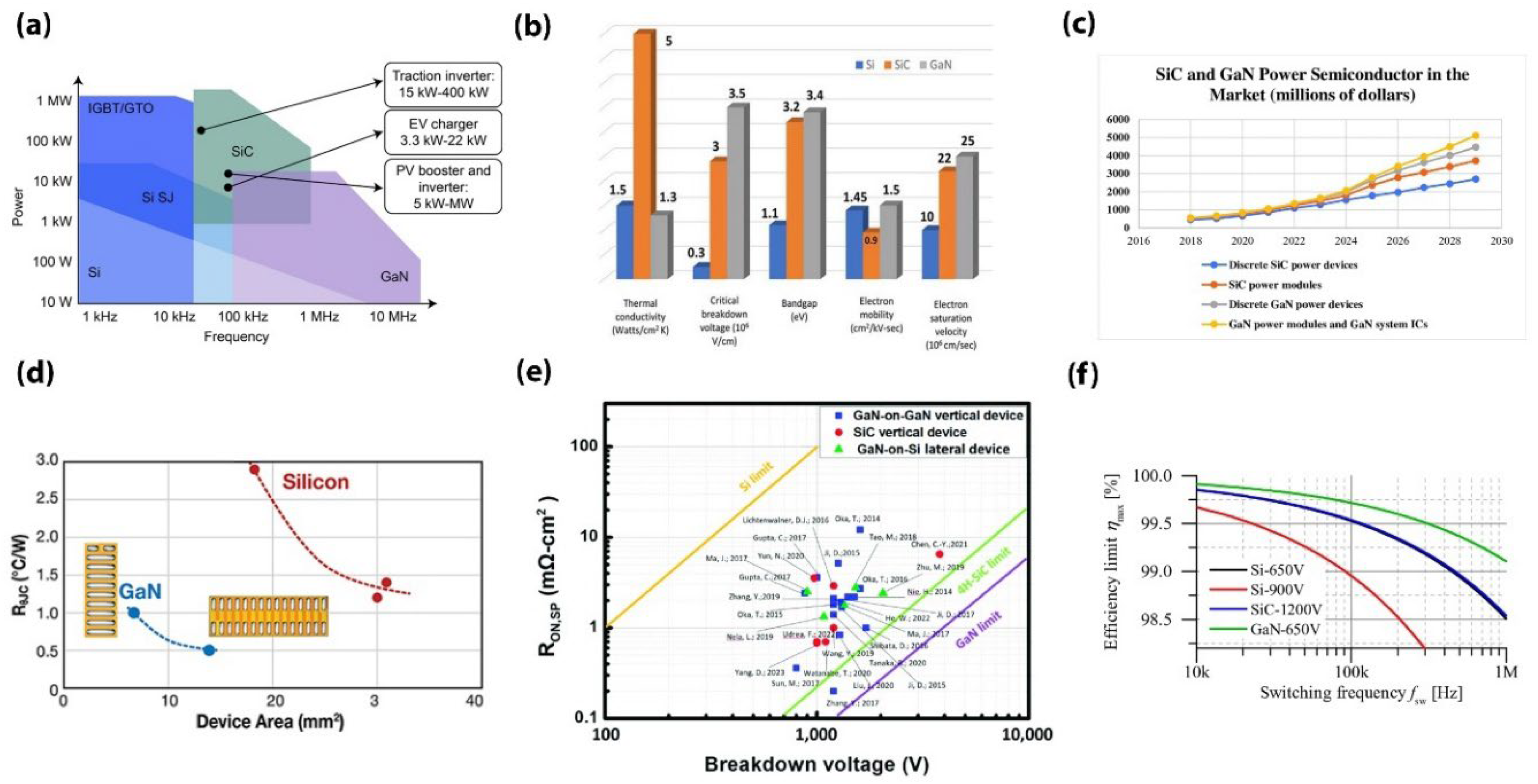
Wide-bandgap (WBG) semiconductors, especially silicon carbide (SiC) and gallium nitride (GaN), are emerging as third-generation semiconductor materials; they possess superior properties compared to conventional semiconductors like silicon [
103]. These materials have high saturated drift velocity and a high critical breakdown field (
Figure 3). These materials are also appropriate for high-power, high-temperature, and high-frequency applications (
Figure 4) [
103].
While both SiC and GaN have proven superior to silicon in high-power and high-frequency applications, the choice between them depends on specific industry needs.
Table 2 provides a comparison of SiC and GaN in terms of performance, cost, and fabrication complexity.
Silicon Carbide (SiC) and Gallium Nitride (GaN) each have distinct advantages that cater to different industry requirements. SiC is renowned for its high thermal conductivity and breakdown voltage (Table 2), making it particularly suitable for high-power applications such as electric vehicles and industrial power systems, where devices can operate at elevated temperatures and voltages without significant losses. In contrast, GaN excels in high-frequency applications, such as RF amplifiers, due to its superior electron mobility (Table 2), which allows for higher power densities and efficiency at microwave frequencies. Additionally, GaN's lower fabrication costs make it an attractive option for commercial applications. Thus, the choice between SiC and GaN ultimately hinges on the specific performance requirements and cost considerations of the intended application.
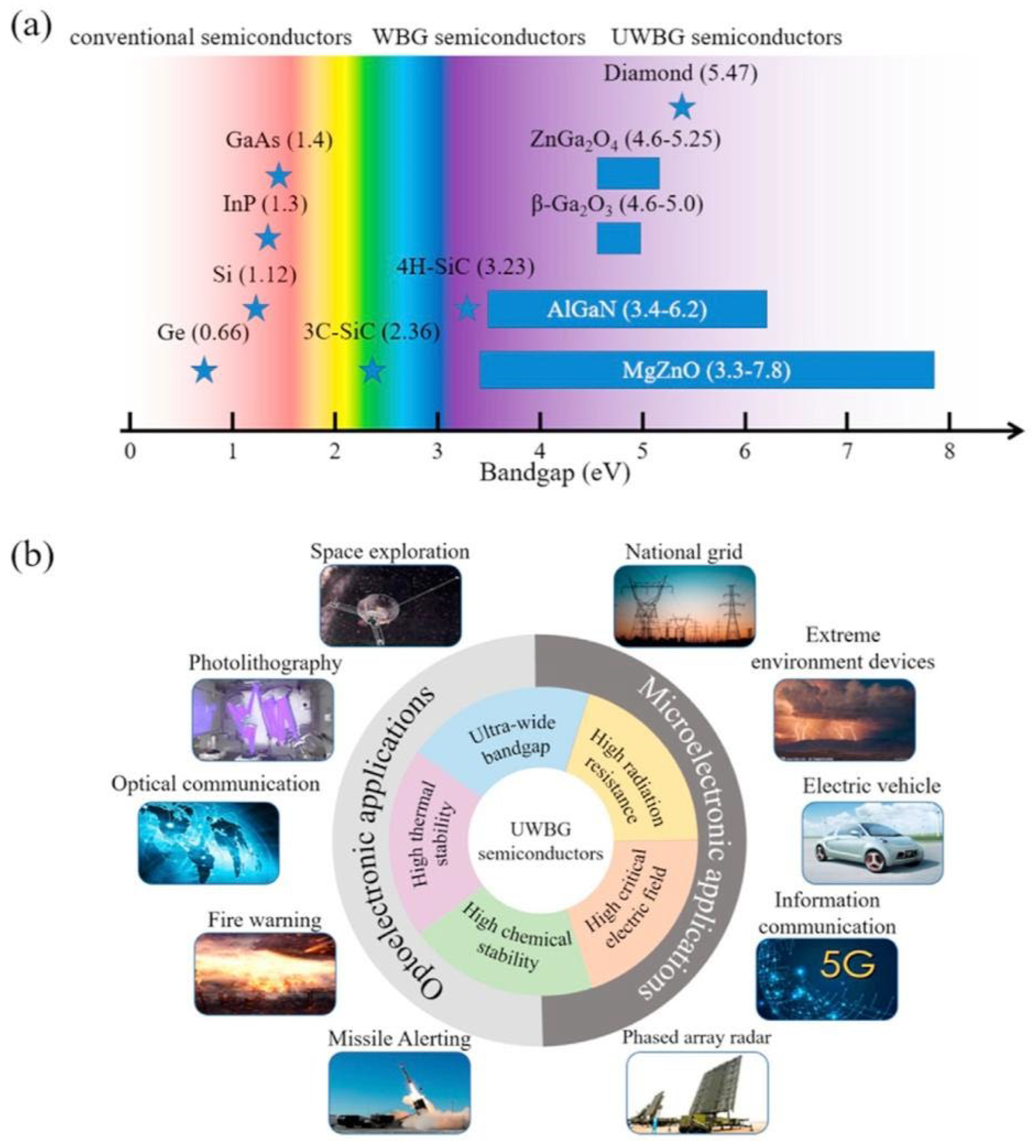
Recent research has also focused on ultrawide bandgap (UWBG) semiconductors, which have bandgaps wider than 3.4eV of GaN, including high Al-content AlGaN, diamond, and Ga
2O
3 [
104]. Recent advancements in ultrawide bandgap (UWBG) semiconductors have garnered significant attention due to their potential applications in high-power and RF electronics, deep-UV optoelectronics, quantum information, and extreme-environment scenarios. These materials, characterized by bandgaps exceeding 3.4 eV, offer superior performance metrics, including enhanced thermal stability and efficiency in power-switching applications, as highlighted in various studies [
105,
106]. However, challenges remain, particularly in achieving bipolar electrical conductivity and managing defects, which are critical for their practical implementation [
107]. The systematic analysis of these materials underscores their advantages, such as improved efficiency and operational capabilities, while also addressing the manufacturing hurdles that need to be overcome for widespread adoption in power electronics [
24]. Furthermore, UWBG semiconductors are being explored for innovative applications in ultraviolet photodetectors, enhancing their utility across diverse fields [
108]. Ongoing research aims to address challenges and advance the state-of-the-art in WBG and UWBG semiconductor technologies.
Figure 3.
Wide-bandgap Semiconductors analysis; (a) Comparing various semiconductor devices over power and frequency, highlighting the advantages of SiC and GaN over conventional silicon devices [
109]. (b) Key differences between Si, SiC and GaN materials [
110]. (c) Comparison of SiC and GaN devices in the market [
111]. (d) Heat dissipation capabilities of GaN devices compared to SiC and Si, emphasizing the thermal advantages of GaN [
112]. (e) Benchmarking vertical GaN devices against lateral GaN MOSFET devices and vertical SiC devices, illustrating the comparative performance metrics.[
113]. (f) Fundamental efficiency limits of Si, SiC, and GaN technologies in bidirectional DC/DC converters, demonstrating the superior efficiency of SiC and GaN [
114].
Figure 3.
Wide-bandgap Semiconductors analysis; (a) Comparing various semiconductor devices over power and frequency, highlighting the advantages of SiC and GaN over conventional silicon devices [
109]. (b) Key differences between Si, SiC and GaN materials [
110]. (c) Comparison of SiC and GaN devices in the market [
111]. (d) Heat dissipation capabilities of GaN devices compared to SiC and Si, emphasizing the thermal advantages of GaN [
112]. (e) Benchmarking vertical GaN devices against lateral GaN MOSFET devices and vertical SiC devices, illustrating the comparative performance metrics.[
113]. (f) Fundamental efficiency limits of Si, SiC, and GaN technologies in bidirectional DC/DC converters, demonstrating the superior efficiency of SiC and GaN [
114].
Figure 4.
(a) Bandgap energies of various semiconductors. (b) Characteristics and applications of UWBG semiconductor materials. [
83].
Figure 4.
(a) Bandgap energies of various semiconductors. (b) Characteristics and applications of UWBG semiconductor materials. [
83].
3.2. Quantum Dot Semiconductors
Quantum dot semiconductors are nanomaterials that have special electronic and optical properties attributed to their size-dependent quantum effects. These semiconductor nanostructures confine excitons in three spatial dimensions, exhibiting discrete energy levels akin to atoms [
115]. Quantum dots have been endeavored in a wide range of applications, like photoelectrochemistry sensors, with simple, fast, and miniaturized solutions for analyte detection [
116]. One of the factors that makes this class so attractive for organic photoredox transformations is the tunability of its redox properties [
117].
Initially cadmium-based, quantum dots have evolved to include alternative materials with reduced toxicity such as germanium, silicon, and carbon, while retaining unique photonic properties in drug development and delivery [
118]. A small change in one of the parameters, like size or shape, will alter the electronic and optical properties of quantum dots, therefore making them tuneable for desired applications that range from optoelectronics to biomedical diagnostics.
3.3.2. D Materials
Two-dimensional (2D) materials, such as Transition Metal Dichalcogenides (TMDCs), graphene, and black phosphorus, have emerged as promising semiconductors for electronic and optoelectronic applications due to their unique properties like atomic thickness, excellent electronic structure, and high mobility [
119,
120,
121,
122,
123,
124]. These materials adhere to other substances through van der Waals interactions, enabling compatibility with different material platforms for on-chip light sources and photodetectors, potentially offering a universal on-chip light source scheme for Photonic Integrated Circuits (PICs) [
121].
2D semiconductors have several advantages in ultra-thin devices with atomic scale thicknesses and allow the creation of nanoribbons and heterostructures [
125]. These materials have a highly tunable bandgap, which may be engineered with controlling layer numbers, strain engineering, chemical doping, and external electric fields, thus offering an alternative for applications that lie within various spectral regions from terahertz to ultraviolet [
126]. Engineering atomic-scale defects in TMDCs can enhance carrier transport and improve future electronic technologies, pointing out the need for understanding electron-defect interactions of these materials [
127].
Even though the performance is high and energy-efficient, several challenges remain to be overcome in terms of stability, material quality, dielectric integration, contact formation, and preparation methods before 2D semiconductor materials find large-scale production and application [
120]. Ongoing research focuses on improving growth techniques, understanding charge carrier scattering mechanisms, and addressing short-channel effects to realize the full potential of 2D semiconductors in future electronic devices [
124,
125]. With such challenges being surmounted, prospects presented by 2D materials in revolutionizing semiconductor technology are very high, and their potential to foster advancements in the development of high-performance and energy-efficient electronic and optoelectronic devices is at its inception stage.
3.4. Organic Semiconductors
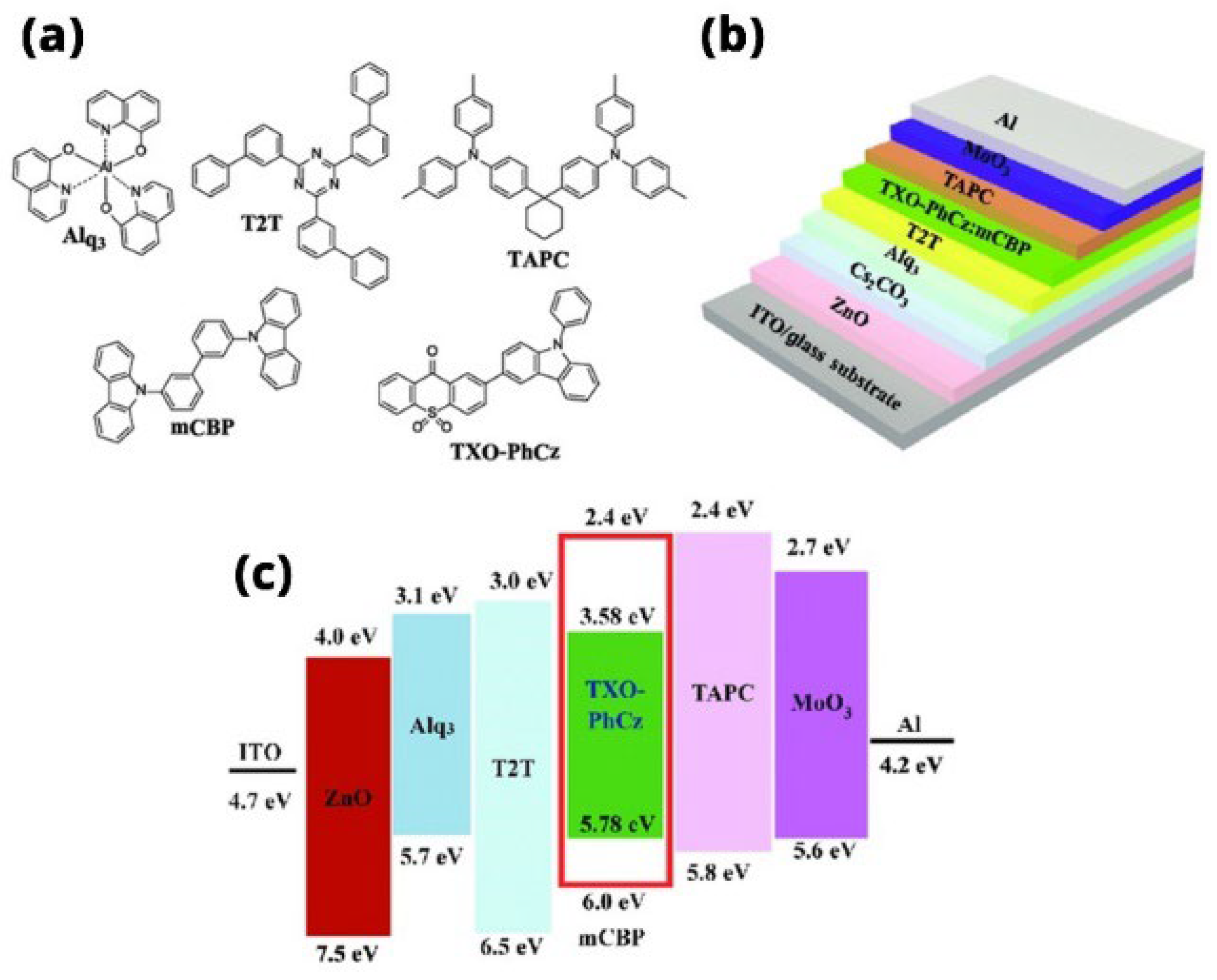
Organic semiconductors, primarily composed of carbon-hydrogen bonds, exhibit semiconductor behavior and can be doped to create N- and P-type materials, enabling the construction of devices like organic light-emitting diodes (OLEDs), organic field-effect transistors (OFETs), and organic solar cells [
128]. These materials are made up of π-bonded molecules or polymers, often including heteroatoms like nitrogen, sulfur, and oxygen, and can exist as molecular crystals or amorphous thin films (
Figure 5). They typically behave as insulators but become semiconducting upon charge injection, doping, or photoexcitation. They hold a large bandgap and a low dielectric constant [
129].
The carrier mobility of organic semiconductors is influenced by factors such as energy, morphology, and solvent choice, impacting crystallinity and molecular ordering. Techniques like cyclic voltammetry and ultraviolet electron spectroscopy are essential for understanding charge transport mechanisms [
130]. Single-crystal organic semiconductors are recognized as central to high-performance devices attributed to unique optoelectronic properties because of weak van der Waals interactions [
131]. Hyperbranched polymers (HBPs) are also notable for regulating charge transport and film morphology [
132].
Figure 5.
Organic Semiconductors; (a) Molecular structures of the organic semiconductors for the inverted OLEDs; (b) scheme of the inverted OLEDs; and (c) the energy levels of the materials involved in the inverted OLEDs [
133].
Figure 5.
Organic Semiconductors; (a) Molecular structures of the organic semiconductors for the inverted OLEDs; (b) scheme of the inverted OLEDs; and (c) the energy levels of the materials involved in the inverted OLEDs [
133].
Techniques to fabricate organic semiconductors include vacuum deposition, solution processing, and self-assembly, with methods such as spin-coating and inkjet printing enabling the realization of flexible/wearable electronics [
134]. Applications include OLEDs, organic photovoltaic cells, OFETs, and biosensing devices. Organic semiconductors have some very attractive features associated with them, relating to mechanical flexibility, low cost, and ease of fabrication that make them very attractive in a wide range of electronic and optoelectronic applications [
129].
3.5. Perovskite Semiconductors
Perovskite semiconductors, with their remarkable optoelectronic properties and versatile applications, have emerged as a promising class of materials, particularly in photovoltaics and other optoelectronic devices [
135]. Characterized by a general formula of ABX
3, with A and B as cations and X as an anion, usually a halide or oxygen, these materials have high optical absorption, high carrier mobility, long diffusion lengths, and unique ambipolar charge transport properties [
136,
137].
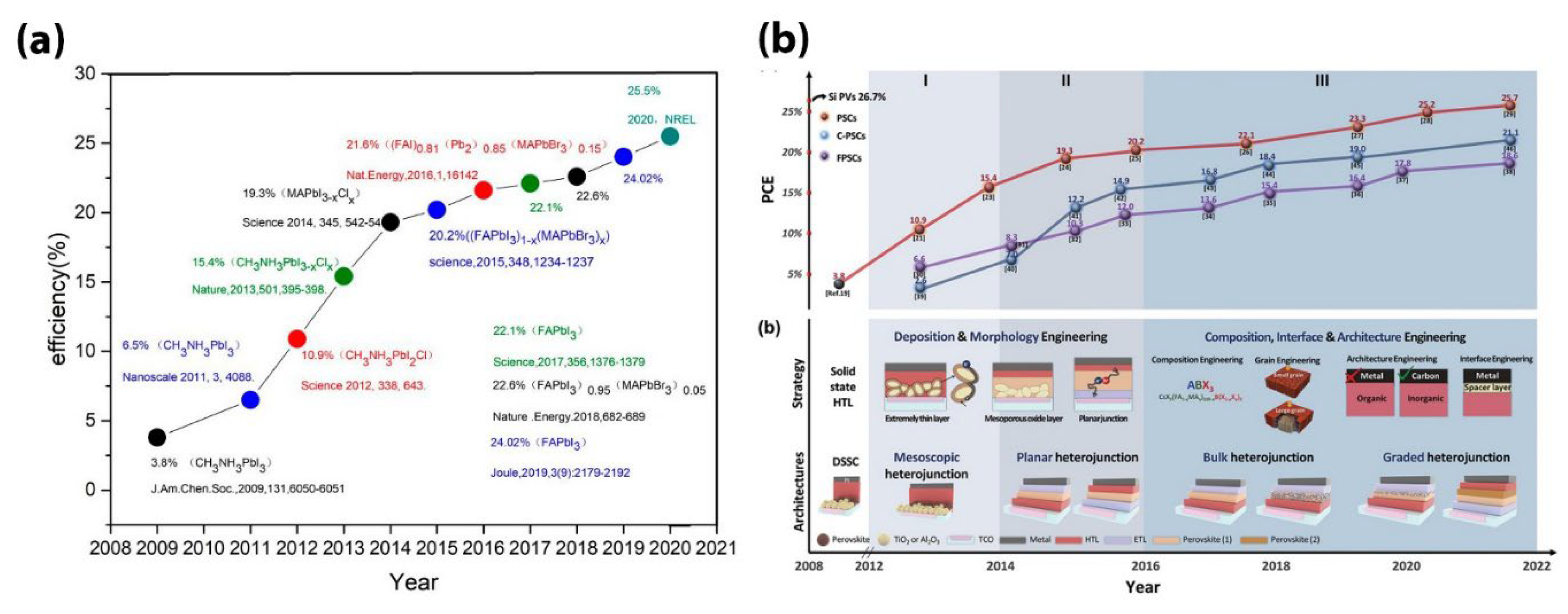
Perovskite solar cells have seen rapid advancements (
Figure 6), achieving power conversion efficiencies exceeding 25% in just over a decade [
138]. Their excellent photophysical properties and solution-processability have also led to applications in light-emitting diodes, photodetectors, lasers, and X-ray scintillators [
138]. The ability to tailor perovskite properties by manipulating their crystal structure, size, and composition has further enhanced their functionalities, making them valuable in applications like photocatalysis and radiation detection [
139]. In the domain of radiation detectors, lead halide perovskites like CsPbBr
3 demonstrated high efficiency in X-ray and gamma-ray detection and thus can be an important material for imaging applications [
140].
Figure 6.
Perovskite Semiconductors; (a) The evolution of the efficiency of perovskite solar cells (PSCs) from 2008 to 2020 [
141]. (b) Chronological evolution of the PCE of perovskite solar cells (PSCs), C-PSCs, and FPSCs and a brief history of schematics for fabrication strategies and device architectures in PSCs (HTL: hole-transport layer, ETL: electron-transport layer, TCO: transparent conductive oxides, PV: photovoltaic) [
142].
Figure 6.
Perovskite Semiconductors; (a) The evolution of the efficiency of perovskite solar cells (PSCs) from 2008 to 2020 [
141]. (b) Chronological evolution of the PCE of perovskite solar cells (PSCs), C-PSCs, and FPSCs and a brief history of schematics for fabrication strategies and device architectures in PSCs (HTL: hole-transport layer, ETL: electron-transport layer, TCO: transparent conductive oxides, PV: photovoltaic) [
142].
Despite their rapid progress, perovskites face challenges in stability, reproducibility, and toxicity. Issues such as ionic transport can introduce defects and degrade performance, necessitating strategies to mitigate these challenges [
143]. Understanding the fundamental chemistry and physics of perovskites is essential for addressing these issues and guiding future developments [
135].
Environmental concerns have heightened interest in finding alternatives to lead-based perovskites. Research is still focused on developing the stability, efficiency, and scalability of perovskite-based technologies. The incorporation of PbS quantum dots into perovskite matrices, for instance, enables sub-bandgap photocurrent generation; this could fundamentally open up prospects for overcoming traditional efficiency limits in solar cells [
144]. As the field progresses, the development of stable, high-performance perovskite devices holds great promise for revolutionizing optoelectronics and renewable energy technologies.
3.6. Hybrid Semiconductors
In particular, hybrid semiconductor materials that have gained much attention today are porous metal halide semiconductors and organic-inorganic hybrid semiconductors, owing to their great properties and potential applications. PMHS spanned by the Spanopoulos group [
145] reveal excellent water stability and broadband light emission, which makes them very promising for solid-state batteries and photonic crystals. On the other hand, organic-inorganic hybrid semiconductors, such as the ones explored by Yawen Li et al. [
146] in their paper, exhibit specific optoelectronic properties and thermodynamic stability that enable next-generation optoelectronic applications. Such hybrid materials take advantage of the assets of both organic and inorganic components in terms of tailored properties and functionalities, making them very promising for several technological innovations related to, among others, electronics, photonics, and energy storage technologies [
147,
148,
149].
3.7. Porous Semiconductors
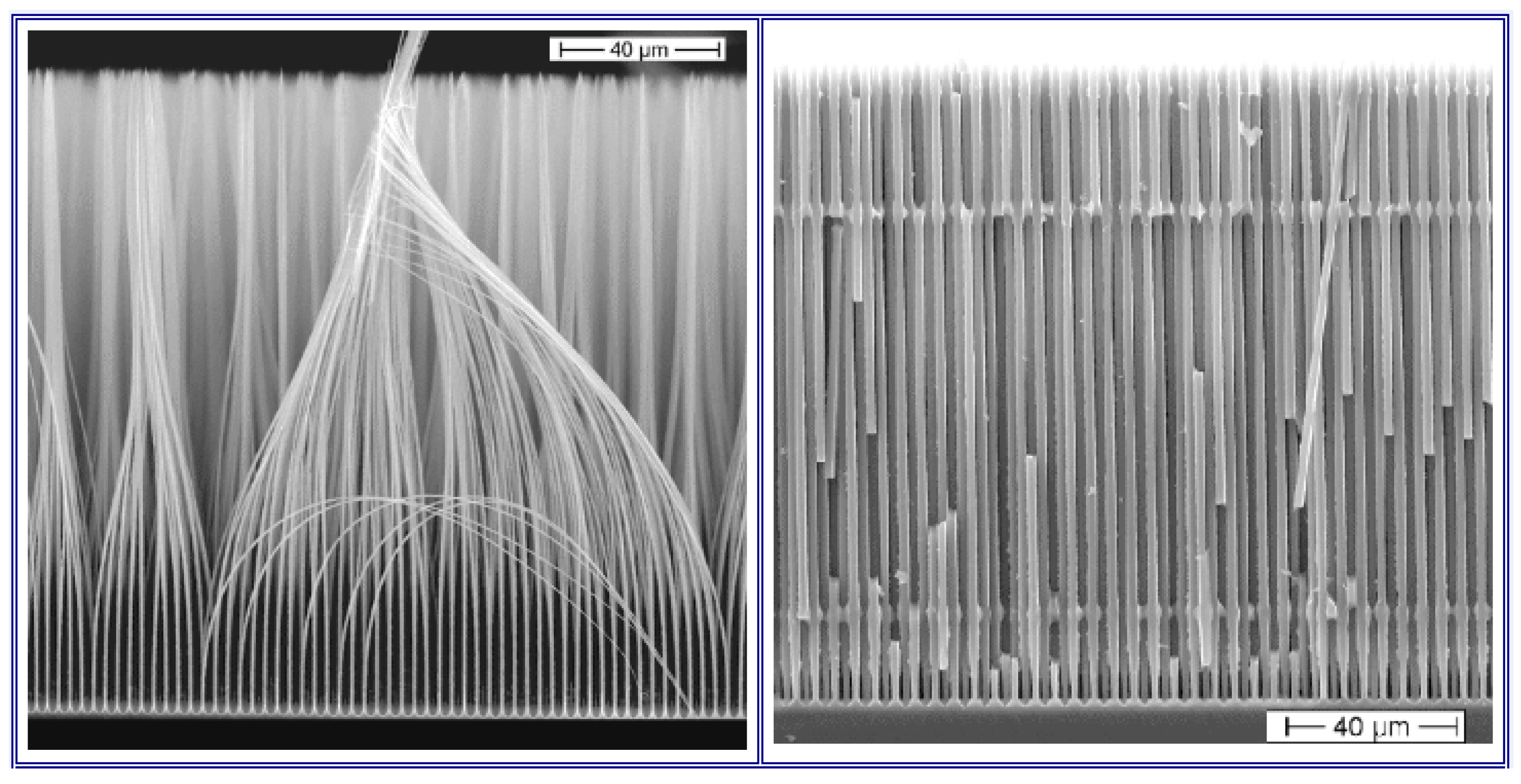
Porous semiconductors have garnered significant research attention attributed to their unique properties due to their porous structure (
Figure 7) and potential applications. Some key properties include increased surface area [
150], quantum confinement effects, reduced thermal conductivity [
151], improved luminescence [
150] and enhanced photoconductivity, second harmonic generation, and THz emission [
150]. Studies have focused on creating controlled porous structures in various semiconductor compounds, leading to advancements in fields such as optoelectronics and photocatalysis [
152,
153,
154,
155]. These porous materials exhibit diverse morphologies and topologies, impacting their physical characteristics like luminescence, optical properties, and hydrophobicity or hydrophilicity. The use of porous silicon as a template for filling with other materials has shown promise in altering its electrophysical parameters, making it versatile for display technologies. Additionally, the incorporation of halogens into organic porous semiconductors has been explored for enhancing photocatalytic performance, highlighting the importance of composition and electronic nature in achieving efficient energy conversion.
Porous semiconductors are typically fabricated by electrochemical etching techniques (
Figure 7). For example, microporous silicon can easily be produced by running current through a silicon anode in an electrochemical cell under the right conditions [
151]. Other semiconductors like II-Vs, II-Vis, and SiC can also be made porous using similar electrochemical dissolution methods [
150].
Porous semiconductors have a wide variety of potential applications, including energy storage [
151], optoelectronics [
150], sensing, and thermoelectric [
151]. Porous (metal)-organic semiconductors are being explored as alternatives to silicon with tunable structures for various applications [
156]. However, most porous semiconductor applications are still at the research stage and not yet commercialized [
151]. Ongoing research aims to further understand and optimize their unique properties for practical applications.
Figure 7.
Si "nanowires" made via electrochemical pore etching [
151].
Figure 7.
Si "nanowires" made via electrochemical pore etching [
151].
4. Semiconductor Manufacturing and Emerging Technologies
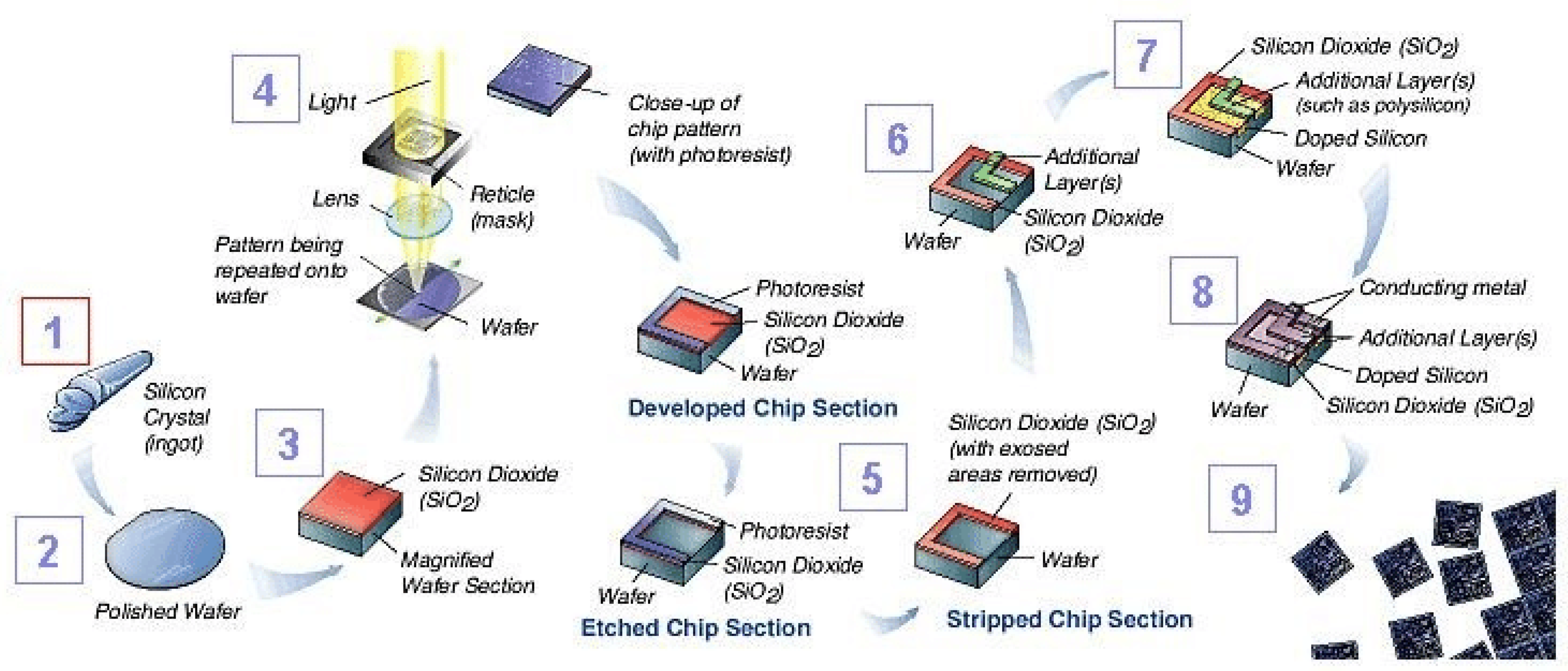
Semiconductor manufacturing involves crucial processes like wafer fabrication, doping, lithography, etching, and deposition (
Figure 8) [
157,
158]. Various doping methods, such as ion implantation and diffusion, alter the electrical properties of semiconductors significantly. Lithography is essential for patterning at the nanometer scale, while etching allows for defining structures on the semiconductor surface. Deposition is a very vital process in adding thin films to the semiconductor substrate. Some of the new techniques that are evolving in the semiconductor manufacturing process include the use of plasma etching technology in flattening surfaces, as well as terminating the deposition of thin films at desired positions [
157]. Additionally, advancements in semiconductor manufacturing involve addressing uncertainties and disturbances through control schemes like run-to-run control based on discrete active disturbance rejection control, which effectively suppresses disturbances and uncertainties in the manufacturing process [
159]. These processes collectively contribute to the intricate and precise production of semiconductor devices in modern manufacturing environments [
160].
4.1. Semiconductor Manufacturing Process
4.1.1. Wafer Fabrication
The foundation of semiconductor devices begins with wafer fabrication. First, a single crystal ingot like pure silicon is pulled and sliced into thin wafers. The wafers are polished to create a smooth surface. To analyze the defects such as stress fields in the crystal lattice, the wafer undergoes thermal treatments in which a radial temperature gradient acts on the wafer. This preparation is important because even minor defects will result in flaws in the final product. The wafers serve as the substrate for subsequent processing steps [
161,
162].
4.1.2. Doping
Doping is an essential process in semiconductor processing/manufacturing since it defines the electronic features of this material. Several methods are implemented to introduce impurities into semiconductor materials. These processes can change the resistivity, mobility, energy band gap, and light absorption coefficients [
163]. Doping refers to introducing certain impurities into the wafer to alter its electrical properties. It can be done through a process of thermal diffusion or by ion implantation. Doping allows the creation of n-type and p-type semiconductors; this aspect is very important in forming p-n junctions that are basic to transistor operations [
164].
Figure 8.
Semiconductor Manufacturing Process Flowchart [
165]. This figure illustrates the key steps involved in the fabrication of integrated circuits using photolithography. Starting from a polished silicon wafer, it shows the application of silicon dioxide (SiO₂) layers, the deposition of photoresist, and exposure to light through a patterned reticle mask. The process highlights how light is used to transfer the mask pattern onto the wafer, leading to the development of etched sections that form the foundation for semiconductor chips. The final steps involve adding additional conducting and insulating layers to create the desired circuit patterns. This detailed visual serves as a guide to understanding the photolithography sequence, a core technique in semiconductor manufacturing.
Figure 8.
Semiconductor Manufacturing Process Flowchart [
165]. This figure illustrates the key steps involved in the fabrication of integrated circuits using photolithography. Starting from a polished silicon wafer, it shows the application of silicon dioxide (SiO₂) layers, the deposition of photoresist, and exposure to light through a patterned reticle mask. The process highlights how light is used to transfer the mask pattern onto the wafer, leading to the development of etched sections that form the foundation for semiconductor chips. The final steps involve adding additional conducting and insulating layers to create the desired circuit patterns. This detailed visual serves as a guide to understanding the photolithography sequence, a core technique in semiconductor manufacturing.
4.1.3. Thermal Oxidation
The thermal oxidation step in semiconductor manufacturing processes is a fundamental process for the creation of silicon dioxide layers on silicon wafers; these are integral components in most electronic devices [
166,
167]. This process helps in creating gate dielectrics, which are vital for the proper functioning of transistors and other semiconductor devices [
167]. Optimized gas flow rate, oxidation time, and temperature in the thermal oxidation process guarantee that high-quality oxide layers are formed with the necessary thickness, which relates to semiconductor device performance and reliability [
166]. Besides, it aids in reducing stress on wafers, enhances IC yield, and improves the quality of semiconductor products as a whole [
168,
169]. The precise control and optimization of the thermal oxidation process are essential for achieving high-quality semiconductor devices with optimal performance characteristics. Thermal oxidation essentially involves the step of heating semiconductors on silicon wafers in an environment rich in oxygen at temperatures usually within the range of 800°C to 1200°C. It is within this temperature limit that the oxygen molecules diffuse into the silicon substrate and react to form silicon dioxide. There are two major techniques of thermal oxidation: Dry Oxidation and Wet Oxidation. Dry oxidation uses pure oxygen, and the oxide layer is thinner with higher quality (Si + O
2 → SiO
2).
They are characterized by slow growth, high density, and high breakdown voltage. Wet oxidation involves the use of steam, which may grow thicker oxide layers more quickly but of lesser quality compared with dry oxidation. Fast growth even at low temperatures is their characteristic feature and they permit thicker oxides [
170].
4.1.4. Lithography
Lithography is one of the most important patterning techniques in defining the geometric shapes of semiconductor devices on a substrate. After preparing the wafer, its surface is coated with a photoresist, a light-sensitive material that changes the chemical properties of the wafer to make it suitable for circuit printing [
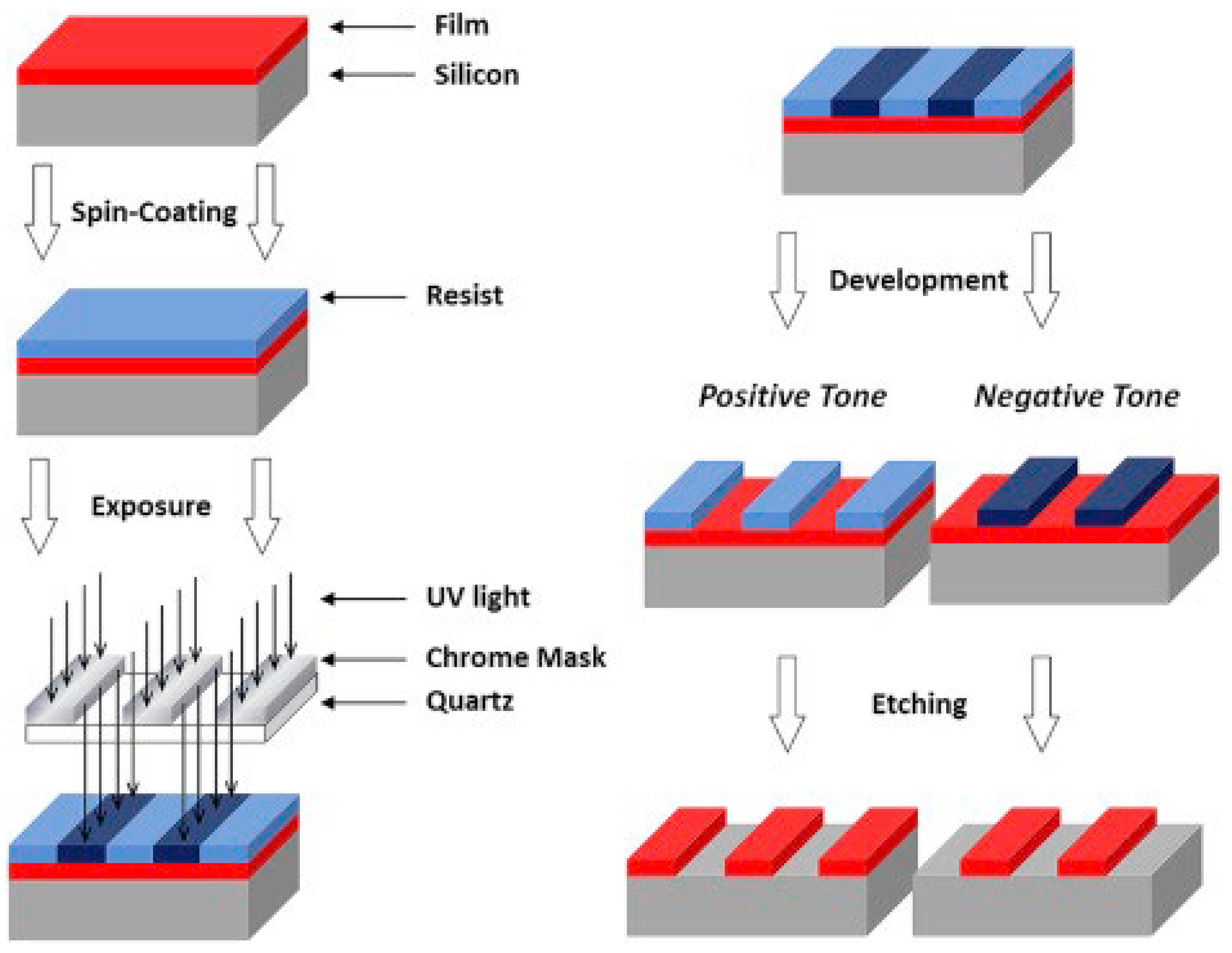
171]. There are two main types of photoresists based on their ultraviolet light (UV) reactivity: positive and negative. The positive photoresist becomes soluble upon exposure to UV light, and the exposed resist gets dissolved, leaving the unexposed resist remaining. On the other side, negative photoresists harden when exposed to UV light. Positive photoresist is more widely applied in the semiconductor manufacturing process due to its better thermal stability and resolution capability (
Figure 9) [
161].
The various steps in the photolithography process include the application of a layer of photoresist, coating with an adhesion promoter, pre and post-baking, light exposure, and finally the development of the exposed material. A photosensitive substance known as "photoresist" is applied to the wafer. Afterward, the photoresist-coated wafer is pre-baked from 90 to 120°C to fix the binding of the photoresist and evaporate the extra photoresist solvent. Then the photoresist is exposed to a pattern of intense light following the prebake. In optical lithography, UV light is commonly used. A post-exposure bake is conducted at 60 - 120°C to fix the pattern before development. Afterward, a developer is applied to the photoresist layer. The substance can be such that it is able to dissolve either the irradiated or non-irradiated photoresist [
172].
Photolithography refers to the process of drawing a circuit design onto a wafer. This is the step where the wafer is introduced to the photolithographic equipment and exposed to UV light. This light draws the pattern from the mask, containing the blueprint of the circuit, onto the wafer coated with a photoresist film. Using light, photolithography transfers a geometric pattern from a photomask onto the photoresist applied to a substrate. Variants of lithography include e-beam lithography, which uses a focused beam of electrons to create extremely fine patterns for small-scale devices, and extreme ultraviolet lithography (EUV), which uses EUV light to achieve smaller feature sizes essential for advanced semiconductor nodes. Refraction and defects can occur in the lithography process, which is why robust quality control is necessary. This is a critical step in defining the layout of electronic components, as well as creating complex patterns on the surface of the wafer [
161,
173].
Figure 9.
The lithography and etching process [
174]. This figure illustrates the photolithography steps in semiconductor device fabrication. A silicon wafer is coated with a photoresist layer and exposed to UV light through a mask. In positive-tone resists, the exposed areas are dissolved during development, while negative-tone resists harden. The process concludes with etching, where unwanted material is removed to create precise patterns on the wafer surface. This figure highlights the differences between positive and negative resists and the role of etching in defining geometric shapes.
Figure 9.
The lithography and etching process [
174]. This figure illustrates the photolithography steps in semiconductor device fabrication. A silicon wafer is coated with a photoresist layer and exposed to UV light through a mask. In positive-tone resists, the exposed areas are dissolved during development, while negative-tone resists harden. The process concludes with etching, where unwanted material is removed to create precise patterns on the wafer surface. This figure highlights the differences between positive and negative resists and the role of etching in defining geometric shapes.
4.1.5. Etching
After printing the circuit diagram on the wafer through lithography, the etching process follows to remove excess materials from the surface, creating the desired patterns (
Figure 9). The two main primary types of etching include wet and dry etching. Wet etching involves chemical solutions that mostly dissolve material equally in all directions and are less precise. Dry etching, also known as plasma etching, uses ionized gases to remove the material and thus provides better resolution and anisotropy, which results in highly defined structures [
161,
162,
173].
Emerging techniques like atomic layer etching (ALE) and cryogenic etching are critical in advanced semiconductor manufacturing. ALE provides atomic-level precision by alternating between etching and passivation steps, while cryogenic etching, performed at very low temperatures, enables the creation of high-aspect-ratio features with smooth sidewalls. These methods are of vital importance in advanced semiconductor devices. Semiconductors often require repeating the photolithography and etching processes several times on all layers of the wafer to achieve the final product; hence, precision is required, and close process control is necessary to prevent damage to the chip structure. Various methods in semiconductor processing, such as using atomized droplets with etching solutions at high temperatures, curing photoresists to reduce consumption, conducting multiple etch cycles with gas and purge gas introductions, and employing specific gas mixtures for plasma processing, aim to achieve precise and controlled material removal, enhancing efficiency and reducing costs [
175,
176].
4.1.6. Deposition
Deposition involves adding thin films of materials onto the semiconductor substrate to form layers necessary for device functionality. Various techniques are used in this process including Chemical Vapor Deposition (CVD), Physical Vapor Deposition (PVD) and Atomic Layer Deposition. In chemical vapor deposition, chemical reactions in a vapor phase deposit materials onto the substrate. Variants of CVD include low-pressure CVD (LPCVD) and plasma-enhanced CVD (PECVD). Physical vapor deposition (PVD), which involves physical processes like sputtering or evaporation, is widely used for depositing metals. Another method, atomic layer deposition (ALD), deposits materials one atomic layer at a time, providing excellent control over thickness and uniformity. These deposited films serve multiple purposes, such as forming insulating layers, conducting paths, or active components like transistors [
161,
162,
173].
4.1.7. Assembly and Packaging
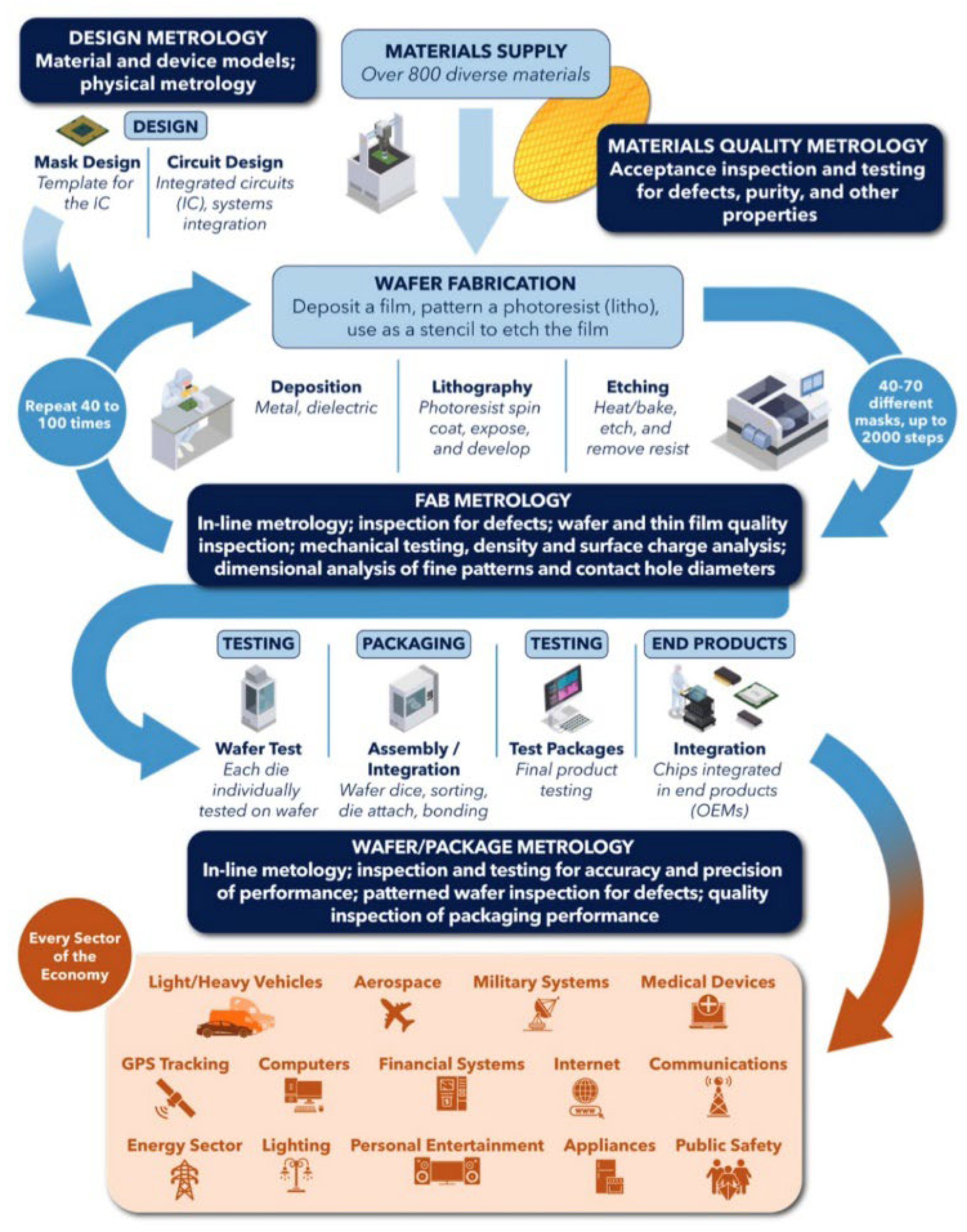
The semiconductor manufacturing process (
Figure 8,
Figure 10) is intricate and can span up to 26 weeks from design to production, culminating in the dicing of wafers into individual chips and their subsequent bonding onto substrates. This final stage is critical as it involves separating the chips, which is often achieved through methods like laser stealth dicing, followed by grinding and thinning to ensure precision and quality. The packaging of these chips serves multiple essential functions: it protects against mechanical damage, provides barriers against moisture and chemical contaminants, and ensures robust electrical connections through strong leads. Materials such as plastic and ceramic are commonly used to create protective layers that encapsulate the chips, safeguarding the electrical circuits from potential damage due to heat or physical stress. Ultimately, these processes ensure that the semiconductor chips are reliable and ready for integration into electronic devices.
Figure 10.
A comprehensive overview of the semiconductor fabrication process, detailing the steps from materials supply and wafer fabrication to testing and integration. The diagram highlights the critical role of metrology in ensuring quality and precision at each stage, from design through to end products utilized across various sectors of the economy [
177].
Figure 10.
A comprehensive overview of the semiconductor fabrication process, detailing the steps from materials supply and wafer fabrication to testing and integration. The diagram highlights the critical role of metrology in ensuring quality and precision at each stage, from design through to end products utilized across various sectors of the economy [
177].
The semiconductor manufacturing process involves other steps, like testing and inspecting chips [
178]. Among the most common problems that create issues for manufacturers are:
Product Quality; The difficulty in ensuring quality products can arise as semiconductor products become more sophisticated and their demand increases. Defects; There are several steps from assembling to testing that can lead to defects in the products. These defects can hardly be noticed considering the size of each chip and the number of its layers.
Cost; The cost associated with the semiconductor manufacturing process continues to rise, with new technologies coming out and shortages occurring that make it harder for manufacturers to break even in revenue.
Equipment; Advances within the industry will require manufacturers to keep pace with new equipment and technologies, which can be a struggle and an added cost. Time; Even minor production faults render hundreds of chips useless, and there is almost always a challenge of minimizing the downtime in case of quality compromise and delay [
161].
4.2. Emerging Techniques in Semiconductor Manufacturing
As the semiconductor industry evolves, several emerging techniques are gaining traction. Such Techniques include Extreme Ultraviolet Lithography (EUV), Atomic Layer Deposition (ALD), 3D Integration, Quantum Dots and Nanowires.
Extreme Ultraviolet Lithography (EUV); The technique under modern lithography uses shorter wavelengths of light to create smaller features on chips, underlying more powerful, more efficient devices on the market. Compared to conventional optical lithography, this technique uses a shorter wavelength of light, 13.5 nm. This allows for smaller features to be carried on chips, enabling the production of devices that are more powerful and efficient. EUV lithography has the potential to overcome the limitations of optical lithography, which is getting to the end of its resolution, and to make it possible to manufacture features in the sub-10 nm scale. [
179].
Atomic Layer Deposition (ALD); Atomic layer deposition (ALD) is a thin film deposition technique that allows for the precise control of film thickness at the atomic level. This is particularly important as the devices shrink in size, as it enables the fabrication of ultra-thin and conformal films [
180,
181]. ALD exposes the substrate to alternating gaseous precursors that react with the surface to deposit a layer of atoms one at a time. This method offers superb control of film thickness, composition, and conformality, making it an essential process for advanced semiconductor manufacturing.
3D Integration; 3D integration revolutionizes the semiconductor industry by stacking circuits vertically, enabling higher performance and reduced device footprint. Through-silicon vias (TSVs) or Cu-Cu connections are utilized for interconnecting stacked layers, facilitating shorter interconnects and increased integration density [
182]. This technique allows for heterogeneous integration, where diverse components fabricated using optimized processes can be stacked together, enhancing overall performance and functionality [
183]. The integration of various technologies like analog, radio frequency, sensors, memory devices, and digital components in a vertically stacked manner opens up possibilities for improved communication bandwidth, design flexibility, and cost reduction, aligning with the "More than Moore" paradigm in semiconductor advancements [
184].
Quantum Dots and Nanowires; These are being researched into ways that they could be used in making much smaller and more efficient electronic components—material structures that benefit from quantum mechanics for better performances [
173,
175]. Quantum Dots (QDs) and Nanowires leverage quantum mechanics to enhance electronic component performance. QDs, characterized by their unique optical properties and potential for applications in optoelectronics and quantum computing, are being optimized through various synthesis methods such as molecular beam epitaxy and chemical vapor deposition [
185,
186]. Their ability to exhibit excellent photostability makes them ideal for applications in biomedical imaging and nanosensing [
187]. Meanwhile, Nanowires are being explored for their potential in creating smaller, more efficient transistors and other electronic devices, contributing to the ongoing miniaturization trend in semiconductor technology [
188]. The integration of these nanostructures into device architectures is crucial for achieving higher performance and reduced power consumption, aligning with the industry's push towards advanced micro and nanoelectronics [
187,
188].
5. Innovation and Future Prospect
The present trends in the semiconductor industry are oriented toward modernization at a very high rate. Major areas of focus remain quantum semiconductors, flexible electronics, and miniaturization technologies. [
17,
189,
190]. These new cutting-edge developments are pushing this industry toward more efficient and cost-effective solutions, especially in the context of emerging applications like autonomous vehicles and energy-efficient chips [
189]. The future roadmap of the industry is forecasted to be one of low power consumption, low e-waste generation, and alternative raw materials to respond to market demand and regulatory policy [
189]. What is more, the semiconductor industry being an emerging market can be proved from the aspect that the sale of electronic goods will boost up to
$1 trillion by 2030, indicating the huge space for development and technology development in this industry [
191]. This underlines the critical role semiconductors play in driving economic growth, national security, and technological innovation, which supports continued research and development efforts to ensure leadership in microelectronics manufacturing and a sustainable future for the industry as a whole [
177].
Recent strides made in the semiconductor industry have greatly innovated flexible electronics, quantum semiconductors, and miniaturization. Developments like these are changing the face of electronic devices, opening up possibilities for technologies of the future.
Flexible electronics, otherwise known as flex circuits, are a technology where the mounting of electronic devices is done on flexible plastic substrates. This feature brings along several advantages over their traditional counterpart, rigid electronics, which include flexibility and durability. They are bendable, foldable, and even rollable without sustaining any damage; hence, they are highly applicable where space is limited or, inversely, flexibility is very essential. They are resistant to some tough environmental conditions and suffer less mechanical damage. Applications of flexible electronics include flexible displays, RFID tags, flexible sensors, and memories. They find special applications in those areas where traditional devices are hard to apply, like wearable devices, medical implants, and automotive systems [
192,
193].
Quantum semiconductors, which harness the principles of quantum mechanics, are about to revolutionize the semiconductor industry. Quantum computing, for example, uses quantum bits qubits, which can be in a superposition, thus enabling one qubit to process multiple information bits simultaneously. This increases the speed of processing of certain types of tasks exponentially. Technologies like these have enormous potential for performance enhancement and could change industries. Quantum computers can solve complex problems much faster than classical computers; therefore, they would be suitable for applications such as cryptography, artificial intelligence, and simulation of complex systems. Quantum computing has the potential to be huge in epidemiology, cryptography, machine learning, and data analysis due to its power to enhance capabilities and efficiency [
194,
195,
196,
197].
Miniaturization; This miniaturization of semiconductors has been behind the advancement of modern electronics. The progress emanates from Moore's Law, which has facilitated the development of small and highly efficient gadgets. Key among these developments is Deep Submicron Technology. Other techniques, such as lithography and etching, have made it possible to create semiconductor devices in the submicron regime, increasing their performance and efficiency. Fin Field-Effect Transistors came to introduce better performance and reduce leakage in nano-scale devices.
Advanced lithography technique such as Extreme Ultraviolet Lithography uses shorter wavelengths to create even smaller features, thus essential in manufacturing advanced nano-scale semiconductors [
198]. This groundbreaking technique facilitates the continuation of Moore’s Law and the scaling down of device features beyond traditional photolithography limits [
199]. Recent developments, including mirror-based interference lithography, have further enhanced the resolution capabilities of EUV, pushing the boundaries of photon-based lithography and addressing the demands of nanoscience and technology. Additionally, innovative approaches like colloidal nanosphere lithography combined with EUV light are being explored to achieve sub-50 nm feature sizes at a lower cost [
200].
The semiconductor industry is poised to continue its rapid pace of innovation, driven by cutting-edge technologies that will transform the landscape of electronic devices [
192,
193].
6. Opportunity and Areas of Expansion
Semiconductors present vast opportunities for growth and impact across various sectors such as renewable energy, healthcare, and telecommunications. In terms of growth, the sector is already witnessing high growth and diversification, contributed by rapid technological progress and growing demand from different industries (
Figure 11) [
17].
One major area of development in this regard has been playing out with the role of artificial intelligence within this semiconductor landscape. The AI-related semiconductor market was expected to grow from
$6 billion in 2020 to over
$30 billion in 2022, representing compound annual growth (CAGR) of nearly 50% [
201] in less than three years alone. The high demand from AI for advanced processing capability will drive growth in microprocessors and memory chips and hence become a key area for investment and development. Moreover, the application of AI technologies in semiconductor manufacturing processes—product development, risk assessment, and defect classification—has taken a different route with the intervention of deep learning and machine learning techniques, further propelling the industry [
202].
The automotive sector has also remained a dominant driver of semiconductor demand, especially with increasing electric vehicles (EVs) and advanced driver-assistance systems (ADAS). The outlook of the automotive semiconductor market is encouraging, with the CAGR for ADAS calculated at nearly 20% by 2027 [
203]. Indeed, the need for semiconductors is probably going to increase due to the increasing digitization of vehicles powered by complex electronics. By design, according to this, energy-efficient chips and manufacturing processes can power autonomous cars and vehicles [
202]. Moreover, semiconductors are at the heart of innovations in high-performance computing, wireless connectivity, and autonomous driving, thereby contributing to productivity, efficiency, safety, and sustainability.
The rollout of 5G technology is creating large opportunities for semiconductor manufacturers. With faster and more efficient communication devices requiring advanced chipsets, this has increased their demand, especially those chipsets designed for Internet of Things applications. The integration of IoT and AI into telecommunications is expected to drive further growth in this sector [
204,
205]. The convergence will come up with some of the cutting-edge technologies and improve communication infrastructure, thus strengthening the role of semiconductors in modern telecommunications.
Semiconductors drive most of the renewable energy technologies, from solar inverters to energy management systems. As the world is moving into sustainable energy, the demand for semiconductors that facilitate the process of energy conversion and storage will rise. This opens up huge opportunities for companies to innovate and widen product lines in this field. Another solution would be the progress in material research that can be done to make semiconductors relatively cheap and more effective. It would be realized through the development of energy-efficient chips and manufacturing processes [
206].
Healthcare is increasingly being driven by semiconductor technology that is powering medical devices, diagnostics tools, and telehealth solutions. Increased patient monitoring, data collection, and analysis within healthcare devices pertaining to the domains of AI and IoT open new fields of device application and correlated semiconductors. This trend supports the market growth of semiconductors in healthcare delivery improvement and better patient outcomes [
204,
205].
Geopolitical dynamics are reshaping the semiconductor industry given the increasingly important role that manufacturing plays in ensuring both national security and economic stability. Government incentives become a leading force in expanding companies to new regions, especially for greenfield investments where the focus is both sustainability and supply chain security. This development sets the stage for companies to do business in locations away from traditional strongholds of the semiconductor industry, therefore engendering a more diversified and resilient global semiconductor supply chain [
206].
Figure 11.
(a) Projected Global Semiconductor Market Size from 2023 to 2033 (USD Billion). The market is expected to grow from
$544.78 billion in 2023 to
$1,137.57 billion in 2033. (b) Projected Semiconductor Market Size in the Asia Pacific Region from 2023 to 2033 (USD Billion). The market is anticipated to increase from
$287.79 billion in 2023 to
$611.73 billion in 2033. (c) Semiconductor Market Share by Region in 2023 (%). The Asia Pacific region leads with 52.8%, followed by North America (22.7%), Europe (15.8%), Latin America (4.5%), and the Middle East & Africa (4.1%). (d) Semiconductor Market Share by Application in 2023 (%). The largest share is held by Networking & Communications (29.2%), followed by Data Processing (23.6%), Consumer Electronics (17.1%), Industrial (13.6%), Automotive (11.3%), and Government (5.2%) [
205].
Figure 11.
(a) Projected Global Semiconductor Market Size from 2023 to 2033 (USD Billion). The market is expected to grow from
$544.78 billion in 2023 to
$1,137.57 billion in 2033. (b) Projected Semiconductor Market Size in the Asia Pacific Region from 2023 to 2033 (USD Billion). The market is anticipated to increase from
$287.79 billion in 2023 to
$611.73 billion in 2033. (c) Semiconductor Market Share by Region in 2023 (%). The Asia Pacific region leads with 52.8%, followed by North America (22.7%), Europe (15.8%), Latin America (4.5%), and the Middle East & Africa (4.1%). (d) Semiconductor Market Share by Application in 2023 (%). The largest share is held by Networking & Communications (29.2%), followed by Data Processing (23.6%), Consumer Electronics (17.1%), Industrial (13.6%), Automotive (11.3%), and Government (5.2%) [
205].
Sustainability and supply chain resilience are very slowly becoming a trend in semiconductors. Environmentally friendly practices, coupled with the new need to be supply chain resilient, have been incorporated into the long-term growth strategy by various companies. Such focus on sustainability is expected to shape decisions related to manufacturing locations and partnerships into a more sustainable and resilient industry [
205,
206].
The semiconductor industry faces a talent shortage. It has therefore been exposed to be the imperative of workforce development. Firms have to invest in a skilled workforce through the delivery of training and retention programs to ensure that skilled workers are geared up for increasing sector demand. This 'talent-oriented' approach will be critical to staying competitive and driving innovation while maintaining the growth momentum of the industry (
Figure 11) [
203].
The future of the semiconductor industry is therefore niche in innovating and adapting. It makes possible the advancement in the most critical sector.
7. Sustainability and SDG Alignment
The semiconductor industry underpins sustainable development and achievement of the United Nations SDGs. Given the constantly growing demand for semiconductors to match strides in technology and transition to a low-carbon economy, the industry must adopt practices that promote energy efficiency, waste reduction, and the use of eco-friendly materials [
207,
208].
Semiconductors are integral to numerous applications that enhance energy efficiency, particularly in the context of SDG 7, which focuses on ensuring access to affordable, reliable, sustainable, and modern energy for all. Research shows a significant focus on SDG 7 (Affordable and Clean Energy), accounting for 68.9% of semiconductor-related SDG publications from 2017 to 2022 (
Figure 12) [
15]. This calls for inventions like low-power chips and energy-efficient designs to save the general energy consumption of the devices. The industry is working on complex manufacturing challenges with data-driven approaches, coupled with advanced modeling techniques, to allow more sustainable practices [
209]. Universities contribute to SDG 7 by promoting energy sustainability and efficiency through research and knowledge transmission [
210].
The Semiconductor Climate Consortium, founded in 2022, marks the industrywide push to increase energy efficiency and reduce emissions throughout the semiconductor life cycle. This collaborative approach aims to meet the Paris Agreement Goals by fostering standards and practices that lower energy use in semiconductor manufacturing and application [
211]. Product design has increasingly included energy efficiency as a prime criterion, and companies have been optimizing power, performance, and area (PPA) to make chips not only become better performers but also be frugal with their power consumption—thereby reducing lifetime emissions and operational cost [
211,
212].
The semiconductor industry faces significant challenges regarding waste generation and resource use, which are critical to achieving SDG 12: Responsible Consumption and Production. Closed-loop manufacturing processes can facilitate the recycling and reuse of materials within the semiconductor production cycle. This approach minimizes waste and reduces the reliance on raw material extraction, aligning with circular economy principles [
213]. The development of efficient recycling methods and the exploration of biodegradable materials are essential for mitigating the environmental impact of electronic waste. Research is ongoing in the development of semiconductor components that can be easily repaired, refurbished, or recycled to extend their lifecycle and reduce landfill contributions [
212,
213].
The transition to sustainable materials is vital for the semiconductor industry to align with SDG 9, which emphasizes building resilient infrastructure, promoting inclusive and sustainable industrialization, and fostering innovation. Focus is also placed on the development of new materials that are recyclable or biodegradable. This ranges from research into plant-based polymers and other sustainable alternatives that can replace traditional semiconductor materials to reduce environmental impact during production and upon disposal [
211,
212]. Many semiconductor manufacturers are committing to the use of renewable energy sources in their operations. Companies like Intel and TSMC are driving this shift, having set targets to source a large part of their energy from renewable sources by 2030 to reduce carbon emissions and thereby aid in the global transition to sustainable energy [
213,
214].
Sustainable practices in related sectors, such as construction, also align with multiple SDGs, including SDG 7, SDG 9 (Industry, Innovation, and Infrastructure), and SDG 11 (Sustainable Cities and Communities) [
215]. However, there is a need for increased collaboration between academia and industry to amplify the impact of semiconductor innovations on the SDGs [
15]. Semiconductor companies are actively working towards reducing energy consumption and waste through initiatives like developing low-power chips and utilizing recyclable materials, thus contributing to SDG targets such as affordable and clean energy, responsible consumption, and industry innovation. This focus on energy efficiency, waste reduction, and eco-friendly materials reflects a broader trend across industries towards sustainable practices, emphasizing the importance of technological advancements in achieving environmental and social objectives. Additionally, the engagement of multinational corporations (MNCs) in sustainable development programs further underscores the significance of semiconductor companies' efforts in addressing global challenges and promoting positive externalities [
208].
Figure 12.
(a) Number of semiconductor-related publications from 2017 to 2022 by SDG program. (b) Number of SDG-related publications on semiconductors per year from 2017 to 2022. (c) Countries contributing to SDG 7-related publications from 2017 -2022 [
15].
Figure 12.
(a) Number of semiconductor-related publications from 2017 to 2022 by SDG program. (b) Number of SDG-related publications on semiconductors per year from 2017 to 2022. (c) Countries contributing to SDG 7-related publications from 2017 -2022 [
15].
8. Conclusions
The advancements in semiconductor technologies have significantly shaped modern innovations, enabling breakthroughs across various sectors such as electronics, telecommunications, and renewable energy. The historical progression from point-contact rectifiers to ultrawide-bandgap semiconductors underscores how continuous technological development has created increasingly efficient, high-performing devices. Key innovations such as wide-bandgap materials, quantum computing, and AI-integrated systems have emerged as essential drivers of this evolution.
However, despite these advancements, critical challenges persist, especially in the scaling of new materials like gallium nitride (GaN) and silicon carbide (SiC), which are poised to replace traditional silicon in high-power and high-frequency applications. While these materials hold immense potential, their integration into mainstream production faces hurdles related to fabrication costs, material scarcity, and performance limitations. To ensure long-term sustainability and meet global demand, significant improvements in material engineering, defect management, and production efficiency are necessary. In particular, the need to develop sustainable semiconductor materials and processes has become imperative, as environmental concerns and global supply chain disruptions—exemplified by the COVID-19 pandemic—have highlighted the vulnerability of current production frameworks.
Looking forward, innovation in quantum computing and the exploration of next-generation semiconductors, such as 2D materials like graphene and ultrawide-bandgap semiconductors, present promising avenues for future research. These technologies not only have the potential to enhance computational power and efficiency but also align with the global sustainability goals by reducing energy consumption and minimizing electronic waste. Furthermore, incorporating sustainable practices in semiconductor manufacturing—such as reducing the use of toxic chemicals, improving energy efficiency in production, and adopting recycling practices for electronic waste—will be vital for addressing environmental challenges.
In addition to these technical advancements, the societal impact of semiconductors cannot be understated. The integration of semiconductor technologies into fields such as healthcare, AI, and renewable energy has already begun to reshape industries, offering new solutions to critical global issues. However, as these technologies become more embedded in daily life, the semiconductor industry must confront ethical and security challenges, particularly concerning data privacy and the responsible development of AI-driven systems.
In conclusion, while the semiconductor industry continues to innovate at a rapid pace, the key to its future success lies in balancing technological progress with sustainability and ethical considerations. Addressing the current gaps in material scalability, production resilience, and sustainable practices will ensure that semiconductors remain at the forefront of global technological advancement, driving innovations that are not only more powerful but also more sustainable and equitable for future generations. The continued integration of semiconductors into emerging fields like quantum computing, AI, and renewable energy systems offers exciting opportunities for research and development, paving the way for transformative changes in both technology and society.
Author Contributions
The manuscript was written through the contributions of all authors. All authors have approved the final version of the manuscript.
Data Availability Statement
No data was used for the research described in the article.
Conflicts of Interest
The authors declare that they have no known competing financial interests or personal relationships that could have appeared to influence the work reported in this paper.
References
- Junior, F.; Nunes, C.; Redkva, P.E.; Sandrino, B. Semiconductors In The Digital Age: Evolution, Challenges, And Geopolitical Implications. 2023, 12, 133–150. [Google Scholar] [CrossRef]
- Schroter, M.; Boeck, J.; D'Alessandro, V.; Fregonese, S.; Heinemann, B.; Jungemann, C.; Liang, W.; Kamrani, H.; Mukherjee, A.; Pawlak, A.; et al. The EU DOTSEVEN Project: Overview and Results. Technical Digest - IEEE Compound Semiconductor Integrated Circuit Symposium, CSIC 2016, 2016. [Google Scholar] [CrossRef]
- Venkatesh, R.; Selvakumar, D.S.; Dhasneem, S.; Kannan, L.V. SEMICONDUCTOR DEVICES: AN OVERVIEW. Futuristic Trends in Electrical Engineering Volume 3 Book 1 2024, 3, 11–37. [Google Scholar] [CrossRef]
- Roy, S.; Ghosh, C.K.; Dey, S.; Pal, A.K. Solid State & Microelectronics Technology. Solid State & Microelectronics Technology 2023. [Google Scholar] [CrossRef]
- Fahlman, B.D. Semiconductors. Materials Chemistry 2023, 291–405. [Google Scholar] [CrossRef]
- Bimberg, D. Semiconductor nanostructures for flying q-bits and green photonics. Nanophotonics 2018, 7, 1245–1257. [Google Scholar] [CrossRef]
- Bosio, A.; O'Connor, I.; Traiola, M.; Echavarria, J.; Teich, J.; Hanif, M.A.; Shafique, M.; Hamdioui, S.; Deveautour, B.; Girard, P.; et al. Emerging Computing Devices: Challenges and Opportunities for Test and Reliability. Proceedings of the European Test Workshop 2021, 2021. [Google Scholar] [CrossRef]
- Dokuchaev, V.A. Digital transformation: New drivers and new risks. 2020 International Conference on Engineering Management of Communication and Technology, EMCTECH 2020 - Proceedings 2020. [Google Scholar] [CrossRef]
- Malik, H.; Chaudhary, G.; Srivastava, S. Digital transformation through advances in artificial intelligence and machine learning. J. Intell. Fuzzy Syst. 2022, 42, 615–622. [Google Scholar] [CrossRef]
- Kapoor, K.; Bigdeli, A.Z.; Dwivedi, Y.K.; Raman, R. How is COVID-19 altering the manufacturing landscape? A literature review of imminent challenges and management interventions. Ann. Oper. Res. 2024, 335, 1567–1599. [Google Scholar] [CrossRef]
- Sweidan, O.D. The geopolitics of technology: Evidence from the interaction between the United States and China. Russ. J. Econ. 2024, 10, 130–150. [Google Scholar] [CrossRef]
- Kumar, S. Semiconductor Geopolitics - Past, Present, and Future. Indian Public Policy Rev. 2024, 5, 171–174. [Google Scholar] [CrossRef]
- Bu, Q. Can de-risking avert supply chain precarity in the face of China-U.S. geopolitical tensions? From sanctions to semiconductor resilience and national security. Int. Cybersecur. Law Rev. 2024, 5, 413–442. [Google Scholar] [CrossRef]
- Germann, J.; Rolf, S.; Baines, J.; Starrs, S.K. A Chip War Made in Germany? US Techno-Dependencies, China Chokepoints, and the German Semiconductor Industry. Politi- Gov. 2024, 12. [Google Scholar] [CrossRef]
- Hsieh, S.; Lin, P.-Y.; Lin, I.-H.; Beck, D.E.; Lin, C.-H. Assessing the contribution of semiconductors to the sustainable development goals (SDGs) from 2017 to 2022. Heliyon 2023, 9, e21306. [Google Scholar] [CrossRef] [PubMed]
- Kurrahman, T.; Tsai, F.M.; Jeng, S.-Y.; Chiu, A.S.; Wu, K.-J.; Tseng, M.-L. Sustainable development performance in the semiconductor industry: A data-driven practical guide to strategic roadmapping. J. Clean. Prod. 2024, 445, 141207. [Google Scholar] [CrossRef]
- Mukherjee, S.; Pal, D.; Bhattacharyya, A.; Roy, S. Future of the Semiconductor Industry. Handbook of Semiconductors 2024, 359–374. [Google Scholar] [CrossRef]
- Pan, Y.; Song, Y.; Zhang, C.-C.; Zhu, Q.; Wu, J. Semiconductor industry's transformation path under circular economy: Evidence from micro-level efficiency evaluation. Comput. Ind. Eng. 2024, 189, 109934. [Google Scholar] [CrossRef]
- Londos, C.A.; Chroneos, A.; Sgourou, E.N.; Panagiotidis, I.; Angeletos, T.; Potsidi, M.S. Comparative Study of Oxygen- and Carbon-Related Defects in Electron Irradiated Cz–Si Doped with Isovalent Impurities. Appl. Sci. 2022, 12, 8151. [Google Scholar] [CrossRef]
- Lee, D.H.; Song, H.W.; Lee, S. (Invited) Doping Mechanisms and Defect Passivation of p-Type SnOx for Tfts and Bipolar Devices. ECS Meet. Abstr. 2024, MA2024-01, 1300. [Google Scholar] [CrossRef]
- Gachovska, T.K.; Hudgins, J.L. SiC and GaN Power Semiconductor Devices. Power Electronics Handbook 2024, 87–150. [Google Scholar] [CrossRef]
- Mohanbabu, A.; Maheswari, S.; Vinodhkumar, N.; Murugapandiyan, P.; Kumar, R.S. Advancements in GaN Technologies: Power, RF, Digital and Quantum Applications. Nanoelectronic Devices and Applications 2024, 1–28. [Google Scholar] [CrossRef]
- Gao, H. Advancements and future prospects of Gallium Nitride (GaN) in semiconductor technology. Appl. Comput. Eng. 2024, 65, 37–44. [Google Scholar] [CrossRef]
- Lu, S. A systematic analysis of wide band gap semiconductor used in power electronics. Appl. Comput. Eng. 2024, 65, 161–166. [Google Scholar] [CrossRef]
- Wide Bandgap Semiconductors: Gallium Oxide is Next in Line. Available online: https://passive-components.eu/wide-bandgap-semiconductors-gallium-oxide-is-next-in-line/ (accessed on 5 October 2024).
- Kalyani, J.M. Basics of Semiconductors. Int. J. Sci. Res. (IJSR) 2023, 12, 412–414. [Google Scholar] [CrossRef]
- Bernardo, C.P.C.V.; Lameirinhas, R.A.M.; Cunha, J.P.d.M.; Torres, J.P.N. A revision of the semiconductor theory from history to applications. Discov. Appl. Sci. 2024, 6, 1–59. [Google Scholar] [CrossRef]
- Łukasiak, L.; Jakubowski, A. History of Semiconductors. J. Telecommun. Inf. Technol. 2010, 3–9. [Google Scholar] [CrossRef]
- Russer, P. Ferdinand Braun — A pioneer in wireless technology and electronics. 2022, 547–554. [Google Scholar] [CrossRef]
- Lather, A.S. Study of Semiconductor Devices. Universal Research Reports 2017, 4, 32–34. Available online: https://urr.shodhsagar.com/index.php/j/article/view/148 (accessed on 29 July 2024).
- Heidari, H.; Nabaei, V. Magnetic Sensors Based on Hall Effect. Magnetic Sensors for Biomedical Applications 2019, 33–56. [Google Scholar] [CrossRef]
- Balkan, N.; Erol, A. Charge Transport in Solids. 2021, 79–123. [Google Scholar] [CrossRef]
- Bhattacharya, G.; Venimadhav, A. An alternative approach to extract diode parameters from metal-semiconductor-metal asymmetric Schottky diodes. J. Phys. D: Appl. Phys. 2022, 55, 435101. [Google Scholar] [CrossRef]
- Dilshad, K.; Rabinal, M.K. Experiment with Schottky junction: estimation of metal–semiconductor interface parameters. Eur. J. Phys. 2019, 40, 035502. [Google Scholar] [CrossRef]
- Khiangte, L.; Dhar, R.S.; Kumar, K.; Pachuau, J.L. State-of-the-art MOSFET and TCAD in the advancement of technology: A review. 2018. [Google Scholar]
- Iwai, H.; Misra, D. The Transistor was Invented 75 Years Ago: A Big Milestone in Human History. Electrochem. Soc. Interface 2022, 31, 65–72. [Google Scholar] [CrossRef]
- Zhang, Y. MOSFET amplifier circuits. The Tao of Microelectronics 2014. [Google Scholar] [CrossRef]
- Mody, C.C. The little-known history of Jack Kilby's misadventure in solar power. IEEE Spectr. 2016, 53, 50–55. [Google Scholar] [CrossRef]
- Esaki, L. The First Quantum Electron Device. 75th Anniversary of the Transistor 2023, 1–2. [Google Scholar] [CrossRef]
- Bizindavyi, J.; Verhulst, A.S.; Smets, Q.; Verreck, D.; Soree, B.; Groeseneken, G. Band-Tails Tunneling Resolving the Theory-Experiment Discrepancy in Esaki Diodes. IEEE J. Electron Devices Soc. 2018, 6, 633–641. [Google Scholar] [CrossRef]
- Teja, R. Tunnel Diode - Working, Characteristics, Application. Available online: https://www.electronicshub.org/tunnel-diode-working-characteristics-applications/ (accessed on 25 July 2024).
- Varshney, A.; Yan, W.; Dutta, P. Judo: Addressing the Energy Asymmetry of Wireless Embedded Systems through Tunnel Diode based Wireless Transmitters. In MobiSys 2022 - Proceedings of the 2022 20th Annual International Conference on Mobile Systems, Applications and Services; 2022; pp. 273–286. [Google Scholar] [CrossRef]
- Liu, C.; Tien, K.; Chiu, P.; Wu, Y.; Chuang, Y.; Kao, H.; Li, J. Room-Temperature Negative Differential Resistance and High Tunneling Current Density in GeSn Esaki Diodes. Adv. Mater. 2022, 34, e2203888. [Google Scholar] [CrossRef] [PubMed]
- Prabhudesai, G.; Muruganathan, M.; Anh, L.T.; Mizuta, H.; Hori, M.; Ono, Y.; Tabe, M.; Moraru, D. Single-charge band-to-band tunneling via multiple-dopant clusters in nanoscale Si Esaki diodes. Appl. Phys. Lett. 2019, 114, 243502. [Google Scholar] [CrossRef]
- Anvarifard, M.K.; Orouji, A.A. Enhancement of a Nanoscale Novel Esaki Tunneling Diode Source TFET (ETDS-TFET) for Low-Voltage Operations. Silicon 2019, 11, 2547–2556. [Google Scholar] [CrossRef]
- Singh, A. K.; Misra, R.; Wadhwa, G.; Nirosha, R.; Agarwal, R. Design and Performance Analysis of Partially Depleted and Fully Depleted Silicon on Insulator MOSFET. J. Physics: Conf. Ser. 2022, 2335. [Google Scholar] [CrossRef]
- Kim, T.; Lee, J. Fabrication and characterization of silicon-on-insulator wafers. Micro Nano Syst. Lett. 2023, 11, 1–11. [Google Scholar] [CrossRef]
- S. Verma MTech Scholor SISTEC and B. Mohd Abdullah Assistant Professor SISTEC, “Review of SOI MOSFET Design and Fabrication Parameters and its Electrical Characteristics,” 2015.
- Sharma, Y.K.; Khan, I.U. Performance Evaluation of Fully Depleted Silicon on Insulator MOSFET. International Journal of Engineering and Applied Computer Science 2022, 4, 29–35. [Google Scholar] [CrossRef]
- Sivasankaran, K.; Mallick, P.S. Multigate Transistors for High Frequency Applications. 2023. [Google Scholar] [CrossRef]
- Petrosyants, K.O.; Silkin, D.S.; Popov, D.A. Comparative Characterization of NWFET and FinFET Transistor Structures Using TCAD Modeling. Micromachines 2022, 13, 1293. [Google Scholar] [CrossRef]
- Mohammede, A.A.; Mahmood, Z.K.; Demirel, H. Study of finfet transistor: critical and literature review in finfet transistor in the active filter. 3C TIC, Cuad. de Desarro. Apl. a las TIC 2023, 12, 65–81. [Google Scholar] [CrossRef]
- Mahmood, A.; Jabbar, W.A.; Hashim, Y.; Bin Manap, H. Effects of downscaling channel dimensions on electrical characteristics of InAs-FinFET transistor. Int. J. Electr. Comput. Eng. (IJECE) 2019, 9, 2902–2909. [Google Scholar] [CrossRef]
- Mahmood, A.; Jabbar, W.A.; Hashim, Y.; Bin Manap, H. Electrical Сharacterization of Ge-FinFET Transistor Based on Nanoscale Channel Dimensions. J. Nano- Electron. Phys. 2019, 11. [Google Scholar] [CrossRef] [PubMed]
- Kumari, V.; Modi, N.; Saxena, M.; Gupta, M. Theoretical Investigation of Dual Material Junctionless Double Gate Transistor for Analog and Digital Performance. IEEE Trans. Electron Devices 2015, 62, 2098–2105. [Google Scholar] [CrossRef]
- Glaied, S.; Nasri, F.; Machhout, M. Electron and Phonon Tranports in a 3D FinFET Transistor. In Proceedings of the 2023 IEEE International Conference on Advanced Systems and Emergent Technologies, IC_ASET 2023; 2023. [Google Scholar] [CrossRef]
- Jiao, Y.; Huang, X.; Rong, Z.; Ji, Z.; Wang, R.; Zhang, L. Modeling Multigate Negative Capacitance Transistors With Self-Heating Effects. IEEE Trans. Electron Devices 2022, 69, 3029–3036. [Google Scholar] [CrossRef]
- Joshi, B.C. AlGaN/GaN heterostructures for high power and high-speed applications. Int. J. Mater. Res. 2023, 114, 712–717. [Google Scholar] [CrossRef]
- Hao, L.; Hu, T.; Guo, H.; Pan, D.; Ye, J.; Zhou, Y.; Lu, H.; Zhang, R.; Zheng, Y.; Chen, D. Excellent electrostatic control and gate reliability for breakdown enhanced AlGaN/GaN HEMTs with extreme permittivity BaTiO3. Appl. Phys. Lett. 2024, 124. [Google Scholar] [CrossRef]
- Ye, H.; Jeng, Y.-E.; Jonsson, A.; Wu, C.; Venkatesan, N.; Wang, J.; Cao, Y.; Xie, A.; Beam, E.; Fay, P. Integration of ferroelectrics with III-N transistors for high performance millimeter-wave applications. 2023, 12430, 5–8. [Google Scholar] [CrossRef]
- Jeng, Y.-E.; Ye, H.; Bajpai, G.; Fay, P. Performance Improvement of GaN HEMT with Ferroelectric Gate Stacks for RF/mm-Wave Switching Applications. 2023 International VLSI Symposium on Technology, Systems and Applications, VLSI-TSA/VLSI-DAT 2023 - Proceedings; 2023. [Google Scholar] [CrossRef]
- Chang, E.-Y.; Wu, J.-S.; Yang, T.-Y.; Tsai, C.-H. Exploring Next-Generation GaN Power Devices with Ferroelectric Charge Trap Gate Stack Technology for Normally-OFF Operations. 2023 21st International Workshop on Junction Technology, IWJT 2023 2023. [Google Scholar] [CrossRef]
- Swe, H.M.T.; Tun, H.M.; Latt, M.M. Analysis of Quantum-well Heterojunction Emitter Bipolar Transistor Design. Am. J. Nano Res. Appl. 2020, 8, 9. [Google Scholar] [CrossRef]
- Lee, G.; Pearton, S.J.; Ren, F.; Kim, J. 2D Material-Based Vertical Double Heterojunction Bipolar Transistors with High Current Amplification. Adv. Electron. Mater. 2019, 5. [Google Scholar] [CrossRef]
- Santra, A.; Das, A.; Ghosh, A. ON SOME OVERVIEWS OF HETEROJUNCTION BIPOLAR TRANSISTOR TECHNOLOGY: A STUDY. 2019. Available online: http://www.ijeast.com.
- Klever, S.; Thönnessen, A.; De Doncker, R.W. Characterization of Conventional and Advanced Current Measurement Techniques Suitable for WBG Semiconductor Devices. 2022 24th European Conference on Power Electronics and Applications (EPE’22 ECCE Europe). 2022, pp. 1–10. Available online: https://ieeexplore.ieee.org/document/9907537?denied= (accessed on 21 July 2024).
- Aggarwal, A.K. Evolution of Maskless Digital Lithography: Game changer for Advanced Semiconductor Packaging. Mr Int. J. Eng. Technol. 2023, 10. [Google Scholar] [CrossRef]
- Wang, C.; Ali, A.; Karki, K.J. Multiphoton photocurrent in wide bandgap semiconductors for nonlinear optoelectronics: Comparison of GaP, GaN/InGaN, and SiC. Appl. Phys. Lett. 2024, 124. [Google Scholar] [CrossRef]
- Beheshti, M. Wide-bandgap semiconductors: Performance and benefits of GaN versus SiC. Analog Design Journal 2020. [Google Scholar]
- Yang, K.; Fu, L.; Chen, J.; Wang, F.; Tian, L.; Song, X.; Wu, Z.; Li, Y. Anatomy of resistive switching behavior in titanium oxide based RRAM device. Mater. Sci. Semicond. Process. 2022, 143. [Google Scholar] [CrossRef]
- Li, T.-Y.; Chen, W.; Wang, D.-W.; Xie, H.; Zhan, Q.; Yin, W.-Y. Multiphysics Computation for Resistive Random Access Memories With Different Metal Oxides. IEEE Trans. Electron Devices 2021, 69, 133–140. [Google Scholar] [CrossRef]
- Hanyu, S. The Combination of Metal Oxides as Oxide Layers for RRAM and Artificial Intelligence. 2023. Available online: http://arxiv.org/abs/2305.00166.
- Zhang, D.; Peng, B.; Zhao, Y.; Han, Z.; Hu, Q.; Liu, X.; Han, Y.; Yang, H.; Cheng, J.; Ding, Q.; et al. Sensing Circuit Design Techniques for RRAM in Advanced CMOS Technology Nodes. Micromachines 2021, 12, 913. [Google Scholar] [CrossRef] [PubMed]
- Zhang, S.; Guo, K.; Han, H.; Yu, H.; Wei, H.; Gong, J.; Xu, W. Multiplexed Neurotransmission Emulated by a p–n Cross Nanowire Synaptic Transistor for Satiety, Depression, and Drug Withdrawal. Adv. Funct. Mater. 2021, 31, 2101917. [Google Scholar] [CrossRef]
- Kumar, N.; Pali, S.; Gupta, A.; Singh, P. Self-Heating Mapping of the Experimental Device and Its Optimization in Advance Sub-5 nm Node Junctionless Multi-Nanowire FETs. IEEE Trans. Device Mater. Reliab. 2023, 24, 33–40. [Google Scholar] [CrossRef]
- Cimbri, D.; Wang, J.; Al-Khalidi, A.; Wasige, E. Resonant Tunneling Diodes High-Speed Terahertz Wireless Communications - A Review. IEEE Trans. Terahertz Sci. Technol. 2022, 12, 226–244. [Google Scholar] [CrossRef]
- Wang, D.; Su, J.; Yi, H.; Wang, H.; Tan, W. Analytical Modeling and Band-Structure Engineering of Resonant Tunneling Diode for Biased Terahertz Detector. IEEE Trans. Electron Devices 2022, 69, 994–998. [Google Scholar] [CrossRef]
- Tan, H. Advancements And Applications of Field-Effect Transistors in Modern Electronics. Highlights Sci. Eng. Technol. 2024, 81, 318–322. [Google Scholar] [CrossRef]
- Hong, S.; Lee, C.-S.; Lee, M.-H.; Lee, Y.; Ma, K.Y.; Kim, G.; Yoon, S.I.; Ihm, K.; Kim, K.-J.; Shin, T.J.; et al. Ultralow-dielectric-constant amorphous boron nitride. Nature 2020, 582, 511–514. [Google Scholar] [CrossRef]
- Ferreira, J.A.; Wilson, P.R. The Impact of ITRW: How Can WBG Power Semiconductors Break Through? IEEE Open J. Power Electron. 2021, 2, 327–335. [Google Scholar] [CrossRef]
- Lu, S. A systematic analysis of wide band gap semiconductor used in power electronics. Appl. Comput. Eng. 2024, 65, 161–166. [Google Scholar] [CrossRef]
- Zhao, L.; Liu, C.; Wang, K. Progress of GaN-Based Optoelectronic Devices Integrated with Optical Resonances. Small 2022, 18, e2106757. [Google Scholar] [CrossRef] [PubMed]
- Yang, J.; Liu, K.; Chen, X.; Shen, D. Recent advances in optoelectronic and microelectronic devices based on ultrawide-bandgap semiconductors. Prog. Quantum Electron. 2022, 83. [Google Scholar] [CrossRef]
- Shi, J.; Zhang, J.; Yang, L.; Qu, M.; Qi, D.; Zhang, K.H.L. Wide Bandgap Oxide Semiconductors: from Materials Physics to Optoelectronic Devices. Adv. Mater. 2021, 33, 2006230. [Google Scholar] [CrossRef]
- Simatos, D.; Jacobs, I.E.; Dobryden, I.; Nguyen, M.; Savva, A.; Venkateshvaran, D.; Nikolka, M.; Charmet, J.; Spalek, L.J.; Gicevičius, M.; et al. Effects of Processing-Induced Contamination on Organic Electronic Devices. Small Methods 2023, 7, e2300476. [Google Scholar] [CrossRef]
- Zhang, K.; Wang, Z.; Marszalek, T.; Borkowski, M.; Fytas, G.; Blom, P.W.M.; Pisula, W. Key role of the meniscus shape in crystallization of organic semiconductors during meniscus-guided coating. Mater. Horizons 2020, 7, 1631–1640. [Google Scholar] [CrossRef]
- Guo, X.; Xu, L.; Cai, Q.; Liu, S.; Liu, J.; He, M. Intelligent Multimodal Sensors Based on Novel Electronic-Ionic Bi2O2Se Semiconductors. In Proceedings of International Conference on ASIC; IEEE Computer Society, 2023. [Google Scholar] [CrossRef]
- Xu, X.; Zhao, Y.; Liu, Y. Wearable Electronics Based on Stretchable Organic Semiconductors. Small 2023, 19, e2206309. [Google Scholar] [CrossRef]
- Yu, S.; et al. ICSICT-2020 : 2020 IEEE 15th International Conference on Solid-State and Integrated Circuit Technology (ICSICT) proceedings : Nov. 3-Nov. 6, 2020, Kunming, China. In ICSICT-2020 : 2020 IEEE 15th International Conference on Solid-State and Integrated Circuit Technology (ICSICT) Proceedings; Yu, S., Zhu, X., Tang, T.-A., Eds.; IEEE Press, 2020. [Google Scholar]
- Rodrigo, O.; Velasco, V. Neo-Mercantilism in The Semiconductor Industry: The Chinese Strategy. 2024. Available online: https://ajesh.ph/index.php/gp.
- Nor, N.A.M. THE IMPACTS OF COVID-19 PANDEMIC ON THE GLOBAL SEMICONDUCTOR INDUSTRY. Statistika, učet i audit 2021, 83, 111–119. [Google Scholar] [CrossRef]
- Fang, H.; Luo, Y.; Zhang, Z. The impact of the Chinese semiconductor industry based on the Fama-French five-factor Model During the COVID-19. BCP Bus. Manag. 2023, 36, 64–70. [Google Scholar] [CrossRef]
- Chu, Y.; Hsu, S.-M.; Chang, C.-C.; Hsu, S. An Economy-wide Impact Assessment of US-China Trade Friction on Taiwan’s Semiconductor Industry. 2019. [Google Scholar]
- Podapangi, S.K.; Jafarzadeh, F.; Mattiello, S.; Korukonda, T.B.; Singh, A.; Beverina, L.; Brown, T.M. Green solvents, materials, and lead-free semiconductors for sustainable fabrication of perovskite solar cells. RSC Adv. 2023, 13, 18165–18206. [Google Scholar] [CrossRef] [PubMed]
- Bainbridge, A.; Grant, K.; Clark, L.; Kettle, J. Evaluation of the environmental impact within semiconductor packaging materials. 2023. [Google Scholar] [CrossRef]
- Nunes, B.N.; Lopes, O.F.; Patrocinio, A.O.T.; Bahnemann, D.W. Recent Advances in Niobium-Based Materials for Photocatalytic Solar Fuel Production. Catalysts 2020, 10, 126. [Google Scholar] [CrossRef]
- Jiang, K.; Sun, X.; Shi, Z.; Zang, H.; Ben, J.; Deng, H.-X.; Li, D. Quantum engineering of non-equilibrium efficient p-doping in ultra-wide band-gap nitrides. Light. Sci. Appl. 2021, 10, 1–10. [Google Scholar] [CrossRef] [PubMed]
- Seo, H.; Ma, H.; Govoni, M.; Galli, G. Designing defect-based qubit candidates in wide-gap binary semiconductors for solid-state quantum technologies. Phys. Rev. Mater. 2017, 1, 075002. [Google Scholar] [CrossRef]
- Wu, H.; Zhao, X.; Guan, C.; Zhao, L.; Wu, J.; Song, D.; Li, C.; Wang, J.; Loh, K.P.; Venkatesan, T.V.; et al. The Atomic Circus: Small Electron Beams Spotlight Advanced Materials Down to the Atomic Scale. Adv. Mater. 2018, 30. [Google Scholar] [CrossRef]
- Zunger, A.; Malyi, O.I. Understanding Doping of Quantum Materials. Chem Rev 2021, 121, 3031–3060. [Google Scholar] [CrossRef]
- Seo, H.; Govoni, M.; Galli, G. Design of defect spins in piezoelectric aluminum nitride for solid-state hybrid quantum technologies. Sci. Rep. 2016, 6, 20803. [Google Scholar] [CrossRef]
- Giustino, F.; Lee, J.H.; Trier, F.; Bibes, M.; Winter, S.M.; Valentí, R.; Son, Y.-W.; Taillefer, L.; Heil, C.; I Figueroa, A.; et al. The 2021 quantum materials roadmap. J. Physics: Mater. 2021, 3, 042006. [Google Scholar] [CrossRef]
- Jin, H.; Qin, L.; Zhang, L.; Zeng, X.; Yang, R. Review of wide band-gap semiconductors technology. MATEC Web Conf. 2016, 40, 01006. [Google Scholar] [CrossRef]
- Tsao, J.Y.; Chowdhury, S.; Hollis, M.A.; Jena, D.; Johnson, N.M.; Jones, K.A.; Kaplar, R.J.; Rajan, S.; Van de Walle, C.G.; Bellotti, E.; et al. Ultrawide-Bandgap Semiconductors: Research Opportunities and Challenges. Adv. Electron. Mater. 2018, 4. [Google Scholar] [CrossRef]
- Voss, L. (Invited) Wbg and Uwbg Photoconductors and Applications. ECS Meeting Abstracts 2024, MA2024-01, 1566. [Google Scholar] [CrossRef]
- Anderson, T.J. (Electronics and Photonics Division Award) Research Advances Wide- and Ultrawide-Bandgap Power Switching Devices. ECS Meet. Abstr. 2024, MA2024-01, 1562. [Google Scholar] [CrossRef]
- Lyons, J.L.; Wickramaratne, D.; Janotti, A. Dopants and defects in ultra-wide bandgap semiconductors. Curr. Opin. Solid State Mater. Sci. 2024, 30. [Google Scholar] [CrossRef]
- Cao, F.; et al. Wide Bandgap Semiconductors for Ultraviolet Photodetectors: Approaches, Applications, and Prospects. Research 2024, 7. [Google Scholar] [CrossRef] [PubMed]
- Raghumanth, A. Silicon Carbide (SiC) vs Gallium Nitride (GaN). Available online: https://tenxerlabs.com/resources/blogs/silicon-carbide-sic-vs-gallium-nitride-gan-right-power-transistor/ (accessed on 25 July 2024).
- Ivkovic, M. The substantial benefits of silicon carbide (SiC) and gallium nitride (GaN) in power electronics. Avnet. 2021. Available online: https://www.avnet.com/wps/portal/us/resources/article/the-substantial-benefits-of-silicon-carbide-and-gallium-nitride-in-power-electronics/ (accessed on 25 July 2024).
- Rajendran, G.; Vaithilingam, C.A.; Naidu, K.; Prakash, K.S.; Ahmed, R. Hard Switching Characteristics of SiC and GaN Devices for Future Electric Vehicle Charging Stations. MATEC Web Conf. 2021, 335, 02007. [Google Scholar] [CrossRef]
- Efficient Power Conversion Cooperation. Why GaN: Benefits of Gallium Nitride & GaN Technology | EPC,” Efficient Power Conversion. Available online: https://epc-co.com/epc/gallium-nitride/why-gan (accessed on 25 July 2024).
- Langpoklakpam, C.; Liu, A.-C.; Hsiao, Y.-K.; Lin, C.-H.; Kuo, H.-C. Vertical GaN MOSFET Power Devices. Micromachines 2023, 14, 1937. [Google Scholar] [CrossRef]
- Heckel, T.; Rettner, C.; Marz, M. Fundamental efficiency limits in power electronic systems. INTELEC, International Telecommunications Energy Conference (Proceedings) 2016, 2016. [Google Scholar] [CrossRef]
- Deshmukh, A.; Bhaiswar, J.; Kapse, V.; Meghe, D. Quantum dots: a brief review. Quantum Dots: Emerging Materials for Versatile Applications 2023, 41–66. [Google Scholar] [CrossRef]
- Qureshi, A.; Shaikh, T.; Niazi, J.H. Semiconductor quantum dots in photoelectrochemical sensors from fabrication to biosensing applications. Anal. 2023, 148, 1633–1652. [Google Scholar] [CrossRef]
- Wu, H.-L.; Qi, M.-Y.; Tang, Z.-R.; Xu, Y.-J. Semiconductor quantum dots: a versatile platform for photoredox organic transformation. J. Mater. Chem. A 2023, 11, 3262–3280. [Google Scholar] [CrossRef]
- Saravanan, V.; Tippavajhala, V.K. Quantum Dots: Targeted and Traceable Drug Delivery System. Res. J. Pharm. Technol. 2022, 15, 5895–5902. [Google Scholar] [CrossRef]
- Liu, X.; Yang, X.; Tang, Q.; Lv, Y.; Zhang, G.; Feng, W. Application and prospect of 2D materials in photodetectors. J. Phys. D: Appl. Phys. 2024, 57. [Google Scholar] [CrossRef]
- Luo, X. Applications of 2D semiconductor materials in electronics and optoelectronics. Highlights Sci. Eng. Technol. 2024, 87, 148–154. [Google Scholar] [CrossRef]
- Frydendahl, C.; Yezekyan, T.; Zenin, V.; Bozhevolnyi, S.I. 2D semiconductors as integrated light sources for plasmonic waveguides. 2024, 135. [Google Scholar] [CrossRef]
- Li, Y. Application of Two-Dimensional Semiconductor In Transistor. Highlights Sci. Eng. Technol. 2024, 87, 219–225. [Google Scholar] [CrossRef]
- Kang, S.; Lee, D.; Kim, J.; Capasso, A.; Kang, H.S.; Park, J.-W.; Lee, C.-H.; Lee, G.-H. 2D semiconducting materials for electronic and optoelectronic applications: potential and challenge. 2D Mater. 2020, 7, 022003. [Google Scholar] [CrossRef]
- Liu, B.; Abbas, A.; Zhou, C. Two-Dimensional Semiconductors: From Materials Preparation to Electronic Applications. Adv. Electron. Mater. 2017, 3. [Google Scholar] [CrossRef]
- Nandan, K.; Agarwal, A.; Bhowmick, S.; Chauhan, Y.S. Two-dimensional semiconductors based field-effect transistors: review of major milestones and challenges. Front. Electron. 2023, 4, 1277927. [Google Scholar] [CrossRef]
- Chaves, A.; Azadani, J.G.; Alsalman, H.; Da Costa, D.R.; Frisenda, R.; Chaves, A.J.; Song, S.H.; Kim, Y.D.; He, D.; Zhou, J.; Castellanos-Gomez, A.; et al. Bandgap engineering of two-dimensional semiconductor materials. npj 2D Mater. Appl. 2020, 4, 29. [Google Scholar] [CrossRef]
- Chen, H.-Y.; et al. Supporting Information Atomically Resolved Defect-Engineering Scattering Potential in 2D Semiconductors. ACS Nano 2024, 18, 17622–17629. [Google Scholar] [CrossRef]
- Nguyen, T. Overview of Organic Semiconductors. Defects in Organic Semiconductors and Devices 2023, 1–18. [Google Scholar] [CrossRef]
- Organic_semiconductor. Available online: https://www.chemeurope.com/en/encyclopedia/Organic_semiconductor.html (accessed on 23 July 2024).
- Zhou, X.; Yang, S.; Li, Q.; Bai, G.; Wang, C.; Han, C. Energy level measurement for organic semiconductors. Phys. Chem. Chem. Phys. 2024, 26, 2768–2779. [Google Scholar] [CrossRef]
- Hu, W.; Ren, X. Single-Crystal Organic Semiconductors. Encyclopedia of Materials: Electronics 2023, 1–3, 41–50. [Google Scholar] [CrossRef]
- Zhou, Z.; Luo, N.; Shao, X.; Zhang, H.; Liu, Z. Hyperbranched Polymers for Organic Semiconductors. Chempluschem 2023, 88, e202300261. [Google Scholar] [CrossRef] [PubMed]
- Lv, X.; Wang, H.; Meng, L.; Wei, X.; Chen, Y.; Kong, X.; Liu, J.; Tang, J.; Wang, P.; Wang, Y. Highly efficient inverted organic light-emitting diodes based on thermally activated delayed fluorescence. Sci. China Mater. 2016, 59, 421–426. [Google Scholar] [CrossRef]
- Alvertis, A.M. Organic Semiconductors and Their Properties. 2021, 7–23. [Google Scholar] [CrossRef]
- Stoumpos, C.C.; Kanatzidis, M.G. Halide Perovskites: Poor Man's High-Performance Semiconductors. Adv. Mater. 2016, 28, 5778–5793. [Google Scholar] [CrossRef]
- Chen, Q.; De Marco, N.; Yang, Y.; Song, T.-B.; Chen, C.-C.; Zhao, H.; Hong, Z.; Zhou, H.; Yang, Y. Under the spotlight: The organic–inorganic hybrid halide perovskite for optoelectronic applications. Nano Today 2015, 10, 355–396. [Google Scholar] [CrossRef]
- Raja, D.B.; Vidya, R.; Sundaram, K.S. Electronic, structural, and optical properties of Cs2SnGeX6 (X = I, Br, Cl) and mixed halides for solar cell applications. Sol. Energy 2022, 245, 353–364. [Google Scholar] [CrossRef]
- He, C.; Liu, X. The rise of halide perovskite semiconductors. Light. Sci. Appl. 2023, 12, 1–2. [Google Scholar] [CrossRef]
- Parwaiz, S.; Khan, M.M. Perovskites and perovskite-based heterostructures for photocatalytic energy and environmental applications. J. Environ. Chem. Eng. 2024, 12. [Google Scholar] [CrossRef]
- Sellin, P. Perovskites- a broad field of radiation detector technologies. 2023, 1. [Google Scholar] [CrossRef]
- Dai, T.; Cao, Q.; Yang, L.; Aldamasy, M.H.; Li, M.; Liang, Q.; Lu, H.; Dong, Y.; Yang, Y. Strategies for High-Performance Large-Area Perovskite Solar Cells toward Commercialization. Crystals 2021, 11, 295. [Google Scholar] [CrossRef]
- Nazir, G.; Lee, S.; Lee, J.; Rehman, A.; Lee, J.; Seok, S.I.; Park, S. Stabilization of Perovskite Solar Cells: Recent Developments and Future Perspectives. Adv. Mater. 2022, 34, e2204380. [Google Scholar] [CrossRef] [PubMed]
- Zhou, W.; Zhao, Y.; Zhao, Q. Ionic Transport in Perovskite Semiconductors. Halide Perovskite Semiconductors: Structures, Characterization, Properties, and Phenomena 2023, 305–328. [Google Scholar] [CrossRef]
- Ribeiro, G.; Ferreira, G.; Menda, U.D.; Alexandre, M.; Brites, M.J.; Barreiros, M.A.; Jana, S.; Águas, H.; Martins, R.; Fernandes, P.A.; et al. Sub-Bandgap Sensitization of Perovskite Semiconductors via Colloidal Quantum Dots Incorporation. Nanomaterials 2023, 13, 2447. [Google Scholar] [CrossRef] [PubMed]
- Azmy, A.; et al. A Team for the Development and Characterization of Next-Generation Hybrid Semiconductors. Angewandte Chemie 2023, 135, e202308275. [Google Scholar] [CrossRef]
- Li, Y.; Yang, J.; Zhao, R.; Zhang, Y.; Wang, X.; He, X.; Fu, Y.; Zhang, L. Design of Organic–Inorganic Hybrid Heterostructured Semiconductors via High-Throughput Materials Screening for Optoelectronic Applications. J. Am. Chem. Soc. 2022, 144, 16656–16666. [Google Scholar] [CrossRef] [PubMed]
- Liu, S.; Yuan, Z.; Chen, J.; Chen, Y.; Yu, M.; Liu, Z.; Geng, Y. A Cost-Effective Current-Limiting Hybrid DC Circuit Breaker Based on Hybrid Semiconductors. Electronics 2024, 13, 1948. [Google Scholar] [CrossRef]
- Sun, B.; Yan, Z.; Cao, Y.; Ding, S.; Li, R.; Ma, B.; Li, X.; Yang, H.; Yin, W.; Zhang, Y.; et al. Intrinsic Ferromagnetic Semiconductors with High Saturation Magnetization from Hybrid Perovskites. Adv. Mater. 2023, 35, e2303945. [Google Scholar] [CrossRef]
- Zhang, Z.; Hoang, L.; Hocking, M.; Peng, Z.; Hu, J.; Zaborski, G.; Reddy, P.D.; Dollard, J.; Goldhaber-Gordon, D.; Heinz, T.F.; et al. Chemically Tailored Growth of 2D Semiconductors via Hybrid Metal–Organic Chemical Vapor Deposition. ACS Nano 2024, 18, 25414–25424. [Google Scholar] [CrossRef]
- Monaico, E.; Tiginyanu, I.; Ursaki, V. Porous semiconductor compounds. Semicond. Sci. Technol. 2020, 35, 103001. [Google Scholar] [CrossRef]
- Föll, H. Porous Semiconductors and Product Ideas. Available online: https://www.tf.uni-kiel.de/matwis/amat/semitech_en/kap_2/backbone/r2_5_1.html (accessed on 12 August 2024).
- Yang, Y.; Guo, L.; Wang, X.; Li, Z.; Zhou, W. Halogen modified organic porous semiconductors in photocatalysis: mechanism, synthesis, and application. Adv. Powder Mater. 2024, 3. [Google Scholar] [CrossRef]
- Grevtsov, N.; Lopato, U.; Dolgyi, A.; Chubenko, E.; Bondarenko, V.; Smirnov, A.; Stsiapanau, A.; Dronov, A.; Gavrilin, I.; Gavrilov, S. 27-1: Invited Paper: Nanocomposites and Alloys Based on Porous Silicon Filled with Metals and Semiconductors. SID Symp. Dig. Tech. Pap. 2024, 55, 231–236. [Google Scholar] [CrossRef]
- Semiconductors, C.O.P.; Aug, A. Porous Semiconductors: Growth and Applications. Available online: https://arxiv.org/abs/2208.13466v1 (accessed on 12 August 2024).
- Monaico, E.V.; Monaico, E.I.; Ursaki, V.V.; Tiginyanu, I.M. Porous Semiconductor Compounds with Engineered Morphology as a Platform for Various Applications. Phys. Status solidi (RRL) – Rapid Res. Lett. 2023, 17. [Google Scholar] [CrossRef]
- Fritz, P.W.; Coskun, A. The Prospect of Dimensionality in Porous Semiconductors. Chem. – A Eur. J. 2021, 27, 7489–7501. [Google Scholar] [CrossRef] [PubMed]
- Wang, D.; Jiang, Z.; Wang, J.; Ma, Y. Flattening the Silicon Nitride Surface of Semiconductor Chips Through Etching Processes. 2024 Conference of Science and Technology for Integrated Circuits, CSTIC 2024 2024. [Google Scholar] [CrossRef]
- Lilak, A.D.; Handbooks, P.H. CMOS Manufacturing Processes; Springer Handbooks, 2023; pp. 3–36. [Google Scholar] [CrossRef]
- Wang, H.; Pan, T.; Chen, G. Discrete Active Disturbance Rejection Control for Semiconductor Manufacturing Processes With Dynamic Models. IEEE Trans. Semicond. Manuf. 2023, 36, 636–644. [Google Scholar] [CrossRef]
- El-Kholany, M.M.S.; Ali, R.; Gebser, M. Hybrid ASP-Based Multi-objective Scheduling of Semiconductor Manufacturing Processes. Lecture Notes in Computer Science (including subseries Lecture Notes in Artificial Intelligence and Lecture Notes in Bioinformatics) 2023, 14281 LNAI, 243–252. [Google Scholar] [CrossRef]
- Nanotronics. Automated Optical Inspection Solutions | Nanotronics. Available online: https://nanotronics.ai/resources/steps-in-the-semiconductor-manufacturing-process (accessed on 26 July 2024).
- Boy, M.; Kruegler, C. Process for producing semiconductor wafers. Available online: https://typeset.io/papers/process-for-producing-semiconductor-wafers-4u2a5qzkwf (accessed on 26 July 2024).
- Pramanik, B.; Al Rakib, A.; Siddik, A.; Bhuiyan, S. Doping Effects and Relationship between Energy Band Gaps, Impact of Ionization Coefficient and Light Absorption Coefficient in Semiconductors. Eur. J. Eng. Technol. Res. 2024, 9, 10–15. [Google Scholar] [CrossRef]
- Han, G.; Sun, S.; Dong, M. “Capacity Collaboration in Semiconductor Supply Chain with Failure Risk and Long-term Profit. 2011. Available online: www.intechopen.com.
- Mahandran, C.J.; Fatah, A.Y.A.; Bani, N.A.; Kaidi, H.M.; Bin Muhtazaruddin, M.N.; Amran, M.E. Thermal oxidation improvement in semiconductor wafer fabrication. Int. J. Power Electron. Drive Syst. (IJPEDS) 2019, 10, 1141–1147. [Google Scholar] [CrossRef]
- Peart, M.R.; Wei, X.; Borovac, D.; Sun, W.; Tansu, N.; Wierer, J.J. Thermal Oxidation of AlInN for III-Nitride Electronic and Optoelectronic Devices. ACS Appl. Electron. Mater. 2019, 1, 1367–1371. [Google Scholar] [CrossRef]
- Turtsevich, A.S.; Vasiliev, Y.B.; Trusov, V.L.; Bogatkina, A. N. Method for thermal oxidation of silicon wafers. Available online: https://typeset.io/papers/method-for-thermal-oxidation-of-silicon-wafers-1zrpi9e0s9 (accessed on 9 August 2024).
- Liu, L. Novel semiconductor circuit manufacturing process. Available online: https://typeset.io/papers/novel-semiconductor-circuit-manufacturing-process-2gfh6z2wpx (accessed on 9 August 2024).
- Mahandran, C.J.; Fatah, A.Y.A.; Bani, N.A.; Kaidi, H.M.; Bin Muhtazaruddin, M.N.; Amran, M.E. Thermal oxidation improvement in semiconductor wafer fabrication. Int. J. Power Electron. Drive Syst. (IJPEDS) 2019, 10, 1141–1147. [Google Scholar] [CrossRef]
- Sharma, E.; Rathi, R.; Misharwal, J.; Sinhmar, B.; Kumari, S.; Dalal, J.; Kumar, A. Evolution in Lithography Techniques: Microlithography to Nanolithography. Nanomaterials 2022, 12, 2754. [Google Scholar] [CrossRef]
- Hossain, N.; Mobarak, H.; Mimona, M.A.; Islam, A.; Hossain, A.; Zohura, F.T.; Chowdhury, M.A. Advances and significances of nanoparticles in semiconductor applications – A review. Results Eng. 2023, 19. [Google Scholar] [CrossRef]
- Martín-Palma, R.J. Quantum tunneling in low-dimensional semiconductors mediated by virtual photons. AIP Adv. 2020, 10, 015145. [Google Scholar] [CrossRef]
- Lawson, R.A.; Robinson, A.P.G. Overview of materials and processes for lithography. 2016, 11, 1–90. [Google Scholar] [CrossRef]
- Golka, S.; Schartner, S.; Schrenk, W.; Strasser, G. Semiconductor etching methods. J. Vac. Sci. Technol. B: Microelectron. Nanometer Struct. 2007, 25, 839–844. [Google Scholar] [CrossRef]
- Takahashi, I. Etching method, semiconductor device manufacturing method, product manufacturing method, and etching processing device. 2020. Available online: https://typeset.io/papers/etching-method-semiconductor-device-manufacturing-method-4c95z0k0e6 (accessed on 26 July 2024).
- N. Institute of Standards. Strategic Opportunities for U.S. Semiconductor Manufacturing. 2022. Available online: https://nvlpubs.nist.gov/nistpubs/CHIPS/NIST.CHIPS.1000.pdf (accessed on 29 July 2024).
- Jiang, D.; Lin, W.; Raghavan, N. Semiconductor Manufacturing Final Test Yield Optimization and Wafer Acceptance Test Parameter Inverse Design Using Multi-Objective Optimization Algorithms. IEEE Access 2021, 9, 137655–137666. [Google Scholar] [CrossRef]
- Tech Fund. “Atomic layer deposition, next-gen transistors, and ASM,” Investments. Available online: https://www.techinvestments.io/p/atomic-layer-deposition-next-gen (accessed on 26 July 2024).
- Tech, Fund. “Atomic layer deposition, next-gen transistors, and ASM,” Tech Investments. Available online: https://www.techinvestments.io/p/atomic-layer-deposition-next-gen (accessed on 26 July 2024).
- CADENCE PCB SOLUTIONS. Atomic Layer Deposition (ALD) for Semiconductor Fabrication | Advanced PCB Design Blog | Cadence. 2023. Available online: https://resources.pcb.cadence.com/blog/2023-atomic-layer-deposition-ald-for-semiconductor-fabrication (accessed on 26 July 2024).
- Subhashini, G.; Vairaprakash, S.; Chandralekha, R.; Rajalakshmi, R.; Amudhadevi, A.; Ishwarya, R. Modelling and Analysis of different types of TSV for Three Dimensional Integrated Circuits. Proceedings of the 1st IEEE International Conference on Networking and Communications 2023, ICNWC 2023 2023. [Google Scholar] [CrossRef]
- Jayachandran, D.; et al. Monolithic three-dimensional (3D) integration of two-dimensional (2D) field effect transistors. 2023. [Google Scholar] [CrossRef]
- Grauer, Y.; Miller, A.; La Tulipe, D.C.; Manassen, A.; Eisenbach, S.; Bachar, O.; Gronheid, R. Overlay challenges in 3D heterogeneous integration. SPIE-Intl Soc Optical Eng 2022, 27. [Google Scholar] [CrossRef]
- Mondal, J.; Lamba, R.; Yukta, Y.; Yadav, R.; Kumar, R.; Pani, B.; Singh, B. Advancements in semiconductor quantum dots: expanding frontiers in optoelectronics, analytical sensing, biomedicine, and catalysis. J. Mater. Chem. C 2024, 12, 10330–10389. [Google Scholar] [CrossRef]
- Singh, M. Emerging Quantum Materials: Synthesis, Characterization, and Device Applications. J. Quantum Sci. Technol. 2024, 1, 15–19. [Google Scholar] [CrossRef]
- Nazeer, N.; et al. Exploring Semiconductor Quantum Dots for Nanophotonic Applications: QD-Based Nanobiosensors. https://services.igi-global.com/resolvedoi/resolve.aspx?doi=10.4018/979-8-3693-4439-2.ch011. 235–288. [CrossRef]
- Claeys, C.; Simoen, E. (Keynote) Technological Challenges and Emerging Device Architectures for Future Semiconductor Micro and Nanoelectronics. ECS Meet. Abstr. 2023, MA2023-01, 1847. [Google Scholar] [CrossRef]
- Zhang, K. Semiconductor Industry: Present & Future. Dig Tech Pap IEEE Int Solid State Circuits Conf 2024, 10–15. [Google Scholar] [CrossRef]
- Tan, L.-B. Fueling Semiconductor Innovation and Entrepreneurship in the Next Decade. IEEE Int Solid State Circuits Conf 2024, 29–33. [Google Scholar] [CrossRef]
- Sekiguchi, A. The Requirement for a Bright Future in Semiconductor Device Manufacturing is...Innovation, Collaboration and care for the Environment. 6th IEEE Electron Devices Technology and Manufacturing Conference, EDTM 2022 2022, 6–7. [Google Scholar] [CrossRef]
- Liu, H.; Liu, D.; Yang, J.; Gao, H.; Wu, Y. Flexible Electronics Based on Organic Semiconductors: from Patterned Assembly to Integrated Applications. Small 2023, 19, e2206938. [Google Scholar] [CrossRef]
- Shi, Y.; Li, Y.; Jiang, S. Flexible Semiconductor Devices (FSD). Handbook of Integrated Circuit Industry 2024, 1893–1914. [Google Scholar] [CrossRef]
- Jia, Z.; Fu, Y.; Cao, Z.; Cheng, W.; Zhao, Y.; Dou, M.; Duan, P.; Kong, W.; Cao, G.; Li, H.; et al. Superconducting and Silicon-Based Semiconductor Quantum Computers: A Review. IEEE Nanotechnol. Mag. 2022, 16, 10–19. [Google Scholar] [CrossRef]
- Boateng, S.; Liu, M. Quantum Computing Outreach: Raising Public Awareness and Understanding. International Conference on Artificial Intelligence, Computer, Data Sciences, and Applications, ACDSA 2024 2024. [Google Scholar] [CrossRef]
- Verberk, R.; Michalak, D.J.; Versluis, R.; Polinder, H.; Samkharadze, N.; Amitonov, S.; Sammak, A.; Tryputen, L.; Brousse, D.; Hanfoug, R. Synergy between quantum computing and semiconductor technology. 2022, 12472, 12–27. [Google Scholar] [CrossRef]
- De Michielis, M.; Ferraro, E.; Prati, E.; Hutin, L.; Bertrand, B.; Charbon, E.; Ibberson, D.J.; Gonzalez-Zalba, M.F. Silicon spin qubits from laboratory to industry. J. Phys. D: Appl. Phys. 2023, 56, 363001. [Google Scholar] [CrossRef]
- Saxena, V. The Impact of Semiconductor Miniaturization on Industry 4.0. Available online: https://www.bisinfotech.com/the-impact-of-semiconductor-miniaturization-on-industry-4-0/ (accessed on 26 July 2024).
- Mizoguchi, H.G.I.; et al. EUV Light Source for Lithography. 2023, PM351, 255–328. [Google Scholar] [CrossRef]
- Mohanty, S.; Flores, E.; Chang, C.-H. A study on EUV patterning with colloidal nanoparticles. 2023, 12750, 288–292. [Google Scholar] [CrossRef]
- PwC. Opportunities for the global semiconductor market: PwC. Available online: https://www.pwc.com/gx/en/industries/tmt/publications/global-tmt-semiconductor-report-2019.html (accessed on 26 July 2024).
- De Luca, C.; et al. AI in Semiconductor Industry. Artificial Intelligence for Digitising Industry: Applications 2021, 105–112. [Google Scholar] [CrossRef]
- Llp, K. kpmg.com/semiconductors 2024 KPMG Global Semiconductor Industry Outlook. 2024. [Google Scholar]
- Fortune Business Insights. Semiconductor Market Size, Share, Growth & Forecast [2032]. 2024. Available online: https://www.fortunebusinessinsights.com/semiconductor-market-102365 (accessed on 26 July 2024).
- Precedence Research. Semiconductor Market Size, Share, and Trends 2024 to 2034. 2024. Available online: https://www.precedenceresearch.com/semiconductor-market (accessed on 26 July 2024).
- Burkacky, O.; Macini, M.; Poltronieri, G.; Roundtree, T. The greenfield opportunity in semiconductor trends | McKinsey. Available online: https://www.mckinsey.com/industries/semiconductors/our-insights/exploring-new-regions-the-greenfield-opportunity-in-semiconductors#/ (accessed on 26 July 2024).
- Spoz, A. Insurance sector and SDGs. The Role of Financial Markets in Achieving the Sustainable Development Goals 2024, 93–116. [Google Scholar] [CrossRef]
- Xing, C. The Relationship Between the SDGs and Corporate Performance: Key Factors Contributing to the Achievement of the SDGs. Adv. Econ. Manag. Politi- Sci. 2023, 42, 27–32. [Google Scholar] [CrossRef]
- Chandrasekaran, N. Intelligent, Data-Driven Approach to Sustainable Semiconductor Manufacturing. 6th IEEE Electron Devices Technology and Manufacturing Conference, EDTM 2022 2022, 1–5. [Google Scholar] [CrossRef]
- Salvia, A. L.; Brandli, L. L. Energy Sustainability at Universities and Its Contribution to SDG 7: A Systematic Literature Review. World Sustainability Series 2020, 29–45. [Google Scholar] [CrossRef]
- Deloitte. Semiconductor Sustainability Trends. Deloitte. Available online: https://www2.deloitte.com/us/en/pages/consulting/articles/reducing-emissions-insemiconductor- products.html (accessed on 27 July 2024).
- Villard, A.; Lelah, A.; Brissaud, D. Drawing a chip environmental profile: environmental indicators for the semiconductor industry. J. Clean. Prod. 2015, 86, 98–109. [Google Scholar] [CrossRef]
- MRL Consulting Group. Challenges and Solutions in Sustainable Semiconductor Manufacturing. Available online: https://www.mrlcg.com/resources/blog/green-technology-semiconductor/ (accessed on 27 July 2024).
- Favino, C. The Role of Semiconductors in the Green Transition |. Available online: https://earth.org/semiconductors/ (accessed on 27 July 2024).
- Júnior, I.d.O.B.; Macêdo, A.N.; Martins, V.W.B. Construction Industry and Its Contributions to Achieving the SDGs Proposed by the UN: An Analysis of Sustainable Practices. Buildings 2023, 13, 1168. [Google Scholar] [CrossRef]
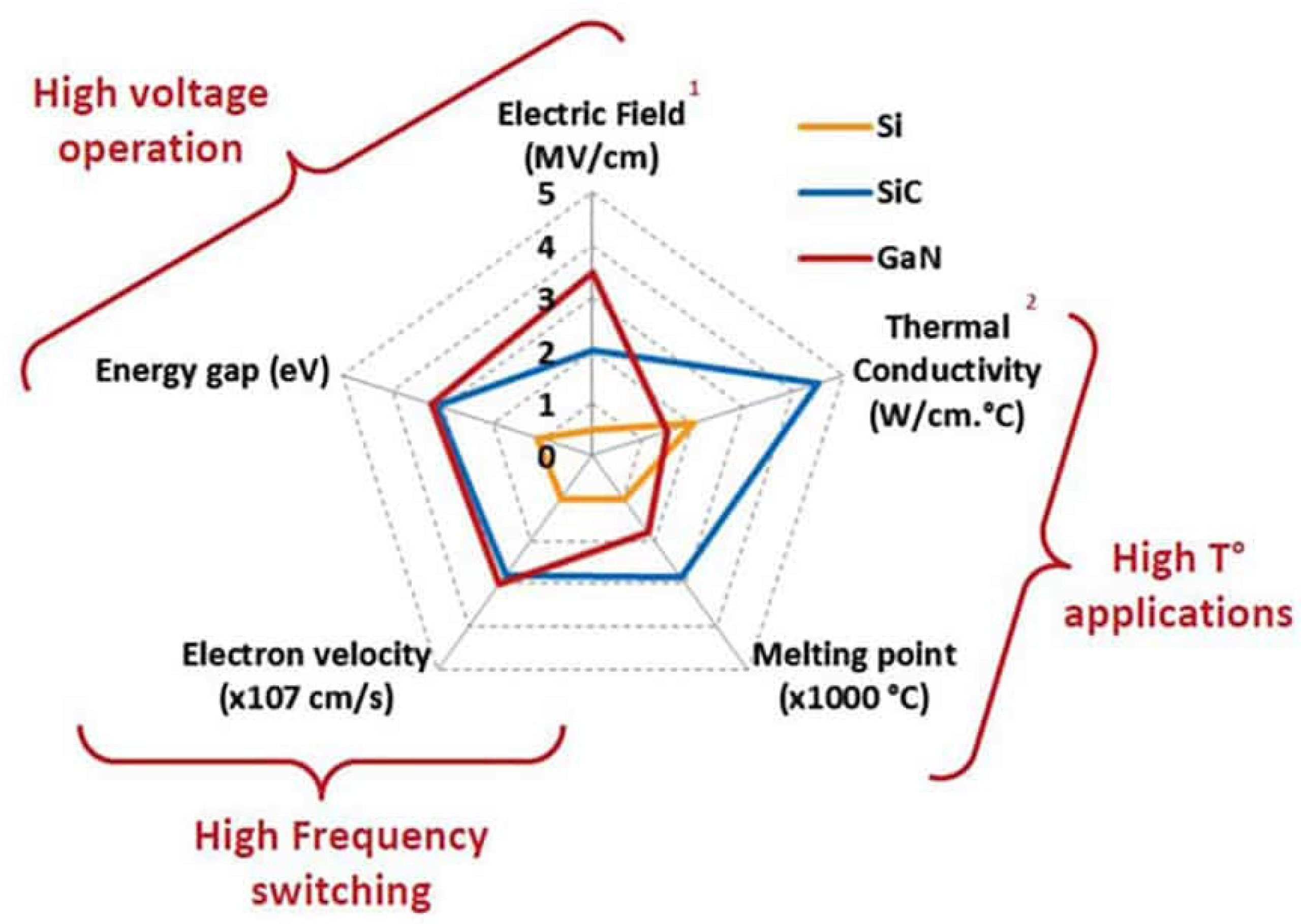
|
Disclaimer/Publisher’s Note: The statements, opinions and data contained in all publications are solely those of the individual author(s) and contributor(s) and not of MDPI and/or the editor(s). MDPI and/or the editor(s) disclaim responsibility for any injury to people or property resulting from any ideas, methods, instructions or products referred to in the content. |
© 2024 by the authors. Licensee MDPI, Basel, Switzerland. This article is an open access article distributed under the terms and conditions of the Creative Commons Attribution (CC BY) license (http://creativecommons.org/licenses/by/4.0/).