

Submitted:
12 September 2024
Posted:
13 September 2024
You are already at the latest version
Abstract
Background
Hepatic resection offers promising outcomes for patients with hepatocellular carcinoma (HCC) but can be constrained by factors like patient suitability. Continuous advancements in laparoscopic and robotic technologies have made minimally invasive hepatectomies (MIH) viable alternatives to open hepatectomies with benefits in recovery and complications.
Materials and Methods
We completed a retrospective review on 138 HCC patients at the Hume-Lee Transplant Center that underwent OH or MIH between 2010 and 2020. Univariate and multivariate analyses were completed on demographic, clinical, and tumor-specific data were collected to assess the impact of these variables on overall and disease-free survival at 1-, 3-, and 5-years. Preoperative metrics like length of hospital stay (LOS) and operation duration were also evaluated.
Results
Of the 109 OH and 29 MIH patients, MIH patients demonstrated shorter LOS and operative times. However, overall survival (OS) and disease-free survival (DFS) were similar between groups, with no significant variations in 1-, 3-, and 5-year survival rates. Ages > 60 years and lack of preoperative transcatheter arterial chemoembolization (TACE) were significant predictors of inferior OS and DFS in multivariate analyses.
Conclusions
MIH is an efficient substitute to OH with comparable survival even in older patients. The reduced LOS and operation time enhances its feasibility, and older patients previously denied for curative resection may qualify for MIH. Preoperative TACE also enhances survival outcomes, emphasizing its general role in managing resectable HCCs. Both robotic and laparoscopic hepatectomies offer acceptable short- and long-term clinical outcomes, highlighting MIH as the standard choice for HCC patients.
Keywords:
Hepatocellular Carcinoma
; Hepatectomy
; Laparoscopy
; Robotic Surgical Procedures
1. Introduction
Hepatocellular carcinoma (HCC) is the third leading cause of cancer death worldwide, accounting for 70-85% of all primary liver cancers [1]. HCC is typically associated with hepatitis B or C, alcohol use, and non-alcoholic fatty liver disease [2]. With a 5-year survival rate of approximately 18%, prognosis remains poor without treatment. The World Health Organization estimates more than 1 million cancer deaths from liver cancer by 2030 [2,3]. Stage of disease primarily determines treatment options for HCC. Surgical treatment offers the highest cure rates but is reserved for early-stage (I/II) HCC with minimal liver disease [2,4,5,6]. Liver transplantation, while preferred for HCC patients with cirrhosis (80% of HCC cases), is limited by organ shortage and strict selection criteria [7,8]. Thus, the role of surgical resection in patients with localized HCC has garnered greater interest, along with improvements in clinical decision algorithms [9,10]. Previously, surgical resection was reserved for patients with a solitary tumor of any size or up to three nodules of < 3 cm [11,12]. However, technological advancements in techniques and devices have allowed for major hepatectomies to be performed in patients with larger, more malignant liver lesions [13]. Laparoscopic techniques have long been established as a safe and effective alternative, providing improved visualization, magnification, less intraoperative blood loss, and more meticulous dissection [14,15,16]. Smaller incisions in the anterior abdominal wall minimize interruption in portosystemic collateral vessels, reducing liver failure and ascites recurrence in patients with severe cirrhosis [17,18,19,20].
Furthermore, robotic platforms have addressed constraints associated with laparoscopic hepatectomies [21]. Robotic systems can achieve safer surgical margins by adhering to curvilinear resection planes through well-articulated instruments and contact ultrasonography via robotic probes [22,23]. Improved visualization, ergonomics, and range of motion within the abdominal cavity may enhance handling, dexterity, and fine dissection maneuvers [24]. The present study evaluates the short- and long-term outcomes of patients receiving open hepatectomy surgery (OH) versus minimally invasive hepatectomy surgery (MIH) for hepatocellular carcinoma. Through a decade of experience at a tertiary referral center, this study aims to assess the effectiveness and safety of MIH in managing HCC, potentially influencing surgical protocols and patient care.
2. Materials and Methods
Patient confidentiality and privacy were strictly maintained and all data was anonymized to protect participant identities. The Institutional Review Board at Virginia Commonwealth University approved our study under protocol number HM20007405 in 2021.
2.1. Patient Selection
This single-center, retrospective study evaluated the medical records of 134 HCC patients who underwent liver resections at the Hume-Lee Transplant Center in Richmond, Virginia from January 1, 2010 to December 31, 2020. Patients were stratified into OH and MIH groups. Patients with American Joint Committee on Cancer (AJCC) stages I-IV diagnosis who underwent curative intent liver resection were included as well as those that had undergone preoperative treatment including TACE, RFA, resection, or a combination of treatments.
We collected comprehensive demographics and clinical data, including tumor specific characteristics like number, total and largest size, AJCC three-tier grading, microvascular and macrovascular invasion, and lymphatic and capsular invasion. Preoperative labs and morbidity-related data on the length of hospital stay, operative duration, transfusion, and estimated resection margins were reported. Our primary outcomes were overall survival at 1, 3, and 5-year intervals, defined as the time interval between the liver resection and death or the most recent follow-up. Our secondary outcomes were disease-free survival at these time intervals, defined as the period after hepatectomy without signs of HCC recurrence.
2.2. Statistical Analysis
Categorical variables were reported as percentages and continuous variables as means with standard deviations (SD). Surgical factors like resection margin and technique were also evaluated. For comparing patients undergoing OH or MIH, Pearson’s Chi-square test or Fisher’s exact test was used for categorical variables and Kruskal-Wallis rank-sum test for continuous variables. Kaplan-Meier plots were used to analyze overall and disease-free survival at 1, 3, and 5-year intervals. Cox proportional hazards regression analyzed predictors of overall survival and of disease-free survival, with significant variables (age and prior TACE) from univariate analysis included in the multivariate model. Hazard ratio (HR) and 95% confidence intervals (CI) were used to determine significance for predicting overall survival. Statistical analyses were conducted using Python (Ver. 3.8.18) where p-values were based on two-sided statistical tests with p<0.05 considered significant.
3. Results
3.1. Patient Characteristics
Between 2010 and 2020, 109 patients diagnosed with HCC had undergone OH while 29 received MIH (Table 1). Within the MIH cohort, 15 patients underwent robotic surgery (2016-2020). 14 patients underwent conventional laparoscopic surgery (only 2 cases were performed in 2018 and 2019, respectively). There was no significant difference between the MIH and OH groups in gender (82.8% vs 66.1%; p=0.112) or racial distribution between the two groups (p=0.070). However, the mean age at time of surgery was significantly higher in the MIH group than the OH group (66.9 years vs 60.1 years; p=0.015).
Both groups had similar rates of cirrhosis, prior cancers, and preoperative therapy (p=0.233; p=0.767; p=0.732). However, a higher proportion of the MIH group had three or fewer tumors than the OH group (96.6% vs 80.7%; p=0.045). While the largest tumor sizes found were similar, the MIH group had shown smaller total tumor size (4.9 cm vs 7.3 cm; p=0.031). There were no significant differences in differentiation grading, microvascular or macrovascular invasion, lymphatic or capsular invasion, and AJCC staging.
3.2. Clinical Outcomes
Univariate analysis showed that age ≥ 60 was associated with worse overall survival (OS) (HR 1.891, CI: 1.156-3.093; p=0.011) (Table 2). Multivariate analysis confirmed the significance between age and overall survival (HR 1.848, CI 1.122-3.046; p=0.016). Lack of preoperative TACE showed improved overall survival in univariate analyses (HR HR 0.393, CI: 0.221-0.698; PI=0.001) and multivariate analyses (HR 0.398, CI: 0.222-0.712; p=0.002).
Age ≥60 years and the absence of preoperative TACE showed significant association with disease free survival (DFS) as well (Table 3). Age ≥ 60 years worsened disease free survival in both univariate (HR 1.918, CI: 1.076-3.418; p=0.027) and multivariate analyses (HR 1.982, CI: 1.169-3.359; p=0.024). Lack of preoperative TACE was associated with improved DFS in univariate analysis (HR 0.360, CI 0.178-0.727; p=0.004).
Surgical technique did not impact OS (p=0.484) between OH and MIH patients. For MIH patients, the 1-, 3-, 5-year OS rates were 79.7%, 52.9%, and 44.1% while 1-, 3-, 5-year OS rates for OH patients were 79.3%, 64.2%, and 47.9% (Figure 1). The disease-free survival rates were comparable as well (p=0.729). For MIH patients, the 1-, 3-, 5-year DFS rates were 73.2%, 53.4%, and 40.0% while the 1-, 3-, 5-year OS rates for OH patients were 70.5%, 48.3%, and 40.0% (Figure 2). No MIH patients survived beyond 6.67 years.
Patients undergoing MIH had shorter LOS than those in the open surgery group (5.4 days vs 8.8 days; p=0.003) and shorter operation times (261.0 minutes vs 338.8 minutes; p=0.004 (Table 4). There were no considerable differences in intraoperative blood transfusion volume between MIH and OH patients (700.0 mL vs. 1161.6 mL; p=0.263) or resection margins (negative margins <10 mm: 11 vs 55; >10 mm: 11 vs 30; positive margins: 3 vs 16; p=0.392).
4. Discussion
Hepatic resection for HCC remains challenging for patients and surgeons, but advancements in surgical techniques and improved equipment have popularized laparoscopic approaches for over three decades [25]. Several studies have illustrated its benefits among HCC patients including reduced hospitalization, blood loss, and postoperative morbidity while maintaining comparable oncological results to open resection [14,26,27,28]. With the recent emergence of robot-assisted liver resections, safety and feasibility of MIH are subject to continual assessment. Our analysis represents a decade of experience with conventional and robot-assisted laparoscopic liver resections at a high-volume, tertiary referral center, in comparison to traditional open procedures.
OH and MIH patients were similar in demographics, comorbidities, and tumor characteristics, with notable exception for age. Despite no definitive consensus regarding the outcomes of OH and MIH among higher-risk elderly patients, it is crucial to identify patients who may benefit most from minimally-invasive alternatives. A recent meta-analysis indicates that elderly patients are more prone to postoperative morbidity and short-term mortality with laparoscopic hepatectomies [29]. The associated risk rises as individuals age, peaking when patients reach their seventies, before stabilizing in septuagenarians [29]. However, our data demonstrates that patients undergoing MIH (robotic and laparoscopic) may experience similar survival benefits compared to OH despite the age discrepancy.
This supports studies showing MIH’s safety and feasibility profiles among elderly patients, possibly attributed to the significantly decreased length of hospital stay among MIH patients [30,31]. Elderly patients who spend a longer time in the Intensive Care Unit (ICU) may develop disabilities that impact overall quality of life, national analysis reporting a median LOS of 3 days among MIH recipients compared to 6 days among OH patients [14,32]. Other centers reported slightly higher LOS of 7 days for MIH patients, but still lower than 9 days seen in OH patients [33]. Our data regarding LOS is within these reported ranges. Additionally, postoperative infections are among the most frequent complications in elderly patients. While not addressed in this study, it is plausible that reducing severe postoperative wound infections and hastening the recovery process may have contributed to similar complication rates in both groups [14].
As the screening apparatus for liver cirrhosis continues to improve globally, elderly patients face higher risks for complications of liver resection and HCC [34]. Our experience indicates that sexagenarians had increased rates of mortality. Despite our patients being mostly sexagenarians, there were no differences in the presence of cirrhosis between OH and MIH groups. The benefits of the minimally-invasive approach may decrease with ages above 80 [35]. Nevertheless, this has not been demonstrated among our patients undergoing MIH. Liver transplantation is another important alternative to resection in HCC patients with cirrhosis, but elderly patients nearing their 70s are mostly excluded due to comorbidities [36]. Our data demonstrates that elderly patients previously denied an opportunity for a potentially curative liver resection can be offered a viable and potentially favorable treatment option of MIH.
The differences in operative time between OH and MIH are notable, as longer operative time is a significant predictor of surgical morbidity after laparoscopic liver resections [37]. Unlike recent national and institutional retrospective analyses showing no difference in operative times, our experience demonstrates significantly reduced duration of operation in favor of MIH [14,33]. This may be due to MIH patients having lower tumor numbers and sizes. Indeed, minor resections have decreased operative times in laparoscopic liver resections and may be associated with lower blood loss and intraoperative transfusion rates [38]. While our study showed no significant difference in intraoperative transfusion rates, MIH patients tended to require less overall transfusion volume.
A prior history of TACE was associated with lower mortality in patients undergoing both OH and MIH. Preoperative TACE identifies latent intrahepatic metastatic foci, improves the resectability of HCCs by reducing tumors initially borderline resectable or unresectable, allows adequate time for therapy in compromised liver function, and enhances overall survival and disease-free survival rates following curative resection [39]. Multiple retrospective studies have demonstrated its effectiveness in patients with intermediate-stage HCC who benefit from superior oncological results with OH or MIH [40]. These patients tend to have large and multifocal HCC without intrahepatic macrovascular invasion or extrahepatic metastases [41]. This is a salient point for patients undergoing OH who have larger and more numerous tumors compared to MIH patients, albeit statistically insignificant. Certain clinicians may not advocate for preoperative TACE in patients with resectable HCC being evaluated for surgical intervention. One of the key factors to consider is that TACE may affect well-differentiated HCC while incompletely eradicating poorly differentiated cells [42]. Consequently, preoperative TACE may increase the chance of HCC metastasis via the portal venous system. However, our experience shows selective chemoembolization of HCC tumors prior to hepatectomy may confer additional survival benefits for HCC patients.
Furthermore, it is known that MIH has a steep learning curve that requires concomitant training in both laparoscopic and robotic techniques [43]. Despite increasing variation in operator experience as MIH evolves, MIH offers several key advantages compared to OH. Unlike OH, MIH may minimize the damage to adherent structures and the liver through manipulation only inside the subphrenic rib cage. Laparoscopic instruments can get directly into the space caudally with minimal damage to the cage and minimal mobilization or compression on the liver [44]. Second, MIH may have advantages for the treatment of intrahepatic recurrence compared to OH. While our short and long-term data showed non-inferior DFS of MIH compared to OH, it is likely that reoperation to the liver is made more difficult once adhesions are formed. To address this, MIH may be associated with lower rates of adhesion formation, allowing for better visibility and maneuverability even in the small surgical fields between adhesions [44]. Comparable OS and DFS after MIH may be from reduced functional deterioration of the liver [25]. With reduced adhesion, the process of repeat treatments becomes more accessible, decreasing mortality among patients with liver insufficiency.
MIH has its disadvantages as maintaining orientation due to the lack of fine perceptible sensation and visibility of the entire surgical field can be difficult. However, effective simulation of minor anatomical resections can ensure precise localization of the tumor within the resected area and adequate surgical margins. This may result in reduced postoperative complications, diminished residual ischemic/congestive parenchyma, and potentially lower recurrence risk [45]. Robotic technology also confers numerous benefits compared to conventional laparoscopic techniques [46]. Features such as Endowrist technology provide a remarkable seven degrees of freedom in hand manipulation. Additionally, robotic systems enable operating surgeons to access lesions located in the posterior superior region, enhance their suturing, reduce physiological tremors, and promote better ergonomics [46]. Overall, these advancements in MIH have likely reduced operative time and other morbidities at our institution and we resultantly demonstrate acceptable short- and long-term clinical results with both robotic and laparoscopic techniques.
Limitations
While our study provides valuable insight into the outcomes and survival rates of patients having undergone OH and MIH for HCC, there are several limitations. First, this was a single center analysis which limits the generalizability of findings. Second, the retrospective nature of our study introduces a certain level of selection bias, as the choice between OH and MIH was determined by physicians based on clinical judgment and patient characteristics. Third, the lack of statistical significance in certain variables may be due to the insufficient power to identify a potential association. Finally, this study did not account for adjuvant therapies. Future studies with larger, multicenter cohorts and prospective design are needed for validating our findings and further exploring the benefits and limitations of MIH in the treatment of HCC. More studies are also needed to compare clinical outcomes between laparoscopic surgeries and robotic surgery using large sets of single-center or multi-center clinical data. Cost analysis studies are also needed to determine the financial impact that robotic and laparoscopic resections have towards optimizing resource allocation and decision-making.
5. Conclusion
This paper represents a recent decade of experience with both OH and MIH at a tertiary referral center. For patients with HCC, MIH, both robot-assisted and conventional laparoscopic, may confer faster recovery and reduced operative times compared to OH. Selected patients may also receive survival benefits when pre-operatively treated with TACE. Despite significantly increased age among patients undergoing MIH, these procedures showed comparable short and long-term oncologic outcomes when compared to OH.
Author Contributions
SL conceptualized and designed the study. AP, YCK, KS, and AS collectively conducted the data analysis and interpretation. All authors contributed to data collection, analysis, manuscript review, and critical revisions. All authors have reviewed and approved the final manuscript.
Funding
This research received no external funding.
Institutional Review Board Statement
The Institutional Review Board at Virginia Commonwealth University approved our study under protocol number HM20007405 in 2021.
Ethics Statement: Patient confidentiality and privacy were strictly maintained and all data was anonymized to protect participant identities.
Data Availability Statement
Research data are not shared.
Conflicts of Interest
The authors declare no conflict of interest.
References
- Polyzos SA, Chrysavgis L, Vachliotis ID, Chartampilas E, Cholongitas E. Nonalcoholic fatty liver disease and hepatocellular carcinoma:Insights in epidemiology, pathogenesis, imaging, prevention and therapy. Semin Cancer Biol. 2023 Aug;93:20-35. [CrossRef]
- Rumgay H, Arnold M, Ferlay J, Lesi O, Cabasag CJ, Vignat J, Laversanne M, McGlynn KA, Soerjomataram I. Global burden of primary liver cancer in 2020 and predictions to 2040. J Hepatol. 2022 Dec;77(6):1598-1606. [CrossRef]
- Villanueva A. Hepatocellular Carcinoma. N Engl J Med. 2019;380(15):1450-1462. [CrossRef]
- European Association for the Study of the Liver. Electronic address: easloffice@easloffice.eu; European Association for the Study of the Liver. EASL Clinical Practice Guidelines: Management of hepatocellular carcinoma [published correction appears in J Hepatol. 2019 Apr;70(4):817. doi: 10.1016/j.jhep.2019.01.020]. J Hepatol. 2018;69(1):182-236. [CrossRef]
- Forner A, Reig M, Bruix J. Hepatocellular carcinoma. Lancet. 2018;391(10127):1301-1314. [CrossRef]
- Gordan J.D., Kennedy E.B., Abou-Alfa G.K., Beg M.S., Brower S.T., Gade T.P., Goff L., Gupta S., Guy J., Harris W.P., et al. Systemic Therapy for Advanced Hepatocellular Carcinoma: ASCO Guideline. J. Clin. Oncol. 2020;38:4317–4345. [CrossRef]
- Llovet J.M., Kelley R.K., Villanueva A., Singal A.G., Pikarsky E., Roayaie S., Lencioni R., Koike K., Zucman-Rossi J., Finn R.S. Hepatocellular carcinoma. Nat. Rev. Dis. Primers. 2021;7:6. [CrossRef]
- Sapisochin G., Bruix J. Liver transplantation for hepatocellular carcinoma: Outcomes and novel surgical approaches. Nat. Rev. Gastroenterol. Hepatol. 2017;14:203–217. [CrossRef]
- Vitale A., Trevisani F., Farinati F., Cillo U. Treatment of Hepatocellular Carcinoma in the Precision Medicine Era: From Treatment Stage Migration to Therapeutic Hierarchy. Hepatology. 2020;72:2206–2218. [CrossRef]
- Di Sandro S., Benuzzi L., Lauterio A., Botta F., De Carlis R., Najjar M., Centonze L., Danieli M., Pezzoli I., Rampoldi A., et al. Single Hepatocellular Carcinoma approached by curative-intent treatment: A propensity score analysis comparing radiofrequency ablation and liver resection. Eur. J. Surg. Oncol. 2019;45:1691–1699. [CrossRef]
- Vogel A., Martinelli E., ESMO Guidelines Committee Updated treatment recommendations for hepatocellular carcinoma (HCC) from the ESMO Clinical Practice Guidelines. Ann. Oncol. 2021. [CrossRef]
- Reich H, McGlynn F, DeCaprio J, Budin R. Laparoscopic excision of benign liver lesions. Obstet Gynecol. 1991;78(5 Pt 2):956-958.
- Wakabayashi G., Cherqui D., Geller D.A., Buell J.F., Kaneko H., Han H.S., Asbun H., O’Rourke N., Tanabe M., Koffron A.J., et al. Recommendations for laparoscopic liver resection: A report from the second international consensus conference held in Morioka. Ann. Surg. 2015;261:619–629. [CrossRef]
- Bagante F, Spolverato G, Strasberg SM, et al. Minimally Invasive vs. Open Hepatectomy: a Comparative Analysis of the National Surgical Quality Improvement Program Database. J Gastrointest Surg. 2016;20(9):1608-1617. [CrossRef]
- Cho JY, Han HS, Yoon YS, Shin SH. Feasibility of laparoscopic liver resection for tumors located in the posterosuperior segments of the liver, with a special reference to overcoming current limitations on tumor location. Surgery. 2008;144(1):32-38. [CrossRef]
- Nguyen KT, Marsh JW, Tsung A, Steel JJL, Gamblin TC, Geller DA. Comparative Benefits of Laparoscopic vs Open Hepatic Resection: A Critical Appraisal. Arch Surg. 2011;146(3):348–356. [CrossRef]
- Simillis C., Constantinides V.A., Tekkis P.P., Darzi A., Lovegrove R., Jiao L., Antoniou A. Laparoscopic versus open hepatic resections for benign and malignant neoplasms—A meta-analysis. Surgery. 2007;141:203–211. [CrossRef]
- Morino M., Morra I., Rosso E., Miglietta C., Garrone C. Laparoscopic vs. open hepatic resection: A comparative study. Surg. Endosc. 2003;17:1914–1918. [CrossRef]
- Dagher I., Di Giuro G., Dubrez J., Lainas P., Smadja C., Franco D. Laparoscopic versus open right hepatectomy: A comparative study. Am. J. Surg. 2009;198:173–177. [CrossRef]
- Xiong J.J., Altaf K., Javed M.A., Huang W., Mukherjee R., Mai G., Sutton R., Liu X.B., Hu W.M. Meta-analysis of laparoscopic vs. open liver resection for hepatocellular carcinoma. World J. Gastroenterol. 2012;18:6657–6668. [CrossRef]
- Tsung A, Geller DA, Sukato DC, et al. Robotic versus laparoscopic hepatectomy: a matched comparison. Ann Surg. 2014;259(3):549-555. [CrossRef]
- Vigano` L, Ferrero A, Amisano M, Russolillo N, Capussotti L (2013) Comparison of laparoscopic and open intraoperative ultrasonography for staging liver tumours. Br J Surg 100:535–542.
- Cho JY, Han HS, Yoon YS, Shin SH (2008) Experiences of laparoscopic liver resection including lesions in the posterosuperior segments of the liver. Surg Endosc 22:2344–2349. [CrossRef]
- Giulianotti PC, Coratti A, Sbrana F, et al. Robotic liver surgery: results for 70 resections. Surgery. 2011;149(1):29-39. [CrossRef]
- Morise Z. Current status of minimally invasive liver surgery for cancers. World J. Gastroenterol. 2022;28:6090–6098. [CrossRef]
- Takahara T, Wakabayashi G, Beppu T, et al. Long-term and perioperative outcomes of laparoscopic versus open liver resection for hepatocellular carcinoma with propensity score matching: a multi-institutional Japanese study. J Hepatobiliary Pancreat Sci. 2015;22(10):721-727. [CrossRef]
- Haney CM, Studier-Fischer A, Probst P, et al. A systematic review and meta-analysis of randomized controlled trials comparing laparoscopic and open liver resection. HPB (Oxford). 2021;23(10):1467-1481. [CrossRef]
- Endo Y, Tsilimigras DI, Munir MM, et al. Textbook outcome in liver surgery: open vs minimally invasive hepatectomy among patients with hepatocellular carcinoma. J Gastrointest Surg. 2024;28(4):417-424. [CrossRef]
- Okinaga H, Yasunaga H, Hasegawa K, Fushimi K, Kokudo N. Short-Term Outcomes following Hepatectomy in Elderly Patients with Hepatocellular Carcinoma: An Analysis of 10,805 Septuagenarians and 2,381 Octo- and Nonagenarians in Japan. Liver Cancer. 2018;7(1):55-64. [CrossRef]
- Wabitsch S, Haber PK, Ekwelle N, et al. Minimally Invasive Liver Surgery in Elderly Patients-A Single-Center Experience. J Surg Res. 2019;239:92-97. [CrossRef]
- Chan AC, Poon RT, Cheung TT, et al. Laparoscopic versus open liver resection for elderly patients with malignant liver tumors: a single-center experience. J Gastroenterol Hepatol. 2014;29(6):1279-1283. [CrossRef]
- Demiselle J, Duval G, Hamel JF, et al. Determinants of hospital and one-year mortality among older patients admitted to intensive care units: results from the multicentric SENIOREA cohort. Ann Intensive Care. 2021;11(1):35. Published 2021 Feb 17. [CrossRef]
- Duarte VC, Coelho FF, Valverde A, et al. Minimally invasive versus open right hepatectomy: comparative study with propensity score matching analysis. BMC Surg. 2020;20(1):260. Published 2020 Oct 30. [CrossRef]
- Yoon YI, Kim KH, Kang SH, et al. Pure Laparoscopic Versus Open Right Hepatectomy for Hepatocellular Carcinoma in Patients With Cirrhosis: A Propensity Score Matched Analysis. Ann Surg. 2017;265(5):856-863. [CrossRef]
- Martínez-Cecilia D, Cipriani F, Shelat V, et al. Laparoscopic Versus Open Liver Resection for Colorectal Metastases in Elderly and Octogenarian Patients: A Multicenter Propensity Score Based Analysis of Short- and Long-term Outcomes. Ann Surg. 2017;265(6):1192-1200. [CrossRef]
- Clavien PA, Lesurtel M, Bossuyt PM, et al. Recommendations for liver transplantation for hepatocellular carcinoma: an international consensus conference report. Lancet Oncol. 2012;13(1):e11-e22. [CrossRef]
- Heise D, Bednarsch J, Kroh A, et al. Operative Time, Age, and Serum Albumin Predict Surgical Morbidity After Laparoscopic Liver Surgery. Surg Innov. 2021;28(6):714-722. [CrossRef]
- Chen J, Li H, Liu F, Li B, Wei Y. Surgical outcomes of laparoscopic versus open liver resection for hepatocellular carcinoma for various resection extent. Medicine (Baltimore). 2017;96(12):e6460. [CrossRef]
- Choi GH, Kim DH, Kang CM, et al. Is preoperative transarterial chemoembolization needed for a resectable hepatocellular carcinoma?. World J Surg. 2007;31(12):2370-2377. [CrossRef]
- Zhou Q, Tuo F, Li R, et al. Transarterial Chemoembolization Combined With Hepatectomy for the Treatment of Intermediate-Stage Hepatocellular Carcinoma. Front Oncol. 2020;10:578763. Published 2020 Nov 4. [CrossRef]
- Lin CW, Chen YS, Lo GH, et al. Comparison of overall survival on surgical resection versus transarterial chemoembolization with or without radiofrequency ablation in intermediate stage hepatocellular carcinoma: a propensity score matching analysis. BMC Gastroenterol. 2020;20(1):99. Published 2020 Apr 10. [CrossRef]
- Bruix J, Llovet JM, Castells A, et al. Transarterial embolization versus symptomatic treatment in patients with advanced hepatocellular carcinoma: results of a randomized, controlled trial in a single institution. Hepatology. 1998;27(6):1578-1583. [CrossRef]
- Bernardi L, Balzano E, Roesel R, et al. Concomitant training in robotic and laparoscopic liver resections of low-to-intermediate difficulty score: a retrospective analysis of the learning curve. Sci Rep. 2024;14(1):3595. Published 2024 Feb 13. [CrossRef]
- Endo T, Morise Z, Katsuno H, et al. Caudal Approach to Laparoscopic Liver Resection-Conceptual Benefits for Repeated Multimodal Treatment for Hepatocellular Carcinoma and Extended Right Posterior Sectionectomy in the Left Lateral Position. Front Oncol. 2022;12:950283. Published 2022 Jul 11. [CrossRef]
- Cho JY, Han HS, Choi Y, et al. Association of Remnant Liver Ischemia With Early Recurrence and Poor Survival After Liver Resection in Patients With Hepatocellular Carcinoma. JAMA Surg. 2017;152(4):386-392. [CrossRef]
- Fukumori D, Tschuor C, Penninga L, Hillingsø J, Svendsen LB, Larsen PN. Learning curves in robot-assisted minimally invasive liver surgery at a high-volume center in Denmark: Report of the first 100 patients and review of literature. Scand J Surg. 2023;112(3):164-172. [CrossRef]
Figure 1.
Overall Survival for OH and MIH Patients.
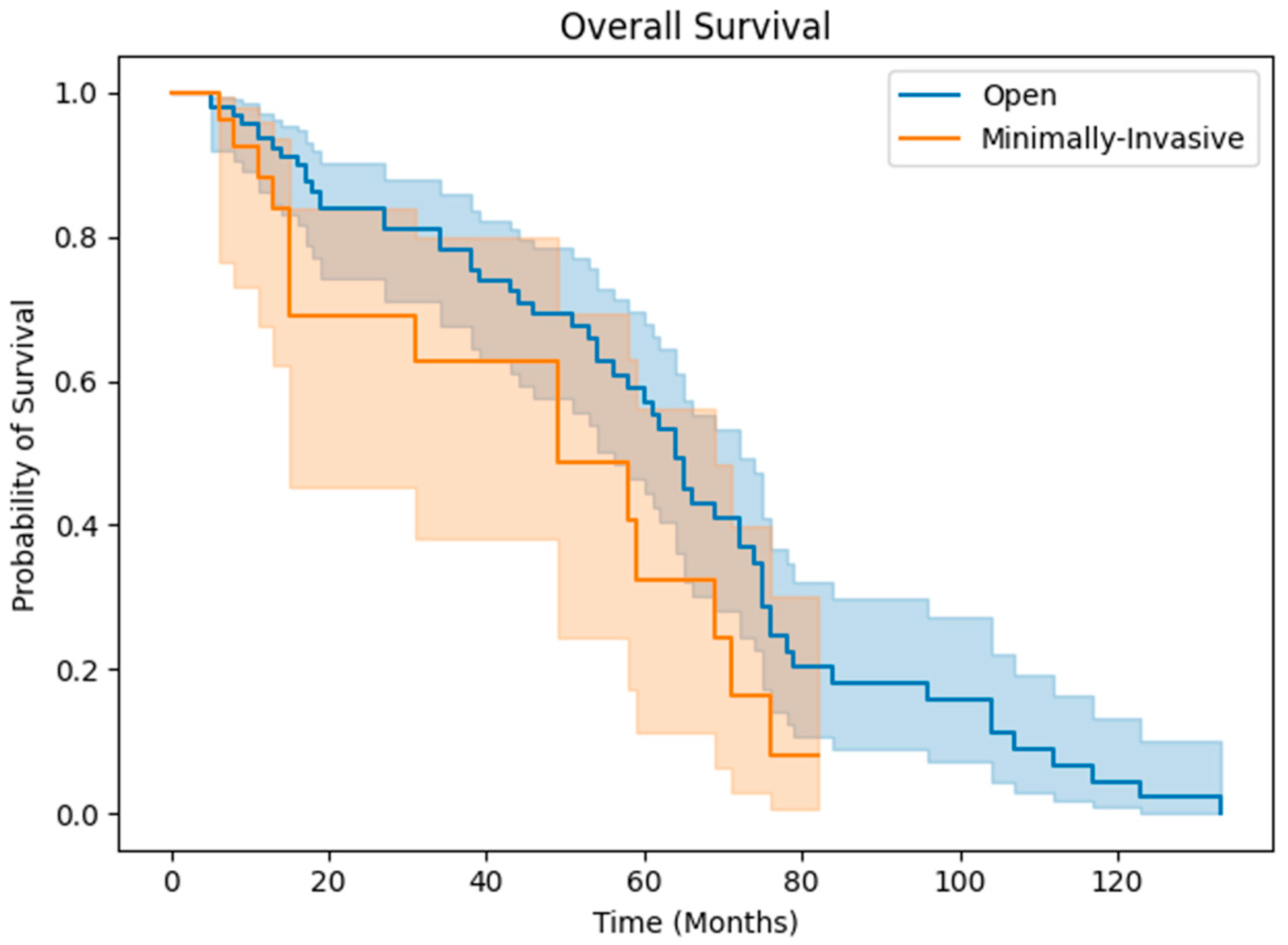
Figure 2.
Disease-Free Survival for OH and MIH Patients.
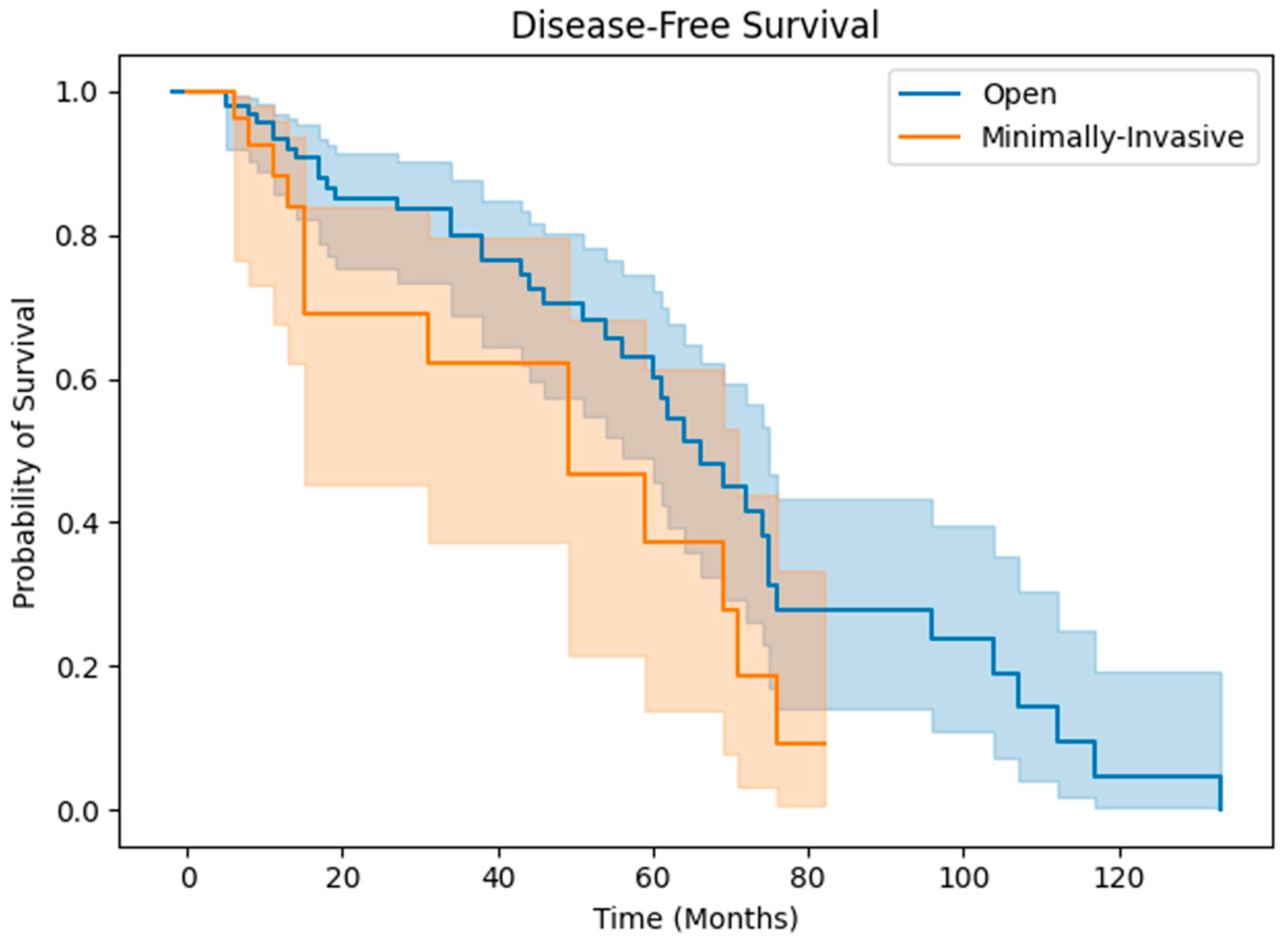

Table 1.
Baseline characteristics of patients undergoing open and minimally-invasive hepatectomies.
| Characteristics | Open (n=109) | Minimally-Invasive (n=29) | P-value |
|---|---|---|---|
| Sex, n (%) | 0.112 | ||
| Male | 72 (66.1) | 24 (82.8) | |
| Female | 37 (33.9) | 5 (17.2) | |
| Age (year), mean (SD) | 60.1 (13.4) | 66.9 (12.1) | 0.015 |
| Race, n (%) | 0.070 | ||
| White | 46 (42.2) | 14 (48.3) | |
| Black | 49 (45.0) | 11 (37.9) | |
| Asian | 14 (12.8) | 2 (6.9) | |
| Hispanic | 0 (0) | 1 (3.4) | |
| Other | 0 (0) | 1 (3.4) | |
| WBC (x109/L), mean (SD) | 6.8 (2.4) | 5.8 (2.0) | 0.059 |
| PLT (x109/L), n (%) | 0.828 | ||
| <225 | 72 (66.1) | 20 (69.0) | |
| ≥225 | 37 (33.9) | 9 (31.0) | |
| ALT (U/L), n (%) | 0.648 | ||
| <80 | 76 (70.4) | 22 (75.9) | |
| ≥80 | 32 (29.6) | 7 (24.1) | |
| Serum Sodium (mmol/L), mean (SD) | 139.0 (3.1) | 140.0 (2.6) | 0.125 |
| Serum Creatinine (μmol/L), mean (SD) | 0.9 (0.3) | 1.0 (0.5) | 0.042 |
| TBIL (μmol/L), mean (SD) | 0.8 (0.7) | 0.8 (0.5) | 0.750 |
| INR, mean (SD) | 1.1 (0.3) | 1.1 (0.1) | 0.511 |
| AFP (ng/mL), mean (SD) | 0.039 | ||
| <200 | 76 (74.5) | 27 (93.1) | |
| ≥200 | 26 (25.5) | 2 (6.9) | |
| MELD-XI, mean (SD) | 8.7 (3.5) | 8.8 (2.8) | 0.852 |
| Cirrhosis, n (%) | 96 (88.1) | 23 (79.3) | 0.233 |
| Prior cancer, n (%) | 15 (13.8) | 5 (17.4) | 0.767 |
| Preoperative therapy, n (%) | 0.732 | ||
| No therapy | 79 (73.1) | 24 (82.8) | |
| TACE only | 19 (17.6) | 2 (6.9) | |
| RFA only | 3 (2.8) | 1 (3.4) | |
| Radiation only | 1 (0.9) | 0 (0) | |
| Resection only | 1 (0.9) | 0 (0) | |
| Combination | 5 (4.6) | 2 (6.9) | |
| Tumor number | 0.045 | ||
| ≤3 | 88 (80.7) | 28 (96.6) | |
| >3 | 21 (19.3) | 1 (3.4) | |
| Largest tumor size (cm) | 5.6 (4.3) | 4.3 (3.3) | 0.138 |
| Total tumor size (cm) | 7.3 (5.2) | 4.9 (4.1) | 0.031 |
| Tumor differentiation, n (%) | 0.372 | ||
| G1 | 11 (10.7) | 5 (19.2) | |
| G2 | 62 (60.2) | 16 (61.5) | |
| G3 | 30 (29.1) | 5 (19.2) | |
| Microvascular invasion, n (%) | 59 (54.1) | 10 (34.5) | 0.118 |
| Macrovascular invasion, n (%) | 29 (26.6) | 5 (17.2) | 0.460 |
| Lymphatic invasion, n (%) | 5 (4.6) | 1 (3.4) | 1.000 |
| Capsular invasion, n (%) | 69 (63.3) | 18 (62.1) | 0.643 |
| AJCC staging, n (%) | 0.159 | ||
| I-II | 78 (76.5) | 22 (91.7) | |
| III-IV | 24 (23.5) | 2 (8.3) |
Abbreviations: AFP: alpha fetoprotein; ALT: alanine aminotransferase; AJCC: American Joint Committee on Cancer; INR: international normalized ratio; MELD-XI: model for end-stage liver disease excluding INR; PLT: platelet; RFA: radiofrequency ablation; SD: standard deviation; TACE: transcatheter arterial chemoembolization; TBIL: total bilirubin; WBC: white blood count.
Table 2.
Cox-regression analysis of predictors of overall survival.
| Univariate | Multivariate | |||||
|---|---|---|---|---|---|---|
| HR | 95% CI | P-value | HR | 95% CI | P-value | |
| Sex (ref: female) | 0.602 | |||||
| Male | 1.137 | 0.701-1.845 | ||||
| Age (ref: <60) | 0.011 | 0.016 | ||||
| >=60 | 1.891 | 1.156-3.093 | 1.848 | 1.122-3.046 | ||
| WBC (ref: <3.5) | 0.350 | |||||
| >=3.5 | 0.615 | 0.222-1.704 | ||||
| PLT (ref: <225) | 0.778 | |||||
| >=225 | 0.933 | 0.577-1.510 | ||||
| ALT (ref: <80) | 0.634 | |||||
| >=80 | 0.870 | 0.492-1.541 | ||||
| TBIL (ref: <2) | 0.398 | |||||
| >=2 | 1.663 | 0.512-5.402 | ||||
| AFP (ref: <400) | 0.695 | |||||
| >=400 | 0.874 | 0.447-1.711 | ||||
| MELD-XI (ref: <15) | 0.710 | |||||
| >=15 | 1.250 | 0.385-4.051 | ||||
| Cirrhosis | 0.979 | |||||
| Present | 1.008 | 0.565-1.799 | ||||
| Prior TACE | 0.001 | 0.002 | ||||
| No | 0.393 | 0.221-0.698 | 0.398 | 0.222-0.712 | ||
| Prior RFA | 0.077 | |||||
| No | 0.276 | 0.066-1.150 | ||||
| Prior Resection | 0.291 | |||||
| No | 2.147 | 0.520-8.858 | ||||
| Resection Margin (ref: positive) | ||||||
| <10mm | 1.756 | 0.924-3.339 | 0.086 | |||
| >10mm | 1.204 | 0.610-2.379 | 0.593 | |||
| Surgical Technique (ref: open) | 0.072 | |||||
| Lap/Robotic | 1.703 | 0.953-3.044 | ||||
| Tumor Number (ref: <3) | 0.715 | |||||
| >3 | 1.174 | 0.496-2.779 | ||||
| Mean Largest Tumor Size (ref: <5) | 0.135 | |||||
| >=5 | 0.678 | 0.408-1.128 | ||||
| Mean Tumor Size (ref: <10) | 0.471 | |||||
| >=10 | 0.781 | 0.399-1.529 | ||||
| Microvascular Invasion | 0.315 | |||||
| Present | 0.786 | 0.492-1.257 | ||||
| Macrovascular Invasion | 0.349 | |||||
| Present | 0.744 | 0.400-1.382 | ||||
| Lymphatic Invasion | 0.731 | |||||
| Present | 0.706 | 0.097-5.142 | ||||
| Ductal Invasion | 0.714 | |||||
| Present | 0.870 | 0.411-1.838 | ||||
| AJCC Staging (ref: I-II) | 0.307 | |||||
| II-IV | 0.680 | 0.324-1.424 | ||||
Abbreviations: AFP: alpha fetoprotein; ALT: alanine aminotransferase; AJCC: American Joint Committee on Cancer; CI: confidence interval; HR: hazard ratio; INR: international normalized ratio; MELD-XI: model for end-stage liver disease excluding INR; PLT: platelet; RFA: radiofrequency ablation; SD: standard deviation; TACE: transcatheter arterial chemoembolization; TBIL: total bilirubin; WBC: white blood count.
Table 3.
Cox-regression analysis of predictors of disease-free survival.
| Univariate | Multivariate | |||||
|---|---|---|---|---|---|---|
| HR | 95% CI | P-value | HR | 95% CI | P-value | |
| Sex (ref: female) | 0.635 | |||||
| Male | 1.150 | 0.646-2.049 | ||||
| Age (ref: <60) | 0.027 | 0.024 | ||||
| >=60 | 1.918 | 1.076-3.418 | 1.982 | 0.169-0.712 | ||
| WBC (ref: <3.5) | 0.302 | |||||
| >=3.5 | 0.533 | 0.162-1.759 | ||||
| PLT (ref: <225) | 0.643 | |||||
| >=225 | 0.876 | 0.500-1.534 | ||||
| ALT (ref: <80) | 0.606 | |||||
| >=80 | 0.834 | 0.418-1.663 | ||||
| TBIL (ref: <2) | 0.514 | |||||
| >=2 | 1.613 | 0.383-6.792 | ||||
| AFP (ref: <400) | 0.547 | |||||
| >=400 | 0.792 | 0.370-1.693 | ||||
| MELD-XI (ref: <15) | 0.745 | |||||
| >=15 | 0.719 | 0.098-5.263 | ||||
| Cirrhosis | 0.883 | |||||
| Present | 1.052 | 0.536-2.063 | ||||
| Prior TACE | 0.004 | 0.004 | ||||
| No | 0.360 | 0.178-0.727 | 0.347 | 0.169-0.712 | ||
| Prior RFA | 0.130 | |||||
| No | 0.216 | 0.030-1.572 | ||||
| Prior Resection | 0.269 | |||||
| No | 2.234 | 0.536-9.306 | ||||
| Resection Margin (ref: positive) | ||||||
| <10mm | 1.928 | 0.908-4.093 | 0.087 | |||
| >10mm | 1.135 | 0.485-2.657 | 0.770 | |||
| Surgical Technique (ref: open) | 0.060 | |||||
| Lap/Robotic | 1.815 | 0.975-3.379 | ||||
| Tumor Number (ref: <3) | 0.893 | |||||
| >3 | 0.931 | 0.330-2.631 | ||||
| Mean Largest Tumor Size (ref: <5) | 0.098 | |||||
| >=5 | 0.589 | 0.315-1.103 | ||||
| Mean Tumor Size (ref: <10) | 0.310 | |||||
| >=10 | 0.620 | 0.246-1.562 | ||||
| Microvascular Invasion | 0.405 | |||||
| Present | 0.794 | 0.461-1.366 | ||||
| Macrovascular Invasion | 0.590 | |||||
| Present | 0.824 | 0.407-1.667 | ||||
| Lymphatic Invasion | 0.756 | |||||
| Present | 0.730 | 0.100-5.335 | ||||
| Ductal Invasion | 0.728 | |||||
| Present | 0.858 | 0.362-2.033 | ||||
| AJCC Staging (ref: I-II) | 0.181 | |||||
| II-IV | 0.497 | 0.179-1.383 | ||||
Abbreviations: AFP: alpha fetoprotein; ALT: alanine aminotransferase; AJCC: American Joint Committee on Cancer; CI: confidence interval; HR: hazard ratio; INR: international normalized ratio; MELD-XI: model for end-stage liver disease excluding INR; PLT: platelet; RFA: radiofrequency ablation; SD: standard deviation; TACE: transcatheter arterial chemoembolization; TBIL: total bilirubin; WBC: white blood count.
Table 4.
Comparisons of clinical outcomes between open and minimally-invasive hepatectomies.
| Open (n=109) | Minimally-Invasive (n=29) | P-value | |
|---|---|---|---|
| LOS (days), mean (STD) | 8.8 (5.7) | 5.4 (2.9) | 0.003 |
| Operation time (minutes), mean (STD) | 338.8 (129.1) | 261.0 (101.2) | 0.004 |
| Transfusion | 0.317 | ||
| Yes | 25 | 4 | |
| No | 82 | 25 | |
| Transfusion amount, median (IQR) | 1161.6 (788.4) | 700.0 (285.8) | 0.263 |
| Resection Margin | 0.392 | ||
| Negative <10mm, n (%) | 55 (54.5) | 11 (44.0) | |
| Negative >10mm, n (%) | 30 (29.7) | 11 (44.0) | |
| Positive, n (%) | 16 (15.8) | 3 (12.0) |
Abbreviations: IQR: interquartile range; LOS: length of stay; STD: standard deviation.
Disclaimer/Publisher’s Note: The statements, opinions and data contained in all publications are solely those of the individual author(s) and contributor(s) and not of MDPI and/or the editor(s). MDPI and/or the editor(s) disclaim responsibility for any injury to people or property resulting from any ideas, methods, instructions or products referred to in the content. |
© 2024 by the authors. Licensee MDPI, Basel, Switzerland. This article is an open access article distributed under the terms and conditions of the Creative Commons Attribution (CC BY) license (http://creativecommons.org/licenses/by/4.0/).
Copyright: This open access article is published under a Creative Commons CC BY 4.0 license, which permit the free download, distribution, and reuse, provided that the author and preprint are cited in any reuse.


