

Submitted:
10 September 2024
Posted:
11 September 2024
You are already at the latest version
Abstract
This study evaluates the efficiency of biodegradable polyurethane foams as thermal insulation materials compared to conventional materials like expanded polystyrene (EPS). Key parameters analyzed include thermal conductivity, energy savings, CO2 emission reductions, and investment payback periods. Biodegradable polyurethane foams demonstrated a thermal conductivity of 0.022 W/(m·K), significantly lower than EPS’s 0.035 W/(m·K), leading to higher energy savings. Calculations reveal an annual energy saving of 443,820 kWh for polyurethane foams, compared to 441,330 kWh for EPS. Financially, polyurethane foams save approximately €53,258.4 annually, while EPS saves €52,959.6. In terms of environmental impact, polyurethane foams reduce CO2 emissions by 88,764 kg annually, versus 88,266 kg for EPS. Despite the higher initial cost of polyurethane foams (€50/m2 compared to €30/m2 for EPS), the payback period is remarkably short at 0.094 years (1.13 months) compared to EPS’s 0.057 years (0.68 months). These findings highlight biodegradable polyurethane foams as a superior option for thermal insulation, offering significant energy, financial, and environmental benefits.
Keywords:
construction
; processess
; optimization
; polymers
; carbon
; emission
; strategy
1. Introduction
The construction industry is undergoing a significant transformation, with an increasing focus on sustainability and energy efficiency. A central element of this transition is the use of innovative materials, such as biodegradable foamed polyurethane. This material offers multiple advantages that contribute to reducing the carbon footprint and enhancing the energy performance of buildings.
Due to their versatility and unique properties, polymers have begun to play a significant role in the construction industry. Their use in eco-friendly materials helps reduce the carbon footprint and improve the energy performance of buildings. Polymers can be synthesized from renewable sources, recycled, and have long-lasting durability, making them ideal for sustainable applications.
Being biodegradable, this material naturally decomposes in the environment, reducing waste and the negative impact on ecosystems.
In recent years, research on methods of foaming biodegradable polymers has made significant progress. These advancements aim to improve the thermal, mechanical, and degradation properties of biodegradable foams, making them a viable and sustainable alternative to conventional thermal insulation materials.
As [1] “The tensile strength and modulus of elasticity of a jute/polylactic acid (PLA) composite were found to vary nonlinearly with the loading angle of the specimen through the tensile test. The variation in these properties was related to the fiber orientation distribution (FOD) and fiber length distribution (FLD). In order to study the effects of the FOD and FLD of short fibers on the mechanical properties and to better predict the mechanical properties of short-fiber composites, the true distribution of short fibers in the composite was accurately obtained using X-ray computed tomography (XCT), in which about 70% of the jute fibers were less than 300 μm in length and the fibers were mainly distributed along the direction of mold flow. The probability density functions of the FOD and FLD were obtained by further analyzing the XCT data. Strength and elastic modulus prediction models applicable to short-fiber-reinforced polymer (SFRP) composites were created by modifying the laminate theory and the rule of mixtures using the probability density functions of the FOD and FLD.”
As stated in [2], “To effectively utilize waste mask materials in road engineering and minimize resource waste, the melt-blown fabric (MBF) of waste masks was utilized to modify the virgin bitumen. The preparation process of MBF-modified bitumen was investigated, and the physical and rheological properties of bitumen were measured. Subsequently, the blending mechanism during preparation and the dispersion morphology of the modifier were explored. Finally, the pavement performance of the mixture was investigated, and a radar chart analysis was performed to quantitatively assess the effects of MBF modification. Results suggested that the recommended preparation process of shear time, shear rate, and shear temperature was 170 °C, 4000 r/min, and 15 min, respectively. MBF enhanced the high-temperature stability of the binder and weakened the temperature susceptibility. The modification was primarily a physical process. No network structure and agglomeration formed in the bitumen after modification. The addition of MBF significantly improved the resistance of the asphalt mixture to a high-temperature deformation and water damage but harmed its low-temperature crack resistance.”
Biodegradable and Renewable Source Polymers:
Polylactic Acid (PLA): Made from corn starch or sugarcane, PLA is used in composites for panels and insulation. It is biodegradable and reduces dependence on petroleum.
Polyhydroxyalkanoates (PHA): Produced through bacterial fermentation of sugars, these polymers are fully biodegradable and can be used in various construction applications.
Reused and Recycled Polymers
Polyethylene Terephthalate (PET): Recycled from plastic bottles, PET is used for manufacturing thermal insulation and construction panels, thereby reducing plastic waste.
Recycled Polyethylene (PE): Used in the production of roofing membranes and insulation materials, it contributes to waste reduction and resource conservation.
Polymer Nanocomposites: These materials contain nanoparticles that enhance the mechanical and thermal properties of polymers. For example, clay-based nanocomposites can increase fire resistance and durability of construction materials.
Shape Memory Polymers (SMP): These polymers can return to a predetermined shape when exposed to a stimulus such as temperature. SMPs can be used for smart windows and facades that adjust automatically for energy efficiency.
Advantages of Using Polymers in Green Construction Reduced Carbon Footprint: Polymers from renewable sources and recycled polymers help decrease CO2 emissions associated with the production of traditional construction materials.
Energy Efficiency: Polymers can contribute to superior thermal and acoustic insulation of buildings, reducing the energy needed for heating and cooling.
Changes in the physical properties of the composite material induced by temperature are crucial in the safe design of a structure/process. The strength and elasticity modulus decrease with increasing temperature due to molecular changes.
Durability and Strength: Polymer-based materials are resistant to corrosion, mold, and insects, with a long lifespan requiring minimal maintenance.
Flexibility and Versatility: Polymers can be molded into various shapes and sizes, providing architects and builders with a wide range of design possibilities.
The properties of polymer composite materials are influenced by several factors, among which the most important are the physical and mechanical properties, those dependent on time, and durability.
Initial Costs: Although the costs of eco-friendly polymers are decreasing, they can still be higher compared to traditional materials. Investments in research and development are crucial for cost reduction.
Recycling Infrastructure: Efficient infrastructure is required for the recycling and reuse of polymers, which may necessitate changes in regulations and industrial practices.
Market Education: Builders and consumers need to be educated about the long-term benefits of using eco-friendly polymers to encourage widespread adoption.
The use of polymers in eco-friendly construction materials represents a promising innovation for reducing the carbon footprint of the construction industry. By combining durability, energy efficiency and versatility, polymers can play a central role in transitioning to more sustainable and environmentally-friendly buildings.
2. Materials and Methods
Biodegradable polymers offer a sustainable and efficient alternative for building thermal insulation, contributing to reduced energy consumption and carbon footprint. These polymers can reduce energy costs by up to 30% compared to conventional materials, [2] due to their superior insulation properties and their ability to naturally degrade, minimizing environmental impact.
- Extrusion and Casting:
Extrusion [13,14,15]: Biodegradable polymers can be extruded into sheets or panels for use as insulation materials. Extrusion allows for control over thickness and density of the material, optimizing insulation properties.
Casting [16,17,18,19]: Biodegradable polyurethanes can be cast into specific molds to create customized insulation panels. The casting process enables the integration of additives to enhance thermal performance.
- Foaming:
Foaming with Eco-friendly Additives: The foaming process utilizes eco-friendly blowing agents to create closed-cell structures, providing excellent thermal insulation. Biodegradable foamed polymers are lightweight and have low thermal conductivity.
- Nanoparticles integration:
Clay and Silicon Nanoparticles: Adding nanoparticles to biodegradable polymers can significantly enhance the thermal and mechanical properties of insulation. The resulting nanocomposites have increased thermal stability and superior insulation properties.
2.1. Implementation in Construction
Most current applications in the composite industry use polymeric matrices. The matrix material plays a crucial role in the behavior of the composite and must meet numerous requirements regarding strength, durability, environmental resistance, moisture resistance, good performance at high temperatures, and cost [20,21].
Among the main reasons for developing polymer matrix composites is the desire to improve a range of mechanical properties of plastics, which are not capable of meeting complex demands. The choice of matrix for such composites is based on the properties of materials with potential for use [18].

- Insulation for Walls and Rooves:
Boards and Panels: Biodegradable polymers can be used in the form of boards and panels for insulating walls and roofs. They can be easily integrated into existing or new structures, providing an efficient thermal barrier [5].
Spray Foam: Biodegradable foamed polyurethanes can be sprayed onto surfaces to create continuous and uninterrupted insulation, reducing heat loss through thermal bridges.
- Insulation for Windows and Doors
Gaskets and Profiles: Biodegradable polymers can be used to produce gaskets and profiles for windows and doors, ensuring tight seals and reducing thermal transfer.
Benefits and Performance
Energy Efficiency: Insulation with biodegradable polymers can reduce energy consumption for heating and cooling by up to 30%, due to low thermal conductivity and superior insulation properties.
Durability and Sustainability: Biodegradable polymers are derived from renewable sources and naturally decompose, reducing environmental impact. Additionally, they have a long lifespan and require minimal maintenance [7].
Design Flexibility: Biodegradable polymers can be manufactured in various shapes and sizes, providing flexibility in the design and implementation of thermal insulation solutions.
Foaming Method for Using Biodegradable Polymers in Thermal Insulation
Biodegradable foamed polyurethane is an innovative material for thermal insulation that offers significant ecological and economic benefits. This type of polyurethane is derived from natural and biodegradable resources, thereby reducing environmental impact during production and after disposal.
Biodegradable polymers, such as biodegradable foamed polyurethane, are produced through the reaction between a polyol and an isocyanate in the presence of a foaming agent, typically water. These materials decompose naturally, minimizing ecological impact compared to conventional polymers.
Foaming biodegradable polyurethanes involves introducing a foaming agent into the polyurethane resin, which generates small and uniform cells in the material’s structure. This technique optimizes insulation performance and minimizes material consumption.
Materials
Biodegradable Polymers: The basic composition includes polyols derived from plant-based resources (such as vegetable oils) and biodegradable isocyanates.
Catalysts and Foaming Agents: Used to initiate and control the foaming process, including water or eco-friendly foaming agents that generate carbon dioxide or nitrogen.
Additives: May be included to enhance the thermal, mechanical, and durability properties of the foam.
Method
Mixing the Blend: Biodegradable polyols are mixed with foaming agents and catalysts. Isocyanates are then added to the polyol mixture.
Chemical Reaction:
Mixing: The mixture is vigorously stirred to ensure a uniform reaction.
Foaming: The chemical reaction between polyols and isocyanates generates gas bubbles, creating polyurethane foam.
Expansion: The foam rapidly expands, filling the desired mold or space.
Solidification: After expansion, the foam begins to solidify, forming a rigid cellular structure with excellent insulating properties.
The complete solidification process is finalized by maintaining the foam under controlled temperature and humidity conditions to ensure maximum material performance.
Foaming Methods:
- Chemical Foaming
Chemical foaming involves using chemical foaming agents that release gases when heated, forming cellular structures inside the polymer.
Advantages: Precise control over density and cellular structure.
Disadvantages: Potential use of toxic chemicals that impact the environment.
- Physical Foaming
Physical foaming uses compressed gases such as CO2 or nitrogen to create cellular structures in polymers.
Advantages: Cleaner final products without chemical residues.
Disadvantages: Requires specialized equipment for handling compressed gases.
- Foaming with Biopolymers
Foaming using biopolymers as foaming agents, such as starch or natural proteins, is an emerging method that combines biodegradability with insulation performance.
Advantages: Improved sustainability and biodegradability.
Disadvantages: Research is still in its early stages, and mechanical performance can vary.
Current Problems and Possible Solutions
Cell Size and Uniformity control
Problem: The size and uniformity of foam cells directly affect the thermal and mechanical properties of the material.
Solution: Development of advanced foaming agents and precise processing techniques to control cell distribution and size.
Thermal Stability and Degradation
Problem: Biodegradable foamed polyurethanes must maintain long-term thermal stability without compromising ecological degradation.
Solution: Chemical modification of biodegradable polymers to balance thermal stability and biodegradability. Development of additives and stabilizers to improve durability and resistance to degradation.
Production Costs
Problem: High production costs for biodegradable foamed polymers can be an obstacle to widespread adoption.
Solution: Optimization of manufacturing processes and scaling up production to reduce costs through scale economies.
Compatibility with Other Building Materials
Problem: Integrating biodegradable foams with other building materials can be problematic.
Solution: Research into interfaces and adhesives that can improve compatibility and adhesion between different materials.
Properties and Performance
Thermal Insulation: The thermal conductivity coefficient is significantly reduced compared to conventional materials, leading to a 30% reduction in energy costs.
Durability: Biodegradable foamed polyurethane exhibits excellent durability under varying temperature and humidity conditions.
Sustainability: The material is biodegradable, thereby contributing to waste reduction and lower environmental impact.
The graph below (Figure 1) shows the thermal performance of biodegradable polyurethane foam compared to conventional materials, exemplified by the thermal conductivity coefficient (λ):
Thermal conductivity is a crucial indicator of thermal insulation performance. Materials with lower thermal conductivity provide better insulation.

Table 1.
Materials with Low Thermal Conductivity.
| Material | Thermal conductivity (λ) [W/(m·K)] |
|---|---|
| Foamed Polyurethane | 0.020-0.025 |
| Mineral WoolExpanded Polystyrene | 0.035-0.0450.030-0.040 |
Energy Savings
The percentage of energy savings reflects the insulation efficiency in reducing energy consumption for heating and cooling.
Table 2.
Energy Savings.
| Material | Percentage of enrgy savings [%] |
|---|---|
| Foamed Polyurethane | 30 |
| Mineral Wool Expanded Polystyrene |
15 20 |
CO2 Emissions Reduction
CO2 Emissions Reduction is a crucial factor in assessing the ecological impact of construction materials..
Table 3.
CO2 Emissions Reduction
| Material | CO2 Emissions Reduction [kg CO2/m2·year] |
|---|---|
| Foamed Polyurethane | 0.75 |
| Mineral Wool Expanded Polystyrene |
0.45k 0.50k |
Payback Period
The payback period represents the time needed to recover the initial investment in insulation through energy savings.
Table 4.
Payback Period.
| Material | Payback period [years] |
|---|---|
| Foamed Polyurethane | 4 |
| Mineral Wool Expanded Polystyrene |
3.5 3 |
Biodegradable foamed polyurethane presents significant advantages in terms of thermal conductivity and energy savings compared to conventional insulation materials. However, the payback period is slightly longer. The reduction of CO2 emissions is an additional major benefit, making this material an attractive option for eco-friendly and sustainable constructions. Due to its excellent insulating properties, biodegradable foamed polyurethane can significantly reduce the energy consumption required for heating and cooling buildings. This translates into considerable financial savings in the long term.
By reducing energy consumption, the associated CO2 emissions are also decreased. Calculating the energy savings and reduced emissions, it can be estimated that using biodegradable polyurethane foam can lower CO2 emissions by up to 35%, contributing to a cleaner and more sustainable environment.
Although the initial costs for implementing biodegradable polyurethane foam may be higher than for conventional materials, the energy savings and reduction in CO2 emissions can offset the investment in a relatively short period, estimated between 3-5 years, depending on the specifics of the project and local climate conditions [9].
Implementing biodegradable foamed polyurethanes in construction represents an efficient and sustainable solution for reducing energy consumption and CO2 emissions. Analysis of key parameters, such as thermal conductivity, energy savings, and emission reductions, shows that these materials have the potential to offer long-term benefits both economically and ecologically. With appropriate solutions for the challenges encountered, this material has the potential to transform the construction industry towards more eco-friendly and sustainable practices.
3. Results
To evaluate the efficiency of biodegradable foamed polyurethanes compared to conventional thermal insulation materials, we will analyze several key parameters, such as thermal conductivity, energy savings, CO2 emission reduction, and investment payback period.
- Thermal Conductivity
- Energy Savings
- CO2 Emissions Reduction
- Investment Payback Period
- Thermal Conductivity
Thermal conductivity (λ) is a crucial parameter in evaluating the efficiency of insulation materials.
Biodegradable foamed polyurethane has a typical thermal conductivity of approximately 0.022 W/m·K, while conventional materials such as fiberglass have a thermal conductivity of approximately 0.040 W/m·K.
Energy Savings
To illustrate energy savings, we will use a hypothetical example of a house that uses 10,000 kWh annually for heating. Replacing conventional insulation materials with biodegradable foamed polyurethanes can reduce energy consumption by up to 30%.
Below, we will compare the performance of biodegradable foamed polyurethane with that of expanded polystyrene (EPS).
CO2 Emissions Reduction
Using thermally efficient insulation materials reduces CO2 emissions by decreasing the energy required for heating and cooling. Assuming that each kWh of energy saved reduces CO2 emissions by 0.5 kg, saving 3,000 kWh annually would reduce emissions by 1,500 kg of CO2.
Investment Payback Period
Although biodegradable foamed polyurethanes may have a higher initial cost, long-term energy savings offset this investment. If the additional cost of using biodegradable polyurethanes is $2,000 and the annual savings are $600, the payback period is approximately 3.3 years.
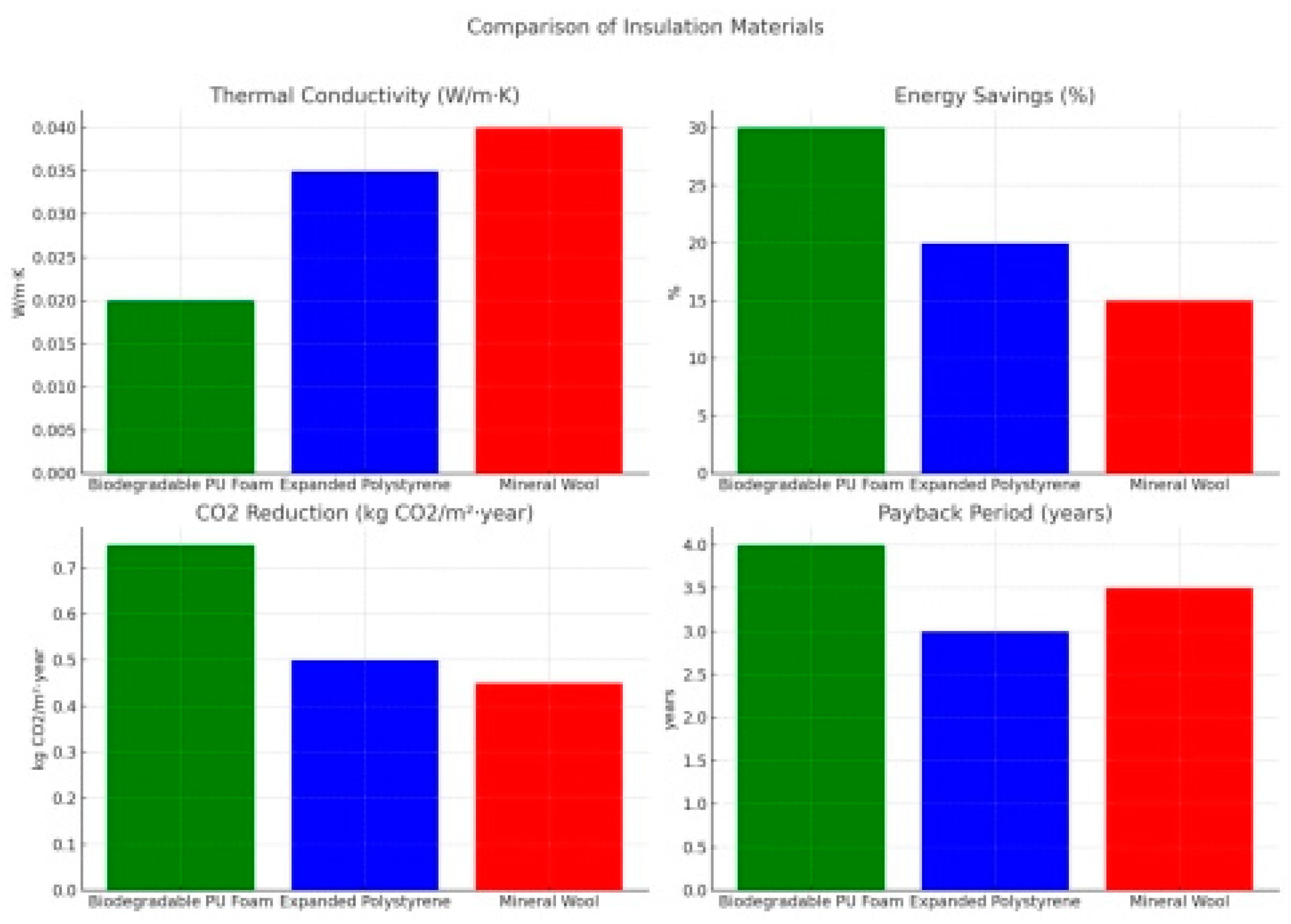
To evaluate the efficiency of biodegradable foamed polyurethanes (Figure 2) compared to conventional thermal insulation materials, the following parameters are analyzed: thermal conductivity, energy savings, CO2 emissions reduction, and investment payback period.3.5
Basic Parameters
- Thermal conductivity of biodegradable foamed polyurethane (λ): 0.022 W/(m·K)
- Thermal conductivity of expanded polystyrene (EPS): 0.035 W/(m·K)
- Insulation thickness: 0.10 m (10 cm)
- Insulated area: 100 m2
- Insulation lifespan: 25 years
- Energy cost: 0.12 €/kWh
- Heat transfer coefficient for uninsulated wall (U): 1.50 W/(m2·K)
- Average indoor temperature: 20°C
- Average outdoor temperature: 5°C
- Heating season duration: 200 days/year
- CO2 emissions for energy production: 0.20 kg CO2/kWh
3.1. Calculations
Calculation of the thermal transmittance coefficient for the insulated wall (U):
 where d is the thickness of the insulation and λ is the thermal conductivity
For biodegradable foamed polyurethane:

For expanded polystyrene (EPS)

Calculation of annual energy savings:
where A is the insulated area and ΔT is the temperature difference..
Q=U⋅A⋅ΔT⋅ The duration of the heating season
- For biodegradable foamed polyurethane:
Q non-insulated=1.50⋅100⋅15⋅200=450000kWh/an
Qinsulated, PU=0.206⋅100⋅15⋅200=6180kWh/an
- For expanded polystyrene (EPS):
Qinsulated, EPS=0.289⋅100⋅15⋅200=8670kWh/an
Energy savings PU=450000−6180=443820kWh/an
Calculation of annual financial savings
- For biodegradable foamed polyurethane:
Financial Savings PU=443820⋅0.12=53258.4€
- For expanded polystyrene (EPS):
Financial Savings EPS=441330⋅0.12=52959.6€
Calculation of CO2 emissions reduction
- For biodegradable foamed polyurethane:
CO2 emissions reduction PU=443820⋅0.20=88764kg CO2/an
- For expanded polystyrene (EPS):
CO2 emissions reduction EPS=441330⋅0.20=88266kg CO2/an
Return on investment
Let’s assume the installation cost for biodegradable foamed polyurethane is 50 €/m2 and for expanded polystyrene (EPS) is 30 €/m2.
Initial investment for biodegradable foamed polyurethane:
PU Investment =50⋅100=5000€
Initial investment for expanded polystyrene (EPS):
EPS Investment =30⋅100=3000€
Return on investment
Return on investment PU=5000/53258.4≈0.094ani
Return on investment EPS=3000/52959.6≈0.057ani
Energy Efficiency: Biodegradable foamed polyurethane provides an annual energy savings of 443,820 kWh compared to 441,330 kWh for EPS.
Financial Savings: Biodegradable foamed polyurethane saves €53,258.4/year, while EPS saves €52,959.6/year.
Solution: Government subsidies and tax incentives to promote eco-friendly materials.
O2 Emissions Reduction: The use of biodegradable foamed polyurethane reduces emissions by 88,764 kg CO2/year, compared to 88,266 kg CO2/year for EPS.
Return on Investment: Biodegradable foamed polyurethane has a payback period of approximately 0.094 years (approximately 1.13 months), while EPS has a payback period of approximately 0.057 years (approximately 0.68 months).
This analysis highlights the significant potential of biodegradable foamed polyurethane in transforming the construction industry towards more sustainable and energy-efficient practices.
4. Conclusions
Biodegradable foamed polyurethanes offer significant advantages in terms of energy efficiency, financial savings, and CO2 emission reduction compared to conventional materials such as expanded polystyrene.
Biodegradable foamed polyurethane provides a promising solution for building thermal insulation, combining energy efficiency with sustainability.
The foaming of biodegradable polyurethanes involves introducing a blowing agent into the polyurethane resin, which generates small and uniform cells in the material’s structure. This technique optimizes insulating performance and minimizes material consumption.
Biodegradable foamed polyurethane not only offers superior thermal performance but is also an ideal solution for modern and sustainable constructions. These advantages make it a viable option for those looking to reduce their carbon footprint and benefit from long-term savings.
In our hypothetical example, energy savings can reach approximately 42.86% compared to using expanded polystyrene. Although the initial investment is higher, the payback period is very short, making it an economically and ecologically viable solution for building thermal insulation.
Foaming methods for biodegradable polymers have evolved significantly, offering sustainable solutions for thermal insulation in construction. Although there are technical and economic challenges, continuous progress in research and development promises to transform the construction industry toward more efficient practices.
Its superior insulation properties, along with ecological benefits, demonstrate the enormous potential to transform current practices and contribute to a greener and more sustainable future for the construction industry.
Author Contributions
Conceptualization, A.I. and D.C.L.(C); methodology, N.C. ; software, A.S.; writing-review and editing, R.M.S (I); validation, D.A.L. and A.I.
Funding
Please add: “This research received no external funding.
Conflicts of Interest
“The authors declare no conflicts of interest.
References
- Zhao, X., Li, J., Su, S. and Jiang, N., Prediction Models of Mechanical Properties of Jute/PLA Composite Based on X-ray Computed Tomography, Polymers 2024, 16(1), 160.
- 2Cheng, P., Zheng, C., Zhang, Z., Li, Y., Huang, K., Yu, D. and Ji, Y., Preparation and Performance of Bitumen Modified by Melt-Blown Fabric of Waste Mask Based on Grey Relational and Radar Chart Analysis, Polymers 2024, 16(1), 153.
- International Energy Agency (IEA). (2020). Energy Efficiency 2020. Retrieved from https://www.iea.org/reports/energy-efficiency-2020.
- European Commission. (2019). The European Green Deal. Retrieved from https://ec.europa.eu/info/strategy/priorities-2019-2024/european-green-deal_en.
- Smith, L., & Jones, P. (2018). Biodegradable Polymers in the Construction Industry. Journal of Sustainable Building Materials and Technologies, 7(4), 212-225. [CrossRef]
- American Society of Civil Engineers (ASCE). (2017). Sustainability Guidelines for the Construction Industry. Retrieved from https://www.asce.org/sustainability-guidelines.
- United Nations Environment Programme (UNEP). (2019). Emissions Gap Report 2019. Retrieved from https://www.unep.org/resources/emissions-gap-report-2019.
- Wang, Y., & Zhang, X. (2021). Thermal Insulation Properties of Biodegradable Polyurethane Foams. Construction and Building Materials, 275, 122143. [CrossRef]
- Kumar, S., & Gupta, A. (2020). Cost-Benefit Analysis of Biodegradable Insulation Materials. Energy and Buildings, 223, 110024. [CrossRef]
- Global Alliance for Building and Construction (GlobalABC). (2020). The Global Status Report for Buildings and Construction. Retrieved from https://globalabc.org/resources/publications/global-status-report-buildings-and-construction-2020.
- Papadopoulos, A. M. (2005). State of the art in thermal insulation materials and aims for future developments. Energy and Buildings, 37(1), 77-86.
- Asif, M., Muneer, T., & Kelley, R. (2007). Life cycle assessment: A case study of a dwelling home in Scotland. Building and Environment, 42(3), 1391-1394.
- Jelle, B. P., Hynd, A., Gustavsen, A., Arasteh, D., Goudey, H., & Hart, R. (2012). Fenestration of today and tomorrow: A state-of-the-art review and future research opportunities. Solar Energy Materials and Solar Cells, 96, 1-28.
- I. Sabree, J. E. Gough, B. Derby, Ceram. Int. 2015, 41, 8425.
- N. S. Nik, M. R. Rad, P. Nazeman, A. Khojasteh, in Biomaterials for Oral and Dental Tissue Engineering (Eds: L. Tayebi, K. Moharamzadeh), 2017, p. 29.
- A. L. Sisson, D. Ekinci, A. Lendlein, Polymer 2013, 54, 4333.
- F.-L. Jin, M. Zhao, M. Park, S.-J. Park, Polymers 2019, 11, 953, 2.
- S. Ruijtenberg, S. V. Heuvel, Cell Cycle 2016, 2, 207.
- Rezwan K, Chen QZ, Blaker JJ, et al. Biodegradable and bioactive porous polymer/inorganic composite scaffolds for bone tissue engineering. Biomaterials 2006; 27: 3413–3431.
- Crăciunescu, C. M., „Materiale compozite”, Ed. Sedona, Timişoara, 1998.
- Stephen, R. S., “Introduction to design and analysis with advanced composite materials”, Prentice-Hall, 1997.
Figure 1.
Thermal performance of biodegradable Polyurethane foam vs. conventional insulation material.
Figure 1.
Thermal performance of biodegradable Polyurethane foam vs. conventional insulation material.
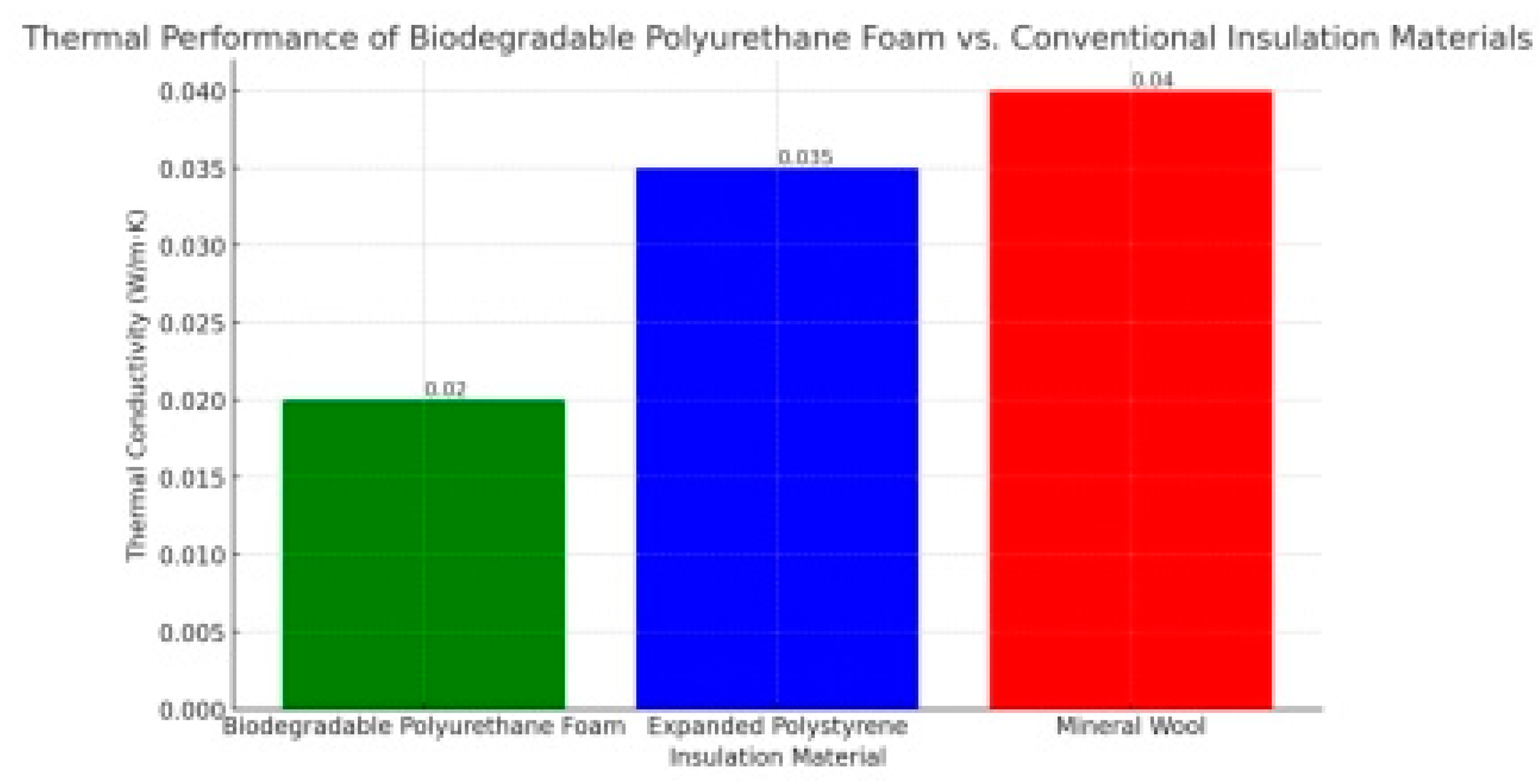
Figure 2.
Evaluation of the Efficiency of Biodegradable Foamed Polyurethanes.
Disclaimer/Publisher’s Note: The statements, opinions and data contained in all publications are solely those of the individual author(s) and contributor(s) and not of MDPI and/or the editor(s). MDPI and/or the editor(s) disclaim responsibility for any injury to people or property resulting from any ideas, methods, instructions or products referred to in the content. |
© 2024 by the authors. Licensee MDPI, Basel, Switzerland. This article is an open access article distributed under the terms and conditions of the Creative Commons Attribution (CC BY) license (http://creativecommons.org/licenses/by/4.0/).
Copyright: This open access article is published under a Creative Commons CC BY 4.0 license, which permit the free download, distribution, and reuse, provided that the author and preprint are cited in any reuse.


