

Submitted:
07 September 2024
Posted:
09 September 2024
You are already at the latest version
Abstract
In the recent years, with the advent of Artificial Intelligence (AI) traditional methods have seen a significant transformation in the agriculture sector, especially in soil management. Soil management involves practices that maintains and improves the physical, chemical as well as the biological properties of the soil. Soil health management is essential for both the environmental conservation and sustainable agriculture production, ensuring the soil productivity and functional aspects associated with the ecosystem. Soil health management is one of the most important aspects of agriculture and food production, hence preserving and enhancing the soil health is an essential factor for supporting agriculture. Integration of Artificial Intelligence (AI) technologies with soil health management offers the potential to enhance agricultural sustainability, productivity, adapt to the climatic changes and resource constraints. The study of AI tools that can help improve soil health management by providing more accurate and efficient monitoring, analysis and decision-making capabilities. This paper studies the potential AI technologies including machine learning, robotics, and remote sensing in enhancing soil health, raising crop yields, and lowering environmental concerns by examining previous research and case studies.
Keywords:
Artificial Intelligence
; Soil Health
; Deep Learning
; Machine Learning
; Unmanned Aerial Vehicle
; ANN
1. Introduction:
The ever-increasing human population demands higher agricultural production and crop yields. The growing crop and its corresponding yield are directly influenced by the soil, irrigation and climatic conditions that serves as the basis for agricultural production. The world’s human population is expected to grow from 8.1 billion (Year-2024) currently to 9.1 billion by the end of 050 requiring 3 billion tons of grain to feed the human population, which is around 50% more food production requirement [1]. For this to achieve we will need to establish solid grounds for the vegetation to grow, that being grounds, being the soil, thus the study for soil health is important. Soil health management is one of the most important aspects for agriculture and food production. Thus, preserving and enhancing soil health is an important factor for supporting agriculture. Soil management involves assessing and adjusting soil nutrient levels, improving soil structure, texture, monitoring and managing carbon footprints of the soil. Maintaining an equilibrium of nutrients and essentials in the soil can help both agricultural crops and the ecosystem. The breakdown of Smart Agriculture Systems could be based over (i) Soil Health monitoring equipment’s (ii) AI for monitoring the data through these systems. The study begins with an introduction to AI – Artificial Intelligence.
Artificial Intelligence (AI) refers to the simulation of human intelligence processes by machines. These processes include learning (the acquisition of information and rules for using the information), reasoning (using heuristic or rules to reach nearly or definite accuracy in task), and self-correction mechanism (through reward- reinforcement learning, or statistical methods- Machine Learning). Other fields that being sub-domain for AI includes (but not limited to) deep learning, transfer learning, Image processing, computer vision, and robotics. These approaches enable AI systems to analyze Big Data, derive insights from them, and make autonomous or semi- autonomous decisions without explicit programming for every possible scenario. While various solutions, such as database decision support systems, have been proposed for agricultural issues, artificial intelligence (AI) systems have proven to be the most accurate and reliable [2]. AI has several real-world applications across a range of industries, including agriculture too. Various Software developments have been successfully deployed over this theme of soil health monitoring, one such being Trace Genomics.
The knack of soil to continue functioning as a living ecosystem that nurtures humans, animals, and plants is known as soil health. Soil health management involves practices and strategies aimed at maintaining and improving the quality and fertility of soil for sustainable agricultural production and environmental conservation. Furthermore, soil health management links agriculture and soil research to policy, stakeholder demands, and sustainable supply-chain management [3]. While crop productivity was the primary focus of soil assessments in the past, soil health now encompasses the function that soil plays in water quality, climate change, and human health.
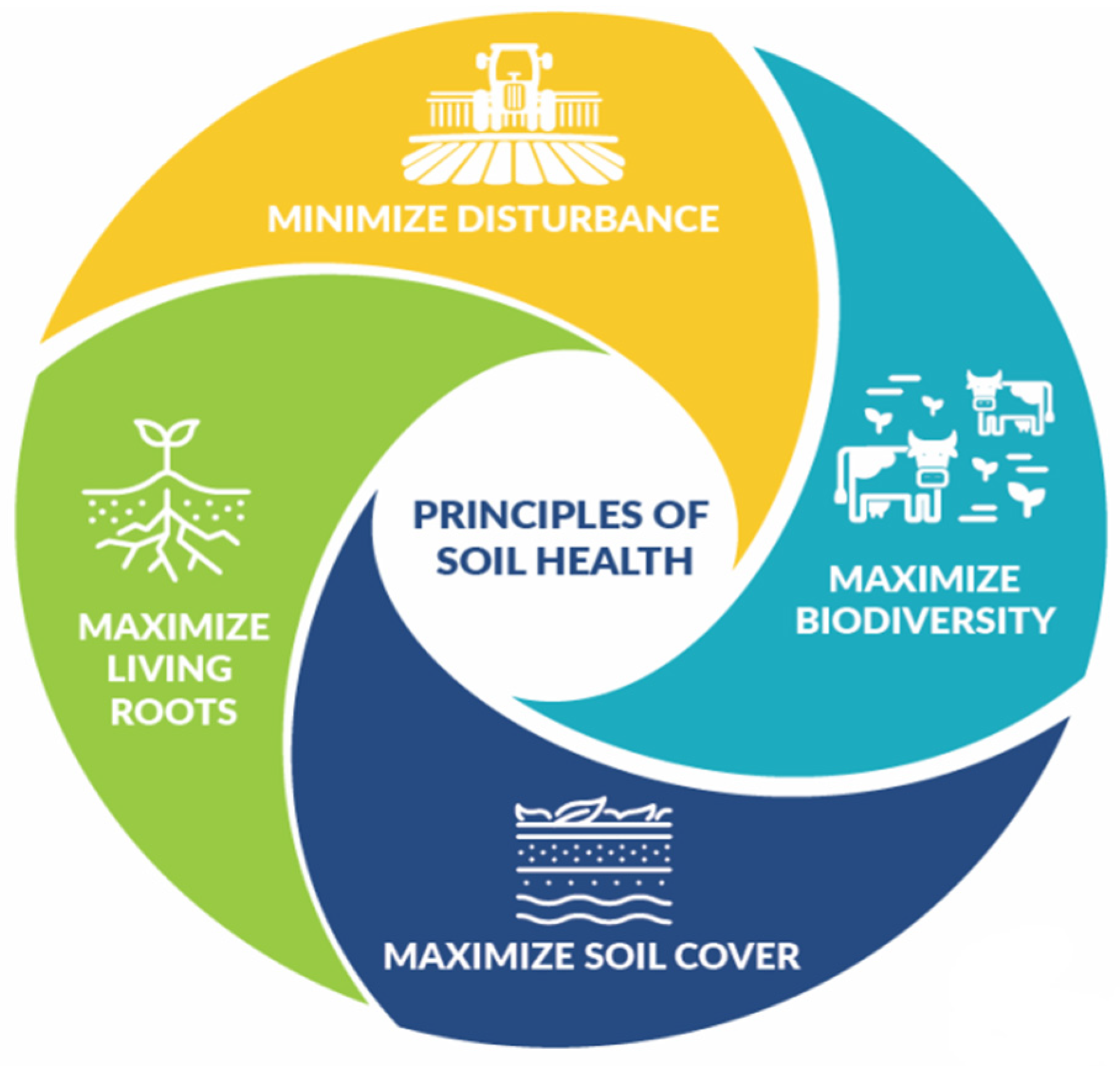
- Principles to Manage Soil for Health:
Research on soil health has provided guidance on managing soil to enhance soil function.
- a.
- Maximize Presence of Living Roots
- b.
- Minimize Disturbance
- c.
- Maximize Soil Cover
- d.
- Maximize Biodiversity
Figure 1.
Principles of soil health [4].
Figure 1.
Principles of soil health [4].
Maintaining our soil’s health and productivity is crucial given the growing global population and increasing needs for food production. An increasing number of farmers are enhancing microbial activity and increasing the organic matter content of their soil through the application of soil health concepts and methods, such as cover crops, no-till farming, and diversified rotation. Consequently, farmers are reaping greater earnings and frequently higher yields while also enhancing water infiltration, improving wildlife and pollinator habitat, and sequestering more carbon.
Effective soil health management requires a holistic and integrated approach, combining traditional knowledge with modern scientific techniques to achieve sustainable and productive agricultural systems. The key components for the effective soil health management are: soil testing and monitoring, organic matter management, crop rotation and diversity, conservation tillage, nutrient management, water management, erosion control, soil biota enhancement, pollution prevention, education and training.
Regular soil testing and monitoring are crucial for determining nutrient level, pH, and other parameters, enabling informed decision-making regarding balanced fertilization to avoid nutrient imbalances and environmental pollution. Soil health is majorly determined by the soil structure, organic matter content, nutrient cycling, which can be enhanced by following practices like composting, diversified planting which enhances the soil structure, lower the incidence of soil- borne diseases, and sustain a diversified microbial community, addition of microbial inoculants, organic amendments such as compost, manure, or green manures improves the nutrient availability and increases the soil and plant health. The contamination of soil and water can be minimized by reducing chemical usage and adopting integrated pest management (IPM) strategies, the pest and disease cycle can be disrupted by following practices like, crop rotation, which also improves soil structure and increases nutrient availability in the same area over the course of several seasons. The soil erosion can be prevented by following cover cropping where the crop residues protect the soil surface and increases the nutrient availability. To minimizing the soil disturbance reduced or no tillage is practiced which in turn helps to maintain soil structure, reduce erosion, and increase water infiltration and retention [5]. Mulching protects the soil surface, reduce evaporation, and maintain moderate soil temperature. To optimize fertilizer application, reduce waste and erosion, efficient irrigation methods like drip or sprinkler systems, water conservation practices such as rainwater harvesting, contour farming, and building terraces, contour farming, terracing and precision agriculture techniques are followed. Windbreaks to reduce wind speed and protect soil from wind erosion. Farmer education, research and development to support research, provide training and resources on innovative soil management techniques and their practical applications.
Ameliorated soil health minimizes the risk of erosion, runoff, and pollution, protecting water bodies and the ecosystem, producing higher and more sustainable yields. Soil health management also helps to tackle climatic changes by sequestering more carbon with the increase of organic matter content of the soil. Healthy soils are better able to withstand extreme weather conditions, such as droughts and floods. The major benefits of soil health management include, enhanced productivity, environmental protection, climate resilience, carbon sequestration.
Overall, soil health management aims to maintain the long-term productivity and sustainability of agricultural systems while minimizing negative environmental impacts such as soil erosion, nutrient runoff, and greenhouse gas emissions.
The intersection of soil health management and artificial intelligence (AI) represents a promising frontier in agricultural innovation, since it offers both the potential to enhance agricultural sustainability and productivity, as well as adapt to the climatic changes or resource constraints. This study is about Soil health management using AI, the foresaid theme involves leveraging advanced technologies to monitor, analyze and optimize soil conditions for sustainable agriculture. Since AI is often data driven, therefor the data from several sources, like as soil sensors, drone images, etc. could be utilized to analyze the current state of the soil and predict future ones. This is soil health management. Harnessing the power of artificial intelligence offers a transformative approach to both soil health management and ecosystem community. As over irrigating field is neither beneficial nor recommendable therefore optimal amount of irrigation and nutrients supply can be done via these AI driven recommender systems combined with robotic machinery from data was prior collected through the above said media. This will improve soil health and increase the chances for crop yield enhancement. AI technologies, including machine learning algorithms and data analytics, enable farmers and agronomists to make data-driven decisions at a scale and precision previously unattainable. By integrating AI into soil health management practices, stakeholders can optimize resource allocation, mitigate risks, and enhance agricultural productivity while minimizing environmental impacts. Overall, AI has the potential to revolutionize soil health management, making it more precise, efficient, and sustainable, which can lead to increase in crop yields, improved food security, and reduce environmental impact. Assuring the long-term growth of agriculture and the wellbeing of the environment requires agricultural practitioners to place a high priority on soil management and take action to safeguard and enhance the soil health.
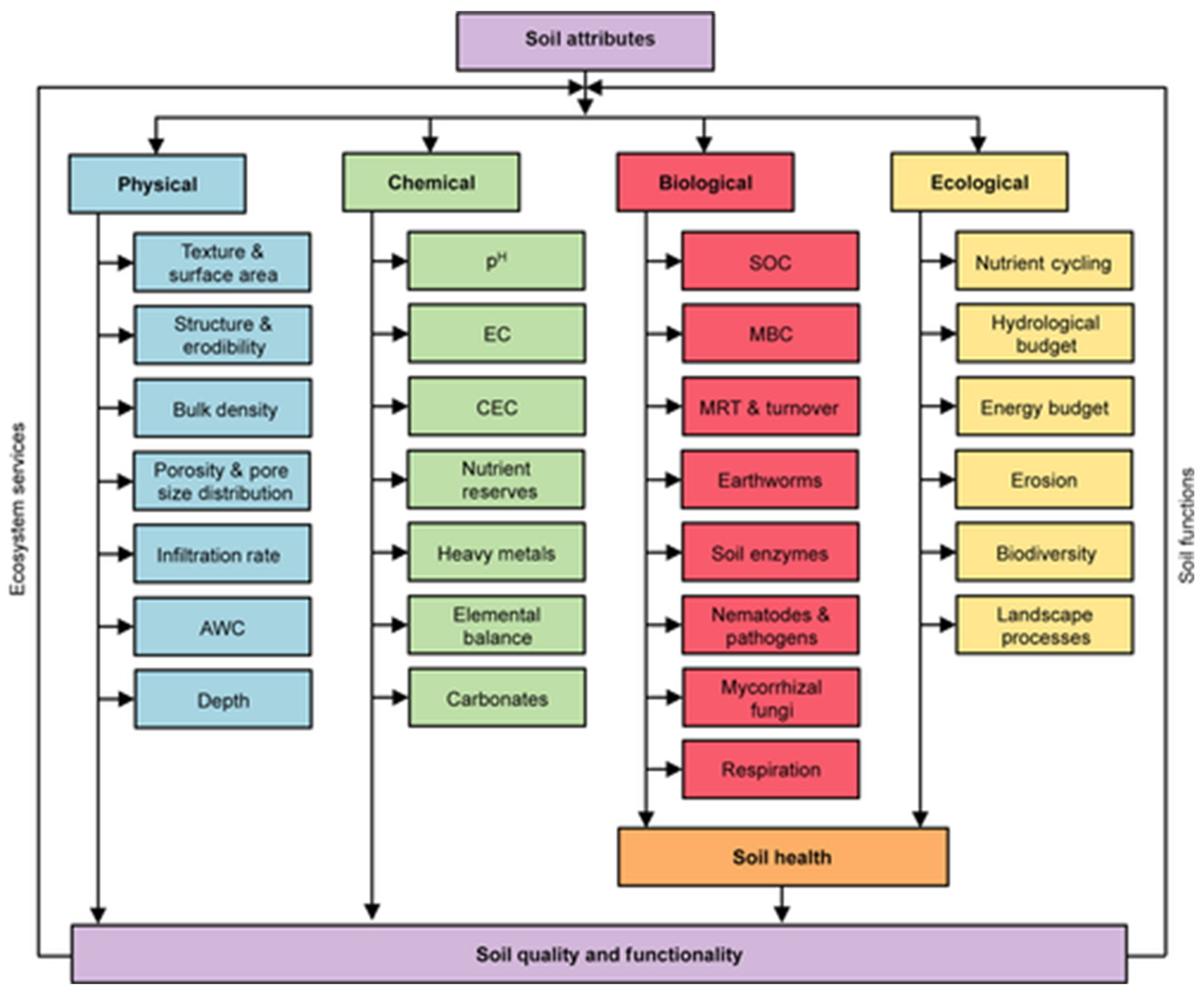
Figure 2.
Soil Attributes [6].
Figure 2.
Soil Attributes [6].
However, AI in soil health management faces certain challenges related to cost, accessibility, expertise, data quality, interpretability and system integration [7]. Additionally, managing, storing, and securing the data needed for AI analysis can conflict with data privacy laws, necessitating careful consideration of legal and regulatory aspects. Ensuring the quality of data, interpretability of results and seamless integration of AI models into existing soil health management practices are crucial for the successful implementation of AI-based soil analysis.
With the advancement in technology, the use of artificial intelligence (AI) in agriculture is becoming more prevalent, particularly in soil management. Conventional methods and experience are often the foundation of traditional soil management approaches, which frequently fall short to discover the full potential of soil and are ill-equipped to handle the demands of modern agriculture. With the goal of promoting sustainable agricultural development and offering more intelligent and scientific solutions for agricultural production, this paper will explore the use of AI in soil health management and its role in the growth of smart agriculture systems. It delves into the key components of AI-driven soil health management, including data collection methodologies, predictive modeling techniques, and decision support systems. Additionally, it examines case studies and real-world applications demonstrating the efficacy of AI in optimizing soil health and fostering sustainable agricultural practices.
2. Application of AI in Soil Health Management
Artificial intelligence (AI) offers various applications in soil health management that can revolutionize agricultural practices. They are [8]:
- a.
- Soil Monitoring and Analysis
AI algorithms can analyze data from various sources such as satellite imagery, soil sensors, and historical data to monitor soil health parameters like nutrient levels, moisture content, and pH. This data-driven approach allows for real-time monitoring and timely interventions to optimize soil health. Utilizing machine learning algorithms to analyze soil properties and predict nutrient levels is a significant aspect of intelligent soil management in modern agriculture.
- b.
- Predictive Modelling
Integrating sensor technology for real-time monitoring of soil moisture and pH value is an important intelligent soil management method in modern agriculture. AI models, such as machine learning algorithms, can predict soil properties and health indicators based on historical data. This can help farmers make informed decisions about crop selection, fertilizer application, and irrigation strategies to improve soil health and productivity.
- c.
- Precision Agriculture
Deploying AI-driven UAVs (Unmanned Aerial Vehicles) and satellites for mapping soil variability is an advanced soil management method in modern agriculture. AI-powered precision agriculture technologies enable farmers to apply inputs like water, fertilizers, and pesticides with precision, reducing waste and environmental impact. By analyzing soil data and crop performance indicators, AI can optimize input usage for sustainable soil management.
- d.
- Disease and Pest Detection
Advanced plant protection technology utilizes AI-driven image recognition systems to swiftly detect and identify early symptoms of plant diseases, using image recognition algorithms and machine learning models. This enables for the timely and efficient application of control measures. AI-based image recognition systems can analyze images of crops and soil to detect signs of diseases, pests, or nutrient deficiencies. Early detection allows for targeted interventions, reducing the need for broad-spectrum treatments and minimizing crop damage.
- e.
- Recommendation Systems
AI-driven recommendation systems can provide personalized advice to farmers on soil management practices based on individual soil conditions, crop types, and environmental factors. These recommendations can optimize soil health, crop yield, and resource efficiency.
- f.
- Autonomous Farming Equipment
Deploying autonomous robots for preventive and control measures, such as field management and crop coverage, is a modern, efficient agricultural management method. AI-powered autonomous tractors and drones can perform soil health monitoring, precision planting, and other tasks with minimal human intervention. These technologies streamline agricultural operations and enable efficient soil management practices.
Overall, the application of AI in soil health management holds great potential for enhancing agricultural sustainability, productivity, and resilience. By leveraging AI technologies, farmers and land managers can make data-driven decisions to improve soil health, conserve resources, and ensure long-term food security.
3. Literature Review
In recent years, the advanced technologies, such as artificial intelligence (AI), has provided new opportunities to revolutionize soil health management practices. AI techniques, including machine learning, deep learning, and data analytics, offer the potential to analyze vast amounts of soil-related data, extract meaningful insights, and guide decision-making processes in real time. By leveraging AI-enabled smart agriculture systems, farmers can enhance soil quality, optimize nutrient management, minimize environmental impact, and increase agricultural productivity in a sustainable manner. This section reviews the work done to provide a comprehensive overview of recent research and development in soil health management using AI for smart agriculture systems. By synthesizing existing knowledge and identifying emerging trends, this review seeks to elucidate the potential benefits, challenges, and opportunities associated with integrating AI technologies into soil management practices, aiming to highlight key findings, gaps in knowledge, and future research directions in this rapidly evolving field.
| Reference | Technique | Strength | Limitations |
| Plant, et.al. [9]- 1989 |
CALEX | Prepares scheduling guidelines for crop management | Time consuming |
| Gholami, et.al. [10]-2017 | ANN (Artificial Neural Network) |
To estimate soil erosion, high calculation speed, high accuracy | Plots required to monitor rill erosion |
| Zhao, et.al. [11]-2007 | ANN | High-resolution soil texture maps generated using coarse resolution soil texture map | Low accuracy |
| Mosaffaei, et.al. [12]-2020 | ANN | Predict degradation in national park management plan | Adaptation challenge with new data. |
| Shao, et.al. [13]-2021 | BP-ANN (Back Propagation- Artificial Neural Network) |
Classify and evaluate soil quality, where soil nutrients contaminated with heavy metal contamination in the arid area | Expensive |
| Dahmardeh, et.al. [14]-2017 | ANN, ANFIS (Adaptive Neuro-fuzzy Inference System) |
The effects of tillage type, temperature, sodium are evaluated based on type of intercropping to carbon-nitrogen ratio | Measures only two chemical properties |
| Pellegrini, et.al. [15]-2021 | ANN | Predict Soil microbial-biomass from soil physical and chemical properties | Only a few cases were studied. |
| Jalal, et.al. [16]-2021 | ANN, ANFIS, GEP (Gene Expression Programming) |
Prediction models developed to evaluate swell pressure and unconfined compression strength of expansive soils | Internet dependent |
| Kim, et.al. [17]-2008 | ANN | Estimates soil erosion, NH4–N concentrations and dissolved P of runoff | Not accurate for higher erosion values |
| Arsoy, et.al. [18]-2013 | ANN | Soil water content determination based on dielectric permittivity measurement | Time consuming |
| Liu, et.al. [19]- 2015 |
SVM (Support Vector Machine) | Classification and assessment of urban soil quality | sensitive to outliers |
| Guan, et.al. [20]-2011 | SVM | Soil salinity prediction for irrigation water management in irrigation districts | Prior Knowledge of EC value required |
| Mustafa, et.al. [21]-2018 | SVM | Geospatial prediction of soil erosion | High Complexity |
| Wijitdechakul, et.al. [22]-2016 | UAV (Unmanned Aerial Vehicle) |
Interpret the plant health conditions for user. | Expensive |
| Pluer, et.al. [23]-2020 | UAV | To test field scale variation in soil characteristics | High complexity |
| Krenz, et.al. [24]-2019 | UAV | To identify the degradation status of soils | Tussocks or exposed shrub roots cannot be detected |
| Falco, et.al. [25]-2018 | UAV | To estimate sprout density and plant vigor throughout the growing season | High complexity |
| Rosa, et.al. [26]-1999 | ImpelERO | To evaluate soil erosion | Time consuming |
| Kaufamann, et.al. [27]-2009 | Fuzzy logic expert system | To evaluate the plant productivity of restored soils | Internet dependent. |
| Ahsanuzzaman, et.al. [28]-2004 | Expert system | To evaluate groundwater pollution from application of manure to soil | Internet-based. |
4. Case Study
- This section addresses the application of Artificial Intelligence for soil health management, providing a detailed view of data input, algorithms used, features, characteristics and the optimal results obtained.
| REFERENCE | DATA INPUT | ALGORITHM | FEATURES | CHARACTERISTICS | OPTIMAL RESULTS |
| Fernandes, et.al. [29]-2019 | 8556 Samples |
ANN | Estimates soil organic matter content from soil chemical attributes | Soil Organic matter | R2=0.76, RMSE=1.98g Kg-1 |
| Mirzaee, et.al. [30]-2016 | 100 soil samples | ANNSK (Artificial Neural Network Simple Kriging) |
To predict soil organic matter content | Soil Organic matter | R2=0.633, RMSE=0.271 |
| Somaratne, et.al. [31]-2005 | 240 soil samples | ANN, MLR (Multivariate Linear Regression) |
to predict SOC contents across different land use patterns | Soil Organic matter |
|
| Bouasria, et.al. [32]-2020 | 369 soil samples | DT (Decision Tree), K-NN (K- Nearest Neighbour), ANN |
To predict soil organic matter content | Soil Organic matter | ANN:(MS image: R2=0.6553, PAN image: R2=0.6985) |
| Huang, et.al. [33]- 2020 |
102 soil samples | BPNN, SVR (Support Vector Regression), PLSR (Partial Least Square Regression) |
To predict soil organic matter concentration | Soil Organic matter |
|
| Swetha, et.al. [34]- 2020 |
90 soil samples | RF (Random Forest), CNN (Convolution Neural Network) |
a smartphone application for predicting soil texture | Soil Texture | Clay (R2=0.97-0.98), Sand (R2=0.96– 0.98), Silt (R2=0.62–
|
| Zhao, et.al. [35]- 2009 |
450 sampling points |
ANN | To predict soil texture based on soil attributes obtained from existing coarse resolution soil maps | Soil Texture | LM:(RMSE- Clay:7.9, Sand:16.6), RP:(RMSE- Clay:8.5, Sand:14.9) |
| Penghui, et.al. [36]-2020 | Various types of variables | ANFIS- GOA, ANFIS-SSA, ANFIS- GWO, ANFIS-PSO, ANFIS-GA, ANFIS-DA | To predict soil temperature | Soil Temperature | ANFIS-mSG was found to be efficient |
| Sattari, et.al. [37]- 2020 |
3995 Records |
DT-GBT (Decision Tree-Gradient Boosted Tree) |
To predict the soil temperature at | Soil Temperature | NS:0.9446–0.9942, KGE:0.857–0.995, R:0.9793–0.9971 |
| Behmanesh, et.al. [38]-2017 | Soil temperature dataset (1997- 2008) |
GEP, ANN, MLR | To estimate the soil temperature at different depths | Soil Temperature | ANN performed efficiently |
| John, et.al. [39]- 2020 |
60 soil samples | ANN, SVM, RF, MLR | Estimation of soil organic content and soil nutrient indicators | Soil Organic Content Soil Nutrient |
RF:R2=0.68, SVM:R2=0.36, ANN:R2=0.36, MLR:R2=0.17 |
| Pathumuthusabana, et.al. [40]-2021 | 1700 soil sample images | CNN, Lenet, AlexNet, Vgg16 | classification of SOC and soil macronutrients | Soil Organic Content, Soil Macronutrients | Accuracy: Lenet:77.4%, AlexNet:85.31%, Vgg16:87.38% |
| Rajamanickam, et.al. [41]-2021 | 1000 Samples |
DT, KNN, SVM | Predicts soil fertility based on macro and micro nutrients status | Soil Fertility | MSE (DT:0.01, KNN:0.6897, SVM_linear:0.6552 SVM_rbf:0.559 |
| Zhang, et.al. [42]- 2021 |
Various types of variables | DT, RF | Predicts soil fertility | Soil Fertility | RF and DT are the most accurate methods |
| Hassan-Esfahani, et.al. [43]-2015 | Various types of variables | ANN, UAV | Estimates surface soil moisture | Soil Moisture | RMSE:2.0, MAE:1.3, R2:0.77 |
| Gill, et.al. [44]- 2006 |
Various types of variables | SVM, ANN | Predicts soil moisture | Soil Moisture | SVM performed efficiently |
| Prakash, et.al. [45]-2020 | Various types of variables | MLR, SVM, RNN (Recurrent Neural Network) |
Predicts Soil Moisture | Soil Moisture | MLR performed efficiently |
| Sarmadian, et.al. [46]-2008 | 125 soil samples | MLR, ANN | Predicts soil parameters | Soil Properties | ANN performed efficiently |
| Kurnaz, et.al. [47]- 2015 |
Various types of variables | ANN | Predicts compression and recompression index of soil | Soil Properties | Compression index(R2=0.8973), Recompression Index(R2=0.3600) |
| Mohanty, et.al. [48]-2015 | 721 soil samples | ANN | Evaluates Pedotransfer function of Field Capacity and Permanent Wilting Point | Soil Properties | ANN indicated unbiased and higher predictability |
5. Limitations of Artificial Intelligence in Soil Health Management
Artificial intelligence in soil health management might have major benefits but it also comes with several challenges. They are:
- Data Quality and Quantity: AI models require a significant amount of high-quality data to effectively analyze and predict soil health. Obtaining comprehensive and accurate soil data can be a challenge, especially in remote or under-studied regions.
- Model Interpretability: Some AI models, such as deep learning neural networks, can be complex and difficult to interpret. Understanding how the AI reaches its conclusions about soil health can be crucial for gaining trust from users and stakeholders.
- Integration with Traditional Practices: Integrating AI technologies with existing soil management practices and workflows can be challenging. Ensuring that AI recommendations align with local knowledge and practices is essential for successful adoption.
- Cost: Implementing AI solutions for soil health management can require significant financial resources, especially for collecting data, developing models, and deploying technology in the field. Cost can be a barrier for small-scale farmers or resource- constrained agricultural organizations.
- Regulatory and Ethical Concerns: There may be regulatory challenges around data ownership, privacy, and ethical considerations when using AI for soil health management. Ensuring compliance with relevant laws and regulations is essential to avoid legal issues.
Overcoming these challenges often requires collaboration among farmers, researchers, technology developers, policymakers, and other stakeholders to develop tailored AI solutions that address specific soil health management needs while considering the broader social, economic, and environmental context.
6. Conclusion
According to recent research, the Indian economy’s most important industry is agriculture, which employs more than 60% of the workforce and accounts for over 17% of GDP. In order to obtain soil fertility and crop health status on a regular basis, farming must be revolutionized by timely soil testing and crop disease detection employing machine learning algorithms and AI techniques effectively on real-time datasets. Artificial Intelligence has been instrumental in revolutionizing soil management practices. AI analyzes soil properties, forecasts nutrient levels, maps soil variations, applies precision irrigation and fertilization, identifies early signs of plant diseases, guides targeted treatments, forecasts soil erosion risks, and deploys autonomous robots for control measures through machine learning algorithms. Anticipating the future, AI will propel smart agriculture into the norm. As artificial intelligence (AI) technology advances and gains traction, it will enable intelligent, more effective, and sustainable agriculture. This will play a major role in conserving the environment, fostering rural revival, and resolving the problem of food security.
References
- Chen, Q., Li, L., Chong, C. and Wang, X., 2022. AI-enhanced soil management and smart farming. Soil Use and Management, 38(1), pp.7-13. [CrossRef]
- Bannerjee, G., Sarkar, U., Das, S. and Ghosh, I., 2018. Artificial intelligence in agriculture: A literature survey. international Journal of Scientific Research in computer Science applications and Management Studies, 7(3), pp.1-6.
- Available online: https://tracegenomics.com/.
- Home | Natural Resources Conservation Service (usda.gov).
- Miner, G.L., Delgado, J.A., Ippolito, J.A. and Stewart, C.E., 2020. Soil health management practices and crop productivity. Agricultural & Environmental Letters, 5(1), p.e20023. [CrossRef]
- Lal, R., 2016. Soil health and carbon management. Food and energy security, 5(4), pp.212-222. [CrossRef]
- Kumar, A., Sharma, H. and Kumar, S., 2022. AI-Based Soil Fertility Management Review: Challenges And Opportunities. Journal of Survey in Fisheries Sciences, pp.283-288. [CrossRef]
- Zhang, X., Yang, P. and Lu, B., 2024. Artificial intelligence in soil management: The new frontier of smart agriculture. Advances in Resources Research, 4(2), pp.231-251. [CrossRef]
- Plant, R.E., 1989. An artificial intelligence-based method for scheduling crop management actions. Agricultural systems, 31(1), pp.127-155. [CrossRef]
- Gholami, V., Booij, M.J., Tehrani, E.N. and Hadian, M.A., 2018. Spatial soil erosion estimation using an artificial neural network (ANN) and field plot data. Catena, 163, pp.210-218. [CrossRef]
- Zhao, Z., Chow, T.L., Rees, H.W., Yang, Q., Xing, Z. and Meng, F.R., 2009. Predict soil texture distributions using an artificial neural network model. Computers and electronics in agriculture, 65(1), pp.36-48. [CrossRef]
- Mosaffaei, Z., Jahani, A., Chahouki, M.A.Z., Goshtasb, H., Etemad, V. and Saffariha, M., 2020. Soil texture and plant degradation predictive model (STPDPM) in national parks using artificial neural network (ANN). Modeling Earth Systems and Environment, 6(2), pp.715-729. [CrossRef]
- Shao, W., Guan, Q., Tan, Z., Luo, H., Li, H., Sun, Y. and Ma, Y., 2021. Application of BP-ANN model in evaluation of soil quality in the arid area, northwest China. Soil and Tillage Research, 208, p.104907. [CrossRef]
- Dahmardeh, M.E.H.D.I., KESHTEGAR, B. and Piri, J.A.M.S.H.I.D., 2017. Assessment chemical properties of soil in intercropping using ANN and ANFIS models. Bulgarian Journal of Agricultural Science, 23(2).
- Pellegrini, E., Rovere, N., Zaninotti, S., Franco, I., De Nobili, M. and Contin, M., 2021. Artificial neural network (ANN) modelling for the estimation of soil microbial biomass in vineyard soils. Biology and Fertility of Soils, 57(1), pp.145-151. [CrossRef]
- Jalal, F.E., Xu, Y., Iqbal, M., Javed, M.F. and Jamhiri, B., 2021. Predictive modeling of swell-strength of expansive soils using artificial intelligence approaches: ANN, ANFIS and GEP. Journal of Environmental Management, 289, p.112420. [CrossRef]
- Kim, M. and Gilley, J.E., 2008. Artificial Neural Network estimation of soil erosion and nutrient concentrations in runoff from land application areas. Computers and electronics in agriculture, 64(2), pp.268-275. [CrossRef]
- Arsoy, S., Ozgur, M., Keskin, E. and Yilmaz, C., 2013. Enhancing TDR based water content measurements by ANN in sandy soils. Geoderma, 195, pp.133-144. [CrossRef]
- Liu, Y., Wang, H., Zhang, H. and Liber, K., 2016. A comprehensive support vector machine-based classification model for soil quality assessment. Soil and Tillage Research, 155, pp.19-26. [CrossRef]
- Guan, X., Wang, S., Gao, Z. and Lv, Y., 2013. Dynamic prediction of soil salinization in an irrigation district based on the support vector machine. Mathematical and Computer Modelling, 58(3-4), pp.719-724. [CrossRef]
- Mustafa, M.R.U., Sholagberu, A.T., Yusof, K.W., Hashim, A.M., Khan, M.W.A. and Shahbaz, M., 2018. SVM-based geospatial prediction of soil erosion under static and dynamic conditioning factors. In MATEC Web of Conferences (Vol. 203, p. 04004). EDP Sciences. [CrossRef]
- Wijitdechakul, J., Sasaki, S., Kiyoki, Y. and Koopipat, C., 2016, September. UAV-based multispectral image analysis system with semantic computing for agricultural health conditions monitoring and real-time management. In 2016 International Electronics Symposium (IES) (pp. 459-464). IEEE.
- Pluer, E.M., Robinson, D.T., Meinen, B.U. and Macrae, M.L., 2020. Pairing soil sampling with very-high resolution UAV imagery: An examination of drivers of soil and nutrient movement and agricultural productivity in southern Ontario. Geoderma, 379, p.114630. [CrossRef]
- Krenz, J., Greenwood, P. and Kuhn, N.J., 2019. Soil degradation mapping in drylands using Unmanned Aerial Vehicle (UAV) data. Soil Systems, 3(2), p.33. [CrossRef]
- Falco, N., Wainwright, H., Ulrich, C., Dafflon, B., Hubbard, S.S., Williamson, M., Cothren, J.D., Ham, R.G., McEntire, J.A. and McEntire, M., 2018, July. Remote sensing to UAV-based digital farmland. In IGARSS 2018-2018 IEEE International Geoscience and Remote Sensing Symposium (pp. 5936-5939). IEEE.
- De la Rosa, D., Mayol, F., Moreno, J.A., Bonsón, T. and Lozano, S., 1999. An expert system/neural network model (ImpelERO) for evaluating agricultural soil erosion in Andalucia region, southern Spain. Agriculture, Ecosystems & Environment, 73(3), pp.211-226. [CrossRef]
- Kaufmann, M., Tobias, S. and Schulin, R., 2009. Quality evaluation of restored soils with a fuzzy logic expert system. Geoderma, 151(3-4), pp.290-302. [CrossRef]
- Ahsanuzzaman, A.N.M., Zaman, M. and Kolar, R., 2004. Simple expert system for evaluation of nutrient pollution potential in groundwater from manure application. International Journal of Geomechanics, 4(4), pp.285-295. [CrossRef]
- Fernandes, M.M.H., Coelho, A.P., Fernandes, C., da Silva, M.F. and Marta, C.C.D., 2019. Estimation of soil organic matter content by modeling with artificial neural networks. Geoderma, 350, pp.46-51. [CrossRef]
- Mirzaee, S., Ghorbani-Dashtaki, S., Mohammadi, J., Asadi, H. and Asadzadeh, F., 2016. Spatial variability of soil organic matter using remote sensing data. Catena, 145, pp.118-127. [CrossRef]
- Somaratne, S., Seneviratne, G. and Coomaraswamy, U., 2005. Prediction of soil organic carbon across different land-use patterns: A neural network approach. Soil Science Society of America Journal, 69(5), pp.1580-1589. [CrossRef]
- Bouasria, A., Namr, K.I., Rahimi, A. and Ettachfini, E.M., 2020, October. Soil organic matter estimation by using Landsat-8 pansharpened image and machine learning. In 2020 Fourth International Conference On Intelligent Computing in Data Sciences (ICDS) (pp. 1-8). IEEE. [CrossRef]
- Huang, D., Liu, H., Zhu, L., Li, M., Xia, X. and Qi, J., 2020. Soil organic matter determination based on artificial olfactory system and PLSR-BPNN. Measurement Science and Technology, 32(3), p.035801. [CrossRef]
- Swetha, R.K., Bende, P., Singh, K., Gorthi, S., Biswas, A., Li, B., Weindorf, D.C. and Chakraborty, S., 2020. Predicting soil texture from smartphone-captured digital images and an application. Geoderma, 376, p.114562. [CrossRef]
- Zhao, Z., Chow, T.L., Rees, H.W., Yang, Q., Xing, Z. and Meng, F.R., 2009. Predict soil texture distributions using an artificial neural network model. Computers and electronics in agriculture, 65(1), pp.36-48. [CrossRef]
- Penghui, L., Ewees, A.A., Beyaztas, B.H., Qi, C., Salih, S.Q., Al-Ansari, N., Bhagat, S.K., Yaseen, Z.M. and Singh, V.P., 2020. Metaheuristic optimization algorithms hybridized with artificial intelligence model for soil temperature prediction: Novel model. IEEE Access, 8, pp.51884-51904. [CrossRef]
- Sattari, M.T., Avram, A., Apaydin, H. and Matei, O., 2020. Soil temperature estimation with meteorological parameters by using tree-based hybrid data mining models. Mathematics, 8(9), p.1407. [CrossRef]
- Behmanesh, J. and Mehdizadeh, S., 2017. Estimation of soil temperature using gene expression programming and artificial neural networks in a semiarid region. Environmental Earth Sciences, 76, pp.1-15. [CrossRef]
- John, K., Abraham Isong, I., Michael Kebonye, N., Okon Ayito, E., Chapman Agyeman, P. and Marcus Afu, S., 2020. Using machine learning algorithms to estimate soil organic carbon variability with environmental variables and soil nutrient indicators in an alluvial soil. Land, 9(12), p.487. [CrossRef]
- Pathumuthusabana, A.M. and Priyadharsini, S.S., 2021. An Artificial Intelligence-Based Evaluation of Soil Fertility. In Handbook of Green Engineering Technologies for Sustainable Smart Cities (pp. 255-275). CRC Press.
- Rajamanickam, J., 2021. Predictive model construction for prediction of soil fertility using decision tree machine learning algorithm. INFOCOMP Journal of Computer Science, 20(1).
- Zhang, P., Guo, Z., Ullah, S., Melagraki, G., Afantitis, A. and Lynch, I., 2021. Nanotechnology and artificial intelligence to enable sustainable and precision agriculture. Nature Plants, 7(7), pp.864-876. [CrossRef]
- Hassan-Esfahani, L., Torres-Rua, A., Jensen, A. and McKee, M., 2015. Assessment of surface soil moisture using high-resolution multi-spectral imagery and artificial neural networks. Remote Sensing, 7(3), pp.2627-2646. [CrossRef]
- Gill, M.K., Asefa, T., Kemblowski, M.W. and McKee, M., 2006. Soil moisture prediction using support vector machines 1. JAWRA Journal of the American Water Resources Association, 42(4), pp.1033-1046. [CrossRef]
- Prakash, S., Sharma, A. and Sahu, S.S., 2018, April. Soil moisture prediction using machine learning. In 2018 Second International Conference on Inventive Communication and Computational Technologies (ICICCT) (pp. 1-6). IEEE. [CrossRef]
- Sarmadian, F. and Taghizadeh Mehrjardi, R., 2008. Modeling of some soil properties using artificial neural network and multivariate regression in Gorgan Province, North of Iran. Global Journal of Environmental Research, 2(1), pp.30-35.
- Kurnaz, T.F., Dagdeviren, U., Yildiz, M. and Ozkan, O., 2016. Prediction of compressibility parameters of the soils using artificial neural network. SpringerPlus, 5, pp.1-11. [CrossRef]
- Mohanty, M., Sinha, N.K., Painuli, D.K., Bandyopadhyay, K.K., Hati, K.M., Sammi Reddy, K. and Chaudhary, R.S., 2015. Modelling soil water contents at field capacity and permanent wilting point using artificial neural network for Indian soils. National Academy Science Letters, 38, pp.373-377. [CrossRef]
Disclaimer/Publisher’s Note: The statements, opinions and data contained in all publications are solely those of the individual author(s) and contributor(s) and not of MDPI and/or the editor(s). MDPI and/or the editor(s) disclaim responsibility for any injury to people or property resulting from any ideas, methods, instructions or products referred to in the content. |
© 2024 by the authors. Licensee MDPI, Basel, Switzerland. This article is an open access article distributed under the terms and conditions of the Creative Commons Attribution (CC BY) license (http://creativecommons.org/licenses/by/4.0/).
Copyright: This open access article is published under a Creative Commons CC BY 4.0 license, which permit the free download, distribution, and reuse, provided that the author and preprint are cited in any reuse.


