

Submitted:
04 September 2024
Posted:
05 September 2024
You are already at the latest version
Abstract
The large-scale introduction of renewable energy, replacing fossil fuels, is presented as an essential part of the energy transition; this substitution is being observed in electrical systems, but it will also be necessary to introduce them in other sectors, such as transportation, either by incorporating renewable energy sources in the sector's facilities, including automotive service centers, or by electrifying transportation technology. The introduction of electromobility in a country is associated with a group of technologies that are required to make this introduction feasible. In Cuba, the introduction of electric vehicles, electric charging stations and charging points, including residential charging points, could increase the current demand by about 330 MW, based on the prospects for the introduction of electrification in the country's transportation system. Taking all of the above as a point of reference, this article addresses the basic elements of an energy transition proposal in the transportation sector, arriving at a proposed Roadmap to achieve the required synergy between energy transition and electromobility.
Keywords:
electromobility
; energy transition
; renewable energy
1. Introduction
It has been suggested that the energy transition is a set of changes in energy production, distribution and consumption patterns to avoid greenhouse gas emissions [1]. Energy transition is not only about meeting the challenges of climate change, but also offers opportunities for a more sustainable, resilient and prosperous future in various aspects. On the other hand, it can be defined as an energy transition as a significant change in the energy system of a country, a region, or even a global level. In turn, this change may be associated with the structure of the system (for example, centralized versus decentralized supply), the energy sources that feed it, its costs, both economic and otherwise, or even the political-economic model where energy supply and consumption take place [2].
At present, Cuba has 99.8% electrification and produces more than 95% of the energy (electricity) with fossil fuels, most of which is imported, to complement domestic fossil resources [3]. Although a policy for the introduction of renewable energy sources has been in place in Cuba since 2010 [4], it was not until 2019 that the Decree-Law 345 on the development of renewable energy sources and the use of energy efficiency was approved [5], therefore the decentralization of electricity production to replace fossil energy technologies has not yet had a major impact on industry, transport and agriculture.
It can be said that at present electric power has become the Achilles' heel of Cuba’s energy sector and economy [6]. It is therefore necessary to reduce energy consumption in the three main sectors of the economy mentioned above. The current energy transition is characterized by the large-scale introduction of renewable energy sources (RES), but basing the energy transition in the transport sector only on the RES is not real, because if you do not work towards improvements in energy efficiency, what is achieved, on the one hand, can be lost on the other. It is for this reason that both pieces must be evaluated and applied to reach an energy transition adapted to the conditions of each country. In this direction, the transport sector is one of the priority sectors to achieve energy saving and efficiency actions, and where Electromobility becomes a way to achieve this [7].
In the report to the Intergovernmental Panel on Climate Change (IPCC), related to the Nationally Determined Contribution (NDC) of Cuba [8], the main responsibility for emissions in the transport subsector is assumed to be the motor vehicle transport; and that more than 50% of the vehicle fleet is in a poor technical condition because of the overexploitation regime to which it is subject, The main problem is that the lack of vehicles, the poor condition of the roads, the lack of spare parts and the irregularity of maintenance work are all factors which have a negative impact on the quality of the services provided.
In Cuba, automotive transport is the main responsible for emissions in the transport sector; more than 50% of the vehicle fleet has a deficient technical situation due to the excessive exploitation regime to which it has been subjected due to the low availability of vehicles, the poor condition of the roads, the lack of spare parts and the lack of regular maintenance [9].
For this reason, it is necessary to work, and propose a Roadmap that, using the requirements required by the introduction of electromobility, will adapt to the characteristics of the Cuban energy sector. This article goes in the direction of making this proposal, proposing not only the steps to be taken, but demonstrating the need to implement it as a way of compliance to change the energy matrix of the country.
2. Materials and Method
2.1. Current Situation in Cuba with the Use of Fuels in Transport
In general, the automotive transport sector consumes 992 thousand tons of fuel annually, where 99.98% of vehicles consume gasoline and diesel, while only 0.2% use other types of fuel (gas, electricity and others). However, the quantity of each of these fuels (diesel, petrol and other) in each class is not homogeneous, and the consumption standard for each differs. 69.4% of the gasoline is consumed by cars and buses, while 69.3% of diesel is consumed in trucks and buses (Figure 1).
Although the electric mobility has its detractors within the electricity sector itself, companies in the electrical sector can benefit greatly from it, this may be based on the fact that EVs represent a source of new power demand and energy consumption for the electricity sector.
For example, in 2014 the Edison Electric Institute stated that bringing electricity to the transport sector would be a huge opportunity, although in the long term, for the growth of load in the electricity sector; whereas on the basis that a typical VE could consume some 261 kWh per month, the forecast was that demand in a US household would grow by up to 40% [10]. Other reports, from the same period, estimated that a VE which would have driven 15,000 km per year (with a consumption of approximately 3,500 kWh) It would approximately double the domestic energy use in the Netherlands or Germany [11,12].
Although EVs could have this impact on the power grid, they could represent an opportunity for profit for the same, from their flexibility and energy storage capacity. Managing the burden of EVs, considering the application of V2G technology by offering a certain compensation to owners of EVs, whether private or state-owned, the electricity grid can benefit. These benefits may be peak displacement and demand response.
The possibility of using V2G technology has been shown in many tests, both for public and domestic charging. Already in 2018, according to [13] in the UK, there were two approved models (LEAF and e-NV2000) that allowed this technology to be used in the home. With the vehicle connected to the grid, users could charge the car when energy was cheap, and sell it when demand made the price higher. The result of using this technology was that users were receiving up to 1300 euros per year in compensation for the service.
Regarding the production of EVs in Cuba, in [14] it was reported that at the end of 2022, a total of 23,361 electric motorcycles and tricycles had been assembled in Cuba, with the possibility of increasing these productions. An international economic partnership with a company in China would create alternative solutions to the difficulties of public transport [14]. This would allow the implementation of the project to introduce EVs in the country. On the other hand, according to [15] by the end of March 2024 more than 100 thousand EVs, of different characteristics, had entered in the country.
In the case of Latin America, for example, it has been suggested that if no action is taken to change this situation, by 2050 the region’s car fleet in Latin America could triple and exceed 200 million units. According to the International Energy Agency estimates based on the Methodology for the Assessment of the Integrated Benefits of Electric Mobility Policies, carried out by the Clean Air Institute (Clean Air Institute) [16], showed that in cities with high density of urban transport in Latin America, the replacement of this by EVs could bring about an appreciable decrease in polluting elements such as particulate matter, carbon dioxide, black carbon and methane and a decrease in mortality from air quality related diseases as shown in Figure 2.
The decarbonization of transport, through the deployment of electric mobility, should be seen as an effective solution to transform the sector, improve quality of life, protecting human health and contributing to the implementation of climate commitments by countries under the Paris Agreement.
In the case of Cuba, the introduction of electromobility is even more urgent given the problems with access to fuel, which makes it a necessity for life rather than a variant required to limit the effects of climate change, without disregarding this last consideration, and the introduction of this technology, both in the transport sector and in different areas of Cuban society and the business sector, such as tourism, agriculture and the energy sector itself, to name a few, can contribute a lot to a sustainable response to the current fuel problem.
2.2. Main Barriers to the Introduction of Electromobility in Cuba
Notwithstanding this need for the replacement of the combustion fleet in Cuba by EVs, there are some elements that must be analyzed, among which is the replacement without adequate preparation and planning. Today, it can be said that in Cuba there is still no road map to achieve this transformation.
Another problem is the electricity tariffs, which are still subsidized by the state. This is a topic to be analyzed in Cuba, with the introduction of electromobility.
Likewise, the lack of knowledge currently associated with technologies associated with electromobility requires to evaluate them, such as the use of intelligent charging, types of connectors and communication protocols between charging stations and EVs.
On the other hand, there is still no regulatory framework for the introduction of these technologies and there is reluctance to evaluate a scheme for electrification of hybrid fuel cell transport, with hydrogen as the basis for charging batteries.
3. Analysis and Proposals for Solutions
3.1. Brief Analysis of the Impact of Charging Stations on the Electricity Sector in the Cuban Case
As previously stated, the transport sector in Cuba can contribute a lot in this direction; a feasibility study carried out by Audita S.A. [17] for the incorporation of 21 charging stations, electrolinera type, throughout the national territory, provides for the presence of three types of charging stations: 10 type I, 7 type II and 4 type III.
This report defines that each charging station must have a transformer, with a minimum capacity of 450 kVA, which implies that, having a minimum power factor in the installation of 0.92, the active power required by each electroline would be of the order of 414 kW, what would make a maximum demand load of 8.69 MW.
Given that the number of 21 charging stations is negligible, in terms of the total number of charging points expected to be installed by 2030 (59,000 as seen above) and whereas 30% of this total would have been installed in residential areas, with an average power demand of 3.7 kW, and 70% in non-residential areas with an average power demand of 11 kW, there would be a demand of 519 MW, which together with those of the electric mills, would have an impact on the Cuban SEN in the order of 528 MW.
In this analysis, the power increase of the electrolines to offer fast-loading service to larger vehicles such as trucks, cargo cranes and buses has not been taken into account, which could be of the order of 250-300 kW per load arm. Assuming two additional 250 kW load arms in each of the 21 above mentioned power plants, we would be talking about an increase of demand close to 5.5 MW; if one considers that out of 59,000 load points only 10% would have at least one 250 kW arm; demand would increase by 1475 MW. As can be seen, any analysis in this direction may vary the numbers of demand for the introduction of EVs in the country.
In the face of any of these variants and possibilities, the adoption of an electric mobility park of this level would only be possible if the charging points and stations were associated with, when they were loaded, electrical service schemes using renewable energy sources (RES) at least partially, including the introduction of these RES technologies on the customer side in the private sector to accommodate the increases that may be experienced by this sector at the secondary circuit level.
In this direction, a regulatory proposal has been prepared that establishes four variants of stations and loading points for Cuba [18], which is presented in Table 1.
The use of 100% RES charging stations should be analyzed on a case-by-case basis, taking into consideration factors such as location and importance of the charging station, service hours and BESS prices, which are the proposals to be used. The BESS are still very expensive, and their use would not only be for managing the possible variability of renewable source generation, but to offer service when they cannot produce. The RES that is proposed to use is solar photovoltaic, which in addition to its possible intermittence, is not able to generate at night. Consequently, the use of RES in the transport sector can also contribute to reducing energy consumption by administrative facilities in this sector.
3.2. Actions to be Developed by the Transport Sector in Cuba within the Framework of the Energy Transition and the Introduction of Electromobility
In order to be able to assimilate this energy transition and obtain benefits, both in the business world and in that which is provided to the population, the transport sector must identify and implement a group of measures that can be considered vital, including:
- Definition of a regulatory framework that ensures safe introduction of technologies associated with Electromobility.
- Creation of the infrastructures required to make sustainable the introduction of technologies associated with electromobility.
- A new vision that will lead to the reorganization of public transport under different conditions than those which exist today.
- Business models for securing the necessary financing.
- Capacity building (knowledge and skills) that supports the technological uptake of technologies associated with Electromobility.
Steps have been taken on the regulatory framework, although they are still slow and need to be accelerated in order not to duplicate bad experiences that have occurred in other countries, where technology has been introduced before the regulatory framework was created and has brought problems that have required subsequent solution. This regulatory framework would allow to regulate the elements related to the construction of infrastructures, import of EVs and approval of these, as well as accelerate the process of adaptation of technical standards related to Electromobility.
In relation to infrastructure, it is necessary to obtain the financing required for the creation of the necessary charging stations within cities, towns and roads, as well as a set of facilities to provide maintenance and repair services, Evaluation of the technical status of batteries and their possible second life, as well as carrying out the approval of EVs and components thereof. According to international experience, there will be workshops of different levels, which should be certified by the staff and the installation itself, and the same should be done for the loading infrastructure or services, at all levels.
In relation to the new vision of reorganizing public transport, here one must consider, on the one hand, the location of stations and loading points for public transport, considering as a fundamental element: that this would be the basis of Electromobility in the country. The models and types of EVs for personnel transport, according to the requirements of passenger movement and routes to be taken, as well as the modes of loading of this type of transport should also be considered, and the entities to be certified to provide this service. This section should also include information on the transport of cargo.
In relation to business models, models that go beyond what has traditionally been applied should be evaluated; in this direction the possibility of leasing schemes for fleets and private cargo services (including public transport) should be incorporated, to name a couple of them that have not been practiced in Cuba. The idea is to eliminate, or seek a solution, to one of the main problems that Cuba has for the development of the energy transition: financing, since the introduction of EVs in Cuba goes beyond environmental problems, The difficulties of access to the international fuel market.
In terms of capacity building, the introduction of this new technology involves problems of electrical safety and efficient handling of EVs, design of charging stations, testing of parts and components of EVs, technical requirements of EVs, etc. All personnel who work with VEs, in any of their services must be certified for this, through courses and technology upgrades, given the conditions and equipment that these vehicles have.
The scenarios for the transport sector in the context of the proposed energy transition could be characterized as follows:
- Accelerated introduction of electric vehicles.
- Accelerated introduction of infrastructure for the charging of EVs.
- Remove all barriers to the introduction of these technologies.
- To intensify efforts in the field of conservation and energy efficiency, applying the certification of an Efficient Energy Management (EEM) in all its installations and systems, as well as accelerating the process of introduction of RES.
- Transition from road, rail and air freight transport to non-conventional mobility, with the introduction of hydrogen technology in these sub-sectors.
In summary, there are a number of positive elements and needs on the basis of which the energy transition and the technologies associated with the concept of electromobility can work towards a safe and sustainable introduction:
- With proper planning, the benefits of EVs for businesses outweigh their costs. Electrification of transport can result in more efficient and less costly network operation, provide ancillary services, lower electricity prices for taxpayers and facilitate greater integration of renewable energy sources [19], as well as direct benefits in other sectors of the economy, and in transport in particular.
- The tariff structures. It is demonstrated that restructuring of electricity prices can influence the charging behaviour of consumers and thus reduce the fuel costs of EVs. This is a topic to be analyzed in Cuba, with the introduction of electromobility.
- Introduction of V2G technology. Although EVs are designed for mobility, their energy storage capacity is an important asset, especially as wind and solar energy become more abundant. Smart recharge with V2G technology would enable UNE to effectively use this storage capacity to stabilize the network and reduce net costs, generating savings that can be passed on directly to VEs owners and all consumers through lower fees. Unidirectional smart charging technologies are already on the market, while bidirectional vehicle to network charging is an area that, although still under investigation, is being implemented in several regions.
- Need for a clear regulatory framework. Uncertainty about vehicle-network integration and the regulations and standards of infrastructure for EVs may deter business entities from committing to them. That is why, in this direction, it must be clearly defined whether or not the cargo infrastructures can be owned by state companies such as CIMEX, ETECSA, Aguas de La Habana, or that private providers are allowed to offer this service on their premises. This has been one of the problems that has been affected by a massive introduction of EVs in other regions. Technical regulations and standards must also be defined to enable safe and sustainable introduction of this technology.
- Active role of the Cuban business sector in advancing the hydrogen economy. The supply of VEs with hydrogen fuel cells is a rapidly growing field of research and could present great advantages for the Cuban Electric Corporation (UNE) and its territorial and national enterprises. Electricity-to-gas programs allow the use of excess energy from RESs to generate hydrogen by electrolysis. The Cuban Petroleum Corporation (CUPET), as a Cuban company that supplies natural gas, can also invest in infrastructure for distribution, storage and dispensing of hydrogen, and even to diversify its business, supporting fuel cell VEs. The feasibility of introducing hydrogen as an energy vector for transport, which although today appears to be a more expensive technology than 100% VEB, and the possibility of obtaining it as by-products in the production of hydrogen, oxygen and fertilizers, must be analyzed as it may be a variant of the contribution of the transport sector to the energy transition.
4. Discussion
4.1. Proposed Roadmap for the Introduction of Electromobility in Cuba
What could define the roadmap for an introduction of electromobility in Cuba as part of the energy transition process in the transport sector? This road map covers the transport sector, by:
- A regulatory framework, defining how the transition to Electromobility will be made.
- Technical and economic requirements to be applied for, including the number and type of electric vehicles to be introduced; number of charging stations in cities and motorways and maximum distance between them; Type, level and modes of loading of EVs; communication protocols for the technology of loading, control and monitoring, approval procedure and characteristics of workshops and intervention laboratories on EVs.
- Deployment strategy, on the basis that the interaction of the concepts of vehicle existence + infrastructure existence (load and intervention) is essential to achieve technical sustainability of technology introduction.
- Recycling of technology, taking into account the need to establish a laboratory for battery condition assessment, reception centres (location) and final recycling centre.
On the basis of the above and taking as a starting point the year 2024 and as an end point for introduction 2050, the strategy (roadmap) to introduce electromobility in the transport sector could be envisaged, as shown in Figure 3, Each stage is characterized as follows:
- Phase I (2024 - 2030). Development phase and start of the transition to Electromobility.
- Phase II (period 2031-2040). Progress in the energy transition in the transport sector.
- Phase III (2040-2045). Consolidation of the energy transition in the transport sector.
- Phase IV (period 2045-2050). End of energy transition in the transport sector.
5. Conclusions
The current economic conditions in the country may delay completion of the various stages proposed, but it is to be considered that only an aggressive attitude in this direction will make it possible to eliminate, if not at all in a first stage, but to a significant degree, the dependence on fuel in transport mainly by land.
It would be the way in which this sector would support the goal of an effective energy transition for Cuba, where the change in energy matrix would be greatly influenced by the use of RES and the shift from the motor vehicle fleet to electric or hybrid fuel cell mode, given the importance of this sector in the composition of such a matrix, Regardless of the possible support to the electricity sector with the use of smart charging supported by V2G technology.
Author Contributions
Conceptualization, investigation, methodology, formal analysis, writing—review and editing, M.C.F M.V.Ll and J.C.H. All authors have read and agreed to the published version of the manuscript.
Funding
This research received no external funding.
Data Availability Statement
All data are available in the manuscript.
Acknowledgments
The authors acknowledge the support provided by the Thematic Network 723RT0150 ‘‘Red para la integración a gran escala de energías renovables en sistemas eléctricos (RIBIERSE-CYTED)’’ financed by the call for Thematic Networks of the CYTED (Ibero-American Program of Science and Technology for Development) for 2022.
Conflicts of Interest
The authors declare no conflicts of interest.
References
- REPSOL. Un mundo con menos emisiones y más energía. 2024. https://www.repsol.com/es/energia-futuro/futuro-planeta/que-es-la-transicion-energetica/index.cshtml.
- Linares, P. La Transición energética. 2018. https://www.mapa.gob.es/ministerio/pags/ Biblioteca/Revistas/pdf_AM%2FPDF_AM_Ambienta_2018_125_20_31.pdf.
- Korkeakosk,i M.; Filgueiras, M.L. A look at the transition of the Cuban energy matrix. Revista Ingeniería Energética 2022, Vol. 43, No.3, September/December. ISSN: 1815-5901. http://scielo.sld.cu/pdf/rie/v43n3/1815-5901-rie-43-03-40.pdf.
- Vázquez, L., et al. Analysis of the breakdown of energy production and use in Cuba: analysis of energy transformation for sustainability. Reviews of Renewable and Sustainable Energies. September 2015. vol. 49, p. 638-645. [CrossRef]
- Ministry of Justice of the Republic of Cuba. 'Official Gazette No. 95 Ordinary 2019. DEVELOPMENT OF RENEWABLE SOURCES AND EFFICIENT USE OF ENERGY. GOC-2019-1063-O95. https://www.gacetaoficial.gob.cu/es/decreto-ley-345-de-2019-de-consejo-de-estado.
- Piñon, J; Torres, R. The National Electrical System and the future of the Cuban economy. Columbian Law School. Cuban Capacity Building Project. 2022. https://horizontecubano.law.columbia.edu/news/el-sistema-electriconacional-y-el-futuro-de-la-economia-cubaina.
- Castro M. Villasol A.; Vilaragut M.; Rafull I.; Martínez L.A.; Vázquez C.L. Electrical safety associated with Electric Vehicles. Revista Ingeniería Energética (submitted). 2024.
- Contribución de mitigación del sector de transporte: transporte terrestre menos intenso en carbono. Contribución Nacionalmente Determinada Actualizada de la República de Cuba. 2020. https://climateactiontransparency.org/wp-content/uploads/2023/07/Del-3B-Reporte_de_producto_ICAT_MRV_Contribucion_transporte_28.09.2021.pdf.
- Castro M. La Electromovilidad en Cuba: desafíos y posibles soluciones. Taller de Electromovilidad. IV Congreso de Gestión de la Calidad y Protección Ambiental. CUBAINDUSTRIA 2024. Palacio de las Convenciones de La Habana, La Habana, Cuba. 19 de junio de 2024, Sala 6. 2024.
- Salisbury, M.; Toor, W. How Leading Utilities are Embracing Electric Vehicles. Southwest Energy Efficiency Project (SWEEP). 2016. http://www.swenergy.org/data/sites/1/media/documents/ publications/documents/How_Leading_Utilities_Are_Embracing_EVs_Feb-2016.pdf.
- McKinsey. Electric vehicles in Europe: Gearing up for a new phase? Amsterdam Roundtables Foundation. 2014. http://www.mckinsey.com/~/media/McKinsey%20Offices/Netherlands/Latest%20 thinking/PDFs/Electric-Vehicle-Report-EN_AS%20FINAL.ashx.
- Bohn, S., Agsten, M., Dubey, A., & Santoso, S. A Comparative Analysis of PEV Charging Impacts—An International Perspective. SAE Technical Paper 2015-01-0300. 2015. http://papers.sae.org/2015-01-0300/.
- Jiménez, J. The electric you pay to connect your car to the light: Germany approves V2G technology in search of the "smart grid". Xataka’s blog. 2018. https://www.xataka.com/energia/100-euros-al-mes-conectar-tu-coche-a-red-tecnologa-v2g-quiere-usar-electricos-para-cambiar-sistema-energetico.
- Granma Newspaper. More than 23,000 electric vehicles produced in Cuba between 2020 and 2022. February 23, 2023. https://www.granma.cu/cuba/2023-02-26/mas-de-23-000-vehiculos-electricos-fueron-producidos-en-cuba-entre-2020-y-2022#:~:text=Entre%202020%20y%202022%20se,dificultades%20con%20el%20transporte%20p%C3%BAblico.
- Corporación CIMEX. Parque de vehículos eléctricos en Cuba. Información interna. 2024.
- MOVILIDAD ELÉCTRICA: AVANCES EN AMÉRICA LATINA Y EL CARIBE Y OPORTUNIDADES PARA LA COLABORACIÓN REGIONAL 2019. (2020). PNUMA. https://parlatino.org/wp-content/uploads/2017/09/movilidad-electrica-16-7-20.pdf.
- Estaciones de carga para vehículos eléctricos. Estudio de factibilidad técnico-económica. AUDITA S.A. Informe interno de la Corporación CIMEX.
- Propuesta de regulación para el diseño y construcción de infraestructuras para la carga de vehículos eléctricos. Resolución Ministerial en proceso de aprobación por el Consejo de Ministros para su publicación en la Gaceta Oficial de la República de Cuba. Informe interno MITRANS.
- Hall, Dale; Lutsey, N.P. Literature review on power utility best practices regarding electric vehicles. White paper. 2017. https://www.researchgate.net/publication/313842635_Literature_review_on_power_ utility_best_practices_regarding_electric_vehicles.
Figure 1.
Distribution of fuel consumption by classes of automotive land transport. Source: [8].
Figure 1.
Distribution of fuel consumption by classes of automotive land transport. Source: [8].
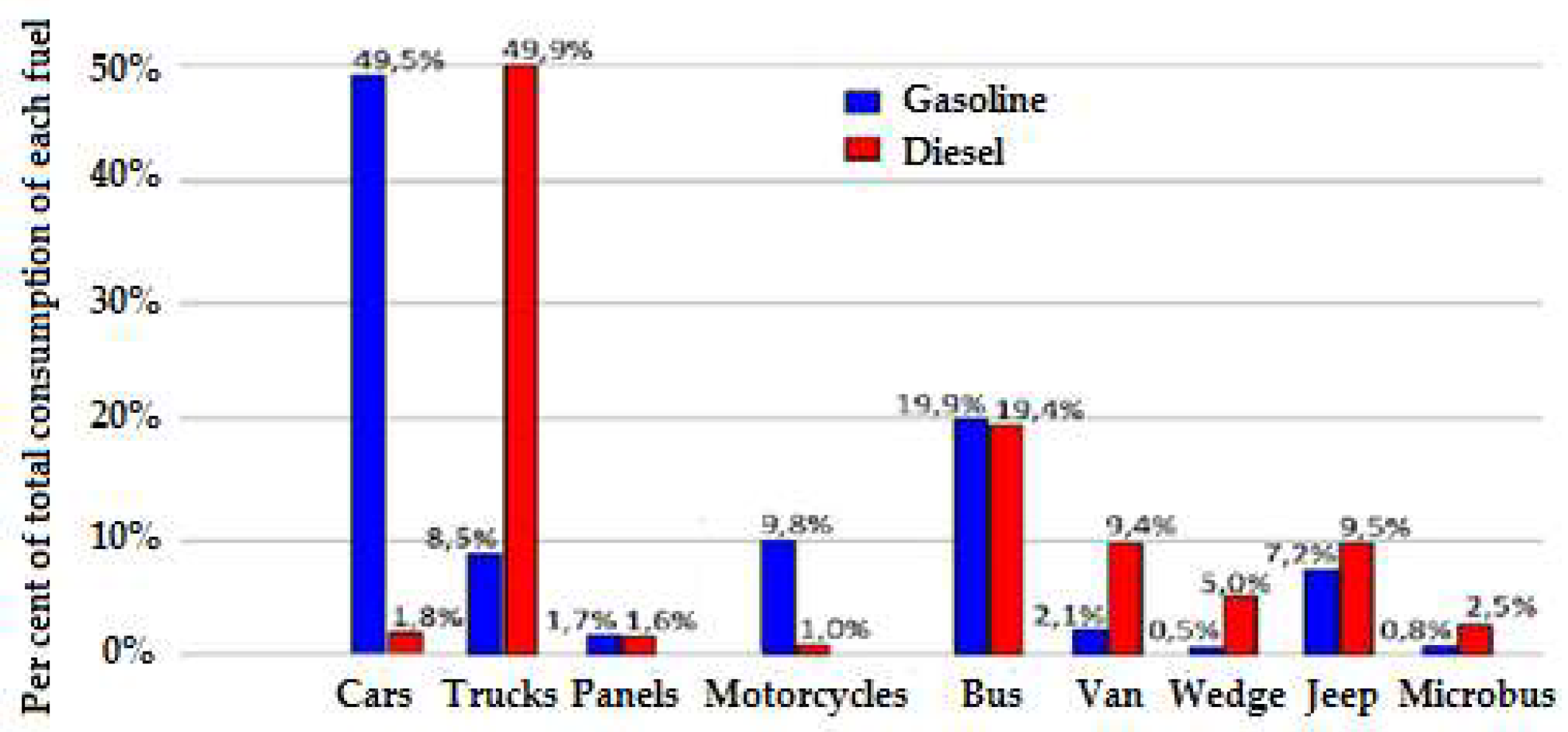
Figure 2.
Estimated benefits from electrification of 100% of transport in selected cities, for the period 2019-2050. Source: [16].
Figure 2.
Estimated benefits from electrification of 100% of transport in selected cities, for the period 2019-2050. Source: [16].
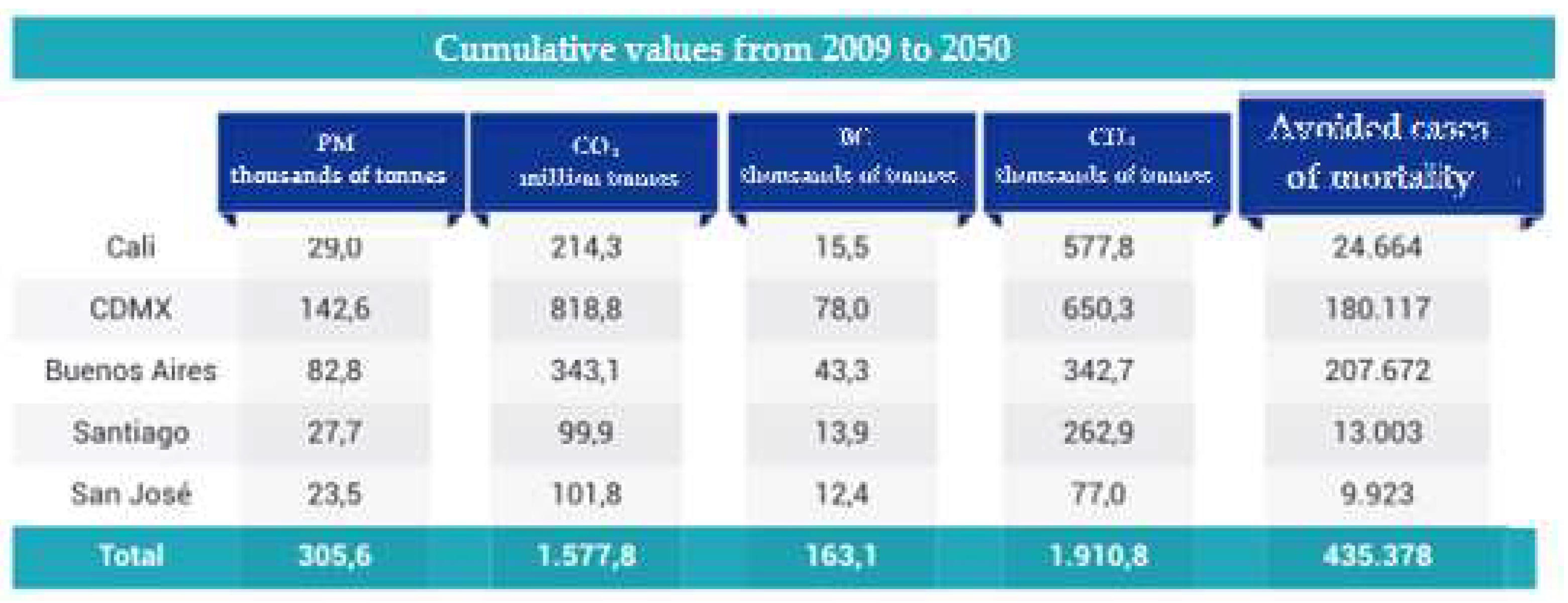
Figure 3.
Roadmap for the introduction of electromobility in Cuba as a basis for implementing the energy transition in the transport sector. Source: own production.
Figure 3.
Roadmap for the introduction of electromobility in Cuba as a basis for implementing the energy transition in the transport sector. Source: own production.
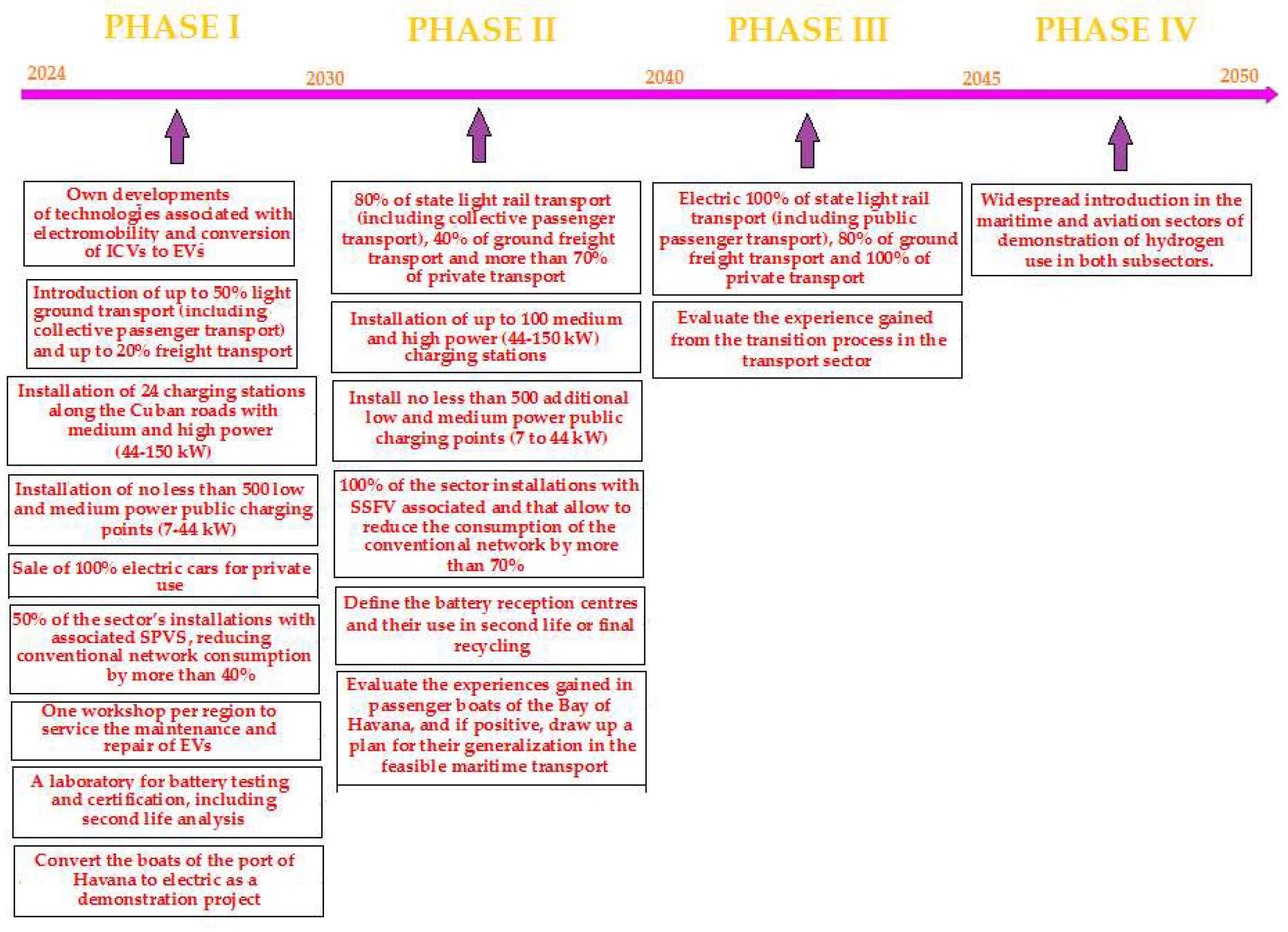

Table 1.
Types of charging stations proposed for installation for the charging of EVs. Source: [18].
Table 1.
Types of charging stations proposed for installation for the charging of EVs. Source: [18].
| Type of station or charging point | Power covered by RES (%) | Power demanded of the PES (%) | Power/Energy (%) feasible to supply by BESS* |
| Hybrid stations, type I | 50 | 50 | 25/50 |
| Hybrid stations, type II | 50 | 50 | 0 |
| Hybrid stations, type III | 25 | 75 | 0 |
| Hybrid stations, type IV | 100 | 0 | 50/100 |
| *. - Battery Energy Storage System | |||
Disclaimer/Publisher’s Note: The statements, opinions and data contained in all publications are solely those of the individual author(s) and contributor(s) and not of MDPI and/or the editor(s). MDPI and/or the editor(s) disclaim responsibility for any injury to people or property resulting from any ideas, methods, instructions or products referred to in the content. |
© 2024 by the authors. Licensee MDPI, Basel, Switzerland. This article is an open access article distributed under the terms and conditions of the Creative Commons Attribution (CC BY) license (http://creativecommons.org/licenses/by/4.0/).
Copyright: This open access article is published under a Creative Commons CC BY 4.0 license, which permit the free download, distribution, and reuse, provided that the author and preprint are cited in any reuse.


