
Submitted:
03 September 2024
Posted:
03 September 2024
You are already at the latest version
Abstract
This review explores the critical difficulties confronting global agriculture in the face of changing climate patterns and limited resources, highlighting the importance of sustainable practices. With agriculture as the largest consumer of water worldwide, sustainable techniques are critical for long-term survival and ecological harmony. Even with advancements, rapid population increase and changing environment conditions demand immediate investment in cutting-edge technologies. Optimizing agricultural operations, increasing output, and reducing resource waste can be achieved through smart farming, which utilizes machine learning and Internet of Things tech-nologies. Particular difficulties like decreasing cultivator proportions and rising costs are empha-sized, with a focus on developing nations where agriculture plays a crucial role in the economy. Additionally, the anticipated rise in food demand highlights how urgent it is to find sustainable alternatives. But problems like inappropriate land and agricultural land fragmentation still exist, necessitating creative solutions. The paper explores how agriculture could be revolutionized by machine learning and IoT-based hydroponics, providing insights into how to improve resilience, productivity, and sustainability in the face of changing environmental and socioeconomic dy-namics. Through a thorough investigation, this paper advances the discussion on sustainable ag-riculture by demonstrating the important role that technology-driven strategies play in addressing concerns about environmental sustainability and global food security.
Keywords:
hydroponics
; machine learning
; smart agriculture
; IoT
1. Introduction
The developing environment and atmospheric conditions as of late have exacerbated existing issues of land and water shortage, presenting continuous difficulties to the rural sector [1]. On a worldwide scale, the farming area is the essential client of water, representing roughly 70% of complete interest. Be that as it may, 70% of this water is released as wastewater through different processes [2].
Feasible farming is described by its attention on long haul practicality and biological similarity in grain creation practices. It envelops procedures and techniques that help the persevering through endurance of people and normal assets [3]. Monetarily reasonable, supportable farming protections soil quality, mitigates soil corruption, rations water assets, improves land biodiversity, and keeps a solid normal air. Through feasible cultivating rehearses, pivotal jobs are satisfied in safeguarding regular assets, protecting biodiversity, and controlling ozone depleting substance emissions [4].
“Feasible horticulture” is a strategy pointed toward safeguarding nature while guaranteeing that people in the future can satisfy their essential needs. It likewise centers around working on cultivating effectiveness. The accomplishments of practical horticulture, for example, crop pivot, tending to supplement inadequacies, irritation and infectious prevention, reusing, and water preservation, contribute fundamentally to making a more secure worldwide environment [5].
By the by, the worldwide populace keeps on developing, prompting expanded hunger, quickly moving environment designs, asset overexploitation, and food and water wastage, all of which reduce the effect of economical agriculture. There is a pressing need to put resources into innovations and framework that can address both current and future demands.Since forever ago, mechanical developments have stayed essential in propelling horticulture, from old times to the current day.
Savvy cultivating now remains as an essential component inside maintainable farming. By and large, huge ventures of time, cash, and work have been expected for crop development. This remembers extensive endeavors for handling, transportation, showcasing, and other calculated parts of gathered crops. Shrewd cultivating advances offer answers for address and mitigate these difficulties, introducing upgraded ways to deal with rural practices [6].
Farming remaining parts the main supporter of India’s Gross domestic product, comprising 18% of the country’s absolute result and connecting around 57% of the provincial populace [7]. Regardless of the general development in horticultural creation throughout the long term, the extent of cultivators has declined from 71.9% in 1951 to 45.1% in 2011, mirroring a pattern in India’s farming history. The Financial Study of 2018 predicts that by 2050 , agrarian business will comprise just 25.7% of the complete workforce [8]. Provincial regions witness a continuous loss of the more youthful age of ranchers due to raising horticultural costs, low per capita efficiency, insufficient soil support, and a shift towards non-cultivating occupations or more lucrative position [9].
In particular, the ongoing yearly cereal creation figure of 2.1 billion tons is projected to stretch around 3 billion tons, while yearly meat creation necessities to increment by north of 200 million tons to satisfy the need of 470 million ton [10].
Unfortunately, not all land across the World’s surface is appropriate for cultivating because of different factors like soil quality, territory, temperature, and climate [11]. Besides, locales helpful for cultivating change fundamentally in their attributes. Moreover, existing farming area faces fracture due to political, monetary, and urbanization impacts, all adding to mounting tension on the accessibility of arable land. Lately, a lessening level of generally speaking farming area has been devoted to food production [12].
2. Related Work
The writing review centers around tank-farming, a strategy for developing plants without soil, by fitting the pursuit to recognize concentrates explicitly examining this development procedure. One procedure includes looking through scholastic data sets like Scopus and Web of Science, utilizing watchwords, for example, “aquaculture,” “soilless development,” “plant sustenance,” and “controlled climate farming.” Pertinent examinations are then separated in view of their arrangement with the subject of interest. Also, assessing research reports and counseling specialists who have led aquaculture related investigations is gainful. Exchange distributions, industry reports, and government distributions are likewise significant hotspots for an exhaustive writing review. Basic assessment of study quality and importance is fundamental; taking into account factors, for example, concentrate on plan, test size, philosophy, and measurable examination, alongside the general qualities and shortcomings of the exploration. By leading such a careful writing review and fundamentally evaluating discoveries, portrayed in Figure 1, a more profound comprehension of flow tank-farming exploration can be accomplished, considering the ID of future innovative work valuable open doors in this field.
Writing on aqua-farming underlines its ability to save water, upgrade supplement conveyance, and empower all year crop development as displayed in Table 1. Research examines different aquaculture frameworks, like the supplement film method (NFT) and profound water culture (DWC), assessing their viability across assorted natural circumstances. Concentrates likewise inspect crop-explicit changes and the joining of innovation, like IoT sensors, to further develop observing and control. In synopsis, the writing highlights aqua-farming’s capability to address worldwide food and water security challenges by proficiently using assets and expanding crop yields.
2.1. Hydroponics
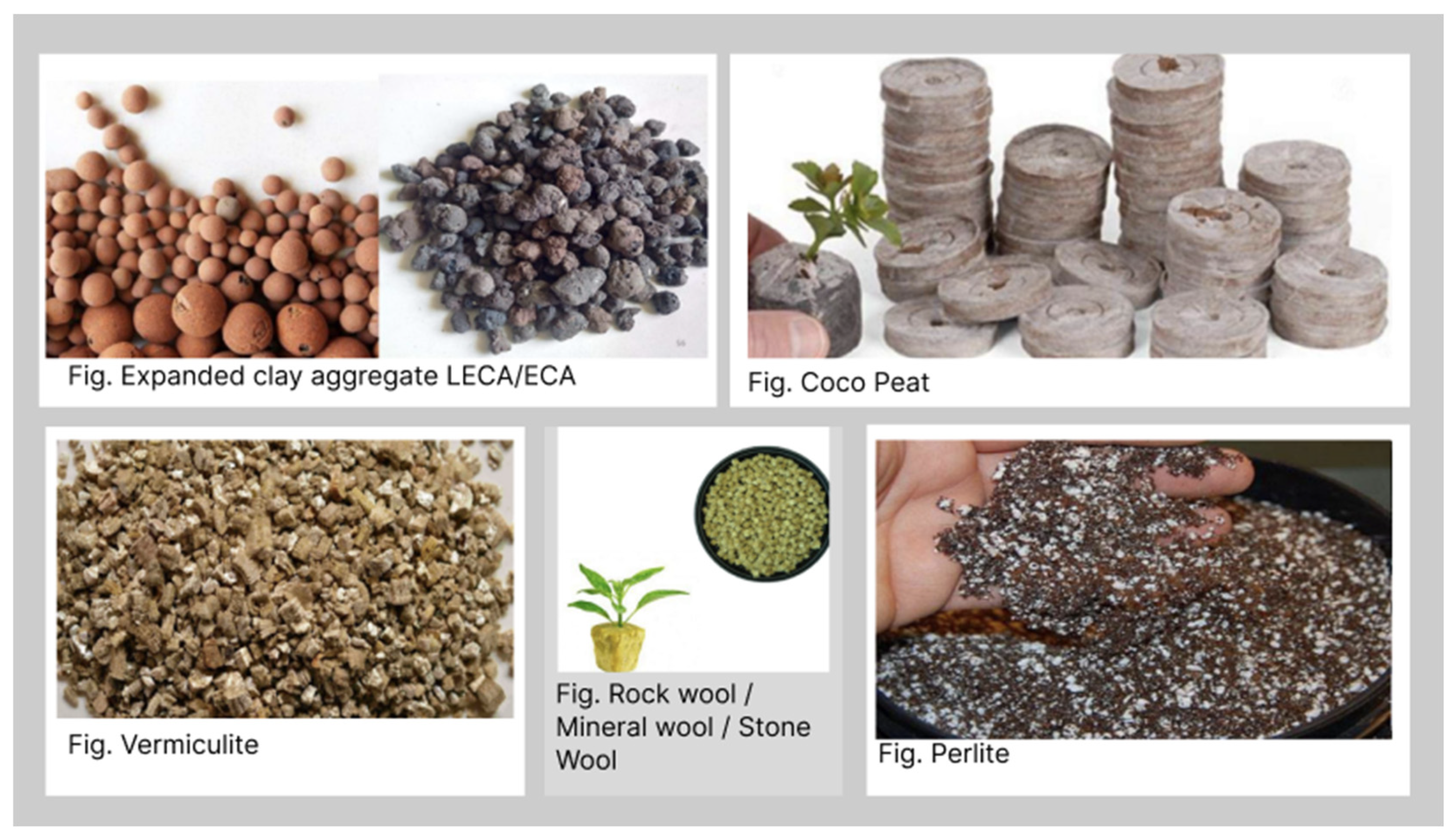
The area coverage expanded in industries and human settlement has led to reduction of horticultural land and therefore, crop production. Scientists have developed strategies with regard to improve crop yields within confined areas by designing techniques that provide aquaculture. It was Dr. William Frederick Gericke who at first coined the term “aqua-farming” in the year 1929. Tank-farming is the word derived from the Greek word hydro water and ponics Labour. Tank-farming is the part of hydroculture and is a method of growing plants with the help of mineral supplement mixtures in water, no soil. Plants may be developed with their base in the mineral profile alone or in an inert medium such as perlite, vermiculite, coco peat or garvel.
Tank farming involves culturing yields in a liquid enriched environment hence no necessity for the ground. This arrangement is enriched using basic minerals such as calcium, magnesium, sulfur and some other minor parts like boron, manganese, iron, and zinc which are very important for the growth of plants [22]. In the same way, using the tank-farming framework, various yields such as tomatoes, cucumber, spinach, lettuce, foliage among others have been nurtured and produced yielding encouraging results. In the development of aquaculture as illustrated in Figure 2, plant is required to be fill in three ways before it takes to the tank—farming structure first way is germination solidifying hydroponic arrangement Secondly, cutting aquaculture arrangement Thirdly, nursery arrangement and then plant establishment immersed in a supplement arrangement containing basic constituents. The conversion processes of minerals that the plants adopt remain consistent hence admitting similar physiological outcomes. In most cases, a tank-farming framework is situated inside an encased climate to shield plants from the outer condition including force, intrusion, and abundance apprehensible light [23].
Different aquaculture frameworks, like profound water culture (DWC), supplement film strategy (NFT), wick, trickle, ebb-stream, and aeroponic arrangements, are utilized relying upon the technique for supplement arrangement application. Tank-farming frameworks have effectively developed a different exhibit of food crops, including verdant vegetables and spices like lettuce, kale, and basil, as well as fruiting harvests like tomatoes, cucumbers, and strawberries [24]. In contrast with soil-based crop creation, aquaculture development offers a few benefits, including the potential for more significant returns and unrivaled quality items, further developed water and supplement usage effectiveness, the capacity to reuse water and supplements, worked on natural control, and counteraction of soil-borne sicknesses and nuisances [3]. Additionally, the improved impacts on food creation like environmental change, water shortage, and accessible fruitful soils have prompted the upgraded practice of aqua-farming strategies because of restricted and lopsided admittance to new deliver from nearby creation in metropolitan habitats.
The development plate or development chamber fills in as the part where plant roots straightforwardly cooperate with the development medium containing the aqua-farming arrangement, involving supplements and minerals. Thus, plant attaches have quick admittance to the disintegrated supplements and minerals close by. This arrangement decreases the development pace of roots since they never again need to stretch out looking for supplements and minerals, subsequently advancing the development pace of shoots and eventually prompting expanded efficiency [25]. The vegetable plants are of two types as shown in Figure 3.
Fruiting vegetables, in the same way as other plants, go through a five-stage life cycle as displayed in Figure 4. This excursion starts with the seedling stage, where the youthful plant rises up out of the seed and fosters its underlying underground root growth and leaves. Subsequent this comes gentle vegetative development, where the plant centers around laying out areas of strength for a framework and delivering more foliage. This is then trailed areas of strength for by development, a time of fast development where the plant expands its size and gathers assets. As the plant develops, it changes into the travel to blossom stage. During this significant stage, the plant’s energy shifts towards blossom advancement, getting ready for generation. At long last, the plant arrives at the sprouting and aging stage, where blossoms bloom, natural products set, and in the end mature for gather.
Verdant vegetables, in contrast to their fruiting partners, have an easier life cycle comprising of three unmistakable stages as displayed in Figure 5. for example first stage is seedling where the underlying stage begins with the seed sprouting and fostering its most memorable leaves and underground root growth. Gentle Vegetative Development during this stage, the plant centers around laying out a solid root structure and creating leaves. Development is more slow contrasted with the following stage. Solid Vegetative Development this is the essential development time frame where the verdant vegetable flourishes. It invests the vast majority of its time into creating the consumable leaves we reap, with quick development and expanded foliage creation. When this stage is finished, the verdant vegetable arrives at development and is prepared for collect. Not at all like fruiting vegetables, do mixed greens ordinarily advance through blooming and fruiting stages.
Hydroponic Benefits Such as Water Conservation, Optimal Use of Space and the Impacts on the Environment
The disturbing changes in worldwide environment examples and climbing temperatures present impressive dangers to water accessibility and food security. Hence, the reception of canny tank-farming frameworks arises as a confident way to deal with decrease water use in rural water system and advance the progression of maintainable agriculture. Tank-farming, a type of soilless horticulture, requires less assets, including water, contrasted with customary soil-based cultivating techniques [27]. It uses water as a developing vehicle for and empowers the creation of great food in restricted land spaces [28]. The execution of an associated shrewd framework will grow openness to tank-farming development, helping more people.
Tank-farming development is generally led inside nurseries to protect ideal plant development from outside components like downpour, vermin, infections, and changing environments. The benefits of aqua-farming include: I) guaranteeing effective plant development and creation, ii) working with additional functional medicines and control of bug problems, iii) upgrading manure productivity, iv) empowering more straightforward supplanting of expired plants with new ones, v) lessening work costs, vi) advancing quick plant development, vii) accomplishing higher and practical plant creation and deals results, viii) permitting development of specific plant composes of season, ix) taking out chances related with normal circumstances, and x) empowering tank-farming plant development anyplace and whenever.
Tank-farming arises as the most reasonable arrangement in districts confronting serious soil and water issues, for example, soil-borne bothers, saltiness, sicknesses, water shortage, and substance deposits. One vital benefit of aquaculture cultivating is diminished work necessities, as ranchers are feeling significantly better from errands like watering, soil planning, and treatment, which are robotized inside the tank-farming framework. Because of its fractional robotization, coordinating IoT innovation into aqua-farming homesteads turns out to be more consistent, working with the age of precise information and ranch mechanization [29]).
The reconciliation of IoT innovation empowers consistent checking and control of the aqua-farming framework, guaranteeing ideal support of fundamental boundaries as displayed in Figure 6, for example, temperature, pH, water levels, mugginess, and light power through Arduino associations [30].Past exploration proposes that tending to the limits of tank-farming frameworks can be accomplished by fostering a clear framework pointed toward decreasing upkeep and creation costs.Scientists have tried to execute a tank-farming framework combined with IoT-based observing applications, utilizing Arduino innovation.
4. Hydroponic Cultivation Techniques
There are six fundamental sorts of aqua-farming frameworks, each with its own benefits and impediments:
4.1. Wick Framework
The wick framework as displayed in Figure 7. addresses the most fundamental type of tank-farming, using uninvolved techniques to convey supplements to plants [1]. In this arrangement, plants retain the supplement arrangement through a stringy material put in a repository. The framework’s straightforwardness is its essential benefit, as it works without moving parts and is less inclined to disappointment for however long water is accessible. Notwithstanding, disadvantages incorporate the failure to control water system rate and recurrence, and the framework might battle to meet the plant’s water system needs during hotter periods. Because of these restrictions, the wick framework is the most un-leaned toward sort of tank-farming framework and is only from time to time used at the business level.
4.2. Ebb and Flow System
The rhythmic movement aqua-farming framework as displayed in Figure 8, exemplified side-effects like the Green tree Tank-farming Recurring pattern Framework, emulates the regular beat of the ocean tide by flooding and depleting plants with a supplement arrangement. Using a back and forth movement framework requires two fundamental parts: Developing Plate: This region obliges plants, seedlings, or seeds. Supply: This holder stores the supplement arrangement that supports the plants. Notwithstanding the developing plate and supply, a rhythmic movement framework incorporates a water siphon and flood controller. The framework’s activity is mechanized using a timer [32].
4.3. Deep Water Culture (DWC)
Deep water culture (DWC), as displayed in Figure 9 likewise alluded to as arrangement culture or the pontoon technique, is a tank-farming development framework where plants flourish with their foundations suspended in a persistently circulated air through supplement arrangement. Straightforwardness: DWC is prestigious for its effortlessness in both arrangement and upkeep, pursuing it an ideal decision for novices wandering into aqua-farming cultivating.
Fast Development: With continuous admittance to water and supplements, plants in DWC show strikingly quick development contrasted with conventional soil-based procedures. Insignificant Parts: All you really want is a supply for the supplement arrangement, a pneumatic machine to keep up with oxygenation, and net pots to oblige your plants. DWC presents a phenomenal choice for developing different mixed greens like lettuce, fragrant spices like basil, and, surprisingly, certain blossoming plants. In any case, keeping up with the suitable supplement equilibrium and water temperature in the repository is vital for guaranteeing powerful plant development [34].
4.4. Nutrient Film Technique
The Nutrient Film Technique (NFT) as shown in Figure 10 is a tank-farming framework intended to monitor water, where plants are developed in shallow channels getting a persistent progression of supplement arrangement. Fundamental parts of this framework incorporate the develop channels, a supply containing the supplement arrangement, a siphon for dissemination, and a pneumatic machine for water oxygenation. Advantages of NFT incorporate proficient use of water and supplements, ideal oxygenation for strong roots, exact administration of plant nourishment, and the potential for sped up development and expanded yields. Be that as it may, contemplations incorporate the prerequisite of a solid power hotspot for the siphon and air stone, the gamble of obstructing assuming that support is disregarded, and the underlying speculation vital for equipment [36].
4.5. Aeroponics
Aeroponics has displayed in Figure 11 includes plant establishes suspended uninhibitedly in a fog climate and occasionally moistened with a supplement arrangement. This technique presents various advantages like sped up development in which plants developed aeroponically frequently mature all the more quickly contrasted with those developed utilizing customary soil-based strategies. Water proficiency as aeroponics drinks considerably less water than customary soil cultivating rehearses. Lower illness weakness due to the shortfall of soil decreases the gamble of root decay and other soilborne infections, limiting plant wellbeing apprehensions. Aeroponics is versatile as it is flexible and reasonable for developing a different scope of plants, as well as vegetables, spices, and flowers [5]
4.6. Drip System
Drip system hydroponics, as displayed in Figure 12 similar to watering garden with a profoundly exact showerhead, supplies plants with a constant stream of supplement arrangement straightforwardly to their foundations. Not at all like different methods that immerse the root zone, trickle frameworks use producers to apportion limited quantities of water at customary stretches. This engaged methodology empowers effective water usage, diminishes wastage, and keeps up with ideal dampness levels for vigorous plant improvement. The utilization of individual pots and customizable producers delivers this framework reasonable for the two learners and business cultivators, giving exact administration over the supplement conveyance to each plant [38].
From the above procedures, the trickle framework remains as the most broadly embraced tank-farming strategy, including an organization of cylinders and producers that regulate exact amounts of supplement arrangement straightforwardly to establish roots. This procedure flaunts a few advantages: it is productive, limiting water wastage, versatile to different plant types, and promptly computerized utilizing clocks and siphons. Not at all like different techniques like profound water culture, where roots stay lowered continually, trickle frameworks bear the cost of better admittance to oxygen for the roots, encouraging strong plant development. The beneath Table 3. shows the striking elements among customary and tank-farming based cultivating with various boundaries.

Table 2.
Present the list of salient features between traditional and hydroponics-based farming.
| Feature | Traditional Soil-Based Farming | Hydroponics | Citation |
|---|---|---|---|
| Advantages | Low beginning expense, laid out rehearses, different yield choices, normal supplement cycling, potential for natural creation | More significant returns, quicker development cycles, all year creation, decreased water utilization, less land required, lower sickness and nuisance pressure | [40] |
| Disadvantages | Dependent on soil quality and atmospheric conditions, inclined to disintegration and supplement exhaustion, requires more land and water, higher work for undertakings like weeding and bug control | Higher introductory venture, requires controlled climate and steady checking, potential for supplement awkward nature, not reasonable for all yields | [41] |
| Water Usage | High, defenseless to dry season and requires standard water system | Possibly lower, utilizes shut circle frameworks and limits vanishing | [42] |
| Land Use | Requires bigger land regions, restricted to reasonable soil conditions | Can use more modest spaces, possibly reasonable for metropolitan regions and vertical cultivating | [43] |
| Nutrient Runoff | Potential for manure and pesticide filtering into soil and streams | Lower hazard of spillover, takes into account exact supplement control | [44] |
| Energy Consumption | Lower, basically depends on normal daylight and precipitation | Higher, may require fake lighting and environment control frameworks relying upon area | [45] |
4.7. Seed Germination
Germination of the seed is a process which occurs in the life cycle of a plant and is a physiological process, which is accompanied by biochemical and morphological changes. This process is sensitive to several factors like temperature, moisture, availability of oxygen and light which differs from one seed to the other. Optimum temperature is very essential element since it determines the rate of enzymatic processes within the seed coat which determines the rate of germination and the dispersion of the germination across the seedbed [46].
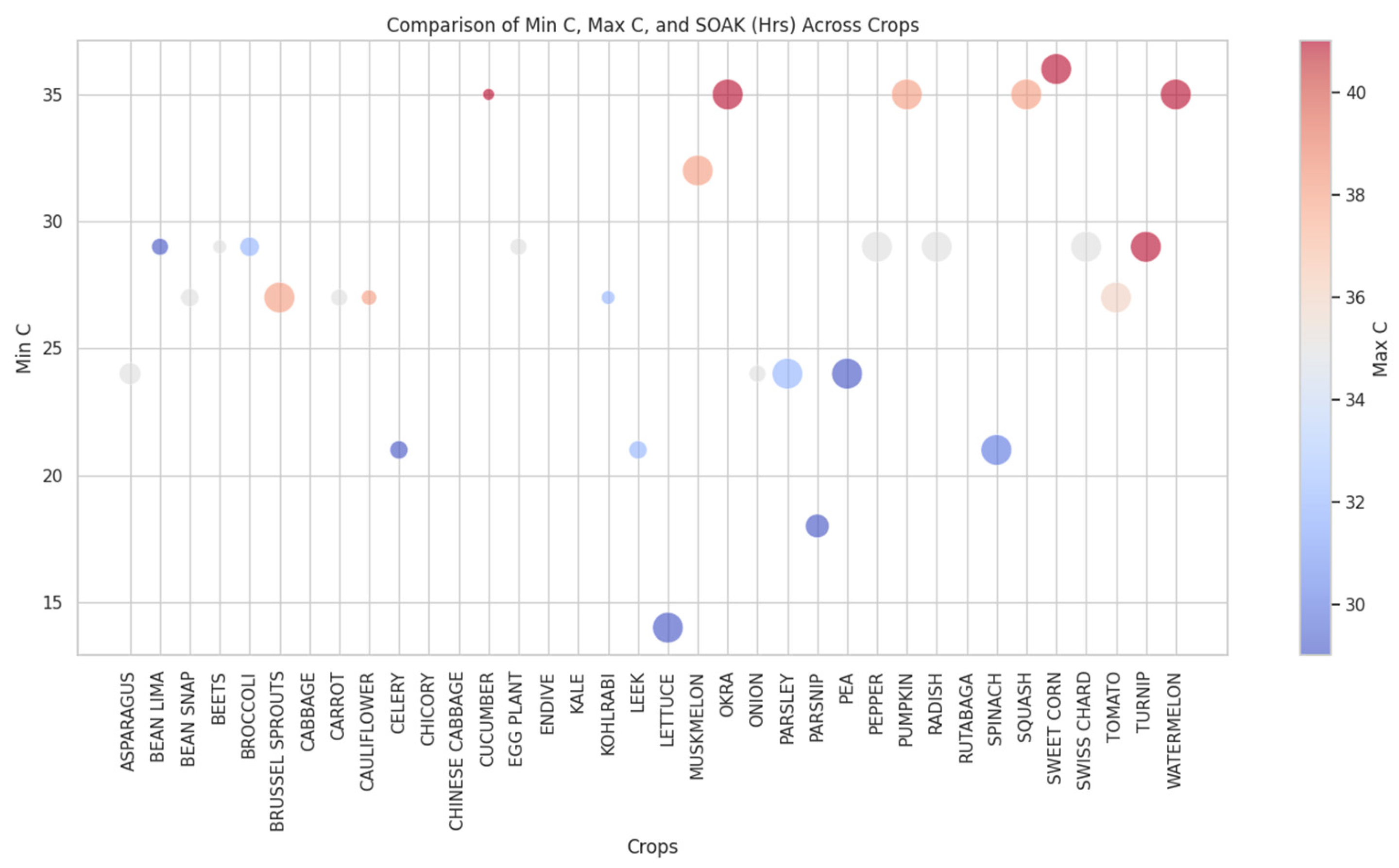
Temperature is a very significant factor in these phases, where each of the crops has a given temperature that ensures maximum germination rate. For instance, a study showed that lettuce seeds and parsley require comparatively cooler temperature for germination, with ideal temperature of germination at 14°C and 24°C respectively of germination [47]. On the other hand, crops such as okra and cucumbers prefer warmer condition, optimum temperature being 104 F and 107 F respectively [48].
One of the practices that can be observed from the chart is the pre-treatment of seeds through soaking before sowing improves germination through wearing down of seed coat and commencement of the process of germination. It is most advantageous where the seed coats are thick or the seeds are slow to germinate, as with parsnips and muskmelons, and where prolonged soaking is required [49].
Awareness of these environmental factors is thus pertinent in the promotion of germination of seeds in the natural and manmade environment. Thus, one can dominate or control these factors in order to increase the rate of germination to the preferred conditions or environments thus enhancing crop plant stand.
Figure 13.
Seed Germination Chart.
5. Substrates
A substrate supports plants by providing an aseptic environment with proper oxygenation and nutrient delivery, ensuring optimal growth conditions [50]. Hydroponic substrates are the parts of the entire non-soil-based culture system, which help; plant support, water, nutrient, and oxygen supply to the root. The kind of substrate used can either enhance or hinder plant growth, root proliferation, and crop production because each substrate has some physical and chemical characteristics that make some substrates suitable for particular plants and hydroponics.
According to [51]the selection of the hydroponic substrate is one of the most important decisions that affects plant requirements for water and nutrients, their uptake, as well as crop yield. The evaluation criteria include the physicochemical characteristics of the substrates, as well as the requirements of the plants grown in the culture. The evidence generated in this area is useful in assessing how various substrates operate under specific conditions so that growers and producers can make informed decisions of what to use.
It is essential for the substrate to have the soil moisture retention capacity but, at the same time, be well-drained so that roots continuously get an easy access to water without being surrounded by water at all times. Proper aeration is important also, to provide sufficient oxygen supply to the roots that are needed for the plants growth. pH stability is also important because the nutrients get to be available at the required range while high CEC (cation exchange capacity) helps in nutrient and overall substrate efficiency. Maintaining equilibrium with all these factors is very essential in attaining high returns in addition to sustainability in hydroponic farming systems [52].
Figure 14.
Hydroponic Substrates.
5.1. Ideal Crops for Hydroponics
Hydroponics is ideal for growing most of the fruits and vegetables; however, some of the characteristics that may limit some of the items include the size of roots that require room to grow, the size of the fruit that is expected to grow and mature, the harvesting time cycle among other characteristics. For the purpose of this paper, several crops that can be grown through hydroponics are as listed in the table below.
Table 4.
Most suitable plants to grow by hydroponics.
| Type | Common Name | Scientific Name | Cultivation Technique |
|---|---|---|---|
| Fruit | Banana Black Currant Blueberry Melon Passionfruit Paw-Paw Pineapple Red Currant |
Musa spp. Ribes nigrum Vaccinium corymbosum Cucumis melo Passiflora edulis Asimina triloba Ananas comosus Ribes rubrum |
Drip irrigation Drip irrigation Drip irrigation, NFT Drip irrigation, NFT Drip irrigation Drip irrigation Drip irrigation Drip irrigation |
| Vegetable | Cauliflower Celery Cucumber Eggplant Endive |
Brassica oleracea var. botrytis Apium graveolens Cucumis sativus Solanum melongena Cichorium endivia |
Drip irrigation, NFT Drip irrigation Drip irrigation, NFT Drip irrigation Drip irrigation |
| Fodder | Fodder | Various species | Drip irrigation |
| Herb | Basil Chicory Chives Fennel Lavender Lemon Balm Marjoram Mint Mustard Cress Parsley |
Ocimum basilicum Cichorium intybus Allium schoenoprasum Foeniculum vulgare Lavandula spp. Melissa officinalis Origanum majorana Mentha spp. Lepidium sativum Petroselinum crispum |
Drip irrigation Drip irrigation Drip irrigation Drip irrigation Drip irrigation Drip irrigation Drip irrigation Drip irrigation Drip irrigation Drip irrigation |
| Flower | African Violets Anthurium Antirrhinum Aphelandra Aster Begonia |
Saintpaulia ionantha Anthurium andraeanum Antirrhinum majus Aphelandra squarrosa Aster spp. Begonia spp. |
DWC, drip irrigation Drip irrigation Drip irrigation Drip irrigation Drip irrigation Drip irrigation |
5.2. Nutrient Solution
The advancement of harvests depends vigorously on the supplement content present in the dirt. Observing soil supplements is basically directed through electric and electromagnetic sensor.There are 17 fundamental components urgent for plant development, as nitty gritty in Table 2 [60]. Ranchers use this data to go with informed decisions in regards to the most appropriate harvests for their territory in light of supplement accessibility. By and by, enhancing supplements through composts, fertilizer, and so on, frequently involves added costs. Additionally, a portion of these enhancements might present ecological dangers and disturb the regular soil cycle.
AI, a subset of man-made brainpower, empowers a PC or “machine” to naturally learn and execute undertakings. It uses complex calculations and numerical displaying to gain from information and has been successfully utilized in different areas for undertakings like characterization, expectation, and making suggestions [61]. For example, it offers agrarian instruments that screen soil excellence and give modified guidance in view of both exploratory information and field perceptions. ML makes models from elements of known trial input information to foresee results from new information. ML can be comprehensively arranged into three sorts: regulated learning, unaided learning, and support learning, each customized to various types of outcomes [62].
Table 5.
Present the list of essential plant nutrients [63].
Table 5.
Present the list of essential plant nutrients [63].
| Essential Plant Element | Symbol | Primary Form | |
|---|---|---|---|
| Non Mineral Element | Carbon | C | CO2 (g) |
| Hydrogen | H | H2O(1), H+ | |
| Oxygen | O | H2O(1), O2(g) |
|
| Mineral Elements | |||
| Primary Macronutrients | Nitrogen | N | NH [4]+ , NO [3]- |
| Phosphorus | P | HPO4 [2]- |
|
| Potassium | K | K+ | |
| Secondary Macronutrients | Calcium | Ca | Ca [2]+ |
| Magnesium | Mg | Mg+ | |
| Sulfur | S | SO4 [2]- | |
| Macronutrients | Iron | Fe | Fe [3]+, Fe [2]+ |
| Manganese | Mn | Mn [2]+ | |
| Zinc | Zn | Zn [2]+ | |
| Copper | Cu | Cu [2]+ | |
| Boron | B | B(OH)3 | |
| Molybdenum | Mo | MoO4 [2]- | |
| Chlorine | Cl | Cl- | |
| Nickel | Ni | Ni [2]+ | |
5.3. pH in Hydroponics Nutrient Solutions
There is another physical property that deserves a special attention of grower and it is pH, which is a scale starting from 1 up to 14 and indicates the acidity or alkalinity of a solution. Finally at the reference temperature of 25°C water not only does not qualify to be basic but also, not an acid therefore it has been given a pH of 7.
Table 6.
Present the list of correlation of pH and PPM with Hydroponic Plant Health.
| Plants | pH | PPM |
|---|---|---|
| Banana | 5.5-6.5 | 1260-1540 |
| Black Currant | 6.0 | 980-1260 |
| Blueberry | 4.0-5.0 | 1260-1400 |
| Melon | 5.5-6.0 | 1400-1750 |
| Passionfruit | 6.5 | 840-1680 |
| Paw-Paw | 6.5 | 1400-1680 |
| Pineapple | 5.5-6.0 | 1400-1680 |
| Red Currant | 6.0 | 980-1260 |
| Rhubarb | 5.0-6.0 | 840-1400 |
| Strawberries | 5.5-6.5 | 1260-1540 |
| Watermelon | 5.8 | 1260-1680 |
| Cauliflower | 6.0-7.0 | 1050-1400 |
| Celery | 6.5 | 1260-1680 |
| Cucumber | 5.8-6.0 | 1190-1750 |
| Eggplant | 5.5-6.5 | 1750-2450 |
| Endive | 5.5 | 1400-1680 |
| Fodder | 6 | 1260-1400 |
| Garlic | 6 | 980-1260 |
| Leek | 6.5-7.0 | 980-1260 |
| Lettuce | 5.5-6.5 | 560-840 |
| Marrow | 6 | 1260-1680 |
| Okra | 6.5 | 1400-1680 |
| Onions | 6.0-6.7 | 980-1260 |
| Pak-choi | 7 | 1050-1400 |
| Parsnip | 6 | 980-1260 |
| Pea | 6.0-7.0 | 980-1260 |
| Peppers | 5.8-6.3 | 1400-2100 |
| Bell peppers | 6.0-6.5 | 1400-1750 |
| Hot Peppers | 6.0-6.5 | 2100-2450 |
| Potato | 5.0-6.0 | 1400-1750 |
| Pumpkin | 5.5-7.5 | 1260-1680 |
| Radish | 6.0-7.0 | 840-1540 |
| Spinach | 5.5-6.6 | 1260-1610 |
| Silverbeet | 6.0-7.0 | 1260-1610 |
| Sweet Corn | 6 | 840-1680 |
| Sweet Potato | 5.5-6.0 | 1400-1750 |
| Tomato | 5.5-6.5 | 1400-3500 |
| Turnip | 6.0-6.5 | 1260-1680 |
| Zucchini | 6 | 1260-1680 |
| Basil | 5.5-6.5 | 700-1120 |
| Chicory | 5.5-6.0 | 1400-1600 |
| Chives | 6.0-6.5 | 1260-1540 |
| Fennel | 6.4-6.8 | 700-980 |
| Lavender | 6.4-6.8 | 700-980 |
| Lemon Balm | 5.5-6.5 | 700-1120 |
| Marjoram | 6 | 1120-1400 |
| Mint | 5.5-6.0 | 1400-1680 |
| Mustard Cress | 6.0-6.5 | 840-1680 |
| Parsley | 5.5-6.0 | 560-1260 |
| Rosemary | 5.5-6.0 | 700-1120 |
| Sage | 5.5-6.5 | 700-1120 |
| Thyme | 5.5-7.0 | 560-1120 |
| Watercress | 6.5-6.8 | 280-1260 |
| African Violets | 6.0-7.0 | 840-1050 |
| Anthurium | 5.0-6.0 | 1120-1400 |
| Antirrhinum | 6.5 | 1120-1400 |
| Aphelandra | 5.0-6.0 | 1260-1680 |
| Aster | 6.0-6.5 | 1260-1680 |
| Begonia | 6.5 | 980-1260 |
| Bromeliads | 5.0-7.5 | 560-840 |
| Caladium | 6.0-7.5 | 1120-1400 |
| Canna | 6 | 1260-1680 |
| Carnation | 6 | 1260-2450 |
| Chrysanthemum | 6.0-6.2 | 1400-1750 |
| Cymbidiums | 5.5 | 420-560 |
| Dahlia | 6.0-7.0 | 1050-1400 |
| Dieffenbachia | 5 | 1400-1680 |
| Dracaena | 5.0-6.0 | 1400-1680 |
| Ferns | 6 | 1120-1400 |
| Ficus | 5.5-6.0 | 1120-1680 |
| Freesia | 6.5 | 700-1400 |
| Impatiens | 5.5-6.5 | 1260-1400 |
| Gerbera | 5.0-6.5 | 1400-1750 |
| Gladiolus | 5.5-6.5 | 1400-1680 |
| Monstera | 5.0-6.0 | 1400-1680 |
| Palms | 6.0-7.5 | 1120-1400 |
| Roses | 5.5-6.0 | 1050-1750 |
| Stock | 6.0-7.0 | 1120-1400 |
5.4. Appropriate Technology for Small and Medium-Scale Food Production With Hydroponic
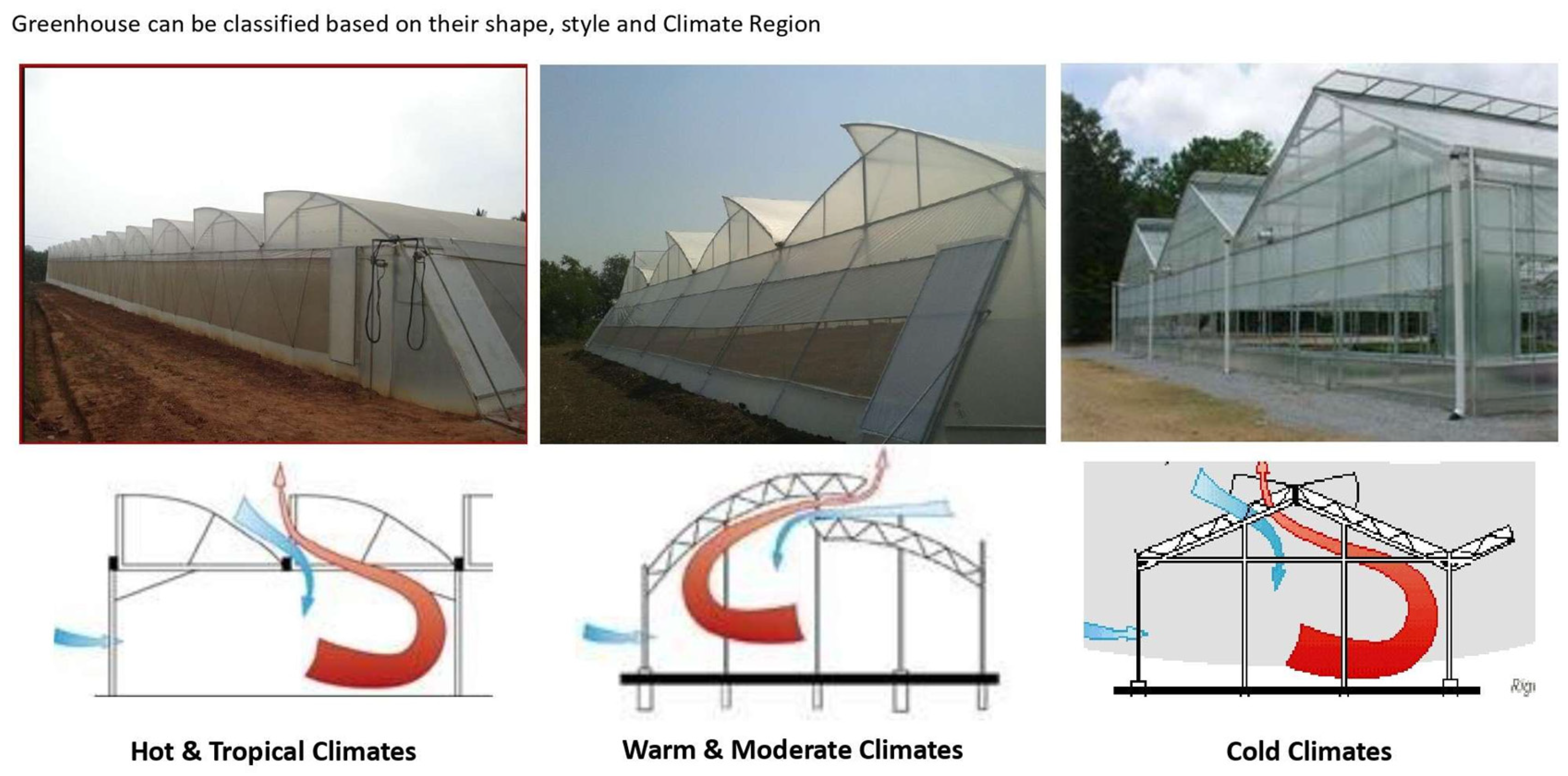
Green houses is a fundamental component in small and medium scale farming employing hydroponic system with many covering options including glass structure green houses, polythene green house, and more complex CEA buildings. They usually consist of metal such as aluminum and steel for frames and transparent material such as plastic or glass for the cover to control heat transfer and light penetration. In these structures different hydroponic methods as Nutrient Film Technique (NFT); Deep Water Culture (DWC); Ebb and Flow and Drip Systems may be fitted for the supply of nutrients to the plant.
Environmental control is the other factor that is very important in greenhouse hydroponics since lighting, humidity, and temperature have to be checked regularly. This is usually done by heaters, cooler, de-humidifiers, humidifiers, and supplementary lighting to emulate suitable growing environment. The advantages of hydroponic food production under greenhouses are quite significant, extending growing seasons, controlling the environment, conserving water and nutrients, which in turn minimizes pest and diseases’ occurrences.
Figure 15.
Naturally Ventilated Green House.
However, several factors that need to be overcome that include; The setting up of the green house and the hydroponic systems require a lot of capital investment, Hydroponics requires consumption of a lot of energy to regulate on environmental conditions, and lastly the management of the green house and the techniques used in the hydroponic systems require technical skills. Trade books such as Hydroponic Food Production by Howard M. Resh and Greenhouse Technology and Management by Nicolás Castilla suggest possible methods to overcome them The publications of the agricultural universities and industry-oriented associations are important sources of information in this regard. These sources focus on great focuses and uses of the greenhouse hydroponic system in an effort to show that the method of food production that the book expounds is indeed possible and is relatively small to medium scale.
5.5. Agriculture 4.0
This generation’s commercial farms and agricultural businesses are experiencing dynamic forms; advanced electronics technology has brought in machines, thermal moisture readers, drone photography, and GPS to change the form of farming. The concept of it means that changing the manner in which industries operate is very necessary. 0 of that in the field of agriculture which initiated in 2017, the term of artificial intelligence (AI), the Internet of things (IoT), and Big Data (BD) were incorporated into self-sufficient food production systems for efficient and effective irrigation, pest control, plant diseases diagnoses, and production management [64]. Agriculture 4. It is suggested that 0, as this revolution is called, should smoothly integrate the farming practices with technology such as sensors, devices, machines, as well as information technology. Sophisticated tools like robots, temperature and moisture sensors, aerial and satellite imaging, GPS technology are gradually gaining adaptation to improve the complete food supply chain and make businesses profitable, optimal, safer, environment-friendly. Hence, hydroponics ca easily be placed under the Agriculture 4. 0, as more and more big firms are using breakthroughs in IVFM, AI, and Plant Biology to grow a wide array of products [65]. So speaking to advanced and disruptive technologies, having credible science to guarantee a high output, it is safe to affirm that hydroponics has now become a major pillar for future food production systems.
6. Role of ML in Disease Detection
Illness causing parasites, microorganisms, and microscopic organisms get their energy from the plants they occupy, thus affecting harvest yields [66]. Inability to recognize these illnesses immediately can bring about critical financial misfortunes for ranchers. To battle illnesses and guarantee crop wellbeing, ranchers frequently cause significant monetary costs on pesticides. Nonetheless, unreasonable pesticide use can add to ecological damage and disturb the water and soil cycles in rural land [67].
Using a very much planned simulated intelligence framework during the yield development stage not just decreases the gamble of harvest sicknesses and mitigates financial misfortunes yet additionally limits the unfriendly natural effect of unregulated cultivating rehearses. Two specialists have applied a CNN-based DL model to recognize illnesses in cassava crops, especially zeroing in on imbalanced datasets [68]. The Li. et al. has used a data set containing 10,000 marked pictures as displayed in Figure 3 and Figure 4, which went through preprocessing to upgrade picture contrast utilizing the difference restricted versatile histogram evening out algorithm(Li et al. 2020). Model assessment utilized different execution measurements including disarray network, exactness, accuracy, awareness, and F1 score. Results demonstrated a most elevated exactness of 99.30% and a least precision of 76.9%. Additionally, Ramcharan et al. used DL calculations to recognize sicknesses in cassava crops. Utilizing profound CNN, the creators intended to distinguish three unmistakable illnesses and two kinds of bugs from a dataset involving 11,670 pictures [69].
IoT alludes to the interconnectedness of different gadgets, where sensors address one illustration of such gadgets. Inside IoT, an organization of sensors can speak with each other and with a focal control place. The use of IoT has extended the potential outcomes in cultivating, creature farming, and savvy water system rehearses. Sensors assume a pivotal part in the engineering of IoT frameworks in farming, filling in as transducers that convert detected boundaries (like soil dampness) into electrical signs [70].
6.1. Improving Supplement Conveyance
ML joined with the IoT can change supplement conveyance in aqua-farming. IoT sensors ceaselessly screen factors like pH, supplement focus, and water stream, giving constant information. ML calculations then investigate this information to distinguish ideal supplement levels for each plant stage, naturally changing the supplement answer for expanded development and limited squander. In the accompanying segments paper further investigate into various supplement the executives framework [71].
6.1.1. Custom-Made Supplement Dosing
ML can dissect sensor information connected with factors alike plant development phase, water electrical conductivity, in addition temperature. Utilizing this data, the calculation can produce modified supplement arrangement recipes meant for individual plants, guaranteeing they get the best supplement balance for ideal growth. Deciding a solitary calculation exclusively liable for overseeing custom-made supplement dosing in tank-farming is troublesome. A mix of procedures working pair is more likely. Relapse calculations, for example, direct relapse or backing vector machines (SVMs), can break down sensor information (e.g., supplement levels, plant vitals) and authentic information (e.g., development designs with explicit supplement mixes). This examination lays out the connection between’s supplement levels and plant reactions. Subsequent to this, characterization calculations like arbitrary woodlands or choice trees can sort the ongoing plant state in light of constant sensor readings. At last, support learning methods become an integral factor. These methods persistently screen plant reactions to changed supplement conveyance in light of ideas from past models [72]. Subsequently, the framework acquires and improves the dosing methodology after some time. Subsequently, it’s a cooperative exertion among different calculations, each satisfying a particular job in examining information, perceiving designs, and suggesting changes for custom fitted supplement conveyance in tank-farming.
6.1.2. Expecting Supplement Necessities
Expecting Supplement Prerequisites: In light of data gathered concerning a plant’s past exhibition, it is feasible for ML models to foresee resulting supplement necessities. This approach permits amendment of the supplement arrangement before the event of inadequacies and streamlining of assets. RNNs are especially helpful in successive information examination since they catch this information property very well. They are additionally capable in handling authentic upsides of the sensors (like supplement fixation and formative periods of plants and yield) as well as the past strategy for application. Consequently, RNNs can foresee future supplement needs founded on the grouping by dissecting designs inside these arrangements. There are some vital varieties which have been made to RNNs; one of them is Long Transient Memory (LSTM) organizations. This is especially valid for LSTMs which are especially great at demonstrating long haul conditions into information. This capacity permits them to not just consider the ongoing sensor estimations from the plant yet additionally the plant’s earlier response to relative supplement changes, subsequently giving better assessments of future prerequisites. Different procedures like that of group strategies, where various calculations are utilized together to get the best out of the multitude of techniques to work on the exactness of the outcome can likewise be utilized. Developments like Irregular Backwoods or Slope Helping might develop the consequence of numerous models (for example, RNNs and LSTMs) and offer a colossal point of view toward the plant’s expectation’s before very long [73].
6.1.3. Unique Changes
A few normal boundaries that are continually estimated incorporate the causticity of the arrangement or pH and the supplement focus. Such information is examined by the ML calculations and makes constant change in the framework climate give the best circumstances to growth.Support learning it is the most common way of learning through communication with the climate getting positive or negative criticisms. In aqua-farming, this procedure makes it conceivable to control the framework’s boundaries continuously relying upon sensor estimations to cause ideal plant development and utilize negligible assets. Regulated learning calculations are utilized to foresee/pre/win on decision making from named information to, say, support vector machine (SVM) or brain organization. In tank-farming, these models to anticipate the supplement levels, water system rates or natural boundaries for the given kinds of plants utilizing verifiable information while exercising [74]. A kind of Managed learning is direct characterizing where an information model is delivered by gaining from a bunch of named information. As applied in tank-farming these calculations can group plants by development and many-control attributes or recognize abnormalities in the sensor information, recommending potential issues with the system. RNN or CNN based Profound Learning calculations perform very well when they are dealing with successive or spatial informational collections. In aquaculture, profound gaining can examine the gathered time-series data from the sensors to gauge the future development of the plant or to distinguish the aberrance in the plant’s health [75].The joining of these calculations into the aquaculture frameworks implies that the information from the continuous sensors can be noticed and changes made to elements, for example, supplements, pH level, temperature and stickiness ensure the best climate for development
6.2. Monitoring Plant Health
Several authors highlight that the synergy of ML and IoT enables the health condition to be monitored in real-time in hydroponics. Such key parameters as temperature, humidity, and illumination are monitored with the help of sensors. Medical specialists collect this data and machine learning algorithms are applied to find correlation between stress or disease and the data collected. This way, early detection makes it possible to change the surroundings, or feed specific nutrients to plants so as to control issues and to enhance health.
6.2.1. Early Disease Recognition
The ML algorithms also work on the analyzes of images acquired by cameras and are used for the identification of any initial symptoms of diseases or pest invasions. It also means that the early warning system is pivotal in preventing crop loses hence the need for its enhancement [76]. When it comes to the application of cameras and ML in early disease and pest identification, some several algorithms are vital. This is due to the fact that Convolutional Neural Networks (CNNs) are the core of image analysis, which directly pull structures from the images through filters, learning all the succeeding layers that correspond to patterns and shapes. Transfer Learning makes use of the existing CNN models to identify certain disease or pest signatures within agricultural environments by capitalising on their past experience. Specifically, the Support Vector Machines (SVMs) are quite powerful when it comes to classification problems and are used to classify the features extracted from the images as belonging to the diseased, pest-infested category or the healthy category. Moreover, in Ensemble Methods like Random Forests or Gradient Boosting, the detection level is increased because the result is obtained from the combination of several models. Here, image pre-processing is done as a first step of the process followed by the features extraction by the CNNs and the use of the SVMs or decision trees for classification followed by the use of the ensemble knowledge for a better and more accurate estimate. It should be again noted that the nature of these algorithms depends on the worth and size of the dataset of healthy and diseased/infested plants, hence, there is a need to pull together a precise dataset for accurate prediction [77].
6.2.2. Stress Identification
Through features like temperature of plant, amount of water used, and development rate, SVM can identify symbols of stress in plants way before it shows. It allows one to alter the context or the delivery of nutrients to reduce stress and for the proper growth of the plant [78].
6.2.3. Individual Plant Tracking
ML calculations screen specific plant development designs and distinguish anomalies that might flag explicit issues with specific plants. This designated observing guarantees opportune intercessions and legitimate consideration for all plants. Object Identification and Picture Division incorporates Convolutional Brain Organizations (CNNs) which is serving for infection acknowledgment, CNNs are capable at picture examination. Prepared on marked pictures of individual plants inside the aqua-farming arrangement, CNNs can actually distinguish and section each plant, separating them from the foundation and different components. Famous CNN models like Just go for it (You Just Look Once) otherwise SSD (Single Shot MultiBox Identifier) are appropriate for continuous article recognition tasks [79].
ML models investigate authentic information on factors like plant assortment, supplement appropriation, and ecological variables to figure future harvest yields precisely. This prescient ability empowers cultivators to design creation cycles, apportion assets, and devise showcasing methodologies more effectively. Outrageous Inclination Helping (XGB) troupe strategy joins the expectations from different choice trees, prompting a more precise and powerful result. XGB can successfully deal with complex non-direct connections between different variables impacting yield in tank-farming, giving a more complete picture contrasted with less complex models.
Yield assumptions help cultivators in perceiving areas for improvement to take on in the next production of the harvest. This analytical approach enables the cultivators to transform their structures in order to achieve maximum productivity as posited by Jaggard et al. , 2010. Direct Backslide– is to a great extent a watched method of portraying straight relation between factors. Within hydroponics, it determines employment in evaluating plant enhancement by reflecting characteristics such as the enhancement focus, light intensity, and heat. Of course, Backslide company approach of the Inconsistent Forest area combines different decision trees, which increases accuracy and solves the problem of complex non-causal hierarchy of factors. These models are used to anticipate the environmental conditions resulting from optimal biology inclusive of diverse advancement stages. Appropriate expectation on the yield assists the makers in the avoidance of overproduction and likely waste, enhancing the change throughout the resource proficiency and decreasing the typical burden of water developing operations(Ngoune Tandzi & Mutengwa, 2019).These computerize sensors of temperature, tenacity, and CO2 analyze optimize normal conditions for each plant advancement phase. This takes into account changes based on the limit energy waste whether by over-cooling or insignificant heating/illumination. Help operating Constantly adapts by experimenting and making trial changes to standard controls to obtain the most desirable result, optimal plant improvement using the least resources [80].
7. Contextual Analyses of Reconciliation of IoT and AI in Aquaculture
Tank-farming frameworks have the potential for computerization through the usage of Web of Things (IoT) innovation, with ML, a part of simulated intelligence, demonstrating exceptionally beneficial in this setting as displayed in Figure 16. By and by, there has been restricted examination on the use of ML in aqua-farming/aeroponic frameworks to mechanize plant growth. As of late, various strategies have arisen for assessing crop yield, consolidating customary methodologies, for example, process-situated crop reproduction models and factual based models that evaluate crop creation close by illustrative variable. Traditional measurable based techniques or explicit reaction capabilities connecting yield with autonomous factors present an option for anticipating yield, as they are more straightforward to figure and offer more prominent interpretability [81].
AI (ML) is frequently thought to be a “discovery” because of its complicated capabilities, yet it has the capacity to deal with complex connections among free and subordinate variables. Over ongoing years, ML strategies have found applications in farming examination spaces, including crop arrangement, development observing, and yield expectation in different nations [82]. This lays the preparation for future economical farming that depends on information driven ways to deal with help man-made brainpower and mechanical technology .
ML upgrades PCs’ ability to independently execute undertakings following explicit preparation. To imitate human-like insight, machines should at first obtain information similar to people. Human dynamic draws from previous encounters, or verifiable information, molding ensuing activities. In tank-farming, ML calculations serve assorted capabilities, including controlling plant development, overseeing electrical conductivity (EC) values, and managing supplement arrangement parts. ML guides PCs in performing multifaceted undertakings like relapse, finding, arranging, and acknowledgment by absorbing bits of knowledge from authentic information. Accordingly, information and calculations are urgent to the presentation of ML models. The precision of ML models relies on the quality and amount of information, requiring the use of appropriate calculations to resolve assorted issues with fluctuating dataset types [83].
Researchers at the Public Foundation of Farming Exploration (INRA) in France directed a concentrate on the use of profound figuring out how to gauge the yield of lettuce developed hydroponically. Lettuce shows sped up development in aeroponics rather than a drifting framework, conceivably credited to the raised degrees of broken up oxygen in the supplement solution(Puccinelli et al. 2021). This examination inspected the expectation of lettuce yield (estimated by new weight) utilizing four ML models: support vector regressor (SVR), outrageous angle helping (XGB), irregular timberland (RF), and profound brain organization (DNN). Lettuce was developed across three tank-farming frameworks (suspended supplement film strategy, pyramidal aeroponic, and tower aeroponic) connecting with three attractive unit qualities in a controlled nursery setting during the 2018 and 2019 developing seasons. Three situations, containing various blends of info factors (leaf number, water utilization, dry weight, stem length, and stem distance across), were assessed. The XGB model with situation 3 (all information factors) displayed the most minimal root mean square blunder (RMSE) of 8.88 g, trailed by SVR with a similar situation accomplishing 9.55 g. RF with situation 1 (leaf number and water utilization) created the most noteworthy outcome at 12.89 g. All model situations with Dissipate File (SI) values beneath 0.1 (RMSE partitioned by the normal noticed yield) were considered great in foreseeing new lettuce yield. In view of execution measurements, the main two models were SVR with situation 3 and DNN with situation 2 (leaf number, water utilization, and dry weight). Notwithstanding, DNN with situation 2, requiring less info factors, was inclined toward. The promising capability of the DNN model for anticipating new lettuce yield recommends its relevance for an enormous scope as a quick dynamic instrument for crop yield the executives [84].
Figure 18.
???

8. Challenges and Opportunitie
In tank farming, information moves emerge because of the restricted accessibility of extensive information assortment arrangements, which limits how much information available for preparing AI models. Also, issues with information quality, coming from sensor irregularities or natural variances, can bring errors into models, ruining their viability. Besides, the fluctuation inborn in tank-farming arrangements, described by contrasts in supplement creations, lighting, and plant assortments, presents a huge test for AI models, as they might battle to sum up across different frameworks. On the specialized front, framework prerequisites for constant information assortment, combined with worries in regards to display interpretability and the significant beginning expenses related with executing AI frameworks, represent extra obstacles. Besides, tank-farming explicit difficulties, for example, the requirement for fast variation to natural variations and the need for fitted models to report the particular necessities of various plant types, additional confuse the combination of AI into aqua-farming cultivating rehearses.
In spite of these difficulties, AI holds monstrous commitment for aqua-farming. By tending to information challenges through creative information assortment strategies and working on model interpretability, AI can improve asset use, upgrade illness location, and empower prescient upkeep in tank-farming frameworks. Through progressions in innovation and expanded cooperation among scientists and producers, the capability of AI to alter aquaculture agribusiness turns out to be progressively obvious. As addressed in Table. 4, conversations encompassing the difficulties of carrying out AI in brilliant agribusiness feature the amazing open doors for defeating these hindrances and bridling the maximum capacity of AI to advance productivity, supportability, and development in aquaculture.
Table 7.
Present the list of challenges and opportunity in machine learning for smart agriculture.
| Sr. No. | Challenge | Opportunity | Reference |
|---|---|---|---|
| 1 | Data availability Most of the time, the Mnemonist AI will encounter limited data for training its ML models. | Design methods for having low-cost sensors and methods of data gathering | [85] |
| 2 | Data Quality An example of low-quality data can be noisy or inconsistent values of a sensor. | Using of techniques with regards to filtering and cleaning of research data | |
| 3 | Data Specificity Models are not transportable from one system to another | Establish methods of transfer learning in the context of the hydroponics | |
| 4 | Infrastructural Requirements Expensive sensors and internet-service | Review on how domain knowledge can be used in the creation of ML models to improve on interpretability | |
| 5 | The evaluation Expertise models are often referred to as “black box” models meaning it hard to understand them. | Research on incorporating domain knowledge into ML models for better interpretability | |
| 6 | Costs The first of ownership in the technology is relatively high. | Find ways to lower the cost of production and examine ways growers can finance their produce. | |
| 7 | A disadvantage that resulted from it is knowledge gap whereby some farmers lack technical know-how | Provide training programs and support services for hydroponic growers | |
| 8 | Intensive changes Extremes of temperature and humidity hydroponic systems are affected | Create a system adaptable to online data updates of the phenomena like pH and temperature using the ML algorithm. | [86] |
| 9 | Distinct Characteristics of Plants Compliance with crops of different kinds | Studying the opportunities of applying machine learning in particular plant systems |
9. Future Directions
The eventual fate of ML and hydroponics incorporation embraces tremendous latent with a portion of the capable roads for innovative work like Coordinating different sensors (pH, temperature, supplement levels) with cutting edge ML calculations can empower ongoing checking and distinguishing proof of potential issues like supplement lopsided characteristics or bug pervasions. Prescient models for customized plant development in which ML could be utilized to break down authentic information and ecological elements to anticipate plant development examples and supplement necessities, considering customized changes for ideal yield. Independent shut circle frameworks where Exceptional artificial intelligence could be utilized to make automatic aqua-farming frameworks that consequently change ecological circumstances (light, temperature, CO2) in view of continuous sensor information and anticipated development needs the development procedure like PC vision for plant wellbeing evaluation for Picture acknowledgment methods joined with profound learning could empower harmless observing of plant wellbeing, considering early discovery of illnesses and vermin. Combination with advanced mechanics for computerized assignments in which AI combined with mechanical technology can mechanize errands like gathering, pruning, and fertilization, further developing productivity and diminishing difficult work prerequisites in huge scope aqua-farming tasks. By investigating these bearings, ML can possibly alter aqua-farming, prompting expanded productivity, better returns, and more reasonable food creation.
The eventual fate of brilliant farming is overflowing with inventive innovations set to change food creation. Envision fields overflowing with information gathering robots dissecting soil situations, drones definitively spread over pesticides just wherever required, and high level hereditary designing making crops impervious to dry spell then disease [87]. Computerized reasoning will crunch immense datasets to improve water system, foresee crop yields, and even distinguish and target bugs beforehand they develop an issue. These progressions, combined with sensor networks covering ranches and strong homestead the executives programming, will engage ranchers to become stewards of hyper-productive, asset cognizant developing systems [88].
Conclusion
The survey highlights the groundbreaking capability of ML in improving tank-farming as a more astute and more useful horticultural framework. Key discoveries highlight that ML calculations break down information gathered from different sensors checking variables like temperature, pH, supplement levels, and daylight. This information examination works with the improvement of asset the executives, wherein ML precisely predicts water and supplement necessities, consequently limiting waste and expanding crop yield. Besides, mechanized infection and vermin identification through ML calculations successfully distinguish indications of plant pressure, sicknesses, and nuisance pervasions in view of visual information, empowering early mediation. ML models additionally add to working on ecological control by directing variables like temperature and moistness inside the aquaculture framework, in this way making ideal circumstances aimed at plant development. The commitment of this paper deceits in outlining how ML mix with Internet of Things (IoT) devices empowers constant checking and information assortment, working with accuracy agribusiness and information driven decision-production for custom fitted supplement conveyance and changes in view of individual plant needs. Moreover, ML-driven decreases in functional expenses and computerization limit difficult work and asset wastage. Improved ranch the board through versatile applications associated with the framework permits ranchers to screen and control the aqua-farming climate from a distance.
By breaking down authentic information and perceiving designs, ML models can figure ideal development conditions customized to explicit harvests. This empowers robotized changes in accordance with factors like water system and supplement conveyance, guaranteeing exact and effective plant sustenance all through their development stages. Such an information driven approach limits asset wastage, expands asset use, and improves by and large harvest yields. The proactive ID takes into consideration convenient mediations, safeguarding crop wellbeing and alleviating likely misfortunes. With its versatile learning capacities, ML makes way for the development of wise aquaculture frameworks, working with feasible and effective food creation. In this way, the survey highlights that ML offers a strong tool compartment to reform tank-farming, encouraging maintainable and proficient rural perceives.
Conflicts of Interest
Declare conflicts of interest or state “The authors declare no conflicts of interest.” Authors must identify and declare any personal circumstances or interest that may be perceived as inappropriately influencing the representation or interpretation of reported research results. Any role of the funders in the design of the study; in the collection, analyses or interpretation of data; in the writing of the manuscript; or in the decision to publish the results must be declared in this section. If there is no role, please state “The funders had no role in the design of the study; in the collection, analyses, or interpretation of data; in the writing of the manuscript; or in the decision to publish the results”.
References
- Rahman, M. A.; Chakraborty, N. R.; Sufiun, A.; Banshal, S. K.; Tajnin, F. R. An AIoT-Based Hydroponic System for Crop Recommendation and Nutrient Parameter Monitorization. Smart Agricultural Technology 2024, 8, 100472. [Google Scholar] [CrossRef]
- Mohd Azmi, K. H.; Mohamed Radzi, N. A.; Ahmad, A. THE FUTURE OF SUSTAINABLE AGRICULTURE: A REVIEW OF IOT AND AUTONOMOUS CONTROL IN VERTICAL HYDROPONIC FARMING. AEEE 2024, 22(2), 146–162. [Google Scholar] [CrossRef]
- Bovas Herbert Bejaxhin, A.; Brucely, Y.; Rose, D. D.; Mahesh, G.; Sharma, S.; Singh, R.; Kumar, A.; Abbas, M. Revolutionizing Agriculture: A Comprehensive Research on IoT Controlled Fluid Circulation in Hydroponics Using Plumbed PVC Planting Pipes for Enhanced Crop Growth and Disease Detection with CFD Analysis. Environ Fluid Mech 2024. [CrossRef]
- (Rathor, A. S.; Choudhury, S.; Sharma, A.; Nautiyal, P.; Shah, G. Empowering Vertical Farming through IoT and AI-Driven Technologies: A Comprehensive Review. Heliyon 2024, 10(15), e34998. [Google Scholar] [CrossRef] [PubMed]
- Sadek, N.; Kamal, N.; Shehata, D. Internet of Things Based Smart Automated Indoor Hydroponics and Aeroponics Greenhouse in Egypt. Ain Shams Engineering Journal 2024, 15(2), 102341. [Google Scholar] [CrossRef]
- Scoones, I. Confronting Uncertainties in Pastoral Areas: Transforming Development from Control to Care. Social Anthropology/Anthropologie Sociale 2023, 31 (4), 57–75.
- Vos, R. Agricultural and Rural Transformations in Asian Development: Past Trends and Future Challenges; 929256529X; WIDER Working Paper, 2018.
- Dev, S. M. Inclusive Development In India: Agriculture, Hunger, Poverty, Inequalities and Human Development. IASSI Quarterly 2024, 43 (1).
- Dev, S. M. Regional Dimensions in India: Economic Growth, Inclusive and Sustainable Development. J. Quant. Econ. 2024, 22(2), 245–296. [Google Scholar] [CrossRef]
- Kukde, R. B.; Negi, P.; Kad, V. Urban Agriculture: A New Dimension in Alternative Farming Systems for Achieving the Target of Food for All. In Food Production, Diversity, and Safety Under Climate Change; Chakraborty, R., Mathur, P., Roy, S., Eds.; Advances in Science, Technology & Innovation; Springer Nature Switzerland: Cham, 2024; pp 39–51. [CrossRef]
- Mohanty, U. C.; Sinha, P.; Nageswara Rao, M. M.; Swain, D. K.; Singh, K. K. Climate Risk Management in Agriculture: Monthly and Seasonal Forecast Application; Springer International Publishing: Cham, 2024. [Google Scholar] [CrossRef]
- Morales, D.; Molares, S.; Ladio, A. Patagonian Ethnopedology and Its Role in Food Security: A Case Study of Rural Communities in Arid Environments of Argentina. Journal of Ethnobiology 2023, 43(2), 176–187. [Google Scholar] [CrossRef]
- Palande, V.; Zaheer, A.; George, K. Fully Automated Hydroponic System for Indoor Plant Growth. Procedia Computer Science 2018, 129, 482–488. [Google Scholar] [CrossRef]
- Mehra, M.; Saxena, S.; Sankaranarayanan, S.; Tom, R. J.; Veeramanikandan, M. IoT Based Hydroponics System Using Deep Neural Networks. Computers and electronics in agriculture 2018, 155, 473–486. [Google Scholar] [CrossRef]
- Cho, W.-J.; Kim, H.-J.; Jung, D.-H.; Kim, D.-W.; Ahn, T. I.; Son, J.-E. On-Site Ion Monitoring System for Precision Hydroponic Nutrient Management. Computers and electronics in agriculture 2018, 146, 51–58. [Google Scholar] [CrossRef]
- Gentry, M. Local Heat, Local Food: Integrating Vertical Hydroponic Farming with District Heating in Sweden. Energy 2019, 174, 191–197. [Google Scholar] [CrossRef]
- Chowdhury, M. E.; Khandakar, A.; Ahmed, S.; Al-Khuzaei, F.; Hamdalla, J.; Haque, F.; Reaz, M. B. I.; Al Shafei, A.; Al-Emadi, N. Design, Construction and Testing of IoT Based Automated Indoor Vertical Hydroponics Farming Test-Bed in Qatar. Sensors 2020, 20(19), 5637. [Google Scholar] [CrossRef] [PubMed]
- Mohamed, E. S.; Belal, A.; Abd-Elmabod, S. K.; El-Shirbeny, M. A.; Gad, A.; Zahran, M. B. Smart Farming for Improving Agricultural Management. The Egyptian Journal of Remote Sensing and Space Science 2021, 24(3), 971–981. [Google Scholar] [CrossRef]
- Tatas, K.; Al-Zoubi, A.; Antoniou, A.; Zolotareva, D. Iponics: Iot Monitoring and Control for Hydroponics; IEEE, 2021; pp 1–5.
- Ramakrishnam Raju, S.; Dappuri, B.; Ravi Kiran Varma, P.; Yachamaneni, M.; Verghese, D. M. G.; Mishra, M. K. Design and Implementation of Smart Hydroponics Farming Using IoT-Based AI Controller with Mobile Application System. Journal of Nanomaterials 2022, 2022(1), 4435591. [Google Scholar] [CrossRef]
- Chakraborty, T.; Mohapatra, S.; Wanglar, C.; Pandey, D. Applied Molecular Cloning: Present and Future for Aquaculture. In Synthetic Biology-New Interdisciplinary Science; IntechOpen, 2019.
- Ahmed, M.; Hasanuzzaman, M.; Raza, M. A.; Malik, A.; Ahmad, S. Plant Nutrients for Crop Growth, Development and Stress Tolerance. Sustainable agriculture in the era of climate change 2020, 43–92. [Google Scholar]
- Ibrahim, L. A.; Abu-Hashim, M.; Shaghaleh, H.; Elsadek, E.; Hamad, A. A. A.; Alhaj Hamoud, Y. A Comprehensive Review of the Multiple Uses of Water in Aquaculture-Integrated Agriculture Based on International and National Experiences. Water 2023, 15(2), 367. [Google Scholar] [CrossRef]
- Castilla-Gavilán, M.; Muñoz-Martínez, M.; Zuasti, E.; Canoura-Baldonado, J.; Mondoñedo, R.; Hachero-Cruzado, I. Yield, Nutrients Uptake and Lipid Profile of the Halophyte Salicornia Ramosissima Cultivated in Two Different Integrated Multi-Trophic Aquaculture Systems (IMTA). Aquaculture 2024, 583, 740547. [Google Scholar] [CrossRef]
- Arun, M. N.; Hebbar, S. S.; Senthivel, T.; Nair, A. K.; Padmavathi, G.; Pandey, P.; Singh, A. Seed Priming: The Way Forward to Mitigate Abiotic Stress in Crops; IntechOpen London, UK, 2022; Vol. 11.
- Sabry, S. STUDIES ON CABBAGE ALTERNARIA LEAF SPOT DISEASE, 2016. [CrossRef]
- Wagan, M. A.; Wagan, F. A. A Study on Hydroponic Farming System of Wheat for Sustainable Development of Agriculture. International Journal of Agricultural Economics7 (1) 2022, 1–3. [Google Scholar]
- Muhasin, H. J.; Gheni, A. Y.; Tajuddin, N. I. I.; Izni, N. A.; Jusoh, Y. Y.; Aziz, K. A. A Systematic Literature Review for Smart Hydroponic System. Bulletin of Electrical Engineering and Informatics 2024, 13(1), 656–664. [Google Scholar] [CrossRef]
- Chipfakacha, C. T. Aquaculture the New Way of Creating Sustainable Livelihoods Among Rural Populations in Africa. A Case of Seke Rural District Zimbabwe. International Journal of Agricultural Extension and Rural Development Studies. 2024, 11(1), 33–45. [Google Scholar] [CrossRef]
- (Gautam, T.; Srivastava, A.; Jain, S. Financial Evaluation of Urban Cooperative Banks—A Machine Learning Approach. Procedia Computer Science 2024, 235, 3428–3437. [Google Scholar] [CrossRef]
- Incemehmetoğlu, A.; Yildiz, F.; Özen, C. INVESTIGATION THE EFFECTS OF DIFFERENT SUPPORT MEDIUM ON PRODUCT WITH NUTRIENT FILM TECHNIQUE IN HYDROPONIC PLANT GROWTH; 2012. [CrossRef]
- Pélisse, J. Ebb and Flow. Laypeople in Law: Socio-Legal Perspectives on Non-Professionals 2024, 2.
- Bhagawati, R.; Paul, S.; Dambale, A. FARM WASTE MANAGEMENT; 2020; pp 77–105. [CrossRef]
- Nursyahid, A.; Setyawan, T. A.; Sa’diyah, K.; Wardihani, E. D.; Helmy, H.; Hasan, A. Analysis of Deep Water Culture (DWC) Hydroponic Nutrient Solution Level Control Systems. IOP Conf. Ser.: Mater. Sci. Eng. 2021, 1108 (1), 012032. [CrossRef]
- Carroll, P. A.; Buss, G. P.; Griffith, M. A. C.; Yang, X.; Griffis Jr., J. L.; Papkov, G.; Bauer, S.; Jackson, K.; Singh, A. K. The Comparative Performance of Soil-Based Systems with Hydroponics. AS 2023, 14 (08), 1087–1097. [CrossRef]
- Primawan, A. B.; Kusuma, N. D. Nutrition Control in Nutrient Film Technique Hydroponic System Using Fuzzy Method. In E3S Web of Conferences; EDP Sciences, 2024; Vol. 475, p 04002.
- Lakhiar, I.; Gao, J.; Syed, T.; Chandio, F. A.; Buttar, N. Modern Plant Cultivation Technologies in Agriculture under Controlled Environment: A Review on Aeroponics. Journal of Plant Interactions 2018, 13. [CrossRef]
- Yadav, B. S.; Chauhan, R. P. S. Drip Fertigation Technology for Enhancing Water and Nutrient Use Efficiency in Arid Agro-Ecosystem of Irrigated North-Western Rajasthan.
- Sudana, D.; Eman, D.; Suyoto, S. IoT Based: Hydroponic Using Drip Non-Circulation System for Paprika; 2019; p 128. [CrossRef]
- Cech, T. V. Principles of Water Resources: History, Development, Management, and Policy; Wiley, 2018.
- O’Quinn, A.; Behera, S. J.; Kim, E.; Pan, M. Engineering an Improved Hydroponics System. 2024.
- Fuentes-Peñailillo, F.; Gutter, K.; Vega, R.; Silva, G. C. New Generation Sustainable Technologies for Soilless Vegetable Production. Horticulturae 2024, 10(1), 49. [Google Scholar] [CrossRef]
- Kumar, N. Hydroponics and Environmental Bioremediation: Wastewater Treatment; Springer Nature, 2024.
- Kumar, P. A Cyber-Physical System Approach for Precision Agriculture Focused on Crop Growth. Master’s Thesis, Arizona State University, 2024. https://search.proquest.com/openview/257605a85ccafbd3f79d2daa733a8dad/1?pq-origsite=gscholar&cbl=18750&diss=y (accessed 2024-08-21).
- (Ragaveena, S.; Shirly Edward, A.; Surendran, U. Smart Controlled Environment Agriculture Methods: A Holistic Review. Reviews in Environmental Science and Bio/Technology 2021, 20 (4), 887–913. [CrossRef]
- Carrera-Castaño, G.; Mira, S.; Fañanás-Pueyo, I.; Sánchez-Montesino, R.; Contreras, Á.; Weiste, C.; Dröge-Laser, W.; Gómez, L.; Oñate-Sánchez, L. Complex Control of Seed Germination Timing by ERF 50 Involves RGL 2 Antagonism and Negative Feedback Regulation of DOG1. New Phytologist 2024, 242(5), 2026–2042. [Google Scholar] [CrossRef]
- Finch-Savage, W. E.; Bassel, G. W. Seed Vigour and Crop Establishment: Extending Performance beyond Adaptation. Journal of Experimental Botany 2016, 67(3), 567–591. [Google Scholar] [CrossRef] [PubMed]
- Mnif Fakhfakh, L.; Abassi, S.; Chaieb, M. Effect of Temperature, Salinity and Water Potential on Seed Germination of Annual Grass Stipa Capensis. Arid Land Research and Management 2024, 1–17. [Google Scholar] [CrossRef]
- Xu, H.; Wang, F.; Damari, R. N.; Chen, X.; Lin, Z. Molecular Mechanisms Underlying the Signal Perception and Transduction during Seed Germination. Molecular Breeding 2024, 44(4), 27. [Google Scholar] [CrossRef]
- Binzunga, M. M. Performance of Cassava Planting Materials Produced Using the “Semi Autotrophic Hydroponics” Technology in the Laboratory and Across Locations in the Democratic Republic of Congo. PhD Thesis, JKUAT-CoANRE, 2024. http://ir.jkuat.ac.ke/handle/123456789/6383 (accessed 2024-08-21).
- Vinci, G.; Rapa, M. Hydroponic Cultivation: Life Cycle Assessment of Substrate Choice. BFJ 2019, 121(8), 1801–1812. [Google Scholar] [CrossRef]
- Bagga, D.; Chauhan, S.; Bhavanam, A.; GN, N.; Meena, S. S.; Mohanty, A. Recent Advancements in Fermentation Strategies for Mass Production and Formulation of Biofertilizers: Towards Waste Valorization. Journal of Soil Science and Plant Nutrition 2024, 1–30. [Google Scholar] [CrossRef]
- Soroush, M.; Roostaei, M.; Hosseini, S. A.; Mohammadtabar, M.; Pourafshary, P.; Mahmoudi, M.; Ghalambor, A.; Fattahpour, V. Challenges and Potentials for Sand and Flow Control and Management in the Sandstone Oil Fields of Kazakhstan: A Literature Review. SPE Drilling & Completion 2021, 36 (01), 208–231. [CrossRef]
- Putra, P. A.; Yuliando, H. Soilless Culture System to Support Water Use Efficiency and Product Quality: A Review. Agriculture and Agricultural Science Procedia 2015, 3, 283–288. [Google Scholar] [CrossRef]
- Tian, M.; Liu, Y.; Zhang, S.; Yu, C.; Ostrikov, K.; Zhang, Z. Overcoming the Permeability-Selectivity Challenge in Water Purification Using Two-Dimensional Cobalt-Functionalized Vermiculite Membrane. Nature Communications 2024, 15(1), 391. [Google Scholar] [CrossRef] [PubMed]
- Yap, Z. S.; Khalid, N. H. A.; Haron, Z.; Mohamed, A.; Tahir, M. M.; Hasyim, S.; Saggaff, A. Waste Mineral Wool and Its Opportunities—A Review. Materials 2021, 14(19), 5777. [Google Scholar] [CrossRef]
- Verasoundarapandian, G.; Zakaria, N. N.; Shaharuddin, N. A.; Khalil, K. A.; Puasa, N. A.; Azmi, A. A.; Gomez-Fuentes, C.; Zulkharnain, A.; Wong, C. Y.; Rahman, M. F.; Ahmad, S. A. Coco Peat as Agricultural Waste Sorbent for Sustainable Diesel-Filter System. Plants 2021, 10(11), 2468. [Google Scholar] [CrossRef] [PubMed]
- Chandramenon, P.; Aggoun, A.; Tchuenbou-Magaia, F. Smart Approaches to Aquaponics 4.0 with Focus on Water Quality − Comprehensive Review. Computers and Electronics in Agriculture 2024, 225, 109256. [Google Scholar] [CrossRef]
- Qureshi, T. A.; Gadhi, T. A.; Khokhar, D. A.; Ali, I.; Memon, N.; Channa, N.; Bakhat, S.; Rafique, T.; Mahar, R. B. Insight on the Properties of Pumice Mineral for the Combined Adsorption Distillation of Membrane Reject Water. Minerals 2023, 13(9), 1131. [Google Scholar] [CrossRef]
- Sangeetha, T.; Periyathambi, E. Automatic Nutrient Estimator: Distributing Nutrient Solution in Hydroponic Plants Based on Plant Growth. PeerJ Computer Science 2024, 10, e1871. [Google Scholar] [CrossRef]
- Vishalakshi, R.; Mangai, S. Introduction of Artificial Intelligence. In Smart Systems for Industrial Applications; Venkatesh, C., Rengarajan, N., Ponmurugan, P., Balamurugan, S., Eds.; Wiley, 2022; pp 141–171. [CrossRef]
- Verma, M. AI and Machine Learning: Supervised Learning Techniques Based on IoMT. In Advances in Medical Technologies and Clinical Practice; Pandey, R., Gupta, A., Pandey, A., Eds.; IGI Global, 2022; pp 196–206. [CrossRef]
- Plant Micronutrients: Deficiency and Toxicity Management; Aftab, T., Hakeem, K. R., Eds.; Springer: Cham, Switzerland, 2020.
- Araújo, S. O.; Peres, R. S.; Barata, J.; Lidon, F.; Ramalho, J. C. Characterising the Agriculture 4.0 Landscape—Emerging Trends, Challenges and Opportunities. Agronomy 2021, 11 (4), 667. [CrossRef]
- Rose, D. C.; Wheeler, R.; Winter, M.; Lobley, M.; Chivers, C.-A. Agriculture 4.0: Making It Work for People, Production, and the Planet. Land Use Policy 2021, 100, 104933. [Google Scholar] [CrossRef]
- Jafar, A.; Bibi, N.; Naqvi, R. A.; Sadeghi-Niaraki, A.; Jeong, D. Revolutionizing Agriculture with Artificial Intelligence: Plant Disease Detection Methods, Applications, and Their Limitations. Frontiers in Plant Science 2024, 15, 1356260. [Google Scholar] [CrossRef]
- Mishra, S.; Dash, A.; Jena, L. Use of Deep Learning for Disease Detection and Diagnosis. In Bio-inspired Neurocomputing; Bhoi, A. K., Mallick, P. K., Liu, C.-M., Balas, V. E., Eds.; Springer Singapore: Singapore, 2021; pp. 181–201. [Google Scholar] [CrossRef]
- Faye, D.; Diop, I. Survey on Crop Disease Detection and Identification Based on Deep Learning. In Innovations and Interdisciplinary Solutions for Underserved Areas; Mambo, A. D., Gueye, A., Bassioni, G., Eds.; Springer Nature Switzerland: Cham, 2022. [Google Scholar]
- Ramcharan, A.; Baranowski, K.; McCloskey, P.; Ahmed, B.; Legg, J.; Hughes, D. P. Deep Learning for Image-Based Cassava Disease Detection. Front. Plant Sci. 2017, 8, 1852. [Google Scholar] [CrossRef]
- Dansana, D.; Sahoo, S.; Mishra, B. K. Efficiency and Reliability of IoT in Smart Agriculture. In Internet of Things and Analytics for Agriculture, Volume 3; Pattnaik, P. K., Kumar, R., Pal, S., Eds.; Springer Singapore: Singapore, 2022; pp. 301–327. [Google Scholar] [CrossRef]
- Ashour, M. A.; Nasser, M. S. A.; Abu-Zaid, T. S. Evaluation of the Effects of Improving Tertiary Earthen Canals on Water Savings, Conveyance Efficiency, and Agricultural Productivity. Ain Shams Engineering Journal 2024, 102850. [Google Scholar] [CrossRef]
- Vandam, D.; Anderson, T.; De Villiers, D.; Timmons, M. Growth and Tissue Elemental Composition Response of Spinach (Spinacia Oleracea) to Hydroponic and Aquaponic Water Quality Conditions. Horticulturae 2017, 3(2), 32. [Google Scholar] [CrossRef]
- Ullah, A.; Aktar, S.; Sutar, N.; Kabir, R.; Hossain, A. Cost Effective Smart Hydroponic Monitoring and Controlling System Using IoT. ICA 2019, 10(04), 142–154. [Google Scholar] [CrossRef]
- (Babcock University; F.Y, O.; J.E.T, A.; O, A.; J. O, H.; O, O.; J, A. Supervised Machine Learning Algorithms: Classification and Comparison. IJCTT 2017, 48 (3), 128–138. [CrossRef]
- Cohen, A. R.; Chen, G.; Berger, E. M.; Warrier, S.; Lan, G.; Grubert, E.; Dellaert, F.; Chen, Y. Dynamically Controlled Environment Agriculture: Integrating Machine Learning and Mechanistic and Physiological Models for Sustainable Food Cultivation. ACS EST Eng. 2022, 2(1), 3–19. [Google Scholar] [CrossRef]
- Wongpatikaseree, K.; Hnoohom, N.; Yuenyong, S.; Jaidee, S. Facial Action Units Recognition Using Deep Learning Model with Bottleneck Features. In 2021 25th International Computer Science and Engineering Conference (ICSEC); 2021; pp 318–323. [CrossRef]
- Chaganti, S. Y.; Nanda, I.; Pandi, K. R.; Prudhvith, T. G. N. R. S. N.; Kumar, N. Image Classification Using SVM and CNN. In 2020 International Conference on Computer Science, Engineering and Applications (ICCSEA); 2020; pp 1–5. [CrossRef]
- Sánchez-Reolid, R.; Martínez-Rodrigo, A.; López, M. T.; Fernández-Caballero, A. Deep Support Vector Machines for the Identification of Stress Condition from Electrodermal Activity. Int. J. Neur. Syst. 2020, 30(07), 2050031. [Google Scholar] [CrossRef] [PubMed]
- Osco, L. P.; Arruda, M. dos S. de; Gonçalves, D. N.; Dias, A.; Batistoti, J.; Souza, M. de; Gomes, F. D. G.; Ramos, A. P. M.; Jorge, L. A. de C.; Liesenberg, V.; Li, J.; Ma, L.; Marcato, J.; Gonçalves, W. N. A CNN Approach to Simultaneously Count Plants and Detect Plantation-Rows from UAV Imagery. ISPRS Journal of Photogrammetry and Remote Sensing 2021, 174, 1–17. [Google Scholar] [CrossRef]
- Pain, C.; Tynan, C.; Botchway, S. W.; Kriechbaumer, V. Variable-Angle Epifluorescence Microscopy for Single-Particle Tracking in the Plant ER. In The Plant Endoplasmic Reticulum: Methods and Protocols; Springer, 2024; pp 273–283.
- Green, A. G.; Abdulai, A.-R.; Duncan, E.; Glaros, A.; Campbell, M.; Newell, R.; Quarshie, P.; KC, K. B.; Newman, L.; Nost, E.; Fraser, E. D. G. A Scoping Review of the Digital Agricultural Revolution and Ecosystem Services: Implications for Canadian Policy and Research Agendas. FACETS 2021, 6, 1955–1985. [Google Scholar] [CrossRef]
- Mokhtar, A.; El-Ssawy, W.; He, H.; Al-Anasari, N.; Sammen, S. Sh.; Gyasi-Agyei, Y.; Abuarab, M. Using Machine Learning Models to Predict Hydroponically Grown Lettuce Yield. Front. Plant Sci. 2022, 13, 706042. [Google Scholar] [CrossRef]
- Leung, M. K. K.; Delong, A.; Alipanahi, B.; Frey, B. J. Machine Learning in Genomic Medicine: A Review of Computational Problems and Data Sets. Proceedings of the IEEE 2016, 104(1), 176–197. [Google Scholar] [CrossRef]
- Ojo, M. O.; Zahid, A. Deep Learning in Controlled Environment Agriculture: A Review of Recent Advancements, Challenges and Prospects. Sensors 2022, 22(20), 7965. [Google Scholar] [CrossRef]
- Alabdulatif, A.; Thilakarathne, N. N. Bio-Inspired Internet of Things: Current Status, Benefits, Challenges, and Future Directions. Biomimetics 2023, 8(4), 373. [Google Scholar] [CrossRef]
- Sarkar, A.; Majumder, M. Real-Time Monitoring of Water Requirement in Protected Farms by Using Polynomial Neural Networks and Image Processing. Environment, Development and Sustainability 2019, 21 (3), 1451–1483. [CrossRef]
- El-Tabakh, M. A. M.; Abd El-Samea, M. A.; Roby, Y. A.; Mohamed, Y. A.; Harb, H. E.; Saleh, A. M.; Abd El-Aziz, M. H.; El-Abeid, S. E. Digital Agriculture for Enhancing Yield, Nutrition, and Biological Stress Resistance. In Digital Agriculture: A Solution for Sustainable Food and Nutritional Security; Priyadarshan, P. M., Jain, S. M., Penna, S., Al-Khayri, J. M., Eds.; Springer International Publishing: Cham, 2024; pp. 445–483. [Google Scholar] [CrossRef]
- Vinod, M.; Rajendra, K.; Prasad, S. V. S. Smart Green Farming Management System Using IoT; Hyderabad, India, 2020; p 030016. [CrossRef]
Figure 1.

Figure 2.
Different ways of plant growing method for hydroponics system.
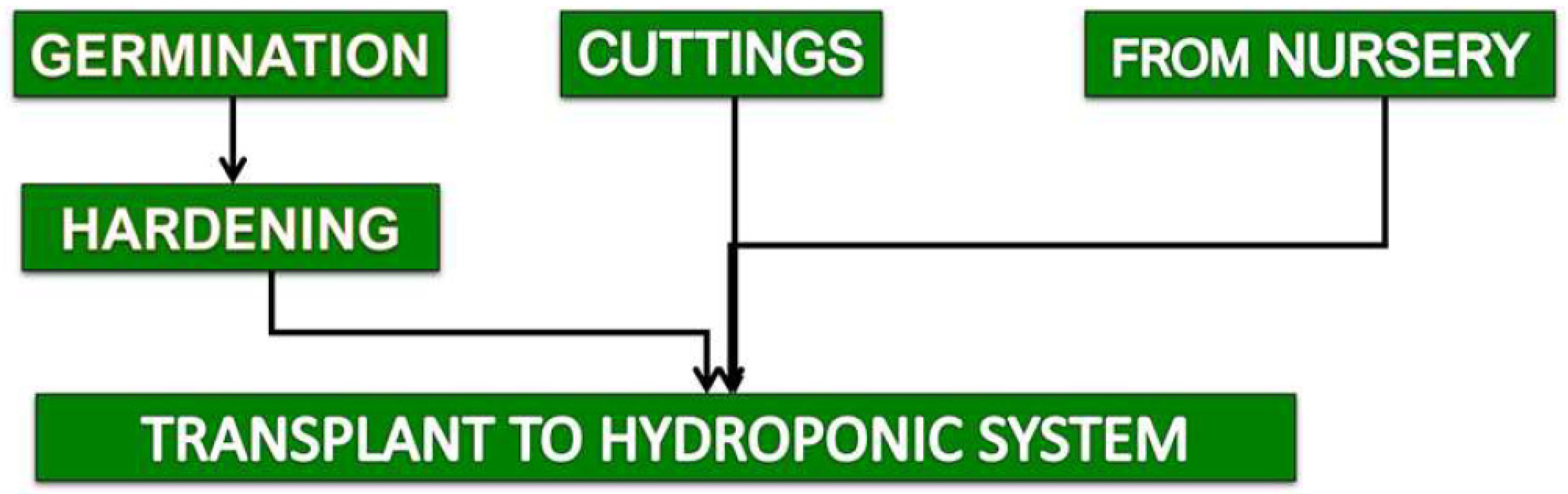
Figure 3.
Types of vegetable plants grown in hydroponics.
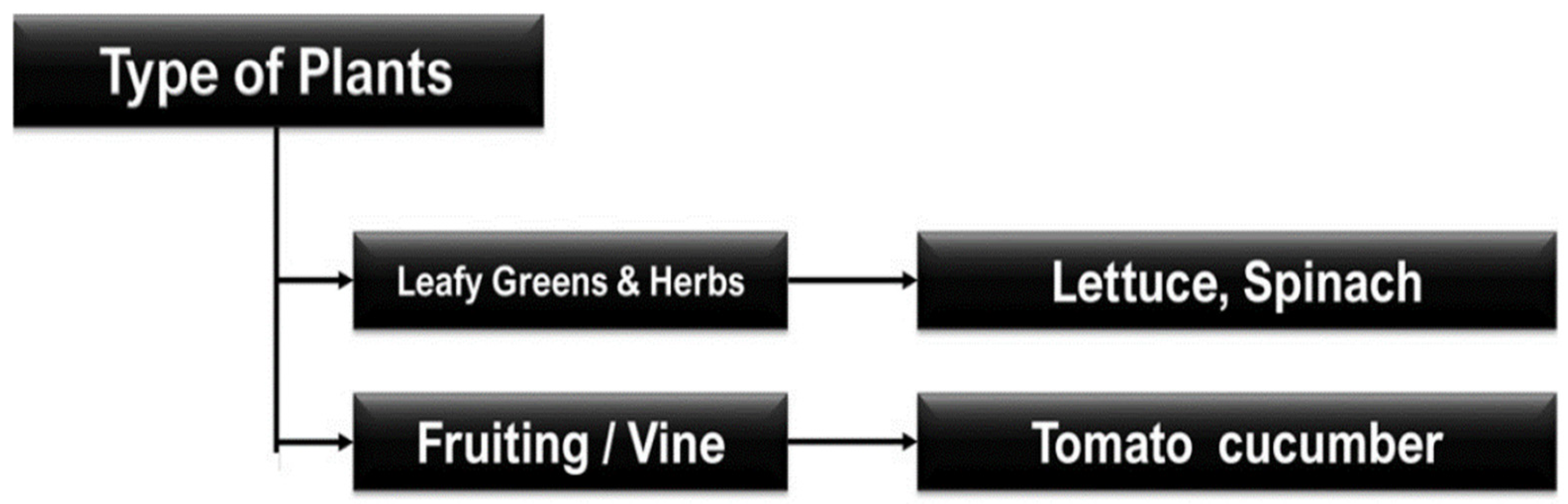
Figure 4.
Showing five stages of fruiting vegetable plant.
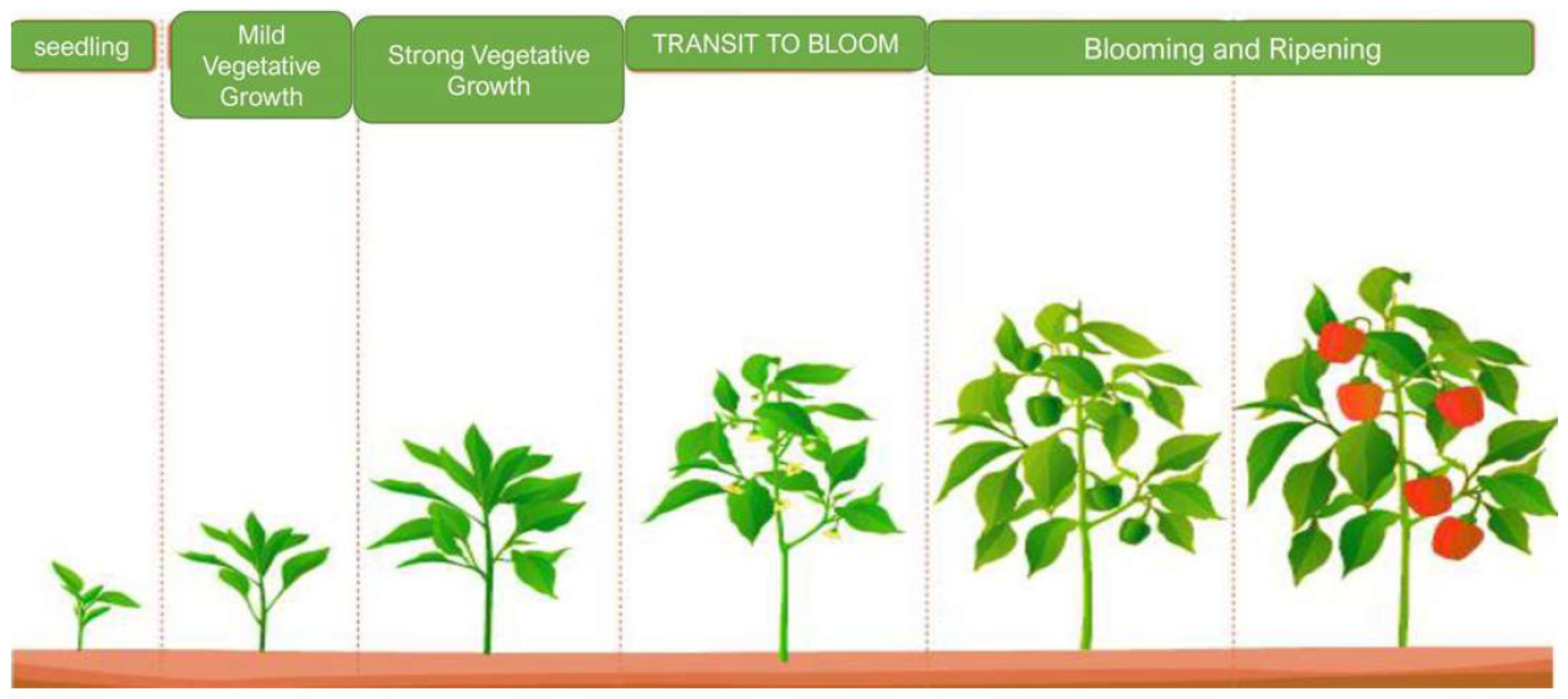
Figure 5.
Showing five stages of verdant vegetable plant [26].
Figure 5.
Showing five stages of verdant vegetable plant [26].
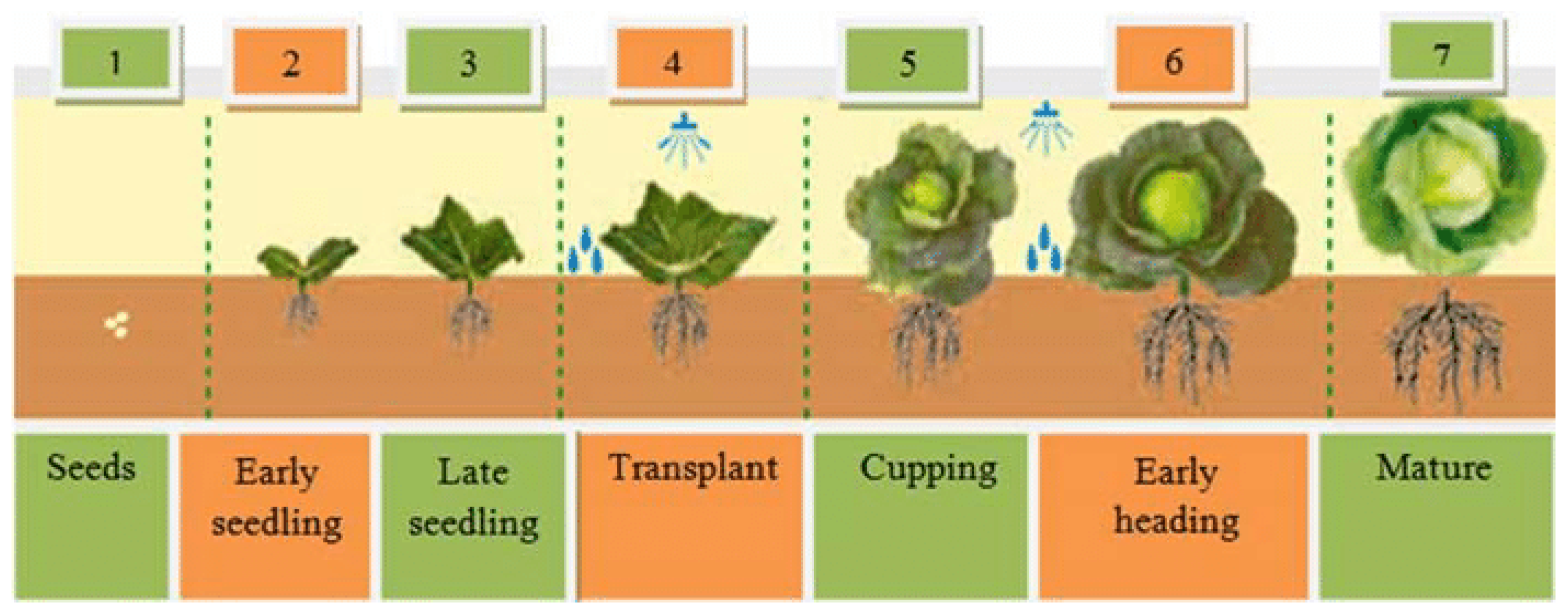
Figure 6.
Showing Important Parameters for Hydroponics System.
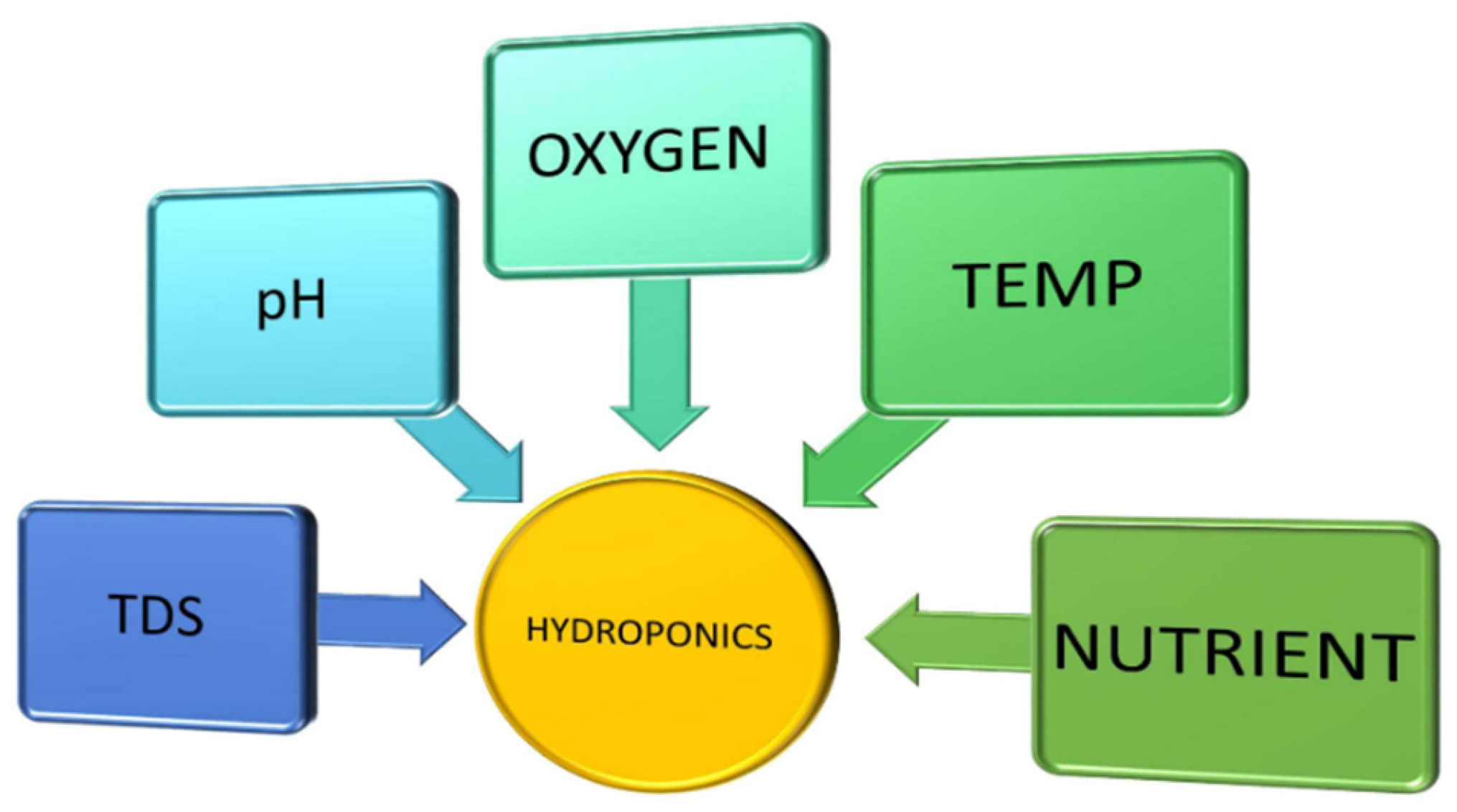
Figure 7.
Wick hydroponic system with permission this image has been reproduce [31].
Figure 7.
Wick hydroponic system with permission this image has been reproduce [31].
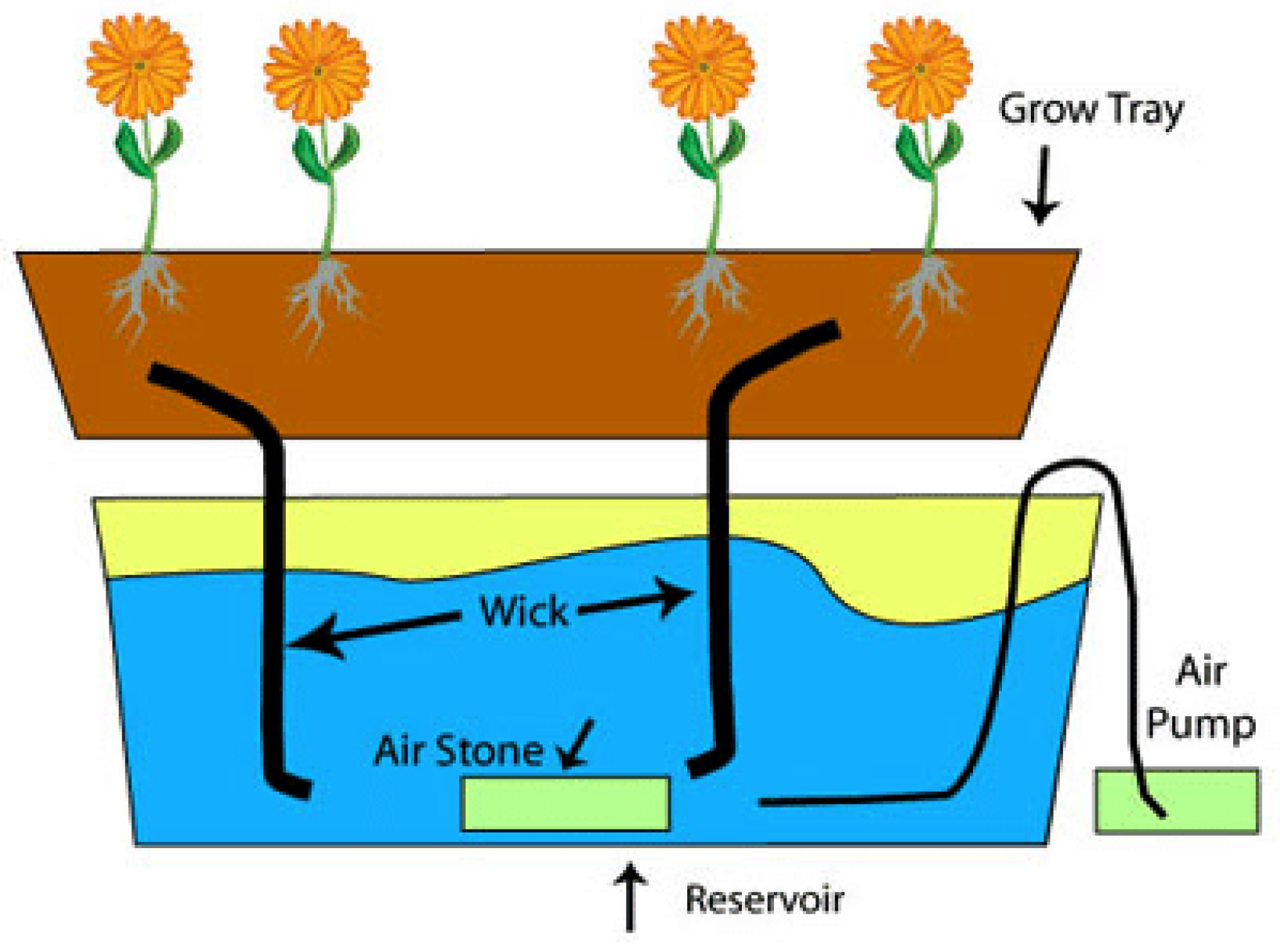
Figure 8.
Ebb and Flow hydroponic system with permission this image has been reproduce [33].
Figure 8.
Ebb and Flow hydroponic system with permission this image has been reproduce [33].
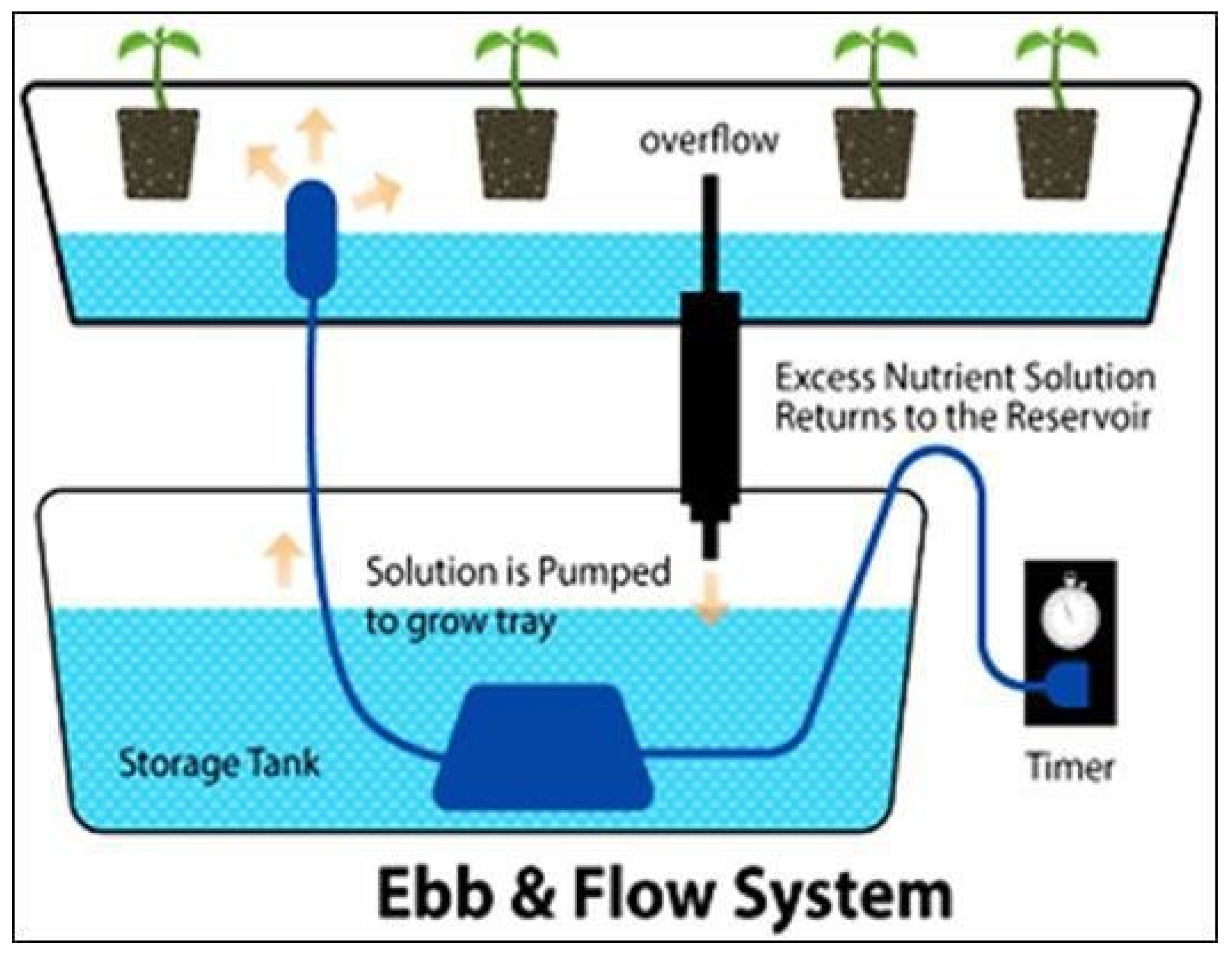
Figure 9.
Deep Flow Technique with permission this image has been reproduce [35].
Figure 9.
Deep Flow Technique with permission this image has been reproduce [35].
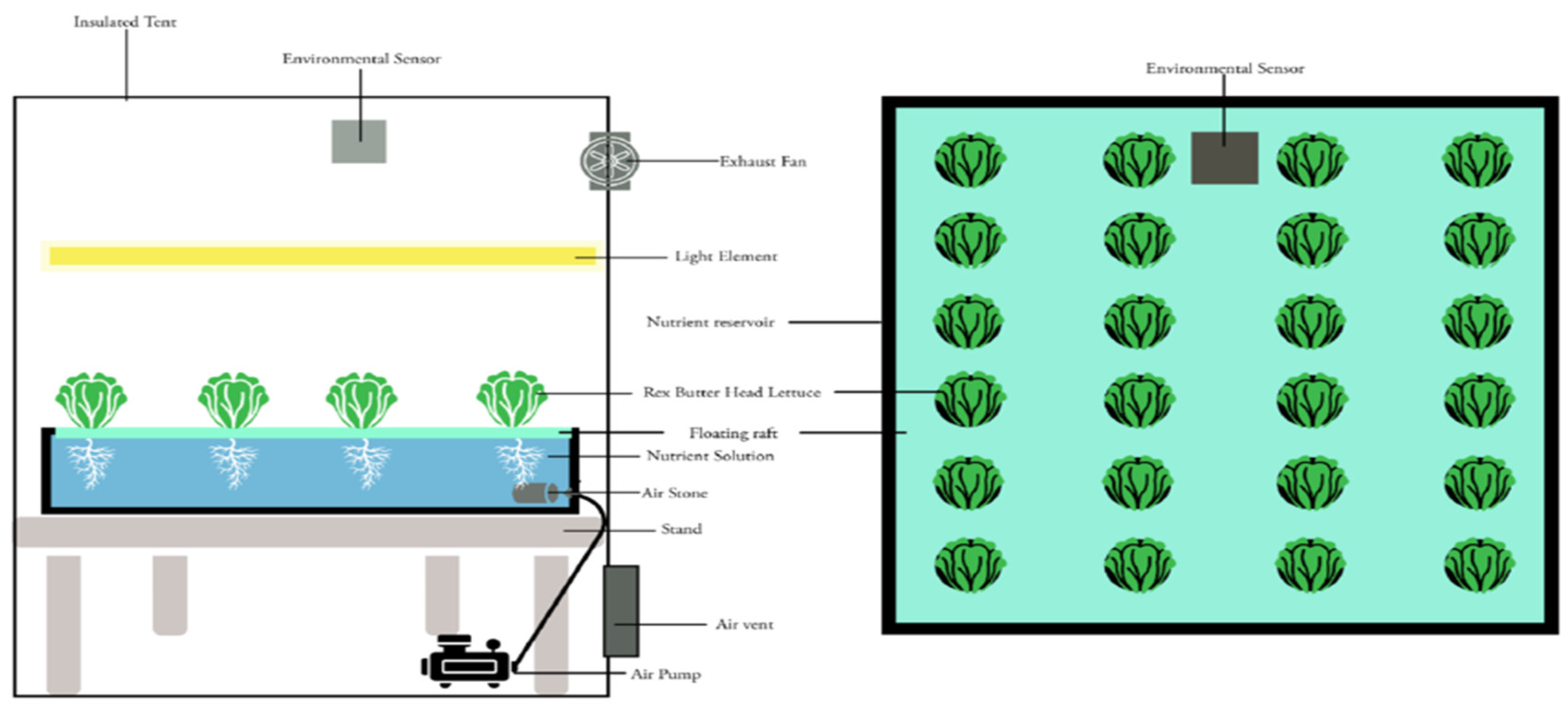
Figure 10.
Nutrient Film Technique with permission this image has been [31].
Figure 10.
Nutrient Film Technique with permission this image has been [31].
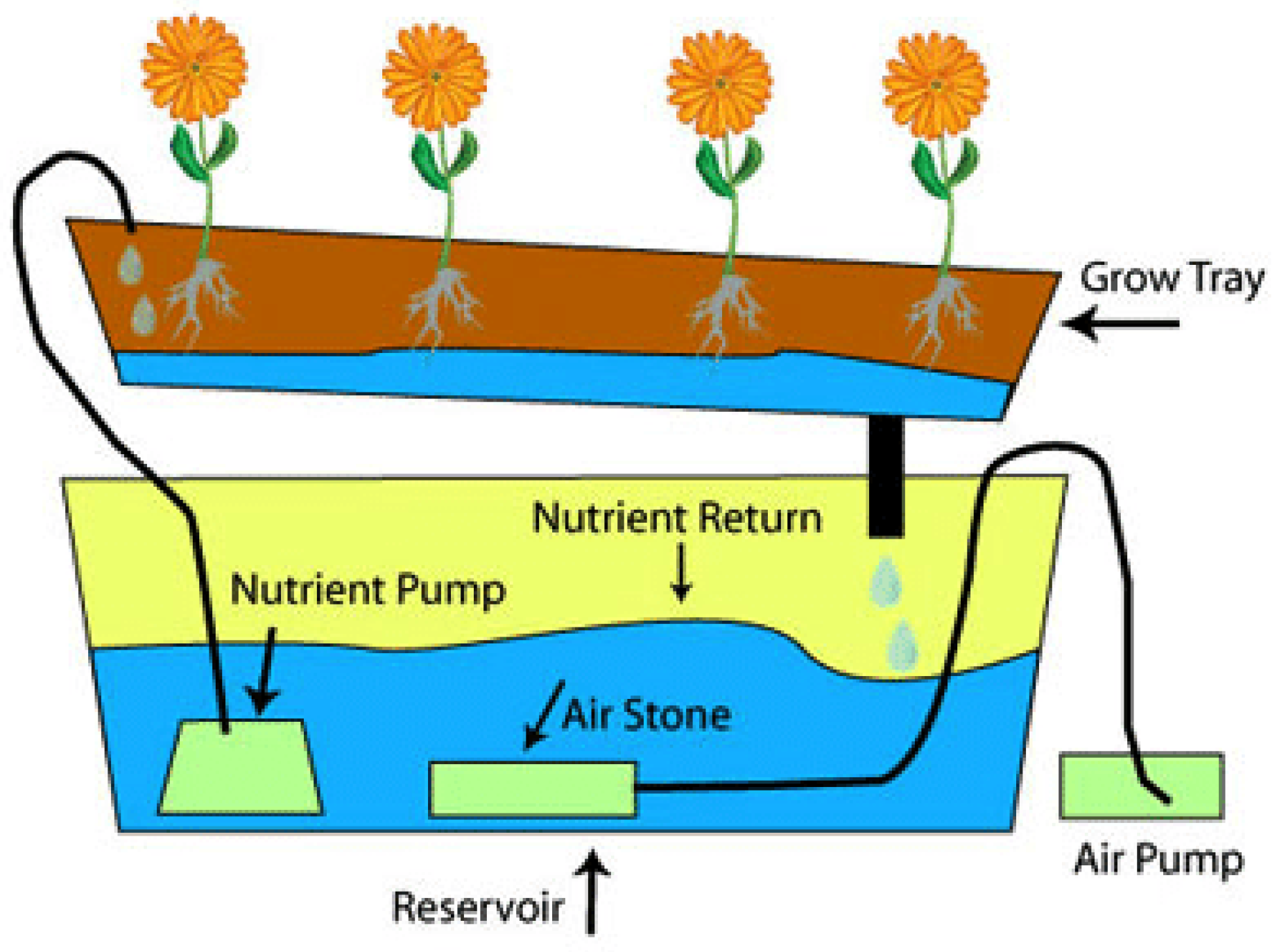
Figure 11.
Aeroponics Technique with permission this image has been reproduce [37].
Figure 11.
Aeroponics Technique with permission this image has been reproduce [37].
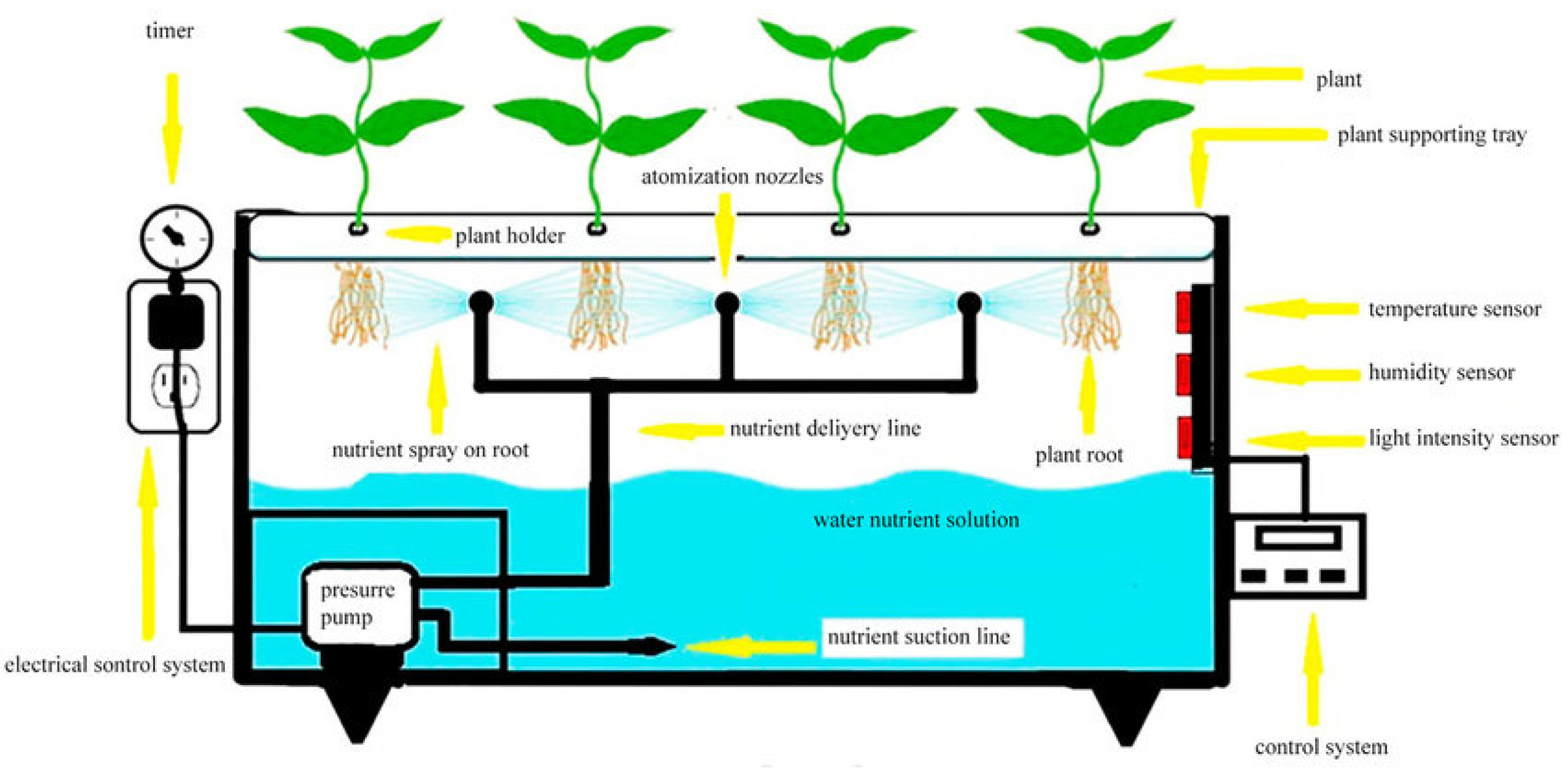
Figure 12.
Drip System with permission this image has been reproduce [39]. Copyright 2019, International Conference of Artificial Intelligence and Information Technology (ICAIIT).
Figure 12.
Drip System with permission this image has been reproduce [39]. Copyright 2019, International Conference of Artificial Intelligence and Information Technology (ICAIIT).
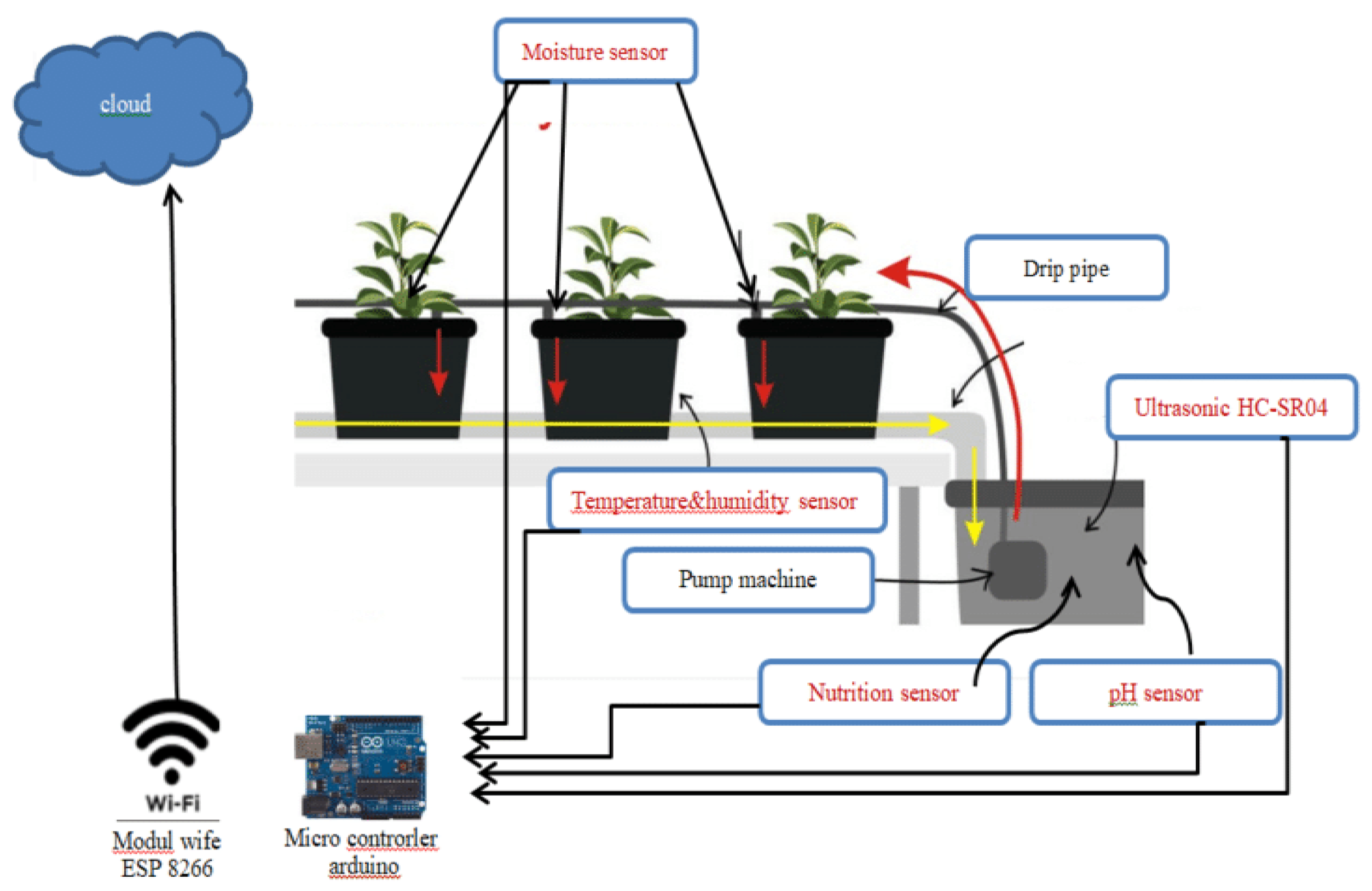
Figure 16.
Healthy cassava leaf images from the (A) original cassava dataset and (B) leaflet dataset with permission this image has been reproduce [69].
Figure 16.
Healthy cassava leaf images from the (A) original cassava dataset and (B) leaflet dataset with permission this image has been reproduce [69].
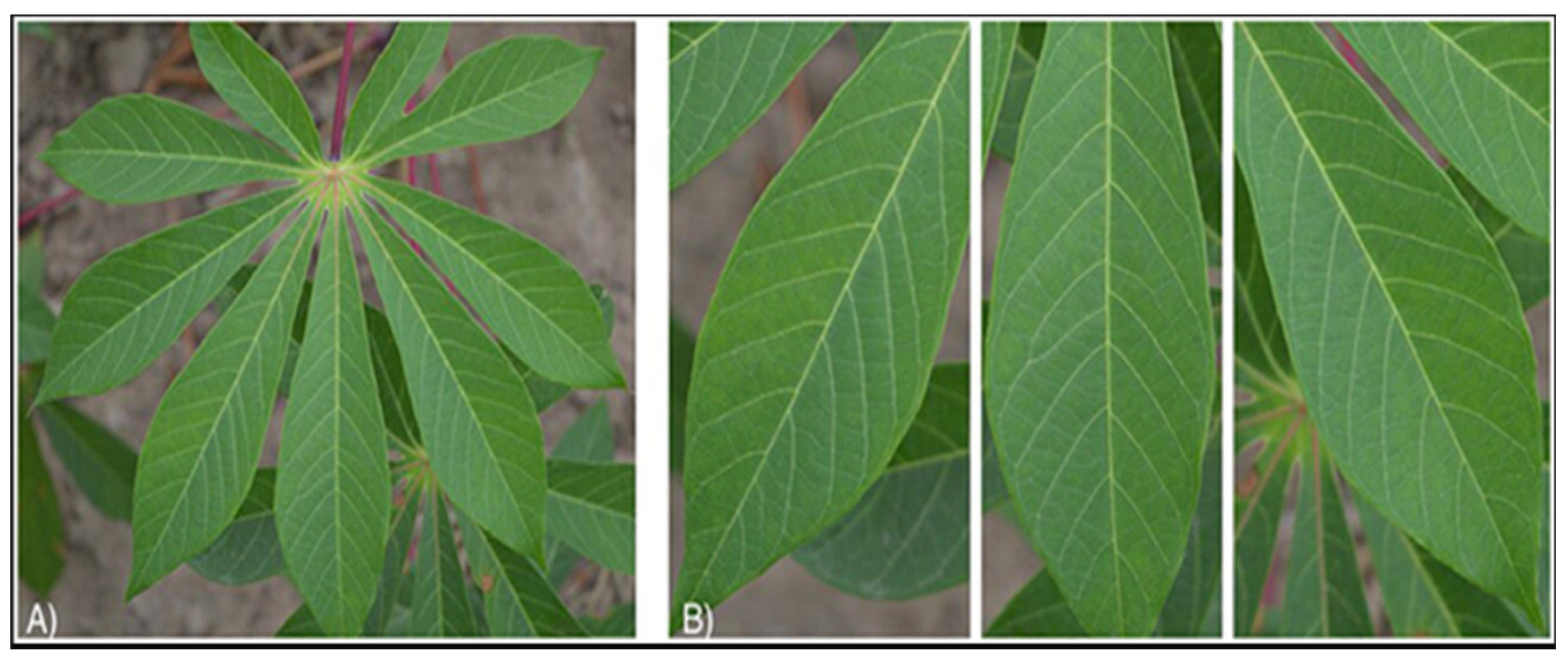
Figure 17.
Examples of images with in field backgrounds from 6 classes in the original cassava dataset. (A) Cassava brown streak disease (CBSD), (B) Healthy, (C) Green mite damage (GMD), (D) Cassava mosaic disease (CMD), (E) Brown leaf spot (BLS), (F) Red mite damage (RMD) with permission this image has been reproduce [69].
Figure 17.
Examples of images with in field backgrounds from 6 classes in the original cassava dataset. (A) Cassava brown streak disease (CBSD), (B) Healthy, (C) Green mite damage (GMD), (D) Cassava mosaic disease (CMD), (E) Brown leaf spot (BLS), (F) Red mite damage (RMD) with permission this image has been reproduce [69].
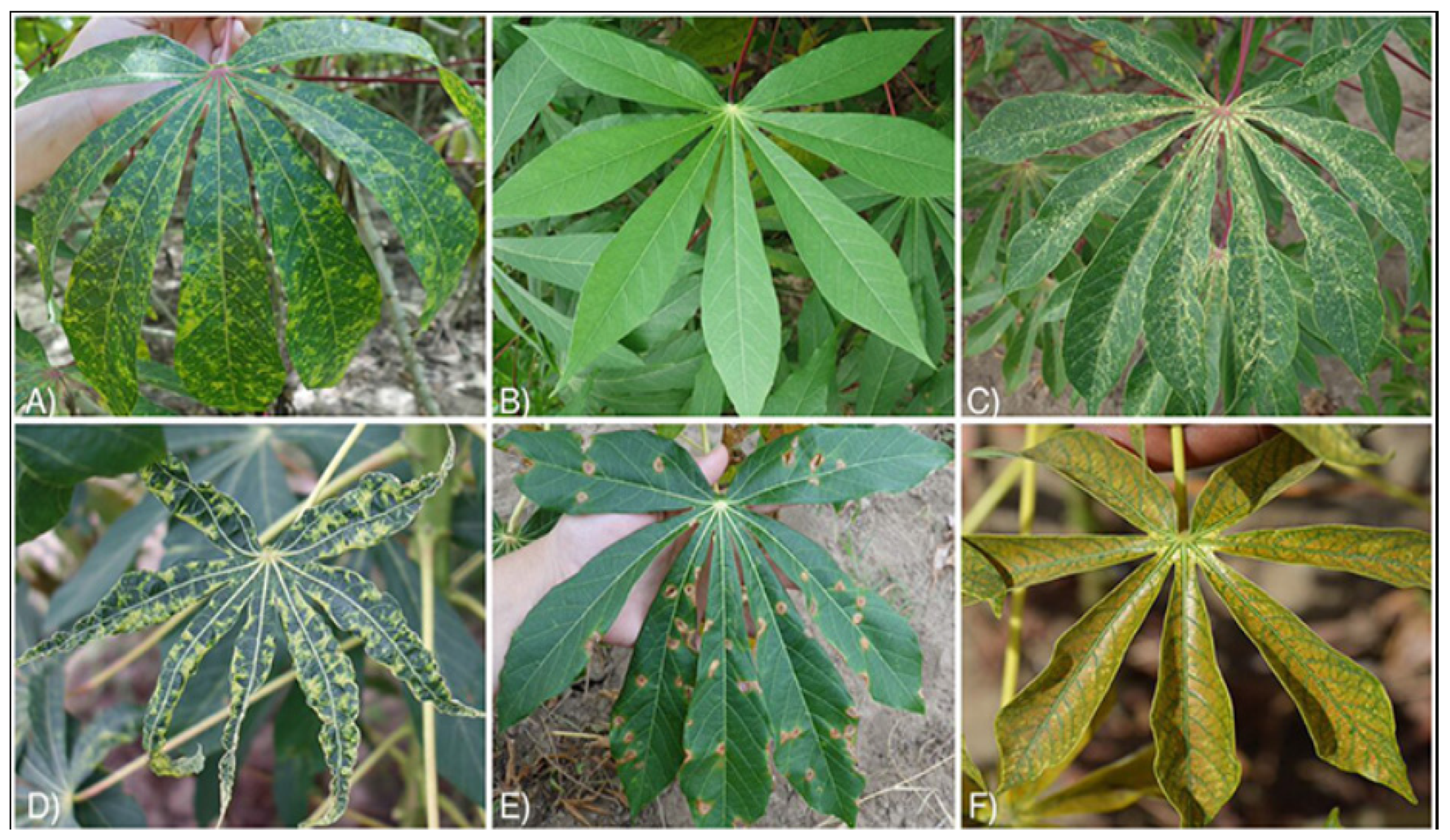
| Sr. No. |
Title of the Article/Paper Author Year of publication |
Focus of Study, Design, Objectives, Method used and Sample size | Findings of the study and their conclusions | Remarks of the Scholar on Limitation |
|---|---|---|---|---|
| 1. | Palande, Vaibhav, Adam Zaheer, and Kiran George. “Fully automated hydroponic system for indoor plant growth.” Procedia Computer Science 129 (2018): 482-488 [13] |
A framework is made that can develop normal plants and vegetables and can work without contingent upon the external environment utilizing a method called Tank-farming. | i. An Internet of Things (IoT) network is made to further develop unwavering quality and permit remote checking and controlling. ii. The client is simply expected to establish a seedling and set introductory boundaries. |
i. The System is monitored and controlled by end user once inputs from different sensors collect large amount data through the IoT system. ii. Initial parameter for Germination and fruit stage nutrition balance are not addressed. |
| 2. | Mehra, Manav, et al. “IoT based hydroponics system using Deep Neural Networks.” Computers and electronics in agriculture 155 (2018): 473-486. [14] |
Profound Brain Organization for anticipating the proper control activity towards controlling the tank-farming framework which are characterized into eight marks. | i. An wise IoT based tank-farming framework is created by taking the tomato plant as a contextual investigation. In here five boundaries taken as contribution for controlling the tank-farming climate which is pH, temperature, dampness, level, lighting. ii. These boundaries are prepared utilizing Profound Brain network towards giving the suitable control activity which is named and precision of 88% is acquired. |
i. The system could be prolonged by deploying the intelligent IoT based Hydroponic system with Deep Neural Network for other hydroponic grown plants toward attaining higher accuracy. ii. The system could be extended by growing a more hydroponic plant in dissimilar tanks and accordingly training the constraints for manufacturing the suitable control action by applying intelligence. |
| 3. | Cho, Woo-Jae, et al. “On-site ion monitoring system for precision hydroponic nutrient management.” Computers and electronics in agriculture 146 (2018): 51-58. [15] |
An on location particle observing framework in light of particle specific terminals (ISEs) that can naturally adjust sensors and measure the convergences of individual particles (NO3−, K+, and Ca2+) in tank-farming arrangements. | This empowers ranchers to successfully oversee supplements in reused arrangements by quickly recognizing any irregular characteristics that show up in the supplement proportions. ii. Consequently align sensors and measure the groupings of individual particles (NO3−, K+, and Ca2+) in aquaculture arrangements. |
i. Additional study needed for stage wise (Seedling, Germination, Fruit) deadline of nutrition’s balance. 2. Solubility timing of nutrition’s is essential to be recognized for the better growth of plants. |
| 4. | Gentry, Matthew. “Local heat, local food: Integrating vertical hydroponic farming with district heating in Sweden.” Energy 174 (2019): 191-197. [16] | Setting Vertical Aqua-farming Cultivating (VHFs) on the region warming matrix can diminish the bring temperature back. | i. Vertical Aqua-farming Cultivating can lessen food miles, asset use, and CO2 outflows. ii. Putting VHFs on the region warming network can lessen the bring temperature back. |
i. Not all crops can be grown successfully in a vertical hydroponic system. The plants that do best in these systems tend to be those that are slighter in size, grow quickly, and have shallow root systems. ii. Energy ingesting or water use is increased. |
| 5. | Chowdhury, Muhammad EH, et al. “Design, construction and testing of IoT based automated indoor vertical hydroponics farming test-bed in qatar.” Sensors 20.19 (2020): 5637. [17] | The client of a tank-farming framework can get ongoing signs from this framework when the climate is ominous. | IoT observing the boundaries(temperature, light frequency, pH, EC, and the necessary measure of water) for the framework. which are impacted by troublesome circumstances. ii. This framework flows around 104 k gallons of supplement arrangement month to month notwithstanding, just 8-10 L water is polished off by the framework. |
i. The novel direction of the works suggest in the ML related articles are interesting and demand more investigation with proposed system once a large quantity data is collected over the IoT system. ii. The thought and design of the vertical NFT system is careful to be used. |
| 6. | Mohamed, Elsayed Said, et al. “Smart farming for improving agricultural management.” The Egyptian Journal of Remote Sensing and Space Science 24.3 (2021): 971-981. [18] |
The brilliant water system framework incorporated those sensors for checking water level, water system productivity, environment, and so on. Brilliant water system depends on shrewd regulators and sensors as well as a few numerical relations. | The execution of Brilliant Choice Emotionally supportive networks (SDSS) upholds the use of joining IoT with UAV and Robots frameworks constrained by artificial intelligence Methods. ii. The improvement of correspondence innovation and the extended utilization of IoT, the utilization of automated airplane has become vital. |
i. The keen technologies should be maintained at the level of small farms, as they aim to increase production and improve the effective use of land and water resource. ii. Unmanned aircraft faced important challenges that they can fly for a short time are exclusive and have climatic impact. |
| 7. | Tatas, Konstantinos, et al. “iponics: IoT monitoring and control for hydroponics.” 2021 10th International Conference on Modern Circuits and Systems Technologies (MOCAST). IEEE, 2021 [19]. |
This Framework presents the plan, and execution of a wise, minimal expense IoT-based control and observing framework for aquaculture nurseries. | i. The framework is made out of a particular Remote Sensor Organization for observing the fundamental boundaries for Tank-farming and control for the siphon. ii. Provides the nursery manager with an easy to use electronic device to screen his yields as well as cautions and admonitions permitting the perception of various nurseries with negligible exertion and need for mediation. |
i. The system needs more effective water pump control using fuzzy logic. ii. Predicting nutrient values grounded on the original absorptions and the water quality sensor values. |
| 8. | Ramakrishnam Raju, S. V. S., et al. “Design and Implementation of Smart Hydroponics Farming Using IoT-Based AI Controller with Mobile Application System.” Journal of Nanomaterials 2022 (2022). [20] | This article centres around execution of portable application coordinated computerized reasoning based shrewd aquaculture master framework. | The rancher works his aquaculture ranch field in manual mode, guaranteeing that supplements are given to plants at the sums determined by the rancher. Besides, supplements are applied to plants at determined reference levels during mechanized method of activity. | i. This arrangement can be extended with hybrid deep learning manners and optimization approaches. |
Table 3.
Main substrates used in hydroponics.
| Material | Advantages | Disadvantages | Source |
|---|---|---|---|
| Sand | Financially suitable, great porosity highlights, | High thickness (around of 1500 kg/m3), | [53] |
| Perlite | what’s more, gives great plant support | low maintenance of water, vulnerable to | [54] |
| Vermiculite | Low thickness (around of 90 kg/m3), | salt aggregation | [55] |
| Rockwool Mineral wool | organically dormant, impartial pH, | Costly, low water maintenance limit | [56] |
| Coconut coir/ Coir Peat | profoundly accessible | Costly, energy consuming item | [57] |
| Peat/Peat moss | Low thickness (around 80 kg/m3), | Adverse consequences on human wellbeing when | [58] |
| Pumice | high supplement holding capacity, great water | is reused | [59] |
Disclaimer/Publisher’s Note: The statements, opinions and data contained in all publications are solely those of the individual author(s) and contributor(s) and not of MDPI and/or the editor(s). MDPI and/or the editor(s) disclaim responsibility for any injury to people or property resulting from any ideas, methods, instructions or products referred to in the content. |
© 2024 by the authors. Licensee MDPI, Basel, Switzerland. This article is an open access article distributed under the terms and conditions of the Creative Commons Attribution (CC BY) license (http://creativecommons.org/licenses/by/4.0/).
Copyright: This open access article is published under a Creative Commons CC BY 4.0 license, which permit the free download, distribution, and reuse, provided that the author and preprint are cited in any reuse.


