

Submitted:
02 September 2024
Posted:
02 September 2024
You are already at the latest version
Abstract
To develop aryloxyphenoxypropionate herbicides with novel structure and improved activity, a total of twenty-eight novel quinazolinone–phenoxypropionate derivatives containing a diester moiety were synthesized and tested for herbicidal activity. The bioassay results in the greenhouse showed that QPEP-I-4 exhibited excellent herbicidal activity against E. crusgalli, D. sanguinalis, S. alterniflora, E. indica, and P. alopecuroides with inhibition rates >80% at a dosage of 150 g ha-1, and displayed higher crop safety to G. hirsutum, G. max, and A. hypogaea than the commercial herbicide quizalofop-p-ethyl. Studying of the molecular mode of action by phenotypic observation, membrane permeability evaluation, and transcriptomic analysis revealed that a growth inhibition of plant by QPPE-I-4 was the result from damage of plants biomembrane. The evaluation of ACCase activity in vivo indicated that QPPE-I-4 could inhibit ACCase and may be a new type of ACCase inhibitor. The present work demonstrated that QPPE-I-4 could serve as a lead compound for further developing novel AOPP herbicides.
Keywords:
quinazolinone
; aryloxyphenoxypropionate
; diester
; ACCase
; herbicides
1. Introduction
Weeds affect crop growth by competing for resources such as light, water, space, and nutrients, resulting in crop yield losses in agriculture. Herbicides are the most extensively used agrochemicals for controlling weeds, and play a pivotal role in ensuring global food security [1]. Among the known herbicides, aryloxyphenoxypropionates (AOPPs) are a class of herbicides that can effectively control annual or perennial gramineous weeds in dicotyledonous crop fields. AOPP herbicides can inhibit acetyl-CoA carboxylase (ACCase), thus interfering with the synthesis of fatty acids, resulting in increased permeability of the cell membrane of plants, plant metabolites leaking out, and finally death of the plants [2,3,4,5,6,7]. Owing to the advantages of AOPP herbicides such as low application rates, long-lasting effects, low toxicity and little residue, a large number of studies have been conducted on the screening of AOPP herbicides, and more than 20 commercial AOPP herbicides have been reached the market place. However, the repeated use of AOPP herbicides inevitably lead to the emergence of herbicide-resistant weeds [8,9,10,11,12,13,14,15,16]. Therefore, there is an urgent demand for the discovery of AOPP herbicides with novel structures and improved activity.
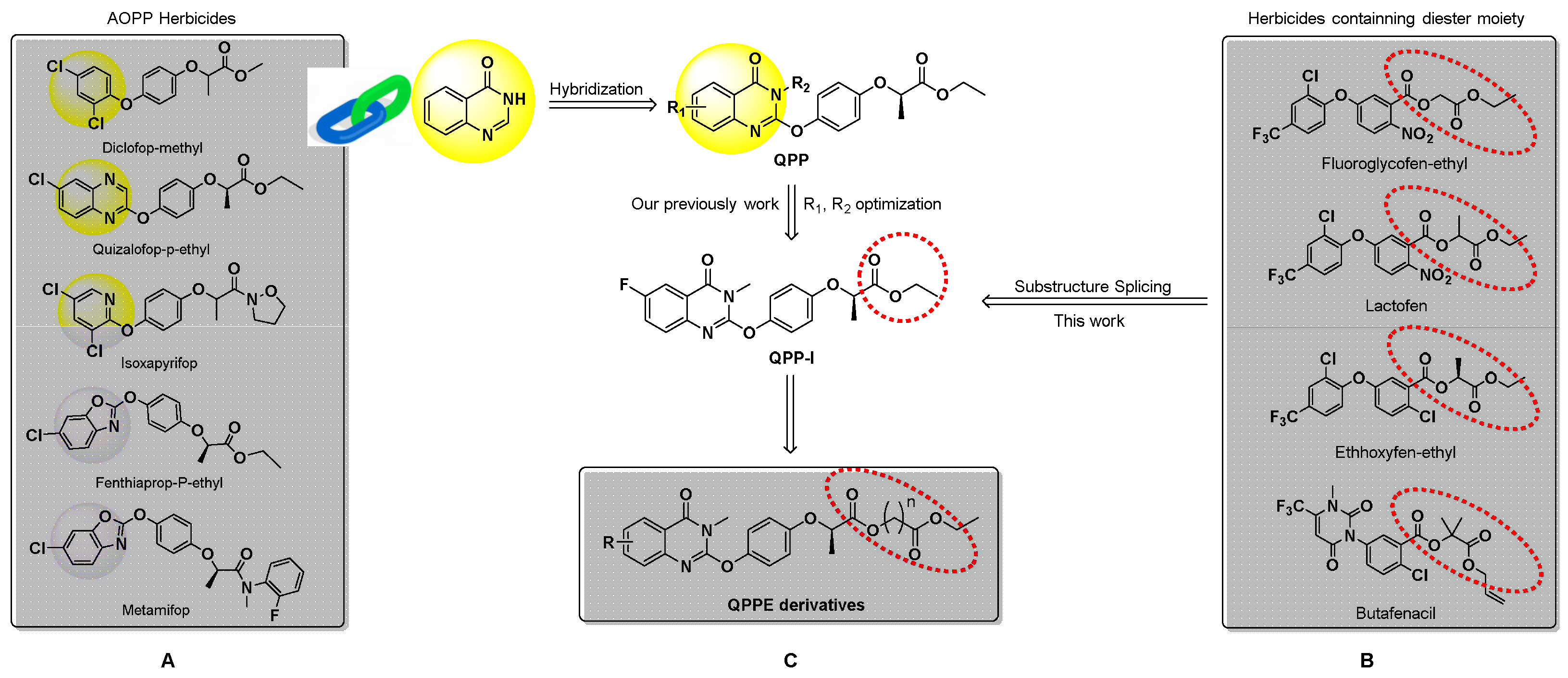
In our previous work [17,18], we have designed and synthesized a series of quinazolinone-phenoxypropionate derivatives (QPP) through replacing the aryl moiety of AOPP herbicides with quinazolin-4(3H)-one moiety (Figure 1). According to the data of herbicidal activity, we found that the substituent R1 and R2 on the quinazolin-4(3H)-one moiety displayed significant effects on herbicidal activity, and QPP-I was identified as a potential herbicidal lead compound. Therefore, as a continuation of the development of new AOPP herbicides with novel structure and improved activity, we would perform further modification on the lead compound QPP-I.
On the one hand, AOPP herbicides are in the form of formulated ester, providing more lipophilicity and increased capacity to cross cellular membranes. Moreover, the substituent at the position of ester moiety of AOPP herbicides has an important effect not only on the activity but also on the crop selectivity [19,20,21,22,23]. On the other hand, lipophilic carboxylates are the common structural fragments in pesticides (Figure 1B), and some studies have verified that the introduction of lipophilic carboxylate can improve biological activity [24,25,26,27,28]. These facts inspired our current hypothesis that the introduction lipophilic carboxylates into ester moiety of QPP-I may get novel lead compounds with improved herbicidal activity. Therefore, in this work, a series of novel quinazolinone-phenoxypropionate derivatives containing diester moiety (QPPE) were designed and synthesized based on the principle of substructure splicing (Figure 1C), and their herbicidal activities, structure–activity relationship (SAR) and molecular mode of action were evaluated to develop a novel AOPP herbicide.
2. Materials and Methods
2.1. General Information
All reagents and solvents, purchased form Energy Chemical or Tokyo Chemical Industry, were analytical grade and used without further purification. Column chromatography purification was carried out using silica gel column chromatography (silica gel 200–300 mesh) (Qingdao Makall Group Co., Ltd., Qingdao, China). The melting points were determined on an X-4 binocular microscope melting point apparatus (Gongyi Tech. Instrument Co., Henan, China) and were uncorrected. Nuclear magnetic resonance (NMR) spectra were recorded in CDCl3 as a solvent on a Bruker AV-500 spectrometer (Bruker Corp., Billerica, MA, USA) with tetramethylsilane (TMS) as the internal reference, and chemical shift values (δ) were given in parts per million (ppm). High-resolution mass spectra (HRMS) data was determined with 6224 TOF LC/MS (Agilent Technologies, Santa Clara, CA) instrument. The crystal structure was determined on a Saturn 724 CCD area-detector diffractometer (Rigaku, Tokyo, Japan). Transmission electron microscopic (TEM) image was collected on a Hitachi-7800 TEM (Japan).
2.2. Chemical Synthesis Procedures
The synthetic pathway used to prepare the series target compounds QPPE−I to QPPE−IV is outlined in Scheme 1. The yields were not optimized.
2.2.1. General Procedure for the Synthesis of Intermediates 2a-2d
The intermediates 2a-2d were prepared following a reported method [29]. Representative example for the synthesis of 2a: 2-Amino-5-fluorobenzoic acid 1a (15.5 g, 100 mmol), methyl isothiocyanate (8.0 g, 110 mmol), Et3N (11.1 g, 110 mmol), and EtOH (250 mL) were sequentially added to a 500 mL three-neck flask. The reaction mixture was stirred for 3 h at 80 oC. After the reaction mixture cooled to room temperature, the resulting precipitate was filtered, and the solid was washed with 100 mL EtOH and 100 mL hexane, and dried under vacuum to obtain intermediate 2a as a white solid (18.8 g, yield: 89.5%).
The intermediates 2b-2d were prepared by a procedure similar to that for intermediate 2a. The data and spectra of 1H NMR of intermediates 2a-2d are given in the Supporting Information.
2.2.2. General Procedure for the Synthesis of Intermediates 3a-3d
The intermediates 3a-3d were prepared following a reported method [29]. Representative example for the synthesis of 3a: Sulfuryl chloride (SO2Cl2, 12.0 g, 89.5 mmol) was added to a 300 mL of CHCl3 solution of 2a (18.8 g, 89.5 mmol), and the solution was stirred for 2 h at 60 oC. After the reaction was complete (TLC monitoring), the solution was cooled to room temperature and diluted with 300 mL CH2Cl2 (DCM). The solution was washed with saturated NaCl solution, dried with anhydrous Na2SO4 for 6 h. The solvent was removed under vacuum, and the crude product was purified via chromatograph on silica gel using petroleum ether/ethyl acetate (v/v, 40:1) as an elution to obtain the intermediate 3a as a white solid (9.1 g, yield: 47.9%).
The intermediates 3b-3d were prepared by a procedure similar to that for intermediate 3a. The data and spectra of 1H NMR of intermediates 3a-3d are given in the Supporting Information.
2.2.3. General Procedure for the Synthesis of Series Target Compounds QPPE−I to QPPE−IV
Representative example for the synthesis of QPPE-I-1: (R)-2-(4-Hydroxyphenoxy) propanoic acid (3.6 g, 20 mmol) was dissolved in 50 mL of DMF, and K2CO3 (5.5 g, 40 mmol) was then added in two batches. The reaction mixture was stirred for 1.0 h at 75 oC, then intermediate 3a (4.2 g, 20 mmol) was added. The reaction mixture was stirred for 7.0 h at 75 oC. After the reaction was complete (TLC monitoring), 150 mL of ice water was poured into the reaction system, and the pH was adjusted to 4-5 by 1 M HCl followed by extraction with ethyl acetate (3 x 50 mL). The organic layer was washed with saturated NaCl solution, dried with anhydrous Na2SO4. The solvent was removed using a rotary flash evaporator, and the crude product 4a was used without further purification.
The crude product 4a (358 mg, 1 mmol) was dissolved in 10 mL of DCM in a 25 mL flask, then oxalyl chloride (254 mg, 2 mmol) and DMF (one drop) was added. The mixture was stirred for 12 h at room temperature. After that, the solvent was removed by a rotary flash evaporator, and the crude product 5a was obtained. Subsequently, 5a was dissolved in 10 mL of DCM, and then, ethyl glycolate (156 mg, 1.5 mmol), 4-dimethylaminopyridine (DMAP, 12 mg, 0.1 mmol), and Et3N (202 mg, 2 mmol) were sequentially added to the solution, and the reaction mixture was stirred for 12 h at room temperature. After the reaction was complete (TLC monitoring), aqueous hydrochloric acid solution (1 M, 20 mL) was added to the reaction system. The organic layer was separated and washed with water, saturated NaCl solution, dried with anhydrous Na2SO4, concentrated by a rotary flash evaporator. The residue was purified through chromatograph on silica gel using petroleum ether/ethyl acetate (v/v, 20:1) as an elution to give target compound QPPE-I-1 as a white solid (193 mg, yield: 43.5%).
The target compounds QPPE-I-2 to QPPE-I-7 and series target compounds QPPE-II to QPPE-IV were synthesized by the similar procedure to compound QPPE-I-1.
2-Ethoxy-2-oxoethyl (R)-2-(4-((6-fluoro-3-methyl-4-oxo-3,4-dihydroquinazolin-2-yl)oxy)phenoxy)propanoate (QPPE-I-1) white solid; yield 43.5%; m.p. 86–89 oC; 1H NMR (500 MHz, CDCl3) δ 7.84 (dd, J = 8.4, 2.3 Hz, 1H), 7.38 – 7.29 (m, 2H), 7.17 (d, J = 8.5 Hz, 2H), 6.99 (d, J = 8.3 Hz, 2H), 4.88 (q, J = 6.8 Hz, 1H), 4.72 (q, J = 15.8 Hz, 2H), 4.23 (q, J = 7.1 Hz, 2H), 3.69 (s, 3H), 1.73 (d, J = 6.8 Hz, 3H), 1.28 (t, J = 7.1 Hz, 3H); 13C NMR (125 MHz, CDCl3) δ 171.5, 167.2, 162.3 (d, J = 3.5 Hz), 159.7 (d, J = 245.5 Hz), 155.3, 152.2, 145.9, 143.1, 128.2 (d, J = 8.0 Hz), 122.8 (d, J = 22.6 Hz), 122.7, 119.9 (d, J = 8.4 Hz), 116.0, 111.9 (d, J = 23.8 Hz), 72.8, 61.7, 61.1, 29.0, 18.7, 14.1; HRMS: calcd for C22H21FN2NaO7+ [M+Na]+ 467.1225, found 467.1234.
3-Ethoxy-3-oxopropyl (R)-2-(4-((6-fluoro-3-methyl-4-oxo-3,4-dihydroquinazolin-2-yl)oxy)phenoxy)propanoate (QPPE-I-2) white solid; yield 42.0%; m.p. 67–70 oC; 1H NMR (500 MHz, CDCl3) δ 7.84 (dd, J = 8.5, 2.1 Hz, 1H), 7.38 – 7.29 (m, 2H), 7.15 (d, J = 8.9 Hz, 2H), 6.93 (d, J = 8.9 Hz, 2H), 4.76 (q, J = 6.7 Hz, 1H), 4.47 (t, J = 6.3 Hz, 2H), 4.15 (q, J = 7.1 Hz, 2H), 3.69 (s, 3H), 2.67 (t, J = 6.3 Hz, 2H), 1.64 (d, J = 6.8 Hz, 3H), 1.26 (t, J = 7.1 Hz, 3H); 13C NMR (125 MHz, CDCl3) δ 171.4, 170.2, 162.3 (d, J = 3.5 Hz), 159.7 (d, J = 245.4 Hz), 155.4, 152.2, 145.9, 143.1, 128.2 (d, J = 7.8 Hz), 122.8 (d, J = 22.9 Hz), 122.6, 119.9 (d, J = 9.0 Hz), 116.0, 111.86 (d, J = 23.9 Hz), 72.8, 69.3, 61.6, 29.0, 18.6, 16.9, 14.1; HRMS: calcd for C23H23FN2NaO7+ [M+Na]+ 481.1382, found 481.1391.
Ethyl (R)-4-((2-(4-((6-fluoro-3-methyl-4-oxo-3,4-dihydroquinazolin-2-yl)oxy)phenoxy)propanoyl)oxy)butanoate (QPPE-I-3) white solid; yield 50.0%; m.p. 51–53 oC; 1H NMR (500 MHz, CDCl3) δ 7.84 (dd, J = 8.3, 2.3 Hz, 1H), 7.38 – 7.29 (m, 2H), 7.18 – 7.13 (m, 2H), 6.97 – 6.91 (m, 2H), 4.78 (q, J = 6.8 Hz, 1H), 4.28 – 4.19 (m, 2H), 4.13 (q, J = 7.1 Hz, 2H), 3.70 (s, 3H), 2.34 (t, J = 7.4 Hz, 2H), 2.00 – 1.96 (m, 2H), 1.66 (d, J = 6.8 Hz, 3H), 1.30 – 1.14 (m, 3H); 13C NMR (125 MHz, CDCl3) δ 172.6, 172.0, 162.3 (d, J = 3.1 Hz), 159.7 (d, J = 245.5 Hz), 155.4, 152.2, 145.8, 143.1, 128.2 (d, J = 8.1 Hz), 122.9, 122.8 (d, J = 24.0 Hz), 122.7, 119.8 (d, J = 8.5 Hz), 115.9, 111.9 (d, J = 23.6 Hz), 73.1, 64.3, 60.6, 30.5, 29.0, 24.0, 18.6, 14.2; HRMS: calcd for C24H25FN2NaO7+ [M+Na]+ 495.1538, found 495.1541.
1-Ethoxy-1-oxopropan-2-yl (2R)-2-(4-((6-fluoro-3-methyl-4-oxo-3,4-dihydroquinazolin-2-yl)oxy)phenoxy)propanoate (QPPE-I-4) colorless oil; yield 43.1%; 1H NMR (500 MHz, CDCl3) δ 7.85 – 7.83 (m, 1H), 7.37 – 7.31 (m, 2H), 7.18 – 7.11 (m, 2H), 7.03 – 6.95 (m, 2H), 5.21 – 5.15 (m, 1H), 4.87 – 4.82 (m, 1H), 4.24 – 4.16 (m, 2H), 3.69 (s, 3H), 1.73 – 1.70 (m, 3H), 1.56 – 1.51 (m, 3H), 1.29 – 1.25 (m, 3H); 13C NMR (126 MHz, CDCl3) δ 171.2, 170.0 (d, J = 10.8 Hz), 161.6, 155.3, 152.7 (d, J = 3.4 Hz), 145.7 (d, J = 10.0 Hz), 145.0, 134.4, 130.0, 127.5, 126.0, 122.6, 122.6, 119.7, 116.0, 115.7, 72.7, 72.6, 69.2, 69.1, 61.5, 18.5, 16.8, 14.1; HRMS: calcd for C23H23FN2NaO7+ [M+Na]+ 481.1382, found 481.1393.
Ethyl 3-(((R)-2-(4-((6-fluoro-3-methyl-4-oxo-3,4-dihydroquinazolin-2-yl)oxy)phenoxy)propanoyl)oxy)butanoate (QPPE-I-5) white solid; yield 36.6%; m.p. 51–54 oC; 1H NMR (500 MHz, CDCl3) δ 7.89 – 7.71 (m, 1H), 7.36 – 7.30 (m, 2H), 7.18 – 7.12 (m, 2H), 6.96 – 6.90 (m, 2H), 5.45 – 5.28 (m, 1H), 4.73 (q, J = 6.8 Hz, 1H), 4.18 – 4.06 (m, 2H), 3.69 (d, J = 1.3 Hz, 3H), 2.71 – 2.47 (m, 2H), 1.63 (dd, J = 6.8, 3.5 Hz, 3H), 1.30 – 1.21 (m, 6H); 13C NMR (125 MHz, CDCl3) δ 171.2, 169.9, 169.8, 162.33, 162.3, 159.7 (d, J = 245.5 Hz), 155.4, 152.2 (d, J = 6.5 Hz), 145.8, 143.1, 128.2 (d, J = 8.1 Hz), 122.8 (d, J = 18.0 Hz), 122.7, 119.8 (d, J = 8.5 Hz), 115.9, 111.8 (d, J = 23.6 Hz), 73.1, 68.6, 68.4, 60.8, 40.7, 29.0, 19.9, 19.7, 18.5, 14.2; HRMS: calcd for C24H25FN2NaO7+ [M+Na]+ 495.1538, found 495.1548.
Ethyl (R)-2-(((2-(4-((6-fluoro-3-methyl-4-oxo-3,4-dihydroquinazolin-2-yl)oxy)phenoxy)propanoyl)oxy)methyl)acrylate (QPPE-I-6) white solid; yield 38.7%; m.p. 112–115 oC; 1H NMR (500 MHz, CDCl3) δ 7.84 (dd, J = 8.5, 1.7 Hz, 1H), 7.37 – 7.30 (m, 2H), 7.15 (d, J = 8.9 Hz, 2H), 6.95 (d, J = 8.9 Hz, 2H), 6.37 (s, 1H), 5.77 (s, 1H), 4.97 – 4.88 (m, 2H), 4.82 (q, J = 6.8 Hz, 1H), 4.23 (q, J = 7.1 Hz, 2H), 3.70 (s, 3H), 1.68 (d, J = 6.8 Hz, 3H), 1.30 (t, J = 7.1 Hz, 3H); 13C NMR (125 MHz, CDCl3) δ 171.5, 165.0, 162.4, 159.8 (d, J = 245.3 Hz), 158.8, 155.4, 152.2, 145.9, 143.1, 135.0, 128.2 (d, J = 7.9 Hz), 128.0, 122.8 (d, J = 24.3 Hz), 122.7, 115.9, 111.9 (d, J = 23.5 Hz), 73.1, 63.2, 61.1, 29.0, 18.6, 14.2; HRMS: calcd for C24H23FN2NaO7+ [M+Na]+ 493.1382, found 493.1391.
Ethyl (R)-1-(((2-(4-((6-fluoro-3-methyl-4-oxo-3,4-dihydroquinazolin-2-yl)oxy)phenoxy)propanoyl)oxy)methyl)cyclopropane-1-carboxylate (QPPE-I-7) white solid; yield 45.3%; m.p. 124–127 oC; 1H NMR (500 MHz, CDCl3) δ 7.83 (dd, J = 8.3, 1.8 Hz, 1H), 7.37 – 7.30 (m, 2H), 7.15 (d, J = 8.9 Hz, 2H), 6.94 (d, J = 8.9 Hz, 2H), 4.80 (q, J = 6.7 Hz, 1H), 4.37 – 4.31 (m, 2H), 4.17 – 4.10 (m, 2H), 3.69 (s, 3H), 1.66 (d, J = 6.7 Hz, 3H), 1.33 (d, J = 2.4 Hz, 2H), 1.23 (t, J = 7.1 Hz, 3H), 0.92 (d, J = 1.8 Hz, 2H); 13C NMR (125 MHz, CDCl3) δ 172.9, 172.0, 162.3 (d, J = 3.4 Hz), 159.7 (d, J = 245.4 Hz), 155.4, 152.2, 145.8, 143.1, 128.1 (d, J = 8.1 Hz), 122.8 (d, J = 25.1 Hz), 122.7, 119.9 (d, J = 8.6 Hz), 115.9, 111.9 (d, J = 23.7 Hz), 73.0, 67.3, 61.0, 29.0, 23.1, 18.6, 14.4, 14.3, 14.2; HRMS: calcd for C25H25FN2NaO7+ [M+Na]+ 507.1538, found 507.1547.
2-Ethoxy-2-oxoethyl (R)-2-(4-((6-chloro-3-methyl-4-oxo-3,4-dihydroquinazolin-2-yl)oxy)phenoxy)propanoate (QPPE-II-1) white solid; yield 45.7%; m.p. 85–88 oC; 1H NMR (500 MHz, CDCl3) δ 8.16 (d, J = 2.2 Hz, 1H), 7.53 (dd, J = 8.7, 2.2 Hz, 1H), 7.29 (d, J = 8.7 Hz, 1H), 7.16 (d, J = 8.9 Hz, 2H), 6.99 (d, J = 8.9 Hz, 2H), 4.88 (q, J = 6.8 Hz, 1H), 4.76 – 4.67 (m, 2H), 4.23 (q, J = 7.1 Hz, 2H), 3.69 (s, 3H), 1.73 (d, J = 6.8 Hz, 3H), 1.28 (t, J = 7.1 Hz, 3H); 13C NMR (125 MHz, CDCl3) δ 171.5, 167.2, 162.0, 155.3, 152.8, 145.8, 145.1, 134.7, 130.5, 127.7, 126.4, 122.7, 119.9, 116.0, 72.8, 61.7, 61.1, 29.0, 18.7, 14.1; HRMS: calcd for C22H21ClN2NaO7+ [M+Na]+ 483.0929, found 483.0939.
3-Ethoxy-3-oxopropyl (R)-2-(4-((6-chloro-3-methyl-4-oxo-3,4-dihydroquinazolin-2-yl)oxy)phenoxy)propanoate (QPPE-II-2) brown solid; yield 38.1%; m.p. 72–75 oC; 1H NMR (500 MHz, CDCl3) δ 8.15 (d, J = 2.3 Hz, 1H), 7.52 (dd, J = 8.7, 2.3 Hz, 1H), 7.29 (d, J = 8.8 Hz, 1H), 7.15 (d, J = 9.0 Hz, 2H), 6.93 (d, J = 9.0 Hz, 2H), 4.76 (q, J = 6.8 Hz, 1H), 4.47 (t, J = 6.3 Hz, 2H), 4.15 (q, J = 7.1 Hz, 2H), 3.69 (s, 3H), 2.67 (t, J = 6.2 Hz, 2H), 1.64 (d, J = 6.8 Hz, 3H), 1.26 (t, J = 7.1 Hz, 3H); 13C NMR (125 MHz, CDCl3) δ 171.8, 170.3, 162.0, 155.4, 152.8, 145.7, 145.1, 134.6, 130.5, 127.7, 126.3, 122.7, 119.9, 115.9, 72.9, 60.9, 60.7, 33.8, 29.0, 18.6, 14.2; HRMS: calcd for C23H23ClN2NaO7+ [M+Na]+ 497.1086, found 497.1093.
Ethyl (R)-4-((2-(4-((6-chloro-3-methyl-4-oxo-3,4-dihydroquinazolin-2-yl)oxy)phenoxy)propanoyl)oxy)butanoate (QPPE-II-3) white solid; yield 44.9%; m.p. 62–65 oC; 1H NMR (500 MHz, CDCl3) δ 8.16 (d, J = 2.5 Hz, 1H), 7.52 (dd, J = 8.7, 2.5 Hz, 1H), 7.28 (d, J = 8.7 Hz, 1H), 7.17 – 7.12 (m, 2H), 6.97 – 6.92 (m, 2H), 4.78 (q, J = 6.8 Hz, 1H), 4.27 – 4.17 (m, 2H), 4.13 (q, J = 7.1 Hz, 2H), 3.69 (s, 3H), 2.34 (t, J = 7.4 Hz, 2H), 2.01 – 1.95 (m, 2H), 1.66 (d, J = 6.8 Hz, 3H), 1.25 (t, J = 7.1 Hz, 3H); 13C NMR (125 MHz, CDCl3) δ 172.6, 172.0, 162.0, 155.4, 152.8, 145.7, 145.1, 134.7, 130.5, 127.7, 126.3, 122.7, 119.9, 115.8, 73.0, 64.4, 60.6, 30.5, 29.0, 24.0, 18.6, 14.2; HRMS: calcd for C24H25ClN2NaO7+ [M+Na]+ 511.1242, found 511.1252.
1-Ethoxy-1-oxopropan-2-yl (2R)-2-(4-((6-chloro-3-methyl-4-oxo-3,4-dihydroquinazolin-2-yl)oxy)phenoxy)propanoate (QPPE-II-4) colorless oil; yield 40.1%; 1H NMR (500 MHz, CDCl3) δ 8.03 – 7.88 (m, 1H), 7.49 – 7.33 (m, 1H), 7.23 – 7.08 (m, 2H), 6.99 – 6.94 (m, 2H), 5.23 – 5.03 (m, 1H), 4.90 – 4.74 (m, 1H), 4.25 – 4.09 (m, 2H), 3.64 – 3.53 (m, 3H), 1.71 – 1.66 (m, 3H), 1.58 – 1.39 (m, 3H), 1.35 – 1.14 (m, 3H); 13C NMR (125 MHz, CDCl3) δ 171.2, 170.0, 161.6, 155.3, 152.7, 145.7, 145.0, 134.4, 130.0, 127.5, 126.0, 122.6, 119.7, 116.0, 115.7, 72.6, 69.2, 61.5, 28.8, 18.5, 16.8, 14.1; HRMS: calcd for C23H23ClN2NaO7+ [M+Na]+ 497.1086, found 497.1095.
Ethyl 3-(((R)-2-(4-((6-chloro-3-methyl-4-oxo-3,4-dihydroquinazolin-2-yl)oxy)phenoxy)propanoyl)oxy)butanoate (QPPE-II-5) yellow oil; yield 41.7%; 1H NMR (500 MHz, CDCl3) δ 8.11 (d, J = 1.2 Hz, 1H), 7.49 (d, J = 7.5 Hz, 1H), 7.25 (t, J = 8.8 Hz, 1H), 7.16 (d, J = 8.4 Hz, 2H), 6.93 (t, J = 7.9 Hz, 2H), 5.38 (q, J = 6.2 Hz, 1H), 4.73 (q, J = 6.4 Hz, 1H), 4.16 – 4.06 (m, 2H), 3.67 (s, 3H), 2.74 – 2.46 (m, 2H), 1.63 (d, J = 6.4 Hz, 3H), 1.40 – 1.20 (m, 6H); 13C NMR (125 MHz, CDCl3) δ 171.2, 169.9, 169.8, 161.9, 154.1, 152.8, 145.7, 145.1, 145.1, 134.5, 130.3, 127.6, 126.2, 119.8, 115.8, 73.0, 68.5, 68.4, 60.7, 40.6, 28.9, 19.8, 19.7, 18.5, 14.2; HRMS: calcd for C24H25ClN2NaO7+ [M+Na]+ 511.1242, found 511.1252.
Ethyl (R)-2-(((2-(4-((6-chloro-3-methyl-4-oxo-3,4-dihydroquinazolin-2-yl)oxy)phenoxy)propanoyl)oxy)methyl)acrylate (QPPE-II-6) white solid; yield 52.3%; m.p. 100–102 oC; 1H NMR (500 MHz, CDCl3) δ 8.17 (d, J = 2.4 Hz, 1H), 7.53 (dd, J = 8.7, 2.4 Hz, 1H), 7.29 (d, J = 8.7 Hz, 1H), 7.15 (d, J = 8.9 Hz, 2H), 6.95 (d, J = 8.8 Hz, 2H), 6.37 (s, 1H), 5.77 (s, 1H), 4.97 – 4.88 (m, 2H), 4.83 (q, J = 6.8 Hz, 1H), 4.23 (q, J = 7.1 Hz, 2H), 3.69 (s, 3H), 1.68 (d, J = 6.8 Hz, 3H), 1.30 (t, J = 7.1 Hz, 3H); 13C NMR (125 MHz, CDCl3) δ 171.4, 165.0, 162.0, 155.4, 152.8, 145.8, 145.1, 135.0, 134.7, 130.5, 128.0, 126.4, 122.8, 119.9, 115.9, 73.0, 63.3, 61.1, 29.0, 18.6, 14.2; HRMS: calcd for C24H23ClN2NaO7+ [M+Na]+ 509.1086, found 509.1095.
Ethyl (R)-1-(((2-(4-((6-chloro-3-methyl-4-oxo-3,4-dihydroquinazolin-2-yl)oxy)phenoxy)propanoyl)oxy)methyl)cyclopropane-1-carboxylate (QPPE-II-7) light yellow oil; yield 46.4%; 1H NMR (500 MHz, CDCl3) δ 8.16 (d, J = 2.4 Hz, 1H), 7.53 (dd, J = 8.7, 2.5 Hz, 1H), 7.29 (d, J = 8.7 Hz, 1H), 7.17 – 7.11 (m, 2H), 6.97 – 6.91 (m, 2H), 4.79 (q, J = 6.8 Hz, 1H), 4.34 (q, J = 11.7 Hz, 2H), 4.13 (q, J = 7.1 Hz, 2H), 3.69 (s, 3H), 1.66 (d, J = 6.8 Hz, 3H), 1.33 (q, J = 4.8 Hz, 2H), 1.23 (t, J = 7.1 Hz, 3H), 0.94 – 0.88 (m, 2H); 13C NMR (125 MHz, CDCl3) δ 172.9, 172.0, 162.0, 155.5, 152.8, 145.7, 145.2, 134.7, 130.5, 127.6, 126.4, 122.7, 119.9, 115.9, 73.0, 67.3, 61.0, 29.0, 23.1, 18.6, 14.3, 14.2; HRMS: calcd for C25H25ClN2NaO7+ [M+Na]+ 523.1242, found 523.1251.
2-Ethoxy-2-oxoethyl (R)-2-(4-((3,6-dimethyl-4-oxo-3,4-dihydroquinazolin-2-yl)oxy)phenoxy)propanoate (QPPE-III-1) white solid; yield 61.4%; m.p. 100–103 oC; 1H NMR (500 MHz, CDCl3) δ 8.00 (s, 1H), 7.42 (d, J = 6.9 Hz, 1H), 7.26 (d, J = 7.9 Hz, 1H), 7.18 (d, J = 8.7 Hz, 2H), 6.99 (d, J = 8.5 Hz, 2H), 4.87 (q, J = 6.8 Hz, 1H), 4.71 (q, J = 15.8 Hz, 2H), 4.23 (q, J = 7.1 Hz, 2H), 3.69 (s, 3H), 2.43 (s, 3H), 1.73 (d, J = 6.8 Hz, 3H), 1.28 (t, J = 7.1 Hz, 3H); 13C NMR (125 MHz, CDCl3) δ 171.5, 167.2, 163.1, 155.2, 152.1, 146.1, 144.4, 135.8, 134.9, 126.5, 125.8, 122.7, 118.6, 116.0, 72.8, 61.7, 61.1, 28.9, 21.1, 18.7, 14.1; HRMS: calcd for C23H24N2NaO7+ [M+Na]+ 463.1476, found 463.1481.
3-Ethoxy-3-oxopropyl (R)-2-(4-((3,6-dimethyl-4-oxo-3,4-dihydroquinazolin-2-yl)oxy)phenoxy)propanoate (QPPE-III-2) white solid; yield 43.6%; m.p. 97–98 oC; 1H NMR (500 MHz, CDCl3) δ 7.99 (s, 1H), 7.42 (dd, J = 8.3, 1.7 Hz, 2H), 7.26 (d, J = 9.3 Hz, 2H), 6.93 (d, J = 9.0 Hz, 1H), 4.76 (q, J = 6.8 Hz, 1H), 4.46 (t, J = 6.3 Hz, 2H), 4.15 (q, J = 7.1 Hz, 2H), 3.68 (s, 3H), 2.66 (t, J = 6.3 Hz, 2H), 2.43 (s, 3H), 1.64 (d, J = 6.8 Hz, 3H), 1.25 (t, J = 7.1 Hz, 3H); 13C NMR (125 MHz, CDCl3) δ 171.8, 170.3, 163.1, 155.2, 152.1, 146.0, 144.5, 135.7, 134.9, 126.5, 125.8, 122.7, 118.6, 115.9, 73.0, 60.9, 60.7, 33.8, 28.8, 21.1, 18.6, 14.2; HRMS: calcd for C24H26N2NaO7+ [M+Na]+ 477.1632, found 477.1641.
Ethyl (R)-4-((2-(4-((3,6-dimethyl-4-oxo-3,4-dihydroquinazolin-2-yl)oxy)phenoxy)propanoyl)oxy)butanoate (QPPE-III-3) white solid; yield 48.2%; m.p. 83–85 oC; 1H NMR (500 MHz, CDCl3) δ 8.00 (s, 1H), 7.42 (d, J = 7.3 Hz, 1H), 7.26 (d, J = 8.9 Hz, 1H), 7.17 (d, J = 8.7 Hz, 2H), 6.94 (d, J = 8.5 Hz, 2H), 4.78 (q, J = 6.7 Hz, 1H), 4.27 – 4.18 (m, 2H), 4.13 (q, J = 7.1 Hz, 2H), 3.69 (s, 3H), 2.43 (s, 3H), 2.34 (t, J = 7.3 Hz, 2H), 2.02 – 1.94 (m, 2H), 1.65 (d, J = 6.8 Hz, 3H), 1.25 (t, J = 7.1 Hz, 3H); 13C NMR (125 MHz, CDCl3) δ 172.7, 172.0, 163.1, 155.2, 152.1, 146.0, 144.4, 135.8, 134.9, 126.5, 125.9, 122.7, 118.6, 115.8, 73.1, 64.3, 60.6, 30.5, 28.8, 24.0, 21.1, 18.6, 14.2; HRMS: calcd for C25H28N2NaO7+ [M+Na]+ 491.1789, found 491.1798.
1-Ethoxy-1-oxopropan-2-yl (2R)-2-(4-((3,6-dimethyl-4-oxo-3,4-dihydroquinazolin-2-yl)oxy)phenoxy)propanoate (QPPE-III-4) colorless oil; yield 42.6%; 1H NMR (500 MHz, CDCl3) δ 7.99 (s, 1H), 7.41 (d, J = 8.1 Hz, 1H), 7.24 (dd, J = 8.2, 3.7 Hz, 1H), 7.17 (d, J = 8.8 Hz, 2H), 6.98 (t, J = 9.3 Hz, 2H), 5.18 (dq, J = 14.1, 7.1 Hz, 1H), 4.89 – 4.78 (m, 1H), 4.20 (p, J = 6.9 Hz, 2H), 3.68 (s, 3H), 2.42 (s, 3H), 1.73 – 1.69 (m, 3H), 1.55 – 1.51 (m, 3H), 1.26 (td, J = 7.0, 2.4 Hz, 3H); 13C NMR (125 MHz, CDCl3) δ 171.4, 170.2, 163.0, 155.2, 152.1, 146.0, 144.5, 135.7, 134.8, 126.5, 125.8, 122.6, 118.6, 116.2, 115.9, 72.9, 69.2, 61.6, 28.8, 21.1, 18.6, 16.8, 14.1; HRMS: calcd for C24H26N2NaO7+ [M+Na]+ 477.1632, found 477.1642.
Ethyl 3-(((R)-2-(4-((3,6-dimethyl-4-oxo-3,4-dihydroquinazolin-2-yl)oxy)phenoxy)propanoyl)oxy)butanoate (QPPE-III-5) colorless oil; yield 41.7%; 1H NMR (500 MHz, CDCl3) δ 7.97 (s, 1H), 7.39 (d, J = 8.2 Hz, 1H), 7.22 (t, J = 8.3 Hz, 1H), 7.16 (d, J = 8.0 Hz, 2H), 6.92 (dd, J = 8.8, 7.0 Hz, 2H), 5.39 (dd, J = 12.8, 6.3 Hz, 1H), 4.72 (q, J = 6.7 Hz, 1H), 4.17 – 4.11 (m, 1H), 4.08 (q, J = 7.1 Hz, 1H), 3.66 (d, J = 1.2 Hz, 3H), 2.75 – 2.48 (m, 2H), 2.40 (s, 3H), 1.62 (dd, J = 6.7, 3.1 Hz, 3H), 1.38 – 1.20 (m, 6H); 13C NMR (125 MHz, CDCl3) δ 171.2, 169.9, 162.9, 155.3, 152.1, 145.9, 144.4, 135.7, 134.7, 126.4, 125.8, 122.7, 118.6, 115.8, 73.0, 68.4, 60.7, 40.6, 28.8, 21.1, 19.7, 18.5, 14.2; HRMS: calcd for C25H28N2NaO7+ [M+Na]+ 491.1789, found 491.1797.
Ethyl (R)-2-(((2-(4-((3,6-dimethyl-4-oxo-3,4-dihydroquinazolin-2-yl)oxy)phenoxy)propanoyl)oxy)methyl)acrylate (QPPE-III-6) white solid; yield 36.7%; m.p. 99–101 oC; 1H NMR (500 MHz, CDCl3) δ 8.00 (s, 1H), 7.42 (dd, J = 8.3, 1.6 Hz, 1H), 7.25 (d, J = 8.3 Hz, 1H), 7.16 (d, J = 9.0 Hz, 2H), 6.94 (d, J = 9.0 Hz, 2H), 6.37 (s, 1H), 5.77 (s, 1H), 4.97 – 4.88 (m, 2H), 4.82 (q, J = 6.8 Hz, 1H), 4.23 (q, J = 7.1 Hz, 2H), 3.69 (s, 3H), 2.43 (s, 3H), 1.67 (d, J = 6.8 Hz, 3H), 1.30 (t, J = 7.1 Hz, 3H); 13C NMR (125 MHz, CDCl3) δ 171.5, 165.0, 163.1, 155.2, 152.1, 146.0, 144.4, 135.8, 134.9, 128.0, 126.5, 125.8, 122.8, 118.6, 115.9, 73.1, 63.2, 61.1, 28.8, 21.1, 18.6, 14.2; HRMS: calcd for C25H26N2NaO7+ [M+Na]+ 489.1632, found 489.1642.
Ethyl (R)-1-(((2-(4-((3,6-dimethyl-4-oxo-3,4-dihydroquinazolin-2-yl)oxy)phenoxy)propanoyl)oxy)methyl)cyclopropane-1-carboxylate (QPPE-III-7) light yellow solid; yield 38.9%; m.p. 64–67 oC; 1H NMR (500 MHz, CDCl3) δ 8.00 (s, 1H), 7.42 (dd, J = 8.3, 1.6 Hz, 1H), 7.25 (d, J = 9.9 Hz, 1H), 7.15 (d, J = 8.9 Hz, 2H), 6.94 (d, J = 9.0 Hz, 2H), 4.79 (q, J = 6.7 Hz, 1H), 4.37 – 4.30 (m, 2H), 4.13 (q, J = 7.1 Hz, 2H), 3.69 (s, 3H), 2.43 (s, 3H), 1.65 (d, J = 6.8 Hz, 3H), 1.36 – 1.30 (m, 2H), 1.23 (t, J = 7.1 Hz, 3H), 0.98 – 0.82 (m, 2H); 13C NMR (125 MHz, CDCl3) δ 173.0, 172.1, 163.1, 155.3, 152.1, 145.9, 144.5, 135.8, 134.9, 126.5, 125.8, 122.7, 118.6, 115.9, 73.0, 67.4, 61.0, 28.9, 23.1, 21.1, 18.7, 14.4, 14.3, 14.2; HRMS: calcd for C26H28N2NaO7+ [M+Na]+ 503.1789, found 503.1798.
2-Ethoxy-2-oxoethyl (R)-2-(4-((7-fluoro-3-methyl-4-oxo-3,4-dihydroquinazolin-2-yl)oxy)phenoxy)propanoate (QPPE-IV-1) white solid; yield 42.2%; m.p. 72–74 oC; 1H NMR (500 MHz, CDCl3) δ 8.20 (dd, J = 8.5, 6.4 Hz, 1H), 7.16 (d, J = 8.9 Hz, 2H), 7.05 – 6.93 (m, 4H), 4.88 (q, J = 6.8 Hz, 1H), 4.72 (q, J = 15.8 Hz, 2H), 4.24 (q, J = 7.1 Hz, 2H), 3.68 (s, 3H), 1.73 (d, J = 6.8 Hz, 3H), 1.29 (t, J = 7.1 Hz, 3H); 13C NMR (125 MHz, CDCl3) δ 171.5, 167.2, 166.6 (d, J = 253.3 Hz), 162.2, 155.4, 153.5, 148.9 (d, J = 13.7 Hz), 145.8, 129.7 (d, J = 10.7 Hz), 122.7, 116.0, 115.6, 113.6 (d, J = 23.6 Hz), 111.4 (d, J = 22.3 Hz), 72.8, 61.7, 61.1, 28.8, 18.6, 14.1; HRMS: calcd for C22H21FN2NaO7+ [M+Na]+ 467.1225, found 467.1235.
3-Ethoxy-3-oxopropyl (R)-2-(4-((7-fluoro-3-methyl-4-oxo-3,4-dihydroquinazolin-2-yl)oxy)phenoxy)propanoate (QPPE-IV-2) light yellow oil; yield 47.7%; 1H NMR (500 MHz, CDCl3) δ 8.20 (dd, J = 8.7, 6.2 Hz, 1H), 7.17 – 7.12 (m, 2H), 7.07 – 6.99 (m, 2H), 6.97 – 6.90 (m, 2H), 4.77 (q, J = 6.8 Hz, 1H), 4.47 (t, J = 6.3 Hz, 2H), 4.16 (q, J = 7.1 Hz, 2H), 3.68 (s, 3H), 2.67 (t, J = 6.3 Hz, 2H), 1.64 (d, J = 6.8 Hz, 3H), 1.26 (t, J = 7.1 Hz, 3H); 13C NMR (125 MHz, CDCl3) δ 171.8, 170.3, 166.6 (d, J = 253.6 Hz), 162.3, 155.4, 153.5, 148.8 (d, J = 13.8 Hz), 145.7, 129.7 (d, J = 10.9 Hz), 122.7, 115.9, 115.6 (d, J = 1.5 Hz), 113.7 (d, J = 23.6 Hz), 111.5 (d, J = 22.2 Hz), 73.0, 60.9, 60.7, 33.8, 28.8, 18.6, 14.2; HRMS: calcd for C23H23FN2NaO7+ [M+Na]+ 481.1382, found 481.1390.
Ethyl (R)-4-((2-(4-((7-fluoro-3-methyl-4-oxo-3,4-dihydroquinazolin-2-yl)oxy)phenoxy)propanoyl)oxy)butanoate (QPPE-IV-3) light yellow oil; yield 42.9%; 1H NMR (500 MHz, CDCl3) δ 8.20 (dd, J = 8.8, 6.2 Hz, 1H), 7.15 (d, J = 9.0 Hz, 2H), 7.06 – 6.98 (m, 2H), 6.94 (d, J = 9.0 Hz, 2H), 4.78 (q, J = 6.8 Hz, 1H), 4.27 – 4.19 (m, 2H), 4.13 (q, J = 7.2 Hz, 2H), 3.68 (s, 3H), 2.34 (t, J = 7.4 Hz, 2H), 2.02 – 1.96 (m, 2H), 1.66 (d, J = 6.8 Hz, 3H), 1.25 (t, J = 7.1 Hz, 3H); 13C NMR (125 MHz, CDCl3) δ 172.6, 171.9, 166.6 (d, J = 253.5 Hz), 162.2, 155.5, 153.5, 148.8 (d, J = 13.7 Hz), 145.8, 129.6 (d, J = 10.9 Hz), 122.7, 115.9, 115.6, 113.6 (d, J = 23.6 Hz), 111.4 (d, J = 22.5 Hz), 73.1, 64.3, 60.5, 30.53, 28.8, 24.0, 18.6, 14.2; HRMS: calcd for C24H25FN2NaO7+ [M+Na]+ 495.1538, found 495.1546.
1-Ethoxy-1-oxopropan-2-yl (2R)-2-(4-((7-fluoro-3-methyl-4-oxo-3,4-dihydroquinazolin-2-yl)oxy)phenoxy)propanoate (QPPE-IV-4) colorless oil; yield 31.6%; 1H NMR (500 MHz, CDCl3) δ 8.20 (dd, J = 8.8, 6.2 Hz, 1H), 7.15 (d, J = 9.0 Hz, 2H), 7.05 – 6.96 (m, 4H), 5.18 (dq, J = 9.9, 7.1 Hz, 1H), 4.87 – 4.82 (m, 1H), 4.29 – 4.13 (m, 2H), 3.68 (s, 3H), 1.73 – 1.70 (m, 3H), 1.56 – 1.51 (m, 3H), 1.27 (td, J = 7.1, 2.9 Hz, 3H); 13C NMR (125 MHz, CDCl3) δ 171.4, 170.1, 166.6 (d, J = 253.5 Hz), 162.2, 155.4, 153.5, 148.9, 145.8 (d, J = 10.5 Hz), 129.7 (d, J = 10.8 Hz), 122.6, 116.2, 115.9, 115.6, 113.6 (d, J = 23.7 Hz), 111.4 (d, J = 23.0 Hz), 72.9, 69.3, 63.7, 61.6, 28.8, 18.6, 16.8, 14.1; HRMS: calcd for C23H23FN2NaO7+ [M+Na]+ 481.1382, found 481.1391.
Ethyl 3-(((R)-2-(4-((7-fluoro-3-methyl-4-oxo-3,4-dihydroquinazolin-2-yl)oxy)phenoxy)propanoyl)oxy)butanoate (QPPE-IV-5) colorless oil; yield 31.4%; 1H NMR (500 MHz, CDCl3) δ 8.22 – 8.19 (m, 1H), 7.14 (d, J = 8.3 Hz, 2H), 7.05 – 6.97 (m, 2H), 6.95 – 6.92 (m, 2H), 5.42 – 5.36 (m, 1H), 4.73 (q, J = 6.7 Hz, 1H), 4.25 – 3.96 (m, 2H), 3.68 (s, 3H), 2.73 – 2.44 (m, 2H), 1.63 (dd, J = 6.8, 3.1 Hz, 3H), 1.41 – 1.18 (m, 6H); 13C NMR (125 MHz, CDCl3) δ 171.2, 169.9, 166.6 (d, J = 253.6 Hz), 162.3, 155.5, 153.5, 148.9 (d, J = 13.8), 145.7, 129.7 (d, J = 10.9 Hz), 122.6, 115.9, 115.6, 113.7 (d, J = 24.0), 73.1, 68.5, 60.8, 40.7, 28.8, 19.8, 18.5, 14.2; HRMS: calcd for C24H25FN2NaO7+ [M+Na]+ 495.1538, found 495.1548.
Ethyl (R)-2-(((2-(4-((7-fluoro-3-methyl-4-oxo-3,4-dihydroquinazolin-2-yl)oxy)phenoxy)propanoyl)oxy)methyl)acrylate (QPPE-IV-6) colorless oil; yield 37.2%; 1H NMR (500 MHz, CDCl3) δ 8.22 – 8.19 (m, 1H), 7.15 (d, J = 8.9 Hz, 2H), 7.07 – 6.98 (m, 2H), 6.95 (d, J = 8.9 Hz, 2H), 6.37 (s, 1H), 5.76 (s, 1H), 4.97 – 4.88 (m, 2H), 4.83 (q, J = 6.7 Hz, 1H), 4.23 (q, J = 7.1 Hz, 2H), 3.68 (s, 3H), 1.68 (d, J = 6.8 Hz, 3H), 1.30 (t, J = 7.1 Hz, 3H); 13C NMR (125 MHz, CDCl3) δ 171.4, 166.6 (d, J = 253.1 Hz), 164.9, 162.2, 155.4, 153.5, 148.8 (d, J = 13.7 Hz), 145.8, 134.9, 129.7 (d, J = 10.8 Hz), 127.9, 122.8, 115.9, 115.6, 113.6 (d, J = 23.6 Hz), 111.4 (d, J = 22.2 Hz), 73.0, 63.2, 61.1, 28.8, 18.6, 14.2; HRMS: calcd for C24H23FN2NaO7+ [M+Na]+ 493.1382, found 493.1392.
Ethyl (R)-1-(((2-(4-((7-fluoro-3-methyl-4-oxo-3,4-dihydroquinazolin-2-yl)oxy)phenoxy)propanoyl)oxy)methyl)cyclopropane-1-carboxylate (QPPE-IV-7) white solid; yield 40.4%; m.p. 73–75 oC; 1H NMR (500 MHz, CDCl3) δ 8.22 – 8.19 (m, 1H), 7.17 – 7.09 (m, 2H), 7.05 – 7.01 (m, 2H), 6.95 (t, J = 6.2 Hz, 2H), 4.80 (q, J = 6.8 Hz, 1H), 4.34 (q, J = 11.7 Hz, 2H), 4.14 (q, J = 7.1 Hz, 2H), 3.68 (s, 3H), 1.66 (d, J = 6.8 Hz, 3H), 1.38 – 1.30 (m, 2H), 1.23 (t, J = 7.1 Hz, 3H), 0.96 – 0.85 (m, 2H); 13C NMR (125 MHz, CDCl3) δ 172.9, 172.0, 166.6 (d, J = 253.1 Hz), 162.3, 155.5, 153.5, 148.9 (d, J = 13.9 Hz), 145.7, 129.7 (d, J = 10.7 Hz), 122.7, 115.9, 115.6, 113.7 (d, J = 23.3 Hz), 111.4 (d, J = 22.5 Hz), 73.0, 67.4, 61.0, 28.8, 23.1, 18.6, 14.4, 14.2, 14.2; HRMS: calcd for C25H25FN2NaO7+ [M+Na]+ 507.1538, found 507.1547.
2.3. X-ray Diffraction Analysis of the Target Compound QPPE-I-7
The target compound QPPE-I-7 was crystallized from a mixture of dichloromethane and methanol (v/v, 2:1) to give colorless crystals suitable for X-ray diffraction analysis. Crystallographic data of the target compound QPPE-I-7 had been deposited with the Cambridge Crystallographic Data Centre as supplementary publications with the deposition number 2372256. The detail data can be acquired free of charge from http://www.ccdc.cam.ac.uk/.
2.4. Evaluation of Herbicidal Activity
According to our previously reported methods [30,31,32], the post-emergence herbicidal activities of all target compounds against four representative plants (Brassica campestris, Amaranthus retroflexus, Echinochloa crusgalli, Digitaria sanguinalis) were evaluated in the greenhouse. Furthermore, monocotyledon weeds E. crusgalli, D. sanguinalis, Pennisetum alopecuroides, Setaria viridis, Eleusine indica, Elymus dahuricus, Spartina alterniflora were selected to screen the herbicidal spectrum of QPPE-I-4. Quizalofop-p-ethyl (QZ) was selected as a positive control. Briefly, 15 weed seeds were evenly sown in an 8-cm × 7-cm × 7-cm plastic pot with 2:1 w/w sandy soil and nutrient matrix. Seedlings were grown in a greenhouse at the temperature 28 ± 2 oC with a 12 h : 12 h light : dark photoperiod. The tested compounds were dissolved in 100 % DMF and then diluted with Tween-80 (concentration: 100 g/L). The resulting solutions were diluted with water to the appropriate concentrations before use. When the two true leaves were expanded, the seedlings were thinned to 10 plants per plastic pot, and sprayed with the tested compounds using a laboratory sprayer (machine model: 3WP-2000, Nanjing Research Institute for Agricultural Mechanization, Nanjing, National Ministry of Agriculture of China) equipped with a flat-fan nozzle delivering 280 L ha-1 at 230 kPa. The doses of tested compounds were set at 150, 75, 37.5, 18.8, and 9.4 g ha-1, according to the preliminary experiment with water used as the control. Each treatment was done in triplicate. After 21 days, the herbicidal activities of the tested compounds were evaluated. The inhibition rate was calculated by the following formula: inhibition rate (%) = ((fresh weight of control − fresh weight of treatment)/fresh weight of control) × 100%.
2.5. Safety for Crops
The most activity compound QPPE-I-4 was selected for crop safety assay. Oryza sativa, Triticum aestivum, Zea mays, Panicum miliaceum, Gossypium hirsutum, Arachis hypogaea and Glycine max were selected as representative crops, and the assay methods were similar to those previously reported. The experiment was conducted when the crops reached the four-leaf stage. The tested compound QPPE-I-4 was applied at 150 g ha-1 with three replications per test. After 21 days, the crop damage of each compound was evaluated. The data represented the percent displaying damage as compared to the control, where complete injury of the target is 100 and no injury is 0.
2.6. Phenotypic Study of P. miliaceum
When P. miliaceum was grown to the 2-leaf stage, the macrophenotypic study of P. miliaceum was performed after seedling treated with QPPE-I-4 at 150 g ha-1 concentration for 7 day. Meanwhile, the leaf cell substructure of P. miliaceum seedlings was detected by TEM. The TEM samples were processed as described by Houot et al. [33]. Briefly, leaf samples of control and QPPE-I-4-treated plantlets were cut to 1 cm2 pieces and fixed for over 12 h in a water solution containing 2.5% glutaraldehyde. After pouring out the fixative solution, samples were treated with 1.0% OsO4 for 1.5 h and dehydrated in acetone several times. Subsequently, samples were embedded in epoxy resin. The resin blocks were trimmed to 70−90 nm thickness using a Reichert Ultracuts ultramicrotome, which were stained with uranyl acetate, followed by lead citrate. After drying, the samples were observed with a Hitachi-7800 TEM.
2.7. Determination of Cell Membrane Permeability
According to a previous method [34], when P. miliaceum was grown to the 2-leaf stage, seedlings was treated with QPPE-I-4 and QZ at a dosage of 150 g ha-1, respectively. At 48, 96, 144, 192, 240 h after the treatment, leaves of the plants were excised at a petiole. The excised leaves were soaked into 10 mL of distilled water in a beaker and shaken gently in a water bath at room temperature. After 3 h, the conductivity of the ambient solution was measured with an electric conductivity meter (DDS-307, INESA, Shanghai, China).
2.8. Transcriptome Study
When P. miliaceum was grown to the 2-leaf stage in the greenhouse, seedlings with growth consistently were selected to be treated with QPPE-I-4 at a dosage of 150 g ha-1. At 1 h after the treatment, 0.5 g of fresh P. miliaceum seedlings were excised and weighed into a 15 mL centrifuge tube, respectively, and quickly frozen and stored in a -80 oC refrigerator for RNA extraction. The treatment with water was selected as control. Three replicate samples were collected from control plants and QPPE-I-4-treated plants. Total RNA extraction and RNA-Seq analysis was performed by Beijing Biomarker Technologies Co., Ltd.. The resulting P values were adjusted using the Benjamini and Hochberg’s approach for controlling the false discovery rate. Genes with an adjusted Fold Change≥2 & FDR<0.01 found by DESeq2 were assigned as differentially expressed. Gene Ontology (GO) enrichment analysis of the differentially expressed genes (DEGs) was implemented by the clusterProfiler packages based Wallenius non-central hyper-geometric distribution. KOBAS database and clusterProfiler software was used to test the statistical enrichment of differential expression genes in Kyoto Encyclopedia of Genes and Genomes (KEGG) pathways.
2.9. ACCase Inhibition Activity Assay
When P. miliaceum was grown to the 2-leaf stage, seedlings were sprayed with QPPE-I-4 using a laboratory sprayer. The dosage of QPPE-I-4 was set at 150 g ha-1, according to the preliminary experiment with water used as the control. At 1, 3, 6, 12, 24, 48, 96 h and 120 h after the treatment, 0.1 g of fresh P. miliaceum seedlings were excised and weighed into a 1.5 mL centrifuge tube for ACCase enzyme inhibition assay. Three replicate samples were collected from control plants and QPPE-I-4-treated plants for each time point. The ACCase enzyme inhibition assay was performed by the method of ACCase activity assay kit according to the manufacturer’s instructions (Solarbio Science & Technology Co., Ltd., Beijing, China). The absorbance [optical density (OD) value] was determined at 660 nm.
3. Results and Discussion
3.1. Chemistry
The series target compounds QPPE-I to QPPE-IV were prepared via a five-step synthetic route as depicted in Scheme 1. Briefly, anthranilic acids 1a−1d reacted with methyl isothiocyanate in EtOH by using Et3N as a base to provide intermediates 2a−2d, which were reacted with SO2Cl2 in CHCl3 to provide intermediates 3a−3d. Then, the important intermediates 4a−4d were obtained by the nucleophilic substitution reaction between intermediates 3a−3d and (R)-2-(4-hydroxyphenoxy)propionic acid in DMF using K2CO3 as a base. Finally, intermediates 4a−4d reacted with oxalyl chloride in the presence of a catalytic amount of DMF to produce the corresponding acyl chlorides 5a−5d, which were reacted with alcohol ester in the presence of Et3N and a catalytic amount of DMAP to afford the series target compounds QPPE-I to QPPE-IV in yields of 31.4%-61.4%. The structures of all the target compounds were characterized via 1H NMR, 13C NMR, and HRMS. In addition, the structure of compound QPPE-I-7 was confirmed using X-ray diffraction analysis (CCDC 2372256; Figure 2).
3.2. Herbicidal Activities and SAR
The initial herbicidal activities of all the target compounds against dicotyledon weeds, including B. campestris and A. retroflexus, and monocotyledon weeds, including E. crusgalli and D. sanguinalis, were evaluated at a dosage of 150 g ha-1 under the post-emergence condition in the greenhouse. Commercial herbicide quizalofop-p-ethyl was selected as the positive control sample. As observed in Figure 3, most of the target compounds exhibited moderate to good sum herbicidal activity against the tested weeds. Among them, compounds such as QPPE-I-3, QPPE-I-4, QPPE-I-6, QPPE-II-1, QPPE-II-3, and QPPE-II-4, exhibited promising herbicidal activity with sum inhibition rate >200%, which equal to quizalofop-p-ethyl (sum inhibition rate = 213%). Further analysis of the herbicidal data revealed that the series of compounds QPPE-I (R= 6-F) and QPPE-II (R = 6-Cl) possessed higher sum inhibition rate than that of QPPE-III (R= 6-Me) and QPPE-IV (R = 7-F), and the herbicidal trend of these compounds was QPPE-I (R = 6-F) or QPPE-II (R = 6-Cl) > QPPE-III (R = 6-Me) > QPPE-IV (R = 7-F). These results demonstrated that the type and position of R group on the benzene ring of quinazolin-4(3H)-one moiety had a significant effect on the herbicidal activity, and the introduction of weak withdrawing electron effect groups at 6-position of the benzene ring of quinazolin-4(3H)-one moiety was conducive to improving herbicidal activity. In addition, it was easy to observe that all of the target compounds distinctly exhibited stronger herbicidal activities against monocotyledonous plants E. crusgalli and D. sanguinalis than against dicotyledonous plants B. campestris and A.retroflexus, implying the target compounds could be developed as selective herbicides to control monocotyledon weeds.
To obtain detailed SAR of the series compounds QPPE-I and QPPE-II, and to further explore their herbicidal activities against monocotyledonous plants, we performed the second round of herbicidal activity screening by using a dose reduction with serial two-fold dilutions method. As observed in Figure 4, the herbicidal activity of series compounds QPPE-I and QPPE-II became progressively lower with the dosage decreased from 75 to 9.4 g ha-1, and all of the tested compounds had lower herbicidal activity than that of quizalofop-p-ethyl. Delightfully, however, the most active target compound QPPE-I-4 still displayed moderate herbicidal activity against the two tested weeds with sum inhibition rate 105% at a dosage of 9.4 g ha-1. This finding demonstrated that compound QPPE-I-4 could be selected as a potential lead compound for further study. Besides, upon decreasing the dosage, the SAR of series compounds QPPE-I and QPPE-II becomes gradually obvious. At a lower dosage, the series compound QPPE-I (R= 6-F) displayed better sum herbicidal activity against the two tested weeds than that of corresponding series compound QPPE-II (R= 6-Cl) in a whole, which may be attributed to the fact that the introduction of a fluorine atom into the target compounds could improve their stability, in turn, could potentially be advantageous to herbicidal activity [35,36].
In addition, it was found that the substituent R1 also displayed a significant impact on the herbicidal activity. For example, at a dosage of 9.4 g ha-1, the sum herbicidal inhibition rates of compounds QPPE-I-4 and QPPE-II-4 (R1 = 2-ethoxy-2-oxoethyl) were 3.5-fold and 12.5-fold higher than that of QPPE-I-7 and QPPE-II-7 (R1 = (1-ethoxycarbonyl)cyclopropylmethyl), respectively. According to the data of series compound QPPE-I at the dosage of 9.4 g ha-1, when the R1 group of target compound was straight-chain carboxylates (i.e., QPPE-I-1 to QPPE-I-3), the sum inhibition rate was decreased with the extension of carbon chain. Comparing the Clog P values of among compounds QPPE-I-1, QPPE-I-2 and QPPE-I-3 revealed that compounds with higher Clog P value possessed lower herbicidal activity, which may be caused by the poor uptake and translocation of compound in plants due to relatively high lipophilicity [37]. When a branch-chain carboxylate was introduced into ester moiety of QPPE-I, the sum herbicidal inhibition rates of QPPE-I-4 and QPPE-I-5 increased when compared with the corresponding compounds bearing straight-chain carboxylates (i.e., QPPE-I-2 and QPPE-I-3). Notably, although compounds QPPE-I-4 and QPPE-I-5 had relatively higher Clog P than QPPE-I-1 and QPPE-I-2, they exhibited slightly higher sum inhibition rates than that of QPPE-I-1 and QPPE-I-2, respectively, implying that the hydrophobicity is not the singular driver of improvement of herbicidal activity, and the steric factors of the substituent R1 also played an significant impact on herbicidal activity. Collectively, the following order of the influence of R1 group can be summarized: 1-ethoxy-1-oxopropan-2-yl > 2-ethoxy-2-oxoethyl > 1-ethoxy-1-oxobutan-3-yl > 3-ethoxy-3-oxopropyl > 4-ethoxy-4-oxobutyl > 2-(ethoxycarbonyl)allyl > (1-ethoxycarbonyl)cyclopropylmethyl. The effect of substituent R1 on herbicidal activity of series compound QPPE-II was similar to that of series compound QPPE-I.
3.3. Herbicidal Spectrum and Crop Safety of Compound QPPE-I-4
Base on the results of second round of screening, compound QPPE-I-4 was confirmed to be the highest herbicidal potency among all the target compounds. To investigate whether QPPE-I-4 could be developed as a potential herbicide or not, its herbicidal spectrum and crop safety were further evaluated at the rate of 150 g ha-1 under the post-emergence condition. The herbicidal spectrum results showed that QPPE-I-4 displayed excellent control effect on E. crusgalli, D. sanguinalis, S. alterniflora, E. indica, and P. alopecuroides with inhibition rate >80%, which comparable to quizalofop-p-ethyl (Figure 5). In addition, the crop safety test showed that, after the seven kinds of crops were treated with QPPE-I-4, G. hirsutum, G. max, and A. hypogaea exhibited a complete tolerance toward QPPE-I-4, while the injury rates of QPPE-I-4 to O. sativa, Z. mays and T. aestivum were 74%, 79% and 81%, respectively (Table 1). Taken together, the target compound QPPE-I-4 could be developed as a post-emergence herbicide for monocotyledonous weed control in G. hirsutum, G. max and A. hypogaea fields.
3.4. Molecular Mode of Action of the Compound QPPE-I-4
The molecular mode of action of the most activity compound QPPE-I-4 was explored with P. miliaceum as a model plant. As shown in Figure 6A-C, phytotoxicity was obviously observed in P. miliaceum leaves with symptoms of leaf curl/distortion, partial chlorosis, and damage to growing points for QPPE-I-4 treatment at 7 d, which is very similar to the commercial AOPP herbicide quizalofop-p-ethyl. TEM images revealed that, when compared with the control (Figure 6D and E), the chloroplast membrane structure of P. miliaceum leaves was damaged and the chloroplast disintegrated after treated with QPPE-I-4, thereby resulting in the decreased chloroplast of P. miliaceum leaf cells (Figure 6G and H). Furthermore, it was easy observed that treatment with QPPE-I-4 resulted in plasmolysis (Figure 6 H). Subsequently, we further investigated the effect of QPPE-I-4 on leaf cell membrane permeability. It was found that significant electrolyte leakage of the leaf cell began at 144 h after being treated with QPPE-I-4, and electrolyte leakage reached a stable state at 192 h, which similar to quizalofop-p-ethyl (Figure 6). Collectively, these results could explain the reason for symptoms of leaf partially yellow, wither, and necrosis, and demonstrated that compound QPPE-I-4 caused damage to the membrane system of the plant.
To further understand the molecular mode of action, the RNA sequencing was then performed to identify the differential expression genes (DEGs) of P. miliaceum after treated with compound QPPE-I-4 for 1 h. As shown in Figure 8A and B, in total 150 DEGs with Fold Change≥2 & FDR<0.01 were identified, and there were 88 up-regulated DEGs and 65 down-regulated DEGs. To understand the functions of those 150 DEGs, GO annotation and KEGG annotation were performed. As observed in Figure 9A, the KEGG annotation showed that the significantly enriched metabolic pathway was related to phenylalanine biosynthesis. As reported [38], phenylalanine is a critical metabolic node that plays an essential role in the interconnection between the primary and secondary metabolism of plants, and it is a precursor of numerous compounds that are crucial for defense against different types of stresses. Thus, it was speculated that P. miliaceum produced stress response to QPPE-I-4 induced stress at 1 h. Meanwhile, GO annotation was performed and analyzed on the 150 DEGs, which classified into the molecular function, cell component, and biological process (Figure 9B, C and D). The significantly enriched GO terms related to cellular component were thylakoid membrane, plastid thylakoid, obsolete thylakoid part, photosynthetic membrane, plastid thylakoid membrane; The significantly enriched GO terms related to biological process were regulation of tetrapyrrole metabolic process, obsolete regulation of cofacor metabolic process and regulation of chlorophyll metabolic process; The significantly enriched GO term related to molecular function was phenylalanine ammonia-lyase activity. These analysis results demonstrated that a growth inhibition of P. miliaceum by QPPE-I-4 was the result from disruption of plants biomembrane, which was confirmed by the above results of phenotypic study.
Since compound QPPE-I-4 had similar motif and phytotoxic phenotypes to AOPP herbicides , it was speculated that QPPE compounds had a similar herbicidal mechanism to AOPP herbicides. Thus, the in vivo inhibition of ACCase activity assay of QPPE-I-4 was performed. As shown in Figure 10, QPPE-I-4 exhibited in vivo inhibition against ACCase activity with inhibition rates 10%, 16%, 26%, 47%, and 62% at 1 h, 48 h, 72 h, 96 h and 120 h, respectively, which comparable to the commercial AOPP herbicide quizalofop-p-ethyl. Interestingly, the inhibition rate of enzyme activity changed over time and showed a trend of first increasing, then decreasing, and finally increasing, which may be caused by plants’ stress response to QPPE-I-4. These results indicate that QPPE-I-4 can inhibit in vivo ACCase activity in plants and may be an ACCase inhibitor.
4. Conclusions
In summary, total twenty-eight novel quinazolinone−phenoxypropionate derivatives containing a diester moiety were prepared in moderate yield and tested for herbicidal activity. The results of herbicidal activity revealed that the type and position of R group on the benzene ring of quinazolin-4(3H)-one moiety displayed an important effect on the herbicidal activity, and the type of R1 group also had effect on the herbicidal activity. The (R= 6-F, R1= 1-ethoxy-1-oxopropan-2-yl) pattern was the optimal orientation, and QPPE-I-4 was confirmed as a potential herbicide lead compound due to its good herbicidal activity, moderate herbicidal spectrum and good crop safety. Furthermore, the study of molecular mode of action of QPPE-I-4 by phenotypic observation, membrane permeability evaluation, transcriptomic analysis analysis and in vivo ACCase activity evaluation suggested that QPPE-I-4 might a novel ACCase inhibitor, which induced the damage to the membrane system of the plants. The present work demonstrated that QPPE-I-4 could be served as a lead compound for further developing novel AOPP herbicides. Further study on the structural optimization of QPPE-I-4 is ongoing in our laboratory.
Author Contributions
Conceptualization, K.L. and W.C.; methodology, K.L. and W.C.; validation, S.W. and N.L.; formal analysis, S.W. and N.L.; investigation, S.W. and N.L.; data curation, S.H., S.F. and K.C.; writing—original draft preparation, W.C.; writing—review and editing, K.L. and K.C.; project administration, K.L.; funding acquisition, K.L., and L.J. All authors have read and agreed to the published version of the manuscript.
Funding
This project was financially supported by the National Natural Science Foundation of China (No. 31701827); the Natural Science Foundation of Shandong Province (No. ZR2023MC095); the China Postdoctoral Science Foundation (No. 2020M671984).
Data Availability Statement
Not applicable.
Conflicts of Interest
The authors declare no conflict of interest.
References
- Zhang, P.; Duan, C. B.; Jin, B.; Ali, A. S.; Han, X. Y.; Zhang, H. F.; Zhang, M. Z.; Zhang, W. H.; Gu, Y. C. Recent advances in the natural products-based lead discovery for new agrochemicals. Adv. Agrochem. 2023, 2, 324–339. [Google Scholar] [CrossRef]
- Zagnitko, O.; Jelenska, J.; Tevzadze, G.; Haselkorn, R.; Gornicki, P. An isoleuciney leucine residue in the carboxyltransferase domain of acetyl-CoA carboxylase is critical for interaction with aryloxyphenoxypropionate and cyclohexanedione inhibitors. PNAS 2001, 98, 6617–6622. [Google Scholar] [CrossRef]
- Zhang, H. L.; Yang, Z. R.; Shen, Y.; Tong, L. Crystal structure of the carboxyltransferase domain of Acetyl-Coenzyme A carboxylase. Science 2003, 299, 2064–2067. [Google Scholar] [CrossRef] [PubMed]
- Tong, L. Acetyl-coenzyme A carboxylase: crucial metabolic enzyme and attractive target for drug discovery. Cell. Mol. Life Sci. 2005, 62, 1784–1803. [Google Scholar] [CrossRef] [PubMed]
- Délye, C. Weed resistance to acetyl coenzyme A carboxylase inhibitors: an update. Weed Sci. 2005, 53, 728–746. [Google Scholar] [CrossRef]
- Tong, L.; Harwood, H. J. Acetyl-coenzyme A carboxylases: Versatile targets for drug discovery. J. Cell. Biochem. 2006, 99, 1476–1488. [Google Scholar] [CrossRef]
- Jia, L.; Gao, S.; Zhang, Y. Y.; Zhao, L. X.; Fu, Y.; Ye, F. Fragmenlt recombination design, synthesis, and safener activity of novel ester-substituted pyrazole derivatives. J. Agric. Food Chem. 2021, 69, 8366–8379. [Google Scholar] [CrossRef] [PubMed]
- Takano, H. K.; Ovejero, R. F. L.; Belchior, G. G.; Maymone, G. P. L.; Dayan, F. E. ACCase-inhibiting herbicides: mechanism of action, resistance evolution and stewardship. Sci. Agric. 2021, 78, e20190102. [Google Scholar] [CrossRef]
- Stoltenberg, D. E.; Wiederholt, R. J. Giant foxtail (Setaria faberi) resistance to aryloxyphenoxypropionate and cyclohexanedione herbicides. Weed Sci. 1995, 43, 527–535. [Google Scholar] [CrossRef]
- Bakkali, Y. Late watergrass (Echinochloa phyllopogon): mechanism involved in the resistance to fenoxaprop-P-ethyl. J. Agric. Food Chem. 2007, 55, 4052–4058. [Google Scholar] [CrossRef]
- Kaundun, S. S.; Hutchings, S. J.; Dale, R. P.; McIndoe, E. Role of a novel I1781T mutation and other mechanisms in conferring resistance to acetyl-CoA carboxylase inhibiting herbicides in a black-grass population. PLoS One 2013, 8, e69568. [Google Scholar] [CrossRef] [PubMed]
- Kaundun, S. S. Resistance to acetyl-CoA carboxylase-inhibiting herbicides. Pest Manag. Sci. 2014, 70, 1405–1417. [Google Scholar] [CrossRef] [PubMed]
- Guo, W.; Zhang, L.; Wang, H.; Li, Q.; Liu, W.; Wang, J. X. A rare Ile-2041-Thr mutation in the ACCase gene confers resistance to ACCase inhibiting herbicides in Shortawn Foxtail (Alopecurus aequalis). Weed Sci. 2017, 65, 239–246. [Google Scholar] [CrossRef]
- Colbach, N.; Chauvel, B.; Darmency, H.; Délye, C.; Le Corre, V. Choosing the best cropping systems to target pleiotropic effects when managing single-gene herbicide resistance in grass weeds: a blackgrass simulation study. Pest Manag. Sci. 2016, 72, 1910–1925. [Google Scholar] [CrossRef]
- Fang, J. P.; He, Z. Z.; Liu, T. T.; Li, J.; Dong, L. Y. A novel mutation Asp-2078-Glu in ACCase confers resistance to ACCase herbicides in barnyardgrass (Echinochloa crus-galli). Pestic. Biochem. Physiol. 2020, 168, 104634. [Google Scholar] [CrossRef] [PubMed]
- Wang, J. Z.; Peng, Y. J.; Chen, W.; Yu, Q.; Bai, L. Y.; Pan, L. The Ile-2041-Val mutation in the ACCase gene confers resistance to clodinafop-propargyl in American sloughgrass (Beckmannia syzigachne Steud). Pest Manag. Sci. 2021, 77, 2425–2432. [Google Scholar] [CrossRef] [PubMed]
- Li, N.; Chen, K.; Han, S. B.; Wang, S. M.; He, Y. Q.; Wang, X. K.; Li, P.; Ji, L. S.; Liu, R.; Lei, K. Synthesis, herbicidal activity, and molecular mode of action evaluation of novel aryloxyphenoxypropionate/amide derivatives containing a quinazolinone moiety. J. Agric. Food Chem. 2024, 72, 9445–9456. [Google Scholar] [CrossRef]
- Wang, C. C.; Chen, K.; Li, N.; Wang, X. K.; Wang, S. B.; Li, P.; Hua, X. W.; Lei, K.; Ji, L. S. Discovery of 3-(1-amino-2-phenoxyethylidene)-6-methyl-2H-pyran-2,4(3H)-dione derivatives as novel herbicidal leads. Agronomy 2023, 13, 202. [Google Scholar] [CrossRef]
- Liu, Q. X.; Huang, M. Z.; Liu, A. P.; Nie, S. Q.; Lei, M. X.; Ren, Y. G.; Pei, H.; He, L. Y.; Hu, L.; Hu, A. X. Synthesis and herbicidal activity of novel N-hetrocyclo containing nitrogen methoxy-O-(4-aryloxy-phenyl) lactamide derivatives. Chin. J. Org. Chem. 2014, 34, 118–125. [Google Scholar] [CrossRef]
- Liu, Q. X.; Huang, M. Z.; Liu, A. P.; Hu, A. X.; Lei, M. X.; Ren, Y. G.; Huang, L. Synthesis and herbicidal activity of novel N-allyloxy/propargyloxy aryloxyphenoxy propionamide derivatives. Chem. Res. Chin. Univ. 2016, 32, 188–194. [Google Scholar] [CrossRef]
- Lin, D.; Xiao, M. W.; Yang, Z. H.; Li, B. B.; Hu, A. X.; Ye, J. Synthesis and herbicidal activity of N-(2, 2-dimethyl-7-alkoxy-2, 3-dihydrobenzofuran-5-yl)-2-(4-arylxoyphenoxy) propionamides. Chem. Res. Chin. Univ. 2017, 33, 74–79. [Google Scholar] [CrossRef]
- Yan, Z. Z.; Yang, Z. H.; Deng, X. L.; Lin, D.; Wu, M. F.; Li, J. M.; Chen, A. Y.; Ye, J.; Hu, A. X.; Liao, H. D. Novel aryloxyphenoxypropionate derivates containing benzofuran moiety: design, synthesis, herbicidal activity, docking study and theoretical calculation. Pestic. Biochem. Physiol. 2019, 154, 78–87. [Google Scholar] [CrossRef] [PubMed]
- Gao, H. T.; Zheng, H. W.; Zhang, P.; Yu, J. X.; Li, J.; Dong, L. Y. Weed control, rice safety, and mechanism of the novel paddy field herbicide glyamifop. Agronomy 2022, 12, 3026. [Google Scholar] [CrossRef]
- Li, B.; Xu, J. D.; Xu, L. H.; Zhang, Z. J. Herbicides of benzoyloxy unsaturated carboxylate type. C.N. Patent 1325624, 2001. [Google Scholar]
- Yu, H. B.; Yang, H. B.; Cui, D. L.; Lv, L.; Li, B. Synthesis and herbicidal activity of diphenyl ether derivatives containing unsaturated carboxylates. J. Agric. Food Chem. 2011, 59, 11718–11726. [Google Scholar] [CrossRef]
- Frederick, G.; Steven, P.; Sidney, R. Process of preparation of substituted diphenyl ethers. U.S. Patent 4424393, 1984. [Google Scholar]
- Jozsef, B.; Balint, H.; Imer, T.; Bela, E.; Istvan, G.; Ferenc, B.; Anna, D. P.; Gyula, E.; Jenoe, K.; Eva, K. N. H.; Laszlo, L.; Agnes, M. N. S.; Bela, R.; Lajos, S. Novel herbicide composition. U.S. Patent 5072022A, 1991. [Google Scholar]
- Johnson, W. O. Nitrodiphenyl ether herbicides. U.S. Patent 5304531A, 1994. [Google Scholar]
- Yan, G.; Zekarias, B. L.; Li, X. Y.; Jaffett, V. A.; Guzei, I. A.; Golden, J. E. Divergent 2-chloroquinazolin-4(3H)-one rearrangement: twistedcyclic guanidine formation or ring-fused N-acylguanidines via a domino process. Chem. Eur. J. 2020, 26, 2486–2492. [Google Scholar] [CrossRef]
- Lei, K.; Li, P.; Yang, X.F.; Wang, S.B.; Wang, X.K.; Hua, X.W.; Sun, B.; Ji, L. S.; Xu, X.H. Design and synthesis of novel 4-hydroxyl-3-(2-phenoxyacetyl)-pyran-2-one derivatives for use as herbicides and evaluation of their mode of action. J. Agric. Food Chem. 2019, 67, 10489–10497. [Google Scholar] [CrossRef]
- Wang, C. C.; Liu, H.; Zhao, W.; Li, P.; Ji, L. S.; Liu, R. M.; Lei, K.; Xu, X. H. Synthesis and herbicidal activity of 5-(1-amino-2-phenoxyethylidene)barbituric acid derivatives. Chin. J. Org. Chem. 2021, 41, 2063–2073. [Google Scholar] [CrossRef]
- Wang, C. C.; Chen, K.; Li, N.; Wang, X. K.; Wang, S. B.; Li, P.; Hua, X. W.; Lei, K.; Ji, L. S. Discovery of 3-(1-amino-2-phenoxyethylidene)-6-methyl-2H-pyran-2, 4(3H)-dione derivatives as novel herbicidal leads. Agronomy 2023, 13, 202. [Google Scholar] [CrossRef]
- Houot, V.; Etienne, P.; Petitot, A.; Barbier, S.; Blein, J.; Suty, L. Hydrogen peroxide induces programmed cell death features in cultured tobacco BY-2 cells, in a dose-dependent manner. J. Exp. Bot. 2001, 52, 1721–1730. [Google Scholar] [PubMed]
- Lee, H. J.; Duke, M. V.; Birk, J. H.; Yamamoto, M.; Duke, S. O. Biochemical and physiological effects of benzheterocycles and related compounds. J. Agric. Food Chem. 1995, 43, 2722–2727. [Google Scholar] [CrossRef]
- Ogawa, Y.; Tokunaga, E.; Kobayashi, O.; Hirai, K.; Shibata, N. Current contributions of organofluorine compounds to the agrochemical industry. iScience 2020, 23, 101467. [Google Scholar] [PubMed]
- Ojima, I. Exploration of fluorine chemistry at the multidisciplinary interface of chemistry and biology. J. Org. Chem. 2013, 78, 6358–6383. [Google Scholar] [CrossRef]
- Zhang, R. B.; Yu, S. Y.; Liang, L.; Ismail, I.; Wang, D. W.; Li, Y. H.; Xu, H.; Wen, X.; Xi, Z. Design, synthesis, and molecular mechanism studies of N-phenylisoxazoline-thiadiazolo [3,4-a] pyridazine hybrids as protoporphyrinogen IX oxidase inhibitors. J. Agric. Food Chem. 2020, 68, 13672–13684. [Google Scholar] [CrossRef]
- Pascual, M. B.; El-Azaz, J.; Torre, F. N.; Cañas, R. A.; Avila, C.; Cánovas, F. M. Biosynthesis and metabolic fate of phenylalanine in conifers. Front. Plant Sci. 2016, 7, 1030. [Google Scholar]
Figure 1.
Design of target compounds QPPE by substructure splicing strategy.
Scheme 1.
General synthetic route for the series target compounds QPPE−I to QPPE−IV.
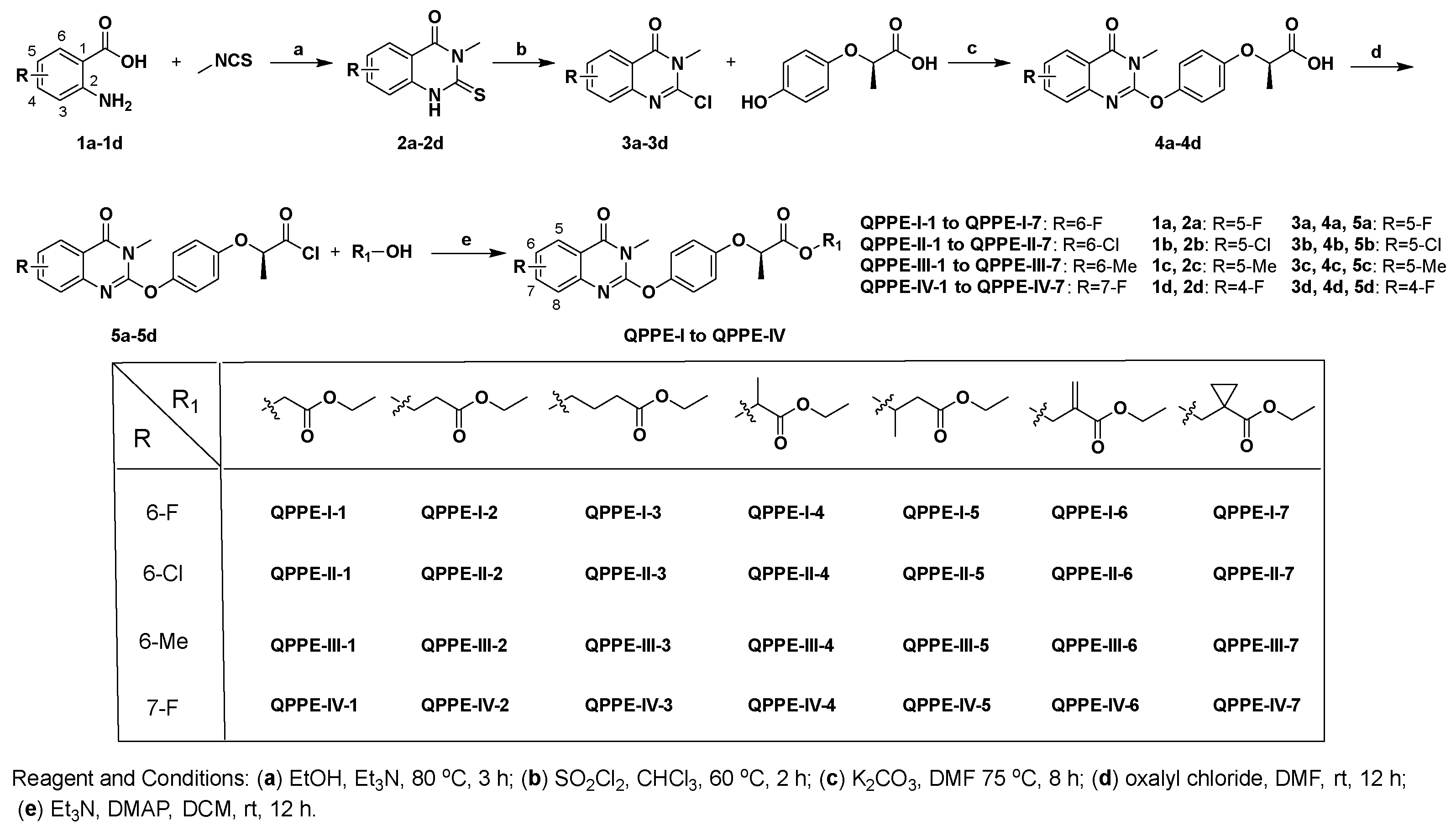
Figure 2.
X-ray crystal structure of the target compound QPPE-I-7.
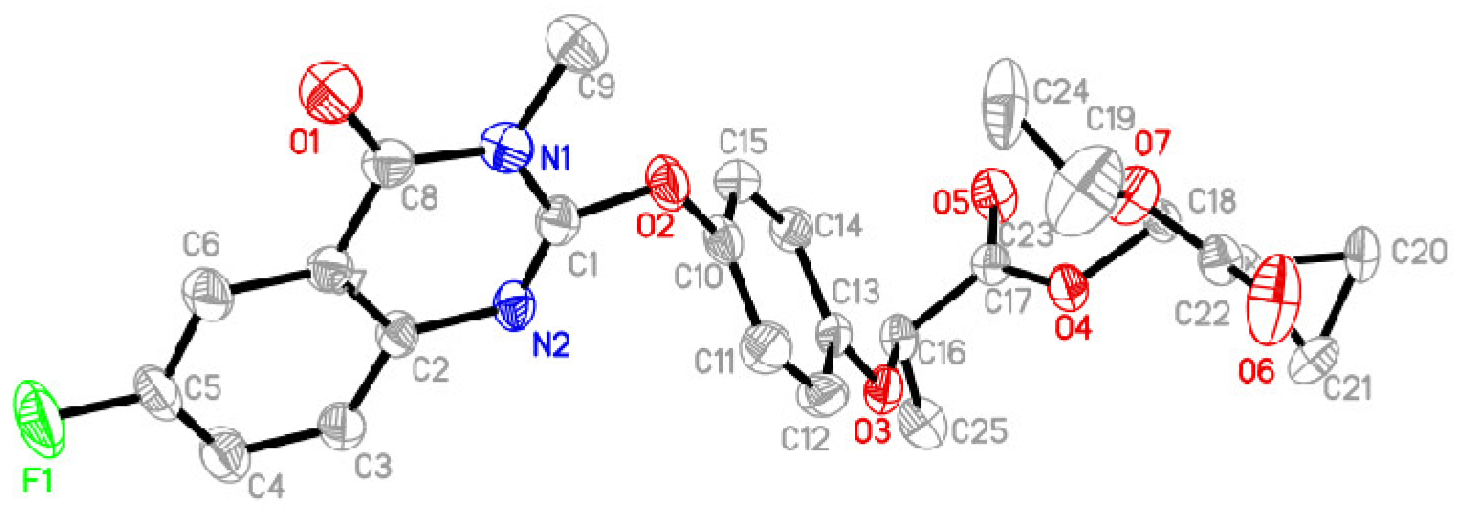
Figure 3.
Effects (% inhibition) of the target compounds on the loss of plant weight at a dosage of 150 g ha-1 under the post-emergence condition; BC: B. campestris; AR: A. retroflexus; EC: E. crusgalli; DS: D. sanguinalis.
Figure 3.
Effects (% inhibition) of the target compounds on the loss of plant weight at a dosage of 150 g ha-1 under the post-emergence condition; BC: B. campestris; AR: A. retroflexus; EC: E. crusgalli; DS: D. sanguinalis.
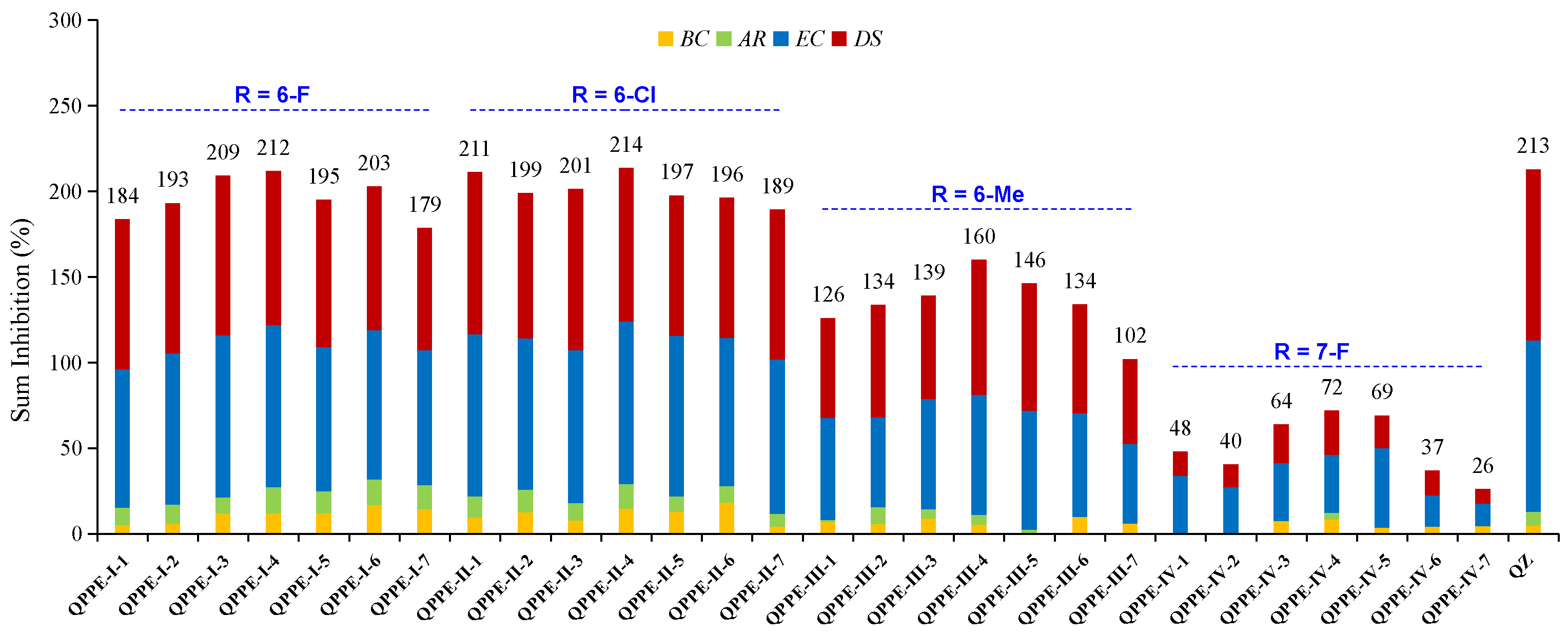
Figure 4.
Effects (% inhibition) of the target compounds on the loss of plant weight a different dosage in greenhouse testing; (A) at a dosage of 75 g ha-1; (B) at a dosage of 37.5 g ha-1; (C) at a dosage of 18.8 g ha-1; and (D) at a dosage of 9.4 g ha-1; EC: E. crusgalli; DS: D. sanguinalis.
Figure 4.
Effects (% inhibition) of the target compounds on the loss of plant weight a different dosage in greenhouse testing; (A) at a dosage of 75 g ha-1; (B) at a dosage of 37.5 g ha-1; (C) at a dosage of 18.8 g ha-1; and (D) at a dosage of 9.4 g ha-1; EC: E. crusgalli; DS: D. sanguinalis.
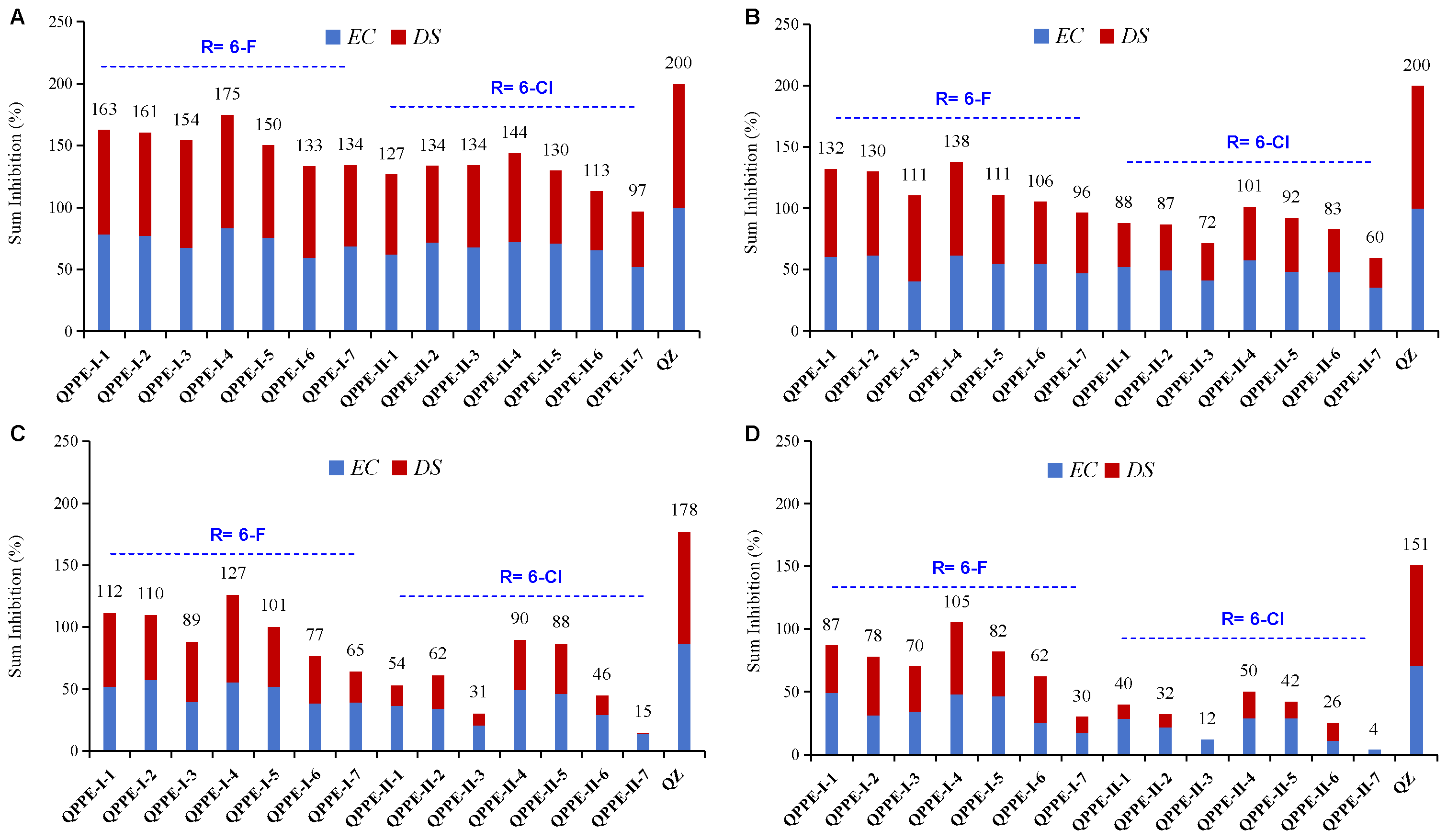
Figure 5.
Herbicidal spectrum of compound QPPE-I-4 under post-emergence conditions at the dosage of 150 g ha-1; Abbreviation: EC, E. crusgalli; DS, D. sanguinalis; SA, S. alterniflora; ED, E. dahuricus; EI, E. indica; PA, P. alopecuroides; SV, S. viridis.
Figure 5.
Herbicidal spectrum of compound QPPE-I-4 under post-emergence conditions at the dosage of 150 g ha-1; Abbreviation: EC, E. crusgalli; DS, D. sanguinalis; SA, S. alterniflora; ED, E. dahuricus; EI, E. indica; PA, P. alopecuroides; SV, S. viridis.
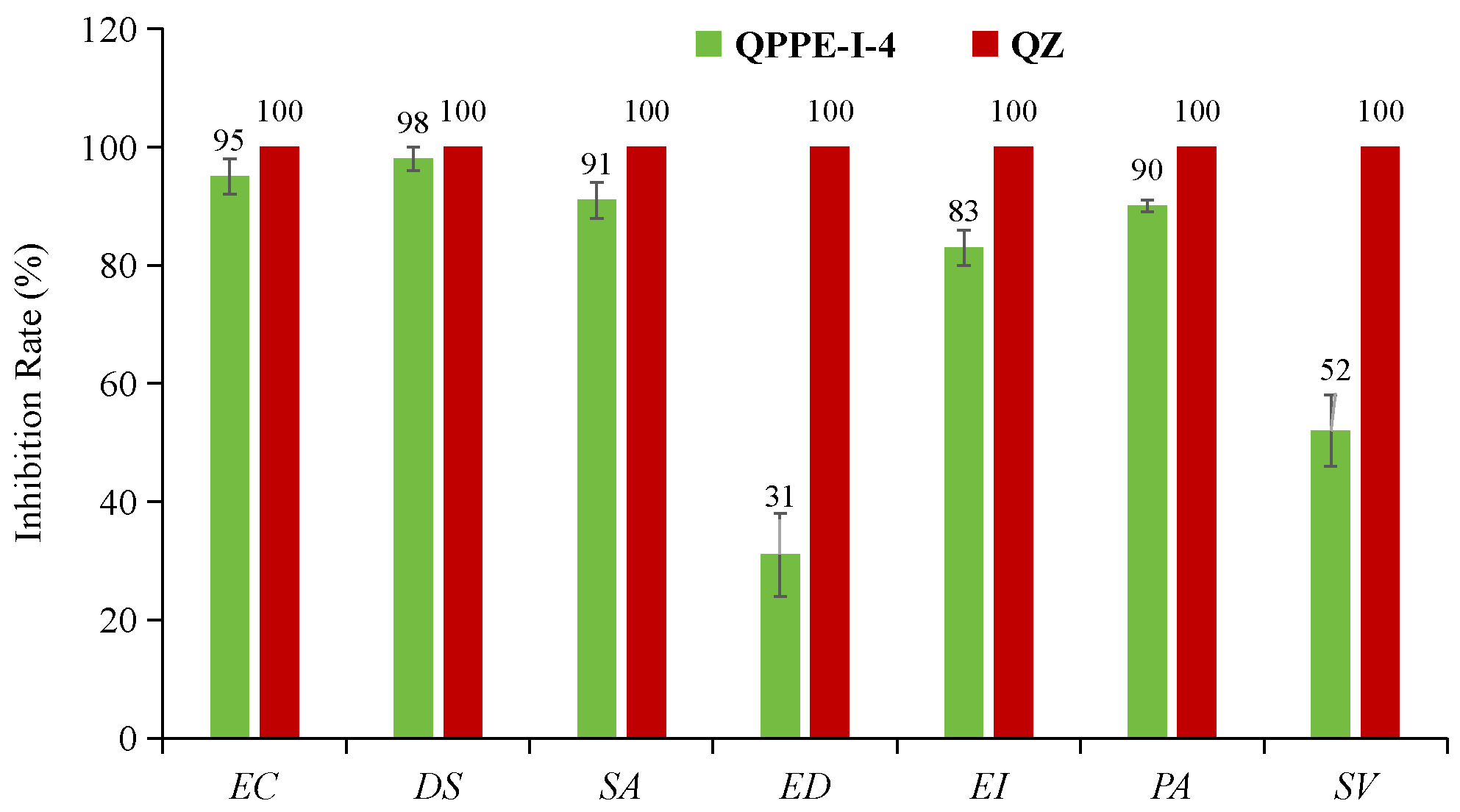
Figure 6.
Phenotype of P. miliaceum seedlings (A, control; B, treated with QPPE-I-4; C, treated with QZ) and TEM images of P. miliaceum leaf cells (control: D, E and F; treated with QPPE-I-4: G, H and I).
Figure 6.
Phenotype of P. miliaceum seedlings (A, control; B, treated with QPPE-I-4; C, treated with QZ) and TEM images of P. miliaceum leaf cells (control: D, E and F; treated with QPPE-I-4: G, H and I).
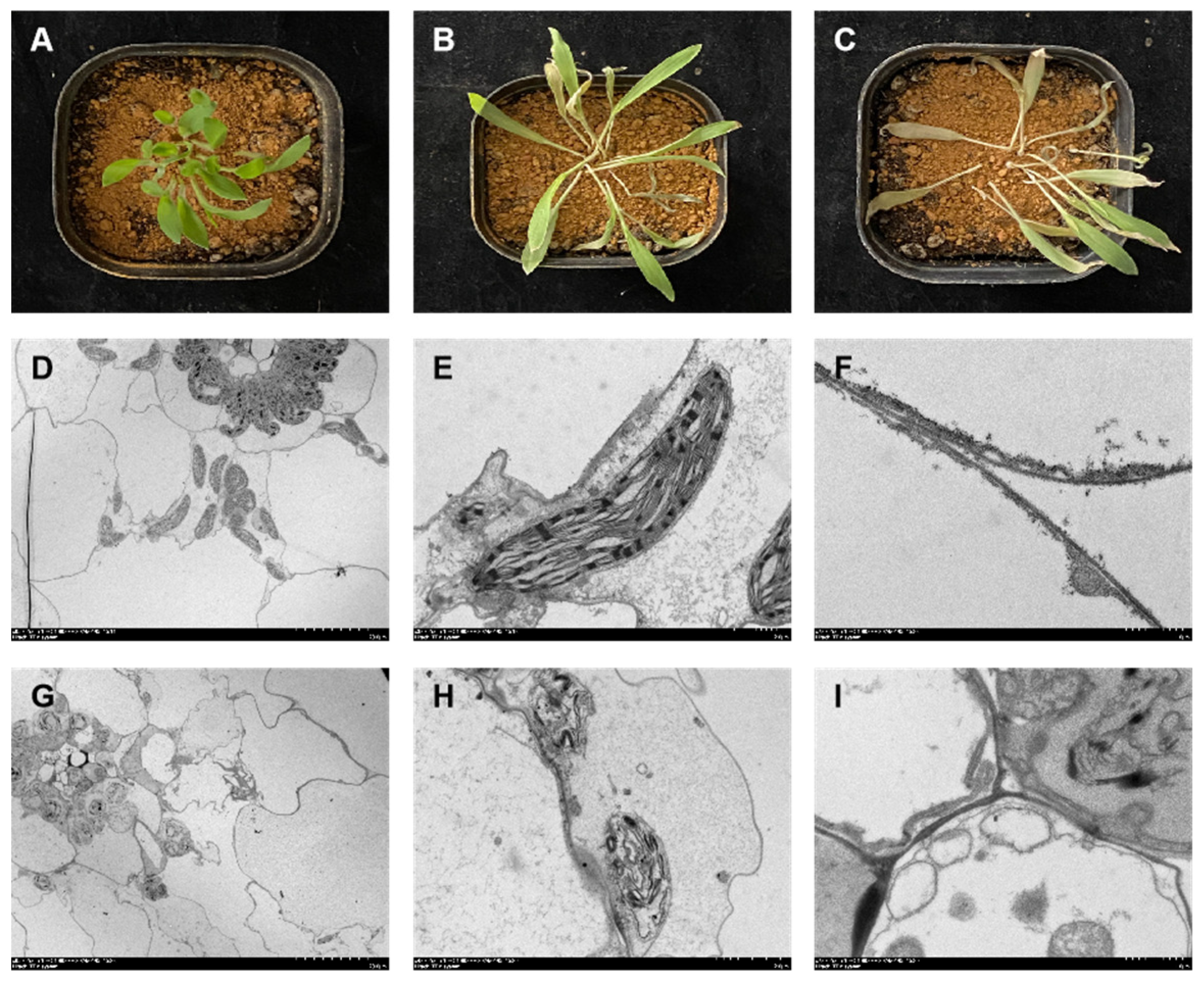
Figure 7.
Effect of QPPE-I-4 and QZ on leaf cell permeability determined by changes in conductance of the ambient solution.
Figure 7.
Effect of QPPE-I-4 and QZ on leaf cell permeability determined by changes in conductance of the ambient solution.
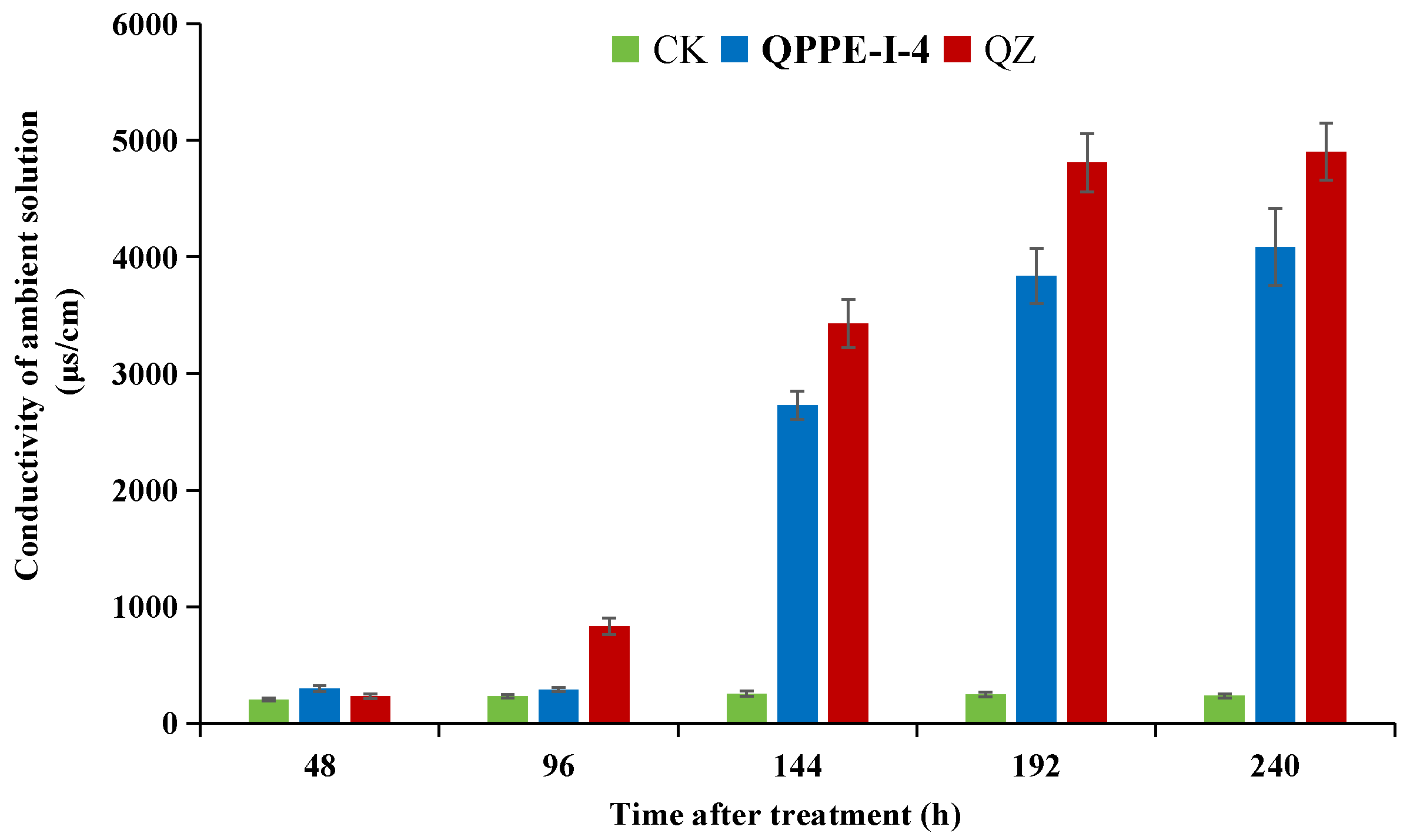
Figure 8.
Bar chart (A) and Volcano plot (B) of gene expression in P. miliaceum leaves after treated with QPPE-I-4 for 1 h.
Figure 8.
Bar chart (A) and Volcano plot (B) of gene expression in P. miliaceum leaves after treated with QPPE-I-4 for 1 h.
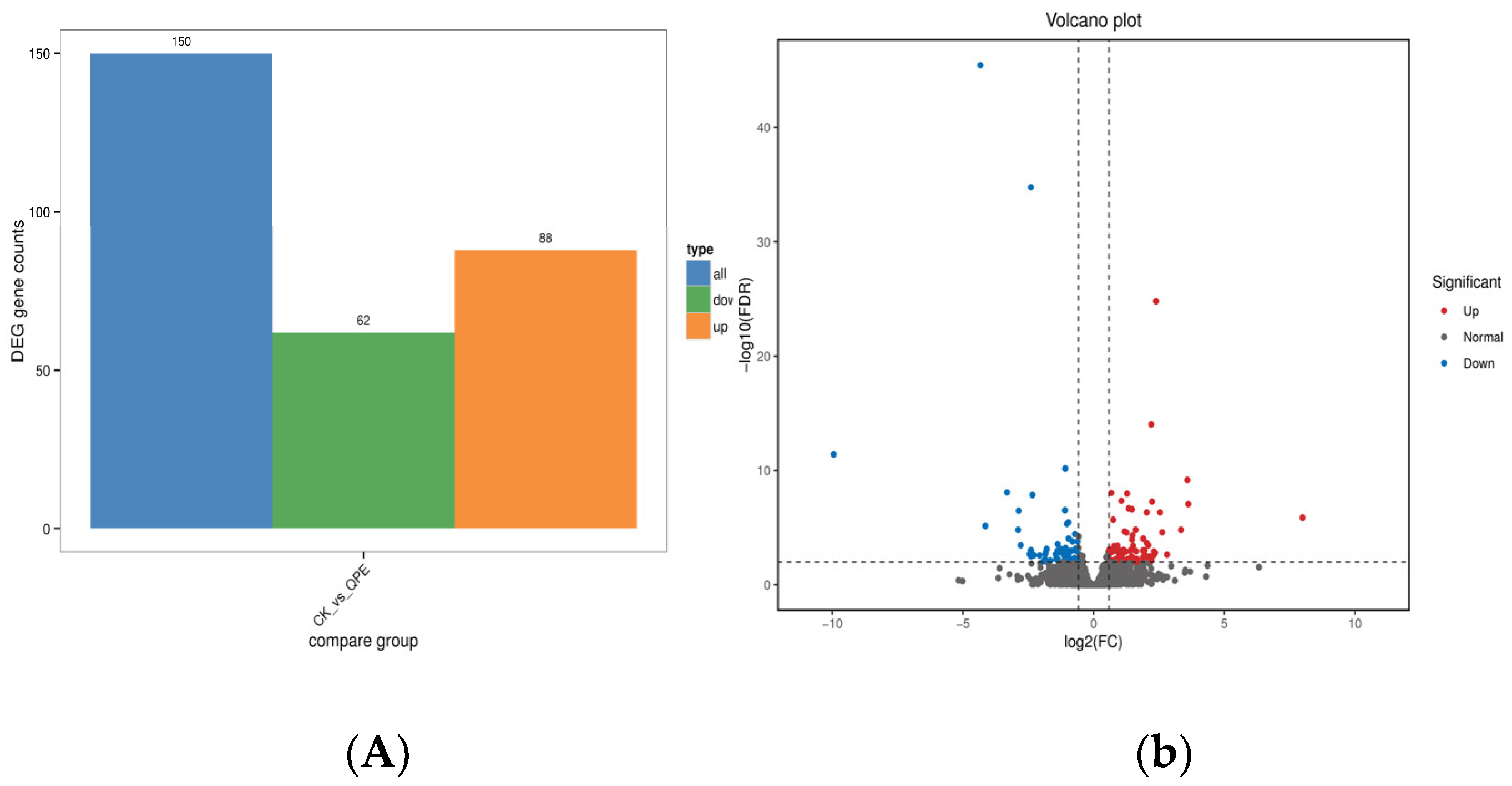
Figure 9.
RNA sequencing analysis of P. miliaceum treated by QPPE-I-4. (A) KEGG analysis of differential expression genes; GO analysis of differential expression genes: (B), cell component; (C), molecular function; (D), biological process.
Figure 9.
RNA sequencing analysis of P. miliaceum treated by QPPE-I-4. (A) KEGG analysis of differential expression genes; GO analysis of differential expression genes: (B), cell component; (C), molecular function; (D), biological process.
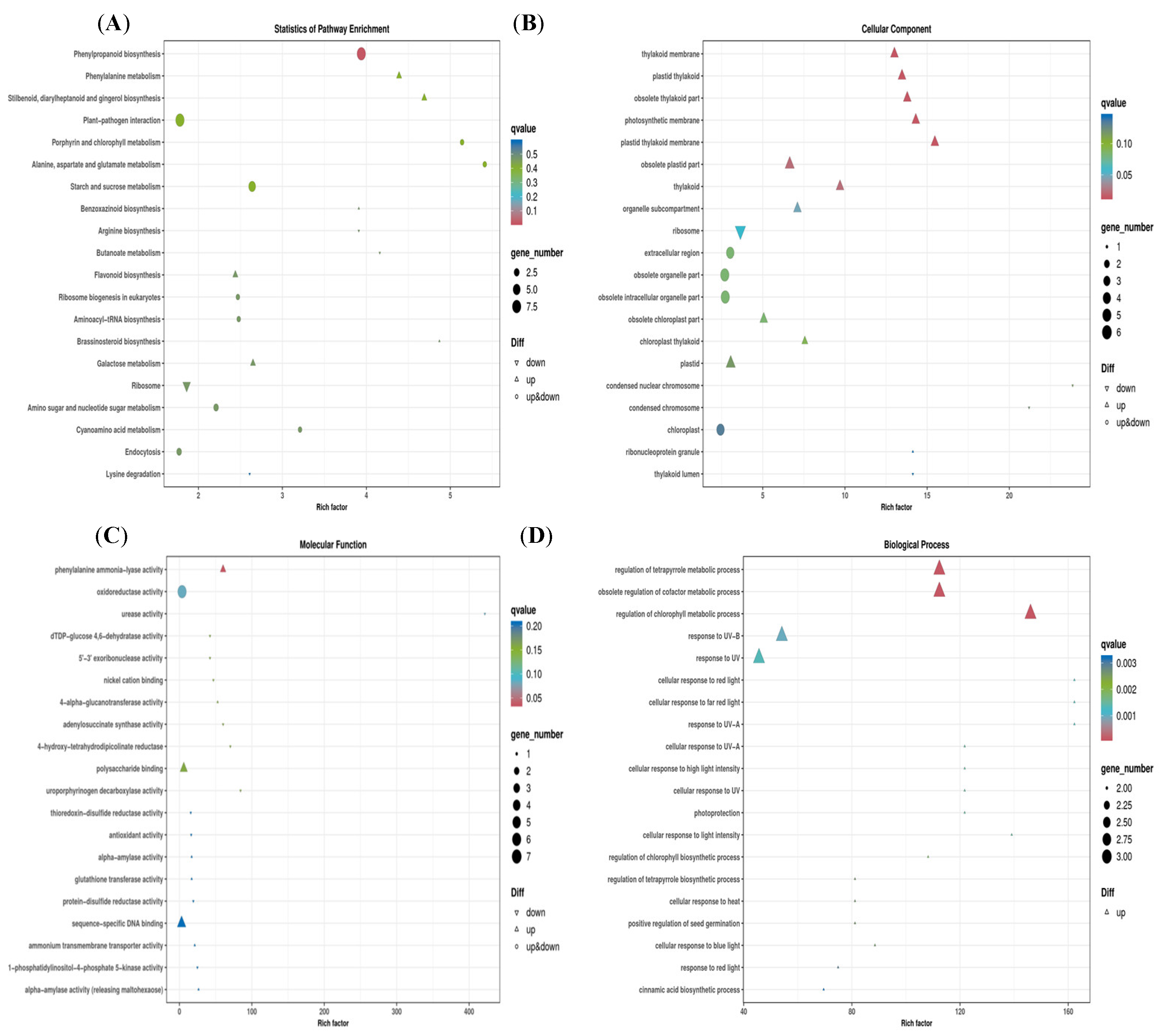
Figure 10.
In vivo inhibition of ACCase activity by QPPE-I-4 and QZ at different treatment time at a dosage of 150 g ha-1; Vertical bars represent mean ± SD; Some error bars of mean ± SD are obscured by data symbols.
Figure 10.
In vivo inhibition of ACCase activity by QPPE-I-4 and QZ at different treatment time at a dosage of 150 g ha-1; Vertical bars represent mean ± SD; Some error bars of mean ± SD are obscured by data symbols.
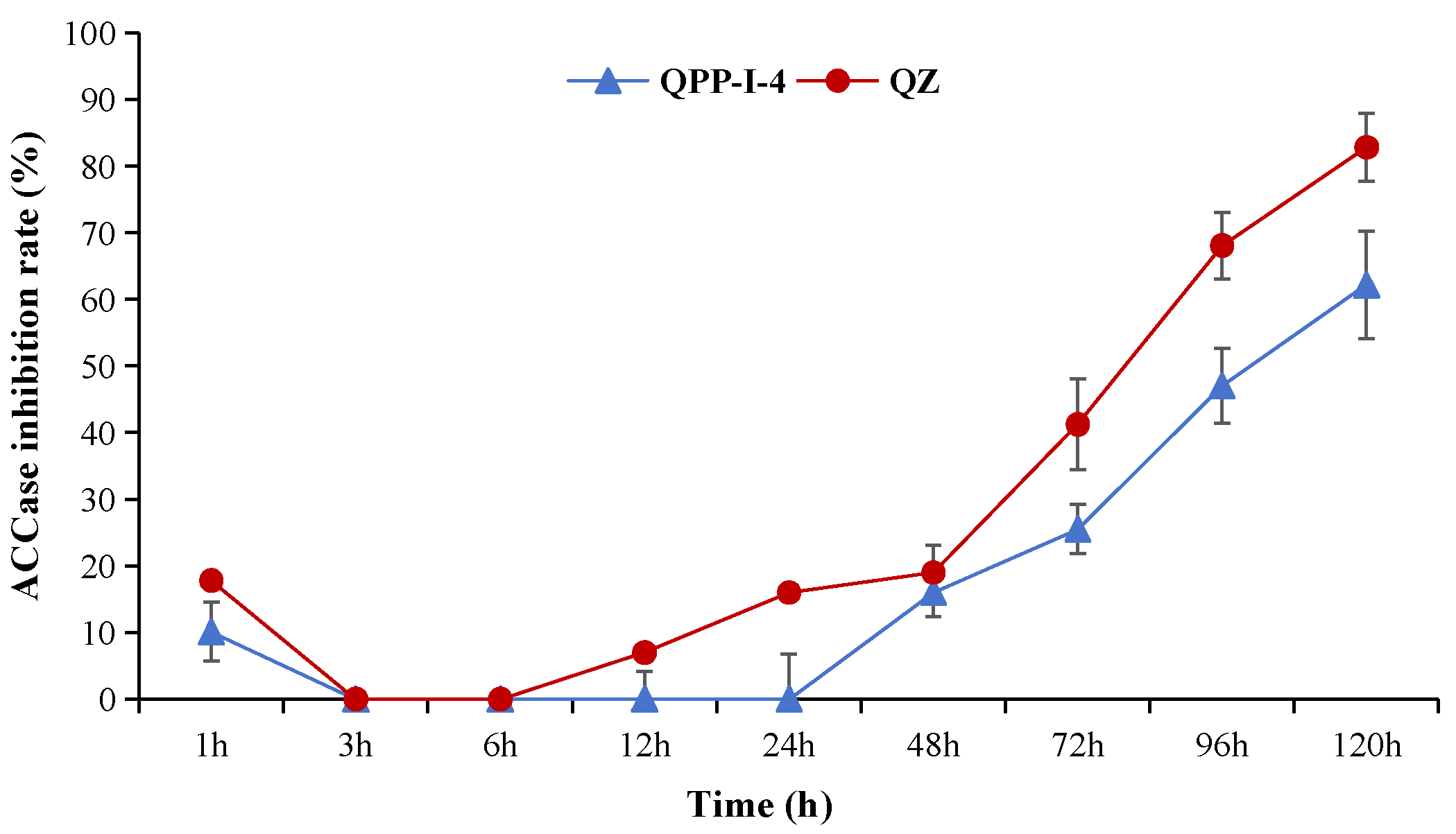

Table 1.
Crop safety of compound QPPE-I-4 and QZ at the dosage of 150 g ha-1 (Injury Rate)a.
| Comp. | % Injury | ||||||
| O. sativa | Z. mays | T. aestivum | P. miliaceum | G. hirsutum | G. max | A. hypogaea | |
| QPPE-I-4 | 74±3 | 79±5 | 81±3 | 92±4 | 0 | 0 | 0 |
| QZ | 100 | 88±2 | 91±4 | 100 | 19±3 | 14±4 | 17±3 |
a Each value represents the mean ± SD of three experiments.
Disclaimer/Publisher’s Note: The statements, opinions and data contained in all publications are solely those of the individual author(s) and contributor(s) and not of MDPI and/or the editor(s). MDPI and/or the editor(s) disclaim responsibility for any injury to people or property resulting from any ideas, methods, instructions or products referred to in the content. |
© 2024 by the authors. Licensee MDPI, Basel, Switzerland. This article is an open access article distributed under the terms and conditions of the Creative Commons Attribution (CC BY) license (http://creativecommons.org/licenses/by/4.0/).
Copyright: This open access article is published under a Creative Commons CC BY 4.0 license, which permit the free download, distribution, and reuse, provided that the author and preprint are cited in any reuse.


