

Submitted:
23 August 2024
Posted:
27 August 2024
You are already at the latest version
Abstract
The current study examined the relationship between creative potential, estimated with tests of divergent thinking (DT) and emotional intelligence (EI). Two DT tests were used, one commonly used to estimate creative potential (Titles Game) and the other focusing on social problems (Social Games). The youth version of the Bar-On Emotional Quotient Inventory ( EQ-i: YV) was used to measure EI. The sample comprised 244 male and female gifted (N = 125) and nongifted (N = 119) high school students in Saudi Arabia. The first objective was to examine whether the EI-DT relationship differs based on the nature of the task of the two DT tests used in the current study (Social Games vs Titles Game). The second objective was to test whether the Interpersonal and Intrapersonal subscales of EI are more associated with DT than the Adaptability and Stress Management EI subscales. Canonical correlation analysis showed that the relationship between the Social Games test and EI was stronger than the relationship between the Titles Game test and EI. Two path analyses were run: one for the total sample and the second for the gifted sample. The likelihood ratio test showed that the Social Games test was more strongly associated with EQ-i subscales than the Titles Game test for both samples. As expected, the Inter and the Intrapersonal subscales of the EQ-i were highly related to Social Games fluency and originality scores compared with Stress Management and Adaptability subscales. Limitations and future directions are discussed.
Keywords:
divergent thinking
; emotional intelligence
; Social Game test
; giftedness
1. Introduction
Arguably the key issue in early studies of creativity concerned its relationship with intelligence. One perspective was that creativity is just a particular kind of intelligence and may depend on it (cf. Getzels & Jackson, 1962). Empirical work fairly quickly refuted this view. Indeed, ever since Wallach and Kogan (1965a, 1965b), creativity and intelligence have been viewed as distinct. Not entirely distinct, however. They may be related at lower levels of intelligence. Guilford (1968) referred to this as triangular theory because bivariate scatterplots of creativity and intelligence data formed a triangle, without much dispersion at low levels of intelligence but quite a bit of variability at the upper levels. This implies that, at the upper levels of intelligence, an individual may be creative, but it is far from guaranteed. This view is also described by threshold theory, named because data suggested that there is a minimum level (or threshold) of intelligence that is necessary for creative performances (Runco & Albert, 1987). Various empirical efforts, including meta-analyses, have supported threshold theory (Gerwing et al. 2021; Kim, 2005), although the actual relationship of creativity and intelligence depends a great deal on what measures are used to quantify each (Runco & Albert, 1987).
More broadly, the creativity-intelligence relationship depends on the underlying definitions, given that both “intelligence” and “creativity” have been defined in diverse ways. The current study examined the relationship between creative potential, estimated with tests of divergent thinking (DT), and one particular kind of intelligence, namely emotional intelligence (EI). Two DT tests were used, one commonly used to estimate creative potential, and the other having a focus on social problems. The idea here was that the latter might be more strongly associated with EI than a more general test of DT. Along similar lines, a second objective of this investigation was to examine whether or not DT tests used in the current study would be more highly related to some EI subscales than others. In sum, one hypothesis was that the relationship would depend on the DT test type, and the second hypothesis was that the DT-EI relationship would differ based on EI subscales. These hypotheses were suggested by previous research, which is summarized below.
Emotional Intelligence and Creativity
The relationship between creativity and emotions has been studied for decades (e.g., Isen, 1999; Kaufmann & Vosberg, 1990), but interest seems to be on the rise (Hoffmann et al., 2021; Ivcevic & Hoffmann, 2019; Ivcevic et al., 2023; Newton, 2013; Sundquist & Lubart, 2022). The general conclusion is that creativity and emotions, although distinct in several ways, are not totally independent (Storbeck & Clore, 2007). There are important implications of this conclusion. A highly creative student might, for example, not perform well on a DT test, not because of his or her low DT skills, but perhaps because of test anxiety or the fear of being less creative than his or her peers. Ivcevic and Hoffmann (2019) recently demonstrated that emotions can fuel creativity. Two meta-analyses reported that positive mood can enhance creativity (Baas et al., 2008; Davis, 2009).
EI in particular might be related to creativity. For instance, the Interpersonal component of EI (one of the core components examined in the current study) may be related to creativity when an individual must convince others about his or her creative idea or product (i.e., persuasion; Simonton, 1995). Further, EI and creativity may each require some degree of Adaptability, which is an essential element of EI and creativity (Bar-On, 2006; Cohen, 1989; Kim & Pierce, 2013; Petrides et al., 2007; Runco, 1999; Sternberg et al., 2019). EI is defined in the current study as “a cross-section of interrelated emotional and social competencies, skills, and facilitators that determine how effectively we understand and express ourselves, understand others and relate with them, and cope with daily demands and challenges” (Bar-On, 2006, p. 563).
Previous research has investigated the relationship between DT and EI (Ferdowsi & Razmi, 2022; Geher et al., 2017; Giancola et al., 2024; Şahin, 2016; Sanchez-Ruiz et al., 2011; Sordia et al., 2019; Tong et al., 2022; Tu et al., 2020). Perhaps the most comprehensive work in this area was a meta-analysis conducted by Xu et al. (2019), which reported a moderate relationship between creativity and EI (r = .32). This overall effect size was, however, based on EI and varied measures of creativity, such as creative personality, creative behavior, creative product, and DT. Individual studies on the relationship between EI and DT have shown mixed results. This probably reflects the different EI and DT assessments used, different indices of DT, task modality (figural vs. verbal DTs), and other factors such as gender, age, and culture. Xu et al. (2019) did not examine DT-related factors (i.e., test type, DT indices), nor did they examine the difference in the relationship between EI and DT, looking at specific EI assessment type (i.e., ability EI vs. trait EI). The current study re-examined the relationship between EI, measured by The Bar-On Emotional Quotient Inventory Youth Version (Bar-On & Parker, n.d.), and creative potential, as measured by two DT tests. One DT test was Titles, which has been called the best test of DT (Guilford, 1968; Runco et al., 2016). It has not been used previously in research on EI. Typically, DT in previous research on EI used the Alternative Uses Test or the Torrance Tests of Creative Thinking (Xu et al., 2019). The other DT test employed here was a relatively new assessment. It was chosen because it would seem to require EI (or some components of it), such as Interpersonal and Intrapersonal subscales. It assesses individuals’ ability to think about social problems and generate as many ideas as possible for these problems.
There is evidence that different DT tests elicit different performances (Erwin et al., 2022; Runco et al., 2016), which explains the hypothesis that DT-EI relationship will be affected by the DT measure used. The same applies to the EI measure used (Abdulla Alabbasi et al., 2021; O’Connor et al., 2019; Zeidner et al., 2005). Zeidner et al. (2005) examined differences between gifted and nongifted students using two different EI tests: (a) the Mayer–Salovey–Caruso Emotional Intelligence Test (MSCEIT) and (b) the Schutte Self-Report Inventory (SSRI). Zeidner et al. (2005) found that gifted students scored higher on the MSCEIT but lower on the SSRI than their nongifted peers. In a meta-analysis on the difference between gifted and nongifted students in EI, Abdulla Alabbasi et al. (2021) found that gifted students outperformed nongifted students, and the EI measures was a significant moderator.
This is the first investigation to examine the specific components of EI (Interpersonal and Intrapersonal subscales) as they may be related to two creative potential tests. The main hypothesis was that the relationship between the Interpersonal and Intrapersonal subscales of the EI, with the Social Games test would be stronger than those using other EI subscales (i.e., Adaptability and Stress Management) because (a) the task nature of the Social Games and (b) research sometimes showing only moderate correlations between Interpersonal and Intrapersonal subscales (.39 to .75; Ghenaati & Naeini, 2019; Tommasi et al., 2023). A second objective also confirms that the present study offers a unique contribution to the creativity and EI literature. This involved taking giftedness status into account in the analyses of the relationship between DT and EI. The rationale here was that recent evidence showed that gifted students are more emotionally intelligent than their nongifted peers (Abdulla Alabbasi et al., 2021; Ogurlu, 2021) and are more creative than nongifted students (Abdulla Alabbasi et al., 2024; Dereli, 2023; Kahveci & Akgul, 2019). With few exceptions (Chan, 2005; Şahin et al., 2016; Şahin, 2016; Sanchez & Blanc, 2023), the EI-DT relationship was studied with gifted samples, and none of these works examined the difference in the EI-DT relationship based on giftedness status. A third novel contribution of the current investigation was its use of canonical correlation and path analysis to compare the association between EI and two tests of creative potential for the total sample and the gifted sample. This statistical approach minimizes the possibility of Type 1 errors. In sum, the present research addressed the following questions:
- Would the EI-DT relationship differ based on the nature of the task of the two DT tests used in the current study (Social Games vs Titles Game)?
- Would the Interpersonal and Intrapersonal subscales of EI be more associated with DT than the Adaptability and Stress Management EI subscales?
2. Method
2.1. Participants and Procedures
The sample comprised 244 male and female high school students in Saudi Arabia in the tenth, eleventh, and 12th grades (Mage = 15.74; SD = .93). The sample included both gifted (N = 125; 54 boys and 71 girls) and nongifted (N = 119; 63 boys and 56 girls). Since education in Saudi Arabia is segregated by gender, a male author collected data from boys’ schools, and a female researcher collected data from girl’s schools. Participants were recruited randomly from two high schools in the Northern region of Saudi Arabia after obtaining approval from the General Directorate of Tabuk City, Ministry of Education (Approval ID: 4400753371; date of approval: January 23, 2023), and consent from their parents. The involvement in the study was voluntary, and there was no credit for participation. The gifted and the nongifted students were recruited from the same schools since the gifted education program in Saudi Arabia is based on a pull-out method. Both groups study together; the only difference is that gifted students receive enrichment programs/classes (i.e., pull-out) in the area where they show exceptionality (i.e., science, math, languages, etc.). According to the National Center for Assessment in Saudi Arabia, the first step in the identification process is a self or a teacher nomination. The student/teacher registers in a special online portal for both types of nominations. The nomination begins in October of each academic year. The following four assessments are being administered for the final selection of gifted learners: (a) a mental flexibility test, (b) a scientific and mechanical reasoning test, (c) a mathematical and spatial reasoning test, and (d) a linguistic reasoning and reading comprehension test. All the assessments were developed and normed for use in Saudi Arabia. Those who score at or above the 95th percentile in at least two tests (and above the 90th percentile in the third) are being selected for the gifted program (for more details on the identification process in Saudi Arabia, see Abdulla Alabbasi et al., 2024).
A booklet with a unique code was printed for each participant. The first page included the consent form to be signed by students, followed by (a) the demographics page (age, grade, sex, parents’ education, birth order, and family size), (b) the Titles Game test, (c) the Bar-On Emotional Quotient Inventory: Youth Version (Bar-On EQ-i: YV), and (d) the Social Game test.
The tests were administered in the second class/session for consistency in both the boys’ and girls’ schools. The authors/data collectors were available to answer any questions before the start of the test session. All DT tasks were untimed, and “be fluent and creative” instructions were emphasized (see the Method section). This follows from the evidence that untimed tests best support originality (Paek et al., 2021; Wallach & Kogan, 1965) and that explicit instructions result in higher DT performance (Acar et al., 2020; Said-Metwal et al., 2020). The Bar-On EQ-i: YV was also administered under an untimed condition. The average time for completing the test sessions was 43.73 minutes.
2.2. Instruments
Titles Test. The Titles test was administered to assess participants’ fluency and originality. Titles was developed by Guilford (1968) and has been used in several recent studies (Runco & Abdulla Alabbasi 2024; Runco et al., 2016). Runco and Abdulla Alabbasi (2024) reported a predictive validity of .73 between Titles and the Creative Activity and Accomplishment Checklist. Runco and Abdulla Alabbasi (2024) reported reliability coefficients of .84 for fluency, .81 for flexibility, and .79 for originality. The original version of Titles gave a paragraph and asked respondents to list possible titles. The newer version presents the title of a famous book or movie, and respondents are asked to list optional titles. To ensure that all participants in the present research were familiar with the titles used in each of the three tasks, three classes representing 10th, 11th, and 12th-grade male and female students from the same schools as the experimental participants were asked to rate 10 movies with which they were the most familiar (1 being more familiar and 10 being less familiar). The task was simple: indicate the best movies from 1 to 10. The questionnaire was distributed using Google Forms. After collecting all responses, the top three frequent movies were: Toy Story, Harry Potter, and Star Wars. The directions for the Titles test were as follows: “List alternative titles for the movies below. Spelling does not matter, and there are no grades for this. Have fun and list as many alternatives as you can.”
Titles was scored for fluency and originality. Fluency is defined as the number of unique and unrepeated ideas related to the stimuli. Originality is defined in terms of the statistical infrequency of responses related to the task (Runco, 1991). The present study scored originality using a 1% cut-off, so ideas given by 1% of the sample or less contributed to the originality score.
The Social Games. Runco (2011) developed the Social Games Test as part of the Runco Creativity Assessment Battery (r-CAB). It asks participants to generate options for various social situations. Each task is open-ended and thus allows scoring like other divergent thinking tests. It is categorized as a realistic test of DT because the social situations are things that could occur in the natural environment. Runco et al. (2024), for example, used Social Games along with other realistic tests of DT in their comparison of different GAI platforms. That previous project did not have human subjects (only GAI platforms), so there is no previous reliability; but of course, we report the reliability of Social Games below, in the Results.
Three Social Games activities were used in the current study. Participants were asked, one at a time, to list (a) different ways of conveying to someone that they are not dressed appropriately, (b) different ways to convey the idea that the meal your friend just prepared for you does not taste good (in fact, it tastes bad!), and (c) different ways for conveying the idea that someone’s performance (say, in a sport, or on a test) was very poor. The verbatim directions for Social Games were as follows:
Sometimes, we must find a polite way to say things to others. This allows you to change how you say something so that it is socially acceptable. You will be given a blunt expression (“you have body odor”) and should list as many different ways of conveying that idea to someone–but using different wording and perhaps nuance, euphemism, or simply ambiguity. There are no grades or points, and spelling does not matter. This is not a test; it is a game. The objective is to list as many different ways as possible to convey the target idea. Instead of saying, “you have body odor,” you might say “do you smell something?” or “Have you been working out?” Or have you tried that new high-tech deodorant?” There are many ways of expressing the target idea, and the most you list, the better!
The Bar-On Emotional Quotient Inventory: Youth Version (Bar-On EQ-i: YV). The current study used a short youth version of the EQ-i. The youth version of the EQ-i was designed for individuals from 7 to 18 years old and it assesses four subskills: (a) adaptability, (b) interpersonal skills, (c) intrapersonal skills, and (d) stress management. The EQ-i is a self-report mixed-model assessment of EI. Bar-On and Parker (n.d) reported the reliability of the short youth version of the EQ-i, which ranged between .65 and .87. Many studies demonstrated the validity and the reliability of the EQ-i in different cultures (Al-Hamdan et al., 2017; Bar-On, R., & Parker, n.d; Esnaola et al., 2018a; Esnaola et al., 2018b; Navarro-Roldán et al., 2023; Stanimirovic & Hanrahan, 2012). The EQ-i was translated and normed in different Arab countries, including Bahrain, Lebanon, and Jordan (Al-Hamdan et al., 2017; Al-Nabhan, 2008; El Hassan & El Sader, 2005). Participants rate each item on a 4-point Likert scale ranging from 1 (very seldom true of me) to 4 (very often true of me).
3. Results
3.1. Reliability
Cronbach’s alpha was used to assess the reliability of the Social Games test, the Titles Game test, and EQ-i. The Cronbach’s alpha for Social Games fluency and originality were .84 and .63, respectively. The Cronbach’s alpha for the Titles Game fluency and originality were .87 and .79, respectively. Finally, the Cronbach’s alpha for the EQ-i Intrapersonal, Interpersonal, Adaptability, Stress Management, and Total EQ-I were .76, .78, .84, .76, and .84, respectively.
3.2. Differences between Gifted and Nongifted Students in DT
Before testing our primary research question of the current investigation, it was reasonable to examine the differences between gifted and nongifted students on the two DT tests, especially since the Social Games test is being used for the first time with human subjects. Four one-way analyses of variance (ANOVAs) were run to test whether gifted and nongifted students’ performance on the Titles Game differed from performance on Social Games. A Bonferroni correction was used to control for type I error; thus, the significant level was .0125 (.05 / 4). The results showed that gifted students outperformed their nongifted peers in: (a) Social Games fluency, F(1, 242) = 148.76, p < .001, η2 = .381, (b) Social Games originality, F(1, 242) = 73.13, p < .001, η2 = .232, (c) Titles Games fluency, F(1, 242) = 113.29, p < .001, η2 = .319, and (d) Titles Games originality, F(1, 242) = 21.83, p < .001, η2 = .083.
Four paired-sample t-tests were run to test which DT test elicits more fluency and originality. Again, a Bonferroni correction was used to control for type I error with a significant level of .0125. For the gifted sample, the results showed that the Social Games elicited more ideas (fluency) than the Titles Game, t(124) = 42.58, p < .001, d = 2.38, and more unique ideas (originality) than the Titles Game, t(124) = 46.92, p < .001, d = 1.69. The same pattern was observed with the nongifted sample where the Social Games test elicited more ideas (fluency), t(118) = 42.58, p < .001, d = 2.15, and more unique ideas (originality), t(118) = 59.08, p < .001, d = 2.31. Table 1 shows descriptive statistics.
3.3. The Relationship between Social Games Test and EQ-i
The primary research question of the current investigation is whether the Social Games test, a DT test that was developed to assess DT in the interpersonal domain, would be more highly related than the Title Game. Table 2 shows the correlations between EI subscales, total EQ-i, and the two DT tests. The correlations between Social Games fluency and EI ranged between -.04 (for Stress Management) to .22 (for the total EQ-i); The correlations between Social Games originality and EI ranged between .03 (for Stress Management) to .17 (for the total EQ-i); The correlations between Titles Game fluency and EI ranged between -.03 (for Stress Management) to .23 (for Intrapersonal and total EQ-i); The correlations between Titles Game originality and EI ranged between -.02 (for Stress Management) to .20 (for Adaptability). The highest correlation between EI subscales was .63 between Inter and Intrapersonal subscales, and the lowest was .39 between Interpersonal and Stress Management subscales.
Two types of analyses were performed to answer the main research question: (a) the canonical correlation, which was used to test the overall relationship between the four EQ-i subscales and the two DT tests, and path analysis, which offers more detailed information about the association between the two DT tests used in this study and each of the EQ-i subscales.
3.3.1. Canonical Correlation Analyses
Two canonical correlation analyses were run to test whether or not Social Games fluency and originality were more highly related to EI than fluency and originality from the Titles Game. The first canonical correlation analysis included fluency and originality scores in the Social Games test and the four EI subscales. Two orthogonal variates were uncovered [Rc = .275 and .203, Wilks = .886, (F(8, 476) = 3.70, p < .001, for the first variate; .959 (F(3, 239) = 3.42, p = .018 for the second variate]. The second canonical correlation analysis included fluency and originality scores in the Titles Game test and the four EI subscales. Again, Two orthogonal variates were uncovered. The first variate was statistically significant, Rc = .239, Wilks = .937, (F(8, 476) = 1.97, p = .049, while the second variate was not statistically significant, Rc = .079, Wilks = .994, (F(8, 476) = .51, p = .678. These results suggest that the Social Game is more highly related to EI than the Ttiles Game test; however, the authors are unaware of a statistical procedure to test whether the two Rcs (.275 vs. .239) are statistically significant from one another. Therefore, we decided to examine the difference in the relationship between the Social and the Titles Games on one hand and EI on the other hand using path analysis.
3.3.2. Path Analysis
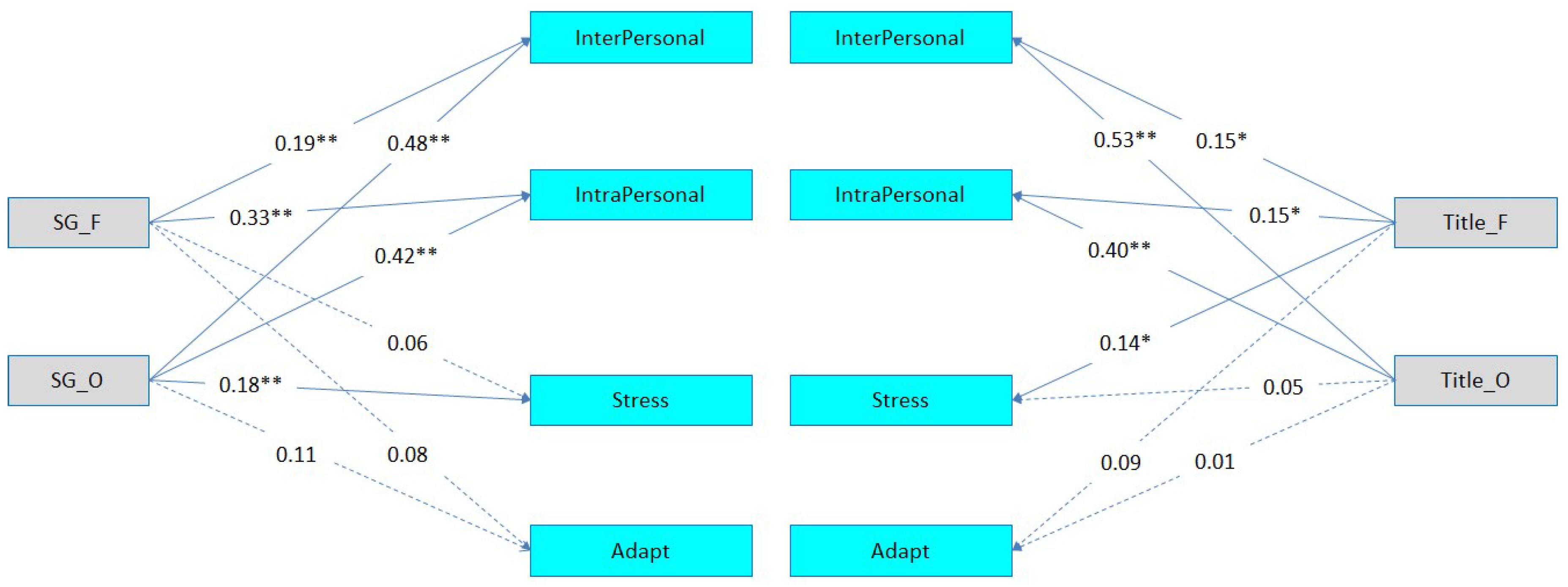
Four models were tested in the path analysis. Models 1 and 2 included the total sample, while models 3 and 4 included the gifted sample. The maximum likelihood method was used to estimate the parameters of the structural equation model. Goodness-of-fit indices for the four models are presented in Table 3. Regarding the total sample, model 1 indicated fluency from Social Games was associated with (a) Interpersonal EI (β = .19, p < .001) and (b) Intrapersonal EI (β = .33, p < .001). There were no significant associations between Social Games fluency and Stress Management nor the Adaptability subscales. Regarding the association between Social Games’ originality and EQ-i subscales, the results indicated that originality was significantly associated with (a) Interpersonal EI (β = .48, p < .001), (b) Intrapersonal EI (β = .42, p < .001), and (c) Stress Management (β = .18, p < .001). There was a nonsignificant association between originality and Adaptability (see Table 4). Model 2 shows the path analysis results between the Titles Game test (fluency and originality) and the EQ-i subscales. The results indicated that the Titles Game fluency was significantly associated with (a) Interpersonal EI (β = .15, p < .05), (b) Intrapersonal EI (β = .15, p < .05), and (c) Stress Management (β = .14, p < .05). There association between Titles Game fluency and Adaptability was nonsignificant. The Titles Game originality index was significantly associated with (a) Interpersonal EI (β = .53, p < .05) and (b) Intrapersonal EI (β = .40, p < .05). The association between Titles Game originality and both Stress Management and Adaptability were nonsignificant. The likelihood ratio test showed that Social Games (Model 1) was more strongly associated with EQ-i subscales than the Titles Game test (Model 2), ( 4.39, Δdf = 1, p = 036).
Figure 1.
Path analysis models for the study variables (total sample; N = 244). Note. SG = Social Games test; Title = Title Game test; F = fluency; O = originality; Stress = stress management; Adapt = adaptability. *p < .05. **p < .01.
Figure 1.
Path analysis models for the study variables (total sample; N = 244). Note. SG = Social Games test; Title = Title Game test; F = fluency; O = originality; Stress = stress management; Adapt = adaptability. *p < .05. **p < .01.
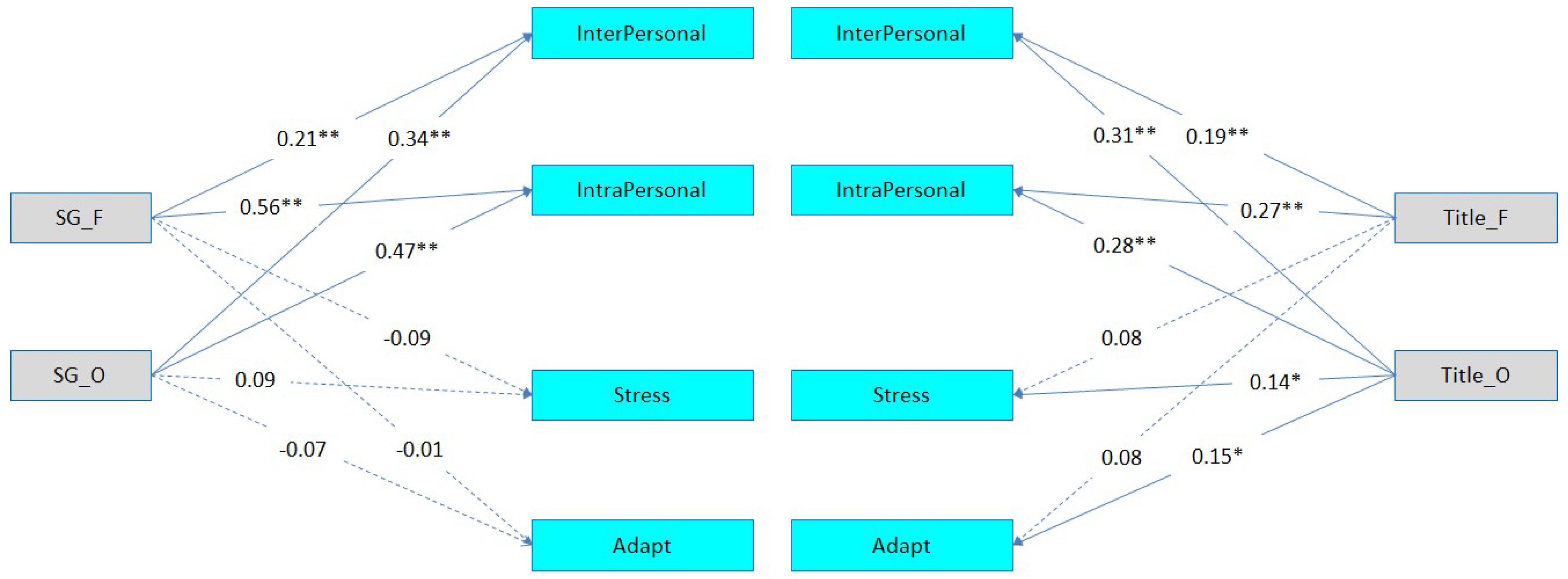
Models 3 and 4 were designed to examine the association between the Social Games and EQ-i tests for the gifted sample. The results indicated that Social Games fluency was significantly associated with (a) Interpersonal EI (β = .21, p < .001) and (b) Intrapersonal EI (β = .56, p < .001). The associations between Social Games fluency and Stress Management and Adaptability were nonsignificant. Regarding the association between Social Games’ originality and EQ-i subscales, the results indicated that there was a significant association of originality with (a) Interpersonal EI (β = .34, p < .001) and (b) Intrapersonal EI (β = .47, p < .001). The associations of originality and Stress Management and Adaptability were again nonsignificant Finally, Model 4 examined the Titles Game test (fluency and originality) and the EQ-i subscales. Results indicated that the Titles Game fluency was significantly associated with (a) Interpersonal EI (β = .19, p < .001) and (b) Intrapersonal EI (β = .27, p < .001). The associations of fluency and both Stress Management and Adaptability were not statistically significant. Originality from the Titles Game was significantly associated with (a) Interpersonal EI (β = .31, p < .001), (b) Intrapersonal EI (β = .28, p < .001), (c) Stress Management (β = .14, p < .05), and (d) Adaptability (β = .15, p < .05). As was the case with the total sample, the likelihood ratio test showed that Social Games (Model 3) was more strongly associated with EQ-i subscales than the Titles Game test (Model 4), ( 3.88, Δdf = 1, p = .049).
Figure 2.
Path analysis models for the study variables (gifted sample; N = 125). Note. SG = Social Games test; Title = Titles Game test; F = fluency; O = originality; Stress = stress management; Adapt = adaptability. *p < .05. **p < .01.
Figure 2.
Path analysis models for the study variables (gifted sample; N = 125). Note. SG = Social Games test; Title = Titles Game test; F = fluency; O = originality; Stress = stress management; Adapt = adaptability. *p < .05. **p < .01.
4. Discussion
The current investigation had two specific objectives. The first concerned a possible difference whereby one test of DT (Social Games) would be more strongly related to the Interpersonal EI scale than would the other DT test (Titles). This followed from the fact that the Social Games measure has an interpersonal emphasis, as does the Interpersonal subscale of the EQ-i measures. There was no specific hypothesis about the relationship between the Social Games test and other EI subscales, although research has previously demonstrated that the inter- and intrapersonal EI subscales are moderately to highly correlated (Ghenaati & Naeini, 2019; Tommasi et al., 2023). This was the case in the current study as well. Table 2 shows that the highest correlation between EI subscales was between the Inter- and Intrapersonal subscales (r = .63).
Path analysis results indicated that the association between Social Games fluency and originality on one hand and Inter- and Intrapersonal subscales on the other hand was higher than the association between the other two subscales (βs .19 to .33) and (βs .42 to .48) respectively. The same conclusion was reached for the Titles Game fluency and originality, (β .15) and (βs .40 to .53) respectively. When only a gifted sample was used, the results were much the same. For models 1 and 2, there were two exceptions: (a) the association between Social Games originality and Stress Management was statistically significant (β = .18), and (b) the association between Titles Game fluency and Stress Management was statistically significant (β = .14). Finally, when only gifted students were considered (i.e., models 3 and 4), the Titles Game originality and both Stress Management and Adaptability were statistically significant (β = .14) and (β = .15) respectively. Future research might investigate the relationship between DT and both Stress Management and Adaptability.
The second objective was to investigate the relevance of giftedness status on the DT-EI relationship. All students, gifted and nongifted, scored higher on the Social Games test than the Titles Game test (see Table 1). The canonical correlation between EI and DT showed that the relationship between Social Games and EI was higher than the relationship between Titles Game and EI (Rc = .275 vs .239). The path analysis confirmed that the EI-DT association was higher for the Social Games vs Titles Game tests in both the total sample (models 1 and 2) and the gifted sample (models 3 and 4).
There are limitations of this research, as well as suggestions for future directions. First is the limitation of relying on one measure of EI. Some research shows that the mixed-model measures of EI, which are self-report-based, differ from ability-based EI assessments (Abdulla Alabbasi et al., 2021; Abdulla Alabbasi et al., 2023; Goldenberg et al., 2006; Zeidner et al., 2005). Goldenberg et al. (2006) compared performance-based vs self-report-based EI assessments and concluded that these two types of measures were unrelated. Still, performance-based EI assessments have some limitations, which are discussed in detail in MacCann et al. (2003). Future research might compare the EI-DT relationship using performance-based EI assessments. The second limitation is that the findings might only generalize to academically gifted students. The EI-DT relationship might differ between different populations of gifted learners, such as artistically and musically, and academically gifted students in specific domains. Finally, future research could test cultural differences in the EI-DT relationship since much evidence shows that EI performance differs between cultures and that EI is culture-specific (Gunkel et al., 2014; Huynh et al., 2018; Pathak & Muralidharan, 2020).
References
- Abdulla Alabbasi, A. M., A. Ayoub, A. E., & Ziegler, A. (2021). Are gifted students more emotionally intelligent than their non-gifted peers? A meta-analysis. High Ability Studies, 32(2), 189–217. [CrossRef]
- Abdulla Alabbasi, A. M., Acar, S., Al-Shehri, R., & Aljasim, F. (2024). Testing the effects of time-on-task and instructions to “be creative” on gifted students. Gifted Education International, 40(1), 67 - 91. [CrossRef]
- Acar, S., Runco, M. A., & Park, H. (2020). What should people be told when they take a divergent thinking test? A meta-analytic review of explicit instructions for divergent thinking. Psychology of Aesthetics, Creativity, and the Arts, 14(1), 39–49. [CrossRef]
- Al-Hamdan, N. S., Al-Jasim, F. A., & Abdulla, A. M. (2017). Assessing the emotional intelligence of gifted and talented adolescent students in the Kingdom of Bahrain. Roeper Review, 39(2), 132–142. [CrossRef]
- Al-Nabhan, M. (2008). Bar-On Emotional Intelligence Inventory EQ-i. Manama, Kingdom of Bahrain: Arabian Gulf University.
- Alabbasi, A. M. A., Alabbasi, F. A., AlSaleh, A., Alansari, A. M., & Sequeira, R. P. (2023). Emotional intelligence weakly predicts academic success in medical programs: A multilevel meta-analysis and systematic review. BMC Medical Education, 23(1), 1 – 12. [CrossRef]
- Baas, M., De Dreu, C. K. W., & Nijstad, B. A. (2008). A meta-analysis of 25 years of mood-creativity research: Hedonic tone, activation, or regulatory focus? Psychological Bulletin, 134(6), 779–806. [CrossRef]
- Bar-On, R. (2006). The Bar-On model of emotional-social intelligence (ESI). Psicothema, 18(Suppl), 13–25.
- Bar-On, R., & Parker, J. D. A. (No year specified.). Emotional Quotient Inventory: Youth Version (BarOn EQ-i: YV™) [Database record]. APA PsycTests.
- Chan, D. W. (2005). Self-perceived creativity, family hardiness, and emotional intelligence of Chinese gifted students in Hong Kong. Journal of Secondary Gifted Education, 16(2-3), 47–56. [CrossRef]
- Cohen, L. M. (1989). A continuum of adaptive creative behaviors. Creativity Research Journal, 2(3), 169–183. [CrossRef]
- Davis, A. (2009). Understanding the relationship between mood and creativity: A meta-analysis. Organizational Behavior and Human Decision Processes, 108(1), 25 – 38. [CrossRef]
- Dereli, F. (2023). Investigation of relationship between creativity potential and scientific imagination of gifted children and comparing them with their peers. Journal of Gifted Education and Creativity, 10(3), 157–175.
- El Hassan, K., & El Sader, M. (2005). Adapting and validating the BarOn EQ–i:YV in the Lebanese context. International Journal of Testing, 5(3), 301–317. [CrossRef]
- Erwin, A. K., Tran, K., & Koutstaal, W. (2022). Evaluating the predictive validity of four divergent thinking tasks for the originality of design product ideation. PloS one, 17(3), e0265116. [CrossRef]
- Esnaola, I., Arias, V. B., Freeman, J., Wang, Y., & Arias, B. (2018a). Validity evidence based on internal structure of scores of the Emotional Quotient Inventory: Youth Version Short (EQ-i: YV-S) in a Chinese Sample. Journal of Psychoeducational Assessment, 36(6), 576–587. [CrossRef]
- Esnaola, I., Azpiazu, L., Antonio-Agirre, I., Sarasa, M., & Ballina, E. (2018b). Validity evidence of Emotional Quotient Inventory: Youth Version (Short) in a sample of Mexican adolescents. Estudios de Psicología, 39(1), 127–153. [CrossRef]
- Ferdowsi, S., & Razmi, M. H. (2022). Examining associations among emotional intelligence, creativity, self-efficacy, and simultaneous interpreting practice through the mediating effect of field dependence/independence: A path analysis approach. Journal of psycholinguistic research, 51(2), 255–272. [CrossRef]
- Geher, G., Betancourt, K., & Jewell, O. (2017). The link between emotional intelligence and creativity. Imagination, Cognition and Personality, 37(1), 5–22. [CrossRef]
- Gerwig, A., Miroshnik, K., Forthmann, B., Benedek, M., Karwowski, M., & Holling, H. (2021). The relationship between intelligence and divergent thinking: A meta-analytic update. Journal of Intelligence, 9(2), 1 – 28. [CrossRef]
- Getzels, J. W., & Jackson, P. W. (1962). Creativity and intelligence: Explorations with gifted students. Wiley.
- Ghenaati, Z., & Naeini, M. (2019). Interrelationships of emotional intelligence with the awareness of request and apology strategies in an EFL setting. Indonesian Journal of Applied Linguistics, 9(1), 148-156. c. [CrossRef]
- Giancola, M., Palmiero, M., & D’Amico, S. (2024). Divergent but not convergent thinking mediates the trait emotional intelligence-real-world creativity link: An empirical study. Creativity Research Journal, 36(1), 15–23. [CrossRef]
- Goldenberg, I., Matheson, K., & Mantler, J. (2006). The Assessment of emotional intelligence: A comparison of performance-based and self-report methodologies. Journal of Personality Assessment, 86(1), 33–45. [CrossRef]
- Guilford, J. P. (1968). Intelligence, creativity, and their educational implications. Robert R. Knapp.
- Gunkel, M., Schlägel, C., & Engle, R. L. (2014). Culture’s influence on emotional intelligence: An empirical study of nine countries. Journal of International Management, 20(2), 256–274. [CrossRef]
- Hoffmann, J. D., Ivcevic, Z., & Maliakkal, N. (2021). Emotions, creativity, and the arts: Evaluating a course for children. Empirical Studies of the Arts, 39(2), 123–148. [CrossRef]
- Huynh, A. C., Oakes, H., & Grossmann, I. (2018). The role of culture in understanding and evaluating emotional intelligence. In K. V. Keefer, J. D. A. Parker, & D. H. Saklofske (Eds.), Emotional intelligence in education: Integrating research with practice (pp. 111–132). Springer International Publishing/Springer Nature. [CrossRef]
- Isen, A. M. (1999). On the relationship between affect and creative problem solving. Brunner and Mazel.
- Ivcevic, Z., & Hoffmann, J. (2019). Emotions and creativity: From process to person and product. In J. C. Kaufman & R. J. Sternberg (Eds.), The Cambridge handbook of creativity (2nd ed., pp. 273–295). Cambridge University Press. [CrossRef]
- Ivcevic, Z., Hoffmann J. D., & Kaufman, J. C. (Eds.) (2023). The Cambridge handbook of creativity and emotions. Cambridge University Press. [CrossRef]
- Kahveci, N. G., & Akgul, S. (2019). The relationship between mathematical creativity and intelligence: A study on gifted and general education students. Gifted and Talented International, 34(1–2), 59–70. [CrossRef]
- Kaufmann, G., & Vosburg, S. K. (1997). “Paradoxical” mood effects on creative problem-solving. Cognition and Emotion, 11(2), 151–170. [CrossRef]
- Kim, K. H. (2005). Can only intelligent people be creative? A meta-analysis. Journal of Secondary Gifted Education, 16(2-3), 57–66. [CrossRef]
- Kim, K.H., Pierce, R.A. (2013). Adaptive creativity and innovative creativity. In E.G. Carayannis, (Eds.) Encyclopedia of creativity, invention, innovation and entrepreneurship. Springer, New York, NY. [CrossRef]
- MacCann, C., Matthews, G., Zeidner, M., & Roberts, R. D. (2003). Psychological assessment of emotional intelligence: A review of self-report and performance-based testing. The International Journal of Organizational Analysis, 11(3), 247–274. [CrossRef]
- Navarro-Roldán, C. P., Mateus-Gómez, S., Botero Ruge, C., & Velez, G. (2023). Validity and reliability of Spanish version of the EQ-i: YV[S] in Colombian children and youth. International journal of psychological research, 16(1), 29–40. [CrossRef]
- Newton, D. P. (2013). Moods, emotions and creative thinking: A framework for teaching. Thinking Skills and Creativity, 8, 34–44. [CrossRef]
- O’Connor, P. J., Hill, A., Kaya, M., & Martin, B. (2019). The measurement of emotional intelligence: A critical review of the literature and recommendations for researchers and practitioners. Frontiers in Psychology, 10, 1116, 1 – 19. [CrossRef]
- Ogurlu, U. (2021). A meta-analytic review of emotional intelligence in gifted individuals: A multilevel analysis. Personality and Individual Differences, 171, 110503, 1 – 11. [CrossRef]
- Paek, S., Abdulla Alabbasi, A. M., Acar, S., & Runco, M. A. (2021). Is more time better for divergent thinking? A meta-analysis of the time-on-task effect on divergent thinking. Thinking Skills and Creativity, 41(September), 1 – 15. [CrossRef]
- Pathak, S., & Muralidharan, E. (2020). Implications of culturally implicit perspective of emotional intelligence. Cross-Cultural Research, 54(5), 502–533. [CrossRef]
- Petrides, K. V., Pita, R., & Kokkinaki, F. (2007). The location of trait emotional intelligence in personality factor space. British journal of psychology, 98(Pt 2), 273–289. [CrossRef]
- Runco, M. A. (1991). The evaluative, valuative, and divergent thinking of children. The Journal of Creative Behavior, 25(4), 311–319. [CrossRef]
- Runco, M. A. (1999). Tension, adaptability, and creativity. In S. W. Russ (Ed.), Affect, creative experience, and psychological adjustment (pp. 165-194). Taylor & Francis.
- Runco, M. A. & Abdulla Alabbasi, A. M. (2024). Interactions among dimensions of divergent thinking as predictors of creative activity and accomplishments. Thinking Skills and Creativity, 53 (September), 1 – 11. [CrossRef]
- Runco, M. A., & Albert, R. S. (1987). The threshold hypothesis regarding creativity and intelligence: an empirical test with gifted and nongifted children. Creative Child and Adult Quarterly, 11, 212 – 218.
- Runco, M. A., Abdulla, A. M., Peak, S., Aljasim, F. A., & AlSuwaidi, H. N. (2016). Which test of divergent thinking is best? Creativity. Theories- Research- Applications, 3(1), 4 – 18. [CrossRef]
- Runco, M. A., Turkman, B., Acar, S., & Abdulla Alabbasi, A. M. (under review). Examining the idea density and semantic distance of AI responses to tests of divergent thinking. [Manuscript submitted for publication].
- Şahin, F. (2016). General intelligence, emotional intelligence and academic knowledge as predictors of creativity domains: A study of gifted students. Cogent Education, 3(1), 1 – 16. [CrossRef]
- Sahin, F., Özer, E., & Deniz, M. E. (2016). The predictive level of emotional intelligence for the domain-specific creativity: A study on gifted students. Egitim ve Bilim, 41(183), 181– 197. [CrossRef]
- Said-Metwaly, S., Fernández-Castilla, B., Kyndt, E., & Van den Noortgate, W. (2020). Testing conditions and creative performance: Meta-analyses of the impact of time limits and instructions. Psychology of Aesthetics, Creativity, and the Arts, 14(1), 15–38. [CrossRef]
- Sanchez C, Blanc N. (2023). Abstract graphic creativity, feelings about school, and engagement in the school environment: What are the interindividual differences between gifted and non-gifted children? Journal of Intelligence, 11(1). [CrossRef]
- Sánchez-Ruiz, M. J., Hernández-Torrano, D., Pérez-González, J. C., Batey, M., & Petrides, K. V. (2011). The relationship between trait emotional intelligence and creativity across subject domains. Motivation and Emotion, 35(4), 461–473. [CrossRef]
- Simonton, D. K. (1995). Exceptional personal influence: An integrative paradigm. Creativity Research Journal, 8(4), 371–376. [CrossRef]
- Sordia, N., Martskvishvili, K., & Neubauer, A. (2019). From creative potential to creative achievements: Do emotional traits foster creativity? Swiss Journal of Psychology, 78(3-4), 115–123. [CrossRef]
- Stanimirovic, R., & Hanrahan, S. (2012). Examining the dimensional structure and factorial validity of the Bar-On Emotional Quotient Inventory in a sample of male athletes. Psychology of Sport and Exercise, 13(1), 44–50. [CrossRef]
- Sternberg R. J. (2019). A Theory of Adaptive Intelligence and its relation to general intelligence. Journal of Intelligence, 7(4). [CrossRef]
- Storbeck, J., & Clore, G. L. (2007). On the interdependence of cognition and emotion. Cognition & emotion, 21(6), 1212–1237. [CrossRef]
- Sundquist, D., & Lubart, T. (2022). Being intelligent with emotions to benefit creativity: Emotion across the seven Cs of creativity. Journal of Intelligence, 10(4), 1 – 13. [CrossRef]
- Tommasi, M., Sergi, M. R., Picconi, L., & Saggino, A. (2023). The location of emotional intelligence measured by EQ-i in the personality and cognitive space: Are there gender differences? Frontiers in Psychology, 13, 985847. [CrossRef]
- Tong, D., Kang, H., Li, M., Yang, J., Lu, P., & Xie, X. (2022). The impact of emotional intelligence on domain-specific creativity: The mediating role of resilience and the moderating effects of gratitude. Journal of Intelligence, 10(4), 1 – 18. . [CrossRef]
- Tu, C., Guo, J., Hatcher, R. C., & Kaufman, J. C. (2020). The relationship between emotional intelligence and domain-specific and domain-general creativity. The Journal of Creative Behavior, 54(2), 337–349. [CrossRef]
- Wallach, M. A., & Kogan, N. (1965a). A new look at the creativity-intelligence distinction. Journal of Personality, 33(3), 348–369. [CrossRef]
- Wallach, M.A., & Kogan, N. (1965b). Modes of thinking in young children. Holt, Rinehart and Winston.
- Xu, X., Liu, W., & Pang, W. (2019). Are emotionally intelligent people more creative? A meta-analysis of the emotional intelligence–creativity link. Sustainability, 11, 1 – 26. [CrossRef]
- Zeidner, M., Shani-Zinovich, I., Matthews, G., & Roberts, R. D. (2005). Assessing emotional intelligence in gifted and non-gifted high school students: Outcomes depend on the measure. Intelligence, 33(4), 369–391. [CrossRef]

Table 1.
Means and Standard Deviations for the Gifted and Non-gifted Students.
| Variables | Gifted (n = 125) | Non-gifted (n = 119) | F | p | η2 | ||
| M | SD | M | SD | ||||
| Fluency (Titles) | 7.76 | 2.04 | 5.38 | 1.38 | 113.29 | < .001 | .319 |
| Originality (Titles) | 3.89 | .93 | 3.41 | .63 | 21.83 | < .001 | .083 |
| Fluency (Social Games) | 15.71 | 3.66 | 10.57 | 2.84 | 148.76 | < .001 | .381 |
| Originality (Social Games) | 9.98 | 2.46 | 7.71 | 1.57 | 73.13 | < .001 | .232 |
Note: A Bonferroni correction was applied to the 4 comparisons. It resulted in a significance level of (.0125); thus, it is safe to conclude that the results presented in Table 1 are not influenced by Type I error.
Table 2.
Correlations Between Fluency and Originality in Titles Game and Social Games DT Tests and EQ-i (N = 244).
Table 2.
Correlations Between Fluency and Originality in Titles Game and Social Games DT Tests and EQ-i (N = 244).
| Variables | Fluency (SG) | Originality (SG) | Fluency (Titles) | Originality (Titles) | Interpersonal | Intrapersonal | Adaptability | Stress Management | Total EQ-i |
|---|---|---|---|---|---|---|---|---|---|
| Fluency (SG) | 1 | .47** | .42** | .39** | .19** | .20** | .19** | -.04 | .22** |
| Originality (SG) | 1 | .23** | .25** | .12 | .13* | .16* | .03 | .17** | |
| Fluency (Titles) | 1 | .85** | .16* | .23** | .18** | -.03 | .23** | ||
| Originality (Titles) | 1 | .10 | .16* | .20** | -.02 | .19** | |||
| Interpersonal | 1 | .63** | .55** | .39** | .83** | ||||
| Intrapersonal | 1 | .53** | .50** | .66** | |||||
| Adaptability | 1 | .52** | .77** | ||||||
| Stress Management | 1 | .46** | |||||||
| Total EQ-i | 1 |
*p < .05. **p < .01.
Table 3.
Goodness-of-fit indices for the different models.
| Model | df | RMSEA 90% CI | GFI | AGFI | NFI | ||
| Model_1 | 10.04 | 6 | 1.67 | 0.053 [0.050, 0.056] | 94 | 93 | 95 |
| Model_2 | 14.21 | 5 | 2.84 | 0.087 [0.082, 0.092] | 92 | 91 | 92 |
| 4.39, Δdf = 1, p = 0.036 | |||||||
| Model_3 | 9.18 | 6 | 1.53 | 0.062 [0.059, 0.065] | 94 | 92 | 94 |
| Model_4 | 13.06 | 5 | 2.61 | 0.084 [0.081, 0.087] | 93 | 93 | 91 |
| 3.88, Δdf = 1, p = 0.049 | |||||||
Note. RMSEA, root mean square error of approximation; CI, confidence interval; GFI, Goodness of Fit Index; AGFI, Adjusted Goodness of Fit Index; NFI, Normed Fit Index.
Table 4.
Path analysis models between Social Games, Titles Games, and EI.
| Model | β | SE | t | Model | β | SE | t |
| Model_1 | Model_2 | ||||||
| SG_F → Interpersonal | 0.19 | 0.072 | 2.64** | TG_F → Interpersonal | 0.15 | 0.071 | 2.11* |
| SG_F → Intrapersonal | 0.33 | 0.073 | 4.52** | TG_F → Intrapersonal | 0.15 | 0.073 | 2.05* |
| SG_F → Stress Management | 0.06 | 0.057 | 1.05 | TG_F → Stress Management | 0.14 | 0.069 | 2.03* |
| SG_F → Adaptability | 0.08 | 0.058 | 1.38 | TG_F → Adaptability | 0.09 | 0.069 | 1.30 |
| SG_O → Interpersonal | 0.48 | 0.073 | 6.58** | TG_O → Interpersonal | 0.53 | 0.072 | 7.36** |
| SG_O → Intrapersonal | 0.42 | 0.072 | 5.83** | TG_O → Intrapersonal | 0.40 | 0.071 | 5.63** |
| SG_O → Stress Management | 0.18 | 0.058 | 3.10** | TG _O → Stress Management | 0.05 | 0.070 | 0.71 |
| SG_O → Adaptability | 0.11 | 0.058 | 1.90 | TG_O → Adaptability | 0.01 | 0.058 | 0.17 |
| Model_3 | Model_4 | ||||||
| SG_F → Interpersonal | 0.21 | 0.064 | 3.28** | TG_F → Interpersonal | 0.19 | 0.067 | 2.84** |
| SG_F → Intrapersonal | 0.56 | 0.066 | 8.48** | TG_F → Intrapersonal | 0.27 | 0.065 | 4.15** |
| SG_F → Stress Management | -0.09 | 0.071 | -1.27 | TG_F → Stress Management | 0.08 | 0.069 | 1.16 |
| SG_F → Adaptability | -0.01 | 0.072 | -0.13 | TG_F → Adaptability | 0.08 | 0.070 | 1.14 |
| SG_O → Interpersonal | 0.34 | 0.067 | 5.07** | TG_O → Interpersonal | 0.31 | 0.068 | 4.56** |
| SG_O → Intrapersonal | 0.47 | 0.068 | 6.91** | TG_O → Intrapersonal | 0.28 | 0.065 | 4.31** |
| SG_O → Stress Management | 0.09 | 0.070 | 1.29 | TG_O → Stress Management | 0.14 | 0.068 | 2.06* |
| SG_O → Adaptability | -0.07 | 0.071 | -0.99 | TG_O → Adaptability | 0.15 | 0.067 | 2.24* |
Notes. β = standardized path coefficient; SE = standard error; SG = social games test; TG = title game test; F = fluency; O = originality. *p < .05. **p < .01.
Disclaimer/Publisher’s Note: The statements, opinions and data contained in all publications are solely those of the individual author(s) and contributor(s) and not of MDPI and/or the editor(s). MDPI and/or the editor(s) disclaim responsibility for any injury to people or property resulting from any ideas, methods, instructions or products referred to in the content. |
© 2024 by the authors. Licensee MDPI, Basel, Switzerland. This article is an open access article distributed under the terms and conditions of the Creative Commons Attribution (CC BY) license (http://creativecommons.org/licenses/by/4.0/).
Copyright: This open access article is published under a Creative Commons CC BY 4.0 license, which permit the free download, distribution, and reuse, provided that the author and preprint are cited in any reuse.