

Submitted:
18 August 2024
Posted:
20 August 2024
You are already at the latest version
Abstract
Artificial intelligence (AI) apps, such as ChatGPT, Gemini, and Siri, have taken society and higher education institutions by storm. Yet, there is a paucity of empirical studies recording and analysing university social sciences students’ attitudes toward AI. Hence, the present study draws upon a sample of 190 university students (82.45% female) from a Greek social sciences department to query what are the students’ attitudes toward AI in education and future employment and what factors correlated with these attitudes. Descriptive statistics revealed that students’ attitudes toward AI were mostly positive. A principal components analysis confirmed a three-component solution of attitudes toward AI, comprising cognitive, behavioural, and emotional dimensions. Comparative analysis of the three components indicated that the emotional dimension was the highest ranked, followed by the cognitive and behavioural dimensions. Pairwise correlation analyses revealed that the strongest correlate of cognitive, behavioural, and emotional components of attitudes toward AI was the future frequency of AI use, followed by general feelings of safety with technology. In conclusion, students display more emotional and cognitive favourable dispositions toward AI. The social background of the students and the prospective future use of AI play a key role in the formulation of attitudes toward AI. University educators need to provide more teaching and learning about AI to improve students’ attitudes toward AI and future AI use.
Keywords:
attitudes
; artificial intelligence
; university students
; social sciences
Introduction
The use of Artificial Intelligence (AI) is becoming particularly widespread in different activities in life and the use of AI in education cannot be excluded from this trend [1,2]. AI can be defined as a field of computer science that aims to address different problems of a cognitive nature, such as problem-solving or learning, but AI can also be defined as a theoretical model that can set useful guidelines for the creation and use of intelligent computer systems that mimic the characteristic capabilities of human beings [3,4]. Outside of education, AI applications are deployed, for instance, for predictive analytics and personalised medicine in healthcare contexts [5]. In the finance sector, AI is used, for example, for smart designing, planning, and developing of financial products and services [6]. In short, AI is revolutionising society [7] and higher education by introducing new modes of learning and knowledge acquisition [8].
AI applications in education are usually called AIEd [9]. AI in education can be used to replace a tutor or instructor, to improve the tutor-student relationship, and/or to act as a fellow student to facilitate one’s own learning either through collaborative learning or through tutoring of a less knowledgeable student [10]. Additionally, AIEd applications can be used as a platform to assist the instruction and learning (e.g., interactive learning environment) or as a tool that expediates the instruction or learning (e.g., automatic grading) [10]. Alternatively, AIEd apps can be conceptualised as directly unnecessary for instruction or learning but they can act in an supplemental assisting capacity to gain greater understanding of and predict learning behaviours, characteristics, and patterns in learning and instruction [10].
Although AI-powered tools have significantly improved the pedagogical and administrative workflow of teachers [11], it remains to be seen whether students are accepting of these new AIEd advances and what their attitudes toward AI are. Given the above considerations, the current study aims to record university social sciences students’ attitudes toward AI in their education and future profession and the factors associated with their attitudes. In this study, the focus is on social sciences students because research on AI attitudes has shown significant differences between STEM (i.e., Science, Technology, Engineering, and Mathematics) versus non-STEM university students [12,13] and non-STEM students might not have any training on AI [13].
Related Empirical Research on Students’ Attitudes Toward AI
The study of students’ attitudes toward AI is a very important, albeit usually ignored area of educational research. Most of the research methodologies implemented in this field follow the survey research design, which is appropriate for the measurement of attitudes [14]. An attitude is defined as a favourable or an unfavourable disposition toward a specific object, person, or behaviour [15,16,17]. Attitudes can have affective, behavioural, and cognitive dimensions [18,19]. According to [19], attitudes can be conceptualised as a person’s particular way of thinking, feeling, and acting. Yet, few comprehensive empirical studies on students’ attitudes toward AI have been published [12,20,21,22]. A summary of the reviewed studies is presented in Table 1.
Yet, some of these studies [21,22] have not provided a comprehensive picture of students’ attitudes toward AI since they have not clearly distinguished cognitive, emotional/ affective, and behavioural components of AI attitudes [18]. This highlights the need for a more in-depth investigation of university students’ attitudes toward AI. Additionally, some of these studies [21,23] conflated the attitudes of non-STEM students with those of STEM students, who usually have more positive attitudes toward AI [12]. Studying students’ attitudes toward AI is important because attitudes play a major role in shaping individuals’ future intention to use AI-powered applications and their subsequent behavioural actualisation of this intention, according to the theory of planned behaviour [15,24]. Therefore, the present study utilises a recently proposed scale [18] to measure social sciences university students’ attitudes toward AI in a multidimensional way.
Measuring Attitudes Toward AI
The measurement of students’ attitudes toward AI remains an actively researched field. Some studies employ single questions to ask students to reflect on their beliefs about AI and to respond to Likert-type items or rank several items [20,23]. Another strand of research has utilised several items to create scales that measure different aspects of attitudes such as emotional attitudes toward AI [25]. Recently, an effort has been observed in the literature to construct psychometrically valid multi-item and multi-dimensional scales that tap into attitudes toward AI. For instance, a study with radiology undergraduates presented a multi-item scale of attitudes toward AI in radiology [25].
A particularly useful measure of students’ attitudes toward AI has been recently proposed in the literature. This measure is called SATAI- A scale measuring students' attitudes toward AI that was developed in the context of K-12 education in Korea [18]. The methodological innovation of this scale is that it comprehensively captures cognitive, affective, and behavioural aspects of attitudes toward AI using multiple items that tap into the domains of education/ schooling and future professional life. Therefore, the present study attempts to adapt this latter scale for university students studying in a social sciences department to investigate university students’ attitudes toward AI and to examine whether the scale’s good psychometric properties can be replicated in the social sciences university setting.
Conceptual Framework and Potential Correlates of Attitudes Toward AI in Education and Professional Life
The correlates of university students’ attitudes toward AI are still being researched. Empirical research on students’ attitudes toward technology in general has shown that attitudes were associated with the mother’s education level but not with the father’s education [26]. Evidence from sociological analyses of adolescents’ use of social media and digital skills originating in cultural capital theory [27,28] has revealed that students with more educated parents, and more cultural practices and resources had greater digital skills and social media use [29]. However, a study conducted within the context of AI attitudes reported that socio-cultural factors were exhibiting associations with attitudes toward AI and particularly, students struggling due to socio-cultural factors held more positive attitudes toward AI if they had an AI education [30]. These inconclusive findings suggest that we need to gain a greater understanding of the associations between students’ socio-economic background and their attitudes toward AI.
Evidence coming both from the attitudes toward technology [26] and the attitudes toward AI [21,31,32] areas has shown a null effect for students’ gender, suggesting that gender is not associated with attitudes toward AI. For example, a study with education undergraduates found no differences between female and male students in perceived usefulness, ease of use, enjoyment, and job relevance of AI [33]. Yet, there is also evidence to the contrary indicating statistically significant differences between males and females in attitudes toward AI [25,30]. This disagreement indicates that more research on gender and attitudes toward AI is needed.
Beyond the above background factors, research has been conducted regarding the potential links between attitudes toward AI and other practical factors. A recent study, for instance, showed that intention to use AI-powered applications frequently was associated with greater attitudes toward the AI chatbot called ChatGPT [34]. Another important factor to consider as a correlate of students’ attitudes toward AI is the students’ year of university studies because a research study found significant differences between students studying in different years, whereby the higher the students’ year, the lower their attitudes of accepting AI [35]. However, another study showed that students in higher undergraduate years found that the benefits of AI increased [20]. Hence, it is necessary to account for students’ years of studies as well. Furthermore, the issue of the safety of AI applications has also been of a long-standing importance with several studies highlighting the need for safety [23,36]. Therefore, we measured the general sense of digital safety using three items as a potential precursor of AI attitudes. Given the above evidence, it is important to verify what is the nature of the associations between all these factors and students’ attitudes toward AI.
Within this conceptual framework, AIEd applications can be used in multiple ways to improve and university students’ learning. For instance, in the case of SES-based disparities, AIEd can become particularly useful by serving as an intelligent tutor [10]. AIEd apps can become more inclusive and adapt to specific learning preferences [9], which may differ by gender. The AIEd applications can be used to adapt the content and the difficulty levels of the learning specifically for the different year of study, as well. Ensuring a general feeling of safety can lead students to deploy AIEd apps more confidently and building a positive attitude toward AI can lead to possible increased future use of AI apps.
The Present Study
The present study follows the tenets of exploratory quantitative survey research [14] to explore social sciences university students’ attitudes toward AI. The purpose of the current study is threefold. First, given the recent interest in AI and its widespread use through chatbots such as ChatGPT [37], the study records and presents the attitudes of social sciences university students’ toward AI in education and their future profession. Second, the study explores whether an adapted version of the multidimensional attitudes toward AI measure developed by [18] is valid for social sciences university students. Third, the study provides additional and updated evidence on the association of students’ attitudes toward AI with several background characteristics as well as with the students’ future frequency of AI use and general feelings of digital safety. Hence, the following research questions and hypotheses guide the present study.
RQ1: Are social sciences students more favourably or unfavourably disposed toward AI in their education and future profession?
RQ2: Is the adapted SATAI multidimensional measure of attitudes toward AI psychometrically valid for social sciences students?
RQ3: Are students’ socio-economic background, gender, year of studies, general sense of digital safety, and frequency of future AI use associated with their attitudes toward AI?
Based on the reviewed literature, there is overwhelming evidence that university students’ attitudes toward AI are quite positive. Hence, we hypothesise that the students will exhibit generally positive attitudes toward AI in their education and future professional lives (H1). Furthermore, it is expected that the adapted SATAI measure will function adequately (H2) in this sample of Greek university students given its previously commendable psychometric properties [18]. The student’s gender is assumed to have a null effect (H3) given that the preceding evidence is rather mixed concerning the gender differences in technology and AI attitudes [21,26]. The student’s year of studies is hypothesised to be negatively linked with attitudes toward AI (H4) because a previous study has shown that the students from a higher year of study had less positive attitudes [35]. However, another study found a positive association between the year of study and attitudes toward AI [20]. Hence, a positive association might be possible (H5).
Additionally, we expect a positive association of attitudes toward AI with socio-economic status indicators (H6) and digital safety (H7). The reason for this is that sociological perspectives stress the role of socio-economic gaps in technology literacy and acceptance [21,29]. Further, it is hypothesised that attitudes will be positively correlated with future intention to use AI more frequently (H8). This latter hypothesis has support from the TPB [15,24], whereby attitudes can predict subsequent behavioural intention.
Materials and method
Participants
The sample of the current study comprises 190 university undergraduate students from a department of social sciences (education and social work) at a Greek university. Amongst these students, 82.45% were female, 15.96% were male, and 1.6% did not disclose their gender. This university department has an overwhelming majority of female students, which is also reflected in the gender composition of the sample. The majority of the sample (78.19%) were in their first year of studies, followed by 12.77% in the fourth year of studies, and 9.04% of the students were studying in the third year. Regarding attained parental education, most fathers (36.36%) and mothers (37.84%) had completed secondary school studies. Amongst the fathers, 19.79% had completed higher education degrees and amongst the mothers, 22.16% had attained a higher education degree.
Measures
Cognitive, behavioural, and emotional attitudes toward AI
To measure cognitive, behavioural, and emotional attitudes toward AI, a recently introduced scale (SATAI) by [18] was adapted and administered. The scale is made up of twenty-six items tapping into the cognitive, behavioural, and emotional dimensions of attitudes [18]. This measure was created by drawing upon previous items being used in information and communication technologies (ICT) and STEM fields [18]. The cognitive dimension comprised four items such as “I think that it is important to learn about AI in school”. The behavioural dimension consisted of twelve items, such as “I want to work in the field of AI”. Finally, the emotional dimension comprised ten items such as “I think AI makes people’s lives more convenient”. The items were scored using a five-point Likert scale ranging from 1 “strongly disagree” to 5 “strongly agree”. Cronbach’s alphas for the cognitive, behavioural, and cognitive dimensions in the initial study were .905, .956, and .924, respectively [18]. As can be understood, the content of this scale needed to be adapted to the Greek university context. Therefore, three items were replaced with context-appropriate items and the initial fifteenth item was adapted.
Covariates
Gender
Students’ gender was measured using a binary variable capturing sex assigned at birth; that is, 1 stood for “female” and 0 stood for “male”.
Year of Studies
Students reported on their year of studies on a scale ranging from 1 “first year” to 5 “more than four years”. The students were concentrated in the first, third, and fourth years of studies.
Mother’s and Father’s Educational Attainment
A clear indicator of families’ socio-economic status is attained parental educational level [38]. Therefore, we measured both parents’/ carers’ highest attained education level on a scale ranging from 1 “did not attend school” to 7 “postgraduate degree”.
Cultural Practices
Students’ families’ cultural practices, which is an essential component of cultural capital [28,39], were measured using a scale of eleven items, which was adapted from previous research [40]. A sample item was “How frequently do you visit museums?”. The items were scored using a four-point scale ranging from 1 “never” to 4 “frequently”. Cronbach’s alpha based on polychoric correlations was sufficient at .73.
General Digital Safety
Students’ general digital safety was measured using three items, such as “how safe do you feel in your financial transactions with e-shops, digital contact with administration, and participation in social media?”. Cronbach’s alpha was .54, probably due to the few items.
Frequency of Future AI Use
A single question was posed to the students to indicate whether they will be using AI more in the future. This question was coded using a five-point scale ranging from 1 “Surely, I wouldn’t use AI apps in the future” to 5 “Surely, I would ask for more and more help from AI apps”.
Procedure
The scale was translated using back-and-forward translation from English to Greek and vice versa. An expert in the English language validated the accuracy of the translation. A pilot study with 10 participants was conducted before the main phase of the survey to ascertain any problems with the item wordings or the questionnaire in general. The questionnaire was administered online using Google Forms and was distributed as widely as possible to all undergraduate students in the academic year 2023-2024.
Statistical Analyses
In the first instance, the data were recoded to calculate percentages of students that expressed agreement (Strongly agree/ agree) with each item of the adapted SATAI scale. These percentages were plotted to gain a greater understanding of the students’ attitudes toward AI in general. Afterwards, a principal components analysis (PCA) was conducted to verify the dimensional structure of the adapted scale for measuring attitudes toward AI. The PCA was selected to closely correspond to the results of the initial validating study [18]. The PCA is an ideal dimension reduction method that clusters together items that can form linear combinations (i.e., principal components) [41].
To determine the number of components to be retained, a PCA parallel analysis [42] and Velicer’s minimum average partial (MAP) retention criterion [43] were calculated in the psych package [44] in R [45]. Afterwards, composite summed scores were created per principal component [46]. To be able to compare the students’ overall attitude scores on the three components (cognitive, affective/emotional, behavioural), a minimum-maximum linear transformation was implemented using the following formula to place the three composite scores on a range from zero to one hundred: [47]. The reason for this transformation was that different components comprise different numbers of items and are, therefore, not comparable without being placed on the same metric. Next, bivariate Pearson correlations were estimated based on the raw variables to examine the associations between gender, year of studies, general digital safety, and future frequency of use with the cognitive, behavioural, and emotional components of attitudes toward AI. The correlogram was calculated using the heatplot package in Stata [48].
Results
Descriptive Statistics
The percentage of agreement per attitude toward AI item is presented in Figure 1. The item wordings are available in Supplemental Materials. From the data in Figure 1, it becomes apparent that more than 50% of the students agreed that AI classes are important and AI courses should be taught at university. 65.2% of the students agreed that every student at university should learn about AI and 62.1% of the students agreed that AI can make people’s lives more convenient. Additionally, 56.3% of the students agreed that AI is related to their daily lives, whereas the vast majority (70%) agreed that they will need AI in their lives in the future. A large percentage of students (74.7%) agreed that it is valuable to learn well how to use AI and the majority of future professions will require knowledge regarding AI (77.3%). Slightly more than half the students (51%) expressed agreement with the fact that they wanted to continue learning about AI. Most students (58.4%) indicated that it is interesting to use AI and half the students (50.5%) reported that they will need AI as professionals (in their professional life) in the future.
Note: T1 to T25 refers to the number of the items. Please refer to the Supplemental Materials to check the correspondence between the item wordings and the item labels.
Principal Components Analysis of the Attitudes Toward AI Scale- Adapted
In the first instance, the data were screened using the Kaiser-Meyer-Olkin (KMO) criterion to evaluate the adequacy of the sample for PCA, and Bartlett’s test of Sphericity to assess the factorability of the correlation matrix [49]. The KMO for the current sample with all 26 items of the adapted SATAI scale was .895, indicating excellent sampling adequacy [49]. Bartlett’s test of Sphericity achieved a χ2 (325)= 2282.712, p<.001, suggesting that the correlation matrix was factorable [49]. The univariate skewness and kurtosis statistics were computed to evaluate the degree of deviation from a univariate normal distribution per item. The skewness values ranged between -1.171 and .011 and kurtosis values were all below 4, suggesting a minimal departure from normality [50]. Additionally, Q-Q plots were utilised to assess the normality of the item responses and it was found that the scores were reasonably normally distributed. Hence, we could proceed with the PCA analysis.
To select the optimal number of principal components, a principal components parallel analysis was run, which indicated that the optimal number of principal components was three. Similarly, Velicer’s MAP criterion reached a minimum at three components. Therefore, we could be confident that the three components adequately represented the data. This three-component solution matched the PCA solution provided in the original study to a great extent [18]. Nevertheless, the initial component structure was not fully replicated since some items loaded on different principal components (i.e., they were adapted) and one item (“I am afraid of AI in education”) was not loading on any component. The current rotated PCA loadings, the variance explained by each principal component and its eigenvalues are presented in Table 2. The mean score across all items belonging to each principal component is also presented in Table 2. From the transformed mean values per component in Table 2, it becomes clear that the emotional dimension of attitudes was the most dominant, followed by the cognitive and the behavioural dimensions.
Factors associated with cognitive, behavioural, and emotional components of attitudes toward AI
Regarding the bivariate associations between the key covariates and the three attitude components, some interesting conclusions can be reached based on the correlations (Figure 2). As shown in Figure 2, the cognitive component was positively correlated with year of studies, r= .13, p<.05, with mother’s education, r= .19, p<.01, with future frequency of use of AI, r= .23, p<.01, and with general feelings of safety, r= .25, p<.001. The behavioural component was modestly associated with future frequency of AI use, r= .31, p<.001, and with general safety, r = .19, p<.001. The emotional component was positively associated with the mother’s education level, r= .16, p<.05, with future frequency of AI use, r= .39, p<.001, and with general safety, r= .14, p<.05. Robust bivariate correlations were observed between the three component scores ranging from .61 to .65 and were all statistically significant at p<.001.
Note: ***p<.001; **p<.01; *p<.05; Gender: female vs. male; Year: year of studies; FED: Father’s education level; MED: Mother’s education level; FREQUSE: Frequency of future use; SAFETY: General safety in digital transactions; CPRACTICES: Cultural practices; COGNITIVE: Cognitive dimension of AI attitudes; BEHAVIOURAL: Behavioural dimension of AI attitudes; EMOTIONAL: Emotional dimension of AI attitudes; Stronger positive correlations are depicted with colours closer to fuchsia, whereas negative correlations are depicted with deeper blue colours.
Discussion
The use of AI-powered applications is becoming widespread in education and has attracted substantial attention lately [9,51]. AI in education drives improvements in instruction and learning not only in the conventional classroom but also in online higher education settings [9]. However, few empirical studies have examined the attitudes of social sciences students toward AI in their education and future professional lives. Additionally, previous research has not comprehensively explored social sciences students’ attitudes toward AI from a multidimensional perspective and has not provided a clear picture regarding the correlates of these multidimensional attitudes. Hence, the present study sought to address these empirical gaps in the literature.
To address the first research objective, descriptive frequencies were computed to assess the students’ degree of agreement with several attitudinal items. The descriptive findings showed that more than half of the students believed that AI courses were important and a notable percentage of students indicated that every student should learn about AI. These findings suggest that there is a growing awareness amongst students about the relevance of AI applications in education and that basic knowledge about AI is becoming important. These results suggest the need for a university-wide universal approach to teaching and learning about AI. Previous empirical research has also reported a wide acceptance of AI in education [20]. A large, recent cross-national study showed that there was a general positive attitude toward the ChatGPT chatbot [32]. However, the current study is taking a more multidimensional perspective and provides more comprehensive information about attitudes toward AI beyond simple single items targeting specific AI applications.
In addition to the role of AI in university education, we noted a large percentage of agreement with the statement that AI will make daily lives more convenient, acknowledging the relevance of AI for both daily life and the future necessity of AI. About half the students also expressed an interest in AI and indicated that they expected to use AI in their future profession. This suggests that there was a moderate but still significant trend to engage with AI and there were some expectations about AI use in the future of their profession, which has been noted in previous studies as well [22,25]. All the above evidence raises important questions about educational practice in higher education institutions. Specifically, the findings illustrate the need for curriculum change at the university level to incorporate some AI courses/ modules to prepare students for integrating AI-powered applications in their future professional lives. At the same time, the findings raise awareness of the fact that educators need to increase students’ interest and engagement with AI since only half the students were interested in AI, despite the far-reaching implications of the latter [2]. Overall, H1 was partially supported.
Now, turning to the second research objective, a PCA was conducted to verify whether the adapted version of the SATAI measure [18] was functioning appropriately in a sample of Greek university students. The SATAI scale was developed to target secondary school student samples [18]. Therefore, there were some challenges in effectively translating the items to refer to the university setting and specifically, to a Greek social sciences department. The major challenge was to accurately translate the items and to adjust the context (e.g., from school to university) as necessary. The results of the PCA analysis revealed that there was to a great extent a match between the current adapted version and the original version. Some significant differences occurred in the cognitive principal component, whereby three items referring to the good side of AI, the value of AI, and the importance of AI for society were loading on the cognitive component instead of the affective component. Additionally, the three modified items that described the students’ capability to use AI apps both in the future and in a professional capacity were loading onto the affective component, suggesting that the future use of AI and the capacity to use AI-powered apps is contingent on affective/ emotional dispositions. Despite the above, the three-component structure of the scale was largely replicated and all components exhibited good reliability and discriminant validity given the modest correlations between the three components. Hence, H2 was partially supported.
Last but not least, the current study examined the bivariate correlations between the students’ demographic characteristics, general sense of digital safety, and future intention to use AI with the three attitude dimensions arising from the PCA. Similarly to previous research [21,31], the correlational analysis did not reveal any statistically significant correlations between gender and attitudes toward AI. This indicates that female and male students did not differ with regard to their disposition toward AI. Yet, previous research on AI attitudes has shown that there were gender differences [22,25]. This discrepancy might have occurred due to the unbalanced nature of gender groups in the current sample. Hence, H3 was sustained.
In contrast to a study on AI attitudes [35], the current analyses did not identify any significant association between the students’ year of studies and their affective and behavioural attitudes toward AI. The reason for this null effect might be tied to the fact that there is no widespread teaching and learning about AI in the department where the students were sampled. Some support for this claim also comes from the fact that the students indicated the need for universal learning about AI at the university level. Yet, a small positive association was noted between the year of studies and the cognitive dimension, suggesting that students who are further along in their studies have a greater understanding of the importance of AI and greater value of AI. This seems to be in line with some previous evidence showing a positive correlation between the benefits of AI as students progressed in their studies [20]. Thus, H4 was partially rejected and H5 was supported.
The results of the correlational analyses illustrated that only mothers’ educational level was associated with more positive cognitive and affective/ emotional attitudes toward AI. The families’ cultural practices and the father’s attained educational level were not statistically significant correlates of the three dimensions of attitudes toward AI. These results confirm to some extent that there exist socio-economic differences in the attitudes toward AI, with students having more educated mothers agreeing more that AI education was needed and that AI can have a great impact on their professional and daily lives and can make people’s lives more convenient. This association might have occurred also because of cultural reasons because higher maternal education might be linked with better understanding and integration of technology in general [52]. Although the link between socio-economic factors and technology attitudes and skills has been recorded in the literature [40], there is no evidence regarding the socio-economic correlates of AI attitudes. Therefore, the current study adds to the literature by highlighting the link between maternal education and more positive attitudes toward AI. Overall, H6 was partially supported.
The seventh hypothesis assumed that students’ general sense of digital safety will be associated with their attitudes toward AI. Past studies have highlighted that technology and, specifically, AI can pose a safety risk [23,36]. Hence, the participants were asked to rate their general sense of digital safety in their transactions and interactions to be able to correlate this with their cognitive, emotional, and behavioural attitudes toward AI. The results of the correlational analysis illustrated that a greater sense of digital safety was associated with more positive cognitive, emotional, and behavioural dimensions of attitudes toward AI. Although there is no direct evidence to corroborate this finding, this result appears to be sensible. This finding suggests that more positive attitudes toward AI can be formulated by strengthening students’ sense of safety with digital transactions and interactions in social media and the administration. Overall, these findings suggest that H7 was supported.
Finally, the analyses revealed that the three dimensions of attitudes were positively associated with future intentions to use AI more frequently. This finding shows, in line with TPB [15,24], that students’ attitudes toward AI can play an important role in shaping their behavioural intention to use AI-powered apps more frequently in the future. However, in line with the latter developments in the field of the technology acceptance model [53,54], attitudes are not very good explanatory factors of future behavioural intention. The current findings seem to support this claim since the correlations between the three dimensions of attitudes and future intention were rather small to modest. Yet, it should be noted that the strongest correlation with future intention to use AI was with the emotional/affective dimension, indicating that emotions are stronger drives of future intention to use AI. Hence, H8 was retained.
Limitations
As with all studies, the current empirical study has some limitations. Although the sample size is sufficient for the current analyses, it might be considered small and, thus, more advanced analytic approaches were not implemented. Another limitation of the study’s design is the cross-sectional correlational nature of the data, which does not permit the drawing of any causal conclusions. Additionally, the sampling method followed the principles of convenience sampling, which means that the results are not necessarily generalisable to the whole target population. Finally, the measure was not validated in the past for Greek higher education students and hence, this is the first attempt to provide evidence on its validity for the current target population.
Directions for Future Research and Practice
Future research is needed in this area to replicate the principal components’ structure of this measure. Future studies can include diverse samples from different higher education university departments to gain a better picture of students’ attitudes toward AI in general. On the practical side of things, the current findings suggest that higher education students and, specifically, social sciences students held mostly positive attitudes toward AI but underscored the need for further education on this topic. This indicates that university departments should provide additional instruction to improve students’ awareness of the benefits and threats of the use of AI-powered tools. Teaching students about AI can be particularly beneficial since AI can be used to streamline the educational learning process [51]. Going forward, it is recommended to investigate if some items are differentially functioning between subject domains (e.g., social sciences vs. natural sciences) and between different demographic categories.
Conclusions
In conclusion, the current study highlights a growing awareness amongst social sciences university students regarding the importance of AI in their education and future professional and daily lives. The findings provide support for integrating AI courses/ modules in university education, reflecting the increasing relevance of AI for higher education. Additionally, the study confirms the value of a multidimensional measurement of attitudes toward AI, confirming the existence of cognitive, emotional, and behavioural indicators of attitudes. Finally, the study reveals socio-economic influences and underscores the critical role of general digital safety in promoting students’ positive attitudes toward AI.
Supplementary Materials
The following supporting information can be downloaded at the website of this paper posted on Preprints.org
Institutional Review Board Statement
The study was conducted in line with the Declaration of Helsinki. Ethics approval was received from the Department of Education and Social Work, University of Patras, Greece (7/3/2024).
Informed Consent Statement
Participants were adults who consented to participate after being informed of the purposes of the study.
Data Availability Statement
The data are available upon reasonable request.
Conflicts of Interest
The authors have no known conflict of interest to disclose.
References
- Salas-Pilco, S.Z.; Yang, Y. Artificial Intelligence Applications in Latin American Higher Education: A Systematic Review. Int J Educ Technol High Educ 2022, 19, 21. [Google Scholar] [CrossRef]
- Zhai, X.; Chu, X.; Chai, C.S.; Jong, M.S.Y.; Istenic, A.; Spector, M.; Liu, J.-B.; Yuan, J.; Li, Y. A Review of Artificial Intelligence (Ai) in Education from 2010 to 2020. Complexity 2021, 2021, 8812542. [Google Scholar] [CrossRef]
- Chassignol, M.; Khoroshavin, A.; Klimova, A.; Bilyatdinova, A. Artificial Intelligence Trends in Education: A Narrative Overview. Procedia Computer Science 2018, 136, 16–24. [Google Scholar]
- Chen, L.; Chen, P.; Lin, Z. Artificial Intelligence in Education: A Review. IEEE Access 2020, 8, 75264–75278. [Google Scholar] [CrossRef]
- Rajpurkar, P.; Chen, E.; Banerjee, O.; Topol, E.J. AI in Health and Medicine. Nat Med 2022, 28, 31–38. [Google Scholar] [CrossRef]
- Cao, L. Ai in Finance: Challenges, Techniques, and Opportunities. ACM Comput. Surv. 2022, 55, 64:1–64:38. [Google Scholar] [CrossRef]
- Makridakis, S. The Forthcoming Artificial Intelligence (AI) Revolution: Its Impact on Society and Firms. Futures 2017, 90, 46–60. [Google Scholar] [CrossRef]
- Walczak, K.; Cellary, W. Challenges for Higher Education in the Era of Widespread Access to Generative AI. EBR 2023, 9. [Google Scholar] [CrossRef]
- Ouyang, F.; Zheng, L.; Jiao, P. Artificial Intelligence in Online Higher Education: A Systematic Review of Empirical Research from 2011 to 2020. Educ Inf Technol 2022, 27, 7893–7925. [Google Scholar] [CrossRef]
- Xu, W.; Ouyang, F. A Systematic Review of AI Role in the Educational System Based on a Proposed Conceptual Framework. Educ Inf Technol 2022, 27, 4195–4223. [Google Scholar] [CrossRef]
- Chen, X.; Xie, H.; Zou, D.; Hwang, G.-J. Application and Theory Gaps during the Rise of Artificial Intelligence in Education. Computers and Education: Artificial Intelligence 2020, 1, 100002. [Google Scholar] [CrossRef]
- Hajam, K.B.; Gahir, S. Unveiling the Attitudes of University Students toward Artificial Intelligence. Journal of Educational Technology Systems 2024, 52, 335–345. [Google Scholar] [CrossRef]
- Kong, S.-C.; Man-Yin Cheung, W.; Zhang, G. Evaluation of an Artificial Intelligence Literacy Course for University Students with Diverse Study Backgrounds. Computers and Education: Artificial Intelligence 2021, 2, 100026. [Google Scholar] [CrossRef]
- Cohen, L.; Manion, L.; Morrison, K. Research Methods in Education, 8th ed.; Routledge: London, England, 2018; ISBN 978-1-315-45651-5. [Google Scholar]
- Ajzen, I.; Schmidt, P. Changing Behavior Using the Theory of Planned Behavior. In The handbook of behavior change; Hagger, M.S., Cameron, L.D., Hamilton, K., Hankonen, N., Lintunen, T., Eds.; Cambridge University Press, 2020; pp. 17–31. ISBN 978-1-108-75011-0. [Google Scholar]
- Kemp, A.; Palmer, E.; Strelan, P. A Taxonomy of Factors Affecting Attitudes towards Educational Technologies for Use with Technology Acceptance Models. British Journal of Educational Technology 2019, 50, 2394–2413. [Google Scholar] [CrossRef]
- Ajzen, I.; Fishbein, M. Attitudes and the Attitude-Behavior Relation: Reasoned and Automatic Processes. European Review of Social Psychology 2000, 11, 1–33. [Google Scholar] [CrossRef]
- Suh, W.; Ahn, S. Development and Validation of a Scale Measuring Student Attitudes toward Artificial Intelligence. SAGE Open 2022, 12, 215824402211004. [Google Scholar] [CrossRef]
- Metsärinne, M.; Kallio, M. How Are Students’ Attitudes Related to Learning Outcomes? Int J Technol Des Educ 2016, 26, 353–371. [Google Scholar] [CrossRef]
- Almaraz-López, C.; Almaraz-Menéndez, F.; López-Esteban, C. Comparative Study of the Attitudes and Perceptions of University Students in Business Administration and Management and in Education toward Artificial Intelligence. Education Sciences 2023, 13, 609. [Google Scholar] [CrossRef]
- Pellas, N. The Influence of Sociodemographic Factors on Students’ Attitudes toward AI-Generated Video Content Creation. Smart Learn. Environ. 2023, 10, 57. [Google Scholar] [CrossRef]
- Yüzbaşıoğlu, E. Attitudes and Perceptions of Dental Students towards Artificial Intelligence. Journal of Dental Education 2021, 85, 60–68. [Google Scholar] [CrossRef]
- Ghotbi, N.; Ho, M.T.; Mantello, P. Attitude of College Students towards Ethical Issues of Artificial Intelligence in an International University in Japan. AI & Soc 2022, 37, 283–290. [Google Scholar] [CrossRef]
- Ajzen, I. The Theory of Planned Behavior: Frequently Asked Questions. Human Behav and Emerg Tech 2020, 2, 314–324. [Google Scholar] [CrossRef]
- Pinto dos Santos, D.; Giese, D.; Brodehl, S.; Chon, S.H.; Staab, W.; Kleinert, R.; Maintz, D.; Baeßler, B. Medical Students’ Attitude towards Artificial Intelligence: A Multicentre Survey. Eur Radiol 2019, 29, 1640–1646. [Google Scholar] [CrossRef] [PubMed]
- Ardies, J.; De Maeyer, S.; Gijbels, D.; van Keulen, H. Students Attitudes towards Technology. Int J Technol Des Educ 2015, 25, 43–65. [Google Scholar] [CrossRef]
- Bourdieu, P. The Forms of Capital. In Handbook of theory and research for the sociology of education; Richardson, J.G., Ed.; Greenwood Press: New York, NY, USA, 1986; pp. 241–258. [Google Scholar]
- Huang, X. Understanding Bourdieu-Cultural Capital and Habitus. Rev. Eur. Stud. 2019, 11, 45. [Google Scholar]
- Ren, W.; Zhu, X.; Yang, J. The SES-Based Difference of Adolescents’ Digital Skills and Usages: An Explanation from Family Cultural Capital. Computers & Education 2022, 177, 104382. [Google Scholar]
- Kim, S.-W.; Lee, Y. Investigation into the Influence of Socio-Cultural Factors on Attitudes toward Artificial Intelligence. Educ Inf Technol 2024, 29, 9907–9935. [Google Scholar] [CrossRef]
- Gado, S.; Kempen, R.; Lingelbach, K.; Bipp, T. Artificial Intelligence in Psychology: How Can We Enable Psychology Students to Accept and Use Artificial Intelligence? Psychology Learning & Teaching 2022, 21, 37–56. [Google Scholar] [CrossRef]
- Abdaljaleel, M.; Barakat, M.; Alsanafi, M.; Salim, N.A.; Abazid, H.; Malaeb, D.; Mohammed, A.H.; Hassan, B.A.R.; Wayyes, A.M.; Farhan, S.S.; et al. A Multinational Study on the Factors Influencing University Students’ Attitudes and Usage of ChatGPT. Sci Rep 2024, 14, 1983. [Google Scholar] [CrossRef]
- Zhang, C.; Schießl, J.; Plößl, L.; Hofmann, F.; Gläser-Zikuda, M. Acceptance of Artificial Intelligence among Pre-Service Teachers: A Multigroup Analysis. International Journal of Educational Technology in Higher Education 2023, 20, 49. [Google Scholar] [CrossRef]
- Acosta-Enriquez, B.G.; Arbulú Ballesteros, M.A.; Huamaní Jordan, O.; López Roca, C.; Saavedra Tirado, K. Analysis of College Students’ Attitudes toward the Use of ChatGPT in Their Academic Activities: Effect of Intent to Use, Verification of Information and Responsible Use. BMC Psychol 2024, 12, 255. [Google Scholar] [CrossRef]
- Cho, K.A.; Seo, Y.H. Dual Mediating Effects of Anxiety to Use and Acceptance Attitude of Artificial Intelligence Technology on the Relationship between Nursing Students’ Perception of and Intention to Use Them: A Descriptive Study. BMC Nurs 2024, 23, 212. [Google Scholar] [CrossRef]
- Eitel-Porter, R. Beyond the Promise: Implementing Ethical AI. AI Ethics 2021, 1, 73–80. [Google Scholar] [CrossRef]
- Ray, P.P. ChatGPT: A Comprehensive Review on Background, Applications, Key Challenges, Bias, Ethics, Limitations and Future Scope. Internet of Things and Cyber-Physical Systems 2023, 3, 121–154. [Google Scholar] [CrossRef]
- Katsantonis, I.; Gibbons, R.A.; Symonds, J.E.; Costello, N. To Persist or Not? Examining the Relations between Parental Education, Self-Regulation, School Engagement and Persistence in Post-Compulsory Education. British Educational Research Journal 2024, n/a. [Google Scholar] [CrossRef]
- Goldthorpe, H.J. “Cultural Capital”: Some Critical Observations. Sociologica 2007, 0–0. [Google Scholar] [CrossRef]
- Ren, Y.; Zhang, F.; Jiang, Y.; Huang, S. Family Socioeconomic Status, Educational Expectations, and Academic Achievement among Chinese Rural-to-Urban Migrant Adolescents: The Protective Role of Subjective Socioeconomic Status. The Journal of Early Adolescence 2021, 41, 1129–1150. [Google Scholar] [CrossRef]
- Pituch, K.A.; Stevens, J.P. Applied Multivariate Statistics for the Social Sciences: Analyses with SAS and IBM’s SPSS, Sixth edition.; Routledge, Taylor and Francis Group: New York London, 2016; ISBN 978-0-415-83666-1. [Google Scholar]
- Horn, J.L. A Rationale and Test for the Number of Factors in Factor Analysis. Psychometrika 1965, 30, 179–185. [Google Scholar] [CrossRef]
- Velicer, W.F.; Eaton, C.A.; Fava, J.L. Construct Explication through Factor or Component Analysis: A Review and Evaluation of Alternative Procedures for Determining the Number of Factors or Components. In Problems and Solutions in Human Assessment; Goffin, R.D., Helmes, E., Eds.; Springer US: Boston, MA, 2000; ISBN 978-1-4613-6978-3. [Google Scholar]
- Revelle, W. Psych: Procedures for Psychological, Psychometric, and Personality Research; Northwestern University: Evanston, Illinois, USA, 2022. [Google Scholar]
- R Core Team R: A Language and Environment for Statistical Computing; R Foundation for Statistical Computing: Vienna, Austria, 2023.
- Finch, W.H.; Immekus, C.J.; French, B.F. Applied Psychometrics Using SPSS and AMOS; Information Age Publishing: Charlotte, NC, 2016. [Google Scholar]
- Moeller, J. A Word on Standardization in Longitudinal Studies: Don’t. Frontiers in Psychology 2015, 6, 1389. [Google Scholar] [CrossRef]
- Jann, B. HEATPLOT: Stata Module to Create Heat Plots and Hexagon Plots 2019.
- Tabachnick, B.G.; Fidell, L.S. Using Multivariate Statistics, 6th edition.; Pearson: Boston, 2012; ISBN 978-0-205-84957-4. [Google Scholar]
- Kline, R.B. Principles and Practice of Structural Equation Modeling, 5th ed.; Guilford Press: New York, NY, US, 2023. [Google Scholar]
- Zawacki-Richter, O.; Marín, V.I.; Bond, M.; Gouverneur, F. Systematic Review of Research on Artificial Intelligence Applications in Higher Education – Where Are the Educators? Int J Educ Technol High Educ 2019, 16, 39. [Google Scholar] [CrossRef]
- Ochoa, W.; Reich, S.M. Parents’ Beliefs about the Benefits and Detriments of Mobile Screen Technologies for Their Young Children’s Learning: A Focus on Diverse Latine Mothers and Fathers. Front. Psychol. 2020, 11. [Google Scholar] [CrossRef]
- Marangunić, N.; Granić, A. Technology Acceptance Model: A Literature Review from 1986 to 2013. Univ Access Inf Soc 2015, 14, 81–95. [Google Scholar] [CrossRef]
- Venkatesh, V.; Morris, M.G.; Davis, G.B.; Davis, F.D. User Acceptance of Information Technology: Toward a Unified View. MIS Quarterly 2003, 27, 425–478. [Google Scholar] [CrossRef]
Figure 1.
Percentage of Students Agreeing with the 25 Items of Attitudes Toward AI Scale (Adapted).
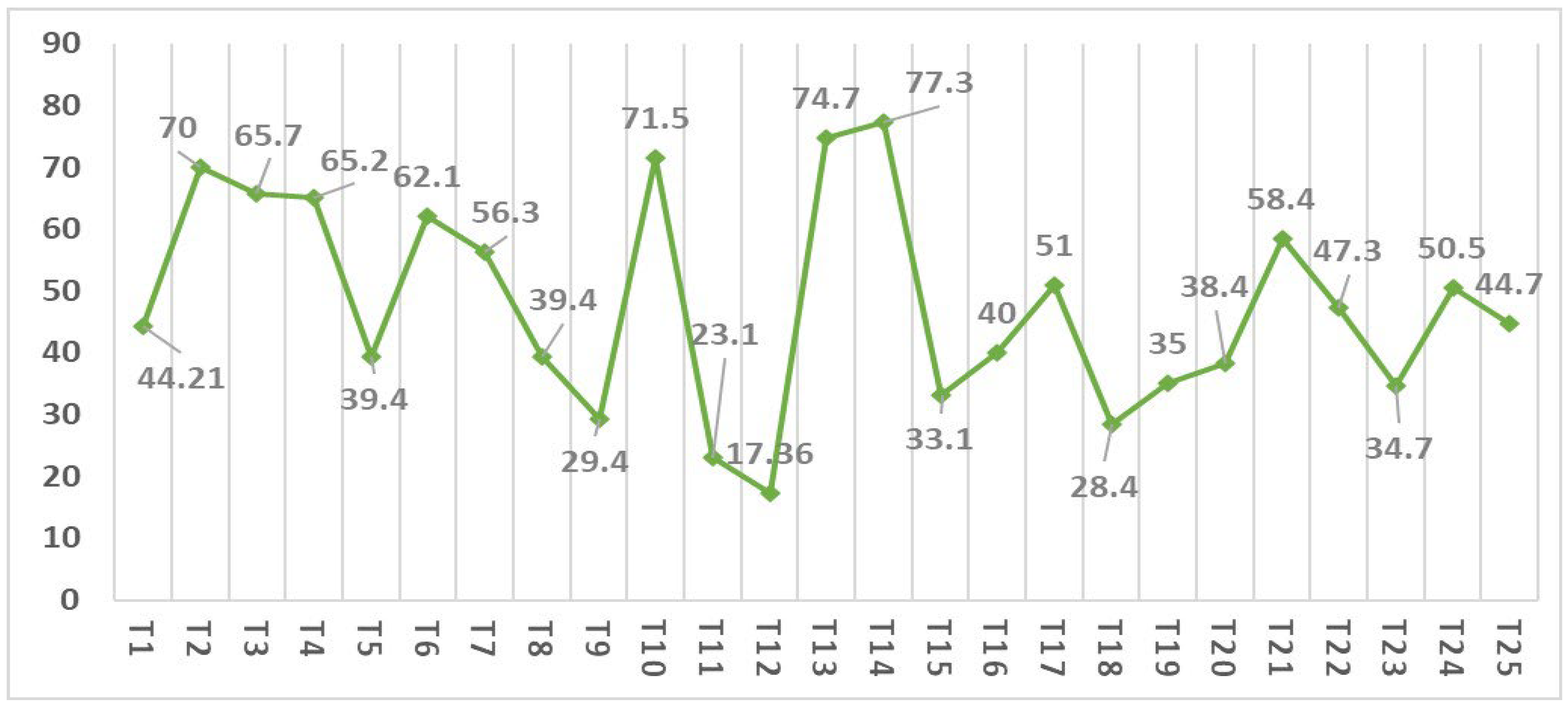
Figure 2.
Bivariate Pearson Correlations Between the Key Covariates and Outcomes.
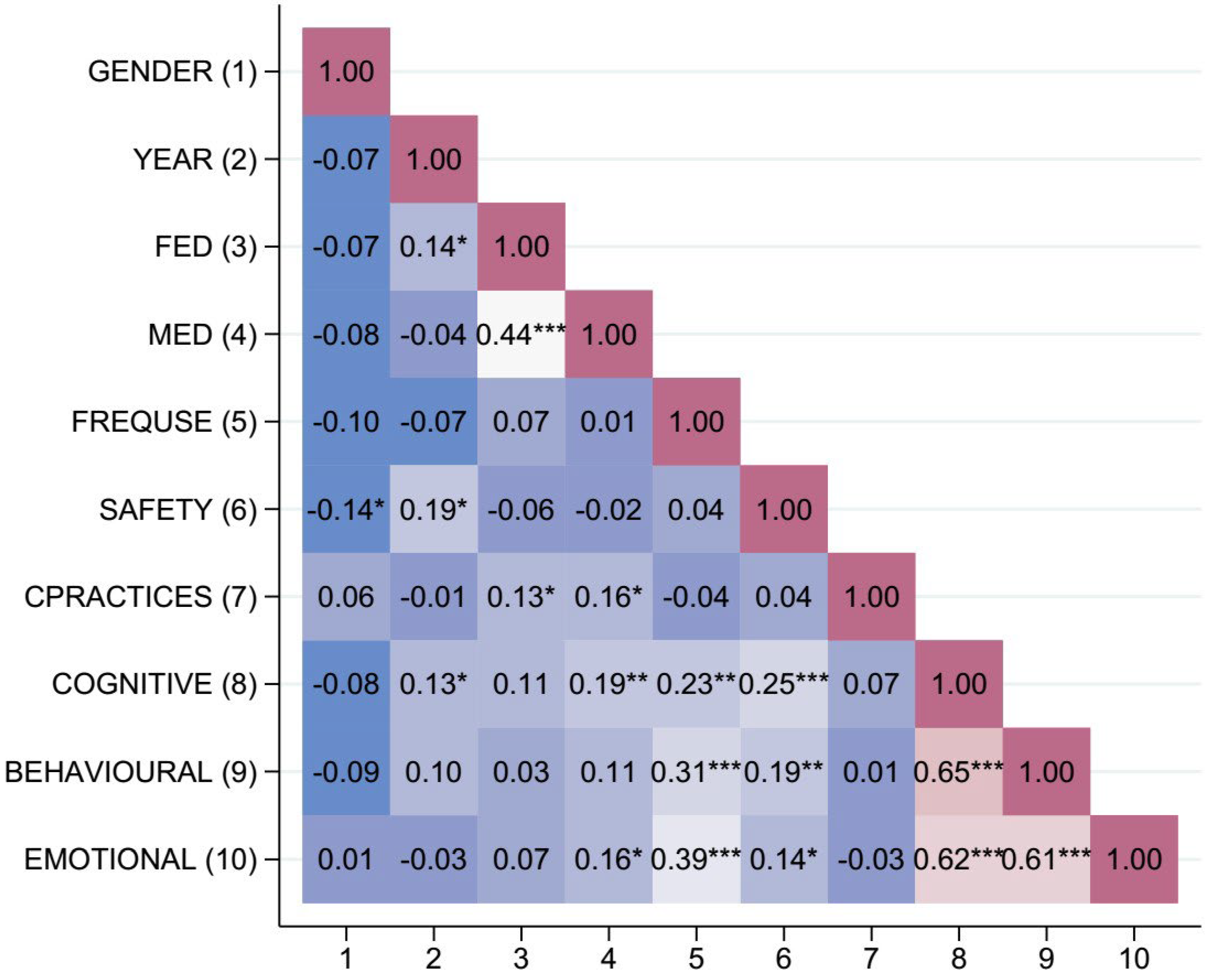

Table 1.
Summary of selected empirical studies on students’ attitudes toward AI in higher education.
Table 1.
Summary of selected empirical studies on students’ attitudes toward AI in higher education.
| Study | Students’ academic discipline | Study design | Measure(s) | Outcome(s) | Limitations | Country | |
|---|---|---|---|---|---|---|---|
| Almaraz-López et al., 2023 | Mixed (Economics/ Business/ Education) | Mixed (survey, interview) | Self-report, single items | Generally positive attitudes toward general AI | Not multidimensional, not validated measures, no reliability reported | Spain | |
| Hajam & Gahir, 2024 | Mixed (Arts, Science, Commerce) | QUAN | Self-report, multiple items |
Very positive attitudes toward general AI | No validation reported, no reliability reported | India | |
| Pellas, 2023 | Mixed (Arts, Education, STEM, Business, Media) | QUAN | Self-report, multiple items |
Very positive attitudes toward Machine Learning | Not distinguishing between STEM vs. non-STEM students | Greece | |
| Yüzbaşıoğlu, 2021 | Dental students | QUAN | Self-report, multiple items |
Very positive attitudes toward AI in dentistry | No validation reported, Not clearly distinguishing between cognitive, affective, or behavioural dimensions |
Türkiye | |
| Ghotbi et al., 2022 | Mixed (unclassified) | QUAN | Essay task (lexical analysis) | Generally positive emotions (trust) and some concerns for unemployment | Not distinguishing between STEM vs. non-STEM students | Japan | |
| Pinto dos Santos et al., 2019 | Radiology medical students | QUAN | Self-report, Single and multiple items |
Generally positive attitudes toward AI | No validation reported, no reliability reported, not clearly distinguishing between cognitive, affective, or behavioural dimensions | Germany | |
Note: QUAN: Quantitative; QUAL: Qualitative: Mixed: Both QUAN and QUAL.
Table 2.
Principal Components Analysis of the Attitudes Toward AI Scale -Adapted for a Greek Sample of Higher Education Students (Rotated Loadings Matrix).
Table 2.
Principal Components Analysis of the Attitudes Toward AI Scale -Adapted for a Greek Sample of Higher Education Students (Rotated Loadings Matrix).
| Items | Principal component loadings | ||
| 1 | 2 | 3 | |
| Behavioural Component (1) | |||
| 1. I like using apps related to AI. | .607 | ||
| 2. It is fun to learn about AI. | .770 | ||
| 3. I want to continue learning about AI | .750 | ||
| 4. I’m interested in AI-related TV programs or online videos | .749 | ||
| 5. I want to make something that makes human life more convenient through AI. | .632 | ||
| 6. I am interested in the development of AI | .666 | ||
| 7. It is interesting to use AI. | .618 | ||
| 8. I think that there should be more class time devoted to AI in university | .550 | ||
| Cognitive Component (2) | |||
| 1. I think that it is important to integrate AI in my university studies | .567 | ||
| 2. AI classes are important | .777 | ||
| 3. I think that lessons about AI should be taught in university | .785 | ||
| 4. I think every university student should learn about AI in university. | .692 | ||
| 5. AI is very important for developing societya | .506 | ||
| 6. AI produces more good than bada | .474 | ||
| 7. It is worth to know AI very wella | .466 | ||
| Affective/ Emotional Component (3) | |||
| 1. I think AI makes people’s lives more convenient | .441 | ||
| 2. AI is related to my daily life | .607 | ||
| 3. I will use AI to solve problems in daily life | .767 | ||
| 4. AI helps me solve problems in real life | .629 | ||
| 5. I will need AI in my life in the future | .515 | ||
| 6. AI is necessary for everyone | .557 | ||
| 7. I think that most jobs in the future will require knowledge related to AI | .426 | ||
| 8. I can use well the apps based on AIb | .621 | ||
| 9. I will use AI in the future in my professional lifeb | .423 | ||
| 10. It would be very helpful for me to have available AI apps in my professional lifeb | .441 | ||
| PCA Eigenvalues | 9.116 | 1.888 | 1.683 |
| % Variance explained by each component | 35.060 | 7.262 | 6.474 |
| Cronbach’s alpha per component | .895 | .816 | .828 |
| Transformed mean score across items per component | 54.98 | 62.08 | 64.06 |
Note: a This item loads on a different component compared to the initial validation study; b This item is a new adaption to the scale; Varimax rotation with Kaiser Normalisation; Items were adapted from Suh and Ahn (2022); No additional permission was required due to CC-BY 4 licence.
Disclaimer/Publisher’s Note: The statements, opinions and data contained in all publications are solely those of the individual author(s) and contributor(s) and not of MDPI and/or the editor(s). MDPI and/or the editor(s) disclaim responsibility for any injury to people or property resulting from any ideas, methods, instructions or products referred to in the content. |
© 2024 by the authors. Licensee MDPI, Basel, Switzerland. This article is an open access article distributed under the terms and conditions of the Creative Commons Attribution (CC BY) license (http://creativecommons.org/licenses/by/4.0/).
Copyright: This open access article is published under a Creative Commons CC BY 4.0 license, which permit the free download, distribution, and reuse, provided that the author and preprint are cited in any reuse.


