

Submitted:
09 August 2024
Posted:
13 August 2024
You are already at the latest version
Abstract
This study aims to evaluate the utilization and effectiveness of artificial intelligence (AI) applications in managing symptoms of anxiety and depression. The primary objectives are to identify current AI tools, analyze their practicality and efficacy, and assess their potential benefits and risks. A comprehensive literature review was conducted using databases such as ScienceDirect, Google Scholar, PubMed, and ResearchGate, focusing on publications from the last five years. The search utilized keywords including "artificial intelligence," "applications," "mental health," "anxiety," "LLMs" and "depression". Various AI tools, including chatbots, mobile applications, wearables, virtual reality settings, and large language models (LLMs), were examined and categorized based on their functions in mental health care. The findings indicate that AI applications, including LLMs, show significant promise in symptom management, offering accessible and personalized interventions that can complement traditional mental health treatments. Tools such as AI-driven chatbots, mobile apps, and LLMs have demonstrated efficacy in reducing symptoms of anxiety and depression, improving user engagement and mental health outcomes. LLMs, in particular, have shown potential in enhancing therapeutic chatbots, diagnostic tools, and personalized treatment plans by providing immediate support and resources, thus reducing the workload on mental health professionals. However, limitations include concerns over data privacy, the potential for over-reliance on technology, and the need for human oversight to ensure comprehensive care. Ethical considerations, such as data security and the balance between AI and human interaction, were also addressed. The study concludes that while AI, including LLMs, has the potential to significantly aid mental health care, it should be used as a complement to, rather than a replacement for, human therapists. Future research should focus on enhancing data security measures, integrating AI tools with traditional therapeutic methods, and exploring the long-term effects of AI interventions on mental health. Further investigation is also needed to evaluate the effectiveness of AI applications across diverse populations and settings.

Keywords:
Artificial intelligence
; machine learning
; LLMs
; depression
; anxiety
; mental health
1. Introduction
Stress and depression are very prevalent mental diseases that have a global impact, impacting individuals across all age groups, genders, and socio-economic status. [49]. Although these physical conditions have unique features, they frequently occur together and exhibit similar symptoms, which complicates the process of diagnosing and treating them. Anxiety and depression are complex mental health diseases that are defined by enduring feelings of unease, unhappiness, and a decline in everyday functioning. Anxiety often encompasses an excessive and disproportionate level of worry or anxiety towards future events, circumstances, or results [38]. Individuals suffering from anxiety may encounter physiological manifestations such as increased heart rate, perspiration, trembling, gastrointestinal distress, and muscular strain. Anxiety disorders encompass several sub-categories, including generalized anxiety, panic disorder, social anxiety disorder, and particular phobias. Each sub-category exhibits distinct symptoms and is triggered by certain stimuli [25].
Conversely, depression is characterized by enduring emotions of melancholy, hopelessness, and insignificance, coupled by a diminished enjoyment or interest in things that persons formerly engaged in [81]. Patients may also exhibit alterations in eating or weight, sleep disturbances, weariness, cognitive impairment, and persistent contemplations of death or suicide. The classification of depressive disorders is based on the specific symptoms exhibited by the individual. These disorders include Major Depressive illness, Dysthymic Disorder (DIS), Bipolar Disorders, Cyclothymic Disorder, and depressive illness that is not further characterized.
The incidence of anxiety and depression has markedly increased in recent decades. As per the World Health Organization (WHO), depression is the primary contributor to global disability, impacting over 280 million individuals, which is about equivalent to the prevalence of anxiety disorders [5]. These illnesses can manifest at any age, although they typically emerge during adolescence or early adulthood. Moreover, women experience a higher prevalence of anxiety and depression in comparison to males, with hormonal, social, and cultural variables contributing to this disparity [6]. The occurrence of anxiety and depression is associated with several variables, such as genetic susceptibility, environmental stressors, traumatic events, socio-economic status, and availability of mental health resources. Furthermore, the COVID-19 pandemic has worsened the occurrence of these diseases, resulting in heightened levels of stress, uncertainty, social isolation, and financial hardships, therefore strengthening pre-existing mental health concerns [5]. The fast advancement of technology and the widespread use of social media have had a substantial impact on individuals’ mental health. This is due to longer exposure to digital displays and increased isolation, which can lead to feelings of unhappiness [64].
Addressing anxiety and depression necessitates a comprehensive strategy that encompasses timely identification, availability of high-quality mental healthcare, destigmatization efforts, and all-encompassing support systems [23]. Based on the information provided, we will now examine how technology might help alleviate the symptoms of anxiety and sadness. The objective of this study is to examine the influence of new technologies, such as machine learning, and mobile therapy applications on the identification and management of symptoms associated with these two mental diseases. Special attention will be given to the accessibility of these technologies, as well as the potential hazards associated with the handling of personal data. This objective results in the creation of the research inquiries, which will serve as the foundation for the whole research project. Therefore, the following are explicitly defined:
- Can artificial intelligence aid in the identification and management of symptoms associated with anxiety and depression?
- Which artificial intelligence techniques are currently employed for symptom management of anxiety and depression, and how is their efficacy evaluated?
- What potential benefits and dangers are arising from the utilization of these technologies by individuals and healthcare practitioners?
In order to answer these research questions, a review of the available scientific literature will be carried out. The completion of this research is expected to initially clarify how artificial intelligence tools and the individual technologies embedded in them help identify and manage symptoms of anxiety and depression. Furthermore, conclusions are expected to be drawn regarding their effectiveness in different user groups and disorders (anxiety, depression), as well as the potential risks posed by their use.
The Materials and Methods should be described with sufficient details to allow others to replicate and build on the published results. Please note that the publication of your manuscript implies that you must make all materials, data, computer code, and protocols associated with the publication available to readers. Please disclose at the submission stage any restrictions on the availability of materials or information. New methods and protocols should be described in detail while well-established methods can be briefly described and appropriately cited.
Research manuscripts reporting large datasets that are deposited in a publicly available database should specify where the data have been deposited and provide the relevant accession numbers. If the accession numbers have not yet been obtained at the time of submission, please state that they will be provided during review. They must be provided prior to publication. Interventionary studies involving animals or humans, and other studies that require ethical approval, must list the authority that provided approval and the corresponding ethical approval code.
2. Background: The Role of Informatics and AI in Mental Health
Information ML tools have been a powerful force in recent years, fundamentally changing how people, communities, and organizations tackle mental health issues. Technology integration not only affects projects, but also brings novel methods to raise awareness, diminish stigma, and enhance support for individuals with mental problems [48]. Simultaneously, the proliferation of mobile applications specifically designed for mental health has significantly transformed how individuals manage their overall well-being. These applications provide customized resources for individuals to engage in self-reflection, self-control, and emotional assistance, ranging from mood tracking to guided meditation [58]. Furthermore, several applications are utilizing artificial intelligence to offer tailored treatments. This model has the potential to enhance mental health services by extending their coverage and decreasing the need for physicians [18]. Artificial intelligence integrated into digital apps primarily serves the purpose of providing self-help and guided cognitive behavioral therapy (CBT) for those experiencing anxiety and depression [72]. Interactive artificial intelligence has the potential to effectively manage and provide real-time treatment for mental health conditions. It can help and, in certain cases, even replace obsolete, overburdened, or inadequate mental health systems [2]. Obstacles to the utilization of AI in mental health encompass factors such as accessibility, efficacy, dependability, user-friendliness, safety, ethical considerations, suitable education, and cultural adaptation. Applications, real-time machine learning techniques, immersion technologies, and digital phenotyping are very promising opportunities. Within a broader framework, there is a recognized requirement for improved efficiency and speed in handling tasks, along with more machine interaction and automation. Additionally, there is a need for more rigorous evaluation of effectiveness and the adoption of mixed, hybrid, or tiered care as a complementary strategy [11]. Modelling hu-man-machine interaction may aid in the design and development of user-friendly apps. It can also assist in identifying and addressing disparities in mental health treatment and suicide prevention and contribute to the digital therapeutic alliance [7].
Machine learning, which refers to computers acquiring knowledge and improving their performance without being explicitly programmed, has become a significant catalyst for advancements in healthcare [12]. Machine learning approaches aim to surpass human performance in many tasks by using the continuous growth in computer power and the abundance of massive datasets to derive valuable insights [14]. Within the healthcare field, this improves the process of making clinical decisions on treatment and diagnosis, hence facilitating the provision of individualized care to patients. Specifically, cognitive behavioral therapy, a commonly employed method, exhibits limited efficacy in addressing specific mental health disorders. Utilizing machine learning on large patient datasets in mental health therapy has the potential to offer valuable information on which patient profiles are most inclined to exhibit good responses to particular therapies [68]. Identifying these individuals early on during therapy might result in better outcomes by providing alternate or more comprehensive kinds of assistance. A difficulty faced by physicians in diagnosing patients is that their interactions provide just a fleeting glimpse into an individual’s mental condition, but mood disorders are characterized by their dynamic and ever-changing nature [73]. Presently, the psychiatric assessment of patients involves the careful monitoring of their mental condition and the administration of subjective self-report questionnaires. These procedures are subjective, arduous to replicate, and can be time intensive. AI has the capability to facilitate the use of other techniques, such as audio and video analysis, which are more impartial and could offer superior forecast accuracy. Psychiatric treatment, including both severe cases and less severe instances, is provided on an outpatient basis. Therefore, receiving further follow-up care in the community would offer substantial advantages. The timely identification and proactive measures to avoid recurrence can greatly influence the results [50].
2. Methods
This study employed a comprehensive and systematic approach to examine the current landscape of artificial intelligence (AI) applications utilized for identifying and managing symptoms of anxiety and depression. The methodology was structured as follows. A comprehensive overview was conducted using a range of reputable databases and platforms, including ScienceDirect, Google Scholar, PubMed, ResearchGate, and theresanaiforthat.com. The search was guided by specific keywords: “artificial intelligence,” “applications,” “mental health,” “anxiety,” and “depression” [48]. The inclusion criteria focused on studies published within the last five years to ensure the most recent advancements in the field were considered [10]. Studies were selected based on their relevance to AI applications in mental health, specifically targeting anxiety and depression. Both qualitative and quantitative studies were included to provide a broad perspective. Articles were screened for their methodological rigor and relevance, ensuring high-quality sources formed the basis of the review [57]. Key information from the selected studies was extracted systematically, focusing on the features, utilization, and outcomes of AI applications in mental health. The extracted data were synthesized to identify common themes, patterns, and insights regarding the efficacy and practicality of these applications [26].
An extensive analysis of many websites and digital platforms was carried out to discover the existing AI technologies in the market that may be used for the management of anxiety and depression. The technologies listed included chatbots and mobile wellness apps. Additionally, a comprehensive analysis of websites was conducted to identify programs that are currently available on the market. After documenting these tools that may be easily accessed, they were then categorized and thoroughly examined to determine their usefulness and effectiveness, using the data as a foundation. All the sources used were written in a foreign language, mostly English. The papers and websites considered in this research were mostly published during the last five years. This implies that the collected data reflects the latest progress in the field of artificial intelligence for mental health care, with a special emphasis on commonly used applications. Considerable emphasis was placed on the collection and documentation of data, as well as the rigorous and comprehensive analysis of the data, in order to get significant insights pertaining to the issue under investigation.
The identified AI tools were categorized based on their primary functions and applications in mental health care. Categories included diagnostic tools, therapeutic interventions, and self-help resources. Each tool was rigorously analyzed for its practicality and efficacy. This involved assessing user experience, accessibility, data security, and the overall impact on mental health outcomes [58]. The analysis was guided by criteria such as usability, user engagement, effectiveness in symptom management, and potential risks. Specific attention was given to the technological aspects, such as the integration of machine learning, predictive analysis, and natural language processing [2]. The results were carefully recorded, offering in-depth understanding of the advantages and constraints of each instrument. An extensive evaluation was carried out to verify that the analysis was meticulous and that the results were strongly supported by the data [12]. The research placed great importance on ethical concerns. The significance of safeguarding data privacy and security was underscored, especially in light of the delicate nature of mental health information. The tools were assessed based on their adherence to data protection rules and their methods for guaranteeing user confidentiality [46]. The ethical ramifications of using AI in mental health treatment were examined, including the possible hazard of excessive dependence on technology and the significance of sustaining human supervision in therapeutic settings [50]. To summarize, the approach used in this research enabled a thorough and meticulous investigation of artificial intelligence (AI) applications in the field of mental health. The research aims to provide significant insights into the existing and possible future roles of AI in controlling anxiety and depression by examining recent breakthroughs and thoroughly analyzing the practical and ethical consequences.
3. Results of Overview
3.1. Natural Language Processing (NLP)
Artificial intelligence has the potential to significantly equalize the amount of work that a physician has, allowing them to have more time to engage with patients, therefore enhancing the standard of treatment. Psychiatrists dedicate a significant amount of time to perusing past records in order to obtain a precise understanding of a patient’s medical background. Natural Language Processing (NLP) is an artificial intelligence discipline that focuses on the analysis of human language to extract significant information [88]. This algorithm has the potential to condense the crucial information from a patient’s electronic health records, offering a succinct overview at the start of a visit. Furthermore, when AI-powered speech and video analysis are integrated, it can enhance the quality of advice by offering a concise overview of a patient’s mental condition. This can serve as a valuable supplement to the psychiatrist’s mental status evaluation [51]. An algorithm with these characteristics would be impartial and immune to inconsistencies across different clinical practices.
Natural Language Processing (NLP) may be used to examine the often-overlooked attributes of healthcare practitioners and patients, as noted by Rowe and Chan [71]. This data enables the examination of treatment adherence, evaluation of patient results, identification of treatment elements, assessment of the therapeutic relationship, and measurement of suicide risk in a manner that is transformative, generating anticipation and concern among participants [26]. Recently, NLP has been utilized in mental health domains, such as social media and electronic health records [34].
3.2. Predictive Analysis
Predictive analysis refers to predictive models, i.e., computational models used to predict the future trend, value, or state of a variable based on data from the past [60]. In the case of mental health, these models can be used to predict the onset, course, or response to treatment of a mental health disorder. Using artificial intelligence, they can analyze large data sets to identify patterns, correlations, and factors that affect mental health. Prediction models based on artificial intelligence devices use various types of data, including structural and functional imaging data of neuropsychological data [1]. Furthermore, predictive models can help prevent relapse or manage medication through reminders and monitoring patient compliance [47]. The widespread adoption and integration of social media into everyday life provides another and, in many cases, much larger data repository for developing predictive models to detect mental health disorders, using user-generated data such as written posts, blogs, photos, and videos [3]. This wide range of data opens up new possibilities for analyzing and predicting mental health using artificial intelligence.
3.3. AI Methodologies and Tools Utilized for Anxiety and Depression Management
AI tools for anxiety and depression encompass many technologies specifically developed to evaluate, control, and address mental diseases. Examples of such technologies include chatbots and virtual assistants, mood tracking applications, cognitive behavioral therapy (CBT) apps, and virtual reality (VR) therapies [51]. AI-driven chatbots and virtual assistants utilize user engagement to provide emotional support, education, and coping mechanisms for managing symptoms associated with anxiety and depression [14]. These technologies employ natural language processing (NLP) algorithms to comprehend user data and deliver suitable replies. Conversely, these applications track users’ emotional condition, symptoms, factors, and actions associated with anxiety and depression. Consequently, these insights offer valuable information on recurring patterns and long-term trends, enabling users to make well-informed choices regarding their mental well-being [4]. However, AI-driven CBT programs offer scientifically supported therapy approaches for anxiety and depression, including cognitive restructuring, behavioral activation, and relaxation strategies. These applications have the ability to include interactive activities, modules that may be completed independently, and customized feedback depending on the user’s input and tracking of their progress [79]. Moreover, VR-based therapies provide lifelike surroundings and scenarios to expose patients to stressful events or teach them relaxation and coping skills in a controlled setting. AI algorithms have the ability to tailor the virtual reality experience in real-time by analyzing user emotions and physiological data. This enhances the effectiveness of treatments and allows for a more personalized experience [9].
AI-powered algorithms evaluate physiological data obtained from mobile devices, including heart rate variability, sleep patterns, activity levels, and speech patterns, to detect small changes that may indicate symptoms of anxiety and sadness [58]. Digital biomarkers provide precise and unbiased assessments of an individual’s mental health condition and their reaction to therapy, enabling prompt intervention and tailored healthcare. By utilizing AI ML tools in these several domains, mental health practitioners may enhance the precision of assessments, the efficacy of treatments, and the involvement of patients in the management of anxiety and depression. The following table compiles technologies that employ artificial intelligence to assist users in identifying and handling symptoms associated with anxiety and depression. Later on, a subset of them will undergo more comprehensive analysis in order to comprehend their purpose and influence.
Figure 1.
Indicative illustration of mental health chatbots, like WYSA, using generative artificial intelligence.
Figure 1.
Indicative illustration of mental health chatbots, like WYSA, using generative artificial intelligence.
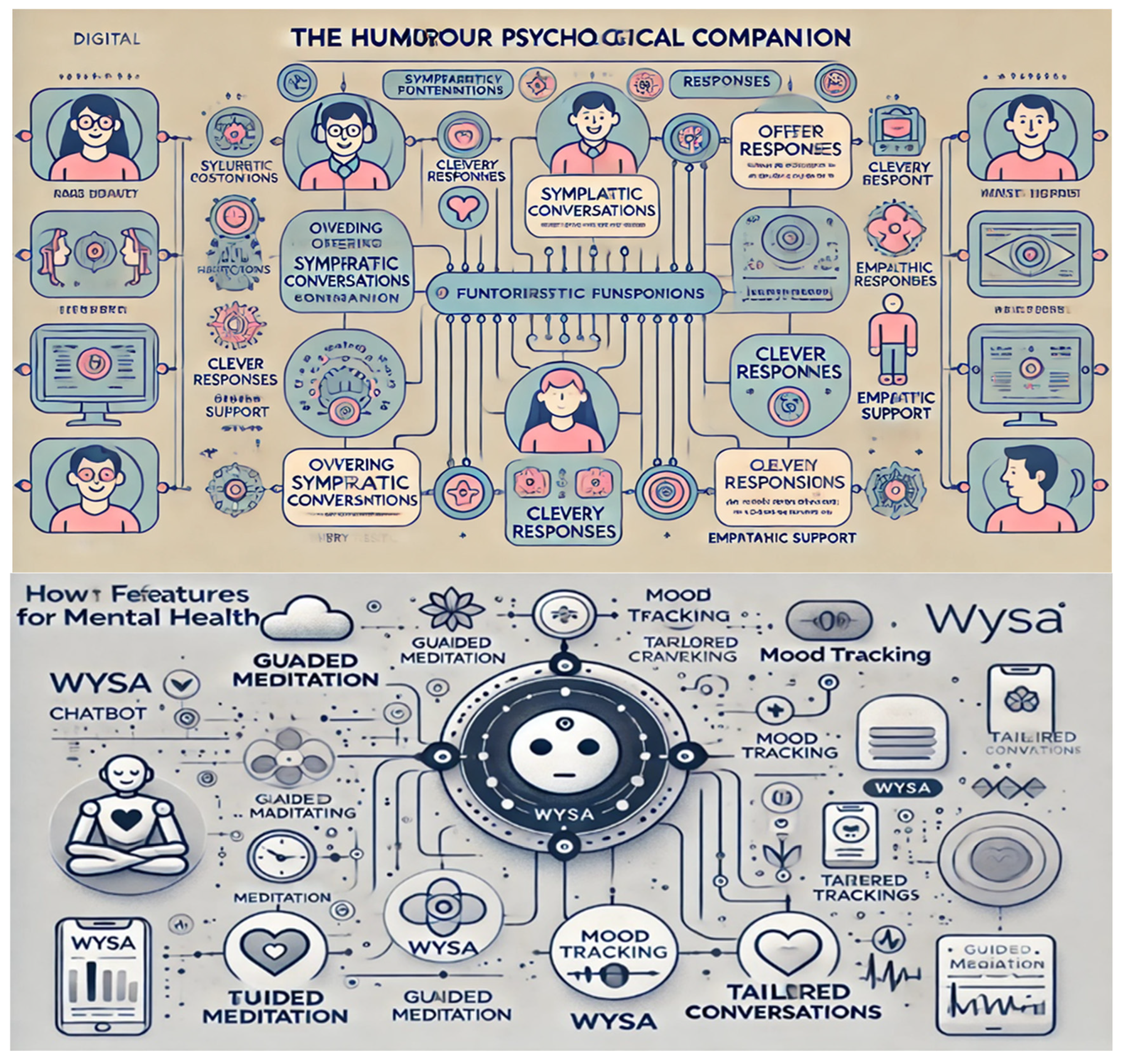

Table 1.
This is a table. Compiles technologies that employ artificial intelligence to assist users in identifying and handling symptoms associated with anxiety and depression.
Table 1.
This is a table. Compiles technologies that employ artificial intelligence to assist users in identifying and handling symptoms associated with anxiety and depression.
| CHATBOTS | Woebot | Woebot is an AI-driven chatbot that assists individuals in managing their mental well-being through the application of cognitive-behavioral therapy approaches. The application offers mood monitoring, daily assessments, and tailored dialogues. As the current leading application, Woebot is likely to continue improving and expanding [28]. |
| Wysa | Wysa is an AI chatbot that utilizes cognitive-behavioral therapy techniques to offer support for mental health. Its features include guided meditation, mood tracking, and tailored conversations. Wysa is widely used by individuals seeking mental health support and has garnered positive reviews [39]. | |
| Youper | Youper exemplifies the integration of artificial intelligence (AI) into the realm of mental health care. As a health technology business, the firm aims to ensure that mental health treatment is accessible and affordable for all individuals. Youper AI assistant interacts with individuals in meaningful dialogues to assess their psychological condition and offers tailored remedies based on the gathered information. This groundbreaking approach guarantees that people receive customized assistance, highlighting the transformative capacity of AI in revolutionizing mental healthcare [55]. | |
| Replika | Replika is an artificial intelligence chatbot that constructs a virtual representation of users by analyzing their personality traits. Its ultimate goal is to help users cope with stress and improve their mental health. It is suitable for individuals who desire to engage in profound and contemplative conversations with a companion. It offers users a safe space for self-reflection and emotional assistance, fostering meaningful connections and understanding. Replika has emerged as a powerful tool for those seeking alternative methods to safeguard and improve their mental well-being [66]. | |
| Lifeline Ally |
A friendly chatbot that focuses on preventing and supporting depression [101]. | |
| Humorous Psychological Companion | The Humorous Psychological Companion is a distinctive combination of a digital assistant and conversational partner, particularly created to aid individuals who are dealing with depression or related emotional conditions. It serves not just as an AI chatbot, but also as a sympathetic, clever, and empathetic friend. The primary objective of this platform is to aid, motivation, and a cheerful conversation to mitigate emotions of sorrow or isolation [106]. | |
| Elomia | Elomia is an AI-powered virtual therapist who has been trained in thousands of consultations, offering quality advice and support. Users can discuss their problems, ask questions, and get recommendations for mental health exercises. According to research, Elomia can help with anxiety, depression, low self-esteem, loneliness, relationship issues, burnout, and sleep problems. Whenever users need someone to talk to or seek guidance, Elomia listens, helps identify concerns and suggest solutions, helping to regain confidence and acceptance of emotions [70]. | |
| Tess | Tess, on the other hand, is a mental health chatbot that provides treatment and support to people experiencing symptoms of depression and anxiety [29]. | |
| Meru Health | Meru Health is an artificial intelligence app that offers treatments for depression, anxiety, and stress. It provides personalized treatment regimens that meet the specific needs of each user, as well as online counseling and guidance [107]. | |
| APPLICATIONS | Ginger | Ginger is an on-demand mental health platform that provides counseling, support, and advice. It offers chat therapy, individualized care plans, and video sessions with licensed therapists [104]. |
| Headspace | Headspace, a mindfulness and meditation software, makes individualized recommendations using artificial intelligence algorithms. It offers daily reminders, sleep sounds, and guided meditations to help users stick to their mental health goals [105]. | |
| Breathhh | Breathhh is a Chrome plugin that uses artificial intelligence to deliver mental health workouts tailored to an individual’s online activities and behavior. Through the surveillance and examination of user interactions, Breathhh is able to ascertain the optimal moments to introduce stress alleviation methods and tactics. This innovative method blends artificial cognitive intelligence with the tangible assistance of mental health, facilitating a smooth and effortless incorporation of self-care into users’ everyday schedules [102]. | |
| Sanvello | Sanvello is an app for mental wellbeing that tracks users’ moods and helps them understand their situation. It offers individualized mental health care. It also provides basic principles through the use of ambient noise. Through a community where users may engage in conversations with others facing similar problems, it also offers peer-to-peer help [15]. | |
| MindDoc | MindDoc provides a number of tools to help different facets of mental health, such as enhancing positive coping mechanisms, tracking your mood, or monitoring your general well-being. Her area of expertise is understanding mental health issues like sleeplessness, eating disorders, anxiety, and depression. It is simple to obtain helpful materials, exercises, and customized recommendations thanks to the user-friendly layout [109]. | |
| MoodMission | This program is designed to aid users in overcoming depression and anxiety by implementing evidence-based coping strategies. MoodMission facilitates personal growth and self-empowerment by suggesting tailored assignments that correspond to the emotions and experiences expressed by the user. By successfully completing missions, you will improve your understanding of your mental health and discover new techniques to efficiently manage difficult tasks [10]. | |
| Ladder | Ladder is a health application that uses artificial intelligence to assist users in comprehending the correlation between their behaviors, emotions, and their general state of well-being. The software’s most compelling attribute lies in its origin and purpose, since it was developed only by and for individuals belonging to ethnic minority groups. This multifunctional device incorporates an exercise tracker to facilitate the development of beneficial routines, while its cognitive journal promotes emotional mindfulness and introspection [103]. | |
| Kintsugi | Kintsugi employs an innovative method in the field of mental health treatment by utilizing cutting-edge voice biomarkers in speech analysis to promptly detect, rank, and tackle mental health concerns as they arise. This API-centric platform readily interfaces with contact centers, telemedicine systems, and remote patient monitoring apps, enabling enhanced accessibility to appropriate treatment as and when required. Through the identification of small alterations in speech patterns and vocal indicators, it is capable of precisely evaluating an individual’s psychological condition and guiding them towards the most suitable resources and assistance [106]. | |
| Calm | Calm has established itself as a highly regarded application for mental well-being, particularly for individuals grappling with anxiety and despair. This application offers a range of powerful resources, including sleep tales, meditation, and other methods, to assist users in managing their mental health difficulties. Users have the opportunity to investigate a range of characteristics that cater to their own requirements in order to enhance their overall state of being [100]. | |
| Rootd | Rooted is a novel application that provides valuable assistance to individuals experiencing panic attacks and anxiety. The Rootr feature of the app offers individuals a convenient way to manage stress and find immediate relief. Furthermore, Rootd provides a range of strategies, including exercises, routines, and healthy diets, to effectively promote mental health improvement. By implementing these strategies and utilizing these resources, users can gradually improve their capacity to manage stress and achieve a more harmonious lifestyle [116]. | |
| MindShift | MindShift is a very helpful mental health tool that helps users properly control their anxiety by applying tried-and-true methods from Cognitive Behavioral Therapy (CBT). In addition to encouraging the development of constructive thinking patterns and the adoption of preventative actions to successfully manage stress-related difficulties, the program gives users the chance to practice mindfulness and relaxation. With MindShift’s exquisitely simple interface and numerous adaptable options, users can effortlessly develop relaxing routines and enhance their mental health in general [69]. | |
| Happify | Happify provides customers with interactive activities and games specifically intended to effectively alleviate stress and counteract negative thinking. The software offers customized analytics derived from an individual’s mental health data, guaranteeing tailored assistance that caters to their distinct requirements. Users may quickly access these activities and games at any time, allowing for seamless integration into their everyday routine. Happify enhances happiness and mental well-being, thereby enhancing an individual’s entire quality of life through its creative method [123]. | |
| Deepwander | Deepwander is an AI-driven platform or tool created to enhance self-reflection and individual development. It involves participants in interactive discussions intended at investigating their internal realm and directing them towards beneficial transformation. Deepwander utilizes a range of psychological strategies, including Cognitive Behavioral strategies, Motivational Interviewing, Narrative Therapy, and Guided Visualization, to assist users in altering negative thinking patterns, discovering motivation, restructuring their life narratives, and clarifying their objectives. In general, Deepwander appears to offer a systematic method for introspection and individual growth [105]. | |
| MindwellAI is a mental health app designed to help users overcome stress. It combines science-based tools, AI-powered counseling, and a virtual self-care partner named Joy [111]. | ||
| Space of Mind | Space of Mind is an online trauma therapy and support group designed to provide affordable PTSD treatment. This AI-powered platform offers a therapeutic space facilitated by a therapist where individuals can participate in anonymous group sessions to address their traumatic experiences and work towards transformative therapy [120]. | |
| Moodpath | Moodpath is a mental health assessment tool that helps individuals understand their mental well-being through science-based questions and assessments. It identifies early signs of depression, anxiety, and burnout, offering personalized diagnoses and access to support resources. Users get insights into their mental health, trends, and tips, along with tailored action plans for long-term management. In addition, Moodpath offers meditations, self-care tips, and personalized plans, making it a valuable resource for managing mental health [115]. | |
| MoodKit | MoodKit is a mobile app designed to help individuals manage their mood and create healthy emotional habits. Developed by psychologists, MoodKit offers a variety of tools and resources based on the principles of cognitive behavioral therapy (CBT), a widely recognized and effective form of treatment for mood disorders [10]. | |
| WEARABLES DEVICES | Samsung Health | Samsung Health is an all-encompassing health and wellness application created by Samsung Electronics. The purpose of this application is to assist users in tracking and controlling several elements of their well-being and physical condition, such as exercise, nutrition, sleep, stress levels, and more. The application provides functionalities such as step monitoring, exercise monitoring, calorie calculation, sleep monitoring, and tools for managing stress [127]. |
| MoodTools | MoodTools is a mobile app designed to provide support and resources for people experiencing depression. It offers various tools and features that help users effectively manage their mood and mental health [113]. | |
| BioBase | BioBase is a wearable device designed to monitor and analyze physiological signals in real time, providing information about a person’s stress levels, energy, and overall well-being. It uses biometric sensors to monitor parameters such as heart rate variability (HRV), skin conductivity and temperature, which are indicators of stress and arousal levels [45]. | |
| Spire Health Tag |
The Spire Health Tag is a portable health device that monitors various aspects of well-being throughout the day. Small labels attach to your clothes and track your activity levels, breathing patterns, stress levels, and sleep quality. Using advanced sensors, Spire Health Tag provides real-time feedback and information about your daily habits and how they affect your overall health [128]. | |
| Moodmetric | Moodmetric is a wearable device designed to monitor and manage stress levels in real time. It measures electrodermal activity (EDA), the electrical activity of the skin caused by the activation of sweat glands, to provide information about stress and emotional arousal [122]. | |
| Fisher Wallace Stimulator | The Fisher Wallace Stimulator is a small device designed particularly to aid in the treatment of anxiety, depression, and insomnia. The procedure is applying gentle electrical stimulation to the brain using small electrodes placed on the forehead. The aim of this stimulation is to regulate the levels of neurotransmitters, such as serotonin and cortisol, which are associated with mood and anxiety. Multiple users have claimed positive results, such as reduced anxiety and improved mood, however individual outcomes may vary [125]. |
Figure 2.
Distribution of mental health Chatbots.
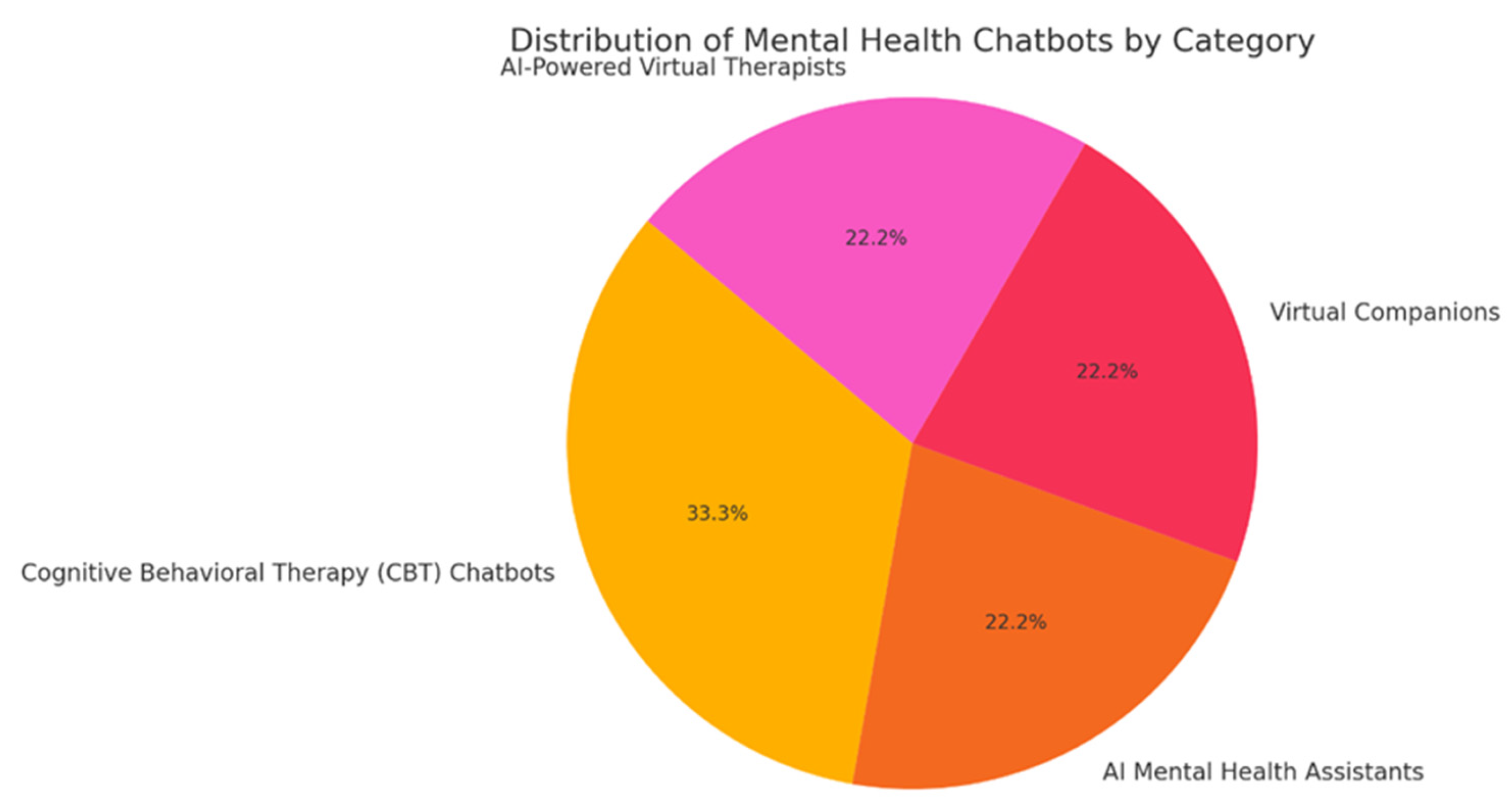
Figure 3.
Distribution of mental health Applications.
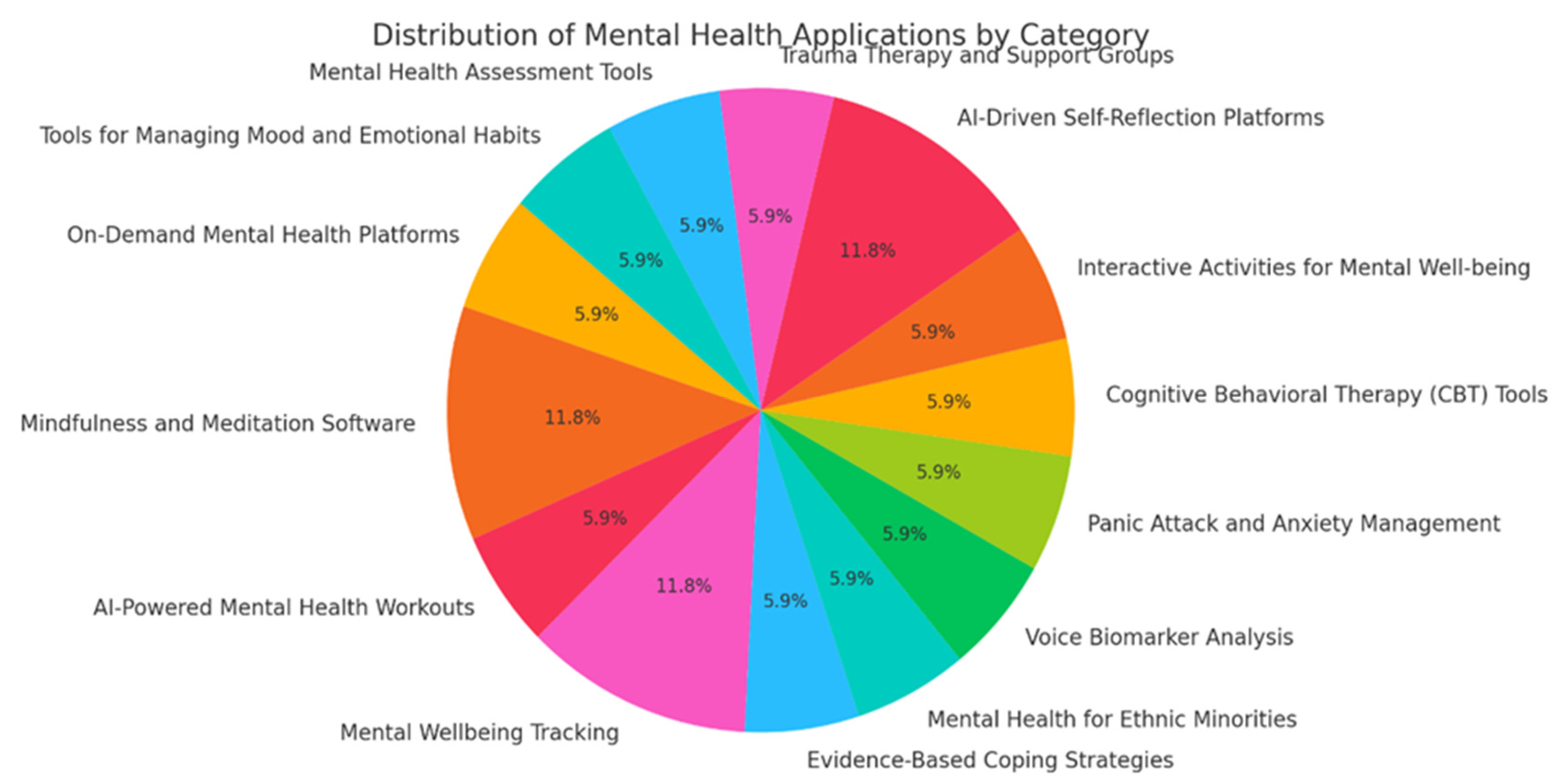
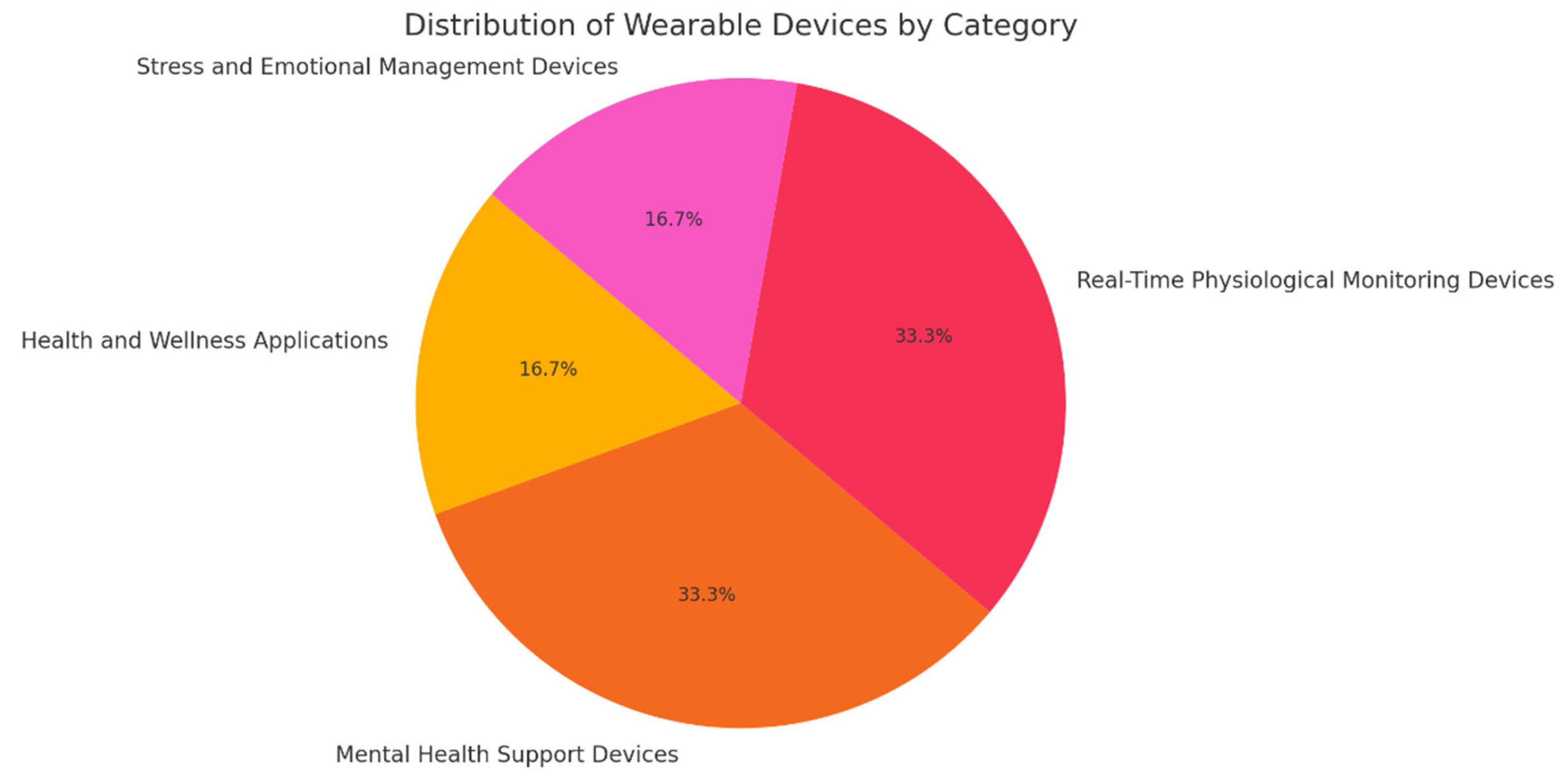
Figure 4.
Distribution of mental health Wearable Devices.
3.3.1. Mobile Apps
The ratio of psychiatrists per inhabitant of the world is less than satisfactory. However, over 50% of the world’s population now owns a smartphone [51]. Based on this data, many mobile applications have been designed in recent years, which offer psychological support, breathing, and relaxation exercises, while collecting useful data on the health and well-being of users. Moreover, wearables, platforms, and mobile applications have integrated artificial intelligence technologies, hence creating new opportunities for diagnosing and treating symptoms related to these conditions. Mobile applications (apps) designed for mental health purposes have become readily available tools that provide regular monitoring of mental well-being and assistance [36]. These applications provide a convenient and often anonymous substitute for conventional medicinal methods.
Mobile applications that use artificial intelligence for mental health rely on many data sources to provide personalized advice and assistance to their users. The inputs may consist of data provided by users via stress and mood questionnaires, as well as data obtained from wearables or mobile sensors that capture information such as heart rate, sleep habits, and activity levels. Applications that gather and analyze this data have the ability to detect trends and symptoms that signify a higher likelihood of experiencing anxiety or depression. Additionally, they may provide timely alerts or recommendations for intervention [58]. These applications have diverse applications and users, serving various purposes. They are utilized by individuals seeking self-help, medical professionals as supplementary tools in treatment, and researchers studying their efficacy [35]. Users are granted access to a diverse range of information and services, including regular monitoring of their mental well-being, recommendations for self-care activities, availability of crisis management tools, and participation in online support communities [16]. Medical providers may use apps to remotely monitor their patients’ development and offer them more personalized care [16]. Some examples of these applications are Sanvello, MindDoc, MoodMission, Ladder, Kintsugi, Calm, Rooted, and MindShift. Each of these programs provides users with a distinct range of features and methods to help them with their daily routines.
Sanvello offers individuals personalized guidance and strategies to address feelings of melancholy and anxiety via the use of mindfulness, relaxation, and cognitive behavioral therapy (CBT). Users have the capability to regulate their mood and anxiety levels, enabling them to track their progress and get prompt feedback and suggestions [15]. MindDoc’s main goal is to provide consumers thorough evaluations of their mental well-being via daily quizzes and progress reports [108]. Utilizing this application may assist users in gaining a deeper comprehension of the variables that impact their mental well-being and identifying recurring trends in their emotional state. Consequently, this facilitates the development of effective coping mechanisms for disorders such as anxiety and depression [108].
Conversely, MoodMission recommends specific actions that users can take to alleviate their symptoms of anxiety and depression. Each “mission” is customized to the user’s current emotions and requirements, thereby facilitating the immediate alleviation of symptoms and the cultivation of self-regulation abilities [110]. Ladder provides a structured program that assists users in establishing and achieving self-improvement objectives, while also offering guidance and support. This method assists users in integrating minor, daily modifications into their regimens, thereby enhancing their overall mental health [113]. Kintsugi employs machine learning technologies to analyze audio data of users’ voices and detect indicators of anxiety and depression [105]. This novel method of monitoring enables the precise identification and monitoring of symptoms, thereby enabling users to identify alterations in their mental health.
Calm emphasizes the promotion of stress reduction and relaxation through guided breathing exercises, sleep sounds, and meditations. Users who are seeking tools to manage daily tension and enhance their sleep quality will find this application to be especially beneficial [100]. Rootd’s panic attack management system is comprehensive, offering users immediate strategies for managing panic attacks and training in long-term anxiety management strategies [115]. Cognitive behavioral therapy (CBT) and other psychological support techniques are employed by MindShift to assist users in altering anxiety-related thoughts and behaviors. Users have access to resources that can assist them in the management of anxiety and the cultivation of healthy thought processes [98].
One of these apps is MoodKit, designed to help users experiencing depression. Based on cognitive behavioral therapy, it offers a variety of tools to guide the sufferer by challenging problematic thoughts and providing space to monitor symptoms. Finally, there is a calendar for users to record important events or information for easy access in the future. Another app to regulate stress levels is Samsung Health, which monitors heart rate, among other things. When the user is stressed, they can select the guided deep breathing mode. In addition to these, there is “MoodTools”, an application designed to help people suffering from depression. In essence, the application provides access to useful videos that can have a positive impact on mood and behavior. MoodTools uses the principles of cognitive behavioral therapy to allow users to record and study their thought patterns. Very importantly, the application provides the ability to create a “suicide safety plan” to manage suicidal thoughts and crises [111,114,123].
The ubiquity of these applications in daily life is amazing. Users may integrate the applications into their daily regimen by regularly engaging with the app in the morning, tracking their emotional state and stress levels throughout the day, and participating in guided relaxation or meditation techniques in the evening. Thus, these applications integrate into everyday mental health treatment, offering continuous assistance and augmenting self-awareness [56]. The outcomes of using these applications are often favorable. Studies have shown that using artificial intelligence (AI) in the field of mental health may effectively alleviate symptoms of sadness and anxiety, boost the quality of sleep, and promote an overall feeling of well-being. Users have reported experiencing more support and a greater sense of agency in managing their mental well-being. Nevertheless, there are obstacles to overcome, such as the need to safeguard data confidentiality and prevent excessive dependence on the applications [89]. AI applications for mental health have a substantial influence on the everyday lives of its users. Users may enhance their quality of life by efficiently managing anxiety and depression via simple access to mental health management resources and the integration of self-care practices into their daily routine.
3.3.2. Chatbots
Internet-based cognitive behavioral treatment (iCBT) has been available since the 1990s, although it is known for having a poor rate of adherence [80]. CBT chatbots, designed to emulate regular chat interactions, can enhance emotional connection and deliver supplementary benefits. One such platform is “Woebot”, which offers direct assistance to patients and members through chat, along with extensive tools and information to optimize their treatment, improve the general health of the population, and increase the efficiency of healthcare practitioners. Extensive study supports it, and it has been utilized by 1.5 million individuals. This platform is specifically designed to target those who may be on the periphery of conventional healthcare, aiding that goes beyond the confines of regular clinical environments [28].
Youper is a virtual therapist that uses artificial intelligence to provide cognitive behavioral therapy (CBT) using a smartphone app. Youper enables users to engage in Cognitive Behavioral Therapy (CBT) sessions directly on their mobile devices, allowing them to specifically address and manage symptoms associated with different mental health disorders, such as anxiety or depression. The application utilizes artificial intelligence to tailor the therapy process, offering personalized exercises, strategies, and concepts that are specifically designed to meet the particular requirements and objectives of the user [55,121].
Tess, however, is a chatbot focused on mental health, namely providing therapy and support to individuals who are exhibiting signs of despair and anxiety. “Tess” is an artificial intelligence program that mimics human behavior and offers techniques for dealing with emotions shown by the user [29]. Research data indicate that Tess has demonstrated a 28% reduction in depression and an 18% reduction in anxiety [120]. The most effective utilization of such a chatbot remains uncertain. Virtual therapists who aid those with anxiety and depression are currently accessible in the market. Extensive study has been conducted to assess their efficacy [89]. In addition to providing tailored therapeutic benefits, they also enhance accessibility by circumventing some stigmas associated with mental illness.
3.3.3. Wearables and Biosignals
Technology has become a powerful ally in dealing with anxiety and managing the negative emotions associated with depression. Wearables, also known as portable devices, are an example of wearable computational models used by people to monitor their health and well-being [52]. These devices are worn on various parts of the body, such as the wrist, hand, and neck, and have sensors that continuously measure physiological signals, such as heartbeat, temperature, and galvanic skin response [20].
The main features of wearables are the ability to connect to the internet for transmitting, recording, or analyzing data, as well as the ability to connect to other electronic devices to expand their functions. Today, wearables are widely used for health management, as they have intelligent detection and communication capabilities [82]. In addition, research focuses on improving the detection capabilities of wearables using machine learning algorithms, as well as designing interventions such as deep breathing guidance. Among the wearable devices is BioBase, which measures heart rate variability and other physiological parameters to assess stress, mood, and emotional well-being [67]. It provides real-time feedback and personalized interventions to help users manage symptoms of depression and anxiety. On the other hand, the “Spire Health Tag” helps monitor the symptoms of depression. By monitoring changes in breathing and activity levels, it can detect periods of increased stress or agitation, which may be associated with depressive episodes. Finally, “Moodmetric” is a portable ring that measures electrodermal activity to assess stress and emotional arousal. It provides information about everyday stressors and helps users identify triggers for depressive symptoms, allowing them to take preventative measures to manage their mental health [116,118,124].
Smartwatches have also emerged as popular wearable devices, known for their stress reduction capabilities [36]. These devices usually monitor the user’s heart rate throughout the day, providing information on stress levels, since stress and anxiety are often associated with increased heart rate. Some smartwatches even provide built-in relaxation or breathing exercises to further aid users in stress management. Alongside smartwatches, Fisher Wallace Labs has released portable brain stimulation computing, which is reported to help reduce depressive symptoms. Their innovative devices aim to treat depression, anxiety, and other neuro-psychiatric and cognitive disorders, highlighting the potential of wearable computing in addressing mental health problems [121].
3.4. Virtual Reality (VR) Therapies
Virtual reality interventions have been found to assist individuals in managing anxiety and depression by offering them secure settings to acquire coping mechanisms for circumstances, ideas, or memories that trigger anxiety or dread. Virtual reality simulations enhance skill development exercises and provide experience learning opportunities, allowing individuals to practice and improve their communication, problem-solving, and coping abilities in virtual settings [74]. These approaches encompass several techniques, including exposure therapy, mindfulness-based therapies, cognitive behavioral therapy, biofeedback mechanisms, social support networks, and skills development exercises [42]. Virtual reality exposure treatment enables patients to confront challenging experiences in a regulated setting, promoting emotional resilience. Mindfulness-based therapies offer intensive opportunities to practice relaxation methods and guided meditation, which facilitate stress reduction and emotional regulation [9].
Furthermore, VR algorithms have the capability to replicate situations in order to trigger maladaptive beliefs and actions, hence aiding in the process of cognitive restructuring [24]. By incorporating biofeedback sensors into virtual reality (VR) systems, individuals are able to see and control their physiological responses, therefore improving their self-awareness and ability to manage stress [40]. Conversely, virtual support groups and their guided treatments (Social Support Networks) in virtual reality (VR) settings provide chances for social bonding, shared encounters, and reciprocal assistance, therefore decreasing the sensations of seclusion and social disgrace linked to mental disorders [65]. VR simulations offer secure and regulated settings for practicing coping skills, problem-solving approaches, and effective communication tactics (Skill-Building Exercises).
3.5. Therapies Using Augmented Reality (AR)
Augmented reality (AR) is an emerging technology that combines virtual and actual worlds, enhancing the impression of reality. Augmented reality (AR) facilitates the simultaneous recording and interaction of actual and virtual items in a real-time environment. In recent times, there has been a significant surge in the use of augmented reality (AR) technology in the field of medicine, along with other supportive technologies, spanning from educational settings to clinical practice [61]. AR treatments have gained an edge over conventional techniques due to their capacity to substantially affect the real-world environment [42].
Augmented reality has shown itself to be a valuable tool in the mental health profession for diagnosis, therapy, and management. This is mostly owing to its versatility and improved availability. It may be conveniently transmitted via several devices, such as smartphones and tablets [17]. The incorporation of this technology in mental health includes a broad spectrum of domains. For instance, augmented reality (AR) has been used to effectively treat phobia exposure, demonstrating comparable effectiveness and reduced rates of denial [87]. Furthermore, augmented reality (AR) has been used to enhance overall physical and mental health by means of engaging video games, physical activity, and educational initiatives. Nevertheless, although the use of AR shows potential, there is a need for sufficient time to implement upgrades. The devices exhibit disparities in both hardware and software, potentially influencing the outcomes of the investigation [62]. For the successful execution of augmented reality (AR), a diverse team consisting of physicians, engineers, and software developers is necessary [41]. In addition, investigations have shown the presence of weariness and dizziness [53].
Multiple augmented reality (AR) apps have been created to enhance mental health. Happify AR utilizes augmented reality technology to provide interactive and guided mindfulness and meditation activities, aiding users in reducing stress and enhancing mental wellness [122]. Phobos AR is an app aimed to treat people with phobias by allowing them to progressively expose themselves to their fears, such as heights or insects, in a virtual yet realistic environment. This exposure helps them lessen their anxiety levels [119]. Sanvello AR integrates augmented reality features into its platform, providing customers with visual and interactive aids to effectively cope with anxiety and despair [112]. In summary, these applications use augmented reality (AR) technology to provide creative solutions that improve the efficacy of psychotherapy and self-help, resulting in immersive and customized experiences for users.
3.6. LLMs in the Treatment of Anxiety and Depression
Sophisticated technologies that have the potential to significantly enhance the treatment of mental health issues, including anxiety and depression, have been developed as a result of advancements in artificial intelligence. This chapter review investigates the potential advantages and disadvantages of large language models (LLMs) in the treatment of anxiety and depression in the field of psychiatry and psychology. Large language models (LLMs) have been extensively employed in the field of mental health care, with the primary objective of effectively managing disorders such as anxiety and depression. These models, in conjunction with mobile health (mHealth) applications and ubiquitous technology, offer innovative approaches to the diagnosis, monitoring, and treatment of mental health disorders. This chapter offers a thorough examination of the most recent research on the efficacy and function of LLMs in the treatment of anxiety and depression.
3.6.1. The Potential of Large Language Models
Language models like GPT-4, developed by OpenAI, have shown impressive abilities in natural language processing. These capabilities can be utilised to enhance mental health care, as suggested by Obradovich et al. [63]. These models have been developed to comprehend and produce text that resembles human language, making them well-suited for a range of applications in the field of psychiatry and psychology. These applications include therapeutic chatbots, diagnostic tools, and personalized treatment plans. LLMs have the potential to greatly improve access to mental health care. The study conducted by Obradovich et al. [63] emphasizes the potential of LLMs in enhancing data collection and developing novel therapeutic tools. This can greatly improve the accessibility of mental health services, particularly in areas that lack sufficient resources. Therapeutic chatbots powered by LLMs offer immediate support and resources to individuals dealing with anxiety or depression. This has the potential to lessen the workload on mental health professionals and enhance patient outcomes.
In their publication, Obradovich et al. [63] delve into the incorporation of LLMs into psychiatric care, emphasizing their significant capacity for transformation. LLMs have the potential to improve diagnostic accuracy, enable personalized care, and simplify administrative processes. They also highlight the capabilities of LLMs, emphasizing their ability to process patient information, streamline therapy sessions, and aid in complex diagnostic problem-solving. This capability has the potential to greatly enhance the accuracy of diagnoses and speed up the delivery of appropriate treatments for patients. Furthermore, LLMs possess the capability to identify patterns and trends in patient data that may not be immediately obvious to human clinicians. The development of more informed and effective treatment strategies can be a potential outcome of this. Nevertheless, the authors highlight the difficulties, including computational requirements and ethical considerations, that require the creation of practical frameworks to guarantee their secure implementation.
A study conducted by Kalisperakis et al. [43] delves into the utilisation of digital phenotypes derived from smartwatches to forecast fluctuations in symptoms among individuals with psychotic disorders. The study primarily examined psychosis, but its methodology and findings have significant implications for the management of anxiety and depression. The study employed smartwatches to gather ongoing biometric data, including heart rate variability and activity levels, over an extended duration. The data was subsequently analysed using LLMs to forecast alterations in the patients’ positive and negative symptoms. The study’s findings suggest a link between elevated heart rate during wakefulness and sleep and heightened positive psychopathology. Conversely, reduced heart rate variability appears to be connected to increased negative psychopathology [43]. This study explores the potential of digital phenotyping tools in tracking physiological signs of anxiety and depression, which could have significant implications for the treatment of these diseases. Regular monitoring and analysis can help identify early signs of worsening symptoms, allowing for timely interventions and personalized adjustments to therapy.
The latest work by Stavrianos et al. [85] delves into the integration of speech emotion recognition (SER) in homecare platforms. The significance of effective computing in improving patient care is highlighted. This research provides a detailed description of the design and implementation of an emotional recognition service, which is a crucial component of an all-inclusive electronic homecare management system. The researchers assess various methods, such as machine learning and deep learning algorithms, for voice analysis to showcase the precision of identifying and interpreting patient emotions. Given the significant impact of emotional states on anxiety and depression, it is crucial to effectively manage these disorders. Integrating Social and Emotional Robotics (SER) into homecare systems allows healthcare personnel to continuously monitor the emotional well-being of patients. This enables a prompt response to emotional discomfort and allows for adjustments in treatment strategies, if needed.
Zlatintsi et al. [97] introduce the E-Prevention system, a sophisticated support tool developed for the purpose of monitoring and preventing relapse in individuals diagnosed with psychotic disorders. This system uses data from wearables and video captures to offer thorough monitoring and analysis. The incorporation of multiple data sources highlights the significance of improving tools for managing mental health. The study demonstrates the potential for enhancing the precision and dependability of mental health interventions by integrating LLMs with other technologies [97]. Gallos et al. [30] investigate how mHealth technologies are used in metropolitan regions to improve public health and well-being. The paper emphasizes how important mHealth tools are for helping people with mental health disorders like anxiety and sadness. These devices provide insightful analysis of patients’ emotional and physical well-being as they gather location and health-related information to track vital signs and physical activity. The integration of mobile health (mHealth) and low-cost, low-maintenance (LLMs) devices exemplify a pragmatic method for improving mental health care using technology [30].
In their study, Maglogiannis et al. [54] present a sophisticated cloud-based platform that has been specifically developed to efficiently monitor individuals with psychotic disorders. This platform utilises cloud computing to store and analyse data from wearable devices and home-based video recordings. Utilising a cloud-based approach allows for efficient processing of large volumes of data, facilitating real-time monitoring and analysis. Continuous surveillance and sophisticated data analysis may provide significant observations about the patient’s state, allowing for timely intervention and customized therapy. The potential advantages of LLMs in the management of anxiety and depression are substantial, however, it is essential to acknowledge and tackle the associated risks and difficulties. LLMs have a notable inclination to generate outcomes that are both unexpected and non-deterministic, which is a significant concern to consider. Obradovich et al. [63] performed research which found that LLMs have the capacity to provide replies that are factually inaccurate or illogical. This might cause difficulties, especially in therapeutic environments where precision is essential. For example, an LLM might possibly provide counsel that is unsuitable or inaccurate, with substantial consequences for those experiencing anxiety or depression. Ensuring the safety and effectiveness of LLM outcomes in mental health treatment requires prioritizing their reliability and correctness.
3.6.2. Examining the Ethical Considerations and Potential Biases
When incorporating LLMs (Linguistic Language Models) in the field of psychiatry or psychology, it is of utmost importance to give priority to ethical issues. Obradovich et al. [63] emphasize the significance of using responsible AI methodologies to tackle possible hazards, such as prejudice, privacy violations, and the reinforcement of stereotypes. LLMs undergo training using large datasets that may have inherent biases, which might manifest in the outcomes they generate. Addressing these prejudices and ensuring that LLMs provide treatment that is fair and unbiased is crucial for maintaining the integrity of mental health services.
Concerns have arisen about the integration of LLMs into therapeutic practice, particularly with potential dependence and the need for human supervision. Obradovich et al. [63] performed a recent study that elucidated the potential hazards of excessive reliance on artificial intelligence by practitioners. This excessive dependence has the capacity to hinder their own understanding and discernment, posing a significant risk. In order to guarantee the safety of patients, it is necessary for human professionals to constantly monitor and intervene in any unforeseen actions performed by LLMs. Establishing protocols for human oversight and intervention is crucial in order to ensure the appropriate use of Language and Learning Models (LLMs) in the field of psychiatry.
3.6.3. Prospects for the Future and Suggestions for Improvement
Further investigation and experimentation are required to fully use the capabilities of LLMs in the treatment of anxiety and depression. Several crucial aspects need attention. The analyzed research highlights the substantial influence of LLMs in alleviating anxiety and depression. The authors provide information that supports the benefits of digital phenotyping, enhanced monitoring systems, mHealth apps, and cloud-based platforms. However, there are still significant challenges that must be addressed, such as ensuring data privacy, addressing computational demands, and establishing ethical principles. It is important to focus on resolving these problems via more research in order to maximize the benefits of LLMs in the realm of mental health treatment.
Ensuring the reliability and accuracy of LLM outcomes is crucial for their safe integration into mental health treatment. This entails enhancing training datasets, implementing rigorous validation processes, and devising techniques to detect and correct faulty outputs. Enhancing the dependability of LLMs may enhance their usefulness as tools for both doctors and patients. Ensuring that LLMs adhere to ethical standards and safeguard patient privacy is of utmost importance. The methodology entails creating structures to ensure the ethical deployment of AI, recognizing and reducing biases in training data, and establishing robust privacy protections. Obradovich et al. propose the use of the Biological-Psychological, Economic, and Social (BPES) model as a comprehensive framework to ensure the ethical and secure implementation of artificial intelligence in the field of mental health therapy [63].
The integration of diverse data sources, including physiological signals captured by wearable devices and emotional cues extracted from speech, has the capacity to enhance the effectiveness of LLMs in addressing anxiety and depression. The research undertaken by Kalisperakis et al. [43], Stavrianos et al. [85], and Zlatintsi et al. [97] emphasizes the need of using various data sources to get a thorough understanding of people’s mental well-being. Additional research should focus on creating integrated systems that use diverse data sources to improve the range and personalization of healthcare. To successfully use LLMs in the area of psychiatry, it is essential to promote multidisciplinary cooperation among AI researchers, clinicians, ethicists, and policymakers. Through collaboration, we can guarantee that the creation and execution of LLMs are directed by the knowledge and skills of medical professionals, ethical factors, and regulatory criteria. By fostering a collaborative mentality, the mental health sector may effectively harness the benefits of artificial intelligence while simultaneously mitigating any possible hazards.
The use of expansive language models in the realm of mental health care has significant promise in enhancing the treatment of anxiety and depression. LLMs may increase access to healthcare, boost diagnosis accuracy, and allow personalized therapy by using their sophisticated natural language processing capabilities. However, the use of these technologies poses substantial hazards, including their unexpected characteristics, ethical concerns, and the need for robust human oversight. To fully use the advantages of LLMs in the area of psychiatry, future research should focus on enhancing the dependability of models, addressing ethical and privacy concerns, integrating multimodal data, and fostering multidisciplinary cooperation. To overcome these challenges, the mental health sector may use AI technology to improve the quality and accessibility of treatment for patients struggling with anxiety and despair.
3.6.4. Enhancing the Accuracy and Efficiency of Psychiatric and Psychological Care
The integration of artificial intelligence (AI) into the field of mental health has opened new avenues for the detection, diagnosis, and treatment of anxiety and depression. Particularly, large language models (LLMs) and multimodal approaches have shown promise in. This comprehensive review explores the current landscape of LLMs in managing anxiety and depression, drawing insights from recent research studies.
Squires et al. conducted a comprehensive assessment on the use of deep learning and machine learning in psychiatry, focusing mostly on depression [83]. The study emphasizes the transformative potential of artificial intelligence (AI) in revolutionizing the diagnosis and treatment of mental health conditions. According to the experts, deep learning algorithms have the ability to analyze large amounts of data and identify complex patterns that may provide a more advanced understanding of mood disorders. Several challenges, including patient privacy issues, the complexity of understanding the models, and their incompatibility with existing healthcare infrastructure, have hindered their extensive use in clinical settings [83].
Xie et al. examined the potential of using multimodal data fusion in their study on anxiety and depression [94]. Their paper proposes a model that combines Convolutional Neural Networks (CNNs) and Long Short-Term Memory (LSTM) networks to integrate various types of input, including text, audio, and physiological signals. This approach provides a comprehensive assessment of the patient’s mental well-being by integrating the advantages of many modalities, hence enhancing the precision of diagnosis. Xie et al. found that multimodal fusion is much more successful than standard single-modality techniques in clinical diagnosis [94].
To get a comprehensive understanding of emotional analytics using multimodal big data, refer to the work of Shoumy et al. [78]. Affective computing systems may enhance their ability to recognize and react to emotional states by incorporating text, auditory, visual, and physiological data. To enhance the development of AI systems for mental health, it is crucial to use a multimodal approach. This technique enables a comprehensive and precise understanding of patients’ emotions and behaviours. Shoumy et al. suggest that these systems have the capacity to fundamentally revolutionize emotional computing and its applications in mental health therapy [78]. Xiao et al. and Zhang et al. performed thorough evaluations of the progress and use of large language models (LLMs) in the domains of mental health and other medical disciplines [93,95]. Xiao et al. examine the ability of LLMs to evaluate and understand medical literature, with the goal of improving clinical decision-making and patient care [93]. Xiao et al. suggest that the use of LLMs capable of analyzing multimodal data might enhance patient assessments, making them more thorough and extensive [93].
Zhang et al. explore recent advancements in multimodal large language models (MM-LLMs) that integrate both visual and textual information to enhance the performance of the models [95]. The authors highlight the potential use of MM-LLMs in healthcare environments, namely for the purposes of diagnosis and treatment planning. The integration of multiple data sources with MM-LLMs may provide crucial and contextually relevant insights for tackling complex disorders like anxiety and depression [95]. Chen et al. examine the efficacy of several tuning procedures for LLMs in the field of medical multimodal analysis [19]. The specific challenges posed by medical data include high dimensionality and heterogeneity. Their research focuses on optimizing LLMs to effectively address these concerns. The result validates prior discoveries that tailored tuning strategies significantly improve LLM performance, making them more appropriate for use in clinical settings [19]. In the realm of mental health, where timely and accurate identification is crucial, this has particular significance [19]. Wu et al. propose LoRA-SP, a simple method for adjusting partial parameters to optimize LLMs [92]. The objective of this method is to enhance resource efficiency while maintaining model performance. According to Wu et al., the authors demonstrate that LoRA-SP has the potential to enhance the practicality of LLMs in healthcare by decreasing processing expenses and improving scalability [92].
Wang et al. thoroughly examine the reasoning abilities of multimodal large language models in their comprehensive study [91]. To enhance the accuracy and depth of their analysis, researchers explore the incorporation and utilization of various types of data, such as text, images, and audio, inside these models. This study focuses on recent advancements in multimodal cognition and their potential applications in addressing mental health conditions, such as depression and anxiety. The authors argue that enhancing the reasoning abilities of LLMs is crucial for developing more efficient and reliable AI systems in the field of healthcare [91].
Shajari et al. analyze the emergence of wearable sensors fueled by artificial intelligence in the field of digital health technologies in their 2023 evaluation [77]. These sensors can monitor physiological data in real-time to assess mental health disorders. The authors assert that the combination of artificial intelligence and wearable technology has potential for advancing early diagnosis and personalized treatment of depression and anxiety. The constant collection and analysis of data facilitated by these sensors may enable more preventive and proactive mental health therapy [77]. Spitzer et al. and Vallée discuss the concept of digital twins in the field of precision mental health [84,90]. Digital twins are virtual replicas of patients that use real-time data to simulate and predict health consequences. Spitzer et al. emphasize the capacity of digital twins to enhance precision mental health by customizing therapy plans and monitoring individuals’ advancements [84]. Digital twins have the capacity to revolutionize mental health care by enabling more accurate and customized treatments, as elaborated by Vallée, who provides a deeper exploration of the role and actuality of digital twins in personalized medicine [90].
The 2019 Global Burden of Disease Study (GBD 2019 Mental disorders Collaborators) incorporates a comprehensive assessment of the worldwide effects of mental illnesses [31]. The study demonstrates that mental health conditions, such as anxiety and depression, have a significant impact on global health. The 2019 report by the Mental disorders Collaborators emphasizes the need to find efficient and adaptable solutions, such as AI and LLMs, to address the growing burden of mental disorders [31].
Figure 5.
Mindmap diagram illustrating the application of LLMs in the treatment of anxiety and depression.
Figure 5.
Mindmap diagram illustrating the application of LLMs in the treatment of anxiety and depression.
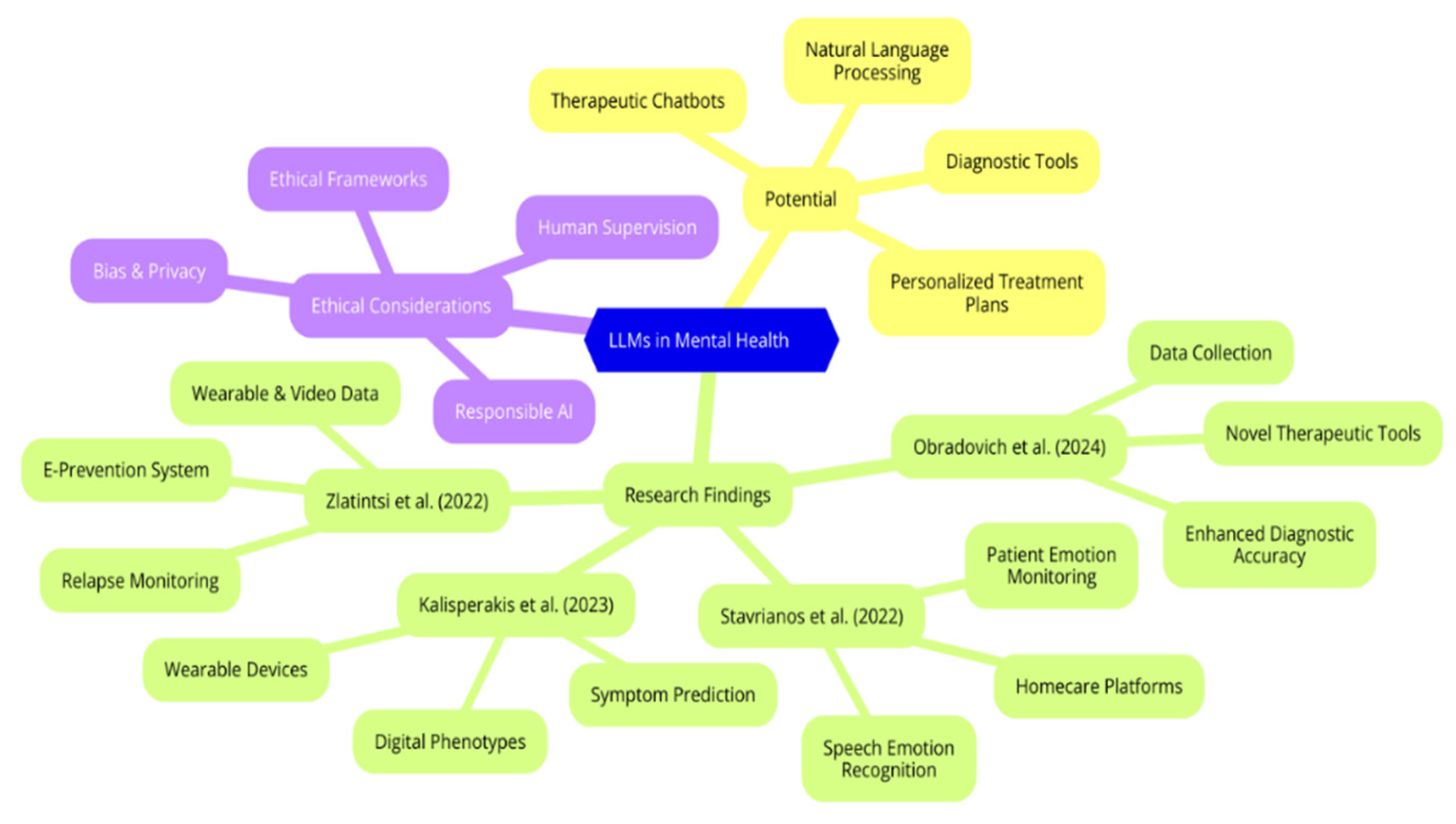
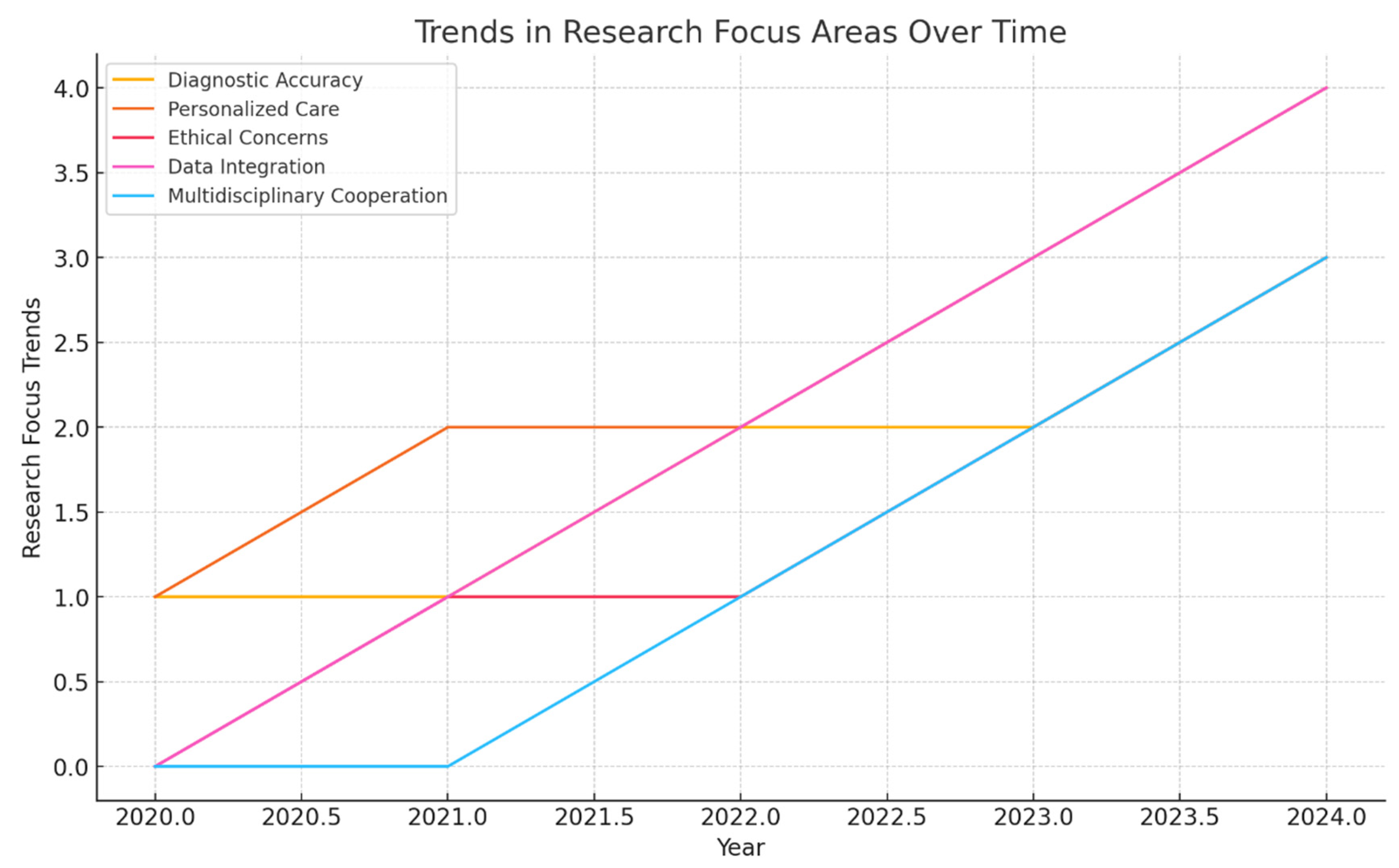
Figure 6.
Trends in Research Focus Areas Over Time.
4. Evaluation of AI Tools—Case Studies
4.1. Quantitative Evaluation
Multiple studies have been undertaken to determine the effectiveness of apps, virtual therapists, wearable devices, and virtual reality therapies in controlling and reducing symptoms of anxiety and depression. In relation to MoodKit, a 30-day trial including 226 individuals revealed a noteworthy decrease in depression, however, there was no significant impact on anxiety [2]. Separate research, with 159 participants from around 200 nations, discovered that MoodTools has the ability to overcome obstacles associated with conventional psychotherapy. Furthermore, the usage of the software did not result in any decline in their mental well-being [86]. It may be inferred that these applications have the potential to increase access to health and wellness services or activities, hence enhancing users’ everyday life.
The study conducted by Narziev et al. revealed that the Gear S3 Frontier smartwatch, a wearable device, was able to detect subjective data such as mood, physical activity, and sleep. This data was then used to classify individuals into different categories of depression. The study also found a strong correlation between the depression scores reported by the participants and the data collected by the smartwatch [59]. Conversely, a 4-week observational research with 55 healthy people found that the BioBase program effectively decreased anxiety and improved their mental well-being. The participants said that they found the application to be user-friendly, with 70% indicating that they would suggest it to a friend. The results indicate that BioBase might be a successful intervention for managing stress and enhancing general well-being, especially for individuals with elevated stress levels [45].
Simultaneously, two studies were done to assess the efficacy of the “Spire Health Tag” in monitoring respiratory rate and its use in managing anxiety, stress, and other related psychological problems. The initial study showcased the efficacy of utilizing the method to monitor and regulate anxiety and stress levels in people suffering from persistent pain [6]. The second trial found that participants had a decrease in both stress and anxiety following the intervention [82].
Positive outcomes have been observed from research conducted on the “Woebot” chatbot. A total of 70 individuals who got assistance for symptoms of anxiety and depression took part in the initial survey. The study conducted by Karkosz et al. found that participants had a noteworthy decrease in symptoms associated with sadness and anxiety [44]. A further study conducted by Fitzpatrick et al. revealed that Woebot effectively alleviated symptoms of sadness and anxiety among college students over a period of two-week sessions [28]. The Youper received a favorable rating from 4517 consumers, who utilized it for a duration of 4 weeks. The app led to a reduction in symptoms of anxiety and sadness within the initial 2 weeks of usage, and these improvements were sustained until the end of the trial [55]. A recent study conducted by Balcombe and de Leo has demonstrated that the chatbot “Tess” is highly helpful in reducing feelings of anxiety in subjects [11]. Finally, with relation to Virtual mental health therapy, the study examined its efficacy in addressing stress and anxiety. The research had 61 individuals, who saw substantial decreases in anxiety (34%) and stress (32%). The results indicate that utilizing virtual treatment in the metaverse is both possible and secure, and it is linked to quantifiable enhancements in mental health results [65]. In general, the efficacy of online services for mental health treatment has been proven, and there is increasing evidence supporting the effectiveness of mental health treatment and support provided through mobile applications [27]. Both the general public and professionals have shown increasing interest in these services [75]. Nevertheless, digital mental health services are typically not included in healthcare systems, despite their potential to have a significant effect.
4.2. Practical Impact of AI Tools on Users’ Daily Lives
The widespread availability and use of artificial intelligence tools has brought about a number of changes in the daily lives of users. Many people can now choose the right tool for them and in time use it to improve their mental health. One of the main advantages of these tools is their accessibility and easy use [76]. Chatbots and apps provide users with instant access to support resources, regardless of time and location. Users can leverage these tools discreetly and anonymously, thus overcoming barriers related to stigma and reluctance to seek help. Research has shown that AI-based interventions offer effective symptom relief and can enhance users’ sense of empowerment and self-efficacy in managing mental health challenges [37]. Furthermore, AI tools leverage advanced algorithms to personalize interventions based on users’ unique needs and preferences. Through machine learning techniques, these tools can analyze vast amounts of data to tailor interventions to individual user profiles. For example, wearable devices such as smartwatches monitor physiological signals such as heart rate variability and sleep patterns to provide personalized information about users’ stress levels and emotional well-being [3]. By offering personalized recommendations and adaptive feedback, AI tools facilitate a more differentiated and targeted approach to managing anxiety and depression. Therefore, even unconsciously, the user can carry out his daily tasks, receiving recordings of his emotions and body functions, for future management. This data can then be used by a professional to support the diagnosis and treatment process. AI apps and tools essentially help both users and health professionals [99].
In addition, the use of artificial intelligence tools may be a first step in symptom management or prevention. The user understands himself better and adopts positive practices and exercises that improve his daily life [76]. In other words, he learns to take care of himself. At the same time, the use of such tools democratizes access to health since users can use services and receive personalized guidance at low cost. The same applies to people living in remote areas, whose access to health facilities is demanding. Using artificial intelligence tools, people with symptoms of anxiety and depression can contact trained chatbots or healthcare professionals, sending the data from the app in real time for an initial assessment and immediate support [70].
However, despite their potential benefits, AI tools also present some limitations and challenges. One notable concern is the lack of human interaction and empathy inherent in automated interventions. While chatbots and apps can simulate conversations and provide support, they may lack the depth of understanding and emotional resonance that human therapists offer. Research shows that the quality of therapeutic alliance and relationship is crucial in mental health interventions, and the absence of genuine human connection can limit the effectiveness of AI-based approaches [39]. Beyond that, it is possible that people with anxiety and depression disorders will postpone visiting a specialist or substitute health services for those of apps. Despite the benefits these tools can offer, their potential to replace critical and synthetic thinking or the empathy that a human and professional can offer has not yet been proven. Finally, the user may underestimate his symptomatology based on the evaluation of the application, resulting in not receiving any treatment in time [8]. Overall, users should use such applications and tools as an adjunct and not equate them with the diagnosis and treatment that a professional would offer.
4.3. Accessibility
While smartphones and internet connectivity have grown globally, some demographic groups still face barriers such as socioeconomic status, geographic location and age. The digital divide, characterized by inequalities in access to technology, remains a critical factor affecting the effectiveness of mental health services. Many people do not have the necessary knowledge or skills to use psychological applications effectively, while others may face barriers to access due to limited knowledge or access to the internet. Ensuring inclusivity and addressing the digital divide is paramount to maximizing the effectiveness of computational models in mental health advocacy [32]. Moreover, the use of artificial intelligence can bring about an increase in accessibility by addressing some of the social stigma associated with mental illness. For example, virtual therapists may avoid this stigma as they are not influenced by social constructs and thus, are more likely to respond impartially. In addition, artificial intelligence can enable personalization of care through more granular analysis of large amounts of data, helping to predict response to treatment and potential side effects from various medications. This will reduce the need to conduct multiple drug tests [51]. In any case, however, parameters such as the cost of acquiring an application or device, its availability, as well as its functionality should be considered.
4.4. User Experience
When using virtual reality interventions remotely, ensuring user support and easy navigation is essential. Clear instructions, user-friendly interfaces and technical assistance can improve the user experience and address potential challenges. However, further research is needed to optimize these interventions to treat anxiety and depression in various populations and settings [55]. Some apps already have evidence, such as Youper, which has been described as user-friendly, benefiting older people in psychiatric outpatient clinics by providing care, companionship and relieving loneliness, especially during the pandemic [21]. It is also important to note that applications that use artificial intelligence to personalize treatment, offering customized exercises and techniques, do not serve all people. While some users may feel empowered, others may find the technology overwhelming or intrusive, underscoring the importance of thorough research [33]. Future research should explore enhancing the functionality of chatbots for personalized mental health support and integrating them into traditional health services.
5. Discussion, Challenges and Limitations
Utilizing computers, such as online services and mobile applications, in mental health services can enhance clinical treatment and alleviate strain on the mental health system [57]. Although they are very successful, they are typically not included in healthcare systems owing to inadequate planning and a lack of collaboration. This is a result of inadequate communication and a lack of collaboration among parties. Effective use of technology in mental health advocacy necessitates teamwork and consistency across several domains [7]. An important constraint is the lack of integration between clinical science and computer science since clinical researchers have difficulties in keeping pace with the rapid progress in natural language processing (NLP) [42]. Gaining a comprehensive and efficient advocacy plan involves recognizing how modern technologies enhance conventional methods, thereby capitalizing on the advantages of both ways [42]. Due to the delicate nature of mental health information, it is necessary to give considerable thought to privacy and data protection. Users utilizing digital mental health services must have assurance that their personal information is properly managed, since compromising confidentiality might undermine trust and discourage individuals from seeking assistance [46]. Furthermore, it is important to consider cultural characteristics since they have a significant impact on the perspective and approach towards mental health. In order to provide a more comprehensive and efficient approach, technology projects aimed at promoting mental health should consider and tailor to cultural variations [117]. However, artificial intelligence encounters difficulties in accurately identifying emotions in the context of a human doctor, since it lacks a complete awareness of emotional nuances and the importance of human empathy and comprehension. The research gap in this issue is characterized by a lack of precise data about the efficacy of technologies in this domain [120].
6. Conclusions and Future Orientations
The use of ML tools into mental health advocacy has introduced a new period of opportunities, providing inventive methods to tackle the intricate issues related to raising awareness, diminishing stigma, and providing support for mental health. Nevertheless, the efficacy of technology in this domain relies on several aspects that determine the implementation, extent, and influence of digital instruments. Comprehending these characteristics is crucial for mental health advocates, technologists, and legislators to fully harness the potential of computational models in furthering mental health advocacy endeavors. First, the proliferation of technological instruments in the realm of mental health might result in a substantial decrease in the proportion of individuals suffering from mental diseases. The accessibility of digital tools, such as applications and websites, together with the anonymity they offer, has the potential to alleviate the negative perception associated with mental illness and promote a greater willingness among individuals to seek assistance. Digital technologies can serve as a valuable adjunct for mental health providers. By furnishing them with data and insights obtained from users’ use of these technologies, they may enhance their comprehension of patients and deliver more efficient and customized treatment.
Moreover, the use of technology solutions might alleviate the burden on healthcare facilities. By providing consumers with digital tools, they may independently handle some of their issues, therefore saving time and resources to focus on more critical matters. While these algorithms tools offer several benefits, there are also legitimate concerns regarding data security and privacy. Moreover, over dependence on these technologies might result in a reduction of users’ independence and self-consciousness, as well as the deterioration of intricate human experiences into quantifiable metrics and algorithms. The widespread use of artificial intelligence systems gives rise to ethical and privacy concerns. These devices frequently gather and retain user data, which may include sensitive information pertaining to their mental well-being. There are apprehensions regarding the security of data, the preservation of secrecy, and the possible exploitation of personal information by other entities. Ultimately, the use of AI technologies might unintentionally lead to the deterioration of intricate human experiences, transforming them into quantifiable measurements and mathematical formulas.
AI solutions possess the capacity to profoundly influence users’ day-to-day existence in terms of managing anxiety and despair. Due to their accessibility, customisation, and efficacy, these tools are highly beneficial for those in need of assistance and direction. Nevertheless, it is crucial to acknowledge the constraints and moral ramifications linked to these technologies. In the future, it is essential to adopt a well-rounded strategy that combines AI technologies with care that focuses on human needs. This approach is necessary to fully utilize the advantages of AI while minimizing any possible drawbacks.
Treatment benefits for mental health, anxiety and depression can be enhanced through the use of Large Language Models (LLMs). This cutting-edge technology has the potential to revolutionise the field of mental health by enhancing diagnosis, monitoring, and therapy. Language models based on GPT-4 have the potential to enhance patient access, customization, and support in therapy. LLMs’ natural language comprehension greatly benefits therapeutic chatbots and diagnostic tools. These models have a remarkable ability to mimic human writing, making them incredibly valuable for providing fast support to individuals experiencing anxiety and depression. LLMs have the potential to improve patient outcomes by reducing the workload of mental health practitioners and offering prompt therapy. LLMs are highly effective in providing personalised treatment. These models could potentially provide remote and timely assistance, which could greatly benefit individuals seeking mental health care. Addressing the increasing global mental health burden is of utmost importance.
Implementing LLM in mental health treatment can be quite challenging. The computational burden of these models could potentially hinder their widespread use. In order to maintain trust and effectiveness, it is crucial that LLMs are used in an ethical manner. It is crucial for LLMs to tackle issues of privacy, prejudice, and preconceptions in order to ensure equality. Ensuring safety and reliability is crucial. The unpredictability of the LLM outputs stems from their nondeterminism. Accuracy and reliability are crucial in therapeutic settings, where a misdiagnosis or incorrect instruction could have devastating consequences. It is crucial for humans to closely monitor and intervene in the accidental activities of LLMs in order to ensure that AI enhances human judgement. Extensive research on training datasets and thorough validation methodologies are necessary to enhance the reliability of LLM. It is crucial to identify and rectify any inaccurate conclusions. Effective implementation of LLM (Language Model) in mental health treatment necessitates the establishment of ethical frameworks to govern AI usage, minimise bias, and safeguard patient privacy. LLMs have the potential to revolutionise mental health treatment, but there are several obstacles and ethical issues that need to be addressed. The potential of AI to enhance anxiety and depression treatment lies in its ability to enhance reliability, integrate multiple data sources, and foster collaboration across different disciplines.
Specifically, more investigation is required to enhance the dependability of these apps and transform them into valuable instruments for both users and healthcare practitioners. Ensuring the protection of personal data is equally crucial. Further investigation is required about the security mechanisms provided by the apps now available in the market for safeguarding sensitive information. Ultimately, it is essential to conduct a more comprehensive assessment of the applications and chatbots that are said to treat symptoms associated with sadness and anxiety. Mental diseases are intricate combinations of distinct symptoms that often occur together (comorbidity). The presence of major problems arises when an app fails to provide sufficient diagnostic or help. Further research is required to evaluate these characteristics comprehensively and to educate users about the efficacy of apps.
Author Contributions
For research articles with several authors, a short paragraph specifying their individual contributions must be provided. The following statements should be used “Conceptualization, T.R. and A.P.; methodology, I.M.; software, I.M.; validation, T.R., A.P. and I.M.; formal analysis, T.R.; investigation, T.R.; resources, A.P.; data curation, I.M.; writing—original draft preparation, A.P.; writing—review and editing, T.R.; visualization, T.R.; supervision, I.M.; project administration, I.M.; funding acquisition, I.M. All authors have read and agreed to the published version of the manuscript.”
Funding
This research received no external funding.
Institutional Review Board Statement
Not applicable.
Informed Consent Statement
Not applicable.
Data Availability Statement
No new data was created or analyzed in this study. Data sharing is not applicable to this article.
Acknowledgments
This work is co-funded by the HORIZON-CL4-2023-HUMAN-01-CNECT, Grant Agreement number: 101135990—Human-centric Digital Twin Approaches to Trustworthy AI and Robotics for Improved Working Conditions (AI4Work).
Conflicts of Interest
The authors declare no conflicts of interest.
References
- Abd-alrazaq A, Alhuwail D, Schneider J, Toro CT, Ahmed A, Alzubaidi M, Househ M. The performance of artificial intelligence-driven technologies in diagnosing mental disorders: an umbrella review. Npj Digital Medicine. 2022;5(1):1–12. [CrossRef]
- Abd-alrazaq A, AlSaad R, Aziz S, Ahmed A, Denecke K, Househ M, Sheikh J. Wearable Artificial Intelligence for Anxiety and Depression: Scoping Review. J Med Internet Res. 2023;25(1). [CrossRef]
- Ahmed A, Aziz S, Toro CT, Alzubaidi M, Irshaidat S, Serhan HA, Househ M. Machine learning models to detect anxiety and depression through social media: A scoping review. Comput Methods Programs Biomed Update. 2022;2:100066. [CrossRef]
- Ahmed A, Hassan A, Aziz S, Abd-alrazaq AA, Ali N, Alzubaidi M, Househ M. Chatbot features for anxiety and depression: A scoping review. Health Inform J. 2023;29(1):146045822211467. [CrossRef]
- Ahorsu DK, Lin CY, Imani V, Saffari M, Griffiths MD, Pakpour AH. The Fear of COVID-19 Scale: Development and Initial Validation. Int J Ment Health Addict. 2020. [CrossRef]
- Alberts NM, Leisenring WM, Flynn JS, Whitton J, Gibson TM, Jibb L, Armstrong GT. Wearable Respiratory Monitoring and Feedback for Chronic Pain in Adult Survivors of Childhood Cancer: A Feasibility Randomized Controlled Trial From the Childhood Cancer Survivor Study. JCO Clin Cancer Inform. 2020;4:1014–1026. [CrossRef]
- Andrews G, Cuijpers P, Craske MG, McEvoy P, Titov N. Computer Therapy for the Anxiety and Depressive Disorders Is Effective, Acceptable and Practical Health Care: A Meta-Analysis. PLoS ONE. 2010;5(10). [CrossRef]
- Austin SF, Frøsig A, Buus N, Lincoln T, von Malachowski A, Schlier B, Simonsen E. Service User Experiences of Integrating a Mobile Solution (IMPACHS) Into Clinical Treatment for Psychosis. Qual Health Res. 2021;31(5):942–954. [CrossRef]
- Baghaei N, Chitale V, Hlasnik A, Stemmet L, Liang HN, Porter R. Virtual Reality for Supporting the Treatment of Depression and Anxiety: Scoping Review. JMIR Ment Health. 2021;8(9). [CrossRef]
- Bakker D, Kazantzis N, Rickwood D, Rickard N. A randomized controlled trial of three smartphone apps for enhancing public mental health. Behav Res Ther. 2018;109:75–83. [CrossRef]
- Balcombe L, de Leo D. Psychological screening and tracking of athletes and digital mental health solutions in a hybrid model of care: Mini review. JMIR Form Res. 2020;4(12). [CrossRef]
- Balcombe L, De Leo D. An Integrated Blueprint for Digital Mental Health Services Amidst COVID-19. JMIR Ment Health. 2020;7(7). [CrossRef]
- Balcombe L, De Leo D. Human-Computer Interaction in Digital Mental Health. Informatics. 2022;9(1). [CrossRef]
- Barua PD, Vicnesh J, Lih OS, Palmer EE, Yamakawa T, Kobayashi M, Acharya UR. Artificial intelligence assisted tools for the detection of anxiety and depression leading to suicidal ideation in adolescents: a review. Cogn Neurodyn. 2024;18(1):1–22. [CrossRef]
- Bautista J, Liu M, Alvarez M, Schueller SM. Multi-Media Field Test: Cognitive-Behavioral Therapy at Our Fingertips: Sanvello Provides On-Demand Support for Mental Health. Cogn Behav Pract. 2024. [CrossRef]
- Becker TD, Torous JB. Recent Developments in Digital Mental Health Interventions for College and University Students. Curr Treat Options Psychiatry. 2019;6(3):210–220. [CrossRef]
- Berenguer C, Baixauli I, Gómez S, Andrés MdEP, De Stasio S. Exploring the Impact of Augmented Reality in Children and Adolescents with Autism Spectrum Disorder: A Systematic Review. Int J Environ Res Public Health. 2020;17(17):1–15. [CrossRef]
- Chandra S, Mohammadnezhad M, Ward P. Trust and Communication in a Doctor-Patient Relationship: A Literature Review. J Health Commun. 2018;3(3):1–6. [CrossRef]
- Chen J, Jiang Y, Yang D, Li M, Wei J, Qian Z, Zhang L. Can LLMs’ tuning methods work in the medical multimodal domain? arXiv preprint arXiv:2403.06407.
- Cheng Y, Wang K, Xu H, Li T, Jin Q, Cui D. Recent developments in sensors for wearable device applications. Anal Bioanal Chem. 2021;413(24):6037–6057. [CrossRef]
- Chou YH, Lin C, Lee SH, Lee YF, Cheng LC. User-Friendly Chatbot to Mitigate the Psychological Stress of Older Adults During the COVID-19 Pandemic: Development and Usability Study. JMIR Form Res. 2024;8.
- . [CrossRef]
- Corrigan PW, Mittal D, Reaves CM, Haynes TF, Han X, Morris S, Sullivan G. Mental health stigma and primary health care decisions. Psychiatry Res. 2014. [CrossRef]
- De Witte NAJ, Joris S, Van Assche E, Van Daele T. Technological and Digital Interventions for Mental Health and Wellbeing: An Overview of Systematic Reviews. Front Digit Health. 2021;3. [CrossRef]
- Ding NB. Anxiety disorders and phobias: A cognitive perspective. Health Soc Work. 1988;13(1):76–77. [CrossRef]
- Ewbank MP, Cummins R, Tablan V, Bateup S, Catarino A, Martin AJ, Blackwell AD. Quantifying the Association Between Psychotherapy Content and Clinical Outcomes Using Deep Learning. JAMA Psychiatry. 2020;77(1):35. [CrossRef]
- Firth J, Torous J, Nicholas J, Carney R, Pratap A, Rosenbaum S, Sarris J. The efficacy of smartphone-based mental health interventions for depressive symptoms: a meta-analysis of randomized controlled trials. World Psychiatry. 2017;16(3):287–298. [CrossRef]
- Fitzpatrick KK, Darcy A, Vierhile M. Delivering Cognitive Behavior Therapy to Young Adults With Symptoms of Depression and Anxiety Using a Fully Automated Conversational Agent (Woebot): A Randomized Controlled Trial. JMIR Ment Health. 2017;4(2). [CrossRef]
- Fulmer R, Joerin A, Gentile B, Lakerink L, Rauws M. Using Psychological Artificial Intelligence (Tess) to Relieve Symptoms of Depression and Anxiety: Randomized Controlled Trial. JMIR Ment Health. 2018;5(4). [CrossRef]
- Gallos P, Menychtas A, Panagopoulos C, Kaselimi M, Temenos A, Rallis I, Doulamis A, Doulamis N, Bimpas M, Aggeli A, Protopapadakis E, Sardis E, Maglogiannis I. Using mHealth technologies to promote public health and well-being in urban areas with blue-green solutions. Stud Health Technol Inform. 2022;295:566-569. [CrossRef]
- GBD 2019 Mental Disorders Collaborators. Global, regional, and national burden of 12 mental disorders in 204 countries and territories, 1990–2019: a systematic analysis for the Global Burden of Disease Study 2019. Lancet Psychiatry. 2022;9(2):137-150.
- Gelfgren S, Ineland J, Cocq C. Social media and disability advocacy organizations caught between hopes and realities. Disabil Soc. 2022;37(7):1085–1106. [CrossRef]
- Glenn T, Monteith S. New Measures of Mental State and Behavior Based on Data Collected From Sensors, Smartphones, and the Internet. Curr Psychiatry Rep. 2014;16(12):523. [CrossRef]
- Goldberg SB, Flemotomos N, Martinez VR, Tanana MJ, Kuo PB, Pace BT, Atkins DC. Machine learning and natural language processing in psychotherapy research: Alliance as example use case. J Couns Psychol. 2020;67(4):438–448. [CrossRef]
- Gomes N, Pato M, Lourenço AR, Datia N. A Survey on Wearable Sensors for Mental Health Monitoring. Sensors. 2023;23(3):1–16. [CrossRef]
- González Ramírez ML, García Vázquez JP, Rodríguez MD, Padilla-López LA, Galindo-Aldana GM, Cuevas-González D. Wearables for Stress Management: A Scoping Review. Healthcare. 2023;11(17):2369. [CrossRef]
- Grimm B, Talbot B, Larsen L. PHQ-V/GAD-V: Assessments to identify signals of depression and anxiety from patient video responses. Appl Sci. 2022;12(18):9150. [CrossRef]
- Healthline. Anxiety Chest Pain: Symptoms, Home Remedies, and More. Retrieved December 3, 2019, from https://www.healthline.com/health/anxiety/anxiety-chest-pain#see-a-doctor.
- Inkster B, Sarda S, Subramanian V. An Empathy-Driven, Conversational Artificial Intelligence Agent (Wysa) for Digital Mental Well-Being: Real-World Data Evaluation Mixed-Methods Study. JMIR MHealth UHealth. 2018;6(11). [CrossRef]
- Ito A, Hiyoshi F, Kanie A, Maruyama A, Oba MS, Kito S. Feasibility Study of Virtual Reality–Based Cognitive Behavioral Therapy for Patients With Depression: Protocol for an Open Trial and Therapeutic Intervention. JMIR Res Protoc. 2023;12. [CrossRef]
- Ivanov VM, Krivtsov AM, Strelkov SV, Smirnov AY, Shipov RY, Grebenkov VG, Koskin VS. Practical Application of Augmented/Mixed Reality Technologies in Surgery of Abdominal Cancer Patients. J Imaging. 2022;8(7). [CrossRef]
- Jingili N, Oyelere SS, Nyström MBT, Anyshchenko L. A systematic review on the efficacy of virtual reality and gamification interventions for managing anxiety and depression. Front Digit Health. 2023;5. [CrossRef]
- Kalisperakis E, Karantinos T, Lazaridi M, Garyfalli V, Filntisis PP, Zlatintsi A, Efthymiou N, Mantas A, Mantonakis L, Mougiakos T, Maglogiannis I, Tsanakas P, Maragos P, Smyrnis N. Smartwatch digital phenotypes predict positive and negative symptom variation in a longitudinal monitoring study of patients with psychotic disorders. Front Psychiatry. 2023;14:1024965. [CrossRef]
- Karkosz S, Szymański R, Sanna K, Michałowski J. Effectiveness of a Web-based and Mobile Therapy Chatbot on Anxiety and Depressive Symptoms in Subclinical Young Adults: A Randomized Controlled Trial (Preprint). JMIR Form Res. 2023;8. [CrossRef]
- Kawadler JM, Hemmings NR, Ponzo S, Morelli D, Bird G, Plans D. Effectiveness of a smartphone app (Biobase) for reducing anxiety and increasing mental well-being: Pilot feasibility and acceptability study. JMIR Form Res. 2020;4(11). [CrossRef]
- Kleine AK, Lermer E, Cecil J, Heinrich A, Gaube S. Advancing mental health care with AI-enabled precision psychiatry tools: A patent review. Comput Human Behav Rep. 2023;12(March):100322. [CrossRef]
- Ku WL, Min H. Evaluating Machine Learning Stability in Predicting Depression and Anxiety Amidst Subjective Response Errors. Healthcare. 2024;12(6):625. [CrossRef]
- Lattie EG, Nicholas J, Knapp AA, Skerl JJ, Kaiser SM, Mohr DC. Opportunities for and Tensions Surrounding the Use of Technology-Enabled Mental Health Services in Community Mental Health Care. Adm Policy Ment Health Ment Health Serv Res. 2020;47(1):138–149. [CrossRef]
- Lederbogen F, Kirsch P, Haddad L, Streit F, Tost H, Schuch P, Meyer-Lindenberg A. City living and urban upbringing affect neural social stress processing in humans. Nature. 2011;474(7352):498–501. [CrossRef]
- Lee EE, Torous J, De Choudhury M, Depp CA, Graham SA, Kim HC, Jeste DV. Artificial Intelligence for Mental Health Care: Clinical Applications, Barriers, Facilitators, and Artificial Wisdom. Biol Psychiatry Cogn Neurosci Neuroimaging. 2021;6(9):856–864. [CrossRef]
- Lovejoy CA, Buch V, Maruthappu M. Technology and mental health: The role of artificial intelligence. Eur Psychiatry. 2019;55(January):1–3. [CrossRef]
- Lu L, Zhang J, Xie Y, Gao F, Xu S, Wu X, Ye Z. Wearable health devices in health care: Narrative systematic review. JMIR MHealth UHealth. 2020;8(11). [CrossRef]
- Lundin RM, Yeap Y, Menkes DB. Adverse Effects of Virtual and Augmented Reality Interventions in Psychiatry: Systematic Review. JMIR Ment Health. 2023;10. [CrossRef]
- Maglogiannis I, Zlatintsi A, Menychtas A, Papadimatos D, Filntisis PP, Efthymiou N, Retsinas G, Tsanakas P, Maragos P. An intelligent cloud-based platform for effective monitoring of patients with psychotic disorders. Proceedings of the International Conference on Artificial Intelligence Applications and Innovation (AIAI-2020). [CrossRef]
- Mehta A, Niles AN, Vargas JH, Marafon T, Couto DD, Gross JJ. Acceptability and Effectiveness of Artificial Intelligence Therapy for Anxiety and Depression (Youper): Longitudinal Observational Study. J Med Internet Res. 2021;23(6). [CrossRef]
- Mercer SW, Reynolds WJ. Empathy and quality of care. Br J Gen Pract. 2002;52(SUPPL.):9–12.
- Mohr DC, Burns MN, Schueller SM, Clarke G, Klinkman M. Behavioral Intervention Technologies: Evidence review and recommendations for future research in mental health. Gen Hosp Psychiatry. 2013;35(4):332–338. [CrossRef]
- Morales A, Barbosa M, Morás L, Cazella SC, Sgobbi LF, Sene I, Marques G. Occupational Stress Monitoring Using Biomarkers and Smartwatches: A Systematic Review. Sensors. 2022;22(17):6633. [CrossRef]
- Muñoz S, Iglesias C. Detection of the severity level of depression signs in text combining a feature-based framework with distributional representations. Appl Sci. 2023;13(21):11695. [CrossRef]
- Top of Form.
- Bottom of Form.
- Nemesure MD, Heinz MV, Huang R, Jacobson NC. Predictive modeling of depression and anxiety using electronic health records and a novel machine learning approach with artificial intelligence. Sci Rep. 2021;11(1):1–9. [CrossRef]
- Newson JJ, Thiagarajan TC. Assessment of Population Well-Being With the Mental Health Quotient (MHQ): Development and Usability Study. JMIR Ment Health. 2020;7(7). [CrossRef]
- Nicosia J, Wang B, Aschenbrenner AJ, Sliwinski MJ, Yabiku ST, Roque NA, Hassenstab J. To BYOD or not: Are device latencies important for bring-your-own-device (BYOD) smartphone cognitive testing? Behav Res Methods. 2023;55(6):2800–2812. [CrossRef]
- Obradovich N, Khalsa SS, Khan WU, Suh J, Perlis RH, Ajilore O, Paulus MP. Opportunities and risks of large language models in psychiatry. Nat Ment Health. 2024. [CrossRef]
- Odgers CL, Jensen MR. Annual Research Review: Adolescent mental health in the digital age: facts, fears, and future directions. J Child Psychol Psychiatry. 2020;61(3):336–348. [CrossRef]
- Oh J, Kim M, Park H, Oh H. Are you depressed? Analyze user utterances to detect depressive emotions using DistilBERT. Appl Sci. 2023;13(10):6223. [CrossRef]
- Pentina I, Xie T, Hancock T, Bailey A. Consumer–machine relationships in the age of artificial intelligence: Systematic literature review and research directions. Psychol Mark. 2023;40(8):1593–1614. [CrossRef]
- Ponzo S, Morelli D, Kawadler JM, Hemmings NR, Bird G, Plans D. Efficacy of the Digital Therapeutic Mobile App BioBase to Reduce Stress and Improve Mental Well-Being Among University Students: Randomized Controlled Trial. JMIR MHealth UHealth. 2020;8(4). [CrossRef]
- Rani K, Vishnoi H, Mishra M. A Mental Health Chatbot Delivering Cognitive Behavior Therapy and Remote Health Monitoring Using NLP And AI. 2023 Int Conf Disrupt Technol ICDT. 2023;313–317. [CrossRef]
- Rappaport LM, Jerome E, Van Ameringen M, Whittal M, McLean CP. North American open-label 16-week trial of the MindShift smartphone app for adult anxiety. J Mood Anxiety Disord. 2023;4(October):100036. [CrossRef]
- Romanovskyi O, Pidbutska N, Knysh A. Elomia chatbot: The effectiveness of artificial intelligence in the fight for mental health. CEUR Workshop Proc. 2021;2870:1215–1224.
- Rowe NC, Chan AL. Rating whole-body suspiciousness factors in automated surveillance of a public area. Proc 2011 Int Conf Image Process Comput Vis Pattern Recognit IPCV 2011. 2011;1:317–322.
- Sadeh-Sharvit S, Camp T. Del, Horton SE, Hefner JD, Berry JM, Grossman E, Hollon SD. Effects of an Artificial Intelligence Platform for Behavioral Interventions on Depression and Anxiety Symptoms: Randomized Clinical Trial. J Med Internet Res. 2023;25(8). [CrossRef]
- Sandhu DE. Compute Depression and Anxiety Among Students in Pakistan, Using Machine Learning. Lahore Garrison Univ Res J Comput Sci Inf Technol. 2022;6(04):4–11. [CrossRef]
- Schröder D, Wrona KJ, Müller F, Heinemann S, Fischer F, Dockweiler C. Impact of virtual reality applications in the treatment of anxiety disorders: A systematic review and meta-analysis of randomized-controlled trials. J Behav Ther Exp Psychiatry. 2023;81:101893. [CrossRef]
- Schueller SM, Neary M, O’Loughlin K, Adkins EC. Discovery of and Interest in Health Apps Among Those With Mental Health Needs: Survey and Focus Group Study. J Med Internet Res. 2018;20(6). [CrossRef]
- Schyff EL, Ridout B, Amon KL, Forsyth R, Campbell AJ. Providing Self-Led Mental Health Support Through an Artificial Intelligence–Powered Chat Bot (Leora) to Meet the Demand of Mental Health Care. J Med Internet Res. 2023;25. [CrossRef]
- Shajari S, Kuruvinashetti K, Komeili A, Sundararaj U. The emergence of AI-based wearable sensors for digital health technology: a review. Sensors (Basel). 2023;23(23):9498.
- Shoumy NJ, Ang LM, Seng KP, Rahaman DM, Zia T. Multimodal big data affective analytics: A comprehensive survey using text, audio, visual and physiological signals. J Netw Comput Appl. 2020;149:102447.
- Sharma G, Schlosser L, Jones BDM, Blumberger DM, Gratzer D, Husain MO, Husain MI. Brief App-Based Cognitive Behavioral Therapy for Anxiety Symptoms in Psychiatric Inpatients: Feasibility Randomized Controlled Trial. JMIR Form Res. 2022;6(11). [CrossRef]
- Sigurðardóttir S, Helgadóttir FD, Menzies RE, Sighvatsson MB, Menzies RG. Improving adherence to a web-based cognitive-behavioural therapy program for social anxiety with group sessions: A randomised control trial. Internet Interv. 2022;28:100535. [CrossRef]
- Skapinakis P, Bellos S, Oikonomou A, Dimitriadis G, Gkikas P, Perdikari E, Mavreas V. Depression and its relationship with coping strategies and illness perceptions during the Covid-19 lockdown in Greece: A cross-sectional survey of the population. Depress Res Treat. 2020. [CrossRef]
- Smith EN, Santoro E, Moraveji N, Susi M, Crum AJ. Integrating wearables in stress management interventions: Promising evidence from a randomized trial. Int J Stress Manag. 2020;27(2):172–182. [CrossRef]
- Squires M, Tao X, Elangovan S, Gururajan R, Zhou X, Acharya UR, Li Y. Deep learning and machine learning in psychiatry: a survey of current progress in depression detection, diagnosis and treatment. Brain Inform. 2023;10(1):10.
- Spitzer M, Dattner I, Zilcha-Mano S. Digital twins and the future of precision mental health. Front Psychiatry. 2023;14:1082598.
- Stavrianos P, Pavlopoulos A, Maglogiannis I. Enabling speech emotional intelligence as a service in homecare platforms. In: EAI/Springer Innovations in Communication and Computing. Springer; 2022:119-144. [CrossRef]
- Su L. Access and Engagement of MoodTools, an mHealth Application for Depression (Georgia: Georgia State University). 2020. Retrieved from http://ezproxy.haifa.ac.il/login?url=https://search.ebscohost.com/login.aspx?direct=true&db=ddu&AN=3817E7D915865FCD&site=eds-live&scope=site.
- Suso-Ribera C, Fernández-Álvarez J, García-Palacios A, Hoffman HG, Bretón-López J, Baños RM, Botella C. Virtual Reality, Augmented Reality, and in Vivo Exposure Therapy: A Preliminary Comparison of Treatment Efficacy in Small Animal Phobia. Cyberpsychol Behav Soc Netw. 2019;22(1):31–38. [CrossRef]
- Tausczik YR, Pennebaker JW. The psychological meaning of words: LIWC and computerized text analysis methods. J Lang Soc Psychol. 2010;29(1):24–54. [CrossRef]
- Oshevwe Y, Oluwatoyin AF, Paschal CM, Chinaemelum OC, Tolulope SO. The role of technology in enhancing mental health advocacy: a systematic review. Int J Appl Res Soc Sci. 2024;6(1):37–50. [CrossRef]
- Vallée A. Envisioning the future of personalized medicine: role and realities of digital twins. J Med Internet Res. 2024;26.
- Wang Y, Chen W, Han X, Lin X, Zhao H, Liu Y, Yang H. Exploring the reasoning abilities of multimodal large language models (mllms): A comprehensive survey on emerging trends in multimodal reasoning. arXiv preprint arXiv:2401.06805.
- Wu Y, Xiang Y, Huo S, Gong Y, Liang P. LoRA-SP: streamlined partial parameter adaptation for resource efficient fine-tuning of large language models. In: Third International Conference on Algorithms, Microchips, and Network Applications (AMNA 2024). SPIE; 2024:488-496.
- Xiao H, Zhou F, Liu X, Liu T, Li Z, Liu X, Huang X. A comprehensive survey of large language models and multimodal large language models in medicine. arXiv preprint arXiv:2405.08603.
- Xie W, Wang C, Lin Z, Luo X, Chen W, Xu M, Cheng M. Multimodal fusion diagnosis of depression and anxiety based on CNN-LSTM model. Comput Med Imaging Graph. 2022;102:102128.
- Zadgaonkar A, Keskar R, Kakde O. Towards a machine learning model for detection of dementia using lifestyle parameters. Appl Sci. 2023;13(19):10630. [CrossRef]
- Zhang W, Lin T, Liu J, Shu F, Li H, Zhang L, Zhuang Y. HyperLLaVA: Dynamic visual and language expert tuning for multimodal large language models. arXiv preprint arXiv:2403.13447.
- Zlatintsi A, Filntisis PP, Garou C, Efthymiou N, Maragos P, Menychtas A, Maglogiannis I, Tsanakas P, Sounapoglou T, Kalisperakis E. E-Prevention: Advanced support system for monitoring and relapse prevention in patients with psychotic disorders analyzing long-term multimodal data from wearables and video captures. Sensors (Basel). 2022;22(19):7544. [CrossRef]
- Anxietycanada.com. New MindShift™ CBT App Gives Canadians Free Anxiety Relief. 2024 May 10. Available from: https://www.anxietycanada.com/articles/new-mindshift-cbt-app-gives-canadians-free-anxiety-relief/.
- Brooks M. AI Tool Flags Anxiety, Depression in Healthcare Workers. Medscape. 2023. Available from: https://www.medscape.com/viewarticle/998047?form=fpf.
- Calm.com. Calm your mind. Change your life. 2024. Available from: https://www.calm.com/.
- Callahan L. Lifeline Ally. Theresanaiforthat.com. 2023. Available from: https://theresanaiforthat.com/gpt/lifeline-ally/.
- Chrome Web Store. Breathhh: Workplace Wellbeing Companion. 2024. Available from: https://chromewebstore.google.com/detail/breathhh-workplace-wellbe/niipedbmjiopjpmjcpigiflabghcckeo/reviews.
- Crunchbase. Ladder. 2024. Available from: https://www.crunchbase.com/organization/ladder-433e.
- d3.harvard.edu. Ginger.io: An app that monitors your mental health. 2018. Available from: https://d3.harvard.edu/platform-digit/submission/ginger-io-an-app-that-monitors-your-mental-health/.
- https://thataicollection.com/en/application/deepwander/.
- Headspace for Organizations. Mental healthcare for every moment [Internet]. Available from: https://organizations.headspace.com/.
- Kintsugihealth.com. “I’m fine. 2024. Available from: https://www.kintsugihealth.com/.
- Liu L. What makes Inflection’s Pi a great companion chatbot. Medium. 2023. Available from: https://medium.com/@lindseyliu/what-makes-inflections-pi-a-great-companion-chatbot-8a8bd93dbc43.
- Meruhealth.com. Better mental health starts here. 2023. Available from: https://www.meruhealth.com/.
- Minddoc.com. Mental Health Starts with You. 2024. Available from: https://minddoc.com/us/en.
- Mindwell.ai. Your virtual self-care partner. 2024. Available from: https://mindwell.ai/en/treatments/anxiety-treatment.
- Moodmission.com. Change the way you feel. 2024. Available from: https://moodmission.com/.
- Moodtools.org. MoodTools. 2024. Available from: https://moodtools.org/.
- Pacifica-stress-anxiety.en.softonic.com. Sanvello: Anxiety Depression APK for Android. 2024 May 12. Available from: https://pacifica-stress-anxiety.en.softonic.com/android.
- Psychiatry.org—MoodPath.
- Rawat M. Best AI Apps For Mental Health (2023). MarkTechPost. 2023. Available from: https://www.marktechpost.com/2023/04/11/best-ai-apps-for-mental-health-2023/.
- Reachout.com. MoodKit. 2024. Available from: https://au.reachout.com/tools-and-apps/moodkit.
- Rootd.io. Panic attack and anxiety relief. 2024. Available from: https://www.rootd.io/.
- Sawh M. Stress wearables: best devices that monitor stress and how they work. Wareable. 2022. Available from: https://www.wareable.com/health-and-wellbeing/stress-monitoring-wearables-explained-7969.
- Solis E. How Mental Health Apps Are Handling Personal Information. New America. 2024. Available from: https://www.newamerica.org/oti/blog/how-mental-health-apps-are-handling-personal-information/.
- Space of Mind: Affordable PTSD facilitated peer support. Find a therapist to help you in anonymous, group facilitated peer support.
- Thehub.io. Moodmetric. 2024. Available from: https://thehub.io/startups/moodmetric.
- Thomasmore.be. App: Phobos AR. 2024. Available from: https://thomasmore.be/en/exp-zw/mw/app-phobos-ar.
- University of Tennessee. Artificial Intelligence (AI) Tools. 2024. Available from: https://research.utk.edu/research-integrity/artificial-intelligence-ai-tools/.
- Fisher Wallace. A Superdevice for Depression and Anxiety. 2024. Available from: https://www.fisherwallace.com/.
- Happify.com. Overcome negative thoughts, stress & life’s challenges! 2024. Available from: https://www.happify.com/.
- Samsung. Measure your stress level with Samsung Health. 2024. Available from: https://www.samsung.com/us/support/answer/ANS00080574/.
- Spire Health. Welcome to Health Tag. 2024. Available from: https://www.spirehealth.com/patient-setup.
Disclaimer/Publisher’s Note: The statements, opinions and data contained in all publications are solely those of the individual author(s) and contributor(s) and not of MDPI and/or the editor(s). MDPI and/or the editor(s) disclaim responsibility for any injury to people or property resulting from any ideas, methods, instructions or products referred to in the content. |
© 2024 by the authors. Licensee MDPI, Basel, Switzerland. This article is an open access article distributed under the terms and conditions of the Creative Commons Attribution (CC BY) license (http://creativecommons.org/licenses/by/4.0/).
Copyright: This open access article is published under a Creative Commons CC BY 4.0 license, which permit the free download, distribution, and reuse, provided that the author and preprint are cited in any reuse.


