
Submitted:
09 August 2024
Posted:
09 August 2024
You are already at the latest version
Abstract
As waterflooding multi-layer reservoirs get into the high-water-cut stage, inter-layer conflicts become increasingly serious, leading to a worsening development effect over time. Production layers regroup is an effective approach for resolving inter-layer conflicts and improving waterflooding efficiency. At the current stage, there are limitations for most of the methods of production layers regroup. This article proposes a smart method for optimizing the layer regroup plan based on genetic algorithm. Comprehensively considering various factors that affect the regroup of layers, based on the combination principle of "smaller intra-group variance and larger inter-group variance of each influencing factor are expected ", genetic algorithm is used to calculate the fitness value of the initial combination schemes, the advantageous schemes with higher fitness values are selected as the basis of the next generation. Then crossover and mutation operations are performed to those advantageous schemes to generate new schemes. Through continuous selection and evolution, until the global optimal solution with the highest fitness value is found, the optimal combination scheme is determined. Comparative analysis with numerical simulation results demonstrates the reliability of this intelligent method, with an increased oil recovery of 4.34% for the sample reservoir. Unlike selecting a preferable plan from a limited number of predefined combination schemes, this method is an automatic optimization to solve the optimal solution of the problem. It improves both efficiency and accuracy as compared to conventional reservoir engineering methods, numerical simulation methods and most of the mathematical methods, thus could provide effective guidance for EOR strategies of waterflooding reservoirs in high-water-cut stage.
Keywords:
high-water-cut reservoirs
; production layer regroup
; genetic algorithm
; EOR
1. Introduction
As waterflooding multi-layer reservoirs get into the high-water-cut stage, due to the strong heterogeneity between layers, inter-layer conflicts become increasingly serious, resulting in imbalanced injection and production, uneven recovery ratio and significant differences of remaining oil distribution among layers, seriously affecting the effectiveness of water injection development [1,2,3]. Production layers regroup is an effective approach for resolving inter-layer conflicts and improving waterflooding efficiency [4,5,6,7].
Scholars have conducted extensive research on the work of production layers regroup. On the basis of accurately understanding the geological and development characteristics of oil reservoirs, scholars such as Jin Y. and Yao B. have used conventional reservoir engineering methods to reasonably divide and combine the production layers for their reservoirs [8,9,10,11,12,13]. Conventional reservoir engineering methods are relatively fast, but the determined layer combination scheme is limited, difficult to compare multiple schemes. Scholars such as Wang S. and Li L. used numerical simulation methods to comprehensively consider various factors that affect the combination of layers, proposed a relatively quantitative classification standard for production layers, and optimized the layer combination of the oilfields [14,15,16]. Although the numerical simulation method can compare and select multiple layer combinations, the early model preparation requires a long time and is not efficient. Scholars such as Li Q. and Wu Y. used mathematical methods such as grey correlation, clustering method, and enumeration to comprehensively consider various factors reflecting the contradictions of reservoir layers, and developed relevant programs for layer combination, achieving rapid layer regrouping and optimization [16,17,18,19,20,21,22]. Mathematical methods can effectively solve the contradiction between efficiency and effectiveness that traditional methods cannot balance, but currently, most methods can only analyze a subset of parameters influencing layers regrouping, or they are limited to selecting the best option from a predefined set rather than seeking the optimal solution to the problem.
Genetic algorithm is a method to search for optimal solutions by simulating the process of natural evolution. This algorithm, through mathematical calculation and computer simulation, converts the problem-solving process into a process similar to the selection, crossover, and mutation of chromosome genes in biological evolution [23]. Genetic algorithm uses probabilistic mechanism for iteration, which makes the method with randomness, and uses evaluation function for heuristic search, which makes the process simple. The mutation mechanism prevents the algorithm from getting trapped in local optima, leading to strong search capabilities. With potential parallelism, it can simultaneously compare multiple individuals, quickly and accurately determine the optimal layer series subdivision scheme. When dealing with complex combination optimization problems, genetic algorithm, compared to some conventional optimization algorithms, usually achieves better results more quickly [24]. Genetic algorithm has been widely applied in fields such as combinatorial optimization, machine learning, signal processing, adaptive control, engineering optimization and artificial life, and is an important intelligent algorithm [25].
This article introduces a smart method for production layers regroup based on genetic algorithm. Comprehensively considering various factors that affect the regroup of layers, based on the combination principle of “smaller intra-group variance and larger inter-group variance of each influencing factor are expected “, genetic algorithm is used to calculate the intra-group variance and inter-group variance of each influencing factor for each initial grouping scheme, and then calculate the fitness values of those schemes. Based on the fitness value, the advantageous schemes with higher fitness values are selected as the basis of the next generation. Then crossover and mutation operations are performed to those advantageous schemes to generate new schemes. Through continuous selection and evolution, until the global optimal solution with the highest fitness value is found, the optimal combination scheme is determined. Unlike selecting a preferable plan from a limited number of predefined combination schemes, this method is an automatic optimization to solve the optimal solution of the problem. It improves both efficiency and accuracy as compared to conventional reservoir engineering methods, numerical simulation methods and most of the mathematical methods.
2. Methodology
2.1. Genetic Algorithm
Genetic algorithm is a method of finding the optimal solution by simulating natural evolution processes. Figure 1 shows the basic flowchart of genetic algorithm. Genetic algorithm maps the phenotypes of all individuals in the population to numerical values, i.e., encoding, and utilizes randomization techniques to efficiently search for an encoded parameter space. After initializing the population, better approximate solutions are obtained according to the principles of survival of the fittest. The genetic operations of genetic algorithm are selection, crossover, and mutation [23,24]. The selection operation ensures the advantageous individuals of the previous generation population to be inherited, while the crossover and mutation operations are aimed at obtaining more diverse populations, so as to quickly find the optimal solution.
2.2. Optimization of Layers Regrouping Scheme with Genetic Algorithm
This paper applies genetic algorithm to the optimization problem of production layers regrouping in oilfield development, the detailed steps are as follows:
2.2.1. Parameter Preset
The preset parameters include: 1) Population size G, indicating how many regrouping schemes are there in the population; 2) Total number of layer groups S; 3) Total number of layers N; 4) Maximum number of iterations T; 5) Crossover probability Pc; 6) Mutation probability Pm.
2.2.2. Population Initialization
Define the initial population G0, which consists of G combination schemes. The initial schemes can be randomly generated or set manually (setting a reasonably sound initial population could accelerate the solution process).
As an example, with a total number of layers of 10 and a layer series of 3 (S = 3), a regroup plan could be as Figure 2:
“1” indicates that the layer is included in the group, while “0” indicates that the layer is not included in the group. This is the coding method used in the genetic algorithm. Note: Different layer groups cannot include the same layer.
2.2.3. Calculation of the Fitness Value for Each Regrouping Scheme
The fitness in genetic algorithm is an indicator for the superiority of an individual (that is, each combination scheme). As for the optimization of production layers regroup, regardless of interbed and economic factors, smaller intra-group variance and larger inter-group variance of the influencing factors are expected for the regroup plan. In this paper, these two variances are then combined into a comprehensive variance as the fitness value for each scheme.
The fitness value for each layer groups division scheme is calculated according to the following steps.
(1) calculation of the intra-group variance of the influencing factors
The intra-group variance of the influencing factors of each layer group is calculated and then the average of for all layer groups is determined through the following formulas.
i, the i-th layer group;
j, the j-th layer in the i-th layer group;
q, the q-th influencing factor;
, the standard variance of the q-th influencing factor between each layer in the i-th layer group;
, the value of the q-th influencing factor in the j-th layer of the i-th layer group;
, the average value of the q-th influencing factor in the i-th layer group;
n, the number of layers in each layer group, could be different between groups;
, the average value of ;
S, total number of layer groups.
(2) Calculation of the inter-group variance of the influencing factors
The inter-group variance of the influencing factors is calculated through the following formulas, When calculating the variance of each influencing factor between layer group, set the average value of of each influencing factor across all layers within layer group as the value of that influencing factor in that layer group.
the standard variance of the q-th influencing factor between layer groups;
, the average value of of all layer groups;
(3) Normalization of intra-group variance and inter-group variance and fitness value calculation for each regrouping scheme.
The two variances above are then normalized and combined into a comprehensive variance as the fitness value for each regrouping plan:
and obtained above are normalized as:
, normalized value of ;
, the minimum value of ;
the maximum value of ;
, normalized value of ;
, the minimum value of ;
, the maximum value of .
and are then combined into as the fitness value of the layer regroup scheme:
; (8)
weight coefficients for intra-group variance and inter-group variance, ;
, weight coefficient for the q-th influencing factor, ;
, comprehensive variance, which is the fitness value for the combination scheme.
Noted that, smaller intra-group variance and larger inter-group variance are expected based on the layers regrouping principle, so a smaller , a larger , a larger , and consequently a larger are expected for an ideal plan.
2.2.4. Genetic Calculation
(1) Selection
Select schemes within the population based on the scheme fitness value. The superior schemes are chosen as the basis for the next calculation.
The roulette wheel selection method is used to define the probability of a scheme being selected [23]:
the fitness value of the k-th scheme.
Schemes with higher fitness values have a higher probability of being selected. In this case, still select G schemes (the same scheme can be repeatedly selected) to maintain the population size.
(2) Crossover
By utilizing single-point crossover operator, perform random crossovers on the selected schemes obtained through the selection process mentioned above. Randomly select two groups within a scheme, choose a random crossover point, and then perform crossover pairing at that position with the specified crossover probability .
(3) Mutation
Perform random mutations for each scheme obtained above after crossover calculation. Randomly select one group within a scheme, choose a random mutation position (i.e., position of the layer), and generate a random number between [0, 1] as a comparison probability. If this probability is less than the mutation probability , then the selected mutation position changes from 1 to 0 or from 0 to 1. However, it is important to note that the mutation method here is different from the conventional mutation method in genetic algorithm. It is not a simple change from 1 to 0 or from 0 to 1. In this case, if a layer changes from 1 to 0, then in another group, the same layer must change from 0 to 1, and vice versa. This ensures that different groups do not contain the same layer.
The selection operation mentioned above allows the inheritance of superior schemes, while crossover and mutation operations aim to generate more diversified schemes.
The next generation population G(t+1) is obtained after the selection, crossover, and mutation of population G(t).
Repeat the calculations from section 2.2.3 to 2.2.4 until the termination condition is met. Finally, the scheme with the maximum fitness value during the calculation process is outputted as the optimal scheme.
3. Case Application
A computational program was developed based on the above method, and the layer groups in the waterflooding sandstone reservoir Block X were optimized.
3.1. Overview of the Reservoir
Block X is a waterflooding sandstone reservoir in China (as shown in Figure 3) with 42 individual sand layers vertically and a production history of approximately 35 years. Currently, the cumulative recovery ratio is 30.39%, and the overall water cut is 90.74%, indicating that it has entered a high-water-cut stage. The heterogeneity between layers has resulted in significant variations in the development effect of each layer. For instance, the highest recovery of single layer is 41.25%, while the lowest is only 1.74%. Some layers have no water production, while most have already entered the high-water-cut stage. Geological and development parameters of each layer are illustrated in Figure 4.
3.2. Optimization of Layers Regrouping Scheme with Genetic Algorithm
Firstly, the parameters are set as follows: population size G = 6, total number of layer groups S = 3, total number of layers N = 42, maximum iteration count T = 1000, crossover probability Pc = 0.8, and mutation probability Pm = 0.005.
The initial population is defined as follows: 6 initial layer regrouping schemes are designed based on the parameter values of geological reserves, remaining reserves, current recovery ratio, comprehensive water cut, permeability, and effective thickness, as shown in Table 1.
3.3. Optimization Results
3.4. Reliability Analysis of Optimization Results
To verify the reliability of the optimization method proposed in this paper, by using numerical simulation method, the final recovery ratio of the top 10 optimization schemes were calculated. The comparative results are shown in Table 4 and Figure 5. The conclusions are as follows: first, the optimization schemes achieved higher recoveries than the non-optimization ones; second, the trends of the final recovery rate calculated by numerical simulation and the fitness value calculated by the method in this paper are generally consistent. As the fitness value increases, the final recovery rate gradually increases. Therefore, it can be seen that the calculation results of the optimization algorithm in this paper are reliable. Additionally, the method in this paper takes only about 1 hour for the whole calculating process, while numerical simulation requires one to two weeks. The method presented in this paper greatly improves work efficiency.
4. Deficiencies
This method still has the following deficiencies:
1) It only considers technical indicators and does not take into account the impact of interbed and economic issues.
2) The weight coefficient λ1 and λ2, as well as the weight coefficient still rely on expertise for assignment.
3) The calculation speed deepens on the reasonable initial schemes to some extent. The more reasonable the initial schemes are, the faster the optimal solution could be obtained.
5. Conclusions
Taking consideration of multiple factors that affect the production layer regroup, such as geological reserves, current recovery ratio, remaining reserves, effective thickness, permeability, porosity and water cut, genetic algorithm is used to calculate the fitness value of the combination scheme. Based on the fitness value, selection, crossover and mutation operations are performed to continuously generate new schemes, until the global optimal solution is found with the biggest fitness value, the optimal scheme is determined.
Unlike selecting a preferable plan from a limited number of predefined combination schemes, this method is an automatic optimization to solve the optimal solution of the problem.
This method can analyze and calculate various factors that influence production layer regrouping beyond those specifically mentioned in this case study. Additional factors can be incorporated into the calculation program as needed.
Comparison with numerical simulation results demonstrates the reliability of this intelligent method, which improves both efficiency and accuracy as compared to conventional reservoir engineering methods, numerical simulation methods and most of the mathematical methods, thus providing effective guidance for the EOR strategies of waterflooding reservoirs in high-water-cut stage.
Author Contributions
Conceptualization, J.Z. and L.C.; Methodology, J.Z. and L.C.; Software, L.C.; Formal analysis, D.H. and L.P.; Investigation, L.C.; Data Curation, B.P.; Writing-original draft preparation, L.C.; Writing-review and editing, J.Z.; Visualization, X.P.; Supervision, J.Z. All authors have read and agreed to the published version of the manuscript.
Funding
This research was funded by the Scientific Research and Technology Development Project of PetroChina: Research on Intelligent Layered Injection Production Engineering Technology (2021ZG12), the Scientific Research and Technology Development Project of CNPC: Real Time Prediction and Optimization Technology for Intelligent Production Measures in Oil Reservoirs (2023DJ8405), and the Scientific and Technological Project of PetroChina: Upgrade and Promotion of Intelligent Reservoir Analysis and Optimization Software-IRes (2023YQX303).
Acknowledgments
The authors would like to express their appreciation to the technical supports from Junhua Chang, Xianing Li, Li Wu, and Liming Wang from PetroChina Research Institute of Petroleum Exploration & Development.
Conflicts of Interest
The authors declare no conflict of interest.
References
- Han, D. Discussions on Concepts, Countermeasures and Technical Routes for the Redevelopment of High Water-cut Oilfields. Pet. Explor. Dev. 2010, 37, 583–591. [Google Scholar]
- Yu, H.; Wang, Y. Remaining oil distribution characteristics in an oil reservoir with ultra-high water-cut. Energy Geoscience 2022, 6, 004. [Google Scholar] [CrossRef]
- Mikael, H.; Tang, X. Development Journey and Outlook of Chinese Giant Oilfields. Pet. Explor. Dev. 2010, 37, 237–249. [Google Scholar]
- Song, X.; Qu, D. Low Cost Development Strategy for Oilfields in China. Pet. Explor. Dev. 2021, 48, 1007–1018. [Google Scholar] [CrossRef]
- Wang, W. Secondary Development Method of Lamadian Oilfield. Pet. Geol. Oilfield Dev. Daqing 2015, 34, 69–73. [Google Scholar]
- Hu, W. Necessity and Feasibility of PetroChina Mature Field Redevelopment. Pet. Explor. Dev. 2008, 35, 1–5. [Google Scholar] [CrossRef]
- Xue, L.; Liu, P. Status and Prospect of Improved Oil Recovery Technology of High Water Cut Reservoirs. Water 2023, 15, 1342. [Google Scholar] [CrossRef]
- Jin, Y. Optimization Technology of Stratigraphic Series Combination and Well Pattern in X Block During the Extra High Water Cut Period and Its Application. Pet. Geol. Oilfield Dev. Daqing 2020, 39, 86–93. [Google Scholar]
- Huang, X.; Zhang, X. Development by Layer Series Subdivision in Wendong Oil Field. Pet. Explor. Dev. 2003, 30, 84–87. [Google Scholar]
- Li, R.; Zhang, J. The Research of Layer System Subdivision and Adjustment Methods in YSL Block of the Low Permeability Reservoirs. Mech. Eng., Mater. Sci. Civ. Eng. 2013, 274, 153. [Google Scholar] [CrossRef]
- Yao, B.; Zhao, Q. A Successful Test with Subdivision of Oil Layers and Adjustment of Water Flooding in Gaotaizi Oil Zone, Daqing Oilfield. Pet. Explor. Dev. 2008, 35, 220–224. [Google Scholar] [CrossRef]
- Lin, L. Study on Optimization of Combined Parameters of Subdivision Water Injection Layer Sections in Ultra-high Water Cut Stage. In Proceedings of the 3rd International Conference on Advances in Energy and Environment Research (ICAEER 2018), Guilin, China, Agu10-12, 2018. E3S Web of Conferences 2018, 53, 01020. [Google Scholar]
- Wang, H. Research on Improvement of Water Flooding by Subdivision of Extra-High Water Cut Period. In Proceedings of the 4th International Conference on Energy Science and Applied Technology, Chongqing, China, 2018. AIP Conference Proceedings 2066, 020033(2019)., Dec29-30. [CrossRef]
- Wang, S.; Niu, S. Layer Subdivision in The Late High Water Cut Stage in The Complex Fault Block Reservoirs, Dongxin Oilfield. Pet. Explor. Dev. 2004, 31, 116–118. [Google Scholar]
- Li, L. Technical Limits of Layer Recombination and Well Pattern Reconfiguration in B2 Oil Region. Spr. Ser. Geomech. Geoeng. 2020, 1560–1568. [Google Scholar]
- Zhang, C.; Teng, S. Optimization of CO2 flooding layer combination in multi thin and ultra-low permeability beach bar sand reservoirs. Petroleum Geology and Recovery Efficiency, 2021, 28, 119–125. [Google Scholar]
- Li, Q.; Zhang, J. Grey Decision-making Theory in the Optimization of Strata Series Recombination Programs of High water-cut Oilfields. Pet. Explor. Dev. 2011, 38, 463–468. [Google Scholar] [CrossRef]
- Shen, A.; Gao, L. Application of Grey Correlation and Cluster Analysis Method in Optimization and Reorganization of Oil Layer Series. Math. Prac. Theor. 2019, 5, 130–137. [Google Scholar]
- Wu, Y. Optimization of Production Layers Subdivision and Prediction of Oil Displacement Effect in Multi-layer Water Drive Reservoirs. Chem. Enterp. Manage. 2021, 11, 197–198. [Google Scholar]
- Hu, Q.; Wang, X. The Mathematical Method and Application of Strata Series Recombination in the Middle-late Stages of Multi-layer Sandstone Reservoir Development. Spr. Ser. Geomech. Geoeng. 2023, 4063–4078. [Google Scholar]
- Wu, Z.; Cui, C. Layer Regrouping Optimization for Multilayer Heterogeneous Reservoirs at a High Water Cut Stage. Arabian Journal of Geosciences. 2019, 12, 458. [Google Scholar] [CrossRef]
- Cui, C.; Jian, P. Layer Regrouping for Water-flooded Commingled Reservoirs at a High Water-cut Stage. Petroleum Science. 2016, 13, 272–279. [Google Scholar] [CrossRef]
- Holland, J. Adaptation in Natural and Artificial Systems. University of Michigan Press: Michigan, USA; 1975; 211-247.
- Yan, X. Genetic Algorithm and Its Applications. China University of Geosciences Press: Beijing, China, 2018; 2-51.
- Zheng, S. Industrial Intelligence Technology and Applications. Shanghai Science & Technology Publishers: Shanghai, China, 2019; 250-251.
Figure 1.
Flowchart of genetic algorithm.
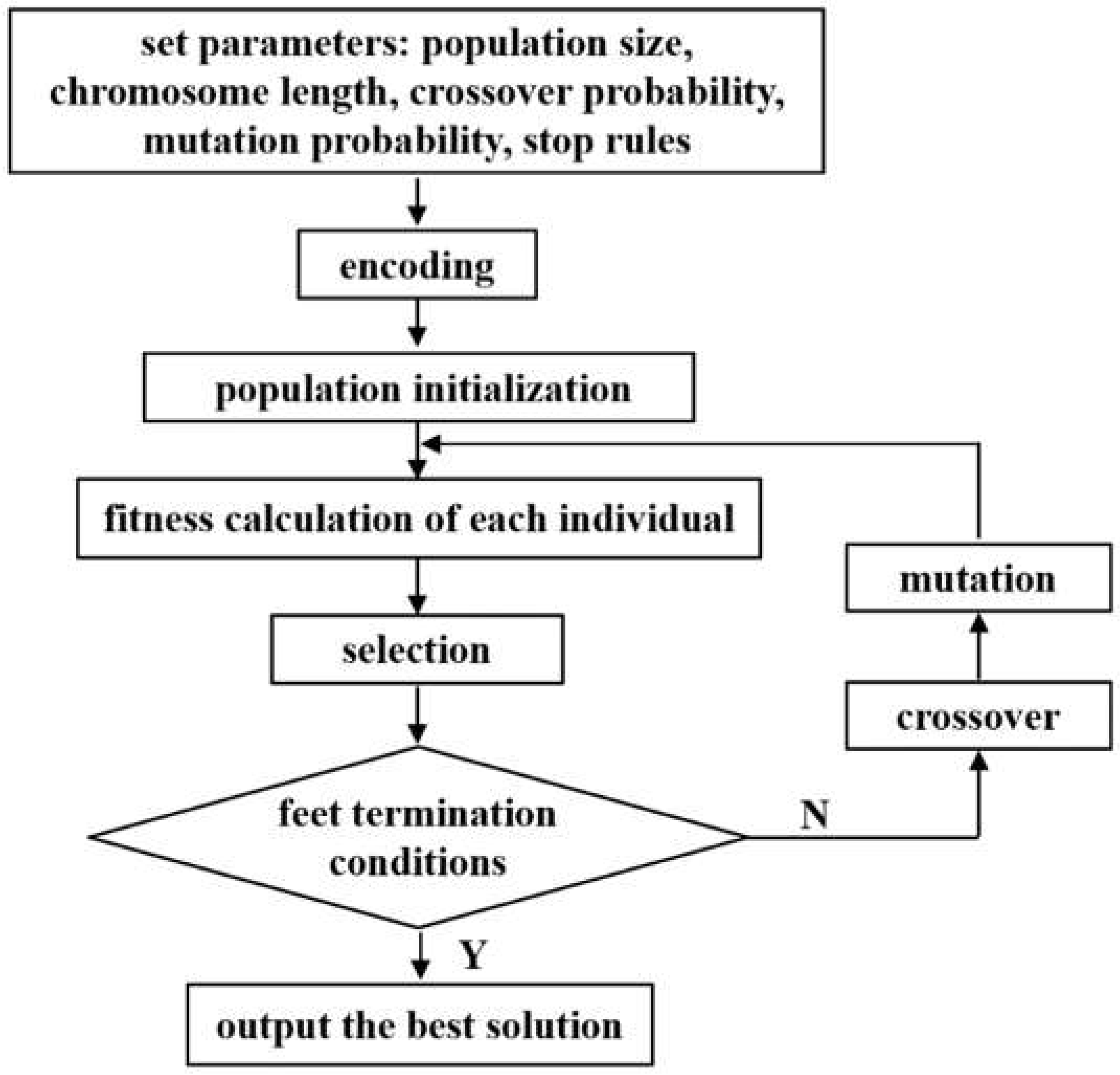
Figure 2.
Schematic diagram of production layers regroup plan and coding mode.
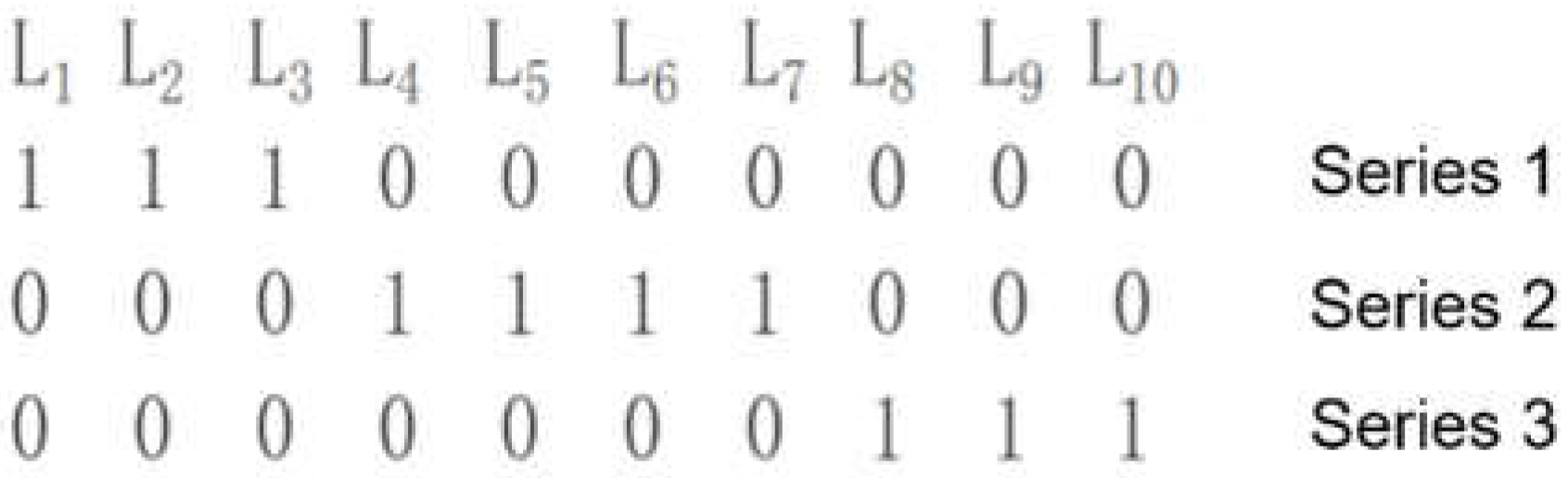
Figure 3.
Overview of block X.
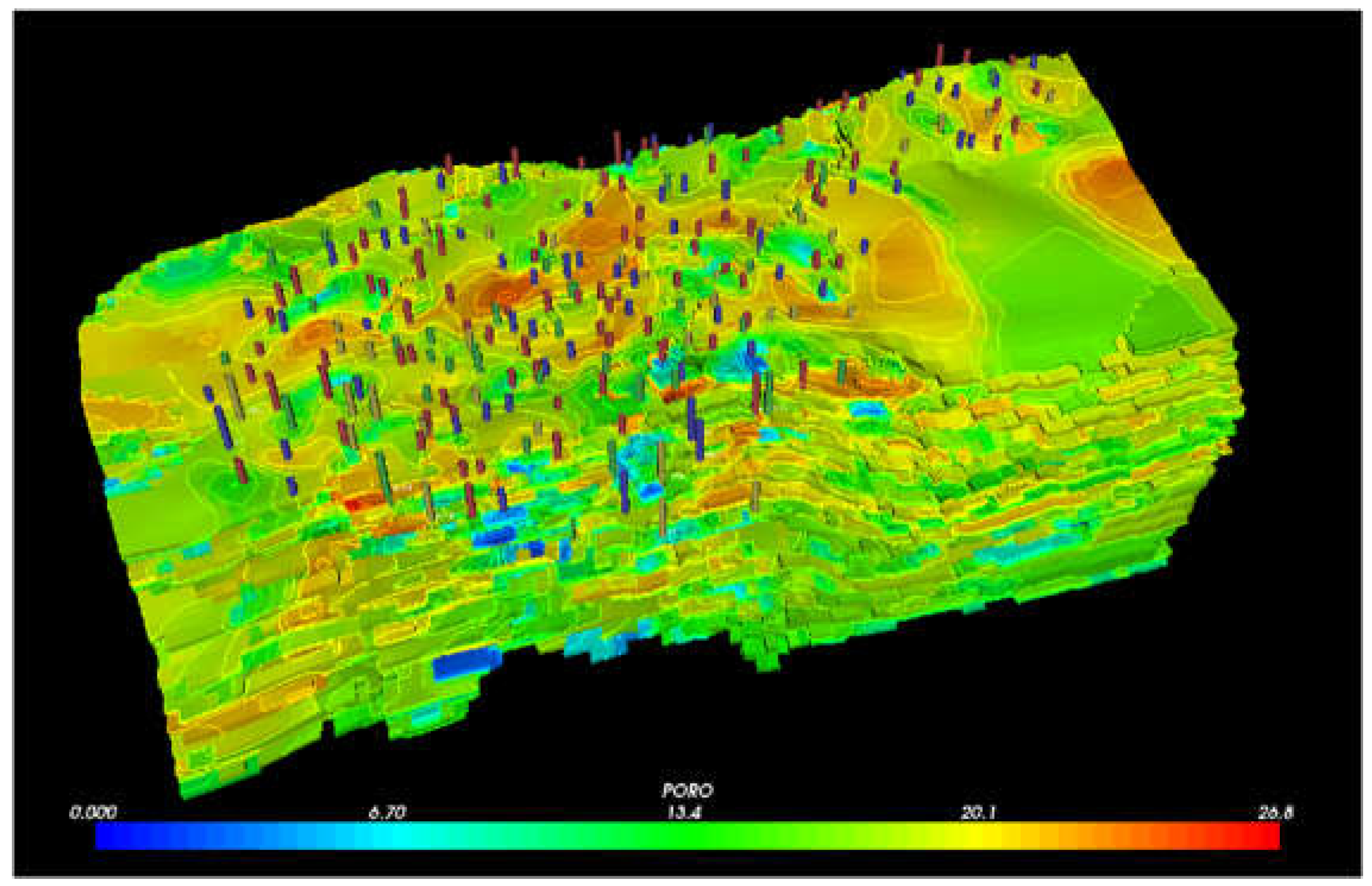
Figure 4.
Geological and development parameters of each layer in Block X.
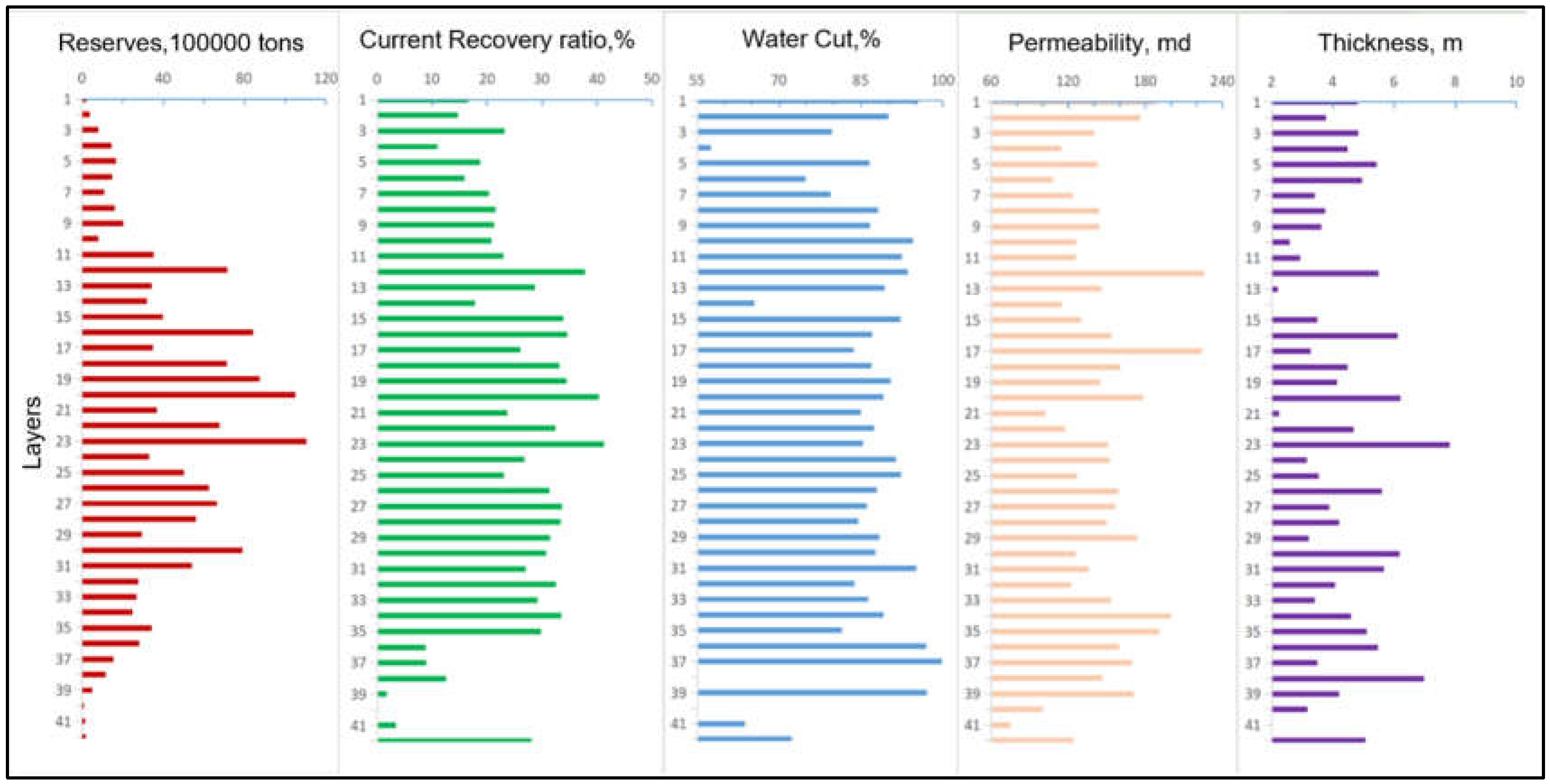
Figure 5.
Comparison of trends between recovery rate predicted by numerical simulation and fitness value.
Figure 5.
Comparison of trends between recovery rate predicted by numerical simulation and fitness value.
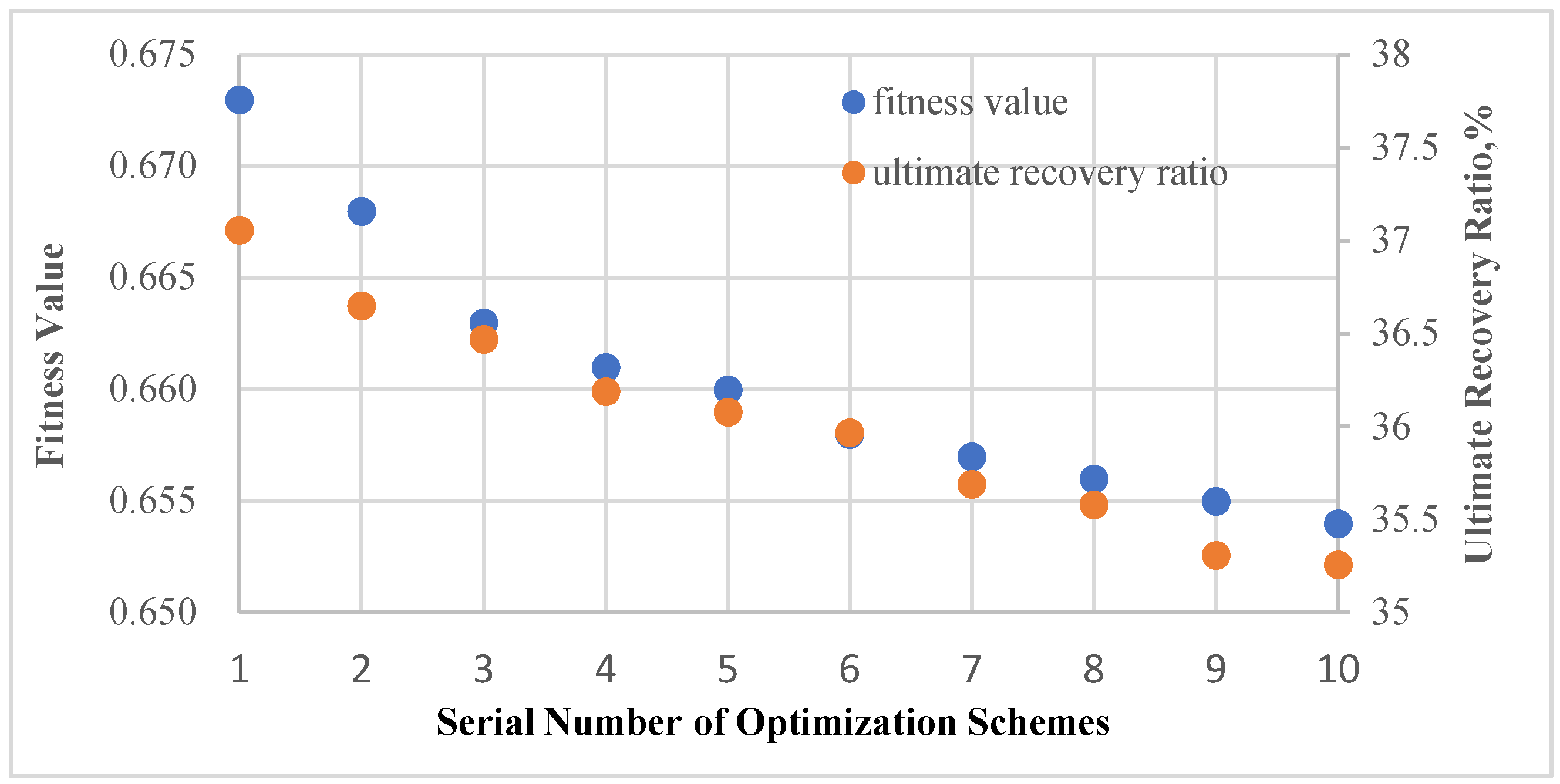

Table 1.
Initial layers regrouping schemes.
| Schemes | Division standard |
|---|---|
| Initial 1 | 3 series with reserves of 150000 tons and 500000 tons as thresholds |
| Initial 2 | 3 series with remaining reserves of 100000 tones and 400000 tons as thresholds |
| Initial 3 | 3 series with current recovery ratio of 0.15 and 0.25 as thresholds |
| Initial 4 | 3 series with comprehensive water cut of 0.75 and 0.9 as thresholds |
| Initial 5 | 3 series with permeabilities of 100 md and 150 md as thresholds |
| Initial 6 | 3 series with thicknesses of 3 meters and 5 meters as thresholds |
Table 2.
10 final optimization schemes.
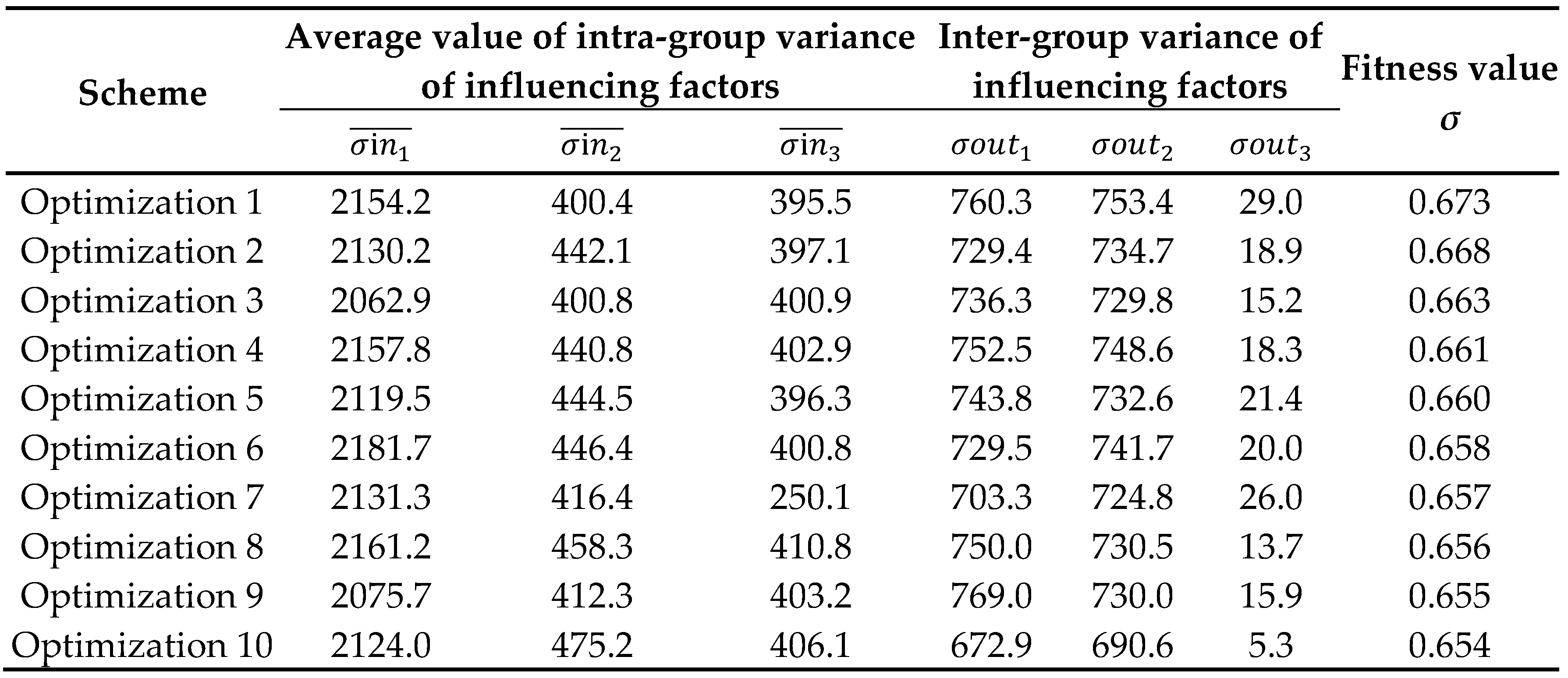 |
Table 3.
Layer grouping results corresponding to the optimal scheme.
| Layer groups | Layers |
|---|---|
| Group 1 | 1,2,3,4,5,6,7,8,9,10,14,38,39,40,41,42 |
| Group 2 | 11,13,15,17,21,24,29,32,33,34,35,36,37 |
| Group 3 | 12,16,18,19,20,22,23,25,26,27,28,30,31 |
Table 4.
Verification of the optimization results from genetic algorithm.
| Scheme | Fitness value | Ultimate recovery rate calculated 刘by numerical simulation, % |
|---|---|---|
| Optimization 1 | 0.673 | 37.06 |
| Optimization 2 | 0.668 | 36.65 |
| Optimization 3 | 0.663 | 36.47 |
| Optimization 4 | 0.661 | 36.19 |
| Optimization 5 | 0.660 | 36.08 |
| Optimization 6 | 0.658 | 35.97 |
| Optimization 7 | 0.657 | 35.69 |
| Optimization 8 | 0.656 | 35.58 |
| Optimization 9 | 0.655 | 35.31 |
| Optimization 10 | 0.654 | 35.26 |
| Non-optimization scheme | 32.72 |
Disclaimer/Publisher’s Note: The statements, opinions and data contained in all publications are solely those of the individual author(s) and contributor(s) and not of MDPI and/or the editor(s). MDPI and/or the editor(s) disclaim responsibility for any injury to people or property resulting from any ideas, methods, instructions or products referred to in the content. |
© 2024 by the authors. Licensee MDPI, Basel, Switzerland. This article is an open access article distributed under the terms and conditions of the Creative Commons Attribution (CC BY) license (https://creativecommons.org/licenses/by/4.0/).
Copyright: This open access article is published under a Creative Commons CC BY 4.0 license, which permit the free download, distribution, and reuse, provided that the author and preprint are cited in any reuse.