

Submitted:
03 August 2024
Posted:
05 August 2024
You are already at the latest version
Abstract
The utilization of Artificial Intelligence (AI) in biotechnology is widespread, addressing challenges such as elucidating disease pathophysiology and novel therapeutic approaches. AI plays a critical role in tasks such as drug manufacturing, chemical analysis, RNA and DNA sequencing, and enzyme studies by automating processes and expediting data collection and analysis. AI has particularly transformed the analysis of omics data for researchers, providing tools to handle complex and multifaceted datasets effectively. Through AI, integrative analysis of multi-omics data can be conducted in efficient ways. This article discusses the application of multi-omics and AI technologies in studying various diseases related to infection (COVID-19), mutation (cancer), and senescence (alopecia) to understand their pathophysiology. The applications of AI were performed as the aspect of the diagnosis, prognosis, and treatment for each disease. We introduce AI-driven analysis of pathophysiology can overcome traditional limitations in pathology, with diverse features showing potential in defining the causes of diseases, and potentially enhancing primary omics data in the distinguish the subtype of diseases. In this context, integrated approaches using multi-omics data and AI technology could provide fresh biological insights by comprehending the molecular mechanism of diseases and is instrumental in advancing precision medicine. We anticipate that the rapidly advancing AI-based multi-omics data analysis will significantly contribute to promoting healthy longevity.
Keywords:
Multi-omics
; AI technology
; Pathophysiology
; COVID19
; Cancer
; Alopecia
1. Introduction
The introduction should briefly place the study in a broad context and highlight why it is important. It should define the purpose of the work and its significance. The current state of the research field should be carefully reviewed and key publications cited. Please highlight controversial and diverging hypotheses when necessary. Finally, briefly mention the main aim of the work and highlight the principal conclusions. As far as possible, please keep the introduction comprehensible to scientists outside your particular field of research. References should be numbered in order of appearance and indicated by a numeral or numerals in square brackets—e.g., [1] or [2,3], or [4,5,6]. See the end of the document for further details on references. Artificial intelligence (AI) was defined at the Dartmouth conference in 1956 [1], leading to the rapid development of techniques such as machine learning (ML) and deep learning (DL). ML focuses on creating algorithms and statistical models that allow computers to perform tasks without explicit programming, with algorithms categorized into supervised, semi-supervised, and unsupervised[2]. DL, a subset of ML, uses neural networks to uncover complex data representations, significantly enhancing classifier performance, particularly with large, high-dimensional datasets[3].
Approaches of AI technology method is extensively used in biotechnology to tackle challenges like drug discovery [4], genomics [5], proteomics [6] , metabolomics [7], and pharmacology [8]. The future of this field depends on biotechnology researchers effectively leveraging advanced AI solutions. The industry relies heavily on data storage, filtering, analysis, and sharing, with vast databases maintained by companies and healthcare organizations.
AI significantly aids in processes such as drug manufacturing, chemical analysis, RNA and DNA sequencing, and enzyme studies by speeding up workflows and reducing manual errors. The success of AI applications relies on digital technology, making digitalization a crucial first step. AI systems often integrate with other digital technologies, like sensors and cyber-physical systems (CPS), to automate tasks and facilitate data collection and analysis [9].
AI has revolutionized how researchers analyze omics data, offering tools to manage high-dimensional and heterogeneous multi-omics datasets [10]. Integrative analysis with multi-omics data can be performed in efficient approaches via AI. Issues encompass data heterogeneity, different dataset sizes in comparison to sample numbers, and the inherent noise present in biological data [11,12]. AI and ML have emerged as promising solutions to address these challenges, providing techniques to manage large, intricate datasets and enhance integration accuracy [10,13]. Advancements in ML/AI also have the potential to address missing data for the reliability and reproducibility of multi-omics research analyses [14,15]. Pathophysiology analysis driven by AI can surpass traditional pathology limitations, with multi-oriented features demonstrating potential in defining disease causes [16], and potentially complementing primary omics data in disease classification [17]. Interpreting single omics data often fails to fully explain complex biological phenomena, but integrating multiple omics datasets provides a more comprehensive understanding of biological systems [18].
In this study, we argue about application of multi-omics and AI technologies in various diseases within the infection, mutation and senescence for elucidating pathophysiology. AI, particularly deep learning and machine learning, has been shown to significantly aid in the analysis of multi-omics data. It also assists in the diagnosis, prognosis, and treatment of disease such as COVID-19, cancer, and hair loss. Furthermore, this study addresses the critical role and potential of AI in accuracy and efficiency via molecular pathophysiological approaches using omics data. Precision medicine for diseases, especially aging-associated diseases, is challengeable issues, which focuses on providing insights into issues aging and multifaceted disease. Finally, integrative approaches with Multi-omics and AI technology contributes to precision medicine, and it would be expected to become central to future healthcare industry aimed at promoting healthy longevity.
2. Omics Data Interpretation: AI Technologies for Advanced Analysis
The advancement and application of AI are rooted in digital technology, particularly digital computers. In biotechnology, this transformation can enhance research and development efficiency, accuracy, and speed, and enable the creation of innovative products and services. By providing access to big data and automating tasks, digital transformation accelerates AI development and application in biotechnology, improving research and development outcomes.
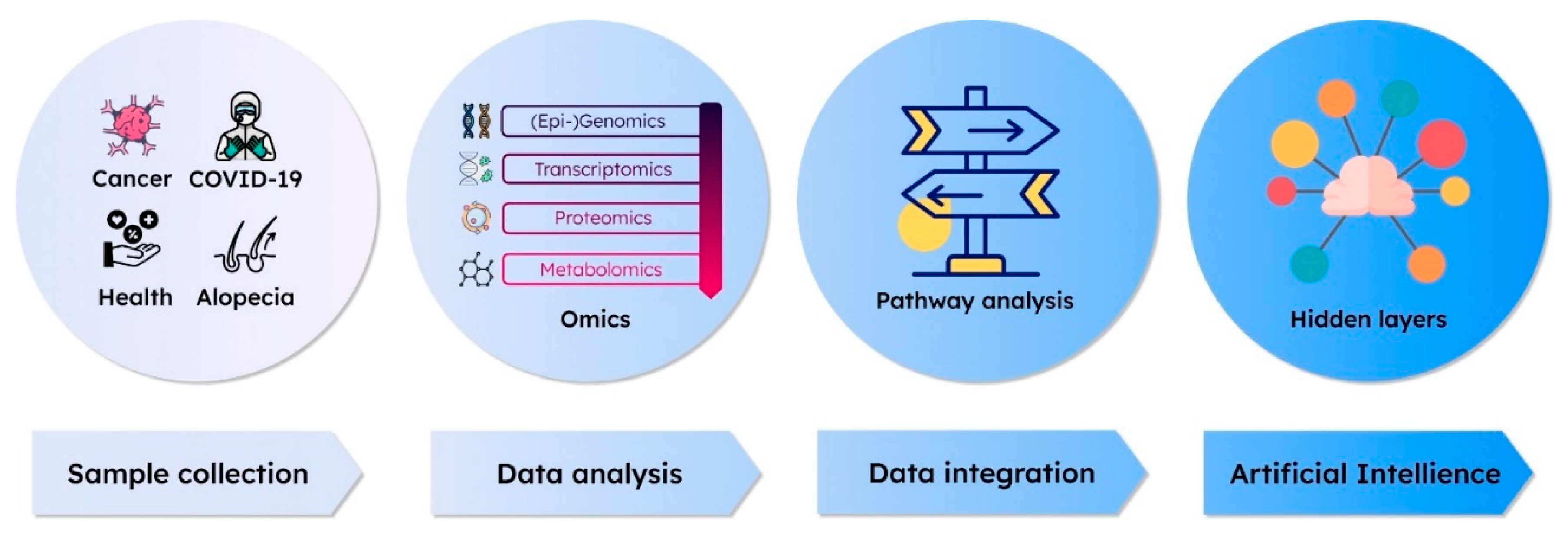
This involves generating various omics data types (like transcriptomics and proteomics) from the same biological samples. The goal is to gain a holistic understanding of biological systems across disciplines such as biomedicine, microbiology, and plant science [19]. Each omics type provides unique insights into different biological processes, such as gene expression and protein abundance [20].
However, integrating these diverse datasets poses significant challenges. Issues include data heterogeneity, varying dataset sizes relative to sample numbers, and inherent noise in biological data [10,12] These complexities hinder efforts to achieve a unified view of biological systems [21]. ML and AI have emerged as promising tools to tackle these challenges, offering methods to handle large, complex datasets and improve integration accuracy [10,13].
Figure 1.
Multi-omics data flow for data Integration and pathophysiological interpretation.
Research has highlighted specific application areas where multi-omics integration is crucial, such as cancer research and precision medicine [22]. Despite technological advancements, handling missing data remains a critical issue. One of the examples was the human proteome project. The estimated ~20% of genes yield protein products were not detected by mass spectrometry, an analytic platform for protein quantification [23,24]. Many current methods either discard data with missing values or impute missing values, impacting the reliability and reproducibility of analyses [25]. Addressing these limitations requires developing robust methodologies capable of handling missing data effectively [26].
While multi-omics approaches hold immense potential for advancing biological understanding, particularly in complex diseases and ecological systems, overcoming current integration challenges is crucial [10]. Future research should focus on enhancing data integration techniques, leveraging ML/AI advancements, and developing strategies to mitigate the impact of missing data to unlock the full potential of multi-omics research [14,15,27].
3. Interpretation of Multi-Omics Data with Approaches Using AI Methodology
Various techniques have been developed to leverage the relationships between different types of omics data [28]. These methods serve diverse purposes such as pathway analysis and drug response prediction, tackling challenges like heterogeneous data characteristics and high dimensionality [29]. Despite their diversity, there is enough common ground to categorize them broadly
3.1. Integrating Jointly Profiled Multi-Omics Data
Single-cell measurements face challenges in recovering molecular fractions efficiently, especially when targeting multiple compartments like DNA and RNA simultaneously. Integrating multimodal data is facilitated by matched data, where measurements from different modalities are obtained from the same cells. Techniques like joint snRNA-seq and snATAC-seq in sci-CAR [30], SNARE-seq [31], paired-seq [32], SHARE-seq [33], and the 10X Genomics Multi-omics solution generate such matched data. Methods such as CITE-seq [34] and REAP-seq [35] combine transcriptomic and surface protein data. Technologies now allow simultaneous measurement of single-cell phenotypes alongside transcriptomic data, enriching single-cell profiling [36]. Comprehensive reviews on matched multi-omics technologies are available elsewhere [37,38].
3.2. Statistical Modeling
Several methods have been developed to integrate matched multimodal data. A straightforward approach is to standardize features to have uniform statistical characteristics. In organismal systematic biology, a common method scales each feature by its variation across cellular samples [39]. However, this oversimplification treats all features equally in determining cell variation, disregarding their biological relevance. Another approach assigns probabilistic scores to feature values, using different models for feature sets to ensure consistent interpretation. For instance, BREM-SC employs a multinomial distribution of genes in cell types based on RNA and protein count matrices from CITE-seq data, facilitating probabilistic cell type clustering [40]. Importantly, this method differs from merely translating measurements across modalities, as it preserves the biological context rather than solely harmonizing statistical characteristics, thereby enhancing utility.
3.3. Latent Space Approaches
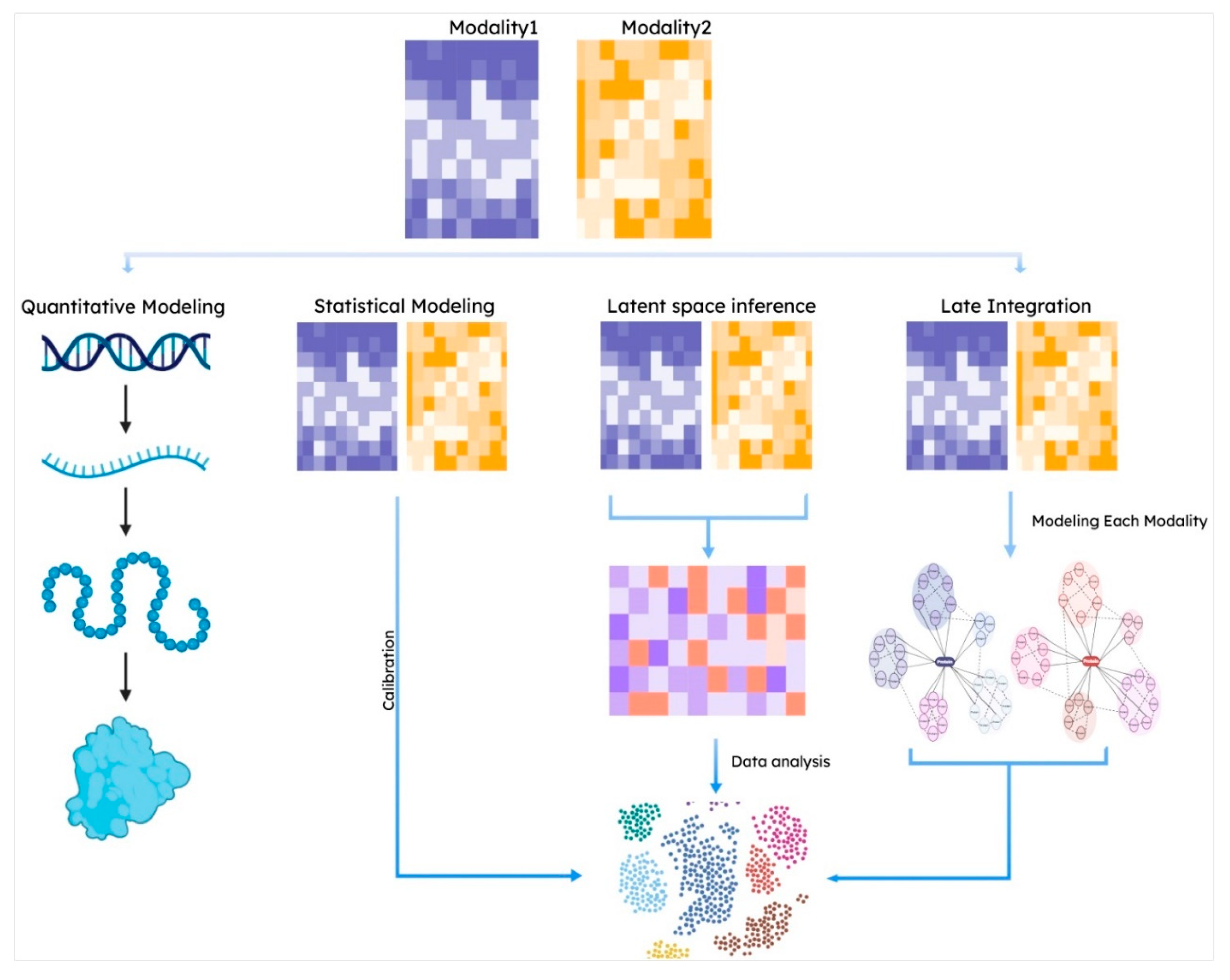
All figures and tables should be cited in; A more model-based theoretical approach is to consider each measurement, regardless of its modality, as an ‘aspect’ (or a ‘view’) of an underlying relationship between the cells. The method can be classified into early, middle, and late integration approaches [41]. Early integration involves straightforward concatenation of features from all omics followed by analysis.
Omics integration methods can be classified based on specific characteristics like feature selection, extraction, kernel learning, matrix factorization, graph/network approaches, and deep learning [27,42]. For instance, deep learning for survival analysis, initially concatenating raw features and extracting implicit representations via neural networks [43]. In contrast, separate networks for each data view, which merge representations later, require complete data, often necessitating imputation that may introduce biases [44].
Graph-based methods discover biomarker interactions, performing feature selection through sub-graph extraction for phenotype prediction [45]. Similarly, netDx constructs patient graphs per biomarker to classify patients effectively [46]. Kernel-based approaches create kernel representations, integrating data relationships with biased imputation preprocessing [47,48]. If a complete set of data from one or more samples is missing and needs to be imputed, specific similarities related to that data may not be preserved.
The study assumes a shared latent space and applies the scAI method to analyze joint transcriptome and epigenome data [49]. Applying scAI to kidney data revealed two subpopulations with different chromatin profiles but similar transcriptomes, emphasizing the necessity of integrating both data types for precise cell identity characterization. Latent space methods integrate features across data modalities early (early integration). Multi-omics factor analysis (MOFA) and its enhanced version, MOFA+, employ group factor analysis to uncover shared variation across multiple types of data [50,51]. These models treat observed data in each modality as linear combinations of a common latent space. MOFA+ extends this by incorporating multiple latent spaces to address group effects like experimental batches. TotalVI, akin to scAI and MOFA, utilizes a common latent space to relate transcriptome and protein measurements via a deep neural network encoder-decoder scheme [52]. Its neural network architecture allows for complex, non-linear relationships between the latent space and measured features, distinguishing it from scAI and MOFA.
Figure 2.
Artificial intelligence driven integration strategies for multi-omics data.
3.4. Late Integration Methods
Late integration methods focus on combining models inferred from multi-omics data after initial processing (late integration). For instance, Seurat V4 employs weighted nearest neighbor analysis to synthesize cell-to-cell affinities across RNA and protein data, evaluating neighborhood informativeness in predicting cell values [53]. Similarly, similarity network fusion, as exemplified in CiteFuse for CITE-seq integration, uses ‘message passing’ to iteratively fuse affinity relationships across different omics data [54,55]. MOLI process each omics type separately with deep neural networks, combining predictions through score fusion or latent representation concatenation [56,57]. These methods assume complete data or require imputation methods for missing multi-omics data, which are rarely missing completely at random (MCAR) [58]. Future methodologies should address missing data explicitly for efficiency and accuracy.
4. Multi-Omics Approaches in AI application from COVID-19, to Cancer, and Alopecia: Diagnosis, Prog-nosis, and Therapeutics
4.1. COVID-19 Endemic
COVID-19, caused by SARS-CoV-2, emerged in December 2019, spreading globally via respiratory droplets [59]. Symptoms vary from mild to severe, notably affecting elderly individuals with underlying conditions [60,61]. By March 2021, it had impacted over 200 countries, with more than 120 million cases and 2.6 million deaths, straining healthcare systems [62]. AI shows promise in diagnostics, treatment, and surveillance due to its scalability and processing power [63].
AI employs algorithms to simulate decision-making, improving with data input [64,65]. It offers high sensitivity, specificity, rapid reporting, and consistent results, advancing medical applications through predictive machine learning and deep learning with utilizing complex Artificial Neural Networks (ANN) architectures [66]. In the fight against COVID-19, AI aids accurate diagnosis, reduces doctor workload, identifies high-risk patients, models disease transmission, and supports drug and vaccine development [67,68,69,70]. AI chatbots and thermal imaging assist in early detection and safety measures [71,72]. Overall, AI plays a crucial role in managing COVID-19, including diagnosis, public health, clinical decision-making, and vaccine development, helping to address the strain on medical resources and contributing to the transition to endemic COVID-19 [71,73].
4.1.1. AI in COVID-19 Diagnosis
The COVID-19 pandemic spreads rapidly [74]. Diagnosis relies on RT–PCR testing, which can take up to 2 days. Chest CT scans are valuable but may not detect early infections [75]. AI, especially deep learning models, aids in early COVID-19 screening, improving accuracy and efficiency [76,77]. Chest CT is more effective than X-ray for diagnosing COVID-19, sometimes detecting symptoms before they appear [78]. AI-aided diagnosis using chest images achieved accuracies from 70.00% to 99.92% and sensitivities from 73.00% to 100.00% [68,79].
CNNs have shown remarkable performance in image recognition [80]. Studies with CNN-based AI models demonstrated high accuracy in distinguishing COVID-19 from non-COVID pneumonia in chest CT scans [68,81,82,83]. A CNN model combining chest CT findings with clinical data was developed for rapid COVID-19 diagnosis [82]. A decision-fusion approach using multiple CNN models achieved over 86% accuracy across all metrics [83]. While CT scans are highly sensitive, they are costly and involve high radiation doses. Chest X-rays, in contrast, are inexpensive and provide rapid detection, suitable for initial screening [84,85].
4.1.2. AI in Predicting COVID-19 Prognosis and Epidemic Trends
Identifying patient deterioration is crucial for effective COVID-19 management. AI models using chest CT scans accurately predict disease severity and patient outcomes [86,87]. Models integrating clinical data forecast critical illness risk with high accuracy and sensitivity [88,89]. Predictive models also consider geographical and demographic data, achieving significant accuracy [90]. Early prognosis and treatment initiation enhance patient outcomes and reduce mortality rates.
The COVID-19 pandemic spurred the development of prediction models [91]. LSTM models and other methods predict cases, deaths, recoveries, and transmission dynamics [79,92]. Examples include SEIR models with machine learning [93], MLP neural networks for USA incidence [94], and combined SVR, ARIMA, LSTM, and Bi-LSTM models for global metrics [95]. These models aid policymakers in resource allocation and outbreak prevention.
4.1.3. AI in Drug Discovery and Vaccine Development for COVID-19
Efforts to develop antiviral drugs and vaccines are crucial. Traditional methods are time-consuming, prompting AI techniques to expedite identification of treatments and vaccines. AI can identify drugs for novel diseases like COVID-19 through drug repurposing, addressing the challenge of identifying drug-disease relationships [96]. AI applications include virus identification, screening, diagnostics, drug repurposing, and prediction [72,97].
Drug repurposing is cost-effective [98]. AI algorithms identify potential COVID-19 treatments from existing drugs. For instance, 13 drugs effective against related coronaviruses were confirmed for SARS-CoV-2 [99]. Gradient-boosted decision trees screened 8,565 drugs, identifying 40 potential candidates [100]. Baricitinib, a JAK inhibitor approved by the FDA for alopecia areata treatment in 2023, was also identified as a COVID-19 treatment using AI [101,102].
A deep learning model using the 3CLpro model identified 175 potential therapeutic agents [103,104]. Deep Docking screened 1.3 billion compounds, identifying top candidates against SARS-CoV-2 Mpro protein [105]. Developing a safe and effective vaccine against SARS-CoV-2 was crucial. Machine learning predicted key viral proteins for vaccine targets, highlighting the S protein and nsp3 [72]. The S protein, highly antigenic, is a favorable vaccine candidate, while nsp3 requires further clinical study.
Omics-based data offer new insights into COVID-19, a pandemic that has highlighted the utility of multi-omics studies [106]. Integrating multi-omics data can aid in combating the epidemic and advancing our understanding of its mechanisms.
Biomarkers found in COVID-19 patients offer important insights into the molecular responses of the host and provide guidance for clinical decisions [107]. In a study by Bernardes et al., an increase in proliferating plasmablasts was identified as a characteristic of severe COVID-19 through the analysis of longitudinal multi-omics data [108]. The key biomarkers such as genes, proteins, and exRNAs were identified by utilization of transcriptomics, proteomics, and metabolomics [109]. Several studies have highlighted biomarkers strongly linked to the severity and progression of COVID-19, indicating potential targets for therapy [110,111].
The analysis of multi-omics data is essential for understanding the development of COVID-19 and for creating treatments [112]. An effective approach using integrative analysis for addressing the dangerous inflammatory response (Cytokine Release Syndrome, CRS) found in severe COVID-19 cases [113,114]. They observed increased levels of IL-6, IL-8, and MCP-1, which were positively linked to plasminogen activator inhibitor-1 (PAI-1, or SERPINE1), and were associated with severe pneumonia and COVID-19 mortality [113]. Furthermore, Tocilizumab, an IL-6 inhibitor, appears to hold potential for treating severe respiratory complications in CRS and COVID-19 [114].
Multi-omics analysis could enhance previous findings by investigating additional cytokines and serpin family genes [115]. Through the use of single-cell RNA sequencing, we scrutinized immune cells from both COVID-19 patients and healthy controls. This analysis revealed varying expressions of essential cytokines (IL32, IL7R, IL2RB, IL6ST, IL17RA, IL4R, IL-8, IL6R, ILF3, IL13RA1, IL10RA) and serpin genes (SERPINA1, SERPINB1, SERPINF1, SERPINB10, SERPING1) [115]. Notably, the levels of IL-8 were notably higher in the plasma of COVID-19 patients [78], whereas IL-17RA exhibited significant increases in milder cases [116]. It has been identified that IL-6R presents a crucial target for therapeutic intervention [117], and the levels of SERPINA1 and SERPING1 were particularly elevated in COVID-19 patients [118,119]. Furthermore, genetic instrumental variables were employed to assess cytokine levels’ COVID-19 risk through two-sample MR analysis [120], a method used to identify COVID-19 risk factors [121]. This analysis revealed differential expression of cytokines and serpin family genes in COVID-19 patients compared to healthy controls across various immune cell types.
4.2. Cancer
In the past 30 years, advances in cancer identification and treatment have reduced overall cancer-related deaths by 33% [122]. Despite this, many types of cancer are increasing, posing a significant global health challenge. Healthcare providers often have limited time to analyze extensive data, which can lead to errors. AI offers a promising solution to improve precision across medical fields [123,124]. Cancer involves complex biological abnormalities affecting genes, RNAs, proteins, and metabolites [109]. Technologies like omics provide detailed insights into cancer’s genetic and metabolic profiles, guiding personalized treatments and predicting responses [125,126]. Pathway-oriented analysis plays a crucial role in understanding cancer’s molecular diversity [127], with AI poised to enhance diagnosis, prognosis, and treatment [128,129].
4.2.1. AI-Assisted Diagnosis for Cancer
Deep learning in digital pathology automates tasks like cell type identification in histopathology slides. For instance, CNNs accurately classify cell nuclei in colon cancer tissues [130]. Tools such as Qupath automate nucleus detection and dataset creation [131], while ResNet achieves high accuracy in detecting colorectal polyps [132]. In prostate cancer, a CNN-based system for Gleason scoring outperformed pathologists [133]. Algorithms for biomarker quantification improve diagnostic precision [134], and convolutional networks aid in radiology for abnormality detection [135,136]. AI models using digital mammograms detect early-stage breast cancer more effectively than radiologists [137], potentially reducing mortality rates [138].
4.2.2. Predicting the Prognosis of Cancer
Early detection and prognosis are critical. AI identifies biomarkers and patient subgroups for cancer recurrence [139]. Methods like SVM and RF-ACE integrate multiple omics data to discover relapse biomarkers in colorectal cancer [140]. Deep learning neural networks predict survival in breast cancer by integrating traditional biomarkers with multi-omics data [141]. Kernel-based machine learning evaluates prognostic values across diverse omics datasets [142], highlighting mRNA’s predictive power in lower-grade glioma [143].
4.2.3. Elucidating Pathophysiology and Drug Discovery for Cancer
Bulleted lists look like this: Cancer treatment strategies traditionally focused on genetic and epigenetic approaches have been limited due to the complex interplay of aging and lifestyle factors [144,145]. Integrative omics studies have thus emerged as crucial in cancer research. Proteomic analyses provide insights into cellular responses to genomic and environmental changes, influencing protein functions like transport and signaling in cancers. Modifications such as phosphorylation and glycosylation enhance clinical sensitivity, aiding in the diagnosis of cancers like colorectal, breast, and liver cancers [146,147,148,149,150]. Mass spectrometry (MS) monitors therapy responses and toxicity, identifies biomarkers, and requires improved instrumentation and data processing for expanded impact [151].
To address global proteomics data variations, the Proteomics Standards Initiative (PSI) from the Human Proteome Organization (HUPO) has established guidelines for sample collection, disease control selection, disease status categorization, storage to eliminate pre-analytical variables, MS instrument calibration, and data reporting for untargeted [152] and targeted [153] analysis. Integrating proteomics with genomics, transcriptomics, metabolomics, and cancer histopathological images using AI enhances confidence in data and metabolic pathway identification. A breast cancer study identified over 12,000 proteins and 33,000 phospho-sites, linking DNA mutations (from TCGA data) to protein signaling, revealing new pathways for breast cancer subtypes with specific mutations (PIK3CA and TP53), and identifying candidate markers (SKP1 and CETN3) in basal-like breast cancer [154]. RNA-seq and DIA proteome data was integrated to link RNA splicing with proteome diversity, aiding cancer perturbation studies [155]. By using Non-Negative Factorization, iClusterBayes demonstrated its ability to discover biomarkers, revealing the role of MTAP/CDKN2A/2B expression for PD-L1 blockade sensitivity with a proportional relation of Kaplan–Meier survival to the gene expression level [156]. iProFun, is a method analyzing the “cascade effects” of the genes. This study revealed potential therapeutic candidates (AKT1, KRT8, and MAP2) in ovarian cancers [157]. AMARETTO was able to highlight different driver genes such as GPX2 for smoking induced cancer (lung squamous cell carcinoma), but also identified OAS2 and TRIM22 as modulator of the immune response [158].
Recent advances in MS imaging (MSI) combined with MRI provide insights into brain pathophysiology and vascularization[159]. Challenges remain in data preprocessing and image analysis for clinical applications [160]. Combining imaging techniques with LC/GC-MS enhances deep proteomic analysis for cancer biomarker discovery [161]. Single-cell proteomics reveals cancer heterogeneity and aids in identifying rare cells [162].
Immunomics integrates multi-omics data with immunology to understand immune responses in cancer [163]. AI and machine learning facilitate TCR sequencing and antigen identification, crucial for immunotherapy [164,165]. Tools like EpiToolKit predict peptide-MHC binding, aiding in immune response prediction[166]. Single-cell expression profiling identifies tumor-specific immune genes and predicts disease prognosis [167,168]. The tumor microenvironment (TME) profile highlights intra-tumor heterogeneity and guides precision immune-oncology [169]. Studies suggest that higher T cell infiltration in ovarian cancer correlates with improved survival rates [170]. Analyzing TME complexity predicts immune therapy responsiveness and identifies mechanisms to restore T cell functions at tumor sites.
4.3. Alopecia
Current treatments for AGA include FDA-approved oral and topical medications such as finasteride and minoxidil. The process of traditional drug discovery takes a lot of time and could lead to unknowns and adverse reactions. As a result, numerous alternative therapies are being thoroughly researched to address these challenges. Furthermore, personalized treatment for AGA can be accomplished by using multi-omics techniques. Omics approaches have now become crucial instruments in biomedical studies, enabling a more profound understanding of genetic, protein, and metabolite variations in diseases at the tissue or cellular level. The study of AGA has involved the exploration and application of different combinatorial techniques. A summary of the methods used in each omics approaches, such as genomics, transcriptomics, proteomics, and metabolomics, is provided.
4.3.1. Diagnostic Approaches Combined with Omics Tools
Genomic data can be used to identify genetic variants linked to AGA so as to evaluate an individual’s susceptibility to the condition, while transcriptomics can be employed to analyze gene-expression variations, pinpoint crucial genes and pathways, and characterize AGA biomarkers [171].Protein markers can be identified to track the effectiveness of treatments and prognoses, and the impact of medications on protein expression can elucidate their underlying mechanisms of action [172]. For instance, early-stage AGA can be identified through blood tests for these markers, allowing for prompt therapeutic intervention [173]. Additionally, metabolomics-based intervention approaches may be utilized as complementary therapies for AGA. Deficiencies in certain vitamins and minerals have been observed in individuals with AGA, and supplementing these nutrients has been proven to enhance hair health[174,175].
It’s essential to emphasize that routine analysis of omics data can also be utilized to continually track disease progression and assess the effectiveness of treatments, thereby guiding adjustments to treatment plans. Consequently, the integration of multi-omics data can offer a comprehensive evaluation of the overall disease condition and the body’s reaction to treatment.
4.3.2. Therapeutic Approaches with Independent Omics Tools in Androgenetic Alopecia
Recent advancements in DNA sequence variation studies have provided valuable insights into androgenetic alopecia (AGA). Utilizing DNA microarray technology, Midorikawa et al. investigated the gene expression in dermal papilla cells (DPCs) of AGA patients and found 107 differentially expressed genes (DEGs) [176]. They observed upregulation of 38 genes, including p16 which is involved in cell-cycle control, and downregulation of 69 genes such as cyclin B and cyclin D1, along with various signaling and growth factor genes [177,178,179]. Previous research has associated the downregulation of BMP2 and ephrinA3 with hair cycle regulation [176]. The biomarker from scalp tissue were identified strengthened enhancer-gene connections, emphasizing genetic variations associated with AGA and eczema through genome-wide association studies (GWAS). They identified regulatory regions in DPCs crucial to AGA pathogenesis and predicted functional single-nucleotide polymorphisms [180].
Regarding AR gene polymorphisms, Ghassemi et al. investigated their impact on the effectiveness of finasteride treatment in AGA, suggesting that fewer GGC sequences correlate with better treatment outcomes [181]. There is no significant differences in AR haplotype frequencies between individuals with and without AGA, indicating the multifactorial nature of AGA [182].
In transcriptomic studies of AGA, the effects of DHT treatment on DPCs using transcriptomic analysis, advocate for the use of 3D models for improved accuracy [183]. The upregulation of inflammation regulators and the downregulation of ion channel markers LRRC26, KCNK5, and B3GNT3 were reported in AGA using RNA microarray of hair follicles [184,185]. Disruption of the Notch pathway and the involvement of the JAG1 gene also discussed in AGA susceptibility [185]. WNT10A and Wnt signaling also strongly associated with HIF-1 pathway in AGA [186]. Furthermore, WNT3 and HSD17B6 downregulation in AGA was associated with microarray and DNA methylation studies [187]. The apoptosis, proliferation, and Wnt signaling identified as crucial factors in alopecia through gene ontology analysis, with Wnt/β-catenin pathway genes showing downregulation [188].
In RNA sequencing studies, ReactomeFIViz, in-silico analysis following by estimating 32 differentially expressed genes, identified downregulation in Wnt and TGF signaling and upregulation in oxidative stress pathways [189]. The induction of hair growth in DPCs is reportedly associated with the involvement of Wnt signaling through the sustained β-catenin pathway during the growth phase [190]. Wnt3a regulation were investigated for identifying upregulated inhibitors (AXIN2, DKK-1) and activators (LEF1, FZD7) [191], while EP2 expression in DPCs was linked to hair growth regulation [192]. RNA-Seq findings through RT-qPCR revealed upregulation in lipid synthesis and electron carrier activity, alongside downregulation of genes related to blood vessels and cell motility in alopecic scalps, potentially influencing AGA development [193].
Advancements in single-cell sequencing have unveiled links between oxidative stress and abnormal hairiness in AGA [194]. ATF3, NAPA, CRABP2, and UBE2D3 were implicated in oxidative stress and hair follicle cell cycle regulation [195]. The single-cell RNA sequencing analyzed hair follicle development stages from hair follicle development: induction, organogenesis, and cytodifferentiation detailing differentiation within dermal and epidermal cell lineages [196].
4.3.3. Multi-Omics Integration and Systems Biology in Therapeutic Insights for Androgenic Alopecia
The combined use of transcriptomics and proteomics provides a robust method to explore the link between gene and protein expressions, enhancing our understanding of the molecular mechanisms underlying androgenetic alopecia (AGA). Forming a comprehensive molecular network by integrating these data uncovers complex interactions among gene expression, protein expression, and metabolism during AGA development. The integrated approach allows for the discovery of novel biomarkers and potential therapeutic targets, leading to the development of better treatment strategies.
Omics technologies currently offer limited biological insights. In order to gain a better grasp of how diseases work and to pinpoint potential targets for diagnosis or treatment, it is essential to combine clinical data with bioinformatics. This comprehensive method enables the investigation of molecular interactions both upstream and downstream. Systems biology plays a critical role by examining cellular and organ-level interactions through integrated data analysis.
Multi-omics research holds significant promise for advancing understanding of androgenetic alopecia (AGA), yet several challenges persist. The vast amounts of data from genomic, transcriptomic, proteomic, and metabolomic studies present hurdles in efficient processing, analysis, and integration to extract meaningful biological insights [197]. Additionally, achieving statistically significant results requires large sample sizes, complicating sample collection in conditions like AGA [198]. Interpreting the extensive biological data and linking it to disease mechanisms remains problematic [11]. Standardizing technical platforms and experimental methods is crucial but currently inconsistent [198]. Addressing data privacy and ethical concerns also poses substantial barriers [199].
Omics studies have explored differential expression in AGA patients across genes, transcription, proteins, and metabolism. These approaches have evaluated the effects of existing treatments and potential therapeutic reversals [197]. By combining omics methodologies, these studies offer valuable perspectives. However, understanding the connections between different omics layers and the molecular pathways underlying androgen-related effects requires further investigation.
5. The Precision Medicine for Healthy Longevity - Future Perspectives
Precision medicine shifts healthcare from generalized treatments to personalized approaches by leveraging omics and AI advancements to optimize outcomes for diseases like alopecia. The precision medicine initiative, launched in the U.S. in 2015, generally aims to move from “one-size-fits-all” treatments to tailored cancer therapies by leveraging individualized molecular data and pharmacogenomics [200]. It requires gathering and analyzing an individual’s molecular signatures, which can be represented by various types of omics data. For instance, Technological innovations, like nanotechnology, enhance drug delivery systems, enabling targeted therapies tailored to individual genetic and molecular profiles [201]. Tools such as G-DOC Plus provide infrastructure for analyzing clinical and multi-omics data at both individual and population levels [202]. For precision medicine drug development, clinical trials need to focus on selecting the right trial for the patient, not just selecting patients for trials [203,204].
Technological advances are making omics data collection more cost-effective and accessible, which benefits analysts by providing more data for exploration. AI and deep learning algorithms play pivotal roles in deciphering complex multi-omics data. Currently, AI-driven analytics, such as machine learning models, is mainly used to identify disease subtypes, biomarkers, and their correlations. Multi-omics-based disease subtype classification has proven superior to the conventional TNM staging method. For instance, multi-omics data analysis is a burgeoning field with great potential, especially when combined with clinical data. AI-driven pathophysiology analysis can overcome classical pathology limitations, with multi-oriented features showing promise in defining disease causes [16,205], and potentially complementing primary omics data in disease classification for precision medicine [17].
Utilizing omics technologies, particularly genomics and transcriptomics, researchers can delineate genetic susceptibility factors and molecular pathways contributing to alopecia pathogenesis. Alopecia is one of the well-known visible manifestations of senescence [180]. Aging is an unavoidable biological process that results in diverse defects. Preventing longevity and aging-related diseases is a challenging target for human health, requiring integrated analysis of multi-omics data and lifestyle factors. Alopecia presents multifaceted etiologies involving genetic predisposition, immune dysregulation, hormone imbalance, and environmental factors [206]. However, the efficacy of current therapeutic strategies and treatment drugs is limited, leading to long-term treatment, lower effective prognosis, and side effects[174,182]. Integrative approaches that combine multi-omics data and AI technology could provide novel biological insights by enhancing our understanding of the molecular pathophysiology of disease.
The other well-known aging-associated diseases on brain, heart, immunity and metabolism are also caused by diverse factors, which included from genome to personal life history and style [207]. The causes of neurodegenerative disease are reported not only genetic mutation but also metabolic deficiency, viral pathogen and neuroinflammation [207,208,209]. Disease in cutaneous tissue, such as wound healing, and allergy, are also associated with aging [206,210]. Furthermore, aging and patterns of ordinary life contribute to incidence of metabolic syndrome [211]. Diabetes and hyperlipidemia, caused metabolic syndrome, suffered quality of life. Recently, GLP-1 agonist is widely used for anti-obesity treatment and emerged novel therapeutics represents a benchmark for future pharmacological metabolic syndrome treatment [212]. However, molecular physiological features of systemic disease would not explain single directional reasoning. In metabolic syndrome risk patients, on the contrary, innate GLP-1 level were increased and it affect to disease incidence [213]. Further progression with integrative studies about diverse factors is needed for understanding human health and developing therapeutics for aging disease.
Figure 3.
Biological insights from AI-driven multi-omics approaches.

Despite technological strides, challenges persist in integrating and interpreting vast omics datasets. However, integrating factors like lifestyle and environmental effects could add new dimensions to the analysis. Collaboration among clinicians, biologists, and computational analysts is essential for achieving successful outcomes in multi-omics analysis, as causal inference problems cannot be solved by machine learning alone [214]. In this workflow, interdisciplinary knowledge must be fluently shared to achieve fruitful outcomes.
AI’s role in integrating diverse datasets and predicting treatment responses will continue to expand. Future research should focus on refining AI algorithms to enhance predictive modeling and optimize therapeutic outcomes for alopecia and other complex diseases [14,197]. In conclusion, the convergence of omics and AI in precision medicine represents a promising frontier for improving treatment efficacy and patient outcomes in alopecia and other age-related conditions. Continued research and technological advancements will pave the way for personalized therapies that enhance healthy longevity [215].
The integrating approaches with multi-omics and environmental factors could elucidate pathophysiology of senescence associated diseases, such as metabolic syndrome, neurodegenerative disorder, and inflammatory disease. AI is needed for the integrative approach to provide a holistic view to the understanding of complex disease and physiological features, like senescence. Several discoveries and inventions could have enriched our understanding for disease and health. These clinically relevant achievements are needed to be more robust for being translated toward the right treatment for the right patient. We believed that the rapidly evolving AI-based medical data analysis is going to aid significantly the heathy longevity.
6. Conclusions
In this perspective, we have summarized how advances in AI have become crucial in the data generation of omics and biological & clinical insight. DL and AI methods still need improvement for incorporating this information transparently and accuracy. The importance of transfer learning in adapting DL models to disease pathophysiology and questions were increased, significantly reducing the data required for DL methods [28]. Future steps should involve more transparent, open-source architectures that seamlessly combine data analysis and various AI algorithms [216].
Omics datasets are increasingly part of larger projects including omics (genomics, transcriptomics, proteomics and metabolomics) data and diverse “meta data” like microscopy images. These results need to be related to existing biomedical literature and knowledge in growing databases, a process currently done manually, which is time-consuming and suboptimal. We believe graph databases and AI on graph data structures can improve this. In the future, AI methods will drive the integration of various results and existing knowledge in multi-omics projects.
A longstanding goal of systems biology is modeling cellular behavior using stoichiometric or kinetic models [217]. Despite successes in specific areas, the large number of datapoints from modern omics makes them mathematically intractable due to the interconnected nature of biological systems. However, these attributes might make predicting cellular decision-making suitable for machine or deep learning. Current efforts do not yet optimally utilize the extensive and accurate data from each omics approaches. Models trained on transcriptomics datasets have already achieved remarkable performance in predicting cellular outcomes [218]. Given multi-omics’ high specificity and quantitative accuracy, ML or DL modeling based on this technology has a bright future. We advocate for generating high-accuracy, temporally resolved datasets from systematic and homogeneous perturbation and further research into suitable ML or DL architectures. Explainability is crucial, as black box models, despite predicting cellular behavior well, do not advance biological knowledge.
In conclusion, AI has become integral to multi-omics data, rapidly establishing itself in data generation and integration. The greatest opportunities lie ahead, offering unprecedented insights into biological systems and new ways to diagnose and influence disease progression. Advances in biomedical data generation, including MS-based omics, along with breakthroughs in ML and DL for data analytics and integration, will move us toward data-driven precision medicine [219,220].
Author Contributions
Conceptualization, J.J.; software, J.J.; resources, J.K.; writing—original draft preparation, J.J. and J.K.; writing—review and editing, J.K.; visualization, J.J.; project administration, J.K. All authors have read and agreed to the published version of the manuscript.
Data Availability Statement
The datasets generated during and/or analyzed during the current study are available from the corresponding author on reasonable request.
Conflicts of Interest
The authors declare no conflicts of interest.
References
- McCarthy, J.; Minsky, M.L.; Rochester, N.; Shannon, C.E. A proposal for the dartmouth summer research project on artificial intelligence, august 31, 1955. AI magazine 2006, 27, 12-12.
- Li, R.; Li, L.; Xu, Y.; Yang, J. Machine learning meets omics: applications and perspectives. Briefings in Bioinformatics 2022, 23, bbab460.
- Ahmed, Z.; Wan, S.; Zhang, F.; Zhong, W. Artificial intelligence for omics data analysis. BMC Methods 2024, 1, 4.
- David, L.; Thakkar, A.; Mercado, R.; Engkvist, O. Molecular representations in AI-driven drug discovery: a review and practical guide. Journal of Cheminformatics 2020, 12, 56.
- Lin, J.; Ngiam, K.Y. How data science and AI-based technologies impact genomics. Singapore medical journal 2023, 64, 59-66.
- Xiao, Q.; Zhang, F.; Xu, L.; Yue, L.; Kon, O.L.; Zhu, Y.; Guo, T. High-throughput proteomics and AI for cancer biomarker discovery. Advanced drug delivery reviews 2021, 176, 113844.
- Petrick, L.M.; Shomron, N. AI/ML-driven advances in untargeted metabolomics and exposomics for biomedical applications. Cell Reports Physical Science 2022, 3.
- van der Lee, M.; Swen, J.J. Artificial intelligence in pharmacology research and practice. Clinical and Translational Science 2023, 16, 31-36.
- Holzinger, A.; Keiblinger, K.; Holub, P.; Zatloukal, K.; Müller, H. AI for life: Trends in artificial intelligence for biotechnology. New Biotechnology 2023, 74, 16-24.
- Misra, B.B.; Langefeld, C.; Olivier, M.; Cox, L.A. Integrated omics: tools, advances and future approaches. Journal of molecular endocrinology 2019, 62, R21-R45.
- Chen, C.; Wang, J.; Pan, D.; Wang, X.; Xu, Y.; Yan, J.; Wang, L.; Yang, X.; Yang, M.; Liu, G.P. Applications of multi-omics analysis in human diseases. MedComm (2020) 2023, 4, e315. [CrossRef]
- Arakawa, K.; Tomita, M. Merging multiple omics datasets in silico: statistical analyses and data interpretation. Systems Metabolic Engineering: Methods and Protocols 2013, 459-470.
- Zhu, H. Big data and artificial intelligence modeling for drug discovery. Annual review of pharmacology and toxicology 2020, 60, 573-589.
- Reel, P.S.; Reel, S.; Pearson, E.; Trucco, E.; Jefferson, E. Using machine learning approaches for multi-omics data analysis: A review. Biotechnology advances 2021, 49, 107739.
- Lee, D.; Kim, S. Knowledge-guided artificial intelligence technologies for decoding complex multiomics interactions in cells. Clinical and Experimental Pediatrics 2022, 65, 239.
- Shakir, H.; Deng, Y.; Rasheed, H.; Khan, T.M.R. Radiomics based likelihood functions for cancer diagnosis. Sci Rep 2019, 9, 9501. [CrossRef]
- Meng, Y.; Sun, J.; Qu, N.; Zhang, G.; Yu, T.; Piao, H. Application of Radiomics for Personalized Treatment of Cancer Patients. Cancer Manag Res 2019, 11, 10851-10858. [CrossRef]
- Hwang, Y.; Cornman, A.L.; Kellogg, E.H.; Ovchinnikov, S.; Girguis, P.R. Genomic language model predicts protein co-regulation and function. Nature communications 2024, 15, 2880.
- Liang, K.-H. Bioinformatics for biomedical science and clinical applications; Elsevier: 2013.
- Graves, P.R.; Haystead, T.A. Molecular biologist’s guide to proteomics. Microbiology and molecular biology reviews 2002, 66, 39-63.
- Gomez-Cabrero, D.; Abugessaisa, I.; Maier, D.; Teschendorff, A.; Merkenschlager, M.; Gisel, A.; Ballestar, E.; Bongcam-Rudloff, E.; Conesa, A.; Tegnér, J. Data integration in the era of omics: current and future challenges. BMC systems biology 2014, 8, 1-10.
- Hamamoto, R.; Komatsu, M.; Takasawa, K.; Asada, K.; Kaneko, S. Epigenetics analysis and integrated analysis of multiomics data, including epigenetic data, using artificial intelligence in the era of precision medicine. Biomolecules 2019, 10, 62.
- Paik, Y.-K.; Jeong, S.-K.; Omenn, G.S.; Uhlen, M.; Hanash, S.; Cho, S.Y.; Lee, H.-J.; Na, K.; Choi, E.-Y.; Yan, F. The Chromosome-Centric Human Proteome Project for cataloging proteins encoded in the genome. Nature biotechnology 2012, 30, 221-223.
- Baker, M.S.; Ahn, S.B.; Mohamedali, A.; Islam, M.T.; Cantor, D.; Verhaert, P.D.; Fanayan, S.; Sharma, S.; Nice, E.C.; Connor, M. Accelerating the search for the missing proteins in the human proteome. Nature communications 2017, 8, 14271.
- Goh, W.W.B.; Wong, L. Advanced bioinformatics methods for practical applications in proteomics. Briefings in bioinformatics 2019, 20, 347-355.
- Ribbenstedt, A.; Ziarrusta, H.; Benskin, J.P. Development, characterization and comparisons of targeted and non-targeted metabolomics methods. PLoS One 2018, 13, e0207082.
- Picard, M.; Scott-Boyer, M.-P.; Bodein, A.; Périn, O.; Droit, A. Integration strategies of multi-omics data for machine learning analysis. Computational and Structural Biotechnology Journal 2021, 19, 3735-3746.
- Mann, M.; Kumar, C.; Zeng, W.-F.; Strauss, M.T. Artificial intelligence for proteomics and biomarker discovery. Cell systems 2021, 12, 759-770.
- Alslaity, A.; Chan, G.; Orji, R. A panoramic view of personalization based on individual differences in persuasive and behavior change interventions. Frontiers in Artificial Intelligence 2023, 6, 1125191.
- Cao, J.; Cusanovich, D.A.; Ramani, V.; Aghamirzaie, D.; Pliner, H.A.; Hill, A.J.; Daza, R.M.; McFaline-Figueroa, J.L.; Packer, J.S.; Christiansen, L.; et al. Joint profiling of chromatin accessibility and gene expression in thousands of single cells. Science 2018, 361, 1380-1385. [CrossRef]
- Chen, S.; Lake, B.B.; Zhang, K. High-throughput sequencing of the transcriptome and chromatin accessibility in the same cell. Nat Biotechnol 2019, 37, 1452-1457. [CrossRef]
- Zhu, C.; Yu, M.; Huang, H.; Juric, I.; Abnousi, A.; Hu, R.; Lucero, J.; Behrens, M.M.; Hu, M.; Ren, B. An ultra high-throughput method for single-cell joint analysis of open chromatin and transcriptome. Nat Struct Mol Biol 2019, 26, 1063-1070. [CrossRef]
- Zhang, L.; Richards, A.; Barrasa, M.I.; Hughes, S.H.; Young, R.A.; Jaenisch, R. Reverse-transcribed SARS-CoV-2 RNA can integrate into the genome of cultured human cells and can be expressed in patient-derived tissues. Proceedings of the National Academy of Sciences 2021, 118, e2105968118, doi:doi:10.1073/pnas.2105968118.
- Stoeckius, M.; Hafemeister, C.; Stephenson, W.; Houck-Loomis, B.; Chattopadhyay, P.K.; Swerdlow, H.; Satija, R.; Smibert, P. Simultaneous epitope and transcriptome measurement in single cells. Nat Methods 2017, 14, 865-868. [CrossRef]
- Peterson, V.M.; Zhang, K.X.; Kumar, N.; Wong, J.; Li, L.; Wilson, D.C.; Moore, R.; McClanahan, T.K.; Sadekova, S.; Klappenbach, J.A. Multiplexed quantification of proteins and transcripts in single cells. Nat Biotechnol 2017, 35, 936-939. [CrossRef]
- Han, S.H.; Choi, Y.; Kim, J.; Lee, D. Photoactivated Selective Release of Droplets from Microwell Arrays. ACS Appl Mater Interfaces 2020, 12, 3936-3944. [CrossRef]
- Stuart, T.; Satija, R. Integrative single-cell analysis. Nat Rev Genet 2019, 20, 257-272. [CrossRef]
- Ma, A.; McDermaid, A.; Xu, J.; Chang, Y.; Ma, Q. Integrative Methods and Practical Challenges for Single-Cell Multi-omics. Trends Biotechnol 2020, 38, 1007-1022. [CrossRef]
- Sokal, R.R. Distance as a Measure of Taxonomic Similarity. Systematic Zoology 1961, 10, 70-79. [CrossRef]
- Wang, X.; Sun, Z.; Zhang, Y.; Xu, Z.; Xin, H.; Huang, H.; Duerr, R.H.; Chen, K.; Ding, Y.; Chen, W. BREM-SC: a bayesian random effects mixture model for joint clustering single cell multi-omics data. Nucleic Acids Res 2020, 48, 5814-5824. [CrossRef]
- Flores, J.E.; Claborne, D.M.; Weller, Z.D.; Webb-Robertson, B.-J.M.; Waters, K.M.; Bramer, L.M. Missing data in multi-omics integration: Recent advances through artificial intelligence. Frontiers in Artificial Intelligence 2023, 6, 1098308.
- Nicora, G.; Vitali, F.; Dagliati, A.; Geifman, N.; Bellazzi, R. Integrated multi-omics analyses in oncology: a review of machine learning methods and tools. Frontiers in oncology 2020, 10, 1030.
- Xie, G.; Dong, C.; Kong, Y.; Zhong, J.F.; Li, M.; Wang, K. Group lasso regularized deep learning for cancer prognosis from multi-omics and clinical features. Genes 2019, 10, 240.
- Xu, J.; Wu, P.; Chen, Y.; Meng, Q.; Dawood, H.; Dawood, H. A hierarchical integration deep flexible neural forest framework for cancer subtype classification by integrating multi-omics data. BMC bioinformatics 2019, 20, 1-11.
- Koh, H.W.; Fermin, D.; Vogel, C.; Choi, K.P.; Ewing, R.M.; Choi, H. iOmicsPASS: network-based integration of multiomics data for predictive subnetwork discovery. NPJ systems biology and applications 2019, 5, 22.
- Pai, S.; Hui, S.; Isserlin, R.; Shah, M.A.; Kaka, H.; Bader, G.D. netDx: interpretable patient classification using integrated patient similarity networks. Molecular systems biology 2019, 15, e8497.
- Mariette, J.; Villa-Vialaneix, N. Unsupervised multiple kernel learning for heterogeneous data integration. Bioinformatics 2018, 34, 1009-1015.
- Gönen, M.; Alpaydın, E. Multiple kernel learning algorithms. The Journal of Machine Learning Research 2011, 12, 2211-2268.
- Jin, S.; Zhang, L.; Nie, Q. scAI: an unsupervised approach for the integrative analysis of parallel single-cell transcriptomic and epigenomic profiles. Genome Biol 2020, 21, 25. [CrossRef]
- Argelaguet, R.; Velten, B.; Arnol, D.; Dietrich, S.; Zenz, T.; Marioni, J.C.; Buettner, F.; Huber, W.; Stegle, O. Multi-Omics Factor Analysis-a framework for unsupervised integration of multi-omics data sets. Mol Syst Biol 2018, 14, e8124. [CrossRef]
- Argelaguet, R.; Arnol, D.; Bredikhin, D.; Deloro, Y.; Velten, B.; Marioni, J.C.; Stegle, O. MOFA+: a statistical framework for comprehensive integration of multi-modal single-cell data. Genome Biol 2020, 21, 111. [CrossRef]
- Gayoso, A.; Steier, Z.; Lopez, R.; Regier, J.; Nazor, K.L.; Streets, A.; Yosef, N. Joint probabilistic modeling of single-cell multi-omic data with totalVI. Nat Methods 2021, 18, 272-282. [CrossRef]
- Hao, Y.; Hao, S.; Andersen-Nissen, E.; Mauck, W.M., 3rd; Zheng, S.; Butler, A.; Lee, M.J.; Wilk, A.J.; Darby, C.; Zager, M.; et al. Integrated analysis of multimodal single-cell data. Cell 2021, 184, 3573-3587.e3529. [CrossRef]
- Wang, B.; Mezlini, A.M.; Demir, F.; Fiume, M.; Tu, Z.; Brudno, M.; Haibe-Kains, B.; Goldenberg, A. Similarity network fusion for aggregating data types on a genomic scale. Nat Methods 2014, 11, 333-337. [CrossRef]
- Kim, H.J.; Lin, Y.; Geddes, T.A.; Yang, J.Y.H.; Yang, P. CiteFuse enables multi-modal analysis of CITE-seq data. Bioinformatics 2020, 36, 4137-4143. [CrossRef]
- Sun, D.; Wang, M.; Li, A. A multimodal deep neural network for human breast cancer prognosis prediction by integrating multi-dimensional data. IEEE/ACM transactions on computational biology and bioinformatics 2018, 16, 841-850.
- Sharifi-Noghabi, H.; Zolotareva, O.; Collins, C.C.; Ester, M. MOLI: multi-omics late integration with deep neural networks for drug response prediction. Bioinformatics 2019, 35, i501-i509.
- Kong, W.; Hui, H.W.H.; Peng, H.; Goh, W.W.B. Dealing with missing values in proteomics data. Proteomics 2022, 22, 2200092.
- Zhou, P.; Yang, X.L.; Wang, X.G.; Hu, B.; Zhang, L.; Zhang, W.; Si, H.R.; Zhu, Y.; Li, B.; Huang, C.L.; et al. Addendum: A pneumonia outbreak associated with a new coronavirus of probable bat origin. Nature 2020, 588, E6. [CrossRef]
- Wiersinga, W.J.; Rhodes, A.; Cheng, A.C.; Peacock, S.J.; Prescott, H.C. Pathophysiology, Transmission, Diagnosis, and Treatment of Coronavirus Disease 2019 (COVID-19): A Review. Jama 2020, 324, 782-793. [CrossRef]
- Li, J.; Gong, X.; Wang, Z.; Chen, R.; Li, T.; Zeng, D.; Li, M. Clinical features of familial clustering in patients infected with 2019 novel coronavirus in Wuhan, China. Virus Res 2020, 286, 198043. [CrossRef]
- Yassine, H.M.; Shah, Z. How could artificial intelligence aid in the fight against coronavirus? Expert Rev Anti Infect Ther 2020, 18, 493-497. [CrossRef]
- Davenport, T.; Kalakota, R. The potential for artificial intelligence in healthcare. Future Healthc J 2019, 6, 94-98. [CrossRef]
- Shen, J.; Zhang, C.J.P.; Jiang, B.; Chen, J.; Song, J.; Liu, Z.; He, Z.; Wong, S.Y.; Fang, P.H.; Ming, W.K. Artificial Intelligence Versus Clinicians in Disease Diagnosis: Systematic Review. JMIR Med Inform 2019, 7, e10010. [CrossRef]
- Hwang, T.J.; Kesselheim, A.S.; Vokinger, K.N. Lifecycle Regulation of Artificial Intelligence- and Machine Learning-Based Software Devices in Medicine. Jama 2019, 322, 2285-2286. [CrossRef]
- Abdulaal, A.; Patel, A.; Charani, E.; Denny, S.; Mughal, N.; Moore, L. Prognostic Modeling of COVID-19 Using Artificial Intelligence in the United Kingdom: Model Development and Validation. J Med Internet Res 2020, 22, e20259. [CrossRef]
- Yousefzadeh, M.; Esfahanian, P.; Movahed, S.M.S.; Gorgin, S.; Rahmati, D.; Abedini, A.; Nadji, S.A.; Haseli, S.; Karam, M.B.; Kiani, A.; et al. Correction: ai-corona: Radiologist-assistant deep learning framework for COVID-19 diagnosis in chest CT scans. PLoS One 2021, 16, e0257119. [CrossRef]
- Bai, H.X.; Wang, R.; Xiong, Z.; Hsieh, B.; Chang, K.; Halsey, K.; Tran, T.M.L.; Choi, J.W.; Wang, D.C.; Shi, L.B.; et al. Artificial Intelligence Augmentation of Radiologist Performance in Distinguishing COVID-19 from Pneumonia of Other Origin at Chest CT. Radiology 2021, 299, E225. [CrossRef]
- Fang, C.; Bai, S.; Chen, Q.; Zhou, Y.; Xia, L.; Qin, L.; Gong, S.; Xie, X.; Zhou, C.; Tu, D.; et al. Deep learning for predicting COVID-19 malignant progression. Med Image Anal 2021, 72, 102096. [CrossRef]
- Al-Qaness, M.A.A.; Saba, A.I.; Elsheikh, A.H.; Elaziz, M.A.; Ibrahim, R.A.; Lu, S.; Hemedan, A.A.; Shanmugan, S.; Ewees, A.A. Efficient artificial intelligence forecasting models for COVID-19 outbreak in Russia and Brazil. Process Saf Environ Prot 2021, 149, 399-409. [CrossRef]
- Ma, X.; Wang, Y.; Gao, T.; He, Q.; He, Y.; Yue, R.; You, F.; Tang, J. Challenges and strategies to research ethics in conducting COVID-19 research. J Evid Based Med 2020, 13, 173-177. [CrossRef]
- Ong, E.; Wong, M.U.; Huffman, A.; He, Y. COVID-19 Coronavirus Vaccine Design Using Reverse Vaccinology and Machine Learning. Front Immunol 2020, 11, 1581. [CrossRef]
- Naudé, W. Artificial intelligence vs COVID-19: limitations, constraints and pitfalls. AI Soc 2020, 35, 761-765. [CrossRef]
- Zhu, N.; Zhang, D.; Wang, W.; Li, X.; Yang, B.; Song, J.; Zhao, X.; Huang, B.; Shi, W.; Lu, R.; et al. A Novel Coronavirus from Patients with Pneumonia in China, 2019. N Engl J Med 2020, 382, 727-733. [CrossRef]
- Chung, M.; Bernheim, A.; Mei, X.; Zhang, N.; Huang, M.; Zeng, X.; Cui, J.; Xu, W.; Yang, Y.; Fayad, Z.A.; et al. CT Imaging Features of 2019 Novel Coronavirus (2019-nCoV). Radiology 2020, 295, 202-207. [CrossRef]
- Albahri, O.S.; Zaidan, A.A.; Albahri, A.S.; Zaidan, B.B.; Abdulkareem, K.H.; Al-Qaysi, Z.T.; Alamoodi, A.H.; Aleesa, A.M.; Chyad, M.A.; Alesa, R.M.; et al. Systematic review of artificial intelligence techniques in the detection and classification of COVID-19 medical images in terms of evaluation and benchmarking: Taxonomy analysis, challenges, future solutions and methodological aspects. J Infect Public Health 2020, 13, 1381-1396. [CrossRef]
- Swapnarekha, H.; Behera, H.S.; Nayak, J.; Naik, B. Role of intelligent computing in COVID-19 prognosis: A state-of-the-art review. Chaos, Solitons & Fractals 2020, 138, 109947. [CrossRef]
- Huang, C.; Wang, Y.; Li, X.; Ren, L.; Zhao, J.; Hu, Y.; Zhang, L.; Fan, G.; Xu, J.; Gu, X.; et al. Clinical features of patients infected with 2019 novel coronavirus in Wuhan, China. Lancet 2020, 395, 497-506. [CrossRef]
- Wang, L.; Zhang, Y.; Wang, D.; Tong, X.; Liu, T.; Zhang, S.; Huang, J.; Zhang, L.; Chen, L.; Fan, H.; et al. Artificial Intelligence for COVID-19: A Systematic Review. Front Med (Lausanne) 2021, 8, 704256. [CrossRef]
- Yasaka, K.; Akai, H.; Kunimatsu, A.; Kiryu, S.; Abe, O. Deep learning with convolutional neural network in radiology. Jpn J Radiol 2018, 36, 257-272. [CrossRef]
- Abbasian Ardakani, A.; Acharya, U.R.; Habibollahi, S.; Mohammadi, A. COVIDiag: a clinical CAD system to diagnose COVID-19 pneumonia based on CT findings. Eur Radiol 2021, 31, 121-130. [CrossRef]
- Mei, X.; Lee, H.-C.; Diao, K.-y.; Huang, M.; Lin, B.; Liu, C.; Xie, Z.; Ma, Y.; Robson, P.M.; Chung, M.; et al. Artificial intelligence–enabled rapid diagnosis of patients with COVID-19. Nature Medicine 2020, 26, 1224-1228. [CrossRef]
- Mishra, A.K.; Das, S.K.; Roy, P.; Bandyopadhyay, S. Identifying COVID19 from Chest CT Images: A Deep Convolutional Neural Networks Based Approach. J Healthc Eng 2020, 2020, 8843664. [CrossRef]
- Momeny, M.; Neshat, A.A.; Hussain, M.A.; Kia, S.; Marhamati, M.; Jahanbakhshi, A.; Hamarneh, G. Learning-to-augment strategy using noisy and denoised data: Improving generalizability of deep CNN for the detection of COVID-19 in X-ray images. Comput Biol Med 2021, 136, 104704. [CrossRef]
- Bressem, K.K.; Adams, L.C.; Erxleben, C.; Hamm, B.; Niehues, S.M.; Vahldiek, J.L. Comparing different deep learning architectures for classification of chest radiographs. Sci Rep 2020, 10, 13590. [CrossRef]
- Li, Z.; Zhong, Z.; Li, Y.; Zhang, T.; Gao, L.; Jin, D.; Sun, Y.; Ye, X.; Yu, L.; Hu, Z.; et al. From community-acquired pneumonia to COVID-19: a deep learning-based method for quantitative analysis of COVID-19 on thick-section CT scans. Eur Radiol 2020, 30, 6828-6837. [CrossRef]
- Yu, Z.; Li, X.; Sun, H.; Wang, J.; Zhao, T.; Chen, H.; Ma, Y.; Zhu, S.; Xie, Z. Rapid identification of COVID-19 severity in CT scans through classification of deep features. Biomed Eng Online 2020, 19, 63. [CrossRef]
- Assaf, D.; Gutman, Y.; Neuman, Y.; Segal, G.; Amit, S.; Gefen-Halevi, S.; Shilo, N.; Epstein, A.; Mor-Cohen, R.; Biber, A.; et al. Utilization of machine-learning models to accurately predict the risk for critical COVID-19. Intern Emerg Med 2020, 15, 1435-1443. [CrossRef]
- Liang, W.; Yao, J.; Chen, A.; Lv, Q.; Zanin, M.; Liu, J.; Wong, S.; Li, Y.; Lu, J.; Liang, H.; et al. Addendum: Early triage of critically ill COVID-19 patients using deep learning. Nat Commun 2021, 12, 826. [CrossRef]
- Iwendi, C.; Bashir, A.K.; Peshkar, A.; Sujatha, R.; Chatterjee, J.M.; Pasupuleti, S.; Mishra, R.; Pillai, S.; Jo, O. COVID-19 Patient Health Prediction Using Boosted Random Forest Algorithm. Front Public Health 2020, 8, 357. [CrossRef]
- Ayyoubzadeh, S.M.; Ayyoubzadeh, S.M.; Zahedi, H.; Ahmadi, M.; S, R.N.K. Predicting COVID-19 Incidence Through Analysis of Google Trends Data in Iran: Data Mining and Deep Learning Pilot Study. JMIR Public Health Surveill 2020, 6, e18828. [CrossRef]
- Ribeiro, M.; da Silva, R.G.; Mariani, V.C.; Coelho, L.D.S. Short-term forecasting COVID-19 cumulative confirmed cases: Perspectives for Brazil. Chaos Solitons Fractals 2020, 135, 109853. [CrossRef]
- Alsayed, A.; Sadir, H.; Kamil, R.; Sari, H. Prediction of Epidemic Peak and Infected Cases for COVID-19 Disease in Malaysia, 2020. Int J Environ Res Public Health 2020, 17. [CrossRef]
- Mollalo, A.; Rivera, K.M.; Vahedi, B. Artificial Neural Network Modeling of Novel Coronavirus (COVID-19) Incidence Rates across the Continental United States. Int J Environ Res Public Health 2020, 17. [CrossRef]
- Shahid, F.; Zameer, A.; Muneeb, M. Predictions for COVID-19 with deep learning models of LSTM, GRU and Bi-LSTM. Chaos Solitons Fractals 2020, 140, 110212. [CrossRef]
- Khan, M.; Mehran, M.T.; Haq, Z.U.; Ullah, Z.; Naqvi, S.R.; Ihsan, M.; Abbass, H. Applications of artificial intelligence in COVID-19 pandemic: A comprehensive review. Expert Systems with Applications 2021, 185, 115695. [CrossRef]
- Vaishya, R.; Javaid, M.; Khan, I.H.; Haleem, A. Artificial Intelligence (AI) applications for COVID-19 pandemic. Diabetes & Metabolic Syndrome: Clinical Research & Reviews 2020, 14, 337-339. [CrossRef]
- Amelio, I.; Gostev, M.; Knight, R.A.; Willis, A.E.; Melino, G.; Antonov, A.V. DRUGSURV: a resource for repositioning of approved and experimental drugs in oncology based on patient survival information. Cell Death Dis 2014, 5, e1051. [CrossRef]
- Ke, Y.Y.; Peng, T.T.; Yeh, T.K.; Huang, W.Z.; Chang, S.E.; Wu, S.H.; Hung, H.C.; Hsu, T.A.; Lee, S.J.; Song, J.S.; et al. Artificial intelligence approach fighting COVID-19 with repurposing drugs. Biomed J 2020, 43, 355-362. [CrossRef]
- Gao, K.; Nguyen, D.D.; Chen, J.; Wang, R.; Wei, G.W. Repositioning of 8565 Existing Drugs for COVID-19. J Phys Chem Lett 2020, 11, 5373-5382. [CrossRef]
- King, B.; Ohyama, M.; Kwon, O.; Zlotogorski, A.; Ko, J.; Mesinkovska, N.A.; Hordinsky, M.; Dutronc, Y.; Wu, W.S.; McCollam, J.; et al. Two Phase 3 Trials of Baricitinib for Alopecia Areata. N Engl J Med 2022, 386, 1687-1699. [CrossRef]
- Stebbing, J.; Krishnan, V.; de Bono, S.; Ottaviani, S.; Casalini, G.; Richardson, P.J.; Monteil, V.; Lauschke, V.M.; Mirazimi, A.; Youhanna, S.; et al. Mechanism of baricitinib supports artificial intelligence-predicted testing in COVID-19 patients. EMBO Mol Med 2020, 12, e12697. [CrossRef]
- Zhang, H.; Saravanan, K.M.; Yang, Y.; Hossain, M.T.; Li, J.; Ren, X.; Pan, Y.; Wei, Y. Deep Learning Based Drug Screening for Novel Coronavirus 2019-nCov. Interdiscip Sci 2020, 12, 368-376. [CrossRef]
- Batra, R.; Chan, H.; Kamath, G.; Ramprasad, R.; Cherukara, M.J.; Sankaranarayanan, S. Screening of Therapeutic Agents for COVID-19 Using Machine Learning and Ensemble Docking Studies. J Phys Chem Lett 2020, 11, 7058-7065. [CrossRef]
- Ton, A.T.; Gentile, F.; Hsing, M.; Ban, F.; Cherkasov, A. Rapid Identification of Potential Inhibitors of SARS-CoV-2 Main Protease by Deep Docking of 1.3 Billion Compounds. Mol Inform 2020, 39, e2000028. [CrossRef]
- Aggarwal, S.; Acharjee, A.; Mukherjee, A.; Baker, M.S.; Srivastava, S. Role of Multiomics Data to Understand Host-Pathogen Interactions in COVID-19 Pathogenesis. J Proteome Res 2021, 20, 1107-1132. [CrossRef]
- Tang, W.; Wan, S.; Yang, Z.; Teschendorff, A.E.; Zou, Q. Tumor origin detection with tissue-specific miRNA and DNA methylation markers. Bioinformatics 2018, 34, 398-406. [CrossRef]
- Bernardes, J.P.; Mishra, N.; Tran, F.; Bahmer, T.; Best, L.; Blase, J.I.; Bordoni, D.; Franzenburg, J.; Geisen, U.; Josephs-Spaulding, J.; et al. Longitudinal Multi-omics Analyses Identify Responses of Megakaryocytes, Erythroid Cells, and Plasmablasts as Hallmarks of Severe COVID-19. Immunity 2020, 53, 1296-1314.e1299. [CrossRef]
- Chen, Y.M.; Zheng, Y.; Yu, Y.; Wang, Y.; Huang, Q.; Qian, F.; Sun, L.; Song, Z.G.; Chen, Z.; Feng, J.; et al. Blood molecular markers associated with COVID-19 immunopathology and multi-organ damage. Embo j 2020, 39, e105896. [CrossRef]
- Ponti, G.; Maccaferri, M.; Ruini, C.; Tomasi, A.; Ozben, T. Biomarkers associated with COVID-19 disease progression. Crit Rev Clin Lab Sci 2020, 57, 389-399. [CrossRef]
- Yang, Y.; Shen, C.; Li, J.; Yuan, J.; Wei, J.; Huang, F.; Wang, F.; Li, G.; Li, Y.; Xing, L.; et al. Plasma IP-10 and MCP-3 levels are highly associated with disease severity and predict the progression of COVID-19. J Allergy Clin Immunol 2020, 146, 119-127.e114. [CrossRef]
- Kang, S.; Tanaka, T.; Inoue, H.; Ono, C.; Hashimoto, S.; Kioi, Y.; Matsumoto, H.; Matsuura, H.; Matsubara, T.; Shimizu, K.; et al. IL-6 trans-signaling induces plasminogen activator inhibitor-1 from vascular endothelial cells in cytokine release syndrome. Proc Natl Acad Sci U S A 2020, 117, 22351-22356. [CrossRef]
- Whyte, C.S.; Morrow, G.B.; Mitchell, J.L.; Chowdary, P.; Mutch, N.J. Fibrinolytic abnormalities in acute respiratory distress syndrome (ARDS) and versatility of thrombolytic drugs to treat COVID-19. J Thromb Haemost 2020, 18, 1548-1555. [CrossRef]
- Matsuyama, T.; Kubli, S.P.; Yoshinaga, S.K.; Pfeffer, K.; Mak, T.W. An aberrant STAT pathway is central to COVID-19. Cell Death Differ 2020, 27, 3209-3225. [CrossRef]
- Wilk, A.J.; Rustagi, A.; Zhao, N.Q.; Roque, J.; Martínez-Colón, G.J.; McKechnie, J.L.; Ivison, G.T.; Ranganath, T.; Vergara, R.; Hollis, T.; et al. A single-cell atlas of the peripheral immune response in patients with severe COVID-19. Nat Med 2020, 26, 1070-1076. [CrossRef]
- Cacciapuoti, S.; De Rosa, A.; Gelzo, M.; Megna, M.; Raia, M.; Pinchera, B.; Pontarelli, A.; Scotto, R.; Scala, E.; Scarano, F.; et al. Immunocytometric analysis of COVID patients: A contribution to personalized therapy? Life Sci 2020, 261, 118355. [CrossRef]
- Zhang, C.; Wu, Z.; Li, J.W.; Zhao, H.; Wang, G.Q. Cytokine release syndrome in severe COVID-19: interleukin-6 receptor antagonist tocilizumab may be the key to reduce mortality. Int J Antimicrob Agents 2020, 55, 105954. [CrossRef]
- D’Alessandro, A.; Thomas, T.; Dzieciatkowska, M.; Hill, R.C.; Francis, R.O.; Hudson, K.E.; Zimring, J.C.; Hod, E.A.; Spitalnik, S.L.; Hansen, K.C. Serum Proteomics in COVID-19 Patients: Altered Coagulation and Complement Status as a Function of IL-6 Level. J Proteome Res 2020, 19, 4417-4427. [CrossRef]
- Urwyler, P.; Moser, S.; Charitos, P.; Heijnen, I.; Rudin, M.; Sommer, G.; Giannetti, B.M.; Bassetti, S.; Sendi, P.; Trendelenburg, M.; et al. Treatment of COVID-19 With Conestat Alfa, a Regulator of the Complement, Contact Activation and Kallikrein-Kinin System. Front Immunol 2020, 11, 2072. [CrossRef]
- Lawlor, D.A.; Harbord, R.M.; Sterne, J.A.; Timpson, N.; Davey Smith, G. Mendelian randomization: using genes as instruments for making causal inferences in epidemiology. Stat Med 2008, 27, 1133-1163. [CrossRef]
- Ponsford, M.J.; Gkatzionis, A.; Walker, V.M.; Grant, A.J.; Wootton, R.E.; Moore, L.S.P.; Fatumo, S.; Mason, A.M.; Zuber, V.; Willer, C.; et al. Cardiometabolic Traits, Sepsis, and Severe COVID-19: A Mendelian Randomization Investigation. Circulation 2020, 142, 1791-1793. [CrossRef]
- Siegel, R.L.; Miller, K.D.; Wagle, N.S.; Jemal, A. Cancer statistics, 2023. CA Cancer J Clin 2023, 73, 17-48. [CrossRef]
- Bray, F.; Laversanne, M.; Weiderpass, E.; Soerjomataram, I. The ever-increasing importance of cancer as a leading cause of premature death worldwide. Cancer 2021, 127, 3029-3030. [CrossRef]
- Ponomarenko, E.A.; Poverennaya, E.V.; Ilgisonis, E.V.; Pyatnitskiy, M.A.; Kopylov, A.T.; Zgoda, V.G.; Lisitsa, A.V.; Archakov, A.I. The Size of the Human Proteome: The Width and Depth. Int J Anal Chem 2016, 2016, 7436849. [CrossRef]
- Perkins, D.O.; Jeffries, C.; Sullivan, P. Expanding the ‘central dogma’: the regulatory role of nonprotein coding genes and implications for the genetic liability to schizophrenia. Mol Psychiatry 2005, 10, 69-78. [CrossRef]
- Tsakiroglou, M.; Evans, A.; Pirmohamed, M. Leveraging transcriptomics for precision diagnosis: Lessons learned from cancer and sepsis. Front Genet 2023, 14, 1100352. [CrossRef]
- Janes, K.A.; Yaffe, M.B. Data-driven modelling of signal-transduction networks. Nat Rev Mol Cell Biol 2006, 7, 820-828. [CrossRef]
- Haga, Y.; Minegishi, Y.; Ueda, K. Frontiers in mass spectrometry-based clinical proteomics for cancer diagnosis and treatment. Cancer Sci 2023, 114, 1783-1791. [CrossRef]
- Liao, J.; Li, X.; Gan, Y.; Han, S.; Rong, P.; Wang, W.; Li, W.; Zhou, L. Artificial intelligence assists precision medicine in cancer treatment. Front Oncol 2022, 12, 998222. [CrossRef]
- Sirinukunwattana, K.; Ahmed Raza, S.E.; Yee-Wah, T.; Snead, D.R.; Cree, I.A.; Rajpoot, N.M. Locality Sensitive Deep Learning for Detection and Classification of Nuclei in Routine Colon Cancer Histology Images. IEEE Trans Med Imaging 2016, 35, 1196-1206. [CrossRef]
- Bankhead, P.; Loughrey, M.B.; Fernández, J.A.; Dombrowski, Y.; McArt, D.G.; Dunne, P.D.; McQuaid, S.; Gray, R.T.; Murray, L.J.; Coleman, H.G.; et al. QuPath: Open source software for digital pathology image analysis. Sci Rep 2017, 7, 16878. [CrossRef]
- Korbar, B.; Olofson, A.M.; Miraflor, A.P.; Nicka, C.M.; Suriawinata, M.A.; Torresani, L.; Suriawinata, A.A.; Hassanpour, S. Deep Learning for Classification of Colorectal Polyps on Whole-slide Images. J Pathol Inform 2017, 8, 30. [CrossRef]
- Nagpal, K.; Foote, D.; Liu, Y.; Chen, P.C.; Wulczyn, E.; Tan, F.; Olson, N.; Smith, J.L.; Mohtashamian, A.; Wren, J.H.; et al. Development and validation of a deep learning algorithm for improving Gleason scoring of prostate cancer. NPJ Digit Med 2019, 2, 48. [CrossRef]
- Ramón, Y.C.S.; Sesé, M.; Capdevila, C.; Aasen, T.; De Mattos-Arruda, L.; Diaz-Cano, S.J.; Hernández-Losa, J.; Castellví, J. Clinical implications of intratumor heterogeneity: challenges and opportunities. J Mol Med (Berl) 2020, 98, 161-177. [CrossRef]
- Chang, H.Y.; Jung, C.K.; Woo, J.I.; Lee, S.; Cho, J.; Kim, S.W.; Kwak, T.Y. Artificial Intelligence in Pathology. J Pathol Transl Med 2019, 53, 1-12. [CrossRef]
- Anwar, S.M.; Majid, M.; Qayyum, A.; Awais, M.; Alnowami, M.; Khan, M.K. Medical Image Analysis using Convolutional Neural Networks: A Review. J Med Syst 2018, 42, 226. [CrossRef]
- McKinney, S.M.; Sieniek, M.; Godbole, V.; Godwin, J.; Antropova, N.; Ashrafian, H.; Back, T.; Chesus, M.; Corrado, G.S.; Darzi, A.; et al. International evaluation of an AI system for breast cancer screening. Nature 2020, 577, 89-94. [CrossRef]
- Elkhader, J.; Elemento, O. Artificial intelligence in oncology: From bench to clinic. Semin Cancer Biol 2022, 84, 113-128. [CrossRef]
- Biswas, N.; Chakrabarti, S. Artificial Intelligence (AI)-Based Systems Biology Approaches in Multi-Omics Data Analysis of Cancer. Frontiers in Oncology 2020, 10. [CrossRef]
- El-Manzalawy, Y.; Hsieh, T.Y.; Shivakumar, M.; Kim, D.; Honavar, V. Min-redundancy and max-relevance multi-view feature selection for predicting ovarian cancer survival using multi-omics data. BMC Med Genomics 2018, 11, 71. [CrossRef]
- Huang, Z.; Zhan, X.; Xiang, S.; Johnson, T.S.; Helm, B.; Yu, C.Y.; Zhang, J.; Salama, P.; Rizkalla, M.; Han, Z.; et al. SALMON: Survival Analysis Learning With Multi-Omics Neural Networks on Breast Cancer. Front Genet 2019, 10, 166. [CrossRef]
- Costello, J.C.; Heiser, L.M.; Georgii, E.; Gönen, M.; Menden, M.P.; Wang, N.J.; Bansal, M.; Ammad-ud-din, M.; Hintsanen, P.; Khan, S.A.; et al. A community effort to assess and improve drug sensitivity prediction algorithms. Nat Biotechnol 2014, 32, 1202-1212. [CrossRef]
- Zhu, B.; Song, N.; Shen, R.; Arora, A.; Machiela, M.J.; Song, L.; Landi, M.T.; Ghosh, D.; Chatterjee, N.; Baladandayuthapani, V.; et al. Integrating Clinical and Multiple Omics Data for Prognostic Assessment across Human Cancers. Sci Rep 2017, 7, 16954. [CrossRef]
- Chakravarthi, B.V.S.K.; Nepal, S.; Varambally, S. Genomic and Epigenomic Alterations in Cancer. The American Journal of Pathology 2016, 186, 1724-1735. [CrossRef]
- Ushijima, T.; Clark, S.J.; Tan, P. Mapping genomic and epigenomic evolution in cancer ecosystems. Science 2021, 373, 1474-1479. [CrossRef]
- Tsai, M.H.; Wu, C.C.; Peng, P.H.; Liang, Y.; Hsiao, Y.C.; Chien, K.Y.; Chen, J.T.; Lin, S.J.; Tang, R.P.; Hsieh, L.L.; et al. Identification of secretory gelsolin as a plasma biomarker associated with distant organ metastasis of colorectal cancer. J Mol Med (Berl) 2012, 90, 187-200. [CrossRef]
- Fayazfar, S.; Zali, H.; Arefi Oskouie, A.; Asadzadeh Aghdaei, H.; Rezaei Tavirani, M.; Nazemalhosseini Mojarad, E. Early diagnosis of colorectal cancer via plasma proteomic analysis of CRC and advanced adenomatous polyp. Gastroenterol Hepatol Bed Bench 2019, 12, 328-339.
- Thorsen, S.F.; Gromova, I.; Christensen, I.J.; Fredriksson, S.; Andersen, C.L.; Nielsen, H.J.; Stenvang, J.; Moreira, J.M.A. Gel-Based Proteomics of Clinical Samples Identifies Potential Serological Biomarkers for Early Detection of Colorectal Cancer. International Journal of Molecular Sciences 2019, 20, 6082.
- Mishra, S.; Srivastava, A.K.; Suman, S.; Kumar, V.; Shukla, Y. Circulating miRNAs revealed as surrogate molecular signatures for the early detection of breast cancer. Cancer Lett 2015, 369, 67-75. [CrossRef]
- Ger, M.; Kaupinis, A.; Nemeikaite-Ceniene, A.; Sarlauskas, J.; Cicenas, J.; Cenas, N.; Valius, M. Quantitative proteomic analysis of anticancer drug RH1 resistance in liver carcinoma. Biochimica et Biophysica Acta (BBA) - Proteins and Proteomics 2016, 1864, 219-232. [CrossRef]
- Patel, S.K.; George, B.; Rai, V. Artificial Intelligence to Decode Cancer Mechanism: Beyond Patient Stratification for Precision Oncology. Front Pharmacol 2020, 11, 1177. [CrossRef]
- Martínez-Bartolomé, S.; Binz, P.A.; Albar, J.P. The Minimal Information about a Proteomics Experiment (MIAPE) from the Proteomics Standards Initiative. Methods Mol Biol 2014, 1072, 765-780. [CrossRef]
- Abbatiello, S.; Ackermann, B.L.; Borchers, C.; Bradshaw, R.A.; Carr, S.A.; Chalkley, R.; Choi, M.; Deutsch, E.; Domon, B.; Hoofnagle, A.N.; et al. New Guidelines for Publication of Manuscripts Describing Development and Application of Targeted Mass Spectrometry Measurements of Peptides and Proteins. Mol Cell Proteomics 2017, 16, 327-328. [CrossRef]
- Mertins, P.; Mani, D.R.; Ruggles, K.V.; Gillette, M.A.; Clauser, K.R.; Wang, P.; Wang, X.; Qiao, J.W.; Cao, S.; Petralia, F.; et al. Proteogenomics connects somatic mutations to signalling in breast cancer. Nature 2016, 534, 55-62. [CrossRef]
- Liu, Y.; Gonzàlez-Porta, M.; Santos, S.; Brazma, A.; Marioni, J.C.; Aebersold, R.; Venkitaraman, A.R.; Wickramasinghe, V.O. Impact of Alternative Splicing on the Human Proteome. Cell Rep 2017, 20, 1229-1241. [CrossRef]
- Mo, Q.; Li, R.; Adeegbe, D.O.; Peng, G.; Chan, K.S. Integrative multi-omics analysis of muscle-invasive bladder cancer identifies prognostic biomarkers for frontline chemotherapy and immunotherapy. Commun Biol 2020, 3, 784. [CrossRef]
- Song, X.; Ji, J.; Gleason, K.J.; Yang, F.; Martignetti, J.A.; Chen, L.S.; Wang, P. Insights into Impact of DNA Copy Number Alteration and Methylation on the Proteogenomic Landscape of Human Ovarian Cancer via a Multi-omics Integrative Analysis. Mol Cell Proteomics 2019, 18, S52-s65. [CrossRef]
- Champion, M.; Brennan, K.; Croonenborghs, T.; Gentles, A.J.; Pochet, N.; Gevaert, O. Module Analysis Captures Pancancer Genetically and Epigenetically Deregulated Cancer Driver Genes for Smoking and Antiviral Response. EBioMedicine 2018, 27, 156-166. [CrossRef]
- Porta Siegel, T.; Hamm, G.; Bunch, J.; Cappell, J.; Fletcher, J.S.; Schwamborn, K. Mass Spectrometry Imaging and Integration with Other Imaging Modalities for Greater Molecular Understanding of Biological Tissues. Mol Imaging Biol 2018, 20, 888-901. [CrossRef]
- Addie, R.D.; Balluff, B.; Bovée, J.V.; Morreau, H.; McDonnell, L.A. Current State and Future Challenges of Mass Spectrometry Imaging for Clinical Research. Anal Chem 2015, 87, 6426-6433. [CrossRef]
- Delcourt, V.; Franck, J.; Leblanc, E.; Narducci, F.; Robin, Y.M.; Gimeno, J.P.; Quanico, J.; Wisztorski, M.; Kobeissy, F.; Jacques, J.F.; et al. Combined Mass Spectrometry Imaging and Top-down Microproteomics Reveals Evidence of a Hidden Proteome in Ovarian Cancer. EBioMedicine 2017, 21, 55-64. [CrossRef]
- Doerr, A. Single-cell proteomics. Nat Methods 2019, 16, 20. [CrossRef]
- De Sousa, K.P.; Doolan, D.L. Immunomics: a 21st century approach to vaccine development for complex pathogens. Parasitology 2016, 143, 236-244. [CrossRef]
- Cohen, I.R.; Efroni, S. The Immune System Computes the State of the Body: Crowd Wisdom, Machine Learning, and Immune Cell Reference Repertoires Help Manage Inflammation. Front Immunol 2019, 10, 10. [CrossRef]
- Koelzer, V.H.; Sirinukunwattana, K.; Rittscher, J.; Mertz, K.D. Precision immunoprofiling by image analysis and artificial intelligence. Virchows Arch 2019, 474, 511-522. [CrossRef]
- Feldhahn, M.; Thiel, P.; Schuler, M.M.; Hillen, N.; Stevanovic, S.; Rammensee, H.G.; Kohlbacher, O. EpiToolKit--a web server for computational immunomics. Nucleic Acids Res 2008, 36, W519-522. [CrossRef]
- Lyons, Y.A.; Wu, S.Y.; Overwijk, W.W.; Baggerly, K.A.; Sood, A.K. Immune cell profiling in cancer: molecular approaches to cell-specific identification. NPJ Precis Oncol 2017, 1, 26. [CrossRef]
- Landhuis, E. Single-cell approaches to immune profiling. Nature 2018, 557, 595-597. [CrossRef]
- Finotello, F.; Eduati, F. Multi-Omics Profiling of the Tumor Microenvironment: Paving the Way to Precision Immuno-Oncology. Front Oncol 2018, 8, 430. [CrossRef]
- Lieber, S.; Reinartz, S.; Raifer, H.; Finkernagel, F.; Dreyer, T.; Bronger, H.; Jansen, J.M.; Wagner, U.; Worzfeld, T.; Müller, R.; et al. Prognosis of ovarian cancer is associated with effector memory CD8(+) T cell accumulation in ascites, CXCL9 levels and activation-triggered signal transduction in T cells. Oncoimmunology 2018, 7, e1424672. [CrossRef]
- Khodadadian, A.; Darzi, S.; Haghi-Daredeh, S.; Sadat Eshaghi, F.; Babakhanzadeh, E.; Mirabutalebi, S.H.; Nazari, M. Genomics and Transcriptomics: The Powerful Technologies in Precision Medicine. Int J Gen Med 2020, 13, 627-640. [CrossRef]
- Olsen, E.A.; Hordinsky, M.; Whiting, D.; Stough, D.; Hobbs, S.; Ellis, M.L.; Wilson, T.; Rittmaster, R.S. The importance of dual 5alpha-reductase inhibition in the treatment of male pattern hair loss: results of a randomized placebo-controlled study of dutasteride versus finasteride. J Am Acad Dermatol 2006, 55, 1014-1023. [CrossRef]
- Whiting, D.A. Diagnostic and predictive value of horizontal sections of scalp biopsy specimens in male pattern androgenetic alopecia. J Am Acad Dermatol 1993, 28, 755-763. [CrossRef]
- Rossi, A.; Cantisani, C.; Melis, L.; Iorio, A.; Scali, E.; Calvieri, S. Minoxidil use in dermatology, side effects and recent patents. Recent Pat Inflamm Allergy Drug Discov 2012, 6, 130-136. [CrossRef]
- Almohanna, H.M.; Ahmed, A.A.; Tsatalis, J.P.; Tosti, A. The Role of Vitamins and Minerals in Hair Loss: A Review. Dermatol Ther (Heidelb) 2019, 9, 51-70. [CrossRef]
- Midorikawa, T.; Chikazawa, T.; Yoshino, T.; Takada, K.; Arase, S. Different gene expression profile observed in dermal papilla cells related to androgenic alopecia by DNA macroarray analysis. J Dermatol Sci 2004, 36, 25-32. [CrossRef]
- Botchkarev, V.A.; Botchkareva, N.V.; Nakamura, M.; Huber, O.; Funa, K.; Lauster, R.; Paus, R.; Gilchrest, B.A. Noggin is required for induction of the hair follicle growth phase in postnatal skin. Faseb j 2001, 15, 2205-2214. [CrossRef]
- Jamora, C.; DasGupta, R.; Kocieniewski, P.; Fuchs, E. Links between signal transduction, transcription and adhesion in epithelial bud development. Nature 2003, 422, 317-322. [CrossRef]
- Kim, J.; Shin, J.Y.; Choi, Y.H.; Joo, J.H.; Kwack, M.H.; Sung, Y.K.; Kang, N.G. Hair Thickness Growth Effect of Adenosine Complex in Male-/Female-Patterned Hair Loss via Inhibition of Androgen Receptor Signaling. Int J Mol Sci 2024, 25. [CrossRef]
- Ober-Reynolds, B.; Wang, C.; Ko, J.M.; Rios, E.J.; Aasi, S.Z.; Davis, M.M.; Oro, A.E.; Greenleaf, W.J. Integrated single-cell chromatin and transcriptomic analyses of human scalp identify gene-regulatory programs and critical cell types for hair and skin diseases. Nat Genet 2023, 55, 1288-1300. [CrossRef]
- Ghassemi, M.; Ghaffarpour, G.H.; Ghods, S. The effect of GGC and CAG repeat polymorphisms on the androgen receptor gene in response to finasteride therapy in men with androgenetic alopecia. J Res Med Sci 2019, 24, 104. [CrossRef]
- Mysore, V.; Shashikumar, B.M. Guidelines on the use of finasteride in androgenetic alopecia. Indian J Dermatol Venereol Leprol 2016, 82, 128-134. [CrossRef]
- Zhang, Y.; Huang, J.; Fu, D.; Liu, Z.; Wang, H.; Wang, J.; Qu, Q.; Li, K.; Fan, Z.; Hu, Z.; et al. Transcriptome Analysis Reveals an Inhibitory Effect of Dihydrotestosterone-Treated 2D- and 3D-Cultured Dermal Papilla Cells on Hair Follicle Growth. Front Cell Dev Biol 2021, 9, 724310. [CrossRef]
- Vogt, A.; Pfannes, E.K.B.; Fimmel, S.; Hadam, S.; Andruck, A.; Kottner, J.; Blume-Peytavi, U. Infundibular protein and RNA microarray analyses from affected and clinically non-affected scalp in male androgenetic alopecia patients. Exp Dermatol 2017, 26, 518-521. [CrossRef]
- Karnik, P.; Shah, S.; Dvorkin-Wininger, Y.; Oshtory, S.; Mirmirani, P. Microarray analysis of androgenetic and senescent alopecia: comparison of gene expression shows two distinct profiles. J Dermatol Sci 2013, 72, 183-186. [CrossRef]
- Philpott, M. Transcriptomic analysis identifies regulators of the Wnt signalling and hypoxia-inducible factor pathways as possible mediators of androgenetic alopecia. Br J Dermatol 2022, 187, 845. [CrossRef]
- Martinez-Jacobo, L.A.; Ancer-Arellano, C.I.; Villarreal-Villarreal, C.D.; Ortiz-Lopez, R.; Montufar-Martinez, M.; Trevino, V.; Santuario-Facio, S.K.; Sanchez-Cornejo, R.; Sanchez-Garcia, A.; Medina-De la Garza, C.E.; et al. Global expression profile and global genome methylation signatures in male patients with androgenetic alopecia. J Eur Acad Dermatol Venereol 2020, 34, e216-e218. [CrossRef]
- Michel, L.; Reygagne, P.; Benech, P.; Jean-Louis, F.; Scalvino, S.; Ly Ka So, S.; Hamidou, Z.; Bianovici, S.; Pouch, J.; Ducos, B.; et al. Study of gene expression alteration in male androgenetic alopecia: evidence of predominant molecular signalling pathways. Br J Dermatol 2017, 177, 1322-1336. [CrossRef]
- Premanand, A.; Rajkumari, B.R. In silico analysis of gene expression data from bald frontal and haired occipital scalp to identify candidate genes in male androgenetic alopecia. Arch Dermatol Res 2019, 311, 815-824. [CrossRef]
- Shimizu, H.; Morgan, B.A. Wnt signaling through the beta-catenin pathway is sufficient to maintain, but not restore, anagen-phase characteristics of dermal papilla cells. J Invest Dermatol 2004, 122, 239-245. [CrossRef]
- Aguilera, O.; Muñoz, A.; Esteller, M.; Fraga, M.F. Epigenetic alterations of the Wnt/beta-catenin pathway in human disease. Endocr Metab Immune Disord Drug Targets 2007, 7, 13-21. [CrossRef]
- Shin, H.; Kwack, M.H.; Shin, S.H.; Oh, J.W.; Kang, B.M.; Kim, A.A.; Kim, J.; Kim, M.K.; Kim, J.C.; Sung, Y.K. Identification of transcriptional targets of Wnt/beta-catenin signaling in dermal papilla cells of human scalp hair follicles: EP2 is a novel transcriptional target of Wnt3a. J Dermatol Sci 2010, 58, 91-96. [CrossRef]
- Chew, E.G.; Ho, B.S.; Ramasamy, S.; Dawson, T.; Tennakoon, C.; Liu, X.; Leong, W.M.; Yang, S.Y.; Lim, S.Y.; Jaffar, H.; et al. Comparative transcriptome profiling provides new insights into mechanisms of androgenetic alopecia progression. Br J Dermatol 2017, 176, 265-269. [CrossRef]
- Trüeb, R.M. The impact of oxidative stress on hair. Int J Cosmet Sci 2015, 37 Suppl 2, 25-30. [CrossRef]
- Ku, H.C.; Cheng, C.F. Master Regulator Activating Transcription Factor 3 (ATF3) in Metabolic Homeostasis and Cancer. Front Endocrinol (Lausanne) 2020, 11, 556. [CrossRef]
- Ge, W.; Tan, S.J.; Wang, S.H.; Li, L.; Sun, X.F.; Shen, W.; Wang, X. Single-cell Transcriptome Profiling reveals Dermal and Epithelial cell fate decisions during Embryonic Hair Follicle Development. Theranostics 2020, 10, 7581-7598. [CrossRef]
- Hasin, Y.; Seldin, M.; Lusis, A. Multi-omics approaches to disease. Genome Biol 2017, 18, 83. [CrossRef]
- Karczewski, K.J.; Snyder, M.P. Integrative omics for health and disease. Nat Rev Genet 2018, 19, 299-310. [CrossRef]
- Yan, S.K.; Liu, R.H.; Jin, H.Z.; Liu, X.R.; Ye, J.; Shan, L.; Zhang, W.D. “Omics” in pharmaceutical research: overview, applications, challenges, and future perspectives. Chin J Nat Med 2015, 13, 3-21. [CrossRef]
- Collins, F.S.; Varmus, H. A new initiative on precision medicine. N Engl J Med 2015, 372, 793-795. [CrossRef]
- Adir, O.; Poley, M.; Chen, G.; Froim, S.; Krinsky, N.; Shklover, J.; Shainsky-Roitman, J.; Lammers, T.; Schroeder, A. Integrating Artificial Intelligence and Nanotechnology for Precision Cancer Medicine. Adv Mater 2020, 32, e1901989. [CrossRef]
- Bhuvaneshwar, K.; Belouali, A.; Singh, V.; Johnson, R.M.; Song, L.; Alaoui, A.; Harris, M.A.; Clarke, R.; Weiner, L.M.; Gusev, Y.; et al. G-DOC Plus - an integrative bioinformatics platform for precision medicine. BMC Bioinformatics 2016, 17, 193. [CrossRef]
- Hollingsworth, S.J. Precision medicine in oncology drug development: a pharma perspective. Drug Discov Today 2015, 20, 1455-1463. [CrossRef]
- Biankin, A.V.; Piantadosi, S.; Hollingsworth, S.J. Patient-centric trials for therapeutic development in precision oncology. Nature 2015, 526, 361-370. [CrossRef]
- Zanfardino, M.; Franzese, M.; Pane, K.; Cavaliere, C.; Monti, S.; Esposito, G.; Salvatore, M.; Aiello, M. Bringing radiomics into a multi-omics framework for a comprehensive genotype-phenotype characterization of oncological diseases. J Transl Med 2019, 17, 337. [CrossRef]
- Lei, M.; Chuong, C.-M. Aging, alopecia, and stem cells. Science 2016, 351, 559-560, doi:doi:10.1126/science.aaf1635.
- Moyse, E.; Krantic, S.; Djellouli, N.; Roger, S.; Angoulvant, D.; Debacq, C.; Leroy, V.; Fougere, B.; Aidoud, A. Neuroinflammation: A Possible Link Between Chronic Vascular Disorders and Neurodegenerative Diseases. Frontiers in Aging Neuroscience 2022, 14. [CrossRef]
- Muddapu, V.R.; Dharshini, S.A.P.; Chakravarthy, V.S.; Gromiha, M.M. Neurodegenerative Diseases – Is Metabolic Deficiency the Root Cause? Frontiers in Neuroscience 2020, 14. [CrossRef]
- Blackhurst, B.M.; Funk, K.E. Viral pathogens increase risk of neurodegenerative disease. Nature Reviews Neurology 2023, 19, 259-260. [CrossRef]
- Khalid, K.A.; Nawi, A.F.M.; Zulkifli, N.; Barkat, M.A.; Hadi, H. Aging and Wound Healing of the Skin: A Review of Clinical and Pathophysiological Hallmarks. Life 2022, 12, 2142.
- Bonomini, F.; Rodella, L.F.; Rezzani, R. Metabolic syndrome, aging and involvement of oxidative stress. Aging Dis 2015, 6, 109-120. [CrossRef]
- Jensterle, M.; Rizzo, M.; Haluzík, M.; Janež, A. Efficacy of GLP-1 RA Approved for Weight Management in Patients With or Without Diabetes: A Narrative Review. Advances in Therapy 2022, 39, 2452-2467. [CrossRef]
- Seon, M.J.; Hwang, S.Y.; Son, Y.; Song, J.; Kim, O.Y. Circulating GLP-1 Levels as a Potential Indicator of Metabolic Syndrome Risk in Adult Women. Nutrients 2021, 13, 865.
- Obermeyer, Z.; Emanuel, E.J. Predicting the Future - Big Data, Machine Learning, and Clinical Medicine. N Engl J Med 2016, 375, 1216-1219. [CrossRef]
- van Deursen, J.M. Senolytic therapies for healthy longevity. Science 2019, 364, 636-637, doi:doi:10.1126/science.aaw1299.
- Strauss, M.T.; Bludau, I.; Zeng, W.F.; Voytik, E.; Ammar, C.; Schessner, J.P.; Ilango, R.; Gill, M.; Meier, F.; Willems, S.; et al. AlphaPept: a modern and open framework for MS-based proteomics. Nat Commun 2024, 15, 2168. [CrossRef]
- Ferrell, J.E., Jr.; Tsai, T.Y.; Yang, Q. Modeling the cell cycle: why do certain circuits oscillate? Cell 2011, 144, 874-885. [CrossRef]
- Lotfollahi, M.; Wolf, F.A.; Theis, F.J. scGen predicts single-cell perturbation responses. Nat Methods 2019, 16, 715-721. [CrossRef]
- Goecks, J.; Jalili, V.; Heiser, L.M.; Gray, J.W. How Machine Learning Will Transform Biomedicine. Cell 2020, 181, 92-101. [CrossRef]
- Topol, E.J. High-performance medicine: the convergence of human and artificial intelligence. Nat Med 2019, 25, 44-56. [CrossRef]
Disclaimer/Publisher’s Note: The statements, opinions and data contained in all publications are solely those of the individual author(s) and contributor(s) and not of MDPI and/or the editor(s). MDPI and/or the editor(s) disclaim responsibility for any injury to people or property resulting from any ideas, methods, instructions or products referred to in the content. |
© 2024 by the authors. Licensee MDPI, Basel, Switzerland. This article is an open access article distributed under the terms and conditions of the Creative Commons Attribution (CC BY) license (http://creativecommons.org/licenses/by/4.0/).
Copyright: This open access article is published under a Creative Commons CC BY 4.0 license, which permit the free download, distribution, and reuse, provided that the author and preprint are cited in any reuse.


