

Submitted:
02 August 2024
Posted:
05 August 2024
You are already at the latest version
Abstract
On using a 3D model to teach students a topic in astronomy, feedback was evaluated via a questionnaire. Analysis of students' responses to the questions revealed that user interface had a significant impact on their attitudes, which in turn could increase users' willingness to use immersive technology in e-learning. The results also showed that improving visual features through immersive technology and augmented reality tools were effective. The results confirm all hypotheses about positive relationships between facilitating conditions and usability of metaverse technology for students' attention and study motivation.
Keywords:
Metaverse
; Immersive Education
; 3D Based Education
; Metaverse-based education
1. Introduction
The stark contrast between the early days of e-learning and the immersive experiences offered by today's metaverse underscores the rapid evolution of educational technology. In the 1970s, pioneering companies like IBM and Control Data invested heavily in computer-based training (CBT), laying the groundwork for what would become a ubiquitous tool in education. However, the limitations of early computing technology hindered the widespread adoption of CBT, and its potential remained largely untapped.
The outgrowth of mobile telephone use develops as the next generation of social connection named metaverse. It is a convergence of virtual and physical realities, emerges presently as a dramatic transformation of the educational landscape. The proliferation of digital technologies, coupled with the global challenges posed by the COVID-19 pandemic [1], accelerated the integration of technology into education, because of the closure of educational institutions during the pandemic. This has resulted in widespread adoption of technology to facilitate distance learning, much like what occurred during the previous outbreaks of viruses such as Influenza [2,3] By leveraging immersive technologies like augmented reality (AR), virtual reality (VR), and extended reality (XR), the metaverse offers unprecedented opportunities for interactive, engaging, and personalized learning experiences. No longer confined to traditional classrooms, students can explore virtual worlds, collaborate with peers from around the globe, and access a wealth of knowledge at their fingertips. This represents a quantum leap from the early days of CBT, demonstrating the power of technology to revolutionize education.
During the pandemic, traditional remote learning that was mainly based on two-dimensional instruction was often found to be tedious. An advantage on the teachers’ side became the possibility of CBT length tests [4] and other automation, without advantage on students’ side. 3Dlearning, on the other hand, has since been found to offer more advantages compared to two-dimensional instruction for learners. VR-based instruction can embed games, simulations, virtual worlds, and unique learning opportunities that are not available in traditional 2D alternatives [5].
There are 4 types of augmented reality technologies: augmented reality, lifelogging, mirror world, and virtual reality. Augmented reality expands the real world with added information through location-aware systems and interfaces. Lifelogging involves recording daily lives using smart devices and sharing them online. The mirror world is an enhanced virtual model of the real world that is convenient and efficient. Virtual reality simulates the inner world and creates immersive experiences using 3D graphics and avatars [6]. We can utilize all these technologies in immersive education for distance learning.
The research reported in this paper has been conducted using the field research method based on the Technology Acceptance Model (TAM), and the data has been collected and analyzed using SmartPLS 4 software. The aim and motivation of this study are to identify the influential factors and their impact on user satisfaction in immersive and three-dimensional education.
2. Related Works
Onggirawan et al. [7] conducted a systematic literature review concerning the adaptation of distance learning process during the Covid-19 pandemic in which virtual spaces in Metaverse was used. Based on many previous studies, the results showed that the leraners mostly enjoyed online leaning. Metaverse as a learning method was more effective than traditional textbook-based and face-to-face learning methods.
Suh and Ahn [8] carried out a survey among 339 Korean elementary students. They used the 18-measurement factors of Metaverse. The results were statistically analyzed and showed that 97.9% of learners had experienced using Metaverse previously and 95.5% of them considered it close to their everyday life. Employing Metaverse was considered fun for the learners, because they believed they were exposed to a form of entertainment.
Sukendro et al. [9] studied the extended TAM to learn about the Indonesian sport science learners’ use of e-learning during Covid-19 pandemic. The study was carried out through surveying 974 learners. Partial Least Squares Structural Equation Modeling was used to measure and evaluate the proposed model. The results showed that TAM-based scale was useful in explaining factors that predict the use of e-learning among Indonesian sport science learners during the pandemic. The findings also reported a significant relationship between facilitating condition and perceived ease of use on one hand, and between facilitating condition and perceived usefulness on the other hand. Furthermore, a significant relationship was fond between core components of TAM and perceived usefulness and the learners’ attitude.
Sayardoost Tabrizi et al. [10] conducted a study on TAM-based model for evaluating the learner satisfaction with e-learning services. The model was analysed by factor analysis. >>> Confirmatory factor analysis was used to measure the research tool, while Cronbach’s alpha was applied to measure the reliability of the study instrument. Further, Partial Least Square (PLS) analytical method was employed to construct structural equations. 143 learners out of 334 participated in the project. The findings of the study revealed that the proposed TAM-based scale successfully explained factors predicting learners’ satisfaction with e-learning services. Also, it was known that technical knowledge contributed to the perceived ease of use and impacted the perceived usefulness of e-learning services. Finally, a significant relationship was found between the learners’ technical knowledge and their attitude toward e-learning.
Mseleku [11] conducted a literature review focusing on the impact of the Covid-19 pandemic on higher education, specifically e-learning and e-teaching. The findings revealed that academic institutes face some challenges during employing e-learning services, particularly for learners from rural areas and low-income families. The review also highlighted the prevalence of stress, depression, and anxiety among academics and learners. Factors related to learners' satisfaction with e-learning during the Covid-19 pandemic were identified in [12]. Dengel et al. [13] highlighted factors influencing learning in Educational Virtual Environments (EVEs), emphasizing presence as a crucial factor, which is affected by objective (immersion) and subjective factors. These factors are integrated into the Educational Framework for Immersive Learning within Helmke's model, providing an initial educational perspective on immersive learning for further empirical evaluation.
Furthermore, research has been conducted in the field of immersive virtual reality (IVR) technology used in education and training through game-based simulations by Mystakidis [14]. Klamma et al. [15] introduced a gamified Mixed Reality environment for creating educational Escape Rooms in an efficient manner. The study included the development of two games for different subjects, demonstrating the feasibility of this approach through an evaluation at a high school.
Mystakids [16] focused on the impact of playful learning in Social Virtual Reality (SVR) within distance and open education settings. This study aimed to provide a practical framework for playful learning by examining three case studies in the United States and Greece. The findings showed that engaging in playful learning experiences in SVR can enhance academic interest, intrinsic motivation, engagement level, satisfaction, and completion rates.
In a related study [17] the effects of immersive virtual reality (IVR) nature-trail tours and actual walking tours on science learning, self-efficacy, cognitive load, enjoyment, and usefulness were compared. Results showed that the IVR tour based on the Cognitive Theory of Multimedia Learning improved science learning and self-efficacy without increasing cognitive load. It was also as enjoyable as walking tours. Designing IVR environments can boost science learning outcomes and promote accessibility to nature-based sites.
An early study of the Metaverse's role of interactive exosomatic forms of memory in learning, surpassing books, museums, personal storage, is in [18].
Taking inspiration from the prior scholarly literature, this study examines the factors that impact user satisfaction in web-based and 3D virtual reality learning. These factors have been investigated using a TAM framework to ultimately achieve user satisfaction.
Satisfaction of student users with the e-learning management system of the University of Tehran during the Corona era. A TAM and ELQ approach [19] is used to analyze factors affecting user satisfaction, with a focus on UI/UX and information quality. The results show that these factors positively impact the technical quality of the service, ultimately increasing user satisfaction.
2. Materials and Methods
This article presents a TAM that demonstrates the estimation of user satisfaction, which is the target variable of the current study all variables and hypotheses illustrated in Figure 1.
2.1. Hypotheses
Based on the relationships assumed by the model 1, the following research hypotheses are proposed to conduct the study:
- 1)
- Hypothesis 1:
The relationship between Facilitating Condition and Perceived Usefulness is positive.
- 2)
- Hypothesis 2:
The relationship between User Interface (UI) and Attitude is positive.
- 3)
- Hypothesis 3:
The relationship between UI and Behavioral Intention (BI) is positive.
- 4)
- Hypothesis 4:
The relationship between Attitude and BI is positive.
- 5)
- Hypothesis 5:
The relationship between Behavioral Intention BI and Learners’ Satisfaction (LS) is positive.
- 6)
- Hypothesis 6:
The raltionship between Perceived Usefulness and Attitude is positive.
The concept of “Facilitating Condition” refers to the conditions that facilitate learning. These conditions may include better language skills for writing (educational content), creating websites, etc.
"Perceived Usefulness" tells how useful the educational content provided on the website is found by the user or student.
The term "UI" refers to the visual beauty of the website through which education is conducted. Additionally, the term "Attitude" refers to the user's perspective or approach towards 3D education.
"Behavioral Intention" means the likelihood or extent to which a user may use 3D or immersive learning for learning and teaching in the present or future.
Finally, "Learners' Satisfaction" refers to the extent of user satisfaction with the education received through the 3D website.
2.2. Participants
The participants consisted of females and males of which 52.2% were male. Their fields of study varied, and included basic sciences; medical and experimental sciences; technical and engineering sciences; humanities and arts. 70.5% of the participants were graduates or learners in technical and engineering sciences. Among the participants there were visitors to Metaverse Kish Laboratory or there were learners from Tehran University, the International Kish Campus.
2.3. Instrumentation
In this study, Smart PLS 4 software was used to examine the effect of the factors. A questionnaire was also distributed among the participants through Google Forms. The questionnaire consisted of 26 key indicators and four sociodemographic questions. Each of the indicators represented a facet of the 6-factor model. It should be noted that five of the indicators were eliminated due to their low correlation with the latent variable, reducing the total number of the indicators to
2.4. Procedure
The participants were first asked to review the website http://www. Project-metis.com and then respond to the questions provided through Google Forms. After that, the results were extracted as an Excel file and were used as a CSV file input for the Smart PLS software.
3. Results
In this study, a descriptive method was used to select an appropriate measurement model for testing the reliability and validity of the measurements. Three measurements were considered in this study: the impact of latent factors, the correlation between observed and latent variables, and validity and reliability.
The latent factors demonstrate the extent to which each construct is correlated with itself and the degree of correlation between constructs. The correlation measures were assessed using Cronbach's alpha coefficient and composite reliability. The threshold values for these measures are reported [20], with a Cronbach's alpha value greater than 0.7 and an Average Variance (AVE) Extracted value greater than 0.5. Figure 2 below also displays the AVE measure for the latent variables, indicating the level of internal consistency and strength of the relationships between indicators. Additionally, the reported values in Table 1 below indicate that there is a satisfactory correlation between the structural variables in the proposed model.
3.1. Discriminnt Validity
Discriminant validity refers to the degree of differentiation between each construct and other constructs, as indicated by the Fornell-Larcker report. According to this report, the AVE value for each construct in the Smart PLS software should be less than the squared correlation between that construct and all other constructs. Table 2 represents a lower triangular matrix, where the diagonal entries are the largest values in each row. This signifies that the observed indicators accurately capture their corresponding latent variables; or in other words, each construct adequately measures its own underlying concept.
Discriminant validity is assessed through cross-loadings, which measure the extent to which an indicator loads more heavily on its own construct compared to other constructs. When the factor loading of an indicator on a construct is higher than its loading on other constructs, it indicates discriminant validity.
3.2. Analysis
In this study, we initially had 26 observed variables. However, five of them (FC1, FC2, UI1, UI4, UI5) were removed from the analysis due to their weak correlation with the latent variable. This reduced the total number of variables to 21. The construct validity was assessed using the Average Variance Extracted (AVE), which was found to be above 0.5 for all constructs, indicating high measurement accuracy and precision, as shown in Figure 2 and Table 1.
To further evaluate the measurement model, we examined the factor loadings and the correlation between the latent and observed variables, as presented in Table 1. This analysis allowed us to reach reliable conclusions regarding the relationships between the variables. Additionally, we calculated Cronbach's alpha, a measure of internal consistency reliability, for the observed variables.
Moreover, we investigated the presence of cross-loadings, which occur when an observed variable shows a relatively high correlation with multiple latent variables. This analysis helps to identify potential influences from multiple underlying constructs on the observed variable. The results of the cross-loading analysis are also presented in Table 1.
By considering both the cross-loadings and Cronbach's alpha values, we were able to evaluate the relationships between the observed and latent variables and assess the Overall reliability of the measurement model [20].
Additionally, it is worth mentioning that the observed variables, namely Attitude, Behavioral Intention, and Learner's Satisfaction have Cronbach's alpha values of 0.866, 0.887, and 0.902, respectively. These high Cronbach's alpha values indicate a high level of internal consistency and reliability for these variables. This signifies their importance and reliability in the study.
3.2.1. Determination of Factor R2
R-square is used to assess the prediction accuracy of the proposed model. It represents the proportion of the variance in the dependent variable (latent variable) that can be explained by the independent variable (observed variable). In other words, it indicates how well the observed variable predicts the latent variable. The R-square coefficient is obtained as the square of the correlation coefficient between the variables or as the output value of regression analysis.
In Table 3, the R-square coefficients for the variables in the proposed model are provided. These coefficients help to evaluate the strength of the relationship between the observed and latent variables. If the R-square coefficient is less than 0.25, it suggests a weak correlation between the variables. If it falls within the range of 0.25 to 0.75, it indicates an average correlation. Finally, if the coefficient is greater than 0.75, it indicates a strong correlation between the structural variables.
In summary, the R-square coefficient serves as a measure of the predictive power of the observed variable in relation to the latent variable. Its values range from 0 to 1, with higher values indicating a stronger correlation and better prediction accuracy.
3.2.2. Path Co-Efficiency Results
Six hypotheses in Table 4 and Figure 3 are to evaluate the coefficients between the paths of observed and latent variables using the Bootstrap algorithm with a running sample of 5000 in SmartPLS with a significance level of 5%. If the p-value is less than 0.05 or the T-statistics is greater than 1.96, it indicates a significant relationship between the two independent variables [14]. As evident from the obtained results, all the hypothesized relationships in the proposed model exhibit a highly significant level of significance.
3.3. Conclusion
All assumptions have been proven based on the Path Co-Efficiency table, and no assumption has been rejected because all P-values were less than 0.05 or T-Statistics were greater than 1.96. Additionally, according to the AVE diagram, all measurements have been performed with good accuracy. Furthermore, Fornell Larcker is presented as a lower triangular matrix, where diagonal entries are the largest values in each row. However, considering Cronbach's alpha in the Construct Reliability and Validity table and R- square, the adoption of immersive websites in the field of education in Iran is still in the culturalization stage, and further simulation of Metaverse use is needed. So, to deliver engaging education, it is necessary to take effective steps to introduce and become familiar with this technology.
Author Contributions
Conceptualization, A.E. and .S.S.T.; methodology, A.M.; software, A.E.; validation, S.S.T. and A.M.; formal analysis, X.X.; investigation, X.X.; resources, S.S.T.; data curation, A.E.; writing—original draft preparation, A.E.; writing—review and editing, A.E. and H.K.; visualization, A.E.; supervision, A.M.; All authors have read and agreed to the published version of the manuscript.
Funding
This research received no external funding.
Informed Consent Statement
Informed consent was obtained from all students involved in the study.
Data Availability Statement
please provide details regarding where data supporting reported results can be found, including links to publicly archived datasets analyzed or generated during the study. Where no new data were created, or where data is unavailable due to privacy or ethical restrictions, a statement is still required. Suggested Data Availability Statements are available in section “MDPI Research Data Policies” at https://www.mdpi.com/ethics.
Acknowledgments
H.K. and A.E. thank Dr. Peyman Nasehpour for his inspiration to collaborate in this research. HK also thanks Mr. Piet de Wijs for the history of CBT via personal communication.
Conflicts of Interest
The authors declare no conflicts of interest.
References
- World Health Organization (WHO), COVID-19 epidemiological update, 19 January 2024, https://www.who.int/publications/m/item/covid-19-epidemiological-update---19-january-2024/. (Accessed July 29, 2024).
- H. Isfeld-Kiely and S. Moghadas, Effectiveness of School Closure for the Control of Influenza, National Collaborating Centre for Infectious Diseases, 2014. https://nccid.ca/publications/effectiveness-of-school-closure-for-the-control-of-influenza/. (Accessed July 29, 2024).
- Cloudflare, 2020. On the Shoulders of Giants: Recent Changes in Internet Traffic, 2020. https://blog.cloudflare.com/on-the-shoulders-of-giants-recent-changes-in-internet-traffic/. (Accessed July 30, 2024).
- Koppelaar, H., van der Linden, W.J., & Mellenbergh, G.J. A computer program for classifications in dichotomous decisions based on dichotomously scored items.Tijdschr Onderwijsresearch, 1977, 2, pp. 32-37.
- Y. Hwang, D. Shin, and H. Lee, Students’ perception on immersive learning through 2D and 3D metaverse platforms, Educ Tech Research Dev, 2023, vol. 71, no. 4, pp. 1687-1708. [CrossRef]
- B. Kye, N. Han, E. Kim, Y. Park, and S. Jo, Educational applications of metaverse: possibilities and limitations, J Educ Eval Health Prof, 2021, vol. 18, no 32, pp. 1-13. [CrossRef]
- C. A. Onggirawan, J. M. Kho, A. P. Kartiwa, and A. A. Gunawan, Systematic literature review: The adaptation of distance learning process during the COVID-19 pandemic using virtual educational spaces in metaverse, Procedia comp sci, 2023, vol. 216, pp. 274-283. [CrossRef]
- W. Suh and S. Ahn, Utilizing the metaverse for learner-centered constructivist education in the post-pandemic era: An analysis of elementary school students, J Intell, 2022, vol. 10, no. 1, p. 17.
- S. Sukendro et al., Using an extended Technology Acceptance Model to understand students’ use of e-learning during Covid-19: Indonesian sport science education context, Heliyon, 2020, vol. 6, no. 11. [CrossRef]
- S. Sayardoost Tabrizi, A. Sabzian, A. Moeini, and K. Yakideh, TAM-Based Model for Evaluating Learner Satisfaction of E-Learning Services Case Study: E-Learning System of University of Tehran, Int J Web Research, 2023, vol. 6, no. 1, pp. 105-112.
- Z. Mseleku, A literature review of E-learning and E-teaching in the era of Covid-19 pandemic, Int J Innov Sc Res Techn, 2020, vol. 5, no. 10, pp. 588-597.
- L. Yekefallah, P. Namdar, R. Panahi, and L. Dehghankar, Factors related to students' satisfaction with holding e-learning during the Covid-19 pandemic based on the dimensions of e-learning, Heliyon, 2021, vol. 7, no. 7, pp. e07628. [CrossRef]
- Dengel and J. Mägdefrau, Immersive learning explored: Subjective and objective factors influencing learning outcomes in immersive educational virtual environments. In 2018 IEEE international conference on teaching, assessment, and learning for engineering (TALE), 2018, pp. 608-615.
- S. Mystakidis et al., Design, development, and evaluation of a virtual reality serious game for school fire preparedness training, Educ Sc, 2022, vol. 12, no. 4, p. 281. [CrossRef]
- R. Klamma, D. Sous, B. Hensen, and I. Koren, Educational escape games for mixed reality. In Addressing Global Challenges and Quality Education: 15th European Conference on Technology Enhanced Learning (EC-TEL 2020), 2020, pp. 437-442.
- S. Mystakidis, Combat tanking in education: the TANC model for playful distance learning in social virtual reality, Int J of Gaming Comp-Mediated Simul (IJGCMS), 2021, vol. 13, no. 4, pp. 28-47. [CrossRef]
- X. Huang, J. Huss, L. North, K. Williams, and A. Boyd-Devine, Cognitive and motivational benefits of a theory-based immersive virtual reality design in science learning, Comp Educ Open, 2023, vol. 4, p. 100124. [CrossRef]
- X. Liu, H. Koppelaar, Adaptive Knowledge Exosomatics for E-Learning. In IGI-Global Encyclopedia of Distance Learning, pp.38 - 43, 2005. https://www.igi-global.com/chapter/encyclopedia-distance-learning/12084. [CrossRef]
- S. Sayardoost Tabrizi, A. Sabzian, A. Moeini, A Hybrid Model for Evaluation of E-Learning User Satisfaction with TAM and ELQ Approach, Int J Inf Comm Techn Res (IJICTR), 2024, vol. 16, no. 2, pp. 45-54.
- J. F. Hair, J. J. Risher, M. Sarstedt, and C. M. Ringle, When to use and how to report the results of PLS-SEM, Eur bus rev, 2019, vol. 31, no. 1, pp. 2-24. [CrossRef]
Figure 1.
Proposed Model and all Hypotheses.
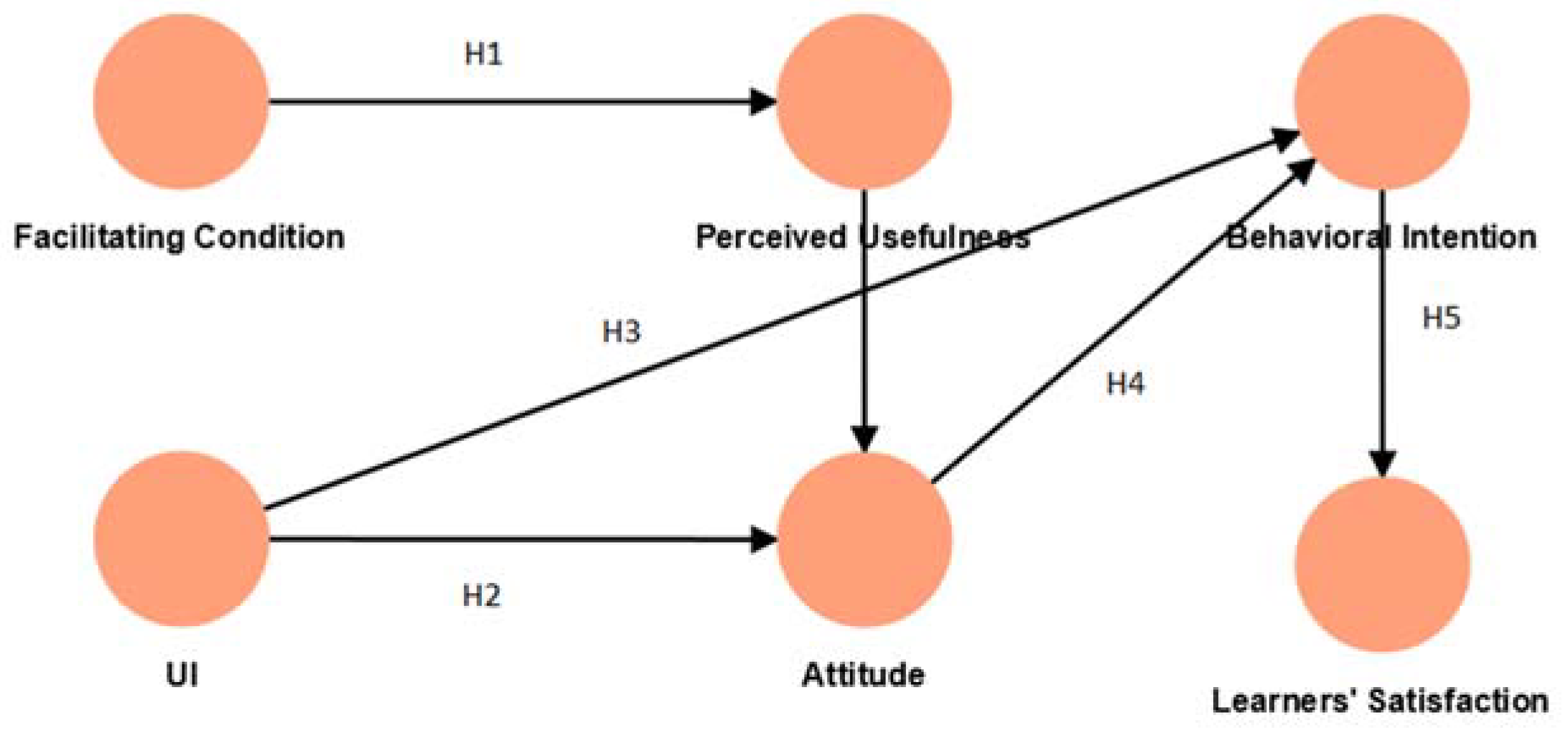
Figure 2.
Average Variance Extracted Results.
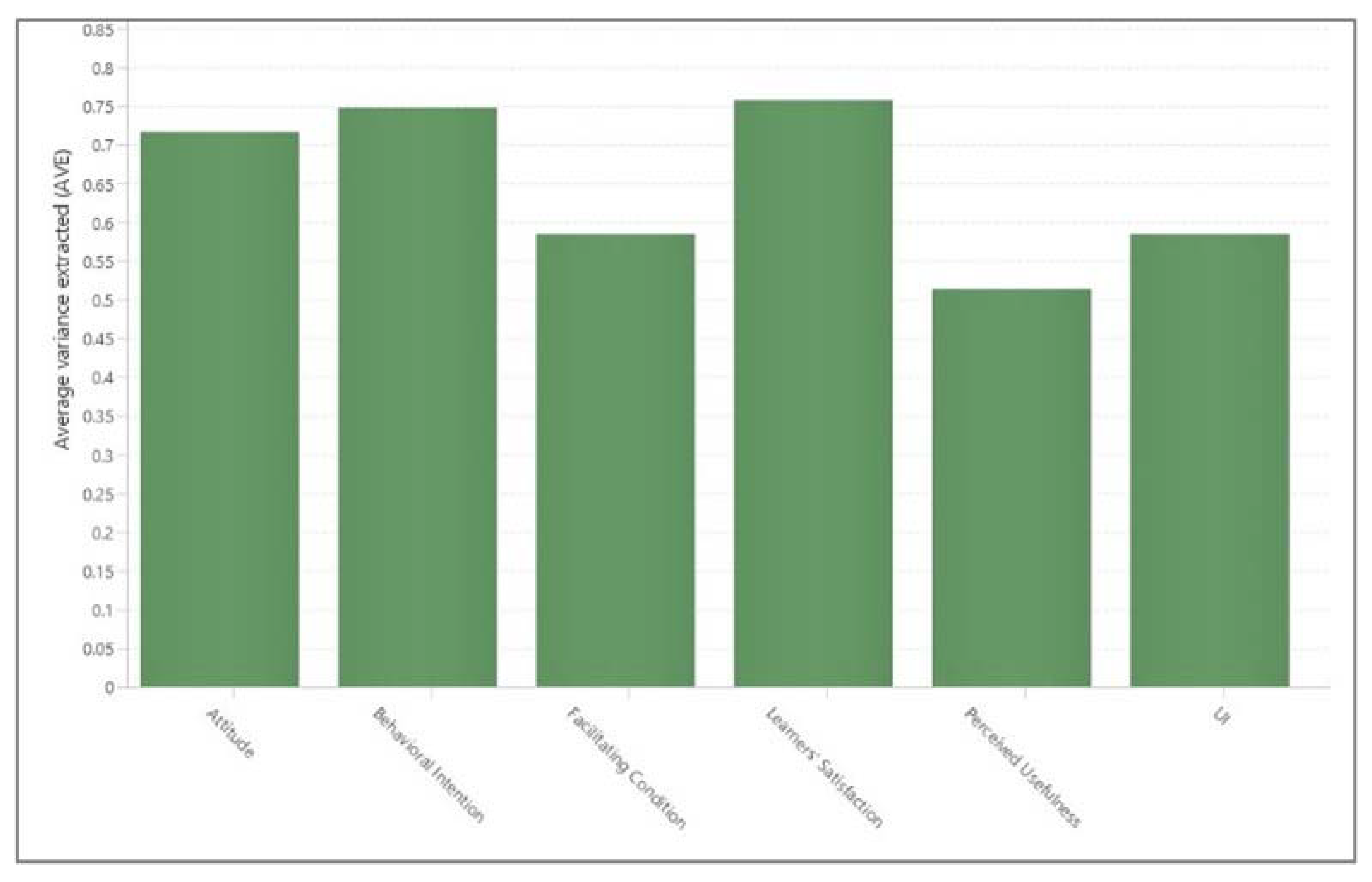
Figure 3.
Results of Structural Model.
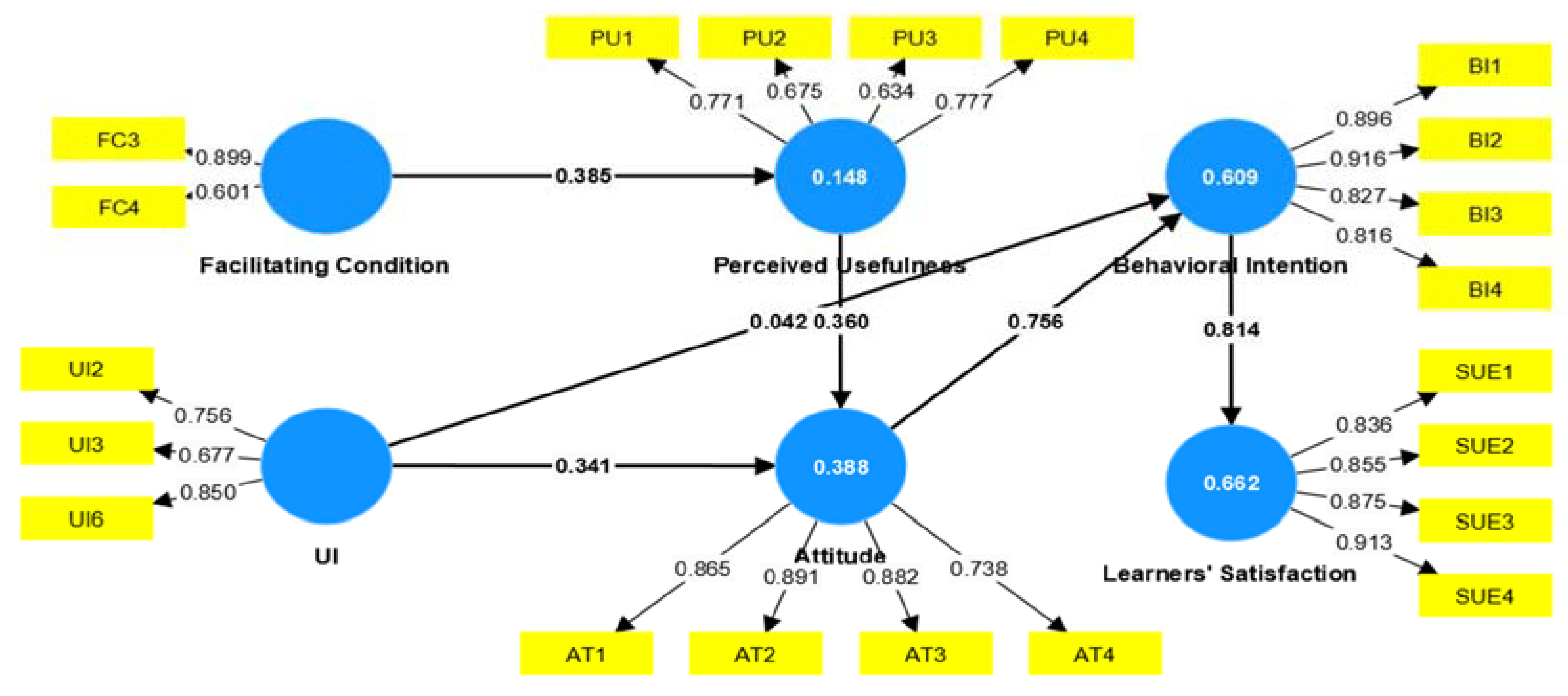

Table 1.
Construct Reliability and validity
| Observed VAR | Factor Loading | Cronbach’s alpha | Composite Reliability | AVE | |
|---|---|---|---|---|---|
| Attitude | AT1 | 0.865 | 0.866 | 0.900 | 0.910 |
| AT2 | 0.891 | ||||
| AT3 | 0.882 | ||||
| AT3 | 0.738 | ||||
| Behavioral Intention | BI1 | 0.896 | 0.887 | 0.901 | 0.922 |
| BI2 | 0.916 | ||||
| BI3 | 0.827 | ||||
| BI4 | 0.816 | ||||
| Facilitating Condition | FC3 | 0.899 | 0.319 | 0.387 | 0.730 |
| FC4 | 0.601 | ||||
| Learners’ Satisfaction | SUE1 | 0.836 | 0.902 | 0.896 | 0.926 |
| SUE2 | 0.855 | ||||
| SUE3 | 0.875 | ||||
| SUE4 | 0.913 | ||||
| Perceived Usefulness | PU1 | 0.771 | 0.689 | 0.693 | 0.807 |
| PU2 | 0.675 | ||||
| PU3 | 0.634 | ||||
| PU4 | 0.777 | ||||
| UI | U12 | 0.756 | 0.664 | 0.735 | 0.807 |
| UI3 | 0.677 | ||||
| UI6 | 0.850 |
Table 2.
Fornell Larcker.
| AT | BI | FC | LS | PU | UI | |
|---|---|---|---|---|---|---|
| AT | 0.846 | |||||
| BI | 0.779 | 0.865 | ||||
| FC | 0.368 | 0.502 | 0.764 | |||
| LS | 0.859 | 0.814 | 0.357 | 0.870 | ||
| PU | 0.557 | 0.593 | 0.385 | 0.469 | 0.717 | |
| UI | 0.548 | 0.457 | 0.279 | 0.446 | 0.576 | 0.764 |
Table 3.
R –square results.
| R square | Correlation | |
| Attitude | 0.388 | Average |
| Behavioral Intention | 0.609 | Average |
| Learners’ Satisfaction | 0.662 | Average |
| Perceived Usefulness | 0.148 | Weak |
Table 4.
Path Co-Efficiency Results.
| Original Sample (O) | Sample Mean (M) | Standard Deviation (STDEV) | T Statistics (|O/STDEV|) | P Values | Significance | |
| Attitude -> Behavioral Intention | 0.756 | 0.75 | 0.066 | 11.383 | 0.000 | Yes |
| Attitude -> Learners’ Satisfaction | 0.615 | 0.614 | 0.071 | 8.695 | 0.000 | Yes |
| Behavioral Intention -> Learners’ Satisfaction | 0.814 | 0818 | 0.037 | 21.981 | 0.000 | Yes |
| Facilitating Condition -> Attitude | 0.139 | 0.150 | 0.057 | 2.414 | 0.016 | Yes |
| Facilitating Condition -> Behavioral Intention | 0.105 | 0.113 | 0.047 | 2.238 | 0.025 | Yes |
| Facilitating Condition -> Learners’ Satisfaction | 0.085 | 0.093 | 0.039 | 2.177 | 0.030 | Yes |
| Facilitating Condition -> Perceived Usefulness | 0.385 | 0.405 | 0.089 | 4.595 | 0.000 | Yes |
| Perceived Usefulness -> Attitude | 0.360 | 0.369 | 0.117 | 3.073 | 0.002 | Yes |
| Perceived Usefulness -> Behavioral Intention | 0.272 | 0.279 | 0.099 | 2.764 | 0.006 | Yes |
| Perceived Usefulness -> Learners’ Satisfaction | 0.222 | 0.229 | 0.084 | 3.649 | 0.008 | Yes |
| UI -> Attitude | 0.341 | 0.342 | 0.0104 | 3.289 | 0.001 | Yes |
| UI -> Behavioral Intention | 0.300 | 0.304 | 0.100 | 3.012 | 0.003 | Yes |
| UI -> Learners’ Satisfaction | 0.244 | 0.249 | 0.082 | 2.976 | 0.003 | Yes |
Disclaimer/Publisher’s Note: The statements, opinions and data contained in all publications are solely those of the individual author(s) and contributor(s) and not of MDPI and/or the editor(s). MDPI and/or the editor(s) disclaim responsibility for any injury to people or property resulting from any ideas, methods, instructions or products referred to in the content. |
© 2024 by the authors. Licensee MDPI, Basel, Switzerland. This article is an open access article distributed under the terms and conditions of the Creative Commons Attribution (CC BY) license (http://creativecommons.org/licenses/by/4.0/).
Copyright: This open access article is published under a Creative Commons CC BY 4.0 license, which permit the free download, distribution, and reuse, provided that the author and preprint are cited in any reuse.


