

Submitted:
16 July 2024
Posted:
16 July 2024
You are already at the latest version
Abstract
Coppicing has been neglected in recent decades leaving gaps in knowledge on silvicultural interventions, especially the long-term effects on coppices of South-East Europe. Thus, our work aims to define the long-term effects of thinning in sessile oak (Quercus petraea (Matt.) Liebl.) and European beech (Fagus sylvatica L.) sub-mountainous thermophilic low coppices in the Croatian Dinarides. The experiment includes two localities with thinning plots and control plots. Thinning was done in 2002 with 17.71% of wood volume removed in the European beech coppice and 26.09% in the sessile oak coppice. 1276 trees were marked, measured (DBH, tree height, number of stems per stump) and assessed for vitality, origin and six silvicultural features revealing tree quality. Descriptive statistics for all variables, RMANOVA for DBH and height and for continuous variables mean+-+ standard deviation for categorical frequency and relative frequency variables were carried out. The results show a statistically significant positive long-term effect of thinning on tree growth, stem and crown features and support findings that thinning, by increasing growth and quality, is a necessary intervention in European beech and sessile oak low coppices. The recent economic crisis, the sudden increase in energy prices, and the increased demand for assorted wood products have initiated higher interest in coppices in Croatia.
Keywords:
Fagus sylvatica L.
; Quercus petraea (Matt.) Liebl.
; DBH
; tree height
; species composition
; stem quality
1. Introduction
Coppicing is the oldest known silvicultural system [1] and considered recently among the most controversial ones in Europe. Even though the proportion of coppices declined after centuries of this being an important traditional management option [2,3,4], they still comprise over 10% of the European forest area [5]. A recent study suggests that coppices might even extend to 14% of European forest cover [6]. The complexity of coppice management, the management aim, the area and the effort put into coppice conversion significantly differ depending on geographical region, historical and social circumstances [7]. Central and Western European countries mainly try to increase management and restore the small share of remaining coppices after decades of successful conversion efforts as these coppices are now perceived as areas of significant multiple ecosystem services, especially due to their ecological and cultural values. Despite the benefits of, and recommendations for, using this traditional form of management [5] and the recognition of the multiple values, coppices are still generally a neglected management system in Europe [8,9].
South-European countries, on the other hand, are now torn between the wish to convert coppice to high forest, which provides more valuable wood products and services, and the need to recognize that they should be protected and actively managed. The reasons for active coppice conversion include the relatively high proportion of coppice, the high proportion of un-favorable tree species used in coppice systems and increasing interest in more valuable wood products. For example, a study from Greece showed the potential for converted stands to sequestrate more carbon by the end of their rotation, strengthening the contribution of conversion towards climate change mitigation [10]. In addition, coppices are an important part of national forests, especially in some European countries where their total share can be as high as 50% of the total forestland [11].
In Croatia, coppices represent 14.5% of forestland [12], whereas the area of Central Dinarides (the Lika region) has 29% of the forest cover under coppice management. Croatia has a long history of coppicing, which has resulted mostly in low coppices [13]. The intensity of silvicultural activities results in a variety of different types and states in which coppices can be found, from those with poor quality and low wood volume to those of the highest quality, good structure and high wood volume [14]. One thing that is common to most coppices is the lack of silvicultural activities [15]. If we consider the way in which coppices developed in Croatia, often as the result of unsuccessful regeneration or lack of silvicultural interventions, one may conclude that coppices are most likely to be low quality and show disturbed natural processes [14]. Coppices in the Lika region are characterized by specific complex historical, economic and societal factors. In addition, they show natural limitations and geographically are in one of the parts of Croatia most vulnerable to climate change [9,16]. They are characterized by lack of management and few open areas in the forest [16]. Where coppices remain, as a result of various influences, forest practitioners should consider the options and set management goals after deciding if it is more appropriate to convert the coppice to high forest or whether it should remain under the existing management system [17].
Nevertheless, no matter how coppices are perceived, it is obvious that their conversion is an expensive and demanding process, which usually results in longer rotations yielding more valuable products [18]. However, coppice conversion is not a favorable option for small private forest owners on experiencing economic and energy crises as well as progressive climate change. Moreover, this interesting form of forest management, that has shaped the present cultural landscape of South Europe [19], is simple to apply and the regular rejuvenation makes the stools less prone to wind and snow damage, and is mostly worked on a short rotation [1] with firewood the most important product. Thus, the recent economic crisis and sudden increase in energy prices, as well the value of wood products could increase efforts for coppice restoration and initiate active coppice management in future [4,18]. Some even argue that current production from natural forests will not satisfy future world demand for timber and fuel wood, so they propose new land management options such as alley (or avenue) coppice, which has potential to produce, both high-value timber and energy wood on the same land unit [20]. Furthermore, returning to active coppicing can be a successful strategy for biodiversity restoration, especially in protected areas where thinning is restricted [8].
Guidelines on coppice management vary widely throughout Europe and are poorly supported by scientific evidence [21] and this also applied to knowledge of coppice forests in South-East Europe [9,22]. Furthermore, coppice is neglected in many national forest policies; consequently, there is little reliable data [5]. Taking all these issues into account, including the emerging economic and energy crises, the need to investigate the influence of silvicultural activities on wood production in coppices has become particularly relevant.
European beech (Fagus sylvatica L., further on beech) and sessile oak (Quercus petraea (Matt.) Liebl., further on s. oak) low coppices are important management systems for South-East Europe, mainly due to their past uses [23]. Historic data for coppice forests in Croatia [24] show that beech and s. oak coppice is the most widespread coppice in the country, while beech coppice is the most significant by growing stock (31.0%) as well. In addition, the majority of the coppice in the Lika region is beech (61.8%). This is partly the result of the high adaptability of the two tree species to many forest sites in Croatia [22]. The proportion of beech and s. oak in the total growing stock of their respective coppice management classes is very high (77% and 61%, respectively with s. oak covering 35886 ha/5 309 656 m3 and beech 108820 ha/15 553 770 m3) [22,24]. Recent official data [12] shows the high importance of these two tree species and points out that conversion to high forest over the previous 10-year period has occurred mostly in the s. oak coppices (s. oak 22958.51 ha/4 177 283 m3; beech 103736.70 ha/17 427 844 m3).
Low coppice is defined by its reproduction, e.g., from stool shoots or root suckers. This coppice system consists of a clear-fell removing all wood material from a logging area [1]. Wood production in low coppice is strongly influenced by tree species, rotation age, production target and site conditions [1,19]. Thinning is an important factor affecting many features of low coppice; since the majority of these coppices are poorly managed (or unmanaged) thinning is needed to increase productivity [5,9,14,16]. Stem shape provided insight into which trees have potential to provide valuable assortments of different products at the end of rotation, e.g., larger, straight trees, without curvatures or forks, with little decrease of diameter along the trunk, are likely to provide higher income. The influence of origin and thinning on tree shape and so potential for valuable products in low coppice has been neglected in recent scientific research. Thinning affects coppice structure, density and tree growth [25], species composition and stem development [26] as well as in-stand ecological factors such as light, heat, moisture, etc. Coppice development can only be regulated by tending measures (e.g., thinning, cleaning); thinning is also beneficial in preparation of coppice for conversion [27,28]. Thinning done appropriately and in a timely manner, can significantly influence the development of coppices [28,29,30] not only in terms of tree diversity and quality, but some studies also stress that it is important for tree health [26]. It could also be instrumental in enhancing stand resistance to climatic stress [31,32], especially drought [33]. This has resulted in this technique attracting more attention in relation to the need of adaptation of forests to climate change [34]. Thinning beech stands is regarded as a good adaptation tool [35] and has been suggested for the more valuable coppices, such as those with beech and oak species, the focus of this study, for both adaptation and wood production. The majority of recent studies focus on the effects of thinning on response of these species to drought [26,33, especially oaks in the Mediterranean area where water is already a scarce resource. The traditional aim of thinning, to increase size and quality of remaining trees have shifted towards that of increasing resistance or resilience to drought [36,37,38]. In addition recent studies have highlighted thinning as important for conservation and to increase biodiversity [8], especially for some generalist and early-successional species groups [6].
Long-term studies, which analyze the quality and growth of thinned compared to un-thinned coppice are rare since such long-term research is expensive and time-consuming but crucial to demonstrate the long-term effects of thinning on coppices. For example, a synthesis of experiments from a wide geographical range using different thinning intensities found this to be a suitable approach to improve the growth response of remaining trees to drought [26]. The most recent study [36] reveals a knowledge gap on the long-term effects of thinning on coppice so highlighting the need for research on this topic.
In response our research aims to define the long-term effects of thinning on two sub-mountainous thermophilic low coppices of s. oak and beech in the Croatian Dinarides. Our research will try to provide answers to the following question: is there a long-term positive effect of thinning in terms of (1) species diversity, (2) stem growth, and (3) stem/crown shape?
2. Materials and Methods
2.1. Study Area and Experiment Establishment
The mountain area of Croatia extends to the furthest northwestern part of the Dinaric Mountain area. This is the highest region of Croatia, the High Karst zone, built mainly of Mesozoic limestones. It is distinctly separate from the Mediterranean and Peripannonian areas and is divided into two economically and geographically different subregions, the significantly larger Lika and smaller Gorski Kotar. Lika is located in the central part of Dinaric Alps, or Dinarides, and it is considered to bridge the continental and Mediterranean areas of the Republic of Croatia. It extends from the Adriatic Sea and Una River up to Plitvice Lakes and Zrmanja River, between 44˚12′ and 45˚20′ north latitude and 15˚00′ and 16˚10′ east longitude, and has a total area of 5563 km2 [39]. The Lika plateau is surrounded by mountains Mala Kapela, Lička Plješivica and the Velebit mountain, known for its wide range of karst features. The altitude ranges from 510 m to 1101 m (the highest peak) and the geology is mostly dolomites and limestone [40].
The climate of the Lika region ranges from continental to alpine, where the influence of the sea is excluded by the Velebit Mountain. The mean January temperature is -1.7 °C, and July temperature is 19.1 °C. The annual rainfall is 1496 mm, with most in autumn and spring [41].
Two trial plots (Beech14 and Oak103) were established in an area with a climate classified by Köppen as Cfsbx [12,16,24,43], meaning it is temperate, moderately warm with a fully humid precipitation regime [44]. The main site characteristics of these plots are as follows:

| Trial plot | Area, ha | Elevation, m | Slope, o | Aspect | Soil | Bedrock | Site quality | Observations |
|---|---|---|---|---|---|---|---|---|
| Beech 14 | 15.96 | 560-660 | 5-35 | N, NW, NE | Brown | Limestone and dolomite | Low (class IV out of V) | Low coppice, with incomplete canopy cover and with protective functions |
| Oak103 | 47.37 | 610-800 | 9-20 | S | Brown | Limestone and dolomite | Low (class IV out of V) | Low coppice indicating transition to high forest. Incomplete canopy cover |
The experiment on the short-term effects of thinning on low coppice was established in several localities of Lika in 2002 [16,43]. The trial included different types of coppice (e.g., shrub-like coppice, low coppice and coppice in different transition stages in conversion to high forest). Out of these trial plots, the ones set in the most important coppices of this region (beech low coppice and s. oak low coppice) were used to study the long-term effects of thinning. In the spring of 2020, two trials were established in different localities in both beech low coppice and s. oak low coppice. These experiments (Beech14, 15.27094/N 44.69155, and Oak103, E 15.33114/N 44.74706, respectively) included one thinned trial plot (0.25 ha) and one control (0.25 ha).
Beech14 represents the most extensive coppice type in the Lika region. The stand volume before thinning in 2002 was 140.20 m3 ha-1. The intensity of thinning by volume was 17.71% (24.84 m3 ha-1) [16,43]. It was the first silvicultural intervention in this coppice since its regeneration. After thinning 200 seed-originating trees per ha and 1197 stump-originating stems per ha remained. The residual stand basal area was 20.40 m2 ha-1 while the stand volume was 115.36 m3 ha-1. The main tree species were beech (94.01% of species composition), s. oak (2.29%) and supporting tree species (i.e. those other than beech and s. oak - 3.7%). In 2003, during the severe drought, 172 trees (basal area 1.81 m2 ha-1, wood volume 9.43 m3 ha-1) died, of which 164 were of vegetative origin, most of which (156) were beech.The most recent management plan, released in 2018, showed that Beech14 had 654 trees/stems per hectare, a basal area of 17.68 m2 ha-1 and a stand volume of 138 m3 ha-1.
Oak103 is typical of low s. oak coppice in this region. The stand volume before thinning in 2002 was 195.69 m3 ha-1. The intensity of thinning by volume reached 26.09% (51.06 m3 ha-1) [16,43]. This was the first intervention in a fully closed stand, and was a mixed cleaning-thinning. After this operation 524 seed-originating trees ha-1 and 1281 stems of vegetative origin per ha remained. The residual stand basal area was 23.36 m2 ha-1 while the residual stand volume was 144.63 m3 ha-1. The main tree species were s.oak (75.39% of species composition), hophornbeam (Ostrya carpinifolia Scop.) (11.80%) and supporting tree species (12.8%). In 2003, during a severe drought period, 68 trees died, of which 23 were of seed origin and 45 were of coppice. Dead s. oaks were mostly seed-originated (23 trees), while 13 dead stems were of vegetative origin. In 2018, when the last complete coppice measurement was carried out, Oak103 had 1053 trees/stems per hectare, a basal area of 22.03 m2 ha-1 and a stand volume of 131 m3 ha-1.
2.2. Study Design
The trial plots are part of a research project funded by Croatian Forest Ltd. which aims to enhance coppice management in the Lika region. As mentioned, four trial plots, with a total area of 1 ha, were established, within which 1276 trees/stems (Beech14 – 466 trees/stems, Oak103 – 810 trees/stems) were permanently marked and measured in spring 2020 and 2022. The location and number of trial plots were limited by the short duration of the project (2022–2023). Each tree was given a unique code in a database which enabled in-depth statistical analysis and provided insight into the growth and development of individual tree. Trees in control plots were marked with yellow paint, trees in the thinned plots with white paint. Trees were marked in the direction of measurement for faster and more efficient repeated measurements and data control with special attention paid to avoiding systematic error. Field measurments were uploaded into the electronic database.
2.3. Measurements of Height and DBH
Forest tree species, tree origin, number of stems per stool, status of the trees/stems (living or dead), diameter at breast height (DBH) of all trees/stems on the stool in the trial plot, height (h) of all trees/stems on the stool were recorded. Tree/stem height was measured with a Haglöf/Vertex IV dendrometer with an accuracy of 0.1 m. For each tree two DBH measurements were made using tree calipers (0.1 cm accuracy) with the mean calculated and recorded so stem distortions would not significantly influence the values. Bent-over trees/stems were not measured, but noted. Trees/stems with apparent damage to the top (broken) or leaning trees were counted with only the DBH measured.
2.4. Assessment of Silvicultural Characteristics
For each tree, six silvicultural characteristics were visually assessed according to the criteria defined by Perić [46]. These characteristics were categorized as follows:
- Tree/stem straightness (S), visually assessed as deviation from the vertical axis of the stem (large - deformed, medium - crooked, small - straight);
- Taper/degree of decreasing diameter along the trunk, visually assessed by how much the stem is similar to the ideal cylinder (T_shape) (large, medium, small);
- Curvature showing how much tree/stem bends (C) (large–more than two curves, medium – two curves, small – one or no curve);
- Crown width (C_WIDTH) (large, medium, small);
- Forking (F) (large - the tree has more than two principal stems that are forked below one-third of its height, medium – the tree has more than two principal stems that are forked higher than one-third of its height, small – the tree has one principal stem or two principal stems that are forked in the tree crown);
- Crown symmetry (C_sym) (symmetric, asymmetric).
Each parameter was then graded: 1 – high, 2 – medium, 3 – small. For crown symmetry, grade 1 was given to the trees with a symmetric crown and grade 2 for those with asymmetric crowns. The origin of a tree (seed or stump regeneration) was also coded, GEN for trees originating from seed, VEG for those originating from the stump.
2.5. Statistical Analysis
Descriptive statistics were carried out for all variables analyzed. For continuous variables the mean+-+ standard deviation was calculated for categorical frequency and relative frequency variables. The differences in DBH (cm) and height (m) for the years 2020 and 2022 were analyzed by repeated measure analysis of variance (RMANOVA) according to model (1). RMANOVA is usually used when several measurements are taken on the same experimental unit (tree); the measurements tend to be correlated with each other. This collection of conditionsis referred to as a between-subjects factor when a dependent variable is tested on independent groups. For example coppice type, thinning/control, tree origin (vegetative or seed generated) of the sample trees, with each group being subjected to a distinct condition. A within-subject factor (s) (year) is created when a dependent variable (i.e. DBH, h) is measured repeatedly for each sample tree across a set of conditions. The main effects (e.g., coppice type, treatment, origin, their interactions and the effect of the year (repeated) as well as all interactions with the year) are included in the model.
Yijkl = 𝜇 + COPPICE TYPEi + TREATMENTj + ORIGINk+ (COPPICE TYPE*TREATMENT)ij + (COPPICE TYPE*ORIGIN)ik+ (TREATMENT*ORIGIN)jk+ YEARSl + (YEARS* COPPICE TYPE)li+ (YEARS* TREATMENT)lj+ (YEARS* ORIGIN)lk+ (YEARS* COPPICE TYPE*TREATMENT)lij+ (YEARS*COPPICE TYPE*ORIGIN)lik+ (YEARS* TREATMENT*ORIGIN)ljk+ eijkl
μ=Overall mean
COPPICE TYPEi =effect of COPPICE TYPE, i=1,2 (Beech12, Oak103);
TREATMENTj =effect of TREATMENT, j=1,2 (control, thinning);
ORIGINk = effect of ORIGIN, k=1,2 (VEG, GEN);
YEARSl= effect of YEARS (repeated), 1,2 (2020, 2022);
(A*B) =interaction effect between A and B effect (variables)
eijkl =random error N(0,2).
Differences for variables of silvicultural features: tree/stem straightness (S), decreasing diameter along the trunk (T shape), Curvature (C), Forking (F), Crown width (C_width), Crown symmetry (C_sym) according to treatments (control and thinning) were subjected to the Chi2 test, if the expected frequency per cell was <5, Fisher’s exact test was used.
For all statistical analyses, a significance level of 5% was considered statistically significant. Graphic displays were made in the statistical packages STATISTICA [47] and SAS9.4. [48]. Statistical analysis was performed with the SAS statistical package [48] using proc glm for RMANOVA and proc freq for Chi2 and Fisher’s exact test.
3. Results
3.1. Descriptive Statistics
a) Number of Trees/Species Composition
Beech is the dominant species in the Beech14 trial plots, comprising between 73% (control) and 96.4% (thinning). 170 beech stems were recorded in the thinned trial plot, with no seed-originating trees. In the control plot, 92.2%of trees were of vegetative origin and 7.8% originated from seed. Beech14 shows a higher number of tree species in the control than in thinned plots (11 and 4, respectively) although the number is low (1 to 4 trees in the trial plot). In the thinned plot only Carpinus betulus L., Ostrya carpinifolia Scop. and Pyrus pyraster (L.) Burgsd. were present (Table 2). In control plots, Quercus petraea (Matt.) Lieb., Abies alba Mill., Prunus avium L., Sorbus torminalis (L.) Crantz, Acer pseudoplatanus L., Cornus mas L. and Acer campestre L. were found in addition to the beech.
The control plot of Oak103 had more trees than all other trial plots. After thinning, the number of trees as well as the ratio of coppice trees was reduced. This clearly reveals that when thinning was done this supported more quality trees from seeds. The control plot shows that this is a typical form of mixed coppice of s. oak, Ostrya carpinifolia Scop. and Fraxinus ornus L. with a relevant number of accompanying species (Table 2).
In the Oak103 trial plot, 184 trees of vegetative origin were recorded in the thinned trial plot, of which 129 originated from seed. In the control plot, 82.5% of trees were of vegetative origin and 17.5% originated from seed. The number of tree species recorded in Oak103 shows similar numbers of tree species in thinned and control plots (9 and 8, respectively). As in the case of Beech14, some are only sporadic.
b) DBH and Height
The difference in the number of tree/stem height measurements and DBH measurements occurred due to deformations of individual trees, which made it impossible and unnecessary to measure heights. Descriptive statistics of DBH and height show higher values of height and DBH in plots where thinning has been done and, as expected, a far greater number of trees/stems in the control plot (Table 3).
c) Other Criteria
Nevertheless, descriptive statistics for both Beech14 and Oak103 show that thinning promoted growth and increased the number of quality trees/stems (Table 2, Table 4). The number of trees/stems with significant defects (breakage, leaning, etc.) was higher in the control plots for both Beech14 and Oak103. In a thinned trial plot of Beech 14, nine stems died in the two years between measurements, so there is no data on DBH and height. Sixteen stems, all of vegetative origin, were so deformed or bent-over that the height was not measured. In the control plot of Beech14, two stems died while many more trees (53 trees/stems in total, 51 of which were of vegetative origin) were significantly deformed and bent-over making it impossible to measure then. In the thinned trial plot of Oak103, three trees/stems died between the two measurements and 32 trees/stems were so deformed and bent-over that they could not be measured. Out of them 9 originated from seed, 23 were of vegetative origin. The control plot of Oak103 had 16 trees/stems that died, and 123 trees were significantly deformed or bent-over, 9 of which were vegetatively generated.
In both Beech14 and Oak103, the maximum number of stems per stump was 3, with the majority having just one stem per stump. The highest number of trees with more than one stem per stump, 19, was recorded in the thinned trial plot of Oak103, with eight trees exhibiting this in the thinned trial plot of Beech14. Both Beech14 and Oak 103 control plots had fewer trees with more than one stem per stump, but had higher numbers of deformed trees and rotten stumps.
3.2. DBH and Height Analysis
The results of RM ANOVA (Table 4) show statistically significant differences between beech and s. oak’s DBH and heights. There is also a statistically significant difference between DBH and height in the different treatments (control, thinning) and in tree/stem origin (VEG, GEN). Out of ’between subject effects´ interactions, the only one that appeared to be statistically significant for both DBH and height is the interaction between species and treatments.
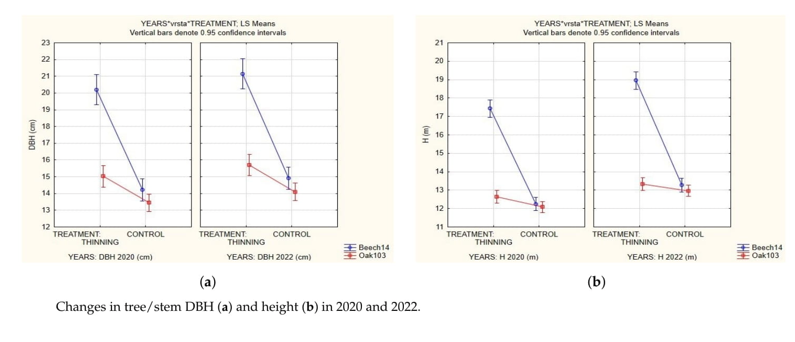
These results show that DBH and height do not behave similarly when the tree species are subjected to the different treatments (Figure 1a,b). Both DBH and height increase and are statistically significant in the thinned than in the control beech plots. In the case of within-subjects effects statistical significance is proven for the effects of years, which is logical since DBH and height significantly increased over the two years. In the case of double mutual interactions with years, statistical significance is shown for year and coppice type: year and treatment. This analysis shows that DBH and height during the two years analyzed do not behave the same for beech and s. oak coppice (coppice type) and for treatment (control, thinning). Out of the triple interactions, statistical significance is proven only for the interactions of DBH and height between years, coppice type and treatments, which was expected based on the previous results. For DBH statistical significance is also proven for the interaction between years, treatment and origin, which reveals that DBH does not behave the same over the years analyzed for different treatments and origins.
3.3. Analysis Of Silvicultural Features (Stem/Crown Shape)
The results of the analysis of silvicultural characteristics (stem/crown shape) (Table 5) for beech trees show statistically significant differences between the trees in the and control plots for tree/stem straightness (S), decreasing diameter along the trunk (T shape) and Curvature (C). In the case of s. oak, statistical differencesare confirmed for decreasing diameter along the trunk (T shape), Curvature (C), Forking (F), Crown width (C_width) and Crown symmetry (C_sym). The only variables which are statistically different for both beech and s. oak, are T shape and C.
4. Discussion
We examined the effects of thinning in beech and s. oak low coppices in the central Dinarides (Lika region) on composition, origin, tree/stem DBH, tree/stem height and stem/crown shape. The period of twenty years provides data on the long-term thinning effects, for which published data are limited [36]. Coppices included in the research are representative of beech and s. oak coppices at lower elevations of the mountainous Dinaric region [16,43], the most widespread coppice types both here and in Croatia in general [12] (Figure 2).
The proportion of coppice in the Forest administration area of Gospić is significant (29%) and these are mainly commercial [12]. This makes coppice management one of the most important forest management issues in the country. The Lika area has specific ecological and socio-economic factors, which significantly influence forest management. These include lack of workforce, limited applicability of mechanization due to rough and steep terrain, landmines from the war, depopulation and lack of adequate planting material. All of these haveled to an extremely challenging management situation [9] with the complexity and expense resulting in the majority of coppices being abandoned. Despite this through the recent “Enhancement of coppice management in Lika region”project, the state has demonstrated increasing interest, both in the active conversion of such coppice and in promoting active management. This is an acknowledgement of coppice as significant component of this rural area, from ecological/protective function [49], social, as well as economic points of view.
4.1. Effects of Thinning on Species Composition and Tree Origin
Thinning promoted the healthiest and best quality trees/stems. Thinning had a positive impact on tree growth regardless of the tree’s origin (seed or stump) and after twenty years no trees of generative origin remained in the Beech14 thinned plot. Higher DBH and height values were recorded in plots where thinning was performed.
In terms of species composition thinning reduced forest tree species diversity in Beech14. There is no clear evidence for what happened in the last twenty years since the analysis of short-term effects of thinning in this plot suggested thinning supported tree species diversity. Since there have been no additional interventions it could be interpreted that the increased growth, stimulated by thinning, increased species competition and self-thinning. The number of tree species in thinned vs. control plots in Oak103 was similar, with improved growth and quality of trees among the supporting tree species.
4.2. Effects of Thinning on Tree/Stem Growth
Tree/stem coding was used in this research and unique identifiers recorded on a database to enable in-depth statistical analysis that provided insight into the growth and development of individual trees in addition to the mean stand values used in other studies. This enabled more detailed insight into the growth and condition of individual trees/stems, setting the context for further long-term observations.
Statistical analysis reveals the long-term effect of thinning on the growth of trees/stems in both coppices. It underlines the beneficial influence of thinning, supporting initial short-term results from research in this area [16,43]. This data can provide important insights into coppice management in Croatia as well as wider Europe. The complexity and uniqueness of Illiric beech and s. oak coppice supports the need for further investigations into both short and long-term effects of higher thinning intensities.
The analysis of collected data includes descriptive statistics, which can provide insight into the type of coppices (tree species ratio concerning their origin and thinning effect) selected. This information has already been recognized as important in previous research performed in coppices [e.g. 16, 43, 55]. The origin of trees, their growth, vitality, quality/stem shape, and tree origin ratio indicate the biological potential of tree/coppice and their ability to adapt, increase wood volume and their potential for successful restoration or conversion [16,27,43,57]. This study has demonstrated a positive (statistically significant) long-term effect on growth and quality in both beech and s. oak coppice.
The favorable short-term effect of thinning on coppice growth has been shown previously [16,43] in the same research area. Other studies, conducted in the broader area, confirm the same effect in the case of DBH. The positive effects of thinning on DBH werefound for beech and s. oak [50,51], as investigated in this research, but for other oaks as well [52]. In these studies, the effect on tree height was variable, positive or negative. Now, the positive long-term effects of thinning on coppice growth for both DBH and height have been supported by the results in both Beech14 and Oak103 sites. In addition, previous studies, although few in number and mostly undertaken under Mediterranean conditions, confirm the long-term benefits of thinning on growth. For example an Italian case-study of a beech coppice in conversion to high forest, over 22 years, indicated that this quickly showed positive response to active conversion practices based on periodic medium-heavy thinning [53]. The most recent study on Quercus subpyrenaica EH del Villar[36] found a similar result over 20 years, which declined slightly with canopy closure. The authors found that thinning improved oak’s basal area increment, more marked in small diameter trees, and that thinning reduced oak sensitivity to short-term drought. Another study on Quercus pyrenaica Willd. coppices [37] supports the claim that thinning favors the growth of Q. pyrenaica trees, especially when stand density reduction is high (extracted ca. 50% of the basal area). Un-thinned plots displayed more natural mortality i.e., self-thinning, similarly to our findings. Long-term (15 years) demographic responses of holm oak (Quercus ilex L.)[38] to thinning from below (-30% basal area) were positive; the effect on stem growth decreased over time but remained significant 15 years after thinning.
In addition, thinning prepares coppices for conversion and accelerates this long process [54,55,56,57]. Since the regrowth of beech after cutting is often poor and stump mortality can be high [1], beech coppice in the area are likely to be converted, highlighting the importance of the long-term effect of thinning. This research supports the conclusion that thinning has long-term positive effects on tree growth.
In addition to these positive effects, some studies [26] have suggested thinning helped to mitigate growth reductions during drought in broadleaves, but the benefits decrease over time since the last intervention. This highlights the need to determine how long the positive thinning effect lasts, particularly in the context of climate change. There is still a gap in knowledge regarding the effect on broadleaves forests [26], especially temperate oak coppice, of long-term thinning with respect to increasing adaptation capacity, making this research a rare contribution to this topic.
4.3. Effects of Thinning on Silvicultural Characteristics (Stem/Crown Shape)
Our findings support the claim that thinning has long-term effects on tree quality producing not only larger trees but also better quality ones, resulting in a more valuable range of wood products and the potential for higher income. This could bring coppices in the Lika region into more active management and increase socio-economic benefits.
Bošeľa et al. (2016) [58] showed that the methods of tending beech stands significantly influence not only the quality and quantity of production, but also their vitality. Another study [38] highlights that the loss of stools from mortality appeared to be faster than the loss of stems in un-thinned plots, particularly in drought conditions or when rainfall was limited. Some even argue that the thinning of beech and s. oak coppice are justifiable during rotation periods due to climate changes, although this was not previously the tradition in Europe [50]. Higher dieback of beech trees in trial plots points to the possible shift in vegetation and higher beech sensitivity on lower mountain elevations. Slightly higher dieback of trees in thinned vs. control plots could suggest higher species competition due to more intensive growth, stimulated by thinning. Nevertheless, the long time interval after thinning could point to the wearing off of thinning effect as observed in aforementioned studies [36,38]. Even though we observed a similar tendency in trial plots of Beech14 and Oak103, our research cannot clearly support such claims as the number of trees affected was low compared to the total number of trees in the trial. On the other hand, the number of significantly deformed trees in trial plots and analysis of silvicultural characteristics, assessed visually clearly support claims that, in the long run, thinning positively affects tree quality.
Recent research on the influence of thinning on coppice biodiversity suggests active management could prevent homogenization of vegetation and loss of some rare plant species [38,59]. Thus, we recommend more phytosociological research into the evaluation of thinning effects as this could be positive in increasing active coppice management. Furthermore, research on short-term and long-term effects of silvicultural interventions should be intensified and supported by new findings (e.g. on wood quality and products, the amount of rot, living or dead stumps, effects of thinning on biodiversity, etc.), especially for beech coppices.
The variety of historical circumstances and natural diversity in Europe in general and in South-East Europe in particular have created great diversity of coppice and management practices [60,61]. Large areas of coppice are still present in some countries, particularly in South-East Europe. Coppice is an interesting management form, and has been used for simple and quick fuel production throughout human history. The newly arisen energy crises increases the relevance of coppice in the green-economy [62] as well to meet the growing needs for wood products supporting the historical perception of coppice as highly valuable and important for securing economic as well as ecological and cultural benefits. Despite past calculations on financial profitability, which concluded that a significant increase in fuelwood prices would be needed to raise the yield value of coppice compared to high forests [63], recent market price analysis show that this is not far-fetched. In addition, there is evidence that trees regenerated vegetatively have higher resistance to drought when young. However, there is a lack of research for different species and coppice ages [64]. Thinning is a crucial tool to support production, adaptation and conservation and is essential for conversion processes with detectable long-term effects. Research into thinning benefits has implications for forest management supporting forest tree species richness, higher tree quality and increased growth, producing larger, more valuable trees, which may be used for other products, not just traditional fuelwood. In the case of rural, depopulated areas, where traditionally coppice played a significant role and where significant areas still remain, the initiation of thinning in neglected coppices could be beneficial in socio-economic terms. Even two decades ago it was evident that silviculture of coppices must be redefined according to new uses [65]. Nowadays, for the majority of private forest owners as well as poor rural areas, coppices are again of interest.
However, published data are still scarce since research efforts have declined in recent decades. This study has shown that thinning has positive long-term effects on the growth of low coppice. In addition, trees in thinned plots had less damage and better stem and crown shapes. Thus, thinned coppice was found to be more prepared for conversion to high forest and had higher growth and better tree quality. Thinning supports recent interest in more active coppice management and related forestry efforts therefore it should be more supported by more scientific research and feature more prominently in forest policy in Croatia and beyond.
Author Contributions
Conceptualization, MĐ, NVN; methodology, MĐ, AJ; software, AJ; validation, MĐ, SP and NVN; formal analysis, MĐ, AJ; investigation, MĐ, SP; resources, MĐ; data curation, MĐ; writing—original draft preparation, MĐ; writing—review and editing, MĐ, NVN, SP, AJ, DB; visualization, MĐ; supervision, NVN, DB; project administration, MĐ; funding acquisition, MĐ, SP. All authors have read and agreed to the published version of the manuscript.
Funding
The work was not funded by any organism.
Data Availability Statement
Data will be made available on request.
Conflicts of Interest
The authors declare no conflict of interest. The funders had no role in the design of the study; in the collection, analyses, or interpretation of data; in the writing of the manuscript; or in the decision to publish the results.
References
- Nicolescu, V.-N. The practice of silviculture; Aldus: Brasov, Romania, 2018, p. 254.
- UN/ECE-FAO, Main report - Forest resources of Europe, CIS, North America, Australia, Japan and New Zealand (industrialised temperate/boreal countries): UN-ECE/FAO contribution to the Global Forest Resources Assessment; United Nations: New York and Geneva, 2000, p. 467.
- Slach, T.; Volařík, D.; Maděra, P. Dwindling coppice woods in Central Europe – Disappearing natural and cultural heritage.For. Ecol. Manag. 2021, 501, 119687. [CrossRef]
- Kamp, J. Coppice loss and persistence in Germany.Trees, Forests and People 2022, 8, 100227. [CrossRef]
- Unrau, A.; Becker, G.; Spinelli, R.; Lazdina, D.; Magagnotti, N.; Nicolescu, V.-N.; Buckley, P.; Bartlett, D.; Kofman, P. Coppice forests in Europe, Albert Ludwig University of Freiburg: Freiburg i. Br., Germany, 2018, p. 388.
- Buckley, P. Coppice restoration and conservation: a European perspective. J. For. Res., 2020, 25 (3), 125–133. [CrossRef]
- Bartlett, D.; Laina, R.; Petrović, N.; Sperandio, G.; Unrau, A.; Županić, M. Socio-Economic Factors Influencing Coppice Management in Europe. In: Coppice forests in Europe, Unrau, A.; Becker, G.; Spinelli, R.; Lazdina, D.; Magagnotti, N.; Nicolescu, V.-N.; Buckley, P.; Bartlett, D.; Kofman, P.; Eds.; Albert Ludwig University of Freiburg: Freiburg i. Br., Germany, 2018, 158–165.
- Vymazalová, P.; Košulič, O.; Hamřík, T.; Šipoš, J.; Hédl, R. Positive impact of traditional coppicing restoration on biodiversity of ground-dwelling spiders in a protected lowland forest. For. Ecol. Manag. 2021, 490, 119084. [CrossRef]
- Đodan, M.; Smerdel, D.; Perić, S. Issues of coppice management in FA Gospić – an overview of scientific and expert project activities. Rad.-Hrv. šum. inst. 2022, 48, 81–89.
- Vlachou, M. A.; Zagas, T. D. Conversion of oak coppices to high forests as a tool for climate change mitigation in central Greece. Int. J. Environ. Sci. Technol. 2022. [CrossRef]
- Radtke, A.; Toe, D.; Berger, F.; Zerbe, S.; Bourrier, F. Managing coppice forests for rockfall protection: lessons from modeling. Ann. For. Sci. 2014, 71, 485–494. [CrossRef]
- MARC (Ministry of Agriculture of the Republic of Croatia). National Forest Management Plant for the Republic of Croatia – 2016 - 2025. Ministry of Agriculture of the Republic of Croatia: Zagreb, 2016, p. 927.
- Dubravac, T.; Đodan, M. Croatia-facts and figures. In: Coppice forests in Europe, Unrau, A.; Becker, G.; Spinelli, R.; Lazdina, D.; Magagnotti, N.; Nicolescu, V.-N.; Buckley, P.; Bartlett, D.; Kofman, P.; Eds.; Albert Ludwig University of Freiburg: Freiburg i. Br., Germany, 2018, 158–165.
- Matić S. Forests and forestry in Croatia — past, presence and the future. Annales pro experimentis foresticis 1990. Faculty of Forestry, University of Zagreb: Zagreb. https://urn.nsk.hr/urn:nbn:hr:108:401278.
- Krejči, V.; Dubravac, T. From coppice to high forest of evergreen oak (Quercus ilex L.) by shelterwood cutting. Šumar. List 2004, 7/8, 405-412.
- Štimac, M. Effects of tending activities on structural features of coppices in Lika region. Šumar. List 2010, 134 (1-2), 45-53.
- Čavlović, J. Management of coppices in the area of Hrvatskozagorje. Annales pro experimentis foresticis 1994, 30, 143—192.
- Nicolescu, V.-N.; Carvalho, J.; Hochbichler, E.; Bruckman, V.; Piqué-Nicolau, M.; Hernea, C.; Viana, H.; Štochlová, P.; Ertekin, M.; Tijardovic, M.; Dubravac, T.; Vandekerkhove, K.; Kofman, P.D.; Rossney, D.; Unrau, A. Silvicultural guidelines for European coppice forests. COST Action FP1301 Reports. Freiburg, Germany: Albert Ludwig University of Freiburg, 2017,p. 33.
- Bottero, A.; Meloni, F.; Garbarino, M.; Motta, R. Temperate coppice forests in north-western Italy are resilient to wild ungulate browsing in the short to medium term. For. Ecol. Manag. 2022, 523, 120484. [CrossRef]
- Morhart, C.D.; Douglas, G.C.; Dupraz, C.; Graves, A.R.; Nahm, M.; Paris, P.; Sauter, U.H.; Sheppard, J.; Spiecker, H. Alley coppice—a new system with ancient roots. Ann. For. Sci. 2014, 71, 527–542. [CrossRef]
- Manetti, M.C.; Conedera, M.; Pelleri, F.; Montini, P.; Maltoni, A.; Mariotti, B.; Pividori, M.; Marcolin, E. Optimizing quality wood production in chestnut (Castanea sativa Mill.) coppices. For. Ecol. Manag. 2022, 523, 120490. [CrossRef]
- Dekanić, S.; Dubravac, T.; Lexer, M.J.; Stajic, B.; Zlatanov, T.; Trajkov, P. European forest types for coppice forests in Croatia. Silva Balcanica 2009, 10(1), 47–62.
- Cutini, A.; Chianucci,F.; Giannini, T.; Manetti, M.C.; Salvati, L. Is anticipated seed cutting an effective option to accelerate transition to high forest in European beech (Fagus sylvatica L.) coppice stands? Ann. For. Sci. 2015, 72, 631–640. [CrossRef]
- MAFRC (Ministry of Agriculture and Forestry of the Republic of Croatia). National Forest Management Plant for the Republic of Croatia – 2006 - 2015. Ministry of Agriculture and Forestry of the Republic of Croatia: Zagreb, 2006, p. 800.
- Niccoli, F.; Pelleri, F.; Manetti, M.C.; Sansone, D.; Battipaglia, G. Effects of thinning intensity on productivity and water use efficiency of Quercus robur L. For. Ecol. Manag.2020, 473, 118282. [CrossRef]
- Sohn, J.A.; Saha, S.; Bauhus, J. Potential of forest thinning to mitigate drought stress: A meta-analysis. For. Ecol. Manag.2016, 380, 261–273. [CrossRef]
- Matić, S.; Rauš, Đ. Conversionof maquis and garrigue of Holm oak into stands of advanced silvicultural form. Annales pro experimentis forestici seditiopeculiaris, 1986, 2.
- Chianucci, F.; Salvati, L.; Giannini, T.; Chiavetta, U.; Corona, P.; Cutini, A. Long-term response to thinning in a beech (Fagus sylvatica L.) coppice stand under conversion to high forest in Central Italy. Silva Fennica 2016, 50 (3), 9. [CrossRef]
- Mattioli, W.; Ferrari, B.; Giuliarelli, D.; Mancini, L.D.; Porthogesi, L; Corona, P. Conversion of Mountain Beech Coppices into High Forest: An Example for Ecological Intensification. Environ Manage 2016, 56, 1159–1169. [CrossRef]
- Manetti, M.C.; Becagli, C.; Sansone, D.; Pelleri, F. Tree-oriented silviculture: A new approach for coppice stands. IForest 2016, 9, 791–800. [CrossRef]
- Marini, F.; Battipaglia, G.; Manetti, M.C.; Corona, P.; Romagnoli, M. Impact of Climate, Stand Growth Parameters, and Management on Isotopic Composition of Tree Rings in Chestnut Coppices. Forests 2019, 10, 1148. [CrossRef]
- García-Pérez, J.L.; Oliet, J.A.; Villar-Salvador, P.; Guzmán, J.E. Root Growth Dynamics and Structure in Seedlings of Four Shade Tolerant Mediterranean Species Grown under Moderate and Low Light. Forests 2021, 12, 1540. [CrossRef]
- Rodríguez-Calcerrada J.; Pérez-Ramos, I.M.; Ourcival J.-M.; Limousin J.-M.; Joffre R.; Rambal, S. Is selective thinning an adequate practice for adapting Quercus ilex coppices to climate change? Ann. For. Sci 2011, 68, 575–585. [CrossRef]
- Vacek, Z.; Prokůpková, A.; Vacek, S.; Cukor, J.; Bílek, L.; Gallo, J.; Bulušek, D. Silviculture as a tool to support stability and diversity of forests under climate change: study from Krkonoše Mountains. Cent. Eur. For. J. 2020, 66 (2), 116–129. [CrossRef]
- van der Maaten, E. Thinning prolongs growth duration of European beech (Fagus sylvatica L.) across a valley in southwestern Germany. For. Ecol. Manag. 2013, 306, 135–141. [CrossRef]
- Tonelli, E.; Vitali, A.; Brega, F.; Gazol, A.; Colangelo, M.; Urbinati, C.; Camarero, J.J.; Thinning improves growth and resilience after severe droughts in Quercus subpyrenaica coppice forests in the Spanish Pre-Pyrenees. Dendrochronologia 2023, 77, 126042. [CrossRef]
- Moreno-Fernández, D.; Aldea, J.; Gea-Izquierdo, G.; Cañellas, I.; Martín-Benito, D. Influence of climate and thinning on Quercus pyrenaica Willd. coppices growth dynamics. Eur. J. For. Res. 2021, 140, 187–197. [CrossRef]
- Gavinet, J.; Ourcival, J.-M.; Gauzere, J.; de Jalón, L.G.; Limousin, J.-M. Drought mitigation by thinning: Benefits from the stem to the stand along 15 years of experimental rainfall exclusion in a holm oak coppice. For. Ecol. Manag. 2020, 473, 118266. [CrossRef]
- Ojurović, R. Historical development of management of European beech forests in Lika. Master’s thesis, Faculty of Forestry, University of Zagreb, Gospić-Zagreb, 1998.
- Pahernik, M.; Jovanić, M. Geomorphologic database in the function of the Central Lika landscape typology. In B. Markoski et al. (Eds.), Hilly-mountain areas: Problems and perspectives, Makedonsko Geografsko Društvo: Skopje: North Macedonia, 2014, 97–105.
- DHMZ (Croatian Meteorological and Hydrological Service) Available online: https://meteo.hr/klima.php?section=klima_podaci¶m=k1&Grad=gospic (accessed on 09.03. 2023.).
- Horvat, I. Bio-geographical placement and dismemberment of Lika and Krbava, Acta Bot. Croat. 1962, 20-21(1), 233–242.
- Štimac, M. Effects of tending activities on structural features of Lika coppices. Master’s thesis, Faculty of Forestry, University of Zagreb, Zagreb, 2009.
- Nimac, I.; Perčec Tadić, M. New 1981–2010 climatological normal for Croatia and comparison to previous 1961–1990 and 1971–2000 normals. Meteorological and Hydrological Service of Croatia, Zagreb, Croatia. In: Proceedings from GeoMLA conference, Beograd: University of Belgrade - Faculty of Civil Engineering, 2016, 79-85.
- Ministry of Agriculture. Management plan for management unit “Risovac-Grabovača”. Croatian Forests Ltd. Zagreb, Ministry of Agriculture, Zagreb, 2018.
- Perić, S. Silvicultural properties of different pedunculated oak (Quercus robur L.) provenances in Croatia. Doctoral thesis, Faculty of Forestry, University of Zagreb, Zagreb 2001, p. 169.
- StatSoft, Inc., Tulsa, OK.: STATISTICA, Version 8.2, 2007.
- SAS Institute. SAS, Version 9.4; SAS Institute: Cary, NC, USA, 2017.
- Barčić, D.; Španjol, Ž.; Rosavec, R.; Ančić, M.; Dubravac, T.; Končar, S.; Ljubić, I.; Rimac, I. Overview of vegetation research in holm oak forests (Quercus ilex L.) on experimental plots in Croatia, Šumar. List 2021, 1-2, 47–62. [CrossRef]
- Fedorová, B.; Kadavý, J.; Adamec, Z.; Knott, R.; Kučera, A.; Knei, M.; Drápela, K.; Inurrigarro, R., O. Effect of thinning and reduced throughfall in young coppice dominated by Quercus petraea (Matt.) Liebl. and Carpinus betulus L. Jahrgang 2018, 1, 1–17.
- Fedorová, B.; Kadavý, J.; Adamec, Z.; Kneifl, M.; Knott, R. Response of diameter and height increment to thinning in oak-hornbeam coppice in the southeastern part of the Czech Republic. J. For. Sci. 2016, 62 (5): 229–235. [CrossRef]
- Ducrey, M.; Toth, J. Effect of cleaning and thinning on height growth and girth increment in holm oak coppices (Quercus ilex L.). Vegetatio 1992, 99–100, 365–376. [CrossRef]
- Chianucci, F.; Salvati, L.; Giannini, T.; Chiavetta, U.; Corona, P.; Cutini, A. Long-term response to thinning in a beech (Fagus sylvatica L.) coppice stand under conversion to high forest in Central Italy. Silva Fennica 2016, 50 (3), 9. [CrossRef]
- Krejči, V.; Dubravac, T. Oplodnom sječom odpanjače do sjemenjače hrasta crnike (Quercus ilex L.). Šumar.List 2004, 128 (7-8), 405-412.
- Krejči, V.; Dubravac, T. Obnova panjača hrasta crnike (Quercus ilex L.) oplodnom sječom. Šumar.List 2000, 5 (11-12), 661-668.
- Mattioli W.; Ferrari, B.; Giuliarelli, D.; Mancini L.D.; Portoghesi L.; Corona, P. Conversion of Mountain Beech Coppices into High Forest: An Example for Ecological Intensification. Environ Manage 2015, 56, 1159–1169. [CrossRef] [PubMed]
- Matić, S. Management interventions in coppices for increase of production and forest stability. Šumar.List 1987, 3-4, 143–148.
- Bošeľa, M.; Štefančík, I.; Petráš, R.; Vacek, S. The effects of climate warming on the growth of European beech forests depend critically on thinning strategy and site productivity. Agr Forest Meteorol. 2016, 222, 21–31. [CrossRef]
- Müllerová, J.; Hédl, R.; Szabó, P. Coppice Abandonment and its Implications for Species Diversity in Forest Vegetation. For. Ecol. Manag. 2015, 343, 88–100. [CrossRef]
- Stajić, B.; Zlatanov, T; Velichkov, I; Dubravac, T.; Trajkov, P. Past and recent coppice forest management in some regions of South Eastern Europe. Silva Balc. 2009, 10(1), 9–19.
- Nocentini S, 2009. Structure and management of beech (Fagus sylvatica L.) forests in Italy. iForest 0: 0-0 [online 2009. Structure and management of beech (Fagus sylvatica L.) forests in Italy. iForest 2: 105-113 [online: 2009-06-10] URL: http://www.sisef.it/iforest/show.php?id=499. [CrossRef]
- Fabbio, G. Coppice forests, or the changeable aspect of things, a review. Ann. Silvic. Res. 2016, 40 (2), 108–132. [CrossRef]
- Kneifl, M.; Kadavý, J.; Knott, R. Gross value yield potential of coppice, high forest and model conversion of high forest to coppice on best sites. J. For. Sci. 2011, 57, 536–546. [CrossRef]
- Stojanović M.,; Čater M.,; Pokorný R. Responses in young Quercus petraea: coppices and standards under favourable and drought conditions. Dendrobiology 2016, 76,127–136. [CrossRef]
- Montes, F.; Cañellas, I.; del Río, M.; Calama, R.; Montero G. The effects of thinning on the structural diversity of coppice forests. Ann. For. Sci. 2004, 61, 771–779. [CrossRef]
Figure 1.
Changes in tree/stem DBH (a) and height (b) in 2020 and 2022.
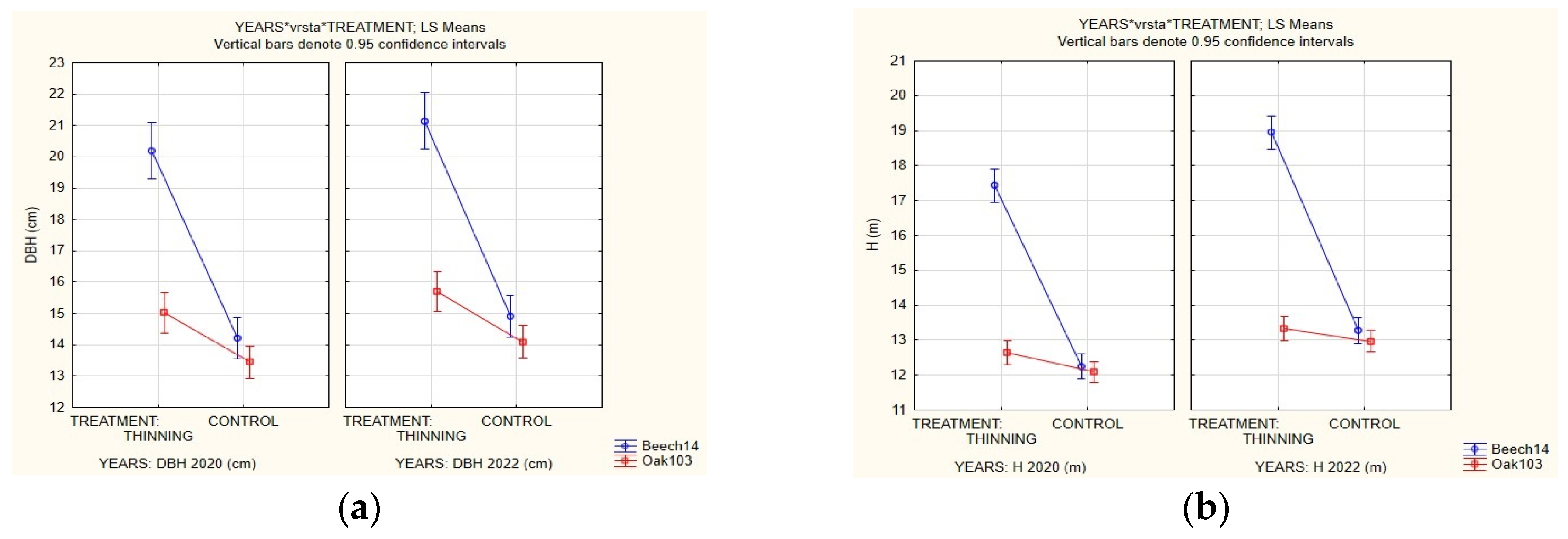
Figure 2.
The proportion of forest tree species by growing stock in the coppices of Lika region showing that beech and s. oak are the most significant coppice species [12].
Figure 2.
The proportion of forest tree species by growing stock in the coppices of Lika region showing that beech and s. oak are the most significant coppice species [12].
Table 2.
Frequency of forest tree species in Beech14 and Oak103 trial plots including thinning and control plots.
Table 2.
Frequency of forest tree species in Beech14 and Oak103 trial plots including thinning and control plots.
| Tree species | Trial plots | |||
|---|---|---|---|---|
| Beech14 | Oak103 | |||
| Thinning | Control | Thinning | Control | |
| Carpinus betulus L. | 2 | 2 | 10 | - |
| Fagus sylvatica L. | 164 | 215 | - | - |
| Quercus petraea (Matt.) Liebl. | - | 26 | 84 | 171 |
| Ostrya carpinifolia Scop. | 3 | 40 | 92 | 131 |
| Pyrus pyraster (L.) Burgsd. | 1 | 4 | 1 | - |
| Abies alba Mill. | - | 1 | 3 | - |
| Prunus avium L. | - | 1 | - | - |
| Sorbus torminalis (L.) Crantz | - | 4 | 2 | 24 |
| Acer pseudoplatanus L. | - | 1 | 45 | 8 |
| Cornus mas L. | - | 1 | - | 1 |
| Fraxinus ornus L. | - | 1 | 73 | 143 |
| Acer obtusatum Waldst. et Kit. ex Willd. | - | - | - | 16 |
| Acer campestre L. | - | - | 3 | 3 |
Table 3.
Descriptive statistics for DBH and height for coppice type (beech coppice, s. oak coppice), treatment and origin for both years 2020 and 2022.
Table 3.
Descriptive statistics for DBH and height for coppice type (beech coppice, s. oak coppice), treatment and origin for both years 2020 and 2022.
| COPPICE TYPE | TREATMENT | ORIGIN | N | DBH2020 (cm) | DBH2022 (cm) | N | H2020 (m) | H2022 (m) |
|---|---|---|---|---|---|---|---|---|
| Mean± Std Dev | Mean± Std Dev | Mean± Std Dev | Mean± Std Dev | |||||
| Beech14 | CONTROL | GEN | 23 | 14.61±7.25 | 15.38±7.18 | 21 | 12.25±2.67 | 13.46±2.77 |
| CONTROL | VEG | 271 | 14.20±5.56 | 14.90±5.56 | 220 | 12.25±2.43 | 13.26±2.39 | |
| THINNING | VEG | 161 | 20.23±7.84 | 21.18±7.83 | 145 | 17.43±3.10 | 18.95±3.44 | |
| Oak103 | CONTROL | GEN | 83 | 15.61±4.73 | 16.16±4.74 | 78 | 12.96±2.44 | 13.90±2.41 |
| CONTROL | VEG | 398 | 13.01±4.23 | 13.69±4.26 | 280 | 11.83±2.58 | 12.69±2.56 | |
| THINNING | GEN | 128 | 17.37±7.72 | 18.08±7.75 | 120 | 13.78±3.73 | 14.51±3.79 | |
| THINNING | VEG | 182 | 13.41±4.76 | 14.06±4.82 | 158 | 11.79±2.89 | 12.43±3.02 |
Table 4.
Results of the repeated measure analysis of variance for DBH (cm) and h (m).
| DBH (cm) | h (m) | |||||||
|---|---|---|---|---|---|---|---|---|
| Source of variability | MS | F value | p>F | MS | F value | p>F | ||
| Between Subjects Effects * | COPPICE TYPE | 1099.13 | 17.02 | <0.0001 | 821.87 | 50.98 | <0.0001 | |
| TREATMENT | 4291.19 | 66.44 | <0.0001 | 2314.56 | 143.56 | <0.0001 | ||
| ORIGIN | 650.83 | 10.08 | 0.0015 | 135.92 | 8.43 | 0.0038 | ||
| COPPICE TYPE*TREATMENT | 3716.58 | 57.54 | <0.0001 | 2928.55 | 181.64 | <0.0001 | ||
| COPPICE TYPE*ORIGIN | 140.93 | 2.18 | 0.1399 | 33.40 | 2.07 | 0.1503 | ||
| TREATMENT*ORIGIN | 151.92 | 2.35 | 0.1254 | 48.15 | 2.99 | 0.0843 | ||
| Error | 64.59 | 16.12 | ||||||
| Within Subjects Effects | YEARS | 80.21 | 708.56 | <0.0001 | 140.745 | 503.75 | <0.0001 | |
| YEARS* COPPICE TYPE | 1.95 | 17.23 | <0.0001 | 8.905 | 31.87 | <0.0001 | ||
| YEARS* TREATMENT | 2.84 | 25.10 | <0.0001 | 1.255 | 4.49 | 0.0343 | ||
| YEARS* ORIGIN | 0.13 | 1.15 | 0.2846 | 0.595 | 2.13 | 0.1449 | ||
| YEARS* COPPICE TYPE*TREATMENT | 2.22 | 19.62 | <0.0001 | 11.995 | 42.93 | <0.0001 | ||
| YEARS* COPPICE TYPE*ORIGIN | 0.33 | 2.91 | 0.0883 | 0.105 | 0.37 | 0.5424 | ||
| YEARS* TREATMENT*ORIGIN | 0.63 | 5.58 | 0.0183 | 0.00 | 0.01 | 0.9292 | ||
| Error (years) | 0.11 | 0.28 | ||||||
* Results in bold are statistically significant at a significance level p<0.05.
Table 5.
Results of Chi2 and Fisher’s exact test for variables: S, T_shape, C, F, C_WIDTH, C_symmetry and treatment.
Table 5.
Results of Chi2 and Fisher’s exact test for variables: S, T_shape, C, F, C_WIDTH, C_symmetry and treatment.
| BEECH | S. OAK | ||||||||
|---|---|---|---|---|---|---|---|---|---|
| Variable | level | CONTROL | THINNING | Total (%) | CONTROL | THINNING | Total (%) | ||
| S * | 1 | 84 | 79 | 163(35.43) |
Chi2=18.91; df=2; P<0.0001 |
106 | 56 | 162 (20.10) |
Chi2=1.35 df=2; P=0.5096 |
| 2 | 153 | 66 | 219(47.61) | 268 | 170 | 438 (54.34) | |||
| 3 | 59 | 19 | 78 (16.96) | 123 | 83 | 206 (25.56) | |||
| ∑ | 296 (64.35%) |
164 (35.65%) |
460 (100) | 497 (61.66%) |
309 (38.34%) |
806 (100%) | |||
| T_shape | 1 | 92 | 97 | 189(41.09) |
Chi2=34.53; df=2; P<0.0001 |
113 | 82 | 195(24.19) |
Chi2=16.99 df=2; P=0.0002 |
| 2 | 164 | 52 | 219(46.96) | 246 | 180 | 426(52.86) | |||
| 3 | 40 | 15 | 55(11.96) | 138 | 47 | 485(55.95) | |||
| ∑ | 296 | 164 | 460 | 497 | 309 | 806 | |||
| C | 1 | 5 | 1 | 6(1.3) |
Fisher Chi2=13.96; df=2; P<0.0006 |
108 | 78 | 186(23.08) | Chi2=7.08 df=2; P=0.0291 |
| 2 | 138 | 49 | 187(40.65) | 285 | 148 | 433(53.27) | |||
| 3 | 153 | 114 | 267(58.04) | 104 | 83 | 187(23.20) | |||
| ∑ | 296 | 164 | 460 | 497 | 309 | 806 | |||
| F | 1 | 11 | 6 | 17(3.72) |
Chi2=5.07; df=2; P=0.0790 |
38 | 22 | 60(7.57) | Chi2=0.13 df=2; P=0.9386 |
| 2 | 87 | 65 | 152(33.26) | 232 | 148 | 380(47.92) | |||
| 3 | 196 | 92 | 288(63.02) | 218 | 135 | 353(44.51) | |||
| ∑ | 294(64.33) | 163(35.67) | 457 | 488(61.54) | 305(38.46) | 793 | |||
| C_WIDTH | 1 | 48 | 42 | 90(19.69) |
Chi2=5.97; df=2; P=0.0505 |
67 | 98 | 165(20.68) | Chi2=42.58 df=2; P<0.0001 |
| 2 | 182 | 91 | 273(59.74) | 233 | 137 | 370(46.37) | |||
| 3 | 64 | 30 | 94(20.57) | 189 | 74 | 263(32.96) | |||
| ∑ | 294 | 163 | 457 | 489(61.28) | 309(38.72) | 798 | |||
| C_sym | sym | 30 | 22 | 52(11.38) |
Chi2=1.13; df=1; P=0.2888 |
19 | 41 | 60(7.52) |
Chi2=23.97; df=1; P<0.0001 |
| asym | 264 | 141 | 405(88.62) | 470 | 268 | 738(92.48) | |||
| ∑ | 294 | 163 | 457 | 489 | 309 | 798 | |||
* Note: levels: 1 (High), 2 (Medium), 3 (Low); df Degree of freedom; sym: symmetric, asym: asymmetric.
Disclaimer/Publisher’s Note: The statements, opinions and data contained in all publications are solely those of the individual author(s) and contributor(s) and not of MDPI and/or the editor(s). MDPI and/or the editor(s) disclaim responsibility for any injury to people or property resulting from any ideas, methods, instructions or products referred to in the content. |
© 2024 by the authors. Licensee MDPI, Basel, Switzerland. This article is an open access article distributed under the terms and conditions of the Creative Commons Attribution (CC BY) license (http://creativecommons.org/licenses/by/4.0/).
Copyright: This open access article is published under a Creative Commons CC BY 4.0 license, which permit the free download, distribution, and reuse, provided that the author and preprint are cited in any reuse.


