

Submitted:
15 July 2024
Posted:
15 July 2024
You are already at the latest version
Abstract
The rapid progress in renewable energy sources and the increasing complexity of energy distribution networks have highlighted the need for efficient and intelligent energy management systems. This paper presents a comparative analysis of two optimisation algorithms, P and M70, used for the optimal control of the operation of microgrids in islanded mode. The main objective is to minimise production costs while ensuring a reliable energy supply. Algorithm P prioritises the use of photovoltaic (PV) and battery storage and operates the diesel generator at minimum capacity to reduce fuel consumption and maximise the use of renewable energy sources. Algorithm M70, on the other hand, uses a heuristic approach to adaptively manage energy resources in real time. In this study, the performance of both algorithms is evaluated through simulation in different operating scenarios. The results show that both algorithms significantly improve the efficiency of the microgrid, with the M70 algorithm showing better adaptability and cost efficiency in dynamic environments. This research contributes to ongoing efforts to develop robust and scalable energy management systems for future smart grids.
Keywords:
microgrid
; energy management
; optimisation algorithms
; predictive control
; heuristic approach
; renewable energy
; islanding
; cost minimisation
; smart grids
1. Introduction
The increasing integration of renewable energy sources (RES) into power systems has necessitated the development of advanced control strategies for microgrids, especially those operating in island mode. Microgrids, which can operate independently or in conjunction with the main grid, offer a promising solution for enhancing the reliability and resilience of power supply, particularly in remote or isolated areas. The ability to operate autonomously in island mode is particularly crucial during grid outages, natural disasters, or other emergencies [1,2].
Microgrid management involves the optimization of various components, including photovoltaic (PV) systems, wind turbines, diesel generators, and battery energy storage systems. Effective management ensures not only the stability and reliability of the power supply but also the economic operation of the microgrid by minimizing production costs and maximizing the utilization of renewable energy [3,4]. However, the inherent variability and uncertainty of RES pose significant challenges to microgrid operation, necessitating robust and adaptive control strategies.
This paper focuses on two advanced optimization algorithms, P and M70, designed to manage microgrid operations in island mode. The P algorithm employs Particle Swarm Optimization (PSO) to determine the optimal sizing of PV fields and battery capacities. This approach maximizes the use of PV energy while minimizing the dependence on diesel generators, thereby reducing overall production costs. On the other hand, the M70 algorithm extends the capabilities of the P algorithm by dynamically adjusting the charge limit (chrLim) of diesel generators, also utilizing PSO for optimization. This dynamic adjustment allows for more efficient management of energy resources, further enhancing cost efficiency and operational performance [5,6].
The primary objective of this study is to compare the performance of the P and M70 algorithms in optimizing microgrid operations in island mode. By conducting a series of simulations, we evaluate the effectiveness of these algorithms in minimizing production costs and improving energy management. The results provide valuable insights into the potential of advanced optimization techniques to enhance the economic and operational performance of microgrids.
In addition to the technical evaluation, this paper also addresses the practical implications of implementing these algorithms in real-world scenarios. By validating the simulation results against a laboratory-scale microgrid model, we ensure that the proposed strategies are both effective and feasible for practical applications [7]. This validation is crucial for bridging the gap between theoretical research and real-world implementation [8].
In the literature on the optimisation of hybrid energy systems, a variety of methods have been proposed to overcome the challenges of cost minimisation, energy production calculation and system management. For example, graphical methods have been used to determine the optimal number of photovoltaic modules and batteries for cost minimisation, to highlight the minimum system costs at the tangent points of cost curves and to optimise the size of wind turbines and photovoltaic arrays [9,10,11]. Probabilistic approaches have been used to calculate the total energy production of hybrid systems and have proven their effectiveness in dealing with uncertainties and fluctuations in energy production [12,13].
Iterative linear programming approaches have been used to size hybrid systems and minimise costs, as well as to optimise systems with respect to energy prices and the probability of load losses [14,15]. Dynamic programming techniques have been used extensively to optimise microgrid management, reduce grid costs and optimise hybrid systems in both parallel and islanded operation [16,17,18,19,20,21]. These methods aim to increase the efficiency and reliability of energy systems by improving management strategies and minimising operating costs.
More advanced techniques such as genetic algorithms and neural networks have been used to optimise the management and sizing of solar and hybrid systems, including PV, wind turbines and other components [22,23,24,25,26]. Multi-objective optimisation approaches, including Multi-Objective PSO (MOPSO), have been used to optimise hybrid systems, greenhouse gas emissions and the economic use of hybrid systems, often reconciling multiple conflicting objectives [27,28,29,30,31,32,33,34,35,36]. Forecasting methods, software tools and reinforcement learning techniques have also been explored for energy forecasting, system simulation and optimised energy management [37,38,39,40,41]. Overall, these methods demonstrate the diverse and innovative approaches that researchers have developed to improve the performance, efficiency and sustainability of hybrid energy systems.

Table 1.
Systematisation of optimal methods for the management of microgrids.
| Reference | Proposed method | Area of the study |
|---|---|---|
| [9] | Graphical method | Optimal number of photovoltaic modules and batteries for minimum cost. |
| [10] | Graphical method | The minimum system costs lie at the tangent point of the curve. |
| [11] | Graphical method | Optimisation of the size of wind turbines and photovoltaic fields. |
| [12] | Probabilistic approach | Calculation of the total energy production of the hybrid system. |
| [13] | Probabilistic approach | Calculation of the total energy production of the hybrid system. |
| [14] | Iterative approach to linear programming | Dimensioning of the hybrid system and minimisation of costs. |
| [15] | Iterative approach | System optimisation regarding the energy price and the probability of load losses. |
| [16] | Dynamic programming | Optimised management of the microgrid. |
| [17] | Dynamic programming | Minimisation of grid costs. |
| [18] | Dynamic programming | Dimensioning of the hybrid system. |
| [19] | Dynamic programming | Optimising microgrid management in parallel and island operation. |
| [20] | Dynamic programming | Optimised microgrid management. |
| [21] | Dynamic programming | Optimised microgrid management in parallel operation. |
| [22] | Genetic algorithm and neural network | Optimisation of the management of the solar system. |
| [23] | Genetic algorithm | Sizing of the hybrid system of PV and wind turbines. |
| [24] | Genetic algorithm | Dimensioning and optimisation of the hybrid system of PV, wind turbine and battery. |
| [25] | Genetic algorithm | Optimisation of the hybrid system consisting of PV, wind turbine and diesel generator. |
| [26] | Genetic algorithm | Optimisation of the hybrid system consisting of hydropower, PV, wind turbine and fuel cell. |
| [27] | Multi-objective optimisation | Optimisation of the hybrid system. |
| [28] | Multi-objective PSO optimisation (MOPSO) | Optimisation of the hybrid system. |
| [29] | Multi-objective optimisation with genetic algorithm | Optimisation of greenhouse gas emissions. |
| [30] | Multi-objective PSO optimisation | Optimisation of the economic use of the hybrid system. |
| [31] | Multi-objective optimisation | Management optimisation of the hybrid system to minimise costs and greenhouse gas emissions. |
| [32] | Multi-objective PSO optimisation (MOPSO) | Optimising the management of the hybrid system to minimise costs and greenhouse gas emissions. |
| [33] | Predictive PSO | Energy forecast in the hybrid system. |
| [34] | Various PSO algorithms | Parameter extraction for photovoltaic systems. |
| [35] | Multi-objective PSO optimisation (MOPSO) | Sizing and optimization of renewable energy communities. |
| [36] | Three PSO variants | Parameter extraction for hydrogen fuel cells and photovoltaic cells. |
| [37] | Predictive method | Load duration forecast for consumption prediction. |
| [38] | Software tools | Simulation, optimisation and management of the PV and wind turbine hybrid system. |
| [39] | Software tools | Summary of 68 tools used for the dimensioning and optimisation of microgrids. |
| [40] | Deep reinforcement learning (DRL) | Optimisation of management. |
| [41] | Reinforcement learning (RL) | Energy management based on reinforcement learning. |
The main contributions of this paper are as follows:
Objective 1: Analysis, systematisation and selection of optimal centralised microgrid management in islanded operation. This paper presents a comprehensive analysis of existing microgrid management models, focusing on their optimisation methods. Different approaches, including classical methods, metaheuristic techniques and artificial intelligence-based management, are analysed. Metaheuristic Particle Swarm Optimization (PSO) is used due to its adaptability to problems with different types of constraints and objective functions and its iterative process of searching the solution space, improving the results through multiple iterations [34,35,36].
Objective 2: Simulation model of centralised microgrid management considering microgrid components. In this paper, a detailed simulation model for centralised microgrid management is developed considering all relevant components such as photovoltaic panels, battery storage systems, diesel generators and bidirectional converters. This model was created using MATLAB Simulink and the Simscape Power Systems Toolbox and provides a robust environment for analysing and optimising the performance of microgrids under different conditions and configurations.
Objective 3: Evaluation of the microgrid simulation model. The effectiveness of the proposed simulation model is evaluated through extensive simulations. Comparative analyses will be conducted to measure the performance of different management strategies, focusing on cost minimisation, reliability and resource utilisation. The results highlight the benefits of integrating advanced optimisation techniques such as PSO for optimal microgrid management.
The remainder of this paper is organized as follows. Section 2 describes the methodology, including the detailed workings of the P and M70 algorithms and the simulation setup. Section 3 presents the simulation results and a comparative analysis of the two algorithms. Section 4 discusses the practical implications of the findings and validates the results using a laboratory model. Finally, Section 5 concludes the paper and outlines directions for future research.
2. Methodology and Mathematical Modelling
This section presents new management algorithms for determining the optimal management model and performing simulations to determine the optimal management of a microgrid in islanded operation based on minimising production costs. An innovative approach is demonstrated by redefining battery storage in contrast to the classical charging approach used in the cited literature [19,20,21,37].
To solve this problem, the metaheuristic method of Particle Swarm Optimisation (PSO) is used. PSO is a simple and effective method commonly used for energy management systems (EMS) in microgrids [42,43,44,45]. The PSO method is applied to two different algorithms for microgrid management:
First algorithm (algorithm P): in this algorithm, the loads are supplied primarily by the photovoltaic (PV), then by the battery bank and only when the battery bank is exhausted and the PV panels (PPVi) do not provide enough power, by the diesel generator (DG). The DG operates with a variable output power (PDGi), which is required to cover the consumption demand (PTi), while the battery bank (PBTi) is charged exclusively by the PV source (Figure 1).
The second algorithm (algorithm M70) differs from algorithm P in that the level (chrLim70) to which the diesel generator charges the battery is calculated in the PSO process before the management algorithm is started and after the system has been dimensioned and modelled. The chrLim70 level is dynamically determined by the input parameters of the model and represents an innovative contribution to microgrid management. Once set, chrLim70 remains constant over the entire lifetime of the project. In algorithm M70, the diesel generator operates continuously at 100% output power after activation, as this is when its efficiency is at its highest (Figure 2).
2.1. Selection of Optimal Management
The selection of the optimal management is based on two previously proposed management algorithms (P and M70). The methodology consists of the following steps:
1. Preparation of the microgrid model: A microgrid model with discrete data is created to simulate the real operating conditions. MATLAB Simulink with the Simscape Power Systems Toolbox, which enables the modelling and analysis of energy systems, is used for the simulation. The model includes PV modules, a battery, a diesel generator, a bidirectional converter and loads. Parameters and constraints are also defined for each element of the MG.
2. Implementation of the PSO algorithm (Figure 3): The PSO algorithm is used to optimise the management of the MG. This process includes initialising a population of particles, evaluating the objective function, updating the velocity and position of the particles, checking convergence and selecting the optimal management model.
3. Simulation of the proposed management algorithms: The proposed management algorithms are simulated in MATLAB Simulink using the Simscape Power Systems Toolbox. This setup enables the modelling and analysis of power systems. Parallel processing is used to speed up the execution of the algorithms and achieve efficient results.
4. Analyse and compare the results: The results of the two algorithms for the management of the microgrid in islanded mode are analysed and compared. The production costs, including the fuel costs for the diesel generator, the maintenance costs and the costs of replacing batteries and inverters are taken into account to minimise the objective function (UTP). The effects of the various parameters on the optimisation process and the quality of the solution are also analysed.
Algorithm P model: The output of the photovoltaic system and the battery capacity are dimensioned using the PSO method in the solution space, subject to the condition that the total project costs (UTP) are minimised over N years, as described in formula 1 to 7.
Algorithm M70 model: This model builds on algorithm P by also determining the chrLim value, i.e., the value up to which the DG charges the batteries before it is switched off and switched to RES. The photovoltaic field power and the battery capacity are dimensioned using the PSO method within the solution space, optimising the chrLim value to minimise the UTP over N years, as described in formula 8 to 14. The chrLim value is calculated using the PSO method with the input values and . In the P algorithm model, the battery is charged to 80% before switching to RES, while in the M70 algorithm model, chrLim is determined dynamically for each pair of module power and battery capacity. The optimal chrLim value is between 50% and 80%, with 74% being optimal in our case.
To select the optimal microgrid management model for islanding based on production cost minimisation, it is necessary to define the objective function to minimise the total project cost for the P management algorithm as described below.
= total project costs, C0 = initial investment costs, = residual value of equipment at the end of the project, = maintenance costs in year j without fuel costs, = cost of replacing the equipment in the 10th year, = cost of replacing the equipment in the 15th year, = power generated by the panels at time i, = power required by the consumers at time i, = power difference in the microgrid (MG), = state of charge of the battery in per cent, = stored battery energy at time i, = battery charging energy at time i, = energy used to charge the battery by solar panels at time i, = fuel consumed at time i, = fuel price (1.7 EUR/L), = fuel costs.
In order to select the optimal microgrid management model for island operation based on the minimisation of production costs, the objective function for minimising the total project costs for the M70 management algorithm, must be defined, as described below.
= output power of the diesel generator at time i, , = energy for charging the battery by the diesel generator at time i, = level to which the diesel generator charges the battery bank.
2.2. Economic Indicators for Microgrid Optimisation
The costs of generating electricity in a microgrid is determined in relation to the investment costs (planning, design and construction costs) and the operation and maintenance costs (O&M costs), such as maintenance of system components, replacement or fuel.
An optimisation of the total project costs is carried out and the net present costs [46](NPC) or life cycle costs are also calculated, which include the following [47]:
o All system costs over the lifetime minus all revenues.
o The value of the costs is reduced to present value by discounting.
o Included costs: capital costs, replacement of system components, operation and maintenance costs, fuel, electricity purchased from the grid.
o Revenues include: sale of electricity to the grid, residual value of the system at the end of the project.
When selecting the optimal model, the average cost of energy generated per kWh (Levelised Cost of Energy—LCOE) is calculated. The LCOE is the standardised cost of generating electricity from a particular energy source or system. It is a commonly used measure for comparing different energy sources or projects [47].
2.3. Defining the Input Data for the Microgrid Model
The input data for the simulation model includes climate data, electrical load, technical and economic parameters of the equipment used for generation and storage, sensitivity variables, dispatch strategy and other constraints. The model simulates system operation and calculates the energy balance for each of the 8760 hours in a year. This results in the optimal system size and management strategy based on minimising total production costs.
The simulated model for optimal microgrid management is based on the needs of the University of Applied Sciences in Zagreb. Given the specified operating conditions for the microgrid and all input data, the goal is to find a solution for optimal system management. Selecting the optimal size of the distributed energy sources and optimising their management is crucial to justify the investment costs and achieve the best possible system efficiency. The aim is to find an optimal management that meets the electricity demand and minimises operating costs, taking into account all the particularities of the market in which the microgrid is located.
2.4. Location and Meteorological Data
The University of Applied Sciences in Zagreb (TVZ) is located at Konavoska 2, 10 000 Zagreb. It is located at a latitude of 45.799 and a longitude of 15.928.
As the renewable energy source will be a photovoltaic plant, meteorological data is crucial for the project implementation. One of the important meteorological data points is the average daily solar radiation at the site [kWh/m2]. The data for the average daily irradiation at the site comes from Homer PRO, a programme based on NASA statistics. The average daily irradiation at the site is 3.52 kWh/m2.
2.5. Electricity Consumption Requirements at the Site
By monitoring the consumption history and scheduling changes in the system, daily, monthly and annual consumption profiles of the users are created. The annual electricity consumption at this site is 269 431.00 kWh.
2.6. Selection of Optimal Microgrid Management in Island Operation
According to the previously defined methodology, the input variables are dimensioned in the following section of this chapter: the power of the solar modules in the photovoltaic field and the battery capacity, labelled . The parameter dimensioning of the model is carried out for both management models (P and M70) in order to obtain the optimum points for both management models. Dimensioning is performed using the PSO method (Figure 3) through three iterations according to formulae 1–14.
Optimising system management using PSO can be challenging, especially when the goal is to minimise system costs while selecting the optimal size for the photovoltaic module output, battery capacity and diesel generator output. This is a multi-criteria problem. There is a balance between these objectives, which leads to a large search space. The PSO model then requires a large number of particles to search this space effectively, resulting in lengthy simulations and a significant demand on computational resources. The optimal modelling of the capacity of the photovoltaic modules, the battery system and the diesel generator is achieved through an economic analysis of different combinations of component sizes.
In order to reduce the number of criteria in the multi-criteria optimisation, an analysis and selection of the generator output was performed based on the evaluation of the worst-case scenario, in which the generator must supply sufficient power for the continuous operation of the system. The analysis of the annual load profile showed that the power requirement does not exceed 80 kW over the course of a year.
Based on this analysis, a generator with a continuous output of 100 kW was selected to provide an additional reserve for possible increases in consumption. In addition, it is important to choose a suitable size for the photovoltaic (PV) array and the battery system. The key element in this selection is the balance between the capacity of the PV array and the battery. If a larger PV array capacity is selected with an insufficient battery capacity, the energy generated by the PV array cannot be stored and production may have to be curtailed during the summer months. Conversely, selecting insufficient PV array power may result in the batteries not being sufficiently charged in the winter months, leading to underutilisation of expensive energy storage capacity.
The total cost function for optimal microgrid management in island operation, based on minimising production costs, is shown in (15):
CUTP = total project cost over N years (UTP), CP = initial investment cost, CO&M (i) = maintenance and equipment replacement cost in year i, N = number of project years, Cs = residual value of equipment at the end of the project.
CPV = total installation cost of solar panels, CPR = cost of the bidirectional converter, CMMPT = cost of the MPPT voltage regulator, CBT = cost of batteries, CDG = cost of the diesel generator.
Here are also: CO&M (i) = annual cost in year i, Codr(i) = annual maintenance costs of the microgrid, Cgor(i) = fuel cost for the diesel generator, CBT10(10) = battery replacement cost in year 10, CBT20(20) = battery replacement cost in year 20, CPR15(15) = converter replacement cost in year 15, CS(25) = residual value of equipment at the end of the project.
Using the cost function according to Formula 15, the total costs of the microgrid are calculated over 25 years for value pairs within the PSO optimisation iterations. The aim is to find the optimal pair that leads to the lowest cost function CUTP for the MG after 25 years.
The PSO algorithm determines the optimal combination of pairs and tests combinations of values within the given range according to Formulas 2 and 9, calculating the total cost for each pair in the space. In the initial phase, the algorithm selects the value . For the selected value of , the algorithm runs through all values of the photovoltaic field power . As a result of the PSO (P, M70) optimisation, the algorithm calculates the CUTP(P, M70) values for over the 25-year simulation through three iterations.
The values obtained for the M70 management model over three iterations, which narrow down the search space and increase the accuracy of the local optimum in the PSO are , for which the minimum cost function is achieved UTP = min CUTP = 2 312 823 EUR (Figure 4).
For the P model of optimal microgrid management, the obtained values are , for which the minimum cost function (UTP) is achieved: min CUTP = 2 666 491 EUR.
Table 2 shows the results of the optimal parameter design for each of the algorithm models P and M70. Parameter optimisation was performed over three iterations, narrowing the range of possible values for . This narrowing of the range increased the precision of the parameter determination for the models. The models were evaluated in terms of minimising the objective function . In addition to the total project costs (UTP), the values for COE, NPC and LCOE were also calculated.
Comparing the optimal values of the two management algorithms, it can be seen that the M70 algorithm delivers very satisfactory total project costs of 2 312 823 EUR, while the P management algorithm leads to higher total project costs of 2 666 491 EUR. The M70 algorithm is based on two PSO optimisations: one for the input parameters of the model and another for the calculation of chgLim. The P algorithm uses PSO for the parameterisation of the input data for PV field power and battery capacity, but does not use any other optimisation methods during management.
PPVmin = lower search boundary in PSO optimization for PV power [kW],
PPVmax = upper search boundary in PSO optimization for PV power [kW],
KBTmin = lower search boundary in PSO optimization for battery capacity [kWh],
KBTmax = upper search boundary in PSO optimization for battery capacity [kWh],
PPV = optimal PV field power size [kW] for minimum UTP costs [EUR],
KBT = optimal battery capacity size [kWh] for minimum UTP costs [EUR],
UTP = total cost at the end of the 25-year project period [EUR],
COE = average cost of produced energy relative to UTP per kWh [EUR/kWh],
NPC = minimum net present cost in PSO optimization [EUR],
LCOE = average levelized cost of produced energy per kWh [EUR/kWh].
Table 3 shows the input and output parameters of the management algorithms P and M70 at their optimal points. The input parameters, PV field power and battery capacity are the optimal pairs for each model, respectively. The diesel generator has an output of 100 kW, but in the P model it operates at 30% of its rated power on average, while in the M70 model it operates at 100% of its rated power. Since the P model has the highest PV array power and the highest battery capacity, it is expected that the production from the PV array is the highest and the production from the diesel generator is lower than the M70 model, which is confirmed by the results. However, compared to the M70 model, the P model consumes 27% less fuel for 52% lower production as it operates at non-rated power. This results in lower efficiency, which translates into higher fuel consumption for lower production, cancelling out the benefits of investing more in larger PV field capacities. Table 2 confirms these conclusions as the P model is a more expensive management model. The results show that the choice of optimal microgrid management is clearly in favour of the M70 algorithm model.
3. Evaluation Results and a Comparative Analysis
Using the discrete input data described in section 2, a microgrid model was created that simulates the real operating conditions of the microgrid. MATLAB Simulink with the Simscape Power Systems Toolbox, which enables the modelling and analysis of power systems, is used for the simulation. The optimal parameters for each model were calculated in the PSO(P, M70) analysis. The simulation is performed at the optimal points of each model presented to observe the behaviour of the models at the optimal points of the competing algorithms. The simulation model created in MATLAB Simulink is shown in Figure 5.
The development of the management model was carried out in two steps. In the first step, the microgrid for each of the developed management algorithms (P, M70) was modelled to obtain the optimal value of each management algorithm using parallel processing and discrete input data together with the developed PSO management algorithms. The results are shown in Table 2 and Table 3.
In the second step, simulation and evaluation of the two management models were performed to determine the behaviour of the management algorithms outside their optimal points. The simulation results of the two models show the expected advantage of the M70 model over the P model (Table 4 and Table 5). For the same input parameters at the optimal point of the P algorithm and at the optimal point of the M70 algorithm the M70 model has lower maintenance and fuel costs and better economic indicators (UTP, COE, NPC, LCOE) (Table 4 and Table 5).
The M70 model calculates the parameter chrLim right at the start of the simulation using the PSO method for the input parameters . The PSO method finds the chrLim for which the objective function is minimal, . The result of the PSO optimisation is chrLim = 74% (Figure 6), which means that once activated the diesel generator charges the battery (SOC) up to 74%, after which the algorithm switches the supply to the consumption of renewable energy. Figure 6 shows that a very similar result is achieved even if chrLim is 52%.
Figure 7 shows how the algorithm adjusts the chrLim level and manages the battery charge (SOC) in the M70 model. The algorithm of the P model manages the microgrid exclusively via the algorithm without additional methods, as is the case with the M70 model. Figure 7 shows how the algorithm regulates the utilisation of the individual sources. For example, the diesel generator is not activated in summer and the entire production comes from the PV field.
A comparison of the two models shows that the M70 algorithm clearly outperforms the P algorithm in terms of total project costs and cost efficiency. The utilisation of the diesel generator at full capacity when required by the M70 model in combination with an optimal balance of PV and battery capacities leads to lower overall costs and better energy management. The M70 algorithm achieves significant savings in both operational and capital costs, resulting in a more sustainable and economically viable microgrid solution.
4. Discussion
The simulations carried out with the P and M70 algorithms for optimal microgrid management in island operation showed clear differences in their economic performance and efficiency. The M70 algorithm showed better adaptability and cost efficiency compared to the P algorithm, which is reflected in the lower total project costs (UTP) and better economic indicators.
The P algorithm focuses on maximising the use of photovoltaics and battery storage and operates the diesel generator at an average of 30% of its rated power. This approach leads to higher initial investment costs due to the larger PV field and battery capacity. In contrast, the M70 algorithm calculates the chrLim parameter at the beginning of the simulation using the PSO method and dynamically adjusts the charging limit of the diesel generator. This method results in a chrLim value of 74%, which ensures efficient battery charging and operation of the diesel generator.
The comparative analysis has shown that the M70 model has lower maintenance and fuel costs and the total project cost (UTP) is 2 312 823 EUR compared to 2 666 491 EUR for the P model. In addition, the utilisation of the diesel generator by the M70 model and the optimised balance between PV and battery capacities resulted in lower overall costs and better energy management. The M70 algorithm also achieved significant savings in operational and capital costs, making it a more sustainable and economically viable solution for microgrid management.
The results show that dynamically adjusting the load limit of the diesel generator through the M70 algorithm provides a more efficient and cost-effective approach to microgrid management. This has practical implications for the design and operation of microgrids, especially in scenarios where economic efficiency and reliable energy supply are critical. The ability to dynamically optimise the use of energy resources can lead to significant cost savings and improved system performance.
The evaluation of the simulation models shows that the costs of the models largely depends on the input parameters and user requirements. In this study, the consumption requirements did not effectively support PV production, as the highest PV energy production with the lowest consumption occurred in summer and the highest consumption with the lowest PV production occurred in winter. This consumption pattern requires large investments in battery storage, which increases the overall cost of the project. The task was to develop an algorithm that optimises the system parameters for the given user requirements in a first step. In the second step, the algorithm must maximise the use of the given model parameters in order to minimise the target function . Both tasks were successfully solved using the metaheuristic PSO method. Future research aims to further develop the predictive algorithm in order to minimise external influences on the management and operation of the microgrid. The developed model is accessible for further analyses and developments via its parametric interfaces.
The study successfully fulfils the objectives mentioned in the introduction:
- Objective 1: Analysis, systematisation and selection of optimal centralised microgrid management in islanded operation. The analysis and systematisation of optimisation methods, especially the PSO method, provided a comprehensive understanding of their performance and led to the selection of the M70 algorithm as the optimal model for centralised microgrid management in islanded operation, based on the minimisation of production costs.
- Objective 2: Simulation model for centralised microgrid management considering microgrid components. The development and implementation of detailed simulation models in MATLAB Simulink for both algorithms enabled an accurate evaluation of their performance under different conditions and revealed the strengths and weaknesses of each approach.
- Objective 3: Evaluation of the simulation model for the microgrid. The comprehensive evaluation of the simulation results highlighted the economic and operational benefits of the M70 algorithm and confirmed its superiority over the P algorithm in terms of cost efficiency and system reliability.
Future research should focus on the further development of prediction algorithms to minimise external influences on the management of microgrids. In addition, the integration of advanced machine learning techniques and real-time data analysis could improve the adaptability and responsiveness of microgrid management systems.
5. Conclusions
The study has shown that the M70 algorithm outperforms the P algorithm in terms of economic efficiency and operational performance in microgrid management. The dynamic adjustment of the load limit of the diesel generator in the M70 model resulted in lower overall project costs and better economic indicators.
The main results are as follows:
- The M70 algorithm achieved a total project cost (UTP) of 2 312 823 EUR, which is significantly lower than the 2 666 491 EUR of the P model.
- The M70 model had lower maintenance and fuel costs due to the efficient operation of the diesel generator and the optimised balance of PV and battery capacities.
- The use of the PSO method to dynamically adjust the chrLim parameter in the M70 model proved to be highly effective in minimising costs and improving the overall efficiency of the system.
The results have significant implications for the design and management of microgrids, especially in isolated or remote areas. The implementation of the M70 algorithm can lead to significant cost savings and improved reliability of energy supply, making it a valuable approach for future smart grid developments.
Based on the results, it is recommended to integrate dynamic and adaptive optimisation techniques, as used in the M70 algorithm, into the management of microgrids to improve economic efficiency and operational performance. Further research should also focus on the integration of advanced predictive and machine learning techniques to improve the adaptability and responsiveness of the system.
This study contributes to ongoing efforts to develop robust and scalable energy management systems for microgrids. The comparative analysis of the P and M70 algorithms highlights the potential of advanced optimisation techniques to improve the economic and operational performance of microgrids and provides valuable insights for future research and practical applications.
Author Contributions
Conceptualization, D.Ž. and S.T.; methodology, D.Ž.; software, D.Ž. and M.L.; validation, D.Ž. and M.L.; formal analysis, D.Ž.; investigation, D.Ž. and M.L.; resources, D.Ž. and M.L.; data curation, D.Ž. and M.L.; writing—original draft preparation, D.Ž.; writing—review and editing, D.Ž.; visualization, D.Ž. and M.L.; supervision, S.T.; project administration, D.Ž., S.T. and M.L.; funding acquisition, S.T. All authors have read and agreed to the published version of the manuscript.
References
- AlDavood, M.S.; Mehbodniya, A.; Webber, J.L.; Ensaf, M.; Azimian, M. Robust Optimization-Based Optimal Operation of Islanded Microgrid Considering Demand Response. Sustainability 2022, 14, 14194. [Google Scholar] [CrossRef]
- Parhizi, S.; Lotfi, H.; Khodaei, A.; Bahramirad, S. State of the art in research on microgrids: A review. IEEE Access 2015, 3, 890–925. [Google Scholar] [CrossRef]
- Shi, L.; Luo, Y.; Tu, G.Y. Bidding strategy of microgrid with consideration of uncertainty for participating in power market. International Journal of Electrical Power & Energy Systems 2014, 59, 1–13. [Google Scholar] [CrossRef]
- Liu, G.; Xu, Y.; Tomsovic, K. Bidding strategy for microgrid in day-ahead market based on hybrid stochastic/robust optimization. IEEE Trans Smart Grid 2016, 7, 227–237. [Google Scholar] [CrossRef]
- Conti, S.; Nicolosi, R.; Rizzo, S.A.; Zeineldin, H.H. Optimal dispatching of distributed generators and storage systems for MV islanded microgrids. IEEE Transactions on Power Delivery 2012, 27, 1243–1251. [Google Scholar] [CrossRef]
- Ranjbar, H.; Safdarian, A. A Robust Model for Daily Operation of Grid-connected Microgrids During Normal Conditions. Scientia Iranica, 2021, 28, 3480–3491. [Google Scholar] [CrossRef]
- Farzin, H.; Fotuhi-Firuzabad, M.; Moeini-Aghtaie, M. Stochastic Energy Management of Microgrids during Unscheduled Islanding Period. IEEE Trans Industr Inform, 2017, 13, 1079–1087. [Google Scholar] [CrossRef]
- Ignat, A.; Lazar, E.; Petreus, D. Energy Management for an Islanded Microgrid Based on Particle Swarm Optimization. 2018 IEEE 24th International Symposium for Design and Technology in Electronic Packaging, SIITME 2018 - Proceedings, 2018. [Google Scholar] [CrossRef]
- Borowy, B.S.; Salameh, Z.M. Methodology for optimally sizing the combination of a battery bank and PV array in a Wind/PV hybrid system. IEEE Transactions on Energy Conversion, 1996, 11, 367–373. [Google Scholar] [CrossRef]
- Ai, B.; Yang, H.; Shen, H.; Liao, X. Computer-aided design of PV/wind hybrid system. Renew Energy, 2003, 28, 1491–1512. [Google Scholar] [CrossRef]
- Markvart, T. Sizing of hybrid photovoltaic-wind energy systems. Solar Energy, 1996, 57, 277–281. [Google Scholar] [CrossRef]
- Karaki, S.H.; Chedid, R.B.; Ramadan, R. Probabilistic performance assessment of autonomous solar-wind energy conversion systems. IEEE Transactions on Energy Conversion, 1999, 14, 766–772. [Google Scholar] [CrossRef]
- Tina, G.; Gagliano, S.; Raiti, S. Hybrid solar/wind power system probabilistic modelling for long-term performance assessment. Solar Energy 2006, 80, 578–588. [Google Scholar] [CrossRef]
- Kellogg, W.D.; Nehrir, M.H.; Venkataramanan, G.; Gerez, V. Generation unit sizing and cost analysis for stand-alone wind, photovoltaic, and hybrid wind/PV systems. IEEE Transactions on Energy Conversion, 1998, 13, 70–75. [Google Scholar] [CrossRef]
- Yang, H.; Lu, L.; Zhou, W. A novel optimization sizing model for hybrid solar-wind power generation system. Solar Energy, 2007, 81, 76–84. [Google Scholar] [CrossRef]
- Heymann, B.; Bonnans, J.F.; Martinon, P.; Silva, F.J.; Lanas, F.; Jiménez-Estévez, G. Continuous optimal control approaches to microgrid energy management. Energy Systems, 2018, 9, 59–77. [Google Scholar] [CrossRef]
- Luu, N.A.; Tran, Q.T. Optimal energy management for grid connected microgrid by using dynamic programming method. IEEE Power and Energy Society General Meeting 2015, 2015. [Google Scholar] [CrossRef]
- Střelec, M.; Berka, J. Microgrid energy management based on approximate dynamic programming. 2013 4th IEEE/PES Innovative Smart Grid Technologies Europe, ISGT Europe 2013. [CrossRef]
- Chalise, S.; Sternhagen, J.; Hansen, T.M.; Tonkoski, R. Energy management of remote microgrids considering battery lifetime. The Electricity Journal, 2016, 29, 1–10. [Google Scholar] [CrossRef]
- Merabet, A.; Ahmed, K.T.; Ibrahim, H.; Beguenane, R.; Ghias, A.M.Y.M. Energy Management and Control System for Laboratory Scale Microgrid Based Wind-PV-Battery. IEEE Trans Sustain Energy, 2017, 8, 145–154. [Google Scholar] [CrossRef]
- Choudar, A.; Boukhetala, D.; Barkat, S.; Brucker, J.-M. A local energy management of a hybrid PV-storage based distributed generation for microgrids”. [CrossRef]
- Kalogirou, S.A. Optimization of solar systems using artificial neural-networks and genetic algorithms. Appl Energy, 2004, 77, 383–405. [Google Scholar] [CrossRef]
- Yang, H.; Zhou, W.; Lu, L.; Fang, Z. Optimal sizing method for stand-alone hybrid solar-wind system with LPSP technology by using genetic algorithm. Solar Energy, 2008, 82, 354–367. [Google Scholar] [CrossRef]
- Koutroulis, E.; Kolokotsa, D.; Potirakis, A.; Kalaitzakis, K. Methodology for optimal sizing of stand-alone photovoltaic/wind-generator systems using genetic algorithms. Solar Energy, 2006, 80, 1072–1088. [Google Scholar] [CrossRef]
- Hong, Y.Y.; Lian, R.C. Optimal sizing of hybrid wind/PV/diesel generation in a stand-alone power system using markov-based genetic algorithm. IEEE Transactions on Power Delivery, 2012, 27, 640–647. [Google Scholar] [CrossRef]
- Mostofi, F.; Shayeghi, H. Feasibility and optimal reliable design of renewable hybrid energy system for rural electrification in Iran. International Journal of Renewable Energy Research, 2012, 2, 574–582. [Google Scholar]
- Coello, C.A.C.; Lamont, G.B.; Van Veldhuizen, D.A.; Goldberg, D.E.; Koza, J.R. , Evolutionary Algorithms for Solving Multi-Objective Problems. 2007. [CrossRef]
- Ramírez-Rosado, I.J.; Bernal-Agustín, J.L. Reliability and costs optimization for distribution networks expansion using an evolutionary algorithm. IEEE Transactions on Power Systems, 2001, 16, 111–118. [Google Scholar] [CrossRef]
- Tsoi, E.; Wong, K.P.; Fung, C.C. Hybrid GA/SA algorithms for evaluating trade-off between economic cost and environmental impact in generation dispatch. Proceedings of the IEEE Conference on Evolutionary Computation 1995, 1, 132–137. [Google Scholar] [CrossRef]
- Corso, G.; Di Silvestre, M.L.; Ippolito, M.G.; Sanseverino, E.R.; Zizzo, G. Multi-objective long term optimal dispatch of distributed energy resources in micro-grids. Proceedings of the Universities Power Engineering Conference, 2010. [Google Scholar]
- Kitamura, S.; Mori, K.; Shindo, S.; Izui, Y.; Ozaki, Y. Multi-objective energy management system using modified MOPSO. Conf Proc IEEE Int Conf Syst Man Cybern, 2005, 4, 3497–3503. [Google Scholar] [CrossRef]
- Pourmousavi, S.A.; Nehrir, M.H.; Colson, C.M.; Wang, C. Real-time energy management of a stand-alone hybrid wind-microturbine energy system using particle swarm optimization. IEEE Trans Sustain Energy, 2010, 1, 193–201. [Google Scholar] [CrossRef]
- Mohammed, O.H.; Amirat, Y.; Benbouzid, M. Particle Swarm Optimization Of a Hybrid Wind/Tidal/PV/Battery Energy System. Application To a Remote Area In Bretagne, France. Energy Procedia, 2019, 162, 87–96. [Google Scholar] [CrossRef]
- Liu, E.J.; Hung, Y.H.; Hong, C.W. Improved Metaheuristic Optimization Algorithm Applied to Hydrogen Fuel Cell and Photovoltaic Cell Parameter Extraction. Energies 2021, 14, 619. [Google Scholar] [CrossRef]
- Faria, J.; Marques, C.; Pombo, J.; Mariano, S.; Calado, M.D.R. Optimal Sizing of Renewable Energy Communities: A Multiple Swarms Multi-Objective Particle Swarm Optimization Approach. Energies 2023, 16, 7227. [Google Scholar] [CrossRef]
- Liu, E.J.; Hung, Y.H.; Hong, C.W. Improved Metaheuristic Optimization Algorithm Applied to Hydrogen Fuel Cell and Photovoltaic Cell Parameter Extraction. Energies 2021, 14, 619. [Google Scholar] [CrossRef]
- Pascual, J.; Arcos-Aviles, D.; Ursúa, A.; Sanchis, P.; Marroyo, L. Energy management for an electro-thermal renewable–based residential microgrid with energy balance forecasting and demand side management. Appl Energy 2021, 295, 117062. [Google Scholar] [CrossRef]
- Zhou, W.; Lou, C.; Li, Z.; Lu, L.; Yang, H. Current status of research on optimum sizing of stand-alone hybrid solar-wind power generation systems. Appl Energy, 2010, 87, 380–389. [Google Scholar] [CrossRef]
- Connolly, D.; Lund, H.; Mathiesen, B.V.; Leahy, M. A review of computer tools for analysing the integration of renewable energy into various energy systems. Appl Energy, 2010, 87, 1059–1082. [Google Scholar] [CrossRef]
- Mocanu, E.; et al. On-Line Building Energy Optimization Using Deep Reinforcement Learning. IEEE Trans Smart Grid, 2019, 10, 3698–3708. [Google Scholar] [CrossRef]
- BV, M. ; Ruelens F; Spiessens F; and et al. Reinforcement learning-based battery energy management in a solar microgrid. 2017.
- Hu, X.; Eberhart, R.C.; Shi, Y. Particle swarm with extended memory for multiobjective optimization. 2003 IEEE Swarm Intelligence Symposium, SIS 2003 - Proceedings, 2003; 193–197. [Google Scholar] [CrossRef]
- Alarcon-Rodriguez, A.; Ault, G.; Galloway, S. Multi-objective planning of distributed energy resources: A review of the state-of-the-art. Renewable and Sustainable Energy Reviews, 2010, 14, 1353–1366. [Google Scholar] [CrossRef]
- Coello, C.A.C.; Lechuga, M.S. MOPSO: A proposal for multiple objective particle swarm optimization. Proceedings of the 2002 Congress on Evolutionary Computation, CEC 2002, 2002; 2, 1051–1056. [Google Scholar] [CrossRef]
- Zia, M.F.; Elbouchikhi, E.; Benbouzid, M. Microgrids energy management systems: A critical review on methods, solutions, and prospects. Appl Energy, 2018, 222, 1033–1055. [Google Scholar] [CrossRef]
- Katche, M.L.; Makokha, A.B.; Zachary, S.O.; Adaramola, M.S. Techno-Economic Assessment of Solar–Grid–Battery Hybrid Energy Systems for Grid-Connected University Campuses in Kenya. Electricity 2024, 5, 61–74. [Google Scholar] [CrossRef]
- Miao, C.; Teng, K.; Wang, Y.; Jiang, L. Technoeconomic Analysis on a Hybrid Power System for the UK Household Using Renewable Energy: A Case Study. Energies 2020, 13, 3231. [Google Scholar] [CrossRef]
- Mongird, K.; et al. An Evaluation of Energy Storage Cost and Performance Characteristics. Energies 2020, 13, e 3307. [Google Scholar] [CrossRef]
- Yimen, N.; et al. Optimal Sizing and Techno-Economic Analysis of Hybrid Renewable Energy Systems—A Case Study of a Photovoltaic/Wind/Battery/Diesel System in Fanisau, Northern Nigeria. Processes 2020, 8, 1381. [Google Scholar] [CrossRef]
Figure 1.
Management algorithm for individual sources (algorithm P).
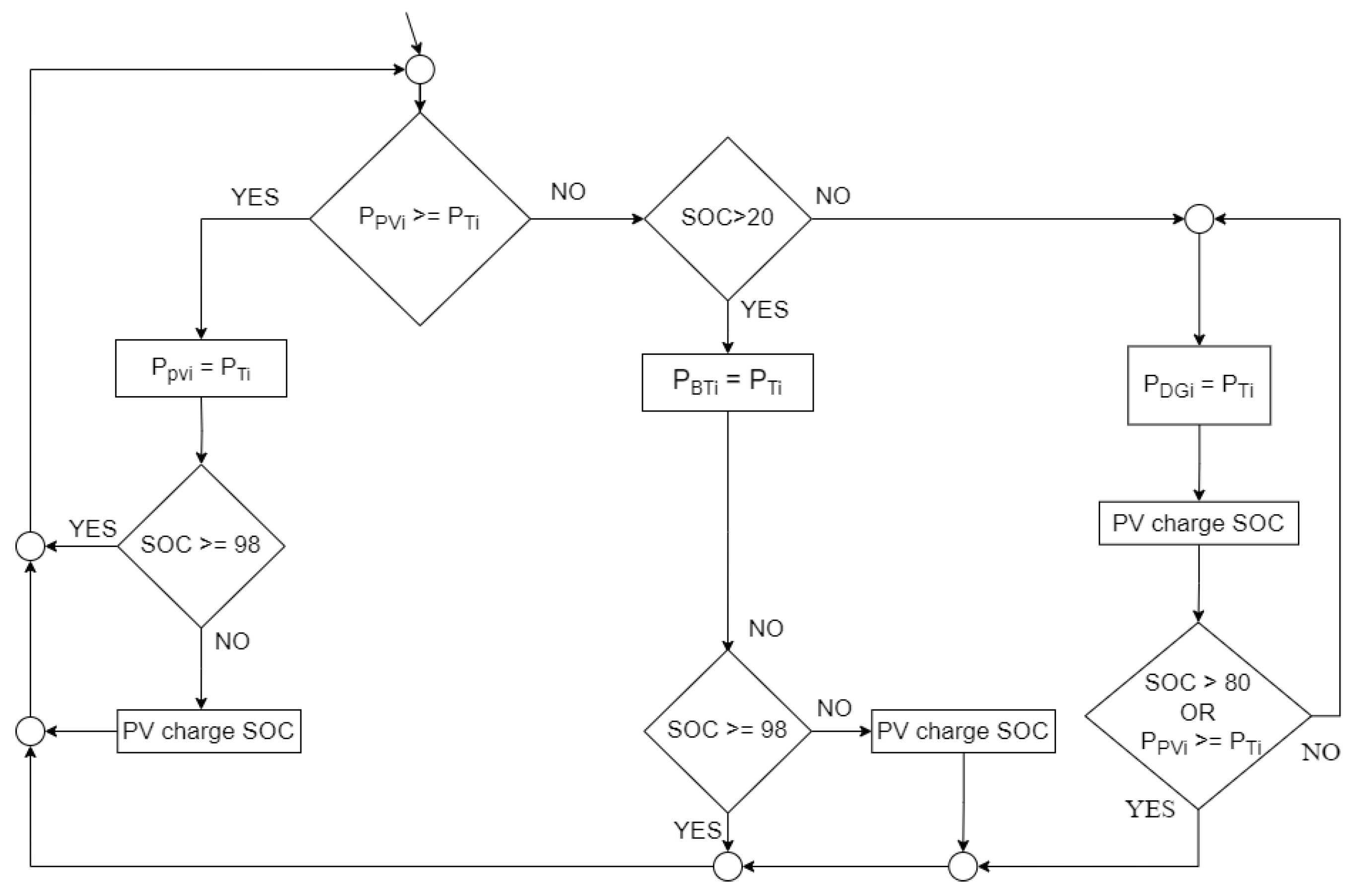
Figure 2.
Management algorithm with PSO method for determining chrLim70 (algorithm M70).
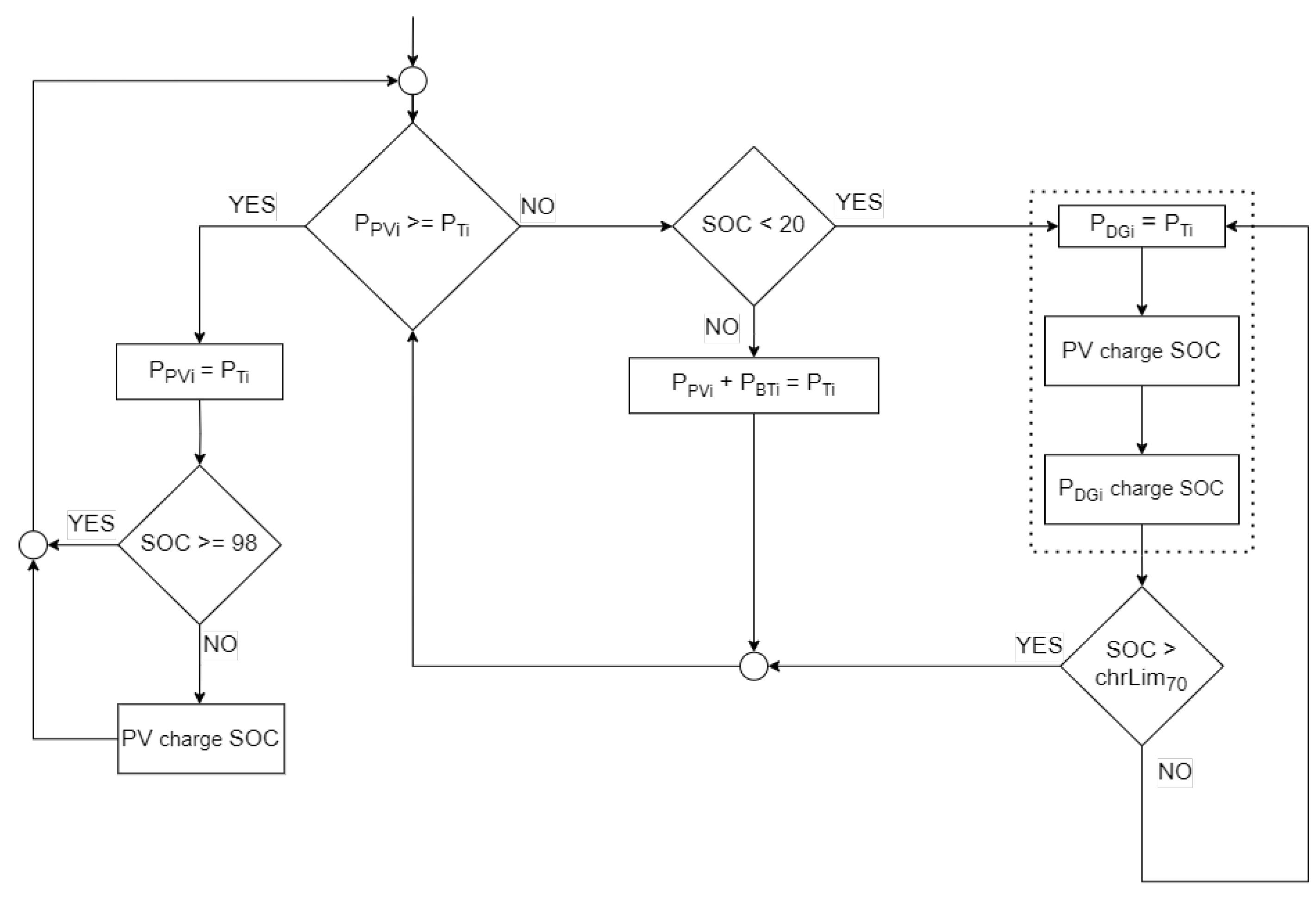
Figure 3.
The PSO algorithm for sizing MG parameters.
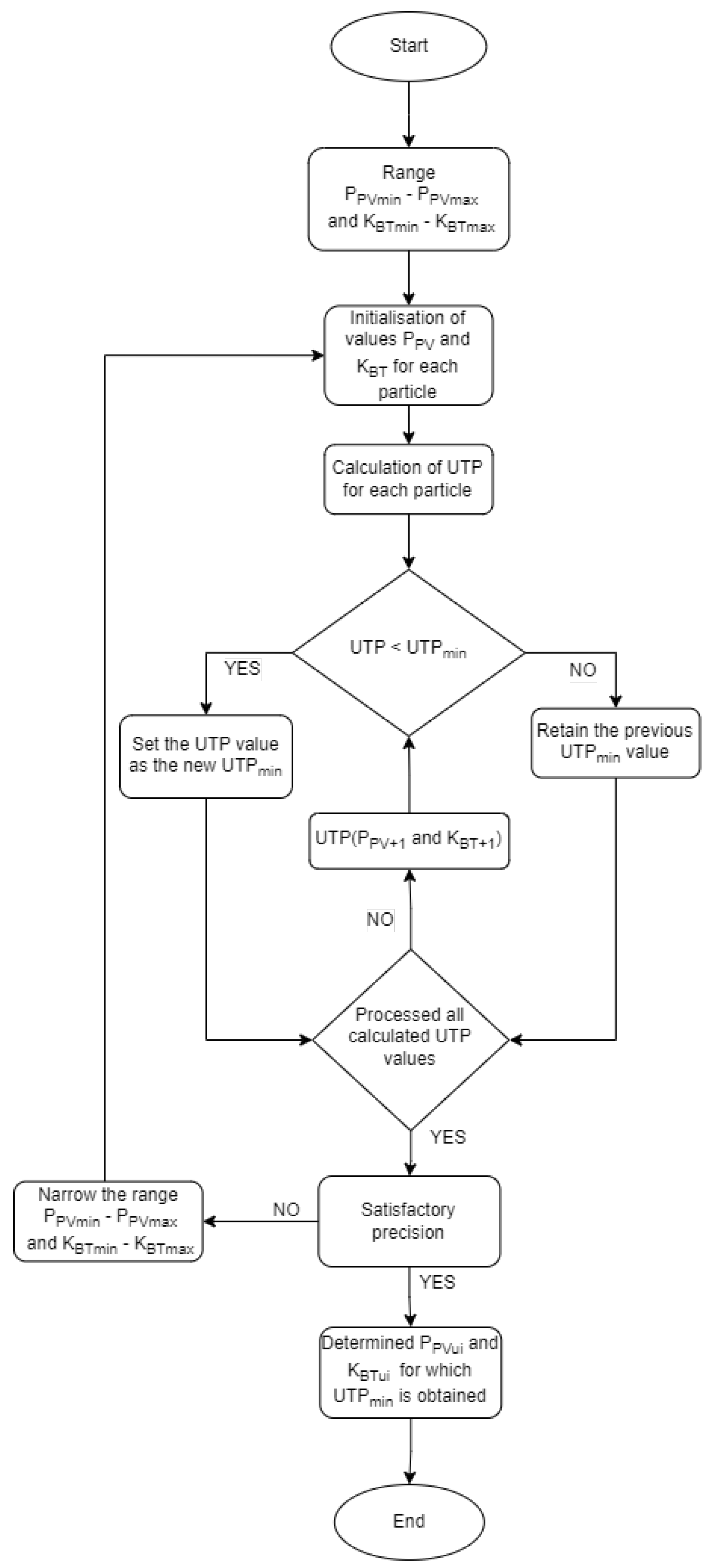
Figure 4.
Calculation of the optimal point for the M70 management model.
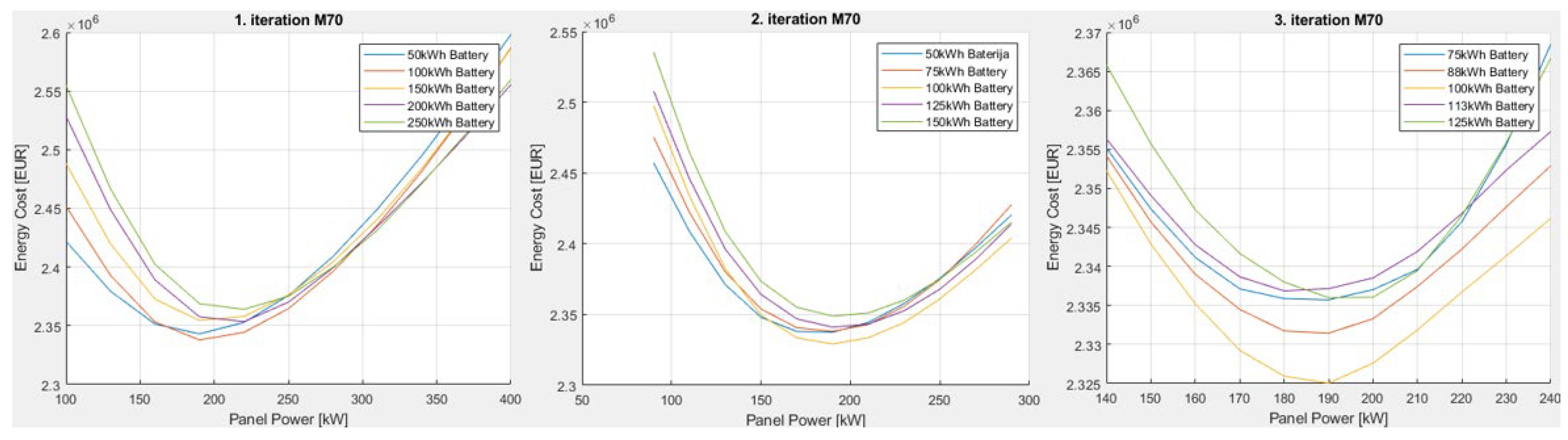
Figure 5.
Microgrid model in island operation (Simulink).
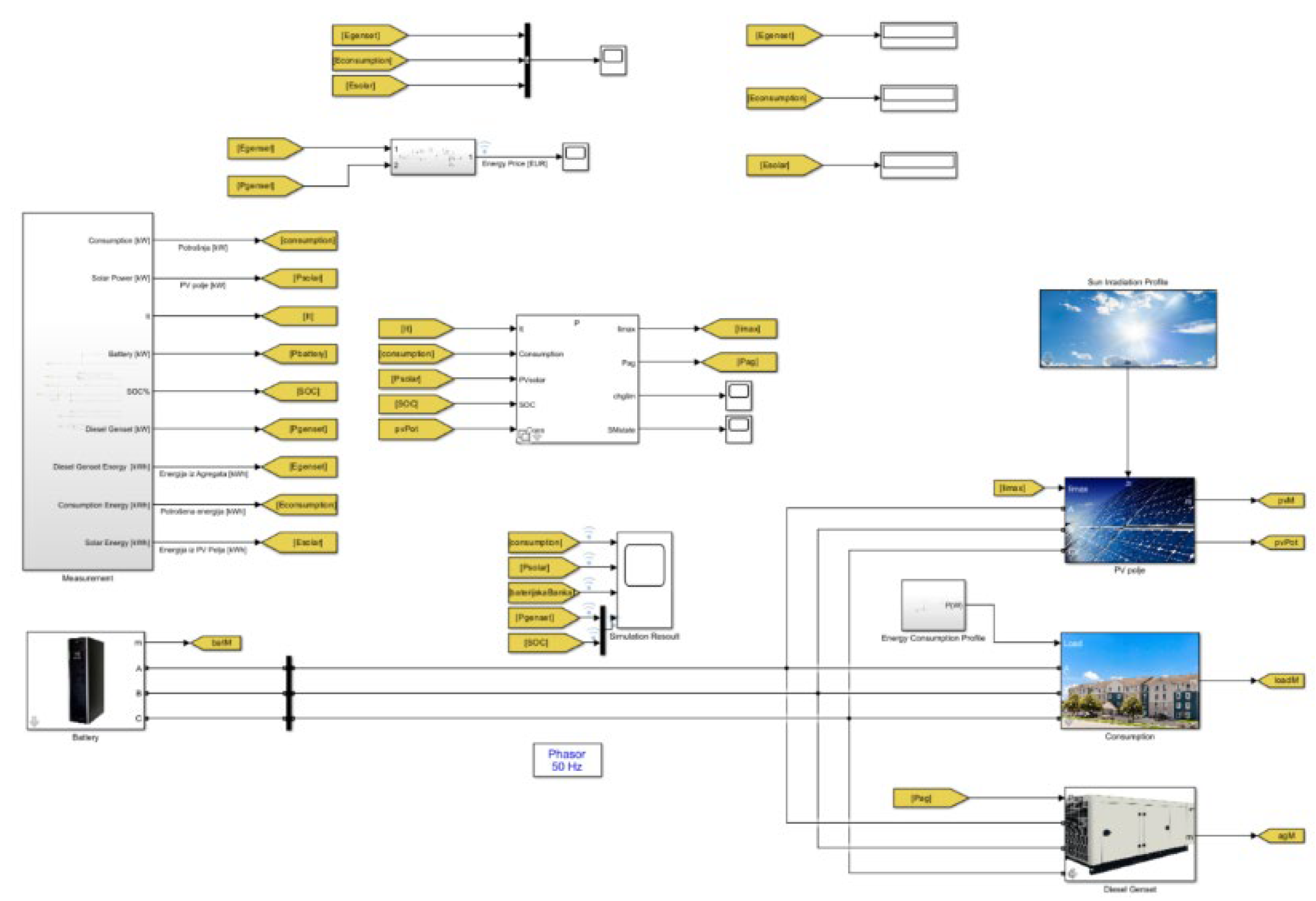
Figure 6.
Result of PSO optimization for chrLim in the M70 model.
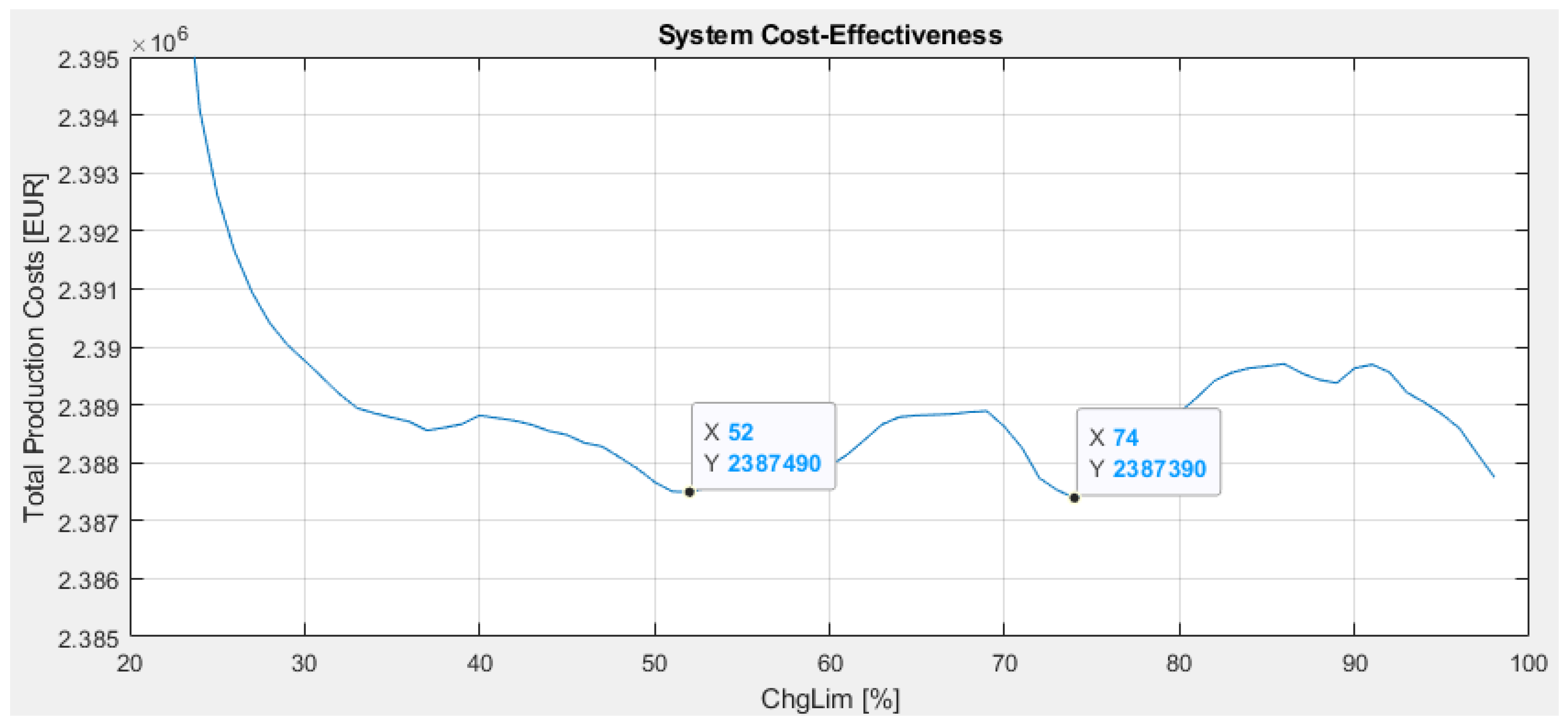
Figure 7.
ChrLim and SOC of the M70 model.
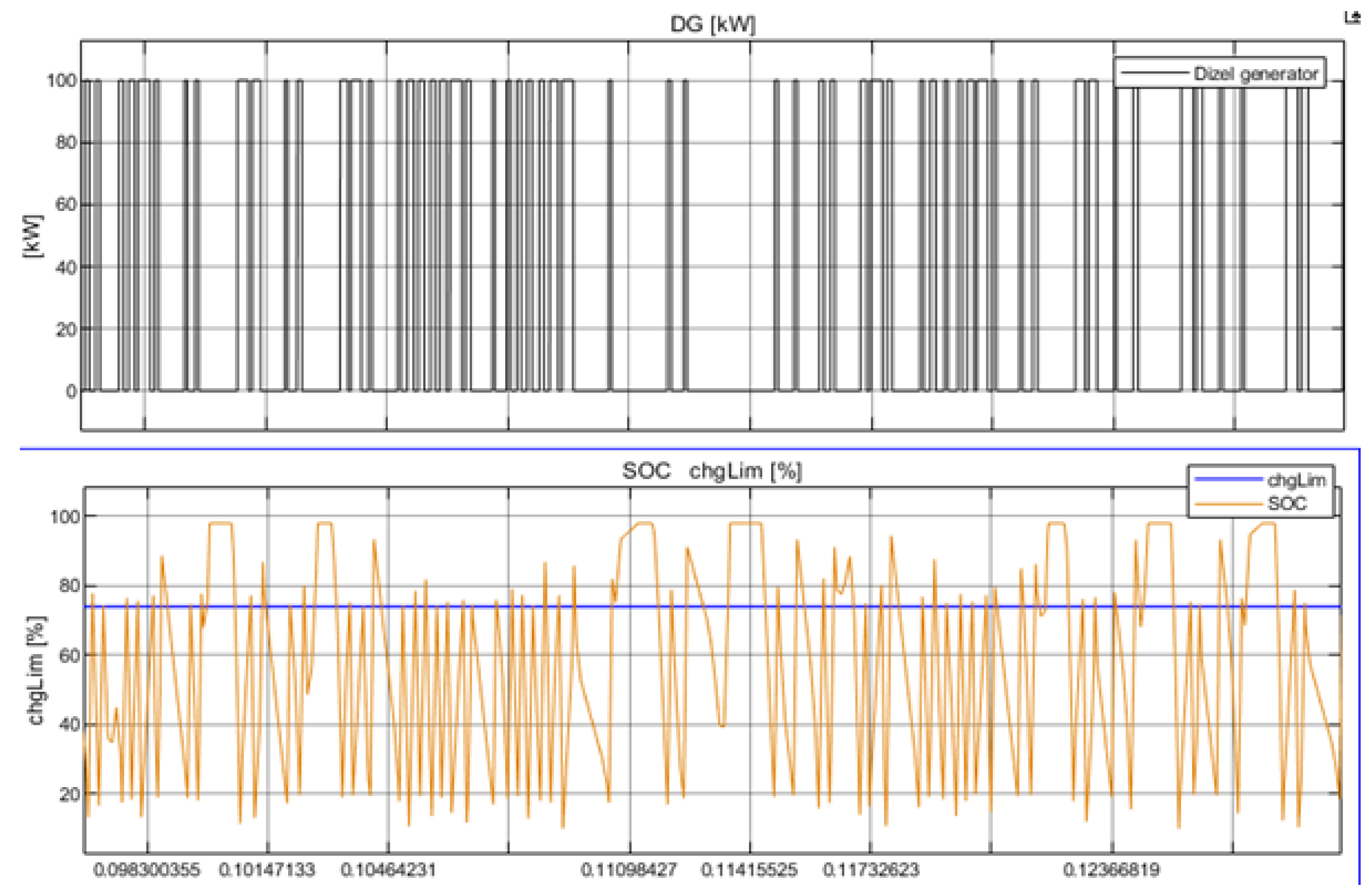
Table 2.
Search space ranges for finding the optimum in the PSO optimization model.
| Optimal values | 1. PSO algorithm P | 2. PSO algorithm M70 | ||
|---|---|---|---|---|
| PPVmin–PPVmax | KBTmin–KBTmax | PPVmin–PPVmax | KBTmin–KBTmax | |
| 1. iteration | 100–400 | 50–500 | 100–400 | 50–250 |
| 2. iteration | 240–440 | 275–500 | 90–290 | 50–150 |
| 3. iteration | 290–390 | 388–500 | 140–240 | 75–125 |
| PPV i KBT | 330 kW | 419 kWh | 190 kW | 100 kWh |
| UTP | 2 666 491 EUR | 2 312 823 EUR | ||
| COE | 0.397 EUR | 0.343 EUR | ||
| NPC | 2 065 129 EUR | 1 690 412 EUR | ||
| LCOE | 0.307 EUR | 0.251 EUR | ||
Table 3.
Input and output parameters of the management algorithms at their optimal points.
| Model | PV (kW) | Converter (kW) | Battery (kWh) | DG (kW) | PV energy (kWh) | DG energy (kWh) | Average power DG (kW) | Fuel (L) 0,335L / kWh | Consumption (kWh) |
|---|---|---|---|---|---|---|---|---|---|
| P | 330 | 313.5 | 419 | 100 | 222 189 | 66 882 | 30 | 28 370 | 269 431 |
| M70 | 190 | 180.5 | 100 | 100 | 143 454 | 138 728 | 100 | 38 671 | 269 431 |
Table 4.
Economic indicators of the management algorithm at the optimal point of algorithm P.
| Optimal Point of Algorithm P | Management Algorithm | M70 | P |
| Initial Investment | 751 411 € | 751.411 € | |
| Annual Maintenance and Fuel Costs | 52 532 € | 58 870 € | |
| Total Project Cost (UTP) | 2 508 051 € | 2 666 491 € | |
| Cost of Energy per kWh (COE) | 0.372 € | 0.396 € | |
| Average Annual Cost | 100 322 € | 106.660 € | |
| Net Present Cost (NPC) | 1 950 789 € | 2 058 490 € | |
| Levelized Cost of Energy per kWh (LCOE) | 0.290 € | 0.306 € |
Table 5.
Economic indicators of the management algorithm at the optimal point of algorithm M70.
| Optimal Point of Algorithm M70 | Management Algorithm | M70 | P |
| Initial Investment | 363 022 € | 363 022 € | |
| Annual Maintenance and Fuel Costs | 72 641 € | 103 287 € | |
| Total Project Cost (UTP) | 2 312 823 € | 3 078 970 € | |
| Cost of Energy per kWh (COE) | 0.343 € | 0.457 € | |
| Average Annual Cost | 92 513 € | 123 159 € | |
| Net Present Cost (NPC) | 1 690 412 € | 2 211 205 € | |
| Levelized Cost of Energy per kWh (LCOE) | 0.251 € | 0.328 € |
Disclaimer/Publisher’s Note: The statements, opinions and data contained in all publications are solely those of the individual author(s) and contributor(s) and not of MDPI and/or the editor(s). MDPI and/or the editor(s) disclaim responsibility for any injury to people or property resulting from any ideas, methods, instructions or products referred to in the content. |
© 2024 by the authors. Licensee MDPI, Basel, Switzerland. This article is an open access article distributed under the terms and conditions of the Creative Commons Attribution (CC BY) license (https://creativecommons.org/licenses/by/4.0/).
Copyright: This open access article is published under a Creative Commons CC BY 4.0 license, which permit the free download, distribution, and reuse, provided that the author and preprint are cited in any reuse.


