
Submitted:
12 July 2024
Posted:
16 July 2024
You are already at the latest version
Abstract
The lack of quality formulated feeds as supplements or replacements for live feeds has negatively impacted the growth performance and survival rates in the larvae of many fish species, notably African catfish (C. gariepinus). Successful larval rearing relies on the availability of suitable diets that are readily consumed, easily digested, and provide the essential nutrients necessary for optimal growth and health of the fish. This study evaluated the growth performance and survival rates of C. gariepinus larvae when fed locally formulated diets. The experiment was conducted using 12 basins, each with a capacity of 20 liters. Each basin was stocked with 60 larvae in four replicates, averaging 0.03 g in weight. The experimental diets were formulated to contain three different levels of crude protein: 40%, 45%, and 50%. The larvae were fed these diets at a rate of 10-20% of their body weight over 70 days. Initially, the larvae were fed artemia at the onset of feeding in hatchling basins immediately after yolk sac absorption for the first seven days. This was followed by a blend of artemia and formulated feeds for 14 days. After 28 days, the larvae were transitioned to be exclusively fed the formulated dry feeds. The results indicated that the larvae fed on diets containing 45% and 50% crude protein exhibited significantly better overall growth performance compared to those fed on a 40% crude protein diet. Specifically, the larvae that received the 45% and 50% crude protein diets showed higher final mean weight, increased daily weight gain, and improved survival rates, which ranged from 80% to 81.5%. Notably, there was no significant difference in growth performance and survival rates between the larvae fed on 45% and 50% crude protein diets, suggesting that a 45% crude protein-formulated diet is sufficient to achieve the best growth performance and survival rates for C. gariepinus larvae. This study supports the recommendation of feeding C. gariepinus larvae with a dry diet containing 45% crude protein starting from 14 days post-hatching to enhance their growth and survival rates. However, further research is recommended to explore the effects of this feeding regimen across different agroecological zones and aquaculture systems to validate and potentially refine these findings.
Keywords:
Clarias gariepinus
; feed
; larvae
; growth performance
; and survival rate
1. Introduction
African catfish (Clarias gariepinus, Burchell 1822) is one of the best candidates for aquaculture fish species in Africa [1,2,3]. This is due to its fast growth rate, tolerance for high stocking density in suboptimal water conditions, disease resistance, high fecundity, and acceptance of both artificial and natural feeds. Additionally, it has high market demand and offers production rates in ponds that are 2.5 times higher than those of tilapias [1,4]. Despite these advantages, significant challenges remain in larval nutrition [5], including in Ethiopia. The success of larval rearing is largely dependent on the availability of suitable diets that are readily consumed, easily digested, and provide the necessary nutrients for optimal growth and health [6].
During the early stages of growth, the larvae rely on the yolk sac for nutrition requirements [5,7]. Once they begin exogenous feeding, live feeds such as brine shrimp (Artemia nauplii), yeast, zooplankton, and unicellular algae are more suitable since the larvae struggle to digest dry-prepared diets [8]. However, sustaining live feed production is challenging due to requires a high amount of space, intensive production techniques, and production costs [9]. Consequently, there is a strong desire to replace live feed with appropriate dry feeds to ensure the sustainable development of fish culture [5].
To reduce reliance on live feeds, research has been focused on developing alternative dry diets [10,11]. These dry-formulated diets should meet the nutritional requirements of larval fish and be readily accepted by them [12,13]. An effective fish feed should contain the following nutrients to acquire better fish production in the culture system: Protein (18 – 50 %), lipid (10 –25 %), carbohydrate (15 – 20 %), ash (<8.5 %), water (<10 %), along with essential vitamins and minerals [14]. The selection of feed ingredients is primarily based on their nutrient contents and digestibility status [15].In Ethiopia, numerous by-products from agro-industrial and agricultural processing, which are not utilized for human consumption, exhibit significant potential as alternative fish feed sources [16,17,18]. The aquaculture of African catfish (C. gariepinus) has received substantial attention in Ethiopia. However, the larval and fry stages are hindered by low survival rates and suboptimal growth performance, primarily due to the absence of adequate starter feeds [19]. Therefore, this study aimed to investigate the growth performance and survival rate of C. gariepinus larvae fed on locally formulated diets reared at a hatchery, using insights and experience from other countries as benchmarks.
2. Materials and Methods
2.1. Description of the Study Area and Experimental Procedures
This experiment was carried out at the National Fisheries and Aquatic Life Research Center (NFALRC) hatchery from September to November 2018, located 24 km southwest of Addis Ababa, Ethiopia (8o55.076’N; 38o38.161’E) at an altitude of 2220 meters.
To obtain C. gariepinus larvae, artificial reproduction was performed using the catfish hypophysation technique as described by Olurin and Oluwo [20]. Brood stocks were selected from NFALRC ponds and separated by sex into different concrete ponds for conditioning. The broodstocks were fed a diet containing 35 % crude protein (CP) and acclimatized for three weeks before being transferred to hatchery holding tanks.
During the experiment, the water temperature in the tanks was maintained between 23 to 26 oC to stimulate ovulation. Two males (mean weight: 958 g) and two females (mean weight: 1kg) were treated with carp pituitary glands obtained from wild-caught fish at the Koka reservoir, following the protocol of Horváth et al. [21]. The ovulation control started within 12 hours post-injection of the pituitary extracts. The readiness for ovulation was assessed by gently pressing the abdomen of the fish [22,23]. Continuous monitoring was employed to control for early egg ovulation, avoiding further harm and fatalities, instead of stitching the genital papilla.
Eggs obtained from stripped females were fertilized in a bowl with milt collected from sacrificed males. The fertilized eggs were placed in incubating basins with a continuous flow of water maintained until hatching was completed within 36 hours in water temperatures of 24-27°C.
A total of 720 larvae of C. gariepinus seven days post hatched with an average weight of 0.03 g were stocked in 12 (20 liters) basins/buckets, 3 fishL-1 [9]. The experiment was designed as 3 treatments in 4 replicates to determine the effect of locally formulated feeds on catfish larvae/ growth and survival rate. Every three days, the buckets were cleaned, maintaining experimental hygiene standards.
Experimental diets, comprising artemia and dry feed, were meticulously prepared at the National Fisheries Research Center laboratory following standard procedures (Table 1 and Table 2). Proximate analysis of the feeds was carried out as described in AOAC [24] in triplicates. The protein content of the diets was determined using the micro-Kjeldahl method, percent fat using the ether extraction method, and acid-alkali digestion for crude fiber. Formulated diets, containing essential amino acids, were finely ground to a crumble size suitable for various larval stages (0.2-1.0 mm), aligning with established protocols [14] and http://www.chinafeeddata.org.cn/.
Artemia was used as the first exogenous feed. Cone-shaped incubators were used to hatch the cyst, to which aquarium aerators and 60W light bulbs were installed (12 g Artemia cyst plus 30 g salt in 40-liter water with a temperature of 28-30 OC was used). After 24 hours, hatched nauplii were separated, cleaned, and fed to the larvae as required.
The feeding regime progressed as follows: initially, larvae relied solely on live food (Artemia) post-yolk absorption for seven days. Subsequently, a blend of 80% Artemia and 20% formulated feed sustained them for the next seven days, and vice versa for another week [7,9] and https://www.alltechcoppens.com/en/). Finally, live feed was phased out, with dry feed becoming the primary diet, as detailed in Table 3. Feeding amounts were adjusted weekly based on larvae size, typically amounting to 10-20% of their body weight per feeding session, administered five times daily [12], over 70 days.
Experimental feeds, formulated to contain varying crude protein levels (40%, 45%, and 50%), were designed based on international practices and adjusted to meet essential amino acid requirements (http://www.chinafeeddata.org.cn/), [14]. This comprehensive approach aimed to optimize growth conditions and nutritional intake for the developing catfish larvae.
Throughout the experimental period, weekly measurements of larval weight were diligently conducted. Prior to initiating Artemia feeding, the larvae were weighed using a sensitive balance accurate to 0.001g, alongside a graded ruler for size determination. To ensure precise measurements, larvae were gently placed on a nylon net and excess surface water was carefully blotted with a paper towel from below, a method intended to minimize any potential measurement inaccuracies [14,17].
Feeding frequencies were adjusted weekly based on the larvae's body weight at the time of sampling, following established protocols aimed at optimizing growth conditions and nutritional intake for the experimental catfish larvae.
The water temperature in the experimental setup was regulated using a heater, maintaining daytime temperatures between 24°C and 28°C, and nighttime temperatures between 18°C and 22°C. To prevent overheating, the heater was manually adjusted and switched off during nighttime. A continuous water flow system, operating at a rate of 0.5 liters per minute, ensured consistent water circulation throughout the day.
Maintenance included the removal of feed remnants and waste excreta every three days using a siphoning method designed to minimize disturbance to the larvae. Water quality parameters such as temperature, pH, and dissolved oxygen (DO) were monitored daily to ensure optimal conditions for the catfish larvae. Additionally, total ammonia levels were assessed biweekly using the Indo-Phenol blue method, as detailed by Khosravi et al. [25], to manage water quality effectively throughout the experiment.
2.2. Growth Parameters and Nutritional Utilization
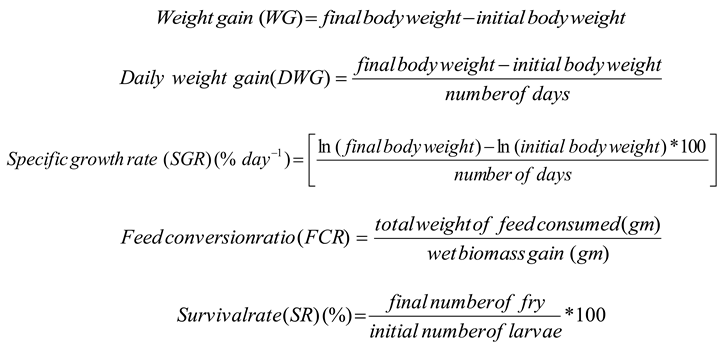
2.3. Statistical Analysis
The obtained numerical data were statistically analyzed using SPSS_25 for a one-way analysis of variance. Comparisons among treatment means were made by using Duncan's multiple-range test. Differences were considered significant at P<0.05.
3. Results
3.1. Water Quality Paramters
During the 70-day experiment, water quality parameters were monitored and summarized in Table 4. No significant differences (P > 0.05) were observed among the treatment groups. The mean dissolved oxygen (DO) concentration measured in the morning and afternoon exceeded 3.5 mg/L across all treatments. Total ammonia nitrogen (TAN) levels were maintained within the recommended range throughout the study period, as specified by El-Shafai et al. [26].
3.2. Growth Performance
The growth data of C. gariepinus fed on the locally formulated feeds are presented in Table 5, and the weekly growth performance in weight is illustrated in Figure 1. At the start of the feeding trial, the mean initial body weight was 0.03 g. The growth performance and survival rate were similar (P > 0.05) between the two treatment units (CP 45 and CP 50 %). They showed a significantly better growth rate (P < 0.05) than the CP 40 % treatment unit throughout the cultured period. The individual weights of the larvae/fry ranged from 2.3 – 8.5g in the CP 40% treatment, 5.2 – 25.6g in the CP 45% treatment, and 5.2 – 30.0 g in the CP 50% treatment.
4. Discussion
4.1. Water Quality Paramters
The water quality parameters observed in this study were consistent across all treatments and remained within acceptable ranges for aquaculture. The dissolved oxygen (DO) levels, exceeding 3.5 mg/L, and total ammonia nitrogen (TAN) levels, maintained within the recommended range as per El-Shafai et al. [26], indicate optimal conditions for the growth of Clarias gariepinus. These findings align with those of El-Sayed [27], who also reported that maintaining DO levels above 3.5 mg/L and TAN within safe limits is crucial for the healthy growth and survival of catfish.
4.2. Growth Performance
Evaluating the effects of feed and its nutritional composition on fish species, particularly growth data parameters, survival, and mortality rates, is critical [12]. This study aimed to assess the impact of locally sourced feeds with varying protein levels (40%, 45%, and 50%) on the growth performance and survival rates of Clarias gariepinus larvae during their early stages post-live feeding.
Initially, C. gariepinus larvae readily consumed artemia at the onset of feeding in hatchling buckets following yolk sac absorption [9,28]. The larvae of C. gariepinus are capable of consuming, digesting, absorbing, and metabolizing nutrients since they have developed a sizeable mouth and digestive system [9].
Statistical analysis of average body weight gain (BWG), final weight (FW), survival rate, and specific growth rate indicated no differences (P > 0.05) between fish fed with 45 and 50 % crude protein (CP) feeds. However, a significant difference was observed when compared to fish fed with 40 % crude protein feed, which exhibited the lowest growth performance. This is attributed to the feeds with 45 and 50 % CP containing nearly all essential nutrients required for the growth of C. gariepinus larvae (Table 1 and Table 2). These feeds were formulated based on the essential nutrient and energy contents of the ingredients in proportions that satisfy the nutritional requirements (proteins, carbohydrates, fats, vitamins, and minerals) for the growth, health, and well-being of the C. gariepinus larvae [9,13,14,29].
In this study, larvae fed with 45 and 50 % CP feeds demonstrated superior growth performance in terms of mean final body weight, daily weight gain, specific growth rate, and feed conversion ratio compared to previous reports by Safina et al. [30]; Oso et al. [31]; Moshood et al. [12], and Tarkegn [32]. This improvement is likely due to the well-balanced nutrient composition of the feeds, which included the necessary amounts of essential amino acids (EAA), such as methionine and lysine, for the growth of C. gariepinus larvae (Table 1 and Table 2). The higher crude protein, lipid, and ash content, along with the lower carbohydrate and crude fiber content in the locally formulated feeds (45% and 50% CP), were responsible for the better growth performance and survival rates compared to the 40% CP feed. Various studies have shown that fish growth is significantly influenced by the protein level and essential nutrient content in the feed [33,34].
According to De Silva and Anderson [35], the quality of feed is determined by how well it meets the nutrient requirements of the fish at a given age or stage. Previous research has also demonstrated that fish growth is significantly influenced by nutrient levels and ingredient types in the feed [6,33,34,36,37]. Water quality parameters, such as temperature and dissolved oxygen, also impact larvae growth [38]. In this study, all water quality parameters remained within recommended levels throughout the experimental period, except during days 24-28 when the generator was under maintenance [14,39,40].
The survival rate of larvae was higher during the live feed period but decreased after transitioning to exogenous feeds across all treatments. Fish fed with 45% and 50% CP feeds exhibited better survival rates than those fed with 40% CP feed. The transition to dry feed is a critical phase in larvae development [41,42]. NFALRC hatchery data shows that the highest mortality rates occur post-transition to exogenous feeds, with previous observations indicating 97% fry survival during the Artemia feeding period and less than 50% during the dry feeding period [43]. In this study, overall survival rates were 66.5%, 80%, and 81.5% for fish fed with 40%, 45%, and 50% CP feeds, and consistent with the findings of Safina et al. [30] and Oso et al. [31]. Furthermore, jumper larvae were continually separated from the stock to reduce cannibalism and increase survival rates. A novel observation in this study was that the deep black-colored larvae/fry exhibited predatory behavior, ambushing and preying on others from the bottom of the buckets. This behavior has not been documented in existing literature.
Furthermore, the high protein content in the local feed was responsible for the small FCR recorded in the fish. Sawhney and Gandotra [44] found that the food conversion ratio in fish decreases with increasing protein in the diet. High FCR on account of reduction in feed intake and rise to a lot of uneaten feed thereby deteriorating the water quality with water pH becoming low (acidic) and carbon dioxide increased and dissolved oxygen decreased [45].
The carbohydrate to lipid (CHO: L) ratio is critical for growth and feed utilization in C. gariepinus larvae/fries, with a recommended range of 1.7 to 3.4 [36]. In this study, within the optimal range, the CHO: L rations for 50% and 45% CP feeds were 2.8 and 3.3, respectively. The balanced nutrients and good proximate composition of local feeds, reflected low FCR when fed to fish, also positively impacted the economics of feeding. Efficient feed formulation involves selecting ingredients that meet the nutrient requirements of cultured species at the most economical cost [20].
Generally, fish feed is fundamental for aquaculture development, particularly during the early larval stage. Providing sufficient nutrients from the onset and throughout the larvae-rearing period is crucial, as inadequate nutrition at this stage can reduce growth and survival rates by up to 99% [46]. Therefore, ensuring adequate nutrition for optimal growth and survival of fish larvae is essential.
5. Conclusion and Recommendation
In conclusion, the optimal protein content for the growth and survival of C. gariepinus reared in hatcheries after live feeding is 45%. This indicates that C. gariepinus larvae require at least 45% crude protein-formulated feed with essential nutrients at an early stage. Therefore, for effective C. gariepinus larvae feed formulation, it is crucial to select ingredients that provide the necessary nutrients and to base the formulation on the essential amino acid contents of these ingredients. The authors recommend further detailed studies to investigate the effects of this feed under different agroecological conditions and culture systems.
Institutional Review Board Statement
Not applicable.
Informed Consent Statement
Not applicable.
Data Availability Statement
The data analyzed in this study are available from the authors upon reasonable request.
Acknowledgments
The authors wish to thank the National Fisheries and Aquatic Life Research Center (NFALRC) and the Ethiopian Institute of Agricultural Research (EIAR) for financing this research. We would like to extend our gratitude for the assistance from technical assistants and fishermen at the National Fisheries and Aquatic Life Research Center for the entire experimental period.
Conflict of interest: The authors have declared that no competing interests exist.
References
- Ponzoni RW, Nguyen NH. Proceedings of a Workshop on the Development of a Genetic Improvement Program for African Catfish, Clarias gariepinus. Accra, Ghana, 2008; 131 pages.
- Adewolu M A, Adeniji CA, Adejobi B. Feed utilization, growth and survival of Clarias gariepinus (Burchell 1822) fingerlings cultured under different photoperiods. Aquaculture, 2008; 283: 64–67. [CrossRef]
- FAO. The State of World Fisheries and Aquaculture Sustainability in action, 2020; Rome.https://doi.org/10.4060/ca9229en. [CrossRef]
- Abdelhamid AM, Radwan AI, Mehrim AF. Improving the survival rate of the African catfish, Clarias gariepinus. Journal of Animal and Poultry Production, Mansoura University, 2010; 1: 409-414.
- Chepkirui-Boit V, Ngugi CC, Bowman J. Growth performance, survival, feed utilization, and nutrient utilization of African catfish (Clarias gariepinus) larvae co-fed Artemia and a micro-diet containing freshwater atyid shrimp (Caridina nilotica) during weaning. Journal of aquaculture nutrition, 2011; 17: 82-89. [CrossRef]
- Giri SS, Sahoo SK, Sahu BB, Sahu AK, Mohanty SN. Larval survival and growth in Wallago mattu (Bloch and Schneider): Effects of light, photoperiod and feeding regimes. Aquaculture, 2002; 213: 151–161.
- Kolkvoski S. Digestive enzymes in fish larvae and juveniles: implications and application to formulated diets. Aquaculture, 2001: 181–201.
- Verreth J. Nutrition and Related Ontogenetic Aspect in Larvae of the African Catfish, Clarias gariepinus. Ph.D Thesis, University of Wageningen, 1994; Wageningen.
- Nyina-Wamwiza L, Wathelet B, Kestemont P. Potential of local agricultural by-products for the rearing of African catfish Clarias gariepinus in Rwanda: effects on growth, feed utilization, and body composition, Aquaculture Research, 2007; 38: 206–214. [CrossRef]
- Jones DA, Karnarudin MH, Le Vay L. The potential for replacement of live feeds in larval culture. J. World Aquaculture. Soc., 1993; 24: 199–207. [CrossRef]
- Person-Le Ruyet J, Alexandre JC, Thebaud L, Mugnier C. Marine fish larvae feeding: formulated diets or live prey. J. World Aquaculture. Soc.1993; 24: 211–224. [CrossRef]
- Moshood KM, Bolarinwa FA, Charles AF. Comparative effect of local and foreign commercial feeds on the growth and survival of Clarias gariepinus juveniles. Journal of Fisheries, 2014; 2 (2): 106-112. DOI: dx.doi.org/10.17017/jfish.v2i2.2014.25. [CrossRef]
- Ogugua NM, Eyo JE. Fish feed technology in Nigeria. Journal of Research in Bioscience, 2014; 3. https://www.researchgate.net/publication/231683748.
- Halver JE, Hardy RW. Fish nutrition, London, Academic Press, 2002: An imprint of Elsevier Science.
- Ibrahim EH. A review of some fish nutrition methodologies, Bioresource Technology, 2005: 395–402.
- Kassahun A, Waidbacher H, Munguti JM, Zollitsch WJ. Locally available feedstuffs for small-scale aquaculture in Ethiopia- a review, 2012.
- Zenebe T, Abeba W, Mulugeta J, Fekadu T, Fasil D. Effect of supplementary feeding of agro-industrial by-products on the growth performance of Nile Tilapia (O.niloticusl) in concrete ponds.Ethiopian J. Biol.Sci., 2012; 11: 29-41.
- Abelneh Y, Zenebe T. Growth performance and economic viability of Nile tilapia (Oreochromis niloticus L.) fed on two formulated diets in the concrete pond, Sebeta/ Ethiopia, publish, pp. 13-34. In: EFASA (2017). Proceedings of the 9th annual conference of EFASA, 24-25 February 2017, Dessie, Ethiopia, 2017; 191 pp. ISBN: 978-999444-910-3-2.
- Alemayehu W, Adamneh D. Survival rate of African Catfish (Clarias gariepinus) larvae reared in a hatchery. IJASR, 2022; 5:43-46.
- Olurin KB, Oluwo AB. Growth and Survival of African Catfish (Clarias gariepinus) Larvae Fed Decapsulated Artemia, Live Daphnia, or Commercial Starter Diet, 2010; 62(1): 50-55. [CrossRef]
- Horváth LJr, Tamás G, Coche AG. Common carp: Mass production of eggs and early fry. FAO Train. Ser. No. 8. Rome, 1985; FAO. 87 pp. (also available at www.fao.org/DOCREP/X5085E/X5085E00.HTM).
- Freund F, Hörstgen-Schwark G, Holtz W. Seasonality of the reproductive cycle of female Heterobranchus longifilis in tropical pond culture. Aquatic Living Resources, 1995; 8: 297–302.
- Legendre M, Linhart O, Billard R. Spawning and management of gametes, fertilized eggs and embryos in Siluroidei. Aquatic Living Resources, 1996; 9: 59–80. [CrossRef]
- AOAC. Official Methods of Analysis. 17th edition. AOAC, Washington, DC, 2003; USA.
- Khosravi A, Esmhosseini M, Jalili J, Khezri S. Optimization of ammonium removal from wastewater by natural zeolite using a central composite design approach. Journal of Inclusion Phenomena and Macrocyclic Chemistry, 2012; 74, 383-390.
- El-Shafai SA, El-Gohary FA, Nasr FA, Van der Steen NP, Gijzen HJ. Chronic ammonia toxicity to duckweed-fed tilapia (Oreochromis niloticus). J. Aquac., 2004; 232: 117-127. [CrossRef]
- El-Sayed A-F M. Tilapia culture, CABI publishing, 2006; ISBN: 13-978-0-85199-014 9(alk. paper).
- Kwiatkowski M, Daniel A, Dariusz K, Krzysztof K. Influence of feeding natural and formulated diets on chosen rheophilic cyprinid larvae. Arch.Pol. Fish., 2008; 16: 383-396.
- Craig S, Helfrich L A. Understanding Fish Nutrition, Feeds and Feeding.Cooperative Extension Service, Virginia State University, 2002, USA.
- Safina MM, Christopher MA, Charles CN, Rodrick K. The Effect of Three Different Feed Types on Growth Performance and Survival of African Catfish Fry (Clarias gariepinus) Reared in a Hatchery. International Scholarly Research Network, 2012:6 doi:10.5402/2012/861364. [CrossRef]
- Oso JA, Edward JB, Ogunleye OA, Majolagbe FA. Growth Response and Feed Utilization of Clarias gariepinus Fingerlings Fed with Bambara Groundnut as protein source. Journal of Natural Sciences Research, 2013; ISSN 2225-0921, 3, 2013.
- Tarkegn A. Growth performance and survival rate of African catfish larvae Clarias gariepinus (Burchell 1822) fed on different types of live and formulated feeds. Master thesis, the University of Natural Resources and Life Science (BOKU), 2015; Vienna.
- Keremah RI, Beregha O. Effect of varying dietary protein levels on growth and nutrient utilization of African catfish Clarias gariepinus fingerlings. Journal of Experimental Biology and Agricultural Sciences, 2014; 2(1): 13-18.
- Corn’elio FHG, Cunha DA, Silveira J, Alexandre D, Silva C, Fracalossi DM. Dietary protein requirement of juvenile Cachara Catfish, Pseudoplatystoma reticulatum. Journal of the World Aquaculture Society, 2014; 45(1): 45-54, DOI: 10.1111/jwas.12090. [CrossRef]
- De Silva SS, Anderson TA. Fish nutrition in aquaculture. Chapman and Hall, 1995; London. 319 pp.
- Ali MZ, Jauncey K. Effect of feeding regime and dietary protein on growth and body composition of Clarias gariepinus (Burchell, 1822). Indian Journal of Fisheries, 2004; 51:407-416.
- Goda AM, El-Haroun ER, Chowdhury MA. Effect of totally or partially replacing fish meal by alternative protein sources on growth of African catfish Clarias gariepinus (Burchell, 1822) reared in concrete tanks. Aquaculture Research, 2007; 38(3): 279-287. DOI: 10.1111/j.1365-2109.2007.01663. x. [CrossRef]
- Hecht T. Consideration of African aquaculture, World Aquaculture, 2000;1, 31: 12-19.
- Wetzel R.G. Limnology: Lake and river ecosystems. 3rd edition. Academic press. N.Y., 2001; 1006pp.
- Azaza MS, Dhraief MN, Kraiem M M. Effects of water temperature on growth and sex ratio of juvenile Nile tilapia O. niloticus (Linnaeus) reared in geothermal waters in southern Tunisia. J Therm. Biol., 2008;33: 98-105.
- Vladimirov VI. Razokaèestvennost’ ontogeneza kak odin iz faktorov dinamiki èislennosti stada ryb Gidrobiol. Journal, 1970; 6: 14-27.
- Dabrowski K. Critical period in the life of newly-hatched fish. An attempt to determine the minimum food requirements in terms of energy Wiad. Ekol., 1975; 21: 277-293.
- Kujawa R, Kucharczyk D, Mamcarz A. Rearing asp (Aspius aspius L.) and ide (Leuciscus idus L.) hatch under controlled conditions on natural and granulated feed in Rheophilic cyprinid fish (Eds) H. Jakucewicz, R. Wojda, Wyd. PZW, Warszawa: 1998; 71-78.
- Sawhney S, Gandotra R. Effects of photoperiod on growth feed conversion, efficiency and survival of fry and fingerlings of Mahseer, Tor putitora. Israel Journal of Aquaculture, 2010; 62(4): 266-271.
- Tan Q, Xie S, Xhu X, Lei W, Yang Y. Effect of carbohydrate to lipid ratios on growth and feed efficiency in Chinese long snout catfish (Leiocasis longirostris). Journal of Applied Ichthyology, 2007; 23(5): 605-610. DOI: 10.1111/j.1439-0426.2007.00846. x. [CrossRef]
- Hjort J. Fluctuations in the great fisheries of northern Europe, Rapp P-v Réun Cons Int Explor Mer, 1914; 20: 1–228.
Figure 1.
Growth curves of catfish larvae fed on the experimental feeds.
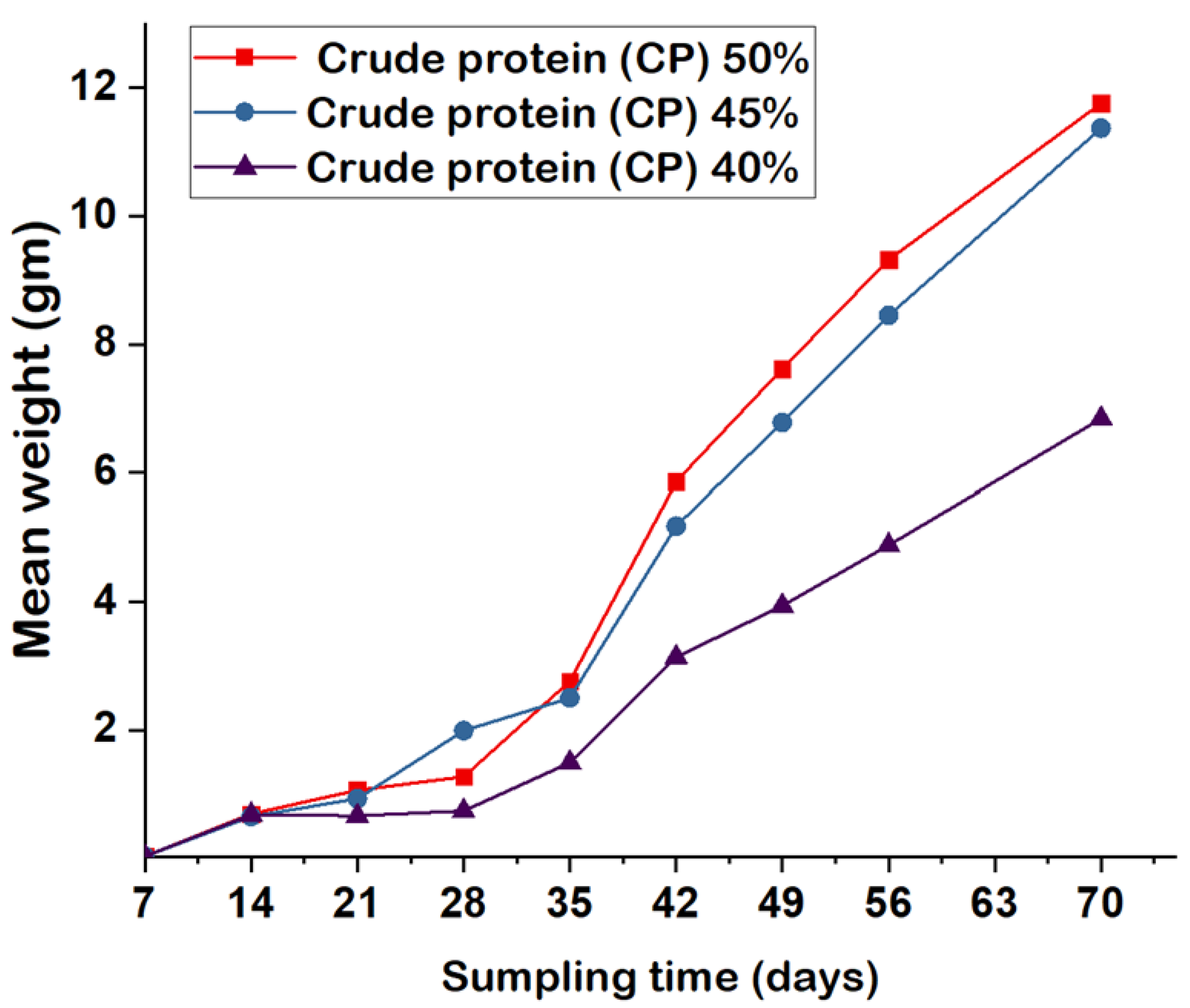

Table 1.
Proximate composition (dry weight basis) of the three locally formulated fish feeds.
| Ingredients | Experimental feeds | ||
| CP 50 % | CP 45 % | CP 40 % | |
| Inclusions % | Inclusions % | Inclusions % | |
| blood meal | 36.9 | 31.79 | 26.66 |
| Fish meal | 28.2 | 25.15 | 22.06 |
| Soybean meal | 18.5 | 17.68 | 16.88 |
| maize (BH660) flour | 3.7 | 5.61 | 8.52 |
| wheat (durum) flour | 2.6 | 5.65 | 8.86 |
| Barley flour | 2.7 | 6.61 | 9.52 |
| Soy oil | 3.0 | 3.0 | 3.0 |
| premix | 2.0 | 2.0 | 2.0 |
| methionine (g/kg) | 1.5 | 1.5 | 1.5 |
| lysine(g/kg) | 0.9 | 0.9 | 0.9 |
| total | 100 | 100 | 100 |
| Proximate composition (g 100 g-1) | |||
| DM | 92.4 | 91.6 | 86.2 |
| Energy Kcal/g | 468.2 | 477.6 | 559.5 |
| CP | 50.0 | 45.0 | 40.0 |
| Lipid | 11.5 | 11.3 | 7.9 |
| NFE | 13.0 | 18.7 | 24.4 |
| CF | 1.4 | 1.6 | 8.8 |
| Ash | 4.9 | 4.7 | 9.4 |
Table 2.
Amino Acid contents of the formulated feeds and requirements for larvae of C. gariepinus (http://www.chinafeeddata.org.cn/; [14].
Table 2.
Amino Acid contents of the formulated feeds and requirements for larvae of C. gariepinus (http://www.chinafeeddata.org.cn/; [14].
| Amino acids | CP 50% |
CP 45% | CP 40% | Recommended amount |
| Inclusion (% of dietary protein) | ||||
| Arginine | 4.3 | 3.9 | 2.9 | 4.3 |
| Histidine | 1.5 | 1.4 | 0.9 | 1.5 |
| Iso leucine | 2.5 | 2.1 | 3.1 | 2.6 |
| Leucine | 3.5 | 3.2 | 2.9 | 3.5 |
| Lysine | 4.2 | 4.2 | 4.2 | 5.1 |
| Methionine | 0.8 | 0.8 | 0.7 | 2.3 |
| Phenylalanine | 4.9 | 4.8 | 3.8 | 5.0 |
| Threonine | 2.0 | 1.9 | 1.2 | 2.0 |
| Tryptophan | 0.5 | 0.7 | 0.6 | 0.5 |
| Valine | 2.9 | 2.8 | 1.9 | 3.0 |
Table 3.
Feeding procedures for larvae on dry and live feeds.
| Feeding procedure | ||||
| Day | CP 50% | CP 45% | CP 40% | Amount of feed |
| ~7 | Yolk sac | Yolk sac | Yolk sac | - |
| 7-14 | live feed | live feed | live feed | 15 individuals /larvae |
| 14 - 21 | 80% live + 20% dry feed |
80% live + 20% dry feed |
80% live + 20% dry feed | 30 ind/larvae +20 % BW |
| 21-28 | 20% live + 80% dry feed |
20% live + 80% dry feed |
20% live + 80% dry feed | 40 ind/larvae + 15 % BW |
| 28-70 | 100% dry feed | 100% dry feed | 100% dry feed | 10 % BW, |
Table 4.
Means ± SD of water quality parameters observed at different treatments over 70 70-day period in a hatchery.
Table 4.
Means ± SD of water quality parameters observed at different treatments over 70 70-day period in a hatchery.
| Experimental feeds | |||
| Parameters | CP 50 % | CP 45 % | CP 40 % |
| DO (mgL−1) | 5.30 ± 0.37 | 5.26 ± 0.57 | 5.37 ± 0.27 |
| Temperature (oC) | 24.55 ±3.34 | 24.32 ± 3.35 | 24.24 ± 3.34 |
| pH | 7.30 ± 0.02 | 7.26 ± 0.05 | 7.31 ± 0.08 |
| TAN (mgL−1) | 0.011 ± 0.008 | 0.012 ± 0.004 | 0.013 ± 0.003 |
Table 5.
Growth performance of C. gariepinus larvae fed on formulated feeds.
| Treatments | |||
| parameters | CP 50 % | CP 45 % | CP 40 % |
| Mean initial weight (gm) | 0.03 | 0.03 | 0.03 |
| Mean final weight (gm) | 11.76 ± 1.52a | 11.37 ± 1.47a | 6.94 ± 1.34b |
| Weight gain (gm fish-1) | 11.73 ± 1.52a | 11.35 ± 1.47a | 5.84 ± 1.34b |
| Average daily gain (gm fish-1 day-1) | 0.17a | 0.16a | 0.08b |
| Specific growth rate (%) | 8.79 | 8.74 | 7.79 |
| Feed conversion ratio | 2.43a | 2.46a | 3.14b |
| Survival rate (%) | 81.5a | 80a | 66.5b |
Disclaimer/Publisher’s Note: The statements, opinions and data contained in all publications are solely those of the individual author(s) and contributor(s) and not of MDPI and/or the editor(s). MDPI and/or the editor(s) disclaim responsibility for any injury to people or property resulting from any ideas, methods, instructions or products referred to in the content. |
© 2024 by the authors. Licensee MDPI, Basel, Switzerland. This article is an open access article distributed under the terms and conditions of the Creative Commons Attribution (CC BY) license (http://creativecommons.org/licenses/by/4.0/).
Copyright: This open access article is published under a Creative Commons CC BY 4.0 license, which permit the free download, distribution, and reuse, provided that the author and preprint are cited in any reuse.


