

Submitted:
12 July 2024
Posted:
12 July 2024
You are already at the latest version
Abstract
In the context of crowds innovation and the generative design driven by big language models, the personalized requirements has become the best engine for innovative design. The exploration of personalized requirements has become a key in significantly improving product innovation, concepts feasibility, and design interaction efficiency. To mine a large number of vague and unexpressed implicit requirements of personalized products, a domain knowledge graph-based method is proposed in this research. First, based on the classical theory of design science, the characteristics and categories of personalized implicit requirements are analyzed. Next, in order to improve the practicability and construction efficiency of the domain knowledge graph, a more informative ontology is constructed, and better performing NLP models are proposed. Then, a series of mining methods based on knowledge graph are proposed for the personalized implicit requirements of different categories. Finally, A platform was developed based on the technical solution proposed in this study, and an example verification was conducted in the field of electromechanical engineering. The efficiency improvement of the training model proposed in the research was analyzed, and the practicality of implicit requirement mining methods were discussed.
Keywords:
Implicit requirement
; Knowledge graph
; Requirement mining
; Patent analysis
; Engineering design
; Generative design
; Crowds innovation
1. Introduction
The field of engineering design, especially in product design, service system design, and complex system design, is being reshaped by two major trends: on the one hand, with the rise of large language models, generic-field generative intelligent design is gradually becoming mainstream[1]; On the other hand, driven by the Internet, human designers have formed new design models such as crowdsourcing design and group intelligence innovative design through collaborative organization [2,3,4]. The core goal of these development trends is to address the growing personalized requirements and achieve rapid iterative design of products and user-participation design.
In engineering design, the expression of personalized requirements has significant semi professional characteristics, which will be elaborated in detail in Chapter 3 "Nature of the Problem". This semi professional feature provides feasibility for directly extracting requirements elements from user descriptions, but also increases the importance and difficulty of implicit requirement mining. In the field of generative intelligent design, a major challenge is how to make machines empathetic [5], so that after users input personalized requirements, they can empathize with the design and product usage context, automate the completion of users' prompts, mine design problems that users have not anticipated or are difficult to express clearly, and improve the output quality of intelligent generative models. In terms of group intelligence innovation design, there are limitations in user understanding of products, which is not conducive to the emergence of innovation, but also becomes a fundamental problem that leads to the design process being repetitive, chaotic, and of low design quality[2,3,4]. Therefore, accurately mining and supplementing implicit needs that have not been clearly expressed in personalized requirements is of great significance for improving the innovation of engineering design, the completeness of product functions, and the feasibility of solutions.
Many studies have analyzed the design requirements of [6,7,8] through data-driven technologies such as machine learning. Although these studies extensively use data derived from user reviews on the Internet, user-generated content (UGC) has inherent limitations in complementing user needs [9,10]. In addition, the review data in the field of engineering design is difficult to meet the research needs in quantity and quality, and its timeliness is not in line with the development trend of engineering design. To overcome these limitations, this study introduced the engineering design knowledge contained in the patents.
This research presents a method to identify implicit personalized requirements using knowledge graphs. First, this study provides an in-depth analysis of semi professional, task-oriented personalized requirements from the perspective of design science and engineering theory to reveal the characteristics of implicit requirements. Then, it builds a domain knowledge graph by gathering product design knowledge from patents. TBy optimizing the ontology layer and stacking the pre-training model, the comprehensiveness and practicability of the knowledge graph are enhanced while improving its construction efficiency. Finally, taking the user's personalized description as input, extract the explicit requirement elements and match the corresponding knowledge entities, and realize the mining of multiple personalized implicit requirements based on the methods of structural similarity and link prediction.
This study makes several key contributions:
- It makes a detailed analysis of the user requirements of front-end design stage, clarifies the characteristics, forms and types of the personalized implicit requirements of users that drive product innovation, and enriches the theoretical basis of the related research of the implicit requirement mining for innovative design.
- It enriches the domain patent knowledge graph ontology layer, improves the comprehensiveness and practicability of the graph, and improves the accuracy and efficiency of the knowledge graph construction by optimizing the pre-training model of the entity layer.
- Aiming at the different characteristics of personalized implicit requirements driving product innovation, this paper puts forward a series of targeted implicit requirement mining method system based on the domain knowledge graph.
In the upcoming chapters, we will systematically explore and analyze personalized implicit requirement mining methods. Chapter 2 will closely review literature related to the study's topic, providing readers with the research background and theoretical basis in this field. Chapter 3 will deeply analyze the unique nature of the research object and problem and clarify the research's boundaries and purpose. In Chapter 4, we will propose a technical solution for building a domain knowledge graph. Chapter 5 will elaborate on the personalized implicit requirement mining methodology. Chapter 6 will demonstrate the platform we developed, verify the effectiveness and practicality of our method through case studies, and discuss the performance of the algorithmic model proposed during the study. Finally, in Chapter 7, we will comprehensively summarize the entire research and propose prospects for future research directions.
2. Related Works
2.1. User Requirements Analysis in Engineering Design
In order to obtain valuable user requirements from these data, there is an increasing number of studies on algorithms and platforms for parsing consumer opinion data, such as identifying high-quality consumer opinion data, intelligently detecting customer sentiment polarity and its corresponding opinion targets, and automatically ranking the importance of user requirements [11]. User requirement analysis theory can be divided into three categories: based on the Kano model, based on fuzzy set and rough set theory, and based on natural language processing algorithms. The research objects of related studies are mainly user online reviews of mass-produced consumer products.
2.1.1. Methods Based on the Kano Model
The Kano model is a user requirements analysis method proposed by Noriaki Kano in the 1980s [12]. This method divides user requirements into basic, expected, attractive, indifferent, and reverse requirements and shows the relationship between different types of requirements and customer satisfaction. Since its introduction, the Kano model has become one of the most commonly used requirement analysis models by marketing, management practitioners, and researchers [13]. Zhou F et al. [14] used FastText technology to filter out uninformative comments from Internet product reviews from the perspective of the product ecosystem. Then, a topic modeling technique was used to extract various topics related to customer requirements, and a rule-based sentiment analysis method was applied to predict the comments' sentiment and intensity values. Finally, based on the "dissatisfaction-satisfaction" pairs in sentiment analysis, the analytical Kano model was used to classify customer requirements related to the extracted topics. Budiarani V H et al. [15] implemented a Kano model for e-commerce. They used it to study user satisfaction with two widely used digital wallets in online shopping transactions during COVID-19. Janmejay Bhardwaj et al. [16] studied the 20 characteristics of products based on the Kano model to determine whether a specific requirement characteristic plays a decisive role in the customer's purchasing behavior.
2.1.2. Methods Based on Rough Sets and Fuzzy Sets
The theory of fuzzy sets was introduced by Zadeh LA in 1965. Fuzzy set theory is based on fuzzy mathematics and studies imprecise phenomena by establishing appropriate membership functions [17]. Rough set theory was first proposed by Polish scientist Pawlak Z [18] in 1982 and has been widely used in rule induction, feature selection, and other applications. Rough and fuzzy sets are two important mathematical tools to deal with uncertainty after probability theory, which play an important role in tackling the ambiguity and uncertainty of requirement. To determine the relative importance level of heterogeneous fuzzy customer requirements more objectively and accurately, Zhang P et al. [19] proposed a weighted interval rough number method. They addressed the problem of customer heterogeneity fusion by assigning different weights to customers. Chen Z et al. [20] presented a hybrid framework for identifying user service requirements and determining priorities to address the lack of systematic induction and assessment methods for intelligent services requirements in uncertain environments. Haber N et al. [21] combined the Kano model and the fuzzy analytic hierarchy process (Fuzzy AHP) to analyze and evaluate customer requirements and select a product service system that can improve product value. Zhang Meixia et al. [22] used fuzzy reasoning to derive the spatiotemporal distribution of requirements based on survey data and chain theory.
2.1.3. Methods Based on Natural Language Processing
Natural Language Processing (NLP) is a theory-driven computing technology that automatically analyzes and represents human language [23]. In recent years, neural networks based on dense vector representation have yielded excellent results in various NLP tasks. As NLP technology continues to advance, there has been a gradual increase in related studies focused on processing user requirements using this method. Li X et al. proposed a kind of context perception diversity knowledge recommendation method, through semantic analysis, context definition and perception, user portrait modeling to solve the item diversity, context diversity and user diversity, realize the diversity and accuracy of the recommended knowledge, meet the requirements of many stakeholders in the design process[24]. To leverage critical information in online review texts for automobile design and development, Zhang Guofang et al. utilized TF-IDF and dependency syntactic analysis methods to extract product features. They then used the BERT pre-trained model for text sentiment analysis and built a House of Quality to transform requirements into technical engineering features. This approach resulted in a product planning method driven by review data[25].
However, unlike general user requirements, personalized requirements do not often appear on ordinary e-commerce platforms but more often appear in crowdsourcing or collaborative community platforms in the form of product development tasks. This article will take this type of personalized requirements as the primary research object.
2.2. Mining and Completion of High Personalized Degree of User Requirements
Many scholars have proposed to explore the implicit needs through Empathic Design, observing the scenarios of users using products, letting users participate in the design process and based on use case reasoning. Zhou F et al. [26] proposed a two-layer model that combines sentiment analysis and case analogy reasoning to address the problem of potential user requirements often being hidden in user requirements semantics and difficult to recognize by typical text mining based methods. This model is used to identify explicit user requirements and deduce implicit features of potential user requirements.. Timoshenko A et al. [27] identified customer requirements from UGC by combining machine learning methods, using convolutional neural networks to filter out non-informative content, and using interview methods to confirm requirements that could not be discovered effectively. Wang Z et al. [28] predefined ontologies such as products, services, and scenarios, extracted requirements generated scenarios and targeted products and services from historical requirement data, constructed a requirement graph, and completed requirement elicitation based on the DeepWalk algorithm. Chen R et al. [29] proposed a domain-based requirement mining framework to promote improving mobile application quality. Zhang M et al. [30] proposed a deep learning-based method to identify and extract product innovation ideas from online review data, using the LSTM algorithm to identify sentences containing innovative ideas from reviews. Chen K et al. [31] extracted explicit and implicit features from user-generated text to obtain requirements. Then they used a multi-layer neural network to distinguish the impact of positive and negative opinions on each product feature.
From the above research, we can see that, firstly, in the process of identifying and improving the requirements, it is difficult to build a stable communication channel between the users and the designers, which is difficult to assist the designers to clarify and improve the user requirements, let alone further inspire the innovative design. Secondly, the above implicit requirement inspiration methods are primarily based on historical requirement data, user usage data and other UGC, which requires a large number to support use case reasoning. However, the number of requirements for the same personalized products is generally small, which makes it challenging to support accurate requirement identification and completion. Finally, the above methods still require a lot of subjective judgments, and can hardly solve the subjective limitations of personalized requirements for innovative design. Therefore, based on the existing analysis of personalized requirement data, it is urgent to integrate relevant domain knowledge to assist.
2.3. Knowledge Graph in Engineering Design
Concept design is a knowledge-intensive process. Design knowledge is a crucial design resource in motivating designers to inspire creativity in concept design. Design knowledge in multidisciplinary fields mainly exists in the form of natural language. The rapid development of NLP technologies, such as named entity recognition, topic discovery, embedding models, pre trained models, sentiment recognition, text similarity calculation, search recommendation, text generation, etc., provides opportunities for designers to process unstructured text and obtain design knowledge from it. L. Siddharth, Jianxi Luo, et al. reviewed the essential applications of natural language processing technology in concept design. He assigned corresponding natural language processing technology and models to different design stages under the existing conceptual design framework [32]. Jia J et al. proposed a method for capturing and reusing implicit knowledge in the design process. The design problem and design solution are represented by constructing a design knowledge graph. The implicit design knowledge is reused through relational learning, tensor decomposition, and other technologies [33]. Jianxi Luo et al. proposed a computer-aided design creative generation method based on the InnoGPS system. In response to the problems of traditional design creative generation relying on the knowledge or intuition of human experts and high uncertainty, combined with data-driven design methods, a cloud based computer-aided rapid creative process is provided. The InnoGPS proposed in this study integrates an experience network diagram of all technical fields based on international patent classification, with functions such as technology spatial map, technology positioning, neighboring domain recommendation, map browsing and domain discovery, and concept discovery within the domain[34]. Liu Q et al. proposed a function-structure concept network construction and analysis method to support an intelligent product design system, exploring the design information association containing explicit and implicit associations as a stimulus to stimulate creativity to support design conception[8]. Gong Lin et al. proposed a cross-domain knowledge discovery method based on knowledge graph and patent mining. Knowledge elements are classified through natural language processing-related technologies such as BERT and word2vec, and the correlation between cross-domain knowledge is mined[35]. Sarica S et al. proposed a knowledge-based expert system to guide data-driven design conception through knowledge distance[36].
As a hallmark of the fourth industrial revolution, Artificial General Intelligence (AGI) has brought about a paradigm shift in design. Large-scale language models such as GPT demonstrate significant integration of cross-domain knowledge and general reasoning capabilities through learning and training on large-scale data, exhibiting empathy and creativity in extremely high dimensions and sequences, and have broad application prospects in creative generation, design questioning and answering, etc., and stimulating the possibility of design change[37]. Xinyu Zhang et al. proposed a generative design method based on pre-trained language model to generate biological incentive design concepts in the form of natural language[38]. Qihao Zhu et al. explored an intelligent design idea generation method based on pre-trained language models, using near-field or far-field external knowledge as inspiration to generate concise and easy-to-understand design ideas[39]. Qihao Zhu et al. continued to explore the application of natural language generation (NLG) technology in concept generation in the early design stage. They proposed a method using the GPT-3 model to transform knowledge in text data into new concepts in the form of natural language [40].
As mentioned above, relevant research ignores the front-end design problems to be solved, that is, the mining and completion of user requirements, and pays too much attention to the concept generation method, leading to repeated iteration of the design process, and the output concept scheme needs to be improved in terms of innovation and feasibility[3,4,5].
3. Nature of the Problem and Research Framework
In order to clarify the essence of personalized implicit requirements mining, according to the classical theory of engineering design [41], the classification and representation of elements in personalized requirements are defined, and the differences between general user requirements and personalized requirements are compared, so as to further analyze the characteristics and categories of implicit personalized requirements.
3.1. Classification and Characterization of Elements of Personalized Requirements
In engineering design, the expression of personalized requirements often has a certain degree of professionalism, and can clearly describe the core function and structure of the product. This feature provides the feasibility of directly extracting requirement elements from user description. Before information extraction, we refine the requirement elements into two categories: functional elements and structural elements based on axiomatic design theory. Further, according to the behavior theory, we subdivide the functional elements into "function operation" and "function object" to facilitate the subsequent matching and supplement process.
In most descriptions of personalized requirements, users usually describe the specific functions and partial structures of the product. Using natural language processing (NLP) technology, we can identify, classify, and extract the functional and structural requirements from the original text. And the functional elements can be further divided into FA (verb) and FO (noun). For example, in a real user requirement case shown in Figure 1, we successfully identified functional requirements such as "loading and unloading" (FA) and "paper box" (FO), as well as structural requirements such as "six-axis robotic arm."
3.2. Analysis on the Characteristics of Personalized Implicit Requirements
By comparing the characteristic differences between general user requirements and personalized requirements, the symbolic characteristics of personalized requirements are studied.
It can be seen from Table 1 that the biggest characteristic difference between general user requirements and personalized requirements is that the former is fuzzy and emotional, while the latter is relatively more professional. Therefore, the general user requirements are more vulnerable to the user's incomplete expression, so the implicit requirements are represented by the lack of standard function operation words, typical structure words and standard engineering parameters. However, personalized requirements are easily subject to the subjective limitations of users. The expressed requirements are often limited to specific functions or structural words. Implicit requirements are mostly actions related to the time series of FAs, sub/parent or very similar structures of FOs/structures. The characteristics, typical performance and requirement examples of the above implicit requirement are summarized in Table 2:
Therefore, the goal of this study is to mine the personalized implicit requirements of sub-actions of FAs, pre/post operations of FAs, sub/parent structures of FOs/structures, pre/post actions of sub-actions of FAs, and very similar structures of FOs/structures. Through the mining of these requirements, a more accurate personalized requirement completion model is constructed to improve the innovation, feasibility and interaction efficiency of generative design or swarm intelligence design.
3.3. Research Framework
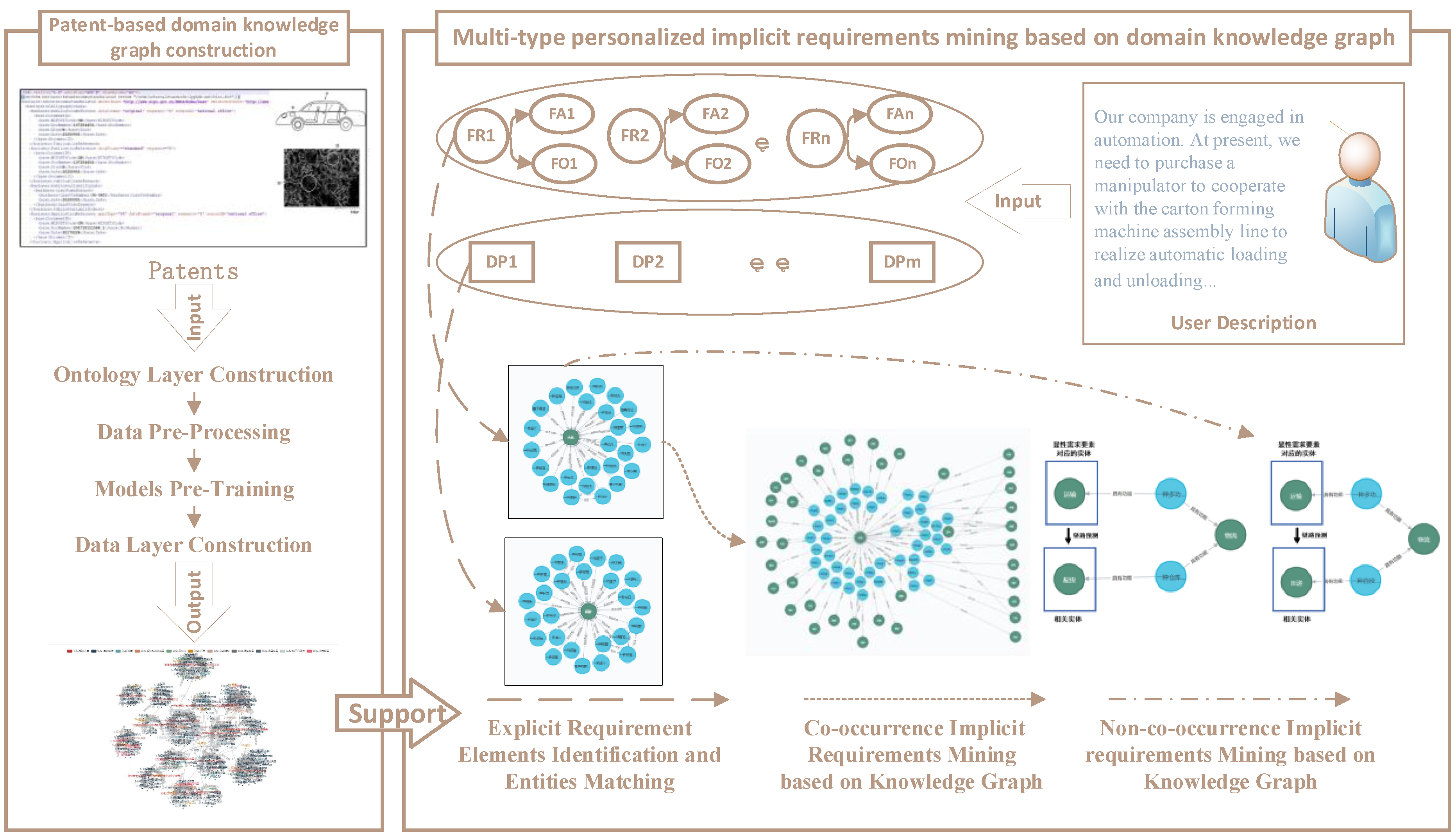
For the nature of the problem in this study, combined with the patent knowledge in the field, the research framework of this paper is proposed as following:
Figure 2.
Research Framework.
4. Patent-Based Domain Knowledge Graph Construction Method
The process of constructing a domain knowledge graph based on patent text is illustrated in Figure 3. It consists of four main stages: ontology layer construction, data pre-processing, models pre-training, and data layer construction. In order to enhance the entity recognition and sentence sequence classification performance of the model in the field of patent text, this study conducts incremental pre-training on a large number of domain related patent text data collected, and constructs the domain knowledge pre-training models BERT-base-patent-fusion and BERT-wwm-ext-patent-fusion based on two base models BERT-base and BERT-wwm-ext[42] respectively. The pre-trained models marked with * in the figure are the models proposed in this study. The numbers and letters in brackets in the data layer construction represent the datasets and training model numbers referenced in the construction process.
4.1. Ontology Layer Construction
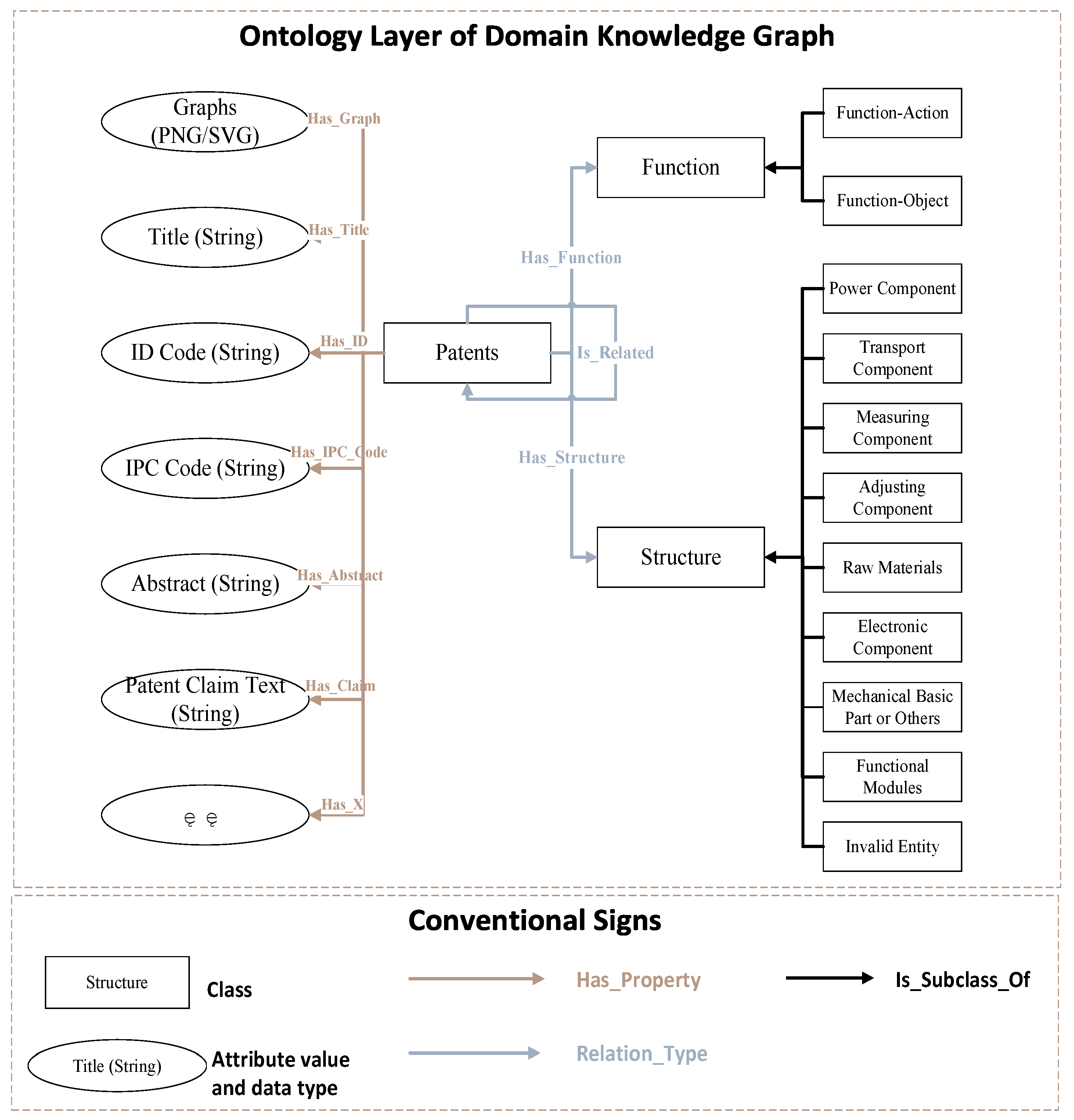
This paper uses ontology to standardize entities, relationships, and the types and properties of entities. The ontology layer schema of the domain knowledge graph can be expressed as <Class, Property, Relation>, where:
Class={classi}, which specifies the node classes in the network and the hierarchical relationships between classes. The domain knowledge graph defines three types of entities, namely functional entities, structural entities, and patent entities; a total of 11 node classes are specified, among which: function-action class and function-object class are subclasses of the function class, and power component, transport component, control component, etc. are subclasses of the structure class.
Property={<class, property_type, value>} specifies the attributes that each entity in the knowledge graph should have and the range of its property value;
Relation={classA, rel_type, classB} specifies the relationships between various entities. Relationships can be divided into three categories: patent has functions, patent has structures and related relationships between patents due to similar functions or structures.
Figure 4.
A schematic diagram of the domain knowledge graph ontology layer.
4.2. Data Pre-Processing
This paper focuses on Chinese patents as the research subject, and first of all, it needs to complete the structured parsing and storage of patent data. In addition to the patent data set, for the construction of the pre-training model, three data sets are extracted and labeled, including the patent data set with domain-related labels, data set with function and structural entity labels, and data set with structural entity category labels.
- Patent data set with domain-related labels is an annotation data set used to determine whether a patent is domain-related. The domain-related classification of patents is a sentence classification task. The domain features of the title and rights statement are significant. As the input data of the model, the patent data with domain-related labels is annotated to form the training and verification sets of the model.
- Data set with function and structural entity labels is constructed to fine-tune the named entity recognition model of patent text.The BIO labeling method is used to label the functional and structural entities in the patent title and claim text for the model pre-training of extracting functional and structural entities.
- Data set with structural entity category labels is used to build a classification model for structural entities, subdividing structural entities into subcategories such as power and transportation components.
4.3. Models Pre-Training
Patent text classification, information extraction and entity semantic similarity calculation all need NLP support. At present, the best SOTA (state of the art) model adopts the "pre train+fine tune" framework. Based on this framework, this paper superimposes patent text data for pre training process to enhance the model's ability to recognize and understand patent text, so as to obtain better results in patent text oriented NLP tasks.When Google released the BERT model in 2018, it included a Chinese model trained on the Chinese Wikipedia corpus. In 2019, the BERT-wwm-ext model was proposed by Harbin CuiY et al[43]. On the basis of Bert, the masked language model at the character level was improved to the whole word mask, and the corpus used for pre-training was expanded, which achieved significant optimization results in multiple tasks.
To improve the model's ability to recognize entities and classify sentence sequences in domain patent texts, this study conducted incremental pre-training using a large number of domain-related patent text data with two base models: BERT-base and BERT-wwm-ext. This led to the creation of pre-training models BERT-base-patent-fusion and BERT-wwm-ext-patent-fusion, which superimposed domain knowledge. For fine-tuning in subsequent tasks, it will be trained based on four models: BERT-base, BERT-base-knowl-fusion, BERT-wwm-ext, and BERT-wwm-ext-knowl-fusion.
4.4. Data Layer Construction
The data layer construction of the domain knowledge graph can be divided into five stages: domain patent screening and information extraction, functional and structural entity extraction, classification of structural entities, structural entities resolution and fusion, and relationship generation in the graph.
4.1.1. Domain Patent Screening and Information Extraction
In order to improve the information purity of domain knowledge graph, it is necessary to screen all patents related to the domain in all patent data. Since there are patents related to the domain under all IPC primary partitions, it is not possible to directly screen through the IPC partition information of patents. Therefore, through the filter based on NLP algorithm, this paper selects the domain patents for graph construction.
Based on NLP algorithm and data set with domain-related labels, this paper fine-tunes four pre-training models to construct the domain-related patent filtering model.
Figure 5.
The sentence sequence classification principle based on the BERT-Transformer module.
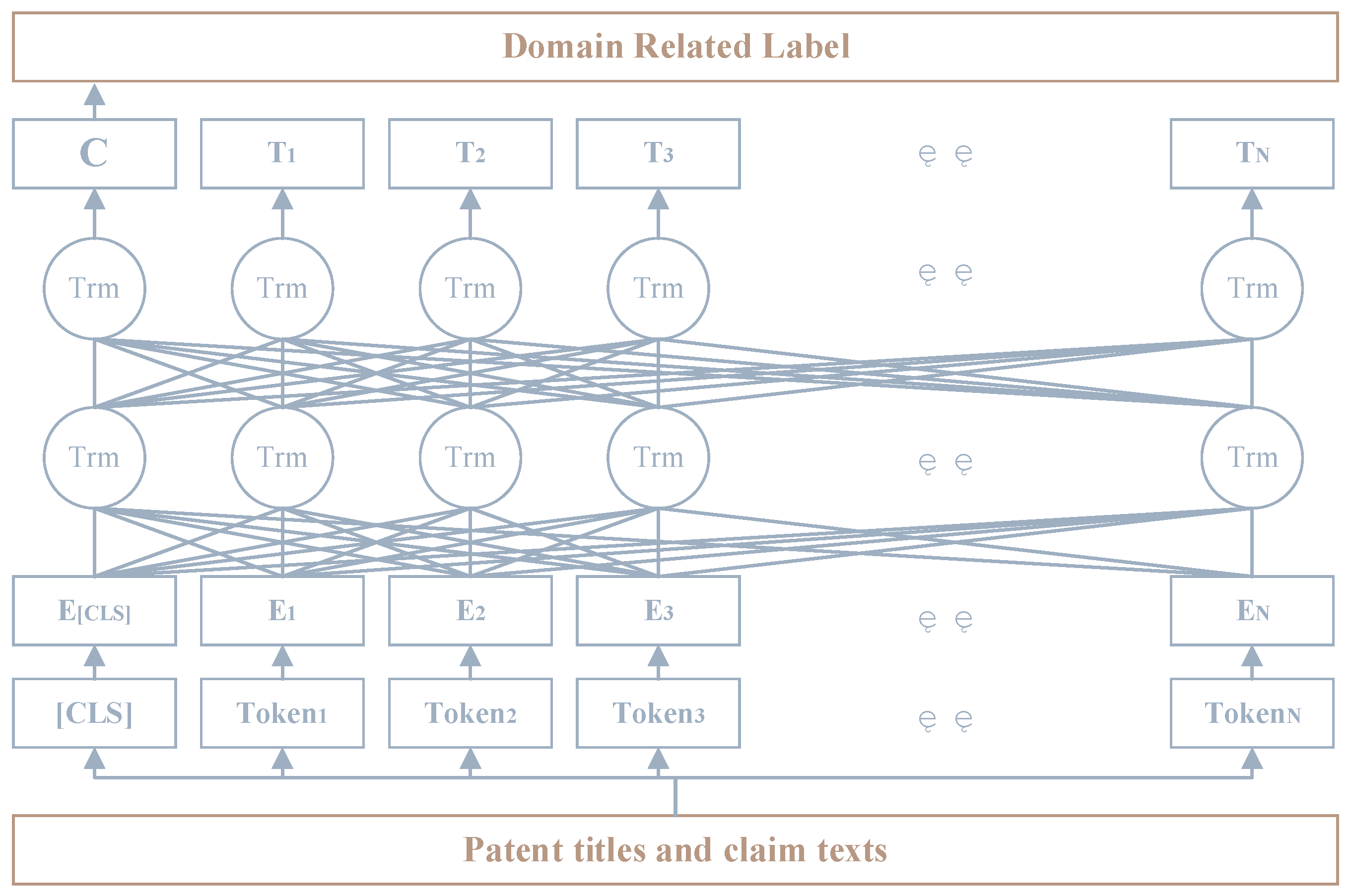
As shown in Figure 6, in the patent title and claim text, the last hidden layer vector C∈RH output after the information extraction of the Transformers module in BERT[44] is used as the representation vector of the sentence, where H is the number of neurons in the last hidden layer. Finally, adjust the classification layer weight W∈RK×H, where K=2 is the number of labels, and the model training can be completed by calculating the classification error based on the Softmax result output by the following formula.
P=softmax(CWT)
Import domain-related patents and their attribute information, such as patent numbers, titles, IPC, etc., into the knowledge graph, to complete the construction of patent entities and extract their attribute information.
4.1.2. Functional and Structural Entity Extraction
Extracting functional and structural entities from unstructured patent text is a text sequence annotation problem [45]. Specifically, given a text sequence of length N
wi represents a single word or token. The named entity recognition model returns a series of tuples <Is, Ie, t> (Is∈[1, N],Ie∈[1, N]), where Is and Ie represent the start and end positions of a named entity, t represents the entity category which should be one of the entity categories predefined according to the actual problem model. The function and structure entity extraction model has three types of named entities, namely FA (Function-Action), FO (Function-Object) and S (Structure), so t∈{FA,FO,S}.
S=(w1, w2, … , wN)
The patent title mainly includes the function of the patent and its overall structure. For example, "A kind of stone grinding machine" clearly states that its function is "grinding stone," where the function-action entity is "grinding," the function-object entity is "stone," and its overall structure is "stone grinding machine", which is a structural entity. The claim of the rights mainly contains the technical characteristics of the patent and expresses the scope of protection requested. The structural entity can be obtained using named entity recognition technology from the claim of rights.
The functional and structural entity extraction models based on patent title, and the structural entity extraction models based on patent rights claim are constructed. Based on the data set with patent functional and structural entity labels, we fine-tuned four pre-trained models, selected the best iteration rounds and models, and constructed three entity extraction models.
4.1.3. Classification of Structural Entities
In order to provide more detailed entity information, the structural entities are divided into 8 categories: power component, transport component, measuring component, adjusting component, raw materials, mechanical basic part or other component, electronic components and functional modules. In the process of named entity recognition, it is inevitable to introduce some wrong recognition entities such as non related fields, so invalid entity is also regarded as a category. Similarly, based on the data set with structural entity category label, the structural entity classification model is constructed by fine-tuning and testing the four pre-training models.

Table 3.
Structural entity classification information table.
| Abbreviation | Meaning | Examples |
|---|---|---|
| PC | Power Component | Traveling motor, turbine device |
| TC | Transport Component | Mud settling pipeline, discharge belt |
| MC | Measuring Component | Tank pressure monitor, low temperature sensor |
| AC | Adjusting Component | Pump motor stop button, lock control system host |
| RM | Raw Materials | Columnar metal, spherical catalyst |
| BP | Mechanical Basic Part Or Other Component | Screws, gears, boxes |
| EC | Electronic Component | FPGA logic controller, ripple generation circuit |
| FM | Functional Module | Disabled scooters, alloy production devices |
| IE | Invalid Entity | Triples, cells |
4.1.4. Structural Entities Resolution and Fusion
Entity Resolution is mainly used to solve the problem of multiple references actually pointing to the same entity. In the domain knowledge graph, since the product described in the patent may have multiple identical structures, they will be distinguished by "Xth structure," "Structure X," etc. Therefore, it is necessary to do Co-referential resolution analysis on the structural entities and fuse the entities that point to the same.
A rule-based method is used for the structural entities resolution: first, regular expressions are used to determine whether the structural entity is expressed in the form of "Xth structure" or "Structure X". If so, the "Xth" prefix or "X" suffix is deleted to determine whether the new entity formed exists. If it exists, the entity is merged with the existing entity; otherwise, a new entity is created.
4.1.5. Relationship Generation in Domain Knowledge Graph
There are three types of relationships in the domain knowledge graph: "Has_Function," "Has_Structure," and "Is_Related". Among them, the "Has" type relationship is between the parent entity and the function and structure entities. In extracting the function and structure entities, this type of relationship has been obtained and can be directly constructed in the graph. The "Is_Related" is constructed based on the network structure similarity between entities. Based on the highly interpretable Jaccard similarity measure, the structural similarity between patent entities with more identical functional and structural entities is higher, and the "Is_Related" is constructed between patent entities above the similarity threshold.
5. Multi-Type Personalized Implicit Requirements Mining Method Based on Knowledge Graph
In view of the different categories of personalized requirements mentioned in Table 2, this paper implements entity-layer co-occurrence implicit requirement mining based on structural similarity, and constructs a co-reference embedding layer to realize non-co-occurrence implicit requirement mining based on link prediction, as summarized in Table 4:
Therefore, the process of mining personalized implicit requirements based on a domain knowledge graph mainly includes three stages: explicit requirement element identification and entity matching, co-occurrence implicit requirements mining of the entity layer, and non-co-occurrence implicit requirements mining of the co-reference embedding layer. As shown in the following formula, for the expression of explicit requirement elements in the domain knowledge graph, that is, each element in the knowledge entity set : If there is a knowledge entity of co-occurrence relationship, the structural similarity algorithm is used to measure its relativity with ; otherwise, its relativity with will be measured based on the entity embedding and link prediction algorithm. Based on the correlation , the two types of entities are sorted to realize the personalized implicit requirements mining.
5.1. Explicit Requirement Element Identification and Entity Matching
The model fine-tuned based on the four pre-training models, is used as the identification model for personalized explicit requirement elements, completing the mapping of unstructured RD (Requirement Description) to ERE (Explicit Requirement Entity). As shown in the following equation, where represent the explicit FA, FO, and structural elements expressed by the user.
The matching process between explicit requirement elements and entities in the knowledge graph is completed based on the cosine similarity calculation of word embedding vectors.Each explicit requirement entity is input into the BERT model to obtain its semantic vector representation . Similarly, the semantic vector representation of functional and structural entities in the domain knowledge graph is obtained, that is, the matrix , where N is the number of functional and structural entities in the network. Then, based on the cosine similarity, the cosine similarity measures of and M are obtained to complete the matching of demand elements and knowledge entities, as follows:
Based on the matching process between requirement elements and knowledge entities, the mapping process from the explicit requirement element set ERE to the entity KE set (Knowledge Entities) in the knowledge graph is completed, as shown in the following formula:
5.2. Co-Occurrence Implicit Requirements Mining of the Entity Layer
For implicit requirement elements that co-occur with explicit requirement, the structural similarity algorithm can be used to mine them. With explicit requirement entities as input, output possible implicit requirement entities and their ranking as shown in Figure 6:
The mining of co-occurrence related entities with the same neighbors can be completed using the node similarity calculation method based on network theory. The node structure similarity calculation algorithms based on network theory mainly include Jaccard similarity, Sorensen-Dice similarity, Hub Promoted similarity, and Hub Depressed similarity, etc., which are all based on the neighbor nodes set calculation. This paper uses Jaccard similarity to calculate node similarity.
In the network G=(V, E), V is the vertices set, and E is the edges set. For a vertex x∈V, N(x) represents the set of its neighbors. Then, for x, y∈V, the Jaccard similarity is:
Sort the output of the above formula, mine and recommend the co-occurrence layer implicit requirement entities.
5.3. Non-Co-Occurrence Implicit Requirements Mining of the Co-Reference Embedding Layer
Some personalized implicit requirements do not have a co-occurrence relationship with the explicit requirement elements in the graph. This study uses network node embedding and link prediction algorithms to mine these implicit requirements. Also take the explicit requirement entities as the input, and output the possible non-co-occurrence implicit requirement entities and their ranking. Taking the requirement "transportation" as an example, a kind of non-co-occurrence implicit requirements such as "Preparation according to order" and "delivery" are shown in Figure 7 (in addition to the "secondary co-occurrence" implicit requirements in the figure, our method can also mine the entities with other types of network structural similarities):
Link prediction is an algorithm that predicts the possibility of a new connection between two nodes in a given network. With the continuous advancement of complex network modeling technology, researchers have proposed many link prediction algorithms for different types of networks, including: simple similarity based, probability theory and maximum likelihood based, dimension reduction based, and other methods. According to the research of Kumar A et al.[46], based on the AUPR (Area Under the Precision-Recall curve) , it was found that the network embedding algorithm Node2Vec based on the dimension reduction had the best performance in the test data set. Therefore, this paper uses the Node2Vec algorithm to complete the link prediction task of the knowledge graph to assist in the discovery of non-co-occurring related entities and support the mining of implicit requirements.The process of implicit requirements mining based on the Node2Vec algorithm includes the following three steps:
5.3.1. Build Co-Occurrence Networks of Functional and Structural Entities
If the sequence is collected directly based on the knowledge graph, it can only start from the patent entities, and the sequence length just can be 2, such as . Therefore, we construct an entity co-occurrence network, which can generate a more extended node sequence, such as , which is conducive to capturing the relationship between entities. Based on the co-occurrence of functional and structural entities, the two co-occurrence network are constructed respectively. The network nodes are still functional and structural entities in the knowledge graph, and the edge weight is the number of co-occurrences. This process is shown in Figure 8:
5.3.2. Construct Node Sequences by Biased Random Walk
As shown in Figure 9, the Node2Vec algorithm draws on the method of generating word vectors. It first starts from any point in the network based on a biased random walk and transfers between connected nodes. In this way, a limited nodes sequence can be collected, and the SkipGram model [47] is used to train the embedding vector E based on these sequences.
The "Biased Random Walk" method proposed by Node2Vec uses two parameters to adjust the random walk process. As shown in Figure 10, nodes and belong to the same node community, showing the homogeneity of nodes; while and belong to two different communities, but have the same structure (or role) in these two communities, showing the structural equivalence of nodes. In order to adjust the weights of these two structural characteristics in the algorithm, Node2Vec generalizes DeepWalk[48]. By setting parameters, the bias of the breadth-first sampling strategy and the depth-first sampling strategy in the node sequence generation process can be selected to support the adjustment of the homogeneity and structural equivalence information reflected in the node embedding vector.
Specifically, Node2Vec defines a random walk with parameters. Suppose a random walk has just walked through the edge (step ① of Figure 10), and the current position is at node . Next, the random walk needs to make the next edge by evaluating the transition probability . Let the transition probability be
Where is the edge weight, and represents the shortest distance between and . The parameters and can control the strategy of random walk exploration, where controls the possibility of a walk returning to the node previously reached. Setting it to a large value makes the walk more breadth first, and smaller encourages the depth first strategy.
5.3.3. Train the SkipGram Model to Obtain the Entity Embedding Vector, and Sort the Entities by Relevance
Based on the collected nodes sequences set, a node is regarded as a word, and a node sequence is regarded as a sentence. Based on the SkipGram method of the Word2Vec model, each node is represented as a low-dimensional dense vector .
When mining non-co-occurring implicit requirement, the formula can be used to calculate and sort the relevance of all entities, giving possible implicit requirement entities.
6. Platform Development, Case Study and Discussion
6.1. Platform Development
Based on the domain knowledge graph construction and personalized implicit requirement mining technology mentioned above, a personalized implicit requirement mining platform is designed to provide knowledge entity retrieval, query, matching, and personalized requirement identification and completion functions.
6.1.1. Platform Development and Operation Environment
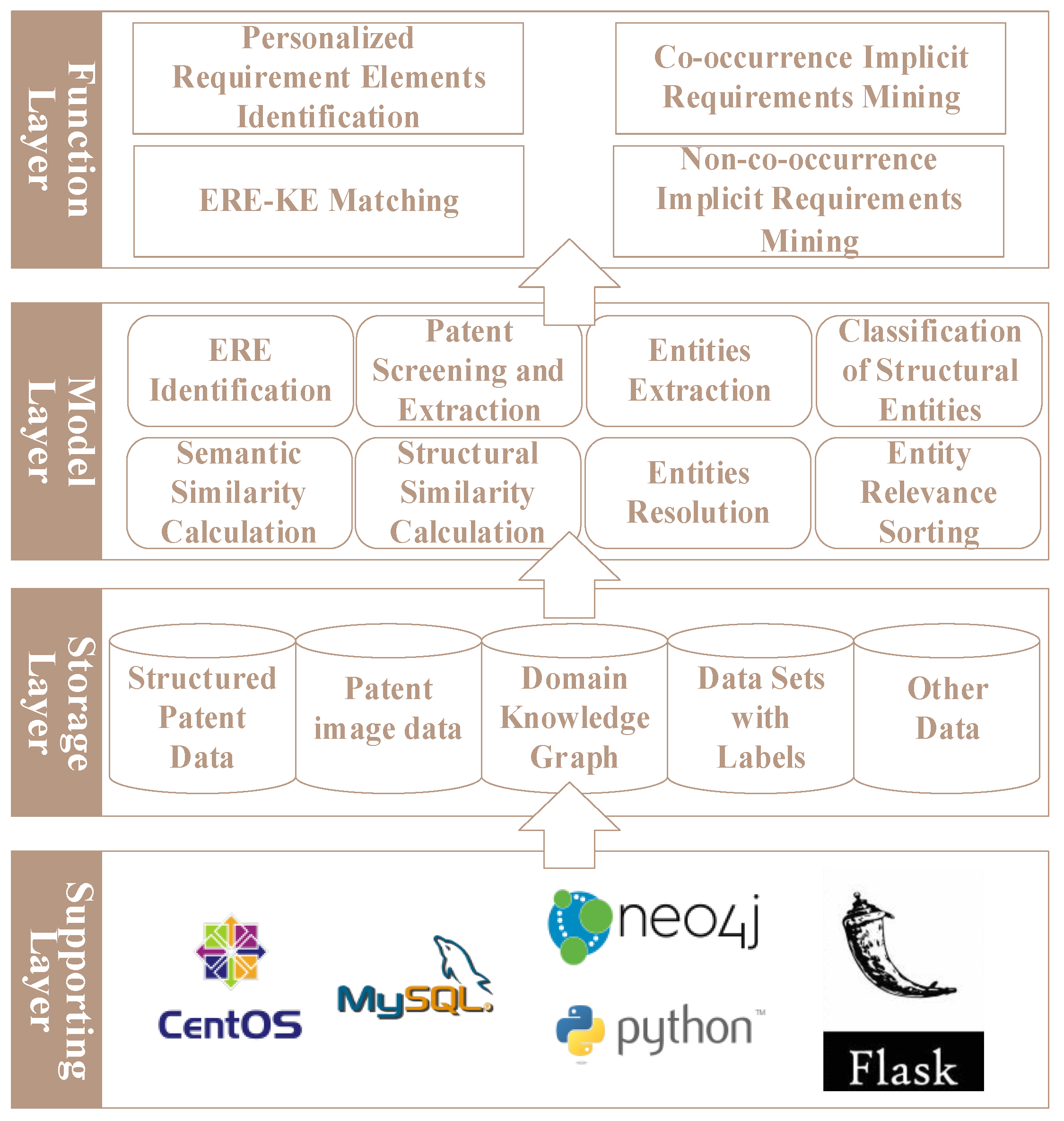
The development and operation software environment and functional framework are shown in the figure. The programming language is Python 3.6. The structured patent data is stored in the MySQL database, while the knowledge network uses the unstructured database Neo4j for storage. The Web backend development is mainly based on the Flask framework. The presentation layer uses the Bootstrap framework and JavaScript to provide interactive operation.
Figure 11.
The software environment and functional framework of personalized implicit requirement mining platform.
Figure 11.
The software environment and functional framework of personalized implicit requirement mining platform.
6.1.2. Construction of the Knowledge Graph in the Electromechanical Domain
The data is sourced from the experimental system of the State Intellectual Property Office of China, and it consists of XML format files containing patent text information and JPEG or TIFF format files containing patent image information. The XML files are parsed into structured tables based on the format and stored in the database along with the path of the corresponding JPEG or TIFF files. Based on the technical process of constructing the domain knowledge graph, this study acquired, parsed and stored 212,100 pieces of structured data of Chinese patents, annotated 100 domain-related tags and 3,000 entities, including 1,000 structural entities, forming a pre-training data set of 62.01 million words.
The study selected sentences with a length of 100 to 500 characters separated by Chinese periods to create a pre-training data set. Using unlabeled patent texts, characters were masked with a 15% probability of performing the Masked Language Model training task, completing the pre-training of the model with domain-specific knowledge. The classification of structural entities in the labeled data set is shown in Table 5:
The training information of the four models is shown in Table 6. The * mark represents the model proposed in this paper.
Finally, a knowledge graph of electromechanical domain was constructed, which included 94,379 patent entities, 27,098 functional entities, and 856,461 structural entities. A partial screenshot of the graph is shown in Figure 12:
6.1.3. Function Modules of the Platform
Functional modules of the platform include three parts: requirement elements identification, requirement elements - knowledge entities matching, and implicit requirement mining.
- Requirement elements Identification
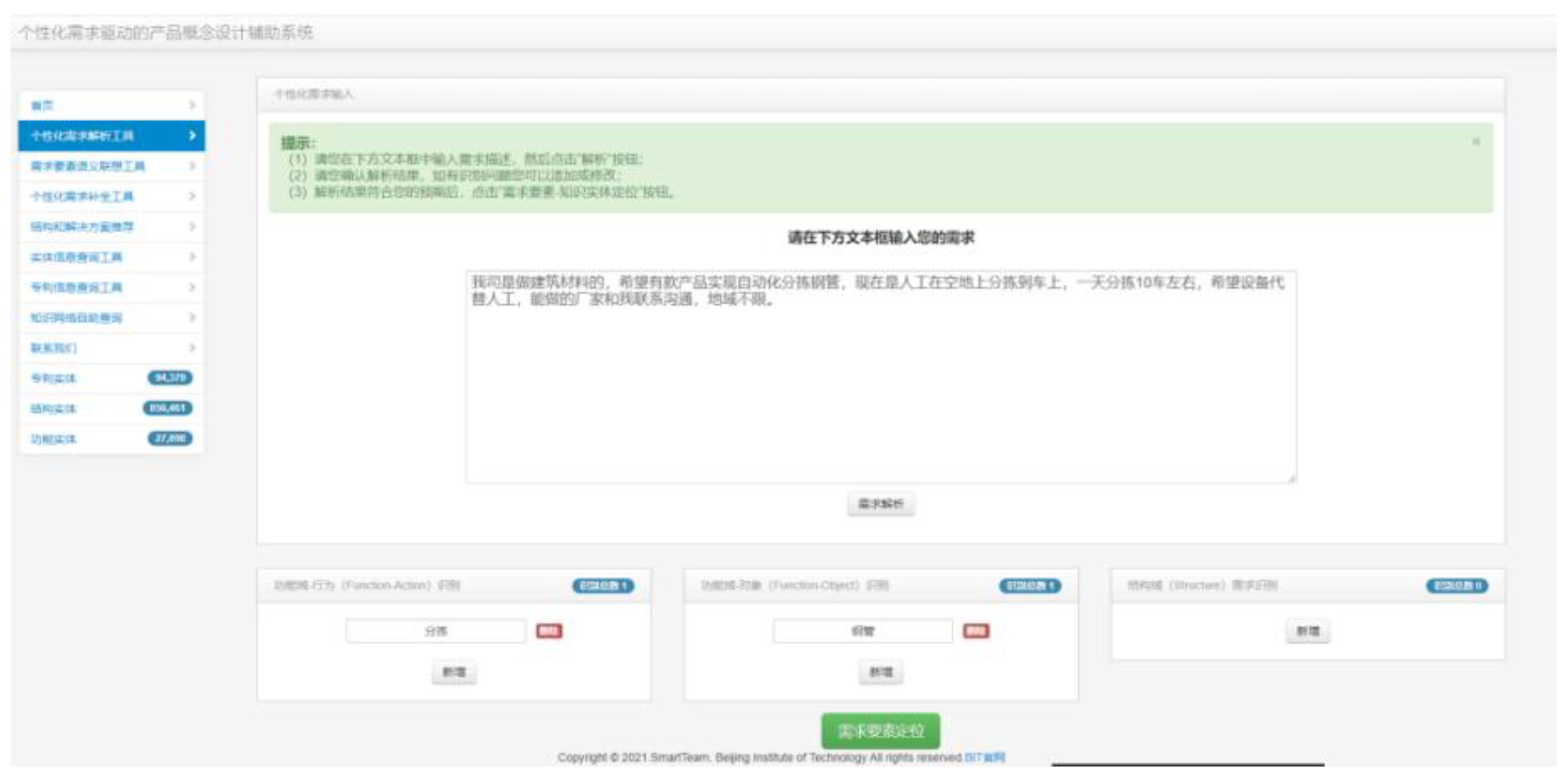
The requirement element identification interface is shown in the figure. Users can directly enter personalized requirements in the text box and then click the "Requirement Analysis" button to obtain the domain identification of requirement elements. Users can add and delete them.
Figure 13.
Requirement elements identification interface.
- Requirement elements - knowledge entities matching
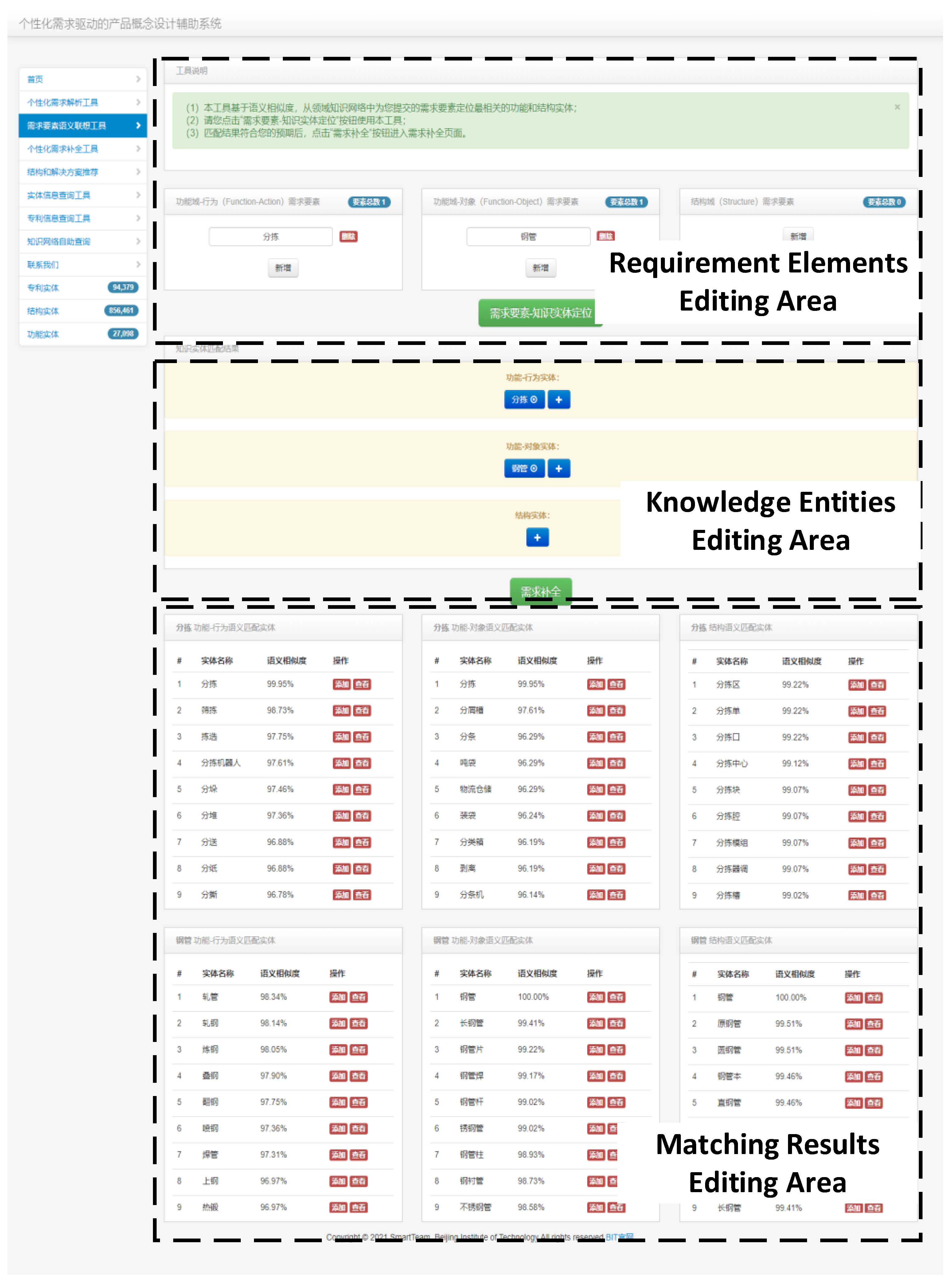
The requirement elements - knowledge entity matching page is shown in the figure. Users can adjust and update the requirement elements, add and delete matched knowledge entities. The entity-matching results are presented in three parts: "FAs", "FOs", and "Structures". Users can select a knowledge entity by clicking the "Add" button or the "View" button to view the entity's information.
Figure 13.
Requirement elements - knowledge entities matching interface.
- Implicit requirement mining
Based on the mining methods proposed in this paper, the platform lists all the implicit requirements that have been mined, and users can click the "Add" button to select. The interface for implicit requirement mining will be presented in the Case Study.
6.2. Case Study
In order to verify the feasibility of the proposed personalized implicit requirement mining method, this paper takes the personalized requirement of mechanical automation equipment on a crowdsourcing platform as an example. The original requirement description proposed by the user is:
"My company is engaged in building materials. I hope there will be a product that can realize the automatic sorting of steel pipes. Now, we sort them manually on the open ground and put them on the truck. We sort about ten trucks a day. I hope that the equipment can replace the manual work. Manufacturers who can do it can contact me to communicate. There is no limit on the region."
6.2.1. Explicit Requirement Elements Identification
Take the result of the explicit requirement elements identified by the algorithm as: FA element "sorting" and FO element "steel pipe" as examples.
6.2.2. Requirement Elements - Knowledge Entities Matching
According to the results returned by semantic similarity, the "sorting" and "steel pipe" entities already exist in the knowledge graph, and the matching is completed directly.
6.2.3. Implicit Requirement Mining
The co-occurrence and non-co-occurrence entities of "sorting" and "steel pipe" are calculated. In the link prediction process, since the mining of implicit requirements focuses on discovering node homogeneity, the selection of parameters p and q should focus on depth priority, so p=0.25 and q=4 are selected as the parameters for controlling biased random walk.
Table 7.
Node2Vec parameter setting.
| Parameters | Parameter Meaning | Values |
|---|---|---|
| dim | The dimensions number of generated representation vector | 128 |
| number-walks | Number of random walks at the beginning of each node | 10 |
| walk-length | Step size of each random walk at the beginning of each node | 30 |
| workers | Number of parallel operations of algorithm | 10 |
| window-size | Window size of SkipGram model | 10 |
| p | Control parameters of biased random walk | 0.25 |
| q | 4 |
The elements identification, entities matching and requirements mining results are shown in Figure 14 and Table 8:
After exploring implicit requirements, the completed user requirements can be described as follows:
"Our company is engaged in building materials. We hope to have a product that can automatically sort building materials steel pipes. The equipment is required to classify steel pipes by detecting short pipes. In some scenarios, it is necessary to verify the marking information on the inner wall, port or surface of the steel pipe. After sorting, the head ends of the steel pipes requirement to be aligned and placed, and then dispatched to the vehicle for transportation. Now it is manually sorted on the open ground and sorted to the vehicle. About 10 vehicles are sorted a day. I hope that the equipment can replace manual labor. Manufacturers who can do it can contact me for communication. There is no limit on the region."
6.3. Discussions
First, we will focus on the training performance of the two NLP models proposed in this study. The models were fine-tuned at different stages of the graph construction, and evaluated using as the standard and by 5-fold cross-validation.
6.3.1. Domain Patent Classification Model
The results are shown in Figure 15. When the training reached the sixth round, the of each model was stable at around 90%. Starting from the seventh round, some models began to overfit, and the on the validation set showed a downward trend. Therefore, based on the performance of each model when the training round was 6, the best training performance at this time was BERT-wwm-ext-patent-fusion (=92.56%).
6.3.2. Functional and Structural Entities Identification Model
Different from the classification model, in the effect evaluation of the entity identification model, this study adopts accurate matching evaluation in the calculation of quasi-call rate, that is, only when the boundary and category are completely matched with the manually marked entity, it is recorded as True Positives (TP). And Micro- is used, that is, the method of calculating the total accuracy rate and recall rate of all categories.
The results are shown in Figure 16 and Figure 17. The value of identifying the functional entities from the patent titles is about 70%, which is mainly because the patent titles are short texts, contain less context information, and have obvious unstructured characteristics, which increases the difficulty of obtaining information from the model. While the structural entities identification model in the patent claim text is relatively high, up to 94.6%, and the best performance of the above two model training is BERT-wwm-ext-patent-fusion.
6.3.3. Structural Entities Classification Model
As shown in Figure 18, the value of the pre-trained model proposed in this study is significantly better than the benchmark BERT model by over 2 percentage points, and the BERT-base-patent-fusion model was used as the classification model of structural entities.
The performance of the four pre-trained models is summarized in Table 9
The results indicate that the pre-training models proposed in this study outperformed the other models at different stages of graph construction.
In addition, the final output of the research content of this paper, that is, the results of personalized implicit requirements mining, should be discussed. From the case study, it can be seen that the personalized requirements are complemented through the mining of implicit requirements. The complemented user requirements can significantly improve the quality of prompt, and the interaction efficiency between users and experts in the process of group intelligence innovation.
7. Conclusions
The Internet's rapid development has led to a surge in requirement for personalized product design and development. However, meeting implicit requirements that drive product innovation remains a challenge. To address this, a study has proposed a method for mining personalized implicit requirements based on a domain knowledge graph. This method involves analyzing personalized requirements and knowledge from domain patents. A patent knowledge ontology layer representation method has been proposed, leading to the construction of a domain knowledge graph. This expands the information contained in the knowledge graph. The two NLP models proposed during the study successfully improves the efficiency of graph construction. Two implicit requirement mining methods are proposed: one based on structural similarity and another based on link prediction. These methods aim to overcome subjective professional limitations and broaden the requirement space for product innovation design.
However, this study has identified some shortcomings that require further exploration. Future research could focus on combing the user context during personalized requirement analysis, and mining implicit requirements in specific usage scenarios. Additionally, in practical engineering application, how to further expand the knowledge source and build a knowledge graph with both breadth and depth under knowledge integration remains to be further studied.
Author Contributions
Conceptualization, ZC.M and L.G.; methodology, ZC.M and J.G; software, ZC.M and J.G; validation, ZC.M and J.G.; formal analysis, J.G; investigation, ZC.M; data curation, J.G.; writing—original draft preparation, ZC.M and J.G; writing—review and editing, HR.C and JD.L; visualization, ZC.M; supervision, L.G; project administration, L.G; funding acquisition, L.G.
Funding
This research was funded by National Natural Science Foundation of China, grant number No.52375229, Theory and Method of Collective Intelligence Innovative Design Space Collaborative Exploration and Innovation Generation.
Institutional Review Board Statement
Not applicable.
Informed Consent Statement
Not applicable.
Data Availability Statement
The raw data supporting the conclusions of this article will be made available by the authors on request.
Conflicts of Interest
The authors declare no conflicts of interest.
References
- Luo, J. Designing the future of the fourth industrial revolution. J Eng Design 2023, 34, 779–785. [Google Scholar] [CrossRef]
- Wei, G.; Zhen, W.; Hongyu, S.; Lei, W.; Lin, G.; Shusong, Y.U.; Yixiong, F.; Xinming, W.; Jianqin, L. Crowdsourcing design theory and key technology development. Computer Integrated Manufacturing System 2022, 28, 2650. [Google Scholar]
- Wei, G.; Yixiong, F.; Lei, W. crowdsourcing design theory and method. China Machine Press: Beijing,China, 2023; p 306.
- Shanghua, M.I.; Zhaoxi, H.; Yixiong, F.; Shanhe, L.; Shaomei, F.; Kangqu, Z.; Tifan, X.; Wei, G.; Jianrong, T. Process control key technologies of crowdsourcing design for product innovation, research and development. Computer Integrated Manufacturing System 2022, 28, 2666. [Google Scholar]
- Zhu, Q.; Luo, J. Toward artificial empathy for human-centered design. J Mech Design 2024, 146, 61401. [Google Scholar] [CrossRef]
- Liu, Q.; Wang, K.; Li, Y.; Liu, Y. Data-driven concept network for inspiring designers’ idea generation. J Comput Inf Sci Eng 2020, 20, 31004. [Google Scholar] [CrossRef]
- Li, X.; Chen, C.; Zheng, P.; Wang, Z.; Jiang, Z.; Jiang, Z. A knowledge graph-aided concept–knowledge approach for evolutionary smart product–service system development. J Mech Design 2020, 142, 101403. [Google Scholar] [CrossRef]
- Liu, Q.; Wang, K.; Li, Y.; Chen, C.; Li, W. A novel function-structure concept network construction and analysis method for a smart product design system. Adv Eng Inform 2022, 51, 101502. [Google Scholar] [CrossRef]
- Tan, L.; Zhang, H. An approach to user knowledge acquisition in product design. Adv Eng Inform 2021, 50, 101408. [Google Scholar] [CrossRef]
- Goldberg, D.M.; Abrahams, A.S. Sourcing product innovation intelligence from online reviews. Decis Support Syst 2022, 157, 113751. [Google Scholar] [CrossRef]
- Jin, J.; Liu, Y.; Ji, P.; Kwong, C.K. Review on recent advances in information mining from big consumer opinion data for product design. J Comput Inf Sci Eng 2019, 19, 10801. [Google Scholar] [CrossRef]
- Kano, N.; Seraku, N.; Takahashi, F.; Tsuji, S. Attractive quality and must-be quality. 1984.
- Mikulić, J.; Prebežac, D. A critical review of techniques for classifying quality attributes in the Kano model. Managing Service Quality: An International Journal 2011, 21, 46–66. [Google Scholar] [CrossRef]
- Zhou, F.; Ayoub, J.; Xu, Q.; Jessie Yang, X. A machine learning approach to customer needs analysis for product ecosystems. J Mech Design 2020, 142, 11101. [Google Scholar] [CrossRef]
- Budiarani, V.H.; Maulidan, R.; Setianto, D.P.; Widayanti, I. The kano model: How the pandemic influences customer satisfaction with digital wallet services in Indonesia. Journal of Indonesian Economy and Business (Jieb) 2021, 36, 61–82. [Google Scholar] [CrossRef]
- Bhardwaj, J.; Yadav, A.; Chauhan, M.S.; Chauhan, A.S. Kano model analysis for enhancing customer satisfaction of an automotive product for Indian market. Materials Today: Proceedings 2021, 46, 10996–11001. [Google Scholar] [CrossRef]
- Zadeh, L.A. Fuzzy sets. Information and Control 1965, 8, 338–353. [Google Scholar] [CrossRef]
- Pawlak, Z. Rough sets. International Journal of Computer & Information Sciences 1982, 11, 341–356. [Google Scholar]
- Zheng, P.; Xu, X.; Xie, S.Q. A weighted interval rough number based method to determine relative importance ratings of customer requirements in QFD product planning. J Intell Manuf 2019, 30, 3–16. [Google Scholar] [CrossRef]
- Chen, Z.; Ming, X.; Zhou, T.; Chang, Y.; Sun, Z. A hybrid framework integrating rough-fuzzy best-worst method to identify and evaluate user activity-oriented service requirement for smart product service system. J Clean Prod 2020, 253, 119954. [Google Scholar] [CrossRef]
- Haber, N.; Fargnoli, M.; Sakao, T. Integrating QFD for product-service systems with the Kano model and fuzzy AHP. Total Qual Manag Bus 2020, 31, 929–954. [Google Scholar] [CrossRef]
- Meixia, Z.; Yahui, C.; Xiu, Y.; Li, L. Charging demand distribution analysis method of household electric vehicles considering users' charging difference. Electric Power Automation Equipment/Dianli Zidonghua Shebei, 2020; 40. [Google Scholar]
- Young, T.; Hazarika, D.; Poria, S.; Cambria, E. Recent trends in deep learning based natural language processing. Ieee Comput Intell M 2018, 13, 55–75. [Google Scholar] [CrossRef]
- Li, X.; Chen, C.; Zheng, P.; Jiang, Z.; Wang, L. A context-aware diversity-oriented knowledge recommendation approach for smart engineering solution design. Knowl-Based Syst 2021, 215, 106739. [Google Scholar] [CrossRef]
- Guofang, Z.; Jiaojiao, K.; Linghua, C. Web review of a text-driven vehicle design planning approach. Machine Design 2021, 38, 139–144. [Google Scholar]
- Zhou, F.; Jianxin Jiao, R.; Linsey, J.S. Latent customer needs elicitation by use case analogical reasoning from sentiment analysis of online product reviews. J Mech Design 2015, 137, 71401. [Google Scholar] [CrossRef]
- Timoshenko, A.; Hauser, J.R. Identifying customer needs from user-generated content. Market Sci 2019, 38, 1–20. [Google Scholar] [CrossRef]
- Wang, Z.; Chen, C.; Zheng, P.; Li, X.; Khoo, L.P. A graph-based context-aware requirement elicitation approach in smart product-service systems. Int J Prod Res 2021, 59, 635–651. [Google Scholar] [CrossRef]
- Chen, R.; Wang, Q.; Xu, W. Mining user requirements to facilitate mobile app quality upgrades with big data. Electron Commer R A 2019, 38, 100889. [Google Scholar] [CrossRef]
- Zhang, M.; Fan, B.; Zhang, N.; Wang, W.; Fan, W. Mining product innovation ideas from online reviews. Inform Process Manag 2021, 58, 102389. [Google Scholar] [CrossRef]
- Chen, K.; Jin, J.; Luo, J. Big consumer opinion data understanding for Kano categorization in new product development. J Amb Intel Hum Comp 2022, 1–20. [Google Scholar] [CrossRef]
- Siddharth, L.; Blessing, L.; Luo, J. Natural language processing in-and-for design research. Des Sci 2022, 8, e212022–8. [Google Scholar] [CrossRef]
- Jia, J.; Zhang, Y.; Saad, M. An approach to capturing and reusing tacit design knowledge using relational learning for knowledge graphs. Adv Eng Inform 2022, 51, 101505. [Google Scholar] [CrossRef]
- Luo, J.; Sarica, S.; Wood, K.L. in Computer-aided design ideation using InnoGPS, International design engineering technical conferences and computers and information in engineering conference, 2019; American Society of Mechanical Engineers: 2019; pp V02AT03A011.
- Ye, F.; Fu, T.; Gong, L.; Gao, J. in Cross-domain knowledge discovery based on knowledge graph and patent mining, Journal of Physics: Conference Series, 2021; IOP Publishing: 2021; p 42155.
- Luo, J.; Sarica, S.; Wood, K.L. Guiding data-driven design ideation by knowledge distance. Knowl-Based Syst 2021, 218, 106873. [Google Scholar] [CrossRef]
- Verganti, R.; Vendraminelli, L.; Iansiti, M. Innovation and design in the age of artificial intelligence. J Prod Innovat Manag 2020, 37, 212–227. [Google Scholar] [CrossRef]
- Zhu, Q.; Zhang, X.; Luo, J. Biologically inspired design concept generation using generative pre-trained transformers. J Mech Design 2023, 145, 41409. [Google Scholar] [CrossRef]
- Zhu, Q.; Luo, J. in Generative design ideation: a natural language generation approach, International Conference on-Design Computing and Cognition, 2022; Springer: 2022; pp 39-50.
- Zhu, Q.; Luo, J. Generative transformers for design concept generation. J Comput Inf Sci Eng 2023, 23, 41003. [Google Scholar] [CrossRef]
- Li, Z.; Tate, D.; Lane, C.; Adams, C. A framework for automatic TRIZ level of invention estimation of patents using natural language processing, knowledge-transfer and patent citation metrics. Comput Aided Design 2012, 44, 987–1010. [Google Scholar] [CrossRef]
- Hulth, A. in Improved automatic keyword extraction given more linguistic knowledge, Proceedings of the 2003 conference on Empirical methods in natural language processing, 2003; 2003; pp 216-223.
- Cui, Y.; Che, W.; Liu, T.; Qin, B.; Yang, Z. Pre-training with whole word masking for chinese bert. Ieee/Acm Transactions On Audio, Speech, and Language Processing 2021, 29, 3504–3514. [Google Scholar] [CrossRef]
- Lample, G.; Ballesteros, M.; Subramanian, S.; Kawakami, K.; Dyer, C. Neural architectures for named entity recognition. Arxiv Preprint Arxiv: 1603.01360, 2016. [Google Scholar]
- Daud, N.N.; Ab Hamid, S.H.; Saadoon, M.; Sahran, F.; Anuar, N.B. Applications of link prediction in social networks: A review. J Netw Comput Appl 2020, 166, 102716. [Google Scholar] [CrossRef]
- Kumar, A.; Singh, S.S.; Singh, K.; Biswas, B. Link prediction techniques, applications, and performance: A survey. Physica a: Statistical Mechanics and its Applications 2020, 553, 124289. [Google Scholar] [CrossRef]
- Mikolov, T.; Sutskever, I.; Chen, K.; Corrado, G.S.; Dean, J. Distributed representations of words and phrases and their compositionality. Advances in Neural Information Processing Systems 2013, 26. [Google Scholar]
- Perozzi, B.; Al-Rfou, R.; Skiena, S. in Deepwalk: Online learning of social representations, Proceedings of the 20th ACM SIGKDD international conference on Knowledge discovery and data mining, 2014; 2014; pp 701-710.
Figure 1.
Examples of personalized requirements characterization.
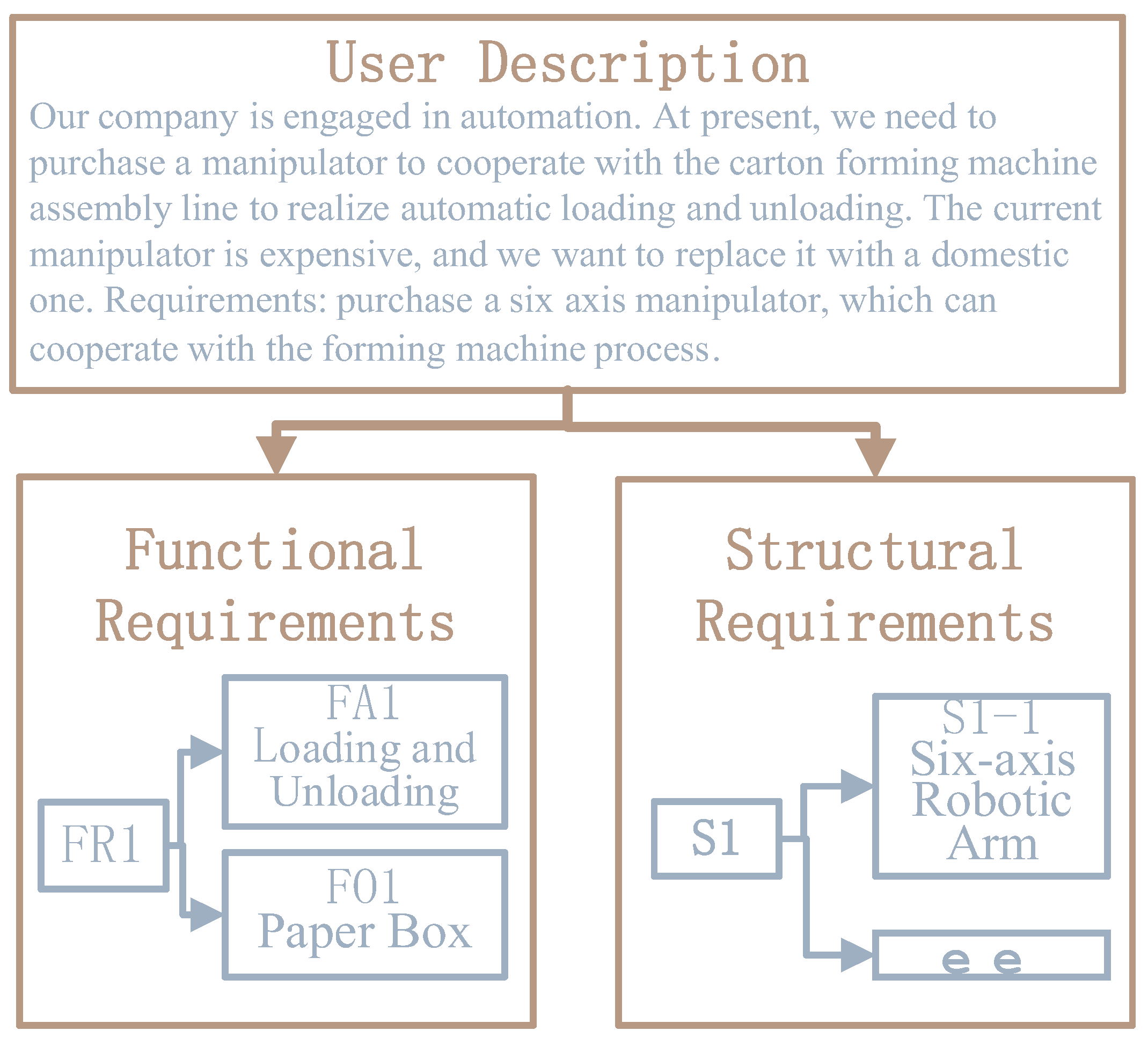
Figure 3.
Construction process of domain knowledge graph based on patent data.
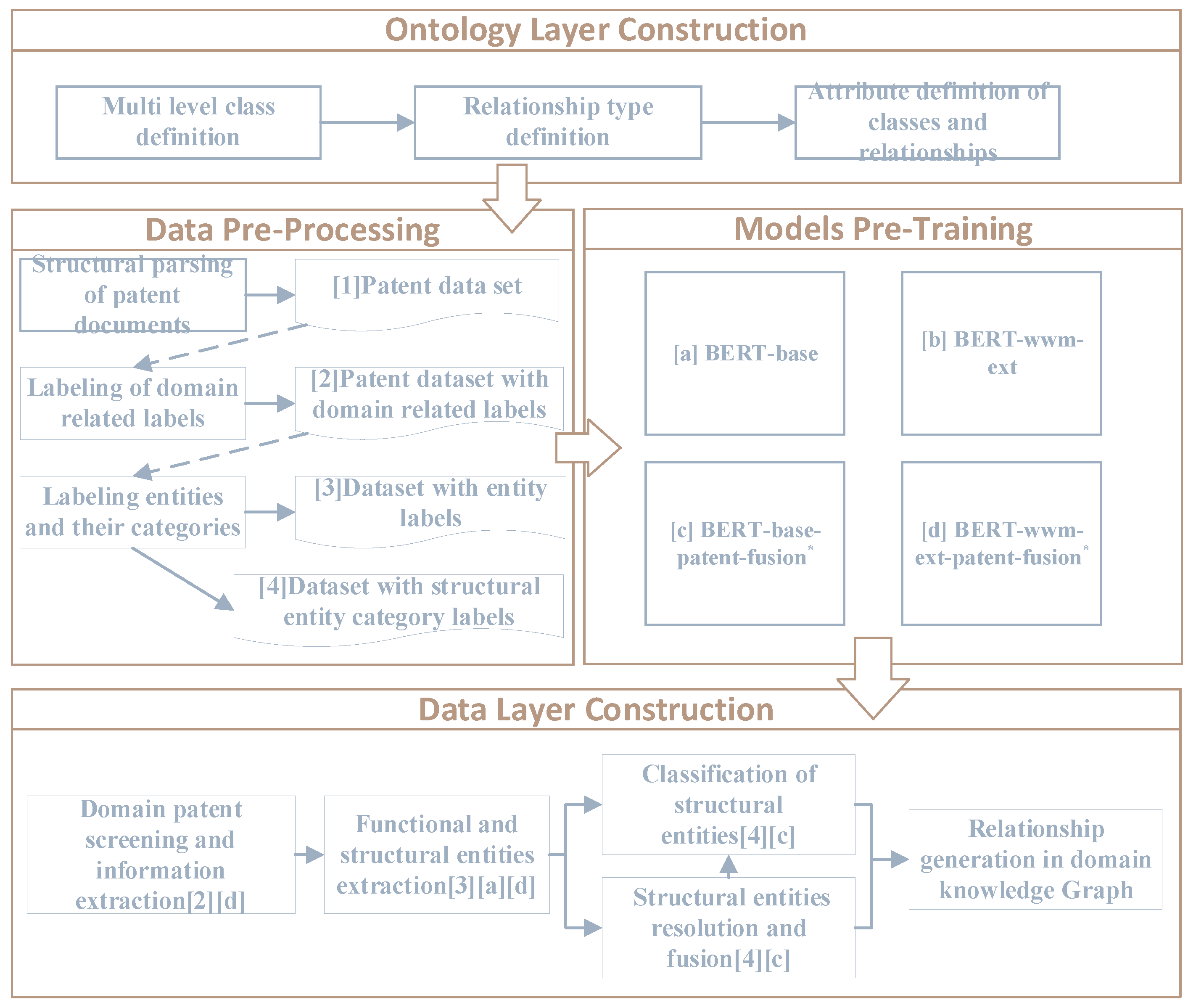
Figure 6.
Implicit requirement elements co-occur with "transport" (outermost entities / nodes).
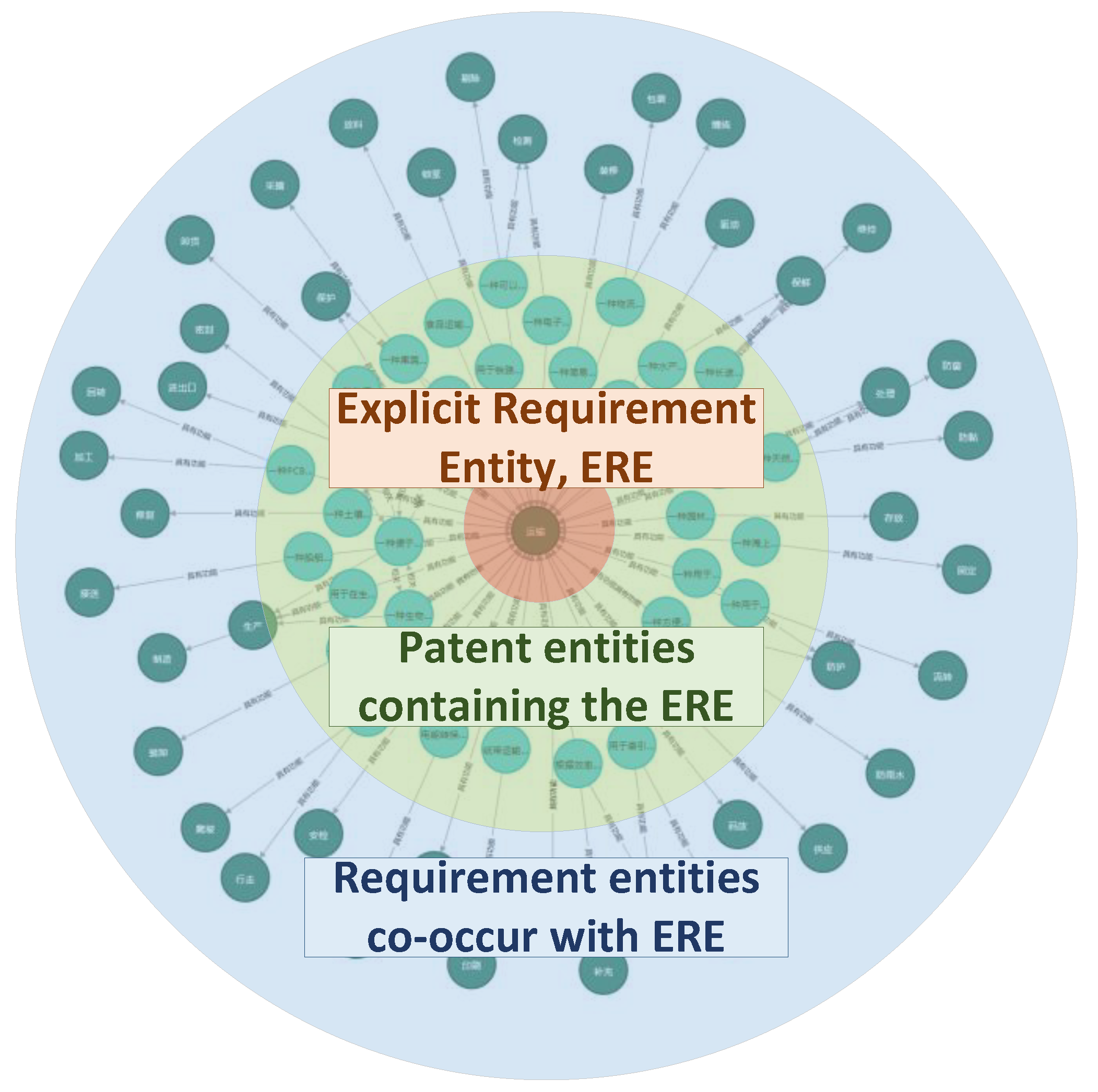
Figure 7.
A kind of implicit requirement element that has a relevance but no co-occurrence relationship with "transport".
Figure 7.
A kind of implicit requirement element that has a relevance but no co-occurrence relationship with "transport".
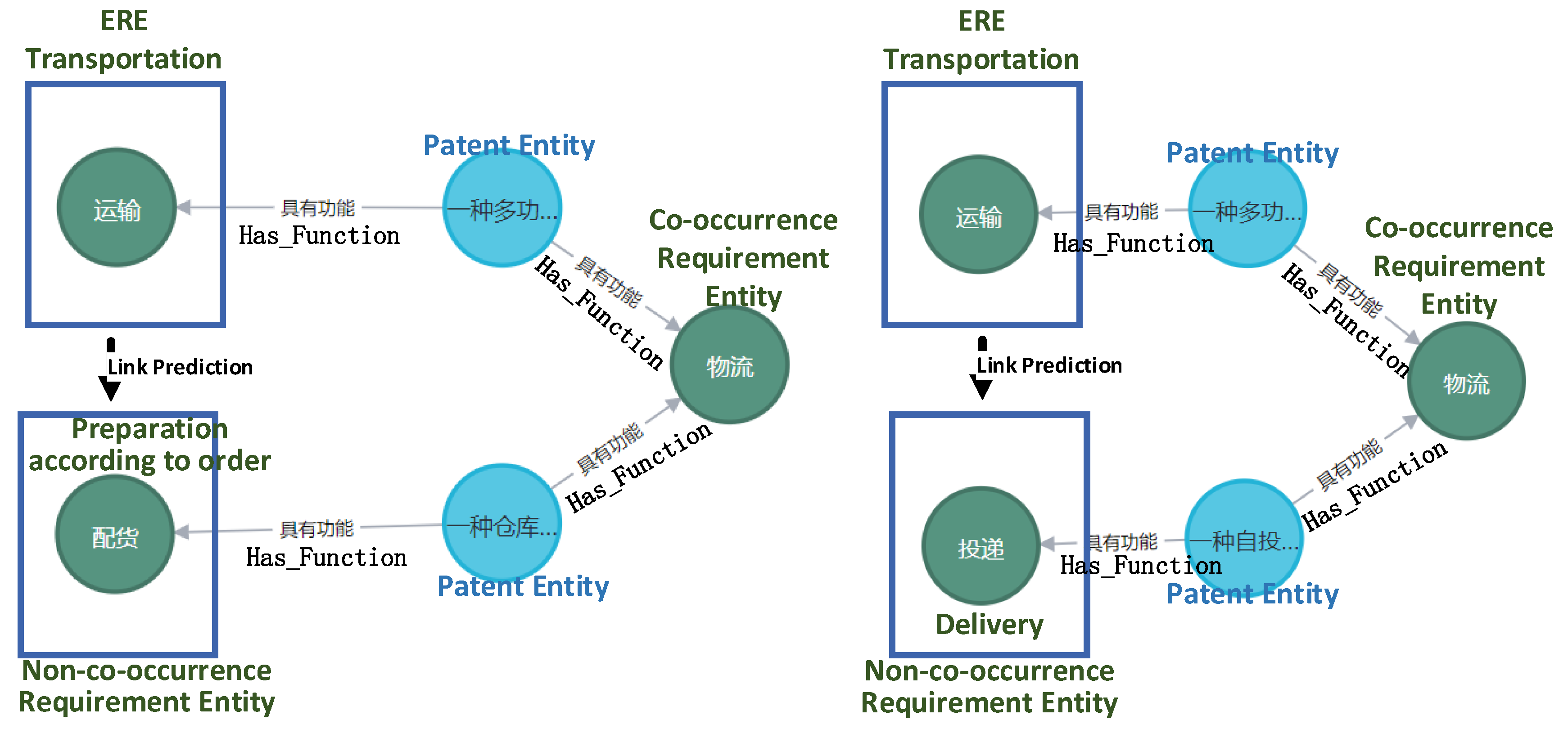
Figure 8.
Generation of co-occurrence networks based on the domain knowledge graph.
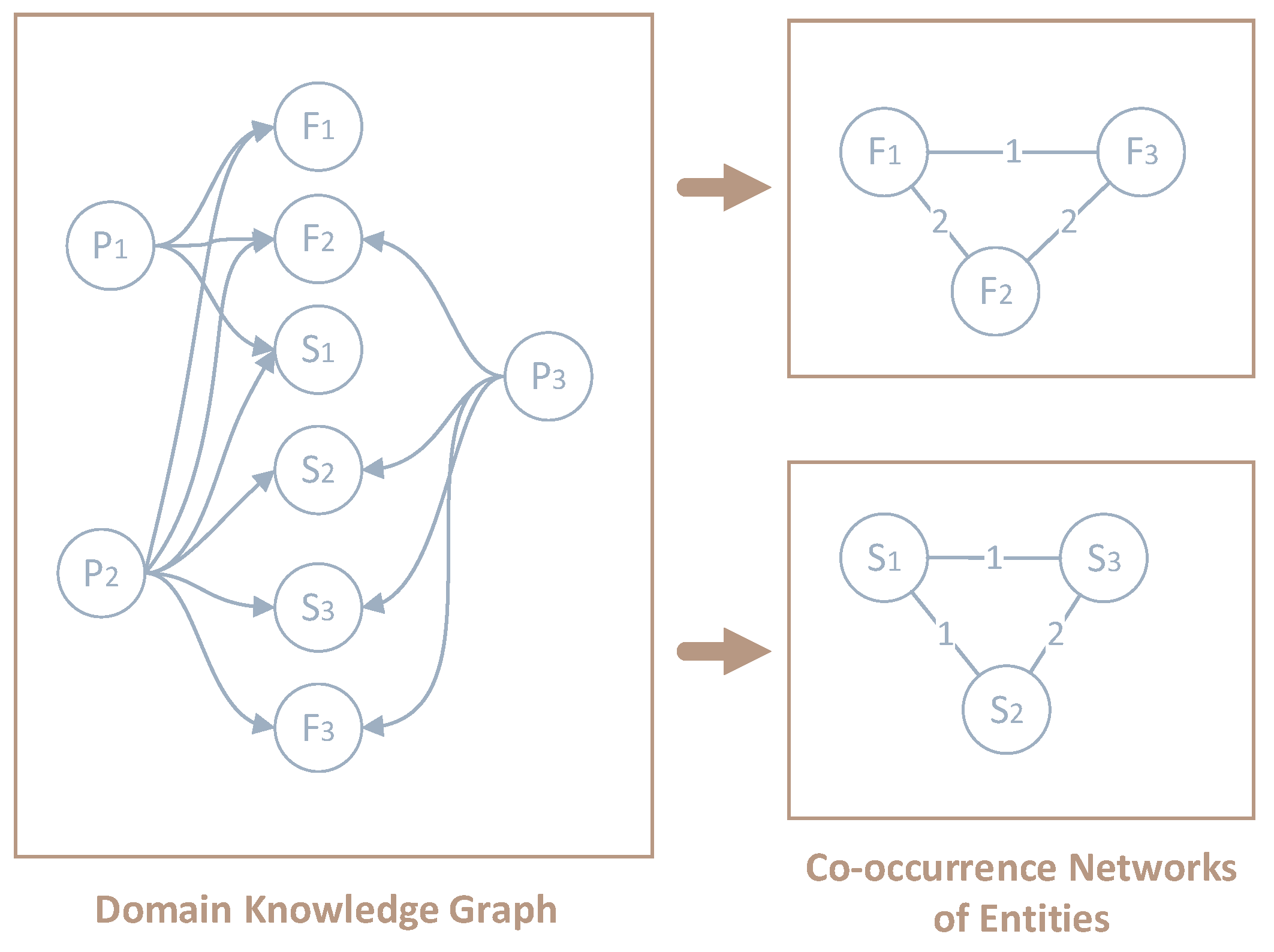
Figure 9.
Node2Vec algorithm process.
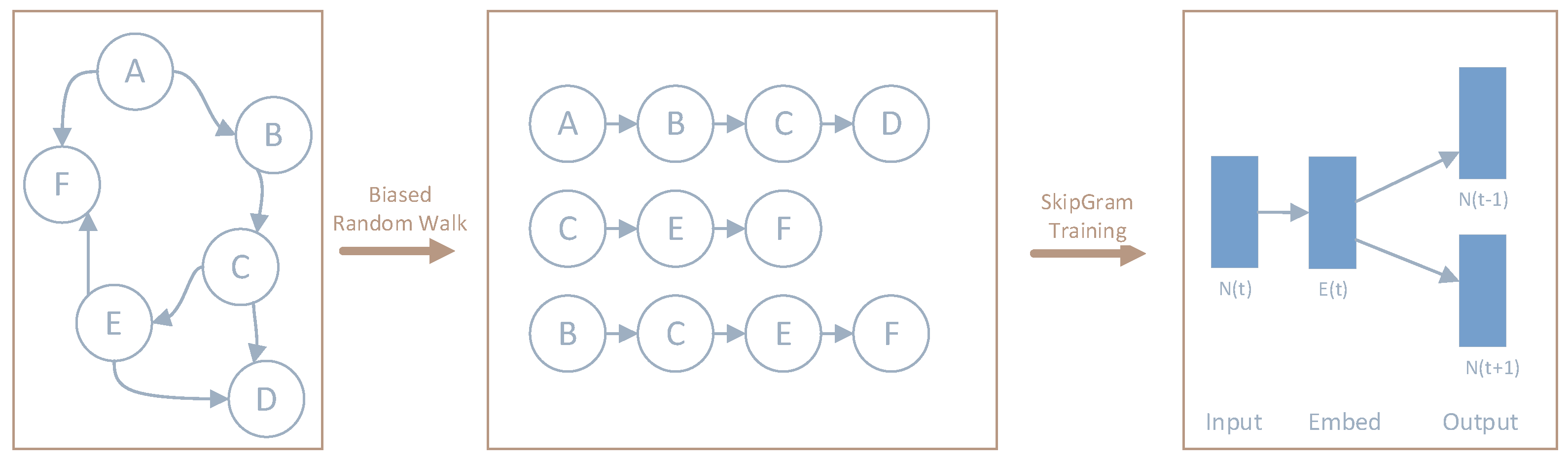
Figure 10.
Walk strategies of breadth-first and depth-first.
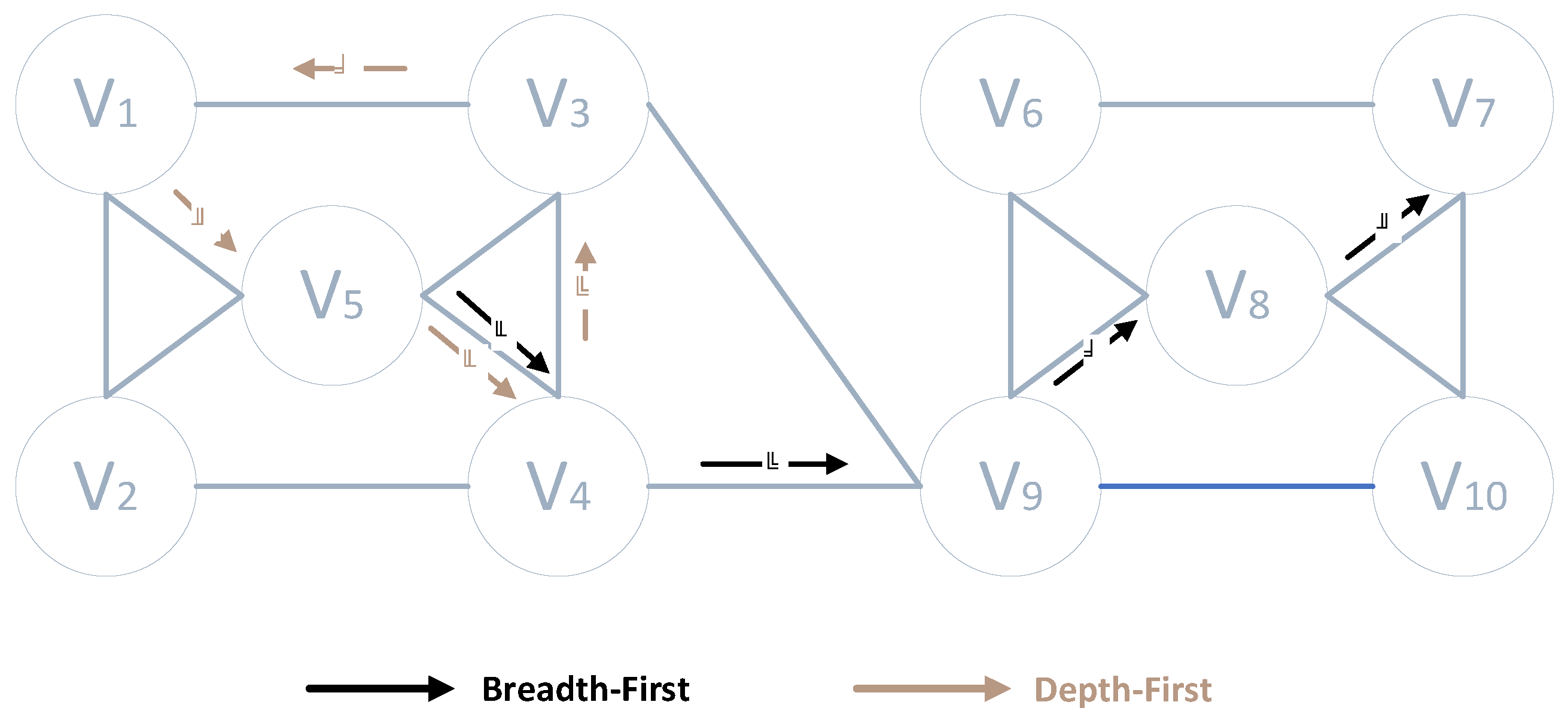
Figure 12.
Screenshots of some domain knowledge graph and details of patent entities.
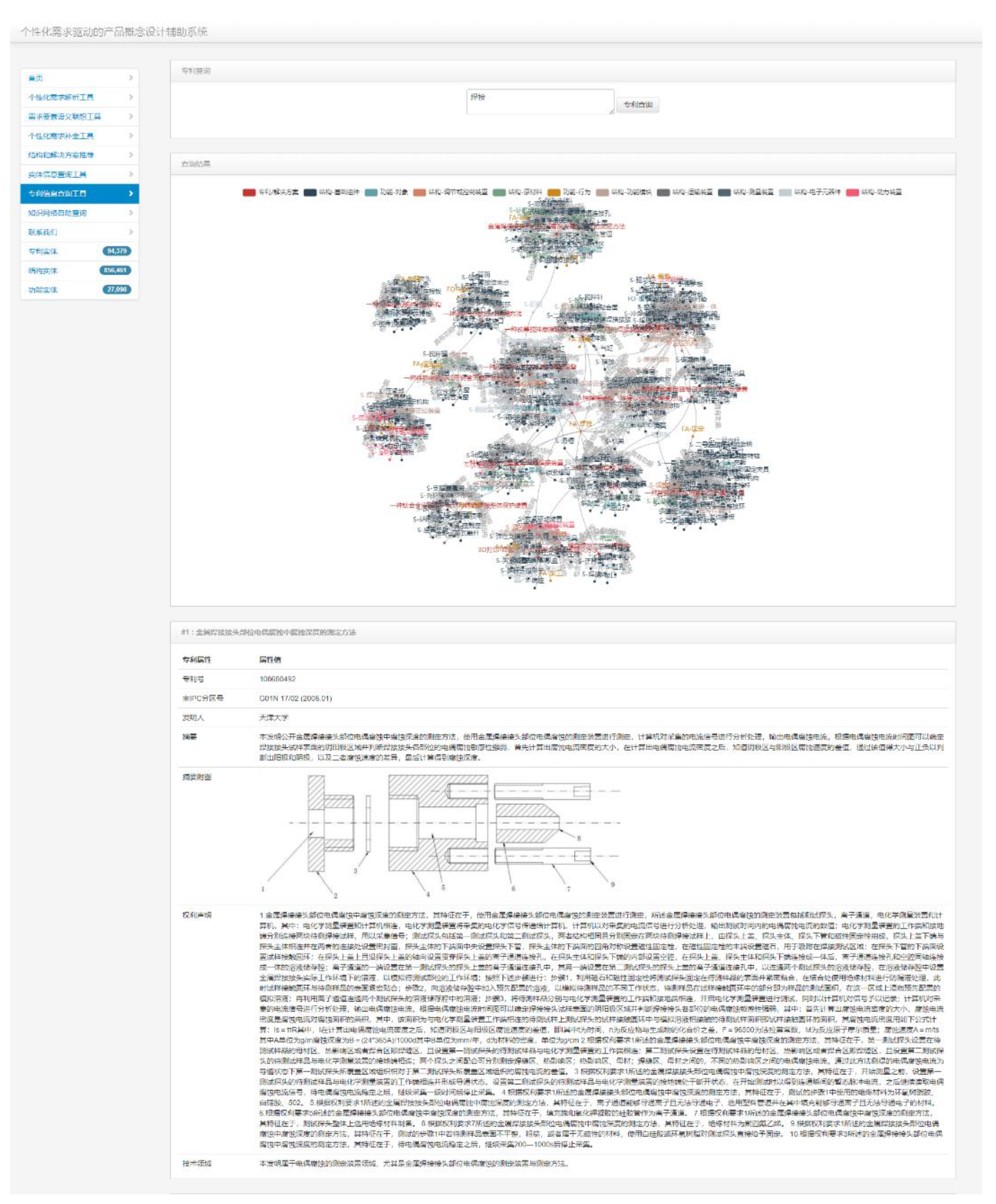
Figure 14.
Personalized implicit requirements mining results of case study.
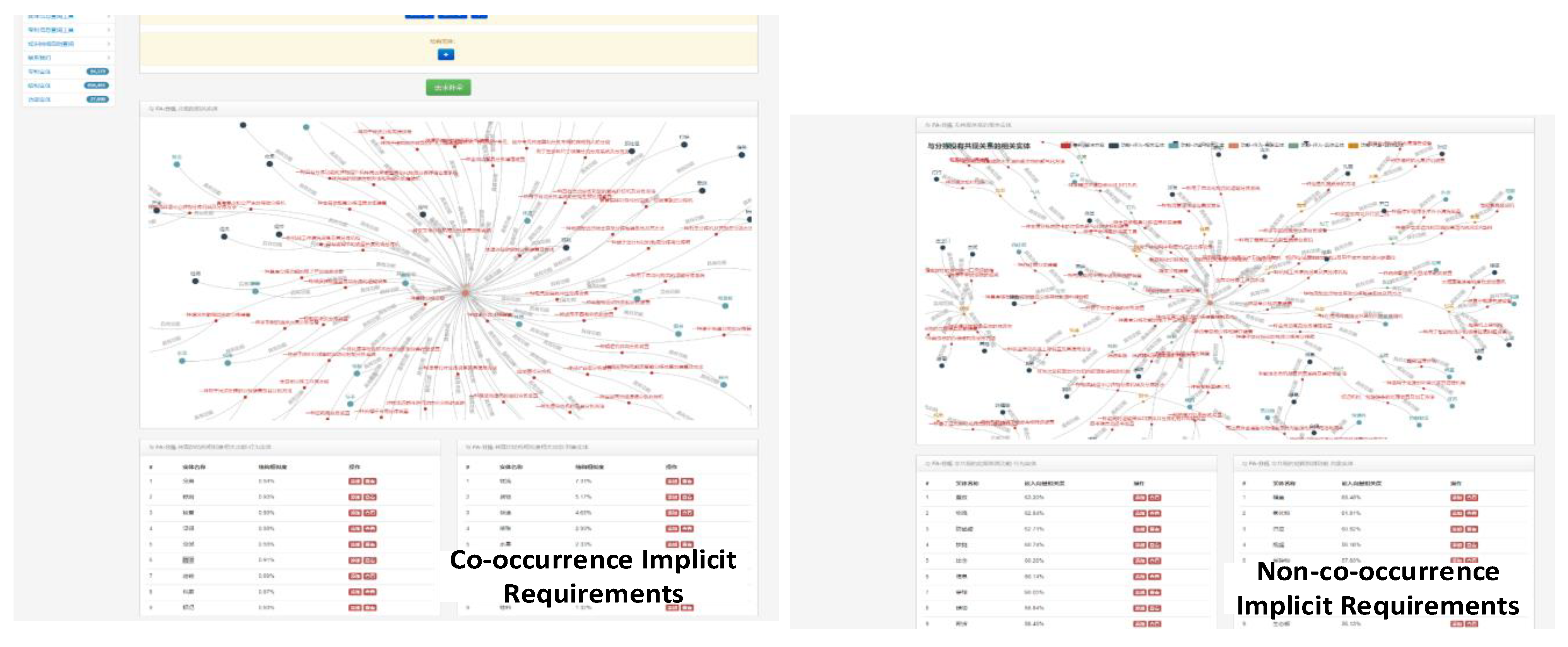
Figure 15.
Personalized implicit requirements mining results of case study.
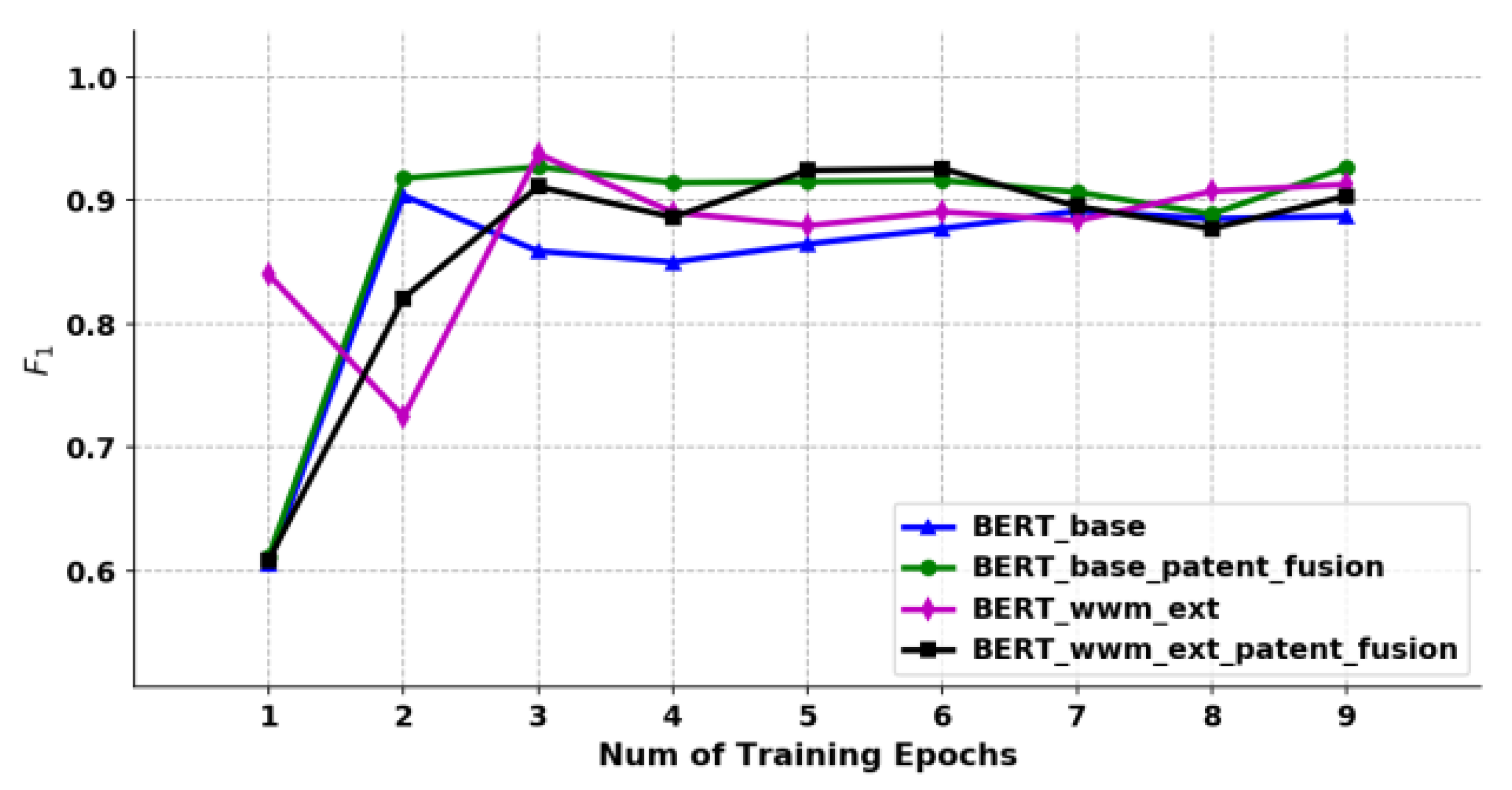
Figure 16.
Training performance of the functional entities identification model in the patent titles.
Figure 16.
Training performance of the functional entities identification model in the patent titles.
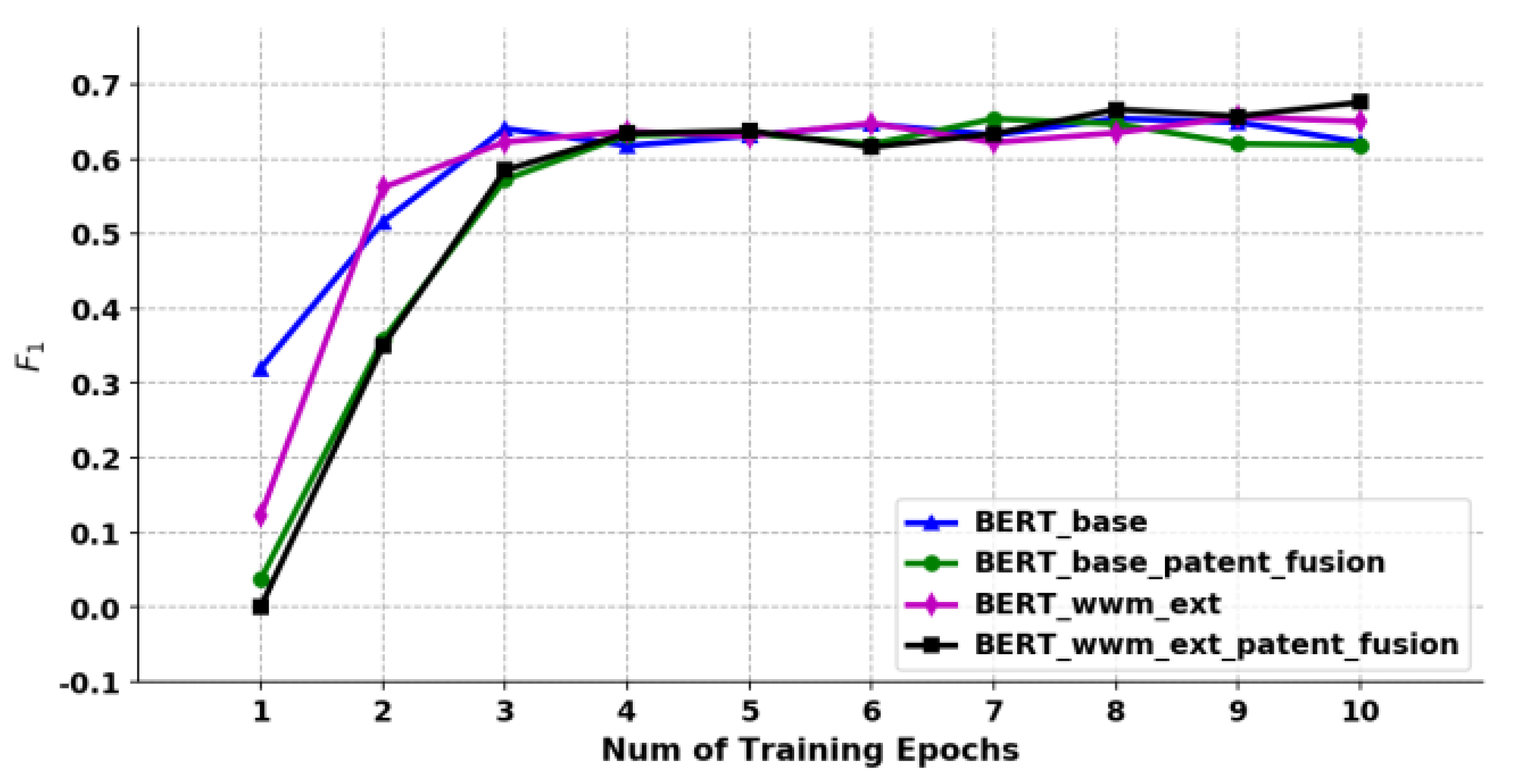
Figure 17.
Training performance of the structural entities identification model in the patent claim.
Figure 17.
Training performance of the structural entities identification model in the patent claim.
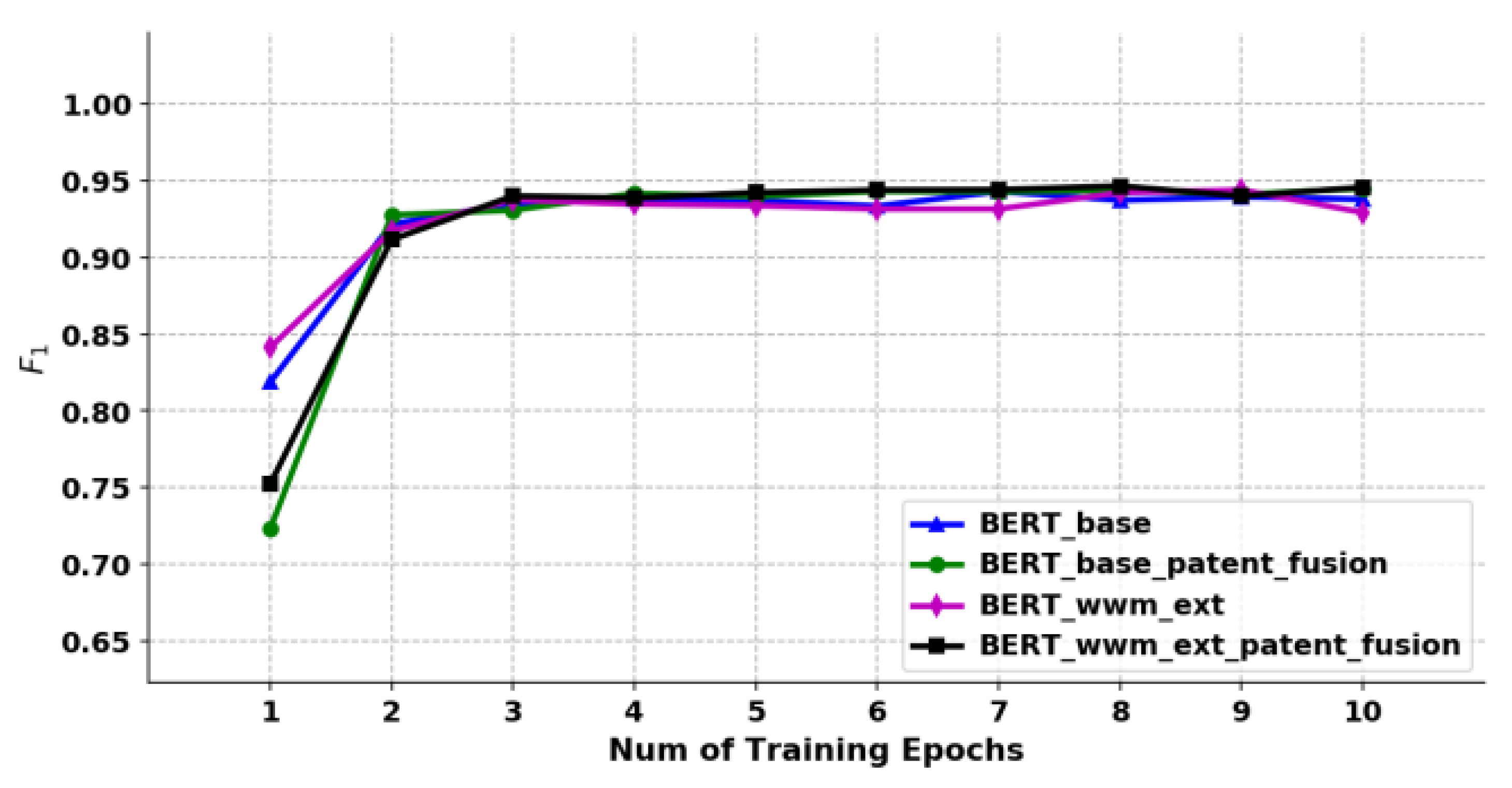
Figure 18.
Training performance of the structural entities classification model.
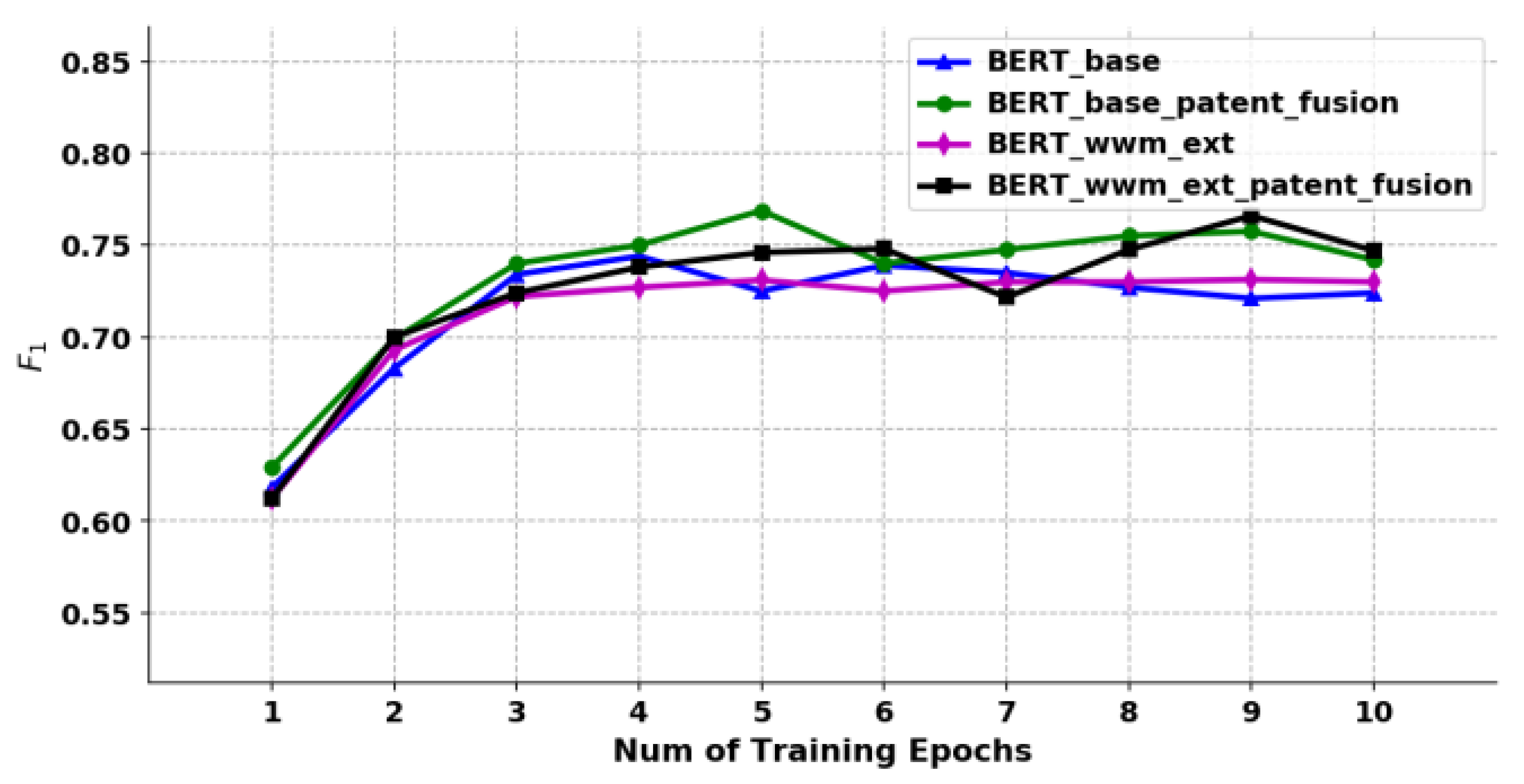
Table 1.
Comparison of general user requirements and personalized requirements.
| General User Requirements | Personalized Requirements | |
|---|---|---|
| Requirements Sources | User comments from ordinary e-commerce platform | Tasks from crowdsourcing/collaborative community platform |
| Targeted Products | Mass-produced consumer products | Mechanical, mechanical and electrical equipment, customized products, non-ordinary consumer products |
| User Characteristics | Ordinary consumers | Field enthusiasts or practitioners |
|
Requirements Characteristics |
Dynamics, complexity, concealment, unstructured description, emotion, ambiguity | Dynamics, complexity, concealment, unstructured description, semi-professional |
| Contents | Fuzzy expression of user requirements | Core functional requirements and even some structural requirements |
| Examples | I want a mobile phone with a large screen, thin body, clear pictures, especially at night, with not card, to use for more than 3 years, to support 2 days without charging. | Our company is engaged in automation. At present, we need to purchase a manipulator to cooperate with the carton forming machine assembly line to realize automatic loading and unloading. The current manipulator is expensive, and we want to replace it with a domestic one. Requirements: purchase a six axis manipulator, which can cooperate with the forming machine process. |
Table 2.
The characteristics and typical manifestations of general user implicit requirements and personalized implicit requirements.
Table 2.
The characteristics and typical manifestations of general user implicit requirements and personalized implicit requirements.
| General User Implicit Requirements | Personalized Implicit Requirements | |
|---|---|---|
| Kano Types | Basic and Expected | Attractive |
| Characteristics | The incompleteness of the description | Subjective limitations of the users |
| Typical Manifestations | Standard function operation words, typical structure words and standard engineering parameters | Sub-actions of FAs, pre/post action of FAs,sub/parent or very similar structures of FOs/structures |
| Example | Smooth operation, HD camera, good durability, large capacity battery, etc | Ingredients, testing, grasping, transportation, sorting, robotic hand, robotic arm, etc |
Table 4.
Methods of the multi-type personalized implicit requirements mining.
| Types of Personalized Implicit Requirements | Relations with the Explicit Requirement Entities | Mining Method |
|---|---|---|
| Sub-actions of the FAs (Type Ⅰ) | Co-occurrence mostly | Entity-layer; Structural similarity |
| Pre/post action of FAs (Type Ⅱ) | ||
| Sub/parent structures of FOs/structures (Type Ⅲ) | ||
| Pre/post actions of sub-actions of FAs (Type Ⅳ) | Non-co-occurrence mostly | Co-reference embedding layer; Link prediction |
| Similar structures of FOs/structures (Type Ⅴ) | Non-co-occurrence |
Table 5.
Structural entities classification information in the domain knowledge graph.
| Labels | PC | TC | MC | AC | RM | BP | EC | FM | IE |
|---|---|---|---|---|---|---|---|---|---|
| Proportion | 3.10% | 7.00% | 1.70% | 3.00% | 3.40% | 46.30% | 12.50% | 6.80% | 16.20% |
Table 6.
Structural entities classification information in the domain knowledge graph.
| Models | BERT-base | BERT-base-patent-fusion* | BERT-wwm-ext | BERT-wwm-ext-patent-fusion* |
|---|---|---|---|---|
| Mask | Character | Character | Whole Word | Character |
| Data Source | Chinese Wiki | Patent Data | Chinese Wiki and extension | Patent Data |
| Number of Words | 40 Million | 62.01 Million | 5 Billion | 62.01 Million |
| Initialization Mode | Random | BERT-base | BERT-base | BERT-wwm-ext |
Table 8.
Implicit requirements mined in case study.
| ERE | Implicit Requirements | Mining Method and Calculation Results | Types | Whether to Adopt | ||
|---|---|---|---|---|---|---|
| Co-occurrence Frequency | Jaccard Similarity | Cosine Similarity | ||||
| Sorting | Transport | 4 | 0.89% | / | Ⅱ | Yes |
| Classification | 2 | 0.94% | / | Ⅰ | Yes | |
| Detection | 2 | 0.93% | / | Ⅰ | Yes | |
| Marking | 1 | 0.93% | / | Ⅱ | Yes | |
| Check | 1 | 0.93% | / | Ⅰ | Yes | |
| Assignment | 1 | 0.93% | / | Ⅰ | No | |
| Tin dipping | 1 | 0.93% | / | Ⅱ | No | |
| Prevent jamming | 1 | 0.91% | / | Ⅱ | No | |
| Shuttle | / | / | 65.52% | Ⅳ | No | |
| Delivery | / | / | 65.12% | Ⅳ | No | |
| Logistics | / | / | 64.85% | Ⅳ | No | |
| Distribution | / | / | 63.99% | Ⅳ | No | |
| Store | / | / | 63.46% | Ⅳ | No | |
| Place | / | / | 62.91% | Ⅳ | Yes | |
| Steel Pipe | Inner wall | 3 | 2.24% | / | Ⅲ | Yes |
| Port | 2 | 2.04% | / | Ⅲ | Yes | |
| Surface | 4 | 1.22% | / | Ⅲ | Yes | |
| Transport height | 1 | 1.14% | / | Ⅲ | No | |
| Side formwork | 1 | 1.14% | / | Ⅲ | No | |
| Building materials | 1 | 0.96% | / | Ⅲ | Yes | |
| Steel ring | / | / | 69.85% | Ⅴ | No | |
| Short pipe | / | / | 64.62% | Ⅴ | Yes | |
| Body of ships | / | / | 64.29% | Ⅲ | No | |
| Billet rod | / | / | 64.25% | Ⅴ | No | |
| Head end | / | / | 64.02% | Ⅲ | Yes | |
Note: The specific meaning of the categories from I to V is shown in Table 4.
Table 9.
Performance of each pre-trained model on each problem of knowledge graph construction.
| Problems | Pre-training Model | |||||||
|---|---|---|---|---|---|---|---|---|
| BERT-base | BERT-wwm-ext | BERT-base-patent-fusion* | BERT-wwm-ext-patent-fusion* | |||||
| Round | F-Score | Round | F-Score | Round | F-Score | Round | F-Score | |
| Domain Patent Classification | 6 | 87.71%±6.41% | 6 | 89.06%±8.69% | 6 | 91.61%±6.54% | 6 | 92.56%±7.30% |
| Functional Entities Identification | 8 | 65.42%±3.39% | 9 | 65.65%±3.54% | 7 | 65.39%±2.42% | 10 | 67.58%±2.92% |
| Structural Entities Identification | 7 | 94.28%±3.59% | 9 | 94.38%±2.68% | 10 | 94.48%±3.49% | 8 | 94.64%±2.20% |
| Structural Entities Classification | 4 | 74.40%±4.26% | 9 | 73.13%±3.66% | 5 | 76.88%±3.80% | 9 | 76.60%±2.54% |
Disclaimer/Publisher’s Note: The statements, opinions and data contained in all publications are solely those of the individual author(s) and contributor(s) and not of MDPI and/or the editor(s). MDPI and/or the editor(s) disclaim responsibility for any injury to people or property resulting from any ideas, methods, instructions or products referred to in the content. |
© 2024 by the authors. Licensee MDPI, Basel, Switzerland. This article is an open access article distributed under the terms and conditions of the Creative Commons Attribution (CC BY) license (http://creativecommons.org/licenses/by/4.0/).
Copyright: This open access article is published under a Creative Commons CC BY 4.0 license, which permit the free download, distribution, and reuse, provided that the author and preprint are cited in any reuse.


