

Submitted:
11 July 2024
Posted:
12 July 2024
You are already at the latest version
Abstract
The goal of this study is to synthesize, determine the structure, and examine the antimicrobial properties of novel metal complexes of 2,4-dithiouracil and its derivatives. These complexes were obtained by mixing aqueous solutions of the corresponding metal salts with the ligand dissolved in DMSO and aqueous NaOH, using a metal-to-ligand ratio of 1:4:2. The structures of the new compounds were analyzed by melting point determination, microwave plasma atomic emission spectrometry (MP-AES) for Cu and Au, inductively coupled plasma optical emission spectrometry (ICP-OES) for S, ATR, solution and solid-state NMR and Raman spectroscopy. The interpretation of the complex spectra was aided by data for 2,4-dithiouracil obtained from 1H-1H COSY, DEPT-135, HMBC, and HMQC spectra. Additionally, the antimicrobial activity of these complex-es and the free ligands was evaluated against Gram-positive and Gram-negative bacteria, as well as yeasts.
Keywords:
antimicrobial activity
; copper(II) complexes
; 2
; 4-dithiouracil
; gold(III) complexes
1. Introduction
Numerous sulfur-substituted pyrimidines and purines have been utilized as clinically effective drugs. It has been observed that the specific position of sulfur substitution is crucial for their biological activity. For example, 2-thiouracil, but not 4-thiouracil, exhibits significant antithyroid activity. Similarly, 6-thioguanine and 6-mercaptopurine, but not their corresponding 2-thio compounds, demonstrate antineoplastic effects.
Singh and Yadav performed DFT calculations of the vibrational spectra of 2,4-dithiouracil and its corresponding cation and anion forms [1]. M. Ruckenbauer and colleagues conducted a photoelectron study involving 2-thiouracil, 4-thiouracil, and 2,4-dithiouracil [2]. In the photoelectron spectra of all three molecules, distinct connections are observed, stemming from the ionization of electron pairs at the S- and O-atoms, as well as the pyrimidine π-system. It’s established that the structure of 2,4-dithiouracil was determined via X-ray diffraction as far back as 1967 [3]. Six tautomers of 2,4-dithiouracil were investigated with quantum chemical calculations [4]. The dithion tautomer was found to have the lowest energy. The energy difference with the second most stable tautomer (dithiol 2) is only 28 kJ mol-1. Replacement of oxygen by sulfur atoms in uracil can increase the probability of its biologically important process of spontaneous mutations by a factor of 103. Recently, a team of scientists conducted an investigation on the biomolecules 2-thiouracil, 4-thiouracil, and 2,4-dithiouracil using quantum chemical calculations, alongside an exploration of molecular packing and their impact on DNA:RNA microhelices [5]. They performed calculations to assess the potential effects of 2-thiouracil against three different pathogens: Bacillus subtilis, Escherichia coli, and Candida albicans. Additionally, the structure of 2,4-dithiouracil was analyzed in relation to various key proteins, including thyroid peroxidase, thyroid hormone receptors (TSHR), and others (Scheme 1).
Three Cu(II) complexes of 2-thiocytosine and 2,4-dithiouracil were obtained [6]. The authors suggest the formation of a polymer complex with paramagnetic properties. The reason for the stated hypothesis is the observed low solubility in almost all inorganic and organic solvents [6]. The study examined the structures and comparative stabilities of complexes formed between Cu2+ [7] and Cu+ [8] and uracil, 2-thiouracil, 4-thiouracil, and 2,4-dithiouracil by DFT calculations. Rastogi et al. described the synthesis and characterization of a Cu(II) complex with 5-carboxy-2-thiouracil [9] which was also used as a ligand for the preparation of other Mn(II), Co(II), Ni(II), Cu(II), Zn(II) and Cd(II) complexes [10]. In addition, a dinuclear complex of Cu(I) with the general formula [CuX(eitotH2)2]2 [11], where X = Cl, Br, I, was obtained by Papazoglou et al. Furthermore, Ni, Cu, and Mn complexes containing 2-thiouracil, 8-hydroxyquinoline and 2-hydroxyquinoline as ligands were described in a previous report [12].
The complexation ability of 2-thiouracil and 2,4-dithiouracil with Cd(SeCN)2 and Hg(SeCN)2 was investigated [13]. Based on the obtained experimental data, the authors propose the probable scheme for obtaining the Cd(II) and Hg(II) complexes with 2-thiouracil and 2,4-dithiouracil. This indicates that the ligand forms a bidentate chelation, involving the nitrogen atom in the 3rd position and the sulfur atom in the second position. Tiekink et al. have shown that thiouracil-containing complexes are effective antitumor and arthritic compounds in vivo [14]. Initial findings from testing for antiarthritic activity in rats regarding the new complexes are also disclosed, demonstrating that certain complexes exhibit greater efficacy or lower toxicity compared to current clinically utilized gold(I) thiolates. Recently, Gimeno and Laguna presented a review about the gold complexes with N, S, P, C donor ligands and with oxygen-based ligands [15]. Yang and Hu studied the conformations, adsorption sites, and orientation of 2-thiouracil on gold substrates at different pH values using SERS (surface-enhanced Raman scattering) and DFT calculations [16]. The use of spherical gold nanoparticles, modified with biologically active molecules, shows considerable promise for diverse medical applications [17]. Specifically, considering the established uses of 2-thiouracil (2-TU) in the treatment of hyperthyroidism and skin cancer, the compound 2-TUAuNPs (gold nanoparticles) stands out as a potential drug candidate for these conditions, providing the benefit of markedly reduced side effects [17]. Fernández-Moreira et al. presented the antitumor properties of gold complexes with biologically relevant ligands [18]. New anionic bis(thiolato)gold(I) complexes were obtained by Vicente et al. [19]. Recently, Seifert et al. published a review that explores the properties of molecular gold strings consisted of a theoretically infinite set of monomeric gold complexes, which are held together by aurophilic interactions, based on a direct gold–gold contact [20].
The synthesis of Rh(II), Ir(III), Pd(II) and Pt(II) complexes with dithiouracil was decribed [21] as their structures were determined by means of UV-Vis and IR spectroscopy and compared to the structures of some pyrimidine-containing complexes. The chelating ligands in the corresponding complexes bind to rhodium or iridium by forming octahedral structures, while their coordination with palladium and platinum leads to the formation of square planar complexes. In both cases, the ligand utilizes the N(3) and the C=S moieties to bind, although in the case of the divalent metals, the ligand is anionic. The synthesis of new complexes of Pt(IV) [22] and Pt(II) [23] with 2-thiouracil, 4-thiouracil and 2,4-dithiouracil was also published.
Many authors have reported in the in vitro antimicrobial activity of different complexes of metal ions with thiouracil derivatives against Gram-negative and Gram-positive bacteria, filamentous fungi, and yeasts [12,13,24,25,26,27,28,29]. Metal complexes of thiouracil derivatives have also exhibited cytotoxic effects against various tumor cell lines [11,24,30,31,32,33]. Marinova and Tamahkyarova (2024) have published a review, focused on the synthesis and the biological activities of 2-thiouracil and its derivatives [34].
The coordination of 2,4-dithiouracil and its derivatives in several metal complexes is shown in Figure 1, Figure 2, Figure 3 and Figure 4. Some complexes exhibit a monodentate coordination binding through atoms, such as S (e.g., Cu(I), Au(I), Pt(IV) complexes) [11,14,22] and/or forming bidentate chelate through N3 and S2 (e.g., Cu(II), Cd(II), Hg(II), Rh(III), Ir(III), Pd(II), Pt(II), Pt(IV) complexes) [6,13,21,22].
This paper describes the synthesis and structure elucidation of novel metal complexes of 2,4-dithiouracil and its derivatives. They were characterized using various methods including melting point analysis, MP-AES, ICP-OES, ATR, 1H NMR, HSQC, 13C NMR solid-state and Raman spectroscopy. The assignment of NMR signals for the ligand (2,4-dithiouracil) was determined from 1H NMR, 13C NMR, DEPT-135, 1H-1H COSY, HMBC and HSQC spectra. Furthermore, their antimicrobial efficacy against both Gram-positive and Gram-negative bacteria, as well as yeasts, was evaluated.
2. Materials and Methods
2.1. Spectra Measurements
The free ligand 2,4-dithiouracil is purchased from Aldrich Chem. The metal salts Cu(CH3COO)2.H2O and (NH4)[AuCl4].H2O (Aldrich Chem) and solvents used for synthesis of the complexes were with a high purity generally equal to A.C.S. grade and suitable for use in many laboratory and analytical applications. The Raman spectra of compounds (the stirred crystals placed in aluminium disc) were measured on a RAM II (Bruker Optics) with a focused laser beam of Nd:YAG laser (1064 nm) from 4000 to 100 cm-1 at resolution 2 cm-1 with 25 scans. ATR spectra of the complexes were measured (MIRacle Single reflection, PIKE technology). The NMR spectra of the ligand were registered on a Bruker Avance II NMR spectrometer operating at 600.130 and 150.903 MHz for 1H and 13C, respectively, using the standard Bruker software. The NMR spectra of the metal complexes were measured on a Bruker Avance III HD spectrometer operating at 500.130 and 125.76 MHz for 1H and 13C, respectively, using the standard Bruker software. Solid-state NMR spectra were acquired on a Bruker Avance III HD 500 MHz spectrometer equipped with 2.5 mm Cross-Polarization Magic Angle Spinning (CPMAS) probehead. CP MAS and Cross Polarization with Polarization Inversion (CPPI) MAS spectra were recorded at MAS speed of 15 kHz and α-glycine was used as external reference (α-glycine carbonyl C - 176.03 ppm). Measurements were carried out at ambient temperature.
2.2. MP-AES Determination of Cu and Au and ICP-OES Determination of S in the Complexes
Sample digestion for determination of Cu, Au and S: approximately 0.02 g of the complexes were weighted on analytical balance and dissolved in concentrated HNO3 (p.a., Chem-Lab NV) for Cu-containing complex and HNO3 and HCl (p.a., Fluka AG) for Au-containing complex. Blank samples were prepared following the same digestion procedure. Determination of Cu, Au and S concentration was done with external calibration solutions prepared from monoelemental standards respectively 1000 mg L-1 Cu (Merck, Darmstadt, Germany), 1000 mg L-1 Au (High-purity Standards, Charleston, England) and 1000 mg L-1 (CPAchem, Ltd.). Cu and Au were measured by Microwave plasma – atomic absorption spectrometry (MP-AES 4200, Agilent Technologies) on analytical lines 324.754 nm, 327.395 nm, 510.554 nm for Cu and 242.795 nm, 267.595 nm, 312.278 nm for Au using standard measurement conditions. Sulfur was determined by Inductively coupled plasma – optical emission spectrometry (ICP-OES iCap 6000, Thermo scientific) on analytical lines 180.731 nm, 182.034 nm and 182.624 nm in axial mode.
2.3. Synthesis of Cu(II) and Au(III) Complexes of 2,4-Dithiouracil (L) – General Procedure
All metal complexes were synthesized by mixing aqueous solutions of the corresponding metal salts with the ligands dissolved in DMSO and aqueous NaOH, using a metal-to-ligand ratio of 1:4:2. Non-charged complexes precipitated out and were subsequently filtered, repeatedly washed with water, and dried over CaCl2 for two weeks.
2.3.1. Synthesis of Cu(II)L and Au(III)L
An aqueous solution containing 159.7 mg (0.8 mmol) of Cu(CH3COO)2.H2O metal salt in 10 mL of water was added dropwise to a solution of 461.5 mg (3.2 mmol) of L in 10 mL of DMSO. The ligand solution had been previously alkalized with an aqueous solution of sodium hydroxide, consisting of 64.0 mg (1.6 mmol) of NaOH in 5 mL of water. Similarly, the aqueous solution containing 71.3 mg (0.2 mmol) of NH4[AuCl4]·H2O in 5 mL of H2O was slowly added to a solution of 115.4 mg (0.8 mmol) of 2,4-dithiouracil in 5 mL of dimethyl sulfoxide. This solution had also been previously alkalized (16.0 mg (0.4 mmol) of sodium hydroxide dissolved in 5 mL of H2O).
2.4. Spectral Data of the Free Ligand and Its Metal Complexes
Raman (cm-1) 2,4-DTu: 3097, 3080 (ν(C-H)), 3058, 1605, 1547 (ν(C=C)), 1491, 1425, 1359, 1357, 1254 (ν(C=S)), 1230, 1189, 1118, 1076, 984, 965, 858, 683, 611, 461, 444, 399, 387, 229.
ATR (cm-1) 2,4-DTu: 3168 (ν(NH)), 3096 ((ν(C-H)), 3080 (ν(C-H), 2994, 2923, 2894, 2720, 1921, 1695, 1673, 1610, 1565 (ν(C=C)), 1486, 1411, 1368, 1358, 1319, 1252 (ν(C=S)), 1230, 1211, 1123, 1099, 1076, 984, 965, 858, 820, 792, 695, 680, 614.
Raman (cm-1) 2,4-DTuAu(III): 3066 (ν(C-H)), 2902, 1604, 1544 (ν(C=C)), 1411, 1363, 1289, 1253 (ν(С=S)), 1219, 1189, 1147, 1120, 1099, 978, 967, 816, 715, 683, 611, 542, 461, 444, 399, 387, 269, 246, 230.
ATR (cm-1) 2,4-DTuAu(III): 3100, 3064 (ν(C-H)), 1603, 1539 (ν(C=C)), 1520, 1486, 1445, 1407, 1363, 1326, 1285, 1252 (ν(C=S)), 1226, 1189, 1122, 1077, 1013, 978, 966, 949, 932, 857, 803, 789, 761, 735, 706, 680.
Raman (cm-1) 2,4-DTuCu(II): 3101, 3018 (ν(C-H)), 2911, 1546 (ν(C=C)), 1480, 1412, 1384, 1305, 1283, 1193, 1148, 1096, 1014, 978, 820, 804, 681, 544, 449, 420, 388, 269, 246, 205.
ATR (cm-1) 2,4-DTuCu(II): 3386 (ν(O-H)), 3078 (ν(C-H)), 2996, 2908, 2362, 1654, 1600, 1546 (ν(C=C)), 1481, 1433, 1380, 1366, 1307, 1282, 1185, 1159, 1148, 1095, 1012, 950, 817, 754, 707, 679, 613.
In summary, as can be seen from the Raman and ATR spectra of the ligand that there is a band at 3080 cm-1 indicating ν(C-H). Also there is a shoulder at 3096 cm-1 in the ATR spectrum and second band in Raman spectrum at 3097 cm-1. In the case of the Au complex, Raman and ATR bands for ν(C-H) were found at 3066 cm-1 and 3064 cm-1 while the Raman and ATR bands for the Cu complex were at 3018 cm-1 and 3078 cm-1. Raman and ATR bands at 1547 cm-1 and 1565 cm-1 were for ν(C=C) stretching in 2,4-dithiouracil. Similarly, ν(C=C) bands at 1544 cm-1 and 1539 cm-1, as well as at 1546 cm-1 were found for the Au and Cu complexes, respectively. Indications for C=S bond in the ligand and Au complex were the Raman and ATR bands in the range 1252-1254 cm-1.
2.5. Antimicrobial Assay
Antimicrobial activity of 2,4-dithiouracil and its complexes against Gram-positive bacteria—Enterococcus faecalis ATCC 19433, Staphylococcus aureus ATCC 25923, Listeria monocytogenes ATCC 8787, Bacillus subtilis ATCC 6633, Bacillus cereus ATCC 11778, and Gram-negative bacteria—Escherichia coli ATCC 8739, Salmonella enterica subsp. enterica ser. Enetritidis ATCC 13076, Pseudomonas aeruginosa ATCC 9027, Proteus vulgaris G, Klebsiella pneumoniae ATCC 13883, and the yeasts Candida albicans ATCC 10231 and Saccharomyces cerevisiae was tested using the agar diffusion method. A suspension of each test microorganism (106 cfu/cm3) was spread on the surface of PCA (Scharlau) nutrient medium for C. albicans and the bacteria and Wort agar (Sharlau) for S. cerevisiae. Wells of 7 mm diameter were made in the inoculated agar medium. 50 μL of the tested substance solution (10 mg/cm3 in DMSO) was pipetted into the wells. The Petri dishes were incubated at 37°С (for the bacteria and C. albicans) and 30°С (for S. cerevisiae) for 24–48 h. The inhibition zones were measured. Zones with diameter more than 7 mm were considered as zones of inhibition. Each test was carried out in triplicates, and the accumulated data are presented as mean values.
3. Results and Discussion
3.1. Synthesis of the Metal Complexes
All of the complexes are stable in air and moisture with limited solubility. We observed that the reaction of the ligand with transition metal ions produced stable solid compounds with yields ranging from 52% to 56%. The resulting complexes exhibit yellow-green or beige coloration and have limited solubility in DMSO, DMF and C6H12 for Cu(II)L and DMSO and DMF for Au(III)L, respectively. They are insoluble in water, THF, ethanol, ethyl acetate. The analytical data, including the yield percentages of the complexes, are presented in Table 1.
1H NMR spectrum of 2,4-dithiouracil showed two singlets at 12.90 ppm and 13.64 ppm for the protons in both NH groups (H-1 and H-3), respectively. Тhe lack of HSQC correlations confirmed that these two singlets were for protons that are not bound to carbons. Additionally, there were two doublets at 6.50 ppm and 7.27 ppm in the 1H NMR spectrum that were assigned correspondingly to the H-5 and H-6 protons. In support of this assignment, there was one 1H-1H COSY correlation found between the signals at 6.50 ppm and 7.27 ppm. Also, there were two HMBC correlations for the H-5 proton with the C-4 and C-6 carbons, as well as three HMBC correlations for the H-6 proton with C-2, C-4 and C-5 carbons. The carbon assignments for 2,4-dithiouracil were additionally verified by using the option provided in the NMRShiftDB database for a 13C NMR chemical shift prediction based on hierarchically ordered spherical environment (HOSE) codes [35]. The complete NMR signal assignments for 2,4-ditiouracil are given in Table 2.
In comparison with the 1H NMR spectrum of the ligand (2,4-DTu), the 1H NMR spectrum of the gold complex showed 7 singlets at 10.81 ppm, 11.00 ppm, 12.27 ppm, 12.43 ppm, 12.88 ppm, 13.62 ppm and 14.13 ppm. Additionally, there were 8 signals at 5.45 ppm, 5.81 ppm, 6.51 ppm, 7.10 ppm, 7.27 ppm, 7.39 ppm, 7.76 ppm and 8.31 ppm. As can be seen, the 1H NMR spectrum of the gold complex contains more signals than the 1H NMR spectrum of the ligand only. Moreover, the HSQC spectrum showed the following 9 signal correlations – (5.44 ppm - 99.94 ppm), (5.81 ppm – 104.91 ppm), (6.51 ppm – 116.83 ppm), (7.10 ppm – 116.00 ppm), (7.26 ppm – 137.92 ppm), (7.39 ppm – 115.50 ppm), (7.39 ppm - 142.04 ppm), (7.76 ppm – 140.73 ppm), (8.31 ppm - 156.48 ppm). Consequently, it can be assumed that 2,4-dithiouracil could possibly undergo desulfurization [36] by the influence of the NaOH used during the synthesis of the Au complex causing the replacement of one of the sulfur atoms or both of them with oxygen, thus, obtaining 2-thiouracil and uracil in the reaction mixture. The pairs of signals (5.44 ppm – 99.94 ppm) and (5.81 ppm – 104.91 ppm) were assigned correspondingly to the protons and carbons, H-5 and C-5, in the respective structures of uracil and 2-thiouracil. There is a multiplet at 7.39 ppm with an area of 3.48 in the 1H NMR spectrum where there were presumably four signals located closely to each other. Therefore, two of these signals at 7.39 ppm were assigned to the protons (H-6) in the structures of the obtained uracil and 2-thiouracil for which the corresponding HSQC correlations (7.39 ppm – 142.04 ppm) were found. The signals at 10.81 ppm and 11.00 ppm as well as at 12.27 ppm and 12.43 ppm were assigned, respectively, to the NH-1 and NH-3 protons in uracil and 2-thiouracil. The 1H NMR spectral data for the Au complex are given in Table 3.
The signal assignments, made for uracil and 2-thiouracil, were in a good agreement with the 1H and 13C NMR data provided in Chemical Book spectral database (https://www.chemicalbook.com) for uracil, as well as with the signal assignments for 2-thiouracil, presented in a previous paper [25] concerning the synthesis of new Au, Cu and Pd complexes with 2-thiouracil.
In accordance with the assignments, presented for the ligand in Table 2, the signals at 6.51 ppm, 7.26 ppm, 12.88 ppm and 13.62 ppm in the 1H NMR spectra of the Au complex clearly showed the presence of uncoordinated 2,4-dithiouracil. However, the other HSQC correlations (7.10 ppm – 116.00 ppm), (7.39 ppm – 115.50 ppm), (7.76 ppm – 140.73 ppm) and (8.31 ppm – 156.48 ppm) were associated with the presence of some tautomeric forms of 2,4-dithiouracil and 2-thiouracil that could participate as ligands in the Au complex containing deprotonated nitrogen atoms. Thus, it can be hypothesized that not only under the alkaline conditions of the synthesis of Au complex a possible desulfurization of 2,4-dithiouracil could happen, but also the nitrogen atoms of 2,4-dithiouracil and 2-thiouracil could be deprotonated in the reaction mixture, thus, stimulating the conversion of these ligands into some of their tautomeric forms during their complexation with Au as described in previous study [22].
The signal at 14.13 ppm with an area of 1.00 showed that there is possibly a tautomeric form of 2,4-dithiouracil with one deprotonated nitrogen that could be coordinated with Au as the chemical shift 14.13 ppm most probably corresponded to the signal of the NH-3 proton. The 2,4-dithiouracil would additionally be coordinated to Au by the sulfur atom that is adjacent to the coordinated nitrogen (Figure 5). In support of this hypothesis, the chemical shifts of the carbon signals in the HSQC correlations (7.10 ppm – 116.00 ppm) and (7.76 ppm – 140.73 ppm) are close to those signals of the carbons (C-5 and C-6) in the structure of the uncoordinated 2,4-dithiouracil (see Table 3).
Therefore, the signals at 7.10 ppm, 7.76 ppm, 116.00 ppm and 140.73 ppm could respectfully be assigned to the protons (H-5 and H-6) and carbons (C-5 and C-6) of the coordinated 2,4-dithiouracil. The two signals left at each of the following chemical shifts (7.39 ppm and 8.31 ppm), in addition to the corresponding HSQC correlations (7.39 ppm – 115.50 ppm) and (8.31-156.48 ppm), possibly indicated the presence of tautomeric forms of 2-thiouracil of the same kind in the Au complex containing deprotonated nitrogen atoms. In such case, these tautomeric forms could be coordinated to Au by the sulfur bound to the carbon at the second position, C-2, and its adjacent nitrogen atoms (see Figure 5).
The potential coordination binding sites for the coordinated 2-thiouracil and 2,4-dithiouracil in the Au complex were shown on Figure 5, where the free uncoordinated uracil that was probably produced by desulfurization of the 2,4-dithiouracil ligand could take a place in the outer sphere of the complex. Also, it is possible for the free uncoordinated 2-thiouracil and 2,4-dithiouracil ligands to participate in the outer sphere of the Au complex similarly to uracil (Table 4). This structure is similar to that described in our previous paper with 6-methyl-2-thiouracil [37], as such type of bidentate coordination mode is observed in other metal complexes of Cu(II), Cd(II), Hg(II), Rh(III), Ir(III), Pd(II), Pt(II), Pt(IV) [6,13,21,22] (see Figure 3).
Additionally, the proton solid state NMR spectrum showed broad peaks at 5.37 ppm and 7.53 ppm which could be an additional indication for the protons H-5 and H-6 in uracil, thus, supporting the potential presence of uracil in the Au complex. The signals of the protons H-5 and H-6 in 2-thiouracil and 2,4-dithiouracil probably cannot be clearly observed in the proton solid state NMR spectrum because they could be also a part of the broad peaks at 5.37 ppm and 7.53 ppm. The broad signal at 13.21 ppm could involve the signals of the NH protons in the uncoordinated uracil, 2-thiouracil, 2,4-dithiouracil that could participate as ligands in the outer sphere of the Au complex (Table 4), as it could also contain the signal for the NH proton of the coordinated 2,4-dithiouracil (Figure 5). The broad peak at 3.05 ppm possibly indicated the presence of DMSO-h6 and H2O in the Au complex.
The solid state CP MAS (Figure 6A), and CPPI MAS (Figure 6B) NMR spectra of complex AuL showed signals at ca 189.7 ppm and 170.4 ppm, thus, confirming the presence of 2,4-dithiouracil in the inner coordination sphere of the Au. The signals at 116.9 ppm and 121.3 ppm would probably correspond to the carbons C-5 in the coordinated 2-thiouracil whereas the signal at 157.9 ppm could be for the carbons C-6, respectively.
The presence of DMSO-h6 in the Au complex was confirmed by the signal at 42.1 ppm in the solid state CP MAS (Figure 6A) and CPPI MAS (Figure 6B), probably in the outer sphere of the Au complex. Additionally, the 1H NMR solution spectrum showed a signal at 2.54 ppm which was an indication for the presence of DMSO-h6 in the Au complex as there was also one HSQC correlation (2.54 ppm – 40.11 ppm).
The content of Au and Cu was determined by MP-AES whereas the ICP-OES was applied for S determination. Based on the results obtained from the NMR, ATR, Raman and elemental analyses, possible tentative average compositions were suggested for the Au and Cu complexes (Table 4).
In contrast with the 1H NMR spectrum of the Au complex, there were no signals for the NH-1 and NH-3 protons of 2,4-dithiouracil in the 1H NMR spectrum of the Cu complex, see Table 5. On the other hand, there were singlets at 10.80 ppm, 11.00 ppm, 12.26 ppm and 12.43 ppm, similarly to those found in the 1H NMR spectrum of the Au complex for 2-thiouracil and uracil, indicating again that 2,4-dithiouracil most probably underwent desulfurization [36] under the alkaline conditions of the synthesis of the Cu complex due to the used NaOH. Also, the HSQC correlations (5.45 ppm – 99.78 ppm) and (5.81 ppm – 105.03 ppm) were close to the ones observed in the HSQC spectrum of the Au complex for the protons and carbons (H-5 and C-5) in uracil and 2-thiouracil, respectively. In this case, there was a multiplet at 7.39 ppm with an area of 3.27 probably consisted of three proton signals.
Additionally, the HSQC spectrum showed the following correlations – (7.40 ppm – 115.27 ppm) and (7.38 ppm – 141.85 ppm) where the signals at 7.38 and 141.85 can be assigned to the protons and carbons, H-6 and C-6, in the structures of the uncoordinated ligands, i.e., uracil and 2-thiouracil. Thus, for the ligands coordinated with Cu, one signal was left at 7.40 ppm, one signal at 7.28 ppm and two signals at 8.33 ppm in the 1H NMR spectrum. Based on the HSQC correlations (7.40 ppm – 115.27 ppm) and (7.28 ppm – 115.48 ppm), the pairs of the chemical shifts (7.28 ppm and 7.40 ppm) and (115.27 ppm and 115.48 ppm) were assigned to the signals of the protons and carbons (H-5 and C-5), whereas, the signals at 8.33 ppm and 156.26 ppm were for the protons and carbons, H-6 and C-6, of the coordinated ligands. The HSQC correlations (7.40 ppm – 115.27 ppm) and (8.33 ppm – 156.26 ppm) were very close to the HSQC correlations (7.39 ppm – 115.50 ppm) and (8.31 ppm - 156.48 ppm) observed in the HSQC spectrum of the Au complex. Thus, it can be assumed there is one ligand that would be common for the both complexes, i.e., a coordinated 2-thiouracil with the following chemical shifts for its protons and carbons (H-5, H-6, C-5 and C-6) – 7.40 ppm, 8.33 ppm, 115.27 ppm and 156.26 ppm, respectively. Thus, the other pairs of signals (7.28 ppm and 115.48 ppm) and (8.33 and 156.26 ppm) probably corresponded to the protons and carbons H-5, C-5, H-6 and C-6, respectively, in the coordinated uracil. Both ligands would probably be coordinated bidentatly with Cu – uracil with its both oxygen atoms and the thiouracil ligand with its sulfur and oxygen atom (Figure 8). As can be seen from the HSQC spectrum, there were no additional signals that could be observed for the protons and carbons of 2,4-dithiouracil.
The proton solid state NMR spectrum showed a broad peak at 7.6 ppm which probably indicated for the presence of H-5 and H-6 protons in the coordinated uracil and 2-thiouracil (Figure 8). There were no signals observed for NH protons in the proton solid state NMR spectrum confirming that the coordinated 2-thiouracil and uracil contain deprotonated nitrogen atoms. The broad peak at 2.9 ppm could indicate that DMSO-h6 and H2O participate in the Cu complex.
The solid state NMR spectra confirmed also the absence of 2,4-DTu in the Cu complex. The signal at 172.8 ppm probably corresponded to the carbon, C-2, in the coordinated 2-Tu. The signals at 150.8 ppm (C-2) and 167.7 ppm (C-4) could indicate for the carbons in the coordinated uracil. The signals for the carbons, C-6 and C-5, in the coordinated uracil can be found at 157.4 ppm (C-6) and 120.3 ppm (C-5) whereas for the coordinated 2-thiouracil – at 157.4 ppm and 116.1 ppm. The solid state CP MAS (Figure 7A) and CPPI MAS (Figure 7B) showed a signal at 40.5 ppm confirming the presence of DMSO in the Cu complex. The 1H NMR solution spectrum showed a signal at 2.54 ppm which is also an indication for the presence of DMSO-h6 in the Cu complex. In addition, there was one HSQC correlation (2.54 ppm – 40.06 ppm).
The results obtained from the NMR, ATR, Raman and elemental analyses suggested the possible composition of the Cu complex (Table 4) and its tentative structure (Figure 8). In addition, it is possible Cu to be with coordination number 6, therefore, if Z1 = H2O or DMSO-h6, then Z2= H2O or DMSO-h6.
Actually, the possible structure of the Cu complex proposed in the present study was similar to that reported by Ghosh et al. for Cu(II), Mn(II), Fe(II), Co(II), and Ni(II) complexes with uracil [40]. So, we suggested bidentate coordination through S- and O-atom of 2-Tu, as well as through both O-atoms of U. Another similarity with the proposed structure in the above cited article is the possible presence of H2O as ligand in the inner coordination sphere of the Cu complex. In addition, the ligands were deprotonated at nitrogen atom in 3-position [40] whereas in our case the deprotonation is in both 1 and 3 position. Various metal complexes (Cu(II), Cd(II), Hg(II), Rh(III), Ir(III), Pd(II), Pt(II), Pt(IV)) exhibit a bidentate coordination mode with 2-thiouracil derivatives [6,13,21,22], as can be seen in Figure 3.
3.2. Antimicrobial Activity
Table 6 depicts the results from the antimicrobial assay of 2,4-dithiouracil and its complexes. The addition of Cu(II) to the ligand slightly improved the antimicrobial effect on Staphylococcus aureus ATCC 25923, Escherichia coli ATCC 8739 and Salmonella enterica ssp. enterica ser. Enetritidis ATCC 13076, while Pseudomonas aeruginosa ATCC 9027 and Saccharomyces cerevisiae were more resitant to the activity of the Cu(II) complex in comparison with the ligand. The rest of the test-microorganisms did not exhibit differences in their sensitivity between the ligand and the Cu(II) complex. These results are in line with the findings of Shaikh et al. (2011) for Cd(II) and Hg(II) complexes with 2,4-dithiouracil, which did not show improvement in antibacterial activity [13].
On the other hand, the 2,4-dithiouracil complex with Au(III) showed stronger antimicrobial effect against all of the test-microorganisms, except Escherichia coli ATCC 8739, where no change in activity was observed. The most significant increase in activity was determined against Staphylococcus aureus ATCC 25923, Eterococcus faecalis ATCC 19433 and Klebsiella pneumoniae ATCC 13883. The antimicrobial activity of Au(III) is well documented [38,39] and similarly to our previous study on the addition of Au(III) to 2-thiouracil [25], the complex exhibited increase antimicrobial activity in comparison with the ligand.
5. Conclusions
The complexation potential of 2,4-DTu and its derivatives was demonstrated for Au(III) and Cu(II) leading to the synthesis of new metal chelate complexes. A combination of various atomic and molecular spectroscopic techniques was used to determine the elemental compositions, as well as the possible structures of the proposed coordination compounds. The interpretation of the presented NMR data was the key factor for determining the possible type of the ligands in the Au and Cu complexes. The antimicrobial activity of the 2,4-dithiouracil and its complexes was studied in vitro against yeasts and Gram-positive and Gram-negative bacteria. The Cu(II) complex with the ligand showed no significant improvement in the inhibition of most test-microorganisms, while the addition of Au(III) to 2,4-dithiouracil increased its antimicrobial effect, especially on Staphylococcus aureus ATCC 25923, Eterococcus faecalis ATCC 19433 and Klebsiella pneumoniae ATCC 13883.
Author Contributions
Conceptualization, P.M. and P.P.; methodology, P.M.; formal analysis, P.P.; N.B.; D.S.; S.T.; E.V.; investigation, S.T.; N.B.; E.V.; resources, N.B.; data curation, P.M.; writing—original draft preparation, P.M, N.B., D.S., P.P.; D. B.; A.S.; writing—review and editing, P.M.; D.S., P.P.; N.B.; D.B.; A. S.; supervision, P.M.; project administration, S.T.; funding acquisition, P.P.
Funding
We acknowledge the financial support from the Fund for Scientific Research of the Plovdiv University, project СП 23-ХФ-006.
Acknowledgments
Research equipment of the Distributed Research Infrastructure INFRAMAT supported by the Bulgarian Ministry of Education and Science under contract D01-284/17.12.2019 was used.
Conflicts of Interest
The authors declare no conflict of interest.
References
- Singh, R.; Yadav, R.A. Raman and IR studies and DFT calculations of the vibrational spectra of 2,4-Dithiouracil and its cation and anion. Spectrochimica Acta Part A: Molecular and Biomolecular Spectroscopy, 2014, 130, 188–197. [Google Scholar] [CrossRef] [PubMed]
- Ruckenbauer, M.; Mai, S.; Marquetand, P.; González, L. ; González, L. Photoelectron spectra of 2-thiouracil, 4-thiouracil, and 2,4-dithiouracil. J. Chem. Phys. 2016, 144, 074303. [Google Scholar] [CrossRef] [PubMed]
- Shefter, E.; Mautner, H. G. The Crystal and Molecular Structure of 2,4-Dithiouracil. J. Am. Chem. Soc. 1967, 89, 1249–1253. [Google Scholar] [CrossRef]
- Leszczyiiski, J.; Lammertsma, K. 2,4-Dithiouracil tautomers: structures and energies. J. Phys. Chem., 1991, 95, 3128–3132. [Google Scholar] [CrossRef]
- Palafox, M. A.; Benial, A. M. F.; Rastogi, V. K. Biomolecules of 2-Thiouracil, 4-Thiouracil and 2,4-Dithiouracil: A DFT Study of the Hydration, Molecular Docking and Effect in DNA:RNA Microhelixes. Int. J. Mol. Sci., 2019, 20, 3477–3507. [Google Scholar] [CrossRef] [PubMed]
- Nelson, H. C.; Villa, J. F. Copper(II) Complexes of 2-Thiocytosine and 2,4-Dithiouracil. Inorg. Chim. Acta, 1979, 34, L235–L237. [Google Scholar] [CrossRef]
- Lamsabhi, A. M.; Alcamí, M.; Mó, O.; Yáñez, M.; Tortajada, J. Association of Cu2+ with Uracil and Its Thio Derivatives: A Theoretical Study. Chem. Phys. Chem. 2004, 5, 1871–1878. [Google Scholar] [CrossRef] [PubMed]
- Lamsabhi, A.M.; Alcamí, M.; Mó, O.; Yáñez, M. Gas-phase reactivity of uracil, 2-thiouracil, 4-thiouracil, and 2,4-dithiouracil towards the Cu+ cation: a DFT study. Chem. Phys. Chem. 2003, 4, 1011–1017. [Google Scholar] [CrossRef] [PubMed]
- Rastogi, V.K. , Alcolea Palafox, M., Singh, C., Gupta, S.L. 1999. Synthesis and characterisation of complex of Cu(II) with 5-carboxy-2-thiouracil. In: Greve, J., Puppels, G.J., Otto, C. (eds) Spectroscopy of Biological Molecules: New Directions. Springer, Dordrecht.
- Singh U., P. , Singh S., Singh S. M., Synthesis, characterization and antitumour activity of metal complexes of 5-carboxy-2-thiouracil. Metal-Based Drugs 1998, 5, 35–39. [Google Scholar] [CrossRef]
- Papazoglou, I.; Cox, P.J.; Hatzidimitriou, A.G.; Kokotidou, C.; Choli-Papadopoulou, T.; Aslanidis, P. Copper(I) halide complexes of 5-carbethoxy-2-thiouracil: Synthesis, structure and in vitro cytotoxicity. Eur. J. Med. Chem. 2014, 78, 383–391. [Google Scholar] [CrossRef]
- Worachartcheewan, A.; Pingaew, R.; Lekcharoen, D.; Prachayasittikul, S.; Ruchirawat, S.; Prachayasittikul, V. Synthesis, Antioxidant and Antimicrobial Activities of Metal Complexes of 2-thiouracil-hydroxyquinoline Derivatives Lett. Drug Des. Discov. 2018, 15, 602–611. [Google Scholar] [CrossRef]
- Shaikh, M. N.; Al-Maythalony, B. A.; Wazeer, M. I. M.; Isab, A. A. Complexations of 2-thiouracil and 2,4-dithiouracil with Cd(SeCN)2 and Hg(SeCN)2: NMR and anti-bacterial activity studies. Spectroscopy, 2011, 25, 187–195. [Google Scholar] [CrossRef]
- Cookson, P.D.; Tiekink, E.R.T.; Whitehouse, M.W. Phosphinegold(I) complexes Containing the Purine-6-thiolate Anion, and their Antiart hritic Activity. Aust. J. Chem. 1994, 47, 577–586. [Google Scholar] [CrossRef]
- Gimeno, M.C.; Laguna, A. Some recent highlights in gold chemistry. Gold Bull 2003, 36, 83–92. [Google Scholar] [CrossRef]
- Yang, W.; Hu, Y. Conformations of 2-thiouracil in the aqueous solution and its adsorption behavior on the gold substrates explored by DFT calculations and experimental methods, Spectrochimica Acta Part A: Molecular and Biomolecular Spectroscopy 2015, 134, 399–405. [CrossRef]
- Lorenzana-Vázquez, G.; Pavel, I.; Meléndez, E. Gold Nanoparticles Functionalized with 2-Thiouracil for Antiproliferative and Photothermal Therapies in Breast Cancer Cells. Molecules 2023, 28, 4453. [Google Scholar] [CrossRef] [PubMed]
- Fernández-Moreira, V.; Herrera, R. P.; Gimeno, M. C. Anticancer properties of gold complexes with biologically relevant ligands. Pure Appl. Chem, 2018. [Google Scholar] [CrossRef]
- Vicente, J.; Chicote, S. M.-T.; Gonzalez-Herrero, P.; Jones P., G. Complexes with S-Donor Ligands. Part 2. Synthesis of Anionic Bis(thiolato)gold(I) Complexes. Crystal Structure of [N(PPh3)2][Au(SR)2] (R = benzoxazol-2-yl)+. J. Chem. Soc. Dalton Trans. 1994; 3183–3187. [Google Scholar] [CrossRef]
- Seifert, T. P.; Naina, V. R.; Feuerstein, T. J.; Knöfel, N. D.; Roesk P., W. Molecular gold strings: aurophilicity, luminescence and structure–property correlations. Nanoscale 2020, 12, 20065–20088. [Google Scholar] [CrossRef]
- Lusty, J.R.; Chan, H.S.O.; Peeling, J. The synthesis and characterisation of dithiouracil complexes of rodium(III), irdium(III), palladium(II) and platinum(II). Transition Met. Chem. 1983, 8, 343–345. [Google Scholar] [CrossRef]
- Vetter, C.; Kaluderovic, G. N.; Paschke, R.; Kluge, R.; Schmidt, J.; Steinborn, D. Synthesis, characterization and in vitro cytotoxicity studies of platinum(IV) complexes with thiouracil ligands. Inorg.Chim. Acta 2010, 363, 2452–2460. [Google Scholar] [CrossRef]
- Crestoni, M. E.; Corinti, D.; Chiavarino, B.; Fornarini, S.; Scuderi, D.; Salpin, J.-Y. Insights into Cisplatin Binding to Uracil and Thiouracils from IRMPD Spectroscopy and Tandem Mass Spectrometry. J. Am. Soc. for Mass Spectrometry, 2020, 31, 946–960. [Google Scholar]
- Kamalakannan, P.; Venkappayya, D.; Balasubramanian, T. A new antimetabolite, 5-morpholinomethyl-2-thiouracil—spectral properties, thermal profiles, antibacterial, antifungal and antitumour studies of some of its metal chelates. J. Chem. Soc. Dalton Trans. 2002, 3381–3391. [Google Scholar] [CrossRef]
- Marinova, P.; Tsoneva, S.; Frenkeva, M.; Blazheva, D.; Slavchev, A.; Penchev, P. New Cu(II), Pd(II) and Au(III) complexes with 2-thiouracil: Synthesis, Characteration and Antibacterial Studies, Russ. J. Gen. Chem. 2022, 92, 1578–1584. [Google Scholar] [CrossRef]
- Marinova, P.; Hristov, M.; Tsoneva, S.; Burdzhiev, N.; Blazheva, D.; Slavchev, A.; Varbanova, E.; Penchev, P. Synthesis, Characterization and Antibacterial Studies of new Cu(II) and Pd(II) complexes with 6-methyl-2-thiouracil and 6-propyl-2-thiouracil, Appl. Sci. 2023, 13, 13150. [Google Scholar] [CrossRef]
- Abou-Melha, K. S. A Series of Nano-sized Metal ion-thiouracil Complexes, tem, Spectral, γ- irradiation, Molecular Modeling and Biological Studies. Orient. J. Chem. 2015, 31, 1897–1913. [Google Scholar] [CrossRef]
- Mohamed, M.S.; Youns, M.M.; Ahmed N., M. Synthesis, antimicrobial, antioxidant activities of novel 6-aryl- 5-cyano thiouracil derivatives. Eur. J. Med. Chem, 2013. [Google Scholar]
- Masoud, M. S.; Soayed, A. A.; El-Husseiny A., F. Coordination modes, spectral, thermal and biological evaluation of hetero-metal copper containing 2-thiouracil complexes. Spectrochim. Acta Part A: Molecular and Biomolecular Spectroscopy 2012, 99, 365–372. [Google Scholar] [CrossRef] [PubMed]
- Singh U., P. , Singh S., Singh S. M., Synthesis, characterization and antitumour activity of metal complexes of 5-carboxy-2-thiouracil. Metal-Based Drugs 1998, 5, 35–39. [Google Scholar] [CrossRef]
- Tyagi, S.; Singh, S. M.; Gencaslan, S.; Sheldrick, W. S.; Singh, U. P. Metal-5-fluorouracil-histamine complexes: solution, structural, and antitumor studies. Metal Based Drugs 2002, 8, 337–345. [Google Scholar] [CrossRef] [PubMed]
- Kumar, B.; Suman, A. Synthesis, spectroscopic characterization and biological application of copper complex of 5-carbethoxy-2-thiouracil. J. Drug Deliv. Ther. 2020, 10, 145–148. [Google Scholar] [CrossRef]
- Illán-Cabeza, N. A.; García-García, A. R.; Moreno-Carretero, M. N.; Martínez-Martos, J. M.; Ramírez-Expósito M., J. Synthesis, characterization and antiproliferative behavior of tricarbonyl complexes of rhenium(I) with some 6-amino-5-nitrosouracil derivatives: Crystal structure of fac-[ReCl(CO)3(DANU-N5,O4)] (DANU = 6-amino-1,3-dimethyl-5-nitrosouracil). J. Inorg. Biochem. 2005, 99, 1637–1645. [Google Scholar] [CrossRef] [PubMed]
- Marinova, P. E.; Tamahkyarova, K. D. Synthesis and Biological Activities of Some Metal Complexes of 2-Thiouracil and Its Derivatives: A Review. Compounds 2024, 4, 186–213. [Google Scholar] [CrossRef]
- Christoph Steinbeck, Stefan Kuhn, NMRShiftDB – compound identification and structure elucidation support through a free community-built web database. Phytochemistry, 2004, 65, 2711–2717. [CrossRef]
- A. Novakov, B. S. Orlinson and M. B. Navrotskii, Desulfurization of 2-Thioxo-1,2,3,4-tetrahydropyrimidin-4-ones with oxiranes and 2-Haloacetonitriles. Russian Journal of Organic Chemistry. 2005, 41, 607–609. [Google Scholar] [CrossRef]
- Marinova, P.; Burdzhiev, N.; Blazheva, D.; Slavchev, A. Synthesis and Antibacterial Studies of a New Au(III) Complex with 6-Methyl-2-Thioxo-2,3-Dihydropyrimidin-4(1H)-One. Molbank 2024, 2024, M1827. [Google Scholar] [CrossRef]
- Shareena Dasari, T.P.; Zhang, Y.; Yu, H. Antibacterial Activity and Cytotoxicity of Gold(I) and (III) Ions and Gold Nanoparticles. Biochem. Pharmacol. 2015, 4, 199–203. [Google Scholar] [CrossRef]
- Zhang, Y.; Dasari, T.; Deng, H.; Yu, H. Antimicrobial Activity of Gold Nanoparticles and Ionic Gold. J. Environ. Sci. Health C Environ. Carcinog. Ecotoxicol. Rev. 2015, 3, 286–327. [Google Scholar] [CrossRef]
- Ghosh, P.; Mukhopadhyay, T. K.; Sarkar, A.R. Interaction of Divalent Metal Ions with Uracil III. Complexes of MnII, FeII, CoII, NiII and CuII with Uracil Acting as Bidentate Ligand, Transition Met. Chem. 1984, 9, 46–48. [Google Scholar] [CrossRef]
Scheme 1.
Different applications of 2-thiouracil and its derivatives and their metal complexes.
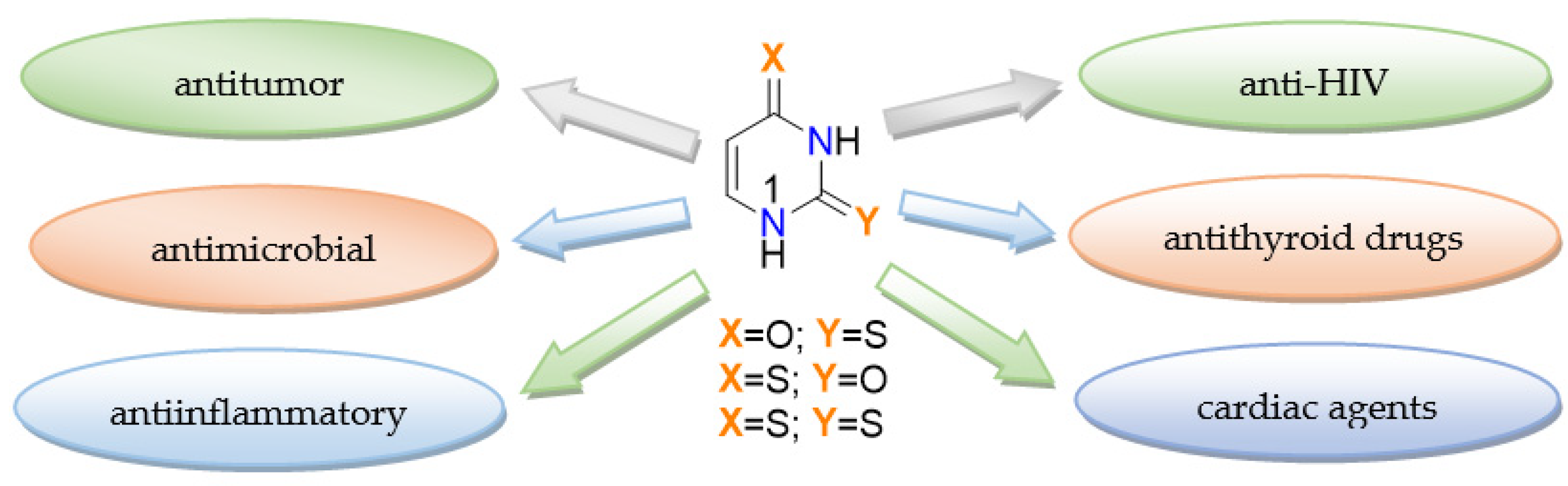
Figure 1.
Monodentate coordination of 2,4-dithiouracil with one of the four donor atoms, without any prior deprotonation (the tautomeric form participates in N1- and N3-coordination).
Figure 1.
Monodentate coordination of 2,4-dithiouracil with one of the four donor atoms, without any prior deprotonation (the tautomeric form participates in N1- and N3-coordination).
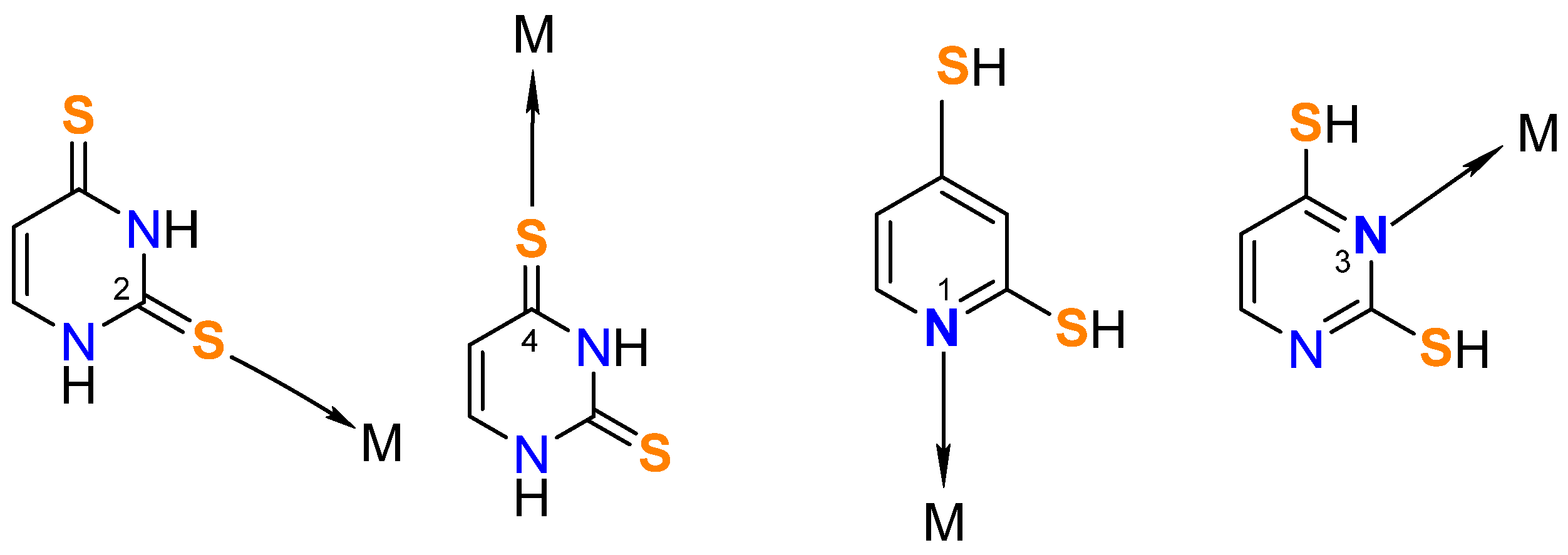
Figure 2.
Monodentate coordination with deprotonated ligand who participate as a monoanionic (through a deprotonated nitrogen atom in the first position N1 or a nitrogen atom in the third position N3).
Figure 2.
Monodentate coordination with deprotonated ligand who participate as a monoanionic (through a deprotonated nitrogen atom in the first position N1 or a nitrogen atom in the third position N3).
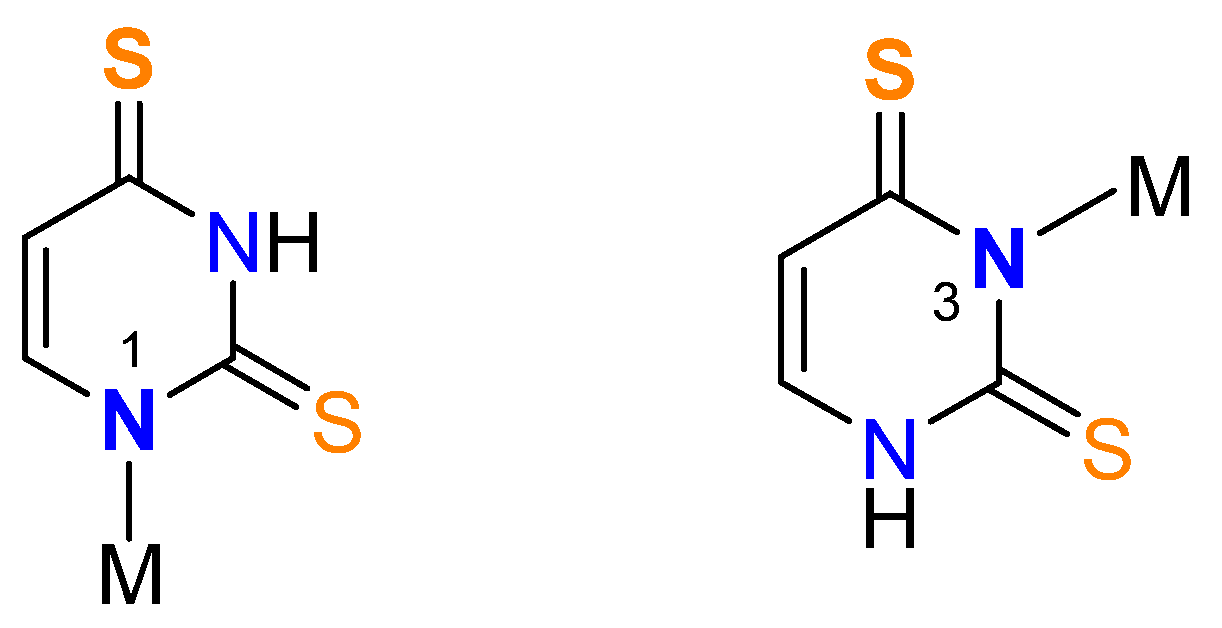
Figure 3.
Bidentate coordination with formed chelate.
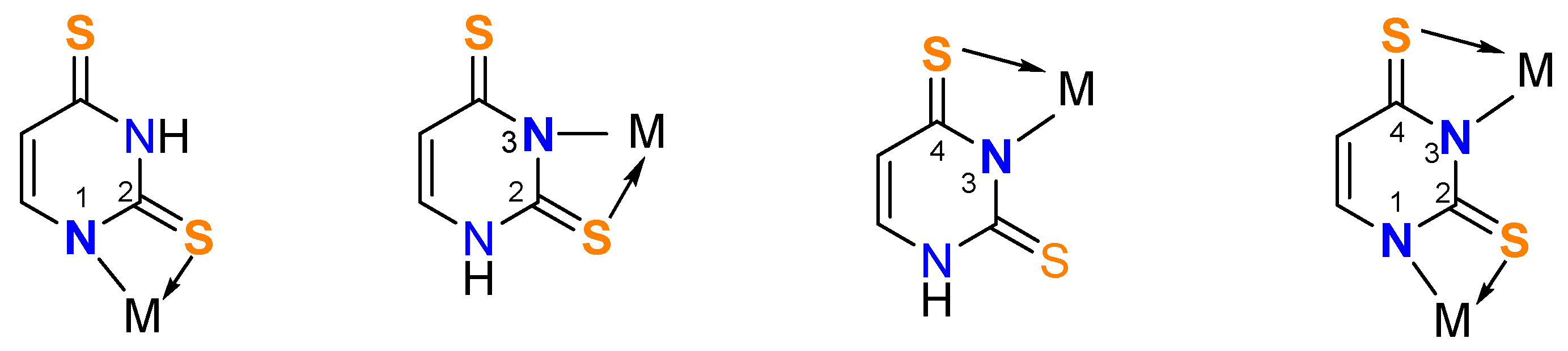
Figure 4.
Possible bridge means of 2,4-dithiouracil coordination with metal ions.
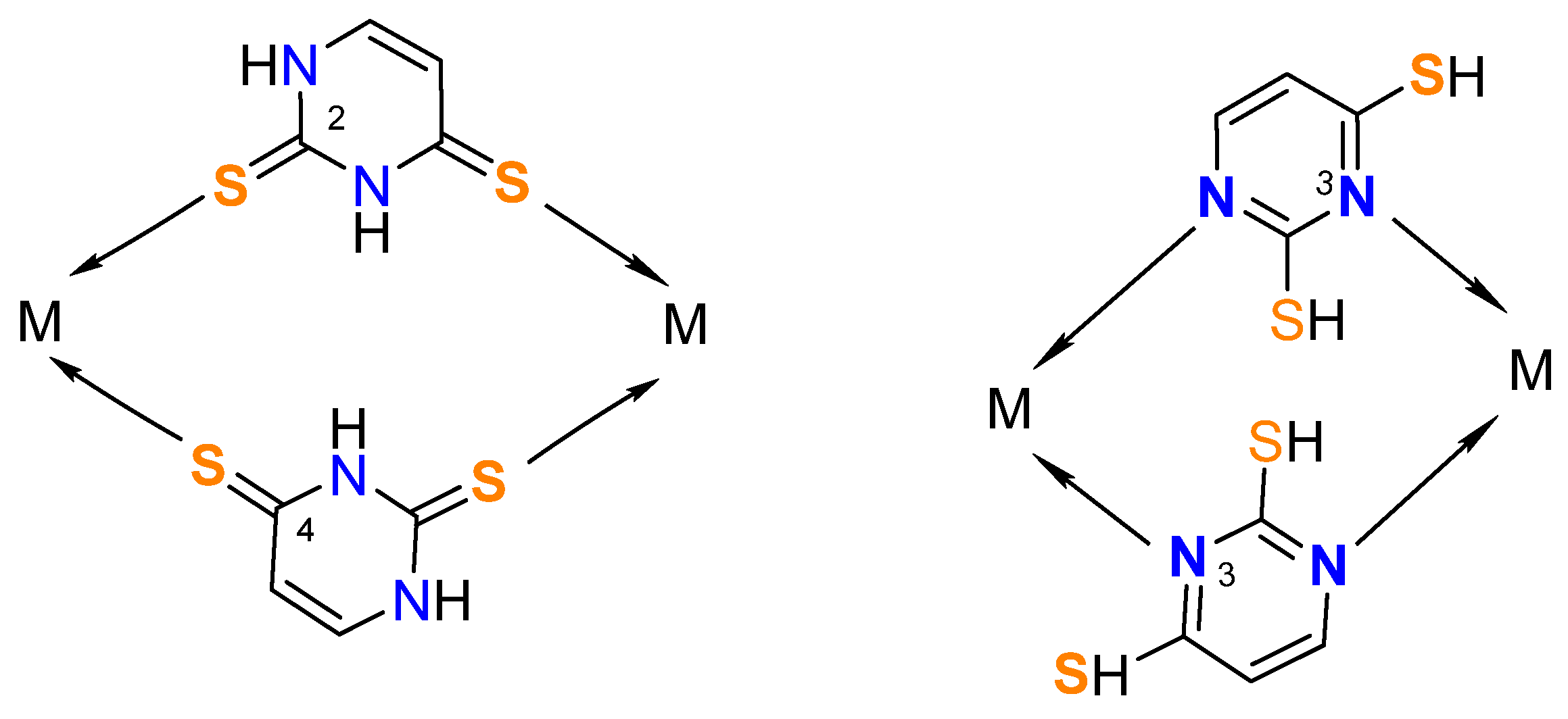
Figure 5.
Possible structures of the Au complex.
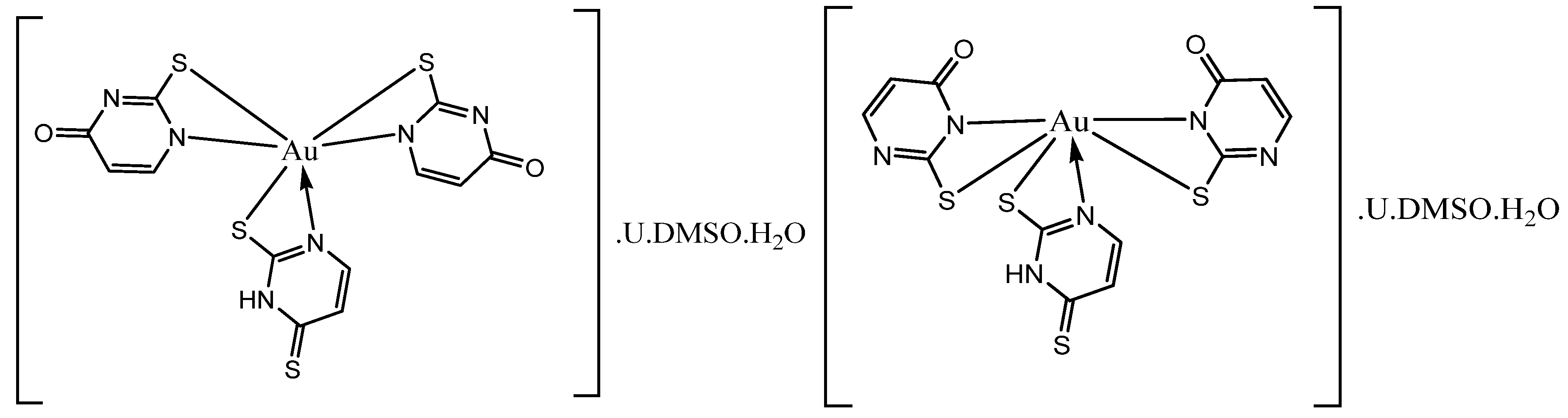
Figure 6.
CP MAS NMR spectrum of complex AuL (A); CPPI MAS NMR spectrum of complex AuL (B); CP MAS NMR spectrum of the ligand (C).
Figure 6.
CP MAS NMR spectrum of complex AuL (A); CPPI MAS NMR spectrum of complex AuL (B); CP MAS NMR spectrum of the ligand (C).
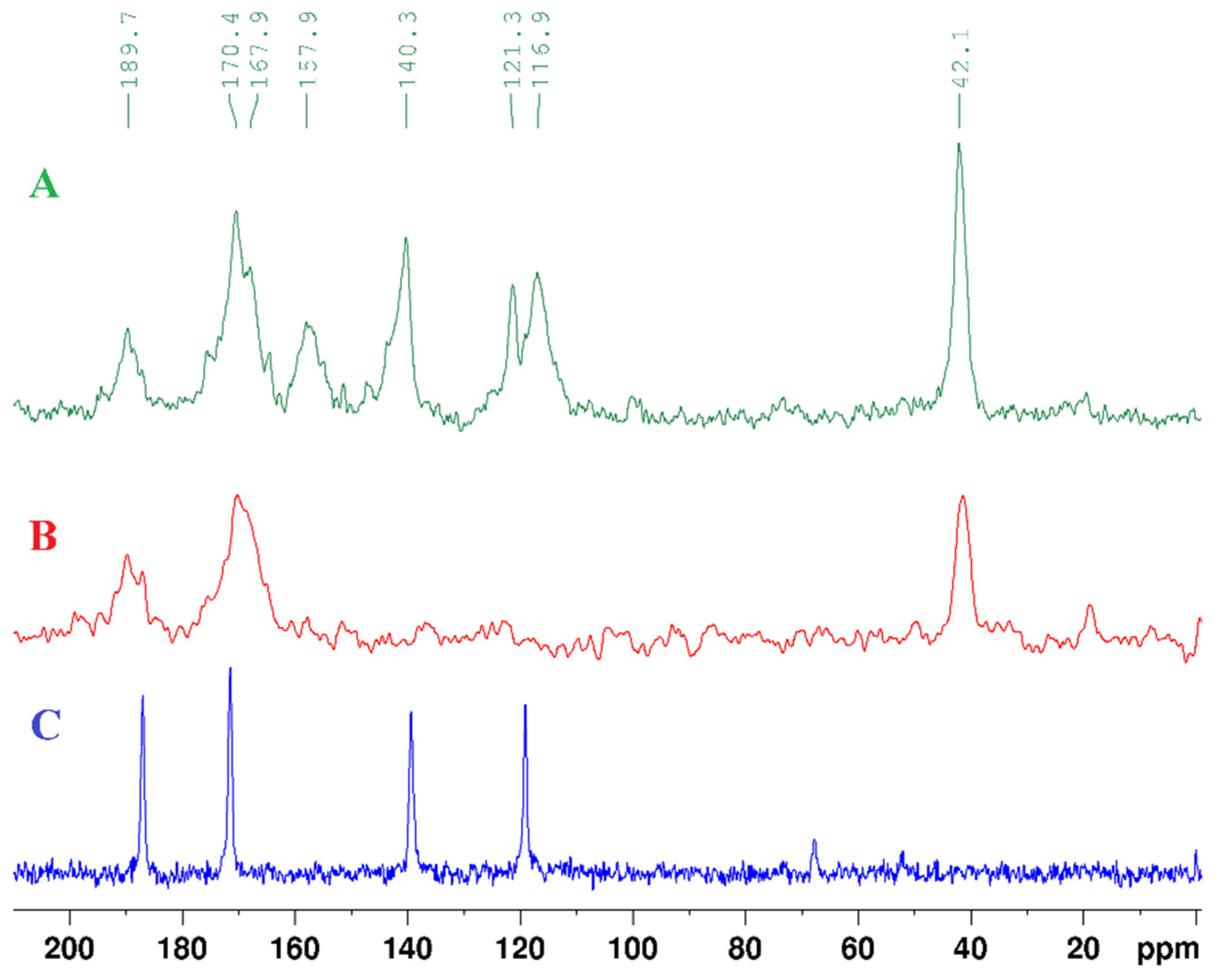
Figure 7.
13C NMR acquired with MAS at 15 kHz. A—CP spectrum of the of complex CuL; B—CPPI spectrum of the complex; C—CP spectrum of the ligand.
Figure 7.
13C NMR acquired with MAS at 15 kHz. A—CP spectrum of the of complex CuL; B—CPPI spectrum of the complex; C—CP spectrum of the ligand.
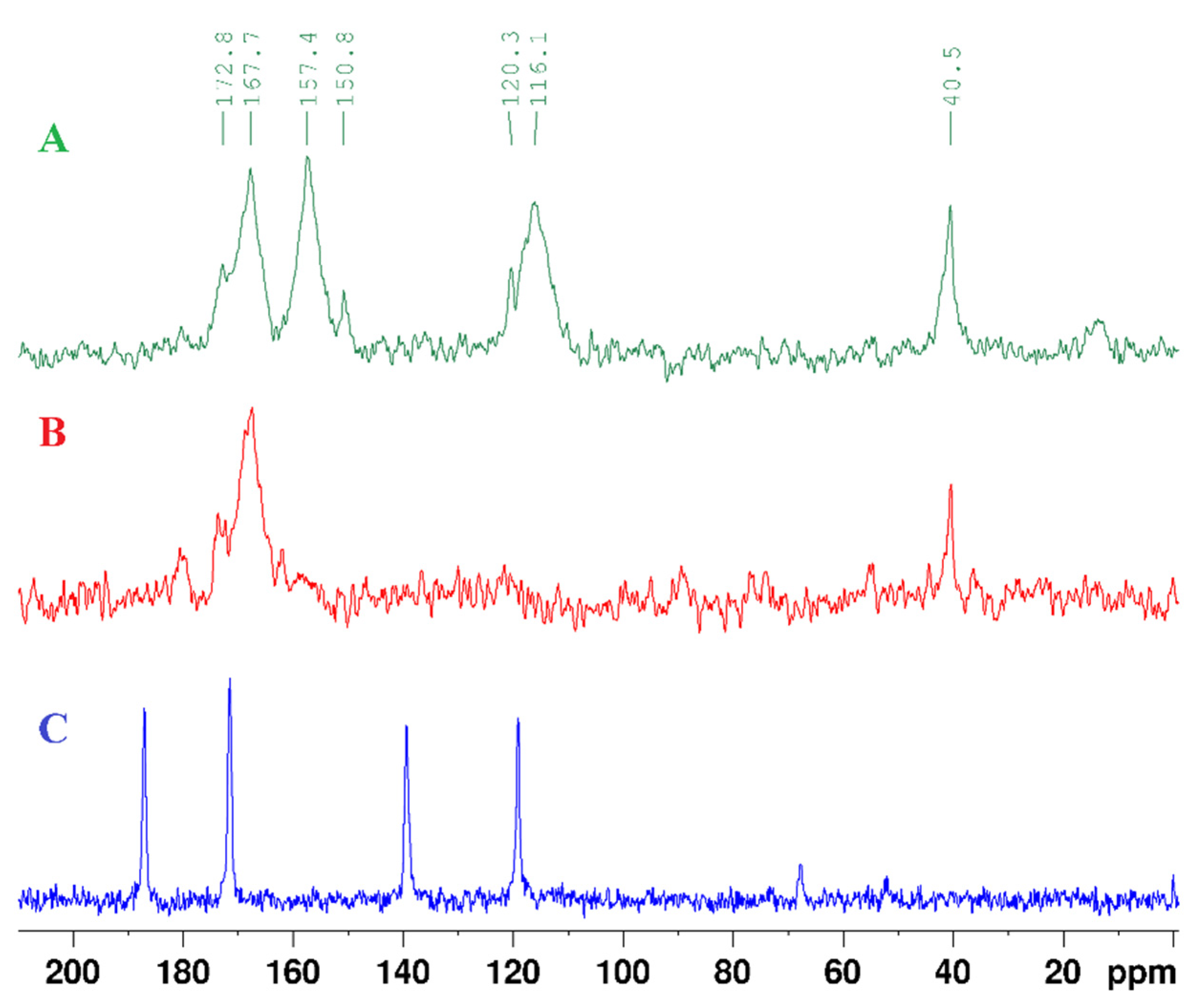
Figure 8.
A possible structure and coordination binding sites in the Cu complex.
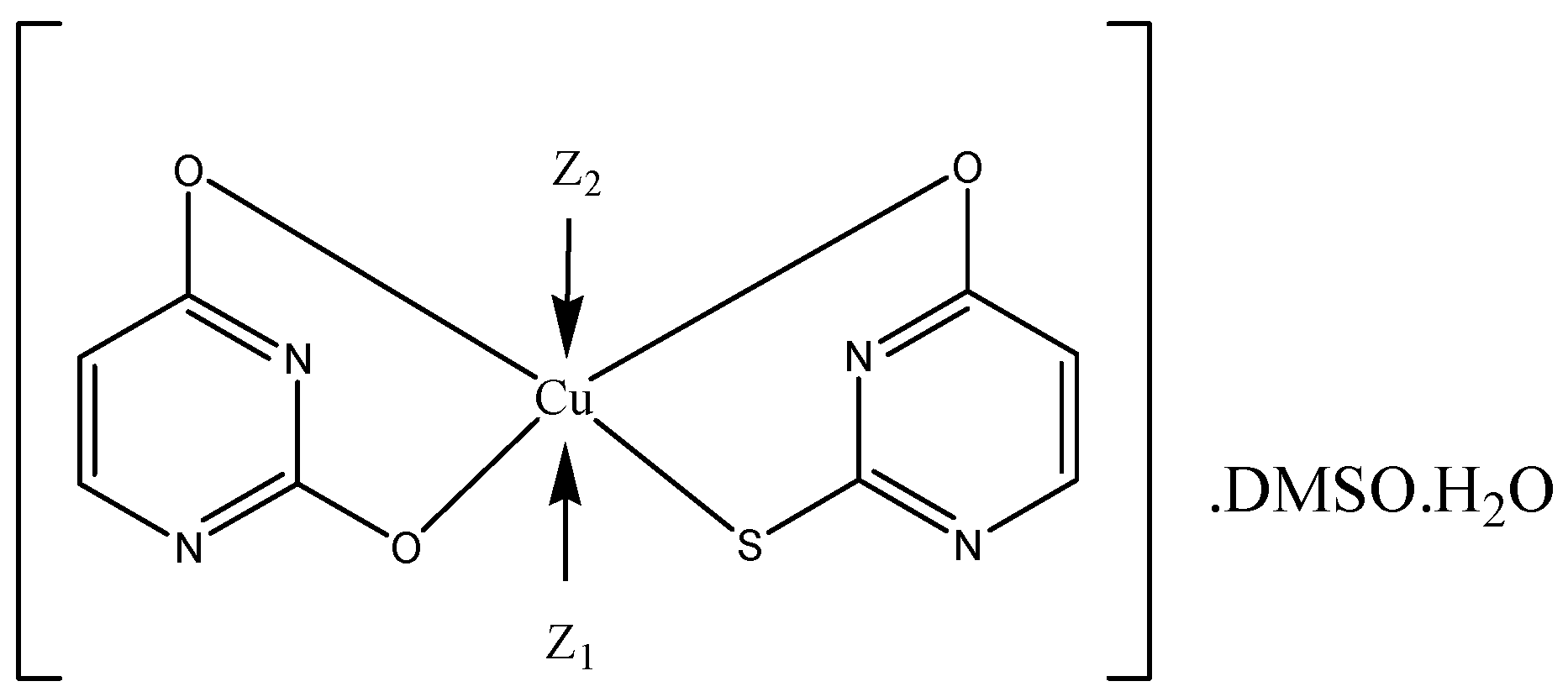

Table 1.
Analytical and physical characteristic of metal complexes with 2,4-dithiouracil.
| complexes | Colour | Yield (%) | Melting point (°C) | Solubility |
|---|---|---|---|---|
| L | yellow | 279-281 | soluble in DMSO | |
| Cu(II)L | yellow-green | 56 | >350 ᵒC | limited solubility in DMSO, C6H12 and DMF; and insoluble in EtOH, H2O, THF, EtOAc. |
| Au(III)L | beige | 52 | >350 ᵒC | limited solubility in DMSO and DMF; insoluble in H2O, THF, EtOH, EtOAc and C6H12. |
Table 2.
1H and 13C NMR spectral data and 1H-1H COSY and HMBC correlations for 2,4-dithiouracil [600.13 MHz (1H) and 150.903 MHz (13C)]a.
Table 2.
1H and 13C NMR spectral data and 1H-1H COSY and HMBC correlations for 2,4-dithiouracil [600.13 MHz (1H) and 150.903 MHz (13C)]a.
| Atom | δ (13C) ppm | DEPT-135 | δ (1H) ppm | Multiplicity (J, Hz) | 1H-1H COSY | HMBC |
|---|---|---|---|---|---|---|
| 1 (NH) | 12.90 | s | ||||
| 2 (C=S) | 172.87 | C | ||||
| 3 (NH) | 13.64 | s | ||||
| 4 (C=S) | 187.81 | C | ||||
| 5 | 117.16 | CH | 6.50 | d (7.1) | 6 | 4, 6 |
| 6 | 136.69 | CH | 7.27 | d (7.1) | 5 | 2, 4, 5 |
a) In DMSO-d6 solution. All these assignments were in agreement with COSY, HMQC and HMBC spectra.
Table 3.
1H NMR spectral data for the Au complex [500.13 MHz (1H) ]a.
| Atom | 2,4-DTub | 2-Tub | Ub | 2,4-DTu.(2-Tu)2.Auc |
|---|---|---|---|---|
| 1 | 12.88, s | 12.27, s | 10.81, s | 14.13, s (2,4-DTu) |
| 2 | ||||
| 3 | 13.62, s | 12.43, s | 11.00, s | - |
| 4 | ||||
| 5 | 6.51, d(6.7 Hz) | 5.81, d(7.50 Hz) | 5.44, m | 7.10, d(6.8 Hz), (2,4-DTu) 7.39, m, (2-Tu) 7.39, m, (2-Tu) |
| 6 | 7.26, t(6.2 Hz) | 7.39, m | 7.39, m | 7.76, d(6.7 Hz), (2,4-DTu) 8.31, d(4.7 Hz), (2-Tu) 8.31, d(4.7 Hz), (2-Tu) |
a) In DMSO-d6 solution. All these assignments were in agreement with the HSQC spectrum; b) The corresponding assignments concern the uncoordinated ligands - 2,4-dithiouracil (2,4-DTu), 2-thiouracil (2-Tu), uracil (U). c) Spectral data suggests that 2,4-DTu and 2-Tu are ligands in our complex.
Table 4.
Elemental analyses data for the metal ions and sulfur of the complexes.
| metal complex | composition* | Formula | Moleculаr weight | W(M)% calc./exp. |
W(S)% calc./exp. |
|---|---|---|---|---|---|
| Au(III)L | [2,4-DTu.(2-Tu)2.Au].U.5DMSO.5H2O | C26H51N8O14S9Au | 1185.28 g/mol | 16.62/16.7±1.5 | 24.35/25.2 ± 2.1 |
| Au(III)LCu(II)L | [2,4-DTu.(2-Tu)2.Au].U.2-Tu. 2,4-DTu.2DMSO.3H2O [2-Tu.U.Cu]. 4DMSO.4H2O |
C28H37N12O10S9Au C16H36N4O11S5Cu |
1187.22 g/mol 684.35 g/mol |
16.59/16.7±1.5 9.29/9.23±0.65 |
24.31/25.2±2.1 23.43/21.9 ± 1.8 |
*tentative average composition of different complexes. 2,4-DTu = 2,4-dithiouracil; 2-Tu = 2-thiouracil; U = uracil.
Table 5.
1H NMR spectral data for the Cu complex [500.13 MHz (1H)]a.
| Atom | 2-Tu b | U b | 2-Tu.U.Cu c |
|---|---|---|---|
| 1 | 12.26, s | 10.80, s | |
| 2 | |||
| 3 | 12.43, s | 11.00, s | |
| 4 | |||
| 5 | 5.81, d(7.3 Hz) | 5.45, d(8.2 Hz) | 7.28, d (5.5 Hz) (U) 7.40 d, m (2-Tu) |
| 6 | 7.38d, m | 7.38 d, m | 8.33, m (U) 8.33, m (2-Tu) |
a) In DMSO-d6 solution. All these assignments were in agreement with the HSQC spectrum. b) The corresponding assignments concern the uncoordinated ligands - 2-thiouracil (2-Tu), uracil (U). c) Spectral data suggests that 2-Tu and U are ligands in our complex. d) This chemical shift was assigned from the HSQC spectrum.
Table 6.
Antimicrobial activity of 2,4-DTu and its Cu(II) and Au(III) complexes.
| Test microorganisms | DMSO | 2,4-DTu | Cu(II)L | Au(III)L | |||
|---|---|---|---|---|---|---|---|
| Inhibition zone, mm | |||||||
| Staphylococcus aureus ATCC 25923 | - | 14 | 15 | 19* | |||
| Escherichia coli ATCC 8739 | - | 14 | 15 | 14 | |||
| Eterococcus faecalis ATCC 19433 | - | 12 | 13 | 16 | |||
| Salmonella enterica ssp. enterica ser. Enetritidis ATCC 13076 | - | 14 | 15 | 15 | |||
| Pseudomonas aeruginosa ATCC 9027 | - | 13 | 12 | 15 | |||
| Proteus vulgaris G | - | 12* | 12* | 14* | |||
| Bacillus subtilis ATCC 6633 | - | 11 | 11 | 13 | |||
| Bacillus cereus ATCC 11778 | - | 11 | 11 | 14* | |||
| Listeria monocytogenes ATCC 8787 | - | 12 | 12 | 14 | |||
| Klebsiella pneumoniae ATCC 13883 | - | 12* | 11* | 15 | |||
| Candida albicans ATCC 10231 | - | 10 | 11* | 12 | |||
| Saccharomyces cerevisiae | - | 11 | 10 | 12 | |||
well diameter – 7 mm. * Inhibition zone with single cell colonies.
Disclaimer/Publisher’s Note: The statements, opinions and data contained in all publications are solely those of the individual author(s) and contributor(s) and not of MDPI and/or the editor(s). MDPI and/or the editor(s) disclaim responsibility for any injury to people or property resulting from any ideas, methods, instructions or products referred to in the content. |
© 2024 by the authors. Licensee MDPI, Basel, Switzerland. This article is an open access article distributed under the terms and conditions of the Creative Commons Attribution (CC BY) license (http://creativecommons.org/licenses/by/4.0/).
Copyright: This open access article is published under a Creative Commons CC BY 4.0 license, which permit the free download, distribution, and reuse, provided that the author and preprint are cited in any reuse.


