

Submitted:
06 November 2023
Posted:
07 November 2023
You are already at the latest version
Abstract
The primary objective of this study is to synthesize, elucidate the structural properties, and ex-plore the biological activity of novel metal complexes derived from 6-methyl-2-thiouracil and 6-propyl-2-thiouracil. The paper outlines a synthesis method and assesses the antimicrobial activ-ity of newly formed Cu(II) and Pd(II) complexes with two substituted 2-thiouracil ligands. The structural attributes of these newly developed compounds are thoroughly discussed based on data derived from melting point analysis, MP-AES for Cu and Pd, UV-Vis, IR, ATR, 1H NMR, 13C NMR and Raman spectroscopy. The interpretation of the complex spectra is assisted by the data for 6-methyl-2-thiouracil and 6-propyl-2-thiouracil obtained from 1H-1H COSY, DEPT-135, HMBC and HMQC spectra. In addition, the antimicrobial activity of these complexes and the free ligands are assessed against both Gram-positive and Gram-negative bacteria, as well as yeasts.
Keywords:
6-methyl-2-thiouracil
; 6-propyl-2-thiouracil
; complexation
; copper(II) complexes
; palladium(II) complexes
; antimicrobial activity
1. Introduction
Pyrimidine derivatives are documented to possess a wide range of biological activity such as antineoplastic [1], antiviral [2], antimicrobial [3], free radical scavenging [4], anti-inflammatory [5], pain-relieving [6], and anxiety-reducing [7] properties. Thionamides, a class of relatively simple molecules, serve as antithyroid drugs, featuring a sulfhydryl group and a thiourea moiety within a heterocyclic framework. In the United States, the antithyroid drugs in use are Propylthiouracil (also known as 6-propyl-2-thiouracil) and Methimazole (referred to as 1-methyl-2-mercaptoimidazole or Tapazole). Various literature reviews have delved into this subject [8,9,10].
Notably, a study by Xiao-Ming Mao et al. explored the efficacy of intrathyroid injection of dexamethasone in reducing the relapse rate of hyperthyroidism in patients newly diagnosed with Graves’ disease [11]. Furthermore, Propylthiouracil is currently regarded as the preferred treatment for hyperthyroidism during pregnancy [12]. A comprehensive review on the topic of hyperthyroidism and pregnancy was presented by M.G. Fernandez [13]. N.Z. Shaban et al. synthesized metal complexes involving pyrimidine, which encompass Cd and Zn-barbiturate, as well as Cd and Hg-thiouracil compounds [14]. In another study, new complexes of Cu(II), Ni(II), Co(II), and Pd(II) were reported [15]. These complexes featured a Schiff base known as {1-[(5-bromo-2-hydroxy-benzylidene)-amino]-4-phenyl-2-thioxo-1,2-dihydro-pyrimidin-5-yl}-phenyl-methanone [15].
The reaction of 5-bromouracil led to the preparation of novel complexes involving Mn(II), Cd(II), Co(II), Ni(II), Cu(II), and Ag(I) [16]. The obtained data demonstrated that these complexes exhibited greater antimicrobial potency compared to the free ligand.
The interest in platinum and palladium complexes stems from their pronounced cytostatic activity. Recently, cis-dihalogeno complexes of Pt(II) and Pd(II) were synthesized in conjunction with 6-tert-butyl-2-thiouracil [17]. Oladipo and Isola provided a comprehensive review on the coordination possibilities of uracil and the practical applications of some of its complexes [18]. Furthermore, a series of complexes was synthesized using Rh(III), Ir(III), Pt(II), and Pd(II) in combination with the ligand 6-methyl-2-thiouracil [19].
K. Paizanos et al. successfully obtained new Cu(I) complexes featuring the antithyroid drug 6-propyl-thiouracil [20].
New complexes, including Cd(II) and mixed-ligand peroxo complexes of vanadium, were prepared using 1,3-propanediamine in combination with 2-thiouracil and its 6-methyl derivative [21,22]. L. M. Bomfim et al. conducted a synthesis of Ru(II) complexes involving 6-methyl-2-thiouracil, showing promise as novel antileukemic drug candidates [23].
To date, a multitude of metal complexes have been synthesized using uracil and thiouracil derivatives, involving various metals such as Cu, Fe, Co, Ni, Zn, Mn, Cd, V [24,25,26], as well as Pd, Pt, and Au, with evaluations of their composition and structure [27]. New thiolate gold(I) complexes, featuring P(NMe2)3 (HMPT) as a phosphane group, were successfully synthesized [28], with two of these thiolate gold(I) complexes demonstrating effectiveness as potential candidates for chemotherapy.
In vitro screening of the antimicrobial activity of numerous metal complexes derived from thiouracil derivatives was conducted against Gram-positive and Gram-negative bacteria, filamentous fungi, and yeast [15,16,29,30,31,32].
Furthermore, the cytotoxic effects of various metal complexes of thiouracil derivatives were investigated against different tumor cell lines [23,28,33,34,35,36,37].
In Scheme 1 (top), the chemical structure of 6-methyl-2-thiouracil and 6-propyl-2-thiouracil was represented. Various metal complexes exhibit a monodentate coordination mode with 2-thiouracil derivatives, binding through different atoms, such as N1 (e.g., Cu(I) complex) [38], N3 (e.g., Pd(II) complex) [39], S (e.g., Ru(II), Cu(I), Sn(IV), Pt(II), Pd(II) complexes) [17,20,34,40], or O (e.g., Co(II), Ni(II), Mn(II), Zn(II) complexes) [41,42,43].
At the bottom of Scheme 1, the bidentate coordination modes of these ligands are highlighted. There are at least four potential bidentate coordination possibilities (A-D) for both ligands. Some of these modes were examined by Lusty and colleagues [19], who discussed coordination modes represented in (A) and (B) in the presence of platinum and rhodium centers, respectively. These were the most common coordination modes for this ligand class. Complexes with Pt(II), Pd(II), Ru(II) and Zn(II) also display coordination mode (A) [15,19,23,39,44], while coordination mode (B) was observed in Cd(II), Hg(II), Co(II) complexes and peroxo complexes of vanadilum [14,21,22,45]. To date, possibility (C) has not been observed for thiouracil derivatives, except in an osmium/uracil complex [46] and Mn(II), Co(II), Ni(II), Cu(II), Cd(II), Ag(I) with 5-bromo-uracil [16]. Coordination mode (D) was observed in a Ru(II) complex with 2,2′-bipyridine (bipy) [47], tin(IV) complexes [48] and Pt(II) with 5,6-diamino-4-hydroxy-2-mercaptopyrimidine [27]. Tridentate coordination mode with the participation of S2,N3,O4-atoms of the free ligands [14,15,24,31] was reported also.
This paper presents the synthesis of novel metal complexes involving 6-methyl-2-thiouracil and 6-propyl-2-thiouracil. The characterization of these compounds was conducted through various techniques, including melting point determination, UV-Vis, IR, 1H NMR, 13C NMR and Raman spectroscopy. The assignment of NMR signals of the ligands was obtained from 1H-1H COSY, DEPT-135, HMBC, and HMQC spectra. In this study we provide details regarding the synthesis of new Cu(II) and Pd(II) complexes with 6-methyl-2-thiouracil (L1) and 6-propyl-2-thiouracil (L2). Furthermore, the antimicrobial activity against both Gram-positive and Gram-negative bacteria, as well as yeasts, is evaluated.
2. Materials and Methods
2.1. Spectra measurements
The free ligands 6-methyl-2-thiouracil and 6-propyl-2-thiouracil are purchased from Aldrich Chem. The metal salts Cu(CH3COO)2.H2O and Pd(NO3)2.H2O (Aldrich Chem) and solvents used for synthesis of the complexes were with a p. a. quality. Absorption spectra were registered on a UV-30 SCAN ONDA UV/Vis/NIR Spectrophotometer from 200 to 1000 nm. The IR spectra of L1, L2 and their complexes were registered in KBr pellet on a Bruker FT-IR VERTEX 70 Spectrometer from 4000 cm-1 to 400 cm-1 at resolution 2 cm-1 with 25 scans. The Raman spectra of compounds (the stirred crystals placed in aluminium disc) were measured on a RAM II (Bruker Optics) with a focused laser beam of of Nd:YAG laser (1064 nm) from 4000 to 100 cm-1 at resolution 2 cm-1 with 25 scans. Additionally, ATR spectra of the complexes were measured (MIRacle Single reflection, PIKE technology) to check if the coordination water was present in them. The NMR spectra of the ligand were registered on a Bruker Avance II NMR spectrometer operating at 600.130 and 150.903 MHz for 1H and 13C, respectively, using the standard Bruker software. The NMR spectra of the metal complexes were measured on a Bruker Avance III HD spectrometer operating at 500.130 and 125.76 MHz for 1H and 13C, respectively, using the standard Bruker software. Measurements were carried out at ambient temperature.
2.2. Microwave Plasma – Atomic emission spectrometry (MP-AES) determination of Cu and Pd in the complexes
0.0200 g of sample were weighted on analytical balance and dissolved with 65% nitric acid, p.a. (Chem-Lab NV) for Cu-complexes and nitric and 37% hydrochloric acid, p.a. (Fluka AG) for Pd-complexes. Blank solutions were prepared as well. After appropriate dilution, concentration of Cu and Pd was determined by MP-AES 4200 (Agilent technologies). Calibration standards were prepared from monoelemental standard solutions – 1000 mg L-1 Cu (Merck, Darmstadt, Germany) and 1000 mg L-1 Pd (High-purity standards, Charlestone, England). Conventional MP-AES operating conditions were used. Analytes were measured on three emission lines for estimation of potential spectral interferences, i.e. 324.754 nm, 327.395 nm, 510.554 nm for Cu and 340.458 nm, 360.955 nm, 363.470 nm for Pd. Five replicates and 5 seconds measurement were applied for all lines.
2.3. Synthesis of Cu(II) and Pd(II) complexes of 6-methyl-2-thiouracil (L1) and 6-propyl-2-thiouracil (L2)
The added reagents, M, L, OH-, were in 1:4:2 molar ratio.
2.3.1. Synthesis of Cu(II)L1
0.0008 mol Cu(CH3COO)2.H2O (0.1597 g) in 10 mL H2O;
0.0032 mol (0.4550 g) of 6-methyl-2-thiouracil (L1) in 10 mL DMSO;
0.0016 mol (0.0640 g) NaOH in 5 mL H2O.
2.3.2. Synthesis of Pd(II)L1
0.002 mol (0.4609 g) Pd(NO3)2.H2O in 10 mL H2O
0.008 mol (1.1374 g) of 6-methyl-2-thiouracil (L1) in 10 mL DMSO;
0.004 mol (0.1600 g) of NaOH in 5 mL H2O.
2.3.3. Synthesis of Cu(II)L2
0.0008 mol Cu(CH3COO)2.H2O (0.1597 g) in 10 mL H2O;
0.0032 mol (0.5447 g) of of 6-propyl-2-thiouracil (L2) in 10 mL DMSO;
0.0016 mol (0.0640 g) NaOH in 5 mL H2O.
2.3.4. Synthesis of Pd(II)L2
0.002 mol (0.4609 g) Pd(NO3)2.H2O in 10 mL H2O
0.008 mol (1.1318 g) of 6-propyl-2-thiouracil (L2) in 10 mL DMSO;
0.004 mol (0.1600 g) of NaOH in 5 mL H2O.
5 mL of NaOH was gradually introduced into a ligand solution under continuous stirring maintaining a pH of 8. The corresponding metal salts solution was dropwise from a burette while using an electromagnetic stirrer. Precipitation of the resulting complexes commenced after 2 hours and 24 hours, manifesting as a yellow-green and brown solid for the copper(II) complexes and palladium(II) complexes, respectively. The precipitates were subsequently separated by filtration, rinsed with 10-20 cm3 of H2O, and then dried over CaCl2 for a period of 2 weeks.
2.4. Spectral data of the free ligands and their metal complexes
UV-Vis (DMSO) of L1: λmax= 258, 294 nm
IR (cm-1) of L1: 3115 (NH), 3080 (NH), 3014 (=CH), 2932 (CH3), 2890 (CH3), 2580, 2407, 1920, 1893, 1863, 1754, 1698, 1676 (C=O), 1637, 1560, 1423, 1384, 1349, 1242 (C=S), 1200, 1194, 1167, 1043, 1032, 993, 962, 933, 874, 838, 808, 729, 656, 598, 580, 553, 548, 513, 457, 416.
IR (cm-1) of Cu(II)L1: 3115 (NH), 3080 (NH), 3003 (=CH), 2931 (CH3), 2888 (CH3), 1753, 1637 (C=O), 1578, 1559, 1426, 1385, 1350, 1284, 1241(C=S), 1207, 1199, 1167, 1033, 962, 933, 906, 872, 837, 809, 755, 656, 621, 597, 553, 512, 457.
ATR (cm-1) of Cu(II)L1: 3111 (NH), 3088 (NH), 3001 (=CH), 2934 (CH3), 2882 (CH3), 1752, 1699, 1633 (C=O), 1575, 1541, 1424, 1386, 1349, 1283, 1241 (C=S), 1207, 1195, 1164, 1032, 962, 932, 908, 872, 834, 806, 755, 656, 628, 621.
Raman (cm-1) of L1: 3085 (NH), 2921, 1635 (C=O), 1558, 1419, 1382, 1353, 1245 (C=S), 1199, 1177, 1043, 985, 961, 931, 834, 789, 657, 597, 554, 512, 458, 258, 214.
Raman (cm-1) of Cu(II)L1: 3084 (NH), 2916, 1636 (C=O), 1578, 1549, 1418, 1382, 1281, 1244 (C=S), 1207, 1170, 1043, 986, 961, 650, 622, 596, 573, 553, 512, 473, 456, 257, 218.
UV-Vis (DMSO) of Pd(II)L1: λmax= 258, 318 nm
IR (cm-1) of PdL1: 3442 (H2O), 3111 (NH), 3071 (NH), 3052 (=CH), 2993, 2930 (CH3), 2892, 2855 (CH3), 2750, 2697, 1678 (C=O), 1559, 1521, 1466, 1419, 1400, 1366, 1352, 1284, 1244 (C=S), 1193, 1168, 1064, 954, 830, 656, 614, 598, 576, 553, 513, 459.
ATR (cm-1) of Pd(II)L1: 3400 (H2O), 3105 (NH), 3080 (NH), 3049 (=CH), 2889, 2747, 2694, 1673 (C=O), 1636, 1559, 1515, 1465, 1417, 1399, 1365, 1351, 1285, 1242 (C=S), 1232, 1192, 1166, 1064, 953, 872, 826, 655, 613.
IR (cm-1) of L2: 3112 (NH), 3093 (NH), 3042 (=CH), 2958 (CH3), 2931 (CH2), 2873, 2607, 1877, 1777, 1703, 1656 (C=O), 1628, 1557, 1445, 1393, 1336, 1314, 1281, 1243 (C=S), 1193, 1165, 1100, 1039, 1014, 965, 940, 888, 821, 790, 743, 641, 558, 538, 508, 465, 422, 416.
Raman (cm-1) of L2: 3110 (NH), 2929 (CH2), 2871, 1661 (C=O), 1630, 1548, 1433, 1337, 1243 (C=S), 1184, 1164, 1099, 1039, 1015, 970, 938, 643, 562, 534, 459, 352, 322, 257, 230.
ATR (cm-1) of L2: 3088 (NH), 3038 (=CH), 2957 (CH3), 2928 (CH2), 2872, 1702, 1653 (C=O), 1627, 1554, 1445, 1392, 1336, 1313, 1281, 1242 (C=S), 1191, 1164, 1100, 1039, 1014, 965, 940, 887, 816, 787, 743, 640.
IR (cm-1) of Cu(II)L2: 3451 (OH), 3093 (NH), 3042 (=CH), 2962 (CH3), 2914 (CH2), 2873, 1694, 1651 (C=O), 1553, 1497, 1453,1403, 1381, 1346, 1313, 1275, 1232 (C=S), 1210, 1191, 1166, 1008, 1021, 954, 876, 832, 754, 741, 703, 669, 658, 589, 571, 559, 549, 528, 468, 414, 403.
Raman (cm-1) of Cu(II)L2: 3000, 2967, 2914, 2876, 1685, 1660 (C=O), 1631, 1595, 1500, 1438, 1416, 1381, 1276, 1230 (sh., C=S) 1212, 1165, 1089, 1021, 975, 878, 704, 670, 593, 581, 563, 531, 473, 438, 337, 307, 247, 219.
ATR (cm-1) of Cu(II)L2: 3416 (OH), 3093 (NH), 3037 (=CH), 2959 (CH3), 2913 (CH2), 2871, 1692, 1642 (C=O), 1551, 1494, 1452, 1401, 1381, 1345, 1310, 1275, 1231 (C=S), 1210, 1190, 1165, 1105, 1015, 966, 953, 875, 831, 787, 754, 738, 703, 657, 644.
IR (cm-1) of PdL2: 3437 (H2O), 3200, 3158, 3117 (NH), 3080 (NH), 2962 (CH3), 2872, 1657 (C=O), 1595, 1545, 1467, 1428, 1379, 1338, 1320, 1261 (C=S), 1202, 1175, 1091, 1023, 972, 916, 882, 832, 789, 748, 697, 643, 606, 548, 468.
ATR (cm-1) of PdL2: 3402 (H2O), 3081 (NH), 2944 (CH3), 2917 (CH2), 2867, 2829, 1703, 1643 (C=O), 1616, 1564, 1516, 1445, 1425, 1386, 1329, 1286, 1223 (C=S), 1184, 1169, 1100, 997, 965, 908, 887, 860, 819, 787, 763, 745, 680, 643, 607.
Raman spectra of PdL1 and PdL2 cannot be measured; the samples burned at 1 mW.
2.5. Antimicrobial assay
Antimicrobial activity of 6-methyl-2-thiouracil, 6-propyl-2-thiouracil and their complexes against Gram-positive bacteria—Enterococcus faecalis ATCC 19433, Staphylococcus aureus ATCC 25923, Listeria monocytogenes ATCC 8787, Bacillus subtilis ATCC 6633, Bacillus cereus ATCC 11778, and Gram-negative bacteria—Escherichia coli ATCC 8739, Salmonella enterica subsp. enterica ser. Enetritidis ATCC 13076, Pseudomonas aeruginosa ATCC 9027, Proteus vulgaris G, Klebsiella pneumoniae ATCC 13883, and the yeasts Candida albicans ATCC 10231 and Saccharomyces cerevisiae was tested using the agar diffusion method. A suspension of each test microorganism (106 cfu/cm3) was spread on the surface of PCA (Scharlau) nutrient medium for C. albicans and the bacteria and Wort agar (Sharlau) for S. cerevisiae. Wells of 7 mm diameter were made in the inoculated agar medium. 50 μL of the tested substance solution (10 mg/cm3 in DMSO) was pipetted into the wells. The Petri dishes were incubated at 37°С (for the bacteria and C. albicans) and 30°С (for S. cerevisiae) for 24–48 h. The inhibition zones were measured. Zones with diameter more than 7 mm were considered as zones of inhibition. Each test was carried out in triplicates, and the accumulated data are presented as mean values.
3. Results and discussion
3.1. Synthesis of the metal complexes
The interaction of metal ions with L1 and L2 in molar ratio of metal:ligand:base (1:4:2) resulted in the formation of the complexes with suggested formulas given in Table 1. The results of elemental analysis for the metal ions were determined by Microwave Plasma – Atomic emission spectrometry. They allow to suppose the tentative average composition of different complexes.
All of the complexes are stable in air and moisture and their solubility is limited. We found that the reaction of L1 and L2 with the transition metal ions afforded a 40-72 % yield of a stable solid compound. The obtained complexes have a yellow-green or brown colour and are limited solubility in DMSO and DMF, except Cu(II)L2 (soluble in DMSO only) and insoluble in water, THF, C2H5OH, EtOAc, and cyclohexane. The analytical data including the yield percentage of the complexes are presented in Table 2.

Table 2.
Analytical and physical characteristic of metal complexes with 6-methyl-2-thiouracil.
| complexes | Colour | Yield (%) | Melting point (°C) | Solubility |
|---|---|---|---|---|
| L1 | colorless | 330 | soluble in DMSO | |
| Cu(II)L1 | yellow-green | 61 | >350 ᵒC | soluble in DMSO, DMF, C2H5OH, H2O and insoluble in THF, EtOAc and C6H12. |
| Pd(II)L1 | brown | 72 | >350 ᵒC | soluble in DMSO, DMF and insoluble in H2O, THF, C2H5OH, EtOAc and C6H12. |
| L2 | colorless | 218-220 | soluble in DMSO | |
| Cu(II)L2 | yellow-green | 43 | 260-263 ᵒC | soluble in DMSO and insoluble in H2O, THF, C2H5OH, EtOAc and C6H12. |
| Pd(II)L2 | brown | 70 | 255-257 ᵒC | soluble in DMSO, DMF and insoluble in H2O, THF, C2H5OH, EtOAc and C6H12. |
IR Verification of the structures of the metal complexes can be easily achieved by comparing the IR spectra of the free ligands with that of their metal complexes. The selected experimental data from the IR spectra of the complexes Cu(II)L1 and Pd(II)L1 and of the free ligand, cm-1 is given in Table 3.
Table 3.
Selected experimental IR data (in KBr, wavenumber in cm-1) for 6-methyl-2-thiouracil and its complexes.
Table 3.
Selected experimental IR data (in KBr, wavenumber in cm-1) for 6-methyl-2-thiouracil and its complexes.
| assignment | L1 | Cu(II)L1 | Pd(II)L1 |
|---|---|---|---|
| ν(OH) | - | - | 3442 |
| ν(NH) | 3115 sh | 3115 | 3111 |
| ν(NH) | 3080 | 3080 | 3071 |
| ν(=CH) | 3014 | 3003 | 3052 |
| ν(C=O) | 1676 m | 1637 | 1678 |
| 1560 w | 1559 | 1559 | |
| ν(C=S) | 1242 | 1242 | 1244 |
| 1167 s | 1167 | 1168 |
In the IR spectra of the free ligand L1 the bands at 3115 cm-1 and 3080 cm-1 are observed which may refer to the stretching vibrations of N-H groups. In the spectrum of the Cu(II) complex the same bands are observed at the same frequencies. In the IR spectrum of the Pd(II)L1 these bands are shifted to the lower frequencies as compared to the free ligand bands with 4 cm–1 and 9 cm–1, respectively. This fact shows that the two NH groups of the ligand participate in the coordination for palladium complex. The L1 IR bands at 1676 and 1242 сm-1 can be attributed to the stretching vibration of C4=O and C2=S groups, respectively. The stretching vibration of C4=O in CuL1 complex is shifted to the lower frequency with 39 сm-1 as compared to this stretching in the free ligand. The same bands in IR spectrum of the PdL1 complex are not changed. In the ATR spectrum of PdL1 complex the band at 3400 cm–1 may refer to the stretching vibrations of molecular H2O. This band missed for CuL1 complex.
In the IR spectrum of the free ligand L2 the bands at 3112 cm-1 and 3093 cm-1 are observed which may refer to the stretching vibrations of N-H groups. In the spectrum of the copper complex the same bands are observed at the same frequencies. In the IR spectrum of the PdL2 complex these bands are shifted; the first with +5 cm–1 and the second with -13 cm–1 as compared to those in the free ligand spectrum. This fact shows that the two NH groups of the ligand participate in the coordination for PdL2. In the IR spectrum of L2 the bands at 1656 and 1243 сm-1 can be attributed to the stretching vibrations of C4=O and C2=S groups, respectively. The band for C2=S group is shifted to the lower frequencies as compared to the free ligand spectrum with 11 cm-1 and to the higher frequencies with 18 сm-1 for the CuL2 and PdL2 complexes, respectively. The band at 3451 and 3437 cm–1 in the IR spectrum of the two complexes may refer to the stretching vibrations of OH- (CuL2) and molecular H2O (PdL2), Table 4. The solid state ATR spectra confirm these findings.
Table 4.
Selected experimental IR data (in KBr, wavenumber in cm-1) for 6-propyl-2-thiouracil and its complexes.
Table 4.
Selected experimental IR data (in KBr, wavenumber in cm-1) for 6-propyl-2-thiouracil and its complexes.
| assignment | L2 | Cu(II)L2 | Pd(II)L2 |
|---|---|---|---|
| ν(OH) | - | 3451 | 3437 |
| ν(NH) | 3112 | - | 3117 |
| ν(NH) | 3093 | 3093 | 3080 |
| ν(=CH) | 3042 | 3042 | |
| ν(C=O) | 1656 | 1651 | 1657 |
| 1557 | 1553 | 1545 | |
| ν(C=S) | 1243 | 1232 | 1261 |
| 1165 | 1166 | 1175 |
The stretching vibrations of C4=O and C2=S appear at 1635 and 1245 сm-1 in the Raman spectrum of 6-metyl-2-thiouracil and 1661 and 1243 сm-1 in that for 6-propyl-2-thiouracil, respectively. In the Raman spectrum of the CuL2 the band for C=S group is shifted with 13 сm-1 to the lower frequency.
The 1H NMR spectrum of 6-metyl-2-thiouracil (L1) shows four signals; a singlets at 12.29 ppm is for H-1 and H-3 (overlap resonances). The olefin proton appears at 5.68 ppm (H-5), and 2.06 ppm is for H-1’. These assignments are confirmed by 1H-1H COSY, 1H-broadband decoupled 13C-NMR, DEPT-135 and HMBC spectra and are given in Table 5.
Table 5.
1H and 13C NMR spectral data and 1H-1H COSY and HMBC correlations for 6-methyl-2-thiouracil [600.13 MHz (1H) and 150.903 MHz (13C)]a.
Table 5.
1H and 13C NMR spectral data and 1H-1H COSY and HMBC correlations for 6-methyl-2-thiouracil [600.13 MHz (1H) and 150.903 MHz (13C)]a.
| Atom | δ (13C) ppm | DEPT-135 | δ (1H) ppm | Multiplicity (J, Hz) | 1H-1H COSY | HMBC |
|---|---|---|---|---|---|---|
| 1 (NH) | 12.29 | s | ||||
| 2 (C=S) | 175.87 | C | ||||
| 3 (NH) | 12.29 | s | ||||
| 4 (C=O) | 161.06 | C | ||||
| 5 | 103.72 | CH | 5.68 | d (0.9) | 7 | 4b, 6, 7 |
| 6 | 153.20 | C | ||||
| 1’ | 18.11 | CH3 | 2.06 | d (0.7) | 5 | 5, 6 |
a) In DMSO-d6 solution. All these assignments were in agreement with COSY, HMQC and HMBC spectra. b) These correlations are weak.
The 1H NMR and 13C NMR spectral data of the Cu(II) and Pd(II) complexes are presented in Table 6 and Table 7, respectively.
The 1H NMR and 13C NMR spectra in DMSO-d6 solution of CuL1 show the same values of chemical shift to those of L1 but the solid-state NMR differentiates between them, see Table 6, 7, 11 and Figure 1. The 13C NMR spectrum of the L1 registered with crosspolarisation (CP) experiment shows five signals. Two of them, at 174.6 and 163.0 ppm, are for the C=S and C=O, respectively.
Figure 1.
Solid-state NMR of the ligand L1 (a) and its complex with copper (b).
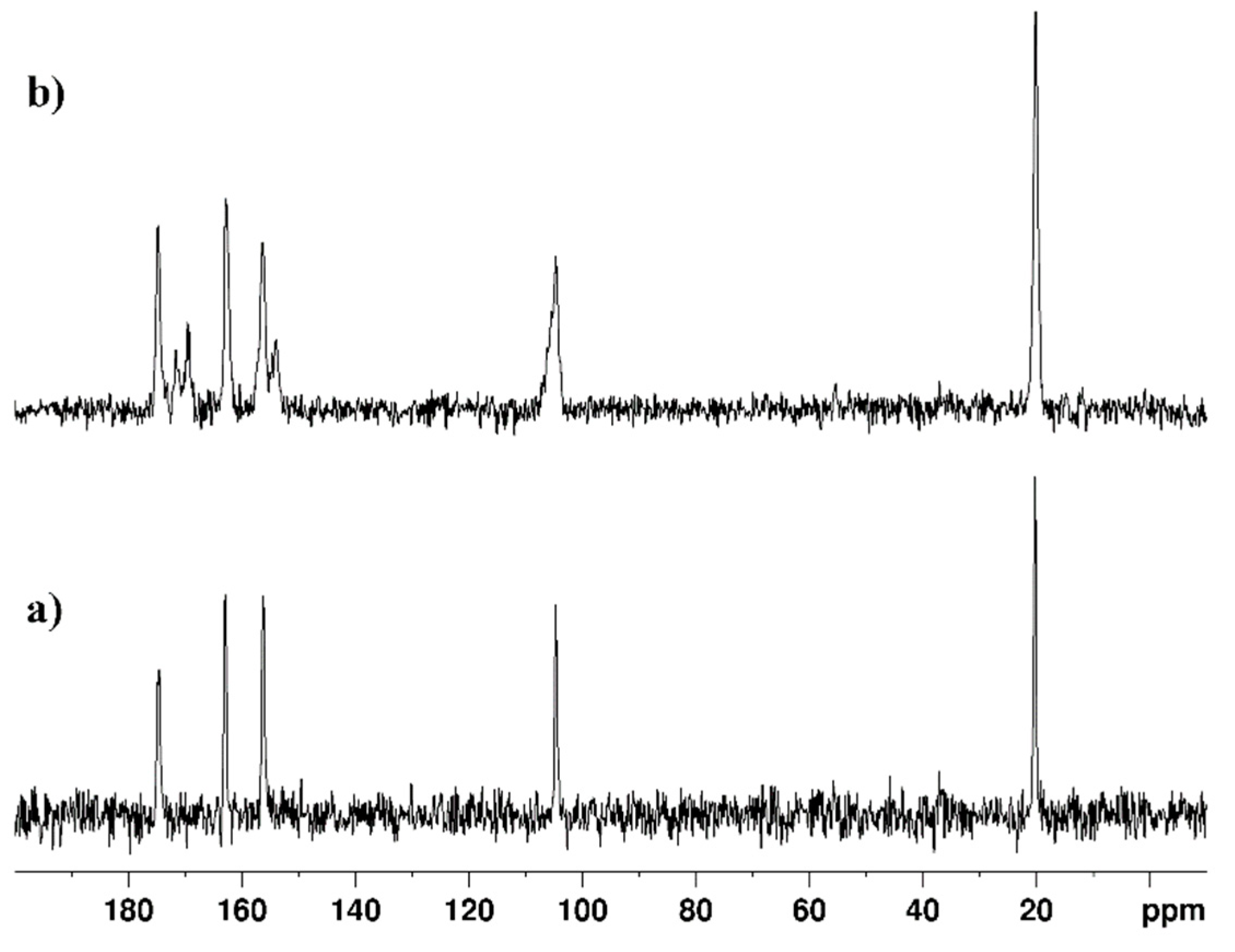
In the 13C NMR solid state spectrum of CuL1 the two couples at 171.7 / 174.8 ppm and 162.9 / 169.5 ppm are for C=S and C=O groups, respectively. This means that the resonance for C=S is upfield shifted with 2.9 ppm and the signal for C=O is downfield shifted with 6.5 ppm, respectively. This fact shows that the C=S and C=O groups of the ligand participate in the coordination with the copper. The two couples at 104.7 / 105.4 ppm and 154.0 / 156.4 ppm, Table 11, are for the carbon atom in 5 and 6 position, respectively.
The 1H NMR solution spectrum of PdL1 shows that the signals for the two amine protons (H-1 and H-3) are upfield shifted with 1.49 and 1.43 ppm. Also, all resonances of the free ligand are present in excess; this could be from the remaining reagent, L1, or from the decomposition of PdL1 in the solution. In the 13C NMR solution spectrum of the PdL1 only methyl and olefin resonances of the coordinated ligand can be seen; the others are indistinguishable from the noise.
The 1H NMR spectrum of 6-propyl-2-thiouracil (L2) shows six signals: two broad singlets at 12.20 ppm (H-1) and 12.31 ppm (H-3). The olefin proton appears at 5.67 ppm (H-5), and 2.32 ppm is for H-1’, 1.54 ppm for H-2’, 0.87 ppm for H-3’. These assignments are confirmed by 1H-1H COSY, 1H-broadband decoupled 13C-NMR and DEPT-135 spectra and are given in Table 8.
Table 8.
1H and 13C NMR spectral data and 1H-1H COSY and HMBC correlations for 6-propyl-2-thiouracil [500.13 MHz (1H) and 150.903 MHz (13C)]a.
Table 8.
1H and 13C NMR spectral data and 1H-1H COSY and HMBC correlations for 6-propyl-2-thiouracil [500.13 MHz (1H) and 150.903 MHz (13C)]a.
| Atom | δ (13C) ppm | DEPT -135 | δ (1H) ppm | Multiplicity (J, Hz) | 1H-1H COSY |
|---|---|---|---|---|---|
| 1 (NH) | - | - | 12.20 | s | |
| 2 (C=S) | 176.08 | C | - | ||
| 3 (NH) | - | - | 12.31 | s | |
| 4 (C=O) | 161.22 | C | - | ||
| 5 | 103.06 | CH | 5.67 | s | |
| 6 | 156.74 | C | |||
| 1’ | 33.21 | CH2 | 2.32 | t(7.5) | 2’ |
| 2’ | 20.58 | CH2 | 1.54 | sx(7.4) | 1’, 3’ |
| 3‘ | 13.26 | CH3 | 0.87 | t(7.4) | 2’ |
a) In DMSO-d6 solution. All these assignments were in agreement with COSY spectra.
In the 1H NMR and 13C NMR solution spectra of CuL2 only the free ligand resonances are presents. In the solid state 13C NMR spectrum there are resonances for both free and coordinated ligand. In the proton spectrum of CuL2 in DMSO-d6 appears a singlet at 2.54 ppm for DMSO-h6 that was coordinated to Cu(II) in the process of synthesis. The data about L2 and CuL2 are summarized and shown in Table 9, Table 10 and Table 11 and Figure 2. a,b,c.
Figure 2.
Solid-state NMR of the ligand L2 and its complexes: a) 13C CP spectrum of L2; b) 13C CP spectrum of Cu(II)L2; c) 13C CPPI spectrum of Cu(II)L2; d) 13C CP spectrum of Pd(II)L2.
Figure 2.
Solid-state NMR of the ligand L2 and its complexes: a) 13C CP spectrum of L2; b) 13C CP spectrum of Cu(II)L2; c) 13C CPPI spectrum of Cu(II)L2; d) 13C CP spectrum of Pd(II)L2.
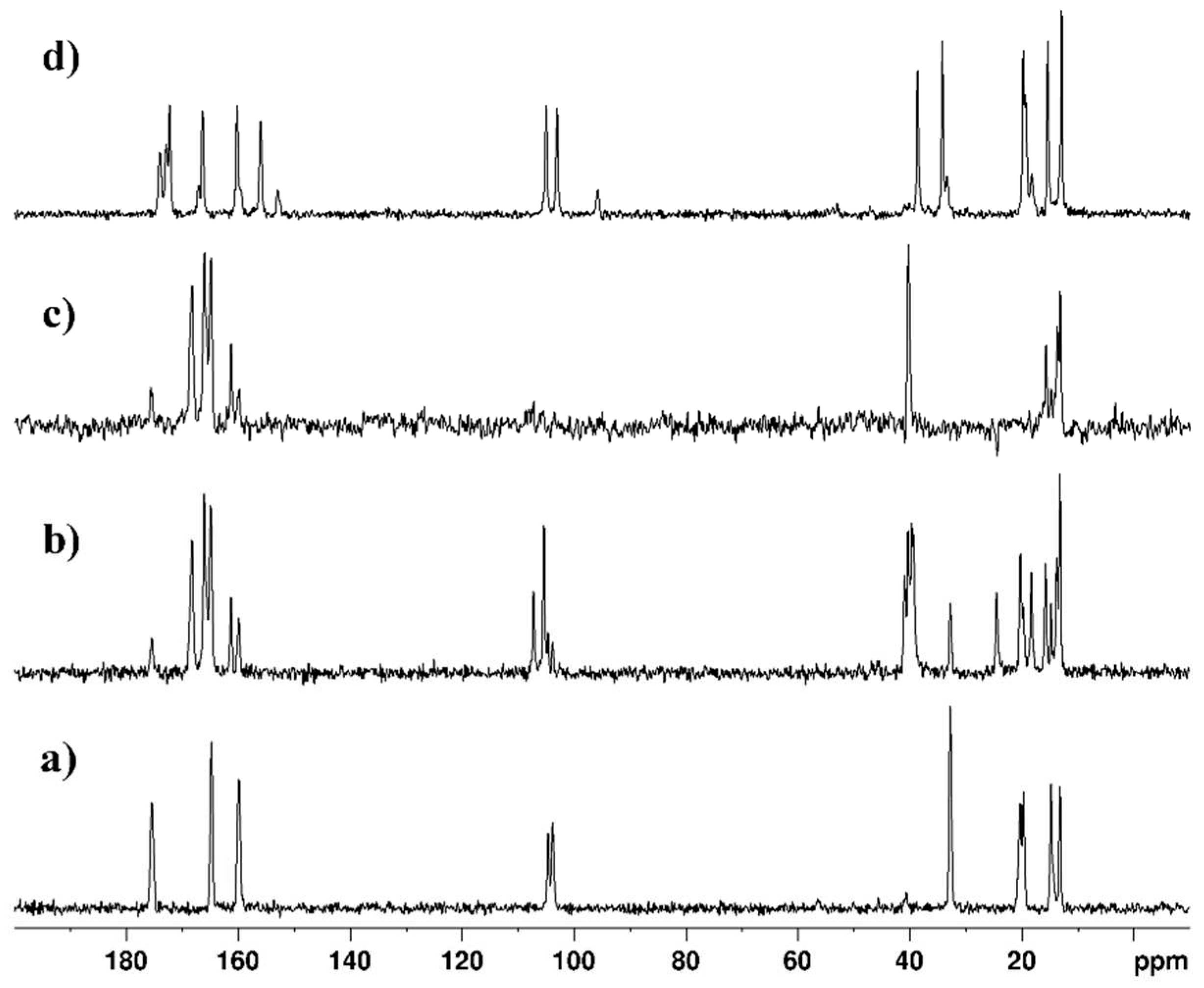
Table 11.
13C NMR spectral data (in ppm) for L1 and L2 and some of the complexes aquired with crosspolarisation experiments, external reference α-glycine carbonyl C (176.03 ppm).
Table 11.
13C NMR spectral data (in ppm) for L1 and L2 and some of the complexes aquired with crosspolarisation experiments, external reference α-glycine carbonyl C (176.03 ppm).
| Atom | L1 | L2 | Cu(II)L1 | Cu(II)L2 | Pd(II)L2 |
|---|---|---|---|---|---|
| 1 (NH) | |||||
| 2 (C=S) | 174.6 | 175.5 | 171.7/174.8 | 168.3/175.4 | 172.3/172.9/174.0 |
| 3 (NH) | |||||
| 4 (C=O) | 163.0 | 164.8 | 162.9/169.5 | 164.9/166.1 | 160.3/166.4/167.0 |
| 5 (CH) | 104.7 | 103.8/104.6 | 104.7/105.4 | 103.8/104.6/105.4/107.2 | 95.8/103.1/105.0 |
| 6 (C) | 156.2 | 159.9 | 154.0/156.4 | 159.9/161.3 | 153.0/156.0/159.7 |
| 1´ | 20.2 | 32.7 | 20.1 | 32.7/39.3/39.6/40.9 | 33.4/34.2/38.6 |
| 2´ | 19.6/20.2 | 18.2/19.7/20.2/24.4 | 18.2/19.3/19.7 | ||
| 3´ | 13.1/14.7 | 13.1/13.6/14.7/15.7 | 12.9/15.4 | ||
| DMSO | 40.3 |
The 13C NMR spectrum of the L2 registered with crosspolarisation experiment shows seven signals. The two signals at 175.5 and 164.8 ppm are for the C=S and C=O, respectively. In the 13C NMR spectrum with crosspolarisation experiment of CuL2 the signal for C=S is upfield shift of 7.2 ppm. This fact showed that the C=S group of the ligand participate in the coordination with the copper. Also, there appears a signal at 40.3 ppm that confirms the coordination of DMSO-h6 to Cu(II).
There are six couples of signals in 1H NMR spectrum of Pd(II) complex with 6-propyl-2-thiouracil. In each couple one of the resonances is for the free ligand (the L2) other for the coordinated L2. The couples at 12.20 / 10.77 ppm and 12.32 / 10.87 ppm are for NH at first and third position. The couple at 5.68 / 5.31 ppm is for olefin proton 5. The three couples at 2.32 ppm (t,7.3) / 2.25 (t,7.3) ppm, 1.54 ppm (sx, 7.6) / 1.48 ppm (m) and 0.87 ppm (t, 7.3) / 0.82 ppm (m) are for propyl protons (H-1’), (H-2’) and (H -3’), respectively. There appears a singlet at 2.54 ppm that is for DMSO-h6. It is interesting to note that all resonances are shifted for coordinated L2 as compared to free L2 but the shifts are higher for NHs. In PdL2 the singlets for NH-1 and NH-3 are upfield shifted with 1.43 and 1.44 ppm, respectively.
The 13C NMR solution spectrum of PdL2 shows seven groups of signals. The two signals with the highest chemical shift, at 176.02 ppm and 164.19 ppm, are for the C=S and C=O in PdL2, respectively. There is also a resonance at 161.09 ppm (free ligand), a.e. there is downfield shift of 2.97 ppm. This fact shows that the C=O group of the ligand participate in the coordination with Pd(II).
In the CP NMR spectrum of PdL2 the signal for C=S is upfield shifted with 3.2 and 2.6 ppm. In the same spectrum there are three signals for C=O, Table 11. One is upfield shifted with 4.5 ppm and the other downfield shifted with 2.2 ppm. This fact showed that the C=S and C=O groups of the ligand participate in the coordination with the palladium in two different ways.
The ATR spectra of CuL2 and PdL2 show the presence of H2O and/or OH-.
According to the solid-state NMR, clear shifts in the signals of the carbon atoms were observed in the complex of Cu(II) with L1, indicating the presence of the complex. There are also signals corresponding to the starting ligand L1, which may or may not be included in the second coordination sphere.
In the case of ligand L2 the situation is more complicated. The ligand itself shows doubled signals for the carbon atoms C-5, C-2´ and C-3´ possibly due to a different spacial arrangement of these atoms in the crystalline lattice of the ligand (Figure 2, a). In the case of the Cu(II)L2 complex, the ligand signals can still be observed, accompanied by the complex signals. What is different in this case is the presence of DMSO included in the complex as a ligand. Despite the presence of many C-1´ signals around it in the CP spectrum (Figure 2, b), the DMSO signal can be easily identified in the CPPI spectrum (Figure 2, c).
The 13C spectrum of Pd(II)L2 obtained by cross-polarisation (CP) (Figure 2, d) presents other complications. There are multiple signals for each type of carbon atom in the ligand, indicating the presence of more than one palladium complex or a palladium complex with two ligands in the coordination sphere simultaneously.
3.2. Antimicrobial activity
Table 12 depicts the results from the antimicrobial assay of 6-methyl-2-thiouracil and its complexes.
The highest antimicrobial activity was exhibited by the Cu(II)L1 complex. It was active against all of the test-microorganisms. The Pd(II)L1 complex did not inhibit the growth of S. aureus, E. faecalis and S. cerevisiae. 6-methyl-2-thiouracil showed the smallest antimicrobial specter – it was not active against S. aureus, E. coli, S. enterica and S. cerevisiae. The addition of Cu(II) improved the antimicrobial activity of 6-methyl-2-thiouracil against all of the test-microorganisms, except B. cereus. Still, there were single cell colonies in the inhibition zones against E. coli, P. vulgaris and K. pneumoniae. This is indicative of different resistance in the microbial population. The addition of Pd(II) on the other hand, led to loss of activity against E. faecalis, and lower activity against L. monocytogenes and C. albicans.
The inhibition zones diameters for 6-propyl-2-thiouracil are presented in Table 13.
It showed higher antimicrobial activity against P. vulgaris and both yeasts strains in comparison with the complexes with Cu(II) and Pd(II). The Cu(II) complex inhibited the growth of all test-microorganisms to a different degree – the best results were obtained against E. faecalis, S. enterica and P. aueruginosa. P. vulgaris was resistant to the tested concentration of the Pd(II) complex (unlike against 6-propyl-2-thiouracil), but all other test-microorganisms were more sensitive towards its action in comparison with 6-propyl-2-thiouracil. This was also true in comparison with the Cu(II) complex except for E. coli, P. vulgaris, and S. cerevisiae. Similarly to 6-methyl-2-thiouracil and its complexes there were single cells in some inhibition zones (e.g. 6-propyl-2-thiouracil against B. cereus, K. pneumonia, and S. cerevisiae). There were two distinct inhibition zones of the Pd(II) complex against S. aureus and B. cereus – a smaller clear zone and an additional larger zone with single cell colonies within. A more concentrated sample would probably inhibit completely the growth of these microorganisms and will significantly increase the antimicrobial activity of the complex.
5. Conclusions
The structure of new complexes was discussed by melting point, MP-AES for Cu and Pd, UV-Vis, IR, ATR, 1H NMR, 13C NMR and Raman spectroscopy. All measured spectra showed that a complexation occurred of Cu(II) / Pd(II) and 6-methyl-2-thiouracil and 6-propyl-2-thiouracil. Water and OH-, as well as solvent (DMSO-h6) were present in some of the complexes. The suggested average composition of the obtained complexes was calculated from the results of determination of metal ions by Microwave Plasma-Atomic emission spectrometry together with analysis of 1H-NMR spectra. The antimicrobial activity of the ligand and its complexes against Gram-positive and Gram-negative bacteria and yeasts was investigated. In general, addition of metal ions improved the antimicrobial activity of both 6-methyl-2-thiouracil and 6-propyl-2-thiouracil. The complex of Cu(II) with 6-methyl-2-thiouracil and Pd(II) with 6-propyl-2-thiouracil demonstrated the highest activity against the test microorganisms.
Author Contributions
Conceptualization, P.M. and P.P.; methodology, P.M.; formal analysis, P.P.; N.B.; S.T; E.V; investigation, S.T.; N.B; E.V; resources, N.B.; data curation, P.M.; writing—original draft preparation, P.M, N. B, P.P.; writing—review and editing, P.M.; P.P.; N.B; supervision, P.M.; project administration, S.T.; funding acquisition, P.P.
Funding
We acknowledge the financial support from the Fund for Scientific Research of the Plovdiv University, project СП 23-ХФ-006.
Conflicts of Interest
The authors declare no conflict of interest.
References
- Abou El E. D., A.; Ghorab, M.M.; Noaman, E.; Heiba, H.I.; Khalil, A.I. Molecular modeling study and synthesis of novel pyrrolo[2,3-d]pyrimidines and pyrrolotriazolopyrimidines of expected antitumor and radioprotective activities. Bioorg. Med. Chem. 2008, 16, 2391–2402. [Google Scholar] [CrossRef] [PubMed]
- Renau, T.E.; Wotring, L.L.; Drach, J.C.; Townsend, L.B. Synthesis of Non-nucleoside Analogs of Toyocamycin, Sangivamycin, and Thiosangivamycin: Influence of Various 7-Substituents on Antiviral Activity. J. Med. Chem. 1996, 39, 873–880. [Google Scholar] [CrossRef] [PubMed]
- Kuyper, L.F.; Garvey, J.M.; Baccanari, D.P.; Champness, J.N.; Stammers, D.K.; Beddell, C.R. Pyrrolo [2,3-d] pyrimidines and Pyrido [2,3-d] pyrimidines as Conformationally Restricted Analogues of the Antibacterial Agent Trimethoprim. Bioorg. Med. Chem. 1996, 4, 593–602. [Google Scholar] [CrossRef] [PubMed]
- Andrus, P.K.; Fleck, T.J.; Oostveen, J.A.; Hall, E.D. Neuroprotective Effects of the Novel Brain-Penetrating Pyrrolopyrimidine Antioxidants U-101033E and U-104067F Against Post-Ischemic Degeneration of Nigrostriatal Neurons. J. Neurosci. Res. 1997, 47, 650–654. [Google Scholar] [CrossRef]
- Chamberlain S., D.; Redman A., M.; Wilson J., W.; Deanda, F.; Shotwell J., B.; Gerding, R.; Lei, H.; Yang, B.; Stevens K., L.; Hassell A., M.; Shewchuk L., M.; Leesnitzer M., A.; Smith J., L.; Sabbatini, P.; Atkins, C.; Groy, A.; Rowand J., L.; Kumar, R.; Mook Jr R., A.; Moorthy, G.; Patnaik, S. ; Optimization of 4,6-bis-anilino-1H-pyrrolo[2,3-d]pyrimidine IGF-1R tyrosine kinase inhibitors towards JNK selectivity. Bioorg. Med. Chem. Lett. 2009, 19, 360–364. [Google Scholar] [CrossRef] [PubMed]
- Amin, K.M.; Hanna, M.M.; Abo-Youssef, H.E.; George, R.F. Synthesis, analgesic and anti-inflammatory activities evaluation of some bi-, tri- and tetracyclic condensed pyrimidines. Eur. J. Med. Chem. 2009, 44(11), 4572–4584. [Google Scholar] [CrossRef] [PubMed]
- Meade, E.A.; Sznaidman, M.; Pollard, G.T.; Beauchamp, L.M.; Howard, J.L. Anxiolytic activity of analogues of 4-benzylamino-2-methyl-7H-pyrrolo[2,3-d]pyrimidin. Eur. J. Med. Chem. 1998, 33, 363–374. [Google Scholar] [CrossRef]
- Cooper D., S. ; Antithyroid Drugs. The New England Journal of Medicine 2005, 352, 905–917. [Google Scholar] [CrossRef] [PubMed]
- Volpé, R. ; The Immunomodulatory Effects of Anti-thyroid Drugs are Mediated via Actions on Thyroid Cells, Affecting Thyrocyte-immunocyte Signalling: A Review. Curr. Pharm. Des. 2001, 7, 451–460. [Google Scholar] [CrossRef]
- Burch H., B.; Cooper, D.S. Antithyroid drug therapy: 70 years later. Eur. J. Endocrinol. 2018, 179, R261–R274. [Google Scholar] [CrossRef]
- Mao, X.-M.; Li, H.-Q.; Li, Q.; Li, D.-M.; Xie, X.-J.; Yin, G.-P.; Zhang, P.; Xu, X.-H.; Wu, J.-D.; Chen, S.-W.; Wang, S.-K. Prevention of Relapse of Graves’ Disease by Treatment with an Intrathyroid Injection of Dexamethasone. J Clin Endocrinol Metab. 2009, 94, 4984–4991. [Google Scholar] [CrossRef] [PubMed]
- Rosenfeld, H.; Ornoy, A.; Shechtman, S.; Diav-Citrin, O. Pregnancy outcome, thyroid dysfunction and fetal goitre after in utero exposure to propylthiouracil: a controlled cohort study. B. J. Clin. Pharmacol. 2009, 68, 609–617. [Google Scholar] [CrossRef] [PubMed]
- Fernandez, M.G. Hyperthyroidism and pregnancy. Endocrinol Nutr. 2013, 60, 535–543. [Google Scholar]
- Shaban N., Z.; Masoud M., S.; Awad, D.; Mawlawia M., A.; Sadek O., M. Effect of Cd, Zn and Hg complexes of barbituric acid and thiouracil on rat brain monoamine oxidase-B (in vitro) Chem. -Biol. Interact. 2014, 208, 37–46. [Google Scholar] [CrossRef] [PubMed]
- Gülcan, M.; Sönmez, M.; Berber, İ. Synthesis, characterization, and antimicrobial activity of a new pyrimidine Schiff base and its Cu(II), Ni(II), Co(II), Pt(II), and Pd(II) complexes. Turk. J. Chem. 2012, 36, 189–200. [Google Scholar] [CrossRef]
- Teleb S., M.; Askar M., E.; El-Kalyoubi S., A.; Gaballa, A.S. Synthesis, characterization and antimicrobial activities of some 5-bromouracil−metal ion complexes. Bull. Chem. Soc. Ethiop. 2019, 33, 255–268. [Google Scholar] [CrossRef]
- Golubyatnikova L., G.; Khisamutdinov R., А.; Grabovskii S., А.; Kabal’nova N., N.; Murinov Yu., I. Complexes of Palladium(II) and Platinum(II) with 6-tert-Butyl-2-thiouracil. Russ. J. Gen.Chem. 2017, 87, 117–121. [Google Scholar] [CrossRef]
- Oladipo, M. A.; Isola, K. T. , Coordination Possibility of Uracil and Applications of Some of Its Complexes: A Review — Res. J. Pharm., Biol.Chem. Sci. 2013, 4, 386–394. [Google Scholar] [CrossRef]
- Lusty J., R.; Peeling, J.; Abdel-Aal M., A. Complexes of 6-Methyl-2-thiouracil with Rhodium, Iridium, Platinum and Palladium Inorg. Chim. Acta, 1981, 56, 21–26. [Google Scholar] [CrossRef]
- Paizanos, K.; Charalampou, D.; Kourkoumelis, N.; Kalpogiannaki, D.; Hadjiarapoglou, L.; Spanopoulou, A.; Lazarou, K.; Manos M., J.; Tasiopoulos A., J.; Kubicki, M.; Hadjikakou S., K. Synthesis and Structural Characterization of New Cu(I) Complexes with the Antithyroid Drug 6-n-Propyl-thiouracil. Study of the Cu(I)-Catalyzed Intermolecular Cycloaddition of Iodonium Ylides toward Benzo[b]furans with Pharmaceutical Implementations. Inorg. Chem. 2012, 51, 12248–12259. [Google Scholar] [CrossRef]
- Sarkar A., R.; Sarkar, M. ; Cadmium(II) Complexes of 1, 3-Propanediamine with 2- Thiouracil and its 6-Methyl Derivative. Synth. React. Inorg. Met.-Org. Chem. 1998, 28, 51–60. [Google Scholar] [CrossRef]
- Sarkar A., R.; Mandal, S. Mixed-Ligand Peroxo Complexes of Vanadium Containing 2-Thiouracil and its 6-methyl Derivative. Syntli. React. Inorg. Met.-Org. Chem, 2000; 30, 1477–1488. [Google Scholar] [CrossRef]
- Bomfim, L.M.; de Araujo F., A.; Dias R., B.; Sales C. B., S.; Gurgel Rocha, C.A.; Correa R., S.; Soares M. B., P.; Batista A., A.; Bezerra D., P. Ruthenium(II) complexes with 6-methyl-2-thiouracil selectively reduce cell proliferation, cause DNA double-strand break and trigger caspase-mediated apoptosis through JNK/p38 pathways in human acute promyelocytic leukemia cells. Sci. Rep. 2019, 9, 11483. [Google Scholar] [CrossRef] [PubMed]
- Abou-Melha K., S. Elaborated studies for the ligitional behavior of thiouracil derivative towards Ni(II), Pd(II), Pt(IV), Cu(II) and UO22 2 ions. Spectrochim. Acta Part (A): Molecular and Biomolecular Spectroscopy 2012, 97, 6–16. [Google Scholar] [CrossRef] [PubMed]
- Masoud, M.S.; Amira, M.F.; Ramadan, A.M.; El- Ashry, G.M. Synthesis and characterization of some pyrimidine, purine, amino acid and mixed ligand complexes. Spectrochim. Acta Part(A) 2008, 69, 230–238. [Google Scholar] [CrossRef] [PubMed]
- Singh U., P.; Ghose, R.; Ghose A., K.; Sodhi, A.; Singh S., M.; Singh R., K. J Inorg Biochem, 1989; 37, 325–329.
- El-Morsy, F.A.; Jean-Claude, B.J.; Butler, I.S.; El- Sayed, S.A.; Mostafa, S.I. Synthesis, characterization and anticancer activity of new zinc(II), molybdate(II), palladium(II), silver(I), rhodium(III), ruthenium(II) and platinum(II) complexes of 5,6-diamino-4-hydroxy2-mercaptopyrimidine. Inorg. Chim. Acta 2014, 423, 144–155. [Google Scholar] [CrossRef]
- Abás, E.; Pena-Martínez, R.; Aguirre-Ramírez, D.; Rodríguez-Diéguez, A.; Laguna, M.; Grasa, L. New selective thiolate gold(I) complexes inhibit proliferation of different human cancer cells and induce apoptosis in primary cultures of mouse colon tumors. Dalton Trans. 2020, 49, 1915–1927. [Google Scholar] [CrossRef]
- Verma, S.; Shrivastva, S.; Rani, P. Synthesis and spectroscopic studies of mixed ligand complexes of transition and inner transition metals with a substituted benzimidazole derivative and RNA bases. J. Chem. Pharm. Res. 2012, 4, 693–699. [Google Scholar]
- Shobana, S.; Dharmaraja, J.; Kamatchi, P.; Selvaraj, S. Mixed ligand complexes of Cu (II) / Ni (II) / Zn (II) ions with 5-Fluorouracil (5-FU) in the presence of some amino acid moieties: Structural and antimicrobial studies. J Chem Pharm Res 2012, 4, 4995–5004, https://www.jocpr.com/articles/mixed-ligand-complexes-of-cu-ii--ni-ii--zn-ii-ions-with-5fluorouracil-5fuin-the-presence-of-some-amino-acid-moieties-str.pdf. [Google Scholar]
- Kamalakannan P.; Venkappayya D.; Balasubramanian T. A new antimetabolite, 5-morpholinomethyl-2-thiouracil—spectral properties, thermal profiles, antibacterial, antifungal and antitumour studies of some of its metal chelates. J. Chem. Soc., Dalton Trans, 2002; 3381–3391. [CrossRef]
- Abou-Melha K., S. A series of Nano-sized metal ion–thiouracil complexes, tem, spectral, γ-irradiation, molecular modeling and biological studies. Orient. J. Chem. 2015, 31, 1897–1913. [Google Scholar] [CrossRef]
- Singh U., P.; Singh, S.; Singh S., M. Synthesis, characterization and antitumour activity of metal complexes of 5-carboxy-2-thiouraci. Metal-Based Drugs, 1998; 5, 35–39. [Google Scholar] [CrossRef]
- Papazoglou, I.; Cox, P.J.; Hatzidimitriou, A.G.; Kokotidou, C.; Choli-Papadopoulou, T.; Aslanidis, P. Copper(I) halide complexes of 5-carbethoxy-2-thiouracil: Synthesis, structure and in vitro cytotoxicity. Eur. J. Med. Chem. 2014, 78, 383. [Google Scholar] [CrossRef]
- Hoeschele J. D.; Piscataway, N.J. Ethylenediamineplatinum(II) 2,4-dioxopyrimidine complexes, US Patent 4 207 416, 1980.
- Supaluk, P.; Apilak, W.; Ratchanok, P.; Thummaruk, S.; Chartchalerm, I.; Somsak, R.; Virapong, P. Metal Complexes of Uracil Derivatives with Cytotoxicity and Superoxide Scavenging Activity. Lett. Drug Des. Discov. 2012, 9, 282–287. [Google Scholar] [CrossRef]
- Illán-Cabeza N., A.; García-García A., R.; Moreno-Carretero M., N.; Martínez-Martos J., M.; Ramírez-Expósito M., J. Synthesis, characterization and antiproliferative behavior of tricarbonyl complexes of rhenium(I) with some 6-amino-5-nitrosouracil derivatives: Crystal structure of fac-[ReCl(CO)3(DANU-N5,O4 )] (DANU = 6-amino-1,3-dimethyl-5-nitrosouracil). J. Inorg. Biochem. 2005, 99, 1637–1645. [Google Scholar] [CrossRef] [PubMed]
- Kitagawa, S.; Nozaka, Y.; Munakata, M.; Kawata, S. Synthesis and crystal structures of tetra- and hexanuclear copper(I) complexes of pyrimidine derivatives, [Cu4(C4H8N2S4)](ClO4)4 and [Cu6(C5H5N2S)6]. Inorg. Chim. Acta. 1992, 197, 169–175. [Google Scholar] [CrossRef]
- Shaheen, F.; Badashah, A.; Gielen, M.; Marchio, L.; Vos D., de; Khosa M, K. ., Synthesis, characterization and in vitro cytotoxicity of homobimetallic complexes of palladium(II) with 2-thiouracil ligands. Crystal structure of [Pd2(TU)(PPh3)3Cl2]. Appl. Organomet. Chem. 2007, 21, 626–632. [Google Scholar] [CrossRef]
- Sce, F.; Beobide, G.; Castillo, O.; Pedro I., de; Pérez-Yáñez, S.; Reyes, E. Supramolecular architectures based on p-cymene/ruthenium complexes functionalized with nucleobases. Cryst.Eng.Comm. 2017, 19, 6039–6048. [Google Scholar] [CrossRef]
- Balas, V.I.; Verginadis, I.I.; Geromichalos, G.D.; Kourkoumelis, N.; Male, L.; Hursthouse, M.B.; Repana, K.H.; Yiannaki, E.; Charalabopoulos, K.; Bakas, T.; Hadjikakou, S.K. Synthesis, structural characterization and biological studies of the triphenyltin(IV) complex with 2-thiobarbituric acid. Eur. J. Med. Chem. 2011, 46, 2835–2844. [Google Scholar] [CrossRef] [PubMed]
- N.N. Golovnev, M.S. 42. N.N. Golovnev, M.S. Molokeev, S.N. Vereshchagin, V.V. Atuchin, M.Y. Sidorenko, M.S. Dmitrushkov, Crystal structure and properties of the precursor [Ni(H2O)6](HTBA)2.2H2O and the complexes M(HTBA)2(H2O)2 (M = Ni, Co, Fe). Polyhedron, 2014; 70, 71–76. [Google Scholar] [CrossRef]
- Pan, Z.R.; Zhang, Y.C.; Song, Y.L.; Zhuo, X.; Li, Y.Z.; Zheng, H.G. Synthesis, structure and nonlinear optical properties of three dimensional compounds. J. Coord. Chem. 2008, 61, 3189–3199. [Google Scholar] [CrossRef]
- Ruf, M.; Weis, K.; Vahrenkamp, H. ; Pyrazolylborate-Zinc Complexes of RNA Precursors and Analogues Thereof. Inorg. Chem. 1997, 36, 2130–2137. [Google Scholar] [CrossRef]
- Yamanari, K.; Kida, M.; Fuyuhiro, A.; Kita, M.; Kaizaki, S. Cobalt(III) promoted ligand fusion reactions of thiobarbituric acid and 4,6-diamino-2-thiouracil (or 4-amino-2-thiouracil). Inorganica Chim. Acta. 2002, 332, 115–122. [Google Scholar] [CrossRef]
- Esteruelas, M.A.; García-Raboso, J.; Oliván, M. ; Reactions of an Osmium-Hexahydride Complex with Cytosine, Deoxycytidine, and Cytidine: The Importance of the Minor Tautomers. Inorg. Chem. 2012, 51, 9522–9528. [Google Scholar] [CrossRef]
- Chakraborty, S.; Laye, R.H.; Munshi, P.; Paul, R.L.; Ward, M.D.; Kumar Lahiri, G. Dinuclear bis(bipyridine)ruthenium(II) complexes [(bpy)2RuII{L}2-RuII(bpy)2]2+ incorporating thiouracil-based dianionic asymmetric bridging ligands: synthesis, structure, redox and spectroelectrochemical properties. J. Chem. Soc. Dalt. Trans. 2002, 2348–2353. [Google Scholar] [CrossRef]
- Ma, C.; Tian, G.; Zhang, R. New triorganotin(IV) complexes of polyfunctional S,N,O-ligands: Supramolecular structures based on π-π and/or C–H-π interactions. J. Organomet. Chem. 2006, 691, 2014–2022. [Google Scholar] [CrossRef]
Scheme 1.
(Top) Structure of 6-methyl-2-thiouracil and 6-propyl-2-thiouracil, as well as the atoms numbering and monodentate coordination. (Bottom) Representation of coordination binding sites for 6-methyl-2-thiouracil and 6-propyl-2-thiouracil ligands (bidentate chelate).
Scheme 1.
(Top) Structure of 6-methyl-2-thiouracil and 6-propyl-2-thiouracil, as well as the atoms numbering and monodentate coordination. (Bottom) Representation of coordination binding sites for 6-methyl-2-thiouracil and 6-propyl-2-thiouracil ligands (bidentate chelate).
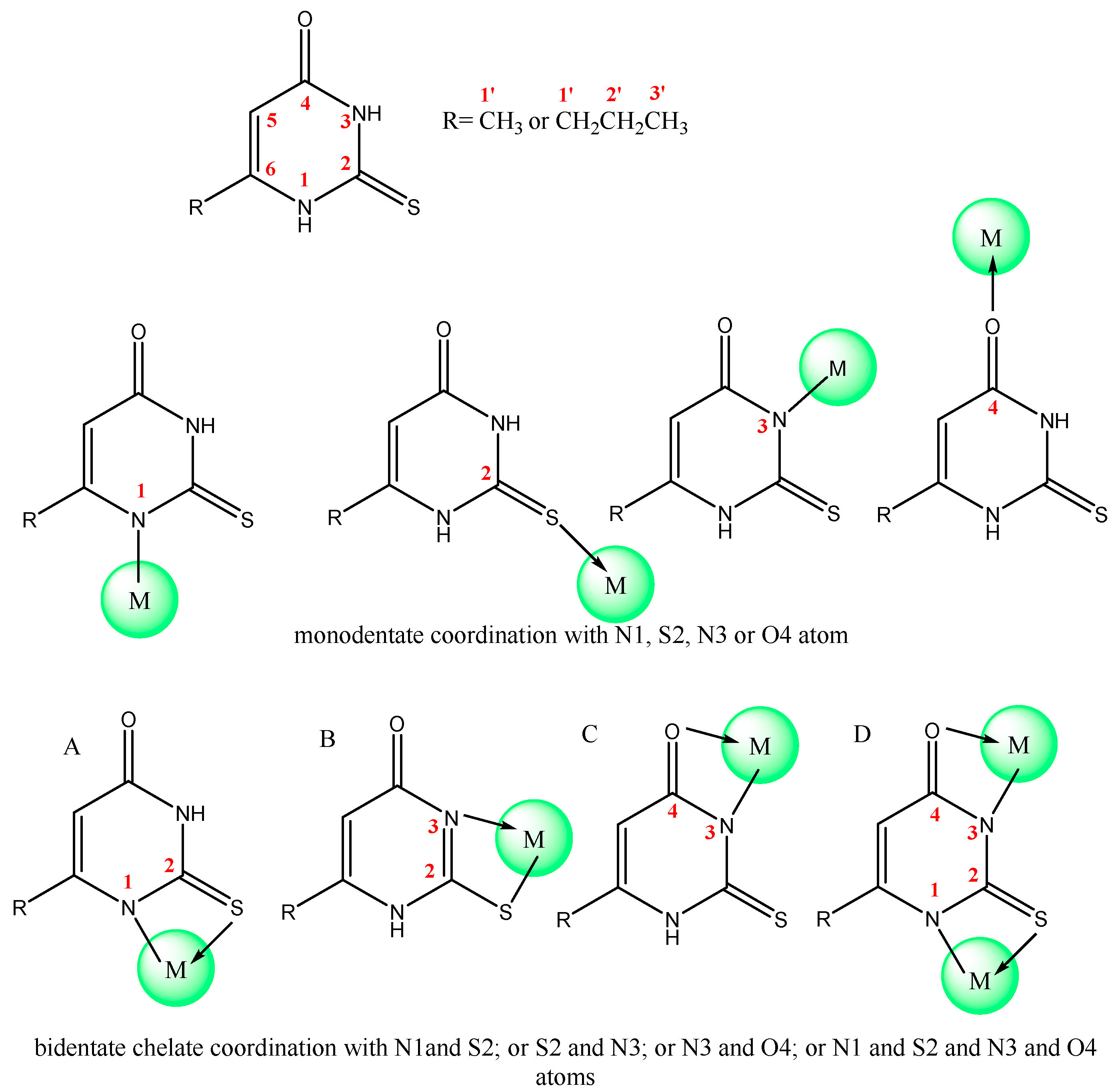
Table 1.
Elemental analyses data for the metal ions of the complexes.
| metal complex | composition* | formula | Moleculаr weight | W(M)% calc./exp. |
|---|---|---|---|---|
| Cu(II)L1 | [3LCu.(DMSO)] | C17H24N6O4S4Cu | M=568.22 g/mol | 11.2 / 11.6±0.6 |
| Pd(II)L1 | [5LPd.(DMSO)].H2O | C27H38N10O7S6Pd | M=913.46 g/mol | 11.6 / 11.1±0.6 |
| Cu(II)L2 | [LCu.H2O.(OH-)2.(DMSO)2] | C11H26N2O6S3Cu | M=442.07 g/mol | 14.4 / 14.3±0.7 |
| Pd(II)L2 | [4LPd.(DMSO)2].H2O | C32H54N8O7S6Pd | M=961.63 g/mol | 11.1 / 11.5±0.5 |
*tentative average composition of different complexes.
Table 6.
1H NMR spectral data (in ppm) for complexes of 6-methyl-2-thiouracil with Cu(II) and Pd(II).
Table 6.
1H NMR spectral data (in ppm) for complexes of 6-methyl-2-thiouracil with Cu(II) and Pd(II).
| Atom | L1 (6-methyl-2-thiouracil) |
Cu(II)L1 Multiplicity (J, Hz) |
Pd(II)L1 Multiplicity (J, Hz) |
|---|---|---|---|
| 1 (NH) | 12.29 s | 12.24 s | 12.24 s and 10.80 |
| 2 (C=S) | – | – | – |
| 3 (NH) | 12.29 s | 12.29 s | 12.30 s and 10.86 |
| 4 (C=O) | – | – | – |
| 5 | 5.68 | 5.68 s | 5.68 s and 5.31 |
| 6 | - | - | - |
| 1’ | 2.06 | 2.07 | 2.07 and 2.01 |
DMSO-H6 - 2.54 s 2.54 s.
Table 7.
13C NMR spectral data (in ppm) for complexes of 6-methyl-2-thiouracil with Cu(II) and Pd(II).
Table 7.
13C NMR spectral data (in ppm) for complexes of 6-methyl-2-thiouracil with Cu(II) and Pd(II).
| Atom | δ (13C) ppm, L1 | Cu(II)L1 | Pd(II)L1 |
|---|---|---|---|
| 1 (NH) | – | – | – |
| 2 (C=S) | 175.87 | 175.86 | 175.86 / ? |
| 3 (NH) | – | – | – |
| 4 (C=O) | 161.06 | 161.01 | 161.01 / ? |
| 5 | 103.72 | 103.69 | 103.69 and 98.71 |
| 6 | 153.20 | 153.12 | 153.12 / ? |
| 1’ | 18.11 | 18.06 | 18.06 and 18.20 |
Table 9.
1H NMR spectral data (in ppm) for complexes of 6-propyl-2-thiouracil with Cu(II) and Pd(II).
Table 9.
1H NMR spectral data (in ppm) for complexes of 6-propyl-2-thiouracil with Cu(II) and Pd(II).
| Atom | L2 (6-propyl-2-thiouracil) |
Cu(II)L2 Multiplicity (J, Hz) |
Pd(II)L2 Multiplicity (J, Hz) |
|---|---|---|---|
| 1 (NH) | 12.20 s | 12.20 s | 12.20 and 10.77 s |
| 2 (C=S) | - | - | - |
| 3 (NH) | 12.31 s | 12.31 s | 12.32 and 10.87 s |
| 4 (C=O) | - | - | - |
| 5 | 5.67 s | 5.67 s | 5.68 and 5.31 s and t(1.8) |
| 6 | - | - | - |
| 1’ | 2.32 t(7.5) | 2.32 t(7.4) | 2.32 and 2.25 t(7.3) and t(7.3) |
| 2’ | 1.54 sx(7.4) | 1.54 sx(7.5) | 1.54 and 1.48 sx(7.6) and m |
| 3’ | 0.87 t(7.4) | 0.88 t(7.3) | 0.87 and 0.82 t(7.3) and m |
| DMSO | - | 2.54 s | 2.54 s |
In DMSO-d6 solution.
Table 10.
13C NMR spectral data (in ppm) for complexes of 6-propyl-2-thiouracil with Cu(II) and Pd(II).
Table 10.
13C NMR spectral data (in ppm) for complexes of 6-propyl-2-thiouracil with Cu(II) and Pd(II).
| Atom | δ (13C) ppm, L2 | Cu(II)L2 | Pd(II)L2 |
|---|---|---|---|
| 1 (NH) | - | - | - |
| 2 (C=S) | 176.08 | 176.02 | |
| 3 (NH) | - | - | - |
| 4 (C=O) | 161.22 | 164.19 and 161.09 | |
| 5 | 103.06 | 98.03 | |
| 6 | 156.74 | 156.61 and 156.33 and 151.71 | |
| 1’ | 33.21 | 33.24 | 33.56 and 33.14 |
| 2’ | 20.58 | 20.55 | 20.50 and 20.24 |
| 3’ | 13.26 | 13.25 | 13.20 |
In DMSO-d6 solution.
Table 12.
Antimicrobial activity of 6-methyl-2-thiouracil and its complexes.
| Test microorganisms | Complexes | ||
|---|---|---|---|
| 6-methyl-2- thiouracil |
Cu(II)L1 | Pd(II)L1 | |
| Inhibition zone, mm | |||
| Staphylococcus aureus ATCC 25923 | - | 8 | - |
| Escherichia coli ATCC 8739 | - | 11* | 10* |
| Eterococcus faecalis ATCC 19433 | 11 | 13 | - |
| Salmonella enterica ssp. enterica ser. Enetritidis ATCC 13076 | - | 13 | 8 |
| Pseudomonas aeruginosa ATCC 9027 | 9 | 12 | 9 |
| Proteus vulgaris G | 9* | 11* | 9* |
| Bacillus subtilis ATCC 6633 | 9* | 9 | 10* |
| Bacillus cereus ATCC 11778 | 9* | 8 | 9* |
| Listeria monocytogenes ATCC 8787 | 9* | 11 | 8 |
| Klebsiella pneumoniae ATCC 13883 | 9* | 13* | 11* |
| Candida albicans ATCC 10231 | 11 | 11 | 9/10* |
| Saccharomyces cerevisiae | - | 9 | - |
well diameter – 7 mm. * Inhibition zone with single cell colonies.
Table 13.
Antimicrobial activity of 6propyl-2-thiouracil and its complexes.
| Test microorganisms | Complexes | ||
| 6-propyl-2-thiouracil | Cu(II)L2 | Pd(II)L2 | |
| Inhibition zone, mm | |||
| Staphylococcus aureus ATCC 25923 | - | 8 | 11/16* |
| Escherichia coli ATCC 8739 | - | 10* | - |
| Eterococcus faecalis ATCC 19433 | - | 12 | 15 |
| Salmonella enterica ssp. enterica ser. Enetritidis ATCC 13076 | 8 | 12 | 15 |
| Pseudomonas aeruginosa ATCC 9027 | 8 | 12 | 14 |
| Proteus vulgaris G | 10 | 9* | - |
| Bacillus subtilis ATCC 6633 | 8 | 12* | 12 |
| Bacillus cereus ATCC 11778 | 10* | 8 | 11/15* |
| Listeria monocytogenes ATCC 8787 | 8 | 9 | 14 |
| Klebsiella pneumoniae ATCC 13883 | 11* | 12* | 12* |
| Candida albicans ATCC 10231 | 12 | 11 | 11 |
| Saccharomyces cerevisiae | 11* | 9 | 8 |
well diameter – 7 mm. * Inhibition zone with single cell colonies.
Disclaimer/Publisher’s Note: The statements, opinions and data contained in all publications are solely those of the individual author(s) and contributor(s) and not of MDPI and/or the editor(s). MDPI and/or the editor(s) disclaim responsibility for any injury to people or property resulting from any ideas, methods, instructions or products referred to in the content. |
© 2023 by the authors. Licensee MDPI, Basel, Switzerland. This article is an open access article distributed under the terms and conditions of the Creative Commons Attribution (CC BY) license (http://creativecommons.org/licenses/by/4.0/).
Copyright: This open access article is published under a Creative Commons CC BY 4.0 license, which permit the free download, distribution, and reuse, provided that the author and preprint are cited in any reuse.


