

Submitted:
09 July 2024
Posted:
10 July 2024
You are already at the latest version
Abstract
Resilience is an important determinant of the quality of life in adults, among others in the sphere of cognitive activities. Developments in brain imaging technology make it possible to acquire a more accurate understanding of the neuronal mechanisms of these correlations. The aim of this study was to verify whether the level of mental resilience would differentiate reading comprehension performance when using different information carriers. More than 150 adults were surveyed with the use of two questionnaires (original and standardised) and near-infrared spectroscopy (fNIRS). The results obtained did not show differences in correct responses between the groups of individuals with different levels of resilience, however, the results in the group of subjects with moderate levels were differentiated by the type of carrier. Further analysis showed that the results referred to above resulted from different neuronal mechanisms. The differences affected many areas of the brain and also depended on the type of information carrier (medium). They affected, among others, attentional areas as well as areas directly involved in the reading process. This may result in increased energy consumption during the examined activities, which can result in greater fatigue, accelerated job burnout and progressive concentration difficulties.
Keywords:
resilience
; reading
; adults
; new technology
; brain image
1. Introduction
Ego resilience is the continuously developed ability to adequately cope with everyday tasks, also under stressful and changing conditions. A resilient person adequately, consistently and persistently adapts to the environment through the appropriate use of own abilities as well as environmental factors.
Mental resilience can be seen as a self-regulatory mechanism involving cognitive, emotional and behavioural elements [1], but also as a broader construct, which plays an imperative role over other individual resources. It includes emotional elements (striving for positive emotions, positive affect and emotional stability), cognitive elements (e.g. beliefs and expectations regarding, among others, perceiving reality as a series of challenges, awareness of own competences) and behavioural elements (taking action in new situations, seeking new experiences, applying diverse and effective coping strategies) [2,3].
Resilience helps us cope with stressful situations. Individuals with higher resilience levels are more likely to perceive stressful situations as a challenge and have positive emotions associated with them, compared to individuals with lower levels of the trait [4]. Resilience helps find solutions and evaluate their usefulness, and boosts confidence. Individuals with low resilience act in a conservative and rigid manner in the face of stress and their reactions are characterised by chaotic and dispersed behaviour [5].
Psychological resilience is linked to cognitive resilience, i.e. the level of cognitive skills that an individual possesses independently or in spite of internal and external conditions [6]. This type of resilience includes the ability to understand written text. Research indicates a correlation between mental resilience and reading competence [7]. Researchers have even defined the term resilience of reading [8]. Among the determinants of this phenomenon are genetic, environmental and educational factors, but also the type of information carrier. Research to date has not conclusively demonstrated whether, among adults, more effective reading is connected to data presented on paper or on a tablet or other electronic medium [9,10,11,12]. In an age of very rapid technological development, such knowledge could be important not only for employers, but also for those using data for therapeutic or educational purposes. It seems important also because the mental and physical burdens associated with the Covid-19 epidemic will continue to be felt in the coming years.
In neuroscience publications, resilience is defined not only as the absence of psychopathology despite exposure to adversity, but also as the ability to function competently in different spheres, despite, for example, a diagnosis of mental disorder [13]. In neurological terms, we can therefore talk about coping with brain pathology and avoiding such pathology [14]. Among the determinants of resilience, in addition to genetic factors [15] or personality traits [16], an important role is played by factors related to brain structure and function [13,17].
Intensive development of brain neuroimaging techniques has facilitated the search for neurobiological determinants of mental and cognitive resilience in studies assessing potential neurobiological correlates of stress susceptibility and/or resilience. To date, most research has focused on:
- studies of people with disorders such as PTSD, anxiety, depression or dyslexia due to the correlations found with selected scales for the study of resilience,
- structural and functional analysis of the brain using EEG and fMRI [18].
The neuroimaging findings indicate that several brain structures are vital here. These include hippocampus, amygdala, insula, anterior cingulate cortex and prefrontal cortex, as well as related brain networks such as the default mode network and central executive network [19]. Research to date has shown that:
- childhood trauma results in negative connectivity between the prefrontal cortex and the amygdala, which may be a predictor of negative anxiety control [20] and difficulties with planning and working memory [21] in adults;
- there is a significant positive correlation between an individual’s level of resilience and the thickness of the cortex in the right hemisphere (comprising the lateral occipital cortex, the fusiform gyrus, the inferior parietal cortex, as well as the medial and inferior temporal cortex), i.e. reduced resilience is associated with reduced cortical thickness in the areas that are involved in processing of emotional visual stimuli [22];
- in children who have experienced abuse and neglect, a reduction in the size of the hippocampus is evident, which also persists into adulthood [23] and results in difficulties related to broadly-defined learning process [24];
- adaptation of neural network efficacy and engagement of additional brain areas may provide mechanisms for coping with increased pathological load – both socio-emotional and cognitive [25,26,27,28], which is consistent with the cognitive reserve hypothesis, which assumes that cognitive function is preserved through functional adaptations of large-scale networks.
The hippocampus or prefrontal cortex play a leading function in reading comprehension. It can therefore be assumed that reduced hippocampal volume and reduced prefrontal cortex thickness as features of people with low resilience levels may account for reading difficulties. Significantly, the resilience study did not show changes in the left parietal, temporal or occipital areas, which are involved in reading in most individuals [29]. Given that the act of reading is highly lateralised, it can be inferred that the efficiency of the reading process in individuals with varying levels of resilience may be reduced by functional and structural changes in areas related to stress control, emotionality and focus - more so than those directly involving areas such as Broca’s or Warnke’s [30].
There are still few studies available on the effects of resilience and carrier type on reading performance in healthy populations [31]. Access to such data could enable adults (including employers) to more consciously increase work performance by tailoring the information carrier to the individual’s predisposition related to resilience levels.
2. Materials and Methods
2.1. Research Objective
The aim of the study was to investigate whether resilience differentiates reading comprehension scores in adults for informational texts presented on different media.
2.2. Research Group
The survey targeted adults aged between 20 and 69. The invitation and information about the survey was disseminated via email to adult employees of state institutions in the defined area. The inclusion criterion was the completion of an online application questionnaire. A total of 135 people (101 women and 34 men) were examined. The majority of the respondents were married (62.00%). Unmarried people accounted for 17.33% and those declaring an informal relationship for 10.66%. Only 6% of respondents were divorced and one was separated. One in three respondents were over 30 and under 40 years old. An almost equal group were respondents with an age range of 40-50 years (32.66%). More than one in five respondents were over 50 years old (22%) and almost one in ten were under 30 years old (8.67%). More than one in four respondents (28.67%) held a managerial position. Work seniority of more than half of the respondents (51.33%) was over 15 years. Only 4.66% of respondents had worked for more than five and less than 10 years. An equal group was made up of people whose length of service was more than six months to two years. A period of employment of between 5 and 10 years characterised 14.67% of respondents. The remainder (21.33%) had been employed for more than 10 but less than 15 years.
2.3. Test Procedure
Results were obtained from three sources. Participants were asked to complete a questionnaire, which included information on demographics, and screening criteria forms to identify medical issues that may pose a risk of biased findings using NIRS. These data were used for exclusion-inclusion decisions, but not for hypothesis testing.
The research procedure began with a clause informing the potential respondent of the purpose, anonymity and voluntary participation in the study. The respondent was then given the Scale questionnaire - SPP-25 - to complete. The scale is designed for adults, both healthy and ill. It contains 25 statements on the various personality characteristics that make up mental resilience. Assessment is made on a 5-point Likert-type scale. In addition to the overall score, the scale measures the following five factors:
- Persistence and determination in action;
- Openness to new experiences and a sense of humour;
- Personal coping competence and tolerance of negative emotions;
- Tolerance of failure and treating life as a challenge;
- An optimistic attitude to life and an ability to motivate oneself in difficult situations [1].
After completing the questionnaire, the subjects participated in a neuroimaging procedure using near-infrared spectroscopy. It included two tasks. During the first one, the subject was given a one-page informational text to read and later a single-choice test with 6 questions on the information content. The respondent was given a maximum of three minutes for the first task, and the same for the second. Each participant was randomly presented with an informative text and a test on paper or digital media.
3. Analysis of Behavioural Data
Firstly, the results of the SPP-25 Scale questionnaire were analysed. Based on the results, the study group was divided into three subgroups: those with low, average and high levels of resilience. The largest group of respondents showed high levels of resilience (42.22%), followed by medium (33.33%) and low (24.45%). In terms of responses to the reading efficiency test, respondents were able to give a maximum of 6 correct answers, with a minimum of 0. Most respondents gave 4 or 5 correct answers. A summary of the results is shown in Table 1.
To test whether there were significant differences in the number of correct answers between groups with different levels of resilience, the Kruskal-Wallis test for independent samples was used. The analysis showed no significant intergroup differences (df=2; F=0.791; p<0.05).
Analysis of intragroup differences using Student’s t for independent samples showed that only in the moderate resilience group were there significant differences in the number of correct answers between the paper-based and digital carrier groups (t=-2.254; p=0.029; df=43). There were no significant differences in reading comprehension performance between the paper-based and computer-based reading groups in those with low (t=-0.325; p=0.747; df=31) and high (t=-0.482; p=0.597; df=55) levels of resilience.
Further analysis showed that a predictor of correct answers in the moderate-resilience group was the carrier type (t=2.336; p=0.025). More often correct answers were given by those using a paper medium.
4. Analysis of Neuroimaging Data (fNIRS)
NIRS is a neuroimaging technique that is increasingly being used to study cognitive function based on the non-invasive measurement of haemodynamic changes in the cortical brain surface, where activated brain areas experience high metabolic demand and increased oxygen uptake [31]. This oxygen consumption leads to an initial decrease in the amount of oxygenated haemoglobin (HbO), followed by an increase in regional cerebral blood flow, which consequently raises the HbO concentration [34]. NIRS uses the changing optical properties in cortical tissue by emitting near-infrared light into the cortex.
In the study, a 64-channel (32x32) fNIRScout system (NIRx Technology, Germany) was used for the measurements, which consisted of 30 emitters and 22 detectors placed around the head according to the design shown in Figure 1. A total of 68 channels were obtained. Beta values were calculated in bilateral prefrontal, temporal, parietal and occipital cortex at two wavelengths (750 and 850 nm). Raw fNIRS data were recorded using NIRStar14.2 acquisition software (NIRx, Germany) and then processed using Homer3 analysis software.
A total of 135 participants took part in the study. In the first phase, the results of left-handed individuals (due to potential different lateralisation of language areas), those with a history of neurological disease or brain injury and those taking medication that could affect cognitive function were eliminated from further analysis. The data of those whose records were incomplete (gaps in the record or missing markers) - a total of 41 participants - were also removed from further analysis.
The data obtained from the other respondents was pre-processed. To eliminate signal noise, the qt-nirs algorithm in the Matlab R2019b environment was used to remove channels with signal-to-noise ratios below 73% (SCI=0.80; PSP=0.10). Those that had the required signal-to-noise ratio in at least 20 individuals (54 channels) were left for statistical analyses. Based on this data, the final signal processing step eliminated those with less than 35% of good channels. Ultimately, 73 people (48 women and 35 men) were selected for final statistical analyses. One in three respondents were over 30 and under 40 years old. An almost equal group were respondents with an age range of 40-50 years (30.98%). In contrast, more than one in four respondents were over 50 years old (28.17%) and only 5.63% were under 30 years old. Work seniority of more than half of the respondents (54.93%) was over 15 years.
Light intensities were then converted to optical densities and blood oxygen concentrations using modified Beer-Lambert laws. The signal was also bandpass filtered from 0.01 to 0.5 Hz to remove both noise and interfering signals (heart rate, respiratory rate and Mayer waves). The initial time of the haemodynamic response function (HRF) was set to -2 s (i.e. baseline) and the end time to 60 s (i.e. the shortest time to complete the reading task and the test). Data prepared in this way were exported in .xlsx format to SPSS 28 software.
For the purpose of static analyses of the processed results, it was assumed that reading comprehension comprises two separate activities, i.e. reading the text and completing the test.
Analyses using the Kruskal-Waliss test (the distribution of results was not normal) showed that there were statistically significant differences in the neural activity of the brain of people with different levels of resilience in the two activities tested (see Figure 2).
Intergroup differences (at p=0.05) included for reading activities channel 10 (F=0.49) and 17(F=0.013); while for test completion channels: 2(F=0.041), 38(F=0.031), 42(F=0.045), 43(F=0.026), 46(F=0.021), 57(F=0.050), 59(F=0.037), 61(F=0.042), 62(F=0.015).
Intragroup analyses were then carried out to see if the medium of information differentiated the number of correct answers. The Student’s t-test for independent groups was used for the analyses (see Figure 3). In relation to reading activity, the carrier differentiated neural activity:
- a)
- in the high-resilience group: in channel 12 (t=2.125; df=27;p=0.430),
- b)
- in the medium-resilience group: in channels: 61 (t=-2.133; df=18;p=0.47) and 68 (t=-2.472;df=18;p=0.24),
- c)
- in the low-resilience group: in channels: 2 (t=-2.51;df=15;p=0.24), 16 (t=-2.123;df=15;t=0.50) and 52 (t=-2.763;df=15;p=0.14).
In the task involving completing the test, the differences were respectively:
- a)
- in the high-resilience group: in channel 54 (t=2.087;df=27;p=0.023) and 56 (t=2.193;df=27;p=0.019),
- b)
- in the medium-resilience group: in channels: 32 (t=-2.426;df=18;p=0.026), 40 (t=-2.962;df=18;p=0.004) and 50 (t=-2.187;df=18;p=0.042) ,
- c)
- in the low-resilience group: in channel 56 (t=-2.775; df=15;p=0.014).
5. Conclusions
The aim of the study was to compare the reading comprehension performance of people with different levels of mental resilience. It was also tested whether the medium of information would further differentiate the results obtained and their neuronal mechanism. Reading comprehension testing involved two tasks: reading the text and completing the test.
The analyses showed no significant differences in the number of correct answers between the groups with different resilience levels, but in the medium-resilience group, the results were differentiated by the medium of information (those performing the tasks on a paper medium performed better). It was also a predictor of correct answers in this group of people.
Further analyses showed that the neural mechanisms in this scope were different for the study groups in both text reading and test completion activities. In the first task, the intergroup differences were related to areas of the left hemisphere, i.e. the inferior and medial frontal gyrus (46 Brodman area-BA), the posterior temporal gyrus (BA 37) and the angular gyrus (BA 39). These areas are actively involved in the selective processing of linguistic material during the simultaneous presentation of multiple stimulus streams [32]. They are activated by both text and speech processing, particularly in terms of verbal fluency, lexical variety, sentence generation and word retrieval [36]. In terms of test completion, differences were found in both left and right hemisphere areas, i.e.:
- left prefrontal area (10 BA) responsible for understanding sentence syntax and inference while reading,
- left lower frontal gyrus (44 BA) involved in tasks requiring language fluency or sentence comprehension skills, and lexical word variation,
- right prefrontal area (10 BA), which plays a key role in activities involving working memory, spatial memory and divided attention,
- right inferior frontal gyrus (BA 43,44,45,46), which - in addition to tasks similar to the area described above - is activated when the person is exposed to unintelligible speech and when the activity requires semantic and phonological processing, word generation, categorisation or strategy formation [33,34].
The level of resilience therefore differentiated, in terms of both activities, between activity in frontal areas (involved in attentional and planning processes) and those directly involved in reading and speech [35].
Intragroup analyses showed that neuronal activity was differentiated by the type of information carrier. This means that in the group of people doing well with stress reduction and adaptation to new environments, reading comprehension using a paper medium resulted in greater neural activity in the left occipital and central areas. In the medium-resilience group, increased activation was evident in the digital media group and involved areas of the right hemisphere (frontal, temporal and occipital). In the last group, greater activity was noted in the left temporal and central parietal-occipital areas.
Near-infrared spectroscopy allows us to observe changes in the biochemical activities of specific areas of the brain. When an activity is automated, there is no noticeable inter- or intra-group difference. If, on the other hand, it is evident, it may indicate over-activation and associated increased energy consumption (consequently greater and faster task fatigue) or the involvement of additional areas in performing the given activity - resulting in a longer nerve impulse pathway and, consequently, longer task completion time [36].
Activation of occipital areas may indicate increased effort during activities involving the use of vision on different media. Activation of left parietal areas is associated with greater demands on visuospatial attention in tasks requiring episodic retrieval [37,38]. Whereas areas of the right hemisphere are involved in visual processing, concentration on spatial stimuli and the theory of mind mechanism. All these processes at each stage can be modulated by attention and emotion [39,40]. Groups of individuals with different levels of resilience, depending on the medium, presented different neural mechanisms that enabled them to successfully perform the reading comprehension task and achieve similar final results. It can therefore be concluded that the different neurobiological structure and functionality in individuals with different levels of resilience (due to genetic conditions or the number and quality of stressors) has its consequences in the neural mechanisms of the reading comprehension process.
6. Discussion
Previous research has shown that the level of resilience differentiates cognitive performance among adults [41]. The results obtained do not support these conclusions. Regardless of the level of resilience in the groups studied, the number of correct answers was similar. This may be due to the nature of the text the respondents read. These results were also not differentiated by the medium of information. This is in line with a new trend, which only appeared a few years ago, indicating that at the current level of technology development and literacy, the medium of information may not differentiate reading performance. For long texts, studies have shown that the type of medium had no effect on narrative comprehension, but in tasks on the chronology of events, reading on an electronic medium produced much worse results [42]. Similar results were obtained using a text that was a story of several pages, but for a short informational text the differences were insignificant [43]. These assumptions were confirmed by the results of the study presented here, in which a short informational text was chosen as neutral and frequently used in many professions. However, it only allows the examination of basic reading comprehension. It does not involve inference, comparison or summarisation. On the other hand, informative texts often do not require a deep understanding of the content.
Differences occurring in one of the groups may be due to psychological conditions as a consequence of, for example, post-Covid stress. Individuals with moderate levels of social and cognitive resilience are limited in their ability to adapt to changing conditions and to make use of available resources found in the environment. Among these individuals, skills in this area are further characterised by high variability and dependence on other factors. One of these may be the type of information medium. The Internet and technology during the epidemic provided an opportunity to connect with other people and thus maintain a sense of security or an opportunity to release difficult emotions associated with isolation or the unpredictability of the situation. On the other hand, for a certain group of people, the imposed necessity to work remotely was a source of stress and difficulties related to the lack of time to prepare for the new situation and to improve their competences in the field [44]. Both these factors can affect stress levels, which in turn determine the effectiveness of cognitive activities.
Notwithstanding the above, the level of resilience differentiated the neural mechanisms of the activities performed. Subject literature points to two supposed reasons for this: compensation and normalisation. Researchers have suggested that increased activation during reading tasks in regions associated with general cognitive processing, including the right hemisphere and frontal and subcortical structures, reflects compensation for dysfunction of the reading system in the left hemisphere. The presumed compensatory processing can take various forms, such as increased reliance on working memory, attention, articulatory mechanisms and/or declarative memory to overcome reading difficulties. Whereas normalisation is usually inferred from increased activation in the “typical” reading network, which is thought to indicate the involvement of typical reading strategies through phonological decoding and/or rapid word recognition. A growing number of studies have begun to reveal intervention-related changes in grey matter volume, cortex thickness and white matter properties [31,45].
The intergroup differences resulting from the level of resilience are in line with the available studies concerning areas of the right hemisphere, i.e. prefrontal, inferior parietal cortex as well as medial and inferior temporal cortex [22]. A new finding is the differences in the left hemisphere, which is most responsible for the course of the activities examined. They concern prefrontal, temporal and occipital areas. Research to date has not shown a relationship between these areas and levels of resilience, but such changes are evident in people with reading difficulties, e.g. dyslexia [46,47] or attention difficulties, e.g. ADHD [48,49,50]. This means that differences in right-hemisphere activity may be due not only to the level of resilience, but also to other disorders that may be the cause or effect of different levels of resilience in the subjects.
7. Summary
Research has shown that in terms of reading short informational texts, the level of mental resilience does not differentiate reading performance. However, in the medium-level resilience group, a higher number of correct answers was found in those using a paper-based medium. This may indicate that this form of communication is more effective.
The results obtained in the studies discussed above also revealed the existence of other neural mechanisms of task performance – directly or indirectly related to the level of resilience. In practice, this means that depending on the level of resilience, adults may put different degrees of effort into a task. This can result in similar performance but, in the long term, increased fatigue and a faster burnout. To prevent this, it is worth implementing preventive measures as early as possible, tailored to the individual’s needs – also to their level of mental resilience.
8. Limitations
The research presented here has several limitations. Reading speed was not analysed and participants were not asked about their preferred reading medium. Moreover, with regard to informational texts, it would be worthwhile to investigate the efficiency of reading a text of several pages. This would make it possible to test reading comprehension at a deep level.
Funding
Please add: This research received no external funding.
Institutional Review Board Statement
The study was conducted in accordance with the Declaration of Helsinki, and approved by the Institutional Review Board or Ethics Committee of University of Marie Curie-Sklodowska (protocol code 6345/2023l). .
Informed Consent Statement
Informed consent was obtained from all subjects involved in the study.
Conflicts of Interest
The authors declare no conflicts of interest.
References
- Rutten, B.P.; Hammels, C.; Geschwind, N.; Menne-Lothmann, C.; Pishva, E.; Schruers, K.; van den Hove, D.; Kenis, G.; van Os, J.; Wichers, M. Resilience in mental health: linking psychological and neurobiological perspectives. Acta Psychiatr Scand. 2013, 128, 3–20. [Google Scholar] [CrossRef] [PubMed]
- Bennett, J.M.; Rohleder, N.; Sturmberg, J.P. Biopsychosocial approach to understanding resilience: Stress habituation and where to intervene. J Eval Clin Pract. 2018, 24, 1339–1346. [Google Scholar] [CrossRef] [PubMed]
- Card, A.J. The biopsychosociotechnical model: a systems-based framework for human-centered health improvement. Health Syst (Basingstoke) 2022, 12, 387–407. [Google Scholar] [CrossRef] [PubMed]
- Tugade, M.M.; Fredrickson, B.L. Resilient Individuals Use Positive Emo-tionsto Bounce Back From Negative Emotional Experiences. Journal of Personality and Social Psychology 2004, 86, 320–333. [Google Scholar] [CrossRef] [PubMed]
- Letzring, T.D.; Block, J.; Funder, D.C. Ego-control and ego-resiliency: Generalization of self-report scales based on personality descriptions from acquaintances, clinicians, and the self. Journal of Research in Personality 2005, 39, 395–422. [Google Scholar] [CrossRef]
- Haft, S.L.; Myers, C.A.; Hoeft, F. Socio-emotional and cognitive resilience inchildren with reading disabilities. Current Opinion in Behavioral Sciences 2016, 10, 133–141. [Google Scholar] [CrossRef] [PubMed]
- Marks, R.A.; Norton, R.T.; Mesite, L.; Fox, A.B.; Christodoulou, J.A. Risk and resilience correlates of reading among adolescents with language-based learning disabilities during COVID-19. Reading and Writing 2023, 36, 401–428. [Google Scholar] [CrossRef] [PubMed]
- Douglas, K.; Barnett, T.; Poletti, A.; Seaboyer, J.; Kennedy, R. Building reading resilience: re-thinking reading for the literary studies classroom. Higher Education Research & Development 2015, 35, 254–266. [Google Scholar]
- Porion, A.; Aparicio, X.; Megalakaki, O.; Robert, A.; Baccino, T. The impact of paper-based versus computerized presentation on text comprehension and memorization. Computers in Human Behavior 2015, 54, 569–576. [Google Scholar] [CrossRef]
- Hou, J.; Wu, Y.; Harrell, E. Reading on Paper and Screen among Senior Adults: Cognitive Map and Technophobia. Frontiers in Psychology 2017, 8, 2225. [Google Scholar] [CrossRef]
- Delgado, P.; Vargas, C.; Ackerman, R.; Salmerón, L. Don’t throw away your printed books: A meta-analysis on the effects of reading media on reading comprehension. Educational Research Review 2018, 25, 23–38. [Google Scholar] [CrossRef]
- Ikeda, M.; Rech, G. Does the digital world open up an increasing divide in access to print books? PISA in Focus 2022, 118, OECD Publishing, Paris. [Google Scholar]
- Eaton, S.; Cornwell, H.; Hamilton-Giachritsis, C.; Fairchild, G. Resilience and young people’s brain structure, function and connectivity: A systematic review. Neuroscience & Biobehavioral Reviews 2022, 132, 936–956. [Google Scholar]
- Hoenig, M.C.; Drzezga, A. Clear-headed into old age: Resilience and resistance against brain aging – A PET imaging perspective. Journal of Neurochemistry 2023, 164, 325–345. [Google Scholar] [CrossRef] [PubMed]
- Hunter, R.G.; Gray, J.D.; McEwen, B.S. The Neuroscience of Resilience. Journal of the Society for Social Work and Research 2018, 9, 305–339. [Google Scholar] [CrossRef]
- Altinok, D.C.A.; Rajkumar, R.; Nießen, D.; Sbaihat, H.; Kersey, M.; Shah, N.J.; Veselinović, T.; Neuner, I. Common neurobiological correlates of resilience and personality traits within the triple resting-state brain networks assessed by 7-Tesla ultra-high field MRI. Scientific Reports 2021, 11, 11564. [Google Scholar] [CrossRef] [PubMed]
- Hang, Y.H.; Yang, M.H.; Yao, Z.F.; Tsai, M.C.; Hsieh, S. The Mediating Role of Brain Structural Imaging Markers in Connecting Adverse Childhood Experiences and Psychological Resilience. Children 2023, 10, 365. [Google Scholar] [CrossRef]
- Van der Werff, S.J.A.; Van den Berg, S.M.; Pannekoek, J.N.; Elzinga, B.M.; Van der Wee, N.J.A. Neuroimaging resilience to stress: A review. Frontiers in Behavioral Neuroscience 2013, 7, 39. [Google Scholar] [CrossRef] [PubMed]
- Abu Hasan, R.; Yusoff, M.S.B.; Tang, T.B.; Hafeez, Y.; Mustafa, M.C.; Dzainudin, M.; Bacotang, J.; Al-Saggaf, U.M.; Ali, S.S.A. Resilience-Building for Mental Health among Early Childhood Educators: A Systematic Review and Pilot-Study towards an EEG-VR Resilience Building Intervention. International Journal of Environmental Research and Public Health 2022, 19, 4413. [Google Scholar] [CrossRef]
- Gee, D.G.; Humphreys, K.L.; Flannery, J.; Goff, B.; Telzer, E.H.; Shapiro, M.; Hare, T.A.; Bookheimer, S.Y.; Tottenham, N. A developmental shift from positive to negative connectivity in human amygdala-prefrontal circuitry. Journal of Neuroscience 2013, 33, 4584–4593. [Google Scholar] [CrossRef]
- Hackman, D.A.; Farah, M.J. i Meaney, M.J. Socioeconomic status and the brain: Mechanistic insights from human and animal research. Nature Reviews Neuroscience 2010, 11, 651–659. [Google Scholar] [CrossRef]
- Kahl, M.; Wagner, G.; de la Cruz, F.; Kӧhler, S.; Shultz, C.C. Resilience and cortical thickness: a MRI study. European Archives Psychiatry and Clinical Neuroscience 2020, 270, 533–539. [Google Scholar] [CrossRef]
- Teicher, M.H.; Samson, J.A.; Anderson, C.M. Ohashi, K. The effects of childhood maltreatment on brain structure, function and connectivity. Nature Re-views Neuroscience 2016, 17, 652–666. [Google Scholar] [CrossRef]
- Pruessner, J.C.; Baldwin, M.W.; Dedovic, K.; Renwick, R.M.; Mahani, N.K.; Lord, C.; Meaney, M.; Lupien, S. Self-esteem, locus of control, hippocampal volume, and cortisol regulation in young and old adulthood. Neuroimage 2005, 28, 815–826. [Google Scholar] [CrossRef]
- Yoo, S.W.; Han, C.E.; Shin, J.S.; Seo, S.W.; Na, D.L.; Kaiser, M.; Jeong, Y.; Seong, J.K. A network flow-based analysis of cognitive reserve in normal ageing and Alzheimer’s disease. Scientific Reports 2015, 5, 10057. [Google Scholar] [CrossRef]
- Stern, Y.; Gazes, Y.; Razlighi, Q.; Steffener, J.; Habeck, C. A task-invariant cognitive reserve network. Neuroimage 2018, 178, 36–45. [Google Scholar] [CrossRef]
- Weiler, M.; Casseb, R.F.; de Campos, B.M.; de Ligo Teixeira, C.V.; Carletti-Cassani, A.F.M.K.; Vicentini, J.E.; Magalhães, T.N.C.; de Almeira, D.Q.; Talib, L.L.; Forlenza, O.V.; Balthazar, M.L.F.; Castellano, G. Cognitive reserve relates to functional network efficiency in Alzheimer’s disease. Frontiers in Aging Neuroscience 2018, 10, 255. [Google Scholar] [CrossRef]
- Lee, D.H.; Lee, P.; Seo, S.W.; Roh, J.H.; Oh, M.; Oh, J.S.; Oh, S.J.; Kim, J.S.; Jeong, Y. Neural substrates of cognitive reserve in Alzheimer's disease spectrum and normal aging. Neuroimage 2019, 186, 690–702. [Google Scholar]
- Kearns, D.M.; Hancock, R.; Hoeft, F.; Pugh, K.R.; Frost, S.J. The Neurobiology of Dyslexia. Teaching Exceptional Children 2019, 51, 175–188. [Google Scholar] [CrossRef]
- Perdue, M.V.; Mahaffy, K.; Vlahcevic, K.; Wolfman, E.; Erbeli, F.; Richlan, F.; Landi, N. Reading intervention and neuroplasticity: A system atic review and meta-analysis of brain changes associated with reading intervention. Neuroscience & Biobehavioral Reviews 2022, 132, 465–494. [Google Scholar]
- Kong, F.; Wang, X.; Hu, S.; Liu, J. Neural correlates of psychological resilience and their relation to life satisfaction in a sample of healthy young adults. Neuroimage 2015, 123, 165–172. [Google Scholar] [CrossRef]
- Vorobyev, V.A.; Alho, K.; Medvedev, S.V.; Pakhomov, S.V.; Roudas, M.S.; Rutkovskaya, J.M.; Tervaniemi, M.; Van Zuijen, T.L.; Näätänen, R. Linguistic processing in visual and modality-nonspecific brain areas: PET recordings during selective attention. Cognitive Brain Research. 2004, 20, 309–322. [Google Scholar] [CrossRef]
- Judaš, M.; Cepanec, M.; Sedmak, G. Brodmann’s map of the hu`man cerebral cortex—or Brodmann’s maps? Translational Neuroscience 2012, 3, 67–74. [Google Scholar] [CrossRef]
- Šimic, G.; Hof, P.R. In search of the definitive Brodmann’s map of Cortical areas in human. Journal of Comparative Neurology 2015, 523, 5–14. [Google Scholar] [CrossRef]
- Henik, A.; Salo, R. Schizophrenia and the stroop effect. Behav Cogn Neurosci Rev. 2004, 3, 42–59. [Google Scholar] [CrossRef]
- Poldrack, R.A.; Packard, M.G. Competition among multiple memory systems: converging evidence from animal and human brain studies. Neuropsychologia 2003, 41, 145. [Google Scholar] [CrossRef]
- Henson, R.N.A.; Shallice, T.; Dolan, R.J. Right prefrontal cortex and episodic memory retrieval: a functional MRI test of the monitoring hypothesis. Brain 1999, 122, 1367–1381. [Google Scholar] [CrossRef]
- Liu, Y.; Xu, M.; Li, W.G. Segregating memories: targeting microenvironment of neuronal ensembles. Signal Transduction and Targeted Therapy 2022, 7, 363. [Google Scholar] [CrossRef]
- Liu, Y.; Xu, M.; Li, W.G. Segregating memories: targeting microenvironment of neuronal ensembles. Signal Transduction and Targeted Therapy 2022, 7, 363. [Google Scholar] [CrossRef]
- Lokshina, Y.; Nickelsen, T. i Liberzon, I. Reward Processing and Circuit Dysregulation in Posttraumatic Stress Disorder. Frontiers in Psychiatry 2021, 12, 559401. [Google Scholar] [CrossRef]
- DeYong, N.R.; Jansen, J.F.A.; Van Boxtel, M.P.J.; Schram, M.T.; Stehouwer, C.D.A.; Dagnelie, P.C.; Van der Kallen, C.J.H.; Kroon, A.A.; Wesselius, A.; Koster, A.; Backes, W.H.; Kӧhler, S. Cognitive resilience depends on white matter connectivity: The Maastricht Study. Alzheimer’s Association 2023, 19, 1164–1174. [Google Scholar]
- Mangen, A.; Olivier, G.; Velay, J.L. Comparing Comprehension of a Long Text Read in Print Book and on Kindle: Where in the Text and When in the Story? Frontiers in Psychology 2019, 10, 38. [Google Scholar] [CrossRef]
- Kong, F.; Wang, X.; Hu, S.; Liu, J. Neural correlates of psychological resilience and their relation to life satisfaction in a sample of healthy young adults. Neuroimage 2015, 123, 165–172. [Google Scholar] [CrossRef]
- Manchia, M.; Gathier, A.W.; Yapici-Eser, H.; Schmidt, M.V.; de Quervain, D.; van Amelsvoort, T.; Bisson, J.I.; Cryan, J.F.; Howes, O.D.; Pinto, L.; van der Wee, N.J.; Domschke, K.; Branchi, I.; Vinkers, C.H. The impact of the prolonged COVID-19 pandemic on stress resilience and mental health: A critical review across waves. European Neuropsychopharmacology 2022, 55, 22–83. [Google Scholar] [CrossRef]
- Anuardi, M.N.A.M.; Yamazaki, A.K.; Sato, I. The effects of tablet and printed media on brain activation during a short-memory task. Procedia Computer Science 2020, 176, 1358–1365. [Google Scholar] [CrossRef]
- Sela, I.; Izzetoglu, M.; Izzetoglu, K.; Onaral, B. A Functional Near-Infrared Spectroscopy Study of Lexical Decision Task Supports the Dual Route Model and the Phonological Deficit Theory of Dyslexia. Journal of Learning Disabilities 2014, 47, 279–288. [Google Scholar] [CrossRef]
- Ligges, C.; Ligges, M.; Gaser, C. Cross-Sectional Investigation of Brain Volume in Dyslexia. Frontiers in Neurology 2022, 13, 847919. [Google Scholar] [CrossRef]
- Purper-Ouakil, D.; Ramoz, N.; Lepagnol-Bestel, A.M.; Gorwood, P.; Simonneau, M. Neurobiology of Attention Deficit/Hyperactivity Disorder. Pediatric Research 2011, 69, 69–76. [Google Scholar] [CrossRef]
- Rubia, K. Cognitive Neuroscience of Attention Deficit Hyperactivity Disorder (ADHD) and Its Clinical Translation. Frontiers in Human Neuroscience 2018, 12, 100. [Google Scholar] [CrossRef]
- Rivas-Vazquez, R.A.; Diaz, S.G.; Visser, M.M.; Rivas-Vazquez, A.A. Adult ADHD: Underdiagnosis of a Treatable Condition. Journal of Health Service Psychology 2023, 49, 11–19. [Google Scholar]
Figure 1.
Schematic of optode placement in the study using fNIRS. Notes: red colour indicates infrared light emitters, blue colour indicates detectors; the numbers given are the numbers of the channels through which the data were read; Nz-nose, LPA-left hemisphere, RPA-right hemisphere.
Figure 1.
Schematic of optode placement in the study using fNIRS. Notes: red colour indicates infrared light emitters, blue colour indicates detectors; the numbers given are the numbers of the channels through which the data were read; Nz-nose, LPA-left hemisphere, RPA-right hemisphere.
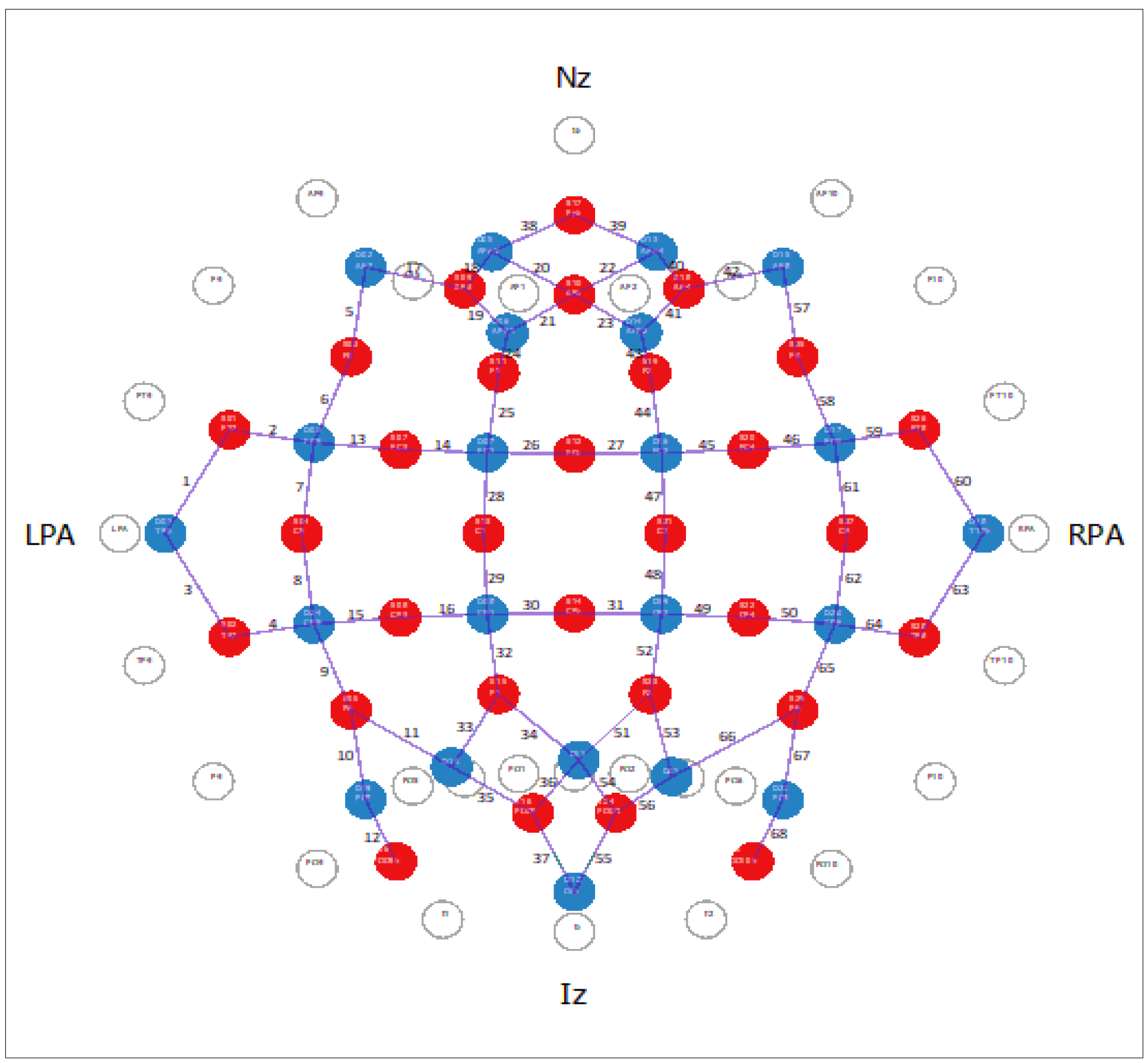
Figure 2.
Graphical representation of significant differences in neuronal activity of groups with different levels of resilience. Notes: green indicates areas with significant differences in text reading activities; orange indicates differences in test completion activities.
Figure 2.
Graphical representation of significant differences in neuronal activity of groups with different levels of resilience. Notes: green indicates areas with significant differences in text reading activities; orange indicates differences in test completion activities.
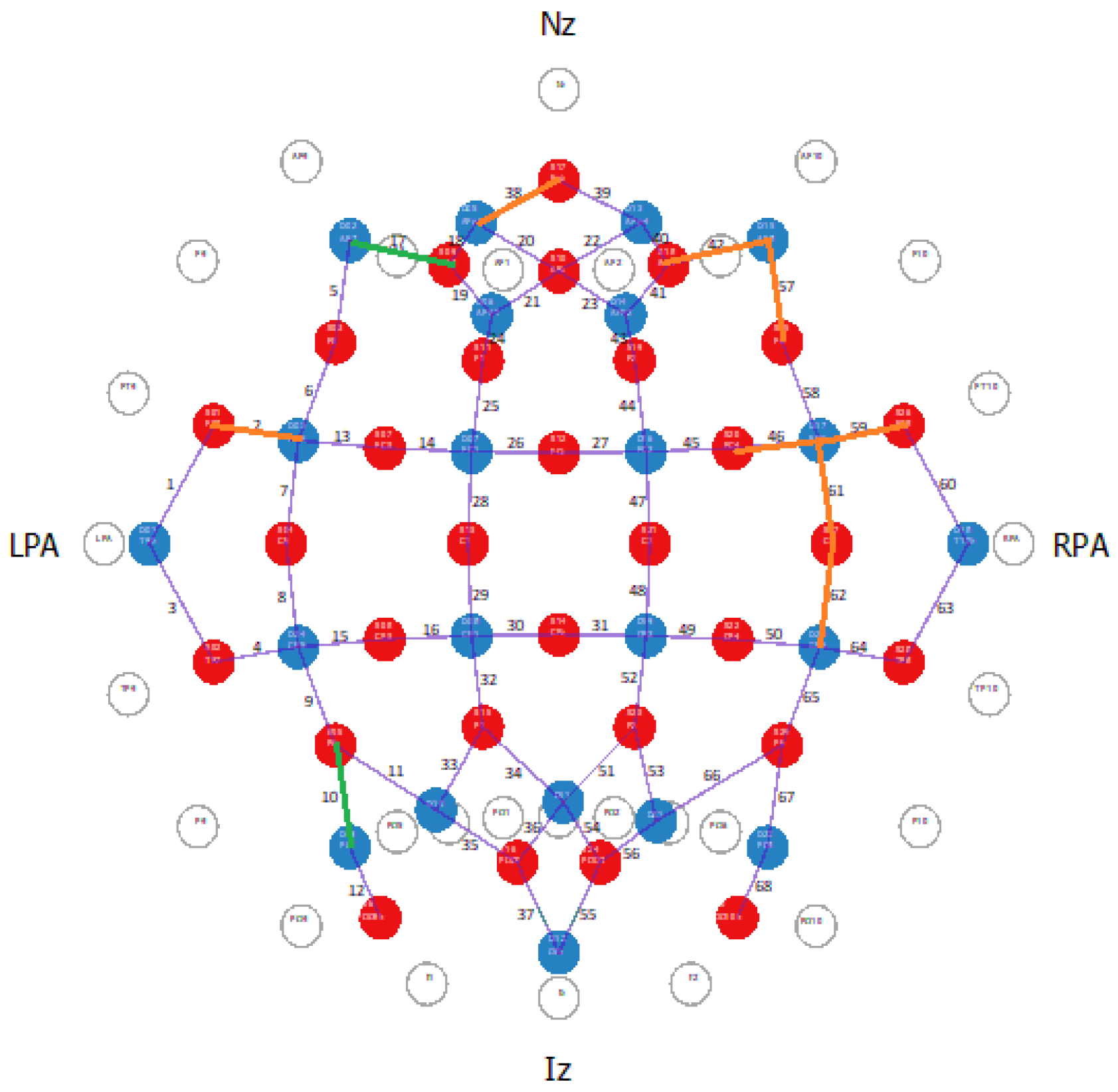
Figure 3.
Graphical representation of significant intragroup differences in correct answers between those performing the task on different media. Notes: green indicates channels where there were significant differences in the high-resilience group; brown - in the medium-resilience group; purple - in the low-resilience group.
Figure 3.
Graphical representation of significant intragroup differences in correct answers between those performing the task on different media. Notes: green indicates channels where there were significant differences in the high-resilience group; brown - in the medium-resilience group; purple - in the low-resilience group.
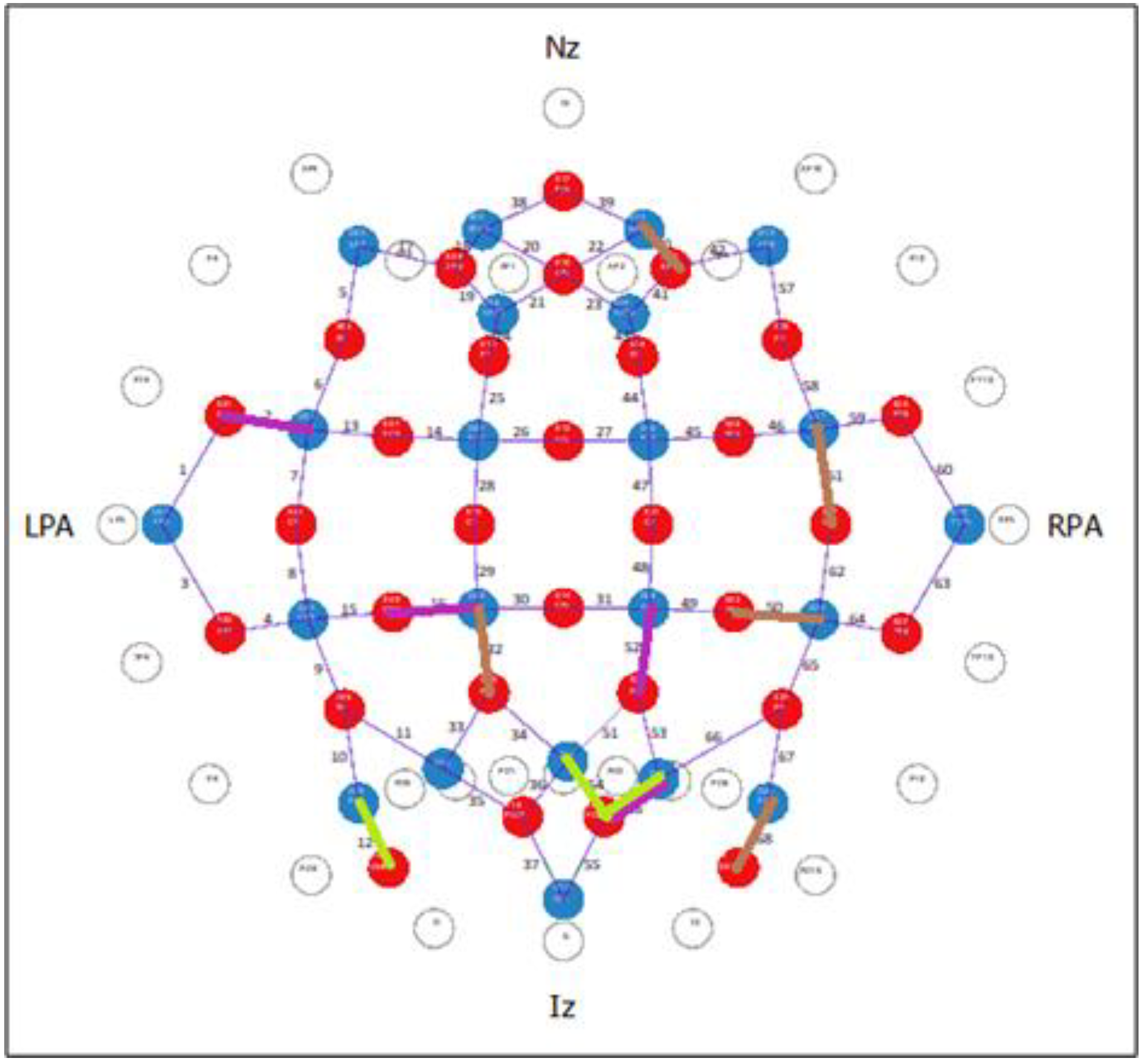

Table 1.
Summary of results, regarding correct answers given by the respondents.
| Numbers number of correct answers | N | % |
|---|---|---|
| 0 | 1 | 0,74 |
| 1 | 4 | 2,96 |
| 2 | 22 | 16,29 |
| 3 | 29 | 21,48 |
| 4 | 34 | 24,44 |
| 5 | 33 | 24,21 |
| 7 | 12 | 9,88 1 |
1 Tables may have a footer.
Disclaimer/Publisher’s Note: The statements, opinions and data contained in all publications are solely those of the individual author(s) and contributor(s) and not of MDPI and/or the editor(s). MDPI and/or the editor(s) disclaim responsibility for any injury to people or property resulting from any ideas, methods, instructions or products referred to in the content. |
© 2024 by the authors. Licensee MDPI, Basel, Switzerland. This article is an open access article distributed under the terms and conditions of the Creative Commons Attribution (CC BY) license (http://creativecommons.org/licenses/by/4.0/).
Copyright: This open access article is published under a Creative Commons CC BY 4.0 license, which permit the free download, distribution, and reuse, provided that the author and preprint are cited in any reuse.


