

Submitted:
03 July 2024
Posted:
03 July 2024
You are already at the latest version
Abstract
In the context of global urbanization and climatic change, the frequency of various uncertainties and disturbances faced by urban system is increasing, and enhancing urban resilience has become one of the vital components of sustainable development of modern cities. At the same time, urban resilience has become a hot topic in interdisciplinary research such as economics, ecology, and geography. This paper constructs urban resilience evaluation indicator system based on four dimensions—economy, ecology, society, and infrastructure. The evaluation indicator is used to measure the resilience levels of Yichang-Jingzhou-Jingmen-Enshi (YJJE) urban agglomeration in China from 2010 to 2023. Using the entropy weight method, the Getis-Ord Gi* model, and the robustness testing, this paper analyzes the spatiotemporal evolution characteristics of urban resilience in YJJE urban agglomeration. Then, the factor contribution model is used to explore the influencing factors of urban resilience. Finally, the CA-Markov model is used to predict urban resilience in 2030. The results are as follows: From 2010 to 2023, the urban resilience values of all prefecture-level and county-level cities in YJJE urban agglomeration showed an upward trend, and it indicated that the resilience of urban system is improving. Meanwhile, the urban resilience of YJJE urban agglomeration increased with an average annual growth rate of 3.25%. Furthermore, the urban resilience exhibited a significant spatially heterogeneity distribution, with Xiling, Wujiagang, Xiaoting, Yidu, Zhijiang, Dianjun, Dangyang, Yuan’an, Yiling, Duodao being the high-value agglomerations of urban resilience, and Hefeng, Jianli, Shishou, Wufeng being the low-value agglomerations of urban resilience. Then, we identified critical driving factors of urban resilience in YJJE urban agglomeration. Finally, the urban resilience of all cities within YJJE urban agglomeration will reach the medium level or higher than medium level in 2030. Xiling, Wujiagang, Xiaoting, Zhijiang, Dianjun, Dangyang, Yuan’an will remain hot spots of urban resilience, while Jianli will remain cold spots of urban resilience in the future. This study can provide the scientific reference and policy recommendation for the government to build resilient cities and improve sustainable urban development.
Keywords:
urban resilience
; spatio-temporal differentiation
; influencing factors
; Yichang-Jingzhou-Jingmen-Enshi urban agglomeration
; China
1. Introduction
As the most complex social ecological system, cities are extremely susceptible to disturbances and impacts from the climate and ecological change, globalization, natural disasters, social security accidents, economic crises, public health incidents, and so on [1,2,3]. Humanity has entered the Anthropocene dominated by human activities [4], and urbanization has become one of the most transformative trends in human society in the 21st century [5]. However, urbanization and industrialization have brought well-being to human beings, while they have also created numerous problems that constrain sustainable development of cities [6,7]. Urban resilience refers to the capacity of cities to resist disasters and to dispose resources rationally to recover quickly from them [8,9]. In recent years, urban resilience has received much attention in urban studies as a concept to deal with urban risks and to enhance the processing ability of the urban system [10].
Currently, several countries and organizations have proposed project and international initiatives on urban resilience [7,8]. The International Council for Advocating Regional Sustainable Development extended resilience research to the urban domain and proposed the concept of urban resilience [11]. The United Nations 2030 Agenda for Sustainable Development Goals (SDGs), the United Nations New Urban Agenda, and the U.S. Rockefeller Foundation Project “Global 100 Resilient Cities” emphasized the resilience is the one of the core objectives of sustainable development of cities [6,12]. In 2020, the Chinese government pointed out the significance and the goal of building resilient cities of China in the 14th Five Year Plan and in the long-term objectives for 2035 [7,13,14].
The ecologist Holling first introduced the term resilience to the field of ecology in 1973 when he published a seminal article about resilience and stability of ecological systems [15]. Since then, resilience research expanded from the field of ecology to the different fields of engineering, economics, society, psychology, ethnology, etc. [16,17,18,19]. Since 21st century, the term resilience was introduced into urban research and planning [11,20]. Scholars defined the concept of urban resilience based on the perspectives of bioscience, ecology, economics and management [7,14,21]. Although there is no uniform definition of urban resilience, in general, urban resilience is the capabilities of a city to offset, resist, reduce, absorb and defuse external disturbances and shocks [14,21].
Scholars have constructed models for quantitative evaluation of urban resilience based on multiple indicators, and then they have analyzed the spatiotemporal differences and the influencing factors of urban resilience among different cities or urban agglomeration [7,14,22]. For example, domestic and international scholars constructed a comprehensive urban resilience assessment framework and an indicator system covering the dimensions of society, economy, housing and infrastructure, ecological environment, community, culture, institution and capital, and used subjective or objective weighting methods to measure the urban resilience of communities, urban networks, cities, megacities, economic circles, economic belt, urban agglomerations, provinces, and countries [22,23,24,25]. Next the academic community analyzed the spatiotemporal evolution of urban resilience, and frequently applied the methods of Getis–Ord Gi analysis, exploratory spatial data analysis and Theil index to assess the difference of urban resilience among different regions and periods [26,27,28,29]. Finally, scholars adopted the mathematical models, geographic detectors, and statistical methods to explore the driving factors of urban resilience [30,31]. They found that natural factors, economic and social factors affect the spatial and temporal differences of urban resilience [30,32], and put forward specific suggestions to improve the urban resilience [14,33].
To sum up, the above scholars have provided the theoretical support and methodological guidance for this study. However, urban resilience is still a complicated and interdisciplinary matter requiring more in-depth research. Firstly, the current research lacks robustness analysis for different standardized methods, while ignoring the uncertainty of urban resilience assessment caused by using a single standardization method. Secondly, very limited literature exists in terms of urban resilience prediction in the future. Thirdly, recent studies primarily concentrate on single spatial scale as their research objectives. Research on the multi spatial scales of urban resilience is still lacking.
Yichang-Jingzhou-Jingmen-Enshi (YJJE) urban agglomeration is an important component of the middle reaches of the Yangtze River urban agglomeration which is one of the eight major urban agglomerations in China. And YJJE urban agglomeration holds a pivotal role in the development of Hubei Province, China with robust economic dynamics and notable urban expansions. Yichang in YJJE urban agglomeration is one of the regional centric cities of Central China. The cities in YJJE urban agglomeration are promoting the constructions of resilient cities to mitigate the adverse impacts of urban social ecological systems in the face of unforeseen crises.
To our knowledge, the objectives of this study are as follows: (1) To construct urban resilience evaluation indicator system from the four dimensions of economy, ecology, society, and infrastructure, and scientifically measure the urban resilience based on robustness analysis. (2) To investigate the spatiotemporal evolution characteristics of urban resilience in YJJE urban agglomeration during 2010–2023, considering two spatial scales of urban resilience: prefecture-level and county-level. (3) To examine the key influencing factors of urban resilience in study area, thereby to provide reference experience for detecting an effective improvement path of urban resilience. (4) To predict urban resilience of YJJE urban agglomeration in 2030, and to provide reference experience for exploring the urban resilience in the future.
The remainder of this paper is organized as follows. Section 2 introduces the study area, the construction of the indicator system, data sources, and research methods. In Section 3, the values of urban resilience are calculated, the spatiotemporal differentiation characteristics of urban resilience are measured and analyzed, the drivers of urban resilience are identified, and the urban resilience in the future is predicted. The discussion and conclusions of the paper are presented in Section 4 and Section 5, respectively.
2. Materials and Methods
2.1. Study Area
This study chooses the YJJE urban agglomeration in Hubei Province, China as the study area, which consists of 4 prefecture-level cities and 34 county-level cities as shown in Figure 1. It has the unique advantage of connecting Central China and Southwest China. Due to vigorous economic vitality and significant urban expansion, the YJJE urban agglomeration plays an increasingly important role in radiating to the surrounding regions, and occupies a vital position in the development of Hubei Province. It encompasses 4 prefecture-level cities: Yichang, Jingzhou, Jingmen, and Enshi. According to the Notice on Adjusting the Criteria for Classifying the Size of Cities issued by the State Council of the People’s Republic of China in 2014 [34], Yichang is classified as metropolis. Jingzhou and Jingmen are medium-sized cities, while Enshi is a small city. Moreover, Yichang, Jingzhou, Jingmen, and Enshi encompass 13 county-level cities, 8 county-level cities, 5 county-level cities, and 8 county-level cities, respectively (Figure 1).
2.2. Construction of Indicator System
This paper will investigate the spatiotemporal evolution characteristics of urban resilience in YJJE urban agglomeration during 2010–2023 from the four dimensions of economy, ecology, society, and infrastructure.
Economy resilience reflects the ability of the urban economic system to deal with external disturbances and risk shocks, and reduce losses [14,35]. We select six indicators to reflect the urban economy resilience level from the aspects of economic development level, industrial structure, savings level, governmental financial expenditure, social retail amount, and fixed asset investment.
Ecology resilience reflects the ability of the urban ecosystem in the process of urbanization and sustainable development under the climate change and anthropogenic disturbance [14,36]. We select six indicators to reflect the urban ecology resilience level from the aspects of urban greening level, air quality level, and waste utilization level.
Society resilience reflects the ability of the urban social system to cope with external pressures, disturbances, uncertainties and crises [37]. We select six indicators to reflect the urban society resilience level from the aspects of income level, education level, medical care level, grain yield level and social management level.
Infrastructure resilience reflects the ability of the urban infrastructure system to overcome the adverse effects of extreme events and recover quickly to guarantee the normal operation of urban system [7,14]. We select six indicators to reflect the urban infrastructure resilience level from the aspects of public transport, power supply, road construction, pipe network density, water supply and gas supply.
This paper presents 24 urban resilience indicators in Table 1, and the property of these indicators are positive.
2.3. Method
2.3.1. Standardization Method
In this paper, three standard methods of transformation were used to standardize each indicator for urban resilience evaluation, as shown in Formulas (1), (2), and (3). Then, three standardized values of each indicator were used in next steps such as the specific calculations of entropy weight method and robustness analysis. With a general focus on robust method, one of the three standardization methods was selected after robustness analysis for the calculation of comprehensive urban resilience index.
the range standardization method:
the z-transformation standardization method:
the interquartile range standardization method:
where Xi is the standardized index value of the indicator i, xi is the initial value of the indicator i, ximax, ximin, and mi are the maximum value, minimum value, mean value, and median value of the indicator i respectively, Si is standard deviation of the indicator i, iqri is interquartile range of the indicator i [38].
2.3.2. Entropy Weight Method
After the Section 2.3.1, the entropy weight method was used to calculate the weight of each indicator. The specific formulas are as follows:
where Pij is the normalized index value of the indicator i in the city j, Xij is the standardized index value of the indicator i in the city j in the Section 2.3.1. ei and di are the information entropy and difference coefficient of the indicator i, respectively. n is the total number of cities, and m is the total number of indicators. Finally, wi is the weight of the indicator i.
2.3.3. Robustness Analysis
The construction of composite indicators involves selection of various methods in the development process. However, this may result in various issues of uncertainty due the selection of the methods of imputation, normalization, standardization, weighting, and aggregation methods [39]. In the calculation of comprehensive urban resilience index, the different selections of data standardization methods can lead to changes in rankings among different cities, which further increases the uncertainty of the composite indicator [39]. The robustness checking can help to enhance the transparency and credibility of the urban resilience indices [39,40]. In this paper, three standardization methods were used to calculate the urban resilience index of 4 prefecture-level cities and 34 county-level cities in 2010, 2015, 2020, and 2023, and then obtain a ranking of 12 urban resilience index values at prefecture-level or county-level. Furthermore, three box plots about urban resilience index rankings in the YJJE urban agglomeration was constructed based on the variation range, which are further used to measure the robustness of the calculation results of urban resilience. The smaller the variation range in ranking of urban resilience, the stronger the robustness [39,40]. Thus, the one standardization method with the strongest robustness was selected from the three standardization methods to calculate the urban resilience index.
2.3.4. Calculation of Urban Resilience Index
The constructed evaluation model formula of urban resilience is as follows:
where URI is the urban resilience value of the city in the YJJE urban agglomeration, and n is the total number of variables. wi is the weight of the indicator i, Xi is the standardized index value of the indicator i, which is calculated using the one of the three standardization methods in Section 2.3.1 after robustness analysis. Yj is the value of the domain j in the urban resilience, Y1 is the value of the economy resilience, Y2 is the value of the ecology resilience, Y3 is the value of the society resilience, and Y4 is the value of the infrastructure resilience. a, b, c, and d are the to-be-determined coefficients, and a +b + c + d =1. In this paper, due to the equal importance of each domain in the urban resilience, a = b = c = d = 0.25. The larger the URI value, the higher the urban resilience. In addition, the levels of urban resilience are shown in Table 2.
URI = aY1+bY2+cY3+dY4
2.3.5. Getis-Ord Gi* Model
The Getis-Ord Gi* model an effective method to identify the spatial correlation between each observation value and adjacent environmental elements, and it can accurately discover the spatial clustering characteristics of high-value (hot spot) or low-value (cold spot) elements [7,41]. This paper uses the Getis-Ord Gi* model to identify high-value clusters and low-value clusters of urban resilience in YJJE urban agglomeration from 2010 to 2030. The specific formulas are as follows:
where xj is the urban resilience value of city j in the YJJE urban agglomeration, w(i,j) is the spatial weight between city i and city j, and n is the total number of cities. In this paper, the specific calculations of the Getis-Ord Gi* model are completed in the ArcGIS software platform.
2.3.6. Factor Contribution Model
To investigate the influence of each indicator on the urban resilience of YJJE urban agglomeration, we used factor contribution model [42] to identify the contribution value of each indicator to the urban resilience and the specific calculation is as follows:
where Oj is the contribution value of the driving factor j on the urban resilience; Ij is gap between the actual value and the optimal target value of the driving factor j, which is usually expressed as the difference between 1 and the standardization value of indicator j; Wj is the weight of the driving factor j; and n is the total number of the driving factors.
2.3.7. CA-Markov Model
The Markov chain can control the temporal variation, while Cellular Automata (CA) conversion rules can control the spatial variation [43]. Thus, the CA-Markov model combines the CA model with Markov chain, giving itself the ability to predict and analyze both spatial and temporal changes. The model can integrate the continuum spatial distribution elements and the possible spatial distribution transitions into the Markov chain, so that the Markov chain provides spatial prediction of the system state at the t+1 time node based on the system state change rules during the t–1 to t time node [44].
In this paper, the CA-Markov model is used to predict the urban resilience of YJJE urban agglomeration in 2030 based on the change rules of urban resilience in YJJE urban agglomeration from 2010 to 2020, and the specific calculations of the CA-Markov model are completed in the IDRISI software platform.
2.4. Data Sources
This study used the 4 prefecture-level cities and 34 county-level cities in the YJJE urban agglomeration as the case study. The data used in this study were derived from Statistical Yearbook of Yichang, Jingzhou, Jingmen, and Enshi, China Urban Statistical Yearbook, China Statistical Yearbook (County-Level), Environmental Quality Annual Report or Environmental Statistics Bulletin of Yichang, Jingzhou, Jingmen, and Enshi, Government Gazette on the Urban Construction Status of Yichang, Jingzhou, Jingmen, and Enshi.
3. Results
3.1. The Results of Robustness Analysis
In this paper, three box plots (Figure 2, Figure 3, and Figure 4) about urban resilience index rankings in the YJJE urban agglomeration was constructed based on the interquartile range standardization method, the range standardization method, and the z-transformation standardization method, respectively. In these box plots, highest ranking order and lowest ranking order showed the variation range in the urban resilience index rankings of each city in the YJJE urban agglomeration. And stable ranking order was the order with most occurrence frequency among the urban resilience index rankings based on the different standardization methods. From the comparison of Figure 2, Figure 3, and Figure 4, the variation range of the majority of cities was smallest in the urban resilience index rankings based on the range standardization method. The smaller the variation range in ranking of urban resilience, the stronger the robustness [39,40]. Thus, the range standardization method was selected from the three standardization methods in this paper to calculate the urban resilience index.
3.2. Spatiotemporal Evolution Characteristics of Urban Resilience
The spatial and temporal evolution characteristics of urban resilience in the YJJE urban agglomeration from 2010 to 2023 were analyzed in this paper. The results showed that the average value of urban resilience of the YJJE urban agglomeration was 0.471 in 2023 (Table 3). From 2010 to 2023, the YJJE urban agglomeration’s urban resilience increased by 0.140, with an average annual growth rate of 3.25%. From the perspective of prefecture-level cities, the urban resilience of Yichang increased by 0.117 during 2010–2023, with an average annual growth rate of 2.37%. At the same time, the urban resilience of Jingzhou increased by 0.156, with an average annual growth rate of 4.08%; the urban resilience of Jingmen rose from 0.356 to 0.504, with an average annual growth rate of 3.20%; the urban resilience of Enshi rose from 0.276 to 0.430, with an average annual growth rate of 4.29% (Table 3). The urban resilience values of all prefecture-level cities showed an upward trend between 2010 and 2023, and it indicated that the urban system’s ability to cope with external uncertainties, shocks, disturbances, and risks is improving. From the perspective of county-level cities, Xiling had the highest value of urban resilience among the all 34 county-level cities in 2010, which was 0.560; while Hefeng had the lowest value, which was 0.171. Furthermore, 10 county-level cities reached the medium level of urban resilience in 2010, while 18 county-level cities reached the relatively low level and 6 county-level cities remained the low level (Figure 5). In 2015, Xiling reached the relatively high level of urban resilience, while 14 county-level cities reached the medium level and remaining 19 county-level cities reached the relatively low level (Figure 5). In 2020, Xiling also reached the relatively high level of urban resilience, while Wufeng had the lowest value (0.30) of urban resilience among the all 34 county-level cities. Meanwhile, 18 county-level cities reached the medium level of urban resilience in 2020, while remaining 15 county-level cities reached the relatively low level (Figure 5). In 2023, Xiling had the highest value of urban resilience among the county-level cities in the YJJE urban agglomeration, which was 0.660; while Wufeng had the lowest value, which was 0.342. Furthermore, 6 county-level cities reached the relatively high level of urban resilience in 2023, while 21 county-level cities reached the medium level and remaining 7 county-level cities remained the relatively low level (Figure 5). From 2010 to 2023, the urban resilience values of all county-level cities showed an upward trend, and it indicated that the resilience of urban system is improving. Meanwhile, the urban resilience values of regional centers have consistently remained higher than that of other regions, such as Xiling, Wujiagang, Yiling, Jingzhou, Dongbao, and Enshi. Additionally, the urban resilience of county-level cities near mountainous areas have consistently remained lower than the average value of the YJJE urban agglomeration or prefecture-level cities, such as Wufeng, Hefeng, Badong, and Xuan’en.
This paper used the Getis-Ord Gi* model to identify high-value clusters (hot spot) and low-value clusters (cold spot) of urban resilience in YJJE urban agglomeration from 2010 to 2023. The spatial distribution of urban resilience in YJJE urban agglomeration was characterized by heterogeneity. Xiling, Wujiagang, Xiaoting, Yidu, Zhijiang, Dianjun, Dangyang, Yuan’an, Yiling, Duodao showed high-value agglomerations of urban resilience, while Hefeng, Jianli, Shishou, Wufeng showed low-value agglomerations of urban resilience (Figure 6). From 2010 to 2020, Xiling, Wujiagang, Xiaoting, Dianjun, Zhijiang exhibited hot-spot 99% confidence, while Yuan’an and Dangyang were identified as a hot spot of 95% confidence. Yiling was only identified as a hot spot of 90% confidence in 2010, while Duodao was only identified as a hot spot of 90% confidence in 2023. Yidu was identified as a hot spot of 95% confidence in 2010 and 2015, and it was identified as a hot spot of 90% confidence in 2020 and 2023. In 2023, Wujiagang and Dangyang were identified as a hot spot of 99% confidence, while Xiling, Xiaoting, Dianjun, Zhijiang, Yuan’an were identified as a hot spot of 95% confidence. Jianli was identified as a cold spot of 95% confidence in 2010, 2015 and 2020, and it was identified as a cold spot of 90% confidence in 2023. Hefeng was identified as a cold spot of 95% confidence in 2010, and it was identified as a cold spot of 90% confidence in 2015, 2020 and 2023. Shishou was identified as a cold spot of 95% confidence in 2010 and 2015, and it was identified as a cold spot of 90% confidence in 2020. Wufeng was only identified as a cold spot of 90% confidence in 2010.
3.3. Driving Factors of Urban Resilience
The factor contribution model (Formula (13)) was used to identify the driving factors influencing urban resilience in the YJJE urban agglomeration from 2010 to 2023. The results showed that the contribution values of the six indicators (park green space area, total amount of urban social retail, financial expenditure per capita, number of buses per 10,000 people, urban disposable income per capita, and GDP per capita) on the urban resilience were in the front rank of the twenty-four indicators, and it indicated that these six indicators were the critical driving factors of urban resilience in the YJJE urban agglomeration between 2010 and 2023. Among the six indicators above, the three indicators (total amount of urban social retail, financial expenditure per capita, GDP per capita) belong to the domain of economic resilience, and it indicated that economic development played a leading role in increasing urban resilience.
3.4. Modeling Changes in Urban Resilience in the future
In this paper, the CA-Markov model was used to predict the urban resilience of YJJE urban agglomeration in 2030. The results showed that the average value of urban resilience of the YJJE urban agglomeration was 0.563 in 2030 (Figure 7). From the perspective of prefecture-level cities, Yichang, Jingzhou, Jingmen, and Enshi all reached the medium level of urban resilience in 2030. Yichang had the highest value of urban resilience, which was 0.586; while Enshi had the lowest value, which was 0.530 (Figure 7). From the perspective of county-level cities, Xiling had the highest value of urban resilience among the all 34 county-level cities in 2023, which was 0.809; while Wufeng had the lowest value, which was 0.430. Furthermore, Xiling reached the high level of urban resilience in 2023, while 11 county-level cities reached the relatively high level of urban resilience and remaining 22 county-level cities remained the medium level (Figure 7).
The Getis-Ord Gi* model was used in this paper to identify high-value clusters (hot spot) and low-value clusters (cold spot) of urban resilience in 2030. Xiling, Wujiagang, Xiaoting, Zhijiang, Dianjun, Dangyang, Yuan’an showed high-value agglomerations of urban resilience, while Jianli showed low-value agglomerations of urban resilience (Figure 7). In 2030, Xiling was identified as a hot spot of 90% confidence, while Wujiagang, Xiaoting, Zhijiang, Dianjun, Dangyang, Yuan’an were identified as a hot spot of 95% confidence. Meanwhile, Jianli was identified as a cold spot of 90% confidence (Figure 7).
4. Discussion
Urbanization has become one of the most important development trends in the current world [45]. Improving urban resilience can increase a city’s ability to cope with external uncertainties, shocks, disturbances, and risks [46]. Scholars have explored spatiotemporal evolution and driving factors of urban resilience in various regions of China [7,14,45,46,47]. Moreover, the Yangtze River Economic Belt and the urban agglomerations in the middle reaches of the Yangtze River have recently become a focus of urban resilience research in China [48,49,50,51,52,53]. Scholars found that the resilience of cities appeared to be on an upward trend in the middle reaches of the Yangtze River from 2009 to 2020 [14,49,52]. Similarly, this study revealed the urban resilience values of the YJJE urban agglomeration, an important component of the middle reaches of the Yangtze River, showed an upward trend from 2010 to 2023. Scholars found that the urban resilience of Yichang reached the medium level in 2019 [46]. Similarly, this study revealed that the urban resilience of Yichang reached the medium level in 2020. Scholars found that the urban resilience of the urban agglomerations in the middle reaches of the Yangtze River increased with an average annual growth rate of 3.86% from 2005 to 2018 [14]. Similarly, this study revealed that the urban resilience of the YJJE urban agglomeration increased with an average annual growth rate of 3.25% from 2010 to 2023.
Scholars have argued that the urban resilience exhibited a significant spatially heterogeneity distribution in the middle reaches of the Yangtze River, and the resilience value of Yichang was higher than that of Jingzhou, Jingmen, and Enshi in 2019 [46,48]. Similarly, this study revealed that the urban resilience showed spatially heterogeneity distribution in the YJJE urban agglomeration, and the resilience value of Yichang was higher than that of Jingzhou, Jingmen, and Enshi in 2020. Furthermore, Xiling, Wujiagang, Xiaoting, Yidu, Zhijiang, Dianjun, Dangyang, Yuan’an, Yiling, Duodao were the high-value agglomerations of urban resilience, and Hefeng, Jianli, Shishou, Wufeng were the low-value agglomerations of urban resilience during 2010–2023. Moreover, Scholars have argued that the economic resilience have the great contribution and driving effect on urban resilience of the middle reaches of the Yangtze River from 2005 to 2019 [14,48]. Similarly, this study revealed that economic resilience played a leading role in increasing urban resilience. Scholars found that the income of urban area and local fiscal revenue were the key factors affecting the level of resilience in the middle reaches of the Yangtze River during 2005–2020 [52]. Similarly, this study revealed that financial expenditure per capita and urban disposable income per capita were the critical driving factors of urban resilience in the YJJE urban agglomeration between 2010 and 2023. And improving the level of regional urban resilience is an important topic for the future research.
5. Conclusions
This paper developed a comprehensive evaluation indicator system of urban resilience based on four dimensions and, in conjunction with the Getis-Ord Gi* model, analyzed the spatiotemporal evolution characteristics of urban resilience in the YJJE urban agglomeration from 2010 to 2023. Moreover, driving factors of urban resilience were detected based on the factor contribution model. Additionally, the CA-Markov model was used to predict the urban resilience in 2030. The conclusions can be summarized as follows:
(1) The urban resilience of the YJJE urban agglomeration increased with an average annual growth rate of 3.25% from 2010 to 2023. The urban resilience exhibited a significant spatially heterogeneity distribution, with Xiling, Wujiagang, Xiaoting, Yidu, Zhijiang, Dianjun, Dangyang, Yuan’an, Yiling, Duodao being the hot spots of urban resilience, and Hefeng, Jianli, Shishou, Wufeng being the cold spots of urban resilience.
(2) The critical driving factors affecting urban resilience in the YJJE urban agglomeration from 2010 to 2023 were park green space area, total amount of urban social retail, financial expenditure per capita, number of buses per 10,000 people, urban disposable income per capita, and GDP per capita.
(3) The prediction of urban resilience is that urban resilience of all cities within the YJJE urban agglomeration will reach the medium level or higher than medium level in 2030. Xiling, Wujiagang, Xiaoting, Zhijiang, Dianjun, Dangyang, Yuan’an are high-value agglomerations of urban resilience, while Jianli are low-value agglomerations of urban resilience.
Author Contributions
Conceptualization, Z.Z., Z.H. and Z.L.; methodology, Z.Z. and Z.H.; software, Z.Z., Z.L. and X.H.; validation, Z.H. and L.C.; formal analysis, Z.Z., Z.L. and Z.H.; investigation, Z.Z., L.C. and X.H.; resources, Z.Z.; data curation, Z.H.; writing—original draft preparation, Z.Z., Z.H. and Z.L.; writing—review and editing, Z.Z., Z.L. and X.H.; visualization, Z.Z. and L.C.; supervision, Z.Z.; project administration, Z.Z.; funding acquisition, Z.Z. and Z.H. All authors have read and agreed to the published version of the manuscript.
Funding
This research was funded by the Science and Technology Research Project of Department of Education of Hubei Province, grant number Q20221207, the National Natural Science Foundation of China, grant number 42101293, and the Sprout Program of Beijing Academy of Sciences and Technology, grant number 23CE-BGS-18.
Institutional Review Board Statement
Not applicable.
Informed Consent Statement
Not applicable.
Data Availability Statement
The data presented in this study are available on request from the corresponding author.
Conflicts of Interest
The authors declare no conflict of interest.
References
- Webber, S.; Leitner, H.; Sheppard, E. Wheeling Out Urban Resilience: Philanthrocapitalism, Marketization, and Local Practice. Ann. Assoc. Am. Geogr. 2020, 111, 343–363. [Google Scholar] [CrossRef]
- Tang, J.; Heinimann, H.; Han, K.; Luo, H.; Zhong, B. Evaluating resilience in urban transportation systems for sustainability: A systems-based Bayesian network model. Transp. Res. Part C: Emerg. Technol. 2020, 121, 102840. [Google Scholar] [CrossRef]
- Chen, J.; Liu, J.; Peng, Q.; Yin, Y. Resilience assessment of an urban rail transit network: A case study of Chengdu subway. Phys. A: Stat. Mech. Appl. 2022, 586, 126517. [Google Scholar] [CrossRef]
- Waters, C.N.; Zalasiewicz, J.; Summerhayes, C.; Barnosky, A.D.; Poirier, C.; Gałuszka, A.; Cearreta, A.; Edgeworth, M.; Ellis, E.C.; Ellis, M.; et al. The Anthropocene is functionally and stratigraphically distinct from the Holocene. Science 2016, 351, 1304–1307. [Google Scholar] [CrossRef] [PubMed]
- Jouni, K.; Juha-Pekka, S. Quantifying the relationship of resilience and eco-efficiency in complex adaptive energy systems. Ecol. Econ. 2015, 120, 83–92. [Google Scholar]
- Shi, C.; Guo, N.; Zhu, X.; Wu, F. Assessing Urban Resilience from the Perspective of Scaling Law: Evidence from Chinese Cities. Land 2022, 11, 1803. [Google Scholar] [CrossRef]
- Deng, H.; Liu, K. Spatiotemporal Evolution of Urban Resilience and Spatial Spillover Effects in Guangdong Province, China. Land 2023, 12, 1800. [Google Scholar] [CrossRef]
- Zhao, R.; Fang, C.; Liu, H. Progress and prospect of urban resilience research. Progess Geogr. 2020, 39, 1717–1731. [Google Scholar] [CrossRef]
- Zhou, Q.; Qiao, Y.; Zhang, H.; Zhou, S. How does college scale affect urban resilience? Spatiotemporal evidence from China. Sustain. Cities Soc. 2022, 85, 104084. [Google Scholar] [CrossRef]
- Büyüközkan, G.; Ilıcak, Ö.; Feyzioğlu, O. A review of urban resilience literature. Sustain. Cities Soc. 2022, 77, 103579. [Google Scholar] [CrossRef]
- Motesharrei, S.; Rivas, J.; Kalnay, E.; Asrar, G.R.; Busalacchi, A.J.; Cahalan, R.F.; Cane, M.A.; Colwell, R.R.; Feng, K.; Franklin, R.S.; et al. Modeling Sustainability: Population, Inequality, Consumption, and Bidirectional Coupling of the Earth and Human Systems. Natl. Sci. Rev. 2016, 3, 470–494. [Google Scholar] [CrossRef]
- Marjolein, S.; Bas, W. Building up resilience in cities worldwide: Rotterdam as participant in the 100 Resilient Cities Programme. Cities 2017, 61, 109–116. [Google Scholar] [CrossRef]
- Liu, Y. Urban resilience system development measurement: Based on an empirical study of 288 Chinese cities. Urban Dev. Stud. 2021, 28, 93–100. [Google Scholar]
- Huang, J.; Sun, Z.; Du, M. Differences and Drivers of Urban Resilience in Eight Major Urban Agglomerations: Evidence from China. Land 2022, 11, 1470. [Google Scholar] [CrossRef]
- Holling, C.S. Resilience and Stability of Ecological Systems. Annu. Rev. Ecol. Syst. 1973, 4, 1–23. [Google Scholar] [CrossRef]
- Walker, B.H.; Anderies, J.M.; Kinzig, A.P.; Ryan, P. Exploring Resilience in Social-Ecological Systems Through Comparative Studies and Theory Development: Introduction to the Special Issue. Ecol. Soc. 2006, 11, 2. [Google Scholar] [CrossRef]
- Smit, B.; Wandel, J. Adaptation, adaptive capacity and vulnerability. Glob. Environ. Chang. 2006, 16, 282–292. [Google Scholar] [CrossRef]
- Alexander, D.E. Resilience and disaster risk reduction: an etymological journey. Nat. Hazards Earth Syst. Sci. 2013, 13, 2707–2716. [Google Scholar] [CrossRef]
- Ma, F.; Wang, Z.; Sun, Q.; Yuen, K.F.; Zhang, Y.; Xue, H.; Zhao, S. Spatial–Temporal Evolution of Urban Resilience and Its Influencing Factors: Evidence from the Guanzhong Plain Urban Agglomeration. Sustainability 2020, 12, 2593. [Google Scholar] [CrossRef]
- Ma, X.; Chen, X.; Du, Y.; Zhu, X.; Dai, Y.; Li, X.; Zhang, R.; Wang, Y. Evaluation of Urban Spatial Resilience and Its Influencing Factors: Case Study of the Harbin–Changchun Urban Agglomeration in China. Sustainability 2022, 14, 2899. [Google Scholar] [CrossRef]
- Wardekker, J.A.; de Jong, A.; Knoop, J.M.; van der Sluijs, J.P. Operationalising a resilience approach to adapting an urban delta to uncertain climate changes. Technol. Forecast. Soc. Change 2010, 77, 987–998. [Google Scholar] [CrossRef]
- Yang, M.; Jiao, M.; Zhang, J. Research on Urban Resilience and Influencing Factors of Chengdu-Chongqing Economic Circle. Sustainability 2022, 14, 10585. [Google Scholar] [CrossRef]
- Cui, P.; Li, D. A SNA-based methodology for measuring the community resilience from the perspective of social capitals: Take Nanjing, China as an example. Sustain. Cities Soc. 2020, 53, 101880. [Google Scholar] [CrossRef]
- Suárez, M.; Gómez-Baggethun, E.; Benayas, J.; Tilbury, D. Towards an Urban Resilience Index: A Case Study in 50 Spanish Cities. Sustainability 2016, 8, 774. [Google Scholar] [CrossRef]
- Xun, X.; Yuan, Y. Research on the urban resilience evaluation with hybrid multiple attribute TOPSIS method: an example in China. Nat. Hazards 2020, 103, 557–577. [Google Scholar] [CrossRef] [PubMed]
- Zhao, R.; Fang, C.; Liu, J.; Zhang, L. The evaluation and obstacle analysis of urban resilience from the multidimensional perspective in Chinese cities. Sustain. Cities Soc. 2022, 86, 104160. [Google Scholar] [CrossRef]
- Liu, L.; Lei, Y.; Fath, B.D.; Hubacek, K.; Yao, H.; Liu, W. The spatio-temporal dynamics of urban resilience in China’s capital cities. J. Clean. Prod. 2022, 379, 134400. [Google Scholar] [CrossRef]
- Liu, L.; Luo, Y.; Pei, J.; Wang, H.; Li, J.; Li, Y. Temporal and Spatial Differentiation in Urban Resilience and Its Influencing Factors in Henan Province. Sustainability 2021, 13, 12460. [Google Scholar] [CrossRef]
- Qin, W.; Lin, A.; Fang, J.; Wang, L.; Li, M. Spatial and temporal evolution of community resilience to natural hazards in the coastal areas of China. Nat. Hazards 2017, 89, 331–349. [Google Scholar] [CrossRef]
- Huang, G.; Li, D.; Zhu, X.; Zhu, J. Influencing factors and their influencing mechanisms on urban resilience in China. Sustain. Cities Soc. 2021, 74, 103210. [Google Scholar] [CrossRef]
- James, S.; Ron, M. The economic resilience of regions: Towards an evolutionary approach. Camb. J. Reg. Econ. Soc. 2010, 3, 27–43. [Google Scholar] [CrossRef]
- Chen, Y.; Su, X.; Zhou, Q. Study on the Spatiotemporal Evolution and Influencing Factors of Urban Resilience in the Yellow River Basin. Int. J. Environ. Res. Public Health 2021, 18, 10231. [Google Scholar] [CrossRef]
- Martin, R.; Sunley, P. On the notion of regional economic resilience: conceptualization and explanation. J. Econ. Geogr. 2015, 15, 1–42. [Google Scholar] [CrossRef]
- CPGPRC (Central People’s Government of the People’s Republic of China). Notification by the Standard of State Council on Adjusting the Urban Scale. Available online: https://www.gov.cn/zhengce/content/2014-11/20/content_9225.htm (accessed on 22 March 2024).
- Christian, R.; Thomas, S. Towards social resilience: A quantitative and qualitative survey on citizens’ perception of social media in emergencies in Europe. Technol. Forecast. Soc. Chang. 2017, 121, 168–180. [Google Scholar] [CrossRef]
- Ranasinghe, U.; Jefferies, M.; Davis, P.; Pillay, M. Resilience Engineering Indicators and Safety Management: A Systematic Review. Saf. Health Work. 2020, 11, 127–135. [Google Scholar] [CrossRef]
- Liu, Y. Urban resilience system development measurement: Based on an empirical study of 288 Chinese cities. Urban Dev. Stud. 2021, 28, 93–100. [Google Scholar]
- Perch-Nielsen, S.L. The vulnerability of beach tourism to climate change: An index approach. Clim. Chang. 2010, 100, 579–606. [Google Scholar] [CrossRef]
- Singh, R.K.; Murty, H.R.; Gupta, S.K.; Dikshit, A.K. An overview of sustainability assessment methodologies. Ecol. Indic. 2009, 9, 189–212. [Google Scholar] [CrossRef]
- Kondyli, J. Measurement and evaluation of sustainable development: A composite indicator for the islands of the North Aegean region, Greece. Environ. Impact Asses. 2011, 30, 347–356. [Google Scholar] [CrossRef]
- Ord, J.K.; Getis, A. Local Spatial Autocorrelation Statistics: Distributional Issues and an Application. Geogr. Anal. 1995, 27, 286–306. [Google Scholar] [CrossRef]
- Murthy, C.S.; Laxman, B.; Menale, V.R. Sesha Sai Geospatial analysis of agricultural drought vulnerability using a composite index based on exposure, sensitivity and adaptive capacity. Int. J. Disast. Risk Re. 2015, 12, 163–171. [Google Scholar] [CrossRef]
- Firozjaei, M.K.; Sedighi, A.; Argany, M.; Jelokhani-Niaraki, M.; Arsanjani, J.J. A geographical direction-based approach for capturing the local variation of urban expansion in the application of CA-Markov model. Cities 2019, 93, 120–135. [Google Scholar] [CrossRef]
- Tang, F.; Fu, M.; Wang, L.; Zhang, P. Land-use change in Changli County, China: Predicting its spatio-temporal evolution in habitat quality. Ecol. Indic. 2020, 117, 106719. [Google Scholar] [CrossRef]
- Liu, N.; Wang, S.; Su, F.; Ye, J. Research on Coupling Coordination of China’s New-Type Urbanization and Urban Resilience—Taking Yangtze River Economic Belt as an Example. Sustainability 2022, 15, 456. [Google Scholar] [CrossRef]
- Tang, D.; Li, J.; Zhao, Z.; Boamah, V.; Lansana, D.D. The influence of industrial structure transformation on urban resilience based on 110 prefecture-level cities in the Yangtze River. Sustain. Cities Soc. 2023, 96, 104621. [Google Scholar] [CrossRef]
- Sun, J.; Zhai, N.; Mu, H.; Miao, J.; Li, W.; Li, M. Assessment of urban resilience and subsystem coupling coordination in the Beijing-Tianjin-Hebei urban agglomeration. Sustain. Cities Soc. 2024, 100, 105058. [Google Scholar] [CrossRef]
- Wang, K.; Zhao, S.; Chen, X.; Lei, Z.; Zhou, X. Spatio-Temporal Evolution and Influencing Factors of the Resilience of Tourism Environmental Systems in the Yangtze River Economic Belt of China. Sustainability 2023, 15, 10527. [Google Scholar] [CrossRef]
- Lee, C.-C.; Yan, J.; Li, T. Ecological resilience of city clusters in the middle reaches of Yangtze river. J. Clean. Prod. 2024, 443, 141082. [Google Scholar] [CrossRef]
- Lin, Y.; Peng, C.; Chen, P.; Zhang, M. Conflict or synergy? Analysis of economic-social- infrastructure-ecological resilience and their coupling coordination in the Yangtze River economic Belt, China. Ecol. Indic. 2022, 142, 109194. [Google Scholar] [CrossRef]
- Wang, L.; Li, J.; Lv, L. Urban Resilience and Its Links to City Size: Evidence from the Yangtze River Economic Belt in China. Land 2023, 12, 2131. [Google Scholar] [CrossRef]
- Wang, X.; Peng, W.; Xiong, H. Spatial-temporal evolution and driving factors of rural resilience in the urban agglomerations in the middle reaches of the Yangtze River, China. Environ. Sci. Pollut. Res. 2024, 31, 25076–25095. [Google Scholar] [CrossRef]
- Lin, Y.; Peng, C.; Shu, J.; Zhai, W.; Cheng, J. Spatiotemporal characteristics and influencing factors of urban resilience efficiency in the Yangtze River Economic Belt, China. Environ. Sci. Pollut. Res. 2022, 29, 39807–39826. [Google Scholar] [CrossRef]
Figure 1.
Geographical location and administrative boundaries of the YJJE urban agglomeration.
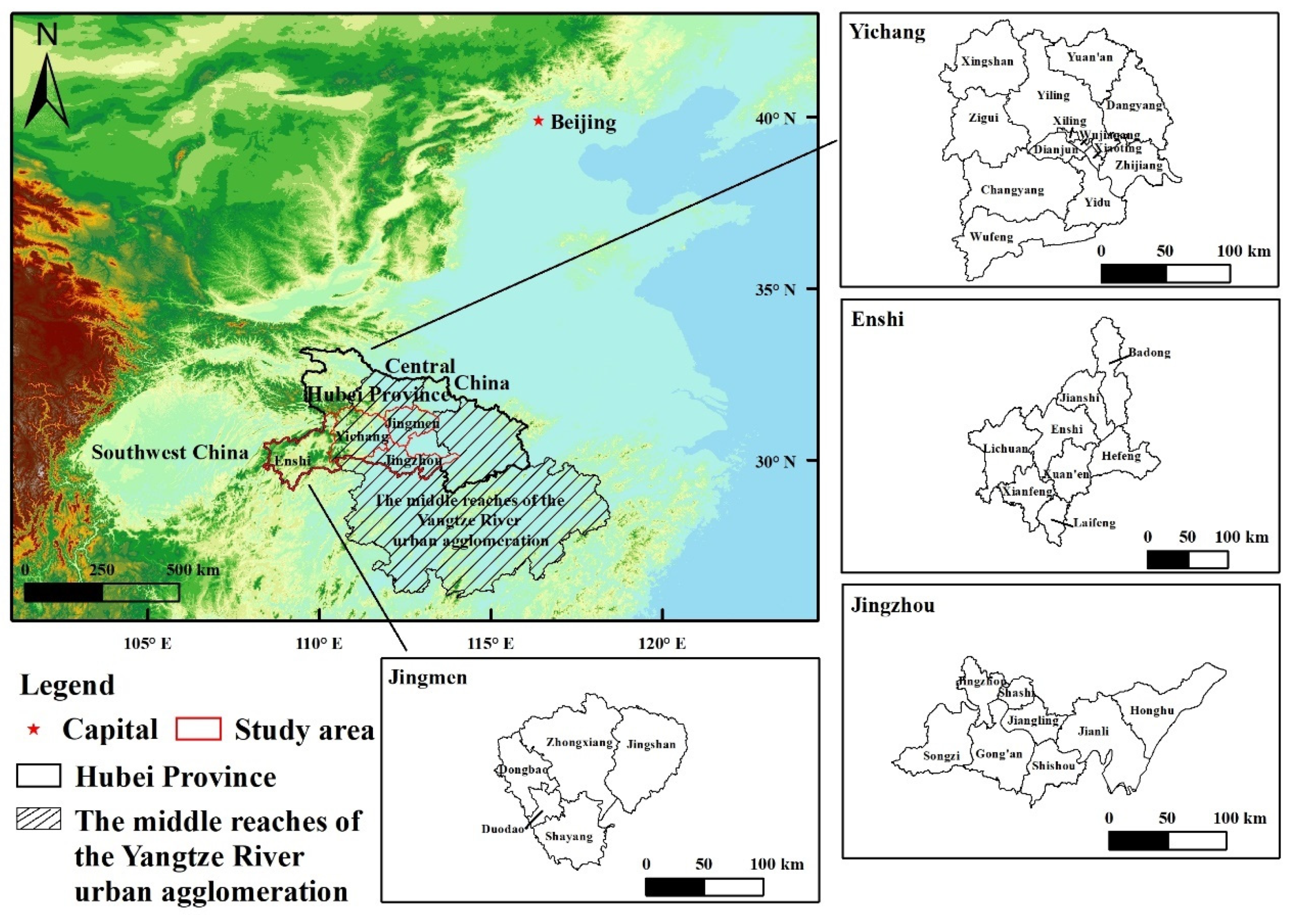
Figure 2.
The range of urban resilience index rankings in the YJJE urban agglomeration based on the interquartile range standardization method.
Figure 2.
The range of urban resilience index rankings in the YJJE urban agglomeration based on the interquartile range standardization method.
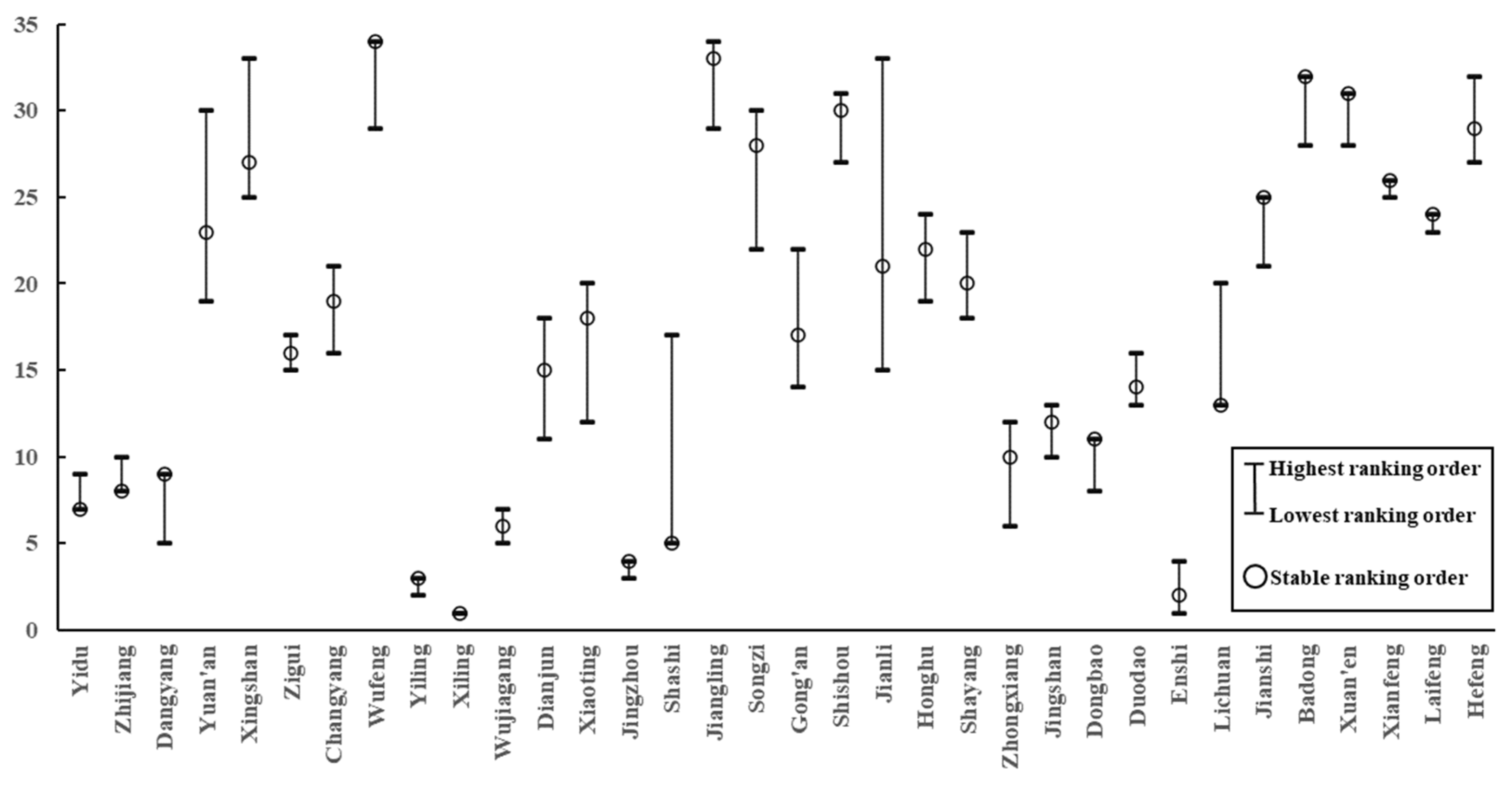
Figure 3.
The range of urban resilience index rankings in the YJJE urban agglomeration based on the range standardization method.
Figure 3.
The range of urban resilience index rankings in the YJJE urban agglomeration based on the range standardization method.
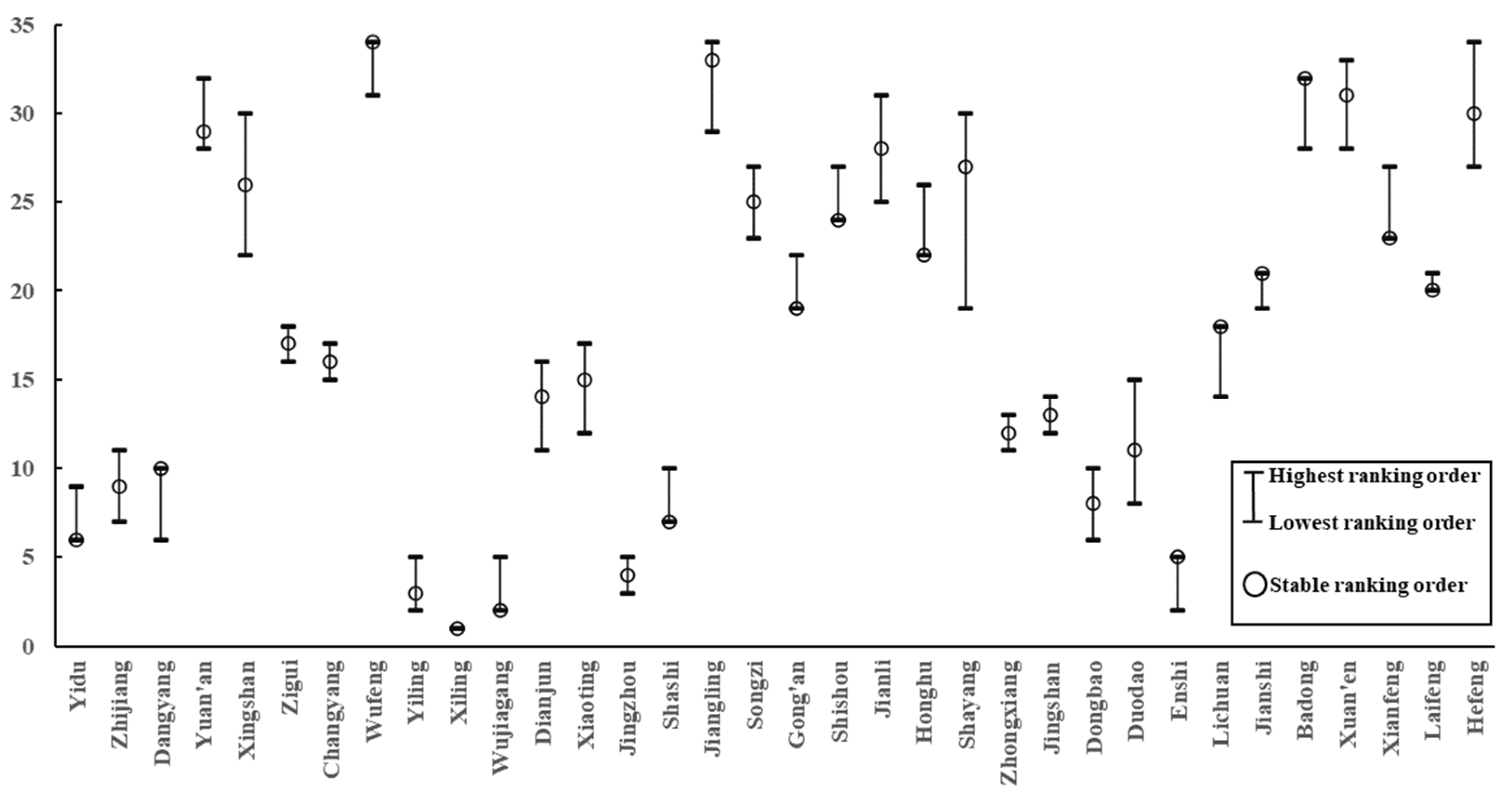
Figure 4.
The range of urban resilience index rankings in the YJJE urban agglomeration based on the z-transformation standardization method.
Figure 4.
The range of urban resilience index rankings in the YJJE urban agglomeration based on the z-transformation standardization method.
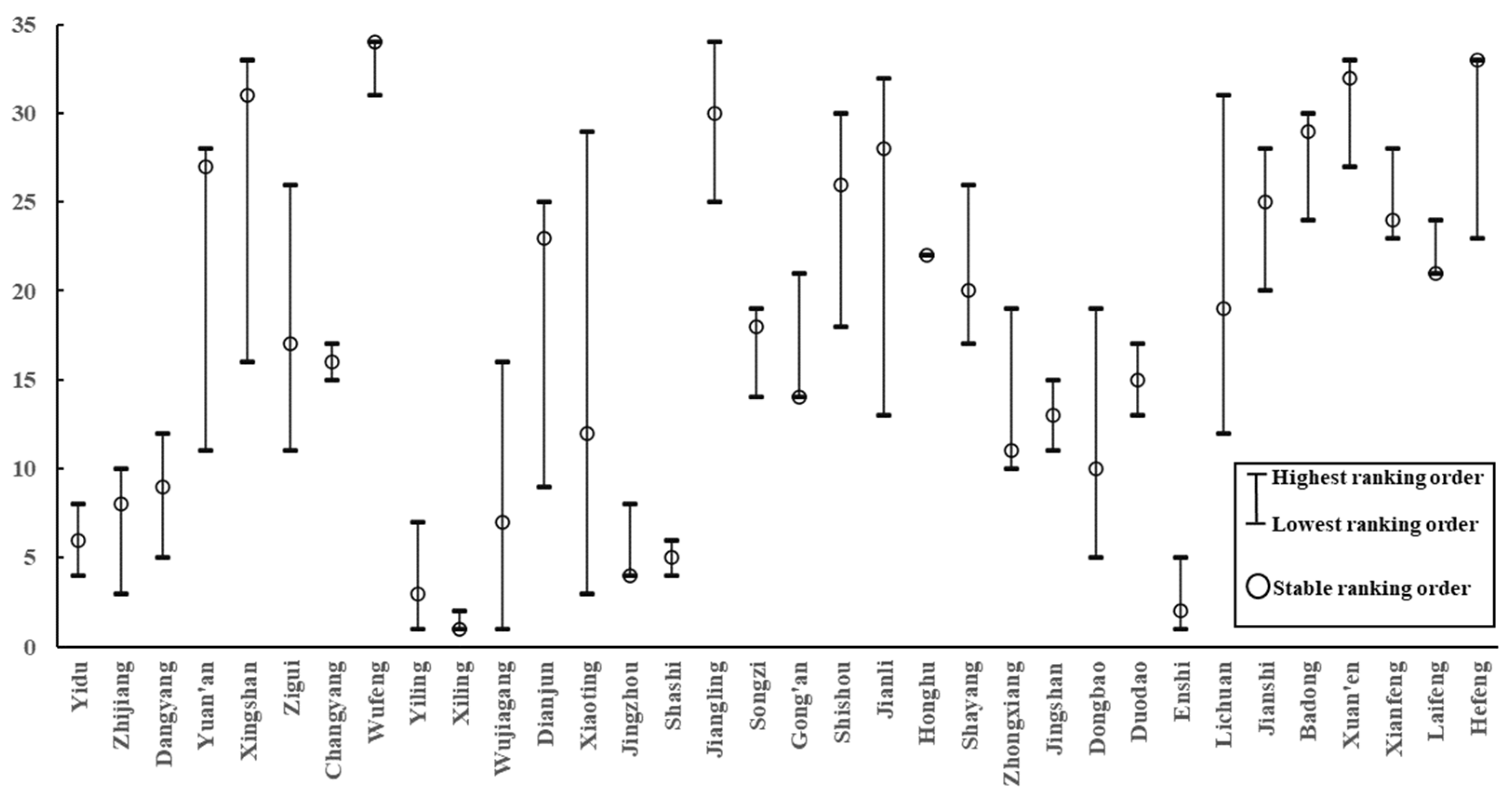
Figure 5.
Spatiotemporal evolution of urban resilience in the YJJE urban agglomeration, 2010–2023.
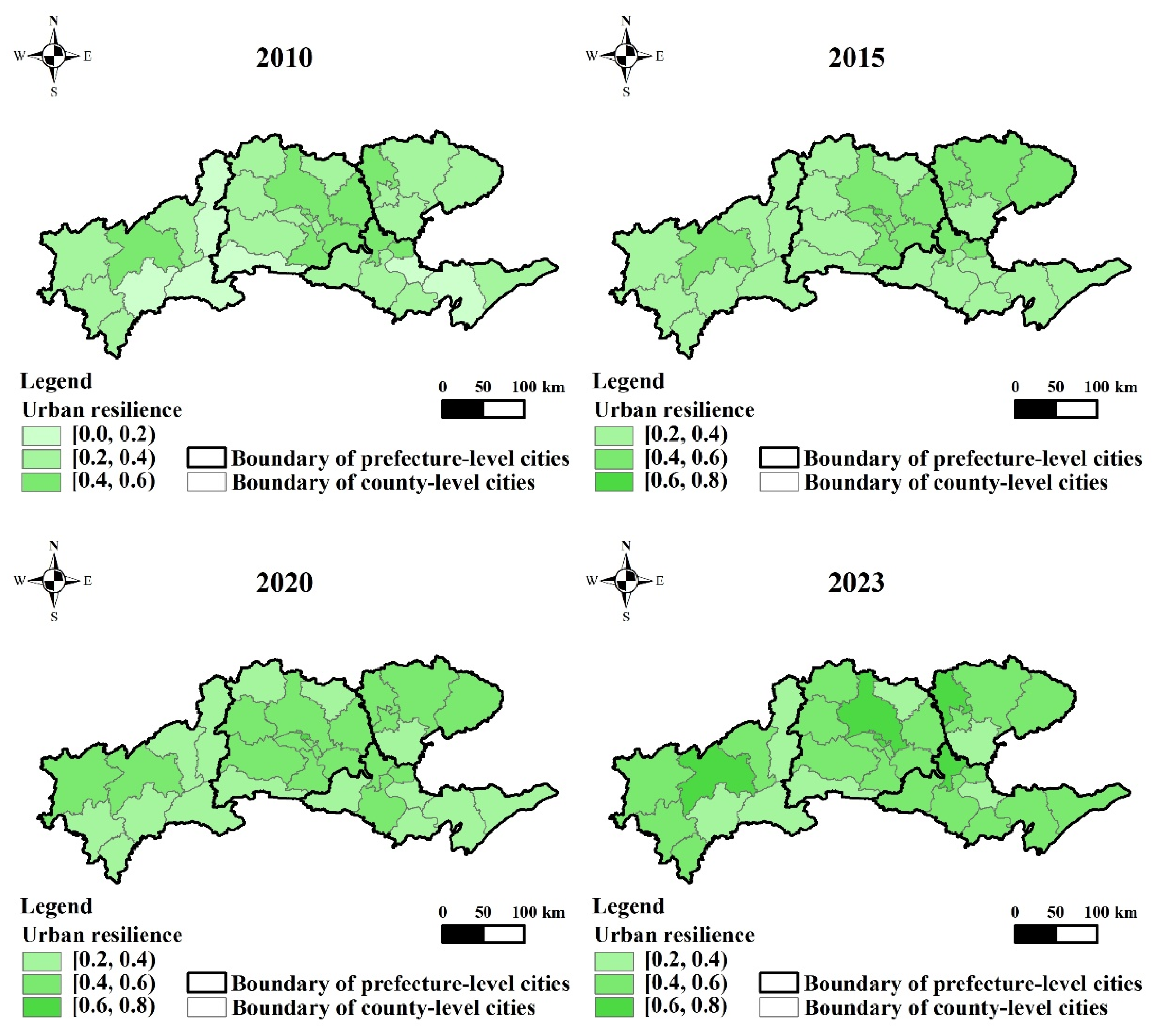
Figure 6.
Analysis of urban resilience hot spots in the YJJE urban agglomeration from 2010 to 2023.
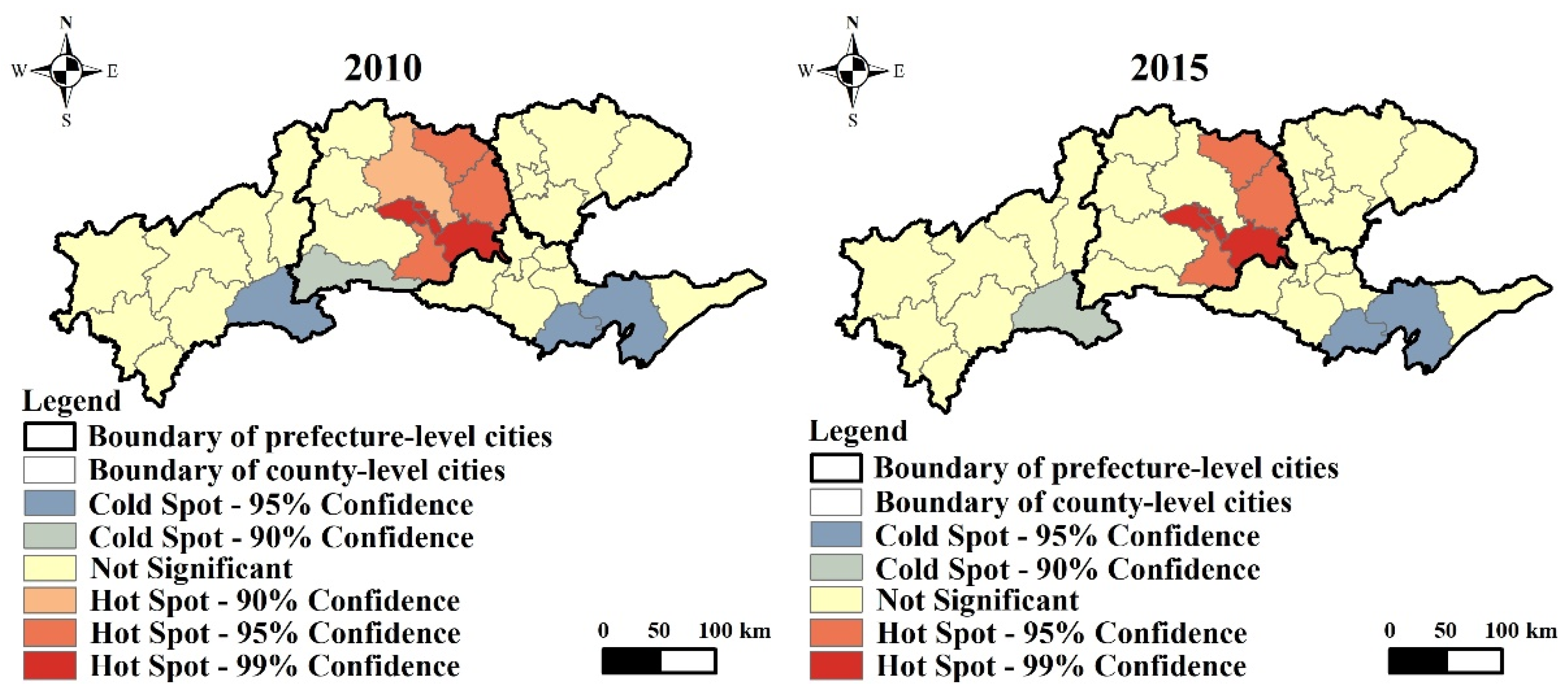
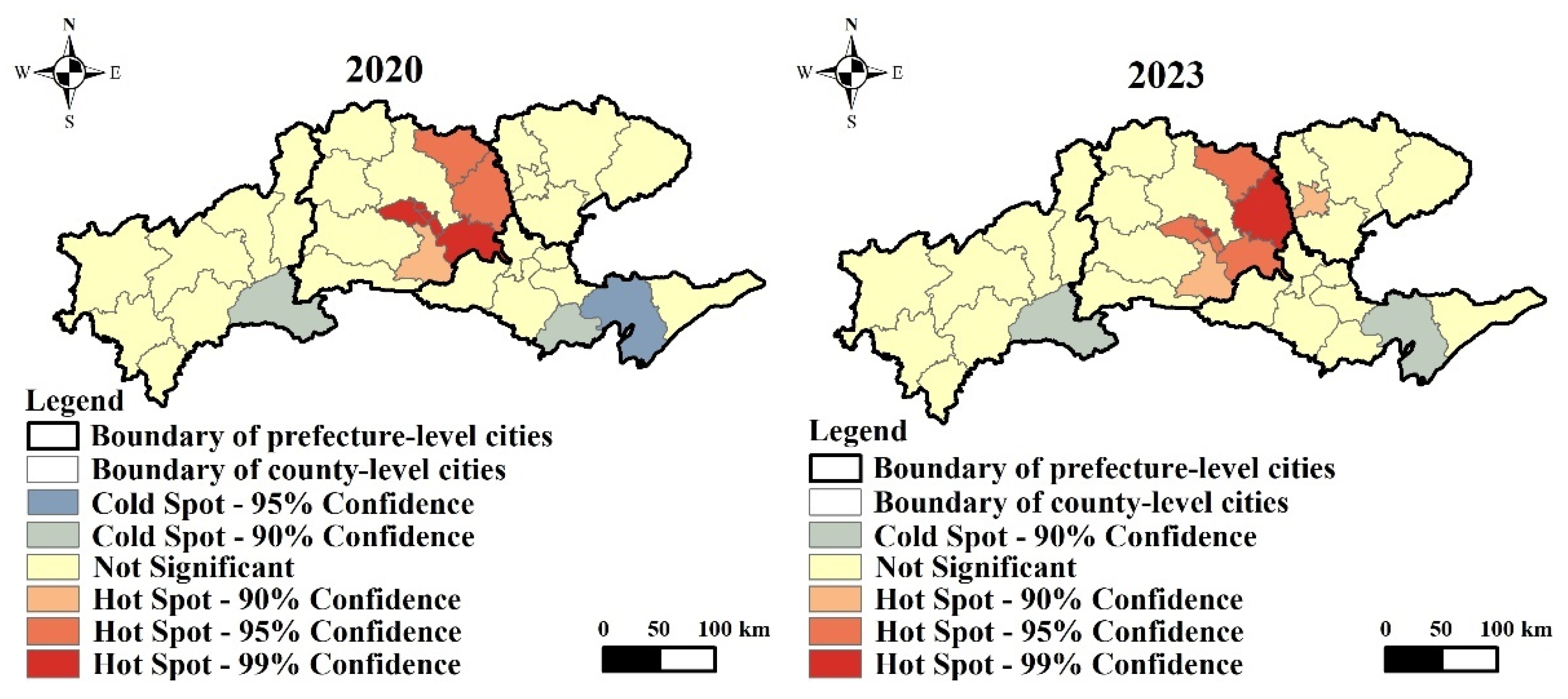
Figure 7.
The urban resilience and its hot spots of YJJE urban agglomeration in 2030.
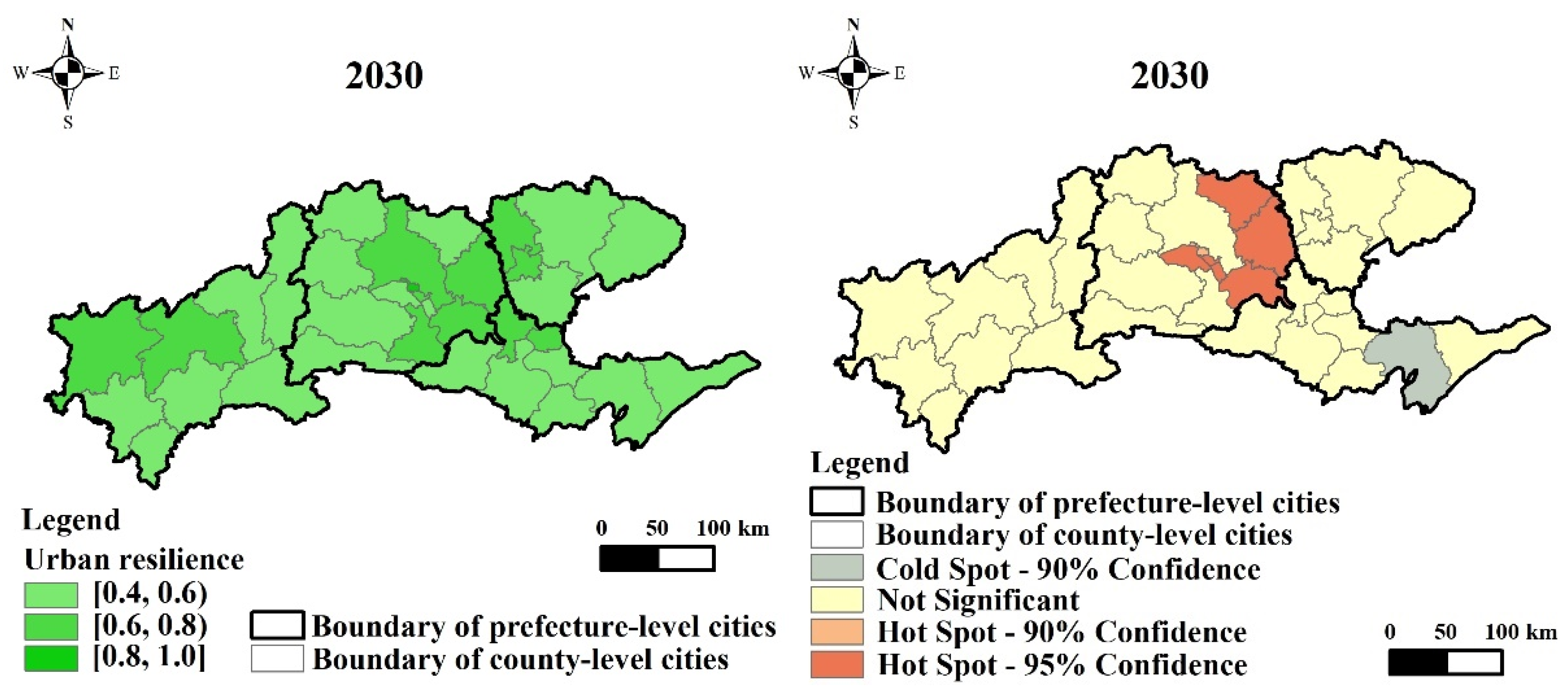

Table 1.
Comprehensive evaluation indicator system of the urban resilience in the YJJE urban agglomeration.
Table 1.
Comprehensive evaluation indicator system of the urban resilience in the YJJE urban agglomeration.
| Domains | Indicators | Unit | Variable |
|---|---|---|---|
| Economy | GDP per capita | CNY 10,000 | a1 |
| resilience | The proportion of tertiary industry in GDP | % | a2 |
| Savings deposit per capita | CNY 10,000 | a3 | |
| Financial expenditure per capita | CNY 10,000 | a4 | |
| Total amount of urban social retail | CNY 10,000 | a5 | |
| Total fixed asset investment | CNY 10,000 | a6 | |
| Ecology | Greening coverage rate of built-up area | % | b1 |
| resilience | Proportion of days with air quality index (AQI) < 100 in a year | % | b2 |
| Park green space area | ha | b3 | |
| Treatment rate of living waste in city | % | b4 | |
| Comprehensive utilization rate of general industrial solid waste | % | b5 | |
| Domestic sewage treatment rate | % | b6 | |
| Society | Urban disposable income per capita | CNY 10,000 | c1 |
| resilience | Number of hospital beds per 10,000 people | per 10,000 people | c2 |
| The investments on education | CNY 10,000 | c3 | |
| Grain yield per capita | kg | c4 | |
| Number of medical technical personnel per 10,000 people | per 10,000 people | c5 | |
| Public management and social organization personnel per 10,000people | per 10,000 people | c6 | |
| Infrastructure | Number of buses per 10,000 people | per 10,000 people | d1 |
| resilience | Per capita power supply | kw·h/person | d2 |
| Road area per capita | m2/person | d3 | |
| Density of urban drainage pipes | km/km2 | d4 | |
| Per capita water supply | m3/person | d5 | |
| Gas penetration rate | % | d6 |
Table 2.
The levels of urban resilience.
| Level | Low | Relatively Low | Medium | Relatively High | High |
|---|---|---|---|---|---|
| Urban resilience value | [0.0, 0.2) | [0.2, 0.4) | [0.4, 0.6) | [0.6, 0.8) | [0.8, 1.0] |
Table 3.
The mean value of urban resilience of the YJJE urban agglomeration and its prefecture-level cities.
Table 3.
The mean value of urban resilience of the YJJE urban agglomeration and its prefecture-level cities.
| Name | 2010 | 2015 | 2020 | 2023 |
|---|---|---|---|---|
| Yichang | 0.379 | 0.427 | 0.461 | 0.496 |
| Jingzhou | 0.294 | 0.350 | 0.401 | 0.450 |
| Jingmen | 0.356 | 0.422 | 0.456 | 0.504 |
| Enshi | 0.276 | 0.350 | 0.395 | 0.430 |
| YJJE urban agglomeration | 0.331 | 0.390 | 0.430 | 0.471 |
Disclaimer/Publisher’s Note: The statements, opinions and data contained in all publications are solely those of the individual author(s) and contributor(s) and not of MDPI and/or the editor(s). MDPI and/or the editor(s) disclaim responsibility for any injury to people or property resulting from any ideas, methods, instructions or products referred to in the content. |
© 2024 by the authors. Licensee MDPI, Basel, Switzerland. This article is an open access article distributed under the terms and conditions of the Creative Commons Attribution (CC BY) license (http://creativecommons.org/licenses/by/4.0/).
Copyright: This open access article is published under a Creative Commons CC BY 4.0 license, which permit the free download, distribution, and reuse, provided that the author and preprint are cited in any reuse.


