

Submitted:
28 June 2024
Posted:
01 July 2024
You are already at the latest version
Abstract
Over the last fifty years, management plans have become more descriptive with regard to potential sustainability of forest systems, raising questions about the feasibility of implementing management activities and ensuring sustainability of a wide variety of ecosystem services. To assess this issue, we conducted a survey among forest planning and operation research communities to understand their perceptions regarding the potential of a sample of sustainability statements currently used in forest plans to be incorporated into optimization models or other mathematical operations. The results revealed that only a few statements from the sample were deemed to have relatively mature or firm methodologies and data to enable inclusion in modern mathematical models for land use optimization. These statements were mostly related to economic sustainability, offering quantifiable information such as a non-declining flow of wood products over time and limits on the amount of timber harvested per decade. In contrast, sociocultural and, to some extent, ecological statements regarding sustainability were generally perceived to be more difficult to translate into mathematical modeling efforts. Particularly challenging were statements corresponding to sustaining natural or scenic characteristics of a forest. These findings may be attributed to various factors, including a lack of measurable indicators for sustainability and a potential lack of understanding about the modeling components and their interactions with planned management activities.
Keywords:
ecological sustainability
; sociocultural sustainability
; Society of American Foresters (SAF)
; economic sustainability
; sustainable forest management
1. Introduction
In contemporary times, the concept of forest sustainability is often viewed by society as the ultimate state within which forest managers and landowners must operate, and by seeking it society may be much wiser about resource allocation even though measures of outcomes may be vague and unclear. In practice, the trade-offs among economic, ecological, and social goals may be significant (Craig 2000; Floyd 2000). Over the last century, views on forest sustainability have evolved, reflecting changes in our understanding of forest ecosystems and societal desires (Bettinger et al. 2017; Baldwin et al. 2023; Vatandaşlar et al. 2023). A detailed assessment of all dimensions of sustainability (economic, ecological, sociocultural) can be challenging (Cooper 2000), as sustainability is inherently a social term concerning the ecosystem services available now and in the future. Statements regarding the desire for, or achievement of, forest sustainability may be easy to develop yet guidance on measuring and monitoring these desires may be lacking (Cooper 2000). Perspectives on forest sustainability may also be influenced by both an organization’s vision and the practical nature of forest management. While it may be possible to translate some statements on sustainability into formal descriptions that can be incorporated into a planning model, it may be impossible to do so for others (Johnson 2000; Lyons 2000), as the data and models necessary to measure and analyze sustainability may be difficult or impossible to acquire (Craig 2000). Although the concept of forest sustainability appears to have widespread support across society, there are lingering concerns about how sustainability is measured (Floyd 2000).
Various approaches exist to measure and evaluate sustainability, including the use of life cycle assessments (Jørgensen et al. 2008), content analyses (Gutierrez Garzon et al. 2022; Vatandaşlar et al. 2023), fuzzy-logic based networks (Reynolds et al. 2003), decision support systems (Kangas et al. 2015), and employment of the weak-strong sustainability concept (Janeiro and Patel 2015). Regardless of the chosen approach, at least four elements are required for measuring and evaluating sustainability: (i) outcomes (indicators), (ii) measures of the values for each outcome (metrics), (iii) the level of outcomes for a specified time period, and (iv) a reference frame (sustainability thresholds) (Davis et al. 2001). For instance, species richness (the number of species in a forest) can serve as a simple surrogate or proxy for certain biodiversity-related outcomes. By measuring and modeling species richness over a planning horizon, one can assess the trade-offs among other outcomes when providing sustainable levels of forest biodiversity is important. However, such evaluations are inherently subjective as any discussion of forest sustainability is strongly influenced by human values and objectives (Reynolds et al. 2003).
While historical records, traditional knowledge, pollen records, and carbon dating methods (for example) can help inform the probable historic range of variability for a condition or outcome of interest, forest inventory information and decision support systems are often utilized to characterize the current state of a forest and to simulate the future forest conditions (Reynolds 2005; Vidal et al. 2016). The availability and use of this technology, supports the decision-making process by allowing forest planners to anticipate the potential consequences of management objectives and to avoid potential unsustainable alternatives in the management solution space (Boyce 1985; Karvonen et al. 2017).
Decision support systems typically employ mathematical operations, ranging from simple regression models such as growth and yield curves, to operation research techniques that include linear programming, mixed-integer programming, and heuristics (Bettinger et al. 2017). The variety of decision support system tools and techniques documented in Kangas et al. (2015) suggests that there is no inherent methodological issue in evaluating forest sustainability. Nonetheless, the primary challenges lie in the practical application of these methods and the knowledge necessary to adequately describe how management actions and projected outcomes are interconnected across economic, ecological, and sociocultural dimensions (Karvonen et al. 2017).
In this paper, we hypothesize that vague and highly qualitative sustainability statements present problematic area for forest management and planning. Forest plans potentially offer “rhetorical exercises” asserting that outcomes of management activities are sustainable, yet they may lack detailed and quantitative direction that can be represented mathematically. One might argue that a lack of quantifiable model decreases the likelihood of achieving sustainability through a forest plan, posing a risk to the needs and well-being of future generations. This is particularly concerning in light of national and international programs that focus on sustainable forest management schemes. Forest sustainability may also be difficult to achieve as a result of focusing too narrowly on one specific dimension of forest sustainability. Since sustainability is commonly discussed in terms of economic, ecological, and sociocultural dimensions, an overemphasis on a single measure could disrupt the desired balance amongst these dimensions. Clouding the issue are terms like multiple use, long term, and resilience which imply that some aspects of management collectively contribute to advance forest sustainability (Vatandaşlar et al. 2023). Therefore, some have suggested that sustainability should be evaluated in a multidimensional manner, considering all three dimensions simultaneously (Karvonen et al. 2017) as economic, ecological, and sociocultural aspects of forest management are often interconnected. For instance, what may be perceived as a positive change in the projected flow of wood (economic) could also be perceived as a negative change in wildlife habitat quantity or quality (ecological).
Recently, a few research efforts have assessed the economic, ecological, and sociocultural aspects of forest sustainability based on language found in forest plans (Gutierrez Garzon et al. 2020; Vatandaşlar et al. 2023). These efforts illustrated predominant dimensions of sustainability within certain forest plans, and provided comparisons of the use of sustainability language between different plans developed by different forestry organizations. A recent international comparison of plans revealed that U.S. national forest plans placed more emphasis on language related to ecological sustainability than Turkish forest plans (Vatandaşlar et al. 2023). However, the inclusion in forest plans of terminology related to sustainability may not necessarily translate into actual forest sustainability for any one outcome. Further, statements regarding sustainability do not automatically imply sustainability has been obtained across all dimensions. We hypothesize that forest plans may contain theoretical or rhetorical sustainability statements whose associated success is difficult to measure or model.
The objective of this study is to analyze expert opinions of foresters on the difficulty (or ease) in developing data, models, and functional relationships that link management actions to outcomes, with respect to statements from forest plans that suggest sustainability can be achieved.
2. Methods
The survey frame included current members of the Society of American Foresters (SAF) working groups “E2-Land Use Planning, Organization and Management” and “E4-Management Science and Operations Research”, as reflected by the membership lists available in the online community offered through the official SAF website on November 5, 2023 (Society of American Foresters 2024). The people in these working groups voluntarily expressed their interest in land management organization and planning at different scales. We did not divide our sampling frame based on the two working groups, and initially, the survey frame included 495 people. The research team meticulously examined the survey frame to remove duplications (i.e., people who were members of both working groups) and the names of past members (i.e., deceased individuals, individuals who are no longer members of the professional society). An online SAF membership list was compared against the members of the working groups to determine whether individuals were current members of the professional society. Through this examination the original survey frame was reduced to 394 potential survey respondents.
The survey was designed to assess perceptions regarding the ability to model or measure various aspects of forest sustainability in conjunction with the development of a mathematical activity allocation problem (forest management plan). Four general demographic questions were first asked to help understand the characteristics of our sampling frame (primary field of work, highest educational degree, years of forestry experience, type of forestry organization affiliation). For the purpose of this survey, 435 statements regarding resource sustainability were extracted from 21 U.S. national forest management plans recently developed by the U.S. Forest Service. These statements were initially categorized as addressing either economic, ecological, or sociocultural sustainability using a process of categorization described through a content analysis of forest plans (Vatandaşlar et al. 2023). As the number of statements varied in each of the three categories (56 for economic, 315 for ecological, and 64 for sociocultural), and in consideration of the potential survey length, we selected five representative statements per category (Table 1). Of the statements selected, we specifically chose those which would provide a diversity of both resource interest and the potential technological challenge to forest planners.
Survey participants were first asked to rate their impression of the difficulty of incorporating statements regarding potential sustainability into a mathematical process addressing forest sustainability, using a scale from −2 to 2 according to the guidance in Table 2. This goal attainment scale uses a Likert-style scale that is based on five discrete levels ranging from −2 (worst possible outcome) to +2 (best possible outcome), with 0 used as an indicator of a neutral opinion on an outcome (Si and Lee 2008). We utilize this discrete Likert goal attainment scale, designed initially for use in medical fields, to indicate the relative importance of each statement (Kiresuk and Sherman 1968).
To gauge the ability of the survey participants in providing these assessments, participants were also asked to provide three types of information, on a 1 (no knowledge) to 5 (expert) Likert scale (Table 3), related to their knowledge of data, models, and functional relationships associated with each sustainability statement:
1. How knowledgeable are you regarding the data required to implement this statement in a forest plan developed using mathematical optimization techniques?
2. How knowledgeable are you regarding the model(s) required to implement this statement in a forest plan developed using mathematical optimization techniques?
3. How knowledgeable are you regarding the functional relationships between management actions and outcomes that are required to implement this statement in a forest plan developed using mathematical optimization techniques?
An electronic survey was created using SurveyMonkey (surveymonkey.com). An internal testing of survey mechanics was conducted by the authors to assess any potential logical flaws in the process. The final version of the survey was submitted to the University of Georgia Institutional Review Board (IRB) for official review on March 24, 2023. On August 4, 2023, the IRB indirectly approved the survey by indicating that this research does not involve human subjects as defined by the U.S. Department of Health and Human Services (DHHS) and Food and Drug Administration (FDA) regulations. The survey was offered to the sample frame on November 10, 2023. A reminder was sent to non-responding members of the sample frame after two weeks, and the final reminder was sent a day before the survey period ended on December 9, 2023.
As non-response bias may be an issue in any survey (Dillman et al. 2014), we extracted the first 10 respondents and compared them to the last 10 respondents (who were assumed to be a proxy for non-response) based on one main question (What is your current primary field of forestry work?) to determine whether significant differences were present between the two sets of respondents (Armstrong and Overton 1977). For this, we used a Chi-squared test of independence with a 95% confidence interval to compare the two response subsets.
The Mann-Whitney U test was employed to understand whether significant differences existed in some of the survey responses between pairs of groups. To this end, the survey participants were divided into two groups based on their highest educational degree (graduate vs. undergraduate). Our hypothesis was that there would be no statistically significant difference in response values between groups when they are partitioned this way. The survey participants were then divided into two groups based on their experience in the forestry sector (>30 years vs. <30 years), and a similar analysis was conducted. Finally, the survey participants were divided into two groups based on their work organization type (public vs. private), and again a similar analysis was conducted.
3. Results
Of the 394 people in the sample frame, 65 people responded to the survey, resulting in a response rate of 16.5%. This is a rate commonly observed in survey studies of this sort in the forestry domain (Bettinger et al. 2019; 2023). Almost half of the respondents stated that their primary field of forestry work was in consulting (25.4%) or land management (15.9%) (Figure 1). A significant portion of the respondents earned as their highest level of education a Master’s degree (44.4%) or a bachelor’s degree (41.3%), while only 14.3% earned a Ph.D. (Figure 2). Regarding the respondent’s work experience in the forestry sector, 69.8% reported over 30 years of experience in their specified fields (Figure 3). Only 9.5% have been employed for less than 10 years, while 20.7% have been employed for between 11 and 30 years. With respect to the organization in which the respondents were employed, we observed a wide spectrum of affiliations, including federal (12.9%) and state (12.9%) public agencies, academia (9.7%), and private consulting companies (27.4%) (Figure 4).
3.1. Economic Sustainability Statements
The economic sustainability category garnered the highest overall mean rating, with a mean goal attainment value of 0.31 (Table 4). Statement 1, “provision of a sufficient amount of scenery and ecological diversity to support the economic sustainability of local communities through ecotourism”, was suggested by the respondents as perhaps the most challenging to model or measure within a mathematical activity allocation problem. The mean goal attainment value for this statement was slightly below −1, indicating a relatively weak, unclear, and limited guidance for implementing this idea into a forest plan using established mathematical optimization techniques. Notably, Statement 2, “limit the quantity of timber harvested per decade to not exceed an estimated sustained yield limit”, had the highest mean goal attainment value (1.34) from survey respondents. Of the respondents, 58.5% affirmed that this particular statement offered clear guidance suitable for incorporation into well-established mathematical optimization techniques.
For Statement 3, “providing a sustainable amount of wood products to contribute to local community economic sustainability”, more than half respondents (53.8%), noted that, generally, there is enough information in the statement to implement mathematical optimization, however, 30.8% responded neutrally to the statement which is reflected in the mean goal attainment value of 0.54. Similar results were found with Statement 4, “provide a sustainable amount of wood products through efforts to meet the needs of ecological restoration goals”, as most respondents seemed neutral with respect to the statement or suggested that the statement did not provide clear guidance to implement in mathematical optimization. However, only 5.6% thought that the statement could clearly be incorporated into modeling efforts. This statement also had the widest range of the five economic sustainability statements, reflecting a wide view on incorporating this statement into a modeling effort. Finally, regarding Statement 5, “provide a non-declining flow of wood products over time,” more than half of respondents (54.6%) agreed that this statement would be relatively easy to implement in a mathematical modeling effort (Table 4).
3.2. Ecological Sustainability Statements
The overall mean goal attainment value of statements concerning ecological sustainability were observed to be close to neutral (0.17), indicating a lack of strong guidance for the incorporation of these statements into forest plans using modern, well-established techniques (Table 4). The responses were somewhat homogeneous among the rating choices for ecological statements compared to other sustainability dimensions, implying diverse opinions among respondents without an apparent clear consensus. Respondents had mixed opinions on Statement 6, “provide ecological conditions (habitat) to support, sustain, and recover rare, endemic, or at-risk species”, as goal attainment values were relatively neutral with regard to potential model implementation. The mean goal attainment value for this statement highlights this diversity of these opinions (0.21).
Most respondents (67.6%) to Statement 7, “provide aquatic and riparian habitats that support self-sustaining populations of native fish,” were either neutral (29.4%) or slightly positive (38.2%) that this statement may have enough information for incorporation into an optimization problem. The mean goal attainment value (0.38) again illustrates this slightly positive response distribution. Survey respondents suggested that Statement 8, “sustain ecosystem functions (nutrient cycling, water infiltration, etc.) as forests adapt to climate change”, appeared to be particularly challenging for its incorporation in a mathematical model, receiving a mean goal attainment value of −0.42. Over half of respondents indicated that implementing this statement into mathematical optimization would be challenging because the statement was somewhat unclear with limited guidance (24.2%) or did not provided methods for implementing the statement (27.3%). Statement 9, “provide a diversity of habitat components at the appropriate spatial, temporal, compositional, and structural levels to meet the life history needs of X species of wildlife, so that species is viable and persistent in the forest”, had the highest mean goal attainment value (0.52). While 61.3% of respondents responded positively to the potential for incorporating this statement into optimization techniques, 19.4% were neutral. The final statement in this series of sustainability statements, Statement 10, “ensure that the distribution and abundance of forest structural stages creates conditions that are ecologically resilient, sustainable, and compatible with natural levels of disturbance,” was viewed by most respondents as neutral (25.0%) or with some potential to implement yet still somewhat vague (25.0%).
3.3. Sociocultural Sustainability Statements
The number of survey responses in the sociocultural category was lower than those obtained for the economic and ecological aspects of sustainability. This may be attributed to varying participant knowledge levels concerning this category, as documented in the following subsection. The overall mean goal attainment value for this category was slightly negative (−0.11), indicating that the statements were somewhat weak and unclear, and provided limited guidance for implementing aspects of sociocultural sustainability into a forest plan using mathematical optimization techniques (Table 4). For example, most participants (31.3%) generally responded neutrally (mean goal attainment value of 0.09) to Statement 11, “provide sustainable and accessible quantities of renewable forest resources for traditional uses”, and the ability to incorporate this statement into modeling efforts. The widest range of responses across all statements in the survey was observed for this statement, which suggests conflicting opinions among respondents regarding its potential for inclusion in an optimization model for forest plans. Statements 12, 13, and 14 all had negative mean goal attainment values (−0.44, −0.38, and −0.63, respectively). The three statements included aspects of forest management that may have been considered by respondents to be subjective, such as maintaining scenically attractive natural characteristics (Statement 12), sustaining recreational user satisfaction (Statement 13), and preserving a visitor’s sense of place through protection of scenic character (Statement 14) and therefore may have been perceived to be more difficult to model. Statement 14, specifically, received negative ratings from almost 60.0% of respondents. Statement 15, “provide a sustainable road network to facilitate access to hunting, fishing, and other recreational activities”, received the most positive responses (64.5%), although the mean goal attainment value remained below 1.0.
3.4. Knowledge of Data, Models, and Functional Relationship to Implement Sustainability Statements
The overall findings indicated that participants’ knowledge of data, models, and functional relationships associated with the 15 sustainability statements were between 3 (I have some knowledge) and 4 (I am very knowledgeable). Survey respondents generally suggested that they possessed a higher level of knowledge concerning the data necessary to address sustainability as compared to the models and functional relationships (Table 5-7). Their highest level of knowledge about data, models, and functional relationship requirements was observed for economic sustainability statements, followed by ecological and sociocultural. The range was wide, however, from those who thought they had limited knowledge to those who thought they were very knowledgeable about data, models, and functional relationship requirements for implementing Statement 1. However, 13.3% of respondents indicated they had no knowledge of data requirements associated with this statement. This statement had the lowest mean rating (2.78) for all economic statements regarding data requirements. The majority of respondents indicated they were very knowledgeable or had expertise in the data required for the optimization of Statement 2. Specifically, this statement received the highest mean rating of 3.90, indicating that respondents felt personally and independently proficient in using such data in forest planning efforts. Somewhat comparable mean ratings were observed for Statement 3 (3.45) and Statement 4 (3.11) but nearly half of respondents (47.5%) expressed a high level of knowledge on data requirements for implementing Statement 3 compared to 34.2% for Statement 4. For Statement 5, of those who responded, approximately 85% of respondents either had some knowledge, were very knowledgeable, or had expertise in data requirements for model implementation.
In examining the knowledge level concerning the model(s) required for implementing the provided statements in a forest plan, a similar pattern was observed (Table 6). The mean ratings exhibited a gradual decrease from the economic towards the sociocultural category. Once again, Statement 2 garnered the highest score with a mean rate of 3.55. Approximately 55.0% of the respondents considered themselves as very knowledgeable or experts regarding the models required to implement this statement in a forest plan using mathematical optimization techniques. In contrast, Statement 14 received the lowest mean rating (2.48), indicating that respondents lacked knowledge about specific models associated with datasets they found unfamiliar.
When participants were asked about their knowledge of the functional relationships between management actions and outcomes required to implement each statement in a forest plan (Table 7), the statements with the highest and lowest rates remained consistent. As expected, the economic sustainability category obtained the highest rating, followed by the ecological and sociocultural categories.
3.5. Statistical Analysis Results
The outcome of the test of nonresponse bias was not significant (X2 = 0.053, p = 0.819), which suggested that the differences in responses between the first and last respondents may have not been significant. According to the Mann-Whitney U test results, all of the null hypotheses were rejected. The most significant difference was related to the organization for which the respondents worked, as mean goal attainment values appeared to be higher for respondents who worked for public agencies than those who worked for private companies (p = 0.001). Regarding work experience, the mean goal attainment values of respondents with a shorter work history were higher than that of more seasoned professionals (p = 0.024). Finally, the mean goal attainment values of respondents with only undergraduate degrees were statistically significantly higher than that of those who had earned graduate degrees (p = 0.043).
4. Discussion
The aim of this study was to gather expert opinions on the difficulty (or ease) of developing data, model(s), or functional relationships between management actions and outcomes for integrating sustainability statements provided in forest plans into mathematical models. Our objective was to ascertain whether the proposed statements regarding sustainability in forest plans might be enacted to illustrate resource sustainability was possible, or if these statements were merely “rhetorical exercises” asserting forest plans would lead to sustainable systems. To achieve this, we selected economic, ecological, and sociocultural sustainability statements from recent U.S. national forest plans and conducted a survey-based assessment within the forest planning and operation research communities registered with the SAF. The input from these experts helped confirm our hypothesis that vague and highly qualitative statements in forest plans are not necessarily conducive to modeling efforts or for evaluating forest sustainability effectively.
One reason for avoiding the use of clear and narrowly defined statements on forest sustainability may be to maximize managerial discretion and minimize potential failures in achieving performance targets due to legal challenges by outside entities. For example, in interviews conducted by Abrams et al. (2021) one person stated that “… what would come up in the team meetings on the forest plan was, ‘Oh, we shouldn’t write that in that certain way, because that’s going to tie our hands,’ so basically, in the forest plan we were writing in a way so that way the districts could be more flexible to get work done on the ground.”. In addition, Chapin et al. (2021) analyzed a set of forest planning documents, and found that although the prevalence of language on forest resilience increased between 2001 and 2017, there was a disconnect between the statements provided and their potential operationalization. Taken together, these findings suggest that some terms, such as sustainability and resilience, perhaps are being used as buzzwords (important sounding, yet of little actual meaning) in forest plans, and they may be limited in their ability to guiding management toward a sustainable state.
Our assessment of survey results indicated that only a few out of 15 representative statements provided detailed and quantitative information sufficient to be represented mathematically. These statements were mostly related to economic sustainability, offering quantifiable information such as a non-declining flow of wood products over time and limits on the amount of timber harvested per decade. In contrast, sociocultural and, to some extent, ecological statements were generally found to be more difficult to translate into a mathematical modeling efforts aimed at advancing forest sustainability. Challenging statements contained language related to sustaining natural or scenic characteristics of a forest, as these received the lowest goal attainment values from respondents in our study. These findings are consistent with existing research in the ecosystem services literature, where cultural ecosystem services are often regarded as the most difficult category to quantify and assess compared to provisioning and regulating ecosystem services categories (Burkhard and Maes 2017; Kopperoinen et al. 2017; Everard 2022). Provisioning and regulating ecosystem services can be associated with economic and ecological aspects of sustainability because the work conducted in this area is much more mature (Burkhard and Maes 2017).
The difficulty with incorporating sociocultural sustainability directly into mathematical planning processes may be due to value judgments that are held by people and shaped by their background and experiences. For example, spiritual and religious values may vary significantly across social groups even within the same geographical region (Everard 2022). Due to the complexities in measuring sociocultural sustainability, almost all cultural ecosystem services have been neglected in mapping studies (Kopperoinen et al. 2017). However, recreation and ecotourism may be exceptions, as they can be described using quantitative indicators such as the number of visitors or density of trails and camping sites.
In Vatandaşlar et al. (2023), it was noted that sustainability language was consistently present in recent U.S. national forest plans and ecological sustainability statements were more prevalent than economic and sociocultural statements. Interestingly, respondents of the present study suggested that they possessed a low level of knowledge concerning the data, model, and functional relationships related to ecological sustainability statements. This suggests that individuals may place more emphasis on textual content related to subjects with which they are less familiar. This may have also contributed to the vagueness of ecological statements in forest plans and their consequent difficulty in representation in mathematical terms compared to economic statements. One strategy to avoid vague statements may be to develop logic models with well-defined syntax and semantics, as demonstrated by Reynolds et al. (2003) in an ecosystem sustainability context. Another strategy is to use measurable and quantifiable sets of goals (objective functions) and constraints (frame of reference and environmental policies), along with defined time periods (planning horizon). Once such statements are formulated, it becomes possible to translate the problem into a mathematical process that can be addressed either manually or with the assistance of modern decision support systems.
When survey participants were divided into groups, significant differences were observed in most of the responses. Generally, foresters who work for public agencies perceived sustainability statements to be easier to incorporate into mathematical modeling efforts compared to those employed in private organizations. Similarly, the educational level obtained and length of work experience attained also influenced the views of survey respondents. We observed that individuals with lower levels of education and less work experience perceived it easier to represent the provided statements in mathematical terms, even if the statements were somewhat unclear. These findings align with those of other surveys. For example, Mahler and Barber (2017) suggested that people with higher educational levels were less likely to view resource quality and quantity as sufficient compared to those less-educated. Similarly, Kavas (2022) suggested that a lack of experience and education, a so-called “courage in ignorance”, may prevail. Considering our sample frame had no participants without a college degree, it is plausible that young people’s familiarity with emerging technologies, such as artificial intelligence methods and decision support systems, may explain their more favorable responses. While the translation process of information into a mathematical process may have previously involved manual construction of matrices and graphical solution techniques, modern software and advanced decision support systems give the impression that implementing quantitative planning process may be relatively easier today.
In the present study, we identified the most appropriate sustainability statements found in the U.S. national forest plans for incorporation into a mathematical process based on the analysis of expert opinions (perceptions) of foresters from the SAF. However, we neither translated the information provided by these statements into a mathematical process nor used it in a decision support system to determine their complete amenability. This may be perceived as one of the limitations of this study. In this regard, further research is needed to confirm that economic, ecological, and sociocultural sustainability are ensured if the specified management activities in forest plans are followed. It would also be useful to study forest plans from other organizations (both in the U.S. and internationally) and evaluate expert opinions of forest professionals in different parts of the world. An increased number of respondents could help better explain potential differences in survey responses between pairs of groups even if the response rate remains low.
5. Conclusions
Over the last five decades or so an increase in the ability of forest managers to model various aspects related to forest sustainability has occurred in conjunction with an increase in computing power and descriptions of the functional relationships between forest management activities and ecosystem services. However, the term sustainability has also become a catchphrase, well-known and frequently used, that is often hollow when closely inspected. Our investigation has illustrated that some statements regarding forest sustainability are indeed very firm in their ability to be measured and assessed using current mathematical models and data. Some of these statements, particularly those regarding economics or timber production, relate to well-established methodologies for measurement and analysis. However, we located other sustainability statements within forest plans that seem vague in their ability to demonstrate forest sustainability. The data, models, and relationships to management activities may be immature, obscure, or elusive to effectively meet the goal of firmly demonstrating that sustainability has been (or will be) achieved. Perhaps these types of statements should be associated with anticipative statements, such as “Although the methods to measure this aspect of sustainability are still developing, we are hopeful that ...” to help improving the transparency, clarity, and accountability of forest plans.
Author Contributions
Conceptualization: Can Vatandaslar, Pete Bettinger, Krista Merry, Kevin Boston, and Alba Rocio Gutierrez Garzon Methodology: Can Vatandaslar, Krista Merry, Pete Bettinger, and Kevin Boston Survey preparation and submission: Krista Merry Initial survey test: Taeyoon Lee, Can Vatandaslar, and Kevin Boston Analysis: Can Vatandaslar, and Krista Merry Writing—original draft preparation: Can Vatandaslar, and Pete Bettinger Writing—review editing: Can Vatandaslar, Pete Bettinger, Krista Merry, Kevin Boston, Alba Rocio Gutierrez Garzon, and Taeyoon Lee.
Acknowledgements
The authors thank the members of the Society of American Foresters (SAF) working groups E2 and E4 who participated in our survey. The corresponding author also acknowledges the financial support provided by the Scientific and Technological Research Council of Türkiye (TÜBİTAK) under the 2219 Post-doctoral Research Fellowship Program.
Conflicts of Interest
The authors declare that they have no conflict of interest.
References
- Abrams J, Greiner M, Schultz C, Evans A, Huber-Stearns H (2021) Can forest managers plan for resilient landscapes? Lessons from the United States national forest plan revision process. Environmental Management 67:574-588. [CrossRef]
- Armstrong JS, Overton TS (1977) Estimating nonresponse bias in mail surveys. Journal of Market Research 14(3):396-402. [CrossRef]
- Baldwin E, McLaughlin DM, Jasso V, Woods D, Breshears DD, López-Hoffman L, Soto JR, Swann A, Lien A (2023) Diverse stakeholders and their interests matter to the U.S. Forest Service: a network of action situations analysis of how stakeholders affect forest plan outcomes. Sustainability Science 18:27-42. [CrossRef]
- Bettinger P, Boston K, Siry JP, Grebner DL (2017) Forest management and planning (2nd ed), Academic Press, London, UK.
- Bettinger P, Merry K, Bayat M, Tomaštík J (2019) GNSS use in forestry—A multi-national survey from Iran, Slovakia and Southern USA. Computers and Electronics in Agriculture 158:369-383. [CrossRef]
- Bettinger P, Merry K, Fei S, Weiskittel A, Ma Z (2023) Usefulness and need for digital technology to assist forest management: Summary of findings from a survey of registered foresters. Journal of Forestry 121(1):1-11. [CrossRef]
- Boyce SG (1985) Forestry Decisions. General Technical Report SE-35. U.S. Department of Agriculture, Forest Service, Southeastern Forest Experiment Station, Asheville, NC.
- Burkhard B, Maes J (2017) Mapping ecosystem services. Pensoft Publishers, Sofia, Bulgaria. [CrossRef]
- Chapin J, Abrams J, Timberlake TJ, Schultz C, Evans AM, Fernández-Giménez M (2021) Operationalizing resilience on U.S. national forestlands: a quantitative analysis of environmental impact statements. Society & Natural Resources 34(10):1394-1411. [CrossRef]
- Cooper AW (2000) National forest management: Hearings before the Subcommittee on Forests and Public Land Management of the Committee on Energy and Natural Resources, United States Senate, One Hundred Sixth Congress, second session on the United States Forest Service’s proposed revisions to the regulation governing national forest planning and wildlife population viability requirements. Senate Hearing 106-552. U.S. Government Printing Office, Washington, D.C. p 41, 46.
- Craig LE (2000) National forest management: Hearings before the Subcommittee on Forests and Public Land Management of the Committee on Energy and Natural Resources, United States Senate, One Hundred Sixth Congress, second session on the United States Forest Service’s proposed revisions to the regulation governing national forest planning and wildlife population viability requirements. Senate Hearing 106-552. U.S. Government Printing Office, Washington, D.C. p 104.
- Davis L, Johnson KN, Bettinger P, Howard T (2001) Forest management (4th ed.). McGraw Hill, New York.
- Dillman DA, Smyth JD, Christian LM (2014) Internet, phone, mail, and mixed-mode surveys. The tailored design method, Fourth edition. John Wiley & Sons, Inc. Hoboken, NJ.
- Everard M (2022) Ecosystem services: key issues (2nd ed.). Routledge, New York, NY.
- Floyd DW (2000) National forest management: Hearings before the Subcommittee on Forests and Public Land Management of the Committee on Energy and Natural Resources, United States Senate, One Hundred Sixth Congress, second session on the United States Forest Service’s proposed revisions to the regulation governing national forest planning and wildlife population viability requirements. Senate Hearing 106-552. U.S. Government Printing Office, Washington, D.C. p 48, 50.
- Gutierrez Garzon AR, Bettinger P, Abrams J, Siry J, Mei B (2022) Forest sustainability in state forest management plans: A content analysis. Journal of Sustainable Forestry 41(1):92-113. [CrossRef]
- Gutierrez Garzon AR, Bettinger P, Siry J, Mei B, Abrams J (2020) The terms foresters and planners in the United States use to infer sustainability in forest management plans: A survey analysis. Sustainability 12(1), Article 17. [CrossRef]
- Janeiro L, Patel MK (2015) Choosing sustainable technologies. Implications of the underlying sustainability paradigm in the decision-making process. Journal of Cleaner Production 105:438-446. [CrossRef]
- Johnson KN (2000) National forest management: Hearings before the Subcommittee on Forests and Public Land Management of the Committee on Energy and Natural Resources, United States Senate, One Hundred Sixth Congress, second session on the United States Forest Service’s proposed revisions to the regulation governing national forest planning and wildlife population viability requirements. Senate Hearing 106-552. U.S. Government Printing Office, Washington, D.C. p 33.
- Jørgensen A, Le Bocq A, Nazarkina L, Hauschild M (2008) Methodologies for social life cycle assessment. The International Journal of Life Cycle Assessment 13(2):96-103. [CrossRef]
- Kangas A, Kurttila M, Hujala T, Eyvindson K, Kangas J (2015) Decision support for forest management (2nd ed.). Springer International Publishing, Cham, Switzerland. [CrossRef]
- Karvonen J, Halder P, Kangas J, Leskinen P (2017) Indicators and tools for assessing sustainability impacts of the forest bioeconomy. Forest Ecosystems 4, Article 2. [CrossRef]
- Kavas S (2022) “Courage in ignorance”: Mothers’ retrospective accounts of early childbearing in Turkey. Comparative Population Studies 47:29-56. [CrossRef]
- Kiresuk TJ, Sherman RE (1968) Goal attainment scaling: A general method for evaluating comprehensive community mental health programs. Community Mental Health Journal 4(6):443-453. [CrossRef]
- Kopperoinen L, Luque S, Tenerelli P, Zulian G, Viinikka A (2017) Mapping cultural services. In: Burkhard B, Maes J (eds) Mapping ecosystem services, Pensoft Publishers, Sofia, Bulgaria, pp 197-209. [CrossRef]
- Lyons J (2000) National forest management: Hearings before the Subcommittee on Forests and Public Land Management of the Committee on Energy and Natural Resources, United States Senate, One Hundred Sixth Congress, second session on the United States Forest Service’s proposed revisions to the regulation governing national forest planning and wildlife population viability requirements. Senate Hearing 106-552. U.S. Government Printing Office, Washington, D.C. p 99.
- Mahler RL, Barber ME (2017) Changes in public perceptions of river basin management priority issues over the last 28 years in the Pacific Northwest, USA. WIT Transactions on Ecology and the Environment 221:13-22. [CrossRef]
- Reynolds KM (2005) Integrated decision support for sustainable forest management in the United States: Fact or fiction? Computers and Electronics in Agriculture 49:6-23. [CrossRef]
- Reynolds KM, Johnson KN, Gordon SN (2003) The science/policy interface in logic-based evaluation of forest ecosystem sustainability. Forest Policy and Economics 5(4):433–446. [CrossRef]
- Si G, Lee H-C (2008) Is it so hard to change? The case of a Hong Kong Olympic silver medallist. International Journal of Sport and Exercise Psychology 6(3):319-330. [CrossRef]
- Society of American Foresters (2024) Working groups. Society of American Foresters, Washington, D.C. https://www.eforester.org/Main/Community/Join_a_Working_Group/Main/About/Working_Groups.aspx? (Accessed January 28, 2024).
- Vatandaşlar C, Bettinger P, Gutierrez Garzon AR, Merry K, Boston K, Lee T, Uzu J (2023) Sustainability language in forest management plans: A comparative analysis for public forests of the US and Turkey. Forests 14(3), Article 447. [CrossRef]
- Vidal C, Sallnäs O, Redmond J, Alberdi I, Barreiro S, Hernández L, Schadauer K (2016) Chapter 1: Introduction. In: Vidal C, Alberdi I, Henández L, Redmond J (eds) National forest inventories: Assessment of wood availability and use, Springer International Publishing, Cham, Switzerland, pp 1-24. [CrossRef]
Figure 1.
Current primary field of forestry work of survey participants (n = 63 for general demographic questions).
Figure 1.
Current primary field of forestry work of survey participants (n = 63 for general demographic questions).
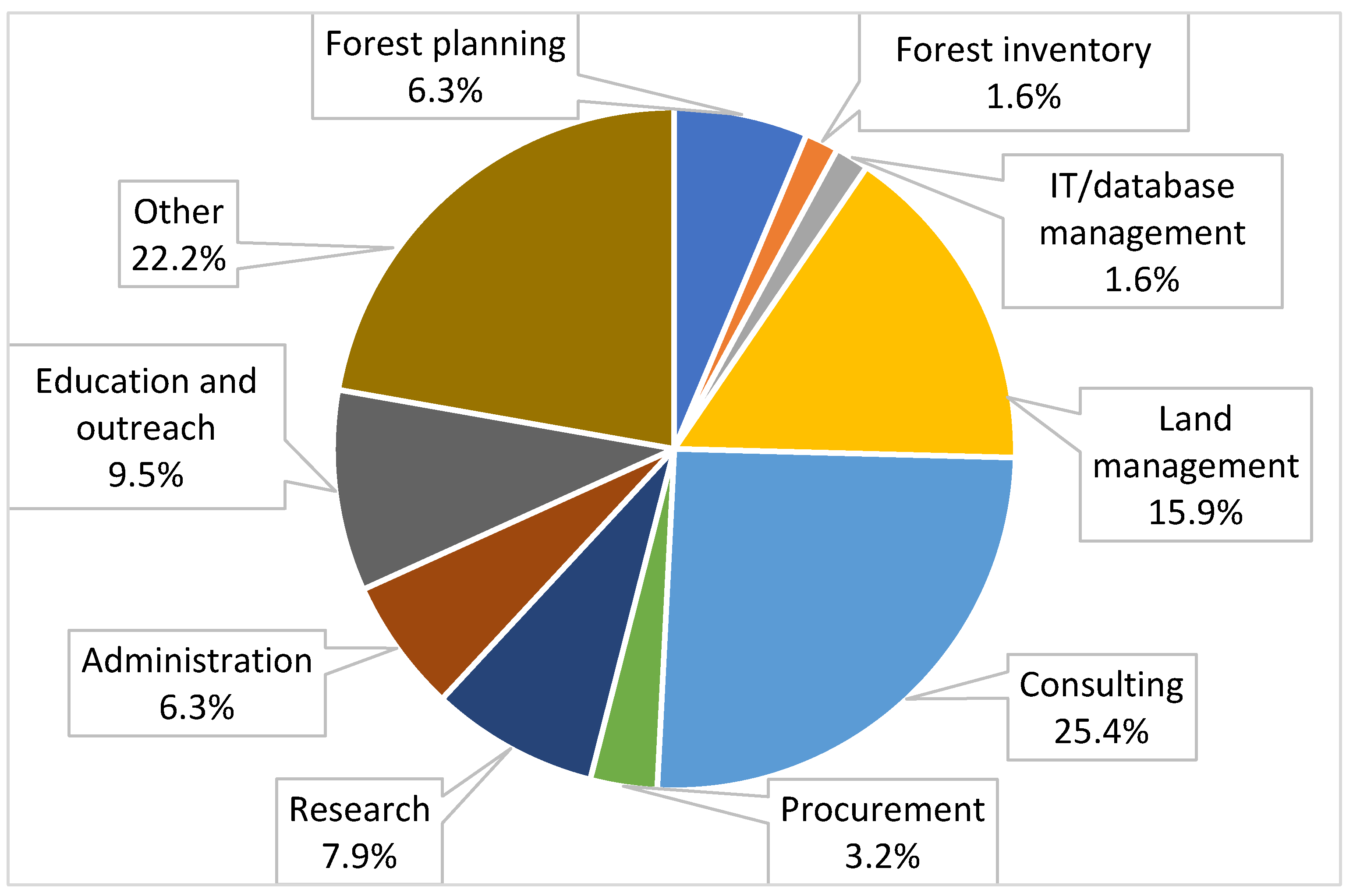
Figure 2.
The highest educational degree of survey participants (n = 63).
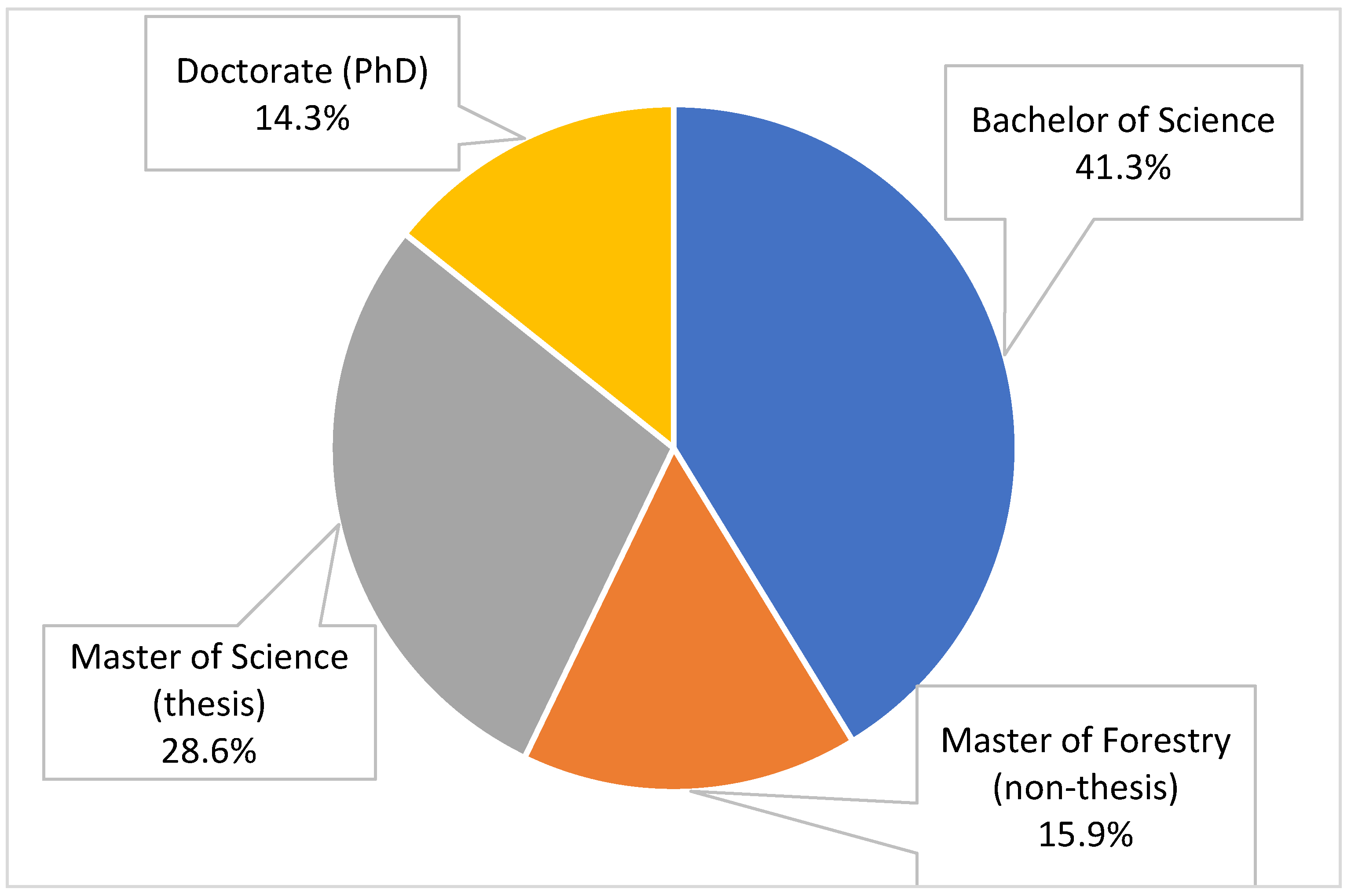
Figure 3.
Length of forestry experience of survey participants (n = 63).
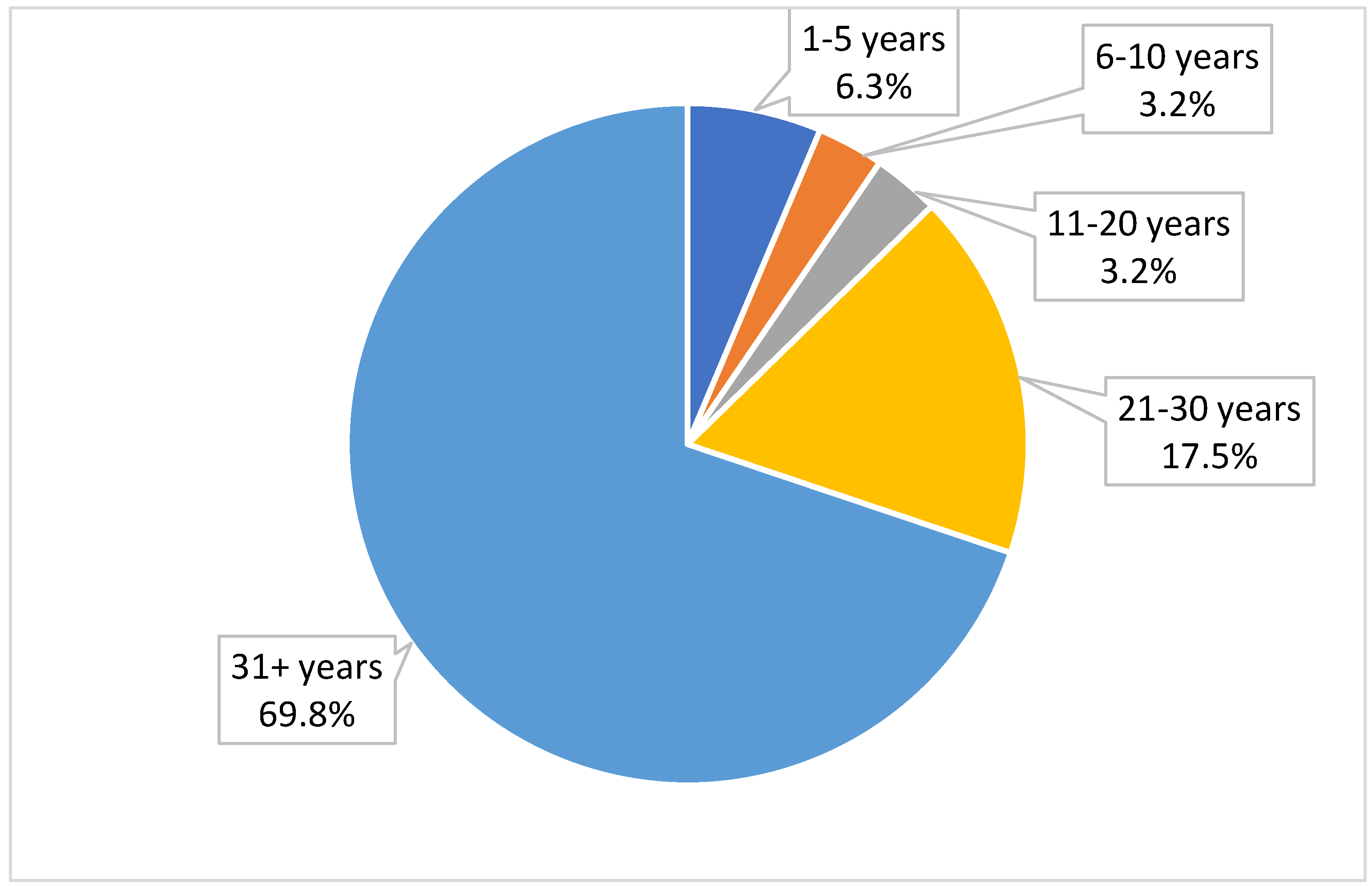
Figure 4.
Type of forestry organization of survey participants (n = 63).


Table 1.
Selected sustainability statements found in recently-developed U.S. National Forest plans.
| Category | No. | Full statement |
|---|---|---|
| Economic | 1 | Provide a sufficient amount of scenery and ecological diversity to support economic sustainability of local communities through ecotourism. |
| 2 | Limit the quantity of timber harvested per decade to not exceed an estimated sustained yield limit. | |
| 3 | Provide a sustainable amount of wood products to contribute to local community economic sustainability (jobs and income). | |
| 4 | Provide a sustainable amount of wood products through efforts to meet the needs of ecological restoration goals. | |
| 5 | Provide a non-declining flow of wood products over time. | |
| Ecological | 6 | Provide ecological conditions (habitat) to support, sustain, and recover rare, endemic, or at-risk species. |
| 7 | Provide aquatic and riparian habitats that support self-sustaining populations of native fish. | |
| 8 | Sustain ecosystem functions (nutrient cycling, water infiltration, etc.) as forests adapt to climate change. | |
| 9 | Provide a diversity of habitat components at the appropriate spatial, temporal, compositional, and structural levels to meet the life history needs of X species of wildlife, so that species is viable and persistent in the forest. | |
| 10 | Ensure that the distribution and abundance of forest structural stages creates conditions that are ecologically resilient, sustainable, and compatible with natural levels of disturbance. | |
| Sociocultural | 11 | Provide sustainable and accessible quantities of renewable forest resources for traditional uses. |
| 12 | Maintain natural characteristics that make the forest scenically attractive. | |
| 13 | Maintain recreation user satisfaction. | |
| 14 | Sustain scenic character in ways that contribute to a visitor’s sense of place. | |
| 15 | Provide a sustainable road network to facilitate access to hunting, fishing, and other recreational activities. |
Table 2.
Guidance for rating sustainability statements found in forest plans.
| Rating | Guidance for rating |
|---|---|
| 2 | This statement appears to provide clear guidance to incorporate this statement in well-established mathematical optimization techniques. |
| 1 | There appears to be, to a lesser extent, an ability to incorporate this statement in well-established mathematical optimization techniques. |
| 0 | There is neither strong nor unlikely convincing guidance to incorporate this statement in forest plan with modern, well-established techniques. |
| −1 | There appears to be somewhat weak, somewhat unclear, and limited guidance to implement this idea into a forest plan using well-established mathematical optimization techniques. |
| −2 | There appears to be no methods to be able to incorporate this statement. The statement is weak, unclear, and provides no guidance to implement this idea into a forest plan using well-established mathematical optimization techniques. |
Table 3.
Answer choices regarding participants’ knowledge of data, models, and functional relationships associated with each sustainability statement.
Table 3.
Answer choices regarding participants’ knowledge of data, models, and functional relationships associated with each sustainability statement.
| Likert scale | Scale value characteristic |
|---|---|
| 1 | I have no knowledge (I have not been exposed to these types of data/models/functional relationships). |
| 2 | I have limited knowledge (I have been exposed to these types of data/models/functional relationships). |
| 3 | I have some knowledge (I have personally used these types of data/models/functional relationships in a forest planning effort, but with assistance from others). |
| 4 | I am very knowledgeable (I have personally and independently used these types of data/models/functional relationships in a forest planning effort, but I have not personally developed these types of data/models/functional relationships). |
| 5 | I am an expert (I have personally and independently developed and used these types of data/models/functional relationships in a forest planning effort). |
Table 4.
Frequency of ratings and descriptive statistics for sustainability statements.
| Category | Statement No. | n | Difficult | Rating | Easy | Mean rating | Median | Mean of the category | ||
| −2 | −1 | 0 | 1 | 2 | ||||||
| Economic | 1 | 46 | 17 | 11 | 11 | 6 | 1 | −1.04 | −1 | 0.31 |
| 2 | 41 | 1 | 1 | 5 | 10 | 24 | 1.34 | 2 | ||
| 3 | 39 | 2 | 4 | 12 | 13 | 8 | 0.54 | 1 | ||
| 4 | 36 | 9 | 7 | 9 | 9 | 2 | −0.33 | 0 | ||
| 5 | 33 | 3 | 3 | 2 | 7 | 18 | 1.03 | 2 | ||
| Ecological | 6 | 34 | 6 | 5 | 7 | 8 | 8 | 0.21 | 0 | 0.17 |
| 7 | 34 | 4 | 2 | 10 | 13 | 5 | 0.38 | 1 | ||
| 8 | 33 | 9 | 8 | 7 | 6 | 3 | −0.42 | 0 | ||
| 9 | 31 | 4 | 2 | 6 | 12 | 7 | 0.52 | 1 | ||
| 10 | 32 | 4 | 6 | 8 | 8 | 6 | 0.19 | 0 | ||
| Socio-cultural | 11 | 32 | 5 | 5 | 10 | 6 | 6 | 0.09 | 0 | −0.11 |
| 12 | 32 | 8 | 9 | 7 | 5 | 3 | −0.44 | −1 | ||
| 13 | 32 | 10 | 6 | 6 | 6 | 4 | −0.38 | −0.5 | ||
| 14 | 32 | 9 | 10 | 6 | 6 | 1 | −0.63 | −1 | ||
| 15 | 31 | 1 | 3 | 7 | 10 | 10 | 0.81 | 1 | ||
Table 5.
Frequency of ratings and descriptive statistics for the knowledge level of data.
| Category | Statement No. | n | N.K. a | Rating | Expert | Mean rating | Median | Mean of the category | ||
| 1 | 2 | 3 | 4 | 5 | ||||||
| Economic | 1 | 45 | 6 | 13 | 14 | 9 | 3 | 2.78 | 3 | 3.37 |
| 2 | 42 | 1 | 2 | 13 | 10 | 16 | 3.90 | 4 | ||
| 3 | 40 | 2 | 7 | 12 | 9 | 10 | 3.45 | 3 | ||
| 4 | 38 | 3 | 9 | 13 | 7 | 6 | 3.11 | 3 | ||
| 5 | 34 | 2 | 3 | 11 | 8 | 10 | 3.62 | 3.5 | ||
| Ecological | 6 | 34 | 2 | 5 | 13 | 6 | 8 | 3.38 | 3 | 3.19 |
| 7 | 35 | 4 | 6 | 11 | 8 | 6 | 3.17 | 3 | ||
| 8 | 32 | 4 | 8 | 9 | 5 | 6 | 3.03 | 3 | ||
| 9 | 31 | 3 | 6 | 12 | 4 | 6 | 3.13 | 3 | ||
| 10 | 32 | 3 | 7 | 9 | 5 | 8 | 3.25 | 3 | ||
| Socio-cultural | 11 | 31 | 4 | 8 | 8 | 6 | 5 | 3.00 | 3 | 2.91 |
| 12 | 32 | 3 | 6 | 14 | 4 | 5 | 3.06 | 3 | ||
| 13 | 32 | 5 | 8 | 13 | 3 | 3 | 2.72 | 3 | ||
| 14 | 32 | 7 | 9 | 10 | 3 | 3 | 2.56 | 2.5 | ||
| 15 | 32 | 4 | 6 | 7 | 9 | 6 | 3.22 | 3 | ||
a Not knowledgeable.
Table 6.
Frequency of ratings and descriptive statistics for the knowledge level of model(s).
| Category | Statement No. | n | N.K. a | Rating | Expert | Mean rating | Median | Mean of the category | ||
| 1 | 2 | 3 | 4 | 5 | ||||||
| Economic | 1 | 45 | 9 | 16 | 13 | 2 | 5 | 2.51 | 2 | 3.17 |
| 2 | 42 | 3 | 6 | 10 | 11 | 12 | 3.55 | 4 | ||
| 3 | 40 | 3 | 10 | 7 | 12 | 8 | 3.30 | 3.5 | ||
| 4 | 38 | 5 | 10 | 11 | 4 | 8 | 3.00 | 3 | ||
| 5 | 34 | 2 | 5 | 11 | 7 | 9 | 3.47 | 3 | ||
| Ecological | 6 | 33 | 3 | 5 | 11 | 8 | 7 | 3.42 | 3 | 3.09 |
| 7 | 35 | 5 | 7 | 11 | 7 | 5 | 3.00 | 3 | ||
| 8 | 32 | 7 | 6 | 10 | 5 | 4 | 2.78 | 3 | ||
| 9 | 31 | 3 | 7 | 10 | 6 | 5 | 3.10 | 3 | ||
| 10 | 32 | 4 | 7 | 8 | 7 | 6 | 3.13 | 3 | ||
| Socio-cultural | 11 | 32 | 5 | 8 | 7 | 6 | 6 | 3.00 | 3 | 2.84 |
| 12 | 32 | 5 | 8 | 10 | 4 | 5 | 2.88 | 3 | ||
| 13 | 32 | 7 | 7 | 11 | 4 | 3 | 2.66 | 3 | ||
| 14 | 31 | 8 | 9 | 8 | 3 | 3 | 2.48 | 2 | ||
| 15 | 32 | 4 | 8 | 5 | 9 | 6 | 3.16 | 3 | ||
a Not knowledgeable.
Table 7.
Frequency of ratings and descriptive statistics for the knowledge level of functional relationship.
Table 7.
Frequency of ratings and descriptive statistics for the knowledge level of functional relationship.
| Category | Statement No. | n | N.K. a | Rating | Expert | Mean rating | Median | Mean of the category | ||
| 1 | 2 | 3 | 4 | 5 | ||||||
| Economic | 1 | 44 | 4 | 17 | 10 | 8 | 5 | 2.84 | 3 | 3.29 |
| 2 | 43 | 0 | 10 | 7 | 10 | 16 | 3.74 | 4 | ||
| 3 | 41 | 0 | 12 | 9 | 12 | 8 | 3.39 | 3 | ||
| 4 | 38 | 4 | 11 | 9 | 7 | 7 | 3.05 | 3 | ||
| 5 | 33 | 2 | 5 | 11 | 7 | 8 | 3.42 | 3 | ||
| Ecological | 6 | 35 | 3 | 7 | 10 | 10 | 5 | 3.20 | 3 | 3.06 |
| 7 | 35 | 5 | 8 | 11 | 5 | 6 | 2.97 | 3 | ||
| 8 | 33 | 4 | 9 | 8 | 9 | 3 | 2.94 | 3 | ||
| 9 | 32 | 3 | 8 | 10 | 6 | 5 | 3.06 | 3 | ||
| 10 | 32 | 4 | 7 | 8 | 7 | 6 | 3.13 | 3 | ||
| Socio-cultural | 11 | 32 | 4 | 6 | 8 | 9 | 5 | 3.16 | 3 | 2.95 |
| 12 | 32 | 4 | 8 | 10 | 6 | 4 | 2.94 | 3 | ||
| 13 | 32 | 7 | 6 | 11 | 5 | 3 | 2.72 | 3 | ||
| 14 | 32 | 8 | 8 | 9 | 4 | 3 | 2.56 | 2.5 | ||
| 15 | 31 | 3 | 6 | 7 | 7 | 8 | 3.35 | 3 | ||
a Not knowledgeable.
Disclaimer/Publisher’s Note: The statements, opinions and data contained in all publications are solely those of the individual author(s) and contributor(s) and not of MDPI and/or the editor(s). MDPI and/or the editor(s) disclaim responsibility for any injury to people or property resulting from any ideas, methods, instructions or products referred to in the content. |
© 2024 by the authors. Licensee MDPI, Basel, Switzerland. This article is an open access article distributed under the terms and conditions of the Creative Commons Attribution (CC BY) license (https://creativecommons.org/licenses/by/4.0/).
Copyright: This open access article is published under a Creative Commons CC BY 4.0 license, which permit the free download, distribution, and reuse, provided that the author and preprint are cited in any reuse.


