

Submitted:
19 June 2024
Posted:
21 June 2024
You are already at the latest version
Abstract
Green and sustainable electrocatalytic conversion of nitrogen-containing compounds to ammonia are currently in high demand in order to replace the eco-unfriendly Haber-Bosch process. Model catalysts for the nitrate reduction reaction were obtained by electrodeposition of metal Co, Fe and bimetallic Fe/Co nanoparticles from aqueous solutions onto a graphite substrate. The samples were characterized by the following methods: SEM, XRD, XPS, UV-vis spectroscopy, cyclic (and linear) voltammetry, chronoamperometry and electrochemical impedance spectroscopy. Besides, the determination of electrochemically active surface was also performed for all electrocatalysts. The best electrocatalyst was a sample containing Fe-nanoparticles on the layer of Co-nanoparticles, which showed the Faradaic efficiency 58.2% (E=-0.785 V vs. RHE) at the ammonia yield rate of 14.6 μmol h-1 cm-2. An opinion was expressed on elucidation of the mechanism of coordinated electrocatalytic action of a bimetallic electrocatalyst. This work can serve primarily as a starting point for future investigations on electrocatalytic conversion reactions to ammonia using model catalysts of the proposed type.
Keywords:
synthesis of ammonia
; nitrate reduction
; electrocatalysis
; sustainable chemistry
; energy chemistry
; Fe-Co catalyst
1. Introduction
Liquid hydrogen carriers (LHC), such as liquid organic hydrogen carriers (LOHC) and ammonia (NH3), are a promising and environmentally friendly alternative to liquid fuels [1], the usage of which increases the CO2 content in the atmosphere. Traditionally, catalytic methods have been used to produce LHC. Recently, however, the attention of researchers has increasingly turned to electrochemical methods. A comparison of these methods [2,3] shows the advantage of the latter, since the synthesis can be carried out at room temperature and hydrogen can be obtained in situ most often from water.
Promising methods for ammonia synthesis are electrochemical, electrocatalytic, photocatalytic, photoelectrocatalytic, and bio-catalytic [4]. Electrocatalytic methods are the most attractive because they combine the advantages of catalytic and electrochemical methods. The advantages of the latter are the use of an optimum potential or current and the ability to replace known industrial processes [5]. Moreover, the advantage of electrochemical methods of ammonia synthesis over the traditional Haber-Bosch process in terms of greenhouse gas formation was shown [4]. Electrochemical synthesis of ammonia can be carried out not only in aqueous electrolytes, but also in ionic liquids and solid electrolytes [6].
Various nitrogen-containing compounds can be used for electrocatalytic production of ammonia. The electroreduction reactions of nitrogen (NRR), nitrogen oxides (NOxRR), nitrite (NO2RR) and nitrate (NO3RR) are actively investigated [7,8,9,10,11,12,13,14,15,16,17]. Two fundamentally different NRR mechanisms are reviewed [8]: dissociative and associative. The first mechanism requires the use of a highly efficient catalyst to break the inert triple bond in the nitrogen molecule. Free energy diagrams for the electrochemical synthesis of ammonia obtained by DFT calculations are presented [10]. The limiting stage can be reductive adsorption of nitrogen to form a *N2H particle or simultaneous transfer of protons and electrons to form a *NH2 particle. Based on thermodynamic data [16], the most promising way is the nitrate reduction reaction compared to other substances. The mechanism of NO3RR in acidic, neutral and alkaline media has been described in detail [7,12]. Moreover, NO3RR is significant from the point of view of environmental problems as a means of nitrate removal from wastewater [15,16]. The application of NO3RR in water treatment of nitrate has some serious limitations that do not yet allow this process to be implemented in the industrial scale. These are, firstly, the multi-step electron and proton transfer, and secondly, the low concentration of ions to be removed. While producing ammonia by electrocatalytic reduction, a side reaction of hydrogen evolution (HER) is possible, since the reaction potential of ammonia synthesis in an alkaline medium is Eo = -0.132 V (vs. SHE, pH=14) [17]:
NO3-(aq) +6H2O(l) +8e- = NH3(g) + 9OH-(aq).
The hydrogen release is also preferable from the kinetic point of view, because fewer electrons are required [8]. Based on the above, one of the criteria for the NO3RR selectivity [18] is the evaluation of the NO3RR selectivity compared to HER. Other important characteristics of electrocatalytic reduction are the Faradaic efficiency (FE, %), ammonia yield rate (mol s-1), turnover frequencies (TOF), energy efficiency (EE, %), and NO3- conversion. To determine these characteristics, it is necessary to know the concentration of ammonia in the solution obtained after reduction. Spectrophotometry, ion chromatography, 1H NMR spectroscopy, enzymatic, fluorometric methods, the use of ion-selective electrodes, conductivity, and titrimetric methods are used for this purpose [9]. Linear voltammetry (LsV) in a solution containing nitrate ions is used to determine the intermediate stages of reduction, evaluate the reaction efficiency and catalyst stability [19,20].
Electrode-catalysts for electroreduction reactions should provide high activity, selectivity, and stability [20]. Several reviews [7,20] outline the strategy for preparation of efficient catalysts, including porous materials, using bimetals and alloys, single atom catalysts (SAC), modification by hetero- and nanostructures.
Noble metals (Pt, Pd, Rh, Ru) as catalyst-electrodes have been mainly investigated to establish the mechanism [7], since they show weak adsorption and low rate of nitrate reduction and significant contribution of HER. In terms of efficiency and cost, Cu- and Co-based catalysts are of interest [19,21]. Copper, its alloys with Fe, Co, Ni and noble metals, copper oxides, Cu single atom catalysts were reviewed [19]. Cu SAC achieved a maximum conversion of NH3.
The application of pure cobalt electrocatalysts encounters problems related to low conductivity and low stability in acidic media. The use of functionalized multi-walled carbon nanotubes (MWCNTs) as carriers for active cobalt catalysts demonstrated an FE of 84.72% in 0.1 M KOH with 0.1 M NO3- at -0.16 V vs. RHE. Surface composition analysis by XPS showed the presence of Co3O4 [22]. A comparison of 12 common transition metal oxide catalysts for NO3RR at a high cathodic current density was carried out [23]. The Co3O4 catalyst shows the highest FE of 85.15% at -0.25 V vs. RHE.
The study and application of Fe containing catalysts for the electrochemical reduction of nitrate to ammonia has so far received insufficient attention compared to other base metals. Iron as a catalyst is employed in industry (Haber-Bosch process) and is present in various forms as a catalyst in the environment (nitrogenase enzyme) [24]. The disposal of such catalysts and release into the environment is not a factor that seriously limits the development and application of these electrocatalystsThe review [25] reported the use of pure iron, nanocomposites, bimetallic catalysts and iron oxides in the NO3RR reaction. The FE was in the range of 74 - 98 %. Pure iron has low stability in aqueous media due to corrosion. Nanocomposites and bimetallic catalysts, as well as reasonable design of iron single-atom catalysts (Fe SAC) [26] can be a solution to this problem. For Fe SAC, the maximum FE was ~75% at -0.66 V with the highest NH3 production rate of 0.46 mmol/h/cm2 at -0.85 V. The rate of ammonia production on Fe SAC is not high enough, so the rational choice of a carbon substrate, increase of the Fe SAC content on the substrate, introduction of components preventing aggregation of Fe SAC particles are important. Iron is used in alloys or bimetallic catalysts to increase the efficiency of NO3RR.
According to [24], the proximity of the energies of the d-orbitals of Cu with the lowest unoccupied molecular π* orbitals of NO3- facilitates electron transfer, which makes Cu an attractive electrode-catalyst. A dual-atom catalyst Fe/Cu due to the improved electron transfer on Cu demonstrates FE of 92.51% for NRR under alkaline conditions.
In conclusion, the turn to non-platinum group metals, especially catalysts based on Fe, Co, Cu, and Ni, has opened more economical approaches to NO3RR since adsorption of *NO3 and its conversion to *NO2 occurs readily on the 3d-transition metal centers, and these metal centers play a crucial role mainly in the adsorption pathways at the O- and N-ends leading to the formation of NH3 [27].
The aim of this work was to obtain (one-step synthesis) and characterize a model bicatalyst for NO3RR, which is in demand in the composition and, first of all, serves as a starting point for future work on NO3RR, NO2RR and NRR. As shown above, Fe- and Fe-Co-containing electrocatalysts are not yet as well studied as, for example, systems containing Cu and Cu-Co and even more so noble metals. Nanoparticles of Co, Fe, and bimetallic Fe/Co catalysts were obtained by the method of electrodeposition from aqueous solutions on a graphite substrate. Mono- and bicatalysts were tested in the reaction of electro-reduction of nitrate into ammonia and experimental data were obtained, which allowed us to suggest the nature of active metal nanoparticles (NPs).
2. Results and Discussion
2.1. Structure and Composition Characterization of Electrocatalysts
2.1.1. SEM analysis
Scanning electron microscopy images are presented in Figure 1. The electrochemically deposited cobalt nanoparticles (for 5 min) represent nanospheres with an average diameter of about 60 nm (Figure 1a). This fragmentary coating allows us to observe the graphite substrate (numerous black gaps between the nanoparticles), and in this case there is no complete isolation and therefore no absence of the substrate influence. In contrast, dense surface coverage reliably isolating the carbon substrate with cobalt nanoparticles (deposition time 30 min) is shown in Figure 1b. The particles have lost their uniformity and are irregular spheres of variable diameters from 80 to 160 nm.
Figure 1c presents a surface image of a graphite substrate with electrodeposited (for 5 min) Fe-NPs, which have a dendrite morphology in contrast to the nano-spheres of Co-NPs in Figure 1a,b. The inset demonstrates uniform surface coating. An even better dendrite shape of Fe-NPs is shown in Figure 1d for the deposition time (tdep) 30 min.
Figure 1e,f present bimetallic Fe/Co nanocatalysts. Co-NPs were first deposited (tdep = 5 min for Figure 1e and tdep = 30 min for Figure 1f). The surface morphology of these nano-layers follows that of the samples presented in Figure 1a,b. Then an independent layer of Fe-NPs (tdep = 5 min for each sample) was deposited on the cobalt layer to obtain a bimetallic catalyst. Figure 1e,f clearly demonstrate both Co-NPs nanospheres and Fe-NPs dendrites. Further investigations demonstrate the obvious advantages of bi-catalysts containing Co-NPs and Fe-NPs on their surface, which exhibit a synergistic electrocatalytic effect expressed in high Faradaic efficiency values.
The elemental mapping images in Figure 1g also confirmed the generally uniform distribution of the elements Co, Fe, and O on the carbon substrate, indicating that the active centers may probably be present in the form of both iron and cobalt oxides.
2.1.2. The Electrocatalysts Used in the Study
The investigated catalysts as well as some features of their preparation are briefly listed in Table 1. The preparation in detail is described in 3.2. Catalyst Preparation.
2.1.3. X-Ray Photoelectron Spectroscopy (XPS)
All the samples were investigated by the XPS technique to estimate the valence states of the elements on the surface of the electrodes. The spectra have a complex shape containing shake-up satellites (Figure 2).
Figure 2 shows the survey spectrum indicating the presence of C, O, and Fe, and high-resolution core-level photoelectron spectra in the regions of C 1s, O 1s, and Fe 2p for the sample Fe(5min)/C. The Fe 2p spectrum of the electrode demonstrates a typical spin-coupled doublet of Fe3O4 consisted of Fe 2p3/2 and Fe 2p1/2 components at binding energies of around 710 and 725 eV [28,29]. The deconvolution of the peaks shows the presence of both Fe2+ and Fe3+ components, the latter is present in both octahedral and tetrahedral coordination according to the literature [28]. The component of Fe2+ in the octahedral coordination is quite small, while the main peak area consists of about 1/3 Fe3+ in the octahedral coordination and 2/3 in the tetrahedral one. The O 1s region high-resolution spectrum also shows a multicomponent signal, which can be attributed to different oxygen-containing sites such as carbon-carbon bonds, carbon-oxygen, and so on. The ratios of different oxygen sites indicate that the surface is covered mainly with hydroxyl and carboxyl groups but C–O bonds are also present and contribute to about 25% of the spectral area. The C 1s spectrum analysis agrees with the interpretation of the oxygen 1s region: about a half of the area is covered by a C-O component, while COOH groups contribute to about 20 % of the area of the spectrum.
Figure 3 shows the survey spectrum for the sample Fe(5min)@Co(30min)/C indicating the presence of C, O, Fe, and Co. In the case of this sample, the most abundant carbon species were C–O, they contribute to about 60 % of the signal in the region of C 1s. The O 1s spectrum shows three bands corresponding to H–O, C–O, and C=O in near equal quantities. The Fe 2p spectrum is much wider than the previous ones and being deconvoluted the same way indicates to the presence of a significant fraction of iron species in the state of Fe2+ in the octahedral coordination in an amount of about 40 %, which is much more than the corresponding amount in the case of cobalt-free electrodes. But the reliability of such data is not clear. The fractions of Co2+ and Co3+ in the sample are nearly the same.
2.1.4. X-Ray Diffraction Analysis
Due to the extremely small amount of deposited NPs, X-ray analysis showed weak reflexes for all catalyst samples, with the exception, of course, of the graphite substrate on which Fe- and Co-NPs deposition took place. Additional deposition improved the appearance of reflexes and the results are shown in Figure 4 (JCPDs 15-0806, JCPDs 06-0696, JCPDs 46-1312, JCPDs 21-0920). In general, we can say that these results do not contradict and confirm the more comprehensive complete data obtained using XPS analysis.
2.2. Linear Voltammetry Researches
Figure 5 shows the LsVs obtained in the background electrolyte in the presence and absence of nitrate for all the electrocatalysts studied. For comparison, the LsVs obtained on a graphite substrate are shown in all Figure 5a-d. As will be shown below, the substrate itself has a weak catalytic effect (FE from 0.8 to 5.4 %) in the investigated potential range (see 2.4. Analysis of Faradaic efficiency). This effect can be eliminated by complete coating of the electrocatalyst surface with cobalt nanoparticles (Figure 1b,f). As can be seen from Figure 5, all catalysts show a rise in the current density in the presence of nitrate compared to the background electrolyte. The current rise is most evident in the studied potential region for Fe(5min)@Co(30min)/C and Fe(30min)/C. According to the literature, several reduction peaks on LsV correspond to the sequential reduction of nitrate to ammonia via intermediates [18,19]. For Fe(30min)/C, it can be assumed that the part of the current that contributes to side reactions (nitrogen release and HER) reduces, respectively, the ammonia yield in terms of the FE value. Thus, the Fe(5min)@Co(30min)/C bimetallic catalyst is more efficient.
2.3. Chronoamperometric Measurements and Nitrate Conversion
Five potential values were chosen to perform NO3RR (treaction = 1 h) for each electrocatalyst from linear voltammetry. The selected potential values are in the interval from the double-layer (non-Faraday) region to the practical onset of hydrogen gas evolution. The NO3RR kinetics is close to zero at lower potential values, and at higher ones the side reaction of hydrogen evolution (HER) starts to significantly dominate. The chronoamperograms for the most efficient catalyst Fe(5min)@Co(30min)/C are shown in Figure 6a. The reaction time of NO3RR should be sufficient for spectrophotometric detection of ammonia and it was selected according to the literature data on modern recent works, for example, the research performed by Zhang et al. [22]. The UV-vis spectra corresponding to the concentration of ammonia synthesized in the NO3RR process are shown in Figure 6b. As can be clearly seen from Figure 6, the concentration maximum is observed at the middle values of the selected potential range (-0.785 V). This indicates a successful choice of the potential interval, where the optimum lies in the middle, with the reaction being too slow at the beginning of the range (-0.385 V) and HER starting to dominate at the end of the interval (-1.185 V).
2.4. Analysis of Faradaic Efficiency
Faradaic efficiency is an important characteristic for description of the reaction selectivity, activity and stability of the electrocatalyst [30,31]. The main results of the investigation are summarized in Figure 7a. For clarity and reader's convenience, each FE result for every of the four electrocatalyst samples, Fe(5min)@Co(30min)/C (Figure 7b), Fe(5min)@Co(5min)/C (Figure 7c), Fe(5min)/C (Figure 7d), Fe(30min)/C (Figure 7e), is given for all the investigated potentials in separate figures. In general, the FE results as a characterization of the electrocatalytic activity showed good agreement with the LsV curves (Figure 5).
The Fe(30min)/C electrocatalyst (Figure 7e) shows almost a linear growth of FE, but exhibits the lowest efficiency in the potential range -0.4 - -1.0V. Despite the considerably lower Fe content as a source of electrocatalytically active centers, the Fe(5min)/C catalyst has a higher FE value (Figure 7d) than Fe(30min)/C. This is probably due to the formation of more effective NO3RR catalytic centers than in a denser coating of Fe(30min)/C. The electrocatalyst Fe(5min)@Co(5min)/C (Figure 7c) containing thin layers of both Fe- and Co-nanoparticles shows a volcano-shaped plot for FE with a maximum at a potential of -0.785 V (Figure 7a). A clearly expressed volcano-like FE-E relationship (Figure 7a) and the highest FE result of 58.2% for E = -0.785 V (RHE) make the bimetallic catalyst Fe(5min )@Co(30min)/C the outstanding alternative in NO3RR compared to other catalysts investigated. The FE maximum for bimetallic catalysts is observed at a potential of -0.785 V, suggesting similarity in the mechanism and structure of the catalytic centers. The FE results are in correlation with the data presented in Figure 6. The catalyst Fe(5min )@Co(30min)/C exhibits the action of a true bimetallic catalyst, where the two components synergistically enhance the electrocatalytic properties of each other. The proposed mechanism of the bimetallic nanocatalyst in NO3RR based on the nature of the metal nanoparticles is discussed further below.
The ammonia yield rate for four electrocatalysts is presented in Figure 7f. The bimetallic catalyst Fe(5min )@Co(30min)/C demonstrated the highest value of 14.6 µmolh-1cm-2 at the potential -0.785 V.
2.5. Determination of Electrochemically Active Surface Area (ECSA)
The electrochemical double layer capacitance (Cdl) is an effective tool to estimate the electrochemically active surface area (ECSA) of catalysts, because ECSA is proportional to Cdl. For all the catalysts, cyclic voltammogramms were obtained at scan rates of 10-100 mV s-1 in the non-Faradaic region, as presented in Figure 8a for the Fe(5min)@Co(30min)/C catalyst. A plot of the average current density versus scan rate was built to obtain the Cdl values Figure 8b. The values of the double layer capacitance (Cdl) for all investigated samples including graphite are shown in Figure 8b. The Fe(30min)/C catalyst has a capacitance value of 1.15 mF cm-2, which is the best result for the whole series. This means that this sample has the most available catalytic centers, as well as the other Fe(5 min)/C sample (Cdl=1.14 mF cm-2). It can be assumed that these catalytic centers are accessible not only for the reactants of the reaction under investigation, but also for other side processes (molecular nitrogen release, HER, corrosion [30]). Consequently, despite the lower value of Cdl = 0.85 mF/cm2 for the Fe(5min)@Co(30min)/C catalyst, its selectivity for the investigated reaction is significantly higher, as confirmed by the EF data discussed above.
2.5. Electrochemical Impedance Spectroscopy (EIS)
The radius of Nyquist plots is related to the charge transfer resistance, a smaller radius indicates fast and efficient charge transfer during the NO3RR catalytic process (Figure 9a,b). The Nyquist plot for Fe(5min)@Co(30min)/C demonstrates that the combined presence of Co and Fe modifies the electrochemical properties of the electrodes. The catalyst containing only Fe has a higher resistance than the bimetallic catalyst, but at the same time, its resistance is much lower than that of graphite. The arc radius of Fe(5min)@Co(30min)/C is the smallest among the obtained catalysts, which indicates a low resistance to charge transfer and suggests that the addition of Co promotes charge transfer at the cathode and increases the reaction rate of conversion of nitrate to ammonia.
2.6. A brief Summary of the Elucidation for Proposed Mechanism of Electrocatalysis
According to [32,33,34,35,36,37], Fe-based electrocatalysts are able to accelerate all stages of NO3RR, and the reaction product can be not only ammonia but also nitrogen, which reduces the NH3 yield rate but is more acceptable from an environmental point of view for drinking water treatment [25]. It is believed that Fe3+, for the most part, catalyzes the early stages of NO3RR and Fe2+ catalyzes the intermediate stages [32,33,34,35,36,37].
As seen in the XPS data (2.1.3. X-ray photoelectron spectroscopy), Fe-NPs in Fe(5min)/C are present predominantly in the Fe3+ state, whereas they are found in the Fe2+ state (almost 40%) in Fe(5min)@Co(30min)/C. The addition of the Co-NPs layer can be assumed to promote the adsorption of NO3- and may catalyze the early steps of NO3RR and in general the process proceeds with a higher FE and yield than without the Co NPs layer. This elucidation is in principle in good agreement with the EIS and ECSA data and can serve as a basis for understanding the role of the nature of NPs metals.
3. Materials and Methods
3.1. Materials
The commercial cobalt (II) sulfate heptahydrate (CoSO4⋅7H2O, chemical purity), sodium nitrate (NaNO3, chemical purity), sodium sulfate (Na2SO4, chemical purity), boric acid (H3BO3, chemical purity), and graphite plates (mark V2L12) were used. All reagents were used without additional purification. Distilled water was employed for all experiments.
3.2. Catalyst Preparation
For the preparation of the electrocatalyst, graphite plates with dimensions of 50×7×1 mm were used as a support. Graphite plates were mechanically abraded and pre-cleaned, washed thoroughly with distilled water and air dried. Fe catalysts were prepared by electrodeposition on the graphite substrate from a 0.1 M FeSO4 aqueous solution under galvanostatic conditions at a current density of -1 mA cm2 for 5 min or 30 min. The catalysts with Co-NPs were prepared by electrodeposition from an aqueous solution of 0.1 M CoSO4 with 1 M Na2SO4 as a background electrolyte and 0.5 M H3BO3 as a pH buffer [38]. Deposition of cobalt was carried out under potentiostatic conditions at E = - 0.75 V (vs Ag/AgCl) for 5 min and 30 min. A conventional cylindrical single-compartment (30 mL) electrochemical cell was used, where a platinum wire and a chlorosilver electrode (Ag/AgCl) were used as the counter electrode and reference electrode, respectively. The Autolab PGSTAT 302N potentiostat-galvanostat equipped with Nova 2.1.5 (Netherlands-Switzerland) software was used for electrodeposition.
3.3. Electrochemical Measurements
Electrochemical measurements were carried out at room temperature using an Autolab PGSTAT 302N potentiostat with a three-electrode cell and an Ag/AgCl electrode as a reference electrode. Electrocatalysts on the graphite substrate were used as the working electrode, and platinum wire was used as the counter-electrode.
Linear voltammetry (LsV) over the range between (-0.25 V) and ≈ (-1.185 V) vs. RHE at a potential scan rate of 50 mV s-1 was performed in a cathode-anode space-separated cell with a total volume of 60 mL.
Electrochemical reactions of NO3RR were carried out during 1 hour in a cell with a separated cathode-anode space and a total volume of 60 mL. The electrolyte was a solution of 100 ppm (1.2 mmol/L) NaNO3 in 0.05 M Na2SO4, degassed by an Ar flow before the tests. All potential values were recalculated vs. the reversible hydrogen electrode (RHE) according to the formula ERHE = E applied Ag/AgCl + 0.202 + 0.059 × pH, unless otherwise noted.
Chronoamperometry tests were carried out in the potential range (-0.385 V) to (-1.185 V) vs. RHE for 1 h to determine the ammonia yield rates and Faradaic efficiencies.
3.4. Detection of Ammonia
The detection of the ammonia content after NO3RR was carried out using the indophenol method, according to the methodology given elsewhere [39]. UV-vis absorption spectra (Figure 10a) were recorded using a Shimadzu 3600 Plus spectrophotometer (Shimadzu, Japan) in a standard 1 cm quartz cuvette. Two milliliters of 5 wt% sodium salicylate in 1.0 M NaOH were added to 2 ml of the tested solution, then 1 ml of 0.05 M NaClO and Na2[Fe(NO)(CN)5] (0.2 ml, 1 wt%) were added. The solutions were kept at 40 °C for 1 hour. The absorption maximum is observed at λ=652 nm, for which a calibration graph was plotted. The resulting calibration graph is described by the equation (y = 0.4217 x + 0.0641; R² = 0.9993) and shows a good linear relationship between the absorbance value and NH3 concentration in the range from 0.25 mg/mL to 10 mg/L (Figure 10b).
The Faradaic efficiency was determined by the formula:
where n (NH3) denotes the amount (mol) of NH3; F is the Faradaic constant (96,485 C mol-1); Q is the total charge passed through the electrode, 8 is the number of electron (n) transfers required to form 1 mol of ammonia.
The ammonia yield rate (yield) was defined as:
where CNH3 denotes the mass concentration (μg ml−1) of NH3 calculated from the UV-Vis spectra, t is the electrolysis time; S is the geometric area of the working electrode (1 cm2); V is the volume of the electrolyte.
3.5. ECSA Evaluation
The ECSA value was calculated from the value of the double layer electrochemical capacitance (Cdl) obtained by measuring CV (cyclic voltammogram) in the double layer potential range, i.e., the non-Faradaic area. All catalysts were scanned in the potential range from 0.165 V to 0.265 V vs. RHE in NaNO3 (1.2 mM) in 0.05 M Na2SO4 at different scan rates (10 to 100 mV s-1). The values of the current density at 0.215 V vs. RHE at different scan rates were calculated and the curves of the dependence of scan rates for each catalyst were plotted. The dependences of the current densities on scan rates were obtained, and the Cdl values were obtained accordingly. ECSA was calculated as
where Cs (= 0,4 F∙m-2) is the total specific capacitance for an atomically smooth planar surface under homogeneous electrolytic conditions.
3.6. Impedance Response Testing
Impedance spectra were measured in a three-electrode undivided cell (60 mL) at room temperature in a solution 1.2 mM of NaNO3 in 0.05 M Na2SO4. An Ag/AgCl reference electrode was used. The auxiliary electrode was a platinum wire. Measurements were carried out with a P-40X potentiostat with an electrochemical impedance measurement module FRA-24M (Electrochemical instruments, Russia) in the frequency range from 50 kHz to 0.01 Hz at an AC voltage amplitude of 20 mV. The time of immersion of the sample corresponded to the time of impedance measurement without preliminary exposure in the medium.
3.7. Material Characterization
Scanning electron microscopy (SEM) analysis was made with a LEO EVO 50 xvp electron microscope (Carl Zeiss, Germany) equipped with an X-ray energy-dispersive spectrometer (EDS).
The powder X-ray diffractograms (XRD) were obtained with a STOE STADI P diffractometer (STOE & Cie GmbH: Darmstadt, Germany) equipped with a Ge-monochromator, CuKα1 emission, λ = 1.54056 Ǻ, linear PSD in the transmittance geometry. The samples were examined in the region 2θ = 10-90° with a scanning step of 0.01° and an exposure time of 15 seconds per point. The samples were identified by comparing theoretical and experimentally obtained X-ray diffraction patterns using WinXPOW version 2.24.
XPS measurements were performed using a PREVAC EA15 spectrometer. In the current work, AlKα radiation (hν = 1486.6 eV, 150 W) was used as a primary radiation source. The pressure in the analytical chamber did not exceed 5×10⁻⁹ mbar during spectra acquisition. The binding energy scale was pre-calibrated using the positions of Ag 3d5/2 (368.3 eV) and Au 4f7/2 (84.0 eV) from silver and gold foils, respectively. The powdered samples were supported onto a double-sided conducting scotch tape. To take into account the effect of surface charging, the C1s line at (Eb = 284.8 eV) from the carbon contamination was used as an internal standard.
4. Conclusions
Green and sustainable electrocatalytic conversion reactions of ammonia production are currently in high demand in order to replace the eco-unfriendly Haber-Bosch process. The model catalysts for the nitrate reduction reaction were synthesized by electrodeposition of metal nanoparticles Co, Fe, and bimetallic Fe/Co catalyst from aqueous solutions onto a graphite substrate. The main results of the completed study are as follows:
- The surface morphology and NPs size, defining the further efficiency of electrocatalysts in NO3RR, were determined by scanning electron microscopy. XPS and XRD revealed the state and composition of catalytic nanoparticles.
- According to the results of linear voltammetric studies, five potential values were selected at which NO3RR was performed for 1 hour for each sample of the electrocatalyst.
- A clearly expressed volcano-like FE-E relationship (Figure 7a) and the highest FE result of 58.2% for E = -0.785 V (RHE) and ammonia yield rate of 14.6 μmol h-1 cm-2 highlight the Fe(5min)@Co (30min)/C bimetallic catalyst in NO3RR compared to other investigated catalysts.
- The ECSA method showed that despite the lower value of Cdl = 0.85 mF/cm2 for the Fe(5min)@Co(30min)/C catalyst, its selectivity for the investigated reaction is significantly higher, as confirmed by the EF data discussed above. It was found by the EIS method that the addition of Co-nanolayer promotes charge transfer at the cathode and increases the reaction rate of conversion of nitrate to ammonia.
- The nature of Fe- and Co- nanoparticles suggests a joint catalysis to accelerate the early and intermediate stages of NO3RR.
This work can serve primarily as a starting point for future investigations on electrocatalytic conversion reactions of ammonia production using model catalysts of the proposed type.
Author Contributions
Conceptualization, D.K., O.K., I.K. and L.K.; methodology, D.K., I.K. and O.K.; investigation, I.K., K.K., M.M and D.K.; writing—original draft preparation, I.K., D.K., and O.K.; writing—review and editing, O.K., D.K., I.K. and L.K.; supervision, L.K. All authors have read and agreed to the published version of the manuscript.
Funding
This research in the part of related to catalyst preparation and catalytic tests were carried out with financial support from Russian Science Foundation, grant No. 23-73-30007.
Conflicts of Interest
The authors declare no conflicts of interest.
References
- MacFarlane, D.R.; Cherepanov, P.V.; Choi, J.; Suryanto, B.H.R.; Hodgetts, R.Y.; Bakker, J.M.; Ferrero Vallana, F.M.; Simonov, A.N. A Roadmap to the Ammonia Economy. Joule 2020, 4, 1186–1205. [Google Scholar] [CrossRef]
- Lebedeva, O.; Kultin, D.; Каlenchuk, A.; Кustov, L. Advances and Prospects in Electrocatalytic Hydrogenation of Aromatic Hydrocarbons for Synthesis of “Loaded” Liquid Organic Hydrogen Carriers. Curr. Opin. Electrochem. 2023, 38, 101207. [Google Scholar] [CrossRef]
- Shen, H.; Choi, C.; Masa, J.; Li, X.; Qiu, J.; Jung, Y.; Sun, Z. Electrochemical Ammonia Synthesis: Mechanistic Understanding and Catalyst Design. Chem 2021, 7, 1708–1754. [Google Scholar] [CrossRef]
- Ahmed, H.S.; Yahya, Z.; Ali khan, W.; Faraz, A. Sustainable Pathways to Ammonia: A Comprehensive Review of Green Production Approaches. Clean Energy 2024, 8, 60–72. [Google Scholar] [CrossRef]
- Maximov, A.L.; Beletskaya, I.P. Carbon Dioxide and “Methanol” Economy: Advances in the Catalytic Synthesis of Methanol from CO2. Russ. Chem. Rev. 2024, 93, RCR5101. [Google Scholar] [CrossRef]
- Garagounis; Vourros; Stoukides; Dasopoulos; Stoukides Electrochemical Synthesis of Ammonia: Recent Efforts and Future Outlook. Membranes 2019, 9, 112. [CrossRef] [PubMed]
- Anastasiadou, D.; van Beek, Y.; Hensen, E.J.M.; Costa Figueiredo, M. Ammonia Electrocatalytic Synthesis from Nitrate. Electrochemical Science Adv. 2023, 3, e2100220. [Google Scholar] [CrossRef]
- Zhu, X.; Mou, S.; Peng, Q.; Liu, Q.; Luo, Y.; Chen, G.; Gao, S.; Sun, X. Aqueous Electrocatalytic N 2 Reduction for Ambient NH 3 Synthesis: Recent Advances in Catalyst Development and Performance Improvement. J. Mater. Chem. A 2020, 8, 1545–1556. [Google Scholar] [CrossRef]
- Utomo, W.P.; Wu, H.; Ng, Y.H. Quantification Methodology of Ammonia Produced from Electrocatalytic and Photocatalytic Nitrogen/Nitrate Reduction. Energies 2022, 16, 27. [Google Scholar] [CrossRef]
- Kibsgaard, J.; Nørskov, J.K.; Chorkendorff, I. The Difficulty of Proving Electrochemical Ammonia Synthesis. ACS Energy Lett. 2019, 4, 2986–2988. [Google Scholar] [CrossRef]
- Zhang, H.; Fang, K.; Yang, J.; Chen, H.; Ning, J.; Wang, H.; Hu, Y. Strategies and Applications of Electrocatalytic Nitrate Reduction towards Ammonia. Coord. Chem. Rev. 2024, 506, 215723. [Google Scholar] [CrossRef]
- Yang, G.; Zhou, P.; Liang, J.; Li, H.; Wang, F. Opportunities and Challenges in Aqueous Nitrate and Nitrite Reduction beyond Electrocatalysis. Inorg. Chem. Front. 2023, 10, 4610–4631. [Google Scholar] [CrossRef]
- Wang, D.; Chen, Z.-W.; Gu, K.; Chen, C.; Liu, Y.; Wei, X.; Singh, C.V.; Wang, S. Hexagonal Cobalt Nanosheets for High-Performance Electrocatalytic NO Reduction to NH 3. J. Am. Chem. Soc. 2023, 145, 6899–6904. [Google Scholar] [CrossRef] [PubMed]
- Shao, J.; Jing, H.; Wei, P.; Fu, X.; Pang, L.; Song, Y.; Ye, K.; Li, M.; Jiang, L.; Ma, J.; et al. Electrochemical Synthesis of Ammonia from Nitric Oxide Using a Copper–Tin Alloy Catalyst. Nat. Energy 2023, 8, 1273–1283. [Google Scholar] [CrossRef]
- He, W.; Zhang, J.; Dieckhöfer, S.; Varhade, S.; Brix, A.C.; Lielpetere, A.; Seisel, S.; Junqueira, J.R.C.; Schuhmann, W. Splicing the Active Phases of Copper/Cobalt-Based Catalysts Achieves High-Rate Tandem Electroreduction of Nitrate to Ammonia. Nat. Commun. 2022, 13, 1129. [Google Scholar] [CrossRef] [PubMed]
- Meng, S.; Ling, Y.; Yang, M.; Zhao, X.; Osman, A.I.; Al-Muhtaseb, A.H.; Rooney, D.W.; Yap, P.-S. Recent Research Progress of Electrocatalytic Reduction Technology for Nitrate Wastewater: A Review. J. Environ. Chem. Eng. 2023, 11, 109418. [Google Scholar] [CrossRef]
- Choueiri, R.M.; Tatarchuk, S.W.; Klinkova, A.; Chen, L.D. Mechanism of Ammonia Oxidation to Dinitrogen, Nitrite, and Nitrate on β-Ni(OH) 2 from First-principles Simulations. Electrochemical Science Adv. 2022, 2, e2100142. [Google Scholar] [CrossRef]
- Zhang, K.; Liu, Y.; Pan, Z.; Xia, Q.; Huo, X.; Esan, O.C.; Zhang, X.; An, L. Cu-Based Catalysts for Electrocatalytic Nitrate Reduction to Ammonia: Fundamentals and Recent Advances. EES. Catal. 2024, 2, 727–752. [Google Scholar] [CrossRef]
- Wei, J.; Li, Y.; Lin, H.; Lu, X.; Zhou, C.; Li, Y. Copper-Based Electro-Catalytic Nitrate Reduction to Ammonia from Water: Mechanism, Preparation, and Research Directions. Environ. Sci. Ecotechnology 2024, 20, 100383. [Google Scholar] [CrossRef]
- Niu, S.; Yang, J.; Qian, L.; Zhou, D.; Du, P.; Si, N.; Gu, X.; Jiang, D.; Feng, Y. Electrochemical Nitrate Reduction to Ammonia – Recent Progress. ChemElectroChem 2023, 10, e202300419. [Google Scholar] [CrossRef]
- Liu, Y.; Jiang, X.; Zhang, Y.; Li, H.; Huang, W.; Yang, Y.; Ye, M.; Liu, Y. The Interface-Mediated Electron Structure Tuning of RuOx–Co3O4 Nano-Particles for Efficient Electrocatalytic Nitrate Reduction. Dalton Trans. 2024, 53, 162–170. [Google Scholar] [CrossRef] [PubMed]
- Ye, M.; Jiang, X.; Zhang, Y.; Liu, Y.; Liu, Y.; Zhao, L. Enhanced Electrocatalytic Nitrate Reduction to Ammonia Using Functionalized Multi-Walled Carbon Nanotube-Supported Cobalt Catalyst. Nanomaterials 2024, 14, 102. [Google Scholar] [CrossRef] [PubMed]
- Wu, Q.; Zhu, W.; Ma, D.; Liang, C.; Wang, Z.; Liang, H. Screening of Transition Metal Oxides for Electrocatalytic Nitrate Reduction to Ammonia at Large Currents. Nano Res. 2024, 17, 3902–3910. [Google Scholar] [CrossRef]
- Chen, L.; Hao, Y.; Chu, J.; Liu, S.; Bai, F.; Luo, W. Electrocatalytic Nitrate Reduction to Ammonia: A Perspective on Fe/Cu-Containing Catalysts. Chin. J. Catal. 2024, 58, 25–36. [Google Scholar] [CrossRef]
- Yuan, S.; Xue, Y.; Ma, R.; Ma, Q.; Chen, Y.; Fan, J. Advances in Iron-Based Electrocatalysts for Nitrate Reduction. Sci. Total Environ. 2023, 866, 161444. [Google Scholar] [CrossRef] [PubMed]
- Chen, X.; Ji, X.; Kou, J. Rational Design of Iron Single-Atom Catalysts for Electrochemical Nitrate Reduction to Produce Ammonia. Discov. Chem. Eng. 2023, 3, 21. [Google Scholar] [CrossRef]
- Yu, Z.; Gu, M.; Wang, Y.; Li, H.; Chen, Y.; Wei, L. Recent Progress of Electrochemical Nitrate Reduction to Ammonia on Copper-Based Catalysts: From Nanoparticles to Single Atoms. Adv. Energy and Sustain. Res. 2024, 5, 2300284. [Google Scholar] [CrossRef]
- Zhang, Z.; Zhang, J.; Wang, X.; Si, R.; Xu, J.; Han, Y.-F. Promotional Effects of Multiwalled Carbon Nanotubes on Iron Catalysts for Fischer-Tropsch to Olefins. J. Catal. 2018, 365, 71–85. [Google Scholar] [CrossRef]
- Mu, J.; Chen, B.; Guo, Z.; Zhang, M.; Zhang, Z.; Zhang, P.; Shao, C.; Liu, Y. Highly Dispersed Fe3O4 Nanosheets on One-Dimensional Carbon Nanofibers: Synthesis, Formation Mechanism, and Electrochemical Performance as Supercapacitor Electrode Materials. Nanoscale 2011, 3, 5034. [Google Scholar] [CrossRef]
- Kempler, P.A.; Nielander, A.C. Reliable Reporting of Faradaic Efficiencies for Electrocatalysis Research. Nat. Commun. 2023, 14, 1158. [Google Scholar] [CrossRef]
- Wang, J.; Fan, Z.; Zhao, H.; Liu, X.; Zheng, M.; Zhang, L.; Zhou, Y.; Sun, L.; Liu, J.; Zhang, H. High Faraday Efficiency of Cu 1 Co 1 –BCN Based on a Dodecahydro- Closo -Dodecaborate Hybrid for Electrocatalytic Reduction of Nitrate to Ammonia. J. Mater. Chem. A 2023, 11, 20234–20241. [Google Scholar] [CrossRef]
- Liu, X.; Wang, Y.; Smith, R.L.; Liu, L.; Qi, X. Synthesis of Self-Renewing Fe(0)-Dispersed Ordered Mesoporous Carbon for Electrocatalytic Reduction of Nitrates to Nitrogen. Sci. Total Environ. 2022, 836, 155640. [Google Scholar] [CrossRef] [PubMed]
- Gao, Y.; Huang, K.; Yan, C.; Li, S.; Zhang, H.; Cheng, L.; Huang, F. Interfacial Engineering of Cu–Fe 2 O 3 Nanotube Arrays with Built-in Electric Field and Oxygen Vacancies for Boosting the Electrocatalytic Reduction of Nitrates. Mater. Adv. 2022, 3, 7107–7115. [Google Scholar] [CrossRef]
- Zhang, N.; Wang, G.; Zhang, G.; Chen, K.; Chu, K. Electrochemical Nitrate-to-Ammonia Reduction over Atomic Fe-Dopants Incorporated in CoS2. Chem. Eng. J. 2023, 474, 145861. [Google Scholar] [CrossRef]
- Wang, J.; Wang, Y.; Cai, C.; Liu, Y.; Wu, D.; Wang, M.; Li, M.; Wei, X.; Shao, M.; Gu, M. Cu-Doped Iron Oxide for the Efficient Electrocatalytic Nitrate Reduction Reaction. Nano Lett. 2023, 23, 1897–1903. [Google Scholar] [CrossRef] [PubMed]
- Xu, B.; Li, D.; Zhao, Q.; Feng, S.; Peng, X.; Chu, P.K. Electrochemical Reduction of Nitrate to Ammonia Using Non-Precious Metal-Based Catalysts. Coord. Chem. Rev. 2024, 502, 215609. [Google Scholar] [CrossRef]
- Wei, P.; Liang, J.; Liu, Q.; Xie, L.; Tong, X.; Ren, Y.; Li, T.; Luo, Y.; Li, N.; Tang, B.; et al. Iron-Doped Cobalt Oxide Nanoarray for Efficient Electrocatalytic Nitrate-to-Ammonia Conversion. J. Colloid Interface Sci. 2022, 615, 636–642. [Google Scholar] [CrossRef] [PubMed]
- Schiavi, P.G.; Altimari, P.; Pagnanelli, F.; Moscardini, E.; Toro, L. Synthesis of Cobalt Nanoparticles by Electrodeposition onto Aluminium Foils. Chem. Eng. Trans. 2015, 43, 673–678. [Google Scholar] [CrossRef]
- Niu, Z.; Fan, S.; Li, X.; Duan, J.; Chen, A. Interfacial Engineering of CoMn2O4/NC Induced Electronic Delocalization Boosts Electrocatalytic Nitrogen Oxyanions Reduction to Ammonia. Appl. Catal., B 2023, 322, 122090. [Google Scholar] [CrossRef]
Figure 1.
SEM images: (a) Co-NPs deposited for 5 min on a graphite substrate; (b) Co-NPs deposited for 30 min on a graphite substrate; (c) Fe(5min)/C; (d) Fe(30min)/C; (e) Fe(5min)@Co(5min)/C; (f) Fe(5min)@Co(30min)/C; (g) elemental mapping for Co, Fe, and O elements on a carbon substrate for Fe(5min)@Co(30min)/C.
Figure 1.
SEM images: (a) Co-NPs deposited for 5 min on a graphite substrate; (b) Co-NPs deposited for 30 min on a graphite substrate; (c) Fe(5min)/C; (d) Fe(30min)/C; (e) Fe(5min)@Co(5min)/C; (f) Fe(5min)@Co(30min)/C; (g) elemental mapping for Co, Fe, and O elements on a carbon substrate for Fe(5min)@Co(30min)/C.
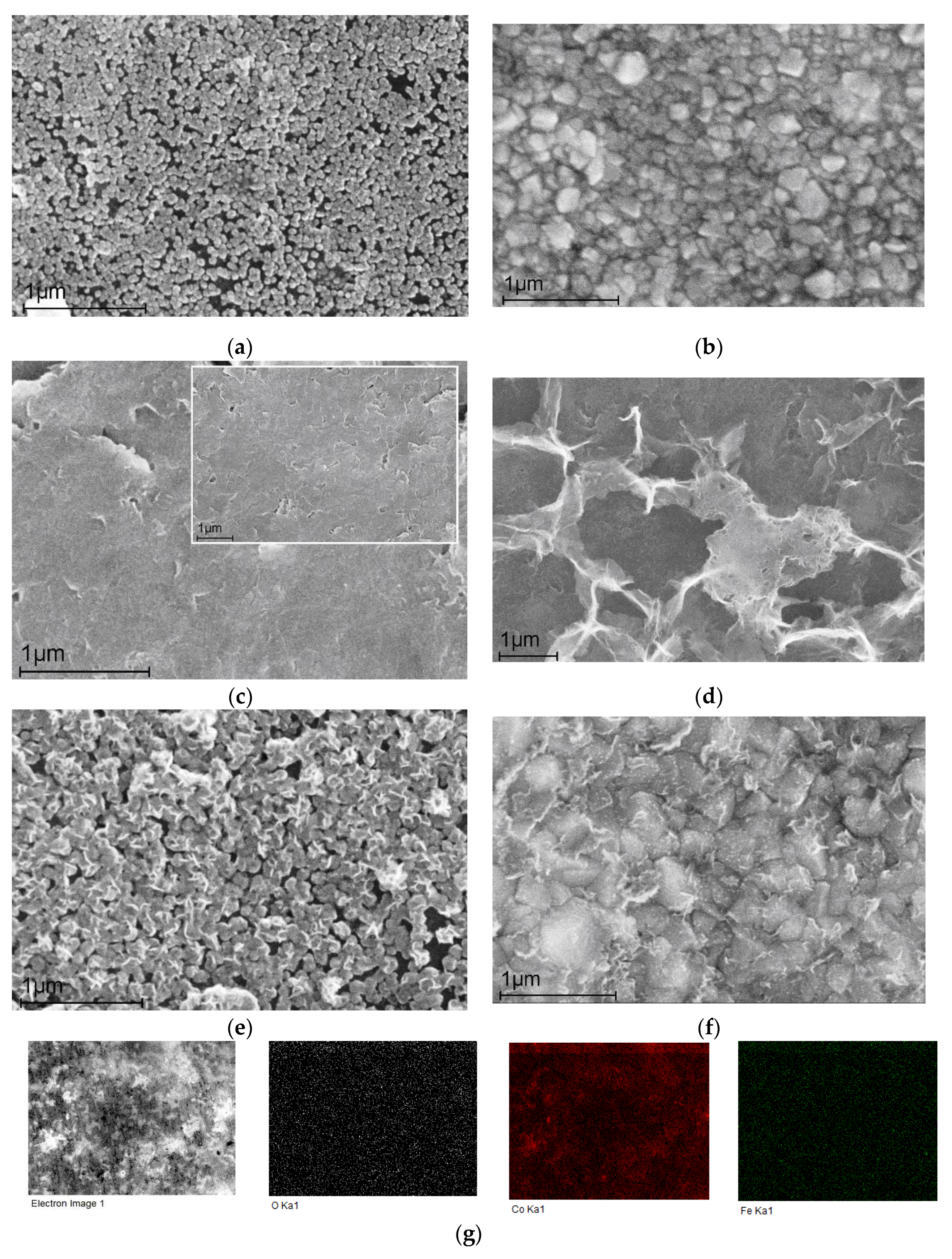
Figure 2.
XP spectra for the sample Fe(5min)/C: (a) survey spectrum, and high-resolution spectra: (b) Fe 2p, (c) C 1s, (d) O 1s.
Figure 2.
XP spectra for the sample Fe(5min)/C: (a) survey spectrum, and high-resolution spectra: (b) Fe 2p, (c) C 1s, (d) O 1s.
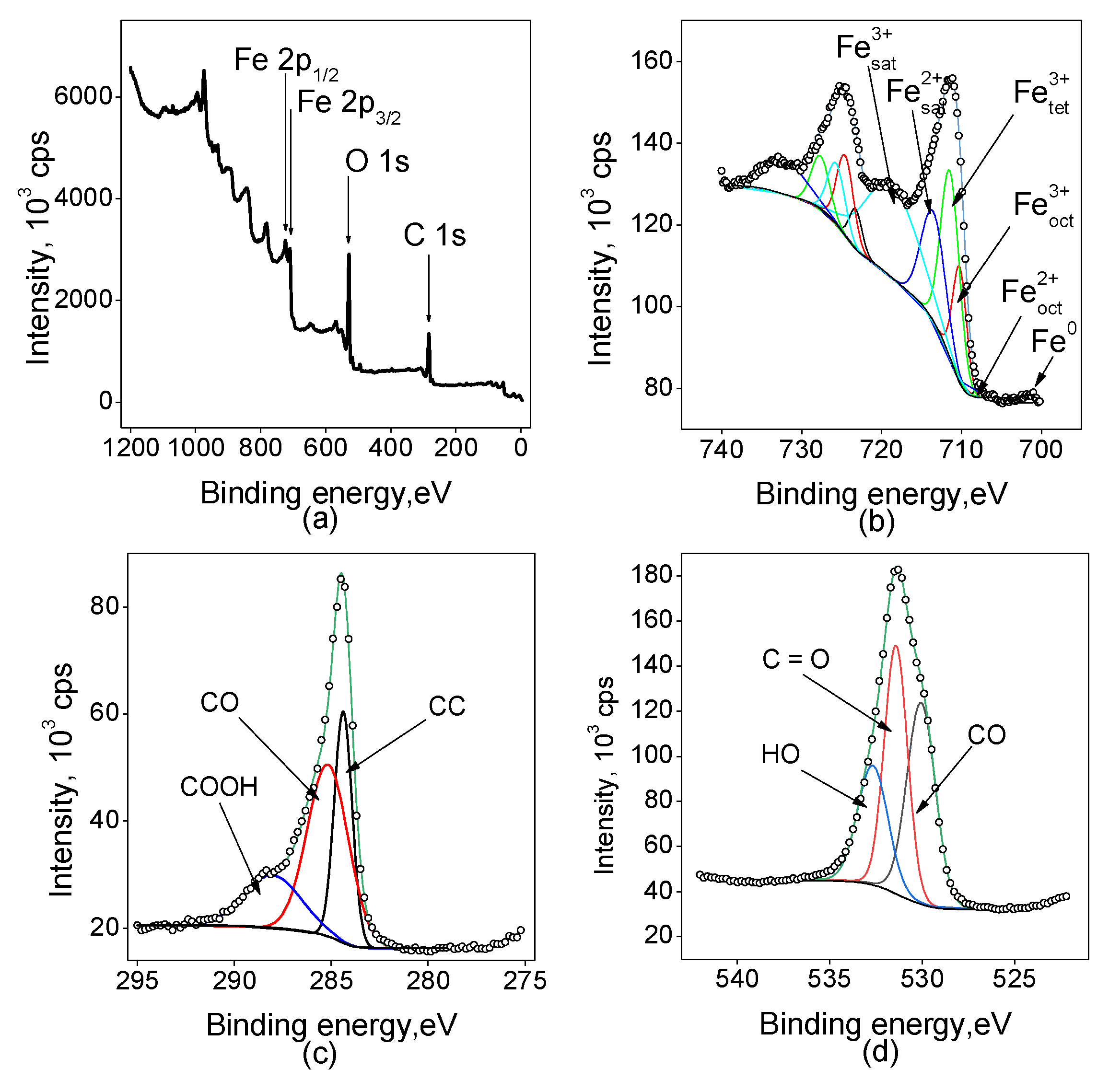
Figure 3.
XP spectra for the sample Fe(5min)@Co(30min)/C: (a) survey spectrum, and high-resolution spectra: (b) Fe 2p3/2 , (c) Co 2p, (d) C 1s, (e) O 1s.
Figure 3.
XP spectra for the sample Fe(5min)@Co(30min)/C: (a) survey spectrum, and high-resolution spectra: (b) Fe 2p3/2 , (c) Co 2p, (d) C 1s, (e) O 1s.
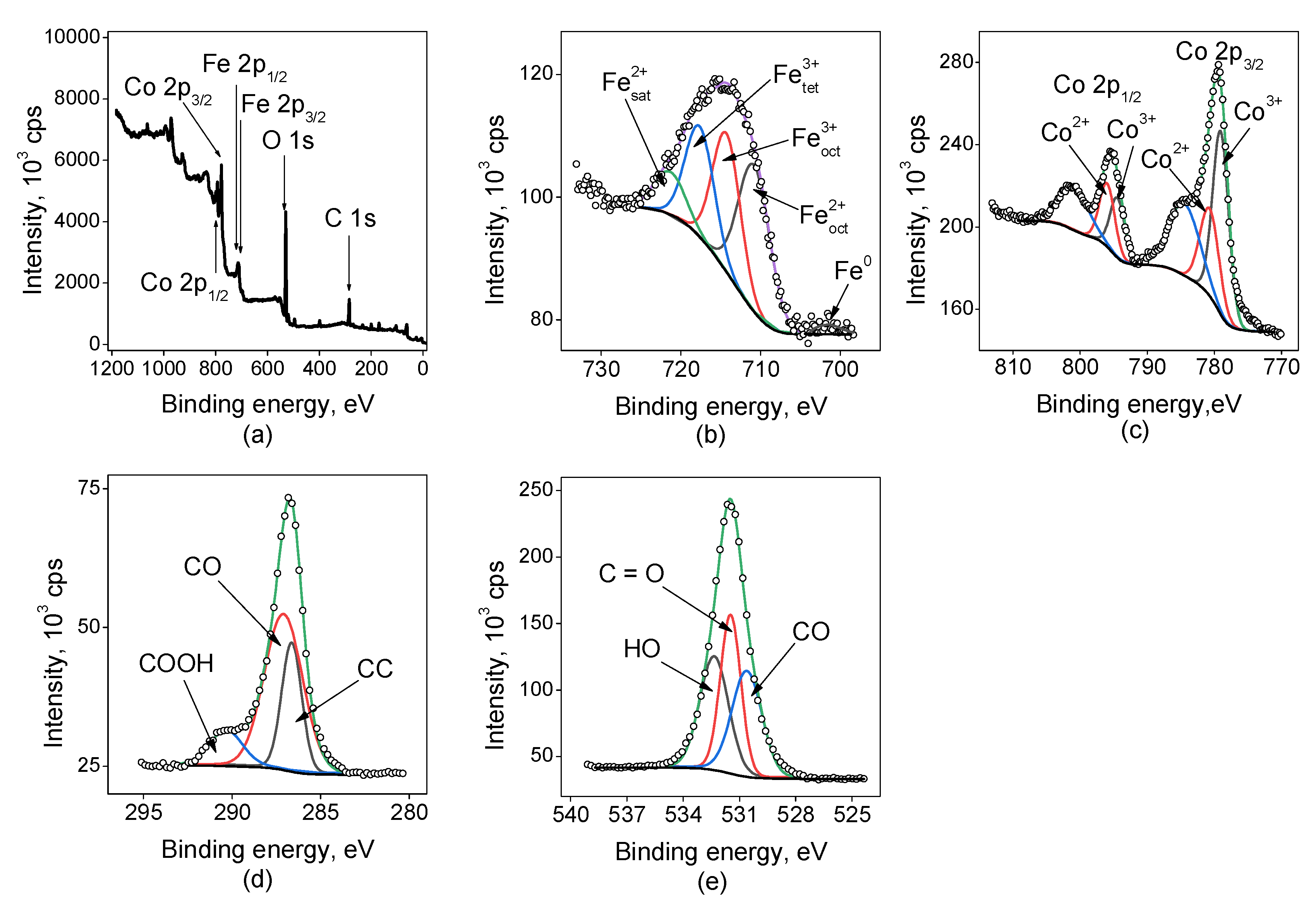
Figure 4.
XRD pattern for electrocatalyst samples: (a) Fe(30min)C; (b) Fe(30min)@Co(30min)/C; (c) Co(30min)/C; (d) Graphite substrate and all samples in the insert.
Figure 4.
XRD pattern for electrocatalyst samples: (a) Fe(30min)C; (b) Fe(30min)@Co(30min)/C; (c) Co(30min)/C; (d) Graphite substrate and all samples in the insert.
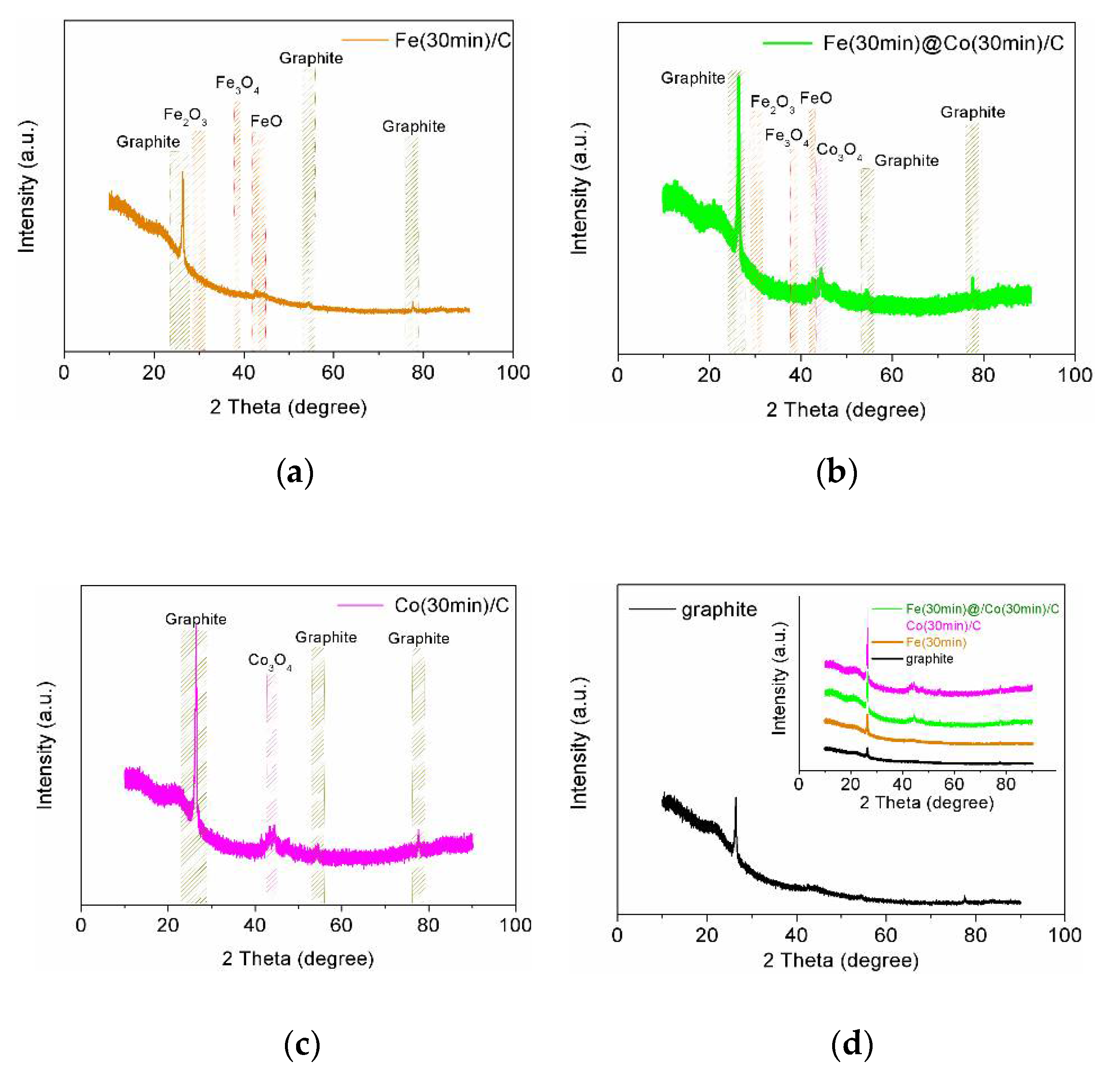
Figure 5.
Linear voltammetric curves in Na2SO4 electrolyte containing and not containing nitrate ions at a potential scan rate of 50 mV s-1 for electrocatalyst samples: (a) Fe(5min)C; (b) Fe(30min)/C; (c) Fe(5min)@Co(5min)/C; (d) Fe(5min)@Co(30min)/C.
Figure 5.
Linear voltammetric curves in Na2SO4 electrolyte containing and not containing nitrate ions at a potential scan rate of 50 mV s-1 for electrocatalyst samples: (a) Fe(5min)C; (b) Fe(30min)/C; (c) Fe(5min)@Co(5min)/C; (d) Fe(5min)@Co(30min)/C.
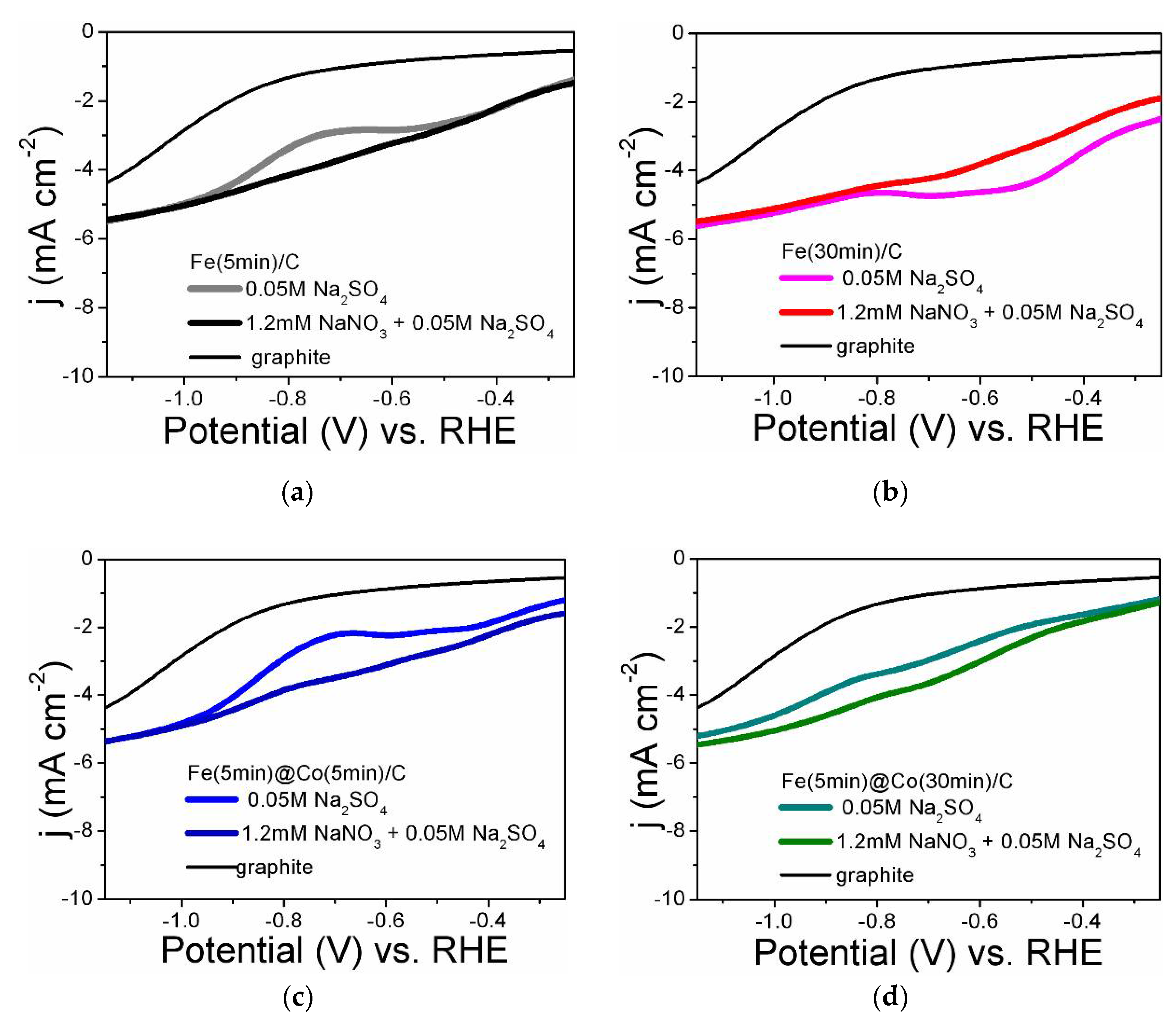
Figure 6.
The process of ammonia synthesis by NO3RR for Fe(5min)@Co(30min)/C; at different potentials: (a) chronoamperometric curves in the 0.05 M Na2SO4 with 1.2 mM NaNO3 electrolyte; (b) UV-vis spectrum corresponding to the concentrations of the resulting product at λ=652 nm.
Figure 6.
The process of ammonia synthesis by NO3RR for Fe(5min)@Co(30min)/C; at different potentials: (a) chronoamperometric curves in the 0.05 M Na2SO4 with 1.2 mM NaNO3 electrolyte; (b) UV-vis spectrum corresponding to the concentrations of the resulting product at λ=652 nm.
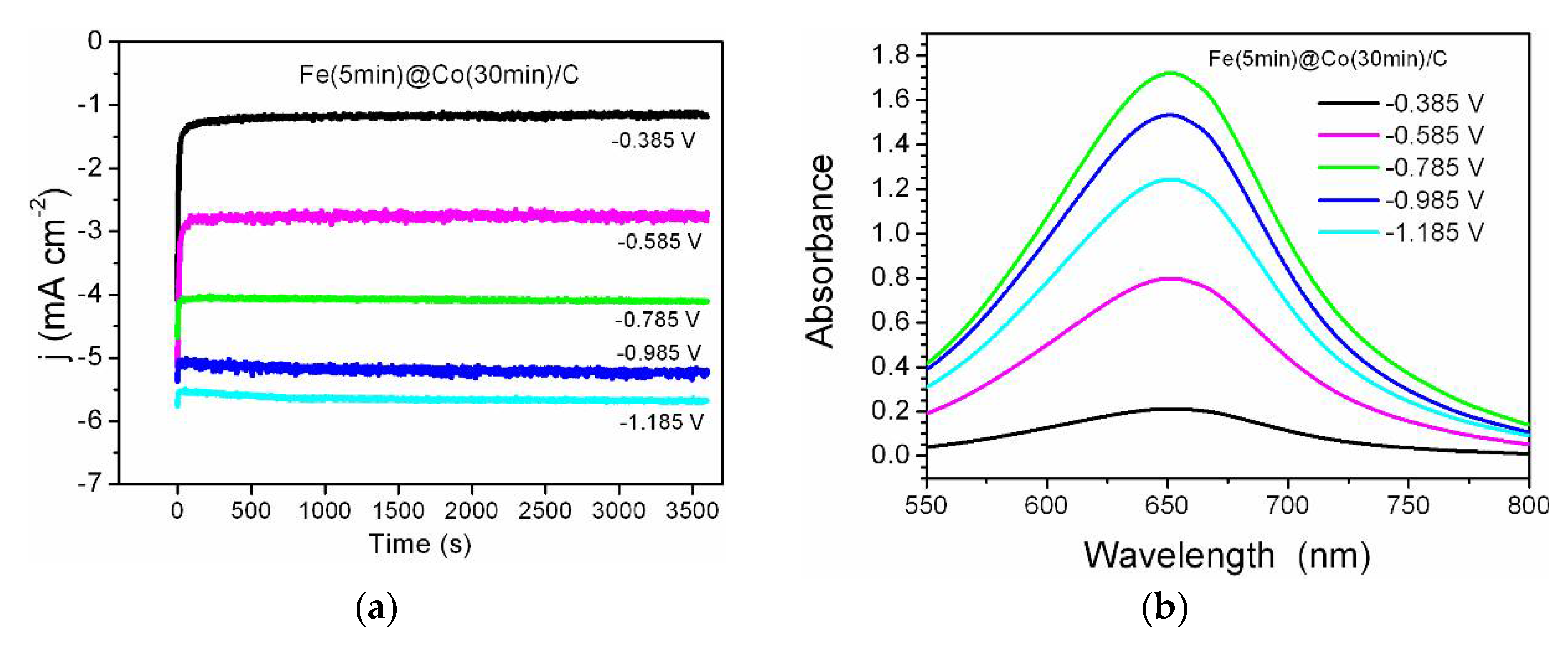
Figure 7.
The values of FE and yield rate in NO3RR: (a) the resulting graph; and for single electrocatalysts: (b) Fe(5min)@Co(30min)/C, (c) Fe(5min)@Co(5min)/C, (d) Fe(5min)C and (e) Fe(30min)/C. (f) NH3 yield rate of NO3RR at the potential -0.785 V.
Figure 7.
The values of FE and yield rate in NO3RR: (a) the resulting graph; and for single electrocatalysts: (b) Fe(5min)@Co(30min)/C, (c) Fe(5min)@Co(5min)/C, (d) Fe(5min)C and (e) Fe(30min)/C. (f) NH3 yield rate of NO3RR at the potential -0.785 V.
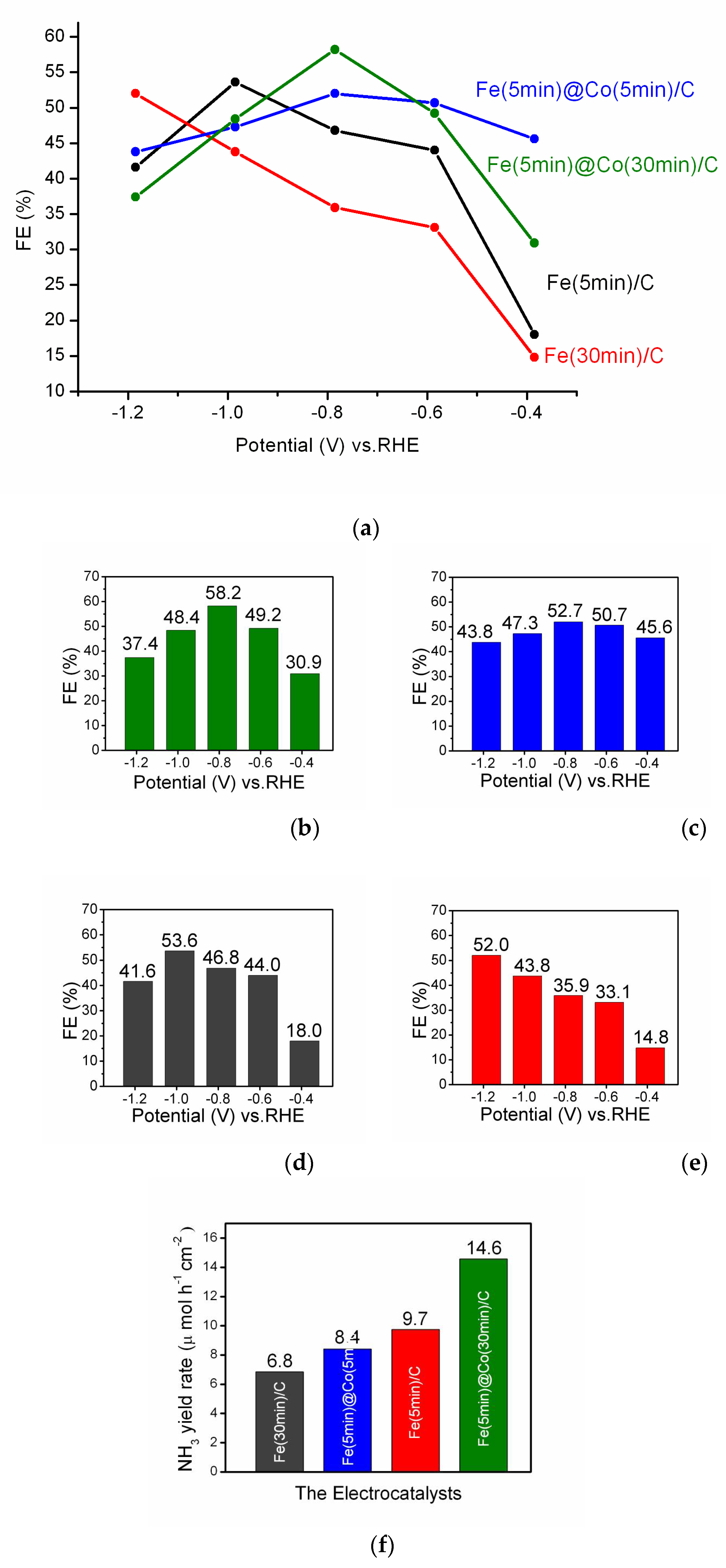
Figure 8.
(a) Cyclic voltammograms for the Fe(5min)@Co(30min)/C electrocatalyst sample for a series at scan rates of 10, 20, 40, 60, 80 and 100 mV s−1 from 0.165 to 0.265 V (RHE). (b) The electrochemically active surface of the electrocatalyst samples presented as a double layer capacity.
Figure 8.
(a) Cyclic voltammograms for the Fe(5min)@Co(30min)/C electrocatalyst sample for a series at scan rates of 10, 20, 40, 60, 80 and 100 mV s−1 from 0.165 to 0.265 V (RHE). (b) The electrochemically active surface of the electrocatalyst samples presented as a double layer capacity.
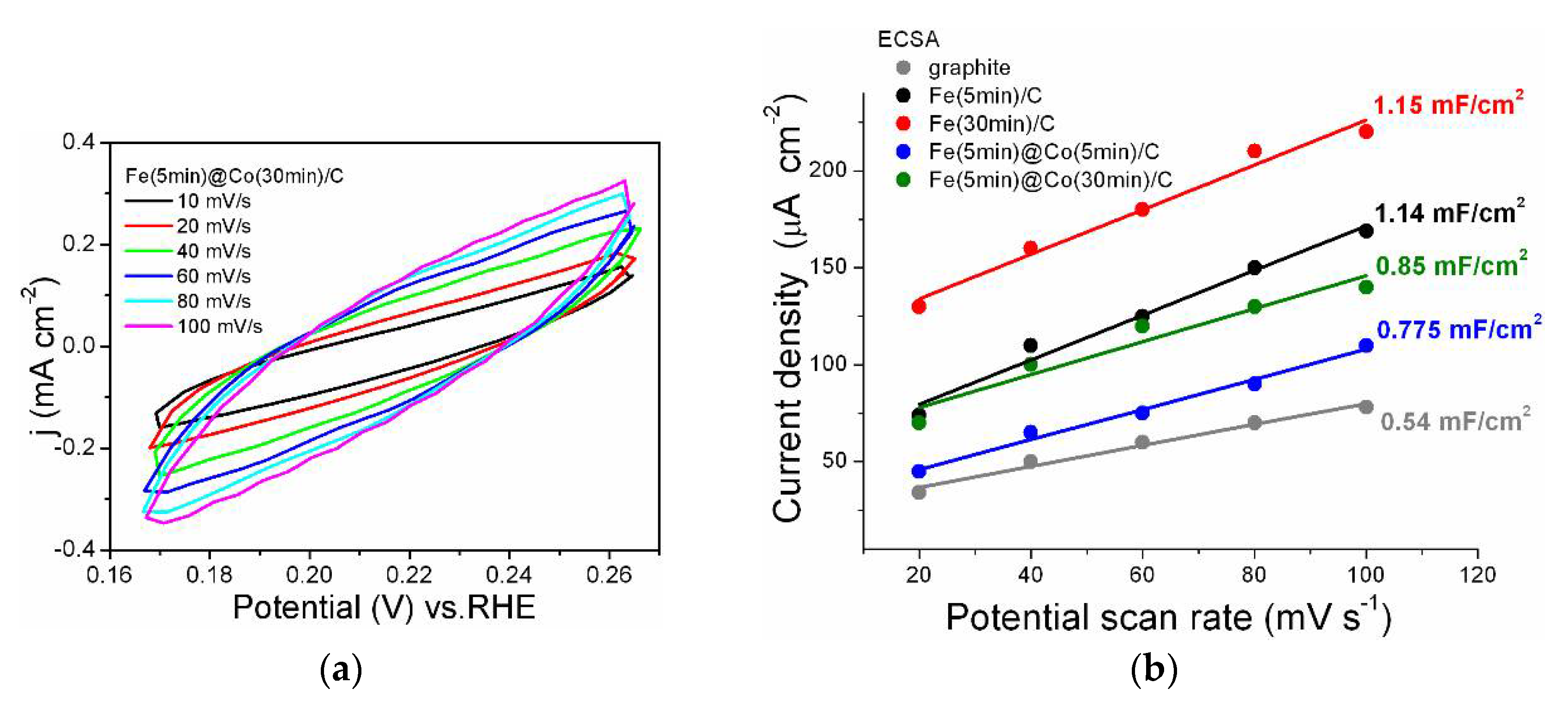
Figure 9.
(a) Nyquist curves for electrocatalyst samples Fe(5min)@Co(30min)/C, Fe(5min)/C and a graphite substrate in 1.2 mM NaNO3 with 0.05 М Na2SO4; (b) enlarged fragment.
Figure 9.
(a) Nyquist curves for electrocatalyst samples Fe(5min)@Co(30min)/C, Fe(5min)/C and a graphite substrate in 1.2 mM NaNO3 with 0.05 М Na2SO4; (b) enlarged fragment.
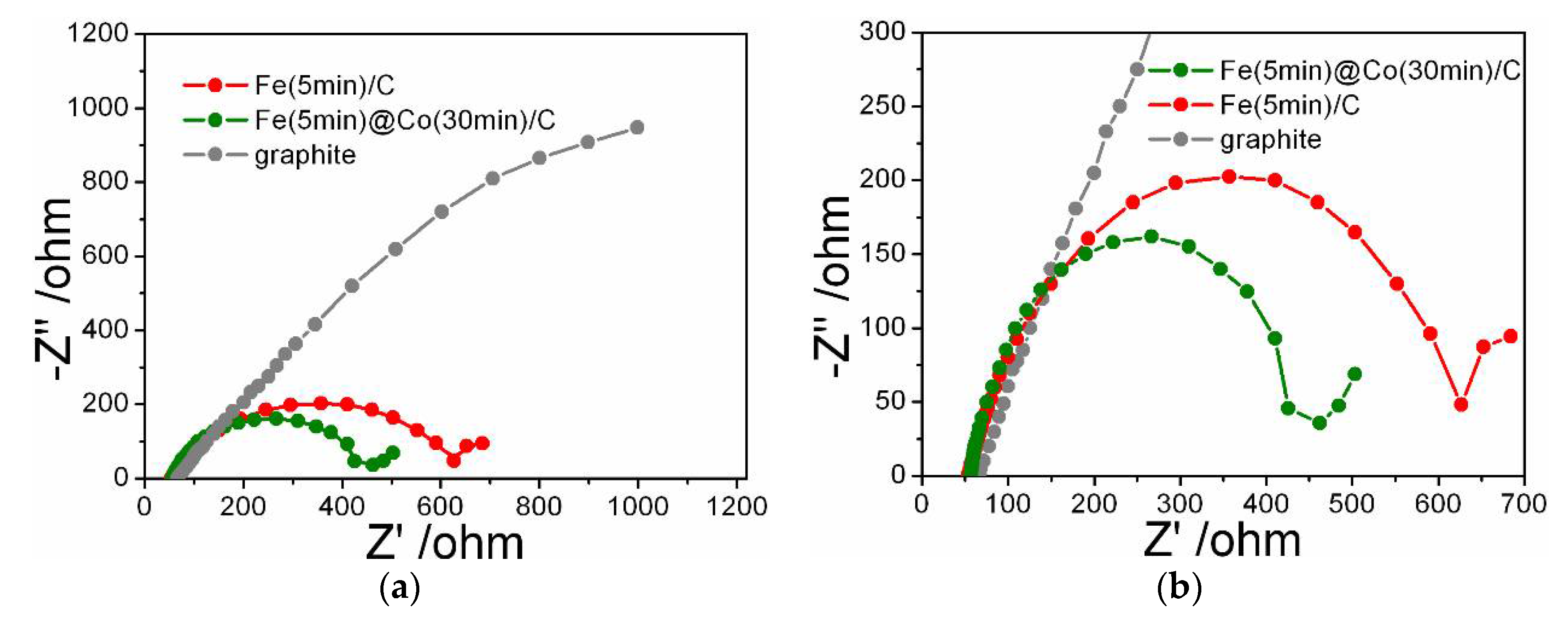
Figure 10.
(a) UV-Vis spectra, and (b) calibration line for testing NH3.
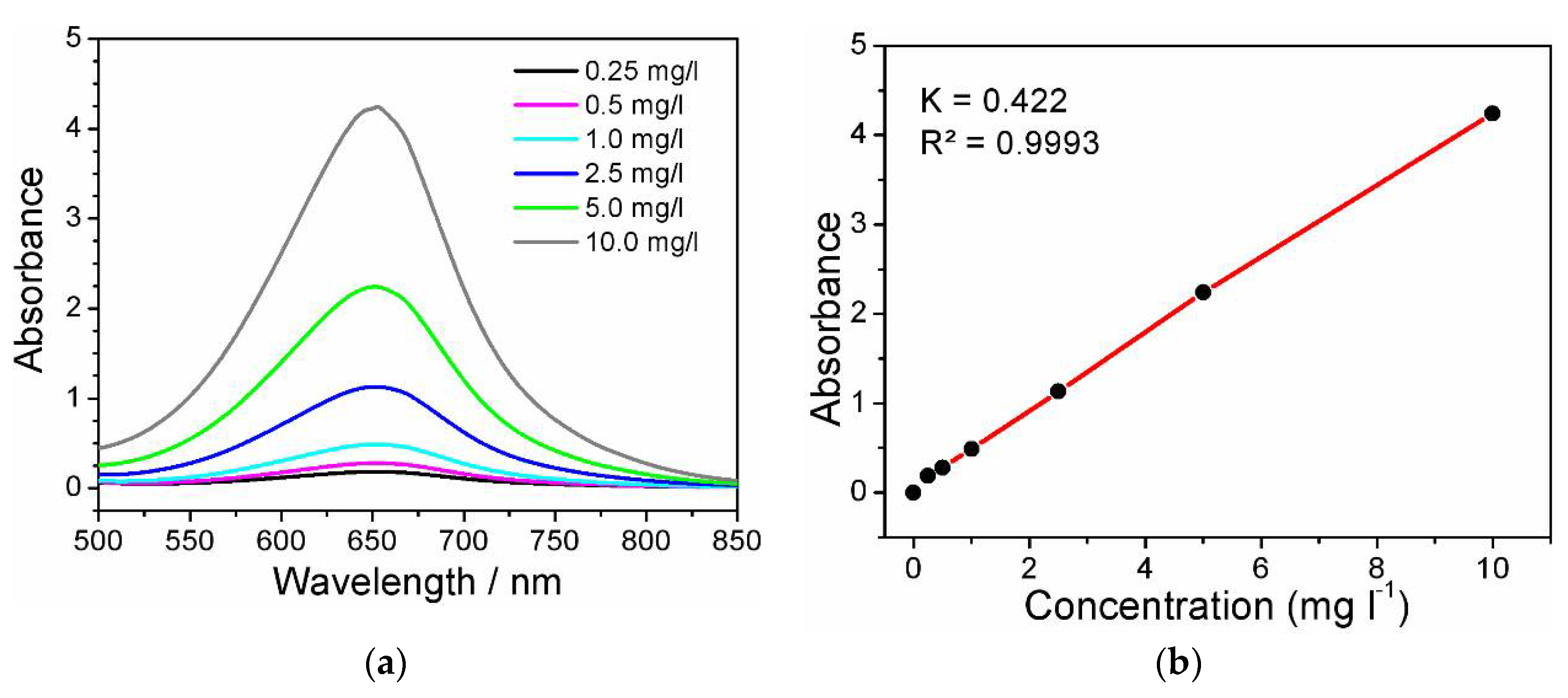

Table 1.
The Samples of electrocatalysts and features of their preparation.
| Designation | General brief description |
|---|---|
| C | Graphite is the initial substrate |
| Fe(30min)/C | Fe-NPs (deposited at 30 min) on the substrate С |
| Fe(5min)/C | Fe-NPs (deposited at 5 min) on the substrate С |
| Fe(5min)@Co(5min)/C | Fe-NPs (deposited at 5 min) on the Сo-NPs layer (deposited at 5 min) on the substrate C |
| Fe(5min)@Co(30min)/C | Fe-NPs (deposited at 5 min) on the Сo-NPs layer (deposited at 30 min) on the substrate C |
Disclaimer/Publisher’s Note: The statements, opinions and data contained in all publications are solely those of the individual author(s) and contributor(s) and not of MDPI and/or the editor(s). MDPI and/or the editor(s) disclaim responsibility for any injury to people or property resulting from any ideas, methods, instructions or products referred to in the content. |
© 2024 by the authors. Licensee MDPI, Basel, Switzerland. This article is an open access article distributed under the terms and conditions of the Creative Commons Attribution (CC BY) license (http://creativecommons.org/licenses/by/4.0/).
Copyright: This open access article is published under a Creative Commons CC BY 4.0 license, which permit the free download, distribution, and reuse, provided that the author and preprint are cited in any reuse.


