

Submitted:
19 June 2024
Posted:
21 June 2024
You are already at the latest version
Abstract
The increasing use of chemicals requires a better understanding of their presence and their dynamics in the environment as well as their impact on ecosystems; it is therefore important to set up procedures. The aim of this study was to validate the first steps of an innovative multi-omics approach based on metabolomics and 16S metabarcoding data for future analyses of the contaminants fate and impact in Mediterranean lagoons. First, semi targeted analytical procedures for water and sediment matrices were set up to evaluate the lagoon contamination status. Forty-six compounds were detected, 28 could be quantified in both water (between 0.09 and 47.4 ng/L) and sediment (between 0.008 and 26.3 ng/g) samples using UHPLC-MS/MS instrument. Regarding the non-targeted metabolomics study (UHPLC-HRMS), four sample preparation protocols, based on solid/liquid extractions and an automated pressurized fluid extraction system (EDGE® extractions), were compared in terms of metabolome coverage, efficiency and reproducibility of the extraction methodology. A solid/liquid extraction using acetonitrile/methanol (50/50) solvent was the best protocol. On the other hand, in order to characterize the microbial diversity of the lagoon sediment using metabarcoding, five commercial kits for DNA extraction were evaluated. This study revealed that the DNeasy PowerSoil Pro Qiagen Kit (Promega, USA) was the best compromise for studies assessing microbial diversity in fresh sediment.
Keywords:
Lagoon
; Organic Contaminants
; Sediment
; Metabolomics
; Metabarcoding
; Microbiome
1. Introduction
Increased global commercial trade, climate change and the accelerated production of xenobiotics are all factors that increase the risks of environmental contamination, affecting environmental, animal and human health. The increasing use, in number and quantity, of chemical molecules requires improved detection capabilities, a better understanding of their presence, their dynamics in the environment and their overall impact on ecosystems. In fact, it seems essential to set up an integrative transdisciplinary approach to better identify the fate and impact of these contaminants on the microbiome, and to investigate the resilience and/or the adaptation capacities of microbial ecosystems. In this context, we have chosen the Mediterranean lagoons as a study model. Indeed, Mediterranean lagoons are particular habitats from an ecological point of view, which support the development of a remarkable biodiversity, and which productivity is particularly high. Being ecosystems at the interface of the continuum “land-lagoon-sea”, they are subjected to chemical and biological pollutants inputs. This human contamination, which can alter the balance of ecosystems, encourages the emergence of pathogenic and/or invasive organisms and is therefore perfectly in line with the issues identified in the "One Health" concept. In the context of this study, the Canet-St Nazaire (France, 66) lagoon constitutes a particularly relevant “model site” since this lagoon, seems to present a worrying level of contamination in terms of pesticides, drug residues, alkylphenols, PolyChloroBiphenyls (PCBs) and Polycyclic Aromatic Hydrocarbons (PAHs) [1,2].
The aim of our study was therefore to set up the first steps of a multi-omics methodology for assessing the environmental fate of lagoon organic contaminants, their impact on the bacterial communities and the ecosystem's response to this exposure. An innovative approach, coupling chemical and microbial methodologies, was hence developed. Indeed, metabolomics is nowadays widely used in fields such as basic biology, medicine, clinical pharmacology, toxicology and nutrition [3,4] but its employment in the environment areas is still limited as it is only just beginning to be used in this field. There are still challenges to be overcome and many developments are needed, particularly with regard to data acquisition procedures, i.e. sampling procedures and analytical methods (sample preparation, extract analysis), as well as the analysis of large metabolomics datasets [3,5,6,7], in order to derive maximum benefit from this science and ensure correct and reliable interpretation of the data. In addition, we aim to use 16S rRNA metagenomic data in combination with metabolomics to aggregate complementary information and reinforce the innovative nature of this multi-omics development workflow. This innovative methodology will enable us to obtain correlations between ecological parameters such as microbial diversity and relative abundance and metabolic parameters (biometabolome) that will be useful for identifying biomarkers of environmental exposure to xenobiotics. [8]. In this context, this article presents results from analytical chemistry and molecular microbial ecology, enabling us to validate the first steps in the development of a future multi-omics workflow. Firstly, semi targeted analytical procedures were set up in order to evaluate the lagoon contamination status by investigating water and sediment samples. 46 compounds were detected and 28 could be quantified. Among them, pharmaceuticals, pesticides and hormonal steroids were found. In the second stage, a non-targeted metabolomics approach was applied to provide information on the fate of contaminants, specifically targeting the xenometabolome (pollutants and by-products) and their impact on the microbiome by studying the under- or over-expression of endometabolites (matrix metabolites) in the presence of contaminants. For that, we based our developments on the “Environmental Metabolic Footprinting” (EMF) approach recently set up in the CRIOBE laboratory [9,10,11,12,13,14,15]. In particular, different sample preparation protocols were compared based on the metabolome coverage, the efficiency and the reproducibility of the extraction method. Understanding microbial diversity in sediment samples becomes of greater importance when investigating the composition and the function of the microbiome. It also provides additional information in terms of dynamics by assessing the effects of the organic pollutants on microbial populations derived from sediment. To determine which environmental DNA extraction commercial kit would offer the most accurate taxonomic view of the sediment microbial ecosystem, this paper also investigates whether the diversity of microbial community structure in lagoon sediments differs substantially depending on the DNA extraction and purification method applied. We therefore evaluated five different DNA extraction kits available on the market and 16S rRNA gene metabarcoding sequencing was performed to calculate alpha diversity metrics.
2. Materials and Methods
2.1. Sediment and Water Sampling
The water and sediment samples were collected in November 2023 in the “Canet-St Nazaire” lagoon (66, France) at intervals of several meters. Sediment sampling consisted of coring the first 20 centimeters of sediment. All the sampled sediment was mixed. As the sediment was full of water, it was left for half a day in a beaker to decant. The solid part was recovered and passed through a 2mm sieve. The sediment was then lyophilized for 24h (Heto, FD3) for chemical analyses, while the non-lyophilized sediment was used for DNA analyses. The water and sediment samples were stored in a freezer at T = -20°C until analysis.
2.2. Lagoon Status of Contamination - Analytical Development
2.2.1. Chemicals and Materials
- For water sample extraction:
Ultra-pure water was supplied from Fischer and Methanol from BioSolve (Dieuse, France). Oasis HLB™ cartridges (6 mL, 150 mg) from Waters® (Guyancourt, France) were used. Labelled internal standards used for extraction (Table S1) and were purchased from C.I.L (Ste Foy-La-Grande, France), LGC (Augsburg, Germany), Sigma (St Quentin Fallavier, France). Their purity was up to 98 %. Individual stocks of internal standard solutions were prepared at 250 mg/L in methanol. Standard solutions were stored at −18 °C.
- For sediment sample extraction:
Ethylenediaminetetraacetic acid disodium salt dehydrate (EDTA) was obtained from VWR Chemicals and QuEChERS salts for Vet Drugs containing 4 g sodium sulfate (Na2SO4) and 1 g sodium chloride (NaCl) from Agilent Technologies (Les Ulis, France).
- For UHPLC-MS/MS analyses:
Ultra-pure water, Methanol, Acetonitrile, ammonium formate and Formic Acid (FA), UHPLC-MS grade were purchased from Biosolve (Dieuse, France). Analytical standards used for quantification (Table S1) were > 98% purity and prepared at 1000 mg/L in methanol.
2.2.2. Extraction Protocols
Blank extractions were performed: a blank of ultra-pure water and a sample of Fontainebleau sand were extracted and analyzed under the same conditions as the samples.
- Water samples
After a filtration on 0.7 μm glass fiber filters with a filtration System (IT30 142 HW) from Millipore (Molsheim, France), 1 mol/L of citric acid solution was added, and 200 µL of a 2 mg/L solution of labelled internal standards were diluted into 250 mL of the sample. Samples were passed through an automated Solid Phase Extraction (SPE) system (AutoTrace™ 280, from Thermo Fisher®, Roissy, France) using Oasis HLB™ cartridge. 250 mL of filtered water sample were loaded. Then, cartridges were rinsed with ultrapure water, dried with nitrogen and eluted with 5 mL of methanol. Eluates were dried under nitrogen (40 °C) and samples stored at T = -18 °C. Just before injection, samples were suspended in 1 mL of ultrapure water/methanol (90/10, v/v).
- Sediment samples
For each sediment sample, an aliquot of 2.5 g was weight in a 50 mL polypropylene centrifuge tube containing one ceramic homogenizer (Agilent technologies) and 100 µL internal mix standards solution at 100 ng/mL was added (list Table S1). The tube was centrifuged at 7000 rpm for 3 min. After 15 min rest, 6 mL EDTA water solution 1mol/L and 10 mL of acetonitrile were added. The tubes were transferred 15 min to an ultrasonic bath (Branson, 5510 model) at 40 Hz, 30°C. After vortex a few seconds, a packet of QuEChERS salts was added and the tube was grounded using a Geno/Grinder®(SPEX SamplePrep, Stanmore, UK) 3 min at 1000 rpm. Subsequently, the sample was centrifuged at 6000 rpm for 3 min. Then, 6 mL of the supernatant were transferred to a 12 mL glass tube and evaporated to dryness under a gentle stream of N2 at 40°C. Finally, the extract was dissolved with 600 µL H2O/methanol (90/10; v/v) for the UHPLC-MS/MS analysis. For the “Canet-St Nazaire” lagoon water and sediment samples, 5 replicates were analyzed for each matrix.
2.2.3. UHPLC-MS(/MS) Analyses
A screening of water and sediments extracts was carried out by comparison with databases after injection on a LC-QToF system using an Ultimate 3000 UHPLC system (Thermo Scientific®, MA, USA) coupled to a quadrupole time-of-flight mass spectrometer (Q-ToF) (Maxis Plus, Bruker Daltonics®, Bremen, Germany). Separations were performed using an intensity solo column (2.1 x 100 mm, 1.8 µm particles, Bruker Daltonics®) protected with a KrudKatcher Ultra In-Line Filter guard column from Phenomenex (Torrence, CA, USA) maintained at 30 °C; the injection volume was 5 µL. The mobile phases consisted of: (A) water/methanol (99/1, v/v); and (B) methanol with 5 mM ammonium formate and 0.01% formic acid in both phases. The binary elution gradient started with 1% of (B) at a flow rate of 0.2 mL/min for 1 min, gradually increasing to 39% (B) for the next 2 min then increasing to 99.9% (B) at 0.4 mL/min for the following 11 min. The last condition was kept constant for 2 min (flow rate 0.48 mL/min), then the initial conditions (1% (B)-99% (A)) were restored within 0.1 min (flow rate decreased to 0.2 mL/min) to re-equilibrate the column prior to the next injection.
For detection, MS data were acquired using Data Independant Acquisition (DIA) mode with an electrospray ionization source in positive mode. The mass range was set to 80-1000 Da. The capillary voltage was maintained at 3600V with drying temperature of 200°C. A solution of sodium formate and acetate (10 mM) to form clusters was used for external calibration at the beginning of each run. A quality control of 22 compounds (Table S2) in methanol was injected to correct the database retention times.
Then, most of the substances found by the screening were quantified. For that, an LC-MS/MS method (Acquity H-Class-Xevo-TQ-S) was developed. A liquid chromatographic system Acquity H-Class from Waters (Saint Quentin en Yvelines, France) was used for the compounds separation with Waters BEH C18 (100x2.1 mm, 1.7µm) column protected with a KrudKatcher Ultra In-Line Filter guard column from Phenomenex (Torrence, CA, USA) with mobile phases composed of (A) ultrapure water with 0.01% formic acid and (B) methanol. The gradient evolves according to the following conditions: 2-100% (B) for 7.5 min, then 3 min maintain at 100% (B) and finally a return to initial conditions for 3 minutes. The flow rate was 0.4 mL/min with oven temperature 40°C and the injection volume was 2 µL. A Xevo-TQ-S mass spectrometer from Waters with positive electrospray ionization was used to detect compounds with following parameters: Capillary voltage 2.6 kV, source and desolvatation temperature T = 150°C and 450°C respectively, cone flow gas (N2) of 150 L/h, desolvatation flow gas (N2) of 900 L/h and collision gas flow (Ar) of 0.15 ml/min. The quantification was performed with MRM mode, two transitions was followed for each analyte (Table S3). The transition with the highest intensity was used for quantification and the second for confirmation. The retention time and the ratio between the two MRM transitions were followed too to confirm analytes presence.
2.2.4. Data Processing
The screening data processing was performed with Target Analysis for Screening and Quantitation (TASQ)® 1.4 (Bruker Daltonics®). All detected signals, couples of exact mass and retention time (m/z; tR), were compared with two databases: PesticideScreener 2.1 and ToxScreener 2.1 (Bruker Daltonics®). These databases contain exact masses, retention time, isotope pattern and fragments of 1200 pesticides and 800 pharmaceutical compounds, respectively.
The quantification was obtained by comparison with internal calibration when labelled internal standards available or external calibration otherwise.
2.3. Omics Approaches Set Up
2.3.1. Non Targeted Metabolomics
- Chemicals and Materials
For extractions, acetonitrile HPLC LC-MS grade was purchased from VWR International (Fontenay-sous-Bois, France) and Methanol LC-MS grade was acquired from CARLO ERBA (Val de Reuil, France).
For solid/liquid extractions, 50 mL centrifuge tubes with Polypropylene plug seal caps were bought from Fisher Scientific (Illkirch, France). 15 mL Soda glass test tubes (100 × 16.00 × 0.8-1.0 mm) were purchased from VWR International. 0.22 μm Polytetrafluoroethylene (PTFE) filters and 2 mL vials were acquired via Analytic Lab (Castelnau-le-Lez, France). NaCl was obtained from Sigma Aldrich (Saint Quentin Fallavier, France) and MgSO4 was purchased from CARLO ERBA.
For EDGE® extractions, EDGE Q-cups, Q-supports, Q-DISC G0 and amber collection bottles were bought from CEM (Saclay, France).
For UHPLC-HRMS analyses, Acetonitrile LC/MS, and Formic Acid LC-MS were purchased from CARLO ERBA.
- Extraction protocols
Four extraction protocols were tested: two based on solid/liquid extractions and two based on an automated pressurized fluid extraction system (EDGE® instrument, CEM Corporation, http://cem. com/edge/). In each case, the acetonitrile solvent and the mixture acetonitrile/methanol (50/50, v/v) were compared. The four protocols are described below:
(1) QuEChERS extraction: 10 milliliters of water and 15 mL of acetonitrile (LC-MS grade) were added to the 50 mL falcon tube that contained 5 grams of lyophilized sediment. The tube was then shaken 30 s manually and 30 s. with a vortex device. Salts (1g NaCl, 4g MgSO4) were then added and the tube was immediately manually shaken for 30 s and swirled on a vortex mixer for 30 s. The tube was centrifuged for 5 min at a rotation speed of 5000 rpm using an Allegra X-30R Centrifuge (Beckman Coulter, Brea, CA, U.S.). 9 mL of supernatant was recovered and transferred into a 15 mL glass tube and evaporated to dryness under vacuum at T = 30°C (EZ-2plus evaporator, Genevac, Ipswich, U.K.). The dry residue was redissolved in 1mL of acetonitrile. The extract was passed through a 0.22 μm PTFE filter to be transferred in a HPLC vial (with insert).
(2) Solid/liquid extraction using acetonitrile/methanol (50/50, v/v) mixture: 15 mL of a mixture of acetonitrile/methanol (50/50, v/v) (LC-MS grade) were added to the tube that contained 5 grams of lyophilized sediment. The tube was then shaken 30 s manually and 30 s with a vortex device. The tube was centrifuged for 5 min at a rotation speed of 5000 rpm using an Allegra X-30R Centrifuge (Beckman Coulter, Brea, CA, U.S.). 12 mL of supernantant was recovered and transferred into a 15 mL glass tube and evaporated to dryness under vacuum at T = 30°C (EZ-2plus evaporator, Genevac, Ipswich, U.K.). The dry residue was redissolved in 1mL of a mixture of acetonitrile/methanol (50/50). The extract was passed through a 0.22 μm PTFE filter to be transferred in a HPLC vial (with insert).
(3) EDGE® acetonitrile: 5 grams of lyophilized sediment sample were packed in the EDGE Q-cup™ with a G0 filter at the bottom. The extraction was performed at T = 45°C in two cycles. For cycle 1, 10 mL of acetonitrile was passed through the sample from the top and 10 mL from the bottom. A rinsing was performed between the 2 cycles (5 mL of acetonitrile). For cycle 2, 10 mL of acetonitrile was passed through the sample from the top. A final rinsing of the instrument was performed (15 mL acetonitrile).
(4) EDGE™ acetonitrile/methanol (50/50): the extraction steps are the same as described above with the mixture acetonitrile/methanol (50/50) as extraction solvent. Also, the dry extract obtained at the end is re-dissolved in 1 mL of the same mixture, i.e. acetonitrile/methanol (50/50).
For all the protocols, extractions were performed without sediment matrix and these samples were called « extraction blank ». It permits to identify compounds coming from the extraction systems (solvents, 15 mL falcon tubes, pipette tips, filters, EDGE® instrument) and therefore allow us to select only endo- and xeno-metabolites coming from the sediment matrix. The extracts were kept in a freezer (T = -20°C) prior to analysis.
- UHPLC-HRMS analyses
UHPLC-HRMS data acquisition was carried out using a Vanquish UHPLC system connected to a high-resolution mass spectrometer (Q-Exactive-Plus, Thermo Fisher, Thermo Fisher Scientific, Waltham, MA, U.S.). Compounds were analyzed using a Luna Omega Polar C18 column (particle size: 1.6 μm, pore size: 100 Å, length: 100 mm, internal diameter: 2.1 mm, solid support: fully porous silica) fitted with a pre-column (AJ0-9532 polar C-18, 2.1 mm) from Phenomenex (Torrance, CA, U.S.). This kind of chromatographic column was chosen rather than a « classical » C18 column as it allows a better retention of polar and semi-polar compounds and hence permits to broaden the range of polarity of the metabolites analyzed. The mobile phases consisted of two solvents: (A) H20 with 0.1% formic acid, and (B) acetonitrile containing 0.1% formic acid. Separation was carried out using the following elution gradient: 0% (B) for 2.5 min, then solvent (B) increased from 0 to 100% between 2.5 min and 15 min, remained constant at 100% (B) between 15 and 17 min, then returned to initial conditions, i.e. 0% (B) in 1 min, and remained under these conditions for 2 min, i.e. until 20 min. The chromatographic column temperature was maintained at T = 30°C in a column oven. The injection volume was set to 5μL and the mobile phase flow rate to 0.400 mL/min.
For detection, MS data were acquired using an ESI electrospray ionization source in Switch mode (simultaneous acquisition in positive, ESI+, and negative, ESI-, modes). Also, MS/MS data were acquired using the Data Dependent Acquisition (DDA) mode. For MS/MS ESI- and ESI+ data were acquired separately. The scan range was set to m/z 90 to 1000. Capillary voltage was maintained at 3200 V and -3200 V for ESI+ and ESI- respectively, capillary temperature was set to T = 320°C.
- Data processing
The pre-processing of the MS data obtained in UHPLC-HRMS was performed on WorkFlow4Metabolomics platform. Firstly, a "CentWave peak picking" step was carried out. It permits to extract the ions from each sample and to integrate them by filtering them according to defined parameters (ROI were considered when detecting 5 consecutive scans with minimum intensity equal to 1 × 10⁵ and 5 × 10⁵ for ESI- and ESI+ data respectively; maximum m/z deviation of 10 ppm; S/N cutoff: 10). After merging all the data together, a « PeakDensity grouping » (bandwidth = 20 sec) was performed in order to group the different peaks corresponding to the same analyte between samples (different extraction protocols tested, 5 replicates per modality + « extraction blanks », 3 replicates). Then, a loess retention time adjustment was applied (degree of smoothing = 0.8) followed by another grouping (bandwidth = 15 sec). The next step is "fillChromPeaks", which performs any additional integration for each variable. Indeed, this function attempts to find signals that may have been missed during the first peak-picking step.
The data were grouped by sample type (sediment samples vs extraction blank samples). We processed a generic filter on the DataMatrix obtained as follows: features must be present in less than 2 blank extraction samples and in at least 4 sediment samples. It means that only features that are representative to sediment endometabolites and xenometabolites are kept and features coming from the extraction system are removed.
The data matrix obtained after the pre-processing detailed above was statistically processed on MetaboAnalyst platform. An OPLSDA was performed comparing sediment samples and extraction blanks and the VIPs > 1.5 were selected (on the first component, separating the 2 modalities sediment vs. blank); it permits to select the most important sediment metabolites. Also, it corresponds to a second filtering of blank contaminants ensuring to select only metabolites from sediment. 883 features were obtained in total (578 and 305 features in ESI- and ESI+, respectively). A log transformation was performed for the Heatmap analysis.
As for the putative identification, MS and MS/MS data were processed using Compound Discoverer (Thermo Fisher Scientific - ChemSpider, mzcloud, Metabolika databases) and SIRIUS softwares.
2.3.2. DNA Extraction and Metabarcoding Analyses
- Protocols for extracting DNA from sediments and assessing DNA quantity and quality
A literature search was undertaken on the extraction of DNA from sediments in order to determine the most efficient kit in terms of DNA quantity and quality [16,17,18,19]. Five commercial kits with the best results in both soil and sediment matrices were selected. These kits were the Quick-DNA Fecal/Soil Microbe kit (Zymo Research, USA), DNeasy PowerSoil Pro Qiagen kit (Promega, USA), FastDNA Spin Kit for Soil and Magbeads FastDNA kit for Soil (MP Biodemicals, USA) and E.Z.N.A Soil DNA kit (Omega Biotek, USA). Extractions were carried out on fresh sediments and according to each kit's protocol. Mechanical lysis was performed using the Mikro Dismembrator S® (Sartorius Group, Germany) at 3000 rpm for 5 minutes. The quantity and quality of extracted DNA was obtained using the Epoch Biotek (Thermo Fisher Scientific) and the Gen5 software. In addition, the integrity of genomic DNA was determined by visualising approximately 200 ng of DNA on a 1% agarose gel (w/v) containing 0.25 μg/μl of ethidium bromide (EtBr), run in 1 × Tris-EDTA buffer at 100 V.
In order to assess DNA quality and check the presence/absence of PCR inhibitors, the 16S ribosomal DNA gene was amplified using universal primers 27f (5'-AGA GTT TGA TCM TGG CTC AG-3') and 1492r (5'-TAC GGY TAC CTT GTT ACG ACT T-3') [20]. Amplification reactions were carried out in a reaction volume containing 200 μM dNTP (Promega, USA), 2 mM MgCl2 (Promega, USA), 1.25 U GoTaq DNA polymerase (Promega, USA), 1X GoTaq polymerase buffer (Promega, USA), 0.5 μM of each primer (Microsynth, Balgach, Switzerland) and ultrapure water (Promega, USA). The PCR reaction was performed using a T100 Thermal Cycler (Bio-Rad) with the following amplification program: 35 cycles of 5 minutes at 95°C, 45 seconds at 92°C, 45 seconds at 52°C, 45 seconds at 72°C and a final cycle of 2 minutes at 72°C. In order to check if PCR amplification had worked correctly, 12 μL of amplicons were loaded and separated by electrophoresis on 1% agarose gel stained with GelRed solution (Nucleic Acid Gel Stain, Biotum), placed at 100 V for 25 minutes in 1X TBE solution. The 100 bp DNA Ladder molecular size marker (BioLabs, England) was used and the gel was revealed using the DOC-PRINT-VX5 stand-alone gel imager (Vilbert Lourmat™) and photographed using an ECX-20.M transilluminator (Vilbert Lourmat™).
- 16S rRNAgene metabarcoding
16S rRNA amplicons libraries were prepared from DNA extracts also with a two-step PCR protocol targeting the hypervariable V3-V4 region with the 341F (5’- CCTACGGGNGGCWGCAG-3’) and 805R (5’- GACTACHVGGGTATCTAATCC-3’) primer pair [21]. Sequencing was performed by the Bio-Environment platform (University of Perpignan Via Domitia, France) using Miseq illumina sequencing kit v2 in 2x250 bp paired-end.
- Bioinformatic analysis of amplicons sequences
The DADA2 package [22] (truncLen = c(230,220); maxN = 0; maxEE = c(2,2); truncQ = 2) was used to define amplicon sequence variants (ASV). We then used Silva database (Version 138, Mar 27, 2020) to compute taxonomic affiliations. The dataset was filtered for singletons, and we have eliminated all the ASV where genus was not defined (=NA). Rarefaction curves were computed using the {phyloseq}, R package (version: 1.38.0) and the ggrare function [23]. The rarefy_even_depth function was used to subsample datasets; the estimate_richness function was used to compute alpha diversity metrics (Chao1, evenness, Shannon and Pielou). The PCoA analysis was done using stats package (version: 4.3.1) and Vegan package (version: 2.6.4) [24]. All the graphs were generated using ggplot package (version 3.4.3) [25] and Venn diagram package (version 1.7.3) [26].
3. Results and Discussion
3.1. Lagoon Status of Chemical Contamination
Semi targeted analytical methodologies were developed for the analysis of both water and sediment matrices from “Canet-St Nazaire” lagoon. These developments were carried out based on previous works performed in the Analytical Sciences Institute (ISA, Villeurbanne, France) [27,28]. Rigorous sample preparations were set up in order to obtain reproducible and sensitive analytical methods. Water samples were extracted by SPE (Auto-Trace 280 Thermofisher) on Oasis HLB cartridges while sediment samples were extracted with 10 mL acetonitrile using the QuEChERS method with NaCl salts. On the one hand, a screening was carried out by comparison with databases, after injection on an LC-QToF system (Ultimate 3000-Bruker Maxis Plus); it allowed the detection of 46 substances belonging to pharmaceuticals (psycholeptics, neuroleptics, antidepressant, analgesics, antiarrhytmics, hypertensives, antihistamines/ antiallergics, antibiotics, antimycotics), pesticides (herbicides, fungicides, insecticides) and hormonal steroids (progesterone, testosterone). Among these substances, 28 were quantified on an LC-MS/MS system (Acquity H-Class-Xevo-TQ-S). The results of the quantification are displayed in Table 1 for water and sediment samples respectively. Substances were classified in this Table 1 by compound type (pharmaceuticals, pesticides, hormonal steroids) and sorted from the most concentrated in water to the least concentrated.
Very low Method Limit of Quantification (MLQ) was obtained: between 0.02 and 1.2 ng/L for the water matrix and between 0.001 and 0.1 ng/g for the sediment matrix. The 28 quantified compounds were found at concentrations between 0.09 and 47.4 ng/L and between 0.008 and 26.3 ng/g for water and sediment samples, respectively. For each matrix (water, sediment), 5 analytical replicates were performed that allowed us to calculate coefficient of variations (CV, %). For water samples, CV are very low as many are inferior to 10%. Only Atrazine has a CV > 30% but it is explained by a different value for one replicate. It could be due to the fact that water was taken from different points, a few meters apart. For sediment matrix, CVs are higher and could be explained by the lower concentrations found in this compartment. For water samples, it can be observed that some pharmaceuticals (Flecainide, Oxazepam, Carbamazepine) are found in high concentration. Also, some pesticides and their by-products are highly presents in the lagoon such as Terbuthylazine and particularly its by-products as well as Carbendazim although banned for agricultural use in the EU since 31/12/2009 [29). As for hormonal steroids, they are present in relatively low quantity. Most of the compounds found in the water were also detected in the sediment matrix, but at lower concentrations. These analyses regarding the lagoon’s status of contamination confirm previous observations [1,2]; indeed, there is a worrying level of xenobiotic contamination. It is hence worth evaluating their fate and impact on the lagoon ecosystem. These results will enable us to select relevant organic contaminants as model molecules for our future studies under controlled conditions using instrumented sediment bioreactors.
3.2. Omics Approaches Set Up
3.2.1. Non Targeted Metabolomics
The goal of the non-targeted metabolomics study was to find the optimal procedure for analyzing the major part of the sediment meta-metabolome, which includes both the xenometabolome (contaminants and by-products) and the microbial metabolome, while being reproducible. We aimed to extract as much information as possible from the meta-metabolome. For that, four extraction methodologies were tested and ranked. Two solid/liquid extraction methods were firstly evaluated: the QuEChERS method and an extraction based on the use of the mix acetonitrile/methanol (50/50). The QuEChERS extraction, based on the use of acetonitrile, was chosen because it is really easy and fast to set up and often used for environmental matrix [28,29,30,31,32,33,34,35,36,37,38]. In parallel, a mixture of acetonitrile and methanol as extraction solvent was also evaluated in an attempt to extend the polarity range of the extracted metabolites. On the other hand, a new instrument was investigated, the Energized Dispersive Guided Extraction (EDGE®) automated system that was introduced recently by CEM Corporation (CEM Corporation, http://cem. com/edge/, [39]). It is based on the same principle as the ASE (Accelerated Solvent extraction) instrument, as the extraction can be done at high pressure and high temperature. The 100% acetonitrile and acetonitrile/methanol (50/50, v/v) solvents were also tested with the EDGE instrument at a temperature T = + 45°C. These solvents were chosen as previous tests carried out with water-containing extraction solvents, conducted to extracts with a high salt content due to the high quantity of salt in the sediment matrix, which can pose detection problems in mass spectrometry. For EDGE® extraction, a higher temperature (T = + 100°C) was also investigated, but a loss of metabolites was observed compared to the temperature of T = 45°C. A relatively low temperature was therefore chosen, which is in agreement with the procedure recommended by CEM for soil matrices (CEM Corporation, http://cem.com/en/literature? application=Extraction&literature _ type=Application _ Notes). The comparison of the four extraction methods was performed in terms of sediment meta-metabolome coverage, procedure efficiency and reproducibility.
- Sediment meta-metabolome coverage and method efficiency
The sediment meta-metabolome coverage was investigated using a Heatmap. It is a 3D representation that enables visualizing the intensity of the features (rows) in the different samples (columns). The different samples, i.e. the different extraction conditions, could therefore be compared. Hierarchical clustering can also be performed; it allows features aggregation, due to their intensities correlation throughout the samples, as well as samples aggregation explained by similarities in their metabolic profiles. The Heatmap displayed in Figure 1 was performed on the VIP > 1.5 selected from the comparison between blank extraction samples and sediment samples as explained in part 3.1.4) regarding the metabolomics data processing. These features correspond therefore to the sediment metabolites. This data processing led to the selection of 883 features in total (578 and 305 features in ESI- and ESI+, respectively). A Log transformation was performed on the data in order to decrease the size effect and to avoid losing metabolites with low intensity. Moreover, it can help to convert a skewed distribution of the metabolomics data into a Gaussian distribution. Hierarchical clustering (Ward algorithm) was performed on both features and samples (extraction protocols). Firstly, it can be observed that the type of extraction is clusterised (similarity in their metabolic profiles). Extractions using acetonitrile (ACN) are grouped together together on the left while the extractions with the acetonitrile/methanol mixture (AM) are clusterised on the right. We can clearly observe that AM solvent permits to extract more compounds compared to ACN alone (red square); the metabolites better extracted being evidenced in the black striped square. The use of a mixture of solvents is likely to extract compounds belonging to a wider polarity range, as expected. On the other hand, it can be observed that some metabolites are better extracted with the protocols using the EDGE® system (Figure 1 A), which could be explained by the use of high pressure and temperature. However, the solid/liquid methods better extract other compounds (Figure 1 B). One hypothesis to explain this result is that these metabolites may be more sensitive to matrix effect that could occur to a greater extent with EDGE® methods compared to solid/liquid protocols. The EDGE® method may extract more interferents from the matrix that could interfere with the analysis of these compounds by mass spectrometry (Figure 1 B). Another explanation is that these metabolites could be degraded with EDGE®, being a stronger extraction method.
In order to better reflect extraction efficiencies, the number of features vs. increasing peak area ranges was represented for the four tested protocols and displayed on Figure 2. This representation is in adequation with the Heatmap, i.e. acetonitrile/methanol protocols are more efficient compared to acetonitrile-based extractions. Indeed, more compounds have low areas with ACN methods (red arrows) whereas more metabolites have high areas for AM procedures (black arrows). Also, it can be observed that for the AM solvent, the EDGE® protocol seems slightly more efficient than the solid/liquid one (yellow vs. orange).
We concluded that the acetonitrile/methanol solvent provides better coverage of the sediment meta-metabolome, with EDGE protocols providing a slight gain in efficiency over the solid/liquid method. However, the reproducibility of the method needs to be assessed, as this is a key factor in metabolomics.
- Method reproducibility
In metabolomics, reproducibility is really crucial when it comes to assessing, as a large number of samples are analyzed in a single study. In order to evaluate this, the coefficients of variation (CVs) were calculated for each feature in the different modalities, i.e. for the diverse extraction protocols. Figure 3 A shows that the AM based extractions (orange and yellow curves) are more reproducible compared to the protocols using only ACN (blue and grey curves) as more features have low CVs. This observation is confirmed by the plots in Figure 3 B and 3 C, which compare the mean, median, minimum and maximum CVs, as well as the number of features with a CV < 30% (analytical threshold) and 50% (accepted threshold in metabolomics [40]). In the previous part, we observed that acetonitrile/methanol-based extraction methods were more efficient than those based on acetonitrile, as they showed higher peak areas for the selected features. An inverse relationship is observed between CVs and peak areas, which was to be expected, since we can assume larger errors on small chromatographic peaks, close to the noise level. On the other hand, if we focus on the AM protocols, Figure 3 also shows that solid/liquid extraction is more reproducible than that using the EDGE instrument. Thus, 45% and 63.5% of the features have CVs below 30% and 50%, respectively, for the solid/liquid procedure using AM as extraction solvent (Figure 3C). This is surprising, as we might have thought that EDGE®, being an automated system, would have been more reproducible. However, the EDGE® system is suitable for matrices that are reduced to a fine, highly homogeneous powder for packing into Q-cup EGDE (extraction cell) (CEM Corporation, http://cem.com/en/literature? application=Extraction&literature _ type=Application _ Notes). The freeze-dried sediment was really 'compact' and perhaps not homogeneous enough in the Q-cup.
On the other hand, the tests were carried out with 5 grams of freeze-dried sediment, because for the following stages, which will be carried out in bioreactors, we will only have 5 grams of freeze-dried sediment. This is the minimum quantity of sample to be placed in the Q-cup according to CEM recommendations. However, it may not be enough; it would not fill the Q-cup sufficiently. In the case of solid/liquid extraction, we shake and vortex, so the solvent can probably penetrate the sample matrix more evenly. At this stage, we therefore conclude that the EDGE® system may not be suitable for the sediment matrix or that the sample preparation needs to be reviewed.
We therefore validated solid/liquid extraction using acetonitrile/methanol as the most suitable protocol for our experimental conditions. As we have shown, in addition to its analytical reproducibility, this method is also efficient and covers a large part of the sediment meta-metabolome. In addition, the solid/liquid methodology is less expensive and more environmentally friendly than EDGE®, as it uses less solvent (15 mL compared with 40 mL).
- Putative family/metabolites identification
Some putative family/metabolites identification were carried out using Compound Discoverer and Sirius softwares (see section 2.3.1.) to process metabolomics data. In this part, we focused only on the endometabolome, as a detailed study of the xenometabolites present in the lagoon (water and sediments matrices) was already performed (see section 2.2.). In terms of endometabolites, benzoic acid, nucleosides, fatty acyls, lipids, and peptides were found. Table 2 displays the various identifications. Lastly, since we have also observed that the endometabolites found are predominantly semi-polar and apolar, and in order to benefit from a more integrative approach, we plan in further work to develop methods for analyzing polar compounds via HILIC column in UHPLC-HRMS (Hydrophilic interaction chromatography) as well as using NMR analyses.
3.2.2. Effects of DNA Extraction Methods on the Determination of Soil Microbial Diversity in sediment
- DNA extraction and PCR amplification differences between DNA extraction kits
The study of the microbiome as a link between different trophic levels has been proposed in the One Health paradigm [41]. The reliability of microbiome data depends on the quality of sediment DNA extraction and purification, so that they accurately reflect the composition of sediment microbial communities [42]. Characterizing the environmental microbiome of sediments with great acuity implies being able to identify the locks and/or methodological limits controlling their detection and characterization. In particular, the characterization may depend on the methodology applied to isolate the nucleic acids present in the environmental matrix. Manufacturers started to release on the market original kits specifically designed for metabarcoding and metagenomics [43]. As previously mentioned in the study carried out by Dopheide et al. [44] on the impact of DNA extraction on soil biodiversity, a consistent DNA extraction method must be applied for comparison between samples. A literature review was carried out to identify the DNA extraction kits described as the most efficient for processing sediment samples, particularly in terms of DNA quantity and quality. We therefore evaluated and compared the efficiency of five commercial DNA extraction kits available on the market in 2024. In a first step, extraction yields were calculated for the five kits tested in order to determine which one extracted the largest amount of DNA (see Figure 4).
These tests were performed on fresh sediment. In brief, we note that the recovery rate was maximum for FastDNA (MP Biomedicals, USA) kit followed by MagBeads FastDNA (MP Biomedicals, USA) kit. They extracted c.a. 1.87 ± 0.21 ng.mg-1 of sediment and c.a. 1.29 ± 0.28 ng.mg-1 of sediment, respectively. The three other extraction kits have a quantity of DNA extracted lower than 1.00 ng.mg-1 of sediment. However, it is important to note that the kit manufacturers impose different mass sample for extraction. The FastDNA and MagBeads (MP Biomedicals, USA) kits required 500 mg of sample for extraction while E.Z.N.A Soil DNA kit (Omega Biotek, USA), DNeasy PowerSoil Pro Qiagen kit (Promega, USA) and Quick-DNA Fecal/Soil Microbe Kit (Zymo Research, USA) only required 250 mg of sediment. The A260/A280 ratio was estimated to determine DNA quality and in particular DNA contamination by proteins, phenols or other extraction kit reagents that could absorb at λ=280 nm while nucleic acids have maximal absorption at λ=260 nm. The ratio A260/A280 obtained ranked between 1.7 and 2 for all the kits, except Quick-DNA Fecal/Soil Microbe kit (Zymo Research, USA). We noted that for this kit the error on the ratio value was really high. We hypothesize that this result could be due to the low quantity of extracted DNA. Moreover, in order to check the quality of the extracted DNA, PCR amplification tests were carried out on the 16S rRNA gene. Amplification of this gene using specific primers enables us to check the presence or absence of undesirable contaminants. A successful PCR indicates that the isolated DNA is sufficiently pure and undamaged to be successfully amplified, and that no inhibitors or DNA degradation were observed. The 16S rRNA amplicons were analyzed by stained agarose gel electrophoresis, and a band was observed at the expected size of the target 16S rRNA sequence (c.a. 1500 bp). Positive (bacterial DNA isolate) and negative (ultra-pure water) controls were run in order to confirm that amplification reaction was working correctly. All the kits tested here were suitable for PCR amplification (data not shown). In conclusion, our study showed that two DNA extraction kits, FastDNA and MagBeads (MP Biomedicals, USA), stood out in terms of quantity of DNA extracted, probably due to the higher sediment quantity required by these two kits (500 mg vs. 250 mg for the other kits). On the other hand, in terms of extracted DNA quality, the five kits tested appeared to be relatively equivalent.
- DNA extraction kit influenced alpha-diversity and composition of the sediment microbiome
When microbial communities [45] are collected from an ecosystem, it is necessary to evaluate the extent to which a sample reflects the true diversity of the specific niche by evaluating species richness and relative abundance over time and space. Using the ASV table (Table S4), we first calculated rarefaction curves, which correspond to graphical representations of species diversity or Amplicon sequence variant (ASVs) in a given sample [46]. These curves show how the number of ASVs increases with the number of sequences, enabling us to estimate the number of ASVs expected in a random sample of individuals taken from our sample collection, and thus to determine whether the sequencing depth was sufficient. Indeed, the number of reads (i.e. the number of genetic sequences) sequenced per sample can vary considerably for purely technical reasons.
Since a higher overall number of reads (sequencing depth) increases the chances of detecting rare sequences, richness is positively correlated with sequencing depth. Here, we calculated rarefaction curves to assess whether a fair comparison of richness between microbial communities measured with unequal sequencing depths was possible. Most of the rarefaction curves shown in Figure 5 tend to stabilize with the appearance of a plateau, suggesting that the treatment of our samples reflects the community from which they originate. However, we observe that the plateau was obtained with slightly less number of sequences for the DNeasy PowerSoil Pro Qiagen kit (Promega, USA) and Quick DNA Fecal/Soil Microbe Kit (Zymo Research, USA) compared to the other kits which require a higher number of sequences to reach the plateau on rarefaction metrics. On another hand, we can observe that DNeasy PowerSoil Pro Qiagen kit (Promega, USA) detects the highest number of ASVs compared to other Kits.
In a second step, we assessed the performance of the five kits in terms of robustness of microbial diversity analysis, in order to determine which candidate would be able to provide a metric closest to true sediment diversity for future analyses. Since measures of alpha diversity summarize the structure of an ecological community [47], giving a good overview of ecological parameters in terms of the number of taxonomic groups (richness) and/or the distribution of group abundance (evenness), we first calculated the three most commonly used diversity indices (Chao 1, Shannon and Pielou) and the number of phyla observed for the five DNA extraction protocols. The estimated alpha diversity indices are shown in Figure 6. We firstly observed that the Power soil Qiagen kit gives the best results compared to the others for the Chao 1 index. In particular, pairwise t test showed that there is a significant difference between Power soil Qiagen and Zymo research kits (p value < 0.05). For both Shannon and Pielou indexes, Power soil Qiagen kit gives similar results to Fast DNA Biomedicals, MagBeads and E.Z.N.A kits (t-test pvalue > 0.05). However, it seems better than the Quick-DNA Fecal/Soil Microbe kit (Zymo Research, USA) that was confirmed by statistical tests (t test pvalue = 9.5e-08 and 1.4e-11 for Shannon and Pielou indexes respectively). Next, as already proposed by Pearman et al. [17] in sediment DNA extraction methodology study, Venn diagrams were constructed to assess the distribution of specific and shared ASVs among kits (Figure 7).
The maximum number of ASVs were obtained for the DNeasy PowerSoil Pro Qiagen kit (Promega, USA) and the Quick-DNA Fecal/Soil Microbe Kit (Zymo Research, USA) (n=1785 and n=1093 respectively) with maximum number of unique ASVs equal to 1153 for DNeasy PowerSoil Pro Qiagen kit (Promega, USA) and 667 for the Quick-DNA Fecal/Soil Microbe Kit (Zymo Research, USA). Considering Bacteria genus, the same two kits had the highest number of unique genus, with 143 unique genera for the PowerSoil Pro Qiagen kit (Promega, USA) and 76 unique genera for the Quick-DNA Fecal/Soil Microbe Kit (Zymo Research, USA). On the other hand, the FastDNA (MP Biomedicals, USA) and MagBeads (MP Biomedicals, USA) conducted to the lowest number of ASVs values obtained (respectively n=907 and n=976) with minimum unique ASVs (220 and 228 respectively). These latter kits also exhibited the lowest unique genus level (respectively n=10 and n=11).
Finally, in order to describe the composition of the ASVs between samples and to determine whether the choice of DNA extraction kit could influence microbial community composition, we computed one beta diversity metrics by using Bray–Curtis dissimilarities (vegdist, {vegan}) algorithm. We processed Principal coordinate analyses (hereafter named PCoA) (pcoa, {vegan}). The PCoA results presented in Figure 8 were in agreement with the distribution of specific and shared ASVs in the five kits, both at ASVs and genus level; the two kits DNeasy PowerSoil Pro Qiagen (Promega, USA) and Quick-DNA Fecal/Soil Microbe (Zymo Research, USA) being well separated from the others.
With regard to assessing the alpha-diversity and composition of the sediment microbiome and the number of unique genera, the kit that stood out from the others was the DNeasy PowerSoil Pro Qiagen kit (Promega, USA). The DNA extracted from commercial kits has to be in large amounts and provide a reproducible representation of the community and diversity in a sample. In this study, we showed that all the kits studied had significantly different microbial community profiles. We identified, from among the five selected commercial DNA extraction and purification kits, the candidate with the best capability to deliver high-quality DNA for downstream molecular applications for sediment microbiome characterization. Although the DNeasy PowerSoil Pro Qiagen kit (Promega, USA) produced lower overall DNA quantities, on the basis of DNA extraction quality (sum of sequences, alpha and beta diversity metric indices, number of unique and shared ASVs and number of unique and shared genera), we showed that this commercial kit had better DNA quality than the other kits. As a consequence, and given our operating conditions, we validated this extraction kit as the most suitable for characterizing the microbial communities occurring in our sediment samples. These results are in agreement with the studies performed by Shi et al [16] and Pearman et al [17] using the same commercial kit, which enabled the authors to extract the best quality DNA from sediments.
4. Conclusion
The present work has enabled us to validate a multidisciplinary approach using chemistry and molecular microbial ecology methodologies to (i) assess the chemical contamination status of the lagoon and (ii) apply metabolomics and 16S metabarcoding methodologies to the sediment. Using semi-targeted methods developed for lagoon contamination, 46 substances belonging to the pharmaceutical, pesticide and hormone steroid groups were detected and 28 were quantified. For metabolomics, sample preparation based on solid/liquid extraction using acetonitrile/methanol (50/50, v/v) as the extraction solvent showed the best results in terms of both efficiency and reproducibility. With regard to the microbial ecology approach developed in this work, and given the ecological parameters assessed (rarefaction curves, alpha and beta diversity, relative abundance), the use of the commercial DNeasy PowerSoil Pro Qiagen Kit (Promega, USA) appears to be the most appropriate choice for characterizing the bacterial diversity of lagoon sediment. This kit provides the most accurate taxonomic view possible of the sedimentary bacterial ecosystem, generated from fresh samples taken from the Canet lagoon. The results obtained in this study have enabled us to validate the methodology for extracting organic compounds, matrix metabolites and DNA from fresh sediments. These results have allowed us to set up the first steps in the workflow of our multi-omics approach. This first step in methodological development was fundamental, as it will enable us to study the fate of contaminants in the lagoon environment and their impact on the microbiome using instrumented bioreactors simulating semi-natural dynamic conditions subjected to organic contaminant exposure scenarios. Regarding the chemical aspect, we now have an effective extraction method associated with chromatographic conditions adapted to our operating conditions. We also identified a commercial DNA extraction kit offering adequate performance for metabarcoding using the 16S rRNA marker.
In terms of perspectives, analytical methodologies targeting polar compounds need to be developed in order to successfully complement the work presented here. Indeed, in the course of this study, we wished to focus on methodological development based on the state of contamination of the lagoon, combined with a metabolic approach targeting mainly semi-polar and apolar compounds. Methodologies adapted to polar substances require more advanced developments, involving in particular the use of HILIC-type chromatographic columns combined with the use of NMR. Furthermore, given the high salinity of the Canet lagoon (>9 g/L), which is likely to harbour extremophilic microorganisms, it seems important to study in a future work, the analysis of the microbial diversity of sediments with the use of primer pairs specifically targeting the Archaea phylum. In this respect, it would be interesting to consider the work of Yang et al [48], who demonstrated that the Archaea-specific primer pair A306F/A713R, specifically targeting the V3-V4 hypervariable region of the 16S rRNA gene, was a very powerful tool for studying microbial diversity in ocean trench sediments.
Supplementary Materials
The following supporting information can be downloaded at the website of this paper posted on Preprints.org, Table S1: Labelled internal standards used for extraction; Table S2: Compounds used as quality control for LC-QToF screening; Table S3: Compounds MRM transitions used for quantification with H-Class-Xevo-TQ-S; Table S4: ASV table for the 5 DNA extraction kits tested and the 5 replicates.
Author Contributions
Conceptualization, all the authors, each for their own part; Methodology, all the authors, each for their own part; Sampling, Anouar Mejait, Marie-Virginie Salvia, Christophe Calvayrac, Jules Kotarba; Chemical and Biological extraction + Analyses, Anouar Mejait, Aurélie Fildier, Barbara Giroud, Marie-Virginie Salvia, Christophe Calvayrac, Delphine Raviglione, Eve Toulza, Triana Ramirez, Alexia Lanseman; Data processing, Anouar Mejait, Marie-Virginie Salvia, Christophe Calvayrac, Aurélie Fildier and Barbara Giroud; Writing - Original Draft Preparation, Marie-Virginie Salvia, Christophe Calvayrac and Anouar Mejait; Writing – Review & Editing, all the authors.; Supervision, Marie-Virginie, Christophe Calvayrac and Emmanuelle Vulliet; Funding Acquisition, Marie-Virginie Salvia and Christophe Calvayrac.
Funding
The University of Perpignan Via Domitia via the OptoMic and BiomeLag research projects financially supported this study.
Acknowledgments
We are grateful to Jean-François Allienne, Margot Doberva and Michèle Laudié from the Bio-Environment platform (UPVD, Région Occitanie, CPER 2007-2013 Technoviv, CPER 2015-2020 Technoviv2) for technical support in library preparation and sequencing and Edouard Jobet from CRIOBE laboratory for technical support in DNA extraction and PCR.
The UHPLC-HRMS(/MS) (Q-Exactive Plus) analyses had been performed using the Biodiversité et Biotechnologies Marines (Bio2Mar) facilities – Métabolites Secondaires Xénobiotiques Métabolomique Environnementale (MSXM) platform at the University of Perpignan Via Domitia (https://bio2mar-msxm.univ-perp.fr/).
Conflicts of Interest
The authors declare no conflicts of interest. The funders had no role in the design of the study; in the collection, analyses, or interpretation of data; in the writing of the manuscript; or in the decision to publish the results.
References
- Munaron, D.; Hubert, M.; Gonzalez, J.-L.; Tapie, N.; Budzinski, H.; Guyomarch, J.; Andral, B. Projet échantillonneurs passifs pour la surveillance de la contamination chimique des lagunes méditerranéennes. Rapport Ifremer 2013.
- Munaron, D.; Derolez, V.; Foucault, E.; Cimiterra, N.; Tapie, N.; Budzinski, H.; Giraud, A. OBSLAG - Volet Pesticides. Bilan 2017-2019 du suivi des lagunes méditerranéennes. Rapport Ifremer 2020.
- Lin, C.Y.; Viant, M.R.; Tjeerdema, R.S. Metabolomics: Methodologies and applications in the environmental sciences. J. Pestic. Sci. 2006, 31, 245–251. [Google Scholar] [CrossRef]
- Lankadurai, B.-P.; Nagato, E.-G.; Simpson, M.-J. Environmental metabolomics: an emerging approach to study organism responses to environmental stressors. Envi Rev. 2013, 21, 180+. [Google Scholar] [CrossRef]
- Bundy, J.-G.; Davey, M.-P.; Viant, M. Environmental metabolomics: A critical review and future perspectives. Metabolomics 2009, 5, 3–21. [Google Scholar] [CrossRef]
- Longnecker, K.; Futrelle, J.; Coburn, E.; Soule, Melissa C.-K.; Kujawinski, E.-B. Environmental metabolomics: Databases and tools for data analysis. Marine Chem. 2015, 177, 366–373. [Google Scholar] [CrossRef]
- Bedia, C.; Cardoso, P.; Dalmau, N.; Garreta-Lara, E.; Gómez-Canela, C.; Gorrochategui, E.; Navarro-Reig, M.; Ortiz-Villanueva, E.; Puig-Castellví, F.; Tauler, R. Applications of Metabolomics Analysis in Environmental Research. Comprehensive Analy Chemi. 2018, 82, 533–582. [Google Scholar]
- Romdhane, S.; Devers-Lamrani, M.; Beguet, J.; Bertrand, C.; Calvayrac, C.; Salvia, M.-V.; Ben Jrad, B.; Dayan, F.E.; Spor, A.; Barthelmebs, L.; Martin-Laurent, F. Assessment of the ecotoxicological impact of natural and synthetic β-triketone herbicides on the diversity and activity of the soil bacterial community using omic approaches. Sci. Total Environ. 2019, 651, 1–11. [Google Scholar] [CrossRef]
- Patil, C.; Calvayrac, C.; Zhou, Y.; Romdhane, S.; Salvia, M.-V.; Cooper, J.-F.; Dayan, F.; Bertrand, C. Environmental Metabolic Footprinting: A novel application to study the impact of a natural and a synthetic β-triketone herbicide in soil. Sci Total Environ, 2016; 566–567, 552–558. [Google Scholar]
- Salvia, M.-V.; Ben Jrad, A.; Raviglione, D.; Zhou, Y.; Bertrand, C. Environmental Metabolic Footprinting (EMF) vs. half-life: a new and integrative proxy for the discrimination between control and pesticides exposed sediments in order to further characterise pesticides’ environmental impact. Environ Sci Pollut Res. 2017, 25, 29841–29847. [Google Scholar] [CrossRef]
- Ghosson, H.; Raviglione, D.; Salvia, M.-V.; Bertrand, C. Online Headspace-Solid Phase Microextraction-Gas Chromatography-Mass Spectrometry-based untargeted volatile metabolomics for studying emerging complex biopesticides: A proof of concept. Anal Chim Acta. 2020, 1134, 58–74. [Google Scholar] [CrossRef]
- Ghosson, H.; Guitton, Y.; Ben Jrad, A.; Patil, C.; Raviglione, D.; Salvia, M.-V.; Bertrand, C. Electrospray ionization and heterogeneous matrix effects in liquid chromatography/mass spectrometry based meta-metabolomics: A biomarker or a suppressed ion? Rapid Commun. Mass Spectrom. 2020, 35, e8977. [Google Scholar] [CrossRef]
- Ramos, M.; Ghosson, H.; Raviglione, D.; Bertrand, C.; Salvia, M.-V. Untargeted metabolomics as a tool to monitor biocontrol product residues' fate on field-treated Prunus persica. Sci. Total Environ. 2022, 807, 150717. [Google Scholar] [CrossRef]
- Ghosson, H.; Raviglione, D.; Salvia, M.-V.; Bertrand, C. Characteristic response of formulation ingredients revealed by ultra high-performance liquid chromatography-electrospray ionization-high resolution mass spectrometry-based untargeted screening of pesticides in soil. J. Mass Spectrom. 2023, 58, e4962. [Google Scholar] [CrossRef]
- Ghosson, H.; Raviglione, D.; Bertrand, C.; Salvia, M.-V. LC-HRMS-Driven Computational Toolbox to Assess Extraction Protocols Dedicated to Untargeted Analysis: How to Ease Analyzing Pesticide-Contaminated Soils? . Anal. Chem. 2024, 96, 2810–2821. [Google Scholar] [CrossRef]
- Shi, Z.; Kong, Q.; Li, X.; Xu, W.; Mao, C.; Wang, Y.; Song, W.; Huang, J. The effects of DNA extraction kits and primers on prokaryotic and eukaryotic microbial community in freshwater sediments. Microorganisms. Microorganisms. 2022, 10, 1213. [Google Scholar] [CrossRef]
- Pearman, J.K.; Keeley, N.B.; Wood, S.A.; Laroche, O.; Zaiko, A.; Thomson-Laing, G.; Biessy, L.; Atalah, J.; Pochon, X. Comparing sediment DNA extraction methods for assessing organic enrichment associated with marine aquaculture. PeerJ. 2020, 8, 10231. [Google Scholar] [CrossRef] [PubMed]
- Yudha, D.S.; Priyono, D.S.; Izzati, R.; Nainggolan, A.P. Comparing DNA extraction from environmental DNA samples to reveal the diversity of freshwater metazoans. Biogenesis Jurnal Ilmiah Biologi. 2021, 9, 206–212. [Google Scholar] [CrossRef]
- Iturbe-Espinoza, P.; Brandt, B.W.; Braster, M.; Bonte, M.; Brown, D.M.; van Spanning, R.J.M. Effects of DNA preservation solution and DNA extraction methods on microbial community profiling of soil. Folia Microbiol. 2021, 66(4), 597–606. [Google Scholar]
- Gűrtler, V.; Stanisich, V.A. New approaches to typing and identification of bacteria using the 16S-23S rDNA spacer region. Microbiology 1996, 142, 3–16. [Google Scholar] [CrossRef]
- Klindworth, A.; Pruesse, E.; Schweer, T.; Peplies, J.; Quast, C.; Horn, M.; Glöckner, F.O. Evaluation of general 16S ribosomal RNA gene PCR primers for classical and next-generation sequencing-based diversity studies. Nucleic Acids Research, 2013, 41, e1. [Google Scholar] [PubMed]
- Callahan, B.; McMurdie, P.; Rosen, M.; et al. DADA2: High-resolution sample inference from Illumina amplicon data. Nat. Methods 2016, 13, 581–583. [Google Scholar] [CrossRef]
- McMurdie, P.J.; Holmes, S. phyloseq: An R Package for Reproducible Interactive Analysis and Graphics of Microbiome Census Data. PLoS ONE 2013, 8, e61217. [Google Scholar] [CrossRef] [PubMed]
- Oksanen, J.; Blanchet, F.G.; Friendly, M.; Kindt, R.; Legendre, P.; McGlinn, D.; Minchin, P.R.; O'Hara, R.B.; Simpson, G.L.; Solymos, P.; Stevens, M.H.H.; Szoecs, E.; Wagner, H. Vegan: Community Ecology Package. R package Version 2.4-3, 2017.
- Wickham, H. ggplot2: Elegant Graphics for Data Analysis. Springer-Verlag New York, 2016.
- Chen, H.; Boutros, P.C. VennDiagram: a package for the generation of highly-customizable Venn and Euler diagrams in R. BMC Bioinformatics. 2011.
- Wiest, L.; Gosset, A.; Fildier, A.; Libert, C.; Hervé, M.; Sibeud, E.; Giroud, B.; Vulliet, E.; Bastide, T.; Polomé, P.; Perrodin, Y. Occurrence and removal of emerging pollutants in urban sewage treatment plants using LC-QToF-MS suspect screening and quantification. Sci. Total Environ. 2021, 774, 145779. [Google Scholar] [CrossRef]
- Lafay, F.; Daniele, G.; Fieu, M.; Pelosi, C.; Fritsch, C.; Vulliet, E. Ultrasound-assisted QuEChERS-based extraction using EDTA for determination of currently-used pesticides at trace levels in soil. Environ Sci Pollut Res Int. 2022.
- Bonnard, N.; Jargot, D.; Falcy, M. Base de données fiches toxicologiques, Carbendazime, fiche toxicologique n°214, INRS 2009, France, https://www.inrs.fr/dms/ficheTox/FicheFicheTox/FICHETOX_214-3/FicheTox_214.pdf.
- Lesueur, C.; Gartner, M.; Mentler, A.; Fuerhacker, M. Comparison of four extraction methods for the analysis of 24 pesticides in soil samples with gas chromatography–mass spectrometry and liquid chromatography–ion trap–mass spectrometry. Talanta. 2008, 75, 284–293. [Google Scholar] [CrossRef] [PubMed]
- Drożdżyński, D.; Kowalska, J. Rapid analysis of organic farming insecticides in soil and produce using ultra-performance liquid chromatography/tandem mass spectrometry. Anal Bioanal Chem. 2009, 394, 2241–2247. [Google Scholar] [CrossRef] [PubMed]
- Asensio-Ramos, M.; Hernández-Borges, J.; Ravelo-Pérez, L.M.; Rodríguez-Delgado, M.A. Evaluation of a modified QuEChERS method for the extraction of pesticides from agricultural, ornamental and forestal soils. Anal Bioanal Chem. 2010, 396, 2307–2319. [Google Scholar] [CrossRef] [PubMed]
- Rashid, A.; Nawaz, S.; Barker, H.; Ahmad, I.; Ashraf, M. Development of a simple extraction and clean-up procedure for determination of organochlorine pesticides in soil using gas chromatography–tandem mass spectrometry. ABC. 2010, 1217, 2933–2939. [Google Scholar] [CrossRef] [PubMed]
- Salvia, M.-V.; Vulliet, E.; Wiest, L.; Baudot, R.; Cren-Olivé, C. Development of a multi-residue method using acetonitrile-based extraction followed by liquid chromatography–tandem mass spectrometry for the analysis of steroids and veterinary and human drugs at trace levels in soil. Journal of Chromatography A. 2012, 1245, 122–133. [Google Scholar] [CrossRef]
- Berlioz-Barbier, A.; Buleté, A.; Faburé, J.; Garric, J.; Cren-Olivé, C.; Vulliet, E. Multi-residue analysis of emerging pollutants in benthic invertebrates by modified micro-quick-easy-cheap-efficient-rugged-safe extraction and nanoliquid chromatography–nanospray–tandem mass spectrometry analysis. Journal of Chromatography A. 2014, 1367, 16–32. [Google Scholar] [CrossRef] [PubMed]
- Salvia, M.-V.; Cren-Olivé, C.; Wiest, L.; Baudot, R.; Vulliet, E. Comparison of Two Analytical Methods for the Determination of Traces of Veterinary Antibiotics and Steroid Hormones in Soil Based on Pressurised Liquid Extraction (PLE) and Quick, Easy, Cheap, Effective, Rugged, Safe (Modified-QuEChERS) Extraction. Pharm. Anal. Acta. 2014, 5, 1–10. [Google Scholar]
- Daniele, G.; Fieu, M.; Joachim, S.; Bado-Nilles, A.; Beaudouin, R.; Baudoin, P.; James-Casas, A.; Andres, S.; Bonnard, M.; Bonnard, I.; Geffard, A.; Vulliet, E. Determination of carbamazepine and 12 degradation products in various compartments of an outdoor aquatic mesocosm by reliable analytical methods based on liquid chromatography-tandem mass spectrometry. ESPR. 2017, 24, 16893–16904. [Google Scholar] [CrossRef]
- Guironnet, A.; Wiest, L.; Vulliet, E. Advantages of MS/MS/MS (MRM3) vs classic MRM quantification for complex environmental matrices: Analysis of beta-lactams in WWTP sludge. Analytica Chimica Acta 2022, 1205, 339–773. [Google Scholar]
- Kinross, A.D.; Hageman, K.J.; Doucette, W.J.; Foster, A.L. Comparison of Accelerated Solvent Extraction (ASE) and Energized Dispersive Guided Extraction (EDGE) for the analysis of pesticides in leaves. J. Chromatogr A. 2020, 1627, 461414. [Google Scholar] [CrossRef] [PubMed]
- Olivier, C.; Allen, B.; Luies, L. Optimising a urinary extraction method for non-targeted GC–MS metabolomics. Sci. Rep. 2023, 13, 17591. [Google Scholar] [CrossRef] [PubMed]
- van Bruggen, A.H.C.; Goss, E.M.; Havelaar, A.; van Diepeningen, A.D.; Finckh, M.R.; Morris Jr, J.G. One Health - Cycling of diverse microbial communities as a connecting force for soil, plant, animal, human and ecosystem health. Sci. Total Environ. 2019, 664, 927–937. [Google Scholar] [CrossRef] [PubMed]
- Lim, M.Y.; Song, E.-J.; Kim, S.H.; Lee, J.; Nam, Y.-D. Comparison of DNA extraction methods for human gut microbial community profiling. Syst Appl Microbiol. 2018, 41, 151–157. [Google Scholar] [CrossRef]
- Gand, M.; Bloemen, B.; Vanneste, K.; Roosens, N.H.C.; De Keersmaecker, S.C.J. Comparison of 6 DNA extraction methods for isolation of high yield of high molecular weight DNA suitable for shotgun metagenomics Nanopore sequencing to detect bacteria. BMC Genomics 2023, 24, 438. [Google Scholar] [CrossRef] [PubMed]
- Dopheide, A.; Xie, D.; Buckley, T.R.; Drummond, A.J.; Newcomb, R.D. Impacts of DNA extraction and PCR on DNA metabarcoding estimates of soil biodiversity. Meth Ecol Evol. 2018, 10, 120–133. [Google Scholar] [CrossRef]
- Wasimuddin, K.S.; Schlaeppi, K.; Ronchi, F.; Leib, S.L.; Erb, M.; Ramette, A. Evaluation of primer pairs for microbiome profiling from soils to humans within the One Health framework. Mol Ecol Resour 2020, 20, 1558–1571. [Google Scholar] [CrossRef] [PubMed]
- Kim, B.-R.; Shin, J.; Guevarra, R.; Lee, J.H.; Kim, D.W.; Seol, K.-H.; Lee, J.-H.; Kim, H.B.; Isaacson, R. Deciphering Diversity Indices for a Better Understanding of Microbial Communities. J. Microbiol Biotechnol. 2017, 27, 2089–2093. [Google Scholar] [CrossRef] [PubMed]
- Willis, A.D. Rarefaction, Alpha Diversity, and Statistics. Front Microbiol 2019, 10, 2407. [Google Scholar] [CrossRef]
- Yang, N.; Tian, C.; Lv, Y.; Hou, J.; Yang, Z.; Xiao, X.; Zhang, Y. Novel primers for 16S rRNA gene-based archaeal and bacterial community analysis in oceanic trench sediments. Appl Microbiol Biotechnol. 2022, 106, 2795–2809. [Google Scholar] [CrossRef]
Figure 1.
Heat map analysis (characteristics in rows, sample types/extraction conditions in columns, color intensity related to metabolite concentration - red present and blue absent) of the comparison of extraction protocols in terms of sediment metabolic profiles; (A) corresponding to EDGE® extraction and (B) corresponding to Solvent/Liquid (S/L) extraction.
Figure 1.
Heat map analysis (characteristics in rows, sample types/extraction conditions in columns, color intensity related to metabolite concentration - red present and blue absent) of the comparison of extraction protocols in terms of sediment metabolic profiles; (A) corresponding to EDGE® extraction and (B) corresponding to Solvent/Liquid (S/L) extraction.
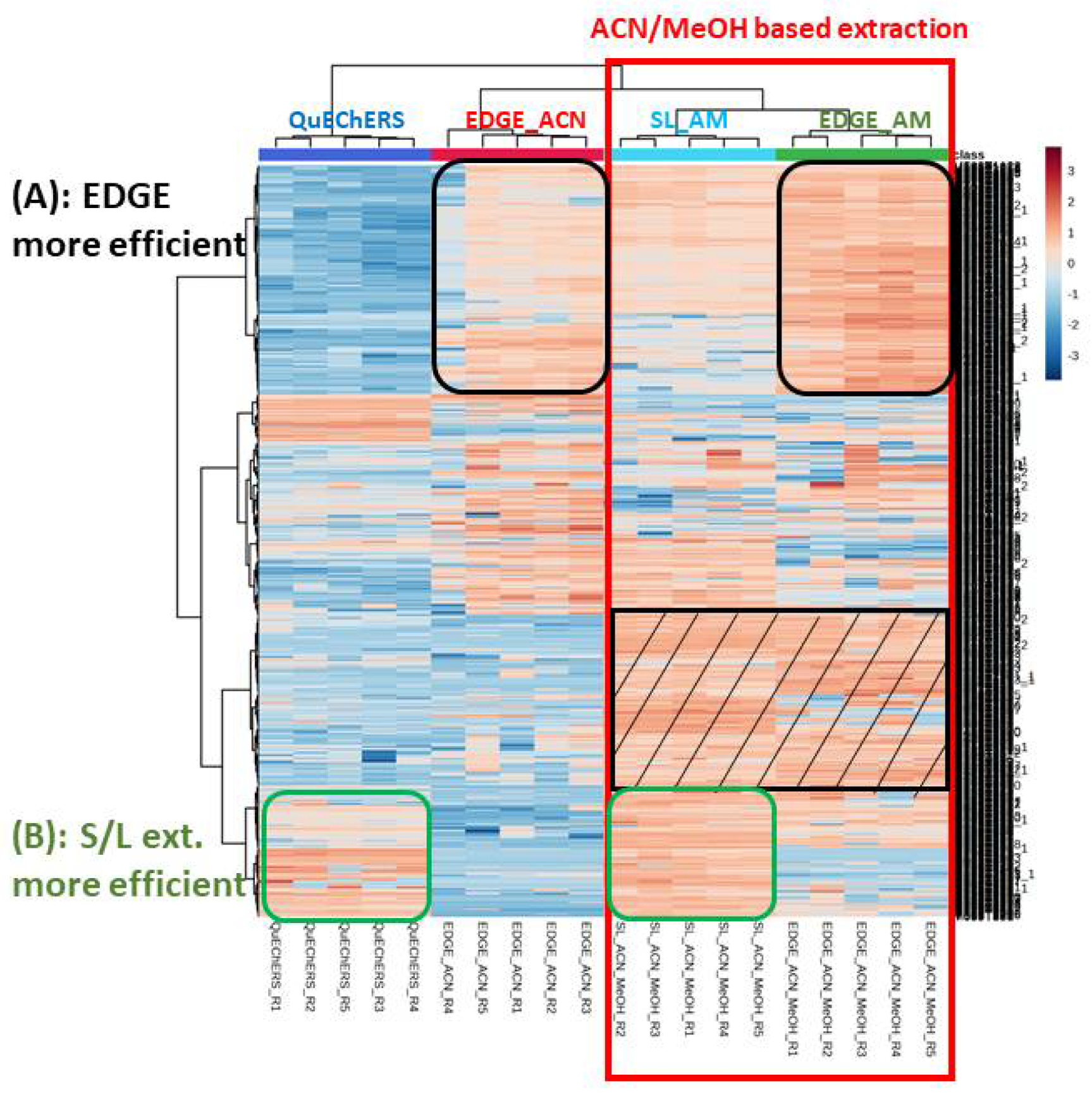
Figure 2.
Distribution of the number of features versus peak area ranges representative of the amount of substance present in the extract.
Figure 2.
Distribution of the number of features versus peak area ranges representative of the amount of substance present in the extract.
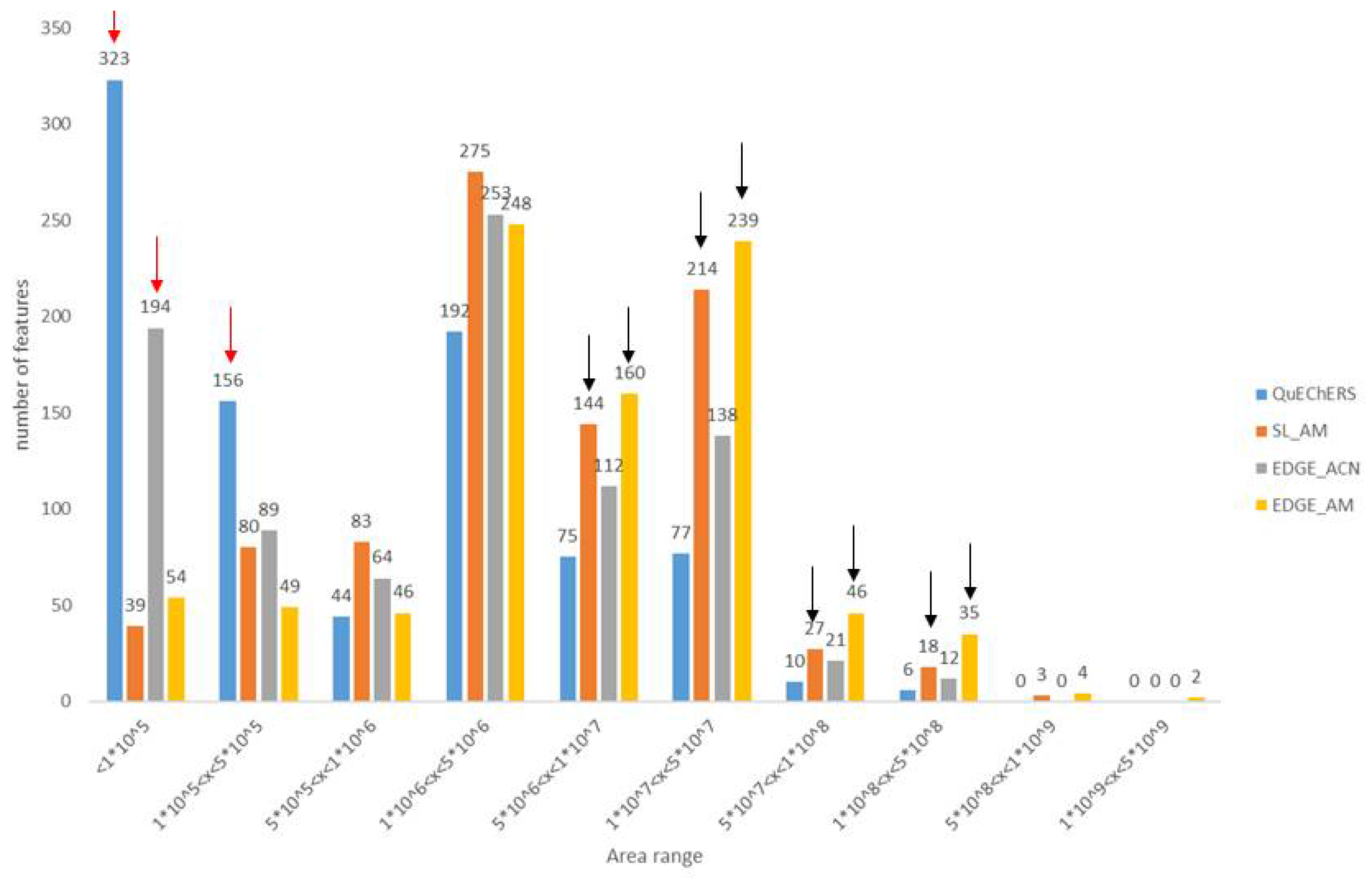
Figure 3.
Evaluation of the reproducibility of the 4 extraction protocols tested. (A) CV distribution for the 883 selected features ; (B) CV mean, median, minimum and maximum ; (C) number of features having a CV < 30% and < 50%.
Figure 3.
Evaluation of the reproducibility of the 4 extraction protocols tested. (A) CV distribution for the 883 selected features ; (B) CV mean, median, minimum and maximum ; (C) number of features having a CV < 30% and < 50%.
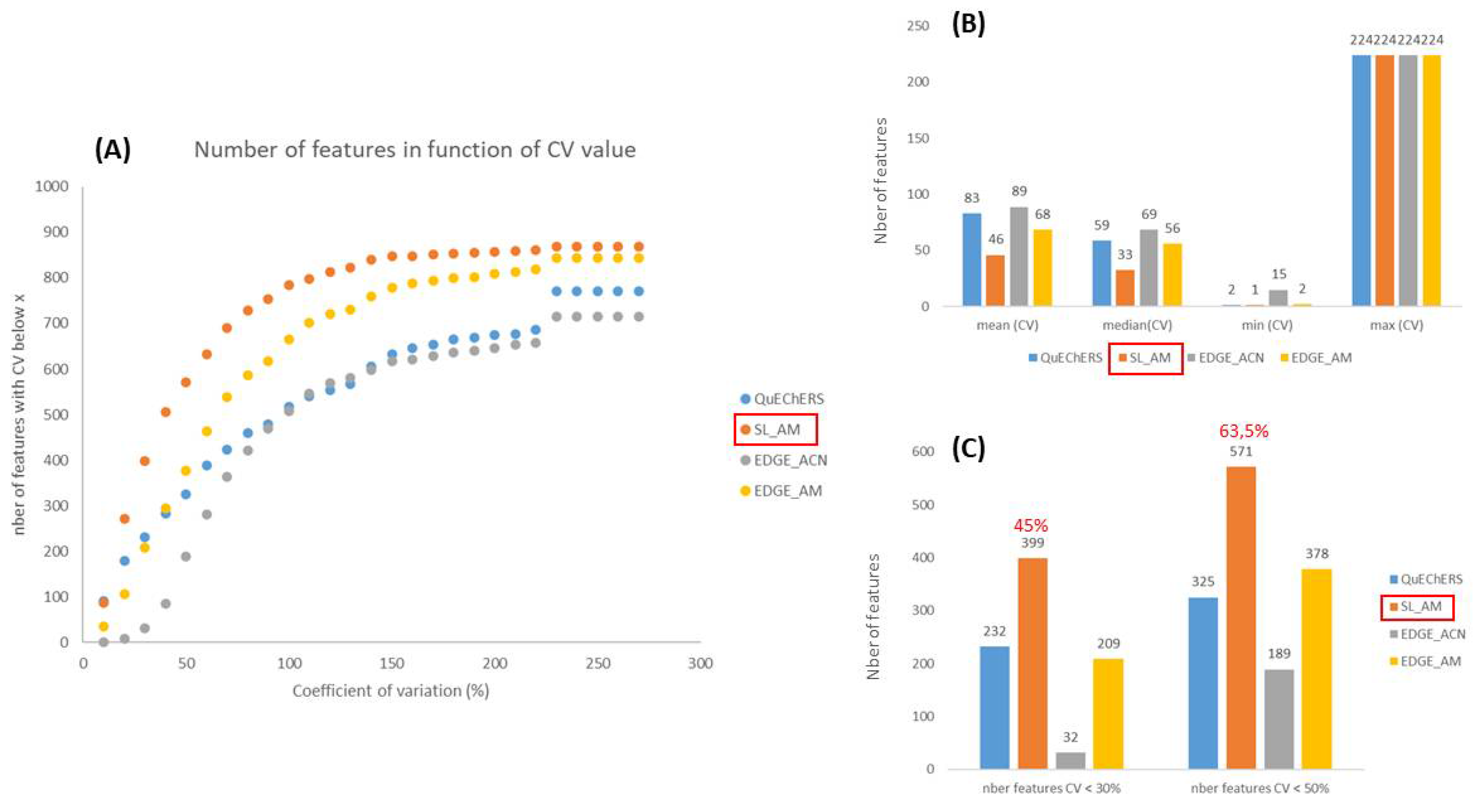
Figure 4.
Yield of extracted DNA obtained for the five commercial kits (ng DNA/mg of fresh sediment, 5 replicates). The kits tested in this study are as follows: the Quick-DNA Fecal/Soil Microbe kit (Zymo Research, USA), the DNeasy PowerSoil Pro Qiagen kit (Promega, USA), the FastDNA Spin Kit for Soil, the Magbeads FastDNA kit for Soil (MP Biodemicals, USA), and the E.Z.N.A Soil DNA kit (Omega Biotek, USA).
Figure 4.
Yield of extracted DNA obtained for the five commercial kits (ng DNA/mg of fresh sediment, 5 replicates). The kits tested in this study are as follows: the Quick-DNA Fecal/Soil Microbe kit (Zymo Research, USA), the DNeasy PowerSoil Pro Qiagen kit (Promega, USA), the FastDNA Spin Kit for Soil, the Magbeads FastDNA kit for Soil (MP Biodemicals, USA), and the E.Z.N.A Soil DNA kit (Omega Biotek, USA).
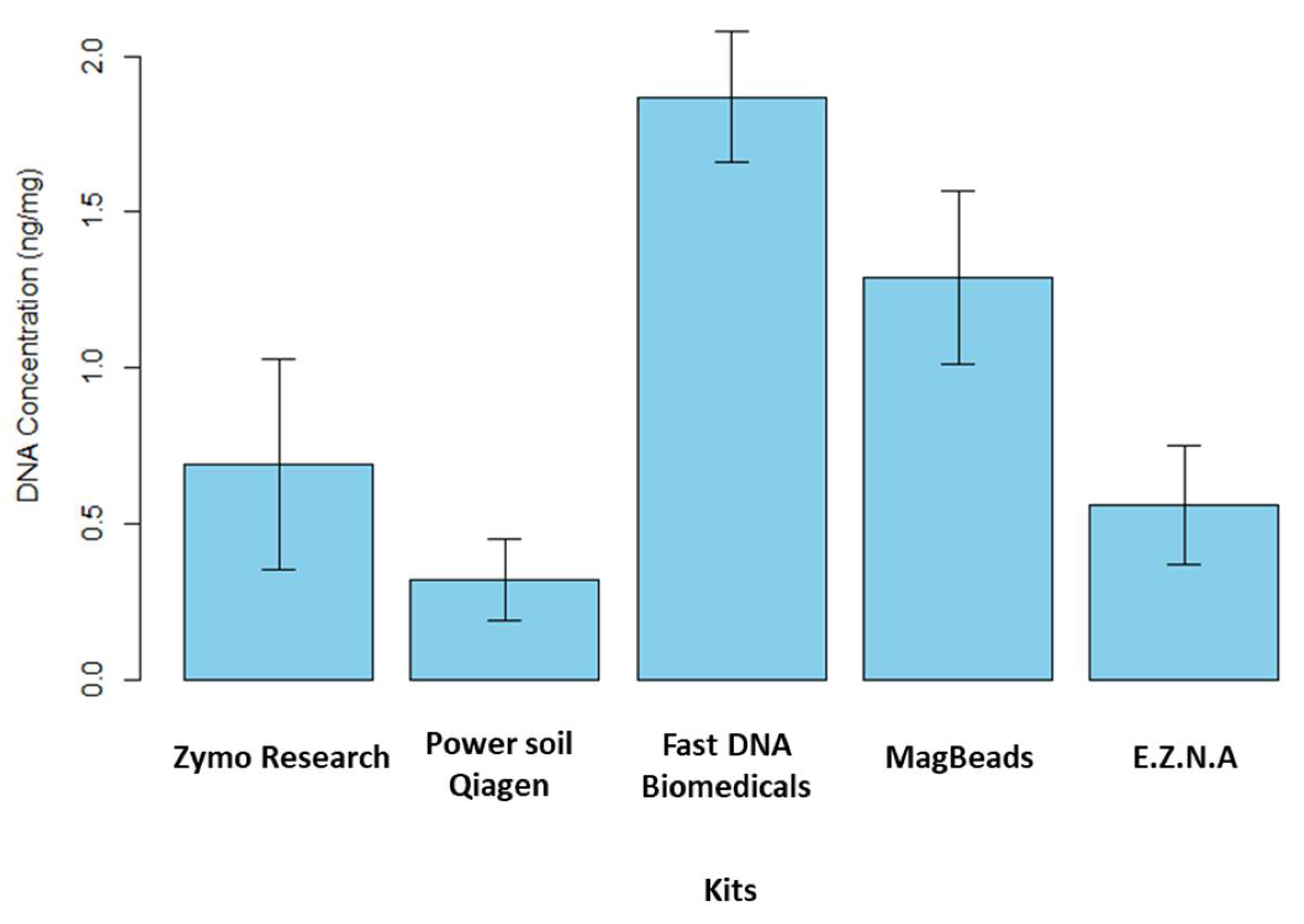
Figure 5.
Bacteria domain rarefaction curves indicating the expected taxonomic richness of the samples (number of ASVs) for the five DNA extraction kits. The kits tested in this study are as follows: the Quick-DNA Fecal/Soil Microbe kit (Zymo Research, USA), the DNeasy PowerSoil Pro Qiagen kit (Promega, USA), the FastDNA Spin Kit for Soil, the Magbeads FastDNA kit for Soil (MP Biodemicals, USA), and the E.Z.N.A Soil DNA kit (Omega Biotek, USA).
Figure 5.
Bacteria domain rarefaction curves indicating the expected taxonomic richness of the samples (number of ASVs) for the five DNA extraction kits. The kits tested in this study are as follows: the Quick-DNA Fecal/Soil Microbe kit (Zymo Research, USA), the DNeasy PowerSoil Pro Qiagen kit (Promega, USA), the FastDNA Spin Kit for Soil, the Magbeads FastDNA kit for Soil (MP Biodemicals, USA), and the E.Z.N.A Soil DNA kit (Omega Biotek, USA).
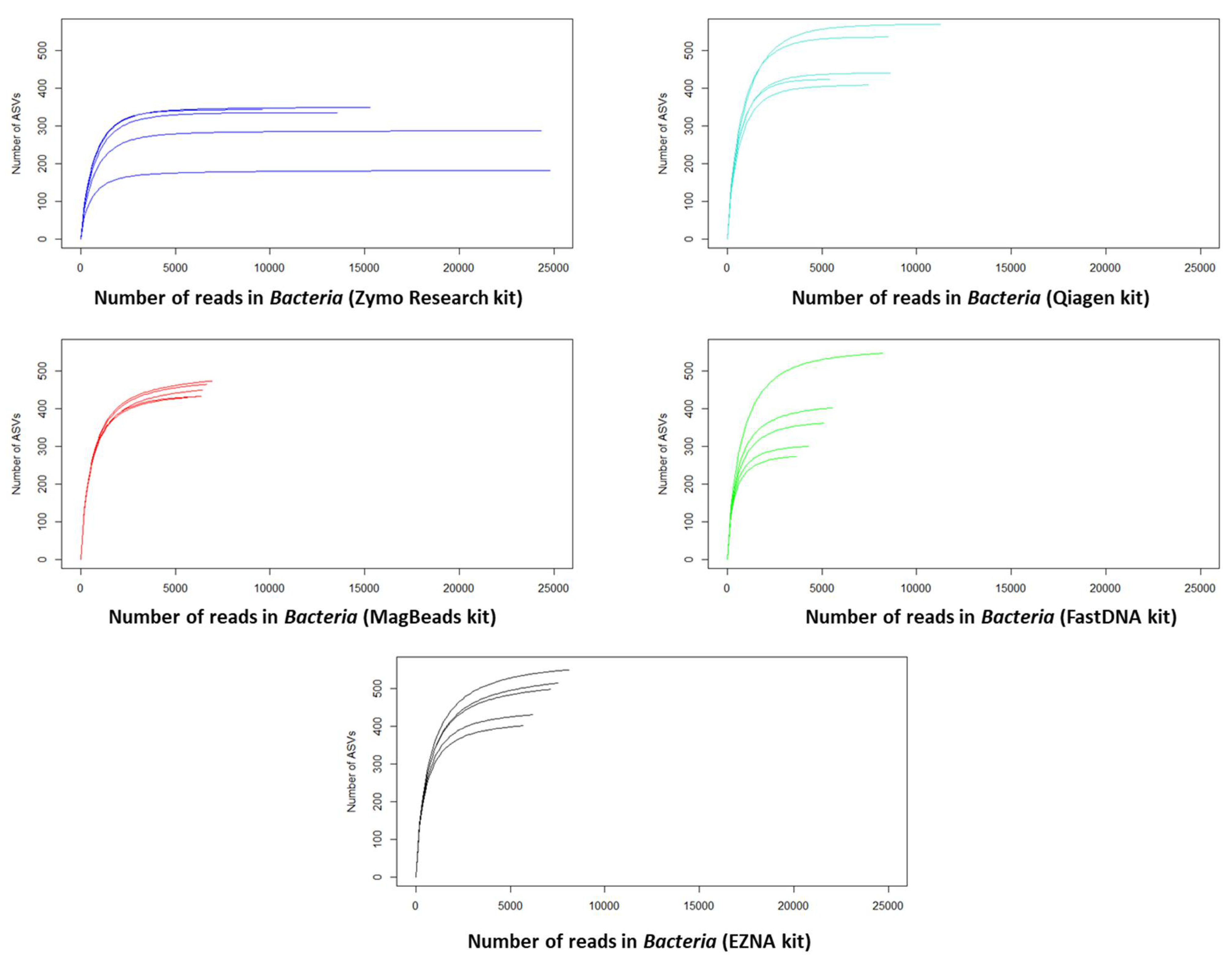
Figure 6.
Alpha diversity metrics (Chao1, Shannon and Pielou indexes) of the samples calculated for the five DNA extraction kits. The kits tested in this study were: the Quick-DNA Fecal/Soil Microbe kit (Zymo Research, USA), the DNeasy PowerSoil Pro Qiagen kit (Promega, USA), the FastDNA Spin Kit for Soil and the Magbeads FastDNA kit for Soil (MP Biodemicals, USA), the E.Z.N.A Soil DNA kit (Omega Biotek, USA).
Figure 6.
Alpha diversity metrics (Chao1, Shannon and Pielou indexes) of the samples calculated for the five DNA extraction kits. The kits tested in this study were: the Quick-DNA Fecal/Soil Microbe kit (Zymo Research, USA), the DNeasy PowerSoil Pro Qiagen kit (Promega, USA), the FastDNA Spin Kit for Soil and the Magbeads FastDNA kit for Soil (MP Biodemicals, USA), the E.Z.N.A Soil DNA kit (Omega Biotek, USA).
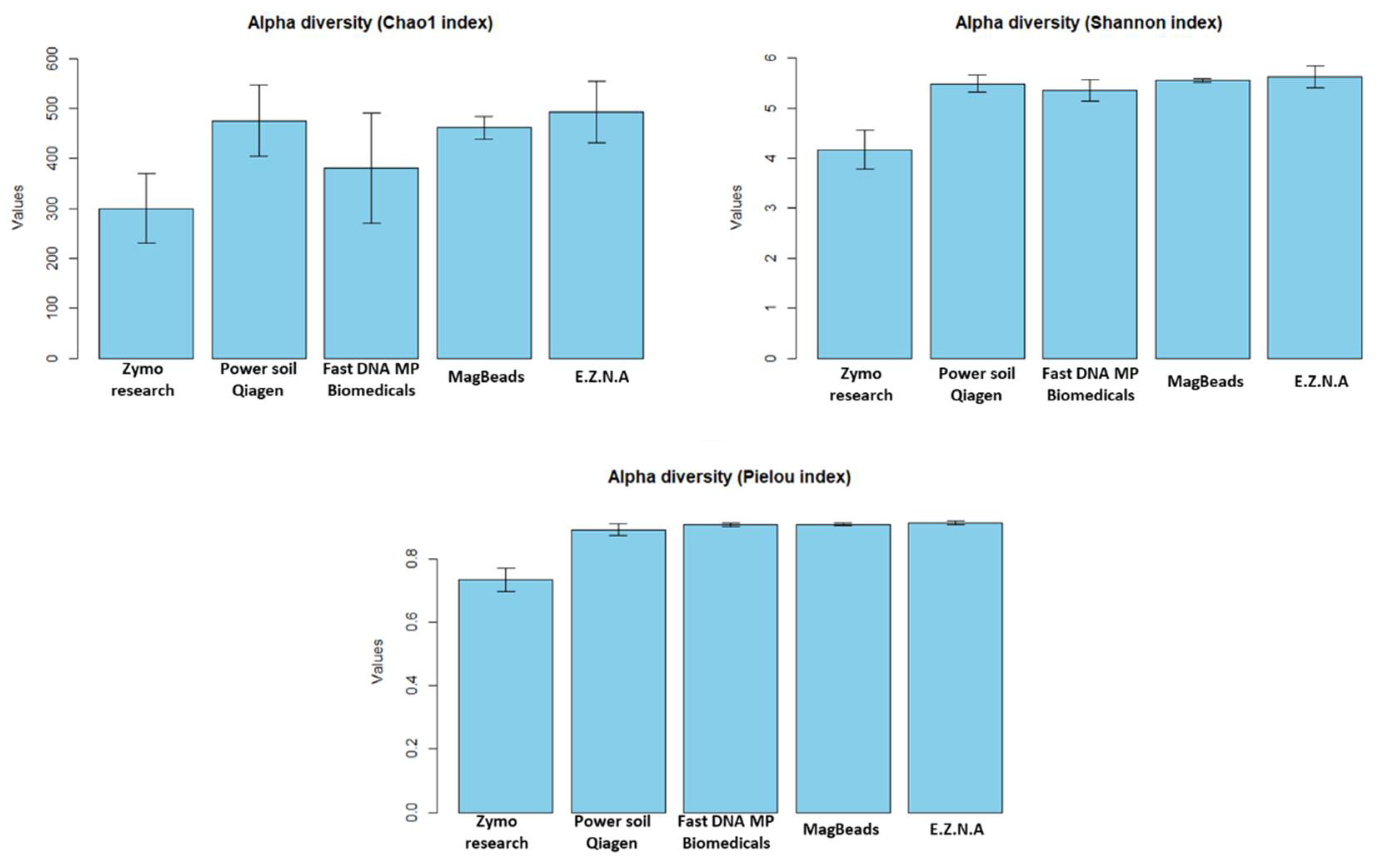
Figure 7.
Venn diagrams showing the distribution of (a): specific and shared ASVs among kits, (b): specific and shared genera among kits. The kits tested in this study were: the Quick-DNA Fecal/Soil Microbe kit (Zymo Research, USA), the DNeasy PowerSoil Pro Qiagen kit (Promega, USA), the FastDNA Spin Kit for Soil and the Magbeads FastDNA kit for Soil (MP Biodemicals, USA), the E.Z.N.A Soil DNA kit (Omega Biotek, USA).
Figure 7.
Venn diagrams showing the distribution of (a): specific and shared ASVs among kits, (b): specific and shared genera among kits. The kits tested in this study were: the Quick-DNA Fecal/Soil Microbe kit (Zymo Research, USA), the DNeasy PowerSoil Pro Qiagen kit (Promega, USA), the FastDNA Spin Kit for Soil and the Magbeads FastDNA kit for Soil (MP Biodemicals, USA), the E.Z.N.A Soil DNA kit (Omega Biotek, USA).
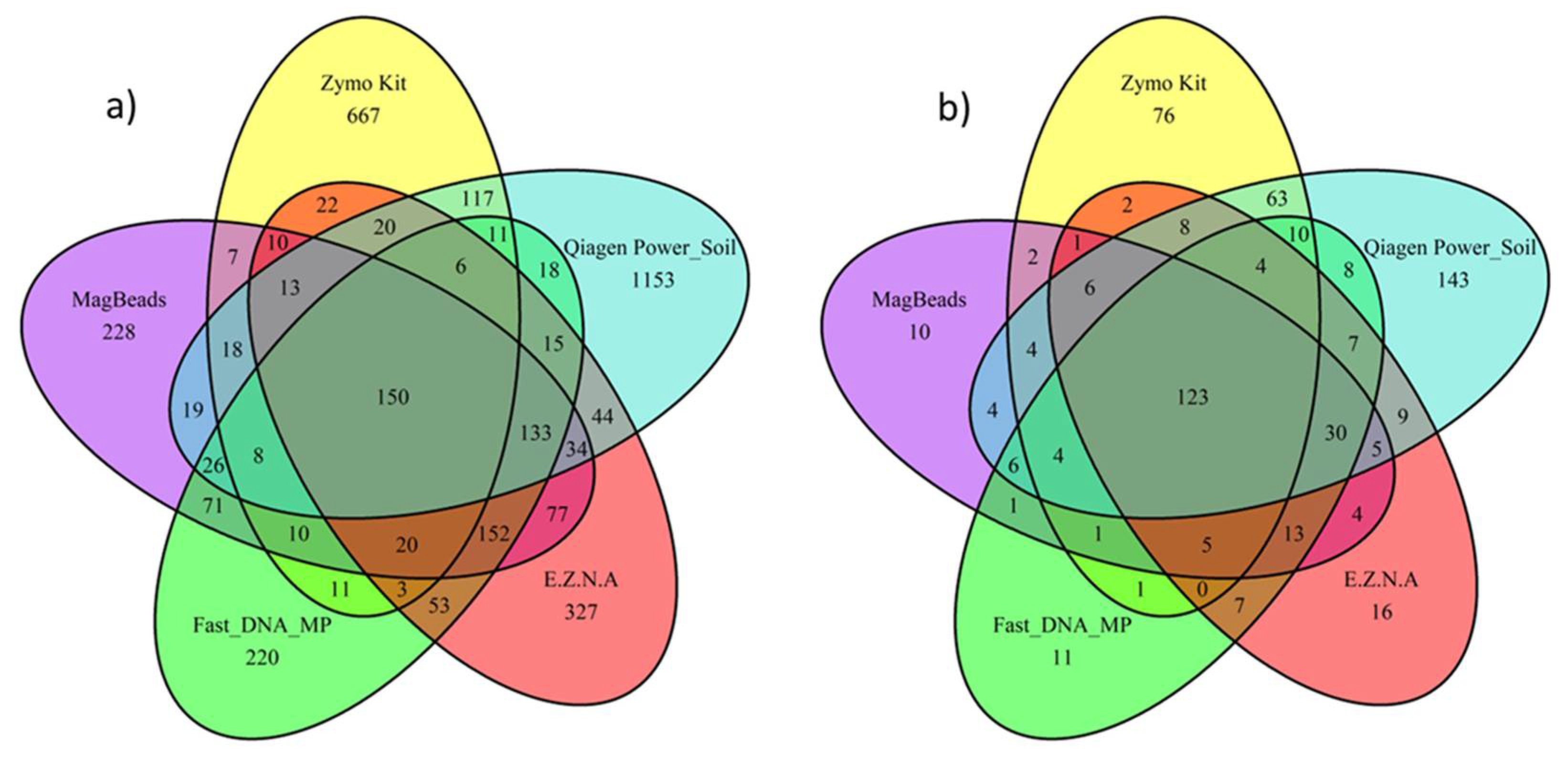
Figure 8.
Multidimensional scaling plots based on the Bray-Curtis distance and reflecting differences in the beta microbial diversity community composition of the five kits. The kits tested in this study were: the Quick-DNA Fecal/Soil Microbe kit (Zymo Research, USA), the DNeasy PowerSoil Pro Qiagen kit (Promega, USA), the FastDNA Spin Kit for Soil and the Magbeads FastDNA kit for Soil (MP Biodemicals, USA), the E.Z.N.A Soil DNA kit (Omega Biotek, USA).
Figure 8.
Multidimensional scaling plots based on the Bray-Curtis distance and reflecting differences in the beta microbial diversity community composition of the five kits. The kits tested in this study were: the Quick-DNA Fecal/Soil Microbe kit (Zymo Research, USA), the DNeasy PowerSoil Pro Qiagen kit (Promega, USA), the FastDNA Spin Kit for Soil and the Magbeads FastDNA kit for Soil (MP Biodemicals, USA), the E.Z.N.A Soil DNA kit (Omega Biotek, USA).
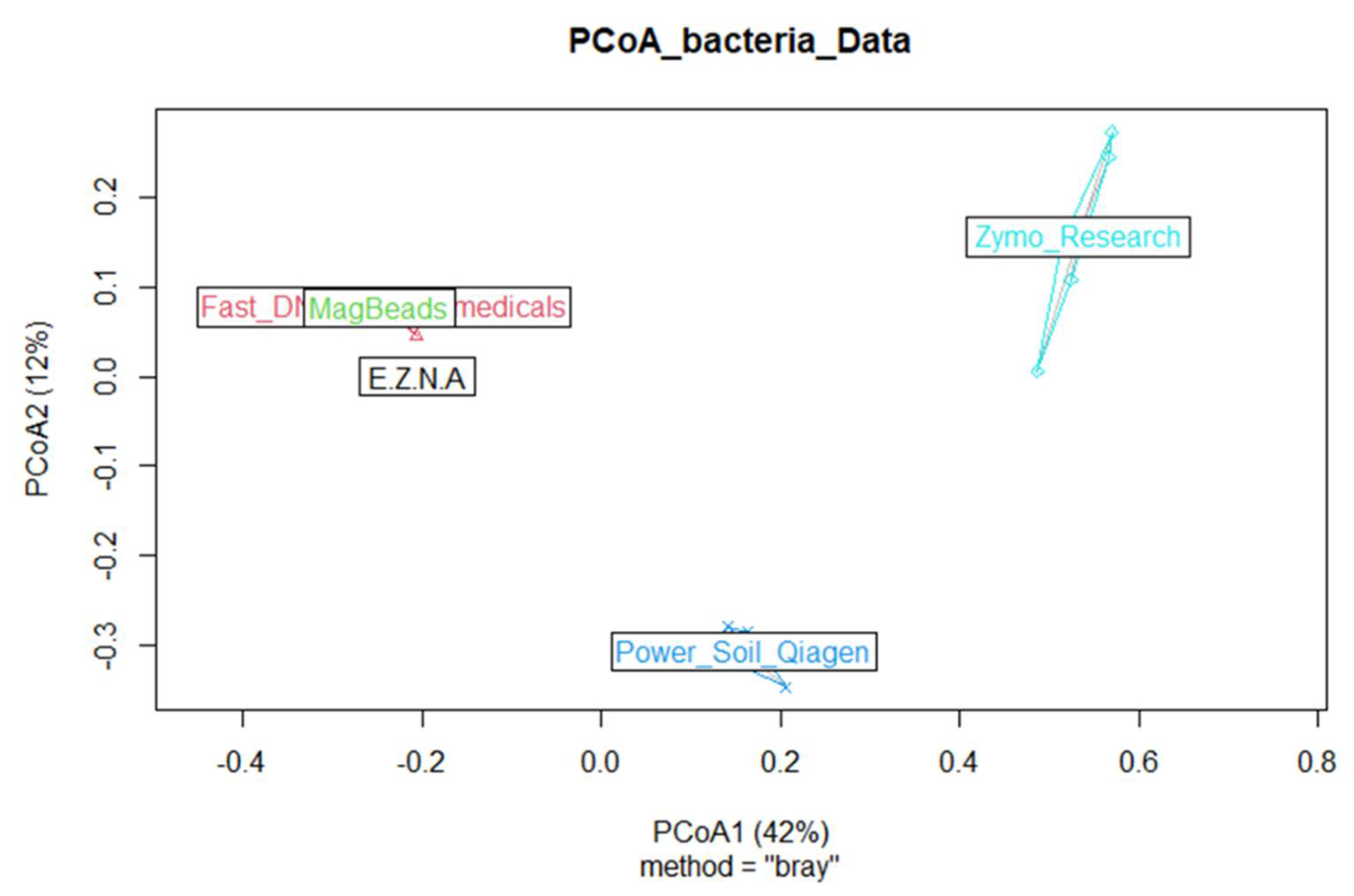

Table 1.
Quantitative results of compounds identified in water and sediment samples (n=5 replicates) from the “Canet-St Nazaire” (France, 66) lagoon. Substances tagged with (*) have been quantified using an external calibration method. For the other compounds, an internal calibration was carried out. MLQ = Method Limit of Quantification.
Table 1.
Quantitative results of compounds identified in water and sediment samples (n=5 replicates) from the “Canet-St Nazaire” (France, 66) lagoon. Substances tagged with (*) have been quantified using an external calibration method. For the other compounds, an internal calibration was carried out. MLQ = Method Limit of Quantification.
| Substances | MLQ Water (ng/L) |
Mean Conc Water (ng/L) |
CV Water (%) | MLQ Sed. (ng/g) |
Mean Conc Sed. (ng/g) |
CV Sed. (%) |
|---|---|---|---|---|---|---|
| PHARMACEUTICALS | ||||||
| Flecainide (Antiarrhythmic) | 0.04 | 35.6 | 6.15 | 0.001 | 0.180 | 46.5 |
| Oxazepam (Psycholeptic) | 0.06 | 30.6 | 5.05 | 0.007 | 0.088 | 14.8 |
| Carbamazepine (Psycholeptic) | 0.03 | 22.6 | 3.30 | 0.007 | 0.076 | 7.21 |
| Fluconazole* (Antimycotic) | 0.06 | 12.1 | 7.55 | 0.001 | 0.030 | 0 |
| Paracetamol (Analgesic) | 1.2 | 9.15 | 8.50 | 0.04 | 0.092 | 14.2 |
| Telmisartan* (Hypertensive) | 0.01 | 8.44 | 20.4 | 0.02 | 0.240 | 47.5 |
| Tiapride (Neuroleptic) | 0.002 | 7.72 | 6.94 | 0.001 | 0.072 | 22.8 |
| Sulfamethoxazole (Antibiotic) | 0.02 | 7.54 | 7.36 | 0.008 | nd | - |
| Valsartan (Hyperstensive) | 0.06 | 7.50 | 5.16 | 0.1 | nd | - |
| Cetirizine* (Antihistamine/ Antiallergic) | 0.01 | 5.34 | 3.88 | 0.007 | 0.042 | 10.6 |
| Venlafaxine (Antidepressant) | 0.05 | 2.86 | 24.8 | 0.001 | 0.050 | 0 |
| Disopyramide*(Antiarrhythmic) | 0.05 | 2.76 | 8.34 | 0.001 | 0.054 | 10.1 |
| Diclofenac (Analgesic) | 0.05 | 1.58 | 12.1 | 0.004 | 0.120 | 37.3 |
| Amisulpride (Antiarrhythmic) | 0.01 | 1.14 | 4.80 | 0.003 | 0.036 | 15.2 |
| Citalopram*(Antidepressant) | 0.06 | 0.34 | 16.1 | 0.005 | 0.040 | 0 |
| PESTICIDES | ||||||
| Terbuthylazine (Herbicide) | 0.02 | 0.200 | 0 | 0.001 | 0.030 | 0 |
| Terbuthylazine-2-OH*(by-product) | 0.06 | 47.4 | 2.78 | 0.001 | 0.340 | 82.1 |
| Terbuthylazine Desethyl hydroxy* (by-product) | 0.04 | 4.40 | 14.9 | 0.001 | 0.028 | 16.0 |
| Carbendazim (Fungicide) | 0.02 | 12.8 | 7.85 | 0.001 | 26.3 | 9.55 |
| Atrazine (Herbicide) | 0.01 | 0.660 | 81.3 | 0.001 | 0.660 | 8.30 |
| Atrazine-2-Hydroxy* (by-product) | 0.02 | 2.98 | 7.65 | 0.001 | 0.0078 | 44.8 |
| Diuron (Herbicide) | 0.05 | 2.52 | 3.32 | 0.01 | 0.048 | 17.4 |
| Boscalid (Fungicide) | 0.08 | 2.00 | 10.0 | 0.01 | 0.046 | 68.0 |
| Propazine-2-Hydroxy*(by-product) | 0.02 | 1.48 | 3.02 | 0.001 | 0.058 | 39.3 |
| Tebuconazole* (Fungicide) | 0.05 | 1.14 | 4.80 | 0.001 | 0.072 | 6.21 |
| Imidaclopride (Insecticide) | 0.06 | 0.880 | 5.08 | 0.008 | nd | - |
| HORMONAL STEROIDS | ||||||
| Progesterone* (Progestogen) | 0.06 | 0.0900 | 11.1 | 0.005 | 0.064 | 34.2 |
| Testosterone* (Androgen) | 0.06 | nd | nd | 0.005 | 0.042 | 10.6 |
Table 2.
Main endometabolites (metabolites/families) putatively identified in sediments from the Canet-St Nazaire lagoon.
Table 2.
Main endometabolites (metabolites/families) putatively identified in sediments from the Canet-St Nazaire lagoon.
| Exp. m/z | RT (min) | Adduct | Elemental composition |
Putative compound class / family |
Putative Compound identity |
|---|---|---|---|---|---|
| 96.9599 | 0.6 | [M-H]- | H2SO4 | acid | sulfuric acid |
| 121.0295 | 6.8 | [M-H]- | C7H6O2 | acid | benzoic acid |
| 268.1043 | 0.9 | [M-H]+ | C10H13N5O4 | nucleoside | adenosine |
| 287.0890 | 0.8 | [M+FA-H]- | C10H14N2O5 | nucleoside | thymidine |
| 327.2913 | 15.6 | [M-H]- | C20H40O3 | fatty acyl (fatty acid / fatty ester) | 20-hydroxyeicosanoic acid |
| 355.3226 | 16.5 | [M-H]- | C22H44O3 | fatty acyl (fatty acid / fatty ester) | 2-hydroxydocosanoic acid |
| 369.3378 | 16.9 | [M-H]- | C23H46O3 | fatty acyl (fatty acid / fatty ester) | 2-hydroxytricosanoic acid |
| 379.2613 | 11.2 / 11.3 | [M-H]+ | C19H39O5P | glycerophospholipid | (isomers) |
| 383.3540 | 17.4 | [M-H]- | C24H48O3 | fatty acid | 2-hydroxy Lignoceric acid |
| 393.2769 | 11.8 | [M-H]+ | C20H41O5P | glycerophospholipid | |
| 496.3394 | 12.8 | [M-H]+ | C24H50NO7P | glycerophospholipid (glycerophosphocholine) | 1-O-palmitoyl-sn-glycero-3-phosphocholine |
| 497.2898 | 12.6 | [M-H]- | C23H47O9P | glycerophospholipid | [3-[2,3-dihydroxypropoxy(hydroxy)phosphoryl]oxy-2-hydroxypropyl] heptadecanoate |
| 552.4642 | 17.8 | [M-H]- | C33H63NO5 | sphingolipid | |
| 566.4282 | 7.71 | [M-H]+ | C30H55N5O5 | natural cyclopeptide | clavatustide C |
| 566.4799 | 18.2 | [M-H]- | C34H65NO5 | lipid / sphingolipid | |
| 653.5118 | 17.6 | [M-H]- | C37H70N2O7 | lipopeptide (containing serine) | |
| 753.5292 | 16.1 | [M-H]- | C42H70N6O6 | peptide |
Disclaimer/Publisher’s Note: The statements, opinions and data contained in all publications are solely those of the individual author(s) and contributor(s) and not of MDPI and/or the editor(s). MDPI and/or the editor(s) disclaim responsibility for any injury to people or property resulting from any ideas, methods, instructions or products referred to in the content. |
© 2024 by the authors. Licensee MDPI, Basel, Switzerland. This article is an open access article distributed under the terms and conditions of the Creative Commons Attribution (CC BY) license (http://creativecommons.org/licenses/by/4.0/).
Copyright: This open access article is published under a Creative Commons CC BY 4.0 license, which permit the free download, distribution, and reuse, provided that the author and preprint are cited in any reuse.


