

Submitted:
14 June 2024
Posted:
18 June 2024
You are already at the latest version
Abstract
This review paper addresses the growing challenges and developments in frequency control within power systems influenced by increasing penetration of renewable energy sources. It evaluates the advancements and limitations of renewable-based control technologies and explores the critical role of diverse energy storage technologies in providing fast frequency response ancillary services. Through a comprehensive analysis of global literature, this paper categorizes energy storage solutions according to their efficacy in meeting fast frequency response demands and potential for revenue generation. It reveals significant gaps in current research, which predominantly focuses on battery energy storage systems and microgrid applications, with insufficient attention to grid-scale storage solutions and innovative energy storage technologies. This analysis identifies a lack of detailed technical simulations and hybrid storage models for frequency control, as well as a minimal exploration of the environmental benefits, particularly in terms of carbon dioxide emission reductions, associated with deploying new energy storage technologies in ancillary service markets. The paper concludes by highlighting the necessity for further research incorporating detailed techno-economic evaluations and carbon dioxide reduction potential of modular, scalable energy storage technologies, facilitated by advanced network simulation models and comprehensive market analysis.
Keywords:
fast frequency ancillary services
; renewable energy sources
; grid stability
; market dynamics
; energy storage
; techno-economic analysis
Introduction
In traditional grids, frequency control has been performed using conventional synchronous machines. The aim of such control is to continuously ensure the generation-load balance in the network. This is achieved through the hierarchical deployment of inertial / primary / secondary / tertiary frequency controls [1]. Inertial (fast-acting) control limits the immediate rate of change of frequency (ROCOF - how fast the frequency changes after a disturbance []) by "buying" time for the primary control to be deployed to limit the frequency deviation after disturbances. Secondary control restores the frequency and tie line flows to nominal/scheduled values and tertiary control ensures re-dispatching of the power plants to free up the reserves [2]. As inertial and primary controls are dependent on the available rotating mass in the grid, the ROCOF and steady-state frequency error (nadir - how much final the frequency deviates from nominal frequency) after a disturbance are ultimately governed by the available system inertia.
When increasing converter-connected RES generation to replace conventional machines, the equivalent inertia of the system (rotating mass) decreases, ultimately leading to an increased ROCOF and a larger nadir following disturbances [3]. Renewable sources typically operate at maximum power output subject to weather conditions; hence they are neither dispatchable nor have active power reserves for frequency control purposes. Characterised by decreased system inertia and inaccessibility of reserves, excessive penetration of RES leads to inadequate inertial control, cannot provide sufficient time for primary control to be activated, jeopardising the stability of the system [4].
Significant research has been conducted over the past years, such as [3,4,5] on developing novel control strategies to provide artificial frequency control capabilities with RES generation, such as deloading, inertia emulation, and the synthetic inertia response. However, by passing a certain level of penetration of RES, such techniques fail to achieve the required control performance [6], and hence additional energy storage-based frequency control solutions are required to be integrated into the grid.
Recent research such as [7,8,9] focused on various energy storage technologies that can be used for ancillary service provision on power grids, but most of them were concerned with battery energy storage solutions (BESS), and location-specific technologies (such as pumped hydro storage or compressed air energy storage). However, current BESS technologies are rapidly degrading under frequent charging / discharge cycles of operation [10], while also not being able to provide a cost-effective way of storing energy, therefore, they would not be suitable for the provision of ancillary services alone. Only a small number of works, such as [11,12,13,14] were concerned with the use of new technologies (such as the proton exchange membrane (PEM) electrolyzer, fuel cells, ready gas turbines) for frequency control and stabilisation purposes; however, these studies often lack detailed technical analysis, verification of real-grid environment, comprehensive coverage of multiple power networks, and evaluations of economic feasibility and emission reduction potentials.
This review paper connects the dots between traditional frequency control mechanisms in power systems and the emerging challenges posed by the high penetration of renewable energy sources (RES). It explores the decline in system inertia due to the replacement of conventional machines with converter-connected RES, leading to increased rate of change of frequency (ROCOF) and larger frequency deviations post-disturbances. The paper highlights significant research efforts in developing novel control strategies for RES, such as deloading and the synthetic inertia response, and acknowledges their limitations beyond certain levels of penetration of RES. The focus then shifts to the potential role of various energy storage technologies in providing ancillary services, recognising both the advantages and limitations of the storage solutions (BESS). The review underscores the need for comprehensive studies that integrate detailed technical analysis, real-grid environment validation, and economic feasibility and emission reduction potential evaluations, thus filling a crucial gap in the current literature and setting the stage for future research directions.
Development of Frequency Control Practices in High RES Penetration Grids
Wind and Solar PV Based Frequency Controls
RES-only frequency control techniques are summarised in Figure 1.
It is understood that increasing RES penetration and moving toward low-inertia grids leads to increased frequency control and stability issues. Consequently, it is necessary to review current practices and research addressing these challenges. Fernandez-Guillamon et al. [3] provides an overview of the goals and importance of primary, secondary, and tertiary frequency control, highlighting that most renewable generation plants are wind farms or solar photovoltaic farms operating in maximum power point tracking (MPPT) mode. This technique aims to achieve the maximum power from the RES within given weather conditions (wind speed for WTGs and solar irradiance and temperature for solar PV plants). MPPT, by definition, is maximising the active power output of the units, hence providing no "reserve" for frequency control proposed. As also highlighted by Alam et al. [15], wind turbines have rotating kinetic energy stored in their blades and rotors, suggesting that shifting from the MPPT operating point has the potential to utilise WTGs for frequency support. Since modern WTGs are connected to the grid via full converters, their rotating mass (inertia) is practically decoupled from the network, so it is considered hidden [3]. By modifying the MPPT control, this hidden inertia can be emulated and made available for grid support. Fernandez-Guillamon et al. [3] state that WTG inertia time constants are comparable to conventional machines, which is true, however, the inertia time constant H is considered on machine rated power, therefore, the WTG inertia response is expected to be marginal compared to conventional synchronous generators, as argued by Munisamy and Sundarajan [16]. As far as solar PV plants are concerned, the recent review papers by Alpizar Castillo et al., Alam et al., Fernandez-Guillamon et al. and Bostrom et al. [3,9,13,17] all agree that having no rotating parts, their inertia is effectively zero; however, with modified MPPT settings, an emulated synthetic inertia-type response can be achieved.
To achieve desired frequency control performance by synthetic inertia emulation with PV farms [3] suggests using a deloading technique, which corresponds to other research recommendations orientated to PV, such as the work by Debanjan and Karuna, Preston et al. and Safiullah et al. [18,19,20]. The purpose of deloading is to move the operating point of the solar photovoltaic unit in the characteristic away from the MPPT driven maximum power output, thus enabling the unit to have certain capacity reserve for frequency control purposes. The major downside of PV deloading is discussed by Dreidy et al. [5], concluding that due to the large geographical footprint of PV farms, the MPPT power output of the units is not equally distributed; hence their emulated inertia-based control is not coherent within a solar PV farm. This requires additional control to distribute the park-assigned power command among individual units, based on their actual operating conditions.
When it comes to wind turbine generators, the options for artificially creating frequency control capabilities are broader. [3] mentions that the deloading technique applied for solar PV units can be implemented for WTGs as well. In the case of wind generators, deloading can be achieved either by pitch angle or over speed control. The available power for a wind turbine generator is described by its power - rotor speed characteristic [21], which suggest that for a constant wind speed there is a corresponding pitch angle, which results in optimal operating point, delivering maximum power output. Consequently, adjusting the pitch angle of the machine results in a lower power output than MPPT. When operating at sub-MPPT output, the excess reserve capacity of the WTG can be used for frequency regulation purposes, which is also confirmed by both Alam et al. and Kazemi Golkhandan et al. [15,22]. When applying over-speed control, for the same pitch angle, the control forces the operation to a power output lower than the MPPT determined value by artificially shifting the machine to higher rotor speed. For the same wind velocity and pitch angle, increasing the rotor speed beyond the MPPT calculated optimal value results in sub-MPPT power output. In such a case, when frequency up-regulation is required, the rotor speed can be decreased, so that stored kinetic energy is released. [3] further mentions that underspeed control could also be used, which would force the power output to a sub-MPPT value, corresponding to a slower rotor speed. This operation mode would require speeding up the rotor to provide extra power output, in the case of up-regulation. As Gonzalez-Inostroza et al. and Dreidy et al. rightly highlight [5,23], increasing the rotor speed would require extra power, so that the effective active power output of the machine would be reduced. This type of control is counterproductive, as it limits the power output surplus the WTG should produce in the case of up-regulation. For the same reasons, Sarasua et al. and Sun et al. [24,25] also suggest not to use under-speed de-loading for WTGs.
Sun et al. [25] recommends considering the droop control technique instead for WTGs, by inputting the system frequency deviation into the converter control, thus forcing it to vary the MPPT output according to the network conditions. This action mimics the droop control action of the speed governors of the synchronous machine.
The latest control technique originally mentioned by Gonzalez-Inostroza et al. and Huang et al. [12,23] and later fine-tuned by Sun et al. [25] recommends the use of the double loop hidden inertia emulation technique for WTG. In the work by Alam et al. and Farhoodnea et al. [4,26] this is called the fast power reserve technique. When the WTG is operated in over-speed deloaded mode, the system ROCOF signal is inputted (single loop) to the controller, to raise active power output during up-regulation by decreasing the rotor speed and releasing kinetic energy. This method provides the same response as primary control with conventional machines. Adding the actual frequency error to the controller (double loop) would drive the WTG further to eliminate the frequency deviation. Such control actions aim to mimic the primary and secondary frequency control of conventional synchronous machines. However, as Sun et al. [25] emphasises, this technique has its drawbacks, since after the overproduction period, the delivered energy requires recovery, in an underproduction period, in which the WTG is unable to participate in frequency control.
Similarly to solar PV plants, the power output of units within a wind farm is not necessarily uniquely distributed, depending on the wind conditions. To address this, Kazemi Golkhandan et al. [22] suggested using a master controller of the wind park with three inputs of fuzzy logic, which first calculates the required power output of the wind farm to control the frequency of the grid, then allocate the total amount required between machines based on their actual power output.
Some recent work, such as Jasim et al., Kumar et al., Zhao et al. and Zulu et al. [27,28,29,30] focused on improving the mentioned RES control techniques using artificial intelligence (AI); however, the results were only tested microgrid environments, which does not provide valuable information on how AI implemented controls could improve the frequency response of these units in large power networks.
Inadequacy of RES-only Based Frequency Control
The initial, RES-only based frequency control techniques based solely on RES gradually became inadequate as the penetration level of RES increased, leading to various new challenges, as Figure 2 shows.
Despite many publications focusing on reviewing the methodologies for providing frequency control with renewable generation plants, only a limited number of articles in the public domain verified the performance via time domain-based simulations. Makolo et al. [31] focused on the simulation of solar photovoltaic farms with the implementation of synthetic inertia control. The paper presents a mathematical summary to prove that the equivalent system inertia is dependent on the RES penetration level. However, the simulation focused only on a test network with 20% RES penetration, and found that synthetic inertia is faster than the primary control, but slower than the inertial response of synchronous machines. It should be noted that this solar PV focused study is based on the assumption that with increased RES penetration the same amount of conventional units are being decommissioned. These assumptions are aligned with Xiong et al. [32] focusing on wind farms instead. [32] proposed droop-inertia combined technique, advancing the control methods described above, and proved with simulations that the combined control logic provides a better frequency response. However, the work assumes that with increased RES penetration, the frequency dependency of the loads also decreases, an assumption that does not seem to be supported.
One of the most recent works by Alqahtani et al. [6] provides an overview of selected, recent studies around the world that highlight frequency control challenges related to high penetration of RES, obtained by grid simulations. Analysing these studies from the USA [33], UK [34], Jordan [35], Egypt [36], and Turkey [37] concludes that achieving RES share over 40% indeed leads to reduced frequency control capabilities. Alqahtani et al. [6] focuses on Saudi Arabia and concludes that the excellent solar irradiation profile of the country will drive the penetration level of RES by 2030 up to 41% depending on the actual progression scenario. The work simulated the ROCOF and frequency nadir under various penetration levels in 2030 considering loss of generation events, and concluded that in the case of high progression case the nadir could reach levels that trigger the under-frequency load shedding.
Interestingly, a similar result was presented in other Middle Eastern-focused studies [35,36,37], concluding that with increased penetration of RES, grid code revisions are also required to prepare the grids for the transition. Alqahtani et al. [6] further concluded that RES control techniques alone are not sufficient to achieve the right frequency response in a grid, therefore additional energy storage or conversion technologies must be used. [6] suggested battery energy storage systems (BESS); however, the simulation was carried out using only test networks and a simplified Saudi equivalent grid, using a simple transfer function representation of the BESS, hence not giving sufficient details of the frequency control performances.
It should be noted that as global RES penetration increased, initial RES-based artificial frequency control techniques turned out to be inadequate to solve grid stability issues alone. Recognising the increasing challenges when providing frequency control with RES technologies alone, Karbouj et al. [38] summarised the main technical and economic downsides of these practices. Consequently, practical experience shows that the use of wind turbines for frequency ancillary services resulted in increased mechanical stress on the components responsible for pitching and underspeed/overspeed control. Furthermore, due to intermittency of the RES generation (and their dependence on weather conditions), typically over-sizing the ancillary service reserves is required, which increases service costs and impractical from a technical point of view as well.
Ku et al. [39] evaluated the impact of using PV generation for AS provision in Thailand. The system is characterised by high penetration of the PV level posing operating challenges around sunrise and sunset, when approximately 3000 and 2500 conventional generation needs to be ramped down and up, respectively, to accommodate solar generation. The Thai system operator is using emergency generation control (EGC) to shift the operating point of the PV (and wind) farms away from MPPT, thus achieving the AS provision. However, due to solar intermittency, the peak load for conventional machines shifts to night (as also discussed by Bai et al. [40]), which requires additional ancillary services to be obtained.
Using RES generation alone for the provision of additional services creates an economic trade-off between the energy and ancillary markets. Since RES-based frequency control requires that the wind and solar PV units be scheduled away from the MPPT operating point (which corresponds to the maximum power generation), the revenues of ancillary service provision can only be derived at the cost of reducing the revenues of the energy market. Ai et al., Aldaadi et al., and Naemi at al. [41,42,43] all confirmed the same, indicating the impracticality of such a setup.
In addition to the growing technical challenges, economic issues appeared in the case of pure RES-based AS provision. Agostini et al. [44] assessed the impact of large-scale PV penetration in the Chilean grid. ancillary services in Chile were historically provided by conventional machines under compulsory provision without remuneration. In 2020 regulatory changes introduced remuneration, and the article evaluated the impact of adopting the US-based pay-as-bid (PAB) [45] or the EU-based system marginal price (SMP) procurement model [46] on the overall costs of auxiliary services (AS). The energy and ancillary markets are cleared with the central dispatch system (CDS) method. The study considered four levels of PV penetration and assessed the impact of the AS profit (AS revenue minus the opportunity cost of providing the AS provision instead of selling capacity in the energy market). The results showed that increased PV penetration led to a decrease in energy spot prices, making conventional generation investments less attractive. Supporting RES development tends to lower energy spot prices. However, this often leads to a decrease in the use of conventional units. Such a decline can cause two main issues: first, AS reserves may become inadequate and second, the prices for AS may increase.
The same conclusions can be drawn from the work of Badesa et al. and Ghiani et al. and Lisi et al. [47,48,49]. The first two assessed changes in AS regulation price in the UK and Italy during the COVID-19 pandemic, while the latter focused on AS cost forecasting in high-RES penetration scenarios in Italy. During the COVID-19 pandemic, the UK grid was generally characterised by high levels of RES generation coupled with low demand. This scenario is widely considered the most difficult from the frequency control perspective [4,50,51]. In the UK, the Contracts of Difference (CfD) pricing encourages the investment in RES, guaranteeing a certain target price for energy generation from RES. Due to high RES - load demand cases, the system operator marketed a new AS product aimed to curtail the non-conventional generation in the grid and also struck a bilateral contract with the largest nuclear power plant (NPP), requesting halving its generation output by operator’s request, leading to reduced AS reserve needs. Due to the new AS product and the optional NPP power reduction contract, AS costs reached approximately three times the normal regulation costs during COVID time [47]. In Italy, similar depressed consumption was observed (37% below the average level), which also resulted in lower prices on the energy market. Due to intermittency related constraints, RES generation participation in AS markets was alone not sufficient; therefore conventional units, which were switched off as a consequence of low demand, had to be re-synchronised to provider AS regulation. This resulted in the double cost of the AS provision during COVID times, especially in the south of the country, where most RES generation occurs, resulting in highly differentiated AS zonal prices [48]. In order to allow the Italian system operator (Terna) to deal with uncertainties related to the future increase in the costs of AS provision, Lisi et al. [49] developed an economic model to quantify the cost-at-risk (CaR) associated with frequency regulation. CaR calculates the maximum expected cost of one day and a 30-day horizon that the system operator is expected to incur.
Integrating Battery Energy Storages for Improved Frequency Response
Despite the growing use of BESS to support frequency control in RES systems, several limitations have emerged from relying solely on BESS-based AS provision, as illustrated in Figure 3.
With the experienced technical and economic challenges associated with the provision of AS based solely on RES, new ways of providing ancillary services were required to be identified. Consequently, most recent research, such as the work of Alam et al., Alpizar Castillo et al., Debanjan and Karuna and Kim et al. [9,13,18,52,53] is now focussing on using energy storage technologies as additional support. However, these works are typically concerned with BESS as the most mature technology when it comes to adding energy storage solutions to the grid to provide frequency support, although some previous works by Amin et al. and Engels et al. [10,54] have already highlighted that BESS alone is not sufficient for fast frequency control, due to the high level of degradation associated with increased charging/discharging cycles.
Tan and Zhang [55] from 2017 were one of the first articles to explore the integration of batteries into wind farm setups and developed a coordinated state machine-based control strategy to optimise technical performance. The work considered BESS as a secondary resource for the wind farm, with the objective of supporting the provision of AS during undesirable weather conditions. Under normal grid conditions, the BESS state of charge (SoC) was kept within a pre-defined optimum area, and the control system ensured that no full charge or discharge states are reached, hence extended the battery life time. The control was validated for primary and secondary AS provision in a test network model and found that a significant ROCOF reduction and higher nadir can be achieved with the combined setup. Further works by Munisamy and Sundarajan, Lei et al., Fernandez-Guillamon et al. and Alam et al. [3,9,15,16,50] utilised various control strategies to coordinate wind or solar PV plants with BESS for AS provision, and also found that batteries can enhance the technical performance of frequency control capabilities. However, these works ignored the economic and financial aspects of battery integration for AS provision.
To also examine economic aspects, Ai et al. [41] developed a model predictive control strategy for the wind / battery system to maximise energy and ancillary market profits in the United States on the PJM market, while Neami et al. [43] looked at NPV optimisation on the AMEO market in Australia. Interestingly, both studies concluded that adding BESS to a wind farm to participate in energy markets alone is not generating financially feasible business cases. This is because global experience shows that the prices in the energy market are typically lower than the prices in the AS market [45,46]. Consequently, the high CAPEX associated with batteries cannot be recovered with a typical battery life of 10 years. Looking into PJM’s market, Ai et al. [41] assessed the techno-economic performance of following Reg D dynamic regulation signal. This energy-neutral signal allows the charging of batteries after delivering either up- or down-regulation service; hence, the SoC can be optimised, positively impacting the storage life. The results showed that in jointly cleared energy and AS markets, the battery can significantly improve the combined system AS performance. This leads, on the one hand, to reduced penalty payments (cost) for the wind farm, while also generating extra revenues from AS provision with the battery. The study by Ai et al. [41] focused solely on profits from joint operations in the energy ancillary market. As a result, it did not provide insight into the actual net present value (NPV) or the recovery of initial capital expenditures (CAPEX). This is complemented by Namei et al. [43], which assessed the performance of the wind + battery system in the energy alone as well as in the combined energy and ancillary markets in the AMEO network. The results indicated that participating only in energy markets requires 85% CAPEX reduction to be able to achieve 10% internal rate of return (IRR), considering historic market prices for 2022 in Australia. The combined energy and AS market provision concluded that the overall NPV can be marginally improved (1-2%), since the increased AS revenues are coupled with the decreased energy market revenue of the wind farm, as the AS provision calls for curtailment.
The increasing technical challenges and the multiplication of regulation costs have recently forced system operators around the world to find new ways for ancillary service provision. In today’s high-RES penetrated power grids it is required to have fast-acting reserves that can successfully limit the ROCOF and frequency nadir after disturbances so that stable system operation can be ensured. Such developments led to the ability of various energy storage technologies to participate in AS markets, as well as the appearance of fast frequency reserve ancillary markets (FFR AS).
Multiple Energy Storage Technologies on FFR AS Markets
Since only a handful of countries have currently opened FFR markets and allowed energy storage technologies to provide ancillary services, the available literature (especially focused on combined techno-economic evaluation) is very limited. Furthermore, because of the maturity of the technology, battery energy storage systems have been studied the most in recent works.
Sizing FFR Reserve Needs
To understand the FFR AS reserve requirements, the initial work focused on developing methodologies to size the FFR reserve requirements. The works of Alcaida-Godinez et al. [56] and [57] from 2022 and 2023, respectively, provide fundamental work about quantifying the required amount of fast frequency reserve capacity in power grids. The suggested methodology is a combination of analytical and simulation-based assessment, developed originally for the Mexican and Australian grids; however, the procedure is applicable in any power network environment and focuses on quantifying the fast frequency response energy requirements in the case of the largest generation outage. The method builds on the valid assumptions that in any power grids, under frequency load shedding (UFLS) are applied to prevent cascaded system blackout in the case where the frequency drops below a certain threshold. The pre-disturbance system inertia (and associated available kinetic energy) level can be determined based on the actual generation dispatch scenario. Similarly, the kinetic energy and inertia corresponding to the frequency value that triggers the UFLS relays can be manually calculated. By simulating the trip of the largest generator in the network, the system frequency locus can be identified. The position of the post-disturbance nadir value dictates whether sufficient FFR capacity is available in the grid. In the event that the nadir is below the UFLS threshold, additional FFR capacity is needed that can be manually sized and estimated.
The estimation provides the required kinetic energy and inertia that FFR technology needs to supply so that ROCOF and frequency drop can be arrested avoiding load shedding. Based on the energy and corresponding delivery time needs, the applicable storage technology can be sized. Alcaida-Godinez et al. [56] sized a single BESS in Mexico and concluded that the battery response time and the required capacity are inversely correlated. Subsequent studies by del Rosario and Orillaza, Dadkhah et al., and Bahloul et al. [58,59,60] confirm the same relation.
[57] refined this methodology in the Australian grid while sizing multiple batteries. The refined approach considers the individual battery characteristics, and the assessment confirmed that the optimal power reserve is not equally distributed among the participating energy storage units. Despite originally theory assumed that frequency control solution can be placed anywhere in the network (as frequency being a global variable), only the most recent works found that in certain, geographically large countries, there is an optimal selection of the FFR location.
Taking the above further, del Rosario and Orillaza [58] as well as Rapizza and Canevese [61] examined the size of the AS requirements in the Philippines and the Sardinia power grid.
[58] focused on secondary and tertiary reserves. The system operator procures three reserve types day-ahead, regulating reserve (4% of the foretasted hourly demand), contingency (N-1 outage) and dispatchable (N-1-1 outage) reserves. The authors highlighted that load forecast and statistical plant outage data errors can significantly impact the procured ancillary service. Accordingly, they proposed a kernel-density based estimation method and suggested to decrease AS procurement steps from 1-hour to 5 minutes slots, which would lead to better forecasting, hence reduced AS reserve needs. The assessment showed that with 5 minutes procurement window, the AS reserve size can be decreased by over 80%. However, this leads to increased transaction number, complicating the procurement process, which is not generally not favoured by system operators [62,63].
[61] provides a sizing method for potential fast primary reserve (FPR) and synthetic inertia (SI) AS products within the Italian island grid of Sardinia, considering the future 2030 operating scenario with hourly resolution. The article considers FPR and SI proportional to the power variation and ROCOF, respectively. In 2030, the RES penetration (wind and solar PV combined) expected to reach 61%. The assessment focused on generation and load losses in the network. The proposed methodology computes the split of required FPR and SI reserves, based on the available conventional machine-based inertia. Since the simulation has been run on hourly load-generation dispatch scenarios, the simulations results shows the cumulative % of various level load loss as well as generation , inertia () and primary control capability () losses. Accordingly, the study quantified the required amount of fast acting control capabilities (in ), which can be sized considering various energy storage characteristics, that would tackle load and generation outages in 100% of the time. As an example the determined 1200 FFR requirement can be achieved with 300 BESS having 4% droop.
Batteries
Gonzalez-Inostroza et al. [23] assessed the BESS-based FFR AS provision in the case of the Chilean network, highlighting that considering the future high-RES penetration states of the grid, converter-based fast frequency control solutions will be mandatory in Chile. The work supports previous research showing that only RES-based frequency control techniques are insufficient to provide adequate stabilisation in cases of high renewable penetration. RES-based control capabilities can be expanded with various BESS system integration to minimise the ROCOF below the desired value of the grid code. Currently, most frequency control in Chile is done with hydropower plants. The comprehensive study assessed the grid strength in terms of limiting the ability of limiting ROCOF, assuming various conventional inertia levels, system-wide and zone-wide stability constraints, and the available technologies for FFR AS provision. The results showed that due to the high penetration levels of PV in Chile, hydro cannot sufficiently control ROCOF, and due to solar intermittency, regardless of which technology provides AS provision, the overall reserve requirements are marginally different. The most important findings of [23] is that in grids with long transmission lines and with an uneven distribution of the RES generation, the measured ROCOF values can differ at various parts of the grid, and hence there is an optimal distribution of the fast frequency reserves, as far as geographic location is concerned. Although [23] did not cover economic assessment, the results obtained (correlation between zonal AS costs and RES penetration levels) from the Italian grid by Schwidtal et al. [64] support the findings.
Amin et al. [54] investigated the ability of BESS to provide AS provision alone, investigating the impact of battery operating parameters, such as capacity and droop coefficient, assuming batteries with a top-of-class ramping rate of . Performance assessment was performed using ROCOF, frequency nadir, and frequency settling time as criteria, testing the Australian grid model under 40%, 60% and 80% penetration levels of RES.
The studies found that each 20% increase in the RES penetration level reduces the available system inertia by approximately 25%, resulting in the activation of UFLS relays in the scenarios 60% and 80%, without any BESS in service, when only conventional generators provide frequency control. Assessing the droop-coefficient of the BESS technologies, the work concluded that high droops results in fast FFR provision, however, extreme droop values are counter productive, driving the batteries to saturation quickly. When droop is considered constant, the study showed that higher BESS capacity generally performs better.
In general, high-droop BESS with high capacity, corresponding to around 15% of the total installed generation base, is favourable (to avoid driving low-capacity units to saturation).
It should be noted that most of the research simply ignored the technical limitation of batteries as far as degradation and charging-discharge cycles are concerned. Engles et al. [10] provided one of the first overviews on how battery characteristics can limit their frequency provision capabilities. The authors highlight that the AS provision could force the batteries into fully charged or discharged states, which has two consequences. On the one hand, this can significantly reduce their useful life and, on the other hand, reaching their limits allowing them to further participate in the AS provision, resulting in penalty payments on certain markets [46]. Accordingly, batteries shall be operated using an SOC controller to ensure that the charging state is kept within an optimal range. The article proposed a methodology for optimising the charging cycles and states, which has been widely adopted in recent research works such as by Amin et al., Khalilisenobari and Wu, as well as Naemi et al. [8,43,54] focussing on battery-based AS provision.
Despite the important results of [23,54,56,57,58,64] on the sizing of the BESS-based FFR requirements, none of these works took into account the limitation of the BESS-based AS provision associated with SOC levels and degradation. As the literature review suggests, BESS technology alone is not sufficient to provide fast frequency control due to degradation challenges in technical terms, and neither the batteries can achieve economically feasible AS provision on their own. However, such bottlenecks have been identified only recently, and accordingly, there is only a handful of relevant work available on techno-economic assessment of various energy storage technologies for AS provision.
Compressed and Liquid Air Energy Storage
Huang et al. [12] in 2022 evaluated the AS provision of a wind and sodium sulphur (NaS) battery system combined with a compressed air energy storage system (CAES). Despite having a long lifespan and relatively low construction capital expenditure (CAPEX), CAES technology has two major downsides, according to Chukhin et al. [65]. First, it is geographic location dependent; second, CAES system alone is worthless, unless it is coupled with gas turbines where compressed air can be used for regeneration purposes. The aim of the CAES is to eliminate the need of a compressor for the GT, hence allowing efficiency boost. Accordingly, the CAES system is economically feasible to install only in certain geographic locations where brown field GT set-up is already available.
However, the findings of [12] are important from an AS provision point of view. They have applied the tiered energy system on the Australian market to provide fast raise/lower, slow raise/lower and delayed raise/lower services with , , and response times, respectively. As concluded, the NaS batteries have a response time faster than that of lithium-ion batteries, and despite the fact that their energy storage capacity is much lower, they can discharge power up to six times of their power rating, making them an ideal candidate for AS purpose. Huang et al. [12] and Chukhin et al. [65] highlighted that the charging cycle of NaS batteries can be reduced by 80% if the depth of discharge (DoD) increases from 10% to 90%. Consequently, its SoC must be managed within a narrow range of 10%, as also recommended by Engles et al. [10]. The proposed tiered energy storage system provided improved frequency control capability, in which the battery was used as long as the SoC could be maintained within the prescribed range. When limits were reached, the CAES provided further AS provision as a second level resource. It should be noted that the system was not used for real FFR AS provision, since AMEO opened the very fast increase and lower service (VFRS, VFLS) AS markets (with response time) later [66].
The missing economic assessment of Huang et al. [12] was complimented by Aldaadi et al. [42] who provided a bid strategy to optimise the revenue of a wind + CAES system in the combined energy and ancillary markets of the US. Coordinated bidding of the system provided increased revenues. At low spot market prices, instead of selling the wind power on the energy market and charging the CAES from the market (hence, significantly reducing revenue potential), the wind power can be used to charge CAES, which capacity was then sold later at higher spot prices, achieving arbitrage. Consequently, the proposed technical setup and bidding strategy achieved the required service provisions, while also increasing the operating profit of the system.
Technology-wise, liquid air energy storage (LAES) is comparable to CAES; however, its major advantage is the independence of geographic location. A recent work assessed the performance of the ancillary service of a wind + battery system supported by LAES [67] in a microgrid environment, simulating the requirements of the UK’s grid. The technical performance assessment considered inertial, droop-based, and combined term control actions. The LAES system operating in combined inertial-droop response mode could improve the frequency control capability of the wind+battery system, by achieving a better nadir after generation loss scenarios. It should be noted that since both CAES [12] and LAES [67] could improve the frequency control ability of a wind+battery system, having lower CAPEX requirements and location independence, LAES generally provide more flexibility when it comes to AS provision.
Hydrogen Electrolyzers
One of the most promising energy storage technologies related to the potential provision of FFR-AS is hydrogen proton exchange membrane electrolyzers ( PEM). Alshehri et al. [68] were the first article exploring the potential techno-economic benefits of using PEM for ancillary frequency control (frequency containment reserve in Europe - FCR) and secondary (automatic frequency restoration reserve in Europe - aFRR) service within the European AS markets. The article highlighted that despite the fact that AS prices have declined, availability-based SPM pricing could generate substantial revenues on AS markets [46] and provided some initial technical simulations on the Dutch system. The technical assessment concluded that PEM can effectively contribute to frequency regulation; in the case of loss of power generation, the resulting nadir improves when PEM is used in the grid. The main strength of a PEM is its extremely fast ramping capacity [68], making it an ideal variable load.
The basic idea of a PEM is to generate and oxygen from water using electricity [69]. Consequently, the actual power demand of the PEM dictates the amount of that can be generated. Jovan and Dolanc [70] indicated that if the generation of is the main driver behind the investment in PEM, participation in the AS market will fluctuate the actual amount of hydrogen produced, which could be problematic. However, if the PEM investment is driven by AS provision, then hydrogen, as a by-product, can generate additional revenue streams, leading to economically feasible business cases.
Alshehri et al. [68] mentioned that to accurately model the frequency control response of a PEM, detailed modelling of the stack, the power conversion system and the balance of the plant is required; however, the details of such a modelling were first presented by Dozein et al. [11,71]. The works concluded that the PEM stack model is described with fast current dynamics, and hence they are superior for frequency AS provision, compared to alkaline electrolyzers. The main conclusion from [11] is that when the PEM is connected to downstream processes (generated is used), a minimum level of production must be maintained, affecting the up-regulation capability of the PEM (decreasing load). In the opposite direction, production could be limited by storage capacity, in which case the frequency down-regulation performance (load increase) can be effected. In order to avoid sudden changes in the output of a PEM [71] recommends applying a dead band when frequency control is provided. Furthermore, [11] suggests that the limitation of the downstream hydrogen system can be eliminated by adding BESS to the PEM. It is apparent that the frequency AS provision of the PEM considering the downstream system limitations shows similarities to the challenges of battery SoC management [13], therefore, proper hydrogen production modelling is required to assess the real AS performance of the PEM.
Based on this, Tuinema et al. [72] investigated the frequency regulation potentials of small-scale, electrolyzers in the Dutch network. PEM control systems are, by default, responsible for regulating the hydrogen production to match demand; therefore, a proposed supplementary control scheme was introduced enabling AS provision. The work used a simplified grid model and tested the frequency regulation performance of the PEM under various loading conditions as well as cold start and shut-down scenarios. The technical assessment showed that the fast ramping capability of the PEM provides frequency control before the primary control action of conventional synchronous machines are delivered; therefore, PEM can be used for FFR ancillary service provision.
Similar findings were provided by Samani et al. [73], which investigated the ability of a PEM to provide primary control (FCR) in the Belgium grid while increasing operating profits by delivering ancillary services. Similarly to the research cited, the article emphasised that using a PEM for AS provision as a controllable load does not affect its lifetime. The financial assessment compared the net present value (NPV) potential (considering CAPEX, life cycle OPEX against revenues from hydrogen, oxygen, and AS provision) under two strategies; following energy spot prices and providing FCR service. However, it ignored the storage and downstream process, assuming that any amount of hydrogen generated can be produced and sold. The AS performance was tested under four scenarios, providing bidirectional symmetric frequency regulation (up and down) with and dead bands, as well as asymmetric up and down regulation with insensitivity. As expected, running an electrolyzer following the price of the spot market (and minimising electricity expenditure) results in hydrogen production revenue that cannot recover the high CAPEX of the PEM. To maximise cash flow, the PEM is supposed to operate at high sensitivity ( dead band) while providing symmetric reserve, in which case positive NPV can be achieved. It should be noted that the article recommended running the electrolyzer at half load as a base for symmetrical AS provisions, as this strategy maximised the revenues. However, it can happen that on different markets the hydrogen and AS prices differ in a way that an alternative base-loading strategy needs to be followed for revenue and NPV maximisation. It is understood from recent academic work that combining AS provision revenues with hydrogen selling income can lead to NPV positive business cases.
Wu et al. [74] provide a techno-economic assessment within ISO-New England network, of a PEM based system considering three energy path ways ( generation, injection into existing gas pipe network, and re-electrification using either hydrogen-ready gas turbine or a fuel cell). The path economic performance was assessed under five scenarios (bulk hydrogen sale, hydrogen + AS revenue, bulk sale + gas pipe injection revenues, and re-electrification with AS provision) with various PEM ratings. Hydrogen storage and associated limitations have been considered, while due to the ISO-NYE market set-up, demand response has also been considered as a revenue generator for curtailing the load, according to system needs. The study showed that the sale of hydrogen alone is not economically viable, whereas bulk hydrogen sale along with the provision of AS also results in a negative NPV business case in the ISO-NYE network. An interesting comparison can be drawn with Samani et al. [73] which concluded that in Belgium, hydrogen selling and AS provision can together reach a financially justified business case, highlighting how AS remuneration structure and local hydrogen prices can impact the profitability of using a PEM for grid regulation. Wu et al. [74] further concluded that the gas network injection revenues can overcome the break-even position, while re-electrification can further increase and economic performance of the system. Because the assessment considered fuel cell for re-electrification, it is important to highlight that a PEM rating matching the fuel cell rating is advisable under constant hydrogen storage conditions, as a PEM rating superior to the fuel cell rating results in excess CAPEX that cannot be recovered from the combined revenue streams.
A similar assessment is presented by Dadkhah et al. [59], where the techno-economic performance of the hydrogen refuelling station (HRS) was investigated, using grid and market data from Belgium. The HRS consists of a PEM and the hydrogen generated is stored in tanks. Cars and buses can be refuelled at various pressures on site, while excess can be delivered to the industry or injected into existing gas pipelines. The HRS ecosystem is expanded with AS provision capabilities, allowing it to provide primary (FCR), secondary (aFRR) and tertiary (mFRR) provision according to the ENTSO-E specifications [46]. It is important to note that FCR bids are required to be symmetrical, while aFRR and mFFR provision can be done via asymmetrical bids as well. The economic assessment was carried out via an optimisation model to maximise profit considering various prices associated with different delivery pathways and AS revenues (FCR is remunerated for capacity only while aFRR and mFRR for capacity and utilisation). It should be noted that, as an existing facility, only OPEX was considered on the cost side, while system CAPEX was ignored. Five cases were tested, one without AS provision, and four with different ancillary services, FCR, aFFR up, aFRR down, and mFFR up, respectively. The observations suggest that, on the basis of the expected hydrogen demand and contracted AS capacity, the PEM can be optimally sized. Providing ancillary services along with hydrogen sales leads to positive NPV business cases. In the assessed set-up FCR provision was marginally profitable (due to payment based only on capacity); however, secondary and tertiary AS revenues showed significant increase to the NPV values, especially in cases of aFRR-up regulation.
Consequently, Dadkhah et al. [59] further confirm that the AS payment structure can significantly impact the revenue potentials of energy storage technologies.
Dadkhah et al. also assessed the techno-economic feasibility of using hydrogen refuelling stations (HRS) for AS provision in the Belgium grid [75]. The setup of the system compared to [59] was different, as industrial hydrogen usage was ignored, while during the evaluation only symmetric primary response was provided with the dead band of . The economic optimisation model also included CAPEX at the site, instead of [59]. The study covered current and future grid scenarios that incorporate expected increases in energy prices and reduction related to technology advancement. The cross-market (hydrogen, energy, and AS) arbitrage opportunity concluded that the major operating cost is associated with the electricity purchase price, and therefore, the PEM size needs to be optimised based on the requirements of the hydrogen downstream system. The AS provision results in an increase in approximately 20%. This means that the provision of AS using PEM can meet technical requirements while also increasing operating revenues, and at the same time, setting the path for lower hydrogen prices for the transportation sector, creating a win-win situation. However, it should be noted that all the above researches focused on primary and secondary AS provision with PEM.
Since the FFR AS markets are currently very limited around the world, the only academic work that has been found to evaluate the ancillary provision of fast frequency using PEM is the work by Ribeiro et al. [76]. The work investigated the possibility of providing FFR and primary AS in the Iberian Peninsula for a future grid scenario. The technical assessment focused on identifying whether system minimum (critical) inertia levels (to stabilise frequency after disturbances) can be reached by allowing multiple PEMs to provide frequency control. ROCOF and nadir were used as technical criteria; however, only up-regulation performance was tested, assuming a nominal power PEM operation pre-disturbance (loss of generation). The study cases focused only on primary (FCR), primary + synthetic inertia, and primary + FFR provision combinations. The conclusions suggest that PEM technology is superior to alkaline for AS provision purpose, because of its fast dynamics. The actual response speed is a decisive factor when it comes to economic feasibility. Compared with other discussed works, the large-scale PEM system introduced a new technical challenge. In Europe, each country is mandated to provide a prescribed primary reserve capacity. [76] found that if the PEM installed base for primary provision is larger than the reserve requirement, then due to the fast ramping capability, PEMs quickly deliver the full FCR, resulting in un-utilised AS capacity on the PEMs. Accordingly, oversizing PEM for primary AS provision alone is not economically meaningful, or looking at from the other side, if the available PEM capacity is larger than primary reserve requirements, then it is economically beneficial to also provide FFR ancillary service to utilised excess capacity. Since [76] did not provide an economic assessment of the setup, it is unclear how profitable such a large-scale PEM system could be.
Fuel Cells
Compared to PEM electrolyzers, the assessment of Fuel Cells (FC) for frequency AS provision is even more limited in recent academic work. Dong et al. and Crespi et al. [77,78] discussed FC modelling and application for grid regulation, while Apostolou and Ezeodili et al. [14,79] focus on combined electrolyzer-fuel cell operation.
Crespi et al. [78] developed a dynamic model of hydrogen fuel cells (FCs), highlighting their rapid ramp-up capabilities and load-following abilities, which are sufficiently rapid to be considered for ancillary service provision. The model consists of stack, plant components, and controller models, validated by field measurements, and reflects the required thermal and electrical transient behaviour. The article emphasises that the cold start-up time for FCs is excessively long, even for tertiary frequency regulation. Consequently, FCs must maintain continuous operation to be viable for the provision of ancillary services. Furthermore, a possible combination with the PEM electrolyzer can enhance the overall frequency regulation capability of the combined system.
This investigation was carried out on the Danish grid by Apostolou [14], assessing the economic viability of using the combination PEM-FC for only AS provision, to generate hydrogen related to transport only, and to combine both objectives. AS provision assumed that purchased hydrogen was used to power up the FC to deliver ancillary services, the transportation only scenario assumed that the PEM produced hydrogen based on purchased electricity, while in the combined objective case, the PEM-produced hydrogen could be utilised by the FC for the AS provision. The hydrogen downstream system and associated constraints were modelled. The economic assessment was performed on the basis of NPV and IRR calculations, considering system CAPEX and OPEX measured against hydrogen and/or ancillary service revenues.
The simulation showed that selling AS provision with FC alone is not feasible under current Danish market conditions (and spot prices); however, in other market NPV positive business cases might be achieved. However, selling PEM-generated hydrogen can offset the CAPEX, OPEX and electricity prices to justify the system investment, while the combined transportation and AS market objective results in well-justifiable investment decisions. The importance of the work is two-fold. On the one hand, hydrogen-based systems that are operated with the combined objective of producing hydrogen and delivering ancillary service can result in economically feasible cases, depending on individual market conditions. However, the combination of various technologies (when complementing each other’s technical characteristics) can significantly improve the AS provision performance and profitability.
Ezeodili et al. [79] evaluated PEM-FC from a purely technical point of view, by integrating such a hydrogen ecosystem in a stand-alone wind farm network powered by a solar farm. The hydrogen system balances the operation and fluctuation in power output related to intermittency of the wind farm. In the case of excess wind generation (or frequency down regulation requirements), instead of power curtailment [80] the extra wind power can be used to generate hydrogen with the PEM, while during up-regulation, FC can deliver the extra power if wind conditions are not favourable.
Dong et al. [77] considered a techno-economic assessment of the combination of reversible solid oxide fuel cells (rSOFC) with hydrogen-ready gas turbines for ancillary service provision. The economic optimisation was carried out considering energy and ancillary market revenues as well as OPEX of the combined rSOFC-GT system. In the energy market during low price times, the energy can be purchased (and used) by running the rSOFC in the electrolyzer mode to generate hydrogen, while in high-price market conditions, the rSOFC can be switched to the fuel cell mode for regeneration purposes. When this is combined with GT capability, not only is energy market arbitrage possible, but additional revenues can also be harvested on the ancillary service market.
Supercapacitors
In order to understand the potential to achieve additional revenues and profits in the ancillary markets, the scientific literature only very recently began to focus on exploring the potential of novel energy storage technologies.
Glass and Glass [81] evaluated the technical performance of using supercapacitors (SCs) for the AS provision. Compared to GTs [77] and batteries [54], super capacitors have significantly faster response times, making them potential candidates for FFR AS provision. The major technology downside of super capacitors is the high level of self-discharge, which can be overcome if they are used in markets where the provision of energy-neutral AS is allowed, such as the Reg D signal in the PJM grid [82]. The fast response and high power injection potential of SCs can reduce the FFR reserve requirements [57], which is welcomed from a system operator point of view, while on the other hand complementing other energy storage technologies for better AS provision.
Bahloul and Khadem [83] investigated the FFR AS provision of a combined battery and supercapacitor set up within the UK (EFR signal) and PJM (Reg D signal) grids. The article highlights the benefits of hybrid energy storage systems for frequency regulation purposes. As widely covered by recent academic work, such as Khalilisenobari and Wu, Naemi et al. and Fernandez-Munoz et al. [8,43,63], the AS provision of the BESS-based storage system is significantly limited by the SoC and charging / discharge characteristic of the actual battery. This limitation can be solved by combining SC with BESS, where SC can be used to share the regulation provision with BESS. The assessment provided by Bahloul and Khadem [83] concluded that the SC rating required for the support of BESS operations on AS markets depends on the actual regulatory and market conditions of the grid, therefore it has to be sized in each individual case.
Flywheels
Despite flywheels being a very mature technology, the literature available focusing on the evaluation of techno-economic performance under the FFR AS provision is very limited. Flywheels are grouped into two categories, low-speed (up to 6000 rpm) and high-speed (up to 100,000 rpm) flywheels, and have been used widely for various frequency stabilisation objectives of power systems, such as adding actual inertia to the system [84]. From an ancillary service provision point of view, the flywheel is characterised by very fast response time (equivalent to conventional generation units) and high-power density, making them an ideal solution in low-inertia grids to limit ROCOF right after severe disturbances. However, on the other hand, their energy density is low and the self-discharge rate is high; therefore, the frequency stabilisation response cannot be maintained for a long time, limiting the revenue potential of the ancillary services.
Lu et al. [85] evaluated the techno-economic performance of the ancillary services of the flywheel within the US energy market (CAISO). The article also confirmed the very fast response time (in a range of milliseconds) and highlighted the flywheels are ideal in energy-neutral ancillary service markets, where recharging is allowed after each discharge period. The economic evaluation (possibility to achieve financial break-even as far as CAPEX, lifecycle OPEX against ancillary revenues) considered two scenarios and two payment methods. Ancillary service provision by flywheel only and by flywheel coupled with RES (hydro) plant, as well as payment for availability and for energy utilisation. The study implies that relying solely on flywheels may limit ancillary service revenue due to their frequent charge-discharge cycles. Consequently, coupling with other RES or energy storage technologies is recommended. The findings are supported by Khaterchi et al. [86] who assessed the performance of a wind turbine−flywheel combined set up, under various network disturbances. The technical simulation concluded that flywheel coupling helps smooth the frequency regulation response of the wind turbine, thus reducing its mechanical stress. However, the additional response from the flywheel results in lower-frequency nadirs that allow the wind turbines to remain connected to the grid.
Achour et al. [87] also investigated the performance of a coupled wind turbine-flywheel system, and highlighted that flywheels are better suited for frequent and fast regulation purposes, compared to batteries, due to their fast recharging potential. The investigation of frequency regulation capability showed that the actual master controller can significantly impact the coupled system performance, and it is recommended to use a fuzzy PI controller instead of the traditional PI one, to achieve better raise time from the flywheel.
Ramakrishnan et al. [88] investigated various ancillary services provided using different storage technologies. In support of the arguments from [84,85,86], they found that the battery-coupled flywheel can overcome the low energy density issue of the flywheel, which can also increase the lifetime of the lithium-ion battery by 20%. The techno-economic investigation further revealed that flywheels are one of the best suited technologies for FFR AS provision; however, as already discussed, the self-discharge rate typically requires flywheels to be coupled with RES or other energy storage mediums. Beltran et al. [89] assessed the techno-economic performance of a coupled wind farm flywheel system and found that in the high-RES penetration grid, hybrid coupled energy storage solutions are typically the lowest-cost balancing solutions. The authors concluded that flywheels are the best candidates for FFR based on inertia response, considering technical performance, commercial aspects, and technology lifetime.
In addition to FFR considerations, flywheels can also be used for primary frequency control purposes when coupled with wind turbines [90]. The study focused on optimising the control strategy for the coupled system to improve the primary frequency response. The assessment suggests that the addition of the flywheel significantly reduces the need to operate the wind farm at sub-MPPT points, therefore improving the revenues of the energy market, as [38,41,42,43] also suggested.
Demand Side Management for FFR AS Provision
As opposed to energy storage based FFR AS provision, a handful of recent works focused on FFR provision using demand side measures (DMS), such as Chau et al., Agbonaye et al., as well as Prakash and Pandzic [91,92,93]. The outcome of these articles points in one direction. Despite the technical potential of having successful AS provision via DMS, currently the participating loads are individually too small to be able to achieve the minimum AS bid limits, and on the other hand, the pooling of small, distributed resources into a "virtual load" is currently not yet supported by the global AS markets. It is, however, noteworthy that in the case of increasing the AS market flexibility in this direction, with the right AS remuneration structure in place, demand response-based AS provision can gain space.
Discussions
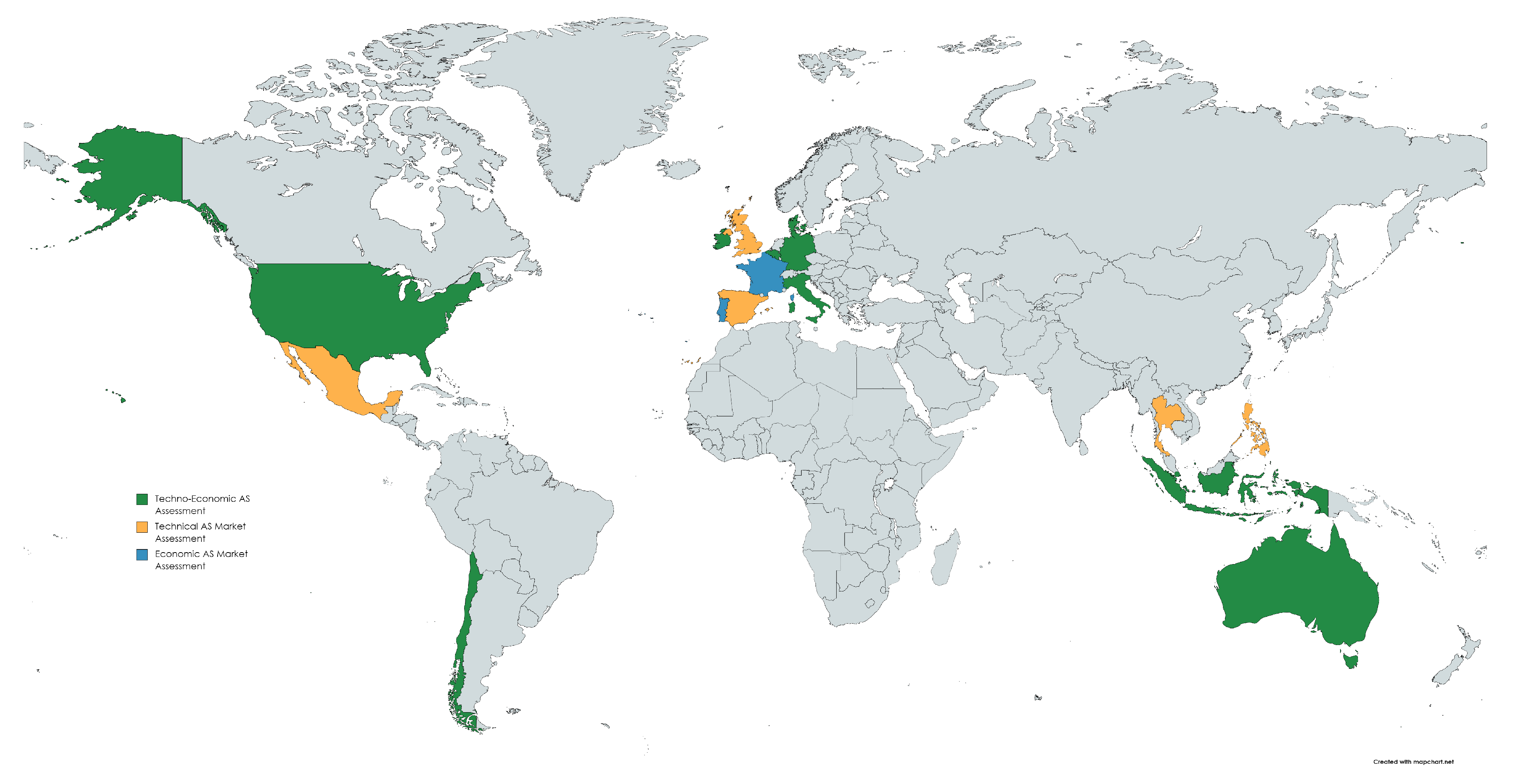
The geographic distribution of the reviewed studies, as indicated by Figure 4 generated using [94], underscores the global interest in optimising energy storage for AS provision. The countries are colour-coded to indicate the nature of the assessments performed in each study concerning various energy storage technologies for the provision of fast frequency response (FFR) ancillary service (AS):
- Green: Represents countries where the papers focused on both technical and economic evaluations of the technologies. These studies provide a comprehensive analysis of technological capabilities and economic viability, offering insights into the full spectrum of considerations for the deployment of these technologies in real-world scenarios.
- Orange: Indicates countries where the research mainly addressed the technical aspects of AS provision. These articles dive into the operational and performance characteristics of energy storage technologies, focusing on their effectiveness and efficiency in grid stabilisation without discussing economic factors.
- Blue: Denotes countries where the studies concentrated solely on the economic assessment of AS provision. These articles evaluate the cost implications, financial benefits, and market potential of using different energy storage technologies, providing valuable information for decision-making on investments and policy formulation.
This colour-coded mapping ensures that the reader can quickly determine the focus areas of research in different regions, enhancing the understanding of how various global perspectives and priorities shape the development and evaluation of energy storage technologies for grid support.
Figure 4.
Geographic Coverage of Energy Storage-Based AS Provision Literature
In exploring the capacity of various energy storage technologies to provide fast frequency response ancillary service, this review reveals a complex landscape where each technology’s strengths and weaknesses need to be carefully balanced against the operational demands and economic realities of modern power grids. Table 1 highlights these differences and serves as a critical tool for stakeholders to evaluate the feasibility and strategic deployment of these technologies.
Battery Energy Storage Systems (BESS)
BESS technology, particularly Lithium-ion and Sodium-Sulphur (NaS) batteries, offers considerable advantages in terms of placement flexibility and high discharge capabilities, making them well suited for FFR AS. However, their efficiency is marred by significant concerns about SoC and Depth of Discharge (DoD), which can lead to rapid degradation and potential economic penalties if not managed correctly. This requires advanced management systems that can significantly increase the total cost of ownership and operation.
Compressed and Liquid Air Energy Storage
Both CAES and LAES show promise due to their increased efficiency when coupled with renewable energy sources (RES) and gas turbines, and lower CAPEX, respectively. Their geographic dependence and complexity of integration can limit their deployment and economic viability. These systems must be designed with a keen awareness of location-specific factors and potential integration benefits to maximise their AS revenue.
Hydrogen-Based Systems
Hydrogen Proton Exchange Membrane (PEM) systems are highlighted for their fast ramp rates and ability to provide bidirectional AS, which is crucial for grids with fluctuating renewable inputs. Despite these benefits, the economic viability of PEM systems can be constrained when FFR is not the primary market goal, as the subsystems required to support hydrogen production can interfere with the flexibility needed for optimal AS provision.
Fuel Cells and Supercapacitors
Fuel cells complement hydrogen systems, but are often not fast enough for the provision of FFR AS without integration with other technologies such as PEM electrolyzers. Supercapacitors, which offer the fastest response among the technologies reviewed, face limitations in capacity that can hinder their revenue potential unless used in hybrid setups with other storage technologies.
Flywheels
Flywheels offer a robust solution with very fast FFR response capabilities and high power density, ideal for immediate grid stabilisation needs. However, their lower energy density and high self-discharge rates limit their standalone application, making them more suitable for integration with other RES or storage technologies.
Demand Management
Finally, demand-side management (DSM) offers potential revenue streams in markets with appropriate remuneration structures. Despite this, current market designs often do not support the aggregation of small, distributed loads into virtual loads necessary for DSM to be a viable FFR AS provider.
Based on the literature review findings, the various storage technologies have been classified based on their expected technical (AS response speed) and economic (AS revenue) performance potential, as shown in Figure 5. The authors of this article assigned technical and economic scores on a scale of [0:5] where higher scores mean faster response speed / greater revenue potential for the given energy storage technology.
Consequently, there is no technology that alone would be an ideal choice for FFR AS provision; however, modular coupling of the technologies, thereby complementing their pros and cons, carries the potential to meet the grid-specific technical requirements under diverse market conditions.
Conclusions
This review paper has systematically addressed the dynamic and evolving landscape of frequency control within power systems, particularly under the increasing influence of renewable energy sources. By critically evaluating the advancements and limitations of renewable-based control technologies and, more importantly, the role of diverse energy storage technologies in providing fast frequency response ancillary services, this research has unearthed significant insights and notable gaps in the existing body of knowledge. It has become evident that while battery energy storage system applications remain at the forefront of current research, there is a pronounced under-representation of grid-scale storage solutions and novel energy storage technologies that are potentially transformative for frequency control.
Moreover, the review highlights a crucial shortfall in the literature: a lack of detailed technical simulations and hybrid storage models that can effectively address frequency control challenges. There is also minimal exploration of the environmental benefits associated with these technologies, particularly the potential for carbon dioxide emission reductions, which is paramount in today’s context of mitigation of climate change.
In conclusion, this paper underscores the urgent need for more comprehensive research. Future studies should not only incorporate detailed techno-economic evaluations and assess the carbon dioxide reduction potential of scalable, modular energy storage technologies but also employ advanced network simulation models and thorough market analyses. By bridging these gaps, research can significantly advance our understanding and implementation of energy storage solutions, ultimately contributing to a more stable, sustainable, and economically viable power system.
Author Contributions
Conceptualization, G.V. and M.N.; methodology, G.V. and M.N.; writing—original draft preparation, G.V.; writing—review, M.N.; writing—editing, G.V.; visualization, G.V.; supervision, M.N. All authors have read and agreed to the published version of the manuscript.
Funding
This research received no external funding.
Informed Consent Statement
Not applicable.
Data Availability Statement
No new data were created.
Conflicts of Interest
The authors declare no conflicts of interest.
Abbreviations
The following abbreviations are used in this manuscript:
| AI | Aritificial Intelligence |
| AS | Ancillary Service |
| BESS | Battery Energy Storage System |
| CaR | Cost at Risk |
| CAES | Compressed Air Energy Storage |
| CAPEX | Capital Expenditure |
| CDS | Central Dispatch Syste |
| CfD | Contracts of Difference |
| DMS | Demand Side Management |
| DOD | Depth of Discharge |
| EGC | Emergency Generation Control |
| FC | Fuel Cell |
| FCR | Frequency Curtailment Reserve |
| FFR | Fast Frequency Response |
| GT | Gas Turbine |
| IRR | Internal Rate of Return |
| LAES | Liquid Air Energy Storage |
| MPPT | Maximum Power Point Tracking |
| NPP | Nuclear Power Plant |
| NPV | Net Present Value |
| OPEX | Operational Expenditure |
| PAB | Pay As Bid |
| PEM | Proton Exchange Membrane |
| PV | Photo Voltaic |
| RES | Renewable Energy System |
| RoCoF | Rate of Change of Frequency |
| SMP | System Marginal Price |
| SOC | State of Charge |
| UFLS | Under Frequency Load Shedding |
| WTG | Wind Turbine Generator |
References
- Kundur, P. Power system stability and control; McGraw-Hill, 1994.
- Pandey, S.K.; Mohanty, S.R.; Kishor, N. A literature survey on load–frequency control for conventional and distribution generation power systems. Renewable & sustainable energy reviews 2013, 25, 318–334. [Google Scholar] [CrossRef]
- Fernandez-Guillamon, A.; Gomez-Lazaro, E.; Muljadi, E.; Molina-Garcia, A. Power systems with high renewable energy sources: A review of inertia and frequency control strategies over time. Renewable & sustainable energy reviews 2019, 115, 109369. [Google Scholar] [CrossRef]
- Alam, M.S.; Al-Ismail, F.S.; Salem, A.; Abido, M.A. High-Level Penetration of Renewable Energy Sources Into Grid Utility: Challenges and Solutions. IEEE access 2020, 8, 190277–190299. [Google Scholar] [CrossRef]
- Dreidy, M.; Mokhlis, H.; Mekhilef, S. Inertia response and frequency control techniques for renewable energy sources: A review. Renewable & sustainable energy reviews 2017, 69, 144–155. [Google Scholar] [CrossRef]
- Alqahtani, S.; Shaher, A.; Garada, A.; Cipcigan, L. Impact of the High Penetration of Renewable Energy Sources on the Frequency Stability of the Saudi Grid. Electronics (Basel) 2023, 12, 1470, Place: Basel Publisher: MDPI AG. [Google Scholar] [CrossRef]
- Nguyen-Huu, T.A.; Van Nguyen, T.; Hur, K.; Shim, J.W. Coordinated control of a hybrid energy storage system for improving the capability of frequency regulation and state-of-charge management. Energies (Basel) 2020, 13, 6304. [Google Scholar] [CrossRef]
- Khalilisenobari, R.; Wu, M. Optimal participation of price-maker battery energy storage systems in energy and ancillary services markets considering degradation cost. International journal of electrical power & energy systems 2022, 138, 107924. [Google Scholar] [CrossRef]
- Alam, M.S.; Chowdhury, T.A.; Dhar, A.; Al-Ismail, F.S.; Choudhury, M.S.H.; Shafiullah, M.; Hossain, M.I.; Hossain, M.A.; Ullah, A.; Rahman, S.M. Solar and Wind Energy Integrated System Frequency Control: A Critical Review on Recent Developments. Energies (Basel) 2023, 16, 812. [Google Scholar] [CrossRef]
- Engels, J.; Claessens, B.; Deconinck, G. Techno-economic analysis and optimal control of battery storage for frequency control services, applied to the German market. Applied energy 2019, 242, 1036–1049. [Google Scholar] [CrossRef]
- Dozein, M.G.; De Corato, A.M.; Mancarella, P. Virtual Inertia Response and Frequency Control Ancillary Services From Hydrogen Electrolyzers. IEEE transactions on power systems2022, pp. 1–12. [CrossRef]
- Huang, J.; Jiang, Z.; Negnevitsky, M. Ancillary Service by Tiered Energy Storage Systems. Journal of energy engineering 2022, 148. Place: New York Publisher: American Society of Civil Engineers. [Google Scholar] [CrossRef]
- Alpizar Castillo, J.J.; Ramirez Elizondo, L.M.; Bauer, P. Assessing the Role of Energy Storage in Multiple Energy Carriers toward Providing Ancillary Services: A Review. Energies (Basel) 2023, 16, 379. [Google Scholar] [CrossRef]
- Apostolou, D. Optimisation of a hydrogen production – storage – re-powering system participating in electricity and transportation markets. A case study for Denmark. Applied energy 2020, 265, 114800. [Google Scholar] [CrossRef]
- Alam, M.S.; Alotaibi, M.A.; Alam, M.A.; Hossain, M.A.; Shafiullah, M.; Al-Ismail, F.S.; Rashid, M.M.U.; Abido, M.A. High-level renewable energy integrated system frequency control with smes-based optimized fractional order controller. Electronics (Basel) 2021, 10, 1–21. [Google Scholar] [CrossRef]
- Munisamy, V.; Sundarajan, R.S. Hybrid technique for load frequency control of renewable energy sources with unified power flow controller and energy storage integration. International journal of energy research 2021, 45, 17834–17857. [Google Scholar] [CrossRef]
- Boström, C.; Hjalmarsson, J.; Thomas, K. Service stacking using energy storage systems for grid applications – A review. Journal of Energy Storage 2023, 60. [Google Scholar] [CrossRef]
- Debanjan, M.; Karuna, K. An Overview of Renewable Energy Scenario in India and its Impact on Grid Inertia and Frequency Response. Renewable & sustainable energy reviews 2022, 168, 112842, Publisher: Elsevier Ltd. [Google Scholar]
- Preston, N.; Maroufmashat, A.; Riaz, H.; Barbouti, S.; Mukherjee, U.; Tang, P.; Wang, J.; Haghi, E.; Elkamel, A.; Fowler, M. How can the integration of renewable energy and power-to-gas benefit industrial facilities? From techno-economic, policy, and environmental assessment. International journal of hydrogen energy 2020, 45, 26559–26573. [Google Scholar] [CrossRef]
- Safiullah, S.; Rahman, A.; Lone, S.A.; Hussain, S.M.S.; Ustun, T.S. Robust frequency–voltage stabilization scheme for multi-area power systems incorporated with EVs and renewable generations using AI based modified disturbance rejection controller. Energy reports 2022, 8, 12186–12202. [Google Scholar] [CrossRef]
- Dong, J.; Attya, A.B.; Anaya-Lara, O. Provision of ancillary services by renewable hybrid generation in low frequency AC systems to the grid. International journal of electrical power & energy systems 2019, 105, 775–784. [Google Scholar] [CrossRef]
- Kazemi Golkhandan, R.; Torkaman, H.; Aghaebrahimi, M.R.; Keyhani, A. Load frequency control of smart isolated power grids with high wind farm penetrations. IET renewable power generation 2020, 14, 1228–1238, Publisher: TheInstitutionofEngineeringandTechnology. [Google Scholar] [CrossRef]
- González-Inostroza, P.; Rahmann, C.; Álvarez, R.; Haas, J.; Nowak, W.; Rehtanz, C. The role of fast frequency response of energy storage systems and renewables for ensuring frequency stability in future low-inertia power systems. Sustainability (Basel, Switzerland) 2021, 13, 5656. [Google Scholar] [CrossRef]
- Sarasua, J.I.; Martinez-Lucas, G.; Garcia-Pereira, H.; Navarro-Soriano, G.; Molina-Garcia, A.; Fernandez-Guillamon, A. Hybrid frequency control strategies based on hydro-power, wind, and energy storage systems: Application to 100% renewable scenarios. IET renewable power generation 2022, 16, 1107–1120. [Google Scholar] [CrossRef]
- Sun, M.; Sun, Y.; Chen, L.; Zou, Z.; Min, Y.; Liu, R.; Xu, F.; Wu, Y. Novel Temporary Frequency Support Control Strategy of Wind Turbine Generator Considering Coordination With Synchronous Generator. IEEE transactions on sustainable energy 2022, 13, 1011–1020. [Google Scholar] [CrossRef]
- Farhoodnea, M.; Mohamed, A.; Shareef, H.; Zayandehroodi, H. Power quality impacts of high-penetration electric vehicle stations and renewable energy-based generators on power distribution systems. Measurement : journal of the International Measurement Confederation 2013, 46, 2423–2434. [Google Scholar] [CrossRef]
- Jasim, A.M.; Jasim, B.H.; Neagu, B.C.; Alhasnawi, B.N. Coordination Control of a Hybrid AC/DC Smart Microgrid with Online Fault Detection, Diagnostics, and Localization Using Artificial Neural Networks. Electronics (Basel) 2023, 12, 187, Place:BaselPublisher:MDPIAG. [Google Scholar] [CrossRef]
- Kumar, R.R.; Yadav, A.K.; Ramesh, M. Hybrid PID plus LQR based frequency regulation approach for the renewable sources based standalone microgrid. International journal of information technology (Singapore. Online) 2022, 14, 2567–2574, Place:SingaporePublisher:SpringerNatureSingapore. [Google Scholar] [CrossRef]
- Zhao, D.; Sun, S.; Mohammadzadeh, A.; Mosavi, A. Adaptive Intelligent Model Predictive Control for Microgrid Load Frequency. Sustainability (Basel, Switzerland) 2022, 14, 11772, Place:BASELPublisher:Mdpi. [Google Scholar] [CrossRef]
- Zulu, M.L.T.; Carpanen, R.P.; Tiako, R. A Comprehensive Review: Study of Artificial Intelligence Optimization Technique Applications in a Hybrid Microgrid at Times of Fault Outbreaks. Energies (Basel) 2023, 16, 1786, Place:Basel Publisher:MDPI AG. [Google Scholar] [CrossRef]
- Makolo, P.; Zamora, R.; Lie, T.T. The role of inertia for grid flexibility under high penetration of variable renewables - A review of challenges and solutions. Renewable & sustainable energy reviews 2021, 147, 111223, Publisher: ElsevierLtd. [Google Scholar]
- Xiong, L.; Liu, X.; Liu, H.; Liu, Y. Performance Comparison of Typical Frequency Response Strategies for Power Systems With High Penetration of Renewable Energy Sources. IEEE journal on emerging and selected topics in circuits and systems 2022, 12, 41–47, Place:Piscataway Publisher: IEEE.. [Google Scholar] [CrossRef]
- Clark, K.; Miller, N.W.; Shao, M.; Pajic, S.; D’Aquila, R. Transient Stability and Frequency Response of the Us Western Interconnection Under Conditions of High Wind and Solar Generation. In Proceedings of the 2015 Seventh Annual IEEE Green Technologies Conference, United States, 2015; Vol.2015-,pp. 13-20. Backup Publisher: National Renewable Energy Lab.(NREL), Golden, CO (UnitedStates) ISSN:2166-546X Issue: none.
- Homan, S.; Brown, S. The future of frequency response in Great Britain. Energy reports 2021, 7, 56–62, Publisher: Elsevier Ltd. [Google Scholar] [CrossRef]
- Feilat, E.; Azzam, S.; Al-Salaymeh, A. Impact of large PV and wind power plants on voltage and frequency stability of Jordan’s national grid. Sustainable cities and society 2018, 36, 257–271, Publisher: Elsevier Ltd. [Google Scholar] [CrossRef]
- Sultan, H.M.; Zaki Diab, A.A.; Kuznetsov, O.N.; Ali, Z.M.; Abdalla, O. Evaluation of the impact of high penetration levels of PV power plants on the capacity, frequency and voltage stability of Egypt’s unified grid. Energies (Basel) 2019, 12, 552, Place: BASEL Publisher: Mdpi. [Google Scholar] [CrossRef]
- Yalman, Y.; Celik, O.; Tan, A.; Bayindir, K.C.; Cetinkaya, U.; Yesil, M.; Akdeniz, M.; Tinajero, G.D.A.; Chaudhary, S.K.; Guerrero, J.M.; et al. Impacts of Large-Scale Offshore Wind Power Plants Integration on Turkish Power System. IEEE access 2022, 10, 83265–83280, Place: Pisctaway Publisher: IEEE. [Google Scholar] [CrossRef]
- Karbouj, H.; Rather, Z.H.; Flynn, D.; Qazi, H.W. Non-synchronous fast frequency reserves in renewable energy integrated power systems: A critical review. International journal of electrical power & energy systems 2019, 106, 488–501, Place: OXFORD, Publisher: Elsevier Ltd. [Google Scholar]
- Ku, T.T.; Lin, C.H.; Hsu, C.T.; Chen, C.S.; Liao, Z.Y.; Wang, S.D.; Chen, F.F. Enhancement of Power System Operation by Renewable Ancillary Service. IEEE transactions on industry applications 2020, 56, 6150–6157, Publisher: IEEE. [Google Scholar] [CrossRef]
- Bai, J.; Ding, T.; Wang, Z.; Chen, J. Day-ahead robust economic dispatch considering renewable energy and concentrated solar power plants. Energies (Basel) 2019, 12, 3832. [Google Scholar] [CrossRef]
- Ai, X.; Wu, Z.; Hu, J.; Li, Y.; Hou, P. Robust operation strategy enabling a combined wind/battery power plant for providing energy and frequency ancillary services. International journal of electrical power & energy systems 2020, 118, 105736, Publisher: Elsevier Ltd. [Google Scholar]
- Aldaadi, M.; Al-Ismail, F.; Al-Awami, A.T.; Muqbel, A. A Coordinated Bidding Model for Wind Plant and Compressed Air Energy Storage Systems in the Energy and Ancillary Service Markets Using a Distributionally Robust Optimization Approach. IEEE access 2021, 9, 148599–148610. [Google Scholar] [CrossRef]
- Naemi, M.; Davis, D.; Brear, M.J. Optimisation and analysis of battery storage integrated into a wind power plant participating in a wholesale electricity market with energy and ancillary services. Journal of cleaner production 2022, 373, 133909, Publisher: Elsevier Ltd. [Google Scholar] [CrossRef]
- Agostini, C.A.; Armijo, F.A.; Silva, C.; Nasirov, S. The role of frequency regulation remuneration schemes in an energy matrix with high penetration of renewable energy. Renewable energy 2021, 171, 1097–1114, Place: OXFORD Publisher: Elsevier Ltd. [Google Scholar] [CrossRef]
- NGESO. Operation market design: Dispatch and Location. Technical report, NGESO, 2022.
- ENTSOE. Survey on Ancillary services procurement Balancing market design 2021. Technical report, ENTSO-E, 2022.
- Badesa, L.; Strbac, G.; Magill, M.; Stojkovska, B. Ancillary services in Great Britain during the COVID-19 lockdown: A glimpse of the carbon-free future. Applied energy 2021, 285, 116500–116500, Place: England Publisher: Elsevier Ltd. [Google Scholar] [CrossRef] [PubMed]
- Ghiani, E.; Galici, M.; Mureddu, M.; Pilo, F. Impact on electricity consumption and market pricing of energy and ancillary services during pandemic of COVID-19 in Italy. Energies (Basel) 2020, 13, 3357, Place Basel Publisher: MDPI AG. [Google Scholar] [CrossRef]
- Lisi, F.; Grossi, L.; Quaglia, F. Evaluation of Cost-at-Risk related to the procurement of resources in the ancillary services market. The case of the Italian electricity market. Energy economics 2023, 121, 106625, Place AMSTERDAM Publisher: Elsevier B.V.. [Google Scholar] [CrossRef]
- Liu, L.; Senjyu, T.; Kato, T.; Howlader, A.M.; Mandal, P.; Lotfy, M.E. Load frequency control for renewable energy sources for isolated power system by introducing large scale PV and storage battery. Energy reports 2020, 6, 1597–1603. [Google Scholar] [CrossRef]
- Pisani, C. Power System Dynamic and Stability Issues in Modern Power Systems Facing Energy Transition; Basel MDPI - Multidisciplinary Digital Publishing Institute: Basel, 2022. [Google Scholar]
- Kim, J.H.; Kahrl, F.; Mills, A.; Wiser, R.; Montañés, C.C.; Gorman, W. Variable Renewable Energy Participation in U.S. Ancillary Services Markets: Economic Evaluation and Key Issues. Utilities Policy2022.
- Kim, J.H.; Kahrl, F.; Mills, A.; Wiser, R.; Montañés, C.C.; Gorman, W. Economic evaluation of variable renewable energy participation in U.S. ancillary services markets. Utilities policy 2023, 82, 101578. [Google Scholar] [CrossRef]
- Amin, M.R.; Negnevitsky, M.; Franklin, E.; Alam, K.S.; Naderi, S.B. Application of battery energy storage systems for primary frequency control in power systems with high renewable energy penetration. Energies (Basel) 2021, 14, 1379. [Google Scholar] [CrossRef]
- Tan, J.; Zhang, Y. Coordinated Control Strategy of a Battery Energy Storage System to Support a Wind Power Plant Providing Multi-Timescale Frequency Ancillary Services. IEEE transactions on sustainable energy 2017, 8, 1140–1153, Backup Publisher: National Renewable Energy Lab.(NREL), Golden, CO (United States) Place: PISCATAWAY Publisher: IEEE. [Google Scholar] [CrossRef]
- Alcaide-Godinez, I.; Bai, F.; Saha, T.K.; Castellanos, R. Contingency reserve estimation of fast frequency response for battery energy storage system. International journal of electrical power & energy systems 2022, 143, 108428, Publisher: Elsevier Ltd. [Google Scholar]
- Alcaide-Godinez, I.; Bai, F.; Saha, T.K.; Memisevic, R. Contingency Reserve Evaluation for Fast Frequency Response of Multiple Battery Energy Storage Systems in a Large-scale Power Grid. CSEE Journal of Power and Energy Systems 2023, 9, 873–883. [Google Scholar]
- Del Rosario, E.J.S.; Orillaza, J.R.C. Dynamic Sizing of Frequency Control Ancillary Service Requirements for a Philippine Grid. IEEE Power & Energy2023.
- Dadkhah, A.; Bozalakov, D.; De Kooning, J.D.M.; Vandevelde, L. Techno-Economic Analysis and Optimal Operation of a Hydrogen Refueling Station Providing Frequency Ancillary Services. IEEE transactions on industry applications 2022, 58, 5171–5183, Place: New York Publisher: IEEE. [Google Scholar] [CrossRef]
- Bahloul, M.; Daoud, M.; Khadem, S.K. A bottom-up approach for techno-economic analysis of battery energy storage system for Irish grid DS3 service provision. Energy (Oxford) 2022, 245, 123229, Place: Oxford Publisher: Elsevier Ltd. [Google Scholar] [CrossRef]
- Rapizza, M.R.; Canevese, S.M. Fast frequency regulation and synthetic inertia in a power system with high penetration of renewable energy sources: Optimal design of the required quantities. Sustainable Energy, Grids and Networks 2020, 24, 100407, Publisher: Elsevier Ltd. [Google Scholar] [CrossRef]
- Rebours, Y.; Kirschen, D.; Trotignon, M.; Rossignol, S. A Survey of Frequency and Voltage Control Ancillary Services-Part II: Economic Features. IEEE transactions on power systems 2007, 22, 358–366, Place: PISCATAWAY Publisher: IEEE. [Google Scholar] [CrossRef]
- Fernandez-Munoz, D.; Perez-Diaz, J.I.; Guisández, I.; Chazarra, M.; Fernandez-Espina, A. Fast frequency control ancillary services: An international review. Renewable & sustainable energy reviews 2020, 120, 109662, Place: OXFORD Publisher: Elsevier Ltd. [Google Scholar]
- Schwidtal, J.M.; Zeffin, F.; Bignucolo, F.; Lorenzoni, A.; Agostini, M. Opening the ancillary service market: new market opportunities for energy storage systems in Italy. In Proceedings of the 2020 17th International Conference on the European Energy Market (EEM). IEEE, 2020, Vol. 2020-, pp.1-6. ISSN: 2165-4077.
- Chukhin, N.I.; Schastlivtsev, A.I.; Shmatov, D.P. Feasibility of hydrogen-air energy storage gas turbine system for the solar power plant in Yakutsk region. Journal of Physics: Conference Series 2020, 1652, 12039. [Google Scholar] [CrossRef]
- AMEO. Market ancillary service specification. Technical report, AMEO, 2022.
- Kheshti, M.; Zhao, X.; Liang, T.; Nie, B.; Ding, Y.; Greaves, D. Liquid air energy storage for ancillary services in an integrated hybrid renewable system. Renewable energy 2022, 199, 298–307, Publisher: Elsevier Ltd. [Google Scholar] [CrossRef]
- Alshehri, F.; Suárez, V.G.; Rueda Torres, J.L.; Perilla, A.; van der Meijden, M.A.M.M. Modelling and evaluation of PEM hydrogen technologies for frequency ancillary services in future multi-energy sustainable power systems. Heliyon 2019, 5, e01396. [Google Scholar] [CrossRef] [PubMed]
- Pyo, M.J.; Moon, S.W.; Kim, T.S. A comparative feasibility study of the use of hydrogen produced from surplus wind power for a gas turbine combined cycle power plant. Energies (Basel) 2021, 14, 8342. [Google Scholar] [CrossRef]
- Jovan, D.J.; Dolanc, G. Can green hydrogen production be economically viable under current market conditions. Energies (Basel) 2020, 13, 6599. [Google Scholar] [CrossRef]
- Dozein, M.G.; Jalali, A.; Mancarella, P. Fast Frequency Response From Utility-Scale Hydrogen Electrolyzers. IEEE transactions on sustainable energy 2021, 12, 1707–1717. [Google Scholar] [CrossRef]
- Tuinema, B.W.; Ebrahim Adabi, M.; Ayivor, P.K.S.; Garcia Suarez, V.; Liu, L.; Perilla Guerra, A.D.; Ahmad, Z.; Rueda, J.L.; van der Meijden, M.A.M.M.; Palensky, P. Modelling of large-sized electrolysers for realtime simulation and study of the possibility of frequency support by electrolysers. IET generation, transmission & distribution 2020, 14. [Google Scholar] [CrossRef]
- Samani, A.E.; D’Amicis, A.; De Kooning, J.D.M.; Bozalakov, D.; Silva, P.; Vandevelde, L. Grid balancing with a large-scale electrolyser providing primary reserve. IET renewable power generation 2020, 14, 3070–3078. [Google Scholar] [CrossRef]
- Wu, D.; Wang, D.; Ramachandran, T.; Holladay, J. A techno-economic assessment framework for hydrogen energy storage toward multiple energy delivery pathways and grid services. Energy (Oxford) 2022, 249, 123638, Backup Publisher: Pacific Northwest National Lab.(PNNL), Richland, WA (United States) Place: Oxford Publisher: Elsevier Ltd. [Google Scholar] [CrossRef]
- Dadkhah, A.; Bozalakov, D.; De Kooning, J.D.M.; Vandevelde, L. On the optimal planning of a hydrogen refuelling station participating in the electricity and balancing markets. International journal of hydrogen energy 2021, 46, 1488–1500. [Google Scholar] [CrossRef]
- Ribeiro, F.J.; Lopes, J.A.P.; Fernandes, F.S.; Soares, F.J.; Madureira, A.G. The role of hydrogen electrolysers in frequency related ancillary services: A case study in the Iberian Peninsula up to 2040. Sustainable Energy, Grids and Networks 2023, 35, 101084, Publisher: Elsevier Ltd. [Google Scholar] [CrossRef]
- Dong, W.; He, G.; Cui, Q.; Sun, W.; Hu, Z.; Ahli raad, E. Self-scheduling of a novel hybrid GTSOFC unit in day-ahead energy and spinning reserve markets within ancillary services using a novel energy storage. Energy (Oxford) 2022, 239, 122355. [Google Scholar] [CrossRef]
- Crespi, E.; Guandalini, G.; Nieto Cantero, G.; Campanari, S. Dynamic Modeling of a PEM Fuel Cell Power Plant for Flexibility Optimization and Grid Support. Energies (Basel) 2022, 15, 4801. [Google Scholar] [CrossRef]
- Ezeodili, E.; Kim, J.; Muljadi, E.; Nelms, R.M. Coordinated Power Balance Scheme for a Wind-to-Hydrogen Set in Standalone Power Systems. In Proceedings of the IEEE Xplore. IEEE, 2020, pp. 2148-2153. [CrossRef]
- Kwon, K.b.; Kim, D. Enhanced method for considering energy storage systems as ancillary service resources in stochastic unit commitment. Energy (Oxford) 2020, 213, 118675. [Google Scholar] [CrossRef]
- Glass, E.; Glass, V. Enabling supercapacitors to compete for ancillary services: An important step towards 100 % renewable energy. The Electricity journal 2020, 33, 106763, Publisher: Elsevier Inc. [Google Scholar] [CrossRef]
- PJM. Single Regulation Signal Modeling and Analysis. Technical report, PJM, 2023.
- Bahloul, M.; Khadem, S.K. Impact of Power Sharing Method on Battery Life Extension in HESS for Grid Ancillary Services. IEEE transactions on energy conversion 2019, 34, 1317–1327, Place: PISCATAWAY Publisher: IEEE. [Google Scholar] [CrossRef]
- Mohammadi-Ivatloo, B. Energy Storage in Energy Markets : Uncertainties, Modelling, Analysis and Optimization.; Elsevier, 2021. Publication Title: Energy Storage in Energy Markets.
- Lu, N.; Weimar, M.R.; Makarov, Y.V.; Rudolph, F.J.; Murthy, S.N.; Arseneaux, J.; Loutan, C. Evaluation of the flywheel potential for providing regulation service in California. In Proceedings of the IEEE PES General Meeting, United States; 2010; pp. 1–2, Backup Publisher: Pacific Northwest National Lab. (PNNL), Richland, WA (UnitedStates) ISSN:1932-5517. [Google Scholar]
- Khaterchi, M.; Belhadj, J.; Elleuch, M. Participation of direct drive Wind Turbine to the grid ancillary services using a Flywheel Energy Storage System. In Proceedings of the 2010 7th International Multi- Conference on Systems, Signals and Devices. IEEE; 2010; pp. 1–6. [Google Scholar]
- Achour, D.; Kesraoui, M.; Chaib, A.; Achour, A. Frequency control of a wind turbine generator–flywheel system. Wind engineering 2017, 41, 397–408, Place: London, England Publisher: Sage Publications, Ltd. [Google Scholar] [CrossRef]
- Ramakrishnan, J.; Hashemi, S.; Traholt, C. Assessment of Energy Storage Systems for Multiple Grid Service Provision. In Proceedings of the 2020 IEEE 14th International Conference on Compatibility, Power Electronics and Power Engineering (CPE-POWERENG). IEEE, 2020, Vol. 1, pp. 333–339. ISSN:2166-9546.
- Beltran, H.; Harrison, S.; Egea-Àlvarez, A.; Xu, L. Techno-economic assessment of energy storage technologies for inertia response and frequency support from wind farms. Energies (Basel) 2020, 13, 3421, Place: Basel Publisher: MDPI AG. [Google Scholar] [CrossRef]
- Diaz-Gonzalez, F.; Hau, M.; Sumper, A.; Gomis-Bellmunt, O. Coordinated operation of wind turbines and flywheel storage for primary frequency control support. International journal of electrical power & energy systems 2015, 68, 313–326, Place: OXFORD Publisher: Elsevier Ltd.. [Google Scholar]
- Chau, T.K.; Yu, S.S.; Fernando, T.; Iu, H.H.C. Demand-Side Regulation Provision From Industrial Loads Integrated With Solar PV Panels and Energy Storage System for Ancillary Services. IEEE transactions on industrial informatics 2018, 14, 5038–5049, Place: PISCATAWAY Publisher: IEEE. [Google Scholar] [CrossRef]
- Agbonaye, O.; Keatley, P.; Huang, Y.; Bani-Mustafa, M.; Ademulegun, O.O.; Hewitt, N. Value of demand flexibility for providing ancillary services: A case for social housing in the Irish DS3 market. Utilities policy 2020, 67, 101130, Place: OXFORD Publisher: Elsevier Ltd.. [Google Scholar] [CrossRef]
- Prakash, V.; Pandzic, H. Fast frequency control service provision from active neighborhoods: Opportunities and challenges. Electric power systems research 2023, 217, 109161, Publisher: Elsevier B.V.. [Google Scholar] [CrossRef]
- Map, W. World Map, 2023.
Figure 1.
Initial Frequency Control Techniques with Renewables (Solar PV and Wind).
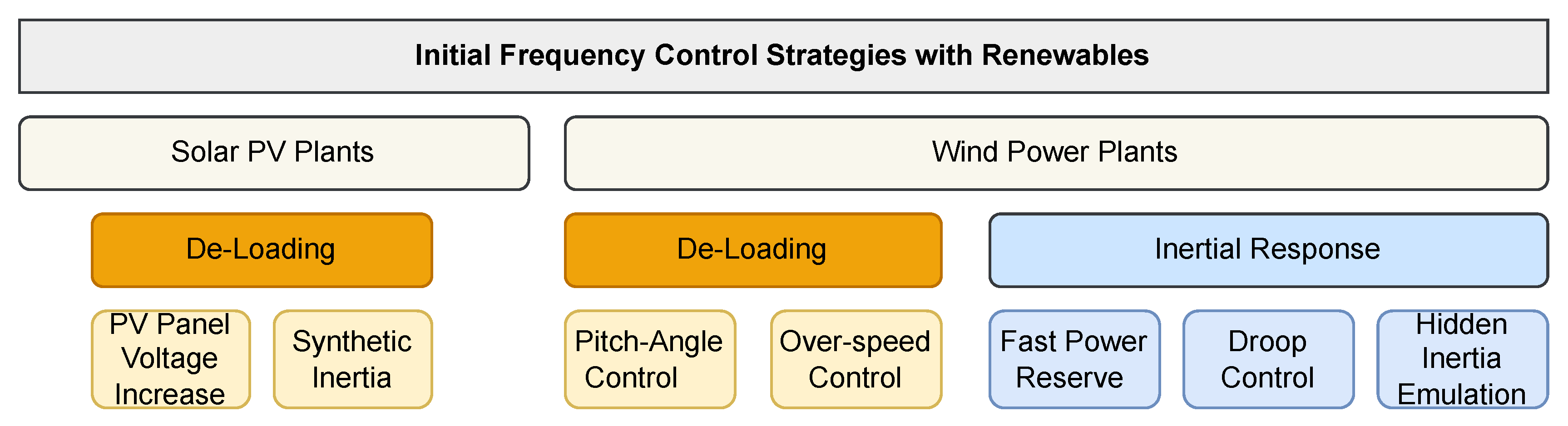
Figure 2.
Challenges with RES-only Based Frequency Control.
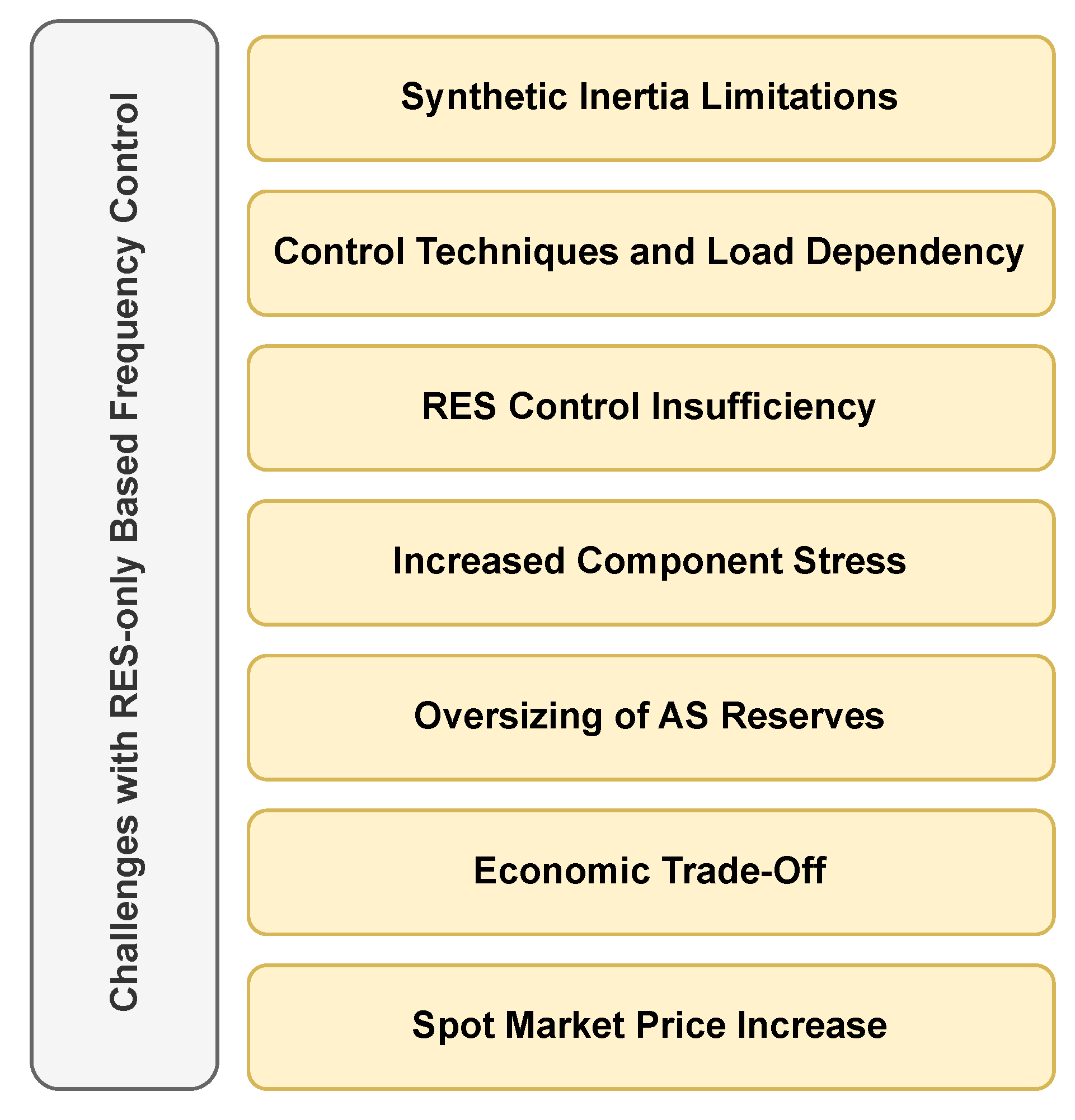
Figure 3.
Limitations of BESS-only AS Provision.
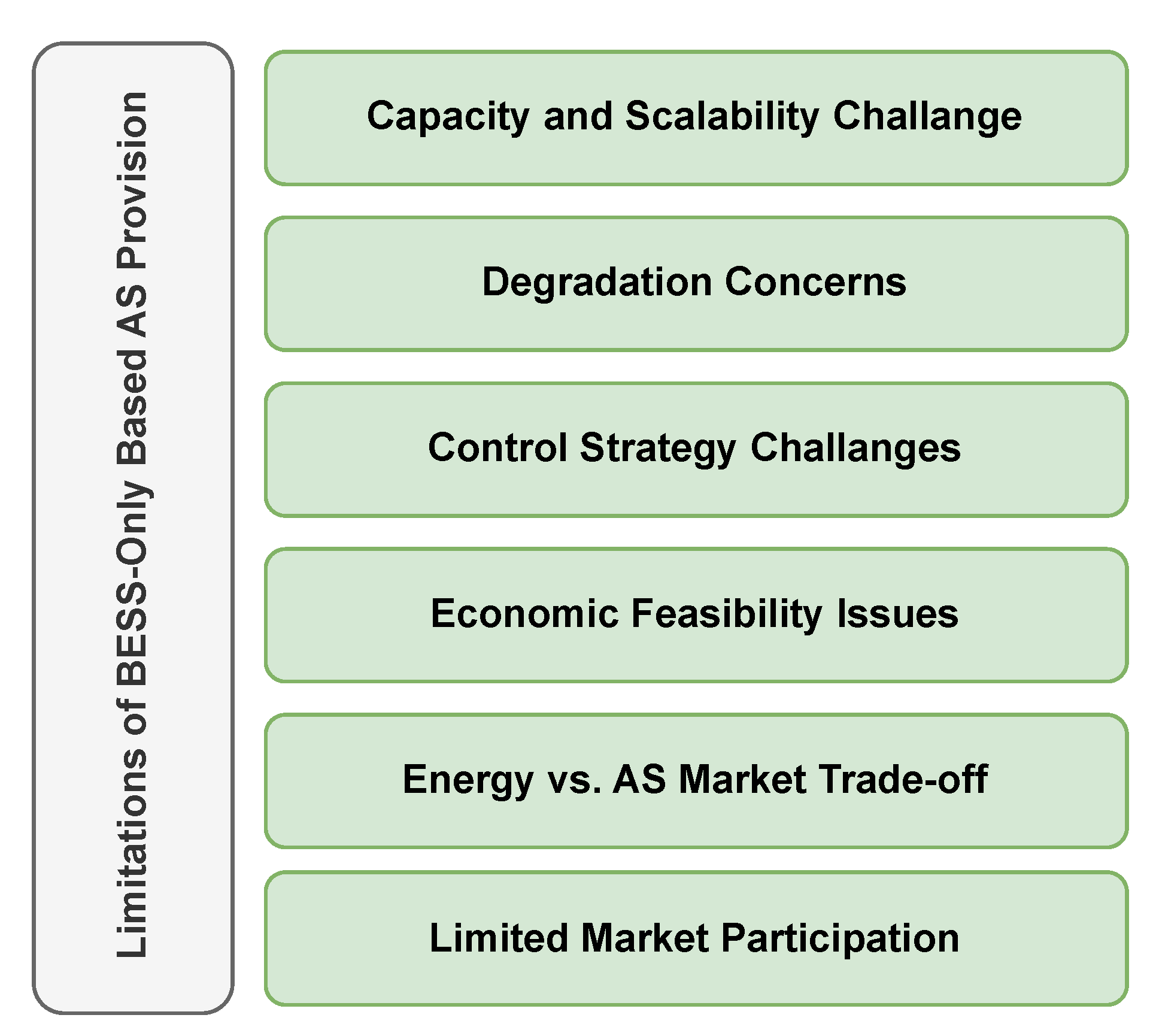
Figure 5.
Energy Storage Classification (AS Response Speed vs. Revenue Potential).
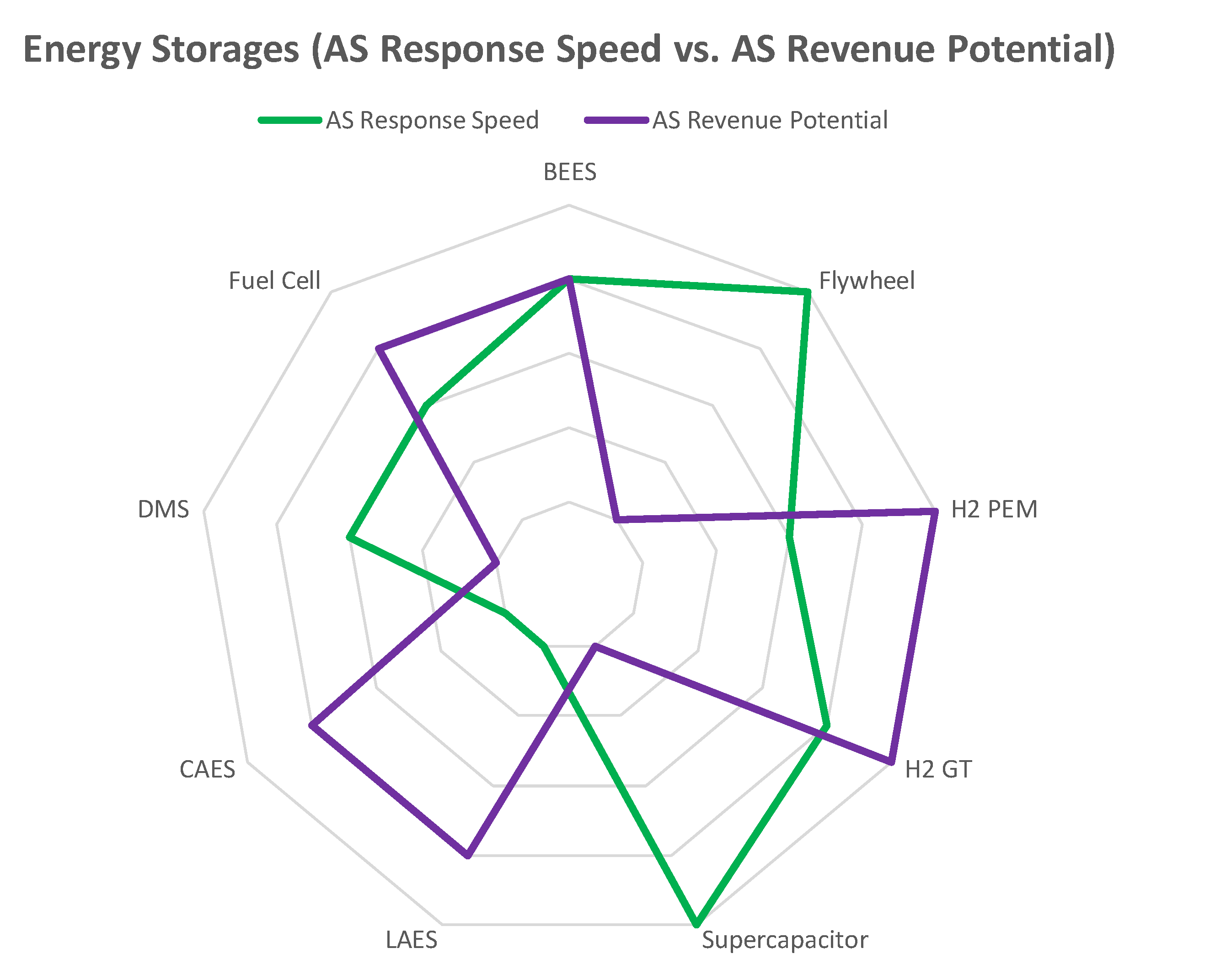

Table 1.
Summary of the Techno-Economic Advantages and Disadvantages of Various Storage FFR AS Relevant Storage Technologies
Table 1.
Summary of the Techno-Economic Advantages and Disadvantages of Various Storage FFR AS Relevant Storage Technologies
| Technology | Technology Advantage | References | Technology Disadvantage | References |
|---|---|---|---|---|
| BESS | Better performance if placed closed to RES | [23] | SoC, DoD is major technical issue | [8,10,43,54] |
| Zonal AS price can suggest location | [64] | SoC limit results in penalty payment | [46] | |
| High droop & high capacity best for AS | [54] | |||
| Charging Cycle can be optimised | [8,43,54] | |||
| NaS resposns is faster than Li-ion | [12] | NaS SoC must be in narrow band of 10% | [65] | |
| CAES | Increase GT efficiency and reduce cost | [12] | Location specific, need GT coupling | [65] |
| Increased AS revenue when RES coupled | [42] | Not fast for FFR | [66] | |
| LAES | Droop-mode increase AS performance | [67] | Location dependent | [67] |
| Lower CAPEX compared to CAES | [67] | |||
| H2 PEM | By-directional AS provison | [69] | economic if AS is not main goal | [70] |
| Fast ramp rates ideal for AS | [68,72] | H2 subsytem impact AS provsion | [11,71] | |
| PEM lifetime not impacted by AS | [73] | FFR provision only limits Revenue | [46,59,76] | |
| Highes revenue when FFR + secondary | [73,74] | PEM to be sized based on H2 demand | [75] | |
| FuelCells | Good primary response if combined with PEM | [79] | Not fast for FFR | [78] |
| High revenue potential with GT coupling | [77] | Not economic for AS alone | [14] | |
| Super Capacitor | Very fast response | [81] | Capacity limits AS revenue | [81] |
| No SoC issue (like BESS) | [83] | |||
| Flywheel | Very fast FFR response | [84,90] | Frequent re-charging | [84,89] |
| High power density | [85,88] | Need coupling with other RES / storage | [86,87,89] | |
| Demand Management | Potential revenue when with right AS remuneration | [93] | Need virtual loads (complex metering) | [91] |
| AS markets are not yet ready for DMS | [92] |
Disclaimer/Publisher’s Note: The statements, opinions and data contained in all publications are solely those of the individual author(s) and contributor(s) and not of MDPI and/or the editor(s). MDPI and/or the editor(s) disclaim responsibility for any injury to people or property resulting from any ideas, methods, instructions or products referred to in the content. |
© 2024 by the authors. Licensee MDPI, Basel, Switzerland. This article is an open access article distributed under the terms and conditions of the Creative Commons Attribution (CC BY) license (http://creativecommons.org/licenses/by/4.0/).
Copyright: This open access article is published under a Creative Commons CC BY 4.0 license, which permit the free download, distribution, and reuse, provided that the author and preprint are cited in any reuse.


