1. Introduction
The expansion of renewable energies and progress of the energy transition pose challenges for the electricity grid. The reduction in conventional power plants decreases the system’s inertia and therefore affects the stability of grid frequency. Alternative technologies must be used to ensure grid frequency stability and thus security of supply in a system with 100 % renewable energy in the future. This article therefore addresses the structure of the future power generation portfolio and proposes a new approach for frequency stabilisation. This study focuses on a time frame of a few minutes, considering only the provision of inertia and the frequency containment reserve (FCR), while not accounting for other types of control power provision currently in use.
This article presents findings of a literature review, which is supplemented with expert interviews. By incorporating qualitative interviews with experts from various industries, practical relevance of the study is established, and different perspectives are considered. The interviews were analysed using Mayring's qualitative content analysis method.
The following section 2 introduces the technical and regulatory aspects of today’s frequency stabilisation and the national power generation portfolio, exemplary for the case of Germany.
Section 3 provides an overview of the future development of the electricity system towards 100 % renewable energy, based on a scenario conceived by a renowned research institute. Further information on possible future developments is yielded with expert interviews, whose. key findings are summarised in
Section 4. In
Section 5, the problems that will result from the expected future development of the energy transition are discussed.
Section 6 presents a solution for these problems and in section 7 the conclusions are drawn.
2. Today’s Frequency Stabilisation in the German Electricity Grid
2.1. Technical Aspects
For the German electricity grid to function safely, the nominal frequency of 50 Hz must be maintained at all times. Imbalances between electricity generation and demand lead to fluctuations of the grid frequency. The resulting frequency deviations can only be controlled as long as the frequency remains within a range of 47.5 and 51.5 Hz. Particularly problematic are underfrequencies, which in the ultimate case, are tackled with load sheddings. [
1].
These fluctuations are countered by the inertia of the system. Rotating power plants, which are synchronously connected to the electricity grid, but also synchronously connected rotating loads, inherently provide inertia. Energy reserves are provided to compensate for power imbalances. By recreating the balance between electricity generation and consumption, the grid frequency is stabilised. In the first place, this happens inherently and instantaneously by inertia, which provides its kinetic energy to the grid whenever the grid frequency changes. Hence, inertia does not stop a drift in frequency, but it retards it, and by doing so, provides the time necessary for activating control reserves [
2].
Not inherently and only after a necessary activation time, control reserves provide the power that is necessary to reestablish a constant and satisfactory grid frequency. If the frequency deviation reaches specified limit, the FCR is automatically activated. Further reserves, such as the Frequency Restoration Reserve with automatic activation (aFRR) and the Frequency Restoration Reserve with manual activation (mFRR), can then be activated additionally [
3]. These regulatory measures are discussed in more detail in the next chapter.
The stability of grid frequency, and therefore the robustness of the electricity grid, can be evaluated through the measurement of frequency deviations and the determination of the frequency gradients. The Rate of Change of Frequency (
RoCoF) is the time derivative of the grid frequency and indicates how quickly frequency changes. The
RoCoF can be calculated as follows [
4]:
A small RoCoF can be a sign of an inert system. The smaller the RoCoF, the less sensitive the power grid is to imbalances. But a small RoCoF can also be a sign for a balanced power grid.
The frequency of an alternating current (AC) grid is not constant; rather, it varies continually.
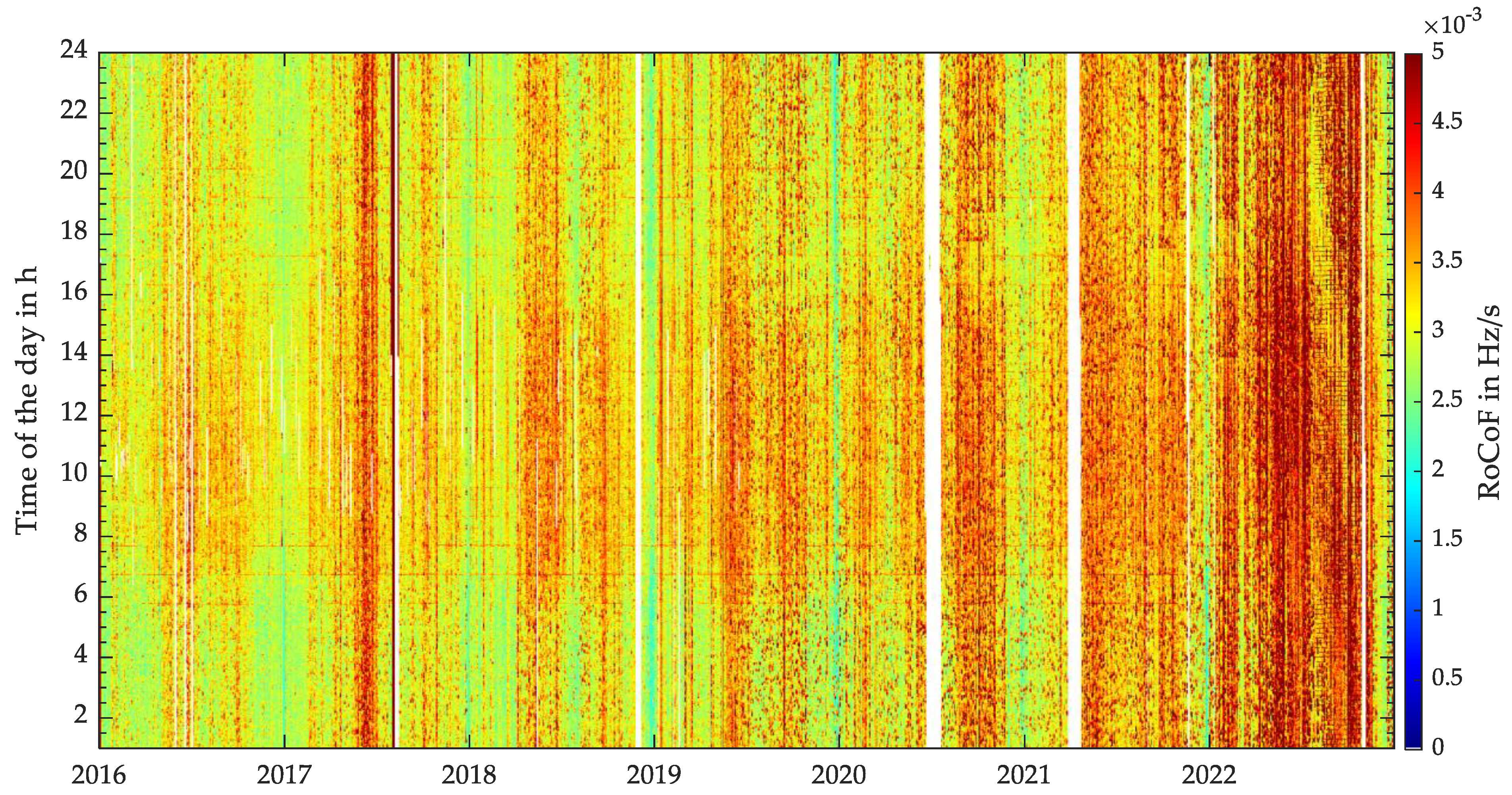
Figure 1 shows the one-minute average of the absolute
RoCoF in the continental European electricity grid for the years 2016 to 2022, based on the frequency measurement at the Wind Energy Technology Institute of Flensburg University of Applied Sciences [
5]. The magnitude of the
RoCoF is shown by the colouring according to the colour bar. It needs to be mentioned that the scale is limited to 5 mHz/s in order to cut off extreme values and make the variation of the
RoCoF visible in colour. The one-minute averaging is necessary to erase the electromagnetic illusions that result from transient distortions of the periodic voltage [
6] . Without these electromagnetic effects,
Figure 1 exhibits the electromechanical grid frequency variations that are relevant in the context of frequency stabilisation, which is the only effect that is within the scope of this paper. Missing measured values, i.e. data gaps, are shown in white. The
RoCoF demonstrates a consistent pattern of behaviour over time, exhibiting seasonal and diurnal variations (
Figure 1). Further discussion of the heatmap is made in chapter 4.
2.2. Regulatory Framework
Inertia provision is an inherent and immediate reaction to a power imbalance to limit frequency gradients (
RoCoF). Given that the power system was previously dominated by conventional power plants with synchronously connected rotating generators, there was no need for additional inertia provision. The consideration of system split scenarios in the German Network Development Plan 2037/45 from 2023 (NDP) [
7] leads to a higher inertia provision demand in the future. The reason for this is, that in the future there will no longer be enough conventional power plants in the grid covering this demand [
7]. According to section 12h (4) Energy Industry Act of Germany (
Energiewirtschaftsgesetz – EnWG) [
8], grid operators are obliged to procure inertia for local grid stability as part of a transparent, non-discriminatory and market-based procedure. The Federal Network Agency may grant an exemption from this obligation if the procurement is not economically efficient (Section 12h (4) EnWG). This is the case, for example, if there is no need for it, as was the case in the past. According to the analyses of the Federal Network Agency, there is no need for additional inertia until 2025. However, in the NDP a need for additional inertia provision was identified for the year 2037/45. A procurement concept will therefore be introduced which remunerates the provision of inertia. To this end, new inertia provision potential, in particular renewable energy plants, are to be tapped in future [
9].
According to the current state of the art, most renewable energy systems are not inherently able to provide inertia, as they are connected to the power grid with the aid of conventional current-controlled inverters.
The utilization and expansion of grid-forming frequency converters that emulate the behaviour of a synchronous generator (virtual synchronous machines – VSM) enable the provision of inertia through converter-based technologies [
10]. Their functionality has already been proven by their use in inverter dominated island grids. They have also been used successfully in uninterruptible power supply systems [
11].
An establishment of the concept of procurement will assign a monetary value to the inertia provision for the first time. The transmission system operators will set a standardised fixed price at which operators of technical systems will be remunerated for the provision of inertia [
9]. As the procurement concept is initially limited until 31 December 2031, and therefore ends well before the time horizon considered in this paper, further details of the design will not be discussed [
12].
The FCR restores the power balance by changing the active power feed-in and thus stabilises the grid frequency. It is automatically activated by measuring the grid frequency. Unnecessary frequent changes of positive and negative supply are ensured by a deadband of 49.99 - 50.01 Hz. As soon as the frequency leaves this deadband, the FCR is activated linearly to the deviation. With a frequency deviation of ± 200 mHz, the entire FCR is activated [
3].
The demand for FCR is put out to public tender. Prequalified plant operators can submit bids for the provision of FCR. All bids for FCR are awarded a contract, as they are only paid after activation. At the end of the auction, a merit order list is drawn up for the activation case, according to which the remuneration is determined. This procedure is called ‘pay as cleared’. The minimum bid size is 1 MW and must be provided symmetrically so that the offered capacity can be activated in both positive and negative directions. A time limit of 30 seconds is granted until the required power is reached. The FCR must be provided for 15 minutes [
13].
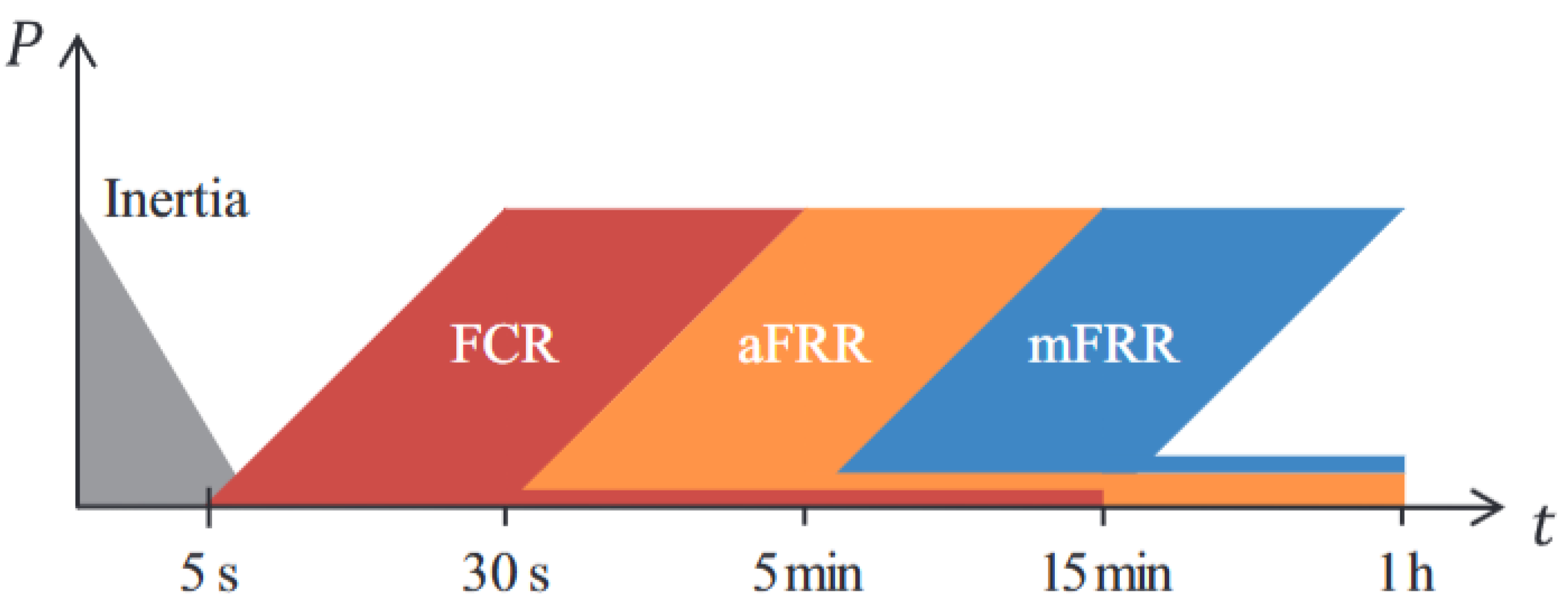
A droop controller is used locally to provide the FCR. This controller adjusts the power output linearly to the measured frequency and intends to stabilise it. However, due to this proportional controller, and due to the above mentioned deadband, the frequency does not return to its nominal value, but exhibits a steady state error. To eliminate this error in the frequency, the transmission system operators use other control power products, such as aFRR and mFRR [
2]. After five minutes, the aFRR is activated so that they run in parallel with FCR for ten minutes [
13]. The order of the used measures to control the frequency is illustrated in
Figure 2.
In the continental European electricity grid, the stipulated demand of FCR is based on the potential failure of the two biggest block-unit power stations. This scenario is assumed to be the maximum instantaneous power deviation that is to be expected. For this reason, the FCR demand was set by ENTSO-E at ± 3000 MW in the ENTSO-E Regional Group Continental Europe [
14].
The German electricity grid is part of the continental European electricity grid, which is why it contributes to covering the FCR demand.
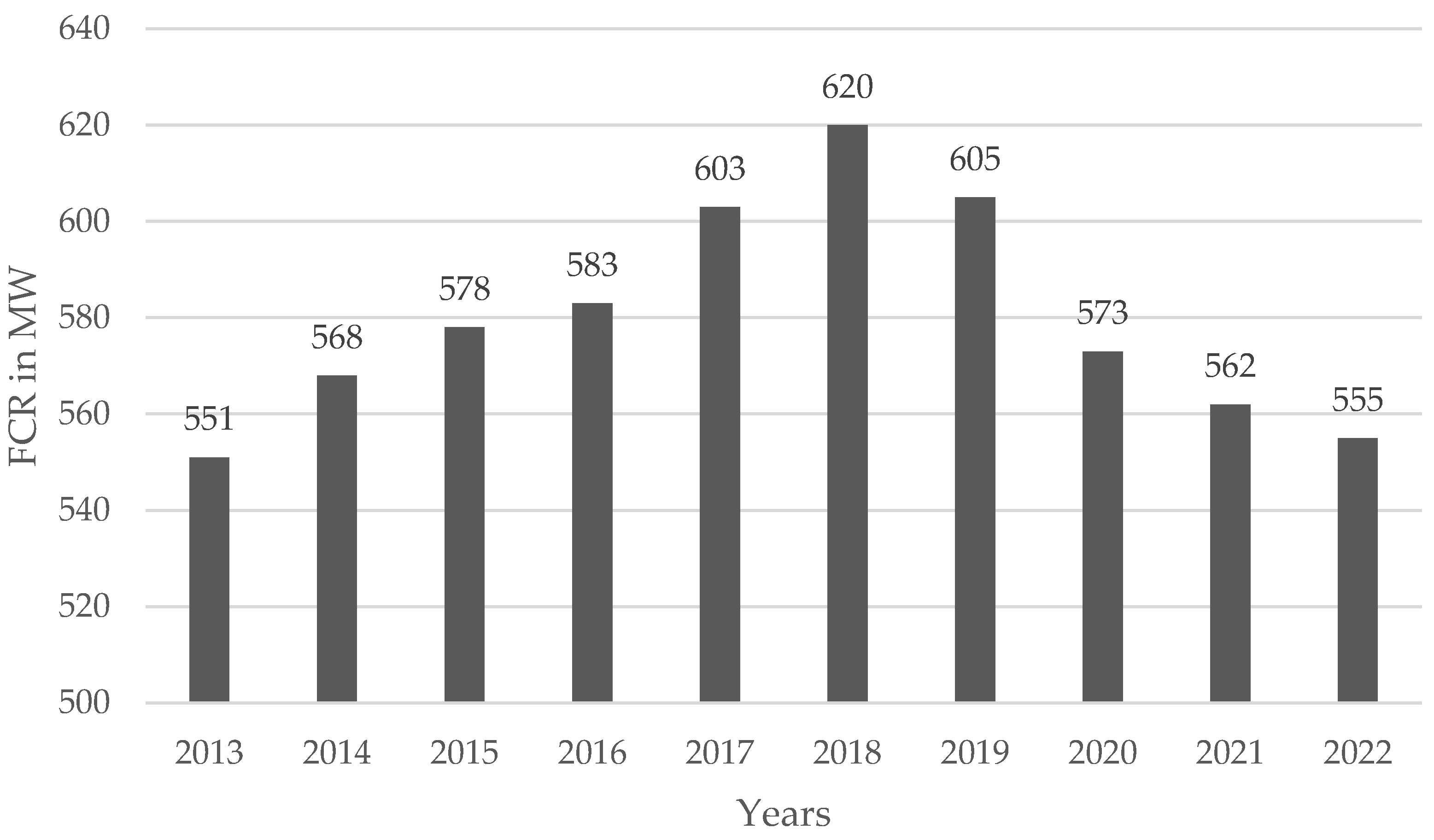
Figure 3 shows the development of the tendered FCR in MW in Germany in the past years.
In the period between 2013 and 2022, the average volume of FCR which was put out to tender ranged between 551 and 620 MW in the years. Demand peaked at 620 MW in 2018 and has been falling since then, reaching 555 MW in 2022.
2.3. National Power Generation Portfolio
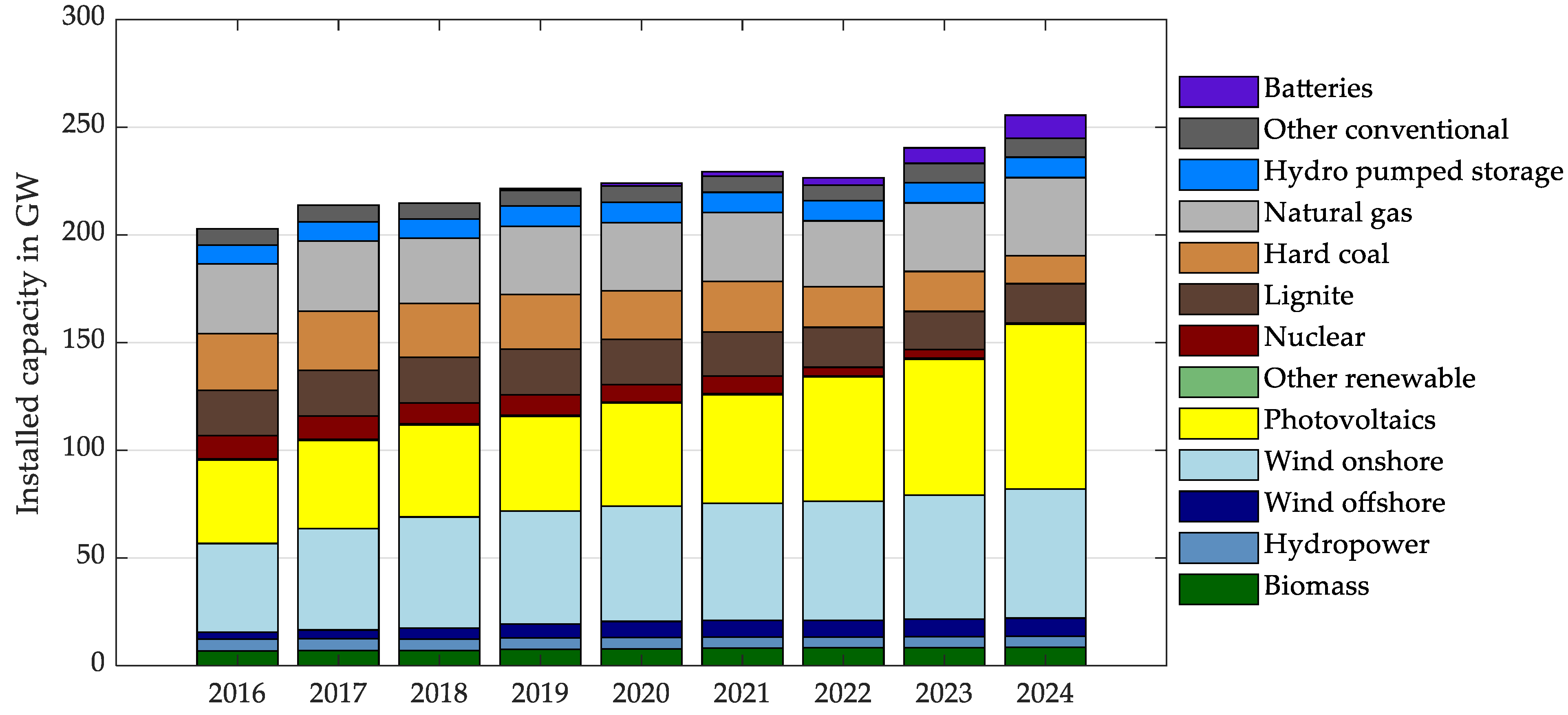
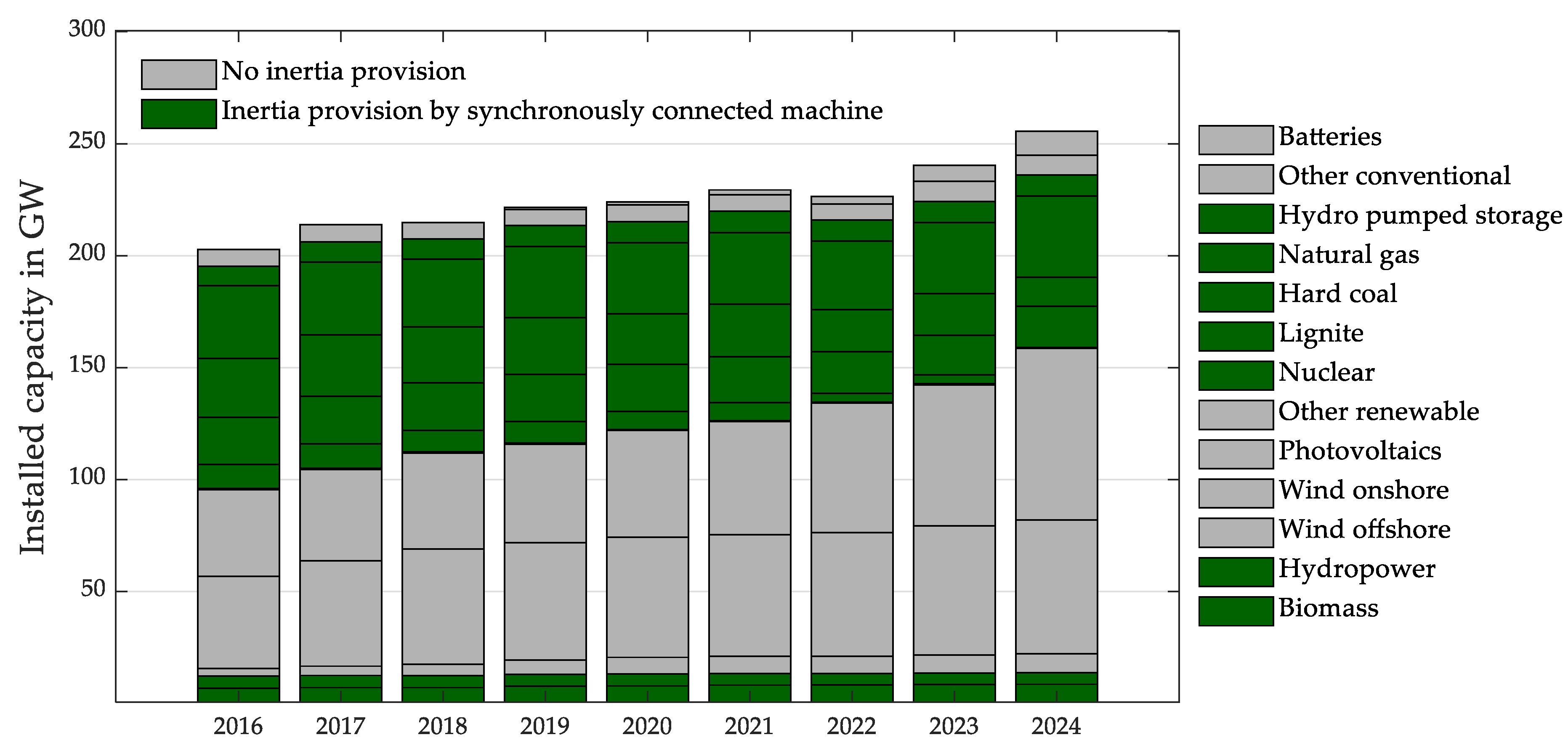
Figure 4 shows the previous development of the national power generation portfolio since 2016. Even though batteries are not generation units but storage units, they have been included to illustrate the proportions. As energy storage units, batteries can also provide positive and negative control power. Generation capacities have increased continuously over the years. The share of conventional power plants is steadily decreasing, while the share of renewable energies is growing. The installed capacity of power generation and batteries amounts to over 255 GW in year 2024. The largest shares of installed capacity in 2024 are accounted for by onshore wind with about 60 GW and photovoltaics with 76 GW installed. There is also strong growth in battery storage capacities. By the end of 2024, the installed battery capacity will reach 11 GW.
3. Future Development of the Electricity System Towards 100 % Renewables
The future German electricity system will be based on 100 % renewable energies. In order to achieve Germany's climate policy targets, the electricity sector will be based exclusively on renewable energies by 2045 [
18]. The utilisation of electricity and thus the consumer structure will change significantly. A study conducted by Fraunhofer Institute for Solar Energy Systems ISE outlines a future climate-neutral energy system in Germany by 2045 [
19]. According to this study,
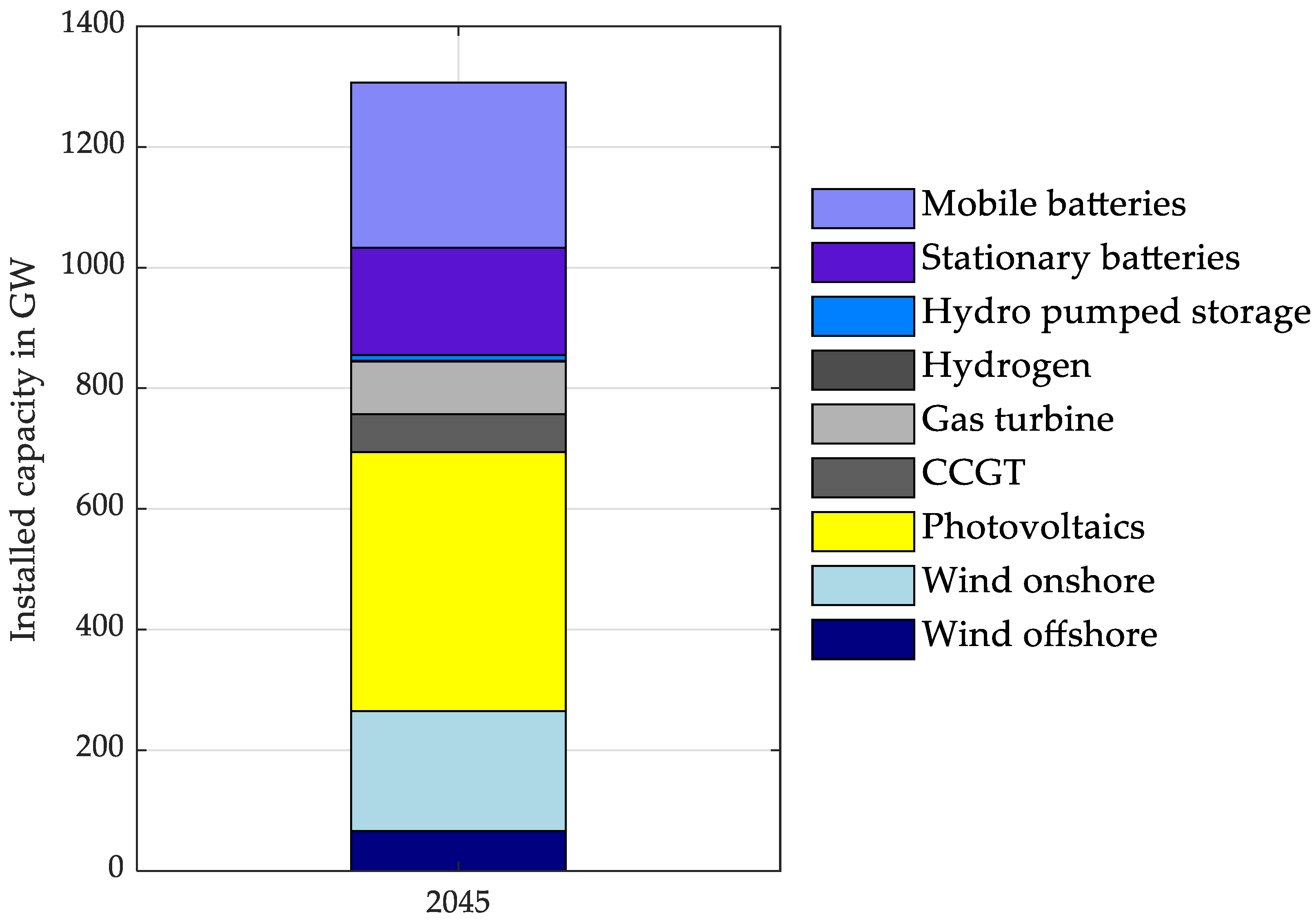
Figure 5 illustrates the potential generation and battery storage structure of the future system. The main energy sources are wind and photovoltaics. In 2045, over 429 GW of photovoltaics and around 200 GW of onshore wind will be installed. 66 GW will be installed in offshore wind power plants. In addition to fluctuating renewable energies, there will also be 152 GW of conventional power plants in the future, although these will not be based on fossil fuels. These power plants will ensure flexibility. The total generation capacity will amount to over 845 GW.
Batteries will experience significant growth. In addition to stationary batteries with 178 GW, the available stock of mobile batteries in particular will be growing to 274 GW. This is not the total capacity of mobile batteries, but the capacity assumed by Fraunhofer ISE (2021) to be available for ancillary services. I.e. this is the share of the mobile batteries that will be connected to the grid via charging devices. The mobile batteries will primarily be installed in electric vehicles. It is assumed that the installed capacity of hydro pumped storages will not change significantly and stays constant on today’s capacity of 9.45 GW [
16]. Hence, the generation portfolio is supplemented with considerable storage capacities. The total generation and storage capacity will be around 1,306 GW in 2045. Compared to
Figure 4, installed capacity will have more than quintupled. One reason for this is the cross-sector expansion of battery capacities.
In order to integrate renewable energies and reduce CO
2 emissions, other sectors, such as the transport and heating sectors, will be electrified, and therefore, will become part of the electricity sector. This will increase demand for electrical energy and create new potential in terms of storage (vehicle-to-grid) and demand side management. It is estimated that demand-side management in industry will create a potential for short-term load shifting of up to 6 GW by 2045 [
21].
4. Interview Results on Future Frequency Stabilisation
Qualified interviews were conducted with experts from various sectors in order to substantiate the scientific work. These sectors include transmission grid operators, consulting, energy suppliers, research institutes and industry. For example, Windcloud 4.0 GmbH, Amprion GmbH, TenneT TSO GmbH, Reiner-Lemoine-Institut gGmbH, and, Deutsche Energie-Agentur GmbH (dena) were interviewed. Twelve interviews were held about the future development of inertia provision and frequency containment reserve. The main results are summarised below.
4.1. Expert Opinion on Future Frequency Stabilisation
The demand for inertia provision will increase in future. One reason is the transformation of the electrical energy system to inverter-based, decentralised generators. The demand depends not only on the technological development of the energy system, but also on the chosen level of security of supply. It is a political decision which system split cases are considered relevant. The majority of the experts answered the question about demand for inertia with a reference to the grid development plan.
According to the experts, inertia demand will essentially be met by large batteries connected to grid-forming converters. Batteries offer the advantage of service stacking. As they can provide inertia as an ancillary task, which can optimize their economic efficiency. In addition to the battery systems, renewable energies will also become increasingly important for the inertia provision. As the power feed-in from wind power plants causes large power transports, the inertia provision of wind power plants is considered to be particularly helpful and relevant. Initially, it is expected that the market-based procurement of the inertia will mostly be provided by batteries, as they are already further technologically developed in this regard than other, e.g. wind power plants. Overall, grid-forming frequency converters will play a major role in the provision of inertia. In order to enable them to provide inertia system-wide in future, there is still a considerable need for development. In addition, a suitable regulatory framework must be created. One example given is that providers should not be allowed to deactivate or reduce the inertial reserve provision independently via the control of the grid forming inverter. Otherwise, a lack of available inertia could occur. It is expected that a future electricity grid will never be based exclusively on frequency converters. Hydropower plants in Europe, among others, are seen by the experts as a basic supply of synchronous generators.
The self-regulating effect of rotating loads directly connected to the grid (e.g. pumps and fans) is deemed to also make a significant contribution to frequency stability. Their frequency-dependent power consumption inherently exhibits grid-friendly operating behaviour. Their potential contributions are difficult to estimate.
Now that a need for additional inertia has been identified for the first time in the NDP, this is to be procured in future via a market-based procurement concept. This way of procurement offers a financial incentive that promotes the development and expansion of technologies for providing inertia. A few of the interviewees expect that, in the long term, the inertia provision will become mandatory via the technical connection rules (TCR). In this way, costs for grid operation can be reduced in the future. Until then, market-based procurement will function as an incentive system.
4.2. Expert Opinion on the Future Frequency Containment Reserve
The German market for FCR represents a proven concept in the field of procurement, which has been developed over an extensive period of time. Three interviewees expect demand to increase slightly. Two experts argue that demand will not change significantly due to the 3 GW reference incident defined by the EU. There are no ambitions at European level to change this definition.
The demand for Frequency Containment Reserve will essentially be covered by largescale battery storage systems. Batteries already dominate 80 % of the FCR market today. Electric vehicles also offer very high capacities in total. One expert is therefore in favour of creating an incentive for their provision.
Since the market for procurement is a proven concept, it is therefore considered unlikely that this system will be abandoned in favour of a new system combined with inertia. No significant changes are expected in the future with regard to the procurement of FCR.
Nevertheless, there are discussions about improving the conditions for participation in the balancing power market. In the past, the system was characterised by largescale plants. In order to be authorised to provide FCR, the power plants must offer a capacity of at least 1 MW. By lowering the existing 1 MW limit, more small power plants can be integrated and thus a large potential can be utilised. This prequalification condition is currently the subject of public debate. Whether this limit will be lowered is considered differently by the experts. Two experts assume a small reduction. By aggregating small systems, the 1 MW limit can be kept, their potential still utilised and their costs reduced. Two experts are therefore favouring this approach.
4.3. Conclusion of the Interviews
The following conclusions can be drawn from the interviews. The experts emphasise the importance of grid-forming frequency converters in the future energy system. These could realise enormous potential for covering the demand for inertia and FCR. Monetary incentives must therefore be put in place to tap this potential in the future. In the long term, the experts see the future provision of inertia and FCR through a mandatory contribution of any technology that is capable of doing so via the (TCR).
The results of the interviews are mainly in line with the state of the art. This is due to the fact that the experts build up their knowledge through their professional activities, which not only involve their own literature work, but also their day-to-day business. Therefore, some results of these interviews might contradict the forward-looking approach proposed in this article. However, they provide the authors with important insights that serve as benchmark for their proposal. Consequently, the interviews substantiate this article.
5. Problem Analysis
As a result of the energy transition, significantly fewer synchronously connected conventional power plants will feed into the electricity grid in future. Nowadays, the system inertia is primarily being provided by synchronous generators. The switch to converter-based power plants will therefore reduce system inertia as long as they are connected by conventional current-controlled inverters [
11]. This development can already be recognised today. As shown in
Figure 6, the provision of inertia by synchronously connected machines decreases between 2016 and 2024. The reduction in the provided inertia is reflected in the frequency and therefore in the
RoCoF.
Figure 1 already shows a significant increase in the
RoCoF over the years. On one hand, the occurrence of higher
RoCoF is increasing, which can be recognised by the increase in red values over the years (
Figure 1). On the other hand, high frequency gradients are increasingly occurring at all times of day. When there was significant photovoltaic power infeed in the past, conventional power plants ran at night and with a lower output during the day; hence, they provided inertia all day. Nowadays, conventional power plants are being replaced by renewable energies during the day and increasingly also at night. As a result, low inertia is available during the day and provision of inertia is also increasingly reduced at night. This results in higher
RoCoF throughout the day. Another reason for the high
RoCoF during the day is a higher electricity demand which can lead to increased imbalances. Overall, the
RoCoF increases over the years. At the same time, controllable generation plants will be reduced in future. This is because generation capacity of renewable energies is dependent on the supply of wind and solar resources. Renewable energies can therefore only be controlled in negative direction (i.e. reducing their power output). Due to the expansion of renewable energies, there could be a shortage of positive control power and inertia, which could endanger security of supply in the future.
A further issue is the predictability of renewable energy generation. Weather-related fluctuations in generation lead to power imbalances in the electricity grid. Even though forecasts are becoming increasingly accurate and reliable, generation is still based on forecasts, which can be flawed. This fact exacerbates the problem of reduced positive controllable capacity.
It can be summarised that the future functionality of frequency stabilisation is at risk due to reduction in available synchronously provided inertia and in positively controllable power plants. It is therefore being examined whether sufficient capacities will be available in a future 100 % renewable energy system and how future frequency stabilisation can be designed in Germany.
6. Problem Solution
6.1. Solution to Cover Future Needs of Inertia
In order to cover future needs of inertia in a system that is based on frequency converters, alternatives to inherent inertia provision must be utilised. Grid-forming frequency converters can be used in combination with an energy storage system to provide synthetic inertia [
10]. Assuming that this technology is fully developed, new potential could be utilised in the future renewable electricity system and the need for inertia could be covered. The following section therefore shows whether sufficient inertia provision is available in the future.
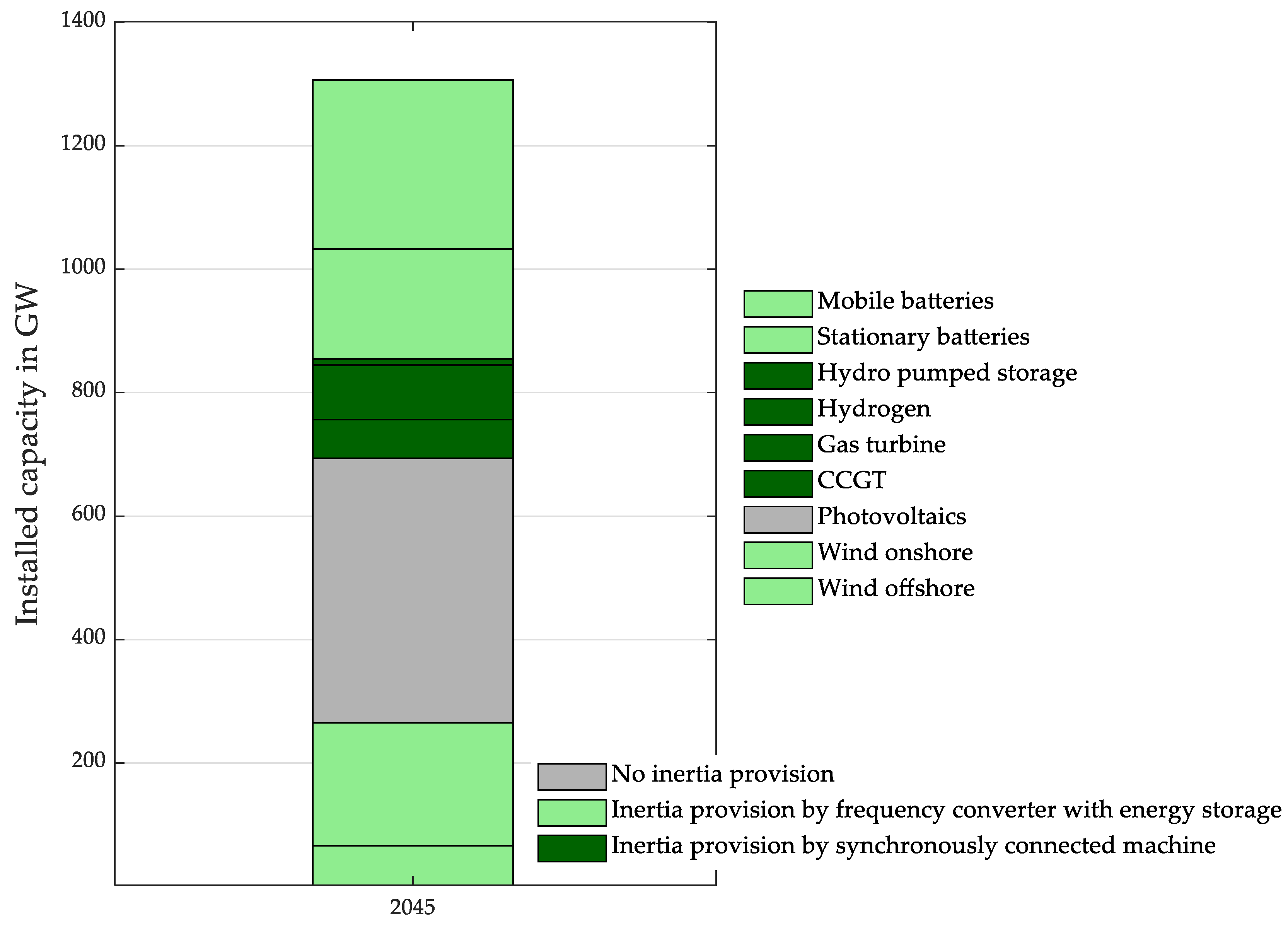
The installed generation and storage capacities will grow significantly to a total of 1,306 GW in the future, as
Figure 7 shows. In order to identify potential inertia provision, the capacities were differentiated in
Figure 7 according to their technological abilities for inertia provision. A complete expansion of grid-forming frequency converters in all converter-based technologies in 2045 is assumed. This results in the following potential resources for the provision of inertia. Wind power plants and batteries can provide their stored energy via grid-forming frequency converters, while photovoltaic power plants are not assumed to be connected to any form of energy storage. In wind turbines, the stored energy is the kinetic rotational energy in the drive train, including the rotor. The installed capacity of wind power and batteries sums up to 717 GW, as shown in the light green areas in
Figure 7. Hydro pumped storage, hydrogen, gas turbines and CCGT provide inertia inherently by being synchronously connected to the electricity grid. They offer an installed capacity of 161 GW (dark green fields in
Figure 7). Although mobile batteries create significant vehicle-to-grid potential, they are not initially considered in the analysis of inertia provision, as it cannot be determined how many of the electric vehicles are connected to the grid at a particular point in time. Therefore, the potential for inertia provision is quantified in the following, without the consideration of mobile batteries.
The inertial behaviour of an AC power system can be quantified with the total kinetic energy,
Ekin, and the apparent power,
S; with the starting time,
T, or with the inertia constant,
H. These quantities are related to each other via the following equation.
Applying values from literature leads to the inertia constants for the respective technologies as shown in
Table 1.
As no inertia constant for CCGT is specified in the NDP, the inertia constant published by Seneviratne and Ozansoy (2016) is used [
22]. The stored kinetic energy of the whole power system can be calculated using the inertia constants and the rated powers of all connected generators [
4].
N is the number of technology categories. Considering the fact that the primary energy wind is not always available, the rated power is reduced in relation to the number of full load hours. The total installed capacity of wind power in 2045 will be around 266 GW (onshore and offshore) [
20]. Average full load hours of 3,081 h were assumed for wind power plants so that the rated wind power is reduced to 93 GW [
19]. For all other technologies the rated installed power is used.
The potential kinetic energy amounts to around 3,250 GWs (
Table 2). However, considering that all power plants are connected to the grid. The individual inertia constants and powers can be used to calculate the system inertia
Hsys [
4].
Consequently, system-wide inertia constant would be 7.53 s if the total installed capacity of all generation technologies, as outlined in Fraunhofer’s 2045 scenario [
20], were connected to the system simultaneously. Realistically, the system inertia constant is dependent on the specific power plants that are simultaneously connected to the grid and therefore changes continuously. Therefore, it is unfeasible to determine a definitive inertia constant. The inertia constant of 7.53 s, therefore represents a potential value as an orientation. Today's electricity grids have inertia constants in a range of 3 to 4 s, data given for the year 2016 [
23].
If no wind power plants are available, the system inertia increases to 7.54 s and the total kinetic energy equates to 2,566.5 GWs, which is approximately double the current value (see above).
The NDP identifies a need of inertia provision of 1,500 GWs (
Ekin, needed) for Germany in 2037/2045 [
7]. All relevant system split scenarios were taken into account when this need was derived. The
Coverage Ratio is calculated in order to check whether sufficient capacity is available to cover future inertia needs:
If all capacities are available as specified in
Table 2, this results in a
Coverage Ratio of 217 %, based on the demand of 1,500 GWs.
Furthermore, if wind power is not taken into account, and all other capacities are as specified in
Table 2, the resulting
Coverage Ratio is 171 %. Hence, even in this case, stationary battery storages and the other power plants are able to cover the needs of inertia.
Moreover, mobile batteries offer a further significant potential. Not all electric vehicles will be connected to the grid and be available for providing inertia at the same time. But if only a fraction of the vehicles is available as part of vehicle-to-grid contribution, this offers a significant inertia resource due to the very high installed capacity. Grid-forming frequency converters enable any value of inertia constants as long as they are combined with a sufficient energy storage. Therefore, in combination with batteries, grid-forming frequency converters can enable even greater inertia constants than 12.5 s, which are specified for batteries in the NDP (
Table 2). In addition, the given inertia constant for wind power plants of 7.5 s is a conservative assumption and lower than what can be realised. Previous research conducted in collaboration with the wind turbine manufacturer Suzlon Energy revealed that wind power plants can easily provide an inertia constant of 12 s [
24,
25]. But even the conservative assumptions still offer a significant potential for further inertia provision.
6.2. Solution to Provide Frequency Containment Reserve in Future
A further challenge is the reduction in number of controllable power plants in a 100 % renewable energy system. FCR is required in both, positive and negative direction. The possible future power generation portfolio shown in
Figure 5 can be differentiated according to its two abilities: first provide positive and negative FCR and second to only provide negative FCR.
The provision of negative FCR is not a problem, as all technologies of the future power generation portfolio can be curtailed. The task is to check if there is sufficient capacity to cover the demand for positive FCR and how much every capable technology can contribute to it. Mobile batteries are not considered because, as already mentioned above, their availability is unknown. The installed capacities which are available for inertia provision, shown in
Table 2, could also provide negative FCR. Additionally, photovoltaics can be curtailed as well. The rated power of photovoltaics is also reduced in relation to its number of full load hours. Full load hours of 1,147 h are assumed so that the reduced rated power is 56 GW [
19]. Therefore, the available capacity sums up to 487 GW.
Batteries, hydro pumped storages, gas turbines, and CCGT can also provide positive FCR. The total installed capacity of these technologies will be 338 GW in 2045 [
20].
Figure 3 shows the tendered FCR volumes in Germany from 2013 to 2022. On average, the annual average volume of FCR put out to tender was 580 MW. This capacity must be provided both positively and negatively. If this volume is distributed among all participants that can provide FCR, the respective share to be provided is calculated as shown in equation 1.
Should all participants who are technologically capable of doing so provide their contribution to FCR, the tendered volume for FCR can be covered and each participant would only have to provide 0.11 % to 0.16 % of its rated power (equation 1) depending on the direction.
Due to this very low specific power required, only a minor amount of energy is required over 15 minutes. Therefore, no significant capacities are used of battery storages.
Overall, there will be sufficient capacity to cover FCR demand, even if it would grow in future. Moreover, the interviewed experts emphasised the economic provision of batteries in particular. By providing FCR as an ancillary activity as part of service stacking, batteries can offer it economically efficient.
In addition to grid-forming frequency converters, also synchronously connected rotating machines, which have kinetic energy storages connected to their shafts, should be part of the future joint grid frequency stabilisation. This expectation is shared by the experts interviewed. The hydraulic variable inertia flywheel (HYDRAD), developed at Flensburg University of Applied Sciences, is such a technology that can be used for providing inertia and FCR. As a kinetic energy storage, HYDRAD is ideally synchronously connected to the grid via a synchronous machine. Although, a simpler and cheaper induction machine would also work [
26].
All rotating electric machines are magnetic energy storages, hence, HYDRAD has an inherent grid-forming effect. In contrast to passive rotating masses, it has a variable moment of inertia, which allows it to offer much greater inertia constants assuming the same initial moment of inertia. Furthermore, it is capable of providing FCR, as it is able to exchange energy with the grid at a quasi-constant rotational speed. HYDRAD is particularly suitable for smaller applications in the low to medium Kilowatt range. By distributing the necessary grid frequency stabilisation over a large number of participants, smaller participants such as HYDRAD can contribute to it and, by doing so, increase redundancy in the system stabilisation [
26].
7. Conclusion
This article examines the future frequency stabilization in a 100 % renewable energy system. Due to the energy transition, the future electric power system will face further challenges that affect the functionality of the electricity grid and therefore the security of supply. Since frequency stabilization is not a problem of capacities, but of the regulatory framework, the following recommendation is made. By regulating via the technical connection rules, everyone, who is technically able to provide inertia or FCR, should make a mandatory contribution to frequency stabilisation. Such an obligation is also proposed by some of the interviewed experts. As a result, the demand is distributed among many participants, so that the individual contribution is very small. To cover the FCR demand the individual contribution ranges between 0.11 % (negative FCR) and 0.16 % (positive FCR). The inertia demand can be covered by the available capacities at a Coverage Ratio of 171 % (excluding wind power) to 217 % (all capacities).
The current system of inertia provision and FCR will no longer be up to date, as the transition to renewable energies progresses as it did in the past and as it is politically targeted. Overall, the mandatory provision of all capable participants simplifies the system, distributes the burden of frequency stabilisation across many participants, and hence, increases redundancy. Since this proposed system does not need tenders, bids and billing, it is not only technologically simpler, but also less bureaucratic as the current system.
Author Contributions
Conceptualization, L.R. and C.J.; methodology, L.R. and C.J.; validation, L.R., A.R. and C.J.; formal analysis, L.R.; investigation, L.R.; resources, L.R., A.R. and C.J.; writing—original draft preparation, L.R. and C.J.; writing—review and editing, L.R., A.R., C.J., R.D. and T.K.; visualization, L.R. and A.R.; supervision, C.J.; project administration, C.J.; funding acquisition, C.J. All authors have read and agreed to the published version of the manuscript.
Funding
This research was funded by Federal Ministry of Education and Research, grant number 03TR06W02A.
(Das diesem Artikel zugrunde liegende Vorhaben wurde mit Mitteln des Bundesministeriums für Bildung und Forschung unter dem Förderkennzeichen 03TR06W02A gefördert. Die Verantwortung für den Inhalt dieser Veröffentlichung liegt bei den Autoren.) 
Data Availability Statement
The data presented in this study is available in the cited references.
Acknowledgments
The authors would like to take this opportunity to thank all the interviewees for their valuable time, exciting insights and interesting information. In addition, the authors express their gratitude to Clausthal University of Technology, elenia Institute for High Voltage Technology and Power Systems, WSTECH GmbH, Dr.-Ing. Karsten Burges and HYDAC International GmbH for the constructive discussions.
Conflicts of Interest
The authors declare no conflict of interest. The funders had no role in the design of the study; in the collection, analyses, or interpretation of data; in the writing of the manuscript; or in the decision to publish the results.
References
- 50Hertz, Amprion, TenneT, TransnetBW. Systemschutzplan der vier deutschen Übertragungsnetzbetreiber. https://www.netztransparenz.de/de-de/Strommarktdesign/ER-Verordnung/Ver%C3%B6ffentlichung-Systemschutzplan (Accessed November 21, 2024).
- Kundur, P.S. Power system stability and control; Mc Graw Hill: New York, NY, USA, 1994.
- 50Hertz, Amprion, TenneT, TransnetBW. Frequency Containment Reserve: Aktivierung der Frequency Containment Reserve. https://www.regelleistung.net/de-de/Infos-f%C3%BCr-Anbieter/Aktivierung-der-Reserven/Frequency-Containment-Reserve (Accessed November 22, 2024).
- ENTSO-E. Inertia and Rate of Change of Frequency (RoCoF): Version 17 - SPD - Inertia TF.
- Thiesen, H.; Gloe, A.; Jauch, C. Grid Frequency Data - WETI. https://osf.io/jbk82/ (Accessed November 14, 2024).
- Thiesen, H.; Jauch, C. Identifying electromagnetic illusions in grid frequency measurements for synthetic inertia provision. https://www.researchgate.net/publication/333651873_Identifying_electromagnetic_illusions_in_grid_frequency_measurements_for_synthetic_inertia_provision.
- 50Hertz, Amprion, TenneT, TransnetBW. Bewertung der Systemstabilität: Netzentwicklungsplan Strom 2037 mit Ausblick 2045, Version 2023, zweiter Entwurf. https://www.netzentwicklungsplan.de/en/nep-aktuell/netzentwicklungsplan-20372045-2023 (Accessed November 23, 2024).
- Bundesministerium der Justiz. Gesetz über die Elektrizitäts- und Gasversorgung (Energiewirtschaftsgesetz - EnWG): § 12h Marktgestützte Beschaffung nicht frequenzgebundener Systemdienstleistungen. https://www.gesetze-im-internet.de/enwg_2005/__12h.html (Accessed November 28, 2024).
- Bundesnetzagentur. BK6-23-010: Beschlusskammer 6. https://www.bundesnetzagentur.de/DE/Beschlusskammern/1_GZ/BK6-GZ/2023/BK6-23-010/BK6-23-010_verfahrenser%C3%B6ffnung.html (Accessed November 21, 2024).
- Roscoe, A.; Yu, M.; Dyśko, A.; Booth, C.; Ierna, R.; Zhu, J.; Urdal, H. A VSM (Virtual Synchronous Machine) Convertor Control Model Suitable for RMS Studies for Resolving System Operator / Owner Challenges. https://www.researchgate.net/publication/316242335_A_VSM_Virtual_Synchronous_Machine_Convertor_Control_Model_Suitable_for_RMS_Studies_for_Resolving_System_Operator_Owner_Challenges.
- Unruh, P.; Nuschke, M.; Strauß, P.; Welck, F. Overview on Grid-Forming Inverter Control Methods. https://www.mdpi.com/1996-1073/13/10/2589 (Accessed November 26, 2024).
- Bundesnetzagentur. BK6-23-010: Zweite Konsultation. https://www.bundesnetzagentur.de/DE/Beschlusskammern/1_GZ/BK6-GZ/2023/BK6-23-010/BK6-23-010_zweite_konsultation.html?nn=877610 (Accessed November 22, 2024).
- 50Hertz, Amprion, TenneT, TransnetBW. Beschaffung Regelleistung & Regelarbeit. https://www.regelleistung.net/de-de/Infos-f%C3%BCr-Anbieter/Beschaffung-Regelleistung-Regelarbeit (Accessed November 22, 2024).
- Seidel, J.; Rauscher, F.; Engel, B. Enhanced contribution of photovoltaic power systems to frequency control in future power systems. IET Renewable Power Generation, 2021, 15, 2753–2765.
- Bundesnetzagentur. Marktbeobachtung - Monitoringbericht 2023: Monitoringbericht gemäß § 63 Abs. 3 i. V. m. § 35 EnWG und § 48 Abs. 3 i. V. m. § 53 Abs. 3 GWB. https://www.bundesnetzagentur.de/DE/Fachthemen/ElektrizitaetundGas/Monitoringberichte/start.html (Accessed November 17, 2024).
- Bundesnetzagentur. SMARD: Download market data. https://www.smard.de/en/downloadcenter/download-market-data/?downloadAttributes=%7B%22selectedCategory%22:1,%22selectedSubCategory%22:3,%22selectedRegion%22:%22DE%22,%22selectedFileType%22:%22CSV%22,%22from%22:1451602800000,%22to%22:1640991599999%7D (Accessed November 12, 2024).
- Figgener, J.; Hecht, C.; Haberschusz, D.; Bors, J.; Spreuer, K.G.; Kairies, K.-P.; Stenzel, P.; Sauer, D.U. The development of battery storage systems in Germany: A marekt review (status 2023). https://battery-charts.rwth-aachen.de/main-page/ (Accessed November 12, 2024).
- Federal Ministry for Economic Affairs and Climate. The Climate-Neutral Electricity System Platform – in dialogue for a new market design. https://www.bmwk.de/Redaktion/EN/Dossier/the-climate-neutral-electricity-system-platform.html (Accessed November 26, 2024).
- Brandes, J.; Haun, M.; Wrede, D.; Jürgens, P.; Kost, C.; Henning, H.-M. Wege zu einem klimaneutralen Energiesystem - Die deutsche Energiewende im Kontext gesellschaftlicher Verhaltensweisen: Update November 2021: Klimaneutralität 2045. https://www.ise.fraunhofer.de/de/veroeffentlichungen/studien/wege-zu-einem-klimaneutralen-energiesystem-version-2020-21.html (Accessed November 19, 2024).
- Fraunhofer ISE. Fraunhofer ISE Study 2021: Towards a climate-neutral energy system. https://www.energy-charts.info/charts/remod_installed_power/chart.htm?l=en&c=DE (Accessed November 25, 2024).
- Prognos, Öko-Institut, Wuppertal-Institut. Klimaneutrales Deutschland 2045: Wie Deutschland seine Klimaziele schon vor 2050 erreichen kann Langfassung im Auftrag von Stiftung Klimaneutralität, Agora Energiewende und Agora Verkehrswende. https://www.agora-energiewende.de/publikationen/klimaneutrales-deutschland-2045-1 (Accessed November 23, 2024).
- Seneviratne, C.; Ozansoy, C. Frequency response due to a large generator loss with the increasing penetration of wind/PV generation – A literature review. Renewable and Sustainable Energy Reviews, 2016, 57, 659–668.
- Fernández-Guillamón, A.; Gómez-Lázaro, E.; Muljadi, E.; Molina-García, Á. Power systems with high renewable energy sources: A review of inertia and frequency control strategies over time. Renewable and Sustainable Energy Reviews, 2019, 115, 109369.
- Jauch, Clemens, Arne, Gloe. Simultaneous Inertia Contribution and Optimal Grid Utilization with Wind Turbines. (Accessed November 15, 2024). [CrossRef]
- Gloe, A.; Jauch, C.; Craxiun, B.; Zanter, A.; Winkelmann, J.; Craciun, B.; Zanter, A. Influence of Continuous Provision of Synthetic Inertia on the Mechanical Loads of a Wind Turbine. Energies, 2021, 14, 5185.
- Jauch, C.; Jost, R.; Kloft, P. Hydraulic variable inertia flywheel. Applied Energy, 2024, 360, 122830.
|
Disclaimer/Publisher’s Note: The statements, opinions and data contained in all publications are solely those of the individual author(s) and contributor(s) and not of MDPI and/or the editor(s). MDPI and/or the editor(s) disclaim responsibility for any injury to people or property resulting from any ideas, methods, instructions or products referred to in the content. |
© 2024 by the authors. Licensee MDPI, Basel, Switzerland. This article is an open access article distributed under the terms and conditions of the Creative Commons Attribution (CC BY) license (http://creativecommons.org/licenses/by/4.0/).