

Submitted:
15 June 2024
Posted:
18 June 2024
You are already at the latest version
Abstract
Background: We aimed to 1) Understand the level of knowledge about sex trafficking of minors among school personnel and the determinants of such knowledge; 2) Test the effectiveness of short educational videos in increasing awareness about sex trafficking of minors among school personnel.
Methods: We employed an online survey to gather responses from 741 teachers and school counselors living in the US. The McNemar test was used to test for differences in awareness before and after exposure to the videos. Logistic regression was used to identify predictors of awareness based on the respondents’ characteristics.
Results: Predictors of knowledge about sex trafficking were years of experience, level of education and being a female. Exposure to the educational videos improved the respondents’ level of awareness about this crime and prompted respondents to seek additional educational material. There is a need to develop training initiatives for school personnel on sex trafficking and response protocols to support victims of this crime.
Conclusion: School personnel have a high level of awareness of risk factors for sexual abuse but less awareness of what constitutes sex trafficking in children. Exposure to short educational videos can increase such awareness.
Keywords:
sex trafficking
; human trafficking
; schools
; teachers
; adolescents
1. Background
Human trafficking remains a pervasive crime both within the United States and globally. Global prevalence estimates suggest that rates of human trafficking are increasing [1]. In the United States, it is estimated that 80% of those in the commercial sex industry became involved before the age of 18, with the average age for girls as 13 and boys as 12 years old [2]. Combatting such a nuanced crime is inherently complex as the crime feeds on individual’s vulnerabilities and social power imbalances. Annually, the U.S. State Department calls for increased awareness of sex trafficking, stating that with an increased understanding of this crime, society will be able to better recognize victims and support survivors [3]. Building awareness across avenues and professional roles is a crucial step in adopting a prevention model to combat this crime.
One pivotal avenue to increase awareness is within the school system. Research with survivors of human trafficking indicates that they did not feel “seen” while in school; and that their behaviors were overlooked or discounted.ii Schools are a prime location to train and educate personnel in recognizing potential victims, as they constantly interact with students. School counselors, due to their training and daily interaction with youth are in a unique position to recognize situations of abuse, potential indicators of human trafficking and related needs of survivors [4]. Recent research emphasizes the role of training in increasing awareness of sex trafficking and improve self-efficacy for combatting this crime [4,5]. Human trafficking awareness training tailored to professionals that regularly interact with children needs to enable them to recognize the nuance and range of behaviors associated with the victimization process [2,6]. Yet, there remains a lack of evidence on the effectiveness of such programs, not only on lasting knowledge gained by the individual but also on the ability to translate it into actions that support the victim [6] To help fill this gap, we aimed to understand the level of awareness of school personnel about this crime and the effectiveness of specific training interventions. We aimed to 1) Understand the level of knowledge about sex trafficking of minors among school personnel and the determinants of such knowledge; 2) Test the effectiveness of short educational videos in increasing awareness about sex trafficking of minors among school personnel.
2. Methods
For aim 1, we utilized a cross-sectional study design and incorporated both closed and open-ended questions in an online survey. For aim 2, we utilized a pre-post survey design where participants were asked questions before and immediately after watching two educational videos embedded in the survey instrument as well as at a 6-month follow-up. The study protocol and survey questions were approved by the Harvard T.H. Chan School of Public Health Institutional Review Board. Participants consented to participate in the survey prior to responding to the questions. The survey questions underwent cognitive testing on nine individuals before implementation and revisions were made accordingly.
2.1. Participants
We were interested in recruiting school teachers and counselors and used two mechanisms to do so: 1) We purchased two panels of survey respondents, one from Pollfish (n=550) and another one from Prolific (n=100), using a screening question to identify teachers, schools counselors and other school personnel and 2) We purchased a dataset of public high schools in the US from the National Center for Education Statistics referring to the school year 2020-2021 and extracted a random sample of 1500 schools. For each school we manually searched for the school counselor’s name and email on the school website. We invited each counselor to participate in the survey via email, 91 people responded. This method was used to increase the number of school counselors because this professional role was underrepresented in both the Pollfish and Prolific panels.
Both Pollfish and Prolific use crowdsourcing technology [7,8]. However, Prolific assigns an ID to each respondent making it possible to survey the same individuals over time, a feature not available through Pollfish at the time of our study. As such the Prolific panel and the school counselors’ emails manually identified by our team were used to create a sub-cohort of teachers and school counselors for the 6-month follow up. The surveys were implemented between November 2022 and January 2023.
2.2. Video Intervention
The videos tested as part of this study included two Blue Campaign videos focused on human trafficking regarding minors, each approximately two minutes long, entitled: 1) Mia’s story - an animated story of a girl victim of human trafficking who was groomed online and coerced into sex trafficking and 2) The teacher - an animated story describing a teacher who noticed a change in Mia’s school performance and suggest the girl to talk to the school counselor. The two videos are part of the Blue Campaign, a campaign developed by the U.S. Department of Homeland Security (DHS) to raise awareness about human trafficking and are available to the public from the DHS media library [9].
2.3. Dependent Variables
Table 1 depicts the survey questions and coded answer options used to define five dependent variables to describe different types of awareness.
2.4. Independent Variables
Teachers and school counselors who participated in this survey were working in high schools. Their socio-demographic variables are described in Table 2. We used the zip code information, reported by each respondent, to describe the characteristics of the geographic area where the respondent lives. Data from two different sources were used to obtain characteristics of the population within the participants’ geographic area. Census region (Midwest, Northeast, South and West), median household income, percentage of the population reporting as of white race, and percentage of the population under the 1.37 of the poverty threshold were derived from the Agency for Healthcare Research and Quality’s (AHRQ) database on Social Determinants of Health (SDOH) 2020 zip code data [10] . Density of the population was derived from the data resource hub Standard Co [11].
In addition, we asked respondents about their knowledge of their school protocol (if any) to report potential cases of sex trafficking, if they ever reported a case, and if they ever received training on this topic.
3. Data Analysis
3.1. Descriptive Statistics
Descriptive statistics were computed to describe the respondents’ socio-demographic characteristics. The sample was also described in terms of perceived knowledge, past training experience, awareness of potential risk factors and signs of human trafficking, and reporting mechanisms.
Multiple factor analysis (MFA) – Extension of Principal components analysis (PCA)
MFA was used to test the dimensionality of multi-item scales for the questions describing awareness of situations experienced by youth indicative of potential risk factors for sex trafficking (outcome variable #2 in Table 1) and signs of sex trafficking (outcome variable #3 in Table 1).
Multiple Factor Analysis (MFA) extends the principles of Principal Component Analysis (PCA) to accommodate multiple data sets that capture when several sets of variables have been measured on the same set of observations. In this case, the questions describing awareness of situations experienced by outcome variable #2 and outcome variable #3 in Table 1 were measured pre- and post-video on the same participants. For retained components, scores were created as the matrix product of the survey responses and the factor loadings from the aggregated data set.
3.2. Pre-Post Exposure Assessment
To assess the impact of the exposure to the videos on the pre-identified outcome variables we compared participants’ responses before watching the videos (baseline survey data) with 1) immediately after watching the videos, and 2) at 6 months follow up, using the McNemar's Chi-squared Test and Wilcoxon signed-rank test. All statistical tests were performed at the 5% alpha level using the software RStudio Version 2023.03.0+386.
3.3. Multivariable Models
Using the survey data gathered at baseline, we conducted logistic regression models using the outcome variables reported in Table 1 to identify determinants of knowledge about human trafficking including the following independent variables: age, sex, race, experience, level of education, job type, median household income (area level), percentage of the population reporting as of white race (area level), percentage of the population under the 1.37 of the poverty threshold (area level), and density of the population (area level). To determine the most appropriate representation for predictors, age, experience, and level of education, likelihood ratio tests (LRTs) were used to evaluate whether they exhibited a better fit as ordinal variables or as categorical variables. The goodness-of-fit of the final models were tested using the Hosmer–Lemeshow test.
3.4. Coding of Open-Ended Questions
Respondents were asked two open-ended questions to gather: 1) their input on what situations could put youth at risk of sex trafficking; and 2) in the event the respondent had reported a potential case of sex trafficking in the past, what prompted them to report it. The two questions were analyzed by manually coding and grouping the answers into themes using a deductive approach; one researcher performed the coding first and a second researcher reviewed the coding, any discrepancy between the two researchers was discussed and solved to achieve consensus on the main themes derived from the analysis and their interpretation.
4. Results
4.1. Sample Characteristics
Table 2 described the sample characteristics. Survey data include 741 respondents: Public schools’ sample (n=91), Pollfish (n=550), and Prolific (n=100). All 741 respondents answered questions before watching the videos and right after. Out of these 741 respondents, for 191 participants it was possible to administer a follow up survey at 6-month. This sample corresponds to the Prolific and school sample datasets combined (n=91+100). As explained in the methods the Pollfish sample was excluded for the 6-month analysis because it does not allow for follow up surveys (anonymous answers). Out of these 191 individuals, 120 (62.8%) responded to the 6-month follow-up survey.
4.2. Multiple Factor Analysis
The multiple factor analysis for the dependent variables named “Awareness of situations that could potentially put students at risk of becoming a victim of sex trafficking” [variable labeled: risk factors] and “Awareness of situations experienced by students that could potentially be signs of sex trafficking” [variable labeled: signs] (Table 1) led to one component associated with an eigenvalue greater than 1. The factor loadings of all items were >0.4, and the final scores were calculated through matrix multiplication of the survey results and the factor loading.
4.3. Experience in Reporting Potential Cases And Past Training.
At baseline, more than half of respondents (56.5%) reported that they never received training on sex trafficking. Most respondents (91.8%) said they never reported a potential case of sex trafficking during their lifetime, while 8.2% said they did. After 6-months from exposure to the videos, 4.2% said they encountered potential instances of sex trafficking involving students since they watched the videos (6-month timeframe).
At baseline, regarding the existence and use of school protocols to report potential cases of sex trafficking, 48.3% said their school has a protocol and that they know how to implement it, 30.1% said that either they never read the protocol or they have read it but wouldn’t know how to implement it, 21.3% indicated that their school does not have a protocol, and the remaining 0.3% said the question was not applicable to their school/work situation. After recoding the variable to represent a binary response indicating whether or not participants read the protocol and understood how to implement it, we found a 10% increase from the baseline survey to the 6-month follow-up for participants who responded, “I read the protocol, and I know how to implement” (Chi-square= 4.03, p = 0.045) suggesting that watching the videos may have prompt them to read their school’s protocol.
Additionally, at the 6-month follow-up, we asked respondents if since watching the videos they took steps to educate themselves about trafficking. The majority (61.7%) reported taking the following steps: 25.8% (31) talked with colleagues about trafficking, 23.3% (28) completed some trainings, 21.7% (26) searched for information about human trafficking online, 16.7% (20) watched additional videos, and 16.7% (20) did some readings about the issue. On the contrary, 38.3% (46) of participants responded that they did not take any action to educate themselves.
5. Impact of the Exposure to the Videos on Awareness About Human Trafficking
5.1. Face Validity of the Videos
In direct response to both videos, participants were asked 1) whether they think the video (Mia’s story) describes a realistic scenario that one or more of their students could face, and 2) whether they believe the video (The Teacher) describes a situation they could face as a teacher or counselor. In response to the first video 85.8% said the scenario was realistic, and 87.3% said the second video was realistic as well.
5.2. Awareness that Commercial Sex Involving Minors Is a Form of Sex Trafficking
Respondents were asked, both before and after watching the videos, whether they thought that a person under the age of 18 engages in sexual activity in exchange for money or goods is an instance of human trafficking.
Immediately after watching the videos, from the total 741 respondents, we observed a significant increase, from 57.4% to 80.3%, in the percentage of respondents giving a correct answer (Chi-square = 127.5, p < 0.001).
For the 120 participants who completed pre- and post-video surveys and the 6-month follow-up survey, 59.2% respondents gave a correct response pre-video, 92.5% gave a correct response post-video, and 78.3% gave a correct response at 6-month follow-up. So, from post-video to 6-month follow-up, the percentage of respondents giving a correct answer decreased from 92.5% to 78.3% (Chi-square = 12.19, p < 0.001), but this was still 20.9% greater compared to the baseline of 59.2% (Chi-square = 10.30, p = 0.001).
5.3. Awareness of being in a Position at Work to Interact With Students who May Be Victims of Sex Trafficking
Respondents were asked, before and after watching the videos, if they felt they could find themselves in a position to encounter students who could be victims of sex trafficking. Out of the 741 total respondents, the percentage of respondents perceiving they could find themselves in that position increased from 67.7% to 81% after watching the videos. (Chi-square = 67.21, p < 0.001).
For the 120 participants who completed pre- and post-video surveys and the 6-month follow-up survey, 74.2% of the 120 respondents gave a correct response pre-video, 85.8% gave a correct response post-video, and 74.2% gave a correct response at 6-month follow-up. At 6-month follow up compared to post-video, there was a decrease in correct responses from 85.8% to 74.2% (Chi-square= 5.63, p = 0.018), essentially nullifying the effect of the exposure to the videos.
5.4. Awareness of Situations that Could Potentially Put Students at Risk of Becoming a Victim of Sex Trafficking (Risk Factors)
Figure 1 describes the respondents’ perceptions of the likelihood that the situations presented in the videos (risk factors for human trafficking) could put a child at an increased risk of becoming a victim of this crime. Before watching the videos, 76.2% of respondents reported that all situations presented in the videos were likely or extremely likely to put a child at risk of becoming a victim of sex trafficking. After watching the videos, we observed an increase in the composite score of all risk factors (Wilcoxon test statistic = 89959, p < 0.001). More specifically, after watching the videos, respondents showed the greatest increase in their level of awareness, from 76.2% to 89.1%, for the situation of ‘A student being in a romantic relationship with a controlling partner’.
5.5. Awareness of Situations Experienced By Students Being Potential Signs Of Sex Trafficking (Signs)
Figure 2 describes the respondents’ perceptions of the likelihood that the situations presented in the videos could be signs of human trafficking. Before watching the videos, more than 40% of respondents responded with likely or extremely likely to all situations presented in the videos as being potential signs of sex trafficking. After watching the videos, we observed an increase in the composite risk factors score (Wilcoxon test statistic = 14141, p = < 0.001). After watching the videos their level of awareness increased for all potential signs of sex trafficking, with the largest increase observed from 44.7% to 63.3% for ‘A student with a tattoo with sexual content or a male name’.
5.6. Open Ended Question: Based on your Experience, what other Situations And Behaviors Can Put Youth at High Risk of Sex Trafficking?
Respondents reported, in open-ended questions, a series of situations which the research team were grouped into eight themes: 1) familial vulnerability, 2) social vulnerability, 3) behavior changes, 4) mental health, 5) socio-economic factors, 6) online behavior, 7) sexual vulnerability, and 8) substance misuse. The theme of familial vulnerability was named by 36% of respondents, and included situations related to domestic or child abuse, neglect, lack of supervision, foster care, and general conflict at home. Social vulnerability was named by 31% of respondents, and included social factors that leave a student more prone to exploitation such as peer pressure, bullying, insecurity, lack of supervision or support system, being groomed, a feeling of not belonging, and isolation, as examples. Changes in behavior was named by 29% of respondents and included changes in performance/attendance, as well as other behavioral indicators such as sensitive temperament, fatigue, startle response, or making risky social decisions. Mental health issues were named by 27% of respondents, and included traumatic circumstances such as domestic violence, homelessness, abuse, or neglect, or being in foster care, as well as risk mental health conditions such as depression or low self-worth, that left a minor more vulnerable to exploitation. Socio-economic factors were named by 19% of respondents and included financial circumstances pushing students to engage in risky behaviors for money, either because they want to be financially independent from their family or because they want to help their family financially. Online behavior was named by 14% of respondents, and included social media use, chat rooms, “catfishing,” (pretending to be a different age or a different person online) or being groomed online by strangers and adults. Sexual vulnerability was named by 12% of respondents and included developmentally inappropriate sexual behavior and unsafe or public underage sex, as well as being sexually harassed and sexually harassing others. It can also include sexual trauma history and making risky sexual decisions. Finally, substance misuse was named by 7% of respondents and included use of drugs or alcohol by the parents, the child, or their friends.
5.7. Awareness of the Different Modalities to Report A Potential Case of Sex Trafficking Involving a Minor
Participants were asked to select, from a pre-identified list, the most appropriate ways to report a potential case of sex trafficking involving a minor. Before watching the videos, 97.6% of participants selected one of the appropriate responses listed in the videos, and 2.4% of participants responded, “I don’t know”. Immediately after watching the videos, the frequency of correct responses increased, with 98.8% of participants responding with one of the appropriate answers, and 1.2% or 9 participants responded, “I don’t know” (p = 0.039)1. We can conclude that respondents increased their awareness of reporting mechanisms as the proportion of respondents who responded with “I don’t know” after watching the videos is significantly less than those who responded “I don’t know” before watching the video.
5.8. Open ended Question: If you Have Reported a Potential Case of Sex Trafficking, Please Describe what Prompted You to Report the Case And How You Reported it?
Sixty-one respondents corresponding to 8% of the sample described situations in which they reported a potential case of sexual exploitation. Fifty-one responses to this question could be grouped into the following themes: 1) change in a student’s behavior, 2) grooming indicators, and 3) physical indicators. The remaining 10 did not provide enough information to be coded.
Forty-four percent (n=27) of respondents wrote that behavioral indicators prompted them to report a potential case of sex trafficking involving students. Such indicators included a change in a student’s behavior (including temperament, fatigue, startle response), change in school performance/attendance, signs of distress or mental health issues, awareness of the student being exposed to risky online behaviors, developmentally inappropriate sexual behavior, underage sex, and a student being sexually harassed or having sexually harassed others. Grooming indicators were reported by 25% (n=15) of respondents and entailed circumstances where the reporter or a colleague noticed signs of grooming, including the student having an older boyfriend or older friends that they would be seen with, or signs of control or inappropriate boundaries in a student’s relationship. Finally, 15% (n=9) of respondents to this question reported that physical signs of abuse prompted them to report the case, physical indicators included tattoo branding, new tattoos on a student, bruises/injuries, or changes in showing very little or a lot of skin.
5.9. Determinants of Knowledge About Human Trafficking
Table 3 displays the predictors of respondent’s awareness of sex trafficking at baseline, based on each outcome variable described in Table 1. After conducting likelihood ratio tests (LRTs), it was determined that age, years of teaching/counseling experience, and level of education were all better suited as ordinal predictors rather than categorical variables in the regression model.
For each increase in the level of work experience, respondents had 43% increased odds of being aware of situations that could put students at risk of becoming a victim of sex trafficking (OR 1.43, 95% CI 1.13, 1.80). Additionally, female respondents had 88% increased odds of being aware of such situations compared to male respondents (OR 1.88, 95% CI 1.36, 2.62).
Female respondents had 48% increased odds of being aware of situations experienced by students being potential signs of sex trafficking compared to male respondents (OR 1.48, 95% CI 1.07, 2.04). For each increase in education level, respondents had 56% increased odds of being aware of being in a position at work to interact with students who may be victims of sex trafficking, (OR 1.56, 95% CI 1.23, 2.0). Additionally, mental health professionals and school counselors had 150% increased odds of being aware of findings themselves in such position compared to educators (OR 2.5, CI 1.37, 4.85). There was no difference across subgroups on the level of awareness of the different modalities to report a potential case of sex trafficking involving a minor.
The results of the Hosmer-Lemeshow goodness of fit tests for all five models indicate no evidence of poor fit (p>0.05).
6. Discussion
The results of our study show that most school personnel have a basic understanding of the risk factors of abuse and most recognize that they could find themselves in a position to interact with potential victims of human trafficking. However, our data also indicate that training on human trafficking is lacking for these professionals, with more than half of respondents in our sample stating they never received training on this topic.
Some school personnel, like school counselors and school nurses, have a legal responsibility to report child sexual exploitation and, as such, play a critical role in prevention and intervention efforts [12]. Yet, even as mandated reporters, previous literature shows that these professionals may express reservations about reporting potential abuse, due to dissatisfaction with follow-up services delivered by child protection agencies [2,13]. Lack of trust in the response system coupled with lack of awareness and response training may lead school staff to under-reporting of this serious crime. Furthermore, children, like adult victims, may find it challenging to self-recognize as victims [2,14]. Consequently, the responsibility falls on the adults with whom interact. School personnel, who regularly interact with children, such as schools’ teachers and counselors hold a pivotal role in protecting and recognizing situations of abuse. v, vi Exposure to brief educational videos, as those tested in our study, may not be sufficient to establish a response mechanism that supports the victim but can increase interest in the topic and initiate discussions on how to develop appropriate educational initiatives for school personnel as well as for the children. There is a clear need for policy actions to develop trainings that meet the educational needs of school personnel around this topic and response systems that lead to the protection of victims and are trusted by those in a position to address children to such services.
Moreover, within the broader context of victimization and prevention efforts at large, several factors make children more susceptible to a variety of risks among which human trafficking is only one of them. Such factors include low socioeconomic status, family violence, child sexual abuse, mental health issues and being in foster care or in a homeless situation. These vulnerabilities, coupled with the influence of social media and gaming platforms as described in the videos, increase the likelihood that children would establish connections with adults grooming them into situations of abuse, exacerbating one’s risk for victimization. iv, vi This aspect was acknowledged by respondents in our survey, who identified socio-economic factors, unhealthy social and family relationships and their online behaviors as a combination of primary risk factor for victimization.
6.1. Limitations
This study presents several limitations. First, this study did not aim to evaluate the content of the Blue Campaign videos, and as such, we assumed the videos appropriately depict the correct way to handle specific situations experienced by youth. Second, for the pre- and post-study analysis, there was no control group included for comparison. Third, an increase in teachers’ awareness about human trafficking does not mean that such knowledge is actionable or leading to better outcomes for the victim. Fourth, the results need to be interpreted based on the context and situations presented in the videos; it is important to note that risks of youth exploitation may be very different based on the local context and awareness videos should reflect the nuance of such diversity. Finally, this evaluation is based on a pre- and post-study design conducted using crowdsourcing technology where the respondent is given only a few minutes to complete a series of questions and watch the videos, it is reasonable to believe that in a different setting knowledge retention could be greater.
7. Conclusion
The school personnel represented in our study showed a high level of awareness of risk factors for sexual abuse but less awareness of what constitutes sex trafficking in children. Exposure to short educational videos was effective in increasing such awareness. However, a one-time exposure to a video may not lead to long term knowledge retention. In addition, it is important to note that in absence of adequate protocols to respond to a potential situation of human trafficking and mechanisms to refer the victim to adequate services and support, identification may result in unethical practices and cause harm to the victim.
Conflict of interest statement
The authors declare that the research was conducted in the absence of any commercial or financial relationships that could be construed as a potential conflict of interest.
Human subjects
The study was reviewed and approved by the Harvard Longwood Medical Area Internal Review Board Boston protocol # IRB21-0800.
Acknowledgments
This study was funded by the U.S. Department of Homeland Security Science & Technology Directorate, a project titled “Evaluation of the Blue Campaign”, award # 21STFRG00012-01-00. The content and the views expressed are only those of the authors.
| 1 | We considered participants who responded with either a given appropriate response or another response that was deemed appropriate a correct response. We considered participants who only responded with “I don’t know” as incorrect. |
References
- International Labour Organization (ILO), Walk Free, and International Organization for Migration (IOM), (2022), Report: Global Estimates of Modern Slavery: Forced Labour and Forced Marriage. Geneva. Available at: Report: Global Estimates of Modern Slavery: Forced Labour and Forced Marriage (ilo.org). Accessed on June 3, 2024.
- Fraley, H. E., & Aronowitz, T. (2021). Obtaining Exposure and Depth of Field: School Nurses “Seeing” Youth Vulnerability to Trafficking. Journal of Interpersonal Violence, 36(15-16), 7547-7573. [CrossRef]
- U.S. State Department (2022). Trafficking in Persons Report. Available at: https://www.state.gov/reports/2022-trafficking-in-persons-report/. Accessed on June 3, 2024.
- Litam, S.D.A., Lam, E.T.C. Sex Trafficking Beliefs in Counselors: Establishing the Need for Human Trafficking Training in Counselor Education Programs. Int J Adv Counselling 43, 1–18 (2021). [CrossRef]
- Zhu, T., Crenshaw, C., & Scott, L. M. (2020). Curriculum in Action: Teaching Students to Combat Human Trafficking. Education and Urban Society, 52(9), 1351-1371. [CrossRef]
- Albert, L. S. (2022). Trauma Informed Strategies for Human Trafficking Education in Urban Schools: An Attachment Theory Perspective. Education and Urban Society, 54(8), 903-922. [CrossRef]
- Pollfish. (2023). How the Pollfish methodology works. Available at: https://resources.pollfish.com/pollfish-school/how-the-pollfish-methodology-works/ . Accessed on June 3, 2024.
- Prolific. Available at: https://www.prolific.com/. Accessed on June 3, 2024.
- DHS Media Library. Available at: https://www.dhs.gov/medialibrary/collections/36284. Accessed on June 3, 2024.
- AHRQ, Social Determinants of Health Database. Available at: https://www.ahrq.gov/sdoh/data-analytics/sdoh-data.html. Accessed on June 3, 2024.
- Standard Co. Available at: https://www.standardco.de/. Accessed on June 3, 2024.
- American School Counselor Association (2021). The school counselor and child abuse and neglect prevention. Available at: https://www.schoolcounselor.org/Standards-Positions/Position-Statements/ASCA-Position-Statements/The-School-Counselor-and-Child-Abuse-and-Neglect-P#:~:text=School%20counselors%20are%20a%20key%20link%20in%20the,abused%20and%20neglected%20students%20by%20providing%20appropriate%20services. Accessed on June 3, 2024.
- Waalkes PL, DeCino DA, Stickl Haugen J, Woodruff E. A Q Methodology Investigation of School Counselors' Beliefs and Feelings in Reporting Suspected Child Sexual Abuse. J Child Sex Abus. 2022 Nov-Dec;31(8):911-929. [CrossRef] [PubMed]
- Rajaram SS, Tidball S. Survivors' Voices-Complex Needs of Sex Trafficking Survivors in the Midwest. Behav Med. 2018 Jul-Sep;44(3):189-198. [CrossRef] [PubMed]
Figure 1.
Risk Factors.
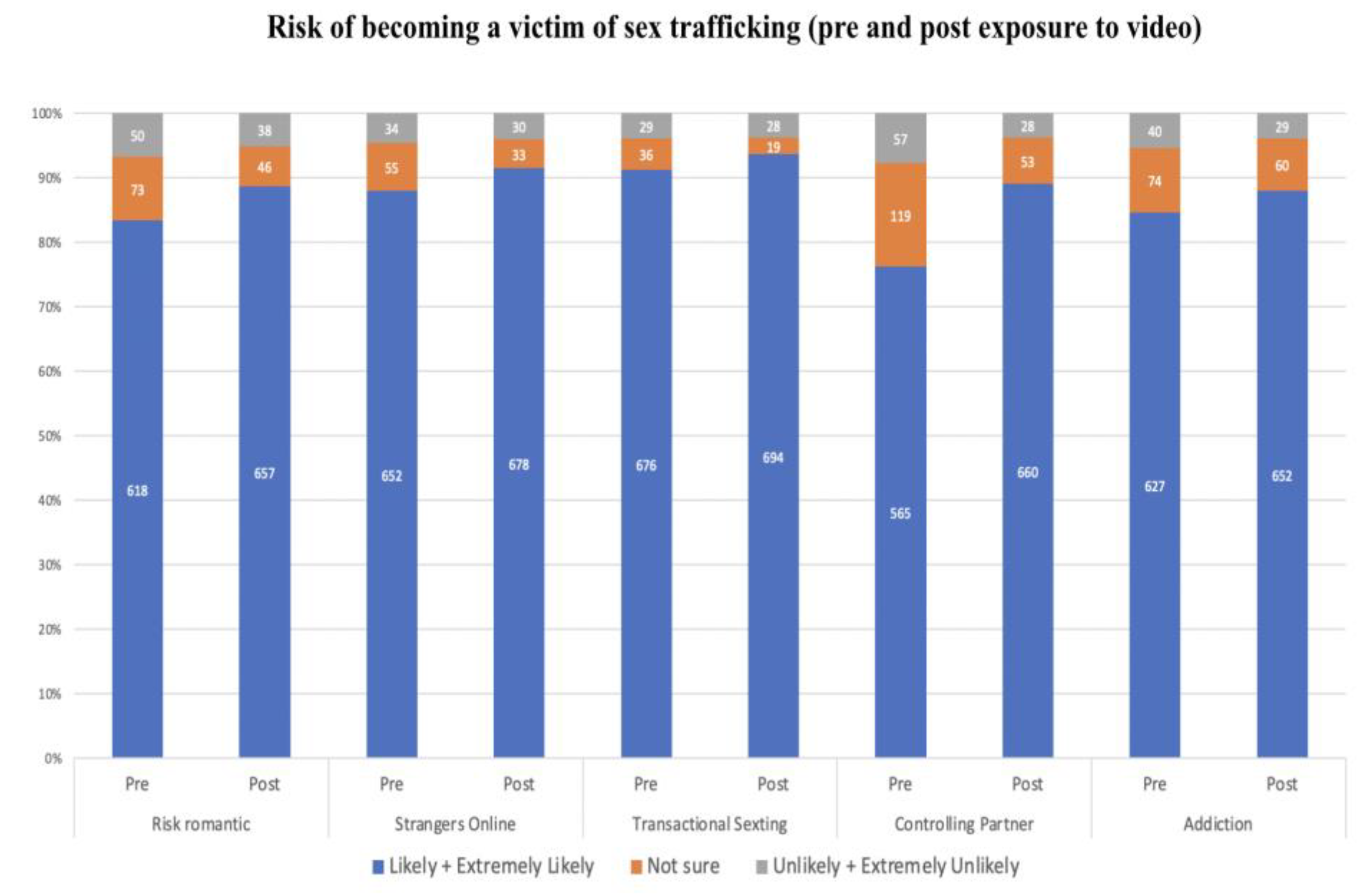
Figure 2.
Signs of Human Trafficking.
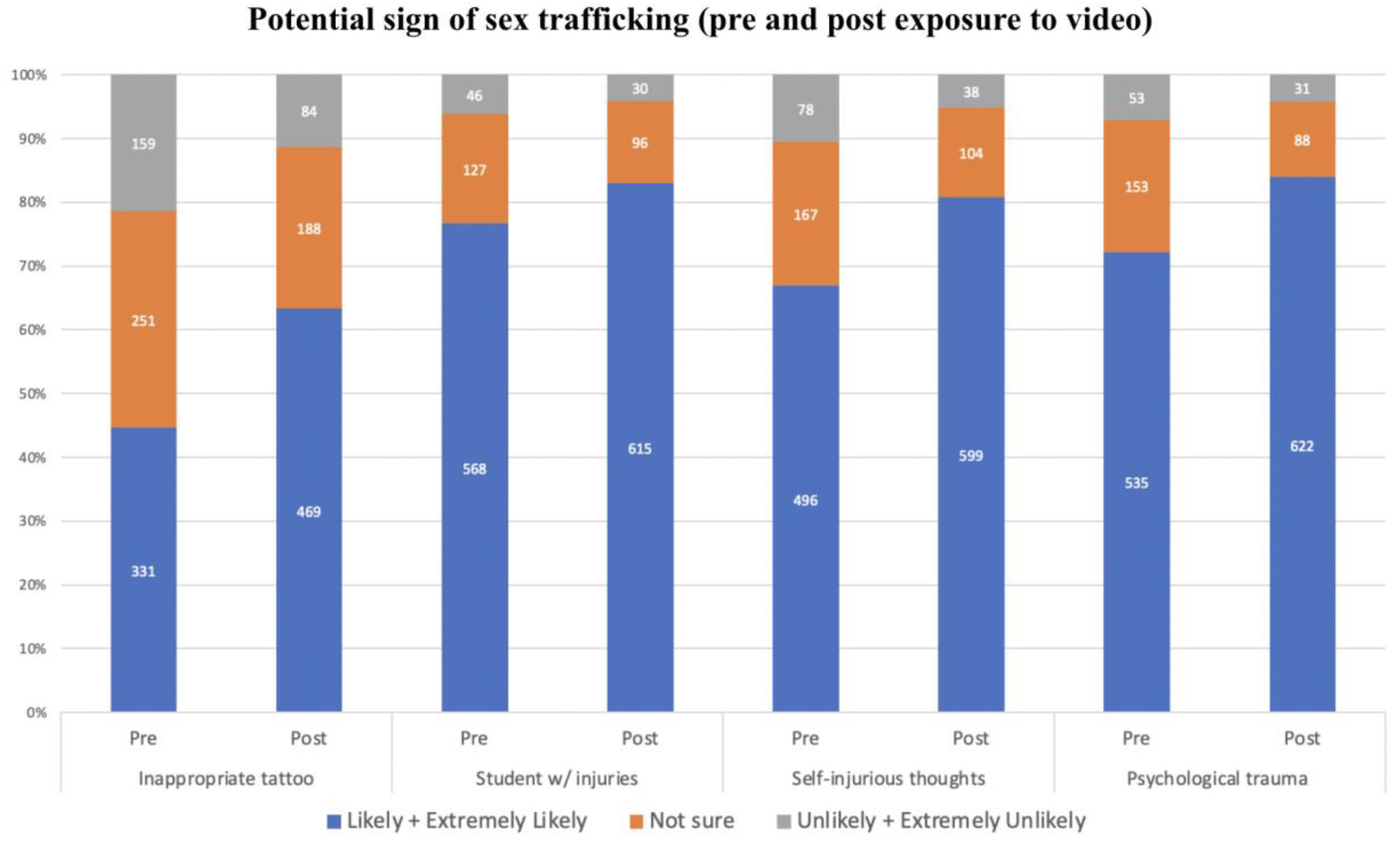

Table 1.
Outcome Variables.
| Dependent Variable | Question | Answer options and coding |
|---|---|---|
| 1. Awareness of commercial sex (sex in exchange of money or goods) involving minors being considered sex trafficking [variable labeled: definition] | A situation in which a person under the age of 18 is having sex in exchange for money or goods is: |
1=A and B 0=C |
| 2. Awareness of situations that could potentially put students at risk of becoming a victim of sex trafficking* [variable labeled: risk factors] | Could any of the following situations - experienced by a student - put them at risk of becoming a victim of sex trafficking?
|
1= the MFA factor score above the median 0= the MFA factor score equal or below the median |
| 3. Awareness of situations experienced by students that could potentially be signs of sex trafficking*[variable labeled: signs] |
|
1= the MFA factor score above the median 0= the MFA factor score equal or below the median |
| 4. Awareness of being in a position at work to interact with students who are victims of sex trafficking [variable labeled: position] | At your job, do you think you could be in a position to interact with a student who may be a victim of sex trafficking? |
1= C 0= A and B |
| 5. Awareness of the different modalities to report a potential case sex trafficking involving a minor [variable labeled: reporting] | What are the appropriate ways to report a potential case of sex trafficking involving a minor? [check all that apply] |
1= A, B, C, D, E and F 0= E |
*This variable was computed as a summative score of all response options.
Table 2.
Demographic characteristics of study population.
| Baseline (N = 741) | n (%) |
|---|---|
| Age | |
| 18-24 | 69 (9.3%) |
| 25-34 | 200 (27.0%) |
| 35-44 | 204 (27.5%) |
| 45-54 | 155 (20.9%) |
| >54 | 113 (15.2%) |
| Sex* | |
| Female | 425 (62.1%) |
| Male | 259 (37.9%) |
| Race* | |
| White | 528 (77.2%) |
| Non-white | 151 (22.1%) |
| Prefer not to say | 2 (0.3%) |
| Education | |
| Bachelor’s degree | 274 (37.0%) |
| High school, GED, or some college | 112 (15.1%) |
| Post-graduate degree (i.e. Master’s degree, PhD, MD etc.) | 355 (47.9%) |
| Experience | |
| Less than 1 year | 14 (1.9%) |
| 1-5 years | 164 (22.1%) |
| 6-10 years | 172 (23.2%) |
| More than 10 years | 391 (52.8%) |
| Job Title | |
| Administrator | 64 (8.6%) |
| Counselor | 117 (15.8%) |
| Educator | 454 (61.3%) |
| Mental Health Professional | 22 (3.0%) |
| Other School Staff | 84 (11.3%) |
| Census Region | |
| Midwest | 156 (21.1%) |
| Northeast | 162 (21.9%) |
| South | 286 (38.6%) |
| West | 137 (18.5%) |
| Received Training (Have you ever received specific training about sex trafficking?) | |
| Yes, within the last 2 years | 231 (31.2%) |
| Yes, more than 2 years ago | 91 (12.3%) |
| No | 419 (56.5%) |
*Information not available for 57 respondents;Note: Information on population reporting White race alone and population under 1.37 of the poverty thresholds could not be determined for 1 case and information on median household income could not be determined for 3 cases due to missing data from the AHRQ database.
Table 3.
Results of Logistic Regression Models.
| Outcomes | |||||
|---|---|---|---|---|---|
| Predictors | Awareness of commercial sex | Awareness of situations that could potentially put students at risk | Awareness of situations experienced by students being potential signs of sex trafficking | Awareness of being in a position at work to interact with students who are victims of sex trafficking | Awareness of the different modalities to report a potential case of sex trafficking involving a minor. |
| OR (95% CI) | OR (95% CI) | OR (95% CI) | OR (95% CI) | OR (95% CI) | |
| Intercept | 0.62 (0.19 – 2.05) | 0.17(0.06-0.58) | 0.3 (0.09-0.99) | 0.47 (0.13 - 1.69) | 4743.36 (72.64 – 516551.6) |
| Age | 0.89 (0.75 - 1.04) | 1.03 (0.88-1.21) | 0.98 (0.84-1.15) | 0.91 (0.77 - 1.07) | 1.05 (0.65 - 1.73) |
| Level of Education | 1.21 (0.96 - 1.53) | 1.02 (0.8-1.28) | 0.89 (0.71-1.13) | 1.56 (1.23 - 2)* | 1.00 (0.48 - 2.04) |
| Experience | 1.21 (0.97 - 1.52) | 1.43 (1.13-1.8)* | 1.17 (0.93-1.46) | 1.14 (0.9 - 1.45) | 0.57 (0.24 - 1.2) |
| Educator | Ref | Ref | Ref | Ref | Ref |
| Mental Health Professional or Counselor | 1.03 (0.63 - 1.71) | 0.92 (0.55-1.52) | 1.07 (0.65-1.75) | 2.5 (1.37 - 4.85)* | 1.34 (0.33 - 9.25) |
| Administrator or Other School staff | 1.29 (0.86 - 1.92) | 1.07 (0.72-1.59) | 0.92 (0.62-1.36) | 1.32 (0.87 - 2.01) | 1.19 (0.35 - 5.47) |
| Northeast | Ref | Ref | Ref | Ref | Ref |
| South | 1.60 (0.84 - 3.06) | 1.09 (0.56-2.12) | 1.55 (0.81 - 3.01) | 1.6 (0.8 - 3.12) | 0.4 (0.03 - 3.41) |
| Midwest | 1.58 (0.80 - 3.15) | 0.97 (0.49-1.96) | 1.09 (0.55 - 2.19) | 1.57 (0.76 - 3.23) | 0.39 (0.03 - 3.86) |
| West | 1.51 (0.75 - 3.06) | 1.09 (0.53-2.24) | 1.37 (0.68 - 2.81) | 1.57 (0.75- 3.31) | 0.85 (0.06 – 11.92) |
| White | Ref | Ref | Ref | Ref | Ref |
| Non-White | 0.75 (0.50, 1.12) | 1.16 (0.77 – 1.73) | 0.88 (0.59 – 1.30) | 1.05 (0.69 – 1.61) | 1.25 (0.36 – 5.84) |
| Male | Ref | Ref | Ref | Ref | Ref |
| Female | 1.09 (0.79 - 1.51) | 1.88 (1.36-2.62)* | 1.48 (1.07 - 2.04)* | 0.89 (0.63 - 1.26) | 0.3 (0.07 - 0.94) |
| Median Household Income | 0.96 (0.75 - 1.23) | 0.9 (0.7-1.16) | 1.05 (0.82 - 1.35) | 0.9 (0.68 - 1.17) | 0.58 (0.27 - 1.22) |
| Less than median percentage (<=79.5%) of the population reporting as of White race | Ref | Ref | Ref | Ref | Ref |
| More than median percentage (>79.5%) of the population reporting as of White race | 0.94 (0.66 - 1.34) | 0.95 (0.67-1.36) | 1.16 (0.82 - 1.65) | 1.16 (0.8 - 1.69) | 1.31 (0.45 - 3.9) |
| Percentage of the population under the 1.37 of the poverty thresholds | 0.99 (0.97 - 1.0) | 1.01 (0.99-1.02) | 1.01 (1.00 – 1.03) | 1 (0.99 - 1.02) | 0.98 (0.94 - 1.02) |
| Density of the population (<= 2184.41 persons per square mile) | Ref | Ref | Ref | Ref | Ref |
| Density of the population (>2184.41 persons per square mile) | 0.87 (0.44 - 1.71) | 0.85 (0.42-1.7) | 1.11 (0.56 – 2.22) | 0.68 (0.34 - 1.36) | 0.31 (0.03 - 2.87) |
Disclaimer/Publisher’s Note: The statements, opinions and data contained in all publications are solely those of the individual author(s) and contributor(s) and not of MDPI and/or the editor(s). MDPI and/or the editor(s) disclaim responsibility for any injury to people or property resulting from any ideas, methods, instructions or products referred to in the content. |
© 2024 by the authors. Licensee MDPI, Basel, Switzerland. This article is an open access article distributed under the terms and conditions of the Creative Commons Attribution (CC BY) license (http://creativecommons.org/licenses/by/4.0/).
Copyright: This open access article is published under a Creative Commons CC BY 4.0 license, which permit the free download, distribution, and reuse, provided that the author and preprint are cited in any reuse.


