

Submitted:
13 June 2024
Posted:
14 June 2024
You are already at the latest version
Abstract
Cancer is a highly heterogeneous disease and remains a global health challenge affecting millions of human lives worldwide. Despite advancements in conventional treatments like surgery, chemotherapy, and immunotherapy, the rise of multidrug resistance, tumor recurrence, and severe side effects necessitates innovative therapeutic approaches. The complex nature of the tumor microenvironment (TME) further compromises the efficacy of traditional chemotherapy drugs. Recently, stimulus-responsive nanomedicines designed to target TME characteristics (e.g., pH, redox, enzymes) have gained attention for their potential to enhance anticancer efficacy while minimizing adverse effects. Among various nanocarriers, hydrogels are an interesting class of nanocarriers used in cancer therapy due to their high water content, adjustable mechanical characteristics, and ability to respond to external/internal stimuli. These properties make hydrogels an ideal nanocarrier for controlled drug release within the TME. This review comprehensively surveys the latest advancements in stimulus-responsive hydrogels for cancer therapy, exploring various stimuli-responsive mechanisms, including biological (e.g., pH, redox), chemical (e.g., enzymes, glucose), and physical (e.g., temperature, light), as well as dual- or multi-stimuli responsiveness. This review will offer novel perspectives on the development of stimulus-responsive hydrogels for cancer therapy.
Keywords:
Hydrogels
; Stmuli-responsive
; Drug delivery
; Cancer
1. Introduction
Cancer is one of the most detrimental diseases, affecting millions of human lives globally and imposing a significant economic burden. As per the reports from International Agency for Research on Cancer (IARC), there were about 20 million new cancer diagnoses, as well as 9.7 million cancer-related deaths has been reported in 2020 year [1]. Conventional cancer therapies, such as chemotherapy and radiotherapy, often suffer from limited efficacy, multidrug resistance, tumor recurrence, and severe side effects such as cardiotoxicity and nephrotoxicity due to their non-specific targeting of cancerous cells alongside healthy tissues [2]. Hence, there is a pressing need to explore innovative approaches that enable targeted drug delivery to cancer cells while minimizing systemic toxicity.
Nanotechnology represents a growing and promising field with diverse applications in drug delivery, bioimaging, and therapeutics [3]. Nano-drug delivery systems offer beneficial properties such as enhanced bioavailability, sustained drug release, stability, and improved aqueous solubility, thereby enhancing the anticancer activity of drugs [4]. Various nanocarriers, including hydrogels, polymeric, metallic, lipid-based, micelles, dendrimers, and so on, have been utilized for the delivery of chemotherapeutic drugs/ bioactive compounds [5].
Stimulus-responsive nanomedicine offers significant potential advantages in the realm of targeted therapy and personalized medicine [6]. By leveraging nanomaterials that respond to specific physiological stimuli—such as pH changes, temperature variations, or enzyme presence—these advanced therapeutic systems can deliver drugs with high precision directly to diseased tissues, minimizing off-target effects and reducing systemic toxicity. This targeted approach not only enhances the efficacy of treatments, particularly in cancer and inflammatory diseases, but also allows for controlled drug release, improving patient compliance and outcomes. Additionally, the adaptability of these nanomedicines can lead to real-time monitoring and responsive treatment adjustments, paving the way for more dynamic and effective healthcare solutions.
Hydrogels are three- dimensional (3D) structures of crosslinked polymers hold great potential in drug delivery [7]. Their water content and structural similarity to biological tissues make them suitable carriers for drug delivery and tissue bioengineering applications. Other advantages such as swelling behavior, porosity, ability to modification and responsiveness to endogenous or exogenous environmental stimuli, also make them ideal platforms for developing smart drug delivery systems. The tumour microenvironment has specific characteristics such as hypoxia, acidity, increased enzyme levels, and aberrant temperatures, all of which can be used to selectively induce drug release from hydrogels. In response to specific stimuli present at tumor microenvironment, hydrogel-based drug delivery systems could be promising approach to combat with cancer. Targeted drug delivery through hydrogels is achieved via various stimulus-based approaches such as pH, temperature, light and so on [8]. Hydrogels can be synthesized using different biomaterials, including carbohydrates, proteins, lipids, or DNA/RNA-based nanomaterials, depending on the targeted cancer sites [9,10]. Hydrogels can be administered through various methods including injection, topical application, or implantation, depending on the therapeutic need. Hydrogels are widely used in biomedical applications such as drug delivery systems, wound dressings, and tissue engineering, due to their biocompatibility and ability to mimic natural tissue environments.
We present here an in-depth overview of the current status of research on stimulus-responsive hydrogels as a cancer therapy. We will explore the various types of biomaterials used in hydrogel fabrication, their responsiveness to different stimuli, and their applications in cancer targeting (Figure 1). Biological, chemical, and physical stimuli are thoroughly discussed with recent studies on hydrogels. By defining the fundamental concepts and focusing on current advances in the field, we are interested in shedding light on the potential of stimulus-responsive hydrogels to transform cancer treatment strategies.
2. Tumor Microenvironment (TME)
The scientific community has been unable to eliminate cancer despite many years of effort. One reason behind this is the complex nature of the TME. A tumour is a heterogeneous collection of invading cells rather than just a collection of cancer cells. This comprises the extracellular matrix (ECM), substances that are secreted, and resident host cells. In order to facilitate the growth and spread of tumours, cancer cells fundamentally alter the host tissues' cellular, molecular, and physical makeup [11]. A developing TME is a dynamic and evolving entity. While the TME's makeup varies depending on the kind of tumour, immune cells, stromal cells, blood vessels, and extracellular matrix are common components. The theory states that the "tumour microenvironment actively promotes the progression of cancer rather than merely acting as a silent bystander [12]. The development of challenging TME is primarily linked to the uncontrolled growth of cancer cells and the expansion of defective blood vessels.
Recent research has revealed that key cellular metabolism pathways, which are controlled by internal genetic changes and TME-induced cell-extrinsic responses, are different in cancer cells from those in the majority of normal tissue cells. These changes involve, but are not restricted to, signal transductions (e.g., hypoxia-inducible factor 1 (HIF-1), aerobic glycolysis, reduced oxidative phosphorylation), and biomolecule metabolism (e.g., glucose, lactate, glutathione). These factors lead to increased tumour proliferation, invasive metastasis, and highly effective treatment resistance, enabling tumour cells to elude tumor-targeted therapies. They also promote vascular regeneration, nutrient uptake, adenosine triphosphate (ATP) generation, increased macromolecule biosynthesis, and elevated redox levels [13].
Acidic pH, hypoxia, increased level of GSH, higher Reactive Oxygen Species (ROS) generation, and overexpressed enzymes are key characteristics of TME, which promote tumour angiogenesis and metastasis while also being responsible for therapeutic resistance and treatment failure (Figure 2) [14]. The design and development of TME-responsive intelligent nano-drug delivery systems has gained interest in improving drug therapeutic effects, owing to their potential to address some significant therapeutic issues, such as low therapeutic efficacy and serious side effects like cardiotoxicity, nephrotoxicity and so on.
3. Hydrogels: An Overview
In 1960, Wichterle and Lim invented the word "hydrogel" to describe a 3D structure composed of hydrophilic polymers for the first time in biological contexts [15]. They named it poly (2-hydroxyethyl methacrylate) (PHEMA), and it was utilized in the contact lens industry. PHEMA demonstrated how a hydrogel could absorb moisture and maintain its network structure. Hydrogels have emerged as fascinating drug delivery materials because of their distinct characteristics. One of their primary advantages is their high-water content, which replicates the natural environment of biological tissues, enhancing compatibility and decreasing discomfort during administration [16]. Furthermore, hydrogels have variable porosity and swelling behaviour, which allows for controlled drug release kinetics and maintains therapeutic concentrations throughout time [17]. Their soft and flexible structure allows high entrapment of anticancer drugs including hydrophilic and hydrophobic drugs, while maintaining stability and bioactivity [18]. Furthermore, hydrogels have the benefit of being easily adaptable to achieve sustained release profiles adapted to the needs of various pharmaceuticals and medicinal applications (Figure 3A). These promising characteristics make hydrogels an appealing candidate for precise and effective drug delivery systems. Hydrogels can be classified as homo or copolymeric based on their chemical composition, macro gels, microgels or nanogels based on network size, anionic, cationic, zwitterionic or non-ionic based on ion charge and physical or chemical based on crosslinking (Figure 3B) [19,20].
4. Stimulus Responsive Hydrogels for Cancer Therapy
Recently, to regulate the release of encapsulated anticancer medications or bioactive molecules while simultaneously ensuring the gel's disintegration after its role is performed, stimuli-responsive disintegration has emerged as a desirable design requirement for functional hydrogels [21]. For stimulus-responsive hydrogels, a novel class of smart biomaterial, sensing external physical stimuli (e.g., thermo, photo), chemical stimuli (e.g., pH, redox reaction), biochemical stimuli (e.g., glucose, enzymes, etc.), and other stimuli is preferred (Figure 4). In this review, we have discussed various stimulus-responsive hydrogels, providing recent examples from research studies.
4.1. Chemical Stimuli Responsive Hydrogels
Chemical response mediated hydrogels dynamically change their structure or properties in response to specific chemical signals, offering tailored solutions for drug delivery and tissue engineering [22]. pH-responsive hydrogels undergo swelling or contraction in response to changes in environmental acidity or alkalinity, making them ideal for targeted drug release in acidic tumor microenvironments [23]. Similar to this, redox-responsive hydrogels can be made to change reversibly in response to changes in the redox state of their environment. This allows for controlled release in environments that are either reducing or oxidative [24]. We have discussed pH and redox responsive hydrogels below, along with several research studies that have utilized these stimuli for drug delivery.
4.1.1. pH Responsive Hydrogels
Hydrogels that respond to pH fluctuations are an exceptional category of biomaterials designed to exhibit reversible changes [25]. These hydrogels contain pH-sensitive functional groups, such as acidic or basic residues, within their polymer networks, enabling them to swell or contract in acidic or alkaline environments. This pH-triggered swelling behavior can be harnessed for targeted drug delivery, where the hydrogel acts as a carrier for therapeutic agents, releasing them selectively in response to specific pH conditions characteristic of diseased tissues or cellular compartments [26]. Their tunable responsiveness to pH gradients renders them invaluable tools in biomedicine, offering tailored solutions for controlled release, tissue engineering, and diagnostic applications, with the potential to revolutionize drug delivery strategies and improve healthcare outcomes [27]. pH-sensitive hydrogels can deliver oral drugs to particular sites in the gastrointestinal (GI) tract due to pH variations [25]. Hydrogels with basic or acidic functional groups can ionize in the GI tract's acidic or alkaline environment [28]. Ionization of functional groups causes swelling in the polyelectrolyte network due to electrostatic repulsion and osmotic effects of bound counterions [29]. Swelling of the pH-sensitive hydrogels is depends on the polyelectrolyte charge density, medium pH and ionic strength, and network crosslinking density [30]. The large pH differential between the stomach and the rest of the GI tract enables pH-sensitive drug delivery systems for the anticancer and antimicrobial drugs [31]. For example, specific disease locations in the GI tract can be targeted for local therapeutic release or drug uptake/delivery.
Ortiz, J.A., et al., synthesized novel pH-responsive hydrogels by combining carboxymethylagarose (CMA) and chitosan (CS) at different weight ratios [32]. Diclofenac sodium (DS) was used as a model drug and successfully incorporated into CMA/CS PECs. The viability of HaCat cells was nearly 100% in the condition of hydrogels and DS. The study demonstrated that prepared hydrogels could be use as pH responsive nano system for transdermal drug delivery. Another research team synthesized pH-responsive injectable and covalently crosslinked hydrogels by mixing Dibenzaldehyde-Terminated PEG (DF-PEG) solution and Polyaspartylhydrazide (PAHy) solution (Figure 5A), loading Doxorubicin into the prepared hydrogel [33]. The results indicate that the sol-gel transitions of the produced hydrogel are reversible in response to pH fluctuations (Figure 5B). In the in vivo mice model, the release rate of DOX encapsulated within the hydrogel and its accumulation in the tumor were significantly slower compared to free DOX. The drug loaded hydrogel exhibited enhanced efficacy, achieving approximately 80% tumor inhibition by day 20 (Figure 5C), suggesting its potential as a highly effective treatment for human fibrosarcoma with reduced side effects.
Various polymers, such as chitosan [34,35,36,37,38], poly(ethylene oxide) [39,40,41], polyethylene glycol [42,43,44], methacrylic acid [45,46,47], gelatin [48,49,50], laponite RD [51], polyethyleneimine [52], β-cyclodextrin [53,54,55], polyacrylamide, polyurethanes [56], carboxymethylagarose [32], and dibenzaldehyde-terminated PEG [33], have been used in the synthesis of pH-responsive hydrogels. Table 1 summarizes the diverse polymers conjugated or encapsulated with drugs/ligands for synthesizing chemical-responsive hydrogels, along with concise findings.
4.1.2. Redox Responsive Hydrogels
Redox is advantageous over other stimuli because it can change both charge and spin states at the same time of a molecule and its assemblies. In the 18th century, Lavoisier coined the terms "oxidation" and "reduction" to describe oxygen uptake and loss, respectively [57]. Redox-active compounds offer promising uses biomedical applications including drug delivery. Due to their response against redox stimuli, disulfide-crosslinked hydrogels are frequently used as a drug delivery carrier [58]. Thiols can be present in the cysteine residues of synthetic polymers as well as protein-based compounds. Therefore, thiol-based cross-linking can be used to quickly make hydrogels derived from either type of polymer. Therefore, thiol-based cross-linking can be used to quickly make hydrogels derived those polymers [59]. For the synthesis of thiol-ene and thiol-Michael cross-linked hydrogels with good biocompatibility, maleimide and divinyl sulfone (DVS) are efficient chemicals [60]. Through oxidation, thiols can also form disulfide linkages [61] and oxidants like periodate [62] hydrogen peroxide [63] and ferricyanide [64] can be used to enhance the process.
Since disulfide bonds are converted to sulfhydryl (-SH) in tumour tissue by high levels of reduced glutathione, most redox responsive hydrogels are synthesized from disulfide bond-bearing compounds [24]. In low reductive normal tissue, the disulfide bond is reasonably stable; nevertheless, in a tumour environment, its reduction causes structural disruptions to the drug delivery system, leading to abrupt release of the drug for its action [65]. Direct and indirect introduction are the two accepted methods for creating disulfide links in polymers [66]. Whereas the disulfide bond is created by oxidising sulfhydryl groups in indirect introduction, a disulfide bond-containing moiety is inserted into the nanocarrier structure in direct introduction. The indirect method is the simpler and more popular approach among these strategies.
Kilic Boz, R., et al., used a highly effective thiol-disulfide exchange technique to develop redox-responsive hydrogels [21]. Gelation was achieved by combining linear telechelic PEG-based polymers with pyridyl disulfide units at the chain ends with thiol-terminated tetra-arm PEG polymers. Fast gelation provides macroporous hydrogels with significant water absorption through excellent conversions (>85%). Furthermore, the resultant hydrogels have the ability to self-heal because of the disulfide linkages. The hydrogels totally break down in an environment high in thiol-containing substances as L-glutathione (GSH) and dithiothreitol (DTT). Furthermore, the molecular weight of the polymeric precursors can be changed to adjust the release profile of the encapsulated protein, in this case, bovine serum albumin. Furthermore, changing the molecular weight of the polymeric precursors might modify the release profile of an encapsulated protein, such as bovine serum albumin. A live/dead cell viability assay confirmed the materials' cytocompatibility. Their study suggest that redox responsive hydrogels may be appealing for a variety of biological applications due to their ease of manufacturing and capacity to disintegrate on demand and release their payload like BSA. Other examples include DTSSP-crosslinked RZ10-RGD [67], ferric ethylenediaminetetraacetic acid (Fe-EDTA) [58], PEG-b-PBSe block copolymers [68], poly (2-methacryloyloxyethyl phosphorylcholine) (PMPC) [69], and carboxymethyl chitosan [70] polymer-based nano systems synthesized for redox-responsive drug delivery (Table 1).

Table 1.
List of chemical stimuli responsive hydrogels.
| Stimuli | Polymers | Drug/dye/ Ligand |
Cross-linking agent | Preparation method | Cancer/model/Route | Brief finding | References |
|---|---|---|---|---|---|---|---|
| pH | CS and PEO | Amoxicillin, Metronidazole | Glyoxal | Cross-linking | Peptic ulcer | In the acidic environment of the stomach fluid, prepared hydrogels may be helpful for the localized administration of antibiotics. | [34] |
| PAA: PEO | SAM, NAM, CHC, PDN | TDIC | Cross-linking | GI tract | The pH-dependent swelling of IPN granules in the matrix significantly determines drug release across all studied types. | [39] | |
| Gelatin: PEO | Riboflavin | Glyoxal | Cross-linking | For oral delivery | Gelatin and gelatin-PEO hydrogels swell based on pH and high molecular weight PEO. | [42] | |
| PEG and L-Lactide | DOX and TET | MA–PLLA–PEG–PLLA–MA | Cross-linking | GI tract | pH mediated drug release observed (slow release of DOX in acidic buffers as well as fast release of TET) | [71] | |
| PEG-6000 and MAA | - | MBA | Radical polymerization reaction | Male albino rabbits | The nanogels were well-tolerated with no toxic effects in animals. | [45] | |
| Gelatin and Pluronic F127 | CUR | FCHO | Schiff base cross-linking | Diabetes mellitus | Displayed antibacterial and antioxidative activity and biocompatibility, facilitated wound closure and enhancing tissue regeneration | [72] | |
| Lap®/CS/PVA | CUR | Lap®CUR | Cross-linking | Breast cancer cells (MDA-MB 231) and bacteria S. aureus, E. coli and H. pylori | Had good blood compatibility, excellent antioxidant properties, and antibacterial activity. | [51] | |
| PEI-Co-MAA | Mesalazine | MBA | Free radical polymerization | Colorectal diseases | Hydrophilic drugs may be delivered at colon site via hydrogels. | [52] | |
| Black seed extract and β-CD, MAA | Perindopril Erbumine | MBA | Free radical polymerization | - | At alkaline pH, hydrogels demonstrated more swelling and in vitro drug release compared to acidic pH, with no adverse effects observed in animals. | [53] | |
| CMTKG/ PVP/PAM |
DS | MBA | Free radical polymerization | - | The higher drug released was observed at physiological pH (pH 7.4) then acidic (pH 1.2) from hydrogel. | [73] | |
| PU−PEI and PU−CA | Ciprofloxacin, Bromophenol blue and Pyronin Y |
- | Aminolysis and Stiglich esterification mechanism, Physical cross-linking | Chronic Wounds | PU-PEI films exhibited significantly higher antibacterial activity than PU-CA films, and they discharged more cargo at an acidic pH than PU-CA films did at an alkaline pH. | [56] | |
| CMA and CS | DS | - | Ionic complexation | Dermal drug delivery, HaCat cells | The viability of HaCat cells was nearly 100% in the presence of hydrogels and DS, indicating the potential of CMA/CS PECs for pH-responsive dermal drug delivery. | [32] | |
| DF-PEG, PAHy | DOX | - | Chemical cross-linking | Human fibrosarcoma | The DOX-loaded hydrogel exhibited enhanced efficacy, achieving approximately 80% tumor inhibition by day 20, suggesting its potential as a highly effective treatment for human fibrosarcoma | [33] |
|
| Redox | PEG | PDS, BSA | - | - | L929 mouse fibroblast | When hydrogels are treated with thiol-containing reducing agents, they break down quickly, facilitating the release of the encapsulated payload (such as BSA) more quickly. | [21] |
| PEG-SH and Fe-EDTA | Dextran | DVS | One-pot cross-linking | NIH/3T3 mouse fibroblasts | These gels offer a potentially useful platform for separating the behaviour of degradation in response to reduction stimuli from the initial mechanical properties. | [58] | |
| Resilin | RGD | DTSSP | - | NIH/3T3 fibroblasts | Demonstrated the degradation and cytocompatibility of DTSSP-crosslinked RZ10-RGD, showcasing their potential for biomedical appications | [67] |
Abbreviations: CS: Chitosan, PEO: Poly (ethylene oxide), SAM: Salicylamide, NAM: Nicotinamide, CHC: Conidine·HCl, PDN: Prednisolone, PAA: Poly(acrylic acid), TDIC: Tolylene-2,4-diisocyanate, PLLA-PEG-PLLA: Poly(L-lactide)-co-polyethyleneglycol-co-poly(L-lactide), MA: methacrylic anhydride, DOX: Doxorubicin, TET: Tetracycline, GI tract: Gastrointestinal tract, MAA: Methacrylic acid, MBA: N-Methylene bis(acrylamide), CUR: Curcumin, FCHO: Benzaldehyde-modified Pluronic F127 polymer, Lap®/CS/PVA: laponite RD/chitosan/polyvinyl alcohol, PEI: Polyethyleneimine, β-CD: β-cyclodextrin, CMTKG/ PVP/PAM: Carboxymethyl tamarind kernel gum/polyvinylpyrrolidone/polyacrylamide, DS: Diclofenac Sodium, PU−PEI: Polyurethanes Polyethylenimine, PU−CA: Polyurethanes carboxylic-acid-modified films, CMA: Carboxymethylagarose, DF-PEG: Dibenzaldehyde-Terminated PEG, PAHy: Polyaspartylhydrazide, PEG: Poly(ethylene glycol), PDA: Poly(ethylene glycol), BSA: Bovine serum albumin, DVS: Divinyl sulfone, Fe-EDTA: Ferric ethylenediaminetetraacetic acid, DTSSP: 3,3′-dithiobis(sulfosuccinimidyl propionate).
1.2. Biological Stimuli Responsive Hydrogels
Biological stimuli-responsive hydrogels exhibit dynamic changes in their structure or properties in response to specific biological cues, enabling tailored drug delivery and tissue engineering applications [22,74]. Enzyme-responsive hydrogels, such as those triggered by proteases, enable targeted drug release at sites of inflammation or disease where elevated enzyme levels are present [75]. Glucose-responsive hydrogels, another prominent example, undergo swelling or degradation in response to variations in glucose concentration, offering precise insulin delivery for diabetes management [76]. These biological stimuli-responsive hydrogels intelligently respond to biological signals, enhancing therapeutic efficacy, and hold great promise for cancer therapy and the treatment of other medical conditions.
4.2.1. Enzyme Responsive Hydrogels
Among several stimulus responsive nanocarriers, the enzyme-responsive approach has gained increasing interest in the development of functional biomaterials, particularly designed drug delivery systems, for the following reasons: (1) Enzymes play important functions in most biochemical processes, and the enzyme-based method is extremely biocompatible; (2) Therapeutics can be delivered to enzyme-overexpressed tumor sites with great selectivity and efficiency using enzyme-based recognition strategies [77]. Enzymatic responsive hydrogels, leveraging specific enzyme-cleavable motifs within their polymer network, offer a dynamic platform for targeted drug delivery, tissue engineering, biosensing, and regenerative medicine [78]. These hydrogels enable spatiotemporal control over drug release, mimicking the dynamic nature of biological tissues, and providing a biomimetic matrix for promoting cell proliferation and tissue regeneration [79]. Sakai S. and Kawakami K. had synthesized a novel alginate incorporating phenol groups via carbodiimide coupling, aiming to develop an enzymatically cross-linkable hydrogel with maintained gelation properties [80]. By controlling phenol incorporation, they achieved aqueous polymer solutions capable of gelation through both ionic and enzymatic cross-linking, overcoming destabilization challenges in biomedical applications. Their findings suggest the potential of phenol-modified alginate as an alternative to conventional forms for various biomedical uses.
Su T. et al., designed enzyme responsive hydrogels composed of Glucose oxidase (GOx), N-hydroxyimide–heparin conjugate and β-D-Glucose [81]. The developed enzyme-responsive hydrogel enables controlled drug release triggered by heparin-specific cleavage by heparanase, targeting cancer cells with heparanase overexpression while minimizing premature drug release's negative effects on normal cell. Another group has synthesized matrix metalloproteinase (MMP)-responsive hydrogel to target the overexpression of O6-methylguanine-DNA methyltransferase (MGMT) in glioma cells [82]. They loaded O6-benzylguanine (an inhibitor for MGMT) and Temozolomide (TMZ, a first-line agent for treatment) for therapy targeting TMZ-resistant gliomas. The drug loaded hydrogels reduced MGMT expression in vivo, rendering TMZ-resistant glioma cells more responsive to TMZ treatment. Additionally, post-surgery, these hydrogels significantly enhanced TMZ efficacy in glioma growth inhibition and reduced recurrence of TMZ-resistant gliomas, suggesting their potential as localized medication delivery for preventing glioma recurrence. Enzymes such as proteases, hydrolases, oxidoreductases such as glucose oxidase, kinases, phosphatases, and glycosidases commonly utilized in enzyme-responsive hydrogels such as β-galactosidase (Table 2).
MMPs are enzymes crucial for regulating the ECM in various physiological processes, including tissue remodeling, wound healing, and immune response modulation [83]. In cancer, MMPs play a significant role in tumor invasion and metastasis [84]. Exploiting this enzymatic activity, MMP-responsive nanocarriers including nanoparticles and hydrogels have emerged as promising platforms for targeted drug delivery in cancer therapy [85,86]. MMP-responsive hydrogels enable controlled drug release within tumor microenvironments, minimizing systemic toxicity. They hold promise for precision cancer therapy, enhancing efficacy while reducing adverse effects. Various MMP-based targeted hydrogels have been synthesized and explored as nanocarriers for cancer treatment [82,87,88].
Other than MMPs, Hovgaard L. and Brøndsted H. synthesized the dextranases targeted enzyme responsive hydrogels based on dextran [89]. Increasing the molecular weight of dextran, adding crosslinking agents, or lowering DMSO in the reaction mixture resulted in hydrogels with decreased swelling and higher mechanical strength. Dextran hydrogels were degraded in vitro by a model dextranase, as well as in vivo in rats and a human colonic fermentation model. The detail list of enzyme responsive hydrogels is summarized in Table 3. All the evidence underscores the potential of enzyme-responsive hydrogels for effective cancer treatment, offering targeted drug delivery and minimizing systemic side effects.
4.2.2. Glucose Responsive Hydrogels
In the realm of glucose-responsive systems, they dynamically respond to fluctuations in the surrounding glucose concentration, offering significant promise for diabetes and cancer treatment [90]. Research on glucose-responsive systems can be categorized along two dimensions: the mechanism of glucose responsiveness and its application [91]. Mechanistically, these systems fall into three main groups: lectin-based, glucose oxidase (GOx)-based, and phenylboronic acid (PBA)-modified systems. Application-wise, they are typically classified into two groups: glucose concentration diagnostics and insulin release facilitation. In major studies, glucose-responsive components such as glucose binding proteins [92] phenylboronic acid (PBA) [93,94,95] and enzymes (glucose oxidase/catalase (GOx/CAT)) [96,97], were used for the delivery of insulin (Table 2)
Li X. et al., designed novel, biocompatible glucose-responsive hydrogels containing GOx, catalase, and insulin in peptide IA-0 for insulin delivery via the self-assembly approach at physiological condition [98]. The in vitro and in vivo studies demonstrated that the developed hydrogels regulate blood glucose levels, even in mouse models with STZ-induced diabetes. Glucose-responsive hydrogels find more extensive application in diabetic disease management compared to cancer therapy, primarily due to the higher prevalence of diabetes and the urgent need for precise insulin delivery in diabetic patients.
Table 2.
List of biological stimuli responsive hydrogels.
| Stimuli | Polymers | Drug/dye/ ligand |
Cross-linking agent | Preparation method | Cancer/model/Route | Brief finding | References |
|---|---|---|---|---|---|---|---|
| Enzyme (HRP) | Alginate and tyramine | Phenol | HRP/H2O2 | Enzymatic cross-linking | - | Findings demonstrate the viability of a unique synthesised alginate with phenols as an alternate material to typical unmodified alginates. | [80] |
| Enzyme (GOx) | N-hydroxyimide–heparin | DOX | EDC/NHS, GOx |
Radical polymerization reaction | HeLa, HepG2, and NIH-3T3 cells | Drug is released from hydrogel in the enzyme responsive manner | [81] |
| Enzyme (MMP) | Tm | TMZ, BG | - | - | C6 glioma cells, BALB/c nude male mice, orthotropic glioma model | Hydrogels reduced MGMT expression in vivo, rendering TMZ-resistant glioma cells more responsive to TMZ treatment. Additionally, post-surgery, these hydrogels significantly enhanced TMZ efficacy in glioma growth inhibition and reduced recurrence of TMZ-resistant gliomas | [82] |
| Enzyme (β-gal) | PLGA−PEG−PLGA | 5-FU, LAPONITE | 2-ethyl-hexanoate as a catalyst | Bulk ring-opening co-polymerization | MCF-7, female nude mice (ICR-nu/nu), PC-3, | Prodrug 5-FU−β-gal and nanocomposite gels were injected locally once, and the combination had long-lasting anticancer activity in vivo with no side effects. | [99] |
| Enzyme (MMP) | dPG | DOX | peptide | Nano-precipitation | HeLa cells, MCTS, primary fibroblasts | The digested multistage pNGs demonstrated enhanced diffusive transport through a dense gel matrix, pNGs facilitates the infiltration of functional chemotherapeutic medication into deeper tissue regions in tumor-like MCTS | [88] |
| Enzyme (MMP) | PEG | DOX, MIONPs, RGDS | - | Surface-initiated photopolymerization | HeLa cells, Mouse fibroblast | Targeted nanocarriers highly internalized and efficiently carry and release DOX into the nucleus of HeLa cells within 2 hours. | [87] |
| Enzyme (dextranases) | Dextran | - | HDI or DDI | - | SD rats, human colonic ferme-ntation model | Dextran hydrogels were degraded in vitro by a model dextranase, as well as in vivo in rats and a human colonic fermentation model. | [89] |
| Glucose | PBA and glucose | PBA | AIBN as an initiator | Radical polymerization | Insulin delivery | Mechanism was not studied but could be used for insulin delivery | [94] |
| Glucose | IA-0 peptide | Gox, Catal-ase, Insulin | - | Solid phase method | STZ-induced diabetic mice | In vitro and in vivo studies demonstrated that the developed hydrogels regulate blood glucose levels. | [98] |
Abbreviations: HRP: Horseradish peroxidase, Gox: Glucose oxidase, DOX: Doxorubicin, EDC: 1-ethyl-3- (3-dimethylaminopropyl) carbodiimide, NHS: N-hydroxysuccinimide, TMZ: Temozolomide, MMP: Matrix metalloproteinase, BG: O6-benzylguanine, Tm: Triglycerol monostearate, MGMT: O6-methylguanine-DNA methyltransferase, β-gal: β-galactosidase, 5-FU: 5-fluorouracil, dPG: Dendritic polyglycerol, PLGA−PEG−PLGA: Poly(dl-lactide-co-glycolide)-b-poly(ethylene glycol)-b-poly(dl-lactide-co-glycolide), MCTS: Multicellular tumor spheroids, MIONPs: Magnetic iron oxide nanoparticles, HDI: 1,6-Hexamethylenediisocyanate, DDI: 1,12-dodecamethylenediisocyanate, SD rats: Sprague-Dawley rats, PBA: Phenylboronic acid, AIBN: Azobis (isobutyronitrile),.
4.3. Physical Stimuli Responsive Hydrogels
To ensure the effective transport of nanocarriers within cells, it is imperative to thoroughly evaluate appropriate designs incorporating either active or passive targeting strategies. Common mechanisms involved include receptor-mediated endocytosis, passive diffusion, or particle phagocytosis [100]. For example, the enhanced permeability and retention (EPR) effect has frequently underpinned passive targeted approaches in cancer therapy [101]. Conversely, active targeting can be achieved by incorporating specialized ligands capable of binding to specific cells (e.g., surface biomarkers, overexpressed receptors), such as antibodies, oligonucleotides, and peptides. Ensuring the efficient release of drugs, conjugated, complexed, or encapsulated onto nanocarriers is a critical consideration [102]. The stability of the nano system, the drug's bioavailability, and the requisite mechanism for controlled release can all be influenced by the chemical nature of the bond and linker [103]. Recently, controlled drug release has also been achieved through the application of physical stimuli such as light and temperature to overcome any such hurdles from chemical stimuli responsive hydrogels.
4.3.1. Thermo-Responsive Hydrogels
The drug delivery has significantly enhanced patient convenience and maximized the efficiency of medical resource uses. Nevertheless, the hypodermic route of administration has not fully addressed certain challenges, notably cardiotoxicity, associated with intravenous delivery of chemotherapeutic agents such as Herceptin [104]. An alternative therapeutic approach, localized continuous medication administration, emerges as a promising strategy for enhancing therapeutic efficacy while mitigating systemic adverse effects. Thermoresponsive hydrogels undergo a reversible sol-gel transition in response to temperature changes, making them valuable for controlled drug delivery and tissue engineering [105]. For instance, injectable and thermosensitive hydrogels have been widely used for targeted drug delivery for treatment of various diseases [106]. Below their lower critical solution temperature (LCST), they exist as a sol, becoming a gel above this threshold. This transition allows for the encapsulation and targeted release of drugs, minimizing systemic side effects and improving therapeutic efficacy [107]. Common polymers used include poloxamers, poly(N-isopropylacrylamide) (PNIPAAm), CS/β-glycerophosphate, hyaluronic acid (HA), poly (ethylene glycol) (PEG), poly(phosphazene) and poly (lactic-co-glycolic acid) (PLGA), offering versatility and tunability for various biomedical applications [108,109].
In general, these materials are low-viscosity sols at low or room temperature, making it easy to entrapped anticancer therapeutic agents in polymer, polypeptides and protein-based hydrogels [110]. Following injection into the body, they undergo a temperature-triggered sol-gel transition, transforming into semisolid gels. This enables the controlled release of loaded anticancer drugs from the hydrogel and in a predetermined and regulated manner [111]. Among them, thermosensitive hydrogels composed of PLGA and PEG triblock copolymers have gained popularity due to convenient one-pot synthesis and a good safety profile. Furthermore, both FDA-approved PLGA and PEG have been used clinically for many years [112].
Chen X. et al., developed Thermoresponsive injectable hydrogels composed of PLGA-PEG-PLGA triblock copolymers with different ratio of PLGA and PEG using bulk ring opening copolymerization [104]. The mixture of PLGA and PEG optimized in a way which exhibited sol-gel transitions in water as temperature increased. Then, Herceptin was loaded in this designed hydrogel and then in vitro and in vivo antitumor efficacy was assessed using HER2+ breast cancer tumor model (Figure 6). A single injection of Herceptin-loaded hydrogel, combined with weekly injections of Herceptin solution, effectively prevented tumor recurrence in a locally recurrent HER2+ breast tumor nude mice model. Furthermore, the weekly pulsed injection of Herceptin solution led to a significant decrease in the left ventricular ejection fraction (LVEF) in both the anti-cancer and anti-relapse studies. Conversely, the slow and sustained release of Herceptin from the hydrogel depot effectively mitigated cardiotoxicity. These findings suggest that the hydrogel system enhances therapeutic efficacy, reduces systemic adverse effects, and decreases the frequency of administration in the treatment of HER2+ breast tumors.
In addition to PLGA and PEG polymers, various other polymers have been utilized, such as chitosan [113], MXene nanosheets [114], L-lysine and L-alanine-based diblock copolypeptide [115], and poly(N-isopropylacrylamide) [116,117], to synthesize thermoresponsive hydrogels. Anticancer drugs such as DOX, PTX, and CTX have been encapsulated within polymer-grafted hydrogels, releasing them at predetermined times at the tumor target site. This ultimately enhances the anticancer efficacy of the agents.
Table 3.
List of physical stimuli responsive hydrogels.
| Stimuli | Polymers | Drug/dye/ Ligand |
Cross-linking agent | Preparation method | Cancer/model/Route | Brief finding | References |
|---|---|---|---|---|---|---|---|
| Thermo | Chitosan | DSF | - | Physical cross-linking | SMMC-7721 cells | High biocompatibility hydrogels that quickly gelled at body temperature and showed dose-dependently greater cytotoxicity compared to the free DSF solution may be given at room temperature. | [113] |
| PLA-PEG-PLA | CTX and CpG-ODN | - | - | CT26 cells, CT26 bearing mice | The outcomes demonstrate that this combined approach decreases CTX toxicity while generating a cytotoxic T cell response that efficiently suppresses tumour growth, extends survival, and significantly increases the tumour cure rate. | [118] | |
| L-lysine and L-alanine- based diblock copolypeptide |
PTX | - | - | Glioblastoma (HK308 cells) | Hydrogel loaded with paclitaxel caused less cellular inflammation, tissue damage, and reactive astrocytes than either hydrogel or cremaphor-taxol (the usual taxol-carrier), In-vivo studies suggest local tumor control and improved survival. | [115] | |
| HPCS and F127-CHO | ICG and BSA, CaO2 NPs, Bi2S3 | - | Schiff-base linking | L929 cells, 4 T1 cells, BALB/c nude mice | ICG@CaO2-BSA nanoparticles' CaO2 breaks down in the TME to produce Ca2+ and H2O2. In addition, ICG produces ROS when exposed to NIR radiation. Furthermore, when Bi2S3 nanorods and ICG are exposed to near-infrared radiation, they produce a photothermal effect that raises the temperature of tumour tissues, which helps to precisely destroy tumour cells. | [119] | |
| MXene nanosheets | DOX, FeCl2 solution, Gellan gum | - | Physical cross linking | A549 and L-929 cells |
MXene@GG demonstrates superior photothermal properties and precise drug release control. Additionally, cell studies confirm MXene@GG's high biocompatibility and the sustained anticancer efficacy of DOX. | [114] | |
| CS-g-PNIPAM | GO-CET/CPT11 and shRNA | NIPAM and MAA | Free radical polymerization | U87 cells (Glioblastoma), 3T3 fibroblasts, BALB/c nude mice |
In vitro studies suggested cell apoptosis, reduced SLP2 protein expression and inhibited cell migration. In vivo studies confirmed 40% tumor size compared with the untreated control group after 12 days | [116] | |
| PDLLA-PEG-PDLLA | BVZ and DOX | Stannous octoate as catalyst | Ring-opening polymerization | HaCaT and HeLa cells, Hela xeno-graft nude | In vitro studies showed negligible cytotoxicity on HeLa and HaCaT, In vivo studies suggest that hydrogel co-loaded with BVZ and DOX effectively suppressed tumors for 36 days post single intratumoral injection, with no harm to vital organs. | [120] | |
| Alginate grafted PNIPAM | DOX | EDC, NHS, MES buffer | ATRP | AT3B-1 cells | DOX gradually release from hydrogel, enhanced cellular uptake, good biocompatibility and increased efficacy in cancer cell death. | [117] | |
| Light | Azobenzene and α-CD functionalized HA | MSNs-AuNBs, DOX | NIR radiation | In situ self-assembly | HaCaT and SCC, MCS | Upregulation of hyaluronidase (HAase) near the tumour tissue will cause hydrogel HA degradation and the release the drug from hydrogel, which could take up by tumour cells and deliver drug to cell nuclei. | [121] |
| CSMA | Gnp substrate, LAP | 405 nm laser | - | MCF-7, HepG2, Hela, healthy and cancer patient’s blood | Study indicates that the isolation platform had acceptable biocompatibility and had isolated the selected cells successfully. This light-responsive hydrogel has better potential for use in clinical applications. | [122] | |
| Ti3C2 MXene/ Cellulose | DOX | ECH | Chemical cross-linking | HepA1-6, SMMC-7721, HepG2, U-118MG and U-251 MG cells, BALB/c or C57BL/6 mice | The results showed the promise of the nanoplatform for use in cancer therapy by demonstrating the combination of PTT and adjuvant chemotherapy delivered via this nanoplatform destroyed tumours instantly and prevented tumour relapse. Notably, DOX released from hydrogel and have excellent photothermal action. | [123] | |
| Humic acid/ Agarose |
SH and DOX | - | Physical cross-linking | 4T1 cells, 4T1 tumor-bearing BALB/c mice | In vivo studies suggest improved antineoplastic efficacy of free drugs in tumoral tissues as compared to the local distribution of free drugs | [124] | |
| MC | MSNs, DOX | - | - | 3T3 mouse fibroblast and Cal27 human OSCC, female BALB/c mice | Chemotherapy and phototherapy together produced a less toxic, long-lasting synergistic anti-tumor impact both in vitro and in vivo. | [125] |
Abbreviations: DSF: Disulfiram, CTX: Cyclophosphamide, CpG-ODN: Cytosine-phosphate-guanine oligonucleotide, PLA-PEG-PLA – poly(D, L-lactide)-poly(ethylene glycol)-poly(D, L-lactide), ICG: Indocyanine green, BSA: Bovine serum albumin, CaO2 NPs: Calcium peroxide nanoparticles, Bi2S3: Bismuth sulfide nanorods, HPCS: Hydroxypropyl chitosan, F127-CHO: Aldehyde-modified Pluronic F127, TME: Tumor microenvironment, H2O2: Hydrogen peroxide, ROS: Reactive oxygen species, DOX: Doxorubicin, GO-CET/CPT11: CS-g-PNIPAM: Chitosan-g-poly(N-isopropylacrylamide), shRNA: Stomatin-like protein 2 (SLP2) short hairpin RNA (shRNA), NIPAM: Poly(N-isopropylacrylamide), MAA: Mercaptoacetic acid, GO-CET/CPT11: Irinotecan (CPT-11) to cetuximab (CET) conjugated graphene oxide, PDLLA-PEG-PDLLA: Poly (d, l-Lactide)- Poly (ethylene glycol) -Poly (d, l-Lactide), BVZ: Bevacizumab, ATRP: Atom transfer radical polymerization (ATRP), NHS: N-hydroxysuccinimide, MES: 2-(N-morpholino)-ethanesulfonic acid, MSNs-AuNBs: EDC: 1-Ethyl-3-(dimethylaminopropyl)carbodiimide, Gold nanobipyramids (AuNBs) conjugated mesoporous silica nanoparticles, Azobenzene and α-CD functionalized HA: azobenzene and α-cyclodextrin-functionalized hyaluronic acid, SCC: Human squamous carcinoma cells, MSC: Multicellular spheroids, CSMA: Chondroitin sulfate methacryloyl, Gnp substrate: gelatin nanoparticles modified flat glass, LAP: Lithium phenyl-2,4,6-trimethylbenzoylphosphinate, ECH: Epichlorohydrin,PTT: Photothermal performance, OSCC: Oral squamous cell carcinoma, SH: Sodium humate, MC: Methylcellulose, MSNs: Mesoporous silica nanoparticles.
4.3.2. Light Responsive Hydrogels
Light-responsive hydrogels represent a cutting-edge class of biomaterials designed to undergo controlled changes in response to light stimuli [126]. These hydrogels typically incorporate light-sensitive moieties, such as photoactive molecules or photoresponsive polymers, enabling precise spatiotemporal control over their properties and functions [127]. Through techniques like photopolymerization or photoisomerization, light can trigger reversible alterations in the hydrogel's structure, leading to phenomena such as swelling, contraction, or release of encapsulated drugs for cancer therapy [128]. This unique responsiveness to light makes these hydrogels invaluable for a wide range of applications, including drug delivery, tissue engineering, biosensing, and actuators in soft robotics, offering unprecedented levels of precision and versatility in biomedical and technological fields [129]. Drug release mechanisms including photo-induced transformation [130], bond cleavage [131], photoisomerization [132], or photo crosslinking [133] can be activated by UV light. Consequently, certain linkers containing aromatic rings are susceptible to UV light-induced drug release via one or more photon excitation mechanisms operating at specific wavelengths. Hou M. et al., developed a light-induced hydrogel composed of the natural product humic acid/agarose. This hydrogel was utilized to encapsulate sodium humate (SH) and DOX, resulting in combined chemo- and photothermal therapeutic effects (Figure 7A). Since SH is a strong absorber of near-infrared (NIR) light, it has the ability to effectively convert light energy into thermal energy, which causes localized hyperthermia. This, in turn, causes sustained drug release from the complex of hydrogel via a standard gel–sol transition, which improves the uptake of therapeutic drugs by cells. Furthermore, when solid tumours were exposed to NIR laser radiation, intratumoral injection of drug loaded hydrogel produced a simultaneous chemo-photothermal therapeutic response that may prevent tumour recurrence overall. In vivo studies suggest improved antineoplastic efficacy of free drugs in tumoral tissues as compared to the local distribution of free drugs (Figure 7B).
This research offers a promising start towards creating an affordable, light-responsive hydrogel for targeted tumour treatment. Chondroitin sulfate methacryloyl (CSMA) [122] and methylcellulose [125] like polymers are investigated for crafting light-induced hydrogels, pivotal in cancer treatment. These innovative hydrogels, responsive to light stimuli, adeptly encapsulate potent therapeutic agents like DOX, facilitating precise chemo- and photothermal therapy, thereby heightening efficacy in combating cancer cells.
4.4. Multi-Responsive Hydrogels
Multi-responsive hydrogels exhibit dynamic behavior in response to multiple external stimuli, such as pH, temperature, light, ions, or enzymes [134]. These versatile materials possess the ability to undergo reversible changes in their structure, properties, and functionalities upon exposure to specific environmental cues, allowing for finely tuned control over their behavior [74]. By incorporating multiple responsive elements into their polymer networks, these hydrogels offer enhanced adaptability and functionality, making them highly attractive for a wide range of applications in drug delivery, tissue engineering, sensing, and soft robotics [135]. Their ability to integrate and respond to various stimuli provides researchers with a powerful platform for designing sophisticated biomaterials capable of addressing complex biological and technological challenges, with potential implications for personalized medicine, regenerative therapies, and advanced materials science [136].
Multi responsive hydrogels are comprised of three-dimensional polymer networks constructed from either natural or synthetic polymers [137]. Commonly used natural polymers include alginate, chitosan, collagen, hyaluronic acid, and gelatin. Additionally, synthetic polymers like polyethylene glycol (PEG), polyacrylamide (PAAm), and poly(N-isopropylacrylamide) (PNIPAAm) find wide application in hydrogel synthesis. The selection of the polymer is contingent upon the desired properties and intended applications of the hydrogel.
Liang, Y., et al., designed a pH and glucose dual-responsive multifunctional hydrogel for specific drug release of metformin [95]. The hydrogel was formed via dynamic bonds between Schiff base and phenylboronate ester, integrating PEGS-PBA-BA/ CS-DA-LAG. The conductivity and hemostasis were enhanced with rGO@PDA. They evaluated tissue adhesion, blood coagulation, in vivo hemostasis, biocompatibility, antibacterial and antioxidant effects, self-healing, rheological, and mechanical properties, as well as in vitro metformin release. In a rat model, they also assessed how well type II diabetes foot wounds healed. Their research revealed that created PC hydrogels have shown effective in accelerating the healing of chronic athletic diabetic foot wounds. These hydrogels display increased adhesion, stimuli-responsive metformin release, and self-healing properties.
Another study done by Wu Y. et al., developed a pH/ROS dual-sensitive injectable glycopeptide hydrogel by combining PBA grafted oxidized dextran (POD) and caffeic acid-grafted ε-polylysine (CE) [138]. The hydrogel exhibits inherent antibacterial and antioxidant properties. pH-responsive micelles were used to encapsulate the angiogenesis-promoting compound mangiferin (MF). Following this, drug loaded micelles and diclofenac sodium (DS), which is well-known for its anti-inflammatory qualities, were added to the hydrogel. The results of the in vitro and in vivo experiments demonstrated the biocompatibility of the hydrogel in addition to its first-rate anti-infection, anti-oxidation, and anti-inflammatory qualities, which were subsequently followed by enhanced angiogenesis and expedited wound healing.
All things considered, this innovative glycopeptide hydrogel offers a straightforward and effective method for curing long-term diabetic wounds. Recent advancements in this field include the development of smart hydrogels capable of responding to dynamic changes within the TME, offering personalized and responsive treatment strategies. Available literatures highlight the potential of multi-responsive hydrogels in revolutionizing cancer therapy through enhanced drug delivery and therapeutic efficacy [139,140]. Multi-stimuli responsive hydrogels, synthesized from hyaluronic acid and diselenide-based cross-linker, facilitate controlled release of DOX [141]. In vitro studies confirm the hydrogels' cytocompatibility and demonstrate comparable anti-tumor efficacy to free-DOX.
Table 4.
List of multi-stimuli responsive hydrogels.
| Stimuli | Polymers | Drug/dye/ Ligand |
Cross-linking agent | Preparation method | Cancer/disease model/Route | Brief finding | References |
|---|---|---|---|---|---|---|---|
| Thermo-and pH-sensitive | PNVCL, Vim, PVP | 5-FU | MBA | Free radical polymerization | Neoplastic cells | Hydrogels of P(NVCL-co-VIm)/PVP across varied pH and temperature conditions offer promise for targeted drug delivery applications. | [142] |
| Thermo-and pH-sensitive | PNIAAm-co-IA and CS | DOX | GP | Free radical polymerization | Breast cancer (MCF-7 cells) | Lower concentrations in an acidic environment (37°C) demonstrated faster DOX release than a neutral pH and 40°C. The hydrogels are cytocompatible and have negligible or no cytotoxicity, according to the cytotoxicity analysis. | [143] |
| Thermo- and pH-responsive | PGA and PNH | Lysozyme | Carbodiimide | Radical polymerization, Ring-opening polymerization |
- | The hydrogel's potential as a smart drug carrier is highlighted by the quicker rates of lysozyme release at pH 7.4 along with decreased crosslinking density and PNH content. At pH 4.0, the release of lysozyme is slowed down due to protonation of the PGA portion. | [144] |
| pH and glucose | PEGS-PBA-BA and CS-DA-LAG | rGO@PDA and Metformin | - | Double dynamic bond of Schiff-base and phenylboronate ester | Type II diabetic foot wounds | With their increased adhesion, stimuli-responsive metformin release, and self-healing properties, PC hydrogels have shown effective in helping chronic athletic diabetic foot wounds recover. | [95] |
| pH and ROS responsive | POD, CE | DS and MF | Groups from POD and CE | Schiff base linkages and boronic ester bonds | Chronic diabetic wound | Results both in vitro and in vivo showed anti-infection, anti-oxidation, and anti-inflammatory effects at first, which were followed by enhanced angiogenesis and faster wound healing. | [138] |
| Thermo- and pH-responsive | PCLA | DOX-pH-GA, BA |
- | Covalent cross-linking | Hepatocellular carcinoma | The in vivo investigation demonstrated the efficacious inhibition of tumour growth by the DOX-releasing hydrogel depot. These results demonstrate the pH-responsive hydrogel's intriguing potential for localised anticancer therapy. | [145] |
| pH and Enzyme | HEMA and MAA | 5-FU | OLZ-AC | Radical copolymerization | HCT116 colon cells, rat colonic fluid | Local 5-FU release occurs at the colon location, and high 5-FU concentrations overcome cancer therapy resistance by promoting necroptosis in colon cancer cells. | [146] |
| Thermo and Enzyme | PEG, MMP peptide | DOX, TSLs, | Michael-type reaction responsible for cross linking | Thiol-maleimide reaction, chemical crosslinking | AoAF and NIH3T3 cells | Investigations into in-situ drug delivery and degradation demonstrate that TSL-gel reacts to local environmental factors such as temperature and enzymatic stimulation. | [147] |
Abbreviations: 5-fluorouracil (5-FU), PNVCL: Poly(N-vinylcaprolactam), Vim: 1-vinylimidazole, PVP: Polyvinylpyrrolidone, PNIAAm-co-IA: Poly (N-isopropylacrylamide-co-itaconic acid), MBA: N, N′-Methylene bisacrylamide, DOX: Doxorubicin, CS: Chitosan, PNH: Poly(N-isopropylacrylamide-co-2-hydroxyethyl methacrylate), GP: Glycerophosphate, PGA: Poly(l-glutamic acid), CS-DA-LAG: Dihydrocaffeic acid and l-arginine cografted chitosan, PEGS-PBA-BA: Polyethylene glycol-co-poly(glycerol sebacic acid), POD: Phenylboronic acid-grafted oxidized dextran, CE: Caffeic acid-grafted ε-polylysine, rGO@PDA: Polydopamine-coated reduced graphene oxide, DS: Diclofenac sodium, MF: Mangiferin, DOX-pH-GA: Glucuronic acid-bearing doxorubicin, BA: Boronic acid, PCLA: Poly(ε-caprolactone-co-lactide)-b-poly(ethylene glycol)-b-poly(ε-caprolactone-co-lactide, HEMA: Hydroxyethyl methacrylate, MAA: Methacrylic acid, OLZ-AC: Acryloyl chloride modified olsalazine, TSLs: Liposomes, AoAF: Human aortic adventitial fibroblasts.
Moreover, DOX + ICG loaded hydrogels display enhanced antitumor effects post-NIR irradiation. Gou S. and team has also synthesized silk fibroin-based hydrogels for the localized treatment [148]. The resulting HSF hydrogel demonstrated clear thixotropic behavior, viscoelasticity, and self-healing capabilities. Interestingly, upon the usage of different stimulus like ROS, acidity, glutathione, heat, and NIR irradiation, this hydrogel also demonstrated good stimuli-responsive drug release characteristics. (Figure 8).
This implies that in reaction to the NIR irradiation and the TME, the hydrogel could enable on-demand drug release in both location and time. The combination of intratumoral injection of prepared DOX loaded hydrogel and NIR irradiation produced the most potent anticancer effect of all the treatment groups. This demonstrates the strong synergistic benefits of photothermal, photodynamic, and chemotherapy treatments. Interestingly, the hydrogel was able to almost completely remove the tumour masses, significantly prolonging the tumor-bearing mice's survival time for almost 60 days without causing any negative effects (Figure 8). This underscores the potential of developing a multi-stimulus responsive injectable DOX/Cy7-hydrogel as a targeted and cooperative cancer treatment platform. All the research findings suggest multistimuli-responsive hydrogel emerges as a promising platform for targeted cancer treatment.
5. Limitations/Disadvantages of Hydrogels
Stimuli-responsive hydrogels offer versatile platforms for drug delivery and tissue engineering, yet they are not without limitations and disadvantages. Hydrogels, while versatile in drug delivery, present drawbacks including limited loading capacity, potential burst release leading to uneven drug concentrations, stability issues under varying environmental conditions, and sometimes complex fabrication processes [149]. Another significant challenge is achieving precise control over their responsiveness to external cues such as pH, temperature, or biomolecular signals, which can vary widely within biological systems [150]. This lack of fine-tuning may lead to inadequate therapeutic responses or unintended side effects. Moreover, the mechanical properties of stimuli-responsive hydrogels, including their stiffness and elasticity, may not always match the requirements of the target tissue, potentially limiting their applicability in certain clinical scenarios [151]. Additionally, concerns regarding biocompatibility, immunogenicity, toxicity and the potential for long-term accumulation of degradation by-products in vivo necessitate rigorous evaluation for safe and effective use in clinical settings [152]. The challenges found with hydrogels reveal an opportunity to enhance them by improving their responsiveness to various signals, such as temperature and light changes. This could result in the development of smarter and more sensitive hydrogels that respond better to stimuli like temperature, significantly enhancing the precision of treatment delivery and facilitating their use in medical applications.
6. Conclusion and Future Directions
Stimulus-responsive hydrogels represent a rapidly advancing field that is setting new benchmarks for the advancement of drug delivery platforms, offering numerous benefits over conventional therapeutics and delivery methods. As detailed in this review, the versatility of stimulus-responsive hydrogels allows for tailored designs to suit various biomedical applications, showcasing a gain-of-function effect. The present review demonstrates that stimulus-responsive hydrogels, designed with biological, chemical, and physical considerations, hold promising potential for drug delivery in cancer therapy. This review was only able to cover a small number of relevant scientific studies. Still, both basic research and practical applications involving stimuli-responsive hydrogels will continue in many different domains, including controlled delivery and release, biocatalysis, optical sensing and imaging, cell encapsulation, and tissue engineering.
Author Contributions
R. S.: Conceptualization, Writing - Original Draft, Data Curation, Software, D. B.: Conceptualization, Writing - Review & Editing, Supervision.
Acknowledgments
R.S. acknowledge Science and Engineering Research Board (SERB), Govt. of India for National Post Doctoral Fellowship (NPDF). R.S. and D.B. acknowledge Indian Institute of Technology (IIT), Gandhinagar for financial support and facilities.
Conflicts of Interest
The authors declare no conflict of interest.
References
- Bray F, Laversanne M, Sung H, Ferlay J, Siegel RL, Soerjomataram I, Jemal A. Global Cancer Statistics 2022 GLOBOCAN Estimates of Incidence and Mortality Worldwide for 36 Cancers in 185 Countries. CA Cancer J C.
- Zhu, Y.; Jia, H.; Duan, Q.; Wu, F. Nanomedicines for Combating Multidrug Resistance of Cancer. Wiley Interdiscip Rev Nanomed Nanobiotechnol 2021, 13, e1715. [Google Scholar] [CrossRef] [PubMed]
- Mir, M.; Ishtiaq, S.; Rabia, S.; Khatoon, M.; Zeb, A.; Khan, G.M.; ur Rehman, A.; ud Din, F. Nanotechnology: From in Vivo Imaging System to Controlled Drug Delivery. Nanoscale Res Lett 2017, 12, 1–16. [Google Scholar] [CrossRef] [PubMed]
- Solanki, R.; Shankar, A.; Modi, U.; Patel, S. New Insights from Nanotechnology in SARS-CoV-2 Detection, Treatment Strategy and Prevention. Mater Today Chem 2023, 101478. [Google Scholar] [CrossRef] [PubMed]
- Solanki, R.; Jodha, B.; Prabina, K.E.; Aggarwal, N.; Patel, S. Recent Advances in Phytochemical Based Nano-Drug Delivery Systems to Combat Breast Cancer: A Review. J Drug Deliv Sci Technol 2022, 103832. [Google Scholar] [CrossRef]
- Qiao, Y.; Wan, J.; Zhou, L.; Ma, W.; Yang, Y.; Luo, W.; Yu, Z.; Wang, H. Stimuli-responsive Nanotherapeutics for Precision Drug Delivery and Cancer Therapy. Wiley Interdiscip Rev Nanomed Nanobiotechnol 2019, 11, e1527. [Google Scholar] [CrossRef] [PubMed]
- Geckil, H.; Xu, F.; Zhang, X.; Moon, S.; Demirci, U. Engineering Hydrogels as Extracellular Matrix Mimics. Nanomedicine 2010, 5, 469–484. [Google Scholar] [CrossRef] [PubMed]
- Thakuria, A.; Kataria, B.; Gupta, D. Nanoparticle-Based Methodologies for Targeted Drug Delivery—an Insight. Journal of Nanoparticle Research 2021, 23, 87. [Google Scholar] [CrossRef]
- Niazi, M.; Alizadeh, E.; Zarebkohan, A.; Seidi, K.; Ayoubi-Joshaghani, M.H.; Azizi, M.; Dadashi, H.; Mahmudi, H.; Javaheri, T.; Jaymand, M. Advanced Bioresponsive Multitasking Hydrogels in the New Era of Biomedicine. Adv Funct Mater 2021, 31, 2104123. [Google Scholar] [CrossRef]
- Solanki, R.; Patel, S. Protein Nanocarriers for the Delivery of Phytoconstituents. In Nanotechnology Based Delivery of Phytoconstituents and Cosmeceuticals; Pooja, D., Kulhari, H., Eds.; Springer Nature Singapore: Singapore, 2024; pp. 229–264. ISBN 978-981-99-5314-1. [Google Scholar]
- Anderson, N.M.; Simon, M.C. The Tumor Microenvironment. Current Biology 2020, 30, R921–R925. [Google Scholar] [CrossRef]
- Truffi, M.; Sorrentino, L.; Corsi, F. Fibroblasts in the Tumor Microenvironment. Tumor Microenvironment: Non-Hematopoietic Cells 2020, 15–29. [Google Scholar]
- Wang, L.; Huo, M.; Chen, Y.; Shi, J. Tumor Microenvironment-enabled Nanotherapy. Adv Healthc Mater 2018, 7, 1701156. [Google Scholar] [CrossRef] [PubMed]
- Gong, F.; Yang, N.; Wang, X.; Zhao, Q.; Chen, Q.; Liu, Z.; Cheng, L. Tumor Microenvironment-Responsive Intelligent Nanoplatforms for Cancer Theranostics. Nano Today 2020, 32, 100851. [Google Scholar] [CrossRef]
- Wichterle, O.; Lim, D. Hydrophilic Gels for Biological Use. Nature 1960, 185, 117–118. [Google Scholar] [CrossRef]
- Malda, J.; Visser, J.; Melchels, F.P.; Jüngst, T.; Hennink, W.E.; Dhert, W.J.A.; Groll, J.; Hutmacher, D.W. 25th Anniversary Article: Engineering Hydrogels for Biofabrication. Advanced materials 2013, 25, 5011–5028. [Google Scholar] [CrossRef] [PubMed]
- Lin, C.-C.; Metters, A.T. Hydrogels in Controlled Release Formulations: Network Design and Mathematical Modeling. Adv Drug Deliv Rev 2006, 58, 1379–1408. [Google Scholar] [CrossRef] [PubMed]
- Zhang, H.; Zhai, Y.; Wang, J.; Zhai, G. New Progress and Prospects: The Application of Nanogel in Drug Delivery. Materials Science and Engineering: C 2016, 60, 560–568. [Google Scholar] [CrossRef]
- Bustamante-Torres, M.; Romero-Fierro, D.; Arcentales-Vera, B.; Palomino, K.; Magaña, H.; Bucio, E. Hydrogels Classification According to the Physical or Chemical Interactions and as Stimuli-Sensitive Materials. Gels 2021, 7, 182. [Google Scholar] [CrossRef]
- Mohapatra, S.; Mirza, M.A.; Hilles, A.R.; Zakir, F.; Gomes, A.C.; Ansari, M.J.; Iqbal, Z.; Mahmood, S. Biomedical Application, Patent Repository, Clinical Trial and Regulatory Updates on Hydrogel: An Extensive Review. Gels 2021, 7, 207. [Google Scholar] [CrossRef]
- Kilic Boz, R.; Aydin, D.; Kocak, S.; Golba, B.; Sanyal, R.; Sanyal, A. Redox-Responsive Hydrogels for Tunable and “On-Demand” Release of Biomacromolecules. Bioconjug Chem 2022, 33, 839–847. [Google Scholar] [CrossRef]
- Municoy, S.; Alvarez Echazu, M.I.; Antezana, P.E.; Galdopórpora, J.M.; Olivetti, C.; Mebert, A.M.; Foglia, M.L.; Tuttolomondo, M. V; Alvarez, G.S.; Hardy, J.G. Stimuli-Responsive Materials for Tissue Engineering and Drug Delivery. Int J Mol Sci 2020, 21, 4724. [Google Scholar] [CrossRef]
- Qiu, Y.; Park, K. Environment-Sensitive Hydrogels for Drug Delivery. Adv Drug Deliv Rev 2001, 53, 321–339. [Google Scholar] [CrossRef] [PubMed]
- Raza, A.; Hayat, U.; Rasheed, T.; Bilal, M.; Iqbal, H.M.N. Redox-Responsive Nano-Carriers as Tumor-Targeted Drug Delivery Systems. Eur J Med Chem 2018, 157, 705–715. [Google Scholar] [CrossRef] [PubMed]
- Rizwan, M.; Yahya, R.; Hassan, A.; Yar, M.; Azzahari, A.D.; Selvanathan, V.; Sonsudin, F.; Abouloula, C.N. PH Sensitive Hydrogels in Drug Delivery: Brief History, Properties, Swelling, and Release Mechanism, Material Selection and Applications. Polymers (Basel) 2017, 9, 137. [Google Scholar] [CrossRef] [PubMed]
- Ding, H.; Tan, P.; Fu, S.; Tian, X.; Zhang, H.; Ma, X.; Gu, Z.; Luo, K. Preparation and Application of PH-Responsive Drug Delivery Systems. Journal of Controlled Release 2022, 348, 206–238. [Google Scholar] [CrossRef] [PubMed]
- Ramburrun, P.; Khan, R.A.; Choonara, Y.E. Design, Preparation, and Functionalization of Nanobiomaterials for Enhanced Efficacy in Current and Future Biomedical Applications. Nanotechnol Rev 2022, 11, 1802–1826. [Google Scholar] [CrossRef]
- Yang, Z.; McClements, D.J.; Li, C.; Sang, S.; Chen, L.; Long, J.; Qiu, C.; Jin, Z. Targeted Delivery of Hydrogels in Human Gastrointestinal Tract: A Review. Food Hydrocoll 2023, 134, 108013. [Google Scholar] [CrossRef]
- Alvarez-Lorenzo, C.; Blanco-Fernandez, B.; Puga, A.M.; Concheiro, A. Crosslinked Ionic Polysaccharides for Stimuli-Sensitive Drug Delivery. Adv Drug Deliv Rev 2013, 65, 1148–1171. [Google Scholar] [CrossRef]
- Chen, S.; Liu, M.; Jin, S.; Chen, Y. Synthesis and Swelling Properties of PH-sensitive Hydrogels Based on Chitosan and Poly (Methacrylic Acid) Semi-interpenetrating Polymer Network. J Appl Polym Sci 2005, 98, 1720–1726. [Google Scholar] [CrossRef]
- Solanki, R.; Rajput, P.K.; Jodha, B.; Yadav, U.C.S.; Patel, S. Enhancing Apoptosis-Mediated Anticancer Activity of Evodiamine through Protein-Based Nanoparticles in Breast Cancer Cells. Sci Rep 2024, 14, 2595. [Google Scholar] [CrossRef]
- Ortiz, J.A.; Sepúlveda, F.A.; Panadero-Medianero, C.; Murgas, P.; Ahumada, M.; Palza, H.; Matsuhiro, B.; Zapata, P.A. Cytocompatible Drug Delivery Hydrogels Based on Carboxymethylagarose/Chitosan PH-Responsive Polyelectrolyte Complexes. Int J Biol Macromol 2022, 199, 96–107. [Google Scholar] [CrossRef]
- Li, L.; Gu, J.; Zhang, J.; Xie, Z.; Lu, Y.; Shen, L.; Dong, Q.; Wang, Y. Injectable and Biodegradable PH-Responsive Hydrogels for Localized and Sustained Treatment of Human Fibrosarcoma. ACS Appl Mater Interfaces 2015, 7, 8033–8040. [Google Scholar] [CrossRef] [PubMed]
- Patel, V.R.; Amiji, M.M. Preparation and Characterization of Freeze-Dried Chitosan-Poly (Ethylene Oxide) Hydrogels for Site-Specific Antibiotic Delivery in the Stomach. Pharm Res 1996, 13, 588–593. [Google Scholar] [CrossRef] [PubMed]
- Qu, X.; Wirsen, A.; Albertsson, A.-C. Novel PH-Sensitive Chitosan Hydrogels: Swelling Behavior and States of Water. Polymer (Guildf) 2000, 41, 4589–4598. [Google Scholar] [CrossRef]
- Qu, J.; Zhao, X.; Ma, P.X.; Guo, B. PH-Responsive Self-Healing Injectable Hydrogel Based on N-Carboxyethyl Chitosan for Hepatocellular Carcinoma Therapy. Acta Biomater 2017, 58, 168–180. [Google Scholar] [CrossRef] [PubMed]
- Abdelaal, M.Y.; Abdel-Razik, E.A.; Abdel-Bary, E.M.; El-Sherbiny, I.M. Chitosan-based Interpolymeric PH-responsive Hydrogels for in Vitro Drug Release. J Appl Polym Sci 2007, 103, 2864–2874. [Google Scholar] [CrossRef]
- Goycoolea, F.M.; Heras, A.; Aranaz, I.; Galed, G.; Fernández-Valle, M.E.; Argüelles-Monal, W. Effect of Chemical Crosslinking on the Swelling and Shrinking Properties of Thermal and PH-responsive Chitosan Hydrogels. Macromol Biosci 2003, 3, 612–619. [Google Scholar] [CrossRef]
- Bilia, A.; Carelli, V.; Di Colo, G.; Nannipieri, E. In Vitro Evaluation of a PH-Sensitive Hydrogel for Control of GI Drug Delivery from Silicone-Based Matrices. Int J Pharm 1996, 130, 83–92. [Google Scholar] [CrossRef]
- Monir, T.S.B.; Afroz, S.; Khan, R.A.; Miah, M.Y.; Takafuji, M.; Alam, M.A. PH-Sensitive Hydrogel from Polyethylene Oxide and Acrylic Acid by Gamma Radiation. Journal of Composites Science 2019, 3, 58. [Google Scholar] [CrossRef]
- Nho, Y.C.; Lim, Y.M.; Lee, Y.M. Preparation, Properties and Biological Application of PH-Sensitive Poly (Ethylene Oxide)(PEO) Hydrogels Grafted with Acrylic Acid (AAc) Using Gamma-Ray Irradiation. Radiation Physics and Chemistry 2004, 71, 239–242. [Google Scholar] [CrossRef]
- Amiji, M.; Tailor, R.; Ly, M.-K.; Goreham, J. Gelatin-Poly (Ethylene Oxide) Semi-Interpenetrating Polymer Network with PH-Sensitive Swelling and Enzyme-Degradable Properties for Oral Drug Delivery. Drug Dev Ind Pharm 1997, 23, 575–582. [Google Scholar] [CrossRef]
- Tenório-Neto, E.T.; Guilherme, M.R.; Lima-Tenório, M.K.; Scariot, D.B.; Nakamura, C. V; Rubira, A.F.; Kunita, M.H. Synthesis and Characterization of a PH-Responsive Poly (Ethylene Glycol)-Based Hydrogel: Acid Degradation, Equilibrium Swelling, and Absorption Kinetic Characteristics. Colloid Polym Sci 2015, 293, 3611–3622. [Google Scholar] [CrossRef]
- Wang, S.; Attah, R.; Li, J.; Chen, Y.; Chen, R. A PH-Responsive Amphiphilic Hydrogel Based on Pseudopeptides and Poly (Ethylene Glycol) for Oral Delivery of Hydrophobic Drugs. ACS Biomater Sci Eng 2018, 4, 4236–4243. [Google Scholar] [CrossRef]
- Mahmood, T.; Sarfraz, R.M.; Mahmood, A.; Salem-Bekhit, M.M.; Ijaz, H.; Zaman, M.; Akram, M.R.; Taha, E.I.; Sahu, R.K.; Benguerba, Y. Preparation, In Vitro Characterization, and Evaluation of Polymeric PH-Responsive Hydrogels for Controlled Drug Release. ACS Omega 2024. [Google Scholar] [CrossRef] [PubMed]
- Halacheva, S.S.; Freemont, T.J.; Saunders, B.R. PH-Responsive Physical Gels from Poly (Meth) Acrylic Acid-Containing Crosslinked Particles: The Relationship between Structure and Mechanical Properties. J Mater Chem B 2013, 1, 4065–4078. [Google Scholar] [CrossRef] [PubMed]
- Milosavljević, N.B.; Milašinović, N.Z.; Popović, I.G.; Filipović, J.M.; Kalagasidis Krušić, M.T. Preparation and Characterization of PH-sensitive Hydrogels Based on Chitosan, Itaconic Acid and Methacrylic Acid. Polym Int 2011, 60, 443–452. [Google Scholar] [CrossRef]
- Frutos, G.; Prior-Cabanillas, A.; París, R.; Quijada-Garrido, I. A Novel Controlled Drug Delivery System Based on PH-Responsive Hydrogels Included in Soft Gelatin Capsules. Acta Biomater 2010, 6, 4650–4656. [Google Scholar] [CrossRef] [PubMed]
- Oh, J.; Kim, B. Mucoadhesive and PH-Responsive Behavior of Gelatin Containing Hydrogels for Protein Drug Delivery Applications. Korea-Australia Rheology Journal 2020, 32, 41–46. [Google Scholar] [CrossRef]
- Hussain, K.; Aslam, Z.; Ullah, S.; Shah, M.R. Synthesis of PH Responsive, Photocrosslinked Gelatin-Based Hydrogel System for Control Release of Ceftriaxone. Chem Phys Lipids 2021, 238, 105101. [Google Scholar] [CrossRef] [PubMed]
- Jafari, H.; Namazi, H. PH-Sensitive Biosystem Based on Laponite RD/Chitosan/Polyvinyl Alcohol Hydrogels for Controlled Delivery of Curcumin to Breast Cancer Cells. Colloids Surf B Biointerfaces 2023, 231, 113585. [Google Scholar] [CrossRef]
- Asad, S.; Khan, S.A.; Ullah, K.; Mannan, A.; Murtaza, G. Synthesis, Characterization, and in-Vitro Evaluation of PH-Responsive PEI-MAA Polymeric Matrices Decorated with Mesalazine for Colonic Delivery. J Drug Deliv Sci Technol 2023, 88, 104926. [Google Scholar] [CrossRef]
- Noor, F.; Mahmood, A.; Zafar, N.; Sarfraz, R.M.; Rehman, U.; Ijaz, H.; Hussain, Z.; Ahmed, I.A.; Imam, M.T.; Al Abdulmonem, W. Fabrication of PH-Responsive Hydrogels of Perindopril Erbumine Using Black Seed Extract and β-Cyclodextrin Co-Polymerized with Methacrylic Acid and Methylene Bisacrylamide. J Drug Deliv Sci Technol 2023, 88, 104924. [Google Scholar] [CrossRef]
- Yuan, L.; Li, Z.; Li, X.; Qiu, S.; Lei, J.; Li, D.; Mu, C.; Ge, L. Functionalization of an Injectable Self-Healing PH-Responsive Hydrogel by Incorporating a Curcumin/Polymerized β-Cyclodextrin Inclusion Complex for Selective Toxicity to Osteosarcoma. ACS Appl Polym Mater 2022, 4, 1243–1254. [Google Scholar] [CrossRef]
- Yang, X.; Kim, J. Β-Cyclodextrin Hydrogels Containing Naphthaleneacetic Acid for PH-sensitive Release. Biotechnol Bioeng 2010, 106, 295–302. [Google Scholar] [CrossRef] [PubMed]
- Li, Z.; Crago, M.; Schofield, T.; Zeng, H.; Vyas, H.K.N.; Müllner, M.; Mai-Prochnow, A.; Farajikhah, S.; Naficy, S.; Dehghani, F. Synthesis and Evaluation of Functionalized Polyurethanes for PH-Responsive Delivery of Compounds in Chronic Wounds. Gels 2023, 9, 611. [Google Scholar] [CrossRef] [PubMed]
- Fukino, T.; Yamagishi, H.; Aida, T. Redox-responsive Molecular Systems and Materials. Advanced Materials 2017, 29, 1603888. [Google Scholar] [CrossRef] [PubMed]
- Lin, C.-Y.; Battistoni, C.M.; Liu, J.C. Redox-Responsive Hydrogels with Decoupled Initial Stiffness and Degradation. Biomacromolecules 2021, 22, 5270–5280. [Google Scholar] [CrossRef] [PubMed]
- Nair, D.P.; Podgorski, M.; Chatani, S.; Gong, T.; Xi, W.; Fenoli, C.R.; Bowman, C.N. The Thiol-Michael Addition Click Reaction: A Powerful and Widely Used Tool in Materials Chemistry. Chemistry of Materials 2014, 26, 724–744. [Google Scholar] [CrossRef]
- Jiang, Y.; Chen, J.; Deng, C.; Suuronen, E.J.; Zhong, Z. Click Hydrogels, Microgels and Nanogels: Emerging Platforms for Drug Delivery and Tissue Engineering. Biomaterials 2014, 35, 4969–4985. [Google Scholar] [CrossRef]
- Poole, L.B. The Basics of Thiols and Cysteines in Redox Biology and Chemistry. Free Radic Biol Med 2015, 80, 148–157. [Google Scholar] [CrossRef] [PubMed]
- Asai, D.; Xu, D.; Liu, W.; Quiroz, F.G.; Callahan, D.J.; Zalutsky, M.R.; Craig, S.L.; Chilkoti, A. Protein Polymer Hydrogels by in Situ, Rapid and Reversible Self-Gelation. Biomaterials 2012, 33, 5451–5458. [Google Scholar] [CrossRef]
- Yang, F.; Wang, J.; Cao, L.; Chen, R.; Tang, L.; Liu, C. Injectable and Redox-Responsive Hydrogel with Adaptive Degradation Rate for Bone Regeneration. J Mater Chem B 2014, 2, 295–304. [Google Scholar] [CrossRef] [PubMed]
- Chen, L.; Annis, I.; Barany, G. Disulfide Bond Formation in Peptides. Curr Protoc Protein Sci 2001, 23, 16–18. [Google Scholar] [CrossRef] [PubMed]
- Lee, M.H.; Sessler, J.L.; Kim, J.S. Disulfide-Based Multifunctional Conjugates for Targeted Theranostic Drug Delivery. Acc Chem Res 2015, 48, 2935–2946. [Google Scholar] [CrossRef] [PubMed]
- Iqbal, H.M.N.; Keshavarz, T. Bioinspired Polymeric Carriers for Drug Delivery Applications. In Stimuli responsive polymeric nanocarriers for drug delivery applications, volume 1; Elsevier, 2018; pp. 377–404. [Google Scholar]
- Su, R.S.; Galas Jr, R.J.; Lin, C.; Liu, J.C. Redox-responsive Resilin-like Hydrogels for Tissue Engineering and Drug Delivery Applications. Macromol Biosci 2019, 19, 1900122. [Google Scholar] [CrossRef] [PubMed]
- Zhai, S.; Hu, X.; Hu, Y.; Wu, B.; Xing, D. Visible Light-Induced Crosslinking and Physiological Stabilization of Diselenide-Rich Nanoparticles for Redox-Responsive Drug Release and Combination Chemotherapy. Biomaterials 2017, 121, 41–54. [Google Scholar] [CrossRef] [PubMed]
- Tian, Y.; Lei, M.; Yan, L.; An, F. Diselenide-Crosslinked Zwitterionic Nanogels with Dual Redox-Labile Properties for Controlled Drug Release. Polym Chem 2020, 11, 2360–2369. [Google Scholar] [CrossRef]
- Wang, J.; Liu, J.; Lu, D.-Q.; Chen, L.; Yang, R.; Liu, D.; Zhang, B. Diselenide-Crosslinked Carboxymethyl Chitosan Nanoparticles for Doxorubicin Delivery: Preparation and in Vivo Evaluation. Carbohydr Polym 2022, 292, 119699. [Google Scholar] [CrossRef] [PubMed]
- Xu, L.; Qiu, L.; Sheng, Y.; Sun, Y.; Deng, L.; Li, X.; Bradley, M.; Zhang, R. Biodegradable PH-Responsive Hydrogels for Controlled Dual-Drug Release. J Mater Chem B 2018, 6, 510–517. [Google Scholar] [CrossRef] [PubMed]
- Zhang, T.; Cheng, X.; Xiu, J.; Liu, M.; Liu, S.; Zhang, B.; Miao, Q.; Cun, D.; Yang, C.; Li, K. PH-Responsive Injectable Multifunctional Pluronic F127/Gelatin-Based Hydrogels with Hydrogen Production for Treating Diabetic Wounds. ACS Appl Mater Interfaces 2023, 15, 55392–55408. [Google Scholar] [CrossRef]
- Meena, P.; Singh, P.; Warkar, S.G. Development and Assessment of Carboxymethyl Tamarind Kernel Gum-Based PH-Responsive Hydrogel for Release of Diclofenac Sodium. Eur Polym J 2023, 197, 112340. [Google Scholar] [CrossRef]
- Mohamed, M.A.; Fallahi, A.; El-Sokkary, A.M.A.; Salehi, S.; Akl, M.A.; Jafari, A.; Tamayol, A.; Fenniri, H.; Khademhosseini, A.; Andreadis, S.T. Stimuli-Responsive Hydrogels for Manipulation of Cell Microenvironment: From Chemistry to Biofabrication Technology. Prog Polym Sci 2019, 98, 101147. [Google Scholar] [CrossRef] [PubMed]
- Shahriari, M.; Zahiri, M.; Abnous, K.; Taghdisi, S.M.; Ramezani, M.; Alibolandi, M. Enzyme Responsive Drug Delivery Systems in Cancer Treatment. Journal of controlled release 2019, 308, 172–189. [Google Scholar] [CrossRef] [PubMed]
- Webber, M.J.; Anderson, D.G. Smart Approaches to Glucose-Responsive Drug Delivery. J Drug Target 2015, 23, 651–655. [Google Scholar] [CrossRef] [PubMed]
- Hou, X.-F.; Chen, Y.; Liu, Y. Enzyme-Responsive Protein/Polysaccharide Supramolecular Nanoparticles. Soft Matter 2015, 11, 2488–2493. [Google Scholar] [CrossRef] [PubMed]
- Sobczak, M. Enzyme-Responsive Hydrogels as Potential Drug Delivery Systems—State of Knowledge and Future Prospects. Int J Mol Sci 2022, 23, 4421. [Google Scholar] [CrossRef] [PubMed]
- He, W.; Reaume, M.; Hennenfent, M.; Lee, B.P.; Rajachar, R. Biomimetic Hydrogels with Spatial-and Temporal-Controlled Chemical Cues for Tissue Engineering. Biomater Sci 2020, 8, 3248–3269. [Google Scholar] [CrossRef] [PubMed]
- Sakai, S.; Kawakami, K. Synthesis and Characterization of Both Ionically and Enzymatically Cross-Linkable Alginate. Acta Biomater 2007, 3, 495–501. [Google Scholar] [CrossRef] [PubMed]
- Su, T.; Tang, Z.; He, H.; Li, W.; Wang, X.; Liao, C.; Sun, Y.; Wang, Q. Glucose Oxidase Triggers Gelation of N-Hydroxyimide–Heparin Conjugates to Form Enzyme-Responsive Hydrogels for Cell-Specific Drug Delivery. Chem Sci 2014, 5, 4204–4209. [Google Scholar] [CrossRef]
- Zhao, Z.; Shen, J.; Zhang, L.; Wang, L.; Xu, H.; Han, Y.; Jia, J.; Lu, Y.; Yu, R.; Liu, H. Injectable Postoperative Enzyme-Responsive Hydrogels for Reversing Temozolomide Resistance and Reducing Local Recurrence after Glioma Operation. Biomater Sci 2020, 8, 5306–5316. [Google Scholar] [CrossRef]
- Sekhon, B.S. Matrix Metalloproteinases–an Overview. Res Rep Biol 2010, 1–20. [Google Scholar]
- Conlon, G.A.; Murray, G.I. Recent Advances in Understanding the Roles of Matrix Metalloproteinases in Tumour Invasion and Metastasis. J Pathol 2019, 247, 629–640. [Google Scholar] [CrossRef]
- Yao, Q.; Kou, L.; Tu, Y.; Zhu, L. MMP-Responsive ‘Smart’Drug Delivery and Tumor Targeting. Trends Pharmacol Sci 2018, 39, 766–781. [Google Scholar] [CrossRef]
- Chauhan, S.; Solanki, R.; Jangid, A.K.; Jain, P.; Pranjali, P.; Patel, S.; Guleria, A.; Pooja, D.; Kulhari, H. Manganese Nanocarrier for Matrix Metalloproteinase 9 Responsive Delivery of Irinotecan for Colon Cancer Treatment. Journal of Industrial and Engineering Chemistry 2023. [Google Scholar] [CrossRef]
- Nazli, C.; Demirer, G.S.; Yar, Y.; Acar, H.Y.; Kizilel, S. Targeted Delivery of Doxorubicin into Tumor Cells via MMP-Sensitive PEG Hydrogel-Coated Magnetic Iron Oxide Nanoparticles (MIONPs). Colloids Surf B Biointerfaces 2014, 122, 674–683. [Google Scholar] [CrossRef]
- Nagel, G.; Sousa-Herves, A.; Wedepohl, S.; Calderón, M. Matrix Metalloproteinase-Sensitive Multistage Nanogels Promote Drug Transport in 3D Tumor Model. Theranostics 2020, 10, 91. [Google Scholar] [CrossRef]
- Hovgaard, L.; Brøndsted, H. Dextran Hydrogels for Colon-Specific Drug Delivery. Journal of Controlled Release 1995, 36, 159–166. [Google Scholar] [CrossRef]
- Volpatti, L.R.; Matranga, M.A.; Cortinas, A.B.; Delcassian, D.; Daniel, K.B.; Langer, R.; Anderson, D.G. Glucose-Responsive Nanoparticles for Rapid and Extended Self-Regulated Insulin Delivery. ACS Nano 2019, 14, 488–497. [Google Scholar] [CrossRef]
- Wang, J.; Wang, Z.; Yu, J.; Kahkoska, A.R.; Buse, J.B.; Gu, Z. Glucose-responsive Insulin and Delivery Systems: Innovation and Translation. Advanced Materials 2020, 32, 1902004. [Google Scholar] [CrossRef]
- Tanna, S.; Sahota, T.S.; Sawicka, K.; Taylor, M.J. The Effect of Degree of Acrylic Derivatisation on Dextran and Concanavalin A Glucose-Responsive Materials for Closed-Loop Insulin Delivery. Biomaterials 2006, 27, 4498–4507. [Google Scholar] [CrossRef] [PubMed]
- Matsumoto, A.; Ikeda, S.; Harada, A.; Kataoka, K. Glucose-Responsive Polymer Bearing a Novel Phenylborate Derivative as a Glucose-Sensing Moiety Operating at Physiological PH Conditions. Biomacromolecules 2003, 4, 1410–1416. [Google Scholar] [CrossRef] [PubMed]
- Dong, Y.; Wang, W.; Veiseh, O.; Appel, E.A.; Xue, K.; Webber, M.J.; Tang, B.C.; Yang, X.-W.; Weir, G.C.; Langer, R. Injectable and Glucose-Responsive Hydrogels Based on Boronic Acid–Glucose Complexation. Langmuir 2016, 32, 8743–8747. [Google Scholar] [CrossRef] [PubMed]
- Liang, Y.; Li, M.; Yang, Y.; Qiao, L.; Xu, H.; Guo, B. PH/Glucose Dual Responsive Metformin Release Hydrogel Dressings with Adhesion and Self-Healing via Dual-Dynamic Bonding for Athletic Diabetic Foot Wound Healing. ACS Nano 2022, 16, 3194–3207. [Google Scholar] [CrossRef] [PubMed]
- Luo, J.; Cao, S.; Chen, X.; Liu, S.; Tan, H.; Wu, W.; Li, J. Super Long-Term Glycemic Control in Diabetic Rats by Glucose-Sensitive LbL Films Constructed of Supramolecular Insulin Assembly. Biomaterials 2012, 33, 8733–8742. [Google Scholar] [CrossRef] [PubMed]
- Gu, Z.; Aimetti, A.A.; Wang, Q.; Dang, T.T.; Zhang, Y.; Veiseh, O.; Cheng, H.; Langer, R.S.; Anderson, D.G. Injectable Nano-Network for Glucose-Mediated Insulin Delivery. ACS Nano 2013, 7, 4194–4201. [Google Scholar] [CrossRef] [PubMed]
- Li, X.; Fu, M.; Wu, J.; Zhang, C.; Deng, X.; Dhinakar, A.; Huang, W.; Qian, H.; Ge, L. PH-Sensitive Peptide Hydrogel for Glucose-Responsive Insulin Delivery. Acta Biomater 2017, 51, 294–303. [Google Scholar] [CrossRef] [PubMed]
- Ono, K.; Hashimoto, H.; Katayama, T.; Ueda, N.; Nagahama, K. Injectable Biocatalytic Nanocomposite Hydrogel Factories for Focal Enzyme-Prodrug Cancer Therapy. Biomacromolecules 2021, 22, 4217–4227. [Google Scholar] [CrossRef] [PubMed]
- de Almeida, M.S.; Susnik, E.; Drasler, B.; Taladriz-Blanco, P.; Petri-Fink, A.; Rothen-Rutishauser, B. Understanding Nanoparticle Endocytosis to Improve Targeting Strategies in Nanomedicine. Chem Soc Rev 2021, 50, 5397–5434. [Google Scholar] [CrossRef]
- Rahim, M.A.; Jan, N.; Khan, S.; Shah, H.; Madni, A.; Khan, A.; Jabar, A.; Khan, S.; Elhissi, A.; Hussain, Z. Recent Advancements in Stimuli Responsive Drug Delivery Platforms for Active and Passive Cancer Targeting. Cancers (Basel) 2021, 13, 670. [Google Scholar] [CrossRef] [PubMed]
- Wang, N.; Cheng, X.; Li, N.; Wang, H.; Chen, H. Nanocarriers and Their Loading Strategies. Adv Healthc Mater 2019, 8, 1801002. [Google Scholar] [CrossRef]
- Ding, C.; Li, Z. A Review of Drug Release Mechanisms from Nanocarrier Systems. Materials Science and Engineering: C 2017, 76, 1440–1453. [Google Scholar] [CrossRef]
- Chen, X.; Wang, M.; Yang, X.; Wang, Y.; Yu, L.; Sun, J.; Ding, J. Injectable Hydrogels for the Sustained Delivery of a HER2-Targeted Antibody for Preventing Local Relapse of HER2+ Breast Cancer after Breast-Conserving Surgery. Theranostics 2019, 9, 6080. [Google Scholar] [CrossRef] [PubMed]
- Jeong, B.; Kim, S.W.; Bae, Y.H. Thermosensitive Sol–Gel Reversible Hydrogels. Adv Drug Deliv Rev 2012, 64, 154–162. [Google Scholar] [CrossRef]
- Bellotti, E.; Schilling, A.L.; Little, S.R.; Decuzzi, P. Injectable Thermoresponsive Hydrogels as Drug Delivery System for the Treatment of Central Nervous System Disorders: A Review. Journal of controlled release 2021, 329, 16–35. [Google Scholar] [CrossRef] [PubMed]
- Cook, M.T.; Haddow, P.; Kirton, S.B.; McAuley, W.J. Polymers Exhibiting Lower Critical Solution Temperatures as a Route to Thermoreversible Gelators for Healthcare. Adv Funct Mater 2021, 31, 2008123. [Google Scholar] [CrossRef]
- Lanzalaco, S.; Armelin, E. Poly (N-Isopropylacrylamide) and Copolymers: A Review on Recent Progresses in Biomedical Applications. Gels 2017, 3, 36. [Google Scholar] [CrossRef] [PubMed]
- Xiao, Y.; Gu, Y.; Qin, L.; Chen, L.; Chen, X.; Cui, W.; Li, F.; Xiang, N.; He, X. Injectable Thermosensitive Hydrogel-Based Drug Delivery System for Local Cancer Therapy. Colloids Surf B Biointerfaces 2021, 200, 111581. [Google Scholar] [CrossRef] [PubMed]
- Dasgupta, A.; Mondal, J.H.; Das, D. Peptide Hydrogels. RSC Adv 2013, 3, 9117–9149. [Google Scholar] [CrossRef]
- Nagahama, K.; Takahashi, A.; Ohya, Y. Biodegradable Polymers Exhibiting Temperature-Responsive Sol–Gel Transition as Injectable Biomedical Materials. React Funct Polym 2013, 73, 979–985. [Google Scholar] [CrossRef]
- Liow, S.S.; Dou, Q.; Kai, D.; Karim, A.A.; Zhang, K.; Xu, F.; Loh, X.J. Thermogels: In Situ Gelling Biomaterial. ACS Biomater Sci Eng 2016, 2, 295–316. [Google Scholar] [CrossRef]
- Ahsan, A.; Farooq, M.A.; Parveen, A. Thermosensitive Chitosan-Based Injectable Hydrogel as an Efficient Anticancer Drug Carrier. ACS Omega 2020, 5, 20450–20460. [Google Scholar] [CrossRef]
- He, J.; Zou, H.; Zhou, J.; Deng, C. Thermoresponsive MXene-Based Hydrogel for Controlled Anticancer Drug Release. J Drug Deliv Sci Technol 2024, 91, 105207. [Google Scholar] [CrossRef]
- Garrett, M.C.; O’Shea, T.M.; Wollenberg, A.L.; Bernstein, A.M.; Hung, D.; Staarman, B.; Soto, H.; Deming, T.J.; Sofroniew, M. V; Kornblum, H.I. Injectable Diblock Copolypeptide Hydrogel Provides Platform to Deliver Effective Concentrations of Paclitaxel to an Intracranial Xenograft Model of Glioblastoma. PLoS One 2020, 15, e0219632. [Google Scholar] [CrossRef]
- Lu, Y.-J.; Lan, Y.-H.; Chuang, C.-C.; Lu, W.-T.; Chan, L.-Y.; Hsu, P.-W.; Chen, J.-P. Injectable Thermo-Sensitive Chitosan Hydrogel Containing CPT-11-Loaded EGFR-Targeted Graphene Oxide and SLP2 ShRNA for Localized Drug/Gene Delivery in Glioblastoma Therapy. Int J Mol Sci 2020, 21, 7111. [Google Scholar] [CrossRef]
- Liu, M.; Song, X.; Wen, Y.; Zhu, J.-L.; Li, J. Injectable Thermoresponsive Hydrogel Formed by Alginate-g-Poly (N-Isopropylacrylamide) That Releases Doxorubicin-Encapsulated Micelles as a Smart Drug Delivery System. ACS Appl Mater Interfaces 2017, 9, 35673–35682. [Google Scholar] [CrossRef]
- Yang, F.; Shi, K.; Hao, Y.; Jia, Y.; Liu, Q.; Chen, Y.; Pan, M.; Yuan, L.; Yu, Y.; Qian, Z. Cyclophosphamide Loaded Thermo-Responsive Hydrogel System Synergize with a Hydrogel Cancer Vaccine to Amplify Cancer Immunotherapy in a Prime-Boost Manner. Bioact Mater 2021, 6, 3036–3048. [Google Scholar] [CrossRef]
- Qian, Z.; Zhao, N.; Xu, S.; Yuan, W. In Situ Injectable Thermoresponsive Nanocomposite Hydrogel Based on Hydroxypropyl Chitosan for Precise Synergistic Calcium-Overload, Photodynamic and Photothermal Tumor Therapy. Carbohydr Polym 2024, 324, 121487. [Google Scholar] [CrossRef]
- Darge, H.F.; Andrgie, A.T.; Hanurry, E.Y.; Birhan, Y.S.; Mekonnen, T.W.; Chou, H.-Y.; Hsu, W.-H.; Lai, J.-Y.; Lin, S.-Y.; Tsai, H.-C. Localized Controlled Release of Bevacizumab and Doxorubicin by Thermo-Sensitive Hydrogel for Normalization of Tumor Vasculature and to Enhance the Efficacy of Chemotherapy. Int J Pharm 2019, 572, 118799. [Google Scholar] [CrossRef]
- Chen, X.; Liu, Z.; Parker, S.G.; Zhang, X.; Gooding, J.J.; Ru, Y.; Liu, Y.; Zhou, Y. Light-Induced Hydrogel Based on Tumor-Targeting Mesoporous Silica Nanoparticles as a Theranostic Platform for Sustained Cancer Treatment. ACS Appl Mater Interfaces 2016, 8, 15857–15863. [Google Scholar] [CrossRef]
- Chen, B.; Wang, G.; Huang, C.; Sun, Y.; Zhang, J.; Chai, Z.; Guo, S.-S.; Zhao, X.-Z.; Yuan, Y.; Liu, W. A Light-Induced Hydrogel Responsive Platform to Capture and Selectively Isolate Single Circulating Tumor Cells. Nanoscale 2022, 14, 3504–3512. [Google Scholar] [CrossRef] [PubMed]
- Xing, C.; Chen, S.; Liang, X.; Liu, Q.; Qu, M.; Zou, Q.; Li, J.; Tan, H.; Liu, L.; Fan, D. Two-Dimensional MXene (Ti3C2)-Integrated Cellulose Hydrogels: Toward Smart Three-Dimensional Network Nanoplatforms Exhibiting Light-Induced Swelling and Bimodal Photothermal/Chemotherapy Anticancer Activity. ACS Appl Mater Interfaces 2018, 10, 27631–27643. [Google Scholar] [CrossRef] [PubMed]
- Hou, M.; Yang, R.; Zhang, L.; Zhang, L.; Liu, G.; Xu, Z.; Kang, Y.; Xue, P. Injectable and Natural Humic Acid/Agarose Hybrid Hydrogel for Localized Light-Driven Photothermal Ablation and Chemotherapy of Cancer. ACS Biomater Sci Eng 2018, 4, 4266–4277. [Google Scholar] [CrossRef] [PubMed]
- Wu, Y.; Chen, F.; Huang, N.; Li, J.; Wu, C.; Tan, B.; Liu, Y.; Li, L.; Yang, C.; Shao, D. Near-Infrared Light-Responsive Hybrid Hydrogels for the Synergistic Chemo-Photothermal Therapy of Oral Cancer. Nanoscale 2021, 13, 17168–17182. [Google Scholar] [CrossRef] [PubMed]
- Di Martino, M.; Sessa, L.; Diana, R.; Piotto, S.; Concilio, S. Recent Progress in Photoresponsive Biomaterials. Molecules 2023, 28, 3712. [Google Scholar] [CrossRef]
- Li, L.; Scheiger, J.M.; Levkin, P.A. Design and Applications of Photoresponsive Hydrogels. Advanced Materials 2019, 31, 1807333. [Google Scholar] [CrossRef]
- Peng, K.; Zheng, L.; Zhou, T.; Zhang, C.; Li, H. Light Manipulation for Fabrication of Hydrogels and Their Biological Applications. Acta Biomater 2022, 137, 20–43. [Google Scholar] [CrossRef] [PubMed]
- Guimarães, C.F.; Ahmed, R.; Marques, A.P.; Reis, R.L.; Demirci, U. Engineering Hydrogel-Based Biomedical Photonics: Design, Fabrication, and Applications. Advanced Materials 2021, 33, 2006582. [Google Scholar] [CrossRef]
- Tong, R.; Hemmati, H.D.; Langer, R.; Kohane, D.S. Photoswitchable Nanoparticles for Triggered Tissue Penetration and Drug Delivery. J Am Chem Soc 2012, 134, 8848–8855. [Google Scholar] [CrossRef]
- Jiang, Z.; Li, H.; You, Y.; Wu, X.; Shao, S.; Gu, Q. Controlled Protein Delivery from Photosensitive Nanoparticles. J Biomed Mater Res A 2015, 103, 65–70. [Google Scholar] [CrossRef] [PubMed]
- Pianowski, Z.L.; Karcher, J.; Schneider, K. Photoresponsive Self-Healing Supramolecular Hydrogels for Light-Induced Release of DNA and Doxorubicin. Chemical communications 2016, 52, 3143–3146. [Google Scholar] [CrossRef]
- Jiang, J.; Qi, B.; Lepage, M.; Zhao, Y. Polymer Micelles Stabilization on Demand through Reversible Photo-Cross-Linking. Macromolecules 2007, 40, 790–792. [Google Scholar] [CrossRef]
- Pourjavadi, A.; Heydarpour, R.; Tehrani, Z.M. Multi-Stimuli-Responsive Hydrogels and Their Medical Applications. New Journal of Chemistry 2021, 45, 15705–15717. [Google Scholar] [CrossRef]
- Lavrador, P.; Esteves, M.R.; Gaspar, V.M.; Mano, J.F. Stimuli-responsive Nanocomposite Hydrogels for Biomedical Applications. Adv Funct Mater 2021, 31, 2005941. [Google Scholar] [CrossRef]
- El-Husseiny, H.M.; Mady, E.A.; Hamabe, L.; Abugomaa, A.; Shimada, K.; Yoshida, T.; Tanaka, T.; Yokoi, A.; Elbadawy, M.; Tanaka, R. Smart/Stimuli-Responsive Hydrogels: Cutting-Edge Platforms for Tissue Engineering and Other Biomedical Applications. Mater Today Bio 2022, 13, 100186. [Google Scholar] [CrossRef] [PubMed]
- Thang, N.H.; Chien, T.B.; Cuong, D.X. Polymer-Based Hydrogels Applied in Drug Delivery: An Overview. Gels 2023, 9, 523. [Google Scholar] [CrossRef] [PubMed]
- Wu, Y.; Wang, Y.; Long, L.; Hu, C.; Kong, Q.; Wang, Y. A Spatiotemporal Release Platform Based on PH/ROS Stimuli-Responsive Hydrogel in Wound Repairing. Journal of Controlled Release 2022, 341, 147–165. [Google Scholar] [CrossRef] [PubMed]
- Li, X.; Su, X. Multifunctional Smart Hydrogels: Potential in Tissue Engineering and Cancer Therapy. J Mater Chem B 2018, 6, 4714–4730. [Google Scholar] [CrossRef] [PubMed]
- Zhang, Y.; Li, J.; Pu, K. Recent Advances in Dual-and Multi-Responsive Nanomedicines for Precision Cancer Therapy. Biomaterials 2022, 291, 121906. [Google Scholar] [CrossRef] [PubMed]
- Jo, Y.-J.; Gulfam, M.; Jo, S.-H.; Gal, Y.-S.; Oh, C.-W.; Park, S.-H.; Lim, K.T. Multi-Stimuli Responsive Hydrogels Derived from Hyaluronic Acid for Cancer Therapy Application. Carbohydr Polym 2022, 286, 119303. [Google Scholar] [CrossRef] [PubMed]
- Güngör, A.; Özdemir, T.; Genç, R. Investigation of Use in 5-FU Release: Synthesis of Temperature and PH Responsive P (NVCL-Co-VIm)/PVP Hydrogels. Polymer Bulletin 2024, 81, 2091–2109. [Google Scholar] [CrossRef]
- Fathi, M.; Alami-Milani, M.; Geranmayeh, M.H.; Barar, J.; Erfan-Niya, H.; Omidi, Y. Dual Thermo-and PH-Sensitive Injectable Hydrogels of Chitosan/(Poly (N-Isopropylacrylamide-Co-Itaconic Acid)) for Doxorubicin Delivery in Breast Cancer. Int J Biol Macromol 2019, 128, 957–964. [Google Scholar] [CrossRef]
- Zhao, C.; Zhuang, X.; He, P.; Xiao, C.; He, C.; Sun, J.; Chen, X.; Jing, X. Synthesis of Biodegradable Thermo-and PH-Responsive Hydrogels for Controlled Drug Release. Polymer (Guildf) 2009, 50, 4308–4316. [Google Scholar] [CrossRef]
- Jung, J.M.; Kim, S.H.; Phan, V.H.G.; Thambi, T.; Lee, D.S. Therapeutic Effects of Boronate Ester Cross-Linked Injectable Hydrogels for the Treatment of Hepatocellular Carcinoma. Biomater Sci 2021, 9, 7275–7286. [Google Scholar] [CrossRef] [PubMed]
- Ma, Z.; Ma, R.; Wang, X.; Gao, J.; Zheng, Y.; Sun, Z. Enzyme and PH Responsive 5-Flurouracil (5-FU) Loaded Hydrogels Based on Olsalazine Derivatives for Colon-Specific Drug Delivery. Eur Polym J 2019, 118, 64–70. [Google Scholar] [CrossRef]
- Palmese, L.L.; Fan, M.; Scott, R.A.; Tan, H.; Kiick, K.L. Multi-Stimuli-Responsive, Liposome-Crosslinked Poly (Ethylene Glycol) Hydrogels for Drug Delivery. J Biomater Sci Polym Ed 2020, 32, 635–656. [Google Scholar] [CrossRef] [PubMed]
- Gou, S.; Xie, D.; Ma, Y.; Huang, Y.; Dai, F.; Wang, C.; Xiao, B. Injectable, Thixotropic, and Multiresponsive Silk Fibroin Hydrogel for Localized and Synergistic Tumor Therapy. ACS Biomater Sci Eng 2019, 6, 1052–1063. [Google Scholar] [CrossRef] [PubMed]
- Chen, H.; Xu, J.; Sun, J.; Jiang, Y.; Zheng, W.; Hu, W.; Qian, H. Recent Advances on Thermosensitive Hydrogels-Mediated Precision Therapy. Asian J Pharm Sci 2024, 100911. [Google Scholar] [CrossRef]
- Cook, A.B.; Decuzzi, P. Harnessing Endogenous Stimuli for Responsive Materials in Theranostics. ACS Nano 2021, 15, 2068–2098. [Google Scholar] [CrossRef]
- Lavrador, P.; Esteves, M.R.; Gaspar, V.M.; Mano, J.F. Stimuli-responsive Nanocomposite Hydrogels for Biomedical Applications. Adv Funct Mater 2021, 31, 2005941. [Google Scholar] [CrossRef]
- Anju, S.; Prajitha, N.; Sukanya, V.S.; Mohanan, P. V Complicity of Degradable Polymers in Health-Care Applications. Mater Today Chem 2020, 16, 100236. [Google Scholar] [CrossRef]
Figure 1.
Stimulus-responsive hydrogels: Synthesis materials, route for administration and applications.
Figure 1.
Stimulus-responsive hydrogels: Synthesis materials, route for administration and applications.
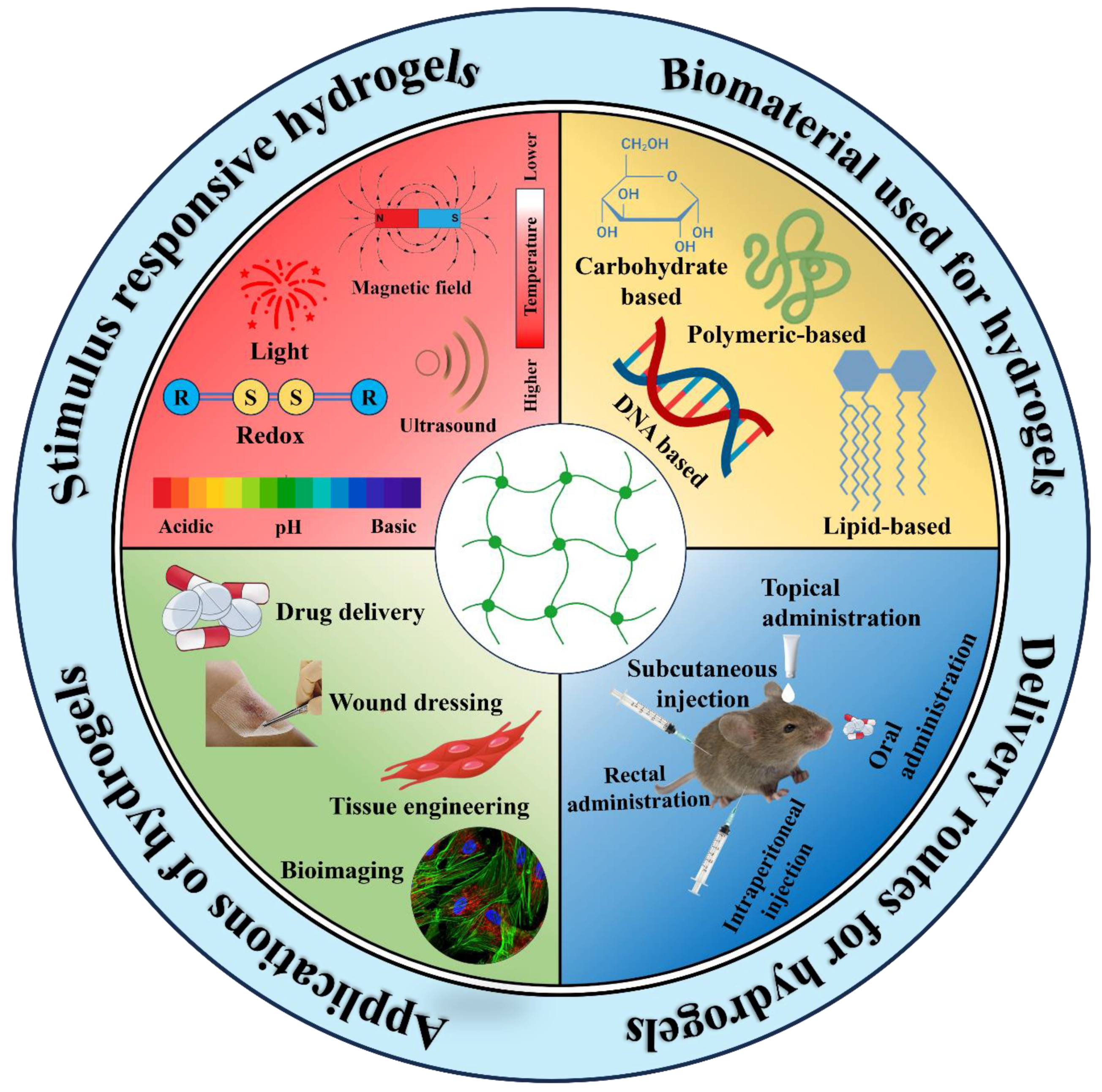
Figure 2.
Schematic representation of tumor microenvironment (TME).
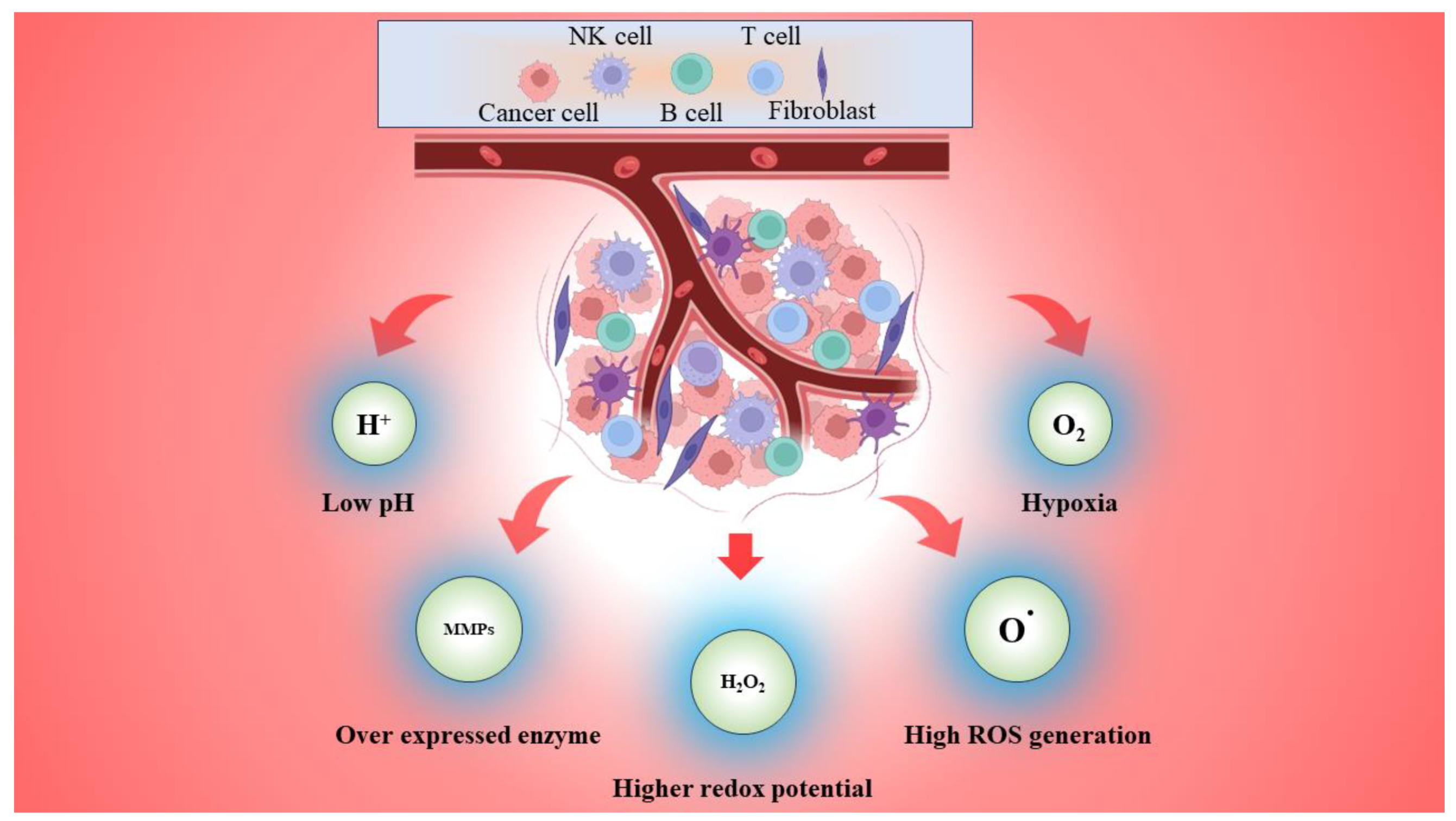
Figure 3.
Stimuli responsive release of anticancer agents from hydrogels (A) and classification of hydrogels based on Sources, crosslinking, preparation, ion charge, size and structure (B).
Figure 3.
Stimuli responsive release of anticancer agents from hydrogels (A) and classification of hydrogels based on Sources, crosslinking, preparation, ion charge, size and structure (B).
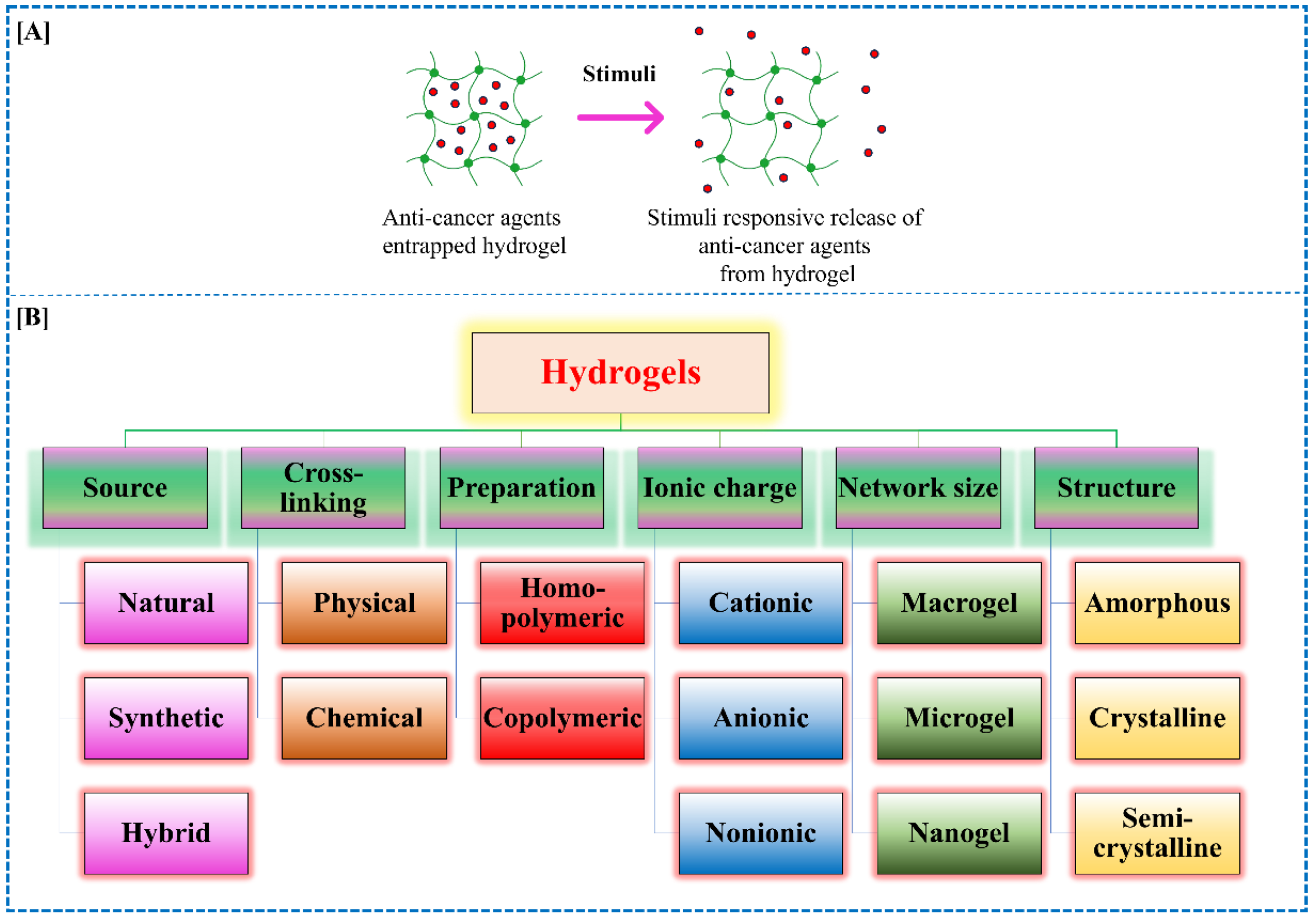
Figure 4.
Different stimulus responsive hydrogels for drug delivery.
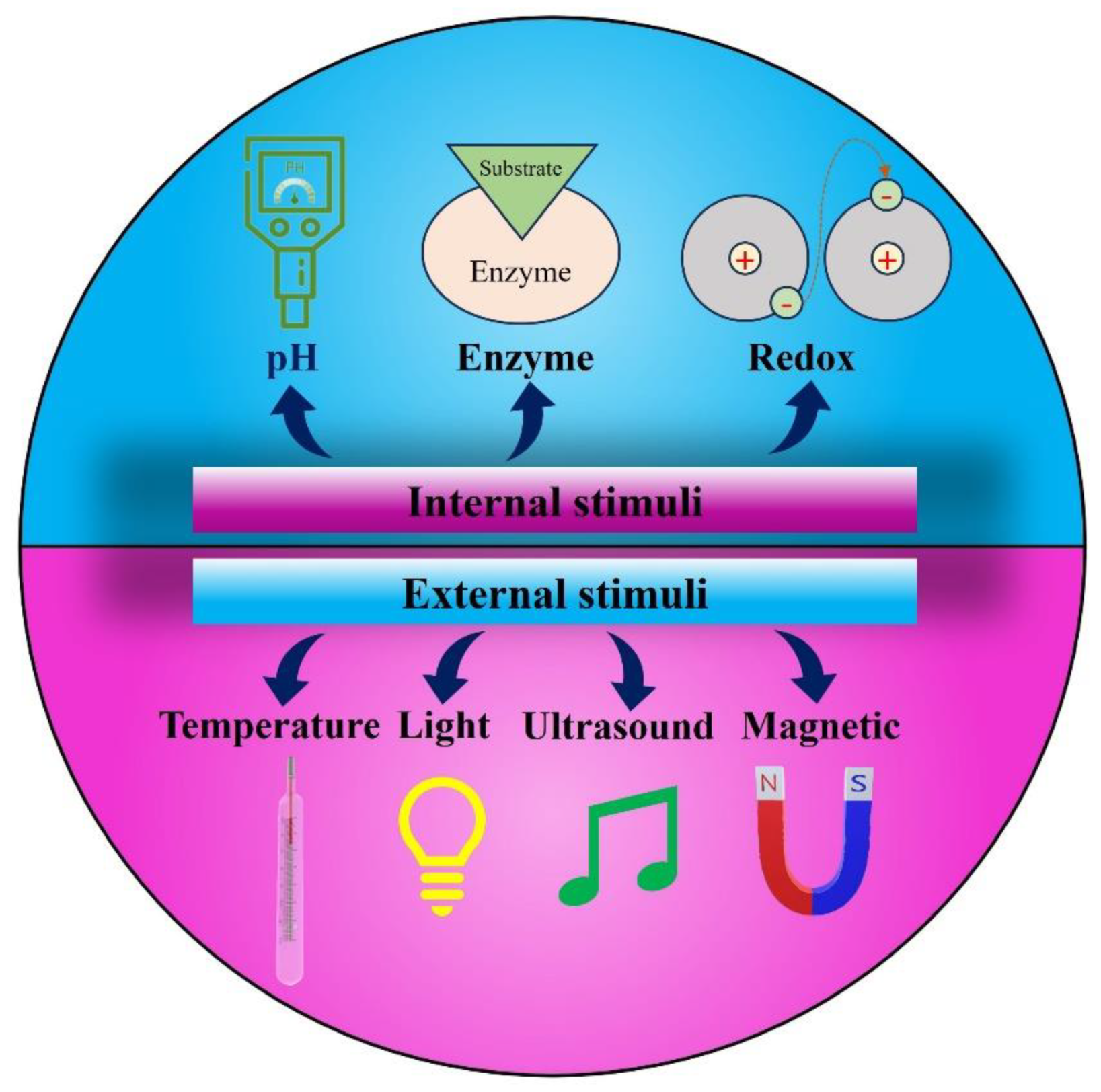
Figure 5.
Illustration of hydrogel preparation (A). Demonstration of the pH-induced phase transitions of the hydrogel (B), In vivo studies after treatment with free Dox and Hydrogel-Dox (C). tumor volume changes, body weight alterations in tumor-bearing mice, and representative tumor images after twenty days. Figures are reprinted from [33] with permission, Copyright © 2015, American Chemical Society.
Figure 5.
Illustration of hydrogel preparation (A). Demonstration of the pH-induced phase transitions of the hydrogel (B), In vivo studies after treatment with free Dox and Hydrogel-Dox (C). tumor volume changes, body weight alterations in tumor-bearing mice, and representative tumor images after twenty days. Figures are reprinted from [33] with permission, Copyright © 2015, American Chemical Society.
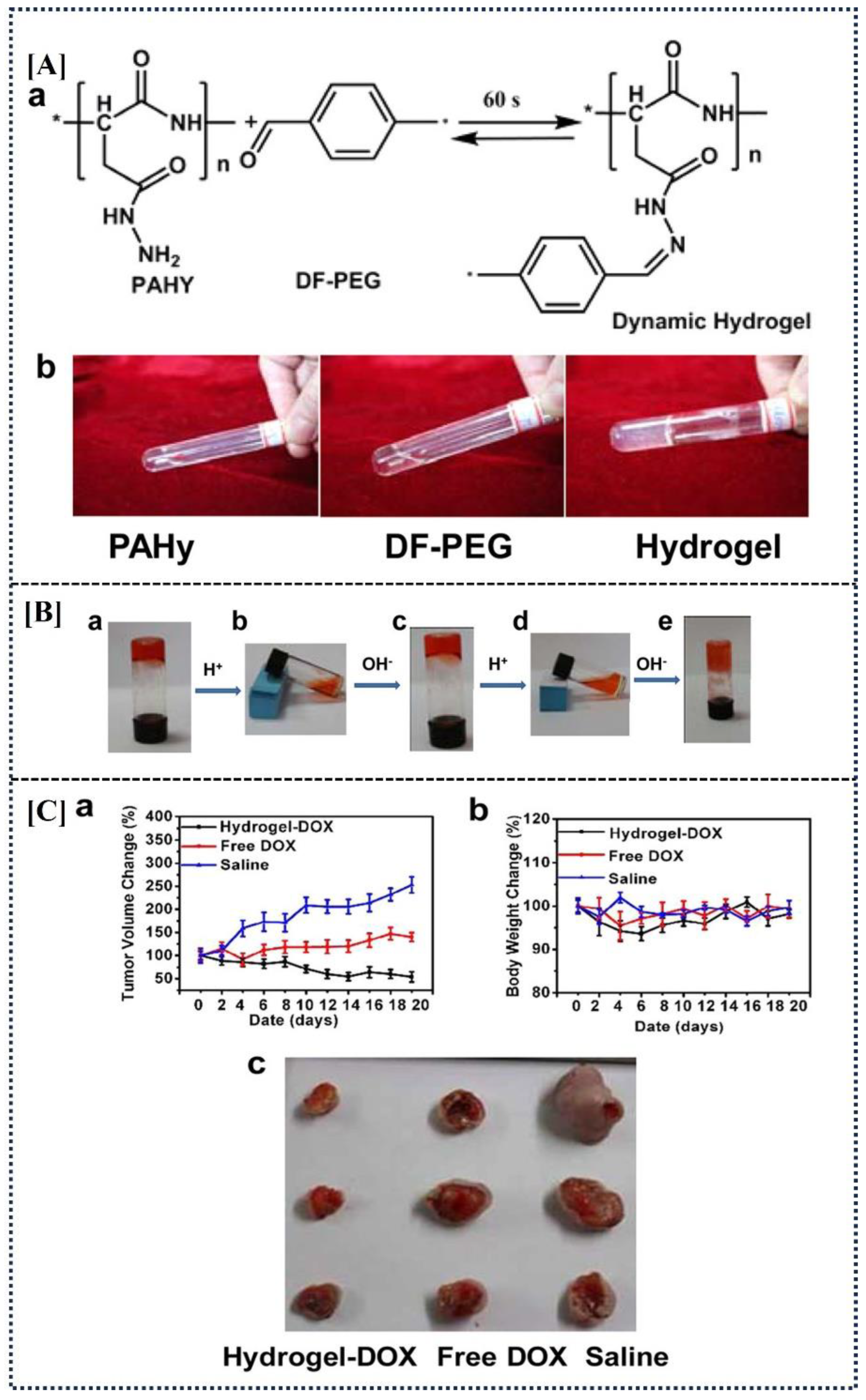
Figure 6.
In vivo antitumor efficacy of Herceptin loaded hydrogel. Illustration depicting the development of a HER2+ breast tumour relapse nude mice model (A). Tumour volume changes (B) and Ex vivo tumour weight (C) on day 28 after treatment. Digital images of tumours(D), and Body weights of mice following various treatments (E). Figures are reprinted from [104] with permission, Copyright ©2024 Ivyspring International Publisher).
Figure 6.
In vivo antitumor efficacy of Herceptin loaded hydrogel. Illustration depicting the development of a HER2+ breast tumour relapse nude mice model (A). Tumour volume changes (B) and Ex vivo tumour weight (C) on day 28 after treatment. Digital images of tumours(D), and Body weights of mice following various treatments (E). Figures are reprinted from [104] with permission, Copyright ©2024 Ivyspring International Publisher).
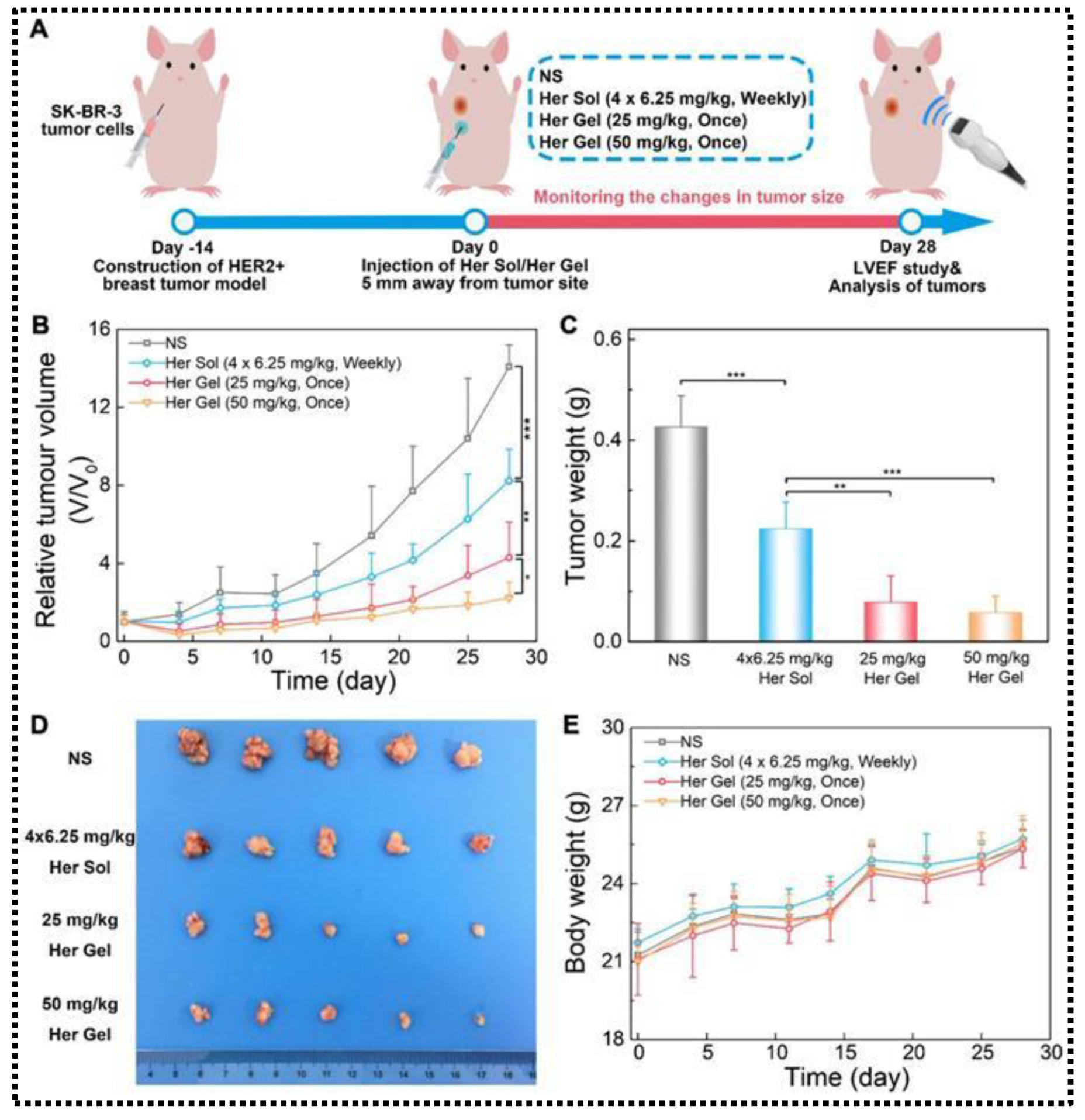
Figure 7.
Schematic diagram of the mechanism of action of the prepared light responsive hydrogel (A) and it’s in vivo anticancer activity. Figures are reprinted from [124] with permission, Copyright © 2018 American Chemical Society).
Figure 7.
Schematic diagram of the mechanism of action of the prepared light responsive hydrogel (A) and it’s in vivo anticancer activity. Figures are reprinted from [124] with permission, Copyright © 2018 American Chemical Society).
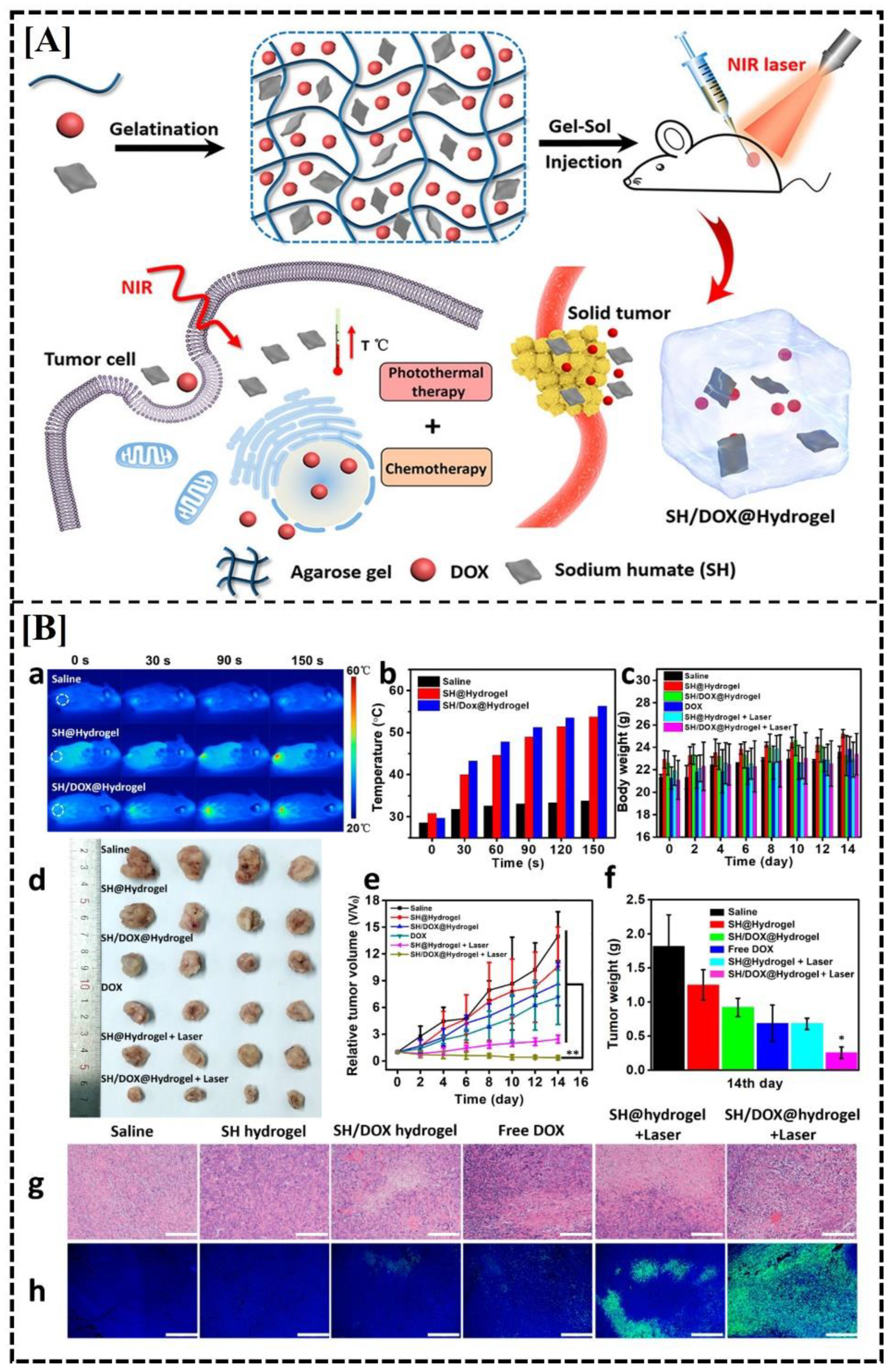
Figure 8.
Multi-responsive Silk fibroin-based hydrogel Schematic representation of synthesis, action of mechanism and In vivo antitumor efficacy. Figures reprinted from [148] with permission, Copyright © American Chemical Society.
Figure 8.
Multi-responsive Silk fibroin-based hydrogel Schematic representation of synthesis, action of mechanism and In vivo antitumor efficacy. Figures reprinted from [148] with permission, Copyright © American Chemical Society.
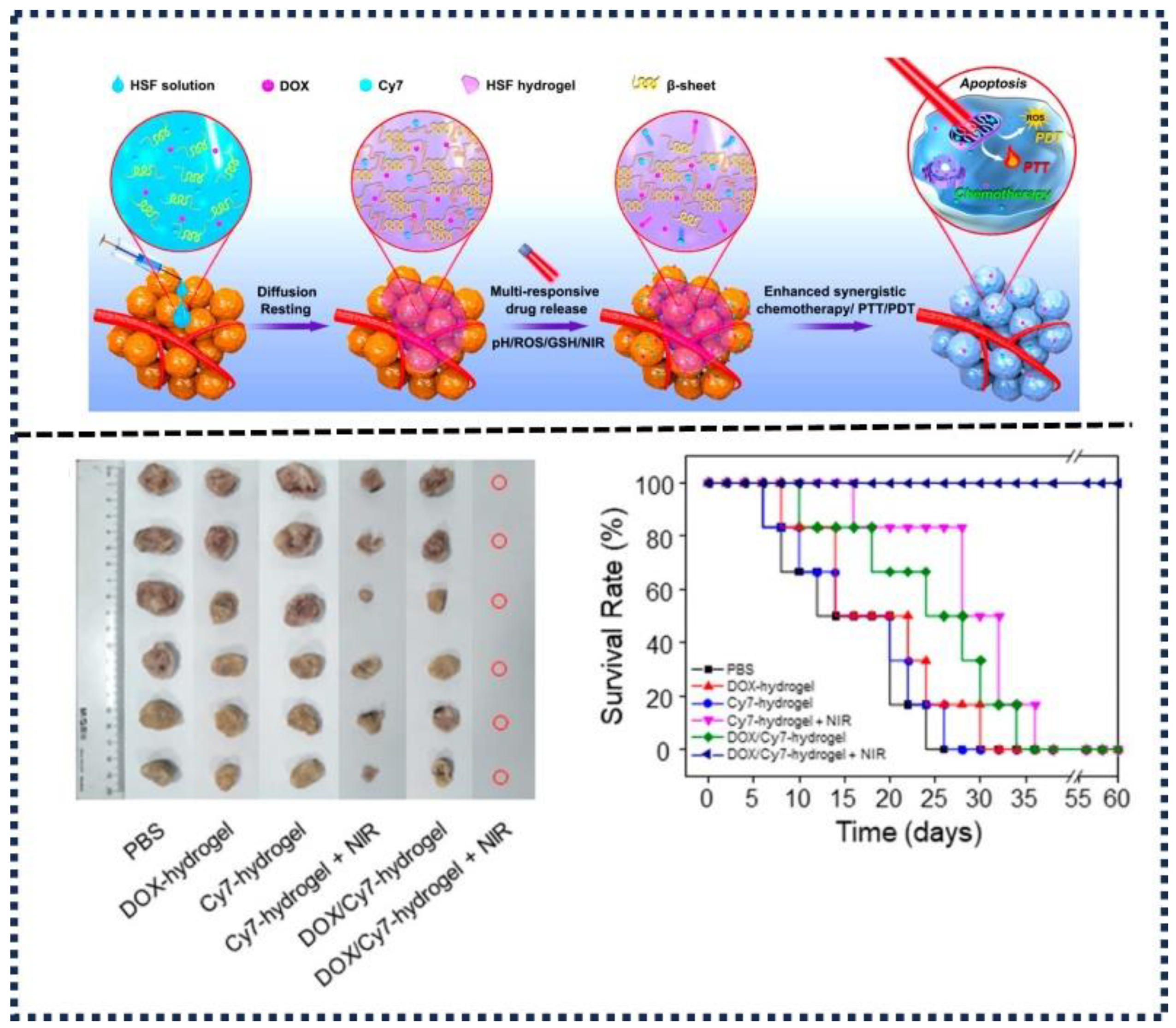
Disclaimer/Publisher’s Note: The statements, opinions and data contained in all publications are solely those of the individual author(s) and contributor(s) and not of MDPI and/or the editor(s). MDPI and/or the editor(s) disclaim responsibility for any injury to people or property resulting from any ideas, methods, instructions or products referred to in the content. |
© 2024 by the authors. Licensee MDPI, Basel, Switzerland. This article is an open access article distributed under the terms and conditions of the Creative Commons Attribution (CC BY) license (http://creativecommons.org/licenses/by/4.0/).
Copyright: This open access article is published under a Creative Commons CC BY 4.0 license, which permit the free download, distribution, and reuse, provided that the author and preprint are cited in any reuse.


