

Submitted:
09 June 2024
Posted:
11 June 2024
You are already at the latest version
Abstract
This review article provides useful information on TiO2 and ZnO photocatalysts and their derivatives in removing organic contaminants such as different types of dyes, hydrocarbons, pesticides, etc. Also, the reaction mechanism of TiO2 and ZnO photocatalysts and their derivatives was investigated. In addition, the impact of adding metallic (e.g., Ag, Co, Pt, Pd, Cu, Au, Ni) and non-metallic (e.g., C, N, O, S) dopants to their structure on the photodegradation efficiency of organic compounds was thoroughly studied. Moreover, advantages and disadvantages of various synthesis procedures of ZnO and TiO2 nanocatalysts were discussed and compared. Furthermore, the impact of photocatalyst dosage, photocatalyst structure, contaminant concentration, pH, light intensity and wavelength, temperature and reaction time on the photodegradation efficiency was studied. According to previous studies, adding metallic and non-metallic dopants to the TiO2 and ZnO structure led to a remarkable enhance in their stability and reusability. Besides, doped TiO2 and ZnO demonstrated remarkable photocatalytic efficiencies in eliminating various types of organic contaminants.
Keywords:
Zinc oxide
; Titanium dioxide
; Photocatalysis
; Dopants
; Organic contaminants
; Wastewater
1. Introduction
Water scarcity has recently become a major problem owing to global warming, rapid industrial growth, depletion of water resources, environmental pollution, and uncontrolled development of groundwater [1,2]. The rapid industrial growth after the Industrial Revolution has remarkably increased living standard, but threatens human health [3]. Because of the development and growth of industries, industrial effluents are becoming more polluted and difficult to treat. The release of organic compounds and chemical fertilizers from various industries has polluted river water and has become increasingly a global pollution [4]. Moreover, complete removal of non-biodegradable organic contaminants is tough using biological treatment technologies [5]. Biological processes are safe, economical, and reliable, but the removal percentage of suspended solids is low, so they need better operation management [6]. The coagulation and precipitation techniques can suspend solid particles with formation of flocs after adding polymeric coagulant and/or inorganic coagulant (such as Al, Fe, etc.). Coagulants bind solids together to form larger particles (flocs), then the flocs settle and separate from the effluent. This method has a high purification performance, but utilizing chemicals and generating biological sludge cause blockage of pipes and water deterioration, thus limit the use of this process [7,8]. In the Fenton oxidation process, organic compounds are broken down using a strong oxidizer reagent. OH radicals can be produced by oxidizer reagents through a reaction between H2O2 and iron salts. This process is easy to apply and additional equipment is not utilized excessively in comparison to other oxidation processes or photo-oxidation process. However, this process has some drawbacks such as sludge production and high operating costs for secondary process [9,10].
An advanced water treatment process can purify water at a high rate and effectively eliminate pollutants [11]. Advanced Oxidation Technology utilizes various techniques for enhancement of oxidation power. For efficient water refinement, various contaminants must be removed economically [12]. Generally, various active species can play a key role in the photocatalytic reaction, including superoxide radicals (O2•−), holes (h+), and hydroxyl radicals (•OH) [13]. Advanced technology using TiO2 and ZnO photocatalysts has attracted the most attention for producing OH• using optical energy without additional chemicals. Also, the operating cost of this technique may be significantly decreased by solar energy. The low photocatalytic performance of ZnO and TiO2 may limit the practical application of advanced technology to treat wastewater [14]. Numerous studies have been done on modifying their surface by metal and non-metal dopants for their possible practical utilization [15].
Various analyzes characterize the structure of ZnO and TiO2 nanocatalysts, including XRD for determining crystal phases and crystal size, AFM for determining refractive index profiles, FTIR for specifying the functional groups, and EDX for determining the constituents. All these features are critical in the photocatalytic reaction. Also, SEM and TEM analyses are used to characterize the morphology and appearance structure of a catalyst [16,17]. Figure 1 demonstrates SEM and TEM photos of ZnO and TiO2 nanocatalysts. As shown, ZnO and TiO2 have various morphologies, shapes and sizes.
TiO2 and ZnO photocatalysts are extensively utilized for photodegradation of contaminants under UV light or sunlight. However, owing to their band gap range, they have limitations for the photodegradation of pollutants. For doing so, TiO2 and ZnO photocatalysts can be combined with other compounds to synthesize an efficient photocatalyst, some of which include La/TiO2 [20], CuO/WO3/TiO2 [21], Fe3O4/TiO2 [22], carbon-doped TiO2 [23], N,P-codoped carbon quantum dots/TiO2 [24], Fe3O4/CuO/ZnO/graphene [25], rGO/Fe3O4/ZnO [26], tungsten/silver/ZnO [27], Pb/ZnO, Cd/ZnO, Ag/ZnO [28], and Bi(12)ZnO(20) [29].
The paper focuses on comparing the photocatalytic capability of TiO2 and ZnO and their composites in the degradation of organic compounds in wastewater. Also, the advantages, disadvantages, and structural features of these photocatalysts were thoroughly investigated. Moreover, the photodegradation mechanism of contaminants using TiO2 and ZnO as well as metals-doped and non-metals doped TiO2 and ZnO were completely discussed. Furthermore, the photodegradation efficiency of different contaminants using these photocatalysts and their derivatives (metallic- and non-metallic- dopants in their structure) were compared. One of the main features of catalysts is their stability in the photocatalytic reaction, so the recyclability of TiO2 and ZnO and their composites was fully studied.
2. Organic Pollutants
Municipal sewage pollutants are mainly organic matter and a variety of pathogenic microorganisms and so on with complex structures such as drugs, antioxidants, polycyclic aromatic hydrocarbons, pharmaceutical intermediates, food additives, PPCPs, steroids, and phenolic compounds [30]. Also, pollutants in industrial wastewaters include gas condensates [5], petroleum products, non-chlorinated compounds, petroleum hydrocarbons, trinitrotoluene, and polycyclic aromatic hydrocarbon [31]. The presence of hydrocarbon compounds in wastewater causes many problems for human health. Discharge of these wastewaters to sea must be performed under certain conditions. The highest permissible concentration of hydrocarbon compounds for discharge into the sea should be 40 ppm, and TDS less than 32000 ppm [32].
Another kind of contaminants in wastewater is volatile organic compounds (VOCs), which have destructive effects on human health. Volatile organic contaminants are categorized into 3 groups, including semi volatile organic compounds (SVOCs), volatile organic compounds (VOCs), and very volatile organic compounds (VVOCs). Propane and butane are some VVOCs, which are poisonous compounds in very low concentrations. VOCs are also toxic compounds found in household products and environment, including isopropyl alcohol, acetone, formaldehyde, toluene, vinyl chloride, and hexanal. Molecular weight and boiling point of SVOCs are higher than VOCs and can evaporate at room temperature. Pesticides such as chlordane and plasticizers such as phthalates are some of the SVOCs [33]. The utmost allowable limit of organic compounds for drainage into the river for utilization in agricultural irrigation should be less than 200 ppm [34].
The main source of VOCs includes incomplete burning of fossil fuels, solvents used in inks and paints (e.g., acetone, ethyl acetate, and glycol ether), utilizing biofuels (e.g., cooking oil and bioethanol), biomass combustion, especially from agricultural residuals, and VOCs released from metal working fluids [33]. The presence of these contaminants in sewages results in various problems for the environment.
Also, tetracycline, sulfamethoxazole, cefixime, amoxicillin, gentamicin, erythromycin, and ciprofloxacin are kinds of antibiotics that are present in hospital effluents. The presence of antibiotics in effluents in low and high concentrations is dangerous and causes serious damage to human health. According to reports, the concentration of antibiotics in surface and groundwater reaches 100 micrograms per liter. Also, the concentration of amoxicillin in raw effluent and urban wastewater treatment is 171 mg/L and 13 ng/L, respectively [35]. The acceptable standard of WHO for antibiotics in wastewater is 1 mg/L [36]. Therefore, their concentrations in wastewater should be attenuated.
Dyes are another kind of organic compounds, which are utilized in many industries like food, plastics, paper, cosmetics and textile. Among these, the most abundant dyes are related to the textile industry, which these dyes can enter the wastewater [37]. More than 7×10⁵ tons of dyes are produced annually, 10–15% of which enters the sewage during the dyeing process. Water pollution by dyes results in many environmental problems. The highest allowable limit of dyes in industrial discharge is in the range 0.01 to 0.05 mg/L. Different groups of dyes are considered carcinogens or mutants. Dyes can prevent sunlight from entering the water, and disrupting biological process in the water. Most dyes are poisonous to organisms and have adverse impacts on their aquatic life, and entire ecosystem. The presence of dye in water causes reproductive dysfunction, kidney damage, carcinogenesis and mutagenicity. Basic dyes are cationic dyes and most of them are crystalline compounds, which can be derived from positively charged sulfur or nitrogen atoms. Under visible and UV light irradiation, dyes have high stability and insensitivity, and do not degrade without photocatalyst [38,39,40]. Cationic, anionic and non-ionic are 3 important categories of dyes, among which, the toxicity of cationic dyes is more than the other two. There are various types of dyes in sewage including crystal violet, Congo Red (CR), methyl orange (MO), reactive orange, reactive black, reactive red, methylene blue (MB), methyl violet, brilliant cresyl blue and Safranin-T that may be generated by plastic, leather, food dye, printing, paper, and textile industries [41,42]. Figure 2 illustrates different categories of organic compounds with some examples.
3. TiO2 Photocatalyst
TiO2 is a non-toxic and insoluble substance in water. TiO2 has high stability with a high catalytic performance. Another name of TiO2 is Titania, which can be available in 3 forms such as anatase, brookite, and rutile [43,44]. The rutile (tetragonal) crystalline structure of TiO2 is quite stable in particles greater than 35 nm [45]. TiO2 in anatase and rutile structures have oxidation strengths of 3-3.2 eV, respectively, which are very strong oxidation strengths [14]. One of the most important applications of TiO2 is its utilization in the photocatalytic process. To this end, UV light, halogen lamp or solar irradiation can help accelerate the photocatalytic reaction in the presence of TiO2 nanocatalyst [46]. The photocatalyst has two important properties. For instance, the photocatalyst should not be consumed or participate directly in the reaction. Also, the photocatalyst provides other mechanism pathways. Photocatalytic reaction is based on the absorption of solar energy in the semiconductor gap. Few semiconductors can be utilized as the catalyst in the photocatalysis process, of which, TiO2 is the most extensively utilized [44]. The various morphologies of TiO2 consist of zero, one, two and three-dimensional structures. By optimization of the shape and size, the photocatalytic activity of TiO2 particles in the wastewater treatment process can be maximized [47].
TiO2 can be synthesized easily by various physical, chemical, and thermal procedures such as chemical or physical vapor deposition, sol-gel, inverse micelle, solvothermal, hydrothermal, sonochemical, microwave, and electrodeposition process [48]. Synthesizing metal-doped semiconductor oxides by conventional physical mixing or chemical deposition usually obtains insoluble materials that are inherently difficult to control the morphology, size, and dispersing metal components. These methods need long time and multi-stage processes. Sonochemistry procedure is an efficient process for preparing mesoporous materials. Ultrasound is very useful to synthesize an extensive range of nanostructured materials, which include high-specific surface area oxides, alloys, carbides, and transition metals [15]. Neppolian et al. synthesized TiO2 nanophotocatalysts by a combination of ultrasonic and sol–gel processes. They investigated the impact of various factors on the synthesis method, including magnetic stirring, ultrasonic sources (e.g., bath and horn), ultrasonic time, power density, temperature, and reactor size [49]. Table 1 indicates the advantages and disadvantages of various processes for TiO2 synthesis. As shown, the production of high-quality crystals as well as easy control of crystals in TiO2 can be achieved by hydrothermal process. Also, the fabrication of TiO2 with sol-gel process has several benefits such as high purity products, good size distribution, remarkable specific surface area, economical, uniform size of particles, fine particle size, and simple synthesis. Between these processes, utilizing the microwave method has significant benefits such as short reaction time, high reaction rate and high efficiency.
3.1. Features and Reaction Mechanism of TiO2 Photocatalyst
Utilization of TiO2 as a photocatalyst for elimination of contaminants from wastewater has several benefits, which include: 1) the process is done at room temperature and 1 atm, 2) complete decontamination without secondary contamination, 3) producing high surface area and high catalytic activity, and 4) using the photocatalyst in multiple cycles and decreasing the costs [52]. The decomposition process of contaminants is mainly an oxidative reaction, which depends on the features of the photocatalyst. TiO2 is also low-cost, suitable band gap energy, long-term stability against light, and safe. Generally, the band distance and wavelength of TiO2 are between 3-3.2 eV, and 400 nm, respectively, indicating that UV light at a wavelengths less than 400 nm leads to an inverse reaction. Also, UV irradiation at a wavelength less than 400 nm initiates a photoreaction. Unfavorable recombination of holes (h+) and electrons (e-), and low yield in the visible region under irradiation are 2 important disadvantages of TiO2 [15]. The catalytic activity of TiO2 photocatalyst can be enhanced under UV irradiation, because TiO2 uses only 5% of the solar energy [53].
At UV light<400 nm, the surface of TiO2 may reach temperatures above 30000oC, which this temperature can oxidize all substances. Hence, all organic compounds are completely decomposed into CO2 and water. Figure 3(a) illustrate a schematic of degradation of contaminants by forming photo-induced charge carriers electron/hole (e-/h+) on the TiO2 surface. Also, Figure 3(b) shows that the catalyst surface is surrounded by the contaminant molecules. On the TiO2 surface, oxygen molecules react with electrons to produce oxygen radicals. Also, water molecules react with h+ for generating hydroxide radicals and H+ ions. The final products will be CO2 and H2O [14]. In other words, electrons introduced into the conduction band from valence band can be easily transferred to the catalyst surface and are trapped by doping with noble metals, intermediate metals, and rare earth elements. Metal-doped cations increase the ability of radicals produced in the photocatalysis reaction and then decrease the recombination life of e-/h+ [54].
By irradiating UV light to the TiO2 surface, the photo-induced electrons react with dissolved oxygen for producing O2•. The photoinduced h+ in the valence band penetrate to the surface of the TiO2 photocatalyst and react with the absorbed water molecules to form OH•. OH• is a highly active species in the photocatalytic process. The reaction mechanism of TiO2 and the electron–hole pair is defined as follows. As shown, TiO2 reacts with hv to produce e- and h+. Next, e- and h+ can produce two important radicals such as OH• and O2•, which have important role in the photocatalytic reaction [14,54].
where, R is the adsorbed pollutant [55].
Also, TiO2 is photochemically stable and non-toxic. Under irradiation, the charge-pair on TiO2 reacts directly with solid lattice ions. Also, TiO2 is resistant to various acidic and alkaline pHs. TiO2 can be utilized in the photocatalytic treatment of the environment. Hence, TiO2 can be used as a promising photocatalyst to degrade organic contaminants. Nevertheless, TiO2 particles are inactive in visible light. To solve this problem, numerous studies have been performed on the synthesis of various composites of TiO2 with metals and non-metals (e.g., ceramics, zeolites, carbon materials, fibers and glasses) as a support in order to have photocatalytic activity in a wide range of visible light [14].
The recombination behavior of e-/h+ decrease with decreasing the size of TiO2 NPs, which can be because of the increase in interfacial charge transfer at TiO2 surfaces. Also, the photocatalytic activity of TiO2 of less than a few nanometers decreases because of the predominant recombination of electron/hole at the TiO2 surface. According to the reports, TiO2 nanotubes are more effective in degrading contaminants than TiO2 particles, indicating the rapid mass transfer of contaminants on the surface of nanotubes [45].
3.2. Improved Photocatalytic Activity of TiO2 Using Metallic and Non-Metallic Dopants
As mentioned earlier, TiO2 photocatalyst can decompose organic contaminants under UV irradiation. Researchers have tried to improve the optical sorption range of TiO2 catalysts from ultraviolet irradiation to visible light to boost its photocatalytic activity. Therefore, for improving the photocatalytic activity of TiO2 in visible lights, its surface should be modified [56]. The catalytic activity of TiO2 can be improved by placing suitable materials on the surface of TiO2 for its application under visible irradiation [53,57,58]. Metallic particles such as Pd, Pt, Fe, Ru, Au, and Ag can be utilized on the TiO2 surface to improve the photocatalytic activity by suppressing recombination behaviors of e-/h+. The induced electrons migrate to the surface of metal particles, stabilizing the photo-induced h+ on TiO2 as the life time of the charge carrier increases. To this end, more superoxide (O2•) and OH• radicals can be produced. As the crystallographic aspects of TiO2 increase, the photocatalytic activity of TiO2 also produces more OH•, which can contribute to the photodegradation of organic pollutants. Also, the element O in the lattice of TiO2 may be replaced by various heteroatoms such as B, S, F, N, P, and common doping B-C and N-S to perform a photocatalytic reaction in the presence of visible light. Besides, metals and non-metals introduced to the TiO2 structure can improve its catalytic activity for the decomposition of organic pollutants [14,59]. Also, modifying the surface of TiO2 improves the uptake capacity of contaminants, which can be useful in advanced oxidation technology. The modified TiO2 with nanotubes, foams, and mesoporous phases has shown better photocatalytic behavior compared to unmodified TiO2 [60].
TiO2 photocatalyst on a nanoscale has a great surface area/volume proportion, leading to increased charge separation and ions trapping at the TiO2 surface. TiO2 nanoparticles show enhanced oxidative power compared to TiO2 microparticles. However, TiO2 nanocatalyst can not be employed directly to wastewater treatment owing to the aggregation of particles during the degradation process as well as their physical and chemical features. To this end, the catalytic activity of TiO2 NPs can be improved by incorporating TiO2 onto carbon materials for composite synthesis such as graphene, carbon nanotubes, and activated carbon nanofiber. Carbon materials can be excellent supports for TiO2 NPs owing to their unique features like excellent mechanical, thermal, chemical, electrical, and optical properties, which lead to rapid charge transfer on the surface of TiO2/carbon nanocomposites [61]. TiO2/carbon nanocomposites are suitable catalysts for the elimination of organic contaminants from effluents. Graphene NPs act as a bridge for excellent electron transfer and electron sinks. TiO2/graphene nanocomposites have an extensive range of band gap (2.66–3.18 eV), suggesting that long-wavelength lights in the visible region can be absorbed by the TiO2/carbon nanocomposite. One of the most benefits of carbon nanomaterials is their high specific surface area, in which TiO2 NPs may be distributed in their structure, leading to improved selectivity of organic contaminants. TiO2/carbon nanocomposite has a good impact on self-purification in comparison to UV irradiation and ozonation when used for wastewater treatment. These nanocomposites can be effective industrially for wastewater purification because carbon NPs are employed as a support to stabilize the composite structure [62].
The photocatalytic activity of TiO2 can be enhanced by enhancing the interfacial charge-transfer and reducing the recombination of e-/h+. To this end, various metals can be used to improve the photocatalytic activity of TiO2, including Ag, boron (B), Si, Ni, and so on under UV light or sun light irradiation. Generally, there are several ways for improving the photocatalytic activity of TiO2, including enhancing the ratio of surface/volume, integrating TiO2 with other semiconductors, optimizing its particle size, and doping metals or non-metals. The presence of metal dopants in the TiO2 structure remarkably affects the photo-reactivity because by shifting the catalyst band gap to the visible region, it changes the interfacial electron transfer rate and the charge-carrying recombination rate [63]. A dopant ion can trap e- or h+, leading to longer lifespan of the produced charge carriers and increased photocatalytic activity. Figure 4 indicates various dopants used in the TiO2 structure. As shown, transition metals, anionic compounds, metal oxides and transition metal ceramics are the main dopants for improving the TiO2 surface. Fe, Al, Zr, Co, Cu, and Ni are several types of transition metals. Also, Fe2O3, Cr2O3, and SiO2 are the most important metal oxides. Moreover, WO3, SnO2, and MoO3 are the most important transition metal ceramics. Eventually, C, N, F, O, and S are non-metallic dopants. The addition of transition metals to the TiO2 surface can enhance its catalytic activity and decline the recombination of photogenerated e- and h+ [15]. The photodegradation mechanism of contaminants using metals- and non-metals- doped TiO2 is also illustrated in Figure 5 [64,65]. As shown, the presence of metals and non-metals on the TiO2 surface can help improve its photocatalytic activity by producing more oxygen radicals. These oxygen radicals play a key role in photodegradation of organic contaminants.
Numerous studies have been performed on the expansion of the solar absorption band by combining TiO2 with new metals, intermediates and anions, which maximizes the performance of the photocatalyst [45]. Table 2 presents the influence of various metal dopants on the photocatalytic activity of TiO2. Accordingly, Wang et al. (2019) synthesized 5% Pd-doped TiO2 photocatalyst to degrade 2,2',4,4'-tetrabromodiphenyl ether from water under UV lamp and showed 100% photodegradation efficiency, which is a remarkable amount [70]. Also, Sescu et al. (2020) synthesized Au/TiO2 photocatalyst using two different procedures such as incipient wet impregnation (IWI) and ultrasound impregnation (UI). Then, Au/TiO2 (IWI) and Au/TiO2 (UI) were used for degradation of 2,4 dinitrophenol under UV irradiation. According to their outcomes, the photodegradation efficiency of 2,4 dinitrophenol using Au/TiO2 (IWI) and Au/TiO2 (UI) were 50 and 37%, respectively, which were less than the photodegradation efficiency of pure TiO2 (60%). Comparing these two methods displays that the IWI procedure is more efficient than the UI procedure. Therefore, they used the IWI procedure to synthesize Pd/TiO2 for degradation of 2,4 dinitrophenol and Rhodamine 6G contaminants under UV irradiation. The photodegradation efficiency of 2,4 dinitrophenol and Rhodamine 6G using Pd/TiO2 photocatalyst was 67% and 96%, respectively, indicating that the Pd/TiO2 photocatalyst is able to remove Rhodamine 6G dye with a significant efficiency [72]. In another work, Yadav et al. (2020) utilized B-doped TiO2 nanophotocatalyst for 4-nitrophenol removal from water. The utmost photodegradation efficiency using TiO2 and B-doped TiO2 was obtained 79 and 90%, respectively, indicating that the photodegradation efficiency of TiO2 enhanced with its doping by boron [71]. In general, previous studies show that most photocatalytic processes are performed under UV light. Also, Ag and Pd dopants showed greater potential for photodegradation of organic contaminants than other dopants.
4. ZnO nano-photocatalyst
ZnO nanocatalyst is one of the most efficient catalysts in the degradation of organic contaminants due to its unique features like excellent oxidation ability, direct and extensive band gap in the spectral region close to UV, high photocatalytic activity, and high binding energy. UV light can be absorbed on ZnO at a wavelength lower than 385 nm [73]. Rock salt, wurtzite and cubic structure are important crystalline structures of ZnO. Among the 3 structures, the wurtzite structure of ZnO is the most common structure and has the utmost stability. Also, ZnO in the form of rock salt is wholly rare. At room temperature and pressure, the crystalline structure of ZnO is a hexagonal wurtzite. Moreover, ZnO can crystallize in the structure of wurtzite. The ZnO wurtzite structure is the most common form of ZnO due to its stability in environmental conditions [74]. Different structures of ZnO are exhibited in Figure 6. In the ZnO wurtzite structure, each Zn atom is surrounded by four O atoms. ZnO has many benefits compared to TiO2, including low-cost, chemical stability, no toxicity, and abundance [75]. Other properties of ZnO include insoluble in water, odorless, and bitter taste. ZnO can be used in catalysis processes, fertilizers, rubber industry, paint industry, and cosmetics. The development of nano-ZnO with precisely controllable properties has recently gained considerable scientific attention [76].
Different zinc salts can be utilized to fabricate ZnO, including Zn(C2H3O2)2.2H2O, Zn(SO4)2.7H2O, Zn(NO3)2·6H2O, and ZnCl2 [77]. ZnO nanoparticles and doped ZnO can be synthesized by various techniques, including pulsed-laser deposition, chemical coprecipitation, hydrothermal, thermal decomposition, sol-gel, liquid-solid solution, vapor condensation, microwave, and spray pyrolysis process [73,78]. Hydrothermal procedure is a well-known and efficient process for synthesizing ZnO nanoparticles, which is performed at high pressure and temperature [78]. Chemical coprecipitation is one of the most successful processes to synthesize ZnO nanoparticles with a fine particle size distribution. Chemical coprecipitation can prevent complex steps like alkoxide reflux and therefore takes less time than other methods [73]. Also, synthesizing ZnO nanoparticles by sol-gel and hydrothermal methods have several important advantages such as uniform particle distribution of particles and synthesis at low temperatures. However, microwave-based synthesis has attracted a lot of attention due to its advantages such as simpler, faster, and more energy efficient. The precursor solution is irradiated by the microwave source. Energy transfer via relaxation and/or resonance can lead to a relatively fast heating process. Also, heating process by the microwave source leads to uniform heating in a short time, which results in uniform distribution of particles [79].
4.1. Characterization of ZnO Nanocatalyst
ZnO nanocatalyst is a semiconductor with broad band-gap as well as high binding energy in environmental conditions. ZnO NPs have a better optical, electrical, and magnetic feature than ZnO microparticles. ZnO NPs also have unique physical, thermal, and chemical properties like biocompatibility, low cost, and non-toxic. ZnO is an environmentally friendly substance, which is well suited for a wide range of daily applications that pose no risk to human health. Also, ZnO NPs have longer shelf life compared to other metal oxides like Fe2O3, SiO2, WO3, and TiO2. Because of its exceptional features, ZnO nanocatalyst can be utilized as a valuable catalyst to treat wastewater [77]. Owing to the band gap energy (3.2 eV) similar to ZnO with TiO2, their photocatalytic capability is similar. Also, ZnO nanocatalyst is relatively cheaper than TiO2 nanocatalyst, the use of ZnO is more economical in the large-scale water purification process. ZnO can adsorb a broad range of solar spectra and more optical quantum than many semiconductor metal oxides. However, the main disadvantage of ZnO is its wide band gap energy, therefore, the absorption of light by ZnO is limited to the visible light range. This leads to rapid recombination of light-generated charges, resulting in low photocatalytic performance [80]. The addition of doping affects the optical features of ZnO and possibly shifts the amplitude of optical absorption to the visible region. Therefore, the photocatalytic activity of ZnO can be enhanced by doping it with other materials, which is described in detail in Section 4.3 [72].
4.2. Photocatalysis Mechanism of ZnO
In a desirable photocatalytic reaction in the presence of zinc oxide particles and active oxidizing species like oxygen, organic contaminants can be converted to H2O, CO2, and inorganic acids. Photocatalytic reaction begins when ZnO NPs absorb photons from light with energies greater than their band gap energy. Thus, the photo-induced electron rises from the valence band to the conduction band, creating h+ and e- on the ZnO surface [81]. The presence of O atom as an electron absorber lengthens the pair of recombinant electron cavities and the formation of superoxide radicals. The reaction between h+ and OH- results in the production of hydroxyl radicals. Figure 7(a) indicates the photocatalytic mechanism of anionic- and cationic doped ZnO catalyst and photodegradation mechanism of the contaminant on the ZnO surface under sun light is illustrated in Figure 7(b) [82]. The reaction mechanism of ZnO in the photocatalytic process has several steps, which are presented below [83]:
4.3. Improving the Photodegradation Efficiency of ZnO
The recombination of photo-produced h+ and e- is one of the main disadvantages of semiconductor photocatalysis. This recombination stage reduces quantum efficiency and wastes energy. Thus, the recombination process of e-/h+ must be inhibited to have an impressive photocatalysis process. Metal doping can counteract the recombination problem by increasing the isolation of charge between h+ and e-. Also, dopants can trap e- and reduce the chance of electron/hole recombination, which inactivates the photocatalytic process. Moreover, the production of active oxygen species and hydroxyl radicals significantly increases the charge separation efficiency. In general, the dopant concentration, operating conditions, and the synthesis procedure have significant impacts on the metal-doped semiconductor photocatalysis process [84].
Anion-doped zinc oxide photocatalyst has shown higher photocatalytic degradation efficiency than pure zinc oxide. The presence of isolated N2p modes above the utmost ZnO valence band in the Ne ZnO sample increases its ability to absorb visible light. Under visible light irradiation, narrow-band gaps in N- ZnO require lower energy to induce the charge carriers (e- and h+). Increased photocatalytic activity of C-doped zinc oxide can be owing to many reasons, including increased adsorption of contaminants on the surface of catalyst, higher UV uptake than pure ZnO, creating new energy levels under the ZnO conduction band, where photoexcited e- by these new energy levels are removed to avoid the electron hole from recombining. All these factors increase the number of charge carriers and improve the photodegradation performance. Also, the number of oxygen vacancies in ZnO have a key role in influencing the photo-activity of ZnO doped with S. In the photocatalytic reaction, oxygen vacancies become centers for trapping e-. Therefore, the more the oxygen vacancies there are, the greater the catalytic activity [85,86]. Figure 8 shows the mechanism of the pollutant degradation by metals and non-metals doped ZnO [87]. As shown in Figure 8(a), the metal doped on the ZnO surface contributes to generate e- and subsequently O2- radicals, resulting in better photodegradation of organic contaminants. The same role is played by non-metals doped with ZnO to generate O2- radicals followed by the photodegradation of pollutants (Figure 8(b)).
Despite the high photodegradation efficiency of ZnO, studies show that the doped ZnO has a significant photocatalytic efficiency compared to the undoped ZnO. ZnO surface modification using cationic dopants has attracted much attention. The chemical, electrical, magnetic, and structural features of ZnO can be adjusted by adding cationic dopants such as Ni, Mn, Co, Al, and Sb. The doped elements are usually iso-morphic to Zn ion, like Cu(II), Co(II), Ni(II), and Mn(II). The doped ZnO photocatalyst shows a faster response to degradation of organic contaminants than pure ZnO [88]. Table 3 reports the impact of different metallic dopants on the photocatalytic efficiency of ZnO. As shown, Adeel and coworkers (2021) studied the degradation process of MO using Co-doped ZnO. The photodegradation efficiency of ZnO and Co-doped ZnO were 46 and 93%, showing that the photodegradation efficiency of ZnO doubled after its doping with Co [89]. In another work, Vallejo et al. (2020a) compared the photodegradation efficiency of MB using ZnO and Ag-doped ZnO. Their results displayed photodegradation efficiencies of 2.7 and 45.1% for ZnO and Ag-doped ZnO, respectively, indicating a remarkable increment in photodegradation efficiency after ZnO doping with Ag. These photodegradation efficiencies were attained after 120 min visible irradiation [90]. Also, Vallejo et al. (2020b) synthesized Co-doped ZnO and Cu-doped ZnO photocatalysts and compared their photodegradation efficiencies with ZnO in MB removal under visible light after 140 min. Their findings demonstrated that the photodegradation efficiencies of ZnO, Co-doped ZnO and Cu-doped ZnO were 2.7, 62.6, and 42.5%, respectively [91]. Moreover, Cr-doped ZnO was able to decompose MO dye with excellent photodegradation efficiency of 99.8% under UV-vis light illumination after 100 min [92]. Among these works, Cr-doped ZnO showed the highest photodegradation efficiency (99.8%) for removing methyl orange after 100 min under UV light.
Table 4 also reports the impact of various non-metallic dopants on the ZnO photocatalytic activity for some organic contaminants. As shown, Wu and coworkers (2014) studied the photodegradation performance of MB using N-doped ZnO under visible light irradiation and compared its results with pure ZnO. Their outcomes indicated that the photodegradation efficiency of MN using pure ZnO and N-doped ZnO photocatalysts are 76.2 and 81.6%, respectively [97]. Also, Li and coworkers (2012) used pure ZnO and C-doped ZnO for photodegradation of MB under visible light. After 60 min, C-doped ZnO was able to decompose MB with the photodegradation efficiency of 98.1%, which is a significant amount compared to pure ZnO (54.3%) [99]. Moreover, the photodegradation efficiency of Bisphenol A using C-doped ZnO under UV irradiation was 100%, indicating high degradation efficiency [101]. Furthermore, Fu et al. (2012) studied the photocatalytic reaction of MB dye using C-doped ZnO under visible light and compared the photodegradation efficiency of ZnO and C-doped ZnO. The highest photodegradation efficiency of ZnO and C-doped ZnO was achieved 26 and 80% under optimal conditions such as 2.5% catalyst and 200 oC, which showed a significant increase in the photodegradation efficiency after ZnO doping with C [100]. In general, most studies have performed by N- and C-doped ZnO photocatalysts and both dopants showed significant photodegradation activity. Therefore, these studies demonstrate that utilizing C- and N-doped ZnO photocatalysts is more attractive to researchers than other dopants.
5. Factors Affecting Photodegradation Efficiency
5.1. Photocatalyst Dosage
Catalyst dosage or catalyst loading is a critical factor on the photocatalytic efficiency of organic contaminants. Increasing the catalyst dose leads to an enhancement in the specific surface area of the catalyst, the creation of more active sites, and ultimately the formation of more hydroxyl and superoxide radicals. Thus, degradation of organic contaminants will be facilitated and a higher photodegradation efficiency will be attained. The photodegradation efficiency initially enhances by enhancing the photocatalyst dosage until it reached an optimal value. At the photocatalyst concentration beyond the optimal concentration, the photodegradation efficiency decreases because of light scattering. Increasing the photocatalyst dosage beyond the optimal value leads to the agglomeration of catalyst particles and then decrease the specific surface area of the catalyst to absorb light, which ultimately leads to a reduction in the degradation efficiency. On the other hand, it prevents light from penetrating into the sewage. As a critical result, an optimal value of catalyst must be determined to prevent overuse of the catalyst and to achieve maximum degradation efficiency [40].
In one study, Zhang and co-workers (2015) studied the photodegradation efficiency of MB using TiO2 in the range of photocatalyst dosage from 1-10%. According to their outcomes, the maximum photodegradation efficiency of MB (93.78%) was attained at an optimal value of 7% [103]. Also, Notodarmojo et al. (2017) studied degradation efficiency of RB-5 dye from water and found that the degradation efficiency increases with increasing the TiO2 photocatalyst concentration from 0.5 to 2.5 g/L. Therefore, 2.5 g/L was considered as the optimum photocatalyst dosage [104]. Moreover, Saiful Amran and co-workers (2019) investigated the maximum degradation efficiency of MB using carbon-doped TiO2 in the photocatalyst dosage range of 1-3%. According to their outcomes, the highest photodegradation efficiency (82.67%) was obtained at 2 wt.% photocatalyst dosage [105]. Furthermore, Erdemoğlu et al. studied the influence of nano-TiO2 dosage (0.1-1 wt.%) on photodegradation of CR under visible light. The nanocatalyst could remove 94% of CR at the catalyst dosage of 0.25 wt.%. By enhancing catalyst dosage from 0.25 to 1 wt.%, the photodegradation efficiency decreased [106].
5.2. Photocatalyst Structure
Photocatalytic efficiency is effectively influenced by the photocatalytic structure. The synthesis of nanostructured photocatalysts has recently received much attention because of their unique structures and features. There are various morphologies for nanostructured photocatalysts, including nanoflowers, nanosheets, nanowires, nanorods, nanodumbbells, nanobelts, and nanospiral disks. Some structures of these photocatalysts are illustrated in Figure 9. Nanostructured photocatalysts have a high specific active area with great catalytic strength. A high surface/volume proportion presents a better physical and chemical feature. Each of these structures has shown various photocatalytic features [107,108].
5.3. Contaminant Concentration on Photodegradation Efficiency
Contaminant concentration has an important influence on the photocatalytic process. Previous studies show that the concentration of organic pollutant in aqueous solution has an undesirable impact on photodegradation efficiency. The higher the concentration of contaminants in the effluent, the lower the photodegradation efficiency, which is because the concentration of the target contaminant becomes more and more. Organic contaminants can be adsorbed on the photocatalyst surface. The number of contaminant molecules increases, while the number of active sites remains constant [113]. Hence, generating hydroxyl radicals are not enough and there will be only a few active sites on the photocatalyst surface to absorb hydroxyl ions. Consumption of hydroxyl radicals (OH.) by the produced intermediates decreases the photodegradation efficiency in solutions with high contaminant concentration. Therefore, the lower the pollutant concentration, the less competition there is for consumption [114,115]. Parida and Parija (2006) investigated the impact of phenol concentration on the degradation efficiency using ZnO in various irradiation strength. Under solar irradiation, the photodegradation yield decreased from 100% to 60% with enhancing the phenol dosage, while under ultraviolet light, the photodegradation efficiency reduced from 94% to 52% with enhancing the phenol concentration [116]. Also, Benhabiles et al. (2016) studied the influence of MB dye concentration (10-30 mg/L) on the photocatalytic process by commercial TiO2. After 5 h, 70% of MB dye was degraded by TiO2 at MB concentration of 10 mg/L, while at MB concentration of 30 mg/L, the catalyst was able to remove only 30% of MB [117]. Moreover, Shelar et al. (2020) surveyed the impact of MB dye concentration (10-40 mg/L) on photodegradation using Ag-doped ZnO. The photodegradation efficiency reduced from 95% to 65% with enhancing MB dosage from 10 to 40 mg/L, indicating that the highest photodegradation efficiency occurs at the lowest dosage of MB dye [118].
Generally, previous studies demonstrate that the highest photodegradation efficiency of contaminants occurs at the lowest contaminant concentration.
5.4. pH
Solution pH plays a vital role in the photocatalytic reaction of water purification. pH can change the surface charge of the photocatalyst [119]. Determination of optimal pH in the photodegradation process depends on the zero-point charge (pHzpc) of the photocatalyst. pH and the photodegradation rate do not have a specific relation. The TiO2 photocatalyst will be negatively charged, if pH> pHZPC. In this case, TiO− anion will be formed. Also, if pH<pHZPC, the TiO2 photocatalyst will be positively charged and form TiOH+2 cation. Depending on the catalyst used, the surface charge of the photocatalyst at 4.5<pHZPC<7 is neutral. When operating at pHzpc, the surface charge of TiO2 photocatalyst is positively charged and absorbs negatively charged molecules electrostatically over time. Industrial effluents may be discharged at different pHs, which complicates the photocatalytic reaction. Also, hydroxyl radicals are rapidly eliminated at high pHs, inhibiting their reaction with the contaminant [40,115]. There are many effective factors on pH in the photocatalytic reaction, including electrostatic charge of catalyst particles, band structure, and crystals size. Each of these factors can alter the photocatalyst surface charge and generally alter the photodegradation efficiency [115]. Generally, the optimal pH in photodegradation depends on the contaminant and the photocatalyst. For example, Hameed et al. (2009) studied the impact of pH on the photodegradation efficiency of carbofuran using TiO2/Ultraviolet and pH 7 was obtained as the optimal pH [120]. Also, Lopez-Alvarez et al. (2011) surveyed the impact of pH on the photodegradation efficiency of carbofuran using TiO2/solar light and their outcomes showed that pH 7.6 is the best pH [121]. Moreover, in the work done by Saien and Khezrianjoo (2008) for degradation of carbendazim using TiO2/Ultraviolet, the optimal pH was 4 [122]. Furthermore, Elmolla and Chaudhuri (2010) found the optimal pH of 11 for photodegradation of amoxicillin, ampicillin and claxocillin using ZnO/Ultraviolet [123]. In another work, the highest photodegradation efficiency of TiO2 for MB removal was attained at pH of 11 [117]. Also, Shelar et al. studied the impact of pH on photodegrading MB dye in the range of 2-12 and found that the utmost photodegradaion efficiency is obtained at pH 8 [118].
5.5. Light Intensity and Wavelength
Photodegradation efficiency depends on the absorption of light by a catalyst [124]. Light intensity specifies how much light can be adsorbed by a photocatalyst at a given wavelength. The higher the light intensity, the more radiation is deposited on the photocatalyst surface, leading to the production of more hydroxyl radicals and enhances the reaction rate. At higher light intensities, the photodegradation reaction depends on the mass transfer between the reactants, because the photocatalyst surface is completely covered by saturated solids, limiting the mass transfer for sorption and desorption. Therefore, the photocatalytic reaction speed remains constant in spite of an increase in the intensity of light. Previous studies have shown that there is a relationship between the photodegradation efficiency of the contaminant and light intensity for different organic compounds. The generation of hydroxyl radicals increases with increasing light intensity, which leads to an improvement in the degradation rate [115,125]. Elaziouti et al. investigated the impact of light intensity in the range of 50-90 j/cm2 on the photodegradation efficiency of CR and benzopurpurine 4B. The photodegradation efficiency of CR and benzopurpurine 4B increased with enhancing the light intensity from 50 to 80 j/cm2 and 50 to 90 j/cm2, respectively. Because more photons at higher light intensities will be available for excitation on the catalyst surface and more electron-hole pairs can be produced [126].
Based on the wavelength of UV irradiation, there are three electromagnetic spectra, including UV-A, UV-B and UV-C. These are categorized based on the wavelength range. For example, the light wavelength range for UV-C, UV-B, and UV-A is between 100-280, 280-315, and 314-400 nm, respectively [127]. Because of the shorter penetration of higher energy photons, the photodegradation rate is greater at 254 nm, which increases the number of pairs of electron holes produced to decompose the target contaminant [128].
5.6. Temperature
It is better to perform the photodegradation reaction at 25 oC and 1 bar because of photonic activation, which is useful to purify water, by which the heating stage can be eliminated to save energy. However, the optimum temperature for photocatalytic reaction can occur at 20-80 ℃. The results show that the photodegradation efficiency of organic pollutants increases with enhancing the reaction temperature, however, it may decline the adsorption capacity of reactive species and dissolved oxygen, leading to lower photodegradation efficiency [129]. Chen and coworkers studied the impact of temperature (0-50 oC) on the photocatalytic activity of TiO2 and Pd/TiO2 photocatalysts for MB elimination under UV light, and their outcomes demonstrated that the photodegradation efficiency increases with raising temperature [130]. Also, Hu and coworkers investigated the impact of temperature on photodegradation of MO dye using TiO2. According to their results, under UV-vis irradiation, the photocatalytic activity of TiO2 increased by enhancing temperature from 38 to 100 oC. Hence, the reaction was endothermic. Also, the reaction rate constant increased from 0.00031 to 0.00217 min-1 with enhancing temperature from 34 to 100 oC, respectively [131]. Moreover, Barakat and coworkers studied the influence of temperature (5-55 oC) for degradation of rhodamine B using Ag-doped TiO2. The highest photodegradation efficiency under irradiation occurred at 55 oC [132]. Generally, the photodegradation efficiency of organic contaminants increases with enhancing temperature and the highest removal performance occurs at high temperatures.
5.7. Reaction Time
Irradiation time or reaction time is a critical factor in the photodegradation process and is when the contaminant is exposed to light or photon energy. Many researches have investigated the impact of reaction time on the photodegradation efficiency of organic contaminants using TiO2 and ZnO photocatalysts. The longer the reaction time, the higher the photodegradation efficiency of the contaminant [40]. According to the work done by Shi et al. (2019), eliminating MO using TiO2/chitosan increased with enhancing the reaction time and finally reaches equilibrium. At the beginning of the photocatalytic reaction, there is a large number of active sites at the photocatalyst surface to attach with MO molecules, resulting in a high degradation efficiency. After the equilibrium reaction time, no change in the photodegradation efficiency was observed [133]. Elaziouti et al. studied the impact of reaction time (0-80 min) on the photodegradation efficiency of CR and benzopurpurine 4B. 95% of CR dye and 97.2% of benzopurpurine 4B were degrade using 1 g/L ZnO after 60 and 80 min, respectively [126]. Also, Erdemoğlu et al. studied the influence of irradiation time on photodegradation of CR dye using TiO2. Under visible irradiation, CR was completely decomposed after 30 min [106].
6. Recyclability of ZnO and TiO2 Photocatalysts
The most important factor for the practical application of catalyst is its recyclability and stability. Catalyst recyclability shows how many times a catalyst can be utilized in the catalytic process. After repeated reuse, the degradation efficiency of the catalyst is reduced, which may be due to saturating active sites, inactivating active sites, and chemical decomposition of the catalyst structure. If the degradation efficiency changes slightly after repeated use of the catalyst, it indicates that the catalyst is highly reusable. Thus, determining the reusability of a catalyst is critical [18,134]. Table 5 reports the reusability of various composites of ZnO and TiO2 in different cycles.
Nikoofar et al. (2015) synthesized ZnO nanorodes for imidazole removal. They studied the reusability of ZnO nanorodes in 4 runs and their results showed that the elimination efficiencies of imidazole after the first, second, third and fourth cycles were 83%, 83%, 81% and 80%, respectively, which indicates that the elimination efficiency has declined slightly (less than 3% after 4 reuse cycles), showing remarkable reusability of ZnO nanorodes [135]. In another study, the reusability of Ag/ZnO nanocomposite was studied in eliminating MB, MO and CR in 5 successive steps. A slight decrease in dye removal efficiency was observed after 5 cycles, indicating significant recyclability of Ag/ZnO for eliminating organic dyes [144]. Also, Shelar et al. (2020) investigated the stability and recyclability of Ag-doped ZnO nanocatalyst for eliminating MB dye. The photodegradation efficiency of MB was 95%. Then, the nanocatalyst was eluted 3 times with deionized water and reused in the photocatalytic process. After 4 cycles, the photodegradation efficiency reduced to 89.5%, indicating high stability of Ag-doped ZnO nanocatalyst [118]. Moreover, Fe3O4@S-doped ZnO was utilized for degrading ofloxacin. The recyclability study illustrated that the photodegradation efficiency of ofloxacin was above 90% after 6 cycles, indicating remarkable stability and reusability of Fe3O4@S-doped ZnO [136]. Furthermore, Khan and coworkers (2021) studied the reusability of ZnO NPs for photodegradation of MB and Rhodamine B dyes after 5 consecutive cycles. The photodegradation efficiencies of MB and Rhodamine B dyes were decreased from 93.25 to 86.63% and 91.06 to 83.61% after 5 cycles, respectively, indicating that the efficiency reduction percentage is less than 10%. ZnO indicates excellent photocatalytic activity and high stability after 5 cycles [18]. Besides, Ikram et al. (2021) studied the reusability of Mg-doped ZnO nanorods for eliminating a mixture of MB and ciprofloxacin. After 4 cycles, the photodegradation efficiency slightly reduced from 82 to 75% after 40 min [137].
Also, Padikkaparambil and coworkers (2013) studied the reusability of 2%Au-doped TiO2 nanocatalyst for MO photodegradation under UV irradiation in 11 reuse cycles. Under operating conditions (3 g/L catalyst, 10 mg/L MO and 1 h irradiation time), the photocatalytic activity of Au/TiO2 did not change (about 100% photodegradation efficiency) even after 10 consecutive tests, which indicates the high reusability of 2%Au-TiO2 [138]. Also, Wu and Zhang (2019) studied the reusability and stability of Samarium/Nitrogen co-doped TiO2/diatomite for eliminating tetracycline under visible light. After 5 cycles, the photodegradation efficiency reduced from 87.1% to 83.2% (less than 5% reduction), indicating high stability and significant reusability of the Samarium/Nitrogen co-doped TiO2/diatomite catalyst [139]. Moreover, Song et al. studied the reusability of C-doped TiO2/carbon nanofibrous in removing rhodamine B. The nanocatalyst showed the photodegradation efficiency of 94.2% under UV light. After six reusing cycles, the photodegradation efficiency reached to 92%, showing significant reusability and stability of C-doped TiO2/carbon nanofibrous [140]. In another work, Bahrudin and coworkers (2019) studied the reusability of TiO2 and TiO2/polyaniline for MO dye photodegradation. After ten reuse cycles, the photodegradation efficiency of MO using TiO2 and TiO2/polyaniline decreased from 58.3 to 36.1% and 86 to 46.2%, respectively [141]. Moreover, Moosavi et al. (2020) studied the recyclability and stability of Fe3O4/AC/TiO2 for 7 cycles of MB photodegradation. After 7 reuse cycles, the photodegradation efficiency reduced from 98 to 93% (about 5% reduction). They attributed the decrease in the photodegradation efficiency after 7 cycles to the following reasons: i) Particles losses may take place in washing and drying steps, which result in lower doses in the next cycle, leading to the decrease in the surface catalytic activity as well as the efficiency. ii) Characteristics of the catalyst like aggregation may change during different cycles, because aggregation of particles reduces the specific surface area as well as number of active sites. iii) The catalytic activity of the catalyst dwindles after each cycle due to blockage of active sites and pores [142]. Furthermore, the reusability of 2-(methacryloyloxy) ethyltrimethylammonium chloride/TiO2 photocatalyst was studied for MB removal under UV irradiation. The photodegradation efficiency of the aforementioned photocatalyst after 270 min was 99.66% and after 20 reuse cycles, the photodegradation efficiency reached 98.7%, i.e., a reduction of less than 1% in the photodegradation efficiency, indicating remarkable stability of the photocatalyst [143]. Besides, TiO2/2NiO photocatalyst was used to decompose MB in 5 reuse cycles and the outcomes showed that the photodegradation efficiency of MB using TiO2/2NiO reduced from 100% to 72.6% after 5 cycles, indicating its high stability [134].
In general, examining the reusability of ZnO and TiO2 nanocatalysts demonstrates that they have high reusability and their utilization in industrial applications is cost-effective. Also, adding metallic and non-metallic dopants to the structure of TiO2 and ZnO catalyst increased their stability.
7. Literature Review
So far, many works have been done on the removal of organic compounds by catalysts. Most of these catalysts are based on TiO2 or ZnO, because these catalysts have shown high performance compared to other catalysts. These catalysts are able to degrade organic contaminants in the presence of light or UV. For example, TiO2 was able to eliminate phenol, nitrobenzene and MO with degradation efficiencies of 100%. But the degradation efficiency of toluene by TiO2 photocatalyst was 71% [145]. Also, Razip and coworkers (2019) synthesized Fe3O4/TiO2 nanocatalyst and used it in the removal of MO from wastewater. After 1h UV irradiation, the photodegradation efficiency of MO dye was obtained 90.3% [22]. In another study, Nagaraju et al. (2020) investigated the photocatalytic degradation of chlorobenzene from water using several catalysts such as ZnO, Pb/ZnO, Cd/ZnO and Ag/ZnO in the presence of LED light and tungsten light. Among these photocatalysts, Pb/ZnO was able to decompose chlorobenzene with 100% degradation efficiency in the presence of both lights. Also, pure ZnO showed the minimum degradation efficiency (71%) in the presence of LED light [28]. Also, carbon-doped TiO2 nanocatalyst was able to eliminate methyl ethyl ketone under UV light with a photodegradation efficiency of 94% [23]. Bi12TiO20 nanophotocatalyst could remove cefixime with a degradation efficiency of 94.93% after 3 h, while Bi12ZnO20 removed 80% of cefuroxime from water after 4 h [146]. Moreover, Akhlaghian and Najafi (2018) synthesized CuO/WO3/TiO2 nanocatalyst for eliminating 4-Chlorophen. According to their outcomes, the aforementioned nanocatalyst was able to remove the pollutant with a degradation efficiency of 94.8%, which was obtained in the catalyst dosage of 0.75 g/L and H2O2 amount of 563.16 mmol/L, after 3 h [21]. Furthermore, Elmolla and Chaudhuri (2010) utilized ZnO nanophotocatalyst for removing Amoxicillin, Ampicillin, and Claxocillin and their outcomes demonstrated that ZnO could eliminate all contaminants with significant photodegradation percentage of 100% under ultraviolet after 180 min [123]. Table 6 reports the performance of TiO2 and ZnO nanocatalysts in photodegradation of organic contaminants.
8. Conclusion and Future Perspectives
TiO2 and ZnO photocatalysts under either UV light or solar irradiation were studied for degradation of organic compounds from wastewater. These catalysts have outstanding features like low cost, excellent degradation efficiency, high photocatalytic activity, etc. and are known as important catalysts in the water and wastewater industry. Both catalysts have been shown to be usable in the presence of sunlight and UV light, but the results generally indicate that using UV light is more efficient. Previous studies have shown that a mix of these catalysts with other materials can enhance the degradation efficiency of organic compounds. In this review study, the impact of various factors like temperature, time, photocatalyst loading, photocatalyst shape, pH, light wavelength and light intensity was investigated on degrading organic compounds and the outcomes demonstrated that pH, photocatalyst dosage, temperature and light intensity have significant impact on the photodegradation efficiency. Also, impacts of these photocatalysts on the degradation rate of various organic compounds from wastewater were fully surveyed. Moreover, various dopants can be utilized in the structure of TiO2 and ZnO nanocatalysts, so the impact of adding metal and non-metal dopants on their structures were fully studied. Studies show that the addition of some metal dopants such as Ag, Pd, and Co and non-metal dopants such as C- and N- in the structure of ZnO and TiO2 significantly increases the photodegradation performance of organic contaminants. Furthermore, the reusability of ZnO and TiO2 catalysts cleared that they have high stability and significant reusability. Therefore, they can be used in several cycles without significant decrease in their photocatalytic activity. 2%Au-doped TiO2 nanocatalyst with a photodegradation efficiency of 100% after 11 reuse cycles showed outstanding stability for elimination of methyl orange dye. Also, the photodegradation efficiency of 2-(methacryloyloxy) ethyltrimethylammonium chloride/TiO2 photocatalyst reduced from 99.66% to 98.7% after 20 reuse cycles for elimination of MB dye, indicating remarkable stability.
Generally, previous studies have shown that they can remove more than 90% of most organic contaminants. Therefore, both metals and non-metals doped TiO2 and ZnO are strongly recommended for elimination of organic compounds from municipal and industrial wastewaters.
Funding
This research was funded by the Deanship of Scientific Research at King Khalid University under grant number RGP.2/367/45.
Data Availability Statement
Data are contained within the article.
Acknowledgments
The authors extend their appreciation to the Deanship of Scientific Research at King Khalid University for funding this work through the Large Group Project under grant number RGP.2/367/45.
Conflicts of Interest
The authors declare no conflicts of interest.
References
- Tamjidi, S.; Moghadas, B.K.; Esmaeili, H.; Khoo, F.S.; Gholami, G.; Ghasemi, M. Improving the surface properties of adsorbents by surfactants and their role in the removal of toxic metals from wastewater: A review study. Process Saf. Environ. Prot. 2021, 148, 775–795. [Google Scholar] [CrossRef]
- Yang, Y. Dynamic Relationship of Urban and Rural Water Shortage Risks Based on the Economy–Society–Environment Perspective. Agriculture 2022, 12, 148. [Google Scholar] [CrossRef]
- Yao, L.; Selmi, A.; Esmaeili, H. A review study on new aspects of biodemulsifiers: Production, features and their application in wastewater treatment. Chemosphere 2021, 284, 131364. [Google Scholar] [CrossRef] [PubMed]
- Khaleghi, H.; Esmaeili, H.; Jaafarzadeh, N. B. Ramavandi, Date seed activated carbon decorated with CaO and Fe3O4 nanoparticles as a reusable sorbent for removal of formaldehyde. Korean J. Chem. Eng. 2022, 39, 146–160. [Google Scholar] [CrossRef]
- Esmaeili, H.; Esmaeilzadeh, F.; Mowla, D. Effect of surfactant on stability and size distribution of gas condensate droplets in water. J. Chem. Eng. Data 2014, 59, 1461–1467. [Google Scholar] [CrossRef]
- Kuhad, R.C.; Gupta, R. Biological remediation of petroleum contaminants. In Advances in applied bioremediation; Springer: Berlin, Heidelberg, 2009; pp. 173–187. [Google Scholar]
- Lürling, M.; Kang, L.; Mucci, M.; van Oosterhout, F.; Noyma, N.P.; Miranda, M.; Huszar, V.L.; Waajen, G.; Marinho, M.M. Coagulation and precipitation of cyanobacterial blooms. Ecol. Eng. 2020, 158, 106032. [Google Scholar] [CrossRef]
- Kumar, V.; Othman, N.; Asharuddin, S. Applications of natural coagulants to treat wastewater− a review. MATEC Web of Conferences. EDP Sciences 2017, 103, 06016. [Google Scholar] [CrossRef]
- Sugita, T. Study of Water Treatment Using Photocatalytic Material. Doctoral dissertation, Gunma University, 2015. [Google Scholar]
- Karale, R.S.; Wadkar, D.V.; Wagh, M.P. Effect of hydrogen peroxide and ferrous ion on the degradation of 2-Aminopyridine. J. Appl. Water Eng. Res. 2023, 11, 54–65. [Google Scholar] [CrossRef]
- Liang, H.; Esmaeili, H. Application of nanomaterials for demulsification of oily wastewater: A review study. Environ. Technol. Innov. 2021, 22, 101498. [Google Scholar] [CrossRef]
- Cuerda-Correa, E.M.; Alexandre-Franco, M.F.; Fernández-González, C. Advanced oxidation processes for the removal of antibiotics from water. An overview. Water 2020, 12, 102. [Google Scholar] [CrossRef]
- Rawal, J.; Kamran, U.; Park, M.; Pant, B.; Park, S.J. Nitrogen and Sulfur Co-Doped Graphene Quantum Dots Anchored TiO2 Nanocomposites for Enhanced Photocatalytic Activity. Catalysts 2022, 12, 548. [Google Scholar] [CrossRef]
- Xie, Y.; Hu, J.; Esmaeili, H.; Wang, D.; Zhou, Y. A review study on wastewater decontamination using nanotechnology: Performance, mechanism and environmental impacts. Powder Technol. 2022, 412, 118023. [Google Scholar] [CrossRef]
- Shirsath, S.R.; Pinjari, D.V.; Gogate, P.R.; Sonawane, S.H.; Pandit, A.B. Ultrasound assisted synthesis of doped TiO2 nano-particles: characterization and comparison of effectiveness for photocatalytic oxidation of dyestuff effluent. Ultrason. Sonochem. 2013, 20, 277–286. [Google Scholar] [CrossRef] [PubMed]
- Esmaeili, H. A critical review on the economic aspects and life cycle assessment of biodiesel production using heterogeneous nanocatalysts. Fuel Process. Technol. 2022, 230, 107224. [Google Scholar] [CrossRef]
- Hu, M.; Yao, Z.; Wang, X. Characterization techniques for graphene-based materials in catalysis. AIMS Mater. Sci. 2017, 4, 755–788. [Google Scholar] [CrossRef]
- Khan, M.; Ware, P.; Shimpi, N. Synthesis of ZnO nanoparticles using peels of Passiflora foetida and study of its activity as an efficient catalyst for the degradation of hazardous organic dye. SN Appl. Sci. 2021, 3, 1–17. [Google Scholar] [CrossRef]
- Bruno, M.E.; Tasat, D.R.; Ramos, E.; Paparella, M.L.; Evelson, P.; Rebagliati, R.J.; Cabrini, R.L.; Guglielmotti, M.B.; Olmedo, D.G. Impact through time of different sized titanium dioxide particles on biochemical and histopathological parameters. J. Biomed. Mater. Res. A. 2014, 102, 1439–1448. [Google Scholar] [CrossRef]
- Yu, C.; Cai, D.; Yang, K.; Yu, J.C.; Zhou, Y.; Fan, C. Sol–gel derived S,I-codoped mesoporous TiO2 photocatalyst with high visible-Light photocatalytic activity. J. Phys. Chem. Solids 2010, 71, 1337–1343. [Google Scholar] [CrossRef]
- Akhlaghian, F.; Najafi, A. CuO/WO3/TiO2 photocatalyst for degradation of phenol wastewater. Sci. Iran. 2018, 25, 3345–3353. [Google Scholar] [CrossRef]
- Razip, N.I.M.; Lee, K.M.; Lai, C.W.; Ong, B.H. Recoverability of Fe3O4/TiO2 nanocatalyst in methyl orange degradation. Mater. Res. Express 2019, 6, 075517. [Google Scholar] [CrossRef]
- Shayegan, Z.; Haghighat, F.; Lee, C.S. Carbon-doped TiO2 film to enhance visible and UV light photocatalytic degradation of indoor environment volatile organic compounds. J. Environ. Chem. Eng. 2020, 8, 104162. [Google Scholar] [CrossRef]
- Bai, L.; Liu, L.; Pang, J.; Chen, Z.; Wei, M.; Wu, Y.; Dong, G.; Zhang, J.; Shan, D.; Wang, B. N,P-codoped carbon quantum dots-decorated TiO2 nanowires as nanosized heterojunction photocatalyst with improved photocatalytic performance for methyl blue degradation. Environ. Sci. Pollut. Res. 2022, 29, 9932–9943. [Google Scholar] [CrossRef]
- Tju, H.; Taufik, A.; Saleh, R. Enhanced UV photocatalytic performance of magnetic Fe3O4/CuO/ZnO/NGP nanocomposites. J. Phys. Conf. Ser. 2016, 710, 012005. [Google Scholar] [CrossRef]
- Thangavel, S.; Thangavel, S.; Raghavan, N.; Krishnamoorthy, K.; Venugopal, G. Visible-light driven photocatalytic degradation of methylene-violet by rGO/Fe3O4/ZnO ternary nanohybrid structures. J. Alloys Compd. 2016, 665, 107–112. [Google Scholar] [CrossRef]
- Vafaee, M.; Olya, M.E.; Drean, J.Y.; Hekmati, A.H. Synthesize, characterization and application of ZnO/W/Ag as a new nanophotocatalyst for dye removal of textile wastewater; kinetic and economic studies. J. Taiwan. Inst. Chem. Eng. 2017, 80, 379–390. [Google Scholar] [CrossRef]
- Nagaraju, P.; Puttaiah, S.H.; Wantala, K.; Shahmoradi, B. Preparation of modified ZnO nanoparticles for photocatalytic degradation of chlorobenzene. Appl. Water Sci. 2020, 10, 1–15. [Google Scholar] [CrossRef]
- Baaloudj, O.; Nasrallah, N.; Assadi, A.A. Facile synthesis, structural and optical characterizations of Bi12ZnO20 sillenite crystals: Application for Cefuroxime removal from wastewater. Mater. Lett. 2021, 304, 130658. [Google Scholar] [CrossRef]
- Liu, Q.; Zhao, Z.; Li, H.; Su, M.; Liang, S.X. Occurrence and removal of organic pollutants by a combined analysis using GC-MS with spectral analysis and acute toxicity. Ecotoxicol. Environ. Saf. 2021, 207, 111237. [Google Scholar] [CrossRef]
- Jain, M.; Khan, S.A.; Sharma, K.; Jadhao, P.R.; Pant, K.K.; Ziora, Z.M.; Blaskovich, M.A. Current perspective of innovative strategies for bioremediation of organic pollutants from wastewater. Bioresour. Technol. 2022, 344, 126305. [Google Scholar] [CrossRef]
- Aguirre Hernandez, E.A. Management of Produced Water from the Oil and Gas Industry: Characterization, Treatment, Disposal and Beneficial Reuse. Doctoral dissertation, Politecnico di Torino, 2021. [Google Scholar]
- David, E.; Niculescu, V.C. Volatile Organic Compounds (VOCs) as Environmental Pollutants: Occurrence and Mitigation Using Nanomaterials. Int. J. Environ. Res. Public. Health. 2021, 18, 13147. [Google Scholar] [CrossRef]
- Ramirez Castillo, F.Y.; Avelar González, F.J.; Garneau, P.; Marquez Diaz, F.; Guerrero Barrera, A.L.; Harel, J. Presence of multi-drug resistant pathogenic Escherichia coli in the San Pedro River located in the State of Aguascalientes, Mexico. Front. Microbiol. 2013, 4, 147. [Google Scholar] [CrossRef]
- Ramírez-Franco, J.H.; Galeano, L.-A.; Vicente, M.-A. Fly ash as photo-Fenton catalyst for the degradation of amoxicillin. J. Environ. Chem. Eng. 2019, 7, 103274. [Google Scholar] [CrossRef]
- Tavasol, F.; Tabatabaie, T.; Ramavandi, B.; Amiri, F. Design a new photocatalyst of sea sediment/titanate to remove cephalexin antibiotic from aqueous media in the presence of sonication/ultraviolet/hydrogen peroxide: Pathway and mechanism for degradation. Ultrason. Sonochem. 2020, 65, 105062. [Google Scholar] [CrossRef]
- Shojaei, M.; Esmaeili, H. Ultrasonic-assisted synthesis of zeolite/activated carbon@ MnO2 composite as a novel adsorbent for treatment of wastewater containing methylene blue and brilliant blue. Environ. Monit. Assess. 2022, 194, 279. [Google Scholar] [CrossRef]
- Tan, I.A.W.; Ahmad, A.L.; Hameed, B.H. Enhancement of basic dye adsorption uptake from aqueous solutions using chemically modified oil palm shell activated carbon. Colloids Surf. A. Physicochem. Eng. Asp. 2008, 318, 88–96. [Google Scholar] [CrossRef]
- Meng, J.; Cui, J.; Yu, S.; Jiang, H.; Zhong, C.; Hongshun, J. Preparation of aminated chitosan microspheres by one-pot method and their adsorption properties for dye wastewater. Royal Soc. Open Sci. 2019, 6, 182226. [Google Scholar] [CrossRef] [PubMed]
- Hui, K.C.; Suhaimi, H.; Sambudi, N.S. Electrospun-based TiO2 nanofibers for organic pollutant photodegradation: a comprehensive review. Rev. Chem. Eng. 2022, 38, 641–668. [Google Scholar] [CrossRef]
- Laskar, N.; Kumar, U. Adsorption of crystal violet from wastewater by modified bambusa tulda. KSCE J. Civ. Eng. 2018, 22, 2755–2763. [Google Scholar] [CrossRef]
- Wanyonyi, W.C.; Onyari, J.M.; Shiundu, P.M. Adsorption of Congo red dye from aqueous solutions using roots of Eichhornia crassipes: kinetic and equilibrium studies. Energy Procedia 2014, 50, 862–869. [Google Scholar] [CrossRef]
- Diantoro, M.; Kusumaatmaja, A.; Triyana, K. Study on photocatalytic properties of TiO2 nanoparticle in various pH condition. J. Phys. Conf. Ser. 2018, 1011, 012069. [Google Scholar]
- Bakhtiari, R.; Kamkari, B.; Afrand, M.; Abdollahi, A. Preparation of stable TiO2-Graphene/Water hybrid nanofluids and development of a new correlation for thermal conductivity. Powder Technol. 2021, 385, 466–477. [Google Scholar] [CrossRef]
- Gatto, S. Photocatalytic activity assessment of micro-sized TiO2 used as powders and as starting material for porcelain gres tiles production. 2014.
- Sarafraz, M.; Sadeghi, M.; Yazdanbakhsh, A.; Amini, M.M.; Sadani, M.; Eslami, A. Enhanced photocatalytic degradation of ciprofloxacin by black Ti3+/N-TiO2 under visible LED light irradiation: Kinetic, energy consumption, degradation pathway, and toxicity assessment. Process Saf. Environ. Prot. 2020, 137, 261–272. [Google Scholar] [CrossRef]
- Inamuddin, I.; Asiri, A.M.; Lichtfouse, E. Nanophotocatalysis and environmental applications. Detoxification and Disinfection. Springer. 2020, 30. [Google Scholar]
- Lin, C.H.; Chen, W.H. Graphene Family Nanomaterials (GFN)-TiO2 for the Photocatalytic Removal of Water and Air Pollutants: Synthesis, Characterization, and Applications. Nanomaterials 2021, 11, 3195. [Google Scholar] [CrossRef] [PubMed]
- Neppolian, B.; Wang, Q.; Jung, H.; Choi, H. Ultrasonic-assisted sol-gel method of preparation of TiO2 nano-particles: characterization, properties and 4-chlorophenol removal application. Ultrason. Sonochem. 2008, 15, 649–658. [Google Scholar] [CrossRef] [PubMed]
- MODAN, E.M.; PLĂIAȘU, A.G. Advantages and disadvantages of chemical methods in the elaboration of nanomaterials. The Annals of “Dunarea de Jos” University of Galati. Fascicle IX, Metallurgy and Materials Science 2020, 43, 53–60. [Google Scholar] [CrossRef]
- Nyamukamba, P.; Okoh, O.; Mungondori, H.; Taziwa, R.; Zinya, S. Synthetic methods for titanium dioxide nanoparticles: a review. Titanium dioxide-material for a sustainable environment 2018, 151–1755. [Google Scholar]
- Madjene, F.; Aoudjit, L.; Igoud, S.; Lebik, H.; Boutra, B. A review: titanium dioxide photocatalysis for water treatment. Transnational Journal of Science and Technology 2013, 3, 1857–8047. [Google Scholar]
- Otieno, S.; Lanterna, A.E.; Mack, J.; Derese, S.; Amuhaya, E.K.; Nyokong, T.; Scaiano, J.C. Solar Driven Photocatalytic Activity of Porphyrin Sensitized TiO2: Experimental and Computational Studies. Molecules 2021, 26, 3131. [Google Scholar] [CrossRef]
- Hernandez, J.V. Structural and Morphological modification of TiO2 doped metal ions and investigation of photo-induced charge transfer processes. Doctoral dissertation, Université du Maine; Instituto politécnico nacional, México, 2017. [Google Scholar]
- Stamate, M.; Lazar, G. Application of titanium dioxide photocatalysis to create self-cleaning materials. Romanian Technical Sciences Academy MOCM 2007, 13, 280–285. [Google Scholar]
- Fernandes, A.; Gągol, M.; Makoś, P.; Khan, J.A.; Boczkaj, G. Integrated photocatalytic advanced oxidation system (TiO2/UV/O3/H2O2) for degradation of volatile organic compounds. Sep. Purif. Technol. 2019, 224, 1–14. [Google Scholar] [CrossRef]
- Teoh, W.Y.; Urakawa, A.; Ng, Y.H.; Sit, P. Heterogeneous Catalysts: Advanced Design, Characterization, and Applications; John Wiley & Sons, 2021. [Google Scholar]
- Thomas, J.; Yoon, M. Facile synthesis of pure TiO2 (B) nanofibers doped with gold nanoparticles and solar photocatalytic activities. Appl. Catal. B. Environ. 2012, 111, 502–508. [Google Scholar] [CrossRef]
- Nguyen, V.H.; Tran, Q.B.; Nguyen, X.C.; Ho, T.T.T.; Shokouhimehr, M.; Vo, D.V.N.; Lam, S.S.; Nguyen, H.P.; Hoang, C.T.; Ly, Q.V.; Peng, W. Submerged photocatalytic membrane reactor with suspended and immobilized N-doped TiO2 under visible irradiation for diclofenac removal from wastewater. Process Saf. Environ. Prot. 2020, 142, 229–237. [Google Scholar] [CrossRef]
- Nakayama, N.; Hayashi, T. Preparation of TiO2 nanoparticles surface-modified by both carboxylic acid and amine: Dispersibility and stabilization in organic solvents. Colloids Surf. A. Physicochem. Eng. Asp. 2008, 317, 543–550. [Google Scholar] [CrossRef]
- Nuraje, N.; Asmatulu, R.; Mul, G. Green photo-active nanomaterials: sustainable energy and environmental remediation. Royal Society of Chemistry 2015. [Google Scholar] [CrossRef]
- Amir, M.N.I.; Julkapli, N.M.; Bagheri, S.; Yousefi, A.T. TiO2 hybrid photocatalytic systems: impact of adsorption and photocatalytic performance. Rev. Inorg. Chem. 2015, 35, 151–178. [Google Scholar] [CrossRef]
- Arul, A.R.; Manjulavalli, T.E.; Venckatesh, R. Visible light proven Si doped TiO2 nanocatalyst for the photodegradation of Organic dye. Mater. Today Proc. 2019, 18, 1760–1769. [Google Scholar] [CrossRef]
- Janczarek, M.; Kowalska, E. On the origin of enhanced photocatalytic activity of copper-modified titania in the oxidative reaction systems. Catalysts 2017, 7, 317. [Google Scholar] [CrossRef]
- Jyothi, M.S.; Nayak, V.; Reddy, K.R.; Naveen, S.; Raghu, A.V. Non-metal (Oxygen, Sulphur, Nitrogen, Boron and Phosphorus)-Doped Metal Oxide Hybrid Nanostructures as Highly Efficient Photocatalysts for Water Treatment and Hydrogen Generation. Nanophotocatalysis and Environmental Applications: Materials and Technology 2019, 83–105. [Google Scholar]
- Rengaraj, S.; Li, X.Z. Enhanced photocatalytic activity of TiO2 by doping with Ag for degradation of 2, 4, 6-trichlorophenol in aqueous suspension. J. Mol. Catal. A. Chem. 2006, 243, 60–67. [Google Scholar] [CrossRef]
- Whang, T.J.; Huang, H.Y.; Hsieh, M.T.; Chen, J.J. Laser-induced silver nanoparticles on titanium oxide for photocatalytic degradation of methylene blue. Int. J. Mol. Sci. 2009, 10, 4707–4718. [Google Scholar] [CrossRef] [PubMed]
- Fang, T.; Yang, C.; Liao, L. Photoelectrocatalytic degradation of high COD dipterex pesticide by using TiO2/Ni photo electrode. J. Environ. Sci. 2012, 24, 1149–1156. [Google Scholar] [CrossRef] [PubMed]
- Khaoulani, S.; Chaker, H.; Cadet, C.; Bychkov, E.; Cherif, L.; Bengueddach, A.; Fourmentin, S. Wastewater treatment by cyclodextrin polymers and noble metal/mesoporous TiO2 photocatalysts. C. R. Chim. 2015, 18, 23–31. [Google Scholar] [CrossRef]
- Wang, R.; Tang, T.; Wei, Y.; Dang, D.; Huang, K.; Chen, X.; Yin, H.; Tao, X.; Lin, Z.; Dang, Z.; Lu, G. Photocatalytic debromination of polybrominated diphenyl ethers (PBDEs) on metal doped TiO2 nanocomposites: Mechanisms and pathways. Environ. Int. 2019, 127, 5–12. [Google Scholar] [CrossRef] [PubMed]
- Yadav, V.; Verma, P.; Sharma, H.; Tripathy, S.; Saini, V.K. Photodegradation of 4-nitrophenol over B-doped TiO2 nanostructure: effect of dopant concentration, kinetics, and mechanism. Environ. Sci. Pollut. Res. 2020, 27, 10966–10980. [Google Scholar] [CrossRef] [PubMed]
- Sescu, A.M.; Favier, L.; Lutic, D.; Soto-Donoso, N.; Ciobanu, G.; Harja, M. TiO2 doped with noble metals as an efficient solution for the photodegradation of hazardous organic water pollutants at ambient conditions. Water 2020, 13, 19. [Google Scholar] [CrossRef]
- Rekha, K.; Nirmala, M.; Nair, M.G.; Anukaliani, A. Structural, optical, photocatalytic and antibacterial activity of zinc oxide and manganese doped zinc oxide nanoparticles. Phys. B. Condens. Matter. 2010, 405, 3180–3185. [Google Scholar] [CrossRef]
- Espitia, P.J.P.; Soares, N.D.F.F.; Coimbra, J.S.D.R.; de Andrade, N.J.; Cruz, R.S.; Medeiros, E.A.A. Zinc oxide nanoparticles: synthesis, antimicrobial activity and food packaging applications. Food Bioproc. Tech. 2012, 5, 1447–1464. [Google Scholar] [CrossRef]
- Muruganandam, G.; Mala, N.; Pandiarajan, S.; Srinivasan, N.; Ramya, R.; Sindhuja, E.; Ravichandran, K. Synergistic effects of Mg and F doping on the photocatalytic efficiency of ZnO nanoparticles towards MB and MG dye degradation. J. Mater. Sci. Mater. 2017, 28, 18228–18235. [Google Scholar] [CrossRef]
- Coleman, V.A.; Jagadish, C. Basic properties and applications of ZnO. In Zinc oxide bulk, thin films and nanostructures; Elsevier Science Ltd, 2006; pp. 1–20. [Google Scholar]
- Shaba, E.Y.; Jacob, J.O.; Tijani, J.O.; Suleiman, M.A.T. A critical review of synthesis parameters affecting the properties of zinc oxide nanoparticle and its application in wastewater treatment. Appl. Water Sci. 2021, 11, 48. [Google Scholar] [CrossRef]
- Saedy, S.; Haghighi, M.; Amirkhosrow, M. Hydrothermal synthesis and physicochemical characterization of CuO/ZnO/Al2O3 nanopowder. Part I: Effect of crystallization time. Particuology 2012, 10, 729–736. [Google Scholar] [CrossRef]
- Lee, Y.C.; Yang, C.S.; Huang, H.J.; Hu, S.Y.; Lee, J.W.; Cheng, C.F.; Huang, C.C.; Tsai, M.K.; Kuang, H.C. Structural and optical properties of ZnO nanopowder prepared by microwave-assisted synthesis. J. Lumin 2010, 130, 1756–1759. [Google Scholar] [CrossRef]
- Pasang, T.; Namratha, K.; Parvin, T.; Ranganathaiah, C.; Byrappa, K. Tuning of band gap in TiO2 and ZnO nanoparticles by selective doping for photocatalytic applications. Mater. Res. Innov. 2015, 19, 73–80. [Google Scholar] [CrossRef]
- Asgari, E.; Esrafili, A.; Jafari, A.J.; Kalantary, R.R.; Nourmoradi, H.; Farzadkia, M. The comparison of ZnO/polyaniline nanocomposite under UV and visible radiations for decomposition of metronidazole: degradation rate, mechanism and mineralization. Process Saf. Environ. Prot. 2019, 128, 65–76. [Google Scholar] [CrossRef]
- Wang, Y.; Yang, C.; Liu, Y.; Fan, Y.; Dang, F.; Qiu, Y.; Zhou, H.; Wang, W.; Liu, Y. Solvothermal Synthesis of ZnO Nanoparticles for Photocatalytic Degradation of Methyl Orange and p-Nitrophenol. Water 2021, 13, 3224. [Google Scholar] [CrossRef]
- Berjilia, M.M.; Manikandan, S.; Dhanalakshm, K.B. PHOTOCATALYTIC DEGRADATION OF RESORCINOL OVER ZnO POWDER THE INFLUENCE OF PEROXOMONOSULPHATE AND PEROXODISULPHATE ON THE REACTION RATE. Int. J. Adv. Res. 2016, 4, 1316–1323. [Google Scholar] [CrossRef] [PubMed]
- Lofrano, G.; Libralato, G.; Brown, J. Nanotechnologies for environmental remediation. Springer International Publishing. 2017. [Google Scholar]
- Jeong, J.H.; Hong, K.; Kwon, S.H.; Lim, D.C. Development of Inverted Organic Photovoltaics with Anion doped ZnO as an Electron Transporting Layer. Journal of the Korean Institute of Surface Engineering 2016, 49, 490–497. [Google Scholar] [CrossRef]
- Kim, S.; Jeong, J.; Hoang, Q.V.; Han, J.W. A. Prasetio, M. Jahandar, Y.H. Kim, S. Cho, D.C. Lim, The role of cation and anion dopant incorporated into a ZnO electron transporting layer for polymer bulk heterojunction solar cells. RSC Adv. 2019, 9, 37714–37723. [Google Scholar] [CrossRef]
- Güy, N.; Çakar, S.; Özacar, M. Comparison of palladium/zinc oxide photocatalysts prepared by different palladium doping methods for congo red degradation. J. Colloid Interface Sci. 2016, 466, 128–137. [Google Scholar] [CrossRef]
- Kuzhalosai, V.; Subash, B.; Senthilraja, A.; Dhatshanamurthi, P.; Shanthi, M. Synthesis, characterization and photocatalytic properties of SnO2–ZnO composite under UV-A light, Spectrochim. Acta A. Mol. Biomol. Spectrosc. 2013, 115, 876–882. [Google Scholar] [CrossRef] [PubMed]
- Adeel, M.; Saeed, M.; Khan, I.; Muneer, M.; Akram, N. Synthesis and characterization of Co–ZnO and evaluation of its photocatalytic activity for photodegradation of methyl orange. ACS Omega 2021, 6, 1426–1435. [Google Scholar] [CrossRef] [PubMed]
- Vallejo, W.; Cantillo, A.; Díaz-Uribe, C. Methylene blue photodegradation under visible irradiation on Ag-doped ZnO thin films. Int. J. Photoenergy 2020, 2020. [Google Scholar] [CrossRef]
- Vallejo, W.; Cantillo, A.; Salazar, B.; Diaz-Uribe, C.; Ramos, W.; Romero, E.; Hurtado, M. Comparative study of ZnO thin films doped with transition metals (Cu and Co) for methylene blue photodegradation under visible irradiation. Catalysts 2020, 10, 528. [Google Scholar] [CrossRef]
- Alkallas, F.H.; Ben Gouider Trabelsi, A.; Nasser, R.; Fernandez, S.; Song, J.M.; Elhouichet, H. Promising Cr-Doped ZnO Nanorods for Photocatalytic Degradation Facing Pollution. Appl. Sci. 2021, 12. [Google Scholar] [CrossRef]
- Ragupathy, S.; Priyadharsan, A.; AlSalhi, M.S.; Devanesan, S.; Guganathan, L.; Santhamoorthy, M.; Kim, S.C. Effect of doping and loading Parameters on photocatalytic degradation of brilliant green using Sn doped ZnO loaded CSAC. Environ. Res. 2022, 210, 112833. [Google Scholar] [CrossRef] [PubMed]
- Tzewei, T.; Ibrahim, A.H.; Abidin, C.Z.A.; Ridwan, F.M. The effect of iron doping on ZnO catalyst on dye removal efficiency. IOP Conf. Ser. Earth Environ. Sci. 2020, 476, 012108. [Google Scholar] [CrossRef]
- Kong, J.Z.; Li, A.D.; Li, X.Y.; Zhai, H.F.; Zhang, W.Q.; Gong, Y.P.; Li, H.; Wu, D. Photo-degradation of methylene blue using Ta-doped ZnO nanoparticle. J. Solid State Chem. 2010, 183, 1359–1364. [Google Scholar] [CrossRef]
- Prabakaran, E.; Pillay, K. Synthesis of N-doped ZnO nanoparticles with cabbage morphology as a catalyst for the efficient photocatalytic degradation of methylene blue under UV and visible light. RSC Adv. 2019, 9, 7509–7535. [Google Scholar] [CrossRef]
- Wu, C.; Zhang, Y.C.; Huang, Q. Solvothermal synthesis of N-doped ZnO microcrystals from commercial ZnO powder with visible light-driven photocatalytic activity. Mater. Lett. 2014, 119, 104–106. [Google Scholar] [CrossRef]
- Yi-hao, T.; Hang, Z.; Yin, W.; Ming-hui, D.; Guo, J.; Bin, Z. Facile fabrication of nitrogen-doped zinc oxide nanoparticles with enhanced photocatalytic performance. Micro. Nano. Lett. 2015, 10, 432–434. [Google Scholar] [CrossRef]
- Li, B.; Liu, T.; Wang, Y.; Wang, Z. ZnO/graphene-oxide nanocomposite with remarkably enhanced visible-light-driven photocatalytic performance. J. Colloid Interface Sci. 2012, 377, 114–121. [Google Scholar] [CrossRef] [PubMed]
- Fu, D.; Han, G.; Chang, Y.; Dong, J. The synthesis and properties of ZnO–graphene nano hybrid for photodegradation of organic pollutant in water. Mater. Chem. Phys. 2012, 132, 673–681. [Google Scholar] [CrossRef]
- Bechambi, O.; Sayadi, S.; Najjar, W. Photocatalytic degradation of bisphenol A in the presence of C-doped ZnO: effect of operational parameters and photodegradation mechanism. J. Ind. Eng. Chem. 2015, 32, 201–210. [Google Scholar] [CrossRef]
- Li, X.; Wang, Q.; Zhao, Y.; Wu, W.; Chen, J.; Meng, H. Green synthesis and photo-catalytic performances for ZnO-reduced graphene oxide nanocomposites. J. Colloid Interface Sci. 2013, 411, 69–75. [Google Scholar] [CrossRef] [PubMed]
- Zhang, Y.; Park, M.; Kim, H.-Y.; El-Newehy, M.; Rhee, K.Y.; Park, S.-J. Effect of TiO2 on photocatalytic activity of polyvinylpyrrolidone fabricated via electrospinning. Compos. B. Eng. 2015, 80, 355–360. [Google Scholar] [CrossRef]
- Notodarmojo, S.; Sugiyana, D.; Handajani, M.; Kardena, E.; Larasati, A. Synthesis of TiO2 nanofiber-nanoparticle composite catalyst and its photocatalytic decolorization performance of reactive black 5 dye from aqueous solution. J. Eng. Technol. Sci. 2017, 49, 3. [Google Scholar] [CrossRef]
- Saiful Amran, S.N.B.; Wongso, V.; Abdul Halim, N.S.; Husni, M.K.; Sambudi, N.S.; Wirzal, M.D.H. Immobilized carbondoped TiO2 in polyamide fibers for the degradation of methylene blue. J. Asian Ceram. Soc. 2019, 7, 321–330. [Google Scholar] [CrossRef]
- Erdemoğlu, S.; Aksu, S.K.; Sayılkan, F.; Izgi, B.; Asiltürk, M.; Sayılkan, H.; Frimmel, F.; Güçer, Ş. Photocatalytic degradation of Congo Red by hydrothermally synthesized nanocrystalline TiO2 and identification of degradation products by LC–MS. J. Hazard. Mater. 2008, 155, 469–476. [Google Scholar] [CrossRef]
- Xiang, Q.; Yu, J.; Jaroniec, M. Enhanced photocatalytic H 2-production activity of graphene-modified titania nanosheets. Nanoscale 2011, 3, 3670–3678. [Google Scholar] [CrossRef]
- Fan, H.; Wu, R.; Liu, H.; Yang, X.; Sun, Y.; Chen, C. Synthesis of metal-phase-assisted 1T@ 2H-MoS2 nanosheet-coated black TiO2 spheres with visible light photocatalytic activities. J. Mater. Sci. 2018, 53, 10302–10312. [Google Scholar] [CrossRef]
- Xia, T.; Wang, Y.; Mai, C.; Pan, G.; Zhang, L.; Zhao, W.; Zhang, J. Facile in situ growth of ZnO nanosheets standing on Ni foam as binder-free anodes for lithium ion batteries. RSC Adv. 2019, 9, 19253–19260. [Google Scholar] [CrossRef] [PubMed]
- Guo, L.; Ji, Y.L.; Xu, H.; Simon, P.; Wu, Z. Regularly shaped, single-crystalline ZnO nanorods with wurtzite structure. J. Am. Chem. Soc. 2002, 124, 14864–14865. [Google Scholar] [CrossRef] [PubMed]
- Zhou, Q.; Xie, B.; Jin, L.; Chen, W.; Li, J. Hydrothermal Synthesis and Responsive Characteristics of Hierarchical Zinc Oxide Nanoflowers to Sulfur Dioxide. J. Nanotechnol. 2016. [Google Scholar] [CrossRef]
- Li, Q.; Wang, Q.; Chen, Z.; Ma, Q.; An, M. A facile and flexible approach for large-scale fabrication of ZnO nanowire film and its photocatalytic applications. Nanomaterials 2019, 9, 846. [Google Scholar] [CrossRef] [PubMed]
- Srivastava, R.R.; Kumar Vishwakarma, P.; Yadav, U.; Rai, S.; Umrao, S.; Giri, R.; Saxena, P.S.; Srivastava, A. 2D SnS2 Nanostructure-Derived Photocatalytic Degradation of Organic Pollutants Under Visible Light. Front. Nanotechnol. 2021, 3, 711368. [Google Scholar] [CrossRef]
- Tayeb, A.M.; Hussein, D.S. Synthesis of TiO2 nanoparticles and their photocatalytic activity for methylene blue. American Journal of Nanomaterials 2015, 3, 57–63. [Google Scholar]
- Tawfik, A.; Alalm, M.G.; Awad, H.M.; Islam, M.; Qyyum, M.A.; Al-Muhtaseb, A.A.H.; Osman, A.I.; Lee, M. Solar photo-oxidation of recalcitrant industrial wastewater: a review. Environ. Chem. Lett. 2022, 20, 1839–1862. [Google Scholar] [CrossRef]
- Parida, K.M.; Parija, S. Photocatalytic degradation of phenol under solar radiation using microwave irradiated zinc oxide. Sol. Energy 2006, 80, 1048–1054. [Google Scholar] [CrossRef]
- Benhabiles, O.; Mahmoudi, H.; Lounici, H.; Goosen, M.F. Effectiveness of a photocatalytic organic membrane for solar degradation of methylene blue pollutant. Desalin. Water Treat. 2016, 57, 14067–14076. [Google Scholar] [CrossRef]
- Shelar, S.G.; Mahajan, V.K.; Patil, S.P.; Sonawane, G.H. Effect of doping parameters on photocatalytic degradation of methylene blue using Ag doped ZnO nanocatalyst. SN Appl. Sci. 2020, 2, 820. [Google Scholar] [CrossRef]
- Mohsenzadeh, M.; Mirbagheri, S.A.; Sabbaghi, S. Degradation of 1,2-dichloroethane by photocatalysis using immobilized PAni-TiO2 nano-photocatalyst. Environ. Sci. Pollut. Res. 2019, 26, 31328–31343. [Google Scholar] [CrossRef] [PubMed]
- Hameed, B.H.; Salman, J.M.; Ahmad, A.L. Adsorption isotherm and kinetic modeling of 2,4-D pesticide on activated carbon derived from date stones. J. Hazard. Mater. 2009, 163, 121–126. [Google Scholar] [CrossRef] [PubMed]
- Lopez-Alvarez, B.; Torres-Palma, R.A.; Penuela, G. Solar photocatalitycal treatment of carbofuran at lab and pilot scale: effect of classical parameters, evaluation of the toxicity and analysis of organic by-products. J. Hazard. Mater. 2011, 191, 196–203. [Google Scholar] [CrossRef] [PubMed]
- Saien, J.; Khezrianjoo, S. Degradation of the fungicide carbendazim in aqueous solutions with UV/TiO2 process: optimization, kinetics and toxicity studies. J. Hazard. Mater. 2008, 157, 269–276. [Google Scholar] [CrossRef] [PubMed]
- Elmolla, E.S.; Chaudhuri, M. Degradation of amoxicillin, ampicillin and cloxacillin antibiotics in aqueous solution by the UV/ZnO photocatalytic process. J. Hazard. Mater. 2010, 173, 445–449. [Google Scholar] [CrossRef]
- Whyte, H.E. Evaluation of the performance of photocatalytic systems for the treatment of indoor air in medical environments. Doctoral dissertation, Ecole nationale supérieure Mines-Télécom Atlantique 2018.
- Lee, K.M.; Lai, C.W.; Ngai, K.S.; Juan, J.C. Recent developments of zinc oxide based photocatalyst in water treatment technology: a review. Water Res. 2016, 88, 428–448. [Google Scholar] [CrossRef] [PubMed]
- Elaziouti, A.; Ahmed, B. ZnO-assisted photocatalytic degradation of congo Red and benzopurpurine 4B in aqueous solution. J. Chem. Eng. Process. Technol. 2011, 2, 1–9. [Google Scholar]
- Gómez-López, V.M.; Koutchma, T.; Linden, K. Ultraviolet and pulsed light processing of fluid foods, In Novel thermal and non-thermal technologies for fluid foods. Academic Press. 2012, 185–223. [Google Scholar]
- Bayarri, B.; Abellán, M.N.; Giménez, J.; Esplugas, S. Study of the wavelength effect in the photolysis and heterogeneous photocatalysis. Catal. Today 2007, 129, 231–239. [Google Scholar] [CrossRef]
- Nilsson, A. Removal of formaldehyde from industrial waste water. M.Sc. thesis in Chemical Engineering, CHALMERS UNIVERSITY OF TECHNOLOGY, Sweden 2020.
- Chen, Y.W.; Hsu, Y.H. Effects of reaction temperature on the photocatalytic activity of TiO2 with Pd and Cu cocatalysts. Catalysts 2021, 11, 966. [Google Scholar] [CrossRef]
- Hu, Q.; Liu, B.; Song, M.; Zhao, X. Temperature effect on the photocatalytic degradation of methyl orange under UV-vis light irradiation. Journal of Wuhan University of Technology-Mater. Sci. Ed. 2010, 25, 210–213. [Google Scholar] [CrossRef]
- Barakat, N.A.; Kanjwal, M.A.; Chronakis, I.S.; Kim, H.Y. Influence of temperature on the photodegradation process using Ag-doped TiO2 nanostructures: negative impact with the nanofibers. J. Mol. Catal. A. Chem. 2013, 366, 333–340. [Google Scholar] [CrossRef]
- Shi, X.; Zhang, X.; Ma, L.; Xiang, C.; Li, L. TiO2-Doped chitosan microspheres supported on cellulose acetate fibers for adsorption and photocatalytic degradation of methyl orange. Polymers 2019, 11, 1293. [Google Scholar] [CrossRef]
- Zayed, M.; Samy, S.; Shaban, M.; Altowyan, A.S.; Hamdy, H.; Ahmed, A.M. Fabrication of TiO2/NiO pn nanocomposite for enhancement dye photodegradation under solar radiation. Nanomaterials 2022, 12, 989. [Google Scholar] [CrossRef]
- Nikoofar, K.; Haghighi, M.; Lashanizadegan, M.; Ahmadvand, Z. ZnO nanorods: efficient and reusable catalysts for the synthesis of substituted imidazoles in water. J. Taibah. Univ. Sci. 2015, 9, 570–578. [Google Scholar] [CrossRef]
- Wang, X.; Jin, H.; Wu, D.; Nie, Y.; Tian, X.; Yang, C.; Zhou, Z.; Li, Y. Fe3O4@ S-doped ZnO: A magnetic, recoverable, and reusable Fenton-like catalyst for efficient degradation of ofloxacin under alkaline conditions. Environ. Res. 2020, 186, 109626. [Google Scholar] [CrossRef]
- Ikram, M.; Aslam, S.; Haider, A.; Naz, S.; Ul-Hamid, A.; Shahzadi, A.; Ikram, M.; Haider, J.; Ahmad, S.O.A.; Butt, A.R. Doping of Mg on ZnO nanorods demonstrated improved photocatalytic degradation and antimicrobial potential with molecular docking analysis. Nanoscale Res. Lett. 2021, 16, 78. [Google Scholar] [CrossRef] [PubMed]
- Padikkaparambil, S.; Narayanan, B.; Yaakob, Z.; Viswanathan, S.; Tasirin, S.M. Au/TiO2 reusable photocatalysts for dye degradation. Int. J. Photoenergy 2013, 2013. [Google Scholar] [CrossRef]
- Wu, Q.; Zhang, Z. The preparation of self-floating Sm/N co-doped TiO2/diatomite hybrid pellet with enhanced visible-light-responsive photoactivity and reusability. Adv. Powder Technol. 2019, 30, 415–422. [Google Scholar] [CrossRef]
- Song, L.; Jing, W.; Chen, J.; Zhang, S.; Zhu, Y.; Xiong, J. High reusability and durability of carbon-doped TiO2/carbon nanofibrous film as visible-light-driven photocatalyst. J. Mater. Sci. 2019, 54, 3795–3804. [Google Scholar] [CrossRef]
- Bahrudin, N.N.; Nawi, M.A.; Nawawi, W.I. Enhanced photocatalytic decolorization of methyl orange dye and its mineralization pathway by immobilized TiO2/polyaniline. Res. Chem. Intermed. 2019, 45, 2771–2795. [Google Scholar] [CrossRef]
- Moosavi, S.; Li, R.Y.M.; Lai, C.W.; Yusof, Y.; Gan, S.; Akbarzadeh, O.; Chowhury, Z.Z.; Yue, X.G.; Johan, M.R. Methylene blue dye photocatalytic degradation over synthesised Fe3O4/AC/TiO2 nano-catalyst: degradation and reusability studies. Nanomaterials 2020, 10, 2360. [Google Scholar] [CrossRef] [PubMed]
- Ma, L.; Chen, Y.; Zheng, J. An efficient, stable and reusable polymer/TiO2 photocatalytic membrane for aqueous pollution treatment. J. Mater. Sci. 2021, 56, 11335–11351. [Google Scholar] [CrossRef]
- Yeganeh-Faal, A.; Bordbar, M.; Negahdar, N.; Nasrollahzadeh, M. Green synthesis of the Ag/ZnO nanocomposite using Valeriana officinalis L. root extract: application as a reusable catalyst for the reduction of organic dyes in a very short time. IET Nanobiotechnol. 2017, 11, 669–676. [Google Scholar] [CrossRef]
- Mansoori, G.A.; Bastami, T.R.; Ahmadpour, A.; Eshaghi, Z. Environmental application of nanotechnology. Annu. Rev. Nano. Res. 2008, 2, 439–493. [Google Scholar]
- Baaloudj, O.; Nasrallah, N.; Bouallouche, R.; Kenfoud, H.; Khezami, L.; Assadi, A.A. High efficient Cefixime removal from water by the sillenite Bi12TiO20: Photocatalytic mechanism and degradation pathway. J. Clean. Prod. 2022, 330, 129934. [Google Scholar] [CrossRef]
- Zhang, Y.Z.; Wang, X.; Feng, Y.; Li, J.; Lim, C.T.; Ramakrishna, S. Coaxial electrospinning of (fluorescein isothiocyanate-Conjugated bovine serum albumin)-Encapsulated poly ("-caprolactone) nanofibers for sustained release. Biomacromolecule 2006, 7, 1049–1057. [Google Scholar] [CrossRef] [PubMed]
- Chuang, C.S.; Wang, M.K.; Ko, C.H.; Ou, C.C.; Wu, C.H. Removal of benzene and toluene by carbonized bamboo materials modified with TiO2. Bioresour. Technol. 2008, 99, 954–958. [Google Scholar] [CrossRef]
- Hou, X.; Cai, Y.; Song, X.; Wu, Y.; Zhang, J.; Wei, Q. Electrospun TiO2 nanofibers coated with polydopamine for enhanced sunlight-driven photocatalytic degradation of cationic dyes. Surf. Interface Anal. 2019, 51, 169–176. [Google Scholar] [CrossRef]
- Baaloudj, O.; Assadi, A.A.; Azizi, M.; Kenfoud, H.; Trari, M.; Amrane, A.; Assadi, A.A.; Nasrallah, N. Synthesis and characterization of ZnBi2O4 nanoparticles: photocatalytic performance for antibiotic removal under different light sources. Appl. Sci. 2021, 11, 3975. [Google Scholar] [CrossRef]
- Norouzi, M.; Fazeli, A.; Tavakoli, O. Photocatalytic degradation of phenol under visible light using electrospun Ag/TiO2 as a 2D nano-powder: Optimizing calcination temperature and promoter content. Adv. Powder Technol. 2022, 33, 103792. [Google Scholar] [CrossRef]
- Chiang, Y.J.; Lin, C.C. Photocatalytic decolorization of methylene blue in aqueous solutions using coupled ZnO/SnO2 photocatalysts. Powder Technol. 2013, 246, 137–143. [Google Scholar] [CrossRef]
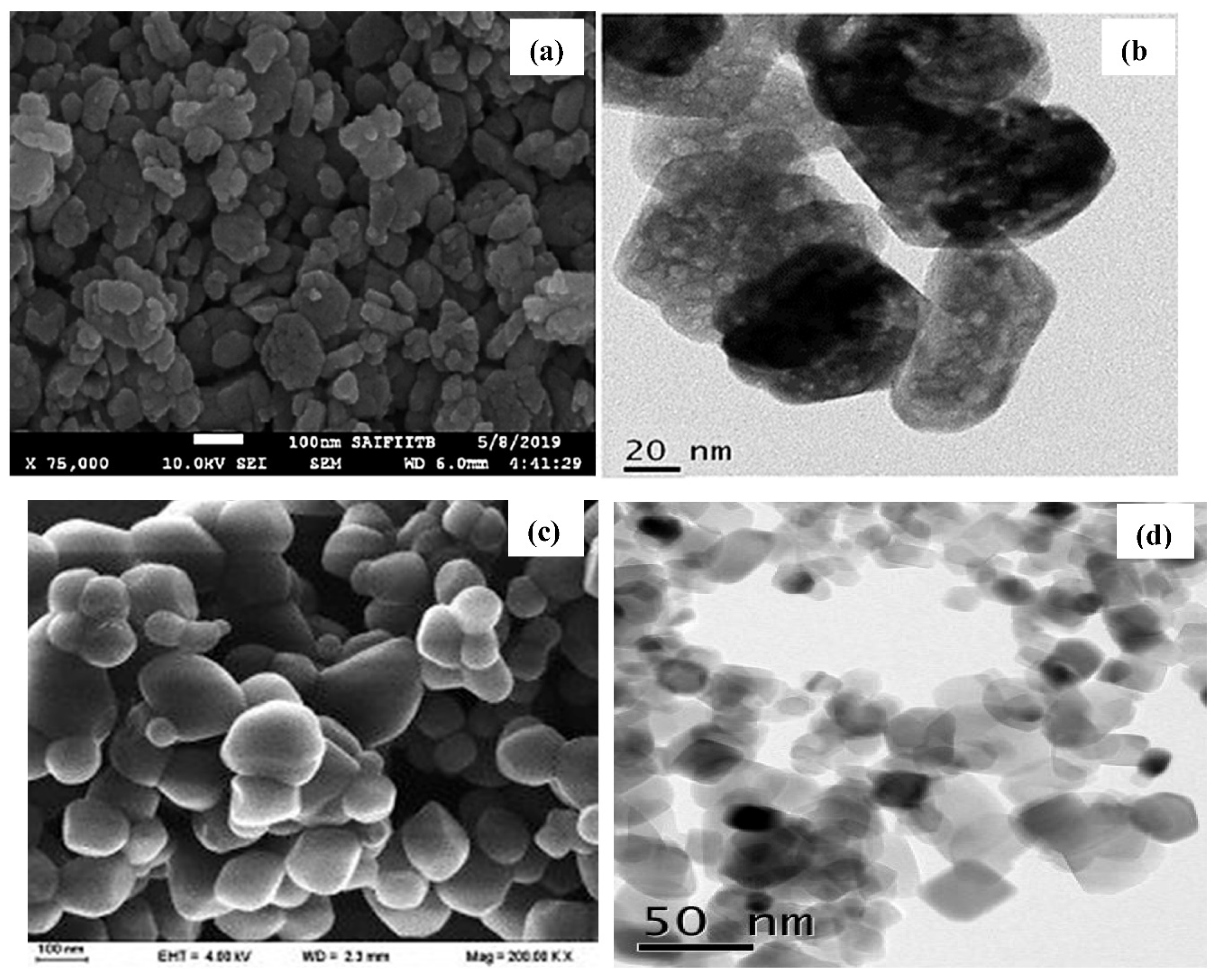
Figure 2.
Different categories of organic compounds.
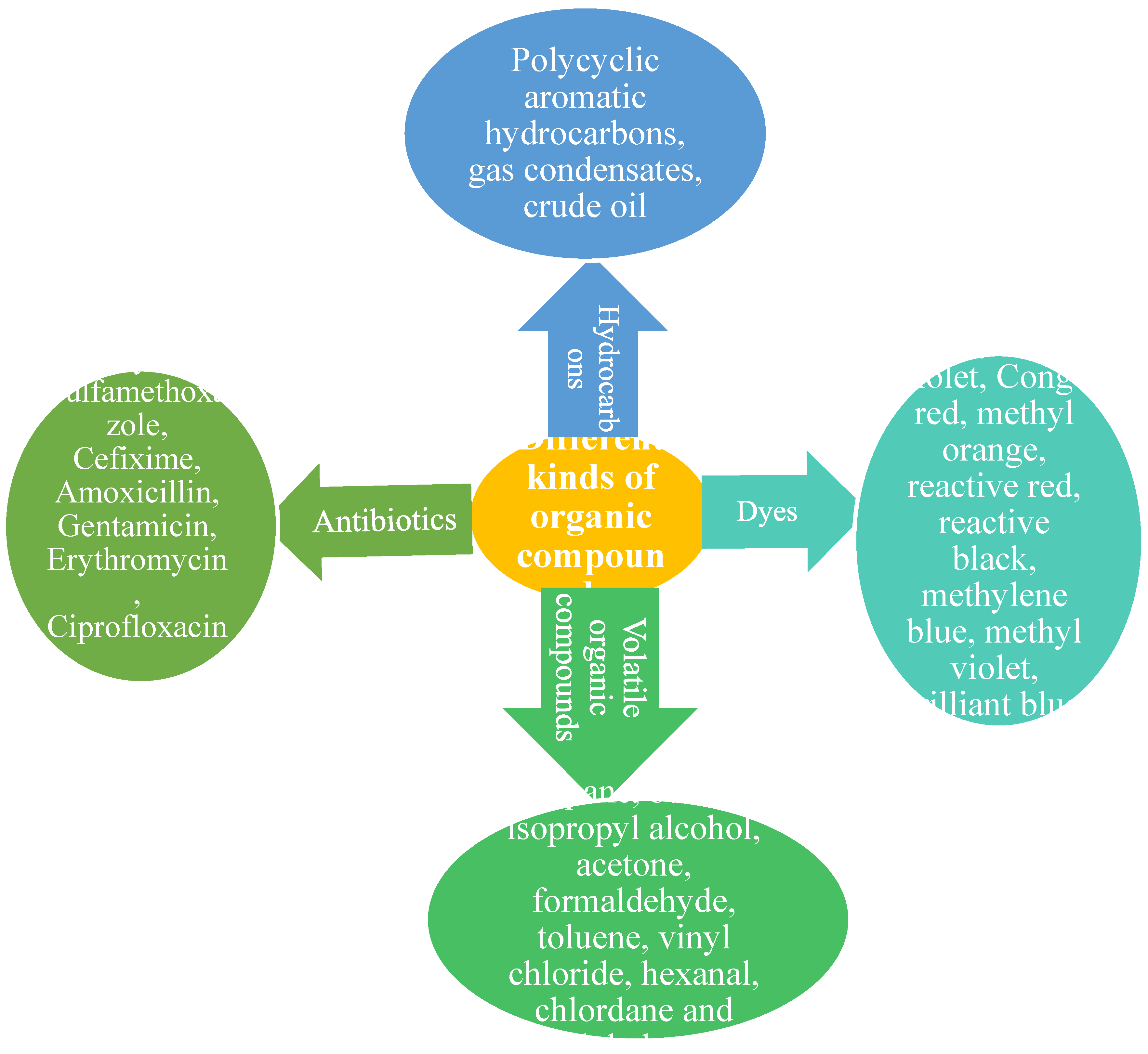
Figure 3.
Photoinduced charge carriers (e-/h+) generation on the TiO2 surface for eliminating contaminants (a) and photodegradation of contaminants on the TiO2 surface (b).
Figure 3.
Photoinduced charge carriers (e-/h+) generation on the TiO2 surface for eliminating contaminants (a) and photodegradation of contaminants on the TiO2 surface (b).
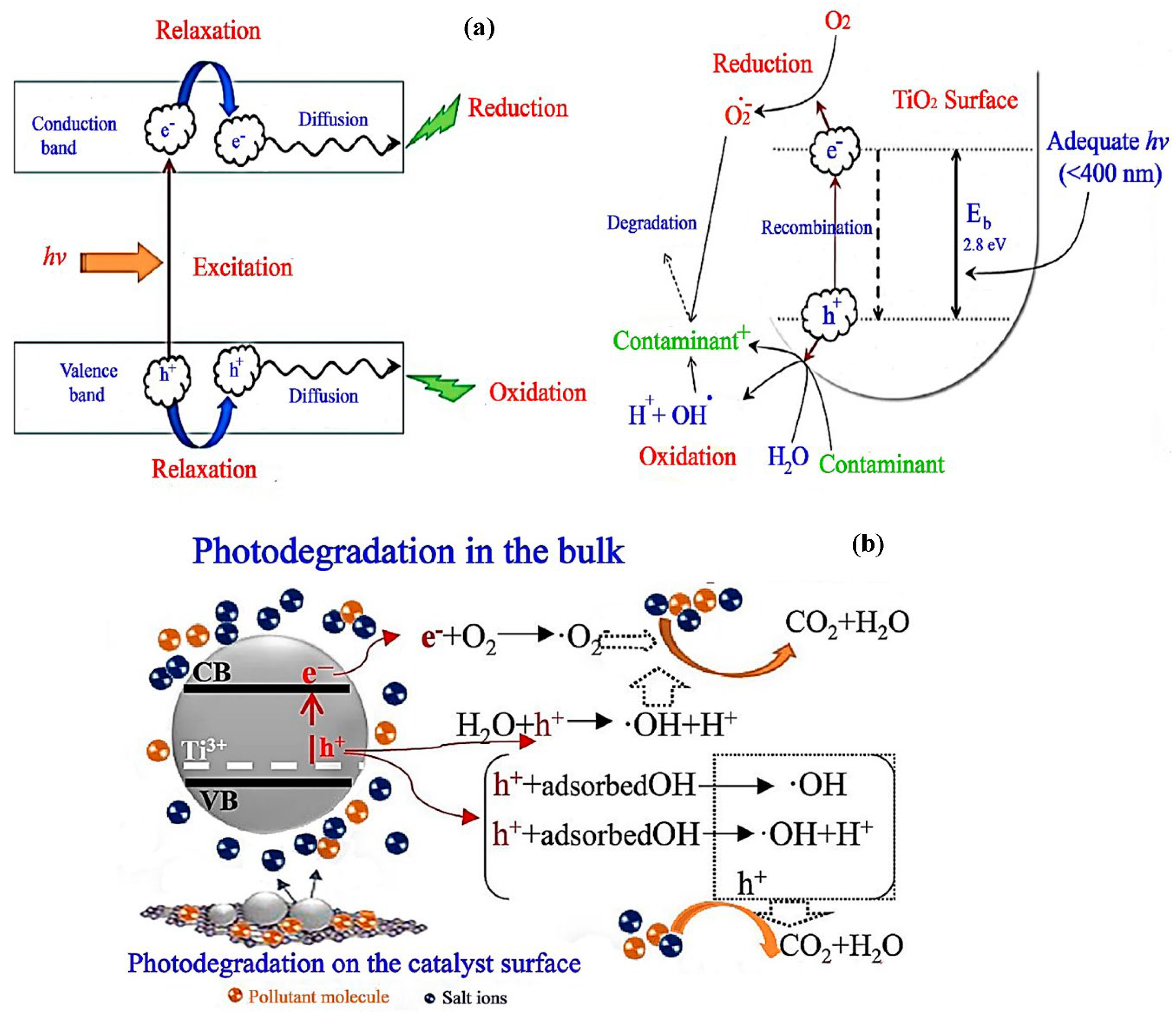
Figure 4.
Types of dopants used in the TiO2 structure
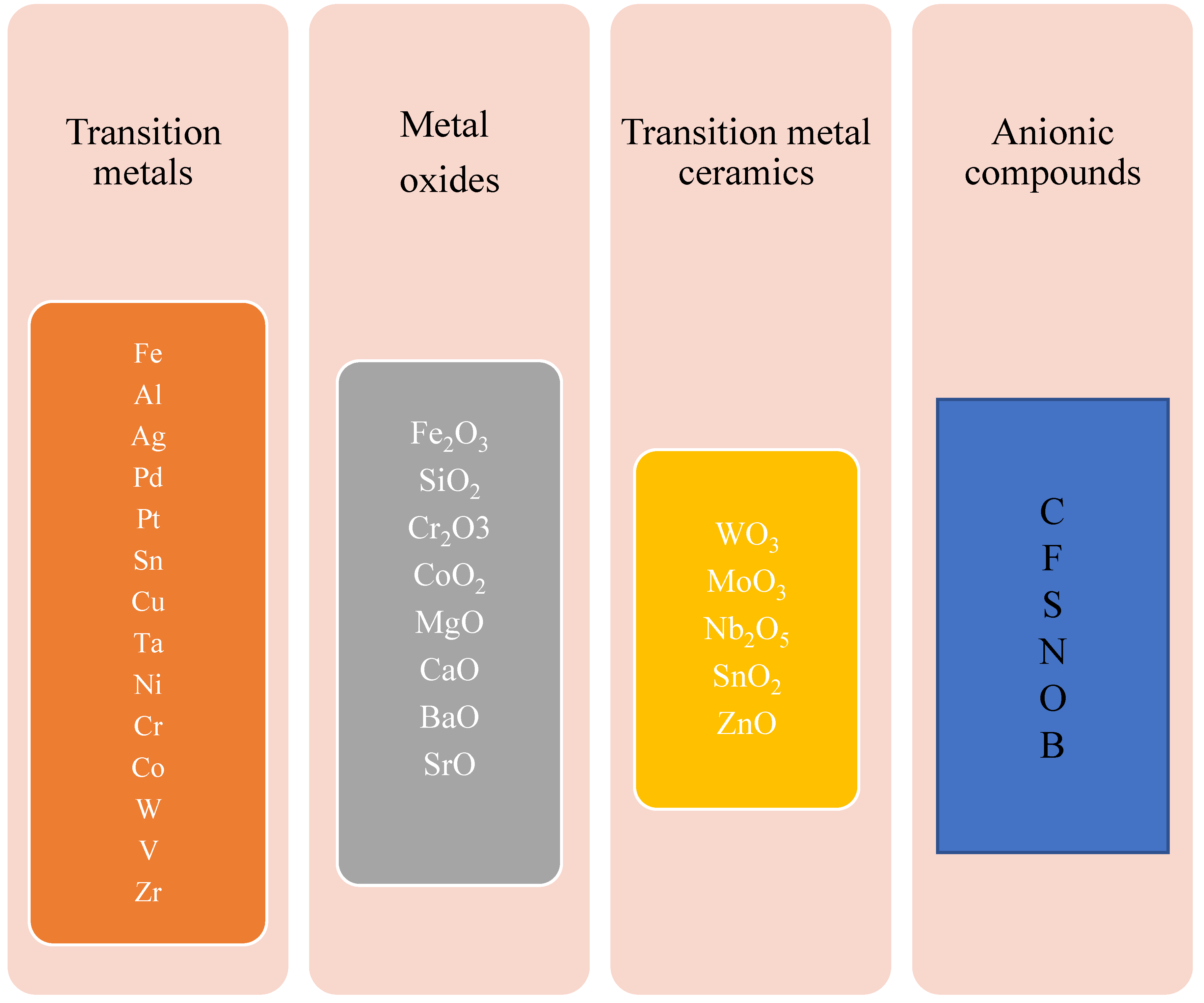
Figure 5.
Photodegradation mechanism of contaminants by metals-doped (a) and non-metals-doped TiO2 (b).
Figure 5.
Photodegradation mechanism of contaminants by metals-doped (a) and non-metals-doped TiO2 (b).
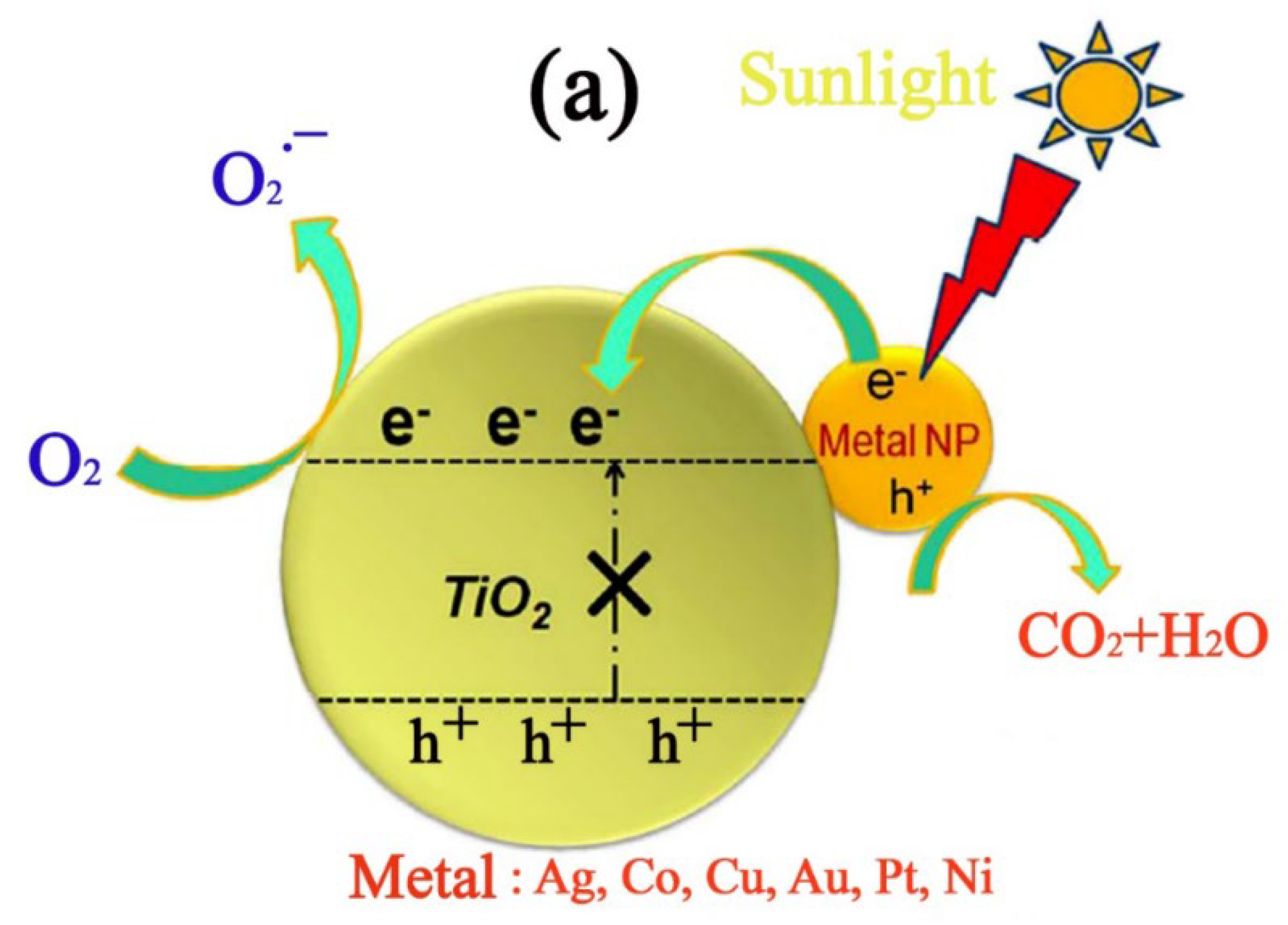
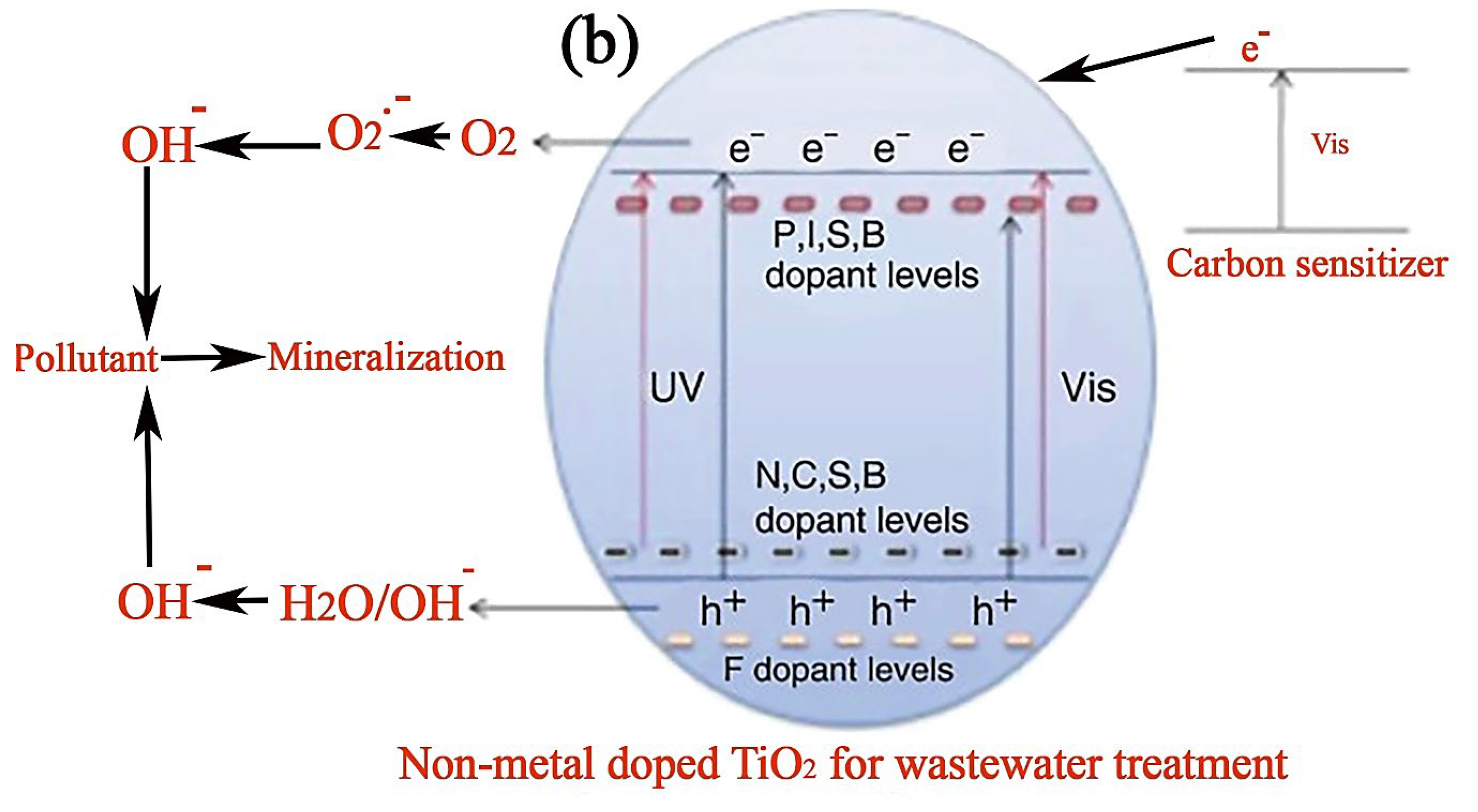
Figure 6.
Different structures of ZnO, including salt rock (cubical structure) (a), zinc blend (cubical structure) (b), and wurtzite (hexagonal structure) (c) (Zn and O atoms are represented by grey and black spheres, respectively) [76].
Figure 6.
Different structures of ZnO, including salt rock (cubical structure) (a), zinc blend (cubical structure) (b), and wurtzite (hexagonal structure) (c) (Zn and O atoms are represented by grey and black spheres, respectively) [76].
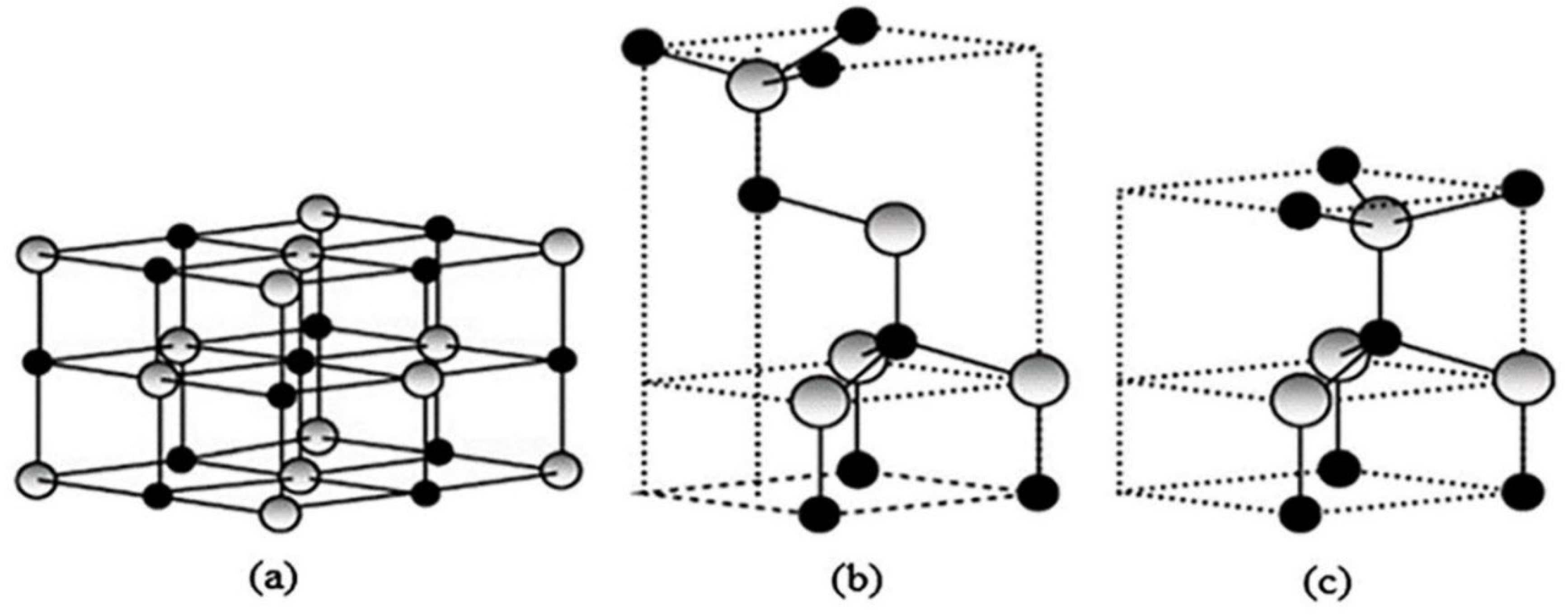
Figure 7.
Catalytic mechanism by cationic and anionic dopants (a) and photodegradation mechanism under sun light (b) on the surface of ZnO NPs.
Figure 7.
Catalytic mechanism by cationic and anionic dopants (a) and photodegradation mechanism under sun light (b) on the surface of ZnO NPs.
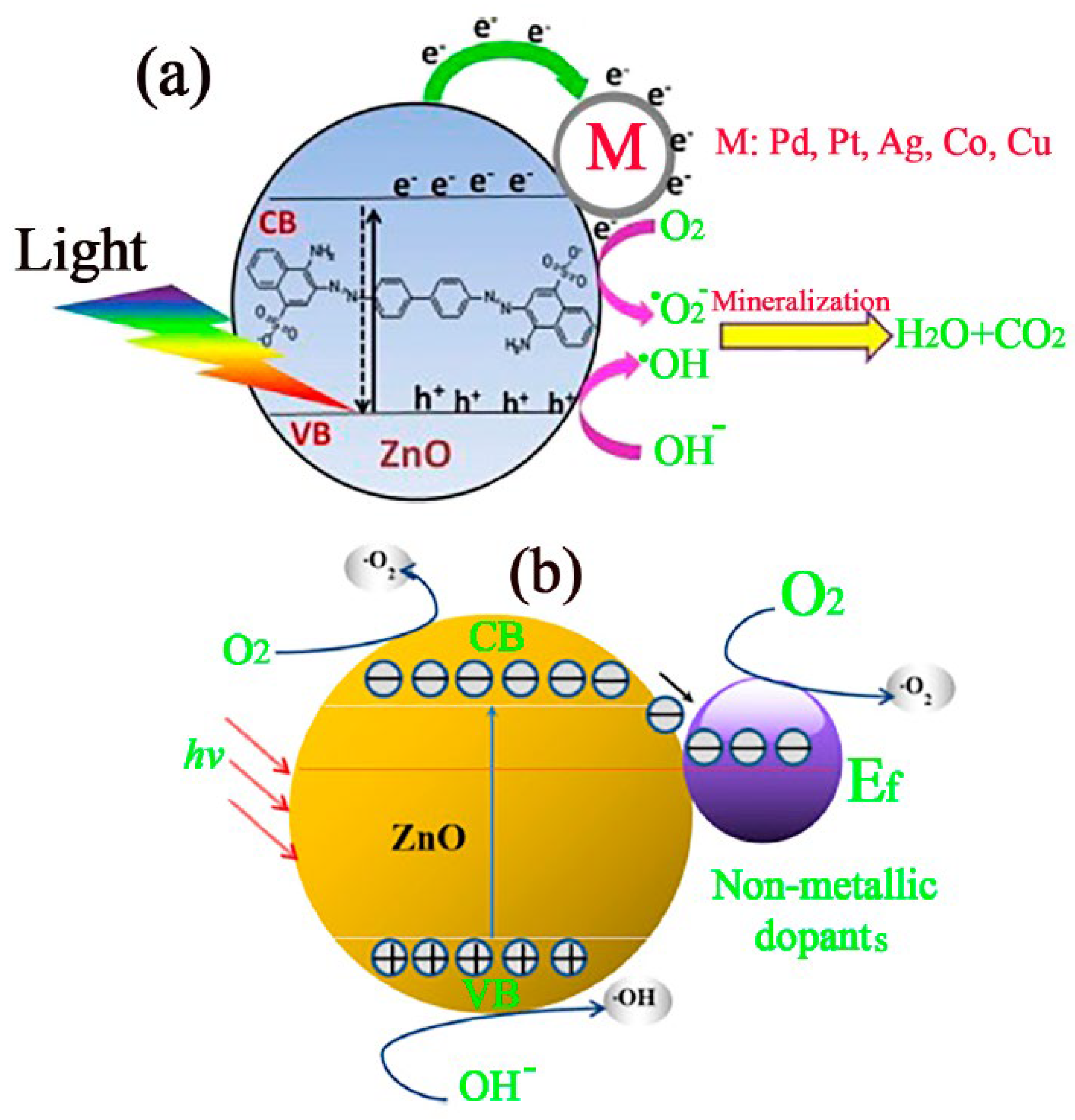
Figure 8.
Photodegradation mechanism of contaminants using metals-doped ZnO (a) and non-metals doped ZnO (b).
Figure 8.
Photodegradation mechanism of contaminants using metals-doped ZnO (a) and non-metals doped ZnO (b).
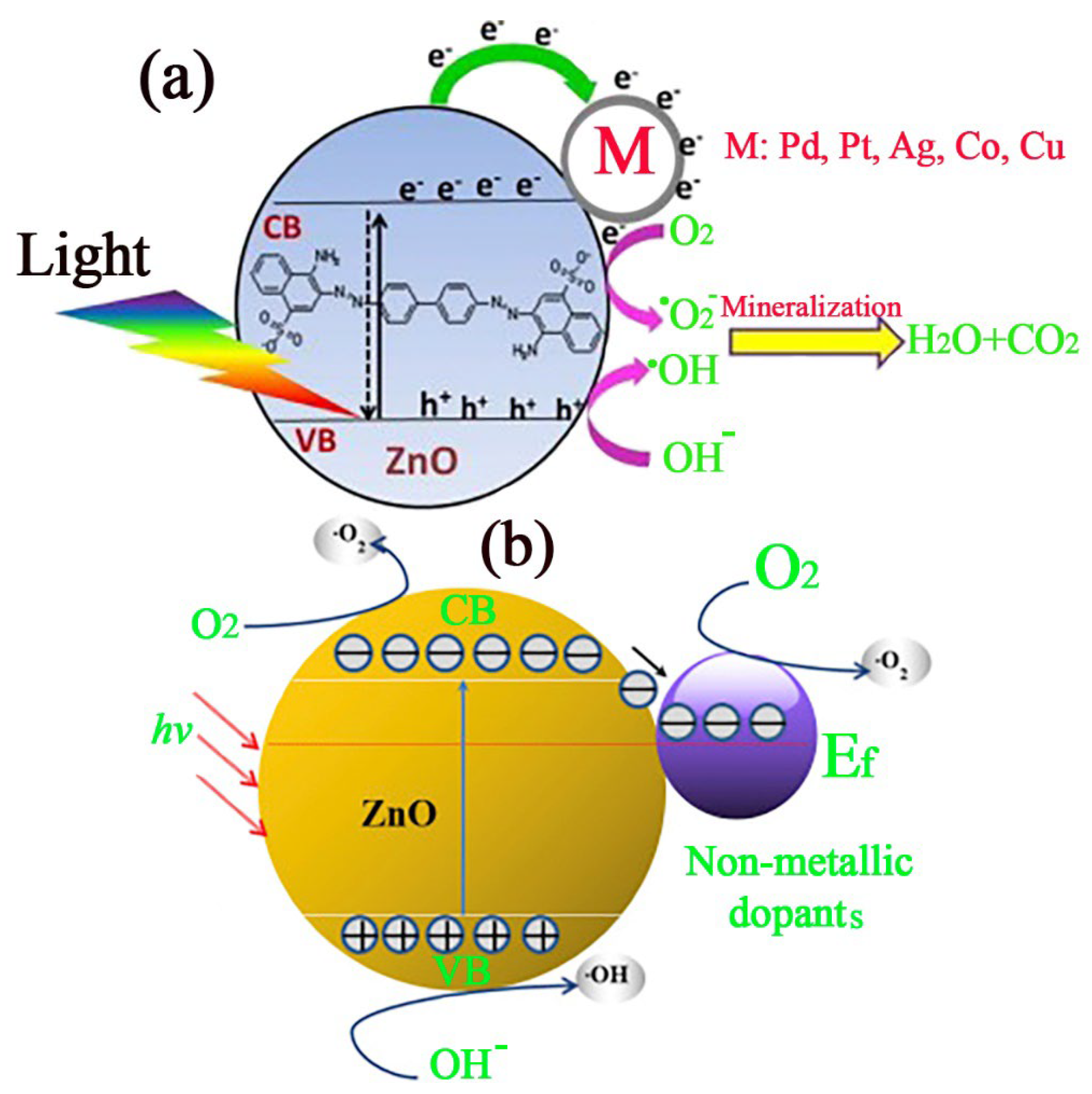
Figure 9.
Different forms of ZnO nanostructured photocatalysts, including (a) nanosheets [109], (b) nanorods [110], (c) nanoflowers [111], and (d) nanowires [112].
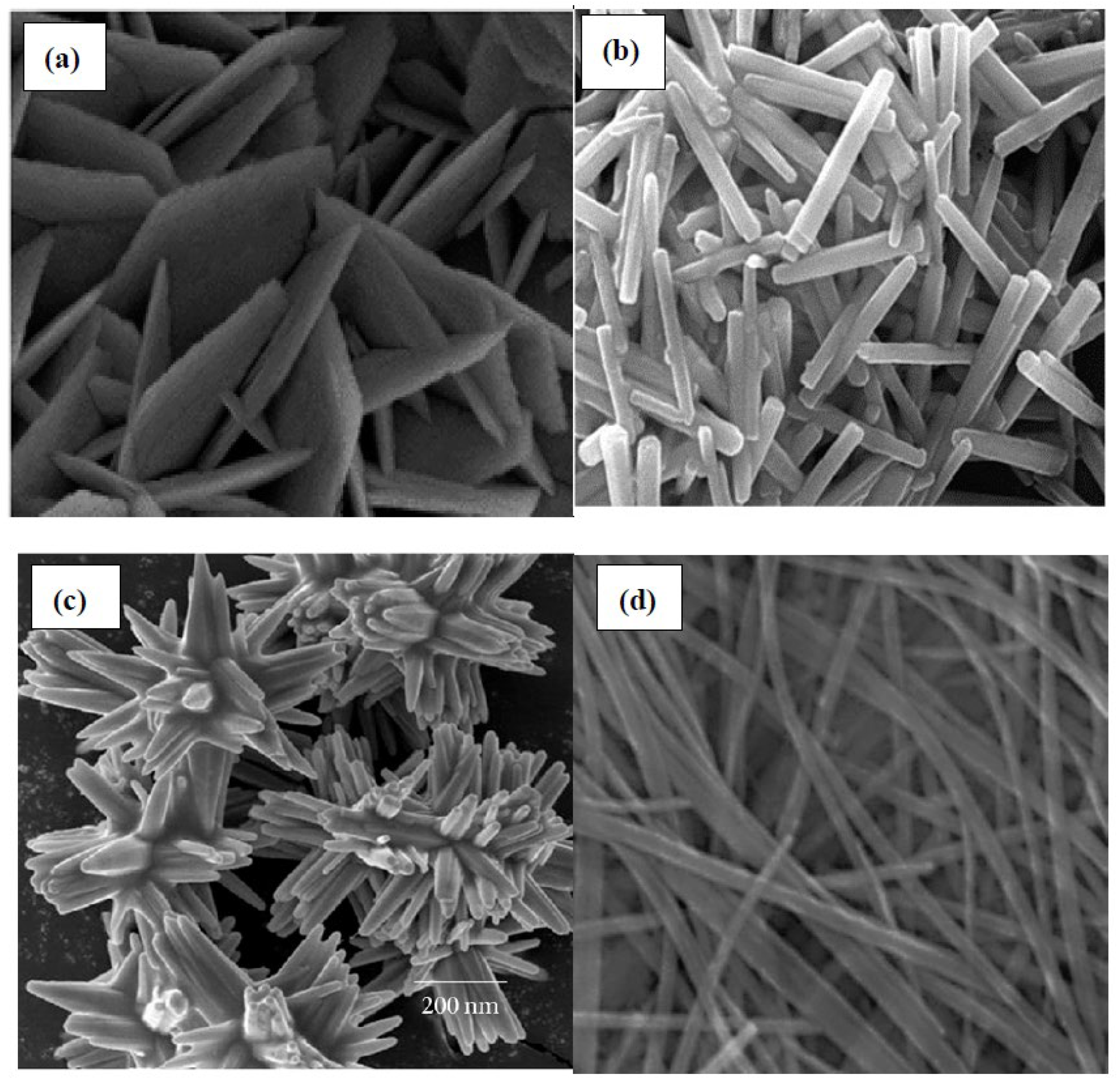

Table 1.
Advantages and disadvantages of various techniques for TiO2 fabrication.
| Process | Advantages and disadvantages | Ref. |
|---|---|---|
| Hydrothermal | Advantages: Good size distribution, crystal shape control, low defects, synthesizing large crystals with high quality, fine particle size Disadvantages: high equipment cost, high temperature and pressure needed, long synthesis time |
[50] |
| Sol-gel | Advantages: High purity products, good size distribution, remarkable specific surface area, economical, uniform size of particles, fine particle size, ease of synthesis Disadvantages: agglomeration of particles, long processing time, using organic solvents which may be toxic |
[50] |
| Flame pyrolysis | Advantages: Rapid and mass production Disadvantages: Requires high energy, ease of rutile formation |
[48] |
| Solvothermal | Advantages: High crystallinity, suitability for materials, low defects, better control of the features of TiO2 compared to hydrothermal process Disadvantages: requires organic solvents, unstable at high temperature |
[48,51] |
| Inverse micelle | Advantages: Fine particle sizes, high crystallinity, low defects Disadvantages: High cost, high crystallization temperature |
[48] |
| Sonochemical | Advantages: High-specific surface area, simple control of particles and morphology, efficient for mesoporous materials, improve reaction rate, short time, no additive Disadvantages: Low yield, inefficient energy |
[15,50] |
| Microwave heating | Advantages: Fast heating, short reaction time, high reaction rate and efficiency | [51] |
Table 2.
Impact of various dopants on the TiO2 photocatalytic activity.
| Dopant | Light source/pollutant | Conditions | PE for TiO2 (%) | PE for Doped TiO2 (%) | Ref. |
| Ag | UV-A illumination/ 2,4,6-trichlorophenol | 0.5 wt.% Ag, 120 min | - | 95 | [66] |
| Ag | Halogen lamp/MB | 2 Wt.% Ag, 120 min | - | 82.3 | [67] |
| Ni | Ultraviolet/Dipterex | pH 6, dipterex concentration= 40 mg/L, 2 h | - | 83.5 | [68] |
| Ce | UV lamp, crystal violet | 0.8 mol Ce in TiO2, 0.2 g/L catalyst, 30 ppm dye concentration, pH 6.5, intensity of 2000 W/cm2 | 70 | 92 | [15] |
| Fe | UV lamp/ Crystal violet | 1.2 mol Fe in TiO2, 0.2 g/L catalyst, 30 ppm dye concentration, pH 6.5, intensity of 2000 W/cm2 | 70 | 80 | [15] |
| Au | UV lamp/Total Organic Carbon | 8.71 mg/L Total Organic Carbon, 15W UV lamp | - | 93 | [69] |
| Si | UV lamp/MB | 20 h for TiO2 and 2 h for Si-doped TiO2, 10 ppm MB | 68 | 86.7 | [63] |
| Pd | UV lamp/2,2',4,4'-tetrabromodiphenylether | 5% Pd, 300 WUV lamp | - | 100 | [70] |
| B | UV light/4-nitrophenol | 5% B in TiO2, 1 g/L catalyst dose, 1 mg/L 4-nitrophenol | 79 | 90 | [71] |
| Au/UI | UV irradiation/2,4 dinitrophenol | 20 mg/L contaminant concentration, 120 min, 1 g/L catalyst dose | 60 | 37 | [72] |
| Au/IWI | UV irradiation/2,4 dinitrophenol | 20 mg/L contaminant concentration, 120 min, 1 g/L catalyst dose | 60 | 50 | [72] |
| Pd/IWI | UV irradiation/2,4 dinitrophenol | 20 mg/L contaminant concentration, 120 min, 1 g/L catalyst dose | 60 | 67 | [72] |
| Pd/IWI | UV irradiation/ Rhodamine 6G | 20 mg/L contaminant concentration, 120 min, 1 g/L catalyst dose | 88 | 96 | [72] |
Table 3.
Comparing different metallic dopants in the ZnO structure on the photocatalytic activity.
| Dopant | Light source/pollutant | Operating conditions | *PE (%) for ZnO | PE (%) for Doped ZnO | Ref. |
| Co | Visible light irradiation/MO | 10 wt.% Co, 130 min, 100 mg/L MO | 46 | 93 | [89] |
| Ag | Visible irradiation/MB | 5 wt.% Ag, 120 min | 2.7 | 45.1 | [90] |
| Co | Visible light irradiation/MB | 5 wt.% Co, 10 ppm dye concentration, 140 min | 2.7 | 62.6 | [91] |
| Cu | Visible light irradiation/MB | 5 wt.% Cu, 10 ppm dye concentration, 140 min | 2.7 | 42.5 | [91] |
| Cr | UV-vis light illumination/MO | 1 wt.% Cr, 100 min | - | 99.8 | [92] |
| Sn | Sunlight/Brilliant green | 120 min | 72.6 | 96.52 | [93] |
| Fe | Sunlight/MB | Time=3 h | 90 | 95 | [94] |
| Ta | Visible light irradiation/MB | 20 min, 1 g/L catalyst dosage, pH 8, 10 mg/L dye concentration | - | 97.5 | [95] |
*PE: Photodegradation efficiency.
Table 4.
Impact of various non-metallic dopants on the ZnO photocatalytic activity.
| Dopant | Light source/pollutant | Conditions | PE (%) ZnO | PE (%) Doped ZnO | Ref. |
| N | UV light or Visible light irradiation/MB | - | - | 99.6 | [96] |
| N | Visible light irradiation/Rhodamine 6G | 60 min, 0.01 g N | 76.2 | 81.6 | [97] |
| N | Visible light irradiation/Rhodamine B | 10 mg/L dye concentration, Room temperature, 2 h | - | 97 | [98] |
| N | Visible light irradiation/MB | 10 mg/L dye concentration, Room temperature, 2 h | - | 99 | [98] |
| C | Visible light/MB | 60 min | 54.3 | 98.1 | [99] |
| C | Visible light/MB | 2.5% Catalyst, 200 oC | 26 | 80 | [100] |
| C | UV irradiation/ Bisphenol A | 24 h | - | 100 | [101] |
| C | Sunlight irradiation/ Rhodamine B | 2.5 h | 54.6 | 92.9 | [102] |
PE: Photodegradation efficiency.
Table 5.
Stability and recyclability of various composites of ZnO and TiO2.
| Catalyst | Pollutant | PE* (%) | PE (%)after n cycles | Ref. |
| ZnO nanorodes | imidazole | 83% | n=4, 80% | [135] |
| Ag-doped ZnO nanocomposite | MB | 95% | n=4, 89.5% | [118] |
| Fe3O4@S-doped ZnO | ofloxacin | Above 90% | n=6, Above 90% | [136] |
| ZnO NPs | MB | 93.25% | n=5, 86.63% | [22] |
| ZnO NPs | Rhodamine B | 91.06% | n=5, 83.61% | [22] |
| Mg-doped ZnO nanorodes | MB and ciprofloxacin | 82% | n=4, 75% | [137] |
| 2%Au-doped TiO2 nanocatalyst | MO | 100% | n=11, 100% | [138] |
| Sm/N co-doped TiO2/diatomite | tetracycline | 87.1% | n=5, 83.2% | [139] |
| C-doped TiO2/carbon nanofibrous | rhodamine B | 94.2% | n=6, 92% | [140] |
| TiO2 | MO | 58.3% | n=10, 36.1% | [141] |
| TiO2/polyaniline | MO | 86% | n=10, 46.2% | [141] |
| Fe3O4/AC/TiO2 | MB | 98% | n=7, 93% | [142] |
| 2-(methacryloyloxy) ethyltrimethylammonium chloride/TiO2 | MB | 99.66% | n=20, 98.7% | [143] |
| TiO2/2NiO | MB | 100% | N=5, 72.6% | [134] |
*PE: Photodegradation efficiency.
Table 6.
The performance of TiO2 and ZnO nanocatalysts and their derivatives in degrading different organic pollutants.
Table 6.
The performance of TiO2 and ZnO nanocatalysts and their derivatives in degrading different organic pollutants.
| Nanocatalysts | Contaminants | Optimal conditions | DE (%) | References |
| TiO2 | Nitrobenzene | * CD=O.1M, CC=50 ppm | 100 | [145] |
| TiO2 | Parathion | CD=1 g/L, CC=50 ppm | 70 | [147] |
| TiO2 | Toluene | CD=5 g, CC=45 ppm | 71 | [145] |
| TiO2 | Phenol | 1.8 g/L catalyst dose | 100 | [145] |
| TiO2 | Benzene | CD=5 g, CC=45 ppm | 72 | [148] |
| TiO2 | MO | CD=3 g/L, CC=30 ppm | 100 | [145] |
| Fe3O4/TiO2 (P25) | MO | 1 h under UV light irradiation | 90.3 | [22] |
| Fe3O4/TiO2 (UV100) | MO | 1 h under UV light irradiation | 51.6 | [22] |
| CuO/WO3/TiO2 | 4-Chlorophen | CD= 0.75 g/L, H2O2 amount=563.16 mmol/L, 3 h | 94.8 | [21] |
| CuO/WO3/TiO2 | 3-Phenyl-1-propan | CD= 0.75 g/L, H2O2 amount=563.16 mmol/L, 3 h | 85.13 | [21] |
| Carbon-doped TiO2 | Methyl ethyl ketone | Under UV light | 94 | [23] |
| La/TiO2 | RamazolBrilliant Blue | - | 72 | [22] |
| PVP/TiO2/polydopamine | malachite green | 60 min, 10 mg/L of dye | 45 | [149] |
| PVP/TiO2/polydopamine | MB | 60 min, 10 mg/L of dye | 25 | [149] |
| PVP/TiO2/polydopamine | MO | 60 min, 10 mg/L of dye | 24 | [149] |
| ZnO | Amoxicillin | Ultraviolet, pH=11, Catalyst dose=0.5 g/L, time 180 min | 100 | [123] |
| ZnO | Ampicillin | Ultraviolet, pH=11, Catalyst dose=0.5 g/L, time 180 min | 100 | [123] |
| ZnO | Claxocillin | Ultraviolet, pH=11, Catalyst dose=0.5 g/L, time 180 min | 100 | [123] |
| rGO/Fe3O4/ZnO | MV | 120 min, CD= 0.04 g/L | 83.5 | [26] |
| Fe3O4/CuO/ZnO/graphene | MB | 120 min, CD= 0.3 g/L | 93 | [25] |
| Tungsten/silver/ZnO | Ponceau 4R | pH 5.64, CD= 0.08 g/L, 25oC | 78.8 | [27] |
| Bi12TiO20 | Cefixime | 3 h | 94.93 | [146] |
| Bi12ZnO20 | Cefuroxime | 4 h | 80 | [29] |
| ZnBi2O4 | Cefixime | Solar light (98 mW/cm2), 30 min | 89 | [150] |
| ZnBi2O4 | Cefixime | UV irradiation (20 mW/cm2), 2h | 88 | [150] |
| Ag/TiO2 | Phenol | pH 7, CD= 1.5 g/L, CC= 5 ppm, power light= 18 W | 82.65 | [151] |
| ZnO/SnO2 | MB | pH 12, CD= 0.5 g/L, time 60 min | 96 | [152] |
| Pure ZnO | Chlorobenzene | LED light | 71 | [28] |
| Pb/ZnO | Chlorobenzene | LED light | 100 | [28] |
| Ag/ZnO | Chlorobenzene | LED light | 95 | [28] |
| Cd/ZnO | Chlorobenzene | LED light | 90 | [28] |
| Pure ZnO | Chlorobenzene | Tungsten light | 90 | [28] |
| Pb/ZnO | Chlorobenzene | Tungsten light | 100 | [28] |
| Ag/ZnO | Chlorobenzene | Tungsten light | 83 | [28] |
| Cd/ZnO | Chlorobenzene | Tungsten light | 73 | [28] |
*CC=Contaminant concentration; CD=catalyst dose.
Disclaimer/Publisher’s Note: The statements, opinions and data contained in all publications are solely those of the individual author(s) and contributor(s) and not of MDPI and/or the editor(s). MDPI and/or the editor(s) disclaim responsibility for any injury to people or property resulting from any ideas, methods, instructions or products referred to in the content. |
© 2024 by the authors. Licensee MDPI, Basel, Switzerland. This article is an open access article distributed under the terms and conditions of the Creative Commons Attribution (CC BY) license (http://creativecommons.org/licenses/by/4.0/).
Copyright: This open access article is published under a Creative Commons CC BY 4.0 license, which permit the free download, distribution, and reuse, provided that the author and preprint are cited in any reuse.