

Submitted:
02 June 2024
Posted:
03 June 2024
You are already at the latest version
Abstract
Jump rope is a widely-applied basic training in various sports, yet it is understudied biomechanically. This study investigates the impact of cycle-tempo-induced motor control changes in elite jump rope athletes, addressing the biomechanical gap of cyclic skill control. The hypothesis posited two accelerations per jump cycle—one in front of and one behind the body—and anticipated that increased cycle frequency would alter the distribution of acceleration time within a cycle. Using 3D motion analysis, kinematic parameters were obtained and analyzed. The results confirmed the presence of two distinct accelerations per cycle. As tempo increased, the percentage of rear acceleration time increased while front acceleration time decreased, along with peak velocities increasing significantly (p<0.01). Rope trajectory analysis indicated a consistent movement pattern across tempos, primarily in the sagittal plane. Variations in skill control showed shorter contact phases and reduced vertical range of motion for the center of gravity and feet at higher tempos (p<0.05), along with significant reductions in joint range of motion for the lower limbs (p<0.01). These findings enhance the understanding of motor control adaptations to different tempos and have practical implications for developing coaching programs aimed at optimizing performance, stability, and efficiency in jump rope training.
Keywords:
3D motion analysis
; biomechanical modeling
; rope trajectory
; acceleration characteristics
; COG
; ROM
; contact time
1. Introduction
Jumping rope has long been recognized as a versatile and practical method for enhancing athletic conditioning, balance, and coordination across various sports disciplines [1,2,3]. Its simplicity belies its effectiveness, making it a staple in training regimes worldwide. Athletes, from amateur enthusiasts to elite professionals, incorporate jumping rope into their workouts to improve agility, endurance, and overall performance [4,5,6,7]. However, despite its extensive use, a significant gap exists in our understanding of how variations in jumping speed influence motor control patterns among athletes. A search conducted using the keywords “rope jump + speed-dependent motor control” in Web of Science in November 2023 yielded no relevant results, indicating a lack of research in this area concerning training practice.
The speed of rope jumping, normally quantified by revolutions per minute (RPM) [8,9], plays a pivotal role in performance. Athletes aiming to increase RPM encounter heightened physical demands [9,10,11], necessitating precise motor control to sustain rhythm, balance, and coordination. It is widely hypothesized that as jumping speed rises, distinct changes in motor control patterns occur, impacting both technique and efficiency.
The scarcity of published articles investigating speed-dependent motor control pattern changes in jumping rope underscores the significant research gap. While numerous studies have explored the benefits of jumping rope on athletic attributes such as jump strength, running speed, endurance, and agility [12,13,14], none have specifically addressed how increasing speed influences motor control strategies. This dearth of scientific evidence presents an unprecedented opportunity for pioneering research in the field.
Speed, as a temporal factor, is crucial for optimizing motor control in complex sports skills [15,16,17,18]. Therefore, understanding the nuances of motor control adaptations to varying jumping speeds is essential for optimizing training methods and enhancing athlete performance. By elucidating the relationship between speed and motor control, researchers can inform evidence-based coaching strategies tailored to the specific demands of jumping rope activities. Furthermore, insights gained from this research have the potential to extend beyond the realm of jumping rope to inform training practices in other sports and physical activities where speed and coordination are integral components.
To ensure reliable motor control pattern analysis, the quality of subjects is paramount [19,20,21]. Professional jumping rope athletes, distinguished by years of rigorous training and competition experience, offer an ideal cohort for examining speed-dependent motor control pattern changes. Their refined motor skills and consistent performance levels provide a stable baseline against which potential alterations in control patterns can be discerned. By studying this population, reliable results can be obtained, elucidating nuanced adaptations in motor control strategies at varying jumping speeds.
Rope jumping entails a cyclic movement. However, due to the absence of biomechanical quantification of this cyclic skill control, the acceleration characteristics within a cycle remain unclear. Drawing from practitioners’ experiences, we hypothesize the presence of two accelerations in each jump cycle—one occurring in front of the body and the other behind the body. It is anticipated that the total time for rope movement within a complete cycle will decrease with increasing cycle frequency, along with both accelerations. Nonetheless, practitioners may find it intriguing to ascertain the relative change in control within a cycle, particularly the percentage change of acceleration times in a cycle. Building upon practitioners’ experiences, we propose the second hypothesis for the current study: as cycle frequency increases, the percentage of acceleration time in front of the body will decrease, while the percentage behind the body will increase. Consequently, the primary aim of this investigation is to examine the alterations in speed-dependent motor control patterns among elite jumping rope athletes. Our objective is to elucidate the relationship between jumping speed variations and motor control alterations, thereby addressing the existing gap in coaching practice. The findings from this study carry practical implications for the development of targeted training programs designed to optimize athletic conditioning, balance, and coordination.
In short, this study aims to contribute novel insights into athletic training by examining the impact of rope tempo on motor control patterns among elite jumping rope athletes. By bridging the gap between theory and practice, we aspire to inform evidence-based coaching strategies that optimize athletic performance and enhance the overall effectiveness of training programs.
2. Materials and Methods
Understanding the coordination between upper and lower limbs is crucial in rope jumping learning and optimized training. To enhance the effectiveness of motor skill learning, it is imperative to acquire proper motor control/kinematic characteristics of the skill. Therefore, the following design elements were incorporated into the study.
2.1. Subjects
As elaborated in the introduction, a central goal of this study is to collect biomechanically appropriate kinematic data while minimizing any influence of the testing process. Consequently, individuals with stable skill control were required. Elite athletes, characterized by their well-trained motor-control stability resulting from extensive training, were deemed ideal candidates. Moreover, elite athletes are less susceptible to the influence of the testing process compared to athletes with standard training backgrounds. For these reasons, 12 healthy young male jump rope athletes (who won medals in provincial or higher-level freestyle jump rope competitions) were recruited. Table 1 presents an overview of their physical attributes and relevant experiences. All participants had not experienced any sports injuries within the past year and were in good physical and mental condition during testing. The test protocol was thoroughly scrutinized and approved by the host university’s ethics committee. Prior to the commencement of the study, participants were briefed on the testing procedures, signed consent forms, and voluntarily participated in the data collection process.

Table 1.
Participant Demographic Information.
| Age (years) | Height (cm) | Weight (kg) | Training (years) | Level 1 |
|---|---|---|---|---|
| 20.11 ± 2.4 | 170.24 ± 2.1 | 68.2 ± 3.4 | 4.5 ± 0.5 | 1 |
1 Chinese National Certificate System for Athlete Performance Level. 1: professional, 2: pre-professional, 3: individuals who attain a placement within the highest six positions in competitions held at the county level or above [22].
2.2. Test Protocol
From a technical and performance standpoint, it is observed that the majority of proficient individuals with developed jumping rope skills maintain rope frequencies ranging between 100 RPM and 180 RPM [23,24]. Consequently, this study opts to commence at 100 RPM as a baseline, considering that jumpers at this frequency already demonstrate continuous, relatively stable, and refined rope swinging techniques [23]. The tempo within the range of 92-100 RPM is regarded as optimal for rope jumping from an injury prevention standpoint, as it minimizes joint stress, particularly on the knees [11]. Beyond 100 RPM, as the jumping cycle accelerates, there is an increase in physical demands [11]. Notably, a frequency of 140 RPM serves as a critical threshold that jumpers and coaches should heed [1]. When assessing the physical demands of rope jumping, factors such as physiological readiness, coordination efficiency, and revolutions per minute need to be taken into account. Specifically, when the frequency surpasses 140 RPM, there are significant disparities in heart rate and oxygen consumption compared to frequencies below 140 RPM [1]; Quirk and Sinning [9] similarly observed notable increases in these parameters between 140 RPM and 160 RPM, with no significant distinctions between 120 RPM and 140 RPM. Additionally, these differences are absent across frequencies of 66, 84, 102, 120, and 132 [10]. Experienced jumpers typically adhere to a frequency of 138 RPM, with 140 RPM marking the lower threshold of the aerobic training frequency range for rope jumping [25]. In the majority of regions in China, approximately 180 RPM is regarded as the benchmark for middle school physical education rope jumping assessments. Achieving a speed of 180 RPM or higher is indicative of exceptional physical prowess, particularly concerning balance, reaction time, and coordination among young adolescents in China [26]. Moreover, a speed of 180 RPM meets the criteria for activating anaerobic energy systems through rope training [25]. Therefore, this study incorporates three representative frequencies, namely 100 RPM, 140 RPM, and 180 RPM.
The participants were guided through the three test tempos by a metronome, ensuring compliance with the required rhythms for each test condition. Before the commencement of the testing session, participants engaged in a ten-minute self-warm-up routine. Subsequently, participants executed three sets of rope jumping at frequencies of 100 RPM, 140 RPM, and 180 RPM, each lasting for 8 seconds. A 3-minute rest interval was provided between frequency adjustments to allow participants to exert consistent physical effort (i.e., without experiencing fatigue) in completing all experimental tasks.
2.3. Three-Dimentional Motion Capture and Biomechanical Modeling
To capture the movement involved in jumping rope, a 3D motion-capture system with 13 high-speed cameras was utilized, incorporating 45 reflective soft markers (diameter = 9 mm), comprising 39 markers positioned on the body and 6 on the rope. Additionally, 2 camcorder (DV1 and DV2) were synchronized with the 3D motion-capture system to supply video references (Figure 1).
The motion capture process employed a 13-camera VICON MX40 motion capture system (VICON Motion Systems, Oxford Metrics Ltd., Oxford, England) operating at a frequency of 200 frames per second. Extensive calibration procedures were undertaken to minimize calibration residuals, following established VICON guidelines, resulting in a precision level within 1 mm. Additionally, all trials were concurrently recorded using two CASIO video camcorders (100Hz) synchronized with the VICON system, facilitating rapid visual assessments of trial quality.
The rope selected was constructed from PVC material designed for speed ropes, as it maximizes rope aerodynamics and can readily achieve speeds of 5 revolutions per second (i.e., 300 RPM) [25,27]. To standardize variables, the same jump rope was utilized for all participants, with a length extending from the feet to the upper chest. This length ensures optimal comfort for advanced jumpers without compromising body posture and technique during jumps, with rotational speeds of up to 240 RPM [25,27]. Two reflective soft markers were positioned in the middle of the jump rope, spaced 25 cm apart (Figure 1c), to prevent interference with the feet during jumps. Placing two reflective markers in the middle of the rope serves two purposes: firstly, to mitigate the impact of rope midpoint rebound on data integrity; and secondly, to ensure comprehensive and accurate data collection of rope revolutions. Additionally, four markers, two on each handle, were utilized to delineate the rope during jumping.
The strategic placement of 39 body markers facilitated the construction of a 15-segment biomechanical model [28,29], encompassing segments such as the head, upper and lower trunk, upper and lower arms, hands, thighs, shanks, and feet. This model has been validated in quantifying various complicated sports skills in prior researches [30,31,32,33]. The 39 markers were meticulously positioned at specific anatomical landmarks on the subjects, including regions such as the temporal and posterior head regions, sternal end of the clavicle, xiphoid process of the sternum, C7 and T10 vertebrae, scapulae, iliac regions, acromion processes, epicondyles, and styloid processes of the radii and ulnae, among others. The utilization of 13 cameras and small markers afforded subjects considerable freedom of movement within the capture volume, enabling their motions to closely replicate their trained “motor control style” to obtain their control patterns at different tempos.
2.4. Data Processing, Parameter Selection, and Statistical Analysis
To ensure stable control, we selected 5 revolutions near the midpoint of each 8-second data collection. The beginning of a revolution was defined as the midpoint of the rope at its lowest point in the vertical direction. This process resulted in a total of 180 revolutions of 3D data (3 tempos * 12 subjects * 5 revolutions = 180) for analysis. The raw motion capture data obtained underwent processing using a five-point smoothing filter provided by the VICON software. The processed dataset provided essential three-dimensional coordinates of the 39 markers. Subsequently, these processed 3D coordinates were utilized to construct the 15-segment biomechanical model [31,32] for kinematic quantification of rope jumping.
Biomechanical models provide a wide array of kinematic parameters, such as joint angles, velocities, accelerations, and more, derived from the 3D coordinates of captured markers on athletes, to unveil control insights into complex sports skills [32,33,34]. However, it is imperative to select relevant data for the clear and concise communication of research findings. Focused reporting and discussion are essential principles in research writing [35,36], ensuring that the study’s aims remain central. Therefore, researchers must carefully choose parameters aligned with their paper’s focus to maintain coherence. Given the study’s objective of quantifying the influence of rope revolution changes on control pattern variations, parameters such as the velocity of the rope midpoint, rope handle, and big toe, as well as the timely coordination among these parameters, joint parameters, and center of gravity (COG), were studied [16,37].
The 3D coordinates of the rope midpoint were determined by averaging the coordinates of the two markers on the rope, each located 12.5 cm from the midpoint (Figure 1c). Speed and acceleration changes over time of the rope midpoint were calculated using frame-by-frame calculations of the average values in Microsoft Excel. Similarly, the averages of rope-handle markers and big toes’ markers were used to quantify the 3D excursions of the rope-handle point (center of cycle movement) and feet (dynamic distance to the ground), respectively. Additionally, two more calculated parameters, ROM (range of motion, determined by max - min) and % of a cycle time, were applied for kinematic analysis. This included the above parameters and the timely excursion of joint angles and COG obtained from the 15-segmental model quantification. With this approach, the potential control pattern changes induced by the tested tempos were quantitatively analyzed. To provide user-friendly results (e.g., minimizing the influence of body height in motor learning) for practitioners, normalization (% of body height) was applied to length-related parameters.
Statistical analysis was performed on the obtained data. Descriptive statistics, including mean and standard deviations (mean ± SD), were calculated to illustrate parameter characteristics. Normality of the data was assessed using the Shapiro–Wilk test, followed by one-way ANOVA if normality was confirmed, to detect changes in control patterns induced by the rope revolution frequency changes. All statistical analyses were conducted using IBM SPSS Statistics 23 (IBM Japan, Tokyo, Japan), with a significance level set at p = 0.05.
3. Results
The Shapiro-Wilk Test confirms the normality of the collected data from the three tempo jump rope tests (p > 0.10). As explained in the introduction, numerous kinematic parameters were obtained from the 3D motion analysis in this study. Given the focus on identifying cycle-tempo induced motor control changes and to maintain a focused report and discussion, the results section reports only the quantified parameters that demonstrate control characteristics and significant changes in control patterns, which will be discussed in the subsequent section of the paper.
3.1. Rope Trajectory
The rope cycle movement is quantified by the rope-handle point (center of cycle movement) and the rope midpoint (rope trajectory). The analysis shows that the rope trajectory is primarily in the sagittal plane (Figure 2), and this movement pattern is not influenced by the three tempos, as there were no significant differences among the rope-handle point and rope midpoint during the cycle movement (p > 0.05).
3.2. Rope Control Variation
As hypothesized, each rope cycle includes two accelerations, evidenced by two peaks in the velocity change-over-time curve for each cycle (Figure 3, left). The first peak occurs behind the body, termed rear-body acceleration (rear acceleration), and the second peak occurs in front of the body, termed front-body acceleration (front acceleration).
As rope tempo increases, the cycle time decreases significantly from 0.6±0.01 s at 100 rpm to 0.43±0.01 s at 140 rpm, reaching 0.33±0.01 s at 180 rpm (p < 0.01). Correspondingly, the two peak velocities increase significantly from 13.39±1.11 m/s at 100 rpm to 16.32±1.13 m/s at 140 rpm, reaching 20.62±0.73 m/s at 180 rpm (p < 0.01) for rear max velocity, and from 12.94±1.20 m/s at 100 rpm to 16.88±1.56 m/s at 140 rpm, reaching 22.74±1.68 m/s at 180 rpm (p < 0.01) for front max velocity (Table 2 and Table 3).
Regarding the relative time (% of a cycle) of the peak velocities, the results clearly show that the two peaks are close to the lowest point of the rope midpoint (Figure 3, left, and Table 2). However, significant differences (p < 0.01) are found only between 100 and 140 rpm, as well as between 100 and 180 rpm, not between 140 and 180 rpm (p > 0.05).
The acceleration-time characteristics within a cycle reveal the reasons for the velocity variations influenced by rope tempos (Table 4 and Table 5). In terms of magnitude, there are no significant differences among the rear accelerations (p>0.05). However, the front acceleration increases significantly from 25.17±13.73 m/s² at 100 rpm to 43.76±15.70 m/s² at 140 rpm, reaching 86.66±29.85 m/s² at 180 rpm (p < 0.01). Regarding timing, while there is no significant difference in the relative total acceleration time among the three tempos (p > 0.05), the rear acceleration time (9.58%±2.94%) at 100 rpm is significantly shorter than at 140 rpm (16.47%±5.38%) and 180 rpm (17.42%±4.68) (p < 0.01). Conversely, the front acceleration time (39.03%±8.63%) at 100 rpm is significantly longer than at 140 rpm (31.40%±5.57%) and 180 rpm (31.57%±5.70) (p < 0.01). There are no significant differences between 140 rpm and 180 rpm (p > 0.05). Figure 3 (left) illustrates these acceleration characteristics across the three tempos.
3.3. Skill Control Variation
Figure 4 illustrates a typical example of skill control variation. As the rope tempo increases, the contact phase shortens, and the ROMs (range of motion) of the COG (center of gravity) and feet in the vertical direction decrease. The movement patterns of the rope midpoint and rope-handle point remain unaffected by the different tempos.
Statistical analysis reveals cycle-tempo-induced motor control changes, as shown in Figure 5. As the tempo increases, the contact time at 100 rpm (61.53%±9.03%) is significantly longer (p<0.01) than at 140 rpm (50.97%±5.65%) and 180 rpm (48.25%±5.08%). There are no significant differences between 140 rpm and 180 rpm (p>0.05) (Figure 5, left).
Regarding the ROMs of feet and COG height (% of body height), both decrease continuously as tempo increases. The feet ROM decreases significantly from 0.05±0.02 (% of body height) at 100 rpm to 0.04±0.01 at 140 rpm, reaching 0.03±0.00 at 180 rpm (p < 0.05). Similarly, the COG ROM decreases significantly from 0.15±0.03 (% of body height) at 100 rpm to 0.09±0.01 at 140 rpm, reaching 0.06±0.00 at 180 rpm (p < 0.01) (Figure 5, middle).
The significant joint-ROM changes are only found in lower limb joint flexion/extension. As tempo increased, the hip ROM decreased significantly from 22.31°±2.56° at 100 rpm to 8.00°±3.18° at 140 rpm, reaching 3.47°±1.22° at 180 rpm (p < 0.05); Similarly, the knee ROM decreased significantly from 49.31°±13.81° at 100 rpm to 22.55°±3.49° at 140 rpm, reaching 9.35°±3.37° at 180 rpm (p < 0.01) and the ankle ROM decreased significantly from 52.99°±5.60° at 100 rpm to 35.63°±4.16° at 140 rpm, reaching 21.41°±2.90° at 180 rpm (p < 0.01).
4. Discussion
The present study aimed to explore the impact of cycle-tempo-induced motor control changes in elite jump rope athletes. By examining the biomechanical aspects of rope jumping at various tempos, this research sought to fill a gap in the understanding of cyclic skill control in this athletic activity. The findings provide valuable insights into the relationship between jumping speed and motor control, offering practical implications for training and coaching practices.
4.1. Key Findings and Hypotheses Evaluation
The study’s first hypothesis posited that each jump cycle includes two accelerations, one occurring in front of the body and the other behind it. The results has confirmed this hypothesis, revealing distinct velocity peaks in the velocity change-over-time curve for each cycle. These findings align with practitioners’ observations, supporting the notion that the rope’s movement entails significant accelerations at specific points within the cycle [25,38]. However, a novel aspect of this preliminary biomechanical study is that the two peak velocities are close to the lowest point of the rope midpoint, indicating that rear and front accelerations occur near the rope-feet intersection. This result highlights the unique timing characteristics of rope control, which should be emphasized in the skill learning and training process to increase learning/training efficiency [37]. This insight enhances the understanding of the skill control demands of jump rope, highlighting the importance of wrist control and its role in hand-foot coordination for optimizing performance.
The second hypothesis suggested that with increasing cycle frequency, the percentage of acceleration time in front of the body would decrease while the percentage behind the body would increase. The results have partially supported this hypothesis. While the relative total acceleration time did not vary significantly across tempos, the distribution of acceleration time between front and rear periods showed two-stage change. Specifically, rear acceleration time increased significantly between 100 rpm and 140 rpm (p<0.01) and remained relatively unchanged between 140 rpm and 180 rpm (p>0.05). Similarly, front acceleration time decreased significantly between 100 rpm and 140 rpm (p<0.01) and remained relatively unchanged between 140 rpm and 180 rpm (p>0.05). This two-stage increase might suggest the existence of a critical tempo, beyond which the rear-front acceleration time ratio stabilizes at approximately 1:2. These findings imply that targeted timing control training could enhance training efficiency [39,40]. Further studies with larger samples are needed to validate these results.
4.2. Rope Trajectory and Training-induced Control Adaptation
The analysis of rope trajectory indicated that the rope’s movement predominantly occurs in the sagittal plane, with no significant differences among the three tempos. This consistency in movement pattern underscores the stability of the well-trained athletes’ technique across varying speeds. The stability of the rope trajectory despite tempo changes suggests that elite athletes possess a high level of rope control that allows them to maintain consistent patterns under different tempo conditions. The results may indicate that rope jumping training helps trainees improve timely coordination between upper and lower limbs, especially between hands and feet. These preliminary biomechanical results provide direct evidence to support empirical findings from previous studies that suggest rope jumping improves dynamic coordination under various age and physical conditions [38,41,42,43,44].
Furthermore, the biomechanical analysis revealed that as rope tempos increased, the cycle time decreased significantly (p < 0.01), accompanied by a significant increase in peak velocities (p < 0.01) for both rear and front acceleration phases. This inverse relationship between cycle time and peak velocities indicates that higher tempos demand more rapid and forceful movements, exemplifying the basic physics principle: power = force * velocity in sport applications [45]. Specifically, the greater increase in front maximum velocity at higher tempos highlights the importance of increasing power control in this phase, which is crucial for successfully maintaining the rope’s changing rhythm. To improve learning and training efficiency, this aspect should also be emphasized in coaching practice.
A further novel finding of the current study is the extremely low feet height at the rope-feet intersection point, particularly at 180 rpm. On average, this height is only 3% of the athlete’s body height, translating to approximately 5 cm for an athlete who is 1.7 meters tall. This observation explains why high tempos often lead to failure in practice, as both the time available for coordination and the allowable height decrease significantly (p < 0.01).
Lastly, combining the above results, increasing cycle-rope-tempo training improves timely acceleration control, limb coordination, and power generation and control. All these characteristics are essential for enhancing athletes’ agility [46], especially in team sports [47]. From this perspective, this study provides biomechanical evidence explaining why rope jumping training can enhance athletic agility across various sports, as observed in previous studies [6,48,49,50,51]. The findings underscore the value of rope jumping as a training modality for developing the agility crucial for performance in a wide range of athletic disciplines.
4.3. Cycle-Tempo-Induced Body Control Pattern Changes
The skill control variation analysis demonstrated that increased rope tempos led to a shorter contact phase and reduced range of motion (ROM) for both the center of gravity (COG) and feet in the vertical direction. These changes suggest that athletes adapt to higher tempos by minimizing vertical displacement, which likely contributes to more efficient energy use and quicker cycle times. The unchanged movement patterns of the rope midpoint and rope-handle point across different tempos further emphasize the athletes’ ability to maintain a consistent rope path while adapting to cycle-tempo variations. This newly unveiled control insight suggests a separation of upper and lower body control: the upper body maintains the consistency of the rope path regardless of rope-tempo variations, while the legs adapt to rope-tempo changes by reducing vertical movement of the feet and COG. This separation indicates the complexity and optimization of motor control developed through varied rope-tempo training, which enhances athletes’ coordination abilities.
Currently, the literature lacks a consensus on the precise definition of joint-locking control. Based on the normal flexion/extension ROM of the hip, knee, and ankle in adult males [52], a cutoff value for joint locking/unlocking can be established at 10°—i.e., if the ROM is less than 10°, the joint is considered locked; otherwise, it is actively controlled. Using this cutoff value for joint locking identification, the ROM results of leg joints revealed new insights into lower limb control patterns: a hip-knee-ankle control strategy at 100 rpm, a knee-ankle control strategy at 140 rpm, and an ankle control strategy at 180 rpm. As rope tempo increases, the body becomes progressively stiffer, with the control pattern transitioning from multi-joint control to ankle-dominant control. This adaptation likely aids in maintaining stability and efficiency by limiting excessive joint motion under high-speed conditions. The results suggest that high-tempo training is beneficial for enhancing ankle power, potentially explaining why rope jumping is frequently utilized in sprinter and agility training across various sports [53,54,55].
4.4. Limitations, Practical Implications and Future Research
As with many research endeavors, the present study has limitations that warrant consideration. Notably, it exhibits characteristics of a small-sample-size study, which is prone to significant biases. Small sample sizes are often inevitable in research involving skilled or elite athletes due to the limited availability of such subjects. However, one advantage is the high stability of control patterns over time due to extensive training [32]. Typically, small-sample-size studies in elite sports involve 2 to 9 qualified subjects [56,57,58,59,60]. Our study aligns with this framework, though efforts were made to expand the sample size to 12 participants.
A critical consideration in small-sample-size studies is whether the research goal prioritizes generalizable inference or informs decisions closely aligned with real-world conditions. Our study is explicitly positioned as a case-like investigation, focusing on providing detailed insights rather than drawing broad, generalizable conclusions. The case study approach allows for the exploration of complex units comprising multiple variables relevant to the phenomenon under scrutiny [61]. Rooted in real-life contexts, case studies yield comprehensive and nuanced insights, which can inform future research endeavors [61].
A second limitation is the study’s confined focus on male athletes, raising questions about the generalizability of the findings to a broader population. To enhance the robustness and applicability of these findings, subsequent research should prioritize participant diversity, corroborating and potentially extending the insights obtained from this specific cohort.
The findings of this study have several practical implications for developing training programs aimed at enhancing athletic performance in jump rope. Understanding the specific motor control adjustments required at different tempos can inform evidence-based coaching strategies. Coaches can design targeted training drills that focus on improving acceleration control and optimizing joint ROM to enhance performance at varying speeds.
Future research should build on these findings by investigating the underlying neuromuscular mechanisms that facilitate these motor control adaptations. Additionally, exploring the impact of fatigue on motor control patterns and performance at different tempos could provide further insights into training and competition preparation. Longitudinal studies examining the effects of specific training interventions on motor control and performance in elite jump rope athletes would also be valuable.
5. Conclusions
This study offers a comprehensive biomechanical analysis of cycle-tempo-induced motor control changes in elite jump rope athletes. The findings confirm the presence of distinct acceleration phases within each jump cycle and reveal significant adjustments in motor control strategies as tempos increase. These insights enhance the understanding of the biomechanical demands of rope jumping and provide practical guidance for optimizing training and coaching practices. By bridging the gap between theory and practice, this research contributes to the development of evidence-based strategies that can enhance athletic performance and training effectiveness in jump rope.
Author Contributions
Conceptualization, Q.Z., Y.L., J.K. and G.S.; methodology, Q.Z., Y.L., X.W. and G.S.; validation, Q.Z., Y.L., J.K., X.W. and G.S.; formal analysis, Q.Z., Y.L., X.W. and G.S.; investigation, Q.Z., Y.L., J.K., X.W., K.Z. and G.S.; resources, Y.L.; data curation, Q.Z., Y.L., J.K., X.W. and K.Z.; writing—original draft preparation, Q.Z., Y.L. and G.S.; writing—review and editing, Q.Z., Y.L., J.K., X.W., K.Z. and G.S.; visualization, Q.Z., Y.L., and G.S.; supervision, Y.L., and G.S.; project administration, Y.L., and G.S.; funding acquisition, Q.Z. and Y.L. All authors have read and agreed to the published version of the manuscript.
Funding
This research project was supported by three grants from Shanxi Province, China: 1) Shanxi Higher Education Teaching Reform and Innovation Grant (Grant No.: J20231131), 2) 2023 Annual Grant of Xinzhou Science and Technology (Grant No.: 20230310), and 3) “Population Health Study: The Role of Rope Jumping in the Fitness Culture of Modern Chinese Society” at the Xinzhou Teachers’ University.
Institutional Review Board Statement
This study was carried in accord with the policy of the Ethical Committee of Xinzhou Teachers’ University (protocol number: ECAXTU2022-12; approval period: 1 January to 31 December 2023).
Informed Consent Statement
Informed consent was obtained from all subjects involved in the study.
Data Availability Statement
The data presented in this study are available on request and after appropriate IRB approvals.
Acknowledgments
We would like to thank all the subjects of the study who donated their time and expertise.
Conflicts of Interest
The authors declare no conflict of interest.
References
- Solis, K., et al., Aerobic requirements for and heart rate responses to variations in rope jumping techniques. The Physician and Sportsmedicine, 1988. 16(3): p. 121-128.
- Jahromi, M.S. and M. Gholami, The effect of jump-rope training on the physical fitness of 9 to 10 years old female students. Advances in Applied Science Research, 2015. 6(4): p. 135-140.
- Shkola, O., et al., Rope skipping as a means of increasing students’ physical activity. 2022.
- Orhan, S. Effect of weighted rope jumping training performed by repetition method on the heart rate, anaerobic power, agility and reaction time of basketball players. Advance in Environmental Biology, 2013. 7(5): p. 945-951.
- Trecroci, A., et al., Jump rope training: Balance and motor coordination in preadolescent soccer players. Journal of sports science & medicine, 2015. 14(4): p. 792.
- Pratama, N.E., et al., The influence of ladder drills and jump rope exercise towards speed, agility, and power of limb muscle. Journal of Sports and Physical Education, 2018. 5(1): p. 22-29.
- Dimarucot, H.C. and G.P. Soriano, Effectiveness of the multistage jumping rope program in enhancing the physical fitness levels among university students. International Journal of Human Movement and Sports Sciences, 2020. 8(5): p. 235-239.
- Getchell, B. and P. Cleary, The caloric costs of rope skipping and running. The Physician and Sportsmedicine, 1980. 8(2): p. 55-60.
- Quirk, J.E. and W.E. Sinning, Anaerobic and aerobic responses of males and females to rope skipping. Medicine and Science in Sports and Exercise, 1982. 14(1): p. 26-29.
- Jette, M., J. Mongeon, and R. Routhier, The energy cost of rope skipping. The Journal of Sports Medicine and Physical Fitness, 1979. 19: p. 33-37.
- YAMAGUCHI, H., et al., EFFECT OF DIFFERENT FREQUENCIES OF SKIPPING ROPE ON ELASTIC COMPONENTS OF MUSCLE AND TENDON IN HUMAN TRICEPS SURAE. Japanese Journal of Physical Fitness and Sports Medicine, 2002. 51(2): p. 185-192.
- Singh, U., et al., Jump rope training effects on health-and sport-related physical fitness in young participants: A systematic review with meta-analysis. Journal of Sports Sciences, 2022. 40(16): p. 1801-1814.
- Cengizel, Ç., E. Öz, and E. Cengizel, Short-term plyometric and jump rope training effect on body profile and athletic performance in adolescent basketball players. International Journal of Sport Studies for Health, 2022. 5(2).
- Barrio, E.D., et al., Jump rope training for health and fitness in school-age participants: Secondary analyses from a systematic review. International Journal of Kinesiology and Sports Science, 2023. 11: p. 27-41.
- Shan, G. and X. Zhang, Soccer Scoring Techniques—A Biomechanical Re-Conception of Time and Space for Innovations in Soccer Research and Coaching. Bioengineering, 2022. 9(8): p. 333.
- Zatsiorsky, V. Biomechanics in sport: performance enhancement and injury prevention. 2008, Hoboken, New Jersey: John Wiley & Sons.
- Zhang, X., et al., Jumping side volley in soccer—A biomechanical preliminary study on the flying kick and its coaching know-how for practitioners. Applied Sciences, 2020. 10(14): p. 4785.
- Shan, G., et al., Pilot Study on the Biomechanical Quantification of Effective Offensive Range and Ball Speed Enhancement of the Diving Header in Soccer: Insights for Skill Advancement and Application Strategy. Applied Sciences, 2024. 14(2): p. 946.
- Zhang, X., et al., Diversity of Scoring, Ingenuity of Striking, Art of Flying — Conceptual and Systematical Identification of Soccer Scoring Techniques. Physical Activity Review, 2021. 9(1): p. 86-99.
- Bartlett, R., J. Wheat, and M. Robins, Is movement variability important for sports biomechanists? Sports biomechanics, 2007. 6(2): p. 224-243.
- Shan, G. The Practicality and Effectiveness of Soccer Scoring Techniques Revealed by Top Elite Soccer Scorers. Physical Activity Review, 2023. 11(1): p. 99-111.
- General Administration of Sport of China. National Standards for Athlete Technical Proficiency 《运动员技术等级标准》. 2010. Available online: https://www.gov.cn/gzdt/att/att/site1/20100226/001aa04b79580cf1b96001.pdf (accessed on 16 June 2022).
- LI, W.-b., W.-h. CHIU, and C.-z. FENG, The Effects of Sports Vision Control for Coordination——Biomechanical Analysis Based on the Action of Rope Skipping. Journal of Jilin Institute of Physical Education, 2016. 32(3): p. 41-48.
- Liang, S., et al., Upper Limb Kinematic Analysis of Rope Skipping. Fujian Sports Science and Technology, 2023. 42(1): p. 93-96.
- Lee, B. Jump Rope Training 2nd Edition. 2003: Human Kinetics.
- Ministry of Education of China. National Student Physical Health Standards. 2014. Available online: http://www.moe.gov.cn/s78/A17/twys_left/moe_938/moe_792/s3273/201407/t20140708_171692.html (accessed on 16 July 2023).
- Lee, B. Jump Rope Basics. CrossFit Journal Article, 2007. 62: p. 1-7.
- Shan, G. and C. Bohn, Anthropometrical data and coefficients of regression related to gender and race. Applied ergonomics, 2003. 34(4): p. 327-337.
- Winter, D.A. Biomechanics and motor control of human movement. 2009, Hoboken, New Jersey: John Wiley & Sons.
- Shan, G. and P. Westerhoff, Full body kinematic characteristics of the maximal instep Soccer kick by male soccer players and parameters related to kick quality. Sports Biomechanics 2005. 4(1): p. 59-72.
- Shan, G., et al., Bicycle kick in soccer: is the virtuosity systematically entrainable? Science bulletin, 2015. 60(8): p. 819-821.
- Liu, Y., et al., Biomechanical analysis of Yang’s spear turning-stab technique in Chinese martial arts. Physical Activity Review, 2020. 8(2): p. 16-22.
- Zhang, Z., et al., The influence of X-factor (trunk rotation) and experience on the quality of the badminton forehand smash. Journal of human kinetics, 2016. 53(1): p. 9-22.
- Shan, G. Soccer Scoring Techniques: How Much Do We Know Them Biomechanically?—A State-of-the-Art Review. Applied Sciences, 2022. 12(21): p. 10886.
- Thomas, J.R., et al., Research methods in physical activity (7th ed.). 2022, Champaign, IL,: Human kinetics, Inc.
- Kowalski, K.C., et al., Research methods in kinesiology. 2018, Oxford, England: Oxford University Press.
- Magill, R.A. Motor learning concepts and applications. 6 ed. 2001, Boston: McGraw-Hill.
- Curtis, D.M. ROPE JUMPING AND THE ENDURANCE, LEG POWER, AGILITY, AND COORDINATION OF CHILDREN. 1963: University of Illinois at Urbana-Champaign.
- Grondin, S., G. Meilleur-Wells, and R. Lachance, When to start explicit counting in a time-intervals discrimination task: A critical point in the timing process of humans. Journal of Experimental Psychology: Human Perception and Performance, 1999. 25(4): p. 993.
- Mayer-Kress, G., Y.-T. Liu, and K.M. Newell. Multiple Time Scale Model of Self Organized Criticality in Human Motor Learning. in International Conference on Complex Systems. 2007.
- Jeong, K.-C. and J.-G. Shin, Effects of Jump Rope Program on Motor Coordination of Children with Autistic Spectrum Disorder. Research Journal of Pharmacy and Technology, 2017. 10(7): p. 2391-2394.
- Yang, X., et al., Physical fitness promotion among adolescents: Effects of a jump rope-based physical activity afterschool program. Children, 2020. 7(8): p. 95.
- EPURE, M. and D. BĂDĂU, STUDY ON IMPROVING COORDINATION SKILLS IN WOMEN’S BASKETBALL GAME. Discobolul-Physical Education, Sport & Kinetotherapy Journal, 2021. 60(2).
- Mischenko, N.y., et al., «Help» methodology for improving coordination training effectiveness in acrobatics sports. Journal of Physical Education and Sport, 2021. 21(6): p. 3504-3510.
- Burkett, B. Sport mechanics for coaches. 2010: Human kinetics.
- Sheppard, J.M. and W.B. Young, Agility literature review: Classifications, training and testing. Journal of sports sciences, 2006. 24(9): p. 919-932.
- Paul, D.J., T.J. Gabbett, and G.P. Nassis, Agility in team sports: Testing, training and factors affecting performance. Sports medicine, 2016. 46: p. 421-442.
- Miller, J.M., S.C. Hilbert, and L.E. Brown, Speed, quickness, and agility training for senior tennis players. Strength & Conditioning Journal, 2001. 23(5): p. 62.
- Turgut, E., et al., Effects of weighted versus standard jump rope training on physical fitness in adolescent female volleyball players: A randomized controlled trial. Fizyoterapi Rehabilitasyon, 2016. 27(3): p. 108-115.
- İpekoğlu, G., et al., Effect of 12 week neuromuscular weighted rope jump training on lower extremity reaction time. Turkish Journal of Sport and Exercise, 2018. 20(2): p. 111-115.
- Malar, S. and D. Maniazhagu, Effect of circuit training combined with speed agility quickness drills and jump rope drills on agility. Asian J. Appl. Sci. Technol.(AJAST), 2022. 6: p. 111-121.
- Roaas, A. and G.B. Andersson, Normal range of motion of the hip, knee and ankle joints in male subjects, 30–40 years of age. Acta Orthopaedica Scandinavica, 1982. 53(2): p. 205-208.
- Boccolini, G., N. Costa, and G. Alberti. The effect of rope jump training on sprint, agility, jump and balance tests in young basketball players. in Book of Abstracts of the 17th Annual Congress of the European College of Sport Science, 4-7th July, ECSS Bruges 2012–Belgium. 2012. ECCS.
- Makaruk, H. Acute effects of rope jumping warm-up on power and jumping ability in track and field athletes. Polish Journal of Sport and Tourism, 2013. 20(3): p. 200-204.
- Miyaguchi, K., S. Demura, and M. Omoya, Relationship between jump rope double unders and sprint performance in elementary schoolchildren. The Journal of Strength & Conditioning Research, 2015. 29(11): p. 3229-3233.
- Cavanagh, P.R., et al., An approach to biomechanical profiling of elite distance runners. Journal of Applied Biomechanics, 1985. 1(1): p. 36-62.
- Barris, S., D. Farrow, and K. Davids, Increasing functional variability in the preparatory phase of the takeoff improves elite springboard diving performance. Research Quarterly for Exercise and Sport, 2014. 85(1): p. 97-106.
- Ho, S.R., R. Smith, and D. O’Meara, Biomechanical analysis of dragon boat paddling: a comparison of elite and sub-elite paddlers. Journal of sports sciences, 2009. 27(1): p. 37-47.
- Gløersen, Ø., et al., Technique analysis in elite athletes using principal component analysis. Journal of sports sciences, 2018. 36(2): p. 229-237.
- Hébert-Losier, K., M. Supej, and H.-C. Holmberg, Biomechanical factors influencing the performance of elite alpine ski racers. Sports Medicine, 2014. 44(4): p. 519-533.
- Hamel, J., S. Dufour, and D. Fortin, Case study methods. 1993, New York: Sage publications.
Figure 1.
The setup of 3D motion capture: (a) camera setup, (b) an exemplary illustration of a captured instant of the 3D jumping rope with camera positions, and (c) the marker configuration on the rope.
Figure 1.
The setup of 3D motion capture: (a) camera setup, (b) an exemplary illustration of a captured instant of the 3D jumping rope with camera positions, and (c) the marker configuration on the rope.
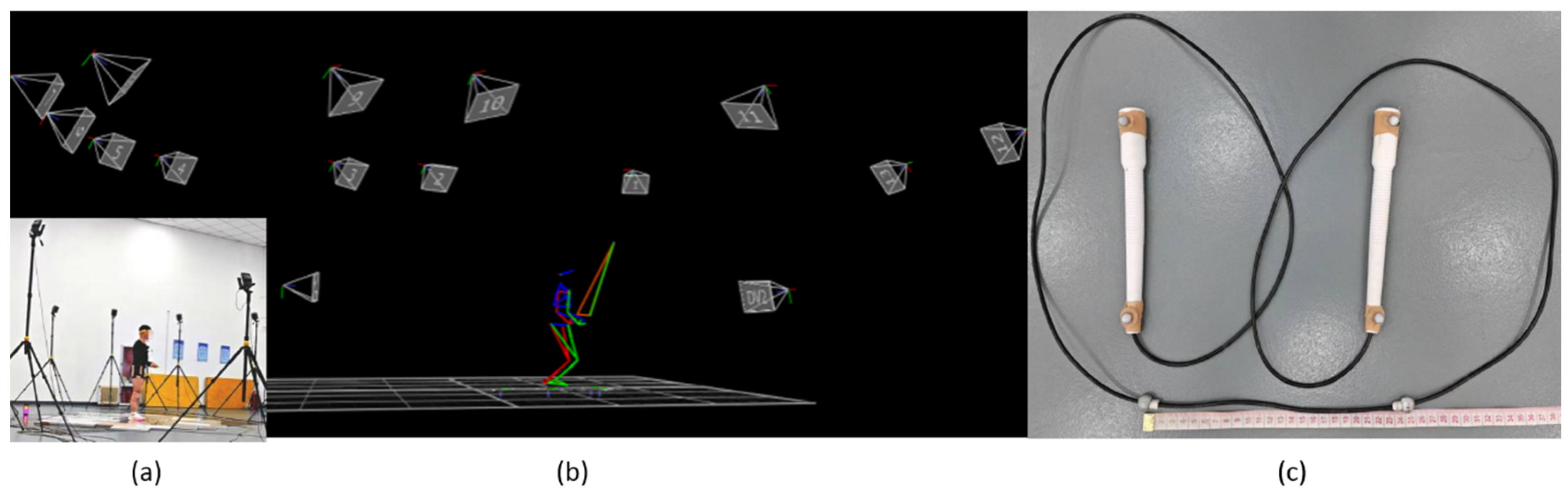
Figure 2.
A 3D cycle trajectory (black) of the rope midpoint and its projections on 3 analysis planes (blue: sagittal plane, green: frontal plane and red: transverse plane).
Figure 2.
A 3D cycle trajectory (black) of the rope midpoint and its projections on 3 analysis planes (blue: sagittal plane, green: frontal plane and red: transverse plane).
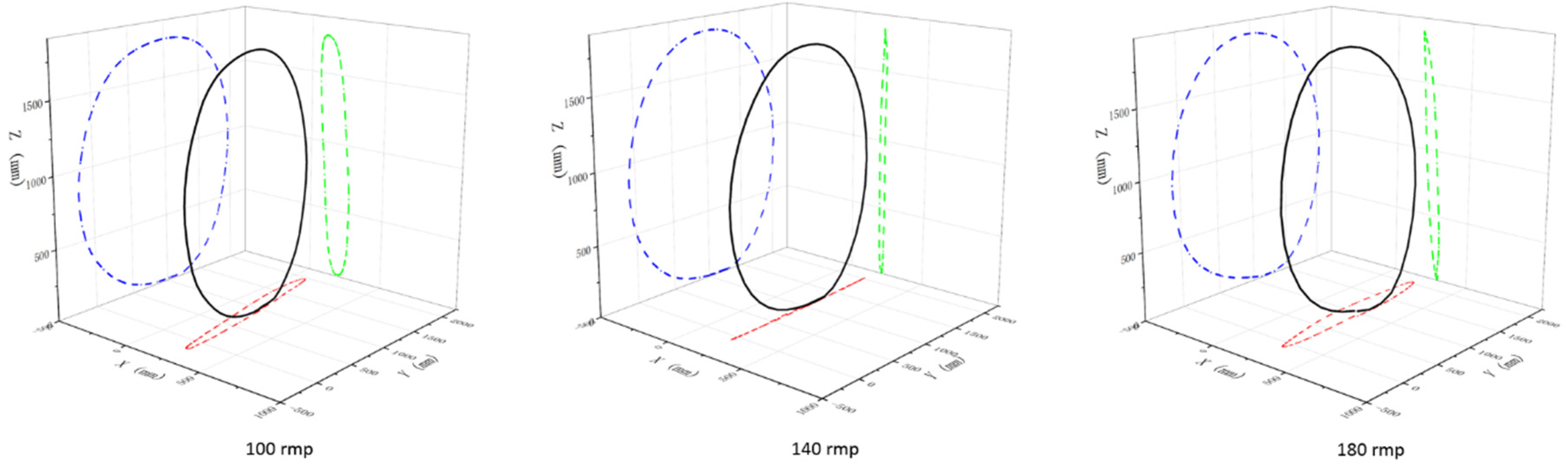
Figure 3.
The influences of rope tempos on rope control. Left: a type velocity change of rope midpoint during a cycle (Hrope: height of rope midpoint). Right: demonstration of acceleration (red) and deceleration (blue) phase in a cycle (from inside to outside: 100 rpm, 140 rpm and 180 rpm).
Figure 3.
The influences of rope tempos on rope control. Left: a type velocity change of rope midpoint during a cycle (Hrope: height of rope midpoint). Right: demonstration of acceleration (red) and deceleration (blue) phase in a cycle (from inside to outside: 100 rpm, 140 rpm and 180 rpm).
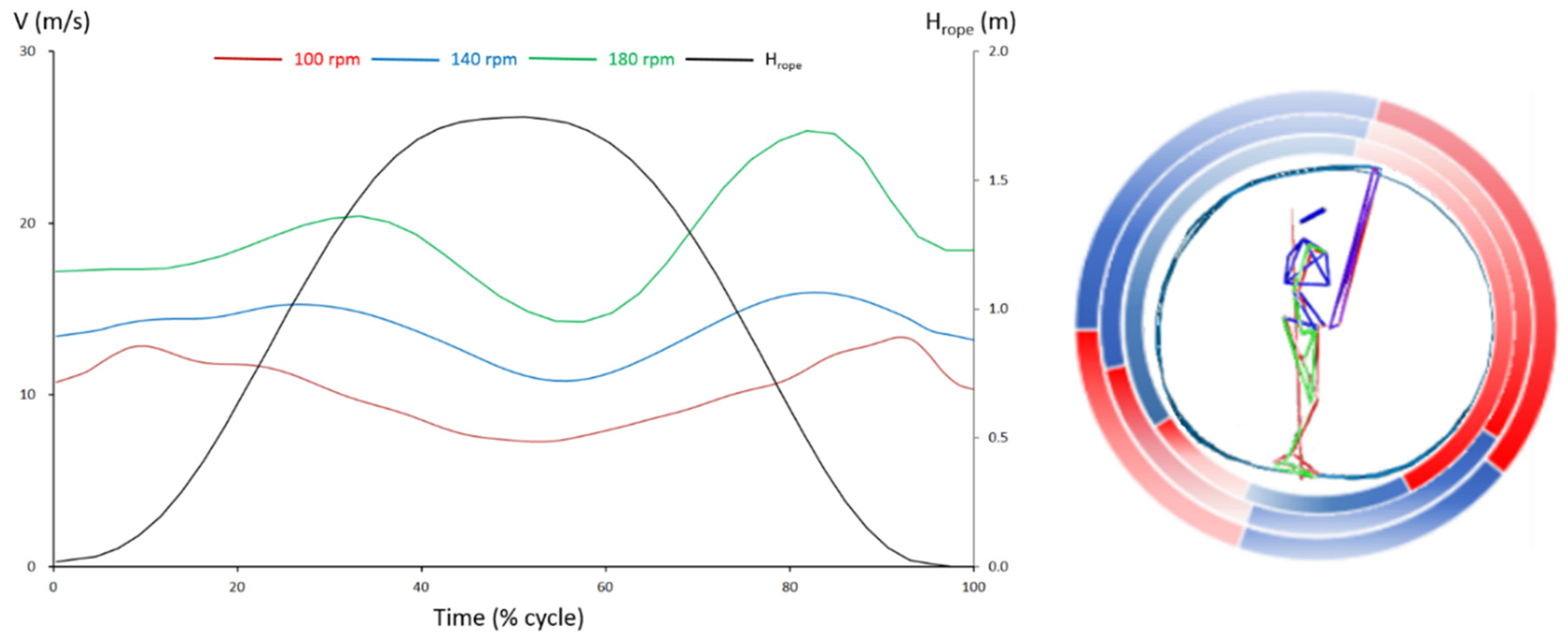
Figure 4.
A typical position change over time of selected key markers. H: height, Hfeet: feet height.
Figure 4.
A typical position change over time of selected key markers. H: height, Hfeet: feet height.
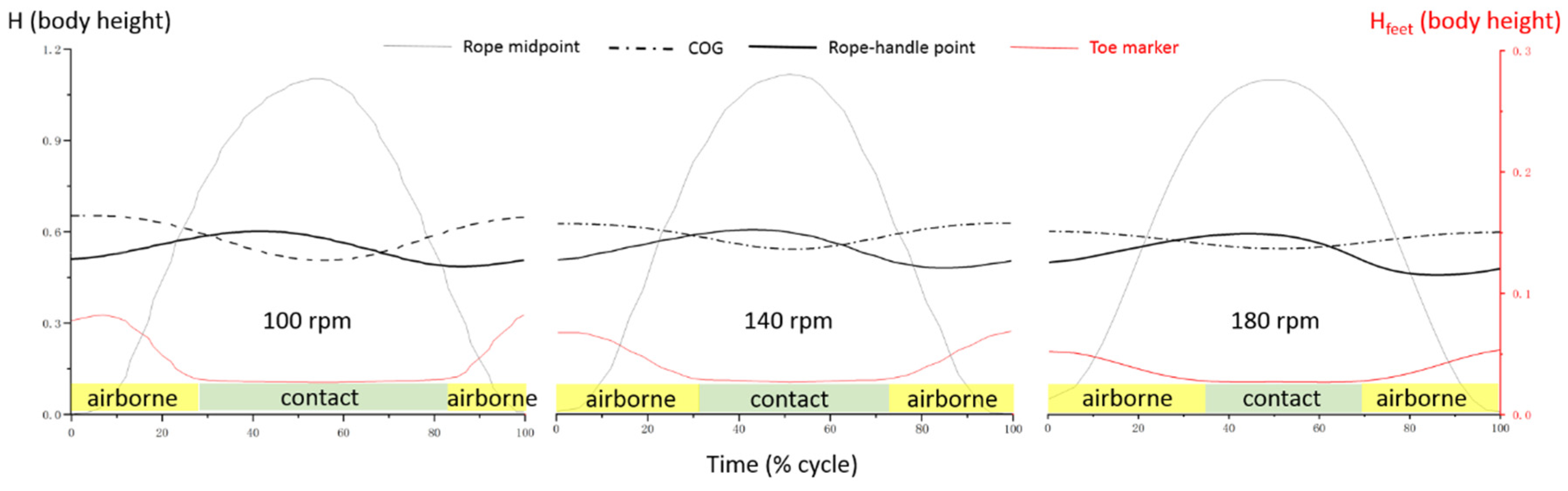
Figure 5.
Selected skill control parameters significantly influenced by rope tempos. *: p<0.05, **: p<0.01, Flex/Ext: flexion/extension.
Figure 5.
Selected skill control parameters significantly influenced by rope tempos. *: p<0.05, **: p<0.01, Flex/Ext: flexion/extension.
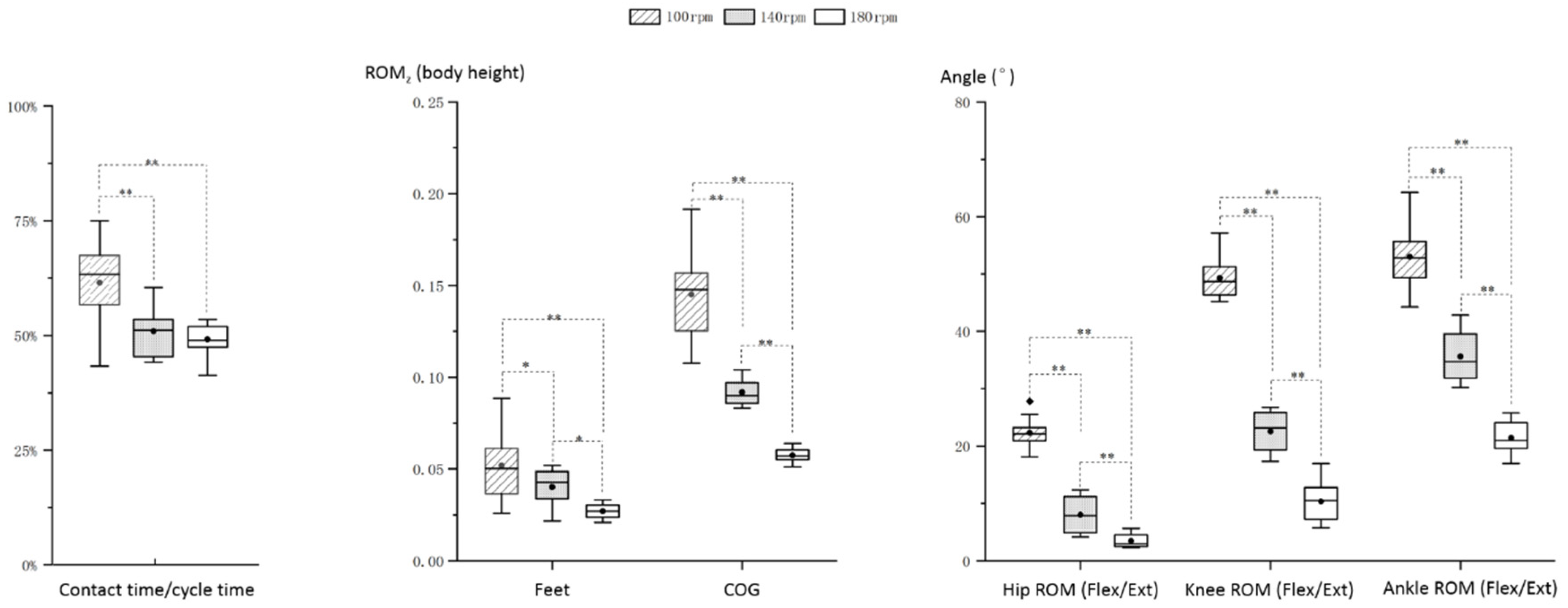
Table 2.
Mean and standard deviation (mean±SD) of the selected time-velocity parameters associated with the influences of rope tempos on rope control.
Table 2.
Mean and standard deviation (mean±SD) of the selected time-velocity parameters associated with the influences of rope tempos on rope control.
| Parameter | 100 rpm | 140 rpm | 180 rpm |
|---|---|---|---|
| Cycle time (s) | 0.60±0.01 | 0.43±0.01 | 0.33±0.01 |
| Rear Vmax (m/s) | 13.39±1.11 | 16.32±1.13 | 20.62±0.73 |
| Time at rear Vmax (% of a cycle) | 13.02±4.20 | 21.76±6.99 | 25.60±5.60 |
| Front Vmax (m/s) | 12.94±1.20 | 16.88±1.56 | 22.74±1.68 |
| Time at front Vmax (% of a cycle) | 89.17±2.58 | 83.59±4.77 | 85.06±4.45 |
Vmax: max velocity.
Table 3.
Significance identified by p-value obtained from ANOVA test associated with the selected time-velocity parameters (*: significant, p≤0.05; **: highly significant, p≤0.01).
Table 3.
Significance identified by p-value obtained from ANOVA test associated with the selected time-velocity parameters (*: significant, p≤0.05; **: highly significant, p≤0.01).
| Parameter | 100 – 140 rpm | 140 – 180 rpm | 100 – 180 rpm |
|---|---|---|---|
| Cycle time (s) | 0.00 ** | 0.00 ** | 0.00 ** |
| Rear Vmax (m/s) | 0.00 ** | 0.00 ** | 0.00 ** |
| Time at rear Vmax (% of a cycle) | 0.00 ** | 0.00 ** | |
| Front Vmax (m/s) | 0.00 ** | 0.00 ** | 0.00 ** |
| Time at front Vmax (% of a cycle) | 0.01 ** | 0.01 ** |
Vmax: max velocity.
Table 4.
Mean and standard deviation (mean±SD) of the selected time-acceleration parameters associated with the influences of rope tempos on rope control.
Table 4.
Mean and standard deviation (mean±SD) of the selected time-acceleration parameters associated with the influences of rope tempos on rope control.
| Parameter | 100 rpm | 140 rpm | 180 rpm |
|---|---|---|---|
| Total acceleration time (% of a cycle) | 48.61±10.04 | 47.87±6.97 | 48.99±5.31 |
| Average rear acceleration (m/s2) | 40.13±17.18 | 43.87±22.54 | 51.75±20.25 |
| Rear acceleration time (% of a cycle) | 9.58±2.94 | 16.47±5.38 | 17.42±4.68 |
| Average front acceleration (m/s2) | 25.17±13.73 | 43.76±15.70 | 86.66±29.85 |
| Front acceleration time (% of a cycle) | 39.03±8.63 | 31.40±5.57 | 31.57±5.70 |
Table 5.
Significance identified by p-value obtained from ANOVA test associated with the selected time-acceleration parameters (*: significant, p≤0.05; **: highly significant, p≤0.01).
Table 5.
Significance identified by p-value obtained from ANOVA test associated with the selected time-acceleration parameters (*: significant, p≤0.05; **: highly significant, p≤0.01).
| Parameter | 100 – 140 rpm | 140 – 180 rpm | 100 – 180 rpm |
|---|---|---|---|
| Total acceleration time (% of a cycle) | |||
| Average rear acceleration (m/s2) | |||
| Rear acceleration time (% of a cycle) | 0.00 ** | 0.00 ** | |
| Average front acceleration (m/s2) | 0.00 ** | 0.00 ** | 0.00 ** |
| Front acceleration time (% of a cycle) | 0.00 ** | 0.00 ** |
Disclaimer/Publisher’s Note: The statements, opinions and data contained in all publications are solely those of the individual author(s) and contributor(s) and not of MDPI and/or the editor(s). MDPI and/or the editor(s) disclaim responsibility for any injury to people or property resulting from any ideas, methods, instructions or products referred to in the content. |
© 2024 by the authors. Licensee MDPI, Basel, Switzerland. This article is an open access article distributed under the terms and conditions of the Creative Commons Attribution (CC BY) license (https://creativecommons.org/licenses/by/4.0/).
Copyright: This open access article is published under a Creative Commons CC BY 4.0 license, which permit the free download, distribution, and reuse, provided that the author and preprint are cited in any reuse.


