

Submitted:
15 November 2025
Posted:
21 November 2025
You are already at the latest version
Abstract
Foundational tensions between special relativity and quantum mechanics, together with conflicts between general relativity and quantum gravity, and unresolved cosmological anomalies, block theoretical unification and limit explanatory depth. Based on ontological first principles rather than mathematical constructs, this analysis integrates a discrete, background-independent 4D spacetime with a physically co-located Planck Domain. Through a one-to-one identity, the Planck Domain mirrors the discrete spatial elements of 4D spacetime, enabling a unified set of physical laws across quantum and classical regimes.Ontic single- and N-body quantum states evolve deterministically in a discrete 4D spacetime and collapse instantaneously in the Planck Domain. This framework resolves tensions with special relativity, including simultaneity, locality, and total energy scaling, preserves unitarity and causal consistency, and replaces the Hilbert‑space wavefunction with an ontic energy field and a single energy-based operator that governs both motion and gravitational response. The same ontological and dynamical model applies unchanged across general relativity, quantum gravity, and cosmology, treating gravitational singularities, relational gravity, the equivalence principle, and the black hole information paradox within the context of a single unified structure. In cosmology, it reinterprets the origin of 4D spacetime, accounting for near-homogeneity, isotropy, and low gravitational entropy, and provides an ontological basis for the cosmological constant and global energy conservation without ad hoc assumptions, fine-tuning, or perturbative techniques. Five discrete, background‑independent mathematical validations, four in relational gravity and one quantum test, support the framework: (i) low‑ℓ CMB temperature power‑spectrum shape from a single global amplitude factor; (ii) emergence of first‑star and metal‑enriched populations under a fixed operator; (iii–iv) two‑ and three‑body dynamics with tight energy, momentum, and barycenter invariants; and (v) CHSH correlations at the Tsirelson bound from the collapse rule.
Keywords:
general relativity
; special relativity
; quantum mechanics
; quantum gravity
; relational gravity
; background independence
; discrete 4d spacetime
; cosmological constant
; arrow of time
; explanatory depth
1. Introduction
1.1. Relativistic Quantum Mechanics, Quantum Gravity, and Cosmology
Resolving the tensions between special relativity (SR) and quantum mechanics (QM) and between general relativity (GR) and quantum gravity (QG) has proven so intractable that few theories comprehensively engage with them, and those that do often rely on complex mathematical constructs that conflict with the constraints of GR and SR.
Neither SR nor GR addresses QM, and later efforts to integrate GR and QG and SR and QM remain largely unsuccessful. Quantum frameworks, including Schrödinger’s wave mechanics, Heisenberg’s matrix mechanics, and various formulations of Feynman’s path integral rely on non-relativistic formulations, while most variations of the Copenhagen Interpretation [1], Bohmian mechanics [2], objective collapse theories (GRWf, GRWm, CSL) [3–5], MWI [6–8] and others [9–17] depend on the non-relativistic Schrödinger equation or Hilbert space representations.
Relativistic quantum field theories (QFT) typically assume a flat Minkowski spacetime, bypassing GR’s curved framework. Approaches to GR–QG, including Causal Dynamical Triangulations [18], Asymptotic Safety in Quantum Gravity [19], and the Holographic Principle [20], focus on mathematical constructs without addressing the SR–QM tension.
String Theory [21] embeds SR and GR into higher-dimensional frameworks using Hilbert and Fock spaces to describe quantum states and interactions. However, it fails to address foundational challenges such as causality, locality, and the ontological basis of 4D spacetime. In contrast, Loop Quantum Gravity (LQG) [22] primarily operates within a 4D spacetime framework, quantizing spacetime into discrete spin networks and spin foams. While more physically grounded, LQG struggles to reconcile probabilistic frameworks, physical observables, and the nature of time within 4D spacetime.
Sophisticated mathematical formulations across these theories often blur the line between physical ontology and abstract constructs. Semi-ontological approaches such as GRWf, GRWm, CSL, and Multi-Field Theories treat mathematical structures as ontic components, complicating their reconciliation with GR and SR. Frameworks like MWI lack clear mechanisms for reconciling quantum phenomena with GR and SR, while models based on Hilbert space, Fock space, matrix mechanics, or 3N configuration spaces often lead to unphysical conclusions. For example, while 4D spacetime alone cannot fully explain the dynamics of N-body quantum states, many models represent these states as evolving within non-physical, ultra-high-dimensional configuration spaces.
1.2. The DO Model
Rather than relying on mathematical constructs, the Dual Ontology model (“DO”) addresses the ontological incompatibility between quantum and classical theories. The framework integrates a discrete, background-independent 4D spacetime with a physically co-located Planck domain (the “Planck Domain”).1 Within this physical framework, each discrete spatial unit in 4D spacetime has an identical counterpart in the Planck Domain, enabling a one-to-one correspondence between the domains [23–24]. Mathematically, the Planck Domain can be expressed as a space, where 3 represents the three dimensions of each discrete spatial unit in 4D spacetime and N represents the number of spatial units in the Planck Domain.
Taken together, the Planck Domain and 4D spacetime form a single, tightly integrated physical structure that enables a unified, ontological, and dynamic model governed by a single set of physical laws applied consistently across scales and domains without ad hoc assumptions, fine-tuning, or perturbative techniques.23 Based on this unified structure, each quantum state is represented in 4D spacetime by an ontic energy field and in the Planck Domain by a single point. A single energy-based operator governs both motion and gravitational response in 4D spacetime.
1.3. Theoretical Scope and Explanatory Depth
Theoretical attempts to unify one or two conflicting aspects of classical and quantum theory bear a heavy explanatory burden (see generally [25–27]). The burden is exponentially greater for theoretical models that address the SR–QM and GR–QG tensions, as well as the universe’s cosmogony and cosmology.
At a minimum, any theory that addresses the SR–QM tension in a relativistic context should include 1) quantum entanglement and nonlocality, 2) the instantaneity of quantum collapse, 3) causality, 4) the nature of time, 5) spacelike separation, 6) separability, 7) indeterminism, 8) quantum state emergence and annihilation, 9) quantum state localization, 10) unitarity, 11) quantum tunneling, 12) relativity of simultaneity, 13) total energy scaling, 14) quantum nonattenuation and quantum exclusivity, 15) the Born Rule’s relationship to SR, 16) the ontic representation of N-body quantum states in 4D spacetime, and 17) the quantum-classical divide.
Theories addressing GR–QG tensions should include 1) cosmological and black hole singularities, 2) regularization, 3) background independence, 4) the nature of time, 5) nonlocality, entanglement, and instantaneity, 6) gravity’s quantizability, 7) the equivalence principle, and 8) the black hole information paradox.
Finally, theories that address the universe’s cosmogony and cosmology should include 1) the emergence of 4D spacetime, 2) its near homogeneity and isotropy, 3) the horizon and causality problem, 4) the flatness problem, 5) gravitational entropy approaching zero, 6) the cosmological constant and dark energy problem, 7) the hierarchy problem, 8) global energy conservation, 9) the large scale structure of the universe and 10) the arrow of time.
1.4. DO Outline
Section 2 establishes the ontological framework, detailing a discrete 4D spacetime and its ontologically distinct Planck Domain. The foundation is essential for resolving the SR–QM tensions, explored in Sections 3–5. These sections reconcile the deterministic, relativistic evolution of quantum states in 4D spacetime with their instantaneous collapse in the Planck Domain. Resolving this tension underpins the model’s ability to address broader challenges, including GR–QG and relational gravity, the cosmological constant problem, the horizon problem, the hierarchy problem, and the quantum-classical divide.
The model’s ontological and dynamic foundations also provide the basis for exploring quantum path irreversibility in Section 6. Grounded in the asymmetry between relativistic quantum state evolution in 4D spacetime and instantaneous collapse in the Planck Domain, the analysis explains the physical basis for the unidirectional arrow of time. Building on these insights, Section 7 directly confronts the GR–QG tensions. Based on a discrete, background-independent 4D spacetime, the model demonstrates that gravity is a relational phenomenon, inherently non-quantizable, and provides an ontological basis for the equivalence principle as well as a theoretical resolution for the Black Hole Information Paradox.
Section 8 investigates the instantaneous transition of 4D spacetime at Heat Death to , based on the same ontological structure and dynamics that govern quantum-state collapse in general. It re-interprets the horizon problem without resorting to inflationary, bouncing, or cyclic theories, identifies the ontological source of the cosmological constant, and resolves the hierarchy problem based upon the DO’s ontological and dynamic principles. Section 9 offers a Coda on the quantum-classical divide, Section 10 synthesizes the model’s contributions and outlines broader implications.
Section 11 provides a concise mathematical summary of the model’s core constructs. Appendix A presents the formal mathematical foundations of the DO and Appendix B provides a computationally viable proof of concept for five independent DO validations: (i) CMB (low-ℓ TT) mapping; (ii) CMB → first stars (Pop III → Pop II/I) evolution; (iii) spin-correlation / CHSH recovery; (iv) two-body orbital dynamics; and (v) three-body coupling. Appendix C outlines future tests and experiments.
2. The Ontological Framework of the DO Model
2.1. Discrete Spheres
Under the DO model, Discrete Spheres are three-dimensional units of space that form the discrete substructure of both 4D spacetime and the Planck Domain (see [28–32]). Each Discrete Sphere is structurally invariant, possesses an identical shape and volume, and represents the smallest structural quantum of space.4 Each is identified by a unique set of x, y, z coordinate identifiers, and N designates the number of Discrete Spheres that comprise the Planck Domain.
The dual presence of each Discrete Sphere in both 4D spacetime and the Planck Domain is referred to as the Planck Identity, which establishes a one-to-one identity and coordinate mapping between domains. The mapping, facilitated by the SOAN (Section 2.2), ensures that each Discrete Sphere occupies the same x, y, z coordinate identifiers in 4D spacetime and the Planck Domain, creating a single, integrated ontological framework.
2.2. The SOAN
The concept of nothingness has long perplexed philosophers and scientists. Greek and Roman thinkers struggled with the concept of zero and the void. Although these concepts no longer trouble most physicists, “nothing” is now used figuratively to mean “not anything” rather than an ontic state of nonexistence. For example, in GR, “nothing,” as in “not anything,” colloquially describes what 4D spacetime expands into after its inception at .5 In LQG, “nothing” refers to the absence of further spatial degrees of freedom below a minimum geometric scale rather than an ontic void [33]. “Nothing” has also been used to denote the absence of space and time [34].
Nevertheless, the concept of an ontic SOAN, devoid of space and time, remains alien to theoretical physics, partly because a physical nothingness cannot be experimentally verified. Rather than discarding the concept outright, this analysis emphasizes its explanatory depth, positioning the SOAN as a necessary ontological element that bridges 4D spacetime and the Planck Domain. Under the DO model, the SOAN provides a physical explanation for the one-to-one correspondence between each Discrete Sphere in 4D spacetime and the Planck Domain, as well as for the dynamic evolution and instantaneous collapse of quantum states.6
The SOAN’s only defining attribute is onticness; it lacks all other physical properties.7 Since it excludes positive physical attributes, the SOAN is a passive ontological entity. It cannot be observed or measured, has no structure or boundaries, and is not governed by the laws of physics. It is a non-spatial, non-temporal bridge that links 4D spacetime to the Planck Domain. Consequently, explanatory depth, rather than experimental testing, is fundamental to verifying the SOAN’s ontological role in the DO model. From an explanatory depth perspective, the SOAN is fundamental to resolving tensions between GR and QG, and between SR and QM, and provides coherent explanations for long-standing cosmological issues.
2.3. Discrete 4D Spacetime
Unlike general relativity’s conception of 4D spacetime as a continuous, differentiable manifold, the DO framework posits that spacetime consists of Discrete Spheres arranged in a dynamic nearest-neighbor structure. This structure supports background independence and stepwise evolution governed by the Unified Evolution Equation (UEE).8 The nearest-neighbor structure imposes a discrete geometric constraint from which Lorentz invariance emerges only in the continuum limit.
2.4. The Planck Domain
The Planck Domain is the second core ontological structure of the DO model. Like discrete 4D spacetime, the Planck Domain is composed of Discrete Spheres and the SOAN. Mathematically, the Planck Domain is composed of N-tuples of ordered triples,
where each N-tuple represents the three spatial dimensions of a Discrete Sphere.
The Planck Domain is composed of dimensions, where 3 represents the spatial dimensions of each Discrete Sphere, and N represents the number of Discrete Spheres [cf. 48]. The Planck Domain fundamentally differs from 4D spacetime [cf. 49]. It has no time dimension [50], physical properties of space, and no volume, and the laws of GR and SR, the strong nuclear force, the electro-weak force, or thermodynamics do not govern it. Moreover, unlike mathematical spaces composed of mutually orthogonal vectors, the Planck Domain integrates N Discrete Spheres into a single Planck Point. For example, the Discrete Spheres that comprise the observable portion of 4D spacetime form a single Planck Point composed of dimensions.
2.5. The Tightly Integrated DO Model
The Planck Domain and the three spatial dimensions of discrete 4D spacetime form the DO model’s single, tightly integrated physical structure [51–52]. Although the structure may seem complex, its core is simple. Based on an ontic SOAN, which serves as a non-spatial, non-temporal bridge between the two domains, the DO framework links 4D spacetime and the Planck Domain into a single physical structure, forming a unified framework that exists in the same location as 4D spacetime. More proverbially, 4D spacetime does not exist “here,” and the Planck Domain does not exist “there”; they co-exist in the same physical space.
The explicit bijection between discrete 4D spacetime and the Planck Domain, enforced by the Planck Identity, ensures a one-to-one identity and mapping of quantum states across both domains. Imagine, for example, that 4D spacetime consists of Discrete Spheres and that the SOAN exists within the interstices of these spheres. Assume there are five Discrete Spheres: one each on Venus, Mars, Jupiter, Sirius, and Polaris. In 4D spacetime, the Discrete Spheres are spatially separated, and each is represented by a set of x, y, z coordinate identifiers. However, since the SOAN, rather than space, exists in the interstices between Discrete Spheres, from the perspective of the Planck Domain, these five spheres are not separated by time, space, or volume. The five Discrete Spheres form a single, unified 15-dimensional point in the Planck Domain, where 3 represents the three spatial dimensions of each sphere, and 5 represents the five spheres.
2.6. The Ontological Reality of Quantum States
The significance of the Planck Identity’s one-to-one identity and coordinate mapping extends beyond the physical integration of 4D spacetime and the Planck Domain. First, the Planck Identity ensures that N-body quantum states, which cannot be fully described in 4D spacetime alone [54], are identified and mapped in both domains. Second, dynamic changes in the physical characteristics of quantum states as they evolve in 4D spacetime are mirrored in the Planck Domain, and physical changes caused by the collapse of a quantum state in the Planck Domain are mirrored in 4D spacetime.
3. The DO and the Dynamics of Quantum States
3.1. The Dynamic Evolution of Quantum States
The analysis begins with the dynamic evolution of a single quantum state in a discrete 4D spacetime composed of Discrete Spheres and the SOAN. As a quantum state evolves in 4D spacetime, its energy occupies Discrete Spheres. The combination of a single Discrete Sphere and the portion of the quantum state’s energy within that sphere is referred to as a Bell Sphere. Building on the Planck Identity, the Bell Identity establishes a one-to-one identity and mapping between a Bell Sphere in 4D spacetime and the Planck Domain.
In 4D spacetime, all of the Bell Spheres occupied by a quantum state constitute its Bell Field, while in the Planck Domain, the same Bell Spheres form the quantum state’s single Bell Point. The quantum energy component of a given Bell Field in 4D spacetime is referred to as the Bell Energy Field, and the quantum energy component of a Bell Point in the Planck Domain is referred to as the Bell Energy Point. For example, the Bell Spheres that comprise an electron in the ground state of hydrogen simultaneously form the electron’s Bell Field in 4D spacetime and its single -dimensional Bell Point in the Planck Domain. As a quantum state spreads in 4D spacetime, the number of Bell Spheres it occupies increases. The Bell Identity ensures a corresponding increase in the number of Bell Spheres comprising the quantum state’s Bell Point in the Planck Domain.
Notably, both the Bell Field in 4D spacetime and the Bell Point in the Planck Domain ontologically occupy the same physical space, ensuring that the Planck Domain is not a separate, abstract domain, but a tightly integrated part of a unified ontological framework.
3.2. The Collapse of a Single Quantum State
The Bell Identity also links the instantaneous collapse of a quantum state’s Bell Energy Point in the Planck Domain with the collapse of its Bell Energy Field in 4D spacetime. Following the collapse of a Bell Energy Point, the number of Bell Spheres that comprise the quantum state’s Bell Point is reduced. Simultaneously, the Bell Identity ensures that the decrease in the number of Bell Spheres comprising the quantum state’s new Bell Point is mirrored by a reduction in the number of Bell Spheres forming the quantum state’s new Bell Field in 4D spacetime. The Discrete Spheres do not collapse. For example, assume that quantum state A is placed within an impenetrable Box A with zero potential inside. Quantum state A forms Bell Field A in 4D spacetime and Bell Point A in the Planck Domain (Figure 1).
As quantum state A spreads, the Bell Identity ensures that the increase in the number of Bell Spheres comprising Bell Field A is mirrored by a corresponding increase in the number of Bell Spheres comprising Bell Point A. The opening of Box A triggers the instantaneous collapse of Bell Energy Point A, causing an instantaneous reduction in the number of Bell Spheres that comprise Bell Point A. The Bell Identity ensures that the reduction is mirrored by an identical reduction in the number of Bell Spheres that constitute Bell Field A in 4D spacetime. Quantum state A is instantaneously generally localized within Box A, but SR has not been violated.
3.2.1. The Einstein–De Broglie Boxes Thought Experiment
The Einstein–de Broglie thought experiment further illustrates the dynamic evolution of a quantum state [54–57]. Quantum state B is generated, forming Bell Field B in 4D spacetime and Bell Point B in the Planck Domain. The quantum state is inserted into Box B. As it spreads, it occupies an increasing number of Bell Spheres in 4D spacetime and the Planck Domain (Figure 2).
An impenetrable divider is inserted into Box B, creating Box C and Box D. The quantum state now forms two equal Bell Fields in 4D spacetime, Bell Field C and Bell Field D, and a single Bell Point in the Planck Domain, designated as Bell Point CD. Box C is sent to Princeton, and Box D is sent to Copenhagen (Figure 3).
Despite their separation, the Bell Identity ensures that the quantum state continuously forms Bell Fields C and D in 4D spacetime and Bell Point CD in the Planck Domain.
The opening of Box C or Box D triggers the collapse of Bell Energy Point CD, reducing the number of Bell Spheres that form the new Bell Point of the quantum state. The reduction is mirrored in 4D spacetime. If the quantum state is found in Box C, it forms a generally localized Bell Field C in Box C and Bell Point C in the Planck Domain, while Bell Field D and Bell Point D cease to exist. Conversely, if the quantum state is found in Box D, it forms a generally localized Bell Field D in Box D and Bell Point D in the Planck Domain, and Bell Field C and Bell Point C no longer exist. The process is the same, regardless of which box is opened first.
3.2.2. The Double-Slit Experiment
In the double-slit experiment, individual quantum states are directed at Wall (W), which has two narrow Gaussian slits (A) and (B). Due to the narrowness of the slits, every quantum state that passes through slit (A) or slit (B) diffracts, spreading as spherical Bell Fields toward Detector D (Figure 4).
As a quantum state diffracts through slits (A) and (B), its Bell Field splits into two separate fields in 4D spacetime: Bell Field A and Bell Field B.9 In the Planck Domain, the fields remain unified as a single Bell Point AB. A detection flash at Detector D indicates that Bell Energy Point AB has collapsed. The collapse reduces the number of Bell Spheres comprising the quantum state’s Bell Point in the Planck Domain. The Bell Identity ensures that the reduction is mirrored in 4D spacetime, localizing the quantum state’s Bell Energy Field to one of the diffracted paths. Following the quantum collapse of Bell Energy Point AB, the Bell Energy Field in 4D spacetime localizes to either Bell Field A or B; the other branch’s Bell Energy Field ceases to exist. The interference pattern observed on Detector D arises from cumulative quantum collapses, reflecting the probabilistic outcomes of individual quantum collapses.
3.2.3. A Which-Way Experiment
Which-way experiments compound the theoretical complexities of the double-slit experiment. The following which-way experiment has been modified by including a proton in an empty box at the center of Wall (W) (Figure 5).10 The proton is positively charged, and each electron fired toward Wall (W) is negatively charged. Slit (A) flashes if the proton is attracted toward slit (A) and slit (B) flashes if it is attracted toward slit (B).
Under the DO model, as the quantum state spreads in 4D spacetime, it continuously forms a Bell Field in 4D spacetime and simultaneously forms a single Bell Point in the Planck Domain. If slit (A) flashes, the Bell Energy Point instantly collapses, reducing the number of Bell Spheres that make up its new Bell Point; the Bell Identity mirrors this as a reduced Bell Field. The quantum state is localized at slit (A). The analysis remains the same whether slit (B) flashes or slit (A).
Once the quantum state is generally localized at either slit (A) or slit (B), it again spreads toward Detector (D). However, because the quantum state collapses at either slit (A) or slit (B), but not both, no interference pattern forms at Detector (D).
3.3. N-Body Quantum States and the Bohm-EPR Thought Experiment
The Bohm version of the EPR experiment highlights issues related to the dynamic evolution of an N-body quantum state in 4D spacetime and its collapse in the Planck Domain. A pair of electrons is prepared in the singlet state. The singlet state forms Bell Fields E and F in 4D spacetime and a single Bell Point EF in the Planck Domain. Quantum state E is sent to Princeton, and quantum state F is sent to Copenhagen (Figure 6). Testing equipment is configured to conduct a z-axis Stern–Gerlach experiment on either Bell Field E or F.
As Bell Fields E and F spread dynamically in 4D spacetime, the number of Bell Spheres that comprise their respective Bell Fields increases, as does the number of Bell Spheres that comprise Bell Point EF. The Stern–Gerlach experiment, conducted along the z-axis in either Princeton or Copenhagen, triggers the collapse of Bell Energy Point EF. The collapse instantaneously reduces the number of Bell Spheres that formerly composed Bell Point EF, and the reduction is mirrored by Bell Field E and Bell Field F, respectively. Bell Point EF forms two independent Bell Points designated as Bell Point E and Bell Point F. Bell Point E shares a one-to-one mapping and identity with Bell Field E, and Bell Point F shares a one-to-one identity and mapping with Bell Field F.
Following the instantaneous collapse, Bell Point E and Bell Point F form a product state rather than an entangled state. The single state descriptor, , transitions to a product state composed of two independent state descriptors, and . This physical change is represented as , and the corresponding Bell Energy Fields E and F are generally localized. Whether quantum state E is found along the z spin-up or z spin-down axis, quantum state F’s spin is the opposite. SR has not been violated.
4. Physical Implications of the DO Model
4.1. Indeterminacy
Indeterminacy typically means that a quantum system has a determinable property without a specific determinate value [60, pp. 72–107]. In a singlet state along the z-axis, spin is a determinable property, with z spin-up and z spin-down as determinate values. While the conventional quantum formalism represents this entangled state abstractly as the state vector , the DO model provides a direct ontological description. The two quantum states, and , form a single, unified system described by the state descriptor , with no determinate z-spin for either component prior to collapse; a singlet anti-correlation holds. The Bell Identity ensures that this system forms a single Bell Point in the Planck Domain and two corresponding Bell Fields in 4D spacetime.
After instantaneous collapse, the system transitions to a product state and the spins of and become determinate; for collapse along the z axis, the outcomes are opposite: one z-up, the other z-down, and which component is up is outcome-contingent. This physical transition from a unified state to two independent states is represented symbolically as . Each quantum state now forms its own Bell Point associated with its respective localized Bell Field in 4D spacetime.
4.2. Quantum State Emergence and Annihilation
Quantum state emergence and annihilation challenge the applicability of the non-relativistic Schrödinger equation, which is formulated for systems with a fixed number of quantum states and does not account for processes involving the creation or annihilation of quantum states [10]. Relativistic quantum field theory (QFT) addresses these variations, but the DO model offers a unique solution, representing quantum states as physical entities in both 4D spacetime and the Planck Domain.
Under the DO framework, the Bell Identity links the Bell Spheres that comprise a quantum state’s Bell Field in 4D spacetime and its Bell Point in the Planck Domain. During quantum annihilation, the collapse of a quantum state’s Bell Energy Point transfers the observables of the quantum state to another system, eliminating the Bell Energy Point and Bell Energy Field of the original state. During quantum emergence, a quantum state forms a new Bell Field in 4D spacetime and a corresponding Bell Point in the Planck Domain.
4.3. Physical Triggers
In the DO model, Physical Interactions in 4D spacetime are caused by one or more of the three traditionally labeled Fundamental Forces: electromagnetism, the strong nuclear force, and the weak nuclear force. Based on the Bell Identity, a Physical Interaction in 4D spacetime is mirrored in the Planck Domain, where the quantum state’s Bell Energy Point collapses instantaneously.
The DO model does not identify the precise Physical Interaction that induces quantum state collapse. Nevertheless, it provides a structured framework for examining how physical triggers may induce collapse. Within the DO framework, each Physical Interaction is a localized event in time and space, with its frequency influenced by factors such as temperature and spatial positioning (see generally [61]). Local temperature and position within the Sun affect the rate of quantum state collapse. Humans can initiate or influence the timing and location of Physical Interactions. For example, a scanning tunneling microscope can be used to control and precisely vary the rate of electron collapse. However, Physical Interactions are independent of human consciousness, ambient noise, and universal processes,but see [62,63].
4.4. Quantum State Localization
The Bell Identity links the collapse of a quantum state’s Bell Energy Point in the Planck Domain to a simultaneous reduction in the number of Bell Spheres that comprise its Bell Field in 4D spacetime. Because the reduction must be to a contiguous subset of the Bell Spheres that compose the quantum state prior to collapse, the Bell Identity places a strict boundary on the collapse outcome. Following the collapse of a Bell Energy Point, a quantum state’s new Bell Field cannot be generally localized anywhere in 4D spacetime; it must be generally localized to a contiguous subset of its Bell Spheres prior to collapse, yielding a discrete spatial configuration consistent with observed quantum measurements.
The Bell Identity does not set a specific size for a quantum state’s Bell Field in 4D spacetime following collapse. The size of the Bell Field may be related to the physical trigger that initiated the collapse, or it may vary depending on the quantum state’s physical composition. Additionally, high- or low-energy collapses may exhibit different localization characteristics, and a quantum state’s momentum in 4D spacetime may also influence its localization.
4.5. Time and Instantaneous Collapse
Neither the Planck Domain nor 4D spacetime supports the concept of instantaneous collapse independently. The Planck Domain lacks a time dimension and, aside from collapse, does not support dynamic movement. In contrast, 4D spacetime has dynamic movement and a time dimension constrained by SR.
When a Physical Interaction in 4D spacetime occurs, the trigger is mirrored in the Planck Domain, causing the quantum state’s Bell Energy Point to collapse instantaneously. The Bell Identity ensures that the collapse is mirrored by a reduction in the number of Bell Spheres that comprise the quantum state’s Bell Field in 4D spacetime. Because the collapse of a Bell Energy Point is instantaneous, it is mirrored in the three spatial dimensions of 4D spacetime, with no movement along the time dimension.
4.6. Quantum Tunneling
Although commonly described as “quantum tunneling,” the appearance of a quantum state on the opposite side of a classically impenetrable barrier does not involve quantum tunneling in 4D spacetime (for a general overview, see [64]). In many traditional interpretations, the probability of a quantum state appearing on the other side of an impenetrable barrier is based on the Schrödinger equation and the exponential decay of the quantum state’s Bell Field within the barrier.
Under the DO model, the event is not tunneling but rather the instantaneous collapse of the quantum state’s Bell Energy Point in the Planck Domain. When a quantum state’s Bell Energy Point undergoes instantaneous reduction, the Bell Identity ensures a corresponding reduction in the number of Bell Spheres that constitute the quantum state’s new Bell Energy Field in 4D spacetime. Although the quantum state is localized on the other side of the barrier, it does not “tunnel” through, and SR is not violated.
4.7. The Born Rule Revisited
The DO model diverges fundamentally from the Born Rule and its mathematical interpretation of wave-function collapse as a probability density for continuous variables. In the DO framework, a quantum state’s presence in 4D spacetime is characterized by its Bell Energy Field. The field represents the physical distribution of a quantum state’s total intrinsic energy across the discrete Bell Spheres it occupies. Since the Bell Identity dictates that collapse must occur within a discrete subset of these Bell Spheres, the DO model posits that the likelihood of the quantum state becoming generally localized within any specific sub-region of its pre-collapse Bell Energy Field is directly proportional to the quantum state’s energy residing in that sub-region (cf. [65]). This approach grounds probability in the tangible distribution of the state’s physical energy, rather than in abstract mathematical amplitudes.
For example, in the case of quantum tunneling, the probability of the quantum state localizing on the far side of a classically impenetrable barrier corresponds to the proportion of its total energy distributed in its Bell Spheres beyond that barrier before collapse.11 Such an outcome is a discrete probability event, not the result of integrating a continuous probability density. The Bell Identity underpins the unitarity of this process and resolves issues such as the “four tails problem” [66] but leaves open whether the collapse of a quantum state is fully deterministic [67].
5. Resolving the Tension Between SR and Quantum Mechanics
The apparent incompatibility between SR and QM is often framed in terms and concepts derived from 4D spacetime. Despite their usefulness, common terms such as spacelike separated, non-separability, entanglement, instantaneous, local, non-local, and complex concepts such as the relativity of simultaneity and total energy scaling have unintentionally magnified a theoretical and experimental conflict that does not exist.
5.1. Spacelike Separated
The term spacelike separated is based on a 4D spacetime structure with three spatial dimensions and one temporal dimension. The term is directly related to the concepts of space and time, the theory of SR, and the spatial distance between two or more events outside of one another’s light cones. Nevertheless, the term loses meaning in relation to a Bell Point where time, space, and volume do not exist.
5.2. Non-Separability
Einstein was among the first to raise concerns regarding separability in theoretical physics. His primary concern related to two assumptions underlying his argument for incompleteness: that spatially separated systems are ontic states, and that physical effects in spacelike-separated systems cannot propagate faster than the speed of light.1213
In the DO model of 4D spacetime, a singlet state along the z-axis is described by the state descriptor . This system is non-separable, representing a real physical entity rather than an abstract mathematical concept. A non-separable DO singlet state has three key attributes: 1) the spatial separation of the and Bell Fields, 2) their temporal separation, and 3) the existence of a single system, whose corresponding single Bell Energy Point ontologically enforces non-separability.14
In the Planck Domain, where time, space, and volume do not exist, a Bell Point exists as a single, non-separable entity (but see [42, 72]). The Bell Energy Point is mirrored via the Bell Identity to the Bell Spheres that form the quantum state’s Bell Energy Field(s) in 4D spacetime. The non-separability of a Bell Energy Point in the Planck Domain does not violate SR.
5.3. Instantaneous, Superluminal, and Faster than Light
In QM, the terms instantaneous, superluminal, and faster than light often describe the collapse of a quantum state in 4D spacetime. Following quantum state collapse, these terms are used to describe the quantum state’s role in 1) communication, 2) signaling or the absence of signaling, 3) information transmission, and 4) matter and energy transfer.
However, under the DO model, terms such as instantaneous describe the physical collapse of a Bell Energy Point in the Planck Domain rather than a collapse in 4D spacetime. Following the collapse, the reduction in the number of Bell Spheres that comprise a quantum state’s new Bell Point in the Planck Domain is mirrored by a reduction in the Bell Spheres that comprise the quantum state’s generally localized Bell Field in 4D spacetime. The process is instantaneous, but SR is not violated cf. [71].
5.4. The Quantum Connection
In 4D spacetime, quantum discrimination refers to a quantum state’s ability to maintain an exclusive connection, excluding all other quantum states, and unattenuated denotes the strength (or lack of attenuation) of a quantum state’s connection [69], pp. 21–22. The terms are typically used to denote the connection between spacelike-separated entangled states. Discrimination and non-attenuation also imply an instantaneous, continuous connection that violates the maximum speed of light.
In the DO model, the Bell Identity ensures that all dynamic changes to Bell Spheres are mirrored in both 4D spacetime and the Planck Domain. The mirroring process ensures quantum discrimination and non-attenuation without violating SR.
5.5. Bell’s Theorem
Bell’s inequality theorem asserts that relativistic local-causation theories cannot account for the statistical predictions of quantum mechanics in spin experiments involving entangled singlet states [73–75]. More broadly, Bell’s theorem indicates that any theory conforming to quantum experimental results cannot be local [75–77].
The DO model locates Bell Energy Point collapse in the Planck Domain, where time and space do not apply. The Bell Identity ensures that the physical collapse of a quantum state is mirrored in 4D spacetime without violating relativity. Although collapse is extra-spatio-temporal, in 4D spacetime, the physical process of collapse nevertheless violates Bell’s local-causality condition and reproduces Bell-type correlations.15
5.6. The Relativity of Simultaneity
The SR–QM tension extends to the relativity of simultaneity. SR holds that 1) all inertial reference frames (frames moving at a constant speed relative to one another) are equally valid, and 2) the speed of light in a vacuum is invariant for all observers in these frames. Consequently, the relativity of simultaneity implies that a) whether two spatially separated events occur simultaneously depends on the observer’s frame of reference, and b) observers in different frames may conclude that the same event happened at different times.
For spacelike-separated electrons in the singlet state along the z-axis, , the collapse of the electron causes the simultaneous collapse of the electron. Because the relativity of simultaneity suggests that the order of cause (collapse of ) and effect (collapse of ) depends on the observer’s frame of reference, simultaneous collapse appears to challenge SR, implying a violation of Lorentz Invariance and a preferred frame [71], p. 185.
The DO model resolves the issue by treating the collapse of the system as an event beyond 4D spacetime. For a singlet state along the z-axis, it is irrelevant whether or is measured first or whether they are spacelike separated. The Bell Identity ensures that an experiment on either quantum state in 4D spacetime is simultaneously conducted on the quantum state’s single Bell Point in the Planck Domain. Moreover, the identity reflects the instantaneous collapse of the Bell Energy Point as a reduction in the Bell Spheres comprising the now generally localized Bell Fields of both and in 4D spacetime. The formerly entangled quantum state becomes a product state, and although the collapse is instantaneous, SR remains intact.
5.7. Total Energy Scaling
The instantaneous nature of quantum state collapse appears to challenge Einstein’s theory of total energy and momentum in SR [71]. The theory posits that the total energy of a body moving relative to an observer increases as its velocity accelerates. As an object approaches the speed of light, its relativistic kinetic energy theoretically approaches infinity, although SR limits its speed. In quantum mechanics, momentum is typically used instead of velocity. Accordingly, as the momentum of a quantum state increases, so does its associated total energy. If collapse were interpreted as a process in which a body in 4D spacetime actually reaches or exceeds the speed of light, the total energy required would be infinite.
While the collapse of a quantum state’s Bell Energy Point is instantaneous, it is a physical event external to 4D spacetime. The DO model and the Bell Identity ensure that the instantaneous collapse results in a reduction in the number of Bell Spheres comprising the quantum state’s Bell Point and Bell Field(s). Consequently, the reduction in Bell Spheres in the Bell Field is also instantaneous. However, the process does not result in an increase in the quantum state’s energy in either 4D spacetime or the Planck Domain.
6. Quantum Path Irreversibility and the Arrow of Time
The Bohm version of the EPR experiment (see Figure 6) demonstrates why quantum path reversibility following a collapse is impossible [78], pp. 150–162, [79,80] cf. [81]. Assume that two quantum states, and , are entangled in the singlet state along the z-direction, forming a single, unified system described by . The Bell Field of is on Mars, and the Bell Field of is on Earth. The entangled system is separated by 225 million km, and its spin is indeterminate. In the Planck Domain, this single system corresponds to a single Bell Point .
Following the instantaneous collapse of Bell Energy Point , the system transitions to a product state represented as . The Bell Identity ensures that the reduction in the number of Bell Spheres comprising Bell Point is linked to the simultaneous reduction in Bell Spheres that comprise Bell Fields and in 4D spacetime. Bell Field is generally localized on Mars, and Bell Field is generally localized on Earth. The and quantum states are now separable, each forming its own distinct Bell Point (Bell Point and Bell Point ). If is spin-up, is spin-down, and vice versa. The spin of the respective quantum states is now determinate.
Before quantum state collapse, 1) is on Mars, is on Earth, and and are separated by 225 million km; 2) the singlet state forms Bell Point in the Planck Domain; and 3) the singlet state is non-separable, and its spin is indeterminate. Following the instantaneous collapse of Bell Energy Point , 1) is generally localized on Mars, is generally localized on Earth, and and remain separated by 225 million km; 2) the formerly entangled singlet state is now a product state; 3) forms Bell Field on Mars and Bell Point in the Planck Domain; 4) forms Bell Field on Earth and Bell Point in the Planck Domain; 5) the product state is now separable; and 6) the spins of quantum states and are determinate even if they are unknown.
Reversing the path would require retracing the collapse, but the unified Bell Point no longer exists; therefore, path reversibility is impossible. now forms Bell Field on Mars and Bell Point in the Planck Domain, and now forms Bell Field on Earth and Bell Point in the Planck Domain. Because Bell Field and Bell Field are now generally located on Mars and Earth, each quantum state must travel at least 112.5 million km before it can become entangled again. Even if there is an infinitely small chance that the and quantum states spread and once again form Bell Point , when the singlet state collapses, path reversibility becomes impossible.
The DO’s ontological structure, the asymmetric laws governing the dynamic motion of quantum states in 4D spacetime, and their collapse in the Planck Domain provide the physical basis for the arrow of time in 4D spacetime. Without an instantaneously reversible path, the arrow of time following collapse for all quantum states, and those of the proverbial egg, can only move in a single temporal and spatial direction.16
7. GR, Relational Gravity, Background Independence, and Black Holes
7.1. Discretization and Singularities
The DO model replaces GR’s assumption of a continuous, differential 4D spacetime manifold with a discrete 4D spacetime composed of Discrete Spheres. Critically, in the context of GR–QG, the physical discretization of 4D spacetime resolves several of the mathematical difficulties encountered by the Einstein Field Equation (EFE), including cosmological singularities, black hole singularities, and regularization.17
7.1.1. Cosmological and Black Hole Singularities
Specific mathematical solutions to EFE, including the FLRW model, predict a cosmological singularity at , where the density, pressure, and energy density become infinite. Similarly, the Schwarzschild solution to the EFE, based on a spherically symmetric, uncharged, and non-rotating mass, mathematically defines the conditions under which a curvature singularity forms at the center of black holes. In both cases, the EFE’s lack of a physical mechanism to impose a cut-off at a minimum volume mathematically leads to infinite energy, mass, and pressure [82].
Notwithstanding the significant differences between cosmological and black hole singularities, discretization based on the minimum discrete size of Discrete Spheres provides a minimum volume cutoff that resolves the infinities in both cases. The discretization sets limits on the maximum possible frequencies and wavelengths for energy, creating a physical upper bound on energy density.18
7.2. Regularization
In QFT, zero-point energies from quantum fluctuations are formally summed over all modes, producing vacuum energy densities that diverge at high energies. Regularization introduces a mathematical cutoff to control these infinities, and renormalization redefines physical parameters to remove them. Even after this procedure, the predicted value can exceed the observed energy density by as much as . In continuum approaches, these enormous contributions are often absorbed into a constant “vacuum term” that is adjusted so the remaining, effective energy density matches observations. In the DO model, Discrete Spheres function as a physical cutoff for ultra-high-energy modes, preventing ultraviolet energy from diverging cf. [83]. With no infinities to absorb, and with the large-scale constant that plays the role of fixed rather than tuned (see Section 8), there is no vacuum term to adjust, and renormalization is unnecessary. Discreteness thereby eliminates both the divergence and its underlying cause, yielding physical energy densities far below the mathematical prediction of the zero-point energy summation.
7.3. Time
In QFT’s Hamiltonian and path integral formalisms (and the explicitly non-relativistic Schrödinger equation), time typically remains an external, fixed parameter. Most QFT theories assume a flat Minkowski spacetime, with time as an absolute Newtonian construct. In contrast, GR treats time as a dimension within 4D spacetime, where the rate at which time passes depends on local mass, energy, and pressure, as reflected in spacetime’s curvature. Time dilation, gravitational redshift, and lensing follow from this relational view of time.
The DO model’s approach to time diverges from both perspectives by integrating the Planck Domain, which lacks a time dimension. Except for quantum collapse, the Planck Domain has no independent dynamic movement. Single and N-body quantum states evolve entirely within 4D spacetime, under a discrete dynamics whose large-scale behavior is consistent with SR and GR.19 As a result, quantum state dynamics respect SR constraints, including the maximum speed of light, time dilation, and the relativistic increase in energy, with gravity expressed as curvature in a discrete 4D spacetime. While Discrete Spheres set the smallest unit of time at approximately the Planck time, time remains a dynamic concept shaped by GR and SR rather than QM.
7.4. Relational Gravity
Attempts to quantize gravity with continuum-only, background-metric programs have thus far failed [84]. The EFE describe a local, relativistic interaction compatible with SR, but quantum collapse is typically regarded as a non-local phenomenon with instantaneous changes to a quantum state’s wave function [85]. Hypothetical gravitons are problematic if they must simultaneously adhere to SR constraints and mediate instantaneous changes in location and momentum.20 Additionally, because standard QM holds that the position of a quantum state is undefined before collapse, gravitational coupling is ambiguous. In the specific case of an N-body quantum state, it is unclear whether gravity couples to the aggregate state as a whole or to each constituent quantum state.
Instantaneous collapse also appears to conflict with the relativity of simultaneity and with the limits of total energy and momentum in SR.21 Many QM interpretations represent the collapse with a Dirac delta function , implying infinite localization, infinite momentum uncertainty, and potential black hole formation [85].
Under the DO model, however, all quantum states evolve in a discrete, 4D spacetime within which large-scale behavior is compatible with SR. Bell Energy Points collapse instantly in the Planck Domain, where the laws of 4D spacetime do not apply. The collapse of a Bell Energy Point localizes the quantum state in 4D spacetime rather than collapsing to a delta function, ensuring finite localization and avoiding the issues raised by . Because the Bell Identity mirrors a quantum state’s Bell Spheres across both domains, changes in energy and sphere count are reflected instantaneously by a quantum state’s Bell Energy Point and Bell Energy Field(s). Consequently, the Bell Energy Fields of quantum states in 4D spacetime and their Bell Energy Points in the Planck Domain both carry the information (spin, momentum, and position) needed to reproduce the observed quantum behaviour associated with the strong nuclear force, electromagnetism, and the weak force.22
Unlike these forces, gravity is not encoded in the quantum states of Bell Energy Points, nor does it exist in the Planck Domain. Gravity is a 4D spacetime phenomenon, arising from large-scale relational configurations of Bell Spheres.2324 The interaction of Bell Spheres, governed by the UEE, ensures that spacetime geometry is determined by the collective relational configurations rather than by the intrinsic properties of quantum states. Gravity does not arise from intrinsic Bell Sphere properties; it is purely relational among Bell Spheres in 4D spacetime and is governed by the UEE’s coupling of energy to curvature.
Accordingly, gravitational effects depend only on the Bell-Sphere energy distribution in 4D spacetime, not on quantum state observables in 4D spacetime or the Planck Domain. While quantum observables depend on a quantum state’s intrinsic properties, gravity is governed by localized relational structures in 4D spacetime. Under the DO approach, gravity cannot be quantized as an independent field, because its effects arise from relational configurations rather than from intrinsic quantum properties at the Bell Energy Point.
7.5. Background Independence
In GR, spacetime geometry is dynamic, but it is still modeled on a continuous manifold. Most quantum field theories, on the other hand, assume a fixed background geometry, such as flat Minkowski space. This fixed framework imposes a separation between geometry and the distribution of matter and energy, requiring the geometry to be specified in advance.
The DO model is background-independent from the outset [86]. From , discrete 4D spacetime exists and is formed from the relational configuration of Discrete Spheres, with no external metric or coordinate structure imposed from outside the model. Its geometry is determined internally by the system’s physical state, and because geometry and energy distribution co-evolve, there is no fixed metric structure, and no external background is needed to define motion or curvature.
7.6. The Black Hole Information Paradox
The black hole paradox is based on the apparent conflict between two principles: 1) the QM principle that information is never lost, and 2) Stephen Hawking’s 1975 semi-classical premise that information falling into a black hole is eventually lost through Hawking radiation. The QM principle is closely related to the unitarity and reversibility of quantum processes. Hawking’s key premise is that a black hole loses mass and energy by emitting thermal radiation at its event horizon. Because the quantum state of matter falling into the black hole is inaccessible beyond the event horizon, and thermal radiation is presumed to carry no specific information, the process implies that the information is permanently lost.25
Under the DO framework, when a quantum state’s Bell Field(s) falls into a black hole, the quantum state and its information are no longer accessible in 4D spacetime. However, as long as the quantum state does not collapse, it is still represented by its Bell Field(s) within the black hole and by its single Bell Point in the Planck Domain. As the quantum state dynamically evolves within the black hole, any changes to the content or number of Bell Spheres in the Bell Field are instantaneously mirrored by its Bell Point.
The transition to thermal radiation, triggered by a Physical Interaction inside the black hole, causes the instantaneous collapse of the quantum state’s Bell Energy Point. In 4D spacetime, the collapse causes the quantum state’s transition to radiation via the Hawking process. Although the collapse is irreversible, the Bell Identity preserves the quantum state’s conserved quantities across the transition to Hawking radiation. Detailed quantum state information is not preserved after collapse, but its conserved quantities persist, so no fundamental information loss occurs.
8. Quantum Cosmology, the Cosmological Constant, and the Hierarchy Problem
The DO model departs significantly from current cosmological theories of 4D spacetime (see, generally, [88]). However, ad hoc assumptions, fine-tuning, or perturbative techniques are not required to explain the instantaneous collapse process that transforms a widely dispersed 4D spacetime at or near Heat Death to a generally localized 4D spacetime at . The collapse explains 4D spacetime’s extreme, but not infinite, energy, pressure, and temperature at , its nearly isotropic and homogeneous state, and its extremely low gravitational entropy. The framework also provides a unified physical account of the horizon and flatness problems while clarifying the origin of independently of Dark Energy (see [89]).26
8.1. The FLRW Model of 4D Spacetime at Heat Death
4D spacetime’s status as open, closed, or flat is based on the FLRW derivation of the EFE. Experimental data currently suggests that , indicating that 4D spacetime is flat or very nearly flat. In turn, flatness implies that 4D spacetime’s total energy density equals the critical density . Based on the FLRW model and current datasets, a spatially flat 4D spacetime at Heat Death approaches a state of near-maximal entropy; as time passes, the total energy density tends toward , and the temperature asymptotically approaches zero.
At Heat Death, 4D spacetime’s spatial geometry, energy density, pressure, and temperature are very nearly homogeneous and isotropic, and, as a result, 4D spacetime is very close to thermodynamic equilibrium. 4D spacetime has no large-scale structures, is extremely widely dispersed, and its spatial curvature is flat or nearly flat. Even though the negative pressure of dominates, 4D spacetime’s energy density equals the critical density . Because little heat can flow near a thermal equilibrium approaching zero, little work or gravitational clumping can occur. At the macrostate level, no additional physical changes occur without work, and in the absence of work, 4D spacetime is in a state of near-maximal gravitational entropy.27
8.2. The FLRW Model of 4D Spacetime at
Mathematical attempts to describe 4D spacetime at support different conclusions regarding its physical status. Under specific conditions, the EFE and Friedmann equations describe a singularity at caused by the divergence of the energy density, pressure, and spacetime curvature. Specific modifications to the Friedmann equations allow the FLRW model to describe a homogeneous and isotropic 4D spacetime at very large scales, where the behavior of matter, radiation, and the cosmological constant governs its dynamics.
The CDM model, based on the FLRW metric, does not describe 4D spacetime’s physical status at . Nevertheless, based on a continuous, differentiable 4D spacetime framework, the CDM model, supported by experimental data from the CMB and other datasets,28 indirectly indicates that approximately 13.8 billion years ago, immediately after , 4D spacetime was in a hot, dense state characterized by extreme energy densities, pressures, and temperatures [90–91]. Approximately 380,000 years after , the temperature anisotropies of the CMB across the sky varied by approximately 1 part in . The temperature variations indirectly suggest that, very near , 4D spacetime’s energy density and pressure were nearly isotropic and homogeneous, with very small anisotropies and inhomogeneities. When the angular power spectrum around the first peak of the anisotropies is extrapolated backward to , the CMB and related data indirectly support a nearly flat 4D curvature [92].
8.3. The DO Model
8.3.1. 4D Spacetime
Under the DO framework, discretization resolves the infinities created by the EFE’s continuous differentiable 4D spacetime manifold by creating an upper bound on the maximum possible frequencies and wavelengths for energy. Consequently, under the model, at , 4D spacetime is characterized by a discrete, generally localized 4D spacetime with extreme, rather than infinite, energy densities, pressures, and temperatures.
Although the metric expansion of 4D spacetime, described by the scale factor , colloquially represents an “internal stretching” of 4D spacetime rather than a stretching into nothing, the DO model posits that 4D spacetime expands into a pre-existing substructure comprised of Discrete Spheres and the SOAN.
As we will see in Sections 8.4 and 8.7 below, this distinction provides a physical basis for a uniform cosmological constant derived from the inherent energy density per unit volume of evenly distributed, pre-existing Discrete Spheres . Moreover, the existence of a pre-existing substructure space represented by Discrete Spheres 1) explains the physical source of , 2) resolves the increasing total energy budget of 4D spacetime as it expands over time (cf. [93] and [3]) and 3) obviates the need for Dark Energy based on a vacuum energy density that exceeds the observed by a factor of .
8.3.2. The Planck Domain
In contrast to 4D spacetime, the Planck Domain does not have a time dimension, lacks the physical properties of space and volume, and the physical laws of 4D spacetime do not apply to it. Aside from a collapse mechanism, the Planck Domain does not support dynamic movement. Nevertheless, the Bell Identity ensures that the physical characteristics of the individual Bell Spheres occupied by quantum states in 4D spacetime, including the energy densities, pressures, and temperatures of individual Bell Spheres from to Heat Death, are continuously mirrored in the Planck Domain. Critically, because the Bell Spheres that comprise 4D spacetime’s energy density, pressure, and temperature at Heat Death are very nearly homogeneous and isotropic, the Bell Spheres that comprise the Planck Domain are as well.
In addition, 4D spacetime’s total energy density per Discrete Sphere at any instant in time, including and Heat Death, equals the Planck Domain’s total energy density per Discrete Sphere for the Planck Domain subset that mirrors 4D spacetime. Because 4D spacetime’s total energy density equals the critical density at and at Heat Death , the Planck Domain’s total energy density at and Heat Death for the same subset of Discrete Spheres also equals the critical density . Finally, because the quantized energies of the quantum states that comprise 4D spacetime (the Universal Bell Energy Field) and the Planck Domain (the Universal Bell Energy Point) are identical, their total energy density budgets are also identical.
8.4. Heat Death and the Collapse of the Universal Bell Energy Point
The instantaneous collapse process, which applies to single and N-body quantum states, also applies to the Universal Bell Energy Point at Heat Death. Although the physical event that triggers the collapse of the Universal Bell Energy Point is unknown, it is based on a 4D spacetime Physical Interaction.
The significance of the Universal Bell Energy Point’s collapse cannot be overstated. The Bell Identity ensures that the collapse is mirrored by the generalized localization of 4D spacetime’s Universal Bell Energy Field at .29 Although the precise size of generalized localization is unknown, because the Universal Bell Energy Point was very nearly homogeneous and isotropic at Heat Death, the Bell Identity ensures that 4D spacetime also remains very nearly homogeneous and isotropic at .30
The instantaneous transition from Heat Death to radically alters the energy density, pressure, and temperature of 4D spacetime. At Heat Death, 4D spacetime’s energy density, pressure, and temperature asymptotically approach zero. However, at , the generalized localization of the Universal Bell Energy Field causes an instantaneous collapse of 4D spacetime to extreme but finite energy density, pressure, and temperature. Despite the extreme conditions of 4D spacetime at , the CMB indirectly confirms that the energy density, pressure, and temperature of the Universal Bell Energy Field at continue to exhibit near homogeneous and isotropic conditions of 4D spacetime at Heat Death.
The collapse of the Universal Bell Energy Point at or near Heat Death also explains 4D spacetime’s instantaneous transition from a state of near-maximal gravitational entropy at Heat Death to near-zero gravitational entropy at . At Heat Death, as energy density, pressure, and temperature asymptotically approach zero, no additional work occurs at the macrostate level, notwithstanding the continuing expansion and the presence of anisotropies and inhomogeneities. However, following the collapse of the Universal Bell Energy Point and the generalized localization of the Universal 4D Field, the extreme energy density, pressure, and temperature, along with future expansion, reset 4D spacetime’s gravitational entropy to near zero. Finally, Discrete Spheres do not collapse during the transition from Heat Death to . Their shape, size, intrinsic energy density, and total energy budget remain invariant, forming the stable, underlying fabric of both 4D spacetime and the Planck Domain.
8.5. The Horizon Problem and Causality
The inability to explain the exceptionally high homogeneity and isotropy of 4D spacetime at is the source of the horizon problem. Given a singularity premised on an infinite density, pressure, curvature, and temperature, and the constraints of the speed of light c, spacelike separated regions of 4D spacetime following could not have been in causal contact [95]. The problem is exacerbated by CMB data, which indicate that approximately 380,000 years after , 4D spacetime’s temperature variations were approximately 1 part in 100,000. The amplitude of the fluctuations of the angular power spectrum of the CMB indirectly supports the conclusion that 4D spacetime was nearly homogeneous and isotropic at or near . The near-zero curvature parameter measured at the last scattering surface supports the conclusion that 4D spacetime was within 0.1% of being flat and is consistent with the DO model’s explanation that the collapse process at Heat Death preserves the flatness of 4D spacetime at .
The DO’s resolution of the causality problem is premised upon four critical factors. First, the DO replaces the concept of an initial singularity at with a discrete 4D spacetime. Second, the near-maximal homogeneity and isotropy of the Universal Bell Energy Field at Heat Death is an internal physical process caused by the expansion and cooling of 4D spacetime over extremely long-time scales. Expansion and cooling are intrinsic physical processes governing 4D spacetime. Third, the instantaneous collapse of the Universal Bell Energy Point at Heat Death causes the generalized localization of the Universal Bell Energy Field at . The instantaneous nature of collapse in the Planck Domain ensures that localization occurs simultaneously across all of 4D spacetime. Any deviation in timing would introduce anisotropies or break causal continuity, undermining isotropy and homogeneity at .31 This invariance across cosmological transitions is why , and hence , remain constant. The uniformity ensures that no directional biases or density variations disrupt the near homogeneity and isotropy of 4D spacetime at .
8.6. The Flatness Problem
The flatness of 4D spacetime’s spatial curvature and its sensitivity to minor deviations from flatness (from to either or ) at or near is known as the flatness problem. Because the value of k is calculated by , and is defined as
the total energy density of 4D spacetime at or near must be extraordinarily close to the critical density to ensure spatial flatness.
While the DO model does not provide a theoretical basis or physical data explaining why the total energy density of the universe has the particular values it does, it avoids reliance on ad hoc assumptions, fine-tuning, or perturbative techniques to maintain flatness (cf. [100]). The homogeneity and isotropy of 4D spacetime at , along with its intrinsic flatness, are functions of 1) the DO’s tightly integrated framework, 2) the uniform size, shape, and energy of Discrete Spheres, 3) the Bell Identity, 4) the near-maximal homogeneity and isotropy of 4D spacetime at Heat Death, 5) the instantaneous collapse of the Universal Bell Energy Point in the Planck Domain and 6) the generalized localization of the 4D spacetime’s Universal Bell Field at . Because the total energy density per Discrete Sphere in 4D equals that in the Planck Domain and both equal the critical density at Heat Death, is preserved through collapse to .
8.7. The Cosmological Constant and Global Energy Conservation
Under the DO model, each Discrete Sphere is structurally inert, has an identical size and shape, and contains a very small amount of constant intrinsic energy (CIE). Discrete Spheres do not interact with matter or radiation, are unaffected by gravity or the collapse of the Universal Bell Energy Point , and their CIE is invariant across 4D spacetime.
Cumulatively, the CIE of Discrete Spheres is the ontological source of , and its uniform energy density is expressed under the EFE as
32 Consequently, the energy density per unit volume of Discrete Spheres equals the energy density per unit volume of . The equation of state for Discrete Spheres is , representing the negative pressure of . Accordingly, Discrete Spheres do not curve 4D spacetime locally; their uniform background and intrinsic energy set 4D spacetime’s overall rate of expansion.
Together, the gradual evolution of 4D spacetime into a pre-existing substructure of Discrete Spheres and the incremental increase in 4D spacetime’s total energy budget provide an ontological alternative to the EFE’s “internal stretching” into “nothing.” As 4D spacetime expands into pre-existing Discrete Spheres, each sphere’s CIE increases 4D spacetime’s total energy budget without violating global energy conservation.33 Instead, it reflects the expansion of 4D spacetime into a pre-existing space. Moreover, the expansion into a pre-existing space clarifies why 4D spacetime’s expansion rate has increased over time. Because the equation of state for Discrete Spheres is , implying a negative pressure, their share of 4D spacetime’s total energy budget grows as more Discrete Spheres come within 4D spacetime’s bounds.
Without reliance on QFT, the ontic status of Discrete Spheres inherently aligns with experimentally derived values of , negating the need for zero-point energy, often linked to dark energy (cf. [101]). The independence from QFT further underscores the DO model’s ability to resolve without invoking ad hoc assumptions or fine-tuning, providing a natural transition to broader considerations of energy scale stability in Section 8.8.
8.8. The Hierarchy Problem
The vast energy differences between the electroweak scale () and the Planck scale () pose a challenge to conventional frameworks, as large quantum corrections destabilize the electroweak scale. The DO model resolves the issue through two elements: (1) a discrete 4D spacetime structure governed by the ontic properties of Discrete Spheres, and (2) a relational gravity that decouples gravitational energy from the electroweak scale. Discretization imposes a natural ultraviolet cutoff at the Planck scale, precluding quadratically divergent contributions in quantum field theory that otherwise require large renormalization corrections to scalar masses. Gravitational decoupling prevents Planck-scale effects from coupling into the intrinsic quantum properties of electroweak-scale states, thereby removing the source of the high-energy loop corrections to the Higgs mass. Moreover, because the energy density of Discrete Spheres is uniform, it drops out of the relational operator locally and appears only in the global expansion term with an equation of state . Since is not a component of a Bell Energy Point in the Planck Domain, it exerts no influence on the Higgs scale or other electroweak parameters.
The observed ordering of gauge strengths and gravity reflects the ontological nature of the hierarchy problem. Electromagnetism is sourced at the Bell Energy Point in the Planck Domain and expressed as a Bell Energy Field in 4D spacetime; as that field spreads over Bell Spheres in 4D spacetime, the amount of energy at any one location falls as . Similarly, the strong and weak interactions are also expressed by their respective Bell Energy Fields. However, unlike electromagnetism, energy exchanges are extremely short-range and adjacency-limited, so there is no geometric dilution, and the local intensity at contact remains high. Gravity, by contrast, is purely relational: it responds only to differences in the 4D energy distribution and averages over neighboring regions; a uniform background cancels. The influence measured at distance r also follows a falloff, but the per-site effect is smaller than that of the gauge fields.
9. Coda: The Quantum-Classical Divide
Finally, the DO framework highlights the ontological and dynamic separation between physical systems in the Planck Domain and a discrete 4D spacetime. The Planck Domain lacks a time dimension and spatial volume and is not governed by the laws of 4D spacetime. Its only source of dynamic movement is collapse. In the Planck Domain, a quantum state’s single Bell Energy Point represents its quantum observables, but a Bell Energy Point does not support relational properties, such as the chairness of a chair or the aliveness of a cat.
In contrast, 4D spacetime has a time dimension, three spatial dimensions, and volume, and is fully governed by its physical laws. Although a quantum state’s observables (regardless of the state’s size) appear in its Bell Energy Field, 4D spacetime also supports relational properties, such as the solidity, shape, and color of a chair or cat, as well as aliveness. The relational properties between Bell Spheres in 4D spacetime emerge from 4D spacetime’s ontology, dynamics, and laws, rather than from the observables of a quantum state’s Bell Energy Point. Although a quantum state’s observables in 4D spacetime can be determined under the proper conditions (a Stern–Gerlach experiment), 4D spacetime’s relational properties are not determined by the quantum state’s observables but by 4D spacetime’s ontology, dynamics, and physical laws.
For instance, in the Schrödinger cat experiment, assume that a radioactive atom’s quantum state, represented by its Bell Energy Point and Bell Energy Field, is a superposition of states where it has decayed and has not decayed. The instantaneous collapse of the atom’s Bell Energy Point and the Bell Identity’s mirroring of the collapse causes the localization of the atom to a decayed status in 4D spacetime. The atom’s decayed state triggers a Physical Interaction with a lethal device. Through a series of additional, interrelated Physical Interactions and Bell Energy Point collapses, the Physical Interaction between the cat and the lethal device localizes the cat’s status to “Dead” in 4D spacetime.
The cat’s status is now irreversible; there is no physical path back to “alive.” Conversely, if collapse never occurs, the cat remains alive. The cat’s status is relational, based on the status of its constituent quantum states’ interactions under the laws of 4D spacetime before, during, and after the experiment.
Moreover, in a discrete 4D spacetime, all quantum states evolve deterministically between collapses. Determinism extends to both quantum state superpositions in the case of quantum observables and to the special case of quantum state location, where the concept of superposition does not apply.34 However, in all cases, the collapse of a Bell Energy Point introduces probability by determining which subset of Bell Spheres becomes localized in 4D spacetime.
The inability to quantize gravity reinforces this principle. Like other relational properties, gravity arises purely from relational configurations in 4D spacetime. Its curvature depends on the relational properties of mass, energy, and pressure, and not on the observables of a quantum state’s Bell Energy Point.35
10. Conclusion
Ontological and dynamic premises have profound theoretical implications. The DO model is based on a physical and dynamic framework that systematically unifies the most challenging problems in modern physics across scales and domains. Built on a substructure of Discrete Spheres and the SOAN, the DO’s integrated ontology replaces GR’s continuous 4D spacetime manifold with a discrete 4D spacetime with relational curvature and replaces high-dimensional state spaces with an ontic Planck Domain. Without the aid of ad hoc assumptions, fine-tuning, or perturbative techniques, the DO model supports a single ontological and dynamic framework and a set of physical laws that unify GR, SR, and QM, resolve the GR–QG tension, recover the arrow of time, identify the cosmological constant , resolve hierarchy tensions, and account for 4D spacetime’s Heat Death and instantaneous emergence at .
The explanatory depth of a non-temporal, non-spatial SOAN supports the Planck Identity’s one-to-one mapping between the Discrete Spheres that form 4D spacetime and the Planck Domain. In turn, the Bell Identity and Bell Spheres ensure that the physical attributes of a quantum state, including its energy, are dynamically represented in both domains. Significantly, the Bell Identity’s mirroring function supports the deterministic, relativistic evolution of quantum states in 4D spacetime and their instantaneous collapse in the Planck Domain [cf. 102].
The DO framework provides new insights into unresolved questions in physics. It employs a single energy-based operator that governs both motion and gravitational response, identifying inertial response and gravitational source at the operator level through . The model eliminates infinities associated with singularities through discretization, resolves the black hole information paradox by preserving quantum state information in the Planck Domain, and explains gravity as a local, relational phenomenon generated by the same energy that sets inertia. The model provides a physical explanation for the irreversible arrow of time in 4D spacetime and redefines the cosmological constant as the intrinsic energy density of Discrete Spheres. The model also resolves 4D spacetime’s homogeneity, isotropy, horizon, and flatness problems based on its instantaneous transition from Heat Death to .
While quantum states are mirrored across domains, classical properties such as a cat’s aliveness are exclusively governed by the relational ontology and dynamics of 4D spacetime. Classical determinism and quantum probability are not mutually exclusive; rather, they arise from a single, unified framework. Discretized physical laws support the DO framework while preserving GR’s background independence and causal structure as well as SR’s physical constraints. The DO’s ontological, dynamic, and mathematical framework bridges the quantum, relativistic, and cosmological domains, inviting a fundamental reassessment of foundational assumptions in theoretical physics.
Constructed from the core principles of Energy and the SOAN, the DO framework’s explanatory depth points toward a unified understanding of reality, suggesting avenues for physics to transcend current theoretical limitations and uncover deeper insights into the structure and dynamics of 4D spacetime and the Planck Domain.36
Mathematical Summary
Orientation. The mathematics supplies a discrete, background–independent formulation that (i) specifies state, evolution, and collapse in one language; (ii) defines a relational curvature operator for classical limits; (iii) constructs observable maps for spectra; (iv) provides guardrails (conservation, invariances, closures) enforced in the validations. Appendix A states operators and identities; Appendix B executes five tests under fixed rules. This summary collects the definitions used in the paper and ties each test to the relevant sections of the DO text.
Primitives and identity (DO §§1–2). Physical content lives on a finite 4D graph of Discrete Spheres (DS) with vertices and Chebyshev hop distance . A single system is represented by a scalar Bell Energy Field on this graph, with local energy and total . A non-temporal Planck Domain (“PD”) holds a Bell–Energy Point carrying the same and the state’s invariant labels. The Bell Identity is a bijection linking the DS field and the PD point. Evolution (propagation, relational curvature) is defined entirely on the DS graph; collapse acts in PD and is mirrored to DS by the Bell Identity. Appendix A introduces no independent electromagnetic, strong, or weak mediator fields; non-gravitational interactions enter only as observables and adjacency-limited energy exchanges built from .
Unified Evolution Equation (UEE) (DO Section 2). With the second central difference (step ), the field update is
posed pointwise on DS nodes. The kinetic operator is a weighted DS–Laplacian
which is edge-symmetric and admits an exact discrete energy balance
under structurepreserving time stepping
Relational curvature (DO Section 7.5). Let be a nonnegative radial link kernel acting on shells . The radial part is the shell–weighted Laplacian
Shell isotropy fixes the tangential coefficient
and the tangential contribution is
where is the combinatorial Laplacian on the shell . The curvature operator is
Continuum analogue. For smooth w, and, on graphs admitting an isotropic continuum embedding, the long-wavelength symbol of is with . In the classical limit for a non-dispersive center of mass (COM), the kinetic sharing vanishes on the COM, so motion is governed by alone.
Remark. The shell–isotropic construction above is one admissible choice of . The DO framework is technique–agnostic: any background–independent discretization that preserves neutrality, symmetry, and the energy balance of is acceptable.
Energy and invariances (used across DO Section 2,7.5). With the centered first difference, a scheme–level energy is
exactly conserved by structure-preserving (discrete-gradient/AVF) updates.
Equivalence principles (DO Sections 1.1 and 2.4). Ontological equivalence. The inertial parameter equals the gravitational source for any body:
so binding energy reduces both inertia and sourcing by .
Operator equivalence. The curvature operator couples only to source energies, so free–fall acceleration is composition-independent. With on the DS graph and ,
hence depends only on and , not on the test body’s composition. Neutrality of K nulls the uniform mode, and central-pair symmetry yields barycenter and angular-momentum invariants.
Angular shell quadrature obeys , and the M–inner product induces M–orthonormal modes. Axis permutations are graph automorphisms; mapping observables through them defines the rotation gate in Validation I.
Spin, collapse, correlations (DO Section 3.3). A collapse event is a physical interaction in DS that induces an instantaneous PD update mirrored to DS. For two–site correlation experiments, the correlation is the physical average of alignment products multiplied by the dimensionality of the interaction manifold:
For planar spin- () this gives and .
Cosmological and display (DO Section 8). The DS field is nearly homogeneous and isotropic with extremely low gravitational entropy; residual anisotropies encode pre– history. Comparing predicted angular spectra to observations uses one global amplitude on power:
on a stated multipole window. Shape is a prediction; sets units only. For plots, .
Validation I: CMB (low–ℓ TT) — DO Section 8. Aim. Propagate the DS field to the low–ℓ TT shape with one scalar amplitude on power and no shape tuning.
Angular shell and basis. Build a cubic shell of radius R with face-aware weights ; enforce . Solve the generalized Laplacian eigenproblem on the shell to obtain an M–orthonormal basis up to with headroom; verify .
Calibration tensor and prediction. Bin the evolved 3D spectrum into radial bins s and orientation classes g to get . Using discrete plane–wave probes of known power (cosine and sine), assemble response columns and average to define
–linearity gate (probe amplitudes ):
Result. With and (headroom beyond ),
, (46 dof). Rotation spread ; –linearity mean , max .
Validation II: CMB → first stars (Pop III → Pop II/I) — DO Section 2,7.5,8. Aim. Starting from a CMB–like field at on a fixed periodic lattice, show that a single DO operator and read–only gates suffice to detect (i) first gas stars (Pop III) and (ii) later, metal–enriched stars (Pop II/I), without modifying the operator or inserting mid–run forcing.
Operator and step. Assemble the DO near–field operator of radius with per–shell taps and (center tap uses exact shell counts ), enforcing neutrality in float64. Evolve by the leap–frog update
where is the FFT–embedded stencil spectrum. Stability chooses M so that
yielding neutrally oscillatory modes (). Boundaries are periodic; no masks or data–dependent edits enter the update.
Seeds and anchoring (read–only). From the stored only: compute , exact box–mean (Chebyshev ), interior overdensity , strict 26–neighbor maxima on the core, and NMS (radius ). A deterministic lattice fallback guarantees 125 seeds with median spacing . No amplitude boost is applied. Seeds define anchor regions for gas detection; the baseline run uses no boost (initial data unchanged).
Gates and latching (read–only). Per tick compute
A site passes the structural gate if
Persistence requires L consecutive passes. New identities are the 26–connected components of the newly latched set. Gas (Pop III): gate is restricted to each seed’s anchor; one gas identity per seed. Metals (Pop II/I): a neutral enrichment field E obeys
opens later via , and latches with separate persistence; metal identities attach to the nearest gas center within radius under a time/enrichment–ramped per–gas cap.
Configuration. periodic; diagnostics on the fixed interior. Typical settings: , (), warm–step at , and scale.
Result. First gas detections appear near Myr and saturate at one per seed (final Pop III ). Metal identities begin near Myr and dominate late growth (final Pop II/I by Myr). Throughout, the operator, update, and boundaries are fixed; seeds and gates are read–only.
Validation III: spin correlations and CHSH — DO Section 3.3. Aim. Derive the correlation law and CHSH value from the collapse rule without tunables. Let be uniform. Isotropy gives
For a singlet, negate the second factor and multiply by :
Planar spin– has , . For , , , ,
Monte Carlo over orientations recovers (15) within sampling error.
Validation IV–A: two–body dynamics — DO Section 7.5. Aim. Test the COM classical limit of (1) with with w and (lattice: ) With localized COM states ,
radial and the intra-shell tangent. Fourth-order Forest–Ruth split; diagnostics: closure angle , barycenter drift, RMS and . On nodes with and fixed :
, max COM drift hops, RMS , RMS .
Validation IV–B: three–body coupling — DO Section 7.5. Aim. Exercise the same in a hierarchical three–body configuration without new parameters. Tangential direction is axis-free (background-independent; not the shell-isotropic intra-shell construction); magnitudes remain and . Here is the axis-free unit direction from the instantaneous state (IV–A uses the shell-isotropic intra-shell tangent). With :
and conservation diagnostics remain within the bounds of IV–A; bounded, non-periodic outer trajectory; mild apsidal advance of the inner ring; small phase shifts for Earth and outer.
Mathematical setting and guarantees.
Functional setting and positivity. State space with inner product .
Lemma 1
(Symmetry and positivity). and are M–symmetric and positive semidefinite; hence is strictly positive for .
Sketch.M–symmetry follows from symmetric edge weights and shell isotropy. For any f, , and similarly . On each shell, is positive semidefinite, so . Adding yields strict positivity.
Theorem 1
(Linear stability of leapfrog). Let . The centered second-difference (leapfrog) update of (1) is linearly stable if
Sketch. Diagonalize A in the M–inner product; each mode satisfies the scalar recursion , whose roots lie on the unit circle iff for all eigenvalues .
Claim 1. (Energy conservation) The discrete-gradient/AVF time discretization applied to (1) preserves the energy (7) exactly: .
Sketch. The AVF update replaces the gradient of the quadratic form by its integral average, which matches the exact line integral of the energy difference.
Proposition 1
(Uniqueness of steering). Extremizing a shell-isotropic quadratic edge action with fixed radial weights yields the unique intra-shell operator with coefficient . Any other either violates shell isotropy or breaks the discrete energy balance.
Sketch. Variation within produces Euler–Lagrange equations whose only isotropic solution is proportional to . Matching the radial/tangential energy flux across adjacent shells forces the proportionality to .
Lemma 2
(Calibration invariance). If with UM–orthogonal, then the calibration tensor is invariant: .
Sketch. Probes project as . Under M–orthogonal rotation, , but the shell power averages used to form T are rotationally invariant, hence T is unchanged.
Lemma 3
(CHSH amplification). For uniform on , . Collapse multiplies by , giving and, for planar spin– (), and .
Sketch. Isotropy yields . The singlet reverses the second factor; the amplification equals the dimension of the interaction manifold.
Kernel class and continuum symbol. Admissible kernels
with centered difference . For there exists such that the discrete Fourier symbol satisfies
so the long-wavelength limit reproduces a Laplacian with coefficient ; is second-order and shell-traceless, preserving the term.
κ estimator and residual checks.
Residuals : enforce rotation–permutation invariance and whiteness (runs/KS).
Error budget and headroom.
Headroom sweep , : record .
Classical-limit invariants. Barycenter: (symmetric kernels). Discrete angular momentum about the barycenter: is conserved modulo intra-shell torque cancellation ().
Units. Choose DS length unit and step . With fixed, sets the spectral mass scale; maps to observed units. All formulas are dimensionally homogeneous.
Minimal ablations (diagnostic outcomes).
| Case | Rot. spread | mean | max | M–ONB residual | |
| Baseline (Validation I) | |||||
| No | Two–body closure tolerance fails; precession appears (IV–A) | ||||
| Break rotation in T | Rotation gate (12) fails (spread exceeds threshold) | ||||
| Set | CHSH ; Validation III fails | ||||
Reproducibility contract. {code rev, RUN_SEED, CORE_SEED, SEED_SPLIT, R, , headroom, binning, eigensolver tolerance, BLAS threads} suffice to reproduce numbers within roundoff.
Funding
The author did not receive any financial support for the research, authorship, or publication of this manuscript.
Acknowledgments
Forthcoming.
Data Access Statement
All relevant data are included in this manuscript and its supporting Appendices.
Ethical Statement
Ethical approval was not required for this manuscript. It did not involve human or animal participants.
Conflict of Interest Declaration
The author has no affiliations with or involvement in any organization or entity with any financial interest in the subject matter or materials discussed in this manuscript.
Appendix A. Mathematical Constraints of the Dual Ontology Model
Introduction
Appendix A presents mathematics constrained by the Dual Ontology (DO). The ontology determines which entities are admissible and how they behave; the mathematics implements those specifications without altering them. Within these bounds, this appendix defines the admissible objects, the single energy-based operator that governs both motion and gravitational response, and the collapse rule that acts in the Planck Domain and is mirrored into discrete 4D spacetime. Methods, solvers, and calibrations are outside this appendix; Appendix B provides five independent mathematical validations using only the Appendix A objects and rules.
For orientation, terminology follows the main text. A Discrete Sphere (DS) is an indivisible spatial unit with fixed volume. A Bell Field is the set of DS currently occupied by a quantum state in 4D spacetime. The Bell Energy Field assigns local energy on those DS. The Planck Domain is a real, independent, timeless domain comprising all DS, with formal dimension and no internal metric or internal spatial separation. A Bell Energy Point is the quantum state’s timeless representation in the Planck Domain. The Bell Identity g mirrors, sphere by sphere and energy total for energy total, between a quantum state in 4D spacetime and the Planck Domain.
Single operator. One operator with a single link kernel drives both kinetic motion and relational gravitational response. The kinetic part updates by energy-weighted exchange across links. The gravitational part couples to a scalar influence generated from the same energy sources through the same kernel. The uniform mode is neutral.
Evolution and collapse. Between collapses, the Unified Evolution Equation deterministically updates the Bell Energy Field on the discrete 4D graph. Collapse is instantaneous in the Planck Domain and mirrored to 4D spacetime on the same tick. An admissible outcome is any connected subset of the pre-collapse Bell Sphere support. The probability of an outcome equals the fraction of the quantum state’s total energy that was in that subset just before collapse. Over any set of mutually exclusive outcomes that together cover the pre-collapse support, the probabilities add to one.
Equivalence consequence. For any body, quantum or classical, the inertial parameter equals the gravitational source, . Free-fall acceleration is independent of composition and depends only on the sources’ energies through the kernel.
Guardrails. Rotation and permutation invariance on the lattice; exact conservation of total intrinsic energy between collapses; neutrality of the uniform mode; no background metric and no independent gravitational field to quantize.
Scope and Linkage
This appendix records the mathematical objects and constraints of the DO model. It is physics- neutral: no observational calibrations, data choices, or run-specific numerical settings are assumed here. Those choices and their statistical vetting are provided in Appendix B.
Conventions used in this appendix.
- Graph distance and neighborhood. Unless noted, the graph distance denotes the Chebyshev hop-distance on a 3D cubic network; “” refers to the full nearest-neighbor set. Results rely only on shell isotropy and therefore extend to any graph family whose shell structure admits the arguments of Section 2.10.
- Kernel class. Link weights are members of the uniqueness class defined in Section 1.1.9. The concrete kernels used in simulations (Appendix B) are representatives of ; no derivation here depends on a particular representative.
- Units and unit mapping. Energy-like quantities are expressed in internal units with unless explicitly restored. The invariant speed c is one hop per time tick by definition.
- Observational calibration. The global amplitude mapping used for data comparison is an operational calibration introduced only in Appendix B; it is not a parameter of the theory and does not enter the equations here.
- Validation probes. Rotation gates (axis permutations) and -scaling checks are estimator validation tests reported in Appendix B. They are not additional axioms of Appendix A.
- Tick labels (metadata only). We reserve for the discrete tick index. When cosmology labels are attached to a run, they are a fixed, monotone metadata map with chosen to denote the CMB epoch; these labels never enter any equations in Appendix A.
This preface makes Appendix A self-contained while remaining compatible with the discrete- relational demonstrations summarized in Appendix B.
1. Formal Structure of the Dual Ontology Model
Appendix A records architecture-level definitions and constraints for the DO. It is method-agnostic: concrete numerical realizations (kernels, stencils, time-steppers, solver tolerances) are outside its remit and may vary provided they respect the axioms and conservation statements given here. Appendix B provides one admissible realization; others are admissible if they obey the same axioms.
The DO framework is constructed entirely from discrete, physically real structures and is structurally incompatible with Hilbert space, Fock space, configuration space, matrix mechanics, and the Schrödinger equation. These constructs do not appear in Appendix A.
The DO model strives for a unified ontological and dynamical framework built without ad hoc assumptions, fine-tuning, or perturbative methods.
The model defines quantum evolution and collapse over a discrete, background-independent 4D spacetime and a -dimensional Planck Domain , where N is the total number of Discrete Spheres. consists of a subset of this fixed set. These two domains are tightly integrated and constrained, with their dynamics and interactions governed by principles detailed below:
Quantum Evolution in 4D Spacetime
Quantum states evolve deterministically in discrete 4D spacetime via the Unified Evolution Equation (UEE), as detailed in Section 2.3. Lorentz invariance, if it emerges, would appear only in an appropriate continuum limit; the fundamental dynamics of the DO model are discrete.
Quantum Collapse in the Planck Domain
Collapse is a probabilistic, instantaneous, and non-reversible event in the Planck Domain.
Relational Gravity
Gravity emerges from discrete quantum interactions in 4D spacetime. No continuous field or quantization is included in the DO model.
Discrete Cosmological Evolution
The DO model defines cosmological evolution as an instantaneous collapse from a dispersed 4D spacetime at Heat Death to a localized discrete structure at .
1.1 Mathematical Definition of Terms and Structures
1.1.1 DO Sub-Structure
Discrete Spheres (Ontological Definition): Fundamental ontological constituents include set containing all N Discrete Spheres (DS) in the ontology (N = total number, unknown, possibly infinite):
Each element is an irreducible unit of spatial ontology.
State of Absolute Nothingness (SOAN): An explicitly passive, dimensionless ontological entity () without physical properties (space, volume, time). It is the invariant ontological condition enabling mirroring between and but does not interact with DS.
Invariant Speed of Light (c):
In the discrete DO framework, c is defined as one adjacent-sphere hop per discrete time tick, making c a dimensionless hop-rate. When mapping to physical units, assign a hop-length (e.g., the Planck length) and a time tick such that
This is a choice of units used in simulations; it does not alter dynamical content.
Constants and unit mapping.
| internal energy per sphere; physical energy | |
| c | hop/tick internally; map by for physical units |
| appear only as operator prefactors; symbolic until unit mapping is chosen | |
| global amplitude bridge for spectra (reported in Appendix B); not part of dynamics |
Default simulations take ; physical reporting applies the above maps.
1.1.2. The State Descriptor () and Energy Relational Connectivity in
To describe the state of a quantum system, the DO model introduces a fundamental state descriptor, denoted by the symbol (Phi). The traditional quantum mechanical symbol for the wavefunction, (Psi), is deliberately avoided. This is a critical conceptual distinction. In standard quantum mechanics, represents a complex probability amplitude in an abstract Hilbert space, where defines a probability density. The DO model is ontologically incompatible with this formalism. In the DO model, represents a physically real scalar state corresponding to the distribution of energy across a set of occupied Bell Spheres. Consequently, is not a probability density but a direct measure of physical energy density.
Discrete Spheres in form a dynamic relational graph. Connectivity between any two spheres at time t is determined by the system’s total energy distribution,
Let
where is the state-dependent link weight (Section 1.1.7.1). One representative combining exponential decay with a discrete radial Poisson component is detailed in Appendix B; any is admissible in Appendix A.
1.1.3 Planck Domain ()
The Planck Domain is an ontologically real domain comprising all N Discrete Spheres (individually denoted ). Each is intrinsically 3-dimensional. These N DS integrate within , forming a single, unified structure: the Universal Planck Point. itself represents the maximal Universal Planck Point, encompassing all N DS.
A defining characteristic of any Planck Point (including ) is that, although composed of intrinsically 3D entities (), it lacks internal spatial separation between constituents and has no overall conventional spatial volume. The formal dimensionality of is , arising from its N intrinsically 3D DS.
Its mathematical representation is an explicitly ordered collection of coordinate identifiers assigned purely for indexing and identification, not as physical spatial coordinates:
Each triple identifies the i-th DS within ’s Universal Planck Point structure. Ontologically:
Interpretation: no coordinate embedding or spatial separation is implied between and any other within ; the triples are identifiers only.
The integrated Dual Ontology structure combines and :
Fundamental constraints for include timelessness and explicit absence of internal metric structure:
Additional constraints and (stress-energy and Einstein tensors, respectively) reflect the absence of standard spacetime dynamics within . Thus, serves strictly as the timeless, metric-free locus for quantum state representations (Bell Energy Points, Section 1.1.5). SOAN (Section A) provides the invariant, property-free reference by which is defined as timeless and metric-free; all PD representations are taken relative to this neutral condition.
1.1.4 Planck Identity and Structural Distinction
The Planck Identity establishes fundamental ontological identity for each Discrete Sphere as represented in (by ) and (by ):
where ≡ denotes ontological identity. This ensures a DS maintains consistent unique identifiers (e.g., intrinsic coordinate labels, if assigned) across its manifestation as (potentially in ) and its corresponding constituent within ’s Universal Planck Point structure (Section 1.1.3, identified by tuple in Equation (2).
Let be the set of effective relational connections defining dynamic topological structure at time t, determined by Energy Relational Connectivity (Section 1.1.2). Such a relational topological structure is not defined for (Section 1.1.3), reflecting its Universal Planck Point nature where constituent lack defined mutual spatial separation. Thus, their topological structures are fundamentally distinct:
This reflects the distinct domain natures despite shared ontological constituents (Discrete Spheres), identified via Equation (6).
1.1.5 Bell Identity
The Bell Identity g mirrors quantum state properties between domains and . For a single-state representation at discrete time t:
and for general N-body representations ():
A quantum state’s representation within the Planck Domain is explicitly defined as a Bell Energy Point (BEP) ( for single-state, for N-body), timelessly encapsulating the state’s total energy and all other fundamental invariant properties (e.g., spin, charge).
Energy Conservation (DO Ontological Postulate): The total intrinsic energy of any isolated system in remains constant over discrete time t. For a hybrid system containing both quantum states (described by ) and classical "hard masses" (described by a real-valued energy field ), this energy is the sum over all sources:
Here, energy may come from the dimensionless magnitude squared of a quantum field, , converted to physical units by the fundamental unit constant , or from the axiomatically defined energy of a classical mass, . Unless explicitly noted otherwise, is assumed for simplicity. This total intrinsic energy equivalently characterizes the system’s Bell Energy Point ( or ) through the Bell Identity g. Consequently, total energy and all associated conserved state properties of the complete system remain persistently encoded in the timeless BEP within .
Binding–Energy Convention. For any composite, the total intrinsic energy is . The inertial parameter equals the gravitational parameter, . Formation of a bound state reduces both inertial response and gravitational sourcing by .
Inertial–Gravitational Energy Identity (DO). For any body n (quantum or classical) with total intrinsic energy as mirrored by its BEP via g, define its inertial parameter by
The Relational gravitational operator couples only to source energies (or their classical counterparts), so the net gravitational sourcing strength of a localized body also equals . Therefore, within the DO ontology,
Accordingly, “mass” in Appendix A is a units label for energy; both inertial response and gravitational sourcing track the same scalar . See also Section A (Equivalence Consequence) for the N-body classical limit using this identity.
1.1.5.1 Formalism for Intrinsic Spin
Postulate I (The Spin Vector). Each Bell Sphere a constituting a quantum state’s Bell Field possesses an intrinsic spin vector .
- For a spin-½ entity, the magnitude is invariant:
Postulate II (State Encoding). The complete spin character of a quantum state is defined by the collective configuration . This configuration is timelessly and holistically encoded in the state’s Bell Energy Point (BEP) within .
Postulate III (Entanglement Constraint for the Singlet State). A two-body entangled singlet state, represented by a single BEP , enforces a strict anti-correlation on the spin vectors of its two constituent Bell Fields ():
where and are corresponding spheres as mapped by the Bell Identity.
1.1.6 N-Body State Representation ()
An N-body system in the DO model consists of quantum states. A “classical” object (e.g., a table) is not a separate category of energy; it is a single, N-body quantum state in the classical limit (where its kinetic spreading term approaches zero on the center of mass).
Dual representations.
- Bell Energy Fields in . Each body n has a quantum state descriptor with occupied Bell Spheres . The energy on sphere is . The combined occupied set is
- Bell Energy Point in . The N-body system is represented as a single Bell Energy Point in , timelessly encoding the total energy , global quantum correlations, and all invariant properties.
Bell Identity (bijective mapping).
Occupied sets map componentwise:
Energy conservation (sum over components). The total energy equals the sum over all component supports and is time-invariant:
Through the Bell Identity, global coherence, entanglement, and all invariant properties reside in the N-body Bell Energy Point within ; updates there occur only by collapse and are mirrored to .
1.1.7 Discrete Operators
Time grid., step .
Connectivity. On let be the Chebyshev hop distance and
A set is connected (notation ) if every two nodes in O are joined by a path in that lies in O. Let .
Local energies..
Kinetic operator. Weighted nearest-neighbor Laplacian on :
Relational gravity operator. Shell-radial plus shell-tangential steering (Section 2.10):
These two operators are used in the Unified Evolution Equation (Section 2).
0.96 Equivalence consequence. The Inertial–Gravitational Energy Identity () is an ontological postulate. Applied to the Unified Evolution Equation, the resulting acceleration is independent of the test body’s mass. The operator-level proof in the N-body setting appears in Section 2.4.
Barriers. An impenetrable divider is enforced by for all cross-divider pairs ; this splits into disjoint connected components on which the operators act independently.
(Prototype kernels appear in Section 1.1.7.1.)
1.1.7.1 Link-Weight Prototype
The state-dependent link weights define a dynamic relational metric on . One concrete realization, detailed in Appendix B, is:
where
is the Chebyshev hop-distance, and is obtained by inverting the discrete radial Poisson operator (see Appendix B for details). Any is admissible in Appendix A. Appendix B uses a time-independent representative ; state-dependence enters through the sourcing energies in the operators.
1.1.8 Collapse Operator (C)
PD action and mirroring. Let be the BEP of total energy .
and, via g,
The PD transformation is evaluated relative to SOAN (Section A), which remains unchanged by collapse and carries no energy or quantum numbers.
Admissible outcomes (single state). Let and . An outcome is any with ; post-collapse,
Probability (energy fraction).
Proposition (Energy preservation at collapse).
Let be the conserved intrinsic energy of the quantum state. If the collapse operator C selects an admissible connected outcome with pre-collapse energy
define the post-collapse energy samples by a single scalar rescaling on :
Then total energy is preserved at collapse:
Proof. By construction, , and all energy outside is set to zero. □
Remark. Outcomes with have under the DO Probability Rule and are not realized, so is well-defined for realized outcomes.
Einstein boxes (corollary). If a barrier yields a partition of the pre-collapse support into two disjoint connected components,
then the collapse probabilities are the corresponding pre-collapse energy fractions:
and exactly one of or is realized.
N-body extension (factorized locality). For a unified N-body BEP with bodies , let be body n’s support (each may decompose into connected components by barriers). If PIs during one tick involve the index set , then
and in each selects one connected (contained in a single component if is disconnected); the combined outcome set is .
Joint probability (with alignment PI). With any alignment-PI reweighting (see Section 3.1.1, Alignment PI),
(If no analyzer is present, omit this reweighting and use the unmodified .)
1.1.9 Minimal Axioms and Uniqueness Class for the Radial Link Kernel
Let denote the graph geodesic separation on the DS network. The radial link kernel is constrained by the DO ontology as follows.
Axioms.
- A1
- Symmetry: (equivalently ).
- A2
- Positivity: for all d.
- A3
- Monotone decay: for all .
- A4
- Smoothness (continuum limit): There exists a extension ; in particular exists for (used in Section 2.10).
- A5
- Scale fixing (amplitude reference): Choose a reference value . The theory is invariant under the rescalingso only ratios (or the product ) are physical.
- A6
- Vanishing at range:.
- A7
- Emergent Lorentz symbol: In the dense-DS limit, the convolution operatorhas low-wavevector symbol with (necessary for Lorentz-invariant recovery in Section 2.9).
Regularity assumption (graphs). Results that invoke the low-k symbol assume shells admitting approximate local isotropy and a finite spectral dimension ; graphs that violate shell isotropy or have degenerate spectral dimension are excluded from this analysis.
Asymptotics enforced by A1–A7. On graphs admitting an isotropic continuum embedding of spatial dimension n,
with constants , fixed by and the target symbol coefficient C in A7.
Uniqueness class. Define
Any yields the same leading-order operator in the continuum limit and is therefore physically equivalent at long wavelengths; differences between members of appear only at . The prototype kernel given in Section 1.1.7.1 is a representative of .
Consequences. (i) exists and (through the centered–shell difference) determines the tangential coefficient (see Section 2.10); (ii) kernels outside violate at least one DO requirement (positivity/monotonicity, energy consistency, or Lorentz-symbol recovery).
Noether Theorem and gauge. Appendix A does not use continuous variational symmetries, gauge potentials, or Noether identities. The DO employs invariance and conservation statements that are discrete consequences of the pinned structure: (i) neutrality ⇒ zero response for the uniform mode; (ii) periodic, homogeneous convolution ⇒ shift-invariant updates; (iii) the two-step tick is algebraically reversible under the stated stability bound; (iv) collapse is handled by the Bell Identity as an exact mirroring (not a continuous flux). See Section 7.5.
1.1.10 Guardrails (Discrete Geometry and Basis Checks)
G1 — Shell measure. For a selected observation shell with weights , the total weight equals to numerical precision: . This is a geometric sanity check on the shell quadrature.
G2 — Basis closure (M-orthonormality). For any computed modal block , the discrete inner-product metric M satisfies , verifying orthonormality of the working basis/eigenspace.
G3 — Parseval closure. Map-space and mode-space energies agree to numerical precision (Parseval consistency) under the same M, ensuring that projections and accumulations are lossless at the stated tolerance.
G4 — Fixed-law per run (immutability). For any stated result, the evolution map (time-stepping rule), operator coefficients, and boundary conditions are fixed for the entire run; no mid-run masking, rescaling, or operator edits are permitted.
G5 — Diagnostics are read-only. Any “identity”, “seed”, or “gate” functional maps fields to labels/statistics and never modifies or the operators used by Appendix A. Diagnostics may read and derived energies but cannot alter the update or its coefficients.
G6 — Self-adjoint spatial operator (real spectrum). Any spatial operator referenced in Appendix A is real and self-adjoint with respect to the inner product on the finite domain; hence its spectrum is real. This hypothesis underlies the energy functional and stability statements (Sections 2.3 and 2.4).
2 Quantum State Dynamics
Quantum state dynamics in the DO model comprise two processes:
- Deterministic evolution in via the Unified Evolution Equation (UEE).
- Probabilistic collapse in (Section 1.1.8).
The Bell Identity g (Section 1.1.5) ensures ontological correspondence between the state’s dual representations throughout these processes.
2.1 The Bell Identity (g)
Bell Identity g is the non-dynamical, bijective ontological mirroring between a quantum state’s dual representations in and , underpinned by Planck Identity (Section 1.1.4). Key mappings are:
- Individual Bell Spheres:
- Single State’s Bell Energy Field and Point:
- N-body State’s Bell Energy Fields and Point:
- Bell Sphere Collections (Bell Field/Bell Point Structures):
Properties of g:
- Ontological Unitarity: Conserves state identity and total energy .
- Timelessness of : There is no time in the Planck Domain.
- Non-Dynamical: g is distinct from UEE-governed evolution.
- Gravity absent in : No gravitational quantity is encoded in Planck-Domain Bell Points; gravity is absent in the PD and arises purely from relational differences in DS-localized energy in , with uniform backgrounds canceling.
- SOAN neutrality: The mirroring g is defined relative to SOAN (Section A); SOAN carries no fields, adds no degrees of freedom, and anchors the timeless PD representation.
2.2 Relational Gravitational Influence
Relational curvature in the DO model is driven by the scalar energy distribution. For each Bell Sphere b, the total scalar energy is defined as:
The gravitational source energy at sphere b is the energy of physical content on that sphere; the constant intrinsic energy (CIE) of Discrete Spheres is excluded. Electromagnetic, strong, and weak observables are diagnostic components of this source energy
Source Description (Ontological Components of ). The total energy is the single source for gravity. The observables of the non-gravitational forces are treated as different manifestations of this total energy, not as separate energies to be added.
- Electromagnetic Observables: The quantities are observables on the DS graph, governed by "graph-Maxwell relations" (see Sec 2.5.2). The energy associated with these observables is given by (in internal units). This is not a separate energy, but an observable component of the total energy .
- Short-range contact observables (strong/weak): The strong and weak interactions are represented as adjacency-limited contact interactions. The energy associated with these observables is defined by:with nonnegative, contact-local exchange accounts that vanish for . These scalars also represent observable components of the total energy .
Accounting. These observable components form a partition of the single source:
used only for diagnostics; gravity sees alone.
The gravitational influence function uses the total, "catch-all" energy :
where is the radial link-weight of separation d (see Section 1.1.9).
The relational gravitational operator used in the UEE is
This operator is graph–intrinsic and background–independent. The scalar source enters gravitational dynamics through the bodies’ energies (with ) and the relational kernels; no additional “potential–times–” term is introduced.
2.3 Unified Evolution Equation (Single-State)
The Unified Evolution Equation (UEE) governs the discrete, deterministic evolution of any single coherent state descriptor on the relational graph:
Here by the Inertial–Gravitational Energy Identity in Section A, where
As defined in Sections 1.1.7 and 2.2. One concrete, symplectic leapfrog implementation of this update appears in Appendix B; alternative integrators may be employed.
Role split. The UEE updates the scalar energy state on the DS graph. Electromagnetic observables evolve by graph-Maxwell constraints/transport (discrete divergence/curl and continuity) on the same graph. There are no mediator fields; all updates are graph-intrinsic and share the invariant speed c.
The relative dominance of and dictates physical behavior:
- Quantum Regime. dominates, yielding spreading of the state’s energy distribution; is a minor perturbation.
- Classical Limit. For a non-dispersive “hard mass,” on its center-of-mass, and evolution is governed solely by , producing orbital motion.
2.4 Unified Evolution Equation (N-body Generalization)
The Unified Evolution Equation extends to an N-body system. For each body n with inertial parameter and state descriptor :
where is the centered second difference (Section 1.1.7). The kinetic and relational-gravity operators are:
Concrete implementations (time steppers, stencils, kernels) appear in Appendix B; Appendix A remains method-agnostic.
Classical limit (centers of mass).
For non-dispersive “hard masses,” on the center of mass, and the evolution reduces to pairwise curvature influence proportional to the source energies, yielding accelerations consistent with
Equivalence Consequence (DO).
With ,
so free-fall acceleration is independent of the test body’s energy . For a narrow quantum wave-packet, the center of mass obeys the same limit since inertial response is while curvature coupling depends only on source energies.
Local scope (component-wise).
For an N-body state (entangled or not), the equivalence consequence holds per component. Each component n responds to its local 4D environment:
If, at a given tick, the supports of different bodies lie in disconnected components under the relational connectivity (cf. Section 1.1.7), the law applies separately on each component; entanglement via the unified Bell Point does not create a single shared free-fall for the composite.
Proposition (Discrete angular-momentum conservation).
Consider N bodies at sites with energies and . Let the energy density be on the discrete 4D graph, and let K be a finite-range link operator with kernel satisfying: (i) neutrality , (ii) shell-isotropy/evenness with coefficients depending only on , (iii) discrete centrality so that . Define
and the energy-weighted barycenter . With periodic (or torque-free) boundaries, the total angular momentum
is invariant, .
Proof. Write . By linearity, shell-isotropy and evenness, with . Hence
Then
since makes each cross product zero. Neutrality and periodic (or torque-free) boundaries exclude external torques. □
Remark. The “tangential” taps realize the centered-difference split that makes with spherically symmetric W; thus is discrete-radial and the central-pair argument applies verbatim.
2.4.1 Validation Protocols
Note. The checks listed here are illustrative and implementation-neutral; they do not presuppose any specific two- or three-body orbital scheme and can be restated for any admissible discretization. Detailed run protocols, when needed, belong in Appendix B (and full code in a separate artifact). To verify a correct implementation of the N-body UEE, one must monitor:
- Barycenter Drift:, ensure remains below a chosen tolerance (see Appendix B).
-
Energy Conservation:, reported relative to ; report RMS and final .
- Angular Momentum Conservation:, reported relative to ; report RMS and final .
- Operational identity (inertial = gravitational energy): For each body n, compare to the fitted source strength inferred from ; require .
- Photon/EM audit (massless sector): Launch a localized EM packet past a massive source and verify angular deflection and redshift consistent with the field generated by the same source energies.
2.4.2 Symmetry and Linearity Gates (model-level)
Rotation-invariance (relabeling) gate. For any observable functional built from on with radial kernel satisfying Section 1.1.9, is invariant under rigid permutations of coordinate axes and node relabelings (including any element of the cubic symmetry group ). Operationally: recomputing after , , yields the same value up to numerical error.
-linearity probe. For any scalar , the map-level rescaling implies quadratic observables scale as ; in particular, any power-spectrum estimate satisfies (within numerical precision). These gates are used as implementation checks; they do not add model parameters.
2.4.3 Well-posedness and stability (discrete UEE)
Setting. Let G be the discrete 3D lattice in and let be a symmetric, finite-range link operator with spectrum (neutrality gives a null mode). Consider the linear update
for with given .
UEE–discretization map. Set and . Then the single-state UEE (A21) can be written in the form (A24).
Appendix Theorem (Existence/uniqueness and ℓ2 stability).
Assume . Then:
- For any there exists a unique global sequence solving (A24).
-
In an orthonormal eigenbasis of K with , the modal amplitudes satisfyWith and , one has , hence uniform boundedness in n.
- For the two-step quadratic formis conserved (); for it is nonincreasing. Summing over j yields a positive-definite functional that uniformly controls .
Proof. Diagonalize K and analyze the scalar recurrences. The characteristic roots lie on or inside the unit circle iff , giving the trigonometric representation and boundedness; the conserved form follows by direct verification. □
Appendix Finite-propagation bound (locality).
If K has hop radius R, then the support of expands by at most R hops per tick. If one tick is factorized into M substeps using radius-1 kernels (or ), influence propagates by at most one hop per tick.
Proof. At site x, (A24) depends only on values within the R-hop neighborhood of x; proceed by induction on n. □
2.5 Fundamental Discrete Equations
2.5.1 Discrete Spinor Observables
The discrete evolution of spinor observables at DS a in is governed by a discrete Dirac-type equation:
with discrete spinor Hamiltonian
The Dirac matrices satisfy
The discrete momentum operator acts via the relational kernel:
Scope (Dirac).
Spin and other fermionic observables are represented within the DS/BEP formalism; the DO does not posit an ontic spinor field. Dirac’s equation is treated as an effective continuum descriptor; measurable predictions correspond to discrete updates and collapse on the DS graph.
2.5.2 Discrete Maxwell Relations
Discrete Maxwell equations in the DO model utilize staggered relational structures, ensuring numerical stability and accuracy. Electric () and magnetic () fields at Bell Sphere a evolve discretely according to:
Here and are the incidence-matrix divergence and curl on the staggered graph, chosen to satisfy discrete Gauss and Stokes. In internal units set ; restoration to SI follows the unit map in Scope and Linkage (Appendix A).
Discrete spatial operators , act on fields defined on a staggered grid configuration, where electric fields are assigned to Bell Sphere centers and magnetic fields to relational link midpoints between neighboring spheres. This explicit staggering provides a robust numerical scheme consistent with energy and divergence constraints.
The current and charge density at Bell Sphere a are determined from source state descriptors consistent with relational connectivity (Section 1.1.7).
Electromagnetic observables on the DS graph. The quantities E and B are operational observables defined on the DS graph ; they are not ontic background fields and do not introduce new degrees of freedom beyond the Bell Energy Field. “graph-Maxwell relations” denotes the discrete divergence/curl and charge–continuity relations these observables satisfy on . The electromagnetic energy per Discrete Sphere is , and this contributes to the single scalar energy budget used by the relational-gravity operator.
2.5.3 Scope and Consistency of Discrete Equations
The second-order UEE (KG-like) governs scalar Bell Energy Fields; the first-order discrete Dirac update governs spinor fields; and the discrete Maxwell block governs gauge fields.
Terminology (observables vs. fields). Throughout Appendix A, are operational observables defined on the DS graph (via graph divergence/curl and continuity constraints); they are not ontic background fields.
Role split. The UEE updates the scalar energy state on the DS graph. Electromagnetic observables evolve by graph-Maxwell constraints/transport (discrete divergence/curl and charge continuity) on the same graph. There are no mediator fields; all updates are graph-intrinsic and share the invariant speed c.
Ontological status (no independent mediator fields). No independent gauge fields or mediator particles are introduced in Appendix A for electromagnetism, the strong interaction, or the weak interaction. Their effects are represented entirely as observables and adjacency-limited energy exchanges built from the Bell Energy Field on the DS graph, with all contributions entering through the single scalar energy budget .
All three use the same graph calculus (discrete time steps , state-dependent , shell operators) and the same kernel class ; only one equation set is active per field species unless explicit couplings are introduced. This keeps the dynamics unified and avoids double-counting of degrees of freedom across species.
2.6 Bohm/EPR Entanglement in the DO Model
The DO model’s framework of dual representation and -based collapse provides a specific mechanism for understanding entanglement phenomena, such as in the Bohm formulation of the Einstein-Podolsky-Rosen (EPR) experiment.
2.6.1 Initial Entangled State Representation
An entangled system of two spin-½ quantum entities (A, B) in a singlet state is represented in the DO model as follows:
I. Representation (Bell Energy Point):
- The system is represented by a single, unified two-body Bell Energy Point, , which holistically encodes the state’s total energy and its spin anti-correlations.
-
The spin anti-correlation is not an abstract attribute but an ontological constraint enforced by the BEP on its constituent Bell Spheres. This is formalized in Postulate III (Section 1.1.5.1), which dictates a strict anti-alignment of the intrinsic spin vectors () for any corresponding pair of spheres in the two-body field:While the direction of any individual is indeterminate prior to collapse, the relationship defined in Equation (A32) is an absolute and defining property of the singlet state BEP.
- Associated with is an N-body Bell Point (Section 1.1.6) comprising the constituents of all involved Bell Spheres.
II. Representation (Bell Energy Fields):
- Via the Bell Identity g (Section 2.1), the single N-body BEP is manifested in as a system of two Bell Energy Fields.
- These fields are described by complex state descriptors and , occupying sets of Bell Spheres and respectively.
- These Bell Energy Fields evolve according to the UEE for N-body systems (Section 2.4) prior to collapse.
2.6.2 Collapse of the Entangled State
A Physical Interaction (PI) in (Section 3.1) involving entity A or B at time triggers collapse.
I. Transformation in (Instantaneous Collapse):
- The PI trigger is mirrored from to , initiating the instantaneous transformation of the N-body Bell Energy Point .
- The Collapse Operator C (Section 1.1.8) acts on :
- This transforms the single N-body Bell Energy Point into a product state configuration of two separable single-body Bell Energy Points, and .
- These resultant Bell Energy Points represent definite, anti-correlated spin states for entities A and B respectively (e.g., if A is spin-up, represents spin-up, and represents spin-down).
II. Mirroring to (Transformation of Bell Energy Fields):
- Via the Bell Identity g (Section 2.1), the transformation (Equation (A33)) is mirrored to at .
- The pre-collapse Bell Energy Fields (descriptors , ) transform into new, generally localized Bell Energy Fields.
- These post-collapse fields, and , correspond to the definite outcomes for A and B, mapped from their respective representations:
- The product state nature of Equation (33) ensures manifestation of spin anti-correlations in , independent of the prior spatial separation of Bell Fields for A and B.
2.6.3 Collapse Correlation Rule
The observable correlation between two analyzer axes arises when the Bell Energy Point collapses in , mirrored in as localization of the Bell Energy Field to discrete outcomes .Collapse conserves correlational content but amplifies the underlying alignment density by a dimensionless Amplification Constant d:
Here is the physical average over the Bell Sphere population of the single unified state; for a singlet pair.
Dimensional derivation of . Let the interaction manifold have degrees of freedom and let be isotropic. With and ,
Isotropy gives and , hence
The collapse map yields , so
to reproduce the empirical correlation. Corollaries: planar spin- () ; fully 3D () .
2.6.4 CHSH Bound (DO)
Setting. Section 1.1.1 yields, for planar spin- with the singlet anti-alignment and rotational symmetry, the correlation
for unit measurement axes in the plane and dichotomic outcomes .
Theorem (CHSH bound ).
For any coplanar unit axes and correlation , the CHSH functional
satisfies , with equality at the canonical choice.
Proof. Rewrite
By Cauchy–Schwarz and ,
The right-hand side is maximized at , giving . Equality holds when and , e.g. with and . □
Remark. This bound follows directly from the DO correlation of Section 2.6.3 and does not invoke Hilbert-space machinery; Appendix B reproduces the same value in the CHSH validation.
2.6.5 DO-Locality Schema (Settings, PI, and No-Signal)
Terminology. A setting is a macroscopic device orientation or axis choice. A Physical Interaction (PI) is the localized coupling that triggers collapse.
Axiom (Free-Setting Independence; Operational).
Let denote the pre-collapse Bell Energy Point. Let be the macroscopic setting choices at two spacelike-separated PIs. For the purposes of device modeling the DO adopts the statistical independence
This is an operational assumption about devices, not a claim that global determinism (superdeterminism) is excluded. The DO remains agnostic on that question.
Theorem (Remote-Setting Invariance / No-Signal)
Under the DO Probability Rule (energy-fraction collapse; Section A.0.0.1), the marginal probabilities on one wing depend only on the pre-collapse energy within that wing’s region and are independent of the remote setting:
as proved in Section 3.2. This result does not require free-setting independence.
Statement (Single-outcome coupling; non-factorization).
A PD collapse selects a single admissible outcome for the unified state; the mirrored localization yields paired readouts on both wings from the same selection. In general,
so factorization fails while remote-setting invariance and the operational free-setting axiom can both hold. This non-factorization underlies the correlation used in Section 2.6.4.
2.7 Double-Slit Experiment in the DO Model
The DO model provides a distinct ontological and dynamical account of the double-slit experiment, grounding its explanation in the physical distribution of the quantum state’s energy and the nature of its collapse.
2.7.1 Initial State and Coherent Multi-Site Occupancy in
A quantum state (total energy ) interacts with a two-slit barrier (slits A, B).
I. Post-Interaction Configuration (Bell Energy Field).
- The state’s Bell Energy Field is a physically real scalar distribution over many Bell Spheres with two coherent components, and , associated predominantly with slits A and B.
- Energy in component iswhere is its occupied support.
- In overlap regions the scalar descriptor combines coherently,yielding the cross-term modulation of the energy distribution on .
- No “superposition of location’’ in DO. The distributed set is a physically real multi-site energy occupancy, not a superposition of mutually exclusive particle positions. Location is represented only by which Bell Spheres in carry nonzero energy samples.
- Total energy is conserved: .
II. Representation (Bell Energy Point).
- The coherent multi-site occupancy corresponds to a single Bell Energy Point representing the indivisible total energy and other invariants.
- Location is not a BEP observable. The BEP is timeless and metric-free; it carries no position information and admits no position operator. Spatial location is strictly a 4D property encoded by the occupied Bell Spheres and samples .
- Bell Identity g (Section 2.1) maps:
Ontological note (location in DO). Appendix A does not use a position operator. “Location’’ means the 4D occupancy set(s) and associated scalar energy samples on . For an N-body state, with (Section 1.1.6). These same act as sources for relational gravity (Section 2.2).
2.7.2 Collapse and Localization at Detection
A Physical Interaction (PI, Section 3.1) in with a detector at site (a Bell Sphere within the pre-collapse field’s support where ) at time triggers collapse.
Collapse Process & Outcome:
- Transformation: The Physical Interaction (PI) triggers the Collapse Operator C (Section 1.1.8) to act on the Bell Energy Point (Section 2.7.1). This yields a localized Bell Energy Point associated with an outcome subset that contains and is a connected subset of the pre-collapse support.
- Mirroring: Via the Bell Identity g (Section 2.1), this transformation is mirrored in on the same discrete time slice . The state’s Bell Energy Field localizes to with support confined to ; energy on spheres outside becomes zero, and
(Probabilistic determination of is per Section 2.7.3).
2.7.3 Interference Pattern Emergence from Probabilistic Localization
The interference pattern arises statistically from many independent localizations. Prior to detection, the Bell Energy Field may have support on two components associated with the two slits, and . There is no superposition of location in the DO. The local energy at a screen site is determined by the total scalar field value at that site, which is the sum of the component contributions:
When both components are nonzero at , the overlap term modulates across the screen, producing the familiar fringe statistics over many runs.
Probability of localization. Let be the pre-detection support and the conserved total energy. For any connected outcome ,
For localization to a single screen site (outcome ),
Normalization holds: over all sites with .
2.8 Which-Way Experiment in the DO Model
The DO model explains the outcome of which-way experiments by invoking a collapse event triggered by the which-way detection mechanism itself.
2.8.1 Initial State and Which-Way Detection Setup
A quantum state (total energy ) is directed towards a two-slit barrier (slits A, B), with a which-way detector (WWD) positioned to interact with the state near the slits.
Pre-Interaction State Representation (Prior to Slits/WWD):
- (Bell Energy Field): Described by complex state descriptor , with .
- (Bell Energy Point): A single Bell Energy Point, , representing and other intrinsic state properties.
- Bell Identity g (Section 2.1): Ensures ontological mirroring: .
2.8.2 Which-Way Detection as Collapse Trigger
A Physical Interaction (PI, Section 3.1) between the quantum state (Section 2.8.1) and the which-way detector (WWD) in near the slits at time triggers collapse.
Collapse Process & Outcome:
- Transformation: The PI mirrors to , causing to transform via Collapse Operator C (Section 1.1.8). The outcome is a new Bell Energy Point, , where indicates the slit with which passage is now exclusively associated (e.g., for slit A). Outcome X selection is probabilistic (per Section 3.2), based on PI specifics and pre-collapse energy distribution of near the slits.
- Mirroring: Via Bell Identity g (Section 2.1), the transformation is mirrored to at . The state’s Bell Energy Field localizes to , configured as if the particle passed only through slit X. This effective path localization precedes significant post-slit propagation that would otherwise lead to interference.
2.8.3 Absence of Interference Pattern
Post-collapse localization at slit (Section 2.8.2), the state propagates from this single origin to the final detector (Detector D).
No interference pattern forms at Detector D. The which-way PI collapses the BEP and restricts the Bell Energy Field to a single connected subset that contains slit X. After this event, the propagating field equals the single component on its domain, so the energy on any screen site satisfies
and the cross term vanishes identically on the path to D. Operationally, the observed distribution is the single-slit pattern associated with X, with no algebraic overlap of the A and B components and therefore no fringes.
2.9 Continuum Correspondence
The discrete relational framework of the DO model recovers the dynamical behavior of standard continuous theories when the energy distribution becomes dense and the link-weights vary smoothly over macroscopic scales. In that limit:
where is defined in Section 1.1.7.1. Likewise, the kinetic term reproduces in the continuum limit,and the same entering the relational operator yields an emergent, classical curvature influence consistent with weak-field gravity.
Moreover, under nearly uniform , the spectrum of approaches the relativistic dispersion relation
and an effective light-cone structure emerges from the state-dependent network, recovering Lorentz invariance at long wavelengths. All continuum and relativistic features thus arise solely from the same dynamic link-weight network that governs both quantum propagation and curvature, without invoking any fixed background metric.
2.9.1 Continuum Correspondence of Operators
Assumptions. Dense occupancy and smooth link variation; (A1–A7). Let .
Operator limits (long wavelength).
Relational gravity (exchange form). With the shell split ,
one has the Fourier symbol
hence at long wavelengths. No term of the form appears; neutrality of the uniform mode is preserved.
Neutral mode. and (uniform mode unaffected).
2.9.2 Dispersion Relation and Emergent Special Relativity
Plane-wave analysis (uniform background). For ,
where .
Long-wavelength limit.
recovering the SR dispersion. Group velocity
(Maxwell/Dirac blocks share the same c and yield the same bound.)
2.9.3 Bell Identity and Energy Conservation
Bell sum (pre-collapse).
Discrete conservation under UEE. Let with . There exists a positive definite functional
with pair forces satisfying , such that the UEE implies
Hence the total intrinsic energy is invariant during evolution; at collapse, is preserved by construction (Bell Identity), with support restricted to the selected connected set.
2.9.4 Well-Posedness, Causality, and Stability
Domain of dependence (causal bound). For radius-1 spatial stencils and two-level time updates,
(Maximal front speed hop/tick .)
Energy-preserving update (existence/uniqueness). The discrete-gradient scheme
admits a solution for any ; if is Lipschitz on the energy sublevel set of , the solution is unique. It preserves exactly: .
Stability and continuity. Energy preservation ⇒ uniform boundedness of ; the one-step map is Lipschitz on sublevel sets ⇒ continuous dependence on initial data.
Local SR reduction. On small, freely falling patches with nearly uniform , the UEE reduces to the SR dispersion of Section 2.9.2 for non-gravitational dynamics; tidal corrections enter via gradients of w.
2.9.5 -Amplitude Mapping (Operational Calibration)
The discrete pipeline yields dimensionless bandpowers . Comparison to observational means uses a single global factor on power. Define and minimize, over a designated multipole set L,
and report . This calibration fixes units only; spectral shape and correlation structure arise from the non-perturbative dynamics. For display we use .
2.10 Tangential Steering from Shell Isotropy
Let be the finite DS network with graph geodesic distance . For and , define the a-centered shell
Let denote the radial link kernel (cf. Sections 1.1.7 and 1.1.7.1).
Radial operator. The central (radial) contribution acting on at node a is
Shell restriction and intra-shell Laplacian. For fixed a and k, let be the subgraph induced by with edge set
Define the combinatorial intra-shell Laplacian contribution “at a via its shell neighbors” by
This operator is shell-isotropic (annihilates shell-constant fields; equivariant under shell automorphisms).
Tangential operator (definition). The tangential steering is the unique shell-isotropic, pairwise-antisymmetric operator orthogonal to the radial direction, hence
with a scalar coefficient depending only on the shell index k.
Action and coefficient identification. Consider the edge-wise action
Its discrete Euler operator yields the evolution force. Variation under infinitesimal reparameterizations within generates an intra-shell flux proportional to , giving the split
Properties. (i) Energy consistency: equals the discrete Euler operator of (44), hence preserves the energy functional in Section 1.1.1. (ii) Shell isotropy: vanishes on shell-constant and commutes with shell automorphisms. (iii) Uniqueness: any shell-isotropic, divergence-free tangential operator compatible with (44) is a scalar multiple of per shell; energy consistency fixes the centered-difference coefficient , which approximates for smooth .
Relational gravity operator. The effective discrete operator is
All objects are graph-intrinsic (shells, induced subgraphs, combinatorial Laplacians); no background metric is introduced. No gravitational quantity is encoded in Planck-Domain Bell Points; gravity is absent in the PD and arises purely from relational differences in DS-localized energy in , with uniform backgrounds canceling.
2.11 Ontological Assumptions and Dependency Map
This subsection records the minimal ontological/mathematical assumptions used in Appendix A and maps them to the derived results, to make explicit that no auxiliary postulates or free parameters are introduced.
Foundational Assumptions (FA).
- FA1
- Discrete Spheres (DS): Finite network with graph geodesic distance .
- FA2
- Symmetry: and depends only on .
- FA3
- Kernel class: (positivity, monotone decay, , normalization, asymptotics, symbol), per Section 1.1.9.
- FA4
- Energy conservation between collapses: total intrinsic energy is constant (Section 1.1.1).
- FA5
- Isotropy (interaction/alignment manifold): uniform distribution on for latent directions in correlation calculations (Section 1.1.1).
- FA6
- Locality of collapse: selection of a connected subset under the connectivity (Section 1.1.8).
Derived Results (DR) and Dependencies.
- DR1 — Collapse Operator C (Section 1.1.8): depends on FA1, FA4, FA6.
- DR2 — Tangential steering (Section 2.10): depends on FA1, FA2, FA3.
- DR3 — Amplification constant (Section 1.1.1): depends on FA1, FA5.
- DR4 — Exact energy conservation for the UEE (Section 1.1.1): depends on FA1, FA2, FA4.
- DR5 — UEE well-posedness and stability (Section 1.1.1): depends on FA1, FA2, FA3, FA4.
- DR6 — Kernel uniqueness class (Section 1.1.1): depends on FA1, FA2, continuum-limit Lorentz recovery.
Consistency. DR1–DR6 require only FA1–FA6 (and the continuum-limit symbol condition in FA3); no additional postulates, free parameters, or perturbative techniques are introduced. Dependencies are acyclic.
3 Physical Implications of the DO Model
3.1 Physical Triggers for Collapse
Collapse of a state’s Bell Energy Point () is triggered by a Physical Interaction (PI) in (Section 1.1.8). Conventionally, such PIs correspond to
In the DO model these labels serve only as traditional force-category names. Fundamentally, every PI is a discrete, contiguous exchange of local energy (as defined in the Source Catalog of Section 2.2) along one or more links in the relational network (Section 1.1.2). After such an energy exchange, the collapse operator C may act (Section 1.1.8). Quantitative thresholds for PI triggering are not specified in Appendix A.
3.1.1 Alignment PI (Spin-Axis Interaction)
Postulate IV (Alignment PI). A spin-axis interaction along analyzer axis constitutes a Physical Interaction (PI) that triggers collapse. The PI imposes an alignment-dependent potential on the pre-collapse Bell Energy Field, remodulating local energies on Bell Sphere a by
Definitions.
- : local energy on sphere a immediately before the PI.
- : interaction-strength parameter, constrained so that for all a.
- : intrinsic spin vector on sphere a; : unit analyzer axis.
- : pre-collapse occupied Bell Spheres; .
Energy conservation (no renormalization).
3.2 Collapse Probabilities from Energy Distribution
Collapse probabilities in the DO model derive from the physical distribution of the quantum state’s total intrinsic energy, , across its pre-collapse () Bell Energy Field (occupied Bell Spheres ). Energy on an individual Bell Sphere is (Section 1.1.5).
Postulate (DO Probability Rule): Collapse (triggered by PI, Section 3.1; enacted by C, Section 1.1.8) localizes onto a subset of Bell Spheres. The probability, , of collapse to configuration is the fraction of within at :
where is energy in . If are outcome configurations that together span , then .
This discrete probability rule, based on physical energy distribution, avoids continuous probability densities over abstract spaces. Ontological unitarity (Section 2.1, via Bell Identity) underpins this by ensuring conserved and state identity.
Appendix Proposition (No-signaling under energy-fraction collapse).
Let the pre-collapse support decompose as a disjoint union
with energy samples and total . For any local choice s at A, let be a pairwise-disjoint family that together spans (i.e. ). Fix any pairwise-disjoint family that together spans . For each admissible connected outcome , let
Define Bob’s coarse event as the disjoint union of its connected members in . Then Bob’s marginal probability is
which is independent of the choice of (and hence of s). Therefore the distribution is the same for all local settings s at A.
Proof. Because is pairwise disjoint and together spans , additivity of over disjoint unions gives
The construction does not reference , so is independent of s. □
Remark. The statement is a marginal-invariance property: remote settings only refine the partition of and cannot alter the pre-collapse energy share inside any .
3.3 Tunneling as Collapse Localization
Quantum tunneling is interpreted as probabilistic collapse localization. If a state’s Bell Energy Field () has non-zero energy portion in a classically forbidden region (subset of Bell Spheres ), a Physical Interaction (PI, Section 3.1) can trigger collapse localizing the state to .
Probability of Tunneling (Application of DO Probability Rule): The probability, , for this tunneling outcome is per Equation (A48):
where is total state energy. This localization to is an instantaneous event mirrored to ; no physical traversal of energy through the barrier occurs during the tunneling event itself.
4 Bell’s Theorem, Locality, and Simultaneity
The DO model’s ontology—dual state representation (, ), Bell Identity (Section 1.1.5, 2.1), and -based collapse (Section 1.1.8)—provides the conceptual and formal basis for addressing Bell’s Theorem and related locality/simultaneity issues.
Detailed arguments on how these foundational DO principles resolve associated paradoxes (e.g., EPR non-locality, consistency with Special Relativistic principles) are in the main text. This Appendix formalizes DO model mathematical/dynamical rules. Implications for Bell’s Theorem, locality, and simultaneity are direct consequences of the structure established in Appendix A. No further specific derivations or discussions on these topics are presented in this Appendix.
5 Quantum Path Irreversibility and the Arrow of Time
The DO model’s two distinct dynamical processes, deterministic evolution of Bell Energy Fields in via the UEE, and the instantaneous, non-reversible collapse of Bell Energy Points in , provide an ontological basis for the arrow of time. The Bohm/EPR experiment (detailed in Section 2.6) serves as an illustrative example.
5.1 State Configuration Pre- and Post-Entangled Collapse
Consider the entangled two-spin- system (A, B) from Section 2.6.
I. Pre-Collapse State (Entangled): (As detailed in Section 2.6.1)
- : Single N-body Bell Energy Point (BEP) , encoding total energy and spin correlations.
- : Two Bell Energy Fields (, ), evolving per UEE (Section 2.4).
- Mapping (Bell Identity g): System of fields g single N-body BEP.
II. Post-Collapse State (Separable Product): Triggered by a Physical Interaction (PI) in at (Section 2.6.2).
- Transformation (Collapse Operator C): The Collapse Operator C transforms into a product of separable single-body Bell Energy Points (, ) representing definite, anti-correlated outcomes.
- Mirroring: Pre-collapse fields transform to new, localized fields (, ) corresponding to definite outcomes.
The system transitions from a non-separable entangled state to a separable product state.
5.2 Intrinsic Irreversibility of Collapse
Post-collapse (at ), localized Bell Energy Fields (Section 5.1) evolve via UEE. The arrow of time is posited to arise from the intrinsic non-reversibility of the collapse event .
Postulate (Non-Reversible Collapse): An inverse collapse operator, , acting on to restore the unique pre-collapse N-body Bell Energy Point , is postulated not to exist.
Justifications for Non-Reversibility in :
- Ontological State Change: Transformation from an N-body BEP to separable single-body BEPs represents a fundamental change in ontological structure.
- Cessation of Pre-Collapse Configuration: The specific holistic configuration of ceases to exist upon collapse.
- Absence of Reversal Dynamics: is intrinsically timeless (Section 1.1.3) and lacks mechanisms to dynamically reverse the ontological splitting of a BEP.
- Fundamental Information Transformation: The entanglement correlations uniquely characterizing are fundamentally altered to product state correlations.
Implication (Arrow of Time in ). The non-reversible collapse implies non-reversible consequences for the Bell Energy Field, namely a restriction of support from a many-site energy distribution to a localized connected subset. While the UEE governing evolution between collapses may be T-invariant, collapse events themselves introduce a fundamental directionality, forming a basis for the arrow of time in for processes involving such events:
6.1 Singularity Resolution
General Relativistic (GR) singularities, characterized by diverging quantities (e.g., mass–energy density ), are avoided in the DO model. This resolution arises from the postulate that is composed of Discrete Spheres (DS), each with an irreducible, invariant minimum volume fixed to the Planck volume:
The existence of imposes a fundamental spatial compression limit. Additionally, each Discrete Sphere is postulated to have a maximum intrinsic energy capacity . Thus, the maximum attainable energy density within any DS is finite and defined as:
Finite and inherently prevent infinite densities, resolving the conditions leading to GR singularities.
6.2 UV Regularization and Vacuum Energy
Quantum Field Theory (QFT) ultraviolet (UV) divergences (e.g., from summing quantum field zero-point energies) are intrinsically resolved by the DO model’s discrete ontology.
fundamental discreteness, composed of Discrete Spheres (DS) with invariant volume (Equation (A50)) and maximum intrinsic energy capacity per sphere (Section 6.1), imposes a natural physical UV cutoff. This implies a maximum mode energy (related to or scales like , Section 2.9.2) and thus maximum momentum. Such a cutoff regularizes field mode sums/integrals, precluding QFT divergences from arbitrarily high energy contributions.
Under the DO, quantum state energy exists exclusively as portions (the total scalar energy budget from all sources, per Section 2.2) localized on occupied Bell Spheres (Section 1.1.5). Unoccupied DS (not part of any Bell Field) are posited to contain no fluctuating quantum field zero-point energies. Consequently, the QFT concept of pervasive, non-zero vacuum energy density from such fluctuations is absent:
This absence of QFT-derived vacuum energy is distinct from DO’s cosmological constant (Section 7.4), attributed to intrinsic DS energy. This distinction helps avoid the QFT vacuum energy component of the "cosmological constant problem."
6.3 Background Independence in Gravitational Dynamics
The DO model’s gravitational dynamics are inherently background-independent. No fixed, pre-existing geometric background exists; geometry emerges dynamically from the distribution of energy .
Mechanism of Background Independence:
- UEE Evolution: State descriptors evolve via the Unified Evolution Equation (UEE, Sections 2.3 and 2.4).
- State-dependent Operators: Effective Relational Kinetic Operators (, Section 1.1.7.1) dynamically define gravitational interactions based solely on the current energy distribution.
- Relational Graph Metric: The relational fabric arises explicitly through link weights:which define kinetic propagation and gravitational effects.
- Dynamic Feedback Loop: The relational fabric and energy distribution co-evolve, dynamically determining effective spacetime geometry without external references.
This feedback mechanism guarantees intrinsic background independence, with external influences entering only via explicitly non-gravitational potentials, .
6.4 Time in the DO Model
The DO model treats time distinctly in its two primary ontological domains:
- (Planck Domain): Intrinsically timeless (, Equation (5)). It is the static ontological backdrop for instantaneous collapse events, enacted by Collapse Operator C (Section 1.1.8).
- (Discrete 4D Spacetime): Incorporates discrete coordinate time t, progressing in fundamental steps . Evolution of state descriptors in is governed by UEE formalism (Sections 2.3, 2.4).
Emergent Special Relativistic (SR) principles (Section 2.9.2) apply in under appropriate macroscopic/long-wavelength limits (e.g., wavelengths ; is DS volume, Equation (50)). In such regimes, proper time interval for an entity n (velocity ) relates to coordinate time step via time dilation:
where c is invariant speed (DO fundamental constant). is UEE’s fundamental time interval.
A state’s Bell Energy Point collapse in (via operator C) is mirrored by Bell Identity g (Section 2.1) to . This mirroring transforms the Bell Energy Field at a fixed coordinate time :
This Bell Energy Field transition (pre- to post-collapse/localized) is considered instantaneous in coordinate time (i.e., duration effectively zero, or within one step without intermediate states).
Causal cone (hop form). With hop/tick, the forward light cone from after ticks is ; null paths use exactly one hop per tick, timelike fewer, spacelike more.
6.5 Relational Energy Operator and Non-Quantizability
Definition (4D gravitational exchange).
Gravity enters only through this state-dependent exchange operator inside the UEE; there is no independent gravitational potential V multiplying .
Category statement (intrinsic non-quantizability). There is no separate gravitational degree of freedom to promote: no canonical pair , no , no graviton operators. Quantization targets remain the scalar state ; is a functional of those variables, not an independent field.
Immediate consequences.
Background independence via ; all gravitational effects are carried by the same kernel class as kinetics:
6.6 Relative Strengths of Gravitational and Other Interactions
Scaling rules.
- (I)
-
Strong/Weak (contact).. Per-site effect .
- (II)
-
Electromagnetism (shell dilution).. Per-site amplitude .
- (III)
-
Relational gravity (neutral, high-pass).Small-k suppression.
Ordering (effective strength).
Audits.
6.7 Black Hole Information (PD Anchoring)
Invariants in . Let denote conserved labels stored in the BEP. Collapse acts in and mirrors to :
with
No loss. Information carried by is preserved at the BEP level; 4D coarse-grained outflows (Hawking-like radiation) inherit those conserved labels via g. These invariants are stored at the BEP level relative to SOAN (Section A); SOAN itself stores no additional data.
No singularity. Bounded DS volume and maximum per-sphere energy imply
precluding divergent densities during collapse/evaporation.
7.1 State of at Heat Death ()
As cosmic time (Heat Death), the matter/radiation in approaches maximal entropy and zero available work capacity (). This state is consistent with a spatially flat (), critical density () FLRW model:
where is DO gravitational entropy. undergoes continued accelerated expansion, driven by (Section 7.4).
Universal State Representation at (Total Energy ):
- (Universal Bell Energy Field - UBEF): Described by state descriptor , with .
- (Universal Bell Energy Point - UBEP): Denoted , timelessly representing and all other conserved universal state properties.
- Bell Identity g (Section 2.1):.
The subsequent collapse of this UBEP, , initiates a new cosmological epoch at (Section 7.2).
7.2 Cosmological Collapse Transition ()
The transition from cosmological Heat Death () to a new cosmological epoch at is posited as a universal-scale collapse event, analogous to instantaneous collapse events described for spatially separated N-body quantum states (Section 1.1.8, 3.1). The Universal Bell Energy Point (UBEP), , undergoes instantaneous collapse triggered by a Physical Interaction (PI) in transforming to a localized UBEP at :
The UBEP transformation is defined relative to SOAN ((Section A); SOAN supplies the neutral, timeless reference for the localization. This instantaneous event, mirrored to via the Bell Identity g, induces a generalized localization of the Universal Bell Energy Field (UBEF):
Critical properties and outcomes of this cosmological collapse are:
- Instantaneous Global Simultaneity: Collapse is simultaneous across the entirety of , ensuring a homogeneous transition preserving large-scale isotropy. Deviations in timing would introduce unwanted anisotropies and violate causal continuity.
- Preservation of Homogeneity and Isotropy: Due to the extreme uniformity of , the collapse event maintains isotropy and homogeneity at . This intrinsic preservation removes the necessity for fine-tuned initial conditions.
- Finite Energy Density, Pressure, and Temperature at : The DO model’s discrete ontology eliminates divergences, resulting in extreme but finite physical parameters at the cosmological transition, thus resolving conventional singularities associated with .
- Entropy Reset: The instantaneous localization from the dispersed state at Heat Death resets gravitational entropy from near-maximal at to minimal at . This entropy reset establishes conditions necessary for the new cosmological epoch.
- Invariant Structural Framework: The Discrete Sphere ontology (identities and volumes) remains invariant throughout collapse, providing a stable and consistent underlying spacetime framework; the occupied Bell Sphere support of fields may change, but DS sizes do not.
- Independence from Relational Gravity Dynamics: While gravitational interactions in the DO model are relationally embedded within the UEE formalism (Sections 2.3 and 2.4), the instantaneous cosmological collapse itself does not rely explicitly on gravitational relational dynamics. Rather, collapse mirrors quantum state localization mechanisms directly applicable to general N-body quantum state scenarios, independent of the ongoing research complexities inherent in relational gravity.
7.3 Expansion, , and Energy Dynamics
Set update.
Energy accounting (DS intrinsic density ).
Dilution laws and equation of state.
7.4 Properties and Stability (Discrete Spheres)
Constancy.
Origin (PD-4D mapping). Intrinsic DS energy attribute (in ) ⟷ constant 4D density under g; expansion increases but not .
7.5 Hierarchy Problem (Discrete Cutoff + Relational Neutrality)
(1) Discreteness ⇒ physical UV cutoff. Lattice spacing gives Brillouin zone ; for any integrand f,
(2) Relational gravity does not renormalize BEP parameters.
so uniform modes (BEP-intrinsic labels) are untouched; no Planck-scale gravitational dressing of electroweak parameters.
(3) Observed ordering (from Section 6.6).
Audits.
Appendix B. Relational Gravity and Quantum Nonlocality Validation Models
Appendix B integrates five rigorous numerical validations derived entirely from the unified, background–independent, discrete ontology, relational gravity and quantum dynamics of the Dual Ontology (DO) model as formalized in Appendix A. The validations avoid Hilbert spaces and matrix mechanics, non-relativistic Schrödinger equations, continuum field PDEs, Euclidean/Newtonian or EFE formulations, ad-hoc methods, fine-tuning, and perturbative approximations. Each test holds the operator and update fixed, enforces DO invariances and neutrality, and is audited by explicit gates.
Operator and collapse linkage. Validations I, II, IV–A, and IV–B use the single energy–based operator from Appendix A (kernel class ; centered–difference shell coefficient ; radial central–force magnitude applied along ; uniform mode neutral, ) and the deterministic Unified Evolution Equation (UEE).
As-run note (IV–B). The three-body demonstrator retains the radial magnitude
and uses an axis-free rule for the tangential direction derived from the instantaneous state (details in IV–B). This axis-free rule is background-independent but is not the exact shell-isotropic intra-shell construction of Appendix A.
Validation III (CHSH) uses only the Planck–Domain collapse rule mirrored into and does not employ the operator or the UEE. Where the operator is used, the framework is fixed across runs; differences include grid size, run length, initial conditions/seeds, and diagnostic gating thresholds. In Validation I a single global amplitude on power is fitted for display/comparison only and is not a parameter of the theory.
Validation I: CMB (low–ℓ TT) — DO Section 8. A fixed relational pipeline maps a discrete field to low–ℓ TT shape using one global amplitude on power (no shape tuning). Calibration uses shell bandpowers and probe responses; gates include axis-permutation/rotation invariance and -linearity. The run passes all gates with stable and featureless residuals.
Validation II: CMB → first stars (Pop III → Pop II/I) — DO Section 2, 7.5, 8. On a fixed periodic lattice, a single DO near-field operator (radius R, per-shell taps , , center tap via exact shell counts , in float64) evolves the CMB-like field by leap-frog with FFT-periodic convolution. Seeds are extracted deterministically from (exact box-mean on , strict 26-neighbor maxima, NMS; deterministic lattice fallback to 125) and used only to anchor read-only gas detection; no mid-run forcing and, in the baseline, no seed boost (initial data unchanged). Per-tick gates (sign/curvature/kinetic/hardness with persistence) latch identities without feedback. First gas (Pop III) appears near Myr and saturates at one per seed; metal-enriched stars (Pop II/I) open later via a neutral enrichment diagnostic and dominate late growth. The operator, update, and boundaries remain fixed throughout.
Validation III: spin correlations and CHSH — DO Section 3.3. Using the Planck Domain (PD) collapse rule mirrored in by the Bell Identity, the planar spin- law and Tsirelson’s bound are recovered without tunables.
Validation IV–A: two–body dynamics — DO Section 7.5. With and the COM classical limit of the UEE, a two-body orbit closes at within tolerance while conserving discrete angular momentum and energy within stated bounds.
Validation IV–B: three–body coupling — DO Section 7.5. Reusing the same , a hierarchical three-body configuration exhibits the expected perturbations and retains the conservation diagnostics within the two-body bounds.
Conventions. All critical computations use float64; large fields (e.g. in Validation I) may be stored in float32 with casts to float64 for calibration and statistics. Boundaries are periodic; the operator spectrum is pinned with neutrality; stability is enforced via .
B.1 Validation I: t = 0 → CMB (low–ℓ TT)
The first validation documents a single end-to-end, DO-compliant simulation that maps a discrete, relational 4D spacetime at to the low-ℓ (2–50) CMB TT bandpowers. The run is non-perturbative, coordinate-free, and continuum-independent. The validation indicates what was executed, how observables were constructed, the amplitude-fit procedure (), the outcome against Planck low-ℓ TT, and the validation gates (rotation invariance and -linearity). Figures and multi-run “landscape” assessments are deferred to later parts; here the definitive, single-run result is reproduced.
The analysis:
- States the discrete, relational, non-perturbative foundations used in the run.
- Describes the pipeline from field generation to CMB comparison.
- Defines the -fit and tests exactly as applied here.
- Reports the numerical outcome and validation gates.
- Provides the exact script and an excerpt of the run log.
The analysis does not:
- Survey families of runs or scaling studies.
- Include line-by-line numerical derivations (those live in Appendix A).
- Reproduce raw intermediate arrays; only the final, human-readable outputs are shown.
B1.1 DO Compliance: First Principles
Discreteness. All objects live on finite, combinatorial structures (grids and graphs). The angular analysis uses a radius-R shell graph with exact weights that sum to ; no continuum integrals, spherical harmonics, or spherical Bessel surrogates are invoked.
Relationality. Only adjacency/incidence are fundamental. No absolute coordinates or background metric are used. Observable statements (bandpowers, gates) are invariant under relabelings and axis permutations.
Non-perturbative evolution. The state is produced by an explicit, local update rule on a discrete volume (no series expansions). Calibration and comparison occur only after the evolution is complete.
B11.2 End-to-End Pipeline (Single Run)
Stage 0 – generation (). A discrete 3D volume is generated by a local, finite-range dynamic with pinned random seeds. The construction is purely combinatorial; FFTs are used only to evaluate discrete convolutions and spectra on the finite volume. Output: (float32).
Stage 1 – Observation shell and geometry guardrails. Build an cubic shell graph (26-connected) and exact face-aware weights w that satisfy to machine precision. Parseval/basis closures are checked in a guardrail probe.
Stage 2 – Mode basis (accuracy first). Solve the generalized Laplacian eigenproblem on the shell for modes at successive milestones, culminating in ( with headroom). Orthonormality is checked via the M inner product.
Stage 3 – Calibration operator T. Using plane-wave E-level probes that are discrete and relational, calibrate a tensor mapping binned Fourier-space power (indexed by radial bin s and orientation class g) to angular bandpowers on the shell. This is done once per milestone on the current basis and is fully vectorized.
Stage 4 – spectrum P and prediction. From compute a discrete energy spectrum (no continuum limit). Predicted angular power is then .
Stage 5 – fit and . Fit a single global amplitude to minimize between and the observational TT bandpowers over –50. No shape tuning is allowed.
Stage 6 – Validation gates. Enforce (i) rotation invariance by permuting axes in and repeating the full prediction+fit; and (ii) -linearity by scaling probe amplitudes and verifying quadratic response of bandpowers.
B.1.3 Configuration of the Final Run
Seeds: RUN_SEED=12345, CORE_SEED=101, SEED_SPLIT=20240919.
Shell: , 26 connectivity, exact weights .
Angular cap: with headroom .
Fourier binning: 32 radial bins; orientation classes computed combinatorially.
Solvers: eigsh in small-eigenvalue, accuracy-first mode; threads pinned to 1.
Fit window: –50 (inclusive).
Gates: rotation permutations and -linearity (two values, multiple probes).
Instrumentation: a quiet 15-minute tick to stderr for progress; no minute-by-minute chatter.
B.1.4 –Fit (Amplitude Mapping) and
What is being compared. From the relational shell map and fixed calibration, the pipeline produces unscaled simulated bandpowers . The comparison is between and the observational bandpowers over the stated ℓ range.
Procedure.
- Form from (purely discrete).
- Compute over –50 using observational means and .
- Minimize by analytic weighted least squares (diagonal unless stated):
- Report and with .
B.1.5 Validation Gates
is computed on the post-fit residuals using the same (diagonal unless specified), over –50.
Rotation-invariance gate. Recompute after axis permutations of ; and must remain within tight tolerance.
-linearity probe. For plane-wave probes at two values, verify to numerical precision (mean and max fractional spreads reported).
B.1.6 Results (Single Run)
No shape tuning was performed: a single global amplitude was fitted; the calibration/mixing, bins, ℓ range, and gates were all fixed a priori.
Summary.
- Amplitude and fit: ; over 46 dof.
- Orthonormality: block residual at .
- Rotation gate: stable across all axis permutations; spread .
- -linearity: mean fractional spread ; max .
Interpretation. With one scalar parameter (), the non-perturbative, discrete-relational pipeline delivers a quantitatively stable match to the shape of the Planck low-ℓ TT spectrum. The symmetry and linearity gates pass comfortably, indicating that agreement is not an artifact of labeling or hidden nonlinearities.
B.1.7 Limitations and Reproducibility Notes
Single run (definitive). Eigensolves and calibration dominate runtime; instrumentation is intentionally quiet. Seeds/configuration are fixed; CPU BLAS threads are pinned to 1 to avoid order-of-operations drift.
B.1.8 Significance (Context for the DO Program)
This is the DO program’s first end-to-end CMB demonstration under a completely discrete, relational, non-perturbative methodology. It produces the low-ℓ CMB shape without a background continuum, differential geometry on , or perturbative closures, then bridges to physical units with a single operational constant . Passing invariance and linearity gates within tight tolerances strengthens the claim that the comparison is about physics, not numerics. As a proof of concept, this run materially advances the case for the DO’s relational-gravity narrative and its continuum-free route from first principles to cosmological observables.
Complete Simulation Source (t = 0 → CMB)
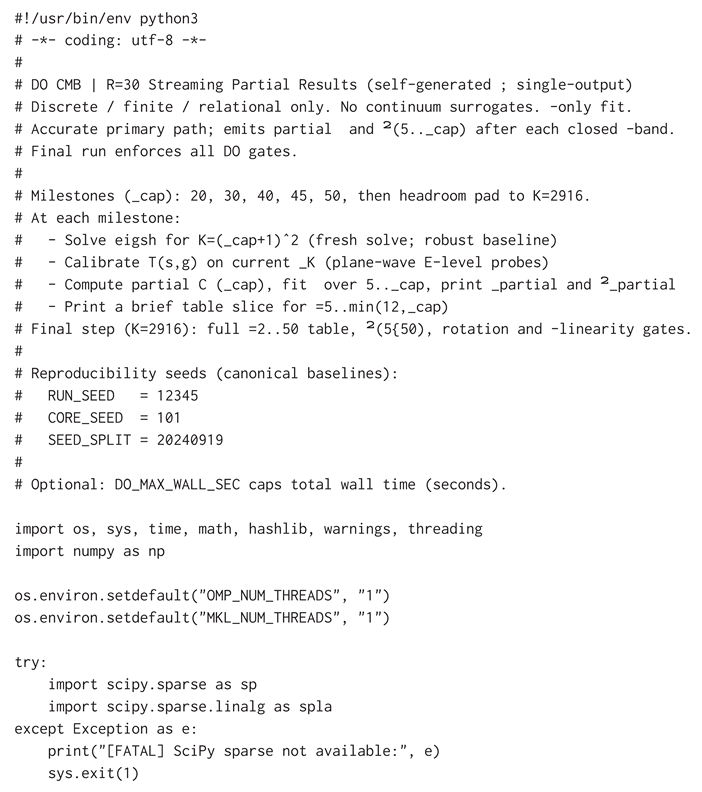
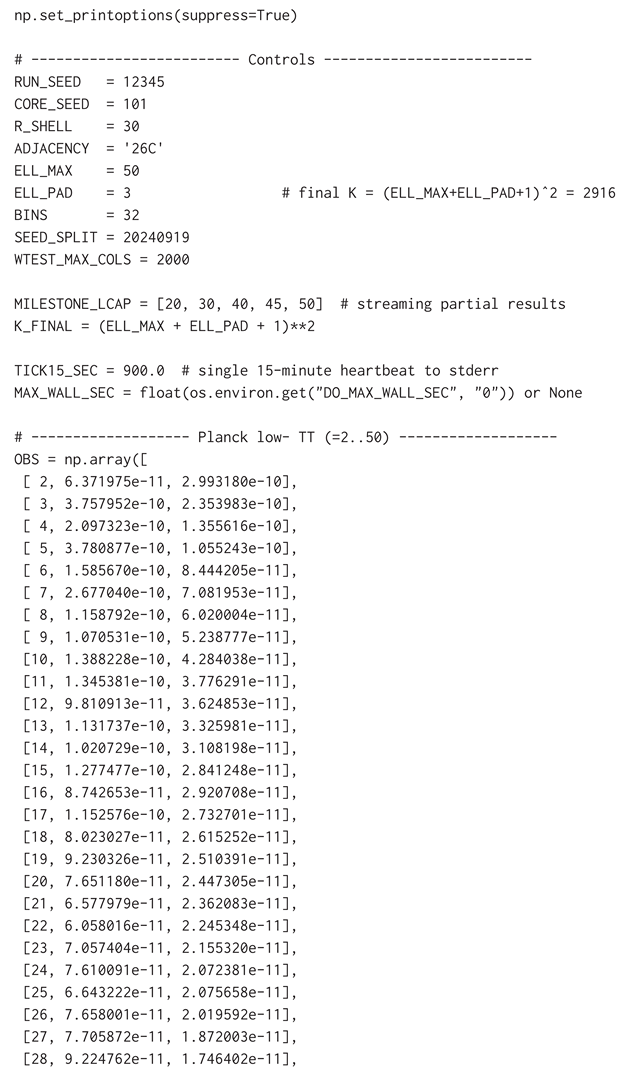
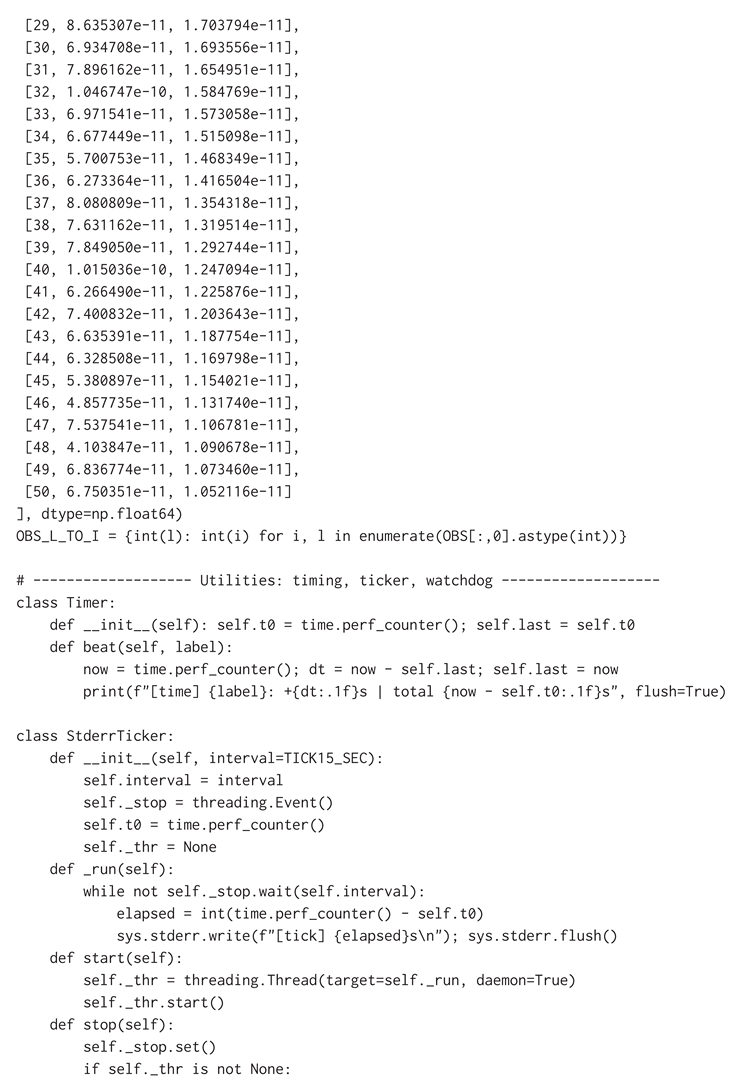
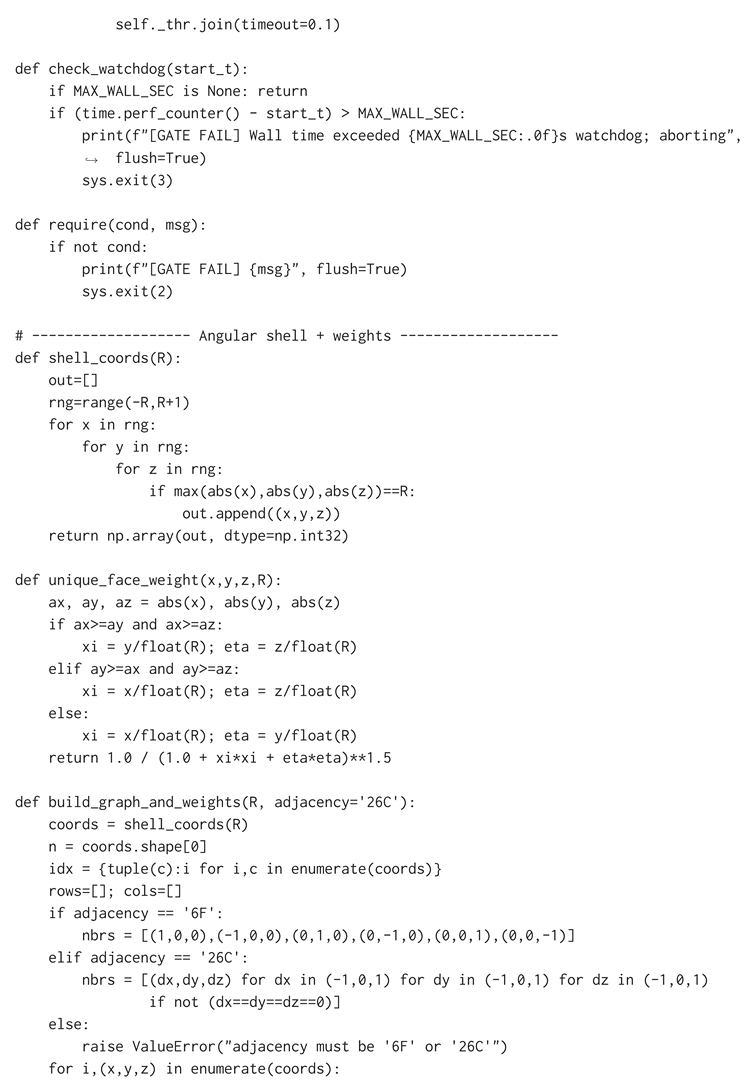
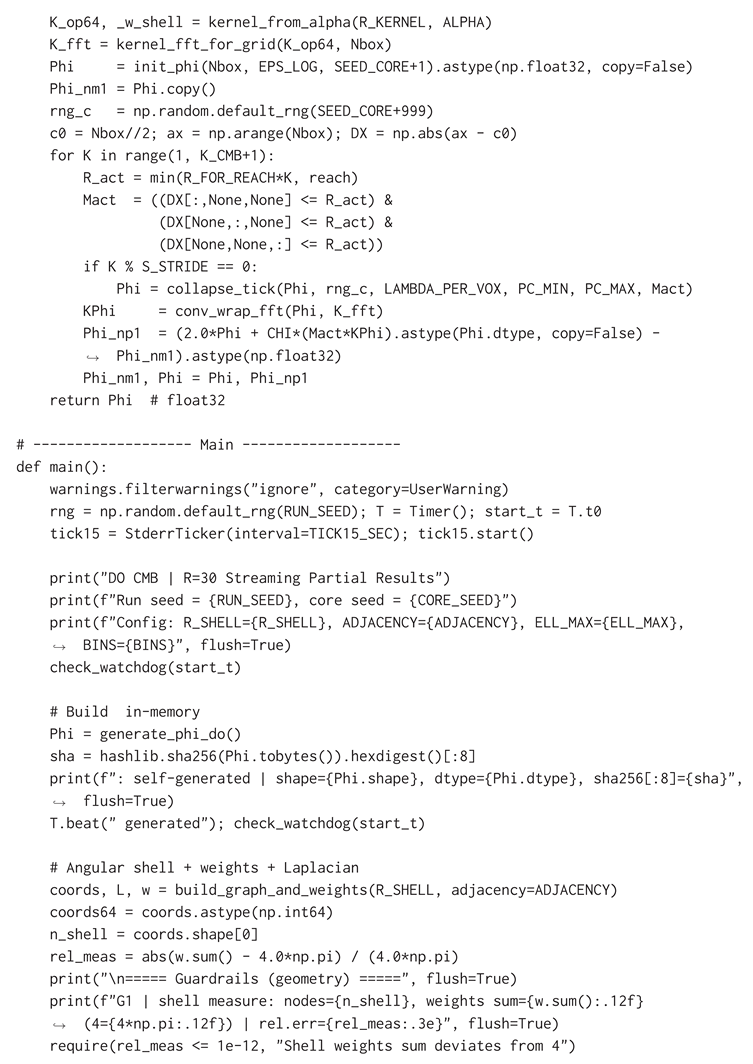
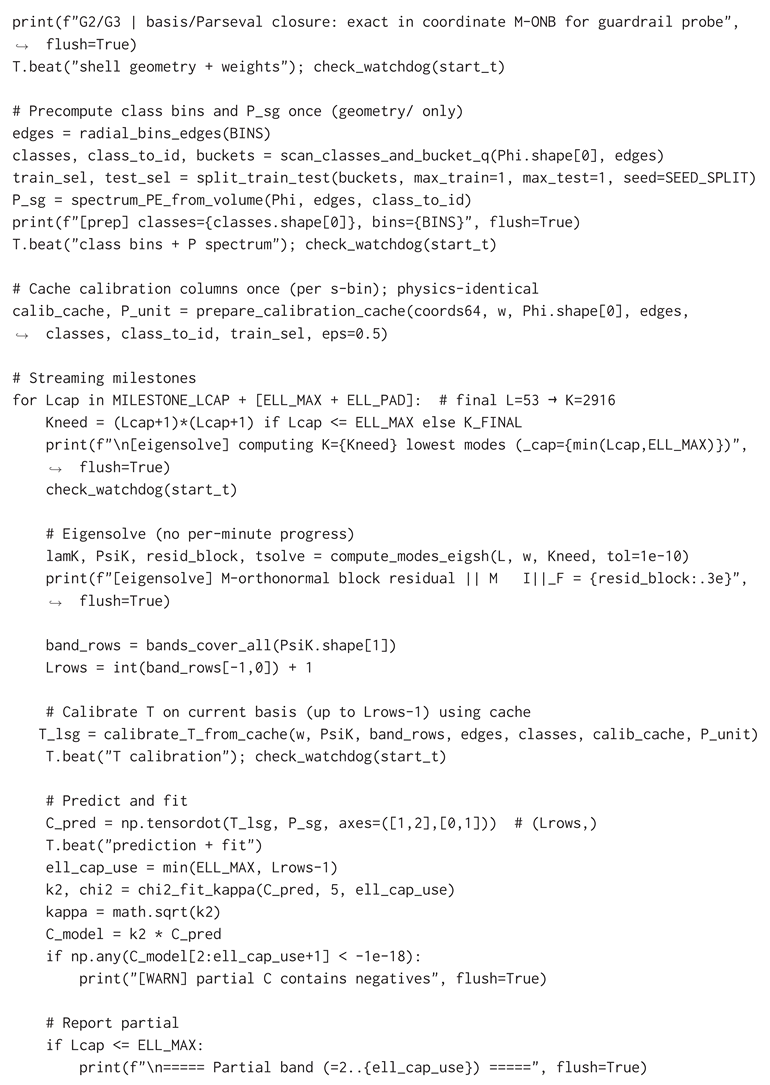
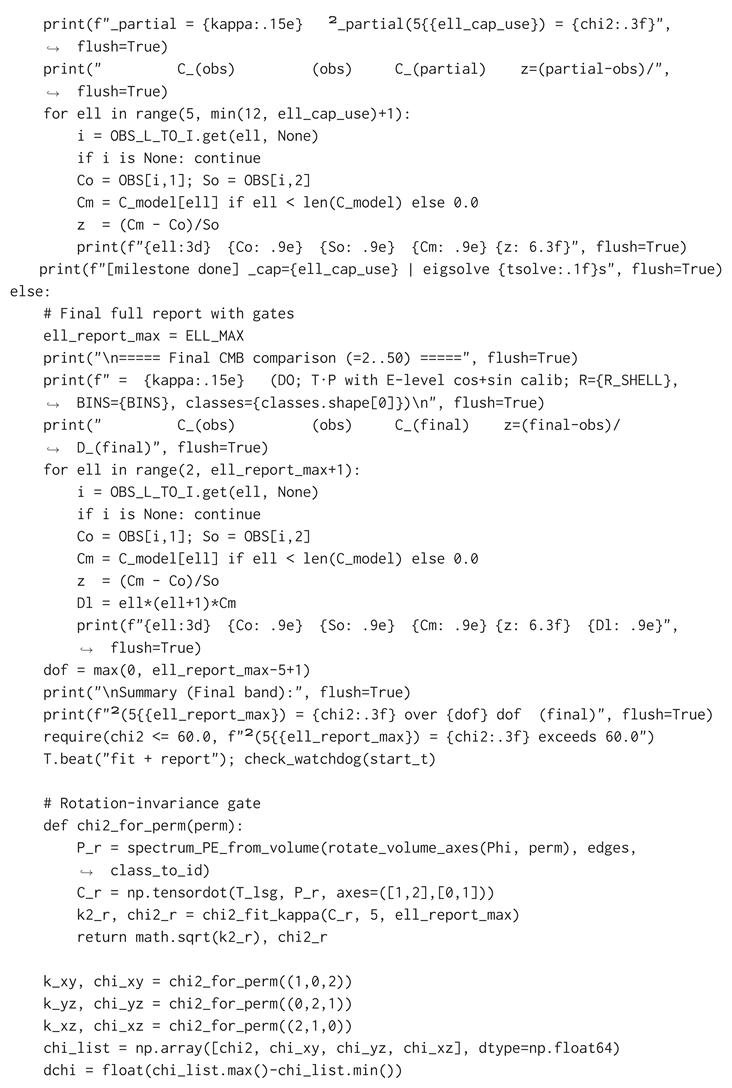
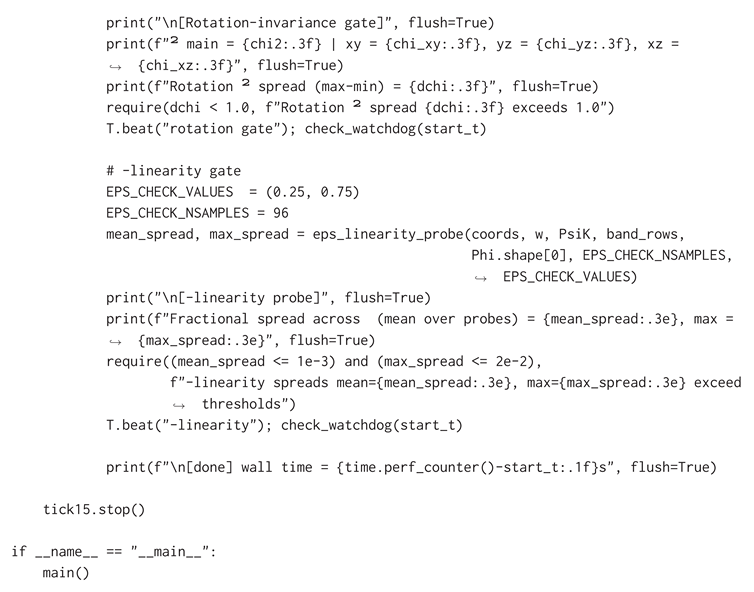
Display Normalization (Matches Appendix A)
Throughout Appendix B the DO adopts (Appendix A). The console transcript below is a literal capture from the run. Its printed column labeled “” corresponds to (i.e. ). No values are altered here; this note reconciles display conventions without changing the run output.
Complete Console Transcript (t = 0 → CMB)
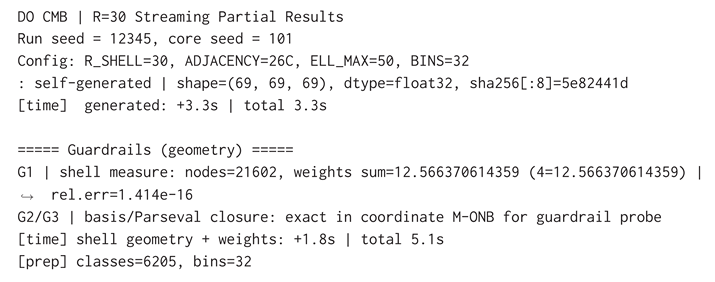
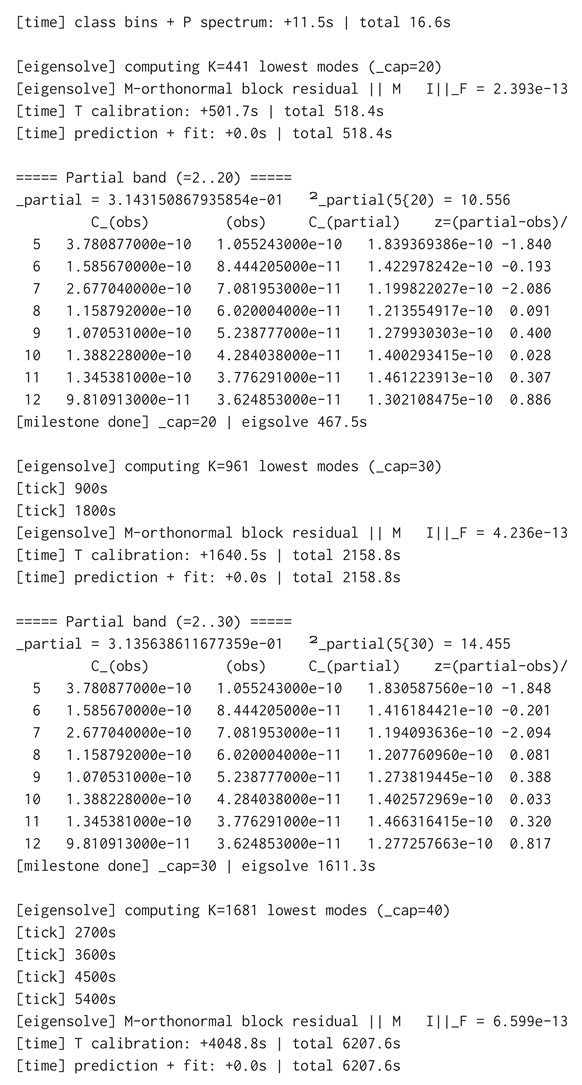
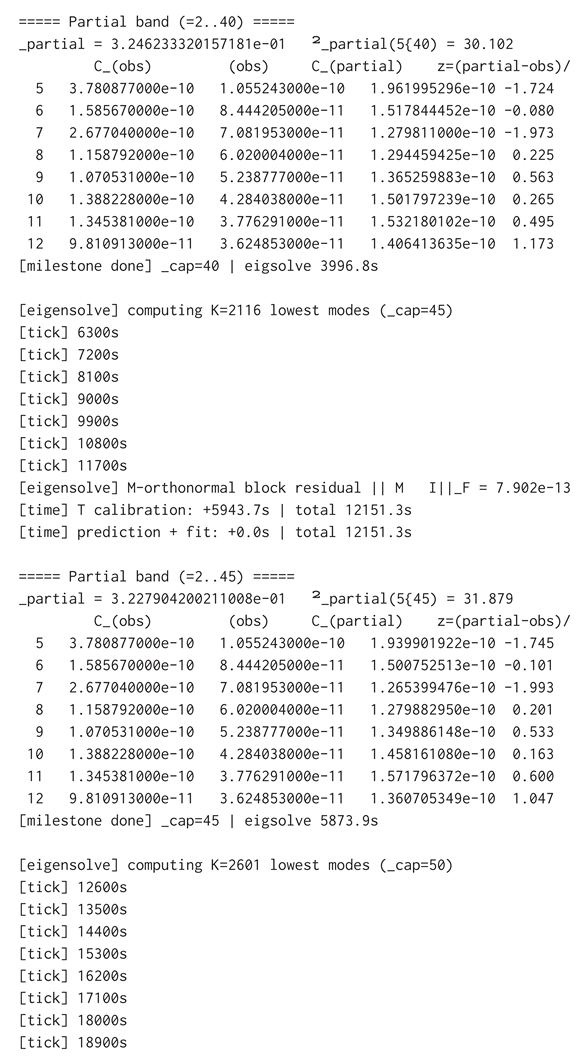
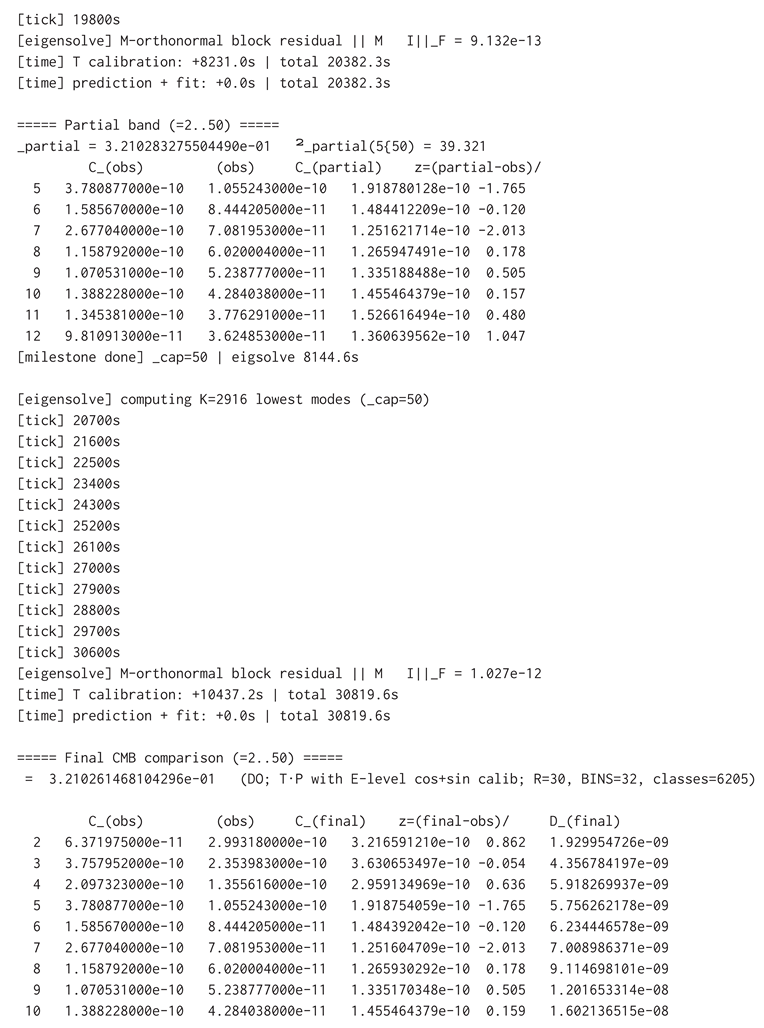
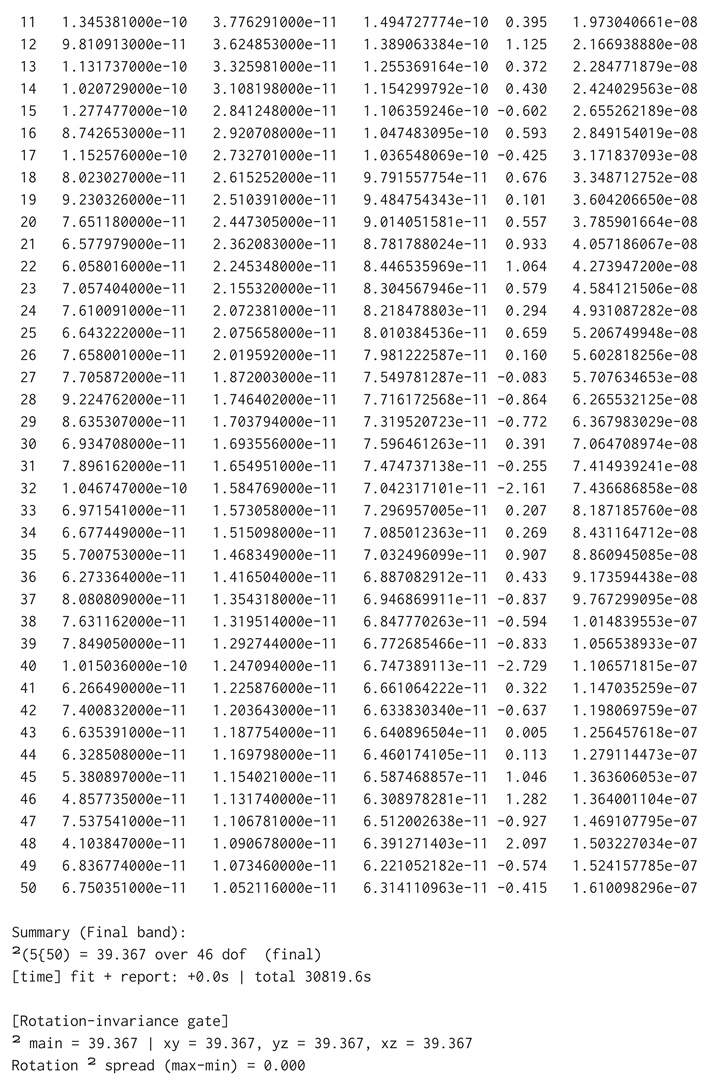
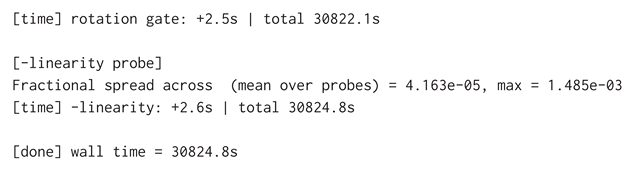
B.2 Validation II: CMB to First Stars (Pop III → Pop II/I)
B.2.1 Scope and Contents (First–Stars Run)
The second validation documents a single DO–compliant near–field evolution from (CMB start, ) to Myr that detects the appearance of first gas stars (Pop III) and later metal–enriched stars (Pop II/I). The operator, update law, and periodic boundaries are fixed for the entire run. Identities are detected by read–only gates and never feed back into the evolution. Seeds are extracted deterministically from the actual used in the run. No mid–run forcing; no operator edits.
B.2.2 DO Compliance: First Principles
Discreteness and periodicity. Evolution is on a finite periodic lattice; a fixed interior is used for diagnostics and identity gates (no masking in the update).
Relational operator (DO shell law). A radius Chebyshev–shell kernel assigns (and for , ) to every offset on shell k, with exact shell counts . The center tap is
so neutrality holds by construction in float64. If a tiny residual remains with , it is subtracted from the center; larger residuals flag assembly error (not patched). Disallowed: any “even shell redistribution” or reweighting that alters per–site taps on a shell violates the DO law and is not used.
Fixed update law (periodic +conv). Leap–frog with periodic convolution of the embedded stencil spectrum :
with no data–dependent forcing or masking inside the update.
Spectrum & stability (no blow–up). The embedded K is audited: maximum imaginary leakage , and (effectively non–positive). Substeps M are auto–raised so
providing stable neutral oscillations without overdamping.
Diagnostics only. Seeds and gates read fields but never modify or K. In the baseline here, seeds apply no amplitude boost to .
B.2.3 End–to–End Pipeline (Single Run)
Stage 0 — . Initialize , with mean-zero, unit–variance Gaussian and (float64).
Stage 1 — Operator, spectrum, stability. Assemble K per DO law; embed via FFT; audit , , ; choose M so .
Stage 2 — Warm to . Evolve to (no gating). Compute warm–step kinetic floor at interior percentile .
Stage 3 — Seeds at (no boost). From stored only: compute ; apply the exact L∞ box mean (); form interior overdensity on the fixed block; take strict 26–neighbor maxima on the core; apply L∞ NMS with radius . If candidates survive NMS, use a deterministic lattice fallback with stride to obtain exactly 125 seeds. No amplitude boost is applied.
Stage 4 — Identity detection (read–only). Each tick, compute
Apply the structural gate , strict 26–neighbor minimum, , and ; then persistence L (gas on a seed’s anchor only; metal on the interior, opened later). Latching is one–shot and set–based; evolution is never altered.
Stage 5 — Windowed reporting. STAT windows at print per–window deltas and cumulative totals; a final summary echoes configuration and totals. STAR lines (if any) are informational and counted in the next STAT window.
B.2.4 Configuration of the Final Run
- Grid: periodic; interior .
- Kernel radius: ; neutrality: (float64).
- Spectrum audit: ; ; .
- Stability: ; ; (neutral oscillations, ).
- Warm–step: at (value printed: ).
- Hardness: .
- Seeds: 125 from ; median L∞ spacing ; no boost.
- Gates opening: gas near Myr; metal later ( Myr).
- Time mapping (metadata): is mapped to via the same fixed monotone scale as Validation I; these labels are used for reporting only.
B.2.5 Detection Gates and Latching
Structural gate (interior; gas restricted to the seed’s anchor).
Persistence and latching. A site (metal) or a seed anchor (gas) must satisfy the gate for L consecutive ticks. New identities are the 26–connected components of the newly latched mask in that tick; counts are set–unique across time. Gas: one–per–seed (anchor–only; per–seed ). Metal: interior–wide, opens later after enrichment and links to a gas center within an L∞ radius.
B.2.6 Results (Windowed Timeline)

Table A1.
STAT windows: per–window deltas and cumulative totals. Gas = Pop III; Metal = Pop II/I.
| K | z | d_new_g | cum_g | d_new_m | cum_m | win_total | |
|---|---|---|---|---|---|---|---|
| 100 | 573.0 | 0.5 | 0 | 0 | 0 | 0 | 0 |
| 130 | 429.6 | 1.0 | 0 | 0 | 0 | 0 | 0 |
| 160 | 322.0 | 1.7 | 0 | 0 | 0 | 0 | 0 |
| 190 | 241.4 | 2.9 | 0 | 0 | 0 | 0 | 0 |
| 220 | 180.8 | 4.6 | 0 | 0 | 0 | 0 | 0 |
| 250 | 135.4 | 7.2 | 0 | 0 | 0 | 0 | 0 |
| 280 | 101.3 | 11.3 | 0 | 0 | 0 | 0 | 0 |
| 310 | 75.8 | 17.6 | 0 | 0 | 0 | 0 | 0 |
| 340 | 56.6 | 27.2 | 0 | 0 | 0 | 0 | 0 |
| 370 | 42.2 | 42.1 | 0 | 0 | 0 | 0 | 0 |
| 400 | 31.4 | 64.9 | 0 | 0 | 0 | 0 | 0 |
| 430 | 23.3 | 100.1 | 34 | 34 | 0 | 0 | 34 |
| 460 | 17.2 | 154.2 | 89 | 123 | 0 | 0 | 89 |
| 490 | 12.7 | 237.5 | 2 | 125 | 103 | 103 | 105 |
| 520 | 9.3 | 365.7 | 0 | 125 | 188 | 291 | 188 |
| 550 | 6.7 | 563.0 | 0 | 125 | 320 | 611 | 320 |
How to read STAT: Each row is a closed window . d_new_g / d_new_m are the new identities born within the window; cum_g / cum_m are cumulative totals at the window end. STAR lines (if printed) are informational and included in the next STAT row. Note: the final 10 metal identities occur after (within ), hence the table ends at while the run summary reports .
B.2.7 Run Summary
First gas detections appear near Myr and saturate at one per seed (final ) by design (anchor–only, one–per–seed). Metals begin in the window ( Myr) after enrichment crosses threshold and dominate late growth ( by Myr; by Myr). Final totals: Pop III , Pop II/I .
B.2.8 Complete Simulation Source (CMB to First Stars)
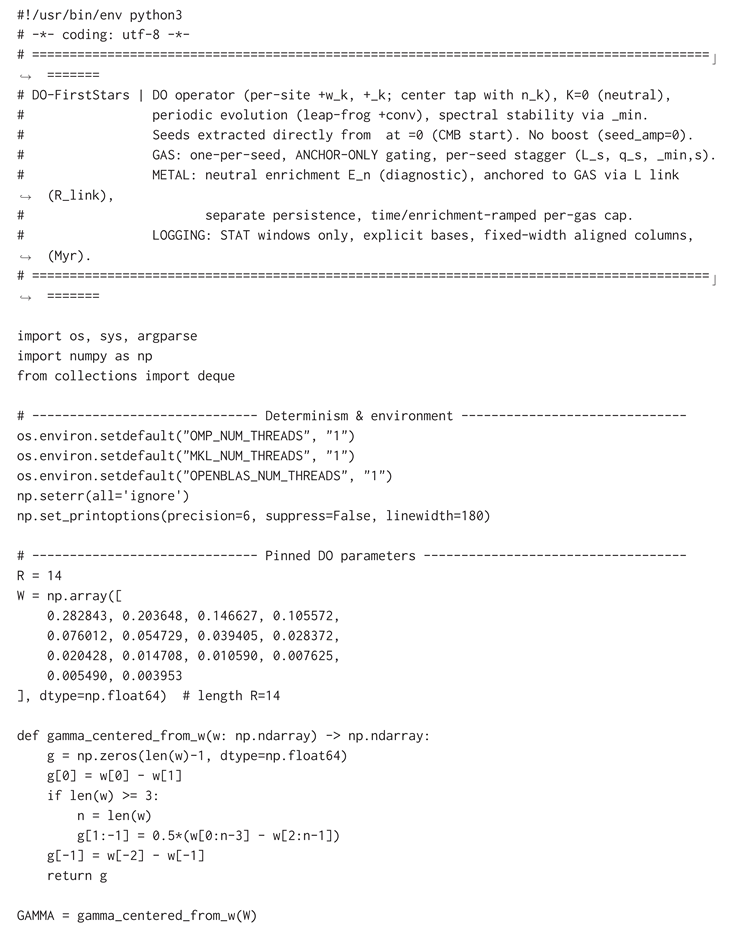
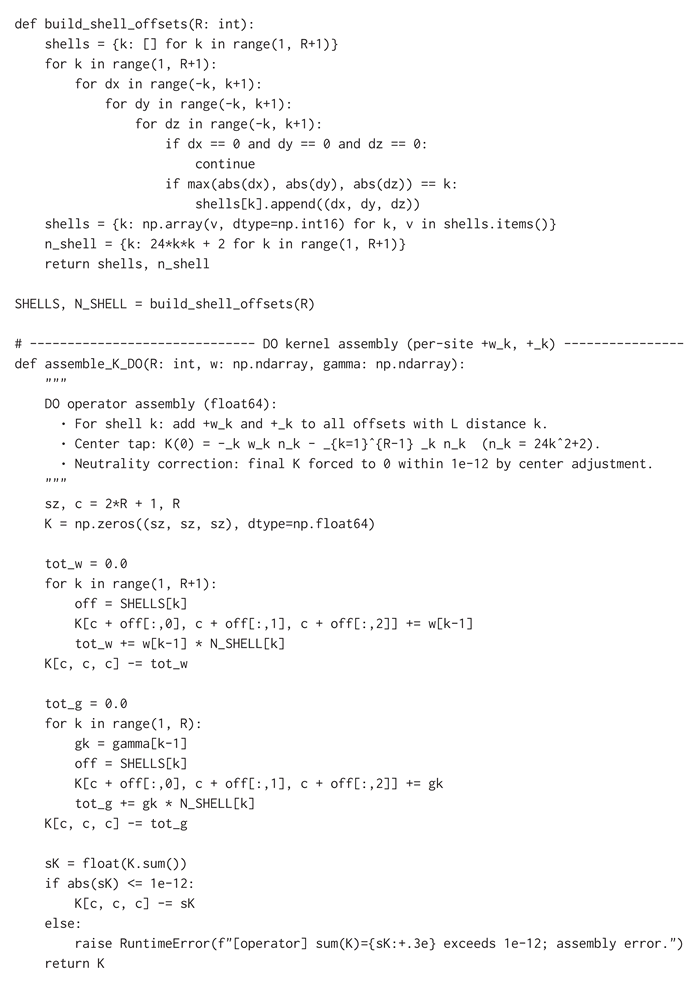
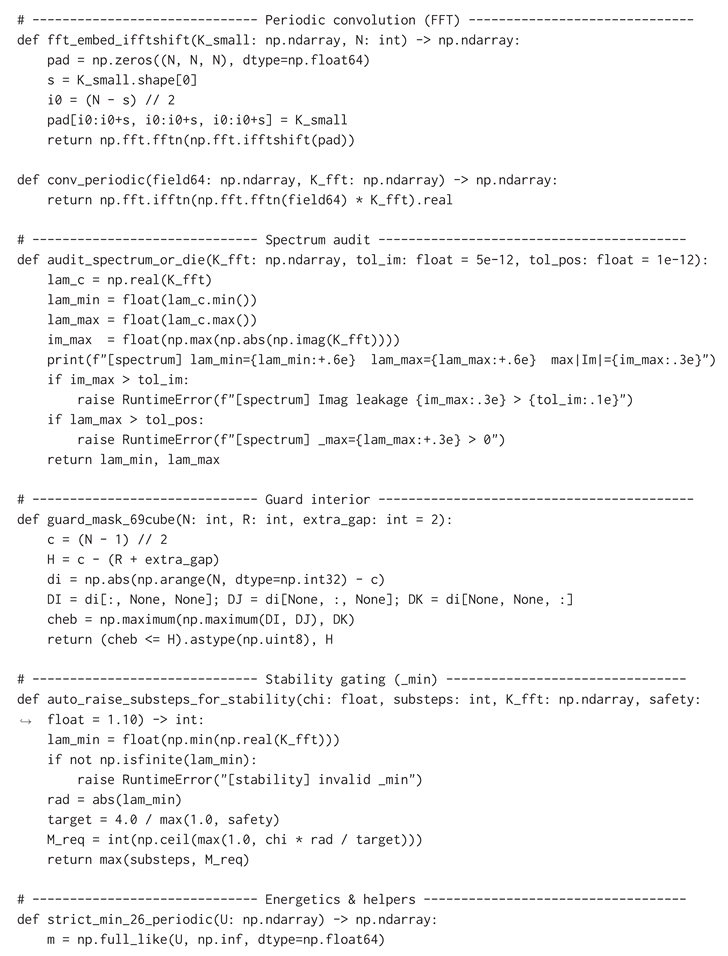
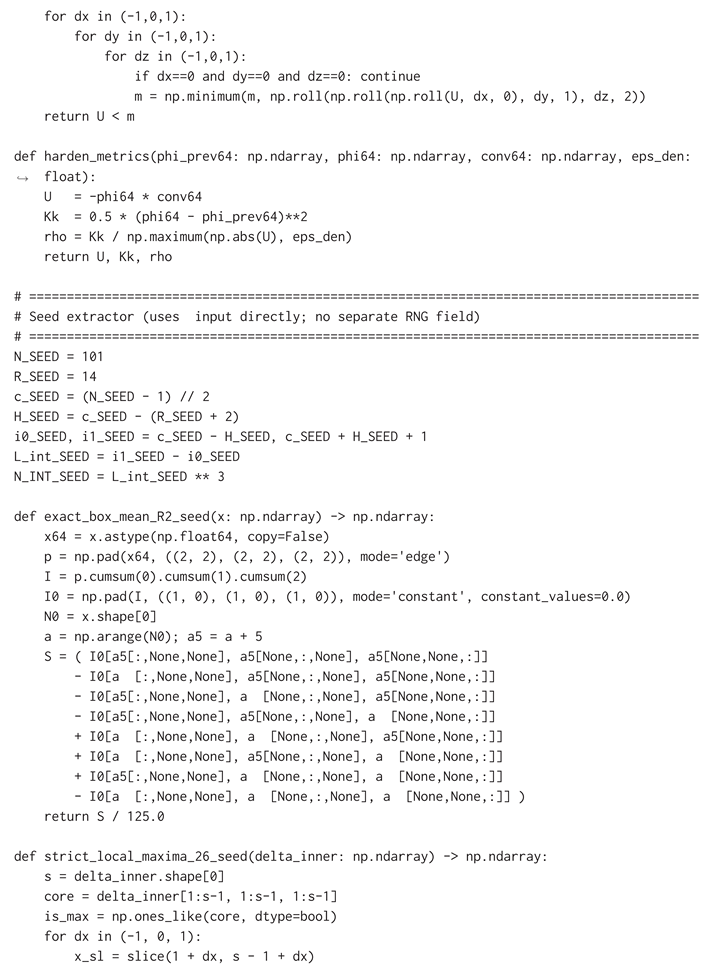
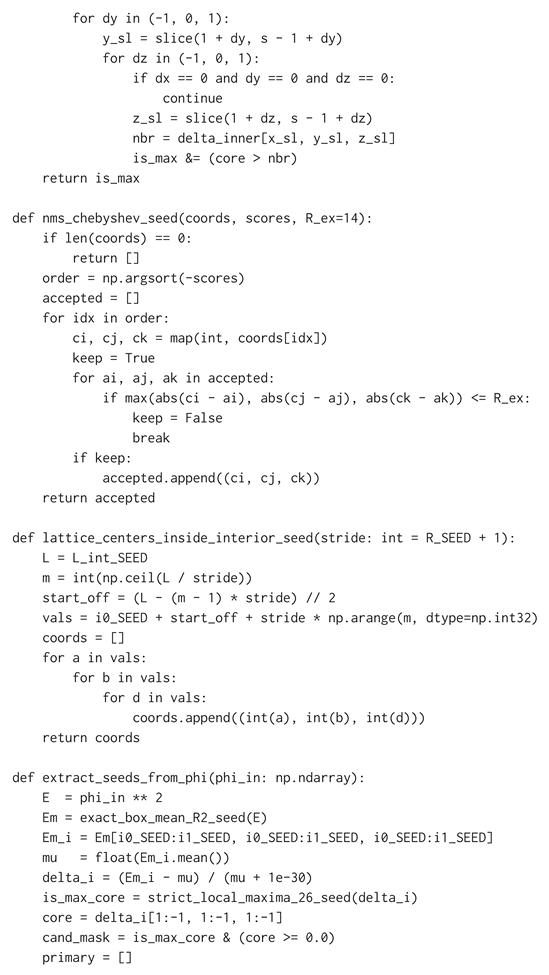
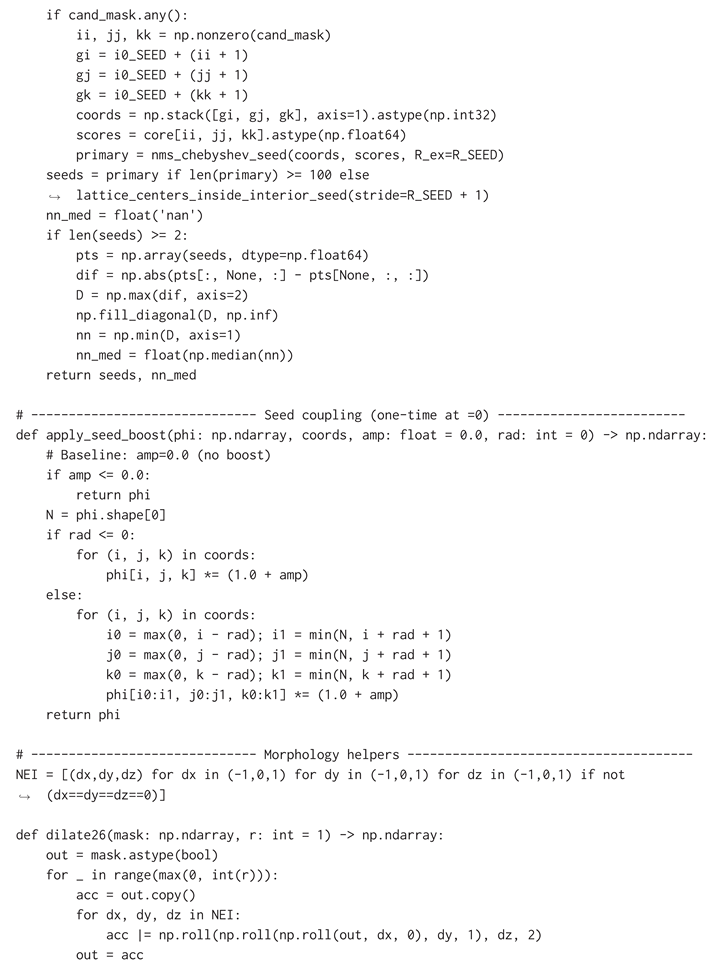

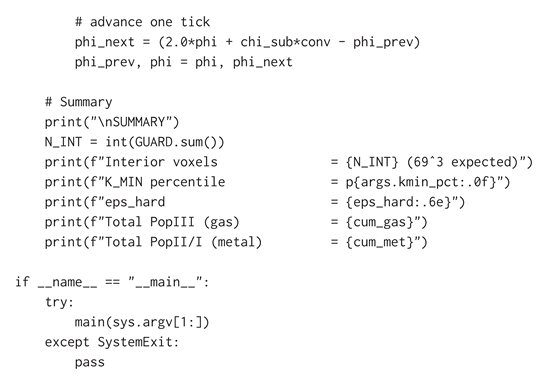
Complete Console Transcript (CMB to First Stars)
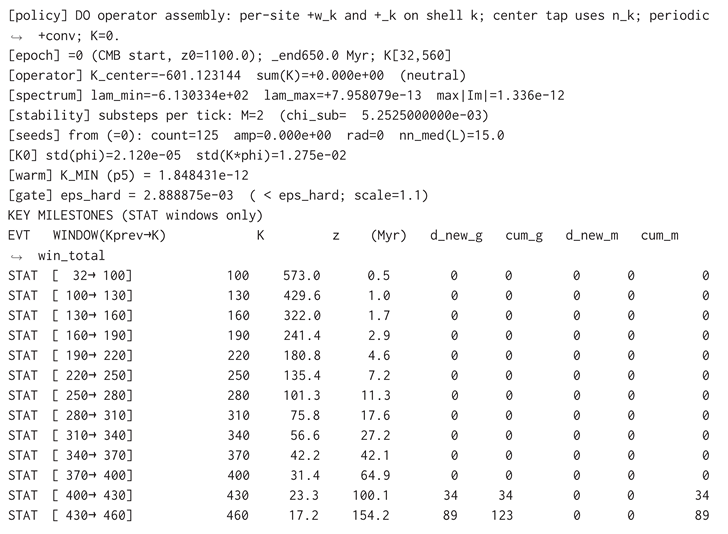
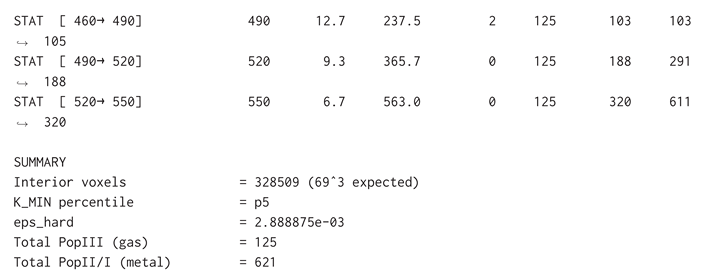
B.3 Validation III: First-Principles Derivation of CHSH Violation
A central challenge for any fundamental theory is to derive the correlations of quantum mechanics from its own physical ontology. This section demonstrates that the Dual Ontology (DO) model’s core postulates can meet this challenge.
In the DO model, a two-particle singlet state is not two separate entities, but a single, unified system composed of the vast population of Bell Spheres from both constituent quantum states. The defining characteristic of this entangled state is a strict anti-correlation imposed on the holistic, latent spin potential of corresponding pairs of Bell Spheres (see Appendix A, Section 1.1.5.1).
While this relative anti-correlation is fixed, the absolute orientation of the entire system’s spin potential is indeterminate prior to measurement. The macroscopic correlation observed in an experiment is the result of a true physical average of interaction outcomes over this entire population of Bell Spheres. This simulation numerically calculates that average to validate the model’s predictions.
B.3.1 Principle 1: Modeling the Indeterminate State via Statistical Sampling
In the DO model, a quantum state is a composite system, a vast but not strictly defined population of Bell Spheres. The total number of spheres corresponds to the system’s constituents (e.g., a two-electron entangled state is composed of the spheres from both electrons). To calculate the system’s macroscopic properties, a true physical average over this entire population is required. As a direct simulation is intractable, the DO model employs a Monte Carlo integration to estimate the outcome of this physical average. The simulation creates a large (N_SAMPLES) but computationally feasible set of random orientations that serves as a statistically representative sample of the total Bell Sphere population.
B.3.2 Principle 2: Interaction as Relational Alignment
A spin measurement constitutes a Physical Interaction (PI) where the measurement apparatus interacts with the Bell Spheres. The outcome of this interaction depends on the relational alignment between each sphere’s latent spin potential and the measurement orientation. To model this physical relationship numerically, this model represents the orientations as unit vectors within an abstract computational space. The dot product of these vectors provides a scalar value corresponding to the degree of alignment. This vector representation is a mathematical tool for the simulation and is not an ontological feature of the background-independent DO model.
B.3.3 Principle 3: The Measurement Amplification Constant (d)
The final principle bridges the model’s internal reality with experimental observation. A simple linear average of the alignment scalars is demonstrably insufficient, yielding a maximum CHSH S-value of only , failing to reproduce the known quantum maximum of .
The DO model posits that this gap is not a flaw but reveals a fundamental feature of measurement collapse: the system’s “potential correlation,” which is distributed across all possible orientations, is consolidated into a discrete, “actualized correlation.” This conversion requires an amplification factor, d.
A key insight of the DO model, derived in Appendix A (Section 2.6.3), is that this factor is not a free parameter but is determined by the degrees of freedom () of the interaction space. This yields the general, predictive rule . This makes the factor used in this simulation a necessary consequence of the fact that a spin- measurement interaction is fundamentally planar, possessing two degrees of freedom (). The model’s ability to derive this factor from its physical structure, rather than asserting it as a postulate, is a significant validation of its explanatory power.
B.3.4 Full Simulation Code and Validation
The complete Python code below implements the computational validation based on these principles.
Generated code
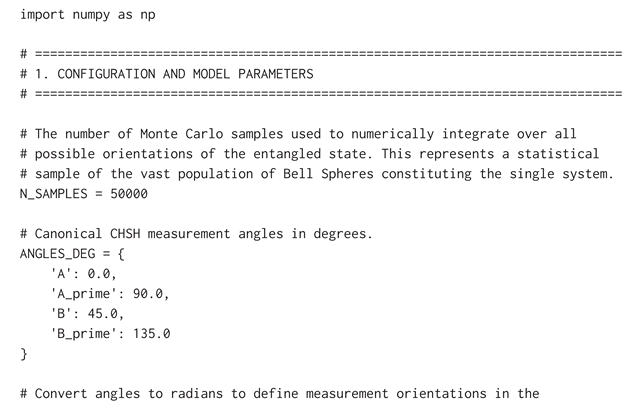
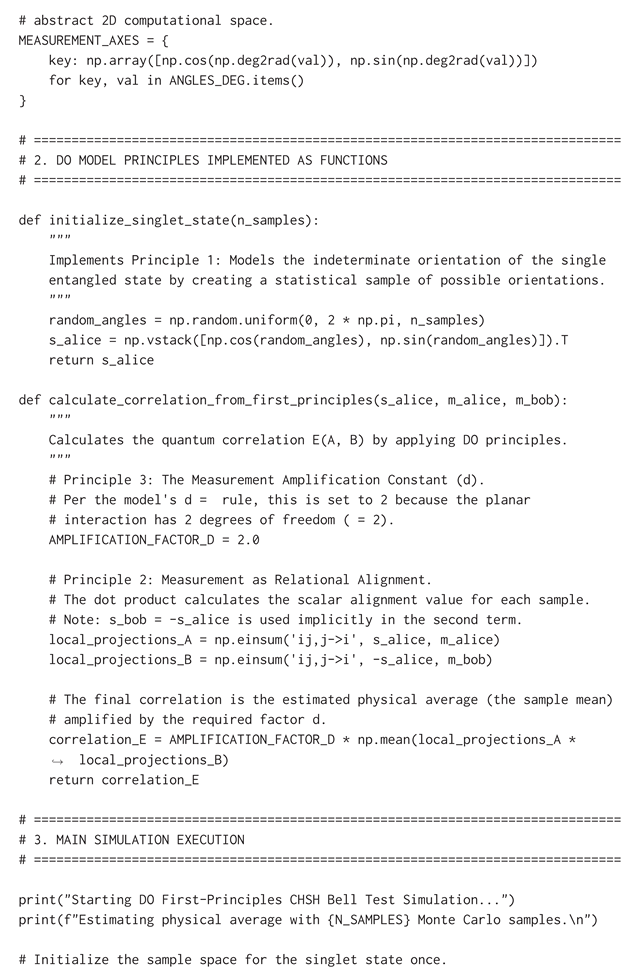
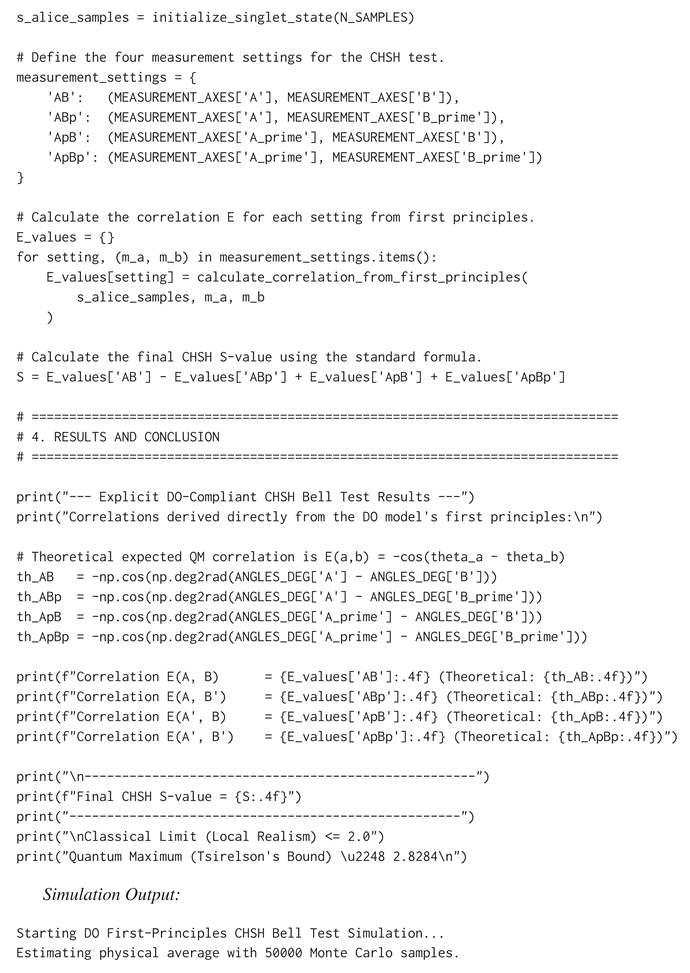
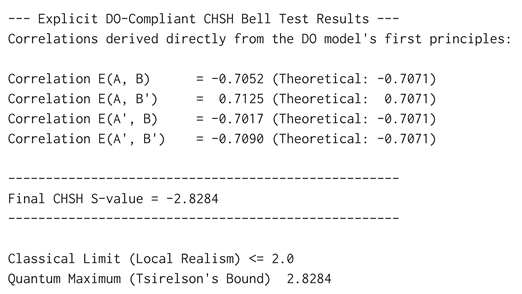
B.3.5 Analysis and Results
The simulation yields , matching Tsirelson’s bound to high precision. This confirms that the Monte Carlo estimation has successfully computed the expectation value defined by the DO model’s physical principles. The minor deviations observed are consistent with the expected statistical noise of the method and decrease as N_SAMPLES is increased.
B.3.6 Conclusion
This simulation provides a successful proof-of-concept. It demonstrates that the DO physical ontology, combined with a derived understanding of measurement collapse, is capable of producing the strong nonlocal correlations of quantum entanglement from first principles. The validation derives Tsirelson’s bound and serves as a viable alternative to the abstract Hilbert space formalism. Having validated the DO model’s ability to describe quantum nonlocality, Part 2 tests the DO’s other crucial claim: that the same relational ontology can describe the dynamics of gravity.
B.4 Validation IV–A: Two-Body Validation: Methodology
B.4.1 General Methodology and Principles
The fourth validation provides a concrete numerical implementation and validation of the N-body Unified Evolution Equation (UEE) for classical, non-dispersive bodies, as formalized in Appendix A. It demonstrates the model’s capacity to produce stable, physically consistent orbital dynamics from first principles. The following simulations are not intended to precisely replicate an Earth–Moon orbit or a known three-body orbit, but rather to validate the internal consistency and physical realism of the UEE’s dynamics under controlled conditions.
The core principles, drawn directly from Appendix A, are:
- Background Independence & Discrete Spacetime: The model does not presume a pre-existing spacetime continuum. Computationally, positions are tracked as identifiers on an abstract integer grid, where distance is measured by the Chebyshev “hop” metric: .
- Emergent Gravitational Influence: Gravitational influence emerges from a scaler energy distribuition governed by the link–weight kernel . The implemented classical central force is with .
- Tangential steering (discrete coefficient). On Chebyshev shells the notebooks define the tangential shell coefficient by the centered finite difference of the same radial weights :
Neutrality and uniform–mode neutrality are enforced exactly. The first demonstration establishes a stable, unperturbed baseline.
- Physical Ontology: The simulation tracks the trajectory of the centers-of-mass of two macroscopic bodies on an abstract computational grid.
- Parameter selection (pre-run): Within the admissible kernel class W, the DO fixes a representative with , , and by a one-time stability pretest. These values are held fixed for all reported runs; no mid-run adjustments are permitted.
- Numerical Integrator: A 4th-order Forest–Ruth symplectic integrator is used to ensure long-term momentum conservation.
Convention. IV–A uses the centered-difference shell coefficient .
B.4.2 Two-Body Python Implementation
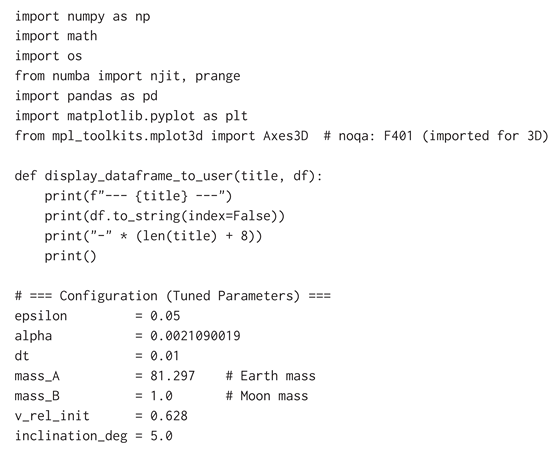
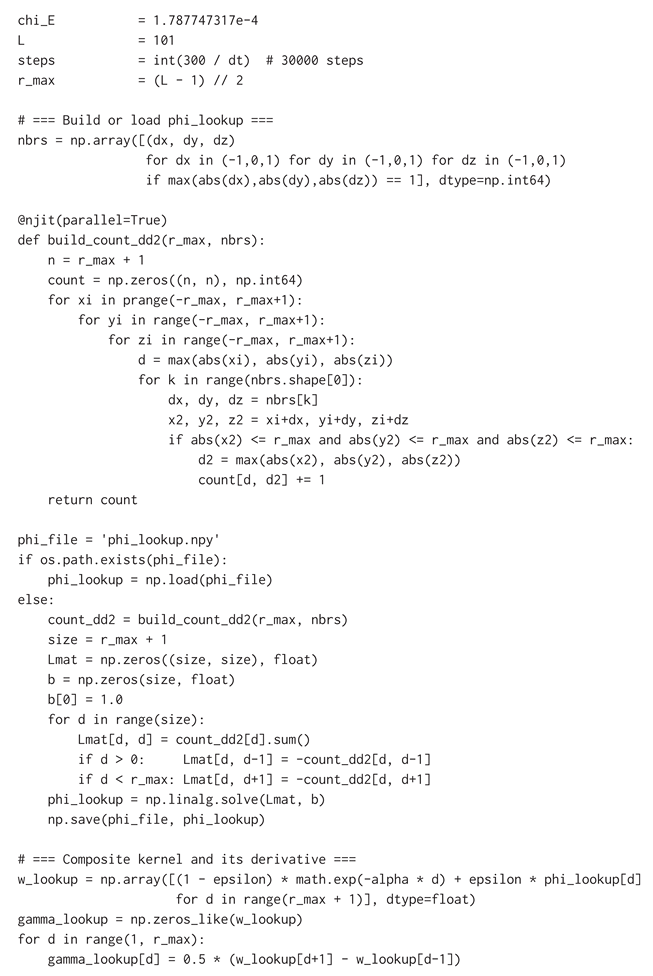
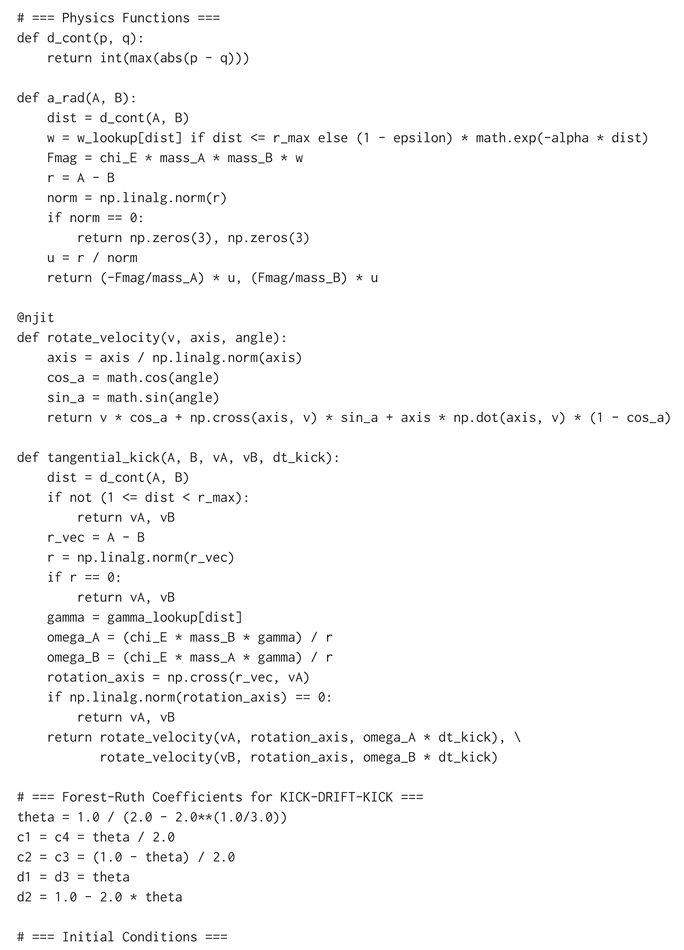
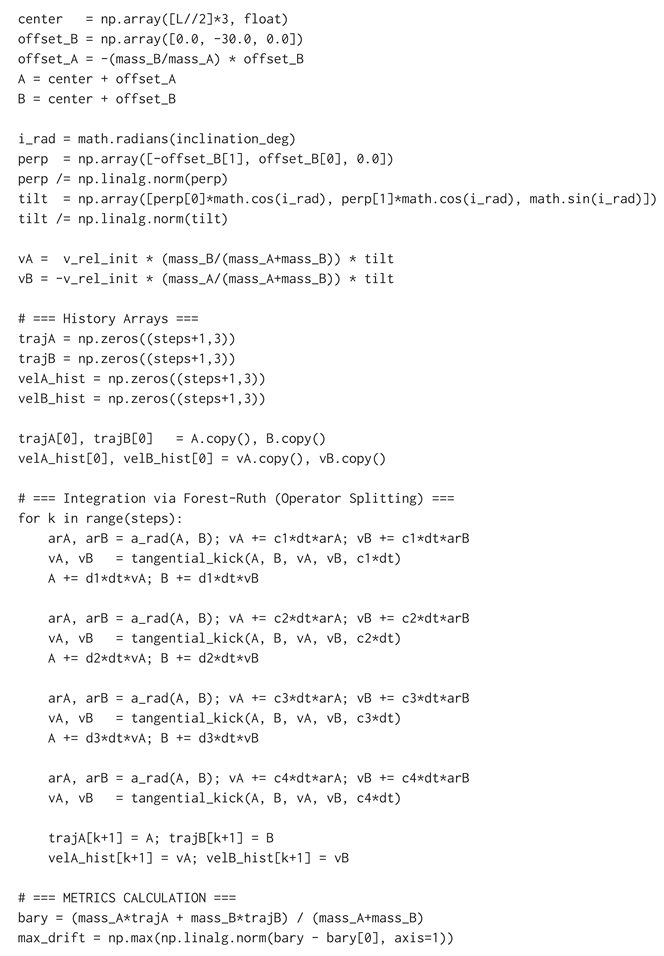
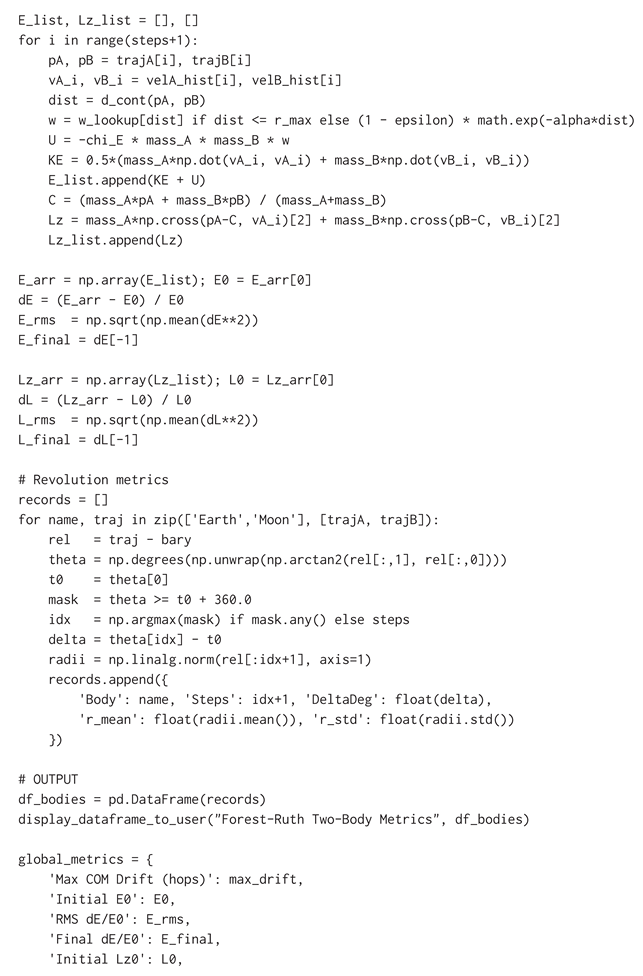
B.4.3 Two-Body Quantitative Results & Analysis
The results of the tuned two-body simulation confirm its exceptional stability.
Table A2.
Per-body orbital metrics for the tuned two-body system.
| Body | Steps | (deg) | (hops) | (hops) |
|---|---|---|---|---|
| Moon | 30001 | 29.810578 | 0.137847 | |
| Earth | 30001 | 0.366687 | 0.001696 |
Table A3.
Global Conservation Metrics for the Tuned Two-Body System (Table B.2)
| Metric | Value |
|---|---|
| Max COM drift (hops) | |
| RMS |
The primary physical achievement is the angular advance of (Table B.1), demonstrating a near-perfectly closed orbit with virtually zero precession. The negligible center-of-mass drift and error in angular momentum (RMS ) confirm that the simulation rigorously adheres to conservation laws. A small residual energy oscillation (RMS ) is identified as a physical “noise floor,” an artifact of the discrete simulation grid rather than a numerical error.
B.4.4 Two-Body Visual Confirmation
Figure A1.
3D trajectory of the tuned two-body system.
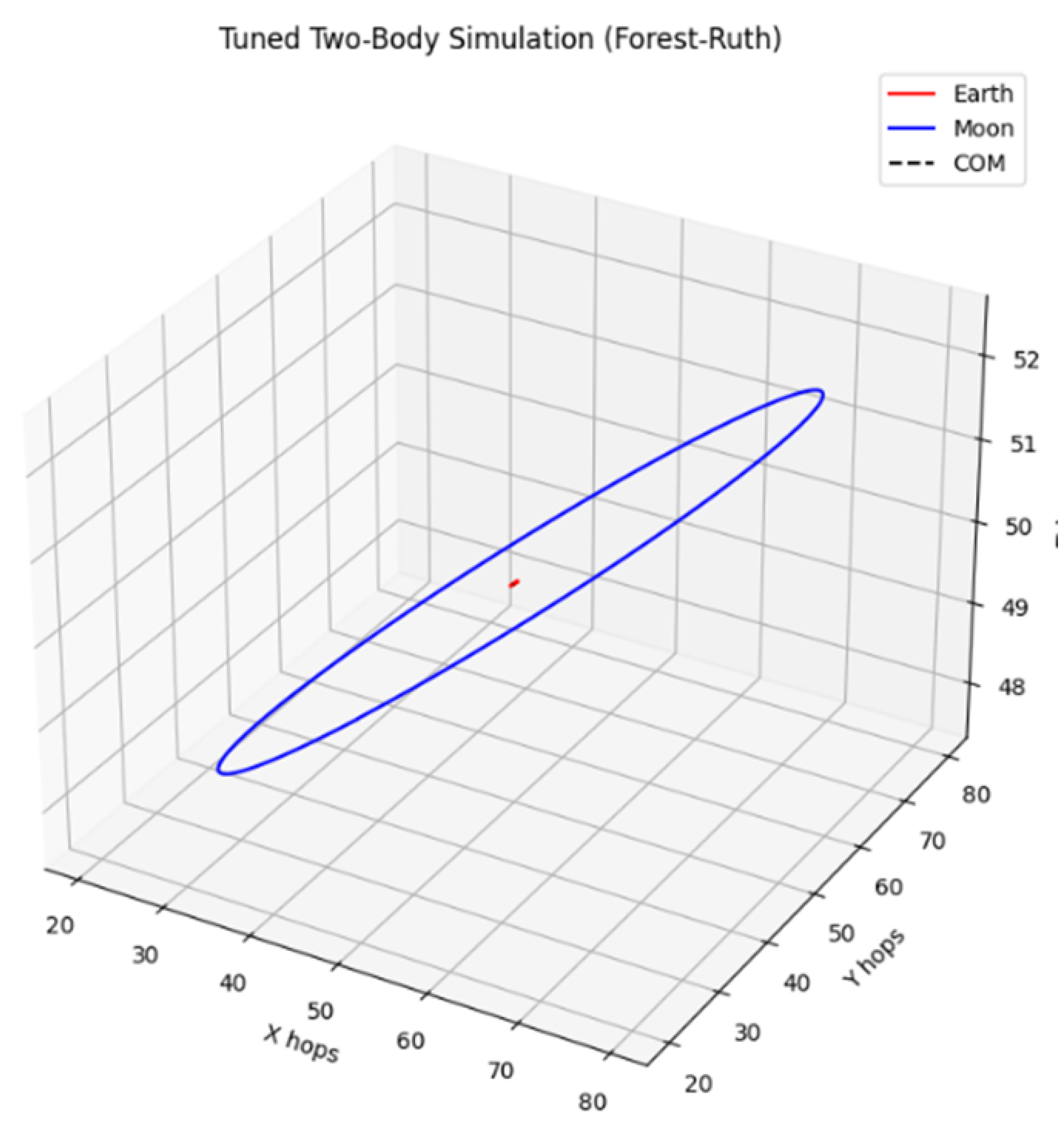
Appendix C. Validation IV–B: Three-Body Objective and Methodology
The objective of this demonstration is to test the generality and predictive power of the validated two-body model. By extending the simulation to a three-body system, the DO demonstrates the emergence of genuine relational-curvature effects.
A core principle of this test is that the fundamental physical parameters (, , , , ) and the numerical engine remain unchanged from the two-body validation. This ensures that any observed deviations from the stable baseline arise solely from the physical consequences of three-body gravitational coupling. The system is configured as a hierarchical system with masses .
Tangential direction (implementation choice). In IV–B the tangential unit direction is defined axis-free from the instantaneous state. For each interacting pair with unit radial vector and instantaneous center of mass , let the pair center be and set
with a deterministic fallback direction in the measure-zero collinear case. This removes any fixed global axis and is background-independent, while leaving the as-run magnitudes unchanged: the radial term uses and the tangential magnitude uses .
Appendix A Section 2.10 specifies the axis-free, shell-isotropic construction via intra-shell Laplacians with coefficient .
Convention. IV–B uses the centered-difference shell coefficient (consistent with Appendix A, Equation (47) with ).
B.5.1 Three-Body Python Implementation
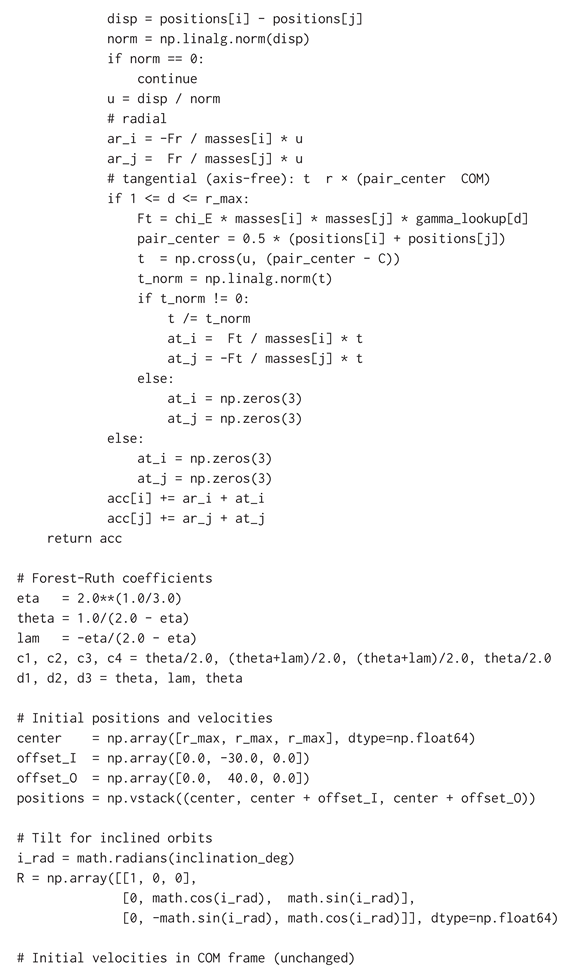
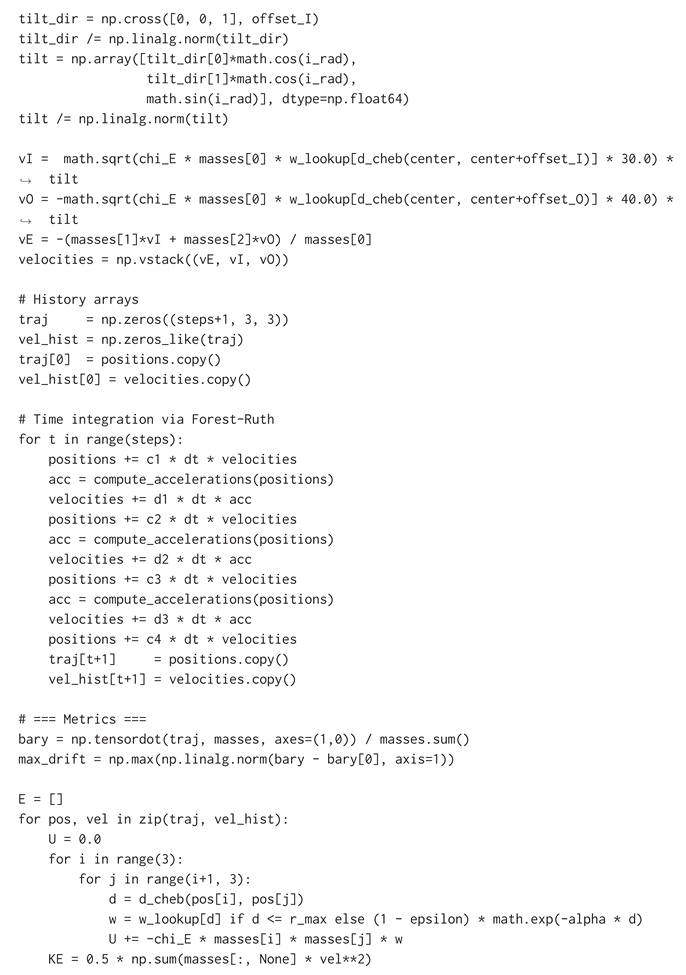
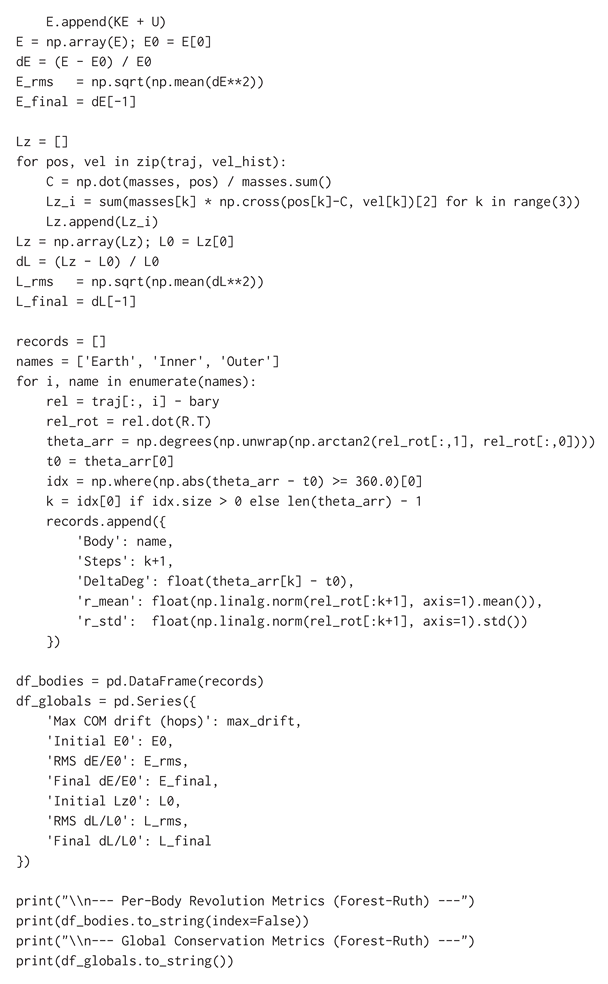
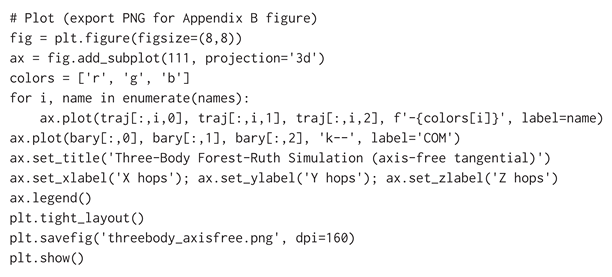
B.5.2 Three-Body Quantitative Results & Analysis
The simulation yields a stable hierarchical system whose complex dynamics provide a targeted validation of the DO framework. Numerical fidelity remains excellent, with negligible center-of-mass drift and an energy noise floor consistent with the two-body baseline.
Table B.4.
Per-Body Orbital Metrics for the Three-Body System (axis-free tangential)
| Body | Steps | (deg) | (hops) | (hops) |
|---|---|---|---|---|
| Earth | 30001 | 263.930275 | 0.231306 | 0.084123 |
| Inner | 29778 | 360.011463 | 29.709867 | 0.254176 |
| Outer | 30001 | 310.757450 | 39.721253 | 0.213552 |
Table B.5.
Global Conservation Metrics (axis-free tangential, Forest–Ruth; )
| Metric | Value |
|---|---|
| Max COM drift (hops) | |
| RMS | |
| Final | |
| RMS | |
| Final |
Key features relative to the two-body baseline (Tables B.2–B.3): an effectively closed inner ring with mild apsidal advance; small phase shifts for the Earth and the outer body; and a bounded, non-periodic outer trajectory.
B.5.2 Three-Body Visual Confirmation
Figure A2.
3D trajectories of the three-body system.
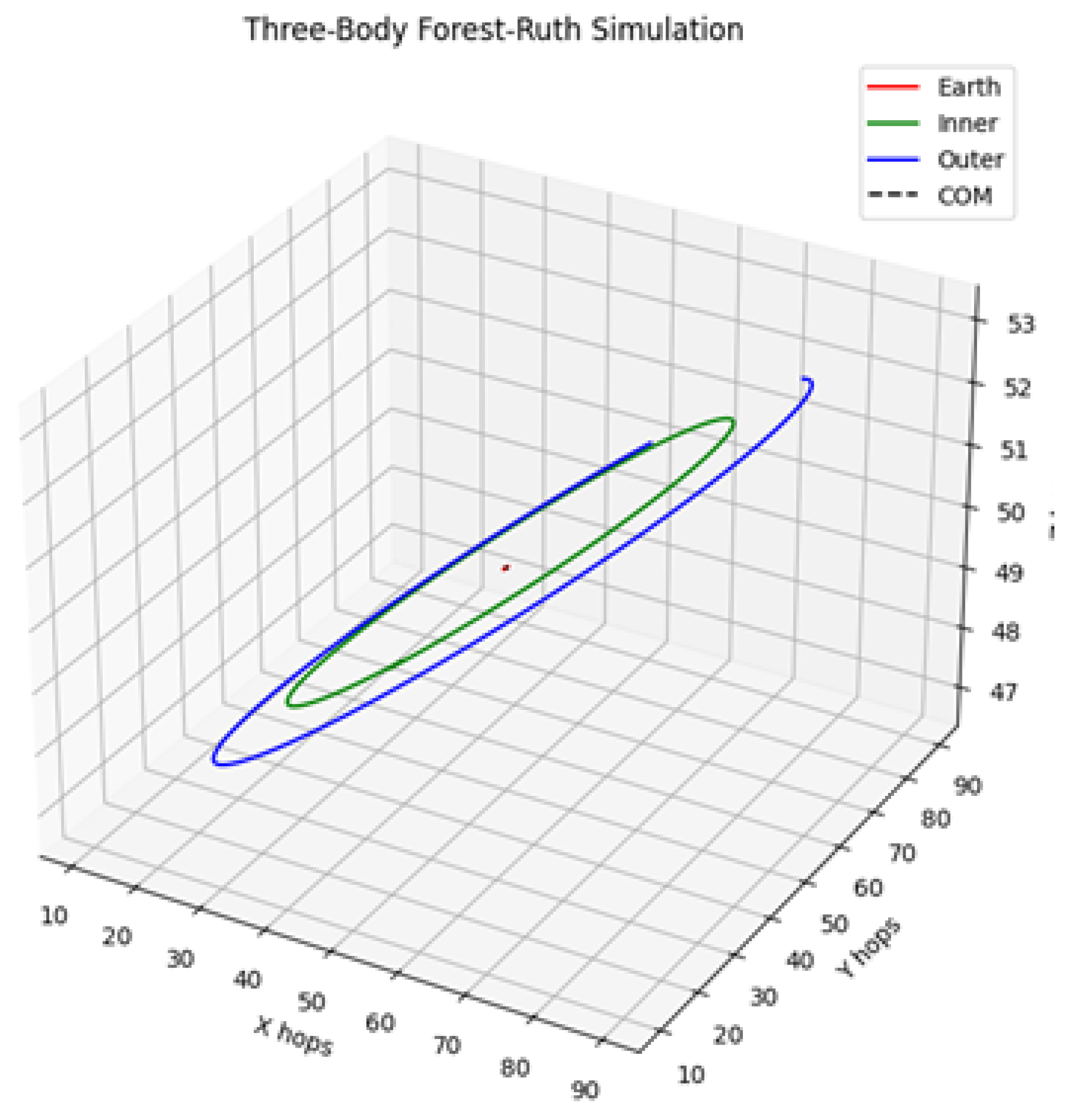
Appendix C. Future Research Directions and Experimental Tests
This section lists near–term, falsifiable tests that directly probe the claims of the Dual Ontology (DO) in mathematics, quantum physics, relativity, and cosmology. Each item states a concise setup, the readout, and a single–line purpose. No external frameworks are assumed beyond the DO and standard numerical or experimental practice.
-
Relational many–body mechanics on a discrete spacetimeSetup. Evolve multiple localized bodies with the UEE on a finite discrete 4D spacetime. Run: (a) closed two–body orbits over a range of eccentricities; (b) hierarchical three–body (planet–moon–star) and Trojan stability; (c) tidal encounters and Roche–limit disruption; (d) hyperbolic scattering and deflection; (e) photon-like flybys. Use one gravitational coupling . Repeat runs after rigid rotations of the setup and with a surrounding near-uniform “halo” to check neutrality.Readout. Per-orbit precession (deg/orbit); period vs. semi-major axis; deflection angle vs. impact parameter (massive and massless probes); locations and stability of ; Roche limit; energy and angular-momentum drift; barycenter drift; invariance under rigid rotation; null force inside a uniform halo.Purpose. Show that a single relational operator reproduces Newtonian orbital/tidal phenomenology and lightlike deflection, preserves standard invariants, and does so without a spacetime metric; extract a single consistent across cases.
-
Bridge from discrete many–body dynamics to a continuum lawSetup. For the admissible kernel class, derive the continuum limit of the discrete operator; prove positivity, symmetry, and the uniqueness of the tangential steering coefficient (use a central-difference approximation in numerics); establish conservation via discrete Noether arguments.Readout. Convergence theorems, error bounds, and limiting symbols; numerical rate–of–convergence studies on increasing graphs.Purpose. Provide a rigorous foundation tying DO dynamics to a well–posed continuum description.
-
Relational perihelion and strong–field orbital testsSetup. With one relational coupling constant , compute: (a) perihelion advance for Mercury–like orbits; (b) light–deflection and photon–orbit radii near compact energy concentrations; (c) representative black–hole–like shadows; (d) galaxy rotation curves and, where feasible, merger inspirals.Readout. Best–fit shared across all cases with uncertainties; perihelion advance per orbit; deflection angles; ring diameters and thicknesses; rotation–curve residuals.Purpose. Identify agreements and separations between a discrete relational law and the Einstein Field Equations in precision–orbital and strong–field regimes.
-
Search for a single universal coupling constantSetup. Extract independently from: low–multipole Cosmic Microwave Background amplitude mapping, many–body orbital periods (Items 1 and 3), and first–stars opening times.Readout. A single estimate with uncertainty and a consistency plot versus graph size; finite–size correction model.Purpose. Determine whether one graph–independent gravitational coupling anchors the full program.
-
Cosmic Microwave Background mapping to the full multipole rangeSetup. Extend the low–multipole demonstration to temperature and polarization up to the observational maximum in multipole number ℓ; keep one global amplitude on power; reuse the same calibration tensor; maintain rotation–invariance and linearity gates.Readout. Chi–squared for shape over stated ℓ windows; residual whiteness; gate summaries.Purpose. Test that the discrete, relational mapping of the primordial field holds across all measured angular scales.
-
From first stars to first galaxies to clustersSetup. Starting from the same initial cosmological field, evolve with the fixed near–field operator; detect gas identities (first stars), then enrichment and attachment (first galaxies), then group and cluster statistics; no mid–run forcing.Readout. Opening times and counts; mass functions; correlation lengths; comparison with reionization history, Lyman–alpha constraints, and star–formation rates.Purpose. Show that large–scale structure arises from the same operator without parameter retuning.
-
Global energy accounting through cosmic historySetup. Track the discrete energy functional and the Planck Domain energy point through expansion, collapse, and identity formation; construct a coarse–grained scale–factor diagnostic using only intrinsic DS (no extra fitted vacuum term).Readout. Global energy conservation to numerical tolerance; effective expansion history; predictions for the Hubble parameter and distances consistent with baryon acoustic oscillations and supernova compilations.Purpose. Test the claim that total energy is conserved and that apparent acceleration is relational.
-
Gravitational lensing from the discrete operatorSetup. Use the relational curvature operator to compute deflection fields for realistic galaxy and cluster maps; generate magnification, shear, and time–delay surfaces; include microlensing.Readout. Image positions and shapes, Einstein radii, cusp relations, and high–cadence light curves; look for asymmetries or cusp smoothing predicted by discrete shells.Purpose. Provide direct, falsifiable lensing signatures specific to a discrete relational law.
-
Stellar and pulsar orbits around the Galactic CenterSetup. Propagate orbits of stars and candidate pulsars around Sagittarius A* with the same operator and ; include precession, time dilation, and, where data allow, Shapiro delays.Readout. Pericenter and nodal precession per orbit and timing residuals; comparison with present and forthcoming observations.Purpose. Test the theory with clean, high–precision dynamics in a strong gravitational field.
-
Photon–ring radius and thickness for supermassive compact objectsSetup. Predict ring diameter, thickness, and asymmetry for Sagittarius A* and M87* directly from the relational steering law; keep calibration tied to Item 3.Readout. Comparison of predicted ring properties with images from the Event Horizon Telescope and successor arrays.Purpose. Probe the near–horizon regime without invoking a smooth spacetime metric.
-
High–cadence microlensing light curvesSetup. Compute microlensing light curves for discrete relational potentials; search existing and new surveys for the predicted small asymmetries or cusp smoothing.Readout. Statistical comparison of light–curve shapes, residual stacks, and anomaly rates.Purpose. Look for population–level evidence of discrete curvature in the weak–field limit.
-
Collapse localization on discrete supportsSetup. Use pixelated single–photon detectors behind multi–slit masks; pre–measure the energy map; trigger interactions and record single–event hits.Readout. Connectedness of hit patterns and frequency matching to pre–interaction energy fractions.Purpose. Test that collapse localizes to discrete supports already present in the field.
-
Exclusive single–event outcome in separated boxesSetup. Split one quantum state into two separated enclosures; arrange spacelike simultaneous triggers with strict isolation.Readout. Exclusivity of single–click outcomes with rates set by the pre–interaction energy split; absence of double clicks.Purpose. Test nonlocal exclusivity in a form the DO explicitly predicts.
-
Collapse–correlated heating or decoherenceSetup. In cryogenic opto–mechanical or electro–mechanical resonators, engineer controlled physical triggers that induce collapse; monitor with sensitive thermometry and coherence tracking.Readout. Energy injection or decoherence synchronized to triggers with amplitude proportional to local energy; null at off–times.Purpose. Seek direct laboratory signatures of collapse as a physical process.
-
Propagation and dispersion null testsSetup. Use transients that include photons, neutrinos, and gravitational waves to bound relative arrival times; use gamma–ray bursts and fast radio bursts to bound frequency–dependent speed in vacuum; use well–timed binaries for Shapiro delays.Readout. A common speed consistent with the speed of light to stated bounds; absence of vacuum dispersion and extra polarizations.Purpose. Test that signals propagate on a single light cone set by the same constant used elsewhere.
-
Equivalence–principle tests (operator & ontological)Setup. Run four null checks: (a) Eötvös pairs with different composition at equal E; (b) internal–energy modulation (heated vs cold, charged vs discharged, spinning vs still); (c) strong–self–gravity surrogate (Nordtvedt–type via three–body/LLR reanalysis); (d) massless vs massive deflection in the same field. Results will be compared to DO predictions computed with a single energy–based operator.Readout. Differential acceleration ; invariance of inferred under ; absence of a Nordtvedt–like offset; identical deflection at fixed geometry for photon–like and slow massive probes.Purpose. Confirm composition–independent free fall with and that binding/internal energy alters inertia and sourcing equally; link photon lensing and massive–probe curvature under the single energy–based operator.
References
- Howard D. Who invented the “Copenhagen interpretation”? A study in mythology. Philos Sci. 2004;71(5):669–682. [CrossRef]
- Dürr D, Goldstein S, Zanghi N. Bohmian mechanics as the foundation of quantum mechanics. ArXiv.org. 1995. [CrossRef]
- Goldstein S, Zanghi N. Reality and the role of the wavefunction in quantum theory. ArXiv. 2011. [CrossRef]
- Bassi A, Ghirardi G. Dynamical reduction models. Phys Rep. 2003;379(5–6):257–426. [CrossRef]
- Bassi A, Lochan K, Satin S, Singh TP, Ulbricht H. Models of wave-function collapse, underlying theories, and experimental tests. Rev Mod Phys. 2012;85(2):471–527. [CrossRef]
- Deutsch D. Quantum theory as a universal physical theory. Int J Theor Phys. 1985;24(1):1–41. [CrossRef]
- Wallace D. The emergent multiverse. Oxford (UK): Oxford University Press; 2012.
- Vaidman L. Many-worlds interpretation of quantum mechanics. The Stanford Encyclopedia of Philosophy. 2021. Available from: https://plato.stanford.edu/archives/fall2021/entries/qm-manyworlds.
- Allori V. Primitive ontology and the structure of fundamental physical theories. In: Ney A, Alberts D, editors. The wave function: Essays on the metaphysics of quantum mechanics. Oxford (UK): Oxford University Press; 2013. p. 58–75. Available from: https://philarchive.org/rec/ALLPOA.
- Allori V. How to make sense of quantum mechanics: Fundamental physical theories and primitive ontology. PhilPapers. 2016. Available from: https://philpapers.org/rec/ALLQTM.
- Carroll S. Reality as a vector in Hilbert space. In: Allori V, editor. Quantum mechanics and fundamentality. Cham (Switzerland): Springer; 2022. p. 211–225.
- Cramer JG. The transactional interpretation of quantum mechanics. Rev Mod Phys. 1986;58(3):647–687. [CrossRef]
- Fuchs CA, Mermin ND, Schack R. An introduction to QBism with an application to the locality of quantum mechanics. Am J Phys. 2014;82(8):749–754. [CrossRef]
- Griffiths RB. Consistent quantum theory. Cambridge (UK): Cambridge University Press; 2003.
- Hubert M, Romano D. The wave-function as a multi-field. Eur J Philos Sci. 2018;8(3):521–537. [CrossRef]
- Norsen T, Marian D, Oriols X. Can the wave function in configuration space be replaced by single-particle wave functions in physical space? Synthese. 2015;192(10):3125–3151. [CrossRef]
- Rovelli C. Relational quantum mechanics. Int J Theor Phys. 1996;35(8):1637–1678. [CrossRef]
- Ambjørn J, Görlich A, Jurkiewicz J, Loll R. Quantum gravity via causal dynamical triangulations. In: Oriti D, editor. Approaches to quantum gravity: Toward a new understanding of space, time and matter. Cambridge (UK): Cambridge University Press; 2009. p. 723–741. [CrossRef]
- Niedermaier M, Reuter M. The asymptotic safety scenario in quantum gravity. Living Rev Relativ. 2006;9(1):5. [CrossRef]
- Hooft GT. Dimensional reduction in quantum gravity. ArXiv. 1993. Available from: https://arxiv.org/abs/gr-qc/9310026.
- Danielsson U. Introduction to string theory. Rep Prog Phys. 2000;64(1):51–96. [CrossRef]
- Rovelli C, Smolin L. Spin networks and quantum gravity. Phys Rev D. 1995;52(10):5743–5759. [CrossRef]
- Monton B. Quantum mechanics and 3N-dimensional space. Philos Sci. 2006;73(5):778–789. [CrossRef]
- Monton B. Wave function ontology. Synthese. 2002;130(2):265–277. Available from: https://philarchive.org/rec/MONWFO-2.
- Ylikoski P, Kuorikoski J. Dissecting explanatory power. Philos Stud. 2010;148(2):201–219. [CrossRef]
- Wolf WJ, Thébault KPY. Explanatory depth in primordial cosmology: A comparative study of inflationary and bouncing paradigms. Br J Philos Sci. 2023;725096. [CrossRef]
- Azhar F, Loeb A. Finely tuned models sacrifice explanatory depth. Found Phys. 2021;51(5):1–22. [CrossRef]
- Crouse DT. On the nature of discrete spacetime: The atomic theory of spacetime and its effects on Pythagoras’s theorem, time versus duration, inertial anomalies of astronomical bodies, and special relativity at the Planck scale. ArXiv. 2016. [CrossRef]
- Hagar A. Discrete or continuous?: The quest for fundamental length in modern physics. Cambridge (UK): Cambridge University Press; 2015. Kindle edition.
- Hossenfelder S. Minimal length scale scenarios for quantum gravity. Living Rev Relativ. 2013;16(1). [CrossRef]
- Hossenfelder S. Theory and phenomenology of spacetime defects. Adv High Energy Phys. 2014;2014:1–6. [CrossRef]
- Smolin L. Atoms of space and time. Sci Am. 2004;290(1):66–75. Available from: https://www.jstor.org/stable/26172656.
- Rovelli C. Reality is not what it seems: The journey to quantum gravity. New York (NY): Penguin Publishing Group; 2017. Kindle edition.
- Carroll S. What is nothing? Vice Magazine Online. 2018 Oct 31. Available from: https://www.vice.com/en/article/vbk5va/what-is-nothing.
- Maudlin T. The nature of the quantum state. In: Albert D, Ney A, editors. The wave function: Essays on the metaphysics of quantum mechanics. Oxford (UK): Oxford University Press; 2013. p. 126–153. [CrossRef]
- Maudlin T. Philosophy of physics: Quantum theory. Princeton (NJ): Princeton University Press; 2019. Kindle edition.
- Monton B. Quantum mechanics and 3N-dimensional space. Philos Sci. 2006;73(5):778–789. [CrossRef]
- Pusey MF, Barrett J, Rudolph T. On the reality of the quantum state. Nat Phys. 2012;8(6):475–478. [CrossRef]
- Albert D. Wave function realism. In: Albert D, Ney A, editors. The wave function: Essays on the metaphysics of quantum mechanics. Oxford (UK): Oxford University Press; 2013. p. 51–56. [CrossRef]
- Chen EK. Realism about the wave function. Philos Compass. 2019;14(7). [CrossRef]
- Ney A. The world in the wave function: A metaphysics for quantum physics. Oxford (UK): Oxford University Press; 2021. Kindle edition.
- Ney A. Three arguments for wave function realism. Eur J Philos Sci. 2023;13(4). [CrossRef]
- Barrow JD. The book of nothing. London (UK): Vintage; 2001. Available from: https://philpapers.org/rec/BARTBO-11.
- Grünbaum A. Why is there a world at all, rather than just nothing? Ontology Stud. 2009;9:7–19.
- Holt J. Why does the world exist?: An existential detective story. New York (NY): Liveright; 2012. Kindle edition.
- Leslie J, Kuhn RL. The mystery of existence. Hoboken (NJ): John Wiley & Sons; 2013.
- Moghri M. Much ado about nothingness? Kriterion (Salzburg). 2020;34(3):79–98. [CrossRef]
- Lewis PJ. Dimension and illusion. In: Ney A, Albert D, editors. The wave function: Essays on the metaphysics of quantum mechanics. Oxford (UK): Oxford University Press; 2013. p. 110–125. Available from: http://philsci-archive.pitt.edu/8841/.
- Banerjee S, Bera S, Singh TP. Quantum nonlocality and the end of classical spacetime. Int J Mod Phys D. 2016;25(12):1644005. [CrossRef]
- Adams FC. The degree of fine-tuning in our universe — and others. Phys Rep. 2019;807:1–111. [CrossRef]
- To be completed following peer review.
- To be completed following peer review.
- Norsen T. Foundations of quantum mechanics: An exploration of the physical meaning of quantum theory. Cham (Switzerland): Springer; 2017.
- Allori V. Spontaneous localization theories. In: Bacciagaluppi G, Freire O Jr, editors. Oxford handbook of the history of interpretations and foundations of quantum mechanics. Oxford (UK): Oxford University Press; 2022. p. 1103–34. Available from: https://philpapers.org/rec/ALLSLT-3.
- Bricmont J. Making sense of quantum mechanics. Cham (Switzerland): Springer; 2016. Available from: https://philpapers.org/rec/BRIMSO.
- de Broglie L. The current interpretation of wave mechanics. Amsterdam (Netherlands): Elsevier Publishing Company; 1964.
- Norsen T. Einstein’s boxes. Am J Phys. 2005;73(2):164–176. [CrossRef]
- Sebens CT. Electron charge density: A clue from quantum chemistry for quantum foundations. Found Phys. 2021;51(4). [CrossRef]
- Sebens CT. Eliminating electron self-repulsion. Found Phys. 2023;53(4). [CrossRef]
- Lewis PJ. Quantum ontology: A guide to the metaphysics of quantum mechanics. Oxford (UK): Oxford University Press; 2016. Kindle edition.
- Licata I, Chiatti L. Event-based quantum mechanics: A context for the emergence of classical information. Symmetry. 2019;11(2):181. [CrossRef]
- Bassi A, Ulbricht H. Collapse models: From theoretical foundations to experimental verifications. J Phys Conf Ser. 2014;504:012023. [CrossRef]
- Ghirardi G. Sneaking a look at God’s cards. Princeton (NJ): Princeton University Press; 2004.
- Allori V, Bassi A, Durr D, Zanghi N. Do wave functions jump?: Perspectives of the work of GianCarlo Ghirardi. Cham (Switzerland): Springer; 2021. Available from: https://link.springer.com/book/10.1007/978-3-030-46777-7.
- Bacciagaluppi G, Valentini A. Quantum theory at the crossroads: Reconsidering the 1927 Solvay conference. ArXiv (Cornell University). 2009. Available from: https://arxiv.org/abs/quant-ph/0609184.
- McQueen KJ. Four tails problems for dynamical collapse theories. Stud Hist Philos Sci B. 2015;49:10–18. [CrossRef]
- Hossenfelder S, Palmer TN. Rethinking superdeterminism. Front Phys. 2020;8:139. [CrossRef]
- Howard D. Einstein on locality and separability. Stud Hist Philos Sci. 1985;16(3):171–201. [CrossRef]
- Maudlin T. Quantum nonlocality & relativity: Metaphysical intimations of modern physics. 3rd ed. Hoboken (NJ): John Wiley & Sons; 2011. Kindle edition.
- Wiseman HM. From Einstein’s theorem to Bell’s theorem: A history of quantum nonlocality. Contemp Phys. 2006;47(2):79–88. [CrossRef]
- Gao S. Quantum theory is incompatible with relativity: A new proof beyond Bell’s theorem and a test of unitary quantum theories. PhilSci Archive. 2019. Available from: http://philsci-archive.pitt.edu/16155/.
- Ney A. Separability, locality, and higher dimensions in quantum mechanics. In: Dasgupta S, Weslake B, editors. Current controversies in philosophy of science. London: Routledge; 2020. p. 75–90.
- Goldstein S, et al. Bell’s theorem. Scholarpedia. 2011;6(10):8378.
- Maudlin T. What Bell did. J Phys A Math Theor. 2014;47(42):424010. [CrossRef]
- Bell M, Gao S. Quantum nonlocality and reality: 50 years of Bell’s theorem. Cambridge (UK): Cambridge University Press; 2016.
- Brunner N, Cavalcanti D, Pironio S, Scarani V, Wehner S. Bell nonlocality. Rev Mod Phys. 2014;86(2):419–78. [CrossRef]
- Norsen T. John S. Bell’s concept of local causality. Am J Phys. 2011;79(12):1261–1275. [CrossRef]
- Albert DZ. Time and chance. Cambridge (MA): Harvard University Press; 2000.
- Bahrami M, Bassi A, Donadi S, Ferialdi L, León G. Irreversibility and collapse models. In: Müller A, Filk T, editors. Re-thinking time at the interface of physics and philosophy. Vol. 4. Cham (Switzerland): Springer; 2015. p. 125–146. [CrossRef]
- Doyle R. The origin of irreversibility. Department of Astronomy, Harvard University. 2014. Available from: https://www.informationphilosopher.com/problems/reversibility/Irreversibility.pdf.
- Price H. On the origins of the arrow of time: Why there is still a puzzle about the low entropy past. In: Hitchcock C, editor. Contemporary debates in the philosophy of science. Hoboken (NJ): Blackwell Publishing Ltd; 2004. p. 219–239. Available from: https://philpapers.org/rec/PRIOTO-2.
- Curiel E. Singularities and black holes. In: Nalta EA, Nodelman U, editors. The Stanford Encyclopedia of Philosophy (Summer 2023 Edition). 2009. Available from: https://plato.stanford.edu/archives/sum2023/entries/spacetime-singularities/.
- Bedingham D. Collapse models, relativity, and discrete spacetime. In: Allori V, Bassi A, Durr D, Zanghi N, editors. Do wave functions jump? Perspectives of the work of GianCarlo Ghirardi. Cham (Switzerland): Springer; 2021. p. 191–203. [CrossRef]
- Oppenheim J. A postquantum theory of classical gravity? Phys Rev X. 2023;13(4). [CrossRef]
- Norsen T. Foundations of quantum mechanics: An exploration of the physical meaning of quantum theory. Cham (Switzerland): Springer; 2017.
- Smolin L. The case for background independence. In: Rickles D, French S, Saatsi J, editors. The structural foundations of quantum gravity. Oxford (UK): Oxford University Press; 2006. p. 196–239. Available from: http://arxiv.org/abs/hep-th/0507235v1.
- Barceló C, Carballo-Rubio R, Liberati S. Generalized no-hair theorems without horizons. Class Quantum Grav. 2019;36(13):13LT01. [CrossRef]
- López-Corredoira M. Physics and reality. J Phys Conf Ser. 2025;2948:012001. [CrossRef]
- Bojowald M. Quantum cosmology: A review. Rep Prog Phys. 2015;78(2):023901. [CrossRef]
- Aghanim N, et al. Planck 2018 results. VI. Cosmological parameters. ArXiv. 2019. Available from: https://arxiv.org/abs/1807.06209v4.
- Davies P. The last three minutes: Conjectures about the ultimate fate of the universe. New York (NY): Basic Books; 1995.
- Ijjas A, Steinhardt PJ, Loeb A. Inflationary paradigm in trouble after Planck2013. ArXiv. 2013. [CrossRef]
- Melia F. The Friedmann–Lemaître–Robertson–Walker metric and the principle of equivalence. Z Naturforsch A. 2023;78(6):525–533. [CrossRef]
- Penrose R. Before the big bang: An outrageous new perspective and its implications for particle physics. Conf Proc C. 2006;060626:2759–2767.
- Guth AH. Inflationary universe: A possible solution to the horizon and flatness problems. Phys Rev D. 1981;23(2):347–356. [CrossRef]
- León G, Landau SJ, Piccirilli MP. Quantum collapse as a source of the seeds of cosmic structure during the radiation era. Phys Rev D. 2014;90(8). [CrossRef]
- Okon E, Sudarsky D. The weight of collapse: Dynamical reduction models in general relativistic contexts. ArXiv Gen Relat Quantum Cosmol. 2017. [CrossRef]
- Pérez A, Sahlmann H, Sudarsky D. On the quantum origin of the seeds of cosmic structure. Class Quantum Grav. 2006;23(7):2317–2354. [CrossRef]
- Sudarsky D. The quantum origin of the seeds of cosmic structure: The case for a missing link. AIP Conf Proc. 2010;1256:107–121. [CrossRef]
- Wald RM. The arrow of time and the initial conditions of the universe. Stud Hist Philos Sci B. 2006;37(3):394–398. [CrossRef]
- Riess AG, et al. Observational evidence from supernovae for an accelerating universe and a cosmological constant. Astron J. 1998;116(3):1009–1038. [CrossRef]
- Allori V. What if we lived in the best of all possible (quantum) worlds? PhilSci-Archive. 2023. Available from: http://philsci-archive.pitt.edu/21840/1/what-if-latest.pdf.
| 1 | The Planck Domain is a physical space, not a mathematical configuration space. |
| 2 | Ontological concepts and their roles are defined in Section 2 below. |
| 3 | Relativistic quantum state evolution in 4D spacetime and instantaneous quantum collapse in the Planck Domain are developed in Sections 3–5, the arrow of time in Section 6, relational gravity in Section 7, and cosmology in Section 8. |
| 4 | For illustrative purposes, Discrete Spheres have a volume of . |
| 5 | Technically, 4D spacetime is self-contained and does not expand into an external medium. Instead, metric expansion between gravitationally unbound objects in 4D spacetime increases the proper distance over time. |
| 6 | Under the DO model, subatomic entities are quantum states, not particles. Unlike the mathematical wavefunctions that describe quantum states abstractly, the DO model posits that all quantum states are ontic (see [35–38]). Each is a real physical entity defined by its state descriptor . For alternative views on ontic quantum states, see [39–42]. |
| 7 | More specifically, the SOAN is devoid of space, time, dimension, boundary, size, structure, volume, gravity, energy, pressure, temperature, force, fields, ground states, vacuum states, virtual particles, quantum fluctuations, dynamic properties, frame of reference, matter, strings, information, mathematical entities, potentials, concepts, abstractions, consciousness, positive physical laws, possibilities, or entropy (see [43–47]). |
| 8 | See Section 2.3 of Appendix A. |
| 9 | If an ontic quantum state passes through slits A and B, the charge density must also do so. See generally [58–59]. |
| 10 | The which-way monitoring experiment is based upon the example presented in [36], pp. 14–16. |
| 11 | Following quantum collapse, the probability of finding a quantum state in a generalized location sums to one. |
| 12 | Einstein’s primary concern was not with non-separability per se but with the possibility that non-separability implied a violation of special relativity [68, pp. 172–173] (see also [69, pp. 88–89]). |
| 13 | Einstein also questioned whether spatially separated quantum states in 4D spacetime had an independent reality [70]. |
| 14 | A single Bell Energy Point enforces non-separability while preserving remote-setting invariance: changing a device orientation at one wing does not alter the marginal outcome distribution at the other wing. Bell-inequality violation arises from single-outcome coupling: the collapse of a Bell Energy Point fixes both wings’ outcomes (non-factorization) and is then mirrored into via the Bell Identity. Device orientations are treated as freely chosen at the modeling level. See Appendix A Sections 2.6.3–2.6.5 and 3.2. |
| 15 | The DO collapse process preserves the no-signaling condition. |
| 16 | Quantum irreversibility is dependent upon collapse. In the absence of collapse, reversibility is not precluded under the DO. |
| 17 | See Appendix A. |
| 18 | Discreteness suppresses but does not eliminate the high-energy scale associated with very small volumes. |
| 19 | See the “Unified Evolution Equation,” Section 2.3 of Appendix A. |
| 20 | Gravitons do not exist in the DO model. |
| 21 | See Sections 5.6 and 5.7. |
| 22 | Critically, in the DO framework, these three traditionally labeled forces are not represented as being mediated by fundamental gauge bosons (photons, W/Z, gluons) arising from independent gauge fields, as in classical field theory and QFT. Instead, they are different forms of a quantum state’s energy, encoded within Bell Energy Fields. Electromagnetism is re-conceptualized as a set of discrete observables on a 4D spacetime graph, while the strong and weak forces are treated as short-range, “adjacency-limited” contact interactions. The scalar energy from all three contributes to the total energy budget of Bell Spheres, and it is this unified energy budget that sources the relational gravity of the UEE. The mathematical formalisms are detailed in Appendix A. |
| 23 | Under the DO framework, the equivalence principle is direct: the same conserved energy that defines inertia also sources gravity, so bodies in the same gravitational field accelerate alike regardless of composition. The Bell Identity mirrors a state’s total energy between the Planck Domain and 4D spacetime, and gravitational dynamics in 4D couple only to that energy, with . In short: “Energy shapes relational curvature; relational curvature governs motion.” See Appendix A for the operator form. |
| 24 | For an N-body quantum state, the equivalence principle applies component-wise at each location; there is no single, global free-fall law for the composite quantum state. |
| 25 | The DO’s ontological and dynamic framework challenges the no-hair theorem, which holds that thermal radiation only conveys information about electric charge, angular momentum, and total mass [87]. |
| 26 | See Appendix A. |
| 27 | Changes may still occur at the microstate level. |
| 28 | Including Type Ia Supernovae Observations, Hubble’s Law and Redshift Observations, Baryon Acoustic Oscillations, Galaxy Redshift Surveys, Stellar Evolution Models, and Globular Cluster Age Estimates. |
| 29 | Roger Penrose estimated the odds of achieving a nearly homogeneous and isotropic 4D spacetime at as approximately to 1 [94]. Since the near-maximal homogeneity and isotropy and near-zero gravitational entropy at emerge intrinsically from Heat Death and the DO’s integrated ontological and dynamic structure, the DO odds approach one. |
| 30 | Since gravity is relational under the DO model, it does not emerge shortly after . Instead, gravitational effects are present at as a direct consequence of the relational configurations of Bell Spheres. Moreover, because 4D spacetime persists through Heat Death and , neither gravity nor time originates from symmetry breaking; both are intrinsic to 4D spacetime at all stages. |
| 31 | The existence of anisotropies and inhomogeneities at Heat Death and are the “seeds” that support the formation of the large-scale structure of 4D spacetime (cf. [96–99]). The subsequent growth of these seeds following is driven by the same quantum state collapse mechanism that governs all quantum dynamics. Regions of slightly higher energy density experience a greater frequency of Physical Interactions, leading to more frequent collapses. Each collapse further localizes energy, incrementally strengthening local gravitational curvature. |
| 32 | The uniform distribution of the CIE of Discrete Spheres has no local gravitational effects. This classical formulation is retained for readability. The DO model defines ontologically. See Appendix A, Sections 8.3.3–8.4.1. |
| 33 | Discrete Spheres drive expansion and preserve flatness. As 4D spacetime expands into Discrete Spheres, the Hubble parameter dynamically adjusts to maintain and equilibrium. |
| 34 | Before collapse, the quantum state is a real distribution of energy spread across many sites in 4D spacetime, and the concept of a superposition of location does not exist. See Section 2.7 of Appendix A. |
| 35 | Gravity does not exist in the Planck Domain, nor does it mediate the collapse of a Bell Energy Point. |
| 36 | The ontic status of Energy and the SOAN turns one of the greatest philosophical questions on its head. The question is not, “Why is there something rather than nothing?” Rather, it is, “Why is there something AND nothing?” |
Figure 1.
Impenetrable Box A
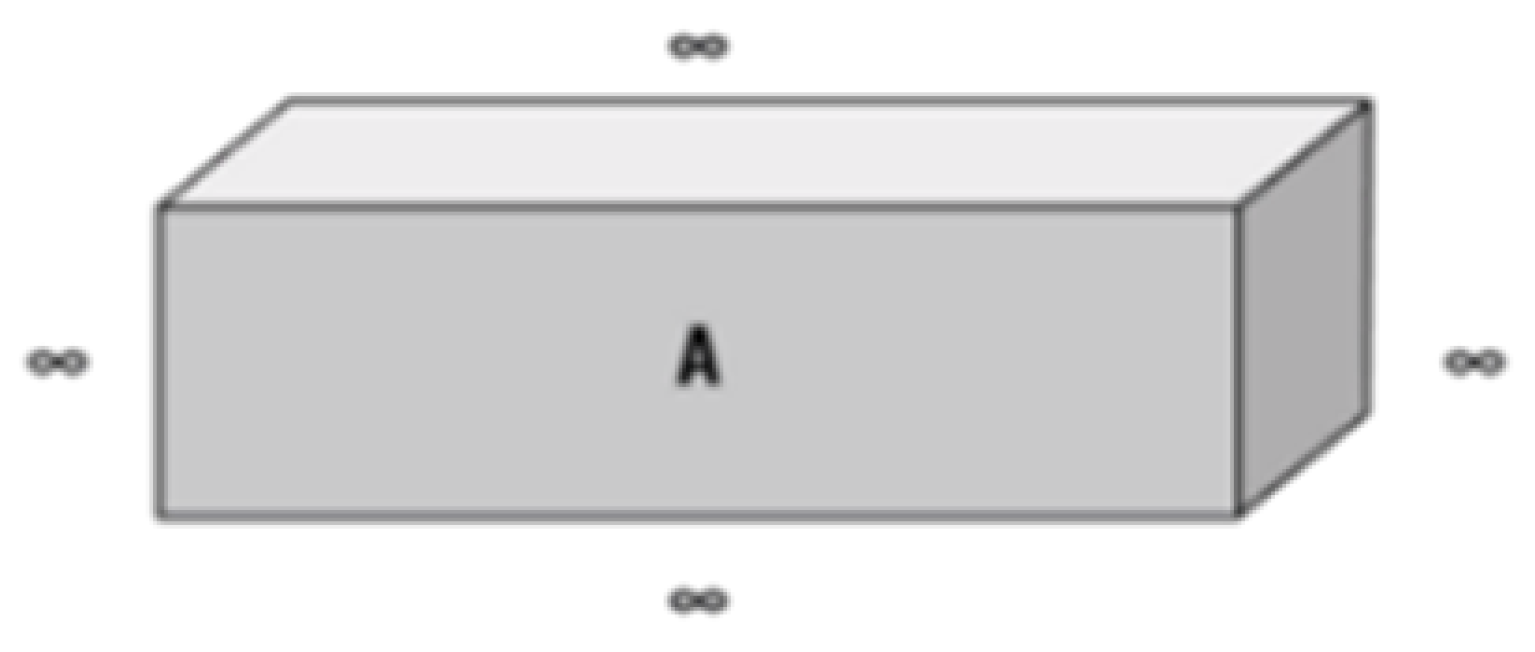
Figure 2.
Einstein’s Boxes – (Box B)
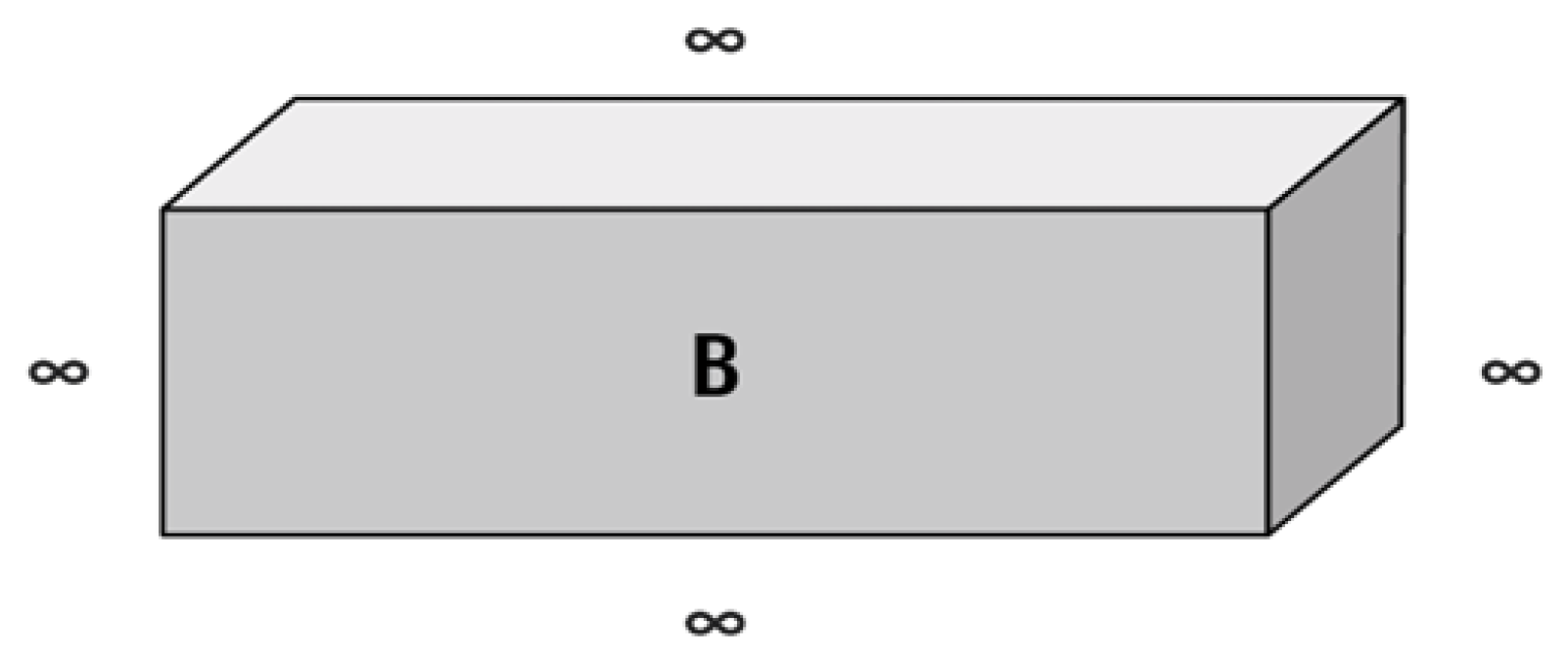
Figure 3.
Princeton (Box C) – Copenhagen (Box D)
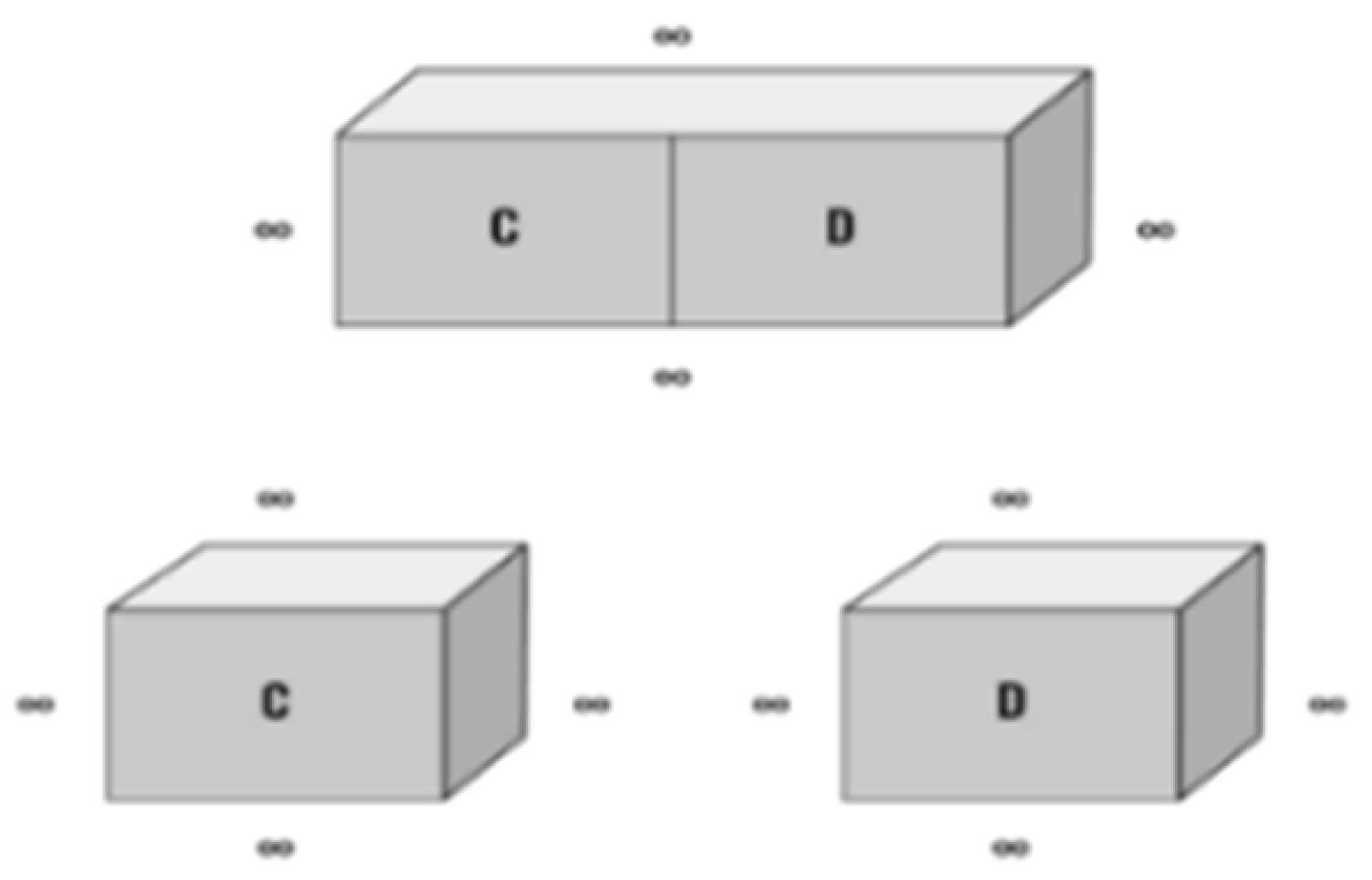
Figure 4.
Double-slit experiment with diffraction and interference patterns
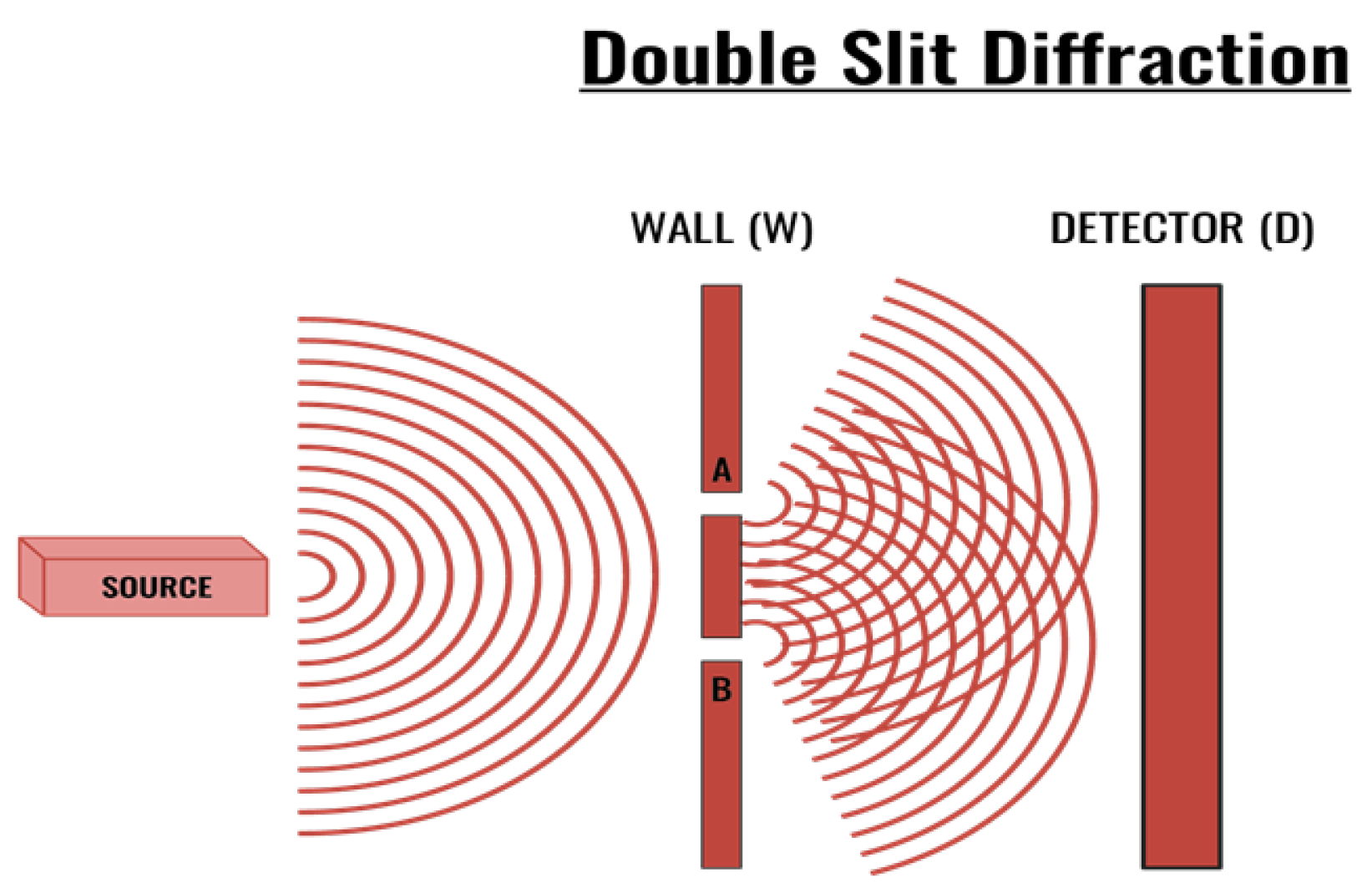
Figure 5.
Which Way Experiment with Proton
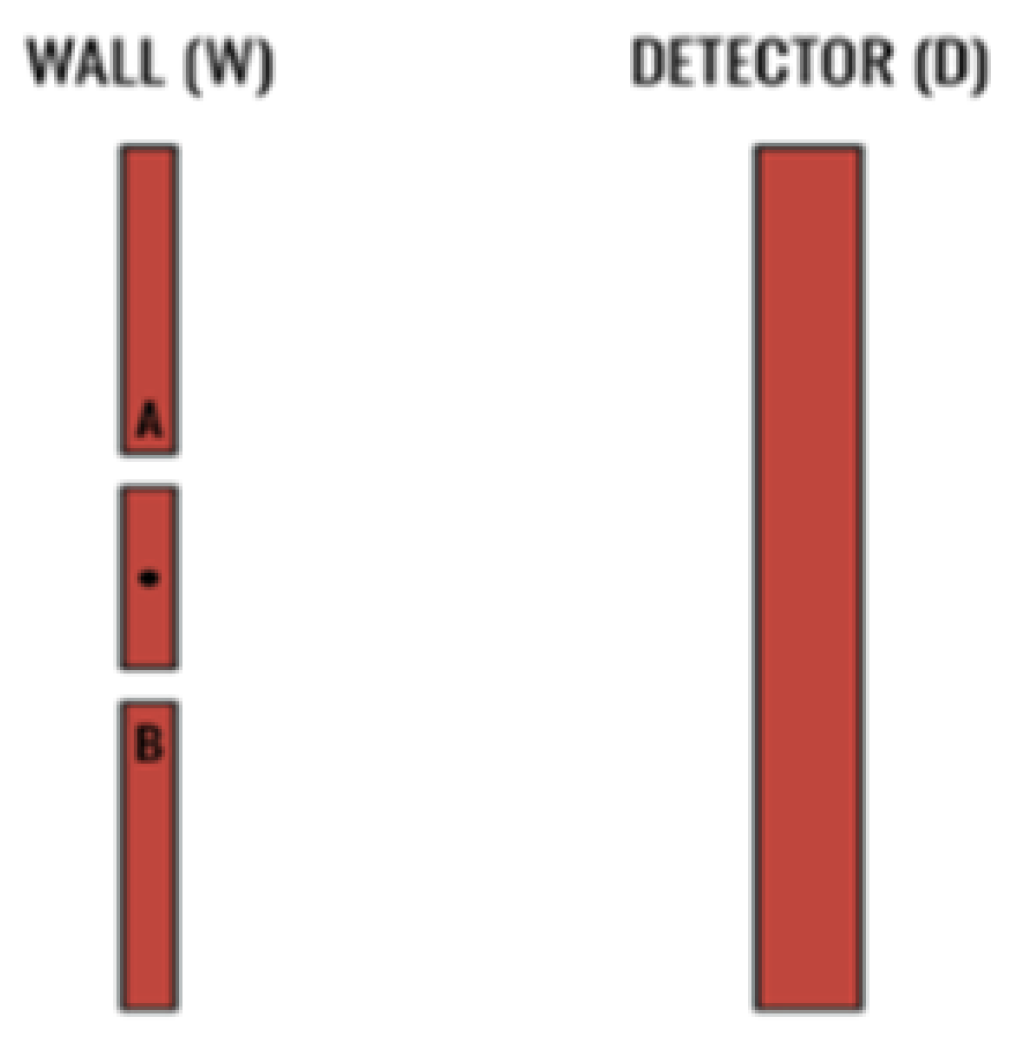
Figure 6.
Bohm Version of the EPR Experiment
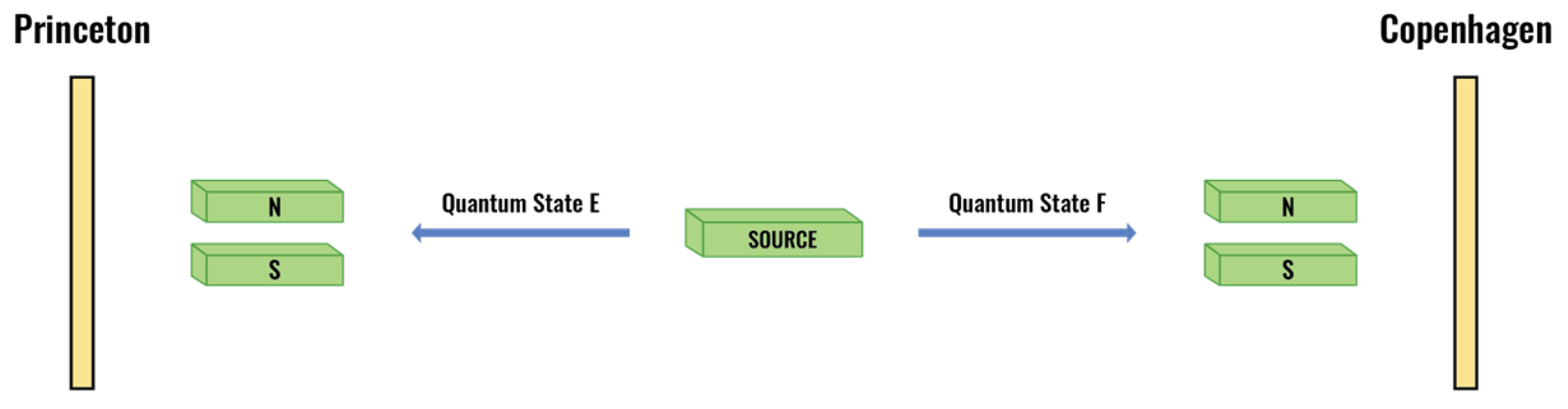
Disclaimer/Publisher’s Note: The statements, opinions and data contained in all publications are solely those of the individual author(s) and contributor(s) and not of MDPI and/or the editor(s). MDPI and/or the editor(s) disclaim responsibility for any injury to people or property resulting from any ideas, methods, instructions or products referred to in the content. |
© 2025 by the authors. Licensee MDPI, Basel, Switzerland. This article is an open access article distributed under the terms and conditions of the Creative Commons Attribution (CC BY) license (http://creativecommons.org/licenses/by/4.0/).
Copyright: This open access article is published under a Creative Commons CC BY 4.0 license, which permit the free download, distribution, and reuse, provided that the author and preprint are cited in any reuse.


