

Submitted:
30 May 2024
Posted:
30 May 2024
You are already at the latest version
Abstract
Landraces are considered a crucial component of biodiversity conservation, serving as a reservoir of genetic diversity. Consequently, the collection, cultivation and detailed characterization of such landraces constitute an inherent aspect of the world’s natural resource heritage. This effort holds promise for the development of elite varieties capable of thriving amidst continuous global climate fluctuations. In this context, we conducted a comprehensive assessment of the main agronomic attributes, physico-chemical properties, and functional quality traits of the major hot pepper landraces adapted to diverse climatic conditions in Tunisia. These landraces include ‘Dhirat’, ‘Semmane’, ‘Beldi’, ‘Nabeul’, ‘Jerid’, ‘Mahdia’, ‘Cayenne’, ‘Kairouan’ and ‘Baklouti’. Most of the pepper landraces exhibited satisfactory yields, ranging from 1163.25 to 1841.67 g plant-1 in ‘Jerid’ and ‘Kairouan’, respectively, indicating robust productivity, especially under prevailing climatic changes and high temperatures. Landraces such as ‘Baklouti’, ‘Beldi’, ‘Nabeul’, ‘Semmane’, ‘Kairouan’ and ‘Mahdia’ appear suitable for both fresh consumption and processing, owing to their favorable average fruit weight and soluble solids content. Functional quality and the levels of antioxidants, as well as radical scavenging activity, emerged as key discriminating factors among pepper landraces. Irrespective of genotype, capsaicin and dihydrocapsaicin constituted the major capsaicinoids, accounting for at least 87% of the total. Total capsaicinoids ranged from 1.81 µg g−1 to 193.71 µg g−1, with ‘Baklouti’ and ‘Jerid’ identified as the most pungent landraces. Total carotenoids ranged from 45.94 µg g−1 to 174.52 µg g−1 with ‘Semmane and ‘Jerid’ exhibiting the highest levels. Considerable variation was observed in β-carotene content, spanning from 3% to 24% of the total carotenoids. α-Tocopherol content ranged from 19.03 µg g-1 fw in ‘Kair-ouan’ to 30.93 µg g-1 fw in ‘Beldi’, exerting a notable influence on the overall tocopherol content. Conversely, the other isomers were detected at very low concentrations. The total vitamin C content ranged from 132 mg 100g-1 fw in ‘Mahdia’ to 200 mg 100 g-1 fw in ‘Nabeul’, indicating relatively low genetic variability. However, large variability was detected in total phenolics content, ranging from 168.58 mg GAE kg-1 fw in ‘Beldi ‘to 302.98 mg GAE kg-1 fw in ‘Cayenne’. Among the pepper landraces tested, ‘Cayenne’ achieved the highest value of radical scavenging activity in both hydrophilic and lipophilic fractions (RSAHF and RSALF), with variations rang-ing from 59% to 120% for RSAHF and from 4% to 64% for RSALF. This study aims to: 1) preserve and enhance the value of local genetic resources, 2) identify desiderable traits for incorporation into breeding programs, and 3) develop high-quality, high-yielding cultivars capable of with-standing climate variations.
Keywords:
agronomic characteristics
; Capsicum annuum L.
; climate change
; functional quality
; pungent pep-per landraces
1. Introduction
Hot or spicy peppers (Capsicum annuum L.) are savory food additives widely utilized and highly valued for their combination of color, taste, and pungency. Capsaicinoids are the compounds responsible for the spicy flavor of peppers. Pepper fruits are consumed in various forms: either fresh, as immature green or mature red berries, or processed into a range of products, including pastes, jams, paprika powders, and oleoresins. The intense and characteristic red color of Capsicum fruits is principally due to the pigments capsanthin and capsorubin. Recently, pepper fruits have gained recognition as natural sources of various bioactive compounds [1,2]. These phytochemicals are increasingly associated with a lower risk of developing several chronic diseases, particularly due to their radical-scavenging activity [3].
Recent years have witnessed a notable increase in awareness and interest in pepper landraces. This trend has been driven by both farmers seeking adapted, low-input, and water-efficient local pepper cultivars, and consumers who appreciate the traditional/old-fashioned pepper flavor and its associated health benefits [1,2,3]. Landraces represent a critical repository and safety valve of genetic diversity, owing to their confirmed distinctive traits, including tolerance/resistance to abiotic stress, and superior flavor and fruit quality compared to widely grown genotypes in different part of the world [4,5,6]. Therefore, desirable traits can be introgressed into suitable and resilient new cultivars to cope with a constantly and rapidly changing climate [5]. Traditional pepper landraces have also proven to be well suited for various emerging farming systems, including dry-farming, low-input practices, organic cultivation, and urban agriculture [4].
In Tunisia, pepper landraces are increasingly cultivated by small farmers but are rapidly disappearing being replaced by high-yielding hybrids widely distributed by processing plants [1]. Despite this, the horticultural performance and fruit quality of these pepper landraces have not been thoroughly studied previously. Therefore, this study aimed to assess the main agronomic traits and functional quality attributes of the main pungent pepper landraces grown under open field conditions over two consecutive growing seasons in 2022 and 2023.
2. Materials and Methods
The field experiments were conducted over two consecutive growing seasons in 2022 and 2023 at the Research and Experimental Station of Teboulba, Monastir, Tunisia (35.637178, 10.957276). The study utilized nine hot pepper landraces: ‘Dhirat’, ‘Semmane’, ‘Jerid’, ‘Mahdia’, ‘Cayenne’, ‘Baklouti’, ‘Nabeul’, ‘Kairouan’ and ‘Beldi’, which were selected and maintained by the Laboratory of Horticultural Crops at the National Agricultural Research Institute of Tunisia.
Sowing took place in plug-seedling trays during May of both 2022 and 2023. Pepper seedlings were transplanted into open-field sandy soil at the beginning of June, with a spacing of approximately 0.4 m within the row and 0.7 m between rows, resulting in a density of about 4 plants per square meter and grown until maturity. Irrigation was implemented using drippers with a flow rate of 4 L h−1, positioned at 0.4 m intervals along the irrigation line. Drip irrigation was applied for 1–3 h on various day intervals, adjusted according to local evapotranspiration potential, prevailing climatic conditions, and crop coefficient. The cultivation schedule adhered to the practices employed by the Research station and neighbouring high-yield farmers. This method included the application of synthetic chemical fertilizers (145 kg N ha−1, 140 kg P2O5 ha−1, 210 kg K2O ha−1), which were added to the irrigation water through pump injection twice a week. Additionally, production methods involved manual weeding and control of plant pathogens using synthetic chemical pesticides, applied once a cycle.
The experimental design employed a randomized complete block with three blocks (replicates). Throughout the growing seasons of 2022 and 2023, the average temperature ranged between 24.88-33°C and 20-34°C, respectively. Relative humidity varied between 55-88% and 56-90%, while rainfall ranged from 0-5 mm and 0-15 mm during the respective years.
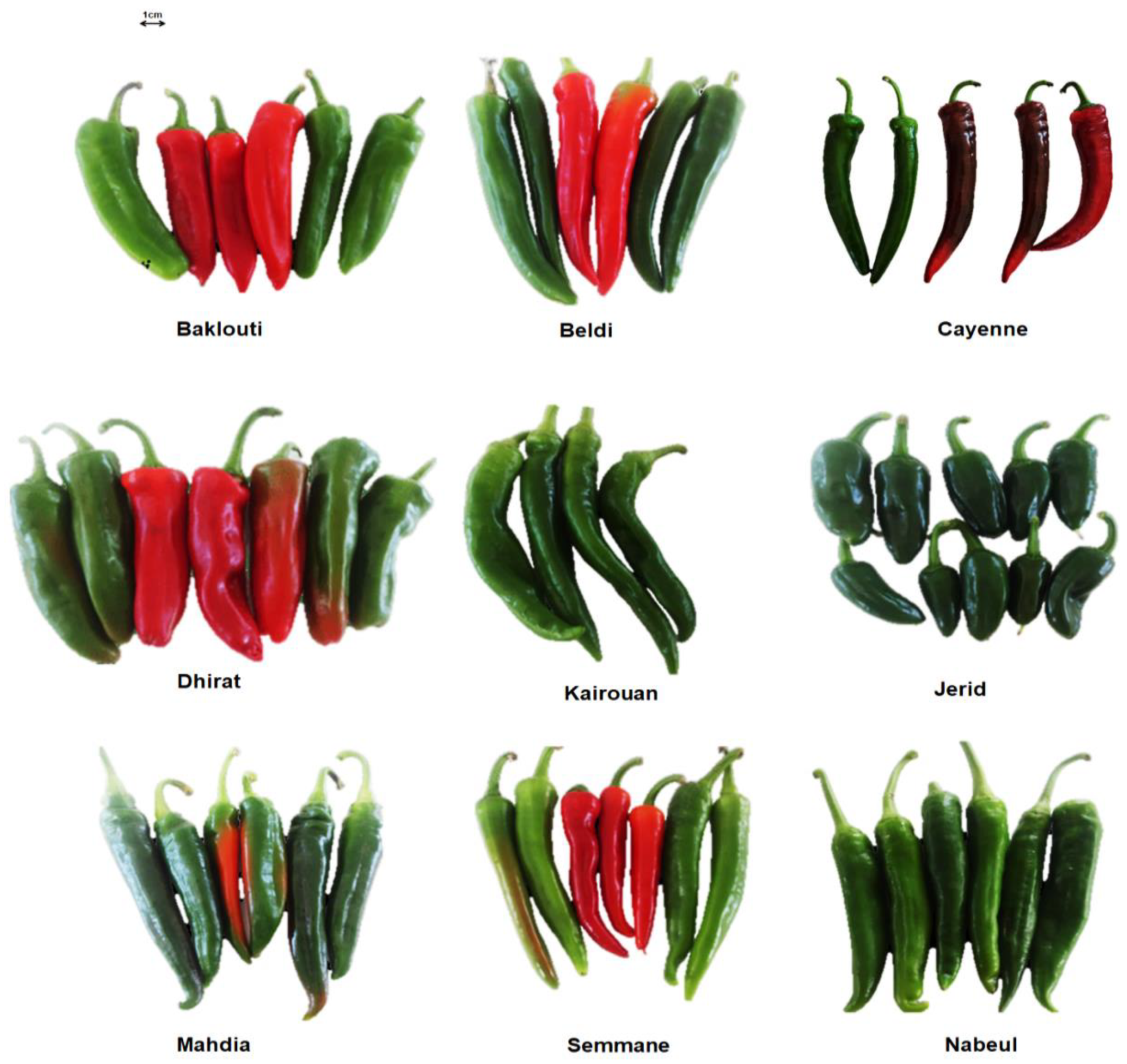
Figure 1.
External appearance of different hot pepper landraces cultivated within the experimental field of Teboulba, Monastir, Tunisia.
Figure 1.
External appearance of different hot pepper landraces cultivated within the experimental field of Teboulba, Monastir, Tunisia.
2.1. Fruit Sampling
Pepper pods were harvested from each plant when they reached the commercial red-mature ripening stage. Healthy, fresh pepper fruits were handpicked from each block and promptly transported to the laboratory. Triplicate sampling was conducted each year upon reaching the desired red-ripe stage. The selected pepper fruits were first washed thoroughly with deionized water before being cut into small pieces. These pieces were then homogenized using a laboratory blender (Waring Laboratory Science, Torrington, CT, US) with the addition of liquid nitrogen to facilitate the process and prevent sample deterioration. The resulting homogenates were stored at -20°C and utilized within a few days to assess capsaicinoids, tocopherols, carotenoids, vitamin C, total phenolics contents, and antioxidant activity, minimizing potential nutrient degradation.
2.2. Evaluation of the Main Agronomic Characteristics
Yield was assessed by determining the weight of fruits per plant, expressed as grams of fresh weight (fw) · plant-1. Average fruit weight was calculated by dividing the weight of a random sample of pepper fruits by the number of fruits within the sample, and it was expressed in grams of fresh weight. Fruit length was measured using a Vernier caliper and averaged over six fruits. Soluble solids concentration was determined by placing a small sample of blended pepper juice on the prism of an Atago PR-100 digital refractometer equipped with automatic temperature adjustment. Titratable acidity was measured as a percentage of citric acid after titrating the diluted pepper juice with 0.1 M sodium hydroxide solution until a pH of 8.1 was reached. Redness (a*) and yellowness (b*) were estimated using a Minolta CR-400, and the ratio (a*/b*) was subsequently calculated [7].
2.3. Determination of Capsaicinoid Content
Capsaicinoid content was determined following the method of Daood et al. [8]. Briefly, in a crucible mortar, three grams of pepper homogenate were crushed with quartz sand. Then, 50 mL of analytical grade methanol was added, and the mixture was placed into a 100 mL Erlenmeyer flask fitted with a stopper. After three minutes of ultrasonication, the mixture was filtered through Whatman grade 1 qualitative paper, and the filtrate was further filtered using a 0.20 µm PTFE syringe filter (Chromfil Xtra) into vials after being diluted ten times (9:1 by vol.). Using an Eppendorf pipette, 1 mL of methanol and 1 mL of the filtrate (from the syringe filter) were further diluted into vials. HPLC conditions The capsaicinoid peaks, including nordihydrocapsaicin (NDC), capsaicin (CAP), dihydrocapsaicin (DC), homocapsaicin (HCAP), dihydrocapsaicin isomer (iDC), and the sum of homodihydrocapsaicin (HDCs), were identified on the chromatogram with retention times of 8.81, 9.62, 12.25, 13.08, and 15.41 minutes, respectively, and their content was expressed as mg kg−1 fw.
2.4. Determination of Carotenoid Content
Total carotenoids were determined according to the protocols of Daood et al. [8]. Approximately 2.5 g of homogenized pepper samples from different landraces were ground in a crucible mortar with quartz sand. A volume of 20 mL of methanol was added over 1–2 min, and the upper layer was poured into an Erlenmeyer flask. Next, 10 mL of analytical-grade methanol was added to 50 mL of dichloroethane in a 100 mL graduated cylinder and shaken gently. The mixture was poured then into the remaining homogenized pepper sample in a crucible mortar, transferred into the Erlenmeyer flask, and shaken vigorously. A few drops of distilled water were added, the mixture was shaken gently, and it was then separated using a burette into a flat bottom flask through a filter paper containing anhydrous sodium sulfate in a separating funnel. To the filtrate, 5 mL of dichloroethane was added through a filter paper for further extraction and evaporated using a rotary evaporation chamber for 10 min at 70°C and 40 °C vacuum, respectively. . After all the filtrate had evaporated, the flask was removed from the chamber. Next, 5 mL of pigment eluents and 5 mL of analytical-grade methanol were respectively added to the flask and shaken evenly. An ultrasonic shaker was used where necessary to ensure no residue was left in the flask. The solution was then filtered through a 0.22 µm PTFE membrane syringe into vials and injected into the HPLC column.
An HPLC (Hitachi Chromaster, Tokyo, Japan) instrument consisting of a Model 5110 Pump, a Model 5210 Auto Sampler, a Model 5430 Diode Array Detector, and a Model 5440 FL Detector was used for the determination of all compounds. All chemicals, including analytical and HPLC-grade solvents, were purchased from VWR (Budapest, Hungary, and Darmstadt, Germany). The individual carotenoid peaks identified and analyzed on the chromatogram were free capsanthin (free caps), free zeaxanthin (free zeax), capsanthin mono-ester (caps ME), zeaxanthin mono-ester (zeax ME), β-carotene (β-carotene), capsanthin di-ester (caps DE), and zeaxanthin di-ester (zeax DE). The retention times were 9.23, 10.95, 12.92, 13.05, 30.64, 32.71 min for capsorubin, violaxanthin, lutein, zeaxanthin, beta-carotene and beta-cryptoxanthin, respectively, and their contents were expressed as mg kg−1 fw.
2.5. Determination of Tocopherol Content
The procedure of Abushita et al. [9] was used for the extraction of tocopherols using n-hexane. The analysis was performed using an HPLC (Hitachi Chromaster, Tokyo, Japan) equipped with a Model 5110 gradient pump, a Model 5210 autosampler, and a Model 5440 fluorescence detector. Separation was achieved using a Nucleosil 5 µm (250 × 4.6 mm i.d.) column with a mobile phase of 99.5:0.5 n-hexane:ethanol). Excitation and emission wavelengths were set at 295 nm and 320 nm, respectively, as outlined in Duah et al. [1]. The isomers of α-, β-, and γ-tocopherols were identified using external standards (Sigma-Aldrich, Budapest, Hungary) and co-chromatographed with the samples. The retention times for α-, β-, and γ-tocopherols were 16.75, 14.41, and 13.34 min, respectively, with the content expressed as mg kg−1 fw.
2.6. Determination of Total Vitamin C Content
Total vitamin C (AsA + DHA) was extracted and quantified from 0.2 g samples of homogeneous pepper juice according to Kampfenkel et al. [10]. Absorbance was measured using a Cecil BioQuest CE 2501 spectrophotometer (Cecil Instruments Ltd., Cambridge, UK) at 525 nm and expressed in mg 100 g−1 fw. The standard curve for AsA was linear between 0 and 750 µmol.
2.7. Determination of Total Phenolic Content
The extraction and measurement of total phenolic content were performed according to the method outlined by Martínez-Valverde et al. [11]. A volume of 5 mL of 80% methanol and 50 µL of 37% HCl were combined with 0.1 g of pepper homogenate and extracted for 2 h at 4 °C and 300 rpm. The mixture was then centrifuged for 20 min at 10,000×g. A 50 µL sample of the supernatant was then treated with Folin–Ciocalteu reagent, and absorbance was measured at 750 nm using a Cecil BioQuest CE 2501 spectrophotometer (Ceil Instruments Ltd., Cambridge, UK). Total phenolic content was expressed as mg of gallic acid equivalent (GAE) kg−1 fw. Additionally, the concentration was adjusted for sugar-phenolic interference according to the procedure of Asami et al. [12].
2.8. Measurement of the Radical Scavenging Activity
The radical scavenging activity of the hydrophilic and lipophilic fractions (RSAHF and RSALF, respectively) was assessed using the Trolox Equivalent Antioxidant Capacity (TEAC) method, following Miller and Rice-Evans [13]. This methodology was chosen for its reproducibility and accuracy in analyzing complex matrices [14,15]. To extract hydrophilic and lipophilic antioxidants, 0.1 g of pepper homogenate was extracted with methanol (50%) or acetone (50%), respectively, at 4 °C under continuous shaking at 300 rpm for 12 hours. The samples were than centrifuged at 10,000× g for 7 min. The collected supernatants were used to determine antioxidant activity at 734 nm using a Cecil BioQuest CE 2501 spectrophotometer (Cecil Instruments Ltd., Cambridge, UK). Antioxidant activity was calculated and expressed as μM of Trolox 100 g−1 of fw.
2.9. Statistical Analysis
Variability influencing the agronomic, physicochemical, and functional quality traits of hot pepper landraces was assessed through analysis of variance (ANOVA). Means were compared using the Duncan test (p < 0.05) when significant differences were observed. Statistical analyses were conducted using IBM SPSS Statistics software for Windows, Version 21.0. (IBM Corp., Armonk, NY, USA). Correlations were determined using Pearson’s correlation coefficient (r). Additionally, Principal Component Analysis (PCA) biplot PC1 vs. PC2 of the main bioactive classes of molecules (total contents) identified in the different investigated hot pepper landraces was performed using the XLSTAT software (Addinsoft, Paris, France).
3. Results
3.1. Agronomic and Physico-Chemical Traits
The main agronomic attributes (Table 1) and physicochemical traits (Table 2) of different hot pepper landraces exhibited significant variations among the tested genotypes (p < 0.05). Under open-field conditions, the pepper genotypes displayed determinate growth habits, showing vigorous growth with excellent foliage coverage. Earliness varied from early for ‘Dhirat’, ‘Beldi’, and ‘Jerid’ to very late for ‘Cayenne’. Fruit shape was triangular for ‘Jerid’ and ‘Baklouti’ and elongate for the remaining landraces. All genotypes exhibited satisfying yields, ranging from 1163.25 g plant-1 in ‘Jerid’ to 1841.67 g plant−1 in ‘Kairouan’, indicating good productivity despite ongoing climatic changes and high temperature registered during the growth period. The average fruit weight ranged from 6.5 g in ‘Jerid’ to 37.75 g in ‘Kairouan’, with ‘Semmane’, ‘Beldi’, ‘Nabeul’, ‘Mahdia’, and ‘Baklouti’ showing similar weights appreciated by fresh market consumers.
Soluble solids content (Table 2) ranged from 9.1° Brix in ‘Semmane’ to 12.2° Brix in ‘Beldi’, with the high content in ‘Beldi’ making it suitable for processing. pH values of pH values spanned from 4.72 in ‘Baklouti’ to 5.6 in ‘Cayenne’, while titratable acidity ranged from 0.16% in ‘Semmane’ to 0.31% in ‘Nabeul’, with ‘Mahdia’ showing similar acidity to ‘Semmane’. The color index (a*), indicating the intensity of red color, ranged from 33.94 in ‘Nabeul’ to 41.35 in’ Kairouan’, while the color index (b*), indicating yellowness, ranged from 39.32 in ‘Nabeul’ to 44.81 in ‘Semmane’. Consequently, the (a*/b*) ratio, useful for characterizing the quality and maturity of pepper pods, spanned from 0.87 in ‘Nabeul’ to 0.97 in ‘Cayenne’.
3.2. Functional Quality Traits
3.2.1. Capsaicinoid Content
The content of single capsaicinoids and their total exhibited significant variation among pepper genotypes (p < 0.05) (Figure 2a, b). Irrespective of genotype, capsaicin and dihydrocapsaicin were the major capsaicinoids detected in the hot pepper landraces under investigation. Nordihydrocapsaicin comprised up to 9% of total capsaicinoids, ranging from 0.02 µg g−1 fw in ‘Nabeul’ to 23.12 µg g−1 fw in ‘Baklouti’, demonstrating substantial variability among the investigated landraces. Similarly, homodihydrocapsaicin ranged from 0.92 µg g−1 fw in ‘Kairouan’ to 3.9 µg g−1 fw in ‘Jerid’. Homocapsaicin was etected in ‘Dhirat’, ‘Semmane’, ‘Nabeul’, and ‘Cayenne’ only, with values ranging from 0.007 µg g−1 fw in ‘Nabeul’ to 1.26 µg g−1 fw in ‘Dhirat’. Capsaicin content ranged from 0.54 µg g−1 fw in ‘Kairouan’ to 108.6 µg g−1 fw in ’Jerid’, while dihydrocapsaicin ranged from 0.49 µg g−1 fw in ‘Mahdia’ to 68.36 µg g−1 fw in ‘Baklouti’. Overall, total capsaicinoids exhibited considerable variability among the tested pepper landraces, ranging from 1.81 µg g−1 fw in ‘Kairouan’ to 194.02 µg g−1 fw in ‘Jerid’.
3.2.2. Carotenoid Content
Capsorubin, violaxanthin, and lutein were considered minor carotenoids due to their relative content, whereas zeaxanthin, β-cryptoxanthin, and β-carotene were identified as the major carotenoids in hot pepper landraces. Significant variations (p < 0.05) were observed in the contents of capsorubin, violaxanthin, lutein, zeaxanthin, β-cryptoxanthin, and β-carotene among the investigated hot pepper landraces (Figure 3a, b).
Among the minor carotenoids, capsorubin content ranged from 1.85 µg g−1 fw in ‘Baklouti’ to 5.01 µg g−1 fw in ‘Kairouan’, while violaxanthin ranged from 1.06 µg g−1 fw in ‘Baklouti’ to 5.14 µg g−1 fw in ‘Jerid’. Lutein content varied from 0.62 µg g−1 fw in ‘Semmane’ to 8.25 µg g−1 fw in ‘Baklouti’.
Regarding major carotenoids, β-cryptoxanthin content ranged from 7.34 µg g−1 fw in ‘Nabeul’ to 27.11 µg g-1 fw in ‘Semmane’, while zeaxanthin content ranged from 7.24 µg g−1 fw in ‘Beldi’ to 27.8 µg g−1 fw in ‘Semmane’. β-carotene, the predominant carotenoid, ranged from 14.32 µg g-1 fw in ‘Kairouan’ to 113.69 µg g−1 fw in ‘Semmane’, reflecting significant variability. The contribution of β-carotene to the total carotenoid content ranged from 2% in ‘Kairouan’ to 14% in ‘Semmane’.
Regarding total carotenoids, which was significantly influenced by the content of β-carotene, ‘Semmane’ exhibited the highest content with 113.68 µg g-1 fw.
3.2.3. Tocopherol Content
The content of different tocopherol isomers and their total varied significantly (p < 0.05) between the studied hot pepper landraces (Figure 4). α-Tocopherol content ranged from 19.03 µg g−1 fw in ‘Kairouan’ to 30.93 µg g−1 fw in ‘Beldi’. The content of β-tocopherol showed lower variability, ranging from 0.11 µg g−1 fw in ‘Mahdia’ to 0.66 µg g−1 fw in ‘Jerid’. The γ-tocopherol isomer was detected in ‘Dhirat’, ‘Semmane’, ‘Beldi’, ‘Nabeul’, ‘Jerid’ and ‘Mahdia’, albeit in very low amounts ranging from 0.021 µg g−1 fw in ‘Dhirat’ to 0.18 µg g-1 fw in ‘Beldi’. The total tocopherol content was highest in ‘Beldi’ and ‘Jerid’, ranging from 19.38 µg g−1 fw in ‘Kairouan’ to 31.36 µg g−1 fw in ‘Beldi’. Consequently, the total to-copherol content was predominantly composed of α-Tocopherol, with the other isomers present in trace amounts across all analyzed pepper landraces.
3.2.4. Total Vitamin C Content
The total vitamin C content varied significantly (p < 0.05) among pepper landraces (Figure 5). Across the study, total vitamin C ranged from 132 mg 100 g−1 fw in ‘Mahdia’ to 200 mg 100 g−1 fw in ‘Nabeul’, with variations ranging from 5% to 52% compared to ‘Mahdia’, indicating relatively low variability among the analyzed pepper landraces. Landraces ‘Jerid’ ‘Dhirat’, and ‘Cayenne’ showed statistically similar intermediate total vitamin C levels.
3.2.5. Total Phenols
The content of total phenols varied significantly (p < 0.05) among the analyzed hot pepper landraces (Figure 6). Total phenolics content ranged from 168.58 mg GAE kg-1 fw in ‘Beldi ‘to 302.98 mg GAE kg−1 fw in ‘Cayenne’, with variations ranging from 22% to 80% compared to ‘Beldi’, indicating substantial variability among the analyzed pepper landraces. ‘Dhirat’, ‘Semmane’, ‘Nabeul’, ‘Jerid’, and ‘Mahdia’ demonstrated statistically similar intermediate total phenolic values.
3.2.6. Radical Scavenging Activity
The RSAHF and RSALF values varied significantly (p < 0.05) among the studied pepper landraces (Figure 7). RSAHF values ranged from 1043.85 µM Trolox 100 g-1 fw in ‘Beldi’ to 1707.28 µM Trolox 100 g-1 fw in ‘Cayenne’, with variations spanning from 4% to 64%compared to ‘Baklouti’. Conversely, RSALF values ranged from 763.31 µM Trolox 100 g-1 fw in ‘Baklouti’ to 1680.27 µM Trolox 100 g-1 fw in ‘Cayenne’, exhibiting variations ranging from 59% to 120% compared to ‘Baklouti’. While the landrace ‘Cayenne’ displayed the highest values for both RSAHF and RSALF, ‘Baklouti’ statistically ranked the last for both traits.
3.3. Correlation Analysis
The relationships between the studied traits were examined using Pearson correlation analysis at p < 0.01 (Figure 8). A significant positive correlation was observed between RSAHF and various hydrophilic antioxidants, including total phenolics and total vitamin C. Similarly, RSALF showed positive and significant correlation with several lipophilic antioxidants, such as homodihydrocapsaicin, β-tocopherol, lutein, and zeaxanthin. Furthermore, the color indexes a* and the ratio (a*/b*) exhibited significant correlations with the content of various quality traits of pepper, including total phenolics, homodihydrocapsaicin, total carotenoids, β-carotene, β-cryptoxanthin, zeaxanthin, violaxanthin, capsorubin, total tocopherols, α-tocopherol, as well as RSAHF and RSALF. These findings suggest the potential utility of color indexes in predicting key quality traits among the investigated parameters.
YLD, yield per plant; AFW, average fruit weight; AFL, average fruit length; TA, titratable acidity; a*, redness; b*, yellowness; (a*/b*), a*/b* ratio; CAP, capsaicin; DHC, dihydrocapsaicin; NDHC, nor-dihydrocapsaicin; HC, homocapsaicin; HDHC, homodihydrocapsaicin; TOT, total capsaicinoids; α-T, α-tocopherol; β-T, β-tocopherol; γ-T, γ-tocopherol; TOC, total tocopherols; CASR, capsorubin; VIO, violaxanthin; LUT, lutein; ZEA, zeaxanthin; β-CRP, β-cryptoxanthin; β-CAR, β-carotene; CAR, total carotenoids; Vit C, Vitamin C; TP, Total phenols; RSAHF, radical scavenging activity of the hydrophilic fraction antioxidant activity; RSALF, radical scavenging activity of the lipophilic fraction.
3.4. Principal Component Analysis (PCA)
To gain a deeper understanding of the relationships between hot pepper landraces, we conducted PCA using the biochemical data as input variables. Figure 9 illustrates the resulting biplot (PC1 vs. PC2). The first two principal components explained 49.72% of the observed variation, with PC1 contributing 27.87% and PC2 contributing 21.85%. PC1 showed positive correlations with total phenols, vitamin C, as well as RSAHF and RSALF, but it exhibited negative correlations with total capsaicinoids, total carotenoids, and total tocopherols. Conversely, PC2 displayed positive correlations with total carotenoids, total tocopherols, RSAHF, RSALF, and vitamin C, but it showed negative correlations with total capsaicinoids and total phenols. Regardless of the growing year, ‘Semmane’ and ‘Nabeul’ displayed positive scores along PC1. ‘Baklouti’ and ‘Jerid’ were strongly correlated with total capsaicinoids contents.
TCP, total capsaicinoids; TP, total phenols; TT, total tocopherols; TC, total carotenoids; Vit C, Vitamin C; RSALF, radical scavenging activity of the lipophilic fraction; RSAHF, radical scavenging activity of the hydrophilic fraction.
4. Discussion
The assessed pepper landraces demonstrated desirable agronomic traits, though significant variations in yield were observed, commonly attributed to environmental conditions rather than genetic factors [16,17]. For instance, Ilić et al. [18] noted significant variations in fruit weight among traditional Serbian pepper landraces (Nizača, Lokošnička, and Turšijara), highlighting the impact of both environmental and genetic factors on yield. Our findings on qualitative chemical traits underscore the suitability of most genotypes for both fresh consumption and processing, aligning with various studies. Brilhante et al. [19] reported similar ranges in soluble solids (5.0 to 24.3 °Brix), pH values (4.69 to 5.94), and total acidity (0.25 to 1.60 mEq% fw) while assessing a Brazilian Capsicum germplasm collection. Similarly, Ilić et al. [18] found soluble solids ranging from 8.81 to 14.42 in traditional Serbian pepper landraces.
Color is a critical attribute of vegetable food, and the a*, b* and a*/b* ratio indices are invaluable in characterizing the quality and maturity of pepper berries. Our b* readings were consistent with those reported by Ilić et al. [18] for Serbian pepper landraces (13.78 to 22.72), although a* readings were slightly higher (30.41 to 37.05) than ours, possibly due to differences in maturity, climate, or agronomic practices enhancing the accumulation of carotenoids and other metabolites responsible for the red color of the ripe fruits.
Regarding functional quality, our study highlighted the prevalence of capsaicin and dihydrocapsaicin as the primary capsaicinoids, comprising 50% and 37%, respectively, of the total capsaicinoid content. This aligns closely with Barbero et al. [20], who reported an even higher dominance of the two compounds, accounting for 79% to 90% of total capsaicinoids during the ripening of Cayenne pepper grown in Spain. Nordihydrocapsaicin emerged as the third major capsaicinoid in the studied landraces, constituting 9% of the total content, while homodihydrocapsaicin and homocapsaicin collectively accounted for 3%, in agreement with Barbero et al. [20]. Indeed, the authors observed nordihydrocapsaicin levels ranging between 6% and 14% of total capsaicinoids in Cayenne pepper, with homodihydrocapsaicin and homocapsaicin present at lower levels (2% to 4%) depending on the fruit's ripening stage. Notably, 'Baklouti' and 'Jerid' exhibited the highest accumulation of total capsaicinoids, solidifying their reputation as among the spiciest and most pungent genotypes in Tunisia. Conversely, 'Mahdia' and 'Kairouan' accumulated the lowest levels, making them preferred choices for consumers seeking milder options. Genotype significantly influences the content of pepper capsaicinoids, as previously reported by Jeeatid et al. [21]. Substantial variation in capsaicin (0 to 9948 µg g−1 dw), dihydrocapsaicin (0 to 4114.3 µg g−1 dw), and total capsaicinoids (0 to 14062.3 µg g−1 dw) has been reported by Castillo-Aguilar et al. [22] in nine chili pepper landraces from Yucatan peninsula, Mexico, with the extreme values registered in ‘Dulce’ and ‘Rosita’, respectively. Alam et al. [23] found higher capsaicin and dihydrocapsaicin content in hot pepper landraces from Malaysia compared to sweet ones. Moon et al. [24] reported wide-ranging capsaicinoid content (0.00 to 1219.90 mg 100 g−1 fw) in a collection of Capsicum annuum and Capsicum frutescens pepper accessions. Diaz-Sanchez et al. [25] found variability in capsaicinoid content in 31 piquin pepper landraces, ranging from 135 to 1379 µg mL-1 and 301 to 3719 µg mL-1 for total capsaicinoids grown under field and greenhouse conditions, respectively.
Our findings on carotenoid content revealed that fresh red peppers of all analyzed landraces accumulated high levels of provitamin A carotenoids (β-carotene and β-cryptoxanthin), as well as zeaxanthin. β-carotene was the most abundant, comprising 60% of all carotenoids, consistent with Rodríguez et al. [26] and Maiani et al. [27]. The obtained results also align with those reported by Martínez-Ispizua et al. [28] in an 18-pepper landrace collection from Valencia, Spain, with total carotenoids levels ranging from 12.17 to 103.88 µg g−1 fw at the red maturity stage. The authors also observed variability ranging from 2.64 to 13.11 µg g-1 fw in the level of total carotenoids in the same landraces harvested at the green stage. Additionally, Moon et al. [24] revealed an even larger variation in total carotenoids and β-carotene contents, ranging from 52.5 to 3496 µg g−1 fw and 5.97 to 392.74 µg g−1 fw, respectively, in 380 pepper accessions of Capsicum annuum grown in Korea. This was confirmed by Da Silveira et al. [29], who reported significant variability among pepper landraces regarding total carotenoids content, emphasizing the high influence of genotype on this trait.
Regarding total tocopherols, a strong correlation with α-tocopherol content was observed, this is likely influenced by the lipid content, which varies according to the ripening stage and variety [30,31]. Karaman et al. [32] detected α-tocopherol content of 1078.4 µg g−1 dw in fruits of recombinant inbred pepper lines from interspecies crosses (Capsicum annuum × Capsicum frutescens). Duah et al. [1] reported a low extent of variability in α-tocopherol content (392 to 448 µg g−1 dw) while assessing bioactive compounds in new hybrid hot chili peppers from Hungary.
Ascorbic acid plays a pivotal role in maintaining plant redox homeostasis by acting as an antioxidant that scavenges reactive oxygen species [33] and is crucial in defending against oxidative stress [34]. Peppers are known to have higher vitamin C content compared to other fresh products, including citrus [34,35]. The obtained values for total vitamin C were consistent with those of Moon et al. [24], who reported vitamin C content ranging from 0.10 to 18.5 mg 100 g−1 fw, and Martínez-Ispizua et al. [28], who detected vitamin C within the range 0.62 to 2.5 mg g-1 fw at the green stage and 1.05 to 3.94 mg g-1 fw at the red stage in 18 sweet pepper landraces harvested at different ripening stages. It has been reported that environmental conditions, variety, maturity, and pre-harvest and post-harvest practices are key factors influencing ascorbic acid content [34].
Our results on total soluble phenolics were in the range of those found by Lee et al. [36] (178 to 384.9 mg chlorogenic acid equivalent 100 g−1 fw) in fresh peppers. The results are also consistent with those of Kumar et al. [37], who recorded total phenolics content reaching 266 mg GAE kg −1 in red peppers. Numerous authors have argued that phenolic accumulation varies depending on the variety, maturity stages, agronomic practices, climate conditions, as well as determination methodologies [38,39] with total phenolics levels ranging between 33 and 250 mg GAE 100 g−1 fw for different Capsicum annuum genotypes [40,41]. Alam et al. [23] found higher total phenolic content in hot versus sweet pepper landraces, ranging from 0.5 to 1.0 mg GAE g−1 dw in the Malaysian ‘cili ungu’ and ‘cili burung’ landraces, respectively, suggesting a positive correlation between phenolic content and pungency. Martínez-Ispizua et al. [28] observed large variability in phenolic content from 1.83 to 7.24 mg g−1 fw at the green stage and from 5.66 to 15.87 mg g−1 fw at the red ripe stages. Based on their phenolic content, the studied pepper landraces can be considered a good source of phenolics.
Regarding RSALF and RSAHF, the results align with those of García-Vásquez et al. [42], who assessed the antioxidant activity of ten pepper populations from Mexico using two analytical methods, finding variations using DPPH (13.8 to 28.4 µmol TE g−1) and FRAP (36.6 to 63.4 µmol TE g−1). Similarly, Constantino et al. [43] assessed antioxidant activity in 22 pepper accessions from four Brazilian states, with DPPH values ranging from 0.13 to 1.12 TEAC g-1 and FRAP values from 0.21 to 2.27 µmol TEAC g−1, suggesting different sensitivities of the techniques, and a variability related to genotype and cultivation place. Ramírez-Aragón et al. [44] reported differences ranging from 65 to 348 µmol Trolox g-1 dw in 14 chili pepper cultivars grown in Mexico. Martínez-Ispizua et al. [28] found antioxidant activity ranging from 49.68 to 96.31 mg TE g−1 fw, noting variability from 6.12 to 77.84 mg TE g−1 fw at the green stage and from 49.68 to 96.31 mg TE g−1 fw at the red stage.
Finally, highly significant correlations were recorded between α-tocopherol and total tocopherols (r = 0.99), capsaicin and total capsaicinoids (r = 0.99), dihydrocapsaicin and total capsaicinoids (r = 0.99), β-carotene and total carotenoids (r = 0.96), β-carotene and β-cryptoxanthin (r = 0.93), nordihydrocapsaicin and total capsaicinoids (r = 0.93), nordihydrocapsaicin and total capsaicin (r = 0.90), (a*) and (b*) (r = 0.897), zeaxanthin and total carotenoids (r = 0.80), as well as total polyphenols and RSALF (r = 0.71), suggesting that this parameter in peppers is greatly influenced by the content of ascorbic acid and phenols.
5. Conclusions
The study provides comprehensive insights into both the agricultural traits and functional quality of various pungent pepper landraces and traditional cultivars. It demonstrates that many traditional genotypes possess valuable agronomic, physicochemical, and functional quality traits, making them suitable candidates for breeding programs aimed at developing high-yielding genotypes with minimal input and water requirements, particularly under the challenging conditions posed by global climate change. Notably, the data were collected under hot season conditions over two growing years, highlighting the resilience of these genotypes.
The findings suggest that several quality traits of pepper landraces can be effectively estimated based on color readings. However, further analysis of other bioactive compounds and the use of additional analytical methodologies would enhance the development of genotypes with specific bioactive profiles. This approach could lead to the creation of pepper varieties tailored to meet specific nutritional and functional demands, thereby supporting sustainable agriculture and improved food security.
Author Contributions
Conceptualization, M.C., I.T., I.H., R.I. and T.R.; investigation, M.C., I.T., I.H., S.T., A.M., M.A. and M.W.S.; data curation, M.C., I.H., H.D., Z.P. and M.S.L.; formal analysis and validation, M.C., I.T., I.H., S.T., H.D., Z.P., L.H., A.M., M.D.C., G.P.D.S., R.I., T.R., and M.S.L.; writing—original draft preparation, M.C., I.T., I.H., S.T., H.D., Z.P., L.H., M.D.C., M.W.S., R.I., T.R., and M.S.L.; writing—review and editing, M.C., I.T., I.H., S.T., H.D., Z.P., L.H., A.M., M.D.C., G.P.D.S., M.A., M.W.S., R.I., T.R., and M.S.L. All authors have read and agreed to the published version of the manuscript.
Funding
This research received no external funding.
Acknowledgments
We thank Dr. Saloua Taoueb Msellmi and Pr. Aziza Zoghlami from the National Agricultural Research Institute of Tunisia.
Conflicts of Interest
The authors declare no conflict of interest.
References
- Duah, S.A.; Souza, C.S.; Daood, H.G.; Pék, Z.; Neményi, A.; Helyes, L. Content and response to Ɣ-irradiation before over-ripening of capsaicinoid, carotenoid, and tocopherol in new hybrids of spice chili peppers. LWT - Food Sci. Technol. 2021, 147, 111555. [Google Scholar] [CrossRef]
- Korkmaz, A.; Atasoy, A.F.; Hayaloglu, A.A. The effects of production methods on the color characteristics, capsaicinoid content and antioxidant capacity of pepper spices (C. annuum L.). Food Chem. 2021, 341, 128184. [Google Scholar] [CrossRef]
- Civan, M.; Kumcuoglu, S. Green ultrasound-assisted extraction of carotenoid and capsaicinoid from the pulp of hot pepper paste based on the bio-refinery concept. LWT - Food Sci. Technol. 2019, 113, 108320. [Google Scholar] [CrossRef]
- Hamza, N.; Jebari, H.; R’him, T.; Hdider, C.; Khamassy, N.; Ilahy, R.; Tlili, I. Historique et principaux acquis de l’INRAT en matière de cultures maraîchères. Annales de l’INRAT 2013, 86, Numéro Spécial Centenaire.
- Corrado, G.; Caramante, M.; Piffanelli, P.; Rao, R. Genetic diversity in Italian tomato landraces: Implications for the development of a core collection. Sci. Hortic. 2014, 168, 138–144. [Google Scholar] [CrossRef]
- Abu-Zahra, T.R. Influence of agricultural practices on fruit quality of bell pepper. Pak. J. Biol. Sci. 2011, 14(18), 876. [Google Scholar] [CrossRef]
- Chen, Y.; Min, Z.; Fan, D.; Kai, F.; Wang, X. Linear regression between CIE-Lab color parameters and organic matter in soils of tea plantations. Eurasian Soil Sci. 2018, 51, 199–203. [Google Scholar] [CrossRef]
- Daood, H.G.; Bencze, G.; Palotas, G.; Pék, Z.; Sidikov, A.; Helyes, L. HPLC analysis of carotenoids from tomatoes using cross-linked C18 column and MS detection. J. Chromatogr. Sci. 2014, 52, 985–991. [Google Scholar] [CrossRef]
- Abushita, A.A.; Hebshi, E.A.; Daood, H.G.; Biacs, P.A. Determination of antioxidant vitamins in tomatoes. Food Chem. 1997, 60, 207–212. [Google Scholar] [CrossRef]
- Kampfenkel, K.; Van Montagu, M.; Inzé, D. Extraction and determination of ascorbate and dehydroascorbate from plant tissue. Anal. Biochem. 1995, 225, 165–167. [Google Scholar] [CrossRef]
- Martínez-Valverde, I.; Periago, M.J.; Provan, G.; Chesson, A. Phenolic compounds, lycopene and antioxidant activity in commercial varieties of tomato (Lycopersicum esculentum). J. Sci. Food Agric. 2002, 82, 323–330. [Google Scholar] [CrossRef]
- Asami, D.K.; Hong, Y.-J.; Barrett, D.M.; Mitchell, A.E. Comparison of the total phenolic and ascorbic acid content of freeze-dried and air-dried marionberry, strawberry, and corn grown using conventional, organic, and sustainable agricultural practices. J. Agric. Food Chem. 2003, 51, 1237–1241. [Google Scholar] [CrossRef]
- Miller, N.J.; Rice-Evans, C.A. Factors influencing the antioxidant activity determined by the ABTS•+ radical cation assay. Free Radic. Res. 1997, 26, 195–199. [Google Scholar] [CrossRef]
- Tlili, I.; Ilahy, R.; Romdhane, L.; R’him, T.; Ben Mohamed, H.; Zgallai, H.; Rached, Z.; Azam, M.; Henane, I.; Saïdi, M.N.; Pék, Z.; Daood, H.G.; Helyes, L.; Hdider, C.; Lenucci, M.S. Functional quality and radical scavenging activity of selected watermelon (Citrullus lanatus (Thunb.) Mansfeld) genotypes as affected by early and full cropping seasons. Plants 2023, 12, 1805. [Google Scholar] [CrossRef] [PubMed]
- Laayouni, Y.; Tlili, I.; Henane, I.; Ahlem, B.A.; Égei, M.; Takács, S.; Azam, M.; Siddiqui, M.W.; Daood, H.; Pék, Z.; Helyes, L.; R’him, T.; Lenucci, M.S.; Ilahy, R. Phytochemical profile and antioxidant activity of some open-field ancient-tomato (Solanum lycopersicum L.) genotypes and promising breeding lines. Horticulturae 2023, 9, 1180. [Google Scholar] [CrossRef]
- Jan, J.A.; Nabi, G.; Khan, M.; Ahmad, S.; Shah, P.S.; Hussain, S.; Sehrish. Foliar application of humic acid improves growth and yield of chilli (Capsicum annum L.) varieties. Pak. J. Agric. Res. 2020, 33, 461–472. [Google Scholar] [CrossRef]
- Fitriani, L. ; Toekidjo; Purwanti, S. The performance of five cultivated varieties of pepper (Capsicum annum L.) at the middle land. Vegetalika 2013, 2, 50–63. [Google Scholar]
- Ilić, Z.S.; Kevrešan, Ž.; Mastilović, J.; Zorić, L.; Tomšik, A.; Belović, M.; Pestorić, M.; Karanović, D.; Luković, J. Evaluation of mineral profile, texture, sensory and structural characteristics of old pepper landraces. J. Food Process. Preserv. 2017, 41, e13141. [Google Scholar] [CrossRef]
- Brilhante, B.D.G.; Santos, T.d.O.; Cansian Júnior, J.C.; Rodrigues, V.A.P.; Almeida, R.d.; Santos, J.O.; Souza Neto, J.D.; Júnior, A.C.S.; Menini, L.; Bento, C.d.S.; Moulin, M.M. Fruit quality and morphoagronomic characterization of a Brazilian Capsicum germplasm collection. Genet. Mol. Res. 2024, 23, GMR19197. [Google Scholar] [CrossRef]
- Barbero, G.F.; Ruiz, A.G.; Liazid, A.; Palma, M.; Vera, J.C.; Barroso, C.G. Evolution of total and individual capsaicinoids in peppers during ripening of the Cayenne pepper plant (Capsicum annuum L.). Food Chem. 2014, 153, 200–206. [Google Scholar] [CrossRef]
- Jeeatid, N.; Suriharn, B.; Techawongstien, S.; Chanthai, S.; Bosland, P.W.; Techawongstien, S. Evaluation of the effect of genotype-by-environment interaction on capsaicinoid production in hot pepper hybrids (Capsicum chinense Jacq.) under controlled environment. Scientia Hortic. 2018, 235, 334–339. [Google Scholar] [CrossRef]
- Castillo-Aguilar, C.C.; Castilla, L.L.; Pacheco, N.; Cuevas-Bernardino, J.C.; Garruña, R.; Andueza-Noh, R.H. Phenotypic diversity and capsaicinoid content of chilli pepper landraces (Capsicum spp.) from the Yucatan Peninsula. Plant Genet. Resour. 2021, 19, 159–166. [Google Scholar] [CrossRef]
- Alam, M.A.; Saleh, M.; Mohsin, G.M.; Nadirah, T.A.; Aslani, F.; Rahman, M.M.; Roy, S.K.; Juraimi, A.S.; Alam, M.Z. Evaluation of phenolics, capsaicinoids, antioxidant properties, and major macro-micro minerals of some hot and sweet peppers and ginger land-races of Malaysia. J. Food Process. Preserv. 2020, 44, e14483. [Google Scholar] [CrossRef]
- Moon, S.; Ro, N.; Kim, J.; Ko, H. C.; Lee, S.; Oh, H.; Kim, B.; Lee, H.-S.; Lee, G. A. Characterization of diverse pepper (Capsicum spp.) germplasms based on agro-morphological traits and phytochemical contents. Agronomy 2023, 13, 2665. [Google Scholar] [CrossRef]
- Díaz-Sánchez, D.D.; López-Sánchez, H.; Silva-Rojas, H.V.; Gardea-Béjar, A.A.; Cruz-Huerta, N.; Ramírez-Ramírez, I.; González-Hernández, V.A. Pungency and fruit quality in Mexican landraces of piquín pepper (Capsicum annuum var. glabriusculum) as affected by plant growth environment and postharvest handling. Chilean J. Agric. Res. 2021, 81, 546–556. [Google Scholar] [CrossRef]
- Rodríguez-Rodríguez, E.; Sánchez-Prieto, M.; Olmedilla-Alonso, B. Assessment of carotenoid concentrations in red peppers (Capsicum annuum) under domestic refrigeration for three weeks as determined by HPLC-DAD. Food Chemistry: X 2020, 6, 100092. [Google Scholar] [CrossRef]
- Maiani, G.; Castón, M.J.; Catasta, G.; Toti, E.; Cambrodón, I.G.; Bysted, A.; Granado-Lorencio, F.; Olmedilla-Alonso, B.; Knuthsen, P.; Valoti, M., Böhm, V., Mayer-Miebach, E.; Behsnilian, D.; Schlemmer, U. Carotenoids: actual knowledge on food sources, intakes, stability and bioavailability and their protective role in humans. Mol. Nutr. Food Res. 2009, 53, S194–218. [CrossRef] [PubMed]
- Martínez-Ispizua, E.; Martínez-Cuenca, M.R.; Marsal, J.I.; Díez, M.J.; Soler, S.; Valcárcel, J.V.; Calatayud, Á. Bioactive compounds and antioxidant capacity of Valencian pepper landraces. Molecules 2021, 26, 1031. [Google Scholar] [CrossRef] [PubMed]
- Da Silveira Agostini-Costa, T.; da Silva Gomes, I.; de Melo, L.A.M.P.; Reifschneider, F.J.B.; da Costa Ribeiro, C.S. Carotenoid and total vitamin C content of peppers from selected Brazilian cultivars. J. Food Compos. Anal. 2017, 57, 73–79. [Google Scholar] [CrossRef]
- Kanner, J.; Harel, S.; Mendel, H. Content and stability of R-tocopherol in fresh and dehydrated pepper fruits (Capsicum annuum L.). J. Agric. Food Chem. 1979, 27, 1316–1318. [Google Scholar] [CrossRef]
- Osuna-Garcia, J.A.; Wall, M.M.; Waddell, C.A. Endogenous levels of tocopherols and ascorbic acid during fruit ripening of New Mexican-type chile (Capsicum annuum L.) cultivars. J. Agric. Food Chem. 1998, 46, 5093–5096. [Google Scholar] [CrossRef]
- Karaman, K.; Pinar, H.; Ciftci, B.; Kaplan, M. Characterization of phenolics and tocopherol profile, capsaicinoid composition and bioactive properties of fruits in interspecies (Capsicum annuum x Capsicum frutescens) recombinant inbred pepper lines (RIL). Food Chem. 2023, 423, 136173. [Google Scholar] [CrossRef] [PubMed]
- Smirnoff, N.; Wheeler, G. L. Ascorbic acid in plants: Biosynthesis and function. Crit. Rev. Plant Sci. 2000, 19, 267–290. [Google Scholar] [CrossRef]
- Martínez, S.; López, M.; González-Raurich, M.; Bernardo Álvarez, A. The effects of ripening stage and processing systems on vitamin C content in sweet peppers (Capsicum annuum L.). Int. J. Food Sci. Nutr. 2005, 56, 45–51. [Google Scholar] [CrossRef] [PubMed]
- Rajput, J.C.; Parulekar, Y.R. El pimiento. In: Tratado de Ciencia y Tecnología de las Hortalizas. Zaragoza, Spain: Acriba; 2004. pp 203-225.
- Lee, Y.; Howard, L.R.; Villalon, B. Flavonoids and antioxidant activity of fresh pepper (Capsicum annuum) cultivars. J. Food Sci. 1995, 60, 473–476. [Google Scholar] [CrossRef]
- Kumar, O.A.; Rao, S.A.; Tata, S.S. Phenolics quantification in some genotypes of Capsicum annuum L. J. Phytol. Phytophysiol. 2010, 2, 87–90. [Google Scholar]
- Ferrari, C.K.B.; Torres, E.A.F.S. Biochemical pharmacology of functional foods and prevention of chronic diseases of aging. Biomed. Pharmacother. 2003, 57, 251–260. [Google Scholar] [CrossRef] [PubMed]
- Williams, R. J.; Spencer, J. P. E.; Rice-Evans, C. Flavonoids: antioxidants or signalling molecules? Free Radic. Biol. Med. 2004, 36, 838–849. [Google Scholar] [CrossRef] [PubMed]
- Alvarez-Jubete, L.; Wijngaard, H.; Arendt, E.K.; Gallagher, E. Polyphenol composition and in vitro antioxidant activity of amaranth, quinoa, buckwheat and wheat as affected by sprouting and baking. Food Chem. 2010, 119, 770–778. [Google Scholar] [CrossRef]
- Oboh, G.; Rocha, J.B.T. Polyphenols in red pepper [Capsicum annuum var. aviculare (Tepin)] and their protective effect on some pro-oxidants induced lipid peroxidation in brain and liver. Eur. Food Res. Technol. 2006, 225, 239–247. [Google Scholar] [CrossRef]
- García-Vásquez, R.; Vera-Guzmán, A.M.; Carrillo-Rodríguez, J.C.; Pérez-Ochoa, M.L.; Aquino-Bolaños, E.N.; Alba-Jiménez, J.E.; Chávez-Servia, J. L. Bioactive and nutritional compounds in fruits of pepper (Capsicum annuum L.) landraces conserved among indigenous communities from Mexico. AIMS Agric. Food 2023, 8. http://www.aimspress.com/journal/agriculture.
- Constantino, L.V.; Fukuji, A.Y.S.; Zeffa, D.M.; Baba, V.Y.; Corte, E.D.; Giacomin, R.M.; Vilela Resende, J.T.; Gonçalves, L.S.A. Genetic variability in peppers accessions based on morphological, biochemical and molecular traits. Bragantia 2020, 79, 558–571. [Google Scholar] [CrossRef]
- Ramírez-Aragón, M.G.; Troyo-Diéguez, E.; Preciado-Rangel, P.; Borroel-García, V.J.; García-Carrillo, E.M.; García-Hernández, J.L. Antioxidant profile of hot and sweet pepper cultivars by two extraction methods. Hortic. Bras. 2023, 40, 411–417. [Google Scholar] [CrossRef]
Figure 2.
(a) Nordihydrocapsaicin, homocapsaicin and homodihydrocapsaicin (Minor capsaicinoids) (b) capsaicin, dihydrocapsaicin (Major capsaicinoids) and total capsaicinoids (µg g−1 fw) in different hot pepper landraces. Values represent mean ± standard error of six replicates (2022 and 2023 sampling data). Bars marked with the same letters are not significantly different (LSD Test, p < 0.05).
Figure 2.
(a) Nordihydrocapsaicin, homocapsaicin and homodihydrocapsaicin (Minor capsaicinoids) (b) capsaicin, dihydrocapsaicin (Major capsaicinoids) and total capsaicinoids (µg g−1 fw) in different hot pepper landraces. Values represent mean ± standard error of six replicates (2022 and 2023 sampling data). Bars marked with the same letters are not significantly different (LSD Test, p < 0.05).
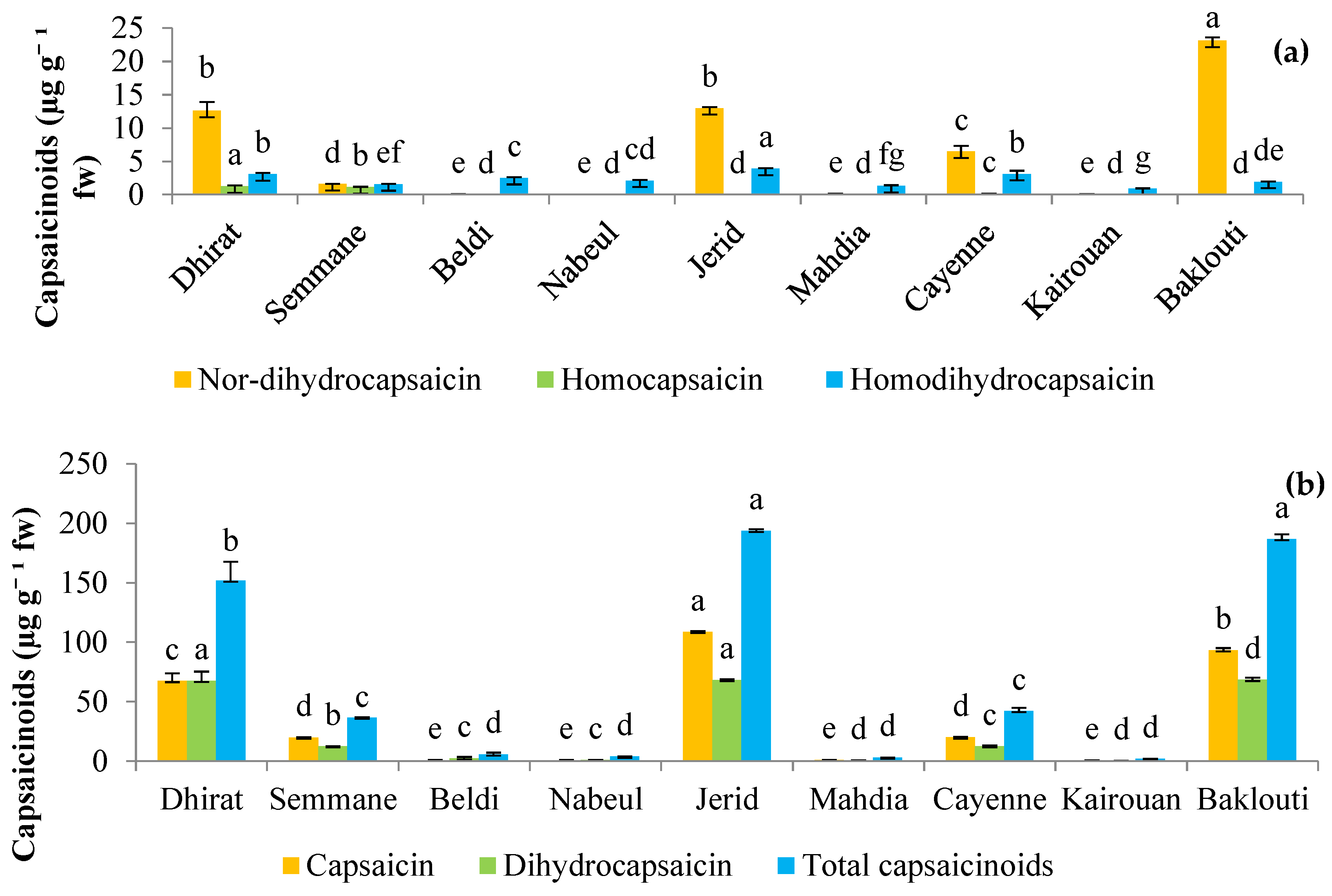
Figure 3.
(a) Capsorubin, violaxanthin and lutein (Minor carotenoids) (b) zeaxanthin, β-cryptoxanthin and β-carotene (Major carotenoids) and total carotenoids (µg g−1 fw) in different hot pepper landraces. Values represent mean ± standard error of six replicates (2022 and 2023 sampling data). Bars marked with the same letters are not significantly different (LSD Test, p < 0.05).
Figure 3.
(a) Capsorubin, violaxanthin and lutein (Minor carotenoids) (b) zeaxanthin, β-cryptoxanthin and β-carotene (Major carotenoids) and total carotenoids (µg g−1 fw) in different hot pepper landraces. Values represent mean ± standard error of six replicates (2022 and 2023 sampling data). Bars marked with the same letters are not significantly different (LSD Test, p < 0.05).
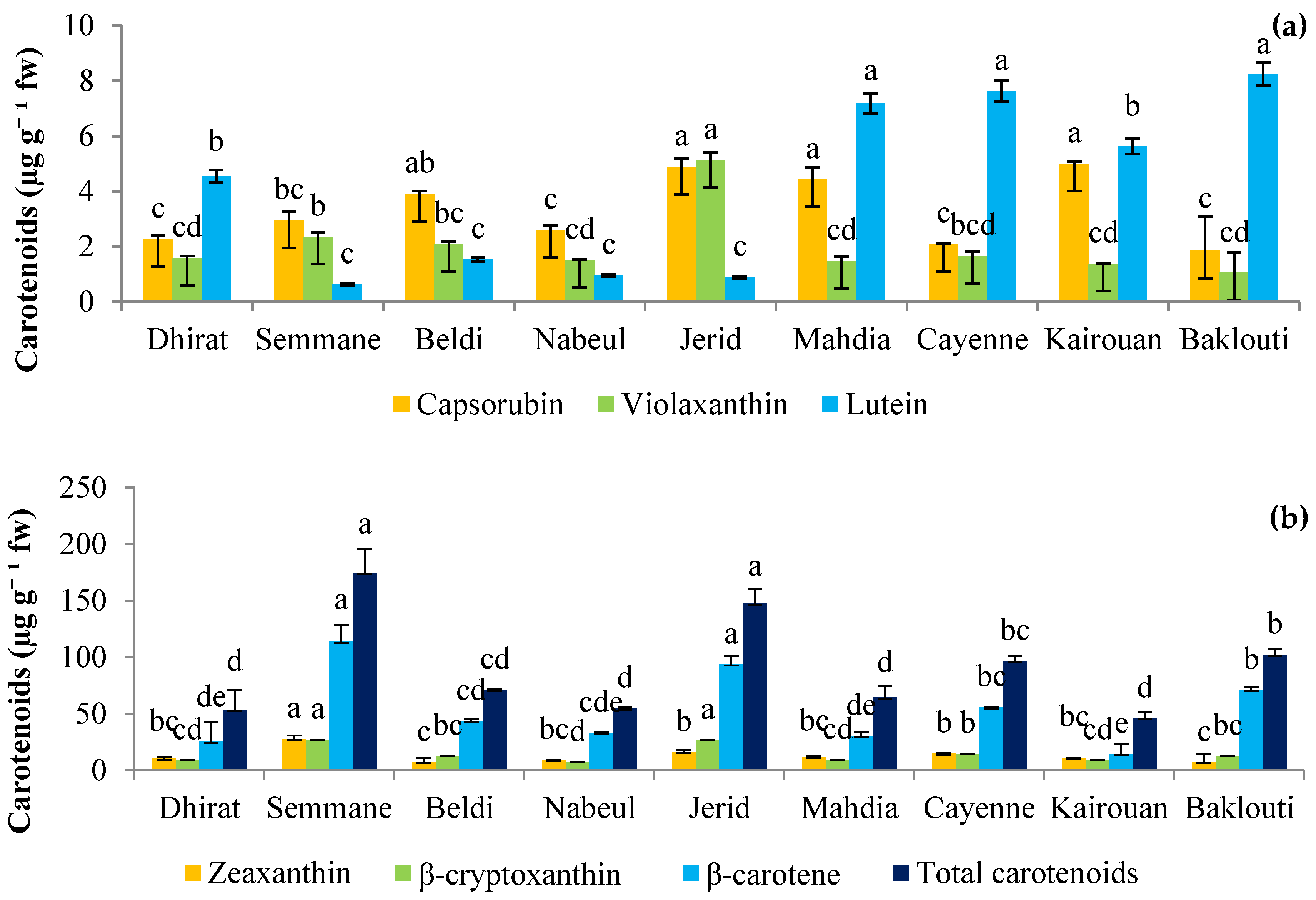
Figure 4.
Tocopherol isomers their total content (µg g−1 fw) in different hot pepper landraces. Values represent mean ± standard error of six replicates (2021 and 2022 sampling data). Bars marked with the same letters are not significantly different (LSD Test, p < 0.05).
Figure 4.
Tocopherol isomers their total content (µg g−1 fw) in different hot pepper landraces. Values represent mean ± standard error of six replicates (2021 and 2022 sampling data). Bars marked with the same letters are not significantly different (LSD Test, p < 0.05).
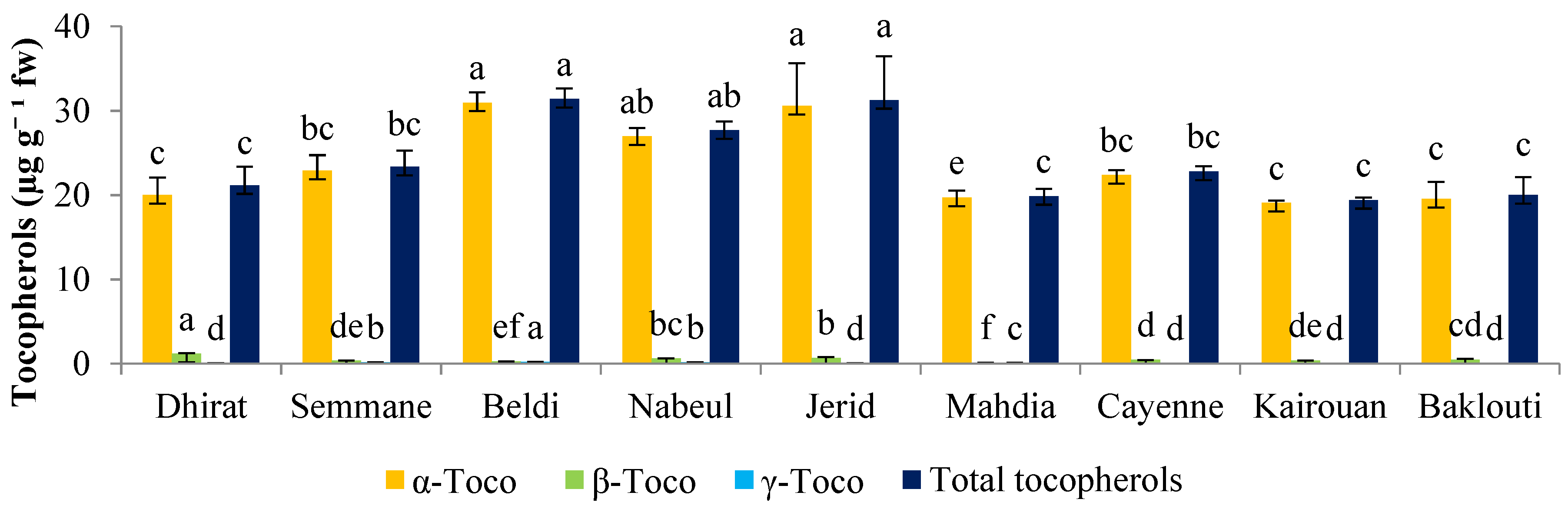
Figure 5.
Total vitamin C content (mg 100 g−1 fw) in different hot pepper landraces. Values represent mean ± standard error of six replicates (2021 and 2022 sampling data). Bars marked with the same letters are not significantly different (LSD Test, p < 0.05).
Figure 5.
Total vitamin C content (mg 100 g−1 fw) in different hot pepper landraces. Values represent mean ± standard error of six replicates (2021 and 2022 sampling data). Bars marked with the same letters are not significantly different (LSD Test, p < 0.05).

Figure 6.
Total phenolics (mg GAE kg−1 fw) in pepper genotypes. Values represent mean ± standard error of six replicates (2022 and 2023 sampling data). Bars marked with the same letters are not significantly different (LSD Test, p < 0.05).
Figure 6.
Total phenolics (mg GAE kg−1 fw) in pepper genotypes. Values represent mean ± standard error of six replicates (2022 and 2023 sampling data). Bars marked with the same letters are not significantly different (LSD Test, p < 0.05).
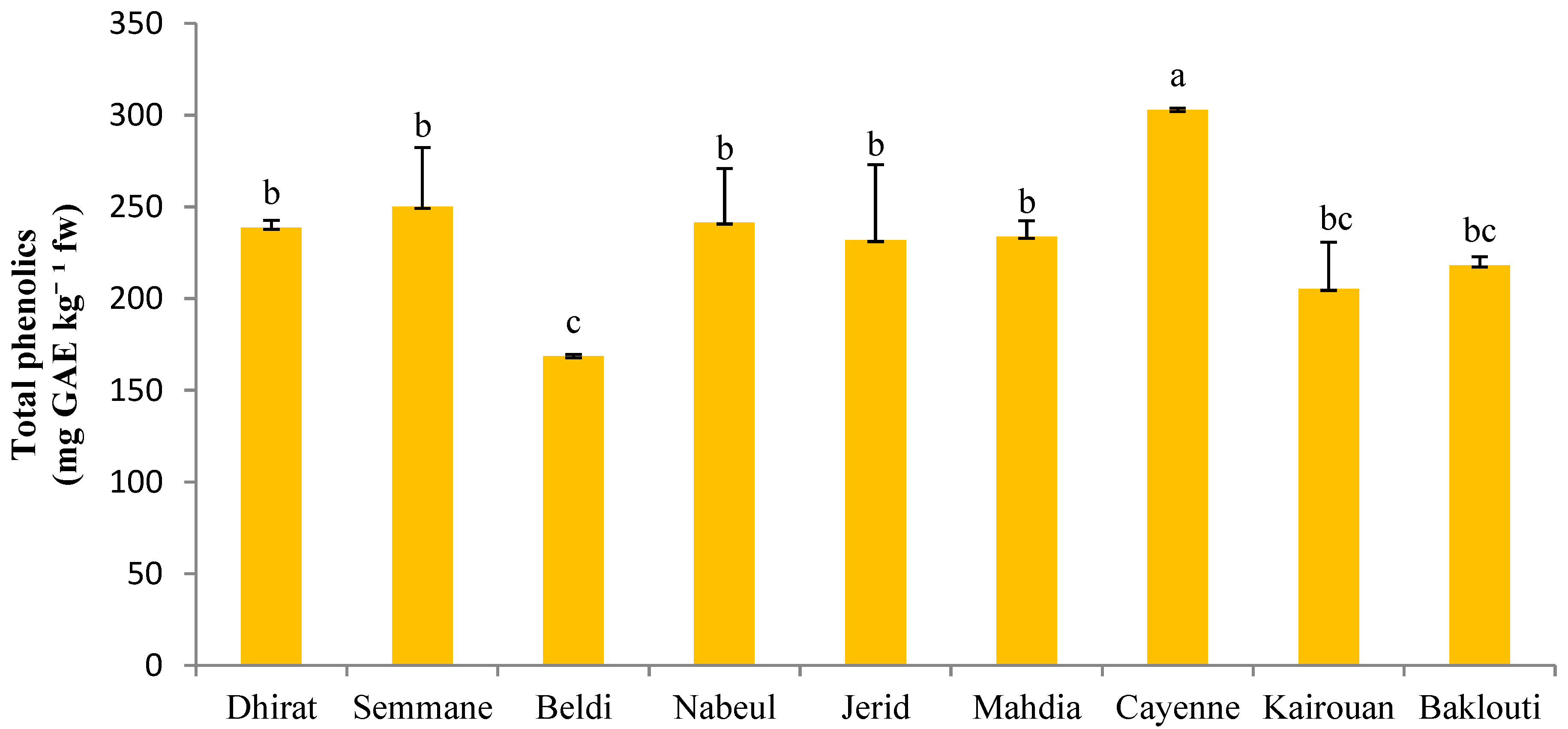
Figure 7.
RSAHF and RSALF (µmol Trolox Equivalent 100 g−1 fw) in hot pepper landraces. Values represent mean ± standard error of six replicates (2022 and 2023 sampling data). Bars marked with the same letters are not significantly different (LSD Test, p < 0.05).
Figure 7.
RSAHF and RSALF (µmol Trolox Equivalent 100 g−1 fw) in hot pepper landraces. Values represent mean ± standard error of six replicates (2022 and 2023 sampling data). Bars marked with the same letters are not significantly different (LSD Test, p < 0.05).
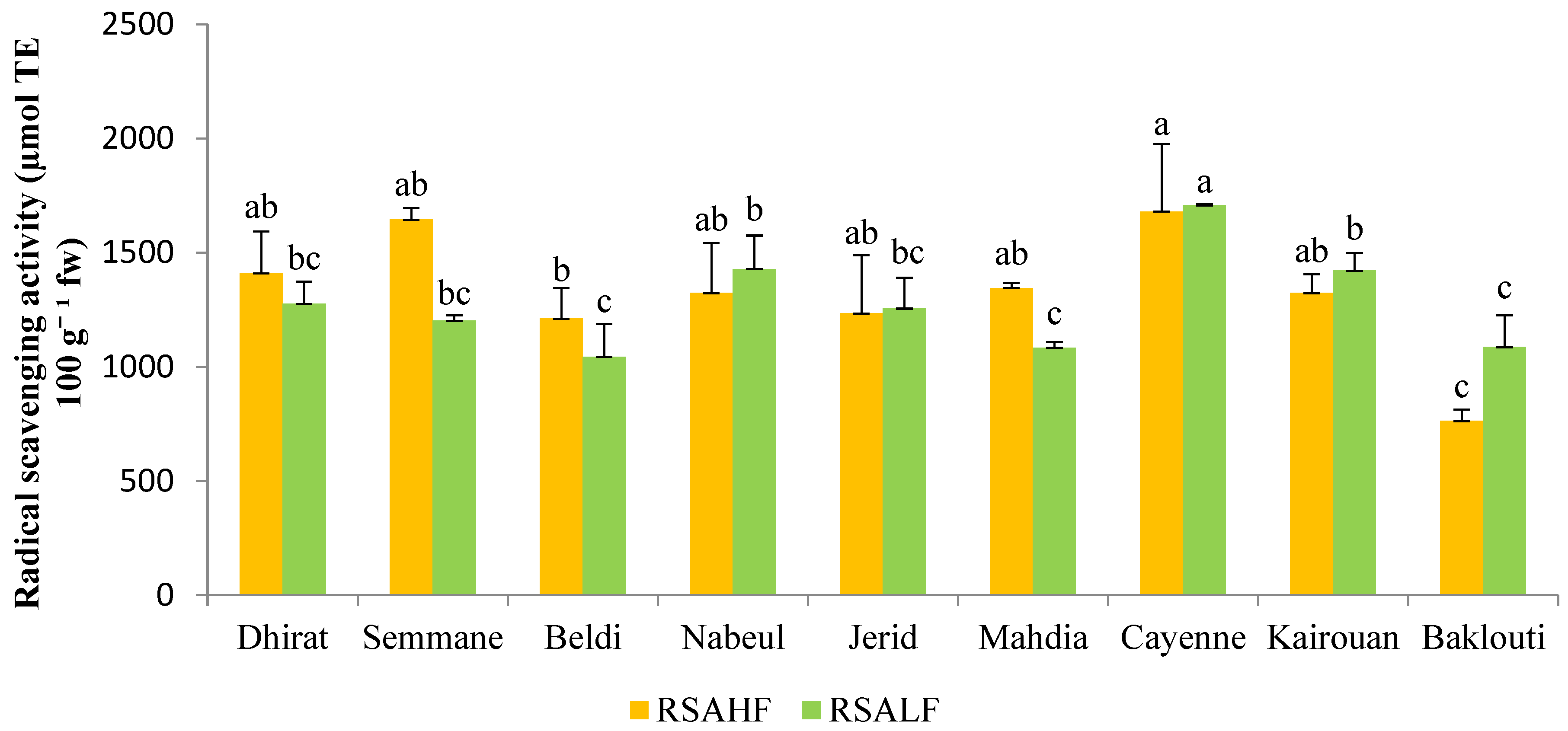
Figure 8.
Pearson correlation matrix between agronomic, physico-chemical, and functional quality attributes of the hot pepper landraces under investigation. Reddish tones express higher positive correlations, whereas blueish tones indicate negative correlations. Larger circle diameters denote higher modules of the correlation coefficient (r). White intersections exhibit non-significant correlations (significance was set at p correlation).
Figure 8.
Pearson correlation matrix between agronomic, physico-chemical, and functional quality attributes of the hot pepper landraces under investigation. Reddish tones express higher positive correlations, whereas blueish tones indicate negative correlations. Larger circle diameters denote higher modules of the correlation coefficient (r). White intersections exhibit non-significant correlations (significance was set at p correlation).
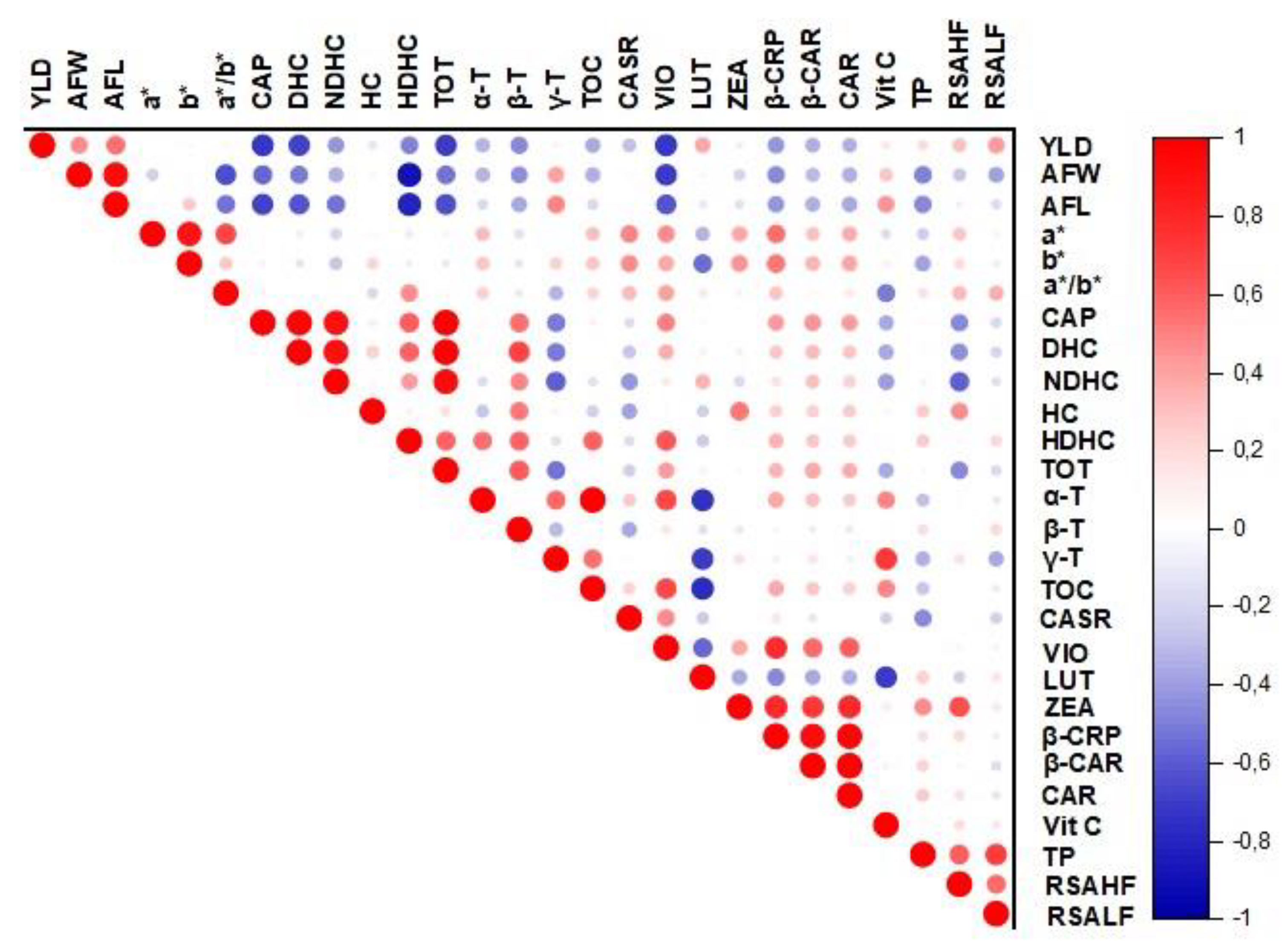
Figure 9.
Principal component analysis (PCA) biplot PC1 vs. PC2 of the main bioactive classes of molecules (total contents) identified in the different pepper genotypes under investigation. The variance (%) explained by each PCA axis is given in brackets. The length of the vectors is correlated to their significance within each population. Between vectors and between a vector and an axis, there is a positive correlation if the angle is <90°, whereas the correlation is negative if the angle reaches 180°. There is no linear dependence if the angle is 90°. Ellipses enclose the 75% confidence interval.
Figure 9.
Principal component analysis (PCA) biplot PC1 vs. PC2 of the main bioactive classes of molecules (total contents) identified in the different pepper genotypes under investigation. The variance (%) explained by each PCA axis is given in brackets. The length of the vectors is correlated to their significance within each population. Between vectors and between a vector and an axis, there is a positive correlation if the angle is <90°, whereas the correlation is negative if the angle reaches 180°. There is no linear dependence if the angle is 90°. Ellipses enclose the 75% confidence interval.
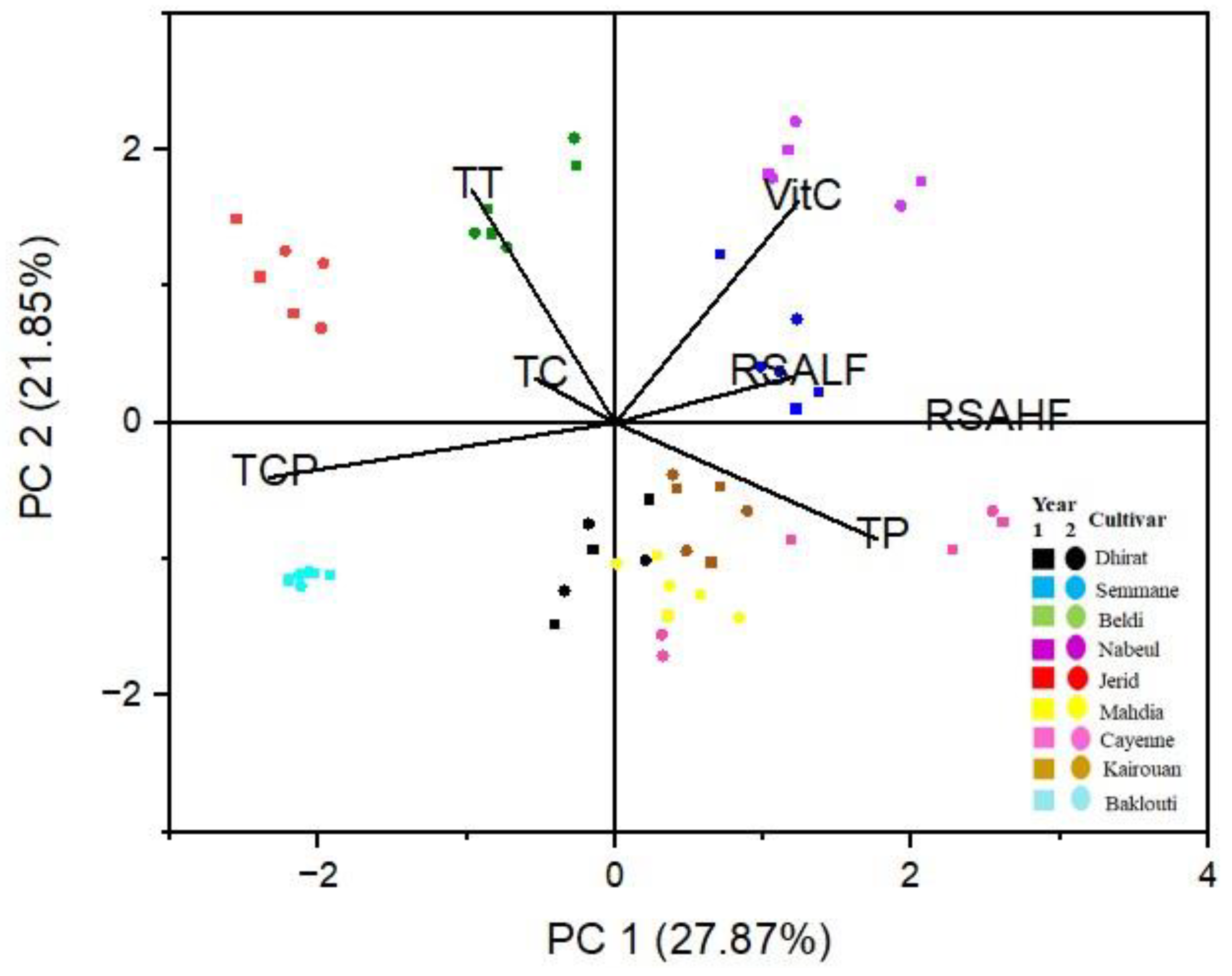

Table 1.
Agronomic attributes of pepper genotypes grown under open-field conditions during two growing seasons. Data are expressed as mean ± S.E. with six replicates (2022 and 2023 sampling data).
Table 1.
Agronomic attributes of pepper genotypes grown under open-field conditions during two growing seasons. Data are expressed as mean ± S.E. with six replicates (2022 and 2023 sampling data).
| Cultivar | Earliness | Fruit shape | Intended use | Yield per plant (g plant−1) |
Average fruit length (cm) | Average fruit weight (g) |
|---|---|---|---|---|---|---|
| Dhirat | Early | Elongate | Fresh market | 1480.58 ± 36.11 d | 11.67 ± 1.11 de | 22.25 ± 0.83 d |
| Semmane | Late | Elongate | Fresh market | 1687.25 ± 40 c | 17.33 ± 1.78 abc | 34.33 ± 1.11 bc |
| Beldi | Early | Elongate | Fresh market/Processing | 1755.08 ± 56.22 c | 18 ± 2 abc | 34.33 ± 1.11 bc |
| Nabeul | Late | Elongate | Fresh market | 1720.83 ± 56.22 c | 18.67 ± 2.44 ab | 35.58 ± 0.89b c |
| Jerid | Early | Triangular | Pickling | 1163.25 ± 47.17 e | 5.33 ± 1.56 f | 6.5 ± 0.5 f |
| Mahdia | Late | Elongate | Fresh market | 1634.92 ± 22.55 c | 13.67 ± 1.11 cde | 33.83 ± 0.39 c |
| Cayenne | Very late | Elongate | Pickling | 1997.33 ± 11.61 a | 9.33 ± 1.56 ef | 14.25 ± 0.5 e |
| Kairouan | Late | Elongate | Fresh market/processing | 1841.67 ± 17.94 b | 20.33 ± 2.22 a | 37.75 ± 0.17 a |
| Baklouti | Late | Triangular | Fresh market/processing | 1644.08 ± 29.61 c | 14.67 ± 1.78 bcd | 35.75 ± 0.17 b |
Table 2.
Physicochemical properties of pepper genotypes grown under open-field conditions during two growing seasons. Data are expressed as mean ± S.E. with six replicates (2022 and 2023 sampling data).
Table 2.
Physicochemical properties of pepper genotypes grown under open-field conditions during two growing seasons. Data are expressed as mean ± S.E. with six replicates (2022 and 2023 sampling data).
| Cultivar | Soluble solids (°Brix) | pH | Titratable Acidity (%) | a* | b* | a*/b* |
|---|---|---|---|---|---|---|
| Dhirat | 10.6 ± 0.3 bc | 4.95 ± 0.006 c | 0.21 ± 0.01bcd | 36.68 ± 0.76 bc | 40.47 ± 0.04 bc | 0.91 ± 0.02 bcd |
| Semmane | 9.1 ± 0.1e | 4.93 ± 0.05 cd | 0.16 ± 0.04 f | 40.33 ± 1.27 a | 44.81 ± 1.52 a | 0.9 ± 0.01 bcd |
| Beldi | 12.2 ± 0.36 a | 4.97 ± 0.02 c | 0.19 ± 0.01 def | 40.9 ± 1.38 a | 43.59 ± 0.76 a | 0.94 ± 0.01 abc |
| Nabeul | 10.9 ± 0.9 bc | 4.85 ± 0.02 cd | 0.31 ± 0.03 a | 33.94 ± 1.23 c | 39.32 ± 0.94 c | 0.87 ± 0.03 d |
| Jerid | 10.63 ± 0.06 bc | 5.02 ± 0.01 c | 0.22 ± 0.02bcd | 40.57 ± 0.98 a | 42.9 ± 1.2 ab | 0.95 ± 0.004 ab |
| Mahdia | 10.6 ± 0.53 bc | 5.35 ± 0 b | 0.16 ± 0 ef | 34.82 ± 1.43 c | 38.36 ± 1.87 c | 0.91 ± 0.006 bcd |
| Cayenne | 9.6 ± 0.1 de | 5.6 ± 0.35 a | 0.2 ± 0.3 cde | 38.81 ± 1.2 ab | 39.82 ± 1.16 c | 0.97 ± 0.004 a |
| Kairouan | 10.1 ± 0.7 cd | 5.02 ± 0 c | 0.24 ± 0.03 bc | 41.35 ± 0.59 a | 44.48 ± 1.68 a | 0.93 ± 0.02 abc |
| Baklouti | 11.4 ± 0.2 ab | 4.72 ± 0.01 e | 0.25 ± 0.01 b | 35.43 ± 0.77 c | 39.58 ± 0.53 c | 0.89 ± 0.03 cd |
Disclaimer/Publisher’s Note: The statements, opinions and data contained in all publications are solely those of the individual author(s) and contributor(s) and not of MDPI and/or the editor(s). MDPI and/or the editor(s) disclaim responsibility for any injury to people or property resulting from any ideas, methods, instructions or products referred to in the content. |
© 2024 by the authors. Licensee MDPI, Basel, Switzerland. This article is an open access article distributed under the terms and conditions of the Creative Commons Attribution (CC BY) license (http://creativecommons.org/licenses/by/4.0/).
Copyright: This open access article is published under a Creative Commons CC BY 4.0 license, which permit the free download, distribution, and reuse, provided that the author and preprint are cited in any reuse.


