

Submitted:
12 July 2024
Posted:
12 July 2024
You are already at the latest version
Abstract
This study addresses the critical need for standardizing Building Information Modeling (BIM) Execution Plans (BEPs) in the Architecture, Engineering, Construction, and Operations (AECO) sector. By analyzing 36 BEP documents from international organizations, we identify key elements and propose a comprehensive framework aimed at enhancing digital transformation and collaboration in complex construction projects. This research employs scientometric analysis to map the evolution of BEP standards and integrates empirical data from industry surveys to validate the proposed framework. Our findings highlight the benefits of standardized BEPs in reducing inefficiencies and improving project outcomes, thereby providing a significant contribution to the field of BIM implementation.
Keywords:
BIM Execution plan
; BIM Frame work
; Standardization of BIM Execution plan
; BIM procedures
; BIM in Construction Projects.
1. Introduction
Building Information Modeling (BIM) has emerged as a fundamental element in the Architecture, Engineering, Construction, and Operations (AECO) sector, facilitating decision-making throughout all stages of a construction project [1,26]. Despite its widespread adoption, the standardization of BIM Execution Plans (BEPs) remains inconsistent, leading to inefficiencies and errors. This study aims to address this gap by developing a standardized framework for BEPs tailored to complex construction projects. By analyzing 36 BEP documents and employing scientometric analysis, we aim to provide a globally applicable, adaptable framework that enhances collaboration and information sharing in BIM projects. To address this significant deficiency, the current study was undertaken to investigate the current state of implementation of Business Ethics and Practices (BEP) in large-scale construction projects. This study conducted an extensive survey of 87 professionals in the industry to evaluate the perceived significance of various sections of Building Energy Performance (BEPs), the incorporation of practices within project lifecycles, and the degree of familiarity and satisfaction with existing Building Information Modeling (BIM) standards. The survey was aimed at professionals from various fields in the construction industry, guaranteeing a wide and comprehensive viewpoint [12,13].
The results unveiled a significant degree of agreement regarding the fundamental essence of BEPs, with a particular emphasis on the significance of management and project objectives. This was accompanied by an acknowledgment of the need to incorporate BEPs into project cycles at an earlier stage to optimize their efficacy. Furthermore, the study emphasized the need for substantial enhancements in aligning BEPs with local standards, improving document management, and promoting collaborative practices.
These observations emphasize the need for a standardized and adaptable strategy for BIM execution planning, which can effectively tackle the distinct challenges encountered in large-scale construction projects.[14] Implementing standardized Best Execution Practices (BEPs) has the potential to significantly improve the clarity, efficiency, and effectiveness of project management in the AECO industry. Through the establishment of standardized protocols and procedures, projects can effectively circumvent the challenges of miscommunication and delays, resulting in improved outcomes and decreased costs.
Furthermore, the process of standardization can help to streamline the incorporation of modern technologies and methodologies, thereby improving the capabilities of Building Information Modeling (BIM) [15].
This paper adds to the ongoing discussion on enhancing BIM implementation in large-scale construction by presenting empirical evidence on the current practices and difficulties in BEP utilization. Also, it suggests making iterative revisions and improvements to BEP frameworks to promote more efficient integration of BIM in the construction sector.
The objective is to establish a base that not only fulfills the current operational requirements of large-scale projects but also allows for future advancements in construction technology.
1.1. Research Objective
The main objective of this study is to improve digital transformation in the AECO sector by developing a standardized framework for BEPs that can enhance collaboration and information sharing in BIM projects.
1.2. Novelty and Significance
The architecture, engineering, construction, and operations (AECO) industry has seen substantial advancements with the integration of Building Information Modeling (BIM) technologies. However, despite the proliferation of BIM usage, the standardization of BIM Execution Plans (BEPs) remains inconsistent and fragmented across the industry. This study addresses a critical and underexplored aspect of BIM implementation:
the development of standardized BEPs tailored for complex construction projects. The following points delineate the unique contributions and novel aspects of this research:
1.2.1. Innovative Framework for BEP Standardization
This study introduces a comprehensive and adaptable framework for BEP standardization, which is a significant advancement over existing models. Unlike previous studies that often focus on specific elements of BEPs or regional standards, our framework integrates best practices from 36 BEP documents sourced from diverse international organizations.
This comprehensive approach ensures that the proposed framework is globally applicable, yet flexible enough to accommodate local standards and project-specific requirements.
1.2.2. Scientometric Analysis of BEP Literature
A key novel aspect of this research is the use of scientometric analysis to examine the evolution and intellectual landscape of BEP research between 2020 and 2023. This method provides a quantitative assessment of the most influential works, key research themes, and prominent authors in the field, offering a data-driven foundation for the proposed framework. The integration of scientometric analysis into BEP standardization is a pioneering approach that enhances the credibility and relevance of the study's findings.
1.2.3. Empirical Validation through Industry Survey
To ensure practical relevance, this study incorporates an extensive survey of 87 industry professionals from various sectors within the construction industry. This empirical validation is crucial, as it grounds the theoretical framework in real-world experiences and challenges. The survey results highlight common inefficiencies and inconsistencies in current BEP practices, reinforcing the necessity for a standardized approach. This direct engagement with industry stakeholders is a distinctive feature that sets this research apart from previous work.
1.2.4. Addressing Regional and Project-Specific Challenges
While existing studies often overlook the specific challenges faced by large-scale construction projects in different regions, this research emphasizes the importance of aligning BEPs with local standards and practices.
By incorporating feedback from professionals operating in the MENA region, particularly Egypt and Saudi Arabia, the study addresses regional challenges and provides actionable insights for improving BEP adoption and effectiveness in these rapidly growing construction markets.
1.2.5. Integration of Emerging Technologies
The proposed framework not only standardizes traditional BEP elements but also incorporates provisions for integrating emerging technologies such as IoT, digital twins, and advanced data management systems. This forward-looking approach ensures that the framework remains relevant as the industry continues to evolve technologically.
2. Methodology
This research adopts a multi-faceted research design that incorporates Scientometric analysis to scrutinize the current state of Building Information Modeling (BIM) Execution Plans (BEPs) and their alignment with international standards. The methodological approach is detailed as follows in Figure 1:
- Literature Review: An exhaustive literature review was undertaken, leveraging databases such as Web of Science and Scopus to identify pertinent publications from 2018 to 2024. The objective was to delineate prevailing trends and foundational concepts within the realm of BIM Execution Plans, ensuring a comprehensive and globally representative analysis.
- Document Analysis: The research critically examined 36 BEP documents, chosen for their pivotal contributions to the domain. These documents, sourced from diverse global entities, were evaluated against international standards and guidelines. The analysis concentrated on aspects such as content structure, practice methods, contractual stipulations, and project-specific characteristics.
- Scientometric Analysis: This component included citation and keyword analysis to delineate the intellectual terrain of BEP research. This analysis was instrumental in identifying key authors, institutions, and seminal publications, thereby shedding light on the evolution of the field and its key scholarly contributions.
The use of scientometric analysis in this study is justified by its ability to evaluate the progress and development of research systematically and quantitatively within the field of BIM Execution Plans (BEPs). Scientometric analysis offers several key benefits:
- (1)
- Mapping Research Trends: Scientometric analysis helps in identifying the most influential works, key research themes, and leading authors and institutions in the field of BEPs. This provides a comprehensive understanding of the intellectual landscape and highlights the evolution of research trends from 2020 to 2024.
- (2)
- Objective Assessment: By analyzing citation data and keyword co-occurrences, scientometric analysis provides an objective assessment of the research impact and the relative importance of different studies. This helps in distinguishing foundational works from less influential ones, ensuring that the proposed framework is built on a robust foundation of significant contributions.
- (3)
- Identifying Gaps: The analysis reveals gaps in the current literature and research, guiding the focus of this study towards underexplored areas. By identifying these gaps, this research can address specific deficiencies and contribute novel insights to the field.
- Factor Frequency Analysis: This analysis was employed to scrutinize the fundamental and ancillary elements of BEPs, identifying both commonalities and discrepancies across various documents. This approach facilitated a nuanced understanding of the standardization efforts within the field.
- Data Collection: Comprehensive data collection was conducted from many sources, including academic institutions, governmental agencies, national standard bodies, and industry professionals. This extensive gathering of data was crucial for capturing the varied methodologies and practices employed in BEP implementation.
- Comparative Analysis: An in-depth comparative analysis was performed, which synthesized the insights garnered and was discussed extensively in the results section of the study.
The industry survey method is chosen for several reasons:
- Practical Relevance: Surveys capture the practical experiences and challenges faced by industry professionals in implementing BEPs. This ensures that the proposed framework is grounded in real-world practices and addresses the actual needs of stakeholders.
- Broad Perspective: By surveying 87 industry professionals from various fields within the construction industry, the study gathers a wide range of viewpoints. This diversity enhances the generalizability of the findings and ensures that the framework is applicable across different contexts and project types.
- Validation of Framework: The survey data provides a means to validate the proposed BEP framework. By comparing the theoretical insights gained from document analysis and scientometric analysis with empirical data, the study can refine and adjust the framework to better align with industry practices and expectations.
- Enhancing Reliability and Applicability
Combining scientometric analysis with industry surveys enhances the reliability and applicability of the findings in several ways:
- (1)
- Robust Data Foundation: Scientometric analysis offers a robust, data-driven foundation by highlighting influential studies and key themes. This ensures that the proposed framework is supported by the most relevant and impactful research in the field.
- (2)
- Empirical Validation: The industry surveys provide empirical validation, ensuring that the theoretical framework is relevant and applicable. This dual approach bridges the gap between theory and practice, making the findings more reliable and actionable.
- (3)
- Comprehensive Understanding: By integrating both quantitative and qualitative data, the study achieves a comprehensive understanding of BEPs. The scientometric analysis provides a macro-level view of research trends, while the surveys offer micro-level insights into practical challenges and needs.
- (4)
- Addressing Practical Challenges: The empirical data from industry professionals highlight specific areas where BEPs currently fall short. This direct feedback informs the refinement of the framework, ensuring that it addresses real-world challenges and enhances project outcomes.
2.1. Literature Review
The adoption of Building Information Modeling (BIM) in the construction industry has been increasingly recognized as a transformative force, particularly for large-scale construction projects. The literature on BIM emphasizes its potential to enhance transparency, efficiency, and collaboration across various stages of the construction lifecycle. However, a critical aspect that continues to challenge industry professionals is the standardization of BIM Execution Plans (BEPs), which are essential for managing the complexities inherent in mega construction projects [16].
Recent studies highlight that while BIM offers substantial benefits in terms of project management and operational efficiency, the lack of standardized BEPs can lead to significant barriers to implementation. The proposed BEP framework derived from the comprehensive analysis of 36 globally recognized BEP documents addresses these inconsistencies by integrating the most frequently occurring elements identified across diverse BEP guidelines. This framework includes detailed management structures, project goals, roles and responsibilities, technology infrastructure needs, and quality control processes, all of which are designed to be adaptable to various project requirements while maintaining a standardized approach [15].
A significant body of research has focused on the elements of BEPs. According to Antunes and Elliott (2019) [3], the effective implementation of BIM requires a clear understanding of project goals, roles, and responsibilities, as well as collaboration procedures and quality control measures. These components are essential to ensuring that BIM technologies are used effectively to support project outcomes.
The literature also discusses the impact of BIM on project coordination and information management. For instance, Galitskaya [5] points out that BIM facilitates improved coordination between different project teams, which is crucial in mega projects involving multiple stakeholders. The ability to manage and synchronize vast amounts of project data in a BIM environment can significantly reduce errors and rework, enhancing overall project quality. However, the integration of BIM into existing project management frameworks remains a challenge. Studies like those by Çekin and Seyis [4], have attempted to address these challenges by proposing frameworks that align BIM execution planning with international standards like ISO 19650. These frameworks aim to standardize the processes involved in BIM execution planning, thus providing a clearer pathway for its adoption in the construction industry [3]. Despite the potential benefits of standardized BEP frameworks, the research by Synek (2018) [2]. indicates that the actual adoption and implementation of these frameworks are not widespread. The barriers to adoption include a lack of understanding of the benefits of BIM, the perceived complexity of implementing new systems, and resistance to change from traditional project management approaches [11].
In conclusion, while BIM is poised to revolutionize the construction industry, the standardization of BEP remains a crucial step that requires more focused research and development [5]. The literature suggests that standardized BEP frameworks can facilitate better integration of BIM into construction projects, leading to improved project outcomes and efficiency. The ongoing evolution of BIM technologies and methodologies will continue to influence the development of new standards and practices in the field [17]. The BEP is often incorporated into the project contract to establish clear expectations and responsibilities, ensuring that all parties are aligned on BIM processes and deliverables. By defining roles, workflows, and data exchange protocols, the BEP helps to mitigate risks and enhance project outcomes [18].
Integrating risk management within the BEP involves identifying potential project risks, assessing their impact, and establishing mitigation strategies. This proactive approach enhances collaboration, minimizes uncertainties, and improves project outcomes. By addressing risks early, the BEP helps ensure the project's efficiency and success [19].
Integrating advanced technologies such as Digital Twin and BLE (Bluetooth Low Energy) can significantly enhance resource positioning and management. Abdelalim et al. (2024) demonstrate the potential of agent-based modeling in optimizing construction resource allocation through real-time data integration, which can be crucial for improving project efficiency and decision-making processes. Incorporating these technologies into BEPs can provide more accurate and dynamic resource management, aligning with the goals of enhanced project outcomes and risk mitigation [20].
2.2. Document Analysis
The study entailed a meticulous analysis of 36 Building Information Modeling (BIM) Execution Plans (BEPs), chosen for their significant contributions to the field. The documents were obtained from various international organizations, covering a diverse array of mandates, guidelines, and protocols. The analysis concentrated on various crucial facets:
Content Structure: The documents underwent analysis to determine their content structure, specifically examining how information was structured and presented within each BEP. Practice Methods: The analysis examined the methods and practices suggested in the documents, evaluating their suitability and efficacy in real-life situations.
Data Collection: A comprehensive collection of data was obtained from academic institutions, government bodies, national standards agencies, and industry professionals. The comprehensive data collection was crucial for comprehending the varied approaches and practices in implementing BEP.
2.3. Scientometric Analysis
This study performs a comprehensive Scientometric analysis by utilizing the Web of Science and Scopus databases to investigate the development of scientific subjects and patterns within the field of Building Information Modeling (BIM) Execution Plans (BEP) from 2020 to 2023. This era is distinguished by significant progress in Business Process Engineering (BEP). The analysis employs citation and keyword analysis to chart the academic terrain, pinpointing prominent authors, institutions, and influential works that have influenced BIM standards and practices. The knowledge acquired from this analysis is crucial in guiding future strategies and initiatives to establish standardized BIM Execution Plans. The literature review of the study presents a comprehensive summary of the existing research and application of BEP content and structure in BIM projects. It emphasizes a significant lack of specialized literature on the factors that influence the progress of BEPs. The absence of standardized protocols for the development of BEPs is recognized as a notable hindrance, leading to inconsistent and inefficient project implementation [21].
2.3.1. Analysis of the Simultaneous Presence of the Most Important Keywords
Keyword co-occurrence analysis is a powerful method for visually representing the evolution and modifications of scientific topics over time. Figure 2 visually displays the author keywords that are frequently used in BIM Execution Plan studies, as recorded by the Web of Science between 2020 and 2024. The chosen time frame corresponds to the period with the most publications on BEP, amounting to 36 documents. The visualization depicts the frequency of occurrence of these keywords, providing insights into the dominant areas of research.
Figure 2 displays a vibrant network diagram created by VOS viewer, a tool u sed for constructing and visualizing bibliometric networks. The purpose of this analysis is to visually represent the occurrence and relationship between keywords in a specific dataset related to BIM research. The term "BIM" is prominently positioned, signifying its central importance to research, while other significant terms such as "framework," "construction," and "design" are grouped around it.
Figure 3, obtained using the VOS viewer tool, visually displays the main themes found in BIM Execution Plan research from 2020 to 2024, as recorded in the Scopus database. The complex network of keywords demonstrates the ever-changing nature of this discipline, emphasizing the close connection between terms such as 'architectural design,' 'construction industry,' and 'building information modeling,' which frequently co-occur. The diagram, characterized by diverse color clusters, illustrates the extensive and interdisciplinary nature of BIM research. It is based on the examination of 68 documents, which highlight the specific areas of interest and scholarly focus within the academic community.
The list of the identified documents is in Table 1, totaling thirty-six (36), identified, compared, and analyzed. The findings highlight the crucial elements necessary for the development of BEPs. A thorough elucidation allows all parties involved to understand the project's objectives, process, allocated responsibilities, data prerequisites, and specifications for the final output. Hence, the Business Execution Plan (BEP) framework can function as a roadmap for the progress and improvement of BEP. The study's findings offer a comprehensive range of parameters for researchers and practitioners to develop tools that improve the effectiveness of implementing BIM projects.
Through the examination of thirty-six (36) BEPs, it was revealed that all of them exhibit a common theoretical framework.
The presentation of the content and the titles of the chapters exhibited dissimilarities. The Building Execution Plan (BEP) outlines project information, project goals, BIM objectives, BIM uses roles and responsibilities, BIM process design, BIM information exchange, collaboration procedures, model structure, quality control, technology infrastructure needs, and project deliverables [4,6].
Table 2 displays the frequency of sub-elements in the reviewed documents that have a percentage higher than 50%. The factor is determined by the equation provided:
Figure 4 displays the frequency of occurrence of the sub-element's topics in the reviewed documents. This is done to identify the topics with the highest percentage, which will be chosen as the main elements for the proposed BIM execution plan framework. Figure 8 displays the elements in the document comparison that have the highest percentage.
The table is a structured compilation of key topics frequently addressed in the literature about BIM Execution Plan (BEP) standardization. It categorizes 40 distinct aspects ranging from foundational elements like "BIM Project Execution Plan overview" to more specialized topics such as "federated model color scheme." This tabulation serves as a reference point for the distribution of focus areas within the body of BEP literature, highlighting the multifaceted nature of BIM implementation and management in construction projects. Figure 4 illustrates a bar chart detailing the frequency of occurrence for various sub-elements within the topics covered in the reviewed BIM Execution Plan documents. The chart presents a descending order of frequency, starting with the most commonly occurring sub-elements on the left. The percentages above each bar indicate the proportion of documents that mention each sub-element, providing a clear visual representation of which aspects within the BIM Execution Plans are given the most emphasis in the literature [26].
2.3.2. Pareto Analysis
Pareto Analysis, a statistical technique in decision-making, is based on the Pareto Principle, which posits that for many events, 80% of the effects come from 20% of the causes. This method is integral to identifying the most significant factors in a set of data, which in the context of BIM Execution Plans, helps prioritize the standardization efforts. By focusing on the few critical elements that cause the most significant impact, researchers and practitioners can streamline processes, optimize resource allocation, and drive substantial improvements in project outcomes [20].

Table 3.
Pareto Analysis of BEP Sub-Elements by Frequency and Impact.
| Sub-elements | Number of Sub-elements | percentage | percent 80% | |
|---|---|---|---|---|
| 1 | BIM Use | 29 | 7% | 80% |
| 2 | BIM Model and Level of Development | 26 | 14% | 80% |
| 3 | Project information | 25 | 20% | 80% |
| 4 | Model Coordination Procedures | 25 | 26% | 80% |
| 5 | Project Goals and Objectives | 23 | 32% | 80% |
| 6 | Collaboration procedures | 20 | 37% | 80% |
| 7 | Roles and Responsibility | 20 | 42% | 80% |
| 8 | Common Data Environment | 20 | 47% | 80% |
| 9 | BIM Project Execution Plan Overview | 20 | 51% | 80% |
| 10 | Master information delivery plan | 20 | 56% | 80% |
| 11 | Model structure | 19 | 61% | 80% |
| 12 | Software requirements | 19 | 66% | 80% |
| 13 | Project deliverables | 19 | 71% | 80% |
| 14 | Project Phases / Milestones | 19 | 75% | 80% |
| 15 | File Naming Conventions | 18 | 80% | 80% |
| 16 | Measurement and coordinate systems | 18 | 84% | 80% |
| 17 | Key project contacts | 16 | 88% | 80% |
| 18 | Quality Management | 16 | 92% | 80% |
| 19 | Methods & Procedure | 16 | 96% | 80% |
| 20 | Hardware | 16 | 100% | 80% |
| Total | 404 |
The Pareto analysis displays the number and relative importance of sub-elements within BIM Execution Plans. The blue bars indicate the number of occurrences of each sub-element in the reviewed documents, while the orange line charts the cumulative percentage, highlighting that a small number of sub-elements account for a large percentage of the focus in BIM documentation. This analysis is a strategic tool for identifying key areas for standardization and improvement. in the Pareto analysis figure, the sub-elements that surpass the 80% (BIM Use, BIM Model and Level of Development, Project information, Model Coordination, and Project Goals and objective) threshold are of particular significance as they comprise the core content within the BIM Execution Plans. These critical elements are the main contributors to the substance of the documentation, representing most of what is deemed essential in literature. Identifying these allows for focused improvements in areas that will yield the most substantial impact on the standardization of BIM Execution Plans. The proposed framework, which requires validation through a literature review, is as follows based on the results and analysis of the provided data.
Table 4.
The proposed framework.
| Document Release History | |
|---|---|
| Definition | Abbreviation |
| Other Definitions | |
| BIM Project Execution Plan Overview | Executive Summary |
| Vision Statement | |
| References | |
| Project information | Project Description |
| Project Stakeholders | |
| Project Scope of Work in details | |
| Project Masterplan | |
| Buildings Key plan | |
| Key Project Contacts | |
| Key Project BIM Management | |
| Management | Project Phases/ Milestones |
| Key Roles and Responsibilities | |
| Project Deliverables | |
| Project Information Model Delivery Strategy | |
| Task information delivery plan (TIDP) | |
| Master information delivery plan (MIDP) | |
| Project Goals / BIM Uses | Major BIM Uses |
| BIM Workflow | |
| Level of Development (LOD) | |
| Level of Development Matrix | |
| Technical Requirements | Exchange Formats |
| Software Needs / Scope | |
| Hardware Needs | |
| Data Security | |
| IT Upgrades | |
| Training | |
| Quality Assurance / Quality Control (QA/QC) Plan. | Quality Assurance / Quality Control |
| Design content Check | |
| Visual / Coordination Check | |
| Standards Check | |
| Interference Check | |
| Clash Criteria | |
| Model Size | |
| Model Warnings | |
| Information exchange | |
| Coordination Process | |
| Clash Matrix |
2.4. Validation of the Proposed BEP Framework
Online questionnaires have gained popularity as a favored method in both the research community and the business world (Wu and Issa, 2013) [22]. The questionnaire's structure was designed to ensure data comparability, precise data recording, and streamlined data processing. Survey respondents were asked to rate their level of agreement on a Likert-type scale ranging from 1 (strongly disagree) to 5 (strongly agree). The questions focused on their knowledge and understanding of the status and issues related to BEPs.
2.5. Data Collection
This research employed an internet-based survey methodology to efficiently gather data from a diverse range of industry professionals. Online questionnaires have gained popularity in academic and commercial research because they can efficiently collect substantial amounts of data while maintaining the comparability and accuracy of the recorded responses. This study utilized a structured questionnaire to collect data on professionals' knowledge and comprehension of Building Information Modeling (BIM) Execution Plans (BEPs) throughout different phases of large-scale construction projects. The survey consisted of questions assessed using a Likert-type scale, where participants indicated their level of agreement on a scale ranging from 1 (strongly disagree) to 5 (strongly agree). This scale was selected to measure the levels of opinion regarding various aspects associated with BEPs [22]. Considerable attention was given to topics including the present state of BEP implementation, the perceived significance of various sections of the BEPs, and the level of satisfaction with existing BIM standards. The survey specifically focused on professionals from various disciplines within the construction industry, guaranteeing a wide-ranging and thorough collection of data points for analysis. The survey data was utilized to enhance the BIM Execution Plan framework, incorporating practical application, and addressing challenges acknowledged by professionals. This approach not only connected the theoretical framework to practical reality but also emphasized areas for enhancing the standardization and integration of BEPs into project management workflows. This data collection method was crucial for comprehending the wide-ranging viewpoints within the industry and identifying crucial areas for improvement in BIM execution planning.
3. Results
This Section discusses the findings of the survey questionnaire which was related to the implementation of building information modeling (BIM) Execution Plans (BEPs). The study runs the descriptive statistics, demographic/respondent ratings, RII - Relative Importance Index (RII) analysis, and reliability and confidence analysis to test the execution plan framework. The questionnaire extracted the opinions of the construction management personnel regarding the questionnaire was distributed in different project sizes in Egypt and Saudi Arabia as the two booming construction markets in the MENA region. The sample size is calculated as the following equation:
where z = 1.64 at 95% confidence, p = 0.20, e = 0.80
where pop is the population which is considered for this research as the number of all engineers in the construction industry in Egypt and Saudi Arabia, the number of pops is 850,000, by using the equation.
SS (sample size) = (z^2 * p (1 - p) / e^2
SS (sample size) = (1.64^2 * 0.2(1 - 0.2)) / 0.08^2 = 68
SS new=SS / (1 + (SS - 1) / pop) where, population = 850,000
3.1. Descriptive Statistics
This descriptive statistical summary presents survey data on Building Information Modeling (BIM) Execution Plans (BEPs) in Egyptian mega-construction projects (as an example of those in the MENA region). Respondents strongly agree that all sections of the proposed BEP Framework are essential for project success, with mean scores ranging from 4.45 to 4.68 on a 5-point scale. The "Management Section" and "Project Goals/BIM Uses Section" are the most important, scoring 4.67 each. A mean score of 4.68 indicates high agreement on the importance of standardizing BIM Execution Plans for mega construction projects in Egypt. BEP familiarity averages 3.92 among respondents. BIM Execution Plans are integrated into the project lifecycle at various stages, with a lower mean score of 1.64, suggesting earlier integration may be rare. Due to a low mean of 1.30, respondents' BIM experience with mega construction projects varies.
Demographically, the survey shows various construction industry experience, company sizes, and sectors. The mean current occupation and mega construction experience scores of 4.60 and 3.16 indicate a diverse group of professionals. This diversity is reflected in the average 3.07 years of construction experience. The proposed BEP workflow for BIM mega projects received a satisfactory mean score of 4.14, indicating a consensus on the BEP's importance. However, alignment with current BIM standards and workflow in Egypt has a lower mean score of 3.71, suggesting room for improvement or standardization and implementation gaps. These findings highlight the importance of BEPs in project execution and the need for standardization, early integration, and addressing Egypt's unique BIM mega project challenges.
Table 5.
Descriptive statistics.
| Survey questions | N | Mean | SD | Variance |
|---|---|---|---|---|
| How important do you think the Definition Section in the Proposed BEP Framework is? | 87 | 4.45 | .818 | .669 |
| How important do you think the BIM Project Execution Plan Overview Section in the Proposed BEP Framework is? | 87 | 4.51 | .713 | .509 |
| How important do you think the Project Information Section in the Proposed BEP Framework is? | 87 | 4.55 | .695 | .483 |
| How important do you think the Management Section in the Proposed BEP Framework is? | 87 | 4.67 | .604 | .364 |
| How important do you think the Project Goals/BIM Uses Section in the Proposed BEP Framework is? | 87 | 4.67 | .604 | .364 |
| How important do you think the Technical Requirements Section in the Proposed BEP Framework is? | 87 | 4.63 | .649 | .421 |
| How important do you think the Quality Assurance/Quality Control Plan Section in the Proposed BEP Framework is? | 87 | 4.64 | .647 | .418 |
| At what stages of the project lifecycle do you integrate BIM Execution Plans? | 87 | 1.64 | 1.023 | 1.046 |
| Have you ever worked on a mega construction project in Egypt that used BIM? | 87 | 1.30 | .460 | .212 |
| How familiar are you with BIM Execution Plans (BEPs)? | 87 | 3.92 | .930 | .866 |
| How important do you think standardization of BIM Execution Plans is for mega construction projects? | 87 | 4.68 | .707 | .500 |
| How often do you refer to a BIM Execution Plan during the construction process? | 87 | 3.89 | 1.028 | 1.056 |
| How satisfied are you with the proposed BIM Execution Plan workflow for implementation in BIM mega projects? | 87 | 4.14 | 1.091 | 1.190 |
| How well does the proposed BIM Execution Plan align with the current BIM standards and Workflow? | 87 | 3.71 | 1.247 | 1.556 |
| In which sector do you describe your company? | 87 | 2.11 | .599 | .359 |
| In which sector does your company seek construction work? | 87 | 2.61 | .653 | .427 |
| In your experience, does the outlined workflow address the unique challenges of BIM mega projects? | 87 | 4.13 | 1.065 | 1.135 |
| What is the category of your current organization? | 87 | 3.40 | 2.037 | 4.150 |
| What is the level of your current occupation? | 87 | 4.60 | 2.099 | 4.406 |
| What is your highest level of education? | 87 | 1.49 | .663 | .439 |
| What type of mega construction do you have experience in? | 87 | 3.16 | 2.332 | 5.439 |
| Which of the following best describes your role in the construction industry? | 87 | 2.24 | 1.303 | 1.697 |
| Years of experience in the construction sector? | 87 | 3.07 | 1.159 | 1.344 |
| Your Company Size | 87 | 4.01 | 1.688 | 2.849 |
| Valid N (list-wise) | 87 |
Table 6.
RII – Relative importance index analysis.
| Proposed Framework for BIM Executive Plans (BEPs) | RII |
| How important do you think the Definition Section in the Proposed BEP Framework is? | 68 |
| How important do you think the BIM Project Execution Plan Overview Section in the Proposed BEP Framework is? | 69.2 |
| How important do you think the Project Information Section in the Proposed BEP Framework is? | 93.2 |
| How important do you think the Management Section in the Proposed BEP Framework is? | 94 |
| How important do you think the Project Goals/BIM Uses Section in the Proposed BEP Framework is? | 89.2 |
| How important do you think the Technical Requirements Section in the Proposed BEP Framework is? | 87.6 |
| How important do you think the Quality Assurance/Quality Control Plan Section in the Proposed BEP Framework is? | 85.2 |
Table 7.
Responses ratings based on respondents.
| Categories | Frequency | Percent |
|---|---|---|
| Role in the construction industry | ||
| Architect | 31 | 35.6 |
| Civil Engineer | 30 | 34.5 |
| Electrical Engineer | 8 | 9.2 |
| Mechanical Engineer | 10 | 11.5 |
| Other | 8 | 9.2 |
| Years of experience in the construction industry | ||
| 0-5 Years | 10 | 11.5 |
| 5-10 Years | 15 | 17.2 |
| 10-15 Years | 31 | 35.6 |
| 15-20 Years | 21 | 24.1 |
| >20 Years | 10 | 11.5 |
| Category of the organization | ||
| General engineering consultants | 26 | 29.9 |
| Project management consultants | 3 | 3.4 |
| General contractor | 24 | 27.6 |
| Specialized contractor | 4 | 4.6 |
| Owner | 9 | 10.3 |
| BIM Services | 16 | 18.4 |
| Other | 5 | 5.7 |
| Education | ||
| Bachelor's degree | 52 | 59.8 |
| Master's degree | 27 | 31.0 |
| PhD | 8 | 9.2 |
| In which sector does your company operate? | ||
| Public | 11 | 12.6 |
| Private | 55 | 63.2 |
| Both | 21 | 24.1 |
| In which sector does your company seek construction work? | ||
| Public | 7 | 8.0 |
| Private | 21 | 24.1 |
| Both | 58 | 66.7 |
| Company size | ||
| 1-10 | 3 | 3.4 |
| 10-50 | 21 | 24.1 |
| 50-100 | 15 | 17.2 |
| 100-250 | 7 | 8.0 |
| 250-1000 | 15 | 17.2 |
| >1000 | 26 | 29.9 |
| Level of occupation | ||
| Junior level | 4 | 4.6 |
| Senior level | 22 | 25.3 |
| Project Engineer | 1 | 1.1 |
| Projects Manager | 13 | 14.9 |
| BIM Coordinator | 9 | 10.3 |
| BIM Manager | 16 | 18.4 |
| Top management | 20 | 23.0 |
| Other | 2 | 2.3 |
| Mega construction experience | ||
| Residential | 34 | 39.1 |
| Commercial | 10 | 11.5 |
| Infrastructure | 10 | 11.5 |
| Mixed-use | 11 | 12.6 |
| Complex | 2 | 2.3 |
| Hospital | 6 | 6.9 |
| Educational Building | 11 | 12.6 |
| Other | 3 | 3.4 |
| Familiarity with BIM Execution Plans (BEPs) | ||
| Not familiar at all | 1 | 1.1 |
| Familiar | 6 | 6.9 |
| Moderately familiar | 17 | 19.5 |
| Very familiar | 38 | 43.7 |
| Extremely familiar | 25 | 28.7 |
| At what stages of the project lifecycle do you integrate BIM Execution Plans? | ||
| Design Stage | 59 | 67.8 |
| Tender Stage | 6 | 6.9 |
| Construction Stage | 17 | 19.5 |
| Operation Stage | 4 | 4.6 |
| Have you ever worked on a mega construction project that used BIM? | ||
| Yes | 61 | 70.1 |
| No | 26 | 29.9 |
| How often do you refer to a BIM Execution Plan during the construction process? | ||
| Never | 3 | 3.4 |
| Rarely | 6 | 6.9 |
| Occasionally | 15 | 17.2 |
| Frequently | 37 | 42.5 |
| Always | 26 | 29.9 |
| How important do you think standardization of BIM Execution Plans is for mega construction projects? | ||
| Important | 2 | 2.3 |
| Moderately important | 6 | 6.9 |
| Very important | 10 | 11.5 |
| Extremely important | 69 | 79.3 |
| In your experience, does the outlined workflow address the unique challenges of BIM mega projects? | ||
| No, not at all | 2 | 2.3 |
| Not Sure | 4 | 4.6 |
| Partially | 20 | 23.0 |
| Often | 16 | 18.4 |
| Completely | 45 | 51.7 |
3.2. Classification According to the Experience
Table 8's analysis of variance (ANOVA) provides nuanced insights into how construction experience influences the perceived importance of various sections within the Building Information Modeling (BIM) Execution Plan (BEP) framework. The average scores for each section of the BEP show minor variations among various levels of experience, indicating that respondents agree on the significance of these sections regardless of their experience in the construction industry. Respondents with 0-5 years of experience rated the "Management Section" and "Project Goals/BIM Uses Section" highest, with mean scores of 4.80. This indicates that early career professionals recognize the significance of effective management and clear goal setting in BIM projects. The section titled "Quality Assurance/Quality Control Plan" received the highest average score of 4.93
From respondents who have 5-10 years of experience. This suggests that there is a strong emphasis on maintaining high quality at this stage of their careers.
An analysis of variance (ANOVA) was performed to investigate the statistical significance of differences in mean scores for the importance of different sections of the Business Execution Plan (BEP) among respondents with varying levels of construction experience. The analyzed sections comprised the Definition Section, BIM Project Execution Plan Overview Section, Project Information Section, Management Section, Project Goals/BIM Uses Section, Technical Requirements Section, and Quality Assurance/Quality Control Plan Section.
The F-values and p-values obtained from the ANOVA tests are utilized to ascertain whether the experience levels have a significant impact on the ratings of BEP sections. The p-value determines whether we should reject or not reject the null hypothesis, which asserts that there is no variation in the means of the groups and any observed variation is a result of random fluctuations [7,8,9,10].
3.2.1. Interpretation of Significance Values
- All sections that were tested yielded significant values (p-values) greater than 0.05, with a range from 0.189 to 0.692. This suggests that there are no statistically significant disparities in how individuals with varying levels of experience perceive the significance of BEP sections.
- The absence of substantial disparities implies that the perceived significance of BEP sections is uniformly acknowledged among individuals with various levels of experience, indicating a widespread agreement among professionals irrespective of their tenure in the field.
3.3. Reliability
A popular statistical measure of scale or test item internal consistency or reliability is Cronbach's alpha. In the proposed Building Information Modeling (BIM) Execution Plan Specification (BEPS) framework, Cronbach's alpha of .935 and .941, with 7 items, indicate excellent internal consistency [23].
Table 9.
Cronbach alpha.
| Cronbach's Alpha | Cronbach's Alpha Based on Standardized Items | Number of Items |
|---|---|---|
| .935 | .941 | 7 |
3.4. Qualitative Feedback about BIM Execution Plans (BEPs)
The study also obtained feedback from the participants regarding BIM Execution Plans (BEPs) in Egypt. The respondents' findings regarding BEPs are presented in Table 10. The survey's qualitative feedback on the proposed BIM Execution Plan (BEP) framework for mega projects in Egypt provides valuable recommendations and highlights areas of improvement identified by industry professionals. The respondents have identified various areas that need improvement to better align with the Egyptian BIM standards. These areas include making management changes, clarifying document ownership, ensuring Cobie compliance, and enhancing collaboration and interoperability. These suggestions emphasize the necessity of a comprehensive and flexible Business Execution Plan (BEP) that is customized to suit the unique requirements of various project categories. The inclusion of technology requirements, stakeholder roles and responsibilities, and data management and exchange protocols in the framework demonstrates a deeper comprehension of the intricate nature of BIM and the necessity for a thorough approach to project execution planning. Moreover, the feedback underscores the significance of streamlining the workflow to facilitate implementation and establish national standards for practices, thereby ensuring uniformity and effectiveness in the industry [7,8,9,10].
4. Discussion
The results of this study demonstrate a strong agreement among construction experts regarding the crucial importance of Building Information Modeling (BIM) Execution Plans (BEPs) in large-scale construction projects. The survey data demonstrates a notable consistency in the perceived significance of various sections of BEPs, irrespective of respondents' experience levels. The Management and Project Goals/BIM Uses sections stand out for consistently receiving high-importance ratings.
4.1. Analysis within the Framework of Prior Research
Upon comparing these findings with prior research, it becomes apparent that the significance of organized management and well-defined project objectives corresponds with the wider body of literature on project management and BIM implementation. Prior studies have highlighted the importance of well-defined responsibilities and standardized procedures to improve the results and effectiveness of construction projects that utilize Building Information Modeling (BIM). The present study strengthens this perspective by empirically verifying these factors through input from the industry, emphasizing a widespread acknowledgment of their significance across various levels of expertise.
4.2. Proposed Hypotheses for Investigation
The proposed hypotheses suggested that the use of standardized and adaptable BIM Execution Plans would be crucial for enhancing efficiency and effectively handling the intricacies of large-scale construction projects. The survey results confirm these hypotheses, as the data shows a significant dependence on Best Execution Practices (BEPs) for the success of projects. The results also suggest the need for more standardized practices, especially in the initial stages of projects, to reduce inefficiencies and misalignments.
4.3. Significance of Results
The results indicate that although the significance of BEPs is acknowledged, there are deficiencies in their prompt incorporation and uniformity across projects. This misalignment may result in inefficiencies and a lack of coherence in project implementation. Hence, it is evident that there is a requirement to promote a uniform methodology for BEPs, while also accommodating the flexibility to cater to individual project requirements and regional norms. This may entail creating a more extensive framework for the implementation of BEP that incorporates the most effective methods identified in this and prior research.
4.5. The Developed Framework
The "Developed Framework" delineates the organized elements of a Building Information Modeling (BIM) Execution Plan (BEP) for extensive construction projects. The framework is methodically structured into multiple primary sections, each focusing on distinct aspects of BIM execution planning. The following steps are outlined in the table, presented in a simplified manner for better understanding:
The following are the sequential stages of the developed framework:
4.5.1. Definition
- Abbreviations: Lists standard abbreviations used within the plan.
- Other Definitions: Provides definitions of key terms relevant to the project.
4.5.2. BIM Project Execution Plan Overview
- Executive Summary: Brief overview of the BIM execution strategy.
- Vision Statement: Outlines the project’s vision and strategic goals.
- References: Lists documents, standards, and resources referenced in the BEP.
4.5.3. Project Information
- Project Description: General description of the project.
- Project Stakeholders: Identification of all parties involved in the project.
- Project Scope of Work in Details: Detailed scope including tasks and deliverables.
- Project Masterplan, Buildings Key Plan, Key Project Contacts, Key Project
- BIM Management: Layouts and contact information essential for project management.
4.5.4. Management
- Project Phases/Milestones, Key Roles and Responsibilities, Project Deliverables, Project Information Model Delivery Strategy, Task Information Delivery Plan (TIDP), Master Information Delivery Plan (MIDP): Detailed management plans outlining the project timeline, responsibilities, deliverables, and information delivery strategies
4.5.5. Project Goals / BIM Uses
- Major BIM Uses, Level of Information Needed (LOIN), Level of Development (LOD), Level of Information (LOI): Specifies the BIM usage goals and the required levels of information and development.
4.5.6. Model Process & Project Standards (Methods & Procedure)
- Volume Strategy, Project Models Breakdown, Naming Conventions, Annotations, Dimensions, Abbreviations and Symbols “Drawing Standards”, Project Units and Datum, Model Authoring: Standards and procedures for model creation and management.
4.5.7. Quality Assurance / Quality Control (QA/QC) Plan
- Detailed QA/QC processes like design content check, visual/coordination check, standards check, interference check, clash criteria, model size, model warnings, information exchange, coordination process, and clash matrix.
4.5.8. Collaborations
- Collaboration Strategy, Schedule of Information Exchange, Schedule of Meetings, Common Data Environment (CDE): Framework for collaboration among stakeholders, including schedules and data sharing environments.
4.5.9. Technical Requirements
- Exchange Formats, Software Needs/Scope, Hardware Needs, Data Security, IT Upgrades, Training: Specifies the technical requirements including software, hardware, data security measures, and necessary training.
Implementation of the Proposed BEP Framework in Real-World Projects
The proposed framework for standardizing Building Information Modeling (BIM) Execution Plans (BEPs) provides a structured approach to enhance collaboration, efficiency, and consistency in large-scale construction projects. Here are practical steps and considerations for practitioners aiming to implement this framework in real-world projects:
1. Initial Assessment and Planning
Project Evaluation: Begin by assessing the specific needs and characteristics of the project. Understand the scope, complexity, and key stakeholders involved.
Customization: Tailor the standardized BEP framework to fit the unique requirements of the project. Customize elements such as project goals, roles, collaboration procedures, and technical requirements based on the project's context.
2. Stakeholder Engagement
Collaborative Workshops: Conduct workshops with all key stakeholders, including project managers, architects, engineers, contractors, and clients. These sessions should aim to align everyone on the BEP objectives, processes, and roles.
Roles and Responsibilities: Clearly define the roles and responsibilities of each stakeholder within the BEP. Ensure that everyone understands their tasks and the overall workflow.
3. Framework Implementation
Documentation: Create a comprehensive BEP document that includes all necessary sections such as project information, goals, BIM uses, collaboration procedures, model structure, and quality control.
Technology Integration: Identify and integrate the necessary technologies and software tools that support the BEP. This includes BIM software, data management systems, and collaboration platforms.
4. Training and Capacity Building
BEP Training Programs: Develop and conduct training programs for all stakeholders to ensure they are proficient in using the BEP and associated technologies. Training should cover the use of BIM tools, data exchange protocols, and quality control measures [10].
Continuous Learning: Encourage a culture of continuous learning and improvement. Keep stakeholders updated with the latest advancements in BIM technologies and best practices.
5. Quality Assurance and Control
Regular Audits: Implement regular audits and reviews of the BEP implementation. This includes checking compliance with the BEP guidelines, ensuring data integrity, and evaluating the effectiveness of collaboration procedures.[24–27].
Feedback Mechanisms: Establish feedback loops where stakeholders can report issues, suggest improvements, and share their experiences. Use this feedback to make iterative improvements to the BEP.
6. Monitoring and Evaluation
Performance Metrics: Define clear performance metrics to monitor the success of the BEP implementation. These metrics should cover aspects such as project timelines, cost savings, quality of deliverables, and stakeholder satisfaction.
Benchmarking: Compare the project's performance against industry benchmarks and best practices. This helps in identifying areas of improvement and showcasing the benefits of the standardized BEP framework.
7. Case Studies and Best Practices
Documenting Case Studies: Document case studies of successful BEP implementations to serve as references for future projects. Highlight the challenges faced, solutions implemented, and the overall impact on project outcomes.
Sharing Best Practices: Share best practices and lessons learned within the organization and with the wider industry. This promotes knowledge transfer and continuous improvement in BEP implementation.
8. Adaptation to Regional Standards
Local Compliance: Ensure that the BEP framework complies with local standards and regulations. This includes aligning with regional BIM standards, contractual requirements, and construction practices.
Regional Customization: Adapt the framework to address specific regional challenges and opportunities. This might involve incorporating local construction methods, materials, and stakeholder expectations.
5. Conclusions
This study embarked on an extensive exploration of Building Information Modeling (BIM) Execution Plans (BEPs) within the mega construction sector, revealing critical insights into the current practices, challenges, and the imperative need for standardized processes. Through the administration of a comprehensive questionnaire among 87 industry professionals, the study highlighted a strong consensus on the essential nature of structured and standardized BEPs to effectively tackle the complexities of large-scale projects.
The findings underscore several key points:
Critical Importance of BEPs: The survey data demonstrates a notable consistency in the perceived significance of various sections of BEPs, irrespective of respondents' levels of experience. The Management and Project Goals/BIM Uses sections consistently received high importance ratings, emphasizing the necessity of organized management and well-defined objectives in navigating the intricacies of mega projects.
Challenges and Gaps: Despite the acknowledged importance of BEPs, the study revealed significant gaps in their early integration and uniformity across projects. These misalignments can lead to inefficiencies and a lack of coherence in project implementation. The feedback from the survey indicated a need for substantial improvements in aligning BEPs with local standards, improving document management, and promoting collaborative practices.
Proposed Framework: To address these challenges, the study developed a comprehensive BEP framework based on empirical data and professional feedback. This framework integrates best practices from 36 BEP documents sourced from diverse international organizations, ensuring global applicability while allowing for regional customization. Key elements of the framework include detailed management structures, project goals, roles and responsibilities, collaboration procedures, model structure, and quality control measures.
Validation and Practical Application: The proposed framework was validated through empirical data collected from industry professionals. The practical implementation steps outlined in the study, including stakeholder engagement, training programs, and regular quality audits, provide a roadmap for practitioners to enhance collaboration, reduce inefficiencies, and improve project outcomes in real-world projects.
Future Research Directions: While this study makes significant contributions to the field of BIM implementation, continuous efforts are required to ensure the effective application of BEPs across different project stages and contexts.
In conclusion, this research contributes to the ongoing discussion on enhancing BIM implementation in large-scale construction by presenting a novel, empirically validated framework for the standardization of BEPs. By addressing both global and regional challenges, this framework enhances the efficiency and effectiveness of project management in the AECO industry, laying the groundwork for more efficient, collaborative, and technology-integrated construction project management.
Author Contributions
Conceptualization, Ahmed Mohammed Abdelalim, and Alaa Sherif; Data curation, Ahmed Mohammed Abdelalim, and Kamal Shawky; Formal analysis, Ahmed Mohammed Abdelalim, and Kamal Shawky; Funding acquisition, Ahmed Mohammed Abdelalim; Investigation, Ahmed Mohammed Abdelalim, and Kamal Shawky; Methodology, Ahmed Mohammed Abdelalim; Project administration, Ahmed Mohammed Abdelalim; Resources, Ahmed Mohammed Abdelalim and AlJawharah A.AL Nasser; Software, Ahmed Mohammed Abdelalim and Kamal Shawky; Supervision, Ahmed Mohammed Abdelalim and Alaa Sherif; Validation, Ahmed Mohammed Abdelalim, Kamal Shawky, AlJawharah A.AL Nasser, Amna Shibeika and Alaa Sherif; Visualization, Ahmed Mohammed Abdelalim, Kamal Shawky and AlJawharah A.AL Nasser; Writing – original draft, Ahmed Mohammed Abdelalim and Kamal Shawky; Writing – review & editing, Ahmed Mohammed Abdelalim, Kamal Shawky, AlJawharah A.AL Nasser, Amna Shibeika and Alaa Sherif.
Funding
The authors extend their appreciation to the Researchers Supporting Project number (RSPD2024R590), King Saud University, Riyadh, Saudi Arabia.
Data Availability Statement
The data presented in this study are available on request from the corresponding author.
Conflicts of Interest
The authors declare no conflict of interest.
References
- Yang, J.-B.; Chou, H.-Y. Mixed approach to government BIM implementation policy: An empirical study of Taiwan. Journal of Building Engineering 2018, 20, 337–343. [CrossRef]
- Shawky, K. A., Abdelalim, A. M., & Sherif, A. G. Standardization of BIM Execution Plans (BEP) for Mega Construction Projects: A Comparative and Scientometric Study. Technology and Engineering 2024. [CrossRef]
- Olbina, S., & Elliott, J. W. Contributing Project Characteristics and Realized Benefits of Successful BIM Implementation: A Comparison of Complex and Simple Buildings. Buildings 2019, 9, 175. [CrossRef]
- Çekin, E., & Seyis, S. BIM Execution Plan based on BS EN ISO 19650-1 and BS EN ISO 19650-2 Standards. In Proceedings of the 6th International Project and Construction Management Conference, Istanbul, Turkey, 2020.
- Galitskaya, V. Building Information Modeling Execution Plans: Implementation and Challenges. Journal of Construction Engineering and Management 2019, 145(3), 04019012. [CrossRef]
- Abu Bakar, A. R., Haron, A. T., & Rahman, R. A. Building Information Modelling Execution Plan (BEP): A Comparison of Global Practice. Sciences 2021. [CrossRef]
- George, D.; Mallery, P. SPSS for Windows Step by Step: A Simple Guide and Reference. 11.0 Update (4th ed.); Allyn & Bacon: Boston, MA, USA, 2003.
- Chan, D. W.; Kumaraswamy, M. M. An evaluation of construction time performance in the building industry. Building and Environment 1996, 31(6), 569-578.
- Alarcon, L. F.; Ashley, D. B. Project Management Decision Making using the Relative Importance Index. In Proceedings of the CIB W-65, the Organization and Management of Construction Symposium, Glasgow, Scotland, 1996.
- Synek, J. (CTU Prague, Department of Building Technology, Thakurova 7, 160 59 Praha 6, Czechia; Metrostav, a.s., Koželužská 2450, 180 00 Praha 8, Czechia). Personal communication, 2012.
- Khedr, R.; Abdelalim, A. M. The Impact of Strategic Management on project performance of Construction Firms in Egypt. International Journal of Management and Commerce Innovations 2022, 9(2), 202-211. Available at: www.researchpublish.com.
- Bain, D. UK BIM survey 2019 findings. National BIM Report. Available online: https://www.thenbs.com/knowledge/national-bim-report-2019 (accessed on 5 January 2020).
- Akinradewo, O.; Aigbavboa, C.; Ikuabe, M.; Adekunle, S.; Adeniyi, A. Unmanned aerial vehicles usage on South African construction projects: Perceived benefits. Modular and Offsite Construction (MOC) Summit Proceedings 2022, 146-153.
- Barker, P. From UK to the world – Making BIM work internationally. National BIM Report. Available online: https://www.thenbs.com/knowledge/the-national-bim-report-2018 (accessed on 3 February 2019).
- Cao, H., & Huang, M. Building Information Modeling Technology Capabilities: Operationalizing the Multidimensional Construct. Sustainability 2023, 15(20). [CrossRef]
- Building Information Modeling (BIM), Blockchain, and LiDAR Applications in Construction Lifecycle. Buildings 2024, 14(4). [CrossRef]
- Besné, A., Pérez, M. Á., Necchi, S., Peña, E., Fonseca, D., Navarro, I., & Redondo, E. A Systematic Review of Current Strategies and Methods for BIM Implementation in the Academic Field. Applied Sciences 2021, 11(12), 5530. [CrossRef]
- Panagiotidou, N., Pitt, M., & Lu, Q. Building information modelling execution plans: a global review. Proceedings of the Institution of Civil Engineers - Smart Infrastructure and Construction 2022. [CrossRef]
- Abdelalim, A.M. Risks Affecting the Delivery of Construction Projects in Egypt: Identifying, Assessing and Response. In Project Management and BIM for Sustainable Modern Cities; Proceedings of the 2nd GeoMEast International Congress and Exhibition on Sustainable Civil Infrastructures, Egypt 2018–The Official International Congress of the Soil-Structure Interaction Group in Egypt (SSIGE); Springer International Publishing: Cham, Switzerland, 2019; pp. 125–154. [CrossRef]
- Abdelalim, A. M., Said, S. O., Alnaser, A. A., Sharaf, A., ElSamadony, A., Kontoni, D.-P. N., & Tantawy, M. Agent-Based Modeling for Construction Resource Positioning Using Digital Twin and BLE Technologies. Buildings 2024, 14(6), 1788. [CrossRef]
- Panagiotidou, N., Pitt, M., & Lu, Q. (2022). Building information modelling execution plans: a global review. Proceedings of the Institution of Civil Engineers - Smart Infrastructure and Construction. [CrossRef]
- Wu, W., & Issa, R. R. A. Development of a BIM-based automated construction safety checking system. Procedia Engineering 2013, 85, 107–113. [CrossRef]
- Tavakol, M., & Dennick, R. Making sense of Cronbach's alpha. International Journal of Medical Education 2011, 2, 53–55. [CrossRef]
- National Institute of Building Sciences. Project BIM Execution Plan (BEP) Standard. 2022. Retrieved from NIBS.
- Liu, Z., Gong, S., Tan, Z., & Demian, P. Immersive technologies-driven building information modeling (BIM) in the context of the metaverse. Buildings 2023, 13(6), 1559. [CrossRef]
- Babatunde, S. O., Ekundayo, D., Adekunle, A. O., & Bello, W. Comparative analysis of drivers to BIM adoption among AEC firms in developing countries. Journal of Engineering Design and Technology 2021.
- Abdelalim, A.M. and Abo. Elsaud, Y., 2019. “Integrating BIM-based simulation technique for sustainable building design”. In Project Management and BIM for Sustainable Modern Cities Issue : Proceedings of the 2nd GeoMEast International Congress and Exhibition on Sustainable Civil Infrastructures, Egypt 2018–The Official International Congress of the Soil-Structure Interaction Group in Egypt (SSIGE) (pp. 209-238). Springer International Publishing. [CrossRef]
Figure 1.
The methodological approach is detailed as follows.
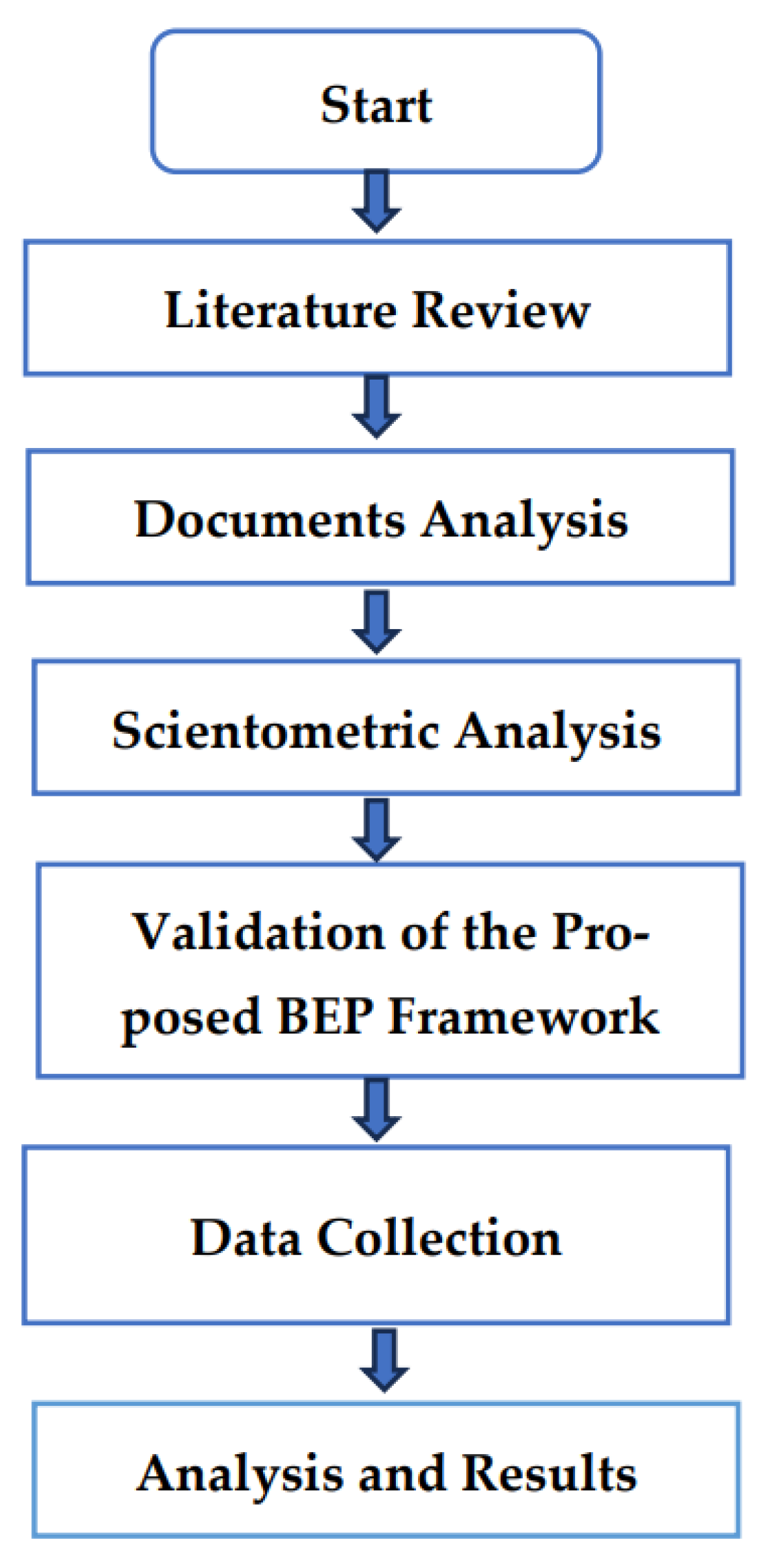
Figure 2.
Web of Science searches. Co-occurrence of the top keywords.
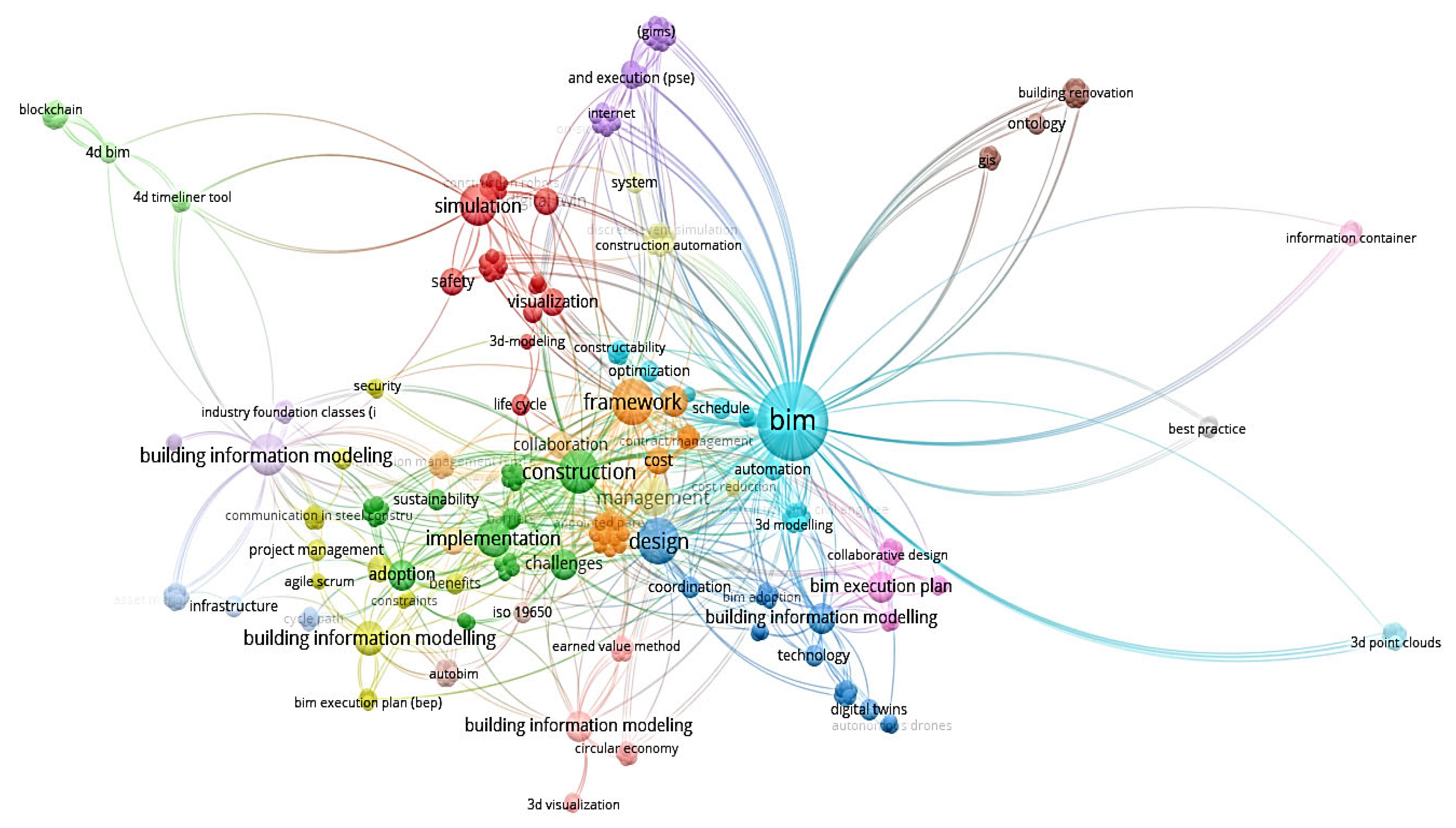
Figure 3.
Web of Science searches, Co-occurrence of the top keywords.
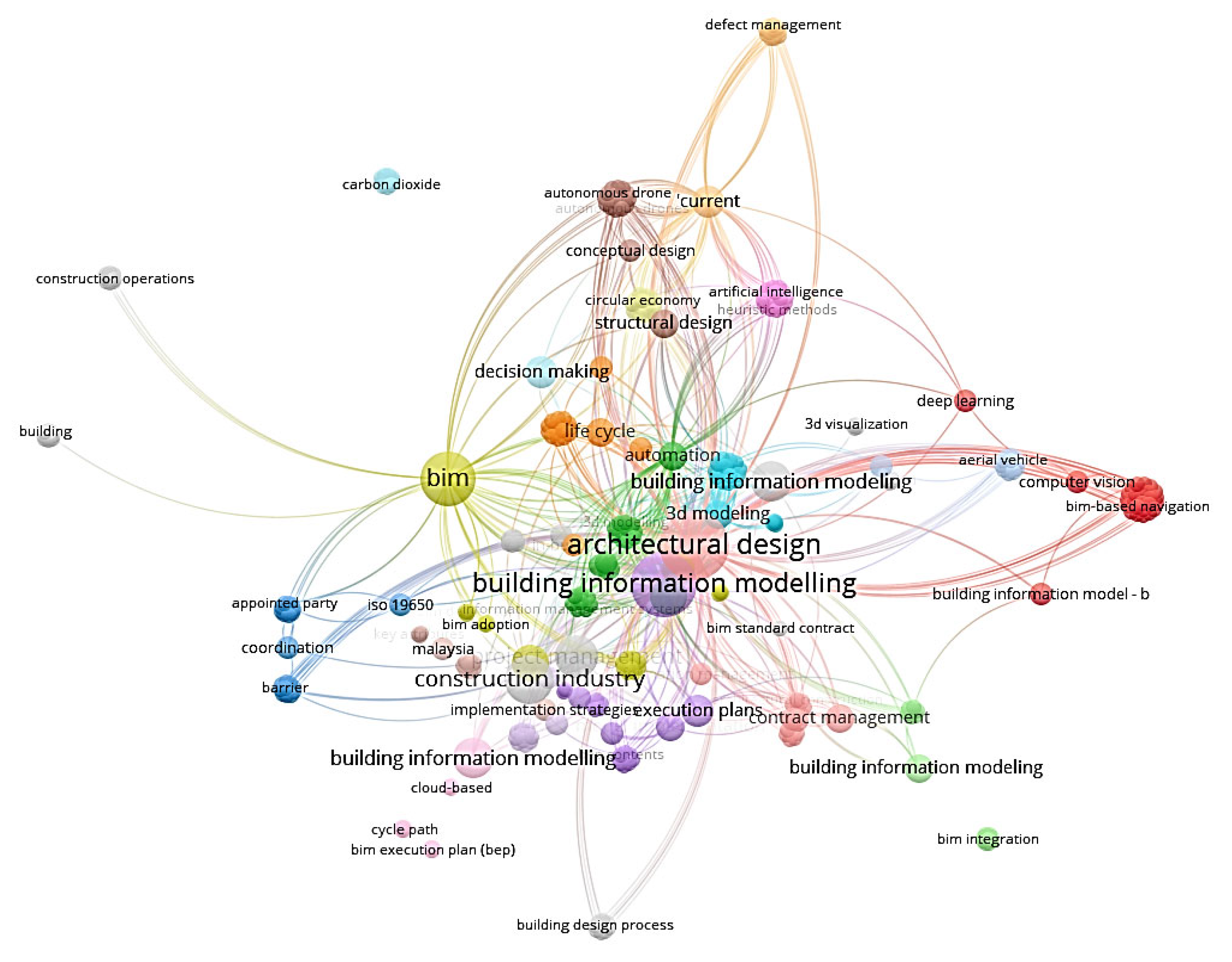
Figure 4.
The Percentage of occurrence of the Sub-element’s topics in the reviewed document.
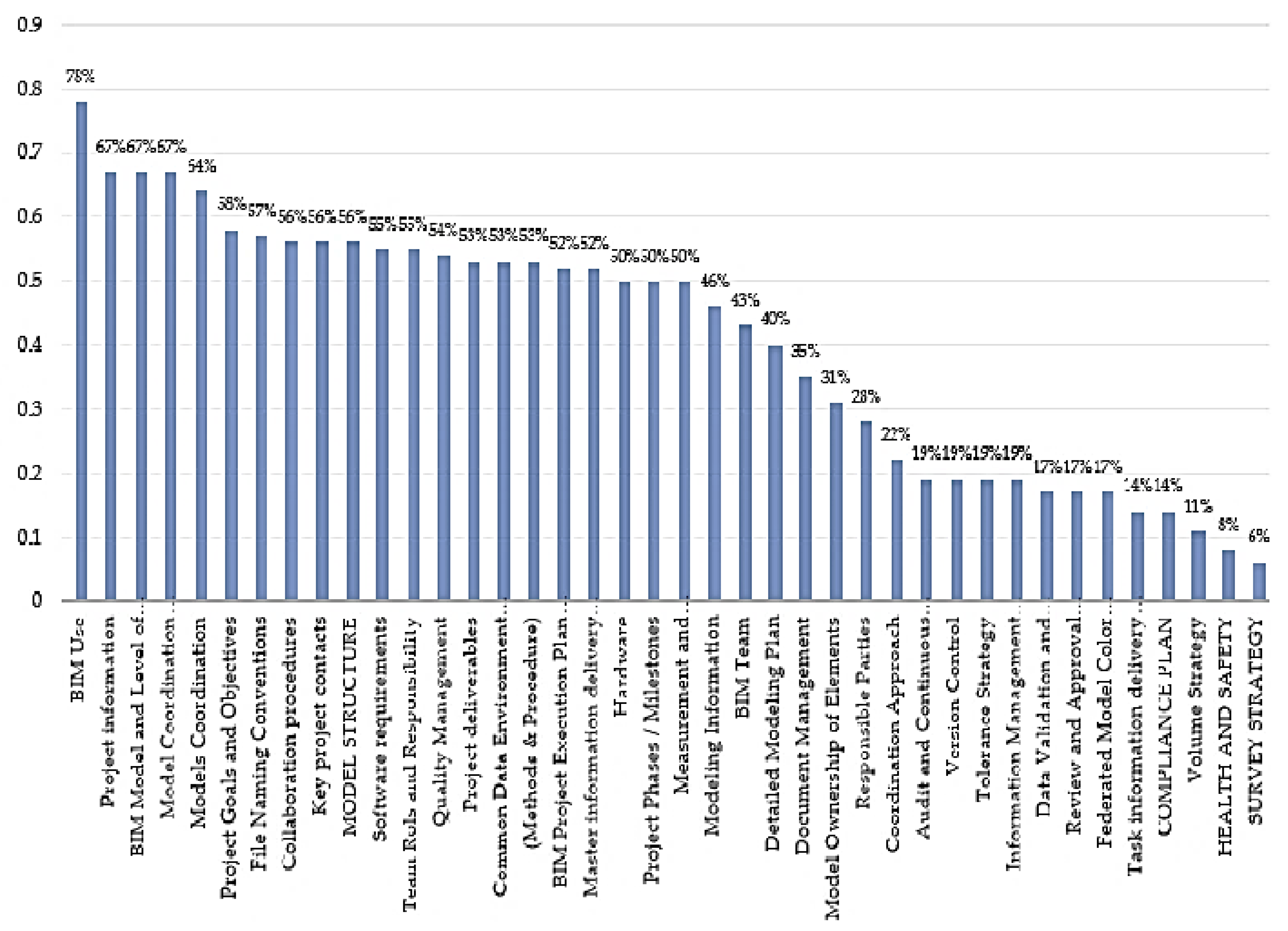
Table 1.
The list of identified Documents.
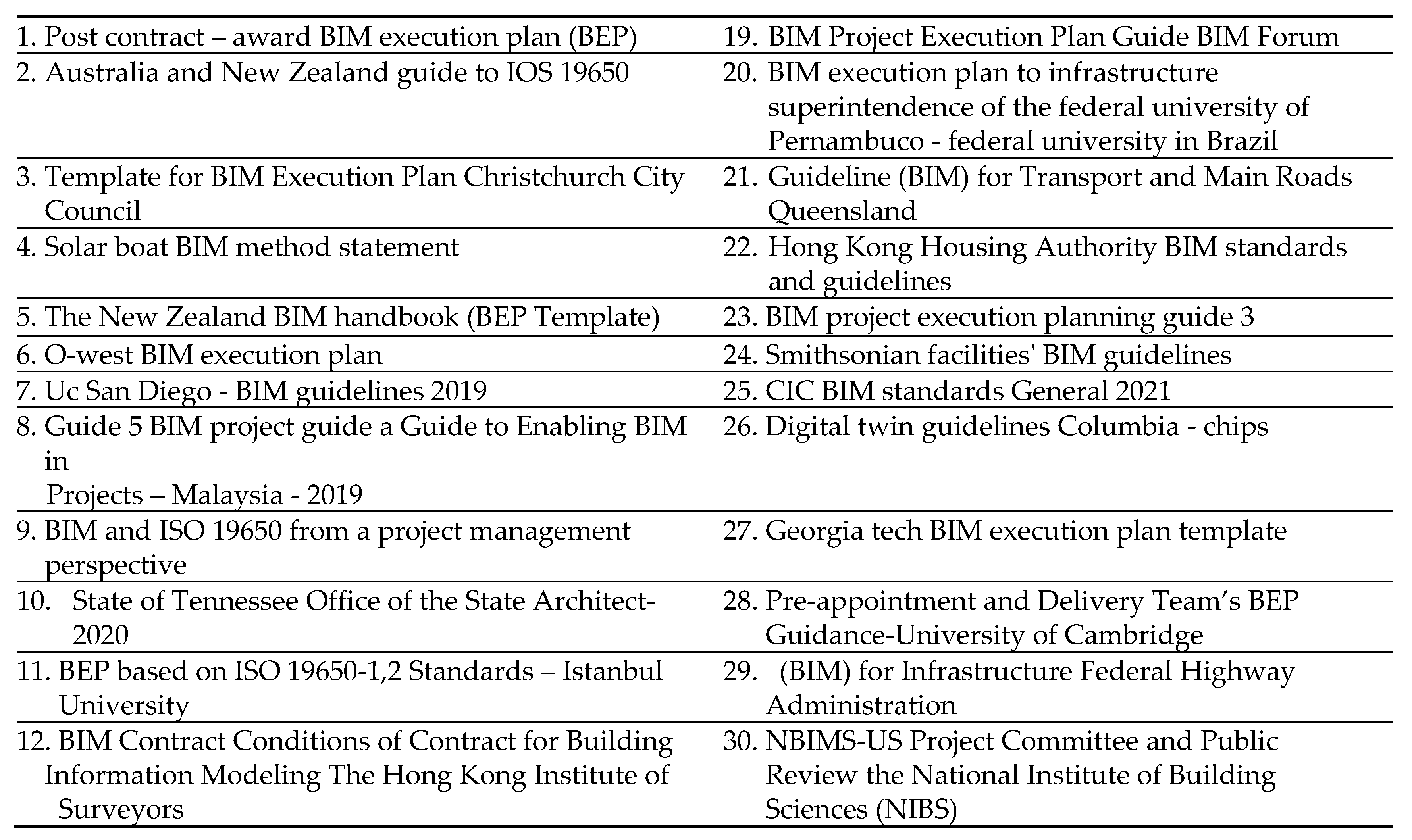
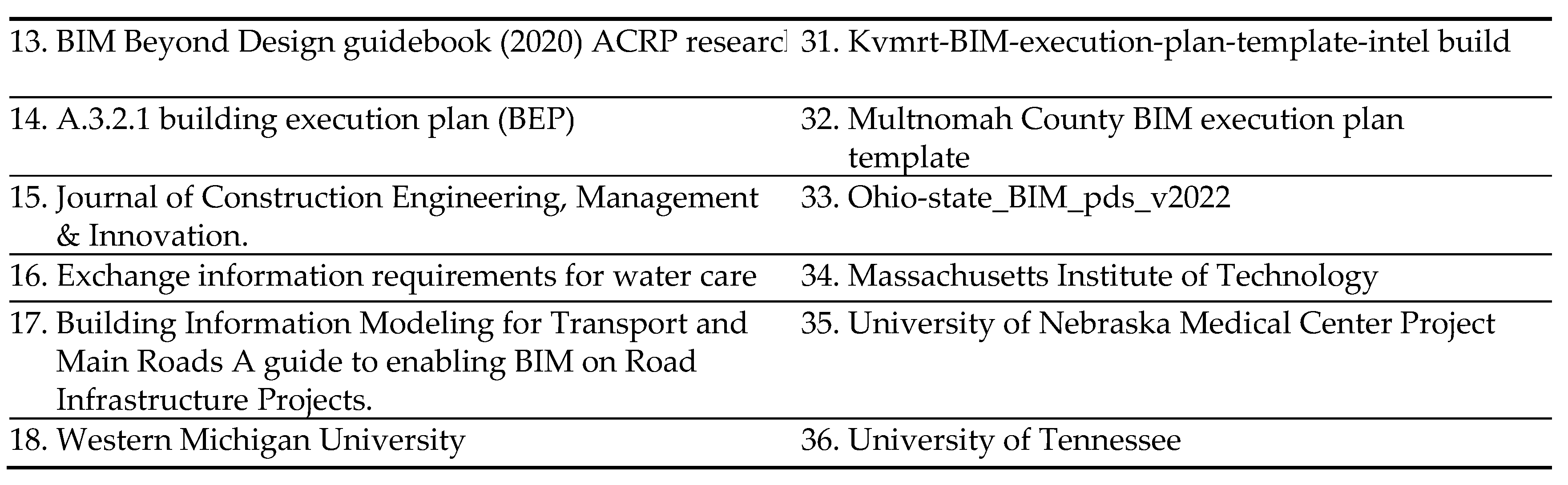
Table 2.
Frequency Distribution of Key Topics in BIM Execution Plan Literature.
| BIM Project Execution Plan Overview | Project Goals and Objectives |
| Project information | BIM Team |
| Task information delivery plan (TIDP) | Project Phases / Milestones |
| Responsible Parties | Detailed Modeling Plan |
| Project deliverables | Document Management |
| BIM Uses | Roles and Responsibility |
| BIM Model and Level of Development | Information Management Risk Register |
| Collaboration procedures | Master information delivery plan |
| Common Data Environment “CDE” | Key project contacts |
| Software requirements | Measurement and coordination systems |
| Hardware | Modeling Information |
| Data Validation and Verification | Model Ownership of Elements |
| Review and Approval Processes | Health and safety |
| Audit and Continuous Improvement | Survey strategy |
| Volume Strategy | File Naming Conventions |
| Model Coordination Procedures | Federated Model Color Scheme |
| Version Control | Model structure |
| Models Coordination | Coordination Approach |
| Tolerance Strategy | Quality Management |
| (Methods & Procedure) | Compliance plan |
Table 8.
ANOVA with construction experience.
| # | Section | Mean (0-5 Years) | Mean (5-10 Years) | Mean (10-15 Years) | Mean (15-20 Years) | Mean (>20 Years) | Mean (Total) | Std. Deviation | ANOVA F-value | ANOVA Sig. |
|---|---|---|---|---|---|---|---|---|---|---|
| 1 | Definition Section | 4.60 | 4.67 | 4.19 | 4.48 | 4.70 | 4.45 | 0.818 | 1.372 | 0.251 |
| 2 | BIM Project Execution Plan Overview Section | 4.60 | 4.73 | 4.32 | 4.48 | 4.70 | 4.51 | 0.713 | 1.138 | 0.344 |
| 3 | Project Information Section | 4.40 | 4.73 | 4.52 | 4.48 | 4.70 | 4.55 | 0.695 | 0.560 | 0.692 |
| 4 | Management Section | 4.80 | 4.73 | 4.55 | 4.62 | 4.90 | 4.67 | 0.604 | 0.866 | 0.488 |
| 5 | Project Goals/BIM Uses Section | 4.80 | 4.87 | 4.52 | 4.57 | 4.90 | 4.67 | 0.604 | 1.560 | 0.193 |
| 6 | Technical Requirements Section | 4.60 | 4.87 | 4.48 | 4.62 | 4.80 | 4.63 | 0.649 | 1.073 | 0.375 |
| 7 | Quality Assurance/Quality Control Plan Section | 4.70 | 4.93 | 4.55 | 4.48 | 4.80 | 4.64 | 0.647 | 1.470 | 0.219 |
Table 10.
Comments from survey questionnaire with themes and sub-themes.
| No. | Questions | Findings | Main Themes & Sub-Themes |
|---|---|---|---|
| 1 | Are there specific areas of the plan that you believe require adjustments to comply with Egyptian BIM standards? | Management adjustments are needed, with emphasis on Document ownership, COBie compliance, Collaboration, interoperability, VDC/BIM adjustments, and BIM workflow adjustments. | Management Adjustments, Document Ownership, Standards Compliance |
| 2 | Are there components or processes in the workflow that you believe are unnecessary or overly complex for BIM mega projects in Egypt? | I am admirable by project, emphasizing the need for flexible standards, collaboration, tailored training, and effective change management. | Workflow Complexity, Training, and Change Management |
| 3 | What recommendations would you make to improve the BIM Execution Plan workflow for better suitability and efficiency in the context of Egyptian/ MENA-region BIM mega projects? | Follow international standards, ensure LOD and stakeholder inclusion, simplify for easier implementation, standardize nationally, and include facility management early. | Standards & Stakeholder Engagement, Implementation Simplicity, National Standardization |
| 4 | Do you think the two subsections in the definition section of the proposed BEP Framework are sufficient? | Suggested additions include subsections on Technology Requirements, Stakeholder Roles and Responsibilities, and Data Management and Exchange Protocols. | Framework Comprehensiveness: Technology, Stakeholder Roles, Data Management |
| 5 | Do you think the three subsections in the BIM Project Execution Plan Overview section of the proposed BEP Framework are sufficient? | Suggested additions include Implementation Timeline, Performance Metrics, and Continuous Improvement Processes. | Framework Detailing: Implementation Schedule, Performance Evaluation, Improvement Processes |
| 6 | Do you think the seven subsections in the Project Information section of the proposed BEP Framework are sufficient? | Suggested additions include Sustainability Goals, Risk Management Strategies, and Change Management Procedures. | Information Sufficiency: Environmental, Risk, Change Management |
| 7 | Do you think the six subsections in the Management section of the proposed BEP Framework are sufficient? | Suggested additions include Quality Assurance/Quality Control Procedures, Stakeholder Communication Plans, and Technology Integration Strategies. | Management Robustness: QA/QC, Communication, Technology Integration |
| 8 | Do you think the four subsections in the Project Goals/BIM Uses section of the proposed BEP Framework are sufficient? | Suggested additions include Environmental Sustainability, Lifecycle Management, and Stakeholder Engagement Objectives. | Project Goals Depth: Sustainability, Lifecycle, Stakeholder Engagement |
| 9 | Do you think the six subsections in the Technical Requirements section of the proposed BEP Framework are sufficient? | Suggested additions include Cybersecurity Measures, Interoperability Standards, and Data Archiving and Retrieval Procedures. | Technical Adequacy: Cybersecurity, Interoperability, Data Management |
| 10 | Do you think the eleven subsections in the Quality Assurance/Quality Control Plan section of the proposed BEP Framework are sufficient? | Suggested additions include Continuous Improvement Mechanisms, Stakeholder Feedback Loops, and Compliance with International Standards. | QA/QC Expansion: Continuous Improvement, Stakeholder Feedback, Standards Compliance |
| 11 | Please provide any additional comments or suggestions regarding the BIM Execution Plan workflow. | Suggestions for the BEP to become a pivotal document in Egypt, with calls for specific sections and emphasis on adaptability, collaboration, and integration with contracts. | BEP as Pivotal Document: Specific Sections, Adaptability, Stakeholder Collaboration |
Disclaimer/Publisher’s Note: The statements, opinions and data contained in all publications are solely those of the individual author(s) and contributor(s) and not of MDPI and/or the editor(s). MDPI and/or the editor(s) disclaim responsibility for any injury to people or property resulting from any ideas, methods, instructions or products referred to in the content. |
© 2024 by the authors. Licensee MDPI, Basel, Switzerland. This article is an open access article distributed under the terms and conditions of the Creative Commons Attribution (CC BY) license (http://creativecommons.org/licenses/by/4.0/).
Copyright: This open access article is published under a Creative Commons CC BY 4.0 license, which permit the free download, distribution, and reuse, provided that the author and preprint are cited in any reuse.


