
Submitted:
17 May 2024
Posted:
20 May 2024
You are already at the latest version
Abstract
Using the example of a generator model with dedicated inertia, a theoretical study of two coupled self-oscillators with capacitive coupling, their sequential single-frequency synchronization, chaos and two-frequency synchronization with an adiabatic change in the magnitude of the coupling between partial self-oscillators was carried out. The parameters of self-oscillators and the values of the coupling coefficient at which the specified operating modes of coupled self-oscillators exist are determined. The results of numerical studies, illustrating the conditions for excitation of single-frequency, chaotic and dual-frequency oscillations in a system of coupled self-oscillators are presented.
Keywords:
generator with dedicated inertia
; coupling value
; system of two coupled self-oscillators
Introduction
Chaotic oscillation modes of systems of coupled self-oscillators have been studied by a number of authors, for example [1,2]. They have always attracted the attention of researchers due to the wide variety of both oscillatory processes and the quality of the generated chaotic oscillations, for example, [3,4,5,6,7,8,9].
Of particular interest are coupled systems with the possibility of chaotic dynamics of partial self-oscillators, as they have the largest set of oscillatory modes, including both regular and chaotic oscillations based on multi-frequency dynamics [3,4]. However, the vast majority of works focused on systems of coupled self-oscillators with greatly different natural frequencies and defining parameters, while additional elements and external signals were introduced to facilitate the generation of chaos in coupled systems of self-oscillators.
Thus, in [5,6], the influence of a low-pass filter on the synchronization of chaotic oscillations of a pair of unidirectionally coupled self-oscillators of a chaotic signal is studied, which changes the phase of the common oscillations to expand the chaos zone on the plane of control parameters.
In [7,8], a system of coupled Kislov-Dmitriev self-oscillators was studied with non-identical control parameters, where it was noted that the main scenario of oscillations during the transition to chaos is the destruction of the quasiperiodic regime.
In [9], the synchronization of chaotic oscillations in a system of two mutually coupled non-identical Rössler generators, each of which is in the helical chaos mode, is studied. At the same time, the fundamental role of differences in the parameters of partial self-oscillators for the transition to developed chaotic oscillations is noted.
From the above review it is clear that a system of coupled self-oscillators with equal partial frequencies of the components has been practically not studied. Thus, it is of interest what oscillation modes can be inherent in systems of two coupled self-oscillators with identical partial frequencies and what is the possible scenario for the development of the oscillatory process in such a system during the transition to chaos.
This paper presents the results of a numerical analysis of a system of two coupled self-oscillators with selected inertia for the case of practical equality of partial frequencies.
Materials and Methods
A mathematical model of a generator with dedicated inertia (GDI) was proposed in [10]. The model is interesting in that it adequately describes the dynamics of the amplifier stage on a powerful bipolar transistor operating in large-signal mode. The parameters of the generator model correspond to the real parameters of systems based on power transistors and can be used in the calculation of real circuit designs, as was demonstrated in [11,12]. Chaotic oscillations of such systems have a probability density distribution close to normal and have a wide frequency range, which makes it possible to solve real problems of creating chaos generators with high energy potential. Therefore, a system of coupled GDIs may be the most striking prototype model for studying the complex dynamics of coupled oscillators with similar frequencies.
Calculations are given for an autonomous self-oscillatory mode and are limited to identifying areas of defining parameters that are characterized by certain types of oscillations of the system, such as a limit cycle of a unit multiplicity of a period, limit cycles with multiple periods n, n = 2, 3,..., resonant tori and chaotic oscillations with a differential the probability density distribution law is close to normal Gaussian. Numerical analysis was carried out using the Runge-Kutta method with an integration step of 0,05. Varying the values of parameters did not lead to qualitative changes in the dynamics of the system. The initial conditions have been chosen . Time realizations of oscillations, phase portraits, trajectories of motion of representing points and bifurcation diagrams were studied.
The Results and Its Discussion
Using the results of work [10], the system of equations of two coupled self-oscillators with allocated inertia can be represented with capacitive coupling in the form:
where i, j = 1, 2; , k – coupling coefficient, X, Y, Z, W – dimensionless voltage at the input of the nonlinear amplifier, current in the feedback circuit, voltage at the output of the half-wave inertial converter, current in the input circuit, respectively, m1, m2, q, g – parameters excitation, dissipation, limitation and inertia, F(a) – Heaviside unit function.
System (1) was solved for a small mismatch in inertia parameters g1 = 0,045, g2 = 0,05 and equality of other parameters of partial self-oscillators, the values of which corresponded [10], тo есть m1 = 1,6, m2 = 0,2, q =1, which satisfies the condition of equality of partial frequencies.
In Figure 1 shows spectrograms that make it possible to trace the development of the oscillatory process in system (1) when the coupling parameter k changes. Initially, with a small connection (k = 0.1), periodic motion () is realized in the system in the form of a stable limit cycle based on the frequency f0, equal to the frequency of autonomous oscillations of partial self-oscillators (Figure 1a).
A periodic motion mode exists in the system until the coupling coefficient reaches the value k = 0.4, while an increase in coupling leads to a change in periodic motion modes of various multiplicities (Figure 1b). At k = 0.4, the development of a complex oscillatory process begins in the system, which ends with the appearance of chaotic oscillations based on the frequency f0, (Figure 1c).
Further movement along the parameter k leads to the fact that the system goes from the strange attractor mode based on a single frequency (СА1) to the mode of generating chaotic oscillations based on two-frequency motion (СА2), which manifests itself in the spectral representation as a double-humped spectral characteristic of the variable X1 (Figure 1d). The next stage in the evolution of oscillation modes is shown in Figure 1e–f. When the value k = 0.56 is exceeded, the CA2 mode is replaced by two-mode regular motion (T2) based on the frequencies f1 and f2, f1 < f0 < f2. An increase in the coupling coefficient leads to structural rearrangements of the resonant tori in the phase space of the system, and a larger value of the coupling coefficient corresponds to a smaller number of spectral components in the oscillation power spectrum of the system. The dual-frequency dynamics of the system demonstrates the emergence of additional synchronization areas in a system of coupled GDI at a high coupling coefficient.
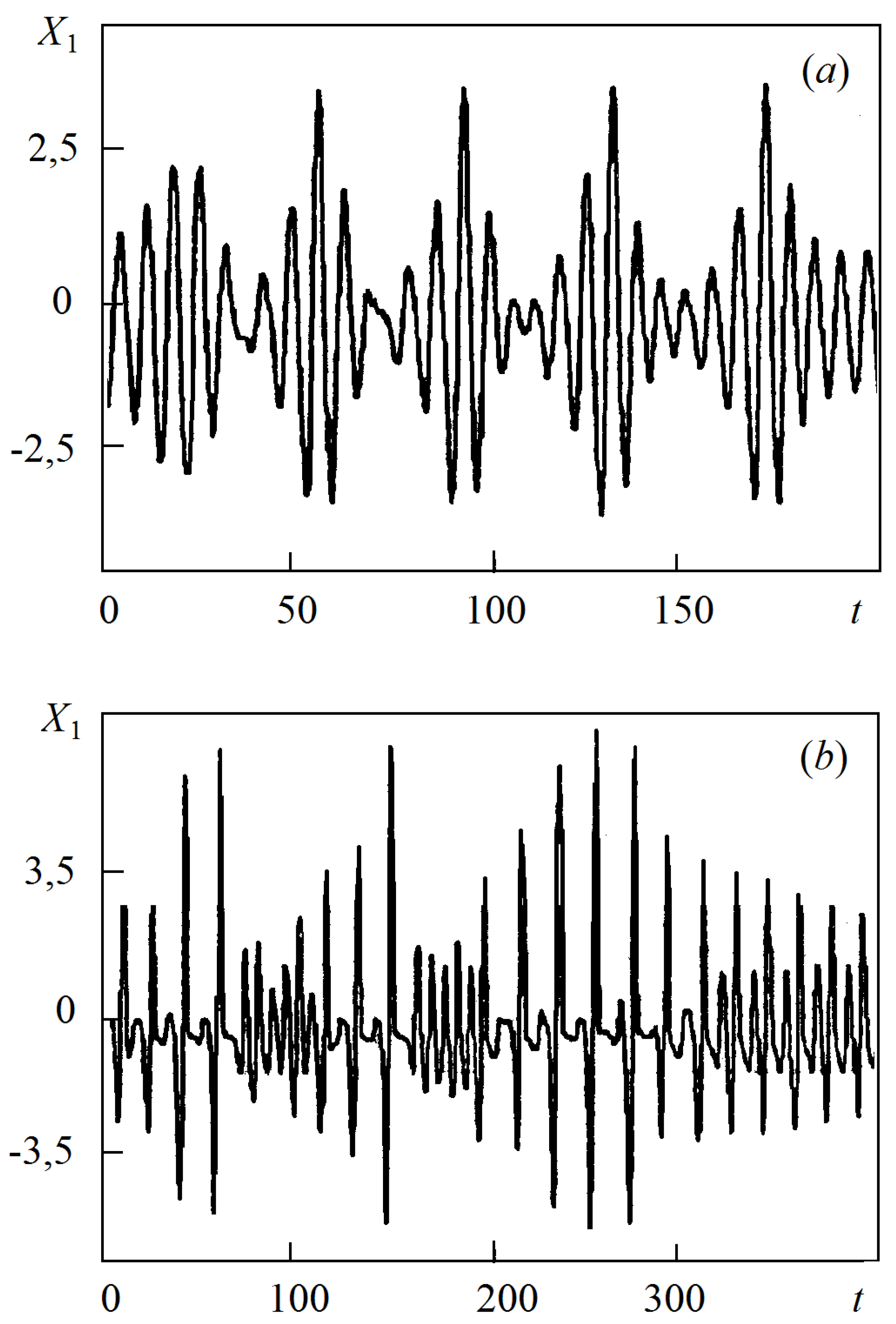
To analyze the processes occurring in the system under study, we consider the temporary implementation of oscillations. Changes in the variable X1 for CA1 are shown in Figure 2a and for CA2 in Figure 2b, they allow us to trace the transition mechanism in more detail СА1 — СА2.
The CA1 case is characterized by a regime of irregular intermittency between trains of oscillations of different periods. An increase in the coupling parameter k leads to a sequential change in the states of the system in the form of stable limit cycles, the oscillation periods of which successively increase by one. The system of coupled GDI demonstrated an additive increase in the multiplicity of the oscillation period by one during the transition from stable periodic motion with a period n/f0 to periodic motion (n + 1)/f0, n = 1,2,.... With each subsequent transition to stable cycle with an increase in the oscillation period by one, the distance between the critical values k of the variable parameter k decreased. In the numerical experiment, the maximum value is n = 5 at k = 0.39.
In the two-frequency chaotic mode CA2, competition between interacting modes of the system occurs, which manifests itself in the fact that oscillations with frequencies randomly alternate in the system f1, и f2 (Figure 2b). In the case under consideration, there is no competition between the frequency components of partial self-oscillators. The modes of the system compete, and the system of coupled self-oscillators under consideration acts as a single system with properties inherent only to it. In a system of equivalent self-oscillators, additional synchronization areas are realized, which manifests itself in a two-frequency oscillation mode.
To identify the statistical properties of chaotic oscillations in the CA2 mode, calculations were carried out to calculate the probability density distribution. Calculation of the histogram showed that at k = 0,53 the probability density distribution of oscillations is close to normal Gaussian.
The scenario for the development of oscillations upon exiting the CA2 mode is a sequential change in the number of combinational components with the arrangement (f2 - f1) / h, where h = 4, 3, 2. That is, the transition from two-frequency chaos to the resonant torus mode was characterized by a consistent decrease in the number of combinational components with increasing coupling coefficient k in accordance with the law inverse to the natural series.
Conclusions
Thus, a numerical experiment in a system of coupled GDI revealed the appearance of secondary nonlinear resonances and chaotization of oscillations as a result of the transition from single-frequency to two-frequency interaction. The considered oscillation scenario — CA1 — CA2 — T2 shows that the transition to chaotic oscillations in the system of coupled GDI under study for the case of practical equality of partial frequencies is accompanied by mode competition and intermittency. The dynamics of the system are characterized by a pattern characteristic of the tightening and switching of modes in the region of chaos, which manifests itself as a transition between a regime based on single-frequency oscillations and a regime based on two-frequency oscillations.
Financing
The work was carried out within the framework of the state task.
Conflict of Interest
The authors have no conflict of interest.
References
- B.E. Zhelezovsky, E.V. Kalyanov. // Tech. Phys. Lett., 35 (14), 18 (2009).
- Yu.P. Emelyanova, A.P. Kuznetsov. // Technical Physics. 81 (4), 7 (2011).
- Yu. Nemets, D.M. Vavriv. // Issues of atomic science and technology. 98 (4), 282 (2015).
- V.A. Buts, D.M. Vavriv. // Issues of atomic science and technology. 116 (4), 213 (2018).
- A.A. Prokhorov, E.S. Mchedlova. // Tech. Phys. Lett., 33 (4), 66 (2007).
- A.A. Prokhorov, E.S. Mchedlova. // Technical Physics, 78 (11), 77. (2008).
- A.P. Kuznetsov, V.I. Paksyutov. // Technical Physics, 78 (4), 129. (2008).
- A.P. Kuznetsov, Yu.V. Sedova, N.V. Stankevich. // Technical Physics, 91 (11), 1619 (2021).
- A.V. Makarenko. // Technica Physics, 86 (2), 110 (2016).
- S.V. Savel’ev. // Journal of Radioelectronics [electronic journal]. 2017. No. 6. http://jre.cplire.ru/jre/jun17/10/text.pdf.
- S.V. Savel’ev, L.A. Morozova // Technical Physics, 65 (12), 2056 (2020) . [CrossRef]
- S.V. Savel’ev, L.A. Morozova. // Tech. Phys. Lett., 49 (4), 48 (2023) . [CrossRef]
Figure 1.
Dynamics of the oscillatory process of a system of two connected GVIs when the coupling coefficient between partial generators changes: k = 0,1, (a); k = 0,25, (b); k = 0,42, (c); k = 0,53, (d); k = 0,56; (e); k = 0,61, (f).
Figure 1.
Dynamics of the oscillatory process of a system of two connected GVIs when the coupling coefficient between partial generators changes: k = 0,1, (a); k = 0,25, (b); k = 0,42, (c); k = 0,53, (d); k = 0,56; (e); k = 0,61, (f).
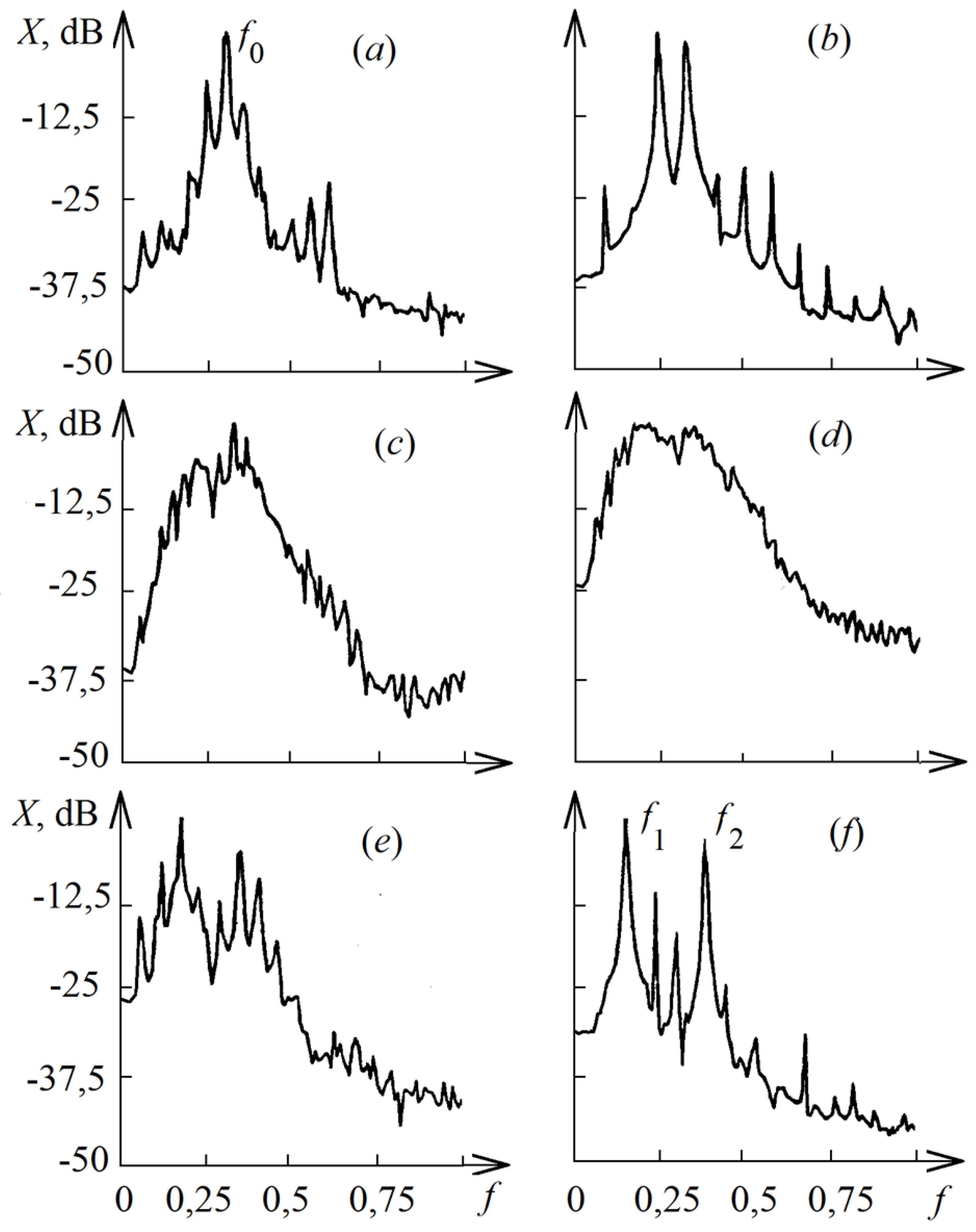
Figure 2.
Temporary implementations of X1 corresponding to oscillations of a system of connected GDI: k = 0,42 — СА1, (a), k = 0,56 — СА2, (b).
Figure 2.
Temporary implementations of X1 corresponding to oscillations of a system of connected GDI: k = 0,42 — СА1, (a), k = 0,56 — СА2, (b).
Disclaimer/Publisher’s Note: The statements, opinions and data contained in all publications are solely those of the individual author(s) and contributor(s) and not of MDPI and/or the editor(s). MDPI and/or the editor(s) disclaim responsibility for any injury to people or property resulting from any ideas, methods, instructions or products referred to in the content. |
© 2024 by the authors. Licensee MDPI, Basel, Switzerland. This article is an open access article distributed under the terms and conditions of the Creative Commons Attribution (CC BY) license (http://creativecommons.org/licenses/by/4.0/).
Copyright: This open access article is published under a Creative Commons CC BY 4.0 license, which permit the free download, distribution, and reuse, provided that the author and preprint are cited in any reuse.


