

Submitted:
14 May 2024
Posted:
15 May 2024
You are already at the latest version
Abstract
In paired-associate vocabulary learning task, second language learners employ different cognitive strategies, associated with either elaborative or rote rehearsal, resulting in different recall performance. The current study investigated the role of intelligence, measured with Raven’s Advanced Progressive Matrices, in strategy effects on performance and eye movement parameters. The Keyword method, which is regarded as a more effective cognitive strategy in paired-associate task, was induced on a sample of 32 healthy participants with normal or corrected to normal vision. Effective cognitive strategy use, mentioned in a structured post-hoc report, was found to improve performance after strategy induction. Higher intelligence score was associated with higher recall performance in case the Keyword method was reported, but not in the cases when no rote rehearsal was reported. No effect of cognitive strategy use on eye movement measures after explicit cognitive strategy instruction was revealed, which is supposed to be connected with lack of self-sustained strategy use immediately after strategy instruction. The findings emphasize the role of intelligence in cognitive strategy instruction.
Keywords:
cognitive strategies
; strategy instruction
; paired-associate learning
; intelligence
1. Introduction
The term "cognitive strategies" is commonly used to describe the mental processes individuals employ to think, learn, and solve problems effectively (Davidson and Sternberg, 2003; Waris et al., 2021a; Bock et al., 2023). Strategy use is an intra-individual feature of cognitive processes that contributes to individual differences in performance in memory and learning tasks, such as traditional n-back (Waris et al., 2021a), word list learning (Laine et al. 2024), item-recognition (Rypma et al. 2005), Raven’s matrices (Gonthier and Roulin 2020) and visual search (Boot, Becic, and Kramer 2009) tasks. The strategies are supposed to enable better performance with the same working memory resources (Malinovitch, Jakoby, and Ahissar 2021), therefore, in contemporary research the dynamics of task performance is regarded along with traditional performance measures (Waris, Jylkkä, et al. 2021).
Cognitive strategies are operationalized and assessed through shifts in reaction time (Davidson and Sternberg 2003), post hoc reports (Webb and Nation 2017), eye movement patterns (A. L. Simon and Schindler 2022), or a combination of these methods (Wang and Pellicer-Sánchez 2023).
Flexibility, or the ability to adapt the strategies to the demands of the task at hand, contributes to better performance, which makes mastering a wide range of strategic behavior an essential part of learning and instruction (Chamot and Harris, 2019). On the other hand, flexibility manifests in spontaneous strategy use: successful learners discover effective strategies faster, which results in performance improvement (Malinovitch, Jakoby, and Ahissar 2021), with strategy-based effects manifesting right at the start of training (Laine et al. 2018).
Individual Differences in Strategy Implementation and Adaptivity
Cognitive strategy use is regarded as an intra-individual variable, however, strategy choice is dependent on individual differences. In early cognitive strategy studies R. Sternberg and E. Weil demonstrated that the efficiency of employing alternative strategies for solving linear syllogisms (problems like “Bill is taller than John, John is taller that Peter, who is the tallest?”) depended on subjects' verbal and spatial abilities – even though explicit strategy instruction, in general, facilitated task performance, the effectiveness of strategy implementation depended on one's specific pattern of abilities (Sternberg and Weil 1980). In subsequent research strategy adaptivity dimension has also been associated with the factors of reasoning ability and working-memory capacity (Schunn and Reder, 2001; Gonthier and Roulin, 2020). For instance, the interplay of these factors in Raven’s matrices task resulted in choosing either less costly response elimination strategy (in participants with low working memory capacity and high need for cognition) or more effective but costly constructive matching (in participants with high working memory capacity and high need for cognition) in increasing task demand (Gonthier and Roulin, 2020).
In the Language Learning Strategies research the adaptive component has been emphasized since the onset of the field, along with self-monitoring and social components in second language acquisition (Rubin 1975; Oxford 2016). The research in the field of language strategies has mostly been carried out in the area of language teaching, with strategy inventories and classroom strategy instruction as main methods. Today one of the key prospective research directions, pointed out by the leaders of the field, is examining how exactly different strategies are deployed in various learning tasks with more objective methods (Pawlak 2021).
The role of the ability to cope with novelty and ambiguity has also been emphasized within the framework of the Language Learning Aptitude research, where language aptitude is viewed a complex measure, which a determinant of language learning outcomes, comprising four components: phonetic coding ability (perceiving and reproducing the sounds of a foreign language); grammatical sensitivity (recognizing and understanding the grammatical structures of a foreign language); rote learning ability (memorizing and retaining vocabulary); inductive language learning ability (inferring and generalizing language rules and patterns based on exposure to examples) (Carroll 1989). These key components for assessing the aptitude at an individual level, defined by R. Carroll and St. Sapon, remain the benchmark in the field for predicting student potentialities in second language studies (Sparks and Dale 2023). Another Language Learning Aptitude framework was developed by E. Grigorenko, R. Sternberg and M. Ehrman in the Cognitive Ability for Novelty in Acquisition of Language as applied to Foreign language (CANAL-F) test, which stressed the ability to cope with novelty and ambiguity in second language acquisition (Grigorenko, Sternberg, and Ehrman 2000). Language aptitude components in the CANAL-F include ability for acquiring vocabulary, comprehending extended texts, extracting grammatical rules, and making semantic inferences. Language aptitude is viewed in this theoretical framework as part of the experiential aspect of intelligence (the ability to invent solutions to new problems), as described by R. Sternberg’s triarchic theory of intelligence (Sternberg, 2000). This view is supported by the evidence that the discriminated components of LA were found to be in correlation with fluid (ability to generate, transform, and manipulate different types of novel information in real time), but not with crystallized (general knowledge, vocabulary, and reasoning based on acquired information) intelligence. The role of fluid intelligence in language learning strategy use is emphasized with the meta-analysis results, indicating that language aptitude correlates with intelligence more than it does with working memory capacity (Li 2015; 2019).
Cognitive Strategies of Vocabulary Learning without Context
In second language (L2) learning tasks cognitive strategies are supposed to be involved in making associations between new and already known information; while metacognitive strategies are regarded as controlling through planning, organization and evaluation of the learning process (Oxford 2016).
In L2 vocabulary learning without context task two key strategies are defined: 1) the Keyword method (KWM): a novel L2 word is connected to its native language (L1) translation by an acoustic link (similarity in sound) and an imagery link (mental image of the interaction between the two words (for example, for memorizing the Spanish word “pato” - “duck”, one can imagine a duck with a pot on its head) (Atkinson 1975); 2) rote learning (constantly repeating the word pair).
The KWM benefit on vocabulary learning performance can be attributed to several memory effects:
- elaboration processes in working memory, which refer to linking representations into existing semantic networks, are associated with higher performance in memory tasks as compared to refreshing (rote rehearsal) processes, which only prioritize the refreshed information in working memory (Bartsch et al., 2018; Oberauer, 2019)
- the depth of processing involved: rote learning implies primarily phonemic encoding, while the Keyword method implies the addition of semantic encoding (Craik and Lockhart 1972), which is considered to improve the robustness of verbal working memory (Savill, Ellis, and Jefferies 2017)
- the benefits of dual coding (Sadoski and Paivio 2012), as using the KWM implies alternation of verbal and visuospatial encoding in the working memory, which is also in line with recent research on domain-specific resources in working memory (Kowialiewski et al. 2023)
- chunking in working memory: in paired-associate learning new 2-word chunks in working memory are created, thus facilitating recall as capacity limits and length limits come into play (Chen and Cowan 2005)
Positive effect of the KWM on recall performance has been demonstrated in previous research (Shapiro and Waters 2005), as well as the possibility of the KWM instruction (Wyra and Lawson 2018). However, the KWM effect on recall is not manifested in case the participants are explicitly provided with keywords and illustrations (Campos, González, and Amor 2003), which emphasizes the role of self-sustained strategy use.
Cognitive Strategy Instruction
In memory tasks cognitive strategy instruction has yielded significant results: e.g., engagement in mnemonic strategy training has been found to have facilitating effect on hippocampal functioning (Hampstead et al. 2012). Strategy instruction, as well as implicit strategy learning benefits have been found, for instance, in classic n-back working memory task (Malinovitch, Jakoby, and Ahissar 2021).
However, a key problem in working memory training remains the task-specific training with little transfer to other memory, cognitive control or fluid intelligence tasks (for meta-analysis see Soveri et al. 2017). On the other hand, training-related improvement in working memory is considered to be connected with spontaneous strategy use in untrained memory tasks (Dunning and Holmes 2014). Therefore, strategy instruction effects are supposed to be mostly task-specific, but the ability to find and employ efficient cognitive strategies could belong to the area of general abilities. Moreover, as cognitive strategy effects in the working memory (n-back) task have been demonstrated right from the start of the training (Laine et al. 2018), which stresses the role of strategy induction (introducing the strategies to the subjects before or without extensive long-term training).
In the field of second language learning, strategy instruction has been proved moderately efficacious (for meta-analysis see (Plonsky 2011)), with such variables as training duration, context, age, proficiency, educational level, setting, type and number of strategies taught, outcome variable mediating the effect.
Strategy induction can be implemented either with explicit instruction or with more sophisticated paradigms, such as Eye Movement Modelling Examples. The Eye Movement Modelling Examples paradigm involves showing the learners gaze behavior of a domain expert while performing a perceptual task, providing a domain novice with guidance in how to process the visual input (Jarodzka, Holmqvist, and Gruber 2017).The paradigm has been widely used for strategy instruction in professional tasks in different areas: meta-analysis results demonstrated significant effect of displaying experts’ gaze on time to first fixation and fixation duration on task-relevant Areas of Interest, thus helping learners attend faster and longer to the task-relevant elements, fostering their cognitive performance (Xie et al. 2021). These practical implications highlight the application of eye tracking research for finding eye movement correlates of cognitive strategies.
Eye Tracking Evidence of Cognitive Strategies
Eye tracking has been increasingly used as a reliable measure of second language learners’ attention in L2 acquisition tasks, both as an individual measure and in combination with stimulated recall (Wang and Pellicer-Sánchez 2023). Eye movement patterns (e.g. combination of fixation duration, dwell time on the areas of interest, revisits measures) have already been distinguished in vocabulary learning without context (Blinnikova and Izmalkova 2016), reading (Kuperman et al. 2023) and incidental vocabulary learning (Zuo and Yan 2019). Eye tracking measures can be used either alone or in triangulation with other measures such as reaction time, self-report and analysis of correct answers and mistakes. Combining eye-tracking with verbal reports has been suggested for obtaining a fuller picture of learners’ cognitive processes (Wang and Pellicer-Sánchez 2023).
Eye movement research of experts and novices in different professional domains emphasizes the role of expertise-related strategy use, revealed in eye movement patterns of experts and novices (Gegenfurtner, Lehtinen, and Säljö 2011), which emphasizes their significance in attaining academic objectives via effective allocation of cognitive resources.
Recent research has also provided eye-movement evidence of the different cognitive strategies used: rote learning is manifested in a larger number of gaze shifts between the areas of interest, while the Keyword method is associated with longer fixation times on the novel words (Blinnikova and Izmalkova 2016).
Present Study
While there is ample evidence of flexible cognitive strategy choice effect on performance in different tasks, the role of intelligence in strategy choice and strategy instruction outcome has as yet not been addressed.
In the present study the Keyword method, which has been associated with higher recall in previous research, is induced with explicit instruction. Recall performance and eye movement measures after strategy instruction in subjects with higher and lower intelligence test score (measured with Raven’s Advanced Progressive Matrices) are analyzed. Eye movements in the study are regarded as an online measure of information processing and are used for investigating attention distribution in paired-associate vocabulary learning task. The goal of the study is to test the hypothesis that fluid intelligence mediates cognitive strategy implementation. If so, significant distinctions in paired associate learning task performance after strategy instruction will be found in participants with higher and lower RAPM test score.
2. Materials and Methods
2.1. Participants
An a priori power analysis indicated that a minimum of 30 participants was needed to test our hypotheses, assuming a medium effect size (d = 0.45) with .403 power and alpha set at .05. The experimental sample included 32 healthy participants with normal or corrected to normal vision, with ages ranging between 18–25 years (median = 20), 22 females. The subjects were recruited at Moscow State Linguistic University, receiving course credit for their participation. Informed consent was obtained from all the subjects involved in the study.
2.2. Apparatus and Stimuli
Eye movements were recorded with SMI RED eye tracker (60 Hz, accuracy 0.4°, precision 0.03°) with 22'' screen, 1280×1024 pixels screen resolution.
Paired associates. 24 pairs: L1 word (Russian) and pseudoword. L1 words comprised 7 letters, were concrete nouns with ipm = 8.5-22.8. Pseudowords, amendable to English phonetical rules (e.g. “consike”, “remwoud”, “stalore”), were made in Wuggy program (Keuleers and Brysbaert 2010). A subset of the stimuli from the previous research (Blinnikova and Izmalkova 2016) with normalized associative strength. The stimuli were displayed on the screen in Courier New font (monospace), font size = 48.
2.3. Procedure
The study was carried out in the paired-associate learning paradigm: an episodic memory paradigm in which pairs of items are presented during learning trials, with the first item presented as a cue for a response for the second item (Karantzoulis et al. 2011).
In the study, first language words were presented in pairs with pseudowords (the layout is provided on Figure 1). The trials comprised 4 word pairs, displayed for 5 seconds with an interstimulus fixation cross displayed for 1 second. The participants’ task was to memorize as many words as possible and to recall the pseudowords after each trial, with first language words provided as cues.
After two training trials, the subjects performed two trials without instruction, and then four trials after strategy instruction. Strategy instruction was provided explicitly with an excerpt from a textbook describing the Keyword method in detail (Velichkovsky, 2006, p. 431, in rus.), with reference to R. Atkinson’s benchmark example (“линкoр”-“liqueur”) (Atkinson 1975). An additional KWM knowledge questionnaire was used to ascertain the successful KWM induction, as described in M. Wyra and M. Lawson study (Wyra and Lawson 2018). The participants were asked to help their friend, who is learning Spanish as a second language and has trouble with memorizing “camarera” (Spanish for “waitress”). The following questions were asked: 1) How would you recommend you friend to memorize the word? Possible answers included any acoustic associations, e.g. “камера” (camera); 2) What would you recommend your friend to think of to recall the word? Possible answers included any imagery link to the Russian word “oфициантка” – e.g. a waitress being recorded with a camera.
After strategy instruction the subjects performed 4 more trials, with structured post-hoc strategy report after each trial. Possible answers included “the Keyword method was used” and “the Keyword method was not used”. The subjects were also encouraged to provide unstructured post-hoc report on the features of the Keyword method use. In case the post-hoc report included both the keyword and the associative link to the native language word to the whole word or to the part of the word (e.g., for the pair “тетрадь” (notebook) – “consike” an example of a partial report was “I imagined a horse (кoнь) eating a notebook”, with “кoнь” as a keyword to “con”) or at least provided the keyword, the use of the KWM, marked in the structured report, was supposed to be confirmed. In case the subjects did not provide the keyword and either reported features of single letters (e.g. “There were two upper-case letters”) or rote learning (e.g. “I just read the words”) was reported, no use of the KWM was confirmed.
Following previous research of eye movement correlates of reported cognitive strategy use (Blinnikova and Izmalkova 2016; Wang and Pellicer-Sánchez 2023), the participants’ eye movements were recorded to assess eye movement patterns after strategy induction.
2.3. Measures
2.3.1. Recall. The dependent variable was the number of correctly recalled letters in the word.
2.3.2. Structured post-hoc report. Vocabulary learning strategies were determined based on structured post-hoc report after strategy instruction.
2.3.3. Intelligence score. Raven’s Advanced Progressive Matrices (RAPM) were used to measure intelligence (John and Raven 2003). The RAPM is a validated psychometric tool for assessing fluid reasoning designed for adults with above-average reasoning. In the RAPM participants perform a multiple-choice task, in which they are asked to complete matrix patterns by choosing the correct missing item. The participants were given a 40-minute time limit to solve 36 items of progressive difficulty. The participants were split by median based on the RAPM score (high and low intelligence task performance).
2.3.4. Eye tracking data. Paired associates (L1 word (Russian) and pseudoword) were mapped as areas of interest (AOIs). The following eye movement measures were included in the analysis: AOI dwell time (the total amount of time spent on a target word AOI), AOI first fixation duration (the duration of the first fixation made on a target word AOI), AOI mean fixation duration (the average length of the fixations made on a particular AOI), AOI revisits (the number of times a participant looked back at a specific AOI). Thus both early-stage reading measures (AOI first fixation duration and AOI mean fixation duration), associated with initial lexical access, and late-stage reading measures (AOI dwell time and AOI revisits), associated with postlexical access (Whitford and Titone 2012), were included in the analysis.
2.5. Data Analysis
Eye movement data was pre-processed in BeGaze3.0 software with 50 ms and 50 pixel fixation threshold.
The normality distribution of the eye tracking measures was evaluated with the Kolmogorov–Smirnov test (for all eye movement measures the distribution was not Gaussian). Following previous research (Yan and Pan 2023) the eye tracking data were log10 transformed.
Two-way (strategy x intelligence) ANOVA was used to investigate the interaction effect on recall performance.
All analyses were conducted in Python programming language statistical packages (scipy and statsmodels).
3. Results
Strategy Use and Paired-Associate Task Performance
Recall performance significantly increased after strategy instruction: with mean recall score 3.65 (SD = 2.65) before instruction and 4.87 (SD = 2.36) after instruction (t = 6.42, p < 0.01).
The Keyword method report was associated with higher recall performance: 5.25 (SD = 2.12), as compared to no KWM strategy report: 3.91 (SD = 2.64) (t = 5.99, p < 0.01).
Intelligence and Paired-Associate Task Performance
Higher RAPM performance was associated with higher recall after the Keyword method induction task: 5.2 (SD = 2.26), and 4.54 (SD = 2.42) in lower RAPM performance (t = 3.12, p < 0.01).
However, no such effect of intelligence was found before strategy instruction: higher intelligence test performers demonstrated insignificant advantage (M = 3.93, SD = 2.58) over lower performers (M = 3.37, SD = 2.71) (t = 1.68, p = 0.09).
While both intelligence test score and the Keyword method use were associated with higher recall performance after strategy instruction, two-way (strategies x intelligence) ANOVA results revealed no interaction of the factors (see Table 1).
Post-hoc pairwise t-tests with Bonferroni correction were conducted to further explore significant main effects. The source of distinctions in recall performance in higher and lower RAPM groups was in case KWM use was reported: 5.65 (SD = 1.97) in higher RAPM and 4.84 (SD = 2.2) in lower RAPM (t = 3.69, p < 0.01), while no distinctions were observed in no KWM use in the report. The recall performance of higher and lower RAPM groups are presented in Figure 2 (a) and Figure 2 (b).
Strategy Induction and Eye Movements
Eye movement measures in the experimental series after strategy induction were analyzed. No significant effect of reported KWM use on dwell time, first fixation duration, revisits and mean fixation duration in the pseudoword area of interest was observed (see Table 2). A tendency of longer dwell time on the pseudoword in no KWM use report disagrees with previous results of attention distribution in favor of the new word in paired-associate vocabulary learning task (Blinnikova and Izmalkova 2016), however, the tendency is insignificant.
4. Discussion
In the study the effect of intelligence and cognitive strategy use in paired-associate vocabulary learning task was examined. The key findings are: 1) the Keyword method instruction improved performance in vocabulary learning task; 2) the Keyword method use was associated with higher recall performance after strategy instruction; 3) higher intelligence test score was associated with higher performance in case the KWM strategy was reported, but not in the cases when no KWM strategy was reported; 4) no effect of cognitive strategy use on eye movement measures after explicit cognitive strategy instruction was defined.
In agreement with previous research on the Keyword method effect in paired-associate vocabulary learning task (Atkinson 1975; Shapiro and Waters 2005), the KWM strategy report was associated with an increase in recall performance. This effect can be attributed to the difference in elaborative rehearsal and rote rehearsal processes in working memory, with rote rehearsal promoting refreshing the information in working memory, whereas elaborative rehearsal promoting the maintainance of the information in episodic long-term memory (Oberauer 2019). This is also in line with facilitating effect of associated semantic representations to novel words on the robustness in verbal working memory (Savill et al., 2017), which involves higher-level (semantic) processing (in terms of (Craik 2002).
Effective cognitive strategy instruction, induced with explicit description of the strategy and comprehension questions, proved effective in enhancing performance, which is also in line with previous research (Atkinson 1975; Wyra and Lawson 2018). The benefits of mnemonic strategy training have also been demonstrated for patients with mild cognitive impairment, with transfer to other cognitive tasks (S. S. Simon et al. 2018), which substantiates further the research in the field.
Notably, the findings demonstrate the effect of intelligence on the overall recall performance. This effect was most profoundly manifested in cases when the KWM strategy was reported, but no effect was observed in case of rote rehearsal report. This is probably due to fluid intelligence affecting only the elaborative rehearsal processes, while rote rehearsal relies mostly on working memory capacity. These results are most consistent with the previous findings on the flexibility of strategy use as related to intelligence (Schunn and Reder 2001; Gonthier and Roulin 2020). Moreover, the ability to cope with novelty and ambiguity is also emphasized in recent language aptitude research (Grigorenko, Sternberg, and Ehrman 2000; Li 2019).
Contrary to previous findings (Blinnikova and Izmalkova 2016), attention distribution between the paired associates was not affected by the strategy use. This is probably due to the synthetic nature of the KWM use after strategy instruction, induced in the current study, which additionally points out the role of spontaneous and self-sustained nature of the strategy use (Malinovitch, Jakoby, and Ahissar 2021). On the other hand, according to studies in the Eye Movement Modelling Examples paradigm, novices take their time to adopt experts’ eye movement patterns (Emhardt et al. 2023).
The results of empirical investigations in second language learning strategies could culminate in pedagogical strategic intervention, yielding better language learning outcomes. Moreover, provided that language aptitude components, including paired-associate vocabulary learning, are considered susceptible to language expertise (Li and Zhao 2021), successful strategy instruction in language learning tasks opens up language aptitude training perspectives.
5. Conclusions
In the study the effects of strategy instruction and intelligence on performance and eye movement characteristics were examined. The Keyword method, based on elaborative rehearsal, yielded better results in the paired-associate learning task, as compared to rote vocabulary learning. Furthermore, higher intelligence was associated with higher performance, but only when the Keyword method was mentioned in the post-hoc report.
However, no significant distinctions in eye movement characteristics in the Keyword method and rote recall use were revealed, which is probably due to immediate testing after strategy induction, without comprehensive repetition of the task and hence little strategy interiorization.
The new findings contribute to understanding the role of fluid intelligence in cognitive strategies implementation.
Funding
The research was funded by the Russian Science Foundation (project NO 22-78-00222).
Informed Consent Statement
Informed consent was obtained from all subjects involved in the study.
Data Availability Statement
All the data are available upon reasonable request to the author.
Conflicts of Interest
The author declares no conflicts of interest.
References
- Atkinson, Richard C. 1975. “Mnemotechnics in Second-Language Learning.” American Psychologist 30 (8): 821–28. [CrossRef]
- Bartsch, Lea M., Henrik Singmann, and Klaus Oberauer. 2018. “The Effects of Refreshing and Elaboration on Working Memory Performance, and Their Contributions to Long-Term Memory Formation.” Memory & Cognition 46 (5): 796–808. [CrossRef]
- Blinnikova, Irina, and Anna Izmalkova. 2016. “Eye Movement Evidence of Cognitive Strategies in SL Vocabulary Learning.” In Intelligent Decision Technologies 2016, edited by Ireneusz Czarnowski, Alfonso Mateos Caballero, Robert J. Howlett, and Lakhmi C. Jain, 311–22. Smart Innovation, Systems and Technologies. Cham: Springer International Publishing. [CrossRef]
- Bock, Otmar, Ju-Yi Huang, Oezguer A. Onur, and Daniel Memmert. 2023. “The Structure of Cognitive Strategies for Wayfinding Decisions.” Psychological Research, August. [CrossRef]
- Boot, W. R., E. Becic, and A. F. Kramer. 2009. “Stable Individual Differences in Search Strategy?: The Effect of Task Demands and Motivational Factors on Scanning Strategy in Visual Search.” Journal of Vision 9 (3): 7–7. [CrossRef]
- Campos, Alfredo, María Angeles González, and Angeles Amor. 2003. “Limitations of the Mnemonic-Keyword Method.” The Journal of General Psychology 130 (4): 399–413. [CrossRef]
- Carroll, John B. 1989. “The Carroll Model: A 25-Year Retrospective and Prospective View.” Educational Researcher 18 (1): 26–31. [CrossRef]
- Chamot, Anna Uhl, and Vee Harris. 2019. “8. Language Learning Strategy Instruction for Critical Cultural Awareness.” In 8. Language Learning Strategy Instruction for Critical Cultural Awareness, 123–39. Multilingual Matters. https://www.degruyter.com/document/doi/10.21832/9781788923415-015/pdf?licenseType=restricted.
- Chen, Zhijian, and Nelson Cowan. 2005. “Chunk Limits and Length Limits in Immediate Recall: A Reconciliation.” Journal of Experimental Psychology: Learning, Memory, and Cognition 31 (6): 1235–49. [CrossRef]
- Craik, Fergus I. M., and Robert S. Lockhart. 1972. “Levels of Processing: A Framework for Memory Research.” Journal of Verbal Learning and Verbal Behavior 11 (6): 671–84. [CrossRef]
- Craik, Fergus I.M. 2002. “Levels of Processing: Past, Present... and Future?” Memory 10 (5–6): 305–18. [CrossRef]
- Davidson, Janet E., and Robert J. Sternberg. 2003. The Psychology of Problem Solving. Cambridge University Press.
- Dunning, Darren L., and Joni Holmes. 2014. “Does Working Memory Training Promote the Use of Strategies on Untrained Working Memory Tasks?” Memory & Cognition 42 (6): 854–62. [CrossRef]
- Emhardt, Selina N., Ellen Kok, Tamara van Gog, Saskia Brandt-Gruwel, Tim van Marlen, and Halszka Jarodzka. 2023. “Visualizing a Task Performer’s Gaze to Foster Observers’ Performance and Learning—a Systematic Literature Review on Eye Movement Modeling Examples.” Educational Psychology Review 35 (1): 23. [CrossRef]
- Gegenfurtner, Andreas, Erno Lehtinen, and Roger Säljö. 2011. “Expertise Differences in the Comprehension of Visualizations: A Meta-Analysis of Eye-Tracking Research in Professional Domains.” Educational Psychology Review 23 (4): 523–52. [CrossRef]
- Gonthier, Corentin, and Jean-Luc Roulin. 2020. “Intraindividual Strategy Shifts in Raven’s Matrices, and Their Dependence on Working Memory Capacity and Need for Cognition.” Journal of Experimental Psychology: General 149 (3): 564–79. [CrossRef]
- Grigorenko, Elena L., Robert J. Sternberg, and Madeline E. Ehrman. 2000. “A Theory-Based Approach to the Measurement of Foreign Language Learning Ability: The Canal-F Theory and Test.” The Modern Language Journal 84 (3): 390–405. [CrossRef]
- Hampstead, Benjamin M., Anthony Y. Stringer, Randall F. Stilla, Michelle Giddens, and K. Sathian. 2012. “Mnemonic Strategy Training Partially Restores Hippocampal Activity in Patients with Mild Cognitive Impairment.” Hippocampus 22 (8): 1652–58. [CrossRef]
- Jarodzka, Halszka, Kenneth Holmqvist, and Hans Gruber. 2017. “Eye Tracking in Educational Science: Theoretical Frameworks and Research Agendas.” Journal of Eye Movement Research 10 (1). [CrossRef]
- John, and Jean Raven. 2003. “Raven Progressive Matrices.” In Handbook of Nonverbal Assessment, edited by R. Steve McCallum, 223–37. Boston, MA: Springer US. [CrossRef]
- Karantzoulis, Stella, Kerri Scorpio, Joan C. Borod, and H. Allison Bender. 2011. “Paired-Associate Learning.” In Encyclopedia of Clinical Neuropsychology, edited by Jeffrey S. Kreutzer, John DeLuca, and Bruce Caplan, 1849–51. New York, NY: Springer. [CrossRef]
- Keuleers, Emmanuel, and Marc Brysbaert. 2010. “Wuggy: A Multilingual Pseudoword Generator.” Behavior Research Methods 42 (3): 627–33. [CrossRef]
- Kowialiewski, B., J. Krasnoff, E. Mizrak, and K. Oberauer. 2023. “Verbal Working Memory Encodes Phonological and Semantic Information Differently.” Cognition 233 (April): 105364. [CrossRef]
- Kuperman, Victor, Noam Siegelman, Sascha Schroeder, Cengiz Acartürk, Svetlana Alexeeva, Simona Amenta, Raymond Bertram, et al. 2023. “Text Reading in English as a Second Language: Evidence from the Multilingual Eye-Movements Corpus.” Studies in Second Language Acquisition 45 (1): 3–37. [CrossRef]
- Laine, Matti, Daniel Fellman, Tilda Eräste, Liisa Ritakallio, and Juha Salmi. 2024. “Strategy Use and Its Evolvement in Word List Learning: A Replication Study.” Royal Society Open Science 11 (2): 230651. [CrossRef]
- Laine, Matti, Daniel Fellman, Otto Waris, and Thomas J. Nyman. 2018. “The Early Effects of External and Internal Strategies on Working Memory Updating Training.” Scientific Reports 8 (1): 4045. [CrossRef]
- Li, Shaofeng. 2015. “The Associations Between Language Aptitude and Second Language Grammar Acquisition: A Meta-Analytic Review of Five Decades of Research.” Applied Linguistics 36 (3): 385–408. [CrossRef]
- ———. 2019. “Six Decades of Language Aptitude Research.” In Language Aptitude, edited by Zhisheng (Edward) Wen, Peter Skehan, Adriana Biedroń, Shaofeng Li, and Richard L. Sparks, 1st ed., 78–96. Routledge. [CrossRef]
- Li, Shaofeng, and Huijun Zhao. 2021. “The Methodology of the Research on Language Aptitude: A Systematic Review.” Annual Review of Applied Linguistics 41 (March): 25–54. [CrossRef]
- Malinovitch, Tamar, Hilla Jakoby, and Merav Ahissar. 2021. “Training-Induced Improvement in Working Memory Tasks Results from Switching to Efficient Strategies.” Psychonomic Bulletin & Review 28 (2): 526–36. [CrossRef]
- Oberauer, Klaus. 2019. “Is Rehearsal an Effective Maintenance Strategy for Working Memory?” Trends in Cognitive Sciences 23 (9): 798–809. [CrossRef]
- Oxford, Rebecca L. 2016. Teaching and Researching Language Learning Strategies: Self-Regulation in Context, Second Edition. New York: Routledge. [CrossRef]
- Pawlak, Mirosław. 2021. “Investigating Language Learning Strategies: Prospects, Pitfalls and Challenges.” Language Teaching Research 25 (5): 817–35. [CrossRef]
- Plonsky, Luke. 2011. “The Effectiveness of Second Language Strategy Instruction: A Meta-analysis.” Language Learning 61 (4): 993–1038. [CrossRef]
- Rubin, Joan. 1975. “What the ‘Good Language Learner’ Can Teach Us.” TESOL Quarterly 9 (1): 41–51. [CrossRef]
- Rypma, B, J Berger, H Genova, D Rebbechi, and M Desposito. 2005. “Dissociating Age-Related Changes in Cognitive Strategy and Neural Efficiency Using Event- Related fMRI.” Cortex 41 (4): 582–94. [CrossRef]
- Sadoski, Mark, and Allan Paivio. 2012. Imagery and Text: A Dual Coding Theory of Reading and Writing. 2nd ed. New York: Routledge. [CrossRef]
- Savill, Nicola, Andrew W. Ellis, and Elizabeth Jefferies. 2017. “Newly-Acquired Words Are More Phonologically Robust in Verbal Short-Term Memory When They Have Associated Semantic Representations.” Neuropsychologia 98 (April): 85–97. [CrossRef]
- Schunn, Christian D., and Lynne M. Reder. 2001. “Another Source of Individual Differences: Strategy Adaptivity to Changing Rates of Success.” Journal of Experimental Psychology: General 130 (1): 59–76. [CrossRef]
- Shapiro, Amy M., and Dusty L. Waters. 2005. “An Investigation of the Cognitive Processes Underlying the Keyword Method of Foreign Vocabulary Learning.” Language Teaching Research 9 (2): 129–46. [CrossRef]
- Simon, Anna Lisa, and Maike Schindler. 2022. Strategy Use in Number Line Tasks of Students with Mathematical Difficulties: An Eye-Tracking Study. PME. http://rua.ua.es/dspace/handle/10045/126685.
- Simon, Sharon S., Benjamin M. Hampstead, Mariana P. Nucci, Fábio L. S. Duran, Luciana M. Fonseca, Maria da Graça M. Martin, Renata Ávila, et al. 2018. “Cognitive and Brain Activity Changes After Mnemonic Strategy Training in Amnestic Mild Cognitive Impairment: Evidence From a Randomized Controlled Trial.” Frontiers in Aging Neuroscience 10. https://www.frontiersin.org/articles/10.3389/fnagi.2018.00342.
- Soveri, Anna, Jan Antfolk, Linda Karlsson, Benny Salo, and Matti Laine. 2017. “Working Memory Training Revisited: A Multi-Level Meta-Analysis of n-Back Training Studies.” Psychonomic Bulletin & Review 24 (4): 1077–96. [CrossRef]
- Sparks, Richard L., and Philip S. Dale. 2023. “The Prediction from MLAT to L2 Achievement Is Largely Due to MLAT Assessment of Underlying L1 Abilities.” Studies in Second Language Acquisition, March, 1–25. [CrossRef]
- Sternberg, Robert J., and Evelyn M. Weil. 1980. “An Aptitude × Strategy Interaction in Linear Syllogistic Reasoning.” Journal of Educational Psychology 72 (2): 226–39. [CrossRef]
- Wang, Andi, and Ana Pellicer-Sánchez. 2023. “Combining Eye-Tracking and Verbal Reports in Vocabulary Research: Benefits and Challenges.” Research Methods in Applied Linguistics 2 (3): 100063. [CrossRef]
- Waris, Otto, Daniel Fellman, Jussi Jylkkä, and Matti Laine. 2021. “Stimulus Novelty, Task Demands, and Strategy Use in Episodic Memory.” Quarterly Journal of Experimental Psychology 74 (5): 872–88. [CrossRef]
- Waris, Otto, Jussi Jylkkä, Daniel Fellman, and Matti Laine. 2021. “Spontaneous Strategy Use during a Working Memory Updating Task.” Acta Psychologica 212 (January): 103211. [CrossRef]
- Webb, Stuart, and Paul Nation. 2017. How Vocabulary Is Learned. Oxford University Press.
- Whitford, Veronica, and Debra Titone. 2012. “Second-Language Experience Modulates First- and Second-Language Word Frequency Effects: Evidence from Eye Movement Measures of Natural Paragraph Reading.” Psychonomic Bulletin & Review 19 (1): 73–80. [CrossRef]
- Wyra, Mirella, and Michael J. Lawson. 2018. “Foreign Language Vocabulary Learning Using the Keyword Method: Strategy and Meta-Strategy Knowledge.” The Language Learning Journal 46 (5): 605–21. [CrossRef]
- Xie, Heping, Tingting Zhao, Sue Deng, Ji Peng, Fuxing Wang, and Zongkui Zhou. 2021. “Using Eye Movement Modelling Examples to Guide Visual Attention and Foster Cognitive Performance: A Meta-analysis.” Journal of Computer Assisted Learning 37 (4): 1194–1206. [CrossRef]
- Yan, Ming, and Jinger Pan. 2023. “Joint Effects of Individual Reading Skills and Word Properties on Chinese Children’s Eye Movements during Sentence Reading.” Scientific Reports 13 (1): 14754. [CrossRef]
- Zuo, Fangfang, and Xiaoqin Yan. 2019. “Incidental English Vocabulary Acquisition through Reading: A Review in the Last Two Decades.” English Language Teaching 12 (12): 39–45. [CrossRef]
Figure 1.
Stimuli and experimental sequence in the paired-associate learning task.
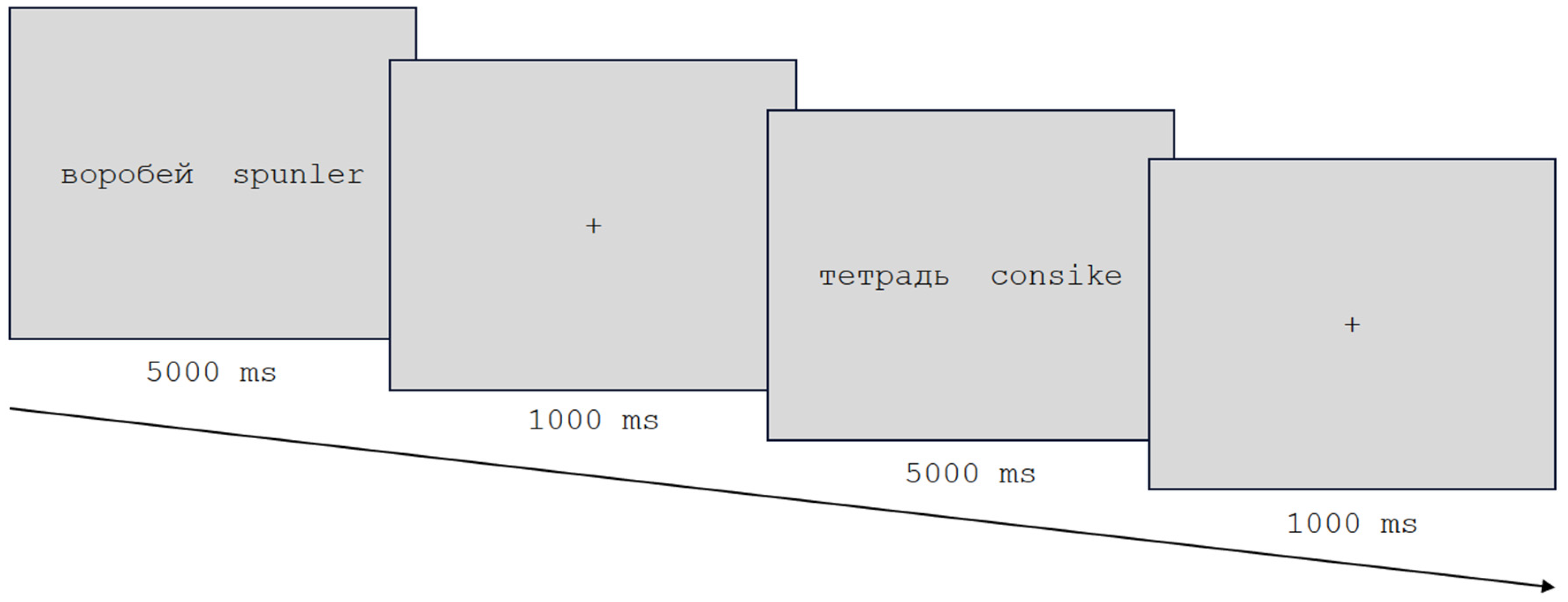
Figure 2.
Recall performance in 1-6 experimental series in the KWM use/no KWM use report. (a) Participants (n = 16) with higher RAPM score, (b) participants (n = 16) with lower RAPM score.
Figure 2.
Recall performance in 1-6 experimental series in the KWM use/no KWM use report. (a) Participants (n = 16) with higher RAPM score, (b) participants (n = 16) with lower RAPM score.
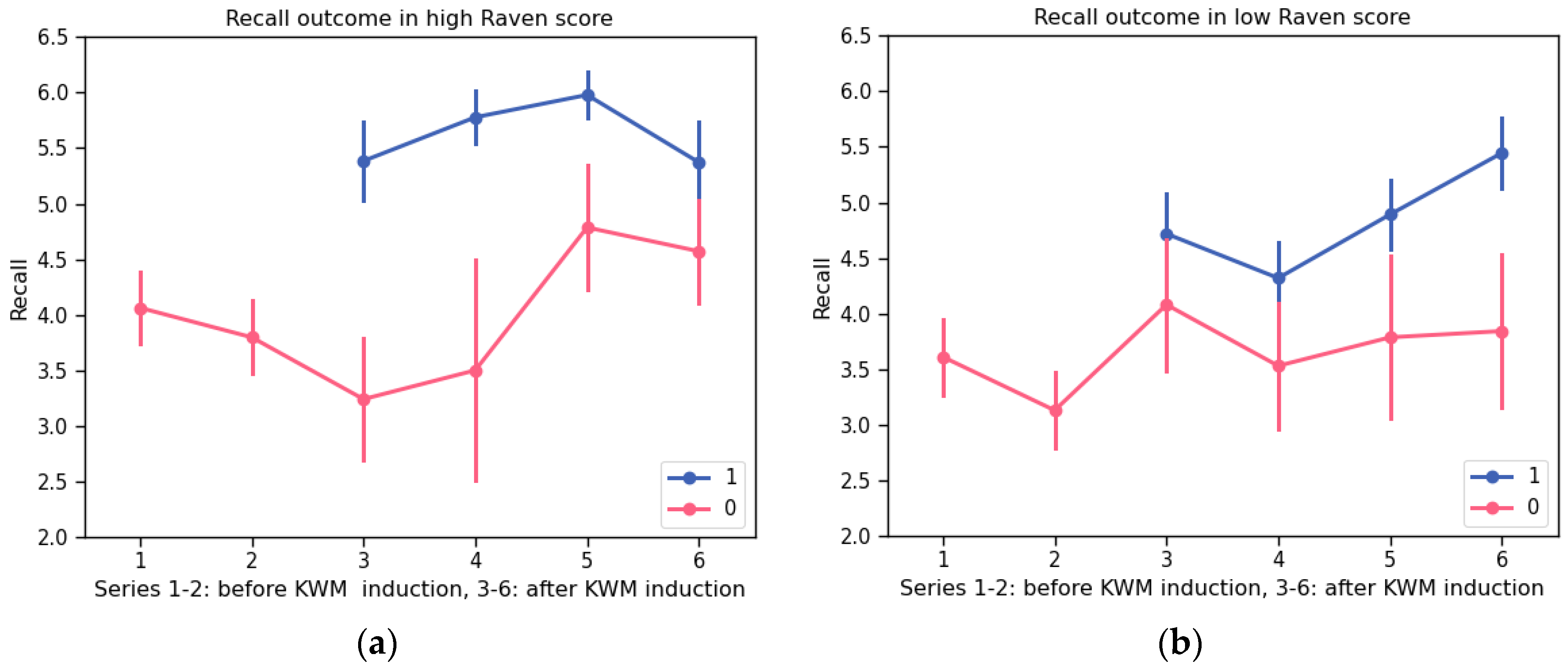

Table 1.
The two-way (strategies x intelligence) ANOVA results of the recall performance.
| F(1;512) | P | |
| KWM report (recall performance) | 37.3 | < 0.01 |
| RAPM score (recall performance) | 7.6 | < 0.01 |
| RAPM score x KWM report (recall performance) | 1.3 | =0.25 |
Table 2.
Eye movement measures in the pseudoword area of interest in KWM and no KWM report.
| t-statistic | p | Mean (SD) in KWM report |
Mean (SD) in no KWM report |
|
| AOI dwell time | 1.89 | =0.06 | 3.46 (0.17) | 3.5 (0.16) |
| AOI first fixation duration | 0.64 | =0.52 | 2.52 (0.21) | 2.51 (0.24) |
| AOI revisits | 0.93 | =0.35 | 0.4 (0.19) | 0.38 (0.21) |
| AOI mean fixation duration | 0.86 | =0.4 | 2.6 (0.12) | 2.61 (0.11) |
Disclaimer/Publisher’s Note: The statements, opinions and data contained in all publications are solely those of the individual author(s) and contributor(s) and not of MDPI and/or the editor(s). MDPI and/or the editor(s) disclaim responsibility for any injury to people or property resulting from any ideas, methods, instructions or products referred to in the content. |
© 2024 by the authors. Licensee MDPI, Basel, Switzerland. This article is an open access article distributed under the terms and conditions of the Creative Commons Attribution (CC BY) license (http://creativecommons.org/licenses/by/4.0/).
Copyright: This open access article is published under a Creative Commons CC BY 4.0 license, which permit the free download, distribution, and reuse, provided that the author and preprint are cited in any reuse.


