

Submitted:
09 May 2024
Posted:
09 May 2024
You are already at the latest version
Abstract
In areas with a deep floor plan, the distribution of natural light is not uniform. Consequently, relying solely on daylight may not suffice to meet the space's lighting requirements, necessitating the use of artificial lighting in darker areas. Therefore, a lighting system is needed that not only controls the glare near the windows but also increases the light at the end of the room and provides uniform daylight. One of the widely used systems is the “light shelf“which has three main functions: shading, increasing the depth of light penetration and reducing glare. Review articles about light shelves have been done in 2015 and 2017, while more than 80% of the studies have been carried out since 2016 and light shelves with more diverse forms and dynamic elements and many consolidations were proposed. Therefore, there is a need for a more comprehensive review. The main question of this research is how different parameters (including climate, material, ceiling and integrated systems) can help to increase the efficiency of light shelves. By using a systematic review, studies in the past three decades were classified in order to determine the effect of these parameters on improving lighting performance and controlling solar heat gain.
Keywords:
lightshelf
; daylighting
; solar heat gain
; energy use
; buildings
1. Introduction
Climate changes caused by the excessive consumption of fossil fuels in recent years make clear the necessity of replacing renewable energies, including the sun. One of the basic steps in this regard is the optimal use of daylight, which, while reducing energy consumption, improves the quality of space and also has significant effects on human mental and physical health. According to research conducted by the National Renewable Energy Laboratory (NREL), they investigated the impact of daylight exposure on individuals. They found that occupants working in full-spectrum office buildings reported an increase in general well-being. These specific office environments were associated with numerous advantages, such as improved health outcomes, decreased absenteeism rates, heightened productivity levels, cost savings, and a preference among employees for this type of workspace [1]. The distribution of daylight in spaces with a deep plan is not uniform; the part of the room that is near the window receives additional light, and there is not enough light in the other part, so daylight alone cannot provide the required light for the space. There is a need for artificial lighting to create enough light in the dark parts of the room. To solve this problem, we need a light system that, while shading near the window, increases the light at the end of the room. In recent years, there has been a growing interest in daylighting systems. Both traditional and modern architectural designs frequently use external overhangs and fins for several reasons. Firstly, they can effectively control solar heat gain by blocking the solar radiation before it reaches the window. Secondly, they maintain a visual connection with the outdoor environment, and lastly, they enhance daylighting performance by maximizing daylight admission while minimizing visual discomfort. [2] A “light shelf” is a passive light transmission system in the form of a horizontal shade, the upper surface of which is made of reflective materials, and while shading, increases the depth of light penetration and reduces electricity consumption.
1.1. A Brief Review of Light Shelves
Light shelves redirect a significant part of the light towards the ceiling and then reflect it into the room. In this way, glare near the window is minimized, and the light at the end of the room increases. This system divides the window into upper and lower parts. The main use of the lower part is to see outside and ventilate (view), and the upper part (clerestory) is for bringing light into the space [3]. Light shelves (in terms of placement) are divided into three general categories: internal, external, and a combination of both. The external part brings the function of shading and reducing the cooling load of the building in the summer, and the internal part provides more visual comfort against glare and directs the light deep into the room. The design of external light shelves should deal with rain runoff, dust and debris accumulation, which reduce the light shelf reflectivity [4]. In sunny weather, the internal shelf provides the highest average amount of illumination compared to external shelves. In contrast, the uniformity and distribution of illumination in the depth of the room is greater for external shelves [5]. In summer, when the sun is higher in the sky, light shelves primarily act as shading, and light penetration into the depth of space is limited. However, in winter, when the sun is lower in the sky, light is transmitted to a greater depth of space. (Figure 1)
1.2. Lightshelf Development Through History
Mirrors have been used since ancient times as a way to redirect sunlight. The first model of the light shelf was used in the Hagia Sophia Mosque in Turkey [6]. In the 6th century AD, reflective shelves were used to reflect sunlight to the inner surface of the dome. Forty windows all around the dome gave a mystical quality to the dome and increased its brightness. (Figure 2) In the late 19th century, reflectors were developed to increase indoor lighting, which was presented at the Berlin Trade Fair in 1889 [6]. (Figure 3) It is not yet known when the term "light shelf" was used, but the first research in this field was in the early 1950s at the Building Research Center to illuminate several deep-plan hospitals. The first one was Larkfield in Scotland, which was done with the aim of increasing the quality of daylight and creating visual comfort for patients. [3].
A lot of research has been done in the field of light shelves, several methods have been proposed to increase their efficiency, and many light shelf designs have been suggested. Review articles about light shelves have been done in 2015 and 2017 [3] [6], while more than 80% of the studies have been carried out since 2016 and light shelves with more diverse forms and dynamic elements and many consolidations were proposed. Therefore, there is a need for a more comprehensive review article in this field. In this research, using a systematic review, the studies in the last three decades were classified in order to obtain solutions to improve the lighting and thermal performance of light shelves. The research path is shown in Figure 4.
2. Materials and Methods
According to the studies, light shelves can affect the quality of daylight and the amount of energy consumption. Some research studies only evaluated the quality of light. In contrast, in order to achieve an optimal light shelf, it is necessary to pay attention to the light, solar heat gain and energy simultaneously. The variety of methods to increase the efficiency of light shelves, as well as the evaluated factors in studies, have made it difficult to choose the best option for light shelves, so this study systematically reviews the literature on the aspects of light shelves. The authors of this paper searched through three main databases: Science Direct, Taylor & Francis and ProQuest. The search terms are related to light shelf, daylight, energy consumption, and solar heat gain in articles, titles, abstracts, and keywords. The results were classified into seven categories shown in Table 1: the method of testing, defining the context of the research (daylight function of lightshelf, thermal function of lightshelf or an integrative approach), room properties (orientation, dimensions and utilization). In cases where the light shelf is integrated with other systems, the type of integrated system is mentioned.
3. Effective Factors in Light Shelves Performance
3.1. Latitude and Type of Sky
Latitude and sky conditions are important factors in the efficiency of light shelves. The performance of light shelves in cloudy skies is not as good as in sunny skies. (Figure 5) In climates with fully cloudy skies, such as England, they do not have good efficiency, although their shading performance in summer and light penetration in winter can be useful. [42] In one of the research studies, the efficiency of light shelves in different latitudes has been investigated. The greatest increase in daylight occurs in tropical climates that have more sunny hours per year [43] and do not penetrate deep into space, so the maximum depth of the room in these countries should not be considered more than 10 meters [43]. In cold climates, reflectors with a higher reflection coefficient can be used, while in hot climates, in order to prevent excess heat, combining the light shelf with other daylight systems such as shade louvers or using a low-emissivity coating on the light shelf is common. Interior light shelves are not suitable for hot climates because they allow the sun's rays to enter. [44]
3.2. Window Components
Since the light shelf is installed on the window, the optimal dimensions of the window must be obtained in the design. In a study conducted in China, the role of the form and deviation of the glass above the light shelf was discussed, and the wide glass at the top and narrow at the bottom with a deviation of 44.3 to 90 degrees was the best option to provide more brightness along uniformity [26]. (Figure 6)
By using smart windows, the amount of light, visibility, heating and cooling can be controlled, and glare can be prevented. The combination of these windows with light shelves will be very useful. So, window components also play an important role in ensuring the efficiency of the light shelf.
3.3. Dimensions, Types and Proportions of Light Shelves
According to project features, climatic conditions and users, the optimal dimensions and proportions of the light shelves are determined. Usually, the length of the shelves is the same as the windows but when the sun is entering from the sides, direct radiation should be avoided. So, the light shelf can be considered longer than the width of the window, or a piece can be added vertically from the sides [45]. For south-facing rooms, the depth of the internal shelf is approximately equal to the height of the window above the light shelf, and for rooms with a 20-degree deviation to the south, 1.5 to 2 times the height of the upper window is recommended [46]. The greater the depth of the light shelf, the less glare occurs, but the entry of light also decreases. If the height of the sun is low in the sky, we need a deeper shelf to reflect more light into the ceiling. Light shelves may block the area covered by fire sprinklers, so either their maximum depth should not be more than 120 cm or sprinklers on the light shelf itself should be used [44].
Regarding the installation height, the light shelf should be above the eye height (about 2 meters from the ground) to prevent glare. The light shelves are classified into four categories in terms of the shape of reflectors: flat, angular, curved and wavy. (Figure 7) The wavy mode has a better performance due to the depth of light penetration and the quality of light distribution; it reflects more uniform light in the space.
In angled light shelves, if the slope is outward, the shading on the lower window is increased but prevents the penetration of light, while if its slope is inward, the depth of light penetration is increased, and the shading is reduced. (Figure 8) A horizontal light shelf usually provides an optimal condition for the required shading and daylight distribution [44].
3.4. Type of Ceiling
The ceiling is an important part of the system because light shelves redirect the light towards the ceiling and then reflect it into the room [5]. In research, Freewan stated that the curvature in the ceiling has a significant effect (10%) on the uniformity of the light [22]. In another study, considering the three sloping, pitched and curved ceilings, it was concluded that the curved ceiling and then the pitched ceiling increase the amount of light in the depth of the room, and these two are better than the flat and sloping ceiling [24]. (Figure 9) Gabled and curved ceilings that have upward slopes through the window towards the center of the space increase the penetration of light inside. Although the ceiling with a glossy surface reflects more light into the space, it is necessary to avoid the reflection of the ceiling's radiation, therefore, it is better to have a white and matte color on the ceiling [5].
3.5. The Type of Reflectors
The performance modes of reflectors can be summarized in mirror, semi-mirror and matte surfaces. (Figure 10) Semi-mirror (foil) surfaces on the light shelf perform best. Although the mirror surface provides more light, it has a negative effect on the attractiveness and quality of the space, especially because of the reflection on the computer monitors. At the same time, it is heavy, expensive and difficult to install [43]. Soler and Claros have investigated the methacrylate and mirror materials on the surface of light shelves and concluded that in the middle months of the year the shelf with methacrylate material and in the early months of the year, the mirror shelf perform better. The average changes made by methacrylate material are less than mirror material [47].
3.6. Combined Other Lighting Systems with Light Shelves
Based on the type of climate and location, to prevent glare and solar heat gain, it may not be enough to use only a light shelf. It is suggested to use a combination of other daylight systems with a light shelf. These systems can be horizontal and vertical shades, a set of mirrors, solar cells, light scattering plates, louvres, or light pipes and can be fixed or dynamically combined with light shelves. The systems’ function and their efficiency are explained below.
3.6.1. combination of Light Shelves with Vertical and Horizontal Shades
In Abboushi's master's thesis, an optimal combination of horizontal and vertical dynamic shades with a light shelf was presented. In his model, the use of horizontal and vertical shades that change throughout the year while adding a low-e coating on light shelves in hot and dry weather can prevent the increase in the cooling load and improve the increase in useful light. [2] (Figure 11)
3.6.2. Combining the Light Shelf with a Set of Mirrors
In another type of combined light shelf, in order to change the direction of sunlight, the light shelf is combined with a set of mirrors that can move in two axes based on the direction of sunlight using a solar tracker [48]. Research results show that the reduction of room energy consumption when using movable mirrors is 17-35% more than fixed mirrors. [48] (Figure 12)
3.6.3. Combining the Light Shelf with Louvers
In another study, with the introduction of the FLS (Fragmented Light Shelf), the combination of light shelf and louver was found to be effective in reducing glare and creating uniform light in the space. [48] Research in Athens suggested a combination of angled light shelves (with an angle of 10 to 20 degrees) and louvers instead of the usual school curtains to improve the quality of light in classrooms. In this design, a light shelf is placed with louvers with a light transmission factor of 30%. Its advantage over common curtains in schools is to increase the visibility to the outside, not causing glare and the uniformity of light. [15] (Figure 13)
3.6.4. Combination of the Light Shelf with Prism Sheets (Diffusion Sheet)
In another type of integrated light shelves, diffusion sheets are used to reduce glare (especially in curved and sloping light shelves). This screen can be placed on the external light shelf or on the upper window. (Figure 14)The results show that the use of a prism sheet on the window above the light shelf with an angle of 30 degrees in autumn and spring and 20 degrees in winter increases the uniformity of light and eliminates glare. [18] In another research, by adding a diffusion sheet to the upper window, the light uniformity increased by 4.6% and energy consumption was saved by 2.9%. [17]
3.6.5. Combination of the Light Shelf with Solar Cells
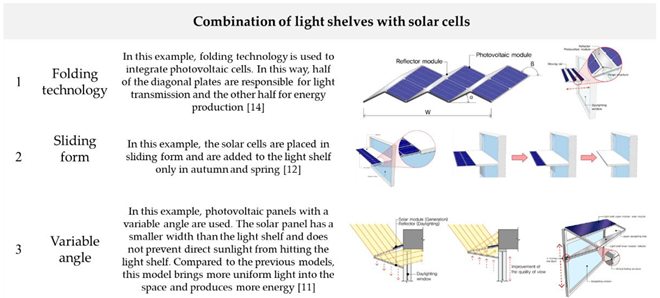
Another category of combined light shelf is combined with photovoltaic cells. The combination of light shelf and solar cells is classified into 3 categories: 1- Using folding technology to add solar cells, 2- Add sliding solar cells and 3- Using variable angle solar cells. (Table 2) Since it is not possible to increase the efficiency of the lighting system and electricity generation simultaneously, in one of the examples, folding technology has been used to combine them. In this way, half of the diagonal plates are responsible for light transmission and the other half for energy production [14]. It should be noted that the photovoltaic panels themselves produce a significant amount of heat that can affect the energy consumption of the room. The results of the research show that the combination of solar cells with a light shelf in summer is not effective due to the high air temperature. In winter, due to the angle of the sun's rays, the level of light uniformity is reduced, not only the energy consumption is not reduced but also increased. Therefore, in one of the researches, solar cells are placed in sliding form and are added to the light shelf only in autumn and spring [12]. In another example, to increase the efficiency of solar cells, photovoltaic panels with a variable angle have been used. The solar panel has a smaller width than the light shelf and does not block direct sunlight. This example of integrating a light shelf with solar cells brings more uniform light into the space and produces more energy than the previous integrated examples. [14]
3.6.6. Combination of the Light Shelf with Horizontal Light Pipe
In one of the research, in order to increase the depth of light penetration in a high-rise office building with a deep plan in Malaysia, a light shelf (with an angle of -15 degrees) was combined with a horizontal semi-cylindrical light pipe. Two valves with an area of 2 square meters were installed on it. (Figure 16) This combination reduces the intense glare near the window and also transmits the light to the depth of the space. [8]
3.7. Using Dynamic Components
Light shelves are divided into two general categories: Dynamic and Static light shelves. Considering that the daylighting condition of the environment around the building changes in the short term (day length) and long term (seasons), the dynamic light shelves correspond to the changes in the movement of the sun. At different hours of the day, they adjust their movements to meet the needs of users and create optimal conditions inside the space. These systems can be operated automatically or by the user. Static light shelves are cheaper than dynamic light shelves and require less maintenance. At the same time, dynamic systems can be accessible for cleaning and dust removal with their height changes or the ability to be installed and dismantled. Cleaning the dust on the surface of the light shelf helps to increase its efficiency. Dynamic light shelves can be of different types with variable angles, inner and outer shelf depths, or reflector’s material. (Figure 17) The efficiency and performance of each are explained below:
3.7.1. Changing the Angle of the Light Shelf in Different Seasons of the Year
In one type of dynamic light shelf, while combining the light shelf with a horizontal shade, the angle of the external light shelf is changed throughout the year. The depth of the horizontal shade is also variable, and considering a rectangular hole in it, the light shines directly on the light shelf. By using this system, while preventing the increase of indoor air temperature, through blocking direct sunlight, more uniform light enters the space and energy consumption is reduced. [24]
3.7.2. Changing the Depth of the Inner and Outer Shelves
In research by Bani Rafael, three modes of lightshelves: 1. Fixed shelf, 2. Fixed internal and movable external shelves, and 3. Internal and external movable shelves are considered. He showed that the third mode saves 12% more energy than the first mode [49]. In another research the inner shelf is movable and is separated in the summer season to provide the required light. In one of the examples, in addition to the variable depth of the light shelf in different seasons, the number of light shelves was also variable [33].
3.7.3. Changing the Reflectivity of the Light Shelf
In one of the studies, in addition to the different angles of the reflective surface, the amount of reflection is also considered to be changed in different seasons. In this way, the reflection rate of the reflector is considered to be 97% in summer, spring and autumn and 85% in winter. The results show that changing the type of reflector throughout the year will have a significant effect on reducing energy consumption [25].
4. Results
4.1. Space Utilization
Figure 18 shows the space utilization in the studies. The use of spaces was classified into commercial, educational, residential, official and health categories. Since the occupied time of offices and educational spaces is during daylight time, most of the studies investigated official spaces (24%) and then educational spaces (21%). In many studies, the utilization was unknown (43%), which can be considered as one of the gaps because different utilization requires different lighting characteristics, and ignoring these factors means omitting important variables. Many studies carried out in educational places have often ignored the effect of the height of the work plane on light shelf proportions and have considered a work plane with a fixed height for different educational levels.
4.2. Dispersion of Research Methods
The diagram below shows the distribution of the methods used in the studies. The methods to evaluate the performance of the light shelf can be divided into 2 parts: 1-Using the artificial sky or under the real sky by making a model on a smaller scale or a real scale and 2-Simulation with software, including Ecotect software and Honeybee, Ladybug and Climate Studio plugins). Among the methods, computer simulation is in the first place (around 49%) due to the progress of various software in recent years. It is better to use different methods at the same time and compare the results. (Figure 19)
4.3. The Parameters Investigated in the Studies
In Figure 20, the distribution of the investigated parameters in the research has been examined. Most of the studies have focused on optimization with the aim of improving the lighting quality, while a large part of them have been done on the combination of these systems with photovoltaic panels. In these studies, it is very important to pay attention to the heat produced by the panels. In addition to increasing the temperature of the room, these panels become less efficient and produce less energy. Therefore, it is essential to consider the thermal comfort in such studies. Among the studies, 49% only focused on improving the quality of daylight, 6% only examined energy consumption, 33% were concerned with lighting quality and energy consumption at the same time, and only 9% of studies investigated daylight quality, thermal comfort and energy consumption simultaneously. The indicators examined in the studies are shown in Figure 20.
4.4. Orientation Considered in the Studies
Most of the research conducted in the northern hemisphere investigated the effect of the light shelf in the south windows, which receives direct sunlight. (Figure 21) Various studies have shown that the use of a light shelf on the southern front is the most effective and has no advantage on other fronts. Vertical light shelves have been proposed for the east and west orientations by some studies.
5. Conclusion
According to the examined samples, we reach important results about light shelves:
- • Based on the type of climate and the location of the room, to prevent glare and the entry of excess heat, it may not be enough to use only a light shelf and a combination of other daylight systems with a light shelf is suggested. These systems can be horizontal and vertical shades, a set of mirrors, solar cells, light scattering plates, louvers or light pipes and can be fixed or dynamically combined with light shelves. Since each of these systems can bring more or less light into space or even produce heat like solar cells, considering thermal comfort in this field is essential.
- • Since round or angled light shelves perform better than flat light shelves, but the probability of glare is higher in such shelves, one of the solutions can be combining the light shelf with a daylight diffusion sheet. These surfaces can be installed on the external light shelf or on the window above the light shelf or used as a horizontal semi-transparent screen along the light shelf. The results of the conducted research show that installing this screen on the window above the light shelf has better distribution of light in the space and has a higher efficiency than placing it on the light shelf. Due to the fact that in the winter season, the use of these panels may reduce the entry of natural light and, as a result, increase the building's heating load, it is better to separate this panel from the light shelf in the winter.
- • For hot climates, it is more suitable to use louvers, horizontal and vertical shades and daylight scattering screens, which, while preventing glare, introduce less heat into the environment. In order to avoid increasing the cooling load, it is suggested to use light shelves in combination with low emissivity coating, PCM materials or materials with high thermal delay. Also, it is better to use shades with variable depth that, while providing shade in the summer, do not prevent the sunlight from entering the cold seasons. For colder climates, it is more appropriate to use a daylight-diffusing surface in line with the light shelf inside the room.
- • Sometimes, to change the direction of the sun's rays, light shelves can be combined with a set of mirrors. In this case, if these mirrors have a solar tracking system and change the angle based on the direction of the sun, they have a higher efficiency.
- • Light shelves can be integrated with solar cells. Solar cells produce a significant amount of heat and may affect the cooling load of the building. As the temperature rises, the efficiency of solar cells decreases, so it is not recommended to use them in the summer season. In the winter season, due to the oblique radiation of the sun, these systems are practically ineffective, so it is better to use dynamic systems in such a way that in the summer and winter seasons, the solar cells are separated from the light shelf and combined only in the spring and autumn seasons. The angle of the sun's radiation to the solar cells will be very important in their efficiency, so using a system that can adjust the angle of the solar panels according to the angle of the sun's radiation will be very effective. Another thing worth mentioning in the integration of solar cells is that with the passage of time and dust sitting on the solar cells, their efficiency decreases. Therefore the economic analysis regarding the efficiency of the cells should be taken into consideration.
Author Contributions
writing—original draft preparation, Sh.M.; Reviewing and Editing, SM.H., ZZ and Sh.A; All authors have read and agreed to the published version of the manuscript.
Data Availability Statement
No additional data is available.
Acknowledgments
We would like to acknowledge that this study is a part of our contribution to the project titled: "EUDP 2023-I Deltagelse i IEA SHC 70 Low carbon, High comfort integrated lighting.".
Conflicts of Interest
The authors declare no conflicts of interest.
References
- Edwards, L. and Torcellini, P. (2002). A Literature Review of the Effects of Natural Light on Building Occupants .Contract, No. 55 (2002). [CrossRef]
- Abboushi, Belal Khalid .(2013). The effects of adaptive shading and the selective reflector light shelf on office building energy efficiency and daylight performance in hot arid regions. Arizona: College of Architecture, Planning, and Landscape Architecture, The University of Arizona.: Arizona, USA.
- Motazedian, F., & Mahdavinejad, M. (2015). Light Shelves’ Typology and their Characteristics. Armanshahr Architecture & Urban Development.
- Kwok,Alison G., and Walter T. Grondzik. 2011. The green studio handbook environmental strategies for schrmatic design. Amesterdam: Elsevier. [CrossRef]
- Liliana, O. B., Lee, E.S., Papamichael, K. and Selkowitz, S., 1994. The design and evaluation three advanced daylighting systems: Light shelves, light pipes and skylights. Proceedings of the Solar 94’ Golden opportunities for solar prosperity, San Jose, 25-30 June.
- Kontadakis, Antonis , Tsangrassoulis , Aris , Doulos , Lambros and Zerefos , Stelios (2018).A Review of Light Shelf Designs for Daylit Environment. Sustainability. Vol. 10. No. 71. [CrossRef]
- Tageslichtreflector. Available online: https://commons.wikimedia.org/wiki/File:L-Tageslichtreflector.png(accessed on 5 November 2017).
- Sern, C. H. Y., Liou, L. T. K., Jun, B. J., & Fadzil, S. F. B. S. (2023). Daylight Performance of Integrated Horizontal Light Pipe with Shading Devices (Validation) for High-Rise Building in Tropical Climate. Journal of Advanced Research in Applied Sciences and Engineering Technology, 33(1), 384-391. [CrossRef]
- Dogan, Timur, & Stec, Peter. (2016). Prototyping a façade-mounted, dynamic, dual-axis daylight redirection system. Lighting Research & Technology, 50(4), 583-595. [CrossRef]
- Lee, Sunwoo, & Lee, Heangwoo. (2021). A Preliminary Study on Daylighting Performance Experiment of External Lightshelf System with a Base-Attached PV Panel. Journal of Green Engineering, 11, 1909-1925. [CrossRef]
- Lee, Hyunmin., Baek, Songi and Lee, Heangwoo. (2022). A study on the application of solar modules to light shelves to improve generation and daylighting efficiency. Energy and Buildings, 261, 111976. [CrossRef]
- Lee, Heangwoo, Zhao, Xiaolong and Seo, Janghoo. (2021). A study of optimal specifications for light shelves with photovoltaic modules to improve indoor comfort and save building energy. International Journal of Environmental Research and Public Health, 18(5), 2574. [CrossRef]
- Mesloub, Abdelhakim and Ghosh, Aritra. (2020). Daylighting performance of light shelf photovoltaics (LSPV) for office buildings in hot desert-like regions. Applied sciences, 10(22), 7959. [CrossRef]
- Lee, Heangwoo, Han, Sowon, & Seo, Janghoo. (2022). Light shelf development using folding technology and photovoltaic modules to increase energy efficiency in building. Buildings, 12(1), 81. [CrossRef]
- Meresi, Aik.(2016). Evaluating daylight performance of light shelves combined with external blinds in south-facing classrooms in Athens, Greece. Energy and Buildings, 116, 190-205. [CrossRef]
- Brzezicki, Marcin. (2021). An Evaluation of Useful Daylight Illuminance in an Office Room with a Light Shelf and Translucent Ceiling at 51 N. Buildings, 11(11), 494. [CrossRef]
- Lee, Heangwoo, Seo, Janghoo and Kim, Suktae. (2018). Improvement of light-shelf performance through the use of a diffusion sheet. Building and Environment, 144, 248-258. [CrossRef]
- Lee, Heangwoo and Seo , Janghoo (2020). Performance Evaluation of External Light Shelves by Applying a Prism Sheet. Energies , 13(18),4618. [CrossRef]
- Bakmohammadi, P., & Noorzai, E. (2022). Investigating the optimization potential of daylight, energy and occupant satisfaction performance in classrooms using innovative photovoltaic integrated light shelf systems. Science and Technology for the Built Environment, 28(4), 467-482. [CrossRef]
- Lee, Heangwoo, Jang, Hyang-In and Seo, Janghoo. (2018). A preliminary study on the performance of an awning system with a built-in light shelf. Building and environment, 131, 255-263. [CrossRef]
- Mahdavinejad, M., Tahbaz, M., & Dolatabadi, M. (2016). Optimization of Properties and Light Shelf System in Architecture of Learning Building. Journal of Fine Arts: Architecture & Urban Planning, 21(2), 81-92. [CrossRef]
- Freewan. AA (2010). Maximizing the Lightshelf Performance by Interaction between Litshelf Geometries and a Curved Ceiling. Energy Conversion and Management, 51(8), 1600-1604. [CrossRef]
- Labib, R. (2015). Trade-off method to assess the interaction between light shelves and complex ceiling forms for optimized daylighting performance. Advances in Building Energy Research, 9(2), 224-237. [CrossRef]
- Freewan, A. A., Shao. L., & Riffat, S. (2008). Optimizing Performance of the Lightshelf by Modifying Ceiling Geometry in Highly Luminous Climate. Solar Energy, 82(4), 343-353. [CrossRef]
- Lee, H. (2020). A basic study on the performance evaluation of a movable light shelf with a rolling reflector that can change reflectivity to improve the visual environment. International journal of environmental research and public health, 17(22), 8338. [CrossRef]
- Xue, P., Mak, C.M., & Cheung, H.D. (2014). New Static Lightshelf System Design of Clerestory Windows for Hong Kong. Building and Environment, (72), 368-376. [CrossRef]
- Moazzeni, M. H., & Ghiabaklou, Z. (2016). Investigating the influence of light shelf geometry parameters on daylight performance and visual comfort, a case study of educational space in Tehran, Iran. Buildings, 6(3), 26. [CrossRef]
- Lee, H., Seo, J., & Choi, C. H. (2019). Preliminary study on the performance evaluation of a light shelf based on reflector curvature. Energies, 12(22), 4295. [CrossRef]
- Nassiri, B., & Mahmodi, Z. M. (2020). Achieving the Principles of High Performance of Light Shelves Design in Educational Buildings.
- Ruggiero, S., Assimakopoulos, M. N., De Masi, R. F., de Rossi, F., Fotopoulou, A., Papadaki, D.,& Ferrante, A. (2021). Multi-disciplinary analysis of light shelves application within a student dormitory refurbishment. Sustainability, 13(15), 8251. [CrossRef]
- Kurtay, C., & Esen, O. (2017). A new method for light shelf design according to latitudes: CUN-OKAY light shelf curves. Journal of Building Engineering, 10, 140-148. [CrossRef]
- Moon, J. W., Baik, Y. K., & Kim, S. (2020). Operation guidelines for daylight dimming control systems in an office with lightshelf configurations. Building and Environment, 180, 106968. [CrossRef]
- Lim, Y. W., & Heng, C. Y. S. (2016). Dynamic internal light shelf for tropical daylighting in high-rise office buildings. Building and Environment, 106, 155-166. [CrossRef]
- Ebrahimi-Moghadam, A., Ildarabadi, P., Aliakbari, K., Arabkoohsar, A., & Fadaee, F. (2020). Performance analysis of light shelves in providing visual and thermal comfort and energy savings in residential buildings. Journal of the Brazilian Society of Mechanical Sciences and Engineering, 42, 1-18. [CrossRef]
- Sok, T., & Tuaycharoen, N. Effect of multiple curved light shelves on daylighting in university classrooms.
- Bahdad, A. A. S., Fadzil, S. F. S., Onubi, H. O., & BenLasod, S. A. (2021). Sensitivity analysis linked to multi-objective optimization for adjustments of light-shelves design parameters in response to visual comfort and thermal energy performance. Journal of Building Engineering, 44, 102996. [CrossRef]
- Mangkuto, R. A., Feradi, F., Putra, R. E., Atmodipoero, R. T., & Favero, F. (2018). Optimisation of daylight admission based on modifications of light shelf design parameters. Journal of Building Engineering, 18, 195-209. [CrossRef]
- Heangwoo Lee, Seonghyun Park, and Janghoo Seo, (2017) .Development and Performance Evaluation of Light Shelves Using Width-Adjustable Reflectors,2017, Hindawi. [CrossRef]
- Bahdad, A. A. S., Fadzil, S. F. S., & Taib, N. (2020). Optimization of daylight performance based on controllable light-shelf parameters using genetic algorithms in the tropical climate of Malaysia. Journal of Daylighting, 7(1), 122-136. [CrossRef]
- Ziaee, N., & Vakilinezhad, R. (2022). Multi-objective optimization of daylight performance and thermal comfort in classrooms with light-shelves: Case studies in Tehran and Sari, Iran. Energy and Buildings, 254, 111590. [CrossRef]
- Öner, M., & Kazanasmaz, Z. T. (2019). Illuminance and luminance based ratios in the scope of performance testing of a light shelf-reflective louver system in a library reading room. Light and Engineering. [CrossRef]
- Littlefair, P.J. (1995) Light Shelves: Computer Assessment of Daylighting Performance. Lighting Research and Technology, 27(2), 79-91. [CrossRef]
- Burt Hill Kosar Rittlemann Associates. (1985). Thermal and Optical Performance Characteristics of Reflective Light Shelves in Buildings Problem: Design of a Light Shelf, Architectural Science Review, 40(1) 17-21.
- Ghiyabaklou,Z, (2015). Fundamentals of Building Physics 5, Academic Jihad of Amir Kabir University of Technology.
- Evans, B. H. (1981). Daylight in architecture. [CrossRef]
- Dowlatabadi, M. (2013). Energy Consumption Optimization Using Daylight in Educational Classrooms.
- Claros, S. T., & Soler, A. (2001). Indoor daylight climate-comparison between light shelves and overhang performances in Madrid for hours with unit sunshine fraction and realistic values of model reflectance. Solar energy, 71(4), 233-239. [CrossRef]
- Perez, Marlix, Otezia, Pilar and Neila, Javier. (2012, November). Fragmented Light Shelf: Sun protection system and daylighting optimization. In 28th International PLEA Conference. Lima, Perú (pp. 1-5).
- Raphael, B. (2011). Active Control of Daylighting Features in Buildings. Computer-Aided Civil and Infrastructure Engineering, (26), 393-405. [CrossRef]
- Abimaje, J., Kandar, M. Z. B., & Aminu, D. Y. (2018). Light shelf as a daylighting system in a tropical climate office space. International Journal of Engineering & Technology, 7(2.29), 798-803.
- Alkhatatbeh, B. J., Kurdi, Y., & Asadi, S. (2023). Multi-objective optimization of classrooms’ daylight performance and energy use in US Climate Zones. Energy and Buildings, 297, 113468. [CrossRef]
- Cunningham, Patrick ,Zaferiou ,Paul and Lagios, Kera.(2014). A Case Study in Reflective Daylighting. Research Journal. Vol 06.01.
- Ebrahimi-Moghadam, A., Ildarabadi, P., Aliakbari, K., & Fadaee, F. (2020). Sensitivity analysis and multi-objective optimization of energy consumption and thermal comfort by using interior light shelves in residential buildings. Renewable Energy, 159, 736-755. [CrossRef]
- Faraji, A., Rezaei, F., Rahnamayiezekavat, P., Rashidi, M., & Soleimani, H. (2023). Subjective and Simulation-Based Analysis of Discomfort Glare Metrics in Office Buildings with Light Shelf Systems. Sustainability, 15(15), 11885. [CrossRef]
- Franco, I. M. (2007). Efficacy of light shelves: Passive, dynamic and automatic devices related to light and thermal behavior. Thermal Performance of Exterior Envelopes of Whole Buildings X.
- Joarder, M. A. R., Ahmed, Z. N., Price, A., & Mourshed, M. (2009). A simulation assessment of the height of light shelves to enhance daylighting quality in tropical office buildings under overcast sky conditions in Dhaka, Bangladesh.
- Kostantoglou, M., & Tsangrassoulis, A. (2012, October). Performance evaluation of an automatically controlled light-shelf. In Proceedings of the 5th Balkan Light Conference, Belgrad, Serbia (pp. 3-6).
- Lim, T., Yim, W. S., & Kim, D. D. (2020). Evaluation of daylight and cooling performance of shading devices in residential buildings in South Korea. Energies, 13(18), 4749. [CrossRef]
- Lim, Y. W., & Ahmad, M. H. (2015). The effects of direct sunlight on light shelf performance under tropical sky. Indoor and Built Environment, 24(6), 788-802. [CrossRef]
- 46.Mohamed Ali Jama, (2019). the effects of direct daylight on light shelfs performance A comparison study between building cases located in temperate zone, subtropical zone and tropical zone, Master Thesis, Aalborg University Copenhagen. [CrossRef]
- Mousavi, Seyed Mohammad, Khan, Tareef Hayat and Mohammadi, Amin. (2021). Adjustable Internal Shading for Home Office Daylighting in Tropical Climates. International Journal of Design & Nature and Ecodynamics, Vol. 16, No. 6. [CrossRef]
- Noshin, S., Kanwal, H., & Ahmad, A. (2020). A comparative study on daylight performance assessment of light shelves based on inclination. Mehran University Research Journal Of Engineering & Technology, 39(4), 800-805. [CrossRef]
- Oteiza, P., Orozco, S., Pérez, M., Bedoya, C., & Neila, J. (2011, November). Optimized Modular window as a sustainable and industrialized solution for indoor daylighting. In Linköping (Suecia): World Renewable Energy Congress.
- Raphael, B. (2014). Control of an Adaptive Light Shelf Using Multi Objective Optimization. 31st ISARC, Sydney, Australia, 81-87. [CrossRef]
- Sabbagh, M., Mandourah, S., & Hareri, R. (2022). Light Shelves Optimization for Daylight Improvement in Typical Public Classrooms in Saudi Arabia. Sustainability, 14(20), 13297. [CrossRef]
- Salem Bahdad, A. A., Syed Fadzil, S. F., Onubi, H. O., & BenLasod, S. A. (2022). Balancing daylight in office spaces with respect to the indoor thermal environment through optimization of light shelves design parameters in the tropics. Indoor and Built Environment, 31(7), 1963-1985. [CrossRef]
- Schuman, J., Rubinstein, F., Papamichael, K., Beltran, L., Lee, E.S., & Selkowitz, S. (1992). Technology Reviews Daylighting Optical Systems. AIIM, Maryland, 27-29.
- Sorooshnia, E., Rahnamayiezekavat, P., Rashidi, M., Sadeghi, M., & Samali, B. (2023). Passive Intelligent Kinetic External Dynamic Shade Design for Improving Indoor Comfort and Minimizing Energy Consumption. Buildings, 13(4), 1090. [CrossRef]
- Warrier, G. A., & Raphael, B. (2017). Performance evaluation of light shelves. Energy and Buildings, 140, 19-27. [CrossRef]
- Zaky, H. U. A., Dewi, O. C., & Sulistiani, C. D. (2023). Daylight And Artificial Lighting Integration In Achieving Lighting Uniformity In Educational Building. Journal of Architectural Research and Design Studies, 7(1), 40-49. [CrossRef]
- Lee, H., Kim, K., Seo, J., & Kim, Y. (2017). Effectiveness of a perforated light shelf for energy saving. Energy and Buildings, 144, 144-151. [CrossRef]
Figure 1.
Light shelf Performance in Summer (Left) and Winter (Right).
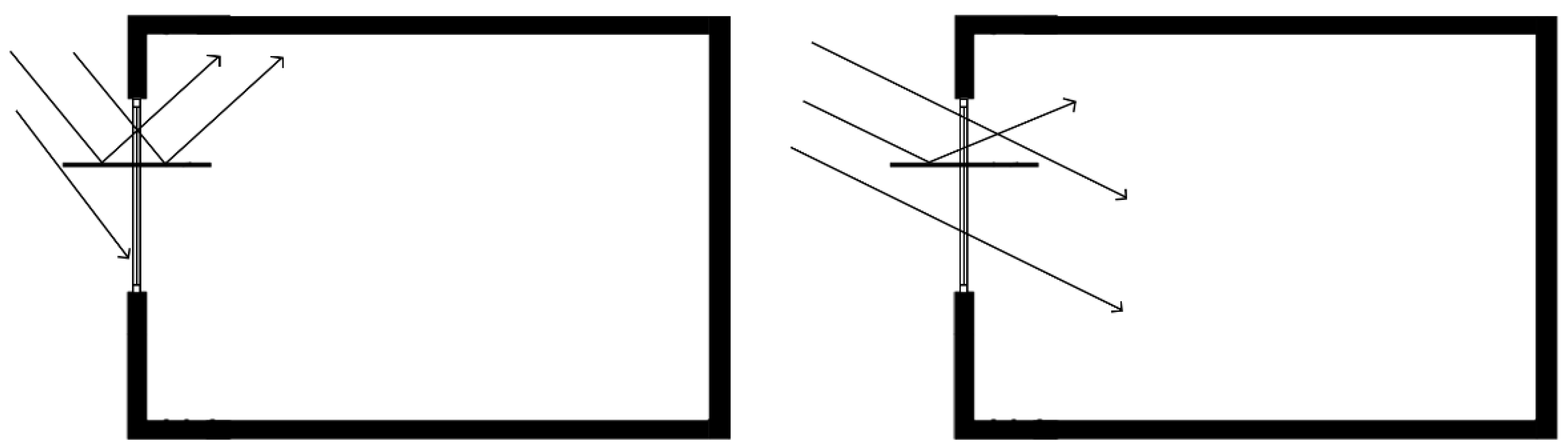
Figure 2.
Schematic representation of the parapet of Hagia Sophia based on Anthemius’s reflector superimposed over the cross-section of the original dome [6].
Figure 2.
Schematic representation of the parapet of Hagia Sophia based on Anthemius’s reflector superimposed over the cross-section of the original dome [6].
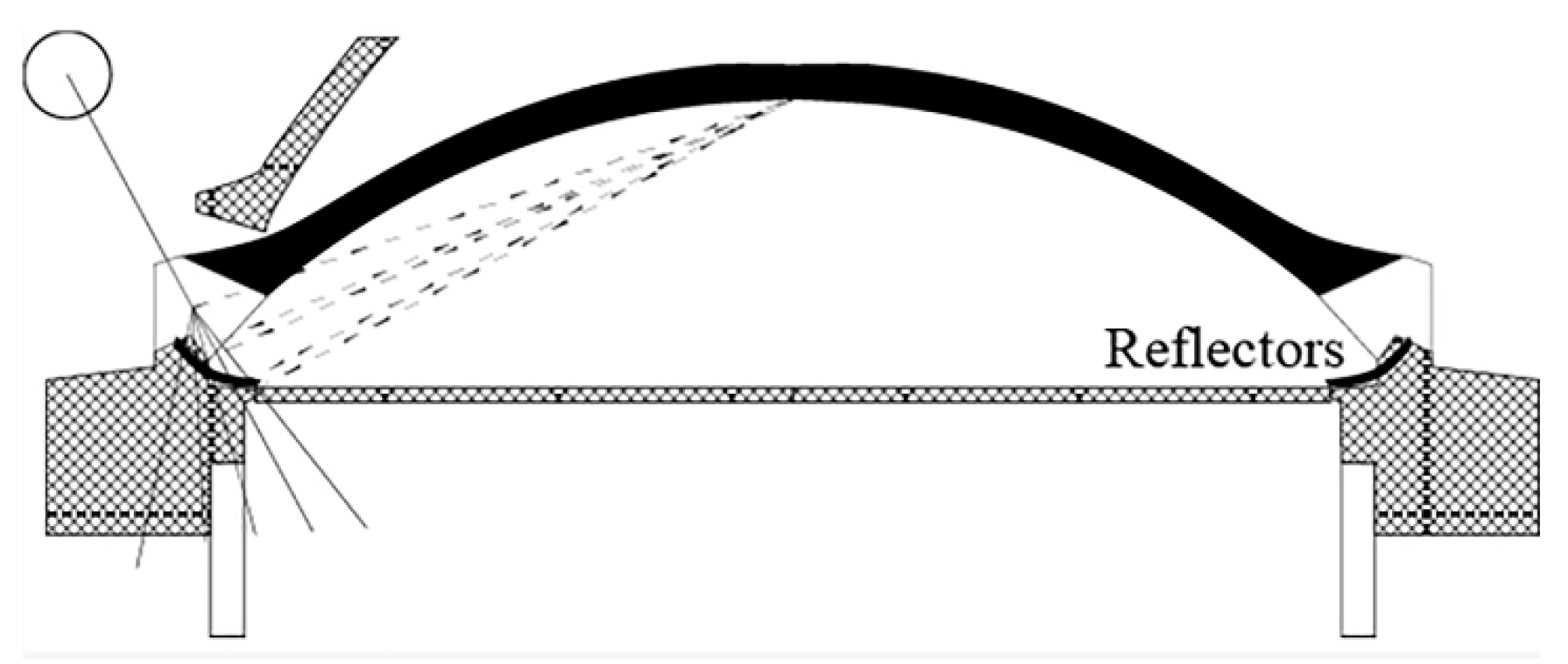
Figure 3.
Daylight reflector by W. Hanifch and Co. [7].
Figure 3.
Daylight reflector by W. Hanifch and Co. [7].
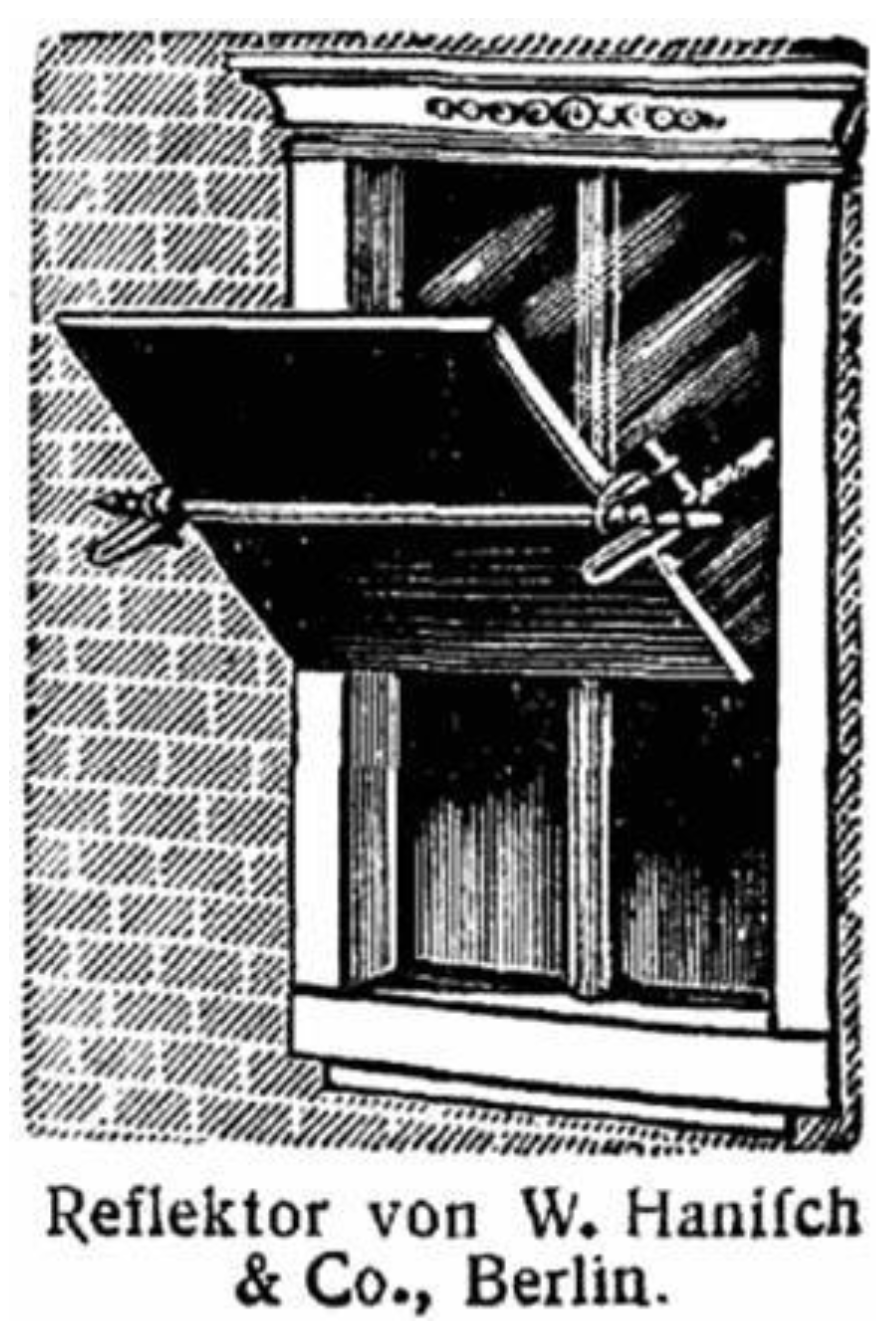
Figure 4.
The research path.
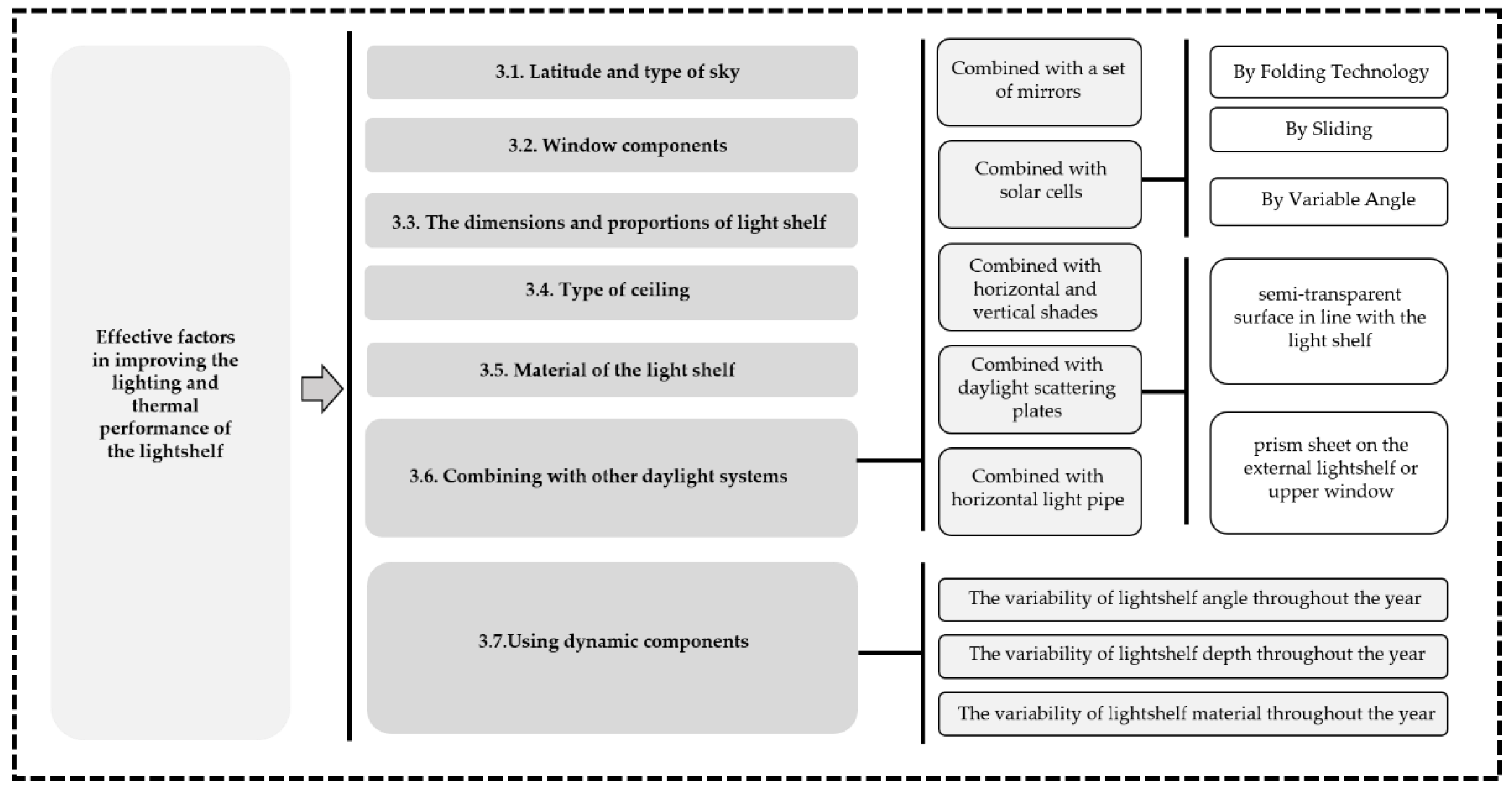
Figure 5.
Various interior radiance renderings of a south-oriented room with dimensions 4 × 6 × 3 m and a window-to-floor ratio equal to 20% equipped with (a) No light shelf under overcast sky; (b) Perfectly diffuse external horizontal light shelf with 0.5 m depth (reflectance 0.8), under overcast sky; (c) Perfectly diffuse external horizontal light shelf with 0.5 m depth, under clear sky conditions, sun’s elevation 37.8◦; (d) Like; (c) but with mirror external horizontal light shelf [6].
Figure 5.
Various interior radiance renderings of a south-oriented room with dimensions 4 × 6 × 3 m and a window-to-floor ratio equal to 20% equipped with (a) No light shelf under overcast sky; (b) Perfectly diffuse external horizontal light shelf with 0.5 m depth (reflectance 0.8), under overcast sky; (c) Perfectly diffuse external horizontal light shelf with 0.5 m depth, under clear sky conditions, sun’s elevation 37.8◦; (d) Like; (c) but with mirror external horizontal light shelf [6].
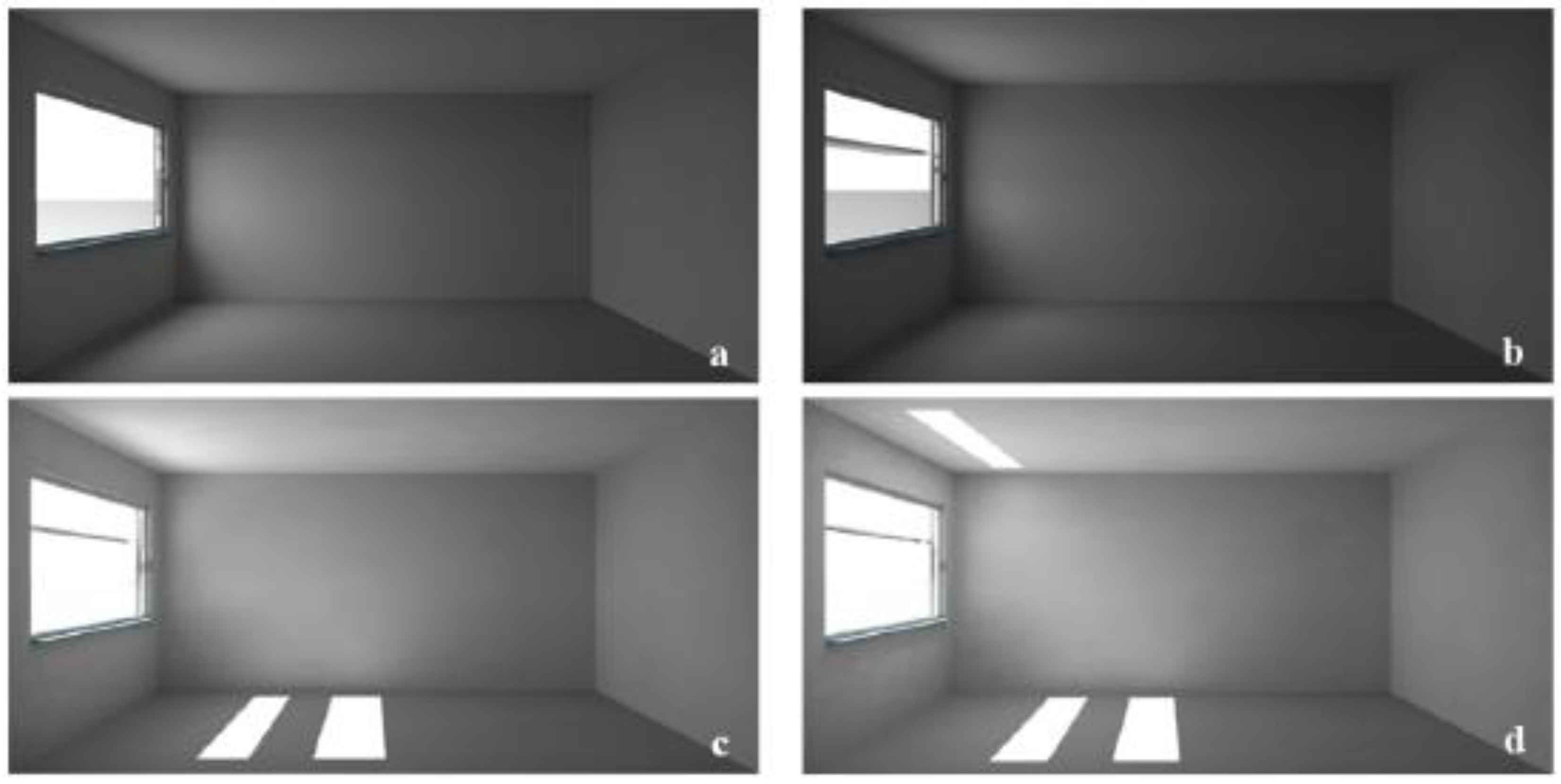
Figure 6.
Selected mode for the glass above the light shelf [26].
Figure 6.
Selected mode for the glass above the light shelf [26].
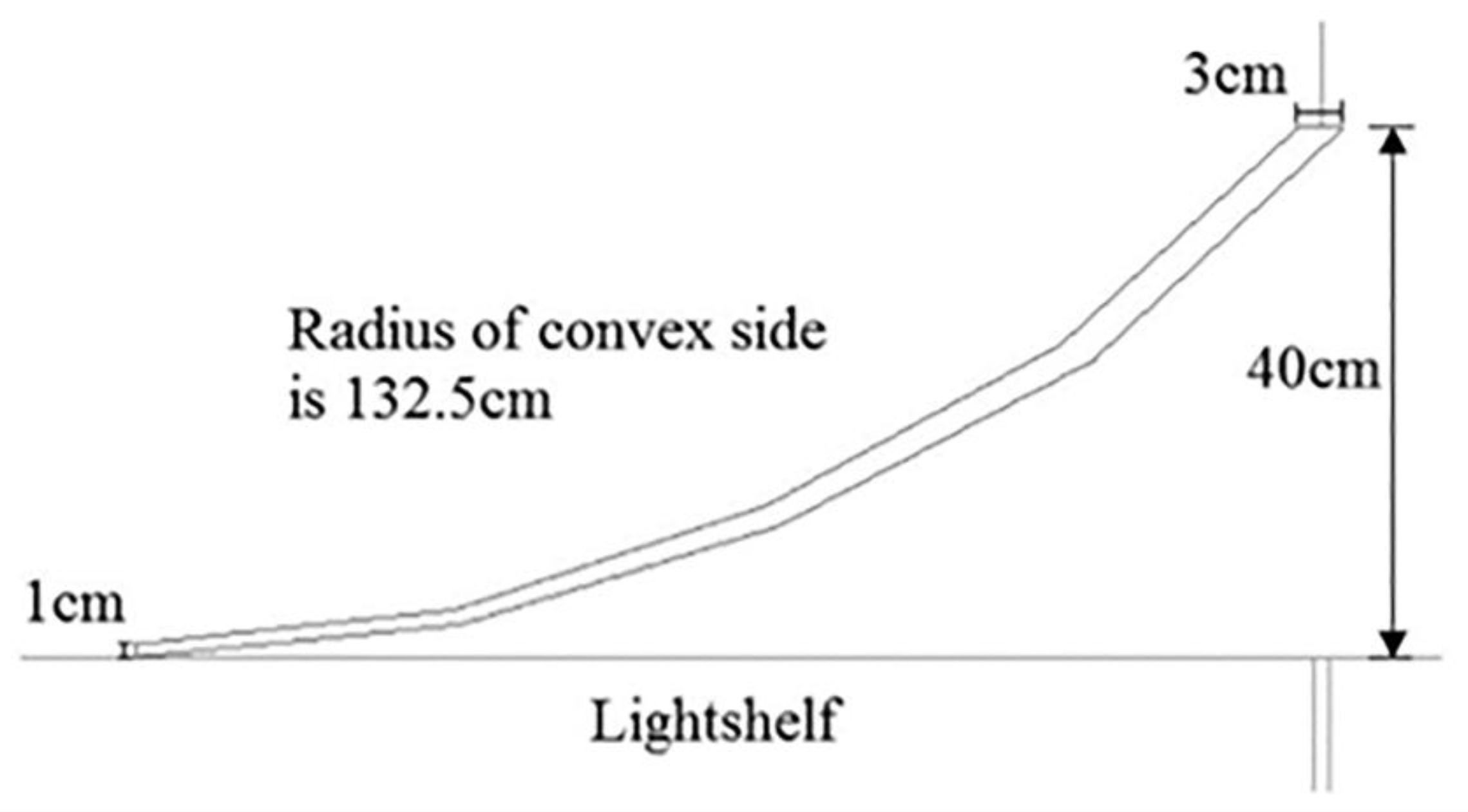
Figure 7.
Types of light shelves (flat, angled, curved and wavy).
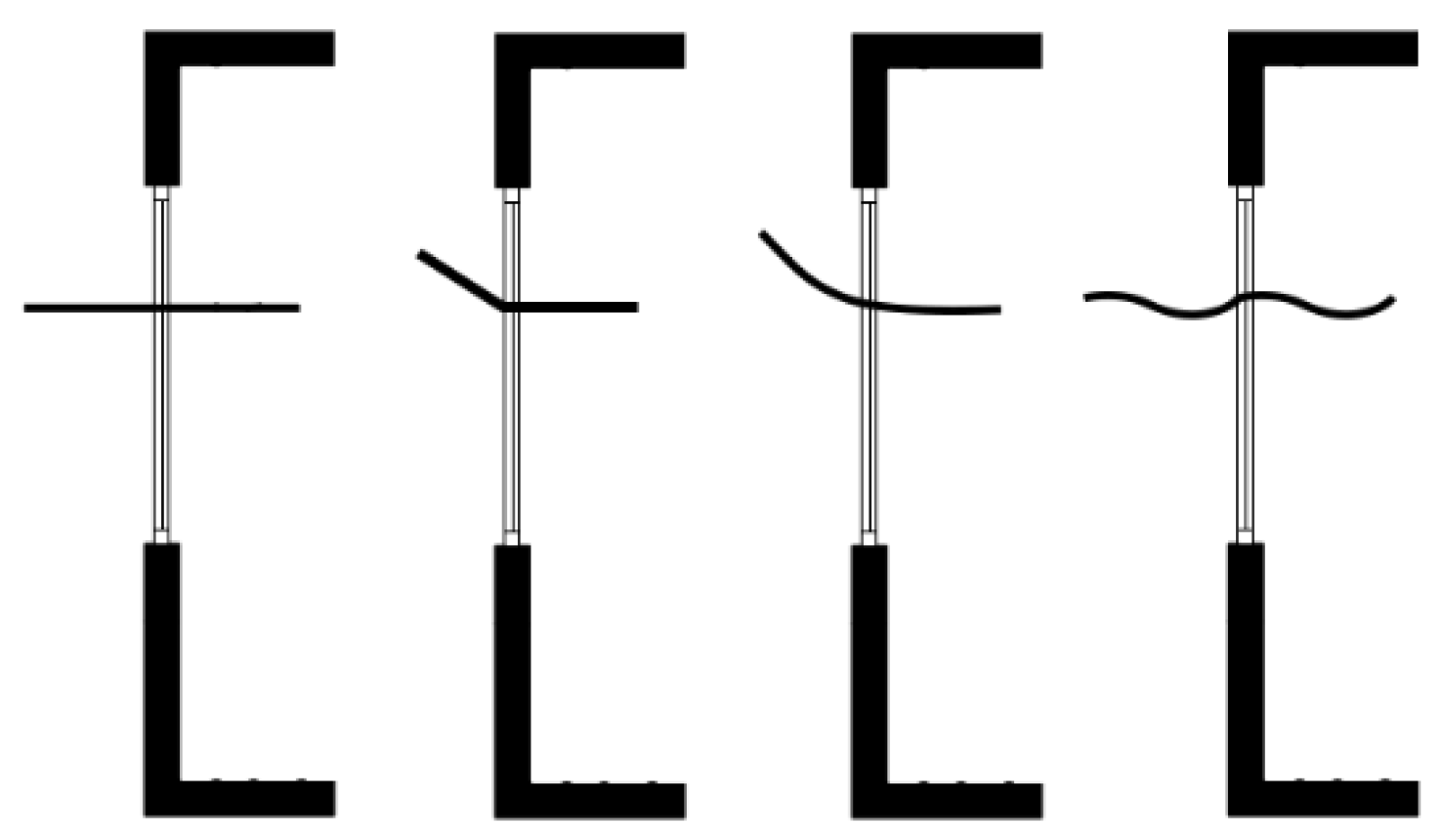
Figure 8.
The role of light shelf slope in light penetration [44].
Figure 8.
The role of light shelf slope in light penetration [44].
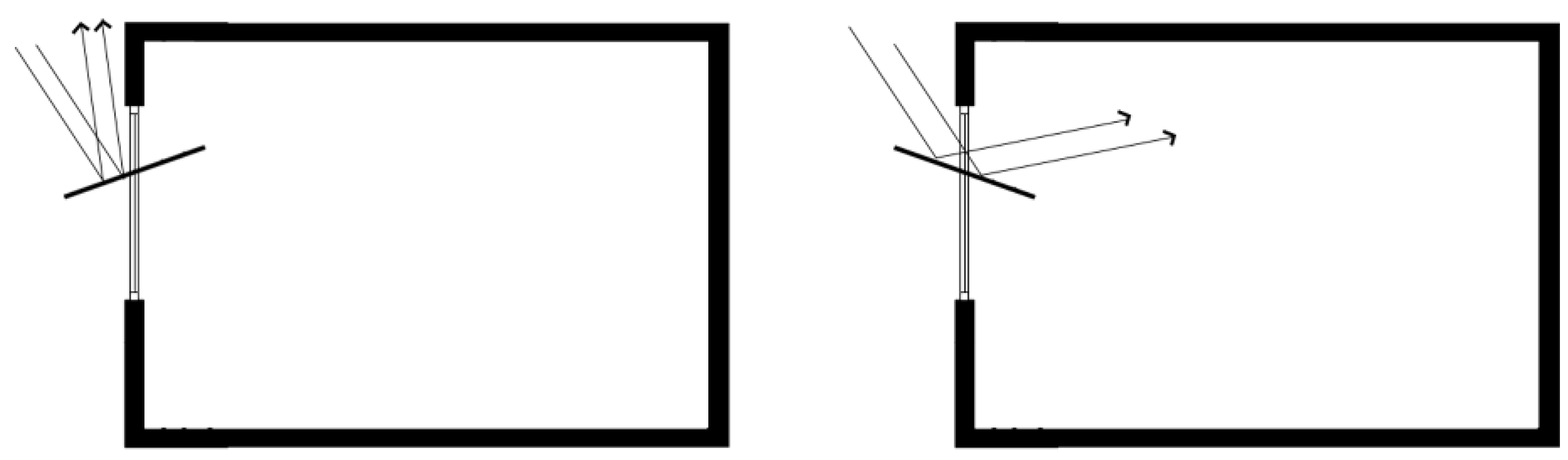
Figure 9.
Increasing the penetration depth of light in sloping roofs [44].
Figure 9.
Increasing the penetration depth of light in sloping roofs [44].
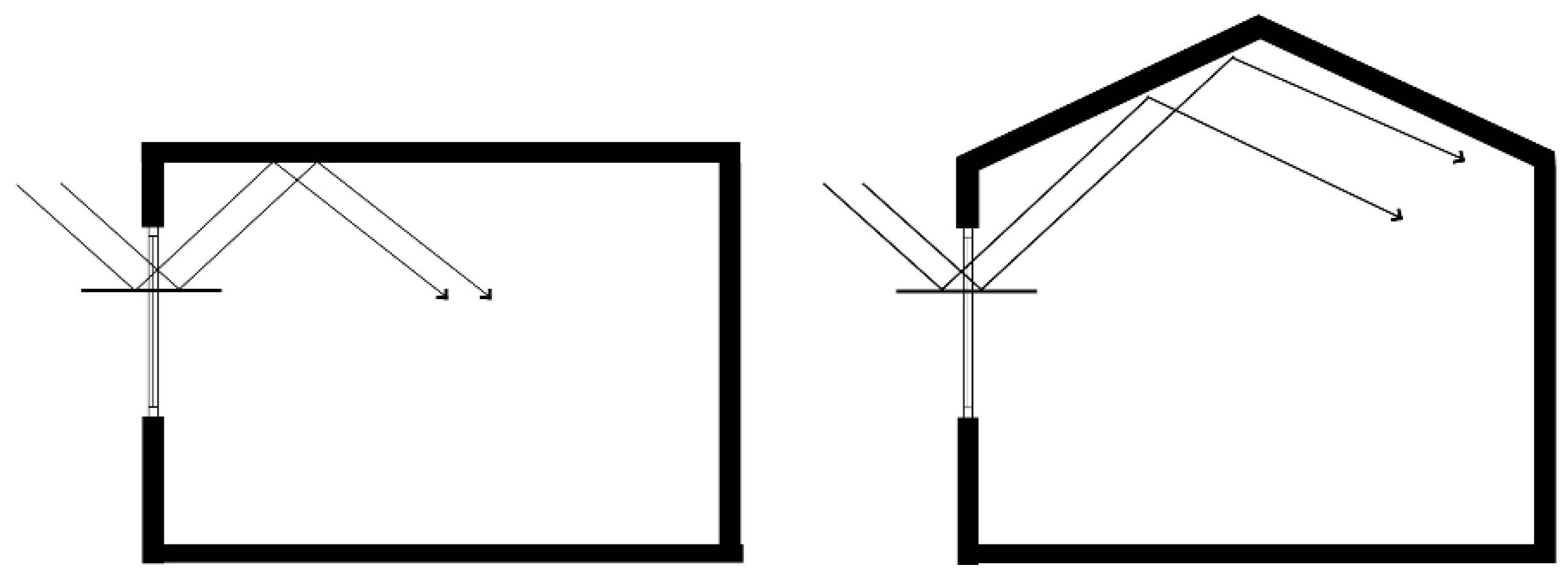
Figure 10.
Reflectance of different surfaces [3].
Figure 10.
Reflectance of different surfaces [3].
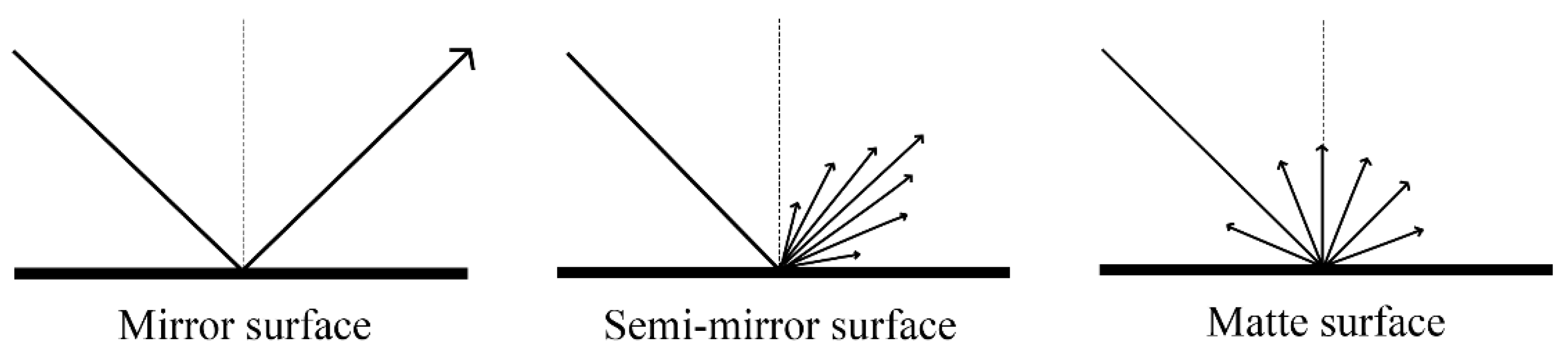
Figure 11.
The optimal combination of shades and light shelf [2].
Figure 11.
The optimal combination of shades and light shelf [2].
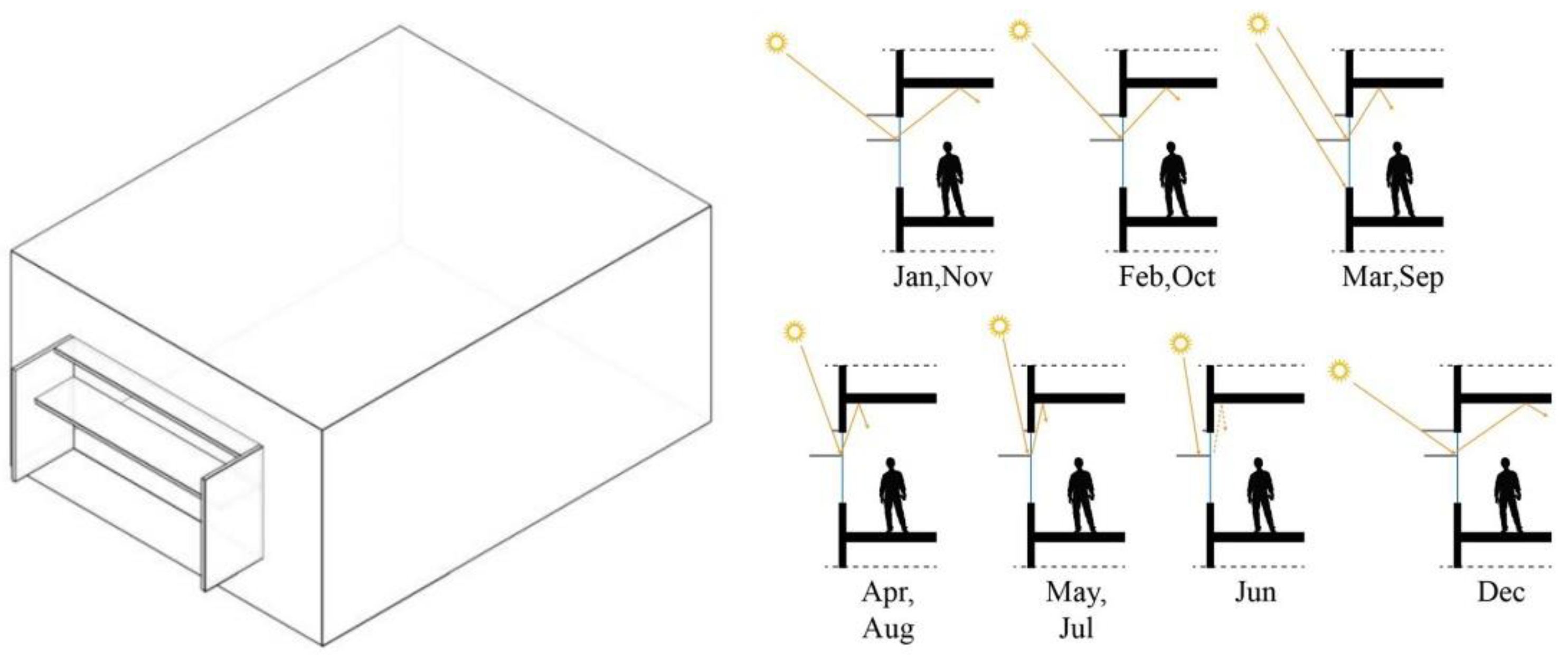
Figure 12.
The combination of a light shelf with a set of mirrors [9].
Figure 12.
The combination of a light shelf with a set of mirrors [9].
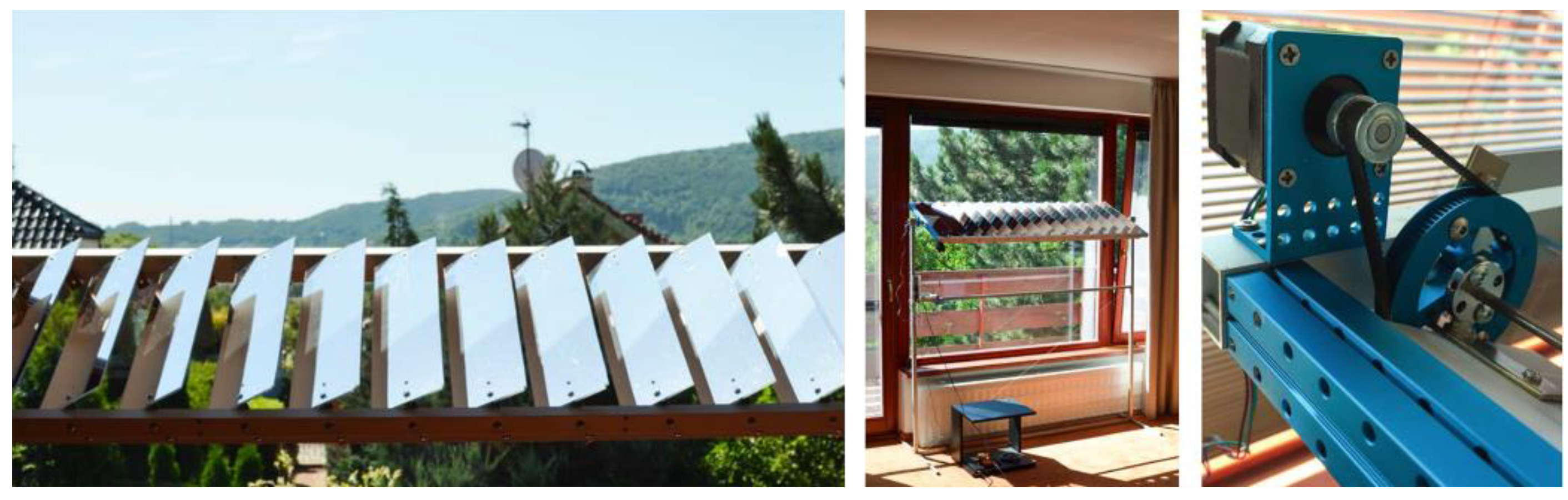
Figure 13.
Combination of light shelves with louvers [15].
Figure 13.
Combination of light shelves with louvers [15].
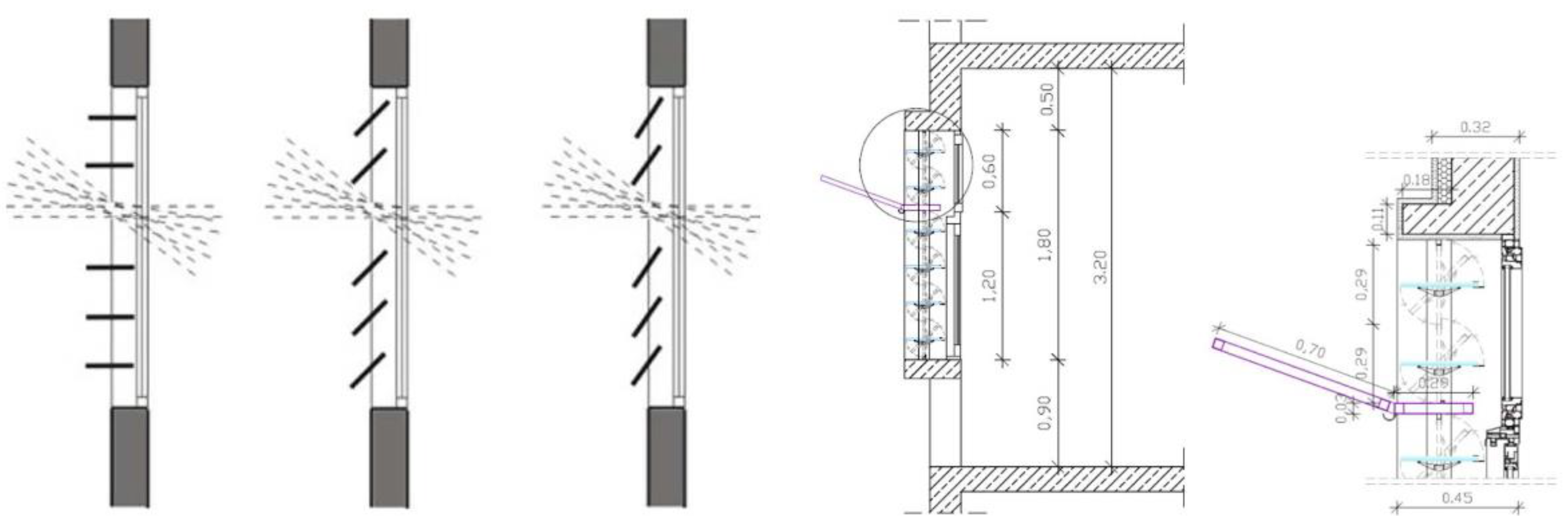
Figure 14.
Combination of light shelf with diffusion sheet [17].
Figure 14.
Combination of light shelf with diffusion sheet [17].

Figure 15.
Combining a semi-transparent surface in line with the light shelf [16].
Figure 15.
Combining a semi-transparent surface in line with the light shelf [16].
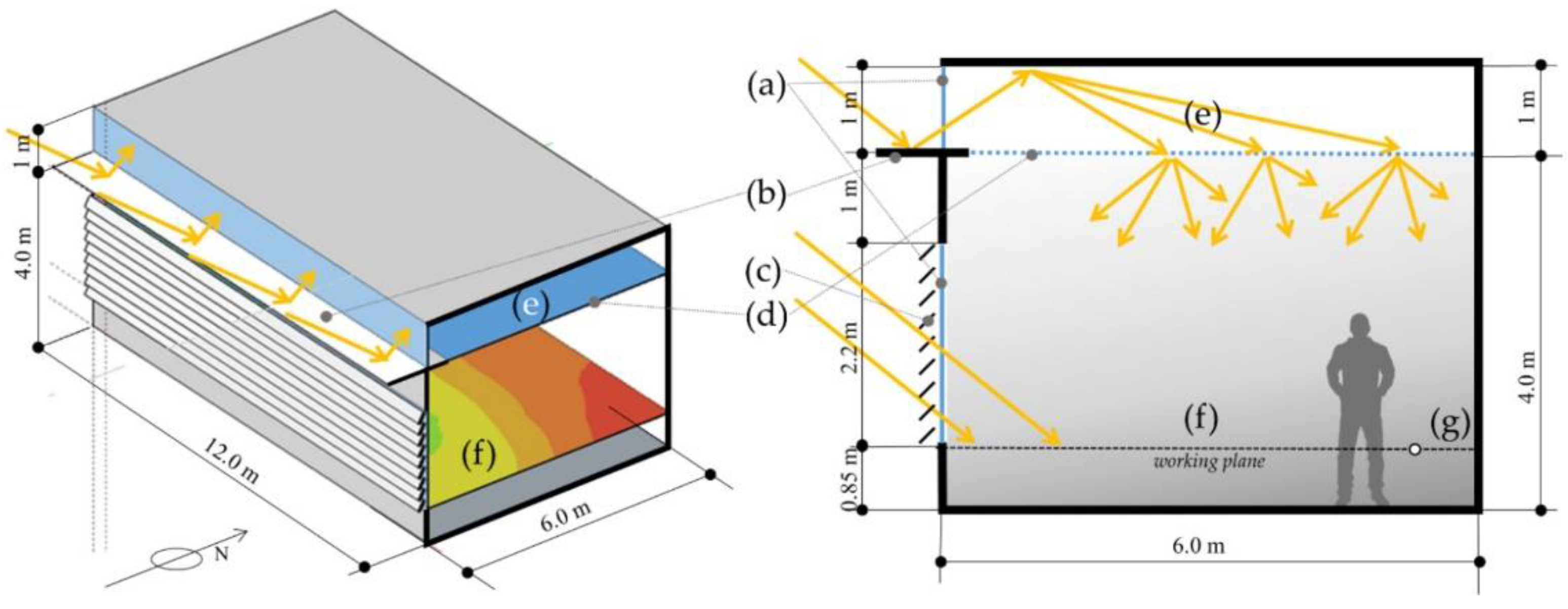
Figure 16.
Combination of the light shelf with horizontal light pipe [8].
Figure 16.
Combination of the light shelf with horizontal light pipe [8].
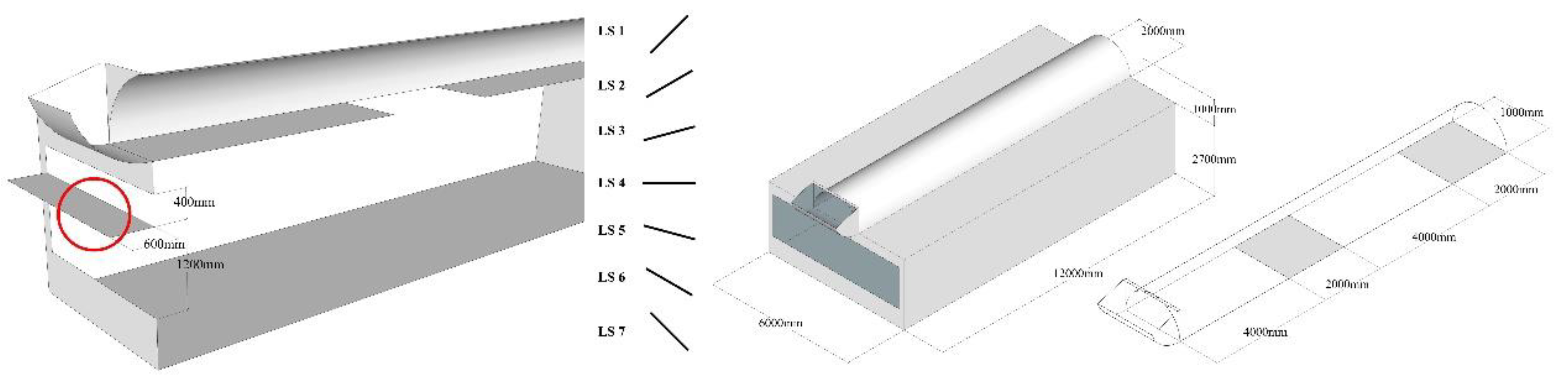
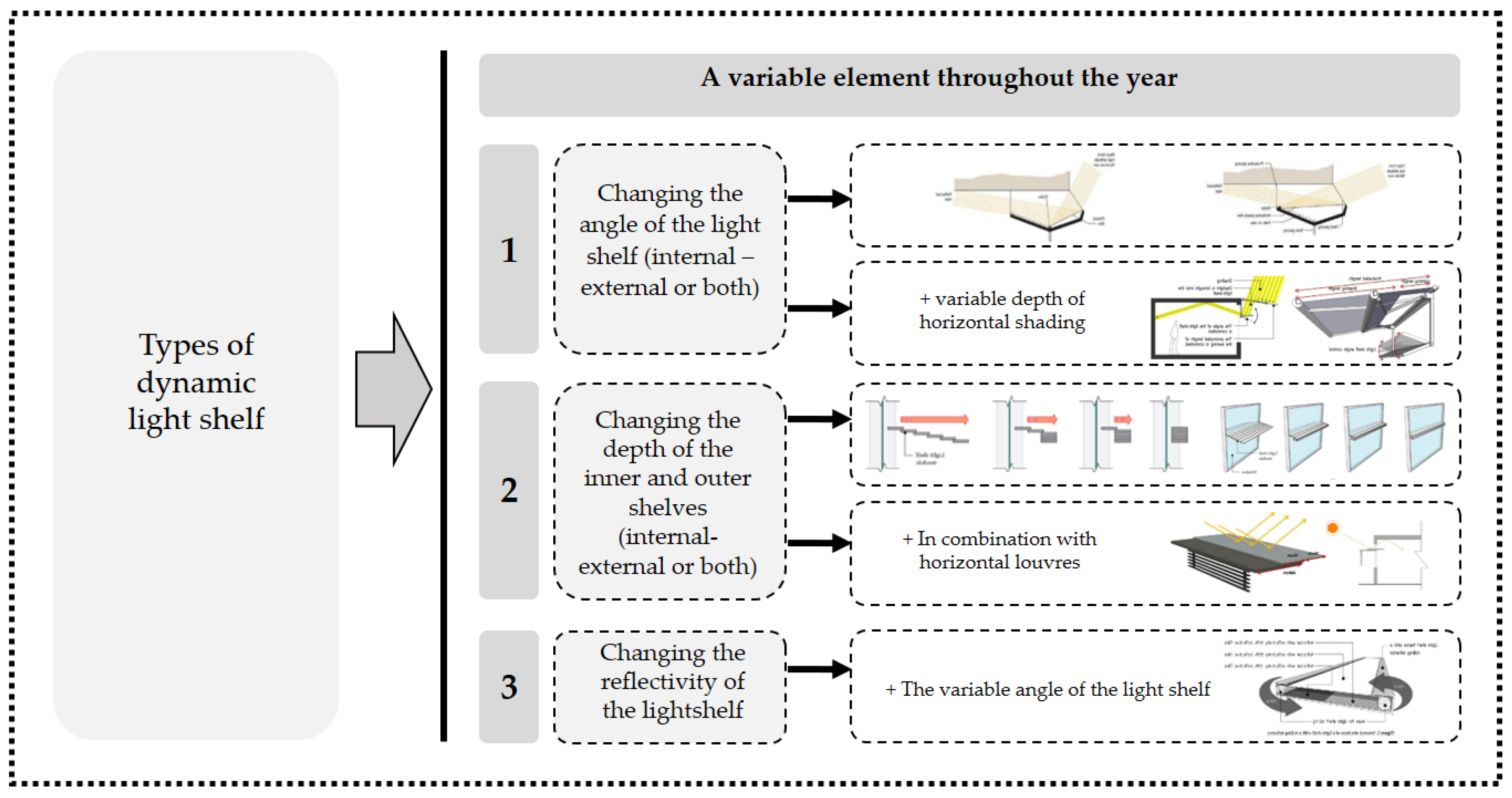
Figure 18.
Space Utilization Chart.
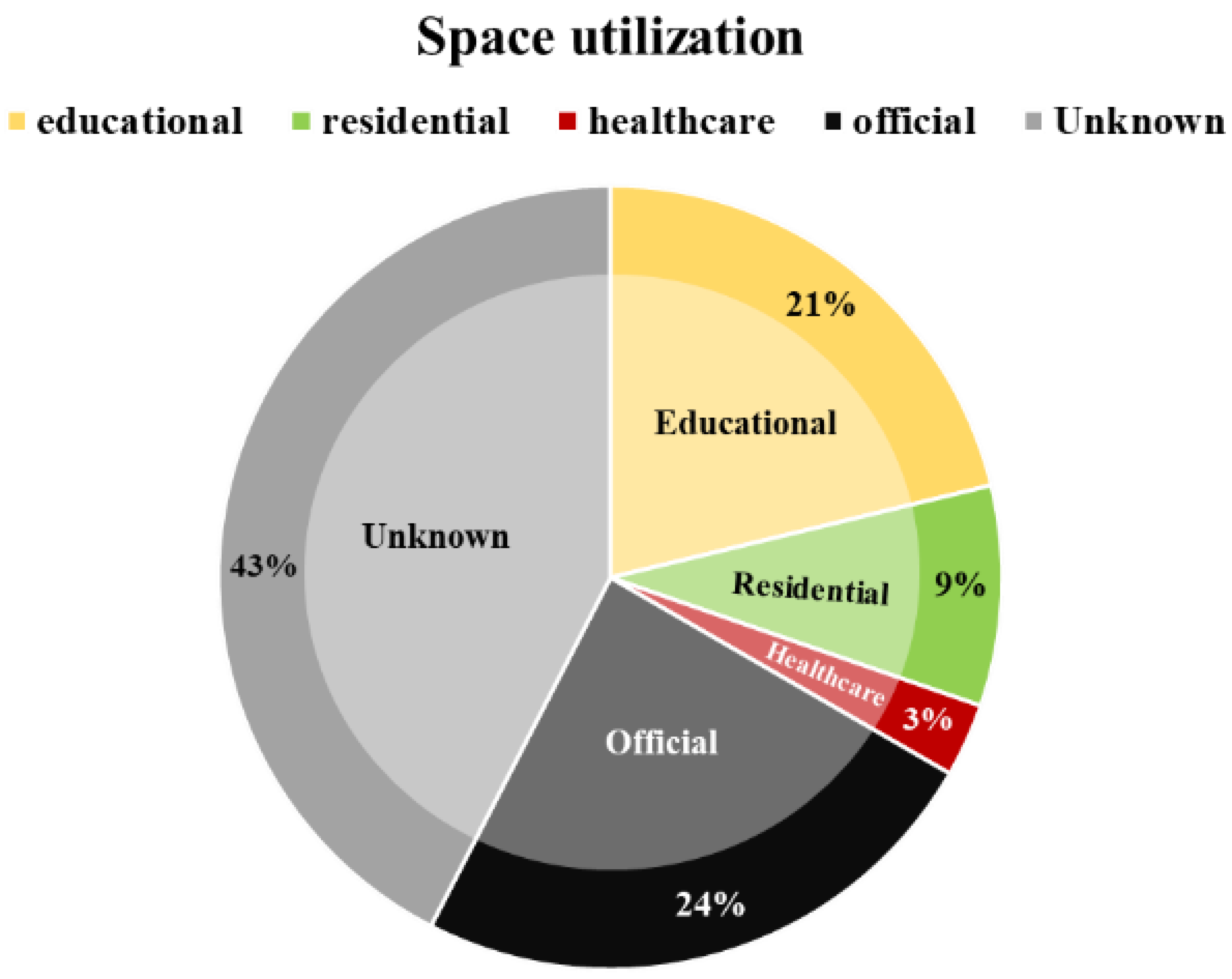
Figure 19.
The research method in the studies.
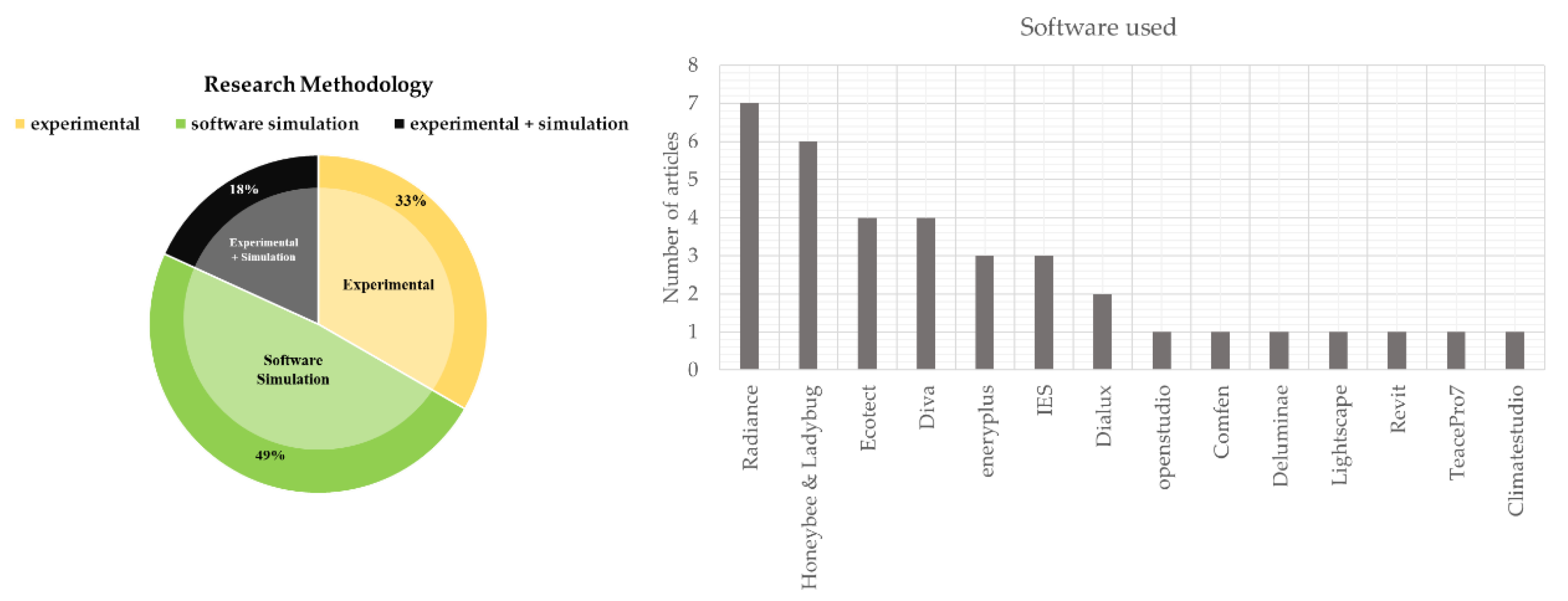
Figure 20.
The parameters investigated and indicators examined in the studies.
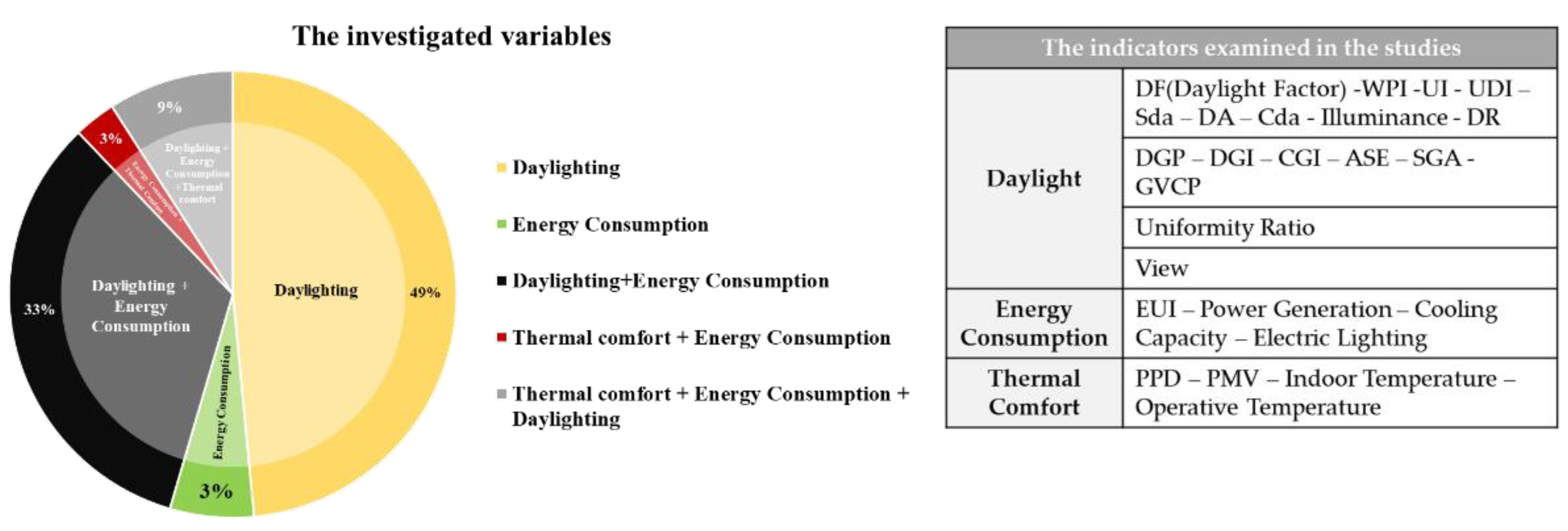
Figure 21.
Orientations in the studies.
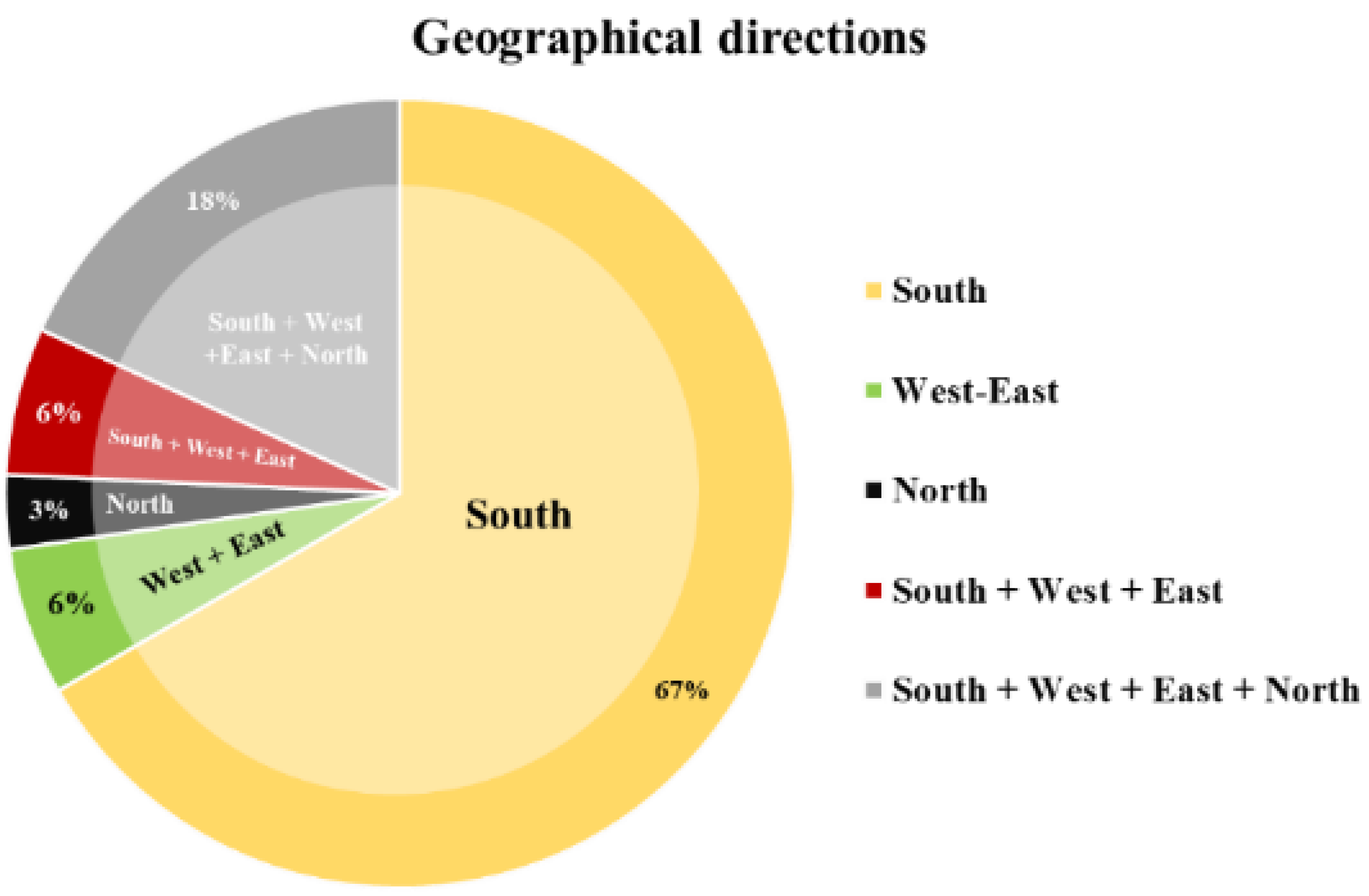

Table 1.
Classification of studies.
| Ref. number | Testing Method | Space utilization | Type of light shelf (Static – Dynamic) | Orientation | Field of Investigation ( Daylight Quality – Energy Consumption – Thermal comfort) |
Room dimensions |
Approaches |
| [8] | IESVE | Official | Static | South – West – East - North | -Daylight Quality | 12*6*2.7 | combined with horizontal light pipe |
| [9] | Radiance- Field measurement |
Official | Dynamic | South – West – East | -Daylight Quality - Energy Consumption |
12*9*3 | combined with a set of mirrors |
| [10] | Field measurement | - | Static | South | -Daylight Quality - Energy Consumption |
6.6*4.9*2.5 | combined with PV cells |
| [11] | Field measurement | - | Dynamic | South | -Daylight Quality - Energy Consumption |
6.6*4.9*2.5 | combined with PV cells |
| [12] | Field measurement | - | Dynamic | South | -Daylight Quality - Energy consumption -Thermal comfort |
6.6*4.9*2.5 | combined with PV cells |
| [13] | DIVA | Official | Static | South | -Daylight Quality - Energy Consumption |
8*4.6*3 | combined with PV cells |
| [14] | Field measurement | - | Dynamic | South | -Daylight Quality - Energy Consumption |
6.6*4.9*2.5 | combined with PV cells |
| [2] | Energy Plus / Comfen | Official | Dynamic | South | -Daylight Quality | 7.62*6.1*3.6 | combined with horizontal & vertical shades |
| [15] | Ecotect – Field measurement | Educational | Static | South | -Daylight Quality | 7*7*3.2 | combined with louvers |
| [16] | DeLuminae | Official | Static | South – West – East - North | -Daylight Quality | 12*6*4 | combined with translucent ceiling |
| [17] | Field measurement | - | Static | South | -Daylight Quality - Energy Consumption |
6.6*4.9*2.5 | combined with diffusion sheet |
| [18] | Field measurement | - | Dynamic | South | -Daylight Quality - Energy Consumption |
6.6*4.9*2.5 | combined with a prism sheet |
| [19] | Honeybee and Ladybug | Educational | Static | South | -Daylight Quality - Energy consumption -Thermal comfort |
10*9*3.5 | combined with PV cells |
| [20] | Field measurement | - | Dynamic | South | -Daylight Quality | 6.6*4.9*2.5 | combined with an awning system |
| [21] | Ecotect | Educational | Dynamic | South | -Daylight Quality | 8.1*6*3.3 | combined with louvers |
| [22] | Radiance | - | Static | South | -Daylight Quality | 8*6*3.25 | application of curved ceiling |
| [23] | DIVA | - | Static | South | -Daylight Quality | 10*6*2.5 | application of complex ceiling forms |
| [24] | Radiance - Field measurement | - | Static | South | -Daylight Quality | 8*6*3.25 | modifying ceiling geometry in highly luminous climates |
| [25] | Field measurement | - | Dynamic | South | -Daylight Quality - Energy Consumption |
6.6*4.9*2.5 | movable Light Shelf with a Rolling Reflector that Can Change Reflectivity |
| [26] | TracePro7.0 | Residential | Static | South | -Daylight Quality | 8*6*3.25 | new design of Clerestory Windows |
| [27] | DIVA | Educational | Static | South – West – East - North | -Daylight Quality | 8*7*3.5 | investigating the influence of light shelf geometry parameters on daylight performance and visual comfort |
| [28] | Field measurement | - | Dynamic | South | -Daylight Quality - Energy Consumption |
6.6*4.9*2.5 | performance Evaluation of a Light Shelf Based on Reflector Curvature |
| [29] | DIVA | Educational | Static | South | -Daylight Quality | 8*7*3.2 | investigating the effect of the light shelf on the quality of the interior light |
| [30] | Design Builder | Educational | Static | West-East | -Daylight Quality - Energy consumption -Thermal comfort |
7.9*3.2*2.8 | Performance evaluation of a Light Shelf |
| [31] | Radiance / Ecotect | Official | Static | South | -Daylight Quality | 14*8*2.8 | a New Method for Light Shelf Design According to Latitudes: CUN- OKAY, Light Shelf Curves |
| [32] | Lightscape | Official | Static | South | -Daylight Quality - Energy Consumption |
10*5*3 | combined with louvers |
| [33] | Radiance- Field measurement | Official | Dynamic | South – West – East - North | -Daylight Quality | 8.4*8.4*2.7 | dynamic internal light shelf for tropical climate |
| [34] | Honeybee | Residential | Static | Northwest-Northeast-Southeast-Southwest | -Daylight Quality -Thermal comfort |
6*5*3.5 | combination of multiple light shelves |
| [35] | DIALux 4.13 program | Educational | Static | South – West – East - North | -Daylight Quality | 8*5*3.5 | combination of multiple light shelves with composition |
| [28] | Field measurement | - | Static | South | -Daylight Quality - Energy Consumption |
6.6*4.9*2.5 | Perforated light shelf for Energy Saving |
| [36] | Honeybee and Ladybug | Official | Static | South | -Daylight Quality - Energy Consumption |
8*5*2.8 | sensitivity analysis linked to multi-objective optimization for adjustments of light shelves design parameters |
| [37] | DIVA | Dental Hospital | Static | East-West | -Daylight Quality | 19*14.2*2.7 | optimization of daylight admission based on modifications of light shelf design parameters |
| [38] | Field measurement | - | Dynamic | South | -Daylight Quality - Energy Consumption |
6.6*4.9*2.5 | development and Performance Evaluation of Light Shelves Using Width-Adjustable Reflectors |
| [39] | Honeybee and Ladybug- Field measurement | Official | Static | South | -Daylight Quality | 8*5*2.8 | optimization of Daylight Performance Based on Controllable Light-Shelf parameters |
| [40] | Honeybee & Ladybug/ Open studio | Educational | Static | South -North | -Daylight Quality -Thermal comfort |
8*5.8*2.9 | multi-objective optimization of daylight performance and thermal comfort |
| [41] | Relux | Educational | Static | Northeast - Southwest -Northwest | -Daylight Quality | 29.7*19*4.3 | performance testing of a light shelf-reflective louver system |
Disclaimer/Publisher’s Note: The statements, opinions and data contained in all publications are solely those of the individual author(s) and contributor(s) and not of MDPI and/or the editor(s). MDPI and/or the editor(s) disclaim responsibility for any injury to people or property resulting from any ideas, methods, instructions or products referred to in the content. |
© 2024 by the authors. Licensee MDPI, Basel, Switzerland. This article is an open access article distributed under the terms and conditions of the Creative Commons Attribution (CC BY) license (http://creativecommons.org/licenses/by/4.0/).
Copyright: This open access article is published under a Creative Commons CC BY 4.0 license, which permit the free download, distribution, and reuse, provided that the author and preprint are cited in any reuse.