

Submitted:
12 February 2024
Posted:
13 February 2024
You are already at the latest version
Abstract
Photovoltaic shading devices (PVSDs) have the dual function of providing shade and generating electricity, which can reduce building energy consumption and improve indoor daylighting levels. This study adopts a parametric performance design method and establishes a one-click simulation process by using the Grasshopper platform and Ladybugtools. The research focuses on the effect of dynamic PVSDs on daylighting and energy consumption in an office building in Qingdao. Through simulation, the study calculates the monthly energy consumption and useful daylight illuminance (UDI) under different inclination angles and installation heights of PVSDs. And the optimal configuration of PVSDs for each month under three dynamic strategies (rotation, sliding, and hybrid) is determined. Additionally, different control strategies and fixed PVSDs are compared to clarify the impact of various control strategies on daylighting and energy consumption. The findings reveal that, compared to no shading, dynamic PVSDs in rotation strategy (with an installation height of 0 m), sliding strategy (with an inclination angle of 20°), and hybrid strategy can achieve energy savings of 32.13%, 47.22%, and 50.38%, respectively. They can increase the annual average UDI by 1.39%, 2.8%, and 3.1%, respectively.
Keywords:
Photovoltaic shading devices (PVSDs)
; Dynamic
; Fixed
; Energy consumption
; Daylighting
1. Introduction
The global issues of energy consumption and environmental pollution have become significant challenges that hinder human development. In 2020, China made a commitment to peak carbon emissions by 2030 and achieve carbon neutrality by 2060 [1]. Subsequently, in 2021, China released the "Action Plan to Peak Carbon Before 2030", which outlined the goal of non-fossil energy consumption will reach 20% and 25% by 2025 and 2030 respectively [2]. Faced with rising energy demand and environmental degradation, renewable energy may efficiently cut fossil fuel use and carbon emissions while also having significant application value. In 2020, China’s energy consumption in the entire building process accounted for 45.5% of the country’s energy consumption, energy consumption in the building operation stage accounted for 21.3% of the country’s energy consumption, and carbon emissions in the building operation stage accounted for 21.7% of the total carbon emissions [3]. Therefore, using clean energy to reduce energy consumption in the building operation phase is of great significance to achieve the goal of carbon neutrality.
Photovoltaic technology can generate electricity for buildings, reduce reliance on traditional urban power networks, and lower urban carbon emissions [4]. With the advancement of Photovoltaic technologies, building-integrated photovoltaics (BIPVs) have been applied to building facades and roofs, as well as integrated into the architectural design to become a functional component of the building [5]. The first BIPV system was introduced in the 1980s, but its expensive cost initially limited its application market [6]. It was not until the advancement of photovoltaic technology and the demand for low-carbon buildings that BIPVs became popular [7]. Photovoltaic shading devices (PVSDs) not only provide shade, but also collect solar energy, converting the sunlight that restricts access to the building into electricity [8]. However, as part of the building envelope, PVSDs will also strongly affect the indoor daylighting environment and energy consumption. Therefore, when designing PVSDs, it is necessary to find the right balance between indoor daylighting and energy consumption as much as possible. Excessive solar radiation can cause indoor overheating and glare problems. But if too much solar radiation is blocked, energy demands for heating and artificial lighting will increase [9].
A PVSD combine the functions of shading and photovoltaic to improve the internal daylight and thermal environment [10], lower the building cooling load [11], improve indoor visual comfort [12], and fulfill a portion of the building’s energy demands [13]. Many studies have demonstrated the energy-saving potential of PVSDs [14,15]. Compared with traditional shading devices and unshaded windows, PVSDs perform better in terms of energy use and daylighting [16]. For instance, Mostafa et al. [17] used an educational facility at the GUC University in Cairo to investigate the daylighting and energy-saving benefits of installing PVSDs in the south and east. Sadatifar et al. [18] optimized the design of PVSDs for five different climate zones from the perspective of energy use and daylighting. Ellika et al. [8] proposed a design method for fixed PVSDs based on multi-objective optimization (MOO). The inclination angle and number of PVSDs louvers on the south side of an office building in Northern Europe were optimized with the goals of net energy consumption, power generation and daylighting. Cheng et al. [19] investigated the daylighting and power generation performance of PVSDs in China’s hot summers and cold winters. The results found that the proportion of indoor space illumination between 450 lx and 2000 lx and exceeding 50% of the time was about 85%, and the power generation amount ranged from 9.18 kWh to 22.46 kWh.
However, most of these studies seek to achieve a balance between power generation and shading, as well as optimize the design of fixed PVSDs with one or more of the following objectives: daylighting, energy consumption, visual comfort, and electricity. The Sun’s altitude and azimuth angles continuously change throughout the year. A dynamic PVSD can greatly enhance the potential of power generation and shading, and improve indoor daylighting and thermal environment. However, there are only a few research on dynamic PVSDs. Ayca et al. [20] classified dynamic PVSDs control strategies into three categories: soft control, hard control, and other technologies (hybrid strategies), based on the implementation method of the control strategy and the tools used. Svetozarevic et al. [21] presented a dynamic PVSD that can increase power generation by 50% compared to a fixed PVSD and can meet 115% of office net energy requirements in temperate and arid climate conditions. Meysam et al. [22] compared the power generation and building heating load between south-facing dynamic PVSD and static PVSD in an apartment in Tehran. The study found that changing the angle and position of the PVSD twice a year can significantly improve energy efficiency, and more changes have little impact on energy consumption. Krarti et al. [23] investigated the impact of a dynamic PVSD on building energy consumption in four U.S. cities. The study found that while hourly control strategies had better energy saving potential, daily and monthly control strategies gained most of the advantages of dynamic PVSD. Compared with no PVSD, controlling PVSD on a monthly basis can reduce greenhouse gas emissions by 87%.
From these studies, it is evident that the optimal shading system is closely related to building characteristics [24] (building function, building orientation, building form coefficient, envelope heat transfer coefficient), geographical location [25] (longitude, latitude, altitude, climate), type of shading device [16] and control strategies, etc [26]. Due to the complexity of these influencing factors, there is no simple method or rule of thumb for designing and optimizing a PVSD system. Professional simulation software (EnergyPlus, DoE-2, TRNsys) is often required, which often requires designers to have professional knowledge. This complexity increases the difficulty for architects to evaluate the performance of a PVSD through software simulation, resulting in the lack of performance evaluation of a PVSD in the design process. Ladybugtools in the Grasshopper platform integrates a variety of commonly used simulation engines, including daylighting and energy consumption simulations, which can be used to evaluate building performance in many aspects and form a simple and flexible parametric performance evaluation process. Architects and users can simply adjust the corresponding parameters to evaluate a PVSD under different conditions, and further export visual graphics for analysis [27], thereby expanding the boundaries of the design [28].
In this study, three control strategies for PVSDs were considered: rotation, sliding, and hybrid (rotation + sliding). By rotating the PVSD, the power generation, indoor daylighting and visual comfort can be adjusted. Sliding the PVSD up and down can effectively adjust whether sunlight can enter the room. Of course, it can also control sunlight entering the room from the upper or lower part of the window. So far, there are few studies on dynamic PVSDs in China, especially for office buildings in cold climate areas. This study established a flexible and simple parametric performance simulation process for PVSDs based on the Ladybugtools and Grasshopper platform. The design and control strategies of PVSD are evaluated using daylighting and energy consumption as optimization objectives. The main purposes of this paper are twofold: 1) To study the impact of three control strategies of PVSDs on building daylighting and energy consumption throughout the year. 2) To explore the energy-saving and daylighting application value of three control strategies of PVSDs in office buildings in cold areas. It is hoped that this study can provide theoretical, methodological and data support for the promotion and application of dynamic PVSDs in cold climate areas.
2. Methodology
2.1. Case study description
This study case is located in Qingdao, China. The research room on the sixth floor of the office building covers an area of 71 m2. It is usually used for multi-person offices. The length, width and height of the room are 8 m, 9 m and 3.4 m, respectively. This room has three casement windows facing south. Each window has a height of 1.8 m and a width of 1.45 m. The window sill height is 0.9 m. There are no other surrounding buildings or landscaping blocking sunlight from entering the room. The north wall of the room adjacent to the internal corridor is a glass wall. There is also the same type of multi-person offices on the east and west sides of the room. Figure 1 shows an overview of the case room.
Qingdao is located in the southern part of the Shandong Peninsula, located at 119°30′-121°00′ east longitude and 35°35′-37°09′ north latitude. Qingdao faces the sea on three sides. Affected by the southeast monsoon, ocean currents and water masses, Qingdao has significant maritime climate characteristics. Generally speaking, Qingdao has four distinct seasons throughout the year, with hot, humid and rainy summers and windy and low temperatures in winter. The meteorological data used in this study is Qingdao meteorological data from 2007 to 2021 (https://climate.onebuilding.org/). Figure 2 shows the changes in dry bulb temperature and global horizontal radiation in Qingdao.
2.2. Baseline model settings
Based on the Grasshopper platform, a parametric model of the room and its surrounding elements was constructed according to the actual situation. Parametric models of energy consumption and daylight were established through the Ladybugtools. The established model was verified in Chapter 3. According to the actual structure of the building and the requirements for school buildings in the "General code for energy efficiency and renewable energy application in buildings" [29], the thermal parameters of the walls, windows, and roofs as well as the internal loads of the building are set. The thermal properties of the building envelope are detailed in Table 1. The optical properties are outlined in Table 2. The air conditioning temperature control schedule is shown in Figure 3. In the daylighting model, indoor illumination test points are distributed in a grid (1 m × 1 m) with a height of 0.75 m. The minimum illumination of indoor working surfaces is controlled at 300 lux. When the working surface does not reach 300 lux, artificial lighting is turned on.
2.3. PVSD control strategies
Figure 4 shows the dynamic photovoltaic shading devices (PVSDs) installed on the south wall. There are three design variables for PVSDs, namely the width, tilt angle and sliding height of PVSDs. The range and interval control of variables are shown in Table 3. This study considers the impact of three dynamic strategies of PVSDs (rotation, sliding up and down, and hybrid) on indoor daylighting and energy consumption. In the case of the rotation strategy, the width and installation height of the PVSD are fixed and can be rotated at intervals of 5° between 0° and 70°. In the case of the sliding strategy, the width and tilt angle of the PVSD are fixed and can slide up and down along the guide rails. The highest point can slide to 1 m above the upper eaves of the window, and the lowest point can slide to the lower eaves of the window. The interval between each sliding is 0.2 m (the upper eave of the window is 0 m, and the lower eave of the window is -1.8 m). A hybrid strategy is a combination of a rotation strategy and a sliding strategy. The PVSD has a fixed width and can rotate at the same time as it slides. These three dynamic strategies are controlled by a set schedule and are activated monthly. In the simulation, the power generation capacity of each square meter of photovoltaic panel is set at 160W.
2.4. Parametric Performance Design Method
The parametric performance design method integrates parametric models and performance evaluation to provide non-professionals with a visual toolbox to optimize and evaluate design solutions. The parametric performance design method allows designers to modify algorithms or rules, prompting the computer to generate multiple design solutions and evaluate the performance of the solutions, so that the designer can choose the best design solution. In parametric performance design thinking, the generation, modification, and evaluation of solutions are combined into a cyclic process that can be driven by performance. This allows designers to pay attention to the relationship between parameters and goals and the feasibility of the solution during the design process, thereby improving the quality and efficiency of the design. The parametric performance design process of dynamic PVSDs is shown in Figure 5.
2.5. Evaluation indicators
2.5.1. Daylighting evaluation indicators
Evaluation of indoor daylighting commonly utilizes two indicators in China: the daylight factor (DF) and illuminance (lux). While illuminance is a local short-term indicator, evaluating the daylighting performance of the entire space over a long period requires a lot of additional work [30]. DF is a ratio and does not show the absolute value of illumination [31]. It ignores the impact of changes in climate conditions, building orientation, location, etc. on daylighting [32]. Furthermore, neither illuminance nor DF considers the impact of glare. To address these issues, a series of dynamic daylighting evaluation indicators have been proposed. The most commonly used ones are daylight autonomy (DA) and useful daylight illuminance (UDI). DA is defined as the percentage of occupied hours of the year during which daylight meets a minimum illuminance threshold [33]. Based on daylight autonomy, continuous daylight autonomy (cDA) [34] and spatial daylight autonomy [35] have also been derived to describe the proportion of time below the minimum illumination threshold and the adequacy of ambient daylight levels in indoor environments, respectively.
UDI is the percentage of time during a period when indoor illumination levels are within a certain range [30]. In comparison with DA, UDI sets upper and lower limits for indoor illumination levels, allowing for the evaluation of indoor illumination levels and limitation of glare occurrence [36]. The given illuminance range on a typical work plane was originally suggested to be 100 lux - 2000 lux, which was later revised to 100 lux-3000 lux [37]. According to Mardaljevic’s research, the need for indoor artificial lighting can be largely eliminated when the UDI is in the range of 300 lux – 3000 lux [37]. When the illumination value of the working plane is below 100 lux, it is difficult to perform basic vision tasks. When the illumination value of the working surface is greater than 3000 lux, glare is likely to occur [38]. As a result, the UDI target range for this study is set to 100 lux – 3000 lux, divided into two parts: the supplementary useful illumination range of 100 lux – 300 lux and the autonomous useful illumination range of 300 lux - 3000 lux, recorded as UDIlow (<100 lux), UDIsup (100 lux - 300 lux), UDIauto (300-3000 lux), and UDIup (>3000 lux). The calculation equation for UDI is as follows:
where ti represents each occupied hour in the calculation time, fi is a weighting factor, and Ei represents the illuminance value of each hour.
2.5.2. Energy consumption indicators
This paper uses energy use intensity (EUI) as the basic indicator to evaluate energy consumption, intuitively quantifies the building’s energy consumption, and eliminates the impact of room area on this indicator. EUI represents the ratio of building energy consumption to the total building area within a certain period, in Kwh/m2 [39]. The energy consumption calculated in this paper includes lighting energy consumption and air conditioning energy consumption (cooling energy consumption and heating energy consumption). In the following, EUI-a will be used to represent the annual energy consumption intensity, and EUI-m will be used to represent the monthly energy consumption intensity.
2.5.3. Model validation indicators
This paper uses two indicators to check the model’s accuracy: mean bias error (MBE) and coefficient of variation of the root mean squared error (CV_RMSE). The calculation equations for the MBE and CV_RMSE are listed as Eqs. 2 and 3 [39]:
where Si and Mi refer to the time intervals (i) of simulation and measurement respectively, is the average value of measurement, and n is the total value for calculation.
3. Results
3.1. Model Validation
Figure 6 shows the measured and simulated temperatures inside the building during the test period. Its MRE and CV(RMSE) values are 0.33% and 1.58% respectively. According to the requirements of ASHRAE Guideline (14-2014) [40], if the hourly MBE value is within ±10% and the hourly CV (RMSE) value is within 30%, the energy consumption simulation model verification is considered successful. Therefore, the error of the simulation model in this study is within the acceptable range.
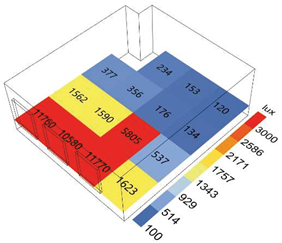
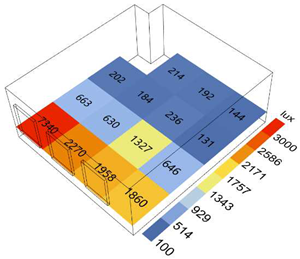
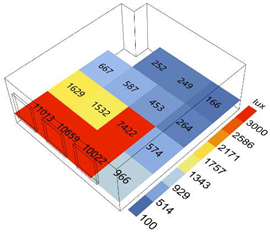
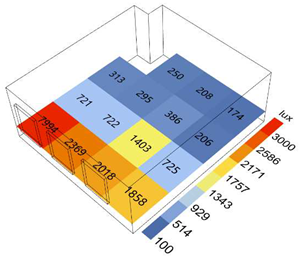
Table 4 shows the measured and simulated illumination distribution of the indoor working plane at 10:30 and 12:30 on December 16. The illumination of all grids in the measured and simulated data is greater than 100 lux, and the distribution of illumination values is also reasonable. Judging from existing research, Merghani et al. [41], considered an MBE of 20% and an RMSE of 32% are acceptable in illumination simulation. In a study of classroom daylight performance optimization in hot and dry areas, Khaoula [42] found that the MBE and CV (RMSE) were -19.57% and 26.01%. Yoon et al. [43] studied 6 simulation algorithms and found that the CV (RMSE) of the daylighting model ranged from 25.36% to 42.05%. The error can be reduced by using more optimized modeling and measurement techniques [33]. These errors in the daylighting model are acceptable due to the influence of measuring instruments, field tests, and various parameters in the modeling process (sky conditions, building materials, etc.). Therefore, these model and related parameters will be used in the following research.
3.2. Energy consumption and daylighting performance of fixed PVSDs
3.2.1. The impact of fixed PVSDs on building energy consumption and daylighting
Figure 7 shows the impact of year-round fixed PVSDs on indoor energy consumption. It can be found that as the width of PVSDs increases, the average annual net energy use intensity (EUI) throughout the year gradually decreases. The panel width increased from 0.2 m to 1.2 m, and the average annual net EUI of PVSDs decreased from 42.89 kwh/m2 to 30.57 kwh/m2. This also shows that in Qingdao, PVSDs power generation capacity plays a leading role in the annual energy consumption. At the same time, it can also be seen that as the panel tilt angle increases from 0° to 70°, the average annual net EUI of PVSDs first decreases and then increases. When the panel tilt angle is 20°, the average annual net EUI of all shading solutions is the lowest at 36.1 kwh/m2. The influence of panel installation height on the annual net EUI shows different trends on the above and below the reference position (0 m). As the panel installation position arises from the bottom of the window frame (-1.8 m) to the top of the window frame (0 m), the annual average net EUI of PVSDs continues to increase. As the panel installation position arises from the top of the window frame (0 m) to 1 m above the window, the average annual net EUI continues to decrease. When the PVSDs are installed at the bottom of the window frame (-1.8 m), the average annual net EUI is the lowest at 34.53 kwh/m2. When the installation position is at the top of the window frame (0 m), the maximum average annual net EUI is 38.82 kwh/m2.
The influence of PVSDs on indoor UDI (100 lux<Illuminance<3000 lux) is shown in Figure 8. It can be seen from the figure that the influence trends of PVSDs on UDI throughout the year are different. When the panel width is large, the panel tilt angle is large, or the PVSDs installation position is close to the upper edge of the window (0 m), the UDI distribution is more discrete. As the panel width increases, the average annual UDI first increases and then decreases. When the panel width is 0.4 m, the maximum average annual UDI is 79.92%. As the panel tilt angle increases, the average annual UDI gradually decreases. When the panel tilt angle is 0°, the maximum average annual UDI is 80.52%. The influence of PVSDs installation height on UDI is the same on the above and below the reference position (0 m). The average UDI throughout the year first increases and then decreases as the installation height increases. When installed at the reference position (0 m), the average annual UDI is the lowest at 76.49%, and when the installation height is -1.2 m, the average annual UDI is at the maximum of 80.77%.
Generally speaking, PVSDs have different trends and influences on indoor daylighting and energy consumption of buildings. For the annual net EUI, PVSDs width has the greatest impact, followed by installation height, and panel tilt angle has the least impact. For UDI, the installation height of PVSDs has the greatest impact, followed by the panel tilt angle, and panel width has the smallest impact.
3.2.2. Energy saving and daylighting potential of fixed PVSDs
The simulation results of all 1,350 solutions were sorted and found that when the width is 1.2 m, the installation height is -1.8 m, and the tilt angle is 35°, the net EUI of fixed PVSDs throughout the year is the lowest 25.49 kwh/m2. At this time, PVSDs only have the function of generating electricity and do not have the function of shading. Comparing the cooling, heating and lighting energy consumption of buildings with and without photovoltaic shading devices, the differences are small. This shows that in Qingdao, fixed shading throughout the year has no energy-saving effect. Although the Qingdao area has a relatively large demand for cooling in summer, it also has a large demand for heating in winter. The fixed shading cannot avoid increasing the heating energy in winter. It can also be seen from Figure 9 that PV power generation can account for 44% of total energy consumption throughout the year. In March and April, PV power generation still has residual power after offsetting the cooling load, heating load, and artificial lighting load. This also confirms that Qingdao has abundant solar energy resources and PVSDs have huge application prospects in Qingdao.
In terms of daylighting, when the width of fixed PVSDs is 1.2 m, the installation height is -1 m, and the tilt angle is 10° throughout the year, indoor daylighting is the best. Compared with no PVSDs, fixed PVSDs with optimal daylighting throughout the year reduced indoor UDIup (>3000 lux) by 4.2%, also reduced UDIauto (300 lux – 3000 lux) by 2.8%, increased UDIlow (<100 lux) by 2%, and increased UDIsup (100 lux - 300 lux) by 5%. Figure 10 shows the visualization of daylighting without PVSDs and optimal daylighting throughout the year with fixed PVSDs. It can also be seen from the figure that PVSDs greatly reduces the proportion of excessive illumination in areas near windows. At the same time, it also increases the proportion of insufficient illumination deep in the room, reducing the risk of glare and direct exposure. The indoor illumination distribution is more even and the UDI (100 lux – 3000 lux) increases by 2.2%.
3.3. The impact of dynamic PVSDs on daylighting
3.3.1. The impact of rotation strategy on daylighting
By rotating the tilt angle of PVSDs, it can better adapt to the impact of changes in the sun’s altitude angle on indoor daylighting, effectively improving the indoor daylighting levels. Figure 11 shows the impact of adjusting the tilt angle of PVSDs at different installation heights on indoor daylighting in January and July when the width of PVSDs is 1.2m. It can be seen from the figure that changes in panel tilt angle at different installation heights have different effects on indoor daylighting. When the installation height is 0 m, changes in panel tilt angle have the greatest impact on indoor daylighting. Taking the PVSD installation height of 0 m as an example, as the panel tilt angle increases, UDIauto and UDIup can decrease by a maximum of 25.6% and 5% respectively in January, while UDIsup and UDIlow can increase by a maximum of 17.4% and 14.6% respectively. In July, UDIlow increased by 33.7%, UDIup, UDIauto, and UDIsup decreased by a maximum of 0.5%, 25.2%, and 8.6% respectively. This shows that the rotation strategy has a greater impact on indoor daylighting in July and will significantly increase the proportion of areas with insufficient illumination. In January, it can effectively limit the proportion of excessive illumination, and also increase the proportion of supplementary useful illumination.
3.3.2. The impact of sliding strategy on daylighting
By sliding the PVSD up and down, the position of sunlight entering the room can be controlled, and the level of daylighting in the room is increased. Of course, this sliding strategy will also be affected by the tilt angle of PVSDs. Figure 12 shows the impact of adjusting the PVSD height on indoor daylighting at different inclination angles when the width of the PVSD is 1.2 m in January and July. It can be found that the larger the panel tilt angle, the more obvious the effect of sliding strategy on daylighting. In July, as the sliding height increases, the changing trends of UDIsup at different inclination angles are different. Especially when the tilt angle is 60°, the positions above and below 0 m show a trend of first increasing and then decreasing, which is the result of the joint influence of the tilt angle and height. When the height slides from -1.8 m to 0 m, UDIlow increases by 31.5% and UDIauto decreases by 29.6%. When the height is -1.8 m, UDI (100 lux – 3000 lux) achieves the optimal value. In January, when the inclination angle is 60° and the height is -0.4 m, UDIsup achieves the minimum value, which is 10.6% lower than without shading. When the height is -1 m, UDI (100 lux – 3000 lux) achieves a maximum value of 73.2%, which is 4.7% higher than without shading.
3.3.3. The impact of hybrid strategy on daylighting
Hybrid strategy is a shading control strategy that combines rotation and sliding. It can combine the advantages of rotation strategy and sliding strategy to control indoor daylighting more flexibly. As shown in Figure 13, the impact of the rotation angle and sliding height on UDI is shown in the form of a heat map. It can be found that no matter in January or July when the tilt angle is 70° and the installation height is 0 m, the UDI is the smallest. The difference is that in July, the UDI expanded outward from the minimum. In January, the distribution of larger UDI values was more discrete, mainly concentrated at -1 m. Therefore, it can be judged that in January, the impact of the height on UDI is greater than the tilt angle. Blocking the daylighting from the lower part of the windows is more conducive to improving UDI. In July, PVSDs will reduce UDI, while no PVSDs will achieve better daylighting.
3.4. Impact of dynamic PVSDs on energy consumption
3.4.1. The impact of dynamic PVSDs on power generation
The PVSD power generation is affected by photovoltaic area, tilt angle, solar radiation, and shading factors. In this study, photovoltaic power generation is mainly affected by tilt angle and solar radiation. Figure 14 shows the optimal monthly power generation and corresponding shading parameters for the three strategies of dynamic PVSDs. The annual photovoltaic power generation in a rotating (height is 0 m), sliding (tilt angle is 35°), and hybrid strategy are 20.6 kwh/m2, 20.46 kwh/m2, and 21.25 kwh/m2 respectively. Among them, the photovoltaic power generation amount is the largest from March to May, which is consistent with the meteorological analysis results. In the rotation strategy, the PVSD can be rotated to the most suitable angle for power generation in the current month, as shown in Figure 14(a). The tilt angle suitable for power generation is smaller in summer and larger in winter, which is related to the changes in the solar altitude angle throughout the year. In the sliding strategy, the direct solar radiation received by the PVSD changes slightly. However, due to the difference in the reflective capabilities of building exterior walls and window glass materials, the indirect solar radiation received by PVSDs will be affected. This also results in different heights corresponding to different power generation amounts (but this effect is small), as shown in Figure 14(b). In the hybrid strategy, due to the influence of sliding height, the monthly optimal power generation angle changes slightly, but the annual trend remains unchanged, as shown in Figure 14(c).
3.4.2. The Impact of dynamic PVSDs on energy consumption
In the Qingdao area, the heating load dominates from November to April, and the cooling load dominates from May to October. PVSDs can reduce the indoor heat gain, which is beneficial in summer but harmful in winter in terms of energy consumption. PVSDs will also increase the use of artificial lighting, which will also have an impact on energy consumption, although the impact is small. Figure 15 shows the optimal monthly energy consumption in the three strategies of dynamic PVSDs. In the figure, “a” represents the rotation strategy (the height is 0 m), “b” represents the sliding strategy (the tilt angle is 0°), and “c” represents the hybrid strategy. The total annual energy consumption of the three strategies is 38.91 kwh/m2, 35.38 kwh/m2, and 34.04 kwh/m2 respectively. In summer, the rotation strategy has a greater impact on cooling energy consumption than the sliding strategy, while in winter the sliding strategy has a greater impact on heating energy consumption than the rotation strategy.
3.4.3. The impact of dynamic PVSDs on lighting energy consumption
Artificial lighting is a supplement to daylighting. In Qingdao, although PVSDs can adjust the level of indoor daylighting, it will also increase the proportion of insufficient indoor illumination (especially deep in the room). Figure 16 shows the impact of dynamic PVSDs on lighting energy consumption. It can be found that when the dynamic PVSDs are at the height of 0 m and the tilt angle of 70° in January and July, the lighting energy consumption reaches the maximum value and decreases diffusely to the surrounding areas. Lighting energy consumption increases with angle. Taking the height of 0 m as an example, as the tilt angle increases, lighting energy consumption increases by 0.2 kwh/m2 and 0.29 kwh/m2 in January and July respectively. The lighting energy consumption first increases and then decreases with the increase of height, reaching the maximum value at 0 m. In general, dynamic PVSDs have a greater impact on lighting energy consumption in July.
3.5. Energy-saving and Daylighting potential of dynamic PVSDs
3.5.1. Energy saving potential of dynamic PVSDs
This section uses net EUI as the evaluation index to explore the energy-saving potential of the three strategies. According to Section 3.2, it can be seen that the wider the width, the more energy-saving it is, so the width selected in this section is 1.2 m. When the installation height is 0 m, the rotation strategy is adopted. When the panel tilt angle is 20°, the sliding strategy is adopted. The optimal net energy consumption of the three strategies is shown in Figure 17. From the perspective of energy saving, the annual net EUI of the three strategies are 31.09 kwh/m2, 24.18 kwh/m2, and 22.73 kwh/m2 respectively. The annual net EUI of the sliding strategy and the hybrid strategy are both smaller than the annual net EUI of the fixed PVSD (25.49 kWh/m2). It is worth mentioning that the position of the fixed PVSD is -1.8 m and has no shading effect. During the rotation strategy, the height of the PVSD is 0 m, which has a shading effect, thus increasing heating energy consumption. Compared with the sliding and hybrid strategies, the rotation strategy reduces cooling energy consumption but increases heating and artificial lighting energy consumption. However, the photovoltaic power generation is small, and the energy-saving effect of the rotation strategy is not ideal. In the rotation strategy, the PVSD tilt angle is smaller in winter, which is not conducive to power generation, but is beneficial to reducing heating energy consumption. This shows that the impact of heating energy consumption on net energy consumption is greater than that of photovoltaic power generation at this time. In the sliding strategy, the PVSD is located at the lower eaves of windows from November to May, indicating that shading is detrimental to energy conservation in these months. In the hybrid strategy, the tilt angle of the PVSD becomes the most beneficial to power generation in winter, which is why the hybrid strategy is better than the rotating and sliding strategies.
3.5.2. Dynamic PVSDs daylighting potential
This section explores the potential of dynamic PVSDs to improve daylighting with the goal of UDI. Referring to the results in Section 3.2, this section takes the width of 1.2 m as an example. The rotation strategy is adopted when the installation height is -1.2 m, and the sliding strategy is adopted when the inclination angle is 20°. The optimal UDI of the three strategies is shown in Figure 18. The optimal average UDI of the three strategies throughout the year is 81.8%, 82.3%, and 82.6% respectively. Compared with the fixed PVSD (81.7%) and no PVSD (79.5%), the indoor daylighting level has improved. Compared with no PVSD, the three strategies reduced UDIup in each month, and the reduction rate was the largest in January. The three strategies of rotation, sliding and mixing reduce UDIup by 6%, 7.6% and 8.7% respectively. The reduction rate of UDIup in summer is smaller than that in winter. The three strategies improve UDIlow in each month, and the improvement rate in winter is greater than in summer.
4. Discussion
From the analysis of the results, in Qingdao, the main effect of PVSDs on indoor energy consumption is reflected in their power generation capacity. Although it is possible to reduce a certain amount of cooling energy, the effect is limited. For indoor daylighting, the biggest role of dynamic PVSDs is to significantly reduce the proportion of excessive illumination, thereby effectively reducing the risk of glare. Of course, this will also increase the proportion of insufficient indoor illumination, and a good control strategy can weaken this deficiency. Therefore, in office buildings in cold areas, flexible and appropriate dynamic control strategies can effectively enhance the application potential of PVSDs in terms of energy saving and daylighting.
However, in dynamic PVSDs design, it is often necessary to consider the costs of various dynamic control strategies. More flexible control often means higher costs. The performance improvements brought by more complex control strategies are sometimes not directly proportional to the cost. For example, in this study, the hybrid strategy and the sliding strategy only reduced the net EUI by 2.76 kwh/m2 and 1.31 kwh/m2 compared with the optimized fixed PVSD. Of course, the fixed PVSD at this time cannot improve indoor daylighting. Adjustments monthly can be made manually, while daily or even hourly control strategies require more complex processes and higher costs. The performance gains are not much better than monthly adjustments. Only fixed PVSDs or dynamic PVSDs can be used according to local conditions to meet design needs.
In addition, dynamic PVSD can better adjust the contradiction between daylighting and energy saving. Although traditional fixed PVSD can prevent glare in winter, it will also significantly reduce the indoor heat gain and increase heating load. In summer, although the cooling energy can be reduced, the proportion of insufficient illumination will increase. Figure 19 shows the comparison of daylighting and energy consumption between fixed PVSDs (height 0 m, tilt angle 20°) and dynamic PVSDs. In terms of daylighting, the best UDI scenario for dynamic PVSDs in January reduced UDIup by 2.02% and increased UDIauto by 2.8% compared with fixed PVSDs. In terms of energy consumption, although heating energy consumption increased by 0.32 Kwh/m2, photovoltaic power generation also increased by 0.25 Kwh/m2. Therefore, the best UDI scenario for dynamic PVSDs in January not only improved indoor daylighting, but also reduced energy consumption. In July, the optimal dynamic PVSDs for energy consumption also increased UDIsup and UDIauto by 0.27% and 1.96% respectively.
Generally speaking, the application of dynamic PVSDs in office buildings in cold areas meets the needs of office buildings. On the basis of energy saving, it reduces the risk of glare, improves the uniformity of indoor daylighting, and also meets the needs of visual comfort. If the PVSD is used in other cities in cold regions of China, the PVDS is suitable for cities with sufficient radiation and cooling needs.
5. Conclusion
This paper investigates the daylighting and energy-saving performance of a south-facing dynamic photovoltaic shading devices (PVSDs) in an office building located in Qingdao, a cold region in China. This study simulated the application of three PVSDs strategies (rotation, sliding and hybrid) in an office building by using the parametric performance design method. The impact of three strategies on daylighting and energy consumption was investigated. The main results of this study are summarized below:
- 1)
- The fixed PVSD in the Qingdao can increase the annual average UDI by 2.2% and reduce the annual average UDIup by 4.2%. When the fixed PVSD is installed at an angle of 35° and installed under the window eaves, the net EUI is the lowest 25.49 kwh/m2.
- 2)
- Simulation results show that the dynamic PVSD is superior to the fixed PVSD and the photovoltaic panel in terms of energy performance, and can also effectively improve the indoor daylighting environment.
- 3)
- Simultaneous changes in height and tilt angle (hybrid strategy) can achieve maximum energy-saving efficiency and higher daylighting levels.
- 4)
- In terms of daylighting, the greater the tilt angle of the PVSD and the closer to the upper eaves of the window (height is 0 m), the lower the indoor daylighting level will be. In terms of energy consumption, when the PVSD area is constant, the tilt angle has the greatest impact on power generation, while the height has a greater impact on energy consumption.
- 5)
- Compared with no PVSD, the rotation strategy (installation height is 0 m), sliding strategy (tilt angle is 20°), and hybrid strategy can save energy by 32.13%, 47.22%, and 50.38% respectively. The three strategies increase the average UDI by 1.39%, 2.8% and 3.1% respectively.
Author Contributions
Conceptualization, Q.M. and Y.J.; methodology, Y.J. and Q.M.; software, S.R. and Z.Q.; validation, Z.Q. and S.R.; writing—original draft preparation, Z.Q. and S.R.; writing—review and editing, Y.J. and Q.M.; visualization, Z.Q. and S.R.; funding acquisition, Q.M. All authors have read and agreed to the published version of the manuscript.
Funding
This research was funded by National Natural Science Foundation of China, grant number 52108015.
Data Availability Statement
The data presented in this study are available on request from the corresponding author.
Acknowledgments
We would like to express our gratitude to the editors and reviewers for their thoughtful comments and constructive suggestions on improving the quality of the paper.
Conflicts of Interest
The authors declare no conflicts of interest.
References
- Building on the past and starting a new journey to address climate change globally. Available online: http://www.gov.cn/gongbao/content/2020/content_5570055.htm (accessed on 12/12).
- China, C.P.s.G.o.t.P.s.R.o. Action plan to peak carbon emissions before 2030. 2021.
- Efficiency, C.A.o.B.E. 2022 Research Report of China Building Energy Consumption and Carbon Emissions. 2022.
- Hao, D.; Qi, L.; Tairab, A.M.; Ahmed, A.; Azam, A.; Luo, D.; Pan, Y.; Zhang, Z.; Yan, J. Solar energy harvesting technologies for PV self-powered applications: A comprehensive review. Renewable Energy 2022, 188, 678–697. [Google Scholar] [CrossRef]
- Peng, C.; Huang, Y.; Wu, Z. Building-integrated photovoltaics (BIPV) in architectural design in China. Energy and buildings 2011, 43, 3592–3598. [Google Scholar] [CrossRef]
- Ekoe A Akata, A.M.; Njomo, D.; Agrawal, B. Assessment of Building Integrated Photovoltaic (BIPV) for sustainable energy performance in tropical regions of Cameroon. Renewable and Sustainable Energy Reviews 2017, 80, 1138–1152. [Google Scholar] [CrossRef]
- Jakica, N. State-of-the-art review of solar design tools and methods for assessing daylighting and solar potential for building-integrated photovoltaics. Renewable and Sustainable Energy Reviews 2018, 81, 1296–1328. [Google Scholar] [CrossRef]
- Taveres-Cachat, E.; Lobaccaro, G.; Goia, F.; Chaudhary, G. A methodology to improve the performance of PV integrated shading devices using multi-objective optimization. Applied Energy 2019, 247, 731–744. [Google Scholar] [CrossRef]
- Tzempelikos, A.; Athienitis, A.K. The impact of shading design and control on building cooling and lighting demand. Solar energy 2007, 81, 369–382. [Google Scholar] [CrossRef]
- Yu, G.; Yang, H.; Luo, D.; Cheng, X.; Ansah, M.K. A review on developments and researches of building integrated photovoltaic (BIPV) windows and shading blinds. Renewable and Sustainable Energy Reviews 2021, 149. [Google Scholar] [CrossRef]
- Skandalos, N.; Karamanis, D. An optimization approach to photovoltaic building integration towards low energy buildings in different climate zones. Applied Energy 2021, 295. [Google Scholar] [CrossRef]
- Noorzai, E.; Bakmohammadi, P.; Garmaroudi, M.A. Optimizing daylight, energy and occupant comfort performance of classrooms with photovoltaic integrated vertical shading devices. Architectural Engineering and Design Management 2022, 1–25. [Google Scholar] [CrossRef]
- Liu, J.; Bi, G.; Gao, G.; Zhao, L. Optimal design method for photovoltaic shading devices (PVSDs) by combining geometric optimization and adaptive control model. Journal of Building Engineering 2023, 69. [Google Scholar] [CrossRef]
- Long, W.; Chen, X.; Ma, Q.; Wei, X.; Xi, Q. An Evaluation of the PV Integrated Dynamic Overhangs Based on Parametric Performance Design Method: A Case Study of a Student Apartment in China. Sustainability 2022, 14, 7808. [Google Scholar] [CrossRef]
- Ma, Q.; Ran, S.; Chen, X.; Li, L.; Gao, W.; Wei, X. Study on the effect of photovoltaic louver shading and lighting control system on building energy consumption and daylighting. Energy Sources, Part A: Recovery, Utilization, and Environmental Effects 2023, 45, 10873–10889. [Google Scholar] [CrossRef]
- Mandalaki, M.; Zervas, K.; Tsoutsos, T.; Vazakas, A. Assessment of fixed shading devices with integrated PV for efficient energy use. Solar Energy 2012, 86, 2561–2575. [Google Scholar] [CrossRef]
- Marzouk, M.A.; Atwa, M. Daylighting and Energy Performance of PVSDs. Scientific Research Journal 2020, 8, 69–75. [Google Scholar] [CrossRef]
- Sadatifar, S.; Johlin, E. Multi-objective optimization of building integrated photovoltaic solar shades. Solar Energy 2022, 242, 191–200. [Google Scholar] [CrossRef]
- Chen, H.; Cai, B.; Yang, H.; Wang, Y.; Yang, J. Study on natural lighting and electrical performance of louvered photovoltaic windows in hot summer and cold winter areas. Energy and Buildings 2022, 271. [Google Scholar] [CrossRef]
- Kirimtat, A.; Tasgetiren, M.F.; Brida, P.; Krejcar, O. Control of PV integrated shading devices in buildings: A review. Building and Environment 2022, 214. [Google Scholar] [CrossRef]
- Svetozarevic, B.; Begle, M.; Jayathissa, P.; Caranovic, S.; Shepherd, R.F.; Nagy, Z.; Hischier, I.; Hofer, J.; Schlueter, A. Dynamic photovoltaic building envelopes for adaptive energy and comfort management. Nature Energy 2019, 4, 671–682. [Google Scholar] [CrossRef]
- Akbari Paydar, M. Optimum design of building integrated PV module as a movable shading device. Sustainable Cities and Society 2020, 62. [Google Scholar] [CrossRef]
- Krarti, M. Evaluation of PV integrated sliding-rotating overhangs for US apartment buildings. Applied Energy 2021, 293. [Google Scholar] [CrossRef]
- Kim, M.; Konstantzos, I.; Tzempelikos, A. Real-time daylight glare control using a low-cost, window-mounted HDRI sensor. Building and Environment 2020, 177. [Google Scholar] [CrossRef]
- Huo, H.; Xu, W.; Li, A.; Lv, Y.; Liu, C. Analysis and optimization of external venetian blind shading for nearly zero-energy buildings in different climate regions of China. Solar Energy 2021, 223, 54–71. [Google Scholar] [CrossRef]
- Grynning, S.; Lolli, N.; Wågø, S.; Risholt, B. Solar Shading in Low Energy Office Buildings - Design Strategy and User Perception. Journal of Daylighting 2017, 4, 1–14. [Google Scholar] [CrossRef]
- Barzegar Ganji, H.; Utzinger, D.M.; Bradley, D.E. Create and Validate Hybrid Ventilation Components in Simulation Using Grasshopper and Python in Rhinoceros. In Proceedings of the Proceedings of Building Simulation 2019: 16th Conference of IBPSA, 2020; pp. 4345-4352.
- Feng, K.; Lu, W.; Wang, Y. Assessing environmental performance in early building design stage: An integrated parametric design and machine learning method. Sustainable Cities and Society 2019, 50. [Google Scholar] [CrossRef]
- China, M.o.H.a.U.-R.D.o.t.P.s.R.o. General code for energy efficiency and renewable energy application in buildings. 2021.
- Carlucci, S.; Causone, F.; De Rosa, F.; Pagliano, L. A review of indices for assessing visual comfort with a view to their use in optimization processes to support building integrated design. Renewable and Sustainable Energy Reviews 2015, 47, 1016–1033. [Google Scholar] [CrossRef]
- Mardaljevic, J.; Heschong, L.; Lee, E. Daylight metrics and energy savings. Lighting Research & Technology 2009, 41, 261–283. [Google Scholar] [CrossRef]
- Reinhart, C.F.; Mardaljevic, J.; Rogers, Z. Dynamic daylight performance metrics for sustainable building design. Leukos 2006, 3, 7–31. [Google Scholar] [CrossRef]
- Reinhart, C.F.; Walkenhorst, O. Validation of dynamic RADIANCE-based daylight simulations for a test office with external blinds. Energy and buildings 2001, 33, 683–697. [Google Scholar] [CrossRef]
- Rogers, Z.; Goldman, D. Daylighting metric development using daylight autonomy calculations in the sensor placement optimization tool. Boulder, Colorado, USA: Architectural Energy Corporation: http://www. archenergy. com/SPOT/SPOT_Daylight% 20Autonomy% 20Report. pdf 2006.
- Committee, I.D.M. IES Spatial Daylight Autonomy (sDA) and Annual Sunlight Exposure (ASE), Daylight Metrics Committee. Approved Method IES LM-83-12. Illuminating Engineering Society of North America 2012.
- Nabil, A.; Mardaljevic, J. Useful daylight illuminances: A replacement for daylight factors. Energy and Buildings 2006, 38, 905–913. [Google Scholar] [CrossRef]
- Mardaljevic, J. Climate-based daylight modelling and its discontents. in: CIBSE Tech. Symp., London, 2015, pp. 1–12.
- Mardaljevic, J.; Andersen, M.; Roy, N.; Christoffersen, J. Daylighting metrics: is there a relation between useful daylight illuminance and daylight glare probabilty? In Proceedings of the Proceedings of the building simulation and optimization conference BSO12, 2012.
- Star, E. US energy use intensity by property type. Energy Star 2016.
- Guideline, A. Measurement of energy, demand, and water savings. ASHRAE guidel 2014, 4, 1–150. [Google Scholar]
- Merghani, A.H.; Bahloul, S.A. Comparison between Radiance Daylight Simulation Software Results andMeasured on-Site Data. Journal of Building and Road Research 2016, 20. [Google Scholar] [CrossRef]
- Lakhdari, K.; Sriti, L.; Painter, B. Parametric optimization of daylight, thermal and energy performance of middle school classrooms, case of hot and dry regions. Building and Environment 2021, 204. [Google Scholar] [CrossRef]
- Yoon, Y.; Moon, J.W.; Kim, S. Development of annual daylight simulation algorithms for prediction of indoor daylight illuminance. Energy and Buildings 2016, 118, 1–17. [Google Scholar] [CrossRef]
Figure 1.
An overview of the case room.
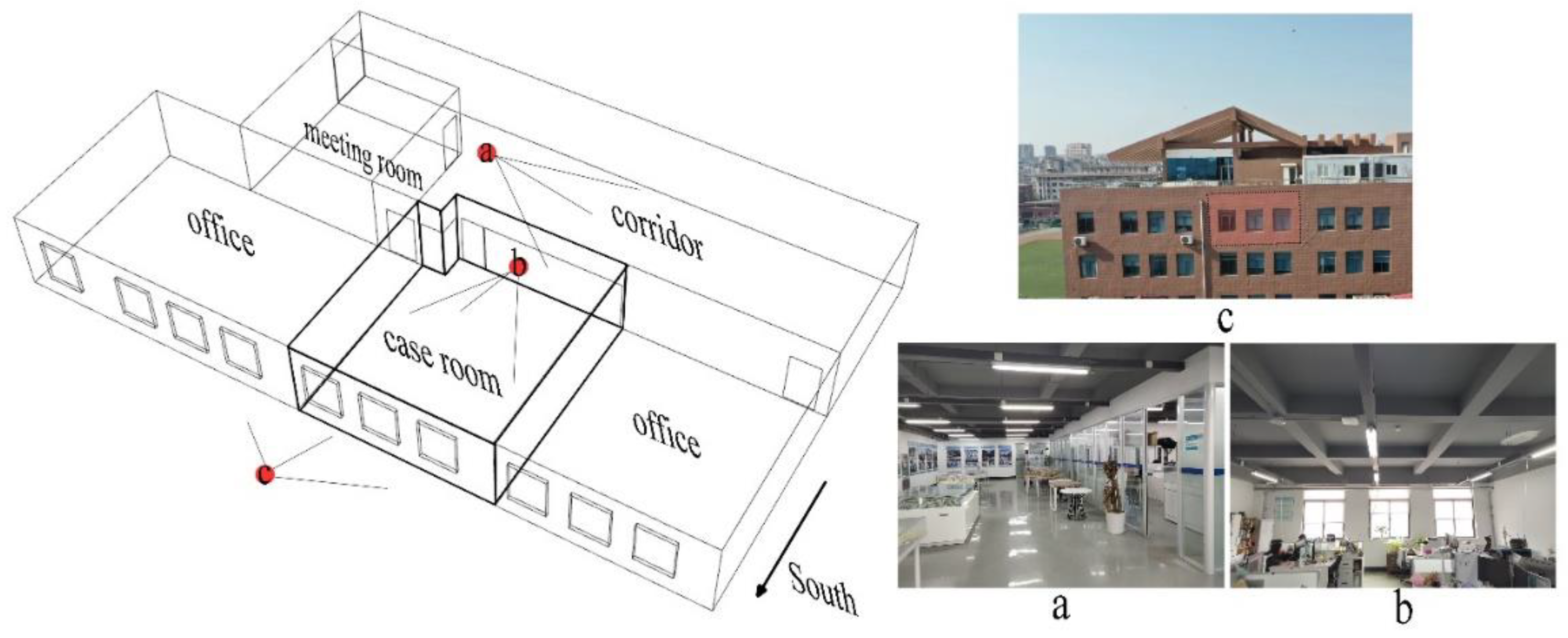
Figure 2.
Dry bulb temperature and global horizontal radiation.
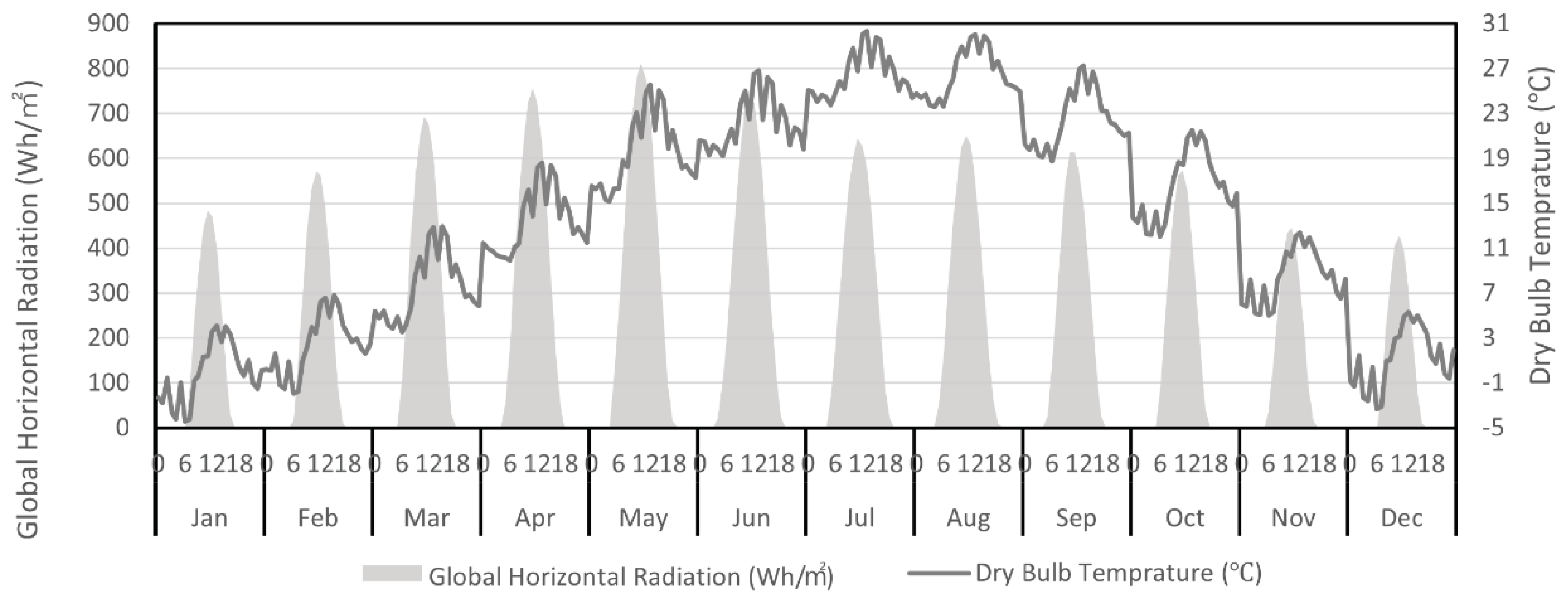
Figure 3.
Air conditioning schedule: (a) Heating setpoint schedule; (b) Cooling setpoint schedule.
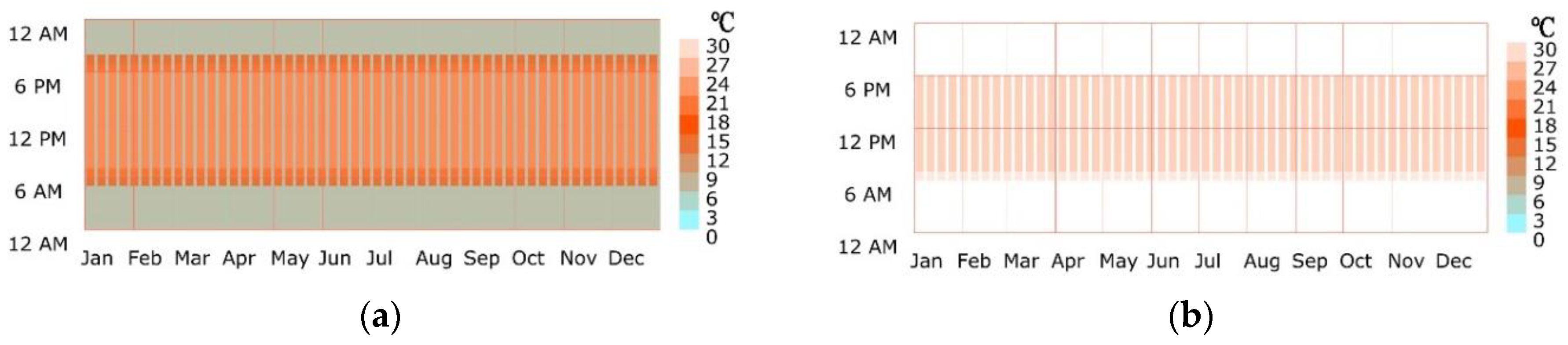
Figure 4.
Schematic diagram of PVSDs.
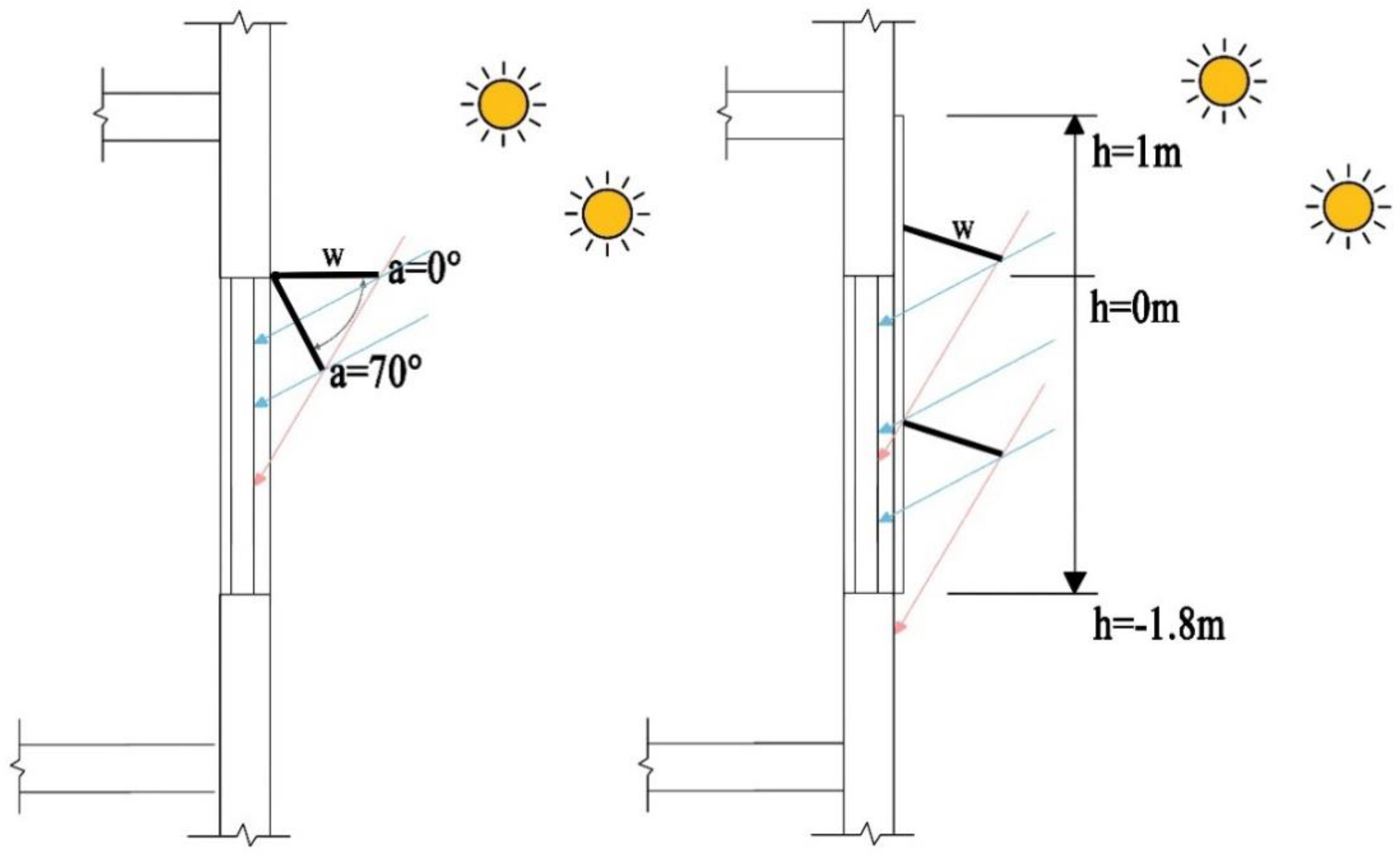
Figure 5.
Parametric performance design flow chart.
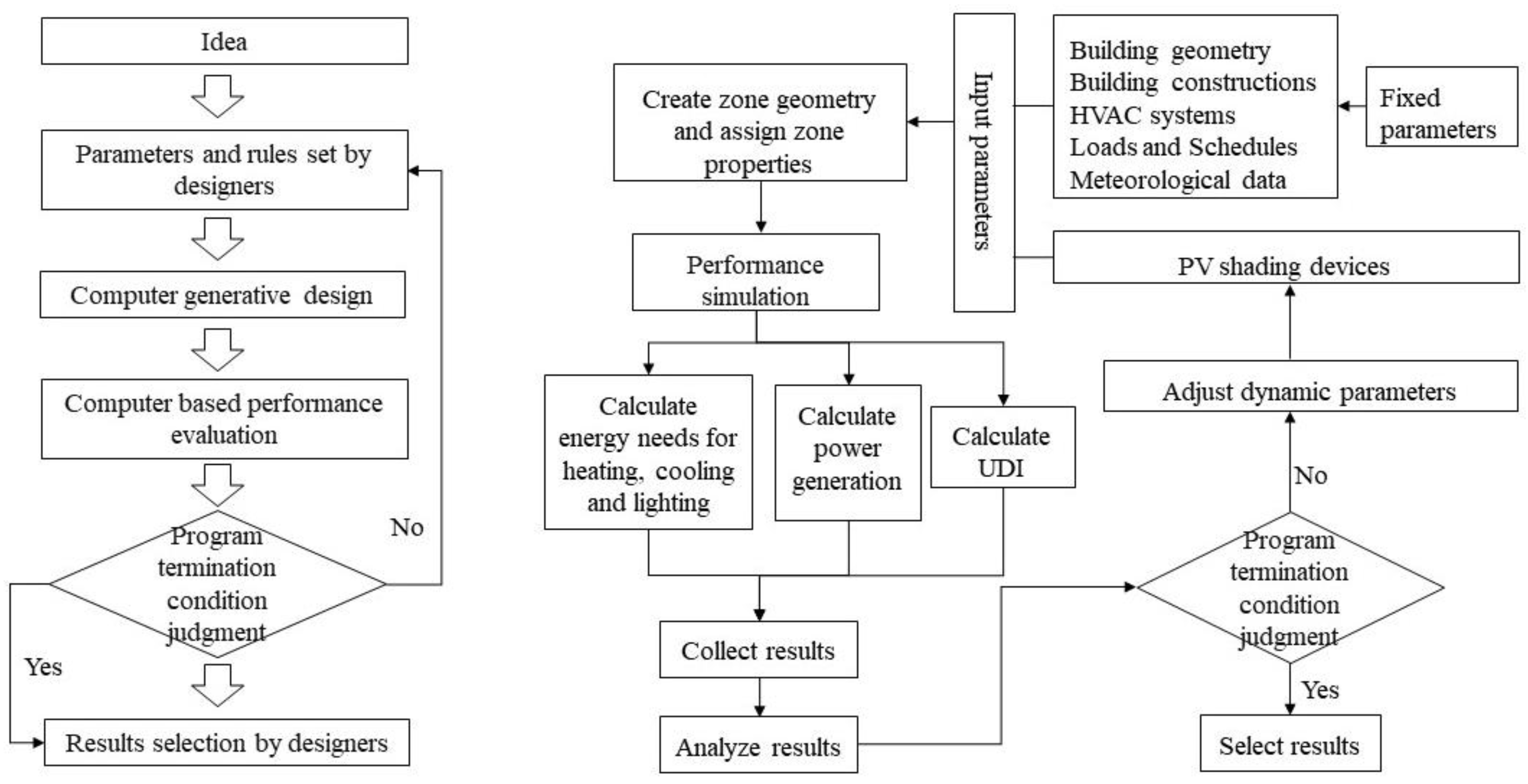
Figure 6.
Comparison between measured and simulated indoor temperatures.
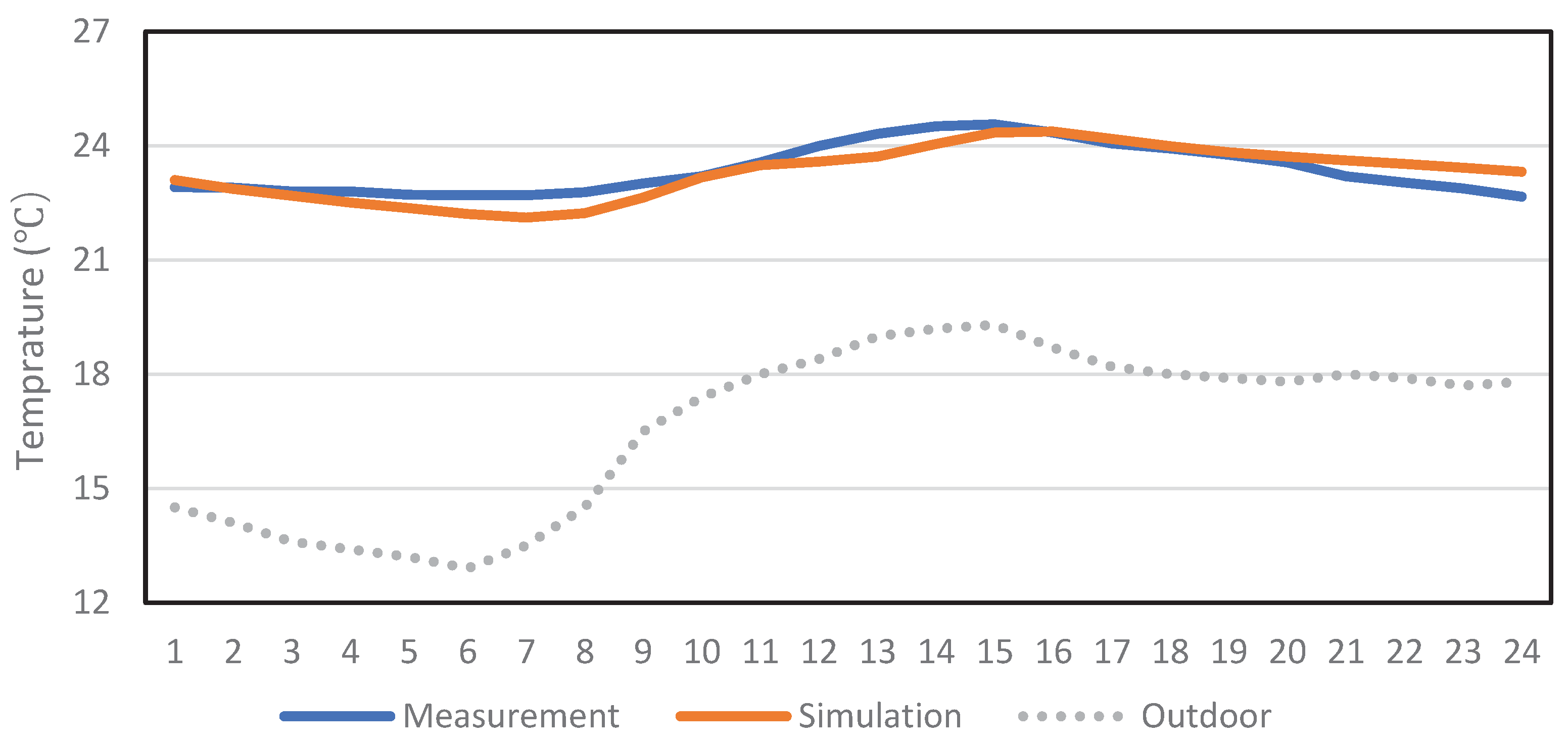
Figure 7.
Impact of PVSDs on energy consumption.
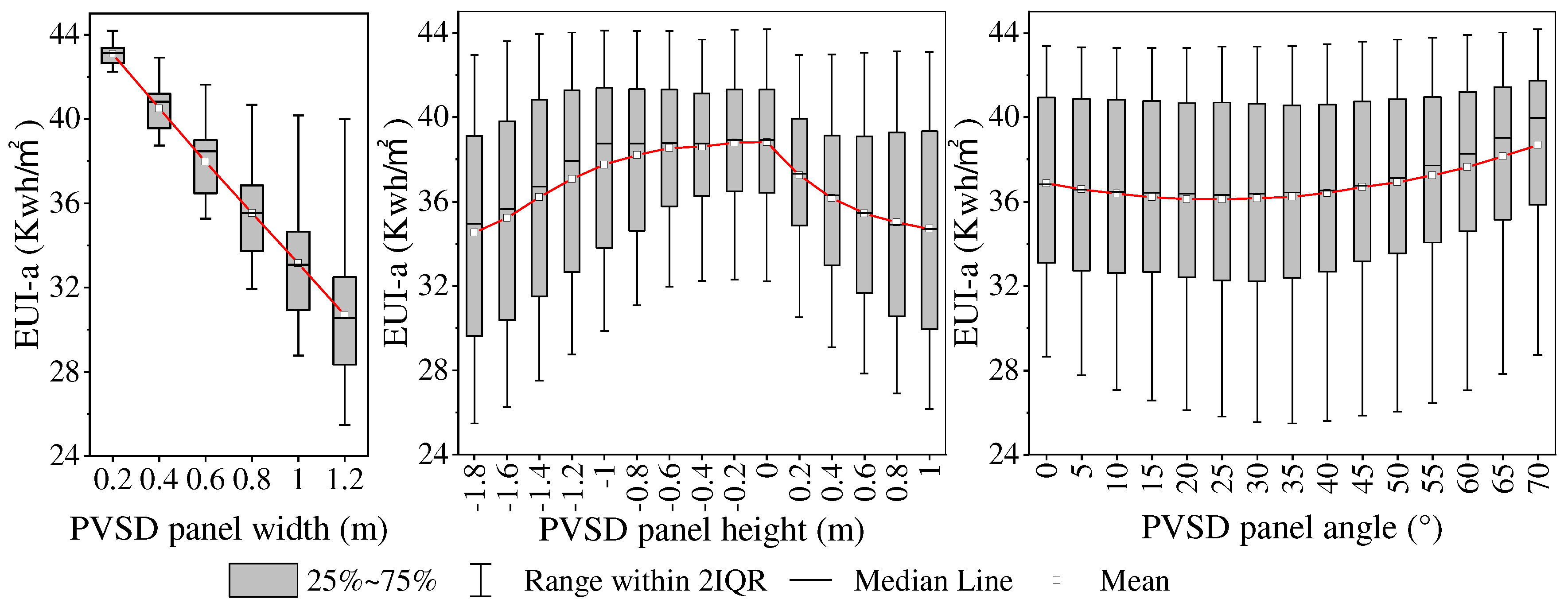
Figure 8.
The impact of PVSDs on daylighting.
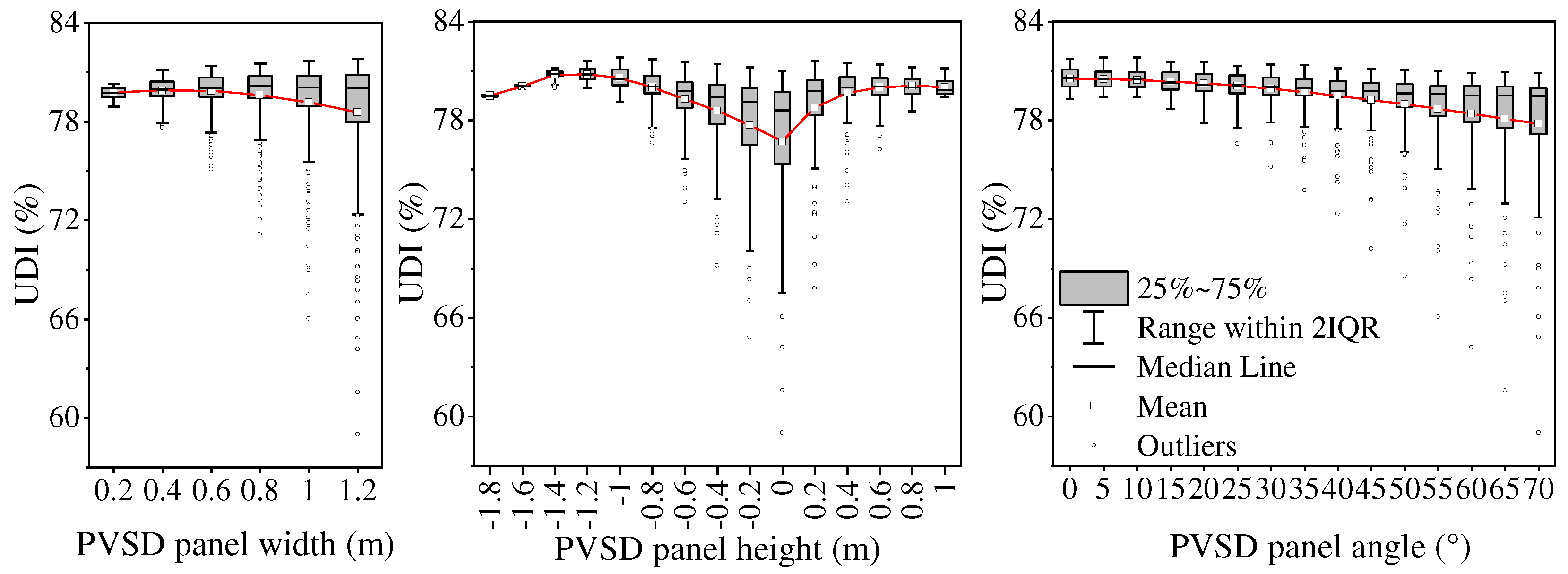
Figure 9.
Monthly energy consumption of fixed PVSDs.
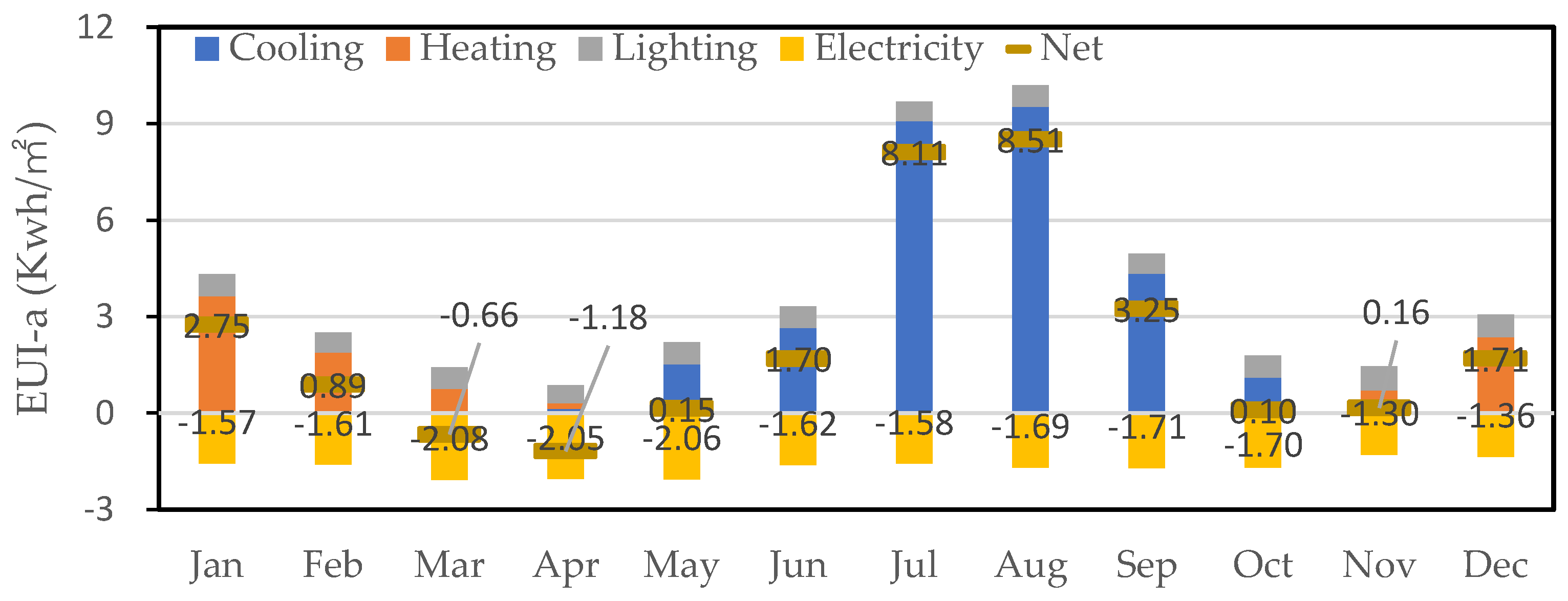
Figure 10.
Daylighting visualization: (a) Visualization of daylighting throughout the year without shading; (b) Visualization of daylighting throughout the year under fixed PVSDs conditions.
Figure 10.
Daylighting visualization: (a) Visualization of daylighting throughout the year without shading; (b) Visualization of daylighting throughout the year under fixed PVSDs conditions.
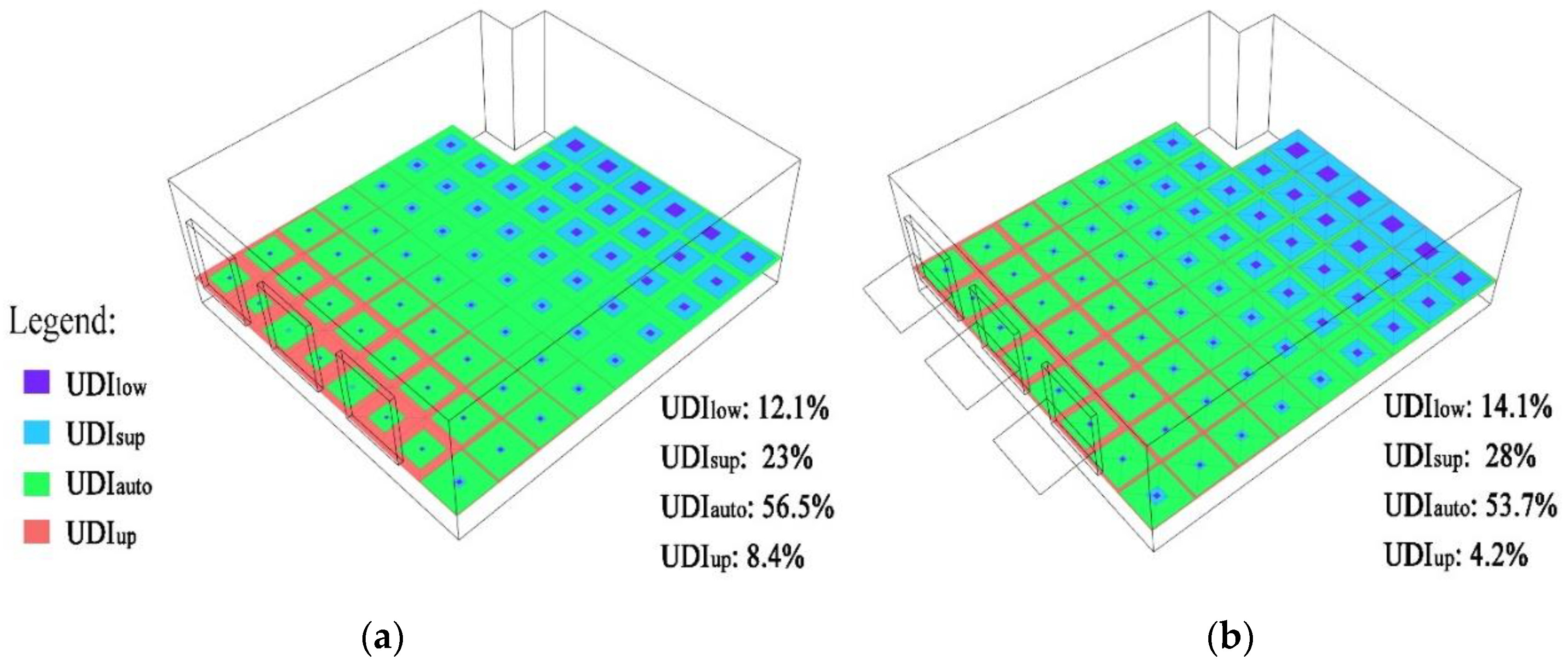
Figure 11.
The impact of rotation strategy on daylighting: (a) January; (b) July.
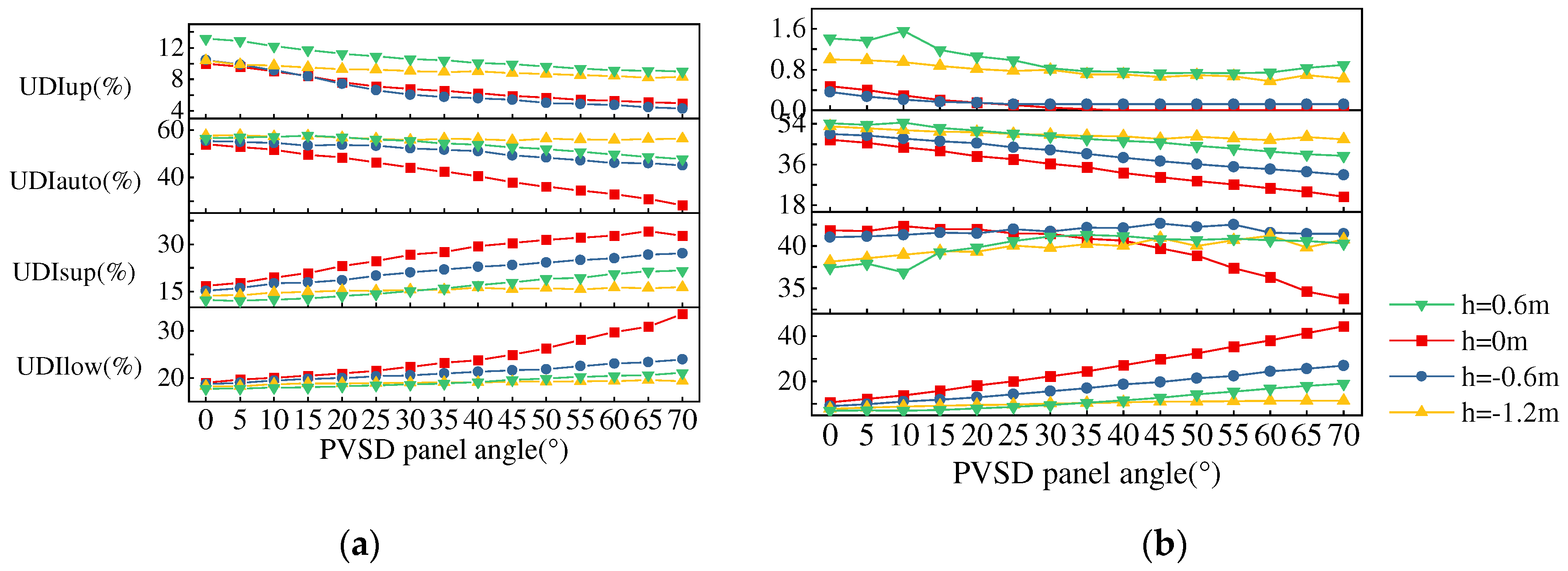
Figure 12.
The impact of sliding strategy on daylighting: (a) January; (b) July.
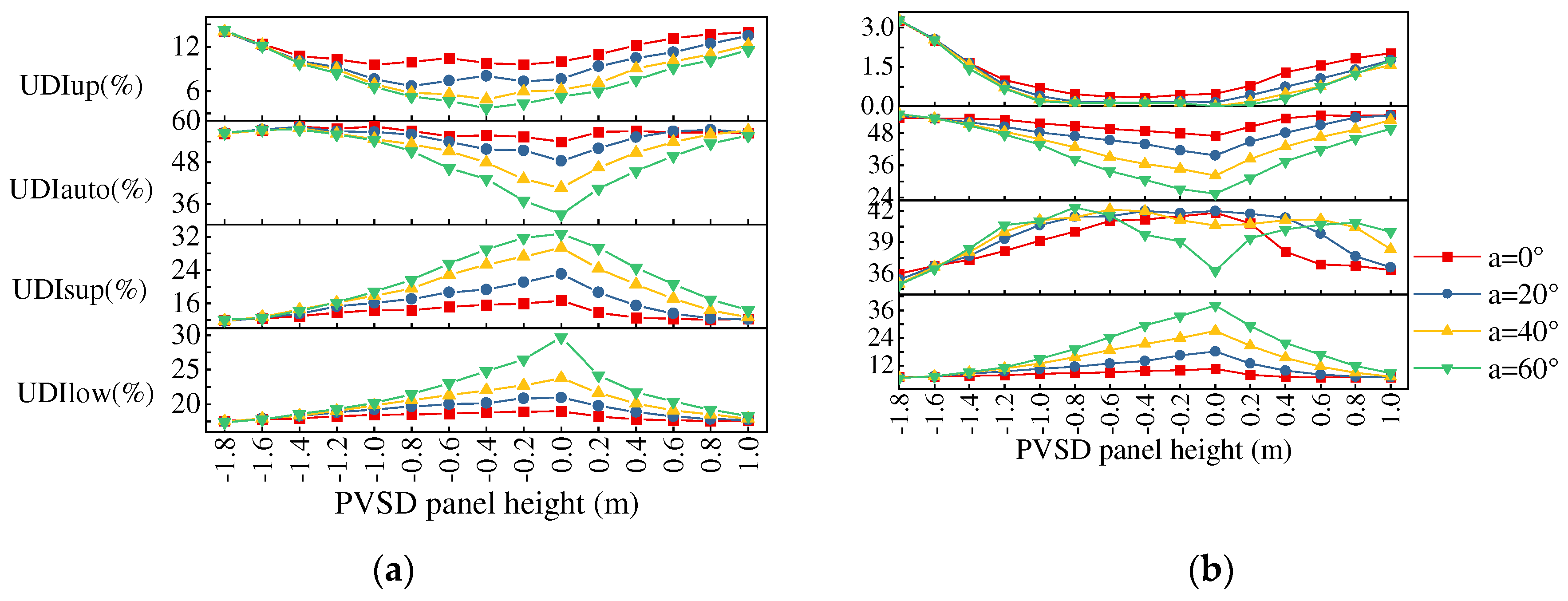
Figure 13.
The impact of hybrid strategy on daylighting: (a) January; (b) July.
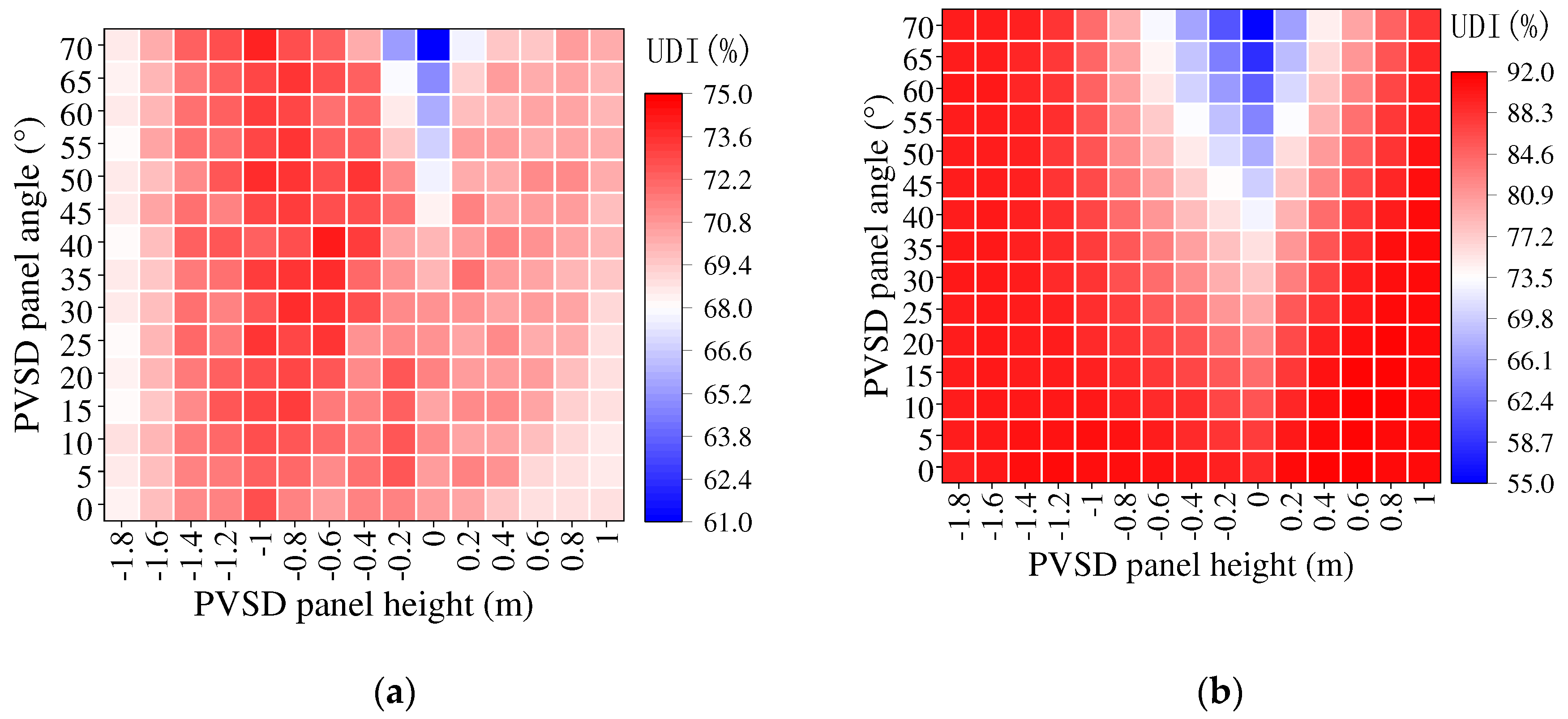
Figure 14.
The impact of dynamic PVSDs on photovoltaic power generation: (a) The impact of rotation strategy on photovoltaic power generation; (b) The impact of sliding strategy on photovoltaic power generation; (c) The impact of hybrid strategy on photovoltaic power generation.
Figure 14.
The impact of dynamic PVSDs on photovoltaic power generation: (a) The impact of rotation strategy on photovoltaic power generation; (b) The impact of sliding strategy on photovoltaic power generation; (c) The impact of hybrid strategy on photovoltaic power generation.
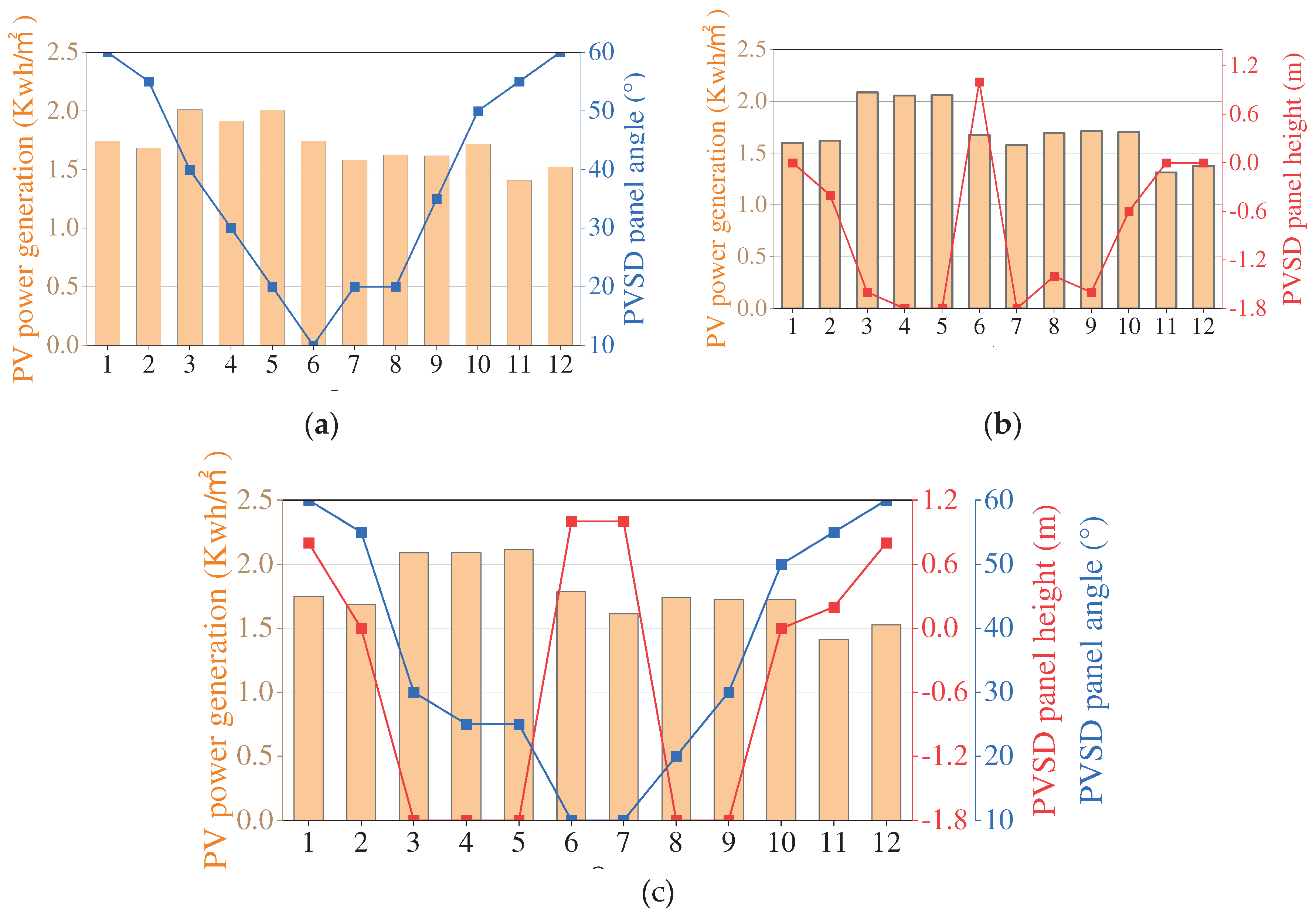
Figure 15.
The impact of dynamic PVSDs on energy consumption.

Figure 16.
The impact of dynamic PVSDs on lighting energy consumption: (a) January; (b) July.
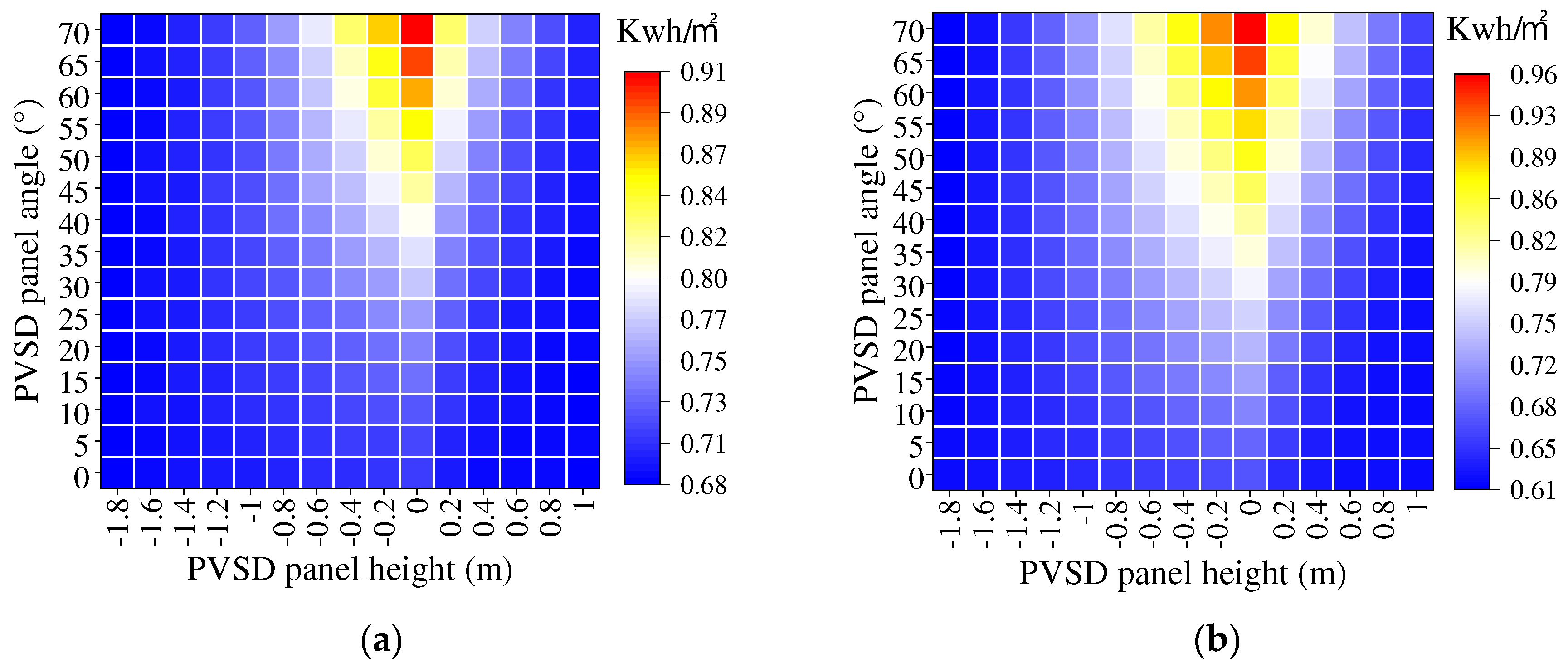
Figure 17.
Energy saving potential of dynamic PVSDs: (a) Rotation strategy; (b) Sliding strategy; (c) Hybrid strategy.
Figure 17.
Energy saving potential of dynamic PVSDs: (a) Rotation strategy; (b) Sliding strategy; (c) Hybrid strategy.
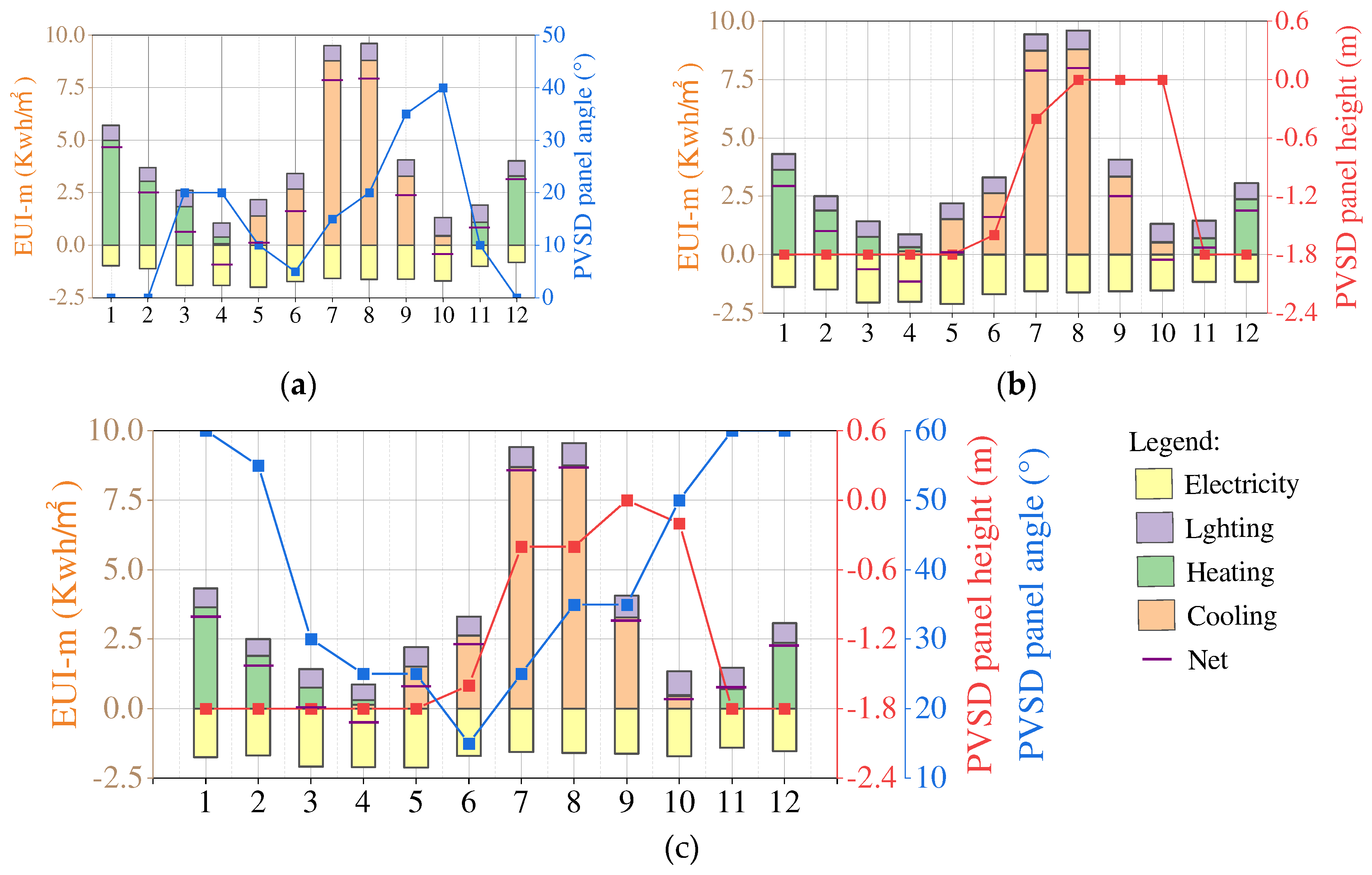
Figure 18.
Dynamic PVSDs daylighting potential: (a) Daylighting potential without PVSDs; (b) Rotation strategy; (c) Sliding strategy; (d) Hybrid strategy.
Figure 18.
Dynamic PVSDs daylighting potential: (a) Daylighting potential without PVSDs; (b) Rotation strategy; (c) Sliding strategy; (d) Hybrid strategy.
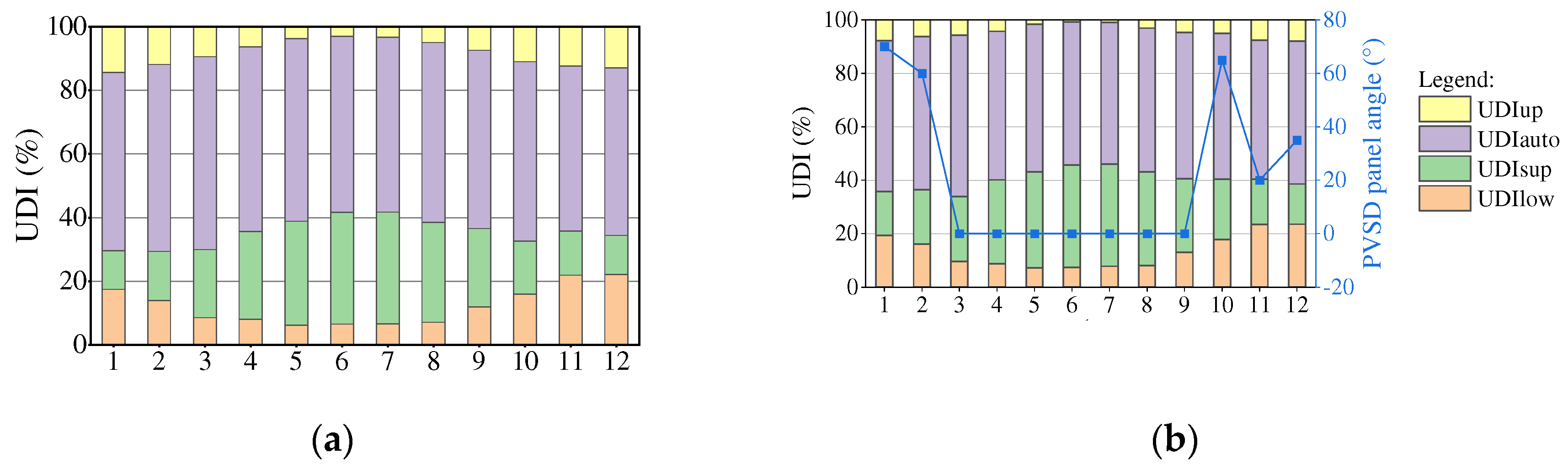
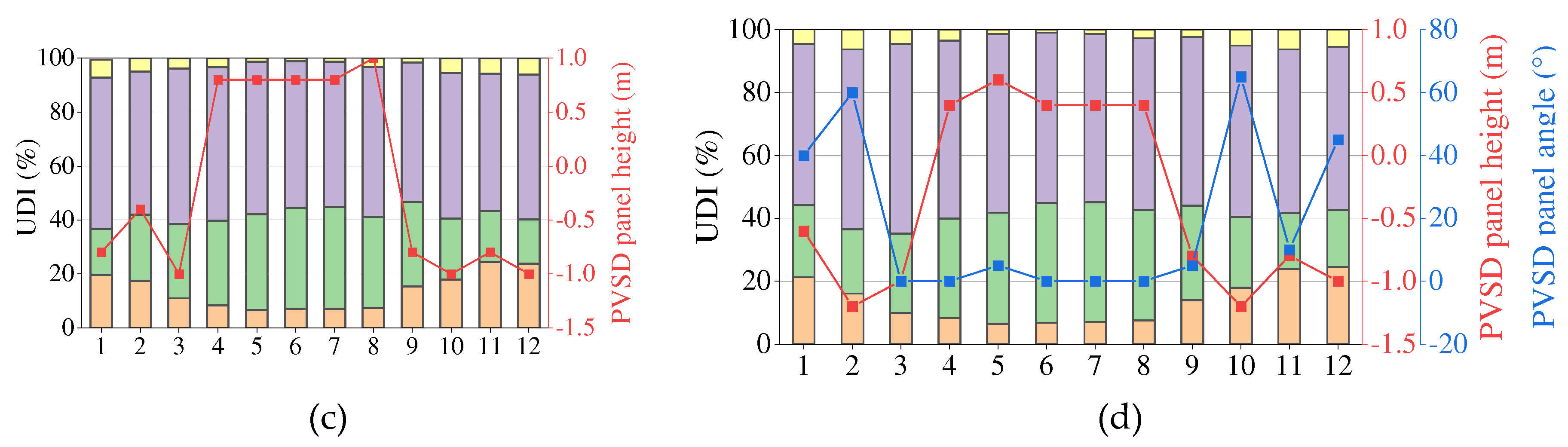
Figure 19.
Comparison of energy consumption and daylighting between fixed PVSD and dynamic PVSD: (a) Energy consumption; (b) Daylighting.
Figure 19.
Comparison of energy consumption and daylighting between fixed PVSD and dynamic PVSD: (a) Energy consumption; (b) Daylighting.
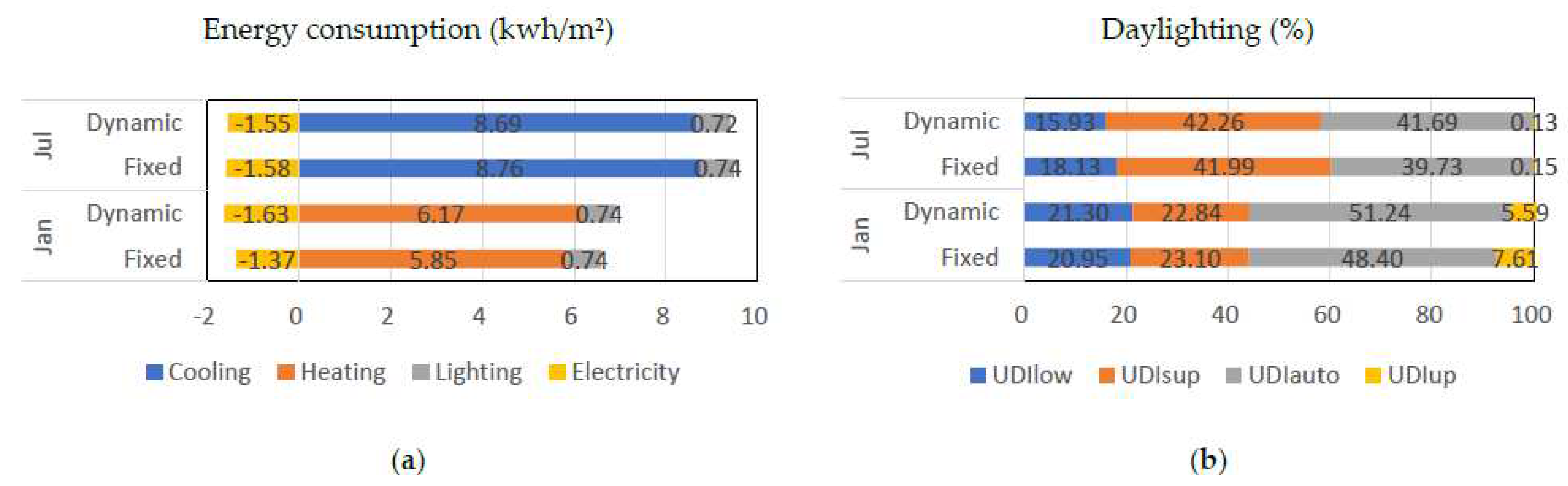

Table 1.
Thermal properties of the building.
| Component | Value | Unit |
|---|---|---|
| External wall U-value | 0.36 | W/(m2K) |
| Roof U-value | 0.47 | W/(m2K) |
| Window U-value | 2.58 | W/(m2K) |
| Airtightness | 0.0003 | m3/s-m2 |
| Lighting load | 8 | W/m2 |
| Equipment load | 15 | W/m2 |
| Ventilation per person | 0.0084 | m3/s-ppl |
Table 2.
Optical properties of the surfaces.
| Building elements | RGB reflectance | Roughness | Speculariy | Transmissivity |
|---|---|---|---|---|
| Opaque wall | 0.85,0.85,0.85 | 0.05 | 0.0013 | - |
| Ceiling | 0.16,0.17,0.17 | 0.005 | 0.008 | - |
| Floor | 0.4,0.45,0.41 | 0.002 | 0.05 | - |
| Window | - | - | - | 0.65 |
| Glass wall | - | - | - | 0.65 |
Table 3.
The range and interval control of variables.
| Variables | Range of values | Value interval | Unit |
|---|---|---|---|
| Width | 0.2 ~ 1.2 | 0.2 | Meter |
| Sliding height | -1.8 ~ 1 | 0.2 | Meter |
| Tilt angle | 0 ~ 70 | 5 | Degree |
Table 4.
Visualization of simulated and measured illuminance levels and their distribution at work plane level.
Table 4.
Visualization of simulated and measured illuminance levels and their distribution at work plane level.
| 10:30 | 12:30 | |
|---|---|---|
| Measured |
 Average illumination: 3118.47 lux |
 Average illumination: 1199.8 lux |
| Simulated |
 Average illumination: 3096.91 lux |
 Average illumination: 1309.63 lux |
| MBE | 0.69% | -9.15% |
| CV (RMSE) | 21.78 | 15.53% |
Disclaimer/Publisher’s Note: The statements, opinions and data contained in all publications are solely those of the individual author(s) and contributor(s) and not of MDPI and/or the editor(s). MDPI and/or the editor(s) disclaim responsibility for any injury to people or property resulting from any ideas, methods, instructions or products referred to in the content. |
© 2024 by the authors. Licensee MDPI, Basel, Switzerland. This article is an open access article distributed under the terms and conditions of the Creative Commons Attribution (CC BY) license (http://creativecommons.org/licenses/by/4.0/).
Copyright: This open access article is published under a Creative Commons CC BY 4.0 license, which permit the free download, distribution, and reuse, provided that the author and preprint are cited in any reuse.


