

Submitted:
08 May 2024
Posted:
08 May 2024
You are already at the latest version
Abstract
Frass generated during the production of black soldier fly larvae is taking the interest of scientists and horticultural producers because it is a material from the biotransformation of organic waste, it has several nutrients that can be used by plants, and its recent focus on its biostimulant capacity. The thermal-composting process is a stabilization that improves physical and chemical properties of treated wastes, allowing better performance in plants compared to its fresh state. In this research, thermocomposted frass was evaluated as a germination substrate for kale seeds (Brassica olerasea). To achieve this, it was evaluated the phytotoxicity in different concentrations on the seeds, and seedlings were grown in a germination substrates mixed with 20, 40, 60, 80 and 100% of frass. The treatment with 20% frass showed the highest values of seedling height, stem diameter, number of leaves, length, and width of first true leaf and length and width of cotyledons, reduced the content of phenols and tannins antioxidants but the content of flavonoids increased compared to the control and the rest of mixtures.
Keywords:
organic waste
; spiral economy
; dynamic programming
; risk management
; post-decision state variable
1. Introduction
The reduction of arable land and extreme weather conditions has led to a great proportion of crops, being cultivated in a soilless greenhouse production system to provide sufficient and high-quality food. Soilless production is a new kind of cultivation that uses organic or inorganic inert substrates, where the nutrients can be supplied from a nutrient solution in an optimal and innocuous way [1].
The most used growing media in soilless cultivation are peat, coir, soft-wood pine bark, wood fiber and composted organic wastes. These materials must offer the physical, chemical, and biological properties to support healthy root growth in the environment that contains it; and it must provide the practical requirements of the production system in which it is being used [2]. Peat moss is the most used substrate for plant germination due to its high moisture retention capacity and porosity. However, these properties generalize the proliferation of fungi that are harmful to the proper development of plants. It comes from moss ecosystems and its extraction destroys areas of ecological importance [3]. The search for new materials for plant germination has become a way to reduce environmental impact and at the same time improve seedling development. The use of composted waste is a good option, since it offers physical and chemical properties suitable for the development of seedlings in addition to reincorporating the waste into the production chains [4].
Black soldier fly larva frass is a bioresource composed by excrement, not digested food and insect exoskeleton, which can be used in agriculture for many purposes, to improve plant growth, to increase production and soil improvement, this due to its high content of organic matter and nitrogen [5]. However, frass post-processing through anaerobic digestion or thermocomposting may be advised to avoid soil nitrogen deficiencies or impairing soil gas permeability, and thus have a better use of nutrients by plants [6].
Frass has been used as a germination substrate for vegetables, coming from Gainesville-type feeding, with any stabilization post-treatment (fresh frass), in combination with commercial peat, where 10% of frass showed the highest values in plant growth [7]. Frass stabilization by thermocomposting improves its physical and chemical properties, such as pH and significantly increases crop yield [8].
For this reason, the aim of this work is to evaluate black soldier fly larvae frass (BSFLF) generated from the treatment of fruit and vegetable waste, stabilized by thermocomposting, as a substrate for kale germination.
2. Materials and Methods
2.1. Obtention of Thermocomposted Black Soldier Fly Larva Frass
Black soldier fly larvae frass (BSFLF) was obtained from biotransformation unit pilot at Universidad Autonoma de Queretaro, Campus Amazcala – Mexico. The feedstock was organic residue integrated of a mixture of fruits and vegetables, from a municipal market as a biotransformation process. The residue was collocated in plastic boxes, filled with 20 kg residue and 9000 5-day-old larvae. 500 grams of sawdust was added to each box to reduce moisture. Fresh frass was collected by sieving after 14 days and placed in a circular tank made of geomembrane. The thermocomposting lasted 30 days using the static heap method until obtain a stabilized and ambient temperature frass.
2.2. Laboratory Analysis Methods of Thermocomposted BSFLF
After thermocomposting, frass was sieved to obtain 2 mm particle size and air dried. The Mexican norm NMX-FF-109-SCFI-2008 [35]was following to determine pH, electric conductivity, moisture content, organic matter, organic carbon, total nitrogen, carbon to nitrogen ratio, cation exchange capacity, apparent density and carbon to phosphorus ratio; nitrate nitrogen was calculated according to Cataldo et al. [36]; phosphorus was determined following the Mexican norm NMX-DGN-AA-32-1976 [37]; potassium, calcium and sodium concentration was determined by flamometry; magnesium concentration was determined according to Harris [38] and humic and fulvic acid was quantified following Kononova Belchikovas method [39].
2.3. Phytotoxicity Test of Thermocomposted Frass and Germination Index
To determine phytotoxicity the plant bioassay method was used, where seed germination index and plant growth were determined. The black soldier fly larvae frass was hand sieved with a 2 mm diameter sieved, then, extracts were obtained by diluting 5 g of frass, with 50 ml of distilled water (1:10 w/v) and shaken in Thermo Scientific maxQ 2506 reciprocating shaker for one hour. The samples were diluted in series of 20%, 40%, 60%, 80%, 100% and distilled water as a positive control. 5 ml of each dilution factor was taken and placed in the petri dish. Seeds of Blue ridge kale (SAKATA ®® Seed America, Inc.) (Brassica oleracea) were used as a test crop, where 10 seeds were placed in the petri dish in triplicate, laid on filter paper and moistened with 5 ml of black soldier fly larvae frass extract. The petri dishes were kept in an incubator Memmert IN30 under a controlled environment at 25 °C, measuring at 72 hours before. The germinated seed were counted, and their root lengths were measured. Germination index (GI) was calculated using the following equation [14]:
Where RSG is the relative seeds germination and RRG represents the relative root growth. RSG and RRG are calculated as follow equation.
Where SGCE is number of seeds germinated in thermocompost extracts and SGDW is number of seeds germinated in distilled water.
Where MRLCE is mean root length in thermocompost extract and MRLDW is mean root length in distilled water. To evaluate the phytotoxicity of frass, the GI value vas calculated [14], where GI values below 50% were considered highly phytotoxic, values between 50% and 80% were moderately phytotoxic and values above 80% indicate no phytotoxic. When the value exceeds 100% can be considered a phytonutrient or phytostimulant.
2.4. Germination Substrate Preparation
To assess the ability of BSFLF as a growing media, six different germinations substrates were composed as follows (% volume): commercial peat moss (PM), PREMIER ®® Sphagnum Peat Moss Premier Horticulture, Inc. – USA, PM 100% (GS1); PM 80% + BSFLF 20% (GS2); PM 60% + BSFLF 40% (GS3); PM 40% + BSFLF 60% (GS4); PM 20% + BSFLF 80% (GS5) and BSFLF 100% (GS6).
2.5. Seedling Experiment
The experiment was carried out under a greenhouse with temperatures ranging from 8.1 to 38.2 °C, relative humidity ranging from 16.6 to 76.8 % and solar photoperiod (maximum intensity 2448 μM/m2s). Blue ridge kale (SAKATA ®® Seed America, Inc.) was sown manually 1 seed per pot. Styrofoam pots were used (diameter 8 cm and height 9 cm, 8 oz.) and filled with the different germination substrates. Each pot was arranged in a completely randomized design with 33 replicates and was manually irrigated every day. Thirty days after sowing, the following variables were measured on each replicate per treatment: Height of plant (mm), stem diameter (mm), total number of true leaves, true leave length (mm), true leave width (mm), cotyledon length (mm) and cotyledon width (mm).
2.6. Antioxidants Content
The extraction was made according to Cardador et al. [40], 25 mg of dry sample and 200 mg of wet sample of kale were taken, and then 2.5 ml of methanol was added. The samples were kept in the dark and shaking, and after 24 h they were centrifugated at 5000 rpm for 10 min at 4 °C, the supernatant was taken only.
2.6.1. Total Content of Phenols, Flavonoids, and Tannins
The total phenols content of root and leaf were determined using the Folin-Ciocalteu method according to Singleton et al. [41], modified to 96-well microplate use. 4 μl equivalent to 0.01 g of the extraction was mixed with 250 μl of Folin-Ciocalteu reagent and 1250 μl of Na2CO3, incubated at room temperature for 2 hr. Absorbance was measured at 760 nm using spectrophotometer MULTISKAN GO, and the results were expressed as gallic acid equivalents per gram of sample.
The spectrophotometric method was used to determine the total flavonoids content in methanolic extracts according to Oomah et al. [42]. 50 μl of methanolic extract was mixed with 180 μl of distilled water and 20 μl of 2-aminoethyl diphenylborinate at 1% in a 96-well microplate. Absorbance was measured at 404 nm using spectrophotometer MULTISKAN GO, and the results were expressed as rutin equivalents per gram of sample.
Total tannins content was determined following Feregrino-Perez [43] modified method to 96-well microplate use. 50 μl of methanolic extract and 200 μl of solution 1:1 (v/v) of vanillin at 1% and HCl at 8% were deposited in 96-well microplate, and 50 μl of methanol and 200 μl of HCl. Absorbance was measured at 492 nm using spectrophotometer MULTISKAN GO, and the results were expressed as catechin equivalents per gram of sample.
2.6.2. Antioxidant Capacity Determination DPPH and ABTS
DPPH quantification was made according to Zenil et al. [44], 20 μl of methanolic extract and 200 μl of DPPH was deposited in in 96-well microplate. Absorbance was measured at 520 nm at 0, 10, 30, 60 and 90 minutes, using a spectrophotometer MULTISKAN GO, and the results were expressed as Trolox equivalents per gram of sample.
The spectrophotometric method for antioxidant capacity quantification by ABTS was made following Pellegrini et al. [45]. 230 μl of ABTS and 20 μl of sample was deposited in a 96-well microplate. Absorbance was measured at 734 nm using spectrophotometer MULTISKAN GO, and the results were expressed as Trolox equivalents per gram of sample.
2.7. Statistical Analysis
Data were analyzed using the software STATGRAPHICS Centurion, by one-way analysis of variance (ANOVA). The least significant difference was determined by Fisher’s test at P<0.05.
3. Results
3.1. Chemical Composition of Thermocomposted BSFLF
The chemical composition of peatmoss and frass are reported in Table 1.
3.2. Phytotoxicity of Thermocomposted BSFLF and Germination Index of Kale
All the treatments showed germination upper than 80 ± 26.46 % with no significant difference however, the 80% and 100% composted frass doses showed a moderately and highly phytotoxicity respectively, 20% and 40% treatments were greater than 100% which it means it has a phytostimulant properties, all values are shown in Table 2.
3.3. Effect of Thermocomposted BSFLF as Germination Substrate on Kale Seedlings Growth
The percentage of emergence of kale was affected by the percentage of inclusion of composted frass as a germination substrate, the results are shown in Table 3. Treatments GS2, GS4 and GS5 were the first to emerge, treatments GS5 and GS6 reached its highest emergence percentage on 7th day and then the plants die. The moderate and high phytotoxicity obtained for these treatments in the previous test was reaffirmed in this test. After 12th day, only treatments GS1, GS2, GS3 and GS4 survived, so the rest of the analyzes were for these treatments.
The growth of the kale seedlings was recorded with the variables of height, stem diameter, number of true leaves, length, and width of first true leaf and cotyledon. In Table 4 and Table 5 are shown mean values of those variable, 12 day after the seeds were sown and day 40 when the seedlings were harvested. The greatest vegetative growth was performed by GS2 substrate, a mixture of composed of 80% peatmoss and 20% composted frass. At the end of the experiment, the GS2 treatment showed the best results compared to the GS1 control treatment, increasing height and steam diameter by 32.7%, number of true leaves by 51.6%, length and width of first true leaf by 38.7% and 17.9% respectively, and cotyledon length and width by 25% and 33.7% respectively (Figure 1).
3.3. Antioxidants Content
The contents of phenols in kale leaf sample are expressed in milligrams equivalent of gallic acid, tannins in milligrams equivalent of catechin, and flavonoids in milligrams equivalent of rutin, in Table 6. The GS1 treatment (control treatment) shows the highest content of phenols and tannins and the GS2 treatment was the one with the lowest content of those phenolic compounds.
In flavonoids content, the GS4 treatment showed the highest amount and the GS1 treatment showed the lowest.
Antioxidant capacity is expressed in ABTS and DPPH percentage in Table 7, only the GS1 treatment showed a significantly higher percentage of ABTS compared to the GS2 treatment. The GS1, GS2 and GS3 treatments showed a significantly higher percentage of DPPH compared to the GS4 treatment.
4. Discussion
The Thermocomposted frass showed an alkaline pH (8.5), a higher value compared to other authors, 7.26 from brewery residue [9], 7.3 from brewery residue [8,10], 7.5 from a mixture of okara and wheat bran [11], 7.6 from brewery residue amended with sawdust [12], 7.7 from brewery residue [13] and 7.8 from brewery residue [14]. The rest of physical and chemical characteristics of thermocomposted frass used in this research are different from those reported in other works, this is because the origin of the waste with which the fly larvae were fed has a direct effect on the physical quality and quantity of frass nutrients [6].
Other experiment that used frass, from different waste compared to this work and even in a fresh state, showed a similar trend on seed of lettuce and radish, decreasing the percentage of frass in the aqueous medium, the GI value increased, however these values were higher in this work, which indicates that a composted frass has fewer effects due to phytotoxicity [15]. Another study carried out with fresh frass demonstrated GI values greater than 100%, which indicated zero phytotoxicity on seed of garden cress, however, it is important to consider the dilution values used in this work, it was at a ratio of 1:20 which means that it was a mostly diluted extract [7].
A study of thermocomposted frass derived from brewers spent grains biotransformation, used a dilution 1:10 made of 100% composted frass as a control, they obtained GI values of 62.4 ± 39.5, upper average value compared to this work, but its standard deviation showed a lower GI [12].
Water extract (1:10) of a mixture of okara and wheat bran frass naturally composted was lower than 25%, which shows that the GI obtained at 100% in this work was higher. This comparison shows that even after a stabilization treatment by composting, frass has a high percentage of phytotoxicity, despite coming from the biotransformation of different types of waste. The high value of phytotoxicity reflected in the low percentage of GI may be due to the presence of phenols, chitin, and an excess of nutrients [11].
According to [16] substrates derived from thermocomposting contain some compounds that can cause phytotoxicity, such as ammonia, ethylene oxide, organic acids, phenols, salts, and heavy metals.
The substrate pH plays an important role in the determination of nutrient availability to the plant [17], while in seed germination, an acid pH can inhibit the action of enzymes necessary for germination and can have a direct effect by dissolving the seed coat [18]. The alkaline pH of the composted frass (8.5) and a high electrical conductivity (7.476 dS/m) could have reduced the germination of kale as the percentage of composted frass increased in the substrate, some authors report pH values between 5.5-6.9 and EC between 1.2-1.9 mS/cm (=dS/m) as suitable for kale germination [19,20,21].
At a higher percentage of inclusion as a germination substrate, the plants present an inhibition in their shoot and root growth. Macro and micronutrients are important for the development and growth of plants because they play important roles in plant physiology [22] however, plant hormones also play a very important role. Auxins and gibberellins are vegetative growth hormones that regulate plant height, cytokinins promote cell division and this is most clearly demonstrated in greater growth of cotyledons; regulates the growth of the stem and roots [23]. It has been reported that the greatest importance of frass is not due to its mineral nutrients, considering they are low compared to other alternative sources; The rhizobacterias and phytormones present in the frass, play a more important role as plant growth promoters [24].
[11] reported the highest number of leaves of pak choi using 10% composted frass with an increase of 41.67% in number of leaves compared to the control. In this study the highest kale growth was with 20% composted frass, with an increase of 51.61% in number of leaves compared to the control.
Therefore, thermocomposting, as a stabilization process for frass, increases the percentage of inclusion as a growth substrate, however, the type of crop produced must be considered because each plant has different demands for physical and chemical properties.
Some authors report that the application of organic fertilizers significantly increases the content of phenolic compounds in plants compared to inorganic fertilizers [25,26]. Considering that the production of phenolic compounds is the response of plants to biotic or abiotic stress [27], the increase in phenolic compounds in plants due to the application of organic fertilizers could be the response to abiotic stress due to the slow release of nutrients [28]. In that sense, a higher nitrogen application results in a decrease in the total phenolic and flavonoid contents [29,30].
Flavonoids has protective functions in plants including defense against phytopathogens and herbivores [31]. They influence the transport of auxin, a plant hormone that protects the plants from microbes and insects. Flavonoids play an important role inside the root during nodule meristem formation and as a defense against the attack of rhizobia soil bacteria [32]. In this way, the increase in flavonoids content as the percentage of composted frass in the substrate increased may have been in response to the defense of the microorganism contained in the frass, some of them are useful as agents that promote plant growth, nitrogen-fixing bacteria and phosphate solubilizing bacteria such as Azospirillum, Rhizobium, Azotobacter and genera Bacillus [33].
The difference between the obtained DPPH values can be attributed to the nitrogen content in the composted frass, because it has been reported that a greater amount of nitrogen applied to the plant, the percentages of ABTS and DPPH decreases, considering that this assay measures the activity of water-soluble antioxidants [29]. The same effect was reported by [30]. [34] reported no significant difference in the total phenol nether antioxidant capacity using fresh frass.
5. Conclusions
The addition of thermocomposted BSFLF derived from the biotransformation of organic waste, mixed with peatmoss generates the appropriate physicochemical conditions for the generation of a substrate for the agronomic performance of kale. The results obtained in this research show an alternative material for the germination, allowing greater production of seedlings under an environmentally friendly concept for soilless agricultural producers. The best dose was 20% of frass, however at higher doses there was an inhibition of growth and even the death of seedlings, so it would be necessary to improve the thermal stabilization process or even add another.
The origin of the residue bio transformed with soldier fly larvae influences the nutrient content in the frass, these nutrients can benefit plant nutrition. However, more research is needed on the content of other components of equal importance such as phytohormones. It is important to know the appropriate doses of composted BSFL in the phenological stages of germination, development, and production in different species of vegetables and fruits. Likewise, it is necessary to evaluate this germination substrate under biotic or abiotic stress, to take advantage of the agronomic benefits offered by the substrate and increase the antioxidant content in the seedlings.
Author Contributions
Writing-original draft, conceptualization, investigation, H.G.L.; investigation, conceptualization, B.P.P; writing—original draft preparation, H.G.L. and A.A.F.P.; investigation, A.G.C.; writing—review and editing, A.A.F.P. and J.F.G.T; visualization, A.A.F.P.; J.F.G.T; H.G.L.; supervision, A.A.F.P. and J.F.G.T. All authors have read and agreed to the published version of the manuscript.
Funding
This research received no external funding.
Data Availability Statement
Data are contained within the article.
Acknowledgments
The authors are grateful for the financial support provided by CONAHCyT (Consejo Nacional de Humanidades, Ciencia y Tecnología) thorough the Hugo González-Lara (663475) to carry out her doctoral studies. The financial support provided by FONFIVE2024 for the realization of the project and support from the Autonomous University of Queretaro.
Conflicts of Interest
The authors declare that they have no known competing financial interests or personal relationships that could have appeared to influence the work reported in this paper.
References
- A. Nerlich and, D. Dannehll. Soilless Cultivation: Dynamically Changing Chemical Properties and Physical Conditions of Organic Substrates Influence the Plant Phenotype of Lettuce. Front Plant Sci 2021, 11. [CrossRef] [PubMed]
- S. TM, N. Thakur, and P. Sharma. Use of alternative growing media in ornamental plants. Int J Chem Stud 2020, 8, 188–194. [CrossRef]
- A. Giménez, et al. Promising composts as growing media for the production of baby leaf lettuce in a floating system. Agronomy 2020, 10. [CrossRef]
- M. A. Bustamante et al. Use of livestock waste composts as nursery growing media: Effect of a washing pre-treatment. Sci Hortic, 2021; 281. [CrossRef]
- S. Choi and N. Hassanzadeh. BSFL Frass: A Novel Biofertilizer for Improving Plant Health While Minimizing Environmental Impact. Candian Sci. Fair 2019, 2, 41–46. [Google Scholar]
- T. Klammsteiner, V. Turan, M. F. D. Juárez, S. Oberegger, and H. Insam. Suitability of black soldier fly frass as soil amendment and implication for organic waste hygienization. Agronomy, 2020; 10. [CrossRef]
- L. Setti et al. Use of black soldier fly (Hermetia illucens (L.), Diptera: Stratiomyidae) larvae processing residue in peat-based growing media. Waste Management 2019, 95, 278–288. [CrossRef] [PubMed]
- M. Tanga et al. Performance of black soldier fly frass fertiliser on maize (Zea mays L.) growth, yield, nutritional quality, and economic returns. J Insects Food Feed 2022, 8, 185–196. [CrossRef]
- O. Anyega et al. Black Soldier Fly-Composted Organic Fertilizer Enhances Growth, Yield, and Nutrient Quality of Three Key Vegetable Crops in Sub-Saharan Africa. Front Plant Sci. [CrossRef]
- N. Wu et al. A full recycling chain of food waste with straw addition mediated by black soldier fly larvae: Focus on fresh frass quality, secondary composting, and its fertilizing effect on maize. Science of the Total Environment. [CrossRef]
- S. Song et al. Upcycling food waste using black soldier fly larvae: Effects of further composting on frass quality, fertilising effect and its global warming potential. J Clean Prod. [CrossRef]
- D. Beesigamukama, et al. Low-cost technology for recycling agro-industrial waste into nutrient-rich organic fertilizer using black soldier fly. Waste Management 2021, 119, 183–194. [CrossRef]
- D. Beesigamukama, et al. Exploring Black Soldier Fly Frass as Novel Fertilizer for Improved Growth, Yield, and Nitrogen Use Efficiency of Maize Under Field Conditions. Front Plant Sci 2020, 11, 4592. [CrossRef]
- D. Beesigamukama, et al. Biochar and gypsum amendment of agro-industrial waste for enhanced black soldier fly larval biomass and quality frass fertilizer. PLoS One 2020, 15. [CrossRef]
- K. Bohm, G. A. Hatley, B. H. Robinson, and M. J. Gutiérrez-Ginés. Analysis of Chemical and Phytotoxic Properties of Frass Derived from Black Soldier Fly-Based Bioconversion of Biosolids. Sustainability (Switzerland). [CrossRef]
- M. Teresa Barral and R. Paradelo. Dynamic Soil, Dynamic Plant A Review on the Use of Phytotoxicity as a Compost Quality Indicator. 2011.
- A. Silber and A. Bar-Tal. Nutrition of substrate-grown plants. in Soilless Culture: Theory and Practice Theory and Practice, Elsevier, 2019, pp. 197–257. [CrossRef]
- Y. Laghmouchi, O. Belmehdi, A. Bouyahya, N. Skali Senhaji, and J. Abrini. Effect of temperature, salt stress and pH on seed germination of medicinal plant Origanum compactum. Biocatal Agric Biotechnol 2017, 10, 156–160. [CrossRef]
- Othman Ali, J. , Eliseeva Ludmila G., Molodkina Polina G., Ibragimova Nazirya A., and Duksi Fatima M.. Dataset on the effect of soaking Kale (Brassica Oleraceae L. var. acephala DC.) seeds in solution based on amorphous silicon dioxide on the bioactive components and physiological growth parameters. Data Brief 2022, 40, 107789. [Google Scholar] [PubMed]
- M. Chowdhury et al. Effects of temperature, relative humidity, and carbon dioxide concentration on growth and glucosinolate content of kale grown in a plant factory. Foods. [CrossRef]
- D. Qin, Q. He, S. M. N. Mousavi, and Lord Abbey. Evaluation of Aging Methods on the Surface Characteristics of Hydrochar and Germination Indices for Kale Seeds. Horticulturae 2023, 9. [CrossRef]
- J. Maathuis. Physiological functions of mineral macronutrients. Current Opinion in Plant Biology 2009, 12, 250–258. [CrossRef] [PubMed]
- T. LAZAR. Taiz, L. and Zeiger, E. Plant physiology. 3rd edn. Ann Bot 2003, 91, 750–751. [CrossRef]
- T. Green. A biochemical analysis of Black Soldier fly (Hermetia illucens) larval frass plant growth promoting activity. PLoS One, 2023; 18. [CrossRef]
- F. Ferreres, et al. Phenolic compounds in external leaves of tronchuda cabbage (Brassica oleracea L. var. costata DC). J Agric Food Chem 2005, 53, 2901–2907. [CrossRef] [PubMed]
- F. Serri, M. K. Souri, and M. Rezapanah. Growth, biochemical quality and antioxidant capacity of coriander leaves under organic and inorganic fertilization programs. Chemical and Biological Technologies in Agriculture. [CrossRef]
- P. Landa. Positive effects of metallic nanoparticles on plants: Overview of involved mechanisms. Plant Physiology and Biochemistry 2021, 161, 12–24. [CrossRef] [PubMed]
- N. Hagemann, C. I. Kammann, H. P. Schmidt, A. Kappler, and S. Behrens. Nitrate capture and slow release in biochar amended compost and soil. PLoS One, 2017; 12. [CrossRef]
- M.H. Ibrahim, H. Z. E. Jaafar, E. Karimi, and A. Ghasemzadeh. Impact of organic and inorganic fertilizers application on the phytochemical and antioxidant activity of Kacip Fatimah (Labisia pumila Benth). Molecules 2013, 18, 10973–10988. [CrossRef] [PubMed]
- Biesiada, A. Z. Kucharska, and A. Sokół-Łętowska. The effect of nitrogen fertilization on nutritive value and antioxidative activity of red cabbage. 2014. [Online]. Available: https://www.researchgate.net/publication/228533229.
- E. M. Yahia and A. Carrillo-Lopez, Postharvest Physiology and Biochemistry of Fruits and Vegetables. Woodhead publishing, 2018.
- S. Amalesh, D. Gouranga, and D. Sanjoy Kumar. Roles of flavonoids in Plants. Int J Pharm Sci Tech 2011, 6. [Online] Available: https://www.researchgate.net/publication/279499208.
- M. Susanto, S. Kurniawan, R. DEP, W. Rianne, and D. Hersade. Bio-Conversion and Decomposing With Black Soldier Fly to Promote Plant Growth. KnE Life Sciences, 2022. [CrossRef]
- N. Romano et al. Applications of Black Solider Fly (Hermetia illucens) Larvae Frass on Sweetpotato Slip Production, Mineral Content and Benefit-Cost Analysis. Agronomy, 2022; 12. [CrossRef]
- Mexicana, N. O. NMX-FF-109-SCFI-2008. Humus de lombriz (lombricomposta)- Especificaciones y métodos de prueba 2008.
- Cataldo, D.A.; Maroon, M.; Schrader, L.E.; Youngs, V.L. Rapid Colorimetric Determination of Nitrate in Plant Tissue by Nitration of Salicylic Acid. Commun. Soil Sci. Plant Anal. 1975, 6, 71–80. [Google Scholar] [CrossRef]
- Mexicana, N. O. NMX-DGN-AA-32-1976. Determinación de fósforo total en desechos sólidos (Método del fosfovanadomolibdato). 1976.
- Harris, D. C. (2003). Análisis químico cuantitativo. Reverté.
- M. Banov, V. Tsolova, and I. Kirilov. Reclamation of heaps and industrial sites built in the region of Madjarovo mine (Bulgaria). 2020.
- Cardador, A. , Lorca, G, Oomah, B. Antioxidant activity in common beans (Phaseolus vulgaris L.). Agric Food Chem Agric. 2002, 50, 6975–80. [Google Scholar] [CrossRef] [PubMed]
- Singleton, et al, Analysis of total phenols and other oxidation substrates and antioxidants by means of Folin-Ciocalteu reagent. Methods Enzymol. 1999, 299, 152–178.
- Oomah, B., Cardador, A, Loarca, G. Fenólicos y actividades antioxidantes en frijol común (Phaseolus vulgaris L). J. 2005, 85, 935–942.
- Feregrino-Pérez, A. A. et. al. Effect of Polysaccharides from Common Beans (Phaseolus vulgaris L.) on Azoxymethane-Induced Colon Cancer. J. Agric. Food Chem. 2008, 56, 8737–8744. [Google Scholar] [CrossRef] [PubMed]
- Zenil, N., et al. Total phenols and antioxidant capacity estimated with DPPH/ABTS assays in roses on preservative solutions. Revista Mexicana de Ciencias Agrícolas. 2014, 5, 1029–1039.
- Pellegrini, N. , Proteggente, A, Pannala, A., Yang, M., Rice-Evans, C. Antioxidant activity applying an improved ABTS radical cation decolorization assay. Free Radic Biol Med. 1999, 26, 1231–7. [Google Scholar]
Figure 1.
Representative kale seedlings harvested at day 40 grown in different germination substrates: (a) GS1= 100% Peatmoss (PM); (b) GS2= 20% composted Black Soldier Fly Larvae Frass (BSFLF) + 80% PM; (c) GS3= 40% composted BSFLF + 60% PM and (d) GS4= 60% composted BSFLF + 40% PM.
Figure 1.
Representative kale seedlings harvested at day 40 grown in different germination substrates: (a) GS1= 100% Peatmoss (PM); (b) GS2= 20% composted Black Soldier Fly Larvae Frass (BSFLF) + 80% PM; (c) GS3= 40% composted BSFLF + 60% PM and (d) GS4= 60% composted BSFLF + 40% PM.
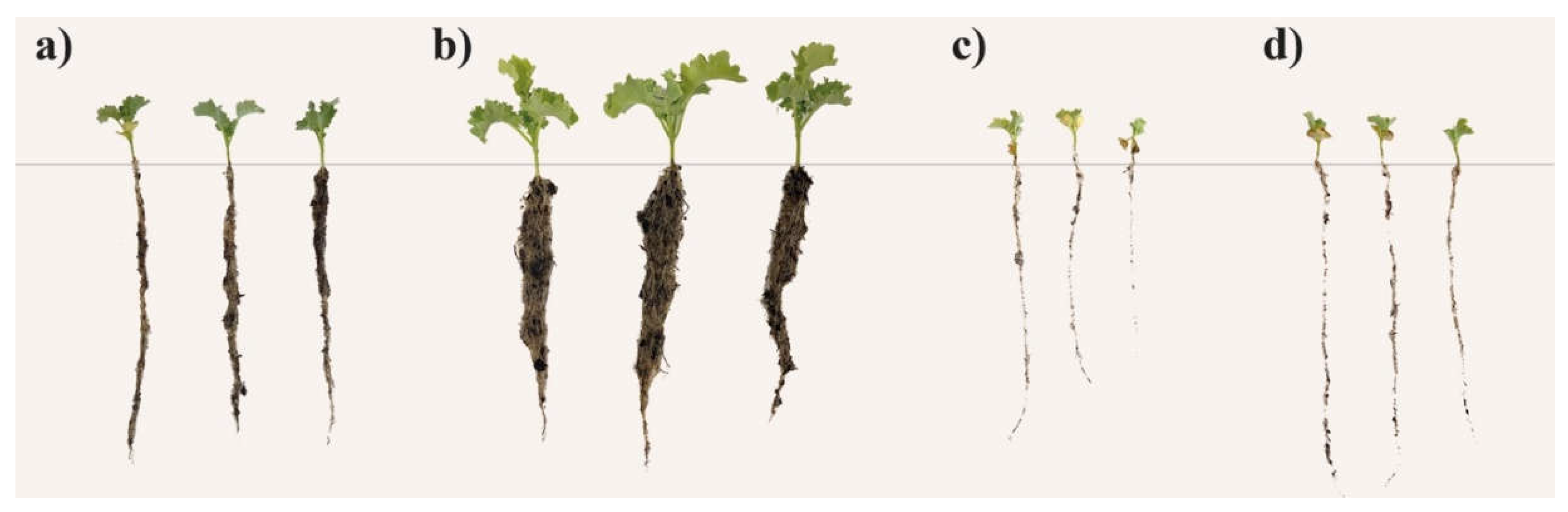

Table 1.
Chemical composition of peatmoss and thermocomposted frass.
| Parameter | Peatmoss | Thermocomposted frass |
|---|---|---|
| Moisture (%) | 64.70 ± 0.025 | 46.46 ± 0.615 |
| pH | 4.435 ± 0.017 | 8.506 ± 0.093 |
| EC (dS/m) | 0.6735 ± 0.019 | 7.476 ± 0.475 |
| OOM (%) | 91.735 ± 0.039 | 78.63 ± 0.750 |
| Total N (%) | 1.08 ± 0.018 | 1.98 ± 0.049 |
| N-NO3 (mg/k) | 308.99 ± 4.458 | 96.50 ± 2.708 |
| C/N | 49.525 ± 0.725 | 23.13 ± 0.368 |
| C/P | 1263.135 ± 3.447 | 29.27 ± 0.453 |
| CEC (Cmol/kg) | 117.69 ± 0.647 | 55.57 ± 0.163 |
| AD (g/ml) | 0.1210 ± 0.007 | 0.2622 ± 0.017 |
| P2O5 (%) | 0.1 ± 0 | 3.57 ± 0.014 |
| K2O (%) | 0.05 ± 0 | 1.71 ± 0.014 |
| Ca (%) | 0.62 ± 0.007 | 0.70 ± 0.035 |
| Mg (%) | 0.085 ± 0.004 | 0.24 ± 0.071 |
| Na (%) | 0.03 ± 0 | 0.11 ± 0 |
| HA (%) | 1.6455 ± 0.012 | 1.629 ± 0.144 |
| FA (%) | 2.613 ± 0.018 | 1.731 ± 0.144 |
Mean values ± standard deviation of Electrical conductivity (EC), Oxidizable organic matter (OOM), Oxidizable organic carbon (OOC), Cation exchange capacity (CEC), Apparent density (AD), Humic acid (HA), fulvic acid (FA).
Table 2.
Mean values of germination and germination index (GI) and phytotoxicity of different treatments in kale seed.
Table 2.
Mean values of germination and germination index (GI) and phytotoxicity of different treatments in kale seed.
| Treatment | Germination (%) | GI (%) | Phytotoxicity |
|---|---|---|---|
| Control | 96.67 ± 5.77 a | 100 ± 0.00 a | No |
| 20% | 96.67 ± 5.77 a | 108.54 ± 6.70 a | No |
| 40% | 90 ± 10.00 a | 106.46 ± 13.60 a | No |
| 60% | 80 ± 26.46 a | 69.70 ± 22.23 a | No |
| 80% | 90 ± 0.0 a | 51.17 ± 6.13 b | Moderate |
| 100% | 96.67 ± 5.77 a | 49.63 ± 4.48 b | High |
Mean values ± standard deviation (n=30) with superscript as significantly difference at p<0.05 according to Dunnett test.
Table 3.
Emergence percentage of kale in different germination substrate after sowing.
| Emergence (%) | |||||
|---|---|---|---|---|---|
| Germination substrate | 3rd day | 5th day | 7th day | 9th day | 12th day |
| GS1 | 0 | 81.82 | 81.82 | 81.82 | 84.85 |
| GS2 | 12.12 | 100 | 100 | 100 | 100 |
| GS3 | 0.00 | 72.73 | 87.88 | 87.88 | 90.91 |
| GS4 | 12.12 | 69.70 | 90.91 | 90.91 | 90.91 |
| GS5 | 3.03 | 21.21 | 24.24 | 15.15 | 9.09 |
| GS6 | 0 | 0 | 6.06 | 0 | 0 |
Mean values (n=33).
Table 4.
Mean values of height, steam diameter, number of true leaves, length of first true leaf, width of true leaf, cotyledon length and cotyledon width of kale seedlings in different germination substrates at the initial measurement on day 12.
Table 4.
Mean values of height, steam diameter, number of true leaves, length of first true leaf, width of true leaf, cotyledon length and cotyledon width of kale seedlings in different germination substrates at the initial measurement on day 12.
| Germination substrate | Height (cm) | Steam diameter (mm) | Number of true leaves | Length of first true leaf (mm) | Width of first true leaf (mm) | Cotyledon length (mm) | Cotyledon width (mm) |
|---|---|---|---|---|---|---|---|
| GS1 | 1.69b | 1.07b | 1.06b | 6.78b | 3.43b | 6.43b | 10.10b |
| GS2 | 2.26a | 1.21a | 1.57a | 9.29a | 5.51a | 7.95a | 13.82a |
| GS3 | 1.44b | 1.09b | 1.00b | 4.40c | 2.53c | 5.10b | 8.41b |
| GS4 | 1.43b | 1.07b | 0.00c | 0.00d | 0.00d | 5.24b | 8.11b |
Mean values (n=33) with superscript as significantly difference at p<0.05 according to Fisher´s LSD test.
Table 5.
Mean values of height, steam diameter, number of true leaves, length of first true leaf, width of true leaf, cotyledon length and cotyledon width of kale seedlings in different germination substrates at the initial measurement on day 30.
Table 5.
Mean values of height, steam diameter, number of true leaves, length of first true leaf, width of true leaf, cotyledon length and cotyledon width of kale seedlings in different germination substrates at the initial measurement on day 30.
| Germination substrate | Height (cm) | Steam diameter (mm) | Number of true leaves | Length of first true leaf (mm) | Width of first true leaf (mm) | Cotyledon length (mm) | Cotyledon width (mm) |
|---|---|---|---|---|---|---|---|
| GS1 | 3.33b | 1.07b | 2.48b | 16.67b | 7.74b | 6.12b | 9.92b |
| GS2 | 4.42a | 1.42a | 3.76a | 23.13a | 9.13a | 7.65a | 13.27a |
| GS3 | 2.16c | 0.94c | 2.06c | 10.82c | 4.78c | 5.89b | 8.63b |
| GS4 | 2.06c | 0.90c | 1.97c | 9.09c | 4.44c | 6.33b | 8.07b |
Mean values (n=33) with superscript as significantly difference at p<0.05 according to Fisher´s LSD test.
Table 6.
This is a table. Tables should be placed in the main text near to the first time they are cited.
Table 6.
This is a table. Tables should be placed in the main text near to the first time they are cited.
| Treatment | Phenols (mg Eq. of gallic acid/g) | Tannins (mg Eq. of catechin/g) | Flavonoids (mg Eq. of rutin/g) |
|---|---|---|---|
| GS1 | 354.054 a | 10.972 a | 0.1045 b |
| GS2 | 170.954 c | 7.985 c | 0.0713 b |
| GS3 | 263.993 b | 4.437 b | 0.2177 a |
| GS4 | 244.744 b | 5.115 b | 0.2516 a |
Mean values (n=3) with superscript as significantly difference at p<0.05 according to Dunnett test.
Table 7.
ABTS and DPPH percentage in leaf of kale seedlings different germination substrates.
| Treatment | ABTS (%) | DPPH (%) |
|---|---|---|
| GS1 | 99.1718 ± 1.11 a | 91.6772 ± 0.47 a |
| GS2 | 97.1877 ±0.09 a | 89.7525 ± 2.82 a |
| GS3 | 99.0338 ± 0.13 a | 88.5828 ± 1.44 a |
| GS4 | 98.1481 ± 2.01 a | 76.7695 ± 2.15 b |
Mean values (n=3) ± standard deviation with superscript as significantly difference at p<0.05 according to Dunnett test.
Disclaimer/Publisher’s Note: The statements, opinions and data contained in all publications are solely those of the individual author(s) and contributor(s) and not of MDPI and/or the editor(s). MDPI and/or the editor(s) disclaim responsibility for any injury to people or property resulting from any ideas, methods, instructions or products referred to in the content. |
© 2024 by the authors. Licensee MDPI, Basel, Switzerland. This article is an open access article distributed under the terms and conditions of the Creative Commons Attribution (CC BY) license (https://creativecommons.org/licenses/by/4.0/).
Copyright: This open access article is published under a Creative Commons CC BY 4.0 license, which permit the free download, distribution, and reuse, provided that the author and preprint are cited in any reuse.


