

Submitted:
06 May 2024
Posted:
06 May 2024
You are already at the latest version
Abstract
Emerging infectious diseases are a major threat to biodiversity and an important public health issue. West Nile virus (WNV) is an emerging vector-borne zoonotic arbovirus that is currently broadening its distribution in Europe. The evidence of WNV circulating in resident and migratory species has implications for both animal and public health, and should therefore be studied in depth. An integrated surveillance program, namely in birds, is essential for reducing the risk of infection in human populations within the One Health principles. In the present study, wild birds admitted to wildlife rehabilitation centres in Portugal were sampled. Two-hundred and eight blood samples were assayed serologically to antibodies to WNV, by using a commercial ELISA kit. An overall seroprevalence of 19.6% (95% confidence interval [CI]: 13.7-26.7%) was observed. Antibodies to WNV were detected in 13 (35.1%) different species of wild birds. Accipitriformes (26.7%; 95% CI: 18.5-36.2%) and Strigiformes (26.7%; 95% CI: 14.6-42.0%) were the orders with the highest seroprevalence recorded. There were no statistically significant differences (p = 0.725) between the geographical regions (NUTS II) studied, but statistically significant difference (p = 0.017) was found between gender (male: 34.4%; female: 4.8%). A higher seroprevalence was found in adults (32.1%) compared to juvenile birds (9.3%) (p = 0.014), and age was considered a risk factor to WNV infection in wild birds (odds ratio 1.4; 95% CI: 0.5–4.0). More epidemiological studies are needed in Portugal, since the actual spread of the WNV throughout the country is unknown.
Keywords:
ELISA
; One Health
; Portugal
; seroprevalence
; West Nile virus
; wild birds
; zoonosis
1. Introduction
West Nile virus (WNV) is a mosquito-borne Flavivirus with a zoonotic transmission cycle based on mosquitoes and avian species, spread almost worldwide [1,2]. WNV infection is now a disease of public health concern in Europe [3,4]. The high genetic and phenotypic diversification of the virus [5] and its endemic circulation in so many different countries, require an intensification of integrated and transdisciplinary research and surveillance efforts [6].
Wild migratory birds represent important reservoir hosts and vectors of endemic or re-emerging zoonotic pathogens, contributing to their wide geographic distribution and being part of the corresponding transmission cycles [7]. Simultaneously, climate change experienced in recent years and globalization continue to favor the dispersal of mosquito species to new regions and the long-distance movement of infectious hosts around the world, resulting in an increase in the number of WNV outbreaks recently reported [8,9]. Even though several studies have focused on the prevalence of WNV in Spain [10,11,12] and other western European countries [13,14], Portugal has limited information available. A previous article reports the results of a serological and virologic survey of birds (and horses) [15] and, more recently, another study reports a serological surveillance study [16] but despite being a notifiable disease in Portugal, WNV surveillance remains passive. Despite evidence of WNV circulation in Portugal since 1969 [17] there has not yet been a WNV human epidemic in the country [18]. It is still not clear whether WNV is endemic in Portugal, but the climate conditions are now definitely suitable for the transmission of the virus. The Southern region of the country has been pointed out as the main region affected so far [19].
West Nile virus can be diagnosed by serology tests, neutralization assays, viral detection by reverse transcription polymerase chain reaction (RT-PCR) assay, and virus isolation by cell culture [20]. RT-PCR has limited value for routine primary diagnosis of WNV and other flaviviruses, due to low level and short-term viremia they induce. Specific antibody testing is currently the most commonly used approach for WNV diagnosis, being immunoglobulin M (IgM) the first to be detected after infection, and immunoglobulin G (IgG), appearing later on. However, since antibodies to WNV can persist for long periods of time in circulation, and cross-reactivity with other flaviviruses can occur, commercial enzyme-linked immunosorbent assay (ELISA) kits cannot diagnose acute infections caused by WNV by themselves [21]. A confirmation test should be carried out [22].
Collaborative efforts on WNV surveillance and control must be implemented and serve as an example to follow for a One Health approach towards zoonotic diseases. Prevention and control efforts depend substantially on effective surveillance of infection in birds, vectors, animals, and humans [20]. Vaccines are currently available for horses [23], and currently being tested in birds [24], but are not yet available for the avian class or people [24,25].
The aim of the present study was to contribute with updated information on the seroprevalence of WNV infection in wild birds admitted to distinct rehabilitation centres in Continental Portugal.
2. Materials and Methods
Wild birds admitted at two main different wildlife rehabilitation centres (WRC) – Wildlife Rehabilitation Centre of the Veterinary Teaching Hospital of UTAD (CRAS-HVUTAD) (n=182), in Vila Real, and Wildlife Study and Rehabilitation Centre (CERAS) (n=21), in Castelo Branco – were sampled, between 2021 and 2023. Five samples from other WRC were also included: one from Centre for Ecology, Recovery and Surveillance of Wild Animals (CERVAS – Gouveia), three from Environmental Interpretation and Animal Recovery Center (CIARA – Torre de Moncorvo), and one from Wildlife Rehabilitation and Research Centre of Ria Formosa (RIAS – Olhão). The causes of admission were varied, including orphans or birds that have suffered traumatic injuries, namely due to collision, electrocution, traffic accidents or illegal shooting. A physical examination was carried out in all birds, to access their health status and body condition, and further diagnostic procedures were performed, as needed. Blood samples (around 0.3 ml) were collected from the ulnar vein, metatarsal vein or jugular vein, according to the anatomy of each species, and transferred into heparin-lithium tubes. Samples were centrifuged at 2000 rpm for 10 minutes and plasma was then separated and stored at -20°C until further analysis. The data gathered for analysis were species, order, location where the bird was rescued and migratory habits. Age and gender were also register whenever possible to identify.
All plasma samples were tested for antibodies to WNV using an ELISA commercial kit (ID Screen® West Nile Competition Multi-species), following the manufacturer´s instructions. Two negative and positive controls were included in each 96-well plate, as recommended. This test allows the detection of anti-pr-E antibodies in multiple species, including birds. Results were classified as positive, negative or doubtful, after verifying the test validation criteria. Doubtful results were not considered in the present study for statistical analysis.
Birds were grouped by order, family and sex (females, males, and undetermined). Individuals of species that don’t exhibit sexual dimorphism could not be distinguished and were therefore classified as undetermined. In terms of age, birds were, in a simplified manner, classified as juvenile, adult or undetermined, because a more in-depth classification is often difficult to determine. Juvenile category includes all ages before adulthood, namely nestlings, fledglings and juveniles themselves. As for the origin, the municipality where the bird was rescued was recorded, whenever possible. Regarding their migratory habits, birds were described as estival, wintering or resident (this classification may be cumulative with one of the first).
Statistical analyses were done with BM SPSS Statistics 27 (IBM; Armonk, NY, USA). The prevalence of WNV antibodies was calculated as the ratio of positive samples to the total number of plasma samples tested, using a 95% confidence interval (CI). The Pearson’s chi-square or Fisher exact tests were used to compare seroprevalence values and associations between results and epidemiological variables. by multivariate analysis.
3. Results
Antibodies against West Nile Virus were detected in 42 out of 208 birds, an overall seroprevalence of 19.6% (95% confidence interval [CI]: 13.7-26.7%). Four birds had doubtful results. Antibodies were detected in 13 (35.1%) out of the 37 species under study (Table 1).
Table 2 presents the seroprevalence of West Nile Virus infection in wild birds admitted to WRC across Portugal, according to the variables studied. By WRC, 19.2% (95% CI: 13.8-25.7%) of the birds were seropositive at CRAS-HVUTAD and 33.3% (95% CI: 14.6-57.0%) at CERAS. No seropositive results were found at CERVAS, CIARA and RIAS. However, no statistically significant differences were found between centres.
Regarding taxonomic orders, the highest seroprevalence was found in Accipitriformes (26.7%; 95% CI: 18.5-36.2%) and Strigiformes (26.7%; 95% CI: 14.6-42.0%); Ciconiiformes had a seroprevalence of 9.5% (95% CI: 0.0-30.4%). No seropositive results were found in the orders Falconiformes, Passeriformes or any other order included in the study. The differences were statistically significant (p < 0.001).
Regarding age, a pairwise analysis (n = 82) revealed significantly different seroprevalence between juvenile (9.3%; 95% CI: 0.0-20.3%) and adult (32.1%; 95% CI: 15.9-52.4%) (p = 0.014) wild birds.
No significant differences (p = 0.725) were observed for the geographical regions with a seroprevalence of 19.5% (95% CI: 13.2-27.3%) in the North, 28.6% (95% CI: 11.3-52.2%) in the Centre, 0.0% (95% CI:0.0-97.5%) in Lisbon (metropolitan area), 22.2% (95% CI: 0.0-60.0%) in Alentejo, and 18.2% (0.0-32.7%) in birds from unknown origin. Antibodies to WNV were found in rescued birds in the following districts: Braga, Bragança, Castelo Branco, Évora, Guarda, Portalegre, Porto, Viana do Castelo, Vila Real and Viseu (Figure 1).
Regarding sex, a pairwise analysis (n = 53) revealed significantly different seroprevalence between female (4.8%; 95% CI: 0.0-23.8%) and male (34.4%; 95% CI: 18.6-53.2%) (p = 0.017) wild birds.
Regarding migratory behavior, the seroprevalence was 29.6% (95% CI: 13.8-50.2%) in migratory birds, 19.6% (95% CI:13.7-26.7%) in resident birds, and 13.0% (95% CI: 0.0-33.6%) in mixed migratory behavior birds.
Age was the only confirmed risk factor. Adult birds had an odds ratio (OR) of 1.4 (95% CI: 0.5–4.0; p = 0.019) when compared to the reference category (juvenile; arbitrary OR = 1)).
4. Discussion
The present results reveal the existence of antibodies to WNV in wild birds from different parts of Portugal. Birds that tested positive came from districts in the North, Center and South of the country, mostly from the interior areas. The absence of positive results in three of the WRC is a circumstance probably related to the low number of birds tested. To the best of our knowledge, cases of WNV infection in Portugal reported so far have been restricted to the South [19], so it is important to highlight the spread of seropositive animals to other geographical areas.
In the present study, four birds had doubtful results and these were not considered for the statistical analysis. These results require ELISA repetition or confirmatory testing. We found an overall seroprevalence of 19.6%. It is relevant to establish a comparison to previous studies in the Iberian Peninsula. In a previous study in Spain, IgG antibodies against flaviviruses were found in 32.7% of the wild birds tested (56/171; 95% CI: 26.8–38.6) using blocking ELISA (bELISA), and an individual WNV seroprevalence of 19.3% (95% CI: 14.3–24.3) after VNT [11], which is very close to what has been found in the present study. In addition, a seroepidemiological study in wild ungulates in Spain also revealed seroprevalence values of 20% to 24.9% (95% CI: 23.2–26.7%) [26]. In other European countries, there has been a wide range of WNV seroprevalence values in wild birds. It spanned from 14.8% to 16.2% in East Germany [14], and 1,3% in Cyprus [27]. There is a notable lack of recent studies in many countries, where there have even been outbreaks.
Orders with more different species analyzed were Accipitriformes (12 species), Passeriformes (6 species) and Strigiformes (6 species). Previously in the Iberian Peninsula, wild birds belonging to the order Accipitriformes also showed the highest frequency of seropositivity to WNV (46.3%; 19/41), followed by Strigiformes (16.1%; 9/56) in third place [11]. From the 13 species in which antibodies to WNV were detected, most of them had already been previously reported as susceptible to infection in Europe, such as the barn owl (Tyto alba) [11], booted eagle (Hieraaetus pennatus), common buzzard (Buteo buteo) [28], griffon vulture (Gyps fulvus), long-eared owl (Asio otus) [29] short-toed snake eagle (Circaetus gallicus) [29,30], Spanish imperial eagle (Aquila adalberti) [31], sparrowhawk (Accipiter nisus) [32], tawny owl (Strix aluco) [33] and white stork (Ciconia ciconia) [30,34].
The main tools used to diagnose WNV consisted of serological (or indirect) tests that aim to detect antibodies to WNV, such as ELISA, hemagglutination-inhibition tests (HAIT) or immunofluorescence assays (IFAT). ELISA are the most commonly used diagnostic assays because they are relatively simple, quick and inexpensive, and allow a large number of samples to be screened at once. Competitive ELISA are the most sensitive of all the developed serological technologies, but are mostly used for screening purposes, a circumstance derived from their lower level of specificity [3]. The aim of this study was to demonstrate evidence of antibodies to WNV circulation, and a competitive ELISA commercial kit was used for this purpose. No confirmatory test was carried out for these results. Therefore, seropositivity must be interpreted with care because cross-reactions among flaviviruses are frequently observed [3,35]. Flaviviruses are antigenically related and diagnostics should be based on tests that prove to be specific enough to avoid cross-reactivity between related flaviviruses that may be co-circulating in the same geographical area. West Nile virus and Usutu (USUV) virus, for example, belong to the Japanese encephalitis serocomplex and share common distribution areas in Europe [13,36], which means that cross-neutralization can occur, leading to misinterpretation of results due to false-positives. Neutralization tests are more specific and are currently considered the gold standard for WNV diagnosis. They are useful to validate ELISA results [1,37,38].
Serosurveys of free-ranging birds should be carefully interpreted. The role of migratory birds in the maintenance and dissemination of zoonotic pathogens, such as flaviviruses, could be extremely relevant in assessing public health risks [39]. Some species are long-distance migrants, choosing Portugal for nesting during Spring-Summer seasons. These birds can be previously infected with WNV and other flaviviruses elsewhere during the migration and wintering sites [40]. However, while they are in Portugal, they act as hosts for potential vectors to be infected during their blood meals. Resident, sedentary bird species may also be exposed to a wide diversity of flaviviruses [41,42].
Sex identification in birds by phenotype and external morphology cannot be performed in approximately half of the species that occur in Europe. This situation is even more difficult in young juvenile birds. Sexing can be done surgically, cytologically, or molecularly [43], but any of these options would be extremely expensive and not feasible for WRC. This is why so many of the individuals sampled were classified as of “undetermined” in terms of gender. Ageing is also not an easy task. A high level of knowledge about the moult pattern of different species is required and the people who receive the birds at the WRC do not always have that experience. Migratory behavior, climatic variation, nutritional status and other intraspecific factors also have influence on the moult duration and progression, making this process very complex [44,45]. This is why we also have a high number of samples classified as of “undetermined” age. In this study, age was the only confirmed risk factor. Adult birds had an 1.4 times higher risk of being infected than juveniles. Age over 1 year old was also previously described as one of the main risk factors to WNV seropositivity. Species group (raptors) and size (large) were other risk factors described [11].
The transmission cycle of WNV is complex and proper control requires targeted preventative measures and actions. WNV outbreaks have been responsible for dramatic bird mortality events, causing severe declines in some bird species [46,47,48]. For conservation purposes, it is highly important to access the status of the virus dispersal in our wild populations, since the Iberian Peninsula is home to some critically endangered bird species [49].
Based on the previous experience from countries where the disease in endemic [50,51], the surveillance plans to be implemented should be based on a holistic vision and multidisciplinary teams between regional institutions involved in every health sector: public, animal, and environmental. A One Health approach is the best way to achieve good results in terms of human cases prevention, based on early detection of the viral circulation in the main vertebrate hosts (birds and horses) and integrating data.
Considering the epidemiology of WNV in the last three decades in Europe, the establishment of appropriate surveillance systems is fundamental, as the risk for bird populations, horse and human health are a reality [52]. Likewise, the analysis of WNV cases in horses can help identify risk areas for humans [53], the assessment of circulation in birds, especially resident species, is also useful. This kind of investigation is essential for designing prevention and control measures properly under the One Health strategies.
Author Contributions
Conceptualization, F.L. and A.C.C.; methodology, F.L., C.P., L.C. and A.C.C.; formal analysis, L.C. and A.C.C.; writing—original draft preparation, F.L.; data curation, F.L. and A.C.C.; writing—review and editing, L.C., A.C.M., J.R.M., C.P., A.P.L., M.F., C.L., F.S., M.M. and A.C.C.; supervision, A.C.C., A.C.M. and M.M.; funding acquisition, L.C. and A.C.C. All authors have read and agreed to the published version of the manuscript.
Funding
This research was funded by the Portuguese Foundation for Science and Technology (FCT), supported by the projects UIDB/00772/2020 (doi:10.54499/UIDB/00772/2020).
Institutional Review Board Statement
The animal study protocol was approved by the Ethics Committee) of University of Trás-os-Montes e Alto Douro.
Informed Consent Statement
Not applicable.
Data Availability Statement
Not applicable.
Acknowledgments
CERAS: CRAS-HVUTAD, CERVAS, CIARA and RIAS teams for their help in collecting samples and data. Inês Cabaça, for her help and companionship in the analyses, and the technicians of the Laboratory of Microbiology, IPCB.
Conflicts of Interest
The authors declare no conflicts of interest.
References
- Mackenzie, J.S.; Gubler, D.J.; Petersen, L.R. Emerging flaviviruses: the spread and resurgence of Japanese encephalitis, West Nile and dengue viruses. Nat. Med. 2004, 10, S98–109. [Google Scholar] [CrossRef] [PubMed]
- Weissenböck, H.; Hubálek, Z.; Bakonyi, T.; Nowotny, N. Zoonotic mosquito-borne flaviviruses: worldwide presence of agents with proven pathogenicity and potential candidates of future emerging diseases. Vet. Microbiol. 2010, 140, 271–280. [Google Scholar] [CrossRef] [PubMed]
- Beck, C.; Jimenez-Clavero, M.A.; Leblond, A.; Durand, B.; Nowotny, N.; Leparc-Goffart, I.; Zientara, S.; Jourdain, E.; Lecollinet, S. Flaviviruses in Europe: complex circulation patterns and their consequences for the diagnosis and control of West Nile disease. Int. J. Environ. Res. Public Health. 2013, 10, 6049–6083. [Google Scholar] [CrossRef] [PubMed]
- Parkash, V.; Woods, K.; Kafetzopoulou, L.; Osborne, J.; Aarons, E.; Cartwright, K. West Nile virus infection in travelers returning to United Kingdom from South Africa. Emerg. Infect. Dis. 2019, 25, 367–369. [Google Scholar] [CrossRef] [PubMed]
- Habarugira, G.; Suen, W.W.; Hobson-Peters, J.; Hall, R.A.; Bielefeldt-Ohmann, H. West Nile virus: an update on pathobiology, epidemiology, diagnostics, control and “One Health” implications. Pathogens. 2020, 9, 589. [Google Scholar] [CrossRef] [PubMed]
- Rizzoli, A.; Jimenez-Clavero, M.A.; Barzon, L.; Cordioli, P.; Figuerola, J.; Koraka, P.; Martina, B.; Moreno, A.; Nowotny, N.; Pardigon, N.; Sanders, N.; Ulbert, S.; Tenorio, A. The challenge of West Nile virus in Europe: knowledge gaps and research priorities. Euro Surveill. 2015, 20, 21135. [Google Scholar] [CrossRef]
- Hubálek, Z. An annotated checklist of pathogenic microorganisms associated with migratory birds. J. Wildl. Dis. 2004, 40, 639–59. [Google Scholar] [CrossRef]
- Farooq, Z.; Sjödin, H.; Semenza, J.C.; Tozan, Y.; Sewe, M.O.; Wallin, J.; Rocklöv, J. European projections of West Nile virus transmission under climate change scenarios. One Health. 2023, 16, 100509. [Google Scholar] [CrossRef]
- Giesen, C.; Herrador, Z.; Fernandez-Martinez, B.; Figuerola, J.; Gangoso, L.; Vazquez, A.; Gómez-Barroso, D. A systematic review of environmental factors related to WNV circulation in European and Mediterranean countries. One Health. 2023, 16, 100478. [Google Scholar] [CrossRef]
- Bravo-Barriga, D.; Aguilera-Sepúlveda, P.; Guerrero-Carvajal, F.; Llorente, F.; Reina, D.; Pérez-Martín, J.E.; Jiménez-Clavero, M.A.; Frontera, E. West Nile and Usutu virus infections in wild birds admitted to rehabilitation centres in Extremadura, western Spain, 2017–2019. Vet. Microbiol. 2021, 255, 109020. [Google Scholar] [CrossRef]
- García-Bocanegra, I.; Franco, J.J.; León, C.I.; Barbero-Moyano, J.; García-Miña, M.V.; Fernández-Molera, V.; Gómez, M.B.; Cano-Terriza, D.; Gonzálvez, M. High exposure of West Nile virus in equid and wild bird populations in Spain following the epidemic outbreak in 2020. Transbound Emerg. Dis. 2022, 69, 3624–3636. [Google Scholar] [CrossRef]
- Marzal, A.; Ferraguti, M.; Muriel, J.; Magallanes, S.; Ortiz, J.A.; García-Longoria, L.; Bravo-Barriga, D.; Guerrero-Carvajal, F.; Aguilera-Sepúlveda, P.; Llorente, F.; de Lope, F.; Jiménez-Clavero, M.Á.; Frontera, E. Circulation of zoonotic flaviviruses in wild passerine birds in Western Spain. Vet. Microbiol. 2022, 268, 109399. [Google Scholar] [CrossRef]
- Scaramozzino, P.; Carvelli, A.; Bruni, G.; Cappiello, G.; Censi, F.; Magliano, A.; Manna, G.; Ricci, I.; Rombolà, P.; Romiti, F.; Rosone, F.; Sala, M.G.; Scicluna, M.T.; Vaglio, S.; Liberato, C.D. West Nile and Usutu viruses co-circulation in central Italy: outcomes of the 2018 integrated surveillance. Parasit. Vectors. 2021, 14, 243. [Google Scholar] [CrossRef]
- Ziegler, U.; Bergmann, F.; Fischer, D.; Müller, K.; Holicki, C.M.; Sadeghi, B.; Sieg, M.; Keller, M.; Schwehn, R.; Reuschel, M.; Fischer, L.; Krone, O.; Rinder, M.; Schütte, K.; Schmidt, V.; Eiden, M.; Fast, C.; Günther, A.; Globig, A.; Conraths, F.J.; Staubach, C.; Brandes, F.; Lierz, M.; Korbel, R.; Vahlenkamp, T.W.; Groschup, M.H. Spread of West Nile virus and Usutu virus in the German bird population, 2019-2020. Microorganisms. 2022, 10, 807. [Google Scholar] [CrossRef]
- Barros, S.C.; Ramos, F.; Fagulha, T.; Duarte, M.; Henriques, M.; Luís, T.; Fevereiro, M. Serological evidence of West Nile virus circulation in Portugal. Vet. Microbiol. 2011, 152, 407–10. [Google Scholar] [CrossRef]
- Costa, A. Serological surveillance of West Nile virus and molecular diagnostic of West Nile virus, Usutu virus, avian Influenza and Newcastle disease virus in wild birds of Portugal. Master Thesis, University of Lisbon – Faculty of Veterinary Medicine, Lisbon, 2021. [Google Scholar]
- Filipe, A.R.; Pinto, M.R. Survey for antibodies to arboviruses in serum of animals from southern Portugal. Am. J. Trop. Med. Hyg. 1969, 18, 423–426. [Google Scholar] [CrossRef]
- Geraldes, M.A.; Cunha, M.V.; Godinho, C.; Lima, R.F.; Giovanetti, M. The historical ecological background of West Nile virus in Portugal provides One Health opportunities into the future. [CrossRef]
- Lourenço, J.; Barros, S.C.; Zé-Zé, L.; Damineli, D.S.C.; Giovanetti, M.; Osório, H.C.; Amaro, F.; Henriques, A.M.; Ramos, F.; Luís, T.; Duarte, M.D.; Fagulha, T.; Alves, M.J.; Obolski, U. West Nile virus transmission potential in Portugal. Commun. Biol. 2022, 5, 6. [Google Scholar] [CrossRef]
- Lustig, Y.; Sofer, D.; Bucris, E.D.; Mendelson, E. Surveillance and diagnosis of West Nile virus in the face of Flavivirus cross-reactivity. Front. Microbiol. 2018, 9, 2421. [Google Scholar] [CrossRef]
- Busch, M.P.; Kleinman, S.H.; Tobler, L.H.; Kamel, H.T.; Norris, P.J.; Walsh, I.; Matud, J.L.; Prince, H.E.; Lanciotti, R.S.; Wright, D.J.; Linnen, J.M.; Caglioti, S. Virus and antibody dynamics in acute West Nile virus infection. J. Infect. Dis. 2008, 198, 984–993. [Google Scholar] [CrossRef]
- Cvjetković, I.H.; Radovanov, J.; Kovačević, G.; Turkulov, V.; Patić, A. Diagnostic value of urine qRT-PCR for the diagnosis of West Nile virus neuroinvasive disease. Diagn Microbiol Infect Dis. 2023, 107, 115920. [Google Scholar] [CrossRef]
- Cavalleri, J.V.; Korbacska-Kutasi, O.; Leblond, A.; Paillot, R.; Pusterla, N.; Steinmann, E.; Tomlinson, J. European College of Equine Internal Medicine consensus statement on equine flaviviridae infections in Europe. J. Vet. Intern. Med. 2022, 36, 1858–1871. [Google Scholar] [CrossRef]
- Bergmann, F.; Fischer, D.; Fischer, L.; Maisch, H.; Risch, T.; Dreyer, S.; Sadeghi, B.; Geelhaar, D.; Grund, L.; Merz, S.; Groschup, M.H.; Ziegler, U. Vaccination of zoo birds against West Nile virus - a field study. Vaccines (Basel). 2023, 11, 652. [Google Scholar] [CrossRef]
- European Centre for Disease Prevention and Control. Available online: https://www.ecdc.europa.eu/en/west-nile-virus-infection http://www.cdc.gov/westnile/index.html (accessed on 13 March 2024).
- Casades-Martí, L.; Cuadrado-Matías, R.; Peralbo-Moreno, A.; Baz-Flores, S.; Fierro, Y.; Ruiz-Fons, F. Insights into the spatiotemporal dynamics of West Nile virus transmission in emerging scenarios. One Health. 2023, 16, 100557. [Google Scholar] [CrossRef]
- Pallari, C.T.; Efstathiou, A.; Moysi, M.; Papanikolas, N.; Christodoulou, V.; Mazeris, A.; Koliou, M.; Kirschel, A.N.G. Evidence of West Nile virus seropositivity in wild birds on the island of Cyprus. Comp. Immunol. Microbiol. Infect. Dis. 2021, 74, 101592. [Google Scholar] [CrossRef]
- Csank, T.; Drzewnioková, P.; Korytár, Ľ.; Major, P.; Gyuranecz, M.; Pistl, J.; Bakonyi, T. A Serosurvey of Flavivirus Infection in Horses and Birds in Slovakia. Vector Borne Zoonotic Dis. 2018, 18, 206–213. [Google Scholar] [CrossRef]
- Jurado-Tarifa, E.; Napp, S.; Lecollinet, S.; Arenas, A.; Beck, C.; Cerdà-Cuéllar, M.; Fernández-Morente, M.; García-Bocanegra, I. Monitoring of West Nile virus, Usutu virus and Meaban virus in waterfowl used as decoys and wild raptors in southern Spain. Comp. Immunol. Microbiol. Infect. Dis. 2016, 49, 58–64. [Google Scholar] [CrossRef]
- Alba, A.; Allepuz, A.; Napp, S.; Soler, M.; Selga, I.; Aranda, C.; Casal, J.; Pages, N.; Hayes, E.B.; Busquets, N. Ecological surveillance for West Nile in Catalonia (Spain), learning from a five-year period of follow-up. Zoonoses Public Health. 2014, 61, 181–191. [Google Scholar] [CrossRef]
- Höfle, U.; Blanco, J.M.; Crespo, E.; Naranjo, V.; Jiménez-Clavero, M.A.; Sanchez, A.; de la Fuente, J.; Gortazar, C. West Nile virus in the endangered Spanish imperial eagle. Vet. Microbiol. 2008, 129, 171–178. [Google Scholar] [CrossRef]
- Erdélyi, K.; Ursu, K.; Ferenczi, E.; Szeredi, L.; Rátz, F.; Skáre, J.; Bakonyi, T. Clinical and pathologic features of lineage 2 West Nile virus infections in birds of prey in Hungary. Vector Borne Zoonotic Dis. 2007, 7, 181–188. [Google Scholar] [CrossRef]
- Michel, F.; Fischer, D.; Eiden, M.; Fast, C.; Reuschel, M.; Müller, K.; Rinder, M.; Urbaniak, S.; Brandes, F.; Schwehn, R.; Lühken, R.; Groschup, M.H.; Ziegler, U. West Nile virus and Usutu virus monitoring of wild birds in Germany. Int. J. Environ Res. Public Health. 2018, 15, 171. [Google Scholar] [CrossRef]
- Linke, S.; Niedrig, M.; Kaiser, A.; Ellerbrok, H.; Müller, K.; Müller, T.; Conraths, F.J.; Mühle, R.U.; Schmidt, D.; Köppen, U.; Bairlein, F.; Berthold, P.; Pauli, G. Serologic evidence of West Nile virus infections in wild birds captured in Germany. Am J Trop Med Hyg. 2007, 77, 358–364. [Google Scholar] [CrossRef]
- Calisher, C.H.; Karabatsos, N.; Dalrymple, J.M.; Shope, R.E.; Porterfield, J.S.; Westaway, E.G.; Brandt, W.E. Antigenic relationships between flaviviruses as determined by cross-neutralization tests with polyclonal antisera. J. Gen. Virol. 1989, 70, 37–43. [Google Scholar] [CrossRef] [PubMed]
- Simonin, Y. Circulation of West Nile virus and Usutu virus in Europe: overview and challenges. Viruses. 2024, 16, 599. [Google Scholar] [CrossRef] [PubMed]
- Kuno, G. Serodiagnosis of flaviviral infections and vaccinations in humans. Adv. Virus Res. 2003, 61, 3–65. [Google Scholar] [CrossRef]
- Weingartl, H.M.; Drebot, M.A.; Hubálek, Z.; Halouzka, J.; Andonova, M.; Dibernardo, A.; Cottam-Birt, C.; Larence, J.; Marszal, P. Comparison of assays for the detection of West Nile virus antibodies in chicken serum. Can. J. Vet. Res. 2003, 67, 128–132. [Google Scholar]
- Malik, Y.S.; Milton, A.A.P.; Ghatak, S.; Ghosh, S. Migratory Birds and Public Health Risks. In Role of Birds in Transmitting Zoonotic Pathogens; Livestock Diseases and Management; Springer: Singapore, 2021; pp. 15–24. [Google Scholar] [CrossRef]
- Lopez, G.; Jimenez-Clavero, M.A.; Tejedor, C.G.; Soriguer, R.; Figuerola, J. Prevalence of West Nile virus neutralizing antibodies in Spain is related to the behavior of migratory birds. Vector-Borne Zoonotic Dis. 2008; 8, 615–621. [Google Scholar] [CrossRef]
- Aguero, M.; Fernandez-Pinero, J.; Buitrago, D.; Sanchez, A.; Elizalde, M.; San Miguel, E.; Villalba, R.; Llorente, F.; Jimenez-Clavero, M.A. Bagaza virus in partridges and pheasants, Spain, 2010. Emerg. Infect. Dis. 2011, 17, 1498–1501. [Google Scholar] [CrossRef]
- Zannoli, S.; Sambri, V. West Nile virus and Usutu virus co-circulation in Europe: epidemiology and implications. Microorganisms. 2019, 7, 184. [Google Scholar] [CrossRef]
- Griffiths, P.R. Sex identification in birds. Semin. Avian Exot. Pet Med. 2000, 9, 14–26. [Google Scholar] [CrossRef]
- Newton, I. Moult and plumage. Ringing & Migration 2009, 24, 220–226. [Google Scholar] [CrossRef]
- Zuberogoitia, I.; Zabala, J.; Martínez, J.E. Moult in birds of prey: a review of current knowledge and future challenges for research. Ardeola 2018, 65, 183–207. [Google Scholar] [CrossRef]
- LaDeau, S.L.; Kilpatrick, A.M.; Marra, P.P. West Nile virus emergence and large-scale declines of North American bird populations. Nature. 2007, 447, 710–713. [Google Scholar] [CrossRef]
- Ip, H.S.; Van Wettere, A.J.; McFarlane, L.; Shearn-Bochsler, V.; Dickson, S.L.; Baker, J.; Hatch, G.; Cavender, K.; Long, R.; Bodenstein, B. West Nile virus transmission in winter: the 2013 Great Salt Lake bald eagle and eared grebes mortality event. PLoS Curr. 2014, 6. [Google Scholar] [CrossRef]
- Centers for Disease Control and Prevention. Available online: http://www.cdc.gov/westnile/index.html (accessed on 25 February 2024).
- 49. Birdlife International. European Red List of Birds; Office for Official Publications of the European Communities: Luxembourg, 2015. [Google Scholar]
- Paternoster, G.; Tomassone, L.; Tamba, M.; Chiari, M.; Lavazza, A.; Piazzi, M.; Favretto, A.R.; Balduzzi, G.; Pautasso, A.; Vogler, B.R. The Degree of One Health Implementation in the West Nile Virus Integrated Surveillance in Northern Italy, 2016. Front. Public Health. 2017, 5, 1–10. [Google Scholar] [CrossRef]
- Todoric, D.; Vrbova, L.; Mitri, M.E.; Gasmi, S.; Stewart, A.; Connors, S.; Zheng, H.; Bourgeois, A.C.; Drebot, M.; Paré, J.; Zimmer, M.; Buck, P. An overview of the National West Nile Virus Surveillance System in Canada: A One Health approach. Can. Commun. Dis. Rep. 2022, 48, 181–187. [Google Scholar] [CrossRef]
- Chevalier, V.; Lecollinet, S.; Durand, B. West Nile virus in Europe: A comparison of surveillance system designs in a changing epidemiological context. Vector-Borne Zoonotic Dis. 2011, 11, 1085–1091. [Google Scholar] [CrossRef]
- García-Carrasco, J.M.; Muñoz, A.R.; Olivero, J.; Segura, M.; García-Bocanegra, I.; Real, R. West Nile virus in the Iberian Peninsula: using equine cases to identify high-risk areas for humans. Euro Surveill. 2023, 28, 2200844. [Google Scholar] [CrossRef]
Figure 1.
Districts of Portugal (spotted) where the birds tested positive were found: Braga (B), Bragança (Br), Castelo Branco (CB), Évora (E), Guarda (G), Portalegre (Po), Porto (P), Viana do Castelo (VC), Vila Real (VR) and Viseu (V).
Figure 1.
Districts of Portugal (spotted) where the birds tested positive were found: Braga (B), Bragança (Br), Castelo Branco (CB), Évora (E), Guarda (G), Portalegre (Po), Porto (P), Viana do Castelo (VC), Vila Real (VR) and Viseu (V).
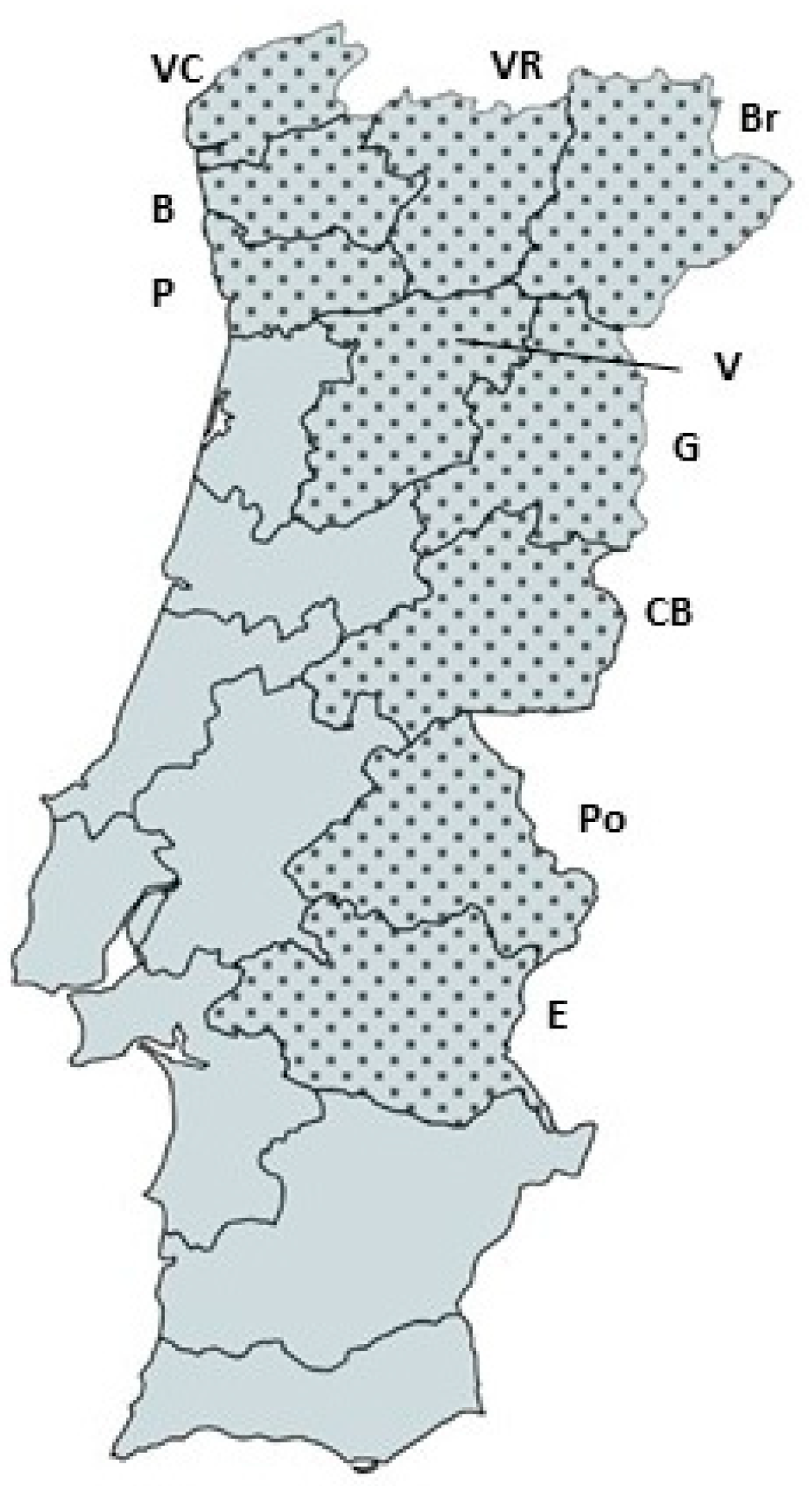

Table 1.
Seroprevalence of West Nile Virus by species of wild birds in Portugal.
| Order | Common name (Scientific name) |
Number (%) tested | Number (%) of seropositive |
95% CI |
|---|---|---|---|---|
| Accipitriformes | Northern goshawk (Accipiter gentilis) |
13 (6.3) | 0 (0.0) | 0.0-21.0 |
| Sparrowhawk (Accipiter nisus) |
10 (4.8) | 1 (10.0) | 0.0-44.5 | |
| Cinereous vulture (Aegypius monachus) |
5 (2.4) | 1 (20.0) | 0.0-71.6 | |
| Spanish imperial eagle (Aquila adalberti) |
1 (0.5) | 1 (100) | 0.0-100 | |
| Bonelli’s eagle (Aquila fasciata) |
1 (0.5) | 0 (0.0) | 0.0-97.5 | |
| Common buzzard (Buteo buteo) |
31 (14.9) | 15 (48.4) | 30.2-67.0 | |
| Short-toed snake-eagle (Circaetus gallicus) |
1 (0.5) | 1 (100) | 0.0-100 | |
| Montagu’s harrier (Circus pygargus) |
2 (1.0) | 0 (0.0) | 0.0-84.2 | |
| Griffon vulture (Gyps fulvus) |
18 (8.7) | 1 (5.6) | 0.0-27.3 | |
| Booted eagle (Hieraaetus pennatus) |
10 (4.8) | 7 (70.0) | 34.8-93.3 | |
| Black kite (Milvus migrans) |
6 (2.9) | 0 (0.0) | 0.0-45.9 | |
| Red kite (Milvus milvus) |
7 (3.4) | 1 (14.3) | 0.0-57.9 | |
| Apodiformes | Common swift (Apus apus) |
1 (0.5) | 0 (0.0) | 0.0-97.5 |
| Pallid swift (Apus pallidus) |
1 (0.5) | 0 (0.0) | 0.0-97.5 | |
| Caprimulgiformes | European nightjar (Caprimulgus europaeus) |
3 (1.4) | 0 (0.0) | 0.0-70.7 |
| Charadriiformes | Yellow-legged gull (Larus michahellis) |
3 (1.4) | 0 (0.0) | 0.0-70.7 |
| Ciconiiformes | Grey heron (Ardea cinerea) |
4 (1.9) | 0 (0.0) | 0.0-60.2 |
| White stork (Ciconia ciconia) |
17 (8.2) | 2 (11.8) | 0.0-36.4 | |
| Columbiformes | Rock pigeon (Columba livia) |
3 (1.4) | 0 (0.0) | 0.0-70.7 |
| Common wood-pigeon (Columba palumbus) |
1 (0.5) | 0 (0.0) | 0.0-97.5 | |
| Collared dove (Streptopelia decaocto) |
1 (0.5) | 0 (0.0) | 0.0-97.5 | |
| Coraciiformes | Kingfisher (Alcedo atthis) |
1 (0.5) | 0 (0.0) | 0.0-97.5 |
| Falconiformes | Peregrine falcon (Falco peregrinus) |
6 (2.9) | 0 (0.0) | 0.0-45.9 |
| Common kestrel (Falco tinnunculus) |
4 (1.9) | 0 (0.0) | 0.0-60.2 | |
| Passeriformes | European greenfinch (Chloris chloris) |
2 (1.0) | 0 (0.0) | 0.0-84.2 |
| Common raven (Corvus corax) |
1 (0.5) | 0 (0.0) | 0.0-97.5 | |
| Carrion crow (Corvus corone) |
5 (2.4) | 0 (0.0) | 0.0-52.2 | |
| Western house-martin (Delichon urbicum) |
2 (1.0) | 0 (0.0) | 0.0 (84.2) | |
| Eurasian jay (Garrulus glandarius) |
1 (0.5) | 0 (0.0) | 0.0-97.5 | |
| Eurasian magpie (Pica pica) |
1 (0.5) | 0 (0.0) | 0.0-97.5 | |
| Piciformes | Eurasian green-woodpecker (Picus viridis) |
1 (0.5) | 0 (0.0) | 0.0-97.5 |
| Strigiformes | Short-eared owl (Asio flammeus) |
1 (0.5) | 0 (0.0) | 0.0-97.5 |
| Long-eared owl (Asio otus) |
2 (1.0) | 1 (50.0) | 0.0-98.7 | |
| Little owl (Athene noctua) |
4 (1.9) | 1 (25.0) | 0.0-80.6 | |
| Eurasian eagle-owl (Bubo bubo) |
3 (1.4) | 0 (0.0) | 0.0-70.7 | |
| Tawny owl (Strix aluco) |
22 (10.6) | 8 (36.4) | 17.2-59.3 | |
| Barn owl (Tyto alba) |
13 (6.3) | 2 (15.4) | 0.0-45.5 | |
| Total | 208 (100) | 42 (20.2) | 15.0-26.3 |
CI: confidence interval. Information is presented by alphabetical order, both for the orders and scientific names of birds.
Table 2.
Seroprevalence of West Nile Virus infection in wild birds admitted to rehabilitation centres across Portugal according to the variables studied.
Table 2.
Seroprevalence of West Nile Virus infection in wild birds admitted to rehabilitation centres across Portugal according to the variables studied.
| Variable | Number (%) tested | Number (%) of seropositive |
95% CI |
|---|---|---|---|
| Rehabilitation centre | |||
| CERAS | 21 (10.1) | 7 (33.3) | 14.6-57.0 |
| CERVAS | 1 (0.5) | 0 (0.0) | 0.0-97.5 |
| CIARA | 3 (1.4) | 0 (0.0) | 0.0-70.7 |
| CRAS-HVUTAD | 182 (87.5) | 35 (19.2) | 13.8-25.7 |
| RIAS | 1 (0.5) | 0 (0.0) | 0.0-97.5 |
| p = 0.362 | |||
| Order | |||
| Accipitriformes | 105 (50.5) | 28 (26.7) | 18.5-36.2 |
| Ciconiiformes | 21 (10.1) | 2 (9.5) | 0.0-30.4 |
| Falconiformes | 10 (4.8) | 0 (0.0) | 0.0-30.9 |
| Passeriformes | 12 (5.8) | 0 (0.0) | 0.0-26.5 |
| Strigiformes | 45 (21.6) | 12 (26.7) | 14.6-42.0 |
| Othera | |||
| p < 0.001 | |||
| Age | |||
| Juvenile | 54 (26.0) | 5 (9.3) | 0.0-20.3 |
| Adult | 28 (13.5) | 9 (32.1) | 15.9-52.4 |
| Undetermined§ | 126 (60.6) | 28 (22.2) | 15.3-30.5 |
| p = 0.014 | |||
| Geographical region | |||
| North | 133 (63.9) | 26 (19.5) | 13.2-27.3 |
| Centre | 21 (10.1) | 6 (28.6) | 11.3-52.2 |
| Lisbon Metropolitan Area | 1 (0.5) | 0 (0.0) | 0.0-97.5 |
| Alentejo | 9 (4.3) | 2 (22.2) | 0.0-60.0 |
| Unknown§ | 44 (21.2) | 8 (18.2) | 0.0-32.7 |
| p = 0.725 | |||
| Sex | |||
| Female | 21 (10.1) | 1 (4.8) | 0.0-23.8 |
| Male | 32 (15.4) | 11 (34.4) | 18.6-53.2 |
| Undetermined§ | 155 (74.5) | 30 (19.4) | 13.5-26.5 |
| p = 0.017 | |||
| Migratory behavior | |||
| Resident | 158 (76.0) | 31 (19.6) | 13.7-26.7 |
| Migratory | 27 (13.0) | 8 (29.6) | 13.8-50.2 |
| Mixed | 23 (11.1) | 3 (13.0) | 0.0-33.6 |
| p = 0.334 | |||
| TOTAL | 208 (100) | 42 (20.2) | 15.0-26.3 |
a Other: Apodiformes, Caprimulgiformes, Charadriiformes, Columbiformes, Coraciiformes, Piciformes; § Not included in statistical analysis; CI: confidence interval. CERAS – Wildlife Study and Rehabilitation Centre; CERVAS – Centre for Ecology, Recovery and Surveillance of Wild Animals; CIARA – Environmental Interpretation and Animal Recovery Centre; CRAS-HVUTAD – Wildlife Rehabilitation Centre of the Veterinary Teaching Hospital of UTAD; RIAS – Wildlife Rehabilitation and Research Centre of Ria Formosa.
Disclaimer/Publisher’s Note: The statements, opinions and data contained in all publications are solely those of the individual author(s) and contributor(s) and not of MDPI and/or the editor(s). MDPI and/or the editor(s) disclaim responsibility for any injury to people or property resulting from any ideas, methods, instructions or products referred to in the content. |
© 2024 by the authors. Licensee MDPI, Basel, Switzerland. This article is an open access article distributed under the terms and conditions of the Creative Commons Attribution (CC BY) license (http://creativecommons.org/licenses/by/4.0/).
Copyright: This open access article is published under a Creative Commons CC BY 4.0 license, which permit the free download, distribution, and reuse, provided that the author and preprint are cited in any reuse.


